
EM407MP - Multifunction tool MAKITA - Free user manual and instructions
Find the device manual for free EM407MP MAKITA in PDF.

 FR
FR
 BG
BG
 CS
CS
 DA
DA
 DE
DE
 EL
EL
 EN
EN
 ES
ES
 ET
ET
 FI
FI
 HU
HU
 IT
IT
 KK
KK
 LT
LT
 LV
LV
 MK
MK
 NL
NL
 NO
NO
 PL
PL
 PT
PT
 RO
RO
 RU
RU
 SK
SK
 SL
SL
 SQ
SQ
 SR
SR
 SV
SV
 TR
TR
 UK
UK
 ZH
ZH
| Product type | Multi-function tool (rotary scissors) |
| Brand | Makita |
| Model | EM407MP |
| Dimensions (L × W × H) | 965 mm × 245 mm × 155 mm |
| Net weight (without blade cover) | 2.7 kg |
| Cutting diameter | 230 mm |
| Gear ratio (upper blade) | 1:26 |
| Gear ratio (lower blade) | 1:12 |
| Approved power units | EX2650LH, DUX60, DUX18, UX01G |
| Power supply | Via compatible power unit (thermal or cordless) |
| Main functions | Cutting grass, weeds, bushes and brush |
| Safety | Wear personal protective equipment (helmet, goggles, gloves, boots); safety distance 15 m; anti-kickback system |
| Maintenance and cleaning | Clean after use; lubricate gear housing every 50 h and drive axle every 30 h; resharp blades every 8 h |
| Spare parts and repairability | Makita spare parts; repair by authorized service center |
| Warranty | Subject to Makita warranty conditions |
| Standards | EN ISO 11806-1:2022, EN 62841-1:2015+A11:2022 |
Frequently Asked Questions - EM407MP MAKITA
User questions about EM407MP MAKITA
0 question about this device. Answer the ones you know or ask your own.
Ask a new question about this device
Download the instructions for your Multifunction tool in PDF format for free! Find your manual EM407MP - MAKITA and take your electronic device back in hand. On this page are published all the documents necessary for the use of your device. EM407MP by MAKITA.
USER MANUAL EM407MP MAKITA

natural_image
Diagram of a mechanical device with labeled component '1' and directional arrow, no readable text or symbols present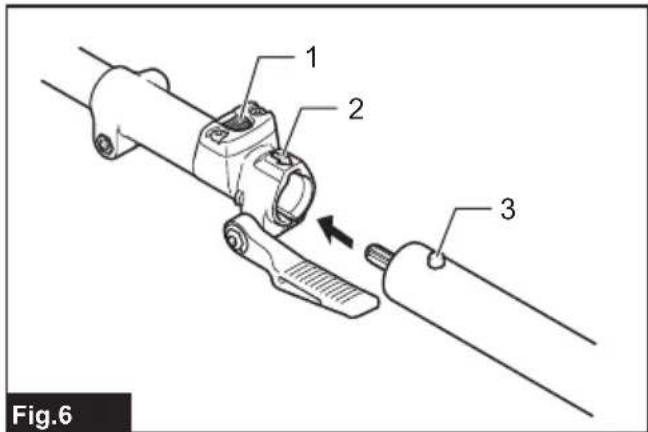

natural_image
Mechanical assembly diagram showing a lever mechanism with motion arrows (no text or symbols)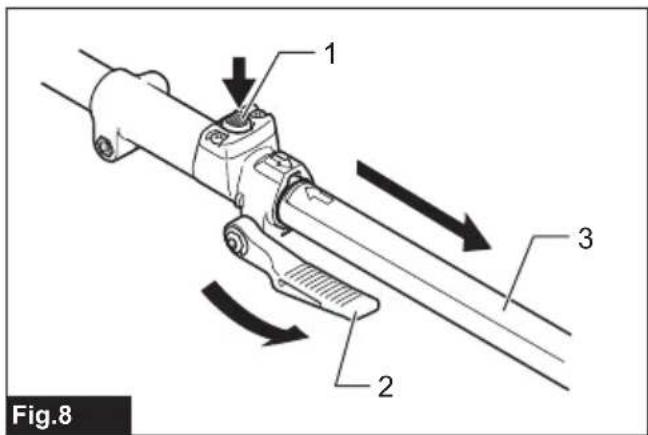
natural_image
Illustration of a worker using a manual tool to clean or inspect machinery, with a magnified inset showing gear mechanism (no text or symbols)

natural_image
Line drawing of a hand holding a tool, poised to write on a blank sheet (no text or symbols)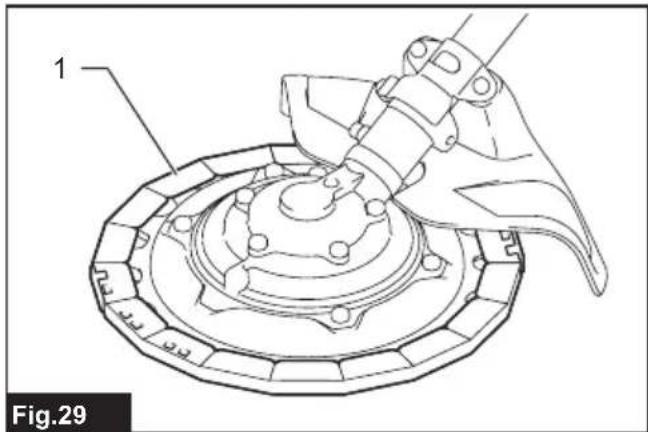
natural_image
Diagram of a cylindrical device with a separate cylindrical component and an arrow indicating direction (no text or symbols)SPECIFICATIONS
| Model: EM407MP | |
| Dimensions: length x width x height 965 mm x 245 mm x 155 mm | |
| Net weight(without blade cover) | 2.7 kg |
| Cutting diameter 230 mm | |
| Gear ratio Upper blade : 1 : 26 | Lower blade : 1 : 12 |
- Due to our continuing program of research and development, the specifications herein are subject to change without notice.
• Specifications may differ from country to country.
• Weight according to EPTA-Procedure 01/2014
Approved power unit
This attachment is approved to use only with the following power unit(s):
• EX2650LH Multi function power head
- DUX60 Cordless multi function power head
• DUX18 Cordless multi function power head
- UX01G Cordless multi function power head
WARNING: Never use the attachment with non-approved power unit. Non-approved combination may cause serious injury.
Symbols
The following symbols are used on the attachment and this instruction manual. Understand these definitions.

Take Particular care and attention!


Read instruction manual.

Wear protective helmet, eye and ear protection!

Protective gloves must be worn!

Wear sturdy boots with nonslip soles. Steeltoed safety boots are recommended!

Keep bystanders at least 15 m (50 ft) away.

Danger; be aware of thrown objects.

Kickback!
Top permissible tool speed

Warning: Hot surface. Risk of burns. Do not touch metal part until cooled.
EU Declaration of Conformity
For European countries only
We as the manufacturers: Makita Europe N.V., Business address: Jan-Baptist Vinkstraat 2 3070 Kortenberg BELGIUM. Authorize Kazuhisa Makino for the compilation of the technical file and declare under our sole responsibility that the product(s); Designation: Rotary Scissors Attachment. Designation of Type(s): EM407MP. Fulfills all the relevant provisions of 2006/42/EC and also fulfills all the relevant provisions of the following EC/EU Directives: 2000/14/EC and are manufactured in accordance with the following Harmonised Standards: EN ISO 11806-1:2022, EN 62841-1:2015+A11:2022. Place and date of declaration: Kortenberg, Belgium. 1. 8. 2024 Responsible person: Kazuhisa Makino, Director - Makita Europe N.V.
Declaration of Conformity (For UK)
For UK only
We as the manufacturers: Makita Europe N.V.,
Business address: Jan-Baptist Vinkstraat 2 3070
Kortenberg BELGIUM. Authorize Kazuhisa Makino
for the compilation of the technical file and declare under our sole responsibility that the product(s);
Designation: Rotary Scissors Attachment.
Designation of Type(s): EM407MP.
Fulfills all the relevant provisions of S.I. 2008/1597 (as amended) and also fulfills all the relevant provisions of the following UK Regulations: S.I. 2001/1701 (as amended) and are manufactured in accordance with the following Designated Standards: EN ISO 11806-1:2022, EN 62841-1:2015+A11:2022.
Place and date of declaration: Kortenberg, Belgium. 1. 8. 2024
Responsible person: Kazuhisa Makino, Director
- Makita Europe N.V.
Importer: Makita (UK) Limited, Michigan Drive,
Tongwell, Milton Keynes, Buckinghamshire, MK15 8JD, UK
SAFETY WARNINGS
General power tool safety warnings
⚠ WARNING Read all safety warnings, instructions, illustrations and specifications provided with this power tool. Failure to follow all instructions listed below may result in electric shock, fire and/or serious injury.
Save all warnings and instructions for future reference.
The term "power tool" in the warnings refers to your mains-operated (corded) power tool or battery-operated (cordless) power tool.
Work area safety
- Keep work area clean and well lit. Cluttered or dark areas invite accidents.
- Do not operate power tools in explosive atmospheres, such as in the presence of flammable liquids, gases or dust. Power tools create sparks which may ignite the dust or fumes.
- Keep children and bystanders away while operating a power tool. Distractions can cause you to lose control.
Electrical safety
-
Power tool plugs must match the outlet. Never modify the plug in any way. Do not use any adapter plugs with earthed (grounded) power tools. Unmodified plugs and matching outlets will reduce risk of electric shock.
-
Avoid body contact with earthed or grounded surfaces, such as pipes, radiators, ranges and refrigerators. There is an increased risk of electric shock if your body is earthed or grounded.
-
Do not expose power tools to rain or wet conditions. Water entering a power tool will increase the risk of electric shock.
-
Do not abuse the cord. Never use the cord for carrying, pulling or unplugging the power tool. Keep cord away from heat, oil, sharp edges or moving parts. Damaged or entangled cords increase the risk of electric shock.
-
When operating a power tool outdoors, use an extension cord suitable for outdoor use. Use of a cord suitable for outdoor use reduces the risk of electric shock.
-
If operating a power tool in a damp location is unavoidable, use a residual current device (RCD) protected supply. Use of an RCD reduces the risk of electric shock.
-
Power tools can produce electromagnetic fields (EMF) that are not harmful to the user.
However, users of pacemakers and other similar medical devices should contact the maker of their device and/or doctor for advice before operating this power tool.
Personal safety
-
Stay alert, watch what you are doing and use common sense when operating a power tool. Do not use a power tool while you are tired or under the influence of drugs, alcohol or medication. A moment of inattention while operating power tools may result in serious personal injury.
-
Use personal protective equipment. Always wear eye protection. Protective equipment such as a dust mask, non-skid safety shoes, hard hat or hearing protection used for appropriate conditions will reduce personal injuries.
-
Prevent unintentional starting. Ensure the switch is in the off-position before connecting to power source and/or battery pack, picking up or carrying the tool. Carrying power tools with your finger on the switch or energising power tools that have the switch on invites accidents.
-
Remove any adjusting key or wrench before turning the power tool on. A wrench or a key left attached to a rotating part of the power tool may result in personal injury.
-
Do not overreach. Keep proper footing and balance at all times. This enables better control of the power tool in unexpected situations.
-
Dress properly. Do not wear loose clothing or jewellery. Keep your hair and clothing away from moving parts. Loose clothes, jewellery or long hair can be caught in moving parts.
-
If devices are provided for the connection of dust extraction and collection facilities, ensure these are connected and properly used. Use of dust collection can reduce dust-related hazards.
-
Do not let familiarity gained from frequent use of tools allow you to become complacent and ignore tool safety principles. A careless action can cause severe injury within a fraction of a second.
-
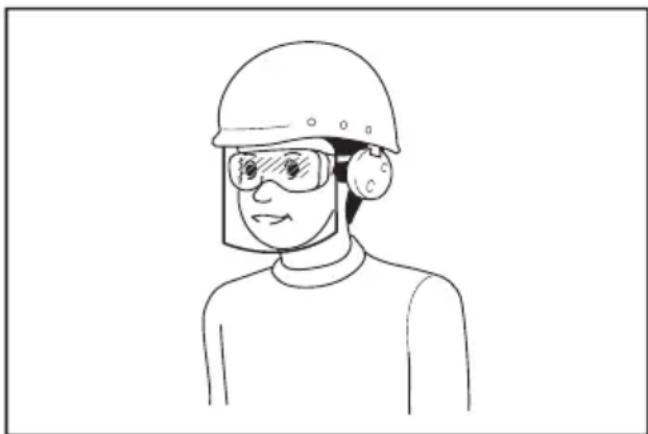
Always wear protective goggles to protect your eyes from injury when using power tools. The goggles must comply with ANSI Z87.1 in the USA, EN 166 in Europe, or AS/NZS 1336 in Australia/New Zealand. In Australia/New Zealand, it is legally required to wear a face shield to protect your face, too.
natural_image
Line drawing of a person wearing a helmet and safety goggles (no text or symbols)It is an employer's responsibility to enforce
the use of appropriate safety protective equipments by the tool operators and by other persons in the immediate working area.
Power tool use and care
- Do not force the power tool. Use the correct power tool for your application. The correct power tool will do the job better and safer at the rate for which it was designed.
- Do not use the power tool if the switch does not turn it on and off. Any power tool that cannot be controlled with the switch is dangerous and must be repaired.
- Disconnect the plug from the power source and/or remove the battery pack, if detachable, from the power tool before making any adjustments, changing accessories, or storing power tools. Such preventive safety measures reduce the risk of starting the power tool accidentally.
- Store idle power tools out of the reach of children and do not allow persons unfamiliar with the power tool or these instructions to operate the power tool. Power tools are dangerous in the hands of untrained users.
- Maintain power tools and accessories. Check for misalignment or binding of moving parts, breakage of parts and any other condition that may affect the power tool's operation. If damaged, have the power tool repaired before use. Many accidents are caused by poorly maintained power tools.
- Keep cutting tools sharp and clean. Properly maintained cutting tools with sharp cutting edges are less likely to bind and are easier to control.
- Use the power tool, accessories and tool bits etc. in accordance with these instructions, taking into account the working conditions and the work to be performed. Use of the power tool for operations different from those intended could result in a hazardous situation.
- Keep handles and grasping surfaces dry, clean and free from oil and grease. Slippery handles and grasping surfaces do not allow for safe handling and control of the tool in unexpected situations.
- When using the tool, do not wear cloth work gloves which may be entangled. The entanglement of cloth work gloves in the moving parts may result in personal injury.
Battery tool use and care
- Recharge only with the charger specified by the manufacturer. A charger that is suitable for one type of battery pack may create a risk of fire when used with another battery pack.
- Use power tools only with specifically designated battery packs. Use of any other battery packs may create a risk of injury and fire.
- When battery pack is not in use, keep it away from other metal objects, like paper clips, coins, keys, nails, screws or other small metal objects, that can make a connection from one terminal to another. Shorting the battery terminals together may cause burns or a fire.
- Under abusive conditions, liquid may be ejected from the battery; avoid contact. If
contact accidentally occurs, flush with water. If liquid contacts eyes, additionally seek medical help. Liquid ejected from the battery may cause irritation or burns.
- Do not use a battery pack or tool that is damaged or modified. Damaged or modified batteries may exhibit unpredictable behaviour resulting in fire, explosion or risk of injury.
- Do not expose a battery pack or tool to fire or excessive temperature. Exposure to fire or temperature above 130 °C may cause explosion.
- Follow all charging instructions and do not charge the battery pack or tool outside the temperature range specified in the instructions. Charging improperly or at temperatures outside the specified range may damage the battery and increase the risk of fire.
Service
- Have your power tool serviced by a qualified repair person using only identical replacement parts. This will ensure that the safety of the power tool is maintained.
- Never service damaged battery packs. Service of battery packs should only be performed by the manufacturer or authorized service providers.
- Follow instruction for lubricating and changing accessories.
Rotary scissors safety warnings
The term “machine” in the warnings and precautions refer to the combination of the rotary scissors and the power unit.
The term “motor” in the warnings and precautions refers to the engine or electric motor of the power unit.
General safety
- First-time or inexperienced operator should ask the dealer for training in all operation of the machine. Never allow children, persons with reduced physical, sensory or mental capabilities or lack of experience and knowledge or people unfamiliar with the instructions to use the machine.
- It is recommended only to lend the machine to people who have proven to be experienced. Always hand over the instruction manual.
- Stay alert, watch what you are doing and use common sense when operating the machine. Do not use the machine while you are tired, ill, or under the influence of drugs, alcohol or medication. A moment of inattention while operating the machine may result in serious personal injury.
- Avoid using the machine in bad weather conditions especially when there is a risk of lightning.
- Follow your national and local regulation for use of outdoor power machines.
Intended use of machine
This machine is only intended for cutting grass, weeds, bushes and undergrowth. Never use the machine for any other purpose. Use for unintended
purpose may result in serious injury.
Personal protective equipment
- Always wear heavy, long pants, sturdy boots, gloves, and a long-sleeve shirt. Do not wear loose clothing, jewelry, short pants, sandals, or go barefoot. Secure hair so it is above shoulder level.
- Always wear a helmet where there is a risk of falling objects.
- Wear ear protection, such as ear muffs. Exposure to noise can cause hearing loss.
- Always wear sturdy shoes with a non-slip sole. This protects your feet against injuries and ensures a good footing.
- Wear a dust mask as necessary.
Preparation before use
- Before use, always check the machine is safe for operation:
— Check for fuel leaks.
— Make sure all fasteners are in place and secure.
— Replace damaged parts.
— Make sure the cutting tool is properly installed and securely fastened.
— Make sure the cutting tool guard is properly attached in the position as described in this manual.
— Check the throttle trigger, lock-off lever and other control switch for smooth action and proper function.
— Clean the handles for proper control of the machine.
— Make sure the handles are installed as described in this manual.
Failure to follow those instructions may cause serious injury.
- Use a sharp blade. Discard blades that are bent, warped, cracked, broken, chipped or damaged in any way. A dull blade is more likely to snag and kickback.
- Always use all required parts for fixing the blade properly. Improper fixing parts can cause the blade to fly off and seriously injure the operator and/or bystanders.
Refueling
- Stop the engine before refueling. Keep away from open flames and sparks. Never smoke during refueling. Otherwise fire and/or explosion may result.
- Refuel outdoors. Refueling in a closed room can cause explosion of fuel vapor.
- Avoid contact with fuel or engine oil. Do not inhale fuel vapor. If fuel or oil spills, wipe it off from the machine and/or ground immediately. If fuel spills on your clothes, change it immediately to prevent it from catching fire.
-
After refueling, carefully tighten the fuel tank cap and check for fuel leak. Move at least 3 m (10 feet) away from the fueling source and site before starting engine.
-
Only transport and store fuel in approved containers. Keep children away from the stored fuel.
Starting up the rotary scissors
- Keep children, bystanders and pets at least 15 m (50 feet) away, when starting up or using the machine. Additionally, bystanders should wear eye protection, as there is still a risk of injury from thrown objects. Otherwise bystanders' unexpected action or blade kickback may cause serious injury to the operator and/or bystanders.
- Start and operate the machine only outdoors in a well ventilated area. Operation in a confined or poorly ventilated area can result in death due to suffocation or carbon monoxide poisoning.
- Before starting, make sure that the cutting tool has no contact with hard objects such as branches, stones etc. as the cutting tool will revolve when starting.
- If the cutting tool rotates at idle, adjust the idle speed so that it stops at idle. Otherwise unintentional contact with moving cutting tool may result in serious injury.
- Stop the motor immediately if you notice any trouble.
Transportation
- Stop the motor during transport. Otherwise unintentional start-up may cause injury.
- When transporting the machine, always attach the cover to the cutting blade. Contact with bare blades results in injury.
- Ensure safe position of the machine during car transportation to avoid fuel leakage.
- Lift the entire machine from the ground when carrying the machine. Dragging the machine causes fuel tank damage and fuel leakage, resulting in fire.
Operation
- Only use the machine in good light and visibility. Use in the dark or poor visibility area may cause unexpected accident.
- Avoid using the machine when it is hard to keep your balance, for example, working on a steep surface or windy day.
- During the winter season, beware of slippery or wet areas, ice and snow to avoid slipping.
- If you are approached, stop the motor. Otherwise the rotating cutting tool may hit the bystander and result in serious injury.
- Clear the working area before operation. Remove all objects such as rocks, broken glass, nails, wire, or string, which can be thrown or become entangled in the cutting attachment. Foreign particles may damage the cutting tool and can cause dangerous kickback.
- To control the machine steadily, do the following during operation:
— Hold the machine with both hands firmly on your right side.
— Hang the machine on your shoulder(s)
with the shoulder harness.
— Ensure a safe footing. Never work on a ladder or in a tree.
— Avoid over-reach.
— Keep cutting tool below waist level.
— Keep all parts of your body away from the rotating cutting tool and hot surface.
Those actions reduce the risk of injury.
- If weeds or branches get caught between the cutting tool and guard, always stop the motor before clearing. Otherwise unintentional blade rotation may cause serious injury.
- Never drop or throw the machine, unless an emergency. If the machine drops or hits something, immediately check for fuel leakage, safety devices and other damages. Operating a malfunctioned machine may cause injury and/or fire.
- Inspect the cutting tool frequently, or immediately after it hits a stone or other hard objects. If the cutting tool breaks during operation, the broken piece may fly and cause injury.
- Stop the motor when inspecting, cleaning or replacing the cutting tool. Otherwise the cutting tool may rotate unexpectedly and result in serious injury.
- Maintain proper control until the cutting tool stops completely, when stopping the motor or releasing the throttle trigger. A coasting blade can cause injury.
- Before starting the cutting operation, wait until the cutting tool attains enough speed for cutting. It reduces the risk of kickback and entangling weeds.
- Take a rest to prevent loss of control caused by fatigue. We recommend taking a 10 to 20-minute rest every hour.
- Stop the motor and place it in safe location, when resting or leaving the machine. It prevents unexpected accident.
- Do not touch the engine and its muffler or do not put them onto combustible materials, while the engine runs or just after stopping it, as they are hot. Burn and/or fire may result.
Cutting Tools
- Use a suitable cutting tool for your work. Always use the cutting tool guard properly suited for the cutting tool used.
- Never use metal multi-piece pivoting chains, flail blades or blades not recommended in this manual. Otherwise serious injury may result.
- When handling the metal blade, always wear gloves and put the blade cover on the blade. The blade can cut bare hands.
- When using metal blades, avoid "kickback" and always prepare for an accidental kickback. See the section Kickback.
- Before and after each operation, make sure that the cutting tool is attached securely. During operation, check the cutting tool for looseness in certain intervals.
Kickback (blade thrust)
Kickback (blade thrust) may occur when the spinning blade contacts an object that it does not immediately cut. It can be violent enough to cause the unit and/or operator to be propelled in any direction, and possibly lose control of the unit, resulting in serious injury. Kickback can occur without warning if the blade snags, stalls or binds and is more likely to occur in areas where it is difficult to see the material being cut.
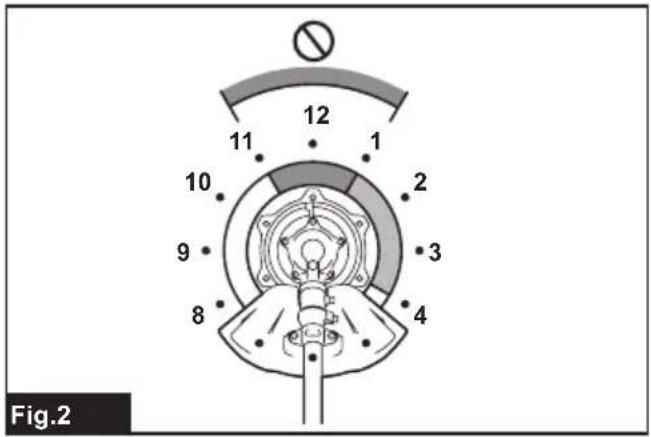
Kickback occurs particularly when applying the blade segment between 11 and 1 o'clock to solids, bushes and trees with 3 cm or larger diameter.
▶ Fig.1
To avoid kickback:
- Apply the segment between 8 and 11 o'clock and between 1 and 4 o'clock.
- Swing the tool evenly in half-circle from right to left, like using a scythe. This allows the proper segment of blade to contact plants to be cut.
- Never apply the segment between 11 and 1 o'clock.
▶ Fig.2
- Never use cutting blades close to solids, such as fences, walls, tree trunks and stones.
- Never use cutting blades vertically, for such operations as edging and trimming hedges.
- Avoid using the tool in areas where it is difficult to see the object being cut.
Vibration
Exposing to excessive vibration injures blood vessels or nervous system of the operator and causes the following symptoms in the fingers, hands or wrists: "Falling asleep" (numbness), tingling, pain, stabbing sensation, or alteration of skin color or of the skin. If any of these symptoms occur, see a physician.
To reduce the risk of "white finger disease", keep your hands warm during operation and well maintain the machine and accessories.
Maintenance
- Have your machine serviced by our authorized service center using only identical replacement parts. Use only identical spare parts and accessories supplied by MAKITA. Incorrect repair and poor maintenance can shorten the life of the machine and increase the risk of accidents.
- Never alter or remove any components of the machine. It may cause fire and/or serious injury.
- After use, clean the machine and check all screws and nuts for tightness.
- Check the condition of the cutting tool, cutting tool guard and shoulder harness. The cutting blade must be sharp. Never straighten or weld damaged cutting tools.
Other instructions
-
Always store the machine in locked rooms and with an emptied fuel tank.
-
Pay attention to the environment. Avoid unnecessary throttle operation for less pollution and noise emissions. Adjust the carburetor correctly.
- Do not operate the engine with faulty exhaust muffler.
First Aid
- In case of accident make sure that a first-aid box is available in the vicinity of the cutting operations. Immediately replace any item taken from the first aid box.
- When asking for help, give the following information:
— Place of accident
— What happened
— Number of injured persons
— Kind of injuries
— Your name
Additional safety instructions
- Only use the dedicated cutting blade for Rotary Scissors Attachment.
- Only use the cutting tools that are marked with a speed equal or higher than the speed marked on the machine.
- Inspect and maintain the machine regularly, especially before/after use. Have the machine repaired only by our authorized service center.
- Before operation, make sure that the shoulder harness is properly attached to the hanger on the machine.
- Remove any adjusting key or wrench before turning the machine on. An accessory left attached to a rotating part may result in personal injury.
- Be sure to remove the cover on the cutting blade before operation.
- Make sure there are no electrical cables, water
pipes, gas pipes etc. that could cause a hazard if damaged by use of the machine.
- Do not operate the machine in explosive atmospheres, such as in the presence of flammable liquids, gases or dust. Machine create sparks which may ignite the dust or fumes.
- Do not use the machine in damp or wet locations or expose it to rain. Water entering the machine will increase the risk of electric shock, fire, and malfunction.
- Do not use the machine on steep slopes and slippery surface.
- To avoid accident, leave more than 15m (50 ft) distance between operators when two or more operators work in one area. Also, arrange a person to observe the distance between operators. If someone or an animal enter the working area, immediately stop the operation.
- Do not touch the gear case during and immediately after the operation. The gear case becomes hot during operation and can cause burn injury.
- Keep fingers away from switch trigger when not operating the machine and when moving from one operating position to another.
WARNING: Use of this product can create dust containing chemicals which may cause respiratory or other illnesses. Some examples of these chemicals are compounds found in pesticides, insecticides, fertilizers and herbicides.
Your risk from these exposures varies, depending on how often you do this type of work. To reduce your exposure to these chemicals: work in a well ventilated area, and work with approved safety equipment, such as those dust masks that are specially designed to filter out microscopic particles.
SAVE THESE INSTRUCTIONS.
PARTS DESCRIPTION
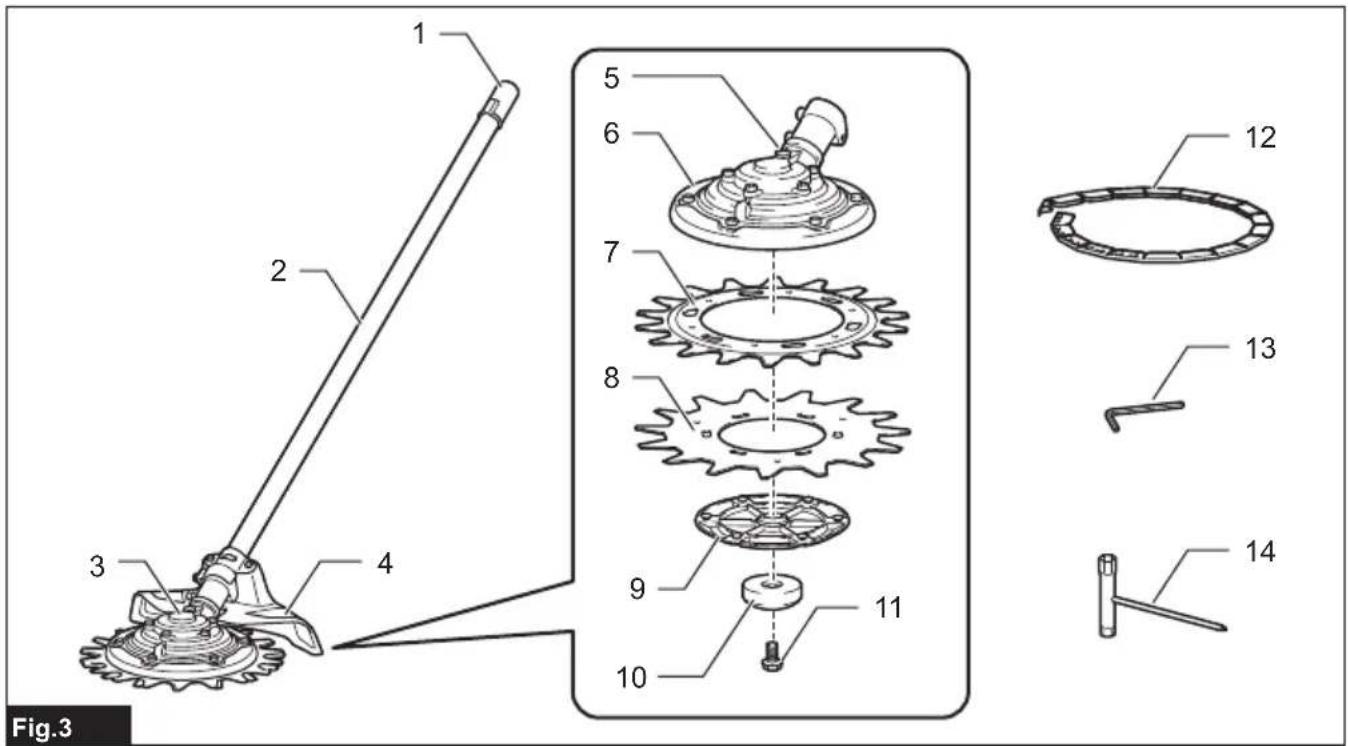
▶ Fig.3
| 1 | Cap | 2 | Pipe | 3 | Gear case | 4 | Protector |
| 5 | Gear case access bolt | 6 | Holder (for upper blade) | 7 | Upper blade | 8 | Lower blade |
| 9 | Holder (for lower blade) | 10 | Clamp washer | 11 | Bolt | 12 | Blade cover |
| 13 | Hex wrench | 14 | Box wrench | - | - | - | - |
ASSEMBLY
WARNING: Before assembling or adjusting the equipment, switch off the motor and remove the spark plug cap or battery cartridge. Otherwise the cutting tool or other parts may move and result in serious injury.
WARNING: Before handling cutter blade, wear protective gloves. During the assembly or adjustment, your fingers may contact with the cutter blade and it may cause serious injury.
WARNING: When assembling or adjusting the equipment, always put it down. Assembling or adjusting the equipment in an upright position may result in serious injury.
⚠ WARNING: Follow the warnings and precautions in the section for safety warnings and the instruction manual of the power unit.
Installing the protector
⚠ WARNING: Do not use this attachment without protector at any time.
WARNING: Always use the protector supplied with this attachment. The wrong protector may not protect you from flying debris and stones. It can also affect the balance of the tool and result in serious personal injury.
NOTICE: Periodically tighten the bolts on the protector. Tighten the right and left bolts evenly so that the gap between the clamp and the protector is constant.
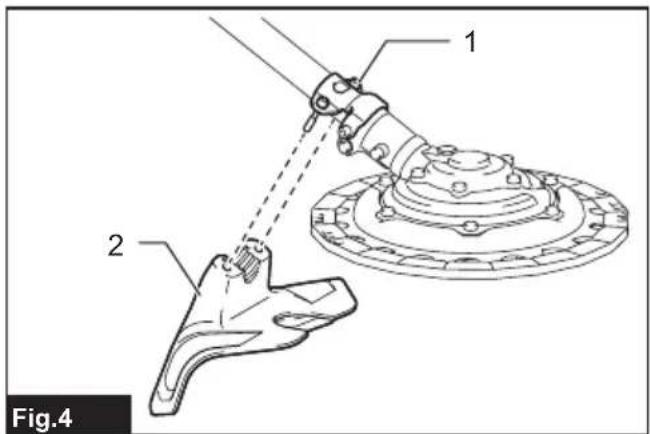
Attach the protector to the clamp using bolts.
▶ Fig.4: 1. Clamp 2. Protector
Mounting the attachment pipe
⚠️CAUTION: Always check that the attachment pipe is secured after installation. Improper installation may cause the attachment falling off from the power unit and cause personal injury.
Mount the attachment pipe to the power unit.
- Turn the lever of the power unit toward the attachment side.
▶ Fig.5: 1. Lever
- Remove the cap of the attachment. Align the pin with the arrow mark and insert the attachment pipe until the release button pops up.
▶ Fig.6: 1. Release button 2. Arrow mark 3. Pin
- Turn the lever toward the power unit side.
▶ Fig.7: 1. Lever
Make sure that the surface of the lever is parallel to the pipe.
To remove the pipe, turn the lever toward the attachment side and pull the pipe out while pressing down the release button.
▶ Fig.8: 1. Release button 2. Lever 3. Pipe
OPERATION
WARNING: Follow the warnings and precautions in the section for safety warnings and the instruction manual of the power unit.
WARNING: If the cutting tool moves at idle, adjust the idle speed of the engine down. Otherwise you cannot stop the cutting tool by throttle off and it may cause serious injury.
⚠️ CAUTION: Be careful not to let the running blades contact with the ground or a hard object. Doing so causes the tool kicked back and result in personal injury.
⚠️ CAUTION: Before operation, check the bolts, nuts and screws for any looseness. Tighten them if they are loose.
⚠️ CAUTION: If the cut grass has got tangled up in the cutting blades and rotation speed has become slower or stopped, switch off the motor and remove the spark plug cap or battery cartridge and then remove the tangled grass.
CAUTION: This attachment is designed for cutting lawn and weeds. Do not use the attachment for other purpose.
NOTICE: Before operation, always check if there is no foreign object such as cut grass adhered to the cutting tool. Running the tool with a foreign object adhered to the cutting tool may cause malfunction.
NOTICE: Foreign objects may enter between the upper and lower blades. Running the tool with the foreign objects remaining between the blades may cause malfunction. For how to remove them, follow the instructions in the section for removing jammed weeds.
Hold the machine so that the cutter blade become parallel to the ground. Start the machine while the cutter blade has no contact with the ground and hard objects.
Adjust the machine to the suitable rotation speed for the grass being cut. Low rotation speed may tangle the cut grass up in the cutting blades.
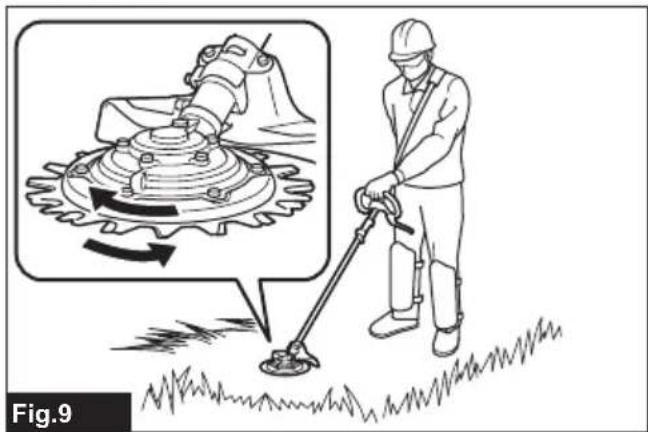
To cut grass, proceed forward while swinging the machine evenly in half-circle from right to left, like using a scythe. Adjust the swing speed according to the grass to be cut.
▶ Fig.9
NOTE: The upper blade and lower blade rotates in the opposite direction each other.
MAINTENANCE
WARNING: Before inspecting or maintaining the equipment, switch off the motor and remove the spark plug cap or battery cartridge. Otherwise the cutting tool or other parts may move and result in serious injury.
WARNING: When inspecting or maintaining the equipment, always put it down. Assembling or adjusting the equipment in an upright position may result in serious injury.
WARNING: Follow the warnings and precautions in the section for safety warnings and the instruction manual of the power unit.
NOTICE: Never use gasoline, benzine, thinner, alcohol or the like. Discoloration, deformation or cracks may result.
To maintain product SAFETY and RELIABILITY, repairs, any other maintenance or adjustment should be performed by Makita Authorized or Factory Service Centers, always using Makita replacement parts.
Overall inspection
- Tighten loose bolts, nuts and screws.
- Check for damaged parts and blades. Ask our authorized service center to replace them if necessary.
Cleaning the tool
Clean the attachment by wiping off dust, dirt, or cut off grass with a dry cloth or one dipped in soapy water and wrung out. Remove the cut off grass or debris adhered to the cutter blade.
Dismounting the cutter blades
⚠️CAUTION: Always wear gloves when dismounting the cutter blades.
When cleaning, sharpening, or replacing the cutter blades, dismount them by the following procedure:
- Remove the blade cover.
- Set the box wrench onto the nut. Rotate the box wrench so that the hole in the lower blade aligns with the hole in the upper blade.
▶ Fig.10: 1. Box wrench 2. Hole in the lower blade
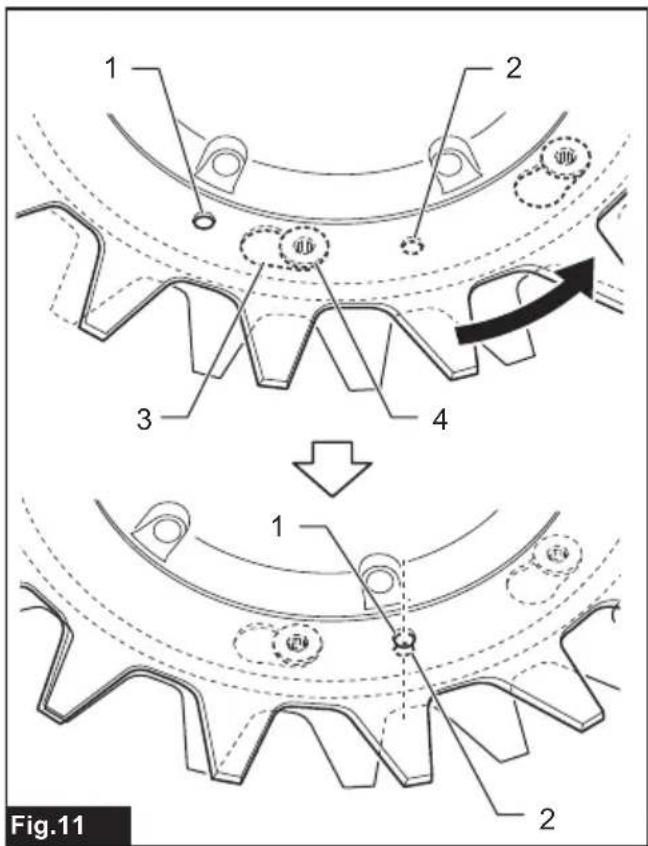
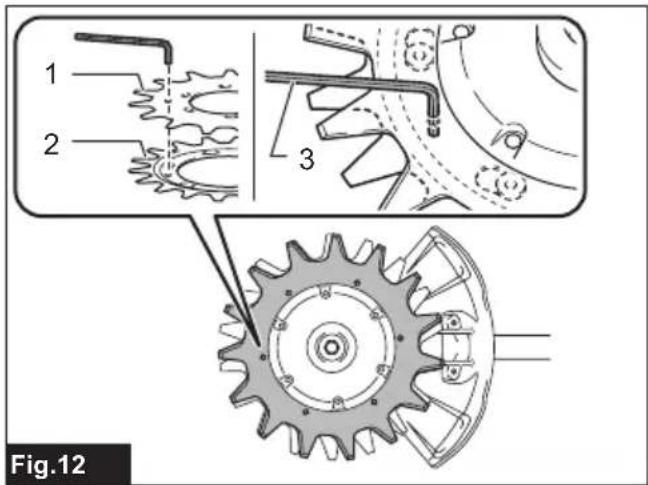
Look into the hole in the lower blade to check if the correct hole in the upper blade is aligned. In the upper blade, there are pins and two types of holes; true circle and oval. Align the true circle hole in the upper blade with the hole in the lower blade and then insert the hex wrench into the holes.
▶ Fig.11: 1. Hole in the lower blade 2. True circle hole in the upper blade 3. Oval hole in the upper blade 4. Pin
▶ Fig.12: 1. Lower blade 2. Upper blade 3. Hex wrench
NOTE: Choose the true circle hole in the upper blade by referring the following information:
- When you rotate the lower blade counterclockwise, the true circle hole comes after the pin.
- When the oval hole is aligned with the hole in the lower blade, you can insert the hex wrench but there is a lot of backlash.
- When the pin is aligned with the hole in the lower blade, you can see the screw thread in the pin. In this case, you cannot insert the hex wrench fully.
CAUTION: Do not put your fingers on the blade when rotating the box wrench. The blades rotate as you rotate the box wrench and it may cause personal injury.
CAUTION: Always use the box wrench when aligning the holes in the upper and lower blades.
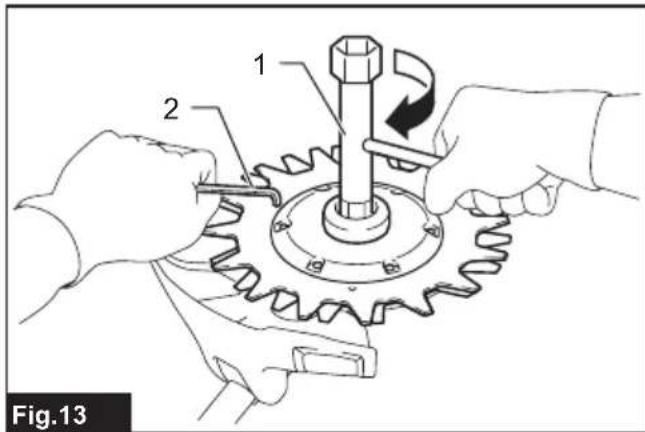
- While inserting the hex wrench, turn the bolt clockwise using the box wrench to loosen the bolt.
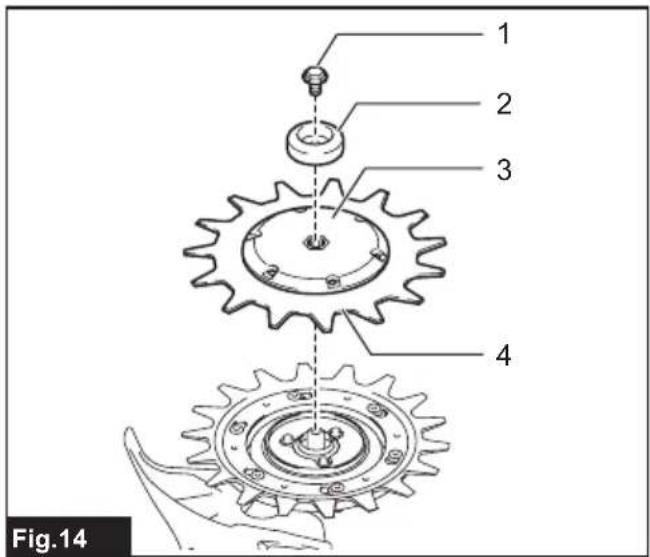
▶ Fig.13: 1. Box wrench 2. Hex wrench - Remove the bolt, clamp washer, and the holder together with the lower blade.
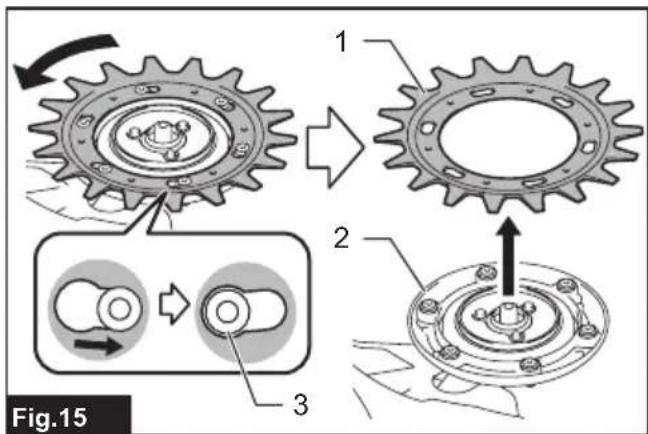
▶ Fig.14: 1. Bolt 2. Clamp washer 3. Holder (for lower blade) 4. Lower blade - While pushing the upper blade, rotate it counterclockwise to position the pin as shown in the figure. After that, lift the upper blade from the holder to remove.
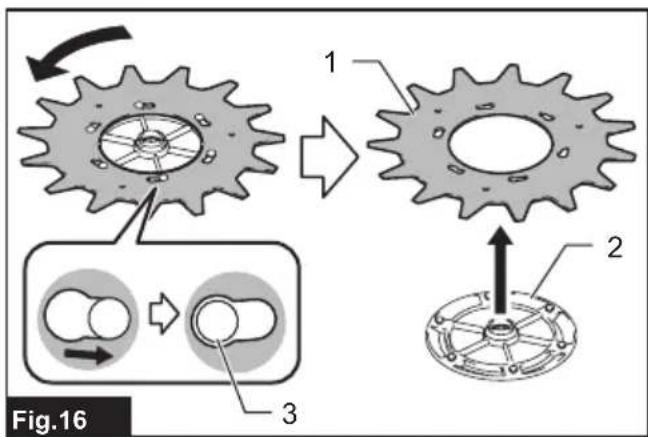
▶ Fig.15: 1. Upper blade 2. Holder (for upper blade) 3. Pin - Remove the lower blade. To remove, rotate the lower blade counterclockwise to position the pin as shown in the figure and then lift the lower blade from the holder.
▶ Fig.16: 1. Lower blade 2. Holder (for lower blade) - Pin
NOTICE: After dismounting the cutter blades, keep the bolt, clamp washer, and the holder in place to avoid them from being lost.
NOTE: To install the cutter blades, refer to the section for replacing the cutter blades.
Removing jammed weeds
NOTICE: Periodically remove jammed weeds and foreign objects between the cutter blades and in the holders. Using this attachment with weeds jammed inside may result in malfunction.
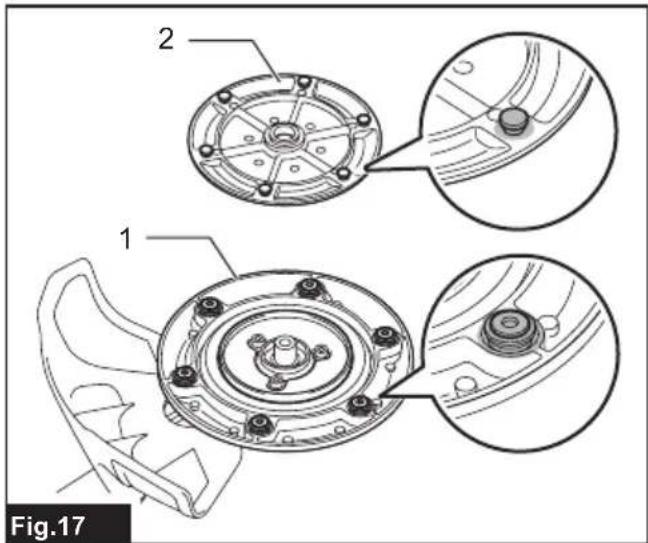
Dismount the cutter blades. Remove jammed weeds between the upper and lower blades. Also remove the jammed weeds in the holders, especially around the pins, using a brush. Be sure to clean the weeds adhered to the holder as shown in the figure.
▶ Fig.17: 1. Holder (for upper blade) 2. Holder (for lower blade)
Clean the cutter blades with water and dry them completely. After that, apply anti-rust oil.
NOTE: To dismount the cutter blades, refer to the section for dismounting the cutter blade.
Resharpening the cutter blades
⚠️CAUTION: Always wear gloves when resharpening the cutter blades.
NOTICE: When resharpening the cutter blades, sharpen both the upper and lower blade.
NOTICE: If the cutter blades have considerably deformed by filing, replace them with new ones.
NOTICE: As a rough guide, sharpen the cutter blades every 8 hours of use. Earlier resharpening is recommended if you often cut the weeds together with their roots or cut the weeds on a stony surface or a surface with a lot of obstacles. Using dull cutter blades result in poor cutting performance and damage to the machine.
NOTICE: Use a diamond file for sharpening cutter blades. You can use a disc grinder instead.
- Dismount the cutter blades from the attachment.
NOTE: Refer to the section for dismounting the cutter blade for detail.
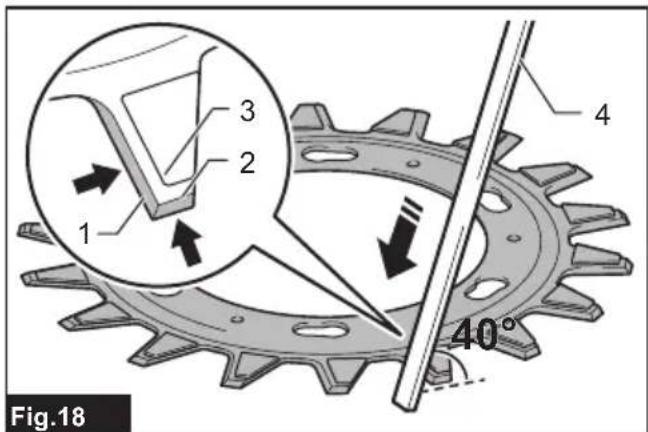
- Sharpen the tips and cutting edges of both upper and lower blades at the angle of 40irc using a file.
▶ Fig.18: 1. Cutting edge 2. Tip 3. Rib 4. File
NOTE: The upper blade should be replaced when the teeth have been worn to the rib.
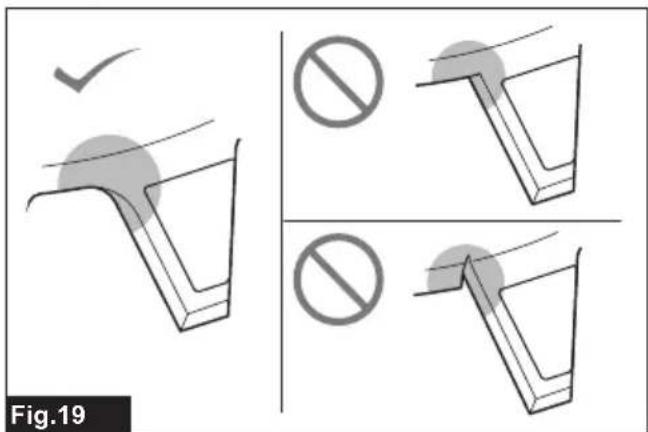
- Round the root of each blade as illustrated using the file.
▶ Fig.19
NOTICE: Do not make the root of the blade angled or chipped. Doing so result in a crack in the cutting blade.
Replacing the cutter blades
Optional accessory
⚠️CAUTION: Always wear gloves when replacing the cutter blades.
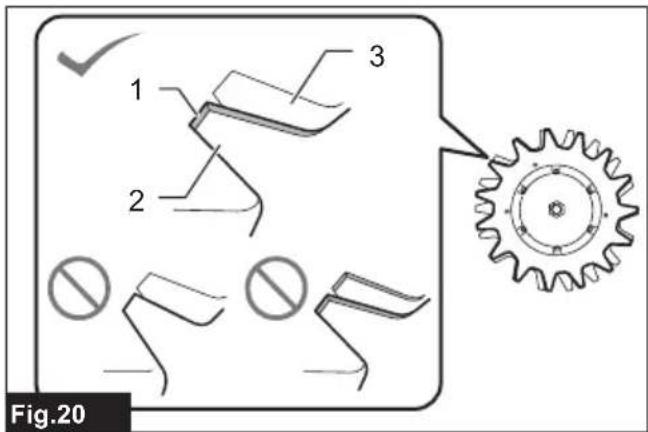
Before starting, make sure the direction of the upper and lower blades; the cutting edges (angled surfaces) on both upper and lower blade face outward each other when assembled.
▶ Fig.20: 1. Cutting edge 2. Lower blade 3. Upper blade
NOTICE: If the cutting edges faces same side or inward each other, you will not able to cut grass.
Install the cutting blades by the following procedure:
- Dismount the old cutter blades from the attachment.
NOTE: Refer to the section for dismounting the cutter blade for detail.
- Install a new upper blade onto the holder.
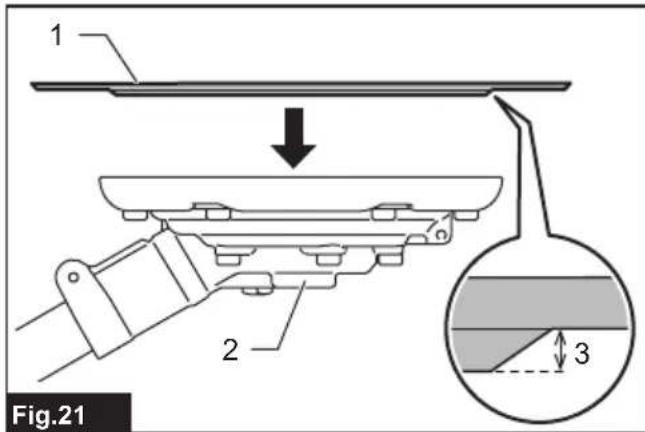
The upper blade has projection on one side. Be sure to place the upper blade so that the projected side (arrow marking printed) faces to the gear case.
▶ Fig.21: 1. Upper blade 2. Gear case 3. Projection
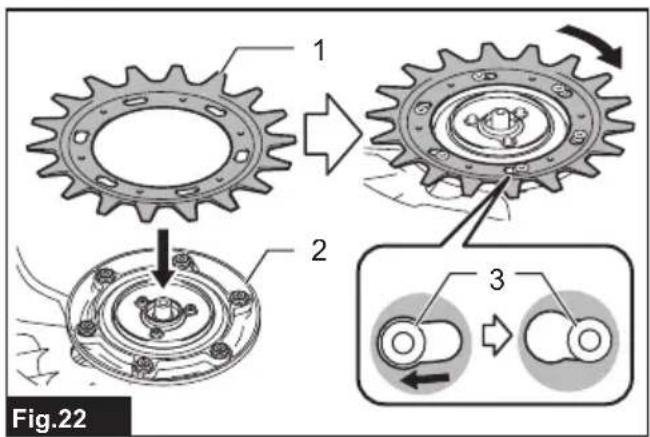
Align the oval holes in the upper blade with the pins.
Rotate the upper blade clockwise while pushing it down until the pins hold the upper blade.
▶ Fig.22: 1. Upper blade 2. Holder (for upper blade) 3. Pin
NOTICE: Be sure to position the upper blade so that all pins hold the upper blade.
- Install a new lower blade onto the holder.
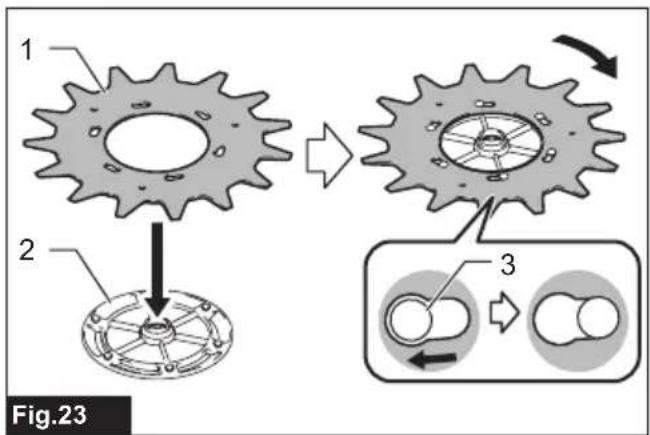
Place the lower blade so that the side with arrow marking faces to the holder and align the oval holes in the blade with the pins. After that, rotate the lower blade clockwise until the pins hold the lower blade.
▶ Fig.23: 1. Lower blade 2. Holder (for lower blade) 3. Pin
NOTICE: Be sure to position the lower blade so that all pins hold the lower blade.
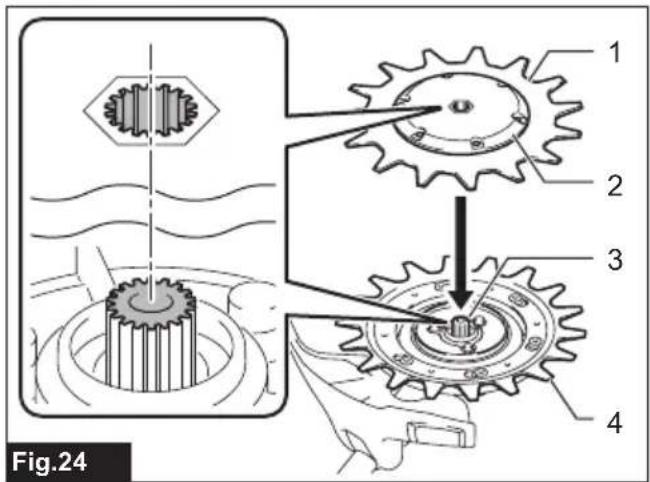
- Put the lower blade (with the holder) onto the upper blade while aligning the spline of the spindle with that of the holder.
▶ Fig.24: 1. Lower blade 2. Holder (for lower blade) 3. Spindle 4. Upper blade
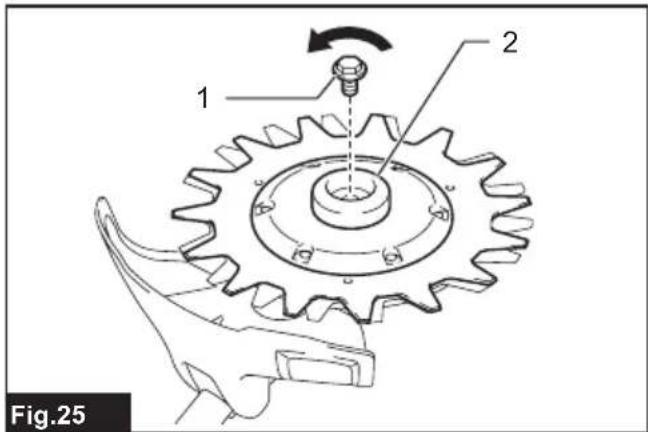
- Place the clamp washer onto the holder while aligning the spline of the spindle with that of the clamp washer. After that, tighten the bolt by hand temporarily.
▶ Fig.25: 1. Bolt 2. Clamp washer
- Align the holes in the lower and upper blades and insert the hex wrench. After that, securely tighten the bolt using the box wrench while the hex wrench is inserted in the hole.
▶ Fig.26: 1. Box wrench 2. Hex wrench
NOTE: Refer to the section for dismounting the cutter blades for how to align the holes of upper and lower blades.
- Remove the hex wrench and then put the blade cover onto the cutting blades.
Lubricating moving parts
NOTICE: Follow the instruction of the frequency and amount of grease supplied. Otherwise insufficient lubrication may damage moving parts.
Gear case:
⚠️ CAUTION: Do not apply grease when the gear case is hot. Hot gear case can cause burn injury.
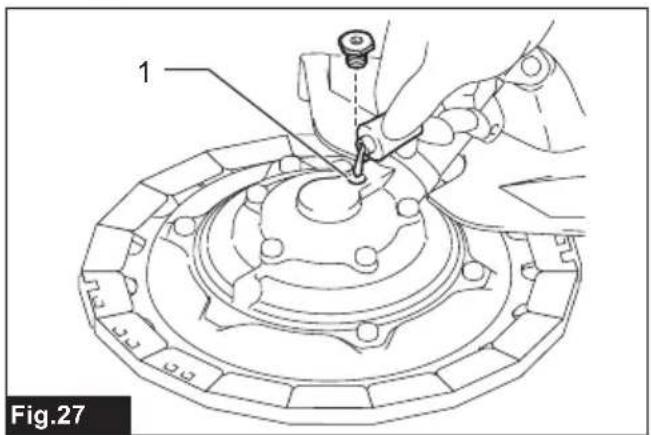
Remove the gear case access bolt using the box wrench.
Apply grease (Shell Alvania 2 or equivalent) to the gear case through the grease hole every around 50 working hours.
▶ Fig.27: 1. Grease hole
Drive axle:
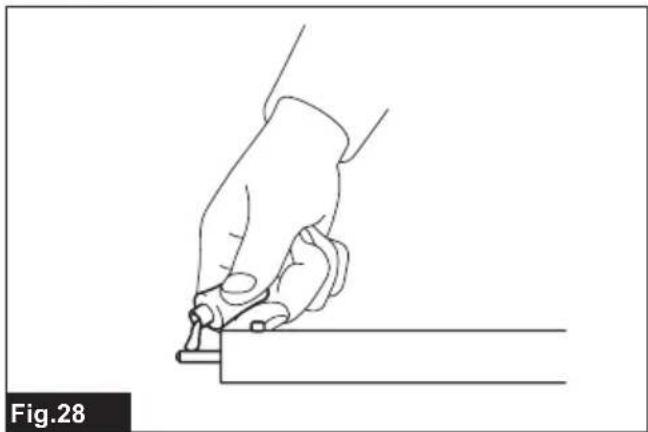
Apply grease (Shell Alvania 2 or equivalent) to the drive axle every around 30 working hours.
▶ Fig.28
NOTE: Genuine Makita grease may be purchased from your local Makita dealer.
Storage
WARNING: Follow the warnings and precautions in the section for safety warnings and the instruction manual of the power unit.
Attach the blade cover when not using this attachment.
▶ Fig.29: 1. Blade cover
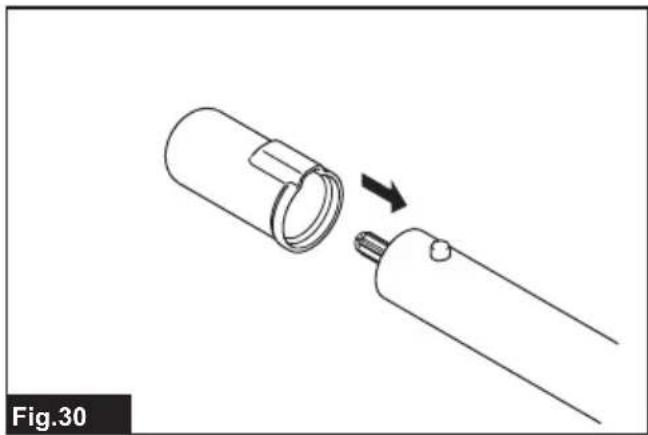
When storing this attachment separated from the power unit, put the cap onto the end of the pipe.
▶ Fig.30
CAUTION: Do not prop the attachment against something such as a wall. The attachment may fall suddenly and cause personal injury.
Interval of inspection and maintenance
| Operating hour Before | operation | 8 H 10 H / | Daily 30 H 50 H | ||||
| Whole unit Visually inspect for damaged parts | √ | ---- | |||||
| All fixing screws and nuts | Tighten | √ | ---- | ||||
| Gear case Supply grease | ---- | √ | |||||
| Drive axle Supply grease | ---- | √ | |||||
| Cutter blade Visually inspect for damage | √ | --- | √ | ||||
| Resharpen - | √ | --- | |||||
| Replace --- | √(up to 40H) | - | |||||
| Power unit | Refer to the instruction manual of the power unit | ||||||
TROUBLESHOOTING
Before asking for repairs, conduct your own inspection first. If you find a problem that is not explained in the manual, do not attempt to dismantle the machine. Instead, ask Makita Authorized Service Centers, always using Makita replacement parts for repairs.
| State of abnormality | Probable cause (malfunction) | Remedy |
| Motor does not start. | - | Refer to the instruction manual of the power unit. |
| Motor stops soon. | - | Refer to the instruction manual of the power unit. |
| Motor speed does not increase. | - | Refer to the instruction manual of the power unit. |
| Cutting blades do not rotate.⇒ Stop the motor immediately. | Irregular attachment of cutting blades | Install the cutting blade properly. |
| Cutting blades caught a twig. | Remove foreign matter | |
| Abnormal drive system | Contact an authorized service center for repairs. | |
| The attachment vibrates abnormally.⇒ Stop the motor immediately. | Broken, bent or worn cutting blades | Replace the cutting blades. |
| Loose attachment of the cutting blades | Tighten the bolt securely. | |
| Irregular attachment of cutting blades | Attach properly. | |
| Abnormal drive system | Contact an authorized service center for repairs. | |
| Cutter blade does not stop imme-diately.⇒ Stop the motor immediately. | The power unit does not work properly. | Refer to the instruction manual of the power unit. |
SPÉCIFICATIONS
natural_image
Line drawing of a person wearing a helmet and safety goggles (no text or symbols)▶ Fig.17: 1. Support (pour lame supérieure)
▶ Fig.29: 1. Couvre-lame
natural_image
Line drawing of a person wearing a helmet and safety goggles (no text or symbols)▶ Abb.26: 1. Rohrschlüssel 2. Inbusschlüssel
natural_image
Line drawing of a person wearing a helmet and safety goggles (no text or symbols)VEILIGHEIDSWAAR- SCHUWINGEN
natural_image
Line drawing of a person wearing a helmet and safety goggles (no text or symbols)▶ Fig.25: 1. Bout 2. Klemring
▶ Fig.27: 1. Smeeropening
Aandrijfas:
Persona responsible: Kazuhisa Makino, Director - Makita Europe N.V.

natural_image
Line drawing of a person wearing a helmet and safety goggles (no text or symbols)▶ Fig.27: 1. Agujero de engrase
Eje propulsor:
natural_image
Line drawing of a person wearing a helmet and safety goggles (no text or symbols)Afiar as lâminas de corte
natural_image
Line drawing of a person wearing a hard hat and safety goggles (no text or symbols)natural_image
Line drawing of a person wearing a helmet and safety goggles (no text or symbols)natural_image
Line drawing of a person wearing a helmet and safety goggles (no text or symbols)natural_image
Line drawing of a person wearing a hard hat and safety goggles (no text or symbols)▶ Fig.29: 1. Bladskydd
natural_image
Line drawing of a person wearing a helmet and safety goggles (no text or symbols)▶ Fig.4: 1. Klemme 2. Vern
Montere festerøret
▶ Fig.17: 1. Holder (for øvre blad) 2. Holder (for nedre blad)
natural_image
Line drawing of a person wearing a helmet and safety goggles (no text or symbols)natural_image
Line drawing of a person wearing a helmet and safety goggles (no text or symbols)natural_image
Line drawing of a person wearing a hard hat and safety goggles (no text or symbols)natural_image
Line drawing of a person wearing a hard hat and safety goggles (no text or symbols)▶ Joon.25: 1. Polt 2. Klamberseib
▶ Joon.29: 1. Terakate
natural_image
Line drawing of a person wearing a hard hat and safety goggles (no text or symbols)natural_image
Line drawing of a person wearing a hard hat and safety goggles (no text or symbols)natural_image
Line drawing of a person wearing a helmet and safety goggles (no text or symbols)natural_image
Line drawing of a person wearing a helmet and safety goggles (no text or symbols)TIETO POKYNY USCHOVAJTE.
POPIS SÚČASTÍ
▶ Obr.3
natural_image
Line drawing of a person wearing a hard hat and safety goggles (no text or symbols)TYTO POKYNY USCHOVEJTE.
POPIS DÍLŮ
▶ Obr.3
natural_image
Line drawing of a person wearing a helmet and safety goggles (no text or symbols)natural_image
Line drawing of a person wearing a helmet and safety goggles (no text or symbols)natural_image
Line drawing of a person wearing a helmet and safety goggles (no text or symbols)natural_image
Line drawing of a person wearing a helmet and safety goggles (no text or symbols)natural_image
Line drawing of a person wearing a helmet and safety goggles (no text or symbols)natural_image
Line drawing of a person wearing a helmet and safety goggles (no text or symbols)natural_image
Line drawing of a person wearing a hard hat and safety goggles (no text or symbols)natural_image
Line drawing of a person wearing a helmet and safety goggles (no text or symbols)natural_image
Line drawing of a person wearing a helmet and safety goggles (no text or symbols)natural_image
Line drawing of a person wearing a hard hat and safety goggles (no text or symbols)



- Approved power unit
- Symbols
- EU Declaration of Conformity
- For European countries only
- Declaration of Conformity (For UK)
- For UK only
- SAFETY WARNINGS
- General power tool safety warnings
- Save all warnings and instructions for future reference.
- Work area safety
- Electrical safety
- Personal safety
- Power tool use and care
- Battery tool use and care
- Service
- Rotary scissors safety warnings
- General safety
- Intended use of machine
- Personal protective equipment
- Preparation before use
- Refueling
- Starting up the rotary scissors
- Transportation
- Operation
- Cutting Tools
- Kickback (blade thrust)
- To avoid kickback:
- Vibration
- Maintenance
- Other instructions
- First Aid
- Additional safety instructions
- SAVE THESE INSTRUCTIONS.
- PARTS DESCRIPTION
- ASSEMBLY
- Installing the protector
- Mounting the attachment pipe
- Overall inspection
- Cleaning the tool
- Dismounting the cutter blades
- Removing jammed weeds
- Resharpening the cutter blades
- Replacing the cutter blades
- Optional accessory
- Lubricating moving parts
- Gear case:
- Drive axle:
- Storage
- TROUBLESHOOTING
- VEILIGHEIDSWAAR- SCHUWINGEN
- Aandrijfas:
- Eje propulsor:
- Afiar as lâminas de corte
- Montere festerøret
- TIETO POKYNY USCHOVAJTE.
- POPIS SÚČASTÍ
- TYTO POKYNY USCHOVEJTE.
- POPIS DÍLŮ
Brand : MAKITA
Model : EM407MP
Category : Multifunction tool