
UML42290 - Monitor BOSCH - Free user manual and instructions
Find the device manual for free UML42290 BOSCH in PDF.
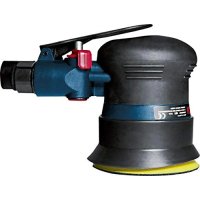
 FR
FR
 BG
BG
 CS
CS
 DA
DA
 DE
DE
 EL
EL
 EN
EN
 ES
ES
 ET
ET
 FI
FI
 HU
HU
 ID
ID
 IT
IT
 KK
KK
 KO
KO
 LT
LT
 LV
LV
 MK
MK
 NL
NL
 NO
NO
 PL
PL
 PT
PT
 RO
RO
 RU
RU
 SK
SK
 SL
SL
 SV
SV
 TR
TR
 UK
UK
 VI
VI
 ZH
ZH
| Product type | Pneumatic drill |
| Brand | Bosch |
| Model | UML42290 |
| Useful power | 400 W |
| No-load speed | 2560 rpm |
| Max. working pressure | 6.3 bar (91 psi) |
| Air consumption | 14 l/s |
| Max. drilling diameter (steel) | 10 mm |
| Spindle thread | 1/2"-20 UNF-2A |
| Weight | 1.2 kg |
| Sound pressure level | 73 dB(A) |
| Vibrations (metal drilling) | 3.5 m/s² |
| Chuck type | Automatic or geared chuck |
| Air supply | Compressed air, 6.3 bar |
| Maintenance | Clean the air inlet filter regularly; lubricate with SAE 10 or SAE 20 oil |
| Safety | Wear safety goggles and ear protection; avoid loose clothing |
| Main functions | Drilling in wood, metal, ceramic and plastic |
Frequently Asked Questions - UML42290 BOSCH
User questions about UML42290 BOSCH
0 question about this device. Answer the ones you know or ask your own.
Ask a new question about this device
Download the instructions for your Monitor in PDF format for free! Find your manual UML42290 - BOSCH and take your electronic device back in hand. On this page are published all the documents necessary for the use of your device. UML42290 by BOSCH.
USER MANUAL UML42290 BOSCH

BOSCH
Robert Bosch Power Tools GmbH
70538 Stuttgart
GERMANY
www.bosch-pt.com
160992A37G(2014.07)AS/383UNI

Original instructions
fr Notice originale
e Ns Muaal minal
itstrucrgial
nl Dagsupokklike
ebouksaanyjizng
Original instructions
Original instructions
Original instructions
Original instructions
Original instructions
Original instructions
Original instructions
Original instructions
Original instructions
s01
12V13A 1
In Original upite 2a tab
US-Feingewinde UNF (Unified National Fine Thread Series)
G Whitworth-Gewinde
NPT National pipe thread
Anschlussgewinde
Executive Vice President
Engineering
Helmut Heinzelmann
Head of Product Certification
PT/ETM9

Robert Bosch Power Tools GmbH
70538 Stuttgart, GERMANY
Stuttgart, 01.01.2017
Technical data
0607 153 5./0607 154 101
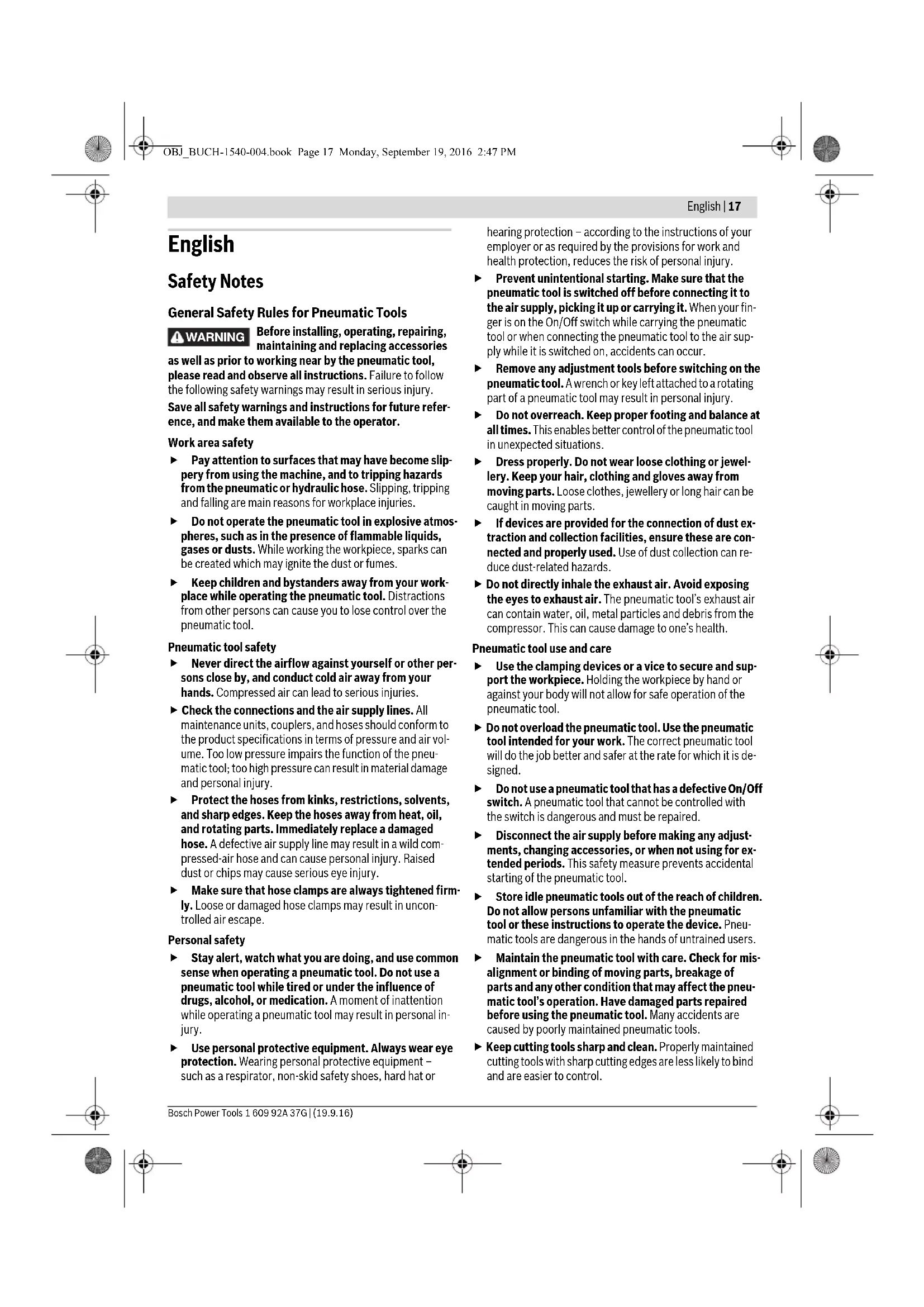
General Safety Rules for Pneumatic Tools
WARNING: Before installing, operating, repairing, maintaining, and replacing accessories, as well as prior to working near the pneumatic tool, please read and observe all instructions. Failure to follow the following safety warnings may result in serious injury. Save all safety warnings and instructions for future reference, and make them available to the operator.
Work area safety
Pay attention to surfaces that may have become slippery from using the machine, and to tripping hazards from the pneumatic or hydraulic hose. Slipping, tripping, and falling are main reasons for workplace injuries. Do not operate the pneumatic tool in explosive atmospheres, such as in the presence of flammable liquids, gases, or dusts. While working on the workpiece, sparks can be created which may ignite the dust or fumes. Keep children and bystanders away from your workplace while operating the pneumatic tool. Distractions from other persons can cause you to lose control over the pneumatic tool.
Pneumatic tool safety
- Never direct the airflow against yourself or other persons close by, and conduct cold air away from your hands. Compressed air can lead to serious injuries.
- Check the connections and the air supply lines. All maintenance units, couplers, and hoses should conform to the product specifications in terms of pressure and air volume. Too low pressure impairs the function of the pneumatic tool; too high pressure can result in material damage and personal injury.
- Protect the hoses from kinks, restrictions, solvents, and sharp edges. Keep the hoses away from heat, oil, and rotating parts. Immediately replace a damaged hose. A defective air supply line may result in a wild compressed-air hose and can cause personal injury. Raised dust or chips may cause serious eye injury. Make sure that hose clamps are always tightened firmly. Loose or damaged hose clamps may result in uncontrolled air escape.
Personal safety
- Stay alert, watch what you are doing, and use common sense when operating a pneumatic tool. Do not use a pneumatic tool while tired or under the influence of drugs, alcohol, or medication. A moment of inattention while operating a pneumatic tool may result in personal injury. Use personal protective equipment. Always wear eye protection. Wearing personal protective equipment - such as a respirator, non-skid safety shoes, hard hat, or
hearing protection - according to the instructions of your employer or as required by the provisions for work and health protection, reduces the risk of personal injury.
Prevent unintentional starting. Make sure that the pneumatic tool is switched off before connecting it to the air supply, picking it up or carrying it. When your finger is on the On/Off switch while carrying the pneumatic tool or when connecting the pneumatic tool to the air supply while it is switched on, accidents can occur. - Remove any adjustment tools before switching on the pneumatic tool. A wrench or key left attached to a rotating part of a pneumatic tool may result in personal injury. Do not overreach. Keep proper footing and balance at all times. This enables better control of the pneumatic tool in unexpected situations. Dress properly. Do not wear loose clothing or jewellery. Keep your hair, clothing and gloves away from moving parts. Loose clothes, jewellery or long hair can be caught in moving parts. If devices are provided for the connection of dust extraction and collection facilities, ensure these are connected and properly used. Use of dust collection can reduce dust-related hazards. Do not directly inhale the exhaust air. Avoid exposing the eyes to exhaust air. The pneumatic tool's exhaust air can contain water, oil, metal particles and debris from the compressor. This can cause damage to one's health.
Pneumatic tool use and care
Use the clamping devices or a vice to secure and support the workpiece. Holding the workpiece by hand or against your body will not allow for safe operation of the pneumatic tool. Do not overload the pneumatic tool. Use the pneumatic tool intended for your work. The correct pneumatic tool will do the job better and safer at the rate for which it is designed. Do not use a pneumatic tool that has a defective On/Off switch. A pneumatic tool that cannot be controlled with the switch is dangerous and must be repaired. - Disconnect the air supply before making any adjustments, changing accessories, or when not using for extended periods. This safety measure prevents accidental starting of the pneumatic tool. Store idle pneumatic tools out of the reach of children. Do not allow persons unfamiliar with the pneumatic tool or these instructions to operate the device. Pneumatic tools are dangerous in the hands of untrained users. Maintain the pneumatic tool with care. Check for misalignment or binding of moving parts, breakage of parts and any other condition that may affect the pneumatic tool's operation. Have damaged parts repaired before using the pneumatic tool. Many accidents are caused by poorly maintained pneumatic tools. - Keep cutting tools sharp and clean. Properly maintained cutting tools with sharp cutting edges are less likely to bind and are easier to control.
Use the pneumatic tool, accessories, application tools, etc. according to these instructions. Take into consideration the working conditions and the activities to be carried out. This reduces the development of dust, vibrations and noise to the greatest extent. The pneumatic tool should be set up, adjusted or used exclusively by qualified and trained operators. The pneumatic tool may not be modified in any way. Modifications can reduce the effectivity of the safety measures and increase the risks for the operator.
Service
Have your pneumatic tool repaired only through a qualified repair person and only using original replacement parts. This will ensure that the safety of the pneumatic tool is maintained.
Safety Warnings for Compressed-air Drills
Check if the type plate can be read. If required, provide for replacement from the manufacturer. In case of breakage of the workpiece or an accessory, or even of the pneumatic tool itself, parts can be thrown about at high speed. During operation, repairs or maintenance, and when replacing accessories on the pneumatic tool, always wear shock-resistant eye protection. The degree of the required protection should be separately evaluated for each individual application. The operators and the maintenance personnel must be physically capable to handle the size, weight and power of the pneumatic tool. Be prepared for unexpected movements of the pneumatic tool that can develop owing to reaction forces or breakage of the application tool. Maintain a firm grip on the pneumatic tool and position your body and arms to allow you to resist such movements. These precautions can prevent injuries. Switch the pneumatic tool off immediately when the application tool locks up. Be prepared for high reaction torque that lead to kickback. The application tool locks up when:
- the pneumatic tool is subject to overload,
- it jams or cants in the workpiece or
- its tip goes through the material being worked.
Use auxiliary aids to absorb reaction torque, such as a supporting fixture. If this is not possible, use an auxiliary handle. Never place your hand near rotating application tools. You could injure yourself. In case of an interruption of the air supply or reduced operating pressure, switch the pneumatic tool off. Check the operating pressure and start again when the operating pressure is optimal. - When using the pneumatic tool for the performance of work-related activities, the operator may experience unpleasant sensations in the hands, arms, shoulders, neck area or other body parts.
When working with this pneumatic tool, assume a comfortable stance, hold the tool securely and avoid unfavourable positions or such positions, where it is difficult to keep your balance. For prolonged work, the operator should change the stance or posture, which can help avoid discomfort and fatigue. Should the operator perceive symptoms such as persistent nausea, discomfort, throbbing, pain, tingling, numbness, burning or stiffness, these warning signs should not be ignored. The operator should notify his employer about the symptoms and consult a qualified physician. Caution! Application tools can become hot during prolonged operation of the pneumatic tool. Wear protective gloves. Use appropriate detectors to determine if utility lines are hidden in the work area or call the local utility company for assistance. Contact with electric lines can lead to fire and electric shock. Damaging a gas line can lead to explosion. Penetrating a water line causes property damage. Avoid contact with "live" conductors. The pneumatic tool is not insulated; contact with a "live" conductor can lead to an electric shock.
WARNING The dust developing during sanding, sawing, grinding, drilling and similar
operations can act carcinogenic, teratogenic or mutagenic. Some of the substances contained in these dusts are:
- Lead in lead-based paints and varnishes;
- Crystalline silica in bricks, cement and other masonry work;
- Arsenic and chromate in chemically treated wood.
The risk of disease depends on how often you are exposed to these substances. To reduce the risk, you should work only in well ventilated rooms with appropriate protective equipment (e.g. with specially designed respirators that filter out even the smallest dust particles).
- When working on the workpiece, additional noise can develop, which can be avoided through appropriate measures (e.g. by using damping materials on occurrence of ringing noise from the workpiece). When the pneumatic tool is equipped with a silencer, always ensure that it is available and in proper working condition when operating the pneumatic tool. Vibration effects may cause damage to the nerves and blood circulation disorders in the hands and arms. Wear close-fitting gloves. The flow of compressed air makes the handles of pneumatic tools cold. Warm hands are less sensitive to vibrations. Loose fitting gloves can be caught by rotating parts. If you notice that the skin of your fingers or hands becomes numb, tingles, hurts or turns white, stop working with the pneumatic tool, notify your employer and consult a physician. Do not allow the drill bit to rattle on the workpiece. This can lead to significant intensification of the vibrations.
If possible, use a stand, spring pull/balancer or compensation device in order to support the weight of the pneumatic tool. Hold the pneumatic tool with a not too firm yet secure grip, compliant with the required hand-reaction forces. The vibrations can be intensified the firmer you hold the tool. When universal rotary couplings (bayonet couplings) are being used, retaining pins are required. Use Whip-check hose restraints to protect against failed hose connections or the connection between hose and pneumatic tool. Never carry the pneumatic tool by the hose.
Symbols
The following symbols could have a meaning for the use of your pneumatic tool. Please take note of the symbols and their meaning. The correct interpretation of the symbols will help you to use the pneumatic tool in a better and safer manner.
Symbol Meaning

Before installing, operating, repairing, maintaining and replacing accessories as well as prior to working near by the pneumatic tool, please read and observe all instructions. Failure to follow the following safety warnings and instructions may result in serious injury.

Wear safety goggles.
| W | W | a | t | P | o |
| Nm Newton metre | Unit of energy (torque) | ||||
| kg | Kilogram | Mass, weight | |||
| Ibs | Pounds | ||||
| mm Millimetre Length | |||||
| min | Minutes | Time period, duration | |||
| s | Seconds | ||||
| \( \mathbf{m}\mathbf{i}^{-1} \) | Revolutions or motions per minute | No-load speed | |||
| bar | bar | Air pressure | |||
| psi | pounds per square inch | ||||
| l/s | Litres per second | Air consumption | |||
| cfm | cubic feet/minute | ||||
| dB Decibel | Unit of relative loudness | ||||
| QC Quick-change chuck | |||||
| ○ | Symbol for hexagon socket | Tool holder | |||
| ■ Symbol for external drive | |||||
| UNF | US fine thread (Unified National Fine Thread Series) | ||||
| G | Whitworth thread | Connecting thread | |||
| NPT | National pipe thread | ||||
20|English
Product Description and Specifications

Read all safety warnings and all instructions. Failure to follow the warnings and instructions may result in electric shock, fire and/or serious injury.
While reading the operating instructions, unfold the fold-out page with the illustration of the pneumatic tool and leave it open.
Intended Use
The pneumatic tool is intended for drilling in wood, metal, ceramics and plastic.
Product Features
The numbering of the product features refers to the illustrations on the graphics page. The illustrations are partly schematic and may differ from your pneumatic tool.
1 Drill spindle 2 Clamping area (collar)(e.g. for an auxiliary handle) 3 On/Off switch (lever) 4 Utility clip 5 Hose fitting 6 Spanner flats on the drill spindle 7 On/Off switch 8 Air outlet with silencer 9 Auxiliary handle*
10 Fastening slots for utility clip
11 Hose clamp
12 Exhaust-air hose
13 Fastening screw for attachment cover
14 Attachment cover
15 Air outlet with hexagon nut
16 Sealing ring
17 Exhaust-air set (decentralised)
18 Connection socket on exhaust-air set
19 Silencer on exhaust-air set
20 Connection socket at air intake
21 Supply-air hose
22 Exhaust-air hose, central
23 Key type drill chuck
24 Keyless chuck
25 Chuck key
26 Tool holder
27 Rear sleeve
28 Front sleeve
29 Rotational direction switch
Accessories shown or described are not part of the standard delivery scope of the product. A complete overview of accessories can be found in our accessories program.
Declaration of Conformity
C
We declare under our sole responsibility that the product described under "Technical data" complies with all applicable provisions of the directive 2006/42/EC including its amendments and is in conformity with the following standards: EN ISO 11148-3.
Technical file (2006/42/EC) at: Robert Bosch Power Tools GmbH, PT/ETM9, 70538 Stuttgart, GERMANY
Henk Becker Helmut Heinzelmann Executive Vice President Head of Product Certification Engineering PT/ETM9

Robert Bosch Power Tools GmbH 70538 Stuttgart, GERMANY Stuttgart, 01.01.2017
Technical Data
0607 153 5../0607 154 101
These pneumatic tools belong to the CLEAN product line.
Through its oil-free operation and reduced air and energy consumption, Bosch's CLEAN technology is operator-ergonomic and helps save the environment.
Operation with air containing oil is also possible.
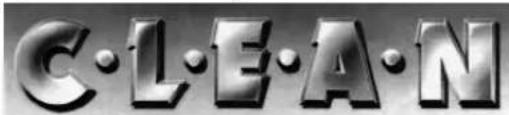
consumption optimized - C, lubrication-free - L, ergonomic - E, air tool - A, noise reduction - N
| Pneumatic drill Straight version Centre-grip version | ||||||||
| Article number | 0 607 154 ... 0 607 161 ... 0 607 153 ... | |||||||
| ... 101 | ... 100 | ... 101 | ... 102 | ... 103 | ... 520 | ... 523 | ||
| No-load speed | \( \mathbf{min}^{-1} \) | 3200 | 2560 | 1200 | 2560 | 1200 | 3700 | |
| Output power | W | 120 | 400 | 400 | 400 | 400 | 180 | 180 |
| Hp | 0.16 | 0.54 | 0.54 | 0.54 | 0.54 | 0.24 | 0.24 | |
| Max. drilling capacity in steel | mm | 4 | 8 | 10 | 8 | 10 | 4 | 4 |
| in | 5/32" | 5/16" | 3/8" | 5/16" | 3/8" | 5/32" | 5/32" | |
| Delivery Scope | ||||||||
| - Keyless drill chuck | - | - | - | - | - | - | ● | |
| - Key type drill chuck | ● | ● | ● | ● | ● | ● | - | |
| Right/left rotation | -- | - | - | - | - | - | ||
| Drill spindle thread | ||||||||
| - 3/8"-24 UNF-2A | ● | - | - | - | - | - | - | |
| - 1/2"-20 UNF-2A | - | ● | ● | ● | ● | ● | ● | |
| Spanner flats on the drill spindle | mm 14 17 17 17 17 14 14 | |||||||
| Collar diameter | mm 28 46 46 46 46 - | - | ||||||
| Max. working pressure for tool | bar | 6.3 | 6.3 | 6.3 | 6.3 | 6.3 | 6.3 | 6.3 |
| psi | 91 | 91 | 91 | 91 | 91 | 91 | 91 | |
| Thread size of hose connection | G 1/8" | G 1/4" | G 1/4" | G 1/4" | G 1/4" | G 1/4" | G 1/4" | |
| Inner diameter of hose | mm | 6 | 10 | 10 | 10 | 10 | 10 | 10 |
| Air consumption at no-load | l/s | 3.4 | 15.5 | 16 | 15.5 | 15 | 7.8 | 8.5 |
| cfm | 7.2 | 32.8 | 33.9 | 32.8 | 31.8 | 16.5 | 18 | |
| Weight according to EPTA-Procedure 01:2014 | kg | 0.52 | 1.1 | 1.2 | 1.3 | 1.5 | 0.84 | 0.88 |
| lbs | 1.1 | 2.4 | 2.6 | 2.9 | 3.3 | 1.8 | 2.0 | |
| Noise/Vibration Information | ||||||||
| Sound emission values determined according to EN ISO 15744. | ||||||||
| Typically the A-weighted noise level of the pneumatic tool is: | ||||||||
| Sound pressure level \( L_{pA} \) | dB(A) | 76 | 75 | 75 | 75 | 75 | 72 | 72 |
| Sound power level \( L_{WA} \) | dB(A) | 87 | 86 | 86 | 86 | 86 | 83 | 83 |
| Uncertainty k | dB | 2.5 | 2.5 | 2.5 | 2.5 | 2.5 | 2.5 | 2.5 |
| Wear hearing protection! | ||||||||
| Vibration total values \( a_h \)(triax vector sum) and uncertainty K determined according to EN 28927: | ||||||||
| Drilling in metal: | ||||||||
| \( a_h \) | \( m/s^2 \) | 4.5 | 9 | 9 | 9 | 9 | < 2.5 | < 2.5 |
| K | \( m/s^2 \) | 0.9 | 1.4 | 1.4 | 1.4 | 1.4 | 1.5 | 1.5 |
Pneumatic drill, Centre-grip version
| Article number | 0 607 160 ... | |||||||
| ...501 | ...502 | ...503 | ...504 | ...505 | ...509 | ...511 | ||
| No-load speed | \( \mathbf{min}^{1} \) | 2800 | 2800 | 850 | 750 | 2200 | ||
| Output power | W | 320 | 320 | 320 | 320 | 320 | 320 | 320 |
| Hp | 0.43 | 0.43 | 0.43 | 0.43 | 0.43 | 0.30 | 0.30 | |
| Max. drilling capacity in steel | mm | 6 | 6 | - | 10 | 10 | 10 | 10 |
| in | 1/4" | 1/4" | - | 3/8" | 3/8" | 3/8" | 3/8" | |
| Delivery Scope | ||||||||
| - Without drill chuck | - | - | ● | - | - | - | - | |
| -Keyless drill chuck | - | ● | - | - | ● | - | - | |
| - Key type drill chuck | ● | - | - | ● | - | ● | ● | |
| Right/left rotation | -- | - | - | - | ● | ● | ||
| Drill spindle thread -3/8"-24 UNF-2A | ● | ● | ● | ● | ● | ● | ● | |
| Spanner flats on the drill spindle | mm 12 12 12 14 14 12 | |||||||
| Collar diameter | mm -- | - | - | - | - | - | ||
| Max. working pressure for tool | bar | 6.3 | 6.3 | 6.3 | 6.3 | 6.3 | 6.3 | 6.3 |
| psi | 91 | 91 | 91 | 91 | 91 | 91 | 91 | |
| Thread size of hose connection | 1/4" NPT | 1/4" NPT | 1/4" NPT | 1/4" NPT | 1/4" NPT | 1/4" NPT | 1/4" NPT | |
| Inner diameter of hose | mm 10 10 10 10 10 10 | |||||||
| Air consumption at no-load | l/s | 13 | 13 | 13 | 13 | 13 | 13 | 13 |
| cfm | 27.5 | 27.5 | 27.5 | 27.5 | 27.5 | 27.5 | 27.5 | |
| Weight according to EPTA-Procedure 01:2014 | kg | 0.81 | 0.87 | 0.71 | 0.87 | 1,0 | 0,96 | 0.91 |
| lbs | 1.8 | 2.0 | 1.5 | 2.0 | 1.4 | 1.4 | 2.0 | |
Noise/Vibration Information
| Sound emission values determined according to EN ISO 15744. | ||||||||
| Typically the A-weighted noise level of the pneumatic tool is: | ||||||||
| Sound pressure level \( L_{pA} \) | dB(A) | 82 | 82 | 82 | 82 | 82 | 82 | 82 |
| Sound power level \( L_{WA} \) | dB(A) | 93 | 93 | 93 | 93 | 93 | 93 | 93 |
| Uncertainty k | dB | 2.5 | 2.5 | 2.5 | 2.5 | 2.5 | 2.5 | 2.5 |
| Wear hearing protection! | ||||||||
| Vibration total values \( a_h \) (triax vector sum) and uncertainty K determined according to EN 28927: | ||||||||
| Drilling in metal: | ||||||||
| \( a_h \) | \( m/s^2 \) | 3.5 | 3.5 | 3.5 | 3.5 | 3.5 | 3.5 | 3.5 |
| K | \( m/s^2 \) | 0.9 | 0.9 | 0.9 | 0.9 | 0.9 | 0.9 | 0.9 |
| Pneumatic drill Centre-grip version | |||||||||
| Article number | 0607 161 ... | ||||||||
| ... 500 | ... 501 | ... 502 | ... 503 | ... 504 | ... 505 | ... 506 | ... 507 | ||
| No-load speed | \( min^{-1} \) | 2560 | 1200 | 800 | 640 | 2560 | 1200 | 800 | 640 |
| Output power | W | 400 | 400 | 400 | 400 | 400 | 400 | 400 | 400 |
| Hp | 0.54 | 0.54 | 0.54 | 0.54 | 0.54 | 0.54 | 0.54 | 0.54 | |
| Max. drilling capacity in steel | mm | 8 | 10 | 13 | 13 | 8 | 10 | 13 | 13 |
| in | 5/16" | 3/8" | 1/2" | 1/2" | 5/16" | 3/8" | 1/2" | 1/2" | |
| Delivery Scope | |||||||||
| - Keyless drill chuck | - | - | - | - | ● | ● | ● | ● | |
| - Key type drill chuck | ● | ● | ● | ● | - | - | - | - | |
| Right/left rotation | - | - | - | - | - | - | - | - | |
| Drill spindle thread | |||||||||
| - 1/2"-20 UNF-2A | ● | ● | ● | ● | ● | ● | ● | ● | |
| Spanner flats on the drill spindle | mm 17 17 17 17 17 17 17 17 | ||||||||
| Collar diameter | mm 48 48 48 48 48 48 48 48 | ||||||||
| Max. working pressure for tool | bar | 6.3 | 6.3 | 6.3 | 6.3 | 6.3 | 6.3 | 6.3 | 6.3 |
| psi | 91 | 91 | 91 | 91 | 91 | 91 | 91 | 91 | |
| Thread size of hose connection | G 1/4" | G 1/4" | G 1/4" | G 1/4" | G 1/4" | G 1/4" | G 1/4" | G 1/4" | |
| Inner diameter of hose | mm 10 10 10 10 10 10 10 10 | ||||||||
| Air consumption at no-load | l/s | 14 | 14 | 14 | 14.2 | 14 | 12 | 14 | 14 |
| cfm | 29.6 | 29.6 | 29.6 | 30 | 29.6 | 25.4 | 29.6 | 29.6 | |
| Weight according to EPTA-Procedure 01:2014 | kg | 1.1 | 1.3 | 1.45 | 1.5 | 1.3 | 1.5 | 1.5 | 1.6 |
| lbs | 2.4 | 2.9 | 3.2 | 3.3 | 2.9 | 3.3 | 3.3 | 3.5 | |
| Noise/Vibration Information | |||||||||
| Sound emission values determined according to EN ISO 15744. | |||||||||
| Typically the A-weighted noise level of the pneumatic tool is: | |||||||||
| Sound pressure level \( L_{pA} \) | dB(A) | 73 | 73 | 73 | 73 | 73 | 73 | 73 | 73 |
| Sound power level \( L_{WA} \) | dB(A) | 84 | 84 | 84 | 84 | 84 | 84 | 84 | 84 |
| Uncertainty k | dB | 2.5 | 2.5 | 2.5 | 2.5 | 2.5 | 2.5 | 2.5 | 2.5 |
| Wear hearing protection! | |||||||||
| Vibration total values \( a_h \)(triax vector sum) and uncertainty K determined according to EN 28927: | |||||||||
| Drilling in metal: | |||||||||
| \( a_h \) | m/s2 | 3.5 | 3.5 | 3.5 | 3.5 | 3.5 | 3.5 | 3.5 | 3.5 |
| K | m/s2 | 0.8 | 0.8 | 0.8 | 0.8 | 0.8 | 0.8 | 0.8 | 0.8 |
The vibration emission level given in this information sheet has been measured in accordance with a standardised test given in EN ISO 11148 and may be used to compare one pneumatic tool with another. It may be used for a preliminary assessment of exposure.
The declared vibration emission level represents the main applications of the pneumatic tool. However, if the pneumatic tool is used for different applications, with different accessories or insertion tools, or is poorly maintained, the vibration emission may differ. This may significantly increase the exposure level over the total working period.
An exact estimation of the level of exposure to vibration should also take into account the times when the pneumatic tool is switched off or when it is running but not actually doing the job. This may significantly reduce the exposure level over the total working period.
Identify additional safety measures to protect the operator from the effects of vibration, such as: maintaining the pneumatic tool and the accessories, keeping the hands warm, and organising work patterns.
Assembly
Suspension Device and Clamping Fixture
Suspension Device (see figure A)
If you want to operate the pneumatic tool in a suspension device or a clamping fixture, take care to fasten it in the device/fixture first before connecting it to the air supply. This measure prevents accidental starting of operation.
With the utility clip 4, you can fasten the pneumatic tool to a suspension device.
-0607 1535..
Mount the utility clip 4 to the pneumatic tool, and allow it to engage in the slots 10.
Depending on the pneumatic tool's centre of gravity, either the front or rear slots can be used.
-06071615..
Mount the utility clip 4 onto the clamping area 2.
Regularly check the condition of the utility clip and the hook of the suspension device.
Clamping Fixture
0607 154 101/0607 161 1../0607 161 5..
- The pneumatic tool can be mounted in a clamping fixture over the mentioned clamping area 2. If possible, utilise the entire clamping area. The smaller the clamping area, the stronger the clamping forces act.
Do not overload the clamping area.
Mounting the Auxiliary Handle
0607 1605./0607 1611./0607 1615..
- Slide the auxiliary handle 9 onto the clamping area (collar) 2.
The auxiliary handle 9 can be set to any position for a secure and low-fatigue working posture.
Turn the wing bolt for adjustment of the auxiliary handle in anticlockwise direction and set the auxiliary handle 9 to the required position. Then tighten the wing bolt again in clockwise direction.
Exhaust-air Guidance
With exhaust-air guidance, the exhaust air can be diverted through an exhaust-air hose away from your workplace, while at the same time achieving optimal sound-proofing. Additionally, your working conditions are improved, as your workplace can no longer be contaminated though oil-containing air and dispersed dust or chips.
Decentralised Exhaust-air Guidance (see figure B) 06071.06071615..
- Unscrew the silencer at air outlet 8 and replace it with a hose fitting 5.
- Loosen hose clamp 11 of the exhaust-air hose 12, mount the exhaust-air hose to hose fitting 5 and retighten the hose clamp.
06071535./0607154101
The exhaust-air guidance should be mounted before connecting to the air supply, as handle cover 14 has to be removed.
The exhaust air can be conducted into an exhaust-air tank.
- Unscrew the three fastening screws 13 and remove handle cover 14.
- Replace the silencer against hexagon nut 15 and fasten the handle cover again with the three fastening screws. Screw hose fitting 5 into hexagon nut 15 at the air outlet.
- Loosen hose clamp 11 of the exhaust-air hose 12, mount the exhaust-air hose to hose fitting 5 and retighten the hose clamp.
Decentralised Exhaust-air Guidance with Exhaust-air Set (see figure C)
The exhaust air can be conducted into an exhaust-air tank by mounting a decentralised exhaust-air set 17.
Note: Pay attention that hose fitting 5 is not screwed into connection socket 20 at the air intake and that sealing ring 16 is positioned in the recess between housing and exhaust-air set 17, so that the outflowing air can only escape through exhaust-air hose 12.
- Screw connection socket 18 of the exhaust-air set firmly into connection socket 20 at the air intake; now screw hose fitting 5 into connection socket 18.
- Replace the silencer 19 of the exhaust-air set with the hose fitting of the exhaust-air set.
- Loosen hose clamp 11 of the exhaust-air hose 12, mount the exhaust-air hose to hose fitting 5 and retighten the hose clamp.
Centralised Exhaust-air Guidance (see figure D) 06071611./06071615..
- Loosen hose clamp 11 of supply-air hose 21, mount the supply-air hose to hose fitting 5 and retighten the hose clamp.
- Work the exhaust-air hose (centralised) 22, which conducts the exhaust air away from your workplace, over the supply-air hose 21. Then connect the pneumatic tool to the air supply (see "Connecting the Air Supply", page 25) and work the exhaust-air hose (centralised) 22 over the mounted supply-air hose onto the end of the pneumatic tool.
Connecting the Air Supply (see figure E)
- Ensure that the air pressure is not lower than 6.3 bar (91 psi) because the pneumatic tool is designed for this operating pressure.
For maximum performance, the values for the inner hose diameter as well as the connection threads must be adhered to as listed in the "Technical Data" Table. To maintain the full performance, only use hoses with a maximum length of 4 m.
The compressed air supplied should be free of foreign material and moisture to protect the tool from damage, contamination, and the formation of rust.
Note: The use of a compressed-air maintenance unit is necessary. This ensures proper function of the pneumatic tools.
Observe the operating instructions of the maintenance unit.
All fittings, connecting lines and hoses must be dimensioned for the pressure and the required air volume.
Avoid restrictions in the air supply, e.g., from pinching, kinking, or stretching!
When in doubt, check the pressure at the air inlet with a pressure gauge with the pneumatic tool switched on.
Connecting the Air Supply to the Pneumatic Tool
- Screw with 5 into the connection socket at air inlet 20. To avoid damage to interior valve components of the pneumatic tool when screwing hose fitting 5 in or out, it is recommended to counter-hold the projecting connection socket of air intake 20 with an open-end wrench (size 22 mm).
- Loosen hose clamp 11 of supply-air hose 21, mount the supply-air hose to hose fitting 5 and retighten the hose clamp.
Note: Always mount the supply-air hose to the pneumatic tool first, then to the maintenance unit.
Mounting the Drill Chuck (see figure F)
Hold drill spindle 1 in place by the spanner flats 6 using a fitting open-end spanner and screw the key-type drill chuck 23 or the keyless chuck 24 onto the drill spindle. The drill chuck must be tightened with a tightening torque of approx. 20-25 Nm.
Changing the Key Type Drill Chuck
Hold the drill spindle 1 in place by the spanner flats using a fitting open-end spanner. - Insert the chuck key 25 into one of the three holes of the key-type drill chuck 23 and loosen the drill chuck by turning in anticlockwise direction.
Note: Loosen a tight-seated drill chuck by counter-holding with an Allen key clamped in the tool holder 26.
Changing the Keyless Chuck
- Place the pneumatic tool on a stable surface (e.g. a workbench). Hold drill spindle 1 in place by the spanner flats 6 using a fitting open-end spanner and loosen the drill chuck 24 from the drill spindle by turning in anticlockwise direction.
Note: Loosen a tight-seated drill chuck by counter-holding with an Allen key clamped in the tool holder 26.
Changing the Tool (see figure G)
Key Type Drill Chuck
- Open the key type drill chuck 23 by turning until the tool can be inserted. Insert the tool.
- Insert the chuck key 25 into the corresponding holes of the key type drill chuck 23 and clamp the tool uniformly.
Removing:
- Turn the sleeve of the key type drill chuck 23 with the drill chuck key in anticlockwise direction until the drilling tool can be removed.
Keyless Chuck
Hold the rear sleeve 27 of the keyless chuck 24 and turn the front sleeve 28 in anticlockwise direction until the tool can be inserted. Insert the tool. Hold the rear sleeve 27 of the keyless chuck 24 and firmly turn the front sleeve 28 in clockwise direction until a "click" can be heard. This automatically locks the drill chuck.
Removing:
- The locking is released again to remove the tool when the front sleeve 28 is turned in the opposite direction.
Operation
Starting Operation
The pneumatic tool works optimally at a working pressure of 6.3 bar (91 psi), measured at the air inlet when the pneumatic tool is switched on.
Starting and Stopping (see figure H)
Note: When the pneumatic tool does not start, for example after a longer rest period, disconnect the air supply, and turn the motor by the tool holder 26 several times through. This removes the adhesive forces.
To save energy, only switch the pneumatic tool on when you are using it.
- To switch on the pneumatic tool, press the On/Off switch (lever) 3 and keep it pressed during the working procedure.
- To switch off the power tool, release the On/Off switch (lever) 3.
- To switch on the pneumatic tool, press the On/Off switch 7 and keep it pressed during the working procedure. To switch off the pneumatic tool, release the On/Off switch 7.
- To switch on the pneumatic tool, press either the top or bottom part of the two-piece On/Off switch 7 and keep it pressed during the working procedure.
- To switch off the pneumatic tool, release the On/Off switch 7.
Reversing the rotational direction (see figure I) 0607160509/0607160511
- Right rotation: Push the rotational direction switch 29 rightward to the stop.
- Left rotation: Push the rotational direction switch 29 leftward to the stop.
Working Advice
Sudden loads cause a sharp drop in speed or a complete stop, yet do not cause damage to the motor.
Maintenance and Service
Maintenance and Cleaning
Have maintenance and repair work carried out only through qualified persons. This will ensure that the safety of the pneumatic tool is maintained.
An authorized Bosch after-sales service agent will carry out this work quickly and reliably.
Regular Cleaning
Clean the sieve at the air intake of the pneumatic tool regularly. For this, unscrew the hose fitting 5 and remove any dust and debris from the sieve. Afterwards, retighten the hose fitting again. Water and debris particles in the compressed air cause rust and lead to wear of plates, valves etc. To prevent this, fill several drops of engine oil into the air intake 20. Reconnect the pneumatic tool to the air supply (see "Connecting the Air Supply", page 25) and run it for 5-10 seconds, while catching/picking up the escaping oil with a cloth. Always carry out this procedure when not using the pneumatic tool for a longer period of time.
Scheduled Maintenance
Clean the gearbox after the first 150 running hours using a mild solvent. Follow the solvent manufacturer's directions for use and disposal. Lubricate the gearbox using Bosch gearbox lube. Repeat the lubrication procedure every 300 hours after the initial gearbox service. Special gearbox grease (225 ml) Article number 3605430009 - The motor plates should be checked regularly by specialised personnel and replaced, if required.
Lubrication of Pneumatic Tools that do not belong to the CLEAN Product Line
For all Bosch pneumatic tools that do not belong to the CLEAN product line (these have a special type of compressed-air motor that functions with oil-free compressed air), oil mist should be added continuously to the flowing-through compressed air. The compressed-air oiler required for this is included in the compressed-air service unit on the line side of the pneumatic tool (for more details, please refer to the compressor manufacturer).
For direct lubrication of the pneumatic tool or admixtures to the service unit, use SAE 10 or SAE 20 engine oil.
Accessories
All compressed-air drills can be equipped with key-type drill chucks or keyless chucks.
For more information on the complete quality accessories program, please refer to the Internet under www.bosch-pt.com or contact your specialist shop.
After-sales Service and Application Service
In all correspondence and spare parts orders, please always include the 10-digit article number given on the type plate of the pneumatic tool.
Our after-sales service responds to your questions concerning maintenance and repair of your product as well as spare parts. Exploded views and information on spare parts can also be found under:
www.bosch-pt.com
Bosch's application service team will gladly answer questions concerning our products and their accessories.
Great Britain
Robert Bosch Ltd. (B.S.C.)
P.O.Box 98
Broadwater Park
North Orbital Road
Denham
Uxbridge
UB95HJ
At www.bosch-pt.co.uk you can order spare parts or arrange the collection of a product in need of servicing or repair.
Tel. Service: (0844) 7360109
E-Mail: boschservicecentre@bosch.com
Ireland
Origoltd.
Unit 23 Magna Drive
Magna Business Park
City West
Dublin 24
Tel. Service: (01) 4666700
Fax: (01) 4666888
Australia, New Zealand and Pacific Islands
Robert Bosch Australia Pty. Ltd.
Power Tools
Locked Bag 66
Clayton South VIC 3169
Customer Contact Center
Inside Australia:
Phone: (01300) 307044
Fax: (01300) 307045
Inside New Zealand:
Phone: (0800) 543353
Fax: (0800) 428570
Outside AU and NZ:
Phone: +61 3 95415555
www.bosch.com.au
Republic of South Africa
Customer service
Hotline: (011) 6519600
Gauteng - BSC Service Centre
35 Roper Street, New Centre
Johannesburg
Tel.: (011) 4939375
Fax: (011) 4930126
E-Mail: bsctools@icon.co.za
KZN - BSC Service Centre
Unit E, Almar Centre
143 Crompton Street
Pinetown
Tel.: (031) 7012120
Fax: (031) 7012446
E-Mail: bsc.dur@za.bosch.com
Western Cape - BSC Service Centre
Democracy Way, Prosperity Park
Milnerton
Tel.: (021) 5512577
Fax: (021) 5513223
E-Mail: bsc@zsd.co.za
Bosch Headquarters
Midrand, Gauteng
Tel.: (011) 6519600
Fax: (011) 6519880
E-Mail: rbsa-hq.pts@za.bosch.com
People's Republic of China
China Mainland
Bosch Power Tools (China) Co., Ltd.
567, Bin Kang Road
Bin Jiang District 310052
Hangzhou, P.R.China
Service Hotline: 4008268484
Fax: (0571) 87774502
E-Mail: contact.ptcn@cn.bosch.com
www.bosch-pt.com.cn
HK and Macau Special Administrative Regions
Robert Bosch Hong Kong Co. Ltd.
21st Floor, 625 King's Road
North Point, Hong Kong
Customer Service Hotline: +852 2101 0235
Fax: +852 2590 9762
E-Mail: info@hk.bosch.com
www.bosch-pt.com.hk
Indonesia
PT Robert Bosch
Palma Tower 9th & 10th Floor
JI. Let. Jend. TB Simatupang II S/06
28th Floor Fort Legend Towers,
3rd Avenue corner 31st Street,
Fort Bonifacio Global City,
1634 Taguig City, Philippines
Tel.: (02) 8703871
Fax: (02) 8703870
matheus.contiero@ph.bosch.com
www.bosch-pt.com.ph
Bosch Service Center:
9725-27 Kamagong Street
San Antonio Village
Makati City, Philippines
Tel.: (02) 8999091
Fax: (02) 8976432
rosalie.dagdagan@ph.bosch.com
Malaysia
Robert Bosch (S.E.A.) Sdn. Bhd.
No.8A,Jalan 13/6
G.P.O. Box 10818
46200 Petaling Jaya
Selangor, Malaysia
Tel.: (03) 79663194
Fax: (03) 79583838
cheehoe.on@my.bosch.com
Toll-Free: 1800 880188
www.bosch-pt.com.my
Thailand
Robert Bosch Ltd.
Liberty Square Building
No.287, 11th Floor
Silom Road, Bangrak
Bangkok 10500
Tel.: 02 6393111, 02 6393118
Fax: 022384783
Robert Bosch Ltd., P.O. Box 2054
Bangkok 10501, Thailand
www.bosch.co.th
Bosch Service - Training Centre
La Salle Tower Ground Floor Unit No.2
10/11 La Salle Moo 16
Srinakharin Road
Bangkaew, Bang Plee
Samutprakarn 10540
Thailand
Tel.: 027587555
Fax: 027587525
Singapore
Robert Bosch (SEA) Pte. Ltd.
11 Bishan Street 21
Singapore 573943
Tel.: 65712772
Fax: 63505315
leongheng.leow@sg.bosch.com
Toll-Free: 18003338333
www.bosch-pt.com.sg



28|English
Vietnam
Robert Bosch Vietnam Co. Ltd
10/F, 194 Golden Building
473 Dien Bien Phu Street
Ward 25, Binh Thanh District
84 Ho Chi Minh City
Vietnam
Tel.: (08) 62583690 ext. 413
Fax: (08) 62583692
hieu.lagia@vn.bosch.com
www.bosch-pt.com
Disposal
The pneumatic tool, accessories and packaging should be sorted for environmental-friendly recycling.
Observe all applicable environmental regulations when disposing of old grease and solvents.
- Dispose of motor plates according to regulations! Motor plates contain Teflon. Do not heat them beyond 400°C, otherwise vapours hazardous to one's health can develop.
If your pneumatic tool can no longer be used, deliver it to a recycling centre or return it to a dealer - for example, an authorized Bosch after-sales service agent.
Subject to change without notice.
Henk Becker Helmut Heinzelmann Executive Vice President Head of Product Certification Engineering PT/ETM9
Robert Bosch Power Tools GmbH
70538 Stuttgart, GERMANY
Stuttgart, 01.01.2017
Technical specifications
0607 153 5.//0607 154 101
Executive Vice President
Engineering
Helmut Heinzelmann
Head of Product Certification
PT/ETM9

Robert Bosch Power Tools GmbH
70538 Stuttgart, GERMANY
Stuttgart, 01.01.2017
Technical data
0607 153 5../0607 154 101
Executive Vice President
Engineering
Helmut Heinzelmann
Head of Product Certification
PT/ETM9

Robert Bosch Power Tools GmbH
70538 Stuttgart, GERMANY
Stuttgart, 01.01.2017
Technical Data
0607 153 5./0607 154 101
Executive Vice President
Engineering
Helmut Heinzelmann
Head of Product Certification
PT/ETM9
Robert Bosch Power Tools GmbH
70538 Stuttgart, GERMANY
Stuttgart, 01.01.2017
Technical data
0607 1535./0607 154 101
ergonomic - ergonomic
Henk Becker Helmut Heinzelmann Executive Vice President Head of Product Certification Engineering PT/ETM9

Robert Bosch Power Tools GmbH 70538 Stuttgart, GERMANY Stuttgart, 01.01.2017
Technical data
0607 153 5../0607 154 101
Executive Vice President
Engineering
Helmut Heinzelmann
Head of Product Certification
PT/ETM9

Robert Bosch Power Tools GmbH
70538 Stuttgart, Germany
Stuttgart, 01.01.2017
Assembly
Bosch Service Center
Telegrafvej 3
2750 Ballerup
Spare parts can be ordered online or a repair order can be created at www.bosch-pt.dk.
Service Center phone: 44898855
Fax: 44898755
E-Mail: vaerktoej@dk.bosch.com
Disposal
noise reduction - reduced sound level
Pneumatic drilling machine Straight design Pistol grip
| Produktnummer 0 607 154 ... 0 607 161 ... 0 607 153 ... | ||||||||
| ... 101 | ... 100 | ... 101 | ... 102 | ... 103 | ... 520 | ... 523 | ||
| Tomgangsvarvatal | \( min^1 \) | 3200 | 2560 | 1200 | 2560 | 1200 | 3700 | 3700 |
| Avgiven effekt | W | 120 | 400 | 400 | 400 | 400 | 180 | 180 |
| Hp | 0,16 | 0,54 | 0,54 | 0,54 | 0,54 | 0,24 | 0,24 | |
| max. borrdiameter i stål | mm | 4 | 8 | 10 | 8 | 10 | 4 | 4 |
| tum | 5/32" | 5/16" | 3/8" | 5/16" | 3/8" | 5/32" | 5/32" | |
| Leveransen omfattar | ||||||||
| - Snabbchuck | - | - | - | - | - | - | ● | |
| - Kuggkranschuck | ● | ● | ● | ● | ● | ● | - | |
| Höger-/vänstergäng | - | - | - | - | - | - | - | |
| Borrrspindelganga | ||||||||
| - 3/8"-24 UNF-2A | ● | - | - | - | - | - | - | |
| - 1/2"-20 UNF-2A | - | ● | ● | ● | ● | ● | ● | |
| Nyckeltag på borrrspindeln | mm | 14 | 17 | 17 | 17 | 17 | 14 | 14 |
| Inspanningshalsens diameter | mm | 28 | 46 | 46 | 46 | 46 | - | - |
| max. arbetstryck på verktyget | bar | 6,3 | 6,3 | 6,3 | 6,3 | 6,3 | 6,3 | 6,3 |
| psi | 91 | 91 | 91 | 91 | 91 | 91 | 91 | |
| Slangkopplingens gänganslutning | G 1/8" | G 1/4" | G 1/4" | G 1/4" | G 1/4" | G 1/4" | G 1/4" | |
| Inre slangdiameter | mm | 6 | 10 | 10 | 10 | 10 | 10 | 10 |
| Luftfürbrukning på tomgang | I/s | 3,4 | 15,5 | 16 | 15,5 | 15 | 7,8 | 8,5 |
| cfm | 7,2 | 32,8 | 33,9 | 32,8 | 31,8 | 16,5 | 18 | |
| Vikt enligt | kg | 0,52 | 1,1 | 1,2 | 1,3 | 1,5 | 0,84 | 0,88 |
| EPTA-Procedure 01:2014 | lbs | 1,1 | 2,4 | 2,6 | 2,9 | 3,3 | 1,8 | 2,0 |
Noise/vibration data
Henk Becker Executive Vice President Engineering
Helmut Heinzelmann Head of Product Certification PT/ETM9

Robert Bosch Power Tools GmbH 70538 Stuttgart, GERMANY Stuttgart, 01.01.2017
Montage
Bosch Service Center
Telegrafvej 3
2750 Ballerup
Danmark
Tel.: (08) 7501820 (inom Sverige)
Fax: (011) 187691
Avfallshantering
Executive Vice President
Engineering
Helmut Heinzelmann
Head of Product Certification
PT/ETM9

Robert Bosch Power Tools GmbH
70538 Stuttgart, Germany
Stuttgart, 01.01.2017
Assembly
Henk Becker Executive Vice President Engineering
Helmut Heinzelmann Head of Product Certification PT/ETM9
f( 2) = h · k
Robert Bosch Power Tools GmbH 70538 Stuttgart, Germany Stuttgart, 01.01.2017
Installation
Executive Vice President
Engineering
Helmut Heinzelmann
Head of Product Certification
PT/ETM9

Robert Bosch Power Tools GmbH
70538 Stuttgart, GERMANY
Stuttgart, 01.01.2017
Technical data
0607 1535./0607 154 101
These compressed air tools are intended for industrial use.
The CLEAN technology from Bosch protects the user and the environment thanks to operation without oil and thanks to reduced air and energy consumption.
Operation with oil is, however, also possible.
consumption optimized - reduced air consumption
- air
lubrication free - without oil
ergonomic - ergonomic
air tool - compressed air tool
Changing the tool
Compatible with any tool holder with a 23 mm hexagon socket on the drive spindle. For this, insert the tool into the three jaws and tighten the tool by turning the sleeve.
Example: Switching on the tool: Press the on/off switch 26 and hold it down.
Switching on
- Do not start the power tool until it is positioned on the workpiece (e.g., when wearing work clothing). - Press the on/off switch 1 by placing a gloved hand on the surface and pressing down on the switch, moving the switch to the left.
Example: Switching on the tool: Press the on/off switch 26 and hold it down.
Switching off the tool (see figure G)
Switching off
- Release the on/off switch 23 by moving it until it stops, so that the tool switches off. Then switch off the tool.
Maintenance and Service
Maintenance and cleaning
Before any maintenance or cleaning, the power tool must be unplugged from the power supply. This ensures the safety of the tool.
An authorized Bosch Service center can carry out these tasks quickly and reliably.
Regular cleaning
Clean the air vents on the tool housing regularly. To do this, remove the dust filter 5 and remove any dust and debris from the air vents. Also clean the dust filter regularly. Dust and debris in the air can cause malfunctions and damage to the tool. To prevent this, you should insert the air filter 20 with a few drops of oil. Connect the tool to the air supply (see "Connecting to the air supply", page 127) and let it run for 5-10 seconds. Then check the oil level and refill if necessary. If the tool will not be used for a long time, you should apply the protective coating.
Periodic maintenance
Clean the drive unit after 150 operating hours. For more information on the use and maintenance of the drive unit, refer to the manufacturer's instructions. Then lubricate the drive unit with the recommended lubricant for drive units from Bosch. Repeat the cleaning procedure after 300 operating hours or before cleaning.
Use only clear compressed air (225 ml) from an air supply of 3605430009. The compressed air containers must be checked for visible damage by trained personnel and, if necessary, replaced.
Disposal of waste air that does not belong to the construction site.
For all Bosch compressed air tools that do not belong to the CLEAN series (a special compressed air tool that works with oil-free air), you must regularly add a little oil to the air inlet. The required oil is located in the maintenance unit of the compressed air system, which is installed in the compressed air supply (see the information in the operating instructions of the manufacturer). Use only SAE 10 or SAE 20 oil to lubricate the compressed air tool for maintenance.
Accessories
The compressed air tools can be operated with all grinding tools or accessories. The complete accessory program can be found in the electronic catalog at www.bosch-pt.com or from your specialist dealer.
Service and customer service
When you need information and when ordering spare parts, please always quote the 10-digit article number on the nameplate of the compressed air tool.
The service department will answer your questions regarding the repair and maintenance of your product and for spare parts:
www.bosch-pt.com
The Bosch customer service team will gladly answer your questions about our products and their spare parts.
Greece
Robert Bosch A.E. Epoelias 37 19400 Koropi-Athens Tel.: 2105701270 Fax: 2105701283 www.bosch.com www.bosch-pt.gr ABZ Service A.E. Tel.: 2105701380 Fax: 2105701607
Disposal
The compressed air tools, accessories, and packaging must be recycled in an environmentally friendly manner.
Dispose of the tools and cleaners in an environmentally friendly manner. Observe the relevant legal regulations. Dispose of the motor oil regularly! The motor oil contains Teflon. Do not heat it above 400°C, as toxic fumes may be released.
The power tool must not be disposed of with household waste. It must be handed over to a recycling center for materials to be returned to the recycling loop or to an authorized Bosch Service center.
We reserve the right to make changes.
Turkish
Safety Instructions
General Safety Instructions for Power Tools
consumption optimized - Optimum air consumption
lubrication free - Oil-free
ergonomic - Ergonomic
air tool - Air tool
Executive Vice President
Engineering
Helmut Heinzelmann
Head of Product Certification
PT/ETM9

Robert Bosch Power Tools GmbH
70538 Stuttgart, GE
Stuttgart, 01.01.2017
Assembly
Suspension and tensioning equipment
Suspension equipment (see Figure A)
Bosch San. ve Tic. A.S.
Ahi Evran Cad. No:1 Kat:22
Polaris Plaza
80670 Maslak/Istanbul
Bosch Expert Team ^+ 90(0212)3671888
Isiklar LTD.ŞTI.
Kizilay Cad. No: 16/C Seyhan
Adana
Tel.: 0322 3599710
Tel.: 0322 3591379
Executive Vice President Engineering
Helmut Heinzelmann
Head of Product Certification PT/ETM9
Robert Bosch Power Tools GmbH
70538 Stuttgart, GERMANY
Stuttgart, 01.01.2017
Montaž
Robert Bosch Sp. z o.o.
Henk Becker Executive Vice President Engineering
Helmut Heinzelmann Head of Product Certification PT/ETM9
Robert Bosch Power Tools GmbH 70538 Stuttgart, GERMANY Stuttgart, 01.01.2017
Montáž
Bosch Service Center PT
K Vapence 1621/16
692 01 Mikulov
You can order the repair of your machine online at www.bosch-pt.cz.
Tel.: 519 305700
Fax: 519305705
E-Mail: servis.naradi@cz.bosch.com
www.bosch.cz
Disposal
Pneumatic tools, accessories, and packaging should be sent for recycling that is environmentally friendly.
Henk Becker Helmut Heinzelmann Executive Vice President Head of Product Certification Engineering PT/ETM9
Robert Bosch Power Tools GmbH 70538 Stuttgart, GERMANY Stuttgart, 01.01.2017
Technical data
0607 153 5../0607 154 101
This pneumatic tool belongs to the CLEAN construction series.
Tools marked as Bosch CLEAN-Technik protect the user and the environment thanks to oil-free operation and lower air and energy consumption.
However, the tool can also work with oil-containing air.
consumption optimized - optimized air consumption
lubrication free - oil-free, ergonomic - ergonomic
air tool - pneumatic hand tool
noise reduction - reduced noise level
Executive Vice President Engineering
Helmut Heinzelmann
Head of Product Certification PT/ETM9
Robert Bosch Power Tools GmbH 70538 Stuttgart, GERMANY Stuttgart, 01.01.2017
Technical data
06071535../0607154101
Wear protective goggles. Personal protective equipment, such as respiratory protection, protective footwear, protective gloves, and hearing protection, depending on the instructions of the work supervisor and safety regulations or sanitary norms, reduces the risk of injury. Avoid accidental starting. Before connecting the pneumatic tool to the air source, inspect it and make sure the pneumatic tool is switched off. Carrying a pneumatic tool with your finger on the switch or connecting a pneumatic tool to the air source while it is switched on can lead to accidents. Before switching on the pneumatic tool, make sure the tools are adjusted. An adjusted tool that is in the rotating part of the pneumatic tool can become a source of injury. Do not overreach. Always maintain a stable stance and balance. A stable stance and proper body position allow you to better control the pneumatic tool in unexpected situations. Wear appropriate clothing. Do not wear loose clothing or jewelry. Tie back hair, clothing, and sleeves away from rotating parts. Loose clothing, jewelry, or long hair can get caught in rotating parts. If devices for dust extraction and collection are provided, check that they are properly connected and used. The use of such devices reduces the risk of dangerous situations due to dust. Do not inhale exhaust air. Avoid getting exhaust air into your eyes. Exhaust air from the pneumatic tool may contain oil, metal particles, and contaminants from the compressor. This can be harmful to health.
Proper handling and use of the pneumatic tool
Use clamps or another way to secure and support the workpiece on a stable platform. Holding the workpiece by hand or against your body does not ensure safety when working with the pneumatic tool. Do not overload the pneumatic tool. Use the pneumatic tool that is specifically intended for your type of work. The appropriate pneumatic tool works
better and safer within the specified power range.
Do not use the pneumatic tool with a damaged switch. A pneumatic tool that turns on or off by itself is dangerous and requires repair. Disconnect the air supply before adjusting the tool, replacing accessories, or storing it for a long time. This precaution prevents accidental starting of the pneumatic tool. Store unused pneumatic tools out of reach of children. Do not allow persons who are not familiar with the tool or these instructions to operate the pneumatic tool. Pneumatic tools are dangerous in the hands of inexperienced users. Maintain the pneumatic tool carefully. Check that moving parts are aligned and do not bind, and that no parts are broken or damaged that could affect the operation of the pneumatic tool. Have damaged parts repaired before using the pneumatic tool. Many accidents are caused by poorly maintained pneumatic tools. Keep the cutting tool sharp and clean. Properly maintained cutting tools with sharp cutting edges are less likely to bind and are easier to control. Use the pneumatic tool, its accessories, and cutting tools, etc., in accordance with these instructions. Take into account the working conditions and the work to be performed. This will reduce the risk of dust, vibration, and noise. Only trained and qualified operators may set up, adjust, and use pneumatic tools. Modifying the pneumatic tool is prohibited. Such modifications may reduce the effectiveness of safety measures and increase the risk to the operator.
Service
Have your pneumatic tool serviced only by qualified personnel and only with original spare parts. This ensures the safety of the pneumatic tool in the future.
Safety instructions for pneumatic grinders
Make sure that the data on the rating plate is legible. If necessary, request a new rating plate from the manufacturer.


Russian | 181
Be careful: broken workpieces, accessories, or the pneumatic tool itself can fly off at high speed. Always wear impact-resistant safety glasses when securing, repairing, servicing, or replacing accessories of the pneumatic tool. The required degree of protection must be determined for each specific use of the tool. Operators and maintenance personnel must be in appropriate physical condition to work with pneumatic tools of this size, weight, and power. Be prepared for unexpected movements of the pneumatic tool caused by reactive forces or breakage of the working tool. Hold the pneumatic tool firmly and position your body so you can control these movements. These precautions help prevent injuries. Immediately switch off the pneumatic tool if the working tool jams. Be prepared for high reactive moments that occur when the working tool jams, if:
- the pneumatic tool is overloaded, - the tool is tilted in the workpiece or
- if its cutting edge is caught on the reverse side of the material being processed.
During reactive moments, use auxiliary devices, e.g., supports. If this is not possible, use an additional handle. Never place your hand near the rotating working tool. You may be injured. When changing air hoses or adjusting the working pressure, switch off the pneumatic tool. Check the working pressure and switch the tool back on when the working pressure is optimal again. During work with pneumatic tools, operators may experience discomfort in the hands, arms, shoulders, neck, or other body parts. To work with this pneumatic tool, adopt a comfortable posture, maintain a stable body position, and avoid awkward postures or positions where balance is difficult to maintain. For prolonged work, the operator should change body position to avoid discomfort and fatigue. The operator must not ignore symptoms such as persistent malaise, recurring pain, aching, numbness, tingling, or burning. The operator should report this to the employer and seek qualified medical consultation.
Caution! During prolonged operation of the pneumatic tool, the working tool may heat up. Wear protective gloves. Use appropriate metal detectors to locate concealed electrical, gas, or water supply lines, and consult the local utility company. Contact with an electrical wire can lead to electric shock. Damage to a gas line can lead to an explosion. Damage to a water pipe leads to material damage. Avoid contact with live wires. The pneumatic tool is not insulated; contact with a live wire can lead to electric shock.
ELECTRICAL SAFETY
Dust generated during sanding
Dust generated by sanding, grinding, cutting, and other similar work may be hazardous and contain harmful chemicals. In particular, dust may contain the following substances:
Lead from paints;
Crystalline silica from bricks, cement, and other masonry products; arsenic and chromium from chemically treated lumber.
Your risk of exposure depends on how often you perform this type of work. To reduce exposure to these chemicals, work in a well-ventilated area and wear appropriate safety equipment, such as a dust mask that is specifically designed to filter out microscopic particles.
When working with the workpiece, harmful noise may be generated, which can be prevented by taking appropriate measures, such as using insulating materials to protect against rattling during contact with the workpiece. If the pneumatic tool is equipped with a silencer, always check that it is in place and in proper working condition. Vibration can be harmful and may cause injury on first use. Wear warm, close-fitting gloves. Due to the airflow, the handles of pneumatic tools may become cold. Warm hands are less susceptible to the effects of vibration. Tight gloves may get caught in rotating parts. If your fingers or hands become numb, turn pale, or tingle, stop working with the pneumatic tool, inform your supervisor, and consult a doctor. Do not hold the workpiece with your hands, as this may lead to increased vibration.
182|Russian
To reduce the risk of vibration from the pneumatic tool, use the supplied stands, spring balancers, or counterweights. Hold the pneumatic tool not too tightly, but firmly, in accordance with the reaction forces of your hand. The tighter you hold the tool, the more vibration may be amplified. If universal rotating connections (quick couplings) are used, it is necessary to install locking pins. Use a safety cable to prevent damage to the connection between the hose and the pneumatic tool, and to prevent damage to the connections between hoses. Never carry the pneumatic tool by the hose.
Symbols
The following symbols may have meaning for the use of your pneumatic tool. Please remember these symbols and their meanings. Correct interpretation of the symbols will help you work more reliably with this pneumatic tool.
Symbol meaning

Before installation, operation, repair, maintenance, or replacement of accessories for pneumatic tools, as well as before working near them, carefully read and follow all instructions. Failure to follow the instructions below regarding safety may result in serious injury.


Wear safety glasses.
Henk Becker Helmut Heinzelmann Executive Vice President Head of Product Certification Engineering PT/ETM9
Robert Bosch Power Tools GmbH 70538 Stuttgart, GERMANY Stuttgart, 01.01.2017
Pneumatic tools are part of the CLEAN series.
CLEAN technology from Bosch protects the environment: it operates without oil mist and consumes only a small amount of air energy.
Nevertheless, these tools can also operate with air containing oil mist.
consumption optimized - optimized air consumption
lubrication free - no lubrication ergonomic - ergonomics
air tool - pneumatic tool noise reduction - noise reduction
| Пселматuelle Дерпл Рема Форma | Пистонатuelle Форma | |||||||
| Товарный № | 0 607 154 ... 0 607 161 ... 0 607 153 ... | |||||||
| ... 101 | ... 100 | ... 101 | ... 102 | ... 103 | ... 520 | ... 523 | ||
| Часло оборотовхолостогохда | Mнн-1 | 3200 | 2560 | 1200 | 2560 | 1200 | 3700 | 3700 |
| Пoleзая мошноctь | Вт | 120 | 400 | 400 | 400 | 400 | 400 | 180 |
| п.с. | 0,16 | 0,54 | 0,54 | 0,54 | 0,54 | 0,54 | 0,24 | |
| Мамс. диметр сөвөнөгөдөрөдөрөдөрөдөрөдөрөдөрөдөрөдөрөдөрөдөрөдөрөдөрөдөрөдөрөдөрөдөрөдөрөдөрөдөрөдөрөдөрөдөрөдөрөдөрөдөрөдөс | MM | 4 | 8 | 10 | 8 | 10 | 4 | 4 |
| in | 5/32" | 5/16" | 3/8" | 5/16" | 3/8" | 5/32" | 5/32" | |
| Компlement поставли | ||||||||
| -Быстrosа жимною cөвөлөний патон | - | - | - | - | - | - | ● | |
| -Сөвөлөний патон сүчатьm венцom | ● | ● | ● | ● | ● | ● | - | |
| Пробoe/леве наразалени врашени | - | - | - | - | - | - | - | |
| Рezьба сөвөлөногог патона -3/8"-24 UNF-2A | ● | - | - | - | - | - | - | |
| -1/2"-20 UNF-2A | - | ● | ● | ● | ● | ● | ● | |
| Повэрхость под к nullоч на сөвөлөногогшлиданe | MM | 14 17 17 17 17 14 14 | ||||||
| Диаметр зжимногшейки | MM | 28 46 46 46 46 - | ||||||
| Мамс. рабочец давлиения на сөmenhom рабочем иструmente | бap | 6,3 | 6,3 | 6,3 | 6,3 | 6,3 | 6,3 | 6,3 |
| psi | 91 | 91 | 91 | 91 | 91 | 91 | 91 | |
| Пробединтынгьая рezьба shanangorogoштусяр | G 1/8" | G 1/4" | G 1/4" | G 1/4" | G 1/4" | G 1/4" | G 1/4" | |
| Внунэндиметршална | MM | 6 | 10 | 10 | 10 | 10 | 10 | 10 |
| Расхов boздаха нахалостомхуd | n/c | 3,4 | 15,5 | 16 | 15,5 | 15 | 7,8 | 8,5 |
| cfm | 7,2 | 32,8 | 33,9 | 32,8 | 31,8 | 16,5 | 18 | |
| Вес сordаго | кr | 0,52 | 1,1 | 1,2 | 1,3 | 1,5 | 0,84 | 0,88 |
| ЕPTA-Procedure 01:2014 | Ibs | 1,1 | 2,4 | 2,6 | 2,9 | 3,3 | 1,8 | 2,0 |
Noise and vibration data
Noise and vibration data
Sound level values were determined in accordance with EN ISO 15744.
| A-B3BWeSEHnhy ypoBeHb lvyma ot ПнебMonHCTpymeHTa COCTaBnIeT obbyho: уpoBeHь 3ByKObO rdoBaJIeHnla LpA уpoBeHь 3ByKObO rdoMaHocTHn LwA norpseHnocTh K Одевайte hayuHnkn! | |||||||||
| Суммарая Вирацnia aₙ (Векторая сумma Trex habралец) и поpeшoc'tb K onpeDEneHb B coOTbETCTBn c EN 28927: | |||||||||
| Сөрлэнme Metalna: | |||||||||
| aₙ | M/c² | 3,5 | 3,5 | 3,5 | 3,5 | 3,5 | 3,5 | 3,5 | 3,5 |
| K | M/c² | 0,8 | 0,8 | 0,8 | 0,8 | 0,8 | 0,8 | 0,8 | 0,8 |
The vibration level indicated in these instructions was measured according to the measurement method described in EN ISO 11148 and can be used for comparison of pneumatic tools. It is also suitable for a preliminary assessment of vibration exposure.
The vibration level is indicated for the main types of work with the pneumatic tool. However, if the pneumatic tool is used for other types of work, with different accessories, with interchangeable tools not recommended by the manufacturer, or if maintenance is not performed as prescribed, the vibration level may be different. This can significantly increase the vibration exposure over the entire working period.
For an accurate assessment of vibration exposure during a defined time interval, you must also consider the times when the pneumatic tool is switched off, or when it is running but not actually in use. This can significantly reduce the vibration load over the total working time.
To prevent dangerous situations for the operator, for example: technical maintenance of pneumatic tools and replacement of working parts, before carrying out work, keep hands away from the tool, organize technological processes.
1609 92A 37G| (19.9.16) Bosch Power Tools




Russian | 187
Assembly
Device for hanging and fastening
Device for hanging (see figure A)
Before inserting the pneumatic tool into the device for hanging and fastening, ensure that the pneumatic tool is first secured in the device, then connect it to the air supply. This will prevent unintentional starting of the pneumatic tool.
Using the hanging bracket, you can secure the pneumatic tool on the device for hanging.
-06071535..
Slide the hanging bracket onto the pneumatic tool so that it fits into the groove.
Depending on the center of gravity of the pneumatic tool, you can use different holes for hanging.
-06071615..
Slide the hanging bracket onto the rear area.
Regularly check the condition of the hanging bracket and hook on the device for hanging.
Clamping device
On the clamping area 2 you can secure the pneumatic tool with the clamping device. If possible, use the entire clamping area. The shorter the clamping zone, the stronger the clamping forces act.
Do not overload the clamping zone.
Installing the auxiliary handle 06071605./06071611./06071615..
Place the auxiliary handle 9 onto the clamping zone 2. The auxiliary handle 9 can be rotated to any position to enable comfortable and safe work with the tool.
- Turn the wing screw d of the auxiliary handle installation counterclockwise and rotate the handle 9 to the desired position. Then firmly tighten the wing screw clockwise.
Exhaust air extraction
Using the exhaust air components, you can extract the exhaust air via a hose from your workplace while simultaneously suppressing the noise. In addition, this improves working conditions, as the workplace is no longer contaminated with oil-containing air and dust and chips are reduced.
Decentralized exhaust air extraction (see fig. B)
06071611./06071615..
Remove the silencer from the air outlet opening 8 and place the exhaust air hose adapter 5 in its place.
Loosen the hose clamp 11 of the exhaust air hose 12 and attach the exhaust air hose to the hose adapter 5, then firmly tighten the hose clamp.
0607 153 5. / 0607 154 101
The exhaust air extraction is mounted before connecting to the air source, since the housing cover 14 must be removed.
The exhaust air can be extracted into a reservoir.
- Unscrew the four screws 13 and remove the housing cover 14. Replace the gasket 15 and secure the housing cover with the three screws. Screw the plug 5 into the six-way connector 15 for the air outlet opening. Loosen the clamp 11 of the exhaust air hose 12 and secure the exhaust air hose with the plug 5, tightly tightening the hose clamp.
Centralized exhaust air outlet with extraction kit (see Fig. C)
06071611..
To discharge the exhaust air into a reservoir, connect the centralized extraction kit 17.
Note: Ensure that the plug 5 is not screwed into the connection piece 20 at the air inlet, and that the sealing ring 16 is in the groove between the housing and the extraction kit 17, so that the exhaust air can only enter the exhaust air hose 12.
First, screw the connection piece 18 of the extraction kit tightly into the connection piece 20 at the air inlet. Then screw the plug 5 onto the connection piece 18. Instead of the plug 19, install the extraction kit plug. Loosen the clamp 11 of the exhaust air hose 12 and secure the exhaust air hose to the plug 5, tightly tightening the hose clamp.
Centralized exhaust air outlet (see Fig. D)
06071611./06071615..
Loosen the clamp 11 of the air inlet hose 21 and secure the air inlet hose to the plug 5, tightly tightening the hose clamp. Route the exhaust air hose (central) 22, which directs the exhaust air from the work area, to the pneumatic tool. Then connect the pneumatic tool to the compressed air supply (see "Connecting to the compressed air source", p. 188) and attach the exhaust air hose (central) 22 to the end of the pneumatic tool.
188 | Russian
Connecting to the compressed air source (see Fig. E)
Ensure that the air pressure is at least 6.3 bar (91 psi), as the pneumatic tool is designed for this working pressure.
To achieve maximum power, the inner diameter of the hose and the connection thread must be maintained as specified in the "Technical data" table. To maintain power, use hoses no longer than 4 m.
To protect the pneumatic tool from damage, contamination, and corrosion, the compressed air supplied must be free of foreign particles and moisture.
Note: An air preparation unit must be used. It ensures trouble-free operation of the pneumatic tool.
Combined operating manual for the air preparation unit.
All control elements, connecting lines and pipelines must be designed for the required pressure and the required air flow rate.
Prevent kinking of the supply lines, for example, due to crushing, bending or stretching!
If any doubts arise, check the pressure gauge at the inlet and the connected pneumatic tool.
Connecting the supply line with compressed air to the pneumatic tool
- Screw the plug 5 into the connection piece at the air inlet 20.
To prevent damage to the internal parts of the pneumatic tool, when screwing in and unscrewing the plug 5, hold the connection piece of the air inlet 20 with a wrench (22 mm).
Loosen the union nut 11 on the air supply line 21 and secure it with the nut 5, then tighten this union nut.
Note: Always secure the air supply line first on the pneumatic tool and then on the air preparation unit.
Installing the drill chuck (see Fig. F)
- Hold the drill 1 by the surface of the key 6 with the appropriate open-end wrench and screw the toothed drill chuck 23 or the quick-release drill chuck 24 onto the drill spindle.
The drill chuck must be tightened until it stops, approx. 20-25 Nm.
Changing the chuck with toothed ring
- Hold the drill spindle 13 by the surface of the key 6 with the appropriate open-end wrench. Insert the key 25 for the drill chuck into one of the three holes on the toothed drill chuck 23 and turn counterclockwise to unscrew the drill chuck.
Note: If the drill chuck is very tight, help yourself by inserting a hex key 26 into the chuck.
Quick-change drill chuck
Place the pneumatic tool on a stable surface (e.g., a workbench). Hold the drill chuck by its surface with the appropriate open-end wrench and turn counterclockwise to unscrew the quick-change drill chuck 24 from the drill spindle.
Note: If the drill chuck is very tight, help yourself by inserting a Torx key into the chuck 26.
Replacing the tool (see fig. G)
Drill chuck with toothed ring
- Turn the chuck with toothed ring 23 until the tool can be inserted. Insert the tool. Insert the chuck key 25 into the corresponding holes of the chuck with toothed ring 23 and tighten the tool evenly.
Removing the tool from the chuck:
- Turn the chuck with toothed ring 23 using the chuck key counterclockwise until the tool can be removed.
Quick-change drill chuck
Firmly hold the rear sleeve 27 of the quick-change chuck 24 with one hand and turn the front sleeve 28 counterclockwise until the tool can be inserted. Insert the tool. Firmly hold the rear sleeve 27 of the quick-change chuck 24 with one hand and turn the front sleeve 28 clockwise until it stops. The drill chuck locks automatically.
Removing the tool from the chuck: -The lock is released by turning the front sleeve 28 in the opposite direction, after which the tool can be removed.
Working with the tool
Switching on
The pneumatic tool operates optimally at an operating pressure of 6.3 bar (91 psi) measured at the air inlet with the pneumatic tool switched on.
Switching on/off (see fig. H)
Note: If the pneumatic tool does not start after prolonged inactivity, check the air supply for the pressure regulator 26 motor several times. This will eliminate sticking.
Switch on the pneumatic tool only when you are working with it.
0607154101/06071611...
Russian189
To turn on the pneumatic tool, press and hold the trigger while performing the work operation. To turn off, release the trigger.
0607 153 5./0607 160 5..
To turn on the pneumatic tool, press the switch 7 and hold it while performing the work operation. To turn off, release the switch 7.
06071615..
To turn on the pneumatic tool, press the switch 7 up or down and hold it while performing the work operation. To turn off, release the switch 7.
Setting the direction of rotation (see Fig. 1) 0607160509/0607160511
- Right rotation: turn the rotation direction switch 29 to the right until it stops. Left rotation: turn the rotation direction switch 29 to the left until it stops.
Usage instructions
Sudden loads that cause a drop in the number of revolutions of the tool do not harm the motor.
Maintenance and service
Maintenance and cleaning
Repairs and maintenance of pneumatic tools should only be carried out by qualified personnel. This ensures the safety of the pneumatic tool.
The Bosch service workshop performs this work quickly and reliably.
Regular cleaning
Regularly clean the screen at the inlet of the compressed air of the pneumatic tool. To do this, unscrew the hose nipple and clean the screen from dust and dirt particles. Then screw the hose nipple back into place. Contaminants in the compressed air, such as water particles, cause corrosion and lead to damage to valves, etc. To prevent this, add a few drops of motor oil to the air inlet. Then connect the pneumatic tool to the compressed air supply (see "Connecting to the compressed air source", p. 188) and switch it on for 5-10 seconds, collecting the escaping oil with a cloth. During regular use of the pneumatic tool, this method should always be applied.
Periodic maintenance
- After the first 150 operating hours, clean the gearbox with a mild solvent. Follow the instructions for the solvent and for disposal. Then lubricate the gearbox with special gearbox
lubricant from Bosch. After the first cleaning, repeat this procedure at intervals of 300 operating hours. Special gearbox lubricant (225 ml) article number 3 605 430 009 - for angle motors should be checked regularly by specialists and replaced if necessary.
Lubrication of pneumatic tools not belonging to the CLEAN series
For all Bosch pneumatic tools that do not belong to the CLEAN series (special type of pneumatic motor that runs on compressed air without oil), oil mist must be added to the compressed air flow. The necessary oiler for compressed air is located in the air preparation unit, which is placed before the pneumatic tool (you will receive more detailed information from the compressor manufacturer).
For direct lubrication of the pneumatic tool, use motor oil SAE 10 or SAE 20 in the oiler of the air preparation unit.
Accessories
All pneumatic tools can be equipped with a toothed drill chuck or a keyless drill chuck.
You can view the range of high-quality accessories on the Internet at: www.bosch-pt.com or ask in a specialized store.
Service and consultation on product use
For all inquiries and orders for spare parts, please always specify the 10-digit article number from the type plate of the pneumatic tool.
The Bosch service workshop is responsible for answering all your questions regarding the repair and maintenance of your product and spare parts. Motor drawings and spare parts information are also available at:
www.bosch-pt.com
The Bosch team of consultants, providing advice on the use of products, is committed to answering all your questions regarding the product and its accessories.
Regions: Russia, Belarus, Kazakhstan, Ukraine
Warranty service and repair of power tools, compliance with the requirements and standards of the manufacturer, are carried out on the territory of all countries only in authorized service centers of "Robert Bosch".
WARNING! The use of counterfeit products is dangerous during operation and can lead to serious health damage. The production and distribution of counterfeit products is prosecuted by law in administrative and criminal proceedings.
190|Russian
Russia
Authorized manufacturer's organization:
LLC "Robert Bosch"
Vavutinskoe Highway, 24
141400, Khimki, Moscow Region
Russia
Tel.: 8 800 100 8007 (toll-free within Russia)
E-Mail: info.powertools@ru.bosch.com
You can obtain detailed information about the location of service centers and pickup points:
- On the official website www.bosch-pt.ru
- Or by phone of the information and service hotline Bosch 8800 100 8007 (toll-free within Russia)
Belarus
LLC "Robert Bosch"
Service center for power tools maintenance
ul. Timiryazeva, 65A-020
220035, Minsk
Belarus
Tel.: +375 (17) 254 78 71
Tel.: +375 (17) 254 79 15/16
Fax: +375 (17) 254 78 75
E-Mail: pt-service.by@bosch.com
Official website: www.bosch-pt.by
Kazakhstan
Service Center for Power Tools
Almaty
Kazakhstan
050050
Pr. Raimbeka 169/1
corner of Kommunalnaya St.
Tel.: +7 (727) 2323707
Fax: +7 (727) 2330787
E-Mail: info.powertools.ka@bosch.com
Official website: www.bosch.kz; www.bosch-pt.kz
Disposal
Power tools, accessories and packaging should be sorted for environmentally friendly recycling.
Lubricants must be disposed of in an environmentally friendly manner. Follow the legal regulations.
According to regulations, dispose of the motor housing! The motor housing contains plastic. Do not heat above 400°C, as this may release harmful vapors.
This device is inoperable. To dispose of it, please take it to a recycling center or a store, for example, an authorized service workshop.
Possible changes.
Ukrainian 191
Ukrainian
Safety instructions
Safety instructions for pneumatic tools
WARNINGS
Before installation, use, repair
Maintenance personnel must read all instructions and follow them before using pneumatic tools. Failure to follow the following safety instructions may lead to serious injuries.
Keep safety instructions and give them to operators.
Workplace safety
Keep the work area clean and well lit. Cluttered or dark areas can cause accidents. Prevent unsafe conditions due to pneumatic or electrical lines. Cords, hoses, and cables are a major cause of tripping hazards at the workplace. Do not operate pneumatic tools in explosive atmospheres where there is a risk of explosion due to the presence of flammable liquids, gases, or dust. During processing, processed parts may create sparks that can ignite fumes or dust. Do not allow untrained persons to operate pneumatic tools. If you are distracted by other people, you may lose control of the pneumatic tool.
Pneumatic tool safety
Never point the air stream at yourself or at others. Never point cold air at your hands. The air stream can cause serious bodily injury. Check connections and hoses for damage. All couplings, hoses, and fittings must be rated for the air pressure specified in the technical data. Too low pressure adversely affects the functioning of the pneumatic tool; too high pressure can lead to injuries and material damage. Protect the hose from kinks, abrasion, cuts, and sharp edges. Keep the hose away from heat, oil, and rotating parts. Do not use damaged hoses. Damaged hoses can burst and cause dangerous pressure loss and injury. Hoses and fittings can be damaged.
Make sure that the hose coupling is properly secured. A loose or damaged coupling can cause uncontrolled air release.
Bezneka IIOeI
Be careful, watch what you do, and use pneumatic tools sensibly. Do not use pneumatic tools if you are tired or under the influence of drugs, alcohol, or medication. Carelessness when using pneumatic tools can lead to serious injuries. Wear safety glasses and always wear protective equipment: safety goggles, respirator, protective gloves, safety shoes, and hearing protection. Failure to follow the instructions, safety rules, or hygiene standards can lead to injuries. Avoid accidental starting. Before connecting a pneumatic tool to the air supply, picking it up, or carrying it, make sure the pneumatic tool is switched off. Carrying a pneumatic tool with your finger on the trigger or connecting it to the air supply while it is switched on can lead to accidents. Before using a pneumatic tool, check the air supply. The presence of moisture in the air supply can damage the pneumatic tool, which rotates, and can lead to injuries. Do not overreach. Keep proper footing and balance at all times. Proper footing and balance allow you to better control the pneumatic tool in unexpected situations. Wear appropriate clothing. Do not wear loose clothing or jewelry. Keep your hair, clothing, and gloves away from moving parts. Loose clothing, jewelry, or long hair can get caught in moving parts. If there is a possibility of using dust extraction and collection devices, make sure they are properly connected and used correctly. Using such devices reduces the risk of dangerous situations. Do not directly connect the air supply to your body. Make sure the air supply does not enter your eyes. Air coming out of the pneumatic tool can contain water, oil, metal particles, and dirt from the compressor. This can harm your health.
192|Ukrainian
Proper handling and use of pneumatic tools
For processed material, use only pneumatic tools with attachments. When processing a part, hold it with one hand and press it against the table. Do not use pneumatic tools. Use only pneumatic tools specifically designed for the type of work. Operate the pneumatic tool at the recommended air pressure. Do not use a pneumatic tool if it is damaged or malfunctioning. A pneumatic tool that does not turn on or off is dangerous and requires repair. Before using the tool, check that all parts are in good condition. If you will not be using the tool, disconnect it from the air supply. Proper maintenance prevents accidental activation of the pneumatic tool. Store pneumatic tools that you are not using away from children. Do not allow people who are not familiar with the tool or have not read the instructions to use it. Using pneumatic tools with untrained persons poses a risk. Carefully inspect your pneumatic tool. Check that moving parts are working properly and are not jammed or damaged, which could affect the operation of the pneumatic tool. Before using the pneumatic tool, repair any damaged parts. Many accidents are caused by poorly maintained pneumatic tools. Keep cutting tools sharp and clean. Carefully inspect cutting tools with sharp edges to avoid injury. Use the pneumatic tool correctly, and insert the working tool according to its specifications. Pay attention to working conditions and the specifics of the task. This will reduce the risk of injury and noise. Starting, adjusting, and using pneumatic tools should only be done by qualified and trained operators. Modifications to the pneumatic tool are prohibited. Such changes can affect safety measures and increase the risk for the operator.
Service
Repairing pneumatic equipment is only allowed for qualified personnel using original spare parts. Improper work with pneumatic equipment will not cause danger.
Safety instructions for pneumatic tools
The tool may become jammed. If necessary, return to the tool for a new one. Parts of a jammed workpiece or attachments may fly off at high speed. During operation, as well as during repair and maintenance of the pneumatic tool, it is mandatory to use protective equipment. The required level of protection is determined separately for each specific case of tool use. The operator and service personnel must be in good physical shape to be able to work with pneumatic tools of such sizes, with such weight and such power. Be prepared for unexpected movements of the pneumatic tool, which may occur at moments of reaction or breakage of the inserted tool. Hold the pneumatic tool, keep your body and hands in a position where you can withstand these movements. Protective measures will help prevent injuries. Immediately turn off the pneumatic tool if the inserted tool is jammed. Be prepared for high reactive moments that lead to jamming. The inserted tool is jammed if:
- the pneumatic tool is overloaded,
- the workpiece is skewed, or if the pneumatic tool comes out of the material being processed.
To reduce reactive moments, use auxiliary devices, for example, supports. If this is not possible, use an auxiliary handle. Never keep your hand near the working tool, it may be dangerous. You can work with the tool only with a constant supply of air and when changing the working tool, turn off the pneumatic tool. Turn off the working tool and turn on the tool again only after the working tool is again optimal. During work with a pneumatic tool, the operator may experience discomfort in the wrists, hands, shoulders, neck and other parts of the body.
Ukrainian 193
For work with pneumatic tools, take a stable position, do not forget to hold the tool firmly in an uncomfortable or difficult-to-maintain balance position. During prolonged work, the operator must change body positions to avoid discomfort and fatigue. The operator must not ignore symptoms such as persistent discomfort, pain, palpitations, pain, tingling, numbness, hearing loss, or other disorders. The operator must inform about their work and consult a qualified specialist. Caution! During prolonged operation of the pneumatic tool, the inserted working tool may heat up. Use protective gloves. To avoid damage to the hose, use the supplied accessories or contact the relevant service for electricity, gas and water supply. Damage to the electrical wire can lead to interference and electric shock. Damage to the gas pipe can lead to explosion. Damage to the water pipe can cause damage to material property. Avoid contact with a wire that is under voltage. The pneumatic tool is not insulated, and contact with a wire under voltage can lead to electric shock.
The tool may become hot during grinding, sanding, sawing, and other operations. It can be a fire hazard, and may cause burns or ignite materials. In particular, it may contain:
Lead in solder; crystalline silica in ceramics, cementitious materials, used in sanding; chromium arsenate in wood that has been treated with chemicals.
The risk of illness depends on how often you are exposed to these substances. To reduce exposure, work in well-ventilated areas and use appropriate protective equipment (e.g., a special respirator that filters out airborne particles).
Prolonged use of the tool may cause hand-arm vibration syndrome. This can be prevented by taking appropriate measures, such as using vibration-dampening materials when in contact with the tool. If the pneumatic tool is equipped with a vibration damper, check that it is in place and in good condition. Vibration can cause numbness, tingling, and pain in the fingers and hands.
Wear gloves. During operation, pneumatic tools may become cold. Cold hands are less sensitive to touch. Gloves may get caught in moving parts, so they should be snug. If you experience numbness, tingling, pain, or whitening of the skin on your fingers or hands, stop using the pneumatic tool, inform your employer, and consult a doctor. Do not let the tool vibrate continuously. This can lead to serious vibration injury. To support the pneumatic tool, use a stand, spring balancer, or counterbalance as much as possible. Hold the pneumatic tool not too tightly, but firmly according to the reaction force. The less you grip the tool, the less vibration is transmitted. However, if you use universal rotating attachments (such as a chuck), it is necessary to install locking pins. Use safety devices to prevent accidental starting of the tool or contact between the tool and other objects. Never carry pneumatic tools by the
Symbols
The following symbols may appear on your pneumatic tool. Please read and understand their meanings. Correct understanding will help you use the pneumatic tool correctly and safely.
Symbol meaning

For repair, maintenance, and servicing of pneumatic tools, as well as for operators, it is important to read and follow the instructions. Failure to follow safety instructions and instructions can lead to serious injury.

Wear safety goggles
The numbering of the illustrated components refers to the illustrations on the page with the figures. The illustrations are schematic and may differ from your pneumatic tool.
1 Drill chuck 2 Trigger (e.g., for a paddle handle) 3 Exhaust (muffler) 4 Air inlet 5 Angle grinder
6 Surface and key on drill chuck
7 Muffler
8 Exhaust air outlet with silencer 9 Additional handle
10 Cover for the air intake on the fan
11 Gasket
12 Plug for the right air duct
13 Cover for the fan casing
14 Fan casing
15 Opening for the air inlet of the air duct
16 Adjustable ring
17 Spare parts kit (decentralized)
18 Adjustable disc on the exhaust kit
19 Semi-rotary valve on the exhaust kit
20 Slide valve on the air inlet
21 Air duct flap
23 Gear chuck
24 Quick-release chuck
25 Key for the drill chuck
26 NatpoH
273aHnBtynKa
28 PerednB TyIka
29 Peremmkau haPamky o6eTaHHa
3o6paKehe a6o onHcane npnnd He BXoHTb B cTaNapTHNI 6c8nocTbKN. NobHH acOpTHMeNT npnndnBn 3HaJeTe B haui nporpami npnndra.
3aIbA npo BiNobiHicTb

Mn 3aBnMo Ni dHaWbNkNoHy BiDNoBjaNbHcTb, UO ONcaHH B《TexHuiHx DaHnx》PnoyKT BiNoBiaC BCIM BmOram DnpeKTHBn 2006/42/EC, BKIIOaOuN 3MiHn Do Hei, i TAKHM HopMaM: EN ISO 11148-3.
TexhiuHaDokymeHTaJia(2006/42/EC):
Robert Bosch Power Tools GmbH, PT/ETM9, 70538 Stuttgart, GERMANY
Henk Becker
Executive Vice President Engineering
Helmut Heinzelmann
Head of Product Certification PT/ETM9

Robert Bosch Power Tools GmbH
70538 Stuttgart,GERMANY
Stuttgart, 01.01.2017
Ukrainian 195
Technical data
06071535./0607154101
Pneumatic tools for pressing up to the CLEAN series. CLEAN technology from Bosch ensures a clean and environmentally friendly operation, it works with oil-free machines and reduces energy consumption.
The tools can also work with oil-containing air.
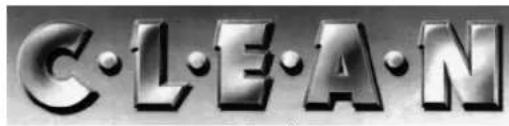
Optimized consumption
consumption optimized - oil-free lubrication - ergonomic - ergonomics
air tool - pneumatic tool noise reduction - reduced noise
Pneumatic tool information
| Товарни homер | 0 607 154 ... 0 607 161 ... 0 607 153 ... | |||||||
| ... 101 | ... 100 | ... 101 | ... 102 | ... 103 | ... 520 | ... 523 | ||
| КльькICTь оберим нахочтоунчicь | xВи.1 | 3200 | 2560 | 1200 | 2560 | 1200 | 3700 | 3700 |
| Корисна потужnicь | Вт | 120 | 400 | 400 | 400 | 400 | 180 | 180 |
| К.c. | 0,16 | 0,54 | 0,54 | 0,54 | 0,54 | 0,24 | 0,24 | |
| мас. дiamетр севдени в стani | MM | 4 | 8 | 10 | 8 | 10 | 4 | 4 |
| in | 5/32" | 5/16" | 3/8" | 5/16" | 3/8" | 5/32" | 5/32" | |
| Обаяг поставки | ||||||||
| - Швийскозатник севдений natрон | ● | |||||||
| - Зубочейс севдений natрон | ||||||||
| Оbertan�ся правору/cловору | ||||||||
| Разсевдениhoу natрona | ||||||||
| - 3/8"-24 UNF-2A | ||||||||
| - 1/2"-20 UNF-2A | ||||||||
| Повекши пд клич на севдениюшпундeni | MM | 14 | 17 | 17 | 17 | 17 | 14 | 14 |
| Дiamетр заимск hoilшени | MM | 28 | 46 | 46 | 46 | 46 | ||
| Мас. рobочий тusc на ровочу IHструmenti | bap | 6,3 | 6,3 | 6,3 | 6,3 | 6,3 | 6,3 | 6,3 |
| psi | 91 | 91 | 91 | 91 | 91 | 91 | 91 | |
| Приедны вална рizьбашианноюштуера | G 1/8" | G 1/4" | G 1/4" | G 1/4" | G 1/4" | G 1/4" | G 1/4" | |
| Чinctий дiamетршианга | MM | 6 | 10 | 10 | 10 | 10 | 10 | 10 |
| Стоожи Bavannah поитray на:xхочтоуху | n/c | 3,4 | 15,5 | 16 | 15,5 | 15 | 7,8 | 8,5 |
| cfm | 7,2 | 32,8 | 33,9 | 32,8 | 31,8 | 16,5 | 18 | |
| Bara вдимовidiю | Кг | 0,52 | 1,1 | 1,2 | 1,3 | 1,5 | 0,84 | 0,88 |
| EPTA-Procedure 01:2014 | Ibs | 1,1 | 2,4 | 2,6 | 2,9 | 3,3 | 1,8 | 2,0 |
Information about noise and vibration
Information about noise and vibration
Application of the tool (see Fig. A)
If you intend to operate the pneumatic tool in a suspended or clamped device, ensure that the tool is first secured in the device, and only then connect it to the air supply. This prevents unintentional switching on of the device.
The pneumatic tool can be suspended by the handle ring.
Press the pneumatic tool against the workpiece to ensure the tool is correctly positioned in the slot. The distance from the center of the pneumatic tool can be adjusted or set in the slot.
Press the button for lifting or lowering the recording head 2.
Regularly check the condition of the lifting mechanism and the lifting device.
Recording devices
0607154101/06071611./06071615.
The recording zone 2 of the pneumatic tool can be set in the recording device. If possible, try to use the entire recording zone. The larger the recording zone, the more recordings you can make.
Move the recording zone.
Mounting the foot pedal
0607 1605./0607 1611./0607 1615..
- Press the foot pedal 9 onto the recording zone 2. The foot pedal 9 can be turned in any position to ensure comfortable work without straining your hands. Turn the adjusting screw to adjust the foot pedal against the direction of the arrow and turn the foot pedal 9 to the desired position. Then tighten the adjusting screw by turning it in the direction of the arrow.
Exhaust air outlet
The exhaust air outlet can be directed away from your work area through a hose, according to the requirements. In addition, this will improve your working conditions, as your work area will not be polluted by exhaust air and there will be no dust or chips.
Centralized exhaust air outlet (optional)
Unscrew the union nut on the air inlet and place it on the flange neck 5. - Loosen the 11 flange bolts for the exhaust air 12 and close the flange for the exhaust air on the flange neck 5, tightening the flange clamp.
The exhaust air outlet is connected to the switching air source, since the housing 14 must be purged.
The exhaust air can be discharged into the atmosphere.
- Unscrew the mounting screws 13 and remove the housing cover 14. Replace the union nut with the hexagon nut 15 and close the housing cover again with the three mounting screws. Screw the flange neck 5 with the hexagon nut 15 onto the air inlet. - Loosen the 11 flange bolts for the exhaust air 12 and close the flange for the exhaust air on the flange neck 5, tightening the flange clamp.
Central exhaust air outlet with exhaust air kit (N.M.A.S)
You can discharge the exhaust air into the atmosphere, for which you need to connect the central exhaust air kit 17.
Note: Make sure that the flange neck 5 is not closed by the adjusting screw 20 at the air inlet, and that the sealing ring 16 fits into the groove between the housing and the exhaust air kit 17. - The incoming air must first pass through the flange for the exhaust air 12.
First, loosely screw the adjusting screw 18 onto the exhaust air kit, then screw the adjusting screw 20 onto the air inlet and tighten the flange neck 5 onto the adjusting screw 18. - Place the union nut 19 on the exhaust air kit flange neck. - Loosen the 11 flange bolts for the exhaust air 12 and close the flange for the exhaust air on the flange neck 5, tightening the flange clamp.
Central exhaust air outlet (N.M.A.N.D)
- Loosen the clamp 11 of the air hose 21 and close the hose clamp on the flange neck 5, tightening the hose clamp. Find on the air hose 21 the mark for the exhaust air (central) 22, through which the exhaust air will be discharged. Connect the air hose to the air source (see "Connecting the air source", page 1) and the exhaust air (central) 22 on


Connect the air supply hose to the tool.
Maximum air pressure (bar/MPa)
Make sure that the air pressure does not exceed the maximum value (91 psi), because the pneumatic tool is designed for a certain pressure.
Do not use the pneumatic tool if it is damaged, repair it first, check for air leaks and replace damaged parts and hoses.
Note: Use a pressure regulator with a filter and a lubricator. This ensures safe and reliable operation of the pneumatic tool.
Refer to the instruction manual for the pressure regulator.
All hoses, couplings, and fittings must be rated for the required air pressure.
Do not use damaged, worn, or defective hoses, couplings, or fittings!
Check the air pressure at the tool inlet with a pressure gauge while the pneumatic tool is running.
Connecting the air supply to the pneumatic tool
Close the shut-off valve 5 on the coupling at the air inlet 20.
To prevent damage to the internal parts of the valve, when tightening or loosening the shut-off valve, hold the coupling at the air inlet 20 with a wrench (size 22 mm).
- Loosen the hose clamp 11 on the air supply hose 21 and close the hose on the air supply valve 5, then tighten the clamp.
Note: The air supply hose should be installed before mounting the pneumatic tool and before connecting it to the service unit.
MOHTAX CBePdHnHbHO nATPOHa (DHB.MaF)
IobpeBisbMItcBiDnOBiHMraIKOBmKIOHcEMa nOBepxHO iN KIOU6CBEPINbHOIINHdE1HaKpyITb Ha CEBPINbHN WINHdEb 3y6actn CBepINbHN naTPOH23 aO bWBNKOaTHCKHN CBepINbHN naTPOH24.
CBePdHnBHH nATPOH Tpe6a 3aTARHyTH DO MOMeHTy 3aTAYBaHH npH6n.20-25HM.
3aima 3y6bactoro cBepnHbHoro natpoHa
Iobpe Bi3bMItbcra 3a NOBepxHIO nID KIOU CBEpINHBHOI INHdE1 BIDNOIBHM raIKOBIM KIOUeM.
BcTporimbKnHou Do CbePnInbHoro NaTPOHa 25 B OINH3 Tpbox OTbOpiB y 3y6aCTOMy CbePnInbHOMy NaTPOHi 23i BIDKpyITb CbePnInbHmN NaTPOH NOBepTaHHM NIBOPuy.
BkaibKa: Kaio CbePiNbHn NaPOn CNiNb dyXe MiHo, DOnOMoKItb Coi BCTpOMieHM B 3aTnCKaU po6OFO IHCTpyMeHTa 26 TopueBM WcETnPaHHM KIOyem.
3aima 3y6cactoro cBepdnnhbo nato poha
- POKlaIbTb NHEBMaTHHn IHCTpyMeHT Ha CTmky OCHOBy (HaNP., Ha Bepctak). Bismbtca3a nobepxHIO nI KIOU6 CbePnNbHoro naTPOHa 1 BiNOBiINHM rAIKOBNM KIOUcEM i NOBepTaHHM niBOpuy BIKpyITb WBIINKO3aTNCKNH CbePnNbHn naTPOH 24 i3 CbePnNbHO HorO nnHdJI.
BkaibKa: RaC BepnHbHn NaPOn CnHb DyKe MiHo, Donomokitb cobi BCTpOMHeHM B 3aTnCKaP o6oYoro IHcTpMeHTa 26 TopeBn WecTHrpaHHM KIOyem.
3aima p06oyoro inctpymenta (nB. man. G)
3y6uactn CBepeHnblHHn NaTPOH
IIOBepTaIOH, BiKpNITE 3y6aCTNH CBePnINbHN nATPOH 23, IO6 B HbOTo MOXHa 6yNo BCTPOMHTn PO6OHn IHCTPymeH. BCTPOMtB p6oouH IHCTPymeH. BCTpOMiTb KIOH Do CBePnINbHO rNaTPOHa 25 y BiIOBIDHI OTBOPN B3y6aCTOMy CBePnINbHOMy NaTPOHi 23 i pIBHomIPHO 3aTfHITb poOOn IHCTpyMeHT.
BnMaHna po6oOro iHcTpymenta: -3a donomorok KIOUO dCbePnHoro natoha nobephiB bTyNKy 3y6uactoro cBePnHoro natoha23 npoTcpiKn rOHNHHka, 06 MoKHa 6yNo BnHrtn pooboun HCTpymENT.
WBnKo3aTHcKHH CBePdHbHNbHN NaTPOH
Remove the front bushing 27 and the high-speed chuck 24, and turn the front bushing 28 against the stripper so that the tool can be installed. Install the tool. Remove the front bushing 27 and the high-speed chuck 24, and turn the front bushing 28 by hand against the stripper so that the valve is obtained. The drill chuck is fixed automatically.
To remove the tool: - To remove the tool, turn the front bushing 28 in the opposite direction.
Operation
Maintenance
The pneumatic tool works optimally at an operating pressure of 6.3 bar (91 psi), supplied to the inlet of the connected pneumatic tool.
Removal/Installation (if applicable)
Removal: If a long pause is required, the pneumatic tool is not disconnected, turn off the air supply and check the motor a few times, taking the tool's handle 26. Remove the adapter.
200|Ukrainian
To save energy, disconnect the pneumatic tool when it is not in use.
0607154101/06071611...
To start the pneumatic tool, press the lever 3 and hold it during operation. To stop the pneumatic tool, release the lever 3.
06071535./06071605..
To start the pneumatic tool, press the trigger 7 and hold it during the operation. To stop the pneumatic tool, release the trigger 7.
06071615..
To start the pneumatic tool, press the trigger 7 or the lever and hold it during operation. To stop the pneumatic tool, release the trigger 7.
External thread (INB.Man.1)
0607160509/0607160511
Turning the ring: turn the adjusting ring clockwise until it stops. Turning the ring counterclockwise: turn the adjusting ring counterclockwise until it stops.
Adjustment instructions
Incorrect adjustment of the tool may lead to a significant change in the number of revolutions and to tool failure, but this will not damage the motor.
Technical maintenance service
Technical maintenance and cleaning
Technical maintenance and repair of the tool should be carried out by qualified personnel. Under such conditions, the pneumatic tool and accessories will be protected from damage.
Authorized master will perform the repair quickly and professionally.
Regular cleaning
Regularly clean the air inlet. To do this, turn off the tool and disconnect it from the air supply. Then turn the tool back on. Water and contaminants that have accumulated in the compressed air can cause damage to the blades, valves, etc. To avoid this, the air inlet should be covered with a few drops of motor oil. Then connect the pneumatic tool to the air supply (see "Connecting to the air supply", page 199) and let it run for 5-10 seconds, blowing out the excess oil. Repeat this procedure each time before prolonged use of the pneumatic tool.
Preventive technical maintenance
After every 150 hours of operation, clean the gearbox with a solvent. Follow the solvent manufacturer's instructions for use. Then lubricate the gearbox with special transmission oil. Repeat the cleaning procedure every 300 hours of operation, starting from the first cleaning. Special transmission oil (225 ml) article number 3605430009 - for the gearbox of the angle grinder. Check the oil level and add if necessary.
Lubrication of pneumatic tools that do not belong to the CLEAN series
All Bosch pneumatic tools that do not belong to the CLEAN series (a special type of pneumatic motor that operates on dry air) must be regularly lubricated with a few drops of oil. The necessary oil is located in the compressor maintenance unit, which is installed before the pneumatic tool (the norm can be obtained from the compressor manufacturer).
The pneumatic tool is designed for use with a toothed belt or V-belt drive.
The full range of high-quality accessories can be found on the internet at: www.bosch-pt.com or in a specialized store.
Service and customer advice on product use
For any questions and orders for spare parts, please specify the 10-digit order number that is on the type plate of the pneumatic tool.
The service workshop will answer questions regarding repairs and maintenance of the tool. Information about spare parts can be found at:
www.bosch-pt.com
The Bosch team of specialists will be happy to answer any questions regarding the use of the product and its accessories.
Warranty service and repair of the power tool are carried out in accordance with the rules and norms of the territory of sale or
AUTHORIZED SERVICE CENTERS OF THE COMPANY "ROBERT BOSCH". WARNING! Use of counterfeit products is dangerous and can cause harm to health. The production and distribution of counterfeit products is prosecuted by law in administrative and criminal proceedings.
Ukraine 201
Ukraine
LLC "Robert Bosch"
Service center for power tools
Kraniv St., 1, 02660, Kyiv-60
Ukraine
Tel.: (044) 490 24 07 (багатоканальний)
E-Mail: pt-service.ua@bosch.com
Офіційний сайт: www.bosch-powertools.com.ua
Адреса регіональних гарантійних сервісних майстерень
Зазначена в національному гарантійному талоні.
Утилізація
Пневматичний прилад, приладдя і упаковку треба здавати на екологічно чисту повторну переробку.
Віддайте машинку і оснащення на екологічно чисту утилізацію. Зважайте на законодавчі приписи. Частини двигуна треба видаляти належним чином!
Частини двигуна містять тефлон. Не нагрівайте їх понад 400°C, скільки це може призвести до утворення шкідливих для здоров'я парів.
Коли пневматичний прилад остаточно виходить з ладу, його треба здати в пункт вторинної сировини або в магазин, напр., в авторизовану майстерню Bosch.
Можливі зміни.
202|Казакстан
Казакстан
Ендірушінің уәкілдік өкілі: пайдаланушы құралдың пайдалану мерзімі өтіп, жарамсыз болған кезде, оны қоқысқа тастамаңыз. Қажеттілікке қарай қоқысқа тастаңыз. Оны өндірушінің мемлекеттік тұрғылықты жері бойынша және қоқысқа тастау керек.
Ендірушінің құнын өтеу, құқықтық кепілдіктерге сәйкес. Міндетті контактілік мәліметтерді орамада табу мүмкін.
The device is designed for measuring temperature. The temperature measurement is carried out by a sensor (the sensor is installed at the end of the probe). The measured temperature is displayed on the display.
The device is designed for measuring temperature and humidity.
If the housing is damaged, the device must not be used - the device must be disconnected from the housing, the device must not be used if the housing is damaged, the device must be protected from moisture and dust. If the device is used in a humid environment, the device must be protected from water splashes.
Technical specifications
- The device's power supply and the device's power consumption
Measurement range and accuracy
The device must be used after reading the instructions.
Storage
The device must be stored at temperatures not exceeding the specified range and away from direct sunlight. The device must be protected from high temperatures - storage at temperatures above the specified range is not allowed. For information on storage conditions, see GOST 15150 (section 1).
Operation
During operation, the device must be protected from mechanical impacts and falls. It is allowed to use the device with packaging materials. For operating conditions, see GOST 15150 (section 2).
Safety precautions
Safety precautions for pneumatic devices
Do not operate the pneumatic gun without reading and understanding all safety instructions. Failure to follow safety instructions may result in injury.
Keep safety instructions for future reference.
Safety instructions for pneumatic tools
When using the tool, always wear protective eyewear and hearing protection. Do not wear loose clothing or jewelry. Keep hands and fingers away from the tool's moving parts. Do not use the tool in explosive atmospheres or near flammable liquids. Do not use the tool if it is damaged or malfunctioning. Always disconnect the air supply before making adjustments or changing accessories. Use only recommended air pressure and never exceed the maximum pressure rating.
Pneumatic tool safety
Always wear safety glasses and hearing protection. Do not point the tool at yourself or others. Keep fingers away from the trigger when not in use. Use only clean, dry, regulated compressed air. Do not use oxygen or other combustible gases. Never use the tool as a hammer. Inspect the tool before each use. Do not use the tool if it is damaged. Use only recommended accessories. Do not exceed the maximum air pressure. Disconnect the air supply before cleaning, servicing, or storing the tool. Store the tool in a dry place out of reach of children.
Operator safety
Always wear safety glasses and hearing protection when operating the pneumatic tool. Do not use the tool if it is damaged or malfunctioning.
When using the pneumatic tool, always wear safety glasses and hearing protection.
Before using the pneumatic system, check that all connections are properly secured. If you are using hoses or pneumatic components, ensure that they are not damaged, cracked, or worn. Do not use the system if any parts are damaged. When connecting or disconnecting pneumatic lines, be careful not to pinch or damage the hoses. Do not exceed the maximum operating pressure of the pneumatic system. Use only compatible components and follow the manufacturer's instructions. Do not modify the pneumatic system without proper authorization. Always wear appropriate personal protective equipment. Keep the work area clean and free of obstructions. Do not operate the pneumatic system if you are tired or under the influence of drugs or alcohol. Inspect all hoses and fittings regularly for wear and tear. Replace any damaged parts immediately. Do not use the pneumatic system if any part is missing or broken. Use only the recommended lubricants and fluids. Failure to follow these warnings can result in serious injury or death.
Pneumatic system maintenance and repair
Do not operate the pneumatic system without proper training or authorization. If you are not trained or are unsure, do not use the pneumatic system. Do not use the pneumatic system if it is damaged. Before use, inspect the pneumatic system for any damage. If the pneumatic system is damaged, do not use it until it has been repaired by a qualified technician. Do not attempt to repair the pneumatic system yourself unless you are qualified. If the pneumatic system is not working properly, turn it off and have it inspected. Do not use the pneumatic system if any parts are missing or broken.
Disconnect the power source. This section describes the pneumatic system components and their functions.
Pneumatic cranes should be operated only by trained personnel. If such personnel are not available, pneumatic cranes may be dangerous. Do not operate pneumatic cranes. If the crane's load hook is not properly secured or the hook is damaged or closed, do not use the pneumatic crane. Do not use a pneumatic crane with a closed hook. Pneumatic cranes with a closed hook must not be used. Pneumatic cranes should not be used for lifting people or loads. Keep hands away from moving parts. Do not use pneumatic cranes with damaged or worn parts. Do not operate pneumatic cranes near flammable materials or explosive atmospheres. Always follow the manufacturer's instructions. Pneumatic cranes are designed for lifting and moving loads only. Do not use them for other purposes. It is possible to modify pneumatic cranes, but only with proper safety measures.
Service
Pneumatic cranes must be equipped with safety devices. Check the pneumatic crane for any signs of damage.
Pneumatic crane safety instructions
Be careful when operating the crane. If necessary, replace the hook. If the pneumatic crane is damaged, it must be repaired by a qualified technician. During operation, do not exceed the rated load capacity. Always use appropriate safety equipment. Operators and maintenance personnel must be trained and qualified to operate the pneumatic crane safely.
204|Kazakh
Reactive forces or sudden movements can cause the pneumatic crane to become unstable. Do not operate the pneumatic crane beyond its rated capacity. It is possible to use additional safety devices. If sudden movements occur, stop the crane immediately. Follow the manufacturer's instructions for safe operation.
-Use pneumatic cranes only with proper training, -Do not exceed the rated load capacity, -Always follow the manufacturer's instructions.
Before starting work, check the mowing mechanism. The mower blade must be sharp. It must not be bent. If it is bent or cracked, replace it with a new blade or use a pneumatic tool. The new blade must be installed so that the cutting edges face the direction of rotation. When using pneumatic tools, during operation, do not allow hands, feet, or other body parts to come near the cutting area. To use this pneumatic tool, connect a suitable hose to the hose fitting, and install the regulator in the upright position. Operators must be trained and authorized to work with pneumatic tools. If the operator experiences symptoms such as dizziness, fatigue, nausea, vomiting, or other discomfort, they must stop work immediately. Inform the supervisor and report to the doctor. Warning! Do not use the pneumatic tool if it has been dropped or damaged. Check for leaks. Replace damaged parts with original spare parts or equivalent. Do not bring the tool near electrical wires or gas lines. Do not bring it near water pipes. Do not bring it near chemical materials. Note: Do not use the pneumatic tool near flammable gases or liquids.
WARNING
Do not use the tool for purposes other than cutting, trimming, or mowing.
Sometimes it may be necessary to use the tool for other tasks, such as trimming hedges or cutting branches.
However, doing so may damage the tool. Always follow the safety instructions:
Do not use the tool near flammable materials; avoid contact with bricks, cement, or concrete containing quartz or silica; avoid contact with chemicals, wood, metal, or chrome.
The tool must be kept clean and free of debris. Clean the tool after each use with a dry cloth or brush, and store it in a dry place.
If pneumatic devices are used, they must be equipped with protective devices to prevent damage to the pneumatic devices themselves, and the pressure must be adjusted to the required level. If the pneumatic device is not equipped with a pressure regulator, it must be present in the pneumatic system before the device. The manufacturer's instructions and the upper limit of the pressure must be observed. It is possible to use the device. The pneumatic device must be protected from contamination. The manufacturer's instructions must be followed. If there are leaks in the connections, hoses, or fittings, or if they are damaged, stop the pneumatic device and notify the manufacturer. Do not attempt to repair it yourself. It is possible to remove the pneumatic device only after disconnecting the air supply. To remove the pneumatic device, if possible, use a hoist, crane, or other lifting equipment. The pneumatic device is not a toy; it must be operated only by trained personnel. It is possible to increase the pressure beyond the recommended level. If a universal joint (cardan joint) is required, it must be installed. The use of pneumatic automation or pneumatic components must be carried out in accordance with the safety regulations. The pneumatic device must be installed by qualified personnel.
Warnings
Warnings: It is possible to operate the pneumatic device only after reading the manual. Follow all instructions and warnings. The warnings must be observed to prevent injury and damage to the pneumatic device.


In Kazakh! 205
Warning symbols

Read all instructions, warnings, and safety precautions before operating the pneumatic device. Failure to follow the instructions or warnings may result in injury.

Safety instructions for operation.
BT WARNING
| Hm | HbIToH-MeTp | энерия 6iPnirī (aɪhaɪbɪmɪdap cahbl) |
| Kr ФуNT | КилограмM ФуNT | Масca, aybɪpɪbɪfbl |
| ММ | МиллмeTp | Узblɪdɪk |
| MHH c | МинуT Секунд | Уakblɪ apaɪbɪfbl, Узakɪtɪk |
| MHN-1 | БiP MnHyTTeri aɪhaɪbɪmɪdap Hemece ĀpekeɪTep | Бoc aiHaŋy cəti |
| Бар пси | Бар ФуNTшapшы дɪоɪmɪfa | Aya KBɪcɪMbɪ |
| Л/c | Лиtrp секун'dta | |
| Тeкшe ФуNT | Тeкшe Фут/MɪnHyT | Аya пɪdɑlaɪhʊ |
| MɪnHyTTa |
| ДБ Д ecнбел | Арн. келем салысты рмалы дayыс Куши ушin | |
| SWF | Жылдан онлайнасты палын патрон | |
| ○ | Ишк ai'tы Кырны ушin бени | |
| ■ | Сырты Терг Кырны ушin бени | Асан панtrpoны |
| UNF | КШ-kiш ошь ( Unified National Fine Thread Series) | |
| G | Whitworth-ошьfы | |
| NPT | National pipe thread | Бірітіру ошьfы |
Warning and service symbols

Read all safety instructions and warnings. Technical safety instructions and warnings must be observed to prevent injury or damage.
The pneumatic device must be inspected before each use.
Do not operate the device without reading the manual.
The pneumatic device must be protected from metal, ceramics, and plastic contamination.
Warnings and symbols
The components shown in the figures may differ from the actual device. The figures are schematic and may vary in the pneumatic device.
1 Byfblnay mnnHndeni 2 KbicyOpHbMbCaBbKocBIMuaTyTkaYuIH 3 Kockbiw/ewipriu (TyTkbiw) 4 Inriu
6 Byprbnay winnHdeninH KIn TaMaBf 7 Kockbiw/ewipriu 8 BaceHdTeKlWteri aya WbIbIcbl 9KocbIMwaTytKa
5IHaHrKeTKeYb6pBb 10 Iriuteri 6ekity onbfb 11WnHaHKaMbTbI 12 WbIfbIH aya wnaHrbI 13 Kopnyc KaKaNaFbHbH 6eKITy bpaHaDaCbI 14 Kopnyc kaKaIaFbl 15 Antb KblbComblkaya Wblfbcbl 16 TbFbl3dayblw CaKNHa 17 Aya 乌bifapy kHaFby (keKeen) 18 AyaMbIfApyXINHaFbIHaIaFbI Kocy KeIeKy6bIpaIbI 19 Aya 乌fapy JxHaftbHaftbFbU Wb6aBkbl 20 Aya kipicihde 6ipiktiperin KeTe Ky6bip 21Aya Knyblnybl 22 Optanbik WbIfaTbH aya WnHaTbI 23 Ticti taekik 6ypfbnay natohoHbI 24 Te3 KblicatbH 6yPbInay nAtpohbl 25 Bypanda na npohki kini 26 Actan naHTpoHbI 27 Aptkblnlnb3a 28 Anbihfblnbl3a 29 AHHany 6aftbHbHa bictbipbn-Kockblb
*BeyHeneHReHHeMeCe HnATAnTAFH Xa6bIbKap TaHApTbI KETi3y KeNemEmeKamTbImaMbI. TOnbIKXa6bIbKapDbI 63dH Xa6bIbKap TaBapNamAmBldanTa6ab3I.
Technical specifications
0607 1535./0607 154 101
This pneumatic tool is designed for CLEAN applications. The CLEAN technology reduces oil consumption and energy consumption and increases service life.
Do not use the tool without proper training.
206|Kazakh
lubrication free - oil-free
ergonomic - ergonomic
air tool - pneumatic tool
noise reduction - noise reduction
consumption optimized - consumption optimized
Executive Vice President Engineering
Helmut Heinzelmann
Head of Product Certification PT/ETM9

Robert Bosch Power Tools GmbH 70538 Stuttgart, GERMANY Stuttgart, 01.01.2017
XnHay
AcymenKbicyKypanbl
Inriu acnan (Acypetin kapaabla)
ErepnEBMaTHKanbIKKypaIbIniriwHemeceKbckblacnanta naDanahy Kepek 6onca, aya Ketictipyi KocyaHa andbin acnantb6ekiri3. ObimEn Ke3deCOK naDanaHydbIn aDbH anacbi3.
Inriuine 4 nheMaTHaNbIK KypanDbI inrii acnanta 6kity MymkiH.
-06071535..
Inrni4 nHeBMaTHKaIbIK KypanFa OPhaTbn ObIKKa 10 kipri3iH3.
IHeBMaTKaBk Kpaan aybipnK optanbIFHa 6aHnAHyCTb anDbIHbI HEmec apTkbl OyIKbI naDaanHy MymKiH.
-06071615..
IniwiTi 4 KbCy opHbHa cAnbHb3 2.
Xyhenik type inriu kynin xane inriu acnantbinn eririn tekepii3.
Kbickbiacnan
- Before using the device, carefully read the user manual. Only use it for its intended purpose. Failure to follow the instructions may result in damage.
Do not use the device beyond its intended purpose.
Intended use
The device is intended for household use. It is not intended for commercial or industrial use.
If the device is used for commercial purposes, the warranty will be void. The manufacturer is not liable for damage caused by commercial use.
Safety instructions
Before using the device, read the safety instructions carefully. Failure to follow the safety instructions may result in injury or damage to property.
Safety instructions (see figure 1) 0607 161. 0607 1615..
When using electrical appliances, basic safety precautions should always be followed. - Do not use the device if the power cord or plug is damaged.
The device must be used with the correct voltage as indicated on the rating label. Use only the supplied power cord.
Before using the device, check that the voltage matches the local power supply.
If the power cord is damaged, it must be replaced by the manufacturer, its service agent, or similarly qualified persons in order to avoid a hazard. Do not use the device if the power cord or plug is damaged. Do not use the device if it has been dropped or damaged. If the power cord is damaged, it must be replaced by the manufacturer, its service agent, or similarly qualified persons in order to avoid a hazard.
Aya wbfapy KHHaHbIme HKeKeNe aya wbfapy (C cypetIH kapaHb3)
06071611..
BbfaTbH ayahb bifaTbH aya KOHeIhe HKeKeIe 17 aya bIfapy KHaFbIa6ekit anapy MyK.
Eckptne: LnaHrTik HnnnEnb 5 aya KipiciHderi 20 Kocy KeTe KybblbHa 6ypaMaHaBHa JxHe 16 Tbi3aybIu CaKHa Kopnyc neH 17 aya WbIfapy XHaHaBbHbApacBHaFbI WyHKbPwanda JatNaybHa Ke3XeK3iJ3, OcbIna WbIfaTbIH aya TeK 12 aya WbIfapy WnaHrIne 6apabbl.
Aya 1bIfapy KINHAFBnIH,18 KOCY KeNTe KybipnapaBH aya KipiciHderi 20 KOCY KybipnapbHa 6ypan 5 WnAHITIK HnnneBdi 18 KOCY KeNTe KybipBaHa 6ypan 6ekitih3. Aya shbFapy KINHAFbHdAfb19 Wy bAckbIbH aya shfapy XHHaFbHbIH WnHaHTIK HnPiNneIHe aJMaCTbPbHb3. - Wnahr KambitapbH 11 aya wibapy WnaHbHda 12 6ocatbn ayaa bifapy WnaHbH KeTne Ky6bip 5 yctiHe H nanaH KambtBn Taptbn 6ekiriH3.
Optanbikaya wbfarpy (D cypetih kapaht3) 0607161.06071615..
UHaKamblTap11 aya Kybiny UHaHbHda 21 6ocatbn aya Kynblny UHaHbHKeTe Kybip 5 yctiHe HnAHaKamblTap1bn Bekitih3. AyaHbI Kymblc opHbHa apb6aftTnBih WbifatbH ayaa HnaHbH (optanbK) 22, aya Kyblny LnaHbR 21 yctiHeh opHbH3. CocbIH INHEBMATKaNbIK KpaJIbI ayaxtictpyre KocBIn (Aya Kxetictpyre KocBIn, 2106eTI KapaHb3) aya bHybL NnAHbH (optanbK) 22 opHaTbIFaH aya KxeticiTpY vctiHeh KpapanarfbHa TaPbH3.
210|Ka3aKa7a
Aya keriictipyre kocbiny (E cypetih KapaHb13)
Aya Kbcbmb6,36apdaH (91ncn) TEme 60maybHa Ke3KeTki3i3, eTKeH INHEMaTHKanbk KypaN Ocbj XyMbIC KbCbMbHa apHaHa.
MaKcMaNdbKyataKaTeYyHJWNaHrTbHJXapbKtAfeHi MeH KocbIyOnbIbFkKeNEMi,TexHKaBikMnIMeTep KecteciHde KpcetirReHne6onybKaKet. TOnbIK KyaTbCaKtay yuH WNaHrTaBbMakcMaNdby3bHDbf4 M 6onybKaKet.
KetkiinreH cbfbnFaH aya 6eIe DeHe MeH bInrAanbKaTah 6oc 6onybl KaKeT, eTIKeHI NHEMaTHKnAbk KypaNdl 3akBmHaHydah, NaCTaHydAn HEmeCe 3EHnKopFay KaKeT.
Eckptne: Cbfbnfa h aya Kbi3Met Kepcety KpbIyIbICbH naIanahy Kepek. Byn KpybIbI apKbIbI nHEBMAtNkAlbIK KpaIaNbIMHCi3 Xymbc icTeYiH KaTMaCbIs etY MyMKIn. KbI3Met Kepcety KpybIbICbIHn IaIanaNy HcyKayIbIKapbIHOpbIHDaHbI3.
BapbikapmTypa,6ipiktipy KybipnapbMeH IHaHTap Kbcim XHe TanaI eTInReh aya KeNemie caI peTe OpbHdanybKaKet.
Ketki3y luHaHTapbHbIHKaHbIMaybiHa, nIMeyiHe Hemece JapbIMaybiHa Ke3 KETk3iH3!
Connect the pneumatic hose to the air inlet fitting.
For connecting the pneumatic hose to the fitting
The hose is connected to the air inlet fitting with a 20 mm diameter. The pneumatic hose has two channels and for sealing, the hose is connected to the air inlet fitting with a 20 mm diameter, and the hose is connected to the fitting or at other times with a clamp (clamp width 22 mm). - The hose clamps are installed at 11 points on the air hose installation plan, and at 21 points on the air hose installation plan, the hose is secured with hose clamps.
Note: The air hose must be connected to the pneumatic hose fitting with a clamp.
Drill holes (see figure)
Drill holes with a diameter of 16 mm at the marked points, then drill holes with a diameter of 23 mm for the drill holes, or 24 mm for the drill holes, and then drill holes with a diameter of 20-25 mm at the marked points.
Installing the drill hole plugs
Drill holes with a diameter of 1 mm at the marked points, then insert the plugs into the 23 mm drill holes, and then insert the plugs into the 24 mm drill holes.
Note: The plugs must be inserted into the holes with a diameter of 26 mm.
Installing the air hose
- Connect the pneumatic hose to the workbench (workbench).
- Drill holes with a diameter of 16 mm at the marked points, then insert the plugs into the 24 mm drill holes, and then insert the plugs into the 24 mm drill holes.
Note: The plugs must be inserted into the holes with a diameter of 26 mm.
Adjusting the koumiss hose (see figure)
Drill hole plugs
Tighten the cartridge 23 to the specified torque. The specified torque is 25 Nm for the 23 cartridges. Tighten the cartridges to the specified torque.
Animal/plant parts: Tighten the cartridge 23 to the specified torque. The cartridge 23 is tightened against the animal/plant part with the specified torque.
Quick-release cartridges
Quick-release cartridges: The 24 cartridges are installed with the specified torque and can be removed against the direction of the 28-hour clock. Remove the cartridges. The 24 cartridges are installed with the specified torque. The 28-hour clock is marked on the cartridges. The cartridges are tightened to the specified torque.
Animal/plant parts: The 28 cartridges are tightened against the animal/plant part with the specified torque.
Disassembly
Disassembly procedure
If the pneumatic valve is stuck, apply a force of 6.35 (91 psi) to remove it.
Removal (see figure)
Note: If the pneumatic valve is stuck, apply a force of 6.35 (91 psi) to remove it. If the valve is stuck, apply a force of 6.35 (91 psi) to remove it.
To reduce energy, remove the pneumatic valve from the disassembly.
0607154101/06071611..
To remove the pneumatic valve, press the button and remove it. To install the pneumatic valve, press the button.
06071535./06071605.
To remove the pneumatic valve, press the button and remove it. To install the pneumatic valve, press the button.
Pneumatic gun for braiding kos 7 and kos/braiding machine. Instructions for use and maintenance. -Pneumatic braiding machine for braiding kos.
Fill the oil bath (see figure I)
0607160509/0607160511
Oil bath: reverse rotation - 29 turns without the head. Oil bath: reverse rotation - 29 turns without the head.
Lubrication instructions
The specified oil bath must be filled with the recommended oil type and level. Do not overfill.
Technical maintenance and service
Service and maintenance
Service and maintenance work must only be carried out by qualified personnel. The pneumatic gun is not protected against unauthorized use.
Use only original spare parts and accessories.
Troubleshooting
- The pneumatic gun must be disconnected from the air supply before troubleshooting. The gun must be disconnected from the air supply before any maintenance. The gun must be disconnected from the air supply before any repair. The oil and water separators must be drained regularly. To drain, the air supply must be disconnected for 20 minutes. The pneumatic gun must be disconnected from the air supply before any maintenance (see "Disconnecting from air supply", page 210) for 5-10 seconds, then the oil level must be checked. If the pneumatic gun is not used for a long time, it must be stored in a dry place.
Regular maintenance
- Before initial operation, read and follow the operating instructions and the safety instructions of the power tool. Failure to follow the safety instructions may result in electric shock, fire, and/or serious injury. Keep the operating instructions for future reference. The user is responsible for accidents involving other people or their property. Before initial operation, ask your dealer or a specialist for advice if you have any questions. The power tool (225 m) is intended for professional use in accordance with the manufacturer's instructions.
CLEAN-Only use pneumatic tools that are clean and free of oil and grease.
CLEAN-Only use Bosch pneumatic tools that are clean and free of oil and grease (see maintenance instructions).
When using pneumatic tools, always wear safety goggles and a dust mask. The dust produced during operation may be harmful to health. The dust from materials such as lead-containing paint, some types of wood, and metal may be hazardous. Contact with or inhalation of these dusts can endanger the operator and bystanders.
Pneumatic tools must be operated and maintained in accordance with the safety instructions and the manufacturer's instructions. Use only original Bosch accessories and spare parts.
Required accessories
All pneumatic tools must be equipped with a pressure regulator, a filter, and a lubricator (optional) in the air supply line.
For the correct selection of accessories, visit www.bosch-pt.com or contact your dealer.
Maintenance and service
Before any work on the pneumatic tool, disconnect it from the air supply and release the air pressure from the hose.
Maintenance and service instructions: Keep the tool clean and free of oil and grease. For safe and proper operation, always keep the ventilation slots clean. For more information on cleaning and maintenance, see the following:
www.bosch-pt.com
For questions about the Bosch service center and their authorized service partners, contact the address provided.
Only use original Bosch spare parts and accessories. Repairs should only be carried out by qualified personnel using original spare parts. Otherwise, the safety of the tool may be compromised.
WARNING! Read all safety warnings and all instructions. Failure to follow the warnings and instructions may result in electric shock, fire, and/or serious injury. Save all warnings and instructions for future reference.
Kazakhstan
Robert Bosch
Electric Power Tools - Service Center
Almaty, Kazakhstan
Kazakhstan
050050
Raiymbek District, Dangyly
Kommunalnaya Street, 169/1
Tel.: +7 (727) 232 37 07
Fax: +7 (727) 233 07 87
E-Mail: info.powertools.ka@bosch.com
Website: www.bosch.kz; www.bosch-pt.kz
Service
Pneumatic tools, their accessories and spare parts - for proper operation, please refer to the service instructions.
212|Kazakhstan
May be used as a spare part for the original equipment manufacturer's tool. The use of non-original spare parts may lead to malfunctions. The use of non-original spare parts is at your own risk. Do not heat above 400°C, as this may damage the tool and cause it to break.
If the tool is not working properly, you can send it to the service center or to an authorized Bosch service center for repair.
Technical data subject to change.
Technical data
0607 1535./0607 154 101
ergonomic - ergonomic
air tool - pneumatic screwdriver
noise reduction - reduced noise level
Identification number 0607 154 ... 0607 161 ... 0607 153 ...
tighten the wing screw by turning it clockwise.
Power tool service phone: (021) 4057540
Fax: (021) 4057566
E-Mail: infoBSC@ro.bosch.com
Customer consultancy phone: (021) 4057500
Fax: (021) 2331313
E-Mail: infoBSC@ro.bosch.com
www.bosch-romania.ro
Disposal
The pneumatic tool, accessories, and packaging must be sent to an ecological recycling station.
Dispose of lubricants and detergents in an environmentally friendly manner. Observe legal regulations. Dispose of rotor blades properly! The rotor blades contain Teflon. Do not heat them above 400°C, as otherwise harmful vapors may be released.
If your pneumatic tool is no longer in working condition, please take it to a recycling station or hand it over to a distribution unit, e.g., an authorized Bosch service and after-sales center.
Subject to modifications.
Bulgarian
Safety instructions
General safety instructions for pneumatic tools
WARNING
Before mounting, operating, repairing, maintaining, or replacing accessories on the pneumatic tool, as well as working in its vicinity, read all instructions. Failure to follow the safety instructions may result in serious injury.
Keep all safety instructions and warnings for future reference and give them to the operator of the pneumatic tool.
Workplace safety
Keep the work area clean and well lit. Cluttered or dark areas invite accidents. Never operate the pneumatic tool in explosive atmospheres, such as in the presence of flammable liquids, gases, or dust. During operation, sparks may be generated that could ignite dust or fumes. Keep bystanders, children, and pets away while operating the pneumatic tool. Distractions can cause you to lose control.
Safety with pneumatic tools
Never point the air stream at yourself or others. Always direct the air stream away from yourself. The air stream can cause serious injury. Check the hoses and fittings. Any pressure regulator, lubricator, hose, or coupling must be suitable for the technical parameters regarding the pressure and flow of air. High or low air pressure can cause improper operation of the pneumatic tool, and high or low pressure can cause material damage or personal injury. Protect the hoses from being pulled, twisted, or coming into contact with solvents or sharp edges. Keep the hoses away from heat sources, oil, and rotating parts of the machine. Protect them from damage. Regularly inspect the hoses and replace them if damaged. Damage to the supply line can cause leaks and rapid movement in different directions due to the reactive force of the free end of the hose, which can cause injury. Be careful of the air stream and the chips; they can cause serious injury.
Always ensure that the hoses are properly connected. Improperly connected or damaged hoses can cause uncontrolled air release.
ChryphocHa nepcoHana
Be careful, safety requirements are observed when working with pneumatic tools. Do not use pneumatic tools when you are tired or under the influence of alcohol, drugs or medication. A moment of inattention while working with pneumatic tools may result in serious injury. Work with protective equipment and wear protective goggles. Wear protective equipment, e.g. dust mask, safety shoes with steel toe caps, protective gloves or hearing protection (ear muffs) according to the instructions of the tool manufacturer and according to the regulations of the relevant labor safety authorities. Take measures to prevent unintentional starting. Make sure that the pneumatic tool is disconnected from the air supply before connecting it to the air supply. If the tool stops unexpectedly while you are using it, or if it is connected to the air supply while it is switched on, it may cause serious injury. Before switching on the pneumatic tool, make sure that all adjustment tools are removed. The tool is adjusted, and if the air supply connection is left attached, it may cause serious injury.
Do not overestimate your abilities. Maintain a stable position of the body and keep your balance at all times. The stable position of the body, combined with the proper handling of the tool, allows you to better control the pneumatic tool in unexpected situations. Work with appropriate clothing and do not wear loose clothing or jewelry. Keep your hair, clothing and gloves away from moving parts. Loose clothing, jewelry or long hair can get caught in moving parts of the pneumatic tool. If dust extraction or collection systems are provided, make sure they are connected and used correctly. The use of such systems can reduce dust-related hazards. Do not inhale exhaust air directly. Avoid directing the air stream at yourself or others. The exhaust air stream may contain water, oil, metal particles or contaminants from the compressor. This can cause injury to the eyes.
Proper attitude towards pneumatic tools
WARNING: When using the tool, always hold it firmly with both hands. When you hold the tool with one hand or against your body, you cannot control the pneumatic tool. Do not use the pneumatic tool. For every operation you perform, use the safety devices for pneumatic tools. With a pneumatic tool and high productivity, you will not work safely and efficiently. Do not use pneumatic tools that are damaged or defective. Pneumatic tools that cannot be switched on or off are dangerous. Before adjusting pneumatic tools, replacing accessories, or when storing them for a long time, disconnect the air supply. This prevents accidental starting of the pneumatic tool. Store pneumatic tools in a place inaccessible to children. Do not allow pneumatic tools to be used by persons who have not read these safety instructions. When used by trained personnel, pneumatic tools are safe. Handle pneumatic tools carefully. Check that moving parts function properly and do not jam, and that no parts are damaged or broken, which could affect the proper functioning of the pneumatic tool. Before using a pneumatic tool, have it repaired by qualified personnel. Many accidents are caused by poorly maintained pneumatic tools. Keep cutting tools sharp and clean. Properly maintained cutting tools are less likely to jam and are easier to control. Use pneumatic tools, accessories, and tool bits, etc., in accordance with these instructions. Consider working conditions and the type of work to be performed. This reduces the risk of injury. The pneumatic tool must be mounted, serviced, and used only by qualified and trained personnel. Do not modify the pneumatic tool. Modifications to the pneumatic tool may compromise its safety and increase risks to personnel.
Service
Have your pneumatic tool serviced only by qualified technicians
using only original spare parts. This ensures that the safety of the pneumatic tool is maintained.
Safety instructions for pneumatic tools
The tool must be held firmly to prevent it from being thrown. If necessary, provide a spare tool from the manufacturer. Handling of workpieces, elements of auxiliary equipment, or the pneumatic tool itself can cause thrown parts at high speed. During work with the pneumatic tool, as well as when performing repairs, maintenance, or replacement of auxiliary equipment, it is necessary to wear impact-resistant eye protection. The degree of required protection must be assessed for each individual case. Workers using the pneumatic tool and personnel maintaining it must be physically fit to handle the size, mass, and power of the pneumatic tool. You are responsible for unintentional release of the pneumatic tool, which may occur due to reactive forces when processing workpieces or when the tool jams. Hold the pneumatic tool firmly, and position your body and arms so that you can counteract the release of the pneumatic tool. These precautions can prevent injuries. If the tool jams, disconnect the pneumatic tool immediately. Be prepared for reactive moments that may arise. The tool may block when:
The pneumatic tool is overloaded, - jammed during workpiece processing - its tip is bent during workpiece processing.
Use auxiliary equipment to reduce reactive moments, e.g., suitable supports. If possible, use a suspension device. Never place your hands near rotating tool parts. You may get injured. When connecting the air supply or when adjusting the pressure, disconnect the pneumatic tool. Check the pressure and refill it before resuming work to achieve optimal performance. Using the pneumatic tool may cause unpleasant vibrations in the hands; change the grip position and reduce vibration exposure. When working with the pneumatic tool, always maintain a stable posture, pay attention to the position of your body, and avoid awkward positions.


Maintain balance with effort. When performing prolonged work with the pneumatic tool, the worker must periodically change the position of their body, which helps reduce unpleasant sensations and fatigue.
If the pneumatic tool is used to relieve symptoms such as headache, back pain, shoulder pain, and shortness of breath, the user must not ignore these signs. The worker must inform the employer so that they can consult a qualified physician. Attention! With prolonged use of pneumatic tools, the working tools may overheat. Use protective gloves. Use protective goggles. Before use, check for damage to the surface of the electrical or pneumatic tool, and check for information about the relevant local power supply. Contact of the working tool with electrical wiring may cause fire or electric shock. Contact with gas pipes may cause explosion. Contact with water pipes may cause significant material damage. Avoid contact with electrical wires. The pneumatic tool is not insulated and contact with live wires may cause electric shock.
WARNING
Dust generated during sanding, sawing, grinding, drilling, and
etc. may contain chemicals known to cause cancer, birth defects, or other reproductive harm. Some examples of these chemicals are:
lead from lead-based paints; crystalline silica from bricks and cement and other masonry products; arsenic and chromium from chemically treated lumber.
Your risk from these exposures varies, depending on how often you do this type of work. To reduce your exposure to these chemicals, work only in well-ventilated areas and with approved safety equipment (e.g., dust masks that are specially designed to filter out microscopic particles).
Processing of materials may cause loud noise, which can damage hearing. Use hearing protection, e.g., ear muffs. The use of noise-reducing materials can reduce the noise level during processing. If the pneumatic tool is equipped with a silencer, it must be in place, in good condition, and functioning properly.
Keep your hands away from the rotating parts while the tool is in operation. Work with dry hands. Hold the pneumatic tools with the cooling air flow directed away from the body. Do not wear loose clothing or jewelry that could be caught by the rotating parts. Keep your hands away from the tool's working area. If you feel the tool becoming insensitive, reduce the pressure or stop the tool immediately, and consult a doctor. Do not leave the tool running unattended. This can cause a significant increase in vibration of the machine. To support the pneumatic tool, use a stand, spring balancer, or counterweight. - Hold the pneumatic tool firmly, but not too tightly, as the reaction forces can cause twisting. The vibration will be less if you hold the pneumatic tool firmly. If universal couplings (hose couplings) are used, they must be fitted with locking pins. Use safety couplings for the hose connection in case the connection to the air supply fails. Never point the pneumatic tool at yourself or others.
SYMBOLS
The symbols below are used to indicate hazards when using your pneumatic tools. Please memorize the symbols and their meanings. Correct interpretation of the symbols will help you use your pneumatic tools better and more safely.
Symbol Meaning

Repair, work with, repair, technical maintenance, modification, and adjustment of modules, as well as any work in the vicinity of the pneumatic tool, require the specified instructions. If you do not follow the safety instructions, the consequences may be severe injuries.

Work with protective goggles.
| W | В а т | M о шноct |
| Nm | Ютон-MeТbp | Единица за[eheprи(Бbvрту морент) |
consumption optimized - optimized air consumption
lubrication free - without lubrication
ergonomic - ergonomic
air tool - pneumatic tool
noise reduction - limited noise level
Thematic information, correct edition, latest form
| Каталожен Home | 0 607 154 ... 0 607 161 ... 0 607 153 ... | |||||||
| ... 101 | ... 100 | ... 101 | ... 102 | ... 103 | ... 520 | ... 523 | ||
| СкорOST на Вьртени на праzenхов | min-1 | 3200 | 2560 | 1200 | 2560 | 1200 | 3700 | 3700 |
| Полесна моцноct | W | 120 | 400 | 400 | 400 | 400 | 180 | 180 |
| Hp | 0,16 | 0,54 | 0,54 | 0,54 | 0,54 | 0,24 | 0,24 | |
| Мамс. Димальпер на OTвор в CTомана | mm | 4 | 8 | 10 | 8 | 10 | 4 | 4 |
| in | 5/32" | 5/16" | 3/8" | 5/16" | 3/8" | 5/32" | 5/32" | |
| Од��лелкова | ||||||||
| - Патонник за Берз засвашие | - | - | - | - | - | - | ● | |
| - Патонник сбс збени вениц | ● | ● | ● | ● | ● | ● | - | |
| Вьртени на дясано/наляво | -- | - | - | - | - | - | - | - |
| Письединникся розба на вала | ||||||||
| - 3/8"-24 UNF-2A | ● | - | - | - | - | - | - | - |
| - 1/2"-20 UNF-2A | - | ● | ● | ● | ● | ● | ● | ● |
| Скобета поьрхост за засвашие | ||||||||
| налая с гаechен Клич | mm 14 17 17 17 17 14 14 | |||||||
| Димальпер нашикatable на вала | mm 28 46 46 46 - | |||||||
| Мамс. работно на лалье при | bar | 6,3 | 6,3 | 6,3 | 6,3 | 6,3 | 6,3 | 6,3 |
| Инструmentа | psi | 91 | 91 | 91 | 91 | 91 | 91 | 91 |
| Письединникся розвашие | ||||||||
| Змарку | G 1/8" | G 1/4" | G 1/4" | G 1/4" | G 1/4" | G 1/4" | G 1/4" | |
| Сbeltл овор | mm | 6 10 | 10 10 | 10 10 | ||||
| Консу这里面 на Вьдунх на прадан xod | l/s | 3,4 | 15,5 | 16 | 15,5 | 15 | 7,8 | 8,5 |
| cfm | 7,2 | 32,8 | 33,9 | 32,8 | 31,8 | 16,5 | 18 | |
| Маса съласno | kg | 0,52 | 1,1 | 1,2 | 1,3 | 1,5 | 0,84 | 0,88 |
| ЕPTA-Procedure 01:2014 | Ibs | 1,1 | 2,4 | 2,6 | 2,9 | 3,3 | 1,8 | 2,0 |
Information for use
| Стойостите на Ильвашишум ca onpeuplesен съласно EN ISO 15744. | ||||||||
| Равишисто А на генираплиа OT Пнебматочьни поструемпшум объновец: Равишице на заковOT налгане LpA Моцноct на заукalwA Heорpeuplesеньocт K Равotete с чуwoэагунштени! | dB(A) | 76 | 75 | 75 | 75 | 75 | 72 | 72 |
| dB(A) | 87 | 86 | 86 | 86 | 86 | 83 | 83 | |
| dB | 2,5 | 2,5 | 2,5 | 2,5 | 2,5 | 2,5 | 2,5 | |
| Пълнаст氧STН на вибраuplesпета a(h)(вектора сима по trпite наразалени) и неорpeuplesеньocт ta К сonaцно EN 28927: | ||||||||
| Проблеме вmetал: ahm | m/s2 | 4,5 | 9 | 9 | 9 | 9 | <2,5 | <2,5 |
| К | m/s2 | 0,9 | 1,4 | 1,4 | 1,4 | 1,4 | 1,5 | 1,5 |
Bosch Power Tools 1609 92A 37G| (19.9.16)
228|Bulgarian
Thematic information for pistol drill
| Каталожен Home | 0 607 160 ... | |||||||
| ... 501 | ... 502 | ... 503 | ... 504 | ... 505 | ... 509 | ... 511 | ||
| СкорOST на вьртени на праzenхов | \( min^{-1} \) | 2800 | 2800 | 850 | 850 | 750 | 2200 | |
| Полесна моцноct | W | 320 | 320 | 320 | 320 | 320 | 320 | 320 |
| Hp | 0,43 | 0,43 | 0,43 | 0,43 | 0,43 | 0,30 | 0,30 | |
| Марс. диметър на OTвор в CTомана | mm | 6 | 6 | - | 10 | 10 | 10 | 10 |
| in | 1/4" | 1/4" | - | 3/8" | 3/8" | 3/8" | 3/8" | |
| Оkomплікова | ||||||||
| - 6ez патоник | - | - | ● | - | - | - | - | |
| - Патоник за брзо замвашие | - | ● | - | - | ● | - | - | |
| - Патоник сбс збен вechец | ● | - | - | ● | - | ● | ● | |
| Вьртени на:dясано/налув | - | - | - | - | - | ● | ● | |
| При scь edи n'te hа peзba на валa -3/8"-24 UNF-2A | ● | ● | ● | ● | ● | ● | ● | |
| Скозени поьрхноct за замвашие на вала с гаechен клич | mm 12 12 12 14 14 14 12 | |||||||
| Диметър нашийкata на вала | mm -- | - | - | - | - | - | - | |
| Марс. работно налигане прии | bar | 6,3 | 6,3 | 6,3 | 6,3 | 6,3 | 6,3 | 6,3 |
| Инструмента | psi | 91 | 91 | 91 | 91 | 91 | 91 | 91 |
| При scь edи n'te hа peзba за hyнpenela за марку | 1/4" NPT | 1/4" NPT | 1/4" NPT | 1/4" NPT | 1/4" NPT | 1/4" NPT | 1/4" NPT | |
| Сvetъл otвор | mm 10 10 10 10 10 10 | |||||||
| Консу мача на вьздунх на праzenхов | I/s | 13 | 13 | 13 | 13 | 13 | 13 | 13 |
| cfm | 27,5 | 27,5 | 27,5 | 27,5 | 27,5 | 27,5 | 27,5 | |
| Маса сьflася | ||||||||
| EPTA-Procedure 01:2014 | kg | 0,81 | 0,87 | 0,71 | 0,87 | 1,0 | 0,96 | 0,91 |
| Ibs | 1,8 | 2,0 | 1,5 | 2,0 | 1,4 | 1,4 | 2,0 | |
Information for use and vibration
Take additional measures to protect the operator from the effects of vibration, such as: maintaining the tool and accessories, keeping hands warm, and organizing work patterns.
Bosch Power Tools 1609 92A 37G| (19.9.16)
230|Bulgarian
Declaration of Conformity
We declare under our sole responsibility that the product described under “Technical Data” complies with the relevant provisions of Directive 2006/42/EC, including its amendments, and with the following standards: EN ISO 11148-3.
Technical documentation (2006/42/EC) at: Robert Bosch Power Tools GmbH, PT/ETM9, 70538 Stuttgart, GERMANY
Henk Becker
Executive Vice President Engineering
Helmut Heinzelmann Head of Product Certification PT/ETM9
Robert Bosch Power Tools GmbH 70538 Stuttgart, GERMANY Stuttgart, 01.01.2017
Mounting
Mounting accessory and clamping accessory
Mounting accessory (see figure A)
If you want to use the pneumatic tool with a lifting accessory or mount it on a wall, first mount it and connect the compressed air system. This way you avoid the danger of it turning on unintentionally.
With the mounting bracket 4 you can mount the pneumatic tool on a lifting accessory.
-06071535.
Place the mounting bracket 4 on the pneumatic tool and tighten it until it engages in the groove 10.
Depending on the position of the center of gravity of the pneumatic tool, you can use the front or rear groove.
-06071615..
Place the mounting bracket 4 on the clamping zone 2.
Regularly check the condition of the bracket and the lifting accessory.
Clamping accessory
0607 154 101/0 607 161 1../0 607 161 5..
You can mount the pneumatic tool in the accessory by using the shown hole 2. Use the mounting zone if possible. The smaller the clamping zone, the greater the forces that occur.
Do not use the zone for gripping.
Mounting the auxiliary handle 0607 1605./0607 1611./0607 1615.
You can mount the auxiliary handle 9 in almost any position on the gripping zone 2 to ensure a comfortable and safe working position. Tighten the screw with the wrench head for adjustment and the auxiliary handle. Turn the handle 9 clockwise to the desired position. Then tighten the screw again with the wrench head, turning it clockwise.
Exhaust air extraction
You can extract the exhaust air from the work area with a hose that you connect to the exhaust air outlet, and thus simultaneously achieve partial dust extraction. In addition, this improves the working conditions, as the exhaust air is not blown into the room and does not stir up dust and chips.
Side exhaust air extraction (see figure B) 0607 1611./0607 1615.
Slide the exhaust hose over the exhaust air outlet. Replace the exhaust hose with the adapter. - Loosen the clamp for the exhaust air outlet 12. Attach the clamp for the exhaust air outlet to the hose 5, then tighten the clamp screw.
0607 153 5./0607 154 101
Before connecting to the compressed air supply system, the exhaust air extraction must be installed, and for this the cover on the housing 14 must be removed.
You can extract the exhaust air into a container or reservoir.
- Remove the three screws 13 and remove the cover of the housing 14. Then replace the exhaust air outlet with the hexagon nut 15 and reinstall the cover with the three screws. Guide the hose 53 to the exhaust air outlet.
- Loosen the clamp for the exhaust air outlet 12. Attach the clamp for the exhaust air outlet to the hose 5, then tighten the clamp screw.
Side exhaust air extraction with the exhaust air extraction kit (see figure C)
0607 1611.
You can extract the exhaust air into a container or reservoir by mounting the kit for side exhaust air extraction 17.
Check the seal, replace it if necessary. The air inlet valve 20 of the cover for the exhaust air outlet 17, between the housing and the exhaust air outlet assembly 16, must be cleaned. For the exhaust air system to be properly cleaned, refer to the marking 12.
Bulgarian 231
Remove the cover 18 of the exhaust air outlet assembly 20 from the exhaust air inlet opening, following the arrow 5 on the cover 18. Replace the filter 19 of the exhaust air outlet assembly with a new one. Loosen the clamp on the marking 11 for the exhaust air inlet 12, remove the exhaust air inlet marking towards the arrow 5, then tighten the clamp correctly.
Central exhaust air outlet (see Fig. D) 0607161.//06071615..
Loosen the clamp on the marking 11 for the supply air system 21, remove the supply air system marking towards the arrow 5, then tighten the clamp correctly. Place the exhaust air (central) marking 22, which exhausts the exhaust air from the working area, onto the supply air marking 21. Then connect the pneumatic tool to the supply air system (see "Connecting to the supply air system", page 231) and select the exhaust air (central) marking 22 on the pneumatic tool, as it is mounted on the supply air marking.
Connecting to the supply air system (see Fig. E)
Follow the instructions to avoid exceeding 9 bar (91 psi), as the pneumatic tool is designed for this working pressure.
To achieve maximum productivity, it is necessary to lubricate the tool with the "Technical Data" values for the recommended air pressure, as well as the recommended thread. For lubrication, use a lubricator with a maximum total capacity of m.
To protect the pneumatic tool from damage, rust, and clogging, the supply air must not contain solid particles or moisture.
Note: It is necessary to use a combined filter (water separator, filter, pressure regulator / air preparation unit). It ensures optimal conditions for safe operation of the pneumatic tools.
Follow the specified operating instructions for the combined filter.
The used fittings, connecting elements, and hoses must comply with the minimum pressure and flow requirements of the supply air system.
Avoid bending the air supply hoses, e.g., due to overheating, pinching, or sharp bending!
If in doubt, check with a pressure gauge the inlet pressure of the pneumatic tool during operation.
Connecting the supply air system to the pneumatic tool
HabnHe Hnpe5 B uyeepa Ha OTBopa 3a BXoJnna Bb3. Dxy 20.
3a da n36BerHete yBpeXdHnHa BaBtpeuHInTe DeTaNnHa BEHTnHa HnEBMaTHUHNHHnCTpyMeHT, npn HABBaHe n pa3BnBaHe Ha HnIeNa 5 KbM NoDaBaUHnCe Uyep Ha OTBOPa 3a BxOJHnN Bb3dyx 20 TpRbBA Da 3aDpbKte KOHpca raeueHKnou (pa3Mep Ha KIOva 22 mm). - Ocbo6oTe cKo6aTa 11 H BkapaiTe H 3actonopeTe Mapkya 3a NpaBaHa He CbCTeH Bb3dyx 21 Ha HnneLa 5, KaTo 3aterHeTe 3dPaBO cKo6aTa.
YnTBaHe:BHHaH3axBaAaIteMapkyua 3a IIOdaBaHe Ha CbCTeH Bb3IyX IIpBO KbM IINHEMaTHUH NHCPTyMeHT, a CNE TOBA KbM KOMBHNHPaHNIpeDNa3HTeI.
MOnTHnpaHHe naTpoHHnka (BxKTe fHyrpya F)
3axBaHete Bana 13aCKOeHnTe NOBbpxHOCT6cNOxOJIaIraeueHN KIOU HABnTe H Bana NaTPOHHKa Cbc 3b-6eHBeHe23NIITaTPOHHKa 3a 6bp30 3axBaHahe 24. PntpoHHKbT Tp86Ba Da 6bde 3aterHAT C Bbptau MoMeHT np6n.20-25 Nm.
CMHa Ha NaTPOHHNk Cbc 3b6eH BHeHu
-3axBaHeteBana13aCKOCEHHTe NOBbpxHOCTN CnoJXoJraeyeh KJIou. BkapaiTe KIOUa 3a NaTPOHHNka 25 BEDINOT TPTNE OTBOpa 3a3aTRAHa Ha 3b6HnBEHeu 23 Hpa3BnTe NaTPOHHKa, KATO rO BbPTNe HAnBO.
YnbTaBe: Ako NaTpoHHNKbTe 3aTeHnat, MoKTe Da rO OCBoBOnIte, KATO 3aJbPkaTe KOKHpTa C WECTOCTHeH KInou, BkapAH B THe3DTo 3a HnCTpyMeHTn 26.
CmHa Ha NaTpoHHKa 3a 6bP3o 3axBaUaHe
NoctabeTneNBMaTHHnIHCTpyMeHTBbpxyTBbpda NoBbpxHOCT (HAnp.pa6oTeH Te3raX). 3axBaHETe Bana 1a cKoCeHHTe NOBbpxHOCTn 6 CnoXO- DnIgraeueh KIOUH pa3BnTe NaTPOHHNka 3a 6bp30 3axBa- UaHe 24OT Bana Ype3 aBbPTaHe HAIBO.
YnTBaHe: Ako natoPONHHKbTe 3ateHrHaT,MOxTe da rOOCBOBOnIte,KATO 3aDbpKaTe KOTPAc WecTOcTeHeH KIOU, BkapAH BTHe3dOTo 3a HNCTpyMeHTn 26.
CmHa Ha pa6oTHn HnctpyMeH (BHXTeΦnHyp aG)
NatpoHHNK CbC 3b6eH Beneu
Upe3aBbptaneHaJIbBOOTBOpTe NaIPOHHKa CbC 3b6eH BHeue23,TONKOBa,Yepa6oTHnHTnHCTpyMeHTdaMOKe da 6bJe nOCTaBeH. BkapaTe cneuHaHn3HpHn KIOU 25 BnpDeBnDEHeHTe 3a CEtTa OTBOp Ha NaTPOHHMa 23 H3aTeHete pa6OTHN INCTpyMeHt PaBHOMepHO, KATO H3NON3BaTe BCNUK NTbOPH.
Демоштуаре на рабогну Иструмент:
The magazine can be turned counterclockwise to release the locking pin, so that the working tool can be removed.
Magazine for quick release
Turn the locking sleeve 27 on the magazine counterclockwise to release the locking pin 24, then turn the front sleeve 28 counterclockwise until the working tool can be removed.
232|Bulgarian
The tool can be removed. In the working position, turn the locking sleeve 27 on the magazine counterclockwise to release the locking pin 24, then turn the front sleeve 28 counterclockwise until you feel resistance (click). With this magazine, the tool is locked.
Removing the working tool: The tool is released when you turn the front sleeve 28 in the opposite direction.
Operation
Switching on
The pneumatic tool operates optimally at a working pressure of 6.3 bar (91 psi), measured at the tool inlet during operation.
Switching on and off (see figure H)
Note: If the pneumatic tool does not turn when switched on, e.g., after a prolonged period of non-use, check the air supply and turn the magazine slightly while pressing the trigger.
- This releases the locking pins.
Switch on the pneumatic tool only when using it.
0607 154 101/0607 161 1..
- To switch on the pneumatic tool, press the trigger 3 during operation and hold it pressed. - To switch off the pneumatic tool, release the trigger 3.
To switch on the pneumatic tool, press the trigger. The tool will start working immediately. To switch off, release the trigger.
To switch on the pneumatic tool, press the two-stage trigger. The first stage starts the tool at low speed, the second stage increases the speed to maximum. To switch off, release the trigger.
Selecting the direction of rotation (see Fig. 1)
To change the direction of rotation, turn the knob on the tool to the left or right. To rotate clockwise, turn the knob to the left. To rotate counterclockwise, turn the knob to the right.
Operating instructions
Sudden activation of the tool may cause it to jerk or twist, but this is not harmful to the operator.
Maintenance and service
Maintenance and cleaning
Maintenance and repairs should only be carried out by qualified technicians. This ensures that the safety of the pneumatic tool is maintained.
The tool can be repaired quickly and efficiently at an authorized service center for tools.
Cleaning
Regularly clean the air inlet filter of the pneumatic tool. To do this, remove the filter and clean it from dust and dirt. Then reinstall it properly. The tool is connected to the compressed air system and the parts are subject to corrosion and increased wear. To prevent this, it is necessary to add a few drops of oil through the air inlet every 20 hours. Connect the pneumatic tool to the compressed air system (see Connecting to the compressed air system), set the pressure to 2-3 bar and let it run for 5-10 seconds to distribute the oil. If the pneumatic tool is to be stored for a long time, this procedure must be repeated.
Important notice
Lubricate the 150 working hours with a special grease for reducers. Follow the instructions and lubricate the reducer thoroughly and put it into operation. Then you can lubricate the reducer with the special grease for reducers. Then repeat this procedure every 300 working hours. Special grease for reducers (225 ml) catalog number 3605430009 - Replace the hose of the supply pipe regularly to be checked by qualified technicians for wear and replace if necessary.
Lubrication of pneumatic tools that are not from the CLEAN series
Pneumatic tools that are not from the CLEAN series (special built-in motor that works with dry air without machine oil) must be constantly lubricated before the dry air to be added with appropriate oil. For this, an oiler for the air system must be installed before the pneumatic tool combined with a filter (more detailed information can be obtained from the compressor manufacturer).
For direct lubrication of the pneumatic tool or for adding to the air system through a combined filter, use motor oil SAE 10 or SAE 20.
Macedonian
Macedonian
Safety instructions
Safety instructions for pneumatic tools
Warnings
Read all instructions
Warnings: Repair, adjustment, and replacement of parts must be performed by qualified personnel as described in the operating instructions. Failure to follow the safety instructions may result in serious injury.
Always follow the safety instructions and use them as intended.
Workplace safety
Be careful of surfaces that may become slippery when using the machine, as well as the risk of tripping, which may cause damage to the air or hydraulic hose. Tripping, slipping, and falling are major causes of injury in the workplace. Do not work with pneumatic tools in environments where there is a risk of explosion, where there are flammable substances, gas, or vapors. When processing metal, sparks may occur that can ignite flammable materials. - Keep bystanders away while using the pneumatic tool. If others are distracted, you may lose control of the tool.
Be36eHOCHT Ha ITHEBMaTCKHTe aIaTH
Bo3dyuHaTctpya HnKoraw He ja HacouyBajTe KOH ce6e Hn HacnpoTH dpYr Hnua nDpXeTe r nnAhnKeIe noHaCTPana od naHnOt Bo3dyx. KmnpceHpaHnO T Bo3dyx MoKe Da npEiN3BnKa cepHo3Hn Nobpei. KoHTponpajTe n npkkyounte H kaBnTe 3a HanojyBaBe.Cite cepBcHcN KOmHOENTH, CNOJKN upeBa MOpdaCe NOCTaBt N OOHcHa pNPTNCOKOT KOLINHHaTa HO3dy Bo cornaCHOCT CoTexHNUKTe NDoTaOuH. PpeHNCKNOT pNTNCOK Tn HApuyBa FyHKnITe Ha nHEBMATCKN0T anat, a pNEBICOKOT pNNTMCOK MOKe Da DOBeDe Do MaTePnJIHn WTeHn NOBpeDi. 3aunntete rH upebata Ond pneBHTkybahe, ctechyahe, cpeCTBa 3a pactBopabe H octpr pa6obn. Upebata dpxkete rH daneky Od tonnnna, macno n potnpaukn denOB. Behdaw 3amehetoe ro otwehoto uebo. OwTeHNOT kaen 3a hanojybahe moeJa daIOBeJe do 3amotyaIbe Ha NHEBMATCKOTO ueBOHa da npedn3Bnka nobPeDn. PpaHnATA HN CTPYTOHTHNE tto Ietaat MoKe Da npedn3Bnkaat TeuKn NobpeDn HA OHTE. BHHMabajte,dpkaHTe 3a ueba cekoraw da 6nadTdo6po 3aterhnt. He3aBpCTeHNTe HIN OWTeEHn dpkaTHa 3a ueBO MOKe Da npedn3BKAaT HeKoHTpOInpaHO nCnyTaTaBe Ha BO3dyXOT.
Be36eDnoct Ha IInua
Before using the pneumatic tool, read the operating instructions carefully. Do not use the pneumatic tool if you are tired or under the influence of alcohol, drugs, or medication. A moment of inattention while using the pneumatic tool can lead to serious injury. Wear protective equipment. Always wear protective glasses. Wear hearing protection, such as safety glasses, a face shield, or hearing protection, depending on the working conditions or as required by the employer or occupational health and safety regulations. Avoid uncontrolled use of the tool. Make sure the pneumatic tool is disconnected from the air supply before connecting it, adjusting it, or cleaning it. When carrying the pneumatic tool, do not place your hand on the trigger or connect the pneumatic tool while the air supply is connected, as this may cause accidental starting. Remove the tool from the air supply before connecting it. The tool may be accidentally activated if it is connected to the air supply. Do not overestimate your abilities. Maintain a stable stance and keep your balance at all times. A stable stance and proper body position allow you to control the pneumatic tool better in unexpected situations. Wear appropriate clothing. Do not wear loose clothing or jewelry. Keep your hair, clothing, and gloves away from moving parts. Loose clothing, jewelry, or long hair can get caught in moving parts. If devices for dust extraction or collection are to be used, make sure they are properly connected and used. The use of these devices can reduce dust-related hazards. Do not inhale exhaust air directly. Be careful not to inhale exhaust air into your mouth. Exhaust air from the pneumatic tool may contain water, oil, metal particles, or impurities from the compressor. This can cause health problems.
Safe use and handling of pneumatic tools
Use the tool for its intended purpose only. Do not use it for any other purpose. The tool is designed for fastening or removing fasteners. Since the fasteners are driven by the tool with great force, you must not operate the tool without proper training.
Macedonian|235
Do not operate the pneumatic tool without the appropriate pneumatic hose. Use the appropriate pneumatic hose for your work. With the appropriate pneumatic hose, you will work safely within the specified working range. Do not use the pneumatic hose if it has defects, cracks, or leaks for switching on/off. The pneumatic hose, once damaged, cannot be switched off or isolated, so to avoid danger, it must be repaired. Before filling with air, before you start to use it, check that the hoses are not damaged, that the connecting parts or the housing are not damaged, and that you are not using the hose. These preventive measures ensure the safe start of the pneumatic tool. Remove and dispose of the waste of the pneumatic hoses that you do not use. This pneumatic hose must not be used by persons who are not familiar with it or have not read these instructions. Pneumatic hoses are dangerous if used incorrectly. Keep the pneumatic hoses properly. Check that the moving parts function smoothly and are not jammed, or that hidden damages are not present, which could affect the function of the pneumatic tool. Repair the damaged parts before using the pneumatic tool. Many accidents are caused by poorly maintained pneumatic tools. The hose is kept clean. Carefully maintain the hoses for your safety with sharp edges; they can be easily damaged with them, so work carefully. Use the pneumatic hoses, equipment, and accessories for the hoses according to these instructions. Consider the working conditions and the task to be performed. Using the tool for operations different from those intended could result in a hazardous situation. The pneumatic tool must be used and serviced exclusively by qualified and trained users. Improper use can reduce the effectiveness of the safety measures and increase the risk for users.
Service
Repairs of the pneumatic tool may only be carried out by qualified personnel using only original spare parts. Only in this way will the safety of the pneumatic tool be ensured.
Safety instructions for pneumatic functions
Check that the safety valve is present. If not, replace it at the manufacturer's.
If the pneumatic tool is used or serviced improperly, the tool may operate at high speed. Risk of injury and incorrect operation, as well as when replacing parts of the pneumatic tool, always wear protective gloves against impacts. The degree of protection required must be assessed individually for each specific application. Users and maintenance personnel must be physically fit to withstand the force, weight, and vibration of the pneumatic tool. Be prepared for unexpected movements of the pneumatic tool, which may occur as a result of reaction force or jamming of the tool being used. Hold the pneumatic tool firmly and position your body in a position where you can control these movements. By following these safety measures, you can avoid injury. If the pneumatic tool jams, turn off the electric motor. Be aware of the high reaction torque, which may cause a sudden impact. The tool jamming is blocked when:
- if the pneumatic tool is overloaded or tilted in relation to the part being worked on or serviced, or if the part being worked on is tilted.
Use auxiliary means to absorb reaction moments, such as a support arm. If this is not possible, use additional handles. Never place your hands near rotating or moving parts of the tool being used. You may get injured. When filling with air or during maintenance work, disconnect the pneumatic tool. Check the working pressure and adjust it to the optimal working pressure. When using the pneumatic tool, the user may experience discomfort in the hands, arms, shoulders, neck, or other parts of the body. While working with this pneumatic tool, maintain a comfortable posture, pay attention to your posture, and avoid awkward positions that are difficult to maintain. During prolonged work, the user should periodically change body posture, which can help avoid discomfort and fatigue. If the user experiences symptoms such as tingling, numbness, pain, swelling, or discoloration, these warning signs should not be ignored. The user of the tool should take these signs
236 | Macedonian
inform the employer or consult a qualified medical professional.
Warning! The tool being used may become hot during prolonged use. Use protective gloves. Use suitable gloves for handling, to detect hidden electrical cables, or consult the local authority for working with electrical energy. Contact with electrical cables can lead to fire and electric shock. Touching the cable can cause an explosion. Working in damp environments poses a risk of electric shock. Avoid contact with cables under voltage. The pneumatic tool is not insulated, and contact with cables under voltage can lead to electric shock.
WARNING Risk that may occur during operation,
Exposure to these substances can cause cancer, birth defects, or other reproductive harm. Some substances are suspected to contain these harmful elements:
- Lead in paints and materials containing lead; crystalline quartz in dust, cement, and other construction materials; arsenic in chemically treated wood.
The risk of exposure depends on how often you are exposed to these substances. To reduce the danger, work only in well-ventilated areas with appropriate protective equipment (e.g., specially designed protective gear when working with pneumatic tools that filter out harmful particles).
Processed material may become additional dust, which can be avoided with appropriate measures, such as using insulating material, as long as sound barriers are used when working. Since the pneumatic tool has moving parts, you must constantly monitor it, and when using the pneumatic tool, it must be in place and in good working condition. The impact of vibrations may cause damage to the nerves, affecting blood circulation in the hands and arms. Wear protective gloves. The parts of the pneumatic tools become hot due to the compressed air flow. The tool rest is subject to strong vibrations. Wide protective gloves can be torn by rotating parts. If you notice that the skin on your fingers or hands is turning white, numb, or painful, stop working with the pneumatic tool, inform your supervisor, and consult a doctor.
Do not let the tool run idle on the workpiece. This can lead to significant vibration exposure. To maintain the tool's performance, when possible, use a spring balancer or a straightening device. Hold the pneumatic tool firmly, but with a relaxed grip. Vibrations can be reduced when the tool is held firmly. When using universal rotating sockets (quick-release sockets), make sure to use a locking pin. Use quick-release couplings for the hose to have protection in case of a defect in the connection of the hose to the pneumatic tool or accidental disconnection of the hose. Do not carry the pneumatic tool by the hose.
Safety Symbols
The safety symbols are of great importance for the safe use of your pneumatic tool. You must understand the symbols and their meaning. The correct interpretation of the symbols will help you use the pneumatic tool better and more safely.
Symbol Meaning

Read and follow all safety instructions before assembly, use, repair, maintenance, and replacement of parts of the equipment, as well as when working near pneumatic tools. Failure to follow these safety instructions and warnings may result in serious injury.

Wear protective goggles.
Component Illustration
The numbering of the figures with components corresponds to the graphic page. The figures are schematic and may differ from your pneumatic tool.
1 Air inlet 2 Locking ring for air inlet (e.g. for additional handle) 3 Trigger for start/stop 4 Directional control 5 Handle for control 6 Cover for trigger lock 7 Trigger lock/unlock 8 Air outlet with silencer 9 Additional handle 10 Opening for attaching the tool for locking 11 Wooden handle 12 Air control valve 13 Attachment for the cap of the kettle 14 Cap of the kettle
15 Air outlet with hexagonal nut 16 Trigger for locking 17 Exhaust air filter (central) 18 Filter cover for exhaust air 19 Exhaust air filter 20 Handle for the air hose connection 21 Air hose connection 22 Central air hose connection 23 Spare blade for cutting 24 Screw for the cutting head 25 Key for the main cutting head 26 Handle for the tool 27 Locking ring 28 Locking ring 29 Trigger for changing the direction of rotation
The original accessories shown are not included in the standard scope of delivery. The complete accessories can be found in our accessories program.
Declaration of Conformity
C
We declare under our sole responsibility that the product described under “Technical Data” is in conformity with the following standards or standardizing documents: 2006/42/EC including amendments, as well as with the following standards: EN ISO 11148-3.
Technical file (2006/42/EC) at: Robert Bosch Power Tools GmbH, PT/ETM9, 70538 Stuttgart, GERMANY
Henk Becker Helmut Heinzelmann Executive Vice President Head of Product Certification Engineering PT/ETM9

Robert Bosch Power Tools GmbH
70538 Stuttgart, GERMANY
Stuttgart, 01.01.2017
Technical Data
06071535.10607154101
These pneumatic tools are part of the CLEAN series.
The CLEAN technology from Bosch ensures optimal compatibility with the compressed air energy source.
It can also be used with air and oil mist.
OPTIMIZED APPLICATION
OPTIMIZED FOR
submersible operation in air
without lubricant
without oil
ergonomic
ergonomic
pneumatic tool
- pneumatic tool
reduced noise level
reduced noise level
238|Macedonian
| Ппеватская дуралka права Изveдба | Форma на Пиштоге | ||||||
| Бpoj на.dcн/арник | 0 607 154 ... 0 607 161 ... 0 607 153 ... | ||||||
| ... 101 | ... 100 | ... 101 | ... 102 | ... 103 | ... 520 | ... 523 | |
| Бpoj на празни вретжи | min¹ | 3200 | 2560 | 1200 | 2560 | 3700 | 3700 |
| Изльозна мok | W | 120 | 400 | 400 | 400 | 400 | 180 |
| Hp | 0,16 | 0,54 | 0,54 | 0,54 | 0,54 | 0,24 | |
| Max.диjsамета на дураны bo чени | ММ | 4 | 8 | 10 | 8 | 10 | 4 |
| ВО | 5/32" | 5/16" | 3/8" | 5/16" | 3/8" | 5/32" | |
| Осем на сиска | |||||||
| - Б розатая ча галва | - | - | - | - | - | - | |
| - Заночта палва за дураны | ● | ● | ● | ● | ● | - | |
| Тек десно/лево | |||||||
| Навoj на вретенота за дураны | |||||||
| - 3/8"-24 UNF-2A | ● | - | - | - | - | - | |
| - 1/2"-20 UNF-2A | - | ● | ● | ● | ● | ● | |
| Повшина на клыOT на вретенота за дураны | ММ | 14 | 17 | 17 | 17 | 17 | 14 |
| Диjsамета на сстеноту grpo | |||||||
| мakс. работен пгитискога | бари | 6,3 | 6,3 | 6,3 | 6,3 | 6,3 | 6,3 |
| алатot | psi | 91 | 91 | 91 | 91 | 91 | 91 |
| Навoj на п riskлuyокота церото | G 1/8" | G 1/4" | G 1/4" | G 1/4" | G 1/4" | G 1/4" | |
| ШирINA на церOTO | ММ | 6 | 10 | 10 | 10 | 10 | 10 |
| Потраваячka на воздах bo | π/c | 3,4 | 15,5 | 16 | 15,5 | 15 | 7,8 |
| празен od | cfm | 7,2 | 32,8 | 33,9 | 32,8 | 31,8 | 16,5 |
| Текина согласno | КГ | 0,52 | 1,1 | 1,2 | 1,3 | 1,5 | 0,84 |
| ЕРТ-A-Procedure 01:2014 | Фунта | 1,1 | 2,4 | 2,6 | 2,9 | 3,3 | 1,8 |
Information on vibration emission
| В鲱нoc titte Ha emicnja Ha bya opejen Ho co rnachoct co EN ISO 15744. | ||||||||
| Hiboto Ha 3byk Ha pheBMATCKNtO anat ouceneto co A, TnHHUHO m3neCyBa: | dB(A) | 76 | 75 | 75 | 75 | 75 | 72 | 72 |
| Hibno Ha 3bvyen npitncok LpA | dB(A) | 87 | 86 | 86 | 86 | 86 | 83 | 83 |
| HecnHyphocT K | dB | 2,5 | 2,5 | 2,5 | 2,5 | 2,5 | 2,5 | 2,5 |
| Hocete zaunita za cnuyxot! | ||||||||
Vibration emission value (vector sum of three directions) and uncertainty according to EN 28927:
The tool is designed to be operated only by trained personnel. It must not be used for purposes other than those specified.
Maintenance and service
Maintenance and cleaning
Maintenance and repair must be carried out only by qualified personnel. Only then will the safety of the pneumatic tool be ensured.
The Bosch service department performs all work quickly and reliably.
Cleaning
- Clean the filter on the air inlet of the pneumatic tool. To do this, open the clamp for the hose 5 and remove the plastic parts from the filter. Then close the clamp again.
- Dust and dirt that gets into the compressor air can cause
premature wear of the parts, especially the vanes. To prevent this, the air inlet 20 must be fitted with a few drops of motor oil. Then connect the pneumatic tool to the air supply (see "Connecting the air supply", page 242) and let it run for 5-10 seconds until the oil that drops from the exhaust port is collected. If the pneumatic tool is not used for a longer period, this procedure must be repeated.
Lubrication
After the first 150 operating hours, clean the tool with a suitable solvent. Follow the solvent manufacturer's instructions for use and disposal. Finally, lubricate the tool with special Bosch grease. Repeat this cleaning procedure about every 300 operating hours from the first cleaning. Special grease (225 ml) order number 3605430009 - The tool must be regularly checked by qualified personnel and, if necessary, replaced.
Pneumatic tools that are not included in the CLEAN series
For all Bosch pneumatic tools that are not included in the CLEAN series (special tools with compressed air, which function with oil-free compressed air), the compressed air must be constantly lubricated with oil mist. The required lubrication for compressed air is provided by the compressed air maintenance unit of the pneumatic tool (details can be obtained from the compressor manufacturer).
For direct lubrication of the pneumatic tool for changing the maintenance unit, use motor oil SAE 10 or SAE 20.
Accessories
CITNEHBMATCKDyUaKNMOKDEONOHHTENHO da ce onpeMat co 3anuecta rnaBa 3dnyuhe.
For the complete and qualified program of the device, you can be informed on the Internet at www.bosch-pt.com or ask your dealer.
After-sales service and advice
For all spare parts, you can find the 10-digit number from the specification plate of the pneumatic tool.
The after-sales service is responsible for your proper requests regarding repairs and maintenance of your product during the warranty period. For spare parts, please contact:
www.bosch-pt.com
The advice team at Bosch will help you if you have questions about your product.
Macedonian
Macedonia
I.D. Elektrik
Sabbakovec 47H, number 3
1000 Skopje
E-mail: dimce.dimcev@servis-bosch.mk
Internet: www.servis-bosch.mk
Tel./fax: 02/2467610
The pneumatic tool must be disconnected from the air supply before any adjustments or maintenance are carried out.
Material for disposal: Dispose of the tool in an environmentally friendly manner. Observe legal regulations.
Regulations for disposal: Do not incinerate the tool! Do not heat it above 400°C, as this may cause a fire that is harmful to health.
If the pneumatic tool is no longer usable, return it to a recycling center or to the regional Bosch service center.
The right to change is reserved.
Safety Instructions
General Safety Instructions for Pneumatic Tools
WARNING
Read and pay attention to all instructions before installation, operation, repair,
maintenance, and changing accessory parts, as well as before working near the pneumatic tool. Failure to pay attention to the following safety instructions may result in serious injury.
Keep the safety instructions in a safe place and give them to the operator.
Workplace safety
Be careful of surfaces that may become slippery during use of the machine and of the risk of tripping caused by air and pneumatic hoses. Slipping, tripping, and falling are major causes of workplace injuries. Do not work with pneumatic tools in an environment at risk of explosion, where flammable liquids, gases, or dust are present. Sparks generated during workpiece processing can ignite dust or vapors. Keep spectators, children, and visitors away from your work area when using pneumatic tools. Distractions caused by other people can cause you to lose control of the pneumatic tool.
Pneumatic tool safety
Never direct the air stream at yourself or others, and keep cold air away from your hands. Compressed air can cause serious injury. Check the connections and supply lines. All maintenance units, couplings, and hoses must be designed according to the technical specifications with respect to pressure and air volume. Too low pressure impairs the function of the pneumatic tool; too high pressure can cause damage to objects and injury. Protect hoses from kinking, constriction, solvents, and sharp edges. Keep hoses away from heat, oil, and rotating parts. Replace damaged hoses. A damaged supply line can cause the pneumatic hose to whip around and cause injury. Swirling dust or chips can cause serious eye injuries. Ensure that hose clamps are always firmly tightened. Loose or damaged hose clamps can release air uncontrollably.
Personnel safety
Be careful, pay attention to what you are doing, and proceed calmly when working with your pneumatic tool. Do not use the pneumatic tool when you are tired or under the influence of drugs, alcohol, or medication. A moment of inattention while using the pneumatic tool can result in serious injury. Wear personal protective equipment and always wear safety glasses. Wearing personal protective equipment, such as respiratory protection, non-slip safety shoes, a hard hat, or hearing protection, as required by your
employer or by occupational health and safety regulations, reduces the risk of injury.
Avoid accidental starting. Make sure that the pneumatic tool is switched off before connecting it to the air supply, picking it up, or carrying it. Carrying the pneumatic tool with your finger on the switch or connecting it to the air supply while it is switched on can lead to accidents. Remove any adjusting tools before switching on the pneumatic tool. An adjusting tool left in a rotating part of the pneumatic tool can cause injury. Do not overreach. Ensure that you stand securely and maintain your balance at all times. By standing securely and maintaining a proper stance, you will be able to control the pneumatic tool better in unexpected situations. Wear suitable clothing. Do not wear loose clothing or jewelry. Keep your hair, clothing, and gloves away from moving parts. Loose clothing, jewelry, or long hair can be caught in moving parts. If dust extraction and collection devices can be fitted, make sure that they are connected and used correctly. The use of these devices reduces dust-related hazards. Do not inhale the exhaust air directly. Avoid getting exhaust air in your eyes. The exhaust air from the pneumatic tool may contain water, oil, metal particles, and impurities from the compressor. This can cause health problems.
Executive Vice President Engineering
Helmut Heinzelmann Head of Product Certification PT/ETM9
Robert Bosch Power Tools GmbH 70538 Stuttgart, GERMANY Stuttgart, 01.01.2017
Assembly
Suspension and clamping devices (see figure
Henk Becker Executive Vice President Engineering
Helmut Heinzelmann Head of Product Certification PT/ETM9
Robert Bosch Power Tools GmbH 70538 Stuttgart, GERMANY Stuttgart, 01.01.2017
Assembly
Suspension and clamping devices
Executive Vice President Engineering
Helmut Heinzelmann
Head of Product Certification PT/ETM9
f( 2) = h · k
Robert Bosch Power Tools GmbH
70538 Stuttgart, GERMANY
Stuttgart, 01.01.2017
Montaža
Before installing accessories, operating, repairing, maintaining, and
replacing them, and before working near compressed air tools, read all instructions. Failure to follow the safety regulations below may result in serious injury.
Executive Vice President
Engineering
Helmut Heinzelmann
Head of Product Certification
PT/ETM9

Robert Bosch Power Tools GmbH
70538 Stuttgart, Germany
Stuttgart, 01.01.2017
Assembly
Henk Becker Executive Vice President Engineering
Helmut Heinzelmann Head of Product Certification PT/ETM9
HE = - ED
Robert Bosch Power Tools GmbH 70538 Stuttgart, GERMANY Stuttgart, 01.01.2017
Technical parameters
0607 1535./0607 154 101
These pneumatic tools belong to the CLEAN series. Bosch CLEAN technology protects the user's health and the environment, as it allows working with lower compressed air and energy consumption, without adding oil to the air.
Air supply (figure E)
Make sure that the air pressure is not less than 6.3 bar (91 psi), as the pneumatic tool is designed for this working pressure.
The maximum power of the tool can be ensured by a hose with an unstressed inner diameter and connecting thread dimensions
Latvian 289
whose values are given in the table "Technical parameters". To ensure the tool operates at full power, use supply hoses whose length does not exceed 4m
To protect the pneumatic tool from damage, accumulation of dirt and rust formation, the supplied compressed air must be free of mechanical impurities and moisture.
Use a compressed air conditioning unit. This will ensure flawless operation of pneumatic tools.
Observe the instructions provided in the air conditioning unit's operating manual.
All pressure line fittings, connections, and valves must be designed for the air pressure and must ensure the air flow specified in the pneumatic tool's technical parameters.
Do not allow the air supply hose to become constricted due to twisting, kinking, or stretching.
Executive Vice President Engineering
Helmut Heinzelmann
Head of Product Certification PT/ETM9

Robert Bosch Power Tools GmbH
70538 Stuttgart, GERMANY
Stuttgart, 01.01.2017
Technical data
06071535../0607154101
Executive Vice President Head of Product Certification
Engineering PT/ETM9

Robert Bosch Power Tools GmbH
70538 Stuttgart, GERMANY
Stuttgart, 01.01.2017
Installation
Suspension and fastening devices
Suspension device (refer to illustration A)
Executive Vice President
Engineering
ut Heinzelmann
Head of Product Certification
PT/ETM9

Robert Bosch Power Tools GmbH
70538 Stuttgart, GERMANY
Stuttgart, 01.01.2017
Installation
Suspension and fastening devices
Title device (refer to illustration A)
| 金字 /[5] [6] [7] [8] [9] [10] | |||||||||
| \( a_n \) | m/s2 | 3.5 | 3.5 | 3.5 | 3.5 | 3.5 | 3.5 | 3.5 | 3.5 |
| K | m/s2 | 0.8 | 0.8 | 0.8 | 0.8 | 0.8 | 0.8 | 0.8 | 0.8 |
Executive Vice President
Head of Product Certification
Engineering
PT/ETM9

Robert Bosch Power Tools GmbH
70538 Stuttgart, GERMANY
Stuttgart, 01.01.2017
Format 10.2.1
This is known at 4 points, namely x1, x2, x3, x4, which are positive integers.
14
14
2 wununu (n.1.1u uunuunu)
3 1
4
5 vii
6W uuiuunun
7
8 7
9
10
11
12
13 anganannnnnnaa
14
15 1
16wnnnn
17 1
18
19 1
20
21
22
23
24
25 1
26
27
28
29 1
C
T 10000000000000000000000000000000000000000000000000000000000000000000000000000000000000000000000000000
Henk Becker
Executive Vice President
Engineering
Helmut Heinzelmann
Head of Product Certification
PT/ETM9
Robert Bosch Power Tools GmbH
70538 Stuttgart, GERMANY
Stuttgart, 01.01.2017
06071535../0607154101
CLEAN

consumption
-
optimized
lubrication-free
-
ergonomic - 甘nunu
air tool
-
noise reduction

1609 92A 37G| (19.9.16) Bosch Power Tools

| 摘要摘要摘要 | 摘要摘要 | 摘要摘要摘要 | ||||||
| 0 607 154 ... | 0 607 161 ... | 0 607 153 ... | ||||||
| ... 101 | ... 100 | ... 101 | ... 102 | ... 103 | ... 520 | ... 523 | ||
| 摘要摘要摘要摘要摘要 | 摘要/摘要 | 3200 | 2560 | 1200 | 2560 | 1200 | 3700 | 3700 |
| 摘要/摘要摘要摘要摘要 | 摘要 | 120 | 400 | 400 | 400 | 400 | 180 | 180 |
| Hp | 0.16 | 0.54 | 0.54 | 0.54 | 0.54 | 0.24 | 0.24 | |
| 摘要摘要摘要摘要摘要摘要摘要摘要摘要摘要摘要摘要摘要摘要摘要摘要摘要摘要摘要摘要摘要摘要摘要摘要摘要摘要摘要摘要摘要摘要摘要摘要摘要摘要摘要摘要摘要摘要摘要摘要摘要摘要摘要摘要摘要摘要摘要摘要摘要摘要摘要摘要摘要摘要摘要摘要摘要摘要摘要摘要摘要摘要摘要摘要摘要摘要摘要摘要摘要摘要摘要摘要摘要摘要摘要摘要摘要摘要摘要摘要摘要摘要摘要摘要摘要摘要摘要摘要摘要摘要摘要摘要摘要摘要摘要摘要摘要摘要摘要摘要 | m.m. | 4 | 8 | 10 | 8 | 10 | 4 | 4 |
| m.m. | 5/32" | 5/16" | 3/8" | 5/16" | 3/8" | 5/32" | 5/32" | |
| 摘要摘要摘要摘要摘要摘要摘要摘要摘要摘要摘要摘要摘要摘要摘要摘要摘要摘要摘要摘要摘要摘要摘要摘要摘要摘要摘要摘要摘要摘要摘要摘要摘要摘要摘要摘要摘要摘要摘要摘要摘要摘要摘要摘要摘要摘要摘要摘要摘要摘要摘要摘要摘要摘要摘要摘要摘要摘要摘要摘要摘要摘要摘要摘要摘要摘要摘要摘要摘要摘要摘要摘要摘要摘要摘要摘要摘要摘要摘要摘要摘要摘要摘要摘要摘要摘要摘要摘要摘要摘要摘要摘要摘要摘要摘要摘要 | - | - | - | - | - | - | - | ● |
| - | - | - | - | - | - | - | - | |
| 摘要摘要摘要摘要摘要摘要摘要摘要摘要摘要摘要摘要摘要摘要摘要摘要摘要摘要摘要摘要摘要摘要摘要摘要摘要摘要摘要摘要摘要摘要摘要摘要摘要摘要摘要摘要摘要摘要摘要摘要摘要摘要摘要摘要摘要摘要摘要摘要摘要摘要摘要摘要摘要摘要摘要摘要摘要摘要摘要摘要摘要摘要摘要摘要摘要摘要摘要摘要摘要摘要摘要摘要摘要摘要摘要摘要摘要摘要摘要摘要摘要摘要摘要摘要摘要摘要摘要摘要摘要摘要摘要摘要摘要摘要摘要摘要 | - | - | - | - | - | - | - | |
| 摘要摘要摘要摘要摘要摘要摘要摘要摘要摘要摘要摘要摘要摘要摘要摘要摘要摘要摘要摘要摘要摘要摘要摘要摘要摘要摘要摘要摘要摘要摘要摘要摘要摘要摘要摘要摘要摘要摘要摘要摘要摘要摘要摘要摘要摘要摘要摘要摘要摘要摘要摘要摘要摘要摘要摘要摘要摘要摘要摘要摘要摘要摘要摘要摘要摘要摘要摘要摘要摘要摘要摘要摘要摘要摘要摘要摘要摘要摘要摘要摘要摘要 | - | - | - | - | - | - | - | |
| - | - | - | - | - | - | - | - | |
| 摘要摘要摘要摘要摘要摘要摘要摘要摘要摘要摘要摘要摘要摘要摘要摘要摘要摘要摘要摘要摘要摘要摘要摘要摘要摘要摘要摘要摘要摘要摘要摘要摘要摘要摘要摘要摘要摘要摘要摘要摘要摘要摘要摘要摘要摘要摘要摘要摘要摘要摘要摘要摘要摘要摘要摘要摘要摘要摘要摘要摘要摘要摘要摘要摘要摘要摘要摘要摘要摘要摘要摘要摘要摘要摘要摘要摘要 | - | - | - | - | - | - | - | |
| - | - | |||||||
| ENISO 15744 | ||||||||
| ### | ### | ### | ### | ### | ### | ### | ### | ### |
| ###-A | ### | ### | ### | ### | ### | ### | ### | ### |
| ###-P | ### | ### | ### | ### | ### | ### | ### | ### |
| ###-U | ###(A) | 76 | 75 | 75 | 75 | 75 | 72 | 72 |
| ###-V | ###(A) | 87 | 86 | 86 | 86 | 86 | 83 | 83 |
| ###-W | ###(A) | 2.5 | 2.5 | 2.5 | 2.5 | 2.5 | 2.5 | 2.5 |
| ###-K | ###(A) | |||||||
| nuiuulana: | ||||||||
| an | m/s2 | 4.5 | 9 | 9 | 9 | 9 | < 2.5 | < 2.5 |
| K | m/s2 | 0.9 | 1.4 | 1.4 | 1.4 | 1.4 | 1.5 | 1.5 |
| 摘要说明 | ||||||||
| 摘要说明 | 0 607 160 ... | |||||||
| ... 501 | ... 502 | ... 503 | ... 504 | ... 505 | ... 509 | ... 511 | ||
| 摘要说明摘要说明 | 摘要 | 2800 | 2800 | 2800 | 850 | 850 | 750 | 2200 |
| 摘要说明摘要说明 | 摘要 | 320 | 320 | 320 | 320 | 320 | 320 | 320 |
| Hp | 0.43 | 0.43 | 0.43 | 0.43 | 0.43 | 0.30 | 0.30 | |
| 摘要说明摘要说明摘要说明 | 摘要 | 6 | 6 | - | 10 | 10 | 10 | 10 |
| 摘要说明摘要说明 | 摘要 | 1/4" | 1/4" | - | 3/8" | 3/8" | 3/8" | 3/8" |
| 摘要说明摘要说明 | - | - | - | ● | - | - | - | - |
| 摘要说明摘要说明 | - | - | ● | - | - | ● | - | - |
| 摘要说明摘要说明 | - | - | - | - | ● | - | ● | ● |
| 摘要说明摘要说明 | - | - | - | - | - | ● | ● | ● |
| 摘要说明摘要说明 | - | - | - | - | - | ● | ● | ● |
| 摘要说明摘要说明 | - | - | - | - | - | ● | ● | ● |
| 摘要说明摘要说明 | - | - | - | - | - | - | - | - |
| 摘要说明摘要说明 | - | - | - | - | - | - | - | - |
| 摘要说明摘要说明 | - | - | - | - | - | - | - | - |
| 摘要说明摘要说明 | - | - | - | - | - | - | - | - |
| 摘要说明摘要说明 | - | - | - | - | - | - | - | - |
| 摘要说明摘要说明 | 1/4" NP T | 1/4" NP T | 1/4" NP T | 1/4" NP T | 1/4" NP T | 1/4" NP T | 1/4" NP T | |
| 摘要说明摘要说明 | 摘要 | 10 | 10 | 10 | 10 | 10 | 10 | 10 |
| 摘要说明摘要说明摘要说明 | 摘要 | 13 | 13 | 13 | 13 | 13 | 13 | 13 |
| 摘要说明摘要说明摘要说明 | 摘要 | 27.5 | 27.5 | 27.5 | 27.5 | 27.5 | 27.5 | 27.5 |
| 摘要说明摘要说明摘要说明 | 摘要 | 0.81 | 0.87 | 0.71 | 0.87 | 1.0 | 0.96 | 0.91 |
| 摘要说明摘要说明摘要说明 | EPTA-Procedure 01:2014 | 1.8 | 2.0 | 1.5 | 2.0 | 1.4 | 1.4 | 2.0 |
| ENISO 15744 | |||||||
| ### | ### | ### | ### | ### | ### | ### | ### |
| ### | ### | ### | ### | ### | ### | ### | ### |
| ### | ### | ### | ### | ### | ### | ### | ### |
| ### | ### | ### | ### | ### | ### | ### | ### |
| ### | ### | ### | ### | ### | ### | ### | ### |
| ### | ### | ### | ### | ### | ### | ### | ### |
| ### | ### | ### | 2.5 | 2.5 | 2.5 | 2.5 | 2.5 |
| nattuululans: | m/s2 | 3.5 | 3.5 | 3.5 | 3.5 | 3.5 | 3.5 | 3.5 |
| ah | m/s2 | 0.9 | 0.9 | 0.9 | 0.9 | 0.9 | 0.9 | 0.9 |
| K |
Executive Vice President
Engineering
Helmut Heinzelmann
Head of Product Certification
PT/ETM9

Robert Bosch Power Tools GmbH
70538 Stuttgart, GE
Stuttgart, 01.01.2017
General Safety Warnings for Pneumatic Nailers
WARNING
Before installing, operating, cleaning, maintaining, and replacing accessories
as well as before working near the pneumatic nailer, please read and follow all instructions. Failure to follow the safety warnings below may result in serious injury. Keep all instructions for future reference and make them available to other users.
Safe working area
Be aware of surfaces that can become slippery from machine use, and hazards from tripping over hoses. Slipping, tripping, and falling are major causes of injury in the workplace. Do not use pneumatic tools in explosive environments, such as where flammable liquids, gases, or dust are present. While working with metal parts, sparks can ignite dust or fumes. Keep children and bystanders away from your work area while operating pneumatic tools. Distraction can cause you to lose control of the pneumatic tool.
Safety with pneumatic tools
Never direct the air stream at yourself or others nearby, and avoid direct contact with the air stream. It can cause serious injury. Check all connections and air supply hoses. All maintenance units, couplings, and hoses must meet the technical specifications for pressure and air volume. Too low pressure reduces tool performance; too high pressure can damage the tool and cause injury. Protect hoses from kinks, blockages, solvents, and sharp edges. Keep hoses away from heat, oil, and rotating parts. Replace damaged hoses immediately. A damaged air supply hose can whip around and cause injury. Dust or debris can cause eye injury.
Ensure the hose clamp is always tightened. A damaged hose clamp can cause loss of control of escaping air.
Personal safety
Stay alert, watch what you are doing, and use common sense when operating a pneumatic tool. Do not use a pneumatic tool while you are tired or under the influence of drugs, alcohol, or medication. A moment of inattention while operating pneumatic tools may result in serious personal injury. Use personal protective equipment. Always wear eye protection. Wear personal protective equipment - such as a dust mask, non-skid safety shoes, hard hat, or hearing protection - as directed by your employer or as required by the job and health protection, to reduce the risk of injury. Prevent unintentional starting. Ensure the pneumatic tool is disconnected from the air supply before picking it up or carrying it. When your finger is on the trigger or when the pneumatic tool is connected to the air supply while the tool is on, accidents can happen. Remove any adjusting key or wrench before turning on the pneumatic tool. A wrench or key left attached to a rotating part of the pneumatic tool may result in personal injury. Do not overreach. Keep proper footing and balance at all times. This enables better control of the pneumatic tool in unexpected situations. Dress properly. Do not wear loose clothing or jewelry. Keep your hair, clothing, and gloves away from moving parts. Loose clothes, jewelry, or long hair can be caught in moving parts. If devices are provided for the connection of dust extraction and collection facilities, ensure these are connected and properly used. Use of dust collection can reduce dust-related hazards. Do not inhale exhaust air directly. Avoid exposing your face to the exhaust air. Exhaust air from pneumatic tools may contain water, oil, metal particles, and debris from the compressor. This can be hazardous to your health.
Use and care of pneumatic tools
Use clamps or another practical way to secure and support the workpiece to a stable platform. Holding the work by hand or against your body leaves it unstable and may lead to loss of control. Do not force the power tool. Use the correct power tool for your application. The correct power tool will do the job better and safer at the rate for which it was designed. Do not use the power tool if the switch does not turn it on and off. Any power tool that cannot be controlled with the switch is dangerous and must be repaired. Disconnect the plug from the power source and/or remove the battery pack, if detachable, from the power tool before making any adjustments, changing accessories, or storing power tools. Such preventive safety measures reduce the risk of starting the power tool accidentally. Store idle power tools out of the reach of children and do not allow persons unfamiliar with the power tool or these instructions to operate the power tool. Power tools are dangerous in the hands of untrained users. Maintain power tools and accessories. Check for misalignment or binding of moving parts, breakage of parts and any other condition that may affect the power tool's operation. If damaged, have the power tool repaired before use. Many accidents are caused by poorly maintained power tools. Keep cutting tools sharp and clean. Properly maintained cutting tools with sharp cutting edges are less likely to bind and are easier to control. Use the power tool, accessories and tool bits etc., in accordance with these instructions, taking into account the working conditions and the work to be performed. Use of the power tool for operations different from those intended could result in a hazardous situation. The air tool must be installed, adjusted, or used only by qualified and experienced operators. Do not modify the air tool in any way. Modifications may reduce the effectiveness of safety measures and increase the risk to the operator.
Maintenance
Have your power tool serviced by a qualified repair person using only identical replacement parts. This will ensure that the safety of the power tool is maintained.
Safety Warnings for Pneumatic Drills
Check the nameplate as the type label may still be readable. If necessary, ask the manufacturer to provide a replacement. In case of breakage of the tool or accessories, the parts may fly off at high speed. During operation, repair, maintenance, or when changing accessories on the pneumatic tool, always wear impact-resistant safety goggles. The level of protection required must be assessed for each application. The operator and maintenance personnel must be physically fit to handle the size, weight, and force of the pneumatic tool. Be prepared to cope with sudden movements of the pneumatic tool that may arise from reaction forces or tool jams. Hold the tool firmly and position your body and arms to allow you to counteract such movements. These precautions can prevent injury. Switch off the pneumatic tool immediately when the application tool jams. Be prepared for high reaction torque that may cause a jerk. The application tool jams when: - the pneumatic tool is overloaded,
- the tool is stuck or wedged in the workpiece, or - the tool tip penetrates through the material being worked.
Use supports to absorb reaction forces, such as auxiliary devices. If this is not possible, use a side handle. Never place your hands near rotating application tools. You may injure yourself. In case of interruption of the air supply or a drop in operating pressure, switch off the pneumatic tool. Check the operating pressure and restart the tool when the operating pressure is at the optimal level. When using the pneumatic tool for work-related activities, the operator may experience discomfort in the hands, arms, shoulders, neck, and other body parts. When working with the pneumatic tool, adopt a comfortable posture, hold the tool firmly, and avoid awkward positions or postures where you cannot maintain balance. For prolonged tasks,
the operator should change posture or position; this helps avoid discomfort and fatigue.
For example, if the machine operator notices symptoms such as fatigue, prolonged weakness, palpitations, headache, itching, numbness, or frequent cramps, these warnings should not be ignored. The machine operator should report these symptoms to their employer and consult a specialist doctor for examination. Note! The power tool may become hot during prolonged use. Wear protective gloves. Use appropriate detection equipment to locate concealed utility lines in the work area, or contact the utility company for assistance. Contact with electrical lines can lead to fire and electric shock. Damaging a gas line can cause an explosion. Puncturing a water pipe can cause property damage or electric shock. Avoid contact with "live" conductors. The power tool is not insulated; contact with "live" conductors can cause electric shock.
WARNING
optimized consumption
lubrication-free ergonomic air tool noise reduction
- optimized consumption
- No lubrication required
- Optimized ergonomics Air tool
- Noise reduction
Vietnamese 355
| Khoan nén khí | Kièu tháp | Kièu tay nám giūa | ||||||
| Mā sǒmay | 0 607 154 ... | 0 607 161 ... | 0 607 153 ... | |||||
| ... 101 | ... 100 | ... 101 | ... 102 | ... 103 | ... 520 | ... 523 | ||
| Tóc do khòng tái | v/p 3200 | 2560 1200 | 2560 1200 | 3700 3700 | ||||
| Cộng suǎt ra | W | 120 | 400 | 400 | 400 | 400 | 180 | 180 |
| Hp | 0,16 | 0,54 | 0,54 | 0,54 | 0,54 | 0,24 | 0,24 | |
| Náng suǎt khoan vào tháp tõi dα | mm | 4 | 8 | 10 | 8 | 10 | 4 | 4 |
| in | 5/32" | 5/16" | 3/8" | 5/16" | 3/8" | 5/32" | 5/32" | |
| Các mon duoc giao | ||||||||
| -Mam cap khòng dung cha | - | - | - | - | - | - | ● | |
| -Mam cap dung cha | ● | ● | ● | ● | ● | ● | - | |
| Quay Phú/Trái | - | - | - | - | - | - | - | |
| Ren cúa trunc khoan | ||||||||
| -3/8"-24 UNF-2A | ● | - | - | - | - | - | - | |
| -1/2"-20 UNF-2A | - | ● | ● | ● | ● | ● | ● | |
| Má kep cúa chia vân trèn trunc khoan | mm 14 | 17 17 | 17 17 | 14 14 | ||||
| Dùng kinh vòng cō | mm 28 | 46 46 | 46 46 | - | ||||
| Ap suǎt lamy bèc tõi da dõi vói dung cu | bar | 6,3 | 6,3 | 6,3 | 6,3 | 6,3 | 6,3 | 6,3 |
| psi | 91 | 91 | 91 | 91 | 91 | 91 | 91 | |
| Kích cō ren cúa vòi nõi | G 1/8" | G 1/4" | G 1/4" | G 1/4" | G 1/4" | G 1/4" | G 1/4" | |
| Dùng kinh trong vòi òng | mm | 6 10 | 10 10 | 10 10 | ||||
| Su tiếu tu hoi khi khòng tái | l/s | 3,4 | 15,5 | 16 | 15,5 | 15 | 7,8 | 8,5 |
| cfm | 7,2 | 32,8 | 33,9 | 32,8 | 31,8 | 16,5 | 18 | |
| Trong luóng theo Qui trinh EPTA-Procedure 01:2014 (chuàn EPTA 01:2014) | kg | 0,52 | 1,1 | 1,2 | 1,3 | 1,5 | 0,84 | 0,88 |
| Ibs | 1,1 | 2,4 | 2,6 | 2,9 | 3,3 | 1,8 | 2,0 | |
| Thếng tin vế Tiếng òn/Dô rung | ||||||||
| Già tri phát thai tiếng on duoc xác minh pù hop vói EN ISO 15744. | ||||||||
| Cáp am thanh tiếu biếu gia quyên A)cua dung cu nén khi là: | ||||||||
| Cáp do ap lyc am thanh LpA | dB(A) | 76 | 75 | 75 | 75 | 75 | 72 | 72 |
| Cáp do cuǒng do am thanh LwA | dB(A) | 87 | 86 | 86 | 86 | 86 | 83 | 83 |
| Biên thiet K | dB | 2,5 | 2,5 | 2,5 | 2,5 | 2,5 | 2,5 | 2,5 |
| Hế y mang trang bì bó hô thúngh Giế! | ||||||||
| T全县 tri do rung a, (t全县 ba truc véc-tô) vát dinh khòng on dinh K duoc xác dinh duà theo EN 28927: | ||||||||
| Khoan vào kim loai: | ||||||||
| a, | m/s2 | 4,5 | 9 | 9 | 9 | 9 | < 2,5 | < 2,5 |
| K | m/s2 | 0,9 | 1,4 | 1,4 | 1,4 | 1,4 | 1,5 | 1,5 |
356|Vietnamese
| Khoan nén khí | Kleu tay nám glúa | |||||||
| Mà sô may | 0 607 160 ... | |||||||
| ... 501 | ... 502 | ... 503 | ... 504 | ... 505 | ... 509 | ... 511 | ||
| Tóc do khòng tát | v/p 2800 2800 | 2800 850 | 850 750 | 2200 | ||||
| Cộng suat ra | W | 320 | 320 | 320 | 320 | 320 | 320 | 320 |
| Hp | 0,43 | 0,43 | 0,43 | 0,43 | 0,43 | 0,30 | 0,30 | |
| Nùng suat khoan vào tháp tói da | mm | 6 | 6 | - | 10 | 10 | 10 | 10 |
| in | 1/4" | 1/4" | - | 3/8" | 3/8" | 3/8" | 3/8" | |
| Các môn duǒc giao | ||||||||
| - Khòng có mám cap | - | - | ● | - | - | - | - | |
| - Mám cap khòng dung cha | - | ● | - | - | ● | - | - | |
| - Mám cap dung cha | ● | - | - | ● | - | ● | ● | |
| Quay Phú/Trái | - | - | - | - | ● | ● | ● | |
| Ren cúa truc khoan | ||||||||
| - 3/8"-24 UNF-2A | ● | ● | ● | ● | ● | ● | ● | |
| Mákop cúa chia vân trèn truc khoan | mm 12 12 12 | 14 14 14 | 12 | |||||
| Dùng kinh vòng c° | mm | - | - | - | - | - | ||
| Áp suat lamy esc tói da tí o台词 dung cu | bar | 6,3 | 6,3 | 6,3 | 6,3 | 6,3 | 6,3 | 6,3 |
| psi | 91 | 91 | 91 | 91 | 91 | 91 | 91 | |
| Kích cō ren cúa vòi nõi | 1/4" NPT | 1/4" NPT | 1/4" NPT | 1/4" NPT | 1/4" NPT | 1/4" NPT | 1/4" NPT | 1/4" NPT |
| Dùng kinh trong vòi ng | mm | 10 | 10 | 10 | 10 | 10 | 10 | 10 |
| Sú tiếu tu hoci khi khòng t ATI | l/s | 13 | 13 | 13 | 13 | 13 | 13 | 13 |
| cfm | 27,5 | 27,5 | 27,5 | 27,5 | 27,5 | 27,5 | 27,5 | |
| Trùng luǒng theo Qui trinh EPTA-Procedure 01:2014 (chuàn EPTA 01:2014) | kg | 0,81 | 0,87 | 0,71 | 0,87 | 1,0 | 0,96 | 0,91 |
| lbs | 1,8 | 2,0 | 1,5 | 2,0 | 1,4 | 1,4 | 2,0 | |
Noise/Vibration Information
| Giac tri phat thai tiếng on duế c xac minh phu hgp voci EN ISO 15744. | ||||||||
| Cáp am thanh tiếu béu gia quyên A)cua dung cu nén khi là: | ||||||||
| Cáp do ap luc am thanh LpA | dB(A) | 82 | 82 | 82 | 82 | 82 | 82 | 82 |
| Cáp do cuong do am thanh LwA | dB(A) | 93 | 93 | 93 | 93 | 93 | 93 | 93 |
| Biên thieu K | dB | 2,5 | 2,5 | 2,5 | 2,5 | 2,5 | 2,5 | 2,5 |
| Hày mang trang bj bao hô thìngh Giac! | ||||||||
| Tõng già tri do rung an (tõng ba truc véc-to) va tinh khòng on dinh K duế c xac dinh du yà theo EN 28927: | ||||||||
| Khoan vào kim loai: | ||||||||
| an | m/s2 | 3,5 | 3,5 | 3,5 | 3,5 | 3,5 | 3,5 | 3,5 |
| K | m/s2 | 0,9 | 0,9 | 0,9 | 0,9 | 0,9 | 0,9 | 0,9 |
Vietnamese|357
| Khoan nén khí | Kleu tay nám glúa | ||||||||
| Mà sô may | 0 607 161 ... | ||||||||
| ... 500 | ... 501 | ... 502 | ... 503 | ... 504 | ... 505 | ... 506 | ... 507 | ||
| Tóc do khòng tái | v/p 2560 1200 800 640 2560 | ||||||||
| Cộng suat ra | W | 400 | 400 | 400 | 400 | 400 | 400 | 400 | |
| Hp | 0,54 | 0,54 | 0,54 | 0,54 | 0,54 | 0,54 | 0,54 | 0,54 | |
| Nùng suat khoan vào tháp tõi da | mm | 8 | 10 | 13 | 13 | 8 | 10 | 13 | 13 |
| in | 5/16" | 3/8" | 1/2" | 1/2" | 5/16" | 3/8" | 1/2" | 1/2" | |
| Các môn duoc giao | |||||||||
| - Mám cãp khòng dung chaia | - | - | - | - | ● | ● | ● | ● | |
| - Mám cãp dung chaia | ● | ● | ● | ● | - | - | - | - | |
| Quay Phú/Trái | - | - | - | - | - | - | - | - | |
| Ren cua truc khoan | |||||||||
| - 1/2"-20 UNF-2A | ● | ● | ● | ● | ● | ● | ● | ● | |
| Mákop cua chía vân trún truc khoan mm 17 17 17 17 17 17 17 | |||||||||
| Dùng cónh vong co | mm 48 48 48 48 48 48 | ||||||||
| Áp suat lam vuoc tõi da dõi või dung cu | bar | 6,3 | 6,3 | 6,3 | 6,3 | 6,3 | 6,3 | 6,3 | 6,3 |
| psi | 91 | 91 | 91 | 91 | 91 | 91 | 91 | 91 | |
| Kich coa ren cua või nõi | G 1/4" | G 1/4" | G 1/4" | G 1/4" | G 1/4" | G 1/4" | G 1/4" | G 1/4" | |
| Dùng cónh trong või ng | mm 10 10 10 10 | ||||||||
| Su tiếu thú hoci khòng tãi | l/s | 14 | 14 | 14 | 14,2 | 14 | 12 | 14 | 14 |
| cfm | 29,6 | 29,6 | 29,6 | 30 | 29,6 | 25,4 | 29,6 | 29,6 | |
| Trùng luǒng theo Qui trinh EPTA-Procedure 01:2014 | kg | 1,1 | 1,3 | 1,45 | 1,5 | 1,3 | 1,5 | 1,5 | 1,6 |
| (chuàn EPTA 01:2014) | lbs | 2,4 | 2,9 | 3,2 | 3,3 | 2,9 | 3,3 | 3,3 | 3,5 |
Noise/Vibration Information
The noise emission values have been verified in accordance with EN ISO 15744.
| Capestam thanh tiieu bieu gia quyen A cua dung cu nén khi la: | |||||||||
| Capesto ap luc am thanh LpA | dB(A) | 73 | 73 | 73 | 73 | 73 | 73 | 73 | 73 |
| Capesto cuong do am thanh LwA | dB(A) | 84 | 84 | 84 | 84 | 84 | 84 | 84 | 84 |
| Biên thien K | dB | 2,5 | 2,5 | 2,5 | 2,5 | 2,5 | 2,5 | 2,5 | 2,5 |
| Hày mang trang bi bao hô thinh glac! | |||||||||
| Tõng già tri do rung an (tõng ba truc véc-tó) va tinh khòng on dinh K duoc xác dinh duà theo EN 28927: | |||||||||
| Khoan vào kim loài: | |||||||||
| ah | m/s2 | 3,5 | 3,5 | 3,5 | 3,5 | 3,5 | 3,5 | 3,5 | 3,5 |
| K | m/s2 | 0,8 | 0,8 | 0,8 | 0,8 | 0,8 | 0,8 | 0,8 | 0,8 |
The vibration values given in these instructions have been measured in accordance with one of the procedures specified in EN ISO 11148 and may be used for comparison with other pneumatic tools. They are also suitable for a preliminary assessment of vibration exposure.
The vibration values represent the main applications of the pneumatic tool. However, if the pneumatic tool is used for other applications, with different accessories, or is poorly maintained, the vibration values may differ. This may significantly increase the vibration exposure over the total working period.
For an accurate assessment of vibration exposure, the times when the tool is switched off or when it is running but not actually being used should also be taken into account. This may significantly reduce the vibration exposure over the total working period. Identify additional safety measures to protect the operator from the effects of vibration, such as: maintaining the pneumatic tool and its accessories, keeping hands warm, and organizing work patterns.
Declaration of Conformity
We declare under our sole responsibility that the product described under "Technical Data" complies with all relevant provisions of Directive 2006/42/EG including its amendments and conforms to the following standards: EN ISO 11148-3.
We declare under our sole responsibility that the product described in the "Technical Data" complies with all relevant provisions of Directive 2006/42/EC, including its amendments, and conforms to the following standards: EN ISO 11148-3.
Technical file (2006/42/EC) at: Robert Bosch Power Tools GmbH, PT/ETM9, 70538 Stuttgart, GERMANY
Helmut Heinzelmann
Executive Vice President
Head of Product Certification
Engineering
Engineering

Robert Bosch Power Tools GmbH
70538 Stuttgart, GERMANY
Stuttgart, 01.01.2017
Mounting options
Suspension and clamping devices
Suspension device (see figure A)
- If you want to operate the power tool with a suspension device or a clamping bracket, make sure that the power tool is securely attached to the suspension device before connecting the tool to the air supply. This will prevent the tool from starting unintentionally.
Using the suspension bracket 4, the power tool can be attached to a suspension device.
Attach the locking hook 4 to the power tool and let the hook engage in the recess in the mounting slot 10.
Depending on the center of gravity of the power tool, the front or rear mounting slot can be used.
Attach the locking hook 4 to the clamping bracket 2.
Regularly check the condition of the suspension ring and hook of the suspension device.
Clamping Device
0607154101/06071611./06071615..
- You can use the clamping range to clamp the workpiece by applying compressed air to the clamping device. If possible, use the full clamping range to clamp. The smaller the clamping range, the stronger the clamping force.
Do not overload the clamping range.
Attaching the Auxiliary Handle
06071605./06071611./06071615.
Push the auxiliary handle 9 onto the clamping range (collar) 2.
The auxiliary handle 9 can be adjusted to any position that ensures safety and the most comfortable working posture.
Loosen the hexagon socket screw to adjust the auxiliary handle counterclockwise and set the auxiliary handle 9 to the desired position. Then tighten the hexagon socket screw clockwise.
Exhaust Air Hose
With the exhaust air hose, the exhaust air can be directed away from your work area through a hose, and at the same time, it can reduce noise and provide the best possible silence. In addition, your working conditions are improved because your work area is not polluted by oil mist or dust and chips.
Connecting the Exhaust Air Hose (see figure B) 06071611./06071615..
- Remove the silencer from the exhaust air outlet 8 and replace it with the double-ended hose connector 5.
- Loosen the hose clamp 11 of the exhaust air hose 12, attach the exhaust air hose to the double-ended hose connector 5, and tighten the hose clamp again.
06071535./0607154101
The exhaust air hose must be connected to the compressed air supply hose, therefore the handle guard 14 must be removed.
The exhaust air can be directed into the exhaust air tank.
- Remove the three retaining screws 13 and remove the handle guard 14.
- Replace the silencer with the union nut 15 and reattach the handle guard with the three retaining screws. Screw the double nipple 5 into the union nut 15 at the exhaust air outlet.
- Loosen the hose clamp 11 of the exhaust air hose 12, attach the exhaust air hose to the double nipple 5 and tighten the hose clamp again.
Exhaust Air Diversion via Exhaust Air Muffler (see figure C)
The exhaust air can be directed into the exhaust air tank by attaching the exhaust air muffler 17.
Note: Make sure that the double nipple 5 is not screwed into the intake connection 20 and that the sealing ring 16 is placed in the recess between the machine and the exhaust air muffler 17, so that the exhaust air can only escape through the exhaust air hose 12.
Screw the intake connection 18 of the exhaust air muffler tightly into the intake connection 20; then screw the double nipple 5 into the intake connection 18. - Replace the silencer 19 of the exhaust air muffler with the double nipple of the exhaust air muffler. - Loosen the hose clamp 11 of the exhaust air hose 12, attach the exhaust air hose to the double nipple 5 and tighten the hose clamp again.
Exhaust Air Diversion via Exhaust Air Hose (see figure D) 0 607 161 1../0 607 161 5..
- Loosen the hose clamp 11 of the compressed air supply hose 21, attach the compressed air supply hose to the double nipple 5 and tighten the hose clamp again. Pull the exhaust hose (combination) 22 away from your work area, covering the intake hose 21. Then connect the compressed air tool to the supply hose (see "Connecting the Supply Hose", page 360) and pull the exhaust hose (combination) 22 over the intake hose that has been directly connected to the tool.
Phuong 25, Quan Binh Thanh
Ho Chi Minh City
Vietnam
Tel.: (08) 6258 3690 Ext 413
Fax: (08) 6258 3692
hieu.lagia@vn.bosch.com
www.bosch-pt.com
The device is used to measure the pressure of the gas in the cylinder (see Figure 91). The pressure gauge is connected to the cylinder valve.
(Figure 9)
0607 154 101/0607 161 1..
1. Connect the pressure gauge to the cylinder valve. 2. Open the cylinder valve slowly. 3. Read the pressure on the gauge.
Pressure gauge
The pressure gauge is used to measure the pressure of the gas in the cylinder.
The pressure gauge is connected to the cylinder valve by a hose. The hose is attached to the valve with a clamp.
The pressure gauge should be checked regularly for accuracy. If the gauge is not accurate, it should be replaced. The gauge should be calibrated at least once a year.
The pressure gauge should be protected from damage. Do not drop the gauge or subject it to shock. The gauge should be stored in a clean, dry place.
20 | gall Jdo baj alogy 5 pgbjll aalb jbj 1gall o baj alalplaoaill jzafj n jn Jj 5 pgbjll aala c gbl jbj sic aq fbgasall abwgl 20 sllgell Jdo baj alogy duoi j .(o22 glaoll joc) clll agiaobj glio 1ggllydolgpbj 11 pgbjll baq cala J 5 pgbjll aala lc gglbl dolgpbj C21 .pgbjll baoa sw poLl Jdo 1gll o baj lalgglu alogpbsa: abalo .qlalldagpgs
(FgJgJgJj)UlaJlJI UJU
ai 1 1g 2000000000000000000000000000000000000000000000000000000000000000000000000000000000
J25-20
1u uJg.
gbljnwnaIlaaiJl jLd
jSjBwJg no pokdy 1 yaiall jrg s goo - .pJyGswbjiagdoabwglgalioll aIuUgaiIg25 waiall jg alao jcl - yaiall jg23 gblnuiuall jall. JluJI gJg Sll JLs Jo
jaoasll jocgasswoll yaiol 1j:daaldo odall jolc wssno bji alio ogall aglmo
pJlglj1b
pIgll ggl dgi U pIgll ggl dga aabwgl diS Ioggl pIgll ggl ggbj U Ldo eLsw uLo n Ula Ia .Ggall qttio aagaae yac U Cgll mniy Jsu Bggl pBd jU U JI JI JI JI JI JI JI JI JI JI JI JI JI JI JI JI JI JI JI JI JI JI JI JI JI JI JI JI JI JI JI JI JI JI JI JI JI JI JI JI JI JI JI JI JI JI JI JI JI JI J1
(Bgglj) jSjJy JdJI gJdJI dgo
06071611./06071615..
aalay aJsuWg8gglgJgJgJgJgJ 5ogj
12 pJl lglj pgbj 11 pgbjll baag aal J - 5 pgbjll aol lc psl jI ggl pgbj cug .pgbjll baag aoa ool
06071535../0607154101
1.14 The user manual is provided in Arabic, and the translation is as follows:
1.14 The user manual is provided in Arabic.
15 The user manual is provided in Arabic, and the translation is as follows:
15 The user manual is provided in Arabic.
12 The user manual is provided in Arabic, and the translation is as follows: 11 The user manual is provided in Arabic, and the translation is as follows: 5 The user manual is provided in Arabic, and the translation is as follows: .The user manual is provided in Arabic, and the translation is as follows:
The user manual is provided in Arabic, and the translation is as follows:
(The user manual is provided in Arabic)
06071611..
The user manual is provided in Arabic, and the translation is as follows:
.17 The user manual is provided in Arabic, and the translation is as follows:
The user manual is provided in Arabic, and the translation is as follows: 5 The user manual is provided in Arabic, and the translation is as follows:
11 16 11 1 |c g |gll Jsso sic 20 bll gll 2 LIV p11 |gll pabg |kll jn .12 p11 |gglpgbjc klaiai
The user manual is provided in Arabic, and the translation is as follows: 18 The user manual is provided in Arabic, and the translation is as follows: - The user manual is provided in Arabic, and the translation is as follows: 20 The user manual is provided in Arabic, and the translation is as follows:
.18 The user manual is provided in Arabic, and the translation is as follows:
06071611./06071615..
2019.
4 10
0607154101/06071611../06071615..
.
#
06071605./06071611./06071615..
| 1-aaq s2560120080004025691200800640 | |||||||||
| 400 | 400 | 400 | 400 | 400 | 400 | 400 | 400 | gag a hiaia | a b p l a b g |
| 0,54 | 0,54 | 0,54 | 0,54 | 0,54 | 0,54 | 0,54 | 0,54 | ||
| 13 | 13 | 10 | 8 | 13 | 13 | 10 | 8 | b y a | m p l a b g |
| 1/2" | 1/2" | 3/8" | 5/16" | 1/2" | 1/2" | 3/8" | 5/16" | ||
| ● | ● | ● | ● | - | - | - | - | b y a | b p l a b g |
| - | - | - | - | ● | ● | ● | ● | ||
| - | - | - | - | - | - | - | - | b y a | b p l a b g |
| ● | ● | ● | ● | ● | ● | ● | ● | b y a | b p l a b g |
| 1/2"-20 UNF-2A - | |||||||||
| 17 | 17 | 17 | 17 | 17 | 17 | 17 | 17 | b y a | b p l a b g |
| 48 | 48 | 48 | 48 | 48 | 48 | 48 | 48 | b y a | b p l a b g |
| 6,3 | 6,3 | 6,3 | 6,3 | 6,3 | 6,3 | 6,3 | 6,3 | b y a | b p l a b g |
| 91 | 91 | 91 | 91 | 91 | 91 | 91 | 91 | b y a | b p l a b g |
| G 1/4" | G 1/4" | G 1/4" | G 1/4" | G 1/4" | G 1/4" | G 1/4" | G 1/4" | b y a | b p l a b g |
| 10 | 10 | 10 | 10 | 10 | 10 | 10 | 10 | b y a | b p l a b g |
| 14 | 14 | 14 | 14 | 14 | 14 | 14 | 14 | b y a | b p l a b g |
| 29,6 | 29,6 | 29,6 | 29,6 | 29,6 | 29,6 | 29,6 | 29,6 | b y a | b p l a b g |
| 1,6 | 1,5 | 1,5 | 1,3 | 1,5 | 1,45 | 1,3 | 1,1 | b y a | b p l a b g |
| 3,5 | 3,3 | 3,3 | 2,9 | 3,3 | 3,2 | 2,9 | 2,4 | b y a | b p l a b g |
| . EN ISO 15744 Jusul L'asiea aiaa aiaa aiaa aiaa aiaa aiaa aiaa aiaa aiaa aiaa aiaa aiaa aiaa aiaa aiaa aiaa aiaa aiaa aiaa aiaa aiaa aiaa aiaa aiaa aiaa aiaa aiaa aiaa aiaa aiaa aiaa aiaa aiaa aiaaa aiaaa aiaaa aiaaa aiaaa aiaaa aiaaa aiaaa aiaaa aiaaa aiaaa aiaaa aiaaa aiaaa aiaaa aiaaa aiaaa aiaaa aiaaa aiaaa aiaaa aiaaa aiaaa aiaaa aiaaa aiaaa aiaaa aiaaa aiaaa aiaaa aiaaa aiaaa aiaaa aiaaa aa aiaaa aiaaa aiaaa aiaaa aiaaa aiaaa aiaaa aiaaa aiaaa aiaaa aiaaa aiaaa aiaaa aiaaa aiaaa aiaaa aiaaa aiaaa aiaaa aiaaa aiaaa aiaaa aiaaa aiaaa aiaaa aiaaa aiaaa aiaaa aiaaa aiaaa aiaaa aiaaa aiaaa cgaagaaagaaagaaagaaagaaagaaagaaagaaagaaagaaagaaagaaagaaagaaagaaagaaagaaagaaagaaagaaagaaagaaagaaagaaagaaagaaagaaagaaagaaagaaagaaagaaagaaagaaagaaagaaagaaagaaagaaagaaagaaagaaagaaagaaagaaagaaagaaagaaagaaagaaagaaaagaaagaaagaaagaaagaaagaaagaaagaaagaaagaaagaaagaaagaaagaaagaaagaaagaaagaaagaaagaaagaaagaaagaaagaaagaaagaaagaaagaaagaaagaaagaaagaaagaaagaaagaaagaaagaaagaaagaaagaaagaaagaaagaaagaaagaaagaaagaaagaaagaaagcaaagaaagaaagaaagaaagaaagaaagaaagaaagaaagaaagaaagaaagaaagaaagaaagaaagaaagaaagaaagaaagaaagaaagaaagaaagaaagaaagaaagaaagaaagaaagaaagaaagaaagaaagaaagaaagaaagaaagaaagaaagaaagaaagaaagaaagaaagaaagaaagaaagaaagataaagaaagaaagaaagaaagaaagaaagaaagaaagaaagaaagaaagaaagaaagaaagaaagaaagaaagaaagaaagaaagaaagaaagaaagaaagaaagaaagaaagaaagaaagaaagaaagaaagaaagaaagaaagaaagaaagaaagaaagaaagaaagaaagaaagaaagaaagaaagaaagaaagaaagtaaagaaagaaagaaagaaagaaagaaagaaagaaagaaagaaagaaagaaagaaagaaagaaagaaagaaagaaagaaagaaagaaagaaagaaagaaagaaagaaagaaagaaagaaagaaagaaagaaagaaagaaagaaagaaagaaagaaagaaagaaagaaagaaagaaagaaagaaagaaagaaagaaagaaegaaagaaagaaagaaagaaagaaagaaagaaagaaagaaagaaagaaagaaagaaagaaagaaagaaagaaagaaagaaagaaagaaagaaagaaagaaagaaagaaagaaagaaagaaagaaagaaagaaagaaagaaagaaagaaagaaagaaagaaagaaagaaagaaagaaagaaagaaagaaagaaagaaagaaegaaaagaaaagaaaagaaaagaaaagaaaagaaaagaaaagaaaagaaaagaaaagaaaagaaaagaaaagaaaagaaaagaaaagaaaagaaaagaaaagaaaagaaaagaaaagaaaagaaaagaaaagaaaagaaaagaaaagaaaagaaaagaaaagaaaagaaaagaaaagaaaagaaaagaaaagaaaagaaaagaaaagaaaagaaaagaaaagaaaagaaaagaaaagaaaagaaaagaaaagaaaegaaaagaaaagaaaagaaaagaaaagaaaagaaaagaaaagaaaagaaaagaaaagaaaagaaaagaaaagaaaagaaaagaaaagaaaagaaaagaaaagaaaagaaaagaaaagaaaagaaaagaaaagaaaagaaaagaaaagaaaagaaaagaaaagaaaagaaaagaaaagaaaagaaaagaaaagaaaagaaaagaaaagaaaagaaaagaaaagaaaagaaaagaaaagaaaagaaaagAAAAGaaaagaaaagaaaagaaaagaaaagaaaagaaaagaaaagaaaagaaaagaaaagaaaagaaaagaaaagaaaagaaaagaaaagaaaagaaaagaaaagaaaagaaaagaaaagaaaagaaaagaaaagaaaagaaaagaaaagaaaagaaaagaaaagaaaagaaaagaaaagaaaagaaaagaaaagaaaagaaaagaaaagaaaagaaaagaaaagaaaagaaaagaaaagaaaagaaaagaaa |
| ...501...502...503...504...505...509...511 | |||||||
| 1-ahd280028002800850075022000 | |||||||
| 320 | 320 | 320 | 320 | 320 | 320 | g | |
| 0,30 | 0,43 | 0,43 | 0,43 | 0,43 | 0,43 | g | a |
| 10 | 10 | 10 | - | 6 | 6 | d | |
| 3/8" | 3/8" | 3/8" | 3/8" | 1/4" | 1/4" | b | a |
| - | - | - | - | - | - | a | |
| - | - | - | - | - | - | a | |
| - | - | - | - | - | - | a | |
| - | - | - | - | - | - | a | |
| - | - | - | - | - | - | a | |
| - | - | - | - | - | - | a | |
| - | - | - | - | - | a | ||
| - | - | - | - | - | - | a | |
| - | - | - | - | - | - | a | |
| - | - | - | - | - | - | a | |
| - | - | - | - | - | - | a | |
| - | - | - | - | - | - | a | |
| - | - | - | - | 12 | 12 | m | a |
| - | - | - | - | - | - | m | a |
| 6,3 | 6,3 | 6,3 | 6,3 | 6,3 | 6,3 | j | a |
| 91 | 91 | 91 | 91 | 91 | 91 | k | a |
| 1/4"NPT | 1/4"NPT | 1/4"NPT | 1/4"NPT | 1/4"NPT | 1/4"NPT | p | |
| 10 | 10 | 10 | 10 | 10 | 10 | m | a |
| 13 | 13 | 13 | 13 | 13 | 13 | q | a |
| 27,5 | 27,5 | 27,5 | 27,5 | 27,5 | 27,5 | r | a |
| 0,91 | 0,96 | 1,0 | 0,87 | 0,71 | 0,87 | s | a |
| 2,0 | 1,4 | 1,4 | 2,0 | 1,5 | 2,0 | t | a |
| EN ISO 15744 | ||||||||
| 82 | 82 | 82 | 82 | 82 | 82 | (A)U | (LpA Ug | εgi) ∑j∈j ∑j∈j ∑j∈j ∑j∈j ∑j∈j ∑j∈j ∑j∈j ∑j∈j ∑j∈j ∑j∈j ∑j∈j ∑j∈j ∑j∈j ∑j∈j ∑j∈j ∑j∈j ∑j∈j ∑j∈j ∑j∈j ∑j∈j ∑j∈ j ∑j∈j ∑j∈j ∑j∈j ∑j∈j ∑j∈j ∑j∈j ∑j∈j ∑j∈j ∑j∈j ∑j∈j ∑j∈j ∑j∈j ∑j∈j ∑j∈j ∑j∈j ∑j∈j ∑j∈j ∑j∈j ∑j∈j ∑j∈i ∑j∈j ∑j∈j ∑j∈j ∑j∈j ∑j∈j ∑j∈j ∑j∈j ∑j∈j ∑j∈j ∑j∈j ∑j∈j ∑j∈j ∑j∈j ∑j∈j ∑j∈j ∑j∈j ∑j∈j ∑j∈j ∑j∈j ∑j∈/ρ ∑j∈/ρ ∑j∈/ρ ∑j∈/ρ ∑j∈/ρ ∑j∈/ρ ∑j∈/ρ ∑j∈/ρ ∑j∈/ρ ∑j∈/ρ ∑j∈/ρ ∑j∈/ρ ∑j∈/ρ ∑j∈/ρ ∑j∈/ρ ∑j∈/ρ ∑j∈/ρ ∑j←j ∑j←j ∑j←j ∑j←j ∑j←j ∑j←j ∑j←j ∑j←j ∑j←j ∑j←j ∑j←j ∑j←j ∑j←j ∑j←j ∑j←j ∑j←j ∑j←j ∑j←j ∑j←j ∑j←j ∑j←/ρ ∑j←/ρ ∑j←/ρ ∑j←/ρ ∑j←/ρ ∑j←/ρ ∑j←/ρ ∑j←/ρ ∑j←/ρ ∑j←/ρ ∑j←/ρ ∑j←/ρ ∑j←/ρ ∑j←/ρ ∑j←/ρ ∑j←/ρ ∑j←/ρ ∑j=1n ∑j=1n ∑j=1n ∑j=1n ∑j=1n ∑j=1n ∑j=1n ∑j=1n ∑j=1n ∑j=1n ∑j=1n ∑j=1n ∑j=1n ∑j=1n ∑j=1n ∑j=1n ∑j=1n ∑j←/ρ ∑j←/ρ ∑j←/ρ ∑j←/ρ ∑j←/ρ ∑j←/ρ ∑j←/ρ ∑j←/ρ ∑j←/ρ ∑j←/ρ ∑j←/ρ ∑j←/ρ ∑j←/ρ ∑j←/ρ ∑j←/ρ ∑j←/ρ ∑j→/ρ ∑j←/ρ ∑j←/ρ ∑j←/ρ ∑j←/ρ ∑j←/ρ ∑j←/ρ ∑j←/ρ ∑j←/ρ ∑j←/ρ ∑j←/ρ ∑j←/ρ ∑j←/ρ ∑j←/ρ ∑j←/ρ ∑j←/ρ ∑j←/ρ ∏j=1n ∑j=1n ∑j=1n ∑j=1n ∑j=1n ∑j=1n ∑j=1n ∑j=1n ∑j=1n ∑j=1n ∑j=1n ∑j=1n ∑j=1n ∑j=1n ∑j=1n ∑j=1n ∑j=1m ∑j=1m ∑j=1m ∑j=1m ∑j=1m ∑j=1m ∑j=1m ∑j=1m ∑j=1m ∑j=1m ∑j=1m ∑j=1m ∑j=1m ∑j=1m ∑j=1m ∑j=1m ∑j=1m ∑j←/ρ ∑j←/ρ ∑j←/ρ ∑j←/ρ ∑j←/ρ ∑j←/ρ ∑j←/ρ ∑j←/ρ ∑j←/ρ ∑j←/ρ ∑j←/ρ ∑j←/ρ ∑j←/ρ ∑j←/ρ ∑j←/ρ ∑j←/ρ ∑j—/ρ ∑j—/ρ ∑j—/ρ ∑j—/ρ ∑j—/ρ ∑j—/ρ ∑j—/ρ ∑j—/ρ ∑j—/ρ ∑j—/ρ ∑j—/ρ ∑j—/ρ ∑j—/ρ ∑j—/ρ ∑j—/ρ ∑j—/ρ ∑j—/ρ ∏j=1n ∑j=1n ∑j=1n ∑j=1n ∑j=1n ∑j=1n ∑j=1n ∑j=1n ∑j=1n ∑j=1n ∑j=1n ∑j=1n ∑j=1n ∑j=1n ∑j=1n ∑j=1n ∓k |
| EN 28927 | ||||||||
| 3,5 | 3,5 | 3,5 | 3,5 | 3,5 | 3,5 | 2u/ρ | a | K |
| 0,9 | 0,9 | 0,9 | 0,9 | 0,9 | 0,9 | 2u/ρ | K | |
Senior Vice President
Engineering
Helmut Heinzelmann
Head of Product Certification
PT/ETM9

Robert Bosch Power Tools GmbH, 70538 Stuttgart, GERMANY
Stuttgart, 01.01.2017
06071535.//0607154101
consumption optimized
lubrication free
ergonomic-ai
noise reduction
__SUPPIMER__

. siuij CLEAN
a 12020 a d s wg g c lw y sl wj jla dks go
15u 15w jgigo j 0e ggi S) SiuuiCLEAN 5
Sul. (suiSio jS iGj Ug y oJug sIg SosU dS
ggsoslaa 5y sgl0sugg gglgglgby
j jgblio jy lglj jg o j jg jg gglg 1000000000000000000000000000000000000000000
.(aiS cJgWgS oii S gjI j ablj J
gj gjglggljpaiao [Sicg]
jgo jcgj jI iuuiu ujj cggj uoi g puiu dglj
Sd SlaI SAE 20 g SAE 10
L
ploaiu uuiuuljgloluggusluuulpaoi
j0000000000000000000000000000000000000000000
g lalao oolj oJ jduu uLbI yss
__SUPPIMER__
0607 153 5./0607 160 5..
17 10g g bS, (s) yjI jS wgol sIy
.
06071615..
gog g bgs 1s yj j s
1j 1g s juag 2y u uu u jb d 1j7
aJ1s0juWJ5pBim
17 89 gabgul sui jui uugol
.
(1gga a gw gj) uas
0607160509/0607160511
jug 29 uo ju o o do s: jwJ u
Cai jai 6 jai j1 1 jui Cai - pabi w ay jjil g jai qi pao wio .24 jai jqo
J 1 Jg J Lg J Caw Jolk Poi Jw Sd gj .S 26 J J J J
(Ggaj gghgj)jjg
(5aij)gosoUbi dW
1j 23 (sdl s) gao pbi d w - jj.1s jg jlal l jj1 jgds k jy .
pIaawabgjyosglaljwJ25poaiawJg 1 gblj Jjglgdujg23 (sdlsi)Jgaoo .sisJqCaIgSi
:01wSgj|Jj|jw|
23 (sdl s) gaoo oai daw (ojo) uSg - cIw aJc Csa qaa oai daw Jai Ss S
Sulogil pUbi du
24 gjw jgo pblj d w 27 gg - duac cag a J 28 gglg g g jlaq j 1J jI .dglg I Jl J I J I J I J I J I J I J I J
24 gjw jgo pblj d 27 gg - slw duac cgs j 28 ggl g g g g g g g g g g g g g g g g g g g g g g g g g g
:0iwsgj|jlj|jw|j
oogwgyjIgglgglg jLg 28 ggl(ggl)
Silw,siS 12 gJgJ 11 CwJ 5 Sll W Js gJ 1g
__SUPPIMER__
06071535../0607154101
JW (Sg) p<ooI gGgGw (Sg) 18 UoJU W
5 5ilw Uoi 20Uoi
. iS pS 2gog a J S Ugb U S J
jI g I JI JI JI JI JI JI JI JI JI
Jls oBssuus u ds ssjcblaa sly j qijis
g sJl jU w gW U Ioo Jgis, Jbji Ssi
jolw g qiw w juSg jI I Jauo g Jui
.15
#
oJ3 j3 Jg g jS jIgI dUwg
(Agagdu gogg)olissuug
4d|jfdSla
__SUPPIMER__
0607154101/06071611../06071615..
| 0607 161 ... | ...500...501...502...503...504...505...506...507 | ||||||||
| ...500...501...502...503...504...505...506...507 | |||||||||
| 2560120080064025601200800640jlljlljlljlljlljlljlljlljlljlljlljlljlljlljlljlljlljlljlljlljlljlljlljlljlljlljlljlljlljlljlljlljlljlljlljlljlljlljlljlljlljlljlljlljlljlljlljlljlljlljell | |||||||||
| 400 | 400 | 400 | 400 | 400 | 400 | 400 | 400 | W | Quarçat χdρημε |
| 0,54 | 0,54 | 0,54 | 0,54 | 0,54 | 0,54 | 0,54 | 0,54 | Hp | |
| 13 | 13 | 10 | 8 | 13 | 13 | 10 | 8 | mm | Bétsési χdρημε |
| 1/2" | 1/2" | 3/8" | 5/16" | 1/2" | 1/2" | 3/8" | 5/16" | in | |
| ● | ● | ● | ● | - | - | - | - | - | - |
| - | - | - | - | ● | ● | ● | ● | - | - |
| - | - | - | - | - | - | - | - | - | - |
| - | - | - | - | - | - | - | - | - | - |
| - | - | - | - | - | - | - | - | - | - |
| - | - | - | - | - | - | - | - | - | - |
| - | - | - | - | - | - | - | - | - | - |
| - | - | 17 | 17 | 17 | 17 | 17 | 17 | mm | dūo (mò) χdρημε jg |
| 48 | 48 | 48 | 48 | 48 | 48 | 48 | 48 | mm | Jg |
| 6,3 | 6,3 | 6,3 | 6,3 | 6,3 | 6,3 | 6,3 | 6,3 | bar | Jg |
| 91 | 91 | 91 | 91 | 91 | 91 | 91 | 91 | psi | Jg |
| G 1/4" | G 1/4" | G 1/4" | G 1/4" | G 1/4" | G 1/4" | G 1/4" | G 1/4" | - | Jg |
| 10 | 10 | 10 | 10 | 10 | 10 | 10 | 10 | mm | Jg |
| 14 | 14 | 12 | 14 | 14,2 | 14 | 14 | 14 | l/s | Jg |
| 29,6 | 29,6 | 25,4 | 29,6 | 30 | 29,6 | 29,6 | 29,6 | cfm | Jg |
| 1,6 | 1,5 | 1,5 | 1,3 | 1,5 | 1,45 | 1,3 | 1,1 | kg | Jg |
| 3,5 | 3,3 | 3,3 | 2,9 | 3,3 | 3,2 | 2,9 | 2,4 | Ibs | EPTA-Procedure 01:2014 |
12wgi (2006/42/EC) 1j
Robert Bosch Power Tools GmbH, PT/ETM9
70538 Stuttgart, GERMANY
Henk Becker
Helmut Heinzelmann
Senior Vice President
Head of Product Certification
Engineering
PT/ETM9

Robert Bosch Power Tools GmbH,
70538 Stuttgart, GERMANY
Stuttgart, 01.01.2017
G
0607 1535./0607 154 101
CLEAN CwLw yj yglo yjy
JLSUJJWJbuaa g JJIgCLEAN (jgiS)
Ggagaa gjjglgga jajgjgugy
.
CswuSaa uugg yIyIyIgmy
Jlsacgolss
1j 1g jai g iai jai g w s aLs psc jui uaiuui .iis aillba cwi jkai gui ai gws n ci LcJ yuugw,giqgucy .gsw yu








- BOSCH
- TECHNICAL DATA
- GENERAL SAFETY RULES FOR PNEUMATIC TOOLS
- WORK AREA SAFETY
- PNEUMATIC TOOL SAFETY
- PERSONAL SAFETY
- PNEUMATIC TOOL USE AND CARE
- SERVICE
- SAFETY WARNINGS FOR COMPRESSED-AIR DRILLS
- WARNING THE DUST DEVELOPING DURING SANDING, SAWING, GRINDING, DRILLING AND SIMILAR
- SYMBOLS
- SYMBOL MEANING
- ENGLISH
- PRODUCT DESCRIPTION AND SPECIFICATIONS
- INTENDED USE
- PRODUCT FEATURES
- DECLARATION OF CONFORMITY
- C
- ASSEMBLY
- SUSPENSION DEVICE AND CLAMPING FIXTURE
- SUSPENSION DEVICE (SEE FIGURE A)
- CLAMPING FIXTURE
- MOUNTING THE AUXILIARY HANDLE
- EXHAUST-AIR GUIDANCE
- DECENTRALISED EXHAUST-AIR GUIDANCE (SEE FIGURE B)
- DECENTRALISED EXHAUST-AIR GUIDANCE WITH EXHAUST-AIR SET (SEE FIGURE C)
- CENTRALISED EXHAUST-AIR GUIDANCE (SEE FIGURE D)
- CONNECTING THE AIR SUPPLY (SEE FIGURE E)
- CONNECTING THE AIR SUPPLY TO THE PNEUMATIC TOOL
- MOUNTING THE DRILL CHUCK (SEE FIGURE F)
- CHANGING THE KEY TYPE DRILL CHUCK
- CHANGING THE KEYLESS CHUCK
- CHANGING THE TOOL (SEE FIGURE G)
- KEY TYPE DRILL CHUCK
- REMOVING
- KEYLESS CHUCK
- OPERATION
- STARTING OPERATION
- STARTING AND STOPPING (SEE FIGURE H)
- REVERSING THE ROTATIONAL DIRECTION (SEE FIGURE I)
- WORKING ADVICE
- MAINTENANCE AND SERVICE
- MAINTENANCE AND CLEANING
- REGULAR CLEANING
- SCHEDULED MAINTENANCE
- LUBRICATION OF PNEUMATIC TOOLS THAT DO NOT BELONG TO THE CLEAN PRODUCT LINE
- ACCESSORIES
- AFTER-SALES SERVICE AND APPLICATION SERVICE
- WWW.BOSCH-PT.COM
- GREAT BRITAIN
- IRELAND
- AUSTRALIA, NEW ZEALAND AND PACIFIC ISLANDS
- REPUBLIC OF SOUTH AFRICA
- CUSTOMER SERVICE
- GAUTENG - BSC SERVICE CENTRE
- VIETNAM
- DISPOSAL
- TECHNICAL SPECIFICATIONS
- MONTAGE
- AVFALLSHANTERING
- INSTALLATION
- CHANGING THE TOOL
- SWITCHING ON
- SWITCHING OFF THE TOOL (SEE FIGURE G)
- SWITCHING OFF
- PERIODIC MAINTENANCE
- DISPOSAL OF WASTE AIR THAT DOES NOT BELONG TO THE CONSTRUCTION SITE
- SERVICE AND CUSTOMER SERVICE
- GREECE
- TURKISH
- SAFETY INSTRUCTIONS
- SUSPENSION AND TENSIONING EQUIPMENT
- SUSPENSION EQUIPMENT (SEE FIGURE A)
- MONTAŽ
- MONTÁŽ
- PROPER HANDLING AND USE OF THE PNEUMATIC TOOL
- SAFETY INSTRUCTIONS FOR PNEUMATIC GRINDERS
- RUSSIAN
- ELECTRICAL SAFETY
- WEAR SAFETY GLASSES
- NOISE AND VIBRATION DATA
- DEVICE FOR HANGING AND FASTENING
- INSTALLING THE AUXILIARY HANDLE
- EXHAUST AIR EXTRACTION
- DECENTRALIZED EXHAUST AIR EXTRACTION (SEE FIG. B)
- CENTRALIZED EXHAUST AIR OUTLET WITH EXTRACTION KIT (SEE FIG. C)
- CENTRALIZED EXHAUST AIR OUTLET (SEE FIG. D)
- CONNECTING TO THE COMPRESSED AIR SOURCE (SEE FIG. E)
- CONNECTING THE SUPPLY LINE WITH COMPRESSED AIR TO THE PNEUMATIC TOOL
- INSTALLING THE DRILL CHUCK (SEE FIG. F)
- CHANGING THE CHUCK WITH TOOTHED RING
- QUICK-CHANGE DRILL CHUCK
- REPLACING THE TOOL (SEE FIG. G)
- DRILL CHUCK WITH TOOTHED RING
- WORKING WITH THE TOOL
- SWITCHING ON/OFF (SEE FIG. H)
- SETTING THE DIRECTION OF ROTATION (SEE FIG. 1)
- USAGE INSTRUCTIONS
- LUBRICATION OF PNEUMATIC TOOLS NOT BELONGING TO THE CLEAN SERIES
- SERVICE AND CONSULTATION ON PRODUCT USE
- REGIONS: RUSSIA, BELARUS, KAZAKHSTAN, UKRAINE
- RUSSIA
- BELARUS
- KAZAKHSTAN
- UKRAINIAN
- WARNINGS
- WORKPLACE SAFETY
- BEZNEKA IIOEI
- PROPER HANDLING AND USE OF PNEUMATIC TOOLS
- SAFETY INSTRUCTIONS FOR PNEUMATIC TOOLS
- THE TOOL MAY BECOME HOT DURING GRINDING, SANDING, SAWING, AND OTHER OPERATIONS. IT CAN BE A FIRE HAZARD, AND MAY CAUSE BURNS OR IGNITE MATERIALS. IN PARTICULAR, IT MAY CONTAIN
- WEAR SAFETY GOGGLES
- AIBA NPO BINOBIHICTB
- APPLICATION OF THE TOOL (SEE FIG. A)
- RECORDING DEVICES
- MOUNTING THE FOOT PEDAL
- EXHAUST AIR OUTLET
- CENTRALIZED EXHAUST AIR OUTLET (OPTIONAL)
- CENTRAL EXHAUST AIR OUTLET WITH EXHAUST AIR KIT (N.M.A.S)
- CENTRAL EXHAUST AIR OUTLET (N.M.A.N.D)
- MAXIMUM AIR PRESSURE (BAR/MPA)
- MOHTAX CBEPDHNHBHO NATPOHA (DHB.MAF)
- AIMA 3Y6BACTORO CBEPNHBHORO NATPOHA
- AIMA 3Y6CACTORO CBEPDNNHBO NATO POHA
- AIMA P06OYORO INCTPYMENTA (NB. MAN. G)
- Y6UACTN CBEPEHNBLHHN NATPOH
- WBNKO3ATHCKHH CBEPDHBHNBHN NATPOH
- MAINTENANCE
- REMOVAL/INSTALLATION (IF APPLICABLE)
- EXTERNAL THREAD (INB.MAN.1)
- ADJUSTMENT INSTRUCTIONS
- TECHNICAL MAINTENANCE SERVICE
- TECHNICAL MAINTENANCE AND CLEANING
- PREVENTIVE TECHNICAL MAINTENANCE
- LUBRICATION OF PNEUMATIC TOOLS THAT DO NOT BELONG TO THE CLEAN SERIES
- SERVICE AND CUSTOMER ADVICE ON PRODUCT USE
- UKRAINE
- УТИЛІЗАЦІЯ
- КАЗАКСТАН
- THE DEVICE IS DESIGNED FOR MEASURING TEMPERATURE AND HUMIDITY
- MEASUREMENT RANGE AND ACCURACY
- STORAGE
- SAFETY PRECAUTIONS
- SAFETY PRECAUTIONS FOR PNEUMATIC DEVICES
- OPERATOR SAFETY
- PNEUMATIC SYSTEM MAINTENANCE AND REPAIR
- PNEUMATIC CRANE SAFETY INSTRUCTIONS
- KAZAKH
- WARNING
- IN KAZAKH
- WARNING SYMBOLS
- WARNING AND SERVICE SYMBOLS
- DO NOT OPERATE THE DEVICE WITHOUT READING THE MANUAL
- WARNINGS AND SYMBOLS
- XNHAY
- ACYMENKBICYKYPANBL
- INRIU ACNAN (ACYPETIN KAPAABLA)
- KBICKBIACNAN
- SAFETY INSTRUCTIONS (SEE FIGURE 1)
- AYA WBFAPY KHHAHBIME HKEKENE AYA WBFAPY (C CYPETIH KAPAHB3)
- OPTANBIKAYA WBFARPY (D CYPETIH KAPAHT3)
- KA3AKA7A
- AYA KERIICTIPYRE KOCBINY (E CYPETIH KAPAHB13)
- FOR CONNECTING THE PNEUMATIC HOSE TO THE FITTING
- DRILL HOLES (SEE FIGURE)
- INSTALLING THE DRILL HOLE PLUGS
- INSTALLING THE AIR HOSE
- ADJUSTING THE KOUMISS HOSE (SEE FIGURE)
- DRILL HOLE PLUGS
- QUICK-RELEASE CARTRIDGES
- DISASSEMBLY
- DISASSEMBLY PROCEDURE
- REMOVAL (SEE FIGURE)
- FILL THE OIL BATH (SEE FIGURE I)
- LUBRICATION INSTRUCTIONS
- TECHNICAL MAINTENANCE AND SERVICE
- SERVICE AND MAINTENANCE
- TROUBLESHOOTING
- REGULAR MAINTENANCE
- CLEAN-ONLY USE PNEUMATIC TOOLS THAT ARE CLEAN AND FREE OF OIL AND GREASE
- REQUIRED ACCESSORIES
- BULGARIAN
- KEEP THE WORK AREA CLEAN AND WELL LIT. CLUTTERED OR DARK AREAS INVITE ACCIDENTS. NEVER OPERATE THE PNEUMATIC TOOL IN EXPLOSIVE ATMOSPHERES, SUCH AS IN THE PRESENCE OF FLAMMABLE LIQUIDS, GASES, OR DUST. DURING OPERATION, SPARKS MAY BE GENERATED THAT COULD IGNITE DUST OR FUMES. KEEP BYSTANDERS, CHILDREN, AND PETS AWAY WHILE OPERATING THE PNEUMATIC TOOL. DISTRACTIONS CAN CAUSE YOU TO LOSE CONTROL
- NEVER POINT THE AIR STREAM AT YOURSELF OR OTHERS. ALWAYS DIRECT THE AIR STREAM AWAY FROM YOURSELF. THE AIR STREAM CAN CAUSE SERIOUS INJURY. CHECK THE HOSES AND FITTINGS. ANY PRESSURE REGULATOR, LUBRICATOR, HOSE, OR COUPLING MUST BE SUITABLE FOR THE TECHNICAL PARAMETERS REGARDING THE PRESSURE AND FLOW OF AIR. HIGH OR LOW AIR PRESSURE CAN CAUSE IMPROPER OPERATION OF THE PNEUMATIC TOOL, AND HIGH OR LOW PRESSURE CAN CAUSE MATERIAL DAMAGE OR PERSONAL INJURY. PROTECT THE HOSES FROM BEING PULLED, TWISTED, OR COMING INTO CONTACT WITH SOLVENTS OR SHARP EDGES. KEEP THE HOSES AWAY FROM HEAT SOURCES, OIL, AND ROTATING PARTS OF THE MACHINE. PROTECT THEM FROM DAMAGE. REGULARLY INSPECT THE HOSES AND REPLACE THEM IF DAMAGED. DAMAGE TO THE SUPPLY LINE CAN CAUSE LEAKS AND RAPID MOVEMENT IN DIFFERENT DIRECTIONS DUE TO THE REACTIVE FORCE OF THE FREE END OF THE HOSE, WHICH CAN CAUSE INJURY. BE CAREFUL OF THE AIR STREAM AND THE CHIPS; THEY CAN CAUSE SERIOUS INJURY
- CHRYPHOCHA NEPCOHANA
- PROPER ATTITUDE TOWARDS PNEUMATIC TOOLS
- MOUNTING
- MOUNTING ACCESSORY AND CLAMPING ACCESSORY
- MOUNTING ACCESSORY (SEE FIGURE A)
- CLAMPING ACCESSORY
- SIDE EXHAUST AIR EXTRACTION (SEE FIGURE B)
- SIDE EXHAUST AIR EXTRACTION WITH THE EXHAUST AIR EXTRACTION KIT (SEE FIGURE C)
- CENTRAL EXHAUST AIR OUTLET (SEE FIG. D)
- CONNECTING TO THE SUPPLY AIR SYSTEM (SEE FIG. E)
- CONNECTING THE SUPPLY AIR SYSTEM TO THE PNEUMATIC TOOL
- MONTHNPAHHE NATPOHHNKA (BXKTE FHYRPYA F)
- CMHA HA NATPOHHNK CBC 3B6EH BHEHU
- CMHA HA NATPOHHKA 3A 6BP3O 3AXBAUAHE
- CMHA HA PA6OTHN HNCTPYMEH (BHXTEΦNHYP AG)
- NATPOHHNK CBC 3B6EH BENEU
- MAGAZINE FOR QUICK RELEASE
- SWITCHING ON AND OFF (SEE FIGURE H)
- SELECTING THE DIRECTION OF ROTATION (SEE FIG. 1)
- OPERATING INSTRUCTIONS
- CLEANING
- IMPORTANT NOTICE
- LUBRICATION OF PNEUMATIC TOOLS THAT ARE NOT FROM THE CLEAN SERIES
- MACEDONIAN
- BE36EHOCHT HA ITHEBMATCKHTE AIATH
- BE36EDNOCT HA IINUA
- SAFE USE AND HANDLING OF PNEUMATIC TOOLS
- SAFETY INSTRUCTIONS FOR PNEUMATIC FUNCTIONS
- WARNING RISK THAT MAY OCCUR DURING OPERATION
- SAFETY SYMBOLS
- COMPONENT ILLUSTRATION
- LUBRICATION
- PNEUMATIC TOOLS THAT ARE NOT INCLUDED IN THE CLEAN SERIES
- AFTER-SALES SERVICE AND ADVICE
- MACEDONIA
- PERSONNEL SAFETY
- SUSPENSION AND CLAMPING DEVICES (SEE FIGURE
- SUSPENSION AND CLAMPING DEVICES
- MONTAŽA
- TECHNICAL PARAMETERS
- AIR SUPPLY (FIGURE E)
- LATVIAN
- SUSPENSION AND FASTENING DEVICES
- SUSPENSION DEVICE (REFER TO ILLUSTRATION A)
- TITLE DEVICE (REFER TO ILLUSTRATION A)
- FORMAT
- SAFETY WITH PNEUMATIC TOOLS
- USE AND CARE OF PNEUMATIC TOOLS
- SAFETY WARNINGS FOR PNEUMATIC DRILLS
- NOISE/VIBRATION INFORMATION
- WE DECLARE UNDER OUR SOLE RESPONSIBILITY THAT THE PRODUCT DESCRIBED UNDER "TECHNICAL DATA" COMPLIES WITH ALL RELEVANT PROVISIONS OF DIRECTIVE 2006/42/EG INCLUDING ITS AMENDMENTS AND CONFORMS TO THE FOLLOWING STANDARDS: EN ISO
- MOUNTING OPTIONS
- CLAMPING DEVICE
- ATTACHING THE AUXILIARY HANDLE
- EXHAUST AIR HOSE
- CONNECTING THE EXHAUST AIR HOSE (SEE FIGURE B)
- EXHAUST AIR DIVERSION VIA EXHAUST AIR MUFFLER (SEE FIGURE C)
- EXHAUST AIR DIVERSION VIA EXHAUST AIR HOSE (SEE FIGURE D)
- (FIGURE 9)
- PRESSURE GAUGE
- (FGJGJGJJ)ULAJLJI UJU
- J
- GBLJNWNAILAAIJL JLD
- PJLGLJ1B
- (BGGLJ) JSJJY JDJI GJDJI DGO
- THE USER MANUAL IS PROVIDED IN ARABIC, AND THE TRANSLATION IS AS FOLLOWS
- SIUIJ CLEAN
- L
- (1GGA A GW GJ) UAS
- (GGAJ GGHGJ)JJG
- (5AIJ)GOSOUBI DW
- SULOGIL PUBI DU
- OJ3 J3 JG G JS JIGI DUWG
- G
- JLSACGOLSS
Brand : BOSCH
Model : UML42290
Category : Monitor