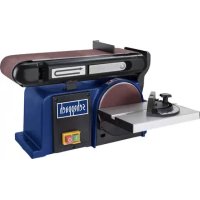
BTS900 - Sander SCHEPPACH - Free user manual and instructions
Find the device manual for free BTS900 SCHEPPACH in PDF.



| Product type | Belt and disc sander |
| Brand | Scheppach |
| Model | BTS900 |
| Supply voltage | 230-240 V ~ 50 Hz |
| Power consumption | 370 W |
| Dimensions (L x W x H) | 460 x 360 x 280 mm |
| Weight | approx. 11.5 kg |
| Grinding disc diameter | 150 mm |
| Disc speed | 2980 min⁻¹ |
| Abrasive belt dimensions | 915 x 100 mm |
| Belt speed | 7.5 m/s |
| Belt inclination | 0° - 90° |
| Grinding table dimensions | 225 x 160 mm |
| Table inclination | 0° - 45° |
| Sound power level (LWA) | 94 dB |
| Sound pressure level (LpA) | 81 dB |
| Type of supplied abrasives | 3 belts P80/P120/P240 and 3 discs P80/P120/P240 |
| Dust extraction connection | Extraction sleeve |
| Usage | Stationary (bench mounting) or mobile |
| Compatible materials | Wood and similar materials |
| Safety equipment | Belt guard, lower disc guard |
| Carrying handle | Yes |
| Included accessories | Cross stop, grinding table, hex key, user manual |
Frequently Asked Questions - BTS900 SCHEPPACH
User questions about BTS900 SCHEPPACH
0 question about this device. Answer the ones you know or ask your own.
Ask a new question about this device
Download the instructions for your Sander in PDF format for free! Find your manual BTS900 - SCHEPPACH and take your electronic device back in hand. On this page are published all the documents necessary for the use of your device. BTS900 by SCHEPPACH.
USER MANUAL BTS900 SCHEPPACH
Homepage: https://www.scheppach.com/de/service
Explanation of the symbols on the device
Symbols are used in this manual to draw your attention to potential hazards. The safety symbols and the accompanying explanations must be fully understood. The warnings themselves will not rectify a hazard and cannot replace proper accident prevention measures.
| Warning - read the instruction manual to reduce the risk of injury. |
| Wear hearing protection. |
| If dust builds up, wear respiratory protection! |
| Wear eye protection. |
| WARNING! Risk of injury! Do not reach into sanding disc while it is running! |
| Running direction of the sanding belt |
| Running direction of the sanding disc |
| The product complies with the applicable European directives. |
| We have marked points in these operating instructions that impact your safety with this symbol. |
| The product complies with the applicable Serbian directives. |
Table of contents: Page:
- Introduction 24
- Device description (fig. 1-19) 24
- Scope of delivery 24
- Proper use 24
- General safety information 25
- Residual risks 27
- Technical data 28
- Unpacking 28
- Assembly 28
- Start up 30
- Working instructions 30
- Electrical connection 31
- Cleaning 31
- Storage 31
- Transport 31
- Maintenance 32
- Disposal and recycling 32
- Troubleshooting 33
- Declaration of conformity 324
1. Introduction
Manufacturer:
Scheppach GmbH
Günzburgerstraße 69
D-89335 Ichenhausen
Dear Customer
We hope your new tool brings you much enjoyment and success.
Note:
In accordance with the applicable product liability laws, the manufacturer of this device assumes no liability for damage to the device or caused by the device arising from:
- Improper handling,
Non-compliance with the operating manual, - Repairs carried out by third parties, unauthorised specialists.
- Installing and replacing non-original spare parts
Application other than specified - Failure of the electrical system in the event of the electrical regulations and VDE provisions 0100, DIN 57113 / VDE0113 not being observed
Please consider:
Read through the complete text in the operating manual before installing and commissioning the device.
The operating manual is intended to help the user to become familiar with the machine and take advantage of its application possibilities in accordance with the recommendations.
The operating manual includes important instructions for safe, proper and economic operation of the device, for avoiding danger, for minimising repair costs and downtimes, and for increasing the reliability and extending the service life of the device.
In addition to the safety instructions in this operating manual, you must also observe the regulations applicable to the operation of the device in your country.
Keep the operating manual package with the machine at all times and store it in a plastic cover to protect it from dirt and moisture. They must be read and carefully observed by all operating personnel before starting the work.
The device may only be used by personnel who have been trained to use it and who have been instructed with respect to the associated hazards.
The required minimum age must be observed.
In addition to the safety instructions in this operating manual and the separate regulations of your country, the generally recognised technical rules relating to the operation of such machines must also be observed.
We accept no liability for accidents or damage that occur due to a failure to observe this manual and the safety instructions.
2. Device description (fig. 1-19)
- Knurled screw for sanding belt adjustment
- Support foot
- Sanding belt tensioner
- Grinding wheel
- On/off switch
- Transverse stop
- Grinding table
- Locking screw for sanding table
- Angle scale
- Extraction port
- Base plate
- Allen screw
- Grinding belt
- Stop rail
- Bottom disc guard
- Screw for bottom disc guard
- Allen screw
- Screw for sanding belt guard
- Sanding belt guard
- Holder tube
- Grinding belt holder
- Transport handle
- Hexagonal nuts
3. Scope of delivery
1 belt and disc sander
1 transverse stop
1 sanding table
3 sanding belts P80 / P120 / P240
3 grinding discs P80 / P120 / P240
1 Allen key
1 Operating manual
4. Proper use
The purpose of the belt and disc sander is to sand all types of wood, depending on the size of the machine.
The machine may only be used in the intended manner. Any use beyond this is improper. The user/operator, not the manufacturer, is responsible for damages or injuries of any type resulting from this.
An element of the intended use is also the observance of the safety instructions, as well as the assembly instructions and operating information in the operating manual.
Persons who operate and maintain the machine must be familiar with it and must be informed about potential dangers.
In addition, the applicable accident prevention regulations must be strictly observed.
Other general occupational health and safety-related rules and regulations must be observed.
The liability of the manufacturer and resulting damages are excluded in the event of modifications of the machine.
The machine may only be operated with original parts and original accessories from the manufacturer.
The safety, operating and maintenance specifications of the manufacturer, as well as the dimensions specified in the technical data, must be observed.
Please observe that our equipment was not designed with the intention of use for commercial or industrial purposes. We assume no guarantee if the equipment is used in commercial or industrial applications, or for equivalent work.
The device is intended for use by adults. Children over the age of 16 may use the tool except under supervision. The manufacturer is not liable for damage caused by an improper use or incorrect operation of this device.
5. General safety information
General power tool safety warnings
WARNING! Read all safety warnings, instructions, illustrations and specifications provided with this power tool. Failure to follow all instructions listed below may result in electric shock, fire and/or serious injury.
Save all warnings and instructions for future reference.
The term "power tool" in the warnings refers to your mains-operated (corded) power tool or battery-operated (cordless) power tool.
1. Work area safety
a) Keep work area clean and well lit. Cluttered or dark areas invite accidents.
b) Do not operate power tools in explosive atmospheres, such as in the presence of flammable liquids, gases or dust. Power tools create sparks which may ignite the dust or fumes.
c) Keep children and bystanders away while operating a power tool. Distractions can cause you to lose control
2. Electrical safety
a) Power tool plugs must match the outlet. Never modify the plug in any way. Do not use any adapter plugs with earthed (grounded) power tools. Unmodified plugs and matching outlets will reduce risk of electric shock.
b) Avoid body contact with earthed or grounded surfaces, such as pipes, radiators, ranges and refrigerators. There is an increased risk of electric shock if your body is earthed or grounded.
c) Do not expose power tools to rain or wet conditions. Water entering a power tool will increase the risk of electric shock.
d) Do not abuse the cord. Never use the cord for carrying, pulling or unplugging the power tool. Keep cord away from heat, oil, sharp edges or moving parts. Damaged or entangled cords increase the risk of electric shock.
e) When operating a power tool outdoors, use an extension cord suitable for outdoor use. Use of a cord suitable for outdoor use reduces the risk of electric shock.
f) If operating a power tool in a damp location is unavoidable, use a residual current device (RCD) protected supply. Use of an RCD reduces the risk of electric shock.
3. Personal safety
a) Stay alert, watch what you are doing and use common sense when operating a power tool. Do not use a power tool while you are tired or under the influence of drugs, alcohol or medication. A moment of inattention while operating power tools may result in serious personal injury.
b) Use personal protective equipment. Always wear eye protection. Protective equipment such as a dust mask, non-skid safety shoes, hard hat or hearing protection used for appropriate conditions will reduce personal injuries.
c) Prevent unintentional starting. Ensure the switch is in the off-position before connecting to power source and/or battery pack, picking up or carrying the tool. Carrying power tools with your finger on the switch or energising power tools that have the switch on invites accidents.
d) Remove any adjusting key or wrench before turning the power tool on. A wrench or a key left attached to a rotating part of the power tool may result in personal injury.
e) Do not overreach. Keep proper footing and balance at all times. This enables better control of the power tool in unexpected situations.
f) Dress properly. Do not wear loose clothing or jewellery. Keep your hair and clothing away from moving parts. Loose clothes, jewellery or long hair can be caught in moving parts.
g) If devices are provided for the connection of dust extraction and collection facilities, ensure these are connected and properly used. Use of dust collection can reduce dust-related hazards.
h) Do not let familiarity gained from frequent use of tools allow you to become complacent and ignore tool safety principles. A careless action can cause severe injury within a fraction of a second.
- Power tool use and care
a) Do not force the power tool. Use the correct power tool for your application. The correct power tool will do the job better and safer at the rate for which it was designed.
b) Do not use the power tool if the switch does not turn it on and off. Any power tool that cannot be controlled with the switch is dangerous and must be repaired.
c) Disconnect the plug from the power source and/or remove the battery pack, if detachable, from the power tool before making any adjustments, changing accessories, or storing power tools. Such preventive safety measures reduce the risk of starting the power tool accidentally.
d) Store idle power tools out of the reach of children and do not allow persons unfamiliar with the power tool or these instructions to operate the power tool. Power tools are dangerous in the hands of untrained users.
e) Maintain power tools and accessories. Check for misalignment or binding of moving parts, breakage of parts and any other condition that may affect the power tool's operation. If damaged, have the power tool repaired before use. Many accidents are caused by poorly maintained power tools.
f) Keep cutting tools sharp and clean. Properly maintained cutting tools with sharp cutting edges are less likely to bind and are easier to control.
g) Use the power tool, accessories and tool bits etc. in accordance with these instructions, taking into account the working conditions and the work to be performed. Use of the power tool for operations different from those intended could result in a hazardous situation.
h) Keep handles and grasping surfaces dry, clean and free from oil and grease. Slippery handles and grasping surfaces do not allow for safe handling and control of the tool in unexpected situations.
- Service
a) Have your power tool serviced by a qualified repair person using only identical replacement parts. This will ensure that the safety of the power tool is maintained.
WARNING!
This power tool generates an electromagnetic field during operation. This field can impair active or passive medical implants under certain conditions. In order to prevent the risk of serious or deadly injuries, we recommend that persons with medical implants consult with their physician and the manufacturer of the medical implant prior to operating the power tool.
Additional safety instructions for the belt and disc sander
WARNING!
Do not use your machine until it is completely assembled and installed according to the instructions.
- Read the entire operating manual before using the device.
- Attention: This machine has only been designed for sanding wood or similar materials. The sanding of other materials can cause fire, injuries, or damage the product.
Always wear safety goggles. - This machine may only be operated indoors.
- Important:Mount and use the machine on a horizontal surface. A non-horizontal surface can damage the motor.
- If the machine tends to tilt or walk (especially when sanding long and heavy panels), it must be fastened to a solid surface of sufficient carrying force.
- Make sure the sanding belt runs in the correct direction. See arrows at the back of the belt.
- Make sure the sanding belt is running correctly so that it cannot come off the drive pulleys.
- Make sure the sanding belt is not twisted or loose.
- Firmly hold the workpiece when sanding.
Always use the stop when using the sander in horizontal position.
Always hold the workpiece firmly to the table when using the disc sander. - Always hold the workpiece to the side of the sanding disc running downwards, in order to maintain the workpiece pressed to the table. By using the upward-running side of the sanding disc, the workpiece could be ejected and cause injury to persons.
- Always keep a minimum distance of about 2mm or less between the table or stop and the sanding belt or disc.
- Do not wear gloves. Do not hold the workpiece with a cloth during sanding.
- Use sanding belt or disc of the correct grit corresponding with the wood.
- Never sand workpieces too small to be held safely.
- Avoid awkward hand positions where a sudden slip could cause your hand to touch the sanding belt or disc.
- When sanding a large piece of material, provide an additional support at table height.
- Never sand an unsupported workpiece. Secure the workpiece with the table or the stop. Exceptions are the sanding of curved workpieces on the outside of the sanding disc.
Always clear the table, fence or sanding belt of scraps or other objects, before turning the machine on. -
Do not perform any layout assembly or set-up work on the table while the sander is in operation.
-
Switch the machine off and pull the power plug from the socket when fitting or removing accessories.
- Never leave the working area of the sander while the tool is running, or as long as it has not come to an absolute standstill.
- Always place the workpiece on the sanding table or position it firmly against the sanding stop. Place curved tools securely on the table when sanding on the sanding disc.
Always ensure that the belt and disc grinder are stable and secured (e.g. fastened to a workbench). - Before each use, check the grinding disc and grinding belt for damage.
- Replace worn or damaged grinding discs and grinding belts immediately.
Always use the protective cover and the workpiece support as required for the insert tools.
Always use the power tool with insert tools on both spindles to limit the risk of contact with the rotating spindle.
6. Residual risks
The machine has been built according to the state-of-the-art and the recognised technical safety requirements. However, individual residual risks can arise during operation.
- Risk of injury for fingers and hands due to the rotating sanding disc with improper guiding or positioning of the tool to be sanded.
- Risk of injury from tools thrown away due to improper holding or guiding.
- Health hazard due to electrical power, with the use of improper electrical connection cables.
- Furthermore, despite all precautions having been met, some non-obvious residual risks may still remain.
- Residual risks can be minimised if the "Safety information" and the "Proper use" together with the operating manual as a whole are observed.
- Avoid accidental starting of the machine: the operating button may not be pressed when inserting the plug in an outlet. Use the tool attachment that is recommended in this operating manual. This is how to ensure that your machine provides optimum performance.
- Keep your hands away from the work area, when the machine is in operation.
7. Technical data
Motor 230 - 240 V~ / 50 Hz
| Rated input 370 W | |
| Dimensions L x W x H 460 x 360 x 280 mm | |
| Ø Disc 150 mm | |
| RPM disc | 2980 rpm |
| Sanding belt size | 915 x 100 mm |
| Sanding belt speed | 7.5 m/s |
| Angle positioning | 0° - 90° |
| Table size | 225 x 160 mm |
| Table tilt | 0° - 45° |
| Weight | approx. 11.5 kg |
Technical changes reserved!
Noise and vibration
Warning: Noise can have serious effects on your health. If the machine noise exceeds 85 dB, please wear suitable hearing protection.
Noise data
Sound power level L_WA 94 dB
Sound pressure level L 81 dB
Uncertainty K 3 dB WA/PA
The specified total vibration value and the specified noise emission value have been measured in accordance with a standardised test procedure and can be used to compare one power tool with another.
The specified total vibration value and the specified noise emission value can also be used for an initial estimation of the exposure.
Note:
-
The vibration and noise emission values can vary from the specified values during the actual use of the power tool, depending on the type and the manner in which the power tool is used, and in particular the type of workpiece being processed.
-
It is necessary to define safety measures to protect the operator which are based on an estimate of vibration exposure during the actual operating conditions (for this, all parts of the operating cycle have to be considered, e.g. times during which the power tool is switched off and times during which it is switched on but runs in no-load mode).
8. Unpacking
- Open the packaging and carefully remove the device.
- Remove the packaging material, as well as the packaging and transport safety devices (if present).
- Check whether the scope of delivery is complete.
- Check the device and accessory parts for transport damage. In the event of complaints the carrier must be informed immediately. Later claims will not be recognised.
- If possible, keep the packaging until the expiry of the warranty period.
- Familiarise yourself with the product by means of the operating instructions before using for the first time.
- With accessories as well as wearing parts and replacement parts use only original parts. Replacement parts can be obtained from your dealer.
- When ordering please provide our article number as well as type and year of manufacture for your equipment.
WARNING!
The device and the packaging material are not children's toys! Do not let children play with plastic bags, films or small parts! There is a danger of choking or suffocating!
9. Assembly
WARNING
Always pull out the mains plug before carrying out adjustments on the device.
- Prior to commissioning, all covers and safety devices must be mounted correctly.
It must be possible for the sanding belt (13) and sanding disc (4) to run freely. - In case of previously machined wood, be aware of any foreign objects, such as nails or screws, etc.
- Before pressing the on/off switch (5), make sure that the sanding paper is correctly fitted, and that moving parts run smoothly.
9.1 Assembly (Fig. 1-4b)
- Mount the sanding table (7) and secure with the locking screw (8) (fig. 2, 3). The sanding table (7) can be infinitely adjusted from 0^ to 45^ with the angle scale (9) and the locking screw (8).
The adjustable transverse stop (6) ensures safe guidance of the workpiece. Attention! It must be possible for the sanding disc (4) to run freely. The distance between the grinding table (7) and the grinding wheel (4) should be max. 2 mm.
-
Place the stop rail (14) and fasten using the hexagon socket screws (17) (Fig. 4a). Attention! It must be possible for the sanding belt (13) to run freely.
To set the gap between the grinding table (7) and the grinding wheel (4), proceed as follows (Fig. 4b): -
First loosen the three hexagonal nuts (23) beneath the grinding table (7). Use a hexagon spanner size 10 for this (not included in the scope of delivery).
- Now clamp a panel or similar with a thickness of 2 mm between the grinding table (7) and the grinding wheel (4).
- Tighten the hexagonal nuts again (23).
- Then remove the panel.
9.2 Replacing the grinding belt (Fig. 5 - 9)
Pull out the mains plug.
- Loosen the hexagon socket screw (12)
- Loosen the screws (18).
Take the grinding belt guard (19) off the grinding belt holder (21). To do this, set the grinding belt holder (21) at a slight angle.
- Turn the sanding belt tensioner (3) to the right in order to reduce the tension on the sanding belt (13).
- Remove the grinding belt (13) to the front.
- Mount the new sanding belt in reverse order. Attention! Note the running direction on the housing and on the inside of the sanding belt!
9.3 Adjusting the grinding belt
- Pull out the mains plug.
- Push the sanding belt (13) by hand slowly in the running direction.
- The sanding belt (13) must run centrally on the sand-ing surface. If not, you can use the knurled screw (1) to make adjustments.
9.4 Moving the sanding position of the sanding belt (fig. 9-11)
- Loosen the hexagon socket screw (12).
- Move the sanding belt (13) upwards into the desired position.
- Retighten the hexagon socket screw (12) to lock in position.
- The grinding table (7) can be inserted in this position to support the workpiece. To do this, first remove the two hexagon socket screws (17) and then remove the stop rail (14). The sanding table (7) can now be pushed into the hole of the holder tube (20) and fixed with the locking screw (8).
9.5 Replacing the sanding paper on the sanding disc (fig. 12)
Dismantle the bottom disc guard (15) by removing the 2 screws (16). Pull the sanding paper off the sanding disc (4) and attach the new sanding paper (quick-fit fastening system). Refit the lower protective panel (15).
9.6 Use as a stationary machine
If your machine is to be used in a permanent location, it is recommended you secure it to a workbench.
- To do so, mark the holes to be drilled: Place the sander where it is to be mounted. Mark the location of the holes to be drilled on the workbench.
- Drill holes through the workbench.
- Place the sander above the holes and insert suitable screws from the top through the holes of the sander and the workbench.
- Now fasten the sander from the underside of the workbench using lock washers and matching hexagonal nuts.
9.7 Use as a mobile machine
If your belt and disc sander is to be used as a portable tool, it is recommended you fasten it to a suitable mounting plate which can easily be clamped to a workbench.
The mounting plate should be at least 19mm thick and sufficiently larger than the sander to allow space for the clamps.
- Mark the holes to be drilled on the mounting plate.
- Follow the last three steps as described in section "Use as a stationary tool".
Note:
Ensure that the screws are of suitable length. Spax screws must not protrude so as not to damage the surface, whereas hexagonal screws must protrude so that washers and hexagonal nuts can be fitted.
9.8 Dust extraction connection
The machine is equipped with a suction port (10).
Connect a dust extractor when processing heavily dusty materials.
Attention:The dust extraction must not be connected when processing metals.
10. Start up
Attention!
Always make sure the device is fully assembled before commissioning!
10.1 On/off switch (5) (fig. 13)
- It is possible to switch the sander on by pressing the green "I" button.
- In order to switch the sander off again, it is necessary to press the red "0" button.
Warning:
Never reach over the device to turn the belt and disc sander on or off! Risk of injury!
10.2 Sanding
- Always hold the workpiece firmly during sanding.
- Do not apply excessive pressure.
- The workpiece should be moved back and forth on the grinding belt (13) or the grinding wheel (4) when grinding. This prevents the sanding paper from becoming worn on one side.
Important! Pieces of wood should always be sanded with the grain to prevent them splitting. Attention! If the grinding wheel (4) or the grinding belt (13) jam while you are working, remove your workpiece. Then wait until the device has reached its maximum speed again before you continue working.
11. Working instructions
11.1 Grinding chamfers and edges (Fig. 14)
The worktable can be infinitely adjusted from 0^ to 45^ .
To do so, loosen the locking screw (8).
- Set the worktable to the desired angle. Attention: The worktable should never be more than 2mm from the grinding wheel (4), even when tilted!
- Tighten the locking screw (8) again.
11.2 Sanding small end surfaces using the transverse stop (fig. 15a, 15b)
The supplied transverse stop (6) makes precise sanding easier. The transverse stop (6) can be used to set grinding angles in addition to the inclination of the grinding table (7). We recommend its use when grinding (short) faces.
Note:
Always move the workpiece from the left to the centre of the sanding disc, never beyond! Risk of injury due to workpiece being thrown away!
11.3 Horizontal and vertical sanding (fig. 9-11, 16)
Your sander can sand both vertically and horizontally. The worktable can be used for both applications.
- Loosen the hexagon socket screw (12).
- Move the sanding belt (13) upwards into the desired position.
- Retighten the hexagon socket screw (12) to lock in position.
- The grinding table (7) can be inserted in this position to support the workpiece. To do this, first loosen the two hexagon socket screws (17) and then remove the stop rail (14). The sanding table (7) can now be pushed into the hole of the holder tube (20) and fixed with the locking screw (8).
Note:
Sand long workpieces in the vertical position by moving the workpiece evenly over the sanding belt (13).
11.4 Surface sanding on the sanding belt (fig. 17)
- Hold the workpiece (W) firmly. Watch your fingers! Risk of injury!
- Keep the workpiece pressed firmly against the stop rail (14) guiding it evenly over the sanding belt (13). Attention: Be particularly careful when sanding very thin pieces and extra long pieces (perhaps even without stop rail (14)). Apply only enough pressure to allow the sanding belt (13) to remove sanded material.
11.5 Grinding concave curves (Fig. 18)
Warning:
Never attempt to sand the end pieces of a workpiece on the idler drum (R). If you do so, the workpiece (W) may be ejected. Risk of injury!
Always sand concave curves using the idler drum at the sanding belt (13).
- Hold the workpiece firmly. Watch your fingers! Risk of injury!
- Guide the workpiece evenly over the sanding belt (13). Attention: Be particularly careful when sanding very thin pieces and extra long pieces.
11.6 Grinding convex curves (Fig. 19)
Always sand convex curves using the sanding disc by guiding the workpiece (W) from the left side to the centre of the sanding disc.
- Hold the workpiece firmly. Watch your fingers! Risk of injury!
- Press the workpiece firmly against the sanding disc moving it from the left to the centre of the sanding disc.
Warning:
Never attempt to sand concave curves at the right side of the sanding disc! The workpiece may be ejected! Risk of injury!
12. Electrical connection
The electrical motor installed is connected and ready for operation. The connection complies with the applicable VDE and DIN provisions.
The customer's mains connection as well as the extension cable used must also comply with these regulations.
Damaged electrical connection cable
The insulation on electrical connection cables is often damaged.
This may have the following causes:
- Pressure points, where connection cables are passed through windows or doors.
- Kinks where the connection cable has been improperly fastened or routed.
- Places where the connection cables have been cut due to being driven over.
Insulation damage due to being ripped out of the wall outlet. - Cracks due to the insulation ageing.
Such damaged electrical connection cables must not be used and are life-threatening due to the insulation damage.
Check the electrical connection cables for damage regularly. Ensure that the connection cables are disconnected from electrical power when checking for damage.
Electrical connection cables must comply with the applicable VDE and DIN provisions. Only use connection cables of the same designation.
The printing of the type designation on the connection cable is mandatory.
For single-phase AC motors, we recommend a fuse rating of C 16A or K 16A for machines with a high starting current (from 3000 watts)!
Connection type Y
If the mains connection cable of this device is damaged, it must be replaced by the manufacturer, their service department or a similarly qualified person to avoid dangers.
13. Cleaning
Danger!
Pull out the mains plug before carrying out any adjustments, maintenance or repair work!
Dust can collect in the belt and disc sander. Check regularly (preferably after each use) and remove dust, e.g. by blowing away or carefully with compressed air.
- Keep protective devices, air vents and the motor housing as free of dust and dirt as possible. Rub the device clean with a clean cloth or blow it off with compressed air at low pressure.
- We recommend that you clean the device directly after every use.
- Clean the device at regular intervals using a damp cloth and a little soft soap. Do not use any cleaning products or solvents; they could attack the plastic parts of the device. Make sure that no water can penetrate the device interior. Water entering a power tool will increase the risk of electric shock.
14. Storage
Store the device and its accessories in a dark, dry and frost-free place that is inaccessible to children. The optimum storage temperature lies between 5 and 30^ . Store the power tool in its original packaging. Cover the power tool to protect it from dust or moisture. Store the operating manual with the power tool.
15. Transport
To transport the power tool, disconnect the equipment from the power supply and set it up in the new position you want to use it in.
Lift the device only by the transport handle (22) and the machine foot for transport.
Attention! Do not transport the device by the grinding belt holder (21), grinding wheel (4), grinding table (7) or other moving parts of the device.
16. Maintenance
Wipe swarf and dust off the machine from time to time with a cloth. Oil the rotating parts once monthly to extend the life of the tool. Do not oil the motor.
Do not use corrosive agents for cleaning the plastic.
Service information
With this product, it is necessary to note that the following parts are subject to natural or usage-related wear, or that the following parts are required as consumables.
Wearing parts*:Abrasives, toothed belts
- may not be included in the scope of supply!
Connections and repairs
Connections and repair work on the electrical equipment may only be carried out by electricians.
Please provide the following information in the event of any queries:
Type of current for the motor
Data of machine type plate
Data of motor type plate
Spare parts and accessories can be obtained from our service centre. To do this, scan the QR code on the cover page.
17. Disposal and recycling
Notes for packaging


The packaging materials are recyclable. Please dispose of packaging in an environmentally friendly manner.
Notes on the electrical and electronic equipment act [ElektroG]
![SCHEPPACH BTS900 - Notes on the electrical and electronic equipment act [ElektroG] - 1](/content/2026/03/572557/images/c9a1e1a22e1d6d4940c0a633b7cb357b0822c251887b2ffaa805d0a915e00cb7.jpg)
Waste electrical and electronic equipment does not belong in household waste, but must be collected and disposed of separately!
- Used batteries or rechargeable batteries that are not installed permanently in the old appliance must be removed non-destructively before disposal. Their disposal is regulated by the battery law.
- Owners or users of electrical and electronic devices are legally obliged to return them after use.
- The end user is responsible for deleting their personal data from the old device being disposed of!
- The symbol of the crossed-out dustbin means that waste electrical and electronic equipment must not be disposed of with household waste.
-
Waste electrical and electronic equipment can be handed in free of charge at the following places:
-
Public disposal or collection points (e.g. municipal works yards)
-
Points of sale of electrical appliances (stationary and online), provided that dealers are obliged to take them back or offer to do so voluntarily.
-
Up to three waste electrical devices per type of device, with an edge length of no more than 25 centimetres, can be returned free of charge to the manufacturer without prior purchase of a new device from the manufacturer or taken to another authorised collection point in your vicinity.
Further supplementary take-back conditions of the manufacturers and distributors can be obtained from the respective customer service.
- If the manufacturer delivers a new electrical appliance to a private household, the manufacturer can arrange for the free collection of the old electrical appliance upon request from the end user. Please contact the manufacturer's customer service for this.
These statements only apply to devices installed and sold in the countries of the European Union and which are subject to the European Directive 2012/19/EU. In countries outside the European Union, different regulations may apply to the disposal of waste electrical and electronic equipment.
18. Troubleshooting
The following table shows fault symptoms and describes remedial measures in the event of your machine failing to work properly. If you cannot localise and rectify the problem with this, please contact your service workshop.
| Fault Possible cause Remedy | ||
| Motor does not start | On/off switch damaged | Replace all damaged parts before you use your sander again.Contact your local service centre or an authorised service station. Every attempt to carry out a repair, can be dangerous if it is not done by skilled personnel. |
| On/off cable damaged | ||
| On/off relay damaged | ||
| Machine becomes slower during work. | Too much pressure is applied to the workpiece. | Apply less pressure to the workpiece. |
| Sanding belt comes off the drive pulleys. | It does not run straight. Reset the track. | |
| Wood gets burnt during sanding. | Sanding disc or belt is covered with grease. | Replace belt or disc. |
| Excessive pressure was applied to the workpiece. | Reduce the pressure applied to the workpiece. | |
A这其中 is a very good idea.
Günzburger Straße 69
D-89335 Ichenhausen
Vázéný zákazniku,
Günzburger Straße 69
D-89335 Ichenhausen
Vázéný zákaznik,
Günzburger Straße 69
D-89335 Ichenhausen
Spostovani kupec,
želimo vam veliko veselja in uspeha pri delu z vašo novo napravo.
Napotek:
Günzburger Straße 69
D-89335 Ichenhausen, Vacija
Godatais client!
Velam prieku un izdošanos, stradajot ar šo jauno ierici.
Norāde:
Günzburger Straße 69
D-89335 Ichenhausen
Arvoisa asiakas
Pabudt minstealer ma overholds.
9.3 Stille inn slepeband
Günzburger Straße 69
D-89335 Ichenhausen,Германя
YBaKaemn KIneHTN,
KeIaem Bn MHO rnpaTHN MOMeHTN uCyTeXn npna pa6oTata C Baunr HOB ypei.
Yka3aHne:
CbIaCHO DeIcTBaun 3aKOH 3a npOdykTObata OTOBOPHOCT, npON3BOIDNTeJIr H a TO3n ypeJ He HOCN OTROBOPHOCT 3a UETn, Bb3HKnHaJI N O IJI N NopAdNI TO3n ypeJ, npI:
- HenpaBnHo 6opabeHe
- Hecna3BaHe Ha pbKOBoDCTBOTO 3a yNoTpe6a
PemOHnOT HeynbHOMOeHN CneuaNCTN,BAuNCe TpeTJNca - MoNTaX I NODMaHa Ha He opuHnHaHn pe3epBHN Yactn
- YnoTe6a He no npedHa3NaueHne
- OTKa3 Ha eIeKtpnueckata nHCTaJauZn npi HeCnA3BaHe Ha npEePiNcAHnra 3a pa6Ota c eIeKtpnueCTBO n pa3npoeD6nte Ha VDE 0100, DIN 57113VDE 0113
Bzeme Te noBHHMaHHe:
Ppei Mohtaxa H n yckaHTo B eKcnnoataunia npo- etete cennr TeKT Ha pkoBOdCTBOTO 3a ynotpe6a.
Lceta HToBa pBkoBoDCTBO 3a ynoTpe6a e da Bn yneCh npn 3ano3HabHeTo c Baunypei n3non3-BAHeTo Ha HerOBIne Tb3MOxHocTH 3a ynoTpe6a cbrrnaCHO npedncaHnraTa.
PbkoOIOCTBOTO 3a ynoTpe6a cbIbpxka BaxHn yka3a-Hn OTHOCHO 6e3oNaChata, npabunHaTa NIKOHOMuHnata pa6ota Cypeda, n36raBaHeTo Ha onaCHOt, CnecTBAHeTO Ha pa3XOn 3a peMOHT, HamaJIbaHeTo Ha BpeMeHaTa Ha npctoN yBeJInuJyBaHeTo Ha HAdEJKHOCTTA N EKCnNoaTaUHOHHN JINBOT Ha eNeKTPnueckn INHCTpymEnT.
B donbHHeHne KbM yKa3aHnra 3a 6e3oNaChocT B TOBa pKOBODCTBO 3a yNtpe6a, 3aDbJXHTeJIHO Tp6Ba Da cna3BaTe OTHacAHTe ce do EKCnnoatauHa Ta Hyaypea npednncAHn BB BaWata ctpaHa.
CbxpaHraBaTe pkoBODCTBOTo 3a ynoTpe6a npuypeda,3aunTeHOOT3ambpcaBaHe n Blara BnnactMacoba TOp6nka.To Tp6Ba Da 6bJe npooyeHo INBHIMATEIHO Cna3BaHO OT BCEKN OepaTop npeNi 3aNoUbaHe Ha pa6Ota.
C ypeda MORaT da pa6oTc RAMO JNua, KOnTO ca HnCTpyKTHpaHn OTHOCHO YnOTpe6aTa Ha ypeDa n Ca 3a-No3HaTu CbC CBbp3AHnTe C TOBa ONaCHOCTn.
U3nCKBaHaTa MmHmMaHa Bb3pact Tpr6Ba Da ce cna3Ba.
OcbEN cbIbpxaunTe ce B TOBa pbKOBOcTBO 3a ynoTpe6a yka3aHnra 3a 6e3onacnoCT n CneuaHnTe pa3npopeBn BB BaWata cTpaHa, npn pa6oTaTa C MaunHn Tp6Ba Da ce Cna3Bat n OboOpnPn3HaNTe npabNla Ha texHnkata.
He noeMaMe OTROBOPHOCT 3a 3IonoIyKn IIN UeTn, Bb3HnKHaJI NopaI IN HeCna3BaHe Ha TOBa pBkoBOdCTBO IIN HA yKa3aHnraTa 3a 6e3oNaCHOCT.
2. OnncaHne Ha ypeDa (Φnrg. 1-19)
- BnHT c Ha3b6eHa rIaBa 3a HAcTPOKa Ha UINΦoBbYHATA JeHTA
- Onopeh kpaK
3.ObTeRaHaJINIOBbUHataJeHTa - ⅢπnΦOBbueh KpbT
- IpeBknIOuBaTeI 3a BKnIOUbaHe/13KNIIOUbaHe
- HanpeyuH orpaHnHTeI
7.卍nФOBbUHaMaCa - BnHT 3aФнКсиранe Ha WlnuФOBbUHaTama
- brnoBa ckana
- HaukpaHnK 3a npaxoynaBHe
- OCHOBHa IIOOa
12.BnHT C BbTpeweH WecToCTeH - WnfoBbUHa NeHTa
- Onopha pelenca
15.ДоленпразителндИСКА - BnHT 3a DonHnI npEJa3nteHa Dncka
- BnHT C BbTpeweH WecTOcTeH
- BnHT 3a npedna3nteHa wJInoBbHuHaTa neHtA
- PpePnA3nteHa WJINFOBbYHATA JeHTa
- Tpb6a-Dbpxkatae
21.Дьржанhaшифовьнотапentа
22.Дрьжka3a TpaHcnpTupaHe - ⅢeCTOCTeHHraKn
3. 06em Ha doctabkaTa
1 JeHTOBA N DnCKOBA UuNΦOBvHa MaunHa
1 Hanpeuen orpaHnHTen
1IINIOBbHa Maca
3 WJINΦOBbUHJIeHTn P80 / P120 / P240
3 WnfoBbHn Dncka P80 / P120 / P240
1 KIOU C BbTpweH WeCTOCTeH
- 1pbkoOoCTBO3a ynoTpe6a
HnBO Ha 3ByKOBA MOUHOCT L WA 94 dB
HnBOHa3ByKOBoHaJraheL 81dB
HeonpeDeneHocT Kwa/pA 3 dB
Iocouehata o6ua cToHocT Ha Bn6paunTe n nocoheta cToHocT Ha 7yMOBnTe emncn Ca n3MepeHN NO cTaHdapTeH MeoD Ha n3nITBaHe N MORaT da 6bDat n3noJ3BaHn 3a cpabHeHne Ha eDIn EeKtpuueckn INCHpymEt C dpYr.
Iocouehata osha cToHOCHa Bn6paunTe n noco-uehata cToHOCHT Ha wymOBITE emncn MORa Tcbio da 6bdat N3non3BaHH 3a npedBapntHa ouehka Ha HATOBAPBAHETO.
Yka3aHHe:
- IIO BpeMe Ha DeIeCTBnTeJIHOTo N3NoJ3BaHe Ha eIeKTPnuecknHa HcTpyMeHT EmCmnte Ha Bn6paunnte mShyMOBITE EMCSM MoKe Da ce pa3JNUHabAT OT NOOCHeta CToHOC T 3aBNCIMOCT OT BnDa N HAuHa,NO KOITOp EJIeKTpNuecknHa HcTpyMeHT Ce N3NoJ3Ba,INo-CneUaJIHO KaKbB BnD JeTaII Ce O6pa60TBA.
Heo6xodmo e da ce onpeJeT Mepkn 3a 6e0-nachoc3a 3aunHa ha onepaTopa, KOtO ce oc-HOBabat Ha OueHka Ha Bn6paounHO ToBaPBAHe NO Bpeme Ha DeNCTBHTENHTE ycNoBna HA n3noJ3BaHe (npu TOBa Tpr6Ba Da ce B3emAT NOBHNMaHne BCnKu qactn Ha pa6OTnua KkJI, HApnpMep Bpemehata, Ppe3 KOtO eIeKtpnuecknT INHCTpyMeH e N3KnUoyen, H TaKnBA, B KOtO Toe BKNIOyeh, Ho pa6OTn 6e3 HatoBapBaHe).
8. Pa3onakobaHe
- OTbopete onakobkata n BHIMaTeJHo 3BaTepepa.
- OtctpaHete onakOBbHnMaTePnAn, KaKTo n ona-KOBbHnTe n TpaHCnOpTHnTe OcnrypOBKn (ako nMa TaKnBa).
- PpOBepeTe daJIH o6EmbT Ha dOcTaBkata e nJIeH.
- PpOBepTe ypeDa n npHnAdJnxKHOCTne 3a noBpeDn OT TpaHCnpTnpaHeTo. Pn peKaMaun DoCTaBcKbT Tpr6Ba Da 6bJe yBeDoMeH He3a6abHo. IIO-KbCHN peKaMaun He ce npu3HaBt.
- No Bb3MOXHOCT 3ana3eTe ONAKOBAkata Do N3TuHaHe Ha rapaHcNoHHnCpOK.
-Ппетунгpe6а ce 3an03найсурда поспдCTBOMpbkoBOdCTBOTO3aynotpe6a.
3a npHaJnEeKHOCTN, KaKTo 3a n3HocBaun ce nppe3epBHN qactn, n3noJ3BaIte cAmO opuHaJIHn qactn. Pe3epBHN qactn MOKeTe da cn Ha6abNTe OT BauncneuaJn3npaH TbproBeu. - Pn npbuk noocBaTe Haun Hoomep Ha apTNKuI, KaTOn u Tnna u RoDInHaTa Ha npOn3BOOCTBO Haypeda.
△PNEyPEXDEHNE!
YpeIbT n ONAKObYHnT MaTePnA He ca IrpaYka 3a Deu! Deua He 6NBa Da IrpaTc PnactMacOBn Top6Nch, fOIno N dpe6Hn YacTn! CbueCTByBa onaCHOCT OT NorlbUaHe n 3aDyUbaHe!
9. KoHcTpkyKzua
IPEDyPPEKDEHNE
Bnarn n3ternayte uence na ot kohtakta, npden da n3BbpuBaTe HactpOkn no ypeDa.
- Ppei NyckaHe B EKcNIOaTaunr npncnoc6neHnIyTa 3a 6e3oNaChocT pr8Ba Da 6bDat npabuHOMHTnpaHn.
-
WJINFOBbHata JnHTa (13) n WJINFOBbHnT KpbT (4) Tp6Ba Da MoRat Da Ce DnKnat CBO6oNo.
-
PnB Beue o6pa6oTbaHO DbPBO BHNMaBaIe 3a UyKdTeJa, KaTO HAp. NpOHN, BNHTObE n T.H.
- PpeHn Da 3aJeIcTBaTe npeBKnIOyBaTeJr 3a BKnIOyBaHe/V3KKnIOyBaHe (5) ce yBepeTe, ye IzkypKaTa e npabINHO MOHTnpaHa n NOdBnXHnte YacTn ca JecHO NODBHXHN.
9.1 MoHTax (Φn.r. 1-4b)
MoHTnpaTe ⅢNFOBbHata Maca (7) nФИKcIpaTc BnHTa 3aФИKcIpaHe (8) (ΦIr.2,3).ⅢN-ФOBbHaTa Maca (7) MoKe Da ce perynpa 6e3Te-eneHHo ot 0^ do 45^ c NOMOuTa Ha bTIOBaTa cKaNa (9) n BnHTa 3aФИKcIpaHe (8).
PerynnpemyHr HanpeuHOrpaHHTn pa 6e3oNacHO BOHe Ha HcTpyMeHa. BnMaHHe! IINFOBbUHNrKpBr (4) Tp8Ba Da MoKe Da ce DnXn CBO6OHO. Pa3CToRHeTo MeXy IINFOBbHata Maca (7) INIINFOBbUHNr KpBr (4) Tp8Ba Da e 2 mm.
IocTaBete onopHaTa penca (14) nЯ ФиксuarTe C BnHTOBeTe C BbTppeWeH WeCTOCTeH (17) (ФИr. 4a). BHHMaHHe! WnΦoBbYHaTaNeHTa (13) Tp8Ba da MoKe Da ce DnKn Cbo6OdHo.
3a da HacptponTe npTa MeKdy uNFOBbHuHaTama (7) uNPOBbHnKpBr (4), npOeDnpaTeKaKTo cneDbA (ΦIr. 4b):
-Пьрв OTВИТЕТРпЕ SECTOBHLH RAHKN (23).Hammpaи ce NOД UINIOPOBbUHATA Maca (7).3a ueNTa H3NON3BaIte WcETOCTeHEN KJIIOH SW10 (He e BKNIOUH B O6ema Ha DoCTaBkata).
-3aterheTeIamapnHaHnnoo6HoCne6eHnHa ot 2 mm MeKdy uNpObHuHaTa Maca (7) n nnPObBcHnKaPb(4).
-3aterheTe OTHOBO 电ctobbnHITe rain (23).
-Hakpar MaxHeTe JnMapuHaTa.
9.2 CmHa Ha wHnfoBvHaTae Hr.5-9
- N3dþpnaTe ɛncεna.
- OTBnHTeTe BnHTa C BbTpseWeH IeCTocTeH (12).
- OTBnHTe BnHToBeTe (18).
CbaIe 3aunTata Ha uNIOOByHaTa IeHTa (19) OT dIbpxaHa Ha uNIOOByHaTa IeHTa (21).3a cen-Ta nOCTabeTe dIbpxaHa Ha uNIOOByHaTa IeHTa (21) mAnko noD bYbn. - PpemeCTe o6Teraya Ha ⅢnΦOBbUHaTa JeHTa (3) HAdrCho, 3a Da OCBO6OdTe ⅢnΦOBbUHaTa JeHTa (13).
CbaIeTe ⅢInΦOBbUHaTa IeHTa (13) Hanpei. - MoHTnpaIte OTHOBO WJINFOBbUHATAJeHTa B o6paTHa NocJIeIOBaTeJIHOCT. BHIMAHne! Cb6JIIOdaBAIte NOCOKaTa Ha DBNXEHNHe BbPxy KOpNyca n OTBbTpeuHaTa CTpHa Ha WJINFOBbUHATA JeHTa!
9.3 HactpoBaHe Ha ⅢnΦOBbHata JeHTa
- N3dþpnaTe ɛncela.
-БаВио 6уTheIшИнФОВьЧИТа ПЕNTa (13)cрБКa B NOcOKa HaДВИХЕНETo. - Μινηφούθυήτα Μεῦτα (13) Trραδba Da ce Μυκην Βcpεπa Ta Bbpxγ Μινηφούθυήτα ΜοῦbpxHOCT; aKO TOBA He e Taka, TOBA MOxe Da ce perγιŋpa γpe3 BnHTa C Na3b6eHa rnaBa (1).
9.4 PerynnpaHe Ha no3nuaHa 7naiahe Ha 7nfoBbHata JeHTa (Fnr. 9-11)
- Pa3xna6eTe BnHTa C BbTppeWeH WeCTocTeH (12).
-П配电电电电电电电电电电电电电电电电电电电电电电电电电电电电电电电电电电电电电电电电电电电电电电电电电电电电电电电电电电电电电电电电电电电电电电电电电电电电电电电电电电电电电电电电电电电电电电电电电电电电电
3aTeHHeTe OTHOBO BnHTa C BbTppeuEH IeCToCTeH (12), 3a da qnkCuPaTe Ta3n No3nCn.
3a onopa ha DeTaNb Ta3n POnuN MoKe da ce n3noJ3Ba 7; 3a ceJTa NbpBO Tp8Ba Da CBaInTe Dbata BNHTa C BbTppeWeH WeCTOcTeH (17) n CneD TOBa OTCPaHete OnOpHaTa penca (14). Cera 7 MoKe da 6bDe n36yTaHa B OTBopa Ha Tpb6aTa-DbpxAteI (20) n Da 6bDe 6nkCnpaHa C BNHTa 3a 6nkCnpaHe (8).
9.5 NocTabaHHe Ha KypKa Bbpxy JnnoobuHnKpb(ΦnR.12)
Демонтурашо долни п dedпашил Ha ducka (15), CBаляйки 2-ta винта (16).ИЗваде тшкypka差别 ot shinфовьчни крг (4)и монтурашо Hobata (Велкpo).Монтурашо отюно долни п dedпашил Ha CTькnoto (15).
9.6 3noJ3BaHe kaTo ctaNoHaMaHnHa
3a Henpekbchata ynoTpe6a ce npenopbUba MOHTax Bbpxy pa60tha maca.
3a ceI Ta MapknpaTe OTBOpTe 3a npo6nBaHe: NocTabete WInncpOBbYHata MaunHa Taka, KaKTo no-KbCHO Tpr6Ba Da 6bJe MOHTnpaHa. Ot6JEnKeTe MecTOnONoXeHHeTo Ha OTBOpTe, KOtTO Tpr6Ba Da 6bDat npo6ntu Bbpxy pa6oTHata Maca.
- PpO6nIte OTBOpHTe npE3 pa6oTHaTama.
- IocTaBete WnfoBbHaTa MaunHa Ha d OTbOpnte n BkapaTe NdoXoJaWn BNHTObe OTrope npe3 OTBOpTe Ha WnfoBbHata MaunHa n pa6OTHaTa Maca.
Cera 3aBHTeTe OTdOly WnHcOBbYHaTa MaunHa cNoIIOXHHe IwA6N INoDxOJaU NWeCTOBbJHn raIKN.
9.7 3nOJ3BaHe KaTo Mo6HHa MaHHa
3a Mo6nHOTo n3noN3BaHe Ha BaHaTa MaunHa ce npenopbUyBa MOHTax Bbpy NOxOJa oCHOBHa nNoya. CneT TOBa MoXeTe Da e 3aTeHHe T Bbpy cb-OTBETHaTa pa6oTHa Maca.
OCHOBHATAIIOUa Tp8Ba Da e MHNmym 19 mm De6eJa I da e NO-ToJMa OT WnNΦOBbHuHaTa MaunHa, Taka Ye da NMA IOCTaTbUHO MRCTO 3a 3aTRAHAETO.
- Ot6eJexKeTe OTBOpnte, KOInTo Tp86Ba Da 6bDaT npo6nTu Bbpxy OCHOBHata NIOya.
- Пордьлжete takа, кakTo e onncaHo B nocneHnTe 3 CTbKnB Tocka ,N3noN3BaHe KaTo cTaCuNoHaHa MaunHa".
Yka3aHHe:
CnepeTe 3a npabnHaTa DbJxHa Ha BnHTOBeTe. BnHTOBete Spax He Tpa6Ba Da CTbpyat, 3a Da He NOBpeIr OCHObAta, B 3amHa Ha TOBa BNHTOBeTe C WeCTOcTeHHa rnaBa Tp6Ba Da CTbpyat, 3a Da MORaT NoIOXHnte Waibn I WeCToBbHInTe raIKN da 6b- da MTHTupaH.
9.8 IVBOD 3a npaxoH3cMyKBaHe
MaunHaTa e o6OpyDbHa c HApaHnK 3a npaxOn3-CmyKBaHe (10).
PnO6pa60ka Ha cnHNo npaxoo6pa3yBaun MaTepuaJIcBbpxKeTe npaxoN3cMyKbaHe.
BHHMaHHe: Pn o6pa6oTkata Ha MeaIIN npaxOynaBraUTo yCTpOInCTBO He 6bNA da Ce CBbp3Ba.
10. Nyckahe B eKcnnoataaia
BHMaHHe!
Ipei nyckaheTo B ekcnnoatauia 3aBnKntenHo crNo6eTe HanbHno ypea!
10.1 PpeBknIOyBaTeI 3a BKnIOyBaHe/u3KnIOyBaHe (5) (Φn.r. 13)
-ⅢnfoBauyt moKe da 6bde BkIoueH ue3 HaTnKaHe Ha 3eIeHna 6yToH,1.
Tp6Ba Da HATnCHete UepBHeHna 6yToH ,0" ,3a Da nKIOHTe OTHOBO IINFOBAa.
PpeynpekdeHne:
Hnkora He nocraIte KbM npeBknOuBaTeI npes3 ypeDa, 3a Da BkIOUHTe NnKIOUHTe IJINoOBbHaTa maunHa! OnaCHOCT OT HapaHbAhe!
10.2 Wlaanfoane
- Pn Bpeme Ha uanfaoheTo BuHaru npbXTe 3paBO o6pa6oTBaHnA DetaiJ.
- He ynpaxhBaTe roJam HaTnCK.
- Ppi shnaehe 6pa6oBaHnT Detaun Tpr6Ba da ce DnKn Happei Ha3ad Bbpxy uNPOBcHaTa IeHTa (13), pecn. Bbpyx uNIOOBcHnKpBr (4). ToBa He no3BOJRA eHOCtpaHHOTu N3HOCBaHe Ha shKypkata.
BaxHo! NapeTaT aIbPBeH MaTePnA Tp6Ba BHa rI da ce Ia naiΦaT B Nocoka Ha TeKCTypata Ha IbP- BeCuHATA, 3a Da ce Ia 36erHe OTcENBaH He TpeCK. BHMaHHe! Ako No BpeMe Ha pa6ota IuNΦOBChnrt Kpb (4) nn IuNΦOBChHata JeHTa (13) 6JoknpaT, MaxheTe o6pa6oTBaHn Jdtai. Cnei ToBa u3yakai- Te, DOKATO UpeBt DOCTURHe MaKcMamHn O6OpOTn, npEi Da npOdbJXKeT Da pa6oTnte.
11. Yukazannya pa6oTa
11.1 Ilaiahe Ha paackn npb6oBe (Anr. 14)
Pa6oTHaTa Maca MoKe Da ce peRyInpa 6e3TeNeHHO ot 0^ do 45^
- 3a ueIpa3BnIe BnHTa 3a fNkCnpaHe (8).
HaKIOHHe pa6oTHata Maca do XeJahnBbI. BHHMaHHe: Pa6oTHata Maca HNKora He Tp8Ba da 6bDe HaKIOHeHa Ha NOBeYe ot 2 mm ot WnfoBbUHn KpbIr (4)! - OTHOBO 3aTeHHeTe BnHTa 3a dKcnpahe (8).
11.4 NOBbpxHocTHo WJaHcHHe Ha WJHΦOBbYHa-Ta JeHTa(ΦnR. 17)
-ДрьжTe 3драВо obpa6OTBAHЯ DeТаЛ (W).ПалeTe npbCTNTe cn!ОпаCHOCT OT HapaHЯBaHe!
- HanpaBraBaTe 6pa6oTBaHnI DeTaN, HATNC KaIKn ro CnJIHO KbM onOpHaTa peLca (14), paBHOMepHo HAD wNFOBbUHaTa JeHTa (13). BHNMaHHe: Heo6xoJIMo e OC6eHO BHNMaHne npu WnaiFaHe Ha OC6eHO TbHBK NIN Dblr MaTePnA (eBeHT. Dopn n 6e3 onOpHa penCa (14)). KOHTAKTHOTo HAnraHe HnKOra He Tp8Ba Da 6bJe ppeKaJIeHO rOJaMo, 3a Da MoKe wNFOBaHnI MaTePnA da 6bJe n3BO3eH OT wNFOBbUHaTa JeHTa (13).
11.5 ⅢnaΦaHe Ha BnIb6HaTH n3BnBKn (ΦnR.18) PpeynpeKdHne:
He wlae TaTe cheHnTe cTpaHn Ha npaBte DeTaHn Bbpy 3axBauaaun BaR (R)! O6pa6oTBaHnT DeTaHn (W) MoKe da 6bJe n3xBbpneH. OnachocTo HapaHaBaHe!
BnHaHn IuaaΦaIte BnIb6HaTne N3BnBKn Bbpxy IuNΦOBbUHaTa JeHTa (13) Bbpx yaxBaUaunBn.
-ДрьжTe 3dpaBO obpa6oTbAHnI DeTaII. Па3Te npbCTnte Cu! OnaCHOCT OT HapAHBaHe!
Ha npabraBte o6pa6oTBaHna DeTaN paBHOmepHo HAD WInΦOBbYHata JeHTa (13). BnMaHne: Heo6xoDIMO e ocObeHO BnMaHne npi WNaΦaHe Ha ocObeHO TbHbK Nn Dblr MaTePnA.
11.6 WnaHae Ha n3nbKHaJIH n3BnBKn (ΦnR. 19)
N3bKHaHnTe N3BnBKn BnHar Tp6Ba Da ce Wnai-ΦaT Bbpy WlnΦOBbYnRA DNCK, KATO o6pa6oTBaHnRT DeTaN (W) 6bDe HnPaBnBAH OT JEBn p6 KbM UeHTbpa Ha WlnΦOBbYnRA DNCK.
-ДрькTe 3драBO obpa6OBtBaHnЯ DeTaI.N.Pa3eTe npbCTnte cn! OnaCHOCT OT HapaHraBaHe!
HaTnchTe paBHomepHo ⅢNΦOBbHOTO KOJIeNO KbM ⅢNΦOBbHINr IINCK I rIpeMeCTe OTJRABO Do HeHTbp Ha ⅢNΦOBbHINr IINCK.
PpeynpekdeHne:
Hnkora He uanai paate Bndb6hatae n3BvKn Bbpxy
dchata ctpaHa Ha uinfoobyHnI dNc! O6pa6oTbaHnT Detain MoKe da 6bJe n3XbPneH! OnaCHOCT OT
HapaHbAhe!
12. EneKtpnuecko CBbp3BaHe
MOHTnpaHnT eJIeKtpoBnIaTeJ e Cbbp3aH B rOtOBHOCT 3a ekCnIIOaTaun. Cbbp3BaHeto OTROBapHa npInoxmnte pa3nope6n Ha VDE n DIN.
MpexkoBTo CBbp3BaHe OTePaHa Ha KnneHt, KaKTo nN3NoI3BaHnT yDbJIkaBaaKa6eI, Tpr6Ba Da OTRO-BaprTa Ha Te3n PpeDnncAHn.
Pobpehen Cbpb3BaU eJNEKtpueeckn npoBODHnK
No Cbbp3BaunTe eNeKtpnueckn npoBODHnU qecTo Bb3HnKBaT nobpeDn B n3OJaunTa.
PnunHn 3a TOBa Moar Da 6bdaT:
Tockn Ha npitnckaHe, KOraTO cBbP3BaUnte npoBoHNu ca npokapauH npe3 npoenu Ha npo3Op
ToUKn Ha nperebBaHe nopadn HennpaBnHo 3akpenBaHe nnnpokapBaHe Ha CbP3Baunn PNOBOHNK.
- Mecta Ha npep3BaHe nopadi npera3BaHe Ha CBbp3BaUNI pOBODHk.
-Поврди Визonaцята поади Дьрnahe OT cTeHnHЯ КонтAKT
-PykhaTnHn nopadn CTapeeHe Ha n30aunra. TaKbA DepeKTHn CBbp3Baun eNeKtpueckn npoBODn He 6nBa da ce n3no3Bat n nopadn nobpeDeHaTa n30aun ca onaChn 3a XNBota.
PeIOBHO npOBepaIte 3a NOBpeIN cBbP3BaIuTe eNEKTPnueckn npoBOHnU. BHMabaIte 3a TOBa, npn npOBepkata CBbp3Baunr npoBOHNK da He e CbP3AH KbM eNEKTPnueckata Mpeka.
Cbpb3BaUHTe eNeKtpnueckn npoBOHnU Tp6Ba da otroBaprHa npuOxIMTe pa3npoe6n Ha VDE n DIN. 3no3BaIte camo Cbpb3BaUn npoBOHnUc cbc cbto 063NaueHne.
OtneayTbaHe Ha TnnoBTo 06o3HaueHne BbpxCy CBbp3Baunna Ka6e 3aBnKInTeHNO npedncaHne.
Pn eHoa3eH DnraTeJ 3a npomeHnB TOK 3a MauHH C BnCOK NcKOB TOK (OT 3000 W) Bu npenopbVabe npedna3nten ot C 16A nn K 16A!
BnHa cBbP3BaHTo Y
Ako npoBODHnKbT 3a CBbp3BaHe KbM MpeKaTa Ha To3n ypeI CE NOBpeN, TO ToI Tp86Ba Da 6bJe CMe-HeN OT pON3BODHTeJI,OT HerOBATA cepBn3Ha cnyk-6a IIN OT NIO6HO KBaIIuΦnUpaHO IInue, 3a Da ce n36erHAT ONaCHOCTN.
13. Почистван.
Onachoct!
IpeDn BcKaKbN HAcTpoKn, POndpBxKKa NIn peMOHT n3dbpnaTe uenceHa!
BJeHToBaTaI DnCKoBaTa WInΦOBuHa MaunHa MoKe Da ce Cb6epe npax. IpoBepaTe peDobHO (3a npednoHTaHe cnei BcKa yNoTpe6a) nOTcPaHraBaTe npaxTa, HAp. Ype3 N3dYXBaHe nnBhMaTeJIHO CbC CbCTeH Bb3dYx.
IopdbpkaaTe npedna3HnTe npncnoc6neHnra, BeHTnlaauonHHte npoceNn KOpnyca Ha DBrarateJIaBb3MOxHO Hn-NCtN OT npax N 3AmbpcaBaHn. I3bpcBaTe ypeDa CnCTa KbPna nIro npOdyxBaTe cbc CbCTeH B3dYx NOHNCO HAnraHe.
- PpenopbUBaMe Da nouchTBeTe ypeDa BeHara CneB BcKa ynotpe6a.
-Почиствашие урEDA ретовс влжна Кьрп manko мек canyH. He n3noIstвашиnpenapatni nii pa3TBOPHTe;Te 6nxa moIi da pa3aTAT pIactMacoBITE qactnHa ypeDA. BHMaBAITE 3a TOBa,Да He MOKe DA nonaIHe BOda BBB BbTpEshocTTa Ha ypeDA. ПронкВанeto Ha BOda B eJektpnuecknY peD yBeJIuHabA pNcKa OT TOKOB ynap.
14. CbxpaHne
CbxaHraBaTe ypeHa n HerOBnTe npHaIaJIeKHOCTHa TbMHO, cyxo n 3aUHTeHO OT 3aMp3BaHe, KaKTo n HeOCTbNHO 3a Deua MRCTo. ONTMaJHaTAtemepa-typa 3a CbxaHeneE meKdy 5 n 30^ . CbxaHraBaTe INCHTpymeHTA B opuHaJHaTAt ONAKObKa. IOKPnTe INCHTpymeHTA, 3a Da ro 3aUHTte OT npax nnBnara. CbxaHraBaTe pkoBOdCTBOTo 3a ynotpe6a npn INCHTpymeHTA.
15. TpaHcNoptnpaHe
3a da TpaHcnpOpTaTe eNeKtpnueckn HNCTpyMeHT, n3KnOyTe ypeDa OT eNeKtpnueckKaTa MpeKa n rO ocTabete Ha npyro npdeBnDEHo 3a CEJTA MRCTO.
3a TpaHcnpTnpaHe BnraTe ypeDa cAmo 3a DpbKkata 3a TpaHcnpTnpaH (22) n Kpaka Ha MaunHaTa. BHmAHne! He TpaHcnpTnpaIe ypeD 3a DbpXaHa Ha IINΦOBbUHaTa JeHTa (21), IINΦOBbUHn Kpb(4), IINΦOBbUHaTa Maca (7) INn dpyn NODBxHn Yactn Ha ypeDa.
16. Nopdpbkka
OT Bpeme Ha Bpeme n36bpcBaIte C Kbpna cTpyKknte H npaxa OT MaunHata. 3a ydbnKabAhe Ha XNBota Ha INCTpyMeHTa, BeDhbX MEceHNO Cma3BaIte BbpTa- uIte ce qactn. He Cma3BaIte DBNrataJIe.
He n3no13BaIte pa3aIauI npenapatn 3a no-uctBaHcHa INaCTMacIte.
CepBn3Ha HhOpMaun
Tp6Ba da ce nMa npedBn, ye cneHnte qactn Ha To3n npOyKT ca oBeKT Ha n3HocBaHe nopadn n3HocBaHe nNn Ha eCTeCTBeHO n3HocBaHe, pecn. cneHnte qactn Ca Heo6xOdIMn KATO KOHCymatNBn.
Бьрзнocваци ceчг*: MATEPnAл 3a WnaJFa-He, 3b6uAT pemk
- He ca BKNIOUeHn 3aIbJIIXuTeHNO B O6ema Ha DocTabkata!
Bp3kn npemOnTHn
Cbbp3BaHnI npMOHTn NO eNEKtpueckOTO o6OpyD BaHe Morat Da Ce N3BbPWBaT cMo OT eNEKtpoTeXHnK.
Ako mMaTe HraKaBn 3aHNTBaHn, MoJ, NocOyTe CJeHNHe DaHHN:
Tun Tok Ha DbuRatEna
-Данnotu nobata Ta6eJaHa ypeDa
- DaaHHN OT TINOBATA Ta6eJka Ha DBnIraTeJIa
Pe3epBnTe qactn n akcecoapnte ce npednarat B Hauinr cepBn3eH cHTbp. 3a ceta ckaHnpaTe QR Koda Ha 3arnaBHata cTpaHua.
17. ɪzʌbɒpʒaɪneɪ peúnkniːpaɪne
Yka3aHnHa 3a onakOBkata


OnakobbHnTe MaepnaIcapeunKnpyem. MoJ, n3xBpJIeTe onakOBkata no npnpoOcb-06pa3eH haHH.
Yka3aHn 3a 3aKoHa 3a eJekTpueckOTo n eJekTPOHHOTo o6OpyDbAhe (ElektroG)
CTapTo eIeKtpnuecko n eIeKtpoHNo o60pyDaHe He Tp86Ba Da ce n3xBbPnla 3aedHO C 6ntOBnTE OTnaDbu, a Tp86Ba Da ce cb6npa n n3XBbPnla pa3dEnHo!
- Cstapnte 6aTeepn n akymyNatOpn, konTo He ca HneoDBNXHO MOHTnpaHn B cTapn ypei, Tp6Ba da 6bDat n3BaDeHn npEi npEpaBaHe 6e3 da ce pa3pyuabaT! TxAHOTO n3XbPnIe e perIamEnTpHaO ot 3aKoHa 3a 6aTeepnTe n akymyNatOpTe.
Co6cTBHeHnIte,peCn. noJI3BaTeJIne Ha eJIeKTpNuecko n eJIeKTPoHNO obOpyDbaHe ca 3aKOHOBO 3a-DbJIKeHn da nBbPHT cNe d ynoTpe6a.
KpaHnT noTppe6nte e OTROBOpEn 3a n3TpNBaHeTo Ha NnHnTe My DaHHn OT CTapn ypeD, KOITOr Tp6Ba Da 6bDe n3XBpIeH!
CIMBOJbT Ha 3auepkHaTa KoFa Ha KOJIeJa O3Ha- YaBa, Ye OTnAdbuTe OT eNEKTPnuEckOTO n eNEK TPOHHTO 6OpUyDbaHe He Tp86Ba Da ce N3XBpJrT 3aEDHO C 6bTOBNTe OTnAdBu. -
EneKtpnueckoto n eNeKtpoHnTo o6OpyDbaHe MoKe Da ce npedaba 6e3nnaTHO Ha cIeHNITE MeCTa:
-
Np6nHc6npuTeHH nyHKTOBe (Ha npMep DBOpOBe Ha oBnHckn crpaN).
-Mara3Hn 3a npoJax6ha neKtpOHn ypei (fN3uecKn OHnaH), npu ycNoBne Ye TbproBcHTe ca nBxHn Da rN B3MaT o6pAHO nn npednarat TOBa B3emaHe Do6pBOJHo.
-MoKTe Da npdaTe Do TpN CTapn eNeKtpn-ueckn ypeDa OT BCEKn TIN ypeD C MaKcImaHaDbIxxHa Ha pb6a OT 25 caHTmEtpa 6e3 DaKyNyBaTe HOB ypeD OT npOn3BOAnTeNa, INN DaTn npdaTe B Dpyr OToPn3npan ChbipateneHnykT BbB Baun paNoH.
- 3a DoIbHnHTeJIHnTe yCNoBn 3a BpbUaHe Ha npOn3BOJnteNn I DnCTpN6yTopn Ce o6bpHe- Te KbM CBoTBETHnA ZEHTbp 3a O6cnyXbaHe Ha KJIneHTn.
Ako HOBNrT eNEK TpHec KI ypeD CE DOC TABr OT pO- n3BOUNTeJI Ha YACTHO DOMAKINCTBO, TOJ MOKe Da opraHn3npa 6e3IIaTHo N3BO3BaHe Ha CTapnE neKTPnuCeKn ypeD npN NOUCBAHe OT KpaHnNnotpe6nTe. 3a cENTa ce CBbpXeTe C OTdena 3a O6cnyKBaHe Ha KNHeHTHa PPOIN3BOUNTEJI.
ToBa ce OTHacr cAmo 3a ypeDnTe, KOITc Ce HCTaIINpat n npOdaBAT B EBpOneckn CbO3 n Ca npEmdet Ha eBpOneckata DnpeKtnBa 2012/19/ EC.B CTpaHn N3BbN EBpOneckn CbO3 MORaT da ce npInarat pa3NIuHN pa3npope6n 3a N3XBpbJrHe Ha OTNaDbUHTe OT eJIeKTPnuecko N eJIeKTPoHHO obOpyDbAHe.
18. OtcpaHbAhe Ha Heu3npaBHOCTn
CneBaata Ta6nua noka3Ba Cmntomte 3a nobpeu n onncba kak morat da Bu nomorhat, ako maunHata Bn He pa60Tu npabunho. Ako He moxete da hamepu t oTcpaHtne npo6nema, cbbpxeTe ce cbc cepBu3.
Hn3npabHocT Bb3MOxHa npuHa OToCTpaHbAhe
| Двигатугелу не се Задвижва | Пов徕ень правлочьател за Вкlioчвае/ Изкlioчвае | Смене всяки по徕ень чASTи, поеда наизлбатешифовьунота машина. Свъжete се с Вашя мостен сервизен цentы рли otориизран сөриги. Всей опит за ремонт можеда Бъдо onаасen, по се ИЗВьрши OT каллфицран спесиаллст. |
| Пов徕ень кабел на правлочьатела 3a Вкlioчвае/Изкlioчвае | ||
| Пов徕ень рале на правлочьатела 3a Вкlioчвае/Изкlioчвае | ||
| Пов徕ень рале на правлочьатела 3a Вкlioчвае/Изкlioчвае | Върху образовтынaria детайл се уралхны Тьрде сален натуck. | Уралхны вайу по-mальк натуck Вьрху образовтыная детайл. |
| Шифовьунота лentesа се оTKlioная OT задвижвашиte шайби. | He се движь в писота. На Троче писота. | |
| ДървOTO пergар пов徕ень шаллфанeto. | Шифовьунот дSCК пли шифовьунота пени са покpitи сбс смазka. | Смене ленита пли диска. |
| Върху образовтынaria детайл e billy уралхны Тьрде сален натуck. | Hamалente натука вьрху образовтыная детайл. |
Eynon Twv ouofoaw v avw otn ouokue
H xpnoaupoaw o npov exyepidio exiokotv eonto n v poooxn oac oe evexoeouc kivuvouc. Ta aubola aopaaiaoc kai oi eynnoeic tou ta auovdeuov npetie va katavoovtai nlpwcs. O I poeiootoinoeic autcKa theauTEc dev atnoofouv touc kivduvouc kai dev utokaioTouv Tn hyn owtow metpov tpolnnc atuxnpatwv.
Kpatate otaepa to avtkeiuevo epyaiaoc otav to aeiaive.
XpnoiopoTIOeIe TAVaTOv aVaoToLa eOtav Xpnoi- ptoieTe n unxavn leiaovs taiviaoc o opizovria 0Eo.
Kpatate Tavto AvtkeiEvo Epyaiaoc Otaepa oE TAPn ME TO TpattcIOTAVXPoaiipooieTe TN mXavnlambdaovsdiokou.
Kpatate navta to avtikeievo epyaoiaoc e enapn e Tnv TIAEUPa Tou TPOXou LEiavong Tou KIVEiTai TPOc Ta Katw, Wote To AVTKEIEVO Epyaoiaac va BpiokeTai oE kaH eTAPN HTo TpaTIe. Otav xpn- aIOTIOIETE Tnv TIAEUPa Tou TPOXou LEiavong Tous KIVEiTai TPOc Ta TAVW, 0a mTropouoe To AVtikeievo EpyaoiaCva EKTIVaXTe i OE aTTOaON KAI Etai va Theon cKivduo aa atopa.
- Diatnpente nava pia eaxiotn anootaon tepitou 2 mm n ukpotepn avaeoa oTo Tpatte i n otov aataa kai tny taivia aeavocn tov tpoxo aeavocn.
Mn opate yavia kai nyn kpatate To avtikeiEvO epyaiaac 1e Tavi, otav aeivete To avtikeiEvO epyaiaac.
Günzburger Straße 69
D-89335 Ichenhausen
Stimate client
Vä dorim sa avei multe satisfactii si mult succes in lucrul cu noul dumneavoastraparat.
Indicatie:
EU Declaration of Conformity
Standard references:
EN 62841-1:2015+AC+A11; EN ISO 12100:2010;
EN IEC 55014-1:2021; EN IEC 55014-2:2021; EN IEC 61000-3-2:2019+A1; EN 61000-3-3:2013+A1
This declaration of conformity is issued under the sole responsibility of the manufacturer.
The object of the declaration described above fulfils the regulations of the directive 2011/65/EU of the European Parliament and Council from 8th June 2011, on the restriction of the use of certain hazardous substances in electrical and electronic equipment.
Subject to change without notice
Documents registrar: Dawid Hudzik
Günzburger Str. 69, D-89335 Ichenhausen
EU Declaration of Conformity
| 2000/14/EG_2005/88/EG | |
| Noise: measured Lwz = xx dB; guaranteed Lwz = xx dB | |
| Annex V | |
| Annex VI | |

Standard references:
EN 62841-1:2015+AC+A11; EN ISO 12100:2010;
EN IEC 55014-1:2021; EN IEC 55014-2:2021; EN IEC 61000-3-2:2019+A1; EN 61000-3-3:2013+A1
This declaration of conformity is issued under the sole responsibility of the manufacturer.
The object of the declaration described above fulfils the regulations of the directive 2011/65/EU of the European Parliament and Council from 8th June 2011, on the restriction of the use of certain hazardous substances in electrical and electronic equipment.
Subject to change without notice
Documents registrar: Dawid Hudzik
Günzburger Str. 69, D-89335 Ichenhausen
EU Declaration of Conformity
Standard references:
EN 62841-1:2015+AC+A11; EN ISO 12100:2010;
EN IEC 55014-1:2021; EN IEC 55014-2:2021; EN IEC 61000-3-2:2019+A1; EN 61000-3-3:2013+A1
This declaration of conformity is issued under the sole responsibility of the manufacturer.
The object of the declaration described above fulfils the regulations of the directive 2011/65/EU of the European Parliament and Council from 8th June 2011, on the restriction of the use of certain hazardous substances in electrical and electronic equipment.
Subject to change without notice
Documents registrar: Dawid Hudzik Gunzburger Str. 69, D-89335 Ichenhausen
EU Declaration of Conformity
AB uygunluk beyani
CE
Scheppach GmbH, Günzburger Str. 69, D-89335 Ichenhausen
| DE | erklart folgende Konformität gemäß EU-Richtlinien und Normen für den Artikel |
| GB | hereby declares the following conformity under the EU Directive and standards for the following article |
| BG | ДекларURA с bóтветно С bóтветост绛 Сыгласно Ди-peк-тува на EC и Норм 3a aprинкуп |
| RS | potvrduje sledeću uskadenost prema smernicama EZ i normama za artikal |
| RO | declarță urmâtoarea conformitate corespunzător directivelor si normelor UE pentru articolul |
| GR | θηλώνει τήν ακόλουθη συμύρφωσι Σύμφωνα με τήν Εθη- yία EE και τα πρότιπα γία το προίον |
| TR | Burada açıklanan urünün geleçteri yönnetmeliklere ve standart-lara uygün olduğunu tamamen kendi sorumluluğumuz-altinda belyn ediyoruz. |
Marke / Brand / Marque: SCHEPPACH
Article name: BELT AND DISC SANDER - BTS900
Urun Tanim:
Standard references:
EN 62841-1:2015+AC+A11; EN ISO 12100:2010;
EN IEC 55014-1:2021; EN IEC 55014-2:2021; EN IEC 61000-3-2:2019+A1; EN 61000-3-3:2013+A1
This declaration of conformity is issued under the sole responsibility of the manufacturer.
The object of the declaration described above fulfils the regulations of the directive 2011/65/EU of the European Parliament and Council from 8th June 2011, on the restriction of the use of certain hazardous substances in electrical and electronic equipment.
Subject to change without notice
Documents registrar: Dawid Hudzik Gunzburger Str. 69, D-89335 Ichenhausen
Garantie DE
Apparent defects must be notified within 8 days from the receipt of the goods. Otherwise, the buyer loses its rights of claim due to such defects are invalidated. We guarantee for our machines in case of proper treatment for the time of the statutory warranty period from delivery in such a way that we replace any machine part free of charge which provably becomes unusable due to faulty material or defects of fabrication within such period of time. With respect to parts not manufactured by us we only warrant insofar as we are entitled to warranty claims against the upstream suppliers. The costs for the installation of the new parts shall be borne by the buyer. The cancellation of sale or the reduction of purchase price as well as any other claims for damages shall be excluded.
Garantie FR
Apparent defects must be notified within 8 days from the receipt of the goods. Otherwise, the buyer's rights of claim due to such defects are invalidated. We guarantee for our machines in case of proper treatment for the time of the statutory warranty period from delivery in such a way that we replace any machine part free of charge which provably becomes unusable due to faulty material or defects of fabrication within such period of time. With respect to parts not manufactured by us we only warrant insofar as we are entitled to warranty claims against the upstream suppliers. The costs for the installation of the new parts shall be borne by the buyer. The cancellation of sale or the reduction of purchase price as well as any other claims for damages shall be excluded.
Zaruka CZ
Apparent defects must be notified within 8 days from the receipt of the goods. Otherwise, the buyer's rights of claim due to such defects are invalidated. We guarantee for our machines in case of proper treatment for the time of the statutory warranty period from delivery in such a way that we replace any machine part free of charge which provably becomes unusable due to faulty material or defects of fabrication within such period of time. With respect to parts not manufactured by us we only warrant insofar as we are entitled to warranty claims against the upstream suppliers. The costs for the installation of the new parts shall be borne by the buyer. The cancellation of sale or the reduction of purchase price as well as any other claims for damages shall be excluded.
Garantii EE
Apparent defects must be notified within 8 days from the receipt of the goods. Otherwise, the buyer's rights of claim due to such defects are invalidated. We guarantee for our machines in case of proper treatment for the time of the statutory warranty period from delivery in such a way that we replace any machine part free of charge which provably becomes unusable due to faulty material or defects of fabrication within such period of time. With respect to parts not manufactured by us we only warrant insofar as we are entitled to warranty claims against the upstream suppliers. The costs for the installation of the new parts shall be borne by the buyer. The cancellation of sale or the reduction of purchase price as well as any other claims for damages shall be excluded.
rapanu BG
OeBnH HeoctaTbun Tp86Ba Da 6bDaT DOKnabHn B pAMKITE Ha 8 dHn OT NOLyabaHeTo Ha cTOKn, B npOTNBc HcyuayKaBHT ry6n BCAKBN npTeHn 3a TaKnBa DeEeKTN. PpeIarame rapaHnna Ha HauNTe MaunH C npABINHO ToeHne Ha cPoka Ha deCTBne Ha KocBeHa rapaHnra O t DaTata Ha DoCTaBk Na TAKB HauHH, Ye Hne 3aMeHN BcRA Kaact B pAMKITE Ha TOBA BPEME OTKPbBA EeIH N B MaTePNa IIN IN3paBOTkATA Tp6Ba Da 6bDe 6e3NoE3Ho, 6e3NlAtho. 3a Chnt, KOnTO Hne He Ce npON3BExJaT, Hne npABIM CAMO KAto rapaHnra, KATO IMMame npABo Ha rapaHIOHH NCKOBe CpeUy DoCTaBnuCn. Pa3XoJnte 3a BMkBbaHe Ha HOB N acTn Ha KnyBaVa. Ppeo6pa3yBaHe n HAmaJIbaHe B3emAHn n dpyr nckobete 3a o6e3eTeHn, ca nKnIOueHn.
Garancija RS
Ocigledni nedostaci se moraju prijaviti u roku od 8 dana nakon prijema robe, u suprotnom kopac gubi sva prava u pogledu takvih nedostataka. Za nase masine dajemo garanciju tokom trajanja zakonskog garantnog roka od datuma primopredaje, pod uslovom da se sa njima pravilno rukju, na taj naclin besplatno vrsimo zamenu svakog dela masine koji tokom tog perioda postane neupotrebljiv usled greške u materijalu ili proizvodnj. Za delove koje ne proizvodimo sami, dajemo garanciju samo u okviru ostvarivanja garantnih prava koja dobijamo od PODdobavljača. Troškove za ugradnju novih delova snosi kopac. Pravo na zamenu i umanjenje i drugi zahtevi za nadoknadu šte te su isklučeni.
Garantie RO
Defecte evidente trebui s fi rortate in termen de 8 zile de la primirea de bunuri, altfel cmparatorul pierde toate cerile pento astfel de defece. Oferim o garantie de pe masinile noastre cu un tratament adevat pe durata unei garantii implicite de la data delrare in a sa fel incat vom inlocui ficare parte in acel moment detectabilit intrun rand in material Sau manoperar ar fi inutil, gratuit. Pentru partile care nu ne produc, vom face doar o astfel de garantie, asa cum avem dreptul la pretentii de garantie impotrivafurnizorilor. Costurile pento introducerea de piese noi la cmparator. Conversie si reducerea createste alte cererile de despagubire sunt excluse.
yyunon GR
Epaawv Eaattwpatw Tnou pTei va koivtoiouvta evtoc 8 nepw v an to nV npalaon twv emtopeuatw. dApopetiká, ta ikaiuata buyeris tnc aIomega Ioyw teoiw Ealattwpatw akupwei. Eyyuopaote yia nucxavc mac o nepittwn katalan an epateia yia to xpovo ts ek tou voupeio dou evyunanc ato nV npadooan me tetoio tpoito wote va avikataotneoi otioobntote mepoc owveav unxavn Tou anoddeiyeva th axnpoteutei loywu Ealattwpatko uikou n Eaattwputa ts kataokueu nce o tetoia xpvikn tiepiodo. Oov apopa Ta tmuaTou dev exouv kataokeuaotei ato emac exoume ovo yyuatai expoeov exoue To dkaiwa va tic agwecic eyyunongevavti wtpountheutw. Ta egoda yia tvnv ykataotaon twv veov tmpatow Th pTei va bapuvovtov ayopatn. Ptei va atnkaiietai nakupwn tnc tiwano n n meiwon nts niuc ayopac, kaowc kai otioeohntote aaies agwoeic ia atoqniuwan. H letida npiovou elavai avawuo ioboc kai egaipouvtai pnta ato kaia eyyunon.