
AL1 38 LI - Lawn mower ALPINA - Free user manual and instructions
Find the device manual for free AL1 38 LI ALPINA in PDF.



| Product type | Lawn mower |
| Brand | Alpina |
| Model | AL1 38 LI |
| Power source | 36 V lithium-ion battery |
| Battery capacity | 2.5 Ah |
| Cutting width | 38 cm |
| Cutting height | Adjustable, 20 to 80 mm |
| Number of height positions | 6 |
| Cutting types | Collection, rear discharge, mulching (optional) |
| Grass catcher capacity | 50 L |
| Weight | 18 kg |
| Noise level | 96 dB(A) |
| Motor | Brushless electric |
| Estimated runtime | 30 to 40 minutes |
| Charging time | 1 to 2 hours |
| Special features | Electronic RPM Adaptor system |
| Safety | Safety key, dual-action switch, automatic stop |
| Maintenance and cleaning | Clean the housing after each use, do not use water jet |
| Spare parts and repairability | Replaceable blade and battery, sharpening at specialized center |
| General information | Amateur use, CE approval, vertical storage possible (model 380) |
Frequently Asked Questions - AL1 38 LI ALPINA
User questions about AL1 38 LI ALPINA
0 question about this device. Answer the ones you know or ask your own.
Ask a new question about this device
Download the instructions for your Lawn mower in PDF format for free! Find your manual AL1 38 LI - ALPINA and take your electronic device back in hand. On this page are published all the documents necessary for the use of your device. AL1 38 LI by ALPINA.
USER MANUAL AL1 38 LI ALPINA
natural_image
Line drawing of a lawn mower with a tool and a cross mark indicating water spray (no text or symbols)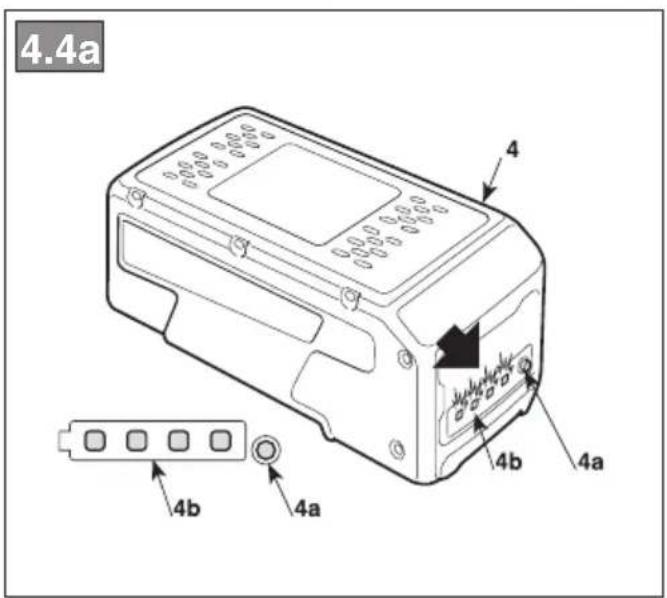
4.4c

CONOSCERE LA MACCHINA
- Batteri (akkumulator)
21.1 Fabrikant
SAFETY REGULATIONS please follow meticulously
A) TRAINING
1) WARNING! Read these instructions carefully before operating the machine. Become acquainted with the controls and the proper use of the machine. Learn how to stop the motor quickly. Failure to follow the warnings and instructions may result in electric shock, fire and/or serious injury. Save all warnings and instructions for future reference.
2) Never allow children or persons unfamiliar with these instructions to use the machine. Local laws can restrict the minimum age of the operator.
3) This appliance can be used by children aged from 8 years and above and persons with reduced physical, sensory or mental capabilities or lack of experience and knowledge if they have been given supervision or instructions concerning use of the appliance in a safe way and understand the hazards involved. Children shall not play with the appliance. Cleaning and user maintenance shall not be made by children without supervision.
4) Never use the lawnmower while people, especially children, or pets are nearby.
5) Never use the machine if the user is tired or unwell, or has taken medicine, drugs, alcohol or any substances which may slow his reflexes and compromise his judgement.
6) Bear in mind that the operator or user is responsible for accidents or unexpected events occurring to other people or their property. It is the user's responsibility to assess the potential risk of the area where work is to be carried out, and to take all the necessary precautions to ensure his own safety and that of others, particularly on slopes or rough, slippery and unstable ground.
7) If the machine is sold or lent to others, make sure that the operator looks over the user instructions contained in this manual.
B) PRELIMINARY OPERATIONS
1) While using the machine, always wear anti-slip and resistant work footwear and long pants. Do not operate the machine when barefoot or wearing open sandals. Avoid wearing chains, bracelets and clothing that is loose fitting or has hanging cords or ties. Tie hair back if it is long. Always wear protective earplugs.
2) Thoroughly inspect the entire work area and remove anything that could be thrown by the machine or damage the cutting unit or motor (stones, branches, iron wire, bones, etc.).
3) Before using the machine, check its general condition and in particular:
- the appearance of the cutting means, and check that the screws and cutting unit are not worn or damaged. Replace the entire cutting means and all damaged or worn screws to preserve balance. Any repairs must be done at a specialised centre.
- Don't force the safety lever as it must move freely; it should return automatically and rapidly back to the neutral position, resulting in the stopping of the cutting device
4) Before starting work, always fit the exit guards (grass catcher, side discharge guard or rear discharge guard).
C) DURING USE
1) Work only in daylight or with good artificial light in good visibility conditions. Keep persons, children and animals away from the working area.
2) If possible, avoid mowing wet grass. Avoid working in the rain and when there is a thunderstorm risk. Do not use the machine in bad weather conditions, especially when there is risk of lightening.
3) Do not expose the machine to rain or wet environments. Water entering a power tool will increase the risk of electric shock.
4) Make sure you have a steady foothold on slopes.
5) Never run, always walk; do not let the lawnmower pull you.
6) Pay special attention when approaching obstacles that could compromise visibility.
7) Always mow across a slope and never up and down it, being very careful when changing direction that the wheels do not hit any obstacles (such as stones, branches, roots, etc.) that may cause the machine to slide sideways or make you lose control of it.
8) The machine must not be used on slopes of over 20^ , regardless of the mowing direction.
9) Be extremely careful when pulling the lawnmower toward you. Look behind you to make sure there are no obstacles before and during operations in reverse gear.
10) Immobilise the cutting means if the lawnmower must be inclined for transport, when moving over surfaces other than grass and when the lawnmower is transported from or to an area that must be cut.
11) Pay attention to traffic when using the machine near roads.
12) Never operate the machine with damaged guards or without the grass catcher, side discharge guards or rear discharge guards.
13) Be very careful near ravines, ditches or embankments.
14) Start the motor carefully following the instructions, keeping feet away from the cutting means.
15) Keep both hands on the grip during ignition.
16) Do not incline the lawnmower during ignition. Ignite the machine on a flat surface without obstacles or high grass.
17) Never place your hands and feet near or under rotating parts. Keep away from the discharge opening.
18) Do not lift or transport the lawnmower when the motor is running.
19) Do not tamper with or disable safety systems.
20) On power-driven models, disengage the wheel drive before switching the motor on.
21) Use manufacturer-recommended attachments only.
22) Don't use the machine if the attachments/tools are not installed in their seats.
23) Disengage the cutting means, switch off the motor and remove the key (making sure that all moving parts are stationary):
- When transporting the machine;
- Whenever you leave the lawnmower unattended;
- Before clearing blockages or unclogging the discharge chute;
- Before checking, cleaning or working on the machine;
- After striking a foreign object. Inspect the machine for damage and make repairs before using it again.
24) Disengage the cutting means and switch off the motor: - Whenever you remove or reattach the grass catcher;
- Whenever you remove or reattach the side discharge chute;
- Before adjusting the cutting height, if this operation can not be performed from the driving seat.
25) When working, always keep a safe distance from the rotary cutting means, given by the length of the handle.
26) WARNING – If something breaks or an accident occurs whilst working, turn off the motor immediately and move the machine away to prevent further damage; if an accident occurs with injuries or third parties are injured, carry out the first aid measures most suitable for the situation immediately and contact the medical authorities for any necessary health care. Carefully remove any debris that might cause damage or harm persons or animals should it not be seen.
27) WARNING - The noise and vibration levels shown in these instructions are the maximum levels for use of the machine. The use of an unbalanced cutting element, the excessive speed of movement, or the absence of maintenance have a significant influence on noise emissions and vibrations. Consequently, it is necessary to take preventive steps to eliminate possible damage due to high levels of noise and stress from vibration. Maintain the machine well, wear ear protection devices, and take breaks while working.
1) WARNING! - Before cleaning or doing maintenance work, remove the key and read the relevant instructions. Wear proper clothing and protective gloves whenever your hands are at risk.
2) WARNING! – Never use the machine with worn or damaged parts. Faulty or worn-out parts must always be replaced and not repaired. Use original replacement parts only: the use of non-original and/or incorrectly fitted parts will jeopardize the safety of the machine, may cause accidents or personal injuries for which the Manufacturer is under no circumstance liable or responsible.
3) Any adjustments or maintenance operations not described in this manual must be carried out by your Dealer or a specialized Service Centre with the necessary knowledge and equipment to ensure that the work is done correctly maintaining the machine's original safety level. Any operations performed in unauthorized centres or by unqualified persons will totally invalidate the Warranty and all obligations and responsibilities of the Manufacturer.
4) Every time you finish working, remove the key and check the machine over for any damage.
5) Keep all nuts, bolts and screws tight to be sure the equipment is in safe working condition. Routine maintenance is essential for safety and for maintaining a high performance level.
6) Check that the cutting means screws are properly tightened on a regular basis.
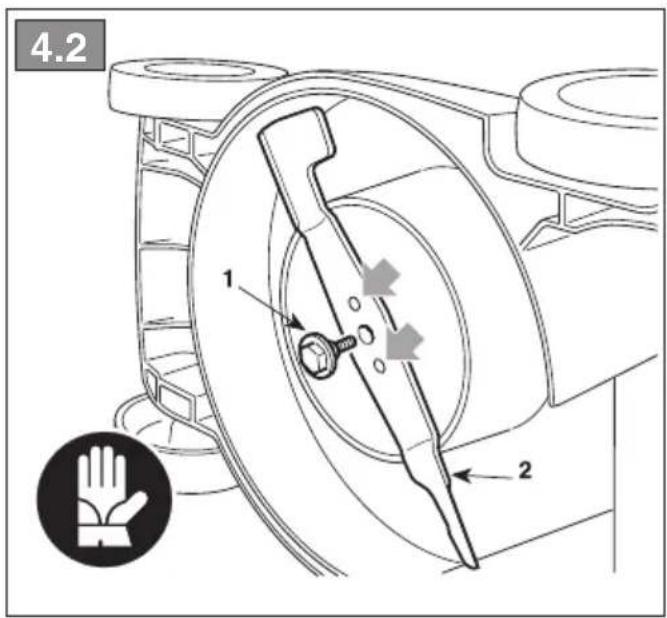
7) Wear work gloves when handling, disassembling and reassembling all cutting means.
8) Keep the cutting means well balanced during sharpening. All work on the cutting means (disassembly, sharpening, balancing, reassembly and/or replacing) are demanding jobs that require special skills as well as special tools.
For safety reasons, these jobs are best carried out at a
specialised centre.
9) Be careful during adjustment of the machine to prevent entrapment of the fingers between moving parts of the cutting means and fixed parts of the machine.
10) Do not touch the cutting means until the key has been removed and the cutting means is completely stationary. When servicing the cutting means, bear in mind that, even though the key has been removed, the cutting means can still move.
11) Check the side discharge guard, the rear discharge guard and the grass catcher frequently for signs of wear or deterioration. Replace them if they are damaged.
12) Replace any instruction or warning message stickers, if damaged.
13) Store the machine out of the reach of children.
14) Allow the motor to cool down before storing in any enclosure.
15) To reduce fire hazards, keep the lawnmower and, in particular, the motor free of grass, leaves, or excessive grease. Always empty the grass catcher and do not leave containers full of cut grass inside storage areas.
E) ADDITIONAL WARNINGS
1) Do not use the machine in explosive atmospheres, such as in the presence of flammable liquids, gases or dust. Power tools create sparks which may ignite the dust or fumes.
2) Do not overload the machine. Use a machine that is suitable for the job. A suitable machine will do the job better and safer at the rate for which it was designed.
3) Only use battery chargers recommended by the manufacturer to recharge batteries. An inadequate battery charger may cause electric shock, overheating or corrosive liquid to leak from the battery
4) Use only batteries specifically designed for your power tool. The use of other batteries may cause injuries and fire risks.
5) Liquid can leak from batteries when they are in bad condition. Avoid all contact with this liquid. Rinse thoroughly with water if accidental contact occurs. If the liquid comes into contact with the eyes, call a doctor immediately. Liquid leaks from batteries can cause skin irritation and even burns.
6) Make sure that the machine is switched off before inserting the battery. Inserting a battery in a machine which is switched on can cause outbreak of fire.
7) Keep all unused batteries at a distance from paper clips, coins, keys, nails, screws or other small metal objects as contact with the same can cause short circuits. Short circuits between battery contacts can lead to explosion or fires.
8) The accumulator must never be opened.
9) Never throw used batteries into a fire
- EXPLOSION HAZARD!
10) Connect the battery charger only to power sockets carrying the voltage indicated on the manufacturer's rating plate.
11) Use original accumulators only.
12) After prolonged use, the accumulator may heat up. Allow it to cool down before recharging it.
13) Never leave the accumulator and battery charger within the reach of children.
14) Never use the battery charger in places where flammable vapours or substances are present.
15) Recharge accumulators at a temperature of between
10^ and 40^ only.
16) Never store accumulators in environments with temperatures of over 40°C.
17) Never cause short circuits between the accumulator contacts and never connect them to metal objects.
18) When transporting accumulators, make sure the contacts never come into contact with each other and never use metal containers to transport them.
19) Short circuit of the accumulator can cause an explosion. In any case, short circuits will damage the accumulator.
20) Regularly check the battery charger cable for damage. If the cable gets damaged, the battery charger must be replaced.
21) Recharge the accumulators completely before storing them in winter.
22) Keep the battery charger out of the rain and away from humidity. Water permeating into the battery charger increases the risk of electric shock.
23) Keep the battery charger clean. Accumulated dirt may cause electric shock.
24) Never use the battery charger in environments with flammable substances or on easily flammable surfaces such as paper, fabric, etc. The battery charger heats up during recharging and may cause a fire.
25) A defective battery charger or improper use of the battery may cause vapours to leak which may irritate the respiratory tract. Air the room with fresh air and consult a physician if in doubt.
26) Regularly clean the battery's vents with a soft, dry and clean brush.
F) TRANSPORTATION AND HANDLING
1) Whenever the machine is to be handled, lifted, transported or tilted you must:
- Wear sturdy work gloves;
- Grasp the machine at the points that offer a safe grip, taking into account the weight and relative distribution of the same
- Use an appropriate number of people for the weight of the machine and the characteristics of the vehicle or the place where it must be placed or collected
- Make sure that machine movements do not cause damage or injuries.
2) During transport, fasten the machine securely with cables or chains.
G) ENVIRONMENTAL PROTECTION
1) Environmental protection should be a priority of considerable importance when using the machine, for the benefit of both social coexistence and the environment in which we live. Try not to cause any disturbance to the surrounding area.
2) Scrupulously comply with local regulations for the disposal of packaging, deteriorated parts or any elements with a strong environmental impact; this waste must not be disposed of as normal waste, it must be separated and taken to specified waste disposal centres where the material will be recycled.
3) Scrupulously comply with local regulations for the disposal of waste materials after mowing.
4) At the time of decommissioning, do not pollute the environment with the machine, but hand it over to a disposal centre, in accordance with the local laws in force.
GETTING TO KNOW THE MACHINE
MACHINE DESCRIPTION AND SCOPE OF APPLICATION
This machine is a garden tool and more precisely a pedestrian-controlled lawnmower.
The machine is essentially composed of a motor which drives a cutting means enclosed in a casing, equipped with wheels and a handle.
The operator is able to operate the machine and use the main controls, always staying behind the handle at a safe distance from the rotary cutting means. If the operator leaves the machine, the motor and cutting means will stop within a few seconds.
Intended use
This machine was designed and manufactured for cutting (and collecting) grass in gardens and grassy areas, in areas in proportion to its cutting capacity, done by a pedestrian operator.
The presence of attachments or specific devices can prevent cut grass from being collected or produce a mulching effect, depositing cut grass on the ground.
User types
This machine is intended for use by consumers, i.e. non-professional operators. The machine is intended for "DIY" use only.
Improper use
Any other usage not in keeping with the above-mentioned ones may be hazardous and harm persons and/or damage things.
Examples of improper use may include, but are not limited to:
- transporting persons, children or animals on the machine;
– letting oneself be transported by the machine;
– using the machine to tow or push loads;
– using the machine for leaf or debris collection; - using the machine to trim hedges, or for cutting vegetation other than grass;
– use of the machine by more than one person; - using the rotary cutting means on surfaces other than grass.
IDENTIFICATION LABEL AND MACHINE COMPONENTS (see figures on page ii)
- Acoustic power level
- CE conformity marking
- Year of manufacture
- Type of lawnmower
- Serial number
- Name and address of Manufacturer
- ArticleCode
8.Motorspeed - Weight in kg
- Power supply voltage
10a. Electrical protection rating
11.Chassis
12.Motor
13. Cutting means
14. Rear discharge guard
15.Grasscatcher
16.Handle
17. Controllever
18. Hatch for accessing the battery compartment
19. Safety key (Deactivation device)
SUPPLIED COMPONENTS AND IDENTIFICATION LABELS
- Battery (accumulator)
21.1 Manufacturer
21.2 Voltage and capacity - Battery charger
22.1 Manufacturer
22.2 Voltage and frequency of power supply / Absorption
22.3 Charger voltage and current
As soon as you have purchased the machine, do not forget to write the identification numbers (3 - 4 - 5) in the spaces on the last page of the manual.
The example of the Declaration of Conformity is provided on the penultimate page of the owner's manual.

Do not dispose of electrical equipment with household waste material. In observance of European Directive 2012/19/EU on electrical and electronic equipment waste and its implementation in accordance with national regulations, electrical equipment that has reached the end of its product life must be collected separately and recycled in an ecologically compatible way. If electrical equipment is disposed of in dumps or in landfills, hazardous substances can leak into the groundwater and contaminate the food chain, damaging your health and well-being. For further information on the disposal of this product, contact your dealer or a domestic waste collection service.
DESCRIPTION OF SYMBOLS ON CONTROLS (where applicable)
- WARNING – Ignition of the motor simultaneously engages the cutting means.
31.Stop
32.Run - Electrical circuit activated (machine on)
SAFETY REQUIREMENTS – Your lawnmower should be used with due care and attention. Therefore, figured labels have been placed on various parts of the machine to remind you of the main precautions to be taken. Their meaning is explained below. You are also asked to carefully read the safety regulations in the specific chapter of this manual. Replace damaged or illegible labels.
- Warning: Read the instruction manual before using the machine.
- Risk of thrown objects. Keep all persons away from the work area whilst working.
-
Only for electric lawnmowers powered by mains supply.
-
Only for electric lawnmowers powered by mains supply.
- Be careful when using the sharp cutting means: Do not put hands or feet inside the cutting means The cutting means continues to turn even after the motor has been switched off. Remove the deactivation device before doing maintenance.
- Do not expose the machine to rain or humidity.
-
Be careful when using the sharp cutting means: The cutting means continues to turn even after the motor has been switched off.
-
Battery charger is equipped with a safety transformer.
- Use only in dry surroundings.
- Read the instruction manual before using.
- Do not expose the accumulator when the temperature is higher than 45^ C.
- Do not immerse the accumulator in water and do not expose it to humidity.
- Do not throw batteries into a fire. EXPLOSION HAZARD!
OPERATING INSTRUCTIONS
NOTE – The number which precedes each paragraph links the references in the text to the respective illustrations (listed on page ix and following pages).
1. COMPLETING ASSEMBLY
NOTE The machine can be supplied with some parts already assembled.
WARNING!
Unpacking and completing the assembly should be done on a flat and stable surface, with enough space for moving the machine and its packaging, always making use of suitable equipment.
Disposal of the packaging should be done in accordance with the local regulations in force.
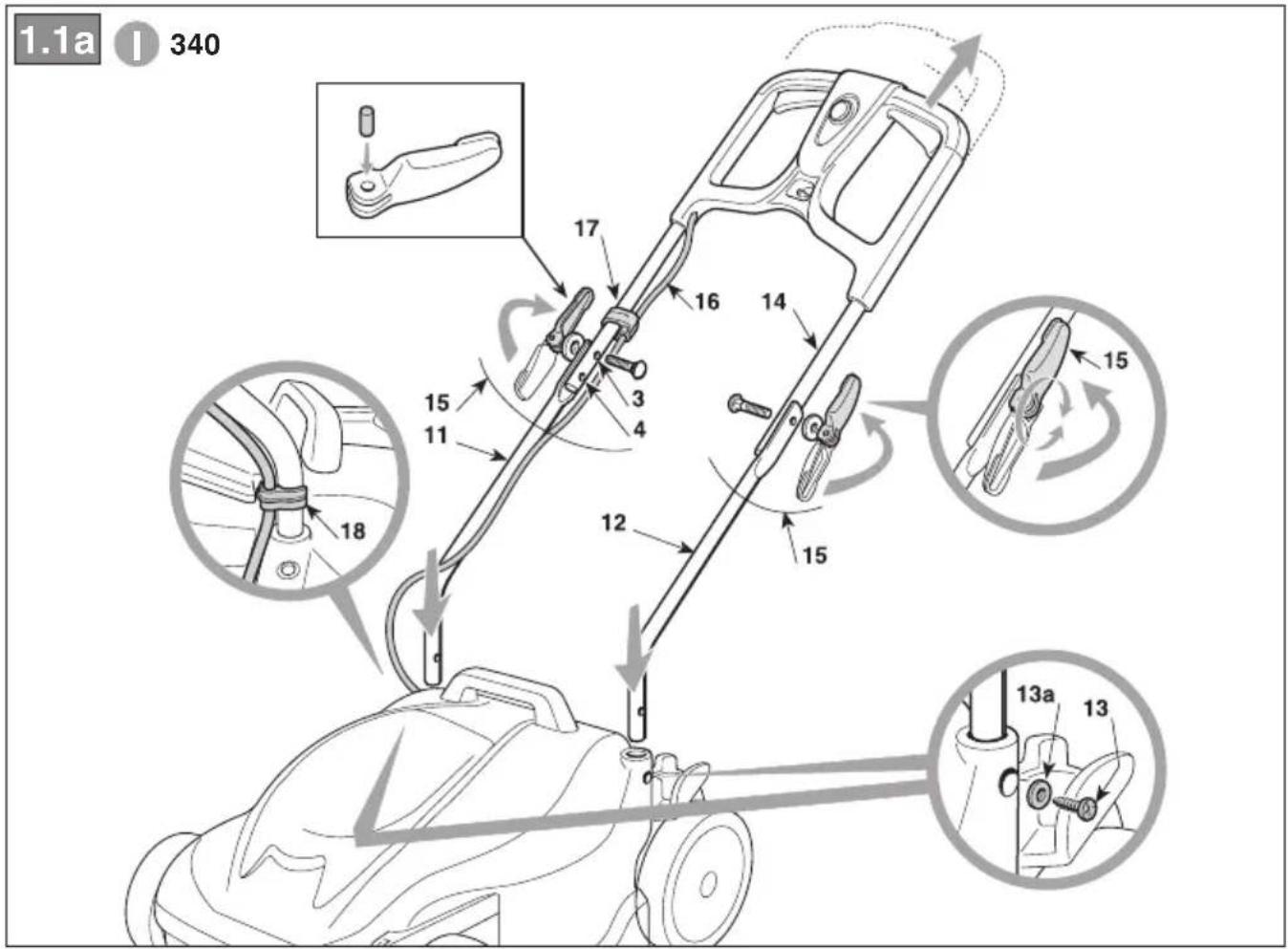
1.1a Assembling the handle (Type“I” - Model 340)
Insert the lower right (11) and left (12) parts of the handle into the respective holes and fasten them in place with the screws (13) and the washers (13a) supplied.
Assemble the upper part of the handle (14) and lock it to the two lower parts (11) and (12) using the upper levers (15) (previously removed from their respective holes), inserted in one of the two holes (3) or (4) according to the desired final height.
To adjust the holding force, each lever (15) must be released then tightened or loosened on its axle as much as is necessary to ensure that the upper part (14) is firmly fastened to the lower parts of the handle (11) and (12), without using excessive force to lock or release them.
Fasten the cable (16) to the cable fasteners (17) and (18) as shown.
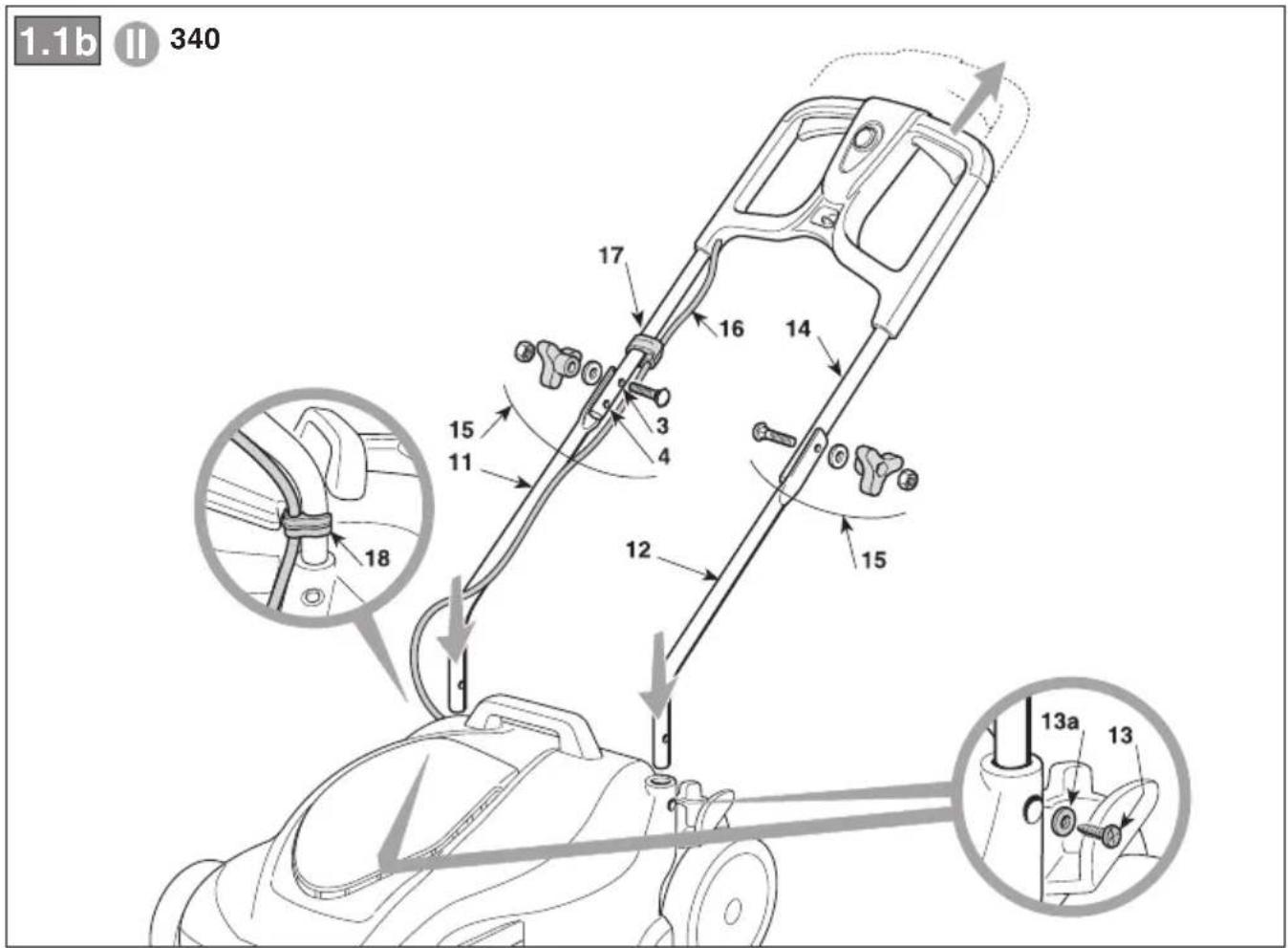
1.1b Assembling the handle (Type"II" - Model 340)
Insert the lower right (11) and left (12) parts of the handle into the respective holes and fasten them in place with the screws (13) and the washers (13a) supplied.
Assemble the upper part of the handle (14) and lock it to the two lower parts (11) and (12) using the upper knobs (15) (previously removed from their respective holes), inserted in one of the two holes (3) or (4) according to the desired final height.
Fasten the cable (16) to the cable fasteners (17) and (18) as shown.
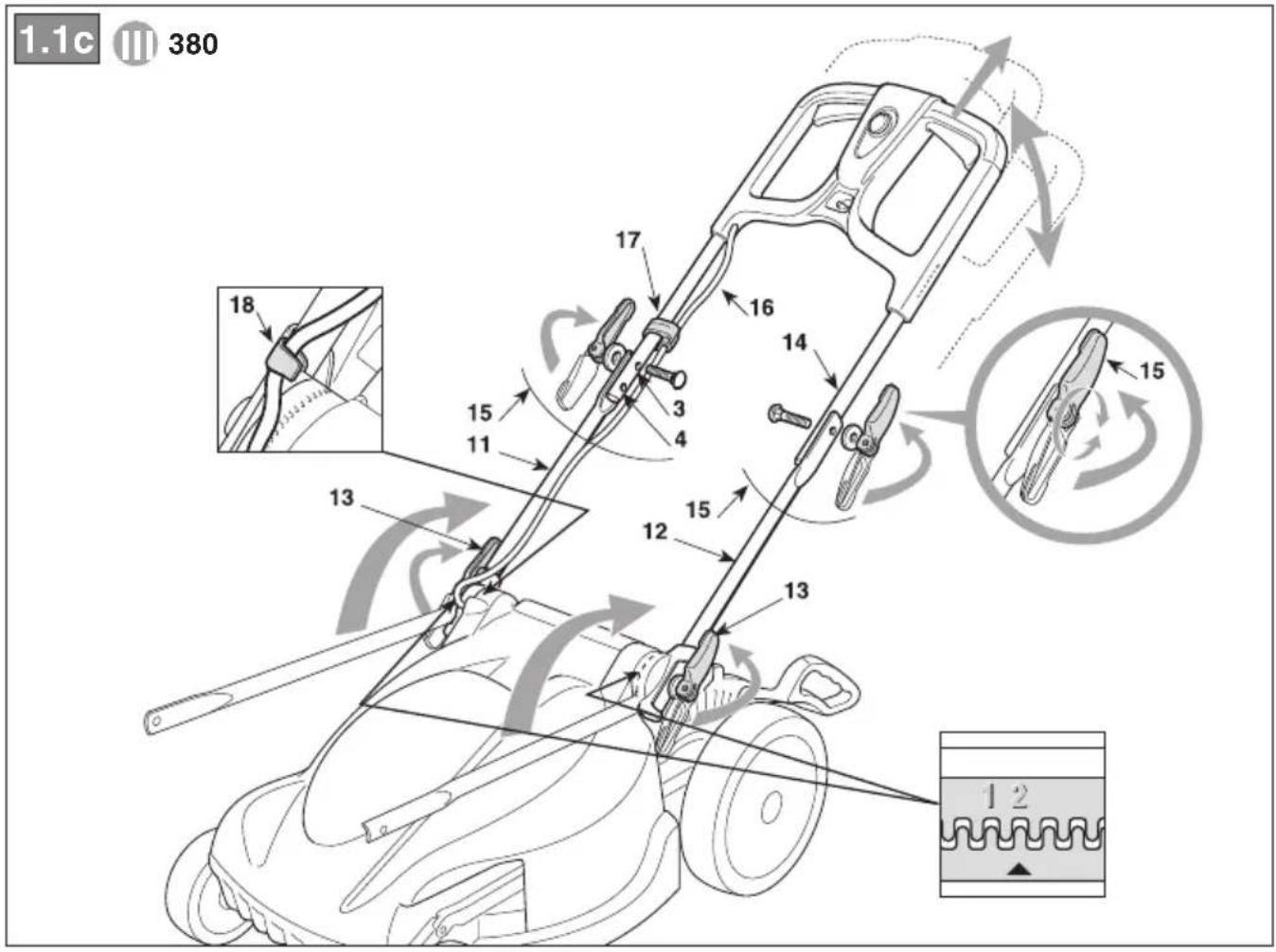
1.1c Assembling the handle (Type"III" - Model 380)
Move the two lower parts of the handle (11) and (12), already pre-assembled, to the working position, matching the tooth marked with «>> EXCLUSIVELY with one of the two compartments marked with «1» or «2» of the teeth, according to the desired height, then lock the two lower levers (13). The position must be the same for both sides.
Assemble the upper part of the handle (14) and lock it to the two lower parts (11) and (12) using the upper levers (15) (previously removed from their respective holes), inserted in one of the two holes (3) or (4) according to the desired final height.
To adjust the holding force, each lever (15) must be released then tightened or loosened on its axle as much as is necessary to ensure that the upper part (14) is firmly fastened to the lower parts of the handle (11) and (12), without using excessive force to lock or release them.
Fasten the cable (16) to the cable fasteners (17) and (18) as shown.
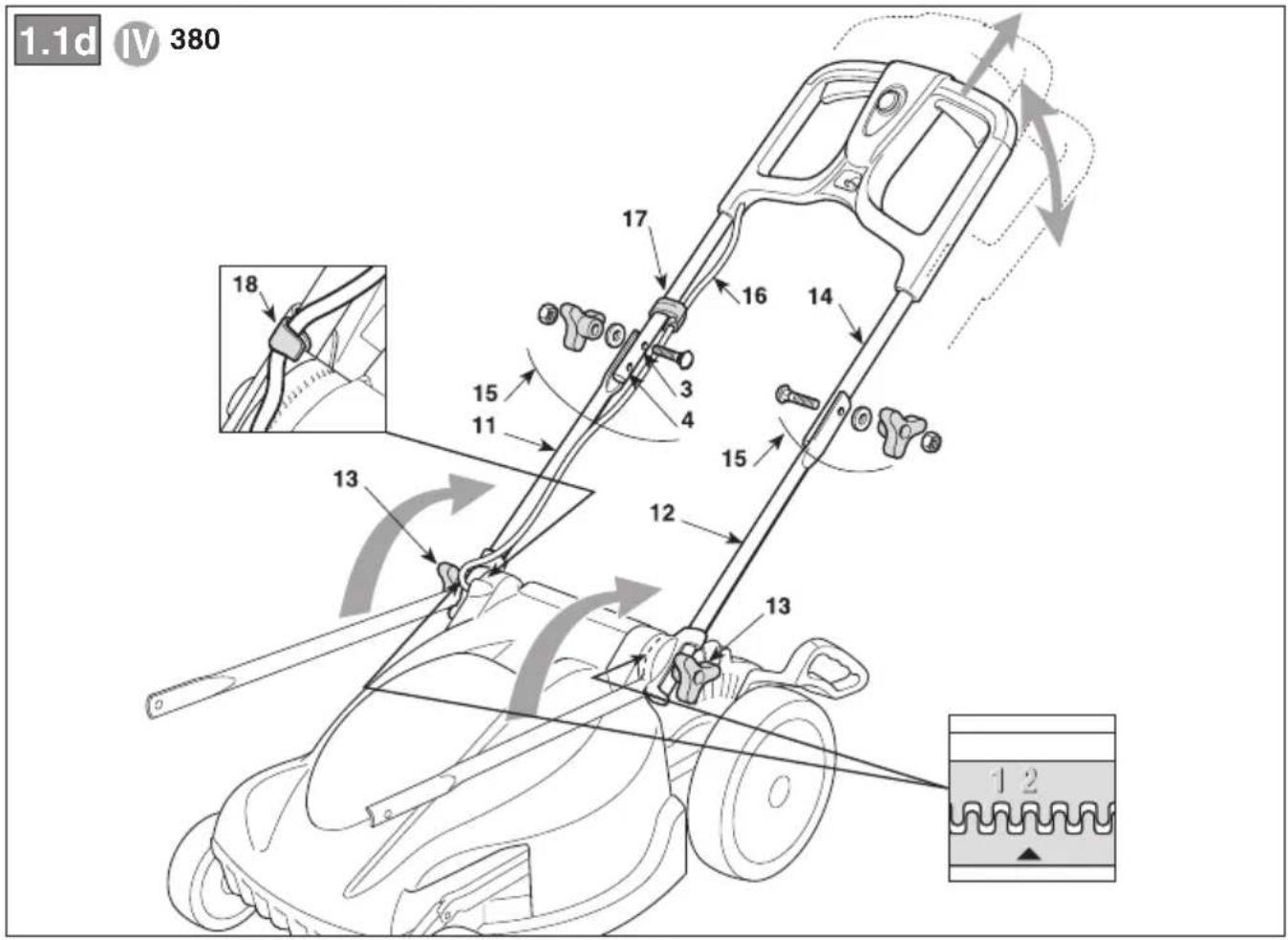
1.1d Assembling the handle (Type"IV" - Model 380)
Move the two lower parts of the handle (11) and (12), already pre-assembled, to the working position, matching the tooth marked with «>> EXCLUSIVELY with one of the two compartments marked with «1» or «2» of the teeth, according to the desired height, then lock the two lower knobs (13). The position must be the same for both sides.
Assemble the upper part of the handle (14) and lock it to the two lower parts (11) and (12) using the upper knobs (15) (previously removed from their respective holes), inserted in one of the two holes (3) or (4) according to the desired final height.
Fasten the cable (16) to the cable fasteners (17) and (18) as shown.
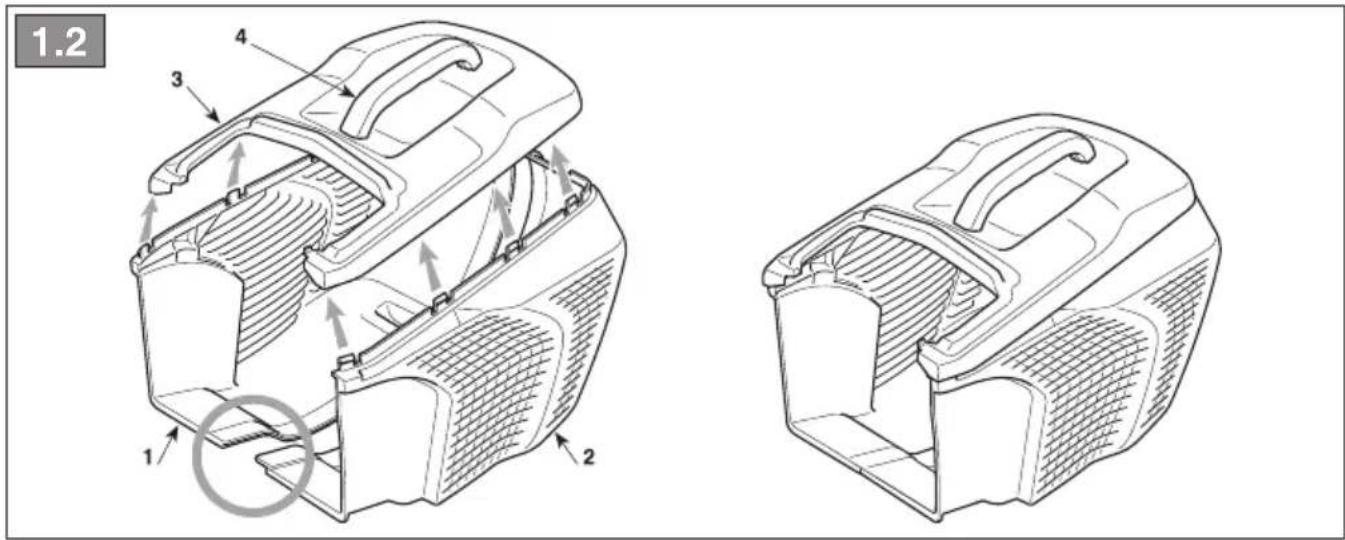
1.2 Assembling the grass catcher
Join the two side components (1) and (2) of the grass catcher, then fit the top part (3), inserting all the outer fittings correctly.
Assemble the handle (4) on the top part of the grass catcher, snapping it into the appropriate seats.
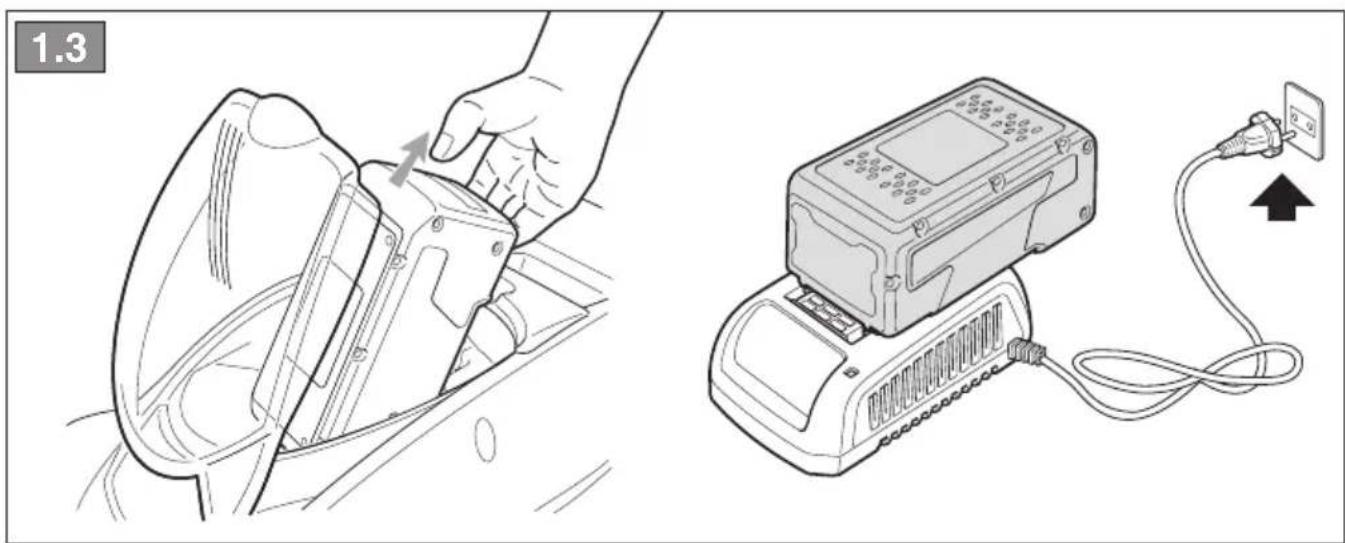
1.3 Battery removal and recharging
The machine is equipped with a partially charged battery, inserted in its housing.
Before using the machine, remove the battery and recharge it completely, as indicated in point 4.4.
2. CONTROLS DESCRIPTION
NOTE The meanings of the symbols on controls are explained in the previous pages.
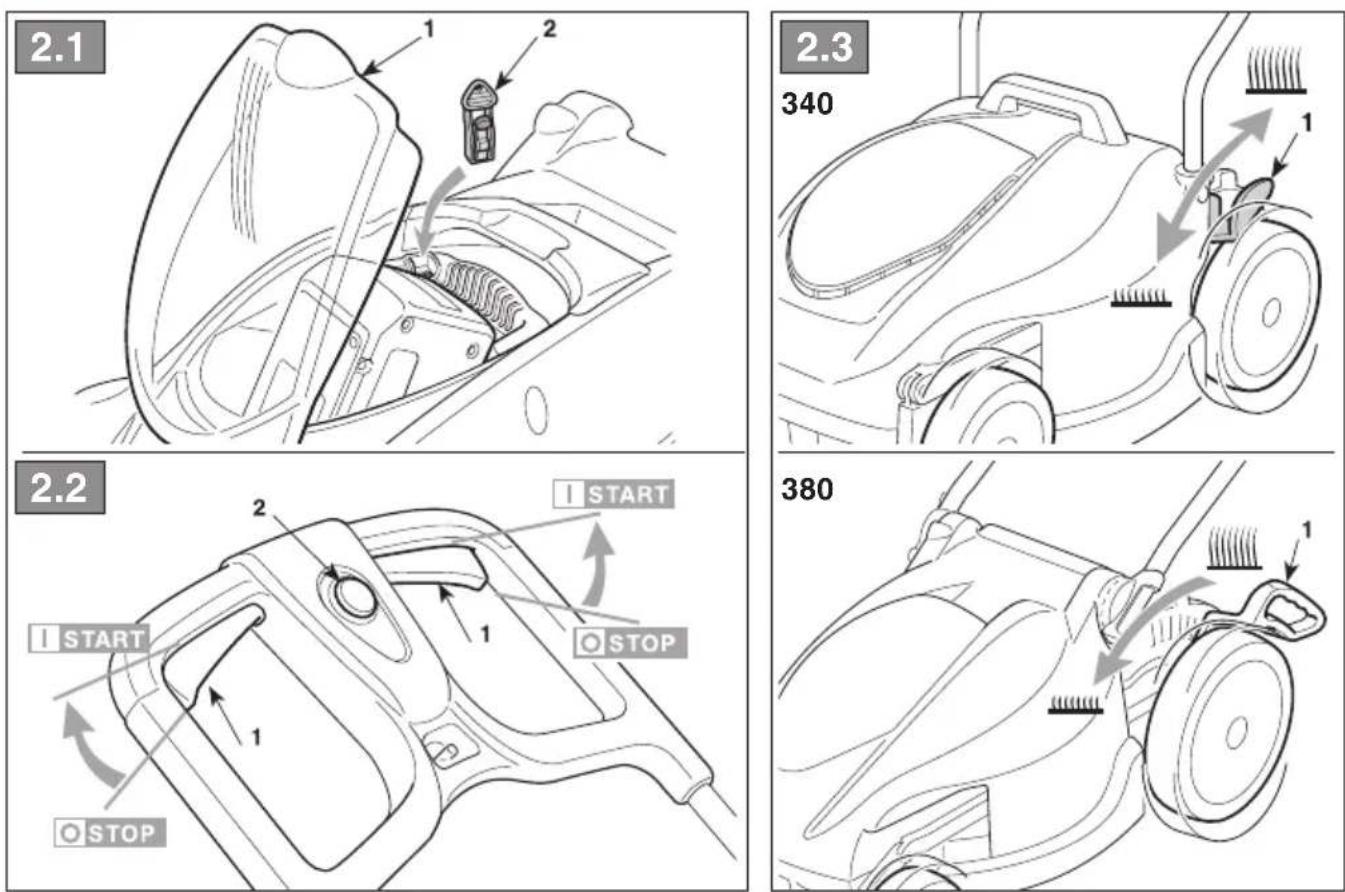
2.1 Safety key (Deactivation device)
The machine's electric circuit is switched on and off by the safety key (Deactivation device), located inside the battery compartment.
Open the hatch (1) and insert the key (2), pushing it in completely to start up the motor.
Press the lock tab to remove the key.
Removing the key, the electric circuit is completely deactivated to prevent uncontrolled use of the machine.
2.2 Dual-action switch
The motor is controlled by a dual-action switch to prevent accidental start ups.
To start the motor, press the button (2), pull one of the two levers (1) and wait 2-3 seconds for the motor to start running.
WARNING! Ignition of the motor simultaneously engages the cutting means.
The motor stops automatically when both levers (1) are released.
2.3 Cutting height adjustment
The cutting height is adjusted by the specific lever (1). DO THIS WHEN THE CUTTING MEANS IS STATIONARY.
3. GRASS CUTTING
- Battery power reserve
Battery power reserve (and therefore the mowable lawn surface before recharging is required) mainly depends on:
a) environmental factors, that cause higher energy requirements:
- mowing dense, high and/or wet grass;
b) operator behaviour, who should avoid:
- switching the machine on and off frequently whilst working;
- setting a cutting height that is too low for the lawn conditions;
- working at a speed that is too high in relation to the amount of grass to be removed;
ELECTRONIC RPM ADAPTOR
This machine is equipped with an electronic system "ELECTRONIC RPM ADAPTOR" that regulates the motor rpm rate according to the force required to cut the grass.
The "ELECTRONIC RPM ADAPTOR" system optimises batteryautonomy.
When the grass is short (minimum force) the machine runs at a lower rpm rate (lower perceived noise), increasing battery autonomy. When the grass is high (greater force) the machine runs at a higher rpm rate (higher perceived noise), decreasing battery autonomy.
To optimise battery power reserve it is always recommended to:
– cut the grass when the lawn is dry;
- cut the grass frequently so that it doesn't grow too tall;
- set a higher cutting height when the grass is very tall, then set a lower height and cut the lawn again;
- do not use the machine in "mulching" mode when the grass is very tall.
If the need arises to use the machine for sessions which exceed the capability of a standard battery, it is possible to:
- purchase a second standard battery to immediately replace the worn down battery, without compromising the continuity of operations;
- purchase a battery with an extended power reserve compared to the standard version (see 5.1).
NOTE This machine can be used to mow lawns in a number of different ways; before starting work, prepare the ma-
chine based on how the lawn is to be mowed. DO THIS WHEN THE MOTOR IS SWITCHED OFF.
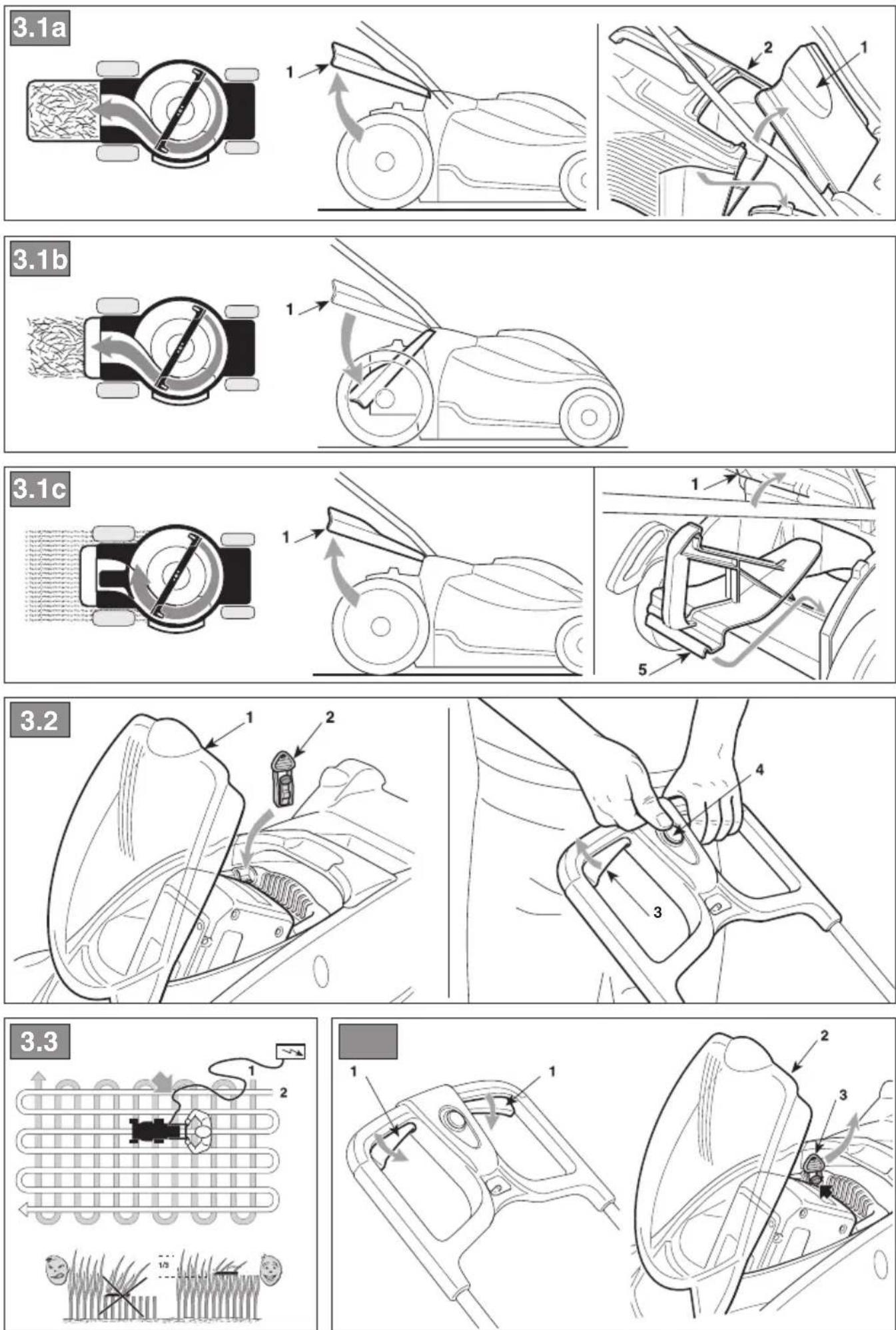
3.1a Preparation for grass cutting and collection in the grass catcher:
- Lift the rear discharge guard (1) and fasten the grass catcher (2) correctly as shown in the illustration.
3.1b Preparation for grass cutting and rear discharge:
- Remove the grass catcher and check that the rear discharge guard (1) maintains its lowered position.
3.1c Preparation for mowing and mulching (where applicable)
- Lift the rear discharge guard (1), position the chute cap (5) inside the discharge opening and push it as far as possible until the lower contour fastens to the edge of the discharge opening.
To remove the chute cap (5), lift the rear discharge guard (1) and pull it, keeping it lifted so as to unfasten the lower contour from the edge of the discharge opening.
3.2 Ignition
Make sure the battery is charged and properly inserted in its housing as indicated in point 4.4.
Open the hatch (1) and insert the safety key (2) until it clicks into place.
To start the motor, press the safety button (4) and pull one of the two switch levers (3).
3.3 Grass cutting
The appearance of the lawn will improve if you alternate cutting in both directions at the same height.
When the grass catcher is too full, grass collection is no longer efficient and the sound of the lawnmower changes.
To remove and empty the grass catcher,
- release the switch lever and wait for the cutting means to stop;
- lift the rear discharge guard, grasp the handle and remove the grass catcher keeping it in an erect position.
- When mulching: always avoid cutting a large quantity of grass. Never cut more than one third of the total grass height per single pass! Regulate the forward speed according to the lawn conditions and the amount of grass being cut.
Lawn care recommendations
Each type of grass has different characteristics and may thus require different ways of caring for the lawn; always read the instructions on seed boxes for mowing height for the growing conditions in the work area.
Keep in mind that most grass is made up of a stem and one or more leaves. If leaves are fully cut, the lawn is damaged and growth is more difficult.
The following indications generally apply:
- cutting too low tears and uproots the grass, giving it a "spotted" appearance;
- in the summer, cutting must be higher to prevent the ground from drying;
- do not cut wet grass; this could reduce cutting means efficiency due to sticky grass and tear the lawn.
– for particularly high grass, initially mow at the maximum
height allowed by the machine then mow again after two or three days.
3.4 End of operations
Release both levers (1) when work has been completed. WAIT UNTIL THE CUTTING MEANS STOPS before making any adjustments to the lawnmower.
Open the hatch (2) and remove the safety key (3), pressing the lock tab.
IMPORTANT If the motor stops while mowing due to overheating, you must wait about 5 minutes before restarting it.
4. ROUTINE MAINTENANCE
Store the lawnmower in a dry place.
IMPORTANT Routine and accurate maintenance is essential in maintaining original machine safety and performance levels.
Adjustments or maintenance operations must only be performed with the motor switched off and the machine disconnected from the mains power supply.
1) Wear strong protective gloves before cleaning, maintaining or adjusting the machine.
2) Accurately wash the machine with water after cutting, remove grass debris and mud accumulated in the chassis to prevent it from drying and causing problems the next time the lawnmower is used.
3) Always make sure the air intakes are free of debris.
WARNING! Remove the safety key before storing the machine and before beginning any cleaning or maintenance.
4.1 Vertical storage (Model 380 - 420)
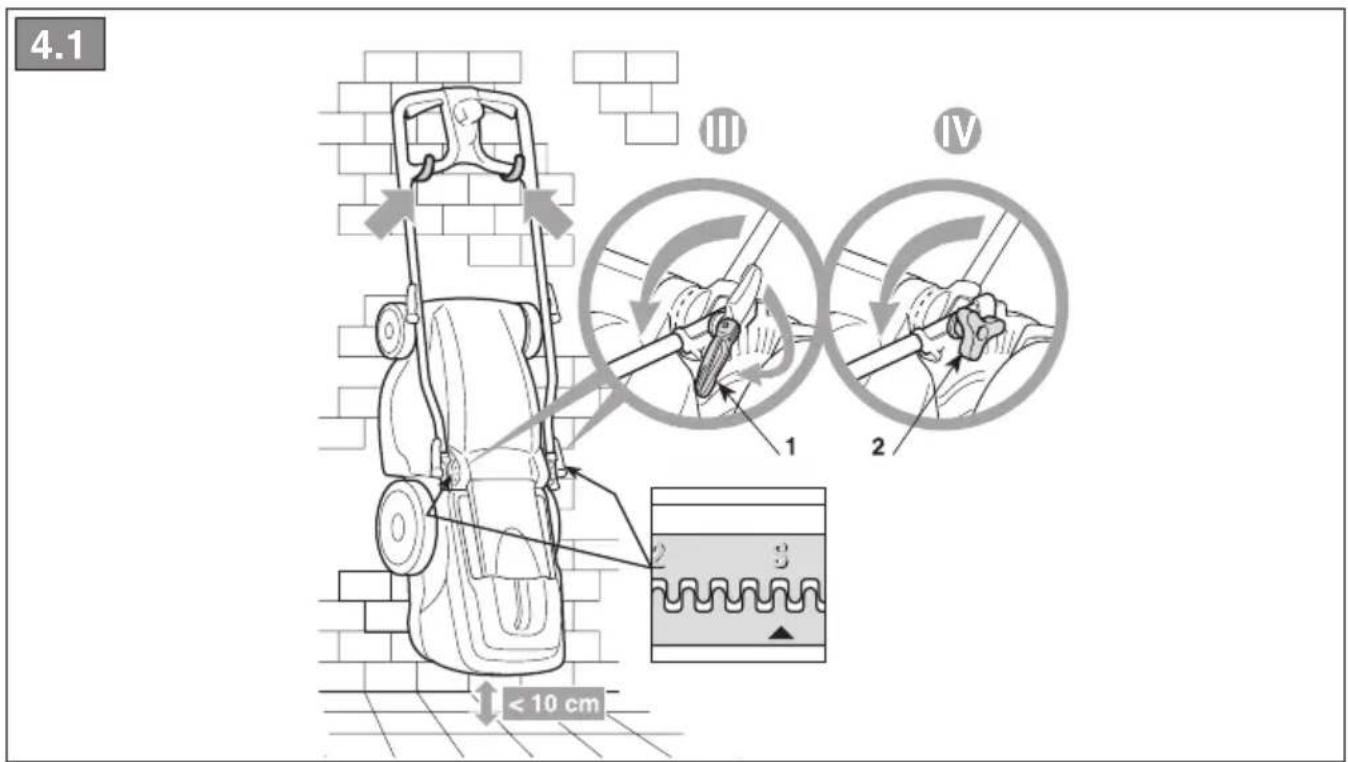
If necessary, the machine can be stored vertically, hanging from a hook.
WARNING! Make sure the hook and its fastening system are adequate and able to sustain the machine's weight; exercise caution and make sure children or animals do not climb on the machine, weighing down the hook.
Fasten the machine so that the cutting means faces a wall or is properly covered, so it is not dangerous in the event of accidental contact with persons, children or animals.
To store the machine vertically, release the levers (1 - Type "III") or loosen the knobs (2 - Type "IV") and turn the handle forward so the tooth marked with «>> matches EXCLUSIVELY with the compartment marked «S» of the teeth, then lock the levers (1 - Type "III") or the knobs (2 - Type "IV").
The position must be the same for both sides.
4.2 Cutting means maintenance
It is best if all interventions on the cutting means are done at a specialised Centre that has the most appropriate tools and equipment.
Only cutting means bearing the code indicated in table on page ix must be used on this machine.
Given product evolution, the above mentioned cutting means may be replaced in time with others having similar
interchangeable and operating safety features.
Reassemble the cutting means (2) with the code facing the ground, following the steps indicated in the illustration. Tighten the central screw (1) using a dynamometric key calibrated at 30 Nm (for model 340) or 16-20 Nm (for model 380 - 420).
4.3 Cleaning the machine
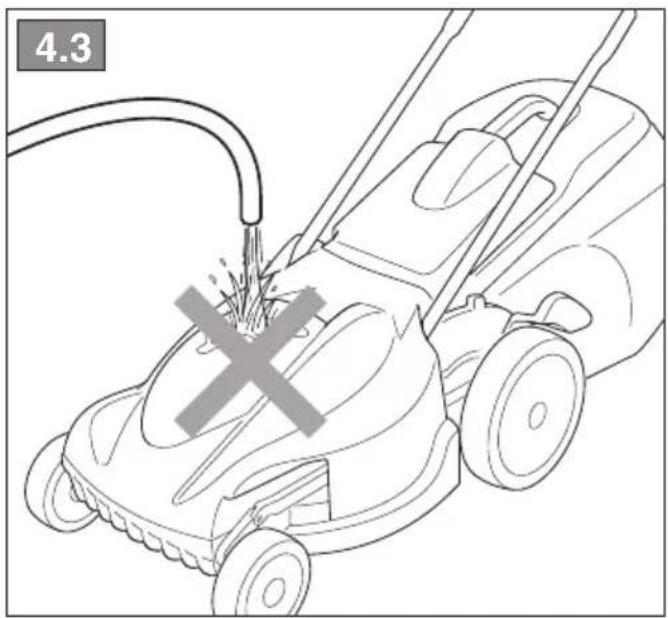
Do not spray water onto the motor and electrical components and prevent them from getting wet. Do not use aggressive liquids to clean the chassis.
4.4 BATTERY RECHARGING AND HANDLING
NOTES
- The battery must be stored in places with temperatures between +7°C and +40°C. If the machine is stored in places that could exceed these threshold, it is recommended to remove the battery and store it in a more suitable location.
- During use, the battery is protected against total drainage with a protective device that switches off the machine and stops it from working.
- The battery is equipped with a guard that inhibits recharging if the environmental temperature is not between 0 and +45 °C.
- The battery can be recharged at any time, even partially, with no risk of damaging it.
4.4a Checking the battery charge status
To check the condition of the battery charge status (4), press the small button (4a) which activates four LED lights (4b) which indicate the following:
| LED Battery power reserve | |
| 4 GREEN | 100% |
| 3 GREEN | 70% |
| 2 GREEN | 45% |
| 1 GREEN | 10% - Recharge needed |
| None The battery has less than 10% power re-serve and needs recharging immediately. If at least one LED does not come on after 30 minutes charging, the battery is faulty and needs replacing. | |
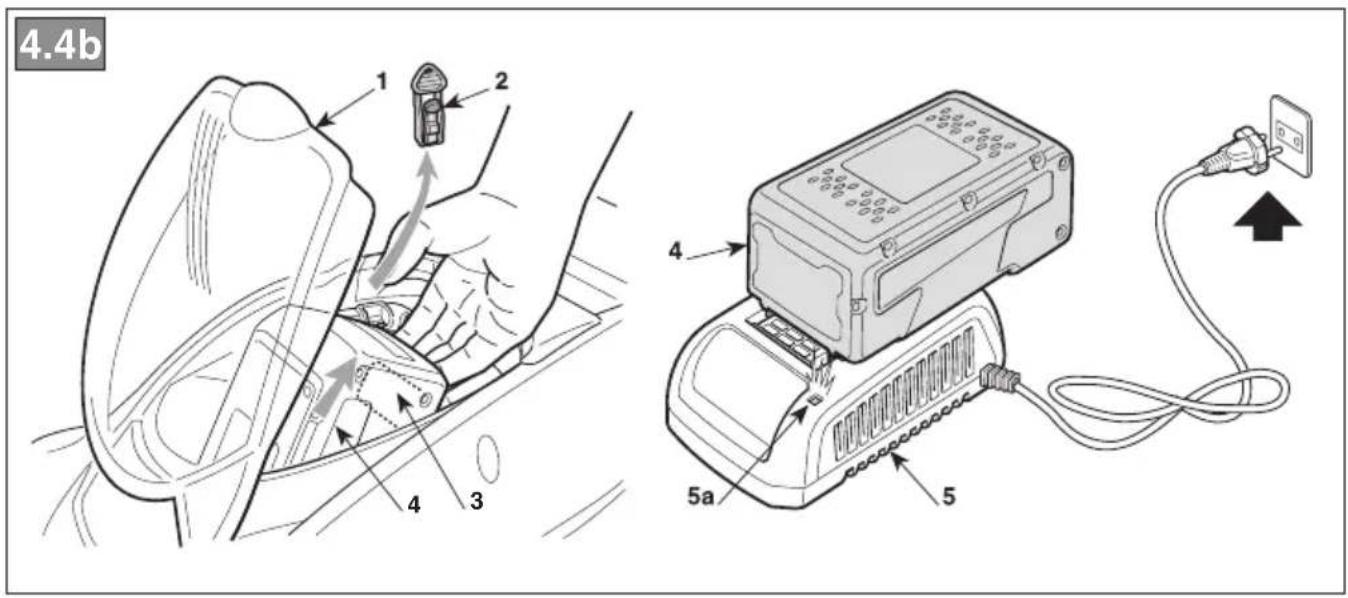
4.4b Battery removal and recharging
After every work session, the battery should be recharged.
To recharge the battery:
- open the hatch (1) and remove the safety key (2);
- press the bottom tab (3) and remove the battery (4);
- insert the battery (4) in its housing in the battery charger (5), pushing it in completely.
- connect the battery charger (5) to a power socket with the voltage indicated on the rating plate.
Battery charging lasts from 1.5 - 3.5 hours, depending on the battery capacity and its residual charge.
The battery charger (5) is the diagnostic type fitted with a LED that provides information on the battery and charge status, based on the following chart:
| LED (5a) Meaning | |
| GREEN(Flashing) | Battery charging |
| GREEN Fully charged battery | |
| RED Battery overheated: remove the battery and leave it to cool for at least 30 minutes | |
| Off No battery or battery inserted incorrectly | |
| RED(Flashing) | Charge anomaly and possible faulty battery; in this case remove the battery and replace it within 2 hours: if the LED indicates charging status, this means that the battery is in good condition and the charging can proceed as normal. Otherwise:– disconnect the battery charger, wait a few minutes, and reconnect it to the mains again;– remove the battery from the charger, wait a few minutes, and replace it again.If, after all these attempts, the LED (5b) does not indicate the charge status and continues to flash, this means that the battery is faulty and needs replacing. |
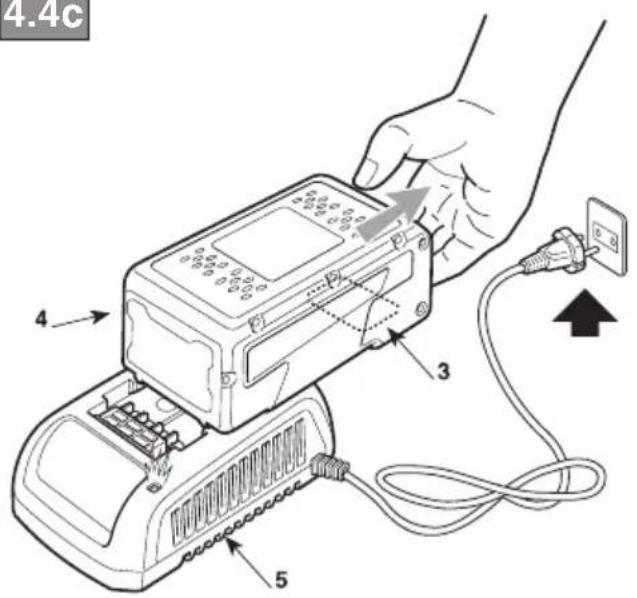
4.4c Refitting the battery on the machine
When recharging is completed:
- press the lower tab (3) and remove the battery (4) (do not keep recharging when recharging is completed);
- disconnect the battery charger (5) from the mains power supply
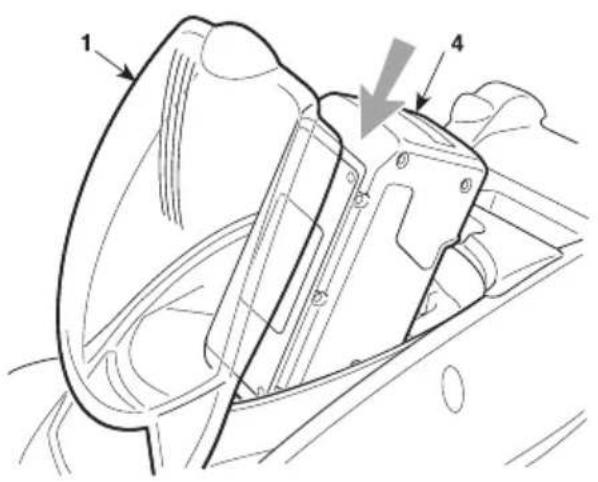
- open the hatch (1) on the machine, insert the battery (4) in its housing on the machine and push in all the way to lock it into place and ensure electrical contact.
- completely close the hatch (1) again.
5. ATTACHMENTS
WARNING! For your safety, it is strictly prohibited to fit any other attachment other than those included in the following list, as they have been exclusively designed for the model and type of machine you are using.
5.1 Alternative batteries
Different capacity batteries are available to suit specific operating requirements. The list of approved batteries for this machine is found in the table on page «ix».
- DIAGNOSTICS
| What to do if ... | |
| Problem description Corrective action | |
| 1. The motor does not start when the switch is pressed | |
| Safety key is not inserted or is inserted incorrectly | Insert the key until you here it “click” (see 3.2) |
| Battery is not inserted or is inserted incorrectly | Open the hatch and check that the battery is fitted in its housing correctly (see 4.3c) |
| Low battery Check the battery status and recharge if necessary (see 4.3) | |
| Thermal switch has tripped Allow the machine to cool down | |
| Motor start-up is slow Press and hold the switch for 1-3 seconds (see 2.2) | |
| 2. The motor shuts down whilst working | |
| Battery is not inserted correctly | Open the hatch and check that the battery is fitted in its housing correctly (see 4.3c) |
| Low battery Check the battery status and recharge if necessary (see 4.3) | |
| Thermal switch has tripped Wait for at least 5 minutes and then restart the machine | |
| Obstructions that prevent rotation of the cutting means | Remove the safety key, put on your work gloves and remove any grass remains or debris from the lower part of the machine and/or the discharge channel |
| 3. The motor is running but the cutting means is stationary | |
| The cutting means fittings are loose | Switch the motor off immediately and contact the nearest Authorised Service Centre (see 4.1) |
| 4. Excessive noise and/or vibration is experienced whilst working | |
| Cutting means fittings are loose or the cutting means is damaged | Switch the motor off immediately and contact the nearest Authorised Service Centre (see 4.1) |
| 5. Battery power reserve is low | |
| Severe working conditions requiring greater current absorption | Optimise operations (see 3) |
| Battery is insufficient for operating requirements | Use a second battery or an extended battery (see 5.2) |
| 6. The battery charger does not recharge the battery (red light steady or flashing) | |
| Battery is not correctly inserted in the battery charger | Check to make sure it is inserted correctly (see 4.3b) |
| Unsuitable environmental conditions | Recharge the battery in places with suitable temperatures (see 4.3) |
| Dirty contacts Clean the contacts | |
| 7. The battery charger does not recharge the battery (no LED is on) | |
| The battery charger is not energised | Check it is plugged in and the power socket is energised |
| Faulty battery charger Replace with an original spare part | |
For all other situations not included in the list, please contract your Dealer or an Authorised Service Centre.
2.2 Kaheastmeline lüliti
4. PLĀNOTĀ TEHNISKĀ APKOPE
D) VEDLIKEHOLD OG OPPBEVARING
BLI KJENT MED MASKINEN
BESKRIVELSE AV MASKINEN OG BRUKSOMRÅDET
4. ORDINÆRT VEDLIKEHOLD
- Bateria (akumulator)
D. Lgs. 262/2002, ANNEX VI, proc. 1 (Italy)