USER MANUAL Deco Flex SL SCHEPPACH
natural_image
Black and white photo of a sewing machine with visible brand label 'schuppack' and cable (no readable text beyond label)
Made in P.R.C.
DECO FLEX SL
| DE | Dekupiersäge mit flexibler WelleOriginalbetriebsanleitung | 9 |
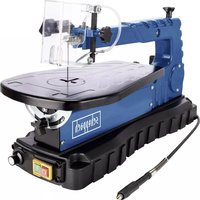
| GB | Scroll saw with flexible shaftTranslation of original instruction manual | 27 |
| FR | Scie à chantourner avec flexibleTraduction des instructions d'origine | 42 |
| IT | Sega a svolgere con albero flessibileLa traduzione dal manuale di istruzioni originale | 58 |
| NL | Decoupeerzaag met flexibele asVertaling van de originele gebruikshandleiding | 74 |
| ES | Sierra de marquetería con eje flexibleTraducción del manual de instrucciones original | 90 |
| PT | Serra de recorte com veio flexívelTradução do manual de operação original | 107 |
| CZ | Lupínková pila s flexibilní hřideliPřeklad originálního návodu k obsluze | 123 |
| SK | Sega a svolgere con albero flessibilePreklad originálného návodu na obsluhu | 137 |
| HU | Dekopírfúrész rugalmas tengellyeEredeti használati utasítás fordítása | 152 |
| PL | Wyrzynarka z elastycznym walemTłumaczenie oryginalnej instrukcji obsługi | 168 |
| HR | Ubodna pila s fleksibilnim vratilomPrijevod originalnog prirućnika za uporabu | 184 |
| SI | Dekupirna žaga s fleksibilno gredjoPrevod originalnih navodil za uporabo | 198 |
| EE | öhvsaag painduva völligaOriginaalkäitusjuhendi tõlge | 212 |
| LT | Siaurapjūklis su lanksčiuoju velenuOriginalios naudojimo instrukcijos vertimas | 226 |
| LV | Finierzāğītis ar lokano vārpstuOriginālās lietošanas instrukcijas tulkojums | 241 |
| SE | Kontursåg med flexibel axelÖversättning av original-bruksanvisning | 256 |
| FI | Lehtisaha joustavalla akselillaKäännös alkuperäisestä käyttöohjeesta | 270 |
| DK | Dekupørsav med fleksibel akselOversættelse fra den oprindelige betjeningsvejledning | 285 |
| NO | Rullesag med fleksibel akselOversettelse av den originale brukerveiledningen | 299 |
| BG | Контурен трион с гъвкав валПревод на оригиналното ръководство за експлоатация | 313 |
| GR | Επιτραπέζια σέγα με εύκαμπτο άξοναΜετάφραση του πρωτοτύπου των οδηγιών χρήσης | 330 |
| RO | Ferăstrău pentru decupat cu arbore flexibilTraducere din manualul de exploatare original | 347 |
| RS | Dekupir testera sa fleksibilnim vratilomPrevod originalnog uputstva za upotrebu | 363 |
| TR | Sabit milli dekupaj testeresiOrijinal kullanım talimatı çevirisi | 377 |
natural_image
Close-up of a sewing machine needle stitching a circular mechanical component, with no visible text or symbols.
natural_image
Close-up of a mechanical assembly with visible components and wiring (no text or symbols)
natural_image
Close-up of a mechanical component with labeled parts (22 and 24), no readable text or symbols beyond labels
natural_image
Close-up of a mechanical tool with a screw and labeled component (no readable text or symbols)
natural_image
Close-up of a black cable with two connectors, labeled with numbers 28 and 37 (no text or symbols on the cable itself)
Günzburger Straße 69
D-89335 Ichenhausen
Verehrter Kunde,
Homepage: https://www.scheppach.com/de/service
Explanation of the symbols on the device
 | Warning - read the instruction manual to reduce the risk of injury |
 | Wear a dust protection mask. When machining wood and other materials, harmful dust may be generated. Do not machine material containing asbestos! |
 | Wear hearing protection! |
 | Wear eye protection. Sparks created during work or fragments, chippings and dust ejected by the device can case sight loss. |
 | Attention! Risk of injury! Do not reach into saw blade while it is running! |
 | The product complies with the applicable European directives. |
 | The product complies with the applicable Serbian directives. |
Table of contents: Page:
- Introduction....29
- Device description (Fig. 1-29) 29
- Scope of delivery 30
- Proper use 30
- Safety information....30
- Technical data.... 33
- Before commissioning 34
- Assembly 35
- Operation 37
- Electrical connection 38
- Transport....38
- Cleaning, maintenance and ordering spare parts.... 38
- Storage 39
- Disposal and recycling.... 39
- Troubleshooting 41
- Declaration of conformity 393
1. Introduction
Manufacturer:
Scheppach GmbH
Günzburger Straße 69
D-89335 Ichenhausen
Dear customer,
We hope your new tool brings you much enjoyment and success.
Note:
In accordance with the applicable product liability laws, the manufacturer of this device assumes no liability for damage to the device or caused by the device arising from:
- Improper handling,
• Non-compliance with the operating manual,
- Repairs carried out by third parties, unauthorised specialists.
• Installing and replacing non-original spare parts,
• Application other than specified,
- Failure of the electrical system in the event of the electrical regulations and VDE provisions 0100, DIN 13 / VDE0113 not being observed.
Please consider:
Read through the complete text in the operating manual before installing and commissioning the device.
The operating manual is intended to help the user to become familiar with the machine and take advantage of its application possibilities in accordance with the recommendations.
The operating manual includes important instructions for safe, proper and economic operation of the device, for avoiding danger, for minimising repair costs and downtimes, and for increasing the reliability and extending the service life of the device.
In addition to the safety instructions in this operating manual, you must also observe the regulations applicable to the operation of the device in your country.
Keep the operating manual package with the machine at all times and store it in a plastic cover to protect it from dirt and moisture. They must be read and carefully observed by all operating personnel before starting the work.
The device may only be used by personnel who have been trained to use it and who have been instructed with respect to the associated hazards. The required minimum age must be observed.
In addition to the safety instructions in this operating manual and the separate regulations of your country, the generally recognised technical rules relating to the operation of such machines must also be observed.
We accept no liability for accidents or damage that occur due to a failure to observe this manual and the safety instructions.
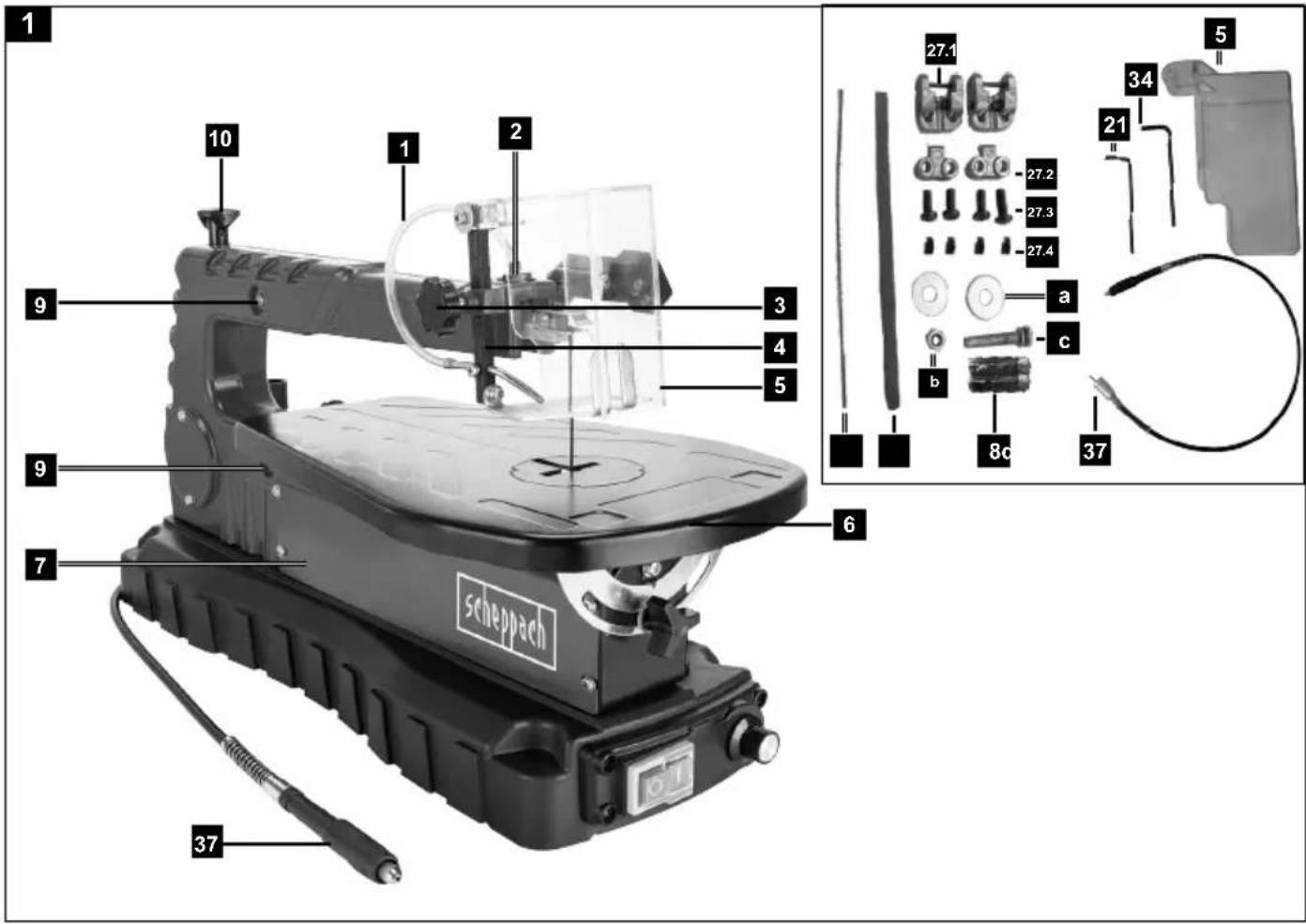
2. Device description (Fig. 1-29)
- Blow-off hose
- Connection point (blow-off device)
- Star grip screw
- Holder (saw blade guard)
- Saw blade guard
- Saw table
- Cover, left
- Batteries
- Bearings
- Clamping screw (saw blade tension)
- Arm
- Scale
- Star grip screw
- Extraction connection
- On/off switch
- Speed regulator
- Assembly points
- Work lamp
- On/off switch work lamp
- Saw blade
- Allen key 2.5 mm
- Depressor
- Screw (depressor)
- Table inlay
- Top saw blade holder
- Mounting surface
- Tool receiver
- Bottom saw blade holder
- Screw (graduated scale)
- Pointer
- Screw (left cover - front)
- Screw (left cover - rear)
- Allen key 3 mm
- Connection point (blow-off device)
- Machine housing
-
Flexible shaft with chuck
-
Angle bracket (not included in the scope of delivery)
-
Protective cover
-
Connection point for flexible shaft
-
Union nut
3. Scope of delivery
- Scroll saw
- Saw blade guard (5)
- Saw blade (20)
• Allen key, 2.5 mm (21)
• Allen key, 3 mm (34)
• Batteries (2x AAA) (8)
• Flexible shaft with chuck (37)
- Tool receiver (27)
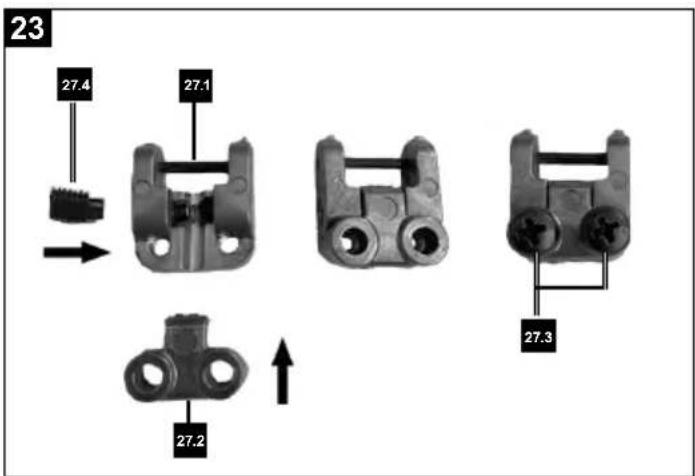
• Tool receiver, lower section (2x) (27.1)
• Tool receiver, upper section (2x) (27.2)
- Screws for tool receiver (4x) (27.3)
• Hexagon socket screws for tool receiver (4x) (27.4)
- Washer (2x) (a)
- Locknut (b)
- Screw (c)
- Grinding belt (d)
• Original Operating Manual
4. Proper use
The scroll saw is used for cutting angular timbers or other materials such as Plexiglas, GRP, foam, rubber, leather and cork. Never use the saw to cut round material. Round material can tilt easily.
Risk of injury! Parts may be ejected!
The device may only be used in the intended manner. Any use beyond this is improper. The user/operator, not the manufacturer, is responsible for damages or injuries of any type resulting from this.
Please observe that our equipment was not designed with the intention of use for commercial or industrial purposes. We assume no guarantee if the equipment is used in commercial or industrial applications, or for equivalent work.
- Only suitable saw blades may be used for the machine.
- An element of the intended use is also the observance of the safety instructions, as well as the assembly instructions and operating information in the operating manual.
-
Persons who operate and maintain the machine must be familiar with the manual and must be informed about potential dangers.
-
In addition, the applicable accident prevention regulations must be strictly observed.
- Other general occupational health and safety-related rules and regulations must be observed.
- The liability of the manufacturer and resulting damages are excluded in the event of modifications of the machine.
Residual risks
Even when this power tool is operated properly, residual risks still remain. The following hazards may arise in connection with the design and construction of this power tool:
- Lung damage if suitable dust protection mask is not worn.
- Hearing damage if suitable hearing protection is not worn.
- Risk of accident due to contact with the hands in the uncovered cutting area of the tool.
- Danger of injury during a tool change (cutting hazard).
- Crushing of fingers.
• Danger due to kick-back.
- Tilting of the workpiece due to insufficient workpiece support surface.
- Touching the cutting tool.
- Ejection of branches and workpiece parts.
⚠ WARNING! Read all safety warnings, instructions, illustrations and specifications provided with this power tool. Failure to follow all instructions listed below may result in electric shock, fire and/or serious injury.
Save all warnings and instructions for future reference.
The term “power tool” in the warnings refers to your mains-operated (corded) power tool or battery-operated (cordless) power tool.
1. Work area safety
a) Keep work area clean and well lit. Cluttered or dark areas invite accidents.
b) Do not operate power tools in explosive atmospheres, such as in the presence of flammable liquids, gases or dust. Power tools create sparks which may ignite the dust or fumes.
c) Keep children and bystanders away while operating a power tool. Distractions can cause you to lose control.
2. Electrical safety
a) Power tool plugs must match the outlet. Never modify the plug in any way. Do not use any adapter plugs with earthed (grounded) power tools. Unmodified plugs and matching outlets will reduce risk of electric shock.
b) Avoid body contact with earthed or grounded surfaces, such as pipes, radiators, ranges and refrigerators. There is an increased risk of electric shock if your body is earthed or grounded.
c) Do not expose power tools to rain or wet conditions. Water entering a power tool will increase the risk of electric shock.
d) Do not abuse the cord. Never use the cord for carrying, pulling or unplugging the power tool. Keep cord away from heat, oil, sharp edges or moving parts. Damaged or entangled cords increase the risk of electric shock.
e) When operating a power tool outdoors, use an extension cord suitable for outdoor use. Use of a cord suitable for outdoor use reduces the risk of electric shock.
f) If operating a power tool in a damp location is unavoidable, use a residual current device (RCD) protected supply. Use of an RCD reduces the risk of electric shock.
3. Personal safety
a) Stay alert, watch what you are doing and use common sense when operating a power tool. Do not use a power tool while you are tired or under the influence of drugs, alcohol or medication. A moment of carelessness when using electrical tools can result in serious injuries.
b) Use personal protective equipment. Always wear eye protection. Protective equipment such as a dust mask, non-skid safety shoes, hard hat or hearing protection used for appropriate conditions will reduce personal injuries.
c) Prevent unintentional starting. Ensure the switch is in the off-position before connecting to power source and/or battery pack, picking up or carrying the tool. Carrying power tools with your finger on the switch or energising power tools that have the switch on invites accidents.
d) Remove any adjusting key or wrench before turning the power tool on. A wrench or a key left attached to a rotating part of the power tool may result in personal injury.
e) Do not overreach. Keep proper footing and balance at all times. This enables better control of the power tool in unexpected situations.
f) Dress properly. Do not wear loose clothing or jewellery. Keep your hair and clothing away from moving parts. Loose clothes, jewellery or long hair can be caught in moving parts.
g) If devices are provided for the connection of dust extraction and collection facilities, ensure these are connected and properly used. Use of dust collection can reduce dust-related hazards.
h) Do not let familiarity gained from frequent use of tools allow you to become complacent and ignore tool safety principles. A careless action can cause severe injury within a fraction of a second.
a) Do not force the power tool. Use the correct power tool for your application. The correct power tool will do the job better and safer at the rate for which it was designed.
b) Do not use the power tool if the switch does not turn it on and off. Any power tool that cannot be controlled with the switch is dangerous and must be repaired.
c) Disconnect the plug from the power source and/or remove the battery pack, if detachable, from the power tool before making any adjustments, changing accessories, or storing power tools. Such preventive safety measures reduce the risk of starting the power tool accidentally.
d) Store idle power tools out of the reach of children and do not allow persons unfamiliar with the power tool or these instructions to operate the power tool. Power tools are dangerous in the hands of untrained users.
e) Maintain power tools and accessories. Check for misalignment or binding of moving parts, breakage of parts and any other condition that may affect the power tool's operation. If damaged, have the power tool repaired before use. Many accidents are caused by poorly maintained power tools.
f) Keep cutting tools sharp and clean. Properly maintained cutting tools with sharp cutting edges are less likely to bind and are easier to control.
g) Use the power tool, accessories and tool bits etc. in accordance with these instructions, taking into account the working conditions and the work to be performed. Use of the power tool for operations different from those intended could result in a hazardous situation.
h) Keep handles and grasping surfaces dry, clean and free from oil and grease. Slippery handles and grasping surfaces do not allow for safe handling and control of the tool in unexpected situations.
5. Service
a) Have your power tool serviced by a qualified repair person using only identical replacement parts. This will ensure that the safety of the power tool is maintained.
WARNING
This power tool generates an electromagnetic field during operation. This field can impair active or passive medical implants under certain conditions. In order to prevent the risk of serious or deadly injuries, we recommend that persons with medical implants consult with their physician and the manufacturer of the medical implant prior to operating the power tool.
- In an emergency, switch the machine off directly and pull out the mains plug.
- Observe all of these notes before and while working with the saw.
- Never use the saw to cut firewood.
- The machine is equipped with a safety switch against reactivation if the voltage drops.
- If an extension cable is required, make sure that its cross-section is sufficient for the current consumption of the saw. Minimum cross-section 1.5 ~mm^2 .
- Only use the cable drum when unrolled.
- Personnel working on the machine must not be distracted.
- Under no circumstances should the saw blades be braked by pushing against the side after switching off the drive.
- Only install saw blades that are well sharpened, free of cracks and not deformed.
- Faulty saw blades must be replaced immediately.
- Do not use saw blades that do not correspond to the characteristics specified in these usage instructions.
- Ensure that all devices that cover the saw blade work properly.
- Safety equipment on the machine must not be disassembled or made unusable.
- Damaged or faulty protective devices must be replaced immediately.
- Do not cut workpieces that are too small in order to keep them secure in your hands.
- Do not load the machine so much that it comes to a standstill.
• Always press the workpiece firmly against the working plate.
- Never remove loose splinters, chips or jammed wood pieces from the running saw blade.
- Switch off the machine to rectify any faults on the blocked tool attachment. Pull out the mains plug. Remove the blockage. Attention! Danger of injury due to saw blade! Wear protective gloves! Perform a test run without a workpiece. Make sure that no unusual noises or vibrations occur. If this is the case, switch the device off and contact the manufacturer.
- Only carry out modifications, adjustment, measuring and cleaning work when the engine is switched off. Pull out the mains plug.
- Before switching on, make sure that keys and adjusting tools are removed.
- Switch off the motor and pull out the mains plug when leaving the work station.
- Electrical installation, repairs and maintenance work may only be carried out by specialists.
- All protection and safety equipment must be reassembled immediately after repair or maintenance work is completed.
- The safety, operating and maintenance information of the manufacturer, as well as the dimensions specified in the technical data, must be observed.
- The relevant accident prevention regulations and the other generally accepted safety rules must be observed.
• The saw is only intended for installation indoors.
• Workpieces that are smaller than the saw blade guard can cause injuries to the hands and fingers. Use a suitable aid!
- Avoid cramped hand positions when guiding the workpiece and positions in which the hand would slip directly into the saw blade.
• Always insert the saw blade so that the teeth point down towards the saw table.
• Always set the correct blade tension in order to avoid breaking the saw blades.
- Use extra care when cutting material with irregular cutting profiles.
- When withdrawing the workpiece, teeth can get caught in the kerf, especially if the shavings block the kerf. In this case you should switch off the saw, pull out the mains plug, open the kerf with a wedge and remove the workpiece.
- Never leave the work station without setting down the saw beforehand. Wait until the saw has come to a standstill.
- Do not place, glue, or assemble any parts on the work table while the saw is running.
- Do not switch on the saw until the work table is cleared of material residues and tools. Only leave the workpiece to be machined and any work aids (wedges) on the workbench.
• Always wear eye protection.
- Keep fingers at a safe distance from the saw blade.
- Guide the workpiece securely and firmly and do not let it loose at any point.
- Never leave the work station without setting down the saw beforehand.
- Do not let your familiarity with the saw lead you to carelessness. Carelessness can lead to serious injuries in a split second.
Keep these safety instructions in a safe place.
5.3 Safety instructions for handling batteries
- Always make sure that the batteries are inserted with the correct polarity (+ and -), as indicated on the battery.
- Do not short-circuit batteries.
- Do not charge non-rechargeable batteries.
- Do not overcharge batteries!
- Do not mix old and new batteries or batteries of different types or manufacturers! Replace an entire set of batteries at the same time.
- Immediately remove used batteries from the device and dispose of them properly! Do not throw batteries away with household waste. Defective or used batteries must be recycled according to Directive 2006/66/EC.
Return batteries and / or the device to the collection facilities offered. Contact your local authority or city administration for information about disposal options.
- Do not allow batteries to heat up!
-
Do not weld or solder directly on batteries!
-
Do not dismantle batteries!
-
Do not allow batteries to deform!
- Do not throw batteries into fire!
- Keep batteries out of the reach of children.
- Do not allow children to replace batteries without supervision!
- Do not keep batteries near fire, ovens or other sources of heat. Do not use batteries in direct sunlight or store them in vehicles in hot weather.
- Keep unused batteries in the original packaging and keep them away from metal objects. Do not mix unpacked batteries or toss them together! This can lead to a short-circuit of the battery and thus damage, burns or even the risk of fire.
- Remove batteries from the equipment when it will not be used for an extended period of time, unless it is for emergencies!
- NEVER handle batteries that have leaked without appropriate protection. If the leaked fluid comes into contact with your skin, the skin in this area should be rinsed off under running water immediately. Always prevent the fluid from coming into contact with the eyes and mouth. In the event of contact, please seek immediate medical attention.
- Clean the battery contacts and corresponding contacts in the device prior to inserting the batteries.
6. Technical data
Mains voltage 230-240 V\~/50 Hz
| Power consumption 70 W (S1*) | 90 W (S2 15min**) |
| Stroke rate 550-1500 rpm | |
| Lifting movement 18 mm | |
| Dimensions L x W x H | 665 x 310 x 340 mm |
| Tilting table | 0° to 45° to the left/right |
| Table size | 254 x 407 mm |
| Saw blade length approx.(between both pins) | 127 mm |
| Saw arm swing | 405 mm |
| Cutting height max. at 90° | 50 mm |
| Cutting height max. at 45° | 20 mm |
| Protection category | IP20 |
| Suction port ø | 34.5 mm |
| Weight | 8.1 kg |
Technical changes reserved!
\*Operating mode S1 (continuous operation)
The machine may be operated continuously with the specified power
\*\*Operating mode S2 (short-term operation)
The machine may be operated for a short period of time with the specified power
Device emissions values
Noise
The noise values have been determined in accordance with EN 62841-1:2015.
Wear hearing protection.
Excessive noise can result in a loss of hearing.
Sound pressure level L_pA 81.7, dB
| Uncertainty K_pA | 3 dB |
| Sound power level L_WA | 94.7 dB |
| Uncertainty K_WA | 3 dB |
The stipulated values are emission values and so do not necessarily represent safe work station values. Although there is a correlation between emission levels and exposure levels, it is not possible to reliably determine whether additional precautionary measures will be required or not based on this. Factors that could influence the emissions level present at any given time at the work station include the duration of exposure, the nature of the working area, other noise sources etc. e.g. the number of machines and neighbouring processes.
The permitted workstation values can also vary from country to country. However, this information should enable the operator to better evaluate the hazards and risks.
Limit the noise level to a minimum!
- Only use devices which are free of defects.
- Maintain and clean the device at regular intervals.
- Adapt your working methods to the device.
- Do not overload the device.
- Have the device checked if necessary.
- Switch the device off if it is not in use.
Suitable saw blades
All industry-standard saw blades with a minimum length of 133 mm with and without a pin may be used.
7. Before commissioning
7.1 Unpacking
- Open the packaging and carefully remove the device.
- Remove the packaging material, as well as the packaging and transport safety devices (if present).
- Check whether the scope of delivery is complete.
- Check the device and accessory parts for transport damage.
- If possible, keep the packaging until the expiry of the warranty period.
WARNING
The device and the packaging are not children's toys! Do not let children play with plastic bags, films or small parts! There is a danger of choking or suffocating!
7.2 General notes
- Prior to commissioning, all covers and safety devices must be mounted correctly.
- It must be possible for the saw blade to run freely.
- In case of previously machined wood, be aware of any foreign objects, such as nails or screws, etc.
- Before pressing the on/off switch, make sure that the saw blade is correctly fitted, and that moving parts run smoothly.
- Before connecting the machine, make certain that the data on the type plate matches with the mains power data.
- Only connect the machine to a correctly installed protective contact socket, with fuse protection of at least 10 A.
You require the following for assembly:
• M6 hexagonal bolt (4x)
• M6 hexagonal nut (4x)
- Washer ∅ 6.4 mm (8x)
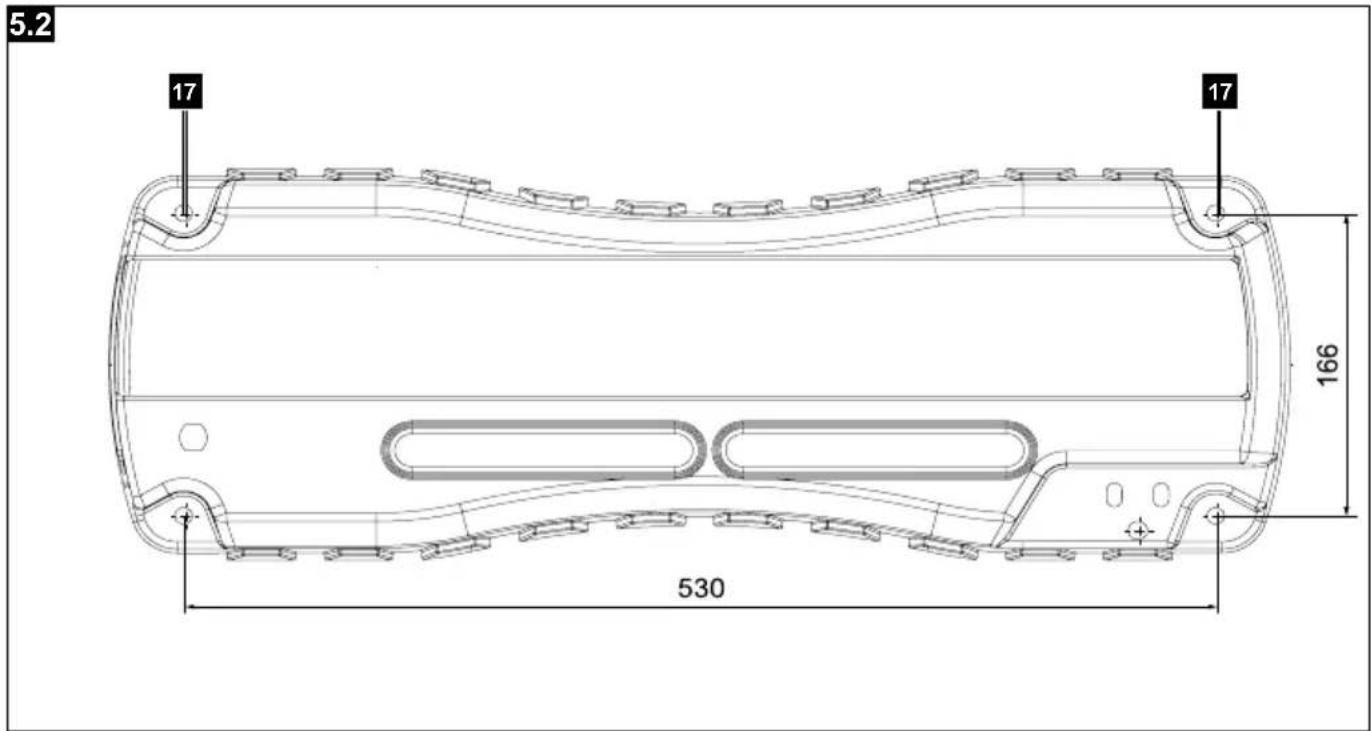
• Drilling template (Fig. 5.2)
The assembly material is not included in the scope of delivery.
The length of the screws to be used vary depending on the thickness of the tabletop.
WARNING
Risk of injury! Disconnect the mains plug on the scroll saw before all assembly work.
-
Mount the scroll saw on a solid wooden workbench. This way, a high noise level due to vibrations can be avoided.
-
Mark the drill holes using the dimensions (Fig. 5.2)
-
Drill the 4 holes (diameter 6 mm) into the workbench.
-
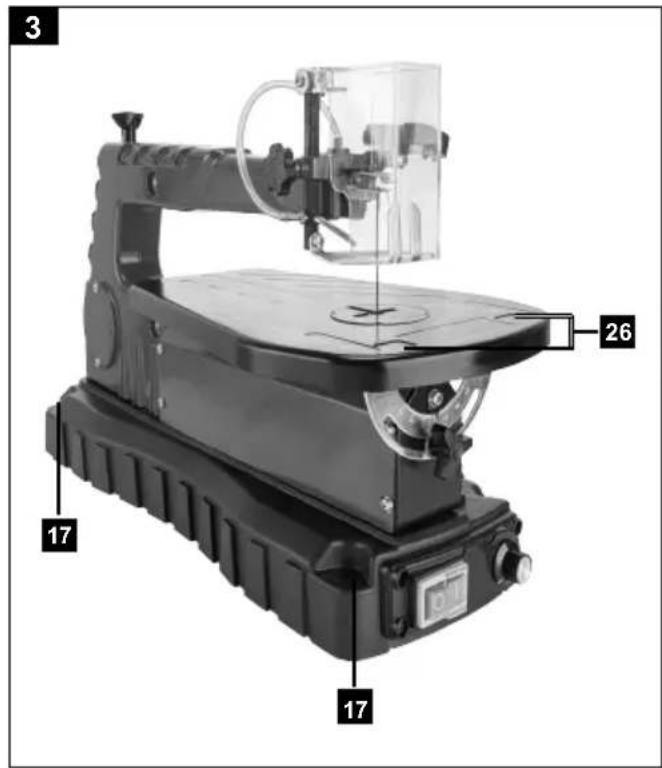
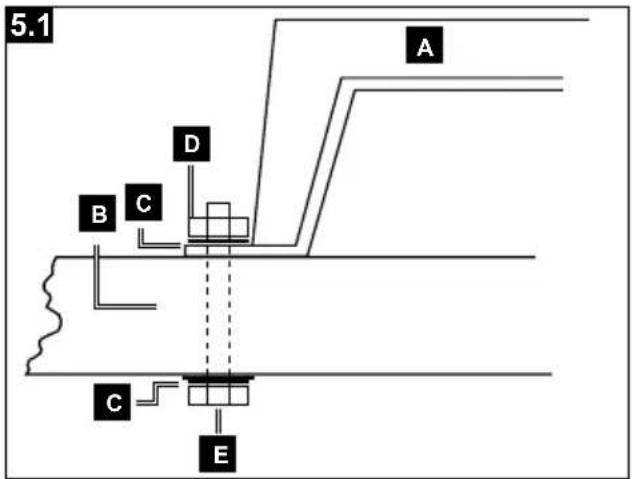
Screw the scroll saw onto the workbench with the hexagonal bolt (E) through the assembly points (Fig. 3 item 17) in the following sequence (Fig. 5.1):
D Hexagon nut
C Washer
A Scroll saw
B Workbench
C Washer
E Hexagonal bolt
- Tighten the hexagon nut (D) first.
8. Assembly
WARNING
Risk of injury! Disconnect the mains plug on the scroll saw before all assembly work.
8.1 Mounting / changing the saw blade(Fig. 6-11) WARNING
To avoid injuries due to unintentional start up: Before removing or replacing the saw blade, always press "0" and remove the mains plug from the socket.
8.1.1 Fitting/removing the table inlay (Fig. 6-11)
-
Loosen the star grip screw (3).
-
Set the saw blade guard (5) all the way up to the top position.
-
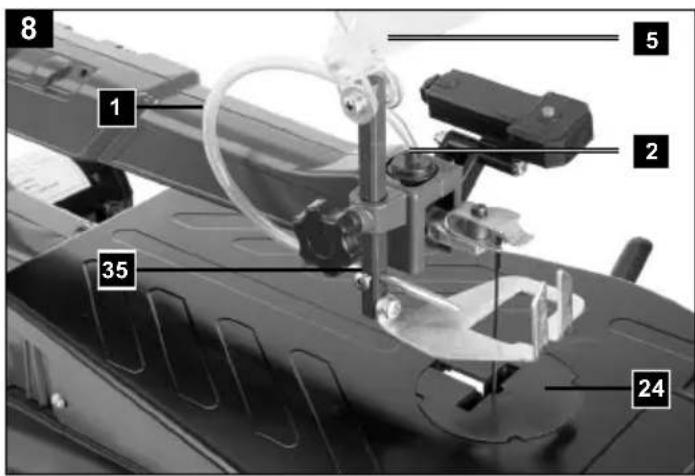
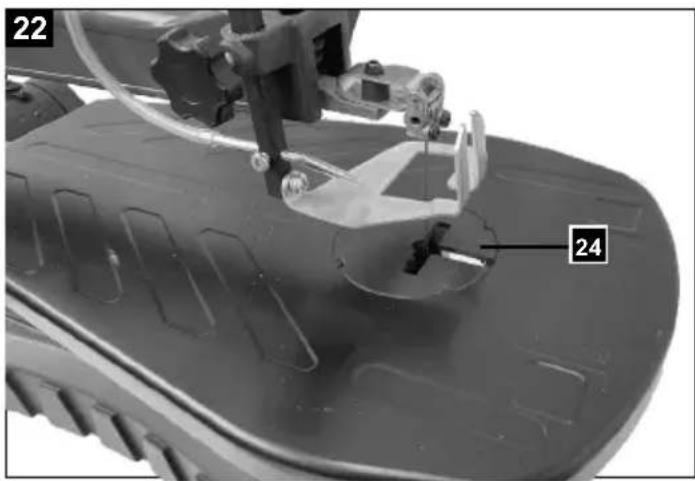
Reach under the saw table (6) and press the table inlay (24) upwards.
-
It is now possible to remove the table inlay (24). Pay attention to the position of the sawing gap when inserting the table inlay (24). The table inlay (24) must be inserted as shown in Fig. 8. Otherwise the machine can be damaged during mitre cuts.
8.1.2 Disassembly of the saw blade with pins (Fig. 8-11, 16, 18-20)
-
To remove the saw blade (20), remove the table inlay (24) upwards. (see 8.1.1)
-
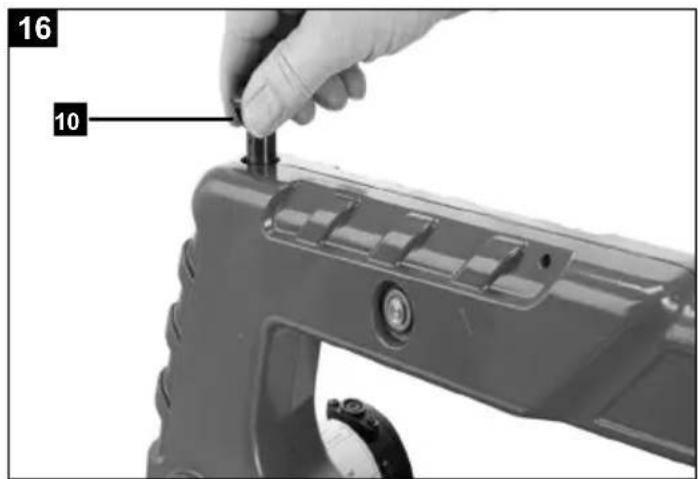
First release the tension by turning the clamping screw (10) anti-clockwise. (Fig. 16)
-
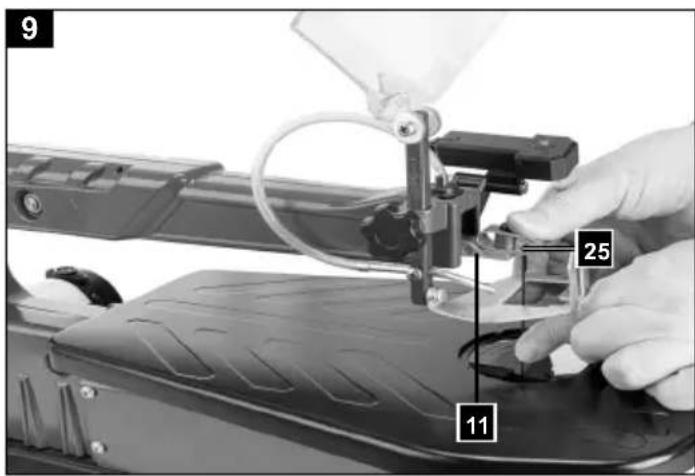
Hold the saw blade firmly and press the arm (11) down slightly (see Fig. 9).
-
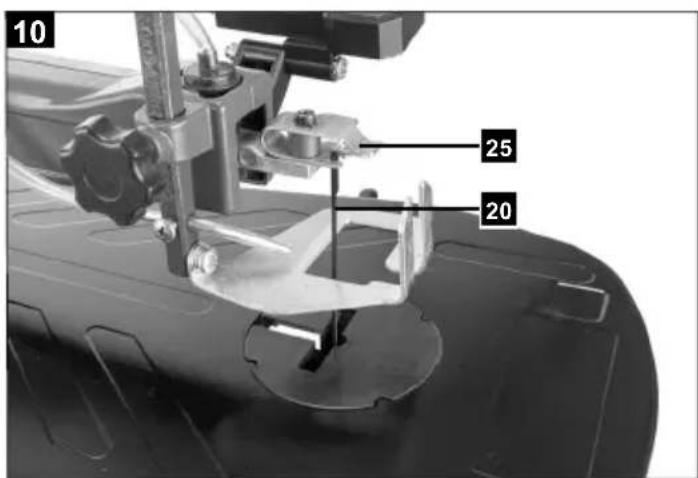
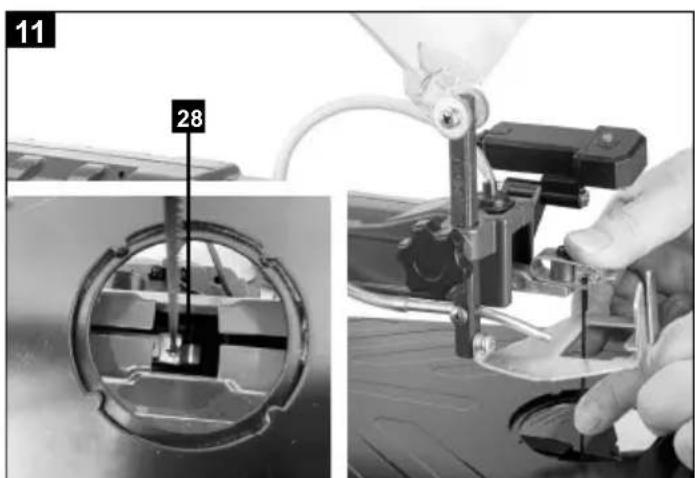
Remove the saw blade from the top and bottom saw blade holder (25/28).
8.1.3 Assembly of the saw blade with pins (Fig. 8-11, 16, 18-20)
The teeth of the saw blade must always point downwards.
-
Insert one end of the saw blade (20) through the opening in the table. Insert the pins of the saw blade (20) into the corresponding recesses of the top and bottom saw blade holder (25/28).
-
First, insert the saw blade (20) into the bottom saw blade holder (28).
-
Press the arm (11) down lightly (see Fig. 9). Insert the saw blade (20) into the top saw blade holder (25).
-
Check the position of the saw blade pins in the saw blade holders (25/28).
-
Tension the saw blade (20) with the clamping screw (10) by turning it clockwise. Check the tensioning of the saw blade (20). (Fig. 16)
-
Re-insert the table inlay (24). (see 8.1.1)
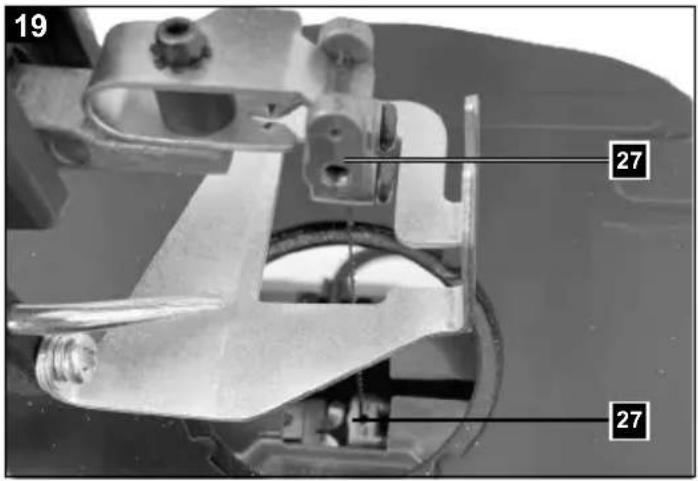
8.1.4 Disassembly of the saw blade without pins (Fig. 1, 9, 10, 18, 19, 20)
-
To remove the saw blade, remove the table inlay (24) upwards. (See 8.1.1)
-
First release the tension by turning the clamping screw (10) anti-clockwise. (Fig. 16)
-
Press the arm (11) down lightly. (Fig. 9)
-
Remove the saw blade by pulling it forward out of the bracket and through the opening in the table.
-
Remove the saw blade from the tool receiver.
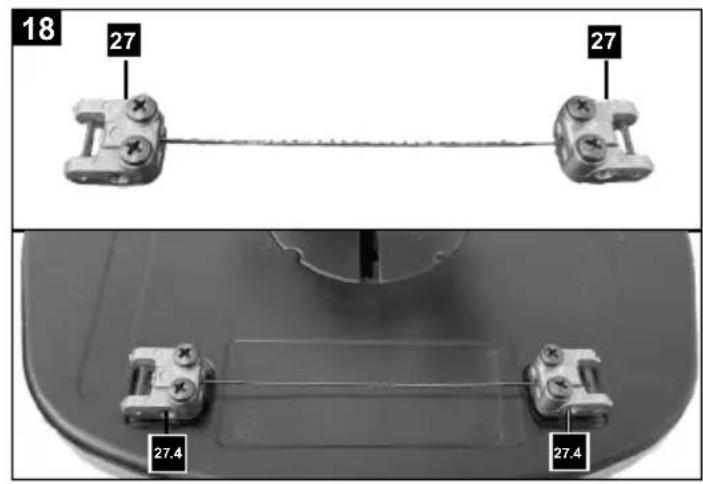
8.1.5 Insertion of the saw blade without pins (optional) (Fig. 1, 3, 16, 18, 19, 20)
The teeth of the saw blade must always point downwards.
-
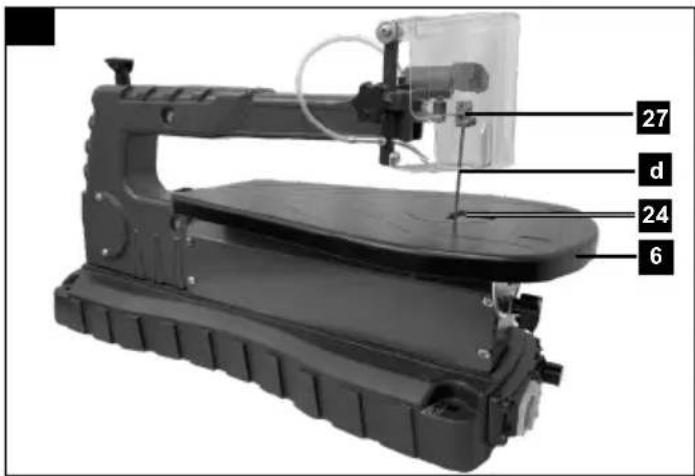
Use the assembly surface (26) for the saw blades without pins. (fig. 3)
-
Place the tool receiver (27) into the intended assembly surface (26) in the table (6). (see Fig. 18).
-
Insert the saw blade into the opening of the tool receiver (27) and tighten the two hexagon socket screws (Fig. 18) firmly. Make sure that the saw blade is clamped in the centre.
-
Insert the saw blade through the opening in the table with the tool receiver mounted.
-
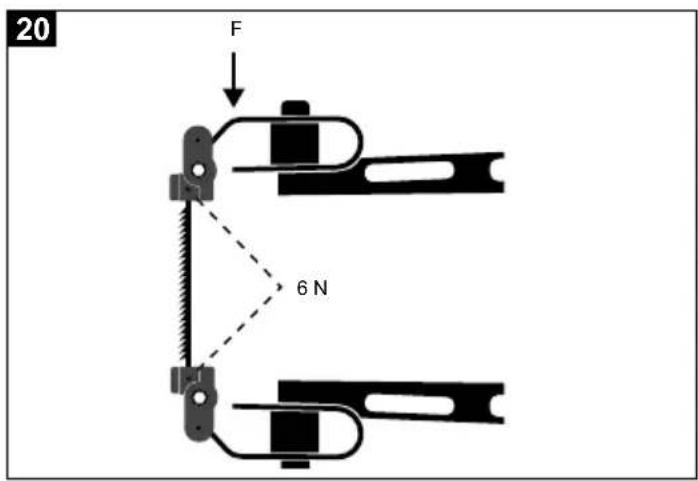
Press the arm (11) of the saw down a little (Fig. 20, F) and secure the other end of the tool receiver in the upper holder.
-
Tension the saw blade (20) with the clamping screw (10) by turning it clockwise. (Fig. 16)
-
Re-insert the table inlay (24). (see 8.1.1)
8.2 Checking the saw blade tension WARNING
Check the blade tension regularly and after inserting a saw blade.
Tension the saw blade after assembly by turning the clamping screw (10) clockwise.
If the blade tension is too low or too high, proceed as follows:
- Turn the clamping screw (10) clockwise to increase the tension and anti-clockwise to reduce it. (Fig. 16) If the tension is correct, the saw blade should produce a light tone when it is "plucked", like a guitar string.
8.3 Mounting / changing the grinding belt
8.3.1 Removing the grinding belt (Fig. 23-25)
- To remove the grinding belt, remove the table in-lay (24) upwards.
- First release the tension by turning the clamping screw (10) anti-clockwise. (Fig. 16)
- Press the arm (11) down lightly. (Fig. 9)
- Remove the grinding belt by pulling it forward out of the bracket and through the opening in the table.
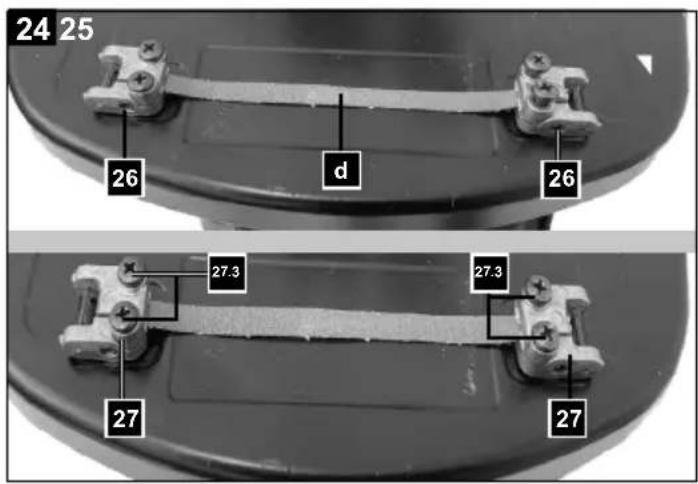
- Remove the grinding belt (d) from the tool receiver (27)
8.3.2 Inserting the grinding belt into the bracket (Fig. 23-25)
The grinding belt must point in the direction of the user, see (Fig. 23-25)
- Use the assembly surface (26) for grinding belts.
- Place the tool receiver (27) into the intended recesses in the table (6).
- Insert the grinding belt into the opening of the tool receiver (27) and tighten the two Phillips screws (27.3) firmly. Ensure that the grinding belt is clamped centrally (see Fig. 23/24).
- Insert the grinding belt through the opening in the table with the tool receiver mounted.
- Press the arm (11) of the saw down a little (Fig. 20, F) and secure the other end of the tool receiver in the upper holder.
- Tension the grinding belt (d) with the clamping screw (10) by turning it clockwise. (Fig. 16)
- Re-insert the table inlay (24). (see 8.1.1)
- Screw the hexagon socket screw (27.4) into the hole intended for the tool receiver (27.1)
-
Repeat the process on the opposite side.
-
Place the upper section of the tool receiver (27.2) on the lower section of the tool receiver (27.1).
- Screw the two sections together with the screws (27.3) provided.
8.5 Fine adjustment of the angle scale (Fig. 12) ATTENTION
Check the setting of the angle scale before working with the device.
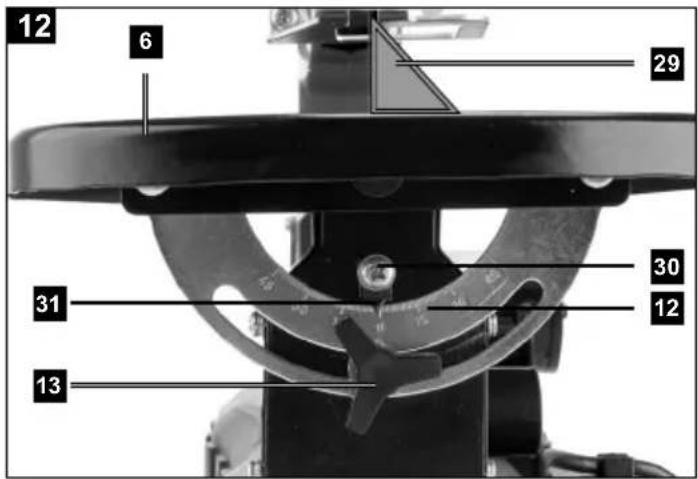
- To set the saw table, use a 90° angle bracket (29) (not included in the scope of delivery). Place this against the saw table and the saw blade (fig. 12).
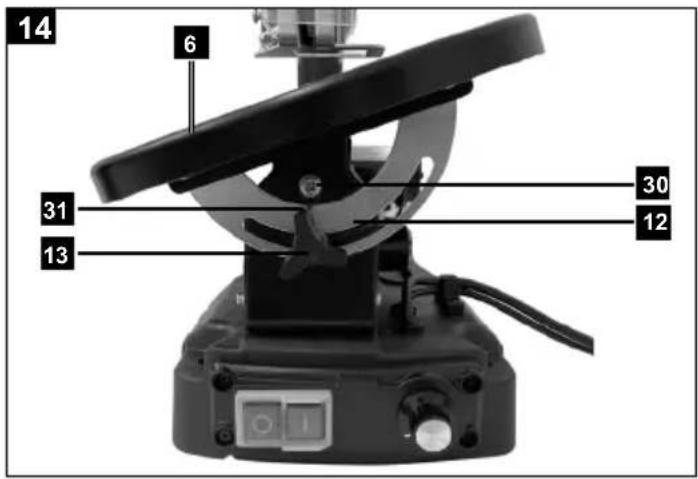
- Loosen the star grip screw (13). Adjust the saw table (6) until the angle between the saw blade (20) and the saw table (6) is 90°.
- Re-tighten the star grip screw (13).
- Loosen the screw (30) and turn the pointer (31) to the 0^ marking.
- Make a test cut. Check the angle on the workpiece with a protractor (not included in the scope of delivery). If necessary, readjust the pointer (31).
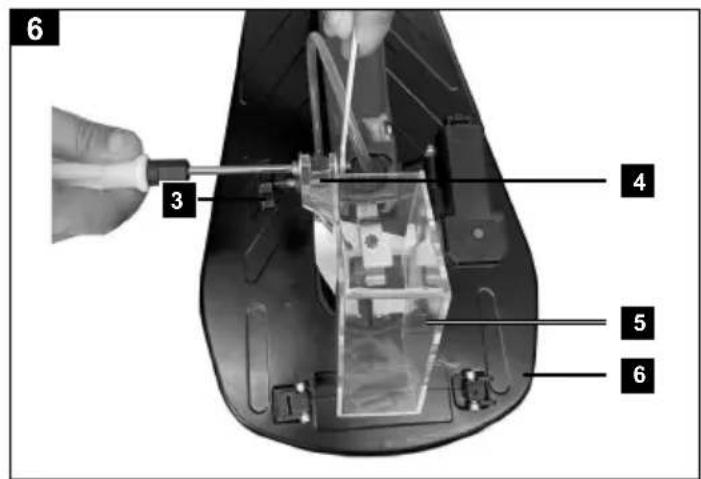
8.6 Installing the saw blade guard (Fig. 6)
- Mount the saw blade guard (5) to the holder (4). Insert the screw (46) through the hole in the holder (4) and tighten it using a Phillips screwdriver and a screwdriver (not included in the scope of delivery).
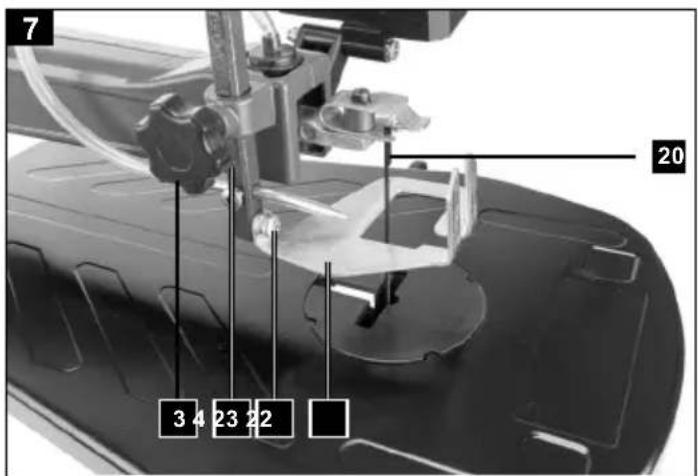
8.7 Adjusting the retaining device (Fig. 7)
NOTE: The retaining device (22) must always be adjusted according to the workpiece height. However, the workpiece should not be clamped, but should rather be able to move freely. The retaining device (22) is used to lock the workpiece so that it cannot swing upwards, which would destroy the saw blade (20).
- Loosen the star grip screw (3) to adjust the retaining device (22).
- Adjust the retaining device (22) according to the height of the workpiece.
- Re-tighten the star grip screw (3).
8.8 Installing the blow-off device (Fig. 8)
- Ensure that the saw blade guard (5) folded up.
- Connect the blow-off hose (1) to the connection points (2) and (35) as shown in Fig. 8.
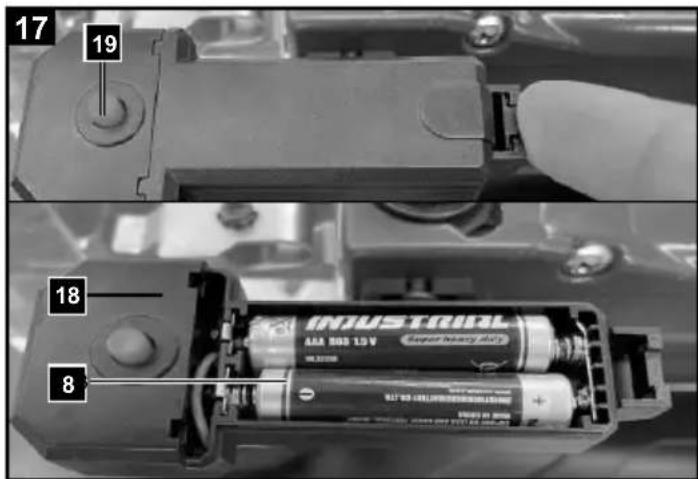
8.9 Inserting the batteries into the work lamp (Fig. 17)
-
Remove the battery compartment cover by un-locking it and folding it upwards.
-
Insert the supplied batteries (8). Attention: Pay attention to the poles!
-
Fit the cover of the battery compartment in reverse order.
ATTENTION: Only operate the product with a suitable chip extraction system. Do not use household vacuum cleaners.
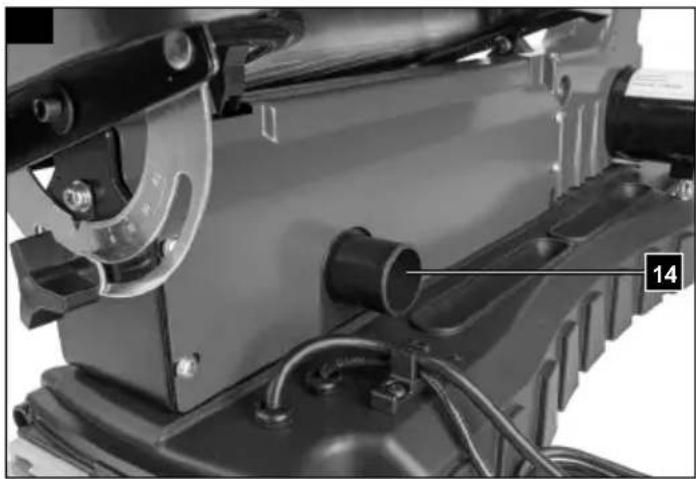
Connect a suitable chip extraction system (not included in the scope of delivery) to the suction connection (14).
ATTENTION: Check and clean the extraction channels at regular intervals.
9. Operation
9.1 General notes
- The saw does not cut wood by itself. The user makes cutting possible by guiding the wood into the moving saw blade.
• The teeth only cut the wood on the down stroke.
- The wood must be fed slowly into the saw blade as the teeth of the saw blade are very small.
- Anyone who wants to use the saw requires a certain amount of learning time. During this time some blades are sure to break.
- When cutting thick timbers, particular care must be taken to ensure that the saw blade is not bent or twisted.
• Working carefully will increase the service life of the saw blade.
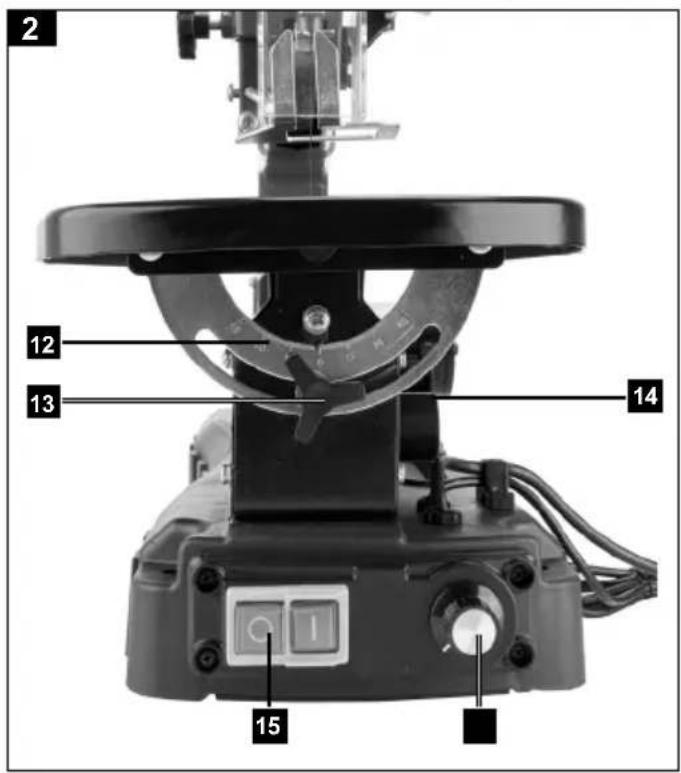
9.2 Speed regulator (Fig. 2)
The speed regulator (16) allows you to set the stroke rate according to the material to be cut. In case of soft material, we recommend high stroke rates, while strokes rates should be kept low for hard material.
Turn the speed regulator (16) clockwise to increase the stroke rate. Turning counterclockwise lowers the stroke rate.
9.3 Making inside cuts
This scroll saw allows inside cuts in workpieces without damaging the outside or the circumference of the workpiece.
- Remove the saw blade (20) as described in 8.1.
- Drill a hole into the workpiece.
-
Place the workpiece with the drilled hole over the opening of the table inlay (24) on the saw table (6).
-
Install the saw blade (20) (as described in 8.1) through the drilled hole in the workpiece and set the blade tension.
- After completing the inside cut, remove the saw blade (20) from the blade holders (as described in 8.1).
- Remove the workpiece from the table.
9.4 Carrying out mitre cuts (Fig. 14)
WARNING
Be particularly careful when making mitre cuts. The incline of the saw table supports slipping. There is a danger of injury.
- To carry out mitre cuts, adjust the distance between the saw blade guard (5) mounted to the retaining device (22) and the work table accordingly.
- Swivel the table by loosening the star grip screw (13) and tilting the saw table (6) into the desired position.
- Tighten the star grip screw (13).
9.5 Working with the grinding belt
Grinding work is possible on the inside and outside of the workpiece using this scroll saw.
9.5.1 Grinding work on the inside and outside (Fig. 23-25)
- Mount the grinding belt, as described in 8.3.
- To carry out grinding work, adjust the distance between the retaining device (22) and the work table (6) accordingly.
- Carefully lead the workpiece to the grinding belt (d) while applying even pressure.
- Remove the grinding belt after completing the grinding work (as described in 8.3).
Attention: The grinding belt may break if too much pressure is applied.
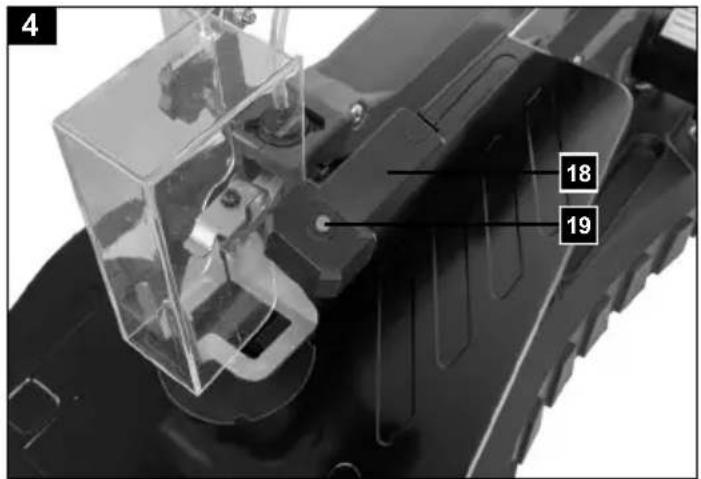
9.6 Work lamp operation (Fig. 4)
- Press the on/off switch (19) to switch the work lamp (18) on and off.
9.7 Working with the flexible shaft (Fig. 26-28)
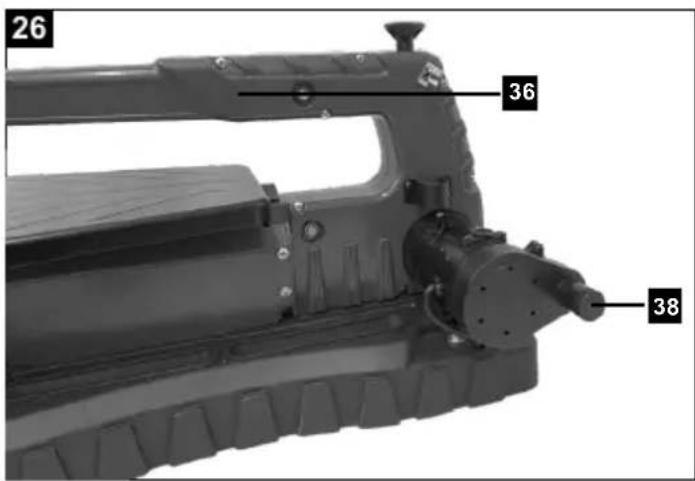
- Remove the protective cover (38) (Fig. 26).
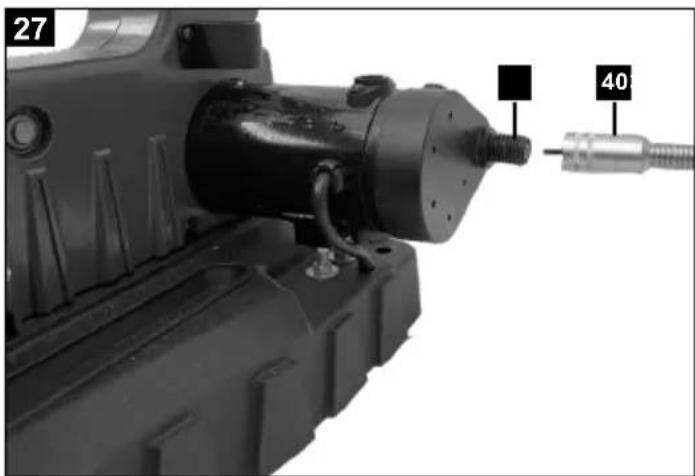
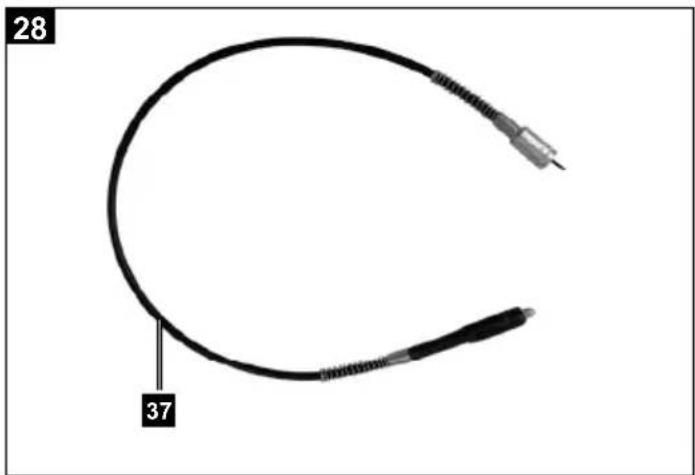
- Place the flexible shaft (37) on the connection point (39) and screw in tight. (fig. 27)
• Tension the tool in the chuck (D 3.2 mm).
- Hold the flexible shaft by the handle and adjust the speed control as described under (9.2 / 9.9).
• After finishing the work, remove the flexible shaft again and unscrew the protective cover (38) again.
- Attention: When working with the flexible shaft, cover the saw blade with the blade guard (5).
9.8 ON/OFF switch (15) (Fig. 2)
- Switching on: Press the green "I" button.
- Switching off: Press the red "0" button.
ATTENTION
The machine is equipped with a safety switch against reactivation if the voltage drops.
If the scroll saw is switched on and the power supply in the mains is interrupted, the scroll saw remains switched off, even if the power supply is re-established. Press the "I" button to switch it on.
10. Electrical connection
The electrical motor installed is connected and ready for operation. The connection complies with the applicable VDE and DIN provisions.
The customer's mains connection as well as the extension cable used must also comply with these regulations.
Damaged electrical connection cable
The insulation on electrical connection cables is often damaged.
This may have the following causes:
- Pressure points, where connection cables are passed through windows or doors
- Kinks where the connection cable has been improperly fastened or routed
- Places where the connection cables have been cut due to being driven over
- Insulation damage due to being ripped out of the wall outlet.
- Cracks due to the insulation ageing.
Such damaged electrical connection cables must not be used and are life-threatening due to the insulation damage.
Check the electrical connection cables for damage regularly. Ensure that the connection cables are disconnected from electrical power when checking for damage.
Electrical connection cables must comply with the applicable VDE and DIN provisions.
Only use connection cables with the marking H 05 VV-F. The printing of the type designation on the connection cable is mandatory.
AC motor
- The mains voltage must be 220-240 V\~.
- Extension cables up to 25 m long must have a cross-section of 1.5 square millimetres.
Connections and repair work on the electrical equipment may only be carried out by electricians.
Please provide the following information in the event of any enquiries:
• Type of current for the motor
• Data of machine type plate
Connection type Y
If the mains connection cable of this device is damaged, it must be replaced by the manufacturer, their service department or a similarly qualified person to avoid dangers.
11. Transport
- Transport the electric tool by lifting it by the machine housing (36). (Fig. 26)
- Never use the protective devices for handling or transport.
• Make sure that the exposed part of the saw blade is covered during transport, e.g. by the protective device.
12. Cleaning, maintenance and ordering spare parts
WARNING
Always switch the machine off and remove the mains plug prior to all maintenance and cleaning work.
12.1 Cleaning
Keep protective devices, air vents and the motor housing as free of dust and dirt as possible. We recommend cleaning the device directly after every use.
12.1.1 Exterior cleaning
- Clean the device at regular intervals using a damp cloth and a little soft soap.
- Do not use cleaning agents or solvents. These could damage the plastic parts of the device.
• Make sure that no water can penetrate the device interior.
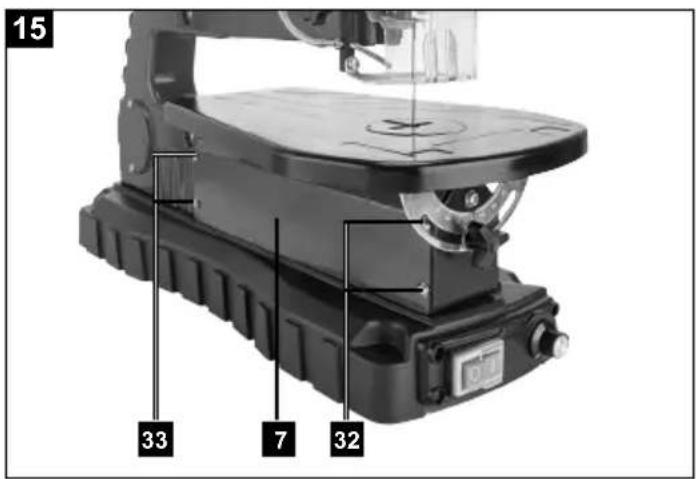
12.1.2 Interior cleaning (fig. 15)
- Remove the screw (33).
- Loosen the screw (32).
-
Remove the cover (7).
-
Blow out the device interior with low-pressure compressed air.
-
Attach the cover again (7).
-
Fasten the screw (32).
-
Insert the screw (33) again and tighten it.
12.2 Maintenance
12.2.1 Bearings (Fig. 1)
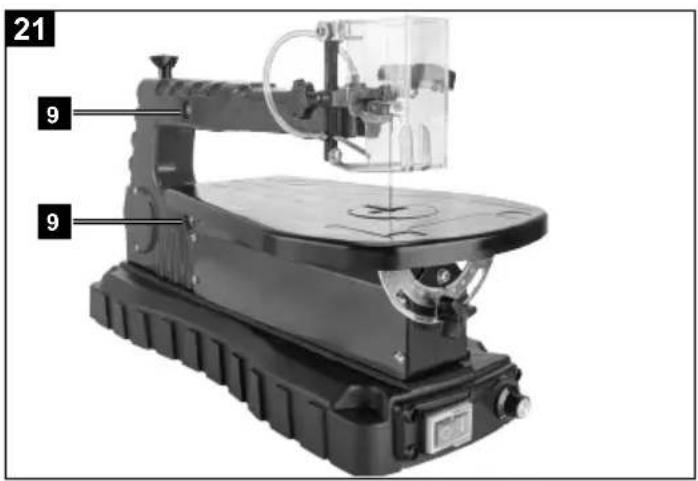
- Lubricate the bearings (9) of the deflection rollers after approx. 50 operating hours at the latest using high-quality machine grease.
The device has no further internal parts that require maintenance.
12.2.2 Carbon brushes
If excessive sparks are generated, have an electrician check the carbon brushes.
ATTENTION
The carbon brushes must only be replaced by an electrician.
12.2.3 Mains cable
If the mains cable is pulled out, cut, or damaged in some other form, then it should be replaced immediately. Do no lubricate the bearings of the motor and internal parts!
With this product, it is necessary to note that the following parts are subject to natural or usage-related wear, or that the following parts are required as consumables.
Wearing parts*: Carbon brushes, saw blade, table inlay
* May not be included in the scope of delivery!
Spare parts and accessories can be obtained from our service centre. To do this, scan the QR code on the cover page.
12.4 Ordering spare parts
Please provide the following information when ordering replacement parts (via the service-hotline):
- Device type
• Device article number (see packaging or instruction manual)
13. Storage
Store the device and its accessories in a dark, dry and frost-free place that is inaccessible to children. The optimum storage temperature lies between 5 and 30 °C. Store the power tool in its original packaging.
14. Disposal and recycling
Notes for packaging


The packaging materials are recyclable. Please dispose of packaging in an environmentally friendly manner.
Notes on the electrical and electronic equipment act [ElektroG]
![SCHEPPACH Deco Flex SL - Notes on the electrical and electronic equipment act [ElektroG] - 1](/content/2026/04/636361/images/45ff622a1d90ac25a414e7f7a968c1c1fe269bc5f8b625bd5c577379e3fa47ea.jpg)
Waste electrical and electronic equipment does not belong in household waste, but must be collected and disposed of separately!
- Used batteries or rechargeable batteries that are not installed permanently in the old appliance must be removed non-destructively before disposal. Their disposal is regulated by the battery law.
- Owners or users of electrical and electronic devices are legally obliged to return them after use.
- The end user is responsible for deleting their personal data from the old device being disposed of!
- The symbol of the crossed-out dustbin means that waste electrical and electronic equipment must not be disposed of with household waste.
- Waste electrical and electronic equipment can be handed in free of charge at the following places:
- Public disposal or collection points (e.g. municipal works yards)
- Points of sale of electrical appliances (stationary and online), provided that dealers are obliged to take them back or offer to do so voluntarily.
- Up to three waste electrical devices per type of device, with an edge length of no more than 25 centimetres, can be returned free of charge to the manufacturer without prior purchase of a new device from the manufacturer or taken to another authorised collection point in your vicinity.
- Further supplementary take-back conditions of the manufacturers and distributors can be obtained from the respective customer service.
- If the manufacturer delivers a new electrical appliance to a private household, the manufacturer can arrange for the free collection of the old electrical appliance upon request from the end user. Please contact the manufacturer's customer service for this.
• These statements only apply to devices installed and sold in the countries of the European Union and which are subject to the European Directive 2012/19/EU. In countries outside the European Union, different regulations may apply to the disposal of waste electrical and electronic equipment.
![SCHEPPACH Deco Flex SL - Information on the battery act [BattG] - 1](/content/2026/04/636361/images/65d86d17db9162cf285066f2537fe4275d5ea71b2da40ee91dd1c47b08d962ca.jpg)
Old batteries and rechargeable batteries do not belong in household waste, but must be collected or disposed of separately!
- For safe removal of primary batteries or rechargeable batteries from the electrical appliance and for information on their type or chemical system, please refer to the additional information in the operating or assembly instructions.
- Owners or users of primary batteries and rechargeable batteries are legally obliged to return them after use. The return is limited to household quantities.
- Old batteries may contain pollutants or heavy metals that can harm the environment or human health. Recycling old batteries and using the resources they contain helps to protect these two important issues.
- The symbol of the crossed-out dustbin means that primary batteries and rechargeable batteries must not be disposed of with household waste.
- If the signs Hg, Cd or Pb are also located below the dustbin symbol, this stands for the following:
- Hg: Battery contains more than 0.0005% mercury
- Cd: Battery contains more than 0.002% cadmium
- Pb: Battery contains more than 0.004% lead
- Rechargeable batteries and primary batteries can be returned free of charge to the following places:
- Public disposal or collection points (e.g. municipal works yards)
- Sales points for primary batteries and rechargeable batteries
- Take-back points of the common take-back system for old device batteries
- Take-back point of the manufacturer (if not a member of the common take-back system)
• These statements are only valid for rechargeable batteries and primary batteries sold in the countries of the European Union and subject to the European Directive 2006/66/EC. In countries outside the European Union, different regulations may apply to the disposal of rechargeable batteries and primary batteries.
15. Troubleshooting
WARNING
Always switch the machine off and remove the mains plug prior to all maintenance and cleaning work.
| Fault Possible cause Remedy |
| Saw blade without pins loosens after switching off the engine | Saw blade clamping screw of the tool receiver (27) not tightened enough | Tighten the saw blade clamping screw of the tool receiver (27) |
| Motor does not start | Extension cable defective Replace the extension cable |
| Connection to the motor or switch not OK | Have this checked by an electrician |
| Motor or switch faulty Have this checked by an electrician |
| Saw blades brake | Tension set incorrectly Set correct tension |
| Load too high Feed workpiece more slowly |
| Incorrect saw blade type Use correct saw blades |
| Workpiece not fed straightly Avoid lateral pressure |
| Saw blade oscillates, not aligned straightly. | Holders not aligned Open the screws that fasten the holders.Bring the holders into the vertical position and tighten the screws again. |
Günzburger Straße 69
D-89335 Ichenhausen
Cher client,
Günzburger Straße 69
89335 Ichenhausen
Egregio cliente,
Günzburger Straße 69
D-89335 Ichenhausen
Geachte klant,
8.10 Spanenafzuiging (afb. 13)
9.8 AAN/UIT-schakelaar (15) (afb. 2)
Günzburger Straße 69
D-89335 Ichenhausen
Estimado cliente:
Günzburger Straße 69
D-89335 Ichenhausen
Estimado cliente,
Günzburger Straße 69
D-89335 Ichenhausen
Vážený zákazníku,
Günzburger Straße 69
D-89335 Ichenhausen
Vážený zákazník,
Günzburger Straße 69
D-89335 Ichenhausen
Kedves Ügyfelünk!
Günzburger Straße 69
D-89335 Ichenhausen
Szanowny Kliencie,
Günzburger Straße 69
D-89335 Ichenhausen
Poštovani kupci,
Günzburger Straße 69
D-89335 Ichenhausen
Spoštovani kupec,
želimo vam veliko veselja in uspeha pri delu z vašo novo napravo.
Napotek:
Günzburger Straße 69
D-89335 Ichenhausen
Austatud klient!
Günzburger Straße 69
D-89335 Ichenhausen
Gerbiamas kliente,
Günzburger Straße 69
D-89335 Ichenhausen
Godātais klient!
Günzburger Straße 69
D-89335 Ichenhausen
Bästa Kund!
Günzburger Straße 69
D-89335 Ichenhausen
Arvoisa asiakas
Günzburger Straße 69
D-89335 Ichenhausen
Kære kunde,
Günzburger Straße 69
D-89335 Ichenhausen
Kjære kunde,
Günzburger Straße 69
D-89335 Ichenhausen, Германия
Уважаеми клиенти,
Günzburger Straße 69
D-89335 Ichenhausen
Αξιότιμε πελάτη,
Günzburger Straße 69
D-89335 Ichenhausen
Stimate client,
Günzburger Straße 69
D-89335 Ichenhausen
Poštovani kupci,
Günzburger Straße 69
D-89335 Ichenhausen
thalatçı:
12.2.1 Yatak (Res. 1)
Standard references:
EN 62841-1: 2015; EN ISO 12100:2010
EN 55014-1:2017+A11:2020; EN 55014-2:2015; EN IEC 61000-3-2:2019; EN 61000-3-3:2013+A1:2019
This declaration of conformity is issued under the sole responsibility of the manufacturer.
The object of the declaration described above fulfils the regulations of the directive 2011/65/EU of the European Parliament and Council from 8th June 2011, on the restriction of the use of certain hazardous substances in electrical and electronic equipment.
Signature/Andreas Pecher/Head of Project Management
First CE: 2021
Subject to change without notice
Documents registrar: Matthias Herz
Günzburger Str. 69, D-89335 Ichenhausen

Standard references:
EN 62841-1: 2015; EN ISO 12100:2010
EN 55014-1:2017+A11:2020; EN 55014-2:2015; EN IEC 61000-3-2:2019; EN 61000-3-3:2013+A1:2019
This declaration of conformity is issued under the sole responsibility of the manufacturer.
The object of the declaration described above fulfils the regulations of the directive 2011/65/EU of the European Parliament and Council from 8th June 2011, on the restriction of the use of certain hazardous substances in electrical and electronic equipment.
Subject to change without notice
Documents registrar: Matthias Herz
Günzburger Str. 69, D-89335 Ichenhausen
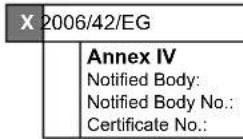
| X 2006/42/EG |
| Annex IVNotified Body:Notified Body No.:Certificate No.: |
| 2000/14/EG_2005/88/EG |
| | Noise: measured L_WA = xx dB; guaranteed L_WA = xx dB |
| Annex V |
| Annex VI |
| 2016/1628/EU |
| Emission. No: |
Standard references:
EN 62841-1: 2015; EN ISO 12100:2010
EN 55014-1:2017+A11:2020; EN 55014-2:2015; EN IEC 61000-3-2:2019; EN 61000-3-3:2013+A1:2019
This declaration of conformity is issued under the sole responsibility of the manufacturer.
The object of the declaration described above fulfils the regulations of the directive 2011/65/EU of the European Parliament and Council from 8th June 2011, on the restriction of the use of certain hazardous substances in electrical and electronic equipment.
Subject to change without notice
Documents registrar: Matthias Herz
Günzburger Str. 69, D-89335 Ichenhausen
AB uygunluk beyanı
CE
Scheppach GmbH, Günzburger Str. 69, D-89335 Ichenhausen
| DE | erklärt folgende Konformität gemäß EU-Richtlinien und Normen für den Artikel |
| GB | hereby declares the following conformity under the EU Directive and standards for the following article |
| BG | декларира съответното съответствие съгласно Дирек-тива на ЕС и норми за артикул |
| RS | potvrđuje sledeću usklađenost prema smernicama EZ i normama za artikal |
Standard references:
EN 62841-1: 2015; EN ISO 12100:2010
EN 55014-1:2017+A11:2020; EN 55014-2:2015; EN IEC 61000-3-2:2019; EN 61000-3-3:2013+A1:2019
This declaration of conformity is issued under the sole responsibility of the manufacturer.
The object of the declaration described above fulfils the regulations of the directive 2011/65/EU of the European Parliament and Council from 8th June 2011, on the restriction of the use of certain hazardous substances in electrical and electronic equipment.
Subject to change without notice
Documents registrar: Matthias Herz
Günzburger Str. 69, D-89335 Ichenhausen
Garantie DE
Apparent defects must be notified within 8 days from the receipt of the goods. Otherwise, the buyer loses its rights of claim due to such defects are invalidated. We guarantee for our machines in case of proper treatment for the time of the statutory warranty period from delivery in such a way that we replace any machine part free of charge which provably becomes unusable due to faulty material or defects of fabrication within such period of time. With respect to parts not manufactured by us we only warrant insofar as we are entitled to warranty claims against the upstream suppliers. The costs for the installation of the new parts shall be borne by the buyer. The cancellation of sale or the reduction of purchase price as well as any other claims for damages shall be excluded.
Garantie FR
Apparent defects must be notified within 8 days from the receipt of the goods. Otherwise, the buyer's rights of claim due to such defects are invalidated. We guarantee for our machines in case of proper treatment for the time of the statutory warranty period from delivery in such a way that we replace any machine part free of charge which provably becomes unusable due to faulty material or defects of fabrication within such period of time. With respect to parts not manufactured by us we only warrant insofar as we are entitled to warranty claims against the upstream suppliers. The costs for the installation of the new parts shall be borne by the buyer. The cancellation of sale or the reduction of purchase price as well as any other claims for damages shall be excluded.
Záruka CZ
Apparent defects must be notified within 8 days from the receipt of the goods. Otherwise, the buyer's rights of claim due to such defects are invalidated. We guarantee for our machines in case of proper treatment for the time of the statutory warranty period from delivery in such a way that we replace any machine part free of charge which provably becomes unusable due to faulty material or defects of fabrication within such period of time. With respect to parts not manufactured by us we only warrant insofar as we are entitled to warranty claims against the upstream suppliers. The costs for the installation of the new parts shall be borne by the buyer. The cancellation of sale or the reduction of purchase price as well as any other claims for damages shall be excluded.
Garantii EE
Apparent defects must be notified within 8 days from the receipt of the goods. Otherwise, the buyer's rights of claim due to such defects are invalidated. We guarantee for our machines in case of proper treatment for the time of the statutory warranty period from delivery in such a way that we replace any machine part free of charge which provably becomes unusable due to faulty material or defects of fabrication within such period of time. With respect to parts not manufactured by us we only warrant insofar as we are entitled to warranty claims against the upstream suppliers. The costs for the installation of the new parts shall be borne by the buyer. The cancellation of sale or the reduction of purchase price as well as any other claims for damages shall be excluded.
гаранция BG