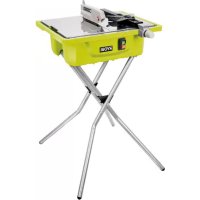
WS721S - Electric saw RYOBI - Free user manual and instructions
Find the device manual for free WS721S RYOBI in PDF.



User questions about WS721S RYOBI
0 question about this device. Answer the ones you know or ask your own.
Ask a new question about this device
Download the instructions for your Electric saw in PDF format for free! Find your manual WS721S - RYOBI and take your electronic device back in hand. On this page are published all the documents necessary for the use of your device. WS721S by RYOBI.
USER MANUAL WS721S RYOBI
Important! It is essential that you read the instructions in this manual before operating this machine.
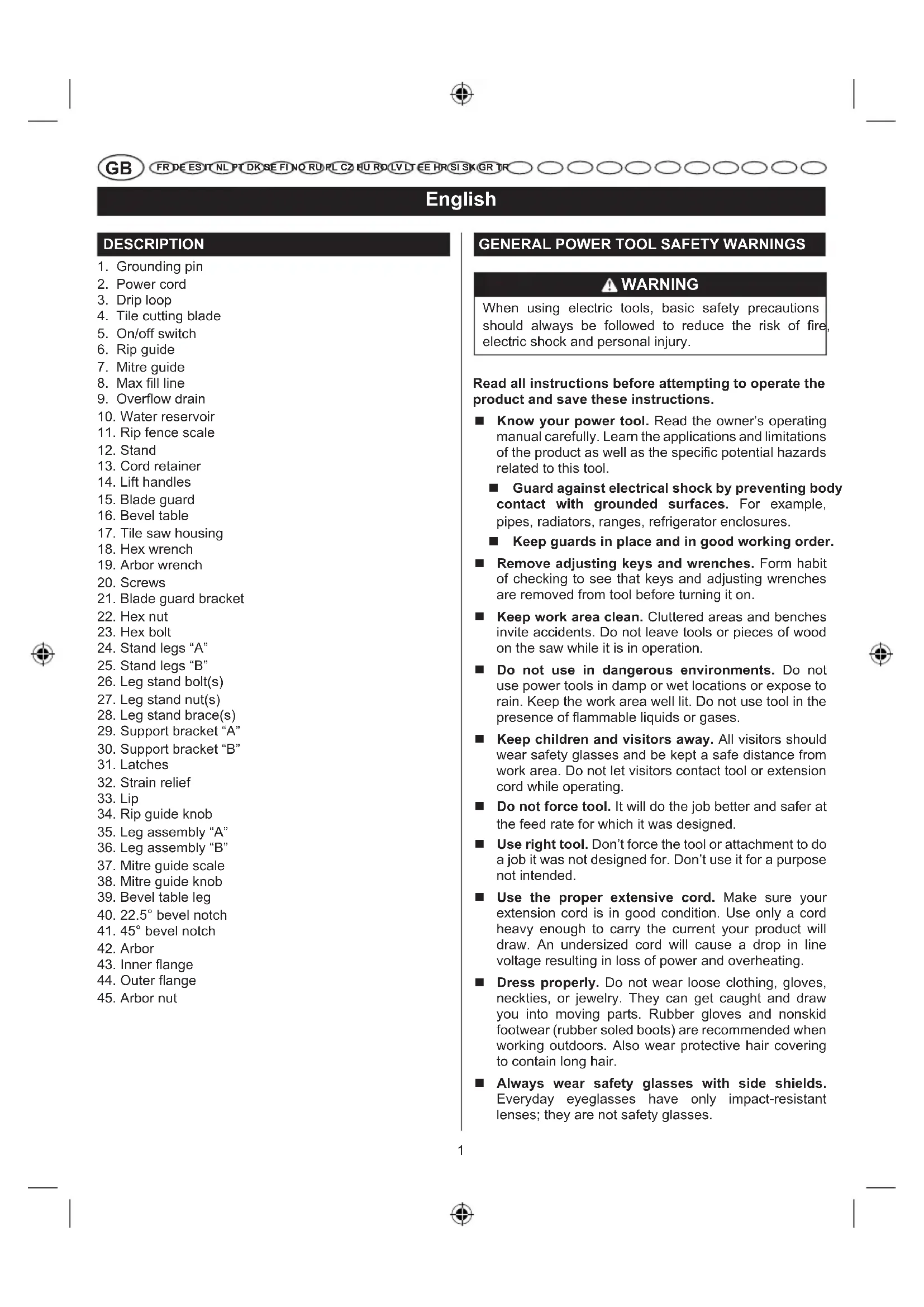
- Grounding pin
- Power cord
- Drip loop
- Tile cutting blade
- On/off switch
- Rip guide
- Mitre guide
- Max fill line
- Overflow drain
- Water reservoir
- Rip fence scale
- Stand
- Cord retainer
- Lift handles
- Blade guard
- Bevel table
- Tile saw housing
- Hex wrench
- Arbor wrench
- Screws
- Blade guard bracket
- Hex nut
- Hex bolt
- Stand legs "A"
- Stand legs "B"
- Leg stand bolt(s)
- Leg stand nut(s)
- Leg stand brace(s)
- Support bracket "A"
- Support bracket "B"
- Latches
- Strain relief
- Lip
- Rip guide knob
- Leg assembly "A"
- Leg assembly "B"
- Mitre guide scale
- Mitre guide knob
- Bevel table leg
- 22.5^ bevel notch
- 45^ bevel notch
- Arbor
- Inner flange
- Outer flange
- Arbor nut
GENERAL POWER TOOL SAFETY WARNINGS
WARNING
When using electric tools, basic safety precautions should always be followed to reduce the risk of fire, electric shock and personal injury.
Read all instructions before attempting to operate the product and save these instructions.
- Know your power tool. Read the owner's operating manual carefully. Learn the applications and limitations of the product as well as the specific potential hazards related to this tool.
Guard against electrical shock by preventing body contact with grounded surfaces. For example, pipes, radiators, ranges, refrigerator enclosures. - Keep guards in place and in good working order.
- Remove adjusting keys and wrenches. Form habit of checking to see that keys and adjusting wrenches are removed from tool before turning it on.
- Keep work area clean. Cluttered areas and benches invite accidents. Do not leave tools or pieces of wood on the saw while it is in operation.
- Do not use in dangerous environments. Do not use power tools in damp or wet locations or expose to rain. Keep the work area well lit. Do not use tool in the presence of flammable liquids or gases.
- Keep children and visitors away. All visitors should wear safety glasses and be kept a safe distance from work area. Do not let visitors contact tool or extension cord while operating.
- Do not force tool. It will do the job better and safer at the feed rate for which it was designed.
Use right tool. Don't force the tool or attachment to do a job it was not designed for. Don't use it for a purpose not intended.
Use the proper extensive cord. Make sure your extension cord is in good condition. Use only a cord heavy enough to carry the current your product will draw. An undersized cord will cause a drop in line voltage resulting in loss of power and overheating. - Dress properly. Do not wear loose clothing, gloves, neckties, or jewelry. They can get caught and draw you into moving parts. Rubber gloves and nonskid footwear (rubber soled boots) are recommended when working outdoors. Also wear protective hair covering to contain long hair.
Always wear safety glasses with side shields. Everyday eyeglasses have only impact-resistant lenses; they are not safety glasses.
GB
English
- Secure work. Use clamps or a vise to hold work when practical, it is safer than using your hand and frees both hands to operate the tool.
- Do not overreach. Keep proper footing and balance at all times.
- Maintain tools with care. Keep tools sharp and clean for better and safer performance. Follow instructions for lubricating and changing accessories. Inspect tool cords periodically and if damaged have them repaired by an authorized service facility. Inspect extension cords periodically and replace if damaged. Keep handles dry, clean and free from oil and grease.
- Disconnect tools. When not in use, before servicing, or when changing attachments, blades, bits, cutters, etc., all tools should be disconnected. Remove the plug before carrying out any adjustment, servicing or maintenance.
- Avoid accidental starting. Be sure switch is off when plugging in any tool.
Use recommended accessories. Consult the operator's manual for recommended accessories. The use of improper accessories may cause risk of injury. - Never stand on tool. Serious injury could occur if the tool is tipped or if the cutting tool is unintentionally contacted.
- Check damaged parts. Before further use of the tool, a guard or other part that is damaged should be carefully checked to determine that it will operate properly and perform its intended function. Check for alignment of moving parts, binding of moving parts, breakage of parts, mounting, and any other conditions that may affect its operation. A guard or other part that is damaged must be properly repaired or replaced by an authorized service center to avoid risk of personal injury.
Use the right direction of feed. Feed work into a blade or cutter against the direction of rotation of blade or cutter only. - Never leave tool running unattended. Turn the power off. Don't leave tool until it comes to a complete stop.
- Protect your lungs. Wear a face or dust mask if the cutting operation is dusty.
- Protect your hearing. Wear hearing protection during extended periods of operation.
- Do not abuse cord. Never yank cord to disconnect from receptacle. Keep cord away from heat, oil, and sharp edges.
Always keep the blade guard in place and in working order. - Keep hands away from cutting area. Keep hands away from blade. Do not reach underneath work or
around or over the blade while blade is rotating. Do not attempt to remove cut material when blade is moving.
Blade coasts after being turned off.
Never use in an explosive atmosphere. Normal sparking of the motor could ignite fumes.
Inspect tool cords periodically. If damaged, have repaired by a qualified service technician at an authorized service facility.
Inspect extension cords periodically and replace if damaged.
Ground all tools. If tool is equipped with three-prong plug, it should be plugged into a three-hole electrical receptacle.
Check with a qualified electrician or service personnel if the grounding instructions are not completely understood or if in doubt as to whether the product is properly grounded.
Use only correct electrical devices: 3-wire extension cords that have 3-prong grounding plugs and 3-pole receptacles that accept the tool's plug.
- Do not modify the plug provided. If it will not fit the outlet, have the proper outlet installed by a qualified electrician.
- Keep tool dry, clean, and free from oil and grease. Always use a clean cloth when cleaning. Never use brake fluids, gasoline, petroleum-based products, or any solvents to clean tool.
- Stay alert and exercise control. Watch what you are doing and use common sense. Do not operate tool when you are tired. Do not rush.
- Do not use tool if switch does not turn it on and off. Have defective switches replaced by an authorized service center.
Use only correct blade. Do not use blade with incorrect size holes. Never use washers or arbor nuts that are defective or incorrect. The maximum blade capacity of your saw is 178~mm . All the blades used must be manufactured to comply with EN13236. Never use a cutting blade with a lower speed rating than that of the tool.
Before making a cut, be sure all adjustments are secure.
Never touch blade or other moving parts during use.
Never start a tool when any rotating component is in contact with the workpiece.
Do not operate a tool while under the influence of drugs, alcohol, or any medication.
When servicing, use only identical replacement parts. Use of any other parts may create a hazard or cause product damage.
GB
FRDEESINLPLDKGEFINORUPLC2HURDLVTHEHRSISKGRTR
00000000000
English
Use only recommended accessories listed in this manual or addendums. Use of accessories that are not listed may cause the risk of personal injury. Instructions for safe use of accessories are included with the accessory.
Double-check all setups. Make sure blade is tight and not making contact with saw or workpiece before connecting to power supply.
TILE SAW SAFETY RULES
Always secure work firmly against the rip guide or bevel block.
- Never stand or have any part of your body in line with the path of the blade.
Never attempt to free a stalled blade without first turning the saw off and disconnecting the saw from the power source.
If the power supply cord damaged, it must be replaced only by the manufacturer or by an authorized service center to avoid risk.
Avoid awkward operations and hand positions where a sudden slip could cause your hand to move into the cutting tool.
Make sure the work area has ample lighting to see the work and that no obstructions will interfere with safe operation before performing any work using the saw.
Always turn off saw before disconnecting it, to avoid accidental starting when reconnecting to power supply.
This tool should have the following markings:
- Wear eye protection.
- Use blade guard for every operation for which it can be used.
- Disconnect saw before servicing, when changing cutting blades, and cleaning.
- Use tool only with smooth edge cutting blades free of openings, grooves, and teeth.
- Replace damaged cutting blade before operating.
- Do not fill water bath above water fill line.
Save these instructions. Refer to them frequently and use to instruct other users. If you loan someone this tool, loan them these instructions too.
ELECTRICAL CONNECTION
This tool is powered by a precision built electric motor. It should be connected to a power supply that is 220-240V, AC only (normal household current), 50Hz . Do not operate this product on direct current (DC). A substantial voltage drop will cause a loss of power and the motor will overheat. If the saw does not operate when plugged into an outlet, double check the power supply.
SPEED AND WIRING
The no-load speed of this tool is approximately 2,900 rpm. This speed is not constant and decreases under a load or with lower voltage. For voltage, the wiring in a shop is as important as the horsepower rating of the motor. A line intended only for lights cannot properly carry a power tool motor. Wire that is heavy enough for a short distance will be too light for a greater distance. A line that can support one power tool may not be able to support two or three tools.
GROUNDING INSTRUCTIONS
See Figure 1.
This product must be grounded. In the event of a malfunction or breakdown, grounding provides a path of least resistance for electric current to reduce the risk of electric shock. This tool is equipped with an electric cord having an equipment-grounding conductor and a grounding plug. The plug must be plugged into a matching outlet that is properly installed and grounded in accordance with all local codes and ordinances.
Do not modify the plug provided. If it will not fit the outlet, have the proper outlet installed by a qualified electrician.
WARNING
Improper installation of the grounding plug could result in a risk of electric shock. When repair or replacement of the cord is required, do not connect the grounding wire to the flat blade terminals. The wire with green-colored insulation (with or without yellow stripes) is the grounding wire.
Check with a qualified electrician or service personnel if the grounding instructions are not completely understood or if in doubt as to whether the product is properly grounded.
Repair or replace a damaged or worn cord immediately.
If the power supply cord is damaged, it must be replaced only by the manufacturer or by an authorized service center to avoid risk.
Only connect the product to an outlet having the same configuration as the plug. Do not use an adapter with this product.
For greater safety and reliability, all repairs should be performed by an Authorised Ryobi Service Centre.
Residual current device (RCD) protection should be provided on the circuit(s) or outlet(s) to be used for the tile saw. Outlets are available having built-in RCD protection and may be used for this measure of safety.
If the saw is used with an extension cord, ensure the connection of the power cord of the tool and the extension cord are not on the ground. Auxiliary devices should
GB
English
always be plugged into the wall outlet and not at the connection of an extension cord and the power tools' power cord.
If a protected outlet is not available, do not use the saw until an outlet can be changed or auxiliary protection can be obtained. These auxiliary protection devices are available at your local retailer.
POSITION OF THE TILE SAW
See Figure 2.
To avoid the possibility of the tool plug or outlet getting wet, position tile saw to one side of a wall-mounted outlet to prevent water from dripping onto the outlet or plug. The operator should arrange a "drip loop" in the cord connecting the saw to the outlet. The "drip loop" is that part of the cord below the level of the outlet, or the connector if an extension cord is used, to prevent water traveling along the cord and coming in contact with the outlet.
If the plug or outlet does get wet, DO NOT unplug the cord. Disconnect the fuse or circuit breaker that supplies power to the tool then unplug and examine for the presence of water in the outlet.
WARNING
To reduce the risk of electrocution, keep all connections dry and off the ground. Do not touch the plug with wet hands.
SPECIFICATIONS
| Product Specifications | |
| Voltage | 220 - 240V |
| Power | 500 W |
| No-load speed | 2,900 min-1 |
| Weight | 15,5 kg (N.W.) |
| Features | |
| Table size | 381 mm x 502 mm |
| Table height from cabinet to table | 181 mm |
| Material Specifications | |
| Table material | Stainless steel |
| Stand material | Steel tubing |
| Cutting Tools/Capacity | |
| Blade diameter | 178 mm |
| Blade type Diamond | |
| Blade inner diameter 25,4 mm | |
| Maximum depth of cut 33 mm | |
| Measured values determined according to EN 61029 A-weighted sound pressure level Uncertainty K 3 dB(A) | pA=61,0 dB(A) |
| Measured values determined according to EN 61029 A-weighted sound power level L Uncertainty K 3 dB(A) | wA=77,0 dB(A) |
KNOW YOUR TILE SAW
178 mm tile cutting blade
-A 178 mm tile cutting blade is included with your saw.
Bevel table
- Beveled 22,5^ and 45^ cuts can be made using the bevel table.
Handles
Saw has convenient handles located on left and right side for lifting and carrying.
Mitre guide
The Mitre guide is fully adjustable for diagonal cuts and Mitre cuts.
Motor
- This machine has a strong motor with sufficient power to handle tough cutting jobs.
Rip guide
Rip guide is fully adjustable for making cross cuts and using the Mitre guide.
Tile saw stand
- This saw comes with a stand for increased portability and convenience.
Blade guard
- The blade guard provides protection from overspray and mist
ASSEMBLY
INSTALLING THE BLADE GUARD
See Figure 5-6.
- Remove bevel table.
- Install the L-shaped blade guard bracket into the lip located under the table behind the blade.
- Install screws into the table and through the blade guard bracket then tighten securely.
NOTE: Be sure that blade guard bracket is aligned.
GB
English
with cutting blade so that it does not interfere with material being cut.
- Align blade guard with blade and slide over bracket. Line up through holes in blade guard with slot in blade guard bracket.
NOTE: Always adjust blade guard horizontally to table and slightly above tile thickness. Blade guard should not be touching tile.
-
Install hex bolt through blade guard and bracket.
-
Thread knob onto bolt and tighten to desired height.
-
Replace the bevel table.
NOTE: The blade cover/guard is assembled in the factory. Do not disassemble during adjustment and maintenance.
INSTALLING THE RIP GUIDE
See Figure 7.
- Turn knob on rip guide counterclockwise to loosen.
- Slide rip guide onto side of table.
- Use rip guide scale, located on front and rear of table, to set rip guide to desired width of cut.
- Turn rip guide knob clockwise to tighten securely.
INSTALLING THE MITRE GUIDE
See Figure 7.
- Adjust rip guide to desired position and secure.
- Slide Mitre guide onto rip guide from the front.
- Adjust to desired angle using angle scale and tighten securely with knob.
ASSEMBLING THE STAND
See Figure 8-9.
The support brackets and stand legs have corresponding letters for easy assembly.
Tools needed: Adjustable wrench or 13 mm wrenches and Philips screwdriver.
- Insert stand legs, labeled "A", into end tubes of the support bracket labeled "A". Angled ends of stand legs should face away from each other so they resemble a "V". Align holes for hardware. Repeat with second support bracket and legs labeled "B".
- Fit leg assemblies into braces. Leg assembly "B" rests on inside of braces. Leg assembly "A" rests on the outer side. Line up holes in the braces and legs. Install hardware through holes.
- Using a wrench, tighten hardware.
- Place stand on level ground and line up grooves under tile saw with brackets on stand. Position table onto stand.
- Be sure the tile saw is on level ground and the stand is sturdy before use.
INSTALLING THE OVERFLOW DRAIN
See Figure 10.
- Remove the bevel table.
- Locate hole on bottom of water reservoir.
- Push overflow drain into hole firmly.
- Replace the bevel table.
ASSEMBLING THE LATCHES
- Turn the tile saw housing upside down.
- Align the screw holes on the latches with the screw holes on the bottom of the tile saw housing.
- Insert the screws and tighten securely.
FILLING THE WATER RESERVOIR
See Figure 11.
- Remove the bevel table.
- Fill the water reservoir with clean tap water to fill line. NOTE: Overflow drain prevents overfilling.
- Replace the bevel table.
CHANGING THE RESERVOIR WATER
- Unplug the tile saw.
- Remove overflow drain and empty into a bucket, do not allow water to splash onto ground or around machine.
- Discard waste water in accordance with local regulations.
OPERATION

WARNING
Do not allow familiarity with the products to make you careless. Remember that a careless fraction of a second is sufficient to inflict serious injury.

WARNING
Always wear safety goggles or safety glasses with side shields when operating the products. Failure to do so could result in objects being thrown into your eyes, resulting in possible serious injury.

WARNING
Do not use any attachments or accessories not recommended by the manufacturer of the product. The use of attachments or accessories not recommended can result in serious personal injury.
English
TESTING THE RCD BEFORE USE
- Plug the RCD into the mains socket.
- Press the reset button. The power indicator should come on.
- Press the test button. The power indicator should go off.
WARNING: If the RCD fails the test, do not use the tool. Consult a qualified electrician.
- Press the reset button to activate the RCD.
APPLICATIONS
You may use this tool for the purposes listed be
Straight line cutting operations such as cross cutting, Mitreing, ripping, and beveling
NOTE: This saw is designed to cut man-made tile, pavers, natural stone products, and stone tile products only.
On/off switch
This saw has an easy access power ON/OFF switch located below the front rail.
To turn your saw off:
Press the red button down to turn OFF (O).
To turn your saw on:
Press the green button down to turn ON (I).
To lock your saw:
With the saw turned OFF, pull the plug out of the power source.
WARNING
ALWAYS make sure your workpiece is not in contact with the cutting blade before operating the switch to start the tool. Failure to heed this warning may cause the workpiece to be kicked back toward the operator and result in serious personal injury.
WARNING
To reduce the risk of accidental starting, always make sure the switch is in the OFF position before plugging tool into the power source. In the event of a power failure or when the tool is not in use, turn the switch OFF and pull plug out of the power source. This action will prevent the tool from accidentally starting when power returns.
USING THE RIP GUIDE AND MITRE GUIDE
See Figure 13.
The rip guide can be used from both the left and right side of the cutting blade.
- Turn knob on rip guide counterclockwise to loosen.
- Adjust the rip guide in the desired position using the rip guide scale, located on front and rear of table, to set
rip guide to desired width of cut.
3. Rotate the knob, clockwise, to tighten securely.
TO ADJUST ANGLES
Adjust rip guide to desired position and secure tightly.
- Slide Mitre guide onto rip guide from the front.
- Adjust to desired angle using angle scale and tighten securely with knob.
MAKING CUTS
Always draw the line to be cut on the tile using a marker or grease pencil. If the tile is shiny and hard-to-mark, place masking tape on the tile and mark the tape.
A common problem when cutting tile is straying from the marked line. Once you've strayed from the mark, you can not force the blade back to the line by twisting the tile. Instead, back up and recut the tile slicing off a small amount of tile until the blade is back on track.
To avoid this problem, use the rip guide when making cross cuts, the Mitre guide for Mitre cuts and the adjustable right side table for making bevel cuts, whenever possible.
To make across cut
See Figure 14.
Cross cuts are straight 90^ cuts. The material is fed into the cut at a 90^ angle to the blade, and the blade is vertical.
- Using a marker or grease pencil, mark the area to be cut on material.
- Adjust rip guide to desired position and secure tightly.
- Place the material on the table and firmly against the rip guide.
- Make sure the material is clear of the cutting blade before turning on the saw.
- Turn the power on.
- Let the cutting blade build up to full speed and wait for the blade to get wet before moving the material into the blade.
- Hold the material firmly against the rip guide and feed the material into the cutting blade.
- When the cut is made, turn the saw OFF. Wait for the cutting blade to come to a complete stop before removing any part of the material.
To make a 45^ diagonal cut
See Figure 15.
45° Diagonal cuts are also referred to as "long point to long point cuts".
- Using a marker or grease pencil, mark the area to be cut on material.
- Set the rip guide to desired width, and tighten the knob to secure in place.
- Slide Mitre guide onto rip guide from the front.
- Adjust Mitre guide to 45^ using angle scale and tighten
English
securely with knob.
- Make sure the material is clear of the cutting blade before turning on the saw.
- Turn the power on.
- Let the cutting blade build up to full speed and wait for the blade to get wet before moving the material into the blade.
- Hold the material firmly against the Mitre guide and slide Mitre guide along rip fence. Feed the material into the cutting blade.
- When the cut is made, turn the saw OFF. Wait for the cutting blade to come to a complete stop before removing any part of the material.
To make a Mitre cut
See Figure 16.
Mitre cuts are used for cutting outside and inside corners on material, decorative chair rail, and base molding with the material at any angle to the blade other than 90^ . Mitre cuts tend to "creep" during cutting. This can be controlled by holding the workpiece securely against the Mitre guide.
- Using a marker or grease pencil, mark the area to be cut on material.
- Set the rip guide to desired width, and tighten the knob to secure in place.
- Slide Mitre guide onto rip guide from the front.
- Adjust Mitre guide to desired angle, using angle scale, and tighten securely with knob.
- Make sure the material is clear of the cutting blade before turning on the saw.
- Turn the power on.
- Let the cutting blade build up to full speed and wait for the blade to get wet before moving the material into the blade.
- Hold the material firmly against the Mitre guide and slide Mitre guide along rip fence. Feed the material into the cutting blade.
- When the cut is made, turn the saw OFF. Wait for the cutting blade to come to a complete stop before removing any part of the material.
To make an L-cut
See Figure 17.
L-cuts are cuts that remove a piece of tile to fit in a corner, around a cabinet, or a piece of molding and are made by two separate cuts.
NOTE: Only overcut on the bottom or underneath side of the material being cut.
- Cut material to desired width using directions for cross cut.
- Adjust rip guide to desired position and secure tightly.
-
Place the material on the table and firmly against the rip guide.
-
Make sure the material is clear of the cutting blade before turning on the saw.
- Turn the power on.
- Let the cutting blade build up to full speed and wait for the blade to get wet before moving the material into the blade.
- Hold the material firmly against the rip guide and feed the material into the cutting blade.
- Make the cut far enough into the material without overcutting.
- Turn the power off.
- Turn the material over and make the cut along one of the marks. This time overcut the other line and the cut piece should separate from the rest of the material.
- Turn the power on.
- Let the cutting blade build up to full speed and wait for the blade to get wet before moving the material into the blade.
- When the cut is made, turn the saw OFF. Wait for the cutting blade to come to a complete stop before removing any part of the material.
To make a bevel cut
See Figure 18-19.
Bveeled 22, 5^ and 45^ cuts can be made using the bevel table.
- Using a marker or grease pencil, mark the area to be cut on material.
- Tip up the bevel table.
- On underside of bevel table, pull down the two table legs into right angles of the plate.
- Use first notches in legs to rest plate into 22,5^ angle.
- Use second set of notches to angle bevel table into highest 45^ angle.
NOTE: Make sure the bevel table is locked firmly in place before beginning cut.
Unfold legs and lay bevel table flat for 22,5^ or 45^ angle.
- Turn the power on.
- Let the cutting blade build up to full speed and wait for the blade to get wet before moving the material into the blade.
- Hold the material firmly against the bevel table and feed the material into the cutting blade.
- When the cut is made, turn the saw OFF. Wait for the cutting blade to come to a complete stop before removing any part of the material.
English
MAINTENANCE
WARNING
When servicing, use only identical replacement parts. Use of any other parts may create a hazard or cause product damage.
WARNING
Always wear safety goggles or safety glasses with side shields during power tool operation or when blowing dust. If operation is dusty, also wear a dust mask.
WARNING
If the power supply cord is damaged, it must be replaced only by the manufacturer or by an authorized service center to avoid risk.
WARNING
For greater safety and reliability, all repairs should be performed by an Authorised Ryobi Service Centre.
GENERAL MAINTENANCE
Avoid using solvents when cleaning plastic parts. Most plastics are susceptible to damage from various types of commercial solvents and may be damaged by their use. Use clean cloths to remove dirt, dust, oil, grease, etc.
Lubrication
All of the bearings in this tool are lubricated with a sufficient amount of high grade lubricant for the life of the unit under normal operating conditions.
Tile cutting blade
For maximum performance and safety, it is recommended that you use the 178 mm cutting blade provided with your saw. Additional cutting blades of the same high quality are available at your local dealer.
WARNING
Do not use cutting blades rated less than the no load speed of this tool. Failure to heed this warning could result in personal injury. Do not use blade with cracks, gaps, or teeth.
CHANGING THE TILE CUTTING BLADE
See Figure 20.
WARNING
A 178 mm tile cutting blade is the maximum blade capacity of the saw. Never use a blade that is too thick to allow blade flange to engage with the flats on the spindle. Larger blades will come in contact with the blade guard, while thicker blades will prevent the blade bolt from securing the blade on the spindle. Either of these situations could result in a serious accident and can cause serious personal injury.
- Unplug the saw.
- Remove bevel table.
- Slide the hex wrench over the blade arbor nut. Using other hand, slide arbor wrench onto blade arbor.
- Hold arbor wrench firmly to prevent the blade from moving. Turn arbor nut counterclockwise to loosen.
- Remove arbor nut, outer blade flange, and cutting blade.
- Wipe a drop of oil onto inner blade flange where it contacts the blade.
WARNING
If inner blade flange has been removed, replace it before placing blade on spindle. Failure to do so could cause an accident since the blade will not tighten properly. Never use blades that have openings, grooves, or teeth on this tool.
- Place the cutting blade onto arbor with arrows on cutting blade going in the counterclockwise direction.
- Replace outer blade flange. The double "D" flats on the blade flange align with the flats on the spindle.
- Using blade wrench and arbor wrench, tighten arbor nut securely.
- Replace the bevel table.
ENVIRONMENTAL PROTECTION

Recycle raw materials instead of disposing of as waste. The machine, accessories and packaging should be sorted for environmental-friendly recycling.
SYMBOL

Safety alert
English

CE Conformity

GOST-R Conformity

Please read the instructions carefully before starting the product.

Always wear eye protection

Wear ear protection

Wear safety gloves

DANGER! Sharp blade.

Caution, risk of cutting

Do not expose to rain or use in damp locations.

Do not expose to rain or use in damp locations.

Machines are required to be used with a continuous rim diamond cutting-off blade.

Direction of blade rotation

Diamond cutting-off blade

Blade diameter

Blade arbor diameter

Net weight

Depth of cut (max.)

Width of cut (max.)

Diagonal width of cut (max.)

Recycle
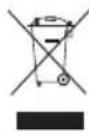
Waste electrical products should not be disposed of with household waste. Please recycle where facilities exist. Check with your Local Authority or retailer for recycling advice.
Français
DESCRIPTION
GBDEFRNPTDKSEPHURPLZHUROLVLIEEHRSHGRTR
Français
GBESITNLPDESEFINORUPLCZHUROLVLTEEHRSGKGRTRFR
Deutsch
GBESITNLPDESEFINORUPLCZHUROLVLTEEHRSGKGRTRFR
Deutsch
No permitted in any time, except for the following:
No permit to bring or carry goods from outside of the country.
No permit to import or import goods from outside of the country.
No permit to import or import goods from outside of the country.
No permit to import or import goods from outside of the country.
No permit to import or import goods from outside of the country.
No permit to import or import goods from outside of the country.
No permit to import or import goods from outside of the country.
Lubricación
GBNLPTDKSEHINORUHCZ HUROLVLTEEHRSHSKGRTRRDBES
Italiano
VEILIGHEIDSWAARSCHUWINGEN TEGELZAAGMACHINE
FYLDNING AF VANDBEHOLDEREN
Sefigur11.
- Fjern smigbordet.
- Fyld vandbeholderen op til fydelinjen med rent postevand. BEMAERK: Overlobsaflbet forbinder overfyldning.
- Genmontér smigbordet.
UDSKIFTNING AF VANDET I BEHOLDEREN
GBFINORPLCZHUROLVLTEEHRSDKGRTRSEESITNCPTDK
Svenska
HASTIGHT OCH ELDRAGNING
SATT FAST GERINGSGUIDEN
Se bild7.
GBFINORPLCZHUROLVLTEEHRSSKGRTRBESITNCPTDK
Svenska
Varning, risk for sagskador

OCHOBHbIE YKA3AHnI NO TEXHnKE B3ONACHOCTN
CCTOPOXHO
Pn nCnoB3OBaHn 3JeKtpnuecknx HcTpymENTOB CneDyET CO6JIHOdaTb OCHOBHbIe npaBnIaTexHnueckoB 6eONaChOCTN DnA CHXKeHn ONaCHOCTN BO3ROPaHn, NopaxKeHn 3JeKtpnueckm TOKOM I NOJyHeHn TpaBM.
Ipeed nCnoJb3OBaHHe m HnctpyMeHTa npouHTaHTe BCE nHCTpyKcunu coXpaHHTe ux dnn HCNOJIb3OBaHnB 6yduem.
O3hakombtecb pa60toHnHCTpymehTa. BHImateIbHO npoHTTE pykoBOcTBO nolb3oBaTeJIy. O3hakombtecb co BCEMN CnyaMn npIMHeHnN 3dennr n OrpaHnueHnMaB N erO npIMHeHnn, a TAKKe CO CNNCOM NOtEHnAIBHO ONaCHbX CNTyaCNI, KOToPbIE MOrTy BO3HNKHyTb npu pa60Te c Hm.
NckIIOUHTe ONaCHOCTb nopaxKeHn3JIeKTPnueCKm TOKOM, npeDToBpaTNB KOHTaKTTeJa C 3a3EmHeHHbIMN NOBepxHOCTaMn.HanpImep, Tpy6, paHaATOpOB, KxyOHbIX PnIT INKOpnycoB XoIoNDHBNKOB.
Iepxnte 3aunTHbIe npncnoc6neHn noD pyKo nB pa6ooyem coCTOHH.
YdaJIHTe KIOUH DnB BbINONHeHH HAcTPOKn n perynpOBKn. Bo3bMITE 3a npabNIO nepeD BKNIOueHEm NHCpymEHTa npOBeprTb, y6paHbI N C Hero raeHbIe KIOUH nDpyrNe npHaadNEXHOCTN.
IopndepknaBte YnCTOTy Ha pa6oem yuctke. 3arpomoxdeHne pa3nHbIX yactKOB n BepctakOB MOKe CTaTB npuHOn HeCuaCTHO CnyaH. He OCTabJnTe HnCTpyMeHTOB KycOB DepeBa Okono NIIbBO Bpema ee pa60tbl.
He nCnOJIb3yIte HNCTpyMeHT BOnaChbIX yCNoBnX 3KcnnyatauH. He nCnOJIb3yIte HNCTpyMeHTbI BO BnAxxbIX ININ CbIPBX MecTAX, a TAKKe NOI DOxJdEM. N03a6oTbTeCbO XopoWem OCBeUeHm pa6Oyo yAcTka. He noJIb3yIteCbHCTpyMeHTOM B6Ln3n IeKOBocnIIaMeHIOUxxCr KNDKOCTe IN Ra3OB.
He noDnyckaIte Deten n NoctopOHnHn Bcem Iuam, OcmatpmbaIOUm yCTpoNCTBO, Heo6xOIMo HAdeBaTb 3aUNTHbIE OCHN HAXOINTbcr Ha 6e30nacHom pacCTOAHN OT pa6oery uAcTka. He NsOBJnTe NOCTOPOHHM Iuam KacaTbcn HnCTpyMeHTa nn yDnHInTeNbHO rKa6JIra BO BpeMpa60bl.
He yBennuBaTe cKOpocTb pa60tb HnHCTpyMeHTa. OH nOMoKeT LyuIe N 6e3OnaChee BblOnHnHt bpa60Ty mEmHo Ha ToI cKOpocTn PoDaun, dJa, pa60tb C KOTopoOH pa3pa60TaH.
Pycckn
NcnoJb3yIte nCnpaBHOe u COOTBeTCTByIOUeeyCTpoiCTBO.He npImeHnTe yCTpoiCTBa npInHaJIeXHOCTn IJa pa6oT, K KOtOpbIM OHn He npEHa3NaHeHb. He nCNoJb3yIte yCTpoiCTBa BHECOOTBeTCTBYIOUX CEJIAX.
NcnoNb3yIte Hndnexkaun ydnHnteBbHbI Ka6eIb.ObecneYbTe nCnpaBHOe COCTOHne YdINHNTeBHorO Ka6eJI.NcNoBayTe TOnbKO Ka6eIb, KOTOpBm CMOXET BbIDepKAtb TK Harpy3Kn DnAHHoro yctpOCTBa.Ipn NcNoJb3OBAHn Ka6eI MaHbWero CeueHn npOn3oJET NaDeHne HapPjKeHn B UeHN, YTO npNBEdet K Notepe MoUHOCTHn NepePebY.
OdeBaItecb COOTBeCTByIOUIM 06pa3OM. He HaDeBaIte ODEXy CBO6oHOro NOKPO, NEPaTKn, raIcTyKn uYkpaWeHnA. OH MOryt NOnactb MExdy BpaauoUmmCReTaTAMN, IN Bac MoXeT 3aTHyTB HnX. Pn pa6ote Ha OTKpbITOM BO3DyXe peKOMeHNyETcHaDeBaTb pe3INHOBbIe NepaTk n HeckOJIb3rJyO 06yBb (6OTNHKn HA pe3INHOB0I noDoWBe). Takke Heo6xOIMo HaDeBaTb 3aUNTHbI rONOBHO y6Op, YTO6bl pNkPbTb dInHHbIe BOLOcbl.
Bcerda HadeBaIte 3aunTHbIe OcKN c 60KOBbIMn uNTkAMN. JINH3bl OBuHbIX OOKOB MOrY T 6bly ydaponpoUHbIMn, HO TaKne OcKN HE ABnIOTcra 3aUHTbIMn.
3aФнксypyte 6b6abTaBbAeMyo 3arOTOBky. NcnoJb3yIte 3axnmbi nnn TnCKn dny KpeNneHn8 6b6a7b1BaEMO 3arOTOBKn, ecIn 3TO BO3MOxHO, NOckOnbky 3To 6e30nacHee, yem INcNoIb30BaTb Dn8 3ToI cEN pyKy, Tem 60nee UTO B 3TOM cNyuae o6e pyKn OCTaHTC Bc06OdHbIMn dny O6cnyKuBAHn HnCTpyMeHTa.
He npiknabbaaTe ype3MePbix ycnn. CtapaiTecb coxpaHrTa yCTOnuBOcTb noDbicknBaTe TBepdyo onopy.
3a60TnBO 6paauTecb c HcTpymeHTAMn. CoepKNTe INHCTpyMeHTb B YNCTOM BNDE N BOBpeM npOn3BOJNTe INX 3aTOUYK, YTO6bl ObecneHTb KAcECTBO n 6e3oNaChOCTb pa6OTb. BblONHnTe INHCTpyKUIN NO npOBedeHNIO CMA3KN I 3aMeNE pInHaNDexKHOCTe. PerynpHO OcmATPnBaIte Ka6JIb INHCTpyMeHTA, NobpeXDeHHbIKa6JIb Heo6xOdIMo CdaTb ABTOPIN3OBAHbIe CEPBNCbI YeHTp Ha peMOHT. PerynpHO OcmATPnBAIte yDNIHnTEhBHeIe Ka6JIu N 3aMeHnTe NOBpeXDeHHbIe IN3 HNX. CoepKNTe pyKn B cyXOM INCTOM BNDE, OCHuaIte IN XT Macna I CMA3KN.
OTKJIIOHTe HNCTpyMeHbI. Heo6xoJIMO OTcoEINHtB BCE yCTpOcTBA,ecn OHn He IcNOJB3yOTcra,peep BblONHeHem Tekyuero peMOHTa nn npn 3amHe npncnoc6JeHn,peKyux NCKOB,CBePn,p3aKOB n T.D.Ipeep BblONHeHem KaKx-Jn60 HacTpoek,Tekyuero pEmOnTa nn
TexHnueckoro 06cnyKuBaHn ydaIne 7TeNceBHyIO Bnky.
He donyckaTe cnyaHoro 3anyca Hctpymenta. PoiKIOUaHcTpMeHT K po3eTke, y6eIITecb, YTO erO BbIKIOuHaTeJIy cTaHOBJIeH B NIOJOKeHne «BbIKN.
IcnoJb3yIte peKOMeHDoBaHHbIe npHaJdNexXhOCTn. IpeyeHb peKOMeHdyEmbIX npHaJdNexXhOCTe MoxHO HaTn B pyKOBoDCTBe no 3KcnnyatauM. McnoJIb3OBAHne HeHaJdNexKaunx npCnOC6JIeHm MoKET npNBecTn K TeJeCHbIM NOBpeKJdeHnA M.
HnkOrda He BCTaBaIte Ha HnHcTpymeHT. Pn KaacAHn INHcTpymeHTa NJIH HenpeHaMepeHHOM KOHTaKTe C pexyUm INHcTpymeHTOM CyIecTByET ONaCHOCTb cepbe3HO TpaBMnpoBAHn.
PpOBepyTe NOBpeXDeHHbIe DetAn. PepeD aJbHeuHMM NCNOJB3OBaHHeM ycTPOcTBa TtateJIbHO npOBepbTe npabINbHOCTb pa6oTbI nФyHKUHOHaJIbHyO pa6OTcNOC6HOCTb NOBpeXDeHHbIX 3aUHTbIX npCnOC6JIeHn I dpyrIX KOMNoHETOB. PpOBepbTe peryIUPOBky IcoNeHHe HDBKUHXCS qACTe, cEIOCTHOCTb DeTanei, KpENIIeHne, IN DpyrIe PhAKTOBbl, KOtOpbl E MOrYT OTPa3NTbcra Ha pa6ote yCTPOcTBa. Bo n36exAHne BO3HNKHOBEHn ONaCHOCTH TeJeCHbIX NOBpeXDeHn, HeNCnPABHbIE 3aUHTbIe pncoc6JIeHn INI DpyrIe DetAJI N DOJIxHbl peMOHTnpOBaTbCn INI 3aMeHbTcB A BTOPNI3OBaHHOM CEPBCHOM CEHTpe.
IcnojB3yIte HaJnEkaaee HnpaBJIeHne noa. Ipon3BOJNTe nOaCy o6pa6aTbIbAem0 3arOTOBn Ha pexyu nnck nnn pe3ak TOnbKO B HnpaBJIeHN, npOTNBONONOxHOM HnpaBJIeHIO BpaUeHnpekuyero dNcKa nnn pe3aka.
HnkOrda He octabnIte HNCTpymeHT pa6oTaIOUm 6e3 npncMOTpa. BbIKIOuHTe NtAHne. He OCTabnIte INHCTpymeHT do ero NOHoro OCTaHOBA.
PpeoopaHnTe JERKne.HaedeBaTe Macky n3aunTbI NuaI INI PbIE3aHTHyO Macky nppa6ote B yCIOBnX NOBbIeHHOH 3aNbIeHHOCTN.
PpeOxpaHnTe opraHbI cnyxa. Pnp dInTeNbHO pa6oTe ycTpoNCTBOM HaedeBaHTe cpeCDTBa 3aunTbI opraHO Bcnyxa.
He donyckaIte HnnpabHbHoro 6paueHn c Ka6eIem. 3aPpeaaetc Depratb Ka6eIb, NItaTcB TaKIM O6pa3OM BbHyTb WTeNCelbHyO BNJKy n3 po3ETKn. He packnaDbBaIte Ka6eIb B6JIn3n NCTOCHIKOB TENNA n OCTpbIX npeMeTOB.
Bcerda depknte 3aunthoe npncnocobnepexyoero ndka noD pyKoN B pa6oemcoCTOHN.
He donyckaite nonadnpyk b obnactpe3kn. He kacaitecb pexyero ncka.He donyckaite nonadaHny pyk noD obpaabaBaem 3arotobKoB, B
Pycckn
obnaTb HAD peKyuM DNCKOM NIN BOKpyr Hero BO BpemBpaueHnpeKyuero DNCKa.He nbTaIteCb ydaJIaTB MaTePnA JBO Bpem erO pe3Kn n BpaueHnpeKyuero DNCKa.
Pocne OTKIOueHnpeKyun nCK npoONKaET no HepuBpaaTbcra.
3anpeaetcpa60TaB BO B3pbIBOONacHOn cpeJe.ObbHoe NCKpeHne DBNrAteTn MOKeT CTAb npuHOBBOCnJaMeHeHn.
Perynnapo ocmatpnaTe Ka6eB nHcTpymeHTa. Ecnn OH NOBpeKJeH,OTdaNeTe ERO B yN0NHOMOeHHbI cepBnCHbI ueHTp dJaPeMOHTa KBaJIuΦuIpOBAHHbIM TEXHNueCKM CNEUaJINCtOM.
Perynnapo ocmatpnaBte ydHHHTeHbHbIe Ka6eJn 3aMeHnTe NOBpeXdeHHbIe N3 HNX.
3a3eMnnte Bce HcTpymEnbI. Ecn nHcTpymENT Meet TpexnoIOCHyIO wTeNceJbHyIO BNky, ee Heo6xOdmo BCTaBNTb B TpexnoIOCHyIO 3neKtpnHeckyIO p03eTKy.
Ecyn yka3aHnno 3a3eMJIeHHo HeOCTaTOHNO RCHbI NNN IMeOTc COMHeHHB INpaBUNbHOCTN NOKJIIOUeHHy YCTpOJCTBa K 3a3eMJIeHHO, O6paTHTecb K KBaJIINΦHnUPOBaHHOMY 3JIeKTpNKy NNTEXHNueCKOMY CneuaJIHCTy.
McnoJb3yIte TOJIbKO HAdnEkaUne 3JIeKTPnueckNe yCTpOietBA: tpexKINbHbIyDINHITeJB C TpEXKOHTaKTHOB BUNKO 3a3EmJIeHNEM n TpEXNOJIHOCHOI 3JIeKTPnueCKoP03ETKoi, COOTBeTCTByIOUeB BNKe yCTpOietBa.
He nepeedeIbIaIe BuNky nHTaHn. EcIn BnIka He NOxOuNT K po3ETke, o6paTNEcB K KBaJIuΦnUPOBaHOMy 3JNeKTPnky dIy yCTaHOBKn NOxOJaEpo3ETKn.
CoepKHTe yCTPOHCTBO B cyXOM n YnCTOM BnDE, OunuAte erO OT Macna n Cma3Kn. IJRA YnCTKN YCTPOHCTBA NcNOJIb3yIe NpOTnPOUHyIO TpRINKy. 3aPeeuaetra cnoNb30BaT bIra YnCTKN YCTPOHCTBA TOPMO3HbIe KnIDKOCTN, 6eH3INH, HeFTePOnDyKTbI n DpyrHe pAcTBOpNTEN.
Co6IHOaIte octOpokHocb n ocyuiceCTBnAte KOHTPOJIb.BydBe BHIMATEnbHbI BO Bpempa60tI pyKOBOcTByITeCb 3npaBBIM CMBICNOM.He nonb3yITecb IHCTpyMeHToM,ecn yCTann. He TOPONITeCb.
He noJb3yItecb HNCTpyMeHToM, ecnB BbIKIOaTeJIb He cyHKUOHNpye. 3aMeHInTe HeNCpabHBi BBIKIOaTeJIb B aBTOpN3OBaHHOM cepBUCOM ueHTpe.
NcnoJb3yIe ToJbKO HAdnEkaun pexyun dNCK.He nCNoJb3yIe pejxuue DnCKn C HecOoTBeTCTByIOUM DNaMeTpOM OTBepCTna. 3anpeuaetca nCNOJb3OBaTb HeNCnpaBHBie nn HenoDxOJaune Wai6blraikn Bana.MakcmaJIbHa
ckopoctbpekyuero DNCKA NJIbI COCTaBnEET 178 MM. Bce pekyuine NOJOTHa DOnXHb COOTBeCTBOBaTb Tpe6oBAHNM CTaHApTa EN13236.HNKOrda He NCNoB3yTe peKyuee NOnTOHO,paCHNTaHHoe Ha CKOpocTB BpaUeHn HnKe, Yem y DaHHORO NHCTpyMeHTa.
Ipeed BbINOJHHeM pe3a y6eHTecb,TO BCE HAcTPOKn BbINOJHHeBIpabNJbHO.
3anpeaetc kacatbce pexyuzero ncka nn Dpynx DBNkxuXxC qacte BO Bpem 3Kcnnyataun.
3anpeaetc3anyckatb HnctpymENT,ecnn KaKoJ-Ni6o n3 erO Bpaauounxcr KOMnoHETOB Kacaetc 3arOTOBKn.
He noIb3yItecb IHCTpyMeHToM, ecnn yctann, a TakoKe nocJe npHHaTnHa HPKOTIKOB, anKOroJn HINHbIX MednHccknx npenapaTOB.
PnpoBedeHn Tekyuero pemOnTa nCnoB3ynt ToIbKO NdeHTNHyBie 3aNactn. NcNoJb3OBAHne IIO6bIX npyHX 3aNacteM MoKET Co3dTa b OnaCHOCTb NNCTaTb PnPHHO BixOda N3DeHN N3 CTPOR.
IcnoJb3yUte TOnbKO peKOMeHDoBAHHbIe npHaAdnExNHOCTN, yKa3aHHbIE B DaHHOM pykoBOdCTBe IIN npINOxHeHX. IcNoJIb3OBAHne npHaADNeXHOCTe, He yKa3aHHbIX B CnICKe, MOKET CTaTb npuHHO TpaBMnPOBaHn. IHCTpyKUn O 6e3OnaHOM nCNoJIb3OBAHn npnaraOTc K npHaADNeXHOCTM.
Двждbl npOBepbte BCE BbINOJIHeHHbIe HAcTpoiKn. IpeNd NOdkNIOUChHnEM K NCTOCHNYKy NITaHnY y6eINTEcB, YTO peKyuI INCK 3aTAYI N He KacaetcNIIbI N 3AROTOKN.
PNEOCTEPEXEHNOBONACHOCTNIIJA DnpePE3KNIITKIN
Haedekho 3aФнКсчуTe 6pa6aTbIbAemyo 3arOTOBky OTHOCHTeJIbHO HAnpaBnIooJe pe3Kn IIN 6JOKa HAKJIOHa.
HnkOrda He cToTe camn Hne NOMEuaTe yacte Tena Ha TpaekTopn DmXKeHnpeKyUero DNCKa.
IДЯ OCBO6OXdHn3aCTPBAWero pexyUero DNCKa CHaHa Na 0B3aTeJIbHO OTKJIIOHTe NIIy, a 3aTEM OTCoEHNHTe ee OTNCTOUYHKa NTaHn.
Ecn Ka6eB nHTAHn NOBpeXJeH, BO n36eKaHne ONaCHOCTn erO DoJIKeH 3aMeHNb JIn6o cam POn3BODNTeB, N60 CneuaJNC T ABTOPN3OBaHHORO cepBnCHoro ueHTpa.
■ N36eraTe HeIOBKnX DeIcTBn IIN NoIOXKeHn pyKn, KOrda pyKa MoKet CnyaHaNHO COCKOJIb3HyTb IN NONaCTb B pa6oTaIoN NHCTpMEnT.
Ipeed Hauanom JIO6bIX pa6OT c nCNoJb3ObaHnEM
Pycckn
NJIbI y6eHTecb, yTo pa6OuYyAcTOK XoPoWo OCBeuehen O6pa6aTbHaemar 3aROTOBka XoPoWo BnDa H yTO HeT HnKaNX npenrTCTBn DnA Be3onacHO pa60tbl.
Bcerda BbIKIOaHTe Nny, npexde Yem OTcoeHNHTb Ka6JIb NITAHN, yTO6bl NCKHOHTb CNYaHbI 3anyck npn NOBTOPHOM IOCDoeHNHeHH Ka6EJa.
Ha daHHOM yCTpoINCTBE DOJXHbI 6bITb yCTaHOBnEhbl CneDyUOuNE 3HaKn:
- PpIMHeHrTe CpeDCTBa 3aunTbI opraHOB 3peHnA.
Icnoj3ynte 3aunTHoe yctpoNCTBO pexyuero DnCKa npBbINONHeHN KaJdoon Oepauu, rOHO MOKeT 6bITb PnmuMeHMO.
Ipeed BbIOJIHeHEm TeKyUeRo peMOHTa, 3aMeHOI pexyux DNCKOB uNCTKoI OTKIOHTe NnJy. - Ncnoj3yTe IJnHCTpymeHTa TOJbKO pejUne DnCKN C rJaDKMn KpaAMn, 6e3 OTBepCTnK KaHabOK nnn upeoxOBaTOCTe.
- PpeJ nauanom pa6oTbI 3aMeHnte HeucnpaBbI peKyuI nnck.
He 3aONHnTe BOdHyO BAHHy BBIe COOTBETCTBYIOUe OTMETKN.
CoxpaHnTe daHHbIe HhctpyKuN. Yaue
Opaaantecb KHM INCNOB3yTe DnHNCTpykTaKa
Dpynx NOb3OBATEne. Ecn Bbl BPemHeHO
pepeaete KOMY-JIN60 DaHHbI INHCTpyMeHT,
pepeaTe Bmecte C Hm IN daHHbIe NHCPTpyKUn.
3NEKTPNUECKOE NODKNIQUOYEHNE
HHTpymENT PnBOIDTCB B DeCTBNE 3JKeTPODIBNATeJIEM BbICOKOKAyeCTBa c6OpKn.
YcTPOIcTBcNEdyET NOKKnHouaTb TOnbKO K3NeKTpueckoCetn nepemehnHO ToKa c HapxKeHHem 220-240 B,50Tc (CTaHdaptThbe npametpbl 3neKtpocetn dJnxNbIXnomeHn. He nCnoB3yTe dJnNTAHn DaHHOROycTPOIcTBa NoCTOBHHBI TOK. 3HaHTeNBHOe NaHeHHeHapxKeHHa Ha DBrarate ne pPBeDET K BblDeJeHHIOMOuHOCn INpeperpeBy DBrarateJI. EcJIn NOkKnUoyHHaK po3ETke Nnna He pa6otaet, npoBepreNoDauy NtAHn.
CKOPOCTb IN IPOBOIDKA
Ckopoocb xoIOCToro XOda DaHHORo INHcTpymeHTa coCTabnIeT npImepHO 2,900 06/MnH. 3Ta CKopoctb HenoCTOBHHa n yMeHbwaetcR npn N3MeHeHN Harpy3kn nn yMeHbweHNn HAnpJKeHNy. YTO KacaETcH HanpJKeHNy, npOBODKa B cExe HaCTOBKO Je BaxHa, KaK n Notpe6nemar MoUHOCTb DnIRatEnr. NInHn, npedHa3NaueHHa dNn NOCBETKn, He MOKeT oBeCneHTb NaIIeXauee NITAHne DnIRatEnr INHcTpymeHTa.
PpOBoD,doCTaTOUHbIMnKOpOTKOrOyAcTka,MoXeT OKa3aTbCHeIOCTaTOUHbIMnIg6Oone nPoTJKeHHoro yAcTka.IINHn,K KOTopoM MoXeT 6blb NODKnIOueH OINH INHCTpyMeHT,MOXeT 6blb He pacCHNTaHa Ha NODKnIOueHHeBxNltpex INHCTpyMeHTOB.
YKA3AHNIO 3A3EMJEHNIK
CM.puc.1.
DaHHe yctpoiCTBO dONKHO 6bIb 3a3emHeo. B cnyae HeNCpabHocTH uNn NOnOMKn yCTpoiCTBa 3a3emJeHne oBeceuHT 3NeKTpyeCKomy TOky IJn pOteKaHn NyTb HAnMeHbWero COnpOTNBLeHn I npedOTBpaNT OnaCHOCTb NOPaxEHn 3NeKTpyeCKm TKOM. DaHHbI INhCTpyMeHT ChA6KeH 3NeKTPOkaBeHm C 3a3emJHOUM npOBODm DnB BCero 06OpdyOBAHn IBNJKOc K OKtAKTom 3a3emJeHn. BuNkdoJINKHa NOdKNIOyATbcr K 3a3emJeHHo PO3eTke, yCTaHOBJEHHO B COOTBetCTBN CO BCEM DeICTBYUIMM B DAHHOM perNOHe HopMaMn.
He nepeenbIbaIte BNky nITahn. Ecnn Bnka He noDxOaNT K po3eTke, o6paTInTeCb K KBaINΦuNpOBaHHOMy 3JNEKtpNK yIraYcTaHOBKn NOxDxaIeepo3eTKn.

OCTOPOXHO
Hepabnbohoe noKIOueHne BUNKc 3a3emJHEm MOKeT cTaB npuHHoN IopaxeHna 3NEkTpueckm TOKOM. Ecn KabeIb Tpe6yET pemOnTa nn 3ameHbl, He nOcEOHNrTe 3a3EMJHOUIN PPOBOK Ka3beMaC C NIOCKM KOHTAKTOM. PPOBOB B 3eNEHO IN3OJIaCn (C JEEITbIM NoIOCKAMn nn 6e3 Hx) ABJAreTCa3aEMJHOUIN PPOBODM.
Ecn yka3aHn no 3a3eMneHHo HeoctaToHNOChb Nnn NmEOCTC COMHeHn B npaBnIbHOCTN NOKIOUcHn YcTPOJCTBa K 3a3eMneHHO, O6paNTecK KBaINΦuNPoBAHHom 3JIeKTpIKy INN TEXHueCKOMCNEuaJIncTy.
Cpa3y je pemOHtnpyuTe uNn 3aMeHnTe NOBpeKdHHbI uNn N3HOWeHHbI Ka6eNb.
Ecn Ka6eJIb NITaHnI NOBpeKJeH, BO n36eKaHHe. onaCHOCTn erO DoJKeH 3aMeHHTb JNoC am npOn3BOuNTeH, JNoC cNeuaNcT aBTOpU3OBaHHoro cepBnCHOro ceHtpa.
IOnKIOHauTe yCTPOINCTBO TOJIbKO K PO3ETKE, IMeJOUeT Ty Ke KOHOpHpyaPcHIO, YTO N BUNKa. He IcNoJIb3yTe nepexOHNKn npn pa6ote C daHHbIM yCTPOINCTBOM.
Дя 60ьшen 6e3oNaChOCTn n HAdeXHocTn, BCE peMOHTbIe pa60tbl DoJxHbI 6bItb BblONHeHbI Ryobi aBTOpN3OBaHHbI cepBnchbI ueHtp.
Cen npo3eKn, nONoB3yEmbIe DnI nnbl dIpe3knPiHTkn, Heo6xOdmo OChactntb yCTpoiCTBOM 3aunTHORO OTKIOUeyHna (RCD). NocTabnHOcTc po3ETK CO BCTpoEHbIM ycTPOiCTBOM 3aunTHORO OTKIOUeyHna, KOtOpbie MoXHO nCNOJb3OBaTb B KaHeCTBe TaKoi Mepbl 6e0NaCHOctn.
Ecnn nna ncoNob3yETcC ydnnHnteJbHbIM Ka6enEM, npocneinte, YTO6bl Ka6JIb NHTAHIN HNCTpyMeNTa n ydnnHnteJbHbI KabeJIb He 6bln 3a3emJIeHbI. DononHnteJbHbIe ycTpoiCTBa cJeDyET NOKNIOUaTb
Pycckn
K ceteboi po3eTke, a He K ydnnHnTeJIO nn Ka6eJIO nHTAHN NHCTpyMeNTa.
Ecn Hn OndHn 3aunueHHo po3ETKn He T, He nObn3yntecb nnIO IO Tex nop, noka He 6ydt 3ameHeHa po3eTKa INn He 6ydt npedymOTpeHa dONHHTenbHa 3aunTa. 3TN DonONHNTeBhble 3aunTHbe yCTpOCTBa MOxHO npno6pcTn y MeCTHORo PO3HNHOrO IpOdaBuca.
NIOJOXEHNE NINbI DnpePE3KN NITKIN
CM.puc.2.
YTo6bI n36ExKaTb yBnaxHeHn IITencJIbHO BnIKn IINpo3eTKn IHCTpyMeHTa, yCTaHOBInTe NUY dNpe3KN PNTK C ODHON CTOPoHbI HAcTeHHOHN PO3eTKN DnnpedOTBpaUeHnNONaHaHn BObIBPO3eTKy ININ BnIKy. Onepatop DOJXeH cDeNaTb npOTNBOKOHDeHCaTHyOnetBIO Ka6ene, Ndyuem OT NIIbI K PO3eTKe. IpOTNBOKOHDeHCaTHA NETJI - 3TO AcTb Ka6eN HIXe YPOBn PO3eTKN ININ CoEINHInTeN pN INCNOb3OBAHm YDnIHInTeJbHO Tko Ka6eN, npEDOTBpaUaOuAa DBNXeHne BOdbI BDOJI Ka6eN I ee NOnaDaHne B PO3eTKy.
Ecni utencjBbHa BnJa HnH po3eTKa cTaN BnAaXhblm, HE oToeHNHJte Ka6JIb. OTKIOUHTe NnABKIN npedoxpAHNTeN n ABOMATuecckn BblkIOuAteJIb, oBeCneuBAOUsn nITaHne INCTpyMeHTa, 3aTeM BblbTe BnIKy n3 po3eTKn OCMOTPte po3eTKy Ha HAnuHBeOdbI.
OCTOPOXHO
IINKHeHnOAnCHOCTN NopaxKeHn3NeKTPueckm TOKOM COePKeNTe BCE CoeHNHeHn B CyXOM COCToHm H He DOnyckaTe KacaHn MM Iona. He KaacaiTecb WTeNCEJIbHO BNKN BNaXKnBIM pyKaMn.
TEXHNUECKNE XAPAKTEPNUCTUKN
YCTAHOBKA 3AUHTHOTO YCTPOICTBA PEXKYUe-TO DNUCKA
CM.puc.5-6.
1.YdaIInTe HAKNOHHbI CTOnJ.
2.BCTaBbTe cKo6y 3aunTHoro yctpoiCTBa peKyUero DnCKa BΦopMe 6yKBbl L BBbICTyn, paCNOJIOKeHHbI NOd CTOnOM 3a peKyuUM DNCKOM.
3. Bctabte BnHTbI B cToJ uepe3 cKo6y 3aunTHoro yctpoiCTBa pexyuero DNCKa N HaDexHo 3aTAHnte.
IPNMEAHNE: PpocneDnte, YTO6bI cKo6a 3aHTHOYcTPOINCTBa pexyuzero NsCKa 6bIa COBMeSeHa C Camm pexyuzIM DnCKOM H He Me7ana pe3Ke MaTePnAna.
- CoBmCTnTe 3aunTHoe yctpoiCTBO pekyuero nckca C cAMM peKyUIM DNCKOM HauBnHbTe Cko6y. CoBmCTnTe CKBO3HbE OTBepCTN B 3aunTHOM ycTPOICTBe pekyuero nckCa C rHezDM B CkObe 3aunTHOro ycTPOIcTBa.
PIMMEAHHE: 3aunTHoe yctpoiCTBO pekyuero DnCKa Heo6xOIMo BceIa ycTaHaBnBaTb B rOpN30HTaJIbHOM NIOJKeHN OTHOCnteJIbHO CTOna HEMHOrO BblSe BepXHei KpOMKn PINTKn. 3aunTHoe yctpoiCTBO pekyuero DnCKa He DoJnxHo KacaTbcra PINTKn.
5.BCTaBbTe 电ctnrgpHbH 60NT B3aunTHoe yCTpoiCTBO pexyueero nckca nCKoby. - Habephnte pyky Ha 6oNT u 3aTHNte Do HyxHOB BbICOTbl.
- 3aMeHnTe HaKnONHbI CTOn. PIMMEAHNE: KpbIuKa/3aUHTHOe yCTPOINCTBO peKyuIero DNCKa CObnpaETcHa 3aBoJe. He pa3bnpaIte INx BO BpeMHaCtPOIKN IN BblONHeHn TExHnueckOrO OcbnykBaHN.
YCTAHOBKA HAPPABJIIOUEN PE3KN
CM.puc.7.
1.ПовернitepyкHaHanpaBIAIOuepe3kn npotNB yacobO CTpeJKN,уTO6bI Ocna6ntb.
2. Cmecnte HnnpabnIouype3kn Ha cTOpOHy cTOna.
3. NcnoIb3yIe Ⅲkanany HnnpabJraIOuei pe3Kn, pacnoIoxKeHHyo C npeDHeN i 3aHHei CTOpOhbl cTOna, dIy yCTaHOBKn HnnpabJraIOuei pe3Kn Ha HyKHyU ⅢuPInHy pe3Kn.
4. ПовернITE руку наразьюше peзno уасови CTpeлke,чтоби Наджно 3атугь.
YCTAHOBKA HAKJIOHHOHNAPABJIIOUJEI
CM.puc.7.
1.YctaHOBNTe HnpaBnaHOupe3Kn B HyXHoe NOJIOXKeHne 3akpenTe.
2. Cmecntte HAKIOHHyH HnpaBIAIOUc nepeDHeu qACTN K HApBaBIAIOUe pe3Kn.
3. YctaHOBHTe HxHbI yrOHa KAnoHa C NOMOsbIO yTIOBOI WkaJIb I HaDeXHo 3aTAHnTe C NOMOsbIO pyKn.
CEOPKA NOCTABKN
CM.puc.8-9.
Ha onophblx KPOHHTeHax HOKKAX NOCTaBKn eCTb COOTBeTcTBYUOuNE 6yKBbl, OJneruOuune c60pky.
Heo6xoIumbIe HNCTpyMeHTb: PerynnpyEmbl KIOU cyraehbke KIOUHn Ha 13 MM n OTBeptKa Philips.
- YctaHOBNTe HOXKN NOCTABKN, NOMeueHHbIe 6yKBOI A B KOHeuHbIe Tpy6Kn ONOpHOro KpOnUHTeHa, NOMeueHHbIE 6yKBOI A 3aRhyTbe qactn HOxek NOCTABKN IONJXHbI 6bITb BCERda HAnpaBJeHbI B CTOPOHy dpyr OT dpyra, HanOMInHa8 6yKBy V CoBMeCTNtE OTBepCTnA DnA O6opyDobAHn. NOBTOPnTE 3Ty ONepaunIO CO BTOpbIM KpOHHTeHOM n HOKKAMN, NOMeueHHbIM 6yKBOI B
- Bctabbte 3neMeHTbl HOxKN B yronKn. Co6paHHa HoxKa «B» ocTaeTc C bHyTpHeHne c TOpOHbI yronKOB. Co6paHHa HOxKa «A» ocTaeTc C hapyKHOI cTOpOHbI. CobmecTnte OTBepCTnB yronkax N HOxKAX. Bctabbte 60pOyIDoBaHne B OTBepCTnJ.
- 3aФИКСИРУTe OБОРУДОВАHne C NOMOцью RaeHOrO KJIIOUa.
- YctaHOBNTe NOCTaBky Ha poBHyIO NOBepxHOCt b N COBMeCTnTe KaHaBKn IOd NINIOI DJIpe3KN PINTKc KPOHTeHN MNOCTaBKn. YCTaHOBNTe CTOI H a NOCTaBKe.
- Y6eHntecb, yTO nIIa HaxoIITcHa ypOBHe 3emn I NOCTaBA. nepeH HaJlOM NcNoJIb3OBAHn 3akpenneHa.
YCTAHOBKA IPEHAXA CO CINBOM IINI PEPOT-BPAUENI PEPOJHEHNI
CM.puc.10.
- YdaJIInTe HAKIOHbIc CTOnJ.
- HanDInTe OTBepCTne B DnHUnpe3epByapa C BODoN
- HndexHo yctahOBITE dpehax co CnBOM B OTBepCTne.
4.3aMeHHTe HAKNOHHbI CToJI.
YCTAHOBKA 3AUJEIOK
- IpepebepnTe Kopnyc nIbI dIpe3Kn nnTkn.
- CoBmecHTne OTBepCTnI NOI B HNTbI B 3aueJIkax C OTBepCTnIMN B DHNUe KOpnyCa NINbl.
Pycckn
- BCTaBbTe BnHTbI NHaDeXHo 3aTahHInTe.
3ANJHEHNE PE3EPBYAPA BOIOI
CM.puc.11.
- YdaJIte HAKIOHHbI CTOnJ.
2.3anolHnTe pe3epByap YnCToB ODoonpoBOHOB BOOn DO NHHN 3anoJIHeHnA.
PIMMEUHNE: Dpehak CO CINBOM NO3BOJREt PpeoTbpaNTb nepenolHeHne.
- 3aMeHHTe HaKIOHHbI CTOJ.
3AMEHA PE3EPBYAPA C BOOJ
- OTKHouHTe NnJy dny pe3KN nITKn OT 3NeKtpocetN.
- YdaJInte DpeHax Co CInBOM N CneIte CoedeKIMoe B BeDEpKO, He DonyCKaTe paCnIeCKINBaHN BODb HA NOJ INN BOKpyr yCTpoiCTBA.
3.ПоиЗВОДИТe cБСССТОУньIX BOД B COOTBETCTBIM C MeCTHbIMn ПпEDПИСАнЯМN.
3KCNYYATAU
A OCTOPOXHO
OBnade INHcTpymeHTOM,He TepaTe 6dntbHocTNIOMHnte,TO DOCTaTOUHO CEkyHdbI HeBHUMAHN, Yo6bl NOLyHTB TjKeNyTO TpaBMY.
OCTOPOXHO
Pn pa6ote BcERda noJIb3yIteCb 3aUHTbIMn OUYKAMn C 60KOBbIMn npOTEkTopamn. Pn HecO6JIIODeHm 3TOr npabNla texHnik 6e3OnaCHOCTn NOCTOPOHHe npeJMeTb MOYr Npactb B rJa3a N Bbl3BaTb TJeJIbIe rJa3HbIe TpaBMbl.
OCTOPOXHO
TOnb3yITeCb TOJbKO peKOMeHIOBaHHbIMN 13rTOBHTenEM DeTaJIaMn N akceccyapamN. IcNoJIb3OBAHne Dpyrnx DeTaJIe N akceccyapOB BeDet K TReKeJIbIM TpaBMAM.
TECTHPOBAHNE YCTPOINCTBA 3AUINTHOOOTKJIIOUeyHRA (RCD) INPEED NCIIOJIb3OBAHHEM
- PoiKIOUHTe RCD K ceTeBOI po3eTke.
- Haxmnte KhoNky BkIooHeHn. DOnJKe 3arOpetbcnHdkaTOp nHTaHn.
- HaxMMTe KNONky TectnpoBaHna. INdNKaTOp NITaHnI DOJXKeH norachyTb.
OCTOPOXHO: Ecn pe3ynbTaT TeCTnPOBaHnR CDR 6ydt OtnpuataBHBIM, He nCNoJb3ynte yctpOHTBO. O6paTNTecK KBaJIuΦnUPOBAHHomY 3JKeTpyk.
- HaxmTe KhONky BkHoueHnI dIaKTHBaCnR C.D.
OBJACTbPIMMEHENIA
ДаHHьИнСТPyМЕNTMOЖHOИСNOЛБ3OBaTbДЯпеpeчиСLEHьIXHIXeJIeI:
PpMOnHeHoe pe3aHne, HApnMpE, nonepeuHoe pe3aHne, pe3Ka NOd yrIOM, npoDoJIbHaay pe3Ka n cKaunBaHne KpOMOK
PIMMEYAHNE: 3Ta nIIa npedHa3HaeHa IJIpe3Kn TOnbKO KaΦeJIbHOI NNITKN I3 NCKycCTBeHHbIX MaTePnAIOB, HAnOJbHOI NNITKN, MATEPnAIOB I3 HaTypaJIbHOr KAMHry N3DeIIN I3 KAMEHHo NNITKN.
BbIKIOyateIb
Ha daHHo nIJIe yCTaHOBnEH DOCTyHbI dIra MaHmNyJauCn BblKJIIOHaTeJIb BKJIIOUcEHn I OTKJIIOUeEHn NOdaHn NITaHn, paCNOJIOKeHHbI NOd nepeDHei HanpaBJIIOUe.
AЯ BbIKIOueHnNnbl:
TEXHINCHECKOE OBCJNYXUBAHNE
OCTOPOXHO
Pn npoBeHn TeKyuIero pemOnTa nCnoJIb3yIe ToIbKO uDeHTNHyIbe 3aNpactn. NcNoJIb3OBAHne IIO6bIX Dpynx 3aNpacte MoKeT Co3JaTb ONaCHOCTb INI CTAb IIpNCHHO BbXODa N3JeINr N3 CTPOJ.
OCTOPOXHO
Bcerda HadeBaIte npedeoxpAHnteHbHbe IIN 3aunTHbIe OcKN C6oKOBbIMN 3aUNTHbIMN 3kpaHAMn npn pa6oTe c DaHHbIM INCTpyMeHTOM IIN CdyBaHIM NblIN. EcnN BO BpeMa pa6oTbI o6pa3yETcMHO rblIN, TaKKe HaeBaTe Nblne3AUHTHyIO Macky.
OCTOPOXHO
Ecn Ka6eBn NtAHn NOBpeKDeH, BO n36ExKaHHe ONaCHOCTN ERO DOJKeH 3aMeHHTb JNoC am PpOn3BOOnTeJIb, JNo6 CneuaJIncT ABTopu3OBAHHoro cepBcHOro ceHTpa.
OCTOPOXHO
Дя 60Льшeн 63Оиасоctи HaДжHOCtN, BCE peMoHThIe pa6Otbl DOnJXHbI 6bITb BbIIOJIHeHbI Ryobi abTOPu3OBaHHbI cepBnCHbI ueTp.
Pycckn
OBUEE TEXHINUECKOE OBCJYKUBAHNE
Ipn uNCTke nnaCTmaccOBbIX DeTanei 3anpeaetcra NCnONb3OBaTb pactBopnteni. Mhorne nnaCTmaccbl noD BO3dEcnCTBnEM pa3NJHbIX 6bITOBbIX pactBopnteien NOBpeKdAOTcR mOryT pa3pyuNTbcr. IJRA OCHCTKN OT rpa3n, nblln, macna, Cma3Kn n T.I. NcNOJIb3yInTe npToHPOHyTO TpAnky.
OCTOPOXHO
Пл actmaccobbe DeTaHn HeIb3a YnCTnTb TOpMo3HOJXnKocTbIO,6eH3nHOM,HeΦTePnoDyKTamN,eKIMMaCnAmu nT.D.3TN XmNKatbl copeKxat BeUcctBa,KOTopbIe MOrYT nCnOpTnTb,Ocna6nTb nIN pa3pyuNTbIIaTmaccy.3TO BeEDK TRAKeJIbIM TpaBMAM.
Cma3ka
Bce Tpyuuee TaTaN DaHHoro INHCTpyMeHTa Cma3aHbIOCTaTOUHbIM KOINueCTBOM BbICOKOkaHeCTBeHHoH CMA3KN Ha BeCb cPOK NcNOLb3OBAHNy YcTPOIcTBa npn HOpMaJIbHbIX ycNOBnX 3KcNlNyataun.
Dnck Dnpe3kn nnNTkn
IЯ obecneueHnMaKcMaJbHOIpOn3BODnteJIbHOCTn 6e3onacHOCTn peKoMeHdyETcNcNoJIb3ObaTbpeKyuUm IaCK 178 MM, npuweuB KOMnJIeKeTc CIIIOu. DonoJIHNTeJIbHbIe peKyuUne DNCKn TaKOrO Xe BlicOKOR KaeeCTBa MoXHO npnoObpctTu y CBOero YnONHOMOeHHORO npedCTaBHTeJI KOMnAHIN.
A OCTOPOXHO
He nCnoIb3yIte pexyuine DNCKN, HOMnHaJIbHna CKOpOCTb BpaueHnKOTopbIX MeHbUe CKOpOCTx XOnoCTORO XOda INHCTpyMeHTA. IrHOpnpOBaHne DaHHoro npEynppeJeHn MOKeT npuBecTN K TpaBMIpOBaHIO. He nCnoIb3yIte pekyune DNCK C TpeunHAMn, CKONAm Nnn 3a3y6pnHAMn.
3AMEHA PEXKYUIEFO DnCKA
CM.puc.20.
A OCTOPOXHO
MaKcMaJIbHbI pa3Mep peKyUeero DNCKa NJIbI dIpe3Kn PIIITKN COCTABnIeT 178 MM. HNkorDa He IcNoJIb3yIte CNIuKOM TOCTbI peKyuIINck, NOTOMy TTO OH He DaCT yCTaHOBnTB PhaHeu DNCKa HaΦackn WnIHdEJI.Bonee WnpOKn peKyuIINck 6yET KacATbCRA 3aUNTHORO yCTPOINCTBa, B TO BPemk KAK BoJee ToNTbI INCK He DaCT BOENTy HADJeXaUM O6pa3OM ΦNKCuPObaTb ERO HA WnIHDeIe. IIo6aI n3 3tIX CNtYaUm MoKET CTaTB PrpUHHoH HeCCHACTHO rCnyAra n B pe3yIbTaTe 3TOrO cepBe3HOrO TpaBMIpOBaHnI.
- OTKnHouTe nIy ot 3neKtpocetN.
2.YdaNTe HAKIOHHbI CTOnJ. - YctaHOBNTe 电TnRpaHHbI raeHbI KIOU Ha raKy peKyuOero DnCKa. DpyroI pyKoI HadeHbTe KIOU dJI Bana Ha BaI peKyuOero DnCKa.
4.KpeKo yedePknBaIte raeHb knOu dna Bana, T06bl npedotBpaTb BpaueHne peKyuero DNCKa. NOBepHnTe raKy Bana npOTNB YacOBn CTpeKN, T06bl ocnaBtB. - YdaInte raKy BaJa, BHeuHn I PhaHeu peKyuIero DnCKa n Cam peKyuIuN DNCK.
- KanHnTe KaJIIO Macna Ha BHyTpEHnn HpnaHeu peKyuIero DNCKa, Ie OH Kacaetc DnCKa.
A OCTOPOXHO
EcnBHyTpEHnΦnaHeu pexyUero DNCKa 6bl ChT, 3aMeHnte ero nepej yctahOBko pexyUero DNCKa Ha WnHdJIb. HecobIIODeHne daHHoro yka3aHn MoKet npNBecr K HeCCHAcTHOM cyuAIO, TAK KaK pexyUIN DNCK He Byedt 3aTAY DoJXHBIM o6pa30M. 3anpeuaetcN cnoJb3OBaTb pexuyne DNCKN C OTBepCTnMaM, KaHaBkAm NII UePOXOBaTOCTaMn.
- HadehTe peKyuIe DNCK Ha BAN, npu 3Tom CTrpeKNn HA DnCKe DOJXHbI 6bITb HAnpABNeHbI IpOTNB YacOBOHTpeKN.
- 3aemeHnte BHeuHn Φlaheu peKyuIero DnCKa. BoHbIe paACKn «D» HaΦnaHuepeKyuIero DnCKa DOJXHbIOBnAaTb C paACKaMn Ha WnHdJe.
9.CnmoosbIraeHoroKnHObIaIpeKyUeroDncka nnKIOHaIBAIhaNaeXHO3aTaNHTe raKyBaNA.
10.3ameHHTe HAKIOHHbI CToJ.
3AUHTA OKPYXAIOUEN CPEbl
He Bb6paCbBaIe CbIpBe.CdaBaIe ero B nepepa60Ky.MaunHa, akceccyapbl ynaKOBka DOJIKHbI 6bItb OTCopTpObaHbI.
CIMBON

BHHMaHne

COOTBETCTBnTe Tpe6oBaHmCE

CoOTBcTbNE Tpe6oBaHnM GOST-R
Pycckn

BHHMaTeJIbHO npOuTnTe daHHeIe HNCTpyKUnn nepeI ncNoJIb3OBaHHeM npOdukTa.

Bcerda HaneBaTe 3aunTHbIe OcKn.

PpMmEHaTe cpeIcTba 3aunTbI opraHOB cnlyxa

HaedeBaTe 3aunTHbIe nepuATKn

ONACHO!OctpbmypexynnIINCK

BHHMaHHe: onaChOCTb nIoUyeHnI nope3OB

He octabJnTe noDdoXdEm nnn BO Bnaxhbx MecTx.

He octabJnTe noDdoXdEm nnn BO BJIaXHbIX MecTAX.

Iy yctpoiCTBa Heo6xOIMo
HCIOJIb3OBaTB OTpe3HOI DnCK C aIma3HOI
peKyuue KpOMKOJ.

HanpaBHeHne BpaueHnpeKyuIeO Je3Bn

Otpe3Hoi DNCK c aIma3Hoi peKyuuei KpOMKO

Dnametppekuyeero Dncka

DnametpwnHdJIbpeKyuero DnCKa

Bec HetTO

Tny6Ha pe3aHn (MaKc.)

UmpnHaΦpe3epoBKn(MaKc.)

MONTAZ PROWADNICY UKOSNEJ
Zobacz rysunek 7.
Tarcza tnaca do plytek
ÜLDISED OHUTUSREEGLID
HOIATUS
GB SK GRTRFRDE ES INLPTDKSEFINORPLCAHUROLVLTEEHR
Slovensko
- S pomocjo kljuca za rezilo in kljuca za matico dobro privijte matico osi.
- Ponovno namestite poševn o mizo.
ZASCIITA OKOLJA
SU DEPOSUNUN DOLDURULMASI
Seklebakiniz11.
In addition to any statutory rights resulting from the purchase, this product is covered by a guarantee as stated below.
- The guarantee period is 24 months for consumers and commences on the date when the product was purchased. This date has to be documented by an invoice or other proof of purchase. The product is designed and dedicated to consumer and private use only. So there is no guarantee provided in case of professional or commercial use.
- There is, in some cases (i.e. promotion, range of tools), a possibility to extend the warranty period over the period described above using the registration on the www.ryobitools.eu website. The eligibility of the tool is clearly displayed in stores and/or on packaging. The end user needs to register his/her newly-acquired tools online within 8 days the date of purchase. The end user may register for the extended warranty in his country of residence if listed on the online registration form where this option is valid. Furthermore, end users must give their consent to the storage of the data which are required to enter online and they have to accept the terms and conditions. The registration confirmation receipt, which is sent out by e-mail, and the original invoice showing the date of purchase will serve as proof of the extended warranty. Your statutory rights remain unaffected.
- The guarantee covers all defects of the product during the warranty period due to defaults in workmanship or material at the purchase date. The guarantee is limited to repair and/or replacement and does not include any other obligations including but not limited to incidental or consequential damages. The warranty is not valid if the product has been misused, used contrary to the instruction manual, or being incorrectly connected. This guarantee does not apply to:
any damage to the product that is the result of improper maintenance any product that has been altered or modified
any product where original identification (trade mark, serial number) markings have been defaced, altered or removed
-any damage caused by non-observation of the instruction manual any non CE product
any product which has been attempted to be repaired by an nonqualified professional or without prior authorization by Techtronic Industries
-
any product connected to improper power supply (amps, voltage, frequency)
-
any damage caused by external influences (chemical, physical, shocks) or foreign substances
-normal wear and tear of spare parts
-inappropriate use,overloading of the tool
-use of non-approved accessories or parts
-carburettor after 6 months, carburettor adjustments after 6 months
-
power tool accessories provided with tool or purchased separately. Such exclusions include but is not limited to screw driver bits, drill bits, abrasive discs, sand paper and blades, lateral guide
components (parts and accessories) subject to natural wear and tear, including but not limited to carbon brushes, chuck, power cord, auxiliary handle, sanding plate, dust bag, dust exhaust tube -
For servicing, the product must be sent or presented to an RYOBI authorized service station listed for each country in the following list of service station addresses. In some countries your local RYOBI dealer undertakes to send the product to the RYOBI service organisation. When sending a product to an RYOBI service station, the product should be safely packed without any dangerous contents such as petrol, marked with sender's address and accompanied by a short description of the fault.
- A repair/replacement under this guarantee is free of charge. It does not constitute an extension or a new start of the guarantee period. Exchanged parts or tools become our property. In some countries delivery charges or postage will have to be paid by the sender.
- This guarantee is valid in the European Community, Switzerland, Iceland, Norway, Liechtenstein, Turkey and Russia. Outside these areas, please contact your authorized RYOBI dealer to determine if another warranty applies.
AUTHORISED SERVICE CENTRE
To find an authorised service centre near you, visit http://uk.ryobitools.eu/ service-agents-ryobi.htm.
FR GARANTIE
normal slitage pa reservedele
-Karburator after 6 maneder, karburatorjusteringer after 6 maneder
EN EC DECLARATION OF CONFORMITY
Techtronic Industries GmbH
Max-Eyth-StraBe 10, 71364 Winnenden, Germany
Herewith we declare that the product
Tile saw with folding stand
Model number: WS721S
Serial number range: 44416701000001 - 44416701999999
is in conformity with the following European Directives and harmonised standards 2006/42/EC,2004/108/EC,2011/65/EU.
EN61029-1:2009+A11:2010; EN55014-1:2006+A1:2009+A2:2011;
EN55014-2:1997+A1:2001+A2:2008;EN61000-3-2:2006+A1:2009+A2:2009;
EN61000-3-3:2008

Andrew John Eyre (BEng, CEng, MIE)
Vice President, Regulatory & Safety
Authorised to compile the technical file:
Alexander Krug, Managing Director
Techtronic Industries GmbH
Max-Eyth-StraBe 10, 71364 Winnenden, Germany

DECLARATION DE CONFORMITE EC
Techtronic Industries GmbH
Max-Eyth-Straße 10, 71364 Winnenden, Germany
Max-Eyth-Straße 10, 71364 Winnenden, Germany

Max-Eyth-Straße 10, 71364 Winnenden, Germany
Max-Eyth-Straße 10, 71364 Winnenden, Germany
Max-Eyth-Straße 10, 71364 Winnenden, Germany
Max-Eyth-Straße 10, 71364 Winnenden, Germany

Max-Eyth-Straße 10, 71364 Winnenden, Germany
Max-Eyth-Straße 10, 71364 Winnenden, Germany

EC CONFORMITEITSVERKLARING
Techtronic Industries GmbH
Max-Eyth-Straße 10, 71364 Winnenden, Germany
Max-Eyth-Straße 10, 71364 Winnenden, Germany

PT DECLARACAO EC DE CONFORMIDADE
Techtronic Industries GmbH
Max-Eyth-Straße 10, 71364 Winnenden, Germany
Pelo presente declaramos que os produits
Serra paraURTAR azulejos com suporte desdobravel
Numero do Modelo: WS721S
Intervalo do numero de série: 44416701000001 - 44416701999999
Max-Eyth-Straße 10, 71364 Winnenden, Germany

EC OVERENSSTEMMELSESERKLAERING
Techtronic Industries GmbH
Max-Eyth-Straße 10, 71364 Winnenden, Germany
Vi erklaer hermed, at produktet
Flisesav med foldestativ
Modelnumber:WS721S
Serienummeromrade:44416701000001-44416701999999
Max-Eyth-Straße 10, 71364 Winnenden, Germany

EC-KONFORMITETSDEKLARATION
Techtronic Industries GmbH
Max-Eyth-Straße 10, 71364 Winnenden, Germany
Max-Eyth-Straße 10, 71364 Winnenden, Germany
FI EC-SÄÄNNÖSTEN NOUDATTAMINEN
Techtronic Industries GmbH
Max-Eyth-Straße 10, 71364 Winnenden, Germany
Max-Eyth-Straße 10, 71364 Winnenden, Germany

EC-SAMSVARSERKLERING
Techtronic Industries GmbH
Max-Eyth-Straße 10, 71364 Winnenden, Germany
Herved erklaerer vi atproduktl
Flissag med sammenleggbart stativ
Max-Eyth-Straße 10, 71364 Winnenden, Germany

3AABJIHNE O COOTBETCTBUN TPEBOAHNIM EC
Techtronic Industries GmbH
Max-Eyth-Straße 10, 71364 Winnenden, Germany
HaTcTaUMMb3aBbIeM.TO daHbI npodyKT
Pnla dny pe3KN nntK co cKnadbibaiouee naDCTaBko
Homep Moen: WS721S
Дианasoн 3аВОДСКИX HomeB0:44416701000001-44416701999999
COOTBCTBYET Tpe6oBAHnM CneIyoUx INpeKTH BCnCOrnaOBAHHbIX CTAHdTOb
2006/42/EC, 2004/108/EC, 2011/65/EU,
EN61029-1:2009+A11:2010; EN55014-1:2006+A1:2009+A2:2011
EN55014-2:1997+A1:2001+A2:2008; EN61000-3-2:2006+A1:2009+A2:2009
EN61000-3-3:2008
C
Andrew John Eyre (BEng, CEng, MIE)
Bnue-Ipesnndent No Texnke Be3onacHocn n CtaHapTaM
Max-Eyth-Straße 10, 71364 Winnenden, Germany

DEKLARACJA ZGODNOSCICEC
Techtronic Industries GmbH
Max-Eyth-Straße 10, 71364 Winnenden, Germany
Max-Eyth-Straße 10, 71364 Winnenden, Germany

PROHLASENIO SHODEEC
Techtronic Industries GmbH
Max-Eyth-Straße 10, 71364 Winnenden, Germany
Max-Eyth-Straße 10, 71364 Winnenden, Germany

EC MEGFELELOSEGINYILATKOZAT
Techtronic Industries GmbH
Max-Eyth-Straße 10, 71364 Winnenden, Germany
Max-Eyth-Straße 10, 71364 Winnenden, Germany


DECLARATIE DE CONFORMITATE EC
Techtronic Industries GmbH
Max-Eyth-Straße 10, 71364 Winnenden, Germany
Numar series: WS721S
Alexander Krug, Director General
Techtronic Industries GmbH
Max-Eyth-Straße 10, 71364 Winnenden, Germany

EC ATBILSTIBAS DEKLARACIJA
Techtronic Industries GmbH
Max-Eyth-Straße 10, 71364 Winnenden, Germany
Ar so paziyojam, ka produkti
Flizu zāgis ar noliecamu stativu
Modela numurs: WS721S
Serijas numura intervals: 44416701000001 - 44416701999999
atbilst sadam Eiropas direktivam un saskanotajiem standartiem
2006/42/EC, 2004/108/EC, 2011/65/EU
EN61029-1:2009+A11:2010; EN55014-1:2006+A1:2009+A2:2011;
EN55014-2:1997+A1:2001+A2:2008;EN61000-3-2:2006+A1:2009+A2:2009;
EN61000-3-3:2008

Andrew John Eyre (BEng, CEng, MIET)
Viceprezidents, Darba Drośibas Noteikumi
Max-Eyth-StraBe 10,71364 Winnenden, Germany

EC ATITIKTIES PAREISKIMAS
Techtronic Industries GmbH
Max-Eyth-Straße 10, 71364 Winnenden, Germany
Max-Eyth-Straße 10, 71364 Winnenden, Germany


EC VASTAVUSDEKLARATSIOON
Techtronic Industries GmbH
Max-Eyth-StraBe 10, 71364 Winnenden, Germany
Kinnitame, et see toode
Max-Eyth-Straße 10, 71364 Winnenden, Germany

EC IZJAVA O USKLADENOSTI
Techtronic Industries GmbH
Max-Eyth-Straße 10, 71364 Winnenden, Germany
Max-Eyth-Straße 10, 71364 Winnenden, Germany

IZJAVA EC O SKLADNOSTI
Techtronic Industries GmbH
Max-Eyth-Straße 10, 71364 Winnenden, Germany
Izjavlamo, da je izdelek
Zaga za keramiko z zložljivim stojalom
Stevilka modela: WS721S
Max-Eyth-Straße 10, 71364 Winnenden, Germany

PREHLASENIE O ZHODE EC
Techtronic Industries GmbH
Max-Eyth-Straße 10, 71364 Winnenden, Germany
Max-Eyth-Straße 10, 71364 Winnenden, Germany

EK△HAQEH SYMMOPΦQH
Techtronic Industries GmbH
Max-Eyth-Straße 10, 71364 Winnenden, Germany
Ara rpoavocn
KoTINO IaKiDioWv Eaon Tnou Dmawvei
Aipouoovs721S
Epuos eipiaikw api8uov:44416701000001-4441670199999
Alexander Krug, DiuBuvwv ZmuouAo
Techtronic Industries GmbH
Max-Eyth-Straße 10, 71364 Winnenden, Germany

EC UYGUNLUK BEYANI
Techtronic Industries GmbH
Max-Eyth-Straße 10, 71364 Winnenden, Germany
Alexander Krug, Genel Muddur
Techtronic Industries GmbH
Max-Eyth-Straße 10, 71364 Winnenden, Germany


RYOBI.