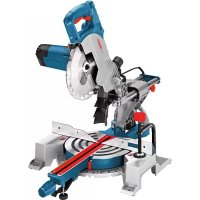
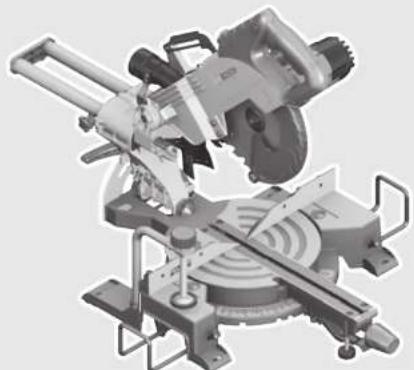
USER MANUAL GCM 800 SJ BOSCH
Robert Bosch Power Tools GmbH
70538 Stuttgart
GERMANY
www.bosch-pt.com
1609 92A 3BW (2017.06) PS/307
GCM Professional
80 SJ|800 SJ|8000 SJ

BOSCH
K. Schulzmann/Original
Original instructions
Original instructions
Original instructions
Original instructions
Original instructions
In fact, the original
It Original instruction
Bosch Power Tools 1 609 92A 3BW | (14.6.17)
6

8
10 | Deutsch
Deutsch
Sicherheitshinweise
WARNING
Read all safety warnings, instructions, illustrations and specifications provided with this power tool. Failure to follow all instructions listed below may result in electric shock, fire and/or serious injury.
ed with this power tool. Failure to follow all instructions listed below may result in electric shock, fire and/or serious injury.
Save all warnings and instructions for future reference.
The term "power tool" in the warnings refers to your mains-operated (corded) power tool or battery-operated (cordless) power tool.
WARNING
When using electric tools, basic safety precautions should always be followed
to reduce the risk of fire, electric shock, and personal injury, including the following.
Read all these instructions before attempting to operate this product and save these instructions.
20 | English
Work area safety
- Keep work area clean and well lit. Cluttered or dark areas invite accidents. ▶ Do not operate power tools in explosive atmospheres, such as in the presence of flammable liquids, gases, or dust. Power tools create sparks which may ignite the dust or fumes. ▶ Keep children and bystanders away while operating a power tool. Distractions can cause you to lose control.
Electrical safety
▶ Power tool plugs must match the outlet. Never modify the plug in any way. Do not use any adapter plugs with earthed (grounded) power tools. Unmodified plugs and matching outlets will reduce risk of electric shock. ▶ Avoid body contact with earthed or grounded surfaces, such as pipes, radiators, ranges, and refrigerators. There is an increased risk of electric shock if your body is earthed or grounded. ▶ Do not expose power tools to rain or wet conditions. Water entering a power tool will increase the risk of electric shock. ▶ Do not abuse the cord. Never use the cord for carrying, pulling, or unplugging the power tool. Keep cord away from heat, oil, sharp edges, and moving parts. Damaged or entangled cords increase the risk of electric shock. When operating a power tool outdoors, use an extension cord suitable for outdoor use. Use of a cord suitable for outdoor use reduces the risk of electric shock. ▶ If operating a power tool in a damp location is unavoidable, use a residual current device (RCD) protected supply. Use of an RCD reduces the risk of electric shock.
Personal safety
Stay alert, watch what you are doing, and use common sense when operating a power tool. Do not use a power tool while you are tired or under the influence of drugs, alcohol, or medication. A moment of inattention while operating power tools may result in serious personal injury. ▶ Use personal protective equipment. Always wear eye protection. Protective equipment such as dust mask, non-skid safety shoes, hard hat, or hearing protection used for appropriate conditions will reduce personal injuries. ▶ Prevent unintentional starting. Ensure the switch is in the off-position before connecting to power source and/or battery pack, picking up, or carrying the tool. Carrying power tools with your finger on the switch or energising power tools that have the switch on invites accidents. Remove any adjusting key or wrench before turning the power tool on. A wrench or a key left attached to a rotating part of the power tool may result in personal injury. Do not overreach. Keep proper footing and balance at all times. This enables better control of the power tool in unexpected situations.
Dress properly. Do not wear loose clothing or jewellery. Keep your hair and clothing away from moving parts. Loose clothes, jewellery or long hair can be caught in moving parts. If devices are provided for the connection of dust extraction and collection facilities, ensure these are connected and properly used. Use of dust collection can reduce dust-related hazards. Do not let familiarity gained from frequent use of tools allow you to become complacent and ignore tool safety principles. A careless action can cause severe injury within a fraction of a second.
Do not force the power tool. Use the correct power tool for your application. The correct power tool will do the job better and safer at the rate for which it was designed. Do not use the power tool if the switch does not turn it on and off. Any power tool that cannot be controlled with the switch is dangerous and must be repaired. Disconnect the plug from the power source and/or remove the battery pack, if detachable, from the power tool before making any adjustments, changing accessories, or storing power tools. Such preventive safety measures reduce the risk of starting the power tool accidentally. Store idle power tools out of the reach of children and do not allow persons unfamiliar with the power tool or these instructions to operate the power tool. Power tools are dangerous in the hands of untrained users. Maintain power tools and accessories. Check for misalignment or binding of moving parts, breakage of parts and any other condition that may affect the power tool's operation. If damaged, have the power tool repaired before use. Many accidents are caused by poorly maintained power tools. Keep cutting tools sharp and clean. Properly maintained cutting tools with sharp cutting edges are less likely to bind and are easier to control. Use the power tool, accessories and tool bits etc. in accordance with these instructions, taking into account the working conditions and the work to be performed. Use of the power tool for operations different from those intended could result in a hazardous situation. Keep handles and grasping surfaces dry, clean and free from oil and grease. Slippery handles and grasping surfaces do not allow for safe handling and control of the tool in unexpected situations.
Service
Have your power tool serviced by a qualified repair person using only identical replacement parts. This will ensure that the safety of the power tool is maintained.
Safety Warnings for Mitre Saws
- Mitre saws are intended to cut wood or wood-like products. They cannot be used with abrasive cut-off wheels for cutting ferrous material such as bars, rods, studs, etc. Abrasive dust causes moving parts such as the lower guard to jam. Sparks from abrasive cutting will burn the lower guard, the kerf insert, and other plastic parts. Use clamps to support the workpiece whenever possible. If supporting the workpiece by hand, you must always keep your hand at least 100 mm from either side of the saw blade. Do not use this saw to cut pieces that are too small to be securely clamped or held by hand. If your hand is placed too close to the saw blade, there is an increased risk of injury from blade contact. The workpiece must be stationary and clamped or held against both the fence and the table. Do not feed the workpiece into the blade or cut "freehand" in any way. Unrestrained or moving workpieces could be thrown at high speeds, causing injury. Push the saw through the workpiece. Do not pull the saw through the workpiece. To make a cut, raise the saw head and pull it out over the workpiece without cutting, start the motor, press the saw head down, and push the saw through the workpiece. Cutting on the pull stroke is likely to cause the saw blade to climb on top of the workpiece and violently throw the blade assembly towards the operator. Never cross your hand over the intended line of cutting either in front or behind the saw blade. Supporting the workpiece "cross handed" i.e., holding the workpiece to the right of the saw blade with your left hand or vice versa is very dangerous. Do not reach behind the fence with either hand closer than 100 mm from either side of the saw blade, to remove wood scraps, or for any other reason while the blade is spinning. The proximity of the spinning saw blade to your hand may not be obvious and you may be seriously injured. Inspect your workpiece before cutting. If the workpiece is bowed or warped, clamp it with the outside bowed face toward the fence. Always make certain that there is no gap between the workpiece, fence, and table along the line of the cut. Bent or warped workpieces can twist or shift and may cause binding on the spinning saw blade while cutting. There should be no nails or foreign objects in the workpiece. Do not use the saw until the table is clear of all tools, wood scraps, etc., except for the workpiece. Small debris or loose pieces of wood or other objects that contact the revolving blade can be thrown with high speed. Cut only one workpiece at a time. Stacked multiple workpieces cannot be adequately clamped or braced and may bind on the blade or shift during cutting. Ensure the mitre saw is mounted or placed on a level, firm work surface before use. A level and firm work surface reduces the risk of the mitre saw becoming unstable.
▶ Plan your work. Every time you change the bevel or mitre angle setting, make sure the adjustable fence is set correctly to support the workpiece and will not interfere with the blade or the guarding system. Without turning the tool "ON" and with no workpiece on the table, move the saw blade through a complete simulated cut to assure there will be no interference or danger of cutting the fence. ▶ Provide adequate support such as table extensions, saw horses, etc. for a workpiece that is wider or longer than the table top. Workpieces longer or wider than the mitre saw table can tip if not securely supported. If the cut-off piece or workpiece tips, it can lift the lower guard or be thrown by the spinning blade. Do not use another person as a substitute for a table extension or as additional support. Unstable support for the workpiece can cause the blade to bind or the workpiece to shift during the cutting operation pulling you and the helper into the spinning blade. The cut-off piece must not be jammed or pressed by any means against the spinning saw blade. If confined, i.e. using length stops, the cut-off piece could get wedged against the blade and thrown violently. ▶ Always use a clamp or a fixture designed to properly support round material such as rods or tubing. Rods have a tendency to roll while being cut, causing the blade to "bite" and pull the work with your hand into the blade. ▶ Let the blade reach full speed before contacting the workpiece. This will reduce the risk of the workpiece being thrown. If the workpiece or blade becomes jammed, turn the mitre saw off. Wait for all moving parts to stop and disconnect the plug from the power source and/or remove the battery pack. Then work to free the jammed material. Continued sawing with a jammed workpiece could cause loss of control or damage to the mitre saw. ▶ After finishing the cut, release the switch, hold the saw head down and wait for the blade to stop before removing the cut-off piece. Reaching with your hand near the coasting blade is dangerous. - Keep your workplace clean. Blends of materials are particularly dangerous. Dust from light alloys can burn or explode. Do not use dull, cracked, bent or damaged saw blades. Unsharpened or improperly set saw blades produce narrow kerf causing excessive friction, blade binding and kick-back. ▶ Do not use high speed steel (HSS) saw blades. Such saw blades can easily break. ▶ Always use blades with correct size and shape (diamond versus round) of arbour holes. Blades that do not match the mounting hardware of the saw will run eccentrically, causing loss of control. ▶ Never remove cutting remainders, wood chips, etc. from the sawing area while the machine is running. Always guide the tool arm back to the neutral position first and then switch the machine off.
▶ Do not touch the saw blade after working before it has cooled. The saw blade becomes very hot while working.
Products sold in GB only: Your product is fitted with a BS 1363/A approved electric plug with internal fuse (ASTA approved to BS 1362).
If the plug is not suitable for your socket outlets, it should be cut off and an appropriate plug fitted in its place by an authorized customer service agent. The replacement plug should have the same fuse rating as the original plug.
The severed plug must be disposed of to avoid a possible shock hazard and should never be inserted into a mains socket elsewhere.
Symbols
The following symbols can be important for the operation of your power tool. Please memorize the symbols and their meanings. The correct interpretation of the symbols helps you operate the power tool better and more safely.
Symbols and their meaning

Keep hands away from the cutting area while the machine is running. Danger of injury when coming in contact with the saw blade.

Wear a dust respirator.

Wear safety goggles.

Wear ear protectors. Exposure to noise can cause hearing loss.

Danger area! Keep hands, fingers or arms away from this area.
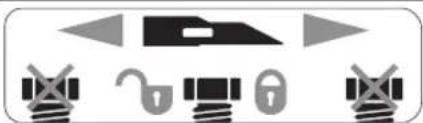
Sawing bevel angles:
The middle locking screw has to be loosened to move the adjustable fence.
The two outer fixing screws must not be loosened!
Symbols and their meaning
ø 30 mm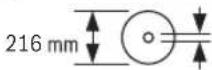
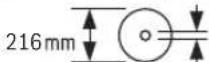
Observe the dimensions of the saw blade. The hole diameter must match the tool spindle without play. If it is necessary to use reducers, ensure that the dimensions of the reducer are suitable for the base blade thickness and the saw blade hole diameter, as well as the tool spindle diameter. Wherever possible, use the reducers provided with the saw blade.
Product Description and Specifications

Read all safety warnings and all instructions. Failure to follow the warnings and instructions may result in electric shock, fire and/or serious injury.
Intended Use
The power tool is intended as a stationary machine for making straight lengthways and crossways cuts in wood. Horizontal mitre angles of -47° to +47° as well as vertical bevel angles of 0° to 45° are possible.
The machine is designed with sufficient capacity for sawing hard and softwood as well as press and particle board.
When using appropriate saw blades, sawing aluminium profiles and plastic is also possible.
Product Features
The numbering of the components shown refers to the representation of the power tool on the graphic pages.
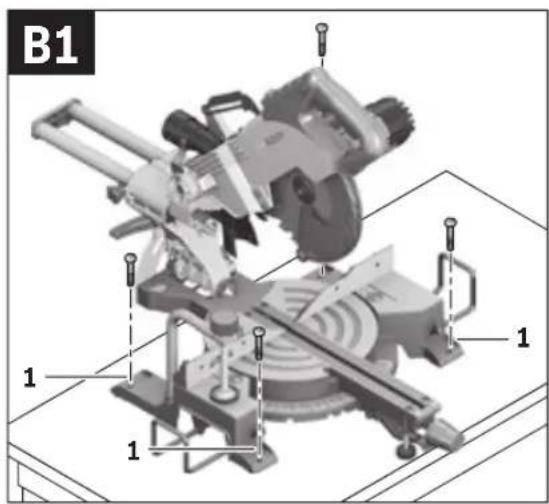
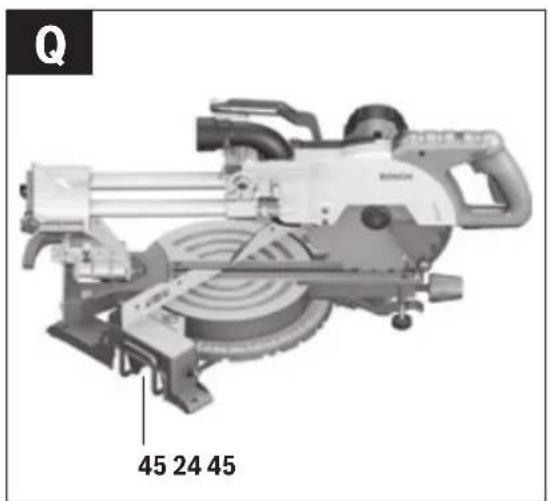
1 Mounting holes
2 Clamping screw for saw-table extension
3 Saw-table extension
4 Recessed handles
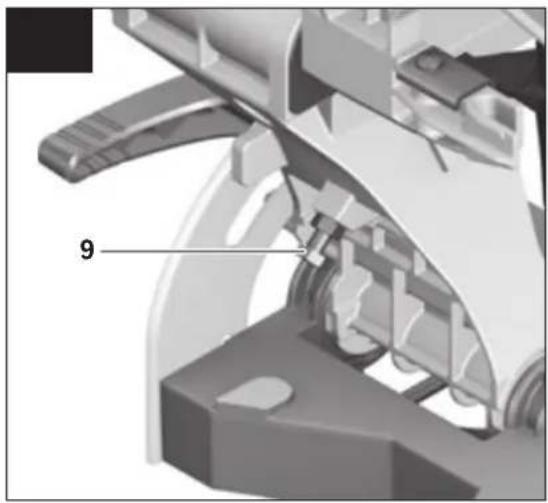
9 Stop screw for 45° bevel angle
10 Bevel lock lever
11 Locking screw for slide device
12 Slide device
13 Chip ejector
14 Chip deflector
15 On/Off switch
16 Handle
17 Locking switch for releasing the tool arm
18 Blade guard
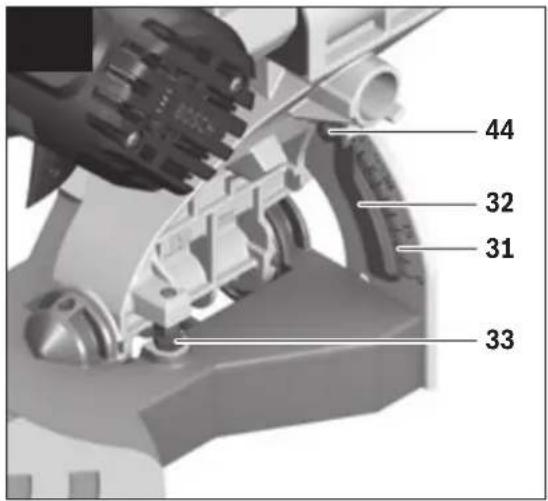
19 Retracting blade guard 20 Roller 21 Fence 22 Saw table 23 Insert plate 24 Mitre angle indicator 25 Locking knob for various mitre angles 26 Mitre detent lever 27 Tilt protector 28 Detents for standard mitre angles 29 Spindle lock 30 Transport safety-lock 31 Scale for bevel angle 32 Indicator for bevel angle 33 Stop screw for 0° bevel angle 34 Stop for 0° bevel angle 35 Hex key (size 5 mm)/cross-head screwdriver 36 Hex socket screw for mounting of saw blade 37 Clamping flange 38 Interior clamping flange 39 Saw blade 40 Locking screw of the adjustable fence 41 Mounting holes for material clamp 42 Threaded rod 43 Screws for insert plate 44 Screw for bevel angle indicator 45 Screw for mitre angle indicator
Accessories shown or described are not part of the standard delivery scope of the product. A complete overview of accessories can be found in our accessories program.
Technical Data
| Sliding Mitre Saw GCM 80 SJ |
| | | GCM 800 SJ |
| | | GCM 8000 SJ |
| Article number | | | | |
| 3 601 M19 ... | | ... 0... ... 06. |
| Rated power input | W | 1 | 4 | 0 |
| No-load speed | min -1 | 5500 | 5500 | |
| Reduced starting current | | ● | | ● |
| Weight according to EPTA-Procedure 01:2014 kg 14.1 14.1 |
| Protection class | | ☐/IT/IT | ☐ |
| Permissible workpiece dimensions (maximum/minimum) see page 26.The values given are valid for a nominal voltage [U] of 230 V. For different voltages and models for specific countries, these values can vary. |
| Dimension of suitable saw blades |
| Saw blade diameter | mm | 216 |
| Blade body thickness | mm | 1.3-1.8 |
| Max. cutting width | mm | 3.3 |
| Mounting hole diameter | mm | 30 |
Sound emission values determined according to EN 62841-3-9.
Typically the A-weighted noise levels of the product are: Sound pressure level 93 dB(A); Sound power level 106 dB(A). Uncertainty K = 3 dB.
Wear hearing protection!
The noise emission value given in these instructions has been measured in accordance with a standardized measuring procedure and may be used to compare power tools. It may also be used for a preliminary estimation of noise emissions.
The noise emission value given represents the main applications of the power tool. However, if the power tool is used for other applications, with different accessories or is poorly maintained, the noise emission value may differ. This may significantly increase noise emissions over the total working period.
To estimate noise emissions accurately, the times when the tool is switched off, or when it is running but not actually being used, should also be taken into account. This may significantly reduce noise emissions over the total working period.
Assembly
- Avoid unintentional starting of the machine. During assembly and for all work on the machine, the power plug must not be connected to the mains supply.
Delivery Scope
Before starting the operation of the machine for the first time, check if all parts listed below have been supplied:
- Sliding mitre saw with mounted saw blade
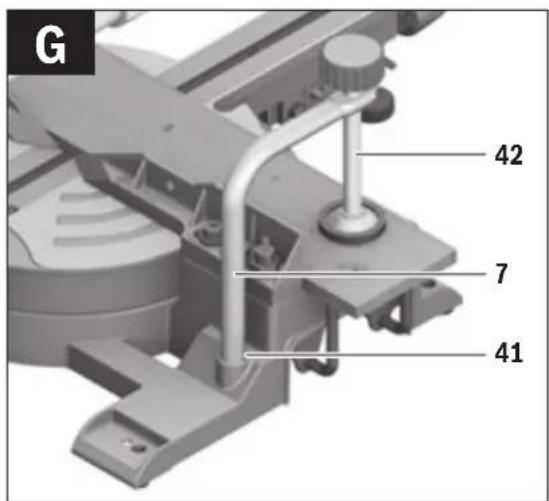
- Material clamp 7
- Saw-table extension 3
Clamping screw 2 x 2, cross-head screw x 2 to prevent the saw table extensions from being pulled out of the saw table
- Hex key/cross-head screwdriver 35
Note: Check the power tool for possible damage.
Before further use of the machine, check that all protective devices are fully functional. Any lightly damaged parts must be carefully checked to ensure flawless operation of the tool. All parts must be properly mounted and all conditions fulfilled that ensure faultless operation.
Damaged protective devices and parts must be immediately replaced by an authorised service centre.
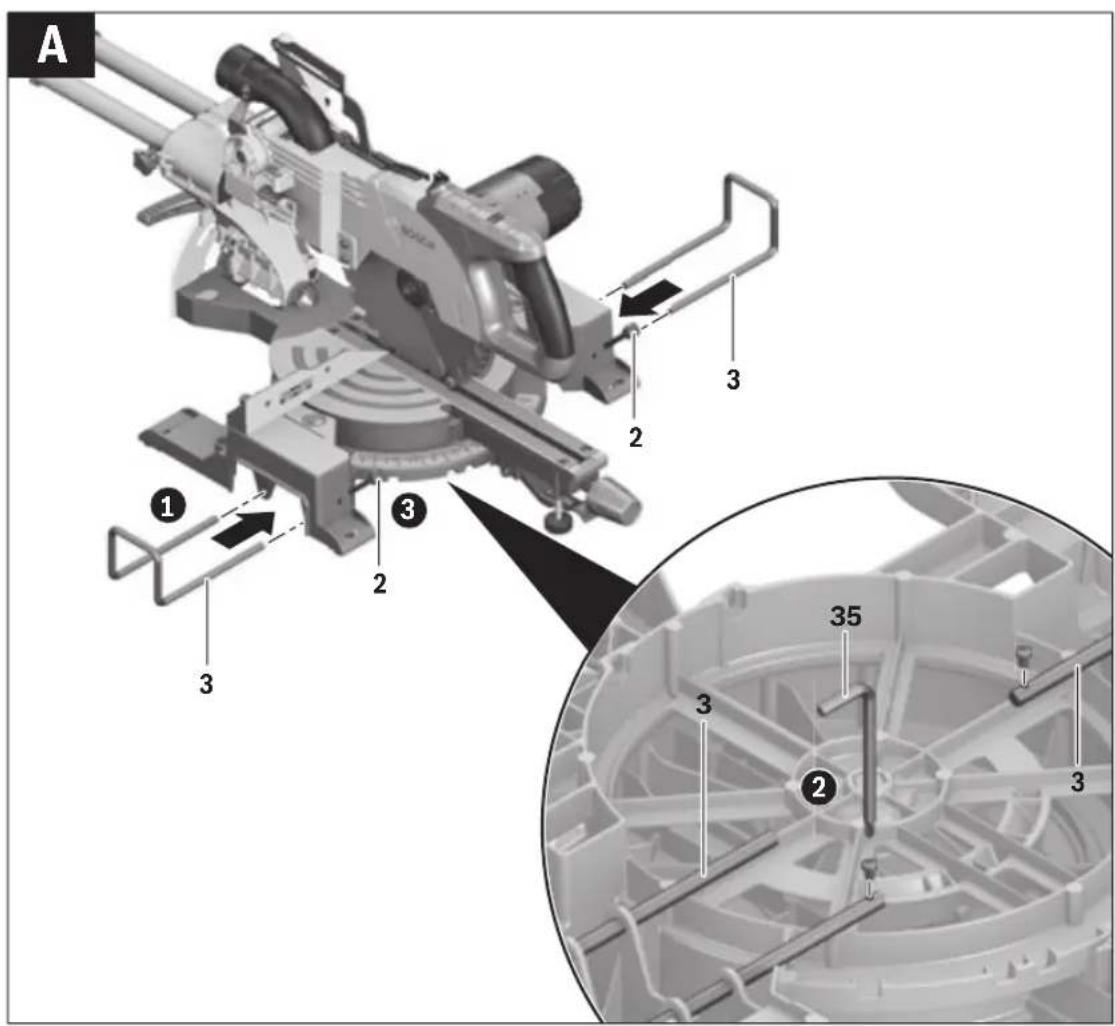
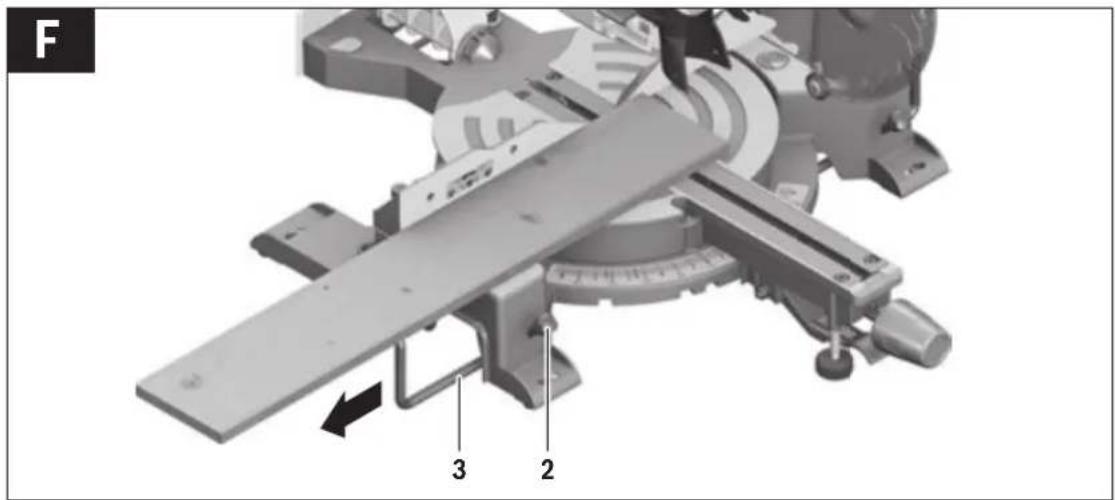
The saw table can be extended left and right with the saw-table extensions 3.
- Slide the saw table extensions in as far as they will go through the holes provided in the saw table.
- Turn the power tool upside down so that you can screw in the two cross-head screws provided to prevent the saw table extensions from being pulled out of the saw table. Screw the cross-head screws into the threaded holes provided in the saw table extensions 3 and use a cross-head screwdriver 35 to tighten them.
Turn the power tool the right way round again and screw the clamping screws 2 for fastening the saw table extensions 3 in place into the threaded holes provided in the saw table 22.
Stationary or Flexible Mounting
To ensure safe handling, the machine must be mounted on a level and stable surface (e.g., workbench) prior to using.
Fasten the power tool with suitable screw fasteners to the working surface. The mounting holes 1 serve for this purpose.
Mounting to a Bosch Saw Stand
With the height-adjustable legs, Bosch GTA saw stands provide firm support for the power tool on any surface. The workpiece supports of the saw stand are used for underlying long workpieces.
Read all safety warnings and instructions included with the worktable. Failure to observe safety warnings and instructions can lead to electrical shock, fire and/or cause serious injuries.
Assemble the worktable properly before mounting the power tool. Perfect assembly is important in order to prevent the risk of collapsing.
Mount the power tool in transport position on the saw stand.
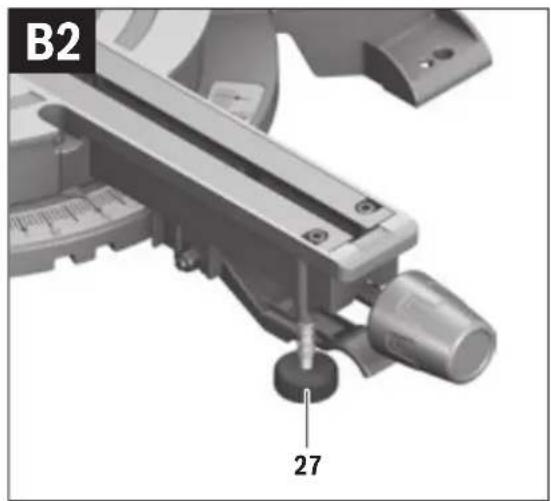
In exceptional cases, when it is not possible to mount the machine onto a level and stable work surface, it can be set up using the tilt protector.
Without the use of the tilt protector, the machine does not stand safely and can tip over, especially when sawing at maximum mitre/bevel angles.
Screw the tilt protector 27 in or out until the machine is positioned level on the working surface.
Dust from materials such as lead-containing coatings, some wood types, minerals and metal can be harmful to one's health. Touching or breathing-in the dust can cause allergic reactions and/or lead to respiratory infections of the user or bystanders.
Certain dust, such as oak or beech dust, is considered carcinogenic, especially in connection with wood-treatment additives (chromate, wood preservative). Materials containing asbestos may only be worked by specialists.
- Always use dust extraction.
- Provide for good ventilation of the working place.
- It is recommended to wear a P2 filter-class respirator.
Observe the relevant regulations in your country for the materials to be worked.
Prevent dust accumulation at the workplace. Dust can easily ignite.
The dust/chip extraction can be blocked by dust, chips or workpiece fragments.
- Switch the machine off and pull the mains plug from the socket outlet.
- Wait until the saw blade has come to a complete stop.
- Determine the cause of the blockage and correct it.
For dust extraction, a vacuum hose (size ∅ 35 mm) can also be connected to the chip ejector 13.
Connect the vacuum hose to the chip ejector 13.
The vacuum cleaner must be suitable for the material being worked.
When vacuuming dry dust that is especially detrimental to health or carcinogenic, use a special vacuum cleaner.
When mounting the saw blade, wear protective gloves.
Danger of injury when touching the saw blade.
Use only saw blades whose maximum permitted speed is higher than the no-load speed of the power tool.
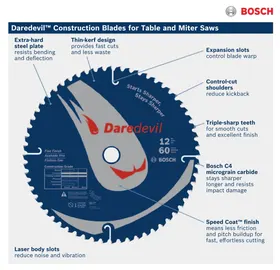
Use only saw blades that correspond with the characteristic data given in these operation instructions and that are tested and marked in accordance with EN 847-1.
Use only saw blades recommended by the tool manufacturer, and suitable for sawing the materials to be cut. This prevents overheating of the saw teeth during sawing.
Removing the Saw Blade
- Bring the power tool into the working position.
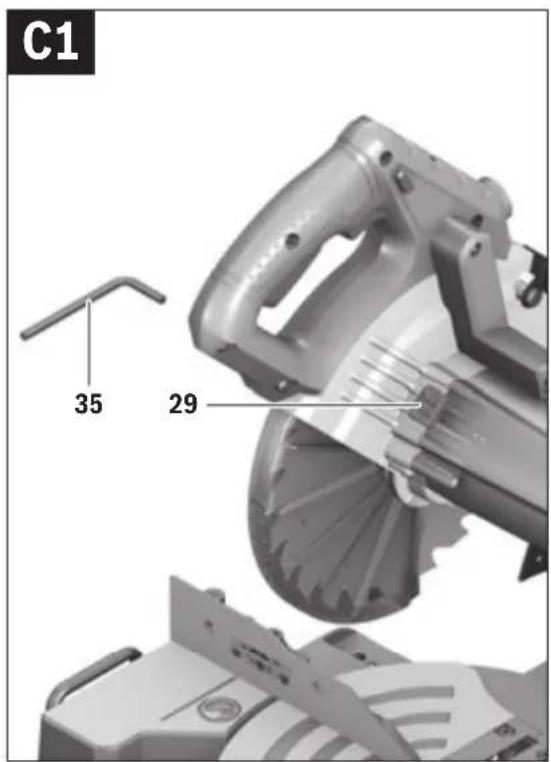
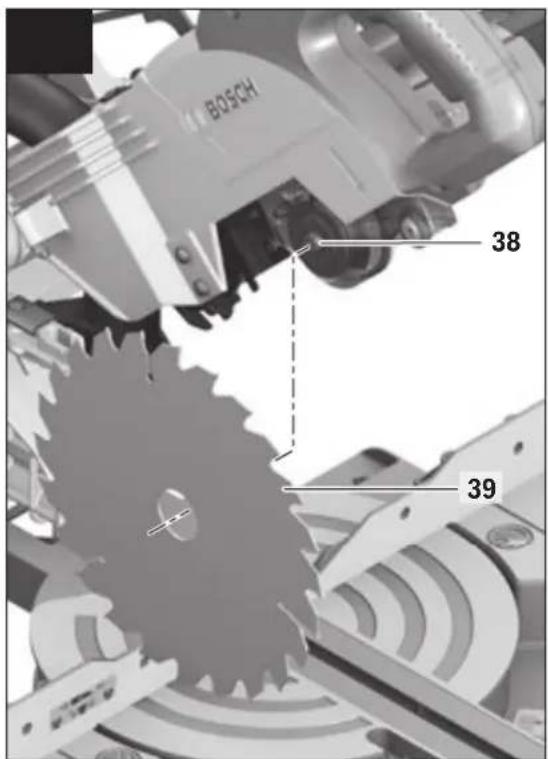
- Turn the hex socket screw 36 with the hex key (5 mm) 35 and at the same time press the spindle lock 29 until it engages.
- Hold the spindle lock 29 pressed and unscrew the hex socket screw 36 in clockwise direction (left-hand thread!).
- Remove the clamping flange 37.
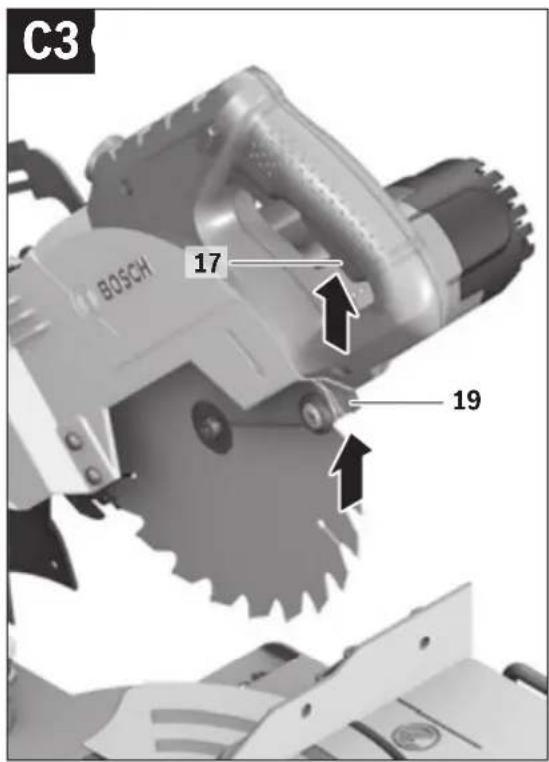
- Press locking switch 17 and swing back the retracting blade guard 19 to the stop.
- Hold the retracting blade guard in this position and remove the saw blade 39.
- Slowly guide the retracting blade guard downward again.
Mounting the Saw Blade
If required, clean all parts to be mounted prior to assembly.
- Press locking switch 17, swing back the retracting blade guard 19 to the stop and hold it in this position.
- Place the new saw blade onto the interior clamping flange 38.
When mounting the saw blade, pay attention that the cutting direction of the teeth (arrow direction on the saw blade) corresponds with the direction of the arrow on the blade guard!
- Slowly guide the retracting blade guard downward again.
- Place on the clamping flange 37 and the screw 36. Press the spindle lock 29 until it engages and tighten the screw turning in anticlockwise direction.


Operation
Before any work on the machine itself, pull the mains plug.
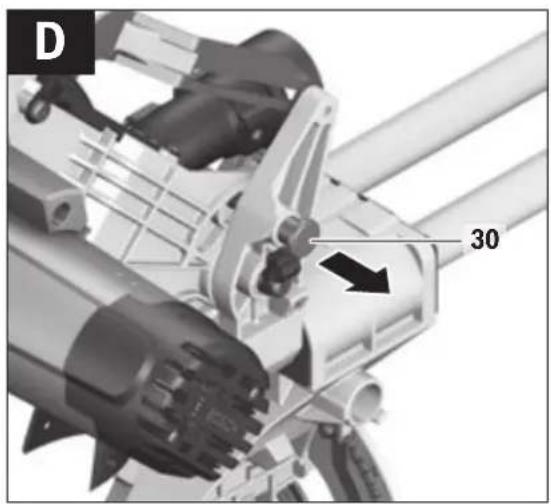
The transport safety-lock 30 enables easier handling of the machine when transporting to various working locations.
Releasing the Machine (Working Position)
- Push the tool arm by the handle 16 down a little in order to relieve the transport safety-lock 30.
- Pull the transport safety-lock 30 completely outward. – Guide the tool arm slowly upward.
Securing the Machine (Transport Position)
- Loosen the locking screw 11 if tightened. Pull the tool arm completely to the front and tighten the locking screw again.
- To lock the saw table 22, tighten the locking knob 25.
- Press locking switch 17 and slowly guide the tool arm downward by the handle 16.
- Guide the tool arm downward until the transport safety-lock 30 can be pushed completely inward.
Preparing for Operation
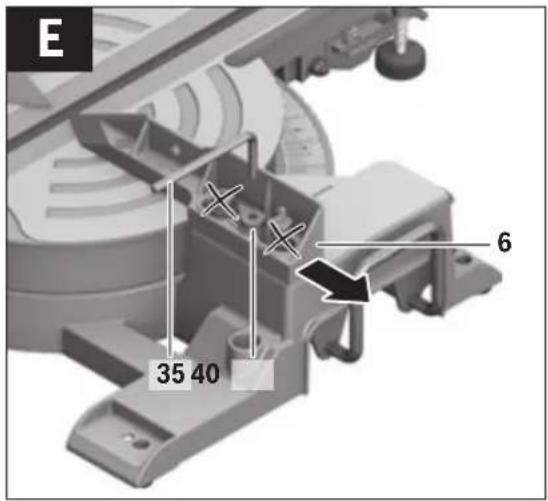
You have to move the adjustable fence 6 to saw bevel angles.
- Loosen the locking screw 40 using the supplied hex key 35.
The two outer fixing screws must not be loosened!
- Pull the adjustable fence 6 completely outward.
- Retighten the locking screw 40.
After sawing the bevel angles, slide the adjustable fence 6 back again (loosen the locking screw 40; slide the fence 6 completely inward; retighten the locking screw).
Long workpieces must be underlaid or supported at their free end.
The saw table can be extended left and right with the saw-table extensions 3.
- Loosen the clamping screw 2.
- Pull out the saw-table extension 3 to the desired length.
- Retighten the clamping screw 2 to fix the saw-table extension.
To ensure optimum working safety, the workpiece must always be firmly clamped.
Do not saw workpieces that are too small to clamp.
- Press the workpiece firmly against the fences 6 and 21.
- Insert the material clamp 7 provided into one of the holes 41 intended for it.
- Adapt the threaded rod 42 of the screw clamp to the workpiece height.
- Firmly tighten the threaded rod 42, thus fastening the workpiece.
Adjusting the Cutting Angle
To ensure precise cuts, the basic adjustment of the machine must be checked and adjusted as necessary after intensive use (see "Checking and Adjusting the Basic Adjustment", page 26).
▶ Always tighten the locking knob 25 firmly before sawing. Otherwise the saw blade can become wedged in the workpiece.
The mitre angle can be set in the range from 47° (left side) to 47° (right side).
- Loosen the locking knob 25 in case it is tightened.
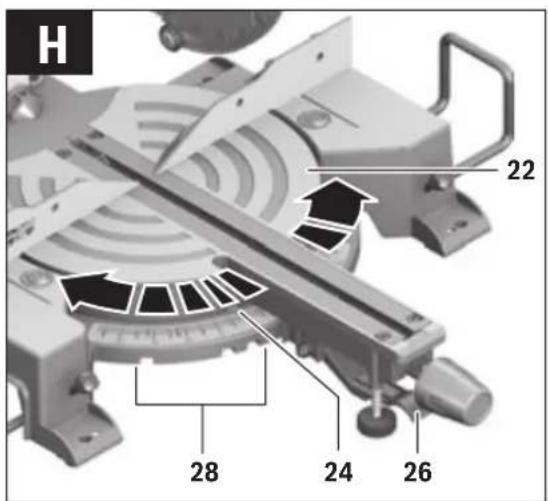
- Pull the lever 26 and turn the saw table 22 until the desired mitre angle is indicated on the angle indicator 24.
- Tighten the locking knob 25 again.
For quick and precise setting of often used mitre angles, detents 28 are provided on the saw table:
Left Right
0°
45° 22.5° 15° 15° 22.5° 45°
- Loosen the locking knob 25 in case it is tightened.
- Pull lever 26 and rotate the saw table 22 left or right to the requested detent.
- Release the lever again. The lever must be felt to engage in the detent.
- Tighten the locking knob 25 again.
The bevel angle can be set in the range from 0° to 45°.
- Pull the adjustable fence 6 completely outward.
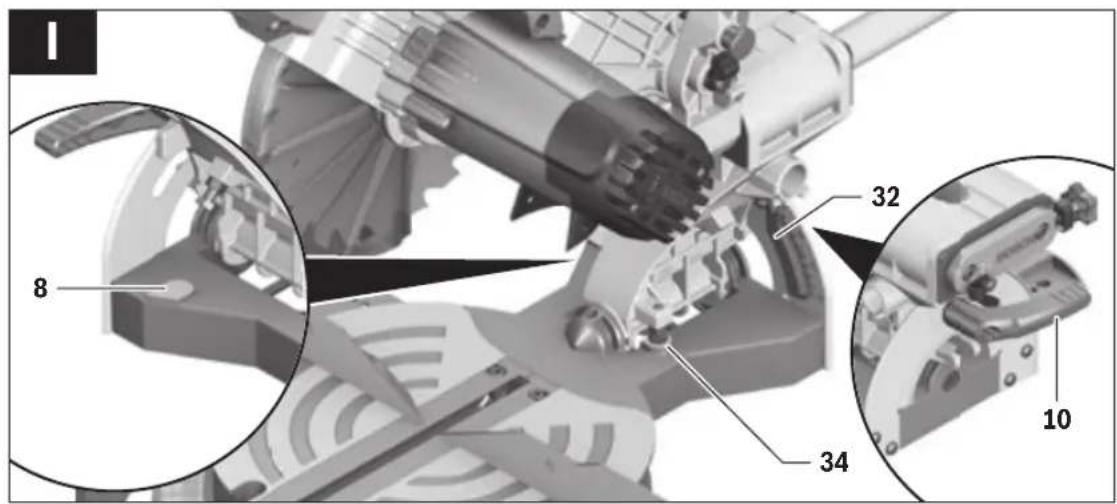
- Loosen the lock lever 10.
- Tilt the tool arm by the handle 16 until the angle indicator 32 indicates the desired bevel angle.
- Hold the tool arm in this position and retighten the clamping lever 10.
For quick and precise setting of the standard angles 0° and 45°, end stops are provided on the housing.
- Pull the adjustable fence 6 completely outward.
- Loosen the lock lever 10.
- To do so, swivel the tool arm by the handle 16 to the stop 34 to the right (0°) or to the stop 8 to the left (45°).
- Retighten the lock lever 10 again.
Starting Operation
▶ Observe correct mains voltage! The voltage of the power source must agree with the voltage specified on the nameplate of the machine. Power tools marked with 230 V can also be operated with 220 V.
Products sold in AUS and NZ only: Use a residual current device (RCD) with a rated residual current of 30 mA or less.
To save energy, only switch the power tool on when using it.
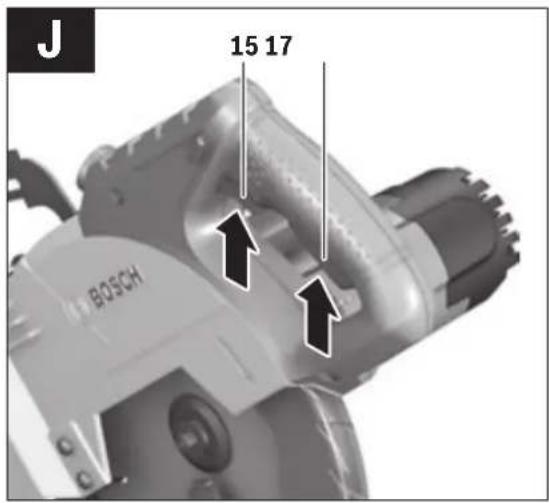
- To start the machine, press the On/Off switch 15 and keep it pressed.
Note: For safety reasons, the On/Off switch 15 cannot be locked; it must remain pressed during the entire operation. The tool arm can only be guided downward by pressing locking switch 17.
- For sawing, the locking switch 17 must be therefore pushed in addition to pressing the On/Off switch 15.
Switching Off
- To switch off the machine, release the On/Off switch 15.
Working Advice
General Sawing Instructions
For all cuts, it must first be ensured that the saw blade at no time can come in contact with the fence, screw clamps or other machine parts. Remove any mounted auxiliary stops or adjust them accordingly.
Only saw materials which are permitted within the scope of the intended use.
Protect the saw blade against impact and shock. Do not subject the saw blade to lateral pressure.
Do not saw warped/bent workpieces. The workpiece must always have a straight edge to face against the fence.
Make sure that the retracting blade guard operates properly and that it can move freely. The retracting blade guard must open when the tool arm is guided downward. When the tool arm is guided upward, the retracting blade guard must close again over the saw blade and lock in the uppermost position of the tool arm.
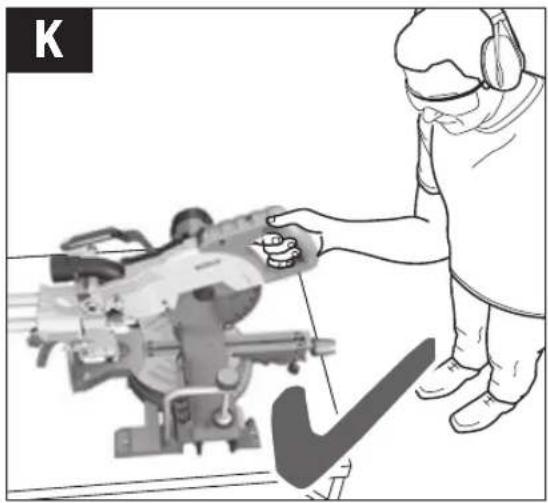
Do not stand in a line with the saw blade in front of the machine. Always stand aside of the saw blade. This protects your body against possible kickback.
Keep hands, fingers and arms away from the rotating saw blade.
Do not cross your arms when operating the tool arm.
Permissible Workpiece Dimensions
Maximum workpiece sizes:
| Mitre/Bevel Angle Height x Width [mm] |
| Horizontal Vertical |
| 0° 0° | 70 x 270 |
| 45° 0° | 70 x 190 |
| 0° 45° | 45 x 270 |
Minimum workpiece sizes (= all workpieces that can be clamped left or right from the saw blade with the supplied material clamp 7): 100 x 40 mm (length x width)
Cutting depth, max. (0°/0°): 70 mm
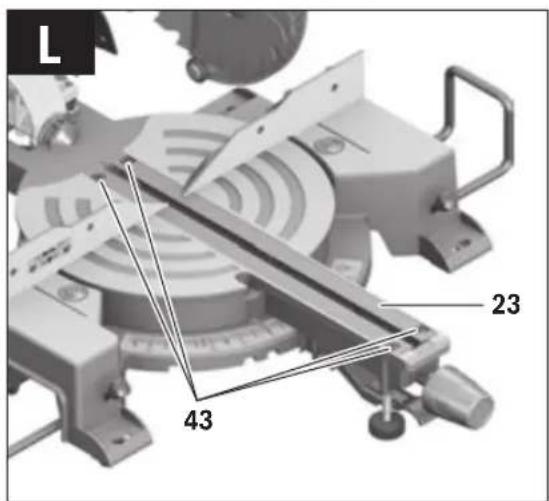
The red insert plates 23 can become worn after prolonged use of the machine.
Replace defective insert plates.
Bring the power tool into the working position.
- Unscrew the screws 43 with a hex key to remove the old insert plates.
- Insert the new right-hand insert plate.
- Screw the insert plate as far as possible to the right with the screws 43 so that the saw blade does not come into contact with the insert plate over the complete length of the possible slide motion.
- Repeat the work steps in the same manner for the left-hand insert plate.
Sawing
▶ Always tighten the locking knob 25 firmly before sawing. Otherwise the saw blade can become wedged in the workpiece.
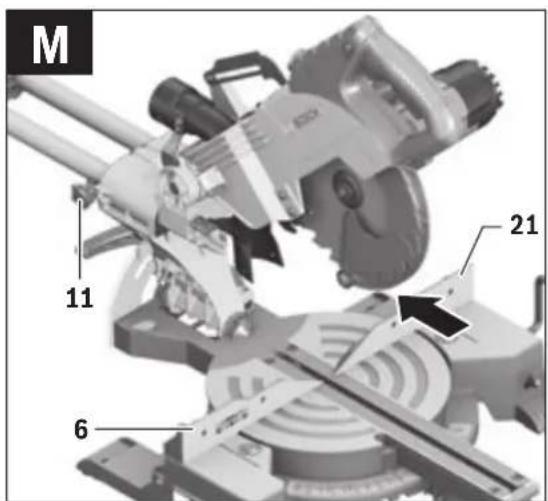
- For cuts without slide movement (small workpieces), loosen the locking screw 11 if it is tightened. Push the tool arm all the way towards the fences 6 and 21 and retighten the locking screw 11.
- Adjust the requested mitre and/or bevel angle.
- Press the workpiece firmly against the fences 6 and 21.
- Firmly clamp the workpiece as appropriate for its dimensions.
- Switch on the machine.
- Press locking switch 17 and slowly guide the tool arm downward by the handle 16.
- Saw through the workpiece applying uniform feed.
- Switch off the machine and wait until the saw blade has come to a complete stop. – Guide the tool arm slowly upward.
Sawing with Slide Movement
- For cuts using the slide device 12 (wide workpieces), loosen the locking screw 11 in case it is tightened.
- Adjust the requested mitre and/or bevel angle.
- Press the workpiece firmly against the fences 6 and 21.
- Firmly clamp the workpiece as appropriate for its dimensions.
- Pull the tool arm away from the fences 6 and 21 until the saw blade is in front of the workpiece.
- Switch on the machine.
- Press locking switch 17 and slowly guide the tool arm downward by the handle 16.
- Now push the tool arm toward the fences 6 and 21 and saw through the workpiece with uniform feed.
- Switch off the machine and wait until the saw blade has come to a complete stop.
- Guide the tool arm slowly upward.
Special Workpieces
When sawing curved or round workpieces, these must be especially secured against slipping. At the cutting line, no gap may exist between workpiece, fence and saw table.
Provide for special fixtures, if required.
Checking and Adjusting the Basic Adjustment
Before any work on the machine itself, pull the mains plug.
(4 min) and remove must be checked and adjusted as necessary after intensive use.
A certain level of experience and appropriate specialty tools are required for this.
A Bosch after-sales service station will handle this maintenance task quickly and reliably.
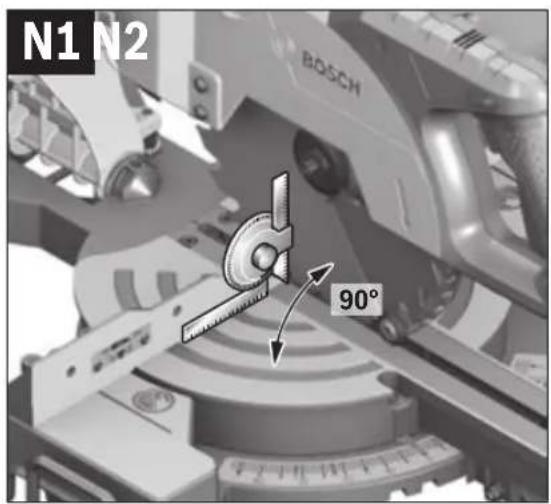
Setting the Standard Bevel Angle 0° (Vertical)
- Bring the power tool into the working position.
- Turn the saw table 22 to the 0° detent 28. The lever 26 must be felt to engage in the detent.
- Adjust an angle gauge to 90° and position it on the saw table 22.
The leg of the angle gauge must be flush with the saw blade 39 over the complete length.
- Loosen the lock lever 10.
- Loosen the lock nut of the stop screw 33 using a commercial box-end or open-end spanner (size 10 mm).
- Screw the stop screw in or out until the leg of the angle gauge is flush with the saw blade over the complete length.
- Retighten the lock lever 10 again.
- Afterwards, retighten the lock nut of the stop screw 33 again.
In case the angle indicator 32 is not in a line with the 0° mark of the scale 31 after the adjustment, loosen the screw 44 using a commercial cross-head screwdriver and align the angle indicator along the 0° mark.
Setting the Standard Bevel Angle 45° (Vertical)
- Bring the power tool into the working position.
- Turn the saw table 22 to the 0° detent 28. The lever 26 must be felt to engage in the detent.
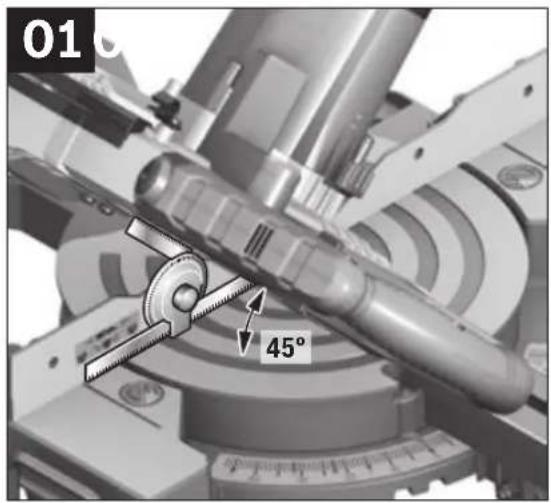
- Loosen the lock lever 10 and tilt the tool arm leftward to the stop (45°) by the handle 16.
- Adjust an angle gauge to 45° and position it on the saw table 22.
The leg of the angle gauge must be flush with the saw blade 39 over the complete length.
- Loosen the lock lever 10.
- Loosen the lock nut of the stop screw 9 using a commercial box-end or open-end spanner (size 10 mm).
- Screw the stop screw in or out until the leg of the angle gauge is flush with the saw blade over the complete length.
- Retighten the lock lever 10 again.
- Afterwards, retighten the lock nut of the stop screw 9 again.
In case the angle indicator 32 is not in a line with the 45° mark of the scale 31, firstly check the 0° setting for the bevel angle and the angle indicator again. Then repeat the adjustment of the 45° bevel angle.
- Bring the power tool into the working position.
- Turn the saw table 22 to the 0° detent 28. The lever 26 must be felt to engage in the detent.
Checking:
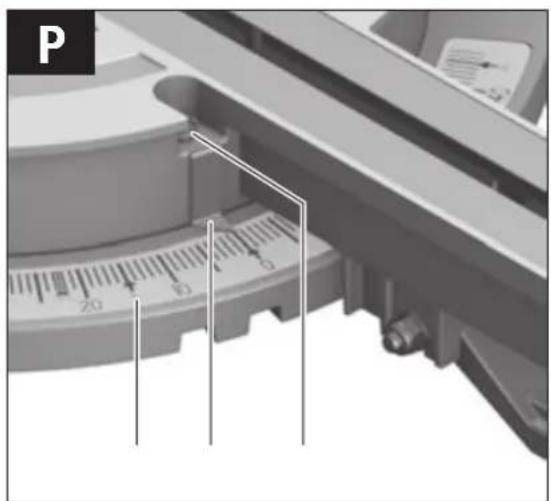
The angle indicator 24 must be in alignment with the 0° mark of the scale 5.
Adjusting:
- Loosen screw 45 using a cross-head screwdriver and align the angle indicator alongside the 0° mark.
- Retighten the screw again.
Before transporting the power tool, the following steps must be carried out:
- Loosen the locking screw 11 if tightened. Pull the tool arm completely to the front and tighten the locking screw again.
- Bring the machine into the transport position.
- Remove all accessories that cannot be mounted firmly to the power tool. If possible, place unused saw blades in an enclosed container for transport.
- For lifting or transporting, hold the power tool by the recessed grips 4 on the side of the saw table 22.
When transporting the power tool, use only the transport devices and never use the protective devices.
Maintenance and Service
Maintenance and Cleaning
▶ Before any work on the machine itself, pull the mains plug.
If the replacement of the supply cord is necessary, this has to be done by Bosch or an authorized Bosch service agent in order to avoid a safety hazard.
Cleaning
For safe and proper working, always keep the power tool and its ventilation slots clean.
The retracting blade guard must always be able to move freely and retract automatically. Therefore, always keep the area around the retracting blade guard clean.
Remove dust and chips after each working procedure by blowing out with compressed air or with a brush.
Clean the roller 20 regularly.
Accessories
| Article number |
| Material clamp 1 609 B04 224 |
| Insert plates 1 609 B05 242 |
| Dust bag 1 609 B05 010 |
| Saw blades for wood and plate materials, panels and strips/mouldings |
| Saw blade 216 x 30 mm, 48 teeth 2 608 640 641 |
| Saw blades for plastic and non-ferrous metals |
| Saw blade 216 x 30 mm, 80 teeth 2 608 640 447 |
| Saw blades for all types of laminate flooring |
| Saw blade 216 x 30 mm, 60 teeth 2 608 642 133 |
After-sales Service and Application Service
Our after-sales service responds to your questions concerning maintenance and repair of your product as well as spare parts. Exploded views and information on spare parts can also be found under:
Bosch's application service team will gladly answer questions concerning our products and their accessories.
In all correspondence and spare parts orders, please always include the 10-digit article number given on the nameplate of the product.
Great Britain
Robert Bosch Ltd. (B.S.C.)
P.O. Box 98
Broadwater Park
North Orbital Road
Denham
Uxbridge
UB 9 5HJ
At www.bosch-pt.co.uk you can order spare parts or arrange the collection of a product in need of servicing or repair.
Tel. Service: (0344) 7360109
E-Mail: boschservicecentre@bosch.com
Ireland
Origo Ltd.
Unit 23 Magna Drive
Magna Business Park
City West
Dublin 24
Tel. Service: (01) 4666700
Fax: (01) 4666888
Australia, New Zealand and Pacific Islands
Robert Bosch Australia Pty. Ltd.
Power Tools
Locked Bag 66
Clayton South VIC 3169
Customer Contact Center
Inside Australia:
Phone: (01300) 307044
Fax: (01300) 307045
Inside New Zealand:
Phone: (0800) 543353
Fax: (0800) 428570
Outside AU and NZ:
Phone: +61 3 95415555
www.bosch-pt.com.au
www.bosch-pt.co.nz
Republic of South Africa
Customer service
Hotline: (011) 6519600
Gauteng - BSC Service Centre
35 Roper Street, New Centre
Johannesburg
Tel.: (011) 4939375
Fax: (011) 4930126
E-Mail: bsctools@icon.co.za
KZN - BSC Service Centre
Unit E, Almar Centre
143 Crompton Street
Pinetown
Tel.: (031) 7012120
Fax: (031) 7012446
E-Mail: bsc.dur@za.bosch.com
Western Cape - BSC Service Centre
Democracy Way, Prosperity Park
Milnerton
Tel.: (021) 5512577
Fax: (021) 5513223
E-Mail: bsc@zsd.co.za
Bosch Headquarters
Midrand, Gauteng
Tel.: (011) 6519600
Fax: (011) 6519880
E-Mail: rbsa-hq.pts@za.bosch.com
Disposal
The machine, accessories and packaging should be sorted for environmental-friendly recycling.

Do not dispose of power tools into household waste!
Only for EC countries:
According to the European Directive 2012/19/EU for Waste Electrical and Electronic Equipment and its implementation into national right, power tools that are no longer usable must be collected separately and disposed of in an environmentally correct manner.
Subject to change without notice.
Français
Robert Bosch (France) S.A.S.
Sawing vertical miter angles:
Stationary or flexible mounting
Bosch Service Center
Telegrafvej 3
2750 Ballerup
At www.bosch-pt.dk you can order spare parts online or create a repair order.
Service Center phone: 44898855
Fax: 44898755
E-Mail: vaerktoej@dk.bosch.com
Disposal
Bosch Service Center
Telegrafvej 3
2750 Ballerup
Denmark
Tel.: (08) 7501820 (within Sweden)
Fax: (011) 187691
Waste disposal
Robert Bosch Sp. z o.o.
BSC
Ul. Szyszkowa 35/37
02-285 Warszawa
Bosch Service Center PT
K Vápence 1621/16
692 01 Mikulov
Power tool service
Strada Horia Măcelariu Nr. 30-34, sector 1
013937 Bucureşti
Power tool service
Strada Horia Măcelariu Nr. 30–34, sector 1
www.bosch-pt.com/bg/bg/
Disposal
Sawing vertical angles of bevel cuts:
To move the adjustable limit rail, you must loosen the middle locking screw.
Both outer fastening screws must not be loosened!
216 mm
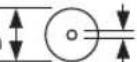
ø 30 mm
Pay attention to the dimensions of the saw blade. The diameter of the hole must fit the tool spindle without play. If it is necessary to use reducing rings, make sure that the dimensions of the reducing ring match the thickness of the original blade and the diameter of the saw blade hole, as well as the diameter of the tool spindle. Preferably use the reducing rings supplied with the saw blades.
Sawing vertical angles of bevel cuts:
To move the adjustable limit guide, loosen the middle locking screw. Both outer fastening screws must not be loosened!
ø 30 mm
Central Motors & Equipment LLC
1984: Mail
+967 1 202010: Forecasts
+967 1 279029: Fax
Malatan Trading & Contracting LLC
131: Mail
Sultanate of Oman
+968 99886794: Tel
malatanpowertools@malatan.net: Email
Qatar
International Construction Solutions W L L
P.O. Box 51 Doha
Qatar
+974 40065458: Tel
+974 4453 8585: Fax
csd@icsdoha.com: Email
(C1-C4 Manufacturer)
| 0° |
| 45° | 22,5° | 15° | 15° | 22,5° | 45° |