
Easy 5.16 SP-D - Lawn mower AL-KO - Free user manual and instructions
Find the device manual for free Easy 5.16 SP-D AL-KO in PDF.


User questions about Easy 5.16 SP-D AL-KO
0 question about this device. Answer the ones you know or ask your own.
Ask a new question about this device
Download the instructions for your Lawn mower in PDF format for free! Find your manual Easy 5.16 SP-D - AL-KO and take your electronic device back in hand. On this page are published all the documents necessary for the use of your device. Easy 5.16 SP-D by AL-KO.
USER MANUAL Easy 5.16 SP-D AL-KO
EASY 4.26 P-D | EASY 4.66 P-D
EASY 4.66 SP-D | EASY 5.16 SP-D
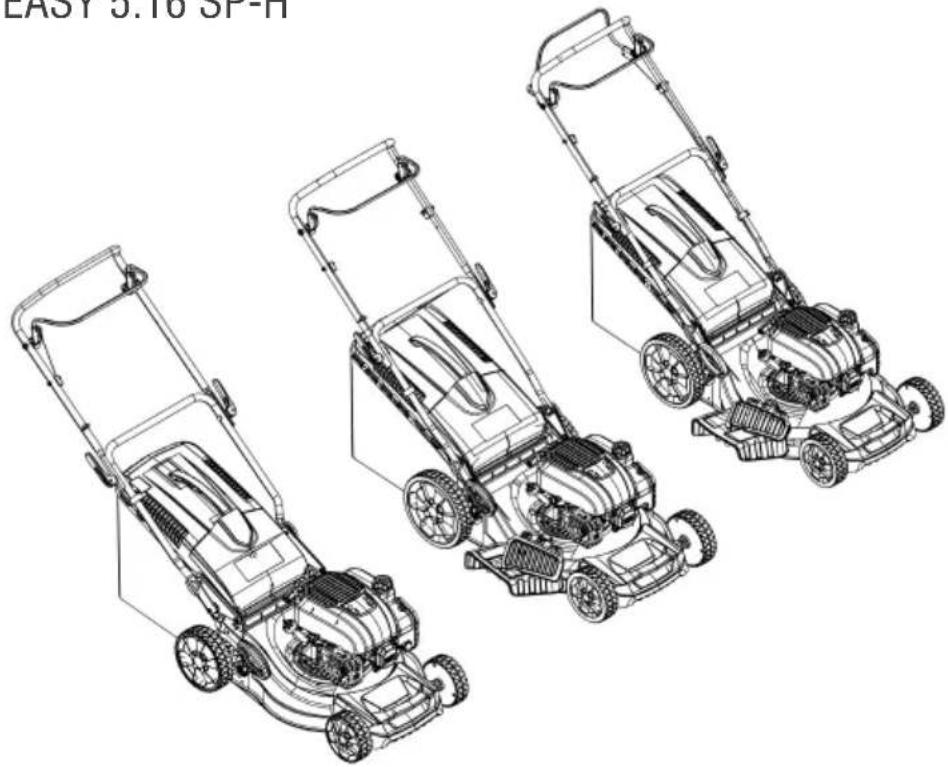
EASY 5.16 SP-H
natural_image
Line drawings of three lawn mower machines in a row, showing different frame and wheel configurations (no text or symbols)






Inhaltsverzeichnis
Deutsch 12
English....29
Nederlands 45
Français....62
Español 80
Portuguese 98
Italiano 116
Slovenščina 134
Hrvatski....150
Српски....167
Polski....185
Česky 203
Slovenská 219
Magyar 236
Dansk 253
Svensk 269
Norsk 285
Suomi 301
Eesti 318
Lietuvių 334
Latviešu 351
Român 368
български 385
Русский 404
Україна....423
Ελληνικά 442
Македонски 461
Türkçe 480
© 2025
AL-KO KOBER GROUP Kötz, Germany
This documentation or excerpts therefrom may not be reproduced or disclosed to third parties without the express permission of the AL-KO KOBER GROUP.
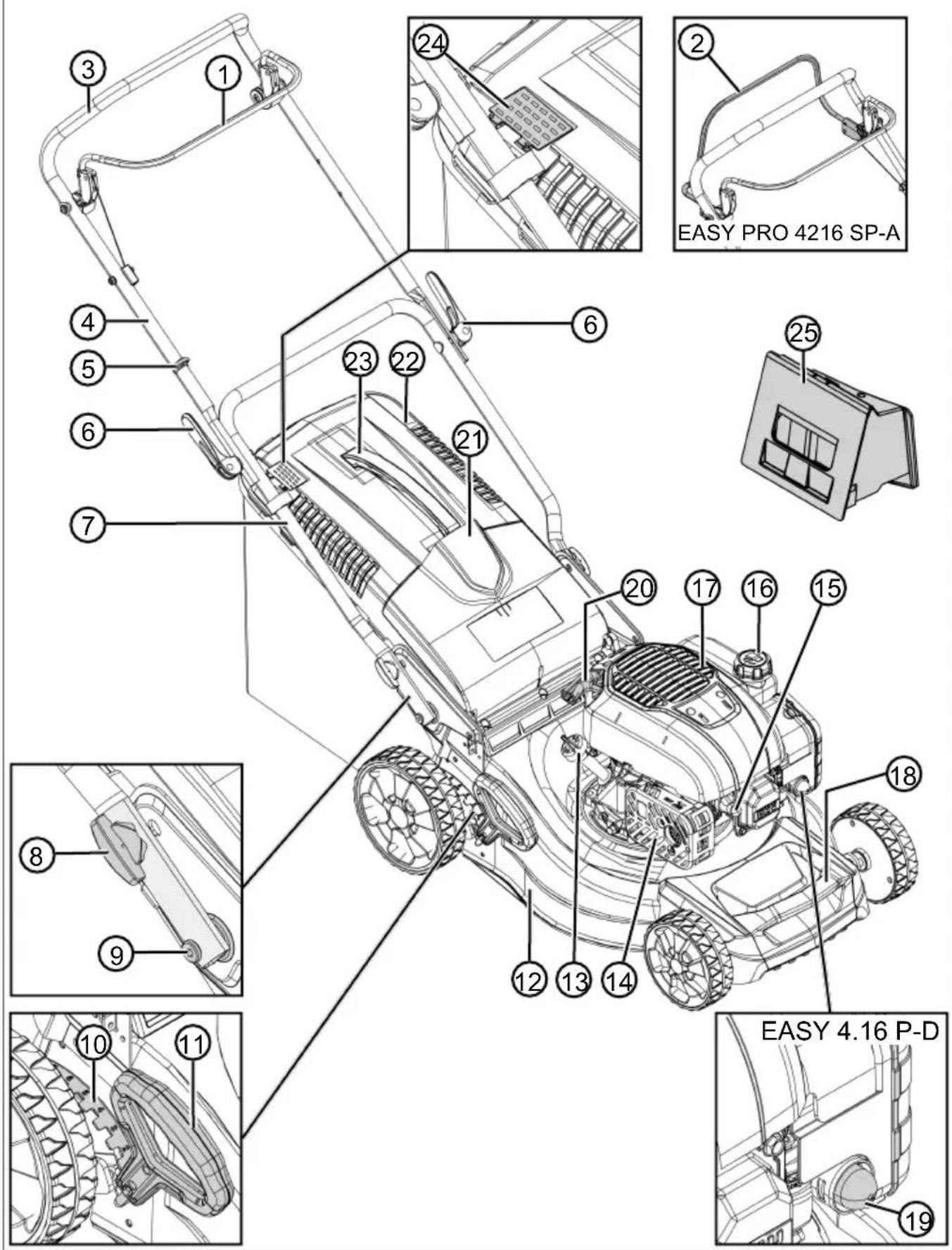
01 EASY PRO 4216 P-A | EASY PRO 4216 SP-A | EASY 4.16 P-D | EASY 4.26 P-D
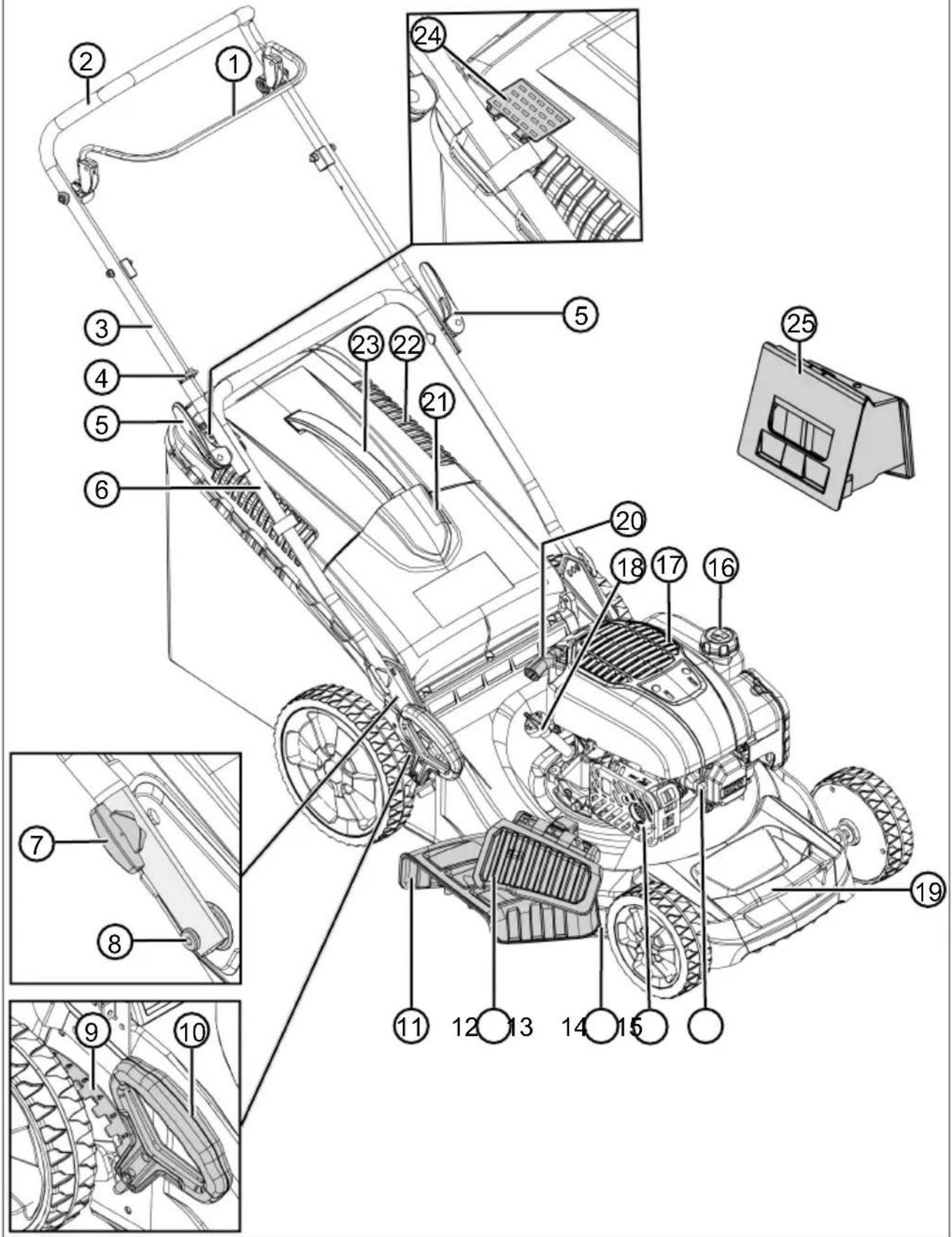
02 EASY PRO 4716 P-A | EASY 4.16 P-D
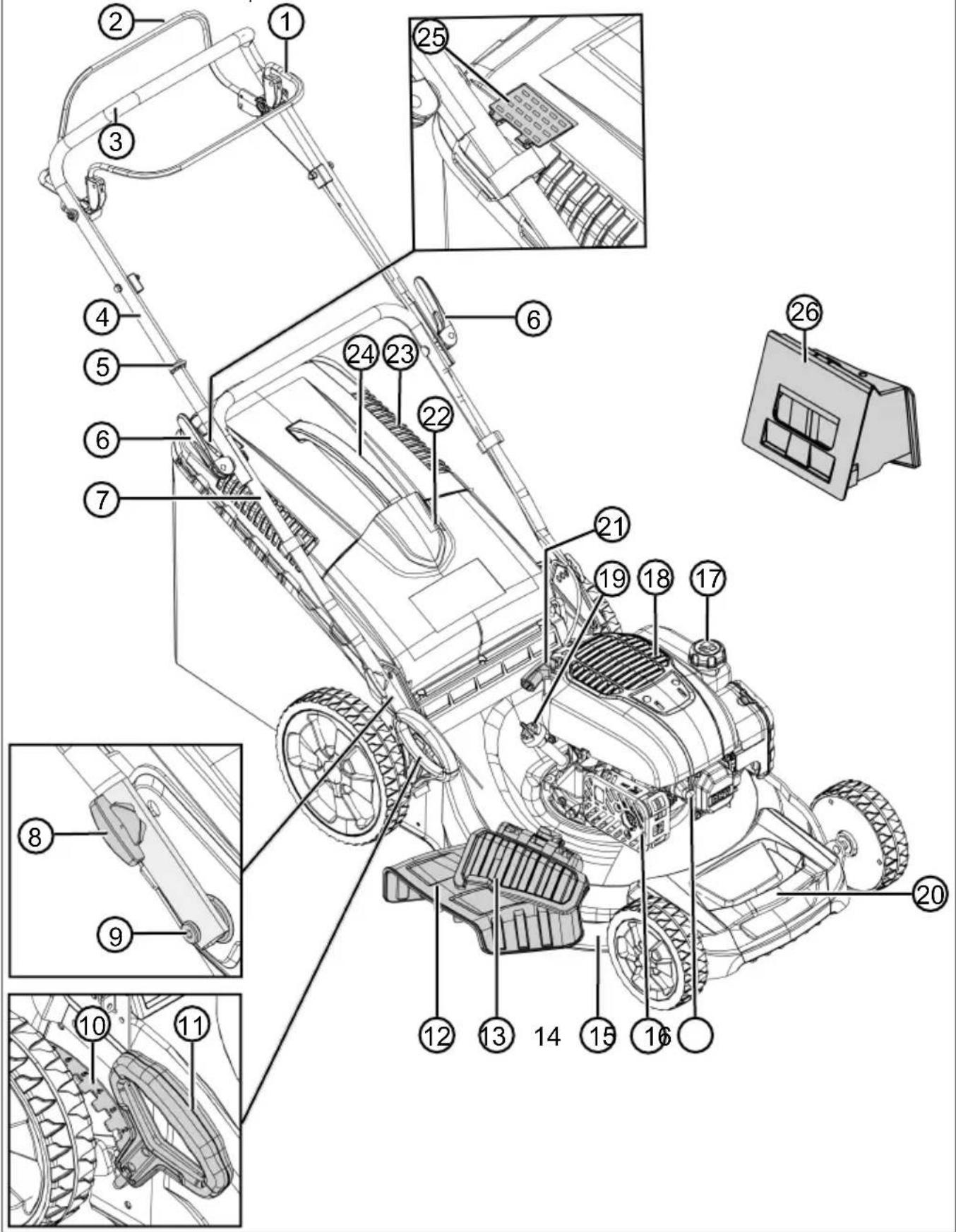
03 EASY PRO 4716 SP-A | EASY PRO 5216 SP-A | EASY 4.66 P-D | EASY 5.16 SP-D | EASY 5.16 SP-H

natural_image
Close-up of a hand adjusting a black plastic component with a numbered marker (19 and 1) in the corner, no visible text or symbols on the main subject.
natural_image
Close-up of a hand adjusting a mechanical component with a labeled arrow (a), no visible text or symbols on the main subject.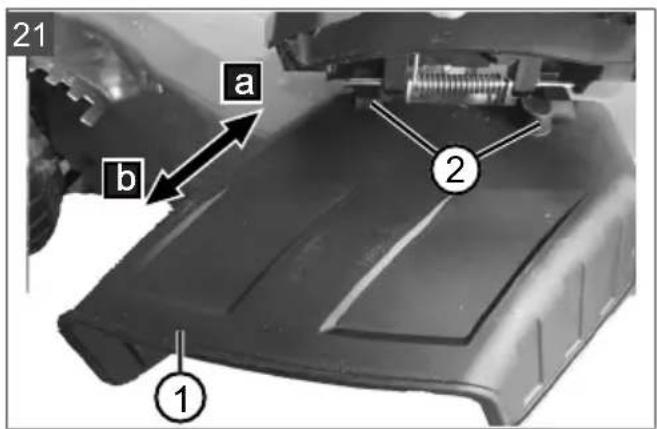
natural_image
Close-up of a mechanical component with a labeled arrow pointing to a feature (no text or symbols beyond label 'a')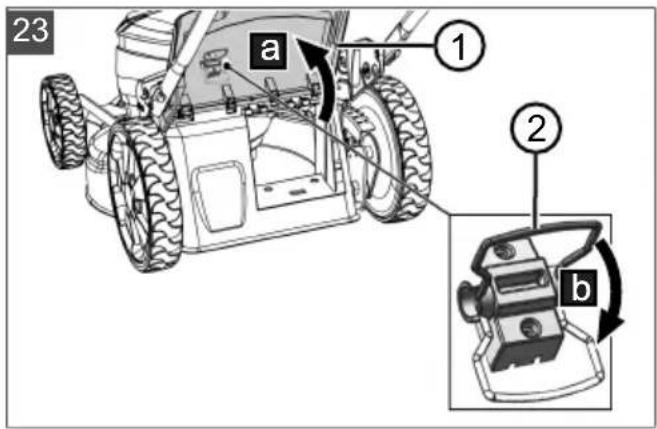
 | EASY PRO4216 P-A | EASY PRO4216 SP-A | EASY PRO4716 P-A | EASY PRO4716 SP-A | EASY PRO5216 SP-A |
 | 127813 127814 127815 127816 127817 | ||||
 | 41 cm 41 cm 46 cm 46 cm 52 cm | ||||
 | 800 m^2 | 1200 m^2 | 1300 m^2 | 1500 m^2 | 1800 m^2 |
 | 23,5 kg 25,5 kg 26,2 kg 28,4 kg 29,4 kg | ||||
 | 50 | 50 | 65 | 65 | 65 | | ||||
 | 25–75 mm | ||||
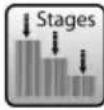 | 7(central)S1: 25 mm; S2: 33 mm; S3: 42 mm; S4: 50 mm; S5: 59 mm; S6: 67 mm; S7: 75 mm | 7(central)S1: 25 mm; S2: 33 mm; S3: 42 mm; S4: 50 mm; S5: 59 mm; S6: 67 mm; S7: 75 mm | |||
 | 127837 | 127837 | 127838 | 127838 | 127839 |
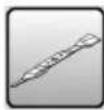
 | -x-xx | ||||
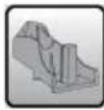 | xxxxx | ||||
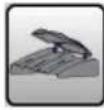 | --xxx | ||||
 | 0,9|0,9|0,9|0,9|1,0| | ||||
 | 123 ccm 123 ccm 123 ccm 139 ccm 166 ccm | ||||
 | 1,9 kW 1,9 kW 1,9 kW 2,1 kW 2,6 kW | ||||
 | 2800 min^-1 | 2800 min^-1 | 2800 min^-1 | 2800 min^-1 | 2800 min^-1 |
 | L_pA = 76,7 dB(A), K = 3 dB(A) | L_pA = 76,7 dB(A), K = 3 dB(A) | L_pA = 79,8 dB(A), K = 3 dB(A) | L_pA = 81,8 dB(A), K = 3 dB(A) | L_pA = 82,8 dB(A), K = 3 dB(A) |
 | L_pA = 91 dB(A), K = 1,92 dB(A) | L_pA = 91 dB(A), K = 1,92 dB(A) | L_pA = 93,1 dB(A), K = 1,88 dB(A) | L_pA = 93,5 dB(A), K = 2,45 dB(A) | L_pA = 94,4 dB(A), K = 2,01 dB(A) |
 | 6,71 a_h < 2,5 m/s^2 , K = 1,5 m/s^2 | 3,62 a_h < 2,5 m/s^2 , K = 1,5 m/s^2 | 6,78 a_h < 2,5 m/s^2 , K = 1,5 m/s^2 | 5,98 a_h < 2,5 m/s^2 , K = 1,5 m/s^2 | 4,35 a_h < 2,5 m/s^2 , K = 1,5 m/s^2 |
 | 0 °C - +45 °C 0 °C - +45 °C 0 °C - +45 °C 0 °C - +45 °C 0 °C - +45 °C 0 °C - +45 °C 0 °C - +45 °C 0 °C - +45 °C 0 °C - +45 °C 0 °C - +45 °C 0 °C - +45 °C | ||||

 | EASY PRO4216 P-A | EASY PRO4216 SP-A | EASY PRO4716 P-A | EASY PRO4716 SP-A | EASY PRO5216 SP-A |
 | -20 °C - +50 °C | -20 °C - +50 °C -20 | °C - +50 °C -20 °C | - +50 °C -20 °C | - +50 °C |








114119 114120 114121 114122 114123 114205
41 cm 41 cm 46 cm 46 cm 51 cm 51 cm
600m^2 800m^2 1200m^2
20,9 kg 21,3 kg 24,2 kg 26,0 kg 26,5 kg 29,2 kg
50 | 50 | 65 | 65 | 65 | 65 |
25–75 mm
7
(central)
S1: 25 mm; S2: 33 mm; S3: 42 mm; S4: 50 mm; S5: 59 mm; S6: 67 mm; S7: 75 mm
7
(central)
S1: 25 mm; S2: 33 mm; S3: 42 mm; S4: 50 mm; S5: 59 mm; S6: 67 mm; S7: 75 mm



--- XXX
XXXXXX
--XXXX
1 About these operating instructions...... 29
1.1 Symbols on the title page 30
1.2 Legends and signal words...... 30
2 Product description .... 30
2.1 Designated use.... 30
2.2 Possible foreseeable misuse.... 30
2.3 Residual risks 30
2.4 Safety and protective devices...... 30
2.5 Symbols on the appliance.... 31
2.5.1 Safety signs* 31
2.5.2 Operating signs* 31
2.6 Product overviews 32
2.6.1 Product overview (01)*...... 32
2.6.2 Product overview (02)*...... 32
2.6.3 Product overview (03)*.... 33
3 Safety instructions.... 33
3.1 Safety instructions for lawnmowers ... 33
3.1.1 Lawnmower safety warnings..... 33
3.1.2 Safety of persons, animals and property 34
3.1.3 Appliance safety.... 34
3.2 Vibration load.... 34
3.3 Noise pollution 35
3.4 Fuel and service products.... 35
4 Installation.... 36
5 Start-up 36
5.1 Carrying out visual inspection...... 36
5.2 Operating fluids.... 36
5.2.1 Filling with petrol (04) 36
5.2.2 Filling with oil (05).... 37
6 Operation 37
6.1 Setting the cutting height (06)...... 37
6.2 Mowing with grass catcher (07, 08)... 37
6.3 Starting and stopping the mower mechanism (09–13).... 37
6.4 Engaging and disengaging wheel drive (14)* 38
6.5 Adjusting the handlebar to your body size (15, 16) 39
6.6 Folding the handlebar in and out..... 39
6.7 Mulching with mulching insert (17, 18) 39
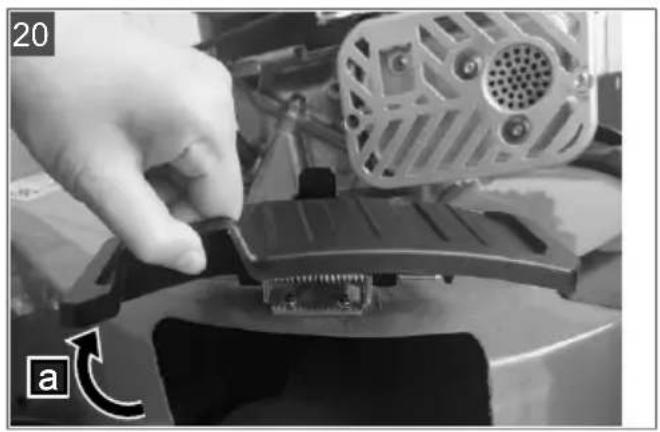
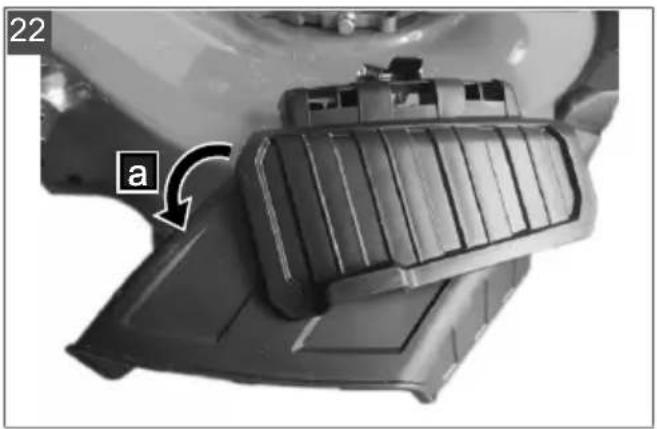
6.8 Mowing with side discharge unit (19–22) ^* 39
6.9 Mowing without grass catcher (23) .... 40
7 Work instructions 40
8 Maintenance and care 40
8.1 Regular maintenance work 40
8.2 Cleaning the appliance and mower mechanism.... 40
8.3 Checking and renewing the cutting blade 41
8.4 Cleaning or replacing the air filter ..... 41
8.5 Maintaining the spark plug 41
8.6 Repair work 41
9 Help in case of malfunction 41
9.1 Correcting appliance and handling faults.... 41
10 Transport 43
10.1 Transporting the appliance.... 43
11 Storage.... 43
11.1 Storing the petrol lawnmower...... 44
12 Disposal.... 44
13 After-Sales/Service.... 44
14 Information on the Declaration of Confor- mity 44
15 Guarantee.... 44
1 ABOUT THESE OPERATING INSTRUCTIONS
The German version is the original operating instructions. All additional language versions are translations of the original operating instructions.
- Keep these operating instructions in a safe place at all times so that they can be consult-
ed if you need any information about the ap- pliance.
■ Only pass on the appliance to other persons together with these operating instructions.
■ Comply with the safety and warning information in these operating instructions.
1.1 Symbols on the title page
Symbol Meaning

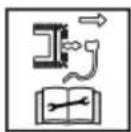
It is essential to read through these operating instructions carefully before start-up. This is essential for safe working and trouble-free handling.

Operating instructions

Never operate the petrol powered device in the vicinity of open flames or heat sources.
1.2 Legends and signal words
⚠️ DANGER! Denotes an imminently dangerous situation which will result in fatal or serious injury if not avoided.
WARNING! Denotes a potentially dangerous situation which can result in fatal or serious injury if not avoided.
CAUTION! Denotes a potentially dangerous situation which can result in minor or moderate injury if not avoided.
IMPORTANT! Denotes a situation which can result in material damage if not avoided.
NOTE Special instructions for ease of understanding and handling.
2 PRODUCT DESCRIPTION
These operating instructions describe various models of AL-KO and solo by AL-KO pedestrian-controlled petrol lawnmowers with different configurations. The configurations of the individual models are presented in the technical data.
Identify your model based on the product images and the description of the different options.
2.1 Designated use
This machine is intended for the non-commercial mowing of lawns, and must only be used on dry grass.
Any use not in accordance with this designated use shall be regarded as misuse. Only work with the appliance when it is fully assembled.
This appliance is intended solely for use in non-commercial applications. Any other use as well as unauthorised conversions or modifications are regarded as contrary to the intended use and will result in voiding of the warranty as well as loss of conformity; the manufacturer will thus decline any responsibility for damage and/or injury suffered by the user or third parties.
2.2 Possible foreseeable misuse
The tool is designed neither for commercial use in public parks and sports facilities, nor for use in farming and forestry.
- Do not use the appliance in the rain or on wet grass.
There must be no foreign objects on the area to be mowed, e.g. stones, pieces of wood, bottles.
■ Installed safety devices must not be removed or bypassed, e.g. by tying the operator presence control to the handlebar.
2.3 Residual risks
Even during correct use of the appliance, there is always a certain residual risk that cannot be excluded. Depending on the use, the following potential risks can be derived from the type and construction of the appliance:
■ Throwing out of cuttings, soil and small stones.
■ Inhalation of cuttings particles if no breathing protection is worn.
■ Lacerations from reaching into the rotating cutting blade.
2.4 Safety and protective devices
WARNING! Risk of injury. Defective and disabled safety and protective devices can result in serious injury.
■ Have any defective safety and protective devices repaired.
■ Never disable safety and protective devices.
Safety handle/operator presence control
The appliance is fitted with a safety handle/operator presence control. In an emergency, simply
release the safety handle/operator presence control. The engine and mower mechanism are stopped.
Starter cable
The safety handle/operator presence control must be pressed before the engine can be started using the starter cable.
Baffle
The baffle offers protection against e.g. material particles and stones which can be flung out.
2.5 Symbols on the appliance
2.5.1 Safety signs\*
* depending on the model
Symbol Meaning





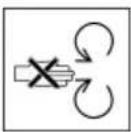
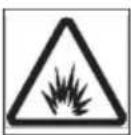
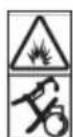
Pay special attention when handling this device!
Read the operating instructions before starting operation!
Risk of objects being thrown out!
Keep bystanders away!
Risk of injury! Keep your hands and feet away from the blade system!
Risk of injury to the hands due to rotating cutting blades!
Caution! Risk of fires! Petrol is flammable.
Do not top up with petrol during operation.
Symbol Meaning




Danger - poisonous gases!
Do not operate in enclosed spaces!
Wear eye and ear protectors!
Disconnect the spark plug connector before starting any maintenance, service and cleaning work!
Risk of burns on hot surfaces!
2.5.2 Operating signs\*
* depending on the model
Symbol Meaning

Operating symbol for twist knob on the handlebar:
Padlock closed: Fix the handlebar in the selected position.
Padlock open: Loosen the handlebar for adjustment.
In the event of danger: Release the operator presence control immediately to stop the lawnmower.
In the event of danger: Immediately release the engagement bar for wheel drive to stop the lawnmower.
Steps for adjusting the height of the handlebar (7-step).
Oil filler cap.
Fuel tank cap.

Symbol Meaning
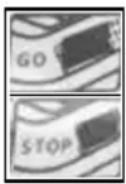
Fill level indicator on the grass catcher:
Fill level indicator is at the top (GO): Continue working!
Fill level indicator is at the bottom (STOP): Stop working and empty the grass catcher!
2.6 Product overviews
2.6.1 Product overview (01)\*
* depending on the model, see technical data.
No. Component
| 1 Operator presence control | |
| 2 Engagement bar for wheel drive | |
| Handlebar: | |
| 3 | ■ Handle surface |
| 4 | ■ Upper brace |
| 5 | ■ Starter cable holder |
| 6 | ■ Rotary joint with quick-release lever |
| 7 | ■ Lower brace |
| 8 | ■ Spring pin with twist knob (2-step)The third step is used for folding down the handlebar. |
| 9 | ■ Handlebar column swivel joint |
| Central cutting height adjustment: | |
| 10 | ■ Display of cutting height (7-step) |
| 11 | ■ Release lever |
| 12 | Mower deck with cutting blade |
| Engine: | |
| 13 | ■ Oil tank cap |
| 14 | ■ Air filter |
| 15 | ■ Spark plug |
| 16 | ■ Fuel tank cap |
| 17 | ■ Engine cover |
| 18 | Carrying handle |
| 19 | Primer button |
| 20 | Starter handle |
No. Component
| 21 Baffle | |
| Grass catcher: | |
| 22 | ■ Housing of grass catcher |
| 23 | ■ Handle of grass catcher |
| 24 | ■ Fill level indicator of grass catcher |
| 15 Mulching insert | |
2.6.2 Product overview (02)\*
* depending on the model, see technical data.
No. Component
| 1 Operator presence control | |
| Handlebar: | |
| 2 | ■ Handle surface |
| 3 | ■ Upper brace |
| 4 | ■ Starter cable holder |
| 5 | ■ Rotary joint with quick-release lever |
| 6 | ■ Lower brace |
| 7 | ■ Spring pin with twist knob (2-step)The third step is used for folding down the handlebar. |
| 8 | ■ Handlebar column swivel joint |
| Central cutting height adjustment: | |
| 9 | ■ Display of cutting height (7-step) |
| 10 | ■ Release lever |
| 11 Side discharge insert | |
| 12 Side discharge flap | |
| 13 Mower deck with cutting blade | |
| Engine: | |
| 14 | ■ Air filter |
| 15 | ■ Spark plug |
| 16 | ■ Fuel tank cap |
| 17 | ■ Engine cover |
| 18 | ■ Oil tank cap |
| 19 Carrying handle | |
| 20 Starter handle | |
No. Component
| 21 Baffle | |
| Grass catcher: | |
| 22 | ■ Housing of grass catcher |
| 23 | ■ Handle of grass catcher |
| 24 | ■ Fill level indicator of grass catcher |
| 25 Mulching insert | |
2.6.3 Product overview (03)\*
* depending on the model, see technical data.
No. Component
| 1 Operator presence control | |
| 2 Engagement bar for wheel drive | |
| Handlebar: | |
| 3 | ■ Handle surface |
| 4 | ■ Upper brace |
| 5 | ■ Starter cable holder |
| 6 | ■ Rotary joint with quick-release lever |
| 7 | ■ Lower brace |
| 8 | ■ Spring pin with twist knob (2-step)The third step is used for folding down the handlebar. |
| 9 | ■ Handlebar column swivel joint |
| Central cutting height adjustment: | |
| 10 | ■ Display of cutting height (7-step) |
| 11 | ■ Release lever |
| 12 Side discharge insert | |
| 13 Side discharge flap | |
| 14 Mower deck with cutting blade | |
| Engine: | |
| 15 | ■ Air filter |
| 16 | ■ Spark plug |
| 17 | ■ Fuel tank cap |
| 18 | ■ Engine cover |
| 19 | ■ Oil tank cap |
| 20 Carrying handle | |
No. Component
| 21 Starter handle | |
| 22 Baffle | |
| Grass catcher: | |
| 23 | ■ Housing of grass catcher |
| 24 | ■ Handle of grass catcher |
| 25 | ■ Fill level indicator of grass catcher |
| 26 Mulching insert | |
3 SAFETY INSTRUCTIONS
3.1 Safety instructions for lawnmowers
3.1.1 Lawnmower safety warnings
■ Do not use the lawnmower in bad weather conditions, especially when there is a risk of lightning. This reduces the risk of being struck by lightning.
■ Use the lawnmower only during daylight or under very bright artificial light.
■ Thoroughly check the area where the lawnmower is to be used for wild animals. Wild animals can be injured by the lawnmower during operation.
■ Thoroughly check the area where the lawnmower is to be used and remove any stones, sticks, wire, bones and other foreign objects. Objects flying out can cause personal injury.
Before using the lawnmower, always perform a visual inspection to ensure that the blade and cutting unit are not worn or damaged. Worn or damaged parts increase the risk of injury.
■ Check the grass catcher at regular intervals for signs of wear or damage. A worn or damaged grass catcher can increase the risk of injury.
- Keep all protective devices in place. Protective devices must be functional and properly installed. A protective device that is loose, damaged or not functioning properly can result in injury.
- Keep all ventilation slots free of soiling. Clogging of the ventilation slots and soiling can lead to overheating or a risk of fires.
■ Always wear non-slip, protective footwear when working with the lawnmower. Do not the operating the lawnmower when bare-
foot or wearing light sandals. This reduces the risk of injury to your feet from contact with the moving blade.
■ Always wear long trousers when working with the lawnmower. Unprotected skin increases the risk of injury from flying objects.
Do not operate the lawnmower in wet grass. Walk, never run. This reduces the risk of slipping or falling, which can lead to injury.
- Do not operate the lawnmower on very steep slopes. This reduces the risk of losing control, slipping or falling, which can lead to injury.
When working on slopes, always ensure you have a secure footing, always work across the slope, never uphill or downhill, and be extremely careful when changing direction. This reduces the risk of losing control, slipping or falling, which can lead to injury.
- Be extremely careful when moving the lawnmower backwards or pulling it towards you. Pay attention to your surroundings at all times. This reduces the risk of tripping during operation.
- Do not touch the blades or other dangerous moving parts while they are still in motion. This reduces the risk of injury from moving parts.
■ Ensure that the engine is switched off and that the mower mechanism has come to a standstill before removing jammed material or cleaning the lawnmower. Unexpected starting of the lawnmower can result in serious injuries.
■ Always allow the lawnmower to cool down before placing it into storage.
■ Empty the grass catcher before placing it into storage.
Take care that your fingers are not trapped between the moving blades and stationary parts of the machine when adjusting the lawnmower.
3.1.2 Safety of persons, animals and property
■ Use the appliance only for the purposes for which it is intended. Any use for other than the intended purpose can lead to injury and property damage.
■ Switch on the appliance only when there are no persons or animals in the working area.
- Keep a safe distance from persons or animals, or switch off the appliance if persons or animals approach.
■ Never direct the exhaust gas jet of the engine towards persons and animals or towards inflammable products and objects. - Do not reach into the vacuum and vent grilles when the engine is running. Injuries can occur due to rotating appliance parts.
■ Always switch off the appliance when not in use, e.g. when moving to another work area, during service and maintenance work, when filling with the operating fluids.
■ Switch off the appliance immediately if there is an accident in order to avoid further injuries and/or property damage.
■ Never operate the appliance with worn or defective parts. Worn or defective appliance parts can cause serious injuries. - Keep the appliance out of the reach of children.
3.1.3 Appliance safety
■ Use the appliance only under the following conditions:
■ The appliance is not soiled.
The appliance show no signs of damage.
■ All controls function properly.
- Do not overload the device. It is intended for light work in the private sector. Overload can lead to damage to the appliance.
■ Never operate the appliance with worn or defective parts. Always replace defective parts with original spare parts from the manufacturer. If the appliance is operated with worn or defective parts, guarantee claims against the manufacturer are excluded.
■ Repair work is only allowed to be carried out by expert workshops or our service centres.
3.2 Vibration load
■ Danger due to vibration
The actual vibrations emitted during the use of the appliance may deviate from those stated by the manufacturer. Observe the following influencing factors before or during use:
Is the appliance being used as intended?
Is the material being cut or processed in the proper manner?
Is the appliance in a proper condition of use?
Is the cutting tool properly sharpened or is the correct cutting tool installed?
Are the handle grips and any optional vibration grips mounted, and are they firmly attached to the appliance?
■ Only operate the tool at the combustion engine speed required for the respective work. Avoid using the maximum speed in order to reduce noise and vibrations.
The noise and vibrations of the tool may increase due to improper use and maintenance. This leads to health damage. In this case, immediately switch off the tool and have it repaired by an authorised service workshop.
The degree of stress due to vibration depends on the work to be performed or on the use of the tool. Estimate the stress and plan appropriate work breaks. This considerably reduces stress due to vibration over the entire working time.
- Extensive use of the tool exposes the operator to vibrations, which can lead to circulatory issues ("white fingers"). To avoid this risk, wear gloves and keep your hands warm. If any symptoms of "white fingers" occur, immediately consult a physician. These symptoms include: Numbness, loss of feeling, tingling, itching, pain, reduced muscular strength, changes in the colour or condition of the skin. Normally these conditions affect the fingers, hands or pulse. The risk increases at low temperatures (below approx 10°C).
Take long breaks during your working day so you can recover from the noise and the vibrations. Plan your work in such a way that the use of appliances that generate strong vibrations is spread over several days.
If you notice an unpleasant sensation or discoloration of the skin on your hands when using the tool, stop work immediately. Take sufficient work breaks. Without sufficient breaks, a hand/arm vibration syndrome can occur.
- Minimise your risk of being exposed to vibrations. Maintain the tool according to the instructions in the operating instructions.
If the tool is used frequently, contact your dealer to purchase anti-vibration accessories (e.g. handles).
■ Define how the vibration load can be limited in a work plan.
3.3 Noise pollution
A certain level of noise exposure from this appliance is inevitable. Carry out noisy work at ap-
proved and specified time periods. Observe rest periods as necessary and restrict the duration of the work to a minimum. For your personal protection and protection of persons in the vicinity, appropriate hearing protection must be worn.
3.4 Fuel and service products
⚠️ DANGER! Risk of explosion and fire. An escaping petrol/air mixture can cause an explosive atmosphere. Deflagration, explosion and fire can lead to serious and even fatal injuries if fuel is not handled properly.
■ Do not smoke when dealing with petrol.
■ Only handle petrol out of doors and never in enclosed spaces.
It is essential to heed the code of conduct stated below.
■ Store petrol only in the appropriate containers.
■ Refuel only outdoors.
■ Do not smoke when refuelling.
■ Use a suitable funnel or a filler pipe when refuelling so that no fuel is spilled onto the engine, the housing or the ground.
- Do not open the fuel filler cap when the engine is running or hot.
- Replace the tank or fuel filler cap if damaged.
■ Renew exhaust silencers if damaged.
■ If petrol has leaked out:
Do not start the engine.
Avoid start attempts.
- Clean the appliance.
- Allow the remaining fuel to evaporate.
WARNING! Danger of burns. Engines become very hot in operation!
■ Never touch parts of the engine, in particular the exhaust.
- Allow the exhaust, cylinder and cooling vanes to cool down before contact.
DANGER! Risk of poisoning. The engine exhaust gases contain carbon monoxide that can kill a person within a few minutes.
■ Operate the engine only outdoors, never in a closed room.
■ Do not inhale the engine exhaust gases.
■ Switch off the engine if you feel nauseous, dizzy or weak when using this appliance. Immediately consult a doctor.
4 INSTALLATION
Assembly: See assembly instructions.
WARNING! Danger if assembly is not carried out completely! Use of an incompletely assembled device can result in serious injury.
■ Only use the device when it is fully assembled!
■ Before switching on, check that all safety and protective devices are in place and functioning correctly!
5 START-UP
⚠️ DANGER! Risk of explosion and fire. An escaping petrol/air mixture can cause an explosive atmosphere. Deflagration, explosion and fire can lead to serious and even fatal injuries if fuel is not handled properly.
■ Do not smoke when dealing with petrol.
■ Only handle petrol out of doors and never in enclosed spaces.
It is essential to heed the code of conduct stated below.
WARNING! Risk of injury from faulty appliance. Operation of an faulty appliance can result in serious injury and damage to the appliance.
- Operate the appliance only when it is undamaged and has not defects, and when no parts are missing or loose.
IMPORTANT! Danger of engine damage. A low oil level can cause engine damage.
- Fill the engine with oil before operating for the first time.
- Check the oil level at regular intervals.
If the level is low, top up with clean oil.
5.1 Carrying out visual inspection
- Check the appliance for damage and loose bolts. Replace the defective appliance parts and tighten the bolts.
- Check the operating fluid levels at regular intervals before starting work. Top up the operating fluids if the level is low.
- Check the appliance for coarse soiling. Remove soiling.
5.2 Operating fluids
DANGER! Risk of explosion and fire. An escaping petrol/air mixture can cause an explosive atmosphere. Deflagation, explosion and fire can lead to serious and even fatal injuries if fuel is not handled properly.
■ Do not smoke when dealing with petrol.
■ Only handle petrol out of doors and never in enclosed spaces.
⚠️ DANGER! Risk of poisoning. The engine exhaust gases contain carbon monoxide that can kill a person within a few minutes.
- Operate the engine only outdoors, never in a closed room.
■ Do not inhale the engine exhaust gases.
■ Switch off the engine if you feel nauseous, dizzy or weak during use. Immediately consult a doctor.
NOTE Dispose of used engine oil in an environmentally responsible manner! We recommend disposing of waste oil in a closed container at a recycling centre or customer service centre. Do not dispose of waste oil:
In domestic waste
In sewers or drains
In the ground
NOTE Observe the enclosed operating instructions for the engine!
Before starting operation, the device must be filled with engine oil and the tank filled with petrol.
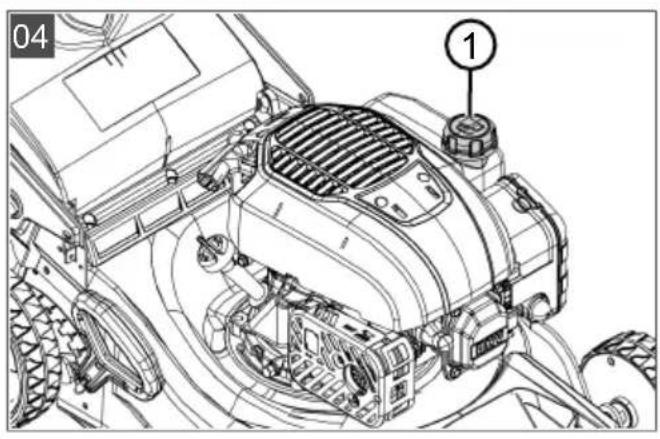
5.2.1 Filling with petrol (04)
- Unscrew the tank cap (04/1) and put it down in a clean place.
- Pour in petrol through a funnel.
- Securely tighten the fuel filler cap and clean the tank filler neck.
Fuel recommendations:
■ Use clean, fresh, lead-free petrol with a minimum octane rating of 86.
■ Buy fuel in quantities that can be used within 30 days (see 'Storage').
- Petrol with up to 10% ethanol content or up to 15% MTBE content (anti-knock protection) is acceptable.
■ Do not mix petrol with oil.
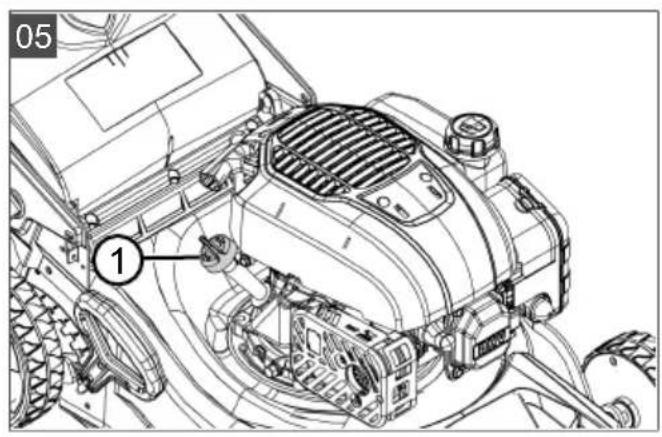
5.2.2 Filling with oil (05)
- Unscrew oil dipstick (05/1) and insert the filling aid.
- Fill with oil.
- Remove the filling aid and screw in the oil dipstick again.
Oil recommendations:
■ Engine oil is a decisive factor for the performance and lifetime of the engine. Use an engine oil which fulfils the requirements for API service class SF or higher (or equivalent).
- Check the API service label on the oil container to ensure that it contains the letters SF or those of a higher (or equivalent) class.
■ SAE 10W-30 is recommended for general use. The recommended operating temperature range for this engine is 0^ C to 40^ C.
Checking the oil level (05)
Check the engine oil level when the engine is stopped and is standing horizontally.
- Unscrew oil dipstick (05/1) and wipe it clean.
- Insert the oil dipstick into the oil filler neck until it bottoms (do not screw tight), then remove it again.
- If the oil level is around or below the lower limit mark on the oil dipstick, top up with oil to the upper limit mark.
- Screw in the oil dipstick again.
6 OPERATION
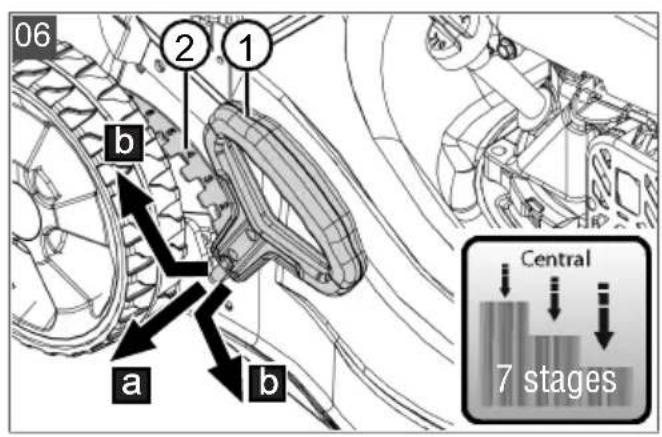
6.1 Setting the cutting height (06)
CAUTION! Danger of lacerations. Danger of lacerations when reaching into the running mower mechanism.
■ Only adjust the cutting height when the motor is switched off and the mower mechanism is stationary.
- Pull adjustment lever (06/1) outwards to disengage it (06/a) and hold.
For a short lawn: Push the adjustment lever in the direction of the front wheel (06/b).
For a longer lawn: Push the adjustment lever in the direction of the grass catcher (06/b).
- Read off the desired cutting height on the scale (06/2).
- Release the adjustment lever so that it engages at the required level.
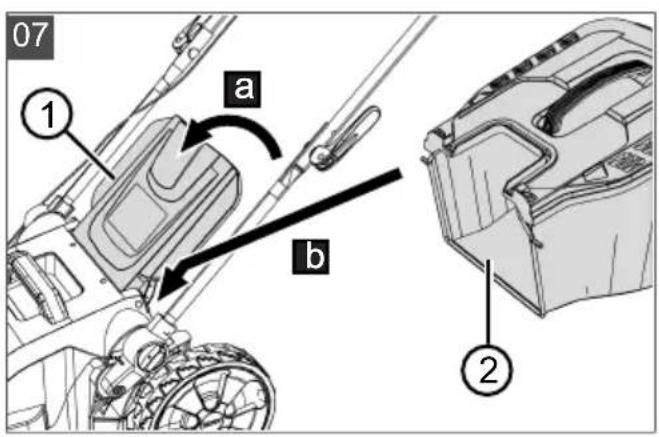
6.2 Mowing with grass catcher (07, 08)
The appliance can be operated with and without a grass catcher.
Hooking in the grass catcher
- Make sure that the appliance is switched off and the mower mechanism has come to a standstill.
- Raise baffle (07/1) (07/a).
- Hook the grass catcher (07/2) into the holders (07/b).
- Release the baffle.
Checking the fill level
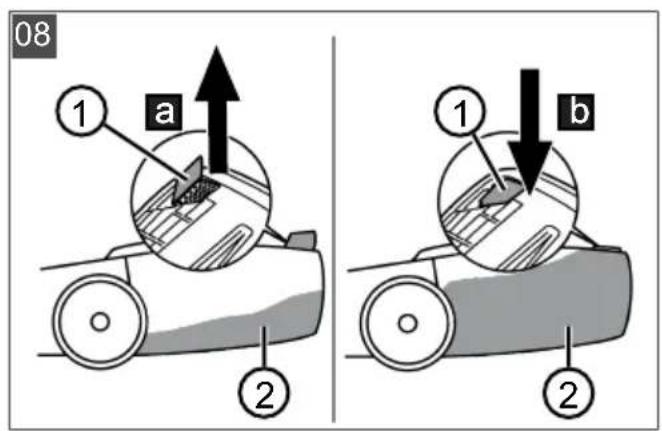
The fill level indicator (08/1) is pressed upwards by the air stream when mowing (08/a). If the grass catcher (08/2) is full, the fill-level indicator is in contact with the grass catcher (08/b). The grass catcher must be emptied.
Unhooking and emptying the grass catcher
CAUTION! Danger of lacerations. Danger of lacerations when reaching into the running mower mechanism.
■ Only remove the grass catcher when the mower mechanism has stopped.
i NOTE When emptying the grass catcher, also clean the discharge holes of the fill level indicator so that it continues to function properly.
- Make sure that the appliance is switched off and the mower mechanism has come to a standstill.
- Raise the baffle (07/1).
- Lift the grass catcher (07/2) out of the holders and take off to the rear.
- Empty the grass catcher.
- Clean the air outlet holes of the fill level indicator.
- Hook in the grass catcher (see above).
6.3 Starting and stopping the mower mechanism (09–13)
Start the mower mechanism on level ground and not in long grass. The ground must be free of foreign objects such as stones, etc. Do not lift or tilt the appliance to start it.
IMPORTANT! Risk of damage to the appliance. The motor and mower mechanism can be damaged by repeatedly switching on and off.
■ Switch the motor on only when the mower mechanism has stopped.
NOTE Permitted operating position: You stand behind the lawnmower and hold the handlebar with both hands.
NOTE The operator presence control does not lock in place. Hold it tight against the handlebar during the entire working period.
Starting the mower mechanism
-
If you have not already done so: Fill with operating fluids: see chapter 5.2 "Operating fluids", page 36.
-
Ensure that the metal loop in the spark plug connector is firmly connected to the spark plug.
Cold start
-
Move the choke lever.
-
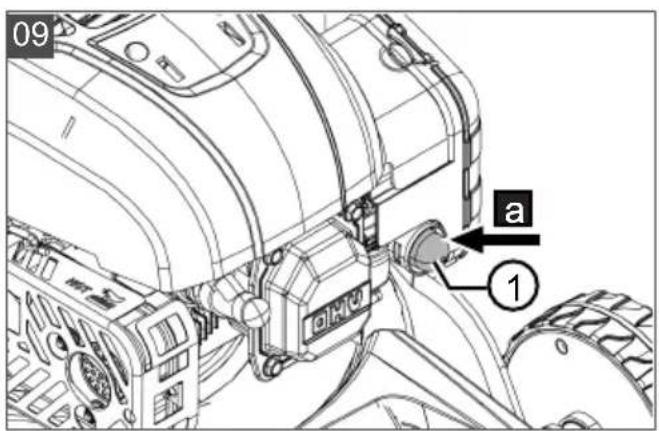
If the engine has a primer (09/1), press it 3 times (09/a) at roughly 2 second intervals. At low ambient temperatures (< 10°C), press the primer 5 times. ^a)
3. Starting the engine:
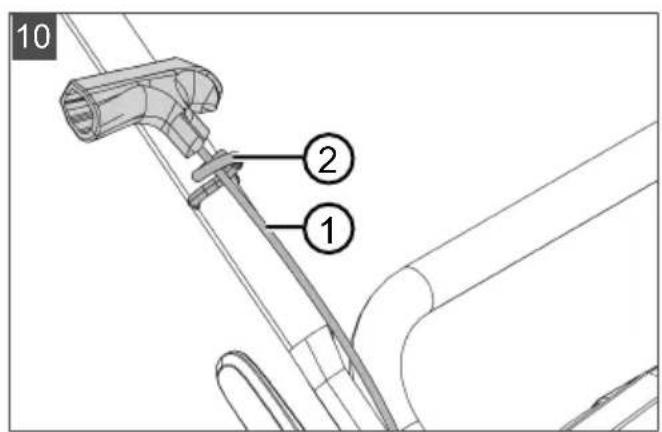
■ Hook starter handle (10/1) into starter cable holder (10/2).
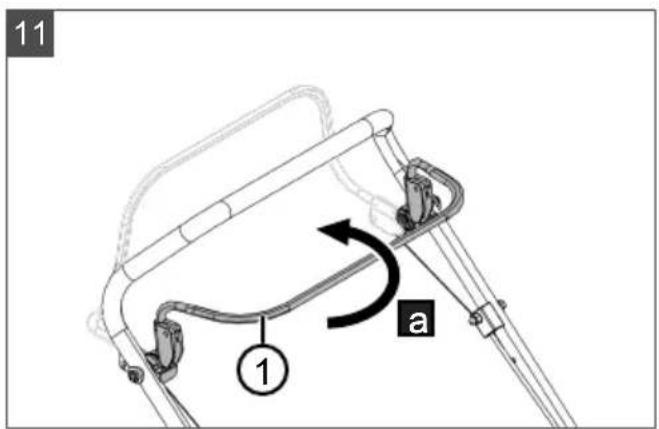
■ Pull operator presence control (11/1) up to the upper brace with one hand (11/a) and hold. The operator presence control does not latch.
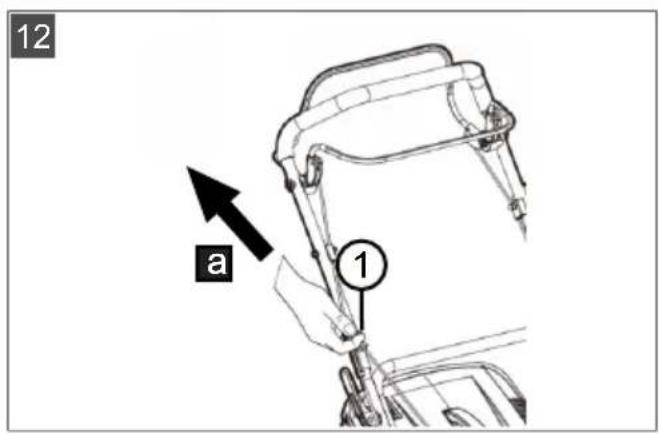
■ With the other hand, pull starter handle (12/1), first carefully and slowly until a noticeable resistance is felt, then pull firmly and quickly upwards (12/a) until resistance is felt again (approx. 1 arm length).
- Allow the starter cable to coil up again, but without releasing the starter handle.
■ Repeat the previous steps several times until the engine starts and runs smoothly.
- Allow the engine to warm up for a few minutes.
Hot start
If the engine is still warm from use, i.e. shortly after it was switched off, a "warm start" is carried out. The choke is not used in this case.
- (Optional) Move the choke lever and immediately move back to RUN. Automatic half throttle is now set.
■ Hook starter handle (10/1) into starter cable holder (10/2).
■ Pull operator presence control (11/1) up to the upper brace with one hand (11/a)
and hold. The operator presence control does not latch.
■ With the other hand, pull starter handle (12/1), first carefully and slowly until a noticeable resistance is felt, then pull firmly and quickly upwards (12/a) until resistance is felt again (approx. 1 arm length).
- Allow the starter cable to coil up again, but without releasing the starter handle.
■ Repeat the previous steps several times until the engine starts and runs smoothly.
Stopping the engine
CAUTION! Danger of cuts and lacerations. Danger of lacerations when reaching into the running mower mechanism.
■ Wait until the mower mechanism has come to a standstill.
■ Before all maintenance and care work: Switch off the appliance and wait until the mower mechanism has come to a standstill.
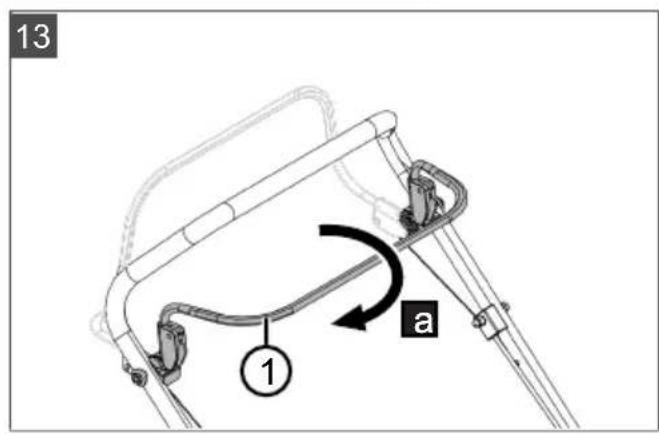
- Release (13/a) operator presence control (13/1).
It automatically returns to its starting position.
- Wait until the cutting tool has come to a complete standstill.
a) With EASY 4.16 P-D only.
6.4 Engaging and disengaging wheel drive (14)\*
* depending on the model, see technical data.
i NOTE Wheel drive can only be engaged when the engine is running.
Engaging wheel drive
- Start the mower mechanism: see chapter 6.3 "Starting and stopping the mower mechanism (9-13)", page 37.
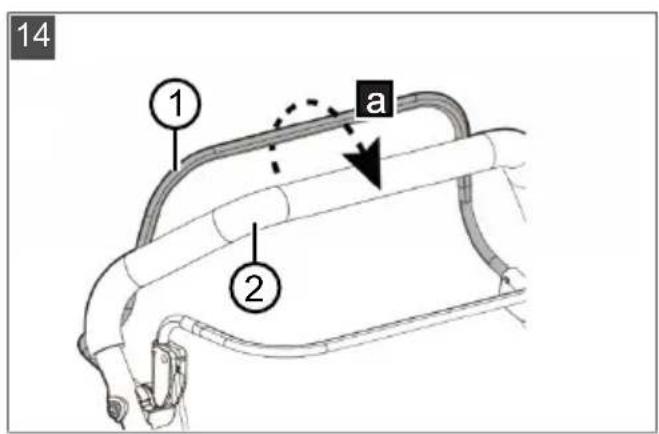
- Press (14/a) the engagement bar for wheel drive (14/1) against handlebar (14/2) and hold. The engagement bar for wheel drive does not engage.
Disengaging wheel drive
- Release the engagement bar for wheel drive. It automatically moves to its initial position.
6.5 Adjusting the handlebar to your body size (15, 16)
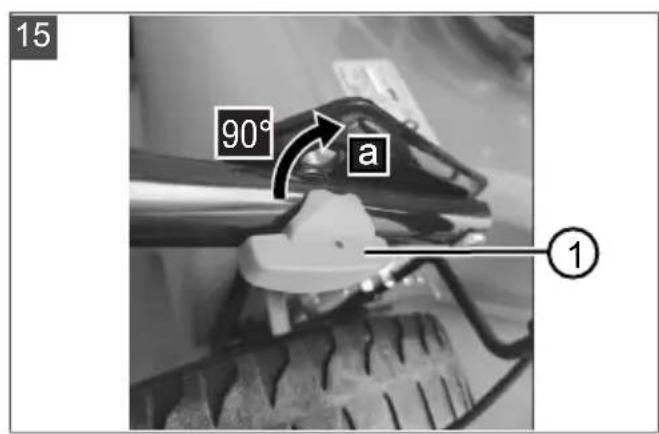
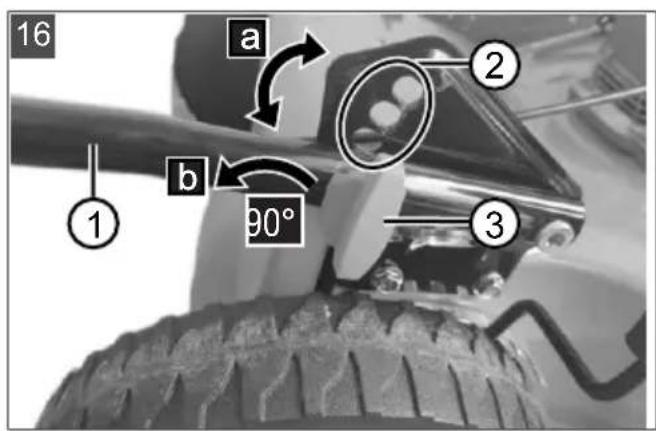
- On both sides: Turn (15/a) twist knob on lower brace (15/1) by 90° to release the locking mechanism.
- Turn (16/a) brace (16/1) to one of the positions (16/2).
Three heights are possible with this lawnmower: The distance from the lower brace to the ground is largest in the first position and smallest in the third position.
- After adjusting to the desired height, lock the lower brace with the twist knob.
- On both sides: Turn twist knob (16/3) back by 90° until it engages (16/b).
6.6 Folding the handlebar in and out
After folding in the handlebar, the appliance can be turned onto its side to allow the mower mechanism to be easily cleaned. Folding in the handlebar saves space when storing the appliance.
CAUTION! Danger of crushing. Fingers or other parts of the body can be crushed between the loose parts of the handlebar.
■ Hold the loose parts of the handlebar tightly.
- Do not hold any fingers or other parts of the body between the loose parts.
- See assembly instructions.
- Fold down the handlebar: Perform the steps in the reverse order to fold the handlebar up.
6.7 Mulching with mulching insert (17, 18)
When mulching, the cuttings are not collected but remain on the lawn. The mulch protects the ground from drying out and supplies it with nutrients. The best results are achieved through regularly cutting back by approx. 2 cm. Only new grass with soft leaf tissue rots quickly.
Grass height before mulching: max. 8 cm
■ Grass height after mulching: min. 4 cm
NOTE Adjust the stepping speed of the mulching, do not go too quickly.
Installing the mulching insert (17, 18)
CAUTION! Danger of cuts and lacerations. Danger of lacerations when reaching into the running mower mechanism.
■ Switch off the appliance before inserting or removing the mulching insert.
IMPORTANT! Danger of damage to the appliance. If the mulching insert does not engage, the mulching insert and mower mechanism can be damaged.
■ Make sure that the locking mechanism engages.
- Stop the mower mechanism (see chapter 6.3 "Starting and stopping the mower mechanism (09-13)"), page 37.
- Unhook the grass catcher (see chapter 6.2 "Mowing with grass catcher (07, 08", page 37)).
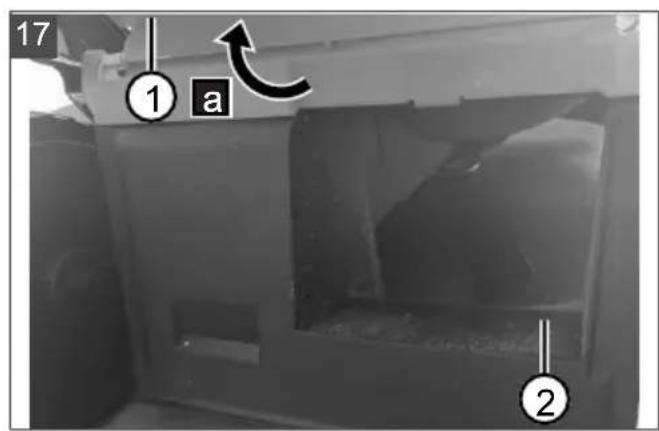
- Raise baffle (17/1) (17/a).
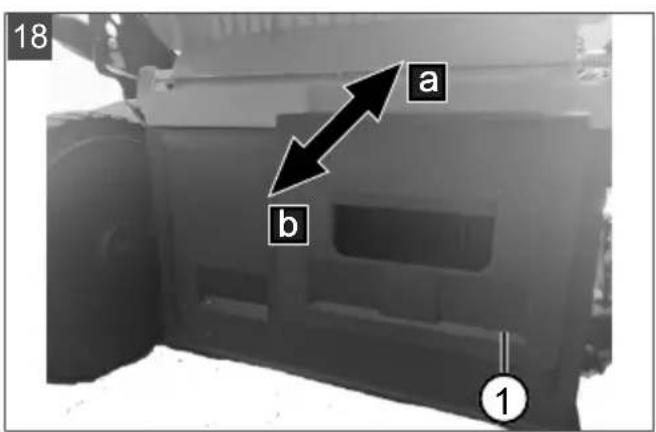
- Push (18/a) mulching insert (18/1) into discharge chute (17/2) until the lock engages.
Removing mulching insert (17, 18)
- Stop the mower mechanism.
- Raise baffle (17/1) (17/a).
- Pull out (18/b) mulching insert (18/1).
6.8 Mowing with side discharge unit (19–22) ^*
* depending on the model, see technical data.
CAUTION! Danger of cuts and lacerations. Danger of lacerations when reaching into the running mower mechanism.
■ Only install or remove the side discharge insert when the motor and mower mechanism have come to a standstill.
Installing the side discharge insert
- Make sure that the appliance is switched off and the mower mechanism has come to a standstill.
- Remove the grass catcher.
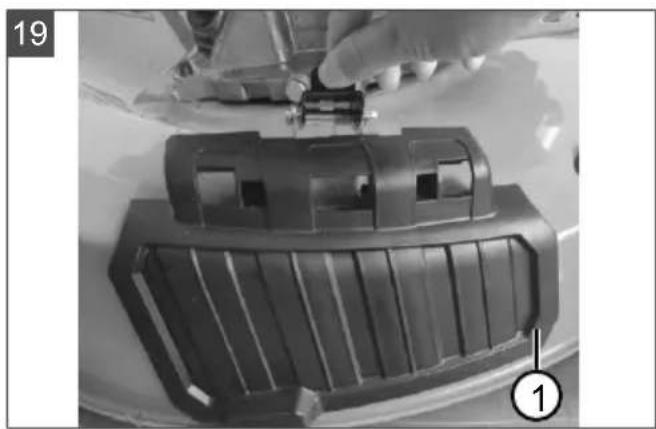
- Open and hold (20/a) side discharge flap (19/1).
- Push in (21/a) side discharge insert (21/1) and hook lugs (21/2) under the top of the side discharge unit.
- Slowly close the side discharge flap (22/a). The side discharge flap secures the side discharge insert to prevent it from falling out.
Removing the side discharge insert
- Make sure that the appliance is switched off and the mower mechanism has come to a standstill.
-
Open and hold (20/a) side discharge flap (19/1).
-
Unhook and pull out (21/b) side discharge insert (21/1).
- Close the side discharge flap (22/a).
- Switch on the appliance again.
6.9 Mowing without grass catcher (23)
The appliance can also be operated without grass catcher. The baffle must be opened slightly so that the discharge channel does not clog.
- Make sure that the appliance is switched off and the mower mechanism has come to a standstill.
- Raise (23/a) baffle (23/1).
- Pull up (23/b) baffle prop (23/2) until it engages.
- Release the baffle.
7 WORK INSTRUCTIONS
Observe the safety instructions!
NOTE Comply with the local regulations as to when a lawnmower may be operated.
■ Watch out for objects in the grass and remove them from the working area.
■ Mow only when visibility is good.
■ Mow only with a sharp cutting blade.
■ Steer the appliance only by the handlebar.
■ Move the appliance only at walking speed.
■ Always move the appliance across the slope. Do not mow up or down the slope, or on slopes with a gradient of more than 10^ . Exercise particular care when changing the working direction.
Cutting speed
The cutting speed or the area that can be mowed depends on the characteristics of the lawn. Factors such as the length of the grass, the grass density, the selected cutting height and wet grass affect the cutting speed.
■ To optimise the cutting speed, we recommend that you mow the lawn frequently, set a high cutting height and move the appliance at walking speed.
Tips for mowing
- Maintain a constant cutting height of 3–5 cm; do not mow the lawn to less than half its original height.
- Do not overload the lawn mower! If the engine speed drops noticeably because of long,
thick grass, increase the cutting height and mow in several passes.
The wind and sun can dry out the lawn after mowing so it is better to mow in the late afternoon.
During phases of strong growth, mow twice a week; during dry periods, increase the intervals between mowing accordingly.
8 MAINTENANCE AND CARE
⚠️ DANGER! Risk of injury or death due to improper maintenance. Maintenance work carried out by unqualified persons and the use of non-approved spare parts, as well as removing or modifying safety devices can result in serious injuries and even death during operation of the appliance.
- Do not remove or deactivate any safety installations.
■ Use only approved OEM spare parts.
■ Ensure through regular and proper maintenance that the appliance is in a clean and functional condition at all times.
WARNING! Risk of injury during maintenance work. Improper maintenance can result in serious injury and damage to the appliance.
■ Have repairs to the appliance carried out only by qualified companies.
8.1 Regular maintenance work
■ Make sure that all nuts, bolts and screws are tightened and the trailer is in a safe working condition.
- Inspect the appliance, mower mechanism and grass catcher at regular intervals for proper function and wear.
8.2 Cleaning the appliance and mower mechanism
IMPORTANT! Danger from water. Water in the appliance causes short-circuits and destroys electrical components.
■ Do not spray the appliance with water.
■ Only use a broom or a brush for cleaning.
- Stop the engine.
- Wait for the mower mechanism to come to a standstill.
- Remove the grass catcher.
- Tilt the appliance and clean the mower mechanism.
8.3 Checking and renewing the cutting blade
WARNING! Severe injuries due to blade parts being flung out. A worn, cracked or damaged cutting blade can break, and its parts can become dangerous projectiles.
■ Regularly check the cutting blade for damage.
■ Do not use the lawnmower if the cutting blade is worn or damaged.
- Have blunt or damaged cutting blades sharpened or replaced only by one of the manufacturer's service centres or an authorised specialist company.
■ To avoid vibrations, the cutting blade and blade bolt must always be replaced together.
■ Resharpened cutting blades must be balanced. Unbalanced cutting blades cause strong vibrations and damage the appliance.
■ Warning! Do not install the cutting blades the wrong way round.
8.4 Cleaning or replacing the air filter
Comply with the operating instructions from the engine manufacturer.
8.5 Maintaining the spark plug
CAUTION! Danger of injury on hot engine parts - wear protective gloves when replacing or cleaning the spark plug!
Comply with the operating instructions from the engine manufacturer.
8.6 Repair work
WARNING! Risk of injury during repair work. Improper repairs can lead to serious injuries and damage to the appliance.
■ Have repair work performed by the manufacturer's service centres and authorised specialist companies only!
In the following cases, contact one of the manufacturer's service centres:
■ Engine no longer starts.
■ Appliance has run onto an obstacle.
■ Cutting blade and/or engine shaft are bent.
■ Appliance vibrates and does not run smoothly.
9 HELP IN CASE OF MALFUNCTION
CAUTION! Risk of injury. Sharp-edged and moving appliance parts can lead to injury.
■ Always wear protective gloves during maintenance, care and cleaning work!
9.1 Correcting appliance and handling faults
NOTE For malfunctions that are not listed in this table or that you cannot resolve yourself, please contact our customer service.
| Malfunction Cause Remedy | ||
| Engine does not start. Filling level of the operating fluids is too low. | Check the filling level of the operating fluids and top up, if necessary. | |
| Cutting blade is blocked. 1. Thoroughly clean cutting blade and mower deck. The cutting blade must rotate freely.2. Start the lawn mower on short grass. | ||
| Cables or switches are defective. | Do not operate the appliance! Contact one of the manufacturer's service centres. | |
| Air filter element is dirty. Clean air filter element. | ||
| Spark plug is loose. Tighten spark plug. | ||
| Spark plug cable is loose or not connected to spark plug. | Connect spark plug cable to spark plug. | |
| Spark plug gap is incorrect. Adjust the gap between spark plug and electrodes. | ||
| Spark plug is defective. Install a new spark plug with the correct electrode gap. | ||
| Carburettor flooded. Remove the air filter element and pull the starter cable repeatedly until the carburettor has cleaned itself. | ||
| Ignition module is defective. Contact Customer Service. | ||
| Engine is difficult to start or cuts out again. | Dirt, water or stale petrol in the tank. | Empty and clean the fuel tank. Then fill with clean, fresh fuel. |
| Vent hole in fuel tank cap blocked. | Clean or replace the fuel tank cap. | |
| Air filter element is dirty. Clean air filter element. | ||
| Engine does not run smoothly. | Spark plug gap is incorrect. Adjust the gap between spark plug and electrodes. | |
| Spark plug is defective. Install a new spark plug with the correct electrode gap. | ||
| Air filter element is dirty. Clean air filter element. | ||
| Poor engine performance at idle speed. | Air filter element is dirty. Clean air filter element. | |
| Ventilation slots in engine housing blocked. | Remove soiling from slots. | |
| Cooling fins and air ducts under the engine fan housing blocked. | Remove residue from cooling fins and air ducts. | |
| Engine loses power. Filling level of the operating fluids is too low. | Check the filling level of the operating fluids and top up, if necessary. | |
| Cutting blade is blunt. Have the cutting blade sharpened at one of the manufacturer's service centres. | ||
| Too much grass in the discharge channel or mower deck. | 1. Thoroughly clean cutting blade and mower deck.2. Start the lawn mower on short grass. | |
| Engine stops during mowing. | Cutting blade is blunt. Have the cutting blade sharpened at one of the manufacturer's service centres. | |
| Engine is overloaded. Switch off the lawn mower, set down on level ground or short grass and restart. | ||
| Engine stalls at high power. | Spark plug gap is incorrect. Adjust the gap between spark plug and electrodes. | |
| Engine is overheated. Air cooling blocked. Remove soiling from the ventilation slots in the engine housing, fan housing and air ducts. | ||
| Wrong spark plug installed. Fit original spark plug and cooling fins on the engine. | ||
| Malfunction Cause Remedy | ||
| Lawnmower has unusually strong vibra-tions. | Cutting blade is loose. Tighten cutting blade. | |
| Cutting blade not balanced. Balance cutting blade. | ||
| Grass catcher is not filled sufficiently. | Grass is wet. Allow the lawn to dry. | |
| Grass catcher is clogged. Clean the grid of the grass catcher. | ||
| Too much grass in the dis-charge channel or mower deck. | ■ Thoroughly clean cutting blade and mower deck. ■ Set the cutting height higher. | |
| Cutting blade is blunt. Have the cutting blade sharpened at one of the manufacturer's service centres. | ||
| Grass falls out of the mower deck. | Grass catcher is full. Empty the grass catcher and clean the discharge channel. | |
| Operating fluid con-sumption increases ab-normally. | Cutting height is too low. Set the cutting height higher. | |
| Grass is too long or too wet. | ■ Allow the grass to dry. ■ Set the cutting height higher. | |
| Mowing speed is too high. | ■ Reduce the mowing speed. ■ Clean the discharge channel and mower deck. The cutting blade must rotate freely. | |
| Grass catcher is full. Empty the grass catcher and clean the discharge channel. | ||
10 TRANSPORT
10.1 Transporting the appliance
IMPORTANT! Risk of damage to the mower mechanism. At the lowest cutting height, the mower mechanism can be damaged by driving over steps, edges or kerbs.
■ Set the cutting height to the highest level for transport.
- Stop the mower mechanism and wait until it has come to a standstill.
- Set the highest cutting height.
Transporting the appliance between two working areas
■ Move the appliance to the working area with the mower mechanism set to the highest cutting height.
■ Engage the wheel drive* for easier manoeuvring.
■ Use the handlebar and front carrying handle* to carry the appliance.
* depending on the model, see technical data.
Transporting the appliance in a vehicle
■ Fold down the handlebar.
- Secure the appliance in the vehicle against falling over and slipping.
■ Protect the appliance against collisions with loose objects.
■ Do not place objects on the appliance.
11 STORAGE
■ Thoroughly clean the appliance after each use and – if present – attach all covers.
■ Perform the required maintenance works.
■ Store the appliance in a dry, lockable place out of the reach of children.
11.1 Storing the petrol lawnmower
CAUTION! Risk of injury during storage.
There is a risk of injury from sharp parts on the stored device.
■ Store the device out of the reach of children and unauthorised persons.
- Make sure that the appliance is switched off and the mower mechanism has come to a standstill.
- Allow the engine and the whole appliance to cool down.
- Empty the grass catcher and clean the discharge channel.
- Thoroughly clean the appliance.
- Apply a thin coat of oil or silicon to all metal parts for corrosion protection.
- Fold down the handlebar.
- Store the appliance in a dry, clean location protected from frost.
■ Cover with a breathable tarpaulin to protect against dust.
- Do not use plastic film in order to avoid the accumulation of moisture.
NOTE! Storage temperature of the lawnmower: see Technical data.
12 DISPOSAL

- Petrol and motor oil do not belong in household waste or the public sewer system, but should be collected and disposed of separately.
■ Before disposing of the device you must empty the fuel tank and the engine oil tank!
Packaging, equipment and accessories are made from recyclable materials, and must be disposed of accordingly.
13 AFTER-SALES/SERVICE
In the event of questions of warranty, repair or spare parts, please contact your nearest AL-KO Service Centre. These can be found on the Internet at:
www.alko-garden.com/service-contacts
Further information on spare parts can be found at:
www.alko-garden.com/spareparts
14 INFORMATION ON THE DECLARATION OF CONFORMITY
We hereby declare, as the exclusively responsible party, that this product in its marketed form meets the requirements of the harmonised EU Directives, EU safety standards and the product-specific standards. The Declaration of Conformity forms part of the operating instructions and is included with the machine.
15 GUARANTEE
We will resolve any material or manufacturing faults on the appliance during the legal warranty period for claims relating to faults, in accordance with our choice either to repair or replace. The legal warranty period is determined by the legislation of the country in which the appliance was purchased.
Our warranty promise applies only if:
■ These operating instructions are heeded
■ The appliance is handled correctly
■ Original spare parts have been used
The warranty becomes void in the case of:
■ Unauthorised repair attempts
■ Unauthorised technical modifications
Non-intended use
The guarantee excludes:
■ Paint damage that can be attributed to normal wear and tear
■ Wear parts that are marked with a frame xxxxxx (x) on the spare parts card
■ Internal combustion engines (these are covered by the guarantee provisions of the corresponding engine manufacturers)
The guarantee period commences with purchase by the first end user. The date on the proof of purchase is decisive. In the event of a guarantee claim, please take this guarantee declaration and the original proof of purchase, and contact your dealer or the nearest authorised customer service centre. This statement does not affect the purchaser's statutory claims for defects against the vendor.
VERTALING VAN DE ORIGINELE GEBRUIKERSHANDLEIDING Inhoudsopgave
2 PRODUCTOMSCHRIJVING
13 Kundeservice/service 268
10 Transport ....283
10.1 Transportera redskap......283
11 Förvaring 283
13 Kundeservice/service ....300
8 VEDLIKEHOLD OG PLEIE
Imported by: AL-KO Gardentech UK Ltd, Murray way, Wincanton, Somerset, BA9 9RS / UK | +44 (0) 1963 828055 shop.uk@al-ko.com | www.alko-garden.uk