USER MANUAL GKS 55 BOSCH

Robert Bosch GmbH
Power Tools Division
70764 Leinfelden-Echterdingen
GERMANY
www.bosch-pt.com
160992ADLU (2014.08) 0/744 EURO
160992A0LU
GKS Professional
55+GCE|55+G|165

BOSCH
This is a translation of the original.
00
no 10grd dnsstrk
t
Original instruction
10 Instruction original
BgCpHnHaHaAeFyki
mkOpHHHnHOynantbaa pabora
sr Originalno uputstvo za rad
sl Izvirna navodila
hr Originalne upute za rad
et Alguparane kasutusjuhend
Winstuk,as original
Original instruction
ar aaii
ta 10015[laim]49




6 | Deutsch
Deutsch
Sicherheitshinweise
Henk Becker Helmut Heinzelmann Executive Vice President Head of Product Certification Engineering PT/ETM9

Robert Bosch GmbH, Power Tools Division 70764 Leinfelden-Echterdingen, GERMANY 07.04.2014
Montage
WARNING
Read all safety warnings and all instructions. Failure to follow the warnings
and instructions may result in electric shock, fire and/or serious injury.
Save all warnings and instructions for future reference. The term "power tool" in the warnings refers to your mains-operated (corded) power tool or battery-operated (cordless) power tool.
Work area safety
- Keep work area clean and well lit. Cluttered or dark areas invite accidents. Do not operate power tools in explosive atmospheres, such as in the presence of flammable liquids, gases or dust. Power tools create sparks which may ignite the dust or fumes.
- Keep children and bystanders away while operating a power tool. Distractions can cause you to lose control.
Electrical safety
Power tool plugs must match the outlet. Never modify the plug in any way. Do not use any adapter plugs with earthed (grounded) power tools. Unmodified plugs and matching outlets will reduce risk of electric shock. Avoid body contact with earthed or grounded surfaces, such as pipes, radiators, ranges and refrigerators. There is an increased risk of electric shock if your body is earthed or grounded. Do not expose power tools to rain or wet conditions. Water entering a power tool will increase the risk of electric shock. Do not abuse the cord. Never use the cord for carrying, pulling or unplugging the power tool. Keep cord away from heat, oil, sharp edges and moving parts. Damaged or entangled cords increase the risk of electric shock. When operating a power tool outdoors, use an extension cord suitable for outdoor use. Use of a cord suitable for outdoor use reduces the risk of electric shock. If operating a power tool in a damp location is unavoidable, use a residual current device (RCD) protected supply. Use of an RCD reduces the risk of electric shock.
Personal safety
Stay alert, watch what you are doing and use common sense when operating a power tool. Do not use a power tool while you are tired or under the influence of drugs, alcohol or medication. A moment of inattention while operating power tools may result in serious personal injury.
Use personal protective equipment. Always wear eye protection. Protective equipment such as dust mask, non-skid safety shoes, hard hat, or hearing protection used for appropriate conditions will reduce personal injuries. Prevent unintentional starting. Ensure the switch is in the off-position before connecting to power source and/or battery pack, picking up or carrying the tool. Carrying power tools with your finger on the switch or energising power tools that have the switch on invites accidents. Remove any adjusting key or wrench before turning the power tool on. A wrench or a key left attached to a rotating part of the power tool may result in personal injury. Do not overreach. Keep proper footing and balance at all times. This enables better control of the power tool in unexpected situations. Dress properly. Do not wear loose clothing or jewellery. Keep your hair, clothing and gloves away from moving parts. Loose clothes, jewellery or long hair can be caught in moving parts. If devices are provided for the connection of dust extraction and collection facilities, ensure these are connected and properly used. Use of dust collection can reduce dust-related hazards.
Do not force the power tool. Use the correct power tool for your application. The correct power tool will do the job better and safer at the rate for which it was designed. Do not use the power tool if the switch does not turn it on and off. Any power tool that cannot be controlled with the switch is dangerous and must be repaired. Disconnect the plug from the power source and/or the battery pack from the power tool before making any adjustments, changing accessories, or storing power tools. Such preventive safety measures reduce the risk of starting the power tool accidentally. Store idle power tools out of the reach of children and do not allow persons unfamiliar with the power tool or these instructions to operate the power tool. Power tools are dangerous in the hands of untrained users. Maintain power tools. Check for misalignment or binding of moving parts, breakage of parts and any other condition that may affect the power tool's operation. If damaged, have the power tool repaired before use. Many accidents are caused by poorly maintained power tools. Keep cutting tools sharp and clean. Properly maintained cutting tools with sharp cutting edges are less likely to bind and are easier to control. Use the power tool, accessories and tool bits etc. in accordance with these instructions, taking into account the working conditions and the work to be performed. Use of the power tool for operations different from those intended could result in a hazardous situation.
Service
Have your power tool serviced by a qualified repair person using only identical replacement parts. This will ensure that the safety of the power tool is maintained.
Safety Warnings for Circular Saws
Cutting procedures
DANGER: Keep hands away from cutting area and the blade. Keep your second hand on auxiliary handle, or motor housing. If both hands are holding the saw, they cannot be cut by the blade. Do not reach underneath the workpiece. The guard cannot protect you from the blade below the workpiece. Adjust the cutting depth to the thickness of the workpiece. Less than a full tooth of the blade teeth should be visible below the workpiece. Never hold piece being cut in your hands or across your leg. Secure the workpiece to a stable platform. It is important to support the work properly to minimize body exposure, blade binding, or loss of control. Hold the power tool by insulated gripping surfaces only, when performing an operation where the cutting tool may contact hidden wiring or its own cord. Contact with a "live" wire will also make exposed metal parts of the power tool "live" and could give the operator an electric shock. When ripping, always use a rip fence or straight edge guide. This improves the accuracy of cut and reduces the chance of blade binding. Always use blades with correct size and shape (diamond versus round) of arbour holes. Blades that do not match the mounting hardware of the saw will run eccentrically, causing loss of control. Never use damaged or incorrect blade washers or bolt. The blade washers and bolt were specially designed for your saw, for optimum performance and safety of operation. Kickback causes and related warnings
- Kickback is a sudden reaction to a pinched, bound or misaligned saw blade, causing an uncontrolled saw to lift up and out of the workpiece toward the operator;
- When the blade is pinched or bound tightly by the kerf closing down, the blade stalls and the motor reaction drives the unit rapidly back toward the operator;
If the blade becomes twisted or misaligned in the cut, the teeth at the back edge of the blade can dig into the top surface of the wood causing the blade to climb out of the kerf and jump back toward the operator. Kickback is the result of saw misuse and/or incorrect operating procedures or conditions and can be avoided by taking proper precautions as given below.
- Maintain a firm grip with both hands on the saw and position your arms to resist kickback forces. Position your body to either side of the blade, but not in line with the blade. Kickback could cause the saw to jump backwards, but kickback forces can be controlled by the operator, if proper precautions are taken.
When blade is binding, or when interrupting a cut for any reason, release the trigger and hold the saw motionless in the material until the blade comes to a complete stop. Never attempt to remove the saw from the work or pull the saw backward while the blade is in motion or kickback may occur. Investigate and take corrective actions to eliminate the cause of blade binding. - When restarting a saw in the workpiece, centre the saw blade in the kerf and check that saw teeth are not engaged into the material. If saw blade is binding, it may walk up or kickback from the workpiece as the saw is restarted. Support large panels to minimise the risk of blade pinching and kickback. Large panels tend to sag under their own weight. Supports must be placed under the panel on both sides, near the line of cut and near the edge of the panel. Do not use dull or damaged blades. Insharpened or improperly set blades produce narrow kerf causing excessive friction, blade binding and kickback. Blade depth and bevel adjusting locking levers must be tight and secure before making cut. If blade adjustment shifts while cutting, it may cause binding and kickback. Use extra caution when sawing into existing walls or other blind areas. The protruding blade may cut objects that can cause kickback.
Lower guard function
- Check lower guard for proper closing before each use. Do not operate the saw if lower guard does not move freely and close instantly. Never clamp or tie the lower guard into the open position. If saw is accidentally dropped, lower guard may be bent. Raise the lower guard with the retracting handle and make sure it moves freely and does not touch the blade or any other part, in all angles and depths of cut. Check the operation of the lower guard spring. If the guard and the spring are not operating properly, they must be serviced before use. Lower guard may operate sluggishly due to damaged parts, gummy deposits, or a build-up of debris. The lower guard may be retracted manually only for special cuts such as "plunge cuts and angle cuts". Raise the lower guard by retracting the handle and as soon as the blade enters the material, release the lower guard. For all other sawing operations, the lower guard should operate automatically. Always observe that the lower guard is covering the blade before placing saw down on bench or floor. An unprotected, coasting blade will cause the saw to walk backwards, cutting whatever is in its path. Be aware of the time it takes for the blade to stop after switch is released.
Additional safety warnings
Do not reach into the chip ejector with your hands. They could be injured by rotating parts. Do not work overhead with the saw. In this manner you do not have sufficient control over the power tool.

Use suitable detectors to determine if utility lines are hidden in the work area or call the local utility company for assistance. Contact with electric lines can lead to fire and electric shock. Damaging a gas line can lead to explosion. Penetrating a water line causes property damage or may cause an electric shock. Do not operate the power tool stationary. It is not designed for operation with a saw table. Do not use high speed steel (HSS) saw blades. Such saw blades can easily break. Do not saw ferrous metals. Red hot chips can ignite the dust extraction. When working with the machine, always hold it firmly with both hands and provide for a secure stance. The power tool is guided more secure with both hands. Secure the workpiece. A workpiece clamped with clamping devices or in a vice is held more secure than by hand. Always wait until the machine has come to a complete stop before placing it down. The tool insert can jam and lead to loss of control over the power tool.
Products sold in GB only: Your product is fitted with a BS 1363/A approved electric plug with internal fuse (ASTA approved to BS 1362).
If the plug is not suitable for your socket outlets, it should be cut off and an appropriate plug fitted in its place by an authorised customer service agent. The replacement plug should have the same fuse rating as the original plug.
The severed plug must be disposed of to avoid a possible shock hazard and should never be inserted into a mains socket elsewhere.
Products sold in AUS and NZ only: Use a residual current device (RCD) with a rated residual current of 30 mA or less.
Product Description and Specifications

Read all safety warnings and all instructions. Failure to follow the warnings and instructions may result in electric shock, fire and/or serious injury.
Intended Use
The machine is intended for lengthways and crossways cutting of wood with straight cutting lines as well as metre cuts in wood while resting firmly on the workpiece. With suitable saw blades, thin-walled non-ferrous metals, e.g., profiles, can also be sawed.
Working ferrous metals is not permitted.
Product Features
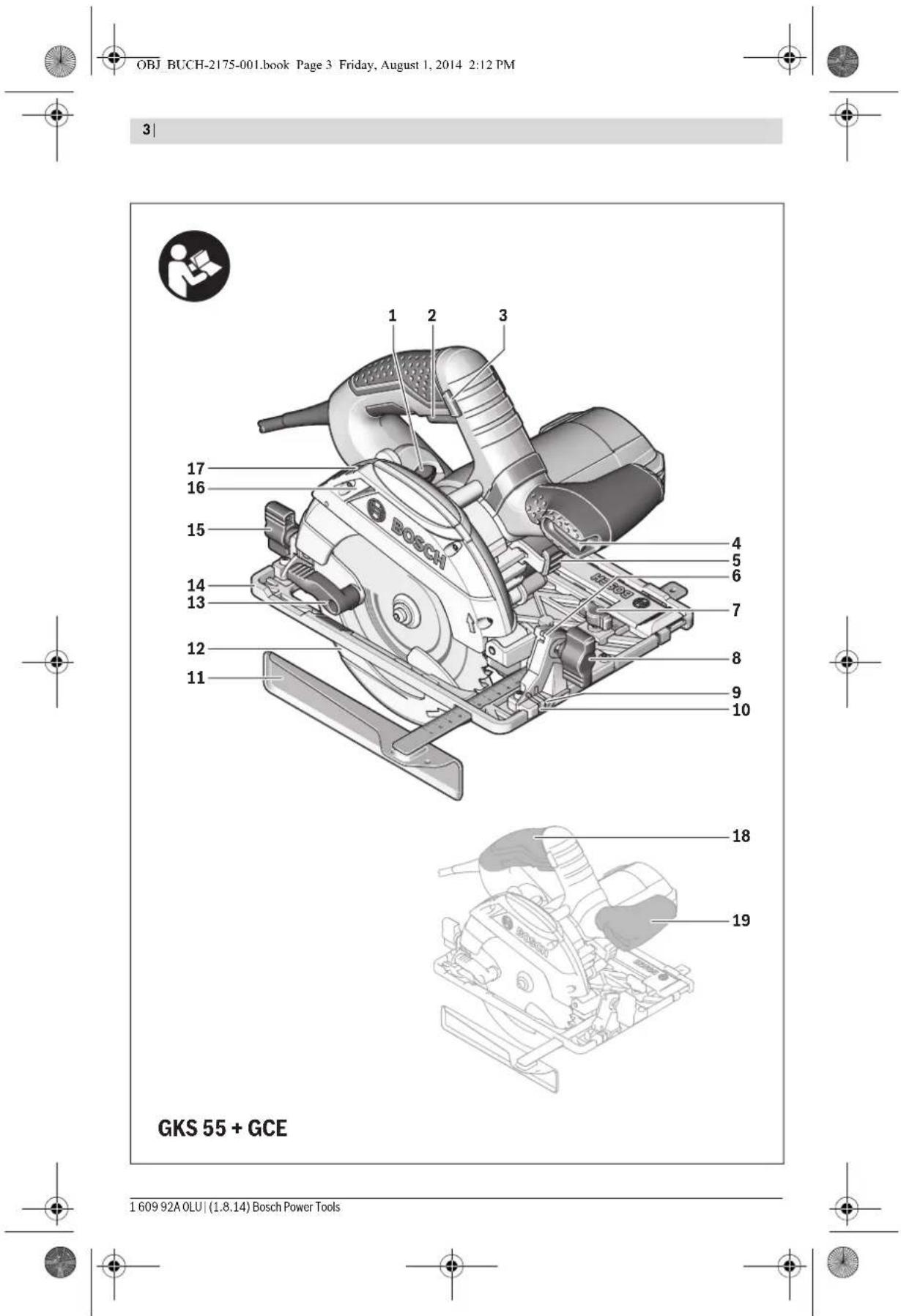
The numbering of the product features refers to the illustration of the machine on the graphics page.
1 Thumbwheel for speed preselection (GKS 55+ GCE)
2 On/Off switch
3 Lock-off button for On/Off switch
4 Hex key
5 Spindle lock button
6 Scale for miter angle
7 Wing bolt for parallel guide
8 Wing bolt for bevel-angle preselection
9 Cutting mark, 45°
10 Cutting mark, 0°
11 Parallel guide
12 Retracting blade guard
13 Lever for retracting blade guard
14 Base plate
15 Wing bolt for bevel-angle preselection (GKS 55 + G/GKS 55 + GCE)
16 Chip ejector
17 Blade guard
18 Handle (insulated gripping surface)
19 Auxiliary handle (insulated gripping surface)
20 Clamping bolt with washer
21 Clamping flange
22 Saw blade
23 Mounting flange
24 Saw spindle
25 Fastening screw for extraction adapter*
26 Extraction adapter
27 Clamping lever for cutting-depth preselection
28 Cutting-depth scale
29 Set of screw clamps
30 Guide rail
31 Vacuum hose
32 Connection piece
*Accessories shown or described are not part of the standard delivery scope of the product. A complete overview of accessories can be found in our accessories program.
Commercially available (not included in the delivery scope)
English | 17
Technical Data
| Circular Saw | GKS 165 | GKS 55+G | GKS 55+GCE |
| Article number | 3601 F76 1..3601 F82 0..3601 F82 1.. |
| Rated power input | W 1100 1200 1350 |
| No-load speed | \( \mathbf{min}^{-1} \) | 4900 4900 2100-4700 | | |
| max. cutting depth with saw blade diameter 165 mm | | | | |
| - for 0° bevel angle | mm | 66 | 63 | 63 |
| - for 45° bevel angle | mm | 47 | 47.5 | 47.5 |
| Spindle lock | ● | ● | | |
| Speed preselection | | - | - | ● |
| Constant electronic control | | - | - | ● |
| Reduced starting current | | - | - | ● |
| Run-on Brake | | - | ● | ● |
| Base plate dimensions | mm | 235 x 138 x 8 | 252 x 194 x 8.5 | 252 x 194 x 8.5 |
| Saw blade diameter | mm | 165 | 165 | 165 |
| Mounting bore | mm | 20 | 20 | 20 |
| Weight according to EPTA-Procedure 01/2003 | kg | 3.6 | 3.8 | 3.8 |
| Protection class | | ☐/II | ☐/II | ☐/II |
The values given are valid for a nominal voltage [U] of 230 V. For different voltages and models for specific countries, these values can vary.
Noise/Vibration Information
| Sound emission values determined according to EN 60745-2-5. | GKS 165 | GKS 55+ G | GKS 55+ GCE |
| 3 601 F76 1.. 3 601 F82 0.. 3 601 F82 1.. |
| Typically the A-weighted noise levels of the product are | | | |
| Sound pressure level dB(A) | 89 | 89 | 86 |
| Sound power level dB(A) | 100 | 100 | 97 |
| Uncertainty K dB | 3 | 3 | 3 |
| Wear hearing protection! | | | |
| Vibration total values ah(triax vector sum) and uncertainty K determined according to EN 60745: | | | |
| Sawing wood: | | | |
| ahm/s2 | 4.0 | 4.0 | < 2.5 |
| K m/s2 | 1.5 | 1.5 | 1.5 |
| Sawing metal: | | | |
| ahm/s2 | < 2.5 | < 2.5 | < 2.5 |
| K m/s2 | 1.5 | 1.5 | 1.5 |
The vibration level given in this information sheet has been measured in accordance with a standardised test given in EN 60745 and may be used to compare one tool with another. It may be used for a preliminary assessment of exposure. The declared vibration emission level represents the main applications of the tool. However if the tool is used for different applications, with different accessories or insertion tools or is poorly maintained, the vibration emission may differ. This may significantly increase the exposure level over the total working period.
An estimation of the level of exposure to vibration should also take into account the times when the tool is switched off or when it is running but not actually doing the job. This may significantly reduce the exposure level over the total working period.
Identify additional safety measures to protect the operator from the effects of vibration such as: maintain the tool and the accessories, keep the hands warm, organisation of work patterns.

18|English
We declare under our sole responsibility that the product described under "Technical Data" is in conformity with all relevant provisions of the directives 2011/65/EU, 2014/30/EU, 2006/42/EC including their amendments and complies with the following standards: EN 60745-1, EN 60745-2-5.
Technical file (2006/42/EC) at:
Robert Bosch GmbH, PT/ETM9,
70764 Leinfelden-Echterdingen, GERMANY
Henk Becker
Executive Vice President
Engineering
Helmut Heinzelmann
Head of Product Certification
PT/ETM9


Robert Bosch GmbH, Power Tools Division
70764 Leinfelden-Echterdingen, GERMANY
07.04.2014
Assembly
Mounting/Replacing the Saw Blade
Before any work on the machine itself, pull the mains plug. - When mounting the saw blade, wear protective gloves. Danger of injury when touching the saw blade. Only use saw blades that correspond with the characteristic data given in the operating instructions. Do not under any circumstances use grinding discs as the cutting tool.
Selecting a Saw Blade
An overview of recommended saw blades can be found at the end of this manual.
For changing the cutting tool, it is best to place the machine on the face side of the motor housing.
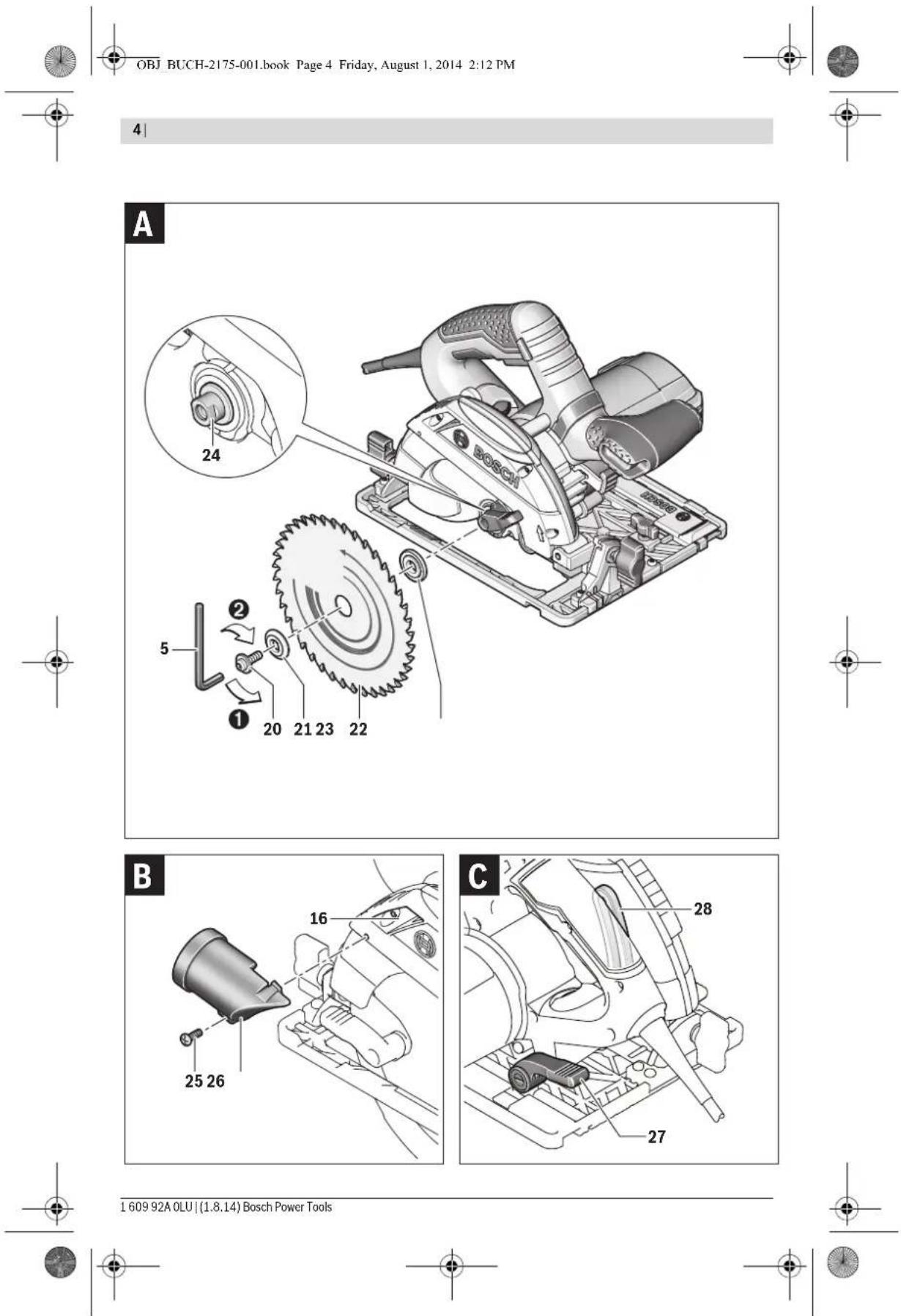
- Press the spindle lock button 5 and keep it pressed. The spindle lock button 5 may be actuated only when the saw spindle is at a standstill. Otherwise, the power tool can be damaged. With the Hex key 4, unscrew the clamping bolt 20 turning in rotation direction.
- Tilt back the retracting blade guard 12 and hold firmly.
- Remove the clamping flange 21 and the saw blade 22 from the saw spindle 24.
For changing the cutting tool, it is best to place the machine on the face side of the motor housing.
Clean the saw blade 22 and all clamping parts to be assembled. Tilt back the retracting blade guard 12 and hold firmly. - Place the saw blade 22 on to the mounting flange 23. The cutting direction of the teeth (direction or arrow on saw
blade) and the direction-of-rotation arrow on the blade guard 17 must correspond.
- Mount the clamping flange bolt 20 turning in rotation direction. Observe correct mounting position of mounting flange 23 and clamping flange 21.
- Press the spindle lock button 5 and keep it pressed. With the Hex key 4, tighten the clamping bolt 20 turning in rotation direction. The tightening torque is between 6-9 Nm, which corresponds to hand tight plus 1/4 turn.
Before any work on the machine itself, pull the mains plug. Dusts from materials such as lead-containing coatings, some wood types, minerals and metal can be harmful to one's health. Touching or breathing-in the dusts can cause allergic reactions and/or lead to respiratory infections of the user or bystanders.
Certain dusts, such as oak or beech dust, are considered as carcinogenic, especially in connection with wood-treatment additives (chromate, wood preservative). Materials containing asbestos may only be worked by specialists.
- As far as possible, use a dust extraction system suitable for the material.
- Provide for good ventilation of the working place.
- It is recommended to wear a P2 filter-class respirator.
Observe the relevant regulations in your country for the materials to be worked. Prevent dust accumulation at the workplace. Dusts can easily ignite.
- Attach the extraction adapter 26 onto the chip ejector 16 until it latches. Secure the extraction adapter 26 additionally with the screw 25. A vacuum hose with a diameter of 35 mm can be connected to the extraction adapter 26. The extraction adapter may not be mounted when no external dust extraction is connected. Otherwise the extraction channel can become clogged. Do not connect a dust bag to the extraction adapter. Otherwise the extraction system can become clogged.
To ensure optimum extraction, the extraction adapter 26 must be cleaned regularly.
Connect the vacuum hose 31 to a vacuum cleaner (accessory). An overview for connecting to various vacuum cleaners can be found at the end of this manual.
The machine can be plugged directly into the receptacle of a Bosch all-purpose vacuum cleaner with remote starting control. The vacuum cleaner starts automatically when the machine is switched on.
The vacuum cleaner must be suitable for the material being worked.
When vacuuming dry dust that is especially detrimental to health or carcinogenic, use a special vacuum cleaner.
Operation
Operating Modes
Before any work on the machine itself, pull the mains plug.
Adjust the cutting depth to the thickness of the workpiece. Less than a full tooth of the blade teeth should be visible below the workpiece. - Loosen the clamping lever 27. For a smaller cutting depth, pull the saw away from the base plate 14; for a larger cutting depth, push the saw toward the base plate 14. Adjust the desired cutting depth at the cutting-depth scale. Tighten the clamping lever 27 again. - If the cutting depth cannot be fully adjusted after loosening clamping lever 27, pull clamping lever 27 away from the saw and swivel it downward. Release the clamping lever 27 again. Repeat this procedure until the requested cutting depth can be adjusted. - If the cutting depth cannot be sufficiently locked after tightening clamping lever 27, pull clamping lever 27 away from the saw and swivel it upward. Release the clamping lever 27 again. Repeat this procedure until the cutting depth is locked.
Adjusting the Cutting Angle (GKS 55+ G/GKS 55+ GCE)
It is best to place the machine on the face side of the blade guard 17. - Loosen the wing bolts 8 and 15. Tilt the saw sideways. Adjust the desired measure on the scale 6. Tighten the wing bolts 8 and 15 again. Note: For bevel cuts, the cutting depth is smaller than the setting indicated on the cutting-depth scale 28.
Adjusting the Cutting Angle (GKS 165)
It is best to place the machine on the face side of the blade guard 17.
- Loosen wing bolt 8. Tilt the saw sideways. Adjust the desired setting at the scale 6. Tighten wing bolt 8 again.
Note: For bevel cuts, the cutting depth is smaller than the setting indicated on the cutting-depth scale 28.
Cutting Marks

The 0° cutting mark 10 indicates the position of the saw blade for right-angled cuts. The 45° cutting mark 9 indicates the position of the saw blade for 45° cuts.
- For precise cuts, position the circular saw against the workpiece as shown in the figure. It is best to carry out a trial cut.
Starting Operation
Observe correct mains voltage! The voltage of the power source must agree with the voltage specified on the nameplate of the machine. Power tools marked with 230V can also be operated with 220V .
Switching On and Off
To start the machine, first push the lock-off button for the On/Off switch 3 and then press the On/Off switch 2 and keep it pressed. - To switch off the machine, release the On/Off switch 2.
Note: For safety reasons, the On/Off switch 2 cannot be locked; it must remain pressed during the entire operation.
Speed preselection (GKS 55+ GCE)
The required speed can be preselected with the thumbwheel 1 (also while running).
The required speed depends on the saw blade being used and on the material being worked (see overview of saw blades at the end of these operating instructions).
Run-on Brake (GKS 55+G/GKS 55+GCE)
An integrated run-on brake reduces the run-on period of the saw blade after switching off the machine.
Reduced starting current (GKS 55+ GCE)
The electronic reduced starting current limits the power consumption when switching the tool on and enables operation from a 13 ampere fuse.
Constant Electronic Control (GKS 55+ GCE)
Constant electronic control holds the speed constant at no-load and under load, and ensures uniform working performance.
Working Advice
Protect saw blades against impact and shock. Guide the machine evenly and with light feed in the cutting direction. Excessive feed significantly reduces the service life of the saw blade and can cause damage to the power tool. Sawing performance and cutting quality depend essentially on the condition and the tooth form of the saw blade. Therefore, use only sharp saw blades that are suited for the material to be worked.
Sawing Wood
The correct selection of the saw blade depends on the type and quality of the wood and whether lengthway or crossway cuts are required.
When cutting spruce lengthways, long spiral chips are formed.
Beech and oak dusts are especially detrimental to health. Therefore, work only with dust extraction.
Note: Use only a sharp saw blade that is suitable for non-ferrous metals. This ensures a clean cut and prevents blade binding.
Guide the switched on power tool against the workpiece and carefully start the cut. Continue the cut with low feed and without interruption.
When sawing profiles, always begin the cut from the narrow side; when sawing U-profiles, never start the cut from the open side. Support long profiles in order to avoid blade binding and kickback of the power tool.
The parallel guide 11 enables exact cuts along a workpiece edge and cutting strips of the same dimension.
- Loosen wing bolt 7 and slide the scale of the parallel guide 11 through the guide in the base plate 14. Adjust the desired cutting width as the scale setting at the respective cutting mark 10 or 9; see Section "Cutting Marks". Tighten wing bolt 7 again.
For sawing large workpieces or straight edges, a board or strip can be clamped to the workpiece as an auxiliary guide; the base plate of the circular saw can be guided alongside the auxiliary guide.
The guide rail 30 is used to carry out straight cuts.
The rubber lip on the guide rail acts as a splinter guard; it prevents fraying of the surface while sawing wooden materials. For this, the teeth of the saw blade must face directly against the rubber lip.
Prior to the very first cut, the rubber lip must be adapted with the guide rail 30 to the circular saw being used. For this, place the guide rail 30 over its complete length on a workpiece. Adjust a cutting depth of approx. 9 mm and the saw blade to a zero degree angle. Switch the circular saw on and guide it uniformly and with light feed in the cutting direction.
Two guide rails can be connected using the connection piece 32. Clamping is carried out with the four screws located in the connection piece.
Maintenance and Service
Maintenance and Cleaning
Before any work on the machine itself, pull the mains plug.
For safe and proper working, always keep the machine and ventilation slots clean.
The retracting blade guard must always be able to move freely and retract automatically. Therefore, always keep the area around the retracting blade guard clean. Remove dust and chips by blowing out with compressed air or with a brush.
Saw blades that are not coated can be protected against corrosion with a thin coat of acid-free oil. Before use, the oil must be removed again, otherwise the wood will become soiled.
Resin and glue residue on the saw blade produces poor cuts. Therefore, clean the saw blade immediately after use.
If the replacement of the supply cord is necessary, this has to be done by Bosch or an authorized Bosch service agent in order to avoid a safety hazard.
After-sales Service and Application Service
Our after-sales service responds to your questions concerning maintenance and repair of your product as well as spare parts. Exploded views and information on spare parts can also be found under:
Bosch's application service team will gladly answer questions concerning our products and their accessories.
In all correspondence and spare parts order, please always include the 10-digit article number given on the type plate of the machine.
Great Britain
Robert Bosch Ltd. (B.S.C.)
P.O.Box 98
Broadwater Park
North Orbital Road
Denham
Uxbridge
UB 95HJ
At www.bosch-pt.co.uk you can order spare parts or arrange the collection of a product in need of servicing or repair.
Tel. Service: (0844) 7360109
E-Mail: boschservicecentre@bosch.com
Ireland
Origoltd.
Unit 23 Magna Drive
Magna Business Park
City West
Dublin 24
Tel. Service: (01) 4666700
Fax: (01) 4666888
Australia, New Zealand and Pacific Islands
Robert Bosch Australia Pty. Ltd.
Power Tools
Locked Bag 66
Clayton South VIC 3169
Customer Contact Center
Inside Australia:
Phone: (01300) 307044
Fax: (01300) 307045
Inside New Zealand:
Phone: (0800) 543353
Fax: (0800) 428570
Outside AU and NZ:
Phone: +61 395415555
www.bosch.com.au
Republic of South Africa
Customer service
Hotline: (011) 6519600
Français|21
Gauteng - BSC Service Centre
35 Roper Street, New Centre
Johannesburg
Tel.: (011) 4939375
Fax: (011) 4930126
E-Mail: bsctools@icon.co.za
KZN - BSC Service Centre
Unit E, Almar Centre
143 Crompton Street
Pinetown
Tel.: (031) 7012120
Fax: (031) 7012446
E-Mail: bsc.dur@za.bosch.com
Western Cape - BSC Service Centre
Democracy Way, Prosperity Park
Milnerton
Tel.: (021) 5512577
Fax: (021) 5513223
E-Mail: bsc@zsd.co.za
Bosch Headquarters
Midrand, Gauteng
Tel.: (011) 6519600
Fax: (011) 6519880
E-Mail: rbsa-hq.pts@za.bosch.com
Disposal
The machine, accessories and packaging should be sorted for environmental-friendly recycling.
Do not dispose of power tools into household waste!
Only for EC countries:

According to the European Directive 2012/19/EU for Waste Electrical and Electronic Equipment and its implementation into national right, power tools that are no longer usable must be collected separately and disposed of in an environmentally correct manner.
Subject to change without notice.
French
Henk Becker Executive Vice President Engineering
Helmut Heinzelmann Head of Product Certification PT/ETM9

Robert Bosch GmbH, Power Tools Division 70764 Leinfelden-Echterdingen, GERMANY 07.04.2014

26 | French
Assembly
Constant-Electronic (GKS 55+ GCE)
Robert Bosch (France) S.A.S.
Executive Vice President
Engineering
Helmut Heinzelmann
Head of Product Certification
PT/ETM9

Robert Bosch GmbH, Power Tools Division
70764 Leinfelden-Echterdingen, GERMANY
07.04.2014
Assembly
Executive Vice President
Head of Product Certification
Engineering
PT/ETM9

Robert Bosch GmbH, Power Tools Division
70764 Leinfelden-Echterdingen, GERMANY
07.04.2014
Assembly
Constant-electronic (GKS 55+ GCE)
Henk Becker Executive Vice President Engineering
Helmut Heinzelmann Head of Product Certification PT/ETM9

Robert Bosch GmbH, Power Tools Division 70764 Leinfelden-Echterdingen, GERMANY 07.04.2014
Assembly
Constant Electronic (GKS 55+ GCE)
Executive Vice President Engineering
Helmut Heinzelmann
Head of Product Certification PT/ETM9


Robert Bosch GmbH, Power Tools Division
70764 Leinfelden-Echterdingen, GERMANY
07.04.2014
Assembly
Inserting or replacing the circular saw blade
Kickback stop (GKS 55+ G/GKS 55+ GCE)
This ensures the greatest possible machine safety.
Henk Becker Executive Vice President Engineering
Helmut Heinzelmann Head of Product Certification PT/ETM9

Robert Bosch GmbH, Power Tools Division 70764 Leinfelden-Echterdingen, GERMANY 07.04.2014
Assembly
Bosch Service Center
Telegrafvej 3
2750 Ballerup
At www.bosch-pt.dk you can order spare parts online and create a repair order.
Service Center Phone: 44898855
Fax: 44898755
E-Mail: vaerktoej@dk.bosch.com
Disposal
Power tools, accessories, and packaging should be recycled in an environmentally friendly manner.
Subject to change without notice.
Henk Becker Executive Vice President Engineering
Helmut Heinzelmann Head of Product Certification PT/ETM9
Robert Bosch GmbH, Power Tools Division 70764 Leinfelden-Echterdingen, GERMANY 07.04.2014
Assembly
Spare parts list (GKS 55+ GCE)
Bosch Service Center
Telegrafvej 3
2750 Ballerup
Denmark
Tel.: (08) 7501820 (within Sweden)
Fax: (011) 187691
Waste disposal
Henk Becker Executive Vice President Engineering
Helmut Heinzelmann Head of Product Certification PT/ETM9
j wz lq2 i.v. h = u
Robert Bosch GmbH, Power Tools Division 70764 Leinfelden-Echterdingen, GERMANY 07.04.2014
Assembly
Executive Vice President
Engineering
Helmut Heinzelmann
Head of Product Certification
PT/ETM9

Robert Bosch GmbH, Power Tools Division
70764 Leinfelden Echterdingen, GERMANY
07,04,2014
Installation
Executive Vice President Engineering
Helmut Heinzelmann
Head of Product Certification PT/ETM9


Robert Bosch GmbH, Power Tools Division
70764 Leinfelden-Echterdingen, GERMANY 07.04.2014
Replacement of the tool
Placement/Replacement of the tool
Remove the plug from the socket before carrying out any work on the electric tool. Wear protective goggles when mounting the tool. Risk of injury in case of contact with the tool. Use only tools that have the characteristics described in these operating instructions. Never use blunt tools.
Selection of the tool
At the end of these instructions you will find a selection of recommended tools.
Greek 93
Removal of the tool (see figure A)
To change the tool, turn the electric tool so that the spindle is facing upwards.
- Press the spindle lock button 5 and hold it pressed. The spindle lock button 5 can only be actuated when the spindle is at a standstill. Otherwise, the electric tool may be damaged. Turn the clamping nut 4 counterclockwise with the Allen key 20 while holding the spindle lock.
- Guide the tool holder 12 towards the spindle and hold it in this position. Remove the clamping nut 21 and the tool 22 from the spindle of the angle grinder 24.
Mounting of the tool (see figure A)
To change the tool, turn the electric tool so that the spindle is facing upwards.
Clean the tool 22 and the mounting flange. - Guide the tool holder 12 towards the spindle and hold it in this position. Place the tool 22 onto the mounting flange 23. The correct position of the grinding wheel (direction of rotation arrow on the tool) must match the direction of rotation arrow on the protective guard 17. Place the clamping nut 21 and tighten the clamping nut 20 counterclockwise with the Allen key 4 while holding the spindle lock. The tightening torque must be 6–9 Nm, which corresponds to tightening by hand with a 1/2 turn.
Wear protective gloves and protective goggles when working with this tool.
Dust from materials such as lead-based paint, some wood types, metals and minerals can be harmful to health. Contact with or inhalation of dust can cause allergic reactions and/or respiratory diseases of the user or bystanders. Certain types of dust, e.g. oak or beech dust, are carcinogenic, especially when combined with wood treatment additives (chromate, wood preservatives). Only allow specialists to work on materials containing asbestos.
- Use the dust extraction as far as possible for the respective material. Keep the workplace well ventilated.
- We recommend using a dust extraction hose with a diameter of P2.
Follow the regulations that apply in your country for the materials to be processed.
Avoid creating sparks when working. Dust can ignite.
Connecting the dust extraction (see Figure B)
Insert the dust extraction hose 26 onto the exhaust outlet 16 until it clicks into place. Attach the dust extraction hose 26 securely with the clamp 25. The dust extraction hose 26 must be able to accommodate a dust extraction hose or a diameter of 35 mm. The dust extraction hose must not be connected to a dust extraction system. Alternatively, it can be connected to a dust extraction system. Δev Do not connect the dust extraction hose to the dust extraction system. Alternatively, it can be connected to the dust extraction system.
To ensure dust extraction, the dust extraction hose 26 must be cleaned regularly.
External dust extraction
Place the dust extraction hose 31 into a dust extraction system (see accessories). An additional connection for dust extraction is available as an accessory.
The electric tool can be connected to the dust extraction system of a Bosch dust extractor of general use, equipped with an automatic start/stop function. The dust extractor starts automatically when the electric tool is switched on.
For the repair, the individual components must be checked by the manufacturer.
Operation
Operating modes
Executive Vice President
Engineering
Helmut Heinzelmann
Head of Product Certification
PT/ETM9


Robert Bosch GmbH, Power Tools Division
70764 Leinfelden-Echterdingen, GERMANY
07.04.2014
Assembly
Preselection of speed (GKS 55+ GCE)
Bosch San. ve Tic. A.S.
Ahi Evran Cad. No:1 Kat:22
Polaris Plaza
80670 Maslak/Istanbul
Bosch Expert Team +90 (0212) 367 18 88
Isiklar LTD.STI.
Kizilay Cad. No: 16/C Seyhan
Adana
Tel.: 0322 3599710
Tel.: 0322 3591379
Henk Becker Helmut Heinzelmann Executive Vice President Head of Product Certification Engineering PT/ETM9

Robert Bosch GmbH, Power Tools Division 70764 Leinfelden-Echterdingen, GERMANY 07.04.2014
Assembly
Executive Vice President Head of Product Certification Engineering PT/ETM9

Robert Bosch GmbH, Power Tools Division 70764 Leinfelden-Echterdingen, GERMANY 07.04.2014
Assembly
With guide profile (GKS 55+ G/GKS 55+ GCE) (see Fig. F)
With the guide profile 30 you can perform straight cuts.
Bosch Service Center PT
K Vapence 1621/16
692 01 Mikulov
On www.bosch-pt.cz you can order repairs for your machine online.
Tel.: 519305700
Fax: 519305705
E-Mail: servis.naradi@cz.bosch.com
www.bosch.cz
Waste disposal
Power tools, accessories, and packaging should be sent for recycling in an environmentally friendly manner.
Executive Vice President
Engineering
Helmut Heinzelmann
Head of Product Certification
PT/ETM9
Paa

Robert Bosch GmbH, Power Tools Division
70764 Leinfelden-Echterdingen, GERMANY
07.04.2014
Slovak | 123
Assembly
Executive Vice President Engineering
Helmut Heinzelmann
Head of Product Certification PT/ETM9
P^a
f(2) = h · m
Robert Bosch GmbH, Power Tools Division 70764 Leinfelden-Echterdingen, GERMANY 07.04.2014
Assembly
No. TC RUC-DE.AR46.B.64828
Certificate of Conformity valid until 27.07.2019
'ROSTEST-Moscow' CJSC 'Regional body for certification and testing'
119049, Moscow
ul. Lva, 14, str. 1
Certificate of Conformity issued to the address:
000 'Robert Bosch'
ul. Akad. Koroleva, 13 str. 5
Russia, 129515, Moscow
The date of manufacture is indicated on the last page of the instruction manual.
Additional information regarding the device is on the packaging.
Service life
The service life of the device is 7 years. It is recommended to operate the device for no more than 5 years of storage from the date of manufacture, subject to regular checks (see the date of manufacture on the label).
Limits of critical failures and erroneous actions of personnel or user
Do not use the device without the handle and protective cover. Do not use when the device is turned on directly from the housing. Do not use with a damaged or worn electrical cable. Do not use outdoors during rain (splashing water). Do not turn on if water gets into the housing. Do not use in case of strong sparking. Do not use when the device is turned on with a wet hand.
Limit states
- Repair of damaged electrical cables Damage to the housing
Types and frequency of technical maintenance
It is recommended to clean the instrument after each use.
Storage
Store in a dry place. Avoid exposure to sources of high temperatures and direct sunlight. Avoid sudden temperature changes during storage. Storage without packaging is not allowed. See GOST 15150 (Condition 1) for storage conditions.
Transportation
Mechanical impacts on the packaging during transportation are not allowed. During loading/unloading, the use of lifting equipment operating on the principle of gripping the packaging is not allowed. See GOST 15150 (Condition 5) for detailed transportation requirements.
Safety instructions
General safety instructions for power tools
WARNING
Read all safety instructions and warnings.
Failure to follow the instructions and safety warnings may result in electric shock, fire, and serious injury.
Keep these instructions and warnings for future use.
The term "power tool" used in these instructions and warnings applies to both corded power tools (with power cord) and cordless power tools (without power cord).
Workplace safety
Keep your workplace clean and well lit. Cluttered or dark areas can lead to accidents. Do not operate this power tool in explosive atmospheres, such as in the presence of flammable liquids, gases or dust. Power tools create sparks which may ignite the dust or fumes. While operating a power tool, keep children and bystanders away. Distractions can cause you to lose control of the power tool.
Electrical safety
Power tool plugs must match the outlet. Never modify the plug in any way. Do not use any adapter plugs with earthed (grounded) power tools. Unmodified plugs and matching outlets will reduce risk of electric shock. Avoid body contact with earthed or grounded surfaces, such as pipes, radiators, ranges and refrigerators. There is an increased risk of electric shock if your body is earthed or grounded. Do not expose power tools to rain or wet conditions. Water entering a power tool will increase the risk of electric shock.




Russian 135
Do not misuse the cord. Never use the cord for carrying, pulling or unplugging the power tool. Keep cord away from heat, oil, sharp edges or moving parts. Damaged or entangled cords increase the risk of electric shock. When operating a power tool outdoors, use an extension cord suitable for outdoor use. Use of a cord suitable for outdoor use reduces the risk of electric shock. If operating a power tool in a damp location is unavoidable, use a residual current device (RCD) protected supply. Use of an RCD reduces the risk of electric shock.
Personal safety
Read all safety warnings and instructions. Failure to follow the warnings and instructions may result in electric shock, fire, and/or serious injury. Save all warnings and instructions for future reference. The term "power tool" in the warnings refers to your mains-operated (corded) power tool or battery-operated (cordless) power tool. Work area safety: Keep work area clean and well lit. Cluttered or dark areas invite accidents. Do not operate power tools in explosive atmospheres, such as in the presence of flammable liquids, gases, or dust. Power tools create sparks which may ignite the dust or fumes. Keep children and bystanders away while operating a power tool. Distractions can cause you to lose control. Electrical safety: Power tool plugs must match the outlet. Never modify the plug in any way. Do not use any adapter plugs with earthed (grounded) power tools. Unmodified plugs and matching outlets will reduce risk of electric shock. Avoid body contact with earthed or grounded surfaces, such as pipes, radiators, ranges, and refrigerators. There is an increased risk of electric shock if your body is earthed or grounded. Do not expose power tools to rain or wet conditions. Water entering a power tool will increase the risk of electric shock. Do not abuse the cord. Never use the cord for carrying, pulling, or unplugging the power tool. Keep cord away from heat, oil, sharp edges, or moving parts. Damaged or entangled cords increase the risk of electric shock. When operating a power tool outdoors, use an extension cord suitable for outdoor use. Use of a cord suitable for outdoor use reduces the risk of electric shock. If operating a power tool in a damp location is unavoidable, use a residual current device (RCD) protected supply. Use of an RCD reduces the risk of electric shock. Personal safety: Stay alert, watch what you are doing, and use common sense when operating a power tool. Do not use a power tool while you are tired or under the influence of drugs, alcohol, or medication. A moment of inattention while operating power tools may result in serious personal injury. Use personal protective equipment. Always wear eye protection. Protective equipment such as dust mask, non-skid safety shoes, hard hat, or hearing protection used for appropriate conditions will reduce personal injuries. Prevent unintentional starting. Ensure the switch is in the off-position before connecting to power source and/or battery pack, picking up, or carrying the tool. Carrying power tools with your finger on the switch or energizing power tools that have the switch on invites accidents. Remove any adjusting key or wrench before turning the power tool on. A wrench or a key left attached to a rotating part of the power tool may result in personal injury. Do not overreach. Keep proper footing and balance at all times. This enables better control of the power tool in unexpected situations. Dress properly. Do not wear loose clothing or jewelry. Keep your hair, clothing, and gloves away from moving parts. Loose clothes, jewelry, or long hair can be caught in moving parts. If devices are provided for the connection of dust extraction and collection facilities, ensure these are connected and properly used. Use of dust collection can reduce dust-related hazards.
The possibility of installing dust extraction and collection devices and their correct use should be verified. The use of a vacuum cleaner can reduce the danger posed by dust.
Use of the power tool and handling it
Do not overreach. Use the correct power tool for your application. The correct power tool will do the job better and safer at the rate for which it was designed. Do not use the power tool if the switch does not turn it on and off. Any power tool that cannot be controlled with the switch is dangerous and must be repaired. Disconnect the plug from the power source and/or the battery pack from the power tool before making any adjustments, changing accessories, or storing power tools. Such preventive safety measures reduce the risk of starting the power tool accidentally. Store idle power tools out of the reach of children and do not allow persons unfamiliar with the power tool or these instructions to operate the power tool. Power tools are dangerous in the hands of untrained users. Maintain power tools. Check for misalignment or binding of moving parts, breakage of parts and any other condition that may affect the power tool's operation. If damaged, have the power tool repaired before use. Many accidents are caused by poorly maintained power tools. Keep cutting tools sharp and clean. Properly maintained cutting tools with sharp cutting edges are less likely to bind and are easier to control. Use the power tool, accessories and tool bits etc., in accordance with these instructions, taking into account the working conditions and the work to be performed. Use of the power tool for operations different from those intended could result in a hazardous situation.
Service
Have your power tool serviced by a qualified repair person using only identical replacement parts. This will ensure that the safety of the power tool is maintained.
136|Russian
Safety instructions for all saws
Kickback
DANGER: Keep hands away from cutting area and the blade. Keep your second hand on auxiliary handle, or motor housing. If both hands are holding the saw, they cannot be cut by the blade.
Do not place your hand under the workpiece. The guard cannot protect you from the blade below the workpiece.
The depth of cut should correspond to the thickness of the workpiece. The saw blade should not protrude more than the height of a tooth beyond the workpiece.
Never hold the workpiece in your hands or across your leg. Secure the workpiece to a stable platform. It is important to support the work properly to minimize body exposure, avoid blade binding, or loss of control.
When performing operations where the cutting tool may contact hidden wiring or its own cord, hold the power tool by insulated gripping surfaces. Contact with a 'live' wire may make exposed metal parts of the power tool 'live' and could give the operator an electric shock.
When ripping, always use a rip fence or straight edge guide. This improves the accuracy of the cut and reduces the chance of blade binding.
Use discs of the correct size and matching the mounting holes (e.g., round or shaped). Incorrect discs that do not match the mounting parts can cause loss of control over the tool.
Never use damaged or incorrect abrasive discs or screws. Abrasive discs and screws were specially designed for optimal performance and safety.
Kickback and corresponding safety instructions
- Kickback is a sudden reaction to a pinched or jammed rotating disc, leading to uncontrolled lifting of the tool and its ejection from the workpiece in the direction of the operator;
- if the disc is pinched or jammed in the cut, it stops and the tool is thrown back towards the operator;
- if the disc is twisted or misaligned in the cut, the teeth of the disc can catch the surface of the workpiece, causing the disc to be thrown out of the cut and the tool to be thrown towards the operator. Kickback is the result of improper use or incorrect operation. It can be avoided by taking the precautions described below. Hold the tool firmly with both hands and position your hands so that you can counteract the forces of a sudden kickback. Always stand to the side of the disc, not in line with it. In case of a kickback, the disc may jump back, but the operator can counteract these forces with proper precautions. Do not jam the disc or interrupt the work abruptly; let the tool come to a complete stop before lifting it from the workpiece. Never try to remove the disc from the workpiece or pull it out while the disc is still rotating, as this may cause a kickback. Investigate and eliminate the cause of the disc jamming. If you need to restart the tool that got stuck in the workpiece, center the disc in the cut and check that it can rotate freely. If the disc is jammed, restarting may cause the disc to be thrown out of the workpiece or cause a kickback. Large discs should be placed on a stable support to reduce the risk of kickback when the disc jams. Large discs tend to sag under their own weight. Place the disc on supports on both sides, near the cutting line, close to the disc. Do not use dull or damaged discs or discs with misaligned teeth, as they increase friction, cause jamming, and lead to kickback. Before starting work, check the guard and adjust it properly. Replacing the guard during operation may lead to jamming and kickback. Be especially careful when cutting into walls or other hidden areas. When cutting into hidden objects, the disc may become blocked and cause kickback.
Russian 137
Function of the protective guard
The protective hood is equipped with a tested, flawless closure. Do not use force if the movement of the lower protective hood is blocked; it closes with a delay. Never lift or pull the protective hood by the open position with your hands. Dust on the lower protective hood may cause it to bend. Open the protective hood by the handle and ensure it is in its free position. Before starting work, check the function of the lower protective hood spring. If the lower protective hood spring does not work satisfactorily, have it serviced before use. Damaged parts, fasteners, or stops may block the lower protective hood. Open the protective hood only when performing cuts, such as plunge cuts. Open the lower protective hood only with the retracting lever, as soon as the blade enters the workpiece. Before each use, ensure the protective hood closes automatically. When you place the tool on a workbench or floor, the lower protective hood must cover the blade. The unguarded, rotating blade will drive the tool towards you, so ensure the tool is stable. Consider the protrusion of the blade.
Additional safety warnings
Do not touch the dust extraction port with your hands. The rotating part may cause injury. Do not hold the tool above your head. In this position, you do not have sufficient control over the power tool. Use appropriate metal detectors to locate hidden pipes or wires, or consult the local utility company. Contact with a live wire can cause fire and electric shock. Damage to a gas pipe can lead to an explosion. Damage to a water pipe results in property damage or may cause electric shock. The power tool is not intended for stationary use. It is not designed for use with a heavy stand. Do not use blades made of high-speed steel. Such blades can break easily. Do not use damaged blades. Warped blades may catch. Always wear safety goggles.
Always hold the power tool with both hands during operation, preferably in a stable position. Two-handed operation provides more control over the power tool. Secure the workpiece. A workpiece clamped in a vice or with clamps is held more securely than in your hand. Always switch off the power tool and wait until it has come to a complete stop before placing it down. The tool may jam, and this could lead to loss of control over the power tool.
Product and service description

Read all safety warnings and instructions. Failure to follow the warnings and instructions may result in electric shock, fire, and/or serious injury.
Intended use
The tool is intended for cross-cutting and ripping of wood and wood-based materials. With appropriate saw blades, it can be used for cutting thin non-ferrous metals, for example, profiles. The tool is not designed for sharpening or cutting ferrous metal.
Illustrated components
The numbering of the illustrated components is shown on the page with illustrations.
1 Adjustment knob for speed (GKS 55+GCE) 2 Switch 3 Lock-off button for switch 4 Hex key 5 Spindle lock button 6 Adjustment for cutting angle 7 Wing bolt for parallel guide 8 Wing bolt for adjusting the bevel angle 9 Mark for 45° angle 10 Mark for 0° angle 11 Parallel guide 12 Pendulum guard 13 Handle for adjusting the pendulum guard 14 Base plate 15 Wing bolt for adjusting the tilt angle (GKS 55+ G/GKS 55+ GCE) 16 Dust extraction nozzle 17 Guard 18 Handle (with insulated gripping surface) 19 Auxiliary handle (with insulated gripping surface)

138|English
20 Clamping lever 21 Guide rail 22 Saw blade 23 Base plate 24 Dust bag 25 Clamping screw for dust extraction adapter 26 Dust extraction adapter 27 Clamping lever for adjusting the cutting depth
28 Scale for cutting depth 29 Clamping lever 30 Guide rail 31 Adjustment 32 Connecting cable
The accessories shown or described are not included in the standard scope of delivery. A complete overview of accessories can be found in our accessories program.
Optional (not included in the scope of delivery)
Technical data
The vibration level is specified for the main types of work with the power tool. However, if the power tool is used for other work, with different accessories, or with insufficient maintenance, the vibration level may differ. This may significantly increase the vibration load over the entire working period.
When estimating the vibration load, the times when the tool is switched off or when it is running but not actually in use must also be taken into account. This can significantly reduce the vibration load over the total working time.
Implement additional safety measures to protect the operator from the effects of vibration, such as: servicing the power tool and the cutting tools, keeping hands warm, and organizing work processes.
Declaration of Conformity
C
We declare under our sole responsibility that the product described under “Technical Data” complies with all relevant provisions of Directives 2011/65/EU, 2014/30/EU, 2006/42/EC, including their amendments, as well as the following standards: EN 60745-1, EN 60745-2-5.
Technical documentation (2006/42/EC) Robert Bosch GmbH, PT/ETM9, 70764 Leinfelden-Echterdingen, GERMANY
Henk Becker Helmut Heinzelmann Executive Vice President Head of Product Certification Engineering PT/ETM9

Robert Bosch GmbH, Power Tools Division 70764 Leinfelden-Echterdingen, GERMANY 07.04.2014
Assembly
Mounting/Replacing the Saw Blade
Before any work on the power tool, pull the plug out of the socket. When mounting the saw blade, wear protective gloves. Touching the saw blade can lead to injury. Use only saw blades that meet the technical data specified in these operating instructions. Never use abrasive discs as the working tool.
Selecting the Saw Blade
An overview of recommended saw blades can be found at the end of these operating instructions.
Removing the Saw Blade (see figure A)
To change the working tool, place the power tool on the front side of the motor housing.
Press the spindle lock button 5 and keep it pressed. The spindle lock button may only be operated when the saw blade is at a standstill. Otherwise, the power tool may be damaged. - Turn the clamping screw 20 in the direction of the arrow to release the clamping flange 12. Press and hold the spindle lock. - Remove the clamping flange 21 and the saw blade 22 from the saw spindle 24.
Mounting the Saw Blade (see figure A)
To change the working tool, place the power tool on the front side of the motor housing.
Clean the saw blade 22 and all mounting parts to be installed. Press and hold the spindle lock. - Place the saw blade 22 on the mounting flange 23. The cutting direction of the teeth (direction of the arrow on the saw blade) must match the direction of the arrow on the guard 17.
- Install the clamping flange 21 and tighten the clamping screws 20 in the direction indicated. Follow the correct installation of the support 23 and the clamping device 21. Press the locking button 15 and hold it pressed. - Tighten the clamping screws 20 in the direction indicated. The tightening torque should be 6-9 Nm, which corresponds to hand-tightening (see Fig. 1/6o-bot).
Dust and chip extraction
Avoid manipulating the electric tool with the plug pulled out. Dust from materials such as paint containing lead, some types of wood, minerals, and metals can be harmful to health. Contact with dust and inhalation of dust into the respiratory tract can cause allergic reactions and/or respiratory diseases in the operator or nearby personnel.
Certain types of dust, e.g., oak and beech dust, are considered carcinogenic, especially when combined with additives for wood treatment (chromate, wood preservatives). Materials containing asbestos should only be worked on by specialists.
- If possible, use a dust extraction system suitable for the material. Good ventilation of the workplace is recommended. It is advisable to use a respirator of class P2.
Follow the regulations in force in your country regarding the materials to be processed. Avoid accumulation of dust at the workplace. Dust can easily ignite.
Installing the extraction adapter (see Fig. B)
Push the extraction adapter 26 onto the chip outlet 16 until it clicks into place. Tighten/loosen the extraction adapter 26 with screw 25. The extraction adapter 26 can be connected to an extraction hose with a diameter of 35 mm. Do not install the extraction adapter on the extraction device without a locking mechanism. The hose may become blocked. Do not operate the tool without the extraction adapter. The extraction system may become clogged as a result.
To ensure proper extraction, the extraction adapter 26 must be cleaned regularly.
External dust extraction system
Connect the extraction hose 31 to the vacuum cleaner (accessory). An overview of possible connections to different vacuum cleaners is provided at the end of this manual.
The electric tool can be connected directly to a universal vacuum cleaner with a suitable connection. The vacuum cleaner must be switched on before the electric tool is switched on.
The vacuum cleaner must be suitable for the material being processed.
Use a special vacuum cleaner for particularly hazardous dusts, such as those from asbestos or wood dust.
Working with the tool
Operating mode
Before using the power tool, pull the plug out of the socket.
Adjusting the cutting depth (see figure C)
The cutting depth should correspond to the thickness of the workpiece. The blade must not protrude more than the height of a tooth beyond the workpiece. - Loosen the clamping lever 27. For a shallow cutting depth, pull the base plate 14 away from the tool; for a deeper cut, push the base plate 14 toward the tool. Set the desired dimension on the cutting depth scale. Tighten the clamping lever 27 firmly. - If after loosening the clamping lever 27 you cannot fully set the cutting depth, turn the clamping lever 27 again and loosen it. Loosen the clamping lever 27. Repeat this operation until you have set the desired cutting depth. - If after tightening the clamping lever 27 you still cannot lock the cutting depth sufficiently, loosen the clamping lever 27 again and turn it upward. Loosen the clamping lever 27. Repeat this operation until you have locked the cutting depth.
Setting the cutting angle (GKS 55+G/GKS 55+GCE)
Place the power tool on the front side of the protective guard 17.
Loosen the wing bolts 8 and 15. Turn the tool to the side. Set the desired dimension on the scale 6. Tighten the wing bolts 8 and 15 firmly. Note: The cutting depth at an angle is less than the value shown on the cutting depth scale 28.
Selecting the speed (GKS 55+GCE)
Using the adjusting wheel 1, you can set the required speed even during operation.
The required speed depends on the installed saw blade and the material to be machined (see overview of saw blades in the operating instructions for the power tool).
Run-down brake (GKS 55+G/GKS 55+GCE)
The integrated run-down brake shortens the run-on time of the saw blade after the power tool is switched off.
Starting current limiting (GKS 55+ GCE)
The electronic system limits the starting current when the power tool is switched on, enabling operation from a 16 A socket.
Constant Electronics (GKS 55+GCE)
Constant Electronics supports the rotation speed of the idle and under load, ensuring uniform productivity of work.
Intended use
Protect the saw blades.
Guide the power tool evenly and gently along the cutting direction. Excessive feed reduces the service life of the tool and can damage the power tool.
Productivity and cutting quality depend significantly on the condition and shape of the saw blade teeth. Therefore, use only sharp blades suitable for the material being processed.
Saw blades
The correct choice of saw blade depends on the type and quality of the wood, as well as on the type of cut - longitudinal or cross.
For longitudinal cuts, use a blade with a coarse tooth shape.
Dust from wood can be particularly harmful to health, so work only with a dust extractor.
Note: Use only suitable blades for light metals. This ensures clean cuts and prevents the saw blade from jamming.
On cuts, always start cutting on the narrow side; on U-shaped cuts, never start cutting from the open side. Guide the saw blade carefully to prevent jamming of the saw blade and kickback of the power tool.
Henk Becker Executive Vice President Engineering
Helmut Heinzelmann, Head of Product Certification PT/ETM9

Robert Bosch GmbH, Power Tools Division, 70764 Leinfelden-Echterdingen, GERMANY, 07.04.2014
MOHTAX
Mounting the saw blade
Before any work on the power tool, pull the mains plug out of the socket. When mounting the saw blade, wear protective gloves. Touching the saw blade can lead to injuries. Use only saw blades whose parameters correspond to the specifications in these instructions. Never use grinding discs as an insertable tool.
Selecting the saw blade
You will find an overview of recommended saw blades at the end of these instructions.
Removing the saw blade (see figure A)
For the best work results, place the power tool on the motor housing.
Press and hold the spindle lock. Press the spindle lock only when the saw spindle is at a standstill! Otherwise, the power tool may be damaged.
148 | Ukrainian
– Using the hex key (4), turn the clamping screw (20) in the direction of the arrow. – Fold back the protective hood (12) and hold it. Remove the clamping flange (21) and the saw blade (22) from the saw spindle (24).
Mounting the saw blade (see figure A)
For the best work results, place the power tool on the motor housing.
– Clean the saw blade (22) and all clamping parts to be mounted. Fold back the protective hood (12) and hold it. – Place the saw blade (22) on the mounting flange (23). The direction of the teeth (arrow on the saw blade) and the direction of rotation arrow on the protective hood (17) must match. – Mount the clamping flange (21) and tighten the clamping screw (20) in the direction of the arrow. Observe the correct mounting position of the mounting flange (23) and the clamping flange. Press and hold the spindle lock (5) and keep it pressed. – Using the hex key (4), tighten the clamping screw (20) in the direction of the arrow. The tightening torque is 6–9 Nm, which corresponds to hand-tight tightening plus a quarter turn.
Before any manipulation with the electric tool, read the section. Dust of materials such as paint, varnish coatings, oak dust, some types of wood and metal may be hazardous to health.
Touching or inhaling dust may cause an allergic reaction and/or respiratory diseases.
If any dust, chips, or shavings get into your eyes, they are considered foreign bodies, so use protective goggles for woodworking (glasses, protective screens). Materials containing asbestos should only be processed by specialists.
-Do not use the device for purposes other than its intended use. Follow safety instructions at your workplace. - It is recommended to wear a respirator mask with a P2 class filter.
Follow the regulations for disposal of materials in accordance with your country's laws.
Accumulation of wood dust may ignite.
INSTALLATION OF THE EXTRACTION ADAPTER (SEE FIG. B)
Place the extraction adapter 26 onto the exhaust outlet 16 until it locks into place. Additionally secure the extraction adapter 26 with screw 25. To the extraction adapter, you can connect an extraction hose with a diameter of 35 mm.
The extraction adapter cannot be installed without an external extraction system. Otherwise, the ventilation channel may become clogged. The extraction adapter cannot be used with a vacuum cleaner. Otherwise, the extraction system may become clogged.
To ensure optimal extraction, regularly clean the extraction adapter 26.
EXTERNAL EXTRACTION
Connect the extraction hose (accessory). You will find the types of hoses that can be connected in the appendix of these instructions.
The power tool can be connected directly to a universal socket with a dust extraction system and a start/stop device. It turns off automatically when the power tool is switched on.
The extraction hose must be suitable for processing the material.
Work
Operating modes
Before starting work, disconnect the electric drill from the socket.
Setting the drilling depth (see Fig. C)
Set the drilling depth according to the required depth. The drilling depth must be less than the tooth depth.
Loosen the locking screw 27. To change the drilling depth, turn the handle 14 upward for a deeper drilling depth, or downward for a shallower drilling depth. Set the required value on the drilling depth scale. Tighten the locking screw 27 again. If the locking screw 27 cannot be tightened, turn it in the direction of the arrow and return it to the surface. Loosen the locking screw 27 again. Repeat the operation until the required drilling depth is set.
Setting the cutting depth (GKS 55+G/GKS 55+GCE)
Place the electric drill on the side of the protective cover 17.
Ukrainian149
Loosen the wing bolt 8. Press the lever. Set the required value on the scale 6. Tighten the wing bolt 8 again.
Insert: The drilling depth with the lever is less than the drilling depth shown on the drilling depth scale 28.
Setting the cutting depth (GKS 165)
Place the electric drill on the side of the protective cover 17.
Loosen the wing bolt 8. Press the lever. Set the required value on the scale 6. Tighten the wing bolt 8 again.
Warning: Before starting work, read the operating instructions carefully and follow them.
Operating instructions


The 0°10 marking shows the position of the front disc during cutting at a right angle. The 45°9 marking shows the position of the front disc during cutting at a 45° angle.
For cutting, present the tool to the material at the angle indicated on the scale. It is best to start cutting with a test cut.
Starting work
Check the mains voltage! The voltage of the power source must match the value specified on the rating plate. A power tool designed for 230 V can also operate at 220 V.
Switching on/off
To switch on the power tool, first press the lock button, then press and hold the switch. To switch off the power tool, release the switch.
Warning: The safety switch must not be locked; it must be held pressed during the entire work.
Setting the number of revolutions (GKS 55+GCE)
Using the adjusting wheel, the number of revolutions can be set steplessly.
The required number of revolutions depends on the material being worked and the tool used (see the operating instructions for the saw blades).
First use (GKS 55+G/GKS 55+GCE)
Before first use, the saw blade guard must be opened manually.
Switching the saw blade guard (GKS 55+GCE)
The electric motor is protected against overload and can be operated with a frequency converter.
Constant electronics (GKS 55+GCE)
The electronics ensure almost identical idle speed and under load; they ensure uniform productivity.
Operating instructions
Grip the power tool firmly with both hands. Guide the electric planer in the direction of planing. Only feed the planer with the grain to avoid reducing the service life of the blades and damaging the electric planer.
The planing blades are mounted in the blade holder. Use only sharp planing blades to ensure a clean cut of the workpiece material.
Planing wood
The correct choice of planing speed depends on the wood type, the wood quality, and the planing direction (with or against the grain).
Planing against the grain destroys the natural fiber structure.
When planing, always consider the risk of kickback and wear protective equipment.
Note: Use only sharp planing blades designed for non-ferrous metals. This ensures a clean cut and prevents the planing blade from jamming.
The electric planer is suitable for all materials and is easy to handle. It works smoothly with a gentle feed.
When planing, always work against the rotation direction of the blade shaft. When planing with the grain, never work from the open side. Always plane with the grain to avoid tearing the wood and damaging the electric planer.
Planing with a parallel stop (m.B. Man.D)
This allows for the correct positioning of the edges of the cut workpiece and the positioning of the folds.
150|Ukrainian
Turn the screw handle 7 and press the calibration control into the support plate 14. Using the calibration marks, set the required bending angle for the positioning 10 or 9. Check the positioning marks. Tighten the screw handle 7 again.
Positioning with an additional stop (see Fig. E)
For repeated cuts and positioning of the edges of the workpiece, it is possible to use an additional stop to guide the workpiece or to guide the workpiece along the positioning edges of the additional stop.
Positioning with a guide rail (GKS 55 + G / GKS 55+GCE) (see Fig. F)
The guide rail can be used for straight positioning.
The guide rail prevents the material from slipping during positioning. Place the guide rail on the workpiece and press it firmly against the guide rail.
Before starting the positioning, you need to adjust the guide rail to the workpiece you are using, using the adjusting screw 30. Apply the adjusting screw 30 to the workpiece. Set the positioning angle to approx. 9 mm and set the positioning angle. Check the workpiece and adjust the positioning angle evenly.
Using the connector 32, you can connect two guide rails. The connection is made with two screws located in the connector.
Technical service
Technical service and maintenance
Before any manipulation with the electric tool, pull the plug out of the socket.
106 electric tools are clean and free of dust, keep the device and the ventilation slots clean.
The pendulum guard must be able to move freely and close automatically. If the cause of the guard is stuck, keep the area around the pendulum guard clean. Remove the dust with a brush or blow it out.
The surface can be protected from corrosion with a thin layer of oil, but it must not contain acids. Refined oil, however, will penetrate wood and into cracks.
The resin gives the painted surface a high-quality finish. All costs for painted surfaces are immediately incurred upon use.
If you need to replace the cable, this must be done by Bosch or a Bosch-approved service center for power tools to avoid danger.
Service and consultation on product use
The service center will answer your questions regarding repair and maintenance of your product. You can find detailed information about spare parts at the following address:
The Bosch team of experts will be happy to answer your questions about using our products and their accessories.
When making inquiries and ordering spare parts, please always specify the 10-digit product number found on the product nameplate.
Warranty service and repair of power tools are carried out in accordance with the manufacturer's standards and the laws of Ukraine, both directly and at authorized service centers of Robert Bosch.
WARNING! Use of counterfeit products is unsafe in operation and may have negative health effects. Manufacturing and distribution of counterfeit products is prosecuted by law in administrative and criminal proceedings.
Ukraine
Robert Bosch
Service Center for Power Tools
Kraina St., 1, 02660, Kyiv-60
Ukraine
Tel. (044) 490 24 07 (baratokaHaJIbHnI)
E-Mail: pt-service.ua@bosch.com
Official website: www.bosch-powertools.com.ua
The addresses of regional warranty service workshops are listed in the national warranty table.
Payment
Electrical appliances, accessories and packaging should be sorted for environmental recycling.
Do not dispose of electrical appliances into household waste!
Only for EU countries:

According to the European Directive 2012/19/EU on waste electrical and electronic equipment, and its implementation into national law, power tools that are no longer usable must be collected separately and disposed of in an environmentally friendly manner.
Subject to change.
Kazakhstan
Kazakhstan

Certificate of Conformity TC RU C-DE.AR46.B.64828 Certificate of Conformity issued on 27.07.2019 by the Certification Body "Certification and Testing Center" JSC, ROSTEST-Moscow, 119049, Moscow, ul. Kravchenko, 14, bldg. 1
Certificate of Conformity issued by: OOO "Robelov" ul. Akad. Koroleva, 13 str. 5 Russia, 129515, Moscow
This certificate is valid until the end of the series production. Import contact: see above.
Ohimdi nai danany Mep3imi
OHMHINKbIeMeTeIyMep3iIM7XbI. OHdipinreH Mep3imHeBactan (EHpy KNY 3aybi TaikTaaHsaBHaJkaaBlnFa)ICTeTne5XbIcKaTaFAHHaOH, EHHMI TeKepCyI3 (cepBNTekCepy) naDaIahNyCbHnMaIbI.
Kb3MeKep Hemepe naDanaHnybHbH katenikTepi MeiCTeh bHy c6bentepinT3imi
TytKacbMeH KOpnycb 6y3bnFaH 60nca, eHIMdi naidanah6aHb3 -0HIM KOpnycbHH TIKENEe TYTH WbIKCa, naDanaan6aHb3 TOKcBIMb6y3bnfAHHEMeceOKuaynaycb3bONca, naaanahaaba JaybH-uaaBHKe3iHc6pTTa(daana) naaana6ba Kopnyc iuihe cy kipce KypbnfHbKocybl60MaB3 KENyUKBHUBIKca,naJdaNaHaBbI3 KaTbI Dipin Ke3IHNe naHnHaB3
Uekri kyy 6enrinepi
TOKcBIMbHbIHTo3ybiHEMece3aKbIMdaHybl -OHIM KOpNpyCbHbIH 3aKbIMdaNybl
Kb3met Kcpcty Typi MeH Xniniri
BpnaIanaHyaan coH eHIMI tazanay YcbIHbIaIbI.
CaKtay
K yPfakBpne caKtay Kepek XOFAPbI TEMNepaTypa Ke3iHeH XKeH KByCaynenepiH ACEPiHE ANBC CaTay KepeK caKtay Ke3IHDe TemnepaTypaHbIH KeHeT aybITKybIHAH KOpFay Kepek - opamacbl3 caKay MyMKH emec - caTay ⅢapTapbI typabI KocbIMla aKnapat any yuH MEMCT 15150 (UapT 1) kKaaTbH kapaB3
Tacbimanday
TacbImaIay Ke3Hne 0hIMJ KyaTpyKa HeKe3KeIReMexAHKAbIK bIKnAe Tye KaTaH TbIMcAblHaBbl 6ocaty/xykTey Ke3iHne naKeTI KbCatbH MaunHaapdbI naDnAnHyf pyKcat 6epimEi. -TacbImanay単apTApbl TanaTnTapbH MEMCT 15150 (5単AP)KyKaTbH OKbHb3.
Kayinci3ik HycKaynapbI
3NeKtp KypanapbIHIN Xannbi Kayinci3dk HcKaynbIKTapbl
ECKEPTY BapnbkKayinciaik HycKaybtkapbH Xane ecepttnepdi okbhi3.
The device can be connected to power sources that comply with the requirements of the technical regulations.
For safety, use only the accessories and spare parts recommended by the manufacturer.
The electrical appliance is intended for use with the power supply unit (adapter) and battery power supply (if included).
Safety precautions
If the device is used improperly or in violation of the operating instructions, it may cause harm. Do not use the device if the power cord or plug is damaged. Do not touch the power cord or plug with wet hands. Do not pull the cord to disconnect the plug from the socket. Do not bend or damage the cord. Do not use the device near water or in damp places. If the device falls into water, unplug it immediately. Do not attempt to repair the device yourself. Contact a qualified service center.
Electrical safety
The electrical appliance must be connected to a properly grounded outlet. Do not use an extension cord. Connect the appliance directly to a wall outlet. Do not use the appliance with a damaged cord or plug. If the cord is damaged, it must be replaced by the manufacturer or a qualified person. Do not immerse the appliance in water or any other liquid. Do not use the appliance near bathtubs, showers, or swimming pools. If the appliance falls into water, unplug it immediately. Do not touch the appliance or cord with wet hands. Do not pull the cord to disconnect the plug. Do not bend or damage the cord. Do not place the appliance on hot surfaces. Do not use the appliance outdoors. Keep the cord away from heated surfaces. Do not use the appliance if it has been dropped or damaged.
152|Kazakh
If you use the appliance in a damp place, use a residual current device (RCD) with a rated residual operating current not exceeding 30 mA. If the appliance is used in a bathroom, unplug it after use. The use of an RCD provides additional protection against electric shock.
Safety for people
The electric current can be dangerous. Before using the electric kettle, read the instructions. The electric kettle must be used only for heating water. Do not use it for other purposes. When using the electric kettle, the water level must be between the minimum and maximum marks. If the kettle is overfilled, boiling water may splash out. Do not operate the kettle without water. Do not immerse the kettle, its base, or the power cord in water or any other liquid. When the kettle is in operation, do not touch the hot surfaces or the steam. Use the handle. Do not place the kettle on or near hot surfaces, such as stoves or gas burners. Do not let the power cord hang over the edge of the table or counter. Keep the kettle away from children. Do not let children operate the kettle. Do not use the kettle if the power cord or plug is damaged. If the kettle is damaged, return it to the service center for inspection and repair. Do not attempt to repair the kettle yourself. Use only original spare parts.
Using and caring for the electric kettle
Do not use the kettle without water. To fill the kettle, use the opening in the lid. When using the kettle with the lid open, be careful of steam. Do not fill the kettle above the maximum level. Do not operate the kettle if it is damaged or if the power cord is damaged. Do not use the kettle if it has been dropped or damaged.
Before cleaning, unplug the kettle and let it cool down. Do not immerse the kettle in water. Wipe the outside with a damp cloth. Do not use abrasive cleaners or scouring pads. Do not use the kettle if the power cord or plug is damaged. Do not operate the kettle with a damaged cord or plug. Do not let the cord hang over the edge of the table. Keep the kettle away from children. Do not let children operate the kettle. Do not use the kettle for anything other than heating water. Do not use the kettle if it is damaged. Do not attempt to repair the kettle yourself. Take it to a qualified service center. Do not use the kettle if the power cord is damaged. Do not use the kettle if it has been dropped or damaged.
Cleaning
Clean the electric kettle with a soft cloth and mild detergent. Do not immerse the kettle in water.
Troubleshooting
Attention: Before starting work, check the device for damage. If damage is found, contact the manufacturer. The device must be installed by qualified personnel. Do not use the device if it is damaged. The device must be installed on a stable surface. Do not place the device on soft surfaces such as carpets or beds. Do not block the ventilation openings. Do not expose the device to rain or moisture. To prevent electric shock, do not open the device casing. Refer all servicing to qualified personnel.
Specifications 153
The device is intended for use in metalworking. It is not suitable for use in explosive atmospheres. Before each use, check the power cord and plug for damage. If the cord is damaged, have it replaced by the manufacturer or a qualified person. Do not use the device if the cord or plug is damaged. Do not use the device with wet hands. Do not pull the cord to disconnect the plug. Keep the cord away from heat, oil, sharp edges, or moving parts. Do not use the device outdoors in rain or damp conditions. Use only accessories recommended by the manufacturer.
The device is designed for use in metalworking. It is not intended for use in explosive atmospheres. Before each use, check the power cord and plug for damage. If the cord is damaged, have it replaced by the manufacturer or a qualified person. Do not use the device if the cord or plug is damaged. Do not use the device with wet hands. Do not pull the cord to disconnect the plug. Keep the cord away from heat, oil, sharp edges, or moving parts. Do not use the device outdoors in rain or damp conditions. Use only accessories recommended by the manufacturer.
- Keep the saw blade clean and free of resin. Before each use, check the blade for cracks or damage. If the blade is damaged, replace it immediately. Do not use the saw without the blade guard in place. Always wear safety glasses when operating the saw. Keep the saw blade sharp. A dull blade can cause the saw to bind or kick back. When changing the blade, always disconnect the saw from the power source. Use only the recommended blade size and type. Do not force the saw. Let the blade do the work. If the saw begins to vibrate or make unusual noises, stop the saw and check the blade. Always hold the saw firmly with both hands. Keep your hands away from the cutting area. Do not reach under the workpiece while the saw is running. Always support the workpiece properly. Do not cut materials that contain nails or other metal objects. Always use the correct blade for the material being cut. Keep the saw clean and free of dust. Do not use the saw in wet conditions. Always wear eye protection. Do not wear loose clothing or jewelry that could get caught in the saw. Keep the work area clean and well lit. Do not use the saw near flammable liquids or gases. Always use the saw with the correct voltage. Do not modify the saw in any way. Always follow the manufacturer's instructions.
When using the saw, always wear safety glasses. The saw is designed for cutting wood and wood products. Do not use the saw for cutting metal or other materials. Always use the correct blade for the material being cut. Keep the saw blade sharp. A dull blade can cause the saw to bind or kick back. When changing the blade, always disconnect the saw from the power source. Use only the recommended blade size and type. Do not force the saw. Let the blade do the work. If the saw begins to vibrate or make unusual noises, stop the saw and check the blade. Always hold the saw firmly with both hands. Keep your hands away from the cutting area. Do not reach under the workpiece while the saw is running. Always support the workpiece properly. Do not cut materials that contain nails or other metal objects. Always use the correct blade for the material being cut. Keep the saw clean and free of dust. Do not use the saw in wet conditions. Always wear eye protection. Do not wear loose clothing or jewelry that could get caught in the saw. Keep the work area clean and well lit. Do not use the saw near flammable liquids or gases. Always use the saw with the correct voltage. Do not modify the saw in any way. Always follow the manufacturer's instructions.
*Standards (subject to change)
Kazakh 155
Technical data
Executive Vice President Engineering
Helmut Heinzel
Head of Product Certification PT/ETM9

Robert Bosch GmbH, Power Tools Division
70764 Leinfelden-Echterdingen, GERMANY
07.04.2014
XnHay
Saw blade installation/removal
Before any work on the saw, pull the plug out of the socket. When installing the saw blade, wear protective gloves. If the saw blade is not yet installed, there is a risk of injury. Always use the correct saw blade for the material being cut. Do not use damaged or deformed saw blades. Replace a damaged saw blade immediately.
Saw blade installation
Check the device before use for any visible damage.
Turn the device off (see figure A)
The electric valve is equipped with a protective grounding terminal.
The device must be installed at an angle of 3 degrees. The device must be installed so that the drain hole is at the lowest point. This is necessary for the electric valve to close properly. - The screws must be tightened to a torque of 20 Nm, and the screws must be tightened in a cross pattern. The magnet holder must be turned 12 turns, then removed. The screws must be tightened to 21 Nm, then the device is ready for use.
Turn the device on (see figure B)
The electric valve is equipped with a protective grounding terminal.
Turn the device on and check the seals for leaks. The magnet holder must be turned 12 turns, then removed. Turn the device on and check for proper operation. To cut the pipe (at the device's connection point), the pipe must be cut with a pipe cutter in one go. The screws must be tightened to 21 Nm, then the screws must be tightened to 20 Nm. The screws must be tightened to 21 Nm and then loosened to 21 Nm. - The device must be installed at an angle of 5 degrees. The screws must be tightened to 20 Nm, then the screws must be tightened. At the moment of tightening, it is necessary to turn 6-9 times, and after that, the device is ready for use.
Waste and condensate disposal
The waste pipe must be connected to the electric valve's outlet.
Corrosion, various chemicals, minerals, and metals can cause damage to the device's materials. It is necessary to avoid contact with aggressive substances or to use appropriate protective measures. Some types of chemicals, especially those with high acidity, can cause cancer (chromium, nickel, etc.). Asbestos materials should only be used with proper precautions.
The device must be protected from direct sunlight. The protective cover must not be removed. The R2 seal must be checked for damage.
For materials that are harmful to health, appropriate safety measures must be taken.
The protective cover must not be removed. It is not possible to turn it on.
Waste pipe connection (see figure C)
The waste pipe must be connected to the 26 mm pipe with a 16 mm hose. The waste pipe must be connected to the 26 mm pipe with a 25 mm hose. The waste pipe must be connected to the 35 mm pipe with a 35 mm hose.
Copy of the certificate. The copy is made in accordance with the rules. The copy is intended for the office. The copy is made in accordance with the rules. The original is kept by the organization. For this work, 26 copies of the certificate are required.
Kazakhstan
Certificate of conformity
The certificate of conformity is issued for a period of 31 years (for goods).
The certificate is issued to the applicant for the goods.
If the electrical appliance is connected to the power supply without a grounding conductor, the protective grounding must be connected to the ground terminal. The electrical appliance must be connected to an automatic circuit breaker.
The material of the certificate must be resistant to moisture.
Do not use the certificate if it is damaged, torn, or has been altered.
Appendix
Appendix types
Do not connect the electrical appliance to a power outlet without grounding.
Installation of the appendix (see figure)
The appendix must be installed at a distance of at least 27 cm from the floor. The appendix must be installed at a distance of at least 14 cm from the wall. The appendix must be installed at a distance of at least 14 cm from the ceiling. The appendix must be installed at a distance of at least 27 cm from the floor. If the appendix cannot be installed at a distance of at least 27 cm from the floor, then it must be installed at a distance of at least 27 cm from the floor. The appendix must be installed at a distance of at least 27 cm from the floor. If the appendix cannot be installed at a distance of at least 27 cm from the floor, then it must be installed at a distance of at least 27 cm from the floor. The appendix must be installed at a distance of at least 27 cm from the floor. This requirement must be observed when installing the appendix.
Battery replacement (GKS 55+G/GKS 55+GCE)
Do not connect the electrical appliance to the power supply without grounding.
Cut the pipes to the required length. Measure the required length. Cut the pipes with a pipe cutter. Remove burrs from the cut ends.
Note: The pipes must be inserted into the fitting until they reach the stop, and then marked.
Pipe cutter (GKS 165)
Electric shock hazard. Read the safety instructions.
The fittings must be clean. The pipes must be cut. Insert the pipes into the fitting until they reach the stop. The fittings must be secured with a clamp.
Note: The pipes must be inserted into the fitting until they reach the stop, and then marked.
Pipe bending tools


0° pipe bending tool: Use the 10 mm pipe bending tool to bend the pipe to the required angle. 45° pipe bending tool: Use the 45° pipe bending tool to bend the pipe to the required angle.
For cutting pipes, use a pipe cutter. Do not use a saw. Cutting with a saw may cause burrs.
Inserting the pipe
Danger! Electric shock hazard! When connecting the pipe to the electric heater, ensure that the power is turned off. The heater must be connected to a 230 V power supply. The heater must be connected to a 220 V power supply.
Commissioning
The heater must be installed by a qualified technician. The heater must be connected to the power supply by a qualified technician.
Note: If the heater is not installed by a qualified technician, it may cause a fire hazard.
Technical data (GKS 55+GCE)
Aanblmnap CaHbTaNdAaBTHpeTeyuapKbIb1KaKetti aHaHbImnapCaHbHpeTeye6oJa.
KaKeT aHaHbIMap caHb IaIaNanAhnatbH apaIay DnCKiHe baNanBCTb (naIaNanHyckaynbFbHbN COIHdArApaay nckinepe WOnydbI KapaHb3).
Kypic texerii (GKS 55 + G/GKS 55 + GCE)
KipikTipme Kypic Tekeriwi IeKtp KpyaIbI eKHeHcO hAp a nonTOhcBt ToKtay YaKbIbI KbICapTaBbl.
Icke Kocy ToBihin WeKeTeynepi (GKS 55+GCE)
Icke Kocy TOrbH IueKteYdi EneKtPoHdbKxyHeci 3neKtp KypaIbI Kocy Ke3IhderI KyAITbI XeKteNdi Xane 16 A po3eKaad Hymblc icTeYe MymKk bepedi.
TypaktbIeNktpoHnka (GKS 55+GCE)
KApTbI 3JNeKTPOHnKa 6Ooc JxpeTe XeHe KYKTeMe KeaIJe aHaJIbIMdap CaHbIn TpaKTbI depNik dEnReIe cKaTaNbXeHe XyMbCTbIbpKeknB HmDIIINIH KAMtAmCb3te etdi.
Tainanany HycKaynapbi
Apaiay dncckineipin coktbifcydaH xHe cokkbdaH KOPFaHbI3.
158|Kazakiiiia
3neKtp KypandbipkkenkiKahe KcyeBaftbHda a3FaHTa KblcimmeH Kpyr13H3. TbM KaTbKcbIM KOHbDpMaHbH Kbl3Met KepCeTy MeP3imH aTapNbTKa KbcKApTaBxaKaHe 3neKtp KypandbakMbmdy MyMKH.
ApalaybHhiminirjKhe canacbI K6iHece apanay DnckciHH KyMe HNIiHHe baiNaHbCTb. CoHbIKaTH Tek 8tKip Xe HeoninXaKaH MaepnAnFa JkaapTbH apanay DnckJIepH naHaanBbH3.
AafuMbapanay
Apanay Dnckicih Dpybc Taay aafwTbH TyPihe XeHe canacbHa, coDnai-Ak, 6oNai Hemece KeIeHEniHep apanayfbaaNaHbctbl.
KeIeHHeHepapay KeiHpe y3bH cepinneni XoHa JaJa 60ana.
EMeh MeH WAMUAT WAHbI DeHCybnkKa eTe 3nHdbI, COHNbIKaTH TEK WAnCOPBfWInH XMyMbIC ICTeH3.
EckepTne: TycI metaIaPaFa apHaIraH apAlya dNckciHi naIaIahbHb3. Bya taI apaIayda KaMTaMaCb3 eteJiKaHe apAlya dNckciHiH cbHAnaHyB6bnldpMaIbI.
3neKtp KypalabkocbIraH Kyide 6eIuueke Kypri31H3xHe OHJ kajran apanaHb3. 7aBfH 6epyMEn, y3incci3 xMybc icteh3.
PpOfnIbeppe apanayabepkawah KyaKaJafbHna 6actaHb3,U Tpi3di npOfnIbeppe apanayabEe uKsaHn aBikKaFbnBcStamAhB3. Apanay dncKiin CbHAnAhyBn 60bnbpMAY XeHNEtKpyPdNKei cokKcbHn 60bnbpMAY yWIn YbHn PpOfnIbepdi tipeH3.
Papannenbji tripek 6apapanay (D cypetin kapaanb3)
PapannenbIi TipeK 11 daHdama Xnneri 60BmEN dApaIaynapRbXyere acUpyaXnHe 60uMe 6ipEn JxOkanTAPRA Kecyre MvMKHik6Bepdi.
KynakTb6paHdaHb7XibepiH3XaHe npaHnenblti TipeK 11uKanacBn6afbTaybU6bMhen TipeK TaqTaBHnA 14 opahtBbHc.CaKeC apaay6pybHbHb6enrCinH 10 Kemerim HkaJanaKaKet eHjO pHaTbHb3 HeMece9 Apaay6pybUbHb6eJIripeTapayH kapaHb3. KynakTb6paHdaHb7KaHTaHd6epik6ekitH3.
Kocbimwa tipekenh 6ipre apanay (E cypetin kapaHb3)
Ynken daaBhdamaanapdbb eHcye Xane T3y3 xneKtepi Kecy yuiin daaHdamaia KocbMua TIpek petiHne taTahHe Hemece peKaHaBe ketyre 6oAnblx KHe DnckInk TaTahBi TIpek TaTacbImen BiPire KocbMua TIpekTIb 60bImen Kypri3yE 6oana.
Baftaybiu peKa KemerimH apanay
(GKS 55 + G / GKS55 + GCE Fcypetinkapaib3
BaftaybpeKaHb30KemrImeHTy3cblkneH apalaydbOpbndayf6oia.
BaftaybpeKaHbIn pe3EKe Kheri aafBb apanay Keinde MATEpHaDbH bYbIn ketyih 60bnbpMaBbl. Syn yiwap anay dckici tkenepe3EKe KHeKke Tictepimeh TaKbIn Tybbl Kepek.
Before starting any work, it is necessary to disconnect the tool from the power supply. Disconnect the battery before any adjustment, maintenance, or storage.
Do not use the tool if the switch does not turn it on or off. Any tool that cannot be controlled with the switch is dangerous and must be repaired.
To avoid injury, read the safety instructions before using the tool. Keep the safety instructions for future reference.
Technical data and service
Service and cleaning
Remove the battery from the tool before any adjustment, maintenance, or storage. To avoid accidents, disconnect the battery from the tool.
Avoid accidental starting. Ensure the switch is in the off position before connecting the battery, picking up, or carrying the tool. Carrying the tool with your finger on the switch or energizing the tool with the switch on invites accidents.
Do not expose the tool to rain or wet conditions. Water entering the tool will increase the risk of electric shock.
Do not use the tool if the switch is damaged. Have the tool repaired before use.
If the battery is damaged, do not use it. To avoid injury, have the battery replaced by the manufacturer or an authorized service center.
Service and cleaning personnel
The service department provides advice and repairs, and can answer questions about accessories and spare parts. For questions about accessories and spare parts, contact:
For questions about Bosch service centers and their accessories, contact the service department.
When disposing of batteries and accessories, follow the local regulations for environmental protection.
The regulatory requirements for the operation of electrical equipment and the provision of services in the member states of the Eurasian Economic Union are established by the authorized bodies.
It is possible to obtain a certificate of conformity for the equipment by contacting the authorized body. The certificate of conformity is issued in accordance with the established procedure.
KAZAKHSTAN
KULS. Robert Bosch
Authorized body for the provision of services for electrical equipment
Almaty city
Kazakhstan
050050
Raimbek Avenue
Kommunalnaya Street, 169/1
Tel.: +7(727)2323707
Fax: +7(727)2330787
E-Mail: info.powertools.ka@bosch.com
Website: www.bosch.kz; www.bosch-pt.kz
Electrical tools, cables and packaging must be disposed of in an environmentally friendly manner.
Electrical tools must not be disposed of with household waste.
Only for EU countries:
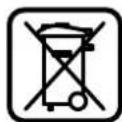
According to the European Directive 2012/19/EU on waste electrical and electronic equipment and its implementation in national law, electrical tools that are no longer usable must be collected separately and disposed of in an environmentally friendly manner.
Subject to change without notice.
Romanian
Safety and work protection instructions
Henk Becker Helmut Heinzelmann Executive Vice President Head of Product Certification Engineering PT/ETM9
Robert Bosch GmbH, Power Tools Division 70764 Leinfelden-Echterdingen, GERMANY 07.04.2014
Assembly
Mounting/changing the circular saw blade
- Before any work on the electric tool, pull the mains plug out of the socket. When mounting the saw blade, wear protective gloves. There is a risk of injury if the saw blade is touched. Only use saw blades that meet the specifications given in these operating instructions. Never use grinding discs as working tools.
Selecting the saw blade
At the beginning of these instructions you will find a list of recommended saw blades.
Removing the saw blade (see figure A)
Preselecting the speed (GKS 55+GCE)
With the speed preselecting wheel 1 you can preselect the required speed even while the machine is running.
Constant Electronic (GKS 55+ GCE)
The Constant Electronic system keeps the speed almost constant at idle and under load, ensuring a uniform working performance.
Tel. power tool service: (021) 4057540
Fax: (021) 4057566
E-Mail: infoBSC@ro.bosch.com
Tel. customer consultation: (021) 4057500
Fax: (021) 2331313
E-Mail: infoBSC@ro.bosch.com
www.bosch-romania.ro
Disposal
Power tools, accessories, and packaging must be directed to an ecological recycling station.
Do not dispose of electrical appliances in household waste!
Safety instructions for work
Be careful, concentrate on what you are doing and use the tool sensibly. Do not use power tools when you are tired or under the influence of drugs, alcohol or medication. A moment of inattention while working with power tools can lead to serious injury. Use personal protective equipment. Always wear eye protection. Protective equipment such as dust mask, non-slip safety shoes, hard hat or hearing protection used under appropriate conditions will reduce personal injuries. Prevent unintentional starting. Ensure the switch is in the off position before connecting to power source and/or battery pack, picking up or carrying the tool. Carrying power tools with your finger on the switch or energizing power tools that have the switch on invites accidents. Remove any adjusting key or wrench before turning the power tool on. A wrench or a key left attached to a rotating part of the power tool may result in personal injury. Do not overreach. Keep proper footing and balance at all times. This enables better control of the power tool in unexpected situations. Dress properly. Do not wear loose clothing or jewelry. Keep your hair, clothing and gloves away from moving parts. Loose clothes, jewelry or long hair can be caught in moving parts. If devices are provided for the connection of dust extraction and collection facilities, ensure these are connected and properly used. Use of dust collection can reduce dust-related hazards.
168|Bulgarian
Careful handling of power tools
Never operate the power tool. Use power tools only as intended. To work safely, when using a power tool, follow the manufacturer's instructions. Do not use power tools that cannot be turned on and off with the switch. A power tool that cannot be controlled with the switch is dangerous and must be repaired. Before adjusting the power tool, changing work tools or accessories, or when you are going to use the power tool for a long time, disconnect the plug from the socket and/or remove the battery pack. This precaution prevents accidental starting of the power tool. Store power tools in places where they cannot be reached by children. Do not allow them to be used by people who are not familiar with the instructions for working with them. When power tools are used by unqualified persons, they can be dangerous. Handle power tools with care. Check regularly that the moving parts function correctly, that they do not jam, and that there are no damaged parts that impair the function of the power tool. Before using the power tool, have damaged parts repaired. Many accidents are caused by poorly maintained power tools. Keep cutting tools sharp and clean. Properly maintained cutting tools with sharp edges are less likely to jam and are easier to control.
Use power tools, accessories, working tools, etc., in accordance with the manufacturer's instructions. Consider the working conditions and the specific operation to be performed.
The use of power tools for purposes different from those intended by the manufacturer can create a dangerous situation.
Instructions
Have power tool repairs carried out only by qualified specialists using original spare parts. This ensures the safety of the power tool.
Safety instructions for working with circular saws
Technical data
DANGER: Keep the disc at a distance of 30 cm from the body and from the power tool. When using the disc, the protective cover of the power tool must be in place. When the disc is used with the guard, there is a danger of the disc breaking. Do not place the disc near flammable materials. The guard may protect you from fragments of the workpiece and the tool. Adjust the depth of cut of the workpiece on the opposite side of the disc. The disc must be applied at a distance of no more than one height of the disc. Never cut a workpiece that is attached to the edge of the table. Secure the workpiece by clamping it in a stable fixture. To limit the risk of electric shock, contact with the disc, or loss of control of the power tool, it is important to switch off the power tool before changing the disc. When there is a danger during work, the worker must immediately remove the power tool from the workpiece. Do not use the power tool with a damaged or cracked disc. Use only discs with the correct dimensions and the correct bore (e.g., with a hole or a key). Discs that do not fit the spindle of the power tool may cause loss of control during work. Never use damaged or worn discs. The discs are designed specifically for your power tool and ensure safe operation. Reject and replace any disc that shows signs of damage or wear.
Sudden reaction of the workpiece, jamming, or incorrect orientation of the power tool, which may lead to uncontrolled kickback of the tool in the direction of the workpiece and the power tool;
- If the disc jams or gets stuck in the workpiece, the tool may suddenly stop, and the power tool may kick back in the direction of the workpiece and the power tool;
Bulgarian 169
The cutting disc may be pulled out of the cut incorrectly, or from the rear side, so that it gets stuck in the surface of the cut, as a result of which the cutting disc bounces off the cut in the direction of the operator. The kickback is the result of incorrect handling of the power tool. This can be avoided by taking appropriate precautions, as described below. Hold the power tool firmly with both hands and position your body and arms so that you can counteract the forces of kickback. If possible, the tool should be positioned so that the cutting disc is not in contact with the material at the point where the cut is being made, and never place the cutting disc above the material being cut. When kickback occurs, the power tool may jump back, but with proper precautions, the operator can control it. If the cutting disc becomes jammed or the work is interrupted, switch off the power tool and hold it still in the material until the disc has completely stopped. Do not attempt to remove the disc from the cut or pull it back while the disc is still moving, as this could cause kickback. Investigate and correct the cause of the jamming of the cutting disc. If you want to restart the power tool while it is in the material, center the cutting disc in the cut and check that the disc is not in contact with the material before switching on. If the cutting disc becomes jammed when starting the power tool, it may jump out of the material or cause kickback. When cutting with a guide, support the workpiece to reduce the risk of jamming and kickback. The workpiece may be pulled by the weight of the tool itself. Support the workpiece on both sides, both near the cut and at the far edge. Do not use dull or damaged cutting discs. When the discs are dull or bent in the direction of the cut, the cutting gap is too narrow, which increases friction and can lead to jamming and kickback. Before cutting, make sure that the mechanism for adjusting the cutting depth is properly adjusted. If during cutting the adjustment changes due to the forces involved, this can lead to jamming and kickback of the power tool. Special precautions should be taken when cutting in existing walls or other elements, as the surface may have hidden objects. The rotating cutting disc may hit a hidden object, become blocked, and cause kickback.
Function of the lower guard
Before operating the tool, check that the blade guard closes without problems. Do not use force, the blade guard must be able to move freely and close completely. Never grab or hold the blade guard in a position where it is open. If the blade guard is damaged, the tool must be repaired. Check the parts that may be worn or damaged, and the blade guard must be able to move freely. Check the function of the blade guard spring. If the blade guard spring does not work properly, the tool must be repaired before use. Check the parts that may be worn or damaged, and the blade guard must be able to move freely. Open the blade guard only when cutting with a special tool, e.g., cutting with a guide and a stop. Open the blade guard with the lever and release it when the cutting disc is in the workpiece. The blade guard must work automatically for other cutting operations. Do not leave the tool running on the ground, as the blade guard may be covered by the disc. Do not turn the tool over while it is running, as the blade guard may be covered by the disc. Be careful with the time it takes for the disc to stop after switching off.
Additional safety instructions for work
Do not place your hands near the exhaust openings. You may be injured by the rotating parts. Do not work with the tool in a position where you cannot control it sufficiently. Use suitable tools to reveal any hidden surfaces and follow the corresponding local regulations. Contact with live wires can cause electric shock. Damage to the power cord can cause electric shock. Damage to the workpiece can cause electric shock. Do not use stationary power tools. They are designed for work on a bench. Do not use cutting discs from a high-speed steel (HSS) saw. Such discs are brittle. Do not cut metal. The heated workpiece can damage the dust extraction system.
170|Bulgarian
For safe operation, hold the power tool firmly and ensure a stable position. Check that the power tool is switched off before connecting to the power supply. Ensure that the workpiece is secure. Use suitable accessories and hold the tool with both hands. If you leave the power tool, switch it off and wait until it has stopped completely. Otherwise, the tool may cause injury or damage to other objects.
Product description and specifications

Read all safety warnings and instructions. Failure to follow the warnings and instructions may result in electric shock, fire and/or serious injury.
Intended use of the power tool
The power tool is intended for cutting wood materials along and across the grain, and for cutting with a bevel. With appropriate saw blades, it can be used for cutting soft metals and plastics.
Do not cut ferrous metals.
Illustrated components
The numbering of the components of the power tool refers to the illustrations on the graphics pages.
1 Spindle lock button for changing the saw blade (GKS 55+GCE) 2 Lock-off button for the On/Off switch 3 On/Off switch 4 Hex key 5 Locking screw for the saw blade 6 Scale for adjusting the cutting depth
7 Wing bolt for the parallel guide 8 Wing bolt for preselecting the bevel angle
9 Marking for 45° cut
10 Marking for 0° cut 11 Parallel guide 12 Hinged chip guard 13 Lever for adjusting the hinged chip guard 14 Base plate 15 Wing bolt for preselecting the bevel angle (GKS 55+G / GKS 55+GCE)
16 Venting slots 17 Chip guard 18 Auxiliary handle (insulated gripping surface) 19 Auxiliary handle (insulated gripping surface) 20 Locking screw 21 Locking flange 22 Circular saw blade 23 Centering flange 24 Saw spindle 25 Locking screw for the dust extraction adapter 26 Dust extraction adapter 27 Locking screw for preselecting the cutting depth and bevel angle 28 Scale for adjusting the bevel angle 29 Locking lever for the parallel guide 30 Guide rail 31 Marking for the dust extraction hose* 32 Connecting piece
*The illustrations and descriptions of the accessories are not included in the standard scope of delivery. You can find a complete list of accessories in the accessories catalog.
*Standard tool (not included in the scope of delivery)
Technical data


Robert Bosch GmbH, Power Tools Division
70764 Leinfelden-Echterdingen, GERMANY
07.04.2014
Safety Instructions
General Power Tool Safety Warnings
WARNING Read all safety warnings and all instructions. Failure to follow the warnings and instructions may result in electric shock, fire and/or serious injury. Save all warnings and instructions for future reference. The term "power tool" in the warnings refers to your mains-operated (corded) power tool or battery-operated (cordless) power tool.
Selecting the saw blade
An overview of recommended saw blades can be found at the end of this manual.
Mounting the saw blade (see figure A)
For best results, use only sharp saw blades. The saw blade must be able to saw the material being cut.
- Press and hold the spindle lock button. The spindle is locked. Turn the saw blade until it engages. - Loosen the clamping screw with the hex key by turning it in the direction of the arrow. - Remove the clamping flange and the saw blade from the spindle.
Mounting the saw blade (see figure A)
First, place the saw blade on the spindle. Make sure that the cutting direction of the teeth (arrow on the saw blade) matches the direction of rotation (arrow on the protective guard).
Place the saw blade on the spindle. Make sure that the cutting direction of the teeth (arrow on the saw blade) matches the direction of rotation (arrow on the protective guard). - Place the clamping flange on the spindle. - Tighten the clamping screw with the hex key by turning it in the direction of the arrow. - Press and hold the spindle lock button. The spindle is locked. Turn the saw blade until it engages. - Loosen the clamping screw with the hex key by turning it in the direction of the arrow. - Remove the clamping flange and the saw blade from the spindle.
Place the clamping flange on the spindle. Tighten the clamping screw with the hex key by turning it in the direction of the arrow. Make sure that the clamping flange and the clamping screw are correctly seated. - Press and hold the spindle lock button. The spindle is locked. Turn the saw blade until it engages. - Loosen the clamping screw with the hex key by turning it in the direction of the arrow. - Remove the clamping flange and the saw blade from the spindle.
Dust extraction
Dust from power tools is often hazardous to health. Dust, separated from materials such as lead paint, some woods, minerals and metals, can be harmful to health. Contact with or inhalation of dust can cause allergic reactions and/or respiratory diseases in the operator or bystanders. Certain dusts, e.g. oak and beech dust, are considered carcinogenic, especially in combination with additives for wood treatment (chromate, wood preservatives). Only allow specialists to handle materials containing asbestos.
- Use a dust extraction system suitable for the material whenever possible. Ensure good ventilation of the workplace. - It is recommended to use a vacuum cleaner with a filter class P2.
Follow the relevant regulations for your country regarding the handling of such materials.
Avoid dust accumulation at the workplace.
Dust can easily ignite.
Mounting the dust extraction adapter (see figure B)
Insert the dust extraction adapter 26 into the extraction outlet 16 until it engages. Secure the dust extraction adapter 26 with the screw 25. A vacuum cleaner with a diameter of 35 mm can be connected to the adapter 26. The dust extraction adapter must not be mounted with the hose connected to the vacuum system. Otherwise, the extraction outlet may become blocked. A dust bag must not be attached to the dust extraction adapter. Otherwise, the extraction system may become blocked.
For proper and optimal dust extraction, the adapter 26 must be cleaned periodically.
Bulgarian173
Dust extraction system
Connect the vacuum hose 31 (not included in the scope of delivery). For an overview of connection options for various vacuum cleaners, see the end of these operating instructions.
The power tool can be connected directly to the socket of a universal vacuum cleaner with remote start. When the power tool is started, the vacuum cleaner starts automatically.
The vacuum cleaner used must be suitable for working with the material.
If, during operation, particularly fine dust or carcinogenic dust is produced, use a special vacuum cleaner.
Power tool operation
Operating mode
Switching on and off the power tool is excluded from the scope of this manual.
Adjusting the cutting depth (see figure C)
Adjust the cutting depth according to the thickness of the workpiece. Less depth should be set than the required cutting depth. - Loosen the locking lever 27 to set the cutting depth. Turn the circular saw away from the base plate 14 to increase the depth. Set the required cutting depth on the scale. Tighten the locking lever 27 again. If the locking lever 27 cannot be turned enough to set the cutting depth, turn the locking lever 27 slightly in the opposite direction. Then tighten the locking lever 27. Repeat this operation until the desired cutting depth can be set. - If the locking lever 27 is set to the desired cutting depth and the depth setting is not fixed, turn the locking lever 27 slightly in the opposite direction. Then tighten the locking lever 27. Repeat this operation until the cutting depth is fixed.
Adjusting the bevel angle (GKS 55+G/GKS 55+GCE)
Place the power tool with the protective guard 17 on the base plate.
Loosen the screws with hex key 8 and 15. Tilt the circular saw to the required angle on the scale 6. Tighten the screws with hex key 8 and 15 again.
Note: When cutting at an angle, the cutting depth is less than the scale reading 28.
Adjusting the bevel angle (GKS 165)
Place the power tool with the protective guard 17 on the base plate. - Loosen the screw with hex key 8. Tilt the circular saw to the required angle, reading the scale 6. Tighten the screw with hex key 8 again. Note: When cutting at an angle, the cutting depth is less than the scale reading 28.
Cutting marks

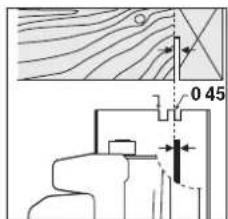
The mark 0° 10 shows the position of the saw blade when cutting at right angles. The mark 45° 9 shows the position of the saw blade when cutting at a 45° angle. For precise cutting along a line, place the circular saw on the workpiece as shown in the figure. It is advisable to make a test cut first.
Starting operation
Pay attention to the mains voltage! The voltage of the power source must match the voltage specified on the rating plate of the power tool. Tools marked with 230 V can also be operated with 220 V.
Switching on and off
- To switch on the power tool, first press the lock-off button 1 and then press the on/off switch 2. - To switch off the power tool, release the on/off switch 2.
Note: For safety reasons, the on/off switch cannot be locked in the on position; it must remain pressed during operation.
Preselecting the impact speed (GKS 55+GCE)
With the thumbwheel for preselecting the speed 1, you can change the speed of the impact mechanism according to the specific application, even during operation.
The required speed depends on the material being processed (see the recommendations in the manufacturer's instructions at the end of this manual).

Switching on and off (GKS 55+G/GKS 55+GCE)
The on/off switch locks the impact mechanism in the on position when the power tool is switched on.
Lock-off button (GKS 55+GCE)
The electronic system for limiting the starting current limits the inrush current when switching on the power tool and allows it to start smoothly with a delay of up to 16 ms.
Electronic constant speed control (GKS 55+GCE)
The electronic module keeps the speed of the impact mechanism almost constant, which ensures consistent performance under load.
Working instructions
Before any work on the machine, pull the plug out of the socket.
The electric tool is designed for even and precise cutting. The protective insulation of the working tools may be damaged by the electric tool.
The cutting performance and quality of the cut depend largely on the condition and shape of the teeth of the cutting disc. Therefore, use only sharp cutting discs suitable for the material being cut.
Cutting metal
The choice of cutting disc depends on the type of metal, its quality, and whether it is cut dry or wet.
When cutting steel/iron, sparks and chips are formed.
When cutting wood and wood-like materials, dust is generated. Therefore, work only with a dust extraction/aspiration system.
Caution: Use only sharp cutting discs intended for non-ferrous metal. This ensures a smooth cut and prevents the cutting disc from jamming.
Switch on the power tool, guide it to the cutting point carefully. Then continue with a feed motion without interruption.
For straight cuts, guide the cutting disc along the marked line. For curved cuts, always use the open side. Always release the lever for the cutting head to prevent the cutting disc from jamming and the risk of kickback.
Cutting with the guide for accelerated cutting
(See Figure D)
The guide for accelerated cutting 11 allows precise cuts to be made quickly and easily, e.g., cutting square tubes.
Loosen the screw with the hex key 7 and insert the guide for accelerated cutting 11 through the opening in the base plate 14. Set the guide to the desired depth using the corresponding marking 10 (see section "Marking for cuts"). Then tighten the screw with the hex key 7 again.
Cutting with the guide (see Figure E)
For cutting larger sheets, attach the base plate to the saw blade as a support and guide the circular saw, keeping the base plate against the sheet.
Cutting with the guide rail (GKS 55+G/GKS 55+GCE) (see figure F)
With the guide rail you can make straight cuts.
The dust guide and the saw blade guard must be adjusted for the respective application before opening the protective hood. The saw blade must be positioned correctly relative to the dust guide.
Before first use, the saw blade guard must be adjusted for working with the guide rail. To do this, set the saw blade to the maximum cutting depth. Adjust the guard so that it is approximately 9 mm above the workpiece and the cutting angle is 90°. Switch on the circular saw and move it with even feed and moderate pressure in the direction of cutting.
With the help of the connecting link 32, two guide rails can be connected. The connection is made with the four screws on the connecting link.
Maintenance and service
Maintenance and cleaning
Before any work on the power tool, remove the battery from the tool. For good and safe work, keep the power tool and the ventilation slots clean.
The protective guard must be able to move freely and close automatically. Therefore, keep the area around the protective guard clean. Remove dust and chips with a soft brush.
Regularly clean the protective hood and the saw blade guard with a soft brush. Do not use cleaning agents or solvents. To remove stubborn dirt, use a soft brush.
The saw blade guard must be cleaned regularly to ensure proper function. Use a soft brush to remove dust and chips after each use.
If the supply cord needs to be replaced, this must be done by Bosch or an authorized after-sales service centre for Bosch power tools in order to avoid a safety hazard.
After-sales service and application service
If you have any questions about our products, you can contact our after-sales service. You can find the addresses and spare parts information at: www.bosch-pt.com
According to the Technical Council, the application of the contracts for shipbuilding and ship repair in relation to the products of the accessories and equipment.
When contacting the representatives, please, temporarily add the 10-digit catalog number of the tools, indicated on the plate of the power tool.
Robert Bosch EOOD
Service Center
Warranty and out-of-warranty repair
bul. Cherni vrah 51-6
Business Center 1407
1907 Sofia
Tel.: (02) 9601061
Tel.: (02) 9601079
Fax: (02) 9625302
www.bosch.bg
Rejected
In order to preserve the environment, the power tool, accessories and packaging must be sorted for environmentally friendly recycling.
Do not throw power tools into household waste.
EC Declaration of Conformity:

In accordance with Directive 2012/19/EU on waste electrical and electronic equipment (WEEE), and as transposed into national law, this product must not be disposed of with other household waste.
It must be collected separately to enable proper treatment and recycling of the materials contained therein.
Subject to change without notice.
Macedonian
Safety Instructions
General Safety Instructions for Electrical Appliances
READ AND SAVE
Read all safety instructions carefully.
Failure to follow the safety instructions may result in electric shock, fire, and/or serious injury.
Keep the safety instructions for future use and for other users.
This appliance is intended for use with alternating current (AC) only. Do not use with direct current (DC).
Workplace Safety
Keep your work area clean and well lit. Cluttered or dark areas can lead to accidents. Do not operate the appliance in explosive atmospheres, such as in the presence of flammable liquids, gases, or dust. Electrical appliances create sparks, which may ignite the dust or fumes. Keep children and bystanders away while operating the appliance. Distractions can cause you to lose control.
Electrical Safety
The power tool must be plugged into an appropriate outlet. The plug must not be changed. Do not use adapter plugs together with earthed (grounded) power tools. Unmodified plugs and matching outlets will reduce risk of electric shock. Avoid body contact with earthed or grounded surfaces, such as pipes, radiators, ranges and refrigerators. There is an increased risk of electric shock if your body is earthed or grounded. Do not expose power tools to rain or wet conditions. Water entering a power tool will increase the risk of electric shock. Do not abuse the cord. Never use the cord for carrying, pulling or unplugging the power tool. Keep cord away from heat, oil, sharp edges or moving parts. Damaged or entangled cords increase the risk of electric shock.
Damaged cords increase the risk of electric shock.
176|Macedonian
When operating a power tool outdoors, use an extension cord suitable for outdoor use. Use of a cord suitable for outdoor use reduces the risk of electric shock. If operating a power tool in a damp location is unavoidable, use a residual current device (RCD) protected supply. Use of an RCD reduces the risk of electric shock.
Safety Warnings
Pay attention to how you work with the power tool. Do not use the power tool while you are tired or under the influence of drugs, alcohol or medication. A moment of inattention while operating the power tool may result in serious personal injury. Use personal protective equipment and always wear safety glasses. Wearing protective equipment such as a dust mask, non-skid safety shoes, hard hat or hearing protection used for appropriate conditions will reduce personal injuries. Avoid accidental starting. Ensure the switch is in the off-position before plugging in. Carrying power tools with your finger on the switch or plugging in power tools that have the switch on invites accidents. Remove any adjusting key or wrench before turning the power tool on. A wrench or a key left attached to a rotating part of the power tool may result in personal injury. Do not overreach. Keep proper footing and balance at all times. This enables better control of the power tool in unexpected situations. Dress properly. Do not wear loose clothing or jewelry. Keep your hair, clothing and gloves away from moving parts. Loose clothes, jewelry or long hair can be caught in moving parts. If devices are provided for the connection of dust extraction and collection facilities, ensure these are connected and properly used. Use of dust collection can reduce dust-related hazards.
Use and care of the power tool
Please read the instructions. Use the device only for its intended purpose. Using the device for purposes other than those intended may lead to dangerous situations. Use the device only within the specified operating range.
Do not use the device if it is damaged. If the device is damaged and cannot be switched on or off, it poses a safety risk and must be repaired. Unplug the device from the power source or disconnect it from the power supply before replacing parts, cleaning, or performing maintenance. These precautions prevent unintentional starting of the device. Keep children away from the device when not in use. Only allow individuals who are familiar with these instructions to operate the device. Electrical devices are dangerous when used by inexperienced persons. Handle electrical devices with care. Check that the power cord is not damaged or tangled, which could impair the function of the device. Replace the cord or parts before using the device. Many accidents are caused by poorly maintained electrical devices. Keep the device clean. Carefully maintain the device. Properly maintained devices are less likely to jam and are easier to control. Use the device, accessories, and attachments in accordance with these instructions. Consider the working conditions and the task to be performed. Using the device for operations other than those intended could result in hazardous situations.
Service
Repairs to your electrical device should only be carried out by qualified personnel using only original spare parts. This ensures the safety of the electrical device.
Safety instructions for circular saws
Installing the saw blade
DANGER: Do not place your hands in the cutting area or near the blade. Keep your other hand on the auxiliary handle or on the motor housing. If both hands are holding the saw, they cannot be cut by the blade. Do not reach under the workpiece. If the blade guard is under the workpiece, it cannot protect you from the blade. Always observe the workpiece thickness. The blade can be visible from below the workpiece only up to the height of the blade.
Macedonian | 177
Before turning on the device, check the device and the power cord for damage. If the device is damaged, contact the manufacturer for safety instructions. Before cleaning the board, unplug the device from the power outlet. Use an antistatic mat for work on the board, as the work area may contain hidden electrical cables or the device's own cable. Contact with electrical conductors or metal parts of the electrical device may cause an electrical shock. Always follow the safety instructions and use the appropriate tools. Before cleaning the board, check the precision of the cleaning and adjust the power according to the board's label. Always use the correct cleaning agent (e.g., with a diamond or ceramic tip). The cleaning agents for the board, which are recommended by the manufacturer, are not dangerous if used according to the control instructions. Never use acidic or abrasive cleaning agents for the board. The cleaning agents for the board are specially designed for your board, for optimal work without danger. Always wear protective goggles and appropriate safety equipment.
- The return stroke is an unexpected reaction of the board, such as bending, breaking, or incorrect cutting of the board, which can cause the board to be thrown or to be pulled under the device being processed. If the board is bent or broken during the cutting process, it can be ejected, and the motor power can throw the board under the device being processed. If the board is bent or incorrectly cut, the board's edge can catch on the surface of the device being processed, and the board can be pulled into the cutting process, and the board is pulled under the device being processed. The return stroke is the last possible use of the board. It can be prevented with appropriate safety measures, as described.
Before starting the board, hold it with both hands and place it in a position where you can control the return stroke. Always use the board's safety guard, never place the board in the same line as your body. In case of a return stroke, the board may jump backwards, but the user can control it if they follow the appropriate safety measures. Since the board's label is visible and you can see the work area, check that the board is held firmly and safely in the device being processed, while the board is
in the process of moving. Never try to pull the board out of the device being processed or pull it backwards, while the board is in motion, as this may cause a return stroke. Open the safety guard for the board and follow the appropriate safety measures.
After the workpiece has been machined, the blade guard should be returned to its original position and checked to ensure that it is properly engaged. If the blade guard is not properly engaged, it may come off the workpiece during machining and cause a serious injury. Use the guard with the blade guard fully covering the blade. The blade guard may be lifted for certain operations. The guard must be open on both sides, both near the workpiece and at the rear. Do not use the blade without the guard. The blade guard is not a proper guard for all operations; it is designed for certain cuts and may require additional adjustments. Always use the guard with the blade guard fully covering the blade. If the guard is not properly adjusted, the blade may be exposed and cause a serious injury. Be especially careful when cutting in confined spaces, such as in a corner. The blade guard may be removed for cutting in certain situations, but this may cause a serious injury.
Function of the lower blade guard
Before use, check that the lower blade guard closes properly. Do not use the saw if the lower blade guard does not move freely and close instantly. Never clamp or tie the lower blade guard in the open position. If the saw is accidentally dropped, the lower blade guard may be bent. Open the lower blade guard with the retracting lever and make sure it moves freely and does not touch the blade or any other part at all angles of cutting depth. Check that the lower blade guard spring returns the guard to the closed position. If the lower blade guard and the spring are not operating properly, the saw must be serviced before use. Damaged parts, guards, or springs must be repaired or replaced by an authorized service center. Open the lower blade guard with the retracting lever for special operations such as plunge cuts and compound cuts. Open the lower blade guard
178|Macedonian
with the retracting lever and release it, and make sure the guard closes completely. Before working with the saw, the lower blade guard must be closed automatically.
Never place the saw on the workbench or floor unless the lower blade guard covers the blade completely. The exposed blade will cause the saw to move backwards and cut whatever is in its path. Be aware of the time required for the blade to stop after the switch is released.
Additional safety warnings
He ja fakajte ncfpnehata ctpyrottna co paue. Moke da se noBpeNTe oD potnpaRKite denOVI. Ne rabotete so plATA na INaPOn. Togash nemate IOVONJa KOntrola vrz eNEKTRICHNIOT aparat. Koristete soodvetni uredi za prebivawe, za da ne pronajdete skrieni električni kabli. Pridržuvajte se na lokalnite propisi za sobirawe so električna energija. Kontaktot so električni kabli može da dovede do požar i električen udar. Otvoruvanjeto na gasovodot može da dovede do eksplozija. Naleganjeto vo vdolžni seci može da predizvika oštećuvanje i može da predizvika električen udar. Ne go fiksirajte električniot aparat. Toj e predviden za rabota na masa za sečenje. Ne koristete listovi na pilata od HSS-čenikite; listovite na pilata može lesno da se skrijat. Noseće železni metali. Drugite modeli može da go zapalat vklučuvanjeto na prav. Pri rabotata, držete go električniot aparat čisto so dve race i zastanete vo sigurna položba. So električniot aparat posigurno ke upravuvate ako go držite so dve race. Zašitete go materijalot što se obrabotuva. Dokolku go zašitite so urez za zatezuvanje ili menuvate, togash pravilno što se obrabotuva se rizikot od povreda so vašata raka. Počekajte dodeka električniot aparat sosema ne prekine so rabota, pred da go trgnete nastrana. Aparatot što e vmetnat može da se voklira od povrede do dlaboka kontrola na uređajot.
Description of the product power

Read all the safety instructions. Injuries occur as a result of not following the safety instructions and can cause electric shock, fire, and/or serious injury.
Intended use
The electric appliance is intended for making clinical incisions on soft tissue and bone. With appropriate blades for the saw, it can also cut thin non-ferrous metals, e.g., aluminum. Processing of ferrous metals is not allowed.
Component illustration
The numbering of the figures with components refers to the illustration on the front side.
1 Knob for setting the cutting depth (GKS 55+ GCE) 2 Switch for switching on/off 3 Locking button for switching on/off 4 Lock-off button 5 Knob for locking the cutting depth 6 Scale for cutting angle 7 Guide for parallel guide 8 Locking knob for parallel guide 9 Marking for 45° cut 10 Marking for 0° cut 11 Parallel guide 12 Protective guard with retracting mechanism 13 Lever for retracting the protective guard 14 Base plate 15 Locking knob for adjusting the cutting depth (GKS 55+ G/GKS 55+GCE) 16 Spindle lock 17 Protective guard 18 Handle (insulated gripping surface) 19 Auxiliary handle (insulated gripping surface) 20 Saw blade 21 Cutting line indicator 22 Saw blade mounting flange 23 Cutting line indicator 24 Spindle 25 Guide for dust extraction adapter 26 Dust extraction adapter 27 Scale for adjusting the cutting depth of the saw blade 28 Scale for adjusting the cutting depth 29 Cutting angle scale 30 Saw blade 31 Saw blade 32 Saw blade* *The accessory shown is not included in the standard scope of delivery. The complete accessory can be found in our accessory program. Commercially available (not included in the scope of delivery).
Macedonian | 179
Technical data
| Раuna кроча плura | GKS 165 | GKS 55+G | GKS 55+GCE |
| Бpoj на дeн/артник | 3601F761..3601F820..3601F821.. |
| Homina на щачина W110012001350 | | | |
| Бpoj на прашии вретжни min-1 | 490049002100-4700 | | |
| мас.данына на сеvelе сдпаметар на лимс Tod на пьлалда 165mm | | | |
| - рпс агел на кос сеvelе 0° MM | 66 | 63 | 63 |
| - рпс агел на кос сеvelе 45° MM | 47 | 47,5 | 47,5 |
| Блесада за вретенот ● | | | |
| Од再多ва bene на бpoj на вретжни | - ● | | |
| Константа[elektroнika | - ● | | |
| Оратноува bene насторнаструja | - ● | | |
| Кочнице за Incфрильные od 6рзни | - ● | ● | |
| Дименэнни на ochobнatable плоча MM | 235x138x8 | 252x194x8,5 | 252x194x8,5 |
| Димаметар на лимстовlete за плалata MM | 165 | 165 | 165 |
| Овор за пирфатot MM | 20 | 20 | 20 |
| Текина соглесно EPTA-Procedure 01/2003 | KΓ | 3,6 | 3,8 |
| Клaca на заштоа | | ☐/II | ☐/II |
The voltage must match the voltage [U] on the nameplate, 230 volts. The voltage may vary depending on the power supply, depending on the country.
Information on vibration
| Вреedingн'tе на(emисиа насычава
odредени во с胃肠ноct co
EN 60745-2-5. | GKS 165 | GKS 55+G | GKS 55+GCE |
| 3601 F76 1.. 3601 F82 0.. 3601 F82 1.. |
| Новота на звекha у畴ет, оменeto
со А, тимочиюзhecува
Новота звуен припесок | dB(A) | 89 | 89 |
| Новота звуна щачиа | dB(A) | 100 | 100 |
| Hecigурноct K
Hocete зашита за сныхот! | dB | 3 | 3 |
| Вкульные刚好
ocumuлaciaja ah(Бекторски збир ha
trite pretрави) и с胃肠ноctaК ce
odредуват с胃肠но EN 60745:
Сеценье на дрово: | | | |
| ah | m/s2 | 4,0 | 4,0 |
| K | m/s2 | 1,5 | 1,5 |
| Сеценье на метал: | | | |
| ah | m/s2 | <2,5 | <2,5 |
| K | m/s2 | 1,5 | 1,5 |
The vibration level given in these instructions has been measured in accordance with the standard EN 60745 and can be used for comparison with other power tools. It can also be used for a preliminary assessment of exposure to vibration. The stated vibration level is for the main applications of the power tool. If the power tool is
used for other applications, with different accessories, or is not maintained properly, the vibration level may differ. This can significantly increase the exposure to vibration over the total working period. For an accurate assessment of the exposure to vibration, the periods when the tool is switched off or when it is running but not actually being used must also be taken into account. This can significantly reduce the exposure to vibration over the total working period.
180 | Macedonian
during the entire period of work, not just at the moment of use. This can significantly reduce the exposure to vibration over the total working period.
Take additional safety measures to protect the operator from the effects of vibration, such as: maintaining the power tool and accessories, keeping hands warm, organizing work patterns.
Declaration of Conformity

We declare under our sole responsibility that the product described under “Technical data” is in conformity with the following directives: 2011/65/EU, 2014/30/EU, 2006/42/EC including their amendments and is in accordance with the following standards: EN 60745-1, EN 60745-2-5.
Technical file (2006/42/EC) at: Robert Bosch GmbH, PT/ETM9,
70764 Leinfelden-Echterdingen, GERMANY
Henk Becker Executive Vice President Engineering
Helmut Heinzelmann Head of Product Certification PT/ETM9

Robert Bosch GmbH, Power Tools Division 70764 Leinfelden-Echterdingen, GERMANY 07.04.2014
MoHTaxa
CTabaBe/MehyBaBe Ha NHCOT 3a KpyxHaTa HnHa
- PjeD 6nO KaKaBa HHTepBHeHJa Ha eNEKtpHuHNot anapat, n3BnepeTe ro cTpjHnot npKnpyok oS nHaTDAdo3N3a. Pn CTABaBeto HA NCTOT HA NINATA HOCETE 3AUHTTH paKaBHUN. IOKOnKy IOniPete NCTOT HA NINATA NOCTO onACHOT OD Nobpega. Kopnctete cmo nhtobh 3a nna, kon odtoBapaat Ha KapaktepncntuHnte noatau nn daeHH BO OBA ynatcBo 3a ynotpe6a. B0 HKOJ cnyaj He KOpHCTe DnCKOBn 3a 6pyceHe KaO aIaT3a BMETHyBaHe.
BpaheHaHnCTo3nnata
Pperneot3a npenopauahnnctobn 3a nnnaKe ro hajte Ha kpaot od oba ynatCTBO.
DEmoHTaKa Ha NcTOT Ha NnTaTA (BmHcnKkA)
Pn3aMeHa aIalot, Hajdo6o e da ro nocabnte enektpHHHT anapat Ha cenHata cTpaHa oN KyKuHTeHO MOTOPT.
- PnHTNCHErTO KOHcTe 3a 6NOKaHa H BpTeHOTo 5 n DpKTe rnpTNCHATO. KoNHTo3a6nOKnpeHaBpTeHOTo5aKTHBnpaJte ro caMoDOKONky BpTeHOToHaHHNaTaE BoCoTojBaHa
MnpyBaHe. Hnaky eNeKtpuHnO t anapat MoKe da ce OHTETN.
- OaBpTe ro 4 3ate3Hnot upaΦ 20 co Hh6yc Knyu BO npabeue Ha BpTeHe 0. HaBaIe ja Haa3a3d 3aunTHata xay6a co nobpaTeH mExAHn3AH 12 nDpKete jaUbpcTo. I3BaTe ja cTe3HaTnPnPa6Hmua 21 nNCTOT 3a nnata 22 od BPteHTo HA nnata 24.
MoTHPpaBe Ha NCTOT3a HnnaTAta(BHn CnHaA)
Pn3aMeHa HAIATOT, HajdoBo e da ro nocbnte enektpuHnOt anapat ha YenHata cTpaHa oN KyKuHTeTo Ha MOTOPOT.
IcHCTeToNCTOT3aPiNlata22nCHTeCTe3HNDeNOBNI TO CE MOHTpaat. HaBane ja HaHa3a3d 3aaTmTHata xay6a co NOBpateH MEXAH3AH 12 N DpxKeTe ja Ubpcto. IocTabete ro nhtot ha nnilata 22 Ha npknnyhata npnaBnHa 23. Napaeot Ha ceyehe Ha 3aunHTe (npabeot HA cTpekata Ha nHcTOT 3a nnilata) Mop a Da oDRObapa Ha cTpekata 3a npabeu Ha BpTeHe Ha 3aUHTHATA xay6a17. IocTabeTe ja cTe3HATA npnpa6hNua 21 n3aWpaFete ro 3aTe3HOT upaΦ20 Bo npBaEu Ha BPteHe ②. BHIMABaJIe Ha npabnHHa NpOxKa ha MoHTHpAbe Ha npKnYnHa Tnpa6HnHa 23 nCTeHAta npnPaHnHa 21. - PnHTNCHErTO KOJIeTO 3a 6IOKaHa HbPeTeHOTo 5 n DpKTeTo pNHTNCHATO. -3aBPCTeTe fo 4 3aTe3HHT upaΦ 20 co Hb6c Kny BO npabeu Ha BPteHe ●. MometOT Ha 3aterhe Tpe6a Da HnEcyBa 6-9 Nm, wto Orobapa Ha paHo 3aterabe nIyc 4BPteHe.
Dust extraction hose
- Connect the hose to the electrical appliance, then insert it into the dust extraction opening. Work with materials such as wood, lead, stone, minerals, and metals may be harmful to health. Contact with or inhalation of this dust can cause allergic reactions and/or respiratory diseases in the user or bystanders.
Certain dusts, such as oak and beech dust, are classified as carcinogenic, especially when combined with additional substances (chromium, wood preservatives). Materials containing asbestos may only be processed by specialists.
As far as possible, use a suitable extraction device for the material being processed. Ensure good ventilation of the work area. It is recommended to wear a protective mask when sanding with P2 filter class.
Pay attention to the relevant regulations and your local laws regarding the material you are processing.
Macedonian 181
Avoid collecting dust at the workplace. Dust can easily ignite.
Mounting the extraction adapter (see figure B)
Mount the extraction adapter 26 onto the dust extraction outlet 16 until it engages. Remove the extraction adapter 26 by turning it counterclockwise. An extraction hose with a diameter of 35 mm can be connected to the extraction adapter 26. The extraction adapter must not be mounted without an attached external extraction system. The extraction hose can become clogged. Do not connect a dust bag to the extraction adapter. The extraction system can become clogged.
For optimal extraction, the extraction adapter 26 must be cleaned regularly.
External extraction
Connect the extraction hose 31 to the dust extraction adapter (accessory). The adapter for connecting different hose diameters and dust extraction adapters can be found at the end of this section.
The electrical appliance can be connected directly to the socket of a Bosch vacuum cleaner with a remote start feature. The vacuum cleaner starts automatically when the electrical appliance is switched on.
The dust extractor must be suitable for the material being processed.
When extracting particularly hazardous, carcinogenic, or allergenic dusts, use a special dust extractor.
Before using the electrical appliance, read the operating instructions carefully.
Adjusting the cutting depth (Fig. C)
Adjust the cutting depth of the saw blade to be used. The blade to be used must protrude from the lower base by at least the full tooth height. Loosen the locking screw 27. For small cutting depths, press against the base plate 14, and for larger ones, press against the base plate 14. The required cutting depth is indicated on the scale for cutting depth. Tighten the locking screw 27 again. If the cutting depth cannot be set exactly after loosening screw 27, pull the locking screw 27 out of the base and insert it again. Loosen screw 27 again. Repeat this procedure until the desired cutting depth is set.
If the cutting depth cannot be set exactly after loosening screw 27, pull the locking screw 27 out of the base and insert it again. Loosen screw 27 again. Repeat this procedure until the desired cutting depth is set.
Adjusting the bevel angle (GKS 55 + G / GKS 55 + GCE)
First, place the power tool on the protective guard 17. Loosen the wing screws 8 and 15. Tilt the base plate. The required cutting angle is indicated on the scale 6. Tighten the wing screws 8 and 15 again.
Note: When adjusting the bevel angle, the cutting depth is less than the maximum value indicated on the scale for cutting depth 28.
Adjusting the bevel angle (GKS 165)
First, place the power tool on the protective guard 17. - Loosen the wing screw 8. Tilt the base plate. The required cutting angle is indicated on the scale 6. Tighten the wing screw 8 again.
Note: When adjusting the bevel angle, the cutting depth is less than the maximum value indicated on the scale for cutting depth 28.
Cutting marks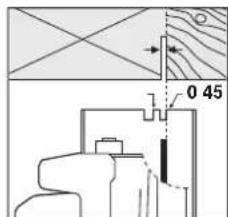

The cutting mark 0° 10 shows the position of the blade from the base when cutting at 0°. The cutting mark 45° 9 shows the position of the blade from the base when cutting at 45°. For example, set the circular saw blade to be processed as shown in the figure. It is best to make a test cut.
Putting into operation
Check the electrical voltage! The voltage on the back of the device must correspond to the one indicated on the specification plate of the electrical device. Electrical devices marked with 230 volts can also be used on 220 volts.
Switching on/off
To start the electrical device, first activate the switch by pressing the on/off switch (2). To switch off the electrical device, press the on/off switch (2) again.
Note: For safety reasons, the on/off switch (2) must not be blocked, as it must remain accessible during operation.
Setting the speed dial (GKS 55+GCE)
Using the speed dial (1), you can set the required speed for the duration of use of the device.
The required speed depends on the type of material being processed (see the table for material processing).
Speed pre-selection
(GKS 55+G/GKS 55+GCE)
The pre-selected speed limits the maximum speed of the electrical device.
Limiting the starting current (GKS 55+GCE)
The electronic starting current limitation reduces the current surge when switching on the electrical device and enables operation on a 16-A fuse.
Constant electronics (GKS 55+GCE)
The constant electronics keep the speed constant under load and enable a constant speed during operation.
CobTeH np pa6oTeBeto
3aHTTe FN HCTOBITE 3a Hnata Oyapn.
Bodete ro ekeKTPHNNOT anapat pAmHomepHo co nceeh PnTNCOK BO nPabeUOT Ha ceeHe. PteCINHATA 6p3Ha 3HAeTHIO RO HAmAYBa POKOT Ha yNtPeBa ha ekeKTPHHHOJ AHATMy WITETH HAEKEKTPHHHOHT anapat
JauHnata Ha nHnata KBAJHTeT O HA CEYeBeto 3aHuHTENHO 3aBCaT OD CoctOjBaTa H FOPMATA Ha 3aIcTe H AINCTOT 3a HnHata. 3aToA KopHeCTe cMo AOCTPH H COOBETHN INCTOB0 3a HnHa 3a Denot UTo ro 06pAbOTyBe.
CeebeHaDpBo
IpaBnHnHOT h6Op HnHCT 3a HnNata 3abHCn OJ BnD0T, KBAIHTeTO HaDPBoTO No TOA daJIe Ke ce npBaBATOJOLKINHCKN MHN HapEnyH peBOH.
PnDIOKHHCKpe3OBHaCmpeKN,HactaHyBaatdoHN, CNpAPAHCTpyrTOHH.
PpabTa 10to HactaHbA npn 6opabOtka Ha da6 6yKa e oco6eHO tTeHa nO dpabjero, 3atoa paobotere co BIMkyBa4 3 npab.
HanomeHa: KopHCTete octap nHTnna noroDen NcknyHb 3aHexeE3n MetaJI. OBA oO3MOxyBa uCT pe3 H ro cnpeuyBa 3aIaNabyBHeTo Ha nCTOT od nIIata.
BoTeToBkUeyHnToEKeTpHuAnapatHaJeNtItoCe 6pa6oTyBa HBMATEHo CeTeTo. Pa6oTeHa KpaJ co manoDbKHeBe Hnpedn npdoJKeTe 6e3 npkeHH.
PnceHe Ha npoHn, cekorai 3anOHyBajte co cehe He naotechata cTpaha, Ka UnpoHn He noHyBajte Ha OTbOpeha TcpaHa. 3auBpcTe He nOJInrte npoHn, 3a Da H3eRhe Ta3nAByBaHe Ha NCTOT O nnIATA N nobPaten ydpar Hne ENEKTPNHTANAPAT.
Ceebe co npaaneH rpaHHNK (BnDn CnKa D)
PapanenHnHOTpranuHnK11OB03MOKyBa npeu3nHn pe3oBN noDOnJHKHaTa HaJeToIto Ce o6pa8OyBa,KakoHa npMmep CeeBHe Na HeHTN CO ICHN DHMEn3HN.
- OJBPTete ja nenepytka 3abptkata 7 H typheTe ja ckanata Ha napaneHHNHTrpanHHHn1 1Hm OTbOPOHa OHCHBHATA nnoa14. NocTaBeJa cakHaTHeuHHHa HeceHe KaKo BpeHIOCT Ha CKaIATA Ha COODBeTHATA O3HaKa3eCehbe 10 OINH.9, BNDTe BOJeIOT, O3HaKn3aCeHeBe." NobTOPHo 3auBpCTeJa nenepytka 3abptkata 7.
Guide rail (see Appendix E)
For processing large panels or for cutting straight cuts, the guide rail can be used as an auxiliary guide for guiding the circular saw along the main plate along the length of the guide rail.
Cutting with guide rail (GKS 55+ G/GKS 55+ GCE) (see Appendix F)
With the guide rail you can make straight cuts.
The guide rail's anti-slip coating serves as protection against slipping, which prevents the saw from slipping on the surface of the workpiece. Therefore, the rail's anti-slip coating must always be placed directly on the workpiece.
The guide rail can be used with the circular saw for cutting panels at speed.
First, place the guide rail at the desired length on the workpiece. Place the anti-slip coating 9 mm away from the cutting line. Turn on the circular saw and guide it evenly with steady placement in the straight cut.
With the connecting piece you can join two guide rails. The connection is made with the help of the four screws that are attached to the connecting piece.
Maintenance and service
Maintenance and cleaning
Before any intervention on the electrical device, pull the plug out of the socket.
Srpski | 183
Keep the electrical device clean and open for inspection, so that it can work well and safely.
The protective hood with lifting mechanism must always be able to move freely and must not be closed. The area around the protective hood with lifting mechanism must always be clean. Remove dust and chips with compressed air or with a brush.
Emergency stop for the saw can be triggered by pressing the switch. Before cutting, remove the oil so that no stains remain on the wood.
Read the safety warnings and instructions that come with the power tool. Failure to follow the safety warnings and instructions may result in electric shock, fire, and/or serious injury.
If it is necessary to use an extension cord, use only an extension cord that is suitable for the power tool's power rating. To avoid the risk of electric shock, use only extension cords that are approved for outdoor use.
After-Sales Service and Application Advice
The after-sales service will answer your questions regarding repairs and maintenance of your product as well as spare parts. Exploded views and information on spare parts can be found at: www.bosch-pt.com
The Bosch application advice team will be happy to help you if you have any questions about our products and their accessories.
Please quote the 10-digit article number on the product nameplate when ordering spare parts.
Macedonia
D.D. Enkips
Saba Kovačević 47H, no. 3
1000 Skopje
E-mail: dimce.dimcev@servis-bosch.mk
Internet: www.servis-bosch.mk
Tel./fax: 02/2467610
Mobile: 070595888
Disposal
Electrical appliances must be disposed of separately from household waste.
Do not dispose of electrical appliances in household waste!
Only for EU countries

According to the European Directive 2012/19/EU on waste electrical and electronic equipment (WEEE), electrical appliances that are no longer usable must be collected separately and recycled in an environmentally friendly manner.
Serbian
Safety Instructions
General Power Tool Safety Warnings
A WARNING
Read all safety warnings and all instructions.
Failure to follow
Henk Becker Helmut Heinzelmann Executive Vice President Head of Product Certification Engineering PT/ETM9

Robert Bosch GmbH, Power Tools Division 70764 Leinfelden-Echterdingen, GERMANY 07.04.2014
Assembly
Mounting/Changing the Circular Saw Blade
Before any work on the power tool, pull the mains plug out of the socket. When mounting the saw blade, wear protective gloves. Touching the saw blade poses a risk of injury. Use only saw blades that match the characteristic data specified in these operating instructions. Never use grinding discs as a working tool.
You will find an overview of recommended saw blades at the end of these instructions.
Removing the saw blade (see figure A)
For changing tools, best place the power tool on the side of the motor housing.
- Press the spindle lock button 5 and hold it down. Activate the spindle lock button 5 only when the saw spindle is at a standstill. Otherwise, the power tool may be damaged.
- Using the hex key 4, unscrew the clamping screw 20 in the direction of rotation 1.
- Swing the pendulum protective guard 12 back and hold it firmly.
- Remove the clamping flange 21 and the saw blade 22 from the saw spindle 24.
Mounting the saw blade (see figure A)
For changing tools, best place the power tool on the side of the motor housing. Clean the saw blade 22 and all clamping parts. Swing the pendulum protective guard 12 back and hold it firmly.
- Place the saw blade 22 onto the receiving flange 23. The cutting direction of the teeth (direction of the arrow on the saw blade) and the rotation direction arrow on the protective guard 17 must match.
- Place the clamping flange 21 and screw in the clamping screw 20 in the direction of rotation. Pay attention to the correct seating and assembly of the receiving flange 23 and the clamping flange 21.
- Press the spindle lock button 5 and hold it down.
- Tighten the clamping screw 20 firmly with the hex key 4 in the direction of rotation. The tightening torque should be 6-9 Nm, which corresponds to hand-tightening plus 1/4 turn.
Dust extraction/chip removal
Pull the mains plug from the socket before carrying out any work on the power tool. - Dust from materials such as lead-containing coating, some types of wood, minerals and metal can be harmful to health. Contact or inhalation of dust can cause allergic reactions and/or respiratory diseases of the worker or persons in the vicinity.
Some dust, e.g. from oak or beech wood, is considered carcinogenic, especially in connection with wood treatment additives (chromates, wood preservatives). Material containing asbestos may only be worked on by specialists.
- Use dust extraction as much as possible, suitable for the material. Ensure good ventilation of the workplace. - It is recommended to wear a breathing mask with filter class P2.
Henk Becker Helmut Heinzelmann Executive Vice President Head of Product Certification Engineering PT/ETM9

Robert Bosch GmbH, Power Tools Division 70764 Leinfelden-Echterdingen, GERMANY 07.04.2014
Assembly
Executive Vice President
Engineering
Helmut Heinzelmann
Head of Product Certification
PT/ETM9


Robert Bosch GmbH, Power Tools Division
70764 Leinfelden-Echterdingen, GERMANY
07.04.2014
Assembly
General Safety Instructions
CAUTION
Executive Vice President Engineering
Helmut Heinzelmann
Head of Product Certification PT/ETM9


Robert Bosch GmbH, Power Tools Division 70764 Leinfelden-Echterdingen, GERMANY 07.04.2014
Assembly
Installing/Replacing the Saw Blade
Executive Vice President
Engineering
Helmut Heinzelmann
Head of Product Certification
PT/ETM9

Robert Bosch GmbH, Power Tools Division
70764 Leinfelden-Echterdingen, GERMANY
07.04.2014
Assembly
Saw blade replacement
Before servicing or maintaining the power tool, pull the plug out of the socket. Wear protective gloves when changing the saw blade. Touching the saw blade can cause injury. Use only saw blades that comply with the parameters specified in these instructions. Under no circumstances use grinding discs as tools.
Saw blade selection
Executive Vice President Engineering
Helmut Heinzelmann
Head of Product Certification PT/ETM9
Ppa

Robert Bosch GmbH, Power Tools Division 70764 Leinfelden-Echterdingen, GERMANY 07.04.2014
Assembly
Inserting and changing the saw blade
2012/19/EU

1
Jz
Lg 10000000000000000000000000000000000000000000000000000000000000000000000000000000000
#
The user manual is provided in English. The original text is garbled and not in English, so it is unusable.
The text is garbled and not in English, so it is unusable.
The text is garbled and not in English, so it is unusable.
(Dgajglj) gjlglgoo
The text is garbled and not in English, so it is unusable.
The text is garbled and not in English, so it is unusable.
(Egajgl) sclua sao go mill
The text is garbled and not in English, so it is unusable.
(GKS 55+G/GKS 55+GCE) a gill a s w go jull (F ojgall
The text is garbled and not in English, so it is unusable.
The text is garbled and not in English, so it is unusable.
-1
∴ 1,2,3
- l 01 l 02
(GKS 55+G/GKS 55+GCE) aIJI bJg
17 aIgll.ubacagcIgulgSsI OssJ 15 g8 uaiuall uugull 6 wauallglggejllwauall bao 15 g8 uaiuall uugull Goc uogkaylal all ggbgajL sic:abalo Goc wgaolglglljuaaall no j201 gboJI 28 gboJI
(GKS 165) aIaJI bIbJI lgj bIgJ 17 aIgJI Ibc agc Jc aJI gJI oJI sJI JsOJ .aJI
daijlc bnlgJgJgoo JJwS1 -
aUolg calJI 12 jaiJl ayIgll Uc -pL
122JwaiJwag 21 wai aaw gji - .24 Jwai
(A ojgall j) Jai j
JUaJIJIaJI JcWuJSLoJU JUaJI JIJI
yglbail gabgazjuiial jai cbi
Lgusj
duuolg calJU 12 aJauJIaLgJU Lbc JI -
23 22 22 jai j - (jai jgwlol) jliwJg
17 aIgll lge IJgdl oai ggo (Jiaiall) 20 wll lgUg21 wll dawu
Executive Vice President Head of Product Certification
Engineering PT/ETM9
Robert Bosch GmbH, Power Tools Division
70764 Leinfelden-Echterdingen, GERMANY
07.04.2014


(GKS 55+GCE)
(GKS 55+GCE)
| GKS 55+ GCE | GKS 55+ G | GKS 165 | | \( \mu \) in \( \mu \) in \( \mu \) in \( \mu \) in \( \mu \) in \( \mu \) in \( \mu \) in \( \mu \) in \( \mu \) in \( \mu \) in \( \mu \) in \( \mu \) in \( \mu \) in \( \mu \) in \( \mu \) in \( \mu \) in \( \mu \) in \( \mu \)\( \mu \) |
| 3 601 F82 1.. | 3 601 F82 0.. | 3 601 F76 1.. | |
| | | | \( \mu \) in \( \mu \) in \( \mu \) in \( \mu \) in \( \mu \) in \( \mu \) in \( \mu \) in \( \mu \) in \( \mu \) in \( \mu \) in \( \mu \) in \( \mu \) in \( \mu \) in \( \mu \) in \( \mu \) in \( \mu \) in \( 1.5 \) |
| 86 | 89 | 89 | dB(A) | \( \mu \) in \( \mu \) in \( \mu \) in \( \mu \) in \( \mu \) in \( \mu \) in \( \mu \) in \( \mu \) in \( \mu \) in \( \mu \) in \( \mu \) in \( \mu \) in \( \mu \) in \( \mu \) in \( \mu \) in \( \mu \) in \( \mathbf{J} \) |
| 97 | 100 | 100 | dB(A) | \( \mu \) in \( \mu \) in \( \mu \) in \( \mu \) in \( \mu \) in \( \mu \) in \( \mu \) in \( \mu \) in \( \mu \) in \( \mu \) in \( \mu \) in \( \mu \) in \( \mu \) in \( \mu \) in \( \mu \) in \( \mu \)\( \mu \) in \( \mu \) in \( \mu \) in \( \mu \) in \( \mu \) in \( \mu \) in \( \mu \) in \( \mu \) in \( \mu \) in \( \mu \) in \( \mu \) in \( \mu \) in \( \mu \) in \( \mu \) in \( \mu \) in \( \mu \) in \( \mu \)(K (C) \( \mu \) in \( \mu \) in \( \mu \) in \( \mu \) in \( \mu \) in \( \mu \) in \( \mu \) in \( \mu \) in \( \mu \) in \( \mu \) in \( \mu \) in \( \mu \) in \( \mu \) in \( \mu \) in \( \mu \) in \( \mu \) in \( \mu ) \) |
| 3 | 3 | 3 | dB | |
| | | | \( \mu \) in \( \mu \) in \( \mu \) in \( \mu \) in \( \mu \) in \( \mu \) in \( \mu \) in \( \mu \) in \( \mu \) in \( \mu \) in \( \mu \) in \( \mu \) in \( \mu \) in \( \mu \) in \( \mu \) in \( \mathbf{J} \) |
:psg (2006/42/EC) 19 Robert Bosch GmbH, PT/ETM9, 70764 Leinfelden-Echterdingen, GERMANY
Henk Becker Executive Vice President Engineering
Helmut Heinzelmann Head of Product Certification PT/ETM9

Robert Bosch GmbH, Power Tools Division 70764 Leinfelden-Echterdingen, GERMANY 07.04.2014
. 1
Laaas aS sS oLaWl gI JI bao 1JSS JI Ss WgolplojUg
sijolai
oJdui
jI sI jS sIgaiw y SLoJ aSgil jSgai
w g y b j 1234567890 j 9 100 j 9 100 j 9 100 j 9 100 j 9 100 j 9 100 j 9 100 j 9 100 j 9 100 j 9 100 j 9 100 j 9 100 j 9 100 j
CC
jI JgJgUgUgUgUgUgUgUgUgUgUgUgUgUgUgUgUgUgUgUgUgUgUgUgUgUgUgUgUgUgUgUgUgUgUgUgUgUgUgUgUgUgUgUgUgUgUgUgUgUgUg U2006/42/EC EN 60745-2-5.EN 60745-1:
13
(a) (a) (a) (a) 14
μggljgljgsga 15
(GKS55 + G / GKS55 + GCE)
oJ Sg dui j 16
17
(juL uSgJU) dW 18
(jusgj)Sasdiu 19
wlgjaggu 20
(jjgo) jqo jiL21
*0jdu22
(jj0g) jj1jjj23
0j jg24
* uSo oSioiwo (u) jgj 25
* uSo oIiJus (gglj) gJgJlJ 26
wjgoc ylaui sly jqo 27
28
** Luy ou cua 29
laoljUJ 30
*uSo 31
*Julai cab32

__SUPPIMER__


2608438693

1619X01612

1600200005(800mm)
1600200006(1100mm)
1600 ZOO 00F (1600 mm)
1600Z00007 (2100 mm)
1600200008 (3100 mm)

1600200009

1600Z0000B
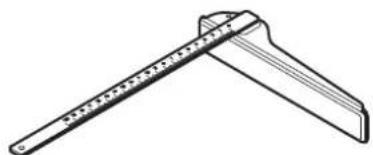
1608190007