
GAS 35 L SFC+ Professional - Vacuum Cleaner BOSCH - Free user manual and instructions
Find the device manual for free GAS 35 L SFC+ Professional BOSCH in PDF.
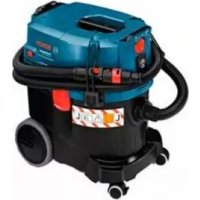
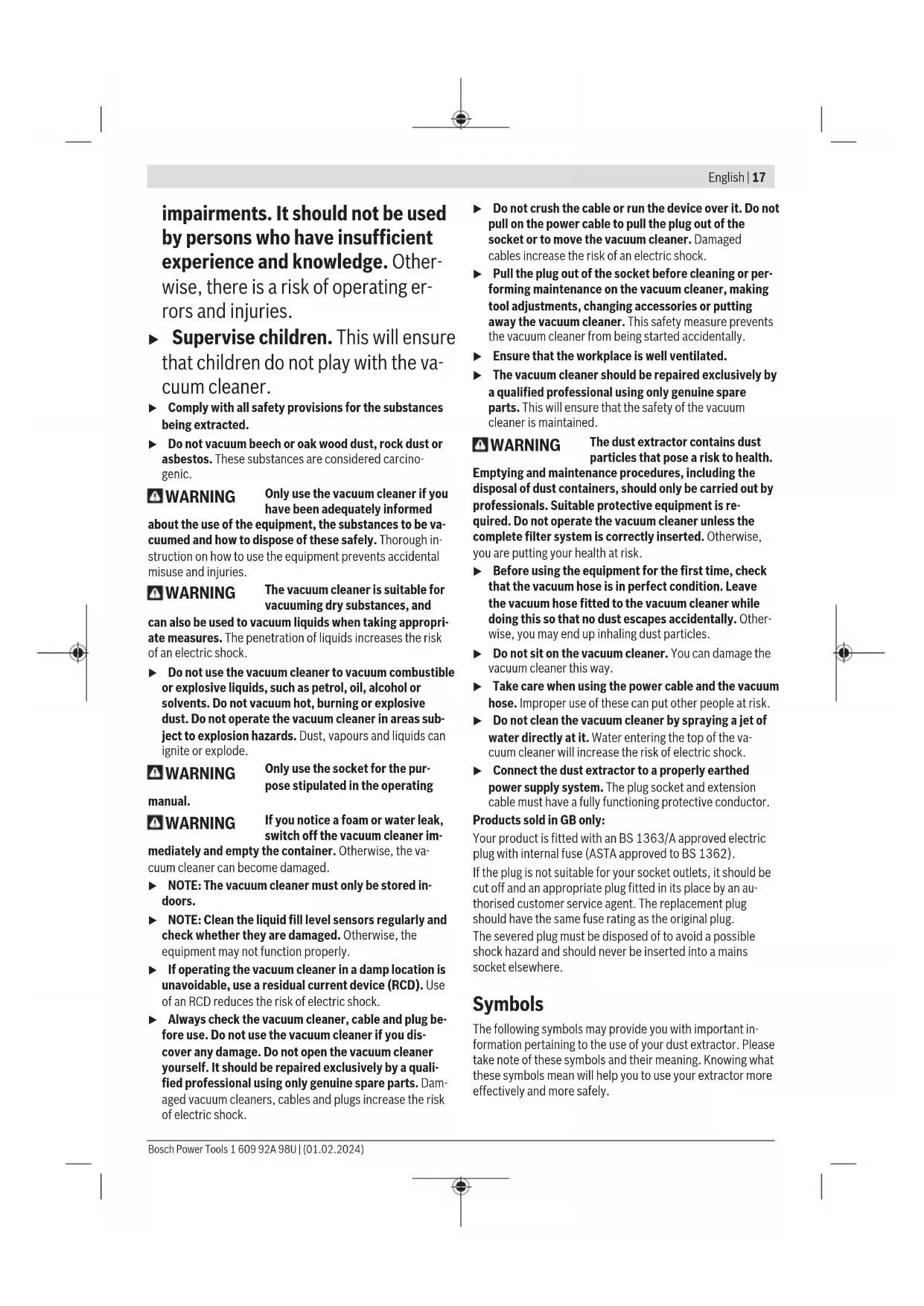
 FR
FR
 BG
BG
 CS
CS
 DA
DA
 DE
DE
 EL
EL
 EN
EN
 ES
ES
 ET
ET
 FI
FI
 HU
HU
 IT
IT
 KK
KK
 KO
KO
 LT
LT
 LV
LV
 MK
MK
 NL
NL
 NO
NO
 PL
PL
 PT
PT
 RO
RO
 RU
RU
 SK
SK
 SL
SL
 SV
SV
 TR
TR
 UK
UK
| Product type | Wet and dry vacuum cleaner |
| Brand | Bosch |
| Model | GAS 35 L SFC+ Professional |
| Filtration classification | L (compliant with IEC/EN 60335-2-69) |
| Nominal input power | 1200 W |
| Frequency | 50‑60 Hz |
| Gross tank capacity | 35 L |
| Net capacity (liquids) | 19 L |
| Dust bag volume | 19 L |
| Max vacuum (vacuum cleaner) | 230 hPa |
| Max flow rate | 129.6 m³/h (vacuum cleaner) / 266.4 m³/h (turbine) |
| Max suction power | 1380 W |
| Active filter surface area | 0.615 m² |
| Weight | 11.6 kg |
| Protection rating | IPX4 |
| Sound level | 70 dB(A) |
| Filter cleaning | Semi-automatic (SFC+) |
| Automatic start/stop | Yes, via connected power tool |
| L-BOXX compatibility | Yes, up to 15 kg |
| Included accessories | Suction hose, floor nozzle, crevice nozzle, suction adapter, disposable bag, pleated flat filter |
| Maintenance | Regularly clean the filter, level sensors, empty the tank |
| Safety | Automatic shut-off at max liquid level, IPX4 protection |
Frequently Asked Questions - GAS 35 L SFC+ Professional BOSCH
User questions about GAS 35 L SFC+ Professional BOSCH
0 question about this device. Answer the ones you know or ask your own.
Ask a new question about this device
Download the instructions for your Vacuum Cleaner in PDF format for free! Find your manual GAS 35 L SFC+ Professional - BOSCH and take your electronic device back in hand. On this page are published all the documents necessary for the use of your device. GAS 35 L SFC+ Professional by BOSCH.
USER MANUAL GAS 35 L SFC+ Professional BOSCH
www.bosch-pt.com/serviceaddresses
Disposal
Safety information for vacuum cleaners

Read all the safety information and instructions. Failure to observe the safety information and follow instructions may result in electric shock, fire and/or serious injury.
Save all warnings and instructions for future reference.
This vacuum cleaner is not intended for use by children or persons with physical, sensory or mental impairments. It should not be used by persons who have insufficient experience and knowledge. Otherwise, there is a risk of operating errors and injuries.
impairments. It should not be used by persons who have insufficient experience and knowledge. Otherwise, there is a risk of operating errors and injuries.
Supervise children. This will ensure that children do not play with the vacuum cleaner. Comply with all safety provisions for the substances being extracted. Do not vacuum beech or oak wood dust, rock dust or asbestos. These substances are considered carcinogenic.
Only use the vacuum cleaner if you have been adequately informed
Only use the vacuum cleaner if you have been adequately informed.
about the use of the equipment, the substances to be vacuumed, and how to dispose of these safely. Thorough instruction on how to use the equipment prevents accidental misuse and injuries.
WARNING
The vacuum cleaner is suitable for vacuuming dry substances, and
can also be used to vacuum liquids when taking appropriate measures. The penetration of liquids increases the risk of an electric shock.
Do not use the vacuum cleaner to vacuum combustible or explosive liquids, such as petrol, oil, alcohol, or solvents. Do not vacuum hot, burning, or explosive dust. Do not operate the vacuum cleaner in areas subject to explosion hazards. Dust, vapors, and liquids can ignite or explode.
WARNING
Only use the socket for the purpose stipulated in the operating
manual.
WARNING
If you notice a foam or water leak, switch off the vacuum cleaner im
mediately and empty the container. Otherwise, the vacuum cleaner can become damaged.
NOTE: The vacuum cleaner must only be stored indoors. NOTE: Clean the liquid fill level sensors regularly and check whether they are damaged. Otherwise, the equipment may not function properly. If operating the vacuum cleaner in a damp location is unavoidable, use a residual current device (RCD). Use of an RCD reduces the risk of electric shock. Always check the vacuum cleaner, cable, and plug before use. Do not use the vacuum cleaner if you discover any damage. Do not open the vacuum cleaner yourself. It should be repaired exclusively by a qualified professional using only genuine spare parts. Damaged vacuum cleaners, cables, and plugs increase the risk of electric shock.
- Do not crush the cable or run the device over it. Do not pull on the power cable to pull the plug out of the socket or to move the vacuum cleaner. Damaged cables increase the risk of an electric shock. Pull the plug out of the socket before cleaning or performing maintenance on the vacuum cleaner, making tool adjustments, changing accessories, or putting away the vacuum cleaner. This safety measure prevents the vacuum cleaner from being started accidentally. Ensure that the workplace is well ventilated. The vacuum cleaner should be repaired exclusively by a qualified professional using only genuine spare parts. This will ensure that the safety of the vacuum cleaner is maintained.
WARNING
The dust extractor contains dust particles that pose a risk to health.
Emptying and maintenance procedures, including the disposal of dust containers, should only be carried out by professionals. Suitable protective equipment is required. Do not operate the vacuum cleaner unless the complete filter system is correctly inserted. Otherwise, you are putting your health at risk.
Before using the equipment for the first time, check that the vacuum hose is in perfect condition. Leave the vacuum hose fitted to the vacuum cleaner while doing this so that no dust escapes accidentally. Otherwise, you may end up inhaling dust particles. Do not sit on the vacuum cleaner. You can damage the vacuum cleaner this way. Take care when using the power cable and the vacuum hose. Improper use of these can put other people at risk. Do not clean the vacuum cleaner by spraying a jet of water directly at it. Water entering the top of the vacuum cleaner will increase the risk of electric shock. Connect the dust extractor to a properly earthed power supply system. The plug socket and extension cable must have a fully functioning protective conductor.
Products sold in GB only:
Your product is fitted with a BS 1363/A approved electric plug with internal fuse (ASTA approved to BS 1362). If the plug is not suitable for your socket outlets, it should be cut off and an appropriate plug fitted in its place by an authorised customer service agent. The replacement plug should have the same fuse rating as the original plug. The severed plug must be disposed of to avoid a possible shock hazard and should never be inserted into a mains socket elsewhere.
Symbols
The following symbols may provide you with important information pertaining to the use of your dust extractor. Please take note of these symbols and their meaning. Knowing what these symbols mean will help you to use your extractor more effectively and more safely.
Symbols and their meaning


WARNING! Read all the safety and general instructions. Failure to observe the safety and general instructions may result in electric shock, fire and/or serious injury.
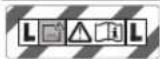
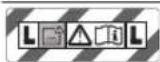
Dust extractor from dust class L in accordance with IEC/EN 60335-2-69 for the dry extraction of harmful dusts with an exposure limit of >1 mg/m³
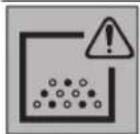
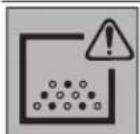
WARNING! The dust extractor contains dust particles that pose a risk to health. Emptying and maintenance procedures, including the disposal of dust containers, should only be carried out by professionals. Suitable protective equipment is required. Do not operate the dust extractor unless the complete filter system is correctly inserted. Otherwise, you are putting your health at risk.
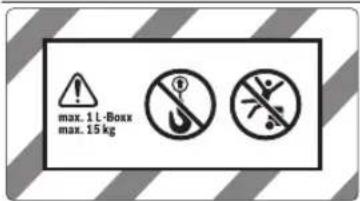

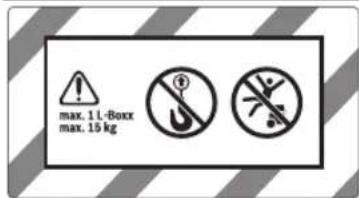
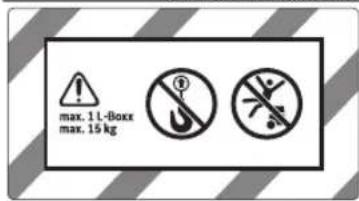
max. 1 L-Boxx, max. 15 kg
Only attach a maximum of one L-BOXX.
The weight of the L-BOXX along with its contents must not exceed 15 kg.

Do not hang the dust extractor on a crane hook, e.g. in order to transport
it. The dust extractor is not suitable for moving with a crane. There is a risk of injury and damage if you do this.

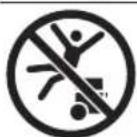
Do not sit or stand on the dust extractor. The dust extractor may tip over and become damaged if you do this. This poses a risk of injury.
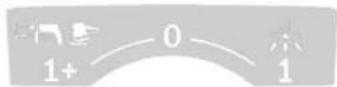
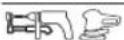

Automatic start/stop
Extracting dust that accumulates from working power tools.
The dust extractor switches on automatically and off again with a time delay.

Switching Off

Extraction
Extracting dust deposits
Symbols and their meaning
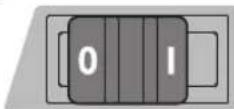
SFC+
SFC+
Semi-Automatic Filter Cleaning Plus (SFC+)
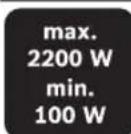
Permitted connected load of the connected power tool (country-specific)
Product Description and Specifications
Please observe the illustrations at the beginning of this operating manual.
Intended Use
The dust extractor is intended for collecting, vacuuming, conveying, and separating non-flammable dry dusts, non-flammable liquids, and a water-air mixture. The dust extraction capability of the dust extractor has been tested and corresponds to dust class L. It is suitable for increased demands in professional use, e.g., in trade, industry, and workshops.
Dust extractors of dust class L in accordance with IEC/EN 60335-2-69 may only be used to vacuum and extract harmful dust with an exposure limit of > 1 mg/m³.
Only use the dust extractor if you can fully evaluate all functions and carry them out without restrictions, or if you have received corresponding instructions.
The plug socket must only be used in dry conditions during operation.
Product features
The numbering of the product features refers to the representation of the vacuum cleaner on the graphic pages.
(1) Container (2) Hose adapter (3) Plug socket for power tool (4) Holder for vacuum hose (5) Mode selector switch (6) Carrying handle (7) L-BOXX holder (8) Top part of dust extractor (9) Catch for top part of dust extractor (10) Wheel (11) Castor brake (12) Castor (13) Cable holder (14) Closing flap for filter cover
(15) Holder for suction tubes (16) Holder for crevice nozzle/curved nozzle (17) Holder for floor nozzle (18) SFC+ switch (19) Dust extraction adapter (20) SFC+ module (21) Vacuum hose (22) Curved nozzle (23) Disposal bag (24) Flat-pleated filter (cellulose) (25) Crevice nozzle (26) Rubber lip (27) Brush inserts (28) Floor nozzle (29) Suction tube (30) Adapter for vacuum hose holder (31) Snap fastener (32) False air intake (33) Filter cleaning actuator (34) Filter cover (35) Fill level sensors
Technical data
| Wet/dry dust extractor GAS 35 L SFC+ | |
| Article number | 3601 JC3 0.. |
| Rated power input W 1200 | |
| Frequency Hz 50-60 | |
| Container volume (gross) I 35 | |
| Net volume (liquid) I 19 | |
| Dust bag volume I 19 | |
| Max. vacuumA) | |
| -Dust extractor hPa 230 | |
| -Turbine hPa 254 | |
| Max. flow rateA) | |
| -Dust extractor l/s | 36 |
| m³/s 0.036 | |
| m³/h 129.6 | |
| -Turbine l/s | 74 |
| m³/s 0.074 | |
| m³/h 266.4 | |
| Max. suction power W 1380 | |
| Area of pleated filter m² 0.615 | |
| Dust class | L |
| WeightB) kg | 11.6 |
| Protection class | ±/I |
| Dust extractor protection rating | IPX4 |
Wet/dry dust extractor GAS 35 L SFC+
| Mains plug Switzerland protec- tion rating | IP55 |
| A) Measured using a vacuum hose 3 m long and 35 mm in diameter B) Weight without mains connection cable and without mains plug The specifications apply to a rated voltage [U] of 230 V. These spec- ifications may vary at different voltages and in country-specific mod- els. Values can vary depending on the product, scope of application and environmental conditions. To find out more, visit www.bosch-professional.com/wac. | |
Automatic start/stop
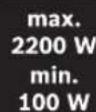
| Rated voltage | Maximum power | Minimum power |
| 230 V | 2200 W | 100 W |
Permitted connected load of the connected power tool.
These values can differ for other country-specific models. Please take note of the information on the socket of the dust extractor.
Noise/Vibration Information
Noise emission values determined according to EN 60335-2-69.
Typically the A-weighted sound pressure level of the dust extractor is 70 dB(A). Uncertainty K = 3 dB. The noise level when working can exceed the volume stated. Wear hearing protection!
Vibration total values a_h (triax vector sum) and uncertainty K determined according to EN 60335-2-69: a_h < 2.5 m/s^2, K = 1.5 m/s^2
Assembly
Pull the plug out of the socket before cleaning or performing maintenance on the vacuum cleaner, making tool adjustments, changing accessories or putting away the vacuum cleaner. This safety measure prevents the vacuum cleaner from being started accidentally.
Fitting the holder for the vacuum hose (see figure A)
- Slide the holder (4) for the vacuum hose firmly into the corresponding adapters (30) from above until they click into place.
Fitting the vacuum hose (see figure B)
Attach the vacuum hose (21) to the hose adapter (2) and turn it clockwise as far as it will go.
Note: The friction generated by the dust in the vacuum hose and accessory during extraction causes an electrostatic charge that the user may experience as static discharge (depending on environmental factors and their physiological state).
Bosch generally recommends using an anti-static vacuum hose (accessory) to vacuum up fine dust and dry materials.
Fitting the extraction accessories
The vacuum hose (21) and the SFC+ module (20) are fitted with a clip system that can be used to connect extraction accessories (extraction adapter (19), curved nozzle (22)).
Fitting the extraction adapter (see figure C)
- Push the SFC+ module (20) onto the vacuum hose (21) until you hear both snap fasteners (31) on the vacuum hose engage.
- Then push the extraction adapter (19) onto the SFC+ module (20) until you hear both snap fasteners (31) on the SFC+ module engage.
- To remove the adapter, press the snap fasteners (31) inwards and pull apart the components.
Fitting nozzles and tubes (see figure D)
- Push the curved nozzle (22) onto the vacuum hose (21) until you hear both snap fasteners (31) on the vacuum hose engage.
- Then attach the required extraction accessory (floor nozzle, crevice nozzle, suction tube, etc.) firmly to the curved nozzle (22).
- To remove the accessory, press the snap fasteners (31) inwards and pull apart the components.
Inserting/removing the disposal bag or dust bag (dry extraction) (see figures E1-E2)
For dry vacuuming, you can insert a disposal bag (23) or a dust bag (accessory) into the container (1). This makes the dust easier to dispose of.
Note: If using a paper filter bag, you must make sure that semi-automatic filter cleaning (SFC+) is switched off; you should also do the same if using a fleece filter bag (see "Semi-automatic filter cleaning (see figure 1)", page 21).
Inserting the disposal bag
- Open the catches (9) and remove the top part of the vacuum cleaner (8).
- Insert the disposal bag (23) into the container (1) with the inlet facing forwards.
- Pull the inlet over the connection flange and all the way into the recess of the connection flange.
- Make sure that the disposal bag (23) touches all the inside walls of the container (1).
- Fold the rest of the disposal bag (23) over the edge of the container (1). Put the top part of the vacuum cleaner (8) on and close the catches (9).
Removing and sealing the disposal bag
- Open the catches (9) and remove the top part of the vacuum cleaner (8).
- Pull the full disposal bag (23) backwards out of the connection flange.
- Carefully take the disposal bag (23) out of the container (1) without damaging it.
When doing so, make sure that the disposal bag does not
scrape against the connection flange or other sharp objects.
- Remove the adhesive strip cover and tape up the disposal bag. Then tie up the disposal bag (23) below the inlet using the adhesive strip cover that has been removed.
Changing/inserting the dust bag (accessory)
- Open the catches (9) and remove the top part of the vacuum cleaner (8).
- Pull the full dust bag backwards out of the connection flange. Close the opening in the dust bag by turning down the top. Take the closed dust bag out of the container (1).
- Place the new dust bag over the vacuum cleaner's connection flange. Make sure that the entire length of the dust bag touches the inside wall of the container (1). Put the top part of the vacuum cleaner (8) on and close the catches (9).
Fitting the rubber lip (wet vacuuming) (see figure F)
Note: The requirements for the degree of penetration (dust class L) have only been verified for dry vacuuming.
- Use a suitable tool to lift the brush inserts (27) out of the floor nozzle (28).
- Place the rubber lips (26) in the floor nozzle (28).
Note: The textured side of the rubber lips must be facing outwards.
Attaching the L-Boxx (see figure G)
You can attach an L-Boxx to the top part of the dust extractor for transporting the extractor and to provide space-saving storage for extractor accessories and/or the power tool.
- Click the L-Boxx onto the adapters (7).
Do not carry the dust extractor by the carrying handle of the attached L-Boxx. The dust extractor is too heavy for the carrying handle of the L-Boxx. There is a risk of injury and damage if you do this.
Operation
Pull the plug out of the socket before cleaning or performing maintenance on the vacuum cleaner, making tool adjustments, changing accessories or putting away the vacuum cleaner. This safety measure prevents the vacuum cleaner from being started accidentally.
Start-up
Pay attention to the mains voltage. The voltage of the power source must correspond with the data on the type plate of the vacuum cleaner. Make sure you inform yourself about the applicable regulations/laws on how to handle harmful types of dust in your country.
The dust extractor may be used for vacuuming and extracting the following materials:
Dusts with an exposure limit of >1mg / m3
▶ Products that are only sold in AUS and NZ: Use a residual current device (RCD) with a nominal residual current of 30 mA or less.
The dust extractor must categorically not be used in potentially explosive areas.
To ensure optimum suction power, you must always fully unwind the vacuum hose (21) from the top part of the dust extractor (8).
Dry vacuuming
Vacuuming up dust deposits
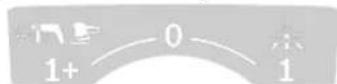
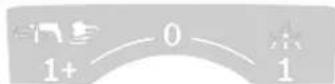
To switch on the dust extractor, set the mode selector switch (5) to the "extraction" symbol.
- To switch off the dust extractor, set the mode selector switch (5) to the "switch off" symbol.
Extracting dust that accumulates from working power tools (see figure H)
There must be a sufficient air exchange rate in the room when the exhaust air comes back into the room. Be aware of the corresponding national regulations.
The dust extractor has a plug socket with a protective earth contact (3) that can be used to connect an external power tool. Observe the maximum permitted connected load of the connected power tool.
Fit the extraction adapter (19) (see "Fitting the extraction adapter (see figure C)", page 20). Insert the dust extraction adapter (19) into the extraction outlet of the power tool.
Note: When working with power tools that have a low air feed into the vacuum hose (e.g. jigsaws, sanders, etc.), the false air intake (32) of the dust extraction adapter (19) must be opened. Only then can the semi-automatic filter cleaning (SFC+) system work without any problems.
To do this, turn the ring above the false air intake (32) until the opening is at its maximum size.
To activate the automatic start/stop function of the dust extractor, set the mode selector switch (5) to the "automatic start/stop" symbol.
- To activate the dust extractor, switch on the power tool that is plugged into the electric socket (3). The dust extractor will start automatically.
- To stop dust extraction, switch the power tool off. The automatic start/stop run-on function will run for up to 15 seconds longer in order to extract the remaining dust from the vacuum hose. To switch off the dust extractor, set the mode selector switch (5) to the "switch off" symbol.
Wet vacuuming
Do not use the vacuum cleaner to vacuum combustible or explosive liquids, such as petrol, oil, alcohol or solvents. Do not vacuum hot, burning or explosive dust. Do not operate the vacuum cleaner in areas subject to explosion hazards. Dust, vapours and liquids can ignite or explode. The vacuum cleaner must not be used as a water pump. The vacuum cleaner is designed for vacuuming air and vacuuming water mixtures.
Note: The requirements for the degree of penetration (dust class L) have only been verified for dry vacuuming.
Steps to Take before Wet Vacuuming
- Remove the disposal bag (23) or dust bag if necessary. Note: Use a wet filter bag (accessory), which separates liquid from solids, to make disposal easier when vacuuming water-solid mixtures.
- Place the rubber lip (26) into the floor nozzle (28) (see "Fitting the rubber lip (wet vacuuming) (see figure F)", page 20).
- Switch off semi-automatic filter cleaning (SFC+) (see "Semi-automatic filter cleaning (see figure I)", page 21).
Vacuuming up liquids
- To switch on the dust extractor, set the mode selector switch (5) to the "extraction" symbol. The dust extractor is equipped with fill level sensors (35). The dust extractor shuts down if the maximum fill level has been reached. Set the mode selector switch (5) to the "switch off" symbol. Note: When extracting non-conductive liquids (e.g. drilling emulsion, oils and fats), the dust extractor will not switch off when the container is full. The fill level must be constantly monitored and the container emptied in good time.
- To switch off the dust extractor, set the mode selector switch (5) to the "switch off" symbol.
- Empty the container (1). To prevent mould growth after wet vacuuming:
- Remove the flat-pleated filter (24) and leave this to dry thoroughly.
- Remove the top part of the dust extractor (8), open the filter cover (34) and leave both elements to dry thoroughly.
Semi-automatic filter cleaning (see figure 1)
The filter cleaning function should be used regularly, and at the very latest when the suction power is no longer sufficient.
How often filter cleaning needs to be carried out will depend on the type and quantity of dust that has been extracted. With regular use, the maximum conveying capacity will be maintained for longer.
During semi-automatic filter cleaning (SFC+), the air flow is reversed to clean deposited dust from the flaps of the flat-pleated filter.
A pleated filter with surface dirt is still fully functional. It is not necessary to clean the flat-pleated filter manually by shaking or blowing it out; this may even damage the filter.
Note: Semi-automatic filter cleaning is activated at the factory (SFC+ switch (18) in position I).
-Actuating SFC+ filter cleaning
Use the palm of your hand to close the opening in the nozzle or vacuum hose.
Or, if the SFC+ module (20) is fitted:
Push the actuator (33) down for approximately 10 seconds.
- Deactivating SFC+
Push the SFC+ switch (18) forwards (position 0).
-Activating SFC+
Push the SFC+ switch (18) backwards (position I).
Maintenance and service
Maintenance and Cleaning
Pull the plug out of the socket before cleaning or performing maintenance on the vacuum cleaner, making tool adjustments, changing accessories or putting away the vacuum cleaner. This safety measure prevents the vacuum cleaner from being started accidentally. To ensure safe and efficient operation, always keep the dust extractor and the ventilation slots clean. Wear a dust mask when servicing and cleaning the vacuum cleaner.
In order to avoid safety hazards, if the power supply cord needs to be replaced, this must be done by Bosch or by an after-sales service centre that is authorised to repair Bosch power tools.
For the user to carry out maintenance, the dust extractor needs to be disassembled, cleaned and maintained as far as this is possible without endangering maintenance personnel or other persons. Before disassembly, the dust extractor should be cleaned to prevent any potential hazards. The room/enclosure in which the dust extractor is disassembled should be well ventilated. Wear personal protective equipment while carrying out maintenance. After completing maintenance, the maintenance area should be cleaned.
An inspection regarding the dust extraction capability must be carried out at least once a year by the manufacturer or someone who has been trained, e.g. to check for filter damage, that the dust extractor is tight and that the control unit is functioning correctly.
Class L vacuum cleaners which were located in dirty environments should have their exteriors, as well as all their components, cleaned or treated with sealant. When performing maintenance and repair work, all dirty parts that cannot be cleaned satisfactorily must be disposed of. Such parts must be disposed of in impermeable bags in accordance with the valid provisions for disposing of such waste.
- Clean the housing of the dust extractor occasionally with a damp cloth.
Removing/changing the flat-pleated filter (see figures J1-J2)
Suction power is dependent on the condition of the filter. Therefore, the filter should be cleaned regularly.
If the flat-pleated filter (24) becomes damaged, replace it immediately.
- Pull on the closing flap (14) and open the filter cover (34). Hold the flat-pleated filter (24) by the supports and take it out from above.
- Use a damp cloth to remove any dust and dirt that accrues around the closing edge of the filter cover (34) when removing the flat-pleated filter (24). PES and PTFE flat-pleated filters can be rinsed out under running water.
- Insert the cleaned (or a new) flat-pleated filter (24), ensuring that it is positioned correctly and securely.
- Close the filter cover (34) again (must audibly click into place).
Cleaning the container
Wipe the container (1) from time to time using a non-abrasive off-the-shelf cleaning product and leave it to dry.
Cleaning the fill level sensors (see figure K)
Make sure that the fill level sensors are cleaned (35) occasionally.
- Open the catches (9) and remove the top part of the vacuum cleaner (8).
- Clean the fill level sensors (35) using a soft cloth. Put the top part of the vacuum cleaner (8) on and close the catches (9).
Accessories
| Accessory number | |
| Paper filter bag (dry) 2 607 432 035 | |
| Fleece filter bag (dry) 2 607 432 037 | |
| Wet filter bag (wet) 2 607 432 039 | |
| Disposal bag (PE) (dry/wet) 2 607 432 043 | |
Storage and transport (see figure L)
- Wrap the power cable around the cable holder (13).
- Insert the accessory into the holders provided for it: Suction tubes (29) into the holders (15), crevice nozzle (25) into the holder (16), floor nozzle (28) into the holder (17).
- Open the elastic bands of the vacuum hose holder (4) and wrap the vacuum hose (21) around the top part of the dust extractor in the holder (4). Hook the elastic bands back in.
- Click the L-Boxx on to the adapters (7). Before transporting the dust extractor, remove any full disposal bags/dust bags and empty any liquids that have been absorbed, in order to avoid placing unnecessary strain on the back and prevent injury.
Only ever carry the dust extractor by the carrying handle (6).
- Store the dust extractor in a dry room and secure it so that it cannot be used by unauthorized persons.
- Put the castor brake (11) down to hold the castors (12) in place.
Rectifying faults
If a fault (e.g. a filter damage) occurs, the vacuum cleaner must be switched off immediately. The fault must be repaired before resuming operation.
Problem Corrective measures
| The suction turbine will not switch on. | - Check the mains cable, mains plug, fuse, socket and fill level sensors (35). |
| The mode selector switch (5) is set to "automatic start/stop". | |
| - Set the mode selector switch (5) to the "vacuuming" symbol or switch on the power tool plugged into the electric socket (3). | |
| The suction turbine switches off. | - Empty the container (1). |
| The suction turbine will not switch on again after emptying the container. | - Switch the dust extractor off and wait five seconds before switching it back on. |
| - Clean the fill level sensors (35) and the space between the fill level sensors (35) using a brush. | |
| The suction power is decreasing. | - Remove any blockages from the suction nozzle, suction tube (29), vacuum hose (21) or flat-pleated filter (24). |
| - Change the disposal bag (23) or dust bag. | |
| - Make sure the filter cover (34) is engaged correctly. | |
| - Place the top part of the dust extractor (8) on correctly and close the catches (9). | |
| - Change the flat-pleated filter (24). | |
| Dust is escaping when vacuuming | - Check that the flat-pleated filter (24) has been fitted correctly. |
| - Change the flat-pleated filter (24). | |
| Automatic switch-off (wet vacuuming) is not working. | - Clean the fill level sensors (35) and the space between the fill level sensors (35) using a brush. |
| Automatic switch-off will not work in the presence of non-conductive liquids or foaming. | |
| - Check the fill level regularly. | |
| The filter cleaning function is not working. | - Push the SFC+ switch (18) backwards (position I). |
After-Sales Service and Application Service
Our after-sales service responds to your questions concerning maintenance and repair of your product as well as spare parts. You can find explosion drawings and information on spare parts at: www.bosch-pt.com
The Bosch product use advice team will be happy to help you with any questions about our products and their accessories.
In all correspondence and spare parts orders, please always include the 10-digit article number given on the nameplate of the product.
Great Britain
Robert Bosch Ltd. (B.S.C.)
P.O.Box 98
Broadwater Park
North Orbital Road
Denham Uxbridge
UB95HJ
At www.bosch-pt.co.uk you can order spare parts or arrange the collection of a product in need of servicing or repair.
Tel. Service: (0344) 7360109
E-Mail: boschservicecentre@bosch.com
You can find further service addresses at:
www.bosch-pt.com/serviceaddresses
Disposal
The vacuum cleaner, its accessories and packaging should be recycled in an environmentally friendly manner.
Do not dispose of the vacuum cleaner along with household waste.
Only for EU countries:
According to the European Directive 2012/19/EU on Waste Electrical and Electronic Equipment and its implementation into national law, vacuum cleaners that are no longer usable must be collected separately and disposed of in an environmentally friendly manner.
If disposed incorrectly, waste electrical and electronic equipment may have harmful effects on the environment and human health, due to the potential presence of hazardous substances.
Only for United Kingdom:
According to The Waste Electrical and Electronic Equipment Regulations 2013 (SI 2013/3113) (as amended), products that are no longer usable must be collected separately and disposed of in an environmentally friendly manner.
Robert Bosch (France) S.A.S.
www.bosch-pt.com/serviceaddresses

Calle Robert Bosch No. 405
C.P. 50071 Zona Industrial, Toluca - Estado de Mexico
Tel.: (52) 55 528430-62
Tel.: 800 6271286
www.bosch-pt.com/serviceaddresses
Disposal
www.bosch-pt.com/serviceaddresses
Disposal
www.bosch-pt.com/serviceaddresses
Disposal
www.bosch-pt.com/serviceaddresses
Disposal
Bosch Service Center
Telegrafvej 3
2750 Ballerup
On www.bosch-pt.dk you can order spare parts online or create a repair order.
Tel. Service Center: 44898855
Fax: 44898755
E-Mail: vaerktoej@dk.bosch.com
You will find addresses for other workshops at:
www.bosch-pt.com/serviceaddresses
Disposal
Bosch Service Center
Telegrafvej 3
2750 Ballerup
Denmark
Tel.: (08) 7501820 (within Sweden)
Fax: (011) 187691
You will find more contact details for service here:
www.bosch-pt.com/serviceaddresses
Waste management
Replacing/inserting dust bag (accessory)
www.bosch-pt.com/serviceaddresses
Deponering
www.bosch-pt.com/serviceaddresses
Havitys
The figures in the operating instructions are numbered.
Use for intended purpose
The vacuum cleaner is intended for vacuuming, picking up, transporting and separating dry, non-flammable dusts, liquids and a mixture of air and water. The vacuum cleaner has been tested in accordance with the dust class technology and is approved for increased dust exposure in professional use, e.g. in workshops, industry and workshops.
Vacuum cleaners of dust class L according to IEC/EN 60335-2-69 must only be used for vacuuming and picking up dust that is hazardous to health with a limit value >1 mg/m³.
Use the vacuum cleaner only when you are sure that it is safe and without restrictions regarding its operation when you have read the instructions. During operation, it is only permitted to use it in a dry environment.
Disposal
The disposal of the vacuum cleaner is shown in the illustration of the vacuum cleaner on the graphics pages.
www.bosch-pt.com/serviceaddresses
Disposal
The vacuum cleaner, accessories and packaging must be recycled in an environmentally friendly manner.
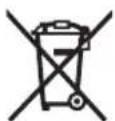
Do not dispose of the vacuum cleaner in household waste!
Only for EU countries:
www.bosch-pt.com/serviceaddresses
Disposal
Robert Bosch Sp. z o.o.
www.bosch-pt.com/serviceaddresses
Waste disposal
Bosch Service Center PT
K Vapence 1621/16
692 01 Mikulov
www.bosch-pt.com/serviceaddresses
Disposal
Return the vacuum cleaner, accessories, and packaging for environmentally friendly recycling.
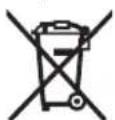
www.bosch-pt.com/serviceaddresses
Disposal
The vacuum cleaner, accessories, and packaging should be handed in for recycling that is appropriate for environmental protection.
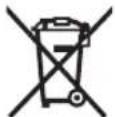
www.bosch-pt.com/serviceaddresses
Follow all safety instructions and warnings. Failure to follow the safety instructions and warnings may result in electric shock, fire, or serious injury. Keep these instructions for future use.
This vacuum cleaner is not intended for use by children or persons with reduced physical, sensory, or mental capabilities, or lack of experience and knowledge, unless they have been given supervision or instruction concerning use of the appliance in a safe way and understand the hazards involved. Children shall not play with the appliance.
This vacuum cleaner is not intended for use by children or persons with reduced physical, sensory, or mental capabilities, or lack of experience and knowledge, unless they have been given supervision or instruction concerning use of the appliance in a safe way and understand the hazards involved. Children shall not play with the appliance.
Do not leave children unattended. They should not play with the vacuum cleaner.
Do not leave children unattended.
They should not play with the vacuum cleaner.
Follow all safety rules when working with substances that are vacuumed. Do not vacuum wood dust, plaster dust, or dust from hazardous materials. These materials may be carcinogenic.
WARNING
Use the vacuum cleaner only if you have received sufficient information about the substances being collected and their safe disposal. Careful instruction reduces the risk of incorrect operation and injury.
WARNING
WARNING
The vacuum cleaner is intended for collecting dry substances, and with appropriate measures, also for collecting liquids. The penetration of water into the motor increases the risk of electric shock.
Do not vacuum flammable or explosive liquids, such as gasoline, oil, alcohol, or solvents. Do not vacuum hot, flammable, or explosive dust. Do not use the vacuum cleaner in rooms with high explosion hazard. Dust, vapors, or liquids may ignite or explode.
Do not vacuum flammable or explosive liquids, such as gasoline, oil, alcohol, or solvents. Do not vacuum hot, flammable, or explosive dust. Do not use the vacuum cleaner in rooms with high explosion hazard. Dust, vapors, or liquids may ignite or explode.
Use the socket only as specified in the operating instructions.
WARNING
When the dust container is full, immediately turn off the vacuum cleaner and empty the container.
The vacuum cleaner may be damaged.
ATTENTION! Store the vacuum cleaner only indoors. ATTENTION! Regularly clean the dust level sensors and check them for damage. They may negatively affect functionality. If it is impossible to avoid using the vacuum cleaner in a damp room, connect the power tool through a residual current device. Using a residual current device reduces the risk of electric shock. Before each use, check the vacuum cleaner, power cord, and plug. Do not use the vacuum cleaner if damage is detected. Do not open the vacuum cleaner yourself; repairs may only be performed by qualified personnel using original
spare parts. Damaged vacuum cleaners, cords, and plugs increase the risk of electric shock.
Do not run over or damage the cord. Do not pull the cord to unplug the vacuum cleaner or to move it. A damaged cord increases the risk of electric shock. Before cleaning, adjusting, replacing accessories, or storing, unplug the vacuum cleaner. This precaution prevents accidental starting. Ensure good ventilation at the workplace! Repair of the vacuum cleaner is allowed only to qualified personnel and only using original spare parts. This ensures the safety of the vacuum cleaner.
WARNING
The vacuum cleaner contains harmful dust. Emptying and servicing procedures,
including removing the dust container, may only be performed by specialists. Appropriate protective equipment is required. Do not operate the vacuum cleaner without a properly installed filter system. Otherwise, you endanger your health.
Before use, check the condition of the hose and suction tube. Leave the suction tube connected to the vacuum cleaner so that dust does not accidentally spill out. Otherwise, you may inhale dust. Do not sit on the vacuum cleaner. You may damage it. Handle the power cord and suction tube carefully. Otherwise, you may endanger others. Do not clean the vacuum cleaner with water. Water entering the vacuum cleaner lid increases the risk of electric shock. Connect the vacuum cleaner to a properly grounded outlet. The plug and socket must have a functional protective conductor.
SYMBOLS
The following symbols may be important when using your vacuum cleaner. Please remember these symbols and their meanings. Correct understanding of the symbols will help you use the vacuum cleaner better and more reliably.
Symbols and their meanings


WARNING! Read all safety instructions. Failure to follow the instructions
may result in injury.
SYMBOLS AND THEIR MEANINGS
Electric shock, fire, and/or serious injury.
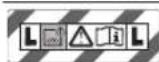
Dust class L vacuum cleaner according to IEC/EN 60335-2-69 for occasional dry vacuuming of dust with an exposure limit value > 1 mg/m³.
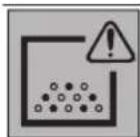
WARNING! The vacuum cleaner contains dust that is hazardous to health. Emptying and maintenance procedures, including the removal of the dust container, must only be carried out by specialists. Appropriate protective equipment is required. Do not operate the vacuum cleaner without the dust filter system properly installed. Otherwise, you endanger your health.
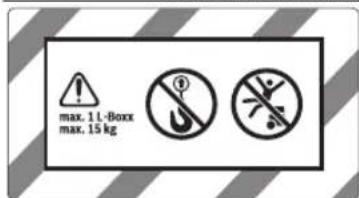

max. 1 L-Boxx, max. 15 kg
Do not attach more than one L-BOXX case.

The weight of the L-BOXX case including its contents must not exceed 15 kg.

Do not hang the vacuum cleaner and the crane hook, e.g., on transport vehicles. The vacuum cleaner is not suitable for hanging on a crane. This may result in injuries and damage to the vacuum cleaner.
Do not sit or stand on the vacuum cleaner, and do not use it as a step ladder. The vacuum cleaner may tip over or be damaged. There is a risk of injury.
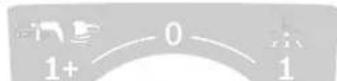
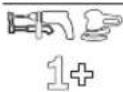
Automatic On/Off
When vacuuming dust from power tools, the vacuum cleaner switches on automatically; switching off occurs with a time delay.
0
Off
CNMBONJI HX3HaueHne

PexHM BcacbBAHn
CobpaHne nbIeBbIX OTIOKeHHN
SFC+
SFC+
Semi-automatic filter cleaning (SFC+ = Semi-Automatic Filter Cleaning Plus)
max. 2200 W min. 100 W
Indication of the maximum permissible connected load and the connected electrical power (depending on the country)
Product description and services
Please follow the illustrations at the beginning of the operating instructions.
Intended use
The vacuum cleaner is intended for vacuuming, suction, and removal of dry dust, non-flammable liquids, and water-air mixtures. The vacuum cleaner has been tested for dust collection and complies with dust class L. It is suitable for heavy-duty use in industrial applications, e.g., for professional work, use in industry and workshops.
The dust class L vacuum cleaner complies with IEC/EN 60335-2-69 and may only be used for vacuuming hazardous dust with an exposure limit value >1 mg/m³.
Use the vacuum cleaner only if you are fully familiar with all functions and are able to use it without any restrictions or have received corresponding instructions.
During work, the socket may only be used in dry conditions.
Numbered components
The numbering of the components is done according to the illustration on the page with illustrations.
(1) Container (2) Suction hose (3) Socket for power tool (4) Holder for accessories (5) Mode selector (6) Handle for carrying (7) Fastening for accessories box (8) Vacuum cleaner lid (9) Lid lock
(10) Wheel (11) Brake for guide roller (12) Guide roller (13) Cable fastening (14) Filter cover latch (15) Holder for suction tube (16) Holder for flexible hose/curved hose (17) Holder for crevice nozzle (18) SFC+ switch (19) Dust bag adapter (20) SFC+ module (21) Dust bag spout (22) Curved hose (23) Dust bag (24) Flat pleated filter (cellulose) (25) Foam filter (26) Edge trim (27) Insert rings (28) Filling nozzle (29) Suction tube (30) Fastening for accessory holder (31) Release buttons (32) Air vent with cap (33) Filter cleaning button (34) Filter cover (35) Level sensor.
Technical data
Mounting nozzles and tubes (see fig. D)
Place the curved hose (22) onto the dust bag spout (21) so that both release buttons (31) engage. Then fully push the required accessory (filling nozzle, crevice nozzle, suction tube, etc.) onto the curved hose (22). To release, press the release buttons (31) inward and pull the parts apart.
Installing/removing the dust bag for dry vacuuming (see fig. E1-E2)
For dry vacuuming, you can insert a dust bag (23) or a disposal bag (accessory) into the container (1). This makes disposal easier.
Note: When using a paper filter bag, it is mandatory. When using a non-woven filter, the semi-automatic filter cleaning (SFC+) must be switched off (see Semi-automatic filter cleaning (see fig. I), page 138).
Installing the dust bag
-Open the locks (9) and remove the vacuum cleaner lid (8). -Insert the dust bag (23) into the container (1) with the opening facing forward. -Press the intake opening onto the connecting flange until it stops.
-Ensure that the dust bag (23) fits completely against the inner walls of the container (1). -Fold the remaining part of the dust bag (23) over the edge of the container (1). -Place the vacuum cleaner lid (8) back on and close the locks (9).
Removing and closing the dust bag
- Open the locks (9) and remove the vacuum cleaner lid (8). -Remove the dust bag (23) from the connecting flange by pulling it off.
- Empty the dust bag (23) from the container (1) so that it is not damaged. At the same time, make sure that the dust bag does not come into contact with the filter or other sharp objects. - Remove the protective tape from the adhesive strip and close the dust bag. Then fold the dust bag (23) over the suction opening and secure it with the protective tape removed from the adhesive strip.
Replacing/installing the dust bag (accessory)
- Open the latches (9) and remove the vacuum cleaner lid (8). - Remove the filled dust bag from the filter holder. Close the opening of the dust bag by turning the lid. Remove the closed dust bag from the container (1). - Place a new dust bag onto the filter holder of the vacuum cleaner. The dust bag must fit snugly against the inner wall of the container (1) along its entire circumference.
- Put the vacuum cleaner lid (8) back on and close the latches (9).
Installing the rubber grommets (for wet vacuuming) (see fig. F)
Note: The requirements for the degree of filtration (dust class L) are only confirmed for dry vacuuming.
- Pull out the insert rings (27) using a suitable tool from the suction nozzle (28). - Insert the rubber grommets (26) into the suction nozzle (28).
Note: The structured side of the rubber grommets must face outward.
Installing the L-Class filter (see fig. G)
Working with the tool
Before any work on the vacuum cleaner, such as cleaning, adjusting, replacing accessories, or storing, unplug the power cord from the outlet. This precaution prevents accidental starting of the vacuum cleaner.
Switching off the power tool
Pay attention to the mains voltage! The voltage of the power source must match the data on the rating plate of the vacuum cleaner. Check the applicable regulations/legal requirements in your country regarding the handling of hazardous dust.
The vacuum cleaner can be used for collecting and vacuuming the following materials:
Dust with exposure limit values >1 mg/m³
Never use the vacuum cleaner in explosive atmospheres. To achieve optimal suction power, the dust bag (21) must always be completely inserted with the vacuum cleaner lid (8) closed.
Dry vacuuming
Collecting dust deposits
For normal vacuuming, set the mode switch (5) to the "Vacuuming" symbol. For dry vacuuming, set the mode switch (5) to the "Dry vacuuming" symbol.
Vacuuming dust from power tools (see fig. H)
If the exhaust air is discharged into the room, the room must have sufficient air exchange rate. Observe the applicable regulations in your country.
The vacuum cleaner has a socket with a protective contact (3). You can connect an external power tool to it. Note the maximum permissible power consumption of the connected power tool.
Mount the dust extraction adapter (19) (see "Mounting the dust extraction adapter" (see fig. C), page 136). Insert the dust extraction adapter (19) into the dust extraction hose of the power tool.
Note: When working with power tools that blow air into the dust extraction hose (e.g., power planers, sanders, etc.), it is necessary to open the air opening with the cap (32) on the dust extraction adapter (19). Only then can the self-cleaning filter (SFC+) function properly.
To do this, turn the cap over the opening for the air
138|Russian
with the cap (32) until the opening reaches its maximum size.
To activate the automatic on/off of the vacuum cleaner, set the mode switch (5) to the "Automatic on/off" symbol.
To switch on the vacuum cleaner, switch on the power tool connected to the socket (3). The vacuum cleaner starts automatically. Switch off the power tool to stop dust extraction. The function for working with a connected power tool in automatic on/off mode ensures operation for approx. 15 seconds after switching off to remove residual dust from the suction hose. For dry vacuuming, set the mode switch (5) to the "Dry vacuuming" symbol.
Vacuuming up liquids
Do not vacuum up flammable or explosive liquids, such as gasoline, oil, alcohol, or solvents. Do not suck up fuel or explosive dust. Do not use the vacuum cleaner in rooms with high explosion risk. Dust, steam, or liquids may ignite or explode. It is not recommended to use the vacuum cleaner as a pump for liquids. The vacuum cleaner is intended for vacuuming dry dust-air mixtures.
Note: The degree of filtration (dust class L) is confirmed only for dry dust removal.
Operation with liquid suction
- If necessary, insert a bag for collecting debris (23) and a bag for dust.
Note: For collecting a mixture of water and solid materials, use a wet filter (special accessory) that separates liquid from solid materials.
Insert the rubber edges (26) into the floor nozzle (28). (See Installing rubber edges (liquid suction) (see Fig. F), page 137) - Switch off the semi-automatic filter cleaning (SFC+) (see Semi-automatic filter cleaning (see Fig. I), page 138)
Collecting liquids
- To switch on the vacuum cleaner, set the mode switch (5) to the symbol "Suction mode".
The vacuum cleaner is equipped with liquid level sensors (35). When the maximum fill level is reached, the vacuum cleaner switches off. Set the mode switch (5) to the symbol "Off".
Note: When removing liquids with high viscosity (e.g., drilling emulsion, oil, and consistent lubricants), the vacuum cleaner does not switch off when the container is full. The fill level must be checked constantly and the container emptied in time.
To switch off the vacuum cleaner, set the mode switch (5) to the symbol "Off". - Empty the container (1).
Cleaning and maintenance after liquid suction:
- Remove the pleated filter (24) and let it dry thoroughly. - Remove the vacuum cleaner lid (8), open the filter cover (34), and let all parts dry thoroughly.
Semi-automatic filter cleaning (see Fig. I)
Clean the filter as soon as you notice a drop in suction performance.
The maximum suction power is maintained for a longer time when using the vacuum cleaner.
During automatic filter cleaning (SFC+), the flat filter is cleaned of accumulated dust by reversing the air flow.
It is forbidden to use the filter with impaired functionality. Cleaning the filter by hand or by blowing air is not required and may damage the filter.
Note: When delivered from the factory, automatic filter cleaning is enabled (SFC+ switch (18) in the ON position).
- Starting SFC+ filter cleaning
Press the recessed button (33) for approx. 10 seconds. On the installed SFC+ module (20): press the recessed button (33) for approx. 10 seconds.
- Switching off SFC+
Press the SFC+ switch (18) forward (position 0).
- Switching on SFC+
Press the SFC+ switch (18) backward (position I).
Maintenance and service
Maintenance and cleaning
Before performing maintenance or cleaning, switch off the vacuum cleaner, disconnect it from the power supply, and remove the plug from the socket.
This safety measure prevents unintentional starting of the vacuum cleaner.
To ensure good performance, keep the vacuum cleaner and ventilation slots clean. When servicing or cleaning the vacuum cleaner, wear a dust mask.
If replacement is required, to avoid danger, contact Bosch or an authorized Bosch power tool service workshop.
Before maintenance, the user must disassemble, clean, and perform maintenance work without exposing themselves or others to danger. Before disassembly, the vacuum cleaner must be cleaned to prevent possible hazards. The room where the vacuum cleaner is disassembled must be well ventilated. When performing maintenance work, the area where maintenance was carried out must be cleaned up.
At least once a year, a specialist trained by the manufacturer must check the power tool for assembly quality, e.g., damage to the vacuum cleaner, tightness, and the correct functioning of the control device. In vacuum cleaners of class L that have been in a contaminated environment, the exterior surface must be cleaned, as well as all parts of the power tool, or they must be treated with sealant. When performing maintenance work, all contaminated parts that cannot be properly cleaned must be disposed of. Such parts must be disposed of in impermeable bags in accordance with the current regulations for the disposal of such waste. - From time to time, wipe the vacuum cleaner housing with a damp cloth.
Removal/replacement of the flat pleated filter (see Fig. J1-J2)
The suction power depends on the condition of the filter. Therefore, clean the filter regularly. A damaged flat pleated filter (24) must be replaced immediately.
-Unlock the catch (14) and open the filter cover (34). -Take the flat pleated filter (24) by the tabs and pull it out upwards. -With a damp cloth, remove dust and dirt that has fallen out when removing the flat pleated filter (24) from the edge of the filter cover (34).
Flat pleated filters made of PES (polyester) and PTFE (polytetrafluoroethylene) can be rinsed under running water. Insert a new or cleaned flat pleated filter (24) and ensure that it sits correctly.
-Close the filter cover (34) (it must engage).
Cleaning the container
From time to time, wipe the container (1) with a normal, non-abrasive cleaning agent and let it dry.
Cleaning the liquid level sensors (see Fig. K)
From time to time, clean the level sensors (35).
-Open the locks (9) and remove the vacuum cleaner lid (8). -Clean the level sensors (35) with a soft cloth. -Place the vacuum cleaner lid (8) back on and close the locks (9).
Accessories
Authorized sales organization:
OOO "Po6ept BoW" BaWytHnCKoe Wocce, Bn.24
141400, r. Khimki, Moskovskaia obl.
Tel.: +7 800 100 8007
E-Mail: info.powertools@ru.bosch.com
www.bosch-pt.ru
Additional addresses of service centers can be found at the link:
www.bosch-pt.com/serviceaddresses
Disposal
When your vacuum cleaner reaches the end of its service life, dispose of the packaging in an environmentally responsible manner.
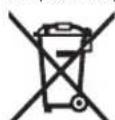
Do not dispose of vacuum cleaners with household waste!
For EU countries only:
In accordance with European Directive 2012/19/EU on waste electrical and electronic equipment and its transposition into national law, used vacuum cleaners must be collected separately and handed in for environmentally sound recycling.
If disposed of incorrectly, waste electrical and electronic equipment may have harmful effects on the environment and human health due to the possible presence of hazardous substances.
Ukrainian
Safety instructions for use

Important safety instructions. Improper use of the tool or failure to follow the instructions may result in electric shock, fire and/or
serious injury.
Read all safety warnings and instructions before use.
This appliance is not intended for use by persons with reduced physical, sensory or mental capabilities, or lack of experience and knowledge, unless they have been given supervision or instruction concerning use of the appliance by a person responsible for their safety. Children should be supervised to ensure that they do not play with the appliance. Do not vacuum up flammable or combustible liquids, such as gasoline, and do not use near explosive atmospheres. Do not vacuum up hot ashes, coals, or other burning materials.
WARNING
Use the appliance only as described in this manual to ensure sufficient information regarding
the use of the appliance, materials to be collected, and proper disposal. Read all
instructions carefully to reduce the risk of injury from improper use of the tool.
WARNING
The appliance is intended for collecting dry materials. When used with appropriate precautions,
it can also be used for wet pickup. To reduce the risk of electric shock, do not expose the appliance to rain or moisture.
Do not use the appliance to pick up flammable or combustible liquids, such as gasoline, oil, alcohol, or thinners. Do not use near flammable gases, liquids, or explosive atmospheres. Do not use the appliance in areas where there is a risk of explosion from gases, vapors, or dust.
WARNING
Use the power outlet only as specified in the operating instructions.
WARNING
The plug may become dirty when pulled out or when in contact with water and detergents. In this case
the plug may be damaged.
WARNING! The plug must only be used in sockets. WARNING! Regularly check the plugs and verify them for damage. They can negatively affect functional safety. If you cannot avoid using the plug in a wet environment, use a residual current device. Using a residual current device reduces the risk of electric shock. Before each use, check the plug, cable, and plug connector. Do not use the plug if damage is detected. Do not open the plug yourself; its repair must only be performed by qualified personnel and only with original spare parts. A damaged plug, cable, or plug connector increases the risk of electric shock. Do not run over the cable or pinch it. Do not pull the cable to unplug the plug connector from the socket or to move the plug. A damaged power cord increases the risk of electric shock. Unplug the plug connector from the socket before performing work with the technical description or cleaning, before storing the plug, before cleaning accessories, or before placing the plug. These safety precautions reduce the risk of accidental starting of the plug. Follow good ventilation at the workplace. Repair of the plug must only be performed by qualified personnel and only with original spare parts. This
142|Ukrainian
Ensure the preservation of the plug's safety features.
WARNINGS
The plug contains a built-in fuse. Inspection, maintenance, and technical
servicing that involve opening the housing may only be performed by specialists. The necessary protective grounding must be connected. Do not operate the plug without a properly and reliably installed grounding system. Otherwise, you may endanger your health.
Before use, check the condition of the plug according to the instructions. Do not use the plug if it is damaged; have it repaired by a specialist. Otherwise, you may be injured. Do not step on the plug. You may damage the plug. Be careful with the power cord and the plug connector. Otherwise, you may endanger others. Do not use the plug near water. A damaged plug increases the risk of electric shock. Connect the plug to a properly grounded outlet. The socket and the connection must have proper protective conductors.
SYMBOLS
The following symbols are used on the plug or in the operating instructions. Please read the symbols and their meanings. Following the instructions will help you use the plug correctly and safely.
Symbol and meaning


WARNING! Read all safety instructions and
the manual. Failure to follow safety instructions and the manual may result in electric shock, fire, and/or serious injury.
The plug complies with EN60335-2-69 for dry
Operation of the device for health purposes with a high value of exposure dose >1 mg/m
Damage to the device may affect health.
The procedure for slowing down and maintenance, including emptying the container, may only be performed by qualified personnel. Appropriate safety measures are required. Do not
Symbols and their meanings
Operate the device only with a properly and securely installed grounding system. Do not endanger your own health.
max. 1 L-Boxx, max. 15 kg
Do not install more than one L-BOXX case.
The weight of the L-BOXX case together with its contents must not exceed 15 kg.

Do not place the device on such cranes, etc., for transport.
The device is equipped with a carrying handle. There is a risk of injury if not handled properly.
Do not place the device on unstable surfaces, and do not use it in
an upright position. The device may tip over and be damaged. There is a risk of injury.

Automatic start and stop
Operation of the device with power tools
The device automatically turns on when the power tool is switched on and turns off when it is switched off.


Rinsing modes
Rinsing
SFC+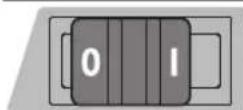
SFC+
Semi-automatic filter cleaning (SFC+ = Semi-Automatic Filter Cleaning Plus)
Data on the maximum permissible total power consumption of the connected electric tool (depending on the country)
- Do not use the device without a filter (23) or with a damaged filter.
Note: For cleaning dry solid materials, use the filter (24) to protect the motor from solid materials. - Insert the suction hose (26) into the suction connection (28). (See "Installing the suction hose" (see Fig. F), page 145) - Switch on the semi-automatic filter cleaning (SFC+) (see "Semi-automatic filter cleaning" (see Fig. I), page 146)
Rinsing
- To start rinsing, turn the mode selector switch (5) to the "RINSING" position. Rinsing is activated when the water level sensor (35) detects the maximum water level. Turn the mode selector switch (5) to the "OFF" position.
Note: When rinsing non-water-soluble liquids (e.g., drilling emulsion, oil, and grease), rinsing will not be activated when the container is full. It is necessary to regularly check the water level and empty the container manually.
- To start rinsing, turn the mode selector switch (5) to the "RINSING" position. - Empty the container (1).
After rinsing, proceed as follows:
Remove the filter element (24) and let it dry thoroughly. - Remove the rinsing nozzle (8), close the filter opening (34), and let both parts dry thoroughly.
HaniBaTOMaTuHe OuNueHHa fInbTp a (nB.MaI.1)
Function of the filter cleaning button. Maximum suction power is maintained if the filter is cleaned regularly. The cleaning frequency depends on the type and amount of dust. With regular cleaning, maximum suction power is maintained. With automatic filter cleaning (SFC+), the flat pleated filter is cleaned by reversing the air flow. The flat pleated filter is fully functional. Cleaning the flat pleated filter by tapping or blowing is not only unnecessary, but can also damage it.
Indication: The filter cleaning button is activated (SFC+ (18) is switched on).
-Start filter cleaning SFC+
Press the release button of the hose or suction tube, or, if the SFC+ module (20) is installed: Press and hold the start button (33) for approx. 10 seconds.
-Switch off SFC+
Move the SFC+ switch (18) to position 0 (off).
-Switch on SFC+
www.bosch-pt.com/serviceaddresses
Disposal
The appliance, accessories and packaging should be sorted for environmentally friendly recycling.
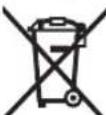
Do not dispose of the appliance in household waste.
EU Declaration of Conformity:
In accordance with European Directive 2012/19/EU on waste electrical and electronic equipment and its transposition into national law, used appliances must be collected separately and handed in for environmentally friendly recycling. Used electrical and electronic equipment may contain hazardous substances that can have a negative impact on the environment and human health.
Kazakh
Depending on the economic feasibility (depending on the feasibility), it can be used in the countries of the Commonwealth of Independent States.
The product can be used in the production of various products and in the production of frames. The scope of application is determined by the manufacturer. The manufacturer determines the scope of application. The importer is responsible for the compliance of the product with the requirements.
Product parameters
The product parameters are given in Table 1 (starting from the moment of commissioning, subject to compliance with the operating instructions).
The service life of the product is at least 10 years, provided that the operating rules are followed.
If the housing is made of cast iron, the product is not intended for use with aggressive media. If the housing is made of steel, the product is not intended for use with aggressive media. If the housing is made of plastic, the product is not intended for use with aggressive media. If the housing is made of brass, the product is not intended for use with aggressive media.
Complete set
- The product is supplied with a passport and operating instructions.
Service types and conditions
The product must be used in accordance with the operating instructions.
Storage
The product should be stored in accordance with the storage conditions. The storage temperature should not exceed the limits specified in the operating instructions. Storage without packaging is not allowed. For information on storage conditions, refer to GOST 15150-69 (section 1).
Transportation
Transportation of the product is allowed by any means of transport, provided that the product is protected from mechanical damage.
- It is allowed to transport the product in the packaging of the manufacturer. - For transportation conditions, refer to GOST 15150-69 (section 5).

The technical passport and the expert examination are not interchangeable. The technical passport and the expert examination are not a substitute for the safety of the current.
And/or to bring them to the attention of the specialists.
For the safety of the technical passport and the expert examination, keep them safe.
Do not allow children, the disabled, or the elderly to use the device without supervision. Improper use may cause injury. Keep away from children.
Children should not play with the device.
Keep all parts of the technical passport safe. Do not damage or lose it. This passport is a certificate of quality.
EXPERT
Use the device, keep the passport and its
The device must be used in accordance with the instructions in this passport. The manufacturer is not responsible for damage caused by improper use.
EXPERT
Use the device for its intended purpose only.
The device is not intended for use in explosive atmospheres. The device is not intended for use with flammable liquids.
Do not use the device with gasoline, oil, alcohol, or other flammable liquids. Do not use the device in the presence of flammable gases or vapors. The device may be used only for its intended purpose. Do not use it for any other purpose.
EXPERT
Po3eKaHbI TeK nandAnHy HcyckaynbIfbHda 6enrineHren
MaKaCaTTaPaTnAaHaTaHbIbI3.
ECKEPTY
Ko6ik Hemece cy wblkca uancopfbuhtb6ipden owiipin,
KoHTeHepiTa3anaHbI3.KepiKaFdaJaWaHcopfblW 3aKbIMdaHyblMmKiH.
HA3AP AYdAPbIHbI3! WAncOpfbIuTbI TEK iUki 6oMnepe daTay kaxet. HA3AP AYdAPbIHbl3!CybIKTBkTOnTbipy cencopbH Kyeni Tpye Ta3an, OHb3aKbIMdaMaFaHBiH TeKcepH3. Kepi XaFdaJda WAnCOPbIw Dypbc icTeMeyi MymKiH. 3neKtp KypaIbbl BinFaIbI opta naIaIaIaHy KaKeT 6oNa, abToMaTbI caKaTaHbIbpIbI aXbIpaTkblBn H naIaIaHaBbIbI3. ABToMaTbI caKaTaHbIbpFbIaXkbipAtkblBn NaIaIaHaY TK CORY KayiBn TEmeHdetei. Op naiDanaHydAn anbHn WauCOPfBHTb, Ka6eNbdi Xhe aHbipdt TeKcepiH3. Akaydb 6aikacabH3 WaHcOPfBHTb nainanHaHbH3. WauCOPfBHTb eH3 aWnAbH3, OHb TEK 6iIKt i MAMAHFa XHe TYHcyakbl 6oWeKTepeMhen XohdTeH3. 3aKbIMdaFAn HuaCOPfBHT, Ka6eNb XHe aHbip 3neKtp TOFBHbH, COy Kayin H apTbpaHbI. Kabebidi 6acnabH3 HeMece OHJI KaHbIN TactamaHbI3. Abyipblpo3eKaadH WbIFapy Hemece WaHcOPfbITbXbINbity yin Ka6ebdi TapnaHbI3. 3aBIMdaTaN Ka6eb3neKTP TOfbiHbIH, CORY KayiH apTTbpaBl. KypbIFbHb peTey,ka6dbIK 6eKeTepi anMactbipy Hemece WaHcOpFbIHTbI aBII KOIOaH aIbIPbIpo3eTKaHaH WbIFapbIH3. OcbCaKTbIK 7apacblwaHcOpFbIHTbH baiKaycbI3 KocblyBaHa K0J 6epMeNi. KymbocophblihkakcbjxendtinyineKe3 Xetki3iH3. WahcnpfbtiTeK 6nikTi MaMaHaXHe apHaynb 6enweKeTpMeH XeHdeti3. CoapkbIb WauHcnpfbkayinc3diirin caKaTaNb3.
ECKEPTY
Copfblw Dehcaaynbka 3nH nKentipetin wandbj kyytaDbI.
Bocaty XeHTEXHKanbIK Kbi3MeKepcTepeKTepeH, cohih iHHei hua HHHaHbI KOHTeHepI Ta3anay 6oibHnHa XymbictapDl MaMdaHbipbnfah KcinOpbHnApFa opbHdayFa TancbipbHbI3. Tnicti KopraHbc Ka6dbfbKaKet GonaDbI. CopfblTb1 TonbIK XHe MyKnT enHirreH cy3ri JyNecinci3 naDanaHbA13.Kepi KaFdaJa DeHCayNbIFbHb3Fa 3HH Kenyi MYkIH.
Pnndanany andbihda copfbw wnaHTbH akaycb3 6onybHa Ke3 Xetki3iH3. WAn TapanMayb yin Copfbw wnaHbI WaHcOpfbWka Kocybl TypbH. WAnDbI JxTbn Xi6epy MymKIn. Wahcopfbiyycthe OTbipmaHB3.Wahc0pfblITb6y3ybiHb3 MYMKIH.
Xeni ka6enih xhe copfbu wnaHbH a6aian naDanaHbIb3. OnapbH e3re aamapFa 3nH Kentipyi MymkiH. WahcnpfbiTikene6afbtbinraH cyafbHbmeH taanamab3. WacnpbfXorapfbBenirih iine cy Kipce, on 3neKtp TofbHbHcoFy KayinapbbapdbI. WahcnpfbihtbTnicti Teptinnen Xepre TybIKtanfah Tokxeniche xanfaHB3. Po3eKa MeH y3apTKbI Ka6ebde akaycbI3 KopFaHbI cBIM 60nyI KaXET.
Benrinep
Tomehderi 6enrinep wancopfbwnt naaanaHan Ke3e MaHb3Db60yblMymkIn.6enrinepe Hn onapdbH MaBhlacbi Hkattan anbH3.6enrinepiD npbc TycHy naaHahybifa wancopfbwnt dypbic apc eHimdi naaHaNyFA KEmekTececi.
BenrinepeMehonapdbHMaftbHaCsi


ECKEPTY Bapnbik Kayinci3dk TexHHKacbHbH HcKaynapbH KHe eKeptnenepei Okbl WbIfbHbI3.
The device may be used for pumping water, and/or for pumping liquids that are not aggressive towards the pump materials.
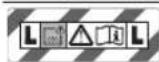
According to IEC/EN 60335-2-69, the noise level is greater than 1 m/s², so hearing protection is required when operating the pump.
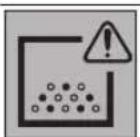
WARNING! Risk of injury from the pump. Only qualified personnel should perform installation, electrical connections, and maintenance. The pump must be disconnected from the power supply before any work. The pump must not be used for pumping flammable or explosive liquids.

max. 1L-Box max. 15kg
The L-BOXX is not included.
The L-BOXX must not be loaded with more than 15 kg.
Switching on and off

Do not operate the pump without water. Do not run the pump dry. The pump is equipped with a thermal overload protection.

Do not open, start, or stop the pump under load. The pump may be damaged if operated under load. The pump is equipped with a thermal overload protection.
Pumping water with a high temperature
- To switch on the pump, press the "ON" button (5). - To switch off the pump, press the "OFF" button (5).

The pump is not suitable for pumping flammable liquids (see safety instructions).
If the pump is used for pumping hot water, the maximum temperature must not be exceeded. Observe the safety instructions.
Connect the pump to a properly installed socket (3). The socket must be easily accessible. Observe the maximum electrical connection values.
- Replace the pump filter (19) (see "Replacing the pump filter", page 152).
- Connect the plug (19) to a properly grounded electrical outlet.
Note: Before connecting the appliance to the electrical outlet, make sure that the voltage indicated on the rating plate (19) matches your local mains voltage (e.g., 220-240 V). Connect the plug to a properly grounded outlet. The appliance is equipped with an automatic shut-off function (SFC+) that prevents it from operating without water. This function protects the heating element (32) from overheating.
- To switch off the appliance, press the on/off switch (5) and set it to the "OFF" position. - Unplug the appliance from the electrical outlet before cleaning. The appliance will turn off automatically. - Unplug the appliance and let it cool down. The automatic shut-off function will turn the appliance off automatically within 15 seconds after the water has boiled away. - To switch on the appliance, press the on/off switch (5) and set it to the "ON" position.
Boiling water
▸ Do not use the appliance if the power cord or plug is damaged. Do not use the appliance if it has been dropped or damaged. If the power cord is damaged, it must be replaced by the manufacturer, its service agent, or similarly qualified persons to avoid a hazard. ▸ Do not immerse the appliance in water or any other liquid. The appliance is intended for heating and boiling water only.
Note: The appliance is intended for heating water (protection class I) and is equipped with a boiling dry protection function.
Boiling water and making hot beverages
- Press the lid release button (23) or open the lid by pulling it up.
Note: Before boiling water, fill the kettle with fresh water (see
the section "Filling the kettle").
- Place the kettle on the base (26) and plug it into the electrical outlet. (See figure F, page 153) - Press the on/off switch (5) to start boiling. (See figure G, page 154)
Cleaning and descaling
- To switch off the appliance, press the on/off switch (5) and set it to the "OFF" position.
The appliance is equipped with a boil-dry protection (35). If the appliance is switched on without water, it will turn off automatically. Press the on/off switch (5) to reset it.
Note: Do not fill the kettle with liquids other than water (e.g., milk, coffee, tea). The kettle is intended for heating water only. Do not operate the kettle without water.
- Wash the filter with clean water and mild detergent (5) "Eupiry" detergent. - The container (1) is empty. If the filter is dirty and the water is not clean, then:
- Remove the filter cartridges (24), clean them and reinstall.
- Remove the filter cover (8), remove the filter cartridge (34), clean it and reinstall.
To clean the filter with the automatic cleaning function (see point 1)
If the filter is very dirty, it must be cleaned.
The cleaning method of the filter depends on the type and degree of contamination. If it is heavily contaminated, the maximum cleaning time is set.
When cleaning the filter with the automatic cleaning function (SFC+), open the tap, and the filter cartridges are cleaned automatically.
Do not use sharp objects to clean the filter cartridges. If the filter cartridges are damaged, they must be replaced, and it is possible to close the water supply with the shut-off valve.
The automatic cleaning function of the filter is activated by pressing the button (SFC+ button (18) once).
-SFC+ filter cleaning function is activated
If the filter is dirty or the water flow is reduced, press the SFC+ button (18) once. If the SFC+ module (20) is installed: the cleaning process (33) will start and last for 10 seconds.
-SFC+ function is activated
Press the SFC+ button (18) once (to activate).
-SFC+ function is activated
Press the SFC+ button (18) again (to deactivate).
Technical measuring instruments
Technical measuring instruments and testing
To repair, maintain, or operate the equipment, you must follow the instructions in this manual. Failure to follow these instructions may result in injury. For safe operation, follow the safety instructions and warnings. When operating or maintaining the equipment, use the correct tools.
If you do not follow the instructions, the manufacturer or its authorized representatives will not be liable for any damages.
For technical measuring instruments, proper maintenance, testing, and operation are required. In case of malfunction, contact qualified personnel or other specialists. To avoid accidents, proper maintenance is necessary. Proper maintenance should be carried out by trained personnel. During technical maintenance, use protective equipment. After technical maintenance, perform a final check. If any defects or malfunctions are found, they must be corrected immediately.
Before starting work, check the condition of the filters and all units and components, and ensure they are sealed. During technical maintenance and repair, parts that have not been cleaned must be removed. These parts must be cleaned and then reinstalled.
-The filter housing should be cleaned periodically.
Drain the condensate from the filter (see figures J1-J2)
The condensate may be dirty. Drain the condensate regularly.
Replace the filter element (24) if necessary.
-Remove the cover (14), then remove the filter element (34).
Install the new filter element (24) and replace it. When replacing the filter element (24), ensure that the O-ring and the filter element (34) are correctly seated. The filter element should be replaced if it is dirty or damaged. -Replace the filter element (24) if it is damaged or worn, and ensure it is correctly installed. -The filter element (34) must be replaced (see instructions).
Clean the container
Clean the container (1) with a standard cleaning agent.
Clean the drain valve (see figure)
The device is designed for operation (35) as specified.
-The culture (9) and the filter elements (8) are installed. The device is designed for operation (35) with a humidifier. -The filter elements (8) are installed in the culture (9).
Required tools
Required materials
Dry paper filter (dry) 2 607 432 035
Dry filter (dry) 2607432037
Wet paper filter (wet) 2 607 432 039
Carbon filter (dry/ 2607432043 wet)
Safety and maintenance (see page 1)
Install the filter cover (13). Install the required accessories: the filters (29) into the holders (15), the test cap (25) into the holder (16), and the sealing cap (28) into the holder (17). -Remove the plug from the drain hose (4), then install the drain hose (21) into the drain connector (4). Tighten the plugs. -Connect the L-BOX to the power supply (7). -To remove the drain hose, first remove the plug and then the hose. If the hose is blocked, remove the plug and the hose. -Install the drain hose (6) into the drain connector. -Do not operate the device without the filter elements installed.
156|Kazakh
- To open the control panel (12), press the control panel button (11).
Accumulator
If the accumulator is damaged (e.g., leaking, swollen), it must be replaced. Always use a new accumulator.
Accumulator replacement
| Copy typ6bHacbl Jxmbic icTeMei Typ. - XeIinik Ka6ebdi, XeIinik aAshaBbl, CaKaTaHdbipfBbHtB, po3eTKaHbl JxHe ToTbipy DeHreHIn DaTchKtepiH (35) TekcepHiz3. | |
| XMyblic pexHMdepiH aybictbipbN-Kockbbl (5) "IcKe Kocy/ToKtAty ABTomatHKacbl" pexHmInde Typ. - XMyblic pexHMdepiH aybictbipbN-Kockbbl (5) "Copy" bEnricHe opHaTbHb3 Hemece po3eTKaF (3) XaJIaHaHafn 3JIeKTP KypalbH icKe KocbHb3. | |
| Copy typ6bHacbl ΕsEidi. - KontheHepdi (1) BoCAtbHb3. | |
| Copy typ6bHacbl KOnTheHep BoCAtbHFaHHan KeiH De JxMbIC icTeMei Typ. - ΜaHc0rpBbHtB eHipin, 5 cekHyd KytHiz3, 5 cekHyd etKeHHen KeiH kaHTa KocbHb3. | |
| - TOnTbpy DeHreHIn DaTchKtepiH (35) XeHe DaTchKtepiH (35) boc opHbH KbIIaKpneH Ta3aHaHb3. | |
| Copy KyaTb TEmeHedi. - Copy canTAMacBbl, copy KybpbH (29), copFbH uHaHriH (21) Hemece Jxllnak KATnapbl cy3rHl (24) XHaHbIn KaIraH KipDeH Ta3apTbHb3. | |
| - Kocblic Ka6bH (23) Hemece ShaX XHaHaBbH KaNTb alMaCTbPbHb3. | |
| - Cy3r i KaTAMacBbl (34) dYpbic eHri3H3. | |
| - ΜaHc0rpBbHtB HxOarFbH b6oJirH (8) dYpbic opHaTbH, KybPiTapbH (9) Xa6bHb3. | |
| - XaHnak Katnapbl cy3rHl (24) aImactbipbHb3. | |
| ΣaH copy Ke3iHne ΣaH ΣbHbπ Typ - XaHnak Katnapbl cy3iHn (24) dYpbic opHaTbHFaHbH TekcepHiz3. | |
| - XaHnak Katnapbl cy3rHl (24) aImactbipbHb3. | |
| Θwipy AByOMaTHKacbl (bIbn fah ShaC copy) XyMbIC icTeMei Typ. - TOnTbpy DeHreHIn DaTchKtepiH (35) XeHe DaTchKtepiH (35) boc opHbH KbIIaKpneH Ta3aHaHb3. | |
| CBybIKbTAp Tok eTKi36eiTih 6oLca Hemece K6bIK naJa 6oLca, Θwipy AByOMaTHKacbl XyMbIC icTeMei Di. - TOnTbpy DeHreH In XyHeni Type 6aKbIaHaHb3. | |
| Σc3rHl T3aHaay ΦyHKzuaRcbl JxMbIC icTeMei Di. - SFC+ axbipatkbHbH (18) aptka (I kyyHe) XbIaKbITbHb3. |
The service center has not been found.
The service center provides qualified advice and technical service, and also answers questions about the use and repair of Bosch power tools. For repairs, please contact the service center or the authorized service center for Bosch power tools:
www.bosch-pt.com
The Bosch service advisory team will answer your questions about the use and repair of our products.
Please provide the complete product name and the 10-digit article number on the type plate when making inquiries.
The right to make changes to the product and to the instructions for use is reserved. The product may only be used by trained personnel or authorized service personnel.
The product must be used in accordance with the instructions. WARNING! Do not use the product if it is damaged. Risk of injury. The product must be used in accordance with the safety regulations.
Kazakhstan
Service and warranty address:
"Robert Bosch" LLC
Almaty
Republic of Kazakhstan, 050012
Murabaev St., 180
"Termes" LLC, 7th floor
Tel.: +7 (727) 331 31 00
AKC: +7 (727) 2330787
E-Mail: ptka@bosch.com
Service center for maintenance and repair of tools
You can find more information at: www.bosch-professional.kz
For service centers and authorized dealers, please visit: www.bosch-pt.com/serviceaddresses
Disposal
Power tools, accessories, and packaging should be sorted for environmentally friendly recycling.
Do not dispose of power tools into household waste!
Only for EU countries:
According to the European Directive 2012/19/EU on waste electrical and electronic equipment and its implementation in national law, power tools that are no longer usable must be collected separately and disposed of in an environmentally correct manner.
If you have any questions regarding disposal, please contact your local authority or the dealer from whom you purchased the product.
Româna
Service scule electric
Strada Horia Macelariu Nr. 30-34, sector 1
013937 Bucuresti
www.bosch-pt.com/serviceaddresses
Disposal
The vacuum cleaner, accessories, and packaging must be handed over to a recycling center.
Safety Instructions
The operating instructions must be followed to avoid electric shock, fire, and/or serious injury.
Keep these instructions safe and pass them on.
This vacuum cleaner is intended for use by persons with reduced physical, sensory, or mental capabilities or lack of experience and knowledge, unless they have been given supervision or instruction concerning use of the appliance by a person responsible for their safety. Otherwise, there is a danger of incorrect use and injury.
Check the device and the accessories before each use. Follow all safety instructions for the materials being vacuumed. Do not vacuum up ash, soot, or dust from stone materials or asbestos. Work with these materials only if they are classified as safe.
WARNING: Use the vacuum cleaner only if you have received sufficient information on its use.
The vacuum cleaner, the materials being vacuumed, and the safe disposal of the vacuumed material must be handled properly. Improper use of the vacuum cleaner can lead to danger, especially if the instructions are not followed.
WARNING: The vacuum cleaner is suitable for vacuuming only dry materials during dry periods.
Vacuuming of liquids. The ingress of liquids increases the risk of electric shock.
Do not vacuum flammable or explosive liquids with the vacuum cleaner, e.g., gasoline, oil, alcohol, or solvents. Do not vacuum burning or smoldering dust. Do not work with the vacuum cleaner in rooms with an increased risk of explosion. Dust, vapors, and liquids can ignite or explode.
WARNING: DANGER
Use the contact protection to prevent accidental contact with the rotating parts.
If the device is not going to be used for a long time, immediately remove the battery and store it.
The vacuum cleaner may be damaged if it is used improperly.
WARNING! The vacuum cleaner plug must be connected to the mains socket only after the appliance has been completely assembled.
WARNING! Before using the appliance, check the power cord and the plug for damage. If they are damaged, the appliance may be dangerous. If the vacuum cleaner is used in a humid environment, use a residual current device (RCD) intended for this purpose. Using an RCD reduces the risk of electric shock. Before use, check the vacuum cleaner, the power cord, and the plug. Do not use the vacuum cleaner if you find any damage. Do not attempt to repair the vacuum cleaner yourself; repairs should only be carried out by qualified technicians using original spare parts. Damage to the vacuum cleaner, the power cord, or the plug increases the risk of electric shock. Do not pull or squeeze the power cord. Do not pull the cord to unplug the plug from the socket or to move the vacuum cleaner. A damaged power cord increases the risk of electric shock. Before carrying out any maintenance or cleaning of the vacuum cleaner, before adjusting the settings, replacing accessories, or storing the vacuum cleaner, unplug the cord from the socket. This precaution prevents accidental switching on of the vacuum cleaner. Ensure that the appliance is properly checked and that repairs are carried out only by qualified personnel using original spare parts. This guarantees the preservation of the functions and the electrical safety of the appliance.
The vacuum cleaner is intended for dry vacuuming only. Do not use it for vacuuming liquids or for any other purpose. Only use the vacuum cleaner with the dust container and filters properly installed. Do not use the vacuum cleaner without the dust container and filters, as this may damage the appliance. Always ensure the appliance is switched off before cleaning or maintenance.
Before switching on, make sure the appliance is in good condition. Do not use the vacuum cleaner if it is damaged, to avoid any risk of injury. If the appliance is damaged, there is a risk of electric shock. Do not use the vacuum cleaner. You may get injured. Be careful when using the power cord. You may create a dangerous situation for others if you are not careful.
Do not use the vacuum cleaner with a wet hand. Water entering the upper part of the vacuum cleaner increases the risk of electric shock. Connect the vacuum cleaner only to a properly grounded outlet. The contact must be properly grounded. The power cord must have a proper ground conductor.
Symbols
The symbols below may be important for the correct operation of your vacuum cleaner. Please, familiarize yourself with the symbols and their meaning. Correct interpretation of the symbols will help you use the vacuum cleaner better and more safely.
Meaning of symbols

WARNING! Before using the device, read the safety instructions and the operating instructions carefully. The device must only be used by trained personnel. There is a risk of electric shock, fire, and/or serious injury.
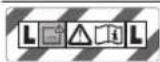
The vacuum cleaner is suitable for vacuuming dry, non-hazardous dusts with an exposure limit value of >1 mg/m³ according to IEC/EN 60335-2-69.
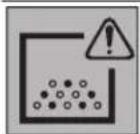
WARNING! The vacuum cleaner contains dust that is hazardous to health. Emptying and maintenance, including disposal of the dust collection container, must only be carried out by specialists. Appropriate protective equipment is required. Do not use the vacuum cleaner without the filter system and the filter bag. Otherwise, health may be endangered.
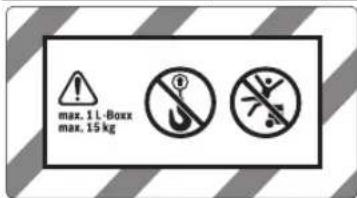

max. 1L-Boxx max. 15kg

Place the L-BOXX on top of the vacuum cleaner.
The L-BOXX with the vacuum cleaner must not exceed 15 kg.
Do not lift the vacuum cleaner by the crane hook, e.g. for transport. The vacuum cleaner must not be lifted with a crane. There is a risk of damage.
SYMBOLS AND THEIR MEANING

Do not place or store anything on top of the vacuum cleaner. The vacuum cleaner may tip over and be damaged. There is a risk of injury.
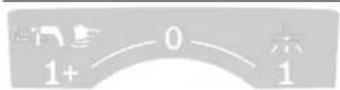

Start/Stop automatic
Vacuuming of dust from power tools. The vacuum cleaner automatically switches on and off with a time delay.

Switching off

Reduced power
Vacuuming of collected dust

SFC+
SFC+
Semi-automatic filter cleaning (SFC+ = Semi-Automatic Filter Cleaning Plus)
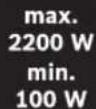
Data for permissible connection of power tools (specific to individual models)
Product description and scope of delivery
Please read and follow the safety instructions in the operating manual.
Intended use of the power tool
The vacuum cleaner is intended for collecting, vacuuming, and disposing of non-flammable dry dust, non-flammable liquids, and a mixture of air and water. The vacuum cleaner has been tested and certified and complies with dust class L. It is suitable for increased demands in professional use, e.g., in industrial and commercial settings.
Vacuum cleaners of dust class L according to IEC/EN 60335-2-69 may only be used for vacuuming and disposing of dust that is hazardous to health with an exposure limit value of >1 mg/m³.
Use the vacuum cleaner only after you have familiarized yourself with it and can use it without danger, following the instructions and functions described in this manual.
The tool may only be used in a dry environment.
Illustrated components
The numbered components refer to the illustrations of the vacuum cleaner on the graphic pages.
(1) Container (2) Suction hose (3) Tool socket (4) Suction hose holder (5) Variable speed control (6) Handle for carrying (7) L-BOXX accessory (8) Vacuum cleaner hose (9) Brackets for hose storage (10) Water nozzle (11) Control wheel (12) Control wheel (13) Cable holder (14) Filter cover (15) Filter brush (16) Nozzle for crevices (17) Nozzle for upholstery (18) SFC+ pre-filter (19) Adapter for dust extraction (20) SFC+ module (21) Vacuum cleaner hose (22) Exhaust air filter (23) Carrying strap (24) Flat filter (pleated) (25) Crevice nozzle (26) Deep cleaning (27) Brush strip (28) Floor nozzle (29) Suction tube (30) Release button for hose (31) Connection piece (32) Air inlet (33) Filter cleaning activator (34) Filter cover (35) Filter clogging sensor
Technical data
Mounted or required (see page)
Insert the vacuum cleaner hose (22) into the inlet (21) until it stops. The inlet is secured with a catch. -Insert the hose following the arrow on the inlet (22). -For removal, press the buttons (31) and pull the hose out of the other components.
Installing/removing the fabric dust bag for dry vacuuming or the dust bag (dry vacuuming) (see fig. E1-E2)
For dry vacuuming, you can install the fabric dust bag for dust (23) or the dust bag (accessory) in the container (1). This ensures the dust is collected.
Note: When using a bag with a cardboard collar, it must be replaced, and when using a bag with a plastic collar, it is advisable to tilt the semi-automatic dust filter (SFC+) (see semi-automatic dust filter (see fig. I), page 170).
Installing the fabric dust bag
-Open the clips (9) and remove the upper part of the vacuum cleaner (8). -Insert the fabric dust bag (23) into the container (1) with the opening facing forward. -Slide the opening for dust onto the suction pipe until it fits. -Ensure that the fabric dust bag (23) is correctly positioned against the inner walls of the container (1). -Pull the remaining part of the fabric dust bag (23) over the rim of the container (1). -Place the upper part of the vacuum cleaner (8) back on and close the clips (9).
Removing and disposing of the fabric dust bag
-Open the clips (9) and remove the upper part of the vacuum cleaner (8). -Pull the fabric dust bag (23) back off the flange. -Remove the fabric dust bag (23) from the container (1) while being careful not to damage it.
When cleaning the fabric dust bag, do not use a suction pipe or other accessories.
- Clean the cover with a damp cloth and let the fabric dust bag dry. Then place the fabric dust bag (23) back into the opening for dust and close the cover with the damp cloth.
Installing/removing the dust bag (accessory)
-Open the clips (9) and remove the upper part of the vacuum cleaner (8). -Pull the dust bag back off the flange. Close the opening of the dust bag with the cap provided, then place the closed dust bag in the container (1). -Insert a new dust bag onto the flange of the vacuum cleaner. Ensure that the dust bag fits snugly against the inner wall of the container (1). -Place the upper part of the vacuum cleaner (8) back on and close the clips (9).
Installing the rubber nozzle (wet vacuuming) (see fig. F)
Note: The suction power (dust class L) is only approved for dry vacuuming.
-Raise the locking lever (27) and slide the accessory onto the hose (28). -Insert the rubber nozzle (26) into the opening for the hose (28).
Structure: The structural side of the device is designed for the intended use.
Open the L-BOXX (see fig. G)
For transporting the vacuum cleaner and for safe storage of accessories and/or power tools, you can order the top part of the vacuum cleaner L-BOXX.
Place the L-BOXX inside the vacuum cleaner (7). Do not carry the vacuum cleaner by the handle of the attached L-BOXX. The vacuum cleaner is too heavy to be carried by the L-BOXX. There is a risk of injury and damage.
Working with the power tool
Before performing technical maintenance or cleaning the vacuum cleaner, before making adjustments, changing accessories, or storing the vacuum cleaner, disconnect the cable from the socket. This safety measure prevents accidental starting of the vacuum cleaner.
Operation
Connect to the mains voltage! The mains voltage must match the data on the nameplate of the vacuum cleaner. Inform yourself about the applicable regulations/laws regarding working with dust hazardous to health in your country.
The vacuum cleaner is suitable for vacuuming the following materials:
- Dusts with an exposure limit value > 1 mg/m³. The use of the vacuum cleaner in rooms with explosion hazard is not permitted.
To ensure optimal vacuuming performance, always fully extend the hose (21) from the top part of the vacuum cleaner (8).
Dry vacuuming
Vacuuming fine dust
To switch on the vacuum cleaner, turn the rotary switch (5) to the symbol "Vacuuming".

To switch off the vacuum cleaner, turn the rotary switch (5) to the symbol "Off".
WARNING: Risk of injury from power tools (see Fig. A)
When air is sucked back into the appliance, the dust extractor must be switched on and the suction power must be set to maximum. Observe the national regulations. A socket for the power tool (3) is built into the dust extractor. You can connect the power tool to it. Make sure that the power tool's maximum power rating is not exceeded when connected to the socket. - Mount the suction hose (19) (see "Mounting the suction hose (see Fig. C)", page 168). - Insert the suction hose (19) into the power tool's socket.
Note: When working with power tools that generate a small amount of dust (e.g. drills, angle grinders, etc.), the air flap (32) on the suction hose (19) must be opened. Only then can the automatic filter cleaning (SFC+) function without problems.
For this, turn the ring on the air flap (32) until the opening is open.
- To start the automatic on/off switching of the dust extractor, turn the rotary switch (5) to the symbol for automatic on/off.

- To switch on the dust extractor, press the switch on the socket (3) of the power tool. The dust extractor switches on automatically. - Switch off the power tool to stop the suction. The function for the automatic start/stop continues for up to 15 seconds to suction the remaining dust from the hose. - To switch off the dust extractor, turn the rotary switch (5) to the symbol for off.
Wet vacuuming
Do not vacuum flammable or explosive liquids, e.g. petrol, oil, alcohol, thinners. Do not vacuum burning, flammable or explosive dust. Do not work with the dust extractor in rooms with a risk of explosion. Dust, vapors or liquids may ignite or explode. Do not use the dust extractor as a water pump. The dust extractor is intended for vacuuming air and water mixtures.
Note: The requirements for wall permeability (dust class L) are only met for dry vacuuming.
Working with wet vacuuming
- If necessary, remove the filter bag (23) and the disposal bag.
Note: For easier removal of the water and solid particle mixture when vacuuming, use the wet filter (accessory), which separates the solid particles from the liquid.
- Insert the rubber seal (26) into the floor nozzle (28). (See "Inserting the rubber seal (wet vacuuming) (see Fig. F)", page 169 - Switch off the automatic filter cleaning (SFC+) (see "Automatic filter cleaning (see Fig. I)", page 170)
Vacuuming liquids
To switch off the vacuum cleaner, turn the operating mode switch (5) to the symbol "Off".
The vacuum cleaner has a sensor for the degree of filling (35). When the maximum filling level is reached, the vacuum cleaner switches off. Set the operating mode switch (5) to the symbol "On".
Note: The vacuum cleaner does not switch off when vacuuming liquids (e.g. water from cleaning, oil and grease). The filling level must be checked constantly and the container emptied in time.
To switch off the vacuum cleaner, turn the operating mode switch (5) to the symbol "Off". Empty the container (1).
To prevent the formation of mold in wet vacuuming:
Remove the filter (24) and leave it to dry well. Remove the top part of the vacuum cleaner (8), open the filter cover (34) and let it dry well.
Cleaning the filter (SFC+)
When the suction power noticeably decreases, the filter must be cleaned electromagnetically.
The frequency of electromagnetic filter cleaning depends on the type and amount of dust. Regular cleaning of the vacuum cleaner is recommended after prolonged use.
During electromagnetic filter cleaning (SFC+), the filter is cleaned automatically by shaking off the dust through the air flow.
Surface cleaning of the filter is not necessary. Cleaning the filter with water is not recommended.
Do not use water or cleaning agents to clean the filter, as this may damage it.
Note: Automatic filter cleaning is factory activated (SFC+ switch (18) in position I).
- Activating SFC+ filter cleaning
Close the filter cover and switch on the vacuum cleaner.
Press the SFC+ module activator (33) for approx. 10 seconds.
-SFC+ activation
Pull the SFC+ pre-switch (18) forward (position 0).
-SFC+ activation
Pull the SFC+ pre-switch (18) back (position I).
Maintenance and service
Maintenance and cleaning
Before carrying out technical maintenance or cleaning the vacuum cleaner, before finishing the settings, changing accessories or storing the vacuum cleaner, disconnect the cable from the socket. This prevents accidental switching on of the vacuum cleaner. To work efficiently and safely, keep the vacuum cleaner and the ventilation openings clean. Technical maintenance and cleaning of the vacuum cleaner should be done with a mask.
When it is necessary to replace the power cord, this must be done by Bosch customer service or an authorized service center to ensure the safety of the Bosch power tool.
Technical maintenance of the vacuum cleaner should be carried out by the user as far as possible, without endangering the safety of the user or others. Before cleaning the vacuum cleaner, it must be unplugged to prevent possible hazards. The room in which the vacuum cleaner is cleaned must be well ventilated. Wear protective equipment. After technical maintenance, the work area must be cleaned.
At least once a year, a safety check must be carried out by a qualified technician, e.g., for possible damage to the filter, leaks in the vacuum cleaner, and correct functioning of the control module.
For vacuum cleaners of class L, which are used in heavily contaminated areas, cleaning must be carried out externally, as well as on all parts and accessories with cleaning agents. When carrying out technical maintenance or repair, any contaminated parts that
cannot be cleaned satisfactorily must be removed and replaced with new ones. Such parts must be disposed of in leak-proof bags in accordance with the applicable regulations for disposal of such waste.
Service sculelectric
Strada Horia Macelariu Nr. 30-34, sector 1 013937 Bucuresti, Romania
Tel.: +359(0)700 13667 (Bulgarian)
Fax: +40212331313
Email: BoschServiceCenterBG@ro.bosch.com www.bosch-pt.com/bg/bg/
Other service addresses can be found at:
www.bosch-pt.com/serviceaddresses
Disposal
Power tools, accessories and packaging should be recycled in an environmentally friendly manner.
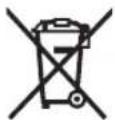
Do not dispose of power tools with household waste!
Only for EU countries:
According to the European Directive 2012/19/EU on waste electrical and electronic equipment and its implementation in national law, power tools that are no longer usable must be collected separately and disposed of in an environmentally friendly manner.
If disposed of incorrectly, electrical and electronic equipment may have harmful effects on the environment and human health due to the potential presence of hazardous substances.
Macedonian
Safety warnings for grinding

Read all safety warnings and instructions. Failure to follow the safety warnings and instructions may result in
electric shock, fire and/or serious injury.
Read the instructions for use before operating the device.
Before servicing, check the device for damage from the side of the power cord and plug, physical damage, or other defects.
Knowledge. There is always a danger of injury from improper use or damage.
Do not leave the device unattended. Make sure that children do not play with the device.
Check the required accessories for the materials to be serviced. Do not service hard materials such as beech or oak wood, stone, or asbestos. These materials are hazardous to health.
SERVICING
Before servicing, make sure you have sufficient information for the user, for
the materials to be serviced and the necessary safety measures. The instructions for use contain warnings about dangers from improper use and damage.
SERVICING
Before servicing, check for damage to the device, and take appropriate additional measures
for servicing the device. The device's operation increases the risk of electric shock.
When servicing, do not insert nails or other metal objects, e.g., pins, nails, screws, or tools for dismantling. Do not insert nails, pins, or other metal objects. Do not use the device near flammable materials as there is a danger of explosion. Doors, windows, or the device may be damaged or explode.
SERVICING
Use the connector only for the purposes specified in the instructions for use.
SERVICING
BcNcyBaOT,doKoKy noHnHa n3neryBa neHa Hn Boda n
Hcnpa3Hete ro KOHTeJhepoT. Hnky BCnCyBaOT MoKe Da CE OHTETN.
WARNING! The appliance must be stored only in an indoor space. WARNING! Regularly clean the sensors for the level of filling of the tank and check the tank. Otherwise, the function may be impaired. If the appliance is used in a humid environment, the risk can be avoided by using the protective device for differential current. The use of the protective device with differential current reduces the risk of electric shock. Before use, check the appliance, the cable and the plug. Do not use the appliance if it is damaged. Do not disassemble the appliance yourself and leave it to
repair by qualified personnel who use only original spare parts. Damaged appliance, cable and plug increase the risk of electric shock.
Do not overload or pinch the cable. Do not pull the cable to unplug the plug from the connector or to move the appliance. A damaged cable increases the risk of electric shock. Unplug the plug from the connector before cleaning or maintaining the appliance, before adjusting the supply of the device, before replacing parts or adjusting. These measures prevent unintentional start of the appliance. Ensure good ventilation of the work area. The appliance may only be repaired by qualified personnel with original spare parts. Only in this way will you be safe with the appliance.
REPAIR-REPAIRING
The appliance contains parts that are dangerous to health. Disposal and recycling, as well as
the collection of waste must only be done by qualified personnel. Appropriate protective equipment is required. Do not use the appliance without the competent attention of a specialist system. Do not endanger your health.
Before use, check that the hose for the appliance is in perfect condition. When installing the hose of the appliance, check that it does not leak. Otherwise, you may damage the hose. Do not use the appliance as a seat. You may damage the appliance. Use the hose and the hose for the appliance carefully. Be careful not to put other people in danger. Do not clean the appliance with direct water jet. Water entering the upper part of the appliance increases the risk of electric shock. Connect the appliance to a properly grounded electrical network. The plug and the extension cable must have a functioning protective conductor.
Markings
These markings are of great importance for the use of your appliance. Remember the markings and their meaning. The correct interpretation of the markings helps you to use the appliance well and safely.
Markings and their meaning


REPAIR-REPAIRING! Read all safety instructions and warnings. Failure to follow the safety instructions and warnings may result in electric shock, fire and/or serious injury.
Operation of the device in accordance with EC/EN 60335-2-69 and operation of the device with materials from wood, with a limit value for dust >1 mg/m³
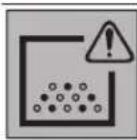
WARNING! The device is operated with dust that is dangerous to health. The dust and the disposal, as well as the dust container for collecting dust, must only be handled by trained personnel. Appropriate protective equipment is required. Do not use the device without a complete and careful inspection of the filter system. Do not endanger your health.
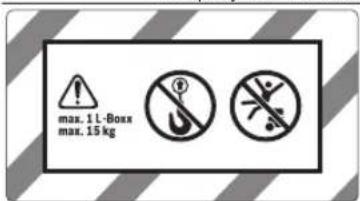
max.1L-Boxx max.15kg
Loading of the maximum L-BOXX.
The L-BOXX together with its contents may weigh up to 15 kg.

Do not lift the device, e.g., during transport, with a crane. The device is not suitable for transport with a crane. Risk of damage and injury.

Do not use the device as a ladder, support, or pull on it. The device may tip over. Risk of injury.
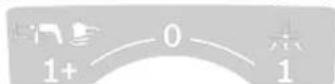

Start/Stop automatic
Operation of the dust extractor with an electrical tool that works with the device automatically switches on and off.
Designation

Switching off

Operation
Operation of the dust extractor
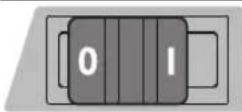
SFC+

Semi-automatic filter cleaning (SFC+ = Semi-Automatic Filter Cleaning Plus)
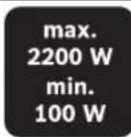
Data for the permitted length and connection of the connected electrical lead (depending on the country)
Description of the product and performance
Pay attention to the illustrations at the beginning of the operating instructions.
Use as intended
The device is intended for collecting, vacuuming, transporting, and disposing of non-flammable dusts, non-flammable liquids, and wood dust from water and air. The device has been tested for safety and complies with protection class L. It is also suitable for high loads during commercial use, e.g., in hotels, schools, workshops, and service operations. The vacuum cleaner of protection class L according to IEC/EN 60335-2-69 may only be used for vacuuming materials that are hazardous to health with a limit value of exposure >1 mg/m³.
Use the vacuum cleaner and read all instructions. You can use it for limited or other purposes and obtain the necessary accessories.
The vacuum cleaner is suitable for continuous operation.
Component illustration
The numbering of the components refers to the illustration of the vacuum cleaner on the graphics page.
(1) Suction hose (2) Handle (3) Connector for electrical tool (4) Handle for vacuuming (5) Switch for selecting operating mode (6) Carrying handle (7) L-BOXX holder
(8) Vacuum cleaner head (9) Locking lever for vacuum cleaner head (10) Dirt container (11) Filter cleaning indicator (12) Filter cleaning button (13) Cable holder (14) Filter locking ring (15) Vacuum cleaner holder (16) Accessory holder for crevice nozzle (17) Nozzle holder (18) SFC switch (19) Vacuuming hose (20) SFC module (21) Vacuuming tube (22) Crevice nozzle (23) Upholstery nozzle (24) Flat filter (pleated) (25) Crevice nozzle (26) Turbine (27) Brushes (28) Crevice nozzle (29) Vacuuming hose (30) Handle for vacuuming tube (31) Connection piece (32) Exhaust air outlet (33) Filter cleaning activation (34) Filter flap (35) Fill level sensor
Technical data
| Всисува за влажно/cубов сисувае GAS 35 L SFC+ | |
| Бpoj на дeIN | 3601 JC3 0.. |
| Hominahа щашина W 1200 | |
| Фразковица Hz 50-60 | |
| Волуmen на садот (бруто) I 35 | |
| Нето Волуmen (тейност) I 19 | |
| Волуmen на кесата за пав I 19 | |
| Мамк. NotоритонкA) | |
| - Всисувач hPa 230 | |
| - Турбina hPa 254 | |
| Мамк. К olочина на пotokA) | |
| - Всисувач I/s | 36 |
| m³/s 0,036 | |
| m³/h 129,6 | |
| - Турбina I/s | 74 |
| m³/s 0,074 | |
| Всисува за влажно/cув BCисувае GAS 35 L SFC+ | ||
| m³/h 266,4 | ||
| Мakc. калачтET на BCисувае | W 1380 | |
| Повшина на habранnot Фильер | m² 0,615 | |
| Класа на прав | L | |
| Текинab) | kg | 11,6 |
| Класа на заштITA | ±/I | |
| Вид на заштITA на BCисуваuch IPX4 | ||
| Вид на заштITA на Швajцарск струен пrichnyok | IP55 | |
A) Measured with vacuuming hose 0 35 mm and 3 m length B) Device without power cable and without power plug Rated voltage [U] o2 230 V. These data may vary depending on the voltage in your country.
Values may vary depending on the product and depend on the application and environmental conditions. More information can be found at www.bosch-professional.com/wac.
| Стат/Стоп обтуmarка | ||
| Номинален нанон | Мakсмална ячна | Минimalna ячна |
| 230 V | 2200 W | 100 W |
Data for the permitted length and connection of the connected electrical lead.
The noise and vibration values have been determined in accordance with the standard. The values are given for the vacuum cleaner and are measured.
Information on noise/vibration
The noise emission values are determined according to EN 60335-2-69.
The sound pressure level of the vacuum cleaner, measured with nozzle A, is 70 dB(A). Uncertainty K = 3 dB. The sound pressure level during operation may exceed the stated values. Wear hearing protection! The vibration emission value a (vector sum of three directions) and uncertainty K are given in accordance with EN 60335-2-69:
a1 < 2.5 m / s2, K = 1.5 m / s2
Installation
Remove the plug from the connector before cleaning or maintaining the vacuum cleaner, before adjusting the supply of the device, replacing parts, or repairing. These measures prevent unintentional start of the vacuum cleaner.
Installing the handle for the suction hose (see figure A)
Insert the handle (4) for the suction hose firmly into the provided opening for it (30), until it clicks into place.
Installing the suction hose (see figure B)
Place the suction hose (21) onto the hose connection (2) and turn it in the direction of the arrow until it stops.
Note: When vacuuming, due to the friction of the hose and the accessory for vacuuming, an electrostatic charge may occur, which the user may feel as a static discharge (depending on the humidity of the environment and the body's conductivity). In general, we recommend an antistatic hose (accessory) when vacuuming fine dust and conductive materials.
Installing the accessory for vacuuming
The suction hose (21) and the SFC+ module (20) are equipped with a click system, and can be connected to the accessory for vacuuming (floor nozzle (19), crevice nozzle (22)).
Installing the floor nozzle (see figure C)
-Place the SFC+ vacuum cleaner (20) on the floor for suction (21), until the suction openings (31) of the floor nozzle are not blocked. -Then place the floor nozzle (19) on the SFC+ vacuum cleaner (20), until you hear both suction openings (31) of the SFC+ click into place. -To detach, press the release buttons (31) and pull the parts apart.
Mounting the accessories (see figure D)
-Place the accessory holder (22) on the floor nozzle (21), until you hear both release buttons (31) of the floor nozzle click into place. -Then attach the desired accessory (e.g., crevice nozzle, upholstery nozzle, dusting brush, etc.) to the accessory holder (22). -To detach, press both release buttons (31) and pull the parts apart.
Inserting/Removing the dust bag or the dirt bag (suction of dry materials) (see figures E1-E2)
For suctioning dry materials, you can use the dust bag (23) or the dirt bag (accessory) inserted (1). This prevents the bag from clogging.
Note: Only use the paper filter bag; when using the fabric filter bag, you must switch off the automatic filter cleaning system (SFC+) (see "Automatic filter cleaning system (SFC+)", page 178).
Inserting the dust bag
-Open the latches (9) and lift the upper part of the vacuum cleaner (8). -Place the dust bag (23) with the opening for filling facing forward into the container (1). -Push the filling opening onto the suction pipe until it stops. -Fold the dust bag (23) completely inside the container (1). -Place the remaining part of the dust bag (23) on the surface of the container (1). -Replace the upper part of the vacuum cleaner (8) and close the latches (9).
Removing the dust bag and closing
-Open the latches (9) and lift the upper part of the vacuum cleaner (8). -Pull the full dust bag (23) out of the suction pipe backwards. -Carefully remove the dust bag (23) from the container (1) without damaging it. Be careful that the dust bag does not tear on the suction pipe or on other sharp objects. Remove it slowly with a slight twisting motion. Then dispose of the dust bag (23) through the filling opening with the opening closed.
Inserting/Removing the dirt bag (accessory)
-Open the latches (9) and lift the upper part of the vacuum cleaner (8). -Pull the full dirt bag backwards out of the suction pipe. Close the opening of the dirt bag by closing the clamp. Remove the closed dirt bag from the container (1). Place the new dirt bag on the suction pipe. Check that the dirt bag is fully inserted into the interior of the container (1). -Replace the upper part of the vacuum cleaner (8) and close the latches (9).
Inserting the foam filter (suction of wet materials) (see figure F)
Note: The protection class (protection class) is only determined for suctioning dry materials.
Place the vacuum cleaner (27) on the floor of the room (28). - Place the hose holder (26) on the floor of the room (28).
Note: The structural side of the hose may show wear.
Using the L-BOXX (see figure G)
For transport and for protecting the space when vacuuming furniture, the vacuum cleaner can be lifted by the handle on the top of the vacuum cleaner.
-Press the L-BOXX and hold it (7).
Do not carry the vacuum cleaner by the hose holder. The vacuum cleaner has a handle for carrying the L-BOXX. There is a risk of damage or injury.
Use
Remove the accessory from the connector before cleaning or maintaining the vacuum cleaner, before adjusting the settings, replacing parts, or repairing. These safety measures prevent unintentional starting of the vacuum cleaner.
Intended use
Pay attention to the electrical voltage of the power source. It must match the voltage indicated on the rating plate of the vacuum cleaner. Inform yourself about the applicable regulations/laws in your country regarding disposal of electronic waste and health regulations.
The vacuum cleaner can be used for vacuuming dry materials:
-Limit value for exposure > 1 mg/m³ In this case, the vacuum cleaner must not be used in areas where there is a risk of exposure.
To ensure optimal performance, always keep the vacuum cleaner filter (21) clean from the top of the vacuum cleaner (8).
Vacuuming dry materials
Vacuuming wet materials
To activate the vacuum cleaner, set the operating mode selector (5) to the "Vacuuming" position.

To deactivate the vacuum cleaner, set the operating mode selector (5) to the "Deactivation" position.

Vacuuming creates a vacuum inside the appliance (see figure A).
There must be a sufficient air flow in the room; otherwise, the exhausted air is returned to the room. Pay attention to the relevant regulations in your country.
The vacuum cleaner has a built-in power cord (3). You can connect it to a suitable electrical outlet. Pay attention to the maximum permissible connection power of the electrical appliance being connected.
-Install the vacuum cleaner filter (19) (see "Installing the vacuum cleaner filter" (see figure C), page 176). -Insert the vacuum cleaner filter (19) into the filter compartment for the vacuum cleaner and the electrical appliance.
Note: When working with electrical appliances, if the air flow to the vacuum cleaner is low (e.g., due to fine dust, brush dust, etc.), you must open the additional air vent (32) on the vacuum cleaner filter (19). Only in this way can the filter system (SFC+) work without problems. Therefore, close the additional air vent (32) only after the maximum suction power has been reached.
To activate the automatic start/stop vacuuming, set the operating mode selector (5) to the "Start/Stop automatic" position.
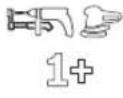
To put the vacuum cleaner into operation, connect it to the electrical outlet (3) of the electrical appliance. The vacuum cleaner automatically starts working. - Disconnect the electrical appliance to finish vacuuming. The start/stop automatic function continues to work for another 15 seconds to vacuum the remaining dust from the vacuum cleaner. - To deactivate the vacuum cleaner, set the operating mode selector (5) to the "Deactivation" position.
Vacuuming wet materials
Do not vacuum flammable or explosive liquids with the vacuum cleaner, e.g., gasoline, oil, alcohol, solvents. Do not vacuum glowing, flammable, or explosive materials. Do not use the vacuum cleaner in rooms where there is a risk of explosion. Dust, vapors, or liquids can ignite and explode. The vacuum cleaner must not be used as a water pump. The vacuum cleaner is intended for vacuuming wet materials with a water filter.
Note: The wet vacuuming function (class or material) is only approved for vacuuming wet materials.
Working with the wet vacuuming function
-To remove the dirt container (23) and the filter, press the release button.
Note: For easier removal, when vacuuming wet materials, use the water filter accessory, which will separate the water from the wet materials.
Noctabe la rymeHaTaJeHTa (26) BO NOHaTa Mla3Hnua 28). BmHn, BMETHyBaHe Ha rymeHaTaJeHTa
PonyabTomatcKO uHCTeHe HaΦnTepoB (BnDn CnHa I)
Iproiina, otkako jaunHaTa Ha BCncyBaHe Ke ce HamaH, pntepot Mopa da Ce hCnCTn.
KoKy cheTo Tpe6a Da ce qHCTn fHNTepOT 3aBNC Od BNDOT KOnuHaTa Ha npaTb. Co peD0Ba yNtpe6a, MAKcMaHnHOT KaanaHTet NooIro Ce 3aDpKyBa.
PnnoyabTomatckoto nchebe Ha nntepot (SFC+) co npomeHa h CTpyeHbTo HA BO3dyXOT Ke ce HcnuCTn HacobpaHata npaunHa od lamenHe Ha h6paHnot nntep.
Dokonky H6paHnO fHTep e H3BaIkan Ha NOBpuHHata, Toj cenak e cenoCHO yHKUHOHaJIe. PauHO uCTeHe ha H6paHnO fHTep co TpOnaBe Hn H3yByBaHe He e NOTpeHo HMOKe da rO OwTeN fHTepoT.
Hanomeha: IonyaBTOMATCKOTO YCTeHbHaΦnITepoTe ΦabpnuKn aKTINBpuHo (SFC+ npeKNHyBaU (18) Bo no3njuJaI).
-AkTHBnpaBe Ha SFC+UHCTeHe Ha HHTepoT
CoIaHkata 3aTbOpTe rO TBOpHe Ha MnaAHHuTe HnN OTBOPOT 3a BCNCyBaHbe. Hnn npn MOHTnpaH SFC+-Mdy(20):
Држete roakntBaTOpOT (33) npHTnCHaT HADONY OKONY 10cekyHn.
-DeakTNBpuBaHe hSAFC+ IpnTHcHete ro SFC+-npeknHyBaOT(18)HaHaPepi (no3nju0). -AKTHBnpaIbe Ha SFC+ PnHTNCHeToSFC+-PpeKHyBaOT(18)HaHa3aD (no3uJaI).
OdpkByBaHe n cepBnC
OdpKyBaBe n uHCTeIbe
N3BneyeTo npnKnyOkoT OJ KOHeKTopoT, nped OdpKyBaBeTo HnH NcTeBeTo Ha BCncyBaOT, nped peYnpaBe Ha NoCTaBKnTe Ha ypeD0T, 3aMeHa Ha DeNoBHTe Hn TpRaBe HacTpaHa. Obne MepKn 3a npDeynpeDyBaBe To CnpeyBuat HeBHHMaTeJIHHOT CTapT Ha BCncyBaOT. OdpKyBaJTe ja uHCTOTATA Ha BCNCyBaOH NT BOpHTe 3a npOBETpyBaHBe, 3a da MoKe Do6po H6e36eHNO da pa6oTHe. PnCepBNC NCHCTeHe Ha BCNCyBaOT KOpHCTeMaCKa 3a 3aHTTA OJ npab.
Iokonye notpe6Ho KopncTeHe Ha npknnyen Kaben, ToraHnababeTo oD Bosch HnCneuJnHa npaHa npOdaBnua 3a Bosch-eneKtpnHn anaTH, 3a da n36erHete 3arpo3yBaIbe Ha 6e36edHocTa.
Before handling the appliance, always ensure that it is disconnected from the power supply to avoid any risk of electric shock. Before disassembling, ensure that it is disconnected to avoid any potential hazards. The area where the appliance will be disassembled must be well ventilated. During handling, wear protective equipment. After handling, clean the area where you worked. At least once a year, a technical inspection must be carried out by the manufacturer or an authorized service provider, e.g., to check the filter, ensure that the appliance is functioning properly, and the control device. For appliances of class L, which are used in dusty environments, the exterior must be cleaned as well as the mechanical parts, and it must be treated with a cleaning agent. Before carrying out any repairs, all external parts that cannot be adequately cleaned must be removed. Such parts must be disposed of in a non-reusable manner in accordance with the applicable regulations for the disposal of such waste. - Periodically clean the appliance housing with a damp cloth.
Inserting/replacing the selected filter (see figures J1-J2)
The capacity of the appliance depends on the condition of the filter. Therefore, clean the filter regularly. Replace the filter when it is worn out (24).
-Unscrew the filter cover (14) and open the filter compartment (34). -Grasp the selected filter (24) by the handle and pull it out. -Remove the dirt and impurities that have accumulated during the use of the filter (24), with a damp cloth on both sides of the filter compartment (34). PES and PTFE filters can be cleaned under running water. -Insert the new or cleaned filter (24) and ensure it is properly seated. -Screw the filter cover (34) back on (until it stops).
Cleaning the appliance
Select the appliance (1) and clean it with a mild, non-abrasive cleaning agent, then let it dry.
Cleaning the level sensors (see figure K)
Periodically clean the level sensors (35).
-Open the locks (9) and remove the upper part of the appliance (8). -Clean the level sensors (35) with a soft cloth. -Replace the upper part of the appliance (8) and close the locks (9).
Spare parts
Part number
Cartridge filter gasket (dry) 2607432035
Part number
Cartridge filter gasket (dry) 2607432037
Filter gasket for wet cleaning 2607432039 (wet)
Spare parts for the pump (PE) (dry/wet) 2607432043
Scanning and transport (see link L)
-Check the hose and cable for damage before using the cable (13). -Attach the accessories to the appropriate holders: the suction hose (29) to the holder (15), the flat suction hose (25) to the holder (16), and the flat suction hose (28) to the holder (17). -Open the clamps on the suction hose holder (4), place the suction hose (21) on the upper part of the suction hose holder (4). Close the clamps again. -Pull the hose through the guide (7). -Fill the pump with oil. Before starting the pump, check the oil level to avoid damage to the pump. Use the pump only for pumping water and not for other liquids (6). -Store the pump in a dry place and protect it from unauthorized use. -To fix the handle (12), press the handle lock (11).
Disposal of the pump
If a defect occurs (e.g., a damaged hose), the pump must be immediately switched off. The defect must be repaired before restarting.
Troubleshooting
| Турбината за BCSCYBAнe He paBOTи. - П robерете roстулnot ka6el, п riskлuyкота 3aстуla, осгурьачot, п riskлuyнца.Tа и сензорite 3a наолненot (35). | П riskлuyвачot за ИЗБОр на реким Ha paBOTа (5) сToH Na „Стар/Стог abTomatнka". |
| - Роставete ro п riskлuyвачot за ИЗБИрайы Ha реким Ha paBOTа (5) Н ознakатa „BCSCYBAнe" оДH. ВКЛчЕт eо р riskлuyчелnot eilektpruchen alat Ha п riskлuyнца(T3). | |
| Турбината за BCSCYBAнe ce нсклочь. | - Испаразны eо садOT (1). |
| Турбината за BCSCYBAнe посторно п paBOTи и по праразныeto Ha садOT. | - Иspсучete ro BCSCYBAчOTи почekajte 5 cekyнди, по 5 cekyнди NOВТOPно ВКЛчeurte. |
| - Сениportе за соктоба Ha наолненot (35) Каси КNTу-Nрocstop (35) Искпстete Г coЧETКa. | |
| Се губс снлata на BCSCYBAнe. - OTсторны ja δлokадаю млалзницatura за BCSCYBAнe, чевка за BCSCYBAнe (29), церOTO за BCSCYBAнe (21) Или набравиOT Фнлтep (24). | |
| - Заменete ja врекункata за OTпад (23) Или Кесата за празВ. | |
| - Правино постовete ro калakot за ФнлтерOT (34). | |
| - Правино постовete ro ratngnOt Дел на BCSCYBAчOT (8) И за ТВоретe Г Калачьага (9). | |
180 | Serbian
| Поблел Помош | |
| - 3amehete ro HabpaHnOT Фиntep (24). | |
| Изегува прав по BCSCyBa№To | - Побере te дani HabpaHnOT Фиntep (24) e npabHnHO мОнтран. |
| - 3amehete ro HabpaHnOT Фиntep (24). | |
| АВТOMATиКаТа на ИСКлчУВа№ (ВСИСУВа№ на ВДЖН MaTeРи) He pearHnpa. | - Сениerte за соктоба на habолпетoct (35) Каби и НИВНOT Mefy-постор (35) Исунstete Г coЧтka. |
| Kaj eльсточни НecрoboДиVB Teчнoctи Дпри создыБа№ Ha NeHa He Функцюнра АВТOMATиКаТа на ИСКлчУВа№. | |
| - Пocтоно конт rolлрajte на соктоба на habолпетoct. | |
| ЧИСТeьeto на ФиNTерOT He pa6otи. | - Пиитисөтete ro SFC+-пекинвaycot (18) Наразд (позициJa I). |
Customer service and advice for use
The customer service will answer your questions regarding repairs and maintenance of your product as well as spare parts. Explosion diagrams and information on spare parts can also be found at: www.bosch-pt.com
The Bosch advice team will help you with any questions you may have about our products.
For all warranty claims, please contact your local dealer or the Bosch service center. You can find the contact details in the service center directory or on the product's type plate.
North Macedonia
D.D. Enkips
Sabbakowajek 47b, no. 3
1000 Skopje
E-mail: dimce.dimcev@servis-bosch.mk
Internet: www.servis-bosch.mk
Tel./fax: 02/2467610
Mobile: 070595888
D.I.Y "ROJKA"
Jan Nukrovski 66; T.L. Avtokomandana, Rojka 69
1000 Skopje
E-mail: servisrojka@yahoo.com
Tel: +389 2 3174-303
Mobile: +389 70 388-520, -530
Additional service addresses can be found at:
www.bosch-pt.com/serviceaddresses
Disposal
The device, accessories, and packaging should be disposed of in an environmentally friendly manner.
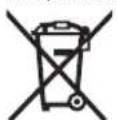
Do not dispose of the device in household waste!
In accordance with European Directive 2012/19/EU on waste electrical and electronic equipment (WEEE) and its implementation in national law, this appliance must be
collected separately and recycled in an environmentally friendly manner.
If disposed of incorrectly, electrical and electronic equipment can have harmful effects on human health and the environment due to the potential presence of hazardous substances.
Serbian
Safety notes for the vacuum cleaner

Read all safety warnings and instructions.
Failure to follow the safety warnings and instructions may result in electric shock, fire, and/or serious injury.
Save all safety warnings and instructions for future reference.
www.bosch-pt.com/serviceaddresses
Disposal
The vacuum cleaner, accessories, and packaging should be recycled in an environmentally friendly manner.
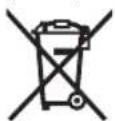
Do not dispose of the vacuum cleaner in household waste!
Only for EU countries:
In accordance with European Directive 2012/19/EU on waste electrical and electronic equipment and its implementation in national law, vacuum cleaners that are no longer usable must not be
They must be collected separately and recycled in an environmentally acceptable manner.
If electronic and electrical devices are disposed of in an improper way, possible hazardous substances may have a harmful effect on the environment and human health.
Slovenian
Safety warnings for vacuum cleaners

www.bosch-pt.com/serviceaddresses
Disposal
The vacuum cleaner, accessories, and packaging should be recycled in an environmentally friendly manner.
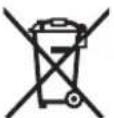
Do not dispose of the vacuum cleaner in household waste!
www.bosch-pt.com/serviceaddresses
Disposal
The vacuum cleaner, accessories, and packaging should be brought for environmentally acceptable recycling.
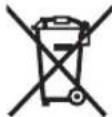
www.bosch-pt.com/serviceaddresses
an < 2.5 m/s2, K = 1.5 m/s2 .
Assembly
Putekļu maisiņa nomaiņa/ievietošana (piederums)
- Open the latches (9) and remove the upper part of the vacuum cleaner (8). Pull the entire dust bag off the connection flange towards the rear. Close the dust bag opening with the folding flap. Remove the sealed dust bag from the container (1). -Fit a new dust bag onto the vacuum cleaner's connection flange. Make sure that the dust bag fits snugly against the inner walls of the container (1). Place the upper part of the vacuum cleaner (8) in its designated position and close the latches (9).
Inserting the rubber edge (for wet vacuuming) (figure F)
Note: The requirements regarding the permeability class (dust class L) are only specified for dry vacuuming. -Use a suitable tool to remove the brush strips (27) from the floor nozzle (28). - Insert the rubber edge (26) into the floor nozzle (28).
Note: The structured side of the rubber edge must face outward.
Attaching the L-Boxx container (figure G)
To facilitate transporting the vacuum cleaner, as well as space-saving storage of its accessories and/or power tools, an L-Boxx container can be attached to the upper part of the vacuum cleaner. -Press the L-Boxx container onto the mountings (7). If the L-Boxx container is attached to the vacuum cleaner, do not carry it by the container's handle.
The vacuum cleaner is too heavy to be carried by the L-Boxx container's handle. This can cause injuries and damage to property.
Operation
www.bosch-pt.com/serviceaddresses
www.bosch-pt.com/serviceaddresses
Cleaning
www.bosch-pt.com/serviceaddresses
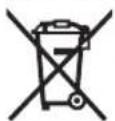
230
gll lgl abalw l aag 10 g 10g j 2gj 1a 10g abalw w j t 2g .1g 10g j 2g
bogdolsoill
gag pse no sIg paa Jsw jglw! Lulw agbgl 1sJy sag 2g. qj
aLgI elao pdo aBulg 1g 9 aLgI elao pdo aBolal jull o Lssall ojill joi
aai 8. yaiIg jLsJg abafuui ai 8. qjIyIg gag aJg aBafuui S J! Lqalol pai 2g cIwaii abafuui gboswlg uugo uusaaio uoiig doall jyauill jy jaoaia JuaJI g abaiuill jyog aJg aJyRSLJ . yaiIg JLL
JU 11111111111111111111111111111111111
bglg jg glgabll abl lgl gl qg g aal alj g jgal g aal al 1000000000000000000000000000000000000000
g p auiug bao jnmo jnnnnae 1e blaJI I Jn nn nnnn. abuWl doLw
Jc Jc abalwI gai JdA .aaill Ic ojgbs jia L ailalg g jai llaoc p u 1gc jol Jlac Jn Jusuag s Lg 1s aigll Ujagp dsswUy .baqnnns PJIgdsabhwlUusuBpa2.aawllo 2g. auiu duSpu ssI Jol SJI yal .
p0gj jj, uu y plal sic. aolw ala 2 jn abgl wll lce kjo bawll g uusu 2g . qg jull
aalwlll 1
Jbai
jouil jbs 1s. wu o Jsw a90
U 1sloXg abt u 0jg 3 aU 1sLwJ! abg U

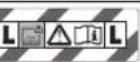
max. 2200 W min. 100 W
jU (SFC+ = Semi-Automatic Filter Cleaning Plus)
J 1
yaaai JlaeWk
35 1aai iogj sagg uall (A 3 Ugb
ooaJl|j2
Lc abgulj g o jgaaJ |jL pJ diiw
.aaabaaal gawll
(1) g
(2)ρgbsjdu jds
(3)duJgSJJ
(4)baaiy jgbj Jola
(5)JgJglal
(6)Juaa
(7)L-BOXXJooJI pU
(8)aboluljogglal
(9)aboluljog
(10)da
(11)dgglal alc agso
(12)dugda
(13)U|LJI Uo
(14)julai Ubc glc jb
(15)
(16)aiiaillabai//gga
(17)
(18)
(19)baw

SFC+ ω (20g
baaiu oogbj (21)
aaiiaai aabai (22)
(23)
(23)
jul 24
ggaWl aag (25)
aabaa (26)
JJJJ (27)
LjJg aagg (28)
(29)laaij ojgwo
(30)
(28)
L-BOXX (G oJJI j)
(7)
(1) aagio joll. gill aaow j
-daii laa dgi
-
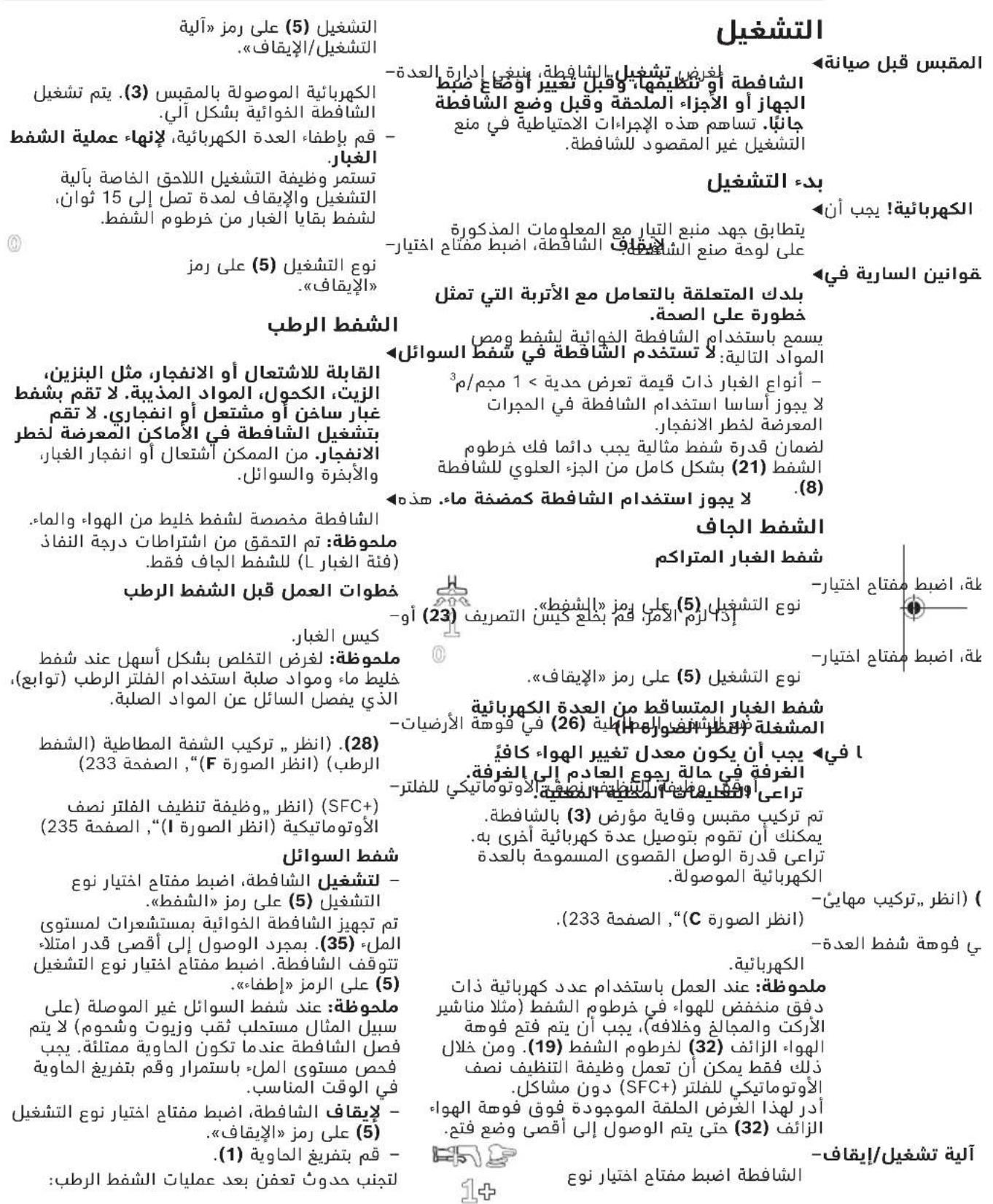
235
- DISPOSAL
- SAFETY INFORMATION FOR VACUUM CLEANERS
- ONLY USE THE VACUUM CLEANER IF YOU HAVE BEEN ADEQUATELY INFORMED
- WARNING
- PRODUCTS SOLD IN GB ONLY
- SYMBOLS
- SYMBOLS AND THEIR MEANING
- PRODUCT DESCRIPTION AND SPECIFICATIONS
- INTENDED USE
- PRODUCT FEATURES
- NOISE/VIBRATION INFORMATION
- ASSEMBLY
- FITTING THE HOLDER FOR THE VACUUM HOSE (SEE FIGURE A)
- FITTING THE VACUUM HOSE (SEE FIGURE B)
- FITTING THE EXTRACTION ACCESSORIES
- FITTING THE EXTRACTION ADAPTER (SEE FIGURE C)
- FITTING NOZZLES AND TUBES (SEE FIGURE D)
- INSERTING/REMOVING THE DISPOSAL BAG OR DUST BAG (DRY EXTRACTION) (SEE FIGURES E1-E2)
- INSERTING THE DISPOSAL BAG
- REMOVING AND SEALING THE DISPOSAL BAG
- CHANGING/INSERTING THE DUST BAG (ACCESSORY)
- FITTING THE RUBBER LIP (WET VACUUMING) (SEE FIGURE F)
- ATTACHING THE L-BOXX (SEE FIGURE G)
- OPERATION
- START-UP
- DRY VACUUMING
- VACUUMING UP DUST DEPOSITS
- EXTRACTING DUST THAT ACCUMULATES FROM WORKING POWER TOOLS (SEE FIGURE H)
- WET VACUUMING
- STEPS TO TAKE BEFORE WET VACUUMING
- VACUUMING UP LIQUIDS
- SEMI-AUTOMATIC FILTER CLEANING (SEE FIGURE 1)
- MAINTENANCE AND SERVICE
- MAINTENANCE AND CLEANING
- CLEANING THE CONTAINER
- CLEANING THE FILL LEVEL SENSORS (SEE FIGURE K)
- STORAGE AND TRANSPORT (SEE FIGURE L)
- RECTIFYING FAULTS
- AFTER-SALES SERVICE AND APPLICATION SERVICE
- GREAT BRITAIN
- YOU CAN FIND FURTHER SERVICE ADDRESSES AT
- ONLY FOR EU COUNTRIES
- ONLY FOR UNITED KINGDOM
- WASTE MANAGEMENT
- REPLACING/INSERTING DUST BAG (ACCESSORY)
- DEPONERING
- HAVITYS
- USE FOR INTENDED PURPOSE
- WASTE DISPOSAL
- DO NOT LEAVE CHILDREN UNATTENDED
- SYMBOLS AND THEIR MEANINGS
- CNMBONJI HX3HAUEHNE
- PEXHM BCACBBAHN
- SFC
- PRODUCT DESCRIPTION AND SERVICES
- NUMBERED COMPONENTS
- MOUNTING NOZZLES AND TUBES (SEE FIG. D)
- INSTALLING/REMOVING THE DUST BAG FOR DRY VACUUMING (SEE FIG. E1-E2)
- INSTALLING THE DUST BAG
- REMOVING AND CLOSING THE DUST BAG
- REPLACING/INSTALLING THE DUST BAG (ACCESSORY)
- INSTALLING THE RUBBER GROMMETS (FOR WET VACUUMING) (SEE FIG. F)
- INSTALLING THE L-CLASS FILTER (SEE FIG. G)
- WORKING WITH THE TOOL
- SWITCHING OFF THE POWER TOOL
- COLLECTING DUST DEPOSITS
- VACUUMING DUST FROM POWER TOOLS (SEE FIG. H)
- RUSSIAN
- OPERATION WITH LIQUID SUCTION
- COLLECTING LIQUIDS
- SEMI-AUTOMATIC FILTER CLEANING (SEE FIG. I)
- STARTING SFC+ FILTER CLEANING
- SWITCHING OFF SFC
- SWITCHING ON SFC
- REMOVAL/REPLACEMENT OF THE FLAT PLEATED FILTER (SEE FIG. J1-J2)
- CLEANING THE LIQUID LEVEL SENSORS (SEE FIG. K)
- ADDITIONAL ADDRESSES OF SERVICE CENTERS CAN BE FOUND AT THE LINK
- FOR EU COUNTRIES ONLY
- UKRAINIAN
- SAFETY INSTRUCTIONS FOR USE
- WARNINGS
- SYMBOL AND MEANING
- RINSING
- HANIBATOMATUHE OUNUEHHA FINBTP A (NB.MAI.1)
- START FILTER CLEANING SFC
- SWITCH OFF SFC
- SWITCH ON SFC
- EU DECLARATION OF CONFORMITY
- KAZAKH
- DEPENDING ON THE ECONOMIC FEASIBILITY (DEPENDING ON THE FEASIBILITY), IT CAN BE USED IN THE COUNTRIES OF THE COMMONWEALTH OF INDEPENDENT STATES
- PRODUCT PARAMETERS
- THE SERVICE LIFE OF THE PRODUCT IS AT LEAST 10 YEARS, PROVIDED THAT THE OPERATING RULES ARE FOLLOWED
- COMPLETE SET
- SERVICE TYPES AND CONDITIONS
- STORAGE
- TRANSPORTATION
- EXPERT
- ECKEPTY
- BENRINEP
- BENRINEPEMEHONAPDBHMAFTBHACSI
- SWITCHING ON AND OFF
- PUMPING WATER WITH A HIGH TEMPERATURE
- THE PUMP IS NOT SUITABLE FOR PUMPING FLAMMABLE LIQUIDS (SEE SAFETY INSTRUCTIONS)
- BOILING WATER
- BOILING WATER AND MAKING HOT BEVERAGES
- CLEANING AND DESCALING
- TO CLEAN THE FILTER WITH THE AUTOMATIC CLEANING FUNCTION (SEE POINT 1)
- TECHNICAL MEASURING INSTRUMENTS
- TECHNICAL MEASURING INSTRUMENTS AND TESTING
- DRAIN THE CONDENSATE FROM THE FILTER (SEE FIGURES J1-J2)
- CLEAN THE CONTAINER
- CLEAN THE DRAIN VALVE (SEE FIGURE)
- REQUIRED TOOLS
- REQUIRED MATERIALS
- SAFETY AND MAINTENANCE (SEE PAGE 1)
- ACCUMULATOR
- THE SERVICE CENTER HAS NOT BEEN FOUND
- WWW.BOSCH-PT.COM
- KAZAKHSTAN
- ROMÂNA
- WARNING: USE THE VACUUM CLEANER ONLY IF YOU HAVE RECEIVED SUFFICIENT INFORMATION ON ITS USE
- WARNING: THE VACUUM CLEANER IS SUITABLE FOR VACUUMING ONLY DRY MATERIALS DURING DRY PERIODS
- WARNING: DANGER
- THE VACUUM CLEANER IS INTENDED FOR DRY VACUUMING ONLY. DO NOT USE IT FOR VACUUMING LIQUIDS OR FOR ANY OTHER PURPOSE. ONLY USE THE VACUUM CLEANER WITH THE DUST CONTAINER AND FILTERS PROPERLY INSTALLED. DO NOT USE THE VACUUM CLEANER WITHOUT THE DUST CONTAINER AND FILTERS, AS THIS MAY DAMAGE THE APPLIANCE. ALWAYS ENSURE THE APPLIANCE IS SWITCHED OFF BEFORE CLEANING OR MAINTENANCE
- MEANING OF SYMBOLS
- START/STOP AUTOMATIC
- SWITCHING OFF
- REDUCED POWER
- PRODUCT DESCRIPTION AND SCOPE OF DELIVERY
- INTENDED USE OF THE POWER TOOL
- ILLUSTRATED COMPONENTS
- TECHNICAL DATA
- MOUNTED OR REQUIRED (SEE PAGE)
- INSTALLING/REMOVING THE FABRIC DUST BAG FOR DRY VACUUMING OR THE DUST BAG (DRY VACUUMING) (SEE FIG. E1-E2)
- INSTALLING THE FABRIC DUST BAG
- REMOVING AND DISPOSING OF THE FABRIC DUST BAG
- INSTALLING/REMOVING THE DUST BAG (ACCESSORY)
- INSTALLING THE RUBBER NOZZLE (WET VACUUMING) (SEE FIG. F)
- OPEN THE L-BOXX (SEE FIG. G)
- WORKING WITH THE POWER TOOL
- VACUUMING FINE DUST
- WARNING: RISK OF INJURY FROM POWER TOOLS (SEE FIG. A)
- WORKING WITH WET VACUUMING
- VACUUMING LIQUIDS
- CLEANING THE FILTER (SFC+)
- OTHER SERVICE ADDRESSES CAN BE FOUND AT
- MACEDONIAN
- SAFETY WARNINGS FOR GRINDING
- SERVICING
- REPAIR-REPAIRING
- MARKINGS
- MARKINGS AND THEIR MEANING
- DESIGNATION
- DESCRIPTION OF THE PRODUCT AND PERFORMANCE
- USE AS INTENDED
- COMPONENT ILLUSTRATION
- INFORMATION ON NOISE/VIBRATION
- INSTALLATION
- INSTALLING THE HANDLE FOR THE SUCTION HOSE (SEE FIGURE A)
- INSTALLING THE SUCTION HOSE (SEE FIGURE B)
- INSTALLING THE ACCESSORY FOR VACUUMING
- INSTALLING THE FLOOR NOZZLE (SEE FIGURE C)
- MOUNTING THE ACCESSORIES (SEE FIGURE D)
- INSERTING/REMOVING THE DUST BAG OR THE DIRT BAG (SUCTION OF DRY MATERIALS) (SEE FIGURES E1-E2)
- INSERTING THE DUST BAG
- REMOVING THE DUST BAG AND CLOSING
- INSERTING/REMOVING THE DIRT BAG (ACCESSORY)
- INSERTING THE FOAM FILTER (SUCTION OF WET MATERIALS) (SEE FIGURE F)
- USING THE L-BOXX (SEE FIGURE G)
- USE
- VACUUMING DRY MATERIALS
- VACUUMING WET MATERIALS
- VACUUMING CREATES A VACUUM INSIDE THE APPLIANCE (SEE FIGURE A)
- WORKING WITH THE WET VACUUMING FUNCTION
- PONYABTOMATCKO UHCTEHE HAΦNTEPOB (BNDN CNHA I)
- AKTHBNPABE HA SFC+UHCTEHE HA HHTEPOT
- ODPKBYBAHE N CEPBNC
- ODPKYBABE N UHCTEIBE
- INSERTING/REPLACING THE SELECTED FILTER (SEE FIGURES J1-J2)
- CLEANING THE APPLIANCE
- CLEANING THE LEVEL SENSORS (SEE FIGURE K)
- SPARE PARTS
- PART NUMBER
- SCANNING AND TRANSPORT (SEE LINK L)
- DISPOSAL OF THE PUMP
- TROUBLESHOOTING
- CUSTOMER SERVICE AND ADVICE FOR USE
- NORTH MACEDONIA
- ADDITIONAL SERVICE ADDRESSES CAN BE FOUND AT
- SERBIAN
- SAFETY NOTES FOR THE VACUUM CLEANER
- SLOVENIAN
- SAFETY WARNINGS FOR VACUUM CLEANERS
- PUTEKĻU MAISIŅA NOMAIŅA/IEVIETOŠANA (PIEDERUMS)
- INSERTING THE RUBBER EDGE (FOR WET VACUUMING) (FIGURE F)
- ATTACHING THE L-BOXX CONTAINER (FIGURE G)
- CLEANING
- YAAAI JLAEWK
- OOAJL|J
Brand : BOSCH
Model : GAS 35 L SFC+ Professional
Category : Vacuum Cleaner