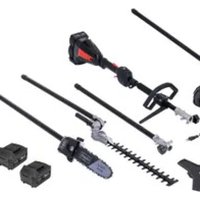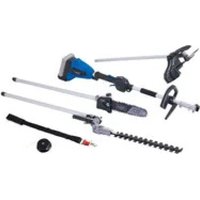
BC-MFH400-X - Multitools SCHEPPACH - Free user manual and instructions
Find the device manual for free BC-MFH400-X SCHEPPACH in PDF.


| Product type | Cordless multifunction garden tool |
| Brand | Scheppach |
| Model | BC-MFH400-X |
| Rated voltage | 40 V (2 × 20 V) |
| Cutting diameter (lawn mower) | 380 mm |
| Cutting diameter (brushcutter) | 255 mm |
| Cutting length (hedge trimmer) | 390 mm |
| Cutting length (pole pruner) | 254 mm |
| Motor speed | 3 speeds (Low / Medium / High) |
| Speed lawn mower / brushcutter | 4000 / 5500 / 6200 min⁻¹ |
| Speed hedge trimmer | 880 / 1100 / 1360 min⁻¹ |
| Cutting speed pole pruner | 12 / 15 / 18 m/s |
| Weight motor unit (without battery) | 3,37 kg |
| Weight tools (without battery) | lawn mower 1,45 kg / brushcutter 1,56 kg / hedge trimmer 2,17 kg / pole pruner 1,63 kg |
| Total length | 2,35 m (lawn mower/brushcutter) / 2,15 m (pole pruner) |
| Power supply | Lithium-ion battery 40 V, IXES series |
| Oil tank capacity | 140 ml |
| Sound power level (brushcutter) | 109,3 dB(A) |
| Sound power level (hedge trimmer) | 109,3 dB(A) |
| Sound power level (pole pruner) | 109,3 dB(A) |
| Number of interchangeable tools | 4 |
| Warranty | 5 years (battery 12 months), 10-year extension possible |
Frequently Asked Questions - BC-MFH400-X SCHEPPACH
User questions about BC-MFH400-X SCHEPPACH
0 question about this device. Answer the ones you know or ask your own.
Ask a new question about this device
Download the instructions for your Multitools in PDF format for free! Find your manual BC-MFH400-X - SCHEPPACH and take your electronic device back in hand. On this page are published all the documents necessary for the use of your device. BC-MFH400-X by SCHEPPACH.
USER MANUAL BC-MFH400-X SCHEPPACH
natural_image
Product photo of four different types of hair tools including a flat tool, diagonal hatch, and a blue-handled tool (no text or symbols visible)
BC-MFH400-X
GB Cordless multi-function device | Translation of the original operating instructions.... 33
natural_image
3D model of a mechanical device with labeled parts (no text or symbols on the object itself)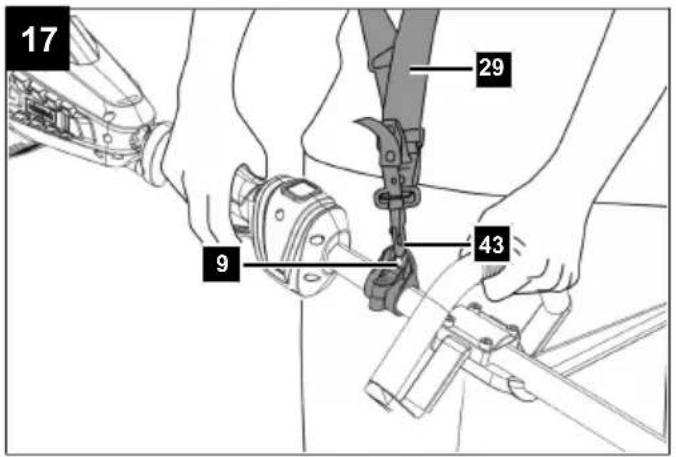
natural_image
Technical line drawing of a mechanical assembly with angular annotation (0°), no readable text or symbols present.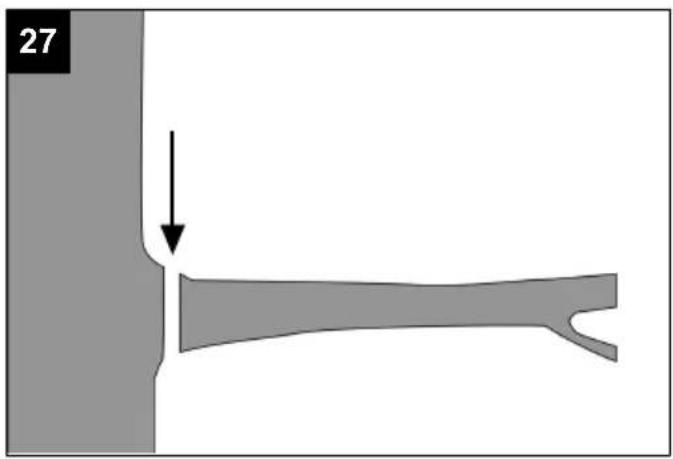
Inhaltsverzeichnis
Günzburger Straße 69
D-89335 Ichenhausen
Verehrter Kunde
C. 1 x Gabelschlüssel SW 8/10 mm
D. 1 x Montageschlüssel (SW 19/21 mm, Kreuzschlitzschraubendreher)
https://www.scheppach.com/de/service
Günzburger Straße 69
D-89335 Ichenhausen
Division Manager Product Center
V. Gordon
Andreas Pecher
Head of Project Management
Table of contents
1 Introduction 34
2 Product description (Fig. 1-6).... 34
3 Scope of delivery (Fig. 1) 35
4 Proper use.... 35
5 Safety instructions.... 35
6 Technical data.... 39
7 Unpacking 40
8 Assembly.... 40
9 Before commissioning.... 42
10 Operation 43
11 Working instructions.... 44
12 Cleaning.... 46
13 Maintenance.... 47
14 Storage and transport 50
15 Repair and ordering spare parts 50
16 Disposal and recycling 51
17 Troubleshooting 52
18 Warranty conditions - Scheppach 20V IXES series....52
19 EU Declaration of Conformity.... 54
20 Exploded view.... 579
Explanation of the symbols on the product
Symbols are used in this manual to draw your attention to potential hazards. The safety symbols and the accompanying explanations must be fully understood. The warnings themselves will not rectify a hazard and cannot replace proper accident prevention measures.
| Before commissioning, read and observe the operating manual and safety instructions! | |
| Attention! Failure to observe the safety signs and warning information affixed to the product and failure to observe the safety and operating manual can result in serious injury or even death. | |
| Wear safety goggles. | |
| Wear hearing protection. | |
| Always wear a safety helmet! | |
| Wear safety gloves! |
| Wear sturdy footwear! | |
| Speed adjustment | |
| Do not expose the product to rain. The product may only be stationed, stored and operated in dry ambient conditions. | |
| Attention! Risk of injury from running blades. | |
| Make sure that other persons maintain a sufficient safety distance. Keep unauthorised people away from the product. Hurled objects and rotating parts can cause severe injuries. | |
| Make sure that other persons maintain a sufficient safety distance. | |
| Keep your distance from other people and electrical lines. | |
| Watch out for falling material. | |
| Only carry out maintenance, modification, adjustment and cleaning work when the motor is switched off and the battery is removed. | |
| Lithium | Lithium-ion battery |
| Filling port for chain oil | |
| Installation direction of the saw chain | |
| Cutting length | |
| Cutter bar length | |
| Direction of rotation of the thread coil. | |
| Direction of rotation of grass trimmer. | |
| Thread coil diameter. | |
| Material removal direction | |
| Cutting blade diameter. | |
| Cutting blade. | |
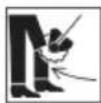 | Keep your feet away from the tool attach-ment. |
 | Do not use a saw blade. |
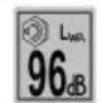 | Guaranteed sound power level of the prod-uct. |
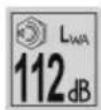 | Guaranteed sound power level of the product. |
 | The product complies with the applicable Serbian directives. |
 | The product complies with the applicable European directives. |
1 Introduction
Manufacturer:
Scheppach GmbH
Günzburger Straße 69
D-89335 Ichenhausen
Dear Customer
We hope your new product brings you much enjoyment and success.
Note:
In accordance with the applicable product liability laws, the manufacturer of this product assumes no liability for damage to the product or caused by the product arising from:
- Improper handling
• Non-compliance with the operating manual
• Repairs carried out by third parties, unauthorised specialists
• Installing and replacing non-original spare parts - Improper use
- Failures of the electrical system in the event of the electrical regulations and VDE provisions 0100, DIN 57113 / VDE0113 not being observed.
Note:
The operating manual is part of this product.
It includes important instructions for the safe, proper and economic operation of the product, for avoiding danger, for minimising repair costs and downtimes and for increasing the reliability and extending the service life of the product. In addition to the safety instructions in this operating manual, you must also observe the regulations applicable to the operation of the product in your country.
Familiarise yourself with all operating and safety instructions before using the product. Only operate the product as described and for the specified areas of application. Keep the operating manual in a good place and hand over all documents when passing the product on to third parties.
2 Product description (Fig. 1-6)
- Battery*
- Rear handle
- On/off switch
- Tubular shaft
- Front handle
5a. Rubber ring
5b. Allen screw M5 - Leg guard
- Locking mechanism (tubular shaft)
- Star grip
- Lifting eye
- Main switch
- Switch lock
- Charge status indicator (battery)
- Front tubular shaft (pole-mounted pruner)
- Chainsaw guide bar (guide rail)
- Saw chain
- Oil tank
- Front tubular shaft (hedge trimmer)
- Handle
- Cutter bar
- Front tubular shaft (brush cutter/lawn trimmer)
20a. Allen screw M6 - Protective cover (side)
- Thread cutter
- Coil capsule
- Protective cover (top)
- Cutting blade
- Transport guard (cutting blade)
- Blade guard (hedge trimmer)
- Guide bar and chain guard
- Carrying strap
- Cover
- M10 nut
- Spring washer
- Receptacle spindle
- Internal flange
- External flange
- Fastening nut (chain wheel cover)
- Chain cover
- Chain tensioning screw
- Guide pin
- Chain tensioning bolt
- Chain wheel
- Adjusting screw (saw chain lubrication)
43.Carabiner hook - Safety tab
- Release button (battery)
- Battery mount
- Trigger (thread coil)
- Thread coil
- Angle adjustment
- Unlocking lever
- Cover
- Release
- Pressure spring
- Thread outlet eyelet
- Notch
- Notch (thread coil centre)
- Grease nipple (pole-mounted pruner)
- Grease nipple (hedge trimmer)
* = may not be included in the scope of delivery!
3 Scope of delivery (Fig. 1)
Item Quantity Designation
- 2 x Battery*
- 1 x Front handle
5a. 1 x Rubber ring
5b. 4 x Hexagon socket screw M5 - 1 x Front tubular shaft (pole-mounted pruner)
- 1 x Chainsaw guide bar (guide rail)
- 1 x Saw chain
- 1 x Front tubular shaft (hedge trimmer)
- 1 x Front tubular shaft (trimmer/grass trimmer)
20a. 2 x Hexagon socket screw M6 - 1 x Protective cover (side)
- 1 x Coil capsule
- 1 x Protective cover (top)
- 1 x Cutting blade
- 1 x Transport guard (cutting blade)
- 1 x Blade guard
- 1 x Guide bar and chain guard
- 1 x Carrying strap
- 1 x M10 nut
A. 1 x Allen key, 4 mm
B. 1 x Allen key, 5 mm
C. 1 x Open-ended spanner, AF 8/10 mm
D. 1 x Installation spanner (AF 19/21 mm, Phillips screwdriver)
1 x Cordless multi-function device
1 x Operating manual
4 Proper use
The product may only be fitted to the motor head supplied.
Brushcutter:
The strimmer (using the cutting knife) is suitable for cutting shrubs, strong weed and undergrowth.
Grass trimmer:
The grass trimmer (using thread coil with trimming line) is suitable for cutting lawns, grass areas and light weed.
Hedge trimmer:
This hedge trimmer is intended for cutting hedges, bushes and shrubs.
Pole-mounted pruner (cordless chainsaw with telescopic handle):
The pole-mounted pruner is intended for branch removal work. It is not suitable for extensive sawing work and felling trees as well as sawing materials other than wood.
The product may only be used in the intended manner. Any use beyond this is improper. The user, not the manufacturer, is responsible for damages or injuries of any type resulting from this.
An element of the intended use is also the observance of the safety instructions, as well as the assembly instructions and operating information in the operating manual.
Persons who operate and maintain the product must be familiar with the manual and must be informed about potential dangers.
The liability of the manufacturer and resulting damages are excluded in the event of modifications of the product.
The product may only be operated with original parts and original accessories from the manufacturer.
The safety, operating and maintenance specifications of the manufacturer, as well as the dimensions specified in the technical data, must be observed.
Please note that our products were not designed with the intention of use for commercial or industrial purposes. We assume no guarantee if the product is used in commercial or industrial applications, or for equivalent work.
Explanation of the signal words in the operating manual

DANGER
Signal word to indicate an imminently hazardous situation which, if not avoided, will result in death or serious injury.

WARNING
Signal word to indicate a potentially hazardous situation which, if not avoided, could result in death or serious injury.

CAUTION
Signal word to indicate a potentially hazardous situation which, if not avoided, could result in minor or moderate injury.
ATTENTION
Signal word to indicate a potentially hazardous situation which, if not avoided, could result in product or property damage.
5 Safety instructions
Save all warnings and instructions for future reference.
The term "power tool" in the warnings refers to your mains-operated (corded) power tool or battery-operated (cordless) power tool.

WARNING
Read all safety warnings, instructions, illustrations and specifications provided with this power tool.
Failure to follow all instructions listed below may result in electric shock, fire and/or serious injury.
1) Work area safety
a) Keep your work area clean and well-lit. Cluttered or dark areas invite accidents.
b) Do not operate power tools in explosive atmospheres, such as in the presence of flammable liquids, gases or dust. Power tools create sparks which may ignite the dust or fumes.
c) Keep children and bystanders away while operating a power tool. Distractions can cause you to lose control.
2) Electrical safety
a) The connection plug of the electric tool must fit into the socket. Never modify the plug in any way. Do not use any adapter plugs with earthed (grounded) power tools. Unmodified plugs and matching outlets will reduce risk of electric shock.
b) Avoid body contact with earthed or grounded surfaces, such as pipes, radiators, ranges and refrigerators. There is an increased risk of electric shock if your body is earthed or grounded.
c) Do not expose power tools to rain or wet conditions. Water entering a power tool will increase the risk of electric shock.
d) Do not abuse the cord. Never use the cord for carrying, pulling or unplugging the power tool. Keep cord away from heat, oil, sharp edges or moving parts. Damaged or entangled cords increase the risk of electric shock.
e) When operating a power tool outdoors, use an extension cord suitable for outdoor use. Use of a cord suitable for outdoor use reduces the risk of electric shock.
f) If operating a power tool in a damp location is unavoidable, use a residual current device (RCD) protected supply. Use of an RCD reduces the risk of electric shock.
3) Personal safety
a) Stay alert, watch what you are doing and use common sense when operating a power tool. Do not use a power tool while you are tired or under the influence of drugs, alcohol or medication. A moment of inattention while operating power tools may result in serious personal injury.
b) Wear personal protective equipment and always safety goggles. Protective equipment such as a dust mask, non-skid safety shoes, safety helmet or hearing protection used for appropriate conditions will reduce personal injuries.
c) Prevent unintentional starting. Ensure the switch is in the off-position before connecting to power source and/or rechargeable battery, picking up or carrying the tool. Carrying power tools with your finger on the switch or energising power tools that have the switch on invites accidents.
d) Remove any adjusting tools or spanners/keys before turning the power tool on. A wrench or a key left attached to a rotating part of the power tool may result in personal injury.
e) Avoid abnormal postures. Keep proper footing and balance at all times. This enables better control of the power tool in unexpected situations.
f) Wear suitable clothing. Do not wear loose clothing or jewellery. Keep your hair and clothing away from moving parts. Loose clothes, jewellery or long hair can be caught in moving parts.
g) If devices are provided for the connection of dust extraction and collection facilities, ensure these are connected and properly used. Use of dust extraction can reduce dust-related hazards.
h) Do not let familiarity gained from frequent use of tools allow you to become complacent and ignore tool safety principles. A careless action can cause severe injury within a fraction of a second.
4) Power tool use and care
a) Do not force the power tool. Use the correct power tool for your application. The correct power tool will do the job better and safer at the rate for which it was designed.
b) Do not use the power tool if the switch does not turn it on and off. Any power tool that cannot be controlled with the switch is dangerous and must be repaired.
c) Disconnect the plug from the power source and/or remove the battery pack, if detachable, from the power tool before making any adjustments, changing accessories, or storing power tools. Such precautionary measures reduce the risk of starting the power tool accidentally.
d) Store idle power tools out of the reach of children and do not allow persons unfamiliar with the power tool or these instructions to operate the power tool. Power tools are dangerous in the hands of untrained users.
e) Maintain power tools and attachments. Check for misalignment or binding of moving parts, breakage of parts and any other condition that may affect the power tool's operation. If damaged, have the power tool repaired before use. Many accidents are caused by poorly maintained power tools.
f) Keep cutting tools sharp and clean. Properly maintained cutting tools with sharp cutting edges are less likely to bind and are easier to control.
g) Use electric tools, insertion tools, etc. according to these instructions. Take into account the working conditions and the work to be performed. Use of the power tool for operations different from those intended could result in a hazardous situation.
h) Keep handles and grasping surfaces dry, clean and free from oil and grease. Slippery handles and grasping surfaces do not allow for safe handling and control of the tool in unexpected situations.
5) Battery tool use and care
a) Only charge the batteries with battery chargers recommended by the manufacturer. A battery charger that is suitable for a particular type of battery poses a fire hazard when used with other batteries.
b) Only use the batteries in power tools that are designed for them. The use of other batteries can lead to injuries and a risk of fire.
c) Keep the unused battery away from paper clips, coins, keys, nails, screws or other small metal objects that could cause a short-circuit between the contacts. A short-circuit between the contacts of the battery could result in burns or fires.
d) Liquid may leak from the battery if used incorrectly. Avoid contact with it. In case of accidental contact, rinse with water. If the liquid gets into your eyes, seek additional medical attention. Leaking battery fluid may cause skin irritation or burns.
e) Do not use a damaged or modified battery. Damaged or modified batteries can behave unpredictably and cause fire, explosion or injury.
f) Do not expose a battery to fire or excessive temperatures. Fire or temperatures above 130^ C may cause an explosion.
g) Follow all charging instructions and never charge the battery or rechargeable tool outside the temperature range specified in the operating manual. Incorrect charging or charging outside the approved temperature range can destroy the battery and increase the risk of fire.
6) Service
a) Only have your power tool repaired by qualified specialists and only with original spare parts. This will ensure that the safety of the power tool is maintained.
b) Never attempt to service damaged batteries. Any type of battery maintenance shall be carried out only by the manufacturer or an authorised customer service centre.
5.1 General safety instructions
a) Stay alert, watch what you are doing and use common sense when operating a power tool. Do not use a power tool while you are tired or under the influence of drugs, alcohol or medication. A moment of inattention while operating power tools may result in serious personal injury.
b) National regulations may restrict the use of the product.
c) Take regular breaks and move your hands to promote circulation.
d) Always hold the product tight with both hands during work. Make sure that you have a secure footing.
5.2 Safety instructions for grass trimmers and brush cutters
IMPORTANT
READ CAREFULLY BEFORE USE
KEEP FOR YOUR RECORDS
5.2.1 Instructions
a) Read through the operating instructions carefully. Familiarise yourself with the control devices and the proper use of the product.
b) Never allow persons who are not familiar with these instructions or children to use the product. Local regulations may restrict the age of the user.
c) Note that the operator or user is responsible for accidents or hazards to other people or their property.
5.2.2 Preparation
a) Check the covers and protective devices for damage and correct seating. Replace them if necessary.
b) Never operate the product while people, especially children, or animals are nearby.
5.2.3 Operation
- Always wear safety goggles.
- Do not use the product barefoot or with sandals. Wear sturdy footwear and long trousers.
- Do not use the product in a thunderstorm - Danger of lightning strike!
-
Only work in daylight or with good, artificial lighting.
-
Never operate the product with defective Protective devices or without safety devices.
-
Do not put your hands or feet in the area of the rotating tool before or after switching on.
-
Switch off the product and remove the battery.
-
When you are leaving the product unattended.
- when removing blockages.
- when checking or maintaining the product, it is raining or when making adjustments;
-
when foreign bodies get into the product, in the event of unusual noises or vibrations (check the product for damage before restarting).
-
Do not put your hands or feet in the area of the rotating tool before or after switching on.
-
Ventilation openings must always be free.
5.2.4 Maintenance and storage
a) Disconnect the product from the power supply (i.e. remove the removable batteries) before carrying out maintenance or cleaning work.
b) Do not use accessories that are not recommended by the manufacturer. This can lead to electric shock or fire.
c) Check the product regularly for damage and maintain it regularly. Have the product serviced only at an authorised repair centre.
d) Store idle power tools out of the reach of children and do not allow persons unfamiliar with the power tool or these instructions to operate the power tool. Power tools are dangerous in the hands of untrained users.
5.3 Safety instructions for hedge trimmers
a) Do not use the hedge trimmer in bad weather conditions, especially when there is a risk of lightning. This decreases the risk of being struck by lightning.
b) Keep all power cords and cables away from cutting area. Power cords or cables may be hidden in hedges or bushes and can be accidentally cut by the blade.
c) Hold the hedge trimmer by insulated gripping surfaces only, because the blade may contact hidden wiring or its own cord. Blades contacting a "live" wire may make exposed metal parts of the hedge trimmer "live" and could give the operator an electric shock.
d) Keep all parts of the body away from the blade. Do not remove cut material or hold material to be cut when blades are moving. Blades continue to move after the switch is turned off. A moment of inattention while operating the hedge trimmer may result in serious personal injury.
e) Make sure all switches are off and the battery is removed before removing trapped clippings or servicing the product. Unexpected actuation of the hedge trimmer while clearing jammed material or servicing may result in serious personal injury.
f) Carry the hedge trimmer by the handle with the blade stopped and taking care not to operate any power switch. Proper carrying of the hedge trimmer will decrease the risk of inadvertent starting and resultant personal injury from the blades.
g) When transporting or storing the hedge trimmer, always use the blade cover. Proper handling of the hedge trimmer will decrease the risk of personal injury from the blades.
5.3.1 Pole hedge trimmer safety warnings
a) Always use head protection when operating the pole hedge trimmer overhead. Falling debris can result in serious personal injury.
b) Always use two hands when operating the pole hedge trimmer. Hold the pole hedge trimmer with both hands to avoid loss of control.
c) To reduce the risk of electrocution, never use the pole hedge trimmer near any electrical power lines. Contact with or use near power lines may cause serious injury or electric shock resulting in death.
5.3.2 Additional safety instructions
a) Always wear safety gloves, safety goggles, hearing protection, sturdy shoes and long trousers when working with this product.
b) The hedge trimmer is intended for work where the operator stands on the ground and not on a ladder or other unstable standing surface.
c) Electrical hazard, remain at least 10 m from overhead wires.
d) Do not attempt to loosen a jammed/blocked cutter bar until you have switched off the product and removed the battery. There is a danger of injury!
e) The blades must be checked regularly for wear and have them resharpened. Blunt blades overload the product. Any resulting damage is not covered by the warranty.
f) If you are interrupted while working with the product, first finish the current operation and then switch off the product.
g) Store idle power tools out of the reach of children and do not allow persons unfamiliar with the power tool or these instructions to operate the power tool. Power tools are dangerous in the hands of untrained users.
5.4 Safety warnings for pole-mounted pruner

CAUTION
Keep your hands away from the tool attachment when the product is in operation.
5.4.1 Personal safety
a) Never use the Product while standing on a ladder.
b) Do not lean too far forwards when using the product. Always make sure you have a firm footing and keep your balance at all times. Use the carrying strap in the scope of delivery to distribute the weight evenly across the body.
c) Do not stand under the branches you wish to cut off to avoid injury from fallen branches. Also watch out for branches springing back to avoid injury. Work at an angle of approx. 60°.
d) Be aware that the device may kick back.
e) Attach the chain guard during transport and storage.
f) Prevent the product being unintentionally started up.
g) Store the product out of the reach of children.
h) Never permit other persons who are not familiar with these operating instructions to use the product.
i) Check whether the set of blade and saw chain stops turning when the engine is idling.
j) Check the product for loose fastening elements and damaged parts.
k) National regulations may restrict the use of the product.
I) It is necessary to conduct daily inspections before use and after dropping or other impacts to determine any significant damage or defects.
m) Always wear sturdy footwear and long trousers when operating the product. Do not operate the product barefoot or in open sandals. Avoid wearing loose-fitting clothing or clothing with hanging strings or ties.
n) Do not use the product while tired or under the influence of drugs, alcohol or medication. Do not use products if you are tired.
o) Keep the product, the set of blade and saw chain and the cutting set guard in good working order.
5.4.2 Additional safety instructions
a) Always wear safety gloves, safety goggles, hearing protection, sturdy shoes and long trousers when working with this product.
b) Keep the product away from rain and moisture. Water penetrating the product increases the risk of an electric shock.
c) Before use, check the safety status of the product, especially the guide bar and the saw chain.
d) Electrical hazard, remain at least 10 m from overhead wires.
5.4.3 Use and handling
a) Never start the product before the guide bar, saw chain and chain cover are correctly fitted.
b) Do not cut wood lying on the ground or try to saw roots protruding from the ground. In any case, make sure the saw chain does not come into contact with the soil, otherwise the saw chain will dull immediately.
c) If you accidentally touch a solid object with the product, switch off the engine immediately and inspect the product for any damage.
d) Take regular breaks and move your hands to promote circulation.
e) If the product is shut down for maintenance, inspection or storage, turn off the engine, remove the battery and ensure that all rotating parts have stopped. Allow the product to cool down before checking, adjusting, etc.
f) Maintain the product carefully. Check for misalignment or binding of moving parts, breakage of parts and any other condition that may affect the product's operation. Have damaged parts repaired before using the product. Many accidents are caused by poorly maintained products.
g) Keep cutting tools sharp and clean. Properly maintained cutting tools with sharp cutting edges are less likely to bind and are easier to control.
h) Only have your power tool repaired by qualified specialists and only with original spare parts. This will ensure that the safety of the power tool is maintained.
Residual risks
The product has been built according to state-of-the-art and the recognised technical safety rules. However, individual residual risks can arise during operation.
- Cutting injuries.
- Damage to eyes if the stipulated eye protection is not worn.
- Damage to hearing if the stipulated hearing protection is not worn.
- Residual risks can be minimised if the "Safety Instructions" and the "Intended Use" together with the operating manual as a whole are observed.
- Use the product in the way that is recommended in this operating manual. This is how to ensure that your product provides optimum performance.
• Furthermore, despite all precautions having been met, some non-obvious residual risks may still remain.

WARNING
This power tool generates an electromagnetic field during operation. This field can impair active or passive medical implants under certain circumstances. In order to prevent the risk of serious or deadly injuries, we recommend that persons with medical implants consult with their physician and the manufacturer of the medical implant prior to operating the power tool.

WARNING
In case of extended working periods, the operating personnel may suffer circulatory disturbances in their hands (vibration white finger) due to vibrations.
Raynaud's syndrome is a vascular disease that causes the small blood vessels on the fingers and toes to cramp in spasms. The affected areas are no longer supplied with sufficient blood and therefore appear extremely pale. The frequent use of vibrating products can cause nerve damage in people whose circulation is impaired (e.g. smokers, diabetics).
If you notice unusual adverse effects, stop working immediately and seek medical advice.
ATTENTION
The product is part of the 20V IXES series and may only be operated with batteries of this series. Batteries may only be charged with battery chargers of this series. Observe the manufacturer's instructions.

WARNING
Follow the safety and charging instructions and correct usage given in the instruction manual of your 20V IXES Series battery and charger. A detailed description of the charging process and further information are provided in this separate manual.
6 Technical data
| Cordless multi-function device BC-MFH400-X | |
| Rated voltage 40 V (2 x 20 V) | --- |
| Grass trimmer: | |
| Cutting diameter | 380 millimeters |
| Thread count | 2x∅1.6 mm |
| Max. grass trimmer speed | 4000/5500/6200 min ^-1 |
| Brush cutter: | |
| Diameter | 255 millimeters |
| Cutting diameter | 1.4 millimeters |
| Mounting diameter | 25.4 millimeters |
| Number of teeth | 3 |
| Max. brush cutter speed | 4000/5500/6200 min ^-1 |
| Hedge trimmer: | |
| Cutting diameter | 24 millimeters |
| Blade angle adjustment ° | +90°/0°/-75° (165°) |
| Cutting length | 390 millimeters |
| Max. hedge trimmer speed | 880/1100/1360 min ^-1 |
| Overall length | 2.35 m |
| Pole-mounted pruner: | |
| Guide rail length | 295 millimeters |
| Cutting length | 254 millimeters |
| Guide rail type | AL10-39-507P |
| Saw chain pitch | 3/8"/9.525 mm |
| Saw chain type | 3/8,050-39 |
| Drive link thickness | 1.27 millimeters |
| Drive pinion | 7x9,525 mm |
| Oil tank content | 140 ml |
| Pole-mounted pruner cutting speed | 12/15/18 m/s |
| Overall length | 2.15 m |
| Weight (without battery) | |
| Motor unit | 3.37 kg |
| Grass trimmer (attachment) | 1.45 kg |
| Brush cutter (attachment) | 1.56 kg |
| Hedge trimmer (attachment) | 2.17 kg |
| Pole-mounted pruner (attachment) | 1.63 kg |
Subject to technical changes!
Noise and vibration

WARNING
Noise can have serious effects on your health. If the machine noise exceeds 85 dB, please wear suitable hearing protection for you and persons in the vicinity.
The noise and vibration values have been determined in accordance with EN 62841-1.
Noise data
| Grass trimmer: | |
| Sound pressure L_pA | 79.8 dB |
| Sound power L_wA | 91.7 dB |
| Measurement uncertainty K_wA | 1.92 dB |
| Brush cutter: | |
| Sound pressure L_pA | 98.4 dB |
| Sound power L_wA | 109.3 dB |
| Measurement uncertainty K_wA | 2.39 dB |
| Hedge trimmer: | |
| Sound pressure L_pA | 98.4 dB |
| Sound power L_wA | 109.3 dB |
| Measurement uncertainty K_wA | 2.39 dB |
| Pole-mounted pruner: | |
| Sound pressure L_pA | 98.4 dB |
| Sound power L_wA | 109.3 dB |
| Measurement uncertainty K_wA | 2.39 dB |
Vibration parameters (hand/arm vibration)
| Lawn trimmer A_hv | 3.196 / 3.193 m/s ^2 |
| Brush cutter A_hv | 1.687 / 3.196 m/s ^2 |
| Hedge trimmer A_hv | 1.776 / 1.568 m/s ^2 |
| Pole-mounted pruner A_hv | 1.854 / 1.738 m/s ^2 |
| Measurement uncertainty K_pA | 1.5 m/s ^2 |
The total vibration emission values specified and the device emissions values specified have been measured in accordance with a standardised test procedure and can be used for comparison of one electric tool with another.
The total noise emission values specified and the total vibration emission values specified can also be used for an initial estimation of the load.

WARNING
The noise emission values and vibration emission value can vary from the specified values during the actual use of the power tool, depending on the type and the manner in which the electric tool is used, and in particular the type of workpiece being processed.
Try to keep the stress as low as possible. For example: Limit working time. In doing so, all parts of the operating cycle must be taken into account (such as times in which the power tool is switched off or times in which it is switched on, but is not running under a load).
7 Unpacking

WARNING
The product and the packaging material are not children's toys!
Do not let children play with plastic bags, films or small parts! There is a danger of choking or suffocating!
- Open the packaging and carefully remove the product.
- Remove the packaging material, as well as the packaging and transport safety devices (if present).
- Check whether the scope of delivery is complete.
- Check the product and accessory parts for transport damage. Immediately report any damage to the transport company that delivered the Product. Later claims will not be recognised.
- If possible, keep the packaging until the expiry of the warranty period.
- Familiarise yourself with the product by means of the operating manual before using for the first time.
- With accessories as well as wearing parts and replacement parts use only original parts. Spare parts can be obtained from your specialist dealer.
- When ordering please provide our article number as well as type and year of manufacture for the product.
8 Assembly

DANGER
Danger of injury!
If an incompletely assembled product is used, serious injuries can be caused.
- Do not use the product until it has been fully fitted.
- Before each use, carry out a visual inspection to check that the product is complete and does not contain any damaged or worn components. Safety and protective devices must be intact.

WARNING
Danger of injury!
Remove the battery from the power tool before carrying out any work on the power tool (e.g. maintenance, tool change, etc.) and when transporting and storing it. There is a risk of injury if the on/off switch is operated unintentionally.

WARNING
Always make sure that the tool attachment is fitted correctly!
- Place the product on a level, even surface.
Tool required:
- Allen key, 4 mm (A)
- Allen key, 5 mm (B)
- Open-ended spanner, AF 8/10 mm (C)
• Installation spanner (D)
• Phillips/slotted screwdriver*
* = may not be included in the scope of delivery!
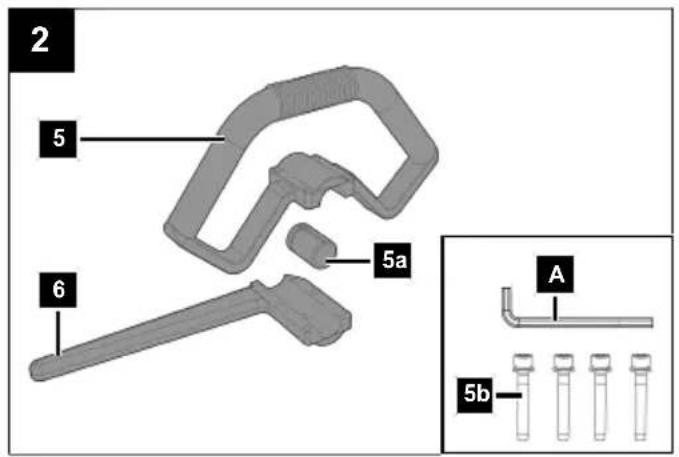
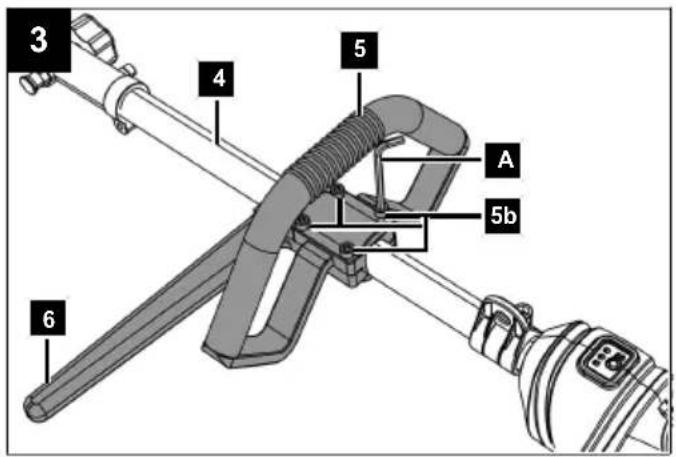
8.1 Fitting the front handle (5) (Fig. 1-3)
Fit the front handle (5) to the tubular shaft (4):
-
Firstly, loosen the Allen screws M5 (5b) and remove the rubber ring (5a) on the front handle (5). Use the 4 mm Allen key (A).
-
Place the rubber ring (5a) onto the tubular shaft (4).
-
Attach the leg guard (6) to the bottom of the rubber ring (5a).
Make sure that the rubber ring (5a) is seated in the recess on the leg guard (6).
-
Place the front handle (5) on the rubber ring (5a) from above so that the screw holes of the leg guard (6) and the front handle (5) are on top of each other.
-
Secure the front handle (5) with the four Allen screws M5 (5b). Use the 4 mm Allen key (A).
Ensure that the leg guard (6) is fitted to the left (towards the operator).
8.2 Fitting the protective covers (21/24)
(Fig. 1, 4)

DANGER
Danger of injury!
If an incompletely assembled product is used, serious injuries can be caused.
- Do not use the product until it has been fully fitted.
- Before each use, carry out a visual inspection to check that the product is complete and does not contain any damaged or worn components. Safety and protective devices must be intact.
-
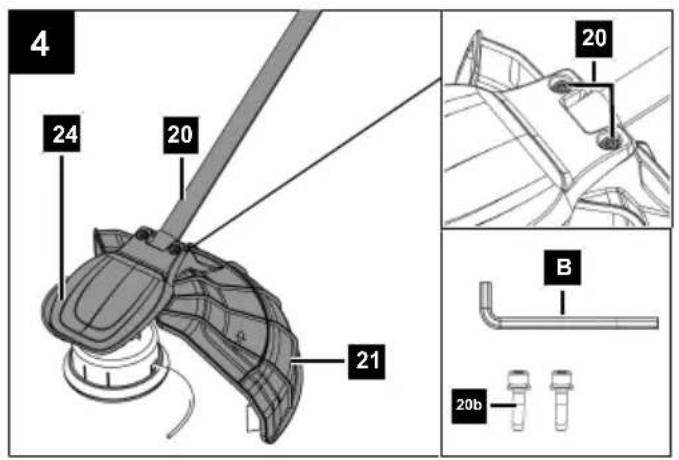
Attach the two protective covers (21/24) to the holder provided on the front tubular shaft (20).
-
Fasten the two protective covers (21/24) with the two M6 Allen screws (20a). Use the 5 mm Allen key (B).
8.3 Assembling/disassembling coil capsule (23) (Fig. 1, 5-7)
The front brush cutter/grass trimmer tubular shaft (20) can be used as a grass trimmer with the coil capsule (23).
-
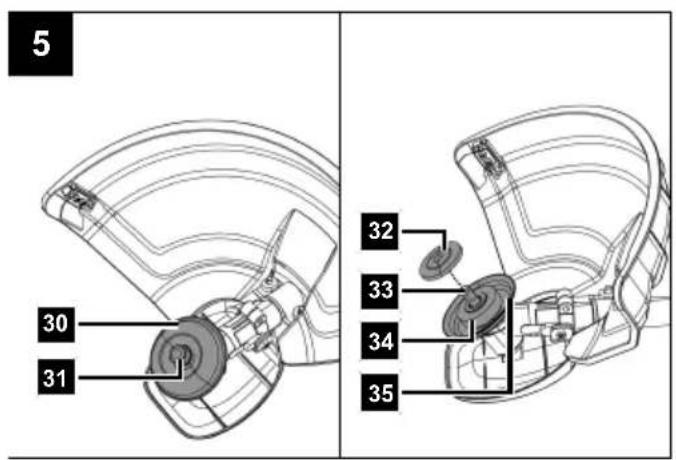
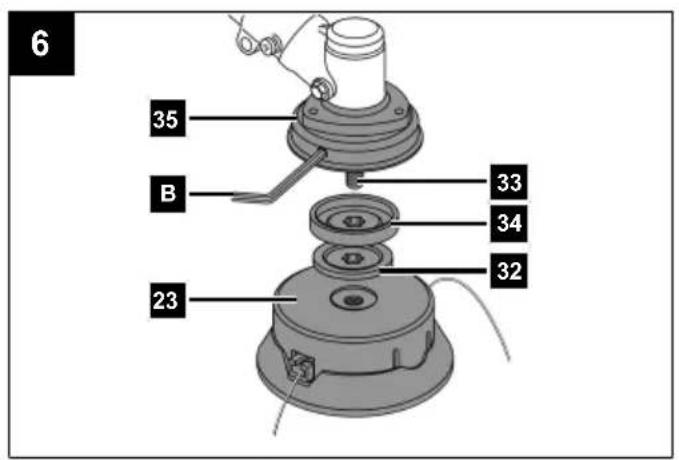
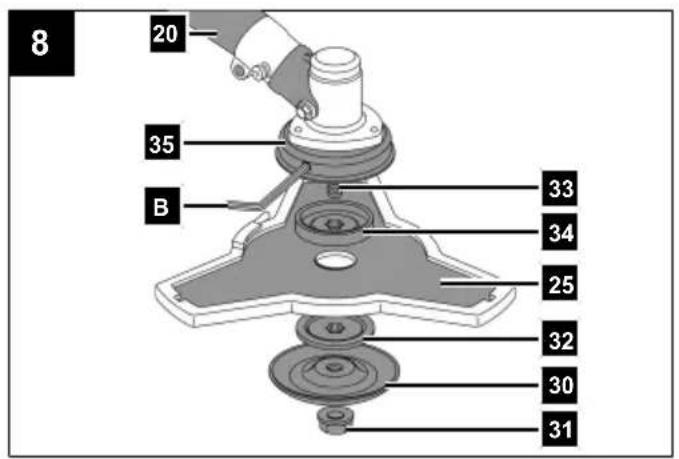
Remove the M10 nut (31) and the cover (30) from the mounting spindle (33). Attention - Left-handed thread! Use the installation spanner (D).
-
The M10 nut (31) and the cover (30) are not required for installation of the coil capsule (23). The inner flange (34) and the spring washer (32) remain on the mounting spindle (33).
-
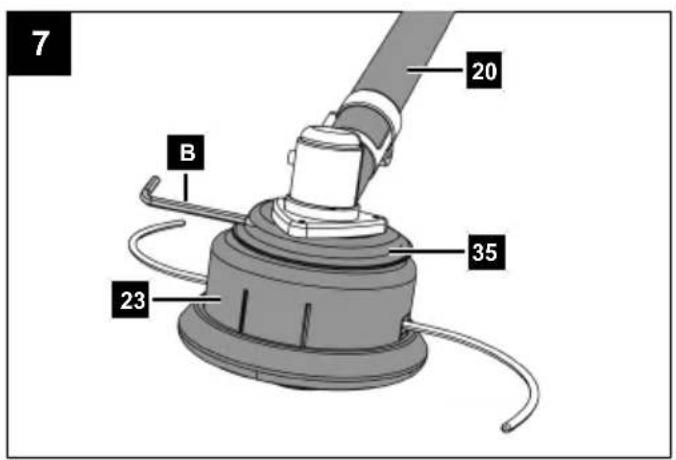
Hold the inner flange (34) through the outer flange (35) using a 5 mm Allen key (B).
-
Turn the coil capsule (23) anti-clockwise onto the mounting spindle (33) and fasten the coil capsule (23) to the mounting spindle (33) hand-tight.
-
Removal of the coil capsule (23) takes place in reverse order.
Note that the direction of rotation of the coil capsule (23) must match with the direction of the arrow on the protective cover (21) (Fig. 4).
8.4 Fitting/removing cutting blade (25) (Fig. 1, 8, 9)
The front brush cutter / grass trimmer tubular shaft (20) can be used as a brush cutter with the cutting blade (25).
-
Remove the M10 nut (31), the cover (30) and the spring washer (32) from the mounting spindle (33). Attention - Left-handed thread! Use the installation spanner (D).
-
The internal flange (34) remains on the mounting spindle (33).
-
Place the cutting blade (25) on the internal flange (34).
Note that the direction of rotation of the cutting blade (25) must match with the direction of the arrow on the protective cover (21) (Fig. 4).
-
Then push the spring washer (32) and the cover (30) onto the mounting spindle (33).
-
Fasten the cutting blade (25) with the M10 nut (31).
-
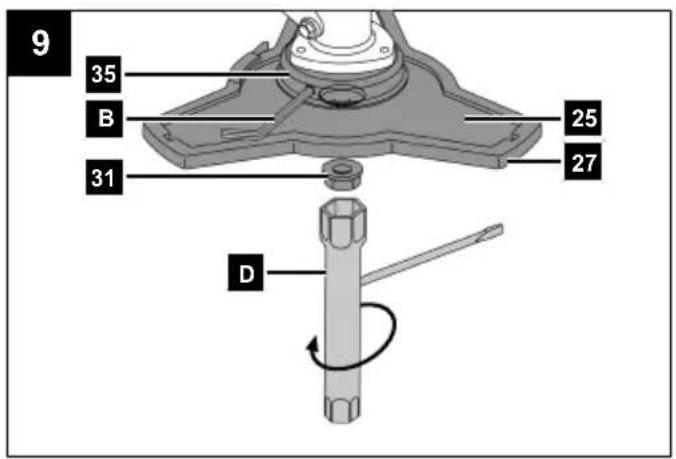
Tighten the M10 nut (31) with the installation spanner (D). To do this, hold the inner flange (34) through the outer flange (35) using the 5 mm Allen key (B).
-
Remove the blade guard (27) from the cutting blade (25).
-
Removal of the cutting blade (25) takes place in reverse order.
8.5 Fit the chainsaw guide bar (14) and saw chain (15) (Fig. 1, 10-13)

WARNING
Danger of injury when handling the saw chain or the blade!
- Wear cut-resistant gloves.
ATTENTION
Blunt blades overload the product! Do not use the product if the cutters are faulty or heavily worn.
Notes:
- A new saw chain stretches and needs to be re-tensioned more often. Check and adjust the chain tension regularly after each cut.
- Only use saw chains and blades designed for this product.

CAUTION
An incorrectly installed saw chain leads to uncontrolled cutting behaviour by the product!
When fitting the saw chain, observe the prescribed running direction!
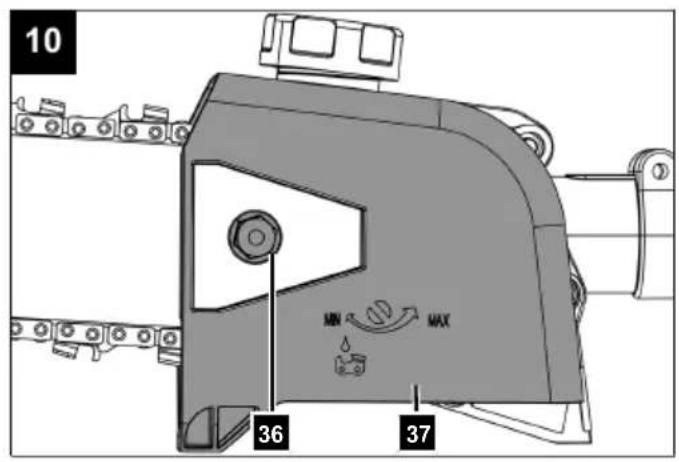
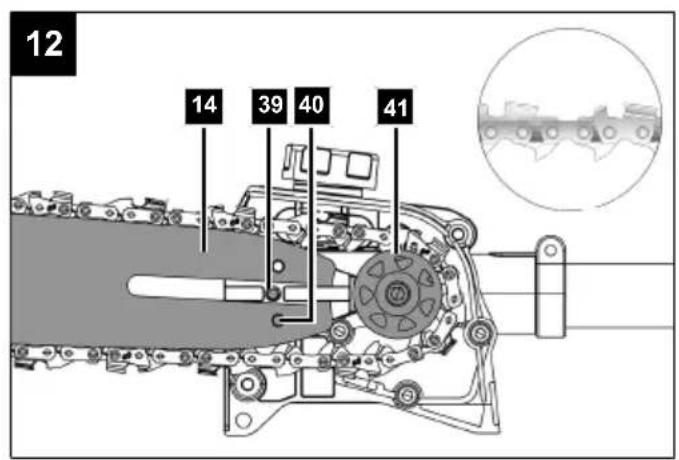
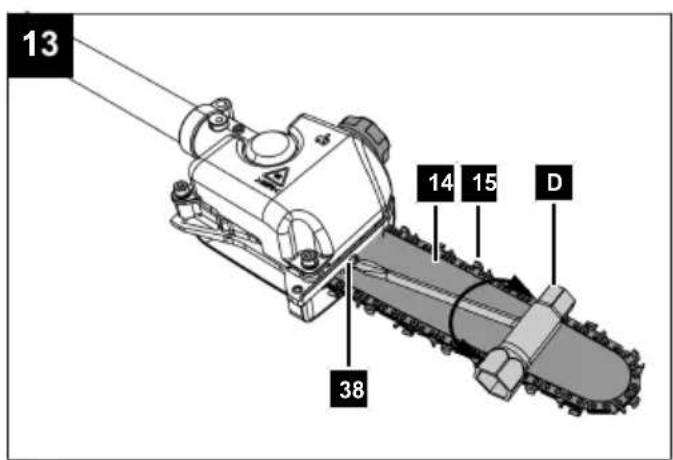
- Turn the fastening nut (36) anti-clockwise, so that the chain wheel cover (37) is removed. Use the open-end spanner AF 8/10mm (C).
-
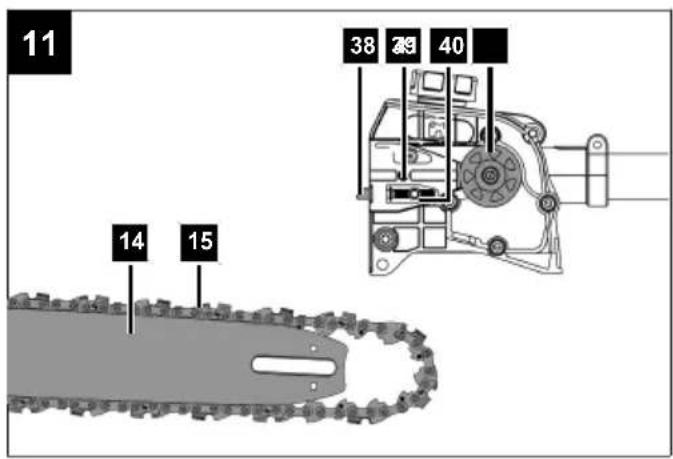
Turn the chain tensioning screw (38) anti-clockwise to loosen the chain tension. Use the installation spanner (D).
-
Lay out the saw chain (15) in a loop so that the cutting edges are aligned clockwise. To align the saw chain (15), follow the symbols (arrows) above the chain wheel (41).
- Place the saw chain (15) in the groove of the chain-saw guide bar (14).
- Guide the saw chain (15) around the chain wheel (41) and check the alignment of the saw chain (15). Make sure that the teeth of the saw chain (15) engage securely in the chain wheel (41).
- Insert the chainsaw guide bar (14) on the guide pin (39) and the chain tensioning bolt (40). The guide pin (39) must be in the elongated hole and the chain tensioning bolt (40) must be in the lower hole on the chain guide (14).
- Fit the chain cover (37) back on.
- Tighten the fastening nut (36) clockwise hand-tight.
- Recheck the seating of the saw chain (15) and tension the saw chain as described under 8.6.
Note:
Only tighten the fastening nut once the chain tension has been set.
8.6 Tensioning the saw chain (15) (Fig. 1, 10, 13, 14)

WARNING
Risk of injury from the saw chain jumping off!
An insufficiently tensioned saw chain can come off during operation and cause injuries.
- Check the saw chain tension frequently.
- The chain tension is too low if the drive links come out of the groove on the underside of the guide rail.
-
Adjust the tension of the saw chain properly if the saw chain tension is too low.
-
Loosen the fastening nut (36) by a few turns using the open-end spanner AF 8/10mm (C).
- Set the chain tension using the chain tensioning screw (38).
Use the installation spanner (D).
- Clockwise - increases the chain tension
- Anti-clockwise - reduces the chain tension
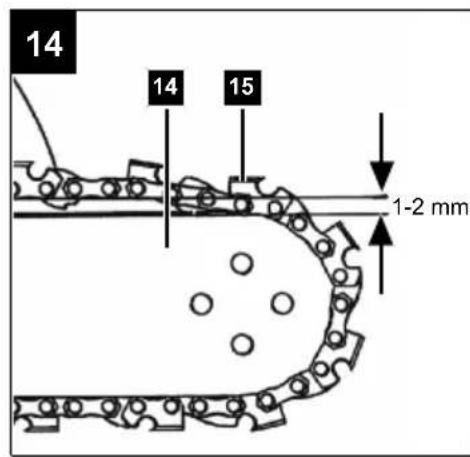
The saw chain (15) must not sag, although it should be possible to pull it 1-2 millimetres away from the chainsaw guide bar (14) in the centre of the chainsaw guide bar (14).
- Turn the saw chain (15) by hand, to check it runs freely. It must glide freely in the chainsaw guide bar (14).
- Re-tighten the fastening nut (36).
The saw chain is correctly tensioned when it does not sag on the chainsaw guide bar and can be pulled all the way round with a gloved hand. When pulling on the saw chain with 9 N (approx. 1 kg) tractive force, the saw chain and chainsaw guide bar must not be more than 2 mm apart.
Note:
- The tension of a new chain must be checked after a few minutes in operation, and adjusted if necessary.
- The tensioning of the saw chain should be carried out in a clean place free from sawdust and the like.
- Correct tensioning of the saw chain is for the safety of the user and reduces or prevents wear and chain damage.
• We recommend that the user check the chain tension before starting work for the first time. The saw chain is correctly tensioned when it does not sag on the underside of the guide bar and can be pulled all the way round with a gloved hand.
ATTENTION
When working with the saw, the saw chain heats up and expands slightly as a result. This "stretching" is to be expected especially with new saw chains.
9 Before commissioning
9.1 Topping up saw chain oil (Fig. 1, 14)
ATTENTION
Product damage!
If the product is operated without oil or with too little oil or with used oil, this can lead to product damage.
- Fill with oil before starting the machine. The product is delivered without oil.
- Do not use used oil!
- Check the oil level every time you change the battery.
ATTENTION
Environmental damage!
Spilled oil can pollute the environment permanently. The liquid is highly toxic and can quickly lead to water pollution.
- Fill/empty oil only on level, paved surfaces.
- Use a filling nozzle or funnel.
– Collect drained oil in a suitable container. - Wipe up spilled oil carefully immediately and dispose of the cloth according to local regulations.
– Dispose of oil as per local regulations.
The chain tension and chain lubrication have a considerable influence on the service life of the saw chain.
The saw chain will be lubricated automatically while the product is running. To lubricate the saw chain sufficiently, there must always be enough saw chain oil in the oil tank. Check the amount of oil remaining in the oil tank at regular intervals.
Notes:
* = not included in the scope of delivery!
• The cover is equipped with an anti-loss device.
- Only add environmentally friendly, good quality chain lubricating oil* (per RAL-UZ 48) to the chain saw.
- Ensure that the cover of the oil tank is in place and closed before switching on the product.
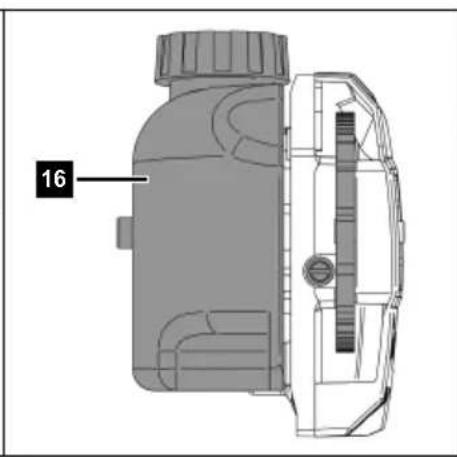
- Open the oil tank (16). To do this, unscrew the oil tank cap (16) anti-clockwise.
- To prevent oil from leaking, use a funnel*.
- Fill it carefully with chain lubricating oil. Oil tank capacity: max. 100 ml.
- Screw the cover of the oil tank (16) clockwise to close the oil tank (16).
- Wipe up any spilled oil carefully immediately and dispose of the cloth* according to local regulations.
- To check the product lubrication, hold the chainsaw with the saw chain over a sheet of paper and give it full throttle for a few seconds. You can see on the paper whether the chain lubrication is working.
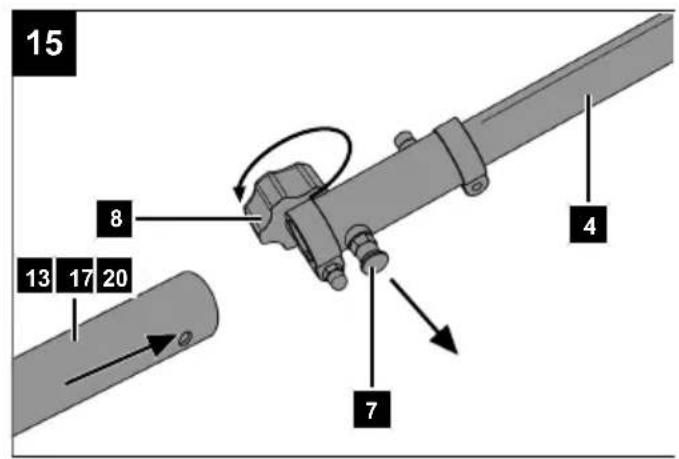
9.2 Fitting the front tubular shaft (13/17/20) (Fig. 1, 15)
- Remove the protective cap from the selected front tubular shaft (13/17/20).
- Loosen the star grip (8).
- Pull the locking mechanism (7) outwards and turn it to the right or left as far as the end stop.
- Push the selected front tubular shaft (13/17/20) onto the tubular shaft (4). Make sure that the hole is aligned with the locking mechanism (7).
- Turn the front tubular shaft (13/17/20) with slight rotary movements until the front tubular shaft (13/17/20) is seated in the tubular shaft (4) up to the end stop.
- Turn the locking mechanism (7) to its starting position. The locking mechanism (7) engages audibly.
- Secure the front tubular shaft (13/17/20) with the star grip (8).
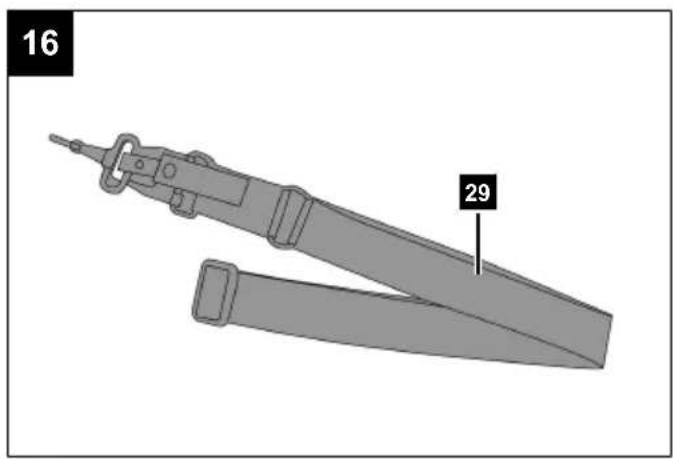
9.3 Attaching the shoulder strap (29) (Fig. 16-18)
Notes:
The product may only be used with the carrying strap.
First, balance the product when the tool is switched off.
- Put on the carrying strap (29).
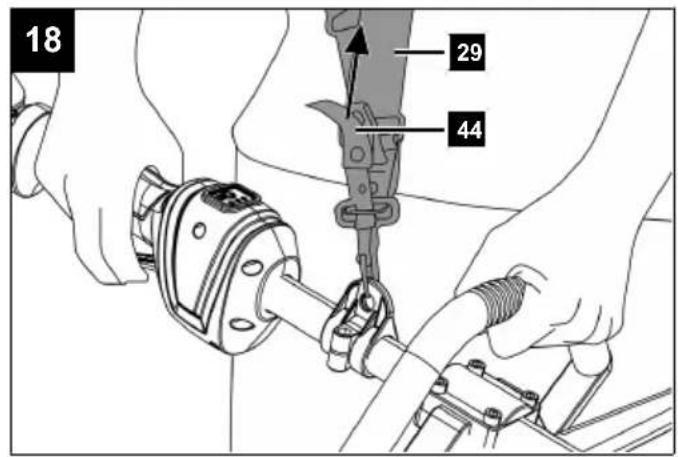
- Adjust the length of the belt so that the carabiner hook (43) is approx. one hand-width beneath the right hip.
- Attach the snap hook (43) to the carrying eye (9).
- Allow the product to settle.
Notes:
The product may just touch the floor with the tool attachment in a normal working position.
In an emergency, the safety tab (44) on the carrying strap (29) can be pulled. The product then immediately detach-es from the carrying strap (29) and falls to the floor.

WARNING
Check the safety tab regularly before each start-up!
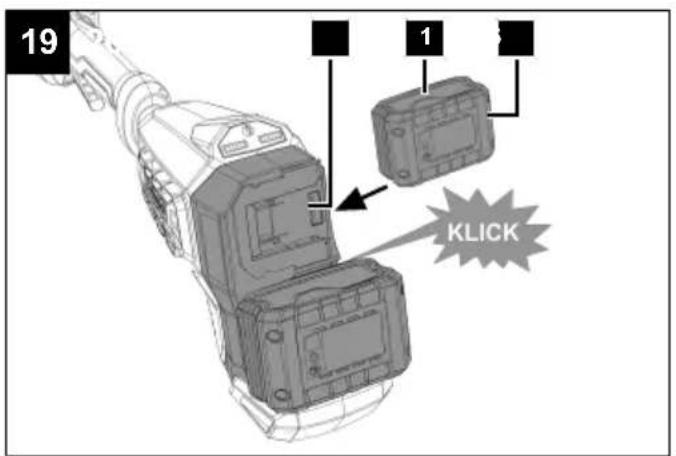
9.4 Inserting/removing the battery (1) in the battery mount (46) (Fig. 19)

CAUTION
Danger of injury!
Do not insert the battery until the battery-powered tool is ready for use.
Inserting the battery
- Slide the batteries (1) into the battery mounts (46). The batteries (1) click into place audibly.
Removing the battery
- Press the unlock button (45) of the batteries (1) and remove the batteries (1) from the battery mounts (46).
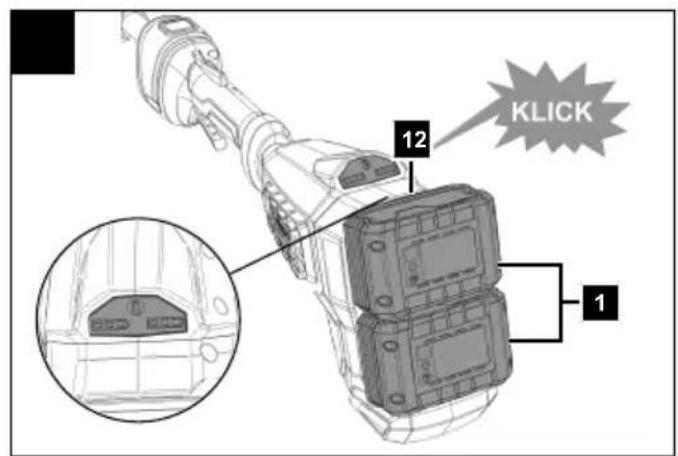
9.4.1 Charge level indicator (12) (Fig. 20)
The charge status indicator (12) indicates the charge status of the battery (1).
The charge status of the battery is indicated by the corresponding LED light lighting up.
- Press the button on the charge level indicator (12) to check the charge level.
| 3 LEDs illuminate Battery fully charged |
| 2 LEDs illuminate Battery partially charged |
| 1 LED illuminates Battery must be charged |
10 Operation
ATTENTION
Always make sure the product is fully assembled before commissioning!

WARNING
Danger of injury!
The on/off switch and the safety switch must not be locked!
- Do not work with the product if the switches are damaged. The on/off switch and the safety switch must switch off the product when released.
- Make sure the product is in working order before each use.

WARNING
Electric shock and damage to the product possible!
Contact with a live cable during cutting can result in electric shock. Cutting into foreign objects can cause damage to the cutter bar.
- Scan hedges and bushes for hidden objects, such as live wires, wire fences and plant supports, before cutting
ATTENTION
Make sure that the ambient temperature does not exceed 50°C and does not fall below -20°C during work.
ATTENTION
The product is part of the 20V IXES series and may only be operated with batteries of this series. Batteries may only be charged with battery chargers of this series. Observe the manufacturer's instructions.

DANGER
Danger of injury!
If the product is jammed, do not try to pull the product out by using force.
- Switch off the engine.
- Use a lever arm or wedge to get the product free.

WARNING
Check the safety equipment regularly before each start-up. Faulty safety equipment can cause serious injuries!
10.1 Switching the product on/off (Fig. 1)

WARNING
Danger of injury due to kickback!
- Never use the product one-handed!
Notes:
The speed can be steplessly controlled by the on/off switch. The further you press the on/off switch, the higher the speed.
Before switching on, make sure that the product does not touch any objects.
When using the brush cutter (20):
- Remove the transport guard (26) from the cutting blade (25).
When using the hedge trimmer (17):
- Pull the blade guard (27) off the cutter bar (19).
When using the pole-mounted pruner (13):
-
Check that there is saw chain oil in the oil tank (16).
-
Fill in saw chain oil before the oil tank (16) is empty, as described under 9.1.
-
Pull the blade and chain guard (28) off the chainsaw guide bar (14).
The speed can also be changed during operation.
You can choose between 3 speed settings:
| Slow Medium Fast | ||
Switching on
-
Press the main switch (10) until the LED lights up.
-
Select the speed setting.
-
Hold the front handle (5) with your left hand and the rear handle (2) with your right hand. Thumb and fingers must firmly grasp the handles (2, 5).
-
Grasp the switch-on lock (11) on the rear handle (2).
-
Press and hold the switch lock (11).
-
To switch on the product, push the on/off switch (3) with your thumb.
Notes:
It is not necessary to keep the switch lock pressed after starting the product. The switch lock is intended to prevent accidental starting of the product.
If the product is not used, the LED on the main switch remains lit for 1 minute. The product is then switched off automatically.
Switching off
-
To switch it off, simply release the on/off switch (3).
-
Press the main switch (10) until the LED goes out.
-
Put on the supplied transport guard (26), blade and chain guard (28) and blade guard (27) after every time you work with the product.
10.2 Overload protection
In the event of overloading, the battery will switch itself off. After a cool-down period (time varies), the product can be switched back on again.
11 Working instructions

DANGER
Danger of injury!
This section examines the basic working technique for using the product.
The information provided here does not replace the many years of training and experience of a specialist.
Avoid any work that you are not adequately qualified for!
Careless use of the product can lead to serious injuries and even death!

CAUTION
After switching off, the product will run on. Wait until the product has come to a complete stop.
Notes:
Before switching on, make sure that the product does not touch any objects.
Some noise pollution from this product is unavoidable. Postpone noisy work to approved and designated times. If necessary, adhere to rest periods.
Only process free, flat surfaces with the tool attachment.
Carefully inspect the area to be cut and remove all foreign objects.
Avoid bumping into stones, metal or other obstacles.
The tool attachment could be damaged and there is a risk of kickback.
- Wear prescribed protective equipment.
- Ensure that other people remain at a safe distance from your workspace. Anyone who enters the workspace must wear personal protective equipment. Fragments of the workpiece or broken accessory tools can fly off and cause injury – even outside the immediate working area.
- If a foreign object is hit, switch off the product immediately and remove the battery. Inspect the product for damage and perform the required repairs before starting again and working with the product. If the product begins to experience exceptionally strong vibrations, switch it off immediately and check it.
- Hold the power tool by the insulated handles when you are carrying out work in which the accessory tool may come into contact with concealed power cables. Contact with a live wire may make exposed metal parts of the power tool live and could give the operator an electric shock.
- Do not use the product in a thunderstorm - Danger of lightning strike!
- Check the product for obvious defects such as loose, worn or damaged parts before each use.
- Switch on the product and only then approach the material to be processed.
- Do not exert excessive pressure on the product. Let the product do the work.
• Always hold the product tight with both hands during work. Make sure that you have a secure footing.
- Avoid abnormal postures.
- Check that the shoulder strap is in a comfortable position to make it easier for you to hold the product.
11.1 Brush cutter/grass trimmer
ATTENTION
All protective covers must be fitted when working with the product!
Note:
Check the nylon thread regularly for damage and whether the cutting thread is still the length specified by the thread cutter.
- Do not hold the tool attachment at an angle.
- Grass is best cut when it is dry and not too long.
- Avoid contact with solid obstacles (stones, walls, fences, etc.).
- Do not use the product to cut wild growth or undergrowth.
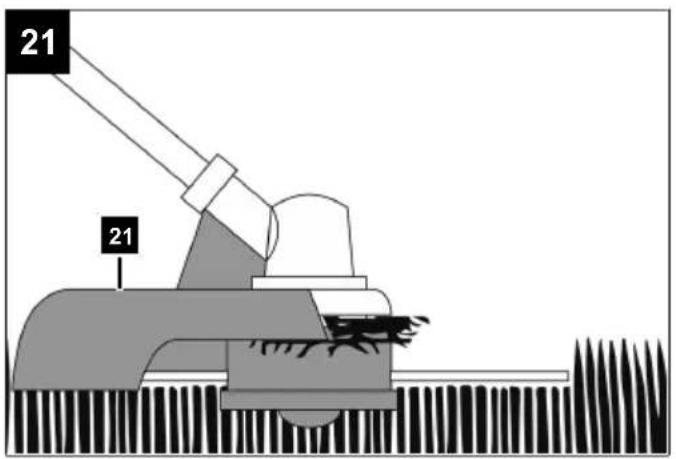
- For technical reasons, wet grass and weeds wrap around the drive axle beneath the protective cover (21) while working. Remove this, otherwise the engine will overheat due to excessive friction (fig. 21).
11.1.1 Lengthening the cutting thread (Figs. 1, 22, 31)
The grass trimmer is supplied with a filled thread coil (48).
This line will wear out during work.
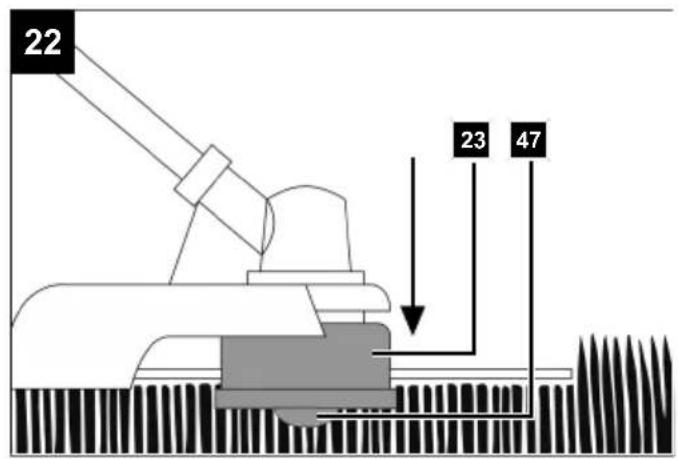
So that new thread is fed in, press the trigger (47) the thread coil (48) firmly on the floor with the engine running.
If the thread is initially longer than the cutting circle specified, it is automatically shortened to the correct length by the thread cutter (22).
Notes:
Check the nylon thread regularly for damage and whether the cutting thread is still the length specified by the thread cutter.
If no thread end is visible:
- Replace the thread coil (48) as described under 13.1.1.
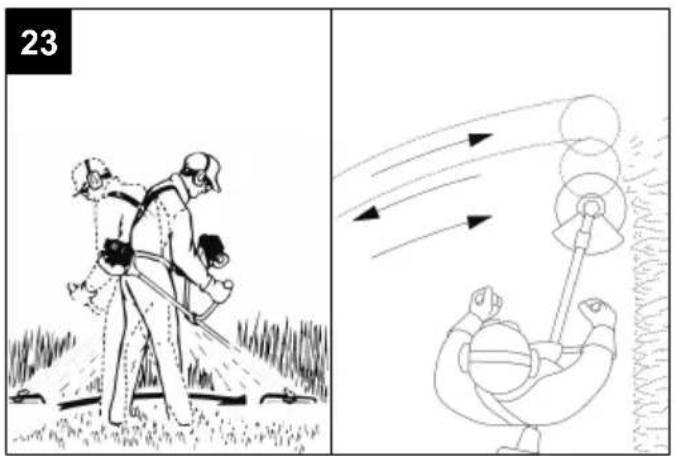
11.1.2 Cutting grass (Fig. 23)
-
Cut grass by swivelling the product to the right and left.
-
Cut slowly and keep the product tilted forwards by approx. 30^ when cutting.
-
Cut long grass in layers from top to bottom.
11.2 Hedge trimmer
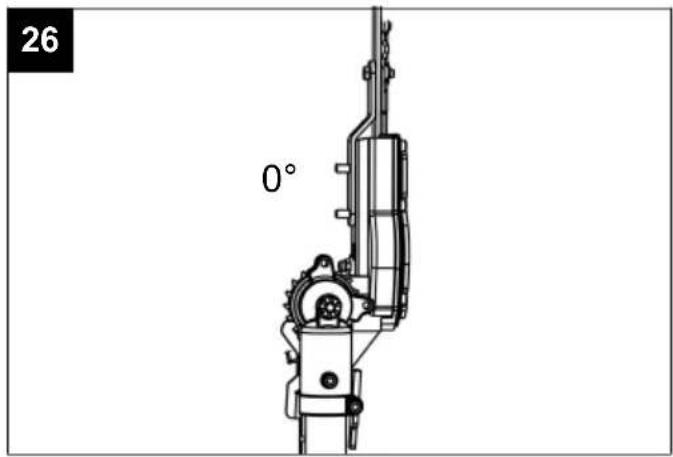
11.2.1 Angle adjustment (Fig. 1 and 24-26)
WARNING
Switch off the product and remove the battery!
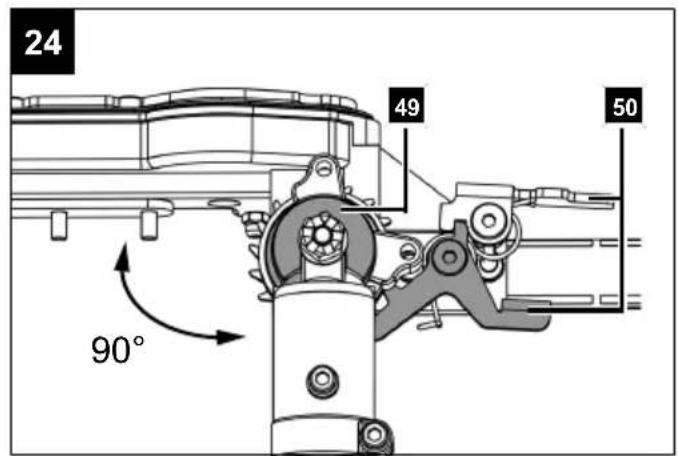
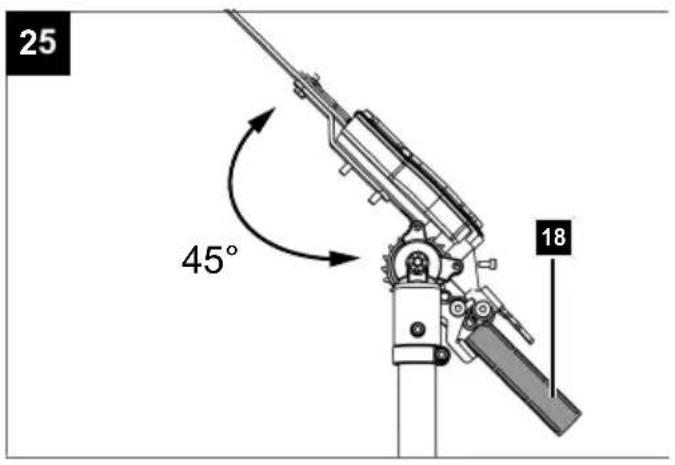
The hedge trimmer (17) can be adjusted to the working conditions by swivelling the blade head from +90° to -75°.
-
Press both unlocking levers (49) on the handle (18) and adjust to the desired position.
-
To do this, use the handle (18).
-
Release both unlocking levers (49) until they engage into the toothing.
-
Before commissioning, check that the unlocking levers (49) are properly engaged.
ATTENTION
The tool attachment may only be used when both unlocking levers are engaged!
11.2.2 Cutting techniques
- Cut out thick branches beforehand with pruning shears.
- The double-sided cutter bar allows cutting in both directions, or using a pendulum movement, swinging the trimmer back and forth.
- When cutting vertically, move the product smoothly forwards or up and down in an arc.
- When cutting horizontally, move the product in a crescent shape towards the edge of the hedge so that cut branches fall to the ground.
- To get long straight lines, it is advisable to stretch guide strings.
11.2.3 Pruned hedges
It is advisable to cut hedges in a trapezoidal shape to prevent the lower branches from becoming bare. This corresponds to natural plant growth and allows hedges to thrive. When pruning, only the new annual shoots are reduced, so that a dense branching and a good screen is formed.
- Trim the sides of a hedge first. To do this, move the product with the direction of growth from bottom to top. If you cut from the top down, thinner branches move outwards and this can create thin spots or holes.
- Then cut the top edge straight, roof-shaped or round, depending on your taste.
- Trim even young plants to the desired shape. The main shoot should remain undamaged until the hedge has reached the planned height. All other shoots are cut in half.
11.2.4 Cut at the right time
- Leaf hedge: June and October
• Conifer hedge: April and August - Fast growing hedge: around every 6 weeks from May
Pay attention to nesting birds in the hedge. Delay the hedge cut or leave this area out if this is the case.
11.3 Pole-mounted pruner

DANGER
Danger of injury!
If the product is jammed, do not try to pull the product out by using force.
- Switch off the engine.
- Use a lever arm or wedge to get the product free.

DANGER
Watch out for falling branches and do not trip.
- The saw chain should have reached maximum speed before you start sawing.
- You have better control when you saw with the underside of the bar (with a pulling chain).
- The saw chain must not touch the ground or any other object during or after sawing.
- Ensure that the saw chain does not become jammed in the saw cut. The branch must not break or splinter.
- Also observe the precautions against kick-back (see safety instructions).
- Remove the branches hanging downwards by making the cut above the branch.
- Branched boughs are cut to length individually.
11.3.1 Automatic saw chain lubrication (Fig. 1, 14)
Fill the oil tank (16) as described under 9.1.
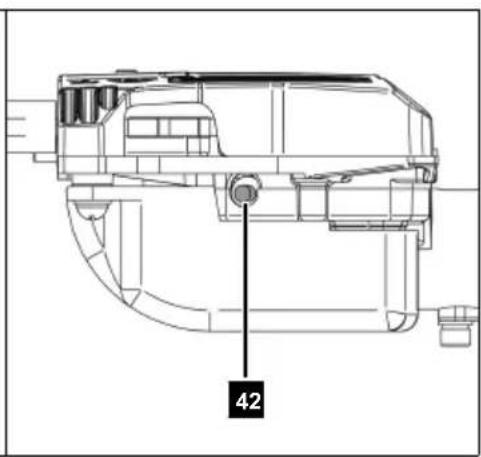
The amount of oil can be reduced or increased with the adjusting screw (42).
Use the installation spanner (D).
- Clockwise - the amount of oil is reduced (-)
- Counterclockwise - the amount of oil is increased (+)
11.3.2 Cutting techniques

WARNING
Never stand directly under the branch that you want to saw off!
Possible risk of injury caused by falling branches and catapulting pieces of wood.
In general, it is recommended to position the product at an angle of 60^ to the branch.
Hold the product firmly with both hands during the cutting process and always ensure that you are in a balanced position and have a good stance.
Sawing off small branches (Fig. 27):
Place the stop surface of the saw against the branch to avoid jerky movements of the saw when starting the cut. Guide the saw through the branch with light pressure from top to bottom.
Make sure that the branch does not break through prematurely if you have misjudged its size and weight.
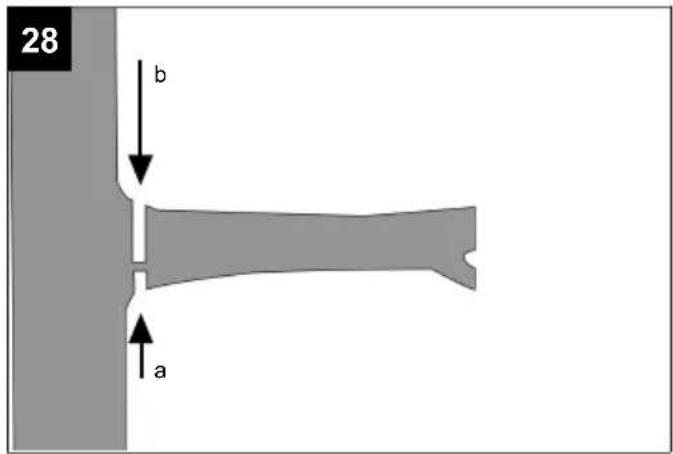
Sawing off larger branches (Fig. 28):
For larger branches, first choose a relief cut for controlled sawing. To do this, saw an incision in the lower third of the branch (with the top of the blade). Then saw from top to bottom (with the underside of the guide bar) towards the first cut.
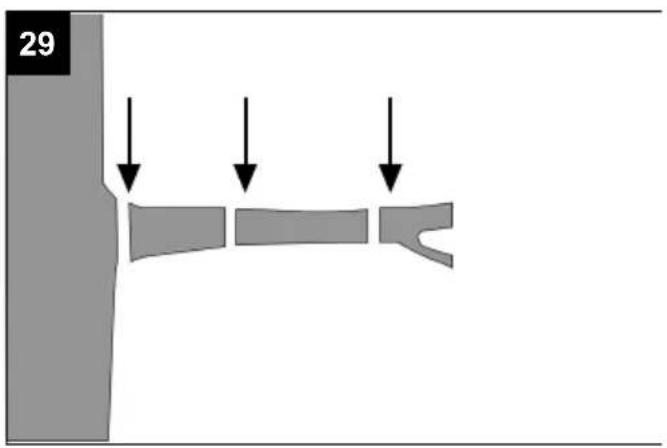
Sawing off in sections (Fig. 29):
Saw off large or long branches in sections so that you have control over the impact location.
- Saw off the lower branches on the tree first to make it easier for the cut branches to fall.
- Once the cut has been completed, the weight of the saw increases abruptly for the operator, as the saw is no longer supported on the branch. There is a risk of losing control of the product.
- Only pull the saw out of the cut with the saw chain running to prevent it from jamming.
- Do not saw with the tip of the tool attachment.
- Do not saw into the bulging branch base, as this will prevent the tree from healing.
11.4 After use
- Always switch the product off before placing it down and wait until the product has come to a standstill.
- Remove the batteries.
- Put on the supplied chainsaw guide bar and chain guard or blade guard after each instance of working with the product.
- Allow the product to cool.
12 Cleaning

WARNING
Have maintenance and repair tasks that are not described in this operating manual, carried out by a specialist workshop. Use only original spare parts.
There is a risk of accident! Always perform maintenance and cleaning work with the battery removed.
There is a danger of injury! Let the Product cool down before all maintenance and cleaning tasks. Elements of the engine are hot. There is a danger of injury and burning!
The product can start unexpectedly and cause injuries.
- Remove the battery.
- Allow the product to cool down.
- Remove the tool attachment.

WARNING
Danger of injury when handling the saw chain or the blade!
- Wear cut-resistant gloves.
- Wait until all moving parts have come to a standstill.
- We recommend that you clean the product directly after every use.
- Keep handles and grasping surfaces dry, clean and free from oil and grease. Slippery handles and grasping surfaces do not allow for safe handling and control of the tool in unexpected situations.
- If necessary, clean the handles with a damp cloth washed in soapy water.
- Never immerse the product in water or other liquids for cleaning.
- Do not splash the product with water.
- Keep protective devices, air vents and the motor housing as free of dust and dirt as possible. Rub the product clean with a clean cloth* or blow it off with compressed air* at low pressure. We recommend that you clean the product directly after every use.
- Ventilation openings must always be free.
- Do not use any cleaning products or solvents; they could attack the plastic parts of the product. Make sure that no water can penetrate the product interior.
12.1 Hedge trimmer
- Clean the cutter bar with an oily cloth after each use.
- Oil the cutter bar after each use with an oil can or a spray.
12.2 Pole-mounted pruner
- Use a brush or hand brush to clean the saw chain and no liquids.
- Clean the groove of the chainsaw guide bar using a brush or compressed air.
- Clean the chain wheel.
13 Maintenance

WARNING
Have maintenance and repair tasks that are not described in this operating manual, carried out by a specialist workshop. Use only original spare parts.
There is a risk of accident! Always perform maintenance and cleaning work with the battery removed.
There is a danger of injury! Let the Product cool down before all maintenance and cleaning tasks. Elements of the engine are hot. There is a danger of injury and burning!
The product can start unexpectedly and cause injuries.
- Remove the battery.
- Allow the product to cool down.
-
Remove the tool attachment.
-
Check the product for obvious defects such as loose, worn or damaged parts before each use.
- Check the covers and protective devices for damage and correct seating. Replace them if necessary.
- Regular, careful servicing is required to guarantee the safety level and performance of the product.
- Position the Product on a straight, level surface.
- Do not splash the product with water.
- For safety reasons, replace worn or damaged parts.
- Any work not described in this operating manual must be performed by an authorised specialist workshop only.
Notes:
Maintain the product carefully. Check for misalignment or binding of moving parts, breakage of parts and any other condition that may affect the product's operation. Have damaged parts repaired before using the product.
13.1 Brush cutter/grass trimmer
13.1.1 Replacing the thread coil (48) (Fig. 1, 30-34)
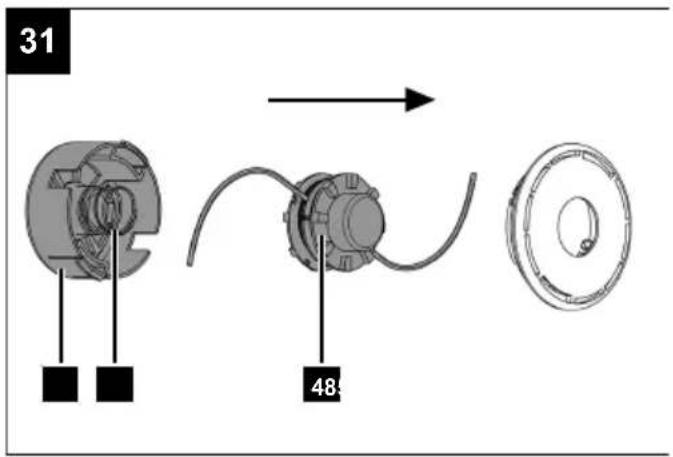
- Disassemble the coil capsule (23) as described under 8.3.
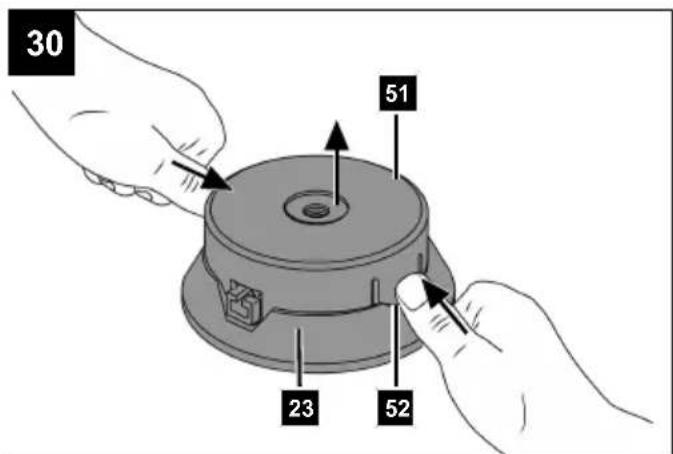
- Open the coil capsule (23) by pressing the two releases (52) on the coil capsule (23) firmly together at the same time.
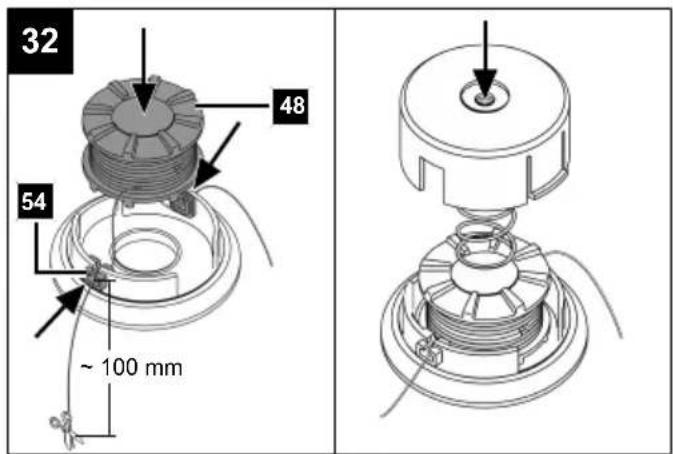
- Remove the cover (51) with the pressure spring (54) of the coil capsule (23) and remove the thread coil (48).
- Pull the thread end of the thread coil (48) out of the thread outlet eyelets (55).
- Remove all thread remnants from the coil capsule (23).
- Take the new thread coil (48) and pull out 10 cm of both trimming lines.
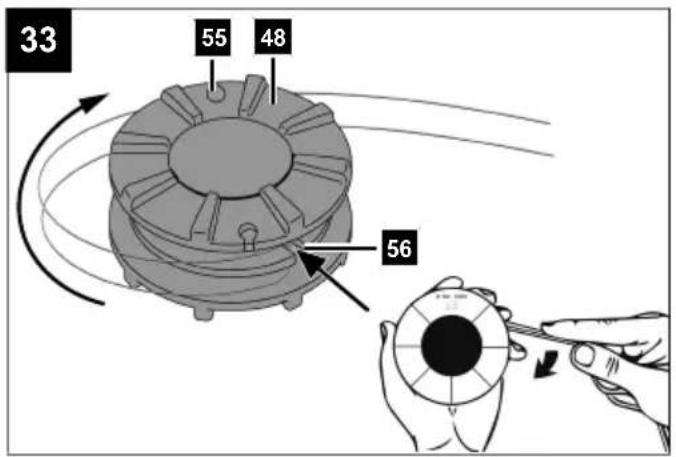
- Clamp the two threads in the opposite notches (55) in the thread coil (48) (Fig. 33).
- Insert the new thread coil (48) into the coil capsule (23). The side of the thread coil (48) on which the running direction is indicated by arrows must be visible after insertion.
- The thread coil (48) must be inserted so that the notches (55) in the thread coil (48) are aligned with the thread outlet eyelets (54) to allow easy threading of the thread.
- Insert the two threads into the respective thread outlet eyelets (54).
- Turn the thread coil (48) slightly back and forth until the integrated lock-in stages of the thread coil (48) slide into the lock-in stages of the coil capsule (23). This prevents unintentional adjustment.
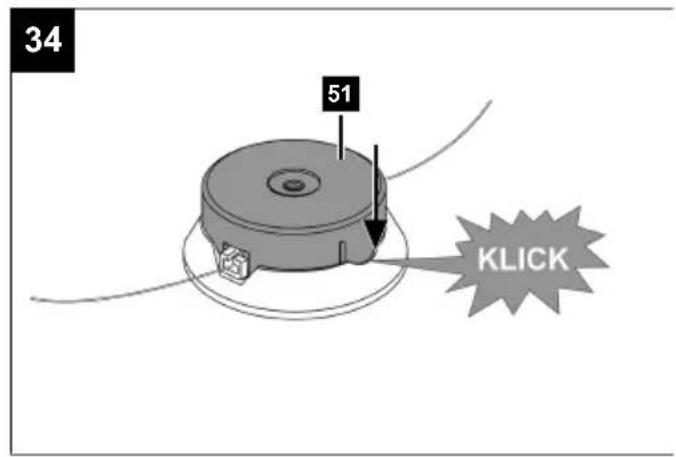
- Replace the cover (51) with the compression spring (53) on the coil capsule (23). Ensure that the unlocking levers (52) on the cover (51) fit exactly into the recesses on the coil capsule (23). You can hear them click into place.
Notes:
So that new thread is fed in, press the trigger (47) the thread coil (48) firmly on the floor with the engine running (Fig. 22).
If the thread is initially longer than the cutting circle specified, it is automatically shortened to the correct length by the thread cutter (22).
13.1.2 Replacing the thread in the thread coil (48) (Fig. 30-34)
Alternatively, the thread on the thread coil can also be replaced.
- Disassemble the coil capsule (23) as described under 8.3.
-
Open the coil capsule (23) by pressing the two releases (52) on the coil capsule (23) firmly together at the same time.
-
Remove the cover (51) with the pressure spring (53) of the coil capsule (23) and remove the thread coil (48).
-
Pull the thread ends of the thread coil (48) out of the thread outlet eyelets (54).
-
Remove all thread remnants from the coil capsule (23) and the thread coil (48).
-
Bend the new thread in the middle (at approx. 2 metres) and insert the bent part of the thread into one of the notches (56) of the centre bar of the thread coil (48). There must now be one thread end in the lower chamber and one in the upper chamber of the thread coil (48).
-
Wind the two thread ends in the direction of the arrow "LH WIND LINE" specified on the top of the thread coil (48).
-
Take the thread coil (48) and pull out 10 cm of both threads.
-
Then clamp the two threads in the opposite notches (55) in the thread coil (48).
-
Proceed further as described under 13.1.1 point 8.
13.1.3 Resharpening the thread cutter (22) (Fig. 1, 35)
Tool required:
Included in the scope of delivery
• Phillips screwdriver (D)
- Flat file*
* = not included in the scope of delivery!
The thread cutter (22) can become blunt over time.
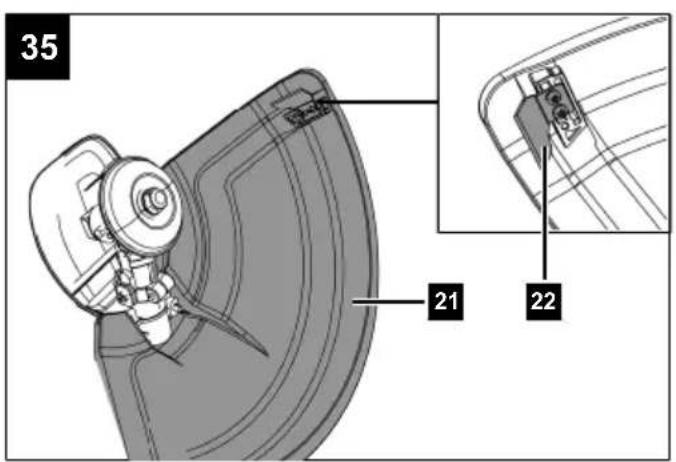
- If you notice this, loosen the two screws with which the thread cutter (22) is attached to the protective cover (21). Use the Phillips screwdriver (D).
- Then fasten the thread cutter (22) in a bench vice.
- Grind the cutting edge of the thread cutter (22) using a flat file and make sure to maintain the angle of the cutting edge.
- Refit the thread cutter (22) onto the protective cover (21).
Note:
Replace or sharpen the thread cutter at the end of each mowing season or as needed.
13.1.4 Grinding the cutting blade (25) (Fig. 1)
Note:
If the blades become slightly dull, you can sharpen them yourself.
Tool required:
* = not included in the scope of delivery!
- Flat file*
-
Bench vice*
-
Remove the cutting blade (25) as described under 8.4.
- Fasten the cutting blade (25) in a bench vice.
- Grind all 3 blades of the cutting blade (25) using a flat file and make sure to maintain the angle of the cutting edge ( 25^ ). Only file in one direction.
- Replace it after resharpening the cutting edge five times at the latest.
Replace the cutting blade (25) if the cutting edge is heavily worn or broken.
An unbalanced cutting blade causes the brush cutter/grass trimmer (20) to vibrate strongly; this poses a danger of injury!
13.2 Hedge trimmer
- Check that the screws in the cutter bar are tight.
- You can smooth out slight nicks on the cutting teeth yourself. To do this, draw an oil stone along the cutting edges. Only sharp cutting teeth provide a good cutting performance.
- Blunt, bent or damaged cutter bars must be replaced.
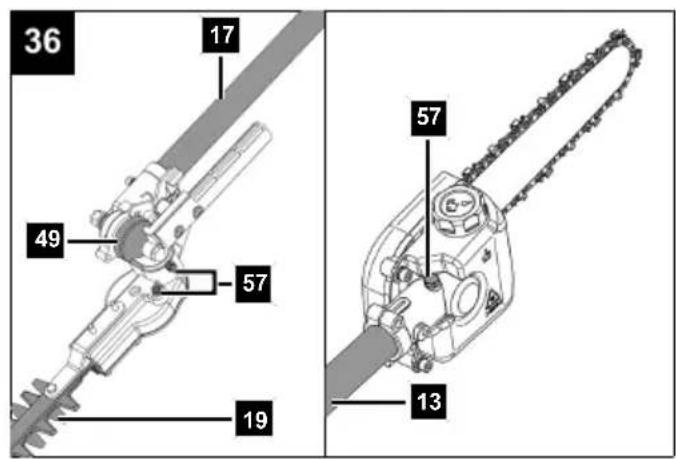
13.2.1 Lubricate the transmission and angle adjustment (49) (Fig. 36)
Notes:
Lubricate the drive every 10 to 20 operating hours.
Top up with only a little grease. Under no circumstances overfill!
- Apply a grease gun (not included in the scope of delivery) to the grease nipple (58).
- Press max. one lift of commercially available grease into the grease nipples (58).
- Lubricate the angle adjustment (49) and the cutter bar (19) with environmentally friendly lubricating oil.
13.3 Pole-mounted pruner
WARNING
Danger of injury when handling the saw chain or the blade!
- Wear cut-resistant gloves.
13.3.1 Checking the chain wheel (41) (Fig. 1, 10, 11, 13)
- Turn the fastening nut (36) anti-clockwise, so that the chain wheel cover (37) is removed. Use the open-end spanner AF 8/10mm (C).
-
Turn the chain tensioning screw (38) anti-clockwise to loosen the chain tension. Use the installation spanner (D).
-
Remove the guide bar (14) and the saw chain (15).
- Check the grooving on the chain wheel (41) with a test gauge (not included in the scope of delivery).
- If the grooves are deeper than 0.5 mm, do not use the product and consult a specialist dealer. The chain wheel (41) must be replaced.
- Refit the chain guide bar (14) and the saw chain (15) as described under 8.5
13.3.2 Checking the chainsaw guide bar (14) (Fig. 1, 10, 11, 13)
- Turn the fastening nut (36) anti-clockwise, so that the chain wheel cover (37) is removed. Use the open-end spanner AF 8/10mm (C).
- Turn the chain tensioning screw (38) anti-clockwise to loosen the chain tension. Use the installation spanner (D).
- Remove the guide bar (14) and the saw chain (15).
- Measure the groove depth of the chainsaw guide bar (14) with the scale on a file gauge (not included in scope of delivery).
- The chainsaw guide bar (14) must be replaced if any of the following apply:
– The chainsaw guide bar is damaged.
- The measured groove depth is smaller than the minimum groove depth of the chainsaw guide bar (2 mm).
- The groove of the chainsaw guide bar has narrowed or spread.
- Fir the chainsaw guide bar (14) and the saw chain as described under 8.5.
13.3.3 Replacing the chainsaw guide bar (14) (Fig. 1, 10, 11, 13)
- Turn the fastening nut (36) anti-clockwise, so that the chain wheel cover (37) is removed. Use the open-end spanner AF 8/10mm (C).
- Turn the chain tensioning screw (38) anti-clockwise to loosen the chain tension. Use the installation spanner (D).
- Remove the guide bar (14) and the saw chain (15).
- Replace the chainsaw guide bar (14) and fit the chain-saw guide bar (14) and saw chain (15) as described under 8.5.
13.3.4 Replace the saw chain (15) and allow it to run in (Fig. 10-13)

DANGER
Serious injuries possible due to tearing or jumping off of the sawtooth!
- Never fit a new saw chain on a worn sprocket or on a damaged or worn guide rail. The saw chain could jump off or break.
- Only use saw chains and blades designed for this product.
- Before changing the saw chain, clean the groove of the guide bar, as the saw chain may jump out of the bar if it dirty. The deposits can also soak up the chain oil. The consequence would be that the chain oil does not reach the underside of the guide bar, or only to a small extent, and lubrication is reduced.
- Turn the fastening nut (36) anti-clockwise, so that the chain wheel cover (37) is removed. Use the open-end spanner AF 8/10mm (C).
- Turn the chain tensioning screw (38) anti-clockwise to loosen the chain tension. Use the installation spanner (D).
- Remove the guide bar (14) and the saw chain (15).
- Refit the chain guide bar (14) and the saw chain (15) as described under 8.5
Note:
Only tighten the fastening nut once the chain tension has been set.
With a new saw chain, the tensioning force decreases after some time. Therefore, you must retension the saw chain after the first 5 cuts, or after 10 minutes of sawing at the latest.
13.3.5 Sharpening the saw chain (15)

WARNING
Increased risk of accidents due to an incorrectly sharpened saw chain!
Deviations from the dimensions of the cutting edge geometry during sharpening increase the risk of kickback of the product.
– Have the saw chain sharpened by a professional.
The saw chain can be resharpened at an authorised specialist workshop. Do not attempt to sharpen the saw chain yourself if you do not have a suitable tool and the necessary experience.

CAUTION
Special tools are required to sharpen the chain; these ensure that the cutting tools are sharpened at the correct angle and to the correct depth.
All cutting links must have the same width and length after sharpening.
Notes:
A sharp saw chain ensures optimum cutting performance. It effortlessly eats through the wood, leaving behind large, long wood chips.
A saw chain is blunt if you have to push the cutting equipment through the wood and the wood chips are very small. With a very blunt saw chain, no chips are produced at all, only wood dust.
13.3.5.1 Instructions for sharpening the chainsaw
Only use files specifically for saw chains!
Other files have the wrong shape and the wrong edge. Select the diameter of the file according to your chain pitch. Be sure to also note the following angles when sharpening the cutting links.
| Saw chain type | File diameter | Top angle | Bottom angle | Top tilt angle (55°) | Standard depth gauge |
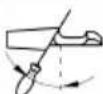 |  | 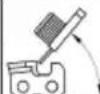 |  | ||
| Clamping rotation angle | Clamping tilt angle | Side angle | |||
| 21PBX approx. 4.8 mm | 30° 10° 85° 0.64 | mm | |||
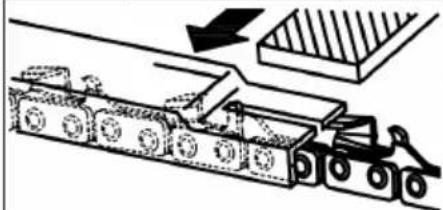 | 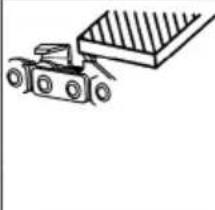 | ||||
| Depth stop File | |||||
Furthermore, the angle must be maintained for all cutting links.
If the angles are uneven, the saw chain (15) will run erratically, wear out quickly and break prematurely.
Since these requirements can only be met with sufficient and regular practice:
- Use a file holder.
- A file holder must be used when sharpening the saw chain (15) by hand. The correct filing angles are marked on it.
- Hold the file horizontally (at the correct angle to the chainsaw guide bar (14)) and file according to the angle marking on the file holder. Support the file holder on the top plate and the depth limiter.
- Always file the cutting link from the inside out.
- The file only sharpens as it moves forward. Lift the file off as you move backwards.
- Do not touch the drive links or fastening links with the file.
- Turn the file regularly to avoid wear on one side.
- Use a piece of hard wood to remove the burr from cutting edges.
All cutting links must have the same length, otherwise they will also be of different heights. This causes the saw chain (15) to run erratically and increases the danger of breaking.
13.3.6 Lubricating the transmission (Fig. 36)
Notes:
Lubricate the drive every 10 to 20 operating hours.
Top up with only a little grease. Under no circumstances overfill!
- Apply a grease gun (not included in the scope of delivery) to the grease nipple (57).
- Press max. one lift of commercially available grease into the grease nipples (57).
14 Storage and transport
Store the product and its accessories in a dark, dry and frost-free place that is inaccessible to children.
The optimum storage temperature is between 5^ C and 30^ C.
Store the product in its original packaging.
Cover the product to protect it from dust or moisture.
Store the operating manual with the product.
14.1 Preparation for storage
- Remove the batteries.
- Attach all protective covers.
- Empty the product completely.
- Clean and check the product for damage.
14.2 Transport

WARNING
Danger of injury!
Remove the battery from the power tool before carrying out any work on the power tool (e.g. maintenance, tool change, etc.) and when transporting and storing it. There is a risk of injury if the on/off switch is operated unintentionally.
- The product may only be transported on the handle provided for this purpose.
- Attach all protective covers.
- The product must be secured against tipping and slipping during transport in vehicles in order to prevent damage and injuries.
15 Repair and ordering spare parts
With this product, it is necessary to note that the following parts are subject to natural or usage-related wear, or that the following parts are required as consumables.
ATTENTION
According to the German Product Liability Act, no liability is accepted for damage caused by improper repairs or by not using original spare parts.
Such work should be performed by a customer service centre or an authorised specialists. The same applies to accessory parts.
Spare parts and accessories can be obtained from our Service Centre. To do this, scan the QR code on the front page.
15.1 Ordering spare parts
Please provide the following information when ordering spare parts:
- Model designation
- Item number
- Type plate data
Spare parts / accessories
| Battery pack SBP2.0 - Article no.: 7909201708 |
| Battery pack SBP4.0 - Article no.: 7909201709 |
| Battery charger SBC2.4A - Article no.: 7909201710 |
| Battery charger SBC4.5A - Article no.: 7909201711 |
| Battery charger SDBC2.4A - Article no.: 7909201712 |
| Battery charger SDBC4.5A - Article no.: 7909201713 |
| StarterKit SBSK2.0 - Article no.: 7909201720 |
| StarterKit SBSK4.0 - Article no.: 7909201721 |
16 Disposal and recycling
Notes for packaging


The packaging materials are recyclable. Please dispose of packaging in an environmentally friendly manner.
Notes on the electrical and electronic equipment act (ElektroG)

Waste electrical and electronic equipment does not belong in household waste, but must be collected and disposed of separately!
- Used batteries or rechargeable batteries that are not installed permanently in the old device must be removed non-destructively before disposal! Their disposal is regulated by the battery act.
- Owners or users of electrical and electronic devices are legally obliged to return them after use.
- The end user is responsible for deleting their personal data from the old device being disposed of!
- The symbol of the crossed-out dustbin means that waste electrical and electronic equipment must not be disposed of with household waste.
- Waste electrical and electronic equipment can be handed in free of charge at the following places:
– Public disposal or collection points (e.g. municipal works yards)
- Points of sale of electrical appliances (stationary and online), provided that dealers are obliged to take them back or offer to do so voluntarily.
- Up to three waste electrical devices per type of device, with an edge length of no more than 25 centimetres, can be returned free of charge to the manufacturer without prior purchase of a new device from the manufacturer or taken to another authorised collection point in your vicinity.
– Further supplementary take-back conditions of the manufacturers and distributors can be obtained from the respective customer service.
- If the manufacturer delivers a new electrical device to a private household, the manufacturer can arrange for the free collection of the old electrical device upon request from the end user. Please contact the manufacturer's customer service for this.
• These statements only apply to devices installed and sold in the countries of the European Union and which are subject to the European Directive 2012/19/EU. In countries outside the European Union, different regulations may apply to the disposal of waste electrical and electronic equipment.
Notes on lithium-ion batteries

Remove the battery before disposing of the device!
- Do not dispose of the battery in household waste, in a fire (risk of explosion) or in water. Damaged batteries can harm the environment and your health if toxic vapours or liquids escape.
- Defective or used batteries must be recycled in accordance with Directive 2023/1542/EC.
- Hand in the device and the battery charger at a recycling centre. The plastic and metal parts used can be separated by type and thus recycled.
- Dispose of batteries when discharged. We recommend covering the poles with an adhesive strip to protect against a short circuit. Do not open the battery.
- Dispose of batteries according to local regulations. Return batteries to a used battery collection point where they can be recycled in an environmentally friendly manner. Ask your local waste disposal company about this.
17 Troubleshooting
Fault Possible cause Remedy
| The product cannot be started. The battery power is too weak. Charge the battery. | ||
| Product works with interruptions. | Internal loose contact. Please contact our service department. | |
| On/off switch defective | ||
| Poor cutting performance. Saw chain fitted incorrectly. Fit the saw chain correctly. | ||
| Product runs with difficulty/saw chain jumps off. | Chain tension insufficient. Check the saw chain. Tension the saw chain if necessary. | |
| Chain gets hot, smoke development during sawing, discolouration of the rail. | Too little saw chain oil. | Check the automatic oil system. Fill up with saw chain oil if necessary. |
| Cutter bar becomes hot. | Cutter bar blunt. Check cutter bar, sharpen or contact our service department. | |
| Cutter bar has nicks. | ||
| Too much friction due to lack of lubrication. | Oil the cutter bar. | |
| Heavy vibration, loud noises | Cutting device is dirty. Clean the cutting device. | |
| Motor defective. | Please contact our service department. | |
| Poor cutting results. | Thread coil does not have enough cutting thread. | Extend the cutting thread / replace the thread coil. |
| Cutting device is dirty. Clean the cutting device. | ||
| The battery power is too weak. Charge the battery. | ||
| Unusual vibration | Guide rail is loose. | Check that the guide rail is tightly fitted. |
18 Warranty conditions - Scheppach 20V IXES series
Revision date 25/04/2024
Dear customer,
our products are subject to strict quality checks. However, if a product does not function perfectly, we deeply regret this and ask that you contact our customer service at the address specified below. We will also be glad to assist you by telephone via the service number. The following information is intended to help you to process and settle your claim without any problems.
For the assertion of warranty claims, the following applies:
- The warranty conditions govern our additional manufacturer warranty services for purchasers (private end consumers) of new products. The statutory war-
ranty claims are not affected by this warranty. This is the responsibility of the dealer who you purchased the product from.
- The manufacturer's warranty only covers defects in a new product purchased by you that are due to a material or manufacturing defect. If material or manufacturing defects occur during the warranty period, the manufacturer as guarantor shall provide one of the following services of its choice under this warranty:
– Free repair of the goods
- Free replacement of the goods with an item of equal value (if necessary also replacement with a successor model if the original goods are no longer available).
Replaced products or parts shall become our property. Please note that our products were not designed for commercial, trade or professional use. A warranty claim is therefore not valid if the product has been
used in commercial, trade or industrial operations within the warranty period or has been subjected to equivalent stress.
3. The following are excluded from our warranty services:
- Damage to the product which was caused by non-observance of the assembly instructions, improper installation, non-observance of the operating instructions (e.g. connection to an incorrect mains voltage or type of current) or the maintenance and safety regulations or use of the product in unsuitable environmental conditions as well as by insufficient care and maintenance.
- Damage to the product caused by misuse or improper application (such as overloading the product or using non-approved tools and accessories), penetration of foreign bodies into the product (such as sand, stones or dust), transport damage, use of force or external influences (such as damage caused if dropped).
- Damage to the product or parts of the product which is due to intentional, normal (operational) or other natural wear as well as damage and/or wearing of wear parts.
- Defects in the product which have been caused by the use of accessories, expansions or spare parts that are not original parts or are not used as intended.
– Products on which changes or modifications have been made.
– Minor deviations from the target characteristics which are irrelevant for the value and usability of the product.
– Products on which unauthorised repairs have been carried out, in particular by an unauthorised third party.
- If the marking on the product or the identification information of the product (machine label) is missing or illegible.
- Products that are very dirty and are therefore refused by the service personnel.
– Claims for damages and consequential damages are generally excluded from this warranty.
- The warranty period is usually 5 years (12 months for batteries/rechargeable batteries) and starts from the date of purchase of the product. The date on the original purchase receipt is decisive. Warranty claims must be made immediately after becoming aware of them. The assertion of warranty claims after expiry of the warranty period is excluded. The repair or replacement of the product does not result in an extension of the warranty period, nor does this service initiate a new warranty period for the product or for any installed spare parts. This also applies when using an on-site service. A prerequisite for a claim under the warranty is that the manufacturer, as the guarantor, is enabled to examine the warranty claim by sending in the goods at the manufacturer's request. Care must be taken to avoid damage during transport by using appropriate packaging. The product concerned is to be cleaned and returned to the service centre together with a copy of the purchase receipt, which must include the date of purchase and the product designa-
tion. If a product is sent in incomplete without the complete scope of delivery, the missing accessories will be charged / deducted in value if the product is exchanged or in the event of a refund. Partially or completely dismantled products cannot be accepted as a warranty claim. In the event of an unjustified complaint or if outside the warranty period, the purchaser shall generally bear the transport costs and the transport risk. Please report a warranty claim in advance to the service centre (see below). It is generally agreed upon that the defective product will be returned to the service address given below with a brief description of the fault by organised return or, in the case of repair outside the warranty period, with sufficient postage, taking the appropriate packaging and shipping guidelines into account. Please note that your product (depending on the model) will be free of all operating materials when returned for safety reasons. The product sent to our service centre must be packaged in such a way that damage to the product under complaint is avoided during transport. After successful repair / replacement, we will send the product back to you free of charge. If products cannot be repaired or replaced, a sum up to the purchase price of the defective product may be refunded at our own discretion, taking into account any deduction for wear and tear. These warranties are only for the benefit of the original private purchaser and cannot be assigned or transferred.
-
Extension of the warranty period to 10 years: Scheppach offers an additional warranty extension of 5 years on products of the Scheppach 20V series. Thus, the warranty period for these products totals 10 years. Batteries / rechargeable batteries, battery chargers and accessories are excluded from this. You can claim this warranty extension by registering your Scheppach product from this range at https://garantie.scheppach.com no later than 30 days from the date of purchase. After registering online successfully, you will receive confirmation for the item-related warranty extension.
-
In order to submit your warranty claim, please contact our service centre.
Preferably, please use our form on our homepage: https://www.scheppach.com/de/service
Please do not send us any products without first contacting and registering with our service centre.
Contacting our service centre first is mandatory to claim these warranty promises. Warranty claims must be made before expiry of the warranty period within 14 days of discovery of the defect. For this purpose, the original purchase receipt and, if necessary, confirmation of the item-related warranty extension are required.
-
Processing time - We normally process complaint consignments within 14 days of receipt at our service centre. If, in exceptional cases, the processing time mentioned is exceeded, you will be informed in good time.
-
Wear parts are generally excluded from the warranty! - Wear parts are: a) supplied, attached and/or installed batteries / rechargeable batteries as well as b) all model-dependent wear parts (i.e. belts, saw blades, tool attachments, grinding discs, filters, carbon brushes etc., see operating manual). The warranty does not cover batteries or rechargeable batteries that are deeply discharged or those with damaged housing or battery terminals.
- Cost estimate - Products that are not covered or no longer covered by the warranty will be repaired at extra cost. Upon request to our service centre, you can send in the defective products for a cost estimate and, if necessary, give the service centre approval for the repair in writing (by post, e-mail). No further processing will take place without approval for the repair.
The warranty conditions only apply in the current version at the time of the complaint and, if necessary, can be found on our homepage (www.scheppach.com).
In case of translations, the German version is decisive.
Scheppach GmbH · Günzburger Str. 69 · 89335 Ichenhausen (Germany)
Tel: +800 4002 4002 ·
E-Mail: customerservice.GB@scheppach.com
Internet: https://www.scheppach.com
We reserve the right to make changes to the warranty conditions at any time without prior notice.
19 EU Declaration of Conformity
Translation of the original Declaration of Conformity
Manufacturer:
Scheppach GmbH
Günzburger Straße 69
D-89335 Ichenhausen
We declare under our sole responsibility that the product described here complies with the applicable directives and standards.
Brand: SCHEPPACH
Art. designation: CORDLESS MULTIFUNCTION DEVICE
BC-MFH400-X
Item No. 5904820900
EU directives:
2014/30/EU, 2006/42/EC, 2000/14/EC_2005/88/EC, 2011/65/EU*
* The object of the declaration described above fulfils the regulations of the directive 2011/65/EU of the European Parliament and Council from 8th June 2011, on the restriction of the use of certain hazardous substances in electrical and electronic equipment.
2006/42/EG - Appendix IV
Notified body: TÜV SÜD Product Service GmbH
Zertifizierstelle,
Ridlerstraße 65,
80339 Munich, Germany
Number: 0123
Certificate number: M6A 011284 0442 Rev. 00
Applied standards:
EN 62841-1:2015/A11:2022; EN 62841-4-2:2019;
EN 50636-2-91:2014; EN ISO 11680-1:2021;
EN ISO 11806-1:2022; EN ISO 12100:2010;
EN IEC 55014-1:2021; EN IEC 55014-2:2021
Documentation authorised representative:
Stefan Hartinger
Günzburger Str. 69
D-89335 Ichenhausen
Division Manager Product Center
Andreas Pecher
Head of Project Management
Sommaire
Günzburger Straße 69
D-89335 Ichenhausen
Cher client,
Günzburger Straße 69
D-89335 Ichenhausen
Division Manager Product Center
V. Andron Hall
Andreas Pecher
Head of Project Management
Indice
1 Introduzione 80
Günzburger Straße 69
D-89335 Ichenhausen, Germania
Egregio cliente,
https://www.scheppach.com/de/service
Günzburger Straße 69
D-89335 Ichenhausen
2014/30/UE, 2006/42/CE,
2000/14/CE_2005/88/CE, 2011/65/UE*
Division Manager Product Center
V. Goudron Pud
Andreas Pecher
Head of Project Management
Inhoudsopgave
Günzburger Straße 69
D-89335 Ichenhausen
Geachte klant,
Günzburger Straße 69
D-89335 Ichenhausen
Division Manager Product Center
Andreas Pecher
Head of Project Management
Índice
Günzburger Straße 69
customerservice.ES@scheppach.com -
Internet: https://www.scheppach.com
Günzburger Straße 69
D-89335 Ichenhausen
2014/30/UE, 2006/42/CE,
2000/14/CE_2005/88/CE, 2011/65/UE*
Division Manager Product Center
Andreas Pecher
Head of Project Management
Índice
Günzburger Straße 69
Utilize, de preferência, o formulário na nossa homepage: https://www.scheppach.com/de/service
Günzburger Straße 69
D-89335 Ichenhausen
Division Manager Product Center
Andreas Pecher
Head of Project Management
Obsah
Günzburger Straße 69
D-89335 Ichenhausen
Vážený zákazníku,
https://www.scheppach.com/de/service
Günzburger Straße 69
D-89335 Ichenhausen
Division Manager Product Center
Andreas Pecher
Head of Project Management
Obsah
Günzburger Straße 69
D-89335 Ichenhausen
Vážený zákazník,
https://www.scheppach.com/de/service
Günzburger Straße 69
D-89335 Ichenhausen
Division Manager Product Center
Andreas Pecher
Head of Project Management
Tartalomjegyzék
Günzburger Straße 69
D-89335 Ichenhausen
Tisztelt Ügyfelünk!
Günzburger Straße 69
D-89335 Ichenhausen
Division Manager Product Center
Andreas Pecher
Head of Project Management
Spis treści
Günzburger Straße 69
D-89335 Ichenhausen
Szanowny Kliencie
Günzburger Straße 69
D-89335 Ichenhausen
Division Manager Product Center

Andreas Pecher
Head of Project Management
Popis sadržaja
1 Uvod....266
2 Opis proizvoda (sl. 1 - 6) 266
Günzburger Straße 69
D-89335 Ichenhausen
Poštovani kupče
Želimo vam mnogo zadovoljstva i uspjeha prilikom rada s novim proizvodom.
Napomena:
Prema važećem njemačkom Zakonu o odgovornosti za proizvode, proizvođač ovog proizvoda ne odgovara za štete koje nastanu na ovom proizvodu ili koje ovaj proizvod uzrokuje u slučaju:
https://www.scheppach.com/de/service
Ne šaljite nam proizvode bez prethodnog stupanja u kontakt i prijave našem servisnom centru.
Günzburger Straße 69
D-89335 Ichenhausen
Division Manager Product Center
Andreas Pecher
Head of Project Management
Kazalo
1 Uvod....288
2 Opis izdelka (sl. 1–6).... 288
3 Obseg dostave (sl. 1)...... 289
4 Namenska uporaba.... 289
5 Varnostni napotki 289
6 Tehnični podatki.... 293
7 Razpakiranje 294
8 Montaža 295
9 Pred zagonom.... 297
10 Uporaba 298
11 Delovna navodila.... 299
12 Čiščenje 301
13 Vzdrževanje 301
14 Skladiščenje in transport.... 304
15 Popravila in naročanje rezervnih delov .... 305
16 Odlaganje med odpadke in reciklaža.... 305
17 Pomoč pri motnjah 306
18 Garancijski pogoji – serija Scheppach 20V
IXES....306
19 EU izjava o skladnosti.... 308
20 Eksplozijska risba.... 579
Razlaga simbolov na izdelku
Günzburger Straße 69
D-89335 Ichenhausen
Spoštovani kupec,
Želimo vam veliko veselja in uspeha pri delu z vašim novim izdelkom.
Napotek:
Proizvajalec tega izdelka skladno z veljavnim zakonom o odgovornosti za izdelke ne jamči za poškodbe na tem izdelku ali poškodbe s tem izdelkom, do katerih pride pri:
Günzburger Straße 69
D-89335 Ichenhausen
Division Manager Product Center
Andreas Pecher
Head of Project Management
Sisukord
1 Sissejuhatus.... 310
Günzburger Straße 69
D-89335 Ichenhausen
Austatud klient!
8.3 Poolikapsli (23) monteerimine/demonteerimine (joon. 1, 5-7)
https://www.scheppach.com/de/service
E-post: customerservice.EE@scheppach.com
Internet: https://www.scheppach.com
Günzburger Straße 69
D-89335 Ichenhausen
Division Manager Product Center
Andreas Pecher
Head of Project Management
Turinys
Günzburger Straße 69
D-89335 Ichenhausen
Gerbiamas kliente,
Günzburger Straße 69
D-89335 Ichenhausen
Division Manager Product Center
V. Goudron
Andreas Pecher
Head of Project Management
Satura rādītājs
Günzburger Straße 69
E-pasts: customerservice.LV@scheppach.com
Internets: https://www.scheppach.com
Günzburger Straße 69
D-89335 Ichenhausen
Division Manager Product Center
Andreas Pecher
Head of Project Management
Günzburger Straße 69
D-89335 Ichenhausen
Bästa Kund!
https://www.scheppach.com/de/service
Günzburger Straße 69
Division Manager Product Center
Andreas Pecher
Head of Project Management
Sisällysluettelo
Günzburger Straße 69
D-89335 Ichenhausen
Arvoisa asiakas
-
2 x Akku*
-
1 x Etukahva
5a. 1 x Kumirengas
5b. 4 x Kuusiokoloruuvi M5
- 1 x Etummainen varsiputki
(pystykarsintasaha)
Günzburger Straße 69
D-89335 Ichenhausen
Division Manager Product Center
Andreas Pecher
Head of Project Management
Indholdsfortegnelse
1 Indledning.... 418
2 Produktbeskrivelse (fig. 1-6) 418
3 Leveringsomfang (fig. 1) 419
Günzburger Straße 69
D-89335 Ichenhausen, Tyskland
Kære kunde
Günzburger Straße 69
D-89335 Ichenhausen, Tyskland
Division Manager Product Center
Andreas Pecher
Head of Project Management
Innholdsfortegnelse
Günzburger Straße 69
D-89335 Ichenhausen
Kjære kunde
E-post: customerservice.NO@scheppach.com
Internett: https://www.scheppach.com
Günzburger Straße 69
D-89335 Ichenhausen
Division Manager Product Center
Andreas Pecher
Head of Project Management
Съдържание
Günzburger Straße 69
D-89335 Ichenhausen, Германия
Уважаеми клиенти,
Günzburger Straße 69
D-89335 Ichenhausen
Division Manager Product Center
Andreas Pecher
Head of Project Management
Günzburger Straße 69
D-89335 Ichenhausen
Αξιότιμε πελάτη
Günzburger Straße 69
D-89335 Ichenhausen
Division Manager Product Center
Andreas Pecher
Head of Project Management
Cuprins
Günzburger Straße 69
D-89335 Ichenhausen
Stimate client
https://www.scheppach.com/de/service
Günzburger Straße 69
D-89335 Ichenhausen
2014/30/UE, 2006/42/CE,
2000/14/CE_2005/88/CE, 2011/65/UE*
Division Manager Product Center
Andreas Pecher
Head of Project Management
Sadržaj
1 Uvod....537
2 Opis proizvoda (sl. 1-6)....537
3 Opseg isporuke (sl. 1)....538
4 Namenska upotreba.... 538
5 Sigurnosne napomene.... 538
6 Tehnički podaci 542
7 Raspakivanje....543
8 Montaža 544
9 Pre stavljanja u pogon.... 546
10 Rukovanje 547
11 Radna uputstva.... 548
12 Čišćenje 550
13 Održavanje.... 550
14 Skladištenje i transport.... 554
15 Popravka i naručivanje rezervnih delova ..... 554
16 Odlaganje na otpad i reciklaža.... 554
17 Pomoć za otklanjanje smetnji.... 555
18 Uslovi garancije - Scheppach 20V IXES serija .. 556
19 EU izjava o usaglašenosti.... 557
20 Znak eksplozije 579
Günzburger Straße 69
D-89335 Ichenhausen
Poštovani kupče
– Nosite rukavice otporne na posekotine.
PAŽNJA
– Nosite rukavice otporne na posekotine.
– Nosite rukavice otporne na posekotine.
13.3.1 Provera lančanika (41) (sl. 1, 10, 11, 13)
- Okrećite navrtku za pričvršćivanje (36) u smeru suprotnom od kazaljke na satu, da biste skinuli poklopac lanca (37). Koristite viljuškasti ključ vel. 8/10 mm (C).
- Okrećite zavrtanj za zatezanje lanca (38) u smeru suprotnom od kazaljke na satu, da biste olabavili zategnutost lanca. Koristite montažni ključ (D).
- Izvadite mač lanca (14) i lanac testere (15).
- Proverite tragove uhodavanja na lančaniku (41) pomoću ispitnog šablona (nije sadržan u opsegu isporuke).
- Ako su tragovi uhodavanja dublji od 0,5 mm, nemojte da koristite proizvod i obratite se distributeru. Lančanik (41) mora da se zameni.
- Ponovo montirajte mač lanca (14) i lanac testere (15), kao što je opisano u 8.5.
13.3.2 Provera mača lanca (14) (sl. 1, 10, 11, 13)
- Okrećite navrtku za pričvršćivanje (36) u smeru suprotnom od kazaljke na satu, da biste skinuli poklopac lanca (37). Koristite viljuškasti ključ vel. 8/10 mm (C).
- Okrećite zavrtanj za zatezanje lanca (38) u smeru suprotnom od kazaljke na satu, da biste olabavili zategnutost lanca. Koristite montažni ključ (D).
- Izvadite mač lanca (14) i lanac testere (15).
- Izmerite dubinu žleba mača lanca (14) mernom šipkom određenog merila (nije sadržano u obimu isporuke).
- Mač lanca (14) mora da se zameni, ako je došlo do jednog od sledećeg:
– Mač lanca je oštećen.
– Izmerena dubina žleba je manja od minimalne dubine žleba mača lanca (2 mm).
– Žleb mača lanca je sužen ili proširen.
- Montirajte mač lanca (14) i lanac testere kao što je opisano u 8.5.
13.3.3 Zamena mača lanca (14) (sl. 1, 10, 11, 13)
- Okrećite navrtku za pričvršćivanje (36) u smeru suprotnom od kazaljke na satu, da biste skinuli poklopac lanca (37). Koristite viljuškasti ključ vel. 8/10 mm (C).
- Okrećite zavrtanj za zatezanje lanca (38) u smeru suprotnom od kazaljke na satu, da biste olabavili zategnutost lanca. Koristite montažni ključ (D).
- Izvadite mač lanca (14) i lanac testere (15).
- Zamenite mač lanca (14) i montirajte mač lanca (14) i lanac testere (15), kao što je opisano u 8.5.
13.3.4 Zamena i uhodavanje lanca testere (15) (sl. 10-13)

OPASNOST
Moguće su teške povrede usled kidanja ili spadanja lanca testere!
– Nikada nemojte pričvršćivati nov lanac testere na istrošeni mali zupčanik lanca testere ili na oštećenoj ili istrošenoj šini za vođenje. Lanac tastera bi mogao da spadne ili da se pokida.
- Koristite samo lance testere i mačeve za lanac, koji su predviđeni za ovaj proizvod.
Günzburger Straße 69
D-89335 Ichenhausen
Division Manager Product Center
V. Agentin
Andreas Pecher
Head of Project Management
İçindekiler
Günzburger Straße 69
D-89335 Ichenhausen
İthalatçı:
Günzburger Straße 69
D-89335 Ichenhausen
Division Manager Product Center
Andreas Pecher
Head of Project Management
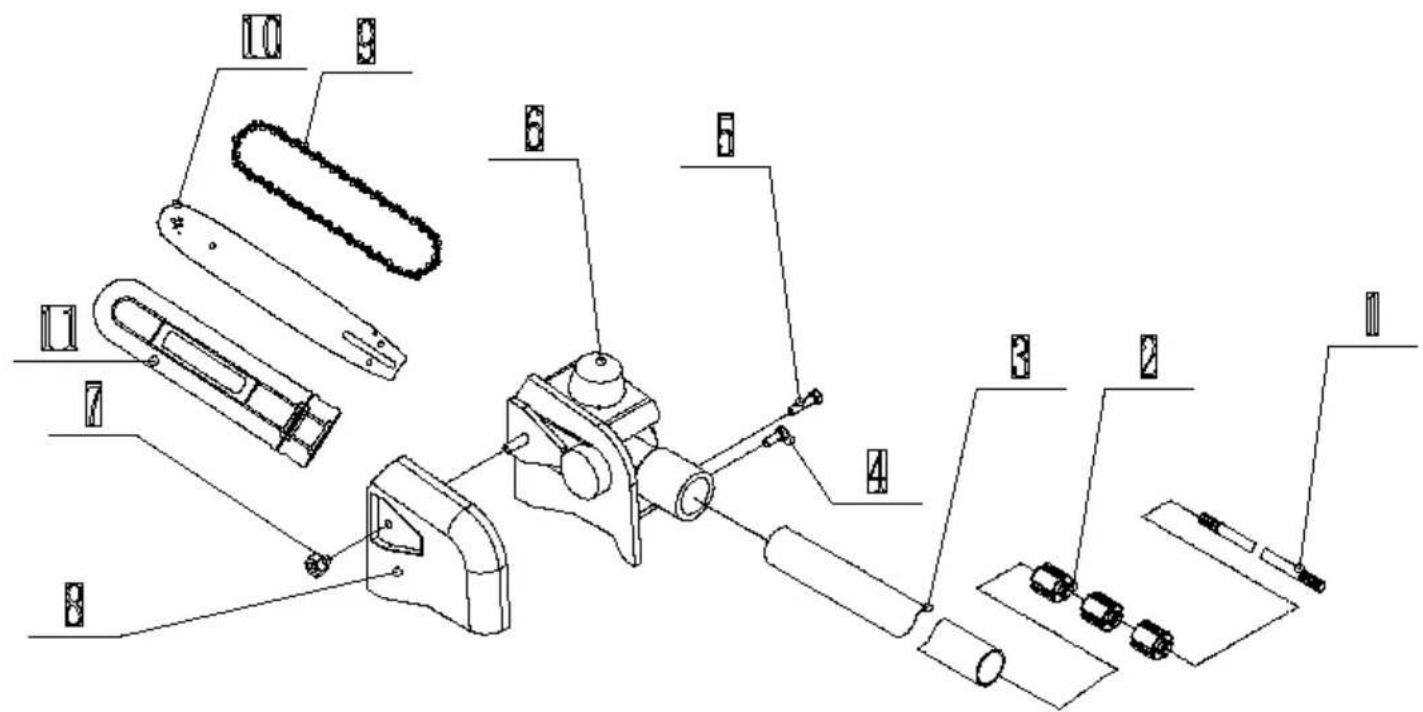
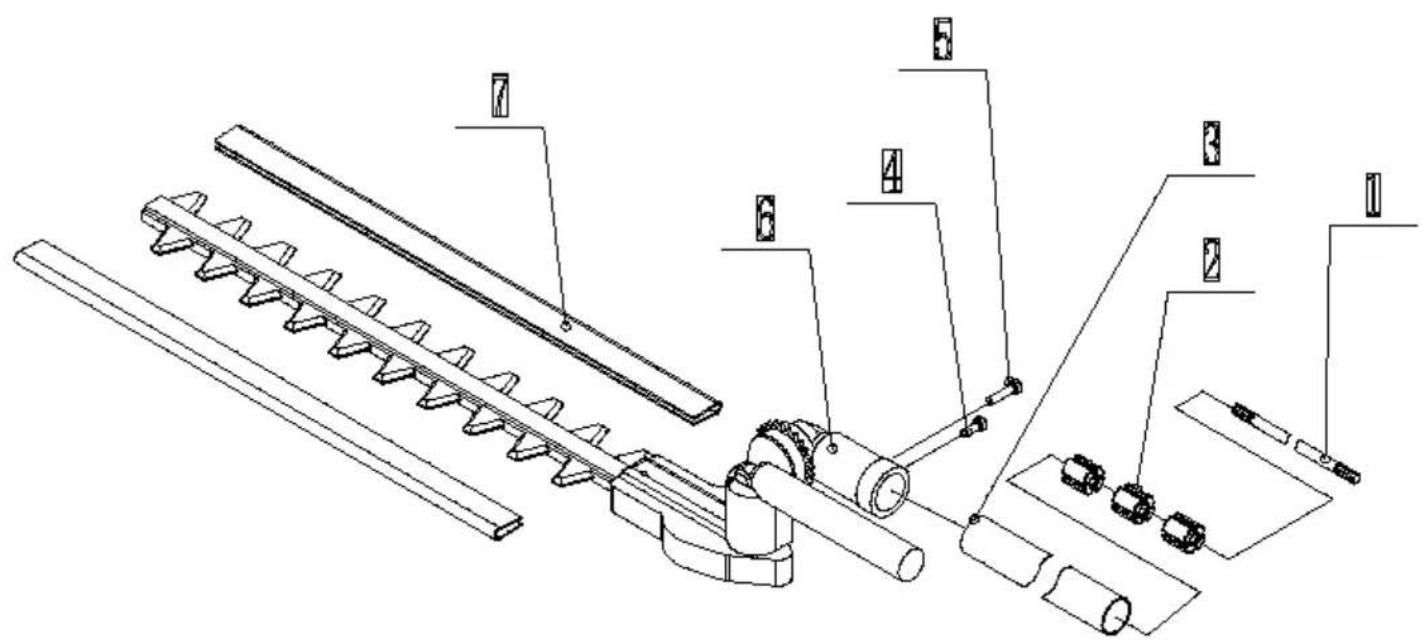
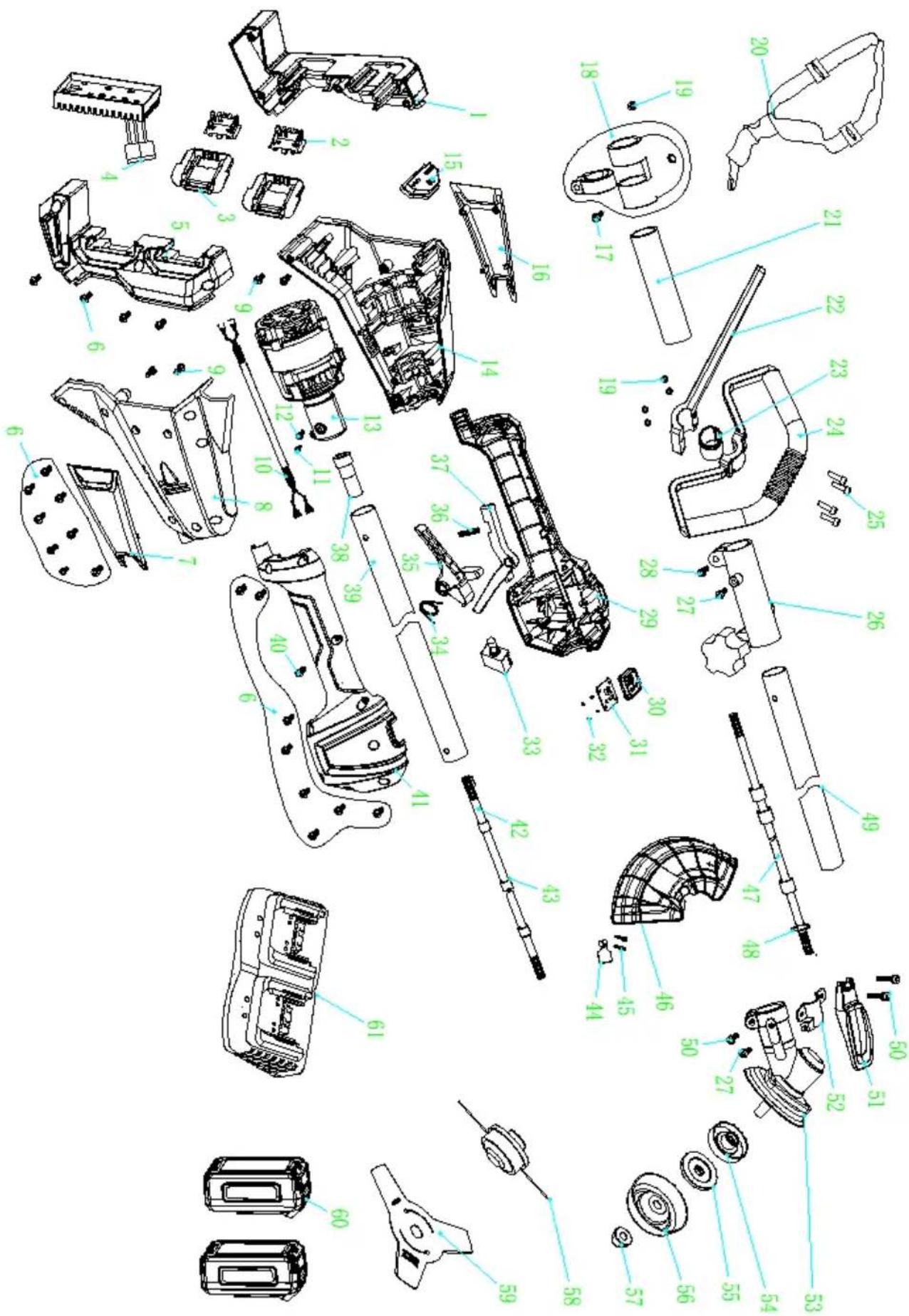
Notizen
CE
SCHEPPACH GMBH
Günzburger Str. 69
D-89335 Ichenhausen

Stand der Informationen · Status of the information · Version des informations · Versione delle informazioni · Stand van de informatie · Información disponible · Versão das informações · Stav informaci · Stav informácií · Az információk kelte · Stan informacji · Verzija informacija · Stanje informacij · Informatsiooni seis · Informacijos data · Informácijas stāvoklis · Informationens status · Tietojen tila · Informationsstatus · Status for informasjon · Последна редакция на информацията · ˈΕκδοση των πληροφοριών · Stadiul informațiilor · Izdanje informacija · Bilgilerin güncelliği Update: 02/2025 · Ident.-No.: 5904820900