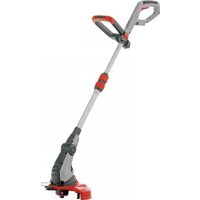
GT 4030 - Grass trimmer AL-KO - Free user manual and instructions
Find the device manual for free GT 4030 AL-KO in PDF.



User questions about GT 4030 AL-KO
0 question about this device. Answer the ones you know or ask your own.
Ask a new question about this device
Download the instructions for your Grass trimmer in PDF format for free! Find your manual GT 4030 - AL-KO and take your electronic device back in hand. On this page are published all the documents necessary for the use of your device. GT 4030 by AL-KO.
USER MANUAL GT 4030 AL-KO
AL-KO KOBER GROUP Kottz, Germany
This documentation or excerpts therefrom may not be reproduced or disclosed to third parties without the express permission of the AL-KO KOBER GROUP.
01
www.al-ko.com/service-contacts
1 About these operating instructions 30
1.1 Legends and signal words 30
2 Product description 30
2.1 Intended use 30
2.2 Possible foreseeable misuse 30
2.3 Product overview (01) 30
2.3.1 Adjustable telescopic handle 30
2.3.2 Swivelling and adjustable cutter head 31
2.3.3 Automatic tip 31
2.4 Safety and protective devices 31
2.4.1 Guard plate 31
2.4.2 Protective bracket.. 31
2.5 Scope of supply 31
2.6 Symbols on the appliance 31
3 Safety 32
3.1 General safety instructions for power tools 32
3.1.1 Electrical safety 32
3.1.2 Personal safety. 32
3.1.3 Use and handling of the electrical tool 33
3.1.4 Safety in the workplace 34
3.1.5 Use and handling of the rechargeable battery-operated tool 34
3.1.6 Service 35
3.2 Safety instructions for the lawn trimmer 36
3.2.1 Safety instructions relating to operation 36
3.2.2 Noise pollution 36
3.2.3 Vibration load 37
3.2.4 Safety information regarding the rechargeable battery 38
3.2.5 Safety information regarding the charging unit 39
4 Installation 41
4.1 Installing the guard plate (02) 41
4.2 Installing auxiliary handle (01, 03) 41
5 Start-up 41
5.1 Charging the rechargeable battery 41
5.2 Removing transport guard from line cutter 42
6Operation 42
6.1 Inserting and removing rechargeable battery (04, 05) 42
6.2 Adjusting telescopic handle (06) 42
6.3 Swivelling cutter head (07, 08) 42
6.4 Tilting cutter head (09) 42
6.5 Starting lawn trimmer (01) 42
6.6 Prolonging the cutting line during operation (13) 43
7 Working behaviour and working technique (11, 12, 14) 43
8 Maintenance and care 43
8.1 Changing the spool (10) 44
9 Storage 44
9.1 Storage of battery and charger 44
10 Transport 44
11 Disposal 45
12 After-Sales / Service 46
13 Help in case of malfunction. 47
14 Guarantee 48
15 EU declaration of conformity 48
1 ABOUT THESE OPERATING INSTRUCTIONS
The German version is the original operating instructions. All additional language versions are translations of the original operating instructions.
It is essential to carefully read through these operating instructions before start-up. This is essential for safe working and trouble-free handling.
Always safeguard these operating instructions so that they can be consulted if you need any information about the appliance.
Only pass on the appliance to other persons together with these operating instructions.
Comply with the safety and warning information in these operating instructions.
1.1 Legends and signal words

DANGER!
Denotes an imminently dangerous situation which will result in fatal or serious injury if not avoided.

WARNING!
Denotes a potentially dangerous situation which can result in fatal or serious injury if not avoided.

CAUTION!
Denotes a potentially dangerous situation which can result in minor or moderate injury if not avoided.
IMPORTANT!
Denotes a situation which can result in material damage if not avoided.

NOTE
Special instructions for ease of understanding and handling.
2 PRODUCT DESCRIPTION
These operating instructions describe a hand-guided battery lawn trimmer.
2.1 Intended use
This appliance is intended for trimming a lawn in non-commercial applications.
2.2 Possible foreseeable misuse
The appliance is designed neither for commercial use in public parks and sports facilities, nor for use in farming and forestry.
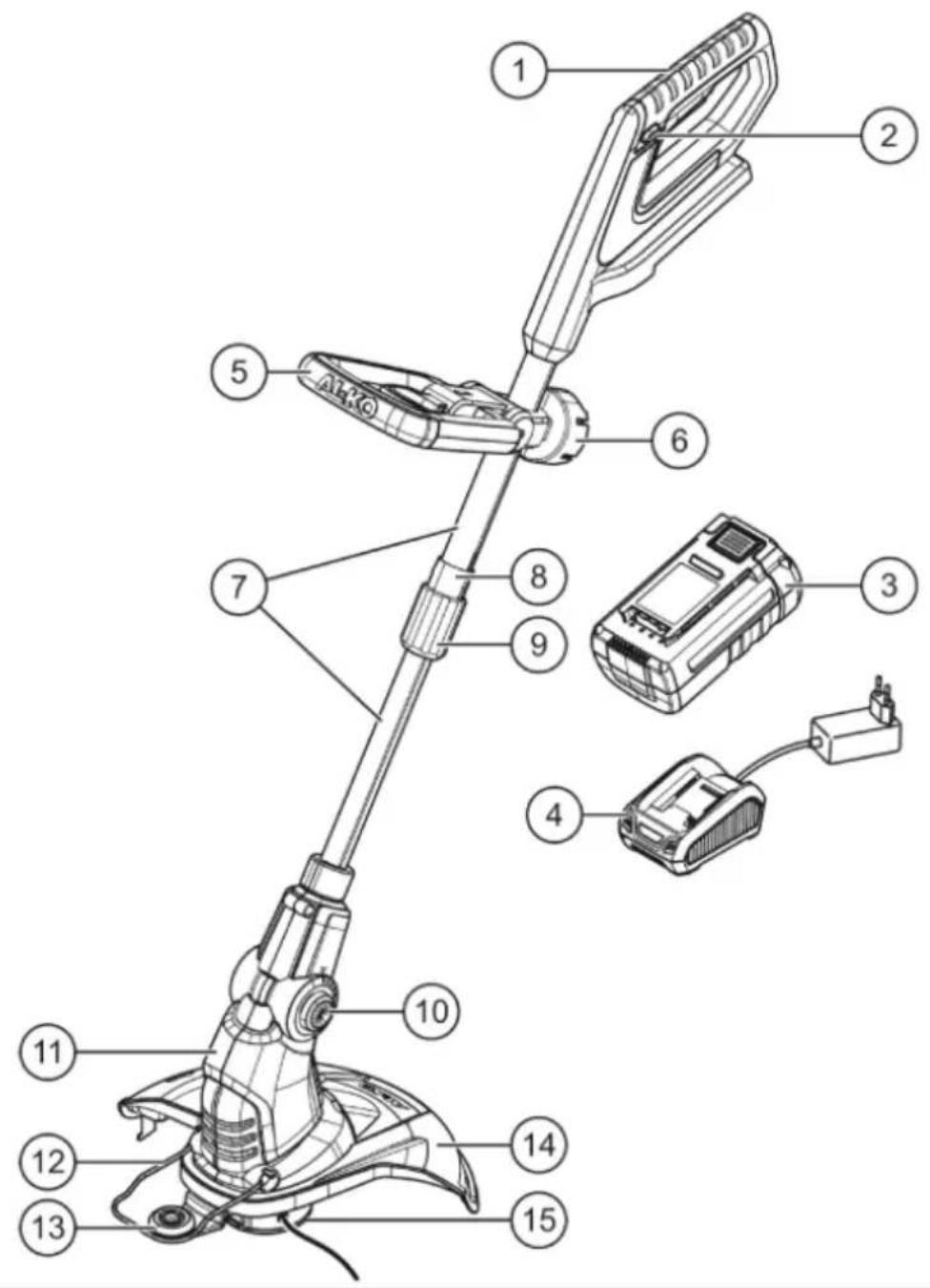
2.3 Product overview (01)
The product overview (01) provides an overview of the appliance.
No. Component
1 Upper hand grip
2 ON/OFF switch with unlock button
3 Rechargeable battery
4 Charger with mains plug
5 Auxiliary handle with tilt lever
6 Holder with replacement spool
7 Telescopic handle
8 Upper guide sleeve
9 Lower guide sleeve
10 Locking button for cutter head
11 Cutter head with motor
12 Plant protection bar
13 Guide wheel
14 Guard plate with line cutter
15 Spool
- not included in the scope of supply.
2.3.1 Adjustable telescopic handle
The lawn trimmer is equipped with an adjustable telescopic handle. This allows the appliance to be set to individual body sizes, and allows the motor head to be swivelled.
2.3.2 Swivelling and adjustable cutter head The lawn trimmer has a swivelling cutter head with an adjustable angle.
2.3.3 Automatic tip
An automatic tip function is integrated into the spool head, allowing the cutting line to be extended while the motor is running.
2.4 Safety and protective devices

WARNING!
Risk of injury
Defective and disabled safety and protective devices can lead to serious injury.
Have any defective safety and protective devices repaired.
- Never disable safety and protective devices.
2.4.1 Guard plate
Protects the operator from the rotating cutting line and objects flying out.
2.4.2 Protective bracket
Protects plants and persons from the rotating cutting line. Also the cutting line is protected against excessive wear on walls during trimming.
2.5 Scope of supply

NOTE
The rechargeable battery and charging unit are not included in the scope of delivery and must therefore be purchased separately.
Rechargeable battery and charger must be purchased separately:
Lithium ion battery max. 40 V, 4.0 Ah
Battery Order No. 113280, Charger Order No. 113281
Lithium ion battery max. 40 V, 5.0 Ah
Battery Order No. 113524, Charger Order No. 113281
2.6 Symbols on the appliance
| Symbol Meaning | |
| ! | Pay special attention when handling this product. |
| Read the operating instructions before starting operation. | |
| Danger due to objects being thrown out! | |
| Keep other people out of the danger area. | |
| The distance between the appliance and persons not involved in the work must be at least 15 m in the entire area around the user. | |
| Protect the appliance from rain and moisture! | |
| Wear protective glasses and ear defenders! | |
| Remove the battery before making adjustments to or cleaning the appliance, or before leaving the appliance unattended for a prolonged period. | |
3 SAFETY
3.1 General safety instructions for power tools

WARNING!
Read all safety instructions, instructions, illustrations and technical data that are provided with this power tool.
Failure to comply with the following instructions can lead to an electric shock, fire and/or series injuries.
- Keep all safety instructions and other instructions for future reference.
The term "power tool" used in the safety instructions refers to mains-operated power tools (with mains line) and to battery-operated power tools (without mains line).
3.1.1 Electrical safety
Avoid physical contact with earthed surfaces such as on pipes, heaters, cookers and refrigerators. There is an increased risk of electric shock if your body is earthed.
- Keep electrical tools out of the rain and away from moisture. Water getting into
an electrical tool increases the risk of an electric shock.
3.1.2 Personal safety
-
Be alert, pay attention to what you are doing and take a cautious approach to working with a power tool. Do not use a power tool if you are tired or under the influence of drugs, alcohol or medicines. A moment's inattentiveness when using the power tool can result in serious injury.
Wear personal protective equipment, and always use safety goggles. The injury risk can be reduced by wearing personal protective equipment such as a dust mask, non-slip shoes, a protective helmet or ear defenders, depending on the type and application of the power tool.
Avoid starting to operate the appliance inadvertently. Ensure the switch is in the off-position before connecting to power source and/or battery pack, picking up or carrying the power tool. Accidents can be caused by leaving your finger on the switch when you carry the power tool or when you connect it to the power supply. -
Remove the adjusting tools or spanner before you switch on the power tool. A tool or spanner that is in a rotating part of the power tool can cause injury.
Avoid an abnormal bodily posture. Make sure you can stand safely and keep your balance at all times. This will enable you to control the power tool better if something unexpected happens.
Wear suitable clothing. Do not wear baggy clothing or jewellery. Keep your hair and clothing away from moving parts. Loose clothing, jewellery or long hair can be snagged on moving parts.
If dust extraction and catchment devices can be mounted, then these must be connected and correctly used. Using a dust extraction system can reduce the risk caused by dust. - Do not give yourself a false sense of safety; do not ignore the safety rules for power tools even if you are familiar with the power tool after using it many times. One careless action can lead to serious injuries within seconds.
3.1.3 Use and handling of the electrical tool
- Do not overload the power tool. Use the appropriate power tool for the job you are doing. Using the appropriate power tool will enable you to work more effectively and safely in the specified performance range.
- Do not use a power tool if it has a defective switch. A power tool that can no longer be switched on or off is dangerous and must be repaired.
- Disconnect the plug from the socket and/or remove the battery before you make adjustments to the appliance, replace parts or put the power tool away. This precautionary measure will prevent the power tool from starting inadvertently.
- Keep unused power tools out of the reach of children. Do not allow people to use the power tool if they are not familiar with it or have not read these instructions. Power tools are dangerous if they are used by inexperienced people.
- Look after power tools and the insertion tool with care. Check whether moving
parts function perfectly and do not stick, whether there are any broken parts or parts that are damaged in such a way that the function of the power tool is impaired. Have damaged parts repaired before using the power tool. Many accidents are caused by failure to maintain power tools properly.
- Keep cutting tools sharp and clean. Carefully maintained cutting tools with sharper cutting edges are less likely to stick and are easier to control.
Use power tools, accessories, insertion tools, etc. according to these instructions. When doing so, take account of the working conditions and the activity to be undertaken. Using power tools for applications other than the intended purpose can result in dangerous situations. - Keep the grips and grip surfaces dry, clean and free from oil and grease. Slippery grips and grip surfaces prevent safe operation and control of the power tool in unforeseen situations.
3.1.4 Safety in the workplace
- Keep your working area clean, and make sure it is well illuminated. Untidiness or dimly lit working areas can lead to accidents.
- Do not work with the power tool in a potentially explosive atmosphere with the presence of flammable liquids, gases or dust. Power tools give rise to sparks that can ignite the dust or vapours.
- Keep children and other people away from the power tool when using it. If you are distracted, you may lose control of the power tool.
3.1.5 Use and handling of the rechargeable battery-operated tool
Only recharge batteries with chargers that are recommended by the manufacturer. Using a charger intended for one particular type of rechargeable battery with a different type of rechargeable battery represents a fire risk.
Only use batteries in the power tools that are intended for this purpose. Using other batteries can lead to injuries and represents the risk of fire.
- Keep the unused rechargeable battery away from paper clips, coins, keys, nails, screws or other small metal objects that could short-circuit the contacts. A short circuit between the rechargeable battery contacts can result in burns or fire.
Incorrect use can result in fluid leaking out of the rechargeable battery. Avoid coming into contact with it. In case of inadvertent contact, rinse off with water. If the fluid gets into your eyes, additionally seek medical assistance. Leaking rechargeable battery fluid can lead to skin irritations or burns. - Do not use a damaged or changed rechargeable battery. Damaged or changed batteries can behave unpredictably and lead to fire, explosion or a risk of injury.
- Do not expose a rechargeable battery to fire or high temperatures. Fire or temperatures over 130^ can cause an explosion.
Comply with all of the instructions for charging, and never charge the re
chargeable battery or the rechargeable battery-operated tool outside of the temperature range specified in the operating instructions. Incorrect charging or charging outside of the permissible temperature range can destroy the rechargeable battery and increase the risk of fire.
3.1.6 Service
- For your own safety, only have your power tool repaired by qualified specialist personnel using genuine spare parts. This ensures that the power tool remains safe.
- Never maintain damaged batteries. All rechargeable battery maintenance should only ever be undertaken by the manufacturer or authorised customer service points.
3.2 Safety instructions for the lawn trimmer
3.2.1 Safety instructions relating to operation

WARNING!
Risk due to electromagnetic field
This power tool produces an electromagnetic field during operation. Under certain circumstances, this field may impair active or passive medical implants.
In order to reduce the risk of serious or fatal injury, we recommend that any persons fitted with medical implants should consult their doctor and the manufacturer of the medical implant before operating the power tool.
Always operate the machine with two hands.
Always keep hand and feet away from the cutting device, above all when switching on the motor.
Wait for the cutting device to come to a standstill after the motor has been switched off.
- Only remove cuttings when the motor and cutting device are at a standstill.
Because of danger of cutting injuries, do not touch the line cutter with unprotected hands.
After pulling out a new line, always bring the appliance into its normal working position before switching it on. -
Do not use a metallic cutting line.
Always keep the guard plate, spool head and motor clear of mowing residues.
People who are not familiar with the appliance should practice handling it while the motor is turned off.
When working on a slope: -
Never work on a smooth and slippery slope.
Always mow across the slope, never down or up.
Always stand below the cutting device.
After contact with a foreign object:
Switch off the motor.
Check the machine for damage.
3.2.2 Noise pollution
A certain level of noise exposure from this appliance is inevitable. Carry out noisy work at approved
and specified time periods. Observe rest periods as necessary and restrict the duration of the work to a minimum. For your personal protection and protection of persons in the vicinity, appropriate hearing protection must be worn.
3.2.3 Vibration load

WARNING!
Danger due to vibration
The actual magnitude of the vibration emissions during the use of the appliance may deviate from that stated by the manufacturer. Observe the following influencing factors before or during use:
Is the appliance being used as intended?
Is the material being cut or processed in the proper manner?
Is the appliance in a proper condition of use?
Is the cutting tool properly sharpened or is the correct cutting tool installed?
Are the handle grips and any optional vibration grips mounted, and are they firmly attached to the appliance?
- Only operate the appliance at the motor speed required for the respective work. Avoid using the maximum speed in order to reduce noise and vibrations.
The noise and vibrations of the appliance can increase due to improper use and maintenance. This leads to damage of the health. In this case, immediately switch off the appliance and have it repaired by an authorised service workshop.
The degree of stress due to vibration depends on the work to be performed or on the use that the appliance is put to. Estimate the stress and plan appropriate work breaks. This considerably reduces stress due to vibration over the entire working time. - Extensive use of the appliance exposes the operator to vibrations, which can lead to circulatory issues ("white fingers"). To avoid this risk, wear gloves and keep your hands warm. If any symptoms of "white fingers" occur, immediately consult a physician. These symptoms include: Numbness, loss of feeling, tingling, itching, pain, reduced
muscular strength, changes in the colour or condition of the skin. Normally these conditions affect the fingers, hands or pulse. The risk increases at low temperatures.
Take long breaks during your working day so you can recover from the noise and the vibrations. Plan your work in such a way that the use of appliances that generate strong vibrations is spread over several days.
If you notice an unpleasant sensation or discolouration of the skin on your hands when using the appliance, stop work immediately. Take sufficient work breaks. Without sufficient breaks, a hand/arm vibration syndrome can occur.
- Minimise your risk of being exposed to vibrations. Maintain the appliance according to the instructions in the operating instructions.
If the appliance is used frequently, contact your dealer to purchase anti-vibration accessories (e.g. handles).
- Avoid working with the appliance at temperatures below 10^ . Define how the vibration load can be limited in a work plan.
3.2.4 Safety information regarding the rechargeable battery
This section mentions all the basic safety and warning information to be heeded when using the rechargeable battery. Read these instructions.
- Only use the rechargeable battery as designated, i.e. for AL-KO rechargeable battery-driven appliances. Only charge the rechargeable battery with the AL-KO charging unit provided.
Only unpack the new rechargeable battery from the original packaging when it is to be used. - Fully charge the rechargeable battery before using it for the first time and always use the specified charger. Comply with the details given in these instructions for use for charging the rechargeable battery.
- Do not use the rechargeable battery in environments where there is a potential risk of explosion and/or fire.
-
Do not expose the rechargeable battery to moisture and humidity when in use with the appliance.
-
Protect the rechargeable battery from heat, oil and fire to prevent it being damaged so no vapours and electrolyte liquids can escape.
- Do not subject the rechargeable battery to impacts or throw it.
- Do not use the rechargeable battery when soiled or wet. Before use, clean and dry the rechargeable battery with a dry, clean cloth.
- Do not open, dismantle or crush the rechargeable battery. There is a danger of electric shock and short-circuit.
This rechargeable battery must not be used by unauthorised persons unless they are supervised by a person responsible for their safety or have been instructed on how to use the rechargeable battery. Unauthorised persons include, for example:
Persons (including children) with limited physical, sensory or mental aptitude
Persons who have no experience and/or knowledge of the rechargeable battery.
Children must be supervised and instructed so they do not play with the rechargeable battery.
- Do not leave the rechargeable battery permanently in the charger. For prolonged storage, remove the rechargeable battery from the charger.
- When not in use, remove the rechargeable batteries from the operated appliances.
Dry the unused rechargeable battery and store in a closed place. Protect from heat and direct sunlight. Unauthorized persons and children must not have access to the rechargeable battery.
3.2.5 Safety information regarding the charging unit
This section mentions all the basic safety and warning information to be heeded when using the charger. Read these instructions.
- Only use the appliance as designated, i.e. for charging the intended rechargeable batteries. Only charge original rechargeable batteries from AL-KO in the charging unit.
Before each use, inspect the entire appliance – and especially the mains cable and the rechargeable battery compartment – for damage. Only use the appliance when it is in a proper working order.
- Do not use the appliance in environments where there is a potential risk of explosion and/or fire.
- Only operate the appliance indoors and do not expose it to moisture and humidity.
Always place the charging unit on a well ventilated and non-inflammable surface because it heats up during the charging process. Keep the ventilation slots clear and do not cover the appliance.
Before connecting the charging unit, make sure that the mains voltage matches the voltage stated in the "Technical data".
- Only use the mains cable for connecting the charging unit, not for other purposes. Do not carry the charging unit by the mains cable and do not remove the power plug from the power outlet by pulling on the mains cable.
- Protect the mains cable from heat, oil and sharp edges to prevent it being damaged.
- Do not use the charging unit and rechargeable battery when soiled or wet. Before using the appliance, clean and dry the rechargeable battery.
- Do not open the charging unit or rechargeable battery. There is a danger of electric shock and short-circuit.
- For your own safety, have your appliance repaired by qualified specialist personnel only using original spare parts.
This appliance must not be used by unauthorised persons unless they are supervised by a person responsible for their safety or have been instructed on how to use the appliance. Unauthorised persons include, for example:
Persons (including children) with limited physical, sensory or mental aptitude
Persons who have no experience and/or knowledge of the appliance.
Children must be supervised and instructed so they do not play with the appliance.
- Dry unused appliances and store in a closed place. Unauthorized persons and children must not have access to the appliance.
4 INSTALLATION

WARNING!
Danger if assembly is not carried out completely!
Operation of an incompletely assembled appliance can result in serious injury.
Only operate the appliance when it is fully assembled.
- Do not insert the battery into the appliance until it is fully assembled.
Check that all safety and protective devices are in place and functioning correctly before switching on.
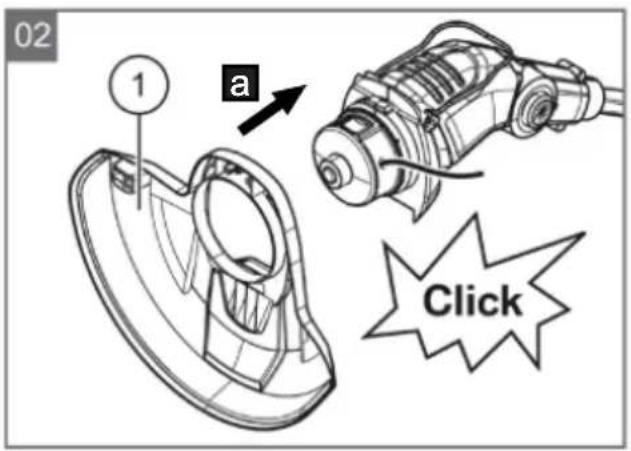
4.1 Installing the guard plate (02)
- Push guard plate (02/1) onto cutter head (02/a).
- The guard plate must engage audibly on the cutter head.
- Ensure that the line is hanging freely.
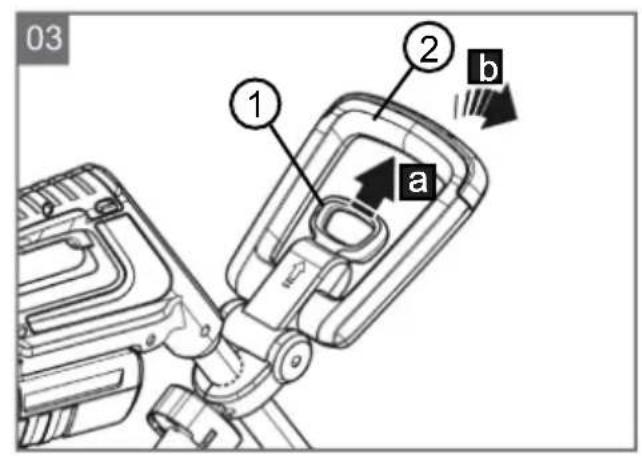
4.2 Installing auxiliary handle (01, 03)
The holder (01/6) of the auxiliary handle is mounted on the telescopic handle. The supplied replacement spool is integrated into the holder.
The angle of the handle can be individually adjusted using the tip lever.
- Pull tilt lever (03/1) outwards (03/a).
- Tilt (03/b) handle (03/2).
- Release the tilt lever.
5 START-UP
5.1 Charging the rechargeable battery

CAUTION!
Danger of fire during charging!
Due to heating of the charger, there is a danger of fire if it is placed on an inflammable surface and is not adequately ventilated.
Always use the charger on a non-inflammable surface or in a non-combustible environment.
If available: Keep the ventilation slots free.

NOTE
Fully charge the rechargeable battery before using it for the first time. The rechargeable battery can be charged in any charge status. Interrupting charging does not damage the rechargeable battery.

NOTE
When charging, the rechargeable battery is protected from overcharging due to automatic detection of the charge status and thus can remain connected to the charging unit for some time, but not permanently.
The temperature range for charging should be between 5^ and +45^ . The charging time for full charging is max. 120 minutes. If the operating time of the rechargeable battery is reduced in spite of it being fully charged, the rechargeable battery is at the end of its service life and must be replaced by a new original rechargeable battery. For more information about charging the battery, refer to the separate instructions for the battery and the charger.
5.2 Removing transport guard from line cutter
Remove the transport guard from the line cutter before putting the appliance into operation for the first time.
6 OPERATION

WARNING!
Risk of injury due to detaching appliance parts
Appliance parts detaching during operation can lead to serious injury.
Before turning the appliance on, check that all the parts of the appliance are firmly tightened.
- Attach cutting tools so that they cannot detach during operation.
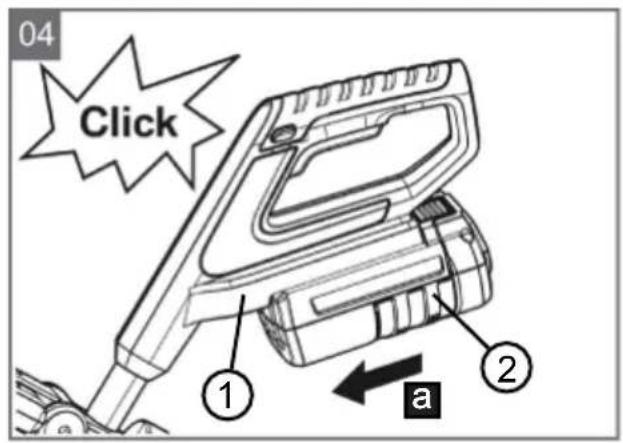
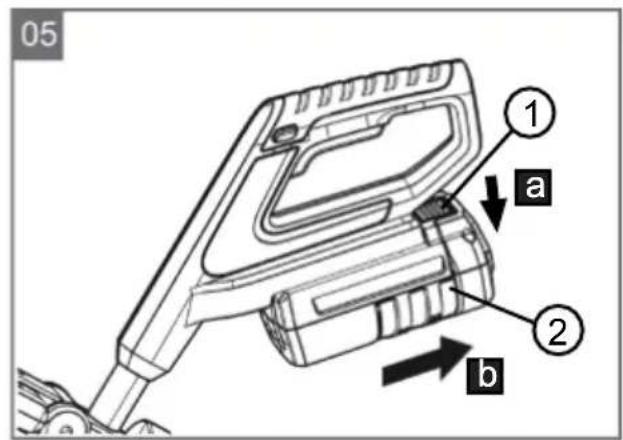
6.1 Inserting and removing rechargeable battery (04, 05)
Inserting rechargeable battery (04)
- Push rechargeable battery (04/2) into battery slot (04/1) until it engages (04/a).
Removing rechargeable battery (05)
- Press (05/a) and hold unlock button (05/1).
- Pull out (05/b) rechargeable battery (05/2).
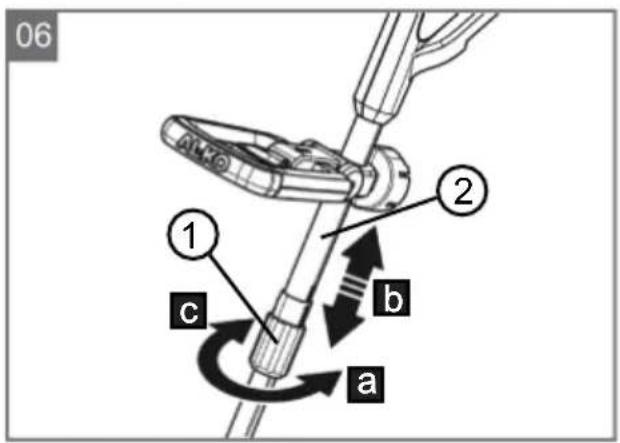
6.2 Adjusting telescopic handle (06)
- Turn upper locking sleeve (06/1) to the right (06/a) to release.
- Adjust telescopic handle (06/2) individually to a comfortable height. The telescopic handle can be extended by approx. 10 cm (06/b).
- Screw locking sleeve tight (06/c).
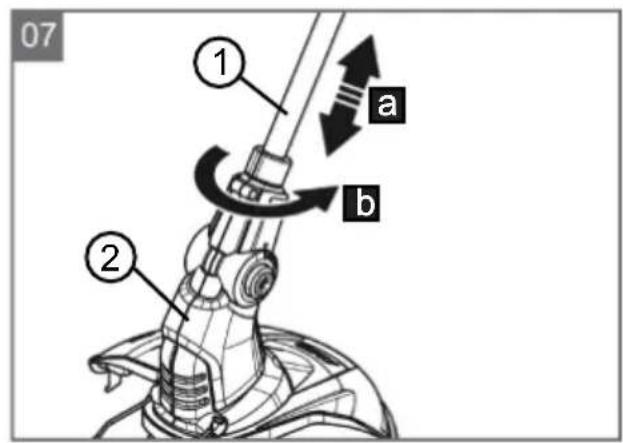
6.3 Swivelling cutter head (07, 08)
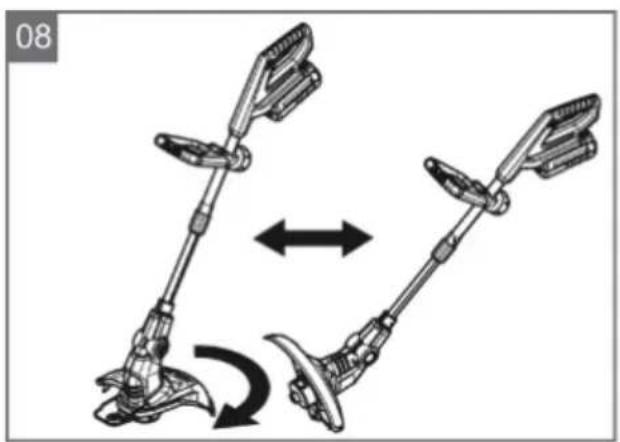
For trimming lawn edges, for example, it is possible to swivel the cutter head through 180^ (07, 08).
- Pull telescopic handle (07/1) slightly upwards (07/a).
- At the same time, turn cutter head (07/2) through 180^ (07/b) until it engages.
- Allow the telescopic handle to slide down and engage (07/a).
6.4 Tilting cutter head (09)
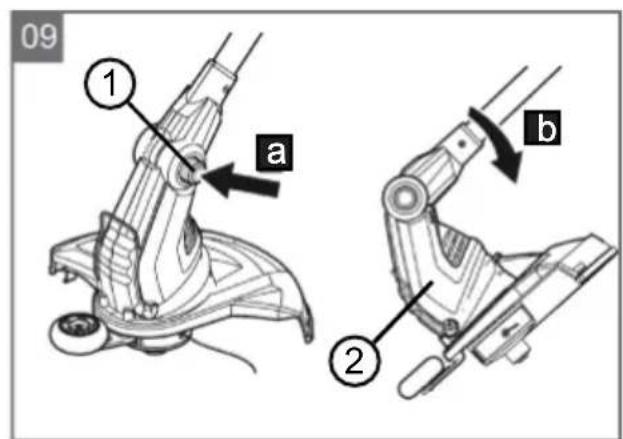
By changing the pivot angle, it is also possible to trim areas that are difficult to access, e.g. under benches, overhangs, etc.
- Press (09/a) locking button (09/1).
- Allow cutter head (09/2) to engage at the desired angle (09/b).
- Release the locking button.
6.5 Starting lawn trimmer (01)
- Stand securely.
- Hold the appliance with both hands. Do not rest the cutter head on the ground when doing this.
- Hold auxiliary handle (01/5) in one hand and upper grip (01/1) in the other hand.
- Press unlock button (01/2).
- Press and hold ON/OFF switch (01/2). The appliance starts.
- Allow the lawn trimmer to run at idling speed for a few moments. This causes the cutting line to be cut off to the correct length.
- The appliance switches off when the ON/OFF switch is released.

WARNING!
Danger of cutting injuries
After the appliance has been switched off, the spool head continues to rotate for a few seconds. Reaching into the spool head during this time can result in cutting injuries.
Wait until the spool head has come to a complete standstill.
6.6 Prolonging the cutting line during operation (13)
The cutting line shortens during operation and frays out.
- Tap spool head (13/1) on the lawn from time to time. This unwinds a piece of new cutting line from the spool and the line cutter cuts off the used line end.
7 WORKING BEHAVIOUR AND WORKING TECHNIQUE (11, 12, 14)
- Switch on the appliance and allow to run at idling speed for a few moments.
First hold the appliance above the grass to be cut and then lower slowly to avoid overloading.
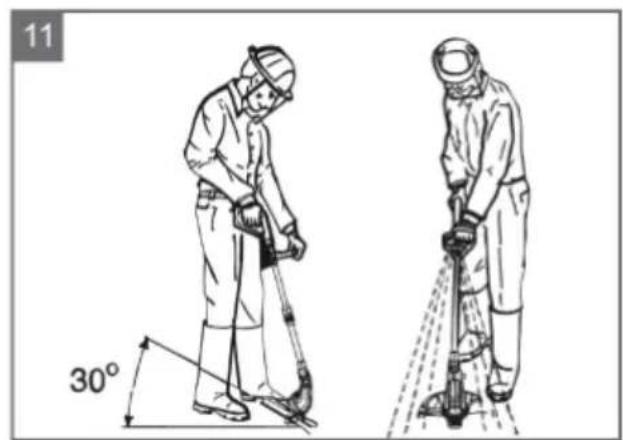
Tilt the appliance slightly forwards (approx. 30^ ) to mow with the tip of the cutting line. Walk forwards slowly (11). - When mowing, swivel the appliance evenly to the right and left (11).
-
Long grass must be mown in several passes. Always proceed from top to bottom (12).
The appliance cuts best at very high speed. Therefore, do not overload the appliance by cutting long grass.
If the appliance is overloaded in long grass, the line will be blocked. Immediately lift the appliance so it releases. Otherwise, the motor could be permanently damaged. -
Do not move the appliance directly against hard obstacles (e.g. walls), but mow sideways. This protects the cutting line (14).
- Keep the appliance away from sensitive plants. Fold the plant protection bar into the horizontal position.
8 MAINTENANCE AND CARE

WARNING!
Danger of cutting injuries
Danger of cutting injuries when reaching into sharp-edged, moving appliance parts and into cutting tools.
Before maintenance, care and cleaning work, always switch off the appliance. Remove the rechargeable battery.
Always wear protective gloves during maintenance, care and cleaning work.

NOTE
Repair work is only allowed to be carried out by expert workshops or our AL-KO service centres.
- Do not expose the appliance to rain or moisture. Do not spray with water.
After every use, clean the housing and cutting blades with a brush or cloth. Do not use water and/or aggressive cleaning agents or solvents - risk of corrosion and damage to the plastic parts.
After every use, remove the rechargeable battery and inspect the appliance for damage. - Do not use the appliance if the blade of the line cutter is missing or damaged.
Always keep the guard plate, spool head and motor clear of mowing residues.
Inspect all bolts for tightness.
Inspect the electrical contacts of the appliance for corrosion, clean with a fine wire brush if necessary and then spray with a contact spray.
8.1 Changing the spool (10)
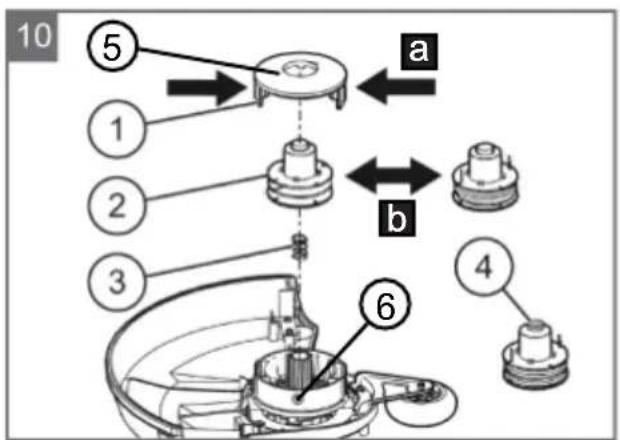
Replacement spool: GT 4030 Art. No. 113349.
Precondition: The appliance must be switched off and the rechargeable battery removed from the appliance.
Inserting and removing the spool
- Take the replacement spool out of holder (01/6).
- Press (10/a) the two unlock buttons (10/1) at the same time and remove cover (10/5).
- Remove empty spool (10/2).
- Insert (10/b) a new spool (10/4). Ensure that spring (10/3) is installed again.
- Thread the cutting line outwards through opening (10/6) of the spool head.
- Fit cover (10/5) and press on until it engages.
- Install the rechargeable battery in the appliance.
Bring the cutting line to the required length (13).
- Switch on the appliance.
- Tap (13/a) spool head (13/1) on the lawn from time to time. This unwinds a piece of new cutting line from the spool.
- Switch off the appliance and wait until the cutter head has come to a standstill.
- Check the line length.
- Repeat the previous steps until the cutting line has the required length.
9 STORAGE
Thoroughly clean the appliance after each use and - if present - attach all covers. Store the appliance in a dry, lockable place out of the reach of children.
Hang up the lawn trimmer by its handle. This avoids placing unnecessary load on the cutter head.
Carry out the following jobs before intervals in work lasting for longer than 30 days:
Thoroughly clean the appliance and store it in a dry place.
9.1 Storage of battery and charger

DANGER!
Danger of explosion and fire!
Persons will be fatally or severely injured if the re chargeable battery explodes because it was stored in front of naked flames or heat sources.
Store the rechargeable battery in cool and dry conditions, but not in front of naked flames or heat sources.

NOTE
When charging, the rechargeable battery is protected from overcharging due to automatic detection of the charge status and thus can remain connected to the charging unit for some time, but not permanently.
Store the rechargeable battery in a dry, frost-free place at an ambient temperature between 0^ and 35^ and with a charge state of approx. 40 - 60%.
- Do not store the rechargeable battery in the vicinity of metallic objects or of objects containing acid to avoid the risk of short-circuit.
- Recharge the rechargeable battery for approx. 2 hours after approx. 6 months' storage.
10 TRANSPORT

NOTE
The nominal energy of the rechargeable battery is more than 100 Wh. Therefore, observe the following transport instructions.
The li-ion rechargeable battery contained in the appliance is subject to the hazardous goods law, but can be transported under simplified conditions:
The rechargeable battery can be transported on public roads by the private user without further conditions provided it is packaged for retail sale and the transport serves personal purposes.
- Commercial users who carry out the transport in connection with their main activity (e.g. delivery from and to building sites, or demonstrations) can also take advantage of this simplification.
In both cases, it is essential to take the mandatory precautions mentioned above to prevent any leakage of the contents. In other cases, it is essential to comply with the regulations of the hazardous goods law. In the case of non-compliance, severe penalties can be imposed on the sender and possibly the transporter.
Additional notes on transport and shipment
Only transport or send the li-ion rechargeable battery in an undamaged condition.
For transporting the rechargeable battery, only use the original cardboard box or a suitable hazardous goods cardboard box (not required for rechargeable batteries with a nominal energy less than 100 Wh).
Tape off exposed rechargeable battery contacts to avoid a short circuit.
- Secure the rechargeable battery against shifting in the packaging to avoid damage to the rechargeable battery.
Ensure the correct marking and documentation of the shipment for transport or shipping (e.g. by parcel service or freight forwarding).
Check in advance that transport with the selected service provider is possible and indicate the shipment.
We recommend involving a hazardous goods specialist in preparation of the shipment. Also heed any further national regulations.
11 DISPOSAL
Information on the German Electrical and Electronic Equipment Act (ElectroG)

Electrical and electronic appliances do not belong in household waste, but should be collected and disposed of separately.
Used batteries or rechargeable batteries that are not installed permanently in the old appliance must be removed before disposal. Their disposal is regulated by the battery law.
- Owners or users of electrical and electronic appliances are obliged by law to return them after use.
The end user bears personal responsibility for deleting his personal data from the old appliance to be disposed of.
The symbol of the crossed-through rubbish bin means that electrical and electronic appliances may not be disposed of in the household rubbish. Electrical and electronic appliances can be handed in at no charge at the following places:
Public service disposal or collection points (e.g. municipal building yards)
Points of sale of electrical appliances (stationary and online) provided traders are obliged to take them back or offer this voluntarily.
These statements only apply to appliances that are installed and sold in the countries of the European Union and are subject to European Directive 2012/19/EU. Different provisions may apply to the disposal of electrical and electronic appliances in countries outside the European Union.
Information on German Battery Act (BattG)

Used batteries and rechargeable batteries do not belong in household waste, but should be collected and disposed of separately.
For safe removal of batteries or rechargeable batteries from the electrical appliance and for information on their type or chemical system, follow the further information within the operating or installation instructions.
- Owners or users of batteries and rechargeable batteries are obliged by law to return them after use. The return is limited to the handover of customary household quantities.
Used batteries can contain harmful substances or heavy metals that can cause damage to the environment and human health. Reuse of the used batteries and use of the resources contained therein contributes to the protection of these two essential commodities.
The symbol of the crossed-through rubbish bin means that batteries and rechargeable batteries may not be disposed of in household rubbish.
In addition, if the symbol Hg, Cd or Pb appears under the rubbish bin, this stands for the following:
Hg: Battery contains more than 0.0005% mercury
Cd: Battery contains more than 0.002% cadmium
Pb: Battery contains more than 0.004% lead
Rechargeable batteries and batteries can be handed in at the following places at no charge:
Public service disposal or collection points (e.g. municipal building yards)
Points of sale of batteries and rechargeable batteries
Disposal points of the common take-back system for the used batteries of appliances
Disposal point of the manufacturer (if not a member of the common take-back system)
These statements apply only to rechargeable batteries and batteries that are sold in the countries of the European Union and that are subject to European Directive 2006/66/EU. Different provisions can apply to the disposal of rechargeable batteries and batteries in countries outside the European Union.
12 AFTER-SALES / SERVICE
In the event of questions of warranty, repair or spare parts, please contact your nearest ALKO Service Centre.
These can be found on the Internet at: www.al-ko.com/service-contacts
13 HELP IN CASE OF MALFUNCTION

CAUTION! Risk of injury
Sharp-edged and moving appliance parts can lead to injury.
Always wear protective gloves during maintenance, care and cleaning work.
| Malfunction Cause Remedy | ||
| Additional cutting line is not supplied. | Spool is empty. Change the spool. | |
| Engine does not run. Rechargeable battery is flat. Charge the rechargeable battery. | ||
| Rechargeable battery missing or rechargeable battery not seated correctly. | Insert the rechargeable battery correctly. | |
| Power supply is interrupted. 1. | Remove the battery. 2. Clean the plug contacts of the appliance. | |
| The motor protection switch has switched off the motor due to overload. | Wait until the motor protection switch enables the motor again. | |
| Motor keeps cutting out. | ■ Appliance faults ■ ON/OFF switch is defective. | Contact an AL-KO service centre. |
| Motor running, but the cutting blade does not move. | Appliance faults Contact an AL-KO service centre. | |
| Appliance vibrates unusually. | Spool is contaminated. Clean the spool, renew it if necessary. | |
| Appliance faults Contact an AL-KO service centre. | ||
| Rechargeable battery operat-ing time is significantly shorter. | Grass is too long or too wet. | ■ Cut the grass at a greater height. ■ Let the grass dry. |
| Cutting height is too low. Cut the grass at a greater height. | ||
| The service life of the re-chargeable battery has expired. | Replace the rechargeable battery. Only use genuine accessories from the manufacturer. | |
| Rechargeable battery cannot be charged. | Rechargeable battery contacts are dirty. | Contact an AL-KO service centre. |
| Rechargeable battery or charging unit is defective. | Order spare parts. Contact an AL-KO service centre. | |
| Rechargeable battery is too hot. | Allow the battery to cool down. | |

NOTE
If you encounter any malfunctions that are not listed in this table or that you cannot rectify yourself, please contact our customer service.
14 GUARANTEE
We will resolve any material or manufacturing faults on the appliance during the legal warranty period for claims relating to faults, in accordance with our choice either to repair or replace. The legal warranty period is determined by the legislation of the country in which the appliance was purchased.
Our warranty promise applies only if:
These operating instructions are heeded
The appliance is handled correctly
Original spare parts have been used
The warranty becomes void in the case of:
Unauthorised repair attempts
Unauthorised technical modifications
Non-intended use
The guarantee excludes:
Paint damage that can be attributed to normal wear and tear
Wear parts that are marked with a frame (x) on the spare parts card
The guarantee period commences with purchase by the first end user. The date on the proof of purchase is decisive. In the event of a guarantee claim, please take this guarantee declaration and the original proof of purchase, and contact your dealer or the nearest authorised customer service centre. This statement does not affect the purchaser's statutory claims for defects against the vendor.
15 EU DECLARATION OF CONFORMITY
We hereby declare that this product in its marketed form conforms to the requirements of the harmonised EU Directives, EU safety standards and the product-specific standards.
Product
Battery lawn trimmer
Serial number
G1083012
Manufacturer
AL-KO Geräte GmbH
Ichenhauser Str. 14
D-89359Kotz
Germany
Duly authorised person for technical file
Andreas Hedrich
Ichenhauser Str. 14
D-89359Kotz
Germany
Type
GT 4030
EU directives
2006/42/EC
2014/30/EU
Harmonised standards
EN 60335-1:2012/A11:2014
EN 50636-2-91:2014
Sound power level
EN ISO 3744
measured/guaranteed
91 dB(A) / 96 dB(A)
2000/14/EC
2011/65/EU
EN 55014-1
EN 55014-2
EN 62233
Notified body
TUV Industrie Service
GmbH
TUV Sud Group
Westendstraße 199
80686 MUNICH
GERMANY
Declaration of conformity
2000/14/EC Appendix VI
Kotz, 18/07/2017
Wolfgang Hergeth
Managing Director
VERTALING VAN DE ORIGINELE GEBRUIKERSHANDLEIDING Inhoudsopgave
2 PRODUCTOMSCHRIJVING
Accu lithium-ion 40 V max., 5,0 Ah
Best.nr.accu 113524, best.nr.lader 113281
www.al-ko.com/service-contacts
13 AIDE EN CAS DE PANNES

ATTENTION! Risque de blessures
15 DÉCLARATION DE CONFORMITÉ CE
www.al-ko.com/service-contacts
13 AYUDA EN CASO DE AVERÍA

www.al-ko.com/service-contacts
13 POMOC U SLUÇAJU SMETNJI

OPREZ!
Opasnost od ozljeda
Ostri i pomični dijelovi ureža mogu uzrokovati ozljede.
www.al-ko.com/service-contacts
13 POMOC W PRZYPADKU USTEREK

15 DEKLARACJA ZGODNOSCI WE
3.2.2 Zatazenie hlukom
www.al-ko.com/service-contacts
13 POMOC PRI PORUCHÁCH

POZOR! Nebezpečenstvo zranenia
Lithium-ion alkumulator max. 40 V, 5,0 Ah
www.al-ko.com/service-contacts
13 HIBAELHÁRITÁS

Brandfare under oplanning!
www.al-ko.com/service-contacts
13 HJÆLP VED FORSTYRELSER

WARNING! Risk for vibration
Lithium-ionbatteri 40 V maks., 5,0 Ah
Best.-nr. batteri 113524, best.-nr. lader 113281
2.6 Symboler på maskinen
Symbol Betydning

Vær spesielt forsiktig ved händtering!

Les bruksanvisingen f#r driften settes i gang!
7 ARBEIDSMATE OG ARBEIDSTEKNIKK (11, 12, 14)
8 VEDLIKEHOLD OG PLEIE

ADVARSEL!
Fare for kuttskader
Lithium-ioniakku maks. 40 V, 4,0 Ah
Akun tilausnro 113280, laturin tilausnro 113281
Lithium-ioniakku maks. 40 V, 5,0 Ah
Akun tilausnro 113524, laturin tilausnro 113281
www.al-ko.com/service-contacts
13 PAGALBA ATSIRADUS SUTRIKIMU

ATSARGIAI!
Pavojus susižaloti
Yka3bIbaeT Ha cnTyauHIO, KOtOpa, ecn ee He n36eXaTb, MoKeT npNBecTN K NMyueeCTBeHHOMy yuep-6y.

ПРИМЕЧАНЕ
CneunabHbIe yka3aHnI dIy oBnerHu HnIOHNMaHnI N 3KcNlyaTaUIN.
2 OПИСАНЕ ПОДУКТА
B 3TOM pyKOBOdCTBe NO 3KcNJIyatauHn OINCbIbAeTcRpyHNo TpIMMep,paBotaUoUsn OT aKKMyJrTopa.
2.1 NcnoJb3OBaHne no Ha3HaueHnIO
3TO yCTpoiCTBO npedHa3NaueHo dIy nOppe3aHnra3OHOB BpaMKax YactHO NcNoJb3OBaHnY.
2.2Примеры He npaBnIbHorO nCNoJIb3OBaHnA
YCTPOIcTBO He npedHa3HaueHO nJa KOMMepueCKOro NcNoB3OBaHnB O6UeCTBeHHbIX NapKax, Ha CnOpTINBbIX PLOaAdkax, B CeJIbCKOM I JecHOM X03rICTBaX.
I PPEyPExEHNc! OnacNoctb Bn6paCn PhaKtUeCKoe 3NaueHne Bn6paCnoHHoJ 3MnCCn INpN NcNoJIb3OBaHn UcTPOiCTBa MoKet OTJIu- YaTBcR O T 3aBJIeHHOrO Ipon3BOdnteJeM 3NaueHn. HApJIoJaTe cJeDyIOUeΦaKTOpbl BO3dE- CTBnJ Do nJI N BO BpeM INcNoJIb3OBaHnJ:
IcnoJb3yeTcra Jn yCTpOiCTBO IIO Ha3Ha- ueHIO?
MaTePnApa3pe3aH nIiO6pa6oTaH npaBnJIbHo?
HaxoNTcIyycTpoiCTBO BXopoWe m pa6o-ueM coCTOHN?
IpaBnIbHO IIN 3a-oCTpeH IIN yCTaHOBJeH peKyuI INcTpymeNT?
YcTaHOBJIJI KpOH- WTeHbI N,ecnTpe6y-etcra,doJOnHITeHbIe Bn6paUOHHbIMn pyKIn, INIIOTHOJIIN OHN COeHNHeHbIC yCTPOJCTBOM?
3Kcnpnyatnpyute yctpoiCTBO TOJbKO C qactOTOB BpaueHnY DBNrataTeI, Heo6xOIMoN OJRAOTdJIbHO pa60TbI. N3- 6eAaTe MaKcImaJIbHOJ qACTOTbl BpaueHn, YTO6bl CHN- 3NTb yPOBeHb Shyma n BV6paCNI.
H3-3a He npabnblbHoro nCIOIb3OBaHnI N TeXnueckoro OBCnyKbAHnI ShyM N Bn6paZnY yCTPOcTBa MOrT NOBbICNTbcra. 3TO HAnocnt BpeD 3dOpOBbU OyeNoBeKa.B TaKnx CnyaX HeMeIJIeHNO BbIKHOuAte yCTPOcTBO N O6paTn-TECb 3a eRo peMOHTOM B aB-Topn3OBaHHbI CepBnCHbI ZeHTp.
CTepeBn6paQnoHOro HapJxHn3aBnCnT OT BblIPOJIHReMO pa6Otbl IIN NCIOJIb3OBaHn yCTpoiCTBa. OcHnte uYCTaHOBnte COOTBETCTByUOuNe nepepbIBbl B pa6ote. B pe3yIbTaTe Bn6paQNoHHa Hapy3Ka B TeueHne BCero pa6Ouyero BpemeHn 6yDet 3NaHTeNbHO CHNXeHa.
Дипельная зкплuyaрази
устpoиства подверрает оп-
ратopa вбраци и может
Бызвы поблемы с крobo-
обрашеним (симпTom «бe-
лого пальca»).Чтобbl
Умehьшпь заю риck, Нocn-
Te nepuATkn I depxnte pyKn B TeIne. B cnyuae obnapykeHnra CnMTOMa «6eIoro nalb-za» HemeIenHo o6paTntecb K BpaCy. 3Tu CnMTOMbl BKIOUaOT B Ce6: OHemEnHe, NOTepHO yBCTBNTeNbHOCTN, NOKaIbIBaHNe, 3yd, 6OJIb, Cna6oCTb, n3MeHHe NCBeta nn COCTOHNK KOJN. O6bIHyHO 3Tu CnMTOMbl BIIraHOT Ha nnBaIpy, pyKn IIN nyIbc. Ppi Hn3Knx Tempeatypax pnck BO3pactaET.
Делайе BO Время равочero Дня дinteьные посяma И вбраши. ПлануITE свою павOTу takIM obpa3OM,чTo- bI pa3deINITb ekCnPyataця устpoиCTB,КOTOpbie CO3daHT сплььhoe вбраши,Ha HeCKOЛько днй.
EcIn Bbl NocYBCTByeTe DnCKOMΦoPT INIIN DnCXpOMNIO KOJN Prn IcNoJIb3OBaHnUcTPOiCTBa B pyKax, HeMeIJIeHNO npeKpaTIte pa6Otu. YcTaHOBtTe DoCTaTOUHbIe nepepbIBbI B pa6Ote. Pa6Ota 6e3 DoCTaTOUHbIX nepepbIBOB MoKeT nPnVBecTN K MeCTHOB Vn6paCnOHHO BoJe3HN.
MnHmN3npuTe pNcK Bo3-DeiCTBnBn6paun. BbInoJnJaIte 06CnykBaHne np6o
pa B COOTBETCTBUN C INHCTpyK-ζЯM N B pyKOBOdCTBe NO 3Kc-Плуataци.
Ecni obopydOBaHne nCNoIb-3yETcY qacto, o6paTntecb K dInIepy, yTO6bl npno6peCTn aHTNB6paZnOHhble akceccyapbl (HaNPImep, pyKn).
I36eaiTe pa6oTbIC np60pom npi TempeType Hnke10 ^ C .B nlahe pa6oTbI onpe-ndeJIte, KaK MOxHO orpaHn-HTb Bn6paOnHHu Ho Harpy3-Ky.
3.2.4 Иструкции по 6e3opacnoctn aKKymyIaTOPa
- KhoNky 6IoknpoBkn (05/1) HaxKaTb (05/a) nydepXnBaTb.
2.AkkymyTOp (05/2) BbIHyTb (05/b).
6.2 PerynipoBaanHe TeJeckoNueeckoI pyuKn (06)
1.ДЯТOrOуTO6bIocla6nTbФИKcauHIO,Bepx-HIOKpeNexHyBtUky(06/1)cneJyET no-BepHyTb BnpaBO(06/a).
2. OTPerynipoBaTb BlicOTy TeJeckOnuYeCKoI pyuKn (06/2) no poCtY noIb3OBaTeJia. TeJeckOnuYeCKyIO pyuKMy MoXHO ydInHHTb npi-MepHo Ha 10 cm (06/b).
3.Пnotho 3akpyTntbКpenekHyO BTyIky (06/c).
6.3Поворауньниpeжушег罗нвки (07, 08)
ДлгТOrOчTo6bl,нанрИмер,пОдpe3aTbКрая ra-30Ha,pexkyuToIOnOBkyMOxHObNObepHyTbHa 180^ (07,08).
- Teneckonuueckyio pyky (07/1) cnerka noTMyTb BBepx (07/a).
- OndnoBpeMeHHo peKyuIroNoBky (07/2) noBepHyTb Ha 180^ (07/b) do 3aueJIeHnI.
- Tepeckonupeckyo pyky onyctntb Bn3 (07/a).
6.4 PerynipOBka yrna haknoHa pexyuue RoJOBKn (09)
3a cHT N3MeHEny yIa HAKIOHa MOXHO NOpe3aTb TpaBv B TpydNOCTUHNbIX MecTaX, HanpImep, NOc CKaMeKamn, BbICTynAmn I T. D.
- HακaMb (09/a) KΗΝΟύν Φικαςην (09/1).
- Pexkyu roJIOBky (09/2) 3aФИКсИрОВаТьdo 3aUeJIpeHnI NOd HxKhbIM yrIOM HaKNoHa (09/b).
- OTnyctntb KhoNky qnkcaunn.
6.5 BkIoueHne Tpmmepa (01)
1.3aMmTe yCTOuHBOe NOJIOKeHne.
2.ДерхиTe yCtpoiCTBO DByMЯpykAmN.B3OT MOMeHTpeKyuzaIra RoIOBka He DoJnxHa HaxOdntbca Ha 3eMne.
3. Ondno pykoCneDyeT B3rTbCra 3a DOnOJIHnTeIbHyIO pyky (01/5), dpyroN pyko-3a BepxHIOI pyky (01/1).
4. HακaMb KhoNky 6JIoKIpOBKn (01/2).
5. HαKaTb N yερχκBaTb BbIKIouaTeNb BKJI/ BbIKI (01/2). YcTpoIcTBo NaHHaet pa6o-TaTb.
6. HekoTopoe Bpem yctpoiCTBO doJxHo pa6oTaTb Ha xOIOCTOM XOy. Pn3Tom peKyuzaIecka aBTOMaTHueckn 06pe3aETc4 Do Heo6XoIMoI dINHbl.
7. Ecnn BbIKnOuateJIb BKJI/BbIKN OTnyCTnTb, yCTPOINCTBO BbIKNHOaETcR.
I PPEdUnPExKDeHne! OnachocTb pe3aHbIX paH IocNe BblKlIoUeHnrapejy- ⅢA rOIOBka 6ydt Bpa- ⅢaTbc8 eue HeckoJIbKO ceKHyD. BVeJeHne KOHeuHocTeB ONaChyHO 3OHy MOKeT CtATb PruHNoJ pe3aHbIX paH.
CneyuETdoxdaTbcra NOHOnOCTaHOBKnpeKyuueI rOIOBKn.
6.6 Perynipobka dnnhbpexyupei neckn B npoecce 3Kcnnyataun (13)
B npoecce 3Kcnpnyataun yctpoicTba pexyuza necka ykopauhBaetca n paeeennaretc.
- Pexyua rOIObka (13/1)doJxHa BpeMa OT BpemeH Kacatbcra 30ha.B pe3yIbTaTe 3TOrO npoCXoINT pOdaA DOONHTeBHOI NOpCnPexyueJleCKN u3 KaTyuKN n aBTOMaTnueckoe NoDpe3aHne HOXOM paCseJIeHHbIX KOHcOB JeCKN.
7 YKA3AHNЯ NO NCSIOJIb3OBAHNHOYCTPOIcTBA (11, 12, 14)
BkJIIOUeHHoe yCTpoINCTBO DOJIXHO HeKOTOpoe BpemI Iopa6OtaTb Ha XOJOCTOM XOdy.
Bo n36exaHne neperpy3OK yCTpOncTBO cNeDyeET CHaHaPa3MeCTnTB HaI TpaBOi, KOTOpyIO HxKHO Cpe3aTb, I TOJIbKO NOTOM ONCTNTB BHN3.
Cnerka haknoHnTB yCTpoiCTBO BnepeD (oko- no 30^ ), TTO6bI TpaBy cpe3aII KOHNK peJxuei neckn. MeDneHNO npoBnRaTbcra BnepeD (11).
B npocece ckaunBaHnra TpaBby ycTpoiCTBO cneDyeT paBHOMepbIMN dBXKeHNm nepeMeaTa b cnpaBa HaneBo (11).
BbICOKyIO TpaBy cneDyeT cpe3aTb no yactM. PpOdBnraTbcn Bneped Bcerda cneDyeT Cbepy BHN3 (12).
JyUwA npOn3BOOnTeNbHOCtB cKaUnBaHn JocTnraeTcR Ha OueHb BbICOKO CKOpOCTN. Io3Tomy He CTouNT neperpykaTb yCTpoiCTBO cKaUnBaHNem BbICOKO TpaBbl.
Bpe3yIbTaTe neperpy3Kn ycTpoiCTBa npn cKaunBaHn BblCOKo TpaBbl 6Joknyetc BpaueHne Jeck.N.YcTPOICTBO CNeDyET HeMeIeHHO npINoDNHT, YTO6bl CHrTB HArpy3- Ky.B npOTNBHom cnyae ype3MepHa Ha- rpy3ka MoKet npInBeCTN K cepbe3HOMy NOBpeXdEHIO DBuRatela.
He cneDyeT KocNTb TpaBy B HenocpeDCTBENH O6IIN3OCTN OT TBepDbIX ObBeKToB (Ha npnMep, Bo3Ne CTeHbI). Ha TaKx yuaCTkax CneDyET CO6JIHOaTb 6e3ONaChyIO DnCTaHcUIO OT ObBeKToB. 3TO TaKke NOMoXeT 3aUNITb peKyuJIO JeCKy OT Upe3MePHoro n3HoCa (14).
He noHocntb yctpoicTBo 6Jn3KO k pacteHnM c HETBepdbIM n CTe6IaMn. Koxy dJa 3aunTbI pacteHn yCTaHOBtB B rOpN-3OHTaNbHOe NOLOXeHne.
8 TEXOBCLNYKINBAHNE N YXOД

ПЕДУПЕЖДECHNE!Опасноctь пое3OB
Onapocb npe3OB npi KOHTaKTe C OCTpbIMn DBNJxUIMNCI DeTaJIaMn YCTpOietBa n pejUIm NHCTpyMeHToM.
Bcerda BbIKIouaTe yCTpoiCTBO Do TexHnYeCKOro n cepBnCHOro 06cnyxnbHn oNCTKn. BbInbTe aKKyMylJrTOP.
Bcerda Hocnte 3auntHbIe nepuaTkn BO BpeMraTexnueckoO obcnyKuBaHna, yXoDa nOChCTKn.

ПОНМЕЧАНЕ
PemOHThbI pa60Tb pa3peSeHo npOboDnTb TOnbKO cepBnCHbIM ueHTpAM AL-KO nnn KOMnTeHThblm npdnpnTnM.
CneDyeT 6epey yctpoiCTBO OT BO3dei-CTBnRA BObl nnn Bnarn. He ouHuaTb ycTPOI-CTBO cTpye BObl.
Iocne kaxdoRo nCnoB3OBAHn KOpync n peKxu nn 3JeMeENT cJeDyET uNCTNb TeTKoINn TkaHbIO. Bo n36exaHne Kopp03nn nNoBpeXdEHNr 3JeMeHTOB n3 PnactnKa He DOnyckaTcra NcNOB3OBAHne BOdbI N (n) arpeccNBbIX MOUux CpeDCTB, a TaKke pactBopnteNei.
Iocne kaxdoRo hCNOb3OBaHn CneDyET BblHMaTb aKKymJrTop nPpOBoNDt Bn3yaJIb-HbIN OCMOTp yCTpoiCTBa Ha npEIMet NOBpeKdHn.
YCTPOINCTBOM HeJIb3I NOJIb3OBaTbcra,ecnB JIeCKOO6pe3uKe HET HOXa NII IN OH NOBpeKDeH.
3aHTbI uT, pexyua rOIOBka C necko n DnirateJIb cJeDyET peryIrpHO OUnuTaB OT OCTaTKOB CKOWeHHO TpaBbl.
PpOBepntb npOuHOCtB pKcaunn Bcex pe3b-60BbIX COeHNHeHn.
IpoBepntb 3JekTpnuceckne KOHTaKTbHa npEiMeT Koppo3H, B Cnyuae Heo6xOIMOCtN KOHTaKTbCJeDyET 3aHcNTb MeTaJIINueCKoIeTKoI N O6pa6OTaTB Cnpem IJa 3JIeKTPnucecknx KOHTaKTbBIX COeHNHeHn.
8.1 3aMeHa KaTuShKn CpeKyuIeN Iecko (10)
3anacharKaTuKhKa:GT4030apt.No113349.
Ycnooe: yctpoiCTBO cJeNyET BbIKIOHTb, aKKyMyIaTOp BbIHyTb.
I3BneueHn yctaHObKa KaTyuKn
- ChЯт b 3anachyio katyukey c ČepkaTeJRA (01/6).
- OndHOBpeMeHHo HaxaTb (10/a) Ha o6e KhoNKn 6JOKnPOBKn (10/1) n ChrTb KpbIiKy (10/5).
- BbHyTb nyctyho katyiky (10/2).
- BCTaBntb (10/b) 3anachyio katyuky (10/4). Prn 3TOM cneDyeT y6eDnTbcR B TOM, YTO npyXnHa (10/3) CHOBa yCTaHOBNeHa.
-
IpnocntnbpekyuI necky uepe3 OTBepCTne (10/6) Ha pekyue roJOBke.
-
KpbIuKy (10/5) noCTaBnTb Ha MeCTO u npN KaTb Do 3aUeJIeHnA.
- BCTaBnTb aKKymyIaTOP bYcTPOIcTBO.
BbITaHyTb IeCKy Ha Heo6xOdmyIO dInHy (13)
- BkIIOuHTb yCTpoINCTBO.
- Pexyuza ronobka (13/1)doJxHa Bpem oT BpemeHn kacatbca ra3oHa (13/a). 3a cuet 3toro npocxOHT noada ydoONHntelhoN nopun pekyeJ neckn n3 kaTywn.
- BbIKIOUHTb ycTpoIcTOB IOdoKdA TbCBnONHOH OCTaHOBKn peKyuIe IToNOBKn.
- Поверпь длину ржунеяпеси neckn.
5.CneNyetyoBToptb npeIbIyUne DeiCTBnHeckOJbKO pa3,yTO6bl 6blna DoCTnHyTa Heo6xOIma nnHa JeCKn.
9 XPAHEHNE
Iocne KaKdoRo IcNoJIb3OBAHn TuaTeNbHO OuN- uAaIte yCTpoiCTBO N npH Heo6XoIMOCtyn UCTaHaBnBaIe BCE 3aunTHbIe KpbIuKn. XpaHInTe yCTpOICTBO B CyXOM, 3aIInpaEMOM MeCTe, HeoCTyINHom dJIa DeTei.
BeishaTe TpIMMep 3a pyky. TaKIM o6pa3oM peKyua rOIOBka He 6yJeT nepepyxHa.
Pn dIINTeBHom nepepbBe cpoKOM 6oJee 30
DHei Heo6xOaIMO BbINOJIHtB CJeDuOuNe DeiCTBn:
TtataTeJIbHO ONUCTNTb yCTpOINCTBO IN XpaHNTB B CyXOM NOMEUeHN.
9.1 XpaHeHne aKKyMylTopa n 3apJdHoro yCTpOiCTBa

ONACHOCTb! B3pbIBO- n noXapoonacHOCTb!
B3pbIb aKKymyJTopa npiBeTeK CMeptn nIIN ceppe3HbIM TpaBMam B pe-3yIbTaTe XpaHeHnB6n-3N OTKpbITOrO PJaMaEHn IJI NCTOCHNKOB TeJIa.
XpaHnte aKKymyIaTOp B npoxlaHOM N cyxom MeCTe, KaK MOxHO daJIbWe OT OTKpbITOrO pIaMeHN IJI NICTOCHN-KOB TeIIa.

ПОНМЕЧАНЕ
3NeKtpnueckoe n 3neKtpoHhoe o6OpyObaHne MOxHO 6ecnIaTHO cDaTb B CJIeDyUOuX MeCTax:
TocydapCTBeHHa Cny6a no yTuHn3aun nn nyHK Tcbopa (HanpImep, MyHnIuaHb-HbIe cKnaDbI)
Mara3nHbI 3neKtpo06OpyDoBaHna (cTaCuHOHapHbI e INHTepHeT-Mara3nHbI), npu ycNoBHN, YTO npOdaBcI o63aHbI npHUMaTb O6OpyDoBaHnE nN ppeDnaraTb BO3BpaT Ha Do6pOBoJbHoOCHOBE.
3TN 3aBHeHn DeiCTBnTeHbI TOhKO dJa yCTpoNCTB, yCTaHOBHeHHbIX n PPOaHHbIX B cTpaHax EBponeckoro Co03a, B COOTBeTcTBnC DInpeKTHBOE EC 2012/19/EC. B cTpaHax 3a npedeJAMn EBponeckoro Co03a MoryT dei-CTBOBaTb Dpyrne npabina, kacaIOuNeecy YTNIN3aUNN 3JeKTPnuecknx N 3JeKTPoHHbIX yCTpoNCTB.
Yka3aHn corIacHo 3aKoHy o 6aTapeKax

IcnoB3OBAHHbIe 6aTapeuKn n aKKyMyJrTOpbl He OTHOCrTcK 6bITOBOMMyMCopy.Ero Heo6xOdmo Co6npaTb NytINn3NPOBaTb OTdeNbHO!
YTo6bI 6e3oNaCHO BbHyTb 6aTapeKINnAkkymyTOpbl N3 3NeKTpueckoro yCTpoiCTBa,a TaKKe IOnyUHTb INHΦopMaunIO O INX TUNe INN XIMuYeCKOcnCTeme,CM.DONONHITeNBHyU INHΦopMaunIO BYPKOBODCTBe NO 3KcNpyataLnn INn YCTaHOBKe.
BnaJeIbCuI IINI NOJIb3OBaTeIIN 6aTapeek IINI aKKyMnyTOpOB o6ra3yIOTCBepHyTB yCTpOcTBo NocIe NCNoJIb3OBAHnI corlaacHO 3aKOHy.Bo3BpatOrpaHnUHBaETCdONyCTHMbIM KOInueCTBOM npno6peTeHHbIX INI yTNlN3iPobAHbIX TObApOB dIg DOMaShHeRoX03JCTBa.
IcnoJb3OBaHHbIe 6batapeMOryt CoepKAtb BpeHbIe BeIeCTBa IIN TReKeIbIe MeTaJIbI, KOToPbIE MOryt HAnecTn Bpe OkpyKaIOUeN CpeDe n Uyep6 3DopOBbI. NObTOpHa NpepeA6OTka IcNoJb3OBaHHbIX 6batapeiKn N cNoJb3OBaHHe pecypcoB, CoepKaunxCra B Hnx, CnOCo6CTByeT 3aUnTe 3TNX DByx BaXhIx AKTNBOB.
CnmboI nepeepKHyToro MycOpHOro KOHTeHepa O3Haayet, yTO 6atapeNk N aKKyMyrTopbI HeJb3ry TtINn3npOBaTB BMeCTe C 6bITOBbIMN OTXoDAMN.
Kpome TOrO, NOI CNMBOJOM MyCOPHOro KOHTeINHepa HAnecenbI CNMBOJIbI Hg, Cd nII Pb. 3To BblrAINT CNeDyUOuIM O6pa3OM:
Hg: 6atapea coepknt 6oJee 0,0005 % pTu-
Cd: 6atapea coepxnt 6oonee 0,002 % ka-dmna
Pb: 6atapea coepknt 6oJee 0,004 % cBnH-ua
AkkymyIaTOpbI 6aTapeiKN MoKHO 6ecnIaTHO CdaTb B CNeDyUxN X MeCTax:
FocydapCTBeHHa Cny6a no ytnn3aun nn nyHKT c6opa (Haepmep, MyHnuaHb-HbIe CKnaDbI)
Mara3nHb6aTaapeek n aKKyMnyTOpOB
IyHKtbl npHema o6uei cnCTembl BO3BpaTa NCNoJIb3OBAHHbIX 6aTapeek yCtpoiCTB
IpyHKtbl npnema n3rTOBNTeJIa (ecn OH He YBJIaETcYJHeHOM ObBeiINHeHHoN CnCTeMbI BO3Bpata)
3aBHeHn DeiCTBnTeHbI TOhko DnA kKymJrTOPOB n 6aTapeN, KOtOpe IpOdaOTcB CtpaHx Ebponeckoro Co03a n COOTBeTCTByOT DInpeKTube 2006/66/EC. B cTpaHax 3a npedeMa MEBponeckoro Co103a MoYr DeiCTBOBaTb DpyrHne npabHa, kacaiouneC yTuIN3aunn 6aTapeN aKKymJrTOPOB.
12 CEPBnCHOE OBCJyXKBAHNE
Ecn y Bac ectb BonpoCbl OTHOCHTBHO rapaHTN, pemonta nn 3anachbix qacte, o6patNTecb B 6nkaaun cepBnchbui eHtp AL-KO.
Ampc MoKHO haHTn B INHTepHeTe no cneDyUo My aDpecy:
www.al-ko.com/service-contacts
13 YCTPAHEHNE HENCINPABHOCTEIN

OCTOPOXHO!
YpoBHe 3ByKOBoMouHOCTH
EN ISO 3744
I3MepeHHbI/rapaHTnpoBaHHbI
91 έB(A) / 96 έE(A)
YNoJHMOUeHHbI opraH
Bka3ye Ha cnTyauciio, kka, kIoo II He yHnKHyTN, MoKe npn3BeCTn Do MaHOBOrO 3bntKy.

ПРИМITKA
CneuiJIbHI BkazIBKn IJ KpaIoropo3ymHH Ta nonerweHH po60Tu.
2 OINC INPNCPOIO
U cybomy KeipBnntbi 3 ekcnnyataqu onncyETbcra pyhoT trpme, zo npaioe BiD akymyIaTopa.
2.1 BnKOpncTaHHa 3a npu3HaueHHaM
Ie npntpi npn3naehn Ipa nIDctpuraHra3OHIB y npNBATHOMy rocnoapCTBi.
2.2Пиклади HenpaBbHoro BnKOpncTaHHa
Pnucpii He np3HaueHn IJRA KOMepuiHoro BnKOpNCTaHHB rPoMaIcBkNX napkax, Ha CnOpTbHNX MaJaHUnkax, y ciNbcbkOMy Ta IICOBMy roCNOapCTbax.
2.3 Bi3yaIbHn orIaI Bnpo6y (01)
Ha manhoKy (01) HabeJeHO 3o6paKeHHa BCix DeTaeJen npucToIO.
Homep KomnoHeHa
1BepxHpyka
2 BIMkaYBIM/BIMK 3 KHOIO6NoKyBaHHa
3 AkymyπaTOp*
4 3apAHHn npncTpni 3 MepeXeBOH BUNKOHO*
Homep KomnoHeHa
5ДоаТКОВа руka 3 nepeкиДнИмВaxKeIeM
6 TpMaui3aNaCHOKOtykoIO
7 TeneckoniuHa pyka
8BepxHaHnpaMHaBtynka
9 HnKHa HanpMaHbTynKa
10ΦikcatopДЯ pixyOTo ronibKn
11 Pikyuza roIbka 3 DnBryHom
12 Cko6a dIy 3axncty poCInH
13 HanpymHe kOJIeCo
14 3axnchni i3 HOxem nna o6pi3aHHBOJochi
15 Kotyuka nna nick
- He exodum do KOMnnekmy nocmaeku.
2.3.1 PerylboBaHa TeIeckOniUHa pyka
Tpimep ochaueHn perybObaHO TeleckoniuHO npuKoIO.3aBdAnu bOMy BucOTy npictpoMOxHa BiDpeYIbOAtn iD 3pict KOpNCTyBaHa, a 6JOK MoTopa - nobepTaTN iKD Kytom.
2.3.2 Nobopotha Ta peryIbObaHa pixyuara roJIbKa
Tpimep OchaueHn pixyouroJIbKOIO, NOBOPOT i HaxNJ K0I MOXHa peryJIOBaTn.
2.3.3 ABTomat dOtnky
Iodaya BOLOciHi perynoetbcra KpOKOBIO aBTOMaTnKOHO, TOMy DOBXHHy pIXyO' BOLOciHi MOxHa peYnOBaTN npn npauOtuOmy MOTopi.
2.4 3anobixhi Ta 3axnchi eIeMeHTn

ПОЕРДЖЕHHЯ!
He6e3neka TpaBMyBaHHa
HecnpabHictb a6o
BiDCyTHiCtB 3anobixKHX Ta
3axnCHNX npNCtpoIB
MOxKyTb PpN3BecTN Do
cepno3Hnx TpaBM.
Hecnpabhi 3anobixhni Ta 3axnchi eIementn cnid BiDpeMOHTyBaTu.
YxOJHOMy pa3i He BnBOJbTe 3 JaDy 3aNo6ixHi Ta 3axNCHi npncTpoi.
2.4.1 3axnchn nT
3axucaKopncTyBaVa BiKDcHTaKTu 3
ObeptOBm pIXyUm eJeMeHToM i npEmdTeiB, kI
MOxTyb 6yTu BIDKNHyTi ObeptOBm pIXyUm
eJeMeHToM.
2.4.2 3axnKoKx
3axuae pocnHn Ta IIOe BID KOHTaKTy 3 o6epTOBm pixyum eIemEHTom. Kpim TORo, iIac nipri3aHnTrpabN 6JIra CTInn 3axuae pIXyUeIeMeENT BID HAdMIPHO 3HOcy.
2.5 KomIIeKTe NOCTaBKn

ПРИМITKA
AkymyIaTopHa 6aTape Ta 3apdHn npictpi He BXoJrB B KOMJIeK T NOCTaBKn, IX MOxHa PnpIb6aTn 3a OKpeMM 3aMOBJeHHaM.
AkymyjTOp i 3aprHn npucptiH He BXoJrTb Do KOMnJIeKTo NocTabKn:
Лити-ioHHn akymyIaTOp 40 B max, 4,0 A roD
№ akymyIaTopa 113280, № зapядно
пристою 113281
JIiTi-IOHnAkyMylTOp 40 B max,5,O A roD
No akymyIaTopa 113524,No 3apJdHoro
npicrpo1 113281
2.6 YMOBHI NO3HaeHHa npncTpoi
U npabnlbno 3aoctpeHn a6o BCTaHOBHeHn pi3aJbHn iHcTpyment?
Yn BCTaHOBJIeHI KPOHSTeHHI, JAKIo nOTpi6Ho, DoaTKoBi Bi6pauiHi pyuKn, i Yu NsIlbHO BOH 3'EdHaHi 3 npncTpoem?
EkCnnyaTyIe npicTpIi TiIbKn 3 YactOTOIO oBepTaHnY DaBnryHa, Heo6xIDHOIO dJa BnKoHaHHa OKpeMoI pOboTn. YnkaTe MaKcImMaJbHoI qactOTn oBepTaHHa, 0o6 3HN3HTN pIBeHb ShyMy i Bi6paui.
Yepe3 He npaBnIbHy ekCnIpyaTauIO Ta TexHicHe o6cnyroBvBaHnY shm i Bi6paizr npncTroO moKytb NiDnUHTscr. Ze 3aBdae ShKOAn 3dOpOB'IO JIOdInn. Y TaKnx BnPaAdkax HeraiHo BnMKHiTb npncTpir i 3BepHITbcra 3a Ioro peMOHTOM B aBTOpN3OBaHn cepBicn I cHTp.
CTyniHb Bi6paizHoro
HaBaHTaJxHnHa 3aJIeXnTb BiD
BnKOnHyBaHoI po6OTn a6O
BnKOpNCTaHHn PrnCTpOu.
OuziHt b i BcTaHOBiTb
BiNDOBiDiHn IpeepBn Bpo6OTi.
B pe3yIbTaTi Bi6paizHe
HaBaHTaJxHn HpOTrOM
BCbOro po6OyOr Oacy 6yJe
3HaUHO 3HNxKeHo.
Tpmbana ekcnnyataciya npnctroo napaxa onepatopa Ha Bi6paui i moke BnKNIKAtu npoblem 3 kpoBOObirom (cIMPTOM «6iIoro naIbca>).Uo6 3MeHsHTN cei pN3NK, HociTb
pykabuTu Ta TpimMaTe pyKn B TeIi. Y pa3i BnBLeHnY CmNTOMy 6iIoro nalbua HeaHNO 3BepHITbcrdo Iikapra. DOn cunx CmNTomIB HaIeXaTb: OHIMHH, BTPaTa CyTlNBOcTi, NOKOIUBaHH, CBep6ix, 6Ib, cna6KicTB, 3MiHa KOJIbOpy a6o CTaHy Shkipn. 3a3Buayi CmNTOMn BVIIBAOTb Ha naIbci, pyKn a6o npIbC. 3a Hn3bKnx Tempeatyp pN3NK 3poCTaE.
Po6itb nid yac po6o0rO dHn Tpnbani nepepbn, 0o6 BiDnoHTN BiD shymy i Bi6paicn. PnaHyTe cBOHpo6OTy TaK, 0o6 po3dIInTne EKcPnyataciIO npncTroOB, kKi CTBOPHOITb CnIbHi Bi6paCII, Ha KIbKa DHiB.
Якwo Bn BiDyBaTe DnCKOMΦoP T a6o DnCxPOMiI Shkipn Pid Yac BnKOpNCTaHHa npICTpoU B pyKax, HeaHNo npinnHITb po6Otu. BcTaHOBtB DoCTaTHi nepePBu B po60ti. Po6ota 6e3 DoCTaTHIX nepePB MoKe Ipn3BeCtN Do MicSeBOI Bi6pauiHoXbOp6n.
MiHim3yIte pN3NK BnInBy Bi6paui. BnKoHyTe 06cnyroBvBaHH npNCtpoHO BiIOBIDNO do iHCTpyKciB noci6nky 3 ekCnPyataui.
■Якшо obладнанньИКОПСТОВУЕТБСЯСTO,ЗВЕРНТБСАДINLEРа,SO6прибати AntINBI6paцIHiaakcescuapn (HanprNKlaD,pyuKN).
YHnKaITe po6OTn 3 npNCTpoE M 3a TempePaTyprn Hxue 10^. Y pAni po6OTn Bn3HaUTe, k MOxHa oMExHTn Bi6pauiHe HabaHTaXeHHra.
3.2.4 Inctrpykci 3 6e3nekn aKymyTopa
U cybomy po3di i OnncaHOBci 3araIbHI npabnla 3 Texhikn 6e3neKn Ta IonepeJxHn, knx cnId DOTpIMyBaTncrNac BVKOpNCtAHnAkyMylTopa. PpoHTaTe ci iHCTpyKcii!
BnKOpncToByIe InIe aKymyJIaTOpN, npn3NaueHi dIy npicTroIB KOMnaHII AL- KO, kI npaIIOuTb BiD aKymyJIaTOpA. 3apJxKaIte aKymyJIaTOp IInIe 3a DOnOMOrOIO 3apJdHOrO npicTroIO AL-KO 3 KOMnJIeKTy.
Ipeed BnKOpncTaHnMaM BNTaRHiTb HOBn aKymyJrTOp i3 opuHaJIbHOi yNaKOBKn.
Повнистю заяд itb akymларп посяд пршим Викоростанham i 3aВждn
BVKOPNCTOBuTe Bka3aHn 3apAHN npnstpi. 3aBXKn DoTpIMyTEcB iHOpMaucii 10do 3apAJaHHaKymyTATopa, kA MaICNTbC8 B CbOMy Noci6Hnky 3 ekPnyataui.
He BnKOpNCTOBuYTe aKymyJIaTOp B noJKeJo-Ta Bn6yXoH6e3neuHnx cepeDoBnUax.
He hapaxaTe aKymyIaTOp Ha BnInB BOJOrn i BORKOcTi nID yac ekCnIyaTaUi npncToHO.
3axnauTe akymyIaTOp BiD BnInBy TeIIa, MaCTnla Ta BOrHIO, 06 yHnKHTn Ioro N0sKOJxehNry N BVtOKy napi Ta pIKOrO eJeKTpoIty.
He po3pjaKeTa He KndaTe aKymyIaTOp.
He BnKOpNCTOBuITe 3a6pydHEnn a6o BoJolOrn akymyIaTOp. Ipeed BnKOpNCTaHHaM aKymyJIaTopa OunchiTb Ioro YnCToO cyXoIO raHcipKOIO Ta BnCyUItb.
He BIDKpBaITe, He po3bpaIte Ta He npDi6HIOIe aKymyIaTOp. Lc epn3BeDe Do ypaKeHHeJeKTPuHm CTrpymom abo KOPOTKOro 3amKaHHra.
AkymyIaTOp 3a6bOpOHeNo BnKOpNCToBvBaTu CToPOHnIM OcO6aM, a Came: JaKIo BOHn Iepe6yBaIoTB NiD HargJaDom OcO6u, BiNIOBIdaJIbHOi 3a ixHIO 6e3NeKy, a6o npoiJn iNCTpykTajx i3 ekCnIyaTaUci iakymyIaTopa. CToPOHHi OcO6u BkIIOUaIOTb, HaPnKJaIaI:
ocio6 (B TOMy yncni diTei) i3
06mexeHnMn o3nHnMn,
ceHCOPHnMn a6o
pO3ymOBnMn
MOJINBOCTaMn;
oci6, kHe MaHTb DocBiy Ta (a6o) 3HaHb npo npnctpi.
ДiTи NOBHHi nepe6yBaTu NiI HaTЯДOM, iIM Heo6xIDHO 3a6OpOHn 6abNTncr 3 akymyJIaTOpOM.
He 3aIIuIe aKymyIaTOp B 3apHOMy npncTrooi HAnOBro.ДЯ TpNbAloRo 36epirAHnCiiD BVInHrTu aKymyIaTOp i3 3apJdHOro npncTroO.
BnMaTe aKymyIaTOp i3 npNcTpoU, JaKIo He BnKOpNCTOBYeTe NOrO.
36epiraTe akymyIaTOp y cyxomy 3akpntomy Micci. Tpmaite npnilad knaIaIi BiD JxpeI TeIIa Ta npamX coHauHnx IpomeHIB. DocTyI
HeaBToPn3OBAHnx oci6 Ta diTeiDo aKymyJrTopa 3a6OpOHeHo.
3.2.5 IInctpykuii 3 6e3nekn 3apndHoro npnctroHO
U cybomy po3di i OnncaHOBci 3araIbHI npabnla 3 Texhikn 6e3neKn Ta nonepedxehnra, knx Cnild DOTpIMyBaTnscrPiD Yac BNIKOpNCtAHNRAapJdHOrO npnctroo. IpouNTaHTe zi iHCTpykii!
BnKOpncToByTe npncTpii TiIbKn 3a npn3HaueHnM, To6To,ДЯЗApJxAHNЯ 3a3HaueHnx akymyIaTOpiB. BCTabJIaIe T B 3apJdHi npncTpiBnKJIuOuHo opnirHaJIbHi akymyIaTOpn ALKO.
Ipeed KoxnmbNKOpNCTaHHm nepeBipYte yBeCb npncTpi, y TOMy uNcni, Ka6JIb XnBJIeHnTa Bicik dJa akymyJTopa Ha npEdMeT NOsKOJxHb. BnkOpNCTOBuYeTe TijbKn cnpaBn npncTpi.
He BnKOpNCToBvIe npncTpiB NoJKeJIO-TaBn6yXoHe6e3neuHnxcepeoBnuaX.
BnKOpncToByTe npncTpii BnKJIouHOBnpMiuIeHHiTa He HapaxKaTe Ioro Ha BnNb DoOy a6o BoIOnr.
3abKdN cTaBTe 3apJHn npncTpIi Ha do6pe npoBITpHOBaHy Ta HeGOpUOy NOBepxHIO, OCKiJIbKn BIn HarpiBaETbcraPiD yac 3apJXeHHa. 3BiNbHiTb BEHTnJIaCiHl OTBOpN Ta He NaKpNBaIte npncTpIi.
IpeedpiiknueHnAm 3apndHOro npncToHO nepekoHaNTecB HnaBHoCTi HanpyrmepeKi,3a3NaueHoB Bpo3diI《TexHiXhapaKTepnCTnKn》.
ПдкюаTe Ka6eJIb
ЖИВЛЕнЯ BИКЛЮЧNO Do
ЗapяДНОТРСТРОТa
ВИКОРИСТОВУITE NOrO 3a
приЗнayeHЯМ. He
перehocbTe 3apяdнi
пристPII 3a Ka6eJIb
ЖИВЛЕнЯ Ta He TЯгHITb 3a
шTekeP, ВИМаHOUn Ka6eJIb
ЖИВЛЕнЯ 3 Po3eTKN.
3axnauTe shhyp kNbIeHnB ViD TeIIa, MaCTnla Ta roCTpIX KpaIB, 06 yHnKHyTn Ioro NOnKOJKeHHra.
He BnKOpncToBvIte 3a6pydHeni a6o BoIori 3apAHN npncTpii n akymyIaTOp. Ipeed
BVKOPNCtAHHm OUNCiTb Ta BnCyuITb npncTpim aKymyJrTOP.
He BiDkPnBaIte 3apAHyn npncTpii n akymyIaTOp. Ce npn3BeDe do ypaKeHHeJeKTPnHm cTpymom a6o KOPOTKOro 3amNkaHHra.
3aДЯ Вlaachoi 6e3neKn
dOpUaIte peMOHT npuJaDy
JIWe KBaJIΦIKOBaHIM
CpeziAniCTam, lo
BVKOPNCTOByOTb opnirHaJIbHi
3aPuaCTuHn.
Ппстрий 3абороновикорисовыати CTОРОНимocobam,аcame:якшо BOHINpepe6увають пд нагладомocobn,ВIDnobiДальноi 3aixню 6e3neky,abo npoшлиinchestруktajx i3 ekcnnyataцilnpicstpoI.CTOPOHHi ocobnBKNIOUaHTb,HaNPNKlaId:
oci6 (B TOMy yncni diTei) i3
obmexeHnMn o3nHnMn,
ceHCOPHnMn a6o
p03ymOBnMn
MOJINBOCTaMn;
oci6, kHe MaHTb DocBiDy Ta (a6o) 3HaHb npo npncTpi.
ДiTи NOBHHI nepe6yBaTи NiI HarJydom, i IM Heo6xIDNo 3a6bOpHTn 6aBVtncs3 npnCTpoem.
36epiraTe npncTpiy cyxomy 3akpntomy miczi. DocTyn HeaBtOpn3OBaHnx OCI6 Ta ditei do npncTpoo 3aboponeho.
4CKJIaADAHHJ

ПОЕРДЖЕня! He6e3neka uepe3 HENOBHNI MOHTaJ!
BnKOpNCTaHHnI npNcTpoU, 3MOHTOBaHOrO He B IOBHOMy o6cra3i, MoJKe Ipn3BeCTn Do cepNo3Hnx TpaBM.
Пристрий с liabilities BИКОРИСТОВВАТи TİЛькIN 3a yMOВи 3аВершени мOLTая В Повhomуобся!
AkymnyTop cnid BCTaBnTn B npncpti TiiIbKn 3a yMOBn 3aBepSeHnMoHTaJy B NOBHOMy o6cra3i!
IpeyBIMKHeHnMa IpeBipTuHaBHiCTb Ta yHKioHaJIbHiCTb BCix 3aNo6iXnX n 3axnHex npicTpoB!
4.1 YctaHObKa 3axnCHoro uTa (02)
- 3axnchni (02/1) npntncnytn do pikyooi rojibkn (02/a).
- 3axnchni nHT NOBHeH yBiTn B na3 Hapixyii roJIbci Do KnaCaHHa
3.ПOTPIбно посяв ТOMу,ю подаь ВОлоси He 3a6лokоваHA.
4.2 MoHTaxdoaTkoBoi pyKn (01, 03)
BctaHOBNr TpIMaU (01/6)doaTKOBOI pyuKN Ha
TeleckoniuHy puyk. Pe3epBHa KOtyuKa 3
BOLOciHHIO, kA BxOHTb DO KOMnNeKTy
NoCTaBKn, 3akpinHeHa TpIMaYeBi.
BnKOpNCToBvUOuN nepeKnHn BaXijb Ha DoaTKoBi pyuCi, MoxHa BiDpeYIIOBaTn Kyt HaxNy puKN.
1.Перекидний Ваджль (03/1)notrayn ha3OBHI (03/a).
2. Puyky (03/2) HaxnilnTu (03/b).
3. BiDnycTnI nepeKuHn BaxKiJIb.
5 BBEDEHHB EKCPIIYATAUIO
5.1 3apädxeHHaKymyIaTopa

OBEPEXHO!
PoxeXoHe6e3neKa pId Yac 3apJxKaHnHa!
HarpiBaHHa3apdHOro
npnCTpoHO MoKe
npn3BecTu DO NOxExKi,
KaIO NOrO NoCTaBHTu Ha
IeRko3aMmNCTi NobepxHi i
He 3a6e3neuHTu DoCTaTHo
BeHTnJaIIO.
3aBxDn BnKOpNCToByIte 3apHn npncTpiHa Heropuoi NobepxHi y Heropouomy cepedOBnui.
3a notpe6n: 3BilbHiTb BeHTnIaIciHi OTBOpN.

PIMITKA
AkymyjTOp cniD noBHcTIO 3apdHTn
peed nepuIM BnKOpNCtAHNM.
AkymyJTop MOxHa 3apdxKatn Ha
6yDb-rykOMy eTani po3pIKeHHa.
IpeepBaHHa 3apxdKeHHa He BnNBAc
Ha cTah AkymyJTopa.

PIMITKA
3aBnA BToMaTnHOMy
po3ni3HaBaHHIO pIBH 3ap4ny niD yac
3apJxKaHH aKymyIaTOp 3axNHeHO BiD
peBaHTaXeHH I, TAKIM YHOM, MOKe
3aIIuTaNCB 3ap4nHOMy npCtpoi
npOTAROM neBHOrO yacy, ane He
noCTiHo.
Donyctmni diaanaOH TemnepaTp dna 3apJxehnA kymyIaTopa Bid 5^ do +45^. IOBHe 3apJxehnA TpNBae MAKcMym 120 XBUNH. RaKIO He3BaKaIOU Na NobHe 3apJxehnA TpNBaIcTB pObOTn akymyIaTopa 3NaUHO 3NHexeHO, Oe O3NaAc, IO TePMiH npndaTHocTI akymyIaTopa BUnepNaHO, iNoRo CIId 3amHHTN HOBM.
IodatKoby iHopMaciIO 0oO 3apJxHaHHaKyMylTopa HabeDeHO B OkpemOMy Noci6NkUdo akyMylTopa Ta 3apJHOro npICtpoH.
5.2 3nTn 3 pixyoi ronibkn 3axnchnyynakOBky dna 3axncty BiD nowkoJxehnna ndac TpaHcnpTyBaHHa
IpeepnBukopncTahHm Heo6xidHO 3Hrtn 3 HOxa dna o6pi3Kn BOnocHi KoxyX dna 3axncty Bi nOwKOJKeHHa NiD Yac TpaHCnOpTyBaHHa.
6 EKCJIYATAUJ

PONEPEDKEHNA!
He6e3neka
NoWKoJKeHHaB
pe3yIbTaTi ocna6JeHHa
DeTaeNn pncToHO
PiJ qac ekCnpyatai
ocna6JeHi DeTaji
pncToHO MoKytb
pnpBeCTn Do cepno3HNx
TpaBM.
IpeepnepemkaHnmpncptpo nppekoahTec,io Bci Detani npncptpoMiHo 3akpinJIeHi.
IpnkpiniTb pixyu iHcTpymEnTuK, 0o6 BOHN He MOJI N BiD'EDHaTnCnPi d Yac po6OTn.
6.1 YcTaHOBJIeHH Ta BnMaHnAkyMylrTopa (04, 05)
YcTaHOBJIeHHaKymyIaTopa (04)
- Akymyntop (04/2) BCTaBnTu (04/a) Ha HanpmaHi dna akymyntopa (04/1)do 3aueenneHHa
BnMaHra akymyIaTopa (05)
- Khonky 6JIOKYBaHHa (05/1) HATnCHyTN (05/a) Ta yTpIMyBaTN.
- AkymyTop (05/2) BnHrTn (05/b).
6.2 PerynIOBaHHa TeNEckOniHoi pyKn (06)
1.ДЯТOrOибпoclaиMuФikcaiHOBepxHIO KpinIbHy BtUkky (06/1)cπiD noBepHyTN Bnpabo (06/a).
2. BiDperyIIOBAtu BnCOTy TeJeCKOniHooI pyKu (06/2) BiNIOBIDHO Do 3pOcTy KOpNCtYBaHa. TeJeCKOniUHy puKy MoJHa NODOBKHTn npN6JIIN3Ho Ha 10 cm (06/b).
3. Μιπόν Θακργτιηκρίπηνβύν ḅτυλή (06/c).
6.3 NobeptanHH pixyoi rojibn (07, 08)
ДяТOrO 6,Ha npKnaI,piDi3aTn KpaI ra3OHy,pixy roiBky moxHa noBepHyTu Ha 180 ^o (07,08).
- Teneckoniuhy puky (07/1) 3nerka notaryn Bropy (07/a).
- Ondohacno pixyry rojibky (07/2) nobepHytn Ha 180° (07/b) do 3aueenenne.
- TeileckoniuHy pyuKy onyctnBn3 (07/a).
6.4 PeryniobaHHKaYTa HaxuNy pixkyoI roJIbKn (09)
3aB4Ku 3miH KyTa HaxNy MoXHa NiDiPiaTu TpaBy y BaxKOIOCTyINHX MicIax, HanpNKJaD, NiJ NaBkAmN, BVCTyNamN TOIo.
- Hatnchnytn (09/a) kHonky φikcaüii (09/1).
- Pijyu rojibky (09/2) 3aqiKcyBaTu do 3auePJIeHHnPiNtpi6Hm Kytom HaxnIy (09/b).
- BiDnycTnTu KhoNkY φikcauii.
6.5 YbIMKHeHH TpMepa (01)
1.3aHrtn ctiKe noJoxeHHr.
2. Tpimatn npicptpii cnid ooba pykamn. Y ue Momet pixyra rojibka He nobHHa TopkaTncr 3emni.
3. Odniepo pykoO cniB B3aTncs 3a DoaTKOBy pyky (01/5), iHsoo pykoO - 3a BepxHIO pyky (01/1).
4. Hatnchytn KhoNky 6JokyBaHHa (01/2).
5. HATNCHTa ytpmByTa BUMKau YBIM/ BIMK (01/2).Iprncpti nouHae npaioBaTu.
6.Дякнчac Trpimep MaepaioBAtnHa xOIOCTOMyXoNy.BONOCINb npuCbOMy 6yde ABTOMATNUHO o6pi3aHo Do nOTpi6Hoi IOBXUNH.
7.JaKIO BUMMkaU YBIM/BNMK BiDnyctnTn, npncTpii BmMkaeTbcra.

ПОПЕДЖEHЯ! He6e3neka OTPIMaHHpaI3aHnx paH
Пись ВимкHeHЯ рЖуа roJIbka npOIOBJyE o6ePtaTnca ige KJIbka cekHy. BBeJeHHa KInCiBOK B He6e3neuHy 3OHy MoKe CTaTN npUHIO OTPMaHHa pi3aHnx paH.
CniDdoyeKaTnCs IOBHOI 3yINHKn pIXyuOIT ROJIbKn.
6.6 PerynobAHna DOBXHHn pixyooi BONochi nId yac ekcnnyatauii (13)
Iiud eKcnnyatauii npntpoPiKyuBa BOnocihb KopoTwa Ta po3uenHoeTbcra.
- Pixyu ta roiBka (13/1) noBnHa yac BiD yacy Topkataa ra3oHy. Bhacniok zuoro Bi6yBaetbca noa daatkoBoi npucii pixyo BoNocHi 3 KOTyUKN Ta aBTOMaTnHe iipiaHn Hoxem po3uepenEnx KInCIB BOJocHi.
7 BKA3IBKN IIOJIO BVKOPNCTAHHRA (11, 12, 14)
YbIMKHyTm npucptiM aeJeKn yac npaObaTu Ha XONoCTOMy XoNy.
Uo6 yHnKHyTu npeBaHTaKeHb npucTpii cnid cNooyatky po3MICTuHa TpaBOO, kky notpi6Ho 3piAtu, i TijbKn Notim ONyCTuTN BHN3.
3nerka haxnntnpncptpiBnepeid (6n3bko 30^ ),o6 pi3aTn TpaBy KINKamPiKyoo BOJocini. NobilbHo npocyBaTncra Bnepeid (11).
Пд час скошуванг Трави писту сдд ровомірні мі рухамп поеміцати справа наліво (11).
Bucoky TpaBy cniD 3pi3aTn no yactnHax. IpocyBaTncBpeep 3abXd n cniD 3Bepxv Bn3 (12).
Kpaanza npOdykTNBHiCTb cKOuYBaHHaDocraeTbcn Ha DyKe BnCOki WnDkoCTi. Tomy He BapTo nepeBaHTaKyBaTu npucTpiN cKOuYBaHHaM BnCOKoi TpaBn.
Bhacniok nepeBaHTaxeHH npncTpo npnCKOuBaHHi BnCOKOiT TpaBN 6nOkyeTbcraOBepTaHHBOJocHNI. Pnpctpii cnId heraHoDeIIO nHRTN, Oo63rtn HabaHTaxeHH.B IHOMy BNpndky HaMipHe HabaHTaxeHHMOKe npNBecTu DO cepNo3HOro NOnKoDxHHe DnRgamma.
He MoxHa KocHTn TpaBy B 6e3nocepEHHi 6n3bKocTi BiD TBepdxo6'ekTIB (HapnPKna, 6iir CTIN). Ha Taknx DInrHKax CnId DOtpmMyBaTncs 6e3neuHOI DnCTaHciB iD o6'ekTIB. Ce TaKox DonomOKe 3axnCTTN pixyu BOLOcIHb iD HAdMipHoro 3Hocy (14).
He niHocHTn npicTpii 6IIN3bKO do pocnH 3 HeTBepdIMn Cte6IaMn. Koxyx Ira 3axncTy poCNIH BCTaHOBHTu y rOpN3OHTaJIbHe NOJIOXeHHr.
8 TEXHlUHE OBCJyROBYAHHRA TAOIJIaD
ПОЛЕРДЖЕHHЯ! He6e3neka OTpIMaHHaPi3aHnx paH He6e3neka OTpIMaHHaPi3aHnx paHпд чсКоHTaKTu 3 ГСТрИМPyxOMmI DeTaJIaMnПиСТpoI o pIXyUmIInCtpyMeHToM.
3aBXdN BmKaiTe npictpi neped TexHcHm i cepBicnM o6cIyROByBaHHam i OunuEHNrM. BnMiTb akymyIaTOP.
3aBXdHocitb 3axnChi pykabuynPiJ yac TexHiyHoro o6cnyroByBaHHa, DOrIyTa OUnIeHHa.

ПРИМITKA
Длг ВИКОHAHHЯ ремоHTу 3ВерТаиТecяdo cneцIANI3OBaHOI MaNCTepHI a6o cepBicHOrO ueHpy AL-KO.
Cπiδ 6epeTn npucTpiB iD BnNBy BOu a6o BOJOrn. He ouHuaT npucTpi Ctpymehm BOU.
IicJyKoXHOrBnKOpNCtAHN KOpnyc i pIXyHn eIeMeHT cIiD uNCTNTu 1tKOIO a60 TKAHHO.3aJIy yHnKHeHHK KOp03I Ta NOxKOJxEHn eIeMeHTiB 3 nlaCTNKy dIra OUnIeHHn He MOxHa BnKOpNCTOBvBaTn BOy Ta (a60) arpeCnBHmHOci 3acO6n, a TAKOX P03HNHKn.
Iicna KoxHoro BnKOpncTaHHcNid BnMaTn akymyIaTOP i npoBOuNTu Bi3yaJIbHn OrJr npNCtpoHa Ha HAreBHicThNoWKoDKeHb.
Ipnctpoem He moxHa KopnctyBaTncra, kUO HIX IIN BIDpi3aHHB OJocHi BiCyTHi a6o NOWKoJKeHNI.
3axnchniuT,piKyu rOJIbky 3 BOJOCHHIO Ta DBrHyN cIiD peryIaRHO OUncaTu BiD 3aIIuKIB cKOUeHOITpABN.
IpeBipuTmMiHicTBphiKcauiiBCixpi3b6oBnx 3'edHaHb.
IpeBipuTNeKtpnHi KOHTaKTuHa HABHICTb KOp03i, B pa3i Heo6XiHocTi KOHTaKTu CnId 3aunCTuTI MeTaJIeBOU UITKOTo Ta Obo6uTu CnpEeM DJIa eJKeKtpuHnx KOHTaKTHNX 3'EdHaHb.
8.1 3aMiHa KOtUshKn 3 pixyOIO BOJocIHHIO (10)
3anaacha kotuoka: GT 4030 apt. N1 113349. YMOEA: npncptiin ciiB BmKHyTN, aKymyIaTOp BnHrTNI.
YcTaHOBJIeHHa Ta BnMaHHa KOTyUKN
- 3нгтп залачу котушку 3 Тримач (01/6).
- Ondnoacho haTnchuty (10/a) Ha o6nDbi KhoIkn 6JIOkyBaHHra (10/1) Ta 3HrTn KpNkKy (10/5).
- BnHrTn nopOxHIO KoTyuKy (10/2).
- BCTaBnTn (10/b) 3anachy KoTyuKh (10/4). Prn cboMy cnid nepekoHaTncB TOMy, zo npyXnHa (10/3) 3HOBy BCTaHOBneHa.
- PpOynCTnPiKyuB OJocInb Ype3 OTBip (10/6) Ha pIXyooI rOJIbci.
- Kpnu (10/5) noctabnHa Micu Ta npntucny Do 3auepeHHra.
- Bctabntn akymnyTop b npncptpi.
BntraHytn BOnocihb Ha Heo6xidHy DoBXnHy (13)
- YbIMKHyTn npucTpii.
- Pixyuà róniBka (13/1) noBHHa yac BiD yacy TopkataNcra3ohy (13/a). 3a paxyHOK zuoro Bi6yBaTbcra nOdaça dOdaTKBOoi nopci iPjyuOI BOLOciHi 3 KOtyuKn.
- BmKHyTn npucptpi Ta doyeKaTncra nobHOI 3ynHKn pikyOoi roJIbKn.
- Npebipntu DOBxHpy pixyoo BONochi.
- CπiД NOBTOPOBaTn NONepeHni Dii KInbKa pa3iB, ΣO6 Byla DoCraHyTa Heo6xIdHa DOBXINHa BOJociHi.
936BEPIGAHH
Iicra KOKHoro BUKOPncTaHHpeTeJbHo Ounuatae npncpti i 3a Notpe6n BCTaHOBIOHTe Bci 3axnChi kpnwn. 36epiraTe npncpti y cyxomy,ka NOBnHa 3amKATNCaMICi, HeoctynHomy dna ditei.
Tpimep cnid niDbiuByaTu 3a puky. TaKIM uHOM pixyua roiBka yHnKHe 3aIBoro HabaHTaKeHHra.
B pa3i TpnbAloro 36epiraHHa CTPOKOM noHa3 30 nHIB Heo6xIDHO BUKOHaTN HAcTyNHI i:
peTeIbHo OuNCTHTn npNCTpii, 36epiratn B cyXOMy npMiuHHi.
9.1 36epirahnna akymyIaTopa Ta 3apdHoro npncTpoo

HEBE3NEKA!
Bn6yxo-Ta noxekone6e3neka!
Bn6yx akymyjTopa npn3BeJe Do cmepti a6o cepno3Hnx TpaBM B pe3yIbTaTi 36epirAHn8 6iJa BiDkPntoro nolym'a6o DxkepeTenla.
36epiraTe akymyITop y npoxoJOnHomy Ta cyxomy mici, knaIaJIi BiD BiKpIToro noIyM'a6o DkepeI TeIIa.

PIMITKA
3aBnA BToMaTnHOMy
po3ni3HaBaHHIO pIBH 3ap4ny niD yac
3ap4JxHaHH aKymyIaTOp 3axNHeHO BiD
peBaHTaXeHH I, TAKIM YHOM, MOKe
3aJIuTaNCB 3ap4dHOMy npCtpoi
npOTAROM neBHOrO yacy, ane He
noCTiHo.
36epiratn akymyantop B cyxomy Ta 3axuueHOMy BiD BpNNBy MiHycOBNX TemnepaTpy npmiiueHHi npri TemnepaTypi BiD O do 35^ .PiJ vac 36epirahna akymyantop Maec bytn 3apjdxhen Ha 40 - 60%
Uo6 yHnKHyTN KOpOTKO 3aMnKaHHaKymyIaTOp He cnI36epiratN no6n3yMeTaJIeBx npEdMeTIB a60 npEdMeTIB,IOMiCTaTB KNCLOTY.
Pn6H3Ho pa3 Ha niBPOky akymyIaTOp cIiD CTaBHTn Ha 3apAky Ha 2 roDHH.
10 TPAHCNOPTYBAHH

PIMITKA
Homina bha notyckhictb akymytaTopa cknaadae 6iNbwe 100 Bt-rod! Tomy cniDOTpmyBaTncb HacTynHx npabnI TpaHCnopTybaHHa!
Iit-iOHnAkymnyTop nIDyrae 3aKOnHy npo nepeBe3eHnHe6e3neuHx BaHTaxiB, aJe Ioro MOXHa TpaHCnOpTyBaTn 3a CnpOSeHnx yMOB:
3 METOI INBAtHO RO BIKOPnCTaHH KOpNCTyBaChi MOxTyTb TpaHCnOpTyBaTN akymyIaTOP DOpOXHIM TpaHCnOpTOM 6e3 6yNb-ax DoaTKOBnx 3axoJIB 6e3neKn, aJe B ynaKobci dny po3di6Horo npodaJy;
KomepuHnKiOpNCTyBaui,aki BNKOHyOTb nepeBe3eHHB 3B'ra3ky 3i CBOEIO OCHOBHO DJIaIbHiCTU (Ha npNKJaD, NoCTaBKn Ha 6yIDBeIbHi MaJdaHUnk a6o Micu HaBaHTaKeHH Ta 3 HNX),MOxYtB TaKoX CKOpNCTaTINc ZIM CNPoUeHHM.
B o6ox Bnue3raDaHnx BnuaKaX cIiD BxHTN npymycOBHX 3axoIDB, uO6 3ano6irTN BNTOKy BMicty. B iHux BnuaKaX cIiD cybopo DToPmByBaTnC npaBnI npo He6e3neHi BaHTaki! HeDoTpmaHH 3arpoKy BeiDpaBHky i, MoKInBO, nepeB3HNy cyBOpM nokapAHnM.
Ihwi Bkazibkn 0do TpaHcnpTyBaHHaHaDCnlaHHa
TpaHcnpTyBaTu Ta HaDCnlaTu NiTi-n-iOHHi akymyIaTOPu Do3BOJAEbCra TiIbKn y HeyuKOJxHOMy CtaHi!
ДяТраHCnOpTyBaHHaKymyIaTopa BHKOpNCTOByBaTN BKNIOUChO OpiHHaNbHy ynaKOBky a6o BiNObiHy ynaKOBky dny He6e3neuHoro BaHTaxy (He CTocyeTbcra akymyIaTopiB 3 HOMHaJIbHOIO NOTYKHicTIO MeHwe 100 Bt-rod).
Heo6xio 3akneiTu Biikpnti KOHTaKTu akymyIaTopa, uob yHnKHyTu KopoTkoTo 3amkaHH.
Heo6xio 3axnctntn akymyIaTOp BiKOB3aHHB BCEpeHHi ynaKOBKn, 06yHNKHyTN NOsKOJXeHb.
B pa3i TpaHcnpTyBaHHa 6o HaIcIIaHH Heo6xio HnepeBipu npabunbHiCTb MapkyBaHH Ta DOKyMeHTaui BiDbaHTaXeHHa (HaPnKna, Kyp'epcbko a6o ekneintopcbko i cnyk601).
Heo6xio 3a3dneriDb i3HaTncs, uMOxNBe TpaHcnpTyBaHHra 3 o6paHmNoCTaaybHKOM nocnyr, i NObiOMHTn npOHaDCnlaHH.
PekomeHdyEmo 3BepHyTnCgdo faxibzra 3 He6e3neuHnx BaHTaXiB dIgPiDROyBaHH npictpoIO do HAdcnilaHH. Cnd OToPMyBaTncs 6ydb-kaNX diOuHX HaioHaJIbHx npinnCIB.
11 YTNJI3ALIY
Bka3iBkn 0do eNeKtpnHoro i eNeKtpoHHoro obnaHaHHa (ElektroG)

EneKtpoHHi Ta eNeKtpuHHi npucTpoi He HaJIeXaTb Do 3BnuaHnX NO6yTOBnX BiJxOdi. Ix CnId 3bnpaTu Ta BnKnDaTu OKpeMo.
BukopncTahi 6aTapeuKn a6o akymyIaTOPn, aKi Bxhe He BukopncTOByOTbcra B CTapomy npicTrooi, cniD 6yTu BnuJaJIeHi nepei BkUdaHnM! IxHrytNiI3aCiJ peYnIOCTbCra 3aKOHOM npo akymyIaTOPn.
Blachnikn a6o kopncTyBaqi eNeKtpnHOro Ta eNekTpOnHOro 0bIaHaHHa 3O6OB'3yIObCra NOBepTaTn Ioro BiNObiDHO Do 3aKOHODaBCTBa NiCJIa BVKOpNCtAHnn.
KInueBn KOpncTyBaH Hece BiINOBiDaIbHiCtB 3a CTnpaHHc CBOIX nepcoHaJIbHnx DaHnx 3i CTaporo 6bnHaHHnpeed ytni3aueio!
CnMBoI 3 nepeKpeCJIeHOro CmITnHa Ka O3Haayae,
IO eJekTpUHi Ta eJekTpoHHi npucTrooi
3a6OpOHeNo yTuNlI3yBaTu pa3Om 3 iHsIMn
PiobYToBIMn BiXoDAm.
EneKtpnHi Ta eNeKtpoHHi npncTpoi MoXHa 6e3KOuTobHO B TAKNX Micx:
Державна служба 3 видалины abo 3бору (наррклад, мунипалынсknади)
MaRa3nHn eIeKtpo06naHaHHa (cTaioHapHi Ta iHTepHET-Mara3nHn) 3a yMOBn, 1O npOdaBci 3o6ob'z3ani npiMaTn ix n npOnohyBaTn ix Ha do6pOBinbhi OCHObi.
Li 3aBn 3actocobyTbC TiNb DNpncTpoB, BCTahOBneHx i npdaHnx y KpaIHax EbponecBko Co03y, BiNObiHO Do DnpEeKTHB EC 2012/19/EC. Y KpaIHax 3a Mexamn EbponecBko Co03y MoKyTB dIaTN IHsi npabnla oDo yTuNi3aui eNeKTpnHnx Ta eNeKTPoHHx npncTpoIB.
Ppimitkn 0do 3aKohny npo akymyITopn (BattG)

CTapi 6aTaapei Ta akymyIaTOpn He HAnExKaTb Do 3BnuaHnx NObTyOBuX BiXoIDIB. Ix CJI, 3bnpaTu Ta BkUdaTu OkpemO.
■ДИВ. iHΦopMaizIO npo 6e3neUHe BndaJIeHHaBapEn a6o akymyIaTOpIB i3 eJekTpNHO rNeEkeKtpOHHO npicrpoI, a TAKOx iHΦopMaizIO npo TIN BnKOpNCTOBaHOi CnCTEmN (HaNPnKpIaD, xIMiChn TUn), y Noci6Hnky 3 ekCnIpyatauii a6o BCTaHOBJIeHHra.
Bnachnki a60 kOpncTyBaui 6aTapei a6o akymyIaTopiB 306ob'ayIOb8cnoBepTaTu Ioro BiNObiIdHO do 3aKHOdaBCTBa NiCJBAkOpcntAHHn. NOBepHeHHn OBmexkyTeCBnOCTaUaHHM HeBeJIKNx KINbKOcTei.
CTapi 6aTapei MoKyTB MiCTnTu KkIINBi peOboHN a6o BaxKi MeTaJI, kI MOKyTB 3aBdaTI uKOdi DOBkiJIIO i 3doPoB'IO. YtNiI3auJr BiDnpaCbOBaHnx 6aTapei i BnKOpNCtaHHr pecypcIB, 10 MICTAYbCBA HNX, cPnIe 3axNCTU cNX DBOX BAXJIINBx AKTNBI.
CnmboJ 3 nepekepcJeHOro CmITnka O3Haaye,
IO 6batapei Ta akymyIaTOpn 3a6OpOHeHO
yTNIi3yBaTH pa3OM 3 iINHMn NO6yTOBIMN
BiIXoJaMn.
Kpim TORO, nID cMIITHNKOM E cIMMBOJHg, Cd a6o Pb, 0BnrrJaHObT TaKIM YHOM:
Hg: 6atapeMicntnbnoHa0005 pTyti
Cd: 6atapery mictnb noha0,002 % kaMio
Pb: 6atapeMiCTnTb noHaD 0,004 % CBNHIO AkymyIaTOPn Ta 6atapei MoXHa 6e3KOISTOBHO B TAKNX MiCJAX:
Державна служба 3 видальеняabo 3бору (наррклад, муницальни склади)
Mara3HH6batapeiakymyIaTOpIB
nyHKT 36opy 3araIbHOI CnCTeMn NOBepHeHHa BiIpaucboBaHnx akymyIaTOPiB
nyHKT 360py Bnpo6Hnka (KuO BiH He cYHeHOM 3araIbHOI CnCTeMn NOBepHeHH)
Li 3aBn 3acTOcOByOTbcra TINbKn dIyakymnyTopiB i6atapei, BCTaHOBneHnx i npoDaHx y kpaIHax CbponeeCbkoro Co03y, BiIOBIDHO do DnpeKTHBN CC 2006/66/EC. Y kpaIHax 3a MexAmu CbponeeCbkoro Co103y MOKyTb DiATn IHwi npabNla oDo yTuNl3aui akymnyTopiB i6atapei.
12 CEPBICHE OBCJYROBYAHH
KyO y BAC e nHTaHH yo do rapaHTi, peMOHTy a6o 3anachnx qactnH, 3BepHiTbcra Hna6Jnxu cepBicn uentp AL-KO.
Ampocy MoKHa 3HaHTB IHTepHeti 3a
IocnHaHHaM:
www.al-ko.com/service-contacts
13 YCYHEHHA HECINPABHOCTE

OBEPEXHO!
He6e3neka TpaBmyBaHHa
Pyxomi detani ta detani 3 roctpIMN KpaMn MOkyTb npu3BecTN Do TpaBM.
3aBxHn Hocitb 3axnChi pykabuCi nID yac Texhichoro 6cnyroByBaHHa, DOrIy Ta OunueHHa!
Hecnpabhictb PnunHa YcyHeHHa
Pibeh3ByKOBoi notyXHocti
EN ISO 3744
BIMipraHn/rapaHToBaHn
91 έB(A) / 96 έB(A)