USER MANUAL GT 2025 AL-KO
AL-KO KOBER GROUP Kottz, Germany
This documentation or excerpts therefrom may not be reproduced or disclosed to third parties without the express permission of the AL-KO KOBER GROUP.
| GT 2025
Art.-Nr. 113535 |
| 25 cm |
| 2,4 kg |
| /III |
| LwA = 84,25 dB(A), K = 1,05 dB(A) |
| LpA = 73,8 dB(A), K = 2,5 dB(A) |
| <2,5 m/s2(K = 1,5 m/s2, DIN EN 28662-1) |
www.al-ko.com/service-contacts
14 GARANTIE
1 About these operating instructions 34
1.1 Legends and signal words 34
2 Product description 34
2.1 Scope of supply 34
2.2 Intended use 34
2.3 Possible foreseeable misuse 34
2.4 Safety and protective devices 35
2.4.1 Child protection (13) 35
2.4.2 Guard plate 35
2.4.3 Protective bracket.. 35
2.5 Symbols on the appliance 35
2.6 Product overview (01) 35
2.6.1 Adjustable telescopic handle 36
2.6.2 Swivelling and adjustable cutter head 36
2.6.3 Automatic tip 36
3 Safety 36
3.1 General safety instructions for power tools 36
3.2 Electrical safety 36
3.3 Use and handling of the electrical tool 36
3.4 Safety in the workplace 37
3.5 Use and handling of the rechargeable battery-operated tool 38
3.6 Personal safety 39
3.7 Service 39
3.8 Safety instructions for the lawn trimmer 40
3.8.1 Vibration load 40
3.8.2 Noise pollution 41
3.9 Safety instructions relating to operation 41
3.9.1 Safety information regarding the rechargeable battery 42
3.9.2 Safety information regarding the charging unit 43
4 Installation 45
4.1 Installing the guard plate (02) 45
4.2 Installing auxiliary handle (03) 45
5 Start-up 45
5.1 Charging the rechargeable battery 45
5.2 Inserting and pulling out the rechargeable battery (14) 46
5.3 Removing transport guard from line cutter 46
6Operation 46
6.1 Adjusting telescopic handle (04) 46
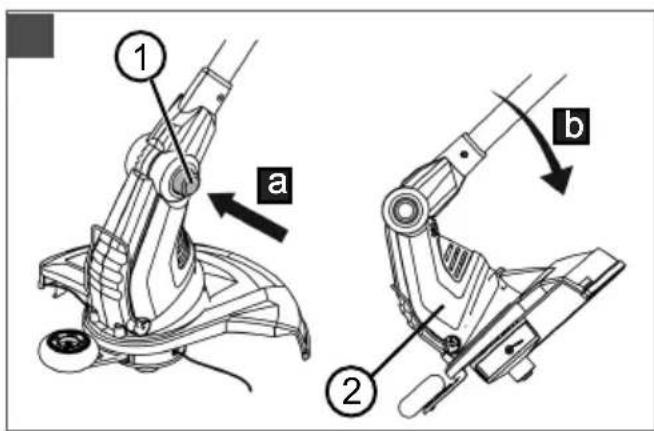
6.2 Swivelling cutter head (05, 06) 46
6.3 Tilting cutter head (07) 47
6.4 Prolonging the cutting line during operation 47
6.5 Starting lawn trimmer (12) 47
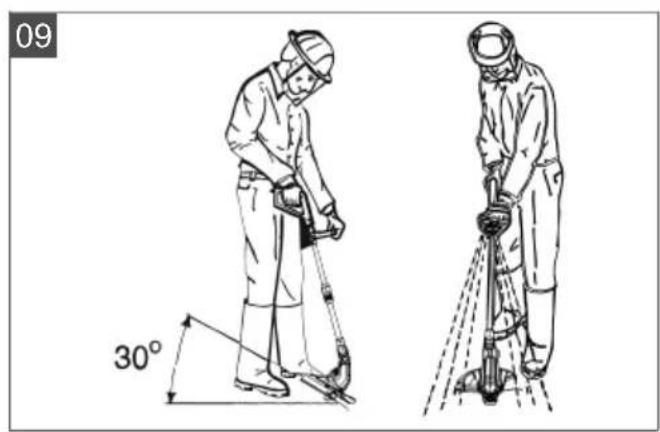
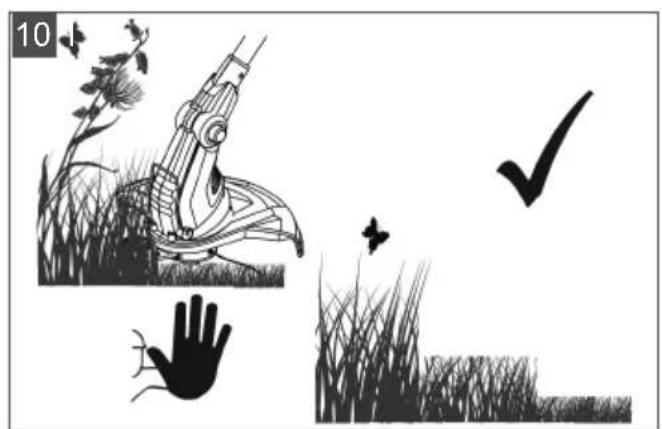
7 Working behaviour and working technique (09 - 11) 47
8 Maintenance and care 48
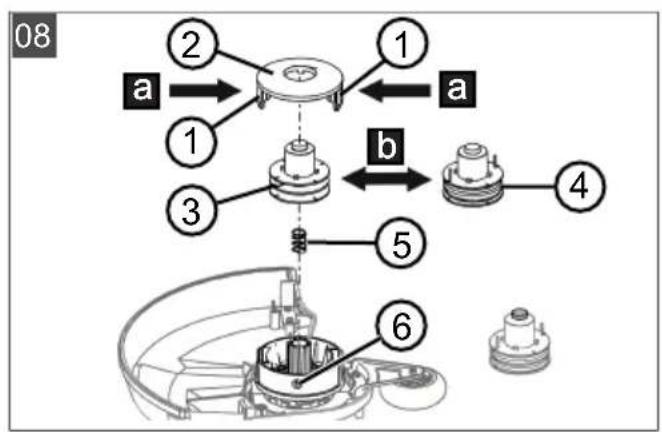
8.1 Changing the spool (08) 48
9 Storage 48
9.1 Storage of battery and charger 48
10 Transport 49
11 Disposal 50
12 Help in case of malfunction. 51
13 After-Sales / Service 52
14 Guarantee 52
15 EU declaration of conformity 53
1 ABOUT THESE OPERATING INSTRUCTIONS
The German version is the original operating instructions. All additional language versions are translations of the original operating instructions.
It is essential to carefully read through these operating instructions before start-up. This is essential for safe working and trouble-free handling.
Always safeguard these operating instructions so that they can be consulted if you need any information about the appliance.
Only pass on the appliance to other persons together with these operating instructions.
Comply with the safety and warning information in these operating instructions.
1.1 Legends and signal words

DANGER!
Denotes an imminently dangerous situation which will result in fatal or serious injury if not avoided.

WARNING!
Denotes a potentially dangerous situation which can result in fatal or serious injury if not avoided.

CAUTION!
Denotes a potentially dangerous situation which can result in minor or moderate injury if not avoided.
IMPORTANT!
Denotes a situation which can result in material damage if not avoided.

NOTE
Special instructions for ease of understanding and handling.
2 PRODUCT DESCRIPTION
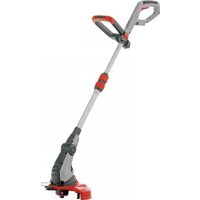
These operating instructions describe a handguided battery lawn trimmer.
2.1 Scope of supply
The rechargeable battery grass trimmer is designed for operation with the B50 Li battery (Art. No. 113559). This rechargeable battery and a charging unit are not included.
The rechargeable battery grass trimmer, rechargeable battery and charging unit can be purchased as a complete set (Art. No. 113633).
IMPORTANT!
Danger of damage to the appliance and battery
If the appliance is operated with an unsuitable battery, both the device and the battery may be damaged.
Only operate the appliance with the specified rechargeable battery.
For charging the rechargeable battery, the charging unit C30 Li (Art. No. 113560) or TC30 Li (Art. No. 113561) is required.

NOTE
You will find further information in the following operating instructions:
"Li-Ion rechargeable battery B50 Li" (Doc. No. 442228)
"Charging unit C30 Li / TC30 Li for battery B50 Li" (Doc Nr. 442230)
2.2 Intended use
This appliance is intended for trimming a lawn in non-commercial applications.
2.3 Possible foreseeable misuse
The appliance is designed neither for commercial use in public parks and sports facilities, nor for use in farming and forestry.
2.4 Safety and protective devices

WARNING! Risk of injury
Defective and disabled safety and protective devices can lead to serious injury.
Have any defective safety and protective devices repaired.
- Never disable safety and protective devices.
2.4.1 Child protection (13)
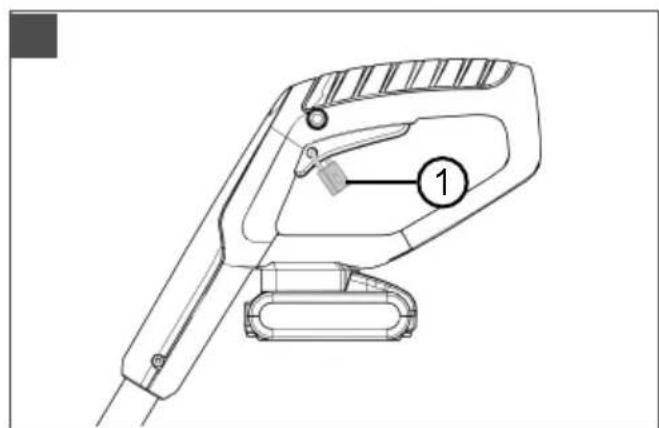
The drill hole (5 mm) at the motor safety switch is intended for a padlock* (13/1). The padlock prevents the appliance from being started inadvertently.
- Not included in the scope of supply.
2.4.2 Guard plate
Protects the operator from the rotating cutting line and objects flying out.
2.4.3 Protective bracket
Protects plants and persons from the rotating cutting line. Also the cutting line is protected against excessive wear on walls during trimming.
2.5 Symbols on the appliance
Symbol Meaning

Pay special attention when handling this product.

Read the operating instructions before starting operation.
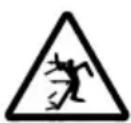
Danger due to objects being thrown out!

Keep other people out of the danger area.
Symbol Meaning
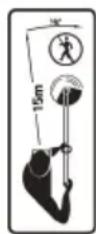
The distance between the appliance and persons not involved in the work must be at least 15m in the entire area around the user.

Protect the appliance from rain and moisture!

Wear protective glasses and ear defenders!
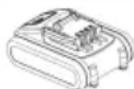
Remove the battery before making adjustments to or cleaning the appliance, or before leaving the appliance unattended for a prolonged period.
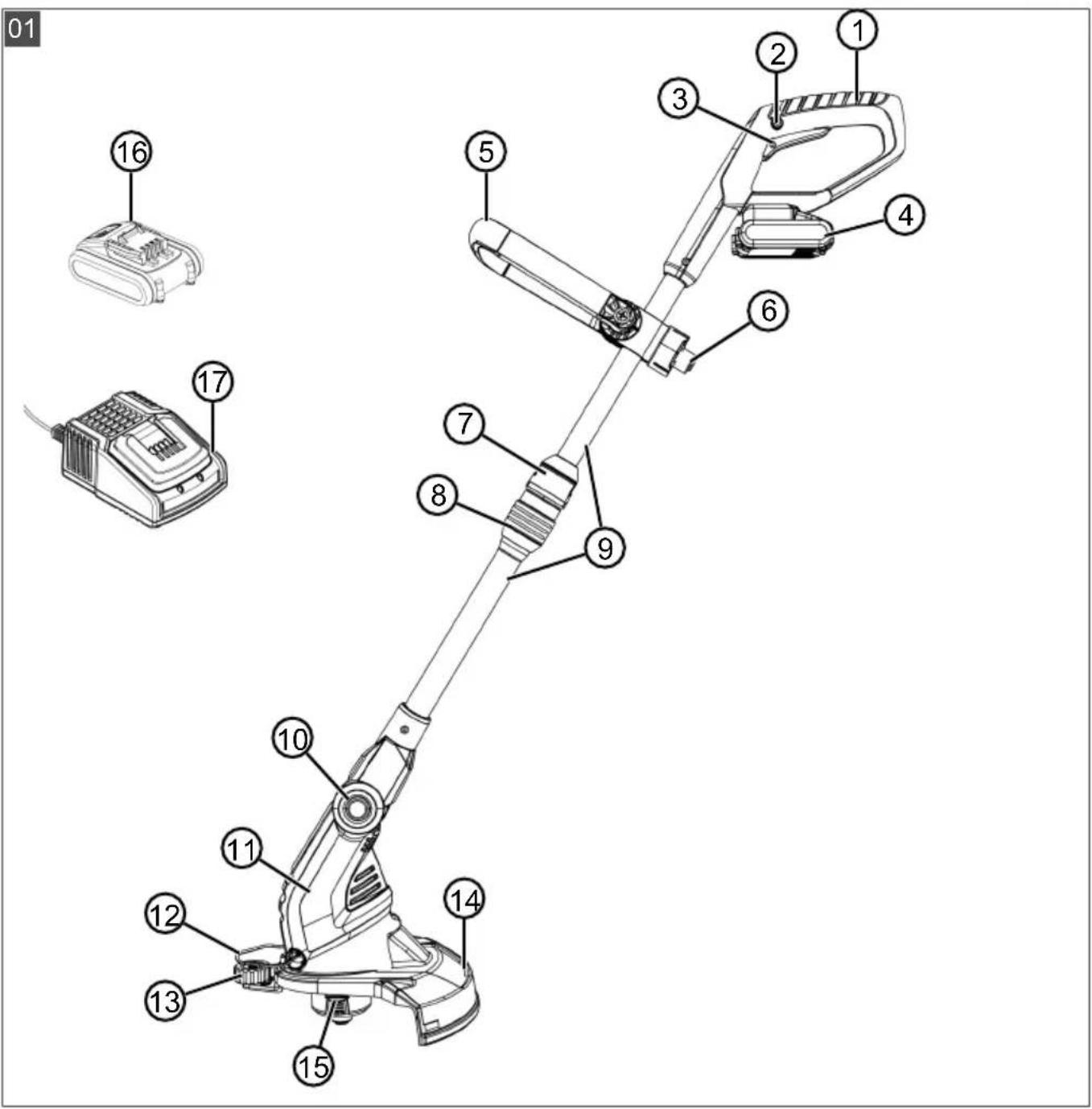
2.6 Product overview (01)
The product overview (01) provides an overview of the appliance.
No. Component
1 Upper hand grip
2 Safety button
3 Switch with child protection
4 Battery latching
5 Auxiliary hand grip with tip lever
6 Holder with additional spool
7 Upper guide sleeve
8 Lower guide sleeve
9 Telescopic handle
10 Locking button for cutter head
11 Cutter head with motor
12 Plant protection bar
13 Guide wheel
14 Guard plate with line cutter
15 Spool
16 Rechargeable battery*
No. Component
17 Charger with mains plug*
- Not included in the scope of delivery, however included as part of the complete set (Art. No. 113633)
2.6.1 Adjustable telescopic handle
The lawn trimmer is equipped with an adjustable telescopic handle. This allows the appliance to be set to individual body sizes, and allows the motor head to be swivelled.
2.6.2 Swivelling and adjustable cutter head The lawn trimmer has a swivelling cutter head with an adjustable angle.
2.6.3 Automatic tip
An automatic tip function is integrated into the spool head, allowing the cutting line to be extended while the motor is running.
3 SAFETY

WARNING!
Read all safety instructions, instructions, illustrations and technical data that are provided with this power tool.
Failure to comply with the following instructions can lead to an electric shock, fire and/or series injuries.
- Keep all safety instructions and other instructions for future reference.
The term "power tool" used in the safety instructions refers to mains-operated power tools (with mains line) and to battery-operated power tools (without mains line).
3.2 Electrical safety
- Avoid physical contact with earthed surfaces such as on pipes, heaters, cookers and refrigerators. There is an increased risk of electric shock if your body is earthed.
- Keep electrical tools out of the rain and away from moisture. Water getting into an electrical tool increases the risk of an electric shock.
- Do not overload the power tool. Use the appropriate power tool for the job you are doing. Using the appropriate power tool will enable you to work more effectively and safely in the specified performance range.
-
Do not use a power tool if it has a defective switch. A power tool that can no longer be switched on or off is dangerous and must be repaired.
-
Disconnect the plug from the socket and/or remove the battery before you make adjustments to the appliance, replace parts or put the power tool away. This precautionary measure will prevent the power tool from starting inadvertently.
- Keep unused power tools out of the reach of children. Do not allow people to use the power tool if they are not familiar with it or have not read these instructions. Power tools are dangerous if they are used by inexperienced people.
- Look after power tools and the insertion tool with care. Check whether moving parts function perfectly and do not stick, whether there are any broken parts or parts that are damaged in such a way that the function of the power tool is impaired. Have damaged parts repaired before using the power tool. Many accidents are caused by failure to maintain power tools properly.
- Keep cutting tools sharp and clean. Carefully maintained cutting tools with
sharper cutting edges are less likely to stick and are easier to control.
Use power tools, accessories, insertion tools, etc. according to these instructions. When doing so, take account of the working conditions and the activity to be undertaken. Using power tools for applications other than the intended purpose can result in dangerous situations.
- Keep the grips and grip surfaces dry, clean and free from oil and grease. Slippery grips and grip surfaces prevent safe operation and control of the power tool in unforeseen situations.
3.4 Safety in the workplace
- Keep your working area clean, and make sure it is well illuminated. Untidiness or dimly lit working areas can lead to accidents.
-
Do not work with the power tool in a potentially explosive atmosphere with the presence of flammable liquids, gases or dust. Power tools give rise to sparks that can ignite the dust or vapours.
-
Keep children and other people away from the power tool when using it. If you are distracted, you may lose control of the power tool.
Only recharge batteries with chargers that are recommended by the manufacturer. Using a charger intended for one particular type of rechargeable battery with a different type of rechargeable battery represents a fire risk.
Only use batteries in the power tools that are intended for this purpose. Using other batteries can lead to injuries and represents the risk of fire.
- Keep the unused rechargeable battery away from paper clips, coins, keys, nails, screws or other small metal objects that could short-circuit the contacts. A short circuit between the rechargeable battery contacts can result in burns or fire.
Incorrect use can result in fluid leaking out of the rechargeable battery. Avoid
coming into contact with it. In case of inadvertent contact, rinse off with water. If the fluid gets into your eyes, additionally seek medical assistance. Leaking rechargeable battery fluid can lead to skin irritations or burns.
- Do not use a damaged or changed rechargeable battery. Damaged or changed batteries can behave unpredictably and lead to fire, explosion or a risk of injury.
- Do not expose a rechargeable battery to fire or high temperatures. Fire or temperatures over 130^ can cause an explosion.
Comply with all of the instructions for charging, and never charge the rechargeable battery or the rechargeable battery-operated tool outside of the temperature range specified in the operating instructions. Incorrect charging or charging outside of the permissible temperature range can destroy the rechargeable battery and increase the risk of fire.
3.6 Personal safety
-
Be alert, pay attention to what you are doing and take a cautious approach to working with a power tool. Do not use a power tool if you are tired or under the influence of drugs, alcohol or medicines. A moment's inattentiveness when using the power tool can result in serious injury.
Wear personal protective equipment, and always use safety goggles. The injury risk can be reduced by wearing personal protective equipment such as a dust mask, non-slip shoes, a protective helmet or ear defenders, depending on the type and application of the power tool.
Avoid starting to operate the appliance inadvertently. Ensure the switch is in the off-position before connecting to power source and/or battery pack, picking up or carrying the power tool. Accidents can be caused by leaving your finger on the switch when you carry the power tool or when you connect it to the power supply.
-
Remove the adjusting tools or spanner before you switch on the power tool. A tool or spanner that is in a rotating part of the machine can cause injury.
Avoid an abnormal bodily posture. Make sure you can stand safely and keep your balance at all times. This will enable you to control the power tool better if something unexpected happens.
Wear suitable clothing. Do not wear baggy clothing or jewellery. Keep your hair, clothes and gloves away from moving parts. Loose clothing, jewellery or long hair can be snagged on moving parts.
3.7 Service
- For your own safety, only have your power tool repaired by qualified specialist personnel using genuine spare parts. This ensures that the power tool remains safe.
- Never maintain damaged batteries. All rechargeable battery maintenance should only ever be undertaken by the manufacturer or authorised customer service points.
3.8 Safety instructions for the lawn trimmer
3.8.1 Vibration load

WARNING!
Danger due to vibration
The actual magnitude of the vibration emissions during the use of the appliance may deviate from that stated by the manufacturer. Observe the following influencing factors before or during use:
Is the appliance being used as intended?
Is the material being cut or processed in the proper manner?
Is the appliance in a proper condition of use?
Is the cutting tool properly sharpened or is the correct cutting tool installed?
Are the handle grips and any optional vibration grips mounted, and are they firmly attached to the appliance?
Only operate the appliance at the motor speed required for the respective work. Avoid us
ing the maximum speed in order to reduce noise and vibrations.
The noise and vibrations of the appliance can increase due to improper use and maintenance. This leads to damage of the health. In this case, immediately switch off the appliance and have it repaired by an authorised service workshop.
The degree of stress due to vibration depends on the work to be performed or on the use that the appliance is put to. Estimate the stress and plan appropriate work breaks. This considerably reduces stress due to vibration over the entire working time.
- Extensive use of the appliance exposes the operator to vibrations, which can lead to circulatory issues ("white fingers"). To avoid this risk, wear gloves and keep your hands warm. If any symptoms of "white fingers" occur, immediately consult a physician. These symptoms include: Numbness, loss of feeling, tingling, itching, pain, reduced muscular strength, changes in the colour or condition of the skin. Normally these condi
tions affect the fingers, hands or pulse. The risk increases at low temperatures.
Take long breaks during your working day so you can recover from the noise and the vibrations. Plan your work in such a way that the use of appliances that generate strong vibrations is spread over several days.
If you notice an unpleasant sensation or discolouration of the skin on your hands when using the appliance, stop work immediately. Take sufficient work breaks. Without sufficient breaks, a hand/arm vibration syndrome can occur.
- Minimise your risk of being exposed to vibrations. Maintain the appliance according to the instructions in the operating instructions.
If the appliance is used frequently, contact your dealer to purchase anti-vibration accessories (e.g. handles).
- Avoid working with the appliance at temperatures below 10^ . Define how the vibration load can be limited in a work plan.
3.8.2 Noise pollution
A certain level of noise exposure from this appliance is inevitable. Carry out noisy work at approved and specified time periods. Observe rest periods as necessary and restrict the duration of the work to a minimum. For your personal protection and protection of persons in the vicinity, appropriate hearing protection must be worn.
3.9 Safety instructions relating to operation

WARNING!
Risk due to electromagnetic field
This power tool produces an electromagnetic field during operation. Under certain circumstances, this field may impair active or passive medical implants.
In order to reduce the risk of serious or fatal injury, we recommend that any persons fitted with medical implants should consult their doctor and the manufacturer of the medical implant before operating the power tool.
Always operate the machine with two hands.
Always keep hand and feet away from the cutting device, above all when switching on the motor.
Wait for the cutting device to come to a standstill after the motor has been switched off.
- Only remove cuttings when the motor and cutting device are at a standstill.
Because of danger of cutting injuries, do not touch the line cutter with unprotected hands.
After pulling out a new line, always bring the appliance into its normal working position before switching it on.
- Do not use a metallic cutting line.
Always keep the guard plate, spool head and motor clear of mowing residues.
People who are not familiar with the appliance should practice handling it while the motor is turned off.
When working on a slope:
- Never work on a smooth and slippery slope.
Always mow across the slope, never down or up.
Always stand below the cutting device.
After contact with a foreign object:
Switch off the motor.
Check the machine for damage.
This section mentions all the basic safety and warning information to be heeded when using the rechargeable battery. Read these instructions.
- Only use the rechargeable battery as designated, i.e. for AL-KO rechargeable battery-driven appliances. Only charge the rechargeable battery with the AL-KO charging unit provided.
Only unpack the new rechargeable battery from the original packaging when it is to be used.
Fully charge the rechargeable battery before using it for the first time and always use the specified charger. Comply with the details given in these instructions for use for charging the rechargeable battery.
-
Do not use the rechargeable battery in environments where there is a potential risk of explosion and/or fire.
-
Do not expose the rechargeable battery to moisture and humidity when in use with the appliance.
- Protect the rechargeable battery from heat, oil and fire to prevent it being damaged so no vapours and electrolyte liquids can escape.
- Do not subject the rechargeable battery to impacts or throw it.
- Do not use the rechargeable battery when soiled or wet. Before use, clean and dry the rechargeable battery with a dry, clean cloth.
- Do not open, dismantle or crush the rechargeable battery. There is a danger of electric shock and short-circuit.
This rechargeable battery must not be used by unauthorised persons unless they are supervised by a person responsible for their safety or have been instructed on how to use the rechargeable battery. Unauthorised persons include, for example:
Persons (including children) with limited physical, sensory or mental aptitude
Persons who have no experience and/or knowledge of the rechargeable battery.
Children must be supervised and instructed so they do not play with the rechargeable battery.
- Do not leave the rechargeable battery permanently in the charger. For prolonged storage, remove the rechargeable battery from the charger.
- When not in use, remove the rechargeable batteries from the operated appliances.
Dry the unused rechargeable battery and store in a closed place. Protect from heat and direct sunlight. Unauthorised persons and children must not have access to the rechargeable battery.
This section mentions all the basic safety and warning information to be heeded when using the charger. Read these instructions.
Only use the appliance as designated, i.e. for charging the intended rechargeable
batteries. Only charge original rechargeable batteries from AL-KO in the charging unit.
Before each use, inspect the entire appliance – and especially the mains cable and the rechargeable battery compartment – for damage. Only use the appliance when it is in a proper working order.
- Do not use the appliance in environments where there is a potential risk of explosion and/or fire.
Only operate the appliance indoors and do not expose it to moisture and humidity.
Always place the charging unit on a well ventilated and non-inflammable surface because it heats up during the charging process. Keep the ventilation slots clear and do not cover the appliance.
Before connecting the charging unit, make sure that the mains voltage matches the voltage stated in the "Technical data".
Only use the mains cable for connecting the charging unit, not for other purposes. Do not carry the charging unit by the mains cable and do not re
move the power plug from the power outlet by pulling on the mains cable.
-
Protect the mains cable from heat, oil and sharp edges to prevent it being damaged.
-
Do not use the charging unit and rechargeable battery when soiled or wet. Before using the appliance, clean and dry the rechargeable battery.
-
Do not open the charging unit or rechargeable battery. There is a danger of electric shock and short-circuit.
-
For your own safety, have your appliance repaired by qualified specialist personnel only using original spare parts.
This appliance must not be used by unauthorised persons unless they are supervised by a person responsible for their safety or have been instructed on how to use the appliance. Unauthorised persons include, for example:
Persons (including children) with limited physical, sensory or mental aptitude
Persons who have no experience and/or knowledge of the appliance.
Children must be supervised and instructed so they do not play with the appliance.
- Dry unused appliances and store in a closed place. Unauthorized persons and children must not have access to the appliance.
4 INSTALLATION

WARNING!
Danger if assembly is not carried out completely!
Operation of an incompletely assembled appliance can result in serious injury.
Only operate the appliance when it is fully assembled.
- Do not insert the battery into the appliance until it is fully assembled.
Check that all safety and protective devices are in place and functioning correctly before switching on.
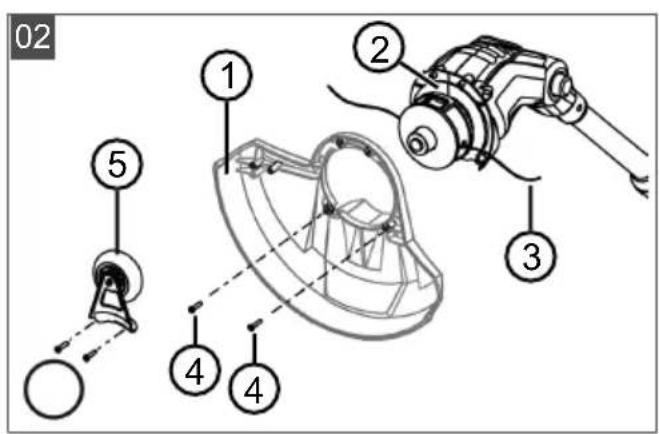
4.1 Installing the guard plate (02)
- Insert the guard plate (02/1) onto the cutter head (02/2). Ensure that the line is hanging (02/3) freely.
- Secure the guard plate on the cutter head with the screws provided (02/4).
- Place the guide wheel (02/5) on the guard plate and tighten the screws.
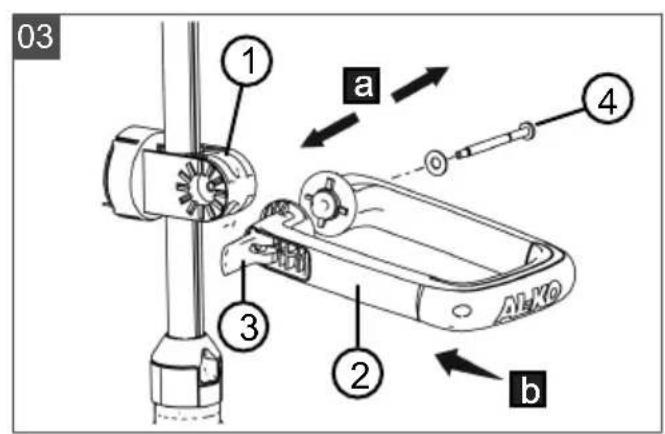
4.2 Installing auxiliary handle (03)
The holder (01/6) of the auxiliary handle (01/5) is mounted on the telescopic handle. The supplied replacement spool is integrated into the holder.
The angle of the handle can be individually adjusted using the tip lever.
- Slide the holder (03/1) onto the telescopic handle.
- Gently pull apart the grip bar of the auxiliary handle (03/2) (03/a).
- Push the auxiliary handle onto the holder (03/ b). The auxiliary handle must engage in the linkage.
- Position the tip lever (03/3) with the bolt holder on the clamping bolt (03/4).
- Tighten the clamping bolts so that the tip lever can be moved with little force.
5 START-UP
5.1 Charging the rechargeable battery

NOTE
For detailed information, heed the separate operating instructions for the rechargeable battery and for the charging unit.

CAUTION!
Danger of fire during charging!
Due to heating of the charger, there is a danger of fire if it is placed on an inflammable surface and is not adequately ventilated.
Always use the charger on a non-inflammable surface or in a non-combustible environment.
If available: Keep the ventilation slots free.

NOTE
Fully charge the rechargeable battery before using it for the first time. The rechargeable battery can be charged in any charge status. Interrupting charging does not damage the rechargeable battery.

NOTE
When charging, the rechargeable battery is protected from overcharging due to automatic detection of the charge status and thus can remain connected to the charging unit for some time, but not permanently.
The temperature range for charging should be between 5^ and +45^ . The charging time for full charging is max. 50 minutes. If the operating time of the rechargeable battery is reduced in spite of it being fully charged, the rechargeable battery is at the end of its service life and must be replaced by a new original rechargeable battery.
- Connect the charger (01/17) without the rechargeable battery (01/16) to the power supply.
- Insert the rechargeable battery into the charger.
The LED on the plug-in power supply is red; the charging process begins.
- Charging is completed when the LED on the plug-in power supply is green. The battery is fully charged.
- Disconnect the charger from the mains.
- Remove the rechargeable battery from the charger.
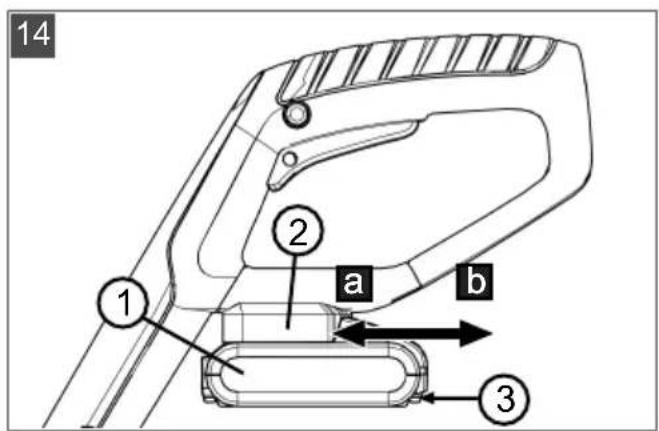
5.2 Inserting and pulling out the rechargeable battery (14)
Inserting the rechargeable battery (14/a)
- Push the rechargeable battery (14/1) into the rechargeable battery slot (14/2) until it engages.
Pulling out the rechargeable battery (14/b)
- Press and hold the unlock button (14/3) on the rechargeable battery (14/1).
- Pull out the rechargeable battery.
5.3 Removing transport guard from line cutter
Remove the transport guard from the line cutter before putting the appliance into operation for the first time.
6 OPERATION

WARNING!
Risk of injury due to detaching appliance parts
Appliance parts detaching during operation can lead to serious injury.
Before turning the appliance on, check that all the parts of the appliance are firmly tightened.
- Attach cutting tools so that they cannot detach during operation.
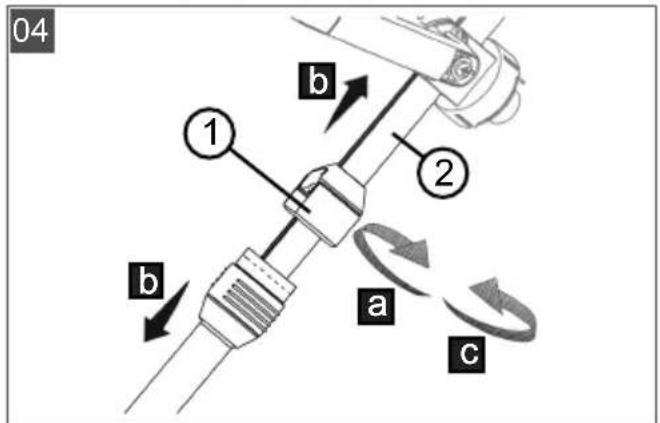
6.1 Adjusting telescopic handle (04)
- Turn upper locking sleeve (04/1) by approximately 180^ in the direction of the arrow (04/a) to release.
-
Adjust telescopic handle (04/2) individually to a comfortable height. The telescopic handle can be extended by approx. 10cm 04/b
-
Screw locking sleeve tight (04/c).
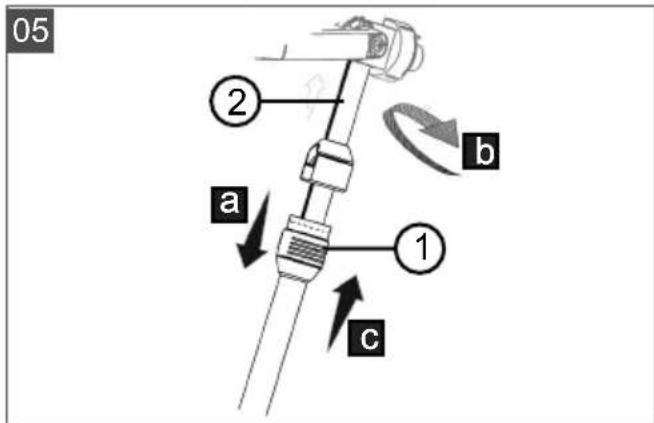
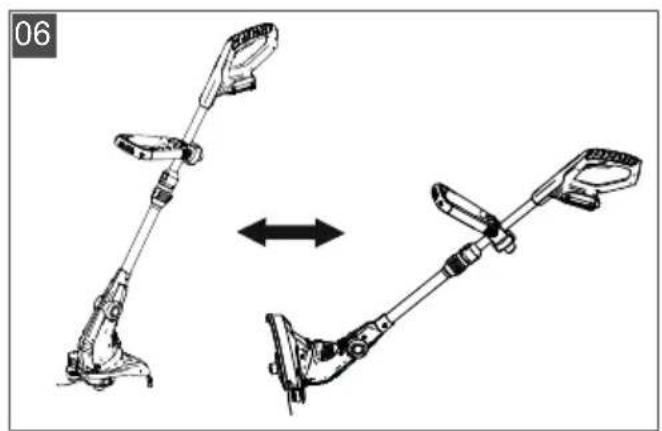
6.2 Swivelling cutter head (05, 06)
For trimming lawn edges, for example, it is possible to swivel the cutter head through 180^ (06).
- Unscrew lower locking sleeve (05/1) (05/a).
- Turn telescopic handle (05/2) through 180^ (05/b).
- Screw locking sleeve tight (05/c).
6.3 Tilting cutter head (07)
By changing the pivot angle, it is also possible to trim areas that are difficult to access, e.g. under benches, overhangs, etc.
- Press the locking button (07/1) and hold (07/a).
- Allow cutter head (07/2) to engage at the desired angle (07/b).
- Release the locking button.
6.4 Prolonging the cutting line during operation
The cutting line shortens during operation and frays out.
- Tap spool head on the lawn from time to time. This unwinds a piece of new cutting line from the spool and the line cutter cuts off the used line end.
6.5 Starting lawn trimmer (12)
- Stand securely.
- Hold the appliance with both hands. Do not rest the cutter head on the ground when doing this.
- Hold auxiliary handle (01/5) in one hand and upper grip (01/1) in the other hand.
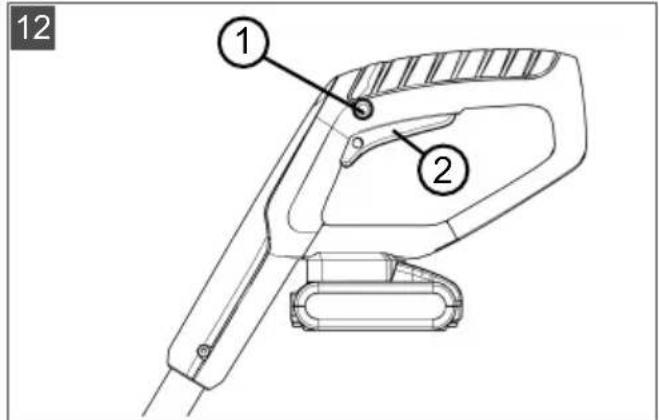
- Press the safety button (12/1) in the upper grip.
- Press the switch (12/2) in the upper grip and hold it pressed. The appliance starts. The safety button can be released.
- Allow the lawn trimmer to run at idling speed for a few moments. This causes the cutting line to be cut off to the correct length.
- The machine switches off when the switch is released.

WARNING! Danger of cutting injuries
After the appliance has been switched off, the spool head continues to rotate for a few seconds. Reaching into the spool head during this time can result in cutting injuries.
Wait until the spool head has come to a complete standstill.
7 WORKING BEHAVIOUR AND WORKING TECHNIQUE (09 - 11)
- Switch on the appliance before approaching the grass to be cut and then lower slowly to avoid overloading.
Tilt the appliance slightly forwards (approx. 30^ ) to mow with the tip of the cutting line. Walk forwards slowly (09).
- When mowing, swivel the appliance evenly to the right and left (09).
- Long grass must be mown in several passes. Always proceed from top to bottom (10).
The appliance cuts best at very high speed. Therefore, do not overload the appliance by cutting long grass.
If the appliance is overloaded in long grass, the line will be blocked. Immediately lift the appliance so it releases. Otherwise, the motor could be permanently damaged.
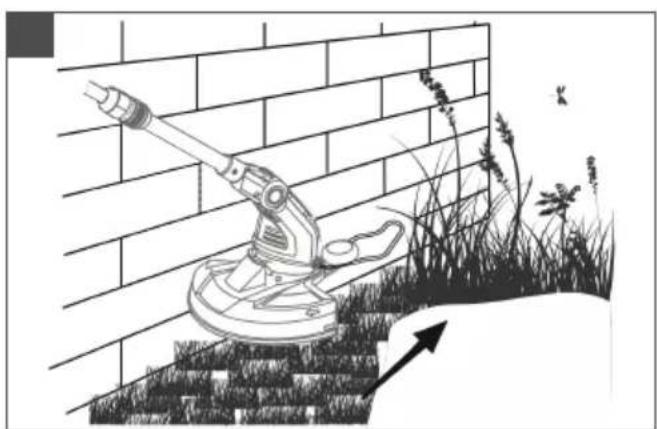
- Do not move the appliance directly against hard obstacles (e.g. walls), but mow sideways. This protects the cutting line (11).
- Keep the appliance away from sensitive plants. Fold the plant protection bar into the horizontal position.
8 MAINTENANCE AND CARE

WARNING! Danger of cutting injuries
Danger of cutting injuries when reaching into sharp-edged, moving appliance parts and into cutting tools.
Before maintenance, care and cleaning work, always switch off the appliance. Remove the rechargeable battery.
Always wear protective gloves during maintenance, care and cleaning work.

NOTE
Repair work is only allowed to be carried out by expert workshops or our AL-KO service centres.
- Do not get the appliance wet or expose it to moisture. Do not spray with water.
After each use, clean the housing and cutting blades with a brush or cloth. Do not use water and/or aggressive cleaning agents or solvents - risk of corrosion and damage to the plastic parts.
After every use, remove the rechargeable battery and inspect the appliance for damage.
- Do not use the appliance if the blade of the line cutter is missing or damaged.
Always keep the guard plate, spool head and motor clear of mowing residues.
Inspect all bolts for tightness.
Inspect the electrical contacts of the appliance for corrosion, clean with a fine wire brush if necessary and then spray with a contact spray.
8.1 Changing the spool (08)
Replacement spool: GT 2025 art. no. 112969.
Precondition: The appliance must be switched off and the rechargeable battery removed from the appliance.
Inserting and removing the spool
- Press (08/a) the two unlock buttons (08/1) at the same time and remove cover (08/2).
- Remove empty spool (08/3).
- Insert (08/b) a new spool (08/4). Ensure that spring (08/5) is installed again.
- Thread the cutting line outwards through opening (08/6) of the spool head.
- Fit cover (08/2) and press on until it engages.
- Install the rechargeable battery in the appliance.
9 STORAGE
Thoroughly clean the appliance after each use and - if present - attach all covers. Store the appliance in a dry, lockable place out of the reach of children.
- Hang up the lawn trimmer by its handle. This avoids placing unnecessary load on the cutter head.
Carry out the following jobs before intervals in work lasting for longer than 30 days:
Thoroughly clean the appliance and store it in a dry place.
9.1 Storage of battery and charger

DANGER!
Danger of explosion and fire!
Persons will be fatally or severely injured if the rechargeable battery explodes because it was stored in front of naked flames or heat sources.
Store the rechargeable battery in cool and dry conditions, but not in front of naked flames or heat sources.

NOTE
When charging, the rechargeable battery is protected from overcharging due to automatic detection of the charge status and thus can remain connected to the charging unit for some time, but not permanently.
Store the rechargeable battery in a dry, frost-free place at an ambient temperature between 0^ and 35^ and with a charge state of approx. 40 - 60%.
- Do not store the rechargeable battery in the vicinity of metallic objects or of objects containing acid to avoid the risk of short-circuit.
- Recharge the rechargeable battery for approx. 1 hours after approx. 6 months' storage.
10 TRANSPORT
Before transporting, carry out the following measures:
- Switch off the appliance.
- Remove the rechargeable battery from the appliance.
- Pack the battery properly.

NOTE
The nominal energy of the rechargeable battery is less than 100 Wh. Therefore, heed the following transport instructions.
The li-ion rechargeable battery contained in the appliance is subject to the hazardous goods law, but can be transported under simplified conditions:
The undamaged rechargeable battery can be transported on public roads by the private user without further conditions provided it is packaged for retail sale and the transport serves personal purposes. The weight limits for batteries sent separately must be observed:
Max. 30kg total weight per package when transported by road, rail and water
No upper limit for air transport but max. 2 pieces per package
If damage to the battery (e.g. due to the appliance falling) is suspected, transport is not permissible.
- Commercial users who carry out the transport in connection with their main activity (e.g. delivery from and to building sites, or demonstrations) can also take advantage of this simplification.
In both cases, it is essential to take the mandatory precautions mentioned above to prevent any leakage of the contents. In other cases, it is essential to comply with the regulations of the hazardous goods law. In the case of non-compliance, severe penalties can be imposed on the sender and possibly the transporter.
Additional notes on transport and shipment
Only transport or ship lithium-ion rechargeable batteries in an undamaged state.
- Secure the appliance in such a way as to prevent it from starting to operate inadvertently during transport.
- Secure the appliance with strong outer packaging (cardboard shipment box). Use the manufacturer's original packaging if possible.
Ensure correct identification and documentation of the consignment during transport or dispatch (e.g. by parcel or forwarding):
- When transporting by road, rail and water, a warning sticker must be applied to the packaging when the battery/batteries accompany the appliance. No warning sticker is necessary if the battery/batteries are installed or fitted into the appliance, since the outer packaging/original packaging must already comply with specific regulations.
A warning sticker must always be placed on the packaging when transporting by air. The maximum weight limits for batteries sent together with the appliance must be observed: max. 5 kg battery weight per package and max. 2 pieces per package, if the battery/batteries are accompanying the appliance.
Please find out in advance whether transport is possible with the selected service provider, and show your shipment.
We recommend involving a hazardous goods specialist in the preparation of the shipment. Please heed any other national regulations.
11 DISPOSAL

- Electrical and electronic appliances do not belong in household waste, but should be collected and disposed of separately.
Used batteries or rechargeable batteries that are not installed permanently in the old appliance must be removed before disposal. Their disposal is regulated by the battery law.
- Owners or users of electrical and electronic appliances are obliged by law to return them after use.
The end user bears personal responsibility for deleting his personal data from the old appliance to be disposed of.
The symbol of the crossed-through rubbish bin means that electrical and electronic appliances may not be disposed of in the household rubbish. Electrical and electronic appliances can be handed in at no charge at the following places:
Public service disposal or collection points (e.g. municipal building yards)
Points of sale of electrical appliances (stationary and online) provided traders are obliged to take them back or offer this voluntarily.
These statements only apply to appliances that are installed and sold in the countries of the European Union and are subject to European Directive 2012/19/EU. Different provisions may apply to the disposal of electrical and electronic appliances in countries outside the European Union.

Used batteries and rechargeable batteries do not belong in household waste, but should be collected and disposed of separately.
For safe removal of batteries or rechargeable batteries from the electrical appliance and for information on their type or chemical system, follow the further information within the operating or installation instructions.
- Owners or users of batteries and rechargeable batteries are obliged by law to return them after use. The return is limited to the handover of customary household quantities.
Used batteries can contain harmful substances or heavy metals that can cause damage to the environment and human health. Reuse of the used batteries and use of the resources contained therein contributes to the protection of these two essential commodities.
The symbol of the crossed-through rubbish bin means that batteries and rechargeable batteries may not be disposed of in household rubbish.
In addition, if the symbol Hg, Cd or Pb appears under the rubbish bin, this stands for the following:
Hg: Battery contains more than 0.0005% mercury
Cd: Battery contains more than 0.002% cadmium
Pb: Battery contains more than 0.004% lead Rechargeable batteries and batteries can be handed in at the following places at no charge:
Public service disposal or collection points (e.g. municipal building yards)
Points of sale of batteries and rechargeable batteries
Disposal points of the common take-back system for the used batteries of appliances
Disposal point of the manufacturer (if not a member of the common take-back system)
These statements apply only to rechargeable batteries and batteries that are sold in the countries of the European Union and that are subject to European Directive 2006/66/EU. Different provisions can apply to the disposal of rechargeable batteries and batteries in countries outside the European Union.
12 HELP IN CASE OF MALFUNCTION

CAUTION! Risk of injury
Sharp-edged and moving appliance parts can lead to injury.
Always wear protective gloves during maintenance, care and cleaning work.
| Malfunction Cause Remedy | | |
| Additional cutting line is not supplied. | Spool is empty. Change the spool. |
| Engine does not run. Rechargeable battery is flat. Charge the rechargeable battery. |
| Rechargeable battery missing or rechargeable battery not seated correctly. | Insert the rechargeable battery correctly. |
| Power supply is interrupted. 1. | Remove the battery.
2. Clean the plug contacts of the appliance. |
| The motor protection switch has switched off the motor due to overload. | Wait until the motor protection switch enables the motor again. |
| Motor keeps cutting out. | ■ Appliance faults
■ ON/OFF switch is defective. | Contact an AL-KO service centre. |
| Motor running, but the cutting blade does not move. | Appliance faults Contact an AL-KO service centre. |
| Appliance vibrates unusually. | Spool is contaminated. Clean the spool, renew it if necessary. |
| Appliance faults Contact an AL-KO service centre. |
| Rechargeable battery operat-ing time is significantly shorter. | Grass is too long or too wet. | ■ Cut the grass at a greater height.
■ Let the grass dry. |
| Cutting height is too low. Cut the grass at a greater height. |
| The service life of the re-chargeable battery has expired. | Replace the rechargeable battery.
Only use genuine accessories from the manufacturer. |
| Rechargeable battery cannot be charged. | Rechargeable battery contacts are dirty. | Contact an AL-KO service centre. |
| Rechargeable battery or charging unit is defective. | Order spare parts. Contact an AL-KO service centre. |
| Rechargeable battery is too hot. | Allow the battery to cool down. |

NOTE
If you encounter any malfunctions that are not listed in this table or that you cannot rectify yourself, please contact our customer service.
13 AFTER-SALES / SERVICE
In the event of questions of warranty, repair or spare parts, please contact your nearest AL-KO Service Centre.
These can be found on the Internet at:
www.al-ko.com/service-contacts
14 GUARANTEE
We will resolve any material or manufacturing faults on the appliance during the legal warranty period for claims relating to faults, in accordance with our choice either to repair or replace. The legal warranty period is determined by the legislation of the country in which the appliance was purchased.
Our warranty promise applies only if:
These operating instructions are heeded
The appliance is handled correctly
Original spare parts have been used
The warranty becomes void in the case of:
Unauthorised repair attempts
Unauthorised technical modifications
Non-intended use
The guarantee excludes:
Paint damage that can be attributed to normal wear and tear
Wear parts that are marked with a frame xxxxx (x) on the spare parts card
The guarantee period commences with purchase by the first end user. The date on the proof of purchase is decisive. In the event of a guarantee claim, please take this guarantee declaration and the original proof of purchase, and contact your dealer or the nearest authorised customer service centre. This statement does not affect the purchaser's statutory claims for defects against the vendor.
We hereby declare that this product in its marketed form conforms to the requirements of the harmonised EU Directives, EU safety standards and the product-specific standards.
Product
Battery lawn trimmer
Serial number
G1082012
Manufacturer
AL-KO Geräte GmbH
Ichenhauser Str. 14
D-89359Kotz
Germany
Duly authorised person for technical file
Andreas Hedrich
Ichenhauser Str. 14
D-89359Kotz
Germany
Type
GT 2025
EU directives
2006/42/EC
2014/30/EU
2000/14/EC
2014/35/EU
2011/65/EU
Harmonised standards
EN 60745-1
EN786
EN 55014-1
EN 55014-2
EN 61000-3-2
EN 61000-3-3
EN 60335-1
EN 60335-2-29
EN 62233
Sound power level
EN ISO 3744
measured/guaranteed
90 dB(A) / 92 dB(A)
2000/14/EC Appendix VI
Named position
2 PRODUCTOMSCHRIJVING
www.al-ko.com/service-contacts
14 GARANTIE
www.al-ko.com/service-contacts
14 GARANTIE
www.al-ko.com/service-contacts
14 GARANTÍA
www.al-ko.com/service-contacts
14 GARANZIA
www.al-ko.com/service-contacts
14 GARANCIJA
www.al-ko.com/service-contacts
14 JAMSTVO
Možebitne greške u materijalu ili proizvodnji na uredaju uklonit cemo tijekom zakonskoga roka zastare za jamstvo na nedostatke prema vlastitom izboru popravljanjem ili zamjenskom dostavom. Rok zastare odreduje se prema pravu države u kooj je uredaj kuplejen.
www.al-ko.com/service-contacts
14 GWARANCJA
15 DEKLARACJA ZGODNOSCI WE
www.al-ko.com/service-contacts
14 ZÁRUKA
www.al-ko.com/service-contacts
14 ZÁRUKA
2000/14/ES, priloha VI
Notifiková osoba
www.al-ko.com/service-contacts
14 GARANCIA
Brandfare under oplanning!
www.al-ko.com/service-contacts
14 GARANTI
WARNING! Risk for vibration
- Skruva loss den undre lashylsan (05/1) (05/a).
- Vrid runt teleskopskaftet (05/2) med 180^ (05/b).
- Skruva fast lashylsan (05/c).
www.al-ko.com/service-contacts
14 GARANTI
8 VEDLIKEHOLD OG PLEIE

ADVARSEL! Fare for kuttskader
www.al-ko.com/service-contacts
14 GARANTI
www.al-ko.com/service-contacts
14 TAKUU JA TUOTEVASTUU
www.al-ko.com/service-contacts
14 GARANTIJA
Galimus jrenginio medziagu ar gamybos defektus jstatymu numatytu pretenziju del trukumu reiskimo senaties termino laikotarpiu mes saliname saveru nuozura remonto arba keitimo budu. Senaties terminas nustatomas kiekvienu konkreciu atveju pagal salies, kurioje jrenginys buvo jsigytas, teises aktus.
www.al-ko.com/service-contacts
14 GARANTIJA
lespejamos materiala vai razoanas brakus iekarta mes noversisim atbilstoikukma noteiktajam noilguma terminam attieciba uz garantijas prasibam, paturot tiesibas izveleties remontu vai jaunas preces piegadi. Noilguma termins tiek noteikts, vadoties pec t as valsts speka esosas likumdoanas, kurierice tika nopirkta.
5 BboB EKcnIyatauio 440
5.1 3apkaakymyTopa 440
5.2 YcTaHOBka Nn3BLeueHne aKKyMylTopa (14) 441
5.3 ChnTb cpejxuei roOBKn 3aunTHyU ynaKOBky dny 3aunTbI OT nobpeXeHn npn TpaHc-nopTnpOBke 441
6 Ynpablenne 441
6.1 PeryunpoBaHne Teleckonuuecko pykn (04). 441
6.2Поворачиване ржушеголobkn (05,06) 442
6.3 PerynilopBka yrna haknoHa pekUeI roNoBkn (07) 442
6.4 YdHHeHnepeKyuIeNlecknBoBpeM3KcPnyaTaun 442
6.5 BkJIoueHne TpIMMepa (12) 442
7 Pa6ooye noBedeHne n cnooc6 pa6oTbI (09-11) 442
8 Texo6cnyKbHne n yxo.. 443
8.1 3aMeHa KaTuShKn c peKyuSei necko (08) 443
9 XpaeHne 444
9.1 XpaHeHne aKkymyIaTopa n 3apAnHoro ycTpoiCtBa 444
10 TpHaHcnpTnpoBka 444
11ytin3a.. 444
12 UcTpaHHe HeucnpaBHOCTeI 446
13 CepBnchoe o6cnyKbAHne 447
14 TapaHTnA 447
15 3aBHeHne o COOTBeTCTBnE EC 448
1 INHΦOPMAUЯ O PYKOBOДCTBE NO 3KcPJIyATAUIN
HemeckaBepnOpunHaNbHoe pyKOBODTBO NO 3KcNpyatau. Bce ocTaNbHbIe 3bIKOBblE Bercn —3TO npeBoDblOpunHaHbHOpyKOBDCTBa No 3KcNpyatau.
O6ra3aTeNbHO npoHTaIte DaHoe pykoBODCTBO NO 3KcNpyatauIN nepei BBODOM B3KcNpyatauIO. 3TO Heo6xOdmo dIg 6e3- onachOH n 6e30Ka3HOJ pa60tbl.
Bcerda depknte 3to pykoDbCTBO nO 3Kc-nnyatau nn pkyo, yTo6bl npouHTaTb erO, ecn Bam notpe6yeTc HOpMaun o6 yctpoiCTBe.
IpeepaBae yctpoNCTBO dpym Iuam TOnbKO BMeCTe C 3TNM pkoBODCTBOM IO 3Kc- Pnyataun.
IpoHTte n co6JIoudaIte yka3aHnra NO TexHnke 6e3OpacHOCTn I npEduynpeKdEHH, npuBeDeHHbIe B DaHHOM pyKOBoDCTBe No 3KcPnyatauN.
1.1 YcNoBHbIe 06o3HaueHn I cnHaJIbHbIe cNoBa

ONACHOCTb!
Yka3bIbaeT Ha onaChyUcHTyaCNIU, KOTopa, ecnHe He n36eKaatb, npNBOiNTK CMEPTN INI N cepBe3HbIM TpaBMam.

ПЕДУПЕЖДECHNE!
Yka3bIbaeT Ha Notehn-aIbHO ONaCHyIO CNTyaCNIIO, KOTOPa, ecII ee He n36eXaTb, MOKeT pNBeCTN K CMePTN IIN cepBe3HbIM TpaBMam.

OCTOPOXHO!
Yka3bIbaeT Ha Notehun- aIbHO ONaCHyIO CNTyaCNIIO, KOtOpa, ecn ee He n36eXaTb, MoKTe PpNBecTN TpaBMam IerKoN i CpeiHNe TJaKeCTN.
BHIMAHHE!
Yka3bIbaeT Ha cnTyauHIO, KOtOpa, ecn ee He n36eXaTb, MoKeT npNBecTN K NMyueeCTBeHHOMy yuepe6y.

ПРИМЕЧАНЕ
CneunabHbIe yka3aHnI dIy oBnerHu HnIOHNMaHnI NkCnIyatauN.
2 OПИСАНЕ ПОДУКТА
B 3TOM pyKOBOdCTBe NO 3KcNJIyatauHn OINCbIbAeTcRpyHNo TpIMMep,pa6oTaUOuN OT aKKMyJrTopa.
2.1 KomnjeKT noCTaBKn
Tpmmep c aKKymyIaTOPOM npeHa3NaueH dIЯ nCnoJIb3OBAHncaKkymyIaTOpom B50 Li (Ng 3aKa3a:113559).AkkymyIaTOp n 3apJdHoe yctpoiCTBO He BXoIaT B KOMJIeKT NOCTABKN.
Tpnmep c akymyraTopom n 3apndhoe yctpoiCTBO MOxHO npno6peCTN B BVNe pONHOro Ha6opa (No 3aka3a:113633).
BHIMAHNE!
Onachoctb NOBpeJdeHn yCTpoiCTBa n aKKyMyljTopa
Ecnn yctpoiCTBO pa6oTa-et C HnpaBnIbHbIM aKKy-MyJrTOpOM,TO yCTPOI-CTBO N aKKymjrTOp MOryT 6bITb NOBpeKdEhbl.
YcTpoIcTBo pa6oTaet TOJbKO C npEHa3Ha- YeHHbIM dJa 3TOrO aKKy- MyJIaTOPOM.
2.3ПиМерьн He npabnIbHorO nCNoJIb3OBaHnA
YcTpoIcTBo He npEHa3HaueHO dJa KOMMepueckoro NcNoIb3OBAHnB O6UecTBeHHbIX napKax, Ha CnpOTNBbIX PNOaAdkax, B CeNbCKOM I neC-HOM XO3raCTBax.
2.4 PpeoXpaHnteIbHbIe n 3aunTHbIe yctpoiCTBa

2.6.3 WArOBAaBtOMaTnKa
Iodaya neckn perynpyetca warobov aBTOMaTkoN, no3tomy dInHy pekyuee neckn moKHOpeynpoBaTB npn pa6oTaioUeM MOTOpe.
3 ПРавиJA
БЕЗПАСHOCTN
3.1 O6nzne yka3aHnna no
TexHnke 6e3ONaChOcTn dIa
3JIeKtpOnHCTpyMeHTOB

ПЕДУПЕЖДEHNE!
O3HaKOMbTecb CO BcEMN HNCTpyKzIyMn PO TexHnKe 6e3OpacHoCTN, HNCTpyKzIyMn, NJIIOCTpaZIyMn IN TexHnYeCKIMN XapaKTepNCtNkAMN, KOTOpbIE BXODaT BVKOMJIeKT NOcTaBKN 3TO-RO 3JIeKTPoHNCTpymeHTa.
HecobJIODeHne yka3aHn I NO TexHnke 6e3OpaCHocTn INHCTpyKcIM MOKeT npINBecTn K ydApy 3JIeKTPnuCeCKm TOKOM, POJapu N (IJI) cepBe3HbIM TpaB-Mam.
CoxpaHnTe Bce yka3a-HnIy IO TexHnke 6e3-OpacHOCTN IN HcTpyKzIN DJIy DaJIbHeJWeRoNCNoJIb3OBaHnY.
IcnoJIb3yeMoE 8 yKa3aHuaX no mexHuKe 6e3oNaChocmu
0603HaueHue «3JIeKmpouHcmpymem» omHocumcra
U K 3JIeKmpouHcmpyMeHmam,
pa6omaiozum om cemu (c ce-me6bIM ka6eJem), u K 3JIeK-
mpouhcmpymehmam,pa6omauo- uum om aKKymyarnopa (6e3 cemebozo ka6e).
3.2 Θлектуеская 6e3опасноctь
■Избeraiteфизеского KOHTaKta C 3a3eMJIeHHbIMN NOBepxHocTЯМ Tpy6, CNCTEM OTONJIeHnA,ПЛNT N XOJODINbHnKOB.Есп Ba-We TeIIO 3a3eMJIeHO, cyuceCTByET NOBblSeHHbI pNcK ydapa əJIeKTpUYeCKnM TOKOM.
He noDBepraTe 3JIeK- TPOINHCTpyMeHTbI BO3deN- CTBnIO DOxJa NIIcBipo- Ctn. IpoHnKHOBeHne BODbl B 3JIeKTPOINHCTpyMeHT IOBbIa-et pIck yIapa 3JIeKTPnueCKIM TOKOM.
3.3 Исторьанne
электponнстумента npa6ota c HmM
He neperpuykaTe 3JeKTPponHCTpyMeHT. NcnoIb-3yIte Dnla pa6OtbI NOxOJaIeN 3JeKTPponHCTpyMeHT.C POnXoJzIM 3JeKTPponHCTpyMeHTOM B IpeHa-3NaueHHoI Dnla pa6OtbI CpeDe Bbl CMOKeTe pa6OtaTbIyUWe n yBepenHHee.
He nCnoJb3yIte əJIek- TpOHHCTpyMeH, BbIKIHOuaTeIb KOTOpOro nCnOpUeH.
3JIeKTPoINHCTpyMeHT, KOTOpbIi HeJIb3a BkJIIOuHTb IJIiBbIKIIOuHTb, ONaCeH n Tpe6y-et peMOHTa.
Ipejde yem HactpaBtB 3JIeKTPoHnHCTpymeHT, MeHrTb 3aPuaCTn IHcTpymeHTa IJIN NOMEcTb YcTPOCTBO Ha XpaHeHne, BbITAHTe 7TeNceIb n3 PO3ETKn I (JIN) n3BJIeKNTe CbeMHbI aKKyMylTOp. 3Ta Mepa IpeIOCTOPOXHOCTn IO3BOJNT He dOpyCTb CnyaHOrO BKJIoueHnA 3JIeKTPoHnHCTpyMeHTa.
XpaHnTe HeNCNoJIb3YeMbIe 3JIeKTPoHHCTpymeHTbIB HeIOcTynHom IJЯ DeTei MeCTe. He No3BOJYte nC- POJB3OBaTB 3JIeK- TPOHHCTpymeHT JIuCaM, KO- TOPbIe He 3HaKOMbl C Hm IJIi He IpOHTaJIi 3TNIHCTpyKcII. 3JIeK- TPOHHCTpymeHTbl ONaChbl, ecJIx IcNoJIb3yIOT HeONblIT-HbIe IJODI.
TuaTeIbHo 3a6oTbTecb o6 3JIeKTPoIHcTpymeHTax n HacaIckax. KoHTpOJIpyIte, 6e3yIpeHNO Jn 4yHKcNoHnpYOT NOBHXHbIe YacTn, He npJxATbl, He cLOMaHbI n He NOBpeXdEhbl IIN OHN Do TaKoI CTeIeHn, YTO 3JIeK-
TPOHnCTpyMeHT xyKe yHK- zuHnpyeT. Npeed nCnoJb- 3OBaHHem 3JIeKTPoIHCTpyMeHTa NOBpeJdeHHbIe Ya-CTN DOJXHBi 6bITb OTpeMOHTnpOBaHbI. MHOrO He-CyactHBix CnyuaeB IpOncxO-DNT IO BInHe 3JIeKTPoIHCTpyMeHTOB, 3a KOTOpbIMn PINOxo yXaxnBaJIi.
CoxpaHnTepeKuIe HnCTpyMeHTbIOCTpbIMN I depXnTe INB YnCTOTE. TuaTeJIbHO yXoJcHHbIe peKuIe IHCTpyMeHTbIC OCTpbIMnpeKuIcMn KpaAMM MeNbIe 3aCTpeBaOT N IMN JerYe NOJb3OBaTbcra.
IcnoJIb3yIte 3JIeK- TPOINHCTPymENT, HacaDN N T.Д. B COOTBETCTBUN C DaHHbIMN INHCTpyKzmaM.N YuHTbIBaIte ycIOBnA TpyDa n CpeZnФNY pa6Otbl. IcnoJIb3OBaHne 3JIeK- TPOINHCTpymENTOB DЯ ZeJeN, DЯ KOTOpbIX OHI He ppeDy-CMOtpeHbI, MOKeT pInBeCTN K ONaCHbIM CNTyaCnYAM.
Cleinte,TO6bIpykN IN IaOnHna YacTb NepyATKn 6bln cyxIMN NcCTbIMN, 6e3 MaEnuX CJeIOB MacJa nn cMa3Kn. KcOJIb3Kne pykN INaOnHna YacTb NepyATKn He n03BOJrOT oBeCne-
HTb 6e30nacHyU 3KcNpyaTaIIO I KOHTPOJIb MOuHOCTN BHepeBnIDeHHbIX CNTyaunX.
3.4 Be3onacHocTb Ha pa6oyem MecTe
Pa6oyee MeCTO DoJxHo 6bITb YnCTbIM N XOpOo OCBeueHHbIM. BeCnpaOK Ha pa6oyem MecTe nIi He-OCBeueHHbIe yUacTKN MOrYT npNBecTI K HeCuaCTHbIM CnyuayM.
He pa6oTaIe c 3JIeK- TPOHnCTpyMeHTOM BO B3pblBOOAnacHOcpe, B KOTOpO IMeIoTcraRopUOHe XnDkoCTN, Ra3bl NII Nblb. 3JIeKTPoHnCTpyMeHTbl npOn3- BOJrT NCKpy, OT KOTOpO MoJxET BOCnJaMeHHTbcra Nblb NII napbl.
Bo BpemnB30BaHnna 3JIeKTPoHHCTpymeHTa He npDnyckaIte K c6e DeTei n dpynx IIOde. EcII Bbl OTBLeueTecb, MoKeTe NOTepaTb KOHTPOh NaI 3JIeK- TPOHHCTpymeHTOM.
Ioppo6Hocn CM. BOTdJIbHbIX pyKOBoDCTBax NO 3KcNpyaTuIN K aKKymyTOpY I 3apAnHomy yCTpOiCTBy.

OCTOPOXHO!
PoxkapoonacHocTb npn 3apdke!
HarpeB 3apJHoro ycTpoiCTBa MoKET PnIBeCTN KNoXapy,ecIe Iero NoCTaBHTb HaJIeKo BocPnaMeHraUOuNEcR NOBepxHOCTN INHe OBeCneuTb DoCTaTOHyIO BEHTNJAciHIO.
Bcerda nCnoIb3yIte 3apJHoe yCTpOiCTBO Ha HeorOpUeN IOBepX-HoCTn I B HeorOpUeN cpeJe.
■Пи Heo6xOДmOCTn: Ocbo6OIndTe BeHTnJa- cnoHHbIe OTBepCTnJ.

ПРИМЕЧАНЕ
Ipepe npBbIM nCNoB3ObaHnem aKkyMnyTOp Heo6xOIMO NOnHOCTbIO 3apJdNTb. AKKymyTOp MOXHO 3apJXKaTbPn IIObOM yOBHe 3apJa. PpepbBaHne 3apJDKn He npNBOIDNT K NOBpeJdeHNIO aKKymyTOpa.

ПРИМЕЧАНЕ
Blaorapra aTOMaTHueckomypacno3HaBaHnU yPoBn 3apJaBO BpeM 3apKn aKKymJrTOp 3aunuEh OT nepepy3Kn, TaKIM o6pa3OM, MoKeT OCTaBaTbCBA3apJHOM yCTpoNCTBe B TeueHne ONpeJeHHO BpeMeH, Ho He NOCTOARHHO.
TemnepaTpa BO Bpem 3aprKn DoJxHa 6bItb Dnana3oHe ot 5^ do +45^ .Ponna 3apraKa dIITcMaKc.50 MNHT.EcnBpem pa6Otbl aKymyIaTOPa 3NaHTeJIbHO CHNkaeTc, HeCMOTpr Ha To, YTO OH NOnHOCTBIO 3apRKeH, 3TO O3Haayet, YTO cPOK CnyXbI aKKymyIaTOPa NOxDxOHT K KOHcy Iero Heo6xOdmo 3aMeHHTb Ha HObII OPINHAJIbHbI aKKymyIaTOP.
1.ПодкночиTe 3арянhoe yctpoiCTBO (01/17) 6e3 akkymaTopa (01/16) K cetn.
2. BCTaBbTe aKKymyIaTOp B 3apJdHoe ycTpoi-CTBO.
CunhaNbHaJaMNoUka Ha 6Ioke nHTaHnHa3aropaeTcKpachbIM cBeTom.HaHnHaETc npoecc 3apdKn.
3apraKa 3aKaHnBaETcK, KOrda CnHaJIb-Ha NaMNoUka Ha 6Noke NtAHHa 3aropaeTc3eNEhBIM.AKKymyIaTOp 3apxKeH NOHOCbIO.
- OToCoeDHHTe 3apAHOoe yCTPOINCTBO OT cETN.
4.ИЗВЕКЛТЕakKуМЛЯТОПи3ЗapяДHorO yCTPoIcTBA.
5.2 YctaHOBka n n3BneueHne aKKymyTopa (14)
YctahOBka akkymyIaTopa (14/a)
- BctaBte akKymyIaTOp (14/1) cBepxv B ot-cek (14/2) do cnblHmoro ueJka.
YdaJIeHHe aKKymyIaTopa (14/b).
- HaxmTe n ydepxnBaay Te KhoNky fNKcaun (14/3) Ha akymytope (14/1).
2.Дocтаны teakkymyTOp.
5.3 ChЯть cpejyuшey roJIOBkn 3aunTHyU ynaKOBky dJIЯ 3aunTbI OT nobpeXdHn npi TpaHCnpTupOBKe
Ipepe npBbIM nCNoB3OBAHnem CneDyeT CHrTb c Hoxa dna 6pe3Kn neckn KoxyX dnn 3aunItbl OT NOBpeKdEHHn pni TpaHCnOpTnpOBke.
6 YIINPABJIENHE

PPEyPExEHE!
OnacHOCTb TpaBMnpoBaHnBpe3yIbTaTe
ocla6JIeHnA DeTaNeyCtpoiCTBa
Bo BpemKcNpyaTuIN
ocla6JIeHHbIe DeTaNyCtpoiCTBa MOrYT npNBecTNI K cepBe3HbIM TpaBMam.
Ipei nepeknueHnem yctpoCTBa ybeintecb, UTO BCE DeTann yctpoCTBa npOHO npBnHcHbl.
Ipnkpenepejxune HnCTpyMeHbI TaK,TO6bIOHN He MOrnn OTCOeINHTbcra BO Bpempa60TbI.
6.1 PerynnpoBaHne TeJeckoNueeCKoJ pyuKn (04)
- UTo6bI ocna6ntb BepxHIO KpeNExHyIO BTyIky (04/1), NOBepHnte npn6Jn3nteNbHO Ha 180^ B HappaBneHn cTpeKn (04/a).
- OTPerynipoBaTb BbICOTy TeNeckOnuYeCKoI pyuKn (04/2) no poCTy nOlb3OBaTeIa. TeNeckOnuYeCKyIO pyuKyo MoXHO yDInHHTb npi-MepHo Ha 10 cm (04/b).
3.ПлOTноЗakpyTntb крпeнжHyюВтуну (04/c).
6.2 NOBOPaUNBaHne peKyuIe IroJIOBKn (05, 06)
Hanpimep, YTo6bI nope3aTb Kpa r30Ha, peJxuyo roNoBky moXHO NOBepHyTb Ha 180^ (06).
- OTBnHTnte (05/a) HIXHIO KpeNExKHyIO BTyIky (05/1).
- ПовернITE (05/b) телескогиескую ручу (05/2) на 180°.
- HanaekHo 3akpyTnTe KpenexHyIO BTyJky (05/c).
6.3 PerynnpOBka yrJa haknoHa pexyuSei roJIOBKn (07)
3a cuetnmeHeHna Yrna HAKNoHa MOxHO NOpe3aTb TpaBy B TpydNOCTyNbIX MeCTax, HanpImep, noCkameKamn, BbICTyNamn nT. d.
- Haxmte u yepknaTe (07/a) KhoNky fckcaun (07/1).
- PexkyuToIobky (07/2) 3aФИКСИрOBaTbdo 3aueJIeHnI NOd HxKhbIM yrIOM HaKIOHa (07/b).
- OTnyCTnTB KHOHkny QHKcaUNN.
6.4 YdHHeHpejxUeJneKn BO BpeMa 3KcnpnyatauN
B npocce 3kcnnyataun yctpoiCTba pekyua na necka ykopauuBaetc n paueennreTc.
- Pexyua rOIOBka DOJXHa 6bITb NOBepHyTa B cTOpOH yra3OHa.Bpe3yIbTaTe 3TOro IPOINCXODHT NOdAa DOnONHtJIbHOI NOpCNIPEKUeJNECKN u3 KaTyuKN u ABToMaTInueckoe NoDpe3aHHe HOXOM paCSePJIeHNHbIX KOHcOB JNeCKN.
6.5 BkIouHeH TePMMepa (12)
1.3aMnTe yCTOnuHBOe NOJIOKeHHe.
2.ДерхиTe yCtpoIcTBo DByMЯ pykAmn.В 3OT MOMeHT peKyuzaЯ roJIOBka He DoJIxHa HaxOДИТбСЯ Ha 3eMNe.
3. Ondno pykoCneDyeT B3rTbc3a DOnoNHTeIbHyO pyky (01/5), npyro pyko-3a BepxHIOpyky (01/1).
4. Haxmte KhoNky 6e3oNaChocTn (12/1) Ha BepxHei pyuKe.
5. Haxmte n depxnte BbIKNoaTeIb (12/2) Ha BepxHe pyKe. YcTpoiCTBO HauHaeT paOtaTb. MoXHo OTnycTnTB KHOkKy 6e3OnacHOctN.
- HeKOTOpoe Bpem yCTpoiCTBO DOJXHO pa6oTaTb Ha XOIOCTOM XOy. Pn3TOM peKyuaI necka aBTOMaTHueCKn 06pe3aETcRdo Heo6-XOIMMOI DIIHbl.
- Ecnn BbIKIOuHaTeIb OTNycTITb, yCTpOiCTBO BbIKIOUaETcR.

PPEyPExKdEHNE! Onachoctb pe3aHbIX paH Pocne BblkIoueHnpejU- 7aTgolOBka 6ydetBpa- 7aTbC8 eue HeCKoJIbKO ceKHyD. BVeJeHne KoHeu-HocTeB ONaChyIO 3OHy MOxET CtaTB npuHOn pe3aHbIX paH.
CneJyETdoXdaTbcra NOHOn OCTaHOBKn peKyuueI rOIOBKn.
7 PAБОЧЕ ПОВЕДЕНЕ И СПОСОВ PAБOTbl (09 - 11)
BknIOuHTe yCTpOJCTBO nepeI npn6JInxKeHnEM K TpaBe, a 3aTeM OncyTHe eRO, YTO6bI n3-6exKaTb neperpy3KN.
Cnerka haknoHnTB yCTPOiCTBO BnepeD (OKO- 10 30^ ), TTO6bI TpaBy cpe3aJI N KOHNK peJxUe J IeCKN. MeIJIeHNO npoBnRaTbcra BnepeD (09).
B npoecce ckaunBaHnra TpaBbl ycTpoiCTBO CneIyET paBHOMepHbIMN dBXKeHNMa NpeMeaTa b cnpaba HaneBO (09).
BbICkyo TpaBy cneDyeT cpe3aTb no yactm. PpOdBnraTbcBnepEd Bcerda cneDyeT Cbepy Bn3 (10).
JyUwA npOn3BOOHTeINbHOCTb cKaWuBaHn AOCITnraEtCRA Ha OueHb BbICOKO CKOPoCTN. IooTOMy He CTouNT neperpykaTb yCTpoIcTBO CKaWuBaHNem BbICOKO TpaBbl.
Bpe3yIbTaTe neperpy3kn ycTpoiCTBa npin ckaunBaHnN BlicOKo TpaBbl 6noknyeTcBpaueHne IeCKn. YcTPOiCTBO CneDyeT HeMeJenHNo npINoHNrTb, YTObI ChrTb Harpy3-ky.B npOTNBHom cnyae Upe3MepHa HaRpy3Ka MoKet npINBeCTN K cepbe3HOMy NOBpeXdEHIO DBNrAtela.
He cneNyet Kocntb TpaBy B HenocpeIcTBeHHO6n3OCTN OT TBepdbix 06beKTOB (Ha npIMep, Bo3Je CTeHbl). Ha Taknx yuaCTkax cneDyET CO6nOaTb 6e3OnaChyIO DnCTaHcUIO OT 06BeKTOB. 3To TaKKe NOMoXeT 3aUNITb peKyuIIO JeCKy OT Upe3MepHOrO I3HoCa (11).
He noHocntb yctpOCTBO 6n3Ko K paTeHHaM C HeTBePdbIMn Cte6nMaM. 3aunTHaNCKo6a Dnpa pAcTeHm yCtAHOBuTB B rOpNU30HTaJIbHOe NOIOXKeHne.
8 TEXOBCLNYKUBAHNE I YXOD

IcnoJb3OBaHHbIe 6aTapeu MOry T copeKaTb BpeHbIe BeueCTBa Nn TjKeJIbIe MeTaIIbI, KO-TopbIe MOrY T hAecTN BpeD OkpyKaHOSe CpeDe n yUep6 3dOpOBbIO. NobTopHa nepepa6oTKa IcNoJb3OBaHHbIX 6aTapeKn N cNoJb3OBaHHe pecypcoB, CoepKaunXcR B Hx, cnocO6CTByet 3aUnTe 3tNx DByx BaXhblx AKTNBOB.
CnmboI nepeepKHyToro MycopHOro KOHTeHepa O3Haayet, yTo 6atapeyn N aKKyMyJrTOpbI He- Ib3ry yTNIN3NPOBaTb BMeCTe C 6bITOBbIMN OTXoDAMN.
Kpome TOrO, NOI CNMBONOM MYCOPHORO KOHTeINHepa HAnecenbl CnMBOnbI Hg, Cd nII Pb. 3To BbIJIaNT CNeDyUoUIM 6pa30M:
Hg: 6atapea coepxnt 6onee 0,0005 % ptytn
Cd: 6atapea coepknt 6onee 0,002 % kaMna
Pb: 6atapea coepknt 60nee 0,004 % cbinuca
AkkymyIopbI n 6aTapeKIMoXHO 6ecnIaTHO CdaTb B CneDyIOxN MecTax:
FocydapCTBeHHa cny6a no ytnn3aun nn nyHKT c6opa (hanpimep, mynncnabhbie ckna- dbl)
Mara3nHb6batapeek n aKKymyIaTOpOB
IyHKtbl npHema 06eun CnCTembl BO3BpaTAnCIOJIb3OBAHHbIX 6aTaapeek yctpoiCTB
IpyHKtbl npHema n3rTOBHTeJI (ecn OH He rBJIaTc qJIeHOM 06beUHeHHOu CnCTembI BO3-Bpata)
3TN 3aBHeHnA DeIcTBnTeJIbHbI TOJIbKO JIA aKKMyJYIATOPOB u batapei, KOtOpblpe npOaIOrCBCTpaHAX Ebponeckoro Co103a u cooTBeTcByIO TInpeKTIbe 2006/66/EC.B ctpaHax 3a npedeJaMn Ebponeckoro Co103a MoIyT DeIcTBoBaTb DpyRne npabNla, KaCAHOUncsca ytnnnaacn Batapeu aKKMyJYIATOPOB.
12 YCTPAHEHNE HENCPABHOCTEIN

OCTOPOXHO! OnachocTb TpaBMnpoBaHna
AkkymyTop He 3apxkaet
3aarpra3HeHbIKoHTaKTbI.ObpaNTbcB cepBnchbI cEHtp ALKO.
HencnpaBHOCTb aKKymyITo- pa nn 3apdHoro yctpoi- CTBa.
3aka3aTb 3anachbIe qactn. O6paNTbCra B cepBnchbI ueHTp AL-KO.
IpeperpeBaKymyJrTopa. DaTb BO3MOxHOCt b AKKymJrTOpOCTbITb.

ПРИМЕЧАНЕ
B cnyuae BO3HnKHOBeHnA HenCnpaBHOCTe, KOtOpbI He yKa3aHbI B DaHHoT TabnCe HnC KOtOpbIMN Bbl He MOKeTe CnpaBnTbcra CamOCToRrTeNbHO, ObaaauTeCb B HaSy cepBnCHyIO cnYk6y.
13 CEPBnCHOE OBCJyKINBAHNE
Ecn y Bac cctb Bonpocbl OTHOCHTBHO rapaHTN, peMOHTa NIN 3anachbIX qacteN, o6paNTecb B 6nkaun cepBnchbl ueHtp AL-KO.
Ampc moxno haTn B INtephe Te no cneyuouemy aepcy:
www.al-ko.com/service-contacts
14 FAPAHTIN
Mby yctpaHReM BO3MOXHbIe DepeKtbl MaTePnaIOB IIN npOn3BOJCTBa B TeYeHne Cpoka DaBHOCTH, YcTaHOBJIeHHOrO 3aKOHOM B OTHOWeHn peKnamaun No KaYeCTBy, NyTeM pEmoHTa IIN 3aMeHbI N3deJn. CpOK daBHocTn ONpeJeJIeTcR 3aKOHOJaTeJIbCTBOM CTpaHbI, B KOTOpO bIIO npNo6peTeHo yCTPOICTBO.
Hahe rapaHTnHoe o8a3aTeNbCTBO DeiCTBNTeHbHO TOJIbKO npN:
CobIIOdaIte daHHoe pyKOBOcTBO no 3Kcnny-atau
HaIJIeKaIeM O6paIeHnI;
IcNoJIb3OBAHnOpuHnHaJIbHbIX 3aNaChbIX Ya-CTeI.
TapaHTa aHHyInpyeTc npn:
cAmOCToTeJIbHbIX NOnbITkax pEmoHTa;
CAMOCTOReTbHbIXTexHnueCKNXn3MeHeHHx;
ICNIOJIb3OBAHINHEIHOHa3HaueHIO
TapaHTnHa He paCnpocTpAraTeTcHa:
IOBpeKdEHHaIakOKpaCooHOrO NOKpbITnA, Bbl3BaHHbIe HOpMaJIbHbIM n3HOCOM;
H3HaIINBaIOUeC8 Yactn, O6O3HaueHHbE B BeDOMoCTN 3aNaChbIX YacTei paMKoX XXXXX (X).
FapantnHbI cPOK hauHaeTcN pOKeYKn NepBbIM KOHeuHbIM NOJIb3OBaTeJEM. OnpedeJIouUIM
fakTopom cnjXnt data Ha DOkymeHTe, nOITBepKdaIOUeM NOKynKy. ObpaaainTeCb C HactoIUM cepTnΦnKaTOM n DOKyMeHToM, nOITBepKdaIOUeM NOKynKy, K CBOEmy DNInepy INN B 6bnkaun ABTOPIN3OBaHHbI cepBnCHbI ceHTp. HacToaIeN cepTnΦnKaT He kacaetc rapaHTnpyEmbx 3aKOHOM npab Ha
IpeTeH3nn NOKyNaTeJN K npodABy.
15 3AABJIeHne O COOTBETCTBnE EC
HactoIIM 3aABnE, yTO daHHbI npOyKT B peaIN3yEmoHa pbIHke fOpMe COOTBeTCTByET Tpe6oBaHnM rapMOHN3npOBaHHbIX dIpeKTHB EC, cTaHApTob 6eONacHOCTN EC n CneuaJIbHbIX cTaHdApTOb, pacpocTpaHraIOUxxCsHa daHHbI npOyKT.
PpoaykT
Tpmmep cakkymnyTopom
CepnHbI Homep
G1082012
PpOn3BODnTeJIb
AL-KO Geräte GmbH
Ichenhauser Str. 14
D-89359Kotz
IIno,OTBeTCTBeHHoe 3a coctabJeHne DOKyMeHTa
Andreas Hedrich
Ichenhauser Str. 14
D-89359Kotz
Tun
GT 2025
DnpeKTNBbI EC
2006/42/EC
2014/30/EC
2000/14/EC
2014/35/EC
2011/65/EC
TapMOHn3npoBaHHbIe CTAHdApTbI
EN 60745-1
EN786
EN 55014-1
EN 55014-2
EN 61000-3-2
EN 61000-3-3
EN 60335-1
EN 60335-2-29
EN 62233
YpoBHeB 3ByKOBoMooHOCTHN
EN ISO 3744
I3mepeHHbI/rapaHTnpoBaHHbI
90 (A) / 92(A)
3aBJIeHne o COOTBeTCTBHN
2000/14/EC, npinoxhene VI
YnOJIHOMOeHHbI opraH
Bka3ye Ha cnTyaCiIO, kA, kIoo II He yHnKHyTN, MoKe npN3BeCTn Do MaHOBOrO 3bNTky.

PIMITKA
CneuiJIbHi BkazIBKn IJ KpaIorO po3ymHH Ta noJeIeHHe p6oToN.
2 OINC INPNCPOHO
YcbomykeipBHHuTBI3eknnyatauOOncyetbcrypuHoi TpImep,IO npauHoe BID akymyIaTopa.
2.1 KomnjeKT noctaHHa
Tpimep 3 akymyIaTOPOM npn3NaeHn dIpy BnKOpNCtAHn 3 akymyIaTOPOM B50 Li (N2 3amOBJIeHHr: 113559). AkymyIaTOP m3apdHn npncTpiH He BXOJrB KOMIIeKT nocTaHaHH. Tpimep 3 akymyIaTOPOM i 3apdHn npncTpiM oXHa npnd6aTu y BuRJaI IOBHOrO KOMIIeKTy (No 3amOBJIeHHr: 113633).
YBAGA!
He6e3neka
NOWKOJXeHHa
ПпстpoюТа
akymyITopa
JaKuo npnctriin ppaue 3
He npaBnJIbHIM
akymyIaTOPOM,TO ue
MOXe PpN3BecTN Do
NOWKOJXeHHnPnCTPOU
Ta akymyjTopa.
Ppnctri npaioe
TINbKN 3 Pn3HaueHnM
ДЯцboro
akymyIaTOPOM.
ДяЗардханнayakymлтopa notpi6eH 3apdHn npictpi C30 Li (№ 3amOBenneHn: 113560)a6o TC30 Li (№ 3amOBenneHn: 113561).

PIMITKA
INB. dOaTkoBy iHΦopMaciIO B HabeJeHnx HxKye noci6HnKax 3 ekCnnyataui:
"Jitii-oHHn akyMnyTop B50 Li" (No 3amOBJIeHn: 442228)
"3apAHHn npncptpi C30 Li / TC30
ДЯ akymyIaTopa B50 Li" (№
ЗамоBsHЯ: 442230)
2.2 BnKOpncTaHHa npHaueHHaM
Ley npncptpi npn3naeHnn Iy nIcTprrnraHra3OHIB y npNBATHOMY rOcnOpapCTBI.
He BnKOpNCToBvIte akymyJIaTOp B nOKeJco-Ta Bn6yXoHe6e3peuHnx cepeDoBnUaX.
He hapaxaTe aKymyIaTOp Ha BnINB BOJOrn i BORKOCTi nID Yac ekCnIyatauii npNcTPOH.
3axuataeakymyIaTOpBID BnByTeIIa,MaCTnla Ta BOHIO,IO6 yHnKHTN Ioro NOsKOJxEHnY N BTOKy napTa pIKOrO eJeKTpOIty.
He po3pjaKeTa He KndaTe aKymyIaTOp.
He BnKOpNCTOBuYTe 3a6pydHEnn a6o BoIogn aKymyJrTop. Ipeed BnKOpNCTaHHaM aKymyJrTopa OunchITb Ioro YnCTOHO CyXOIO rAnHcIPKOIO Ta BnCyUItb.
He BIDKpNBaITe, He po3bnpaIte Ta He npDi6HIOte aKymyIaTOp. Lepn3BeDe Do ypaKeHHeJeKTPnUHM CTrpymo a60 KOPOTKOro 3amNkaHHra.
Akymylaryop3a6bOponeho BnKOpNCToBvBaTn CTOpOHHim Oco6am, a came: kIIO BOHN Ipe6yBaOTb nId HargJalom Oco6n, BiNobidaIbHOi 3a ixHIO 6e3neKy, a6o npoiu iNCTpykTajx i3 ekCnPyataui akymylatopa. CToPOHHi Oco6n BKJIouaOTb, HanpNKJaIad:
ocio6 (B TOMy yncni diTei) i3 o6mexeHnMn i3nHnMn, ceHCOPHnMn a6o p03ymOBnMn MOJINBOCTaMn;
oci6, kHe MaOTb DocBiDy Ta (a60) 3HaHb npo npncTpi.
ДiTи NOBHHi nepe6yBaTn NiI HaraJdOM, i IM Heo6xIDHO 3a6OpOHn 6aBHTncr 3 akymyJIaTOPOM.
He 3aIIuIe aKymyIaTOp B 3apAnHomy npncTrooi HadoBRO.ДЯ TpNbAloRo 36epirAHnCnID BnHrTn aKymyIaTOp i3 3apAnHOro npncTroo.
BnMaTe aKymyIaTOp i3 npNcTPOU, JaKIo He BnKOpNCTOByeTe NOrO.
36epiraTe akymyIaTOp y cyxomy 3akpntomy micci. Tpmaite npnilad knaIaIi BiD dJkepeI TeIIa Ta npreamx coHyaHnx IpomeHIB. DocTyI
HeaBToPn3OBAHnx oci6 Ta diTeiDo aKymyJrTopa 3a6OpOHeHo.
3.9.2 Inctpyku 36e3nekn 3apndoro npnctroo
U cybomy po3diIi onncaHO Bci 3araIbHI npabnla 3 Texhikn 6e3neKn Ta nonepedxehnra, knx Cnild doTPmMyBaTnscn iD yac BnKOpNCtAHNHa 3apJHOrO npnctroIO. IpouHTaTe zi iHcTpykui!
BnKOpncToByTe npncTpii TilbKn 3a npn3HaueHnM, To6To,ДЯЗApJxAHNJa 3a3HaueHnx akymyIaTOpiB. BCTabJIte B 3apJdHi npncTpiBnKJIuOuHo opnirHaJIbHi akymyIaTOpn ALKO.
IpeD KOxHm BnKOpNCTaHHm nepeBipraYte yBeCb npncTpi, y TOMy uNcni, Ka6JIb XnVBJIeHNr Ta BiDcIK dIy akymyJrTopa Ha npedMeT NOsKOJXeHb. BnKOpNCTOBuYTe TINbKn cnpaBn npncTpi.
He BnKOpncToBvIe npncTpiB NoJExo-TaBn6yXoHe6e3neuHxcepeDoBnUax.
BnKOpncToByTe npncTpii BnKJIouHOBnpMiiueHHi Ta He HapaKaIte Ioro Ha BnNb DoOy a6o BoIOnr.
3abxdi cTaBTe 3apdHn npncptiHa do6pe npoBITpOBAHy Ta HeoropUoy IOBepxHIO, OCKiIbKn BiH HarpiaeTbcraPiJac 3apJxehn. 3BiNbHiTb BeHTnlauiHi OTBOpN Ta He NaKpBaIte npncpti.
IpeedpiiknueHnAm 3apndHOro npncTroIO nepekoHaHTecB HnaBHOCTi HanpyrM mepexi, 3a3NaueHoB Bpo3diI《TexHiXhApakTepnCTnKn》.
Пдкюаite kaьь
ЖИВLEHЯ BИКLOUHO Do
Заряного пистою Та
ВИКОРиСТОУITE ИОТ 3a
приз nauseем. He
пегенocь Te 3apянni
пистуй 3a Ka6ь
ЖИВLEHЯ Ta He TЯгнiTb 3a
штЕКЕр, ВИМаIoUч Ka6ь
ЖИВLEHЯ 3 Po3eTKI.
3axuatae shhyp xNBHeHHa BiTeNla, MaCTnla Ta roCTpIX KpaIB, 06 yHnKHyTN Ioro NookJeHHa.
He BnKOpncToBvIte 3a6pydHeni a6o BoIori 3apAHN npncTpii n akymyIaTOP. Ipeed
BVKOPINCTaHHaM OUNCITb Ta BnCyuITb PnCtpii aKymyJrTOP.
He BIDKpNaTe 3apAHyn npncptiynakymyJatop.Le npn3BeDe do ypaKeHHeJIeKTPnHm Ctpymom a6o KOpOTKOTo 3aMnKaHHa.
3aДЯВlaacHoi6e3neKn DopyuAtepeMOHT npIaHy IInSe KBaJIiΦIKOBaHm CneuaIicTam, zo BnKOpNCTOByOTb opNirHaJbHi 3aNpactHn.
BnKOpNCTaHHnI npNcTpoU, 3MOHTOBaHOrO He B IOBHOMy o6cra3i, MoJKe Ipn3BeCTn Do cepNo3Hnx TpaBM.
Пристрий сдВИКОПСТОВВАТиТькIN 3a yMOВиЗавершени мOLTажу ВпOBHOMYобсяз!
AkymnyTop cnid BCTaBnTn B npncpti TiiIbKn 3a yMOBN 3aBepWeHn MOHTaJy B NOBHOMy o6cra3i!
IpeyBIMKHeHnMa IpeBipTuHaBHiCTb Ta yHKioHaJIbHiCTb BCix 3aNo6iXnX n 3axnHex npicTpoIB!
4.1 YctaHObKa 3axnCHoro uNTa (02)
- BctaHOBtB 3axnCHm uT (02/1) Ha pIXky roIbKy (02/2). IpeBipTe, o6 BoNocihb (02/3) leXaNa BInbHo.
- 3aΦikcyuTe 3axnchn uHT 3a DonomoroTo rBnHTi3 kOMnJIeKTu (02/4) Ha pixyuI rOJIbUci.
- BctaHOBIb HapmHe KOneco (02/5) Ha 3axnCHn I 3aTgHITb, 3akpyTNBUN 3a DOnOMOrO rBNHTIB.
4.2 BcTaHOBHeHHaOdaTKoBOi pyKn (03)
BctaHOBIb KpInNeHHr (01/6)doaTKOBoi pyKn (01/5)Ha TeNECKOniHy pyKy. Pe3epBHa KOtyuKa 3 BOLOciHHo, kA BXoINt b Do KOMnIeKTy NOCTaUaHHra, 3akpiInHeHa Ha TpIMaueBi.
BnKOpNCTOBUOuN nepeKnHn BaXiNb Ha DoaTKoBi pyuCi, MoxHa BiDperyIIOBaTn Kyt HaxNy puKn.
- BctaHobiBt KpInJIeHHra (03/1) HaTeleckoIiy pyky.
2.ObepexHo po3cHybTe (03/a) cko6y doataKoBOi pyuKn (03/2).
- ПересувашидогаTKOBу руну по крпльенно (03/b). 3aфikсут dematkoby руну на зучacTomу obdi.
4.3akpinitb nepeKnHn BaxiJIb (03/3) 3a DOnOMOrOIO KpInNlBHNx RbHNTIB (03/4).
- 3aTgHtB KpINnIbHi rBHTn TaKMM YHOM, Uo6 nepeKnDn BaxInb MoXHa 6yIo nepemiusAtn, DOKnabuN HeBeJIKNx 3ycnIb.
5 BBEDEHHB EKCNJYATAUIO
5.1 3apxkennnakymyIaTopa

ПРИМITKA
BinbI DeTalbHa iHOpMaiai 3NaOHTbcB OKpeMnNociHnKax InaykMyIaTopa Ta 3apAHoro npicToIO.

5.2 BCTaHOBJIeHH Ta BnMaHHa kymyITopa (14)
BcTaHOBJIeHHaKymyJrTopa (14/a)
- BCTaBTe akymyIaTOp (14/1) 3Bepxv B BiDcIK (14/2) do yTuTHoro KlaCaHnHa.
BnMaHHaakymyTopa (14/b).
- Hatnchitb i ytpmyTe KhoNky po36IokyBaHHa (14/3) Ha akymyIaTopi (14/1).
- BnIMiTb akymyIaTOp.
5.3 3HimiTb 3 pixyuoi roiBkn 3axnchy ynaKOBky dny 3axncty BiD nowkoJxehnri nd ac TpaHCnpTyBaHHa
IpeepnBukopncTaHHm Heo6xidHO 3Hrtn 3 Hoxa Dnna 06pi3kn BOnocHi Koxy Xnn 3axncty BiD NowKOJKeHHn Ni d Yac TpaHCnOpTyBaHH.
6 EKCNJYATAUIA

ПОЕРДЖЕHHЯ!
He6e3neka
ПОШКODжЕняВ
pe3yIbTaTi ocIa6JIeHHa
deTaleN pncIcTpoH
ПiD yac ekCnIyatauiiocIa6JIeHi DeTani
PpNCtPOU MOKytB
PpNBecTI Do cepNo3Hnx
TpaBM.
Ipeed nepemkaHnM npnctropo IpekoHaTecra, 0o Bci Detalipnctroo MiHo 3akpinJIeHi.
Pnikpinitb pixyu iHctpymeHTn TaK, 0o6 BOHN He MOIIN Bi'EdHaTncn PaJ Yac po6OTn.
6.1 PerynIOBaHHaTeNeckoHoiIpyKn (04)
- Μιος ποςλάντην Bερχήο κρίπηλήν ḅτυλήκγ (04/1), Μουβερήτό τὴ πριδύπελησο Ḍα 180° Β ḤαπργΜκγ στρίπκη (04/a).
- BiDperyIIOBAtu BnCOTy TeNeCKOniHooI pyuKn (04/2) BiNIOBIDHO Do 3pOcTsy KopNCtYBaHa. TeNeCKOniHy puKy MoJHa nOIOBKeHTn np6n3Ho Ha 10 cm (04/b).
- ΜιβHo 3aKpyTtN KpiINMbHy BtUky (04/c).
6.2 NobeptaHH pixyoi rojibn (05, 06)
Hanpknad, 06 o6pi3aK pai raohy, piky roJOBky moXHa noBepHyTu Ha 180^ (06).
- BiДкpyTiTb (05/a) HIXHIO KpiINNbHy BTyIky (05/1).
- Поверншт (05/b) Телескочу ручу (05/2) на 180°.
- Μιήνθο 3ακργτιβύκρημηλύνης (05/c).
6.3 PeryIIOBaHHa KyTa Haxnny pixyooi roJIbKn (07)
3aBjaKni 3miHi KyTa HaxnIy MoXHa NiDiPi3aTn TpaBy y BaXkoDocTyHnx Micx, HapnKnaD, NiJ NaBkAmN, BnCTynamn ToIO.
- Hatncitb i ytpmyte (07/a) KhoNky ikcaqii (07/1).
- Pixyu ronibky (07/2) 3aqiKcyBaTu Do 3aueenneHnpiNtpi6Hm KyTom Haxiny (07/b).
- BiDnycTuN KhoNky fikcauii.
6.4 NoidOBKeHnpiKyuOBOJocHHn iD Yac ekcnnyatauii
Iiic eKcnnyataui npncTropo pikyua BONOCihb KopoTwa Ta po3uennioetbcra.
- Pixyua roIiBka noBHHa 6ytn oBepHeHa B 6ik ra3oHy. BhacniIDOK uboro BiD6yBaETbcra Noadaa doaTkoBoi nopui pixyuoi BONoCiHi 3 KOTuKNI Ta aBTOMaTHUne NiDiPI3aHnHn HOxem po3ueJIeHnx kIHcIB BONoCiHi.
6.5 YbimKHeHH TpImepa (12)
1.3aHHTn CTiKe NOJoxeHHJ.
2. Tpimatn npicpii cnid ooba pykamn. Y ueMOMeHT pixyua roJIIBka He NOBUNHa TOPKATNC3emni.
3. Ondiepo pykoocnB3aTncs3a doataKOby pyky (01/5), iHoo pyko - 3a BepxHOp yky (01/1).
4. HATnchItb KhoNky 6e3neKn (12/1) Ha BepxHi pyuci.
5. Hatncihtb i ytpmyte Bmknkaq (12/2) ha Bepxhi pyuzi. Pnictpiin nounhae npaoubaTn. MoXHa BiDnyctTu KhoNky 6e3neKn.
6.Дякчac Trpimep MaepnpaOBAtuHa xoNocTOMy xOy.BoNocInb npu cIbOMy 6yde ABTOMATUHO o6pi3aHO DO NOTPi6Hoi IOBXINH.
7.у pa3i BiDnyckaHHK HonKn npnlaBIMKHeTbcra.

ПОЕРДЖЕHHЯ! He6e3neka OTPIMaHH pi3aHnx paH
YcTaHOBJIeHHa Ta BnMaHHa KOTyUkN
- OndnoaCHO haTnCHyTN (08/a) Ha o6nDi KhoNk 6IokyBaHHra (08/1) Ta 3HrTn KpUShKy (08/2).
- BnHrTn npOxHIO KOtUkY (08/3).
- BCTaBHTn (08/b) 3anachy KoTyuKy (08/4).
Ppi cIbOMy cIId nepekoHaTncB TOMy, IIO npyKIna (08/5) 3HOBy BCTaHOBNeHa.
- PpOynctnpiKyuB OJocinH uepe3 OTbip (08/6) Ha pikyoi ronibci.
- Kpnuky (08/2) noctabntn Ha Micte Ta npNTCHyTu Do 3aueJIeHHra.
- Bctabntn akymyIaTOp B npncTpi.
936BEPIFAHH
Iicra KOKHO BnKOpncTAHHpeTeJbHo OuaaTe npncpti i 3a notpe6n BCTaHOBIOHTe Bci 3axNCi Kpnu. 36epiraTe npncpti y cyxOMy,ka NOBHHa 3amKaTncMaCi, HeoctynHomy dIteN.
Tpnmep cnid niDbiuByaTu 3a puky. TaKIM uHOM pixyua roJIbka yHnKHe 3aIBORo HabaHTaKeHHra.
B pa3i Tpmbanoro 36epiraHHa CTPOKOM noHaD 30 DnIB Heo6xIDHO BIKOHaTN HAcTynHI i:
peTeIbHo OuNCTnTn npNCTpii, 36epiratn B cyXomy npimiuenceHHI.
9.1 36epirahnna akymyIaTopa Ta 3apAHoro npncTpoO

HE6E3NEKA!
Bn6yxo- ta noxekone6e3neka!
Bn6yx akymyjTopa npn3BeJe Do cmepti a6o cepno3Hnx TpaBM B pezylbTaTI 36epirAHn8 6iJa BiDkPntoro noIyM'a6o DxepeI TeIIa.
36epiraTe akymyITop y npoxoJHOMy Ta cyxomy mici, knaIbI BiD BiKpntoro noIyM'a6o DkepeI TeIIa.

PIMITKA
3aBnA bTOMaTHHOMy
po3ni3HaBaHHIO pIBH 3ap4y niD yac
3ap4xKaHHaKMyJTop 3axuIeHO BID
peBaHTaKeHHI, TAKIM YHOM, MOKe
3aNtuaTcB 3ap4dHOMy npCTpoi
npOTAROM neBHOrO yacy, ane He
noCTiHo.
36epiratn akymyIaTOp B cyxomy Ta 3axuIeHOMy BiD BpINbY MiHycoBHX Tempeatyp npmiiIeHHI npri Tempepatyi BiD O do 35^ .PiJ vac 36epirAHna akymyIaTOp Maec 6ytN 3apJeHn Ha 40 - 60%
Uo6 yHnKHyTN KopoTKO 3aMnKaHHa kymyIaTOp He cIi36epiratN no6n3y MetaJIeBx npEdMeTiB a60 npEdMeTiB, 0MiCTaTb KNCLOTy.
■Пись6-MicraHOro 36epirahnHa akymyIaTOp 3apraJkaetbca npu6n3Ho 1 roDnHa.
10 TPAHCIOPTYBAHNA
Ipeep TpaHcnpTyBaHHaM BnKoHaTe HaBeJeHi HxKYe 3axOOn:
- BmKHiTb npncTpii.
- BnmiTb akymyIaTOp 3 npunctpoH.
- Правильно уразуйт e akymулгop (ДИВ. HIXKe).

ПРИMITKA
HomHaJIbHa notyXHicTh akymyIaTopa cTaHOBnTB MeHsE 100 Bt·roJ. DToPmUyTeCra HabeDeHx HxKYe BkazBOK uODo TpaHCnOpTyBaHHa!
Iit-iOHnAkymnyTop niDnrae 3aKohy npo npebe3EHnHe6e3neuHx BaHTaxiB, ane Ioro MOXHa TpaHCnOpTyBaTn 3a CnpoueHX yMOB:
IpnBaTHi KOpNCyBaCi MoKyTb TpaHCnOpTyBaTu HeuSKoJKeHn AkymyJIaTOp 6e3 6yDb-RAKx DDaTKOBx BmOR DOpOxHIM TpaHCnOpTOM BKNIOUHO B yNaKOBci dPn po3dpi6Horo npOdaJy DnA OcoBnCTnx ciJeN. DToPmMyITecb ObMeXeHb IooBO Barn dPn OKpeMo AkymyJIaTOpIB, Aki HaDCnJaCTe OKpeMo:
3araJIbHa Bara MaKcHymM 30 Kr Ha ynaKOBky NiD Yac TpaHCnOpTyBaHHa ABTOMO6iNbHM, 3aIi3HNuHm i MOpcbkIM TpaHCnOpTOM
Hemac oBmxeHb 0do Barn dIa nobITpHoro TpaHCnOpTy, aJe MaKcMym 2 uTyKn Ha ynaKOBky
KaKmJyTop mOBiPHO noXkoJxHn (Ha npKJa, Ype3 naHn npncToPO), nepeBe3eHHa6OpOHeNo.
KomepuHIni KopnctyBaui, kki BnKOHyOTb nepeBe3eHHB 3B'3kU 3i CBOEIO OCHOBHOI DIIbHicTHO (HaPnPKlaD, NocTABKN Ha 6yIDBeJIbHi MaJdaHUnKn a6o Micu HabaHTaxEHn Ta 3 HNX), MoKyTb TaKox CKOpNCtTaTnCzIM CnpOSeHHM.
B 06ox Bnue3raaHnx BNpaKax cIiD BxNTn
npmycobnx 3axo1B, 06 3ano6irTN BNTOKy
BMicty. B iHux BNpaKax cIiD cybopo
DoTPmYBaTnc npabn Ipo He6e3neHi
BaHTaxi! HeoTpmaHHaRPOkye BiDnpabHNky
i, MoKnIBO, nepeB3HNky cybOpM nOKapaHHaM.
Ihwi BkazBkn 0do TpaHcnOpTyBaHHaHaDcnilaHHa
TpaHcnpTyTe a6oHaDCnnaTe NiitioHHn akymyIaTOP tINbKn BHeNoUkoJKeHomy cTaHi!
3akpiitb npncptiTak, 06 3ano6irtn HeHaBMCHOMy BBeDeHHIO EKcnIpyataciIO nIac TpaHCnOpTyBaHH.
IocTaBTe npncTpi B TBepDy 3OBHiuHIO ynaKOBky (kopo6ky).JaKuo MoKnBO, BnKOpNCTOByTe opurHaJIbHy ynaKOBky Bnpo6Hnka.
IpeBipraIte npabunbHicTb MapkyBaHHa Ta DOKyMeHTaui npo HndCnHaHH na TpaHCnOpTyBaHHi HaCnHaHH (HaNPKnaD, Kyp'epcbko a6o ekneintopcbko i Cnykbo):
Iid yac TpaHcnpTyBaHHa Ha aBTOMO6IbHomy, 3aIi3HNuHOMy i MOpcbKOMy TpaHCnopti Ha ynaKOBci noBnHi 6ytu HAIINNEHI nonepdKyBaIbHi HAIINKN IPO Te, KOJIa kymJrTOpN 6yNo BCTaBNeHO B npicTpii. JaKIO akymJrTOpN 6yIo BCTaBHeo a60 B6yDoBaHO B npicTpoi, To He notpi6Ho KODHOI nonepdKyBaIbHOI HAIINKN, OCKIbKn 3OBHIIHr/OpriHaJIbHa YNAKOBA BKe BiIDNOIaIOTh NeBHIM PpaBnAm.
Y pa3i nobitprno TpaHcnopTy Ha ynaKOBky nobHHa 6ytu HAIINHeHa nonepdKyBaIbHa HAIInka. DToPmMyTeCb obMeXeHb 0do Barn dIra akymyIaTOPIB, 1o NoCTaHOTbcr pa3OM 3 npNCtPoE: MaKcIMyM 5 Kr Barn akymyJIaTopa Ha ynaKOBky IMakcIMyM 2 wTuKn Ha ynaKOBky, kUO akymyJIaTOpn npkPinJeHO Do npNCtPOo.
Ii3HaItec8yCBORO NOCTaayabHnka Nocnyr, YIMOKJIbE TpaHCnOpTyBaHHa, I NOKAKITb CBOIO NOCINKy.
PekomeHdyEmo 3BepHyTncsdo faxibc3 He6e3neuHnx BaHTaxiB nIpiDroTyBaHHn Do HaDCnHaHH. TaKox DOpTpMuyTecs dIOuHX HaioHaIbHnx npinnCIB.
11 YTNJI3AUJIA
Bkaizbki zo do eJeKtpnHoro i eJeKtpoHoro 0bnadhaHHa (ElektroG)

EneKtpoHHi Ta eNeKtpuHHi npucTrooi He HaneXaTb Do 3BnuaHnX NObyTOBHX BiXoDIB. IX CnId 3bupaTu Ta BnKnDaTu OKpeMo.
BnKOpncTahi 6aTapeuKn a6o akymyIaTOPn, kki Bxke He BnKOpNCTOByOTbcra B CTapomy npncTrooi, cniD 6ytN BnuJaJIeHi nepei BnKUdaHHaM! IxHrytNiI3auJPeYrNJIOCTbCra 3aKOHOM npo akymyIaTOPn.
Bnachnki a6o KopncTyBaqi eNeKtpnHoro Ta eNeKtpOnHoro 0bIaHaHHa 3O6OB'3yIOtbcr NOBepTaH NOro BiNObiDHO Do 3aKOHOaBCTBa NiCJIa BnKOpNCaHHa.
KihueBn KOpncTyBauch Hece BiNobiDaIbHicTb 3a CtnpaHHcBOIX nepcoHaJIbHnx DaHnx 3i CTaporo 0bnadHaHH nepeD yTuinizaeio!
CnMBoJ 3 nepeKpeCJIeHOro CmITnHa Ka O3Haayae,
IIO eJIeKTPnUHi Ta eJIeKTPoHHi npNCTpOi
3a6OpOHeNo yTNIi3yBaTu pa3OM 3 iHUnMM
Pi6yTOBIMn BiXoDAMn.
EneKtpnHi Ta eNeKtpoHHi npncTpO MoXHa 6e3KOuTobHO B TaKnx Micx:
Державна служба 3 Видальноаabo 3бору (Hanрнклад, MyHiциальhi ckлади)
MaRa3nHn eJektpo06IaHaHnH (ctauiohapHi Ta iHTepHeT-Mara3nH) 3a yMOBn, 1O npOdaBci 3o6ob'ra3ani npuMAtn ix n npOnohyBaTn ix Ha do6pObinbhi OCHOBI.
Li 3aBn 3actocobyIObC TINbKn DnI npncTroB, BCTaHOBJIeHnx i npOaHnx y KpaIHax EbponecBkoRo Co03y, BiIOBIDHO Do InpKeTbNc EC 2012/19/EC. Y KpaiHax 3a Mekamn EbponecBkoRo Co03y MoKytb DiATN iHni npabnla oDo yTnIi3aui eJeKtpuHnx Ta eJeKtpoHHx npncTroIB.
PpIMITKn 0do 3aKohny npo akymyIaTOpn (BattG)
CTapi 6atapei Ta akymyIaTOpn He HAnlexKaTb DO 3BnuaHnx NObyTOBux BiXoDiB. Ix CJIiD 3bnpaTu Ta BnKuDaTu OKpEmO.
IINB. iHOpMaio npo 6e3neuHe BuaJIeHHaBaTapei afo akymyIaTopiB i3 eJektpnHoro yN eJektpOnHoro npicToPO, a TAKOx iHOpMaio npo TUN BUKOpNCTOBvBaHOi CnCTemN (HaNPnKnaD, xIMiHyn TUn), y Noci6Hky 3 ekCnLyataci abo BCTaHOBJIeHHra.
Bnachnki a60 KopncTyBaqi 6atapei a6o akymyIaTopiB 306ob'ayIObCnOBepTaTI NOrO BiNObiDHO Do 3aKHOdaBCTa NiCJIa BkOpNCaHH. NobepHHeH NoMExKyTbcr NOCTaAHHm HeBeJIKNX KJIbKOcTei.
CTapi 6aTaapei MoKyTb MiCTnTu KIINBi peOboHn a6o BaxKi MeTaN, kI MoKyTb 3aBdATN uKOAn DoBkiJIIO i 3DopOB'U. YtNiI3auJi BiInpaCbOBaHnx 6aTaapei IBKOpNCtAHnpeCypcIB, 10MiCTaTBcB HNX, CnpNIE 3axNCTy cNX DBOX BaxKnBHX aKTNBiB.
CnmboJ 3 nepekepcJeHOro CmITnka O3Haaye,
IO 6batapei Ta akymyIaTOpN 3a6OpOHeHO
yTuIni3yBaTN pa3OM 3 iHUnMn NObyTOBUMN
BiIXOdaMn.
Kpim TORO, NiD CMITHNIKOM E CIMBOJN Hg, Cd a6o Pb, 00 BnIJIaHObT TaKIM YINOM:
Hg: 6atapeMicntnbnoHa0,0005 pTyti
Cd: 6atapery mictnb noha0,002 % kaMio
Pb: 6atapeMictnbnoHa0,004%CBNHcHIO
AkymyIaTopn Ta 6aTapei MoXHa 6e3KoUToBHO B TaKnx Micx:
Державна служба 3 видальеняabo 3бору (наррклад, муницальни склади)
Mara3HH 6atapei i akymyIantopIB
nyHKT 360py 3araIbHOI CnCTeMn NOBepHeHH BIDnpaucboBaHnx akymyITopiB
nyHKT 360py Bnpo6Hnka (aKIO BiH He e YJIeHOM 3araJIbHOI CnCTEmN NOBepHeHHA)
Li 3aBn 3acTOcoByOTbcra TINbKn dIy akymnyTopiB i6atapei, BcTaHOBneHnx i npOaNHX y kpaIHax CbponeeCbkoro Co03y, BiIOBIDHO do DnpeKTHBN CC 2006/66/EC. Y kpaIHax 3a MeKAMN CbponeeCbkoro Co03y MOKyTb DiATn IHwi npabnla oDo yTuNl3aui akymnyTopiB i6atapei.
12 YCYHEHHA HECNPPABHOCTEi

OBEPEXHO!
He6e3neka TpaBmyBaHHa
Pyxomi detani ta detani 3 roctpIMN KpaMn MOkyTb npn3BecTN Do TpaBM.
3aBxHn Hocitb 3axnci pykabuizi nd yac texhichoro o6cnyroByBaHHa, dOgIy Ta OunueHHa!
Hecnpabhictb PpunHa YcyHeHHa
www.al-ko.com/service-contacts
14「APAHTI
До 3akHHeHHA CTPOky DabHocTi peKnaMaui, yCtahOBJIeHOro 3a 3akoHOM, Bnpo6Hk yCyBaE MOxNBI DeΦeKtn MaTepiAny uN Bnpo6HnUH 6paK UJnxOM pemOHTy a60 3amHn (Ha cBm Bn6ip). CToPOK DaBHOCi Bn3HaayAcTbCra 3akoHOdaBCTBOM KpaIHn, yЯкп npuad 6yNo kynneHo.
TapaHTi36epiraetbcnIwe 3a TaKnx yMOB:
IOTpMmYTeCzboO noci6Hnka 3 eknnyataui
BukopncTaHH npnay 3a npn3NaeHHam
BnKOpncTaHHOpriHaJIbHnx3aNqactNH
TapaHTia aHyIIOeTbc3a TaKnx yMOB:
CamobijbHn pemOHr
CamobinbHa 3MiHa TexHiuHx XapaKTepunctIK
BnKOpncTaHH He 3a npu3HaueHHaM
Iapaantia He nounipoeTbcra Ha:
I NowkoJxehnnaKoap6oBOrO nokpTTT, cnpuHHe 3BuayHM 3HOuyBaHHaM
actHn, 3HOyOTbc, nO3NaHei y BiDOMoCTi 3anachnx actHn pAMKOIO; xxxxx (x)
Bidnik rapaHTiHoro TepmiHy po3noUHaCTbC 3 daTn npu6aHHB BnO6y nepuM KInCeBm CnoKNaueM. Data npu6aHHB kA3aHa B YeKy. Y pa3i BnHKHeHHra paaHTiHoro BnPaIky 3BepHiTbcr 3 cieIO 3aIBoTO Ta opuHaNoM KBtAnu, iio NiTBePdJxye NOKynk, do CBORO dUnepa a6o B Hau6nKuy ABTopu3OBaHy cepBicHy cnX6y. Lc rapaHTiHe 306ob'raHHa He 3MiHOC BCTAHOBneHi 3aKOHOM npTeH3i nokpunzdo npodabuz.
15 DEKJIAPAUJI IPO BIINOBIDHICTb CTAHdAPTAM EC
Mn 3aBnEMo, 0u cei Bnp6 y fOpmi, B kii BIn npedctabneHn Ha pNHky, BiNobiae BmOram rapMOHI3OBAHnx DnpeKTHB EC, cTaNdaptIB 6e3neKn EC i 3actocOBHX DO HbO rTaHdaptIb.
Bupi6
AkymyJTopHn TpImep Dna ra3OHy
CepiHnH NHomep
G1082012
Tun
GT 2025
Pibeh3ByKOBOi notyXHocti
EN ISO 3744
BIMIPAHI/raPAHTOBAHNI
90 έB(A) / 92 έB(A)
Bupo6nK