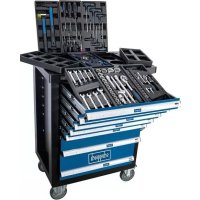
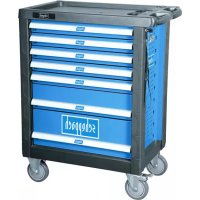
TW1100 - Workshop trolley SCHEPPACH - Free user manual and instructions
Find the device manual for free TW1100 SCHEPPACH in PDF.



User questions about TW1100 SCHEPPACH
0 question about this device. Answer the ones you know or ask your own.
Ask a new question about this device
Download the instructions for your Workshop trolley in PDF format for free! Find your manual TW1100 - SCHEPPACH and take your electronic device back in hand. On this page are published all the documents necessary for the use of your device. TW1100 by SCHEPPACH.
USER MANUAL TW1100 SCHEPPACH
Günzburger Straße 69
D-89335 Ichenhausen
Verehrter Kunde,
Homepage: https://www.scheppach.com/de/service
Table of contents: Page:
- Introduction 14
- Device description 14
- Scope of delivery 14
- Proper use 14
- Safety instructions 14
- Technical data.. 15
- Before commissioning 15
- Assembly and operation 15
- Cleaning and storage 16
- Disposal and recycling.. 16
- Declaration of conformity 157
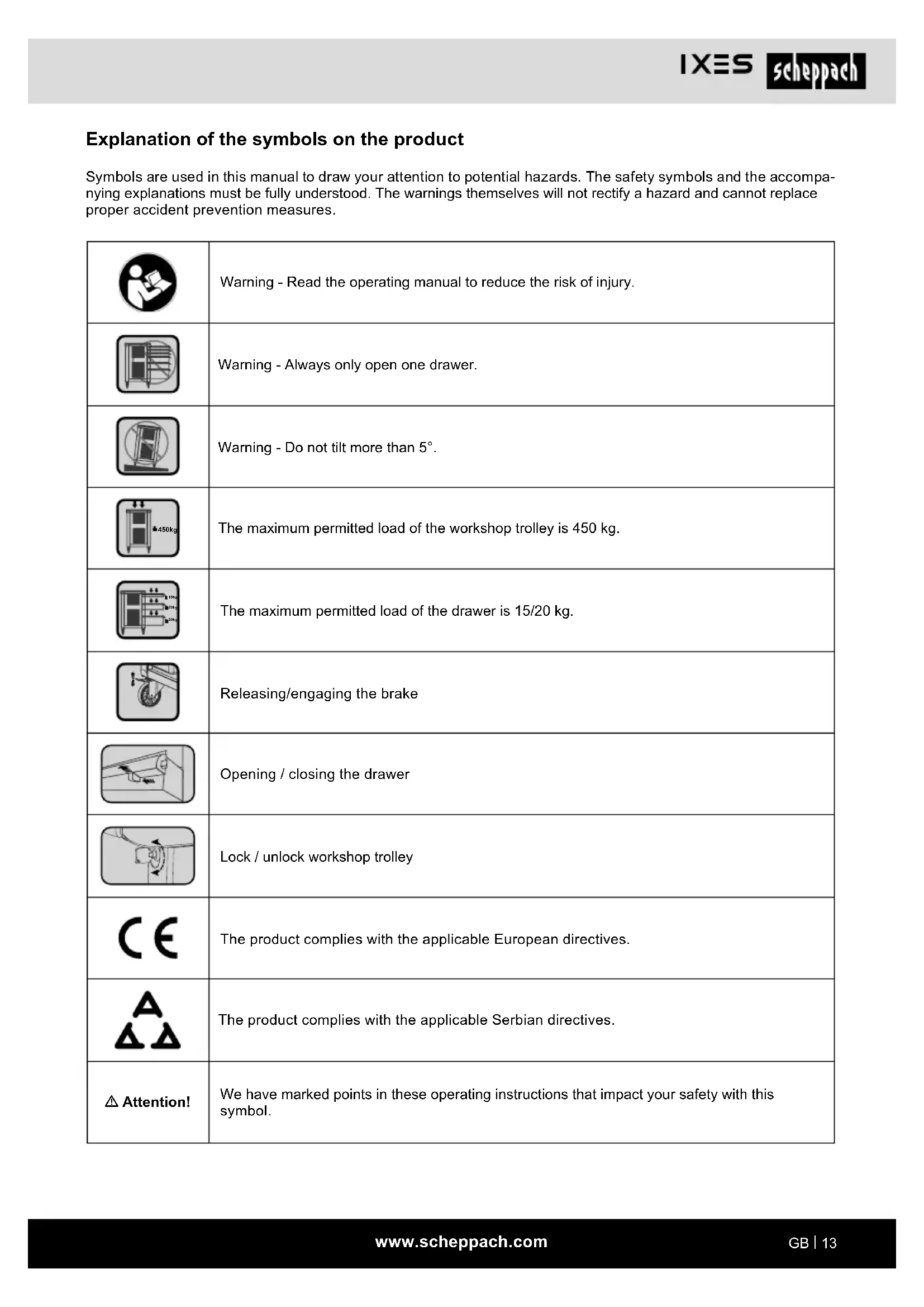
Explanation of the symbols on the product
Symbols are used in this manual to draw your attention to potential hazards. The safety symbols and the accompanying explanations must be fully understood. The warnings themselves will not rectify a hazard and cannot replace proper accident prevention measures.
| Warning - Read the operating manual to reduce the risk of injury. | |
| Warning - Always only open one drawer. | |
| Warning - Do not tilt more than 5°. | |
| The maximum permitted load of the workshop trolley is 450 kg. | |
| The maximum permitted load of the drawer is 15/20 kg. | |
| Releasing/engaging the brake | |
| Opening / closing the drawer | |
| Lock / unlock workshop trolley | |
| The product complies with the applicable European directives. | |
| The product complies with the applicable Serbian directives. | |
| We have marked points in these operating instructions that impact your safety with this symbol. |
1. Introduction
Manufacturer:
Scheppach GmbH
Günzburger Straße 69
D-89335 Ichenhausen
Dear Customer,
We hope your new device brings you much enjoyment and success.
Note:
In accordance with the applicable product liability laws, the manufacturer of this device assumes no liability for damage to the device or caused by the device arising from:
- Improper handling,
- Failure to comply with the operating instructions,
- Repairs carried out by third parties, unauthorised specialists,
- Installing and replacing non-original spare parts,
- Application other than specified.
Note:
The operating manual is part of this product. It includes important instructions for the safe, proper and economic operation of the product, for avoiding danger, for minimising repair costs and downtimes and for increasing the reliability and extending the service life of the product. In addition to the safety instructions in this operating manual, you must also observe the regulations applicable to the operation of the product in your country. Familiarise yourself with all operating and safety instructions before using the product. Only operate the product as described and for the specified areas of application. Keep the operating manual in a good place and hand over all documents when passing the product on to third parties.
2. Device description
- Handle
- Key
- Swivel castor
- Swivel castor with brake
- Fixed wheel
3. Scope of delivery
Workshop trolley
- Swivel castor
- Swivel castor with brake
- Fixed wheels
Fixing screws
Key - Operating manual
4. Proper use
The trolley is designed solely for the storing of tools with a maximum load of 450kg . It is solely intended for private use indoors and is not suitable for commercial applications
Only use the trolley as described in this operating manual. Any other use is considered unintended use and can lead to damage or even injury. The trolley is not a toy. The manufacturer or dealer assumes no liability for damage caused by unintended or improper use.
Please note that our equipment was not designed with the intention of use for commercial or industrial purposes. We assume no guarantee if the device is used in commercial or industrial applications, or for equivalent work.
5. Safety instructions
Danger of injury!
Improper use of the trolley increases the risk of injury.
- Always check the trolley before use. Do not use the trolley if it is damaged.
- Only move the trolley by pushing it to another location. To avoid injury, do not pull the trolley.
- Always ensure the universal machine stand is secure when setting it up.
- Do not climb or stand on the trolley.
- Close and lock all of the drawers before pushing the trolley. Otherwise, the drawers could open while pushing so that the trolley becomes unstable.
- Do not overload the drawers of the trolley.
- Keep the trolley away from children. Do not leave the trolley unattended in the vicinity of children.
- Keep children away whilst assembling the trolley. This product includes screws and other small parts. These could cause asphyxiation if they are swallowed or inhaled.
- The trolley is very heavy when fully loaded. There is a risk of tipping in the event of improper opening. Do not open multiple drawers at the same time.
-
Do not assemble the trolley on a moveable object to avoid tipping.
-
Warning: Only position and operate on a solid, level surface. The trolley can become unstable and tip over if it is kept or pushed on a sloping surface.
- Always block the rotatable castors after the trolley has been pushed to the desired location to prevent the trolley from rolling away.
- Do not make any changes to the trolley. For example, do not weld any external bars and do not attach any electrical devices to the trolley.
- Do not attach or mount the trolley to a vehicle. Do not pull the trolley with a vehicle.
- Only use original spare parts and accessories.
Store these safety instructions safely.
Observe all safety instructions. If you disregard the safety instructions, you endanger yourself and others.
6. Technical data
Total 780 × 460 × 970 mm
| Small drawer | 543 x 58 x 399 mm |
| Payload | 15 kg |
| Medium drawer | 543 x 128 x 399 mm |
| Payload | 20 kg |
| Large drawer | 543 x 195 x 399 mm |
| Payload | 20 kg |
| Weight without tools 49 kg | |
| Weight 58.5 kg | |
| Max. payload 450 kg | |
Subject to technical changes!
7. Before commissioning
Check the device for transport damage. Immediately report any damage to the transport company that delivered the device.
- Open the packaging and carefully remove the device.
- Remove the packaging material, as well as the packaging and transport safety devices (if present).
- Check whether the scope of delivery is complete.
- Check the device and accessory parts for transport damage.
- If possible, keep the packaging until the expiry of the warranty period.
ATTENTION
The device and the packaging are not children's toys! Do not let children play with plastic bags, films or small parts! There is a danger of choking or suffocating!
8. Assembly and operation
Attention!
Always make sure the product is fully assembled before commissioning!
The workshop trolley is largely assembled and you need only fit the wheels as follows:
Fitting the wheels (Fig. 1-3)
- First, remove the tools provided from the trolley.
- Mount the trolley on a sufficiently large and scratchproof surface. If necessary, pad the trolley with packaging material to prevent scratching of the painted surfaces.
- Turn the workshop trolley over and mount the wheels as follows.
- Position the fixed castors (5) at the rear and the rotatable castors (3, 4) at the front (handle side (1)) of the trolley. Line up the holes in the castors with the holes in the trolley.
- Attach the castors to the underside of the trolley using an Allen key. Only use the screws provided for this.
Voltage tester operation (125 to 250V
For detecting AC voltage.
The voltages specified on the voltage tester are rated voltages.
ATTENTION! Danger to life due to electric shock!
- Only use the voltage tester to check voltage.
- Only use the voltage tester in the voltage range from 125 to 250 volts .
- Damaged voltage testers whose function and/or safety is obviously impaired must not be used.
- Only use the voltage tester when it is dry.
- The voltage tester must not be used when exposed to precipitation, e.g. dew or rain.
ATTENTION! Never use the voltage tester as a screwdriver on live system parts.
Before each use:
-
Check the insulation sheath of the voltage tester for damage. Do not use a damaged voltage tester.
-
Check the function of the glow lamp of the voltage tester on a connected socket. Dispose of damaged or malfunctioning voltage testers.
WARNING! Not noticing the light indicator does not guarantee freedom from voltage.
The following factors may affect the perceptibility of the indicator light:
- Unfavourable lighting conditions, e.g. sunlight
- Temperatures outside the range of -10^ to +50^
- Frequencies outside the range of 50 to 500 Hz
- Unfavourable locations such as on wooden stepladders, insulating floor coverings and in AC networks that are not operationally earthed
To determine whether an AC voltage is present, carry out the following steps:
- Hold the tip of the voltage tester against a contact of the electric lead and
- touch the other end of the voltage tester with a finger.
If AC voltage is present, the glow lamp lights up.
9. Cleaning and storage
1. Cleaning
Risk of damage!
If the trolley is not cleaned properly it may become damaged.
- Do not use an aggressive, abrasive cleaning agent and do not use a solvent, acid or chlorine based cleaning agent.
- Do not use brushes with metallic or nylon bristles and do not use sharp or metallic cleaning utensils such as blades, hard spatulas or similar.
- Use a mild cleaning agent to clean the trolley and a soft, clean towel. Allow the trolley to dry completely after cleaning.
- Remove lubricant and oil with a non-flammable cleaning agent.
Cleaning the voltage tester
If the voltage tester is contaminated during normal use, it can be cleaned with a damp cloth and a household cleaner. Aggressive cleaning agents must not be used for cleaning.
2. Storage
Attention!
Rust could form if the trolley is stored in a damp location. The functionality or carrying capacity of the trolley could therefore be permanently and irreparably impaired.
- Protect the trolley from moisture, direct sunlight and frost.
- Store the trolley in a dry location.
- Keep the trolley away from children.
Voltage tester storage
- Do not expose the voltage tester to direct sunlight.
- If the voltage tester is used in accordance with the operating manual, then no maintenance will be required.
- If the voltage tester does not function properly, send it to the service department for repairs.
10. Disposal and recycling
Notes for packaging


The packaging materials are recyclable. Please dispose of packaging in an environmentally friendly manner.
Notes on the electrical and electronic equipment act (ElektroG)

Waste electrical and electronic equipment does not belong in household waste, but must be collected and disposed of separately!
- Used batteries or rechargeable batteries that are not installed permanently in the old device must be removed non-destructively before disposal! Their disposal is regulated by the battery act.
- Owners or users of electrical and electronic devices are legally obliged to return them after use.
- The end user is responsible for deleting their personal data from the old device being disposed of!
- The symbol of the crossed-out dustbin means that waste electrical and electronic equipment must not be disposed of with household waste.
-
Waste electrical and electronic equipment can be handed in free of charge at the following places: - Public disposal or collection points (e.g. municipal works yards)
-
Points of sale of electrical appliances (stationary and online), provided that dealers are obliged to take them back or offer to do so voluntarily.
- Up to three waste electrical devices per type of device, with an edge length of no more than 25 centimetres, can be returned free of charge to the manufacturer without prior purchase of a new device from the manufacturer or taken to another authorised collection point in your vicinity.
Further supplementary take-back conditions of the manufacturers and distributors can be obtained from the respective customer service.
- If the manufacturer delivers a new electrical device to a private household, the manufacturer can arrange for the free collection of the old electrical device upon request from the end user. Please contact the manufacturer's customer service for this.
These statements only apply to devices installed and sold in the countries of the European Union and which are subject to the European Directive 2012/19/EU. In countries outside the European Union, different regulations may apply to the disposal of waste electrical and electronic equipment.
Table des matieres: Page:
Günzburger Straße 69
D-89335 Ichenhausen
Cher client.
Günzburger Straße 69
D-89335 Ichenhausen, Germania
Egregio cliente,
Günzburger Straße 69
D-89335 Ichenhausen
Geachte klant,
Günzburger Straße 69
Günzburger Straße 69
Günzburger Straße 69
D-89335 Ichenhausen
Vázéný zákazníku,
Günzburger Straße 69
D-89335 Ichenhausen
Vázeny zákaznik,
zelame vam vea zabavy a uspechov pri praci s vaish novym pristrojom.
Upozornenie:
Günzburger Straße 69
D-89335 Ichenhausen
Kedves Ügyfelünk!
Günzburger Straße 69
D-89335 Ichenhausen
Szanowny Kliencie,
Günzburger Straße 69
D-89335 Ichenhausen
Poštovani kupci,
Zelimo vam mnogo zadovoljstva i uspjeha pri radu s novim urejadem.
Napomena:
Prema vazećem njemačkom Zakunu o odgovornosti za proizvode, proizvodač ovog uredaja ne odgovara za stete koje nastanu na ovom uredaju ili koje ovaj uredaj uzrokuje u slućaju:
- nestručne obrade,
- nepridržavanja priručnika za uporabu
- popravaka koje obavlaju neovlăsteni strucnjaci,
- montaže i zamjene neoriginalnih rezervnih djelova,
- nenamienske uporabe.
Vodite računa o sljedecem:
Prirucnik za uporabu sastavni je dio ovog proizvoda.
On sadržava važne napomene za siguran, propisan i ekonomičan rad s proizvodom te za izbjugavanje opasnosti, smanjivanje troškova popravaka i prekida rada te povećavanje pouzdanosti i vijeka trajanja proizvoda.
Osim sigurnosnih propisa iz ovog prisucnika za uporabu morate se svakako pridržavati nacionalnih propisa koji se odnose na rad ovog proizvoda.
Günzburger Straße 69
D-89335 Ichenhausen
Spostovani kupec,
želimo vam veliko veselja in uspeha pri delu z vašo novo napravo.
Napotek:
Günzburger Straße 69
D-89335 Ichenhausen
Austatud klien!
Günzburger Straße 69
D-89335 Ichenhausen
Gerbiamas clientele,
Günzburger Straße 69
D-89335 Ichenhausen, Vacija
Godatais client!
Velam prieku un izdošanos, stradajot ar šo jauno ierici.
Norāde:
Günzburger Straße 69
D-89335 Ichenhausen
Bästa kund!
Günzburger Straße 69
D-89335 Ichenhausen
Arvoisa asiakas,
Günzburger Straße 69
D-89335 Ichenhausen, Tyskland
Kaere kunde,
Günzburger Straße 69
D-89335 Ichenhausen
Kjaere kunde,
Kelaem Bn MHO rnpaTHMOMeHTN ycHexn npna pa6oTata C Baun HOB ype.
Yka3aHHe:
CbIacHO DeIcTBaIIa 3aKOH 3a IpoIyKTOBaT a OTROBOPHOCT, IpON3BOIDTeJIaT Ha To3n ypei He HOCNOTROBOPHOCT 3a UeTI, Bb3HNIKHaII N O INIINopaIITo3n ypeI, npI:
- HenpaBnJIHO 6opabeHe,
- Hecna3BaHe Ha pBkoBOdCTBOTO 3a 06CnyKbaHe,
PemOHnOT HeynbHOMOeHN CneuaNCTN,BAUcN Ce TpeTJNla,
Brgpaxkahe nnoMnaHa Ha He OpunHnHn pe3epBHNyactn, - ynoTpe6a He no npedHa3NaueHne.
B3emete noBHHMaHHe:
PbKOoDCTBOTO 3a yIOTpe6a e cBcTbHa qacr OT To3n npOdyKT. To cbDbpxka BaxHn yKa3aHn r OTHOCHO6eONACHATA, npabINHATA u NKOHOMuHaTa pa60Ta C npOdyKTA, n36yBaHeto Ha onaCHOCTN, cNeCTraBaHTo HA pa3XODn 3a peMOHT, HAmAJIbaHeTO Ha BpeMeHa- Ta Ha npctOn u YBeMnUbaHTo Ha HAdEJHOCTTa EKCnloatauOnHHn XJBOT Ha npOdyKTA. B Donbl- HeHne KbM yKa3AHnRA 3a 6eONachOCT B TOBa pbKoBOdCTBO 3a yNoTpe6a, 3aBnKeTIHo Tp8Ba Da cNa3BaTe OTHAcIuNTe Ce Do ekCnloaTaunrTa Ha npOdyKTA npedncaHn BB BaWata cTpaHa.
Ppei Da n3non3BaTe npoDyKta, 3ano3HaIte ce C Bcunk yka3aHna 3a pa60Ta u 6e3oNaChocT. N3non3- BaIte npoDyKta cAmO KaKTo e OnUcaHO u 3a noCooHne oblaCTn Ha yNoTpe6a. CbXpaHraBaIte pBkoBOdCTBOTO 3a yNoTpe6a Ha cnrypHo MrcTo u npedabaTe BCnKn DOKymEnTu, KOrATo npedabaTe npoDyKta Ha TpeTI Nua.
2. Onicahne Ha ypeda
- PbKOXBaTKa
- Knioy
- POKKa Ha KOPMnHnTe npedABKn
- Pɔjka ha kopmnnHte npedabkn cbc cnipauka
- HenoDbnKHo KoneNo
3. 06em Ha doctabkaTa
KoIuKa 3a pa6oTnHnHa
- PoIka Ha KOpMnIHNe npeDaBKn
- Pɔnka Ha KoprMnHnTe npedabKn cBc cnupaKa
- HenoDbNkHn KoneJa
- CkpennntnBuHTOBe
Knou
pBkoBOCTBO3aynotpe6a
BHIMAHHE! Onachoc3a kHBOTA ot TOKOB yap!
- Изразытей Тостера за наржени само за поворека на наржени.To.
- ɪnənɪ3Baɪte TecTepea 3a HʌnpexeHne cʌmɒ B ᶅnɪanəzɔHa Ha HʌnpexeHneTo oT 125 do 250 Bɔnta ~.
He Tp8Ba Da ce n3noJ3BaT DeΦeKTHn TeCTepn 3a HappeKeHne, yraTo cyHKun n/nn 6e3oNaCHOCT ca ouebuHn HApUWeHn. - 3no3BaIte Tectepa 3a HanpeXeHne cMo Ha cyxo.
- TectepbT 3a HanpexKeHne He Tpr6Ba Da ce n3non3Ba, KOrato e noDIOXeH Ha BaJeKn, HApPmEp poca nn DbXd.
BHIMAHHE! HnKora He n3noJ3BaIte Tectepa 3a HanpeXeHne KaTO OTBepTKa 3a YactHTe Ha CnTeMaTApoHapXeHne.
PpeiBcKa ynoTppe6a:
Günzburger Straße 69
D-89335 Ichenhausen
Agiotie TLaatn,
Zaç EUXóμaOte va aTIOλaʊoTe Tn VEA aOc OuaKEun KAI VA exETe Kaλa aTOnEλεσμata KAτa Tn xpθon Tns.
Yπóδειξη:
O kataaekuaotnc autng tsoukeunc dev eueuvetai ouuwa vtov iayovta vopo Tepi euhuvnc poiovtwyia nmuic, Tou Ppokalouvtai oe autn tn ouoKEun n atto autn tn ouokeun otis egns peittwoeic:
akataaannn eaeaeipion,
TapablaewnTwvEvToawxεipeioou,
- ETIOKEUEc aTIO TpIouc, mN EGSOUIOOOTnEvouc TEYVIKOUc,
TOTTOETnon kaiavtikataoataon un yvnoiw avtaa AAKIKOW,
- μη ενδεδειγμένη xρήση.
Ppooεξε:
Oi oyniec xeiipiaou aantoaleouv mepoc autou tou TPOIOVTOG. Nepiexouv onmuavtkec utoideieic yia va epyaceote ME TO TPOIOV ME aopalaia, ootai kai oikovouka kai ia v a tnopeuvete KIVDuvouc, va eoiokovoeite eo0a ETIAKEUNCS, VA MEIWETe Touc Xpovous EKTOs diaoteiOTNTAC Kai va auagaveTe Tnv aIOTTIa kai tn diapkeia zwnc tou TPOIOVTOG. EITINPOothea OTOUC KAVOECAOPAeiaac otis napouoe c obnyiecs xeiipiaou, PPETeiv aauabaveTe OTWOONTOTE UTOYN OAC TIC DIATAEIG Toun IOXouv OTN Xwpa Oac YTA Tn AIEIoupyia Tou TPOIOVTOG.
Piv T xpnTou Tpoiovtoc EsoikeiWtheta ie oAeC TIG UTOBcEic Xepiaou kai aopaaiaac. XpnoiptoieTe To PPOIOV MOVOV OTWC TEPiYPaPcTai kai VIA TOUG AVa-opepuovc ToeiC XpOnc. DuAeTE PE aopaaia Tc OOnyies Xepiaou kai OE TEPiTTwn eTaibBaanC Tou TPOIOVTOs Napawote paizkai oA ta Evypapa.
Günzburger Straße 69
D-89335 Ichenhausen
Stimate client,
Vä dorim sa avei multe satisfactii si mult succes in lucrul cu noul dumneavoastraparat.
Indicatie:
Günzburger Straße 69
D-89335 Ichenhausen
Postovani kupce,
Günzburger Straße 69
D-89335 Ichenhausen
ithalatc:
Ankara Civata Hirdavat Baglanti Elemanlari Ithalat Ihracat Sanayi ve Ticaret A.S.
Macun Mahallesi 250. Cadde No:26
Yenimahalle/Ankara/Turkiye
Sayin Musterimiz,
7. Isletime almadan once
Tertibati tasima hasarlarina karst kontrl edin. Olasi hasarlari, tertibati teslim eden tasima sirketine derhal bildirin.
Apparent defects must be notified within 8 days from the receipt of the goods. Otherwise, the buyer loses its rights of claim due to such defects are invalidated. We guarantee for our machines in case of proper treatment for the time of the statutory warranty period from delivery in such a way that we replace any machine part free of charge which provably becomes unusable due to faulty material or defects of fabrication within such period of time. With respect to parts not manufactured by us we only warrant insofar as we are entitled to warranty claims against the upstream suppliers. The costs for the installation of the new parts shall be borne by the buyer. The cancellation of sale or the reduction of purchase price as well as any other claims for damages shall be excluded.
Garantie FR
Apparent defects must be notified within 8 days from the receipt of the goods. Otherwise, the buyer's rights of claim due to such defects are invalidated. We guarantee for our machines in case of proper treatment for the time of the statutory warranty period from delivery in such a way that we replace any machine part free of charge which provably becomes unusable due to faulty material or defects of fabrication within such period of time. With respect to parts not manufactured by us we only warrant insofar as we are entitled to warranty claims against the upstream suppliers. The costs for the installation of the new parts shall be borne by the buyer. The cancellation of sale or the reduction of purchase price as well as any other claims for damages shall be excluded.
Záruka CZ
Apparent defects must be notified within 8 days from the receipt of the goods. Otherwise, the buyer's rights of claim due to such defects are invalidated. We guarantee for our machines in case of proper treatment for the time of the statutory warranty period from delivery in such a way that we replace any machine part free of charge which provably becomes unusable due to faulty material or defects of fabrication within such period of time. With respect to parts not manufactured by us we only warrant insofar as we are entitled to warranty claims against the upstream suppliers. The costs for the installation of the new parts shall be borne by the buyer. The cancellation of sale or the reduction of purchase price as well as any other claims for damages shall be excluded.
Garantii EE
Apparent defects must be notified within 8 days from the receipt of the goods. Otherwise, the buyer's rights of claim due to such defects are invalidated. We guarantee for our machines in case of proper treatment for the time of the statutory warranty period from delivery in such a way that we replace any machine part free of charge which provably becomes unusable due to faulty material or defects of fabrication within such period of time. With respect to parts not manufactured by us we only warrant insofar as we are entitled to warranty claims against the upstream suppliers. The costs for the installation of the new parts shall be borne by the buyer. The cancellation of sale or the reduction of purchase price as well as any other claims for damages shall be excluded.
raapanu BG
OeBnH HeoctaTbun Tp86Ba Da 6bDaT DOKnAdbAHn B pAMKITE Ha 8 dHn OT NOLyBaHeTo HA CTOKN, B npoTNBE CNUa KynyBaHT rByb BCAKBn PpeTHcnn 3a TaKINBA DepeKtn. PpeIraIame RapaHcna Ha HauIne MaunH C npabUNHO ToeHne Ha cPoka Ha deCTBne Ha KocBeHa rapAHcna ot DaTaTa Ha DocTabKa No TaKB HauH, Ye Hne 3aMeHN BcRA KaCt B pAMKITE Ha TOB A BpeMe OkPnBa B eDIN B MaTePnAna IIN IIN 3pa60TKaTa Tp6Ba Da 6bDe 6e3NoE3Ho, 6e3nLaTHo. 3a ChTn, KOtu Hne He Ce npOn3BexKaDAt, Hne npABIM CAMO KAto rapaHcna, KATO IMMame npabo Ha rapAHcnoHHN NCKOBe Cpeu YoocTabu. PaXoJnte 3a BMkBbaHe Ha HOB NaCTn Ha KynyBaHa. Ppeo6pa3yBaHe n HamaJIraBaHe B3emAHn n Dpyr NckOBe 3a ObeseTeHn, ca NkIOueHn.
Garancija RS
Ocigledni nedostaci se moraju prijaviti u roku od 8 dana nakon prijema robe, u suprotnom kopac gubi sva prava u pogledu takvih nedostataka. Za naše masi ne dajemo garanciju tokom trajanja zakonskog garantnog roka od datuma primopredaje, pod uslovom da se sa njima pravilno rukjupe, na taj način besplatno vrśimo zamenu svakog dela masine koji tokom tog perioda postane neupotrebljiv usled greške u materijalu ili proizvodnj. Za delove koje ne proizvodimo sami, dajemo garanciju samo u okviru ostvarivanja garantnih prava koja dobijamo od poddobavljača. Troškove za ugradnju novih delova snosi kopac. Pravo na zamenu i umanjenje i drugi zahtevi za nadoknadu štete su isklučeni.
Garantie RO
- Verehrter Kunde,
- Table of contents: Page:
- Explanation of the symbols on the product
- Introduction
- Manufacturer:
- Dear Customer,
- Note:
- Device description
- Scope of delivery
- Proper use
- Safety instructions
- Danger of injury!
- Technical data
- Before commissioning
- ATTENTION
- Assembly and operation
- Attention!
- Fitting the wheels (Fig. 1-3)
- Voltage tester operation (125 to 250V
- ATTENTION! Danger to life due to electric shock!
- ATTENTION! Never use the voltage tester as a screwdriver on live system parts.
- Before each use:
- WARNING! Not noticing the light indicator does not guarantee freedom from voltage.
- The following factors may affect the perceptibility of the indicator light:
- To determine whether an AC voltage is present, carry out the following steps:
- Cleaning and storage
- Cleaning
- Risk of damage!
- Cleaning the voltage tester
- Storage
- Voltage tester storage
- Disposal and recycling
- Notes for packaging
- Notes on the electrical and electronic equipment act (ElektroG)
- Table des matieres: Page:
- Cher client.
- Egregio cliente,
- Geachte klant,
- Vázéný zákazníku,
- Vázeny zákaznik,
- Upozornenie:
- Kedves Ügyfelünk!
- Szanowny Kliencie,
- Poštovani kupci,
- Napomena:
- Vodite računa o sljedecem:
- Spostovani kupec,
- Napotek:
- Austatud klien!
- Gerbiamas clientele,
- Godatais client!
- Norāde:
- Bästa kund!
- Arvoisa asiakas,
- Kaere kunde,
- Kjaere kunde,
- Yka3aHHe:
- B3emete noBHHMaHHe:
- Onicahne Ha ypeda
- 06em Ha doctabkaTa
- BHIMAHHE! Onachoc3a kHBOTA ot TOKOB yap!
- BHIMAHHE! HnKora He n3noJ3BaIte Tectepa 3a HanpeXeHne KaTO OTBepTKa 3a YactHTe Ha CnTeMaTApoHapXeHne.
- PpeiBcKa ynoTppe6a:
- Agiotie TLaatn,
- Yπóδειξη:
- Ppooεξε:
- Stimate client,
- Indicatie:
- Postovani kupce,
- ithalatc:
- Sayin Musterimiz,
- Isletime almadan once
- Garantie FR
- Záruka CZ
- Garantii EE
- raapanu BG
- Garancija RS
- Garantie RO
Brand : SCHEPPACH
Model : TW1100
Category : Workshop trolley