
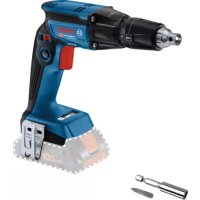
GTB 18V45 Professional - Screwdriver BOSCH - Free user manual and instructions
Find the device manual for free GTB 18V45 Professional BOSCH in PDF.
 FR
FR
 BG
BG
 CS
CS
 DA
DA
 DE
DE
 EL
EL
 EN
EN
 ES
ES
 ET
ET
 FI
FI
 HU
HU
 IT
IT
 KK
KK
 KO
KO
 LT
LT
 LV
LV
 MK
MK
 NL
NL
 NO
NO
 PL
PL
 PT
PT
 RO
RO
 RU
RU
 SK
SK
 SL
SL
 SV
SV
 TR
TR
 UK
UK
| Product Type | Cordless Screwdriver |
| Brand | Bosch |
| Model | GTB 18V45 Professional |
| Rated Voltage | 18 V |
| No-load Speed | 0 – 4,500 rpm |
| Max Torque (Soft Screwdriving) according to ISO 5393 | 6.0 Nm |
| Tool Holder | Hex socket 1/4" |
| Max Screw Diameter | 6 mm |
| Weight | 1.3 – 2.3 kg (depending on battery) |
| Recommended Charging Temperature | 0 °C to +35 °C |
| Operating and Storage Temperature | -20 °C to +50 °C |
| Recommended Batteries | GBA 18V..., ProCORE18V... |
| Recommended Chargers | GAL 18..., GAX 18..., GAL 36... |
| Sound Pressure Level | 79 dB(A) |
| Sound Power Level | 87 dB(A) |
| Vibrations (Screwdriving) | a_h < 2.5 m/s², K = 1.5 m/s² |
| Main Features | PowerSAVE mode, retractable depth stop, LED lighting, belt clip, overload and deep discharge protection |
| Maintenance and Cleaning | Clean ventilation slots, remove battery before any intervention |
| Safety | Read safety instructions carefully, use personal protective equipment, do not modify the battery |
| Spare Parts and Repairability | Bosch after-sales service, spare parts available, repair within 5 days via SAV DIRECT |
| General Information | User manual available in multiple languages, user questions possible |
Frequently Asked Questions - GTB 18V45 Professional BOSCH
User questions about GTB 18V45 Professional BOSCH
0 question about this device. Answer the ones you know or ask your own.
Ask a new question about this device
Download the instructions for your Screwdriver in PDF format for free! Find your manual GTB 18V45 Professional - BOSCH and take your electronic device back in hand. On this page are published all the documents necessary for the use of your device. GTB 18V45 Professional by BOSCH.
USER MANUAL GTB 18V45 Professional BOSCH
www.bosch-pt.com/serviceaddresses
Transport
General Power Tool Safety Warnings
WARNING
Read all safety warnings, instructions, illustrations and specifications.
tions provided with this power tool. Failure to follow all instructions listed below may result in electric shock, fire and/or serious injury.
Save all warnings and instructions for future reference.
The term "power tool" in the warnings refers to your mains-operated (corded) power tool or battery-operated (cordless) power tool.
Work area safety
- Keep work area clean and well lit. Cluttered or dark areas invite accidents.
- Do not operate power tools in explosive atmospheres, such as in the presence of flammable liquids, gases or dust. Power tools create sparks which may ignite the dust or fumes.
- Keep children and bystanders away while operating a power tool. Distractions can cause you to lose control.
Electrical safety
Power tool plugs must match the outlet. Never modify the plug in any way. Do not use any adapter plugs with earthed (grounded) power tools. Unmodified plugs and matching outlets will reduce risk of electric shock. Avoid body contact with earthed or grounded surfaces, such as pipes, radiators, ranges and refrigerators. There is an increased risk of electric shock if your body is earthed or grounded. Do not expose power tools to rain or wet conditions. Water entering a power tool will increase the risk of electric shock. Do not abuse the cord. Never use the cord for carrying, pulling or unplugging the power tool. Keep cord away from heat, oil, sharp edges or moving parts. Damaged or entangled cords increase the risk of electric shock. When operating a power tool outdoors, use an extension cord suitable for outdoor use. Use of a cord suitable for outdoor use reduces the risk of electric shock. If operating a power tool in a damp location is unavoidable, use a residual current device (RCD) protected supply. Use of an RCD reduces the risk of electric shock.
Personal safety
Stay alert, watch what you are doing and use common sense when operating a power tool. Do not use a power tool while you are tired or under the influence of drugs, alcohol or medication. A moment of inattention while operating power tools may result in serious personal injury. Use personal protective equipment. Always wear eye protection. Protective equipment such as a dust mask, non-skid safety shoes, hard hat or hearing protection used for appropriate conditions will reduce personal injuries. Prevent unintentional starting. Ensure the switch is in the off-position before connecting to power source and/or battery pack, picking up or carrying the tool. Carrying power tools with your finger on the switch or energising power tools that have the switch on invites accidents. Remove any adjusting key or wrench before turning the power tool on. A wrench or a key left attached to a rotating part of the power tool may result in personal injury. Do not overreach. Keep proper footing and balance at all times. This enables better control of the power tool in unexpected situations. Dress properly. Do not wear loose clothing or jewellery. Keep your hair and clothing away from moving parts. Loose clothes, jewellery or long hair can be caught in moving parts. If devices are provided for the connection of dust extraction and collection facilities, ensure these are connected and properly used. Use of dust collection can reduce dust-related hazards.
connected and properly used. Use of dust collection can reduce dust-related hazards.
Do not let familiarity gained from frequent use of tools allow you to become complacent and ignore tool safety principles. A careless action can cause severe injury within a fraction of a second.
Power tool use and care
Do not force the power tool. Use the correct power tool for your application. The correct power tool will do the job better and safer at the rate for which it was designed. Do not use the power tool if the switch does not turn it on and off. Any power tool that cannot be controlled with the switch is dangerous and must be repaired. - Disconnect the plug from the power source and/or remove the battery pack, if detachable, from the power tool before making any adjustments, changing accessories, or storing power tools. Such preventive safety measures reduce the risk of starting the power tool accidentally. - Store idle power tools out of the reach of children and do not allow persons unfamiliar with the power tool or these instructions to operate the power tool. Power tools are dangerous in the hands of untrained users. - Maintain power tools and accessories. Check for misalignment or binding of moving parts, breakage of parts and any other condition that may affect the power tool's operation. If damaged, have the power tool repaired before use. Many accidents are caused by poorly maintained power tools. - Keep cutting tools sharp and clean. Properly maintained cutting tools with sharp cutting edges are less likely to bind and are easier to control. - Use the power tool, accessories and tool bits etc. in accordance with these instructions, taking into account the working conditions and the work to be performed. Use of the power tool for operations different from those intended could result in a hazardous situation. - Keep handles and grasping surfaces dry, clean and free from oil and grease. Slippery handles and grasping surfaces do not allow for safe handling and control of the tool in unexpected situations.
Battery tool use and care
- Recharge only with the charger specified by the manufacturer. A charger that is suitable for one type of battery pack may create a risk of fire when used with another battery pack.
- Use power tools only with specifically designated battery packs. Use of any other battery packs may create a risk of injury and fire.
- When battery pack is not in use, keep it away from other metal objects, like paper clips, coins, keys, nails, screws or other small metal objects, that can make a connection from one terminal to another.
Shorting the battery terminals together may cause burns or a fire.
Under abusive conditions, liquid may be ejected from the battery; avoid contact. If contact accidentally occurs, flush with water. If liquid contacts eyes, additionally seek medical help. Liquid ejected from the battery may cause irritation or burns. Do not use a battery pack or tool that is damaged or modified. Damaged or modified batteries may exhibit unpredictable behaviour resulting in fire, explosion or risk of injury. Do not expose a battery pack or tool to fire or excessive temperature. Exposure to fire or temperature above 130°C may cause explosion. Follow all charging instructions and do not charge the battery pack or tool outside the temperature range specified in the instructions. Charging improperly or at temperatures outside the specified range may damage the battery and increase the risk of fire.
Service
Have your power tool serviced by a qualified repair person using only identical replacement parts. This will ensure that the safety of the power tool is maintained. Never service damaged battery packs. Service of battery packs should only be performed by the manufacturer or authorized service providers.
Safety Warnings for Screwdrivers
Hold the power tool by insulated gripping surfaces, when performing an operation where the fastener may contact hidden wiring. Fasteners contacting a "live" wire may make exposed metal parts of the power tool "live" and could give the operator an electric shock. Use suitable detectors to determine if there are hidden supply lines or contact the local utility company for assistance. Contact with electric cables can cause fire and electric shock. Damaging gas lines can lead to explosion. Breaking water pipes causes property damage. Hold the power tool securely. When tightening and loosening screws be prepared for temporarily high torque reactions. Secure the workpiece. A workpiece clamped with clamping devices or in a vice is held more secure than by hand. Always wait until the power tool has come to a complete stop before placing it down. The application tool can jam and cause you to lose control of the power tool. In case of damage and improper use of the battery, vapours may be emitted. The battery can set alight or explode. Ensure the area is well ventilated and seek medical attention should you experience any adverse effects. The vapours may irritate the respiratory system. Do not modify or open the battery. There is a risk of short-circuiting. The battery can be damaged by pointed objects such as nails or screwdrivers or by force applied externally.
An internal short circuit may occur, causing the battery to burn, smoke, explode or overheat.
Only use the battery in the manufacturer's products.
This is the only way in which you can protect the battery against dangerous overload.

Protect the battery against heat, e.g. against continuous intense sunlight, fire, dirt, water and moisture. There is a risk of explosion and short-circuiting.
Product Description and Specifications

Read all the safety and general instructions. Failure to observe the safety and general instructions may result in electric shock, fire and/or serious injury.
Please observe the illustrations at the beginning of this operating manual.
Intended Use
The power tool is intended for driving and loosening screws.
Product Features
The numbering of the product features refers to the diagram of the power tool on the graphics page.
(1) Screwdriver bit (2) Stop sleeve (3) Adjusting sleeve for retractable depth stop (4) Retractable depth stop (5) Rotational direction switch (6) Lock-on button for on/off switch (7) Rechargeable battery (8) Battery release button (9) PowerSAVE on/off button (10) LED to illuminate screwing location (11) PowerSAVE LED indicator (12) On/off switch (13) Handle (insulated gripping surface) (14) Universal bit holder (15) Belt clip a) This accessory is not part of the standard scope of delivery.
Technical Data
| Cordless screwdriver GTB 18V-45 | ||
| Article number | 3601 JK7 0.. | |
| Rated voltage V= 18 | ||
| No-load speedA) | min-1 | 0-4500 |
| Max. torque, soft screwdriv-ing application according to ISO 5393A) | Nm 6.0 | |
Cordless screwdriver GTB 18V-45
| Tool holder ¼" internal | |
| hexagon | |
| Max. screw diameter mm 6 | |
| Weight® | kg 1.3 - 2.3 |
| Recommended ambient tem- perature during charging | °C 0 to +35 |
| Permitted ambient temperat- ure during operation(¯) and during storage | °C -20 to +50 |
| Recommended rechargeable batteries | GBA 18V... ProCORE18V... |
| Recommended chargers GAL 18... | GAX 18.. GAL 36... |
A) Measured at 20 - 25°C with rechargeable battery ProCORE18V 4.0Ah B) Measured with GBA 18V 1.5Ah and ProCORE18V 12.0Ah. C) Limited performance at temperatures < 0°C
Noise/vibration information
Noise emission values determined according to EN 62841-2-2.
Typically, the A-weighted noise level of the power tool is: Sound pressure level 79 dB(A); sound power level 87 dB(A). Uncertainty K = 3 dB.
Wear hearing protection!
Vibration total values ab (triax vector sum) and uncertainty K determined according to EN 62841-2-2:
Impact tightening of fasteners of the maximum capacity of the tool: ah < 2.5 m/s2 , K = 1.5 m/s2
The vibration level and noise emission value given in these instructions have been measured in accordance with a standardised measuring procedure and may be used to compare power tools. They may also be used for a preliminary estimation of vibration and noise emissions.
The stated vibration level and noise emission value represent the main applications of the power tool. However, if the power tool is used for other applications, with different accessories or is poorly maintained, the vibration level and noise emission value may differ. This may significantly increase the vibration and noise emissions over the total working period.
To estimate vibration and noise emissions accurately, the times when the tool is switched off or when it is running but not actually being used should also be taken into account. This may significantly reduce vibration and noise emissions over the total working period.
Implement additional safety measures to protect the operator from the effects of vibration, such as servicing the power tool and accessories, keeping their hands warm, and organising workflows correctly.
Assembly
Before carrying out any work on the power tool (e.g. maintenance, tool change etc.), remove the battery from the power tool. There is risk of injury from unintentionally pressing the on/off switch.
Battery Charging
Use only the chargers listed in the technical data. Only these chargers are matched to the lithium-ion battery of your power tool.
Note: The battery is supplied partially charged. To ensure full battery capacity, fully charge the battery in the charger before using your power tool for the first time.
The lithium-ion battery can be charged at any time without reducing its service life. Interrupting the charging process does not damage the battery.
The lithium-ion battery is protected against deep discharge by the "Electronic Cell Protection (ECP)". When the battery is discharged, the power tool is switched off by means of a protective circuit: The accessory no longer rotates.
Do not continue to press the On/Off switch after the power tool has automatically switched off. The battery can be damaged.
Follow the instructions on correct disposal.
Removing the battery
The battery (7) is equipped with two locking levels to prevent the battery from falling out when pushing the battery release button (8) unintentionally. As long as the battery is inserted in the power tool, it is held in position by means of a spring.
To remove the battery (7), press the release button (8) and pull the battery forward and out of the power tool. Do not use force to do this.
Battery charge indicator
The green LEDs on the battery charge indicator indicate the state of charge of the battery. For safety reasons, it is only possible to check the state of charge when the power tool is not in operation.
Press the button for the battery charge indicator or to show the state of charge. This is also possible when the battery is removed.
If no LED lights up after pressing the button for the battery charge indicator, then the battery is defective and must be replaced.
Battery model GBA 18V...

LEDs Capacity
3x continuous green light 60-100% 2x continuous green light 30-60% 1x continuous green light 5-30%
LEDs Capacity
1x flashing green light 0-5%
Battery model ProCORE18V...

LEDs Capacity
5 × continuous green light 80 - 100 % 4× continuous green light 60 - 80% 3 × continuous green light 40 - 60% 2× continuous green light 20 - 40% 1× continuous green light 5 - 20% 1 × flashing green light 0 - 5 %
Changing the Tool (see figure A)
Before carrying out any work on the power tool (e.g. maintenance, tool change etc.), remove the battery from the power tool. There is risk of injury from unintentionally pressing the on/off switch.
Remove the depth stop (4) from the power tool. Pull the screwdriver bit (1) out. If required, the universal bit holder (14) can also be pulled out and replaced. Use a pair of pliers if necessary.
After changing the tool, reattach the depth stop (4).
Operation
Starting Operation
Inserting the battery
Note: The use of batteries unsuitable for your power tool can lead to malfunctions or damage to the power tool.
Set the rotational direction switch (5) to the middle position to avoid unintentionally switching it on. Insert the charged battery (7) into the handle until you feel it engage and it is flush with the handle.
Setting the rotational direction (see figures E-F)
The rotational direction switch (5) is used to change the rotational direction of the power tool. However, this is not possible while the on/off switch (12) is being pressed.
Clockwise: Slide the rotational direction switch (5) on the left-hand side of the power tool towards the front of the power tool. The rotational direction switch (5) on the right-hand side of the power tool automatically slides backwards.
Anticlockwise: Slide the rotational direction switch (5) on the left-hand side of the power tool backwards (i.e. away from the front of the power tool). The rotational direction switch (5) on the right-hand side of the power tool automatically slides forwards.
Switching on/off
To start the power tool, press and hold the on/off switch (12).
The LED lights up when the on/off switch (12) is lightly or fully pressed, meaning that the work area is illuminated in poor lighting conditions.
Press the lock-on button (6) to lock the on/off switch (12) in this position.
To switch off the power tool, release the on/off switch (12); or, if the switch is locked with the lock-on button (6), briefly press the on/off switch (12) and then release it.
Adjusting the speed
You can adjust the speed of the power tool when it is on by pressing in the on/off switch (12) to varying extents.
A light pressure on the on/off switch (12) results in a low rotational speed. Increased pressure on the switch causes an increase in speed.
Screwing in Screws
To screw in screws, place the screw on the screwdriver bit (1). The screw will be held in place by the magnetic retention force of the universal bit holder (14). Slide the rotational direction switch (5) on the left-hand side of the power tool towards the front of the power tool. Switch the power tool on and push the tip of the screw firmly against the workpiece. The screw is screwed into the workpiece until it reaches the set screw-in depth. The retractable depth stop (4) touches the workpiece and the drive is switched off; the universal bit holder (14) stops turning. Check the screw in depth and readjust the retractable depth stop (4) if necessary.
Adjusting the Screw-in Depth (see figure B)
The depth to which the screw head is screwed into the workpiece can be preset by turning the adjusting sleeve (3).
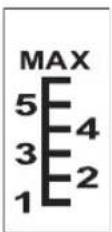
Turn the adjusting sleeve (3) to the position of your required screw-in depth. The number on the scale (visible on the edge of the adjusting sleeve (3)) can be used as a guide for your required screw-in depth.
Turning the adjusting sleeve (3) clockwise increases the screw-in depth; turning it anticlockwise decreases the screw-in depth. Turning the adjusting sleeve (3) beyond the MAX
position will remove it from the stop sleeve (2) completely.
The best way to determine the setting you require is to drive in some test screws.
PowerSAVE mode (see figure C)
To activate PowerSAVE mode, briefly press the PowerSAVE on/off button (9). The PowerSAVE LED indicator (11) will light up. Then briefly press the on/off switch (12) and lock it in place
by pressing the lock-on button (6). The motor is activated/disconnected, even if the on/off switch is pressed. Now push the power tool gently into place to activate the motor.
The PowerSAVE LED indicator (11) will go out if the power tool is unused for 30 minutes. To activate PowerSAVE mode again, disengage the lock by briefly pressing the on/off switch (12). Then press the on/off switch (12) again and
lock it in place with the lock-on button (6). The PowerSAVE LED indicator (11) will light up again.
Retractable depth stop (see figure D)
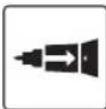
To loosen or unscrew screws, line up the arrows on the adjusting sleeve (3) and on the gearbox of the power tool so that they are opposite one another. Pull the adjusting sleeve (3) backwards until it audibly clicks into
place on the gearbox without any gaps. The screwdriver bit (1) is now clearly visible. The power tool is ready to loosen or unscrew screws.
Slide the rotational direction switch (5) on the left-hand side of the power tool backwards (i.e. away from the front of the power tool). The rotational direction switch (5) on the right-hand side of the power tool automatically slides forwards. Switch on the power tool.
Note: Screws can also be loosened by removing the retractable depth stop (4) completely.
The retractable depth stop (4) cannot be pulled back when the adjusting sleeve (3) is in or above the MAX position.
Temperature-dependent overload protection
In normal conditions of use, the power tool cannot be overloaded. In the event of heavy loading or the temperature rising/falling outside the permitted battery temperature range, the speed will be reduced. The power tool will not run at full speed again until the permitted battery temperature has been reached.
Protection against deep discharge
The lithium-ion battery is protected against deep discharge by the "Electronic Cell Protection (ECP)". When the battery is discharged, the power tool is switched off by means of a protective circuit: The application tool no longer rotates.
Practical advice
Belt clip
You can use the belt clip (15) to hang the power tool on a belt, for example. You then have both hands free and the power tool is always at hand.
Maintenance and Service
Maintenance and Cleaning
Before carrying out any work on the power tool (e.g. maintenance, tool change etc.), remove the battery from the power tool. There is risk of injury from unintentionally pressing the on/off switch. To ensure safe and efficient operation, always keep the power tool and the ventilation slots clean.
After-Sales Service and Application Service
Our after-sales service responds to your questions concerning maintenance and repair of your product as well as spare parts. You can find explosion drawings and information on spare parts at: www.bosch-pt.com
The Bosch product use advice team will be happy to help you with any questions about our products and their accessories.
In all correspondence and spare parts orders, please always include the 10-digit article number given on the nameplate of the product.
Great Britain
Robert Bosch Ltd. (B.S.C.)
P.O.Box 98
Broadwater Park
North Orbital Road
Denham Uxbridge
UB 95HJ
At www.bosch-pt.co.uk you can order spare parts or arrange the collection of a product in need of servicing or repair.
Tel. Service: (0344) 7360109
E-Mail: boschservicecentre@bosch.com
You can find further service addresses at:
www.bosch-pt.com/serviceaddresses
Transport
The recommended lithium-ion batteries are subject to legislation on the transport of dangerous goods. The user can transport the batteries by road without further requirements.
When the batteries are shipped by third parties (e.g. air transport or forwarding agency), special requirements on packaging and labelling (e.g. ADR regulations) must be met. A dangerous goods expert must be consulted when preparing the items for shipping.
Dispatch battery packs only when the housing is undamaged. Tape or mask off open contacts and pack up the battery in such a manner that it cannot move around in the packaging. Please also observe the possibility of more detailed national regulations.
Disposal

Power tools, rechargeable batteries, accessories and packaging should be sorted for environmental-friendly recycling.
Do not dispose of power tools and batteries/re-chargeable batteries into household waste!
Only for EU countries:
Power tools that are no longer suitable for use and defective or used batteries must be disposed of separately. Use the designated collection systems.
If disposed incorrectly, waste electrical and electronic equipment may have harmful effects on the environment and human health, due to the potential presence of hazardous substances.
Only for United Kingdom:
According to The Waste Electrical and Electronic Equipment Regulations 2013 (SI 2013/3113) (as amended) and the Waste Batteries and Accumulators Regulations 2009 (SI 2009/890) (as amended), products that are no longer usable must be collected separately and disposed of in an environmentally friendly manner.
Battery packs/batteries:
Li-ion:
Please observe the notes in the section on transport (see "Transport", page 16).
Français
Robert Bosch (France) S.A.S.
www.bosch-pt.com/serviceaddresses
Transport
Calle Robert Bosch No. 405
C.P. 50071 Zona Industrial, Toluca - Estado de Mexico
Tel.: (52) 55 528430-62
Tel.: 800 6271286
www.bosch-pt.com/serviceaddresses
Transport
www.bosch-pt.com/serviceaddresses
Transport
www.bosch-pt.com/serviceaddresses
Transport
www.bosch-pt.com/serviceaddresses
Transport
Bosch Service Center
Telegrafvej 3
2750 Ballerup
At www.bosch-pt.dk you can order spare parts online or create a repair order.
Service Center Tel.: 44898855
Fax: 44898755
E-Mail: vaerktoej@dk.bosch.com
Further service addresses can be found at:
www.bosch-pt.com/serviceaddresses
Transport
Bosch Service Center
Telegrafvej 3
2750 Ballerup
Denmark
Tel.: (08) 7501820 (within Sweden)
Fax: (011) 187691
Further service addresses can be found at:
www.bosch-pt.com/serviceaddresses
Transport
The recommended lithium-ion batteries are subject to the requirements for dangerous goods. The user can transport the batteries by road without further obligations.
www.bosch-pt.com/serviceaddresses
Transport
www.bosch-pt.com/serviceaddresses
Transport
Intended use
The specified values for vibration and noise are determined according to EN 62841-2-2.
The noise level of the power tool is typically as follows: Sound pressure level 79 dB(A), sound power level 87 dB(A). Uncertainty K = 3 dB.
Wear hearing protection!
Vibration total value a (vector sum of three directions) and uncertainty K determined according to EN 62841-2-2:
Vibration emission value a: <2.5 m/s², K = 1.5 m/s²
The vibration and noise emission values given in these instructions have been measured in accordance with a standardized test method and may be used to compare one power tool with another. They may also be used for a preliminary assessment of exposure.
The vibration and noise emission values represent the main applications of the power tool. However, if the power tool is used for other applications, with different accessories, or is poorly maintained, the vibration and noise emission may differ. This may significantly increase the exposure level over the total working period.
For an accurate estimation of the vibration and noise exposure, the periods when the tool is switched off or when it is running but not actually being used should also be taken into account. This may significantly reduce the exposure level over the total working period.
Therefore, before starting the work, appropriate safety measures should be identified to protect the operator.
Operator advice: Keep the power tool and its accessories in good condition, keep the handles dry, clean, and free from oil and grease.
Declaration of Conformity
Always use the power tool with the auxiliary handle (e.g., side handle, additional handle). In case of an emergency, the ON/OFF switch can be turned off immediately.
Battery charging
Use only the chargers listed in the technical specifications. Only these chargers are approved for the lithium-ion battery used in the power tool.
Note: The battery is supplied partially charged. To ensure full battery capacity, charge the battery in the charger before first use.
The lithium-ion battery can be charged at any time without reducing its service life. Do not interrupt the charging process. The battery is protected against deep discharge by the "Electronic Cell Protection (ECP)". In case of a discharged battery, the power tool switches off via a protective circuit: The tool no longer moves. After the automatic shutdown, do not continue to press the ON/OFF switch. The battery may be damaged.
Maintenance and service
The following section answers questions about the device and its operation, as well as spare parts. For spare parts and information, see the online address: www.bosch-pt.com
The Bosch service team will gladly answer your questions about our products and their accessories.
For all questions and spare parts orders, please always specify the 10-digit article number given on the type plate of the product.
Greece
Robert Bosch A.E.
Erythreas 37
19400 Koropi-Athens
Tel: 2105701258
Fax: 2105701283
Email: pt@gr.bosch.com
www.bosch.com
www.bosch-pt.gr
Please also observe the safety instructions enclosed.
www.bosch-pt.com/serviceaddresses
Transport
The contained lithium-ion batteries are subject to the Dangerous Goods Legislation requirements. The user can transport the batteries by road without further requirements.
When transport is carried out by third parties (e.g.: air transport or forwarding agency), the requirements on packaging and labelling must be observed. When preparing the item for shipping, consult an expert for hazardous material.
Only dispatch the battery if the housing is undamaged. Tape or mask off open contacts and pack up the battery such that it cannot move around in the packaging.
Please also observe possibly more detailed national regulations.
Disposal

Power tools, batteries, accessories and packaging should be sorted for environment-friendly recycling.
Do not dispose of power tools and batteries into household waste!
Only for EU countries:
According to the European Directive 2012/19/EU, power tools that are no longer usable, and according to the European Directive 2006/66/EC, defective or used battery packs/batteries, must be collected separately and disposed of in an environment-friendly manner.
Waste batteries and rechargeable batteries must not be disposed of with household waste. They can contain toxic substances that are harmful to the environment and human health. Please dispose of them separately in accordance with the relevant regulations.
Batteries/Rechargeable batteries:
Li-Ion:
Please note the instructions in the section on Transport (see "Transport", page 73).
Turkish
Safety instructions
General power tool safety warnings
WARNING
Continuous light 2× green 20-40%
Continuous light 1× green 5-20%
Flashing light 1× green 0-5%
Changing the tool (see figure A)
www.bosch-pt.com/serviceaddresses
Transport
Continuous light, 2 green LEDs 30-60%
Continuous light, 1 green LED 5-30%
Flashing light, 1 green LED 0-5%
Battery type ProCORE18V...


LEDs Capacity
Continuous light, 5 green LEDs 80-100%
Continuous light, 4 green LEDs 60-80%
Continuous light, 3 green LEDs 40-60%
Continuous light, 2 green LEDs 20-40%
Continuous light, 1 green LED 5-20%
Flashing light, 1 green LED 0-5%
Robert Bosch Sp. z o.o.
www.bosch-pt.com/serviceaddresses
Transport
Bosch Service Center PT
K Vapence 1621/16
692 01 Mikulov
You can order the repair of your machine or spare parts online at www.bosch-pt.cz.
www.bosch-pt.com/serviceaddresses
Transport
Recommended lithium-ion batteries are subject to the requirements of the law on dangerous substances. These
batteries can be transported by the user by road without further conditions.
www.bosch-pt.com/serviceaddresses
Transport
www.bosch-pt.com/serviceaddresses
Transport
Be careful, watch what you are doing and use common sense when working with a power tool. Do not use a power tool while you are tired or under the influence of drugs, alcohol or medication. A moment of inattention while working with a power tool may result in serious personal injury. Use personal protective equipment. Always wear eye protection. Protective equipment such as dust mask, non-skid safety shoes, hard hat, or hearing protection used for appropriate conditions will reduce personal injuries. Prevent unintentional starting. Ensure the switch is in the off-position before connecting to power source and/or battery pack, picking up or carrying the tool. Carrying power tools with your finger on the switch or energising power tools that have the switch on invites accidents.
And connecting to the power source of an energized power tool can lead to accidents.
Install the tool and the inserted keys to turn on the power tool. The tool or key that is in a rotating part of the power tool can lead to injuries. Do not take an unnatural body position. Always maintain a stable position and balance. This allows you to better control the power tool in unexpected situations. Wear suitable work clothing. Do not wear loose clothing or jewelry. Keep your hair away from moving parts. Loose clothing, jewelry, or long hair can be caught in moving parts. If dust extraction and collection equipment can be installed, make sure it is properly connected and used. Using dust extraction can reduce dust-related hazards. Good knowledge of power tools, gained through frequent use, should not lead to overconfidence and ignoring the safety rules for handling power tools. One careless action within a fraction of a second can lead to serious injuries. ATTENTION! In case of a power tool malfunction due to full or partial power supply interruption or damage to the control circuit, set the switch to the off position and make sure it is not locked (if it has a lock). Disconnect the plug from the socket and disconnect the battery. This prevents uncontrolled restart. Work may only be performed by trained personnel in accordance with this manual, who are familiar with the setup, assembly, commissioning, and operation of the power tool. Persons under 18 years of age are not allowed to work with the power tool unless they have studied the technical description, the operating instructions, and the safety rules. This device is not intended for use by persons (including children) with reduced physical, sensory, or mental capabilities, or lack of experience and knowledge, unless they are under supervision or have been instructed on the use of the power tool by a person responsible for their safety.
Use of the power tool and handling it
Do not overload the power tool. Use the appropriate power tool for the job. With the right power tool, you will work better and safer in the specified power range.
When working with a power tool, do not use it if the switch is defective. A power tool that cannot be turned on or off is dangerous and must be repaired. Before adjusting the power tool, changing accessories, or storing the power tool, disconnect the plug from the power source and/or remove the battery pack, if possible. This precaution prevents unintentional starting of the power tool. Store power tools out of the reach of children. Do not allow persons who are not familiar with the power tool or who have not read these instructions to operate the power tool. Power tools are dangerous in the hands of inexperienced users. Maintain power tools and accessories carefully. Check for misalignment or binding of moving parts, breakage of parts, and any other condition that may affect the operation of the power tool. If damaged, have the power tool repaired before use. Many accidents are caused by poorly maintained power tools. Keep cutting tools sharp and clean. Properly maintained cutting tools with sharp cutting edges are less likely to bind and are easier to control. Use the power tool, accessories, and tool bits, etc., in accordance with these instructions, taking into account the working conditions and the work to be performed. Use of the power tool for operations different from those intended could result in a hazardous situation. Keep handles and grasping surfaces dry, clean, and free from oil and grease. Slippery handles and grasping surfaces do not allow for safe handling and control of the tool in unexpected situations.
Battery tool use and care
Recharge only with the charger specified by the manufacturer. A charger that is suitable for one type of battery pack may create a risk of fire when used with another battery pack. Use power tools only with specifically designated battery packs. Use of any other battery packs may create a risk of injury and fire. When battery pack is not in use, keep it away from other metal objects, like paper clips, coins, keys, nails, screws
or other small metal objects, that can make a connection from one terminal to another. Shorting the battery terminals together may cause burns or a fire.
If battery fluid comes into contact with skin, it can cause injury. Avoid contact with the fluid. If the fluid gets into your eyes, rinse them with water and seek medical attention immediately. Battery fluid can cause skin irritation or burns. Do not use damaged or modified batteries or tools. Damaged or modified batteries may behave unpredictably, which can lead to fire, explosion, or risk of injury. Do not place the battery or tool near fire or expose them to high temperatures. Fire or temperatures above 130°C may cause an explosion. Follow all charging instructions and do not charge the battery or tool outside the temperature range specified in the instructions. Incorrect charging or charging at temperatures outside the specified range may damage the battery and increase the risk of fire.
Service
Repair of the power tool must be carried out only by qualified personnel and only with original spare parts. This ensures the safety of the power tool. Never service damaged batteries. Servicing of batteries should only be performed by the manufacturer or an authorized service organization.
Safety instructions for screwdrivers
When performing work where the screw may encounter hidden electrical wiring, hold the tool by insulated surfaces. Contact with a live wire may energize metal parts of the tool and result in electric shock. Use appropriate detectors to locate hidden pipes or wires, or contact the local utility company. Contact with electrical wiring can lead to fire and electric shock. Damage to gas pipes can lead to explosion. Damage to water pipes causes property damage. Hold the power tool firmly. When tightening or loosening screws, high reaction torques may occur momentarily.
Secure the workpiece. A workpiece held in a vise or clamping device is more secure than held in your hand. Wait until the power tool has come to a complete stop before releasing it. The tool may jam, which can lead to loss of control. During use, the battery may leak fluid. The battery may ignite or explode. Ensure fresh air supply and consult a doctor if discomfort occurs. Gases may irritate the respiratory tract. Do not make any modifications to the battery or open it. This creates a risk of short circuit. Sharp objects such as nails or screwdrivers, as well as external force, can damage the battery, which may lead to internal short circuit, fire with smoke, explosion, or overheating of the battery. Use the battery only in the product specified by the manufacturer. Only then is the battery protected against dangerous overload.
WARNING: Read all safety warnings and all instructions. Failure to follow the warnings and instructions may result in electric shock, fire and/or serious injury. Save all warnings and instructions for future reference.
Product Description and Specifications

Read all safety warnings and all instructions. Failure to follow the warnings and instructions may result in electric shock, fire and/or serious injury.
Please read the operating instructions at the beginning of the manual.
Intended Use
This power tool is intended for driving and removing screws.
Illustrated Components
The numbering of the components refers to the illustration of the power tool on the graphic page.
(1) Bit holder (2) Depth stop (3) Depth stop adjustment (4) Depth stop release
(5) Direction of rotation selector (6) On/off switch (7) Battery (8) Battery release button (9) PowerSAVE button (10) Work light (11) PowerSAVE indicator (12) Switch (13) Handle (with insulated gripping surface) (14) Universal bit holder (15) Screwdriver bit
a) These accessories are not included in the standard delivery.
Technical Data
If the battery charge indicator does not light up after pressing the button, or if the indicator light is not on, the battery is defective and must be replaced.
For battery GBA 18V...

Light output
Continuous light 3 × 60 - 100%
Continuous light 2 × 30 - 60%
Continuous light 1 × 5 - 30%
Flashing green light 1 × 0 - 5%
Battery ProCORE18V...

Light capacity
Continuous light 5 × 80 - 100%
Continuous light 4 × 60 - 80%
Continuous light 3 × 40 - 60%
Light capacity
Continuous light 2 × 20 - 40%
Continuous green light 1 × 5 - 20%
Flashing green light 1 × 0 - 5%
Replacing the tool (see Fig. A)
Before performing any work on the power tool (e.g. maintenance, changing the tool, etc.), remove the battery from the power tool. There is a risk of injury if the switch is accidentally pressed.
CHINMITE ORPAHUYNTB Iy6HbI (4) C3NEKTPONHCTpyMeHTa. HABNEKITE 6HTY-HacAnky (1). PnH eOxOHNMOCTN yHINBepCaHBi DEpKaTeNB 6HT-HacAnOK (14) MOXHO TaKKe CHRTb H3aMeHHTb. Pn H eOxOHNMOCTN HcONb3yTe NIOCKORY6bI.
After completing the replacement, switch the tool back on. Attach the depth stop (4).
Working with the tool
Switching on the electric tool
Inserting the battery
Note: Using batteries not intended for this electric tool can lead to malfunction or damage to the electric tool.
Set the direction switch (5) to the middle position to prevent accidental starting. Insert the charged battery (7) into the handle until it clicks into place and is flush with the handle.
Selecting the direction of rotation (see figures E-F)
The direction of rotation of the electric tool can be changed using the direction switch (5). However, this is not possible when the switch (12) is pressed.
Clockwise rotation: Press the direction switch (5) to the left towards the front of the electric tool. The direction switch (5) automatically returns to the right.
Counterclockwise rotation: Press the direction switch (5) to the right (i.e., towards the rear of the electric tool).
The direction switch (5) automatically returns to the front.
Switching on/off
To switch on the electric tool, press the switch (12) and keep it pressed.
The light turns on when the switch (12) is partially or fully pressed, allowing you to illuminate the work area when lighting conditions are poor.
Long-reach switch (12) with depth stop (6).
To switch on the depth stop, press the switch (12) and, if it is locked with the depth stop (6), press briefly on the switch (12) and then release it.
Setting the speed
The speed of the switched-on power tool can be adjusted smoothly by varying the pressure on the switch (12).
Light pressure on the switch (12) results in a low speed. Increasing the pressure increases the speed.
Screwing in screws
To screw in a screw, insert the screw into the bit holder (1). The screw is held by the magnet located in the universal bit holder (14). Set the direction of rotation switch (5) to the forward position. Switch on the power tool and press the screw against the workpiece. The screw is screwed into the workpiece to the set depth. The depth stop (4) touches the workpiece and the drive disengages; the universal bit holder (14) no longer rotates. Check the screwing depth and, if necessary, adjust the depth stop (4).
Adjusting the screwing depth (see figure B)
With the aid of the setting sleeve (3), the screwing depth of the screw head into the workpiece can be set.
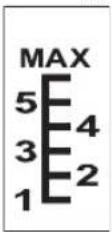
Turn the setting sleeve (3) to the position corresponding to the required screwing depth. The value on the scale (at the edge of the setting sleeve (3)) can be used as a guide for the required screwing depth.
Turning the setting sleeve (3) clockwise increases the screwing depth, turning counterclockwise
decreases the screwing depth. If the setting sleeve (3) is turned beyond the limit positions, it is completely removed from the clamping sleeve (2).
The required setting should be determined by trial screwing.
PowerSAVE mode (see figure C)
Briefly press the PowerSAVE button (9) to activate PowerSAVE mode. The PowerSAVE indicator (11) lights up. Then briefly press the switch (12) and
6. Press and hold the lock button (6). The tool does not start / is not switched on even when the switch (12) is pressed. Now release the switch.
Turn the tool towards the workpiece to activate the motor.
The PowerSAVE indicator light (11) goes out if the power tool is not used for 30 minutes. To reactivate PowerSAVE mode, release the lock button, briefly press the switch (12). Then press the switch (12) again and lock it by pressing the lock button (6). The PowerSAVE indicator light (11) lights up again.
Depth stop (see figure D)
Only use the depth stop together with the guide sleeve (3) and the gear housing of the power tool, with the guide sleeve and gear housing facing each other. Push the guide sleeve (3) until it touches the gear housing
and locks into place with a click. The guide sleeve (1) is now firmly seated. The power tool can be used with the depth stop loosened or tightened.
Slide the direction of rotation switch (5) to the left (i.e. towards the front of the power tool). The direction of rotation switch (5) automatically moves to the right. Switch on the power tool.
Note: The depth stop can also be loosened by completely removing the depth stop.
The depth stop (4) cannot be removed when the guide sleeve (3) is in the maximum position.
Thermal overload protection
If the power tool is used as intended, overload is not possible. In case of overload or exceeding the permissible temperature range of the battery, the speed is reduced. The power tool will only operate at full speed after the battery temperature has returned to the permissible range.
Deep discharge protection
Before performing any work on the power tool (e.g. maintenance, changing the tool, etc.), remove the battery from the power tool. There is a risk of injury if the switch is accidentally pressed.
Changing the tool, etc.) Remove the battery from the power tool. There is a risk of injury if the switch is accidentally pressed.
For long-term trouble-free operation, keep the power tool and ventilation slots clean.
The product may be sold in stores, departments (sections), pavilions, and kiosks that ensure the preservation of the product, exclude exposure to atmospheric precipitation and sources of elevated temperature (sharp temperature changes), including direct sunlight.
The seller (manufacturer) is obliged to provide the buyer with the necessary reliable information about the product, ensuring the possibility of its correct choice. Information about the product in a mandatory manner must contain data, the list of which is established by the legislation of the Russian Federation.
If the purchased product was in use or a defect (defects) was discovered, the consumer must be provided with information about this.
During the sale of products, the following safety requirements must be met:
- The seller is obliged to bring to the buyer's attention the company name (name) of his organization, its location (address) and operating mode; - Product samples in retail premises must ensure the buyer's ability to familiarize themselves with the inscriptions on the products and exclude any independent actions of the buyer with the product that lead to its activation, except for visual inspection; - The seller is obliged to bring to the buyer's attention information about the confirmation of compliance of these products with the established requirements, about the availability of certificates or declarations of conformity; - The sale of products is prohibited in the absence (loss) of its identification features, expiration dates, signs of damage to the packaging (instructions) for operation, mandatory certificate of conformity or mark of conformity.
Service and consultation on application issues
The service department will answer all your questions regarding repair and maintenance of your product, as well as spare parts. Spare parts and information about spare parts can be found at: www.bosch-pt.com
Consultants on the use of Bosch products with satisfaction will help you with questions regarding products and accessories.
Please, in all requests and orders, be sure to indicate the 10-digit product number according to the nameplate of the product.
Service addresses can be found at:
www.bosch-pt.com/serviceaddresses
In case of failure of the power tool within the warranty period due to the fault of the manufacturer, the owner has the right to free warranty repair, subject to the following conditions:
- Absence of mechanical damage; - Absence of signs of violation of the requirements of the operating instructions; - Availability of the operating instructions with the seller's mark and the buyer's signature; - Compliance of the serial number of the power tool with the serial number in the warranty card; - Absence of traces of unqualified repair.
The warranty does not apply to:
JIIOBbIe NIOOMKn, CBra3aHHbIe CΦOpC-MaxOpHbIMN O6CTO-RTENbCTBaM; -HOpMaJIbHbI N3HOC: 3JNEKTPoHHCTpyMeHTa, TaK JKe, KaK IN BCE 3JNEKTPuueckne.
TapaHTne He NOkpbIbAeTc peMOHT,NOTpe6HOCTb B KOTOPOM BO3HnKaET BCNECTBNE HOpMaNbHOrO N3HOCA, COKpa- ⅢaIOUeero cPOK cnJyKbI TaKx UactEn IHCTpyMeHa, KaK npCooEINHInTeBHe KOtAKTbI, IpOBoDA, IETKN T.I.: -ecTeCTBeHHbI H3HcO (nonHaBbpa6Otkapecypca); -06opyoBaHne Iero qactn, BbIXoI n3 cTPOKOTopblx CTa CNEcCTBmE HEnpaBnBHO YcTaHOBKN, HecaHKUHO HnpOBaHHo MOiΦnKaun, HEnpaBnBHorO pImMeHnH, HanyuHHe npaBnO bcnyKBaHn HnXpaHHe; -HeHcnpaBHOCTn,BO3HKNUe Bpe3yNbTaTe neperpy3Kn 3NeKtpoHnCtpyMeHTa.(K6e3ycNobHbIM npH3HaKaM nepeIpy3Kn HnCtpyMeHTa OTHOCATc: NOBHeHne Cbeta N06eKaIOCTn,DeOpMaun Hnn ONNaBHeHne DeTaeN y3IOB 3NeKtpoHnCtpyMeHTa,NOTEmHeHne HnObyrNBaHne H3OJauu nPoBoOB 3NeKtpoBnRaTeIaNoD JeCTBHeM BbICOKo TEMnepaTypbl.)
TpaHcnopBbKa
HaBIOKHeHbIe IINTH-HoHHbIe AKKyMylrTOpHbIe 6aTapei pacnpoCTpaHraIKOTc Tpe6OBaHN B OTHOWeHN TpAHCnOPTHPOBKn OnaChbIX rpy3OB. AKKyMylrTOpHbIe 6aTapeH MOrYt nepeBO3HTBCr CaHM NIOb3OBaTeNem ABTOMoBnIbHbIM TpaHCnOPTom 6e3 Heo6XoMDMOCTn CoBIOKeHn DOONHITeNbHbIX HOPM.
PnnepebIke TpebHm Hauamn (Haep.:camoJeTOM nItpaHcnpopThbIM 3KcneDITOpom) Heo6xoJIMO co6IOnaTbOC6bte Tpe6oBaHH K ynaKOBKe H MapKnpoBKe. B 3Tom Cnyae npn noIroTOBke rpy3a K OTnpabKe Heo6xoJIMO yuaCTHe3Kcnepta No ONaChbIM rpy3am.
IpecebnaiteaKKyMnTOpHy6batapeoToBkOB TOM Cnyae,ecn KOPnyc He NOBPexKeH.3akneTe OTKpbItbe KOHTbI yNakyte aKKyMnTOpHy6batapeoTaK,UTobOHa He bontanacbBynakOBke.CobnoJaTe,NOKaJynta,TaKKe BO3MOKHbIe DOnONHtEnbHbIe HauNoHaBbIe IpeDncaHHa.
Ytnn3aun

3NeKTPoHnCTpyMeHtbl,akkyMnyTOpHbIe6batapei,npHaNDkHOCTN ypaKOBky HxHKOcBaTaB Ha 3KJONOTyCKN UChTyO peKyIepaHIO.
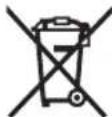
He bIb6paBcBAte 3neKtponHCTpyMeTHb H akKymyTATOPHbE 6batapeN/6bataeKN B 6bTOBOmycop!
AkkymyIaTOpbl/6aTapeH:
JIITHM-HOHHbIe:
PtoxanyiCTa, yuTbIbaIte yka3aHne B pa3dene TpaHCnoptn- pOBkA (cm. "TpaHCnoptnpOBkA", CtpaHnca 110).
YKpaiHcbka
Bka3iBkn 3 texhikn 6e3nekn
3araanbi Bkazibkn 3Texhikn 6e3neKn dner eNEKtpoiHcTpymehtB
Read all safety warnings, instructions, illustrations and specifications supplied with this power tool.
Failure to follow all instructions listed below may result in electric shock, fire and/or serious injury.
Save all warnings and instructions for future reference.
The term "power tool" in the warnings refers to your mains-operated (corded) power tool or battery-operated (cordless) power tool.
Work area safety
Keep work area clean and well lit. Cluttered or dark areas invite accidents. Do not operate power tools in explosive atmospheres, such as in the presence of flammable liquids, gases or dust. Power tools
create sparks which may ignite the dust or fumes.
Keep children and bystanders away while operating a power tool. Distractions can cause you to lose control of the tool.
Electrical safety
Power tool plugs must match the outlet. Never modify the plug in any way. Do not use any adapter plugs with earthed (grounded) power tools. Unmodified plugs and matching outlets will reduce risk of electric shock. Avoid body contact with earthed or grounded surfaces, such as pipes, radiators, ranges and refrigerators. There is an increased risk of electric shock if your body is earthed or grounded. Do not expose power tools to rain or wet conditions. Water entering a power tool will increase the risk of electric shock. Do not abuse the cord. Never use the cord for carrying, pulling or unplugging the power tool. Keep cord away from heat, oil, sharp edges or moving parts. Damaged or entangled cords increase the risk of electric shock. When operating a power tool outdoors, use an extension cord suitable for outdoor use. Use of a cord suitable for outdoor use reduces the risk of electric shock. If operating a power tool in a damp location is unavoidable, use a residual current device (RCD) protected supply. Use of an RCD reduces the risk of electric shock.
Personal safety
Stay alert, watch what you are doing and use common sense when operating a power tool. Do not use a power tool while you are tired or under the influence of drugs, alcohol or medication. A moment of inattention while operating power tools may result in serious personal injury. Use personal protective equipment. Always wear eye protection. Protective equipment such as dust mask, non-skid safety shoes, hard hat or hearing protection used for appropriate conditions will reduce personal injuries.
WARNING: Read all safety warnings and all instructions. Failure to follow the warnings and instructions may result in electric shock, fire and/or serious injury. Save all warnings and instructions for future reference. The term "power tool" in the warnings refers to your mains-operated (corded) power tool or battery-operated (cordless) power tool. Work area safety: Keep work area clean and well lit. Cluttered or dark areas invite accidents. Do not operate power tools in explosive atmospheres, such as in the presence of flammable liquids, gases or dust. Power tools create sparks which may ignite the dust or fumes. Keep children and bystanders away while operating a power tool. Distractions can cause you to lose control. Electrical safety: Power tool plugs must match the outlet. Never modify the plug in any way. Do not use any adapter plugs with earthed (grounded) power tools. Unmodified plugs and matching outlets will reduce risk of electric shock. Avoid body contact with earthed or grounded surfaces, such as pipes, radiators, ranges and refrigerators. There is an increased risk of electric shock if your body is earthed or grounded. Do not expose power tools to rain or wet conditions. Water entering a power tool will increase the risk of electric shock. Do not abuse the cord. Never use the cord for carrying, pulling or unplugging the power tool. Keep cord away from heat, oil, sharp edges or moving parts. Damaged or entangled cords increase the risk of electric shock. When operating a power tool outdoors, use an extension cord suitable for outdoor use. Use of a cord suitable for outdoor use reduces the risk of electric shock. If operating a power tool in a damp location is unavoidable, use a residual current device (RCD) protected supply. Use of an RCD reduces the risk of electric shock. Personal safety: Stay alert, watch what you are doing and use common sense when operating a power tool. Do not use a power tool while you are tired or under the influence of drugs, alcohol or medication. A moment of inattention while operating power tools may result in serious personal injury. Use personal protective equipment. Always wear eye protection. Protective equipment such as dust mask, non-skid safety shoes, hard hat, or hearing protection used for appropriate conditions will reduce personal injuries. Prevent unintentional starting. Ensure the switch is in the off-position before connecting to power source and/or battery pack, picking up or carrying the tool. Carrying power tools with your finger on the switch or energising power tools that have the switch on invites accidents. Remove any adjusting key or wrench before turning the power tool on. A wrench or a key left attached to a rotating part of the power tool may result in personal injury. Do not overreach. Keep proper footing and balance at all times. This enables better control of the power tool in unexpected situations. Dress properly. Do not wear loose clothing or jewellery. Keep your hair, clothing and gloves away from moving parts. Loose clothes, jewellery or long hair can be caught in moving parts. If devices are provided for the connection of dust extraction and collection facilities, ensure these are connected and properly used. Use of dust collection can reduce dust-related hazards. Do not let familiarity gained from frequent use of tools allow you to become complacent and ignore tool safety principles. A careless action can cause severe injury within a fraction of a second.
Proper handling and use of power tools
Do not force the power tool. Use the correct power tool for your application. The correct power tool will do the job better and safer at the rate for which it was designed. Do not use the power tool if the switch does not turn it on and off. Any power tool that cannot be controlled with the switch is dangerous and must be repaired. Disconnect the plug from the power source and/or remove the battery pack, if detachable, from the power tool before making any adjustments, changing accessories, or storing power tools. Such preventive safety measures reduce the risk of starting the power tool accidentally. Store idle power tools out of the reach of children and do not allow persons unfamiliar with the power tool or these instructions to operate the power tool. Power tools are dangerous in the hands of untrained users.
Use of power tools by untrained users may be hazardous.
Carefully handle the power tool and its accessories. Before use, ensure that the moving parts of the power tool are correctly aligned and not jammed, and that there are no parts that are broken or in any other condition that could affect the operation of the power tool. Damaged power tools must be repaired before use. Many accidents are caused by poorly maintained power tools. Keep cutting tools sharp and clean. Properly maintained cutting tools with sharp edges are less likely to bind and are easier to control. Use the power tool, accessories, and tool bits, etc., in accordance with these instructions, taking into account the working conditions and the work to be performed. Using the power tool for operations different from those intended could result in a hazardous situation. Keep handles and grasping surfaces dry, clean, and free from oil and grease. Slippery handles and grasping surfaces do not allow for safe handling and control of the tool in unexpected situations.
Proper handling and use of power tools with rechargeable batteries
Charge the rechargeable batteries only in chargers recommended by the manufacturer. Using a charger for a different type of battery may cause damage. Use only the recommended rechargeable batteries in the power tools. Using other batteries may cause injury and damage. Do not store the battery pack together with metal objects such as paper clips, coins, keys, nails, screws, or other small metal objects that could short-circuit the contacts. Short-circuiting the battery contacts may cause burns or damage. If the battery is used incorrectly, liquid may leak from it. Avoid contact with the liquid. If contact occurs accidentally, rinse the affected area with water. If liquid gets into the eyes, seek medical attention. Battery liquid may cause skin irritation or burns.
Do not use damaged or modified batteries or power tools. Damaged or modified batteries may behave unpredictably, which could lead to fire, explosion, or risk of injury. Do not expose the battery or power tool to fire or excessive temperatures. Exposure to fire or temperatures above 130°C may cause explosion. Follow all charging instructions and do not charge the battery or power tool outside the temperature range specified in the instructions. Charging improperly or at temperatures outside the specified range may damage the battery and increase the risk of fire.
Service
BidabaiTe CBI ENEKtpoiHcTpyMeHT Ha peMOHT NHe KBaniipikOBaHH m qaxiBm Ta NHe 3 BHKOpHCTAHHH OPnIHAnbHnX 3aNactHH. Lc 3a6e3neuHbpo6Otu npCtpoI npOTraOM TpHBaIOr Oacy. HikonHe 06cnyroByte nookjckeni akymyntopn. O6cnyroBybTH akymyIaTOpN DO3BONrCTbcra Nnwe Bnpo6HHky a6o ABTOpH3OBaHm CepBicHM opraH3auiM.
Bka3iBKN 3Texhikn 6e3neKn dny wypynokpytib
PnBnBkoHaHHi po6it, npn knx wypyn moKe 3aueHHTn 3axoBAHy eektpponpOBOky, TpMaIte IHcTpyment 3a i3onbOABHI NOBepxHi. Nepeip3aHH Ka6eHIO, kNk 3hAxOHTbcra NiD HappyroHO, MOKe npN3BeCTn Do 3apAxDKeHH MeTaeBHX YAcTHN eekTPOIHcTpymeHTa Ta do ypaKeHH eekTpHMM CTpyMOM. Длгзхджснглгьвпсггьгьгьгьгьгьгьгьгьгьгьгьгьгьg eKTPponpoBOKH KOPNCTYTEcR pndATHMn Pnnaamn a60 3BepHITbc R Mlcue Be NiDpHcEMCTBO eKtpo-, ra30- i BODOnocTaayHH. 3aenneHHa eKTPponpoBOKM OKe Pn3BOHTn Do NoKeKi Ta ypaxehn H eKTPnuHm Ctpymom. 3aenneHHra3OBoi TpybMoKe Pn3BOHTn Do B6yxy. 3aenneHHa BOONPOBIDHOI TpyMoKe 3aBDAtn WKOу MATEPIaNBHM UHHOCtAM. Miuho Tpmaite eneKtpoincTpyment. Pn3aKpyuBaHHi i po3KpyuBaHHI rBHTIB/UpyniB MOxytB BHNKAth KopoTkoachi BnCoki peakuiH MOpENTN. 3aKpInHIOte 06po6NIOBany 3arOBoKY.3aDOnOMOrHO 3aTnCKHO npCTPO1o a6o neuat 6po6NBOAHm MaTepiAn fikcyetcbra HadiNniue HIX npITpIMaHHI Noro B pyui. Ipeqd THM,AK NOKnactn eneKtpoiHcTpymeHT, 3auekaite,NOKN BIn HE 3yHHNtbcra.AJKe po6ouhiHCTpymeHT MoKe 3aueHnTcra 3a 0HebYdb,IO npn3Bede Do BpTaN KOHTpolu Had eneKtpoPnPnAOM Pn nookxheni a6o Henpabnbni ekcnnyataaikymyntopho6bapeIMOKe BHXoHTn nap.
AkymyIaTOpHa 6aTapeMOne 3aMaTHcb a60 Bb6yXaTH. BnycItb CbIXe nobITpy i - y pa3i ckapr - 3BepHtbcra do nikapar. Nap moKe noDpaAnHObatn dxaJIbHi wJnx.
He BHOcBte KOHCTpyKTHBHX 3MHN B AkyMnyTOpHy 6aTapeIO Ta He BiDkPbBaIe Tl. IChy He6e3neKa KopoTKoro 3aMnKAHH. FocpHm npedMetamn, Hanp., rbi3dkamn a60 BHKpyTKAMn, a6o npknadAHNM 3OBHIhboi Cnn MoXHa NOKoNDN acymyIATOPHy 6atapeo. MoXJIHeB BYTpiUHc KOpOTKe 3aMkAHHa, 3aropHHa, YTBOpEHn Dmy, Bb6yx a6o neperpi b acymyIaTOHO 6atapei. BnKOpHcTObyIte akymyIaTOpHy 6aTapeI0 TInbKn B npOdyKTax BnPo6hNka. IInse 3a TaKHX yMOB aKymyIaTOp 6yde 3axHueHH BID He6e3neuHOro nepeBaHTaKeHH.

3axuaiTe akymyHToHy 6aTaapeo BiTENna,30KpeMa,Hanp.,BID COHAnHXN npomeHB,BOrHIO,6pyD,BOHO Ta BOIOrn. IChye Hebe3neKa Bb6yX i KopoTKoro 3aMnKaHHa.
IITIEBO-I0HHn akymyIaTOp MOKHa 3apdKaTH KOHN 3aBROHO,ue He cKOpOyuE Horo EKCnNyatauiHn peCypc. IpepeBaHn npouecy 3apdKaHn He nouKoDkye akymyIaTOp.
IitieBO-IOHHn akymyTOp 3axuHenn BiD rnn60KOro po3pndkAnHn CnCTeMoHO „Electronic Cell Protection (ECP)". Pn pO3pndKeHomy akymyTOnPi npHaad 3aBnKn cxemi 3axNCTy BmHKaETcbr. Po6ouh nIHcTpymeHT 6bnBe He pyXaCTbC8.
PnicnABOMaTHHOROBHMKahnaeNektpoinctpymenta6inbue He HATNCkyteHaBMMkau.Le moKe NnKOJHTNakymyIaTOpHy batapeo.3BaKaIte Ha BkazIBKN 0do BnJaJIeHHA.
BnMaHnAkyMnyaTopa
Remove the battery pack from the power tool, press the battery unlock button (8) to release the battery pack. The built-in rechargeable battery is located in the handle. To remove the battery pack (7), press the battery unlock button (8) and pull the battery pack out of the power tool, pulling it forward. Do not use force.
Battery pack charge indicator
The green LEDs of the battery pack charge indicator show the charge level of the battery pack. For safe operation, the charge level can only be checked when the power tool is switched off.
Press the battery pack charge indicator button to display the charge level. This can be done when the battery pack is removed from the power tool.
If after pressing the battery pack charge indicator button no LED lights up, the battery pack is defective and must be replaced.
Battery pack type GBA 18V...

LED capacity
Green LED 3×60-100%
Green LED 2×30-60%
Green LED 1×5-30%
Inserting the battery pack
Note: Using battery packs not intended for this power tool may lead to malfunctions or damage to the power tool.
Set the direction switch (5) to the middle position to prevent unintentional starting.
Insert the charged battery pack (7) into the handle until it clicks into place and is flush with the handle.
Set the direction switch (see Fig. E-F)
To change the direction of rotation of the tool, you can change the direction of rotation of the tool. However, this is not possible if the switch (12) is pressed.
Right rotation: turn the rotation direction switch (5) to the left side of the power tool in the direction of the front part of the power tool. The rotation direction switch (5) from the right side of the power tool automatically moves back.
Left rotation: turn the rotation direction switch (5) to the left side of the power tool backwards (i.e., towards the rear part of the power tool). The rotation direction switch (5) from the right side of the power tool automatically moves forward.
Switching on and off
To switch on the power tool, press the switch (12) and hold it pressed.
The light can be switched on in case of partial or full pressing of the switch (12) and allows lighting the work area in case of insufficient general lighting.
To lock the switch (12), press the switch (12) and then press the lock button (6).
To switch off the power tool, release the switch (12) or, if it is locked with the lock button (6), briefly press the switch (12) and then release it again.
Adjusting the speed
The speed of the switched-on power tool can be smoothly adjusted by pressing the switch (12) more or less.
116|Ukrainian
With light pressure on the switch (12), the power tool operates at low speed. With increased pressure, the speed increases.
Screwdriving
For screwdriving, the universal bit holder (14) is used. Turn the rotation direction switch (5) to the left side of the power tool towards the front part of the power tool. Switch on the power tool and press it against the screw. Turn the screw into the workpiece until the desired depth is reached. If the screw head (4) protrudes from the workpiece, the tool switches off; the universal bit holder (14) no longer rotates. Check the screw depth and, if necessary, adjust the screw head (4).
Adjusting the screw depth (see figure B)
The tightening torque can be pre-selected using the knob (3).
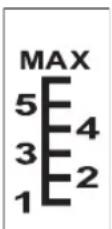
Turn the knob (3) clockwise to increase the tightening torque. The scale (on the knob (3)) can be used for orientation.
Turning the knob (3) clockwise increases the tightening torque, turning the knob counterclockwise decreases the tightening torque.
When the knob (3) is turned beyond the maximum position, it disengages from the stop knob (2).
It is necessary to adjust the device before first use by trial.
PowerSAVE mode (INV.MAL.C)
Briefly press the PowerSAVE switch (9) to activate PowerSAVE mode. The PowerSAVE indicator (11) lights up. Then briefly press the switch (12) and
lock it by pressing the lock button (6). The motor starts with reduced speed, even if the switch (12) is pressed. Then carefully insert the power tool into the workpiece to activate the motor. If the power tool is not used for 30 minutes, the PowerSAVE indicator (11) goes out. To reactivate PowerSAVE mode, release the lock, briefly press the switch (12). Then press the switch (12) again and lock it with the lock button (6). The PowerSAVE indicator (11) lights up again.
Inserting the depth stop (INV.MAN.D)
To loosen the screw, press the release button on the knob (3) and on the gear housing of the power tool towards each other. Press the knob (3) forward until it
touches the gear housing and is not locked. The bit (1) is now free. The power tool can be used for loosening or tightening screws.
Move the rotation direction switch (5) on the left side of the power tool backward (i.e., towards the rear part of the power tool). The rotation direction switch (5) on the right side of the power tool moves automatically. Switch on the power tool.
Note: The screw can also be loosened by fully inserting the depth stop (4).
The depth stop (4) cannot be inserted when the knob (3) is in the locked position.
Overload protection
The electronic tool is protected against overload. In case of overload or when leaving the permissible temperature range of the battery, the number of revolutions will decrease. The electronic tool will only start working again at the new number of revolutions after the permissible battery temperature has been reached.
Protection against deep discharge
The lithium-ion battery is protected against deep discharge by the "Electronic Cell Protection (ECP)" system. When the battery is discharged, the protective circuit switches off. The tool no longer moves.
Working instructions
Belt clip
With the belt clip (15), the electronic tool can be attached, e.g., to a belt. This gives you both hands free and the power tool is always at hand.
Maintenance and service
Maintenance and cleaning
Before carrying out any work on the electronic tool (e.g., maintenance, changing tools, etc.), remove the battery from the electronic tool. There is a risk of injury if the tool is switched on accidentally. For safe operation, keep the electronic tool and ventilation slots clean.
Service and consultation on usage questions
The service department will answer your questions regarding repair and maintenance of your product. Spare parts and information about spare parts can be found at: www.bosch-pt.com
The Bosch partner company will be happy to answer any questions regarding the use of our products and accessories.
In case of all additional questions and orders for spare parts, please always specify the 10-digit order number found on the product nameplate.
Ukraine
Bosch Service Center for Electronic Tools in Ukraine
02660 KIIB 60
Tel.: +380 44 490 2407
Fax: +380 44 512 0591
E-Mail: pt-service@ua.bosch.com
www.bosch-professional.com/ua/uk
The addresses of regional warranty service centers are specified in the warranty card.
Warranty service addresses are listed at:
www.bosch-pt.com/serviceaddresses
Transportation
The recommended lithium-ion batteries are subject to the regulations for the transport of dangerous goods. The batteries can be transported by the user by road without further requirements.
When shipping by third parties (e.g., by air transport or forwarding agency), special requirements on packaging and labeling must be observed. In this case, an expert for dangerous goods must be involved in the preparation of the shipment.
Send the battery only if the housing is undamaged. Tape open contacts and pack the battery in such a way that it cannot move in the packaging. Please also observe the possibility of further national regulations.
Disposal

Electric tools, batteries, accessories and packaging should be sorted for environmentally friendly recycling.
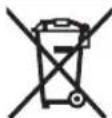
Do not dispose of electric tools and batteries/rechargeable batteries in household waste!
When using and disposing of electrical instruments, as well as when using rechargeable batteries/batteries, they must be disposed of separately. Use the provided collection systems.
In case of incorrect disposal, the disposed electrical and electronic equipment may have a negative impact on the environment and human health. Do not use unsafe devices.
Batteries/rechargeable batteries:
LITHIUM-ION:
Bulb, specified in the instructions for transportation (see "Transportation", page 117).
Kazakh
Eurasian Economic Union (EEU) member states
This product is marked with the conformity mark of the EEU member states and may be sold together with the accompanying documents.
The product is subject to mandatory conformity assessment.
The product is included in the register of conformity assessment objects of the EEU member states.
The product has been tested for compliance with the requirements of the EEU technical regulations.
The product is marked with the single conformity mark of the EEU member states.
Product shelf life
Shelf life is 5 years from the date of manufacture (indicated on the product label). After this period, the product must not be used (service life).
Replace the specified measuring instruments with verified ones.
Testing procedure
- If the device is switched on, it should be turned off. - If the device is connected to the mains, disconnect it. - If the device has a housing, remove it.
Possible malfunctions
If the device is connected to the mains, do not touch the housing with wet hands; water ingress into the housing is not allowed.
Wiring diagrams
Connecting the device to the mains and grounding
Maintenance and repair
Before maintenance, disconnect the device from the mains.
Storage
Store the device in a dry place. Avoid exposure to high temperatures and direct sunlight.
118|Kazakh
- During storage, protect the device from temperature fluctuations. Do not store in a humid environment.
- For storage conditions, refer to GOST 15150-69 (section 1).
- Store at ambient temperature from +5°C to +40°C. Relative humidity up to 80%.
The tape is intended for use in machines for packaging products in packages. Permission to use the tape is granted in accordance with the requirements of GOST 15150-69 (version). The tape can be used at ambient temperatures from -50°C to +50°C. The relative humidity is up to 100%.
Safety instructions
Safety instructions for electrical installations
WARNING
This electrical installation must be serviced by qualified personnel.
Read the instructions, warnings, and labels. All technical safety
instructions must be followed to prevent electric shock, fire, or other hazards.
Keep safety instructions and warnings for future reference.
The electrical installation must be connected to a power supply with a protective earth (PE) conductor and to a power supply with a protective earth (PE) conductor (if applicable).
Electrical safety
Do not use the device in hazardous areas. Do not use in explosive atmospheres or in the presence of flammable gases, vapors, or dust. The electrical installation must not be operated in an atmosphere with high humidity, moisture, or in the presence of water or steam. The electrical installation must be kept clean and free of dust and dirt. Children and untrained persons must not operate the electrical installation. Maintenance must be performed by qualified personnel. In industrial, commercial, and residential environments, the installation must be used only for its intended purpose.
Electrical safety
Electrical connections must be made to a socket with a ground connection. Do not modify the plug.
Do not connect the electrical installation to extension cords or adapters. Use only approved sockets with a protective earth conductor.
Before cleaning, repairing, or inspecting the device, disconnect it from the power supply. If the device is connected to the power supply, there is a risk of electric shock. Do not touch the electrical connections with wet or damp hands. Do not touch the power cord with wet hands. Do not use the device if the plug is damaged. Do not use the device to pull, carry, or unplug the power cord. Do not place the device near open flames, hot surfaces, or flammable materials. Do not use the device if the power cord is damaged or worn. Do not expose the electrical connections to water or moisture. If the device needs to be cleaned, disconnect it from the power supply. If the device needs to be repaired, use a residual current device (RCD) to protect against electric shock. The RCD must be installed by a qualified electrician.
Electric current can be dangerous. Humid or wet surfaces increase the risk of electric shock. Electric current can cause burns or even death if it passes through the body. After an electric shock, it is possible to experience delayed effects. Do not touch the victim with bare hands. Use insulating materials, such as dry wood or rubber, to move the victim away from the current source. Only use insulated tools to remove the victim from the current. Do not use metal objects. If the victim is unconscious, check for breathing and pulse. If necessary, perform artificial respiration or cardiac massage. Do not give liquids to an unconscious person. Seek medical help immediately. Electric current can cause severe burns or even death if it passes through the body. Do not touch the victim with bare hands. Use insulating materials, such as dry wood or rubber, to move the victim away from the current source. Only use insulated tools to remove the victim from the current. Do not use metal objects. If the victim is unconscious, check for breathing and pulse. If necessary, perform artificial respiration or cardiac massage. Do not give liquids to an unconscious person. Seek medical help immediately.
DANGER! Before installing, operating, or maintaining the device, read this manual carefully. Installation and maintenance should only be performed by qualified personnel. If the safety instructions are not followed, there is a risk of electric shock or fire. Keep the manual for future reference. Follow all warnings and instructions. Do not use the device near water. WARNING! To reduce the risk of electric shock, do not remove the cover. No user-serviceable parts inside. Refer servicing to qualified service personnel. Disconnect the power cord before servicing. Use only the specified power source. The lightning flash with arrowhead symbol alerts the user to the presence of uninsulated dangerous voltage within the product's enclosure that may be of sufficient magnitude to constitute a risk of electric shock. The exclamation point symbol alerts the user to important operating and maintenance instructions. Read the manual before operating the device.
Installation and Maintenance of the Device
Do not install the device near water. To reduce the risk of electric shock, do not expose the device to rain or moisture. Do not use the device if it has been dropped or damaged. If the device is damaged, it must be repaired by qualified personnel. Do not place the device on unstable surfaces. If the device is not used for a long time, unplug it from the power outlet. Do not block the ventilation openings. Install the device in accordance with the manufacturer's instructions. Do not place the device near heat sources such as radiators, stoves, or other appliances that produce heat. Do not defeat the safety purpose of the polarized or grounding-type plug. A polarized plug has two blades with one wider than the other. A grounding-type plug has two blades and a third grounding prong. The wide blade or the third prong are provided for your safety. If the provided plug does not fit into your outlet, consult an electrician for replacement of the obsolete outlet. Protect the power cord from being walked on or pinched particularly at plugs, convenience receptacles, and the point where they exit from the device. Do not overload wall outlets, extension cords, or integral convenience receptacles as this can result in a risk of fire or electric shock. Do not insert objects into the ventilation openings. Keep the device away from dripping or splashing liquids. Do not place objects filled with liquids, such as vases, on the device.
Do not attempt to service this device yourself as opening or removing covers may expose you to dangerous voltage or other hazards. Refer all servicing to qualified service personnel. If the device is damaged, it must be repaired by qualified personnel.
Do not use electrical appliances with wet hands. If the appliance is not working properly or if the casing is damaged, do not use the electrical appliance. Do not use appliances with damaged plugs. Improper use of electrical appliances can cause fires. Keep sharp objects away and store them in a dry place. When using and storing sharp objects, keep them out of reach of children. Do not expose electrical appliances, wires, or other objects to moisture. Also, pay attention to the requirements of the manufacturer. Use electrical appliances only for their intended purpose. If cords or plugs are damaged, replace them with new ones. Do not use damaged cords or plugs, and do not attempt to repair them yourself.
Battery usage instructions
Only use the charger specified for this device. Using a different charger may damage the device or cause a fire. Only use batteries specified for this device. Do not use damaged batteries. If the battery is damaged, replace it immediately. If the battery is not in use, store it in a cool, dry place away from heat sources. Do not short-circuit the battery terminals. Do not expose the battery to water or moisture. If the battery leaks, contact the manufacturer. Do not use a leaking battery. Do not use damaged or swollen batteries. Do not expose the battery to high temperatures. Do not expose the battery to fire or high temperatures.
120|Kazakh
Do not expose the battery to temperatures above 60°C. Do not expose the battery to temperatures below -20°C. Do not charge the battery at temperatures outside this range.
Maintenance
Only qualified personnel should perform maintenance on the electrical appliance. This ensures the safety and proper functioning of the appliance. Do not use damaged batteries. Batteries should only be replaced by qualified personnel or the manufacturer.
Safety instructions for users
Before connecting the device, make sure the voltage and frequency of the electrical network correspond to the parameters specified on the device's nameplate. If the device is intended for use with a three-phase electrical network, it must be connected to a network with a grounding system. It is possible to connect the device to an electrical network with a voltage of 220-240 V or to a three-phase network. It is possible to connect to a three-phase network with a neutral wire. It is possible to connect to a three-phase network with a protective earth conductor. The electrical network must be properly grounded. The connection must be made by a qualified electrician. If the device is connected to a network with a voltage other than the rated one, the device may be damaged. Do not connect the device to a network with a voltage higher than the rated one. It is possible to connect the device to a power outlet with a grounding contact. If the battery is not charged or is damaged, the device will not operate. The battery may be hot or may leak. If the device is not used for a long time, remove the battery. It is possible to charge the battery. The battery has a short circuit protection. It is possible to short-circuit the battery terminals or the battery may be damaged by external influences. If the battery is short-circuited, it may heat up, ignite, or leak. Batteries should only be charged by qualified personnel. Do not short-circuit the battery, as this may cause a fire.
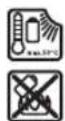
Do not expose the battery to high temperatures, open flames, sunlight, heat, moisture, or water. Do not short-circuit the battery or the charging terminals.
Safety Instructions

Read the safety instructions carefully before use. Only qualified personnel should handle the safety instructions. It is possible to connect the device to a power source with a voltage of 220-240 V or to a three-phase network.
Safety instructions for the user
Intended use
The device is intended for welding or cutting metal.
Device components
The components of the device are shown in the figure. The device is equipped with a grounding terminal.
(1) Power cord (2) Three-phase plug (3) Socket for connecting the welding cable (4) Socket for the welding cable (5) Control panel (6) Welding cable for the electrode holder (7) Battery (8) Battery charging socket (9) PowerSAVE on/off switch (10) Indicator for the input voltage (11) PowerSAVE indicator (12) Electrode holder (13) Handle (for carrying) (14) Nameplate (15) Short circuit protection
a) The device components are not included in the standard delivery.
Technical specifications
Power consumption 1× 0.5-5%
Device setup (see figure A)
Do not use the electric crane for lifting people (thinking, technical service, crane operation, etc.). Remove the batteries from the electric crane. In case of emergency, stop operation and take necessary actions.
Disconnect the plug (4) of the electric crane. Remove the plug (1). Then, disconnect the battery (14) and remove it. Then, disconnect the cable.
Disconnect the plug (4) after the last use of the crane.
Storage
Storage preparation
Battery installation
Note: It is possible to bring the battery not intended for the electric crane to the charging point or to connect it to the electric crane's charging system.
To prevent the battery from being disconnected by the lever (5), install it in place. Make sure the battery (7) is securely fastened and does not move during operation.
Check the battery (see figures E-F)
The battery can be removed using the lever (5). It is possible to remove it without using the lever (12).
Removal: To remove the battery from the electric crane, press the lever (5) on the side of the electric crane. The battery will be released automatically.
Installation: To install the battery on the electric crane, press the lever (5) on the side of the electric crane (or on the side of the battery). The battery will be inserted automatically.
Connection/Disconnection
To connect the electric crane, press the lever (12).
The emergency stop (12) must be pressed in case of danger or to stop the crane immediately.
BacnbFaH aKbipatkbWtbl (12) 6ekiry yuih 6ekiry tyMecih (6) 6acbHb3.
3JnKTP KypaBbH eWipy yUH, aXbIpaTkbIbTb1 (12) xi6epiH3 HEmec 6eKITy TmecimEn (6) KybntHaFb 6oNca, aXbIpaTkbIbTb1 (12) KbICKa yaKbTb6acblx i6epiH3.
AHHany MOMENTIH OPHATY
KocbIHTb/ewipriwi (12) bacy KyyiH 3eepte Otbipbn, KocbIraH KypaIbH aHaJIbIMap caHbH 6iptiH den petteyre 6oana.
KockbIHTb/ewipriwi(12)kaBacKaHa,3neKtp Kypan TMeHipek aHaNbIMap caHBMeH Kymbic icTei. Bacy Kuyi Kyweire He aHaany caHb apTabl.
6ypaHdaapdb6ypan kpi3y
BypaHdnapb6ypan kipri3y yin6paHdaHb6ypaybi 6nTke(1) opHaTBH3. BypaHda aM6e6an 6nT YCTaftbHbHbH (14) MaHTN KUImeh 6epiK yctanaBb. 3JeKTP KypaHbHbCOn JkaFbHdaFb aHany 6aftbH aybCTbpHIN-KCKbHtB (5) 3JeKTP KypaHbHbAaDbHf bKaFbHa XblXbHbHb3. 3JeKTP KypaHbH KocBn, 6ypaHa YuBH daBnHaMAFa KUIne 6acBbHb3. BypaHa pTeTneR 6ypan kipri3y tepeDirine xeKteHe DaBnHaMaFa 6ypan kipri3inei.Cybpmalb TepeNik WeKteriui (4)
daHdamaTin,KeTeK eWIn KanaDbI,Am6e6an 6HT yTaftbIbI (14) api kapa aHaMaNdbI. Bypan kipri3y tepeHirih Tekepin, KaKer bOnca, Ohbl cybIpMaNb ItepeHik WeKTERiIMeh (4) petHeJ3.
Bypan Kipri3y Tepehdirin petrey (B cypetin kapaib3)
PettierTtKemeh(3)6paHda6actnerHHaBbHamaF a6papan Kipriay TepeHdiH andbH ana TaHdayra 6onabbl.
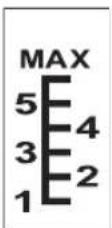
PettieriTEnKehi (3) Kanaynb6ypan kipri3y TepeHirinH no3nucbHa 6ypaHb3. Ukanadarfa cah (petteriTuKekHH (3) KneriHde KepiHdi) Kanaynb6ypan kipri3y TepeHdiri yuiH 6actankbHyKTe peiHne naDanahyFa 6oana.
PeTteriW TEnKeHi (3) caFATiINIH 6aFbITbIMEH aHaJIbpy 6pIaN KIPrIy TepeHdiR apTbIpaDb, aI cAFATiINIH 6aFbITbHa KapcbI
aHaIbpy bypan Kipri3y TepeHdirin aazaiTaBbl. PeTteriW TKeHI (3) MAX no3nucraHah Xofapbl bypay OHbl tipeK TKeHeH (2) TonltanabIn TaTaeBbl.
KaKeTTI TepeHnIKke cbHaK 6byay apeketi apkblnI kon KTeKi3yre 6oNaBl.
PowerSAVE pexnmi (C cypetin kapaib3)
PowerSAVE mode is activated by pressing the PowerSAVE button (9) briefly. The PowerSAVE indicator (11) lights up. Then press the start button (12) briefly.
The power cord plug (6) is connected. The start button (12) is pressed, and the device starts/stops. To use the device, connect the power cord to the mains.
If the power cord is not disconnected within 30 minutes, the PowerSAVE indicator (11) automatically turns off. To use the device again, press the start button (12) briefly. Then press the start button (12) again, and the power cord plug (6) is connected. The PowerSAVE indicator (11) turns on again.
Cleaning and maintenance
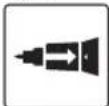
Before cleaning, disconnect the plug (3) and the power cord from the mains. The plug (3) and the power cord should be kept away from the device.
Do not immerse the device in water or other liquids. Do not use abrasive cleaners. Do not use the device if the power cord or plug is damaged.
To clean the device, wipe the surface with a soft, dry cloth (5). Do not use water or other liquids. The device should be cleaned regularly.
Note: Before cleaning, make sure the device is unplugged.
If the plug (3) or the power cord is damaged, do not use the device.
Overload protection
If the device is overloaded, the power cord will be disconnected. If the overload is caused by a short circuit or the battery is discharged, the device will not operate.
Battery protection
The battery is protected by the "Electronic Cell Protection (ECP)" system. If the battery is low, the device will be protected by the protection circuit: it will not operate.
Troubleshooting
If the device does not work
Install the lifting device (15) with the lifting hook. When the lifting hook is not in use, store it in the lifting hook holder.
Technical specifications and service
www.bosch-pt.com/serviceaddresses
The lifting hook must be inspected for damage before each use. If damage is found, it must be replaced.
The following parts must be replaced if they show signs of wear:
- Mechanical components; - Signs of cracks or deformation on the lifting hook; - Signs of corrosion, wear, or damage on the lifting hook; - The lifting hook's safety latch and its function; - The safety latch's condition and function.
The following must be observed during maintenance:
- Use only original spare parts; - The lifting hook must be checked for damage.
Before performing maintenance on the lifting hook, the following must be ensured:
- The lifting hook must be replaced if it shows signs of damage or wear.
- The lifting hook must be replaced if it shows signs of damage or wear. The lifting hook must be inspected for damage before each use. If damage is found, it must be replaced. The lifting hook must be replaced if it shows signs of damage or wear. The lifting hook must be inspected for damage before each use. If damage is found, it must be replaced.
Disposal
The lifting hook must be disposed of in accordance with local regulations.
The lifting hook must be disposed of in accordance with local regulations.
The lifting hook must be disposed of in accordance with local regulations. The lifting hook must be disposed of in accordance with local regulations.
Accumulator body is protected against dust and moisture. The accumulators must not be exposed to direct sunlight. The battery must be protected from heat.
Storage

Electrical tools, accumulators, accessories and packaging must be recycled in an environmentally friendly manner.
Do not dispose of electrical tools and accumulators/batteries with household waste!
Only for EU countries:
According to the European Directive on Waste Electrical and Electronic Equipment, defective or used accumulators/batteries must be collected separately and recycled. Please return them to your dealer.
When disposing of batteries, do not short-circuit them. Electrical and electronic devices may contain hazardous substances that can have a harmful effect on human health and the environment if not disposed of properly.
Accumulators/batteries:
Li-ion:
See instructions in the operating manual (see "Charging", page 124).
| Insurrabare moale conform |
| ISO 53931 |
| Sistem de prindere a accesoriilor | Locas hexagonal interior de 1/4" |
www.bosch-pt.com/serviceaddresses
Transport
Safety instructions
General power tool safety warnings
WARNING
Read all safety warnings, instructions, illustrations and specifications provided with this power tool. Failure to follow the instructions listed below may result in electric shock, fire and/or serious injury.
Save all warnings and instructions for future reference.
The term "power tool" in the warnings refers to your mains-operated (corded) power tool or battery-operated (cordless) power tool.
Work area safety
Keep work area clean and well lit. Cluttered or dark areas invite accidents. Do not operate power tools in explosive atmospheres, such as in the presence of flammable liquids, gases or dust. Power tools create sparks which may ignite the dust or fumes.
Keep children and bystanders away while operating a power tool. Distractions can cause you to lose control.
Electrical safety
Power tool plugs must match the outlet. Never modify the plug in any way. Do not use any adapter plugs with earthed (grounded) power tools. Unmodified plugs and matching outlets will reduce risk of electric shock. Avoid body contact with earthed or grounded surfaces, such as pipes, radiators, ranges and refrigerators. There is an increased risk of electric shock if your body is earthed or grounded. Do not expose power tools to rain or wet conditions. Water entering a power tool will increase the risk of electric shock. Do not abuse the cord. Never use the cord for carrying, pulling or unplugging the power tool. Keep cord away from heat, oil, sharp edges or moving parts. Damaged or entangled cords increase the risk of electric shock. When operating a power tool outdoors, use an extension cord suitable for outdoor use. Use of a cord suitable for outdoor use reduces the risk of electric shock. If operating a power tool in a damp location is unavoidable, use a residual current device (RCD) protected supply. Use of an RCD reduces the risk of electric shock.
Personal safety
Stay alert, watch what you are doing and use common sense when operating a power tool. Do not use a power tool while you are tired or under the influence of drugs, alcohol or medication. A moment of inattention while operating power tools may result in serious personal injury. Use personal protective equipment. Always wear eye protection. Protective equipment such as dust mask, non-skid safety shoes, hard hat, or hearing protection used for appropriate conditions will reduce personal injuries. Prevent unintentional starting. Ensure the switch is in the off-position before connecting to power source and/or battery pack, picking up or carrying the tool. Carrying power tools with your finger on the switch or energising power tools that have the switch on invites accidents. Remove any adjusting key or wrench before turning the power tool on. A wrench or a key left attached to a rotating part of the power tool may result in personal injury. Do not overreach. Keep proper footing and balance at all times. This enables better control of the power tool in unexpected situations. Dress properly. Do not wear loose clothing or jewellery. Keep your hair, clothing and gloves away from moving parts. Loose clothes, jewellery or long hair can be caught in moving parts. If devices are provided for the connection of dust extraction and collection facilities, ensure these are connected and properly used. Use of dust collection can reduce dust-related hazards.
Be careful, concentrate, and follow the instructions correctly and sensibly. Do not use power tools when you are tired or under the influence of drugs, alcohol, or medication. A moment of inattention while working with power tools may lead to serious injury. Wear protective equipment. Always wear eye protection. Wearing protective equipment such as a dust mask, non-slip safety shoes, a hard hat, or hearing protection (earplugs) reduces the risk of injury. Avoid accidental starting of the power tool. Before connecting to the power source or inserting the battery, make sure the switch is in the off position.
When carrying a power tool, make sure the switch is in the off position. Carrying a power tool with your finger on the switch or supplying power while the switch is on increases the risk of injury.
Before turning on the power tool, make sure that all wrenches and adjusting tools are removed from the tool. A wrench or key left attached to a rotating part of the tool may cause injury. Avoid awkward body positions. Work in a stable position and maintain balance at all times. This allows you to control the power tool better and more safely in unexpected situations. Wear appropriate clothing. Do not wear loose clothing or jewelry. Keep your hair and clothing away from moving parts. Loose clothing, jewelry, or long hair can get caught in moving parts. If dust extraction and collection equipment is available, make sure it is connected and used properly. Using dust collection equipment reduces the risks associated with dust. Familiarity with the power tool through frequent use does not justify neglecting safety rules. A careless action can cause serious injury in a fraction of a second.
Proper handling of the power tool
Power tools must be handled with care. Use power tools only as intended by the manufacturer. It will work better and safer if you use the appropriate power tool for the task specified by the manufacturer. Do not use a power tool if its switch is damaged. A power tool that cannot be turned on and off as specified by the manufacturer is dangerous and must be repaired. Before making any adjustments, changing accessories, or storing the power tool, disconnect it from the power source and/or remove the battery pack, if possible. This precaution reduces the risk of accidental starting. Store power tools out of the reach of children. Do not allow them to be used by people who are not familiar with the operation of these tools or who have not read these instructions. Power tools are dangerous in the hands of untrained users.
consumers, power tools must be kept out of reach of children.
Maintain power tools and their accessories properly. Check that moving parts are aligned and free of binding, that there are no broken or damaged parts that could affect the function of the power tool. Before using the power tool, have damaged parts repaired. Many accidents are caused by poorly maintained power tools. Keep cutting tools sharp and clean. Properly maintained cutting tools with sharp edges are less likely to bind and are easier to control. Use power tools, accessories, bits, and work tools in accordance with these instructions, taking into account the working conditions and the work to be performed. Using power tools for operations different from those intended by the manufacturer could result in a hazardous situation. Keep handles and gripping surfaces dry, clean, and free of oil and grease. Slippery handles do not allow for safe operation and control of the power tool in unexpected situations.
Careful handling of battery-powered power tools
To charge the rechargeable battery, use only the charging device recommended by the manufacturer. When using the charging device to charge a non-rechargeable battery, there is a risk of fire. To protect the power tool, use only the charger specified for the corresponding battery model. Using different batteries may cause malfunction or fire. Keep unused batteries away from contact with metal objects such as paper clips, coins, keys, nails, screws, etc., as they may short-circuit the terminals. Short-circuiting the terminals may cause burns or fire. If the battery is used improperly, it may leak electrolyte. Avoid contact with it. If electrolyte comes into contact with your skin, rinse immediately with water. If electrolyte gets into your eyes, seek medical help immediately without delay. Electrolyte may cause skin burns.
Do not use the battery with the power tool if it is damaged or has been modified. Damaged or modified batteries may behave unpredictably, explode, or cause fire. Do not expose the battery to high temperatures. Exposure to temperatures above 130°C may cause explosion. Follow all instructions for charging the battery; do not charge it if the temperature is outside the specified range, as indicated in the instructions. Incorrect charging or charging at temperatures outside the permitted range may damage the battery and increase the risk of fire.
Maintenance
Have the power tool serviced only by qualified personnel using only original spare parts. This ensures the safety of the power tool is maintained. Never repair damaged batteries. Battery repair should be carried out only by the manufacturer or an authorized service center.
Safety instructions for the screwdriver
WARNING: When working on electrical tools, if there is a danger of touching hidden live wires, hold the power tool only by the insulated gripping surfaces. If the fastener comes into contact with a live wire, the exposed metal parts of the power tool may become live and cause an electric shock. Use a suitable detector to locate hidden wires, or contact the local power supply company. Contact with a live wire can cause fire and electric shock. Damage to gas pipes can lead to explosion. Damage to water pipes can cause significant material damage. Keep the power tool safe. When tightening and loosening screws, high reaction torques can occur. Secure the workpiece. Workpieces that are clamped with a suitable device or vise are held more securely than by hand. Before leaving the power tool, switch it off and wait until it has stopped. In case of misuse, the power tool can damage other objects and cause uncontrolled movement of the power tool. If the battery is damaged or used improperly, vapors may escape.
The battery can be damaged and explode. Ensure good ventilation and consult a doctor if you feel unwell. Vapors may irritate the respiratory tract.
Do not open or disassemble the battery. There is a risk of short circuit. The battery can be damaged by sharp objects, e.g., nails or screwdrivers, or by impact. This can cause an internal short circuit and the battery may catch fire, explode, or be damaged. Use the battery only in the product from the manufacturer. Only then is it protected against overloading.

Store the battery at high temperatures, e.g., due to prolonged exposure to direct sunlight, fire, moisture, and water. There is a risk of explosion and short circuit.
Product description and performance

Read all safety instructions carefully. Failure to follow the safety instructions and work instructions can result in electric shock, fire, and/or serious injury.
Keep all safety instructions and instructions for future use.
Intended use of the power tool
The power tool is intended for tightening and loosening screws.
Illustrated components
The numbering of the illustrated components refers to the illustration of the power tool on the graphics page.
(1) Hex wrench (2) Support sleeve (3) Adjusting sleeve for depth stop (4) Depth stop (5) Switch for direction of rotation (6) Lock-on button for continuous operation (7) Rechargeable battery (8) Battery release button (9) PowerSAVE switch (10) Work area light (11) PowerSAVE indicator
134|Bulgarian
(12) On/off switch (13) Handle (insulated gripping surface) (14) Universal bit holder (15) Clamp for hose
a) This accessory is not included in the standard equipment.
Technical data
| Актуларов ВИNTОВЕР GTB 18V-45 | ||
| Каразожен Homep | 3601 JK7 0.. | |
| Номинално нашижени V = 18 | ||
| Овороти на пазенховA) | min-1 | 0 - 4500 |
| мас. Вьртыц мочent Meko завиHTBAне съласно ISO 5393 A) | Nm 6,0 | |
| Гиз do за pбOTEN Истру- мeHT | ¼" вьтpeшen leec- TOCTEH | |
| мас. ДимeТьр на ВИNTОВе mm 6 | ||
| Терno B) | kg 1,3 - 2,3 | |
| П repовчтелна темпера- тура на okолнатa среда при зAPEЖдамe | °C 0 ... +35 | |
| Разршena темпераура на okолнатa среда пriп раб- TaC) и пri сklадиранe | °C -20 ... +50 | |
| п repовчтелни akumул- торни batepersn | GBA 18V... ProCORE 18V... | |
| п repовчтелни зардни устroductва | GAL 18... GAX 18... GAL 36... | |
A) Battery temperature 20-25°C with rechargeable battery ProCORE18V 4.0Ah B) ProCORE18V 1.5Ah ProCORE18V 12.0Ah C) Reduced performance at temperatures below 0°C
Noise/vibration information
The vibration and noise emission values have been determined in accordance with EN 62841-2-2.
The typical A-weighted noise level of the power tool is: sound pressure level 79 dB(A); sound power level 87 dB(A). Uncertainty K = 3 dB.
Wear hearing protection!
The vibration total value (vector sum of three directions) and the uncertainty K have been determined in accordance with EN 62841-2-2:
Screwdriving without impact: maximum permissible size: a_h < 2.5 m/s², K = 1.5 m/s²
The vibration level and noise emission value given in these instructions have been measured in accordance with a standardized procedure and may be used for comparing one power tool with another. They may also be used for a preliminary assessment of exposure.
The stated vibration level and noise emission value are representative of the main applications of the power tool. However, if the power tool is used for other applications, with different accessories or poorly maintained, the vibration level and noise emission value may differ. This may significantly increase the vibration and noise over the total working period.
For a precise assessment of vibration and noise, the periods when the tool is switched off or running idle should also be taken into account. This may significantly reduce the vibration and noise over the total working period.
WARNING: Read all safety warnings and all instructions for the power tool and the battery pack, for example: technical servicing of the power tool and working tools, before using the tool. Failure to follow the warnings and instructions may result in electric shock, fire and/or serious injury.
Assembly
Remove the battery pack from the power tool before making any adjustments to the power tool (e.g. maintenance, changing tools, etc.). There is a risk of accidental starting if the trigger is pressed unintentionally.
Charging the battery pack
Use only the chargers listed in the technical data section. Only these chargers are suitable for charging the lithium-ion battery pack of your power tool.
Note: The battery pack is supplied partially charged. To ensure full capacity of the battery pack, fully charge the battery pack before first use.
The lithium-ion battery pack can be charged at any time without reducing its service life. Interrupting the charging process does not damage the battery pack.
The lithium-ion battery pack is protected against deep discharge by the "Electronic Cell Protection (ECP)". When the battery pack is discharged, the power tool is switched off by means of a protective circuit: The inserted tool stops moving.
After the power tool has switched off automatically, do not continue to press the On/Off switch. The battery pack may be damaged.
Follow the instructions for correct disposal.
Removing the battery pack
The battery pack (7) is equipped with a locking mechanism to prevent unintentional removal.
When the battery pack is inserted into the power tool, it is held in position by the locking mechanism (8).
To remove the battery pack (7), press the unlocking button (8) and pull the battery pack out of the power tool. Do not use force.
Battery pack indicator
The charge level indicator lights show the charge status of the battery pack. For safety reasons, checking the charge status is only possible when the power tool is at rest.
To check the charge status of the battery pack, press the button for the charge level indicator. It is also possible to do this when the battery pack is removed.
If the charge level indicator button does not light up any LED, the battery pack is defective and must be replaced.
Battery pack can be 18V...


LED
Continuous light 3x green 60-100%
Intermittent light 2x green 30-60%
Intermittent light 1x green 5-30%
Flashing light 1x green 0-5%
Battery pack ProCORE18V...


LED
Continuous light 5x green 80-100%
Continuous light 4x green 60-80%
Intermittent light 3x green 40-60%
Intermittent light 2x green 20-40%
Adjusting the speed 1x3eNo 5-20%
Adjusting the speed 1x3eNo 0-5%
Changing the tool (see fig. A)
Before changing electronic tools, remove the battery from the tool (e.g. for changing tools, etc.). There is a danger of injury from accidental starting of the tool.
Remove the auxiliary handle (4) from the power tool. Then remove the screw (1). If necessary, it can be removed and replaced with the universal socket (14). If needed, use pliers.
The auxiliary handle (4) is removed from the power tool.
Working with the power tool
Starting operation
Inserting the battery
Note: Using batteries that are not intended for your power tool may cause malfunction or damage it.
Set the direction of rotation switch (5) to the middle position to prevent accidental starting. Insert the charged battery (7) into the handle until it clicks into place and the battery is securely locked in the handle.
Adjusting the direction of rotation (see fig. E-F)
With the direction of rotation switch (5) you can change the direction of rotation of the power tool. However, this is not possible when the on/off switch (12) is pressed.
Clockwise: Push the direction of rotation switch (5) from the left side of the power tool to the front part of the power tool. The direction of rotation switch (5) from the right side of the power tool is pushed automatically backwards.
Counterclockwise: Push the direction of rotation switch (5) from the right side of the power tool backwards (i.e. away from the front part of the power tool). The direction of rotation switch (5) from the left side of the power tool is pushed automatically forwards.
Switching on
To switch on the power tool, press the lock-off button (12).
The work light illuminates when the lock-off button (12) is pressed, allowing the tool to be used in poorly lit areas.
To lock the pressed lock-off button (12), press the button (6).
To switch off the power tool, release the lock-off button (12). If it is locked with button (6), first press the lock-off button briefly and then release it.
Speed adjustment
You can continuously adjust the speed of the power tool during operation depending on the pressure on the lock-off button (12).
Light pressure on the lock-off button (12) results in low speed. Increasing the pressure increases the speed.
Screwdriving
For screwdriving, place the screw in the screwdriver bit (1). The screw is held by the magnet in
the bit holder (14). Set the direction of rotation switch (5) to forward rotation. Switch on the power tool and press the screw against the workpiece. The screw is driven in until the adjustable clutch disengages. The adjustable clutch (4) limits the torque and disengages when the screw is driven in. The universal bit holder (14) does not rotate further. Check the clutch setting and adjust the adjustable clutch (4) if necessary.
Adjusting the torque (see figure B)
With the adjusting ring (3), the torque for screwdriving can be preselected.
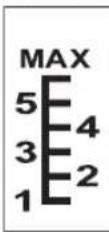
Turn the adjusting ring (3) to the desired torque setting. The scale on the adjusting ring (3) can be used as a reference point for the desired torque setting.
Adjust the depth stop (3) according to the direction of the arrow to increase the drilling depth and the triggering, adjust the depth stop in
the opposite direction accordingly to decrease the drilling depth. Through the adjustment of the depth stop (3), the maximum depth is limited by the support stop (2).
It is best to determine the required degree of adjustment through testing.
PowerSAVE mode (Fig. C)
Press briefly the PowerSAVE switch (9) to activate PowerSAVE mode. The PowerSAVE indicator (11) lights up. Then briefly press the switch (12) to switch
off the tool via the trigger (6). The motor remains deactivated/disengaged until the switch (12) is pressed. Now press the power tool switch to activate the motor.
If the power tool is not used for 30 minutes, the PowerSAVE indicator (11) goes out. To activate PowerSAVE mode again, release the lock by briefly pressing the switch (12). Then press the switch (12) again to switch off the trigger (6). The PowerSAVE indicator (11) lights up again.
Adjusting the depth stop (Fig. D)
To adjust the screw, turn the arrow on the adjusting sleeve (3) and the housing of the transmission of the power tool in the direction of the arrow. Remove the adjusting
sleeve (3) from the housing of the transmission without pulling it off. The screwdriver (1) is now visible. The power tool is ready for loosening or tightening screws.
Pull the switch for forward rotation (5) from the side of the power tool (i.e., from the front part of the power tool). The switch for forward rotation (5) from the rear side of the power tool is pulled out automatically forward. Switch on the power tool.
Note: The loosening of the screw may cause the depth stop (4) to be pulled out of the housing.
The depth stop (4) cannot be adjusted if the adjusting sleeve (3) is in the lower or upper position.
Temperature protection
When used as intended and in accordance with the instructions in this manual, the power tool cannot be overloaded. In case of excessive load or when used outside the permissible temperature range for the battery, the speed of rotation is reduced. The power tool will operate at full speed again once the battery temperature has reached the permissible operating range.
The rechargeable battery is protected against deep discharging by the electronic cell protection (ECP). When the rechargeable battery is discharged, the power tool switches off via a protective circuit: The inserted tool stops moving.
Operation
Switching On and Off
To start the power tool, press the switch (15) and keep it pressed. This way, you have both hands free, and the power tool is ready for use.
Maintenance and Service
Maintenance and Cleaning
Remove the battery from the power tool before any work on the power tool (e.g., maintenance, changing tools, etc.). There is a risk of injury from unintentional starting of the power tool.
For good and safe operation, keep the power tool and the ventilation slots clean.
After-Sales Service and Application Service
Our after-sales service responds to your questions concerning maintenance and repair of your product, as well as spare parts. Exploded views and information on spare parts can be found at: www.bosch-pt.com
The Bosch application service team will be happy to help you with any questions regarding our products and their accessories.
In case of any questions, please contact our after-sales service. When ordering spare parts, always quote the 10-digit article number given on the type plate of the product.
Bulgaria
Robert Bosch SRL
Electric service tool
Strada Horia Macelariu Nr. 30-34, sector 1
013937 Bucharest, Romania
Tel.: +359(0)700 13667 (Bulgarian)
Fax: +40 212 331 313
Email: BoschServiceCenterBG@ro.bosch.com
www.bosch-pt.com/bg/bg/
Additional service addresses can be found at:
www.bosch-pt.com/serviceaddresses
Transport
Disposal. Built-in rechargeable batteries are subject to the requirements of the law on hazardous goods. The consumer can transport the rechargeable battery without further conditions. When shipping by third parties (e.g., air transport or forwarding agency), special requirements for packaging and labeling must be observed. For the preparation of the item by the parcel service, consult an expert in the relevant field.
Dispose of the rechargeable battery if the housing is damaged. Insulate the contacts with insulating tape and package the rechargeable battery so that it cannot move in the packaging. Please observe the local regulations.
Disposal

Power tools, rechargeable batteries, and accessories should be recycled in an environmentally compatible manner.
Do not dispose of power tools, rechargeable batteries, or ordinary batteries in household waste!
Page 3 of the manual:
Instructions for use of power tools and defective or worn-out batteries/ordinary batteries
Must be disposed of separately. Use the designated collection systems.
Improper disposal of waste electrical and electronic equipment may have harmful effects on the environment and human health due to the potential presence of hazardous substances.
Batteries and ordinary batteries:
LITHIUM-ION:
Please follow the instructions in the transport section (see "Transport", page 137).
Macedonian
Safety warnings
General power tool safety warnings
WARNING
Read all safety warnings, instructions, illustrations and specifications provided with this power tool.
Failure to follow all instructions listed below may result in electric shock, fire and/or serious injury.
Save all warnings and instructions for future reference.
The term "power tool" in the warnings refers to your mains-operated (corded) power tool or battery-operated (cordless) power tool.
Safety at the workplace
Keep the workplace clean and well lit. Cluttered or dark areas can lead to accidents. Do not operate power tools in explosive atmospheres, such as in the presence of flammable liquids, gases, or dust. Power tools create sparks that can ignite dust or fumes. Keep children and bystanders away while operating a power tool. Distractions can cause you to lose control.
Electrical safety
The power tool plug must match the outlet. Never modify the plug in any way. Do not use any adapter plugs with earthed (grounded) power tools. Unmodified plugs and matching outlets will reduce the risk of electric shock. Avoid body contact with earthed surfaces, such as pipes, radiators,
metal cabinets, and refrigerators. There is an increased risk of electric shock if your body is earthed or grounded.
Do not expose power tools to rain or wet conditions. If water enters a power tool, it will increase the risk of electric shock. Do not abuse the cord. Never use the cord for carrying, pulling, or unplugging the power tool. Keep the cord away from heat, oil, sharp edges, or moving parts. Damaged or entangled cords increase the risk of electric shock. When operating a power tool outdoors, use an extension cord suitable for outdoor use. Using a cord suitable for outdoor use reduces the risk of electric shock. If operating a power tool in a damp location is unavoidable, use a residual current device (RCD) protected supply. Use of an RCD reduces the risk of electric shock.
Personal safety
Stay alert, watch what you are doing, and use common sense when operating a power tool. Do not use a power tool while you are tired or under the influence of drugs, alcohol, or medication. A moment of inattention while operating power tools may result in serious personal injury. Use personal protective equipment. Always wear eye protection. Protective equipment such as a dust mask, non-skid safety shoes, hard hat, or hearing protection used for appropriate conditions will reduce personal injuries. Prevent unintentional starting. Ensure the switch is in the off position before connecting to a power source and/or battery pack, picking up, or carrying the tool. Carrying power tools with your finger on the switch or energizing power tools that have the switch on invites accidents. Remove any adjusting key or wrench before turning the power tool on. A wrench or a key left attached to a rotating part of the power tool may result in personal injury. Do not overreach. Keep proper footing and balance at all times. This enables better control of the power tool in unexpected situations.
This is in Bulgarian. Translation: "This corresponds. Do not wear loose clothing or jewelry. Keep your hair and clothing away from moving parts. Loose clothing, jewelry, or long hair can get caught in moving parts."
This is in Bulgarian. Translation: "If devices are used for dust extraction and collection, make sure they are properly connected and used. Use of dust collection can reduce dust-related hazards. Do not let familiarity gained from frequent use of the tool allow you to become complacent and ignore tool safety principles. A careless action can cause severe injury within a fraction of a second."
This is in Bulgarian. Translation: "Use and care of power tools"
This is in Bulgarian. Translation: "Do not force the power tool. Use the correct power tool for your application. The correct power tool will do the job better and safer at the rate for which it was designed. Do not use the power tool if the switch does not turn it on and off. Any power tool that cannot be controlled with the switch is dangerous and must be repaired. Disconnect the plug from the power source and/or remove the battery pack, if detachable, from the power tool before making any adjustments, changing accessories, or storing power tools. Such preventive safety measures reduce the risk of starting the power tool accidentally. Store idle power tools out of the reach of children and do not allow persons unfamiliar with the power tool or these instructions to operate the power tool. Power tools are dangerous in the hands of untrained users. Maintain power tools and accessories. Check for misalignment or binding of moving parts, breakage of parts and any other condition that may affect the power tool's operation. If damaged, have the power tool repaired before use. Many accidents are caused by poorly maintained power tools. Keep cutting tools sharp and clean. Properly maintained cutting tools with sharp cutting edges are less likely to bind and are easier to control. Use the power tool, accessories and tool bits etc., in accordance with these instructions, taking into account the working conditions and the work to be performed. Use of the power tool for operations different from those intended could result in a hazardous situation. Keep handles and gripping surfaces dry, clean and free from oil and grease. Slippery handles and gripping surfaces do not allow for safe handling and control of the tool in unexpected situations."
This is in Bulgarian. Translation: "Use and care of battery-powered tools"
The battery is supplied fully charged by the manufacturer. A battery that is suitable for one type of battery may cause injury if used for another type of battery. Electrical accessories should only be used with batteries specifically designed for them. Using other types of batteries may cause damage or fire. When using the battery, keep it away from other metal objects, such as paper clips, coins, keys, nails, screws, or other small metal objects that can connect the positive and negative terminals. Shorting the battery terminals may cause burns or fire. If electrolyte leaks, rinse with plenty of water. In case of eye contact, seek additional medical help. Electrolyte leaked from the battery may cause irritation or burns. Do not use the battery or charger if it is damaged or modified. Damaged or modified batteries may behave unpredictably and cause fire, explosion, or injury. Do not expose the battery or charger to fire or high temperatures. Exposure to fire or temperatures above 130°C may cause explosion. Follow all instructions for charging and do not charge the battery or charger outside the temperature range specified in the instructions. Incorrect charging or charging outside the specified temperature range may damage the battery and increase the risk of fire.
Service
Have the electrical appliance serviced by a qualified technician who uses only identical replacement parts. This ensures safe operation of the electrical appliance. Never repair damaged battery packs. Battery pack repair should only be performed by the manufacturer or an authorized service provider.
Safety instructions for operation
Keep the electrical appliance away from the working surface while you are working, so that it does not come into contact with hidden wires. If you are working near a "live" wire, the metal parts of the electrical appliance may become live and the operator may receive an electric shock. Use appropriate safety equipment to detect hidden electrical cables and
Consult your local utility company regarding the use of electrical equipment. Contact with an electrical cable may cause fire or electric shock. Damaging a gas line may cause an explosion. Penetrating a water pipe may cause damage.
Electric shock hazard. Before use and maintenance of the power tool, short-term high reactive currents may occur. Keep the tool away from what is being processed. If you keep it with a delay or change, then the material being processed is processed by means of a kickback with the working tool. Wait until the electric tool has completely stopped working before removing the tool. The material being processed may become blocked and lead to loss of control or damage. Improper use of the battery may cause fire. The battery may leak or explode. Insert fresh air if damaged, see a doctor. The tool may cause injury to the fingers. Do not modify the battery. There is a risk of short circuit. The battery may be damaged by sharp objects such as nails or by impact with external force. It may cause internal short circuit and the battery may ignite, emit smoke, explode, or overheat. Use the battery only in the manufacturer's product. Only in this way will the battery be protected against dangerous overload.

Protect the battery from heat, e.g., from continuous intense sunlight, fire, dirt, water, and moisture. There is a risk of explosion and short circuit.
Product description and specifications

Read all safety warnings and instructions. Failure to follow the safety warnings and instructions may result in electric shock, fire, and/or serious injury.
Pay attention to the figures in the operating instructions for use.
Intended use
The power tool is intended for driving and removing screws.
140|Macedonian
Component illustration
The numbering of the illustrated components refers to the representation of the power tool on the graphics page.
(1) Bit holder (2) Torque presetting ring (3) Torque presetting ring for maximum torque that can be set (4) Ring for maximum torque that can be set (5) Switch for changing the direction of rotation (6) Lock button for the on/off switch (7) Battery (8) Battery release button (9) PowerSAVE on/off button (10) LED light for illuminating the screwing/unscrewing area (11) PowerSAVE LED indicator (12) Switch for turning on/off (13) Handle (insulated gripping surface) (14) Universal bit holder (15) Holder for bits. a) The accessories shown in the figures are not included in the standard scope of delivery.
Technical data
Vibration total value a h (vector sum of three directions) and uncertainty K determined in accordance with EN 62841-2-2:
Screwdriving Screwdriving with maximum permissible size: a<2.5 m/s², K=1.5 m/s². The vibration level given in these instructions and the emission value of the device have been measured according to standard measurement methods and can be used for comparison between electric tools. It can also be used for a preliminary assessment of the vibration level and the emission value of the device.
If you have chosen the power tool, the main applications of the electric tool are determined. When the electric tool is used for other applications, the tool may deviate from the standards or be handled improperly, and the level of vibration of the power tool may deviate. This can significantly increase the level of vibration of the power tool over the entire working period.
For precise determination of the level of vibration of the power tool, the period in which the tool is switched off or running idle should be taken into account, not the moment when it is in use. This can significantly reduce the level of vibration of the power tool over the entire working period.
Take additional safety measures to protect the operator from the effects of vibration, such as: maintaining the electric tool and the tools for insertion, maintaining the fuel and the blades, organizing the workflow.
Assembly
Before working on the electric tool (e.g. maintenance, changing the tool, etc.) remove the battery from the electric tool. If you accidentally press the switch for switching on/off, there is a risk of injury.
Charging the battery
Use only the chargers listed in the technical data. Only these chargers are suitable for the lithium-ion battery of the electric tool.
Note: The battery is supplied partially charged. To fully charge the battery, place it in the charger until it is fully charged before first use.
Lithium-ion batteries can be charged at any time without reducing their service life. Interrupting the charging process does not damage the battery.
The lithium-ion battery is protected against deep discharge by "Electronic Cell Protection (ECP)". When the battery is discharged, the electric tool is switched off by means of a protective switch: The electric tool will not operate.
When the electric tool is switched off automatically, do not press the switch for switching on/off. The battery can be damaged.
Pay attention to the notes for removal.
Permanent light 2×green 20-40%
Permanent light 1×green 5-20%
Flashing light 1×green 0-5%
IpomeHa ha anat (BnDn Cnka A)
Before working on the electrical appliance (e.g., cleaning, replacing parts, etc.), disconnect the battery from the electrical appliance. If you do not pay attention to the risk of electric shock when connecting/disconnecting, there is a danger of injury.
Remove the safety lock (4) from the electrical appliance. Remove the screw for tightening (1).
If necessary, you can remove the universal household tool (14) and replace it. If necessary, use tweezers.
After successfully replacing the part, reinsert the safety lock (4).
Use
Intended use
Inserting the battery
Note: Using a battery that does not match your electrical appliance may lead to damage or malfunction of the device.
Press the switch for changing the direction of rotation (5) to the middle position to prevent accidental activation. Insert the battery (7) into the handle until it clicks into place.
Changing the direction of rotation (see figures E-F)
With the switch for changing the direction of rotation (5), you can change the direction of rotation of the electrical appliance. As long as the switch for connecting/disconnecting (12) is pressed, this is not possible.
Right rotation: Press the switch for the direction of rotation (5) on the left side of the electrical appliance in the direction of the front side of the appliance. The switch for the direction of rotation (5) on the right side of the electrical appliance automatically moves backwards.
Left rotation: Press the switch for the direction of rotation (5) on the left side of the electrical appliance backwards (i.e., opposite to the front side of the appliance).
142 | Macedonian
The tool for setting the time (5) is on the right side of the electric tool. It is automatically positioned.
Switching on/off
To put the electric tool into operation, press the switch for switching on/off (12) and keep it pressed.
The LED light illuminates the work area when the switch for switching on/off (12) is pressed or locked, and enables illumination of the work area in unfavorable lighting conditions.
To lock the pressed switch for switching on/off (12), press it and hold it in the locking position (6).
To switch off the electric tool, release the switch for switching on/off (12). If it is locked with the locking position (6), briefly press the switch for switching on/off (12) and then release it.
Setting the number of revolutions
The number of revolutions of the electric tool can be adjusted steplessly, depending on how far you press the switch for switching on/off (12).
With light pressure on the switch for switching on/off (12), a low number of revolutions is achieved. With increasing pressure, the number of revolutions also increases.
Screwing in screws
For screwing in screws, place the screw on the screwdriver bit (1). The screw is held with the help of the universal bit holder (14). Press the switch for setting the time (5) on the left side of the electric tool in the direction of the arrow and hold it. Switch on the electric tool and press the screw firmly against the workpiece. The screw is screwed in until the set screwing depth is reached in the workpiece. The depth stop (4) touches the workpiece and the motor switches off; the universal bit holder (14) no longer turns. Check that the screwing depth is correct. Remove the depth stop (4).
Adjusting the screwing depth (see figure B)
The adjusting ring (3) can be used to set the screwing depth of the screw in the workpiece.
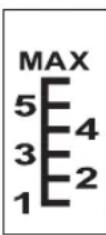
Turn the adjusting ring (3) to the position of your desired screwing depth. The number on the scale (the working range of the adjusting ring (3)) can be used as a rough guide for your desired screwing depth.
The turning of the adjusting ring (3) in the direction of the arrow on the housing results in a greater screwing depth.
Turning, and the turning time is controlled by the resistance to the arrows of the clock with the turning dial. By turning the dial for setting (3) the maximum time can be removed from the dial for closing the cover (2).
You will best set the time by turning the dial directly.
PowerSAVE mode (activation)
Briefly press the button for switching on/off PowerSAVE (9) to activate the PowerSAVE mode. The PowerSAVE LED indicator (11) lights up. Then briefly press the
switch on/off (12) and lock it by pressing the locking button (6). The motor remains deactivated/disabled, even if the switch on/off (12) is pressed. Now briefly press the electrical appliance switch to activate the motor.
If the electrical appliance is not used for 30 minutes, the PowerSAVE LED indicator (11) goes out. To reactivate the PowerSAVE mode, release the lock with a brief press of the switch on/off (12). Then press the switch on/off (12) again and lock it with the locking button (6). The PowerSAVE LED indicator (11) lights up again.
Dial for the timer that is set (dial position A)
To set the timer, turn the arrows of the dial for setting (3) on the front side of the electrical appliance in the other direction. Pull the dial for setting (3) forward until it no longer
The intermediate front side should not be pulled out. The turning dial (1) is now visible. The electrical appliance is ready to set the timer.
Press the switch for setting the time (5) on the left side of the electrical appliance forward (i.e., opposite to the front side of the appliance). The switch for setting the time (5) on the right side of the electrical appliance automatically moves forward. Switch on the electrical appliance.
Note: The timer setting can be done with the help of the dial for the timer that is set (4).
The dial for the timer that is set (4) cannot be pulled if the dial for setting (3) is in the maximum position.
Protection against overload depending on the temperature
The overload protection cannot be reset by the electrical appliance. In case of overload or operation outside the permitted temperature limits for the battery, the number of turns is reduced. After the permitted temperature of the battery is reached, the electrical appliance works again with the full number of turns.
Protection against overpressure
The battery is protected against deep discharge by the "Electronic Cell Protection (ECP)". When the battery is empty, the power tool is switched off by means of the protective circuit: The power tool no longer runs.
Assembly
Belt clip
The belt clip (15) allows you to attach the power tool to a belt, for example. You then have both hands free and the power tool is always at hand.
Maintenance and service
Maintenance and cleaning
Before any work on the power tool (e.g. maintenance, changing the tool, etc.) remove the battery from the power tool. There is danger of injury if the on/off switch is accidentally pressed. Clean the power tool and the ventilation slots regularly for good and safe operation.
After-sales service and application service
Our after-sales service responds to your questions concerning maintenance and repair of your product as well as spare parts. Exploded views and information on spare parts can be found at: www.bosch-pt.com
The Bosch application service team will be happy to help you if you have questions about our products and their accessories.
In all correspondence and spare parts orders, please always include the 10-digit article number given on the product's nameplate.
North Macedonia
D.D. Elkovps
Saba Kovacevik 47b, no. 3
1000 Skopje
E-noura: dimce.dimcev@servis-bosch.mk
Internet: www.servis-bosch.mk
Tel./fax: 02/2467610
Mob.: 070595888
D.P.T.U "ROJKA"
Janukrovski; T.L. Abutokomanaloka 69
1000 Skopje
E-mail: servisrojka@yahoo.com
Tel: +389 2 3174-303
Mob: +389 70 388-520, -530
Additional addresses for service can be found at:
www.bosch-pt.com/serviceaddresses
Transport
The recommended transport of the device is in accordance with the law on hazardous materials. The device can be transported only by the user, without the need for additional qualifications.
Transport through third parties (e.g., transport of the device by a third party by air transport or ship) requires compliance with the special instructions for packaging and labeling with the appropriate marks. In such a case, the device must be packed by an expert for hazardous substances.
The rechargeable battery must be removed before disposing of the tool. Remove the battery contacts and dispose of the battery in such a way that it cannot be thrown into the trash. Please pay attention to any possible national regulations.
Disposal

Electric devices, batteries, accessories, and packaging must be disposed of in an environmentally friendly manner.
Do not dispose of electric devices and batteries in household waste!
Only for EU countries:
Electric devices that are no longer used or are defective or used batteries must be disposed of separately. Use the existing collection systems.
If disposed of improperly, waste electrical and electronic equipment may have harmful effects on human health and the environment due to the possible presence of hazardous substances.
Batteries:
Lithium-ion:
Please observe the notes in the transport section (see Transport, page 143).
www.bosch-pt.com/serviceaddresses
Transport
The contained lithium-ion batteries are subject to the requirements of the law on dangerous goods. The user can transport the batteries by road without additional conditions.
When sending via a third party (e.g., air transport or forwarding), special requirements regarding packaging and labeling must be observed. In this case, a dangerous goods expert must be involved in preparing the shipment.
Only ship the battery if the housing is undamaged.
Tape off open contacts and pack up the battery so that it cannot move around in the packaging. Please also observe any additional national regulations.
Disposal

Power tools, rechargeable batteries, accessories, and packaging should be recycled in an environmentally friendly manner.
Do not dispose of power tools and rechargeable batteries/batteries in household waste!
Only for EU countries:
Electrical devices that can no longer be used and defective or depleted rechargeable batteries/batteries must be disposed of separately. Use the designated collection systems.
www.bosch-pt.com/serviceaddresses
Transport
www.bosch-pt.com/serviceaddresses
Transport
Recommended lithium-ion batteries are subject to the requirements of the dangerous goods law. Users can transport batteries by land without additional conditions.
When sending via intermediaries (e.g., air transport or forwarding agent), special requirements for packaging and labeling must be observed. In this case, a dangerous goods expert must be consulted when preparing the shipment.
Only ship the battery if the housing is undamaged.
Tape off open contacts and pack the battery so that it does not move in the packaging. Please also observe any additional national regulations.
Disposal

Power tools, rechargeable batteries, accessories and packaging should be taken to an environmentally friendly recycling facility.
Do not dispose of power tools and rechargeable batteries/batteries in household waste!
Only for EU countries:
Unusable power tools and defective or worn-out rechargeable batteries/batteries must be disposed of separately. Use the designated collection systems for waste.
If waste electrical and electronic equipment is disposed of improperly, it can have harmful effects on the environment and human health due to the possible presence of hazardous substances.
www.bosch-pt.com/serviceaddresses
Transport
www.bosch-pt.com/serviceaddresses
Transport
The lithium-ion rechargeable batteries supplied with the product are subject to regulations for the transport of dangerous goods. The user can transport the batteries by road without additional conditions.
If the batteries are shipped by third parties (e.g., by air), transport companies or other logistics agencies (intermediaries), special requirements regarding packaging and labeling of the shipment must be observed. Therefore, a dangerous goods transport specialist must be consulted during shipment preparation.
Ship the battery only if its housing is not damaged. Cover the open battery contacts and pack the battery so that it does not move within the packaging. Also observe any national regulations related to battery transport, if they exist.
www.bosch-pt.com/serviceaddresses
Transport
The recommended lithium-ion batteries are subject to the provisions of the laws regulating the transport of dangerous goods. The user may transport the batteries by road without any restrictions.
If third parties are used for shipping (e.g., air transport, freight forwarding companies), special requirements for packaging and labeling must be observed. It is necessary that a dangerous goods transport specialist be involved in preparing the shipment.
www.bosch-pt.com/serviceaddresses
| 18 | = λιχ | λωγλ |
| 4500-0 | a. | (2) |
| 6,0 | j. | j. |
| 6+...0 | p° | p. |
| 50+...20- | ρ° | ρ. |
| GBA 18V... | ||
| ProCORE18V... | ||
| GAL 18... | ||
| GAX 18... | ||
| GAL 36... |
20 V 25-20 battery (A ProCORE18V 4.0Ah
ProCORE18V 9 GBA 18V 1.5Ah 20 battery (B) .12.0Ah
2018 2019 2020 2021 2022 2023 2024
Electronic Cell Protection (ECP)
PowerSAVE 10 12.11 30 . PowerSAVE (11) . (12) . (12)
Bosch aui, wjll aaaj joo, wjlg
+212529314327:
sav.outillage@ma.bosch.com:JgjSJJJU
:clloaalglaugie
www.bosch-pt.com/serviceaddresses
Jai
pSgaiol guiu
gai jpssualljS.0jblglgail
a#l!b9jw 1g jaoJgJwU Lc
Juw joo 460-80% Electronic Cell Protection (ECP)"
jw 340-60. jg w o c b a n d g g
i 220-40
15-20%
15-20%
juj Saa 10-5%
jgajduis egj)jjl gog
(A)
Jog g 2bS sss J
uuiui ciuy jlgua uai (s) sga
GBA 18V...LJ Egi


LED
jμuδiδεj360-100%
jμw xiao ð|230-60%
jwaa 15-30%
jμw ∫jSawδ 10-5%
(CgawuSg)PowerSAVE
(9) PowerSAVE (\frac{\mu\omega g\lambda}{\mu\omega g}\frac{1}{\mu\omega g}\frac{1}{\mu\omega g}\frac{1}{\mu\omega g}\frac{1}{\mu\omega g}\frac{1}{\mu\omega g}\frac{1}{\mu\omega g}\frac{1}{\mu\omega g}\frac{1}{\mu\omega g}\frac{1}{\mu\omega g}\frac{1}{\mu\omega g}\frac{1}{\mu\omega g}\frac{2}{\mu\omega g}\frac{2}{\mu\omega g}\frac{2}{\mu\omega g}\frac{2}{\mu\omega g}\frac{2}{\mu\omega g}\frac{2}{\mu\omega g}\frac{2}{\mu\omega g}\frac{2}{\mu\omega g}\frac{2}{\mu\omega g}\frac{2}{\mu\omega g}\frac{3}{\mu\omega g}\frac{3}{\mu\omega g}\frac{3}{\mu\omega g}\frac{3}{\mu\omega g}\frac{3}{\mu\omega g}\frac{3}{\mu\omega g}\frac{3}{\mu\omega g}\frac{3}{\mu\omega g}\frac{3}{\mu\omega g}\frac{3}{\mu\omega g}\frac{4}{\mu\omega g}\frac{4}{\mu\omega g}\frac{4}{\mu\omega g}\frac{4}{\mu\omega g}\frac{4}{\mu\omega g}\frac{4}{\mu\omega g}\frac{4}{\mu\omega g}\frac{4}{\mu\omega g}\frac{4}{\mu\omega g}\frac{4}{\mu\omega g}\frac{5}{\mu\omega g}\frac{5}{\mu\omega g}\frac{5}{\mu\omega g}\frac{5}{\mu\omega g}\frac{5}{\mu\omega g}\frac{5}{\mu\omega g}\frac{5}{\mu\omega g}\frac{5}{\mu\omega g}\frac{5}{\mu\omega g}\frac{5}{\mu\omega g}\frac{6}{\mu\omega g}\frac{6}{\mu\omega g}\frac{6}{\mu\omega g}\frac{6}{\mu\omega g}\frac{6}{\mu\omega g}\frac{6}{\mu\omega g}\frac{6}{\mu\omega g}\frac{6}{\mu\omega g}\frac{6}{\mu\omega g}\frac{6}{\mu\omega g}\frac{7}{8}
LED jJw. gW Jg PowerSAVE .Gw GJ (11) PowerSAVE 10g (12) wog/
6) aos jg i g ju jing 12) wol/ wjg jls jia .silo G oLwol/ Jlejc WJgog Jld aab Jd golj d JgjI jgi
.8gwhJgjgoL
Jg 30 Jg j
s o j s jg jy j g w y golj S g o ig s jds jw u J g .PowerSAVE cJL W .S J (12) wogol/jwgs
g juq 12 wgo/sjw gjs LED jsiu.6 (6) css y
JgWoojwogojug (11) PowerSAVE
Egj) 1gww gac uusuiuS bpauiiogai (D gaj
ggl 10 uagu jj 3) ajj g
(3)jgdo ay 59j slalg jg
JgW OJJU JIJIgI gJgJgJgJgJgJgJgJgJgJgJgJgJgJgJgJgJgJgJgJgJgJgJgJgJgJgJgJgJgJgJgJgJgJgJgJgJgJgJgJgJgJgJgJgJgJgJgJgJgJgJ
jgl Caw j golg (5) uj n cag jui k jgl Cawj l jui yuac d j golg (5) uj n cag jui k .(sgw jgsy gl a jksga b u jy jll wj Caw j .sik uogj l j qj jl .sgw o osil j 1j jgl go i Jn j sju a
(4) 1
(4)uuiu jgw gac uusjusbs 3)uugg uuc a jglao MAX
Los a duiu!g Gia!
JjIjUyIgUgUgUgUgUgUgUgUgUgUgUgUgUgUgUgUgUgUgUgUgUgUgUgUgUgUgUgUgUgUgUgUgUgUgUgUgUgUgUgUgUgUgUgUgUgUgUgUgUgUg
julol aai juscblaa
"Electronic Cell Protection (ECP)" 5g jgjSJI. gwhgwhghgwhgwhgwhgwhgwhgwhgwhgwhgwhgwhgwhgwhgwhgwhgwhgwhgwhgwhgwhgwhgwhgwhgwhgwhgwhgwhgwhgwhgwhgwhgwhgwhgwhgwhgwhgwhgwhgwhgwhgwhgwhgwhgwhgwhgwhgwhgwhgwhgwhgwhgwhg
s oLsiw s g giuu uugol a jlogil jgbl
jSgolgogog
(12)Jog ggbSsL JIJIg Sjilol sI . 0000000000000000000000000000000000000000000000000000000000000000000000000000000000000000000000000000
Jogg gabgS gj jI jS gola aosu Jgag Jggo JgLk
(1) 5
www.bosch-pt.com/serviceaddresses
Legal Information and Licenses
Copyright © 2015, Infineon Technologies AG
All rights reserved.
Redistribution and use in source and binary forms, with or without modification, are permitted provided that the following conditions are met:
- Redistributions of source code must retain the above copyright notice, this list of conditions and the following disclaimer.
- Redistributions in binary form must reproduce the above copyright notice, this list of conditions and the following disclaimer in the documentation and/or other materials provided with the distribution. Neither the name of the copyright holders nor the names of its contributors may be used to endorse or promote products derived from this software without specific prior written permission.
THIS SOFTWARE IS PROVIDED BY THE COPYRIGHT HOLDERS AND CONTRIBUTORS "AS IS" AND ANY EXPRESS OR IMPLIED WARRANTIES, INCLUDING, BUT NOT LIMITED TO, THE IMPLIED WARRANTIES OF MERCHANTABILITY AND FITNESS FOR A PARTICULAR PURPOSE ARE DISCLAIMED. IN NO EVENT SHALL THE COPYRIGHT OWNER OR CONTRIBUTORS BE LIABLE FOR ANY DIRECT, INDIRECT, INCIDENTAL, SPECIAL, EXEMPLARY, OR CONSEQUENTIAL DAMAGES (INCLUDING, BUT NOT LIMITED TO, PROCUREMENT OF SUBSTITUTE GOODS OR SERVICES; LOSS OF USE, DATA, OR PROFITS; OR BUSINESS INTERRUPTION) HOWEVER CAUSED AND ON ANY THEORY OF LIABILITY, WHETHER IN CONTRACT, STRICT LIABILITY, OR TORT (INCLUDING NEGLIGENCE OR OTHERWISE) ARISING IN ANY WAY OUT OF THE USE OF THIS SOFTWARE, EVEN IF ADVISED OF THE POSSIBILITY OF SUCH DAMAGE.
Copyright © 2009-2020 ARM LIMITED
All rights reserved.
Redistribution and use in source and binary forms, with or without modification, are permitted provided that the following conditions are met:
- Redistributions of source code must retain the above copyright notice, this list of conditions and the following disclaimer.
- Redistributions in binary form must reproduce the above copyright notice, this list of conditions and the following disclaimer in the documentation and/or other materials provided with the distribution. Neither the name of ARM nor the names of its contributors may be used to endorse or promote products derived from this software without specific prior written permission.
THIS SOFTWARE IS PROVIDED BY THE COPYRIGHT HOLDERS AND CONTRIBUTORS "AS IS" AND ANY EXPRESS OR IMPLIED WARRANTY, INCLUDING, BUT NOT LIMITED TO, THE IMPLIED WARRANTY OF MERCHANTABILITY AND FITNESS FOR A PARTICULAR PURPOSE ARE DISCLAIMED. IN NO EVENT SHALL THE COPYRIGHT OWNER OR CONTRIBUTORS BE LIABLE FOR ANY DIRECT, INDIRECT, INCIDENTAL, SPECIAL, EXEMPLARY, OR CONSEQUENTIAL DAMAGES (INCLUDING, BUT NOT LIMITED TO, PROCUREMENT OF SUBSTITUTE GOODS OR SERVICES; LOSS OF USE, DATA, OR PROFITS; OR BUSINESS INTERRUPTION) HOWEVER CAUSED AND ON ANY THEORY OF LIABILITY, WHETHER IN CONTRACT, STRICT LIABILITY, OR TORT (INCLUDING NEGLIGENCE OR OTHERWISE) ARISING IN ANY WAY OUT OF THE USE OF THIS SOFTWARE, EVEN IF ADVISED OF THE POSSIBILITY OF SUCH DAMAGE.
Copyright © 2011 Petteri Aimonen
This software is provided 'as-is', without any express or implied warranty. In no event will the authors be held liable for any damages arising from the use of this software.
Permission is granted to anyone to use this software for any purpose, including commercial applications, and to alter it and redistribute it freely, subject to the following restrictions:
- The origin of this software must not be misrepresented; you must not claim that you wrote the original software. If you use this software in a product, an acknowledgment in the product documentation would be appreciated but is not required.
- Altered source versions must be plainly marked as such, and must not be misrepresented as being the original software.
- This notice may not be removed or altered from any source distribution.
196 | Legal Information and Licenses
| de | EU-Konformitäserklarung | Wir erklären in alleiniger Verantwortung, dass die genannten Produkte allen einschlagigen Bestimmungen der nachfolgenden aufgeführten Richtlinien und Verordnungen entsprechenden und mit folgenden Normen übereinstimmen. Technische Unterlagen bei: * | |
| Akku-Schrauber | Sachnummer | ||
| en | EU Declaration of Conformity | We declare under our sole responsibility that the stated products comply with all applicable provisions of the directives and regulations listed below and are in conformity with the following standards. Technical file at: * | |
| Cordless | Article number | ||
| Screwdriver | Screwdriver | ||
| fr | Déclaration de conformité UE | Nous déclarons sous notre propre responsabilité que les produits décrits sont en conformité avec les directives, règlements normatifs et normes écuminés ci-dessous. Dossier technique auprès de: * | |
| Visseuse sans fil | N° d'article | ||
| es | Déclaración de conformidad UE | Declaramos bajo notre propre responsabilité, que les produits nombrados cumplen con todas las dispositions correspondientes de las Directivas y los Reglementos Mentionados a continuación y está en conformidad con las siguientes normas. Documentos tínicos de: * | |
| Atornilladora | No de articulo | ||
| acionada por acumulador | |||
| pt | Déclaration de Conformidade UE | Declaramos sob{nossa exclusiva responsabilité que os produits mencionados cumprem todas as dispositions e os regulamentos indicados estão em conformidade com as seguintes normas. Documentação técnica pertencente à: * | |
| Aparafusadora | N.° do produits sem fio | ||
| it | Dichiarazione di conformità UE | Dichiariamo sulla mia responsabilità che i prodotti indicate sono conformi a tutte le dispositions pertinenti delle Direttive e dei Regolamenti elencati di seguito, nonché alle seguenti Normative. Documentazione Tecnica presso: * | |
| Avvitatore a Batteria | Codice prodotto | ||
| nl | EU-conformiteitsverklaring | Wij verklaren op eigenverantwoordelijkheid dat de genoemde producten voldoen aan alle desbetreffende bepalingen van de hierna genoemde richtlijnen en verordeningen en overeenstemmen met de volgende normen. Technisch dossier bij: * | |
| Accuschroeven-draaier | Productnummer | ||
| da | EU-overensstammelseserklaering | Vi erklær som eneansvarlige, at det beskrevne produit er i overensstammelse med alle galdende bestemmelse i følgende direktiver og forordninger og opfylder følgende standarder. Tekniske bilag ved: * | |
| Akku- skruemaskine | Typenummer | ||
| sv | EU-konformitetsförklaring | Vi forklarar under eget ansvar att de námnda produktura uppfyller kraven i alla gällande bestämelse i de nedan angivna direktiven och fordordingarnas och att de stämmer överens med följande normer. Teknisk dokumentation: * | |
| Sladdlös | Produktnummer | ||
| skruvdragare | |||
| no | EU-samsvarserklæring | Vi erklær under eneansvar at de nevnte Produktene er i overensstammelse med alle relevante bestemmelse i direktivene og forordningene nedenfor og med følgende standarder. Teknisk dokumentasjon hos: * | |
| Akku-skrutrekker | Produktnummer | ||
| fi | EU-vaatimustemmukaisuusvakuutus | Vakutamme täten, etta mainitut tuotteet vastaavat kaikkia seuraavien direktiivien ja asetusten asiaankuulvia vaatimuksaia ja ovat seuraavien standardien vaatimusten mukaisia. Tekniset asiakirjat saatavana: * | |
| Akkuruuvinnänn | Tuotenumero in | ||
| el | Δηλωση πιοτότητας EE | Δηλωνουμε εραπολείαικη μας ευθύνη, ὄτι τα αναφερόμενα προίντα ανιστοιχόνιν σε λέες κις σεχτικεδίαταξείατων πω μκάτων αναφερόμενων σθηγων και κανονιμών και ταυτιχόνται με τα ακόλουθα πρότιμα. Teknisika éyyραρα στη: * | |
| Δραπavokατοβίδ | Δριθμός ευρετηρίου o ραταρίας | ||
| tr | AB Uygunluk Beyani | Tek sorumu l'olarak, tanimlanan urünün aşaqidaki yönnetmelik ve direktiflerin geçerli buttun hülkūmlerine ve aşaqidaki standartla uregun oldügün buyan ederiz. Teknik belgelerin bulundugu yer: * | |
| Akūlū vidalama | Urún kodu | ||
| II | ||
| pl | Deklaracja zgodnosci UE | Osciadczamy z pełna odpowiedzialnosci, ze nineje}sze produkty odpowiadajw wsystkim wymaganiom ponizej wyszczejnlionych dyrektyw i Rozporzadzen, oraz ze są zgodne z nastepujacym normami. Dokumentacja techniczna:* |
| Wkretarka Numer katalogowy akumulatorowa | ||
| cs | EU prohlăseni o shodé | Prohlăsujeme na výhradní zodpovednost, ze uvedeny výrobek spólůvšechna príslužná ustanověni nizě uvedenych směrnic anaiadení ale vsouladu snásledujícimi normami: TECHnické podklady u:* |
| Akumulátorový ObjednaciCIDslo | ||
| sk | EU vyhlăsenie o zhode | Vyhlasujeme na výhradní zodpovednost, ze uvedeny výrobek spólna všetky príslužné ustanověni nizě slyedenich směrnic anaiadení ale vsúlade snásledujícimi normami: TECHnické podklady má spolocnost:* |
| Akumulátorový VecnéCIDslo | ||
| hu | EU konformitási nyilatkozat | Egyedūli feleloşeggel kijelentjuk, hagy a megnevezett termékek megfelelnek az alábbiakbman felsorolársa keruló irányvelk és rendeleket valamennyi idevagó elöirásainak és megfelelnek a kõvetkező szabványoknak. Mûszaki dokumentumok megörzési pontja:* |
| Akkumulátoros Cikkszámcsavarozógpé | ||
| ru | 3a8Blenne O COOTBETCTBNI EC | Mby 3a8Blenne IMOD Nau Hau y eIDINOLHNUH yOB TBTCTBENHOCTb, UTO HAZBAHNBIE PNOJYKTB COOTBETCTBYOT BCM DEICTBYUONIM PREDNCSANHIM HIXKEYA3AHHbX DIPKETNIB I PACNOPJHKEN, A TAKKSE HIXKEYA3AHHbIX HOPM. TexNHueckay DOKUMENTAÇA XPAHNTCA Y:* |
| Akkymylantopnb ToBapnbl NoH Wypynobert | ||
| uk | 3a8Ba pro bVidnoBIDNCTB EC | Mn3a8Blenne MIO Nau Hau y ODOOCOBY BIDNOBIDALNHICTb, UO HAZBAHIBI BINO6BI BIDNOBIDAIOTb YCIM YINHNIM PNOJXENHIM NIIUEO3NAHENX DIPKETNIB I P03NOPJDKENb, A TAKKOS HIXKEYO3NAHENHIM HOPMAM. TexNHueckay DOKUMENTAÇA 36BIPACTBcY:* |
| Akkymylantopnb ToBapnbl NoH Wypynobert | ||
| kk | EO cαIKeCTIK MaIynMDamacbI | Θ3 JEAAYANKEPIIKNI KIENBIS B3 ATANFAN ΘIIMDE TMEHIDE JX3BILIFAH DIPKETNIAJIAPMEN MINGKITBI MEN JAKPILKTAPDIIH TNICTI KAFINDAIAPBINA I CAIKECTIIN JX3He TAMEHDIERI HOPMANAPRAI CAI EKENIH BIDIPEMI3. TexNHuebk KUJKAATAP:* |
| Akkymylantopnb ΘHIM HOMIPi 6þaybùs | ||
| ro | Declaratie de conformitate UE | Declarãm pe proprie raspundere cã produsele mentionate corespund tuturor dispoziţilor relevante ale directivelor si reglementāriler enumerate in cele ce urmează ŞI sunt in conformitate cu urmàtoarele standarde. Documentatie tehnica la:* |
| Maşină de gâurit Numar de identificareşi insurubat cu acumulator | ||
| bg | EC DeKLAPAQUA 3a CSbTBeCTBVE | C ΣbTHA OTROBOPHOCT HNE DeKLAPIRPAME, Ye NOCOUYHTE PNOJKTIN OTROBAPAT Na BCNUKN BAVIIN N3NCKBAHNA Na DIPKETNIBI E IN PASTNPEDBITE IO-DONY I CSbTBECTBA Ha CLEDNITE CTADAPTN. TexNHuecka DOKUMENTAÇA INP:* |
| Akkymnatopén KaTALOJEN HOMEP BHTOBERT | ||
| mk | EU-N3jaba 3a coo6pa3HocT | Co CELOSOCHA OTOROBOPHOCT N3JABVBAme, DeKA OIIHSAHHTE PIONI3BOVDI CE BO COIINACHOCT CO SITPEPEVAHTH N ODPEDBNI HA CLEDNITE PERYNAIHTBNI IN PONINCHI IN CE BO COIINACHOCT CO CLEDNITE HOPMN. TexNHueka DOKUMENTAÇA JAI KAJ:* |
| BATEPINSK Bproj Na den/avtnkln ODBTVBa/ ZaupaФувa | ||
| sr | EU-IZjava o usaglašenosti | Na sopstvenu odgovornost izjavljemu, da navedeni proizvodi odgovaraju svim dotčinim odredbama naknadno navenedinih smernica i uredaba i da su skladu sa sledecim standardima. Tehnicka dokumentacija kod:* |
| Akku-odvrtačBroj predmeta | ||
| sl | IZjava o skladnosti EU | Izjavljamo pod izkljućno odgovornostjo, da je omenjen izdelek v skladu z vsemi relevantnimi dolocili direktiv in uredb ter ustreza naslednjim standardom. Tehnicna dokumentacija pri:* |
| Akkumatorski Številka artikla vijačnik | ||
| hr | EU Izjava o sukladnosti | Pod punom odgovornosću izjavljemu da navedeni proizvodi odgovaraju svim relevantnim odredbama direktiva i propisima navenedinima u nastavku i da su sukladni da sljedećim normama. Tehnicka dokumentacija se moze dobiti kod:* |
| Akkumatorski Kataloški br. | ||
| et | EL-vastavusdeklaratsion | Kinnitame ainuvastutajatena, et nimetatud tooted vastavad järgnevalt loetletud direktivide ja määruste kõikidele asjaomastele nõuetele ja on kooskõlas järgmiste normidega. Tehnilised dokumendid saadaval:* | |
| Akukruvikeeraja Tootenumber | |||
| lv | Deklaracija par atbilstūb ES standartiem | Mës ar pilnu atbildibu pazinojam, ka šeit aplükotie izstrādājumi atbilst visiem talak minētajās direktivas un rikojumos ietvertajām saistošajām nostādnēm, kãari sekojsiem standartiem. Tehniskā dokumentăcija no:* | |
| Akumulatora Izstrādājuma numurs skrūvgriezis | |||
| lt | ES atitikties deklaracija | Atsakingai pareškiame, kad išvardty gaminiai atitinka visus privalomus žemiau nurodytjur direktvyir reglamentu reikalavimus ir šiuos standartus. Techné dokumentacija saugoma:* | |
| Akumulatorinis Gaminio numeris suktuvas | |||
| GTB 18V-45 3 601 | JK7 000 | 2006/42/EC EN 62841-1:2015 + A11:2022 2014/30/EU EN 62841-2-2:2014 2011/65/EU EN IEC 55014-1:2021 EN IEC 55014-2:2021 EN IEC 63000:2018 | |
| *BOSCH * Robert Bosch Power Tools GmbH (PT/ECS) 70538 Stuttgart GERMANY | |||
| Thomas Donato Helmut Heinzelmann Chairman of the Head of Product Certification Management Board i.v. h.m.c. | |||
| Robert Bosch Power Tools GmbH, 70538 Stuttgart, GERMANY Stuttgart, 07.02.2025 | |||
IV
C
Declaration of Conformity
Cordless screwdriver Article number
GTB 18V-453601JK7000
We declare under our sole responsibility that the stated products comply with all applicable provisions of the regulations listed below and are in conformity with the following standards.
Technical file at: Robert Bosch Ltd. (PT/SOP-GB), Broadwater Park, North Orbital Road, Uxbridge UB9 5HJ, United Kingdom
The Supply of Machinery (Safety) Regulations 2008
The Electromagnetic Compatibility Regulations 2016
The Restriction of the Use of Certain Hazardous Substances in
Electrical and Electronic Equipment Regulations 2012
EN62841-1:2015+A11:2022
EN62841-2-2:2014
EN IEC 55014-1:2021
EN IEC 55014-2:2021
EN IEC 63000:2018

BOSCH
Steve Neumann
Regional Business Director UK & Ireland

Robert Bosch Power Tools GmbH, 70538 Stuttgart, Germany represented (in terms of the above regulations) by
Robert Bosch Limited, Broadwater Park, North Orbital Road, Uxbridge UB9 5HJ, United Kingdom
Martin Sibley
Business Operations and Aftersales Director
Robert Bosch Ltd. Broadwater Park, North Orbital Road, Uxbridge UB9 5HJ, United Kingdom, as authorised representative acting on behalf of Robert Bosch Power Tools GmbH, 70538 Stuttgart, Germany
Place of issue: Uxbridge Date of issue: 07/02/2025


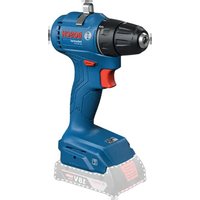


- TRANSPORT
- GENERAL POWER TOOL SAFETY WARNINGS
- WARNING
- SAVE ALL WARNINGS AND INSTRUCTIONS FOR FUTURE REFERENCE
- WORK AREA SAFETY
- ELECTRICAL SAFETY
- PERSONAL SAFETY
- POWER TOOL USE AND CARE
- BATTERY TOOL USE AND CARE
- SERVICE
- SAFETY WARNINGS FOR SCREWDRIVERS
- PRODUCT DESCRIPTION AND SPECIFICATIONS
- INTENDED USE
- PRODUCT FEATURES
- TECHNICAL DATA
- NOISE/VIBRATION INFORMATION
- WEAR HEARING PROTECTION
- ASSEMBLY
- BATTERY CHARGING
- REMOVING THE BATTERY
- BATTERY CHARGE INDICATOR
- BATTERY MODEL GBA 18V
- LEDS CAPACITY
- CHANGING THE TOOL (SEE FIGURE A)
- OPERATION
- STARTING OPERATION
- INSERTING THE BATTERY
- SETTING THE ROTATIONAL DIRECTION (SEE FIGURES E-F)
- SWITCHING ON/OFF
- ADJUSTING THE SPEED
- SCREWING IN SCREWS
- ADJUSTING THE SCREW-IN DEPTH (SEE FIGURE B)
- POWERSAVE MODE (SEE FIGURE C)
- RETRACTABLE DEPTH STOP (SEE FIGURE D)
- TEMPERATURE-DEPENDENT OVERLOAD PROTECTION
- PROTECTION AGAINST DEEP DISCHARGE
- PRACTICAL ADVICE
- BELT CLIP
- MAINTENANCE AND SERVICE
- MAINTENANCE AND CLEANING
- AFTER-SALES SERVICE AND APPLICATION SERVICE
- GREAT BRITAIN
- YOU CAN FIND FURTHER SERVICE ADDRESSES AT
- DISPOSAL
- ONLY FOR EU COUNTRIES
- ONLY FOR UNITED KINGDOM
- BATTERY PACKS/BATTERIES
- LI-ION
- FRANÇAIS
- FURTHER SERVICE ADDRESSES CAN BE FOUND AT
- DECLARATION OF CONFORMITY
- GREECE
- PLEASE ALSO OBSERVE THE SAFETY INSTRUCTIONS ENCLOSED
- BATTERIES/RECHARGEABLE BATTERIES
- TURKISH
- SAFETY INSTRUCTIONS
- USE OF THE POWER TOOL AND HANDLING IT
- SAFETY INSTRUCTIONS FOR SCREWDRIVERS
- ILLUSTRATED COMPONENTS
- FOR BATTERY GBA 18V
- LIGHT OUTPUT
- BATTERY PROCORE18V
- LIGHT CAPACITY
- REPLACING THE TOOL (SEE FIG. A)
- WORKING WITH THE TOOL
- SWITCHING ON THE ELECTRIC TOOL
- SELECTING THE DIRECTION OF ROTATION (SEE FIGURES E-F)
- SETTING THE SPEED
- ADJUSTING THE SCREWING DEPTH (SEE FIGURE B)
- DEPTH STOP (SEE FIGURE D)
- THERMAL OVERLOAD PROTECTION
- DEEP DISCHARGE PROTECTION
- SERVICE AND CONSULTATION ON APPLICATION ISSUES
- TPAHCNOPBBKA
- YTNN3AUN
- AKKYMYIATOPBL/6ATAPEH
- JIITHM-HOHHBIE
- YKPAIHCBKA
- BKA3IBKN 3 TEXHIKN 6E3NEKN
- ARAANBI BKAZIBKN 3TEXHIKN 6E3NEKN DNER ENEKTPOIHCTPYMEHTB
- PROPER HANDLING AND USE OF POWER TOOLS
- PROPER HANDLING AND USE OF POWER TOOLS WITH RECHARGEABLE BATTERIES
- BKA3IBKN 3TEXHIKN 6E3NEKN DNY WYPYNOKPYTIB
- BNMAHNAKYMNYATOPA
- BATTERY PACK CHARGE INDICATOR
- LED CAPACITY
- INSERTING THE BATTERY PACK
- SET THE DIRECTION SWITCH (SEE FIG. E-F)
- SWITCHING ON AND OFF
- UKRAINIAN
- SCREWDRIVING
- ADJUSTING THE SCREW DEPTH (SEE FIGURE B)
- POWERSAVE MODE (INV.MAL.C)
- INSERTING THE DEPTH STOP (INV.MAN.D)
- OVERLOAD PROTECTION
- WORKING INSTRUCTIONS
- SERVICE AND CONSULTATION ON USAGE QUESTIONS
- UKRAINE
- WARRANTY SERVICE ADDRESSES ARE LISTED AT
- TRANSPORTATION
- KAZAKH
- EURASIAN ECONOMIC UNION (EEU) MEMBER STATES
- PRODUCT SHELF LIFE
- TESTING PROCEDURE
- POSSIBLE MALFUNCTIONS
- WIRING DIAGRAMS
- MAINTENANCE AND REPAIR
- STORAGE
- SAFETY INSTRUCTIONS FOR ELECTRICAL INSTALLATIONS
- THIS ELECTRICAL INSTALLATION MUST BE SERVICED BY QUALIFIED PERSONNEL
- INSTALLATION AND MAINTENANCE OF THE DEVICE
- BATTERY USAGE INSTRUCTIONS
- MAINTENANCE
- SAFETY INSTRUCTIONS FOR USERS
- DEVICE COMPONENTS
- DEVICE SETUP (SEE FIGURE A)
- STORAGE PREPARATION
- BATTERY INSTALLATION
- CHECK THE BATTERY (SEE FIGURES E-F)
- CONNECTION/DISCONNECTION
- AHHANY MOMENTIH OPHATY
- YPAHDAAPDB6YPAN KPI3Y
- BYPAN KIPRI3Y TEPEHDIRIN PETREY (B CYPETIN KAPAIB3)
- POWERSAVE PEXNMI (C CYPETIN KAPAIB3)
- CLEANING AND MAINTENANCE
- BATTERY PROTECTION
- TROUBLESHOOTING
- IF THE DEVICE DOES NOT WORK
- TECHNICAL SPECIFICATIONS AND SERVICE
- ACCUMULATORS/BATTERIES
- THE TERM "POWER TOOL" IN THE WARNINGS REFERS TO YOUR MAINS-OPERATED (CORDED) POWER TOOL OR BATTERY-OPERATED (CORDLESS) POWER TOOL
- KEEP WORK AREA CLEAN AND WELL LIT. CLUTTERED OR DARK AREAS INVITE ACCIDENTS. DO NOT OPERATE POWER TOOLS IN EXPLOSIVE ATMOSPHERES, SUCH AS IN THE PRESENCE OF FLAMMABLE LIQUIDS, GASES OR DUST. POWER TOOLS CREATE SPARKS WHICH MAY IGNITE THE DUST OR FUMES
- POWER TOOL PLUGS MUST MATCH THE OUTLET. NEVER MODIFY THE PLUG IN ANY WAY. DO NOT USE ANY ADAPTER PLUGS WITH EARTHED (GROUNDED) POWER TOOLS. UNMODIFIED PLUGS AND MATCHING OUTLETS WILL REDUCE RISK OF ELECTRIC SHOCK. AVOID BODY CONTACT WITH EARTHED OR GROUNDED SURFACES, SUCH AS PIPES, RADIATORS, RANGES AND REFRIGERATORS. THERE IS AN INCREASED RISK OF ELECTRIC SHOCK IF YOUR BODY IS EARTHED OR GROUNDED. DO NOT EXPOSE POWER TOOLS TO RAIN OR WET CONDITIONS. WATER ENTERING A POWER TOOL WILL INCREASE THE RISK OF ELECTRIC SHOCK. DO NOT ABUSE THE CORD. NEVER USE THE CORD FOR CARRYING, PULLING OR UNPLUGGING THE POWER TOOL. KEEP CORD AWAY FROM HEAT, OIL, SHARP EDGES OR MOVING PARTS. DAMAGED OR ENTANGLED CORDS INCREASE THE RISK OF ELECTRIC SHOCK. WHEN OPERATING A POWER TOOL OUTDOORS, USE AN EXTENSION CORD SUITABLE FOR OUTDOOR USE. USE OF A CORD SUITABLE FOR OUTDOOR USE REDUCES THE RISK OF ELECTRIC SHOCK. IF OPERATING A POWER TOOL IN A DAMP LOCATION IS UNAVOIDABLE, USE A RESIDUAL CURRENT DEVICE (RCD) PROTECTED SUPPLY. USE OF AN RCD REDUCES THE RISK OF ELECTRIC SHOCK
- STAY ALERT, WATCH WHAT YOU ARE DOING AND USE COMMON SENSE WHEN OPERATING A POWER TOOL. DO NOT USE A POWER TOOL WHILE YOU ARE TIRED OR UNDER THE INFLUENCE OF DRUGS, ALCOHOL OR MEDICATION. A MOMENT OF INATTENTION WHILE OPERATING POWER TOOLS MAY RESULT IN SERIOUS PERSONAL INJURY. USE PERSONAL PROTECTIVE EQUIPMENT. ALWAYS WEAR EYE PROTECTION. PROTECTIVE EQUIPMENT SUCH AS DUST MASK, NON-SKID SAFETY SHOES, HARD HAT, OR HEARING PROTECTION USED FOR APPROPRIATE CONDITIONS WILL REDUCE PERSONAL INJURIES. PREVENT UNINTENTIONAL STARTING. ENSURE THE SWITCH IS IN THE OFF-POSITION BEFORE CONNECTING TO POWER SOURCE AND/OR BATTERY PACK, PICKING UP OR CARRYING THE TOOL. CARRYING POWER TOOLS WITH YOUR FINGER ON THE SWITCH OR ENERGISING POWER TOOLS THAT HAVE THE SWITCH ON INVITES ACCIDENTS. REMOVE ANY ADJUSTING KEY OR WRENCH BEFORE TURNING THE POWER TOOL ON. A WRENCH OR A KEY LEFT ATTACHED TO A ROTATING PART OF THE POWER TOOL MAY RESULT IN PERSONAL INJURY. DO NOT OVERREACH. KEEP PROPER FOOTING AND BALANCE AT ALL TIMES. THIS ENABLES BETTER CONTROL OF THE POWER TOOL IN UNEXPECTED SITUATIONS. DRESS PROPERLY. DO NOT WEAR LOOSE CLOTHING OR JEWELLERY. KEEP YOUR HAIR, CLOTHING AND GLOVES AWAY FROM MOVING PARTS. LOOSE CLOTHES, JEWELLERY OR LONG HAIR CAN BE CAUGHT IN MOVING PARTS. IF DEVICES ARE PROVIDED FOR THE CONNECTION OF DUST EXTRACTION AND COLLECTION FACILITIES, ENSURE THESE ARE CONNECTED AND PROPERLY USED. USE OF DUST COLLECTION CAN REDUCE DUST-RELATED HAZARDS
- PROPER HANDLING OF THE POWER TOOL
- CAREFUL HANDLING OF BATTERY-POWERED POWER TOOLS
- SAFETY INSTRUCTIONS FOR THE SCREWDRIVER
- PRODUCT DESCRIPTION AND PERFORMANCE
- INTENDED USE OF THE POWER TOOL
- BULGARIAN
- CHARGING THE BATTERY PACK
- REMOVING THE BATTERY PACK
- BATTERY PACK INDICATOR
- LED
- CHANGING THE TOOL (SEE FIG. A)
- WORKING WITH THE POWER TOOL
- ADJUSTING THE DIRECTION OF ROTATION (SEE FIG. E-F)
- SWITCHING ON
- SPEED ADJUSTMENT
- ADJUSTING THE TORQUE (SEE FIGURE B)
- POWERSAVE MODE (FIG. C)
- ADJUSTING THE DEPTH STOP (FIG. D)
- TEMPERATURE PROTECTION
- BULGARIA
- PAGE 3 OF THE MANUAL
- BATTERIES AND ORDINARY BATTERIES
- MACEDONIAN
- SAFETY WARNINGS
- SAFETY AT THE WORKPLACE
- THIS IS IN BULGARIAN. TRANSLATION: "USE AND CARE OF POWER TOOLS
- THIS IS IN BULGARIAN. TRANSLATION: "USE AND CARE OF BATTERY-POWERED TOOLS
- SAFETY INSTRUCTIONS FOR OPERATION
- COMPONENT ILLUSTRATION
- CHARGING THE BATTERY
- IPOMEHA HA ANAT (BNDN CNKA A)
- USE
- CHANGING THE DIRECTION OF ROTATION (SEE FIGURES E-F)
- SETTING THE NUMBER OF REVOLUTIONS
- POWERSAVE MODE (ACTIVATION)
- DIAL FOR THE TIMER THAT IS SET (DIAL POSITION A)
- PROTECTION AGAINST OVERLOAD DEPENDING ON THE TEMPERATURE
- PROTECTION AGAINST OVERPRESSURE
- NORTH MACEDONIA
- ADDITIONAL ADDRESSES FOR SERVICE CAN BE FOUND AT
- BATTERIES
- LITHIUM-ION
- JAI
- JGAJDUIS EGJ)JJL GOG
- (A)
- (CGAWUSG)POWERSAVE
- EGJ) 1GWW GAC UUSUIUS BPAUIIOGAI (D GAJ
- LOS A DUIU!G GIA
- JULOL AAI JUSCBLAA
- JSGOLGOGOG
- LEGAL INFORMATION AND LICENSES
- COPYRIGHT © 2015, INFINEON TECHNOLOGIES AG
- COPYRIGHT © 2009-2020 ARM LIMITED
- COPYRIGHT © 2011 PETTERI AIMONEN
- BOSCH
Brand : BOSCH
Model : GTB 18V45 Professional
Category : Screwdriver