
ASAS 1821 K AS - Saw Fein - Free user manual and instructions
Find the device manual for free ASAS 1821 K AS Fein in PDF.
 FR
FR
 BG
BG
 CS
CS
 DA
DA
 DE
DE
 EL
EL
 EN
EN
 ES
ES
 ET
ET
 FI
FI
 HU
HU
 IT
IT
 JA
JA
 KO
KO
 LT
LT
 LV
LV
 NL
NL
 NO
NO
 PL
PL
 PT
PT
 RO
RO
 RU
RU
 SK
SK
 SL
SL
 SV
SV
 TH
TH
 TR
TR
 UK
UK
 ZH
ZH
| Product type | Cordless reciprocating saw |
| Brand | Fein |
| Model | ASAS 1821 K AS |
| Rated voltage | 18 V |
| No-load stroke rate | 0 – 3,050 min⁻¹ |
| Stroke | 21 mm |
| Max. cutting depth in wood | 200 mm |
| Max. cutting depth in steel (unalloyed) | 16 mm |
| Max. pipe diameter | 100 mm |
| Weight (depending on battery) | 2.3 – 3.3 kg |
| Blade holder type | SDS (tool-free quick change) |
| Recommended battery type | GBA 18V... / ProCORE18V... (Lithium-Ion) |
| Recommended charger | GAL 18... |
| Variable speed | Yes, by trigger pressure |
| LED light | Yes, integrated |
| Number of speeds | Continuously variable |
| Application | Cutting wood, plastic, metal, construction materials |
| Special features | Plunge cutting, flush cutting, 180° adjustable blade |
| Maintenance and cleaning | Clean ventilation slots; lubricate blade holder |
| Safety equipment | Lock-on switch, double battery lock |
| Warranty | Legal warranty + FEIN manufacturer warranty |
| Spare parts | Available at www.fein.com (blades, batteries, chargers) |
| Repairability | Repair by FEIN authorized service |
Frequently Asked Questions - ASAS 1821 K AS Fein
User questions about ASAS 1821 K AS Fein
0 question about this device. Answer the ones you know or ask your own.
Ask a new question about this device
Download the instructions for your Saw in PDF format for free! Find your manual ASAS 1821 K AS - Fein and take your electronic device back in hand. On this page are published all the documents necessary for the use of your device. ASAS 1821 K AS by Fein.
USER MANUAL ASAS 1821 K AS Fein
natural_image
Exterior view of a handheld device with black and silver casing (no text or symbols visible)
ASAS18-21KAS [**] 7 133 ...
2
| de | 5 | no | 76 | sl | 144 | zh-CN | 218 |
| en | 13 | sv | 83 | sr | 152 | zh-TW | 223 |
| fr | 20 | fi | 90 | hr | 160 | ko | 228 |
| it | 28 | tr | 97 | ru | 167 | th | 234 |
| nl | 36 | hu | 104 | uk | 178 | ja | 242 |
| es | 44 | cs | 112 | bg | 187 | ar | 248 |
| pt | 52 | sk | 119 | et | 196 | hi | 255 |
| el | 60 | pl | 127 | lt | 203 | ||
| da | 69 | ro | 136 | lv | 210 | CE |
| zh-CN | 218 |
| zh-TW | 223 |
| ko | 228 |
| th | 234 |
| ja | 242 |
| ar | 248 |
| hi | 255 |
| CE | I |
| UKCA | i |
4
natural_image
Diagram showing a mechanical component with an arrow indicating rotation, no text or symbols present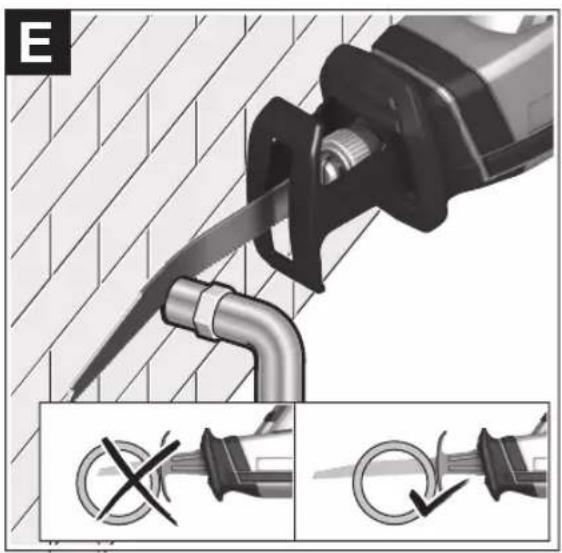
de
Original instructions
Safety Instructions
General Power Tool Safety Warnings WARNING Read all safety warnings, instructions, illustrations and specifications provided with this power tool.
Failure to follow all instructions listed below may result in electric shock, fire and/or serious injury.
Save all warnings and instructions for future reference.
The term "power tool" in the warnings refers to your mains-operated (corded) power tool or battery-operated (cordless) power tool.
Work area safety
▶ Keep work area clean and well lit. Cluttered or dark areas invite accidents.
▶ Do not operate power tools in explosive atmospheres, such as in the presence of flammable liquids, gases or dust. Power tools create sparks which may ignite the dust or fumes.
- Keep children and bystanders away while operating a power tool. Distractions can cause you to lose control.
Electrical safety
▶ Power tool plugs must match the outlet. Never modify the plug in any way. Do not use any adapter plugs with earthed (grounded) power tools. Unmodified plugs and matching outlets will reduce risk of electric shock.
▶ Avoid body contact with earthed or grounded surfaces, such as pipes, radiators, ranges and refrigerators. There is an increased risk of electric shock if your body is earthed or grounded.
▶ Do not expose power tools to rain or wet conditions. Water entering a power tool will increase the risk of electric shock.
▶ Do not abuse the cord. Never use the cord for carrying, pulling or unplugging the power tool. Keep cord away from heat, oil, sharp edges or moving parts. Damaged or entangled cords increase the risk of electric shock.
▶ When operating a power tool outdoors, use an extension cord suitable for outdoor use. Use of a cord suitable for outdoor use reduces the risk of electric shock.
▶ If operating a power tool in a damp location is unavoidable, use a residual current device (RCD) protected supply. Use of an RCD reduces the risk of electric shock.
Personal safety
▶ Stay alert, watch what you are doing and use common sense when operating a power tool. Do not use a power tool while you are tired or under the influence of drugs, alcohol or medication. A moment of inattention while operating power tools may result in serious personal injury.
▶ Use personal protective equipment. Always wear eye protection. Protective equipment such as a dust mask, non-skid safety shoes, hard hat or hearing protection used for appropriate conditions will reduce personal injuries.
▶ Prevent unintentional starting. Ensure the switch is in the off-position before connecting to power source and/or battery pack, picking up or carrying the tool. Carrying power tools with your finger on the switch or energising power tools that have the switch on invites accidents.
▶ Remove any adjusting key or wrench before turning the power tool on. A wrench or a key left attached to a rotating part of the power tool may result in personal injury.
▶ Do not overreach. Keep proper footing and balance at all times. This enables better control of the power tool in unexpected situations.
▶ Dress properly. Do not wear loose clothing or jewellery. Keep your hair and clothing away from moving parts. Loose clothes, jewellery or long hair can be caught in moving parts.
If devices are provided for the connection of dust extraction and collection facilities, ensure these are connected and properly used. Use of dust collection can reduce dust-related hazards.
▶ Do not let familiarity gained from frequent use of tools allow you to become complacent and ignore tool safety principles. A careless action can cause severe injury within a fraction of a second.
Power tool use and care
▶ Do not force the power tool. Use the correct power tool for your application. The correct power tool will do the job better and safer at the rate for which it was designed.
▶ Do not use the power tool if the switch does not turn it on and off. Any power tool that cannot be controlled with the switch is dangerous and must be repaired.
▶ Disconnect the plug from the power source and/or remove the battery pack, if detachable, from the power tool before making any adjustments, changing accessories, or storing power tools. Such preventive safety measures reduce the risk of starting the power tool accidentally.
▶ Store idle power tools out of the reach of children and do not allow persons unfamiliar with the power tool or these instructions to operate the power tool. Power tools are dangerous in the hands of untrained users.
- Maintain power tools and accessories. Check for misalignment or binding of moving parts, breakage of parts and any other condition that may affect the power tool's operation. If damaged, have the power tool repaired before use. Many accidents are caused by poorly maintained power tools.
▶ Keep cutting tools sharp and clean. Properly maintained cutting tools with sharp cutting edges are less likely to bind and are easier to control.
▶ Use the power tool, accessories and tool bits etc. in accordance with these instructions, taking into account the working conditions and the work to be performed. Use of the power tool for operations different from those intended could result in a hazardous situation.
▶ Keep handles and grasping surfaces dry, clean and free from oil and grease. Slippery handles and grasping surfaces do not allow for safe handling and control of the tool in unexpected situations.
▶ Recharge only with the charger specified by the manufacturer. A charger that is suitable for one type of battery pack may create a risk of fire when used with another battery pack.
▶ Use power tools only with specifically designated battery packs. Use of any other battery packs may create a risk of injury and fire.
When battery pack is not in use, keep it away from other metal objects, like paper clips, coins, keys, nails, screws or other small metal objects, that can make a connection from one terminal to another. Shorting the battery terminals together may cause burns or a fire.
▶ Under abusive conditions, liquid may be ejected from the battery; avoid contact. If contact accidentally occurs, flush with water. If liquid contacts eyes, additionally seek medical help. Liquid ejected from the battery may cause irritation or burns.
▶ Do not use a battery pack or tool that is damaged or modified. Damaged or modified batteries may exhibit unpredictable behaviour resulting in fire, explosion or risk of injury.
▶ Do not expose a battery pack or tool to fire or excessive temperature. Exposure to fire
Battery tool use and care
or temperature above 130^ C may cause explosion.
▶ Follow all charging instructions and do not charge the battery pack or tool outside the temperature range specified in the instructions. Charging improperly or at temperatures outside the specified range may damage the battery and increase the risk of fire.
Service
▶ Have your power tool serviced by a qualified repair person using only identical replacement parts. This will ensure that the safety of the power tool is maintained.
▶ Never service damaged battery packs. Service of battery packs should only be performed by the manufacturer or authorized service providers.
Safety instructions for reciprocating saws
▶ Hold the power tool by insulated gripping surfaces, when performing an operation where the cutting accessory may contact hidden wiring. Cutting accessory contacting a "live" wire may make exposed metal parts of the power tool "live" and could give the operator an electric shock.
▶ Use clamps or another practical way to secure and support the workpiece to a stable platform. Holding the workpiece by hand or against your body leaves it unstable and may lead to loss of control.
- Keep hands away from the sawing area. Do not reach under the workpiece. Contact with the saw blade can lead to injuries.
▶ Hold the power tool firmly with both hands and make sure you have a stable footing.
The power tool can be more securely guided with both hands.
▶ Only bring the power tool into contact with the workpiece when switched on. Otherwise there is danger of kickback if the cutting tool jams in the workpiece.
▶ Ensure that the footplate is always resting on the workpiece while sawing. The saw blade can jam and lead to loss of control over the power tool.
When the cut is completed, switch off the power tool and then pull the saw blade out of the cut only after it has come to a standstill. In this manner you can avoid kickback and can place down the power tool securely.
▶ Always wait until the power tool has come to a complete stop before placing it down. The application tool can jam and cause you to lose control of the power tool.
▶ Use only undamaged saw blades that are in perfect condition. Bent or dull saw blades
en
can break, negatively influence the cut, or lead to kickback.
▶ Do not brake the saw blade to a stop by applying side pressure after switching off. The saw blade can be damaged, break or cause kickback.
▶ Ensure that the material is securely clamped. Do not support the workpiece using your hands or feet. Do not touch any objects or the floor with the saw while it is running. There is a risk of kickback.
▶ Use suitable detectors to determine if there are hidden supply lines or contact the local utility company for assistance. Contact with electric cables can cause fire and electric shock. Damaging gas lines can lead to explosion. Breaking water pipes causes property damage.
In case of damage and improper use of the battery, vapours may be emitted. The battery can set alight or explode. Ensure the area is well ventilated and seek medical attention should you experience any adverse effects. The vapours may irritate the respiratory system.
▶ Do not open the battery. There is a risk of short-circuiting.
The battery can be damaged by pointed objects such as nails or screwdrivers or by force applied externally. An internal short circuit may occur, causing the battery to burn, smoke, explode or overheat.
▶ Only use the AMPShare battery in the manufacturer's products or those of the AMPShare partners. This is the only way in which you can protect the battery against dangerous overload.


Protect the battery against heat, e.g. against continuous intense sunlight, fire, dirt, water and moisture.
There is a risk of explosion and short-circuiting.
Product Description and Specifications

Read all the safety and general instructions. Failure to observe the safety and general instructions may result in electric shock, fire and/or serious injury.
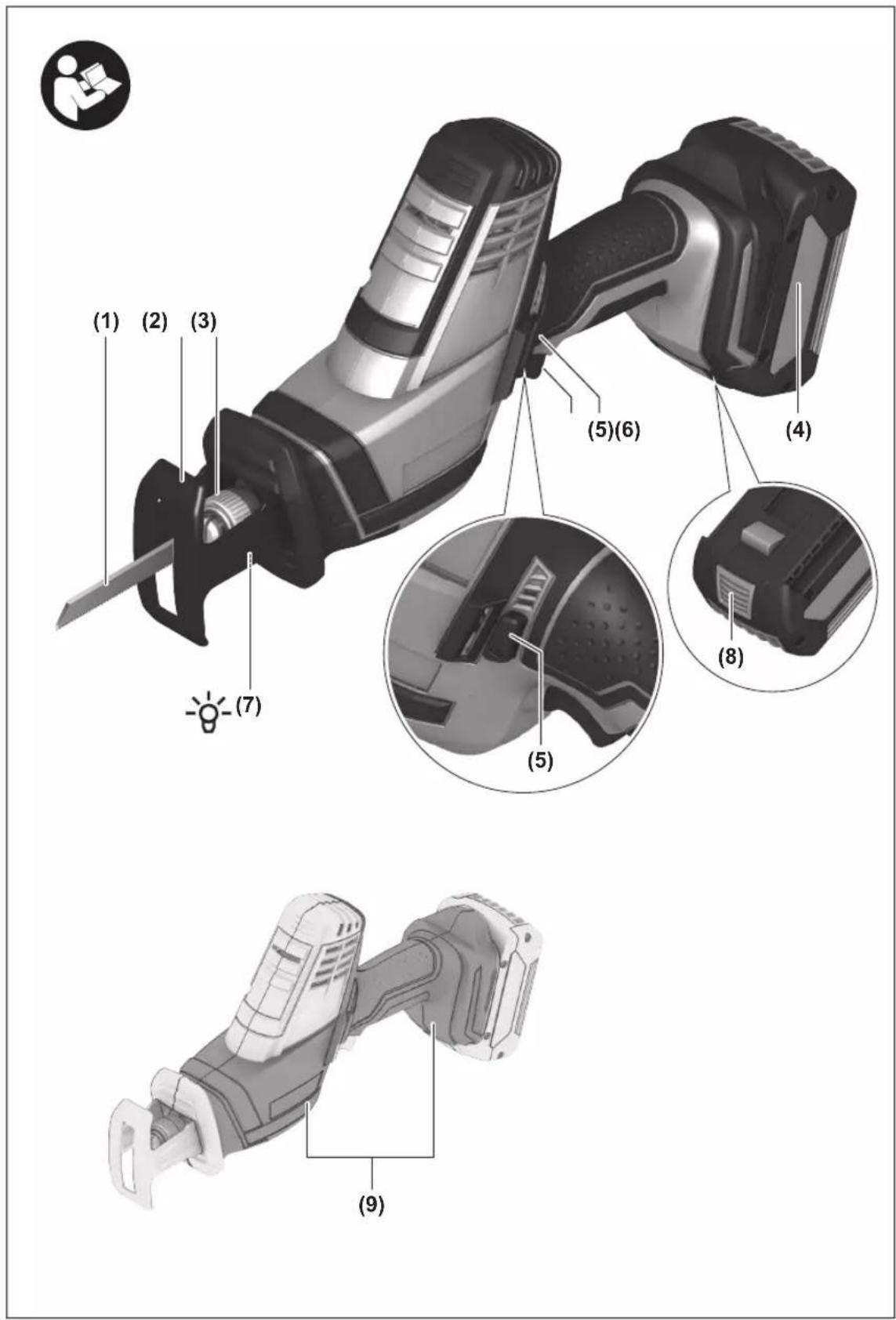
Please observe the illustrations at the beginning of this operating manual.
Do not use this power tool until you have thoroughly read and fully understood this operating manual. Pay additional attention to the applicable national health and safety regulations.
Intended Use
The power tool is suitable for sawing wood, plastic, metal and building materials on a firm surface. It is suitable for straight and curved cuts. When using designated suitable bi-metal saw blades, flush cutting is also possible. The saw blade recommendations are to be observed.
Product Features
The numbering of the product features refers to the diagram of the power tool on the graphics page.
(1) Saw blade
(2) Base plate
(3) Locking sleeve for saw blade
(4) Rechargeable battery ^a)
(5) Lock-off function for On/Off switch
(6) On/Off switch
(7) Worklight
(8) Rechargeable battery release button ^a)
(9) Handle (insulated gripping surface)
(10) Saw blade receptacle
a) Accessories shown or described are not included with the product as standard. You can find the complete selection of accessories in our accessories range.
Technical Data
Reciprocating saw ASAS18-21KAS
| Article number 7 133 ... | |
| Rated voltage V=18 | |
| No-load stroke rate n0^A) min-1 | 0-3050 |
| Tool holder SDS | |
| Stroke mm 21 |
Max. cutting depth
| – in wood mm 200 | |
| – in steel (unalloyed) mm 16 | |
| – pipe diameter mm 100 | |
| Weight according to kg EPTA-Procedure 01:2014 | 2.3–3.3 B) |
| Recommended ambient temperature during charging | °C 0 to +35 |
| Permitted ambient temperature during operation C) and during storage | °C –20 to +50 |
| Recommended rechargeable batteries | GBA 18V... ProCORE18V... |
Reciprocating saw ASAS18-21KAS
Recommended chargers GAL 18...
A) Measured at 20–25 °C with rechargeable battery GBA 18V 4.0Ah.
B) Depends on battery in use
C) Limited performance at temperatures < 0^
Noise/vibration information
Noise emission values determined according to EN 62841-2-11.
Typically, the A-weighted noise level of the power tool is: Sound pressure level 82 dB(A); sound power level 93 dB(A). Uncertainty K = 5 dB.
Wear hearing protection!
Vibration total values a_h (triax vector sum) and uncertainty K determined according to EN 62841-2-11:
Cutting boards with saw blade HCS, 150 × 19 × 1,25 mm, 6 TPI:
a_h,B = 9 m / s^2, K = 1.5 m / s^2,
Cutting wooden beams with saw blade BIM, 150 × 19 × 1.25 mm, 6 TPI:
a_h,WB = 8 m/s^2, K = 1.5 m/s^2 .
(The specifications for cutting boards apply to a workpiece thickness of 20 mm.)
The vibration level and noise emission value given in these instructions have been measured in accordance with a standardised measuring procedure and may be used to compare power tools. They may also be used for a preliminary estimation of vibration and noise emissions.
The stated vibration level and noise emission value represent the main applications of the power tool. However, if the power tool is used for other applications, with different application tools or is poorly maintained, the vibration level and noise emission value may differ. This may significantly increase the vibration and noise emissions over the total working period.
To estimate vibration and noise emissions accurately, the times when the tool is switched off or when it is running but not actually being used should also be taken into account. This may significantly reduce vibration and noise emissions over the total working period.
Implement additional safety measures to protect the operator from the effects of vibration, such as servicing the power tool and application tools, keeping their hands warm, and organising workflows correctly.
Rechargeable battery
Charging the battery
▶ Use only the chargers listed in the technical data. Only these chargers are matched to the lithium-ion battery of your power tool.
Note: Lithium-ion rechargeable batteries are supplied partially charged according to international transport regulations. To ensure full rechargeable battery capacity, fully charge the rechargeable battery before using your tool for the first time.
Inserting the Battery
Push the charged battery into the battery holder until it clicks into place.
Removing the Battery
To remove the rechargeable battery, press the battery release button and pull the battery out.
Do not use force to do this.
The rechargeable battery has two locking levels to prevent the battery from falling out if the battery release button is pressed unintentionally. The rechargeable battery is held in place by a spring when fitted in the power tool.
Battery charge indicator
The green LEDs on the battery charge indicator indicate the state of charge of the battery. For safety reasons, it is only possible to check the state of charge when the power tool is not in operation.
Press the button for the battery charge indicator or to show the state of charge. This is also possible when the battery is removed.
If no LED lights up after pressing the button for the battery charge indicator, then the battery is defective and must be replaced.
Battery model GBA 18V...

LED Capacity
3x continuous green light 60–100 %
2× continuous green light 30–60 %
1x continuous green light 5–30 %
1× flashing green light 0–5 %
Battery model ProCORE18V...

LED Capacity
5 x continuous green light 80–100 %
4 × continuous green light 60–80 %
LED Capacity
3 × continuous green light 40–60 %
2 × continuous green light 20–40 %
1 × continuous green light 5–20 %
1 × flashing green light 0–5 %
Recommendations for Optimal Handling of the Battery
Protect the battery against moisture and water.
Only store the battery within a temperature range of -20 to 50 °C. Do not leave the battery in your car in the summer, for example.
Occasionally clean the ventilation slots on the battery using a soft brush that is clean and dry.
A significantly reduced operating time after charging indicates that the battery has deteriorated and must be replaced.
Follow the instructions on correct disposal.
Assembly
▶ Remove the battery from the power tool before carrying out work on the power tool (e.g. maintenance, changing tool, etc.). The battery should also be removed for transport and storage. There is risk of injury from unintentionally pressing the on/off switch.
Inserting/changing the saw blade
▶ When fitting or changing the saw blade, wear protective gloves. Blades are sharp and can become hot when used for prolonged periods of time.
▶ While replacing the saw blade, ensure that the saw blade receptacle is free of material residue, e.g. wood or metal chips.
Selecting the saw blade
Only use saw blades with a 1/2" universal shank. The saw blade should not be longer than required for the intended cut.
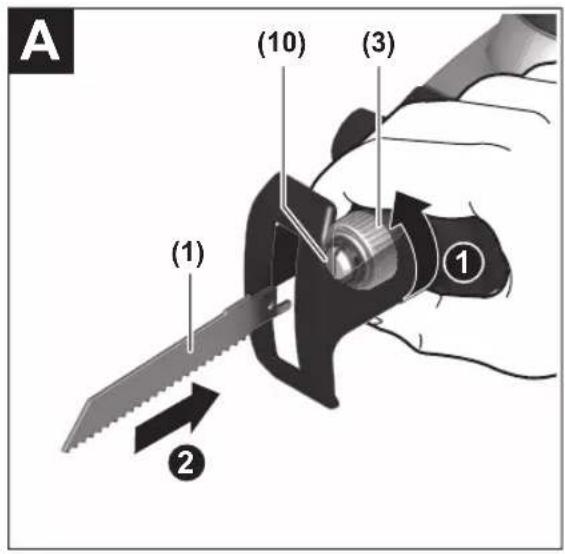
Inserting the saw blade (see figure A)
Turn the locking sleeve (3) approx. 90° in the direction of the arrow and hold it firmly. Push the saw blade (1) into the saw blade receptacle (10). Release the locking sleeve again.
▶ Check that it is seated securely by pulling the saw blade. A loose saw blade can fall out and lead to injuries.
For particular jobs, the saw blade (1) can also be flipped 180^ (teeth point upwards) and refitted.
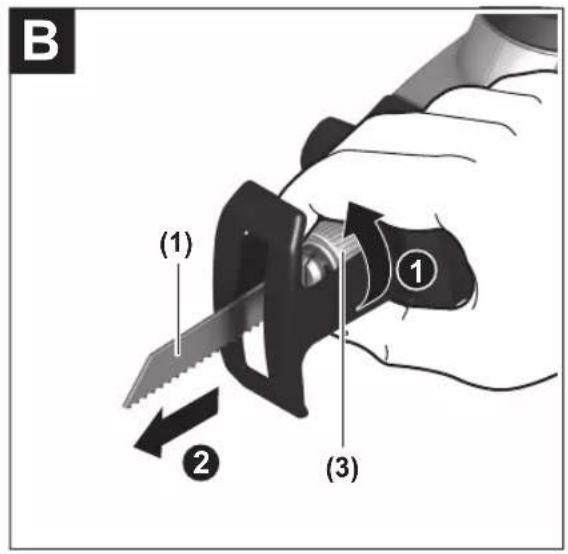
Removing the Saw Blade (see figure B)
▶ Let the saw blade cool down before removing it. There is a risk of injury when touching the hot saw blade.
Turn the locking sleeve (3) approx. 90° in the direction of the arrow and hold it firmly. Remove the saw blade (1).
Dust/Chip Extraction
Dust from materials such as lead-containing coatings, some wood types, minerals and metal can be harmful to one's health. Touching or breathing-in the dust can cause allergic reactions and/or lead to respiratory infections of the user or bystanders.
Certain dust, such as oak or beech dust, is considered carcinogenic, especially in connection with wood-treatment additives (chromate, wood preservative). Materials containing asbestos may only be worked by specialists.
- Provide for good ventilation of the working place.
- It is recommended to wear a P2 filter-class respirator.
Observe the relevant regulations in your country for the materials to be worked.
- Avoid dust accumulation at the workplace. Dust can easily ignite.
Operation
Starting Operation
Switching On and Off (see figure C)
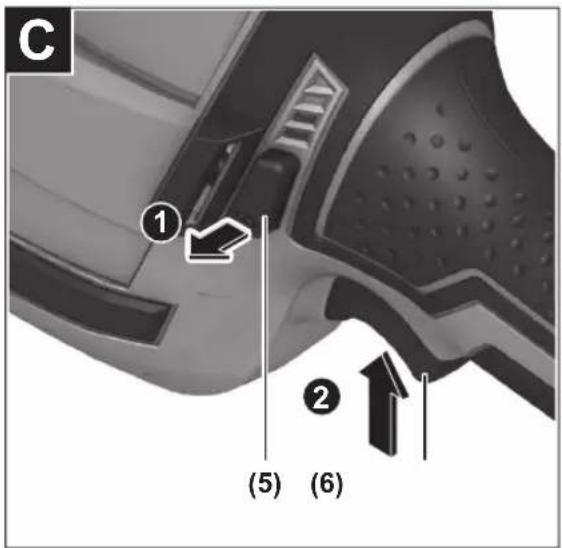
To switch on the power tool, press the lock-off switch to the left (5) first. Then press the on/off switch (6) and keep it pressed.
The worklight lights up when the on/off switch (6) is lightly or fully pressed allowing the work area to be illuminated in poor lighting conditions.
To switch off the power tool, release the on/off switch (6). Then press the lock-off button (5) to the right again.
Controlling the stroke rate
You can variably adjust the stroke rate of the power tool when it is on by pressing in the on/off switch (6) to varying extents.
Applying light pressure to the on/off switch (6) results in a low stroke rate. Applying increasing pressure to the switch increases the stroke rate.
The required stroke rate is dependent on the material and the work conditions and can be determined using practical tests.
It is recommended that you reduce the stroke rate when placing the saw blade on the workpiece and when sawing plastic and aluminium.
During prolonged periods of use at a low stroke rate, the power tool may heat up significantly. Remove the saw blade and let the power tool run at the maximum stroke rate for around three minutes to cool down.
Working Advice
Remove the battery from the power tool before carrying out work on the power tool (e.g. maintenance, changing tool, etc.). The battery should also be removed for transport and storage. There is risk of injury from unintentionally pressing the on/off switch.
▶ Switch the power tool off immediately if the saw blade becomes blocked.
Tips
▶ When sawing lightweight materials, take into account the statutory provisions and recommendations of the material manufacturers.
Before sawing into wood, chipboard, building materials, etc., check for any foreign objects such as nails, screws, etc. and use a suitable saw blade.
Switch on the power tool and guide it towards the workpiece you wish to work on. Place the base plate (2) on the surface of the workpiece and saw through the material applying even pressure and feed. Switch the power tool off once you have finished your work.
Switch the power tool off immediately if the saw blade jams. Widen the sawing gap slightly with a suitable tool and pull the power tool out.
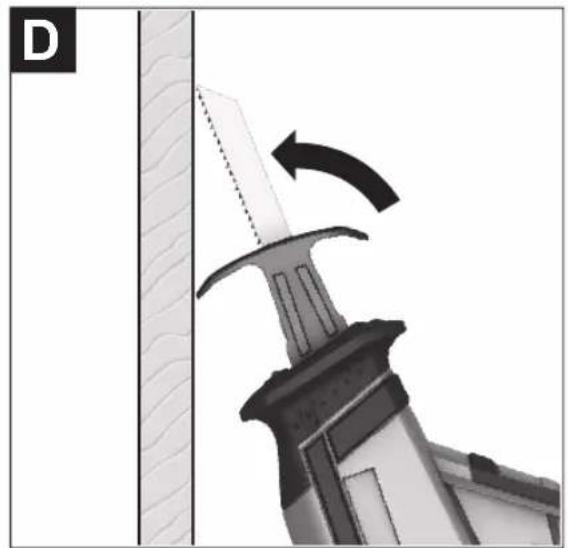
Plunge cutting (see figure D)
▶ Plunge cuts may only be applied to soft materials, such as wood, gypsum board, etc. Do not plunge cut metal materials.
For plunge cutting, use only short saw blades. Place the power tool so that the edge of the base plate (2) rests on the workpiece, without the saw blade (1) touching the workpiece, and switch it on. When using power tools with stroke rate control, select the maximum stroke rate. Press the power tool firmly against the workpiece and allow the saw blade to plunge slowly into the workpiece.
As soon as the base plate (2) rests fully on the workpiece, continue sawing along the required cutting line.
For particular jobs, the saw blade (1) can also be fitted after being turned 180^ in order to operate the power tool the other way around.
Flush sawing (see figure E)
Protruding components such as water pipes, for example, can be cut directly at the wall using elastic bi-metal saw blades.
▶ Ensure that the saw blade is always longer than the diameter of the workpiece. There is a risk of kickback.
Place the saw blade directly against the wall and bend it slightly by applying lateral pressure to the power tool until the base plate is flush with the wall. Switch on the power tool and saw through the workpiece applying consistent lateral pressure.
Coolant/lubricant
As the material heats up along the cutting line when cutting metal, you should apply coolant or lubricant.
Maintenance and Service
Maintenance and Cleaning
▶ Remove the battery from the power tool before carrying out work on the power tool (e.g. maintenance, changing tool, etc.). The battery should also be removed for transport and storage. There is risk of injury from unintentionally pressing the on/off switch.
▶ To ensure safe and efficient operation, always keep the power tool and the ventilation slots clean.
Carefully clean the saw blade receptacle with a soft cloth. To do so, remove the saw blade from the power tool. Keep the saw blade receptacle operational using suitable lubricants.
If the power tool becomes very dirty, this can lead to serious faults. For this reason, do not cut materials which generate large quantities of dust from below or overhead.
Range of accessories
Only use original FEIN accessories. The accessories must be intended for the power tool type.
Maintenance and After-Sales Service
Please note that power tools must only be repaired, serviced and tested by qualified electricians. Improper repairs can pose considerable hazards to the user.
When working metals in extreme conditions, conductive dust can settle in the interior of the power tool. Regularly blow out the interior of the power tool through the ventilation openings with dry and oil-free compressed air.
Processing gypsum-containing materials can create dust. This can settle in the interior of the power tool and on switching elements, and may harden due to the humidity. This may impair the switching mechanism. Regularly blow out the interior of the power tool through the ventilation openings and the switching elements with dry and oil-free compressed air.
Products that have come into contact with asbestos must not be brought for repair. Dispose of products contaminated with asbestos according to the regulations for disposing of waste containing asbestos that apply in the country of use.
If FEIN power tools or accessories require repair, please contact the FEIN after-sales service. The address can be found online at
www.fein.com.
Replace labels and warnings on the power tool if they show signs of ageing or wear.
The current spare parts list for this power tool can be found online at
www.fein.com.
Only use original spare parts.
Warranty and Guarantee
The warranty on the product is in accordance with the statutory provisions of the country in which it is placed on the market. Furthermore, the FEIN guarantee applies in accordance with the FEIN manufacturer guarantee declaration.
It is possible that only some of the accessories described or depicted in this operating manual will be supplied with the power tool you have purchased.
Declaration of Conformity
The CE declaration only applies to countries of the European Union and EFTA (European Free Trade Association) and only to products intended for the EU or EFTA market.
Once the product is placed on the EU market, the UKCA mark will cease to be valid.
The UKCA declaration only applies to the British market (England, Wales and Scotland) and only to products intended for the British market.
Once the product is placed on the British market, the CE mark will cease to be valid.
FEIN declares, under its sole responsibility, that this product complies with the relevant provisions specified on the final pages of this instruction manual.
Technical documentation at:
C. & E. Fein GmbH, 73529 Schwäbisch Gmünd, Germany
Transport
The recommended lithium-ion batteries are subject to legislation on the transport of dangerous goods. The user can transport the batteries by road without further requirements.
When shipping by third parties (e.g.: by air transport or forwarding agency), special requirements on packaging and labelling must be observed.
For preparation of the item being shipped, consulting an expert for hazardous material is required.
Dispatch battery packs only when the housing is undamaged. Tape or mask off open contacts and pack up the battery in such a manner that it cannot move around in the packaging. Please also observe the possibility of more detailed national regulations.
Disposal
Power tools, rechargeable batteries, accessories and packaging should be sorted for environmental-friendly recycling.
Do not dispose of power tools and batteries/rechargeable batteries into household waste!
Only for EU countries:
According to the Directive 2012/19/EU on waste electrical and electronic equipment and its transposition into national law, power tools that are no longer usable, and, according to the Directive 2006/66/EC, defective or drained batteries must be collected separately and disposed of in an environmentally correct manner.
If disposed incorrectly, waste electrical and electronic equipment may have harmful effects on the environment and human health, due to the potential presence of hazardous substances.
Only for United Kingdom:
According to The Waste Electrical and Electronic Equipment Regulations 2013 (SI 2013/3113) (as amended) and the Waste Batteries and Accumulators Regulations 2009 (SI 2009/890) (as amended), products that are no longer usable must be collected separately and disposed of in an environmentally friendly manner.
Battery packs/batteries:
Li-ion:
Please observe the notes in the section on transport (see "Transport", page 19).
Notice originale
$$ a _ {h, W B} = 8 m / s ^ {2}, K = 1, 5 m / s ^ {2}. $$
◀ Capacity Capacity Capacity Capacity Capacity Capacity Capacity Capacity Capacity Capacity Capacity Capacity Capacity Capacity Capacity Capacity Capacity Capacity Capacity Capacity Capacity Capacity Capacity Capacity Capacity Capacity Capacity Capacity Capacity Capacity Capacity Capacity Capacity Capacity Capacity Capacity Capacity Capacity Capacity Capacity Capacity Capacity Capacity Capacity Capacity Capacity Capacity Capacity Capacity Capacity Capacity Capacity Capacity Capacity Capacity Capacity Capacity Capacity Capacity Capacity Capacity Capacity Capacity Capacity Capacity Capacity Capacity Capacity Capacity Capacity Capacity Capacity Capacity Capacity Capacity Capacity Capacity Capacity Capacity Capacity Capacity Capacity Capacity Capacity Capacity Capacity Capacity Capacity Capacity Capacity Capacity Capacity Capacity Capacity Capacity Capacity Capacity Capacity Capacity Capacity capacity capacity capacity capacity capacity capacity capacity capacity capacity capacity capacity capacity capacity capacity capacity capacity capacity capacity capacity capacity capacity capacity capacity capacity capacity capacity capacity capacity capacity capacity capacity capacity capacity capacity capacity capacity capacity capacity capacity capacity capacity capacity capacity capacity capacity capacity capacity capacity capacity capacity capacity capacity capacity capacity capacity capacity capacity capacity capacity capacity capacity capacity capacity capacity capacity capacity capacity capacity capacity capacity capacity capacity capacity capacity capacity capacity capacity capacity capacity capacity capacity capacity capacity capacity capacity capacity capacity capacity capacity capacity capacity capacity capacity capacity capacity capacity capacity capacity capacity capacity capacities
ي monarchExpected Agricultural Management Policy Policy Policy Policy Policy Policy Policy Policy Policy Policy Policy Policy Policy Policy Policy Policy Policy Policy Policy Policy Policy Policy Policy Policy Policy Policy Policy Policy Policy Policy Policy Policy Policy Policy Policy Policy Policy Policy Policy Policy Policy Policy Policy Policy Policy Policy Policy Policy Policy Policy Policy Policy Policy Policy Policy Policy Policy Policy Policy Policy Policy Policy Policy Policy Policy Policy Policy Policy Policy Policy Policy Policy Policy Policy Policy Policy Policy Policy Policy Policy Policy Policy Policy Policy Policy Policy Policy Policy Policy Policy Policy Policy Policy Policy Policy Policy Policy Policy Policy Policy Strategy العملية.
Declaration of Conformity
| Reciprocating sawASAS18-21KAS | Article number7 133 01 00 94 0 |
We declare under our sole responsibility that the stated products comply with all applicable provisions of the directives and regulations listed below and are in conformity with the following standards. Technical file at: *
| The Supply of Machinery (Safety) Regulations 2008 | |
| The Electromagnetic Compatibility Regulations 2016 | |
| The Restriction of the Use of Certain Hazardous Substances in Electrical and Electronic Equipment Regulations 2012 | |
| EN 62841-1:2015 | |
| EN 62841-2-11:2016+A1+2020 | |
| EN 55014-1:2017+A11:2020 | |
| EN 55014-2:2015 | |
| EN IEC 63000:2018 |

i.V. S. Böhm
Director of Quality Management
Director of Product Development
1 609 92A 875
3 41 01 389 06 0. 2022-10-27


FEIN

- de
- Original instructions
- Safety Instructions
- General Power Tool Safety Warnings WARNING Read all safety warnings, instructions, illustrations and specifications provided with this power tool.
- Save all warnings and instructions for future reference.
- Work area safety
- Electrical safety
- Personal safety
- Power tool use and care
- Battery tool use and care
- Service
- Safety instructions for reciprocating saws
- en
- Product Description and Specifications
- Intended Use
- Product Features
- Reciprocating saw ASAS18-21KAS
- Noise/vibration information
- Noise emission values determined according to EN 62841-2-11.
- Wear hearing protection!
- Rechargeable battery
- Charging the battery
- Inserting the Battery
- Removing the Battery
- Do not use force to do this.
- Battery charge indicator
- Battery model GBA 18V...
- LED Capacity
- Battery model ProCORE18V...
- Recommendations for Optimal Handling of the Battery
- Assembly
- Inserting/changing the saw blade
- Selecting the saw blade
- Inserting the saw blade (see figure A)
- Removing the Saw Blade (see figure B)
- Dust/Chip Extraction
- Operation
- Starting Operation
- Switching On and Off (see figure C)
- Controlling the stroke rate
- Working Advice
- Tips
- Plunge cutting (see figure D)
- Flush sawing (see figure E)
- Coolant/lubricant
- Maintenance and Service
- Maintenance and Cleaning
- Range of accessories
- Maintenance and After-Sales Service
- www.fein.com.
- Warranty and Guarantee
- Declaration of Conformity
- Transport
- Disposal
- Only for EU countries:
- Only for United Kingdom:
- Battery packs/batteries:
- Li-ion:
- Notice originale
Brand : Fein
Model : ASAS 1821 K AS
Category : Saw