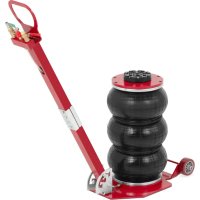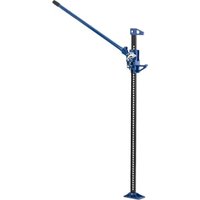
OWH-3000-60 - Hydraulic jack MSW - Free user manual and instructions
Find the device manual for free OWH-3000-60 MSW in PDF.


User questions about OWH-3000-60 MSW
0 question about this device. Answer the ones you know or ask your own.
Ask a new question about this device
Download the instructions for your Hydraulic jack in PDF format for free! Find your manual OWH-3000-60 - MSW and take your electronic device back in hand. On this page are published all the documents necessary for the use of your device. OWH-3000-60 by MSW.
USER MANUAL OWH-3000-60 MSW
Explosive Aussicht
This User Manual has been translated using machine translation. We have made every effort to ensure the translation is accurate, but please note that automated translations are not perfect and are not meant to replace human translators. The official version of the User Manual is in English. Any differences between the translated version and the original English are not legally binding. If you have any questions about the accuracy of the translation, please refer to the English version, which is the official reference.
Technical data
| Parameter description | Parameter value |
| Product Name Offroad farm car jack | |
| Model No | MSW-OWH-3000-60 |
| Lifting range [mm] | 130-1330 |
| Max lifting height [cm] 133 | |
| Handle length [cm] 105.5 | |
| Platform size [cm] 10 x 17.5 | |
| Max load [kg] 3000 | |
| Weight [kg] 14.6 | |
Legend

The product satisfies the relevant safety standards.

Read instructions before use.

WARNING! or CAUTION! or REMEMBER! A general warning sign concerning a given situation.

Wear protective goggles.

Wear protective glove.

Wear foot protection.
EN

ATTENTION! Danger of hand crushing.

ATTENTION! Read all safety warnings and all
instructions. Failure to follow the warnings and instructions may result in serious injury or even death.
The terms "device" or "product" are used in the warnings and instructions to refer to the:
OFFROAD FARM CAR JACK.
SAFETY IN THE WORKPLACE
a) Make sure the workplace is orderly and well lit. A messy or poorly lit workplace may lead to accidents. Try to anticipate what may happen, observe what is going on and use common sense when working with the device.
b) Upon discovering damage or irregular operation, immediately switch the device off and report it to a supervisor without delay.
c) If there are any doubts as to the correct operation of the device, contact the manufacturer's support service.
d) Only the manufacturer's service point may repair the device. Do not attempt any repairs independently!
e) If a fire starts, use solely powder or carbon dioxide (CO2) fire extinguishers suitable for use on live devices to put it out.

REMEMBER! Keep children and other bystanders safe while operating the device.
PERSONAL SAFETY
a) Do not use the device when tired, ill or under the influence of alcohol, narcotics or medication which can significantly impair the ability to operate the device.
b) The machine may be operated by physically fit persons who are able to handle the machine and properly trained and who reviewed this operating manual and received training in occupational health and safety.
c) The machine is not designed to be handled by persons (including children) with limited mental and sensory functions or persons lacking relevant experience and/or
EN
knowledge unless they are supervised by a person responsible for their safety or they have received instructions on how to operate the machine.
d) When working with the device, use common sense and stay alert. Temporary loss of concentration whilst using the device may lead to serious injuries.
e) Use personal protection equipment as required for working with the device, specified in section 1 (Legend). The use of correct, approved personal protection equipment reduces the risk of suffering an injury.
f) Do not overestimate your abilities. When using the device keep your balance and remain stable at all times. This will ensure better control over the device in unexpected situations.
g) Do not wear loose clothing or jewellery. Keep hair, clothes and gloves away from moving parts. Loose clothing, jewellery or long hair may get caught in moving parts.
h) Compressed air may cause serious injury.
i) It is recommended to use eye, ear and respiratory protection.
SAFE DEVICE USE
a) Do not overload the device. Use appropriate tools for the given task. A correctly selected device will perform the task for which it was designed better and in a safer manner.
b) It is necessary to disconnect the pressure line before commencing any adjustment, accessories replacement or after finishing work with the device. Such a preventive measure reduces the risk of an accident.
c) When not in use, store in a safe place, away from children and people not familiar with the device, who have not read the user manual. The device may pose a hazard in the hands of inexperienced users.
d) Maintain the device in a good technical state. Before each use check for general damage and especially check for cracked parts or elements and for any other conditions which may impact the safe operation of the device. If damage is discovered, hand over the device for repair before use.
e) Keep the device out of the reach of children.
f) Device repair or maintenance should be carried out by qualified persons, only using original spare parts. This will ensure safe use.
g) To ensure the operational integrity of the device, do not remove factory fitted guards and do not loosen any screws.
EN
h) When transporting and handling the device between the warehouse and the destination, take into account the occupational health and safety principles for manual transport operations which apply in the country where the device will be used.
i) It is forbidden to move, adjusting and rotating the device in the course of work.
j) Do not leave this appliance unattended while it is in use.
k) Use air to supply the device, it is forbidden to use other gases.
l) Clean the device regularly to avoid a durable encrustation of dirt.
m) Do not use the device in the area exposed to strong magnetic field and adverse weather conditions (subzero temperatures, atmospheric discharges).
n) Do not use the device to handle a dangerous load (eg. molten metal, acid, radiant material, extremely brittle loads). Do not use the device to lift people.
o) It is forbidden to interfere with the structure of the device in order to change its parameters or construction.
p) Lift / lower the elements with parameters consistent with the data given in the technical data table. Do not exceed the permissible operating parameters.
q) Make sure that the device is placed on a flat and stable surface.
r) Make sure that the device does not slip under influence of weight.
s) Ensure that the jack saddle is fully placed under the lifted element.
t) Make sure that the lifting element is stably set so that it will not slip in the course of lifting / lowering.
u) Set the load centrally on the jack saddle before lifting.
v) Do not work at the load unsecured by supports.
w) The device is used for lifting, it is not intended to support the load in the course of works on the vehicle.
x) In the course of using the jack it is necessary to secure the lifted vehicle against fall by means of supports.
y) Secure the load with supports immediately after the end of lifting,
z) Lowering / lifting operations must be performed in a slow, uniform motion. It is forbidden to make sudden movements.
aa) The pressure force should be even and directed vertically downwards.
EN
bb) Do not use any handle extension.
cc) Do not carry the device behind the lever.
dd) In the course of using the jack it is necessary to attentively observe the load lifting / lowering process.
ee) The device is not used to lift the entire vehicle, but only its parts (e.g. one wheel or one axle).
ff) Failure to follow the warnings may result in loss of control over the device and the load, which may lead to a property damage, personal injury or sudden death.
gg) Failure to follow the warnings may result in loss of control over the device and the load, which may lead to a property damage, personal injury or sudden death.

ATTENTION! Despite the safe design of the device and its protective features, and despite the use of additional elements protecting the operator, there is still a slight risk of accident or injury when using the device. Stay alert and use common sense when using the device.
Uplifting a load
-
Place the foot of the product beneath the load.
-
Lift the reversing latch to its "Up" position and ensure it is locked in place, with the indentation in the Latch firmly engaged in the notch on the reversing switch. Refer to Figure 1.
-
Jack up the nose until it comes into contact with the load at the desired point of lift. Pause at this stage and check to ensure there are no obstacles to a clean lift.
-
Pull down firmly and evenly on the handle and observe the load rising. As the handle is pulled down, you will hear the climbing pin click into place as it locates in a hole in the steel bar. At this point, relax the handle allowing the pin to take the load. Raise the handle to the top of its stroke to take a fresh purchase and pump the handle once again.
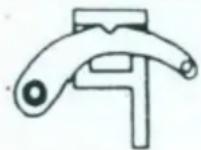
Figure 1
Lowering a load
- Make sure the load is stabilized before operating so that it will not shift.
EN
-
Take the load with the jack (namely, jack the load up slightly), and ensure the handle is in the FULLY UPRIGHT position, tripping the Reversing Latch (20), so that it is in the "Down" position, namely, the indentation on the latch becomes disengaged from the notch on the reversing switch (see Figure 2).
-
Keep a firm grip on the handle, pump it as you would for raising a load.
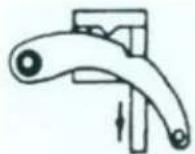
Figure 2
PART LIST
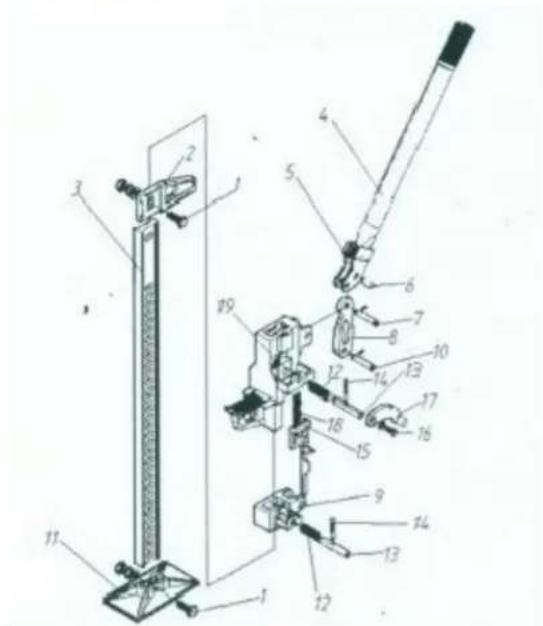
Explosive view
- Top Clamp - Clevis Bolt
- Top Clamp - Clevis
- Steel Standard (Bar)
- Steel Handle W/ Cotter Pin
- Handle Socket
- Pin
- Hex Bolt
- Connecting Rod
- Small Runner
- Screw Bolt
EN
- Base
- Climbing Pin Spring (2 required)
- Climbing Pin (2 required)
- Cross Pin (2 required)
- Reversing Switch Cam Bar and Spring
- Cap Screw W/ Washer
- Reversing Latch
- Reversing Switch Spring
- Large Runner
Ręczny
BEZPIECZEŃSTWO W MIEJSCU PRACY
Widok wybuchowy
Výbušný pohled
Vue explosive
Vista esplosiva
Vista explosiva
Eksplosiv udsigt
- Topklemme - gaffelbolt
- Topklemme - gaffelhoved
DA
Räjähtävä näkymä
Explosief uitzicht
OBS! Fare for håndklemming.

SIKKERHET PÅ ARBEIDSPLASSEN
Eksplosiv utsikt
Explosiv vy
Visão explosiva
Výbušný pohlad
-
Horná svorka - Clevis Bolt
-
Horná svorka - Clevis
SK
Експлозивна гледка
Εκρηκτική θέα
Eksplozivan pogled
- Gornja stezaljka - Clevis vijak
- Gornja stezaljka - Clevis
- Čelični standard (šipka)
- Čelična ručka s klinom
- Utičnica ručke
- Pin
- šesterokutni vijak
- Klipnjača
- Mali trkač
- Vijčani vijak
HR
- Baza
- Opruga igle za penjanje (2 potrebne)
- Igla za penjanje (potrebna 2)
- Križna igla (potrebna su 2)
- Brigasta poluga i opruga prekidača za vožnju unazad
- Vijak s poklopcem s podloškom
- Zasun za okretanje
- Opruga prekidača za vožnju unazad
- Veliki trkač
vadovas
Sprogstamas vaizdas
Vedere explozivă
VARNA UPORABA NAPRAVE
a) Ne preobremenjujte naprave. Uporabite ustrezna orodja za dano nalogo. Pravilno izbrana naprava bo nalogo, za katero je bila zasnovana, opravila bolje in varneje.
Eksploziven pogled
-
Zgornja objemka - Clevis Bolt
-
Zgornja objemka - Clevis
-
Jekleni standard (palica)
-
Jeklen ročaj z razcepko
-
Ročaj vtičnice
-
Pin
-
Šestrobi vijak
-
Ojnica
-
Mali tekač
-
Vijačni vijak
-
Osnova
-
Vzmet za plezalni čep (2 potrebni)
SL
For the disposal of the device please consider and act according to the national and local rules and regulations.
CONTACT
expondo Polska sp. z o.o. sp. k.