EasyManual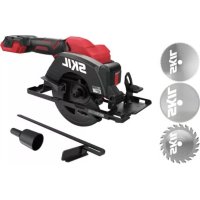
3540 CA - Saw SKIL - Free user manual and instructions
Find the device manual for free 3540 CA SKIL in PDF.



User questions about 3540 CA SKIL
0 question about this device. Answer the ones you know or ask your own.
Ask a new question about this device
Download the instructions for your Saw in PDF format for free! Find your manual 3540 CA - SKIL and take your electronic device back in hand. On this page are published all the documents necessary for the use of your device. 3540 CA by SKIL.
USER MANUAL 3540 CA SKIL
EU Declaration of conformity Brushless compact multi saw Article number We declare under our sole responsibility that the stated products comply with all applicable provisions of the directives and regulations listed below and are in conformity with the following standards. Technical le at:
a) Keep work area clean and well lit. Cluttered or dark areas invite accidents. b) Do not operate power tools in explosive atmospheres,suchasinthepresenceofammable liquids, gases or dust. Power tools create sparks which may ignite the dust or fumes. c) Keep children and bystanders away while operating a power tool. Distractions can cause you to lose control.
2) ELECTRICAL SAFETY
a) Power tool plugs must match the outlet. Never modify the plug in any way. Do not use any adapter plugs with earthed (grounded) power tools. Unmodied plugs and matching outlets will reduce risk of electric shock. b) Avoid body contact with earthed or grounded surfaces such as pipes, radiators, ranges and refrigerators. There is an increased risk of electric shock if your body is earthed or grounded. c) Do not expose power tools to rain or wet conditions. Water entering a power tool will increase the risk of electric shock. d) Do not abuse the cord. Never use the cord for carrying, pulling or unplugging the power tool. Keep cord away from heat, oil, sharp edges or moving parts. Damaged or entangled cords increase the risk of electric shock. e) When operating a power tool outdoors, use an extension cord suitable for outdoor use. Use of a cord suitable for outdoor use reduces the risk of electric shock. f) If operating a power tool in a damp location is unavoidable, use a residual current device (RCD) protected supply. Use of an RCD reduces the risk of electric shock.
a) Stay alert, watch what you are doing and use common sense when operating a power tool. Do not use a power tool while you are tired or under the inuenceofdrugs,alcoholormedication.A moment of inattention while operating power tools may result in serious personal injury. b) Use personal protective equipment. Always wear eye protection. Protective equipment such as a dust mask, non-skid safety shoes, hard hat, or hearing protection used for appropriate conditions will reduce personal injuries. c) Prevent unintentional starting. Ensure the switch isintheo-positionbeforeconnectingtopower source and/or battery pack, picking up or carrying the tool. Carrying power tools with your nger on the switch or energising power tools that have the switch on invites accidents. d) Remove any adjusting key or wrench before turning the power tool on. A wrench or a key left attached to a rotating part of the power tool may result in personal injury. e) Do not overreach. Keep proper footing and balance at all times. This enables better control of the power tool in unexpected situations. f) Keep your hair and clothing away from moving parts. Loose clothes, jewellery or long hair can be caught in moving parts.
Brushless compact multi saw
- This tool is intended for lengthways and crossways sawing of wood, chipboard, plywood, aluminium, tiles, stone, plastic and lightweight construction materials with straight cuts as well as angle cuts up to 45
- This tool is not intended for professional use.
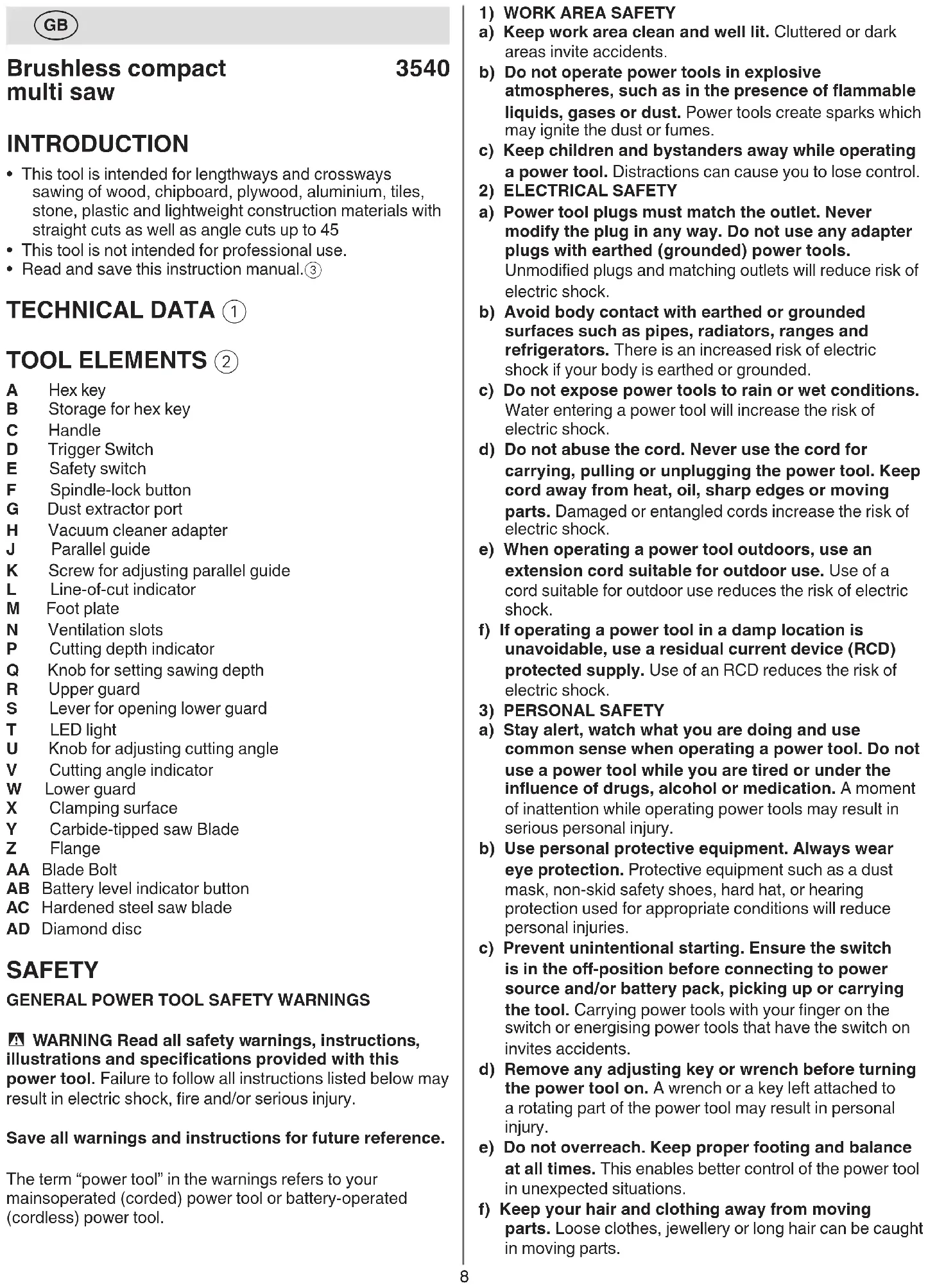
- Read and save this instruction manual.3 TECHNICAL DATA 1 TOOL ELEMENTS 2 A Hex key B Storage for hex key C Handle D Trigger Switch E Safety switch F Spindle-lock button G Dust extractor port H Vacuum cleaner adapter
J Parallel guide K Screw for adjusting parallel guide L Line-of-cut indicator M Foot plate N Ventilation slots
P Cutting depth indicator Q Knob for setting sawing depth R Upper guard S Lever for opening lower guard T LED light U Knob for adjusting cutting angle V Cutting angle indicator W Lower guard X Clamping surface Y Carbide-tipped saw Blade Z Flange AA Blade Bolt AB Battery level indicator button AC Hardened steel saw blade AD Diamond disc SAFETY
GENERAL POWER TOOL SAFETY WARNINGS
- WARNING Read all safety warnings, instructions, illustrationsandspecicationsprovidedwiththis power tool. Failure to follow all instructions listed below may result in electric shock, re and/or serious injury. Save all warnings and instructions for future reference. The term “power tool” in the warnings refers to your mainsoperated (corded) power tool or battery-operated (cordless) power tool.9 ejected from the battery may cause irritation or burns. e) Do not use a battery pack or tool that is damaged ormodied.Damaged or modied batteries may exhibit unpredictable behaviour resulting in re, explosion or risk of injury. f) Donotexposeabatterypackortooltoreor excessive temperature. Exposure to re or temperature above 130°C may cause explosion. g) Follow all charging instructions and do not charge the battery pack or tool outside the temperature rangespeciedintheinstructions.Charging improperly or at temperatures outside the specied range may damage the battery and increase the risk of re.
a) Haveyourpowertoolservicedbyaqualiedrepair person using only identical replacement parts. This will ensure that the safety of the power tool is maintained. b) Never service damaged battery packs. Service of battery packs should only be performed by the manufacturer or authorized service providers.
SAFETY INSTRUCTIONS FOR CIRCULAR SAWS
Cutting procedures a) DANGER: Keep hands away from cutting area and the blade. If both hands are holding the saw, they cannot be cut by the blade. b) Do not reach underneath the workpiece. The guard cannot protect you from the blade below the workpiece. c) Adjust the cutting depth to the thickness of the workpiece. Less than a full tooth of the blade teeth should be visible below the workpiece. d) Never hold the workpiece in your hands or across your leg while cutting. Secure the workpiece to a stable platform. It is important to support the work properly to minimize body exposure, blade binding, or loss of control. e) Hold the power tool by insulated gripping surfaces, when performing an operation where the cutting tool may contact hidden wiring. Contact with a “live” wire will also make exposed metal parts of the power tool “live” and could give the operator an electric shock. f) When ripping, always use a rip fence or straight edge guide. This improves the accuracy of cut and reduces the chance of blade binding. g) Always use blades with correct size and shape (diamond versus round) of arbor holes. Blades that do not match the mounting hardware of the saw will run o-center, causing loss of control. h) Never use damaged or incorrect blade washers or bolt. The blade washers and bolt were specially designed for your saw, for optimum performance and safety of operation. Kickback causes and related warnings - Kickback is a sudden reaction to a pinched, jammed or misaligned saw blade, causing an uncontrolled saw to lift up and out of the workpiece toward the operator. - When the blade is pinched or jammed tightly by the kerf closing down, the blade stalls and the motor reaction g) If devices are provided for the connection of dust extraction and collection facilities, ensure these are connected and properly used. Use of dust collection can reduce dust-related hazards. h) Do not let familiarity gained from frequent use of tools allow you to become complacent and ignore tool safety principles. A careless action can cause severe injury within a fraction of a second.
4) POWER TOOL USE AND CARE
a) Do not force the power tool. Use the correct power tool for your application. The correct power tool will do the job better and safer at the rate for which it was designed. b) Do not use the power tool if the switch does not turn itonando.Any power tool that cannot be controlled with the switch is dangerous and must be repaired. c) Disconnect the plug from the power source and/ or remove the battery pack, if detachable, from the power tool before making any adjustments, changing accessories, or storing power tools. Such preventive safety measures reduce the risk of starting the power tool accidentally. d) Store idle power tools out of the reach of children and do not allow persons unfamiliar with the powerbtool or these instructions to operate the power tool. Power tools are dangerous in the hands of untrained users. e) Maintain power tools and accessories. Check for misalignment or binding of moving parts, breakage ofpartsandanyotherconditionthatmayaectthe power tool’s operation. If damaged, have the power tool repaired before use. Many accidents are caused by poorly maintained power tools. f) Keep cutting tools sharp and clean. Properly maintained cutting tools with sharp cutting edges are less likely to bind and are easier to control. g) Use the power tool, accessories and tool bits etc., in accordance with these instructions, taking into account the working conditions and the work to be performed. Use of the power tool for operations dierent from those intended could result in a hazardous situation. h) Keep handles and grasping surfaces dry, clean and free from oil and grease. Slippery handles and grasping surfaces do not allow for safe handling and control of the tool in unexpected situations.
5) BATTERY TOOL USE AND CARE
a) Rechargeonlywiththechargerspeciedbythe manufacturer. A charger that is suitable for one type of battery pack may create a risk of re when used with another battery pack. b) Usepowertoolsonlywithspecicallydesignated battery packs. Use of any other battery packs may create a risk of injury and re. c) When battery pack is not in use, keep it away from other metal objects like paper clips, coins, keys, nails, screws, or other small metal objects that can make a connection from one terminal to another. Shorting the battery terminals together may cause burns or a re. d) Under abusive conditions, liquid may be ejected from the battery; avoid contact. If contact accidentallyoccurs,ushwithwater.Ifliquid contacts eyes, additionally seek medical help. Liquid10 the lower guard must be released. For all other sawing, the lower guard should operate automatically. d) Always observe that the lower guard is covering the blade before placing the saw down on bench oroor.An unprotected, coasting blade will cause the saw to walk backwards, cutting whatever is in its path. Be aware of the time it takes for the blade to stop after switch is released.
- This tool should not be used by people under the age of 16 years
- This tool is not suitable for wet cutting
- Do not work materials containing asbestos (asbestos is considered carcinogenic)
- Dust from material such as paint containing lead, some wood species, minerals and metal may be harmful (contact with or inhalation of the dust may cause allergic reactions and/or respiratory diseases to the operator or bystanders); wear a dust mask and work with a dust extraction device when connectable
- Certain kinds of dust are classied as carcinogenic (such as oak and beech dust) especially in conjunction with additives for wood conditioning; wear a dust mask and work with a dust extraction device when connectable
- Follow the dust-related national requirements for the materials you want to work with
- Do not use this saw in combination with a saw table
- Remove battery from tool before making any adjustments or changing accessories ACCESSORIES
- SKIL can assure awless functioning of the tool only when original accessories are used
- Use only saw blades that correspond with the characteristic data given in these operation instructions and that are tested and marked in accordance with EN 847-1, if intended for wood and wood-like materials.
- Use only accessories with an allowable speed matching at least the highest no-load speed of the tool
- Useonlysawblades/cut-owheelswithaminimum diameter of 115 mm, a maximum diameter of 120 mm and a spindle hole of 9.5 mm
- Never use grinding discs with this tool
- Handle and store accessories with care
- Identify the correct saw blade to be used for the material to be cut. BEFORE USE
- Avoid damage that can be caused by screws, nails and other elements in your workpiece; remove them before you start working
- Remove all obstacles on top of as well as underneath the cutting path before you start cutting
- Secure the workpiece (a workpiece clamped with clamping devices or in a vice is held more securely than by hand)
- Usesuitabledetectorstondhiddenutilitylines or call the local utility company for assistance or call the local utility company for assistance(contact with electric lines can lead to re or electrical shock; damaging a gas line can result in an explosion; penetrating a water pipe will cause property damage or an electrical shock) drives the unit rapidly back toward the operator. - If the blade becomes twisted or misaligned in the cut, the teeth at the back edge of the blade can dig into the top surface of the wood causing the blade to climb out of the kerf and jump back toward the operator. Kickback is the result of saw misuse and/or incorrect operating procedures or conditions and can be avoided by taking proper precautions as given below. a) Maintainarmgriponthesawandpositionyour arms to resist kickback forces. Position your body to either side of the blade, but not in line with the blade. Kickback could cause the saw to jump backwards, but kickback forces can be controlled by the operator, if proper precautions are taken. b) When blade is binding, or when interrupting a cut for any reason, release the trigger and hold the saw motionless in the material until the blade comes to a complete stop. Never attempt to remove the saw from the work or pull the saw backward while the blade is in motion or kickback may occur. Investigate and take corrective actions to eliminate the cause of blade binding. c) When restarting a saw in the workpiece, center the saw blade in the kerf so that the saw teeth are not engaged into the material. If a saw blade binds, it may walk up or kickback from the workpiece as the saw is restarted. d) Support large panels to minimize the risk of blade pinching and kickback. Large panels tend to sag under their own weight. Supports must be placed under the panel on both sides, near the line of cut and near the edge of the panel. e) Do not use dull or damaged blades. Unsharpened or improperly set blades produce narrow kerf causing excessive friction, blade binding and kickback. f) Blade depth and bevel adjusting locking levers must be tight and secure before making the cut. If blade adjustment shifts while cutting, it may cause binding and kickback. g) Use extra caution when sawing into existing walls or other blind areas. The protruding blade may cut objects that can cause kickback. Lower guard function a) Check the lower guard for proper closing before each use. Do not operate the saw if the lower guard does not move freely and close instantly. Never clamp or tie the lower guard into the open position. If the saw is accidentally dropped, the lower guard may be bent. Raise the lower guard with the retracting handle and make sure it moves freely and does not touch the blade or any other part, in all angles and depths of cut. b) Check the operation of the lower guard spring. If the guard and the spring are not operating properly, they must be serviced before use. Lower guard may operate sluggishly due to damaged parts, gummy deposits, or a build-up of debris. c) The lower guard may be retracted manually only for special cuts such as “plunge cuts” and “compound cuts”. Raise the lower guard by the retracting handle and as soon as the blade enters the material,11 being switched on, when - the load is too high --> remove load and restart - the battery temperature is not within the allowable operating temperature range of -20 to +50°C --> 2 levels of the battery level indicator start ashing when pressing button AB 7c; wait until battery has returned within the allowable operating temperature range - the battery is nearly empty (to protect against deep discharge) --> a low battery level or ashing low battery level ub is shown by the battery level indicator when pressing button AB; charge battery ! donotcontinuetopresstheon/oswitchafterthe toolisswitchedoautomatically;batterymaybe damaged
- Mounting saw blade 2 ! remove battery from tool - take hex key A from storage B - push spindle-lock button F and hold it while you remove blade bolt AA by turning hex key A CLOCKWISE (= in same direction as arrow printed on saw blade) ! push spindle-lock button F only when tool is at a standstill - release spindle-lock button F - remove ange Z ! makesurethatclampingsurfacesXofangesare perfectly clean and face the blade - open lower guard W with lever S and hold it while you mount saw blade with saw teeth and arrow printed on saw blade pointing in same direction as arrow on upper guard - release lower guard W - mount ange Z - push spindle-lock button F and hold it while you tighten blade bolt with hex key 1/8 turn past nger tight (ensures slippage of saw blade when it encounters excessive resistance thus reducing motor overload and saw kickback) - release spindle-lock button F
- Adjusting cutting depth (0-41 mm)9 - for an optimal quality cut the saw blade should not extend more than 3 mm below the workpiece - loosen knob Q - raise/lower foot M until desired cutting depth is set on scale using indicator P - tighten knob Q
- Adjusting cutting angle (0-45°)q - loosen knob U - tilt tool until desired cutting angle is set on scale using indicator V - tighten knob U ! when bevel cutting, cutting depth does not correspond with value on cutting depth scale
- Line-of-cut indicator L w - for guiding tool along desired line of cut marked on the workpiece - for a straight 0° cut or a 45° bevel cut use the indicator line concerned ! the wide part of the foot should rest on the supported part of the workpiece ! cutting width is determined by width of blade teeth and not by width of blade body ! alwaysmaketrialcutsrsttoverifyactuallineof cut DURING USE
- The noise level when working can exceed 85 dB(A); wear ear protection
- Never use the tool without the original protection guard system
- Do not attempt to cut extremely small workpieces
- Do not work overhead with the tool
- In case of jamming or electrical or mechanical malfunction, immediately switch o the tool and remove the battery AFTER USE
- When you put away the tool, switch o the motor and ensure that all moving parts have come to a complete standstill
- After switching o your circular saw, never stop the rotation of the saw blade by a lateral force applied against it BATTERIES
- The battery supplied is partially charged (to ensure full capacity of the battery, completely charge the battery in the battery charger before using your power tool for the rst time)
- Only use the following batteries and chargers with this tool - SKIL battery: BR1*31**** - SKIL charger: CR1*31****
- Do not use the battery when damaged; it should be replaced
- Do not disassemble the battery
- Do not expose tool/battery to rain
- Permitted ambient temperature (tool/charger/battery): - when charging 4...40°C - during operation –20...+50°C - during storage –20...+50°C
EXPLANATION OF SYMBOLS ON TOOL/BATTERY
3 Read the instruction manual before use 4 Batteries may explode when disposed of in re, so do not burn battery for any reason 5 Store tool/charger/battery in locations where temperature will not exceed 50°C 6 Do not dispose of electric tools and batteries together with household waste material USE
- Charging battery ! read the safety warnings and instructions provided with the charger
- Removing/installing the battery 2
- Battery level indicator 7 - press the battery level indicator button AB to show the current battery level 7a ! when the lowest level of the battery indicator startsashingafterpressingbuttonAB7b, the battery is empty ! when2levelsofthebatteryindicatorstartashing after pressing button AB 7c, the battery is not within the allowable operating temperature range
- LED-light T 8 LED-light automatically lights on when the tool starts running ! whenLED-lightstartsashing,thebattery protection is activated (see below)
- Battery protection The tool is suddenly being switched o or prevented from12 ! never pull tool backwards
- Cutting large panels u - support panel close to the cut either on oor, table or workbench ! set cutting depth so that you cut through panel and not through support - in case parallel guide does not allow desired width of cut, clamp or nail straight piece of wood to workpiece as a guide, and use the left side of the foot against this guide i
- For more information see www.skil.com MAINTENANCE / SERVICE
- This tool is not intended for professional use
- Always keep tool clean (especially ventilation slots N ) ! remove battery from tool before cleaning
- Always keep the area around lower guard W 2 clean (remove dust and chips by blowing out with compressed air or with a brush)
- Clean saw blade immediately after use (especially from resin and glue)
- If the tool should fail despite the care taken in manufacturing and testing procedures, repair should be carried out by an after-sales service centre for SKIL power tools - send the tool undismantled together with proof of purchase to your dealer or the nearest SKIL service station (addresses as well as the service diagram of the tool are listed on www.skil.com)
- Be aware that damage due to overload or improper handling of the tool will be excluded from the warranty (for the SKIL warranty conditions see www.skil.com or ask your dealer) ENVIRONMENT
- Do not dispose of electric tools, batteries, accessories and packaging together with household waste material (only for EU countries) - in observance of European Directive 2012/19/EC on waste of electric and electronic equipment and its implementation in accordance with national law, electric tools that have reached the end of their life must be collected separately and returned to an environmentally compatible recycling facility - symbol 6 will remind you of this when the need for disposing occurs ! prior to disposal protect battery terminals with heavy tape to prevent short-circuit NOISE / VIBRATION
- Measured in accordance with EN 62841 the sound pressure level of this tool is 96 dB(A) and the sound power level 107 dB(A) (uncertainty K = 3 dB), and the vibration Þ(triax vector sum; uncertainty K = 1.5 m/s²) ✱ cutting wood < 2.5 m/s² ✱ cutting metal < 2.5 m/s
- The vibration emission level has been measured in accordance with a standardised test given in EN 62841; it may be used to compare one tool with another and as a preliminary assessment of exposure to vibration when using the tool for the applications mentioned - using the tool for dierent applications, or with dierent
- Dust suction e For using vacuum cleaner - connect vacuum cleaner hose to vacuum cleaner adapter H ! never let the vacuum cleaner hose interfere with the lower guard or the cutting operation ! do not use vacuum cleaner when cutting metal
- Operating the tool - mount battery - always hold handle C rmly - place tool with front end of foot at on workpiece ! ensure that the saw teeth are not engaged into the workpiece - switch on tool by rst pressing knob E (= safety switch which cannot be locked) and then pulling trigger D ! the tool should run at full speed before the blade enters into the workpiece - lower guard W opens automatically when saw blade enters the workpiece (open lower guard manually by using lever S only for special cuts such as plunge cuts) ! do not force the tool (apply light and continuous pressure in order to avoid overheating the blade tips) ! while working, always hold the tool at the grip area(s) - after completing the cut switch o tool by releasing trigger D ! ensure that the blade has come to a complete standstill, before you lift the tool from the workpiece APPLICATION ADVICE
- Always face the good side of the workpiece down to ensure minimum splintering ensure minimum splintering when sawing wood and wood-like materials.
- Sawing performance and cutting quality depend essentially on the condition and the tooth count of the saw blade.
- Only use sharp saw blades that are suited for the material being cut r - use hardened steel saw blade AC 2 for cutting wood, aluminium, plastic and all sorts of laminated wood - use diamond disc AD 2 for cutting ceramics and tiles - carbide tipped blades Y 2 stay sharp up to 30 times longer than ordinary blades
- Parallel guide J t - for making exact cuts along a workpiece edge - insert through the slots in the front end of the foot Adjusting parallel guide - loosen screw K using hex key A - adjust to desired cutting width by using parallel guide scale (use line-of-cut indicator L as 0-reference) - tighten screw K
a) Restez vigilant, soyez attentif à ce que vous faites et faites preuve de bon sens lors de l’utilisation or poorly maintained accessories, may signicantly increase the exposure level - the times when the tool is switched o or when it is running but not actually doing the job, may signicantly reduce the exposure level ! protectyourselfagainsttheeectsofvibrationby maintaining the tool and its accessories, keeping your hands warm, and organizing your work patterns
a) Haveyourpowertoolservicedbyaqualiedrepair person using only identical replacement parts. This will ensure that the safety of the power tool is maintained. b) Never service damaged battery packs. Service of battery packs should only be performed by the manufacturer or authorized service providers.
- Measured in accordance with EN 62841 the sound pressure level of this tool is 96 dB(A) and the sound power level 107 dB(A) (uncertainty K = 3 dB), and the vibration Þ(triax vector sum; uncertainty K = 1.5 m/s²) ✱ cutting wood < 2.5 m/s² ✱ cutting metal < 2.5 m/s
a) Haveyourpowertoolservicedbyaqualiedrepair person using only identical replacement parts. This will ensure that the safety of the power tool is maintained. b) Never service damaged battery packs. Service of battery packs should only be performed by the manufacturer or authorized service providers.
a) Haveyourpowertoolservicedbyaqualiedrepair person using only identical replacement parts. This will ensure that the safety of the power tool is maintained. b) Never service damaged battery packs. Service of battery packs should only be performed by the manufacturer or authorized service providers.
1) SIKKERHET I ARBEIDSOMRÅDET
- When you put away the tool, switch o the motor and ensure that all moving parts have come to a complete standstill
- Useonlysawblades/cut-owheelswithaminimum diameter of 115 mm, a maximum diameter of 120 mm and a spindle hole of 9.5 mm
- WARNING Read all safety warnings, instructions, illustrationsandspecicationsprovidedwiththis power tool. Failure to follow all instructions listed below may result in electric shock, re and/or serious injury. Save all warnings and instructions for future reference. The term “power tool” in the warnings refers to your mainsoperated (corded) power tool or battery-operated (cordless) power tool.
- Do not dispose of electric tools, batteries, accessories and packaging together with household waste material (only for EU countries) - in observance of European Directive 2012/19/EC on waste of electric and electronic equipment and its implementation in accordance with national law, electric tools that have reached the end of their life must be collected separately and returned to an environmentally compatible recycling facility - symbol 6 will remind you of this when the need for disposing occurs ! prior to disposal protect battery terminals with heavy tape to prevent short-circuit NOISE / VIBRATION
- Measured in accordance with EN 62841 the sound pressure level of this tool is 96 dB(A) and the sound power level 107 dB(A) (uncertainty K = 3 dB), and the vibration Þ(triax vector sum; uncertainty K = 1.5 m/s²) ✱ cutting wood < 2.5 m/s² ✱ cutting metal < 2.5 m/s
- The vibration emission level has been measured in accordance with a standardised test given in EN 62841; it may be used to compare one tool with another and as a preliminary assessment of exposure to vibration when using the tool for the applications mentioned - using the tool for dierent applications, or with dierent or poorly maintained accessories, may signicantly increase the exposure level - the times when the tool is switched o or when it is running but not actually doing the job, may signicantly reduce the exposure level ! protectyourselfagainsttheeectsofvibrationby maintaining the tool and its accessories, keeping your hands warm, and organizing your work patterns
DODATNA SIGURNOSNA UPUTSTVA
Brushless compact multi saw
S185 hard hard soft COM PACT