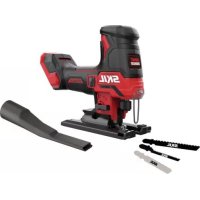
3440 CA - Saw SKIL - Free user manual and instructions
Find the device manual for free 3440 CA SKIL in PDF.



| Product type | Compact brushless jigsaw |
| Brand | Skil |
| Model | 3440 CA |
| Usage | Cuts in wood, plastic, metal; straight and curved cuts; miter angles up to 45° |
| Power supply | Lithium-ion battery (model BR1*31****) |
| Charger | Model CR1*31**** |
| Variable speed | Yes, adjustment wheel with "A" position for controlled start |
| Orbital action | Adjustable to 4 positions (0 = precise cut, 1-3 = fast cut) |
| Blade change | Tool-less, blade clamp lever |
| Blade type | T-shank |
| Lighting | Built-in LED, turns on automatically |
| Tilting base | Up to 45° for bevel cuts |
| Dust extraction | Adapter for vacuum supplied |
| Sound level | Pressure 87 dB(A), power 98 dB(A) |
| Vibration (boards) | 7,68 m/s² |
| Vibration (sheet metal) | 6,08 m/s² |
| Battery protection | Automatic stop in case of overload, out-of-range temperature, deep discharge |
| Operating temperature | -20°C to +50°C |
| Charging temperature | 4°C to 40°C |
| Charge indicator | Button with LED levels |
| Maintenance | Clean ventilation slots; do not disassemble |
| Repairs | Only by SKIL authorized service |
| Warranty | Terms at www.skil.com |
| Compatible accessories | T-shank blades, specific SKIL batteries and chargers |
Frequently Asked Questions - 3440 CA SKIL
User questions about 3440 CA SKIL
0 question about this device. Answer the ones you know or ask your own.
Ask a new question about this device
Download the instructions for your Saw in PDF format for free! Find your manual 3440 CA - SKIL and take your electronic device back in hand. On this page are published all the documents necessary for the use of your device. 3440 CA by SKIL.
USER MANUAL 3440 CA SKIL
natural_image
Illustration of a SKIL device with labeled components and a 20-unit base (no text or symbols beyond branding)
GB ORIGINAL INSTRUCTIONS 10
F NOTICE ORIGINALE 13
D ORIGINALBETRIEBSANLEITUNG 17
NL ORIGINELE GEBRUIKSAANWIJZING 21
(S) BRUKSANVISNING I ORIGINAL 25
DK ORIGINAL BRUGSANVISNING 29
(N) ORIGINAL BRUKSANVISNING 32
FIN ALKUPERÄISET OHJEET 36
E MANUAL ORIGINAL 39
P MANUAL ORIGINAL 43
I ISTRUZIONI ORIGINALI 47
(H) EREDETI HASZNÁLATI UTASÍTÁS 51
CZ PÜVODNÍM NÁVODEM K POUŽÍVÁNÍ 55
TR ORİJINAL İŞLETME TALİMATI 58
PL INSTRUKCJA ORYGINALNA 62
RU ПОДЛИННИК РУКОВОДСТВА ПО 66
ЭКСПЛУАТАЦИИ
UA ОРИГИНАЛЬНА ІНСТРУКЦІЯ 71
З ЕКСПЛУАТАЦІЇ
GR ΠΡΩΤΟΥΠΟ ΟΔΗΓΙΩΝ ΧΡΗΣΗΣ 75
RO INSTRUCTIUNI DE FOLOSIRE 80
ORIGINALE
BG ОРИГИНАЛНО РЪКОВОДСТВО 84
ЗА ЕКСПЛОАТАЦИЯ
SK PÔVODNÝ NÁVOD NA POUŽITIE 88
HR ORIGINALNE UPUTE ZA RAD 92
SRB ORIGINALNO UPUTSTVO ZA RAD 95
SLO IZVIRNA NAVODILA 99
EST ALGUPÄRANE KASUTUSJUHEND 102
LV ORIGINĀLĀ LIETOŠANAS PAMĀCĪBA 106
LT ORIGINALI INSTRUKCIJA 110
МК ИЗВОРНО УПАТСТВО ЗА РАБОТА 113
AL UDHËZIMET ORIGJINALE 118
AR دليل الاستعمال 130
FA راهنمای اصلی 128

EAC

www.skil.com

| GB | EU Declaration of conformityBrushless compact jig saw Article number | We declare under our sole responsibility that the stated products comply with all applicable provisions of the directives and regulations listed below and are in conformity with the following standards.Technical file at* |
| F | Déclaration de conformité UEScie sauteuse compacte sans balais Numéro d'article | Nous déclarons sous notre propre responsabilité que les produits décrits sont en conformité avec les directives, règlements normatifs et normes énumérés ci-dessous.Dossier technique auprès de:* |
| D | EU-KonformitätserklärungBürstenlose Kompakt-Stichsäge Sachnummer | Wir erklären in alleiniger Verantwortung, dass die genannten Produkte allen einschlägigen Bestimmungen der nachfolgend aufgeführten Richtlinien und Verordnungen entsprechen und mit folgenden Normen übereinstimmen.Technische Unterlagen bei* |
| NL | EU-conformiteitsverklaringBorstelloze compacte decoupeerzaag Productnummer | Wij verklaren op eigen verantwoordelijkheid dat de genoemde producten voldoen aan alle desbetreffende bepalingen van de hierna genoemde richtlijnen en verordeningen en overeenstemmen met de volgende normen.Technisch dossier bij* |
| S | EU-konformitetsförklaringBorstlös kompakt figursåg Produktnummer | Vi förklarar under eget ansvar att de nämnda produkterna uppfyller kraven i alla gällande bestämmelser i de nedan angivna direktiven och förordningarnas och att de stämmer överens med följande normer.Teknisk dokumentation* |
| DK | EU-overensstemmelseserklæringBørsteløs kompakt stiksav Typenummer | Vi erklærer som eneansvarlige, at det beskrevne produkt er i overensstemmelse med alle gældende bestemmelser i følgende direktiver og forordninger og opfylder følgende standarder.Tekniske bilag ved* |
| N | EU-samsvarserklæringBørsteløs kompakt stikksag Produktnummer | Vi erklærer under eneansvar at de nevnte produktene er i overensstemmelse med alle relevante bestemmelser i direktivene og forordningene nedenfor og med følgende standarder.Teknisk dokumentasjon hos* |
| FIN | EU-vaatimustenmukaisuusvakuutusHarjaton kompakti lehtisaha Tuotenumero | Vakuutamme täten, että mainitut tuotteet vastaavat kaikkia seuraavien direktiivien ja asetusten asiaankuuluvia vaatimuksia ja ovat seuraavien standardien vaatimusten mukaisia.Tekniset asiakirjat saatavana* |
| E | Declaración de conformidad UESierra de calar compacta sin escobillas Número de artículo | Declaramos bajo nuestra exclusiva responsabilidad, que los productos nombrados cumplen con todas las disposiciones correspondientes de las directivas y los reglamentos mencionados a continuación y están en conformidad con las siguientes normas.Documentos técnicos de:* |
| P | Declaração de conformidade CESerra tico-tico compacta sem escovas Número do produto | Declaramos sob nossa exclusiva responsabilidade que os produtos mencionados cumprem todas as disposições e os regulamentos indicados e estão em conformidade com as seguintes normas.Documentação técnica pertencente à:* |
| I | Dichiarazione di conformità UESeghetto alternativo compatto brushless Codice prodotto | Dichiariamo sotto la nostra piena responsabilità che i prodotti indicati sono conformi a tutte le disposizioni pertinenti delle direttive e dei regolamenti elencati di seguito, nonché alle seguenti normative.Documentazione tecnica presso:* |
| H | EU konformitási nyilatkozatSzénkefe nélküli kompakt szúrófúrész Cikkszám | Egyedüli felelőséggel kijelentjük, hogy a megnevezett termékek megfelelnek az alábbiakban felsorolásra kerülő irányelvek és rendeletek valamennyi idevágó előírásainak és megfelelnek a következő szabványoknak.Műszaki dokumentumok megőrzési pontja:* |
| CZ | EU prohlášení o shoděBezkontaktní kompaktní přímočará pila Objednací číslo | Prohlašujeme na výhradní zodpovědnost, že uvedený výrobek splňuje všechna příslušná ustanovení niže uvedených smérnic a nařizení a je v souladu s následujicimi normami.Technické podklady u:* |
| TR | AB Uygunluk beyaniFirçasiz kompakt dekupaj testeresi Ürün kodu | Tek sorumlu olarak, tanımlanan ürünün aşağıdaki yönetmelik ve direktiflerin geçerli bütün hükümlerine ve aşağıdaki standartlara uygun olduğunu beyan ederiz.Teknik belgelerin bulunduğu yer:* |
| PL | Deklaracja zgodności UEKompaktowa wyrzynarka bezszczotkowa Numer katalogowy | Oświadczamy z pełną odpowiedzialnością, że niniejsze produkty odpowiadają wszystkim wymaganium poniżej wyszczególnionych dyrektyw i rozporządzeń, oraz że są zgodne z następującymi normami.Dokumentacja techniczna:* |
| RU | Заявление о соответствии ЕСБесщеточный компактный лобзик Товарный номер | Мы заявляем под нашу единоличную ответственность, что названные продукты соответствуют всем действующим предписаниям нижеуказанных директив и распоряжений, а также нижеуказанных норм.Техническая документация хранится у:* |
| UA | Заява про відповідність ЄСНомпактний електричний лобзик із безщітковим мотором Товарный номер | Мизаявляемо під нашу одноособову відповідальність, що названі вироби відповідають усім чинним положенням нищеозначених директив і розпоряджень, а також нижчеозначеним нормам.Технічна документація зберігається у:* |
| GR | Δήλωση πιστότητας EEΚόμπακτ σέγα χωρίςψήκτρεςΑριθμός ευρετηρίου | Δηλώνουμε με αποκλειστική μας ευθύνη, ότι τα αναφερόμενα προϊόντα αντιστοιχούν σε όλες τις σχετικές διατάξεις των πιο κάτω αναφερόμενων οδηγιών και κανονισμιών και ταυτίζονται με τα ακόλουθα πρότυπα.Τεχνικά έγγραφα στη:* |
| RO | Declaratie de conformitate UEFerăstrău pendular compact fără periiNumăr de identificare | Declarăm pe proprie răspundere că produsele menționate corespund tuturor dispozițiilor relevante ale directiveior și reglementărilor enumerate în cele ce urmează și sunt în conformitate cu următoarele standarde.Documentație tehnică la:* |
| BG | EC декларация за съответствиеБезчетков компантен прободен трионКаталожен номер | С пълна отговорност ние декларираме, че посочените продукти отговарят на всички валидни изисквания на директивите и разпоредбите по-долу и съответства на следните стандарти.Техническа документация при:* |
| SK | EU vyhlásenie o zhodeBezkontaktná kompaktná priamočiara pílaVecné číslo | Vyhlasujeme na výhradnú zodpovednosť, že uvedený výrobok splína všetky príslušné ustanovenia nižšie uvedených smerníc a nariadení a je v súlade s nasledujúcimi normami.Technické podklady má spoločnosť:* |
| HR | EU izjava o sukladnostiKompaktna ubodna pila bez četkicaKataloški broj | Pod punom odgovornošću izjavljujemo da navedeni proizvodi odgovaraju svim relevantnim odredbama direktiva i propisima navedenima u nastavku i da su sukladni sa sljedećim normama.Tehnička dokumentacija se može dobiti kod:* |
| SRB | EU-izjava o usaglašenostiKompaktna ubodna testera bez četkicaBroj predmeta | Na sopstvenu odgovornost izjavljujemo, da navedeni proizvodi odgovaraju svim dotičnim odredbama naknadno navedenih smernica u uredaba i dă su u skladu sa sledećim standardima.Tehnička dokumentacija kod:* |
| SLO | Izjava o skladnosti ES Kompaktna vbdna žaga z brezkrtacnim motorjemŠtevilka artikla | Izjavljamo pod izključno odgovornostjo, da je omenjen izdelek v skladu z vsemi relevantnimi določili direktiv in uredb ter ustreza naslednjim standardom.Tehnična dokumentacija pri:* |
| EST | EL-vastavusdeklaratsioonHarjadeta kompaktnetikksaagTootenumber | Kinnitame ainuvastutajatena, et nimetatud tooted vastavad järgnevalt loetletud direktiivide ja määruste köikidele asjaomastele nõuetele ja on kooskõlas järgmiste normidega.Tehnilised dokumëndid saadaval:* |
| LV | Deklarăcija par atbilstību EK standartiemKompakts bezkontaktu finierzágisIzstrādājuma numurs | Mês ar pilnu atbildību pazinojam, ka šeit aplūkotie izstrādājumi atbilst visiem tâlāk minētajās direktivās un rīkojumos ietvertajām saistošajām nostādnēm, kā arī sekojošiem standartiem.Tehniskā dokumentacija no:* |
| LT | ES atitikties deklaracija Kompaktiškas siaurapjūklissu bešepečiu varikliuGaminio numeris | Atsakingai pareiškiamė, kad išvardyti gaminiai atitinka visus privalomus žemiau nurodytų direktyvų ir reglamentų reikalavimus ir šiuos standartus.Techninė dokumentacija saugoma:* |
| MK | EU-Изјава за сообразностНомпактна убодна пила без четкиБрој на артикл | Со целосна одговорност изјавуваме, дека опишаните производи се во согласност со сите релевантни одредби на следните регулативи и прописи и се во согласност со следните норми.Техничка документација кaj:* |
| AL | EU Deklarata e konformitetitSharrë sekë kompakte pa karbonçinaNumri i nenit | Ne deklarojmė me përgjegjësinė tonė të vetme se produktet e paraqitura janė në përputhje me të gjitha dispozitat e zbatueshme të direktivave dhe rregulloreve të listuara mė poshtė dhe janė në përputhje me standardet si mė poshtė.Dosja teknike nė:* |
| 3440 SW1*3440** | 2006/42/EC EN 62841-1:20152014/30/EU EN 62841-2-11:2016 + A1:20202011/65/EU EN 55014-1:2021EN 55014-2:2021EN 63000:2018 | |
*Skil BVRithmeesterpark 22 A1 4838 GZ BredaThe Netherlands 4838 GZ BredaThe Netherlands | ||
Olaf DijkgraafApproval Manager Skil BV, Rithmeesterpark 22 A1, 4838 GZ Breda, NL22.04.2022 Skil BV, Rithmeesterpark 22 A1, 4838 GZ Breda, NL22.04.2022 |
1
3440

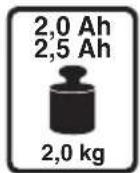


②

③

④

5

max.50 °C
⑥

⑦

⑦a
⑦b
⑦c

8


13



14

natural_image
Technical line drawing of a mechanical component with labeled part B (no text or symbols beyond label)

natural_image
Illustration of a hand using a drill bit to lift a light bulb, with no text or symbols present.
GB
Brushless compact jig saw
3440
INTRODUCTION
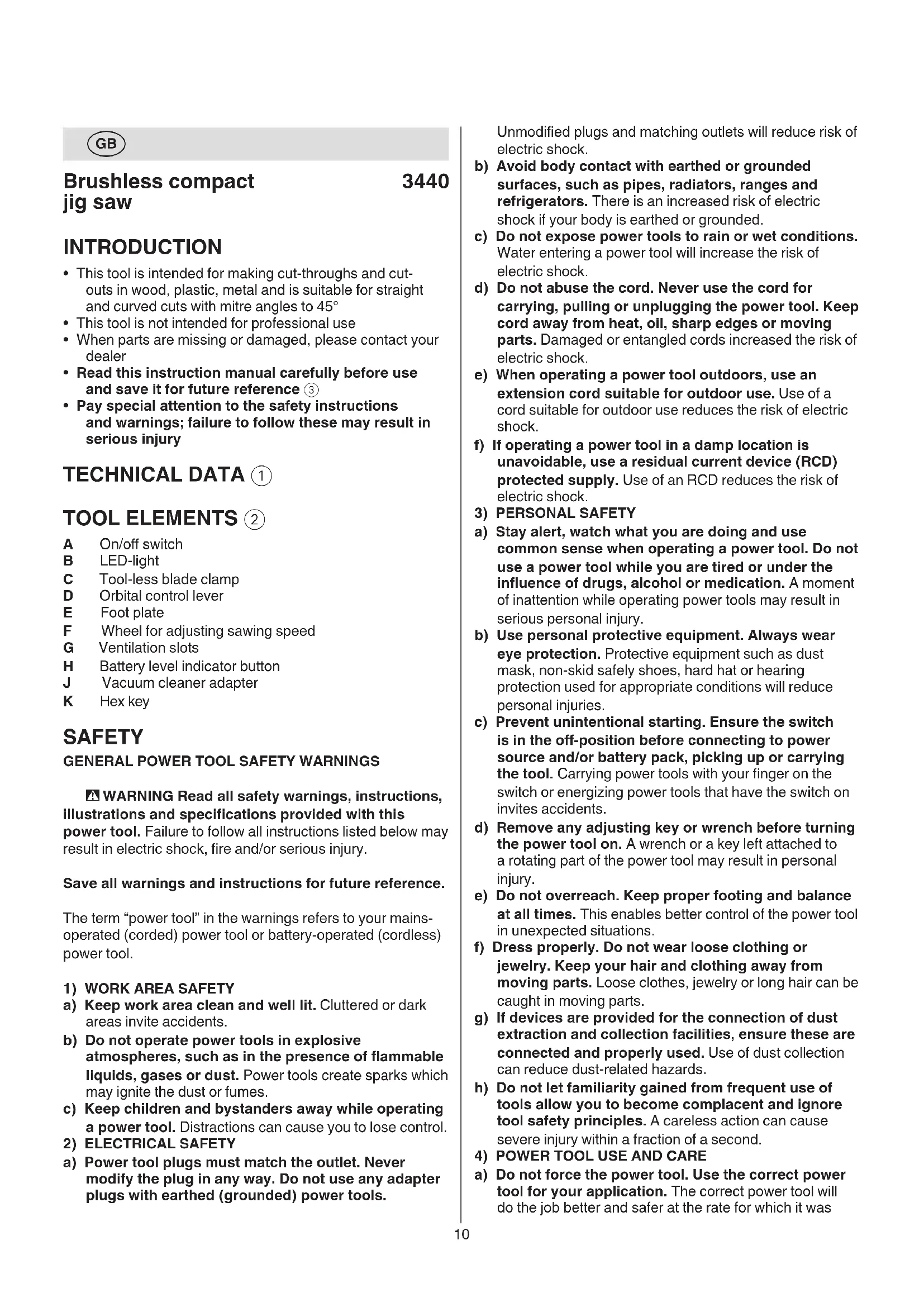
- This tool is intended for making cut-throughs and cut-outs in wood, plastic, metal and is suitable for straight and curved cuts with mitre angles to 45°
• This tool is not intended for professional use - When parts are missing or damaged, please contact your dealer
- Read this instruction manual carefully before use and save it for future reference ③
- Pay special attention to the safety instructions and warnings; failure to follow these may result in serious injury
TECHNICAL DATA ①
TOOL ELEMENTS ②
A On/off switch
B LED-light
C Tool-less blade clamp
D Orbital control lever
E Foot plate
F Wheel for adjusting sawing speed
G Ventilation slots
H Battery level indicator button
J Vacuum cleaner adapter
K Hex key
SAFETY
GENERAL POWER TOOL SAFETY WARNINGS
WARNING Read all safety warnings, instructions, illustrations and specifications provided with this power tool. Failure to follow all instructions listed below may result in electric shock, fire and/or serious injury.
Save all warnings and instructions for future reference.
The term "power tool" in the warnings refers to your mains-operated (corded) power tool or battery-operated (cordless) power tool.
1) WORK AREA SAFETY
a) Keep work area clean and well lit. Cluttered or dark areas invite accidents.
b) Do not operate power tools in explosive atmospheres, such as in the presence of flammable liquids, gases or dust. Power tools create sparks which may ignite the dust or fumes.
c) Keep children and bystanders away while operating a power tool. Distractions can cause you to lose control.
2) ELECTRICAL SAFETY
a) Power tool plugs must match the outlet. Never modify the plug in any way. Do not use any adapter plugs with earthed (grounded) power tools.
Unmodified plugs and matching outlets will reduce risk of electric shock.
b) Avoid body contact with earthed or grounded surfaces, such as pipes, radiators, ranges and refrigerators. There is an increased risk of electric shock if your body is earthed or grounded.
c) Do not expose power tools to rain or wet conditions. Water entering a power tool will increase the risk of electric shock.
d) Do not abuse the cord. Never use the cord for carrying, pulling or unplugging the power tool. Keep cord away from heat, oil, sharp edges or moving parts. Damaged or entangled cords increased the risk of electric shock.
e) When operating a power tool outdoors, use an extension cord suitable for outdoor use. Use of a cord suitable for outdoor use reduces the risk of electric shock.
f) If operating a power tool in a damp location is unavoidable, use a residual current device (RCD) protected supply. Use of an RCD reduces the risk of electric shock.
3) PERSONAL SAFETY
a) Stay alert, watch what you are doing and use common sense when operating a power tool. Do not use a power tool while you are tired or under the influence of drugs, alcohol or medication. A moment of inattention while operating power tools may result in serious personal injury.
b) Use personal protective equipment. Always wear eye protection. Protective equipment such as dust mask, non-skid safely shoes, hard hat or hearing protection used for appropriate conditions will reduce personal injuries.
c) Prevent unintentional starting. Ensure the switch is in the off-position before connecting to power source and/or battery pack, picking up or carrying the tool. Carrying power tools with your finger on the switch or energizing power tools that have the switch on invites accidents.
d) Remove any adjusting key or wrench before turning the power tool on. A wrench or a key left attached to a rotating part of the power tool may result in personal injury.
e) Do not overreach. Keep proper footing and balance at all times. This enables better control of the power tool in unexpected situations.
f) Dress properly. Do not wear loose clothing or jewelry. Keep your hair and clothing away from moving parts. Loose clothes, jewelry or long hair can be caught in moving parts.
g) If devices are provided for the connection of dust extraction and collection facilities, ensure these are connected and properly used. Use of dust collection can reduce dust-related hazards.
h) Do not let familiarity gained from frequent use of tools allow you to become complacent and ignore tool safety principles. A careless action can cause severe injury within a fraction of a second.
4) POWER TOOL USE AND CARE
a) Do not force the power tool. Use the correct power tool for your application. The correct power tool will do the job better and safer at the rate for which it was
designed.
b) Do not use the power tool if the switch does not turn it on and off. Any power tool that cannot be controlled with the switch is dangerous and must be repaired.
c) Disconnect the plug from the power source and/or remove the battery pack, if detachable, from the power tool before making any adjustments, changing accessories, or storing power tools. Such preventive safely measures reduce the risk of starting the power tool accidentally.
d) Store idle power tools out of the reach of children and do not allow persons unfamiliar with the power tool or these instructions to operate the power tool. Power tools are dangerous in the hands of untrained users.
e) Maintain power tools and accessories. Check for misalignment or binding of moving parts, breakage of parts and any other condition that may affect the power tool's operation. If damaged, have the power tool repaired before use. Many accidents are caused by poorly maintained power tools.
f) Keep cutting tools sharp and clean. Properly maintained cutting tools with sharp cutting edges are less likely to bind and are easier to control.
g) Use the power tool, accessories and tool bits etc. in accordance with these instructions, taking into account the working conditions and the work to be performed. Use of the power tool for operations different from those intended could result in a hazardous situation.
h) Keep handles and grasping surfaces dry, clean and free from oil and grease. Slippery handles and grasping surfaces do not allow for safe handling and control of the tool in unexpected situations.
5) BATTERY TOOL USE AND CARE
a) Recharge only with the charger specified by the manufacturer. A charger that is suitable for one type of battery pack may create a risk of fire when used with another battery pack.
b) Use power tools only with specifically designated battery packs. Use of any other battery packs may create a risk of injury and fire.
c) When battery pack is not in use, keep it away from other metal objects, like paper clips, coins, keys, nails, screws or other small metal objects, that can make a connection from one terminal to another. Shorting the battery terminals together may cause burns or a fire.
d) Under abusive conditions, liquid may be ejected from the battery; avoid contact. If contact accidentally occurs, flush with water. If liquid contacts eyes, additionally seek medical help. Liquid ejected from the battery may cause irritation or burns.
e) Do not use a battery pack or tool that is damaged or modified. Damaged or modified batteries may exhibit unpredictable behavior resulting in fire, explosion or risk of injury.
f) Do not expose a battery pack or tool to fire or excessive temperature. Exposure to fire or temperature above 130^ C may cause explosion.
g) Follow all charging Instructions and do not charge the battery pack or tool outside the temperature range specified in the instructions. Charging improperly or at temperatures outside the specified range
may damage the battery and increase the risk of fire.
6) SERVICE
a) Have your power tool serviced by a qualified repair person using only identical replacement parts. This will ensure that the safety of the power tool is maintained.
b) Never service damaged battery packs. Service of battery packs should only be performed by the manufacturer or authorized service providers.
SAFETY INSTRUCTIONS FOR CORDLESS JIG SAW
- Hold the power tool by insulated gripping surfaces, when performing an operation where the fastener may contact hidden wiring (fastener contacting a "live" wire may make exposed metal parts of the power tool "live" and could give the operator an electric shock)
- Use clamps or another practical way to secure and support the workpiece to a stable platform (holding the workpiece by hand or against your body leaves it unstable and may lead to loss of control)
GENERAL
- Do not work materials containing asbestos (asbestos is considered carcinogenic)
- This tool should not be used by people under the age of 16 years
- The noise level when working can exceed 85 dB(A); wear ear protection
- Wear protective goggles when working with materials which produce chips
- Dust from material such as paint containing lead, some wood species, minerals and metal may be harmful (contact with or inhalation of the dust may cause allergic reactions and/or respiratory diseases to the operator or bystanders); wear a dust mask and work with a dust extraction device when connectable
- Certain kinds of dust are classified as carcinogenic (such as oak and beech dust) especially in conjunction with additives for wood conditioning; wear a dust mask and work with a dust extraction device when connectable
- Follow the dust-related national requirements for the materials you want to work with
- Remove battery from tool before making any adjustments or changing accessories
BEFORE USE
- Remove all obstacles on top of as well as underneath the cutting path before you start cutting
- Avoid damage that can be caused by screws, nails and other elements in your workpiece; remove them before you start working
DURING USE
- Keep hands away from the saw blade while the tool is in use
ACCESSORIES
- SKIL can assure flawless functioning of the tool only when original accessories are used
- Do not use a saw blade which is cracked, deformed or dull
AFTER USE
- When you put away the tool, switch off the motor and ensure that all moving parts have come to a complete standstill
BATTERIES
- The battery supplied is partially charged (to ensure full capacity of the battery, completely charge the battery
in the battery charger before using your power tool for the first time).
- Only use the following batteries and chargers with this tool
- SKIL battery: BR1*31****
- SKIL charger: CR1*31****
- Do not use the battery when damaged; it should be replaced immediately
- Do not disassemble the battery
- Do not expose tool/battery to rain
- Permitted ambient temperature (tool/charger/battery):
- when charging 4...40°C
- during operation -20...+50°C
- during storage -20...+50°C
EXPLANATION OF SYMBOLS ON TOOL/BATTERY
③ Read the instruction manual before use
④ Batteries may explode when disposed of in fire, so do not burn battery for any reason
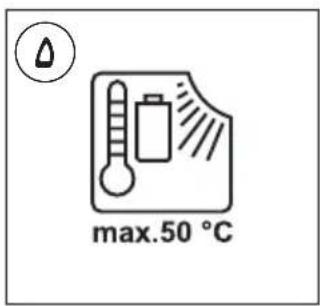
⑤ Store tool/charger/battery in locations where temperature will not exceed 50°C
⑥ Do not dispose of electric tools and batteries together with household waste material
USE
- Charging battery
! read the safety warnings and instructions provided with the charger
- Removing/installing the battery ②
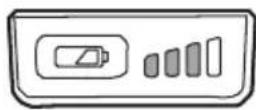
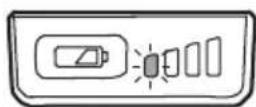
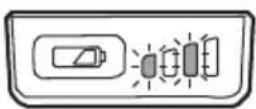
- Battery level indicator ⑦
- press the battery level indicator button H to show the current battery level ⑦a
! when the lowest level of the battery indicator starts flashing after pressing button H⑦b, the battery is empty
! when 2 levels of the battery indicator start flashing after pressing button H⑦c, the battery is not within the allowable operating temperature range
- LED-light ⑭
- LED-light B automatically lights on when activating the on/off switch.
! when LED worklight starts flashing, the battery protection is activated (see below)
- Battery protection
The tool is suddenly being switched off or prevented from being switched on, when
- the load is too high --> remove load and restart
- the battery temperature is not within the allowable operating temperature range of -20 to +50°C -->2 levels of the battery level indicator start flashing when pressing button H⑦c; wait until battery has returned within the allowable operating temperature range
- the battery is nearly empty (to protect against deep discharge) --> a low battery level or flashing low battery level ⑦b is shown by the battery level indicator when pressing button H; charge battery
! do not continue to press the on/off switch after the tool is switched off automatically; battery may be damaged
- On/off ⑧
- switch on/off the tool by pushing switch A in "I/O" position
- Speed control ⑨
- with dial wheel F the desired sawing speed can be
selected
The optimal working speed depends on the material and can be determined with practical trials
With dial wheel F set to "A" the no load speed is reduced for controlled starting
- when sawing, the speed will automatically increase to full speed
! the tool will only return to the reduced no load speed after restarting
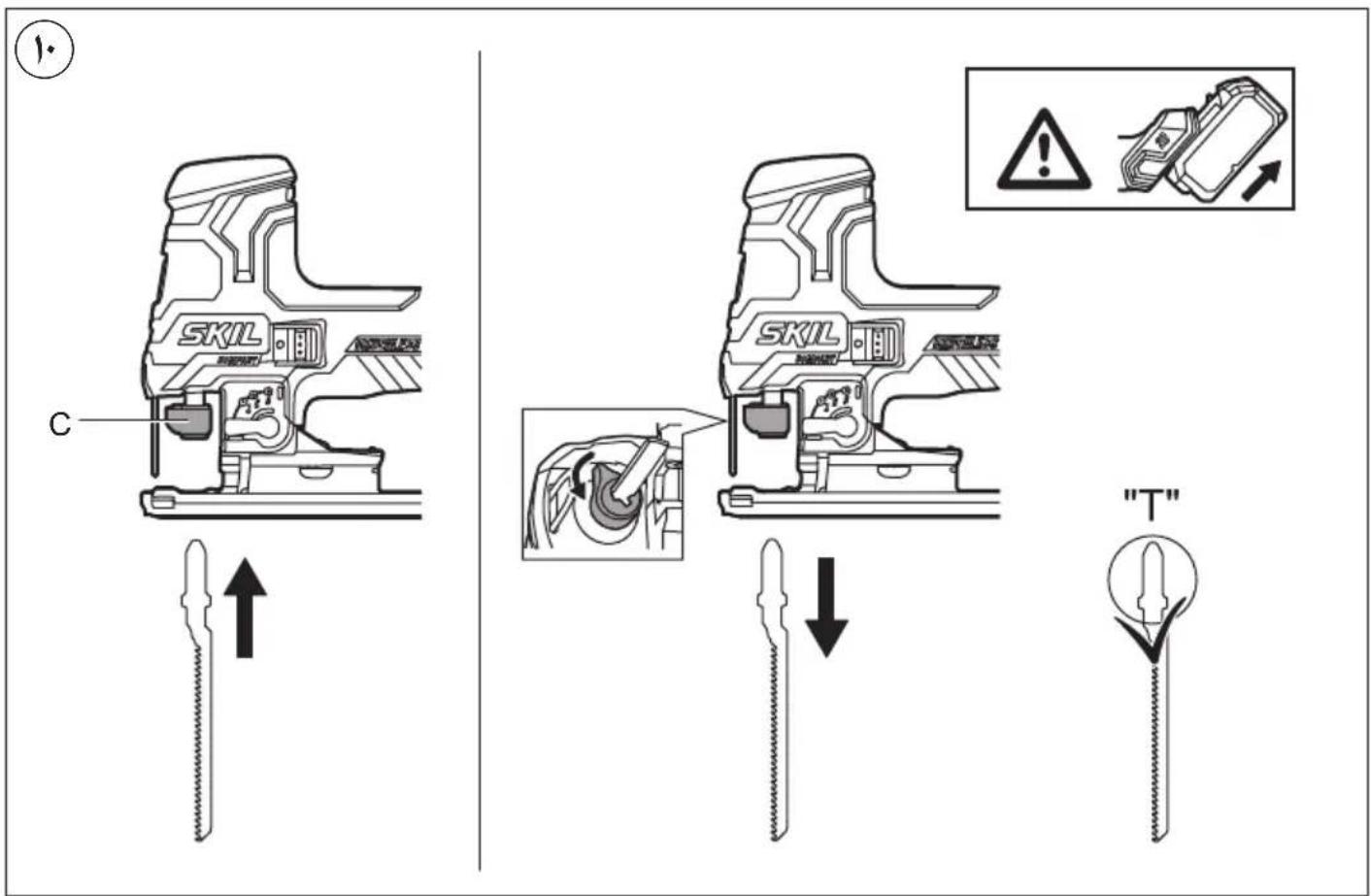
- Changing saw blade ⑩
! remove battery from tool before making any adjustments or changing accessories
! insert blade to full depth with teeth facing forward ⑪
- tool accepts most commonly available T-shank blades (10)
- to eject the blade only operate the lever of blade clamp C (no need to touch the blade)
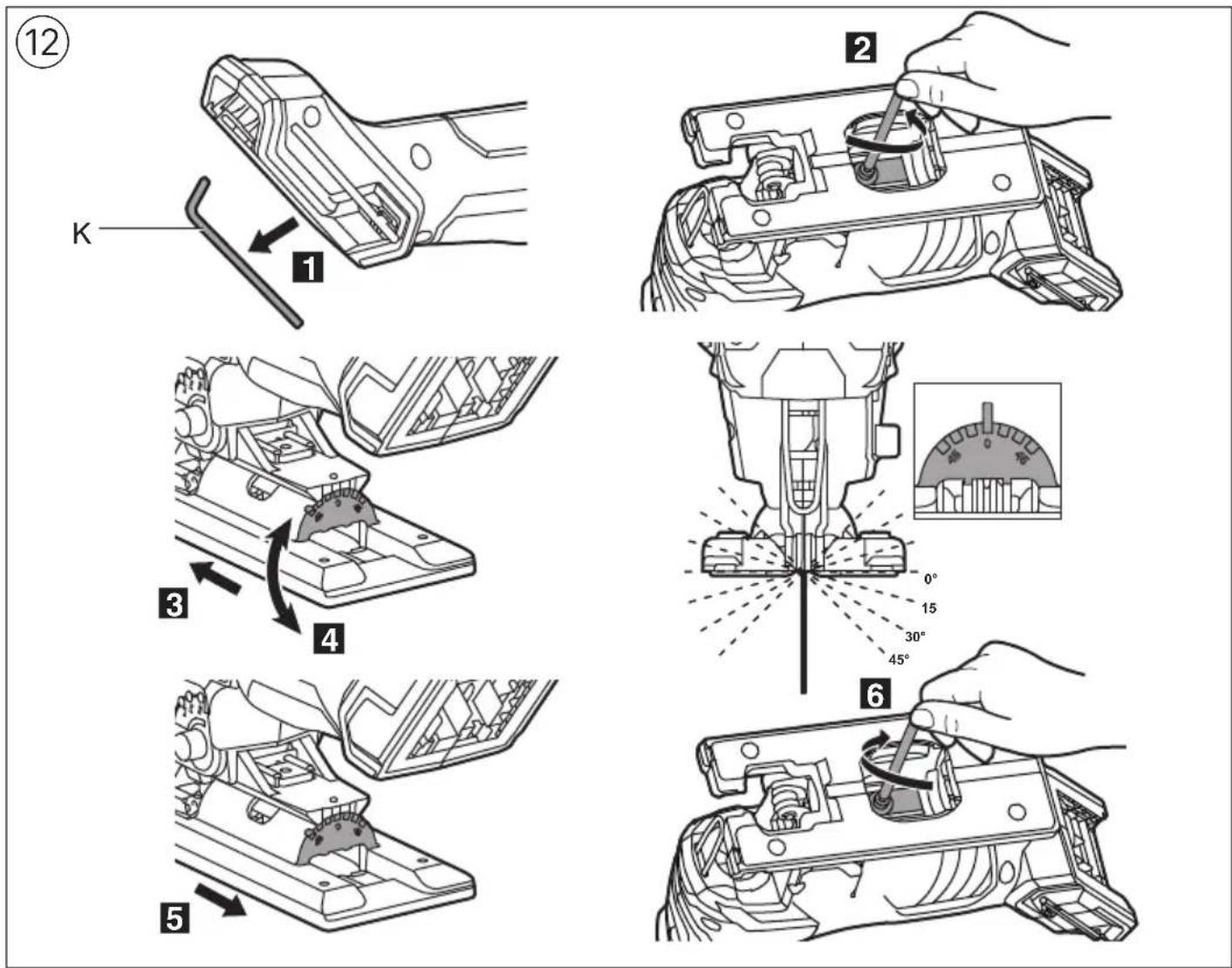
- Sawing at 45^ ⑫
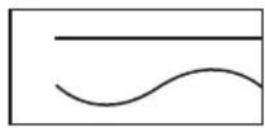
- Selecting sawing mode ⑬
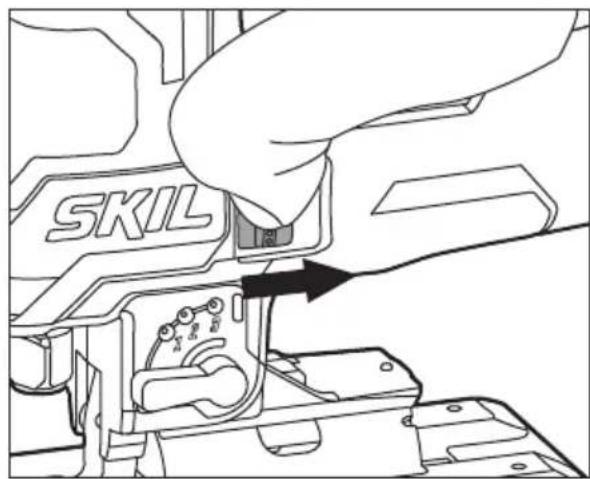
Use lever D for adjusting the orbital action from accurate cutting (=0) to fast cutting (=3)
- 1 setting ("0") for accurate cutting in all materials, straight + curved
- 3 settings for fast cutting in different materials, straight cuts only
1 = aluminum, plastic
2 = hard wood
3 = soft wood
! always select "0" when sawing splinter-sensitive material
- Dust suction ⑮
- connect vacuum cleaner adapter J to foot plate
- connect vacuum cleaner hose to vacuum cleaner adapter J
! do not use vacuum cleaner when cutting metal
- Operating the tool
- before switching on the tool, ensure that front end of footplate rests flat on the workpiece
- hold tool firmly with both hands, so you will have full control of the tool at all times
! while working, always hold the tool at the grey-coloured grip area(s) ⑯
- ensure that complete surface of footplate rests firmly on the workpiece
! ensure that the blade has come to a complete standstill, before you lift the tool from the workpiece - keep ventilation slots G② uncovered
APPLICATION ADVICE
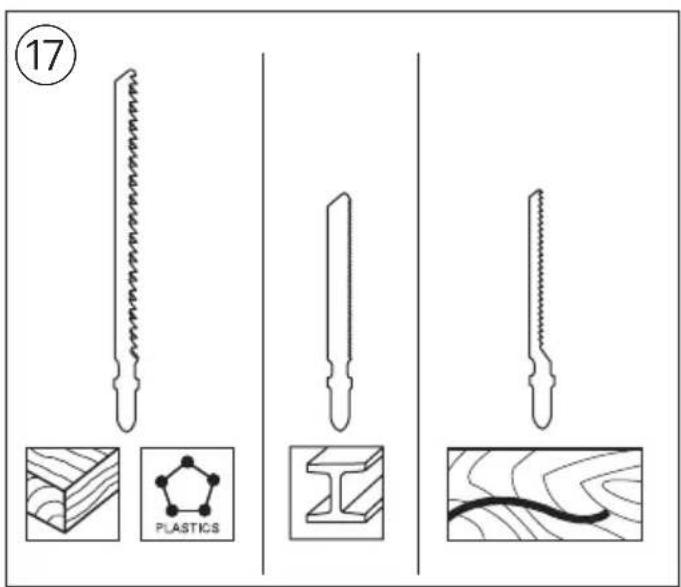
- Use the appropriate saw blades ⑰
! tool accepts most commonly available T-shank blades
- When cutting metals, lubricate saw blade regularly with oil
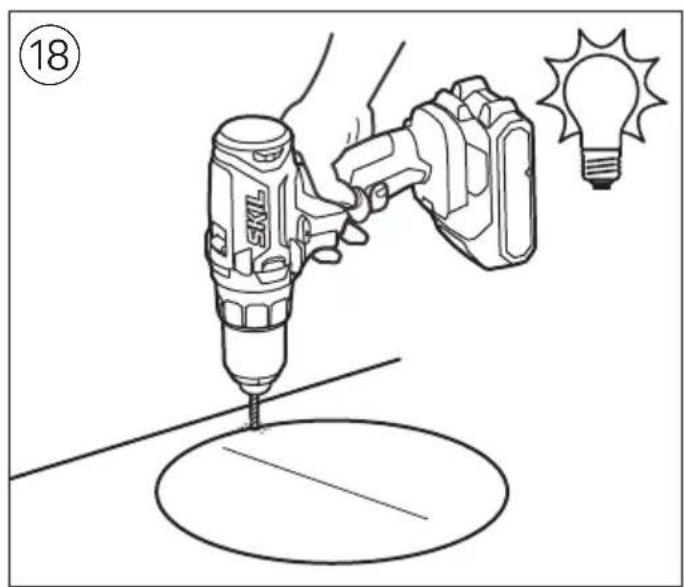
• Pre-drill a hole before making cut-outs ⑱ -
Splinter-free cutting
-
cover cutting-line with several layers of wide tape before cutting
- always face the good side of the workpiece down
• For more information see www.skil.com
MAINTENANCE/SERVICE
• This tool is not intended for professional use
- Always keep tool clean (especially ventilation slots G②) ! remove battery from tool before cleaning
- If the tool should fail despite the care taken in manufacturing and testing procedures, repair should be carried out by an after-sales service centre for SKIL power tools
- send the tool undismantled together with proof of purchase to your dealer or the nearest SKIL service station (addresses as well as the service diagram of the tool are listed on www.skil.com)
- Be aware that damage due to overload or improper handling of the tool will be excluded from the warranty (for the SKIL warranty conditions see www.skil.com or ask your dealer)
ENVIRONMENT
- Do not dispose of electric tools, batteries, accessories and packaging together with household waste material (only for EU countries)
- in observance of European Directive 2012/19/EC on waste of electric and electronic equipment and its implementation in accordance with national law, electric tools that have reached the end of their life must be collected separately and returned to an environmentally compatible recycling facility
- symbol ⑥ will remind you of this when the need for disposing occurs
! prior to disposal protect battery terminals with heavy tape to prevent short-circuit
NOISE / VIBRATION
- Measured in accordance with EN62841 the sound pressure level of this tool is 87 dB(A) and the sound power level 98 dB(A) (uncertainty K = 3 dB), and the vibration* (triax vector sum; uncertainty K = 1,5 m/s ^2 )
*cutting board 7.68 m²/s
*cutting sheet metal 6.08 m²/s
- The vibration emission level has been measured in accordance with a standardized test given in EN62841; it may be used to compare one tool with another and as a preliminary assessment of exposure to vibration when using the tool for the applications mentioned
- using the tool for different applications, or with different or poorly maintained accessories, may significantly increase the exposure level
- the times when the tool is switched off or when it is running but not actually doing the job, may significantly reduce the exposure level
- using the tool for different applications, or with different or poorly maintained accessories, may significantly increase the exposure level - the times when the tool is switched off or when it is running but not actually doing the job, may significantly reduce the exposure level
! protect yourself against the effects of vibration by maintaining the tool and its accessories, keeping your hands warm, and organizing your work patterns

1 = aluminium, plastic
2 = hard hout
3 = zacht hout
1 = aluminium, plast
1 = aluminium, plast
2 = hard tre
3 = mykt tre
! velg alltid "0" når du sager splintfølsomt materiale
- Støvsuging 15
1 = aluminiu, plastic
2 = lemn tare
3 = lemn moale
• Regulator brzine ⑨
- Željenu brzinu piljenja možete odabrati pomoću kotačića za podešavanje F.
Optimalna radna brzina ovisi o materijalu i može se odrediti praktičnim probnim radovima.
S kotačićem za podešavanje F u položaju "A", brzina bez opterećenja se smanjuje za kontrolirano pokretanje.
TECHNINIAI DUOMENYS ①
IRANKIO DALYS ②
- Thithja e pluhurave ⑮
natural_image
Simple line drawing of a pencil (no text or symbols)
natural_image
Simple line drawing of a pencil (no text or symbols)
natural_image
Technical line drawing of a mechanical component with labeled part B (no text or symbols beyond label)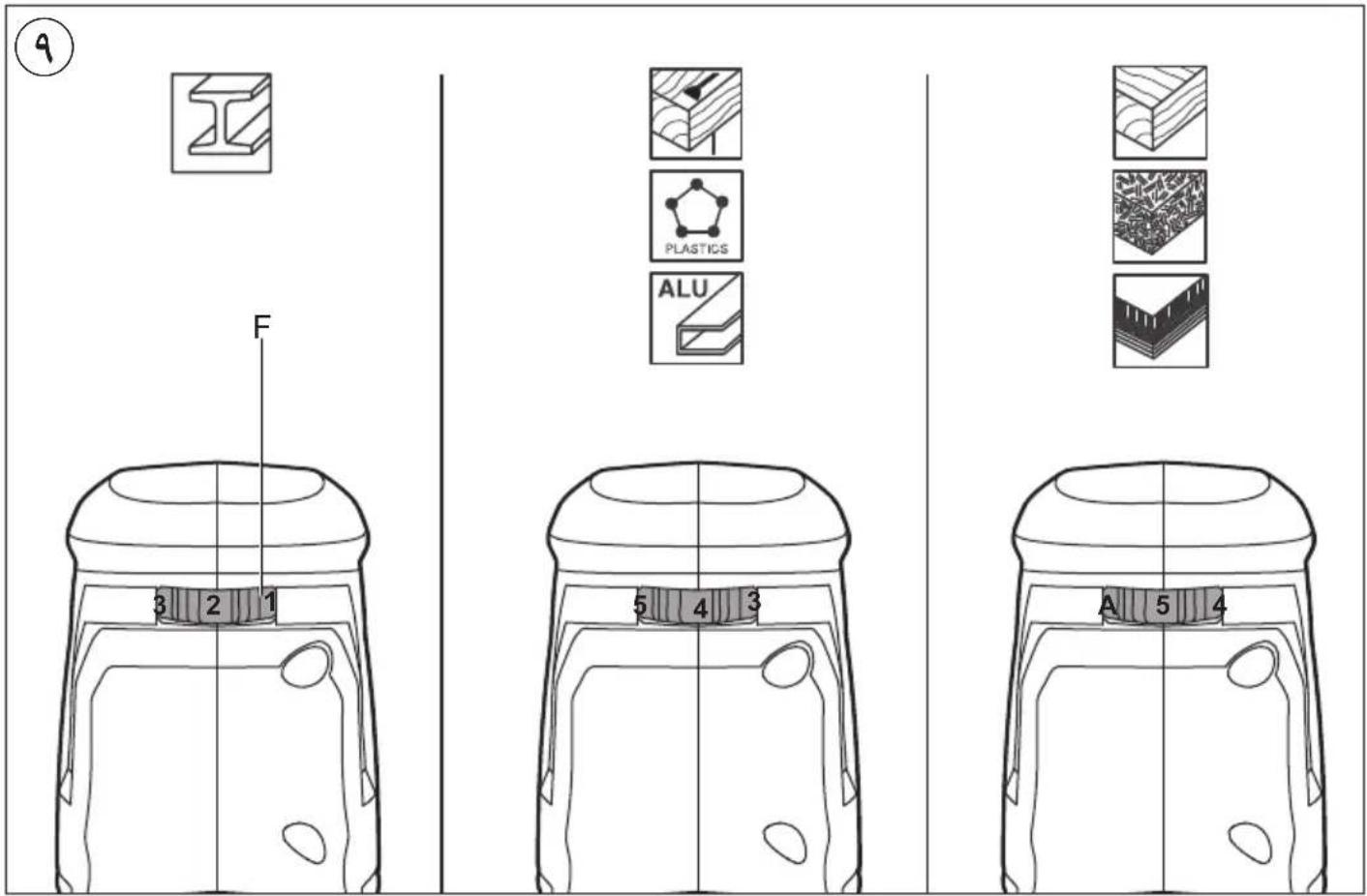
V

⑦a

⑦b

⑦c
A



1
3440


1


natural_image
Icon showing a person using a computer inside a circle with a small symbol above (no text or symbols present)

natural_image
Illustration of a SKIL device with labeled components and a 20-unit housing (no text or symbols beyond branding)


- 3440
- GB
- Brushless compact jig saw
- INTRODUCTION
- TECHNICAL DATA ①
- TOOL ELEMENTS ②
- SAFETY
- GENERAL POWER TOOL SAFETY WARNINGS
- SAFETY INSTRUCTIONS FOR CORDLESS JIG SAW
- GENERAL
- BEFORE USE
- DURING USE
- ACCESSORIES
- AFTER USE
- BATTERIES
- EXPLANATION OF SYMBOLS ON TOOL/BATTERY
- USE
- APPLICATION ADVICE
- MAINTENANCE/SERVICE
- ENVIRONMENT
- NOISE / VIBRATION
- TECHNINIAI DUOMENYS ①
- IRANKIO DALYS ②
Brand : SKIL
Model : 3440 CA
Category : Saw