
PBC3104S - String Trimmer SCHEPPACH - Free user manual and instructions
Find the device manual for free PBC3104S SCHEPPACH in PDF.

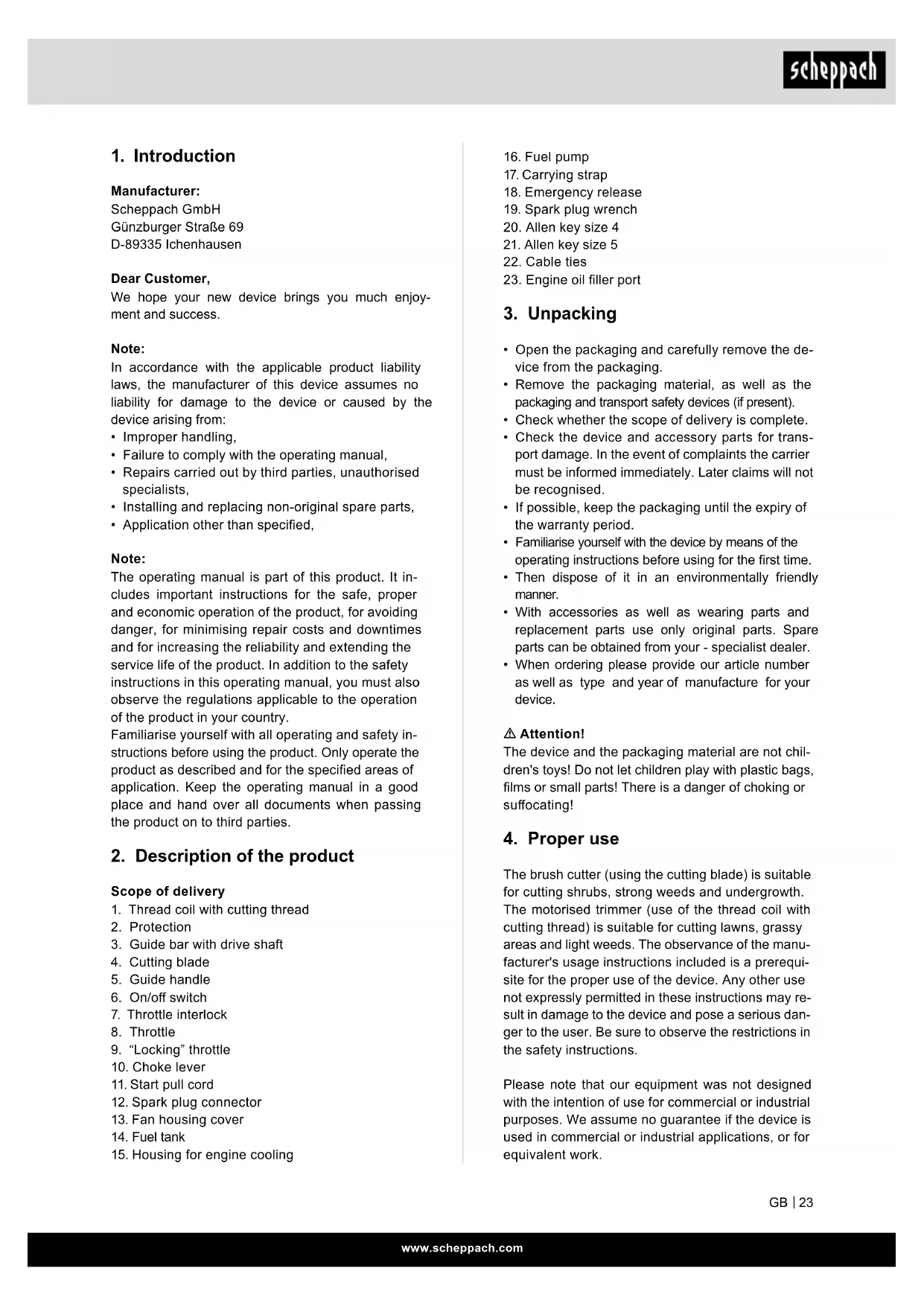


| Product type | String trimmer / Brush cutter (petrol) |
| Brand and model | Scheppach PBC3104S |
| Weight | 7.3 kg |
| Rated engine power | 0.7 kW |
| Displacement | 31.0 cm³ |
| Engine type | 4-stroke, air-cooled |
| Recommended fuel | Unleaded petrol (max. 10% bioethanol) |
| Fuel tank volume | 700 cm³ |
| Engine oil | SAE 30/10W30, 80 ml |
| Cutting diameter (line) | 480 mm |
| Cutting diameter (blade) | 255 mm |
| Cutting line thickness | 2 x 2.4 mm |
| Line length | 4 m |
| Max. cutting speed (line) | 6000 min⁻¹ |
| Max. cutting speed (blade) | 7000 min⁻¹ |
| Sound pressure level (brush cutter) | 92.5 dB(A) |
| Sound pressure level (trimmer) | 93.3 dB(A) |
| Sound power level (brush cutter) | 107.4 dB(A) |
| Sound power level (trimmer) | 108.2 dB(A) |
| Vibrations (trimmer, left) | 6.86 m/s² |
| Vibrations (trimmer, right) | 6.67 m/s² |
| Vibrations (brush cutter, left) | 7.06 m/s² |
| Vibrations (brush cutter, right) | 6.87 m/s² |
| Main functions | Cutting grass, weeds, undergrowth, small woody plants |
| Maintenance and cleaning | Air filter cleaning, oil change, blade sharpening |
| Safety | Protection, emergency stop, trigger lock |
| Spare parts | Line spool, blade, spark plug, air filter, accessories |
| Repairability | Spare parts available via Scheppach after-sales service |
Frequently Asked Questions - PBC3104S SCHEPPACH
User questions about PBC3104S SCHEPPACH
0 question about this device. Answer the ones you know or ask your own.
Ask a new question about this device
Download the instructions for your String Trimmer in PDF format for free! Find your manual PBC3104S - SCHEPPACH and take your electronic device back in hand. On this page are published all the documents necessary for the use of your device. PBC3104S by SCHEPPACH.
USER MANUAL PBC3104S SCHEPPACH
Explanation of the symbols on the product
| Before commissioning, read and observe the operating manual and safety instructions! | |
| Use safety helmet, hearing protection and safety goggles! | |
| Wear sturdy footwear! | |
| Wear work gloves! | |
| Attention! Petrol is very easily flammable. Avoid smoking, naked flames or flying sparks near fuel. | |
| Attention! Risk of suffocation! The exhaust gases are toxic. Do not operate the engine in areas that are not ventilated. | |
| Warning! Disregard results in a risk of death or injury, or damage to the tool | |
| Attention: Risk of injury! Do not allow hands and feet to come into contact with the blade when the engine is running. | |
| Keep children, onlookers and helpers 15m away from the brush cutter! | |
| Attention! The exhaust pipe and other parts of the engine become very hot during operation, do not touch! | |
| Tank contents | |
| Attention! Danger of injury due to objects being flung away | |
| Pay attention to kick-back! | |
| Attention, do not use saw blades or multi-part metallic cutting tools! | |
| Brush cutter | |
| Grass trimmer | |
| Guaranteed sound power level | |
| Primer, fuel pump | |
| Choke on (cold start) Choke off (warm start) | |
| Check the oil level. | |
| The product complies with the applicable Serbian directives. | |
| The product complies with the applicable European directives. |
Table of contents: Page:
- Introduction 23
- Description of the product 23
3.Unpacking 23 - Proper use 23
- Important information 24
- Technical data 25
- Before commissioning 25
- Assembly and operation 26
- Working instructions 27
- Maintenance 28
- Storage 29
- Disposal and recycling 30
- Troubleshooting 30
14.Declaration of conformity 280
1. Introduction
Manufacturer:
Scheppach GmbH
GünzburgerstraBe 69
D-89335 Ichenhausen
Dear Customer,
We hope your new device brings you much enjoyment and success.
Note:
In accordance with the applicable product liability laws, the manufacturer of this device assumes no liability for damage to the device or caused by the device arising from:
- Improper handling,
- Failure to comply with the operating manual,
- Repairs carried out by third parties, unauthorised specialists,
- Installing and replacing non-original spare parts,
Application other than specified,
Note:
The operating manual is part of this product. It includes important instructions for the safe, proper and economic operation of the product, for avoiding danger, for minimising repair costs and downtimes and for increasing the reliability and extending the service life of the product. In addition to the safety instructions in this operating manual, you must also observe the regulations applicable to the operation of the product in your country.
Familiarise yourself with all operating and safety instructions before using the product. Only operate the product as described and for the specified areas of application. Keep the operating manual in a good place and hand over all documents when passing the product on to third parties.
2. Description of the product
Scope of delivery
- Thread coil with cutting thread
- Protection
- Guide bar with drive shaft
- Cutting blade
- Guide handle
- On/off switch
- Throttle interlock
- Throttle
- "Locking" throttle
- Choke lever
- Start pull cord
- Spark plug connector
- Fan housing cover
- Fuel tank
-
Housing for engine cooling
-
Fuel pump
- Carrying strap
- Emergency release
- Spark plug wrench
- Allen key size 4
- Allen key size 5
- Cable ties
- Engine oil filler port
3. Unpacking
- Open the packaging and carefully remove the device from the packaging.
- Remove the packaging material, as well as the packaging and transport safety devices (if present).
- Check whether the scope of delivery is complete.
- Check the device and accessory parts for transport damage. In the event of complaints the carrier must be informed immediately. Later claims will not be recognised.
- If possible, keep the packaging until the expiry of the warranty period.
- Familiarise yourself with the device by means of the operating instructions before using for the first time.
- Then dispose of it in an environmentally friendly manner.
- With accessories as well as wearing parts and replacement parts use only original parts. Spare parts can be obtained from your - specialist dealer.
- When ordering please provide our article number as well as type and year of manufacture for your device.
Attention!
The device and the packaging material are not children's toys! Do not let children play with plastic bags, films or small parts! There is a danger of choking or suffocating!
4. Proper use
The brush cutter (using the cutting blade) is suitable for cutting shrubs, strong weeds and undergrowth. The motorised trimmer (use of the thread coil with cutting thread) is suitable for cutting lawns, grassy areas and light weeds. The observance of the manufacturer's usage instructions included is a prerequisite for the proper use of the device. Any other use not expressly permitted in these instructions may result in damage to the device and pose a serious danger to the user. Be sure to observe the restrictions in the safety instructions.
Please note that our equipment was not designed with the intention of use for commercial or industrial purposes. We assume no guarantee if the device is used in commercial or industrial applications, or for equivalent work.
Attention! Due to physical hazards to the user, the petrol trimmer must not be used for the following work: cleaning pavements and as a shredder for shredding tree and hedge cuttings. Furthermore, the petrol trimmer must not be used for levelling ground elevations, such as molehills. For safety reasons, the petrol trimmer must not be used as a drive unit for other working tools and tool sets of any type.
The machine may only be used in the intended manner. Any use beyond this is improper. The user/operator, not the manufacturer, is responsible for damages or injuries of any type resulting from this.
Who is not permitted to use the device:
People who are not familiar with the operating manual, children under the age of 16, people under the influence of alcohol, drugs or medication.
Petrol trimmer operating hours
Even though a trimmer may be used at any time, the operator should be considerate of the people around him.
5. Important information
Safety instructions
This device is not intended for use by persons (including children) with reduced physical, sensory or mental capabilities, or who have insufficient experience and knowledge, unless they have been given supervision and instruction concerning use of the device by a person responsible for their safety. Children must be supervised so that they do not play with the device.
1. Training
- Read through the instructions carefully. Familiarise yourself with the controls and the proper use of the unit.
- Never allow children or persons who are not familiar with these instructions to use the device. The relevant laws of a country may specify a minimum age for the operator.
- Never mow while people, especially children, or pets are nearby.
- The operator or user is responsible for the consequences of hazards to which other people or their property are exposed.
- Do not run the engine indoors. The exhaust gases contain harmful carbon monoxide.
2. Preparation
- Always wear suitable footwear and long trousers during cutting.
-
Do not operate the device if barefoot or wearing sandals.
-
Thoroughly check the area where the device is to be used; remove all stones, sticks, wires, bones and other objects.
- Check the blades, pins and cutter for visible damage or wear before each use. Replace worn or damaged blades and screws in pairs to ensure balance.
- Be careful with multi-cutting edge devices as one cutting edge may cause other cutting edges to rotate.
3. Operation
- Only use the device in daylight or with good artificial lighting.
- Do not use it on wet grass.
- Make sure of secure footing, especially on slopes.
- Walk; do not run.
- Take particular care when changing direction on a slope.
- Do not cut grass on excessively steep slopes.
- Take particular care when turning the device around or pulling it towards you.
- Never operate the device with faulty protective devices or shields or without protection for yourself.
- Switch on the engine as per the instructions and keep your feet away from the cutting edge(s).
- In this case, do not tilt it further than absolutely necessary and only lift the part that is away from the operator. Both hands must be in the operating position before moving the device back towards the ground.
- Keep hands and feet away from the rotating parts.
- Never pick up or carry the device while the engine is running.
-
Pull the spark plug out of the base:
-
when you are not working with the device,
before removing a blockage, - before checking, cleaning or working on the device,
- after touching an object. Check the device for damage and repair if necessary,
- if it starts to vibrate abnormally (check immediately).
4. Maintenance and storage
- Make sure that all nuts, pins and screws are securely tightened so that the device is in a safe working condition.
- Check the grass catcher regularly for wear and tear.
- Replace worn or damaged parts for safety reasons.
-
On rotary mowers, only use replacement cutting devices of the appropriate type.
-
Never store the device fuelled in a building where gases can reach an open flame or sparks.
- Allow the engine to cool down before storing it in a container.
-
To reduce the risk of fire, keep the engine, silencer, battery compartment and fuel storage area free of grass, leaves and excessive grease.
-
If the fuel tank needs to be emptied, do this outdoors.
Special safety warning
- Hold the handles of the trimmer securely with both hands. When you stop work, move the throttle to the idle position.
- Maintain a stable, even posture when working.
- Keep the engine speed at the level required for cutting; never increase the engine speed above the required level.
- If grass gets caught in the cutting edge during operation or you need to check or refuel the device, always switch off the engine.
- If the cutting edge touches a hard object such as a stone, stop the engine immediately and check whether the cutting edge has been damaged. In this case, replace the cutting edge with a new one.
- If someone calls for you while you are working, you must always switch off the engine before turning towards them.
- Never touch the spark plug or cable while the engine is running. There is a risk of electric shock if disregarded.
- Never touch the silencer, spark plug or other metal parts of the engine while the engine is running or immediately after the engine has been switched off. Failure to do so may result in severe burns.
- When you have finished cutting in one place and want to continue cutting in another, switch off the engine and rotate the machine so that the cutting edge faces away from your body.
- Check that the cutter has stopped rotating when the engine is idle before working with the device again.
6. Technical data
| Grass trimmer cutting data | |
| Cutting diameter | 480 millimeters |
| Thread count | 2 x 2.4 mm |
| Thread length | 4 m |
| Max. cutting speed | 6000 rpm |
| Brush cutter cutting data | |
| Cutting diameter | 255 millimeters |
| Cutting blade thickness | 1.4 millimeters |
| Number of teeth | 3 |
| Max. cutting speed | 7000 rpm |
| Drive | |
| Displacement | 31.0 cm³ |
| Rated engine power | 0.7 kW |
| Idle speed | 3100 ±400 rpm |
| Fuel tank volume | 700 cc, regular petrol / lead-free max. 10% bioethanol |
| Oil quantity | 80 cc |
| Oil | 10W30 / SAE30 |
Type of engine 4-stroke engine, air-cooled
CO2 output 970.92 g/kWh
Weight 7.3kg
Subject to technical changes!
Information about noise level measured in accordance with applicable standards:
Sound pressure
Brush cutter: LpA = 92.5 dB
Grass trimmer: LpA = 93.3 dB
Sound power
Brush cutter: Lwa = 107.4 dB
Grass trimmer: Lwa = 108.2 dB
Measurement uncertainty KPA = 3 dB
Wear hearing protection.
Exposure to noise can cause hearing loss.
Vibration:
Grass trimmer:
Left grip 6.86m / s2
Right grip 6.67m / s2
Brush cutter:
Left grip ab: 7.06 m/s²
Right grip 6.87m / s2
Measurement uncertainty KPA = 1.5 m/s2
Keep the noise level and vibration to a minimum!
- Only use faultless devices.
- Maintain and clean the device at regular intervals.
- Adapt your working methods to the device.
- Do not overload the device.
- Have the device checked if necessary.
- Switch the device off if it is not in use.
Wear gloves.
We have marked points in the operating manual that impact your safety with this symbol:
7. Before commissioning
Before each commissioning, check the device for the following:
- Check the fuel system for leakage.
- Faultless condition and completeness of the guards and the cutting device.
- All screw connections are tight.
- Smooth running of all moving parts.
Attention!
The engine does not come with oil in it. Therefore, ensure that you fill with oil (approx. 0.08 l) before starting it up. Use normal, multigrade oil (SAE 30/10W30). The oil level in the engine must be checked each time before mowing. Fig. 44-45 You will also need to fill in petrol, as this is also not supplied upon delivery.
Fuel
Recommended fuels.
Regular grade petrol / lead-free max. 5% bioethanol.
Attention: Use only designated and approved vessels for the transport and storage of fuel.
Warning! Pay attention to the exhaust gases.
Always switch off the engine before refuelling. Never add petrol to the device while the engine is running or it is hot. There is a risk of fire!
8. Assembly and operation
Assembly
When assembling this machine, please follow the specified assembly instructions.
1 Fit the handle on the machine Fig. 4 - 6
- First loosen the hexagon socket screws and then bring the right and left handle into the centre of the handle holder.
- Then fit the handle holder and tighten the internal screws.
2. Fitting the shaft Fig. 7
- Push the lower part of the shaft (b) down until the locking pin (a) engages in the hole (c) of the shaft. It is easier if you rotate the bottom of the shaft (b) slightly in both directions. The pin (a) is in the correct position when it is fully seated in the hole.
- Then tighten the button (d) securely.
3. Fit the protection Fig. 11 - 13
Fix the guard using the spanner supplied as a standard accessory; tighten the screws.
Warning! Only use original spare parts and accessories from the manufacturer. Failure to do so can reduce performance, result in injuries and void your warranty. Never use the machine without the protection assembled!
4. Assembling and disassembling the two cutting devices
Grass trimmer/ thread coil Fig. 14-15
- Release the nut.
Align the two holes of the flange and cover. Hold the flange with a screwdriver and rotate the socket spanner clockwise; the nut will loosen.
- Attach the nylon cutting head.
Remove the cover by loosening the nut. Continue to hold the flange, attach the nylon cutting head to the shaft and rotate it anti-clockwise; the nylon cutting head is attached. Fig. 15 - Loosen the nylon cutting head.
Hold the flange with a screwdriver and then screw the nylon cutting head clockwise; now it can be replaced.
Brush cutter / cutting blade
Fix the cutting edge in place. Fig. 8 - 10
Remove the outer flange after loosening the nut. Then align the cutting edge (4), the outer flange (25), the cover (24) and the nut. Note that the direction of rotation of the cutting edge must match the direction of the arrow on the cutting edge. Hold the flange with a screwdriver and tighten the nut anticlockwise; make sure the nut is securely fastened.
- Release the cutting edge. Hold the flange with a screwdriver and loosen the nut; then you can remove the cutting edge.
Warning!
Please ensure that the cutting head is fitted correctly before use!
Note: The packaging materials are made from recycled materials. Dispos of the packaging materials in accordance with the directives.
5. Attach the belt. Fig. 17 - 21
- Attach the strap as shown.
Operation
When working with the device, the plastic protective cover for blade or thread operation must be fitted to prevent objects from being thrown away.
The integrated blade (A) in the cutting thread protective cover automatically cuts the thread to the optimum length. Fig. 16
Fill up petrol
Risk of injury! Petrol is explosive!
Before filling the tank with petrol, switch off the engine and allow it to cool down
Danger of damage to the device!
The device is supplied without engine or gearbox oil.
ATTENTION! Before starting it up, you must fill in the petrol.
- Unscrew and remove the fuel cap (14). Fig. 1
- Carefully pour in the petrol/oil mixture. Do not spill anything in the process!
- Screw the tank cap on by hand.
Draining the petrol Fig. 40
- Hold a collection bucket under the petrol drain plug.
- Unscrew the fuel cap and remove it.
- Drain the petrol/oil mixture completely.
- Screw the tank cap back on by hand.
Starting the device
Do not start the device until you have fully assembled it.
Risk of injury!
Do not use the device if you have discovered faults. If a part is damaged, you must replace it before using the device again.
Check before use!
- Check that the device is in a safe condition:
- Check the device for leaks.
- Check the device for visible damage.
- Check that all parts of the device are securely attached.
- Check that all safety devices are in good condition.
Risk of injury!
Before starting work, always remove any objects lying on the ground that could be thrown away when operating the trimmer.
Starting Fig. 21 - 27 + 41
Once the device is properly assembled, start the engine as follows:
- Place the device on a hard, level surface.
- Press the engine switch to the on position. Fig. 22
- Set the choke lever to the position. Fig. 23
- Press the fuel pump more than 5 times. Fig. 24
- Pull the handle of the starter cable (11) 3 to 5 times to start the engine. Fig. 25
- Pull the rope until the engine starts. Fig. 25
- Wait briefly and then set the choke lever to the position. Fig. 26
- When the engine is idling, first press the release lever (7) and then push the throttle (8). The device runs. If you want to lock the throttle at half throttle, press the lock button (9). Fig. 27
- Adjust the thread length when working: This device has a cutting head that works on the "tap and go" principle. You can release more thread by tapping the pulley with the cutting head while the engine is running at maximum speed: El hilo de nailon se sueña automatística y la hoja de cucilla corta la longitud sobrante. Fig. 41
- If problems occur, switch off the engine; the device stops. If you want to stop the cutting head, release the throttle (8). Fig. 27
-
If a problem occurs, pull the pin of the safety belt and release the trimmer immediately. Switch off the engine Fig. 22
-
When the engine is warm, the throttle can be set directly to the on position when the machine is restarted.
Note: If the engine does not start up after several attempts, see the "Troubleshooting" section.
Note: Always pull the start pull cord out straight. If it is pulled out at an angle, friction will occur on the lug. This friction causes the cord to wear through and wear out faster. Always hold the starter handle when the cord retracts.
Never let the cord snap back from its extended state.
Note: Do not start the engine in tall grass.
Attention: If the motor has been switched off, the trimmer continues running for a few seconds; therefore keep away from the cutting head of the trimmer until it comes to a complete standstill!
9. Working instructions
Extension of the cutting thread
Warning! Do not use metal wire or any type of plastic-coated metal wire in the thread coil. This could seriously injure the user.
To lengthen the cutting thread, run the engine at full throttle and tap the thread coil on the ground. The thread is automatically lengthened. Fig. 41
The blade on the shield shortens the thread to the permissible length. Fig. 16
Caution: Regularly remove all lawn and weed debris to prevent the shaft tube from overheating. Lawn/grass/weed debris gets caught underneath the shield, this prevents sufficient cooling of the shaft tube. Carefully remove the residues with a screwdriver or similar. Fig. 42
Different cutting techniques
If the device is assembled correctly, it cuts weeds and tall grass in hard-to-reach places, such as along fences, walls and foundations, and around trees. It can also be used for "mowing" to remove wild growth close to the ground for preparing a garden or for cleaning out a specific area. Fig. 43
Attention: Even with careful use, cutting on foundations, stone or concrete walls, etc. will result in above-normal wear of the thread.
Trimming/mowing
Swing the trimmer from side to side in a sickle-like motion. Always keep the thread coil parallel to the ground. Check the terrain and set the desired cutting height. Guide and hold the thread coil at the desired height to get an even cut. Fig. 43
Low trimming
Hold the trimmer with a slight inclination right in front of you so that the bottom of the thread coil is above the ground and the thread hits the correct intersection. Always cut away from yourself. Do not pull the trimmer towards you.
Cutting on fence/foundation
When cutting, slowly approach wire mesh fences, picket fences, natural stone walls and foundations to cut close to them, but without hitting the obstacle with the thread. If the thread comes into contact with stones, stone walls or foundations, for example, it wears out or frays. If the thread hits the fence mesh, it breaks off.
Trimming around trees
Trim around tree trunks, approaching slowly so that the thread does not touch the bark. Walk around the tree, cutting from left to right. Approach grass or weeds with the tip of the thread and tilt the thread coil slightly forward.
Warning: Be extremely careful when mowing it. Maintain a spacing of 30 metres between yourself and other persons or animals for any such tasks.
Mowing down
When mowing down, capture all vegetation down to the ground. To do this, tilt the thread coil to the right at a 30 degree angle. Set the handle to the desired position. Be aware of the increased danger of injury to the user, spectators and animals, as well as the risk of damage to property from objects being thrown (e.g. stones).
Warning: Do not remove objects from footpaths etc. with the device!
The device is a powerful tool and small stones or other objects can be thrown 15 metres or more away and cause injuries or damage to cars, houses and windows.
Jamming
If the cutting blade jams because the vegetation is too dense, stop the engine immediately. Clear the device of grass and undergrowth before operating it again. Fig. 42
Avoidance of kick-back
When working with the cutting blade, there is a danger of kick-back if it hits solid obstacles (tree trunk, branch, tree stump, stone or the like). The device is thrown back against the direction of rotation of the tool. This can lead to loss of control over the device. Do not use the cutting blade near fences, metal posts, boundary stones or foundations.
10. Maintenance
Always shut the engine down and remove the spark plug connector before carrying out any maintenance and cleaning work.
- Do not spray the device with water. This damages the engine.
- Clean the device with a cloth, hand brush, etc.
| Maintenance plan | |||
| after 12 operating hours | after 24 operating hours | after 36 operating hours | |
| Air filter Clean | Clean Replace | ||
| Spark plug | Check Clean | Replace | |
Expert inspection required:
- if the trimmer hits an object.
- if the engine suddenly stops.
- if the cutting edge is bent (do not straighten it yourself!).
- if the transmission is damaged.
Replacement of the thread coil/cutting thread, Fig. 35 - 39
- Dismantle the thread coil (1) as described in Section 8.4. Press the coil together and remove one half of the housing Fig. 35.
- Remove the bobbin plate from the thread coil housing Fig. 36.
- Remove any remaining cutting thread.
- Fold the new cut thread in the centre and hook the resulting loop into the recess in the bobbin plate. Fig. 37
- Wind the thread anti-clockwise under tension. The bobbin divider separates the two halves of the cut thread. Fig. 38
- Hook the last 15cm of the two thread ends into the opposite thread holders of the bobbin plate. Fig. 39
- Pass the two thread ends through the metal lugs in the thread coil housing.
- Press the bobbin plate into the thread coil housing. Fig. 36
- Pull briefly and firmly on both ends of the thread to release them from the thread holders.
- Put the housing halves back together. Fig. 35
- Cut back the excess thread to about 13cm . This reduces the load on the engine during starting and warming up.
- Refit the thread coil (see section 8.4). If the complete thread coil is replaced, skip points 3-6.
Grinding the cutting blade
The cutting blade can become blunt over time
- If you notice this, loosen the screws securing the cutting blade to the protective cover.
-
Fasten the blade in a bench vice.
-
Grind all 3 cutting unit blades using a flat file and make sure to maintain the angle of the cutting edge. Only file in one direction.
Replace or sharpen the cutting edge at the end of each mowing season or as needed.
The brush cutter can vibrate excessively if the cutting edges are not balanced; therefore there is a danger of injury!
Replace and clean the spark plug. Fig. 32 - 33
- Once the engine has cooled down, remove the spark plug with the supplied socket spanner.
- Clean the spark plug with a wire brush.
- Set the gap to 0.5 to 0.7mm with a feeler gauge.
- Insert the spark plug carefully by hand so that the thread is not damaged.
- After the spark plug is inserted, tighten it with the spark plug wrench.
Cleaning the air filter Fig. 28 - 31
Fouled air filters diminish the engine output due to reduced air supply to the carburettor. Regular inspection is therefore essential
- Loosen the air filter cover and remove the sponge filter element.
- Replace the air filter cover so that nothing falls into the air duct.
- Wash the filter element in warm soapy water, rinse and allow to air dry.
Attention: Never clean the air filter with petrol or combustible solvents.
Oil level check
Attention! Never operate the engine without oil or with too little oil. This can cause serious damage to the engine. Only use SAE 30 / 10W30 engine oil.
Checking the oil level, Fig. 45
- Set the device down on a level surface.
- Remove the oil dipstick by turning it to the left, then wipe off the oil dipstick. Screw in the dipstick up to the limit stop again in the filling nozzle.
- Pull out the dipstick and read the oil level horizontally. The oil level must be positioned between the max and min of the oil dipstick (45).
Changing oil, Fig. 44 - 45
- The motor oil change should be completed annually before the start of the season while the motor is at operating temperature and shut off.
- Only use engine oil (SAE 30 / 10W30).
- Unscrew the oil filler plug (23).
- Drain the warm engine oil into a collection container.
- Fill in engine oil up to the upper mark of the oil dipstick (approx. 0.08 l), do not overfill the device.
Dispose of the used oil in accordance with applicable regulations.
Warning!
Never leave the engine running if the air filter element is not inserted.
Lubricating the angular gear
Treat with lithium-based grease. Remove the screw and put in the grease, turn the shaft manually until the grease comes out; and then attach the screw again.
Storing the device
Clean the device thoroughly after use. Store the device in a dry place and allow the engine to cool down beforehand.
Important note in the case of repairs:
When returning the device for repair, for safety reasons, ensure that it is free of oil and fuel when it is sent to the service centre.
Service information
With this product, it is necessary to note that the following parts are subject to natural or usage-related wear, or that the following parts are required as consumables.
Wearing parts*: Thread coil, cutting blade, spark plug, air filter
- may not be included in the scope of delivery!
Spare parts and accessories can be obtained from our Service Centre. To do this, scan the QR code on the front page.
11. Storage
Cleaning
- Keep the handles free of oil so that you always have a secure grip.
- If necessary, clean the device with a damp cloth and, if necessary, with a mild flushing liquid.
Attention!
- Disconnect the spark plug connector before cleaning.
- Never immerse the device in water or other liquids for cleaning.
- Store the trimmer in a secure and dry place and out of reach of children.
Storage
Caution: Never stow the device for longer than 30 days without carrying out the following steps:
Storing the device
If you stow the device for longer than 30 days, it must be prepared ahead of time. Otherwise, the remaining fuel in the carburettor will evaporate and leave a rubbery sediment behind. This could make it difficult to start and result in expensive repair work.
- Slowly remove the fuel tank cap to release any pressure in the tank. Carefully empty the tank.
- Start the engine and let it run until it stops in order to remove the fuel from the carburettor.
- Allow the engine to cool down (approx. 5 minutes).
- Remove the spark plug
- Add 1 teaspoon of clean 4-stroke oil to the combustion chamber. Pull the starter cord slowly several times to coat the internal components. Re-insert the spark plug.
Note: Store the device in a dry location, far away from potential sources of ignition, such as furnaces, hot water boilers with gas, gas dryers, etc.
Recommissioning
- Remove the spark plug.
- Pull the starter cord quickly to remove excess oil from the combustion chamber.
-
Clean the spark plug and check that the electrode gap on the spark plug is correct is correctly set, or insert a new spark plug with the correct electrode gap.
-
Prepare the device for operation
- Fill the tank with the correct type of fuel.
- Check the oil level.
Transport
If you want to transport the device, empty the fuel tank as explained in chapter 8. Clean coarse dirt from the device using a brush or a hand brush.
12. Disposal and recycling
Notes for packaging


The packaging materials are recyclable. Please dispose of packaging in an environmentally friendly manner.
You can find out how to dispose of the disused device from your local authority or city administration.
Fuels and oils
- Before disposing of the device, the fuel tank and the engine oil tank must be emptied!
- Fuel and engine oil do not belong in household waste or drains, but must be collected or disposed of separately!
- Empty oil and fuel tanks must be disposed of in an environmentally friendly manner.
13. Troubleshooting
The following table shows fault symptoms and describes remedial measures in the event of your machine failing to work properly. If you cannot localise and rectify the problem with this, please contact your service workshop.
| Fault Possible cause Remedy | ||
| The device does not start up. | ·Incorrect start-up procedure. ·Sooty or damp spark plug ·Incorrect carburettor setting ·Cutting edge or thread coil incorrectly fitted ·No fuel in the tank | ·Follow the instructions for starting ·Clean or replace the spark plug with a new one. ·Contact authorised customer service. ·Monte de nuevo la hoja de cucilla o bo-bina de hilo. ·Check the fuel level. |
| The device starts up but does not have full power. | ·Incorrect choke lever setting ·Contaminated air filter ·Incorrect carburettor setting ·Cutting blades blunt | ·Set the choke lever to the position. ·Clean the air filter ·Contact authorised customer service. ·Sharpen or replace the cutting blade |
| The engine runs erratically | ·Wrong spark plug electrode gap ·Incorrect carburettor setting | ·Clean spark plug and adjust electrode gap or fit new spark plug. ·Contact authorised customer service. |
| The engine runs hot · Motor is overloaded · Take regular breaks | ||
Greep links 7,06m / s2
Greeprechtsah:6,87m/s2
Meetonnauwkeurigheid KPA = 1.5 m/s2
Viktig information for reparation:
KeIaem Bm MHO rnn MOMENTn ycnex npna pa6oTaTc Baun HOB ype.
Yka3aHne:
CbIacHO DeIcTBaUIN 3aKOH 3a npOdykTObaTa OTROBOPHOC, pON3BOIDTeJrT Ha To3n ypeD He HocN OTROBOPHOCT 3a UeTn, Bb3HNKHaJn NO Nn nopAdn To3n ypeD, npi:
- HenpaBnHo 6opabeHe,
- Hecna3BaHe Ha pbkoBOdCTBOTO 3a ekcnnoTaunia,
- pemontn OT HeynbHOMOeHN CneuaNCTn, YBaun CE TpeT Nua,
BrgpKaJaHe n noMma Ha He opnHaJIH pe3epBHN qactN, - ynoTpe6a He no npedHa3HaueHHe,
B3emTe noBbHMaHHe:
PbKOBOIDCTBOTO 3a ekCnIIOaTaunie e CbCTaBHa qact OT TO3n npOdyKT. To cBdbpKz BaXHn yKa3aHnEOT HOCHO 6e3oNaChATA, nPabINHaTn IN KOHOMuHaTpa6oTa c npOdykTa, n36rBaHTo Ha ONaCHocTn, cNecTBAHeTO Ha pa3xOOn 3a peMOHT, HAmAnBaHTo Ha BpeMeHaTn I pceTo n YBeInuBaHTo Ha HAdExdHocTTa n EKCnloaTaUHOHHN XJBOT Ha npOdykTa. B DoBJIHeHne KbM yKa3aHnraTt a 6e3-ONaCHOCT B TOBa PbKOBOIDCTBO 3a ekCnIOaTaunie, 3aDbJnxTeJIHo Tp8BaTda Cna3BaTe OTHacIUnTe ce do ekCnIooataunraT ha npOdykTa npeDnncAHn BB BaWata CTpAna.
Ipei Da n3non3Bate npodukta, 3ano3haite ce c BCnuKyka3aHn 3a pa6ota n 6e3onacnoct. N3- no13BaIte npodykTa camo KaT0 e onicaHO 3a nocouehnte obnaactn Ha ynotpe6a. CbxaPraHbaIte pkoBODCTBOTO 3a ekCnloaTaun Ha CNpyHO MAcTO I npedabaTe BCnuKIN DokymHTN, KORATO npedabaTe npodykTa Ha TpeTu Nla.
2. Onnicanhe Ha npoDyKTa
06em Ha doctabkata
- Makapa 3a kopda c pexeua kopda
- 3aunita
- HanpabnBaandaepeda c6c 3aDbnBbaanBan
- Pe3eu
- HanpaBnaBa 4pbkka
- IpeBKnIOuBaTeJ 3a BKNIOUBAHe/N3KNIIOUBAHe
7.БлOKИРовkaHa rα3Ta - JIoCT 3a ra3Ta
- loct 3a ra3Ta,ΦnKcnpaHe
-
JIoCT Ha CmYkaHa
-
CtapTOBa BbXeHa CnCTema
12.ЛунаHa3anaJInteIHa cBeue - Kanayka Ha Kopnyca Ha BeHTnlaTopa
14.БeнзИнов розервогр - Kopnyc 3a oxnaqdaheTo Ha dBiratentra
- Topubha nomna
- Pembk 3a HOceHe
- AbaruHno oCbo6oxJaBaHe
- Knou 3a 3anaTEnHa Cbeu
- Knou 3a BbtpweH wecTocteH pa3M.4
- Kniou 3a Bbtpwehen wecTocteh pa3M.5
- Ka6eJHa Bp3ka
23.「bnpOBnHa 3a nJIHe He Ha MOTOPHO MacIO
3. Pa3onakobaHe
- OTbopete onakobkata n BHIMateJHO n3BaTe ypea oT He.
- OTeTpaHete OnakOBbUHnMaTepuHaI, KaKTo nOnakOBbUHnte N TpaHCnOpTHnte npedna3nte (aKO UMA TAKNBA).
- PpOBepeTe DaJIH OeMbT Ha DoCTaBkTa e NbIeN.
- PpOBepe Te yPeDa n npHaAnJnxHoCTnTe 3a noBpeDn OT TpaHCnpTnpaHTo. PnppeKlmauIN DoCTabUckbT Tpr6Ba Da 6bJe yBeDomeH He3a-6abHO. Po-KbCHn peKlmauIm He ce np3HaBAt.
-ПО Вьзмохност 3ana3ete onakobkatado n3TuHaHe Ha rapaHNoHHnCpOK. - Прази унотуба се заноте суда поседом рьковорсвоTo 3a ekcnnoataua.
CneiTOBaBNMOIMDaIIN3XBpJIteNoEkoIOnyueHnAHnH. - 3a npHaJneJxHocTn, KaKTo 3a n H3HocBaunCe n pe3epBnH Yactn, H3NoJ3BaJTe cAmO opuHaJHn Yactn. Pe3epBn H Yactn MoXeTe Da cn Ha6abNTe ot Baun -cneuaJn3npaH DoCTaBUnk.
- Pnnpbukn nocouBaTe Haunu Hmep Ha apTNUKJ, KaKTo N TUna N rOdnHaTa Ha npOn3BOdCTBOHa ypeJa.
BHMaHHe!
UpeBt n onakOBbHnT MaTePnAa He ca irpaYka 3a Deua! Deua He 6Nba Da nIrpaT C nIaCTmacOu TOp6nKn, Fonno n dpe6n qact! CbueCTByBa onachOCT OT norlbuane H 3aDywaBaHe!
4. Ynotpe6a no npedHa3HaueHne
Motopnata koca (ynoTpe6a Ha pejkeuia HoK) e noDxOJa7a 3a p3aHe Ha Jek xpaTaIaN, roJemn nneBEni n noDnec.
MOTOPHNTprnmep (n3non3BaHe Ha MaKapata 3a Koprda c pexeeta koprda) e nOxodma 3a Kocene Ha MopabN, TpeBn PLOUNI NeknnneBEn. Cna3Ba-HeTO h INCTpykunraTa 3a ynotpe6a, npINOxKeHa OT npOn3BONDTeJ, e npednoctabKa 3a npabuHaTa ynotpe6a ha ypeja.
Bcya dpyra ynoTpe6a, kOyTo He e n3pnuHo pa3pe-WeHa B TOBa pbKOBOdCTBO, MoKe Da NobpeDn ypeDa n da npedctabIbRa cepNo3eH pNCK 3a notpe6TeJr. Hnpemehno cb5IoJaBaIte OrpaHueHnraTaB yka3aHnraTa 3a 6e3oNaCHOCT.
MOn,ObbPHeTe BnHMaHne,Ye HauNte ypeNi He ca KOHCtpyu npaHc npeHa3HaueHne 3a TbpROBcKa, npoFecnoHaJIHa nn npomuIeHa ynoTppe6a.He noEamE rapaHnA,ako ypeBcT ce n3NoJI3Ba BV TbpROBcK,3aHaarTuNCKnnnpOMuIeHn ppeDpNpIyTna,KAKTO INpnpabHocnHn DeHOCn.
BHHMaHHe!IopaIINΦn3Uecka onaChoc3a noTpe6nteJIg 6eH3nHOBaTa MToOpHa Koca He 6bNa da ce n3NOJ3Ba 3a cneHInTe pa6OTn: 3a nouCTBaHe Ha anen I KaTO npO6nIka 3a pa3dpO6raBaHe Ha KIOHN JKNB PJIeT. OCBeh TOBa 6eH3nHOBaTa MToOpHa Koca He 6bNa da ce n3NOJ3Ba 3a 3apABHBAHe Ha HepaBHOCTn Ha NOyBaTA, KaTO HAp. KbPTuHn. OT Cbo6paXeHn 3a 6e3oNacHOCT 6eH3nHOBaTa MToOpHa Koca He Tp86Ba Da ce n3NOJ3Ba KaTO 3aD-BNXBaI arperat 3a dpYr pa6OTn INHCTpyMeHTn IN KOMPNeKTH INHCTpyMeHTN OT KaKbBTO N da e BnD.
MaunHaTa MoKe Da ce n3noT3Ba cAmo cbflacHo HeHOTnpedHa3NaueHne.BcKa pa3nuaBaUaCe OT TOBA yNtpe6a He e no npedHa3NaueHne.3a BcKaKbB BnD npON3TuAaUN OT TOBA uETn nnHaPahraBaHn OTROBOPHOCT HOCN NOTpe6nteT/onePaTOPbT, a He npOn3BOuNTeTAT.
KoH He Tp8Ba Da n3non3Ba ypeda:
Jnca, KOINTo He ca 3aNO3HaTn C pBkoBOODCTBOTO 3a ynoTpe6a, Deza nO16-roMNHa Bb3pact Nnla, KOINTo Ca nO dBNIAHHe Ha aNKOxOJI, HApKOTnI INI nekapCTBa.
Pa60THuacOBe Ha 6eH3nHObTa MoTOpHa Koca
BbnpkeN Ye MOTOpHaTa KocA MoKe Da ce N3No13Ba nO BcKaO BpeMe, OepaTopt Tp6Ba Da ce Cbo6pa- 3raBa C xopata OKoJIO Hero.
5. BaxHn yka3aHHa
Hnctpykun 3a6e3onachoct
To3n npOdyKT He e npEHa3HaueH 3a n3no3BaHe OT LInca (BKNIOHTeHNO Deua) C ORpaHnueHn Fn3N- CheKn, cTeNBn INI INCINXuYeCKn CNOC6HOCTn INI INIINCA Ha ONIT INo3HaHH, OCBEN AKO He bJaT Na6JIIODaBAHH INI INHCTpyKcIM 3a IN3no3BaHeTO Ha ypeDa OT LInce, OTROBOPHO 3a TExHaTa 6e3Onac-HOCT.
Ieata Tp6Ba Da 6bDat noi Ha3Op, 3a Da He cn IrpaT C ypea.
1.ObyuHne
- PpooyTe Te BHHMaTeHNo yka3aHnraTa. 3ano3HaI-Te ce c opraHnte 3a ynpaBHeHne n npaBnHTo n3non3BaHe Ha ypeda.
- HnKora He no3B0nBaIte Ha DeIa IIN NmIa, KOnTo He ca 3aNo3HaTn C Te3N INHCTpyKcIM, Da IV3-NO13BaT ypeJa. CbOTBeTHITE 3aKoHN Ha daDeHa D'bpXaBA MoarTa Da onpeJeIaT MHHMaJHa Bb3pact 3a oneparopa.
Hnkora He Kocete,doKaTo Ha6n3o mMa Xopa, Oco6eHO Dea nn Domaun HIO6mucn. - OnepaTopbI INI NOTpe6nteIe e OTROBOpEn 3a IocneIuNTe OT ONaCHOCTNe, HA KOnTO Ca I3IOXeHN dpyrN Xopa INI TARxHOTO IMyIecTBO.
- HnKora He octabrTe DnBraTeJla da pa6oTu Ha 3akpnto. N3ropeJInte ra3OBe cbIbpxkT BpeDeH BByIepoDoE OKcnd.
2. NIOADROBka
BnHaH NocTe NoDxOJaN ObYBKn IdbJIg NaH TaHOH, KOraTo peXeTe.
- He pa6oTe c ypeDa, aKo CTe 6ocn nn Hocnte caHdaJI.
- PIOBepTe BHIMaTeJHNO MCTOTO, KbDeTo Ue ce n3NoJ3Ba ypeDbT; OTcPaHete BCNUK KaMbHn, npbUKN, XNtN, KOCTN IN Dpyr NpeDMETN.
-Поверявайо octриета,болтobeteи ржеслOTO yctpoiCTBO 3a BnIMN NOBpeDN IIN N3-HOCBaHne npdi BcKa ynotpe6a.CmeHnTe n3-HocEHnTe INI NOBpeDeHN OCTpNETA IN BnHTOBe NOДBOkN,3aДa Ocnrypnte banaHC.
-Быдete BнмATEHnC ypeDn C HяКОко OCTpne-Ta,Ть кATO eEDHO OCTpne MOnke Д npEdu3Bnka BbptHe HaДpyrO OCTpeta.
3. Eknploataun
- I3noI3BaIte ypeJa cAmo Ha nHeBHa CBETJIHa nn np Do6po NkcyCTBeHO OCBeTJeHne.
- He ro n3noJ3BaIe Te BbB BnaJxHa TpeBa.
BHHMabaIte 3a cTaNHeN cToeX,ocObeHo npu pa6oTa no CKJIOHOBe.
XoJeTe,He TuaHTe.
-Быдete ocobeho BHMateJIHn, KORAto CmehrTe Nocokata Ha DBNXeHne no HAKHO.
He Kocete TpeBa Ha npeKaJIeHO CtpbMn cKnIOHOBe.
-БбдTe OcObeHo BHNMaTeJIHH, KOraTo 06pbUaTe ypeDa nIu rO dIbpNaTe KbM ce6e cn. - Hinkora He pa6oTe c ypeDa c nobpeHn 3a- uHTn ycTpoiCTBa nIn uNTObe nIn 6e3 3aunTa 3a ce6e cn.
BknHouTe DnIraTeIcBflacHO HNCTpyKUnnte I npbXte KpaKaTa Cn daJeOT OCTpneTo(aTa).
BTo3n cIyauH He ro HAKnaHnTe NOBeYe,OTKoNKOto e Heo6xOaMo, N NobuRaTte camo YactTa,KoToe daNeuy Otnopeatopa.NDbete pueTp6Ba Da ca B No3nua 3a ynpabHeHne, npednDa npemecTnte ypeDa o6paTHo KbM 3emraTa.
-Дрьктepьцeteи Кракata cn daney OT BbpTЯпnte ceЧаctn.
Hikora He BduraTe n He Hocete ypea,dokaTo DnuratelaTpa6oTu.
-Дьрайтетаалпелнота CBELTOrTHe3dTo:
-Korato He paobnte cypea,
- npedn da otctpaHnte 3anyuBaHe,
- npedn da npobepBaTe, nouchBaTe nIa pa6oTne no ypeia,
-cnei KOHTaKT npedMeT. IpoBepeTe ypeDa 3a noBpeDnIro pemOHtnpaIte, aKo e Heo6xOdmo,
- ako 3aNoUHe da Bn6pnpa Heo6nuaHNO (npoBepeTe He3a6abHo).
4. Podpbskka n cxbxpanHeHne
- YBepTe Ce, Ye BCNUKn RaIKN, BoNTOBe N BHTOBe Ca 3dpaBO 3aTeHATn, 3a Da e ypeIbT B 6e3oNa-CHO pa60THO CbCTOAHne.
-ПоберяBaTe peoBHO yCTpoCTBOTo 3a Cb6paHe Ha TpeBa 3a N3HOCBaHe n aMOPTu3aUna. -
Cmehete n3HOceHnte nnIOBpeHnte qactn OT cbO6paXeHna 3a cnHypHOCT.
3a potaunOHnTE KocauMoraT da ce n3noJ3-BaT cAmO pe3epBHN pexeun yCTpOuCTBa OT cb-OTBETHN TIN. -
HnKora He cBxpaHbAaTe ypeDa, 3apeDen C roPnBO B crpaJa, KbDeTo ra3OBete MoRat Da DOCTnHaT Do OTKpNT PnAmbK NIn NcKpa.
- Octabete Двигатела ДИЗТИНЕ, пedingда ro cIxpaHbATE B KOHTeHep.
- PoiDJIbPkaJte DnIraTeJ, WymO3aJIyUWntTeJ, OTDeJIeHHeTO 3a aKymJaNaTopa N MCTOTO 3a CbXpaHeHHe Ha 6eH3nH YnCTn OT TpeBa, JNCTa N3JIuHa Ma3HnHa, 3a Da HAMaJIte pUCKa OT NOxap.
-Ako6eH3nHOBnTpe3epBoaap Tp8Ba da 6bde n3npa3HeH, HappaBeTo Ha OTkpnto.
CneunanHn npedynpekdeHne 3a 6e3onacnoct
1.ДрьжTe 3ДравОдрьЖКТe Ha MoTOpHaTa KocacDbete cn pue.AkO npekbchete pa60Ta,npemecTeTe loCTa 3a ra3Ta B NOLOKeHne 3a pa60TaHa npa3EH XOD.
2. Пдьркайе сабина стоиka no Врeme ha pa6ota.
3.Подьржайтсокорстандыгатян CTe- nENTa, Heo6xOДIMa 3a pr3aHETo; HNKOra He yBeIuHabaiTe ckopoCTTa Ha DBuratelЯ Hd Heo6xOДIMaTAt CTeNEH.
4.Ako no BpeMe Ha pa6oTa B octpneTo nonaHe TpeBa nnAko Tpr6Ba Da npOBepnte nn Da 3apeDnTe ypeDa C rOpuBO, BuHaR N3KJIouYBaI- Te DBratela.
5.AK0octpneToBJe3eB KOHTaKT C TBbpI npedMet, Hanpimep KAmbK, He3a6abHo Cnpete DnBraTeI I npoBepeTe DaJIH He e ce e NobpeDIO. B To3n Cnyaua 3ameHeTe OCTpneTO C HOBO.
- Ako HraKoB NIO NOBnKa No BpeMe Ha pa6Ota, BN-HaRr Tpr6Ba Da N3KJIuOyBaTe DnRaTeIa, npEIN da ce ObbPHeTe KbM Hero.
- HnKora He DoKocBaIte 3anaNTenHaTa CBeu nn Ka6eNa, DOKaTO dBIRatEnrT pa60Tu. Pnp HeCnA3BaHe Ha TOBa N3NCKBaHe CbUecTByBa ONaCHOCT OT TOKOB yDap.
- HnKora He DoKocBaIte Wymo3aIpyuIteJIa, 3a- nIITeJIHATA CBeU INN Dpyr MTeAJIH NAcTn Ha DBIrATeJIa, DOkATO paBoTI INN HenOcepeCTBeHO CNeI INKIIIOvBAHeTo My. B IpOtnBcH cIyua MoKe Da ce CTnHE Do TEKKn I3rapAHn.
- Ako CTe npKIOHmC p3aHTo Ha eHOMMCTO INCKaTe Da npOdbJNKeT Da pa6OTHe Ha dpYTO, NkIOUcHTe DBnraTeIg N 3abbpTeTe MaunHaTa Taka, Ye OCTpneTo Da e HacouHo daJeyOT TAnOTO BN.
- PpOBepTe daHn pexKeIOTO yCTPOIcTBO e cnpraNo Da Ce BbPTN, KORATO DBIRATeINr paBOTn Ha npaseH XOD, PpeDN da paBOTNe OTHOBOCypeDA.
6. TexHnueckn daHHN
| Данни за рязана на Тримера за Трува | |
| Диаметын на рязана 480 mm | |
| ДебелINA на кордата 2 x 2,4 mm | |
| Дьлжина на кордата 4 m | |
| Скорост на рязана, Мамк. | 6000 min-1 |
| Данни за рязана на Храстореэа | |
| Диаметын на рязана 255 mm | |
| ДебелINA на рекешия Диск | 1,4 mm |
| Брòй зьби 3 | |
| Скорost на рязана, Мамк. | 7000 min-1 |
| Задвожвае | |
| РавOTEN oběм | 31,0 cm3 |
| Hominahна моцноct На двигателя | 0,7 kW |
| Овороти на паазен хов | 3100 ±400 min-1 |
| Овem на сениювия pezeрboaр | 700 cm3, обиковен бенин/бezолobenv мамс. 10% сионетанол |
| Колочеву масло | 80 cm3 |
| Масло | 10W30 / SAE30 |
| Тип на двигателя | 4-Takков двигател с вьз- Душно охлajданe |
| Емиси на CO2 | 970,92 g/kWh |
| Тergо | 7,3 kg |
3ana3Ba ce npaBOTO HaTexHueckn IpomeH!
HnΦopMaun 3a 6pa3yBaHTo Ha 7ym CbflaCHO npJIOXUMITE cTaNapTN:
3BykoBoHaJraHe
Xpactope3: LPA = 92.5 dB
Tpnepe 3a TpeBa: LpA = 93.3 dB
3BykoBa MOHOC
Xpactope3: LwB = 107.4 dB
Tpumep 3a TpeBa: Lwa = 108.2dB
Tpeka npn n3mepBaHeto KpA=3dB
Hocete 3aunta 3a cnya.
Bb3dienCTBneto Ha 1wym MoKe da npuHn 3ary6a Ha cIyxa.
Bn6paun:
TpImep 3a TpeBa:
PbKoXBaTKaOTnBOah:6,86m/s²
PbKoXBtKa OTrACHO 6,67 m/s²
XpacTope3:
PbKoXBaTKa OTnBOah:7,06m/s²
PbKoXBtKa OTJrCHO 6,87 m/s²
Tpeka npu n3mepBaHTo KpA = 1,5 m/s²
OrpaHnUaBaIte 6pa3yBaHTo Ha 5um N Bn6paun-nte Do MNHmym!
- ɪnɪənɪ3baɪte cæmoɪnɪpɑbʌnɪypeɪn.
- PóndbpxaIte n NocuCTBaIte peDobHO ypeIa.
Cb6pa3aBae Ta HauHa cn Ha pa6oTa cnpmo ypea. - He npetobapba Te ypea.
-Пин hyкда вьзлагайтпpoверka на урда. - IV3KIIIOUBAIte ypeDa, KOrato ToH He ce n3non3Ba.
HocTe pBkBaUNz.
B hactoioTo pkoBoDCTBO 3a ekcnloatauca To3n 3nK CME O603HaHIn MecTa, KOnTO 3acraT Bawata 6e3onachOcT:
7. Ппени руckeаны веклноацигя
1 MoHTnpaHe Ha pBkoXBaTKaTa Ha MaunHaTa
- PpBO OTBnTE BnHTOBETe C BbTpweH WeCTOC-TeH nCneTOBa NOCTaBeTe DcHaTa N JIbTaDpbKka B cHTbpa Ha DbpXkaya 3a DpbKkn.
- Hakpa MoHTnpaIte Dbpxka7a 3a dpbXkn n 3aTeHHe TBTpseuHIne BuHTOBe.
2. MoHTnpaHe Ha cTe6JIoTo ΦIr.7
- HatncheTe DoJIHaTa Yact Ha CTe6NoTo (b) HAdOny,doKaTo fNcnpaunT uΦT (a) ce 3a6ne BOTBopa (c) Ha CTe6NoTo. IIO-NecHO e, aKO 3aBbP-TITE NEKo DoJIHATA CTpHa HA CTe6NoTO (b) B DBe-Te NocOKI. BoNTbT (a) e B npaBnHata No3uY, KOrato e HAnbInHO BKapAH B OTBopa.
CneToBa 3aTeHete 3dpabo KonHeTo (d).
3. MoHTupaHe Ha npEpaNa3nteIa H 11-13
3aKpenete npednataHtena c nOmoTuHa raueHnKaIOU, KOTo ce DoCTaB KaTO cTaHApTHa npHADNeKHOCT; 3aTeTHeTe BINTOBe.
InpdunpexdeHne! 3no3BaTe caMo opnHaHN pe3epBHN qactN npHaDHexKHOCTN OT npo3BOnte. Pn HeCna3BaHe npo3BOinteHocTt MaKe Da ce BLOw, da ce CTnrHe Do HapaHraHHaNn BaWata rapaHcNda OTpaHHe. Hnkora He 3no3BaTe MaHHaTa 6e3 npedna3nte!
4. MoHTnpaHe n DEMoHTnpaHe Ha DBeTe peKeu npncnocobJeHn
TpmepeBa/Makapa3aKopdaΦn.14-15
Pa3BnIte raKaTa.
IoppaBHeTe IBaTa OTbopa Ha fIaHeua n KanaKa.3aDpXkTe fIaHeua cOTBeptKa n 3aBbPTe raeuHnKIOUo NIO NOcOka Ha YacOBHKOBaTaCTpeNkA;raKaTAte ce pa3xna6n.
- Pπρκρeπe Te hαŋHOHOBaTa pεχειa rnaBa.
CbaTe Kanaka, Kato pa3BnTe raKaTa. IpoDbJKabaTe Da DbpxKeTc PhaHeu, NoctabeTe HauHOHObata peKeUa Tlaba Ha Cte6NoTo n 3abPteTe o6paTHo Ha YacOBHKnOBaTa CTpeJIka; HauNOHOBaTa peKeUa Tlaba ce 3akpenBa. Fnr. 15
- Pa3xla6te HauHIOHObatapeXeza rnaBa.
3aapbxte pnaheca c OTBepTKa n CneT TOBa 3aBbptete HauHNOHOBA tpeKea rIaBa no NOCKa Ha yacOBHNKOBtA CTpeJIka; cera T a MOKe da6bDe CmeHeHa.
Xpactope3 / Pe3eu
3akpenete octpneTo.ΦnR.8-10
CneI pa3xna6BaHe Ha raiKaTa CbaNeTe BbHnHnHa PhaHe. CJeT OToA NoDpaBHeTe OCTPneTO (4), BbHnHa PhaHeu (25), KanaKa (24) n RaKaTa. O6bpHeTe BHMaHHe, Ye NocOKaHa H BpTeHHe Ha octPneTO Tpr6Ba Da CbBnada C nocOKaHa cTpeKkTa BbpyOcTpneTO. 3aDpbXte PhaHeua COTBePTKa n 3aTeHHeTe raiKaTa NO nocOKa, o6pTHa Ha YacOBHNKOBaTa CTpeKka; yBepTe ce, Ye raKaTa e 3dpaBO 3akpenHa.
- Ocbo6oTe octpneTo. 3aDpbXte pnaHeca cOTBepTKa n pa3BnTe raiKaTa; CneI TOBa MoKeTe Da n3BaNDte octpneTo.
PpeDynpexKeHne!
Ipeyn ynoTpe6ata ce yBepTe, ye pexeuaTa rnaBa e MOHTnpaHa npabuHNo!
Yka3aHne: OnakobbHnTe Maepnau n ca n3pa6oTeHn O peuKnnpaHn Maepnau. NxBbPnTe OnakobbHnTe Maepnau B CbOTBeTCTBNE C yka3aHnTa.
5. NocTabeTe Kojana. Hr. 17 - 21
- NocTabeteKoJanaHa, KaKTo e noka3aHo.
Eknpnoataua
Pp npabotn C ypea nactMacobnT 3aunTeH Ka- nak 3a paobota c Hoxa, pecn. KOpdaT Tpr6Ba da 6bJe MOHTnpaH, 3a da ce NOTBbpN INXbbpJnHETo Ha npdeMEn.
MOHTnpaHnT HOK (A) B 3aunTHna KanaK 3a peXe- uata Kopda ABtOMaTHNO OTpR3Ba KOpDaTa Do ON- TImaJHaTa DbLnKHa. Phr.16
3apekdahec6eH3nH
OnachocT OT HapaHbAHe! BeH3nHbTe eKc- nlo3uBHe!
N3KnHoyete DnBraTeTn HOr OCTaBeTe Da N3CTnHe, npedn da HanbHnHTe pe3epBoapac 6eH3nH
OnachocT OT nobpekdahe Ha ypea!
YpeBc ce DocTaba 6e3 DnRaTeHNO n peyK-TopHO MacNo.
BHIMAHHE!Ipei nyckaHTo B eKcnloataun Tp6Ba da dOJeTe 6e3nH.
- OTBnIte KanaKaTa Ha pe3epBoapa (14) n a cBa-nete.Φnir.1
BHHMaTeJIHO n3CnIe TcMeCTa OT 6eH3nH mACNo. He pa3nBaIte Hnio! - 3abntete KanaykaTa Ha pe3epBoapa Ha pbka.
N3TOUbaHe Ha 6eH3nHaΦnR.40
- NocTabete npneMeH cBd nOd npo6kata 3a n3TOUBAHe Ha 6eH3nHa.
- OTBnIte kanaKata ha pe3epBoapa nЯ cBaIeTe.
- 3nycheTe HanbIHO CmecTa O6eH3nH MaCNo.
3aBnHTeTe OTHOBO KanaQkata Ha pe3epBoapa Ha pbka.
CtaptnpaHn ypeDa
He cTaptnpaTe ypeDa, npeDn da cTe ro MOHTnpaJIHn HAnbIHo.
Onachoct OT HapaHbAhe!
He n3noJ3BaIte ypeDa, aKo cTe oTKpUHn HkaK-Bn HEn3npaBHOCTN. Ako HAKoYacTe e NOBpeHa, Tp6Ba Da a CMeHnte, PpeDn da n3noJ3BaTe ypeDa OTHOBO.
PpOBepe Te ppeyn ynoTpe6a!
- PpOBepeTe dAnu ypeBt ce HAmnpa B 6e3OnaCHO CbCTOaHHe:
- Повереу урEDA за тechove.
- Поберете урета за вдими сету.
- PpOBepeTe DaJIIN BCNUKn YacTn Ha ypeDa ca noCTaBeHn CInpyHo.
- PpOBepeTe DaJIIN BCNUKn npncnocobJeHnra 3a6e3onachocT ca B Do6po CbCToHnne.
Onachoct ot HapaHbahe!
Ipei Da 3anoHete pa6oTa, BnHaT OTCpaHbBaiTe BCNUKn HAMpuAn Ce Ha 3eMaTApneMeTN, KOITo MoRat Da 6bDat N3XbPNeH npu pa6oTa C MOTOpHaTakOca.
Ctaptnpahe 21-27+41
UOM ypeBt e MOHTnpaH n3pAHO, CTapTnpaTe. DBnraTeJI NO CNeDHnHaHn:
-
NocTabete ypeda Bbpxy TBbpda, paBHa noBbpxHOCT.
-
HatncheTe npeKcbaHa 3a DnraTeNa B no3n- cnBKn. Fnr. 22
- NocTaBete IocTa Ha CmyKaaya B noZuIy.
ΦnR. 23 - HatncheTe 6eH3nHObata nomna nOBuee ot 5 nbTN.ΦIr.24
5.ДрнHeTe IpbKkata Ha BbXeTo Ha CTapTepa (11)3do 5 nTn 3a CTapTnpaHe Ha DBuratena. ΦИr.25
6.ИЗдьрпайтБьжeto,ДOKATOДВИralTeЯТ3apabotnФИr.25
7.ИЗразайе Малко И спед TOВа NOCTaBeTe JIOCTaHa CMykaч Ha NO3ицЯТа 26 - Korato Dnirateta Pa60Tu Ha npa3eH xO, nbpBO HATNCHE TIOCTa 3a OCBO60xDaBaHe (7) INcEToBA HATNCHE TIOCTa 3a Ra3Ta (8). YpeDbT pa60Tu. Ako NCKATE Da 6IOKnPate IocTa3a Ra3Ta Ha noIyra3, HATNCHE T3aKJIIOUbaunr6byTOH (9).Φnr.27
- PerynpaIte IbIxHnHaTa H KOpDAta npi pa6oTa: To3n ypeI nMa pexeIa InaBa, KOTo pa6oTn Ha npInuHa "HaTncn H npOdbJnx". MoKeTe Da ocBo6oIte NOBue Che KOpDa, KaTo HATnCKaTe peXeIaTa INaBA KbM DnCKa, DOKaTo DBnRaTeJIrPa6oTn Ha MaKcImaIIHa cKOpocT: HauNoHObata KOpDa ce ocBO6oKdIaBA aBtOMaTHUHO N OCTpneTO OTP3Ba N3NJWHaTa IbIXnHa. FInr.41
- Ako Bb3HKnHat npo6nemn, n3KJIOyete DbrIaTeIa;ypeBt ige cnpe.Ako NcKate da cnpete pekeTa Ta rnaBa,nycheTe loCTa 3a ra3Ta (8).Fnr.27
11.Ako Bb3HnKHe npo6nem, n3IbPnaTte uNΦTa Ha npedNa3HnKoHaH He3a6abHo OCBO6OTe MoTOPHaTkoCa. N3KnIOUbaHe Ha DBrIaTeJIa ΦIr.22 - Korato DBurataeT e TOnbI, NoCTbT 3a ra3Ta MoKe Da Ce NocTAbu DnpeKTHO B NOJIOXeHne 3a BKJIIOUbaHe, KORATO MaUNHaTa ce CTapTnpa OTHOBO.
Yka3aHHe: Ako DnBraTeTne He ce cTapTnpa CneI HrKoNk OOnNTa, npOyTeTe pa3deJa ,OTcTpaHbA-He Ha rpeuKn Ha DnBraTeTne
Yka3aHHe: BnHar n DbPnaTe CTapTOBaTa BbxKeHa cnCTema HnnpaO. Ako Tc Ce N3Ternn Nao bRbI, Bb3NkBa TpneHe npn yxoto. Ype3 TOBa TpneHe shHypt Ce npOTpNA u N3HocBa no-6bp30. BnHar n DpbXte DpbKkata Ha CTapTepa, KOrato UHypbT OTHOBO ce npu6upa.
Hnkora He nyckaIte shypa da ce npnbpe 6bp30 OT n3TerHeO cbCToHne.
Yka3aHne: He cTapTnpaiTe DnBraTeNa BbB BnCoka TpeBa.
BhImaHHe: Ako DnBaTaeTce e N3KJIouHIn, Kocata Ⅲ npOdbJxN da pa6oTN B npOdbJxKeHne Ha HraKO cekyHn; 3aTOBa CToIe danev OT pexeUaTa rnaBa Ha Kocata, DOkato He cnpe HAnbNo!
9. Yka3aHn 3a pa6oTa
YdbkaBaHe Ha pexeata KOpda
Ipeynpexkne! He n3no13BaTte MeTaHa TeJ INM METaHa TE CnactMaCOBO NOKPITNe B MaKa-pata 3a KOpda. Toba MoKe da DoBeDe Do cepNo3Hn HapaHbAHn Ha Notpe6nteJ.
3a da ydbjnxTe pexeuaTa KOpda, nycHeTe DnrgaTeIHa NbIHa ra3 n HATNCHEte MaKapata 3a KopdaKbM 3emrTa. KopdaTa Ie ce ye dbjxN aBTOMaTHUHO.ΦnR.41
HoxbHa npedna3nuaNT Otpra3Ba KopdaTdo pa3pewehata DblnxnHa.Φnr.16
△Bnaropa3yMne:PeIOBHOOTcTpaHbAte BCNUOCTaTbUOn OT TpeBa NIIeBeIIN,3a Da npedotBpataNtpeprbaHETO Ha Tpb6ata HA CTe6noto. OctaTbUIne OT Mopaba/TpeBa/NIeBeIIN nonadT NO3aUNTHIAHT, KOEt OpeHn HdoCTaTbHOTO OxnaJdaHe HA Tpb6ata HA CTe6noto.BHMATEIHO OTcPaHete OCTaTbUIne C NOMoUHa OTBepTKa IIN NODo6EHNCHTpymENT.ΦnR.42
Pa3JNUHMeToaHa pa3aHe
Ako ypeBt e MOHTnpaH npaBnH0, Toi Kocn PneBelen N BnCOka TpeBa HA TpydHOoCTbHN MeCTa, KaTo HapnPmeP NOKpaI ORpaDN, CTeHN I OCHOBN, KaKTO n OKOJI DpbBeta. Moke da ce n3noJ3Ba n 3a „KocHe", 3a Da ce OTcPaHn DInBopactaTa paCTNTENHOCT 6NIN3O Do 3emrTa, 3a Da ce NoDROTNrpaDInHa INI Da ce pa3uNCTn ONpeDeHen paOH. Fnr. 43
BhimaHne: DOpn npn BHMaTeJHo n3noJ3BaHe, p3aHTo NOKpaN OCHOBN, KAMEHH NIN 6eTOHH CTEHn IDP. BODN DO NO-ROJMO OT HopMaJIHO TO n3-HOCBaHe Ha KopdaTa.
POnp3BaHe/KocHe
Pa3maxBaIte TpIMepa B CbPNOBUNHO DBNXKeHne OT
eHa cTpaHa Ha dpyra. BuHaN dpBXTe MaKapata
3a Kopda ycnpoeHn Ha 3emrTa. IpOBepe TepeHa
n 3aJaTe JeHaHaTa BnCOuHa Ha p3aHe. Haco-
yTe n 3aDpBXTe MaKapaTa 3a Kopda Ha JeHaHa
ta BnCOUHa, 3a Da NoCTnHHeTepaBHOMepen Cpe3.
ΦnR.43
Hncko npra3BaHe
Дрьжte TrpIMepa NOJ lek bbrn TOnHO nped c6e cn, Taka Ye DoNHaTc TpaHa Ha MaKapata 3a Kopda da e HAD 3emrTa N KOpdAra Ta Na nonada B npabINHa-ta ToUka Ha pRzHe. BuHAr n peXeTe daney OT Bac. He DbpnaTe TrpIMepa KbM c6e cn.
Pra3ane nokpa orpada/ochoba
Korato pexkTe, noDxoxKaIte 6aBHO KbM orpaNOT TeHeHa MPeka, orpaN ot KOJIOBe, cTeHn ot eCTBeH KaMbK N OCHOBn, 3a da pexKeTe 6n3o DoTAX, 6e3 Da ydpTe C KopDaTa npenrTcBneTo.
Kopata ce n3HocBa nn pa3pbΦBa, KORATO Bne3e B KOHTaTc KaMbHN, KaMeHHN CTeHN Nn OCHOBn. Kopata ce ckbcBA, Korato ce ydapn Bmpexkata Ha orpaData.
Iopra3BaHe okoI dbpBeta
Iopra3BaIte OKOIO CTBOJIOBete Ha IbPBeTata, KaTo Ce np6nKabate 6aBHO, Taka Ye KOpdaTa Da He DOKOCBA Kopata. ObIKoJIeTe DbPBoTO, KaTo peXKeTe OT JABrCho. Pnp6nKTe CE C BbPxA Ha KopDaTa DO TpeBaTA NII NIIeBEnITE HnKaNIOHeTe MaKapata 3a Kopda JeKO HApPeI.
PpeynpejcknHe: BbTe n3KnHouHTeHb BNMaTeJIHN, KOrATo Kocnte. PpN TaKnBa paBoTn cna3BaI-Te pa3cTOHne ot 30 MeTp aMeKdy Ce6e cn IpyrXopa INN XINBOTHN.
KoceHe
Korato Kocite, XbaHete Znata pacteHIOCT Do 3emrta. 3a ceTt HAKNOHeTe MaKapata 3a KOpda HAdcHOno NOD bBnO t 30 rpaDyca. NocTaBeTe pbKOxBaTKaT BKeJahOT NoLoXeHne. B3MeTe npEdNIOBNIeHn PnCK OT HapaHbAHe Ha nOtpe6nte, 3pTEJIte N XJBOTHNTE, KaKTo IN pCKa OT MATEPNAHn UcETn, PnUHHeHn OT N3XBpIeHn PnpMeTN (HaNPmep KaMbHn).
PpeDynpeKdHne: He OTCpaHbAitc cypea npdeMeTN OT aen n T.H!
UpeIbTe MoUeH HnCTpymEt N MaJIKN KaMbHN nINn DpyrnpedMeTmMorat Da 6bDat XBpIeHN Ha 15 IN NOBeYe MeTpA N da npuHrT HapaHbAHN nINn UETn Ha ABtOMoBnIn, KbUnn n PpO3Opz.
3aKJIINHBAHe
Ako pe3eubT ce 3akneu npaI rbcTa pactntenHocT, He3abABHO n3KIOUHTe DniratJI. NOpNCTe Te ypeDa OT TpeBa XpactaIauN, npEi Da ro n3NON3BATE OTHOB.OfIr.42
M36raBaHe Ha OTkaT
Pn pa6oTa c pe3eca cbseCTByba pnck OT OKaT, aKo Toi ce ydApn B TBbpN npeJrTcTBn (bHep Ha DbpBO, KIOH, NbH, KaMbK nn dpyrN noo6HN). YpeBt Ce n3xBpN ha3aD Cpeuy nocokata Ha BbTeHe Ha IHcTpymenta. Toba MoKe da DOBeDe do 3ary6a H KAHTPOJ Bbpxy ypeDa. He n3no3BaIte pe3eua B bIn3OCT Do Opradi, MetaHn CTbNo6Obe, rpaHnHn KaMbHn nn OCHOBn.
10.Подрьжka
Ipeu n3BbPwBaHe Ha pa6oTn no noDpBxka nNouchBaHe BnHaRn 3KJIIOUHBaTe DnRaTeJe N 3-BaxdaTe JyNaTa Ha 3anaNTenHata CBeu.
- He npbckaTe ypeDa c Boda. Toba noBpeKda DnurataJIa.
2.ПочистваiteурдаСкьрna,Четкаи.T.H.
7. Isletime almadan once
Her isletime almadan once cihazi kontrol edin:
Apparent defects must be notified within 8 days from the receipt of the goods. Otherwise, the buyer is rights of claim due to such defects are invalidated. We guarantee for our machines in case of proper treatment for the time of the statutory warranty period from delivery in such a way that we replace any machine part free of charge which provably becomes unusable due to faulty material
or defects of fabrication within such period of time. With respect to parts not manufactured by us we only warrant insofar as we are entitled to warranty claims against the upstream suppliers. The costs for the installation of the new parts shall be borne by the buyer. The cancellation of sale or the reduction of purchase price as well as any other claims for damages shall be excluded.
Garantie FR


- EXPLANATION OF THE SYMBOLS ON THE PRODUCT
- TABLE OF CONTENTS: PAGE
- INTRODUCTION
- MANUFACTURER
- DEAR CUSTOMER
- NOTE
- DESCRIPTION OF THE PRODUCT
- SCOPE OF DELIVERY
- UNPACKING
- ATTENTION
- PROPER USE
- WHO IS NOT PERMITTED TO USE THE DEVICE
- PETROL TRIMMER OPERATING HOURS
- IMPORTANT INFORMATION
- SAFETY INSTRUCTIONS
- TRAINING
- PREPARATION
- OPERATION
- MAINTENANCE AND STORAGE
- SPECIAL SAFETY WARNING
- TECHNICAL DATA
- SUBJECT TO TECHNICAL CHANGES
- SOUND PRESSURE
- SOUND POWER
- VIBRATION
- GRASS TRIMMER
- BRUSH CUTTER
- WE HAVE MARKED POINTS IN THE OPERATING MANUAL THAT IMPACT YOUR SAFETY WITH THIS SYMBOL
- BEFORE COMMISSIONING
- FUEL
- ASSEMBLY AND OPERATION
- ASSEMBLY
- 1 FIT THE HANDLE ON THE MACHINE FIG. 4 - 6
- FITTING THE SHAFT FIG. 7
- FIT THE PROTECTION FIG. 11 - 13
- ASSEMBLING AND DISASSEMBLING THE TWO CUTTING DEVICES
- GRASS TRIMMER/ THREAD COIL FIG. 14-15
- BRUSH CUTTER / CUTTING BLADE
- WARNING
- ATTACH THE BELT. FIG. 17 - 21
- FILL UP PETROL
- RISK OF INJURY! PETROL IS EXPLOSIVE
- DANGER OF DAMAGE TO THE DEVICE
- DRAINING THE PETROL FIG. 40
- STARTING THE DEVICE
- RISK OF INJURY
- CHECK BEFORE USE
- STARTING FIG. 21 - 27 + 41
- WORKING INSTRUCTIONS
- EXTENSION OF THE CUTTING THREAD
- DIFFERENT CUTTING TECHNIQUES
- TRIMMING/MOWING
- LOW TRIMMING
- CUTTING ON FENCE/FOUNDATION
- TRIMMING AROUND TREES
- MOWING DOWN
- JAMMING
- AVOIDANCE OF KICK-BACK
- MAINTENANCE
- EXPERT INSPECTION REQUIRED
- REPLACEMENT OF THE THREAD COIL/CUTTING THREAD, FIG. 35 - 39
- GRINDING THE CUTTING BLADE
- REPLACE AND CLEAN THE SPARK PLUG. FIG. 32 - 33
- CLEANING THE AIR FILTER FIG. 28 - 31
- OIL LEVEL CHECK
- CHECKING THE OIL LEVEL, FIG. 45
- CHANGING OIL, FIG. 44 - 45
- LUBRICATING THE ANGULAR GEAR
- STORING THE DEVICE
- IMPORTANT NOTE IN THE CASE OF REPAIRS
- SERVICE INFORMATION
- STORAGE
- CLEANING
- RECOMMISSIONING
- TRANSPORT
- DISPOSAL AND RECYCLING
- NOTES FOR PACKAGING
- FUELS AND OILS
- TROUBLESHOOTING
- VIKTIG INFORMATION FOR REPARATION
- YKA3AHNE
- B3EMTE NOBBHMAHHE
- ONNICANHE HA NPODYKTA
- 06EM HA DOCTABKATA
- PA3ONAKOBAHE
- BHMAHHE
- YNOTPE6A NO NPEDHA3HAUEHNE
- KOH HE TP8BA DA N3NON3BA YPEDA
- PA60THUACOBE HA 6EH3NHOBTA MOTOPHA KOCA
- BAXHN YKA3AHHA
- HNCTPYKUN 3A6E3ONACHOCT
- 1.OBYUHNE
- NIOADROBKA
- EKNPLOATAUN
- PODPBSKKA N CXBXPANHEHNE
- CNEUNANHN NPEDYNPEKDEHNE 3A 6E3ONACNOCT
- TEXHNUECKN DAHHN
- 3BYKOBOHAJRAHE
- 3BYKOBA MOHOC
- TPIMEP 3A TPEBA
- XPACTOPE3
- ППЕНИ РУCKEАНЫ ВЕКЛНОАЦИГЯ
- MOHTNPAHE HA CTE6JIOTO ΦIR.7
- MOHTUPAHE HA NPEPANA3NTEIA H 11-13
- MOHTNPAHE N DEMOHTNPAHE HA DBETE PEKEU NPNCNOCOBJEHN
- TPMEPEBA/MAKAPA3AKOPDAΦN.14-15
- XPACTOPE3 / PE3EU
- PPEDYNPEXKEHNE
- NOCTABETE KOJANA. HR. 17 - 21
- EKNPNOATAUA
- 3APEKDAHEC6EH3NH
- ONACHOCT OT HAPAHBAHE! BEH3NHBTE EKC- NLO3UBHE
- ONACHOCT OT NOBPEKDAHE HA YPEA
- N3TOUBAHE HA 6EH3NHAΦNR.40
- CTAPTNPAHN YPEDA
- ONACHOCT OT HAPAHBAHE
- PPOBEPE TE PPEYN YNOTPE6A
- CTAPTNPAHE 21-27+41
- YKA3AHN 3A PA6OTA
- YDBKABAHE HA PEXEATA KOPDA
- PA3JNUHMETOAHA PA3AHE
- PONP3BAHE/KOCHE
- HNCKO NPRA3BAHE
- PRA3ANE NOKPA ORPADA/OCHOBA
- IOPRA3BAHE OKOI DBPBETA
- KOCEHE
- 3AKJIINHBAHE
- M36RABAHE HA OTKAT
- 10.ПОДРЬЖKA
- ISLETIME ALMADAN ONCE
- GARANTIE FR
Brand : SCHEPPACH
Model : PBC3104S
Category : String Trimmer