
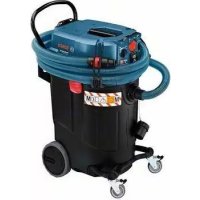
GAS 55 M AFC Professional - Vacuum Cleaner BOSCH - Free user manual and instructions
Find the device manual for free GAS 55 M AFC Professional BOSCH in PDF.
 FR
FR
 BG
BG
 CS
CS
 DA
DA
 DE
DE
 EL
EL
 EN
EN
 ES
ES
 ET
ET
 FI
FI
 HU
HU
 IT
IT
 KK
KK
 KO
KO
 LT
LT
 LV
LV
 MK
MK
 NL
NL
 NO
NO
 PL
PL
 PT
PT
 RO
RO
 RU
RU
 SK
SK
 SL
SL
 SV
SV
 TR
TR
 UK
UK
| Product Type | Wet and dry vacuum cleaner |
| Brand | Bosch |
| Model | GAS 55 M AFC Professional |
| Filtration class | M (dusts with OEL ≥ 0.1 mg/m³) |
| Rated power input | 1,200 W |
| Gross tank capacity | 55 L |
| Net capacity for liquids | 40 L |
| Dust bag volume | 27 L |
| Max. vacuum (vacuum cleaner) | 230 hPa |
| Max. vacuum (turbine) | 254 hPa |
| Max. airflow (vacuum cleaner) | 36 L/s |
| Max. airflow (turbine) | 74 L/s |
| Max. suction power | 1,380 W |
| Active surface area of pleated filter | 0.615 m² |
| Weight (according to EPTA) | 16.2 kg |
| Protection rating | IPX4 |
| Sound pressure level | 70 dB(A) (typical), may exceed 80 dB(A) |
| Power supply | 230 V, 50–60 Hz |
| Main functions | Dry/wet vacuuming, automatic start/stop, automatic filter cleaning (AFC), flow monitoring, power regulator |
| Safety | Auto shut-off when tank full (conductive liquids), acoustic signal, swivel wheel brake |
| Included accessories | Suction hose, floor nozzle/lips, crevice nozzle, tube, elbow, adapter, disposable bag, flat pleated filter |
| Maintenance | Level sensor cleaning, filter replacement, tank emptying |
| After-sales service | Bosch, spare parts available at www.boschpt.com |
Frequently Asked Questions - GAS 55 M AFC Professional BOSCH
User questions about GAS 55 M AFC Professional BOSCH
0 question about this device. Answer the ones you know or ask your own.
Ask a new question about this device
Download the instructions for your Vacuum Cleaner in PDF format for free! Find your manual GAS 55 M AFC Professional - BOSCH and take your electronic device back in hand. On this page are published all the documents necessary for the use of your device. GAS 55 M AFC Professional by BOSCH.
USER MANUAL GAS 55 M AFC Professional BOSCH

GAS 55 M AFC Professional

BOSCH
Bosch Power Tools 1 609 92A 4LZ | (19.11.2018)
6
1 609 92A 4LZ | (19.11.2018) Bosch Power Tools
Bosch Power Tools 1 609 92A 4LZ | (19.11.2018)
8
M
Deutsch
Safety information for vacuum cleaners

Read all the safety information and instructions. Failure to observe the safety information and follow instructions may result in electric shock, fire and/or serious injury.
Save all warnings and instructions for future reference.
This vacuum cleaner is not intended for use by children or persons with physical, sensory or mental impairments. It should not be used by persons who have insufficient experience and knowledge. Otherwise, there is a risk of operating errors and injuries.
Supervise children. This will ensure that children do not play with the vacuum cleaner.
WARNING
Never vacuum material that contains asbestos. Asbestos is a carcinogenic substance.
carcinogenic substance.
WARNING
Only use the vacuum cleaner if you have been adequately informed
about the use of the equipment, the substances to be vacuumed, and how to dispose of these safely. Thorough instruction on how to use the equipment prevents accidental misuse and injuries.
The vacuum cleaner is suitable for vacuuming dry substances, and can also be used to vacuum liquids when taking appropriate measures. The penetration of liquids increases the risk of an electric shock.
The vacuum cleaner is suitable for vacuuming dry substances, and
It can also be used to vacuum liquids when appropriate precautions are taken. The penetration of liquids increases the risk of electric shock.
▶ Do not use the vacuum cleaner to vacuum combustible or explosive liquids, such as petrol, oil, alcohol or solvents. Do not vacuum hot or burning dust. Do not operate the vacuum cleaner in areas subject to explosion hazards. Dust, vapours and liquids can ignite or explode.
WARNING
If you notice a foam or water leak, switch off the vacuum cleaner immediately and empty the container. Otherwise, the vacuum cleaner can become damaged.
manual.
WARNING
If you notice a foam or water leak, switch off the vacuum cleaner immediately and empty the container.
Otherwise, the vacuum cleaner can become damaged.
NOTE: The vacuum cleaner must only be stored indoors. NOTE: Clean the liquid fill level sensors regularly and check whether they are damaged. Otherwise, the equipment may not function properly. ▶ If operating the vacuum cleaner in a damp location is unavoidable, use a residual current device (RCD). Use of an RCD reduces the risk of electric shock.
Connect the vacuum cleaner to a properly earthed power supply system. The socket and extension cable must have a fully functioning protective conductor.
▶ Always check the vacuum cleaner, cable and plug before use. Do not use the vacuum cleaner if you discover any damage. Do not open the vacuum cleaner yourself. It should be repaired exclusively by a qualified professional using only genuine spare parts. Damaged vacuum cleaners, cables and plugs increase the risk of electric shock.
▶ Do not crush the cable or run the device over it. Do not pull on the power cable to pull the plug out of the socket or to move the vacuum cleaner. Damaged cables increase the risk of an electric shock.
▶ Pull the plug out of the socket before cleaning or performing maintenance on the vacuum cleaner, making tool adjustments, changing accessories or putting away the vacuum cleaner. This safety measure prevents the vacuum cleaner from being started accidentally.
▶ Ensure that the workplace is well ventilated.
The vacuum cleaner should be repaired exclusively by a qualified professional using only genuine spare parts. This will ensure that the safety of the vacuum cleaner is maintained.
WARNING
The vacuum cleaner contains dust particles that pose a risk to health.
Emptying and maintenance procedures, including the disposal of dust collectors, should only be carried out by professionals. Suitable protective equipment is required. Do not operate the vacuum cleaner without the complete filter system. Otherwise, you are putting your health at risk.
Before using the equipment for the first time, check that the vacuum hose is in perfect condition. Leave the vacuum hose fitted to the vacuum cleaner while doing this so that no dust escapes accidentally. Otherwise, you may end up inhaling dust particles.
▶ Do not sit on the vacuum cleaner. You can damage the vacuum cleaner this way.
▶ Take care when using the power cable and the vacuum hose. Improper use of these can put other people at risk.
▶ Do not clean the vacuum cleaner by spraying a jet of water directly at it. Water entering the top of the vacuum cleaner will increase the risk of electric shock.
Products sold in GB only:
Your product is fitted with a BS 1363/A approved electric plug with internal fuse (ASTA approved to BS 1362).
If the plug is not suitable for your socket outlets, it should be cut off and an appropriate plug fitted in its place by an authorized customer service agent. The replacement plug should have the same fuse rating as the original plug.
The severed plug must be disposed of to avoid a possible shock hazard and should never be inserted into a mains socket elsewhere.
Symbols
The following symbols may provide you with important information pertaining to the use of your dust extractor. Please take note of the symbols and their meaning. Knowing what these symbols mean will help you to use your extractor more effectively and more safely.
Symbols and their meaning


WARNING! Read all the safety instructions and general instructions. Failure to observe the safety instructions and general instructions may result in electric shock, fire and/or serious injury.
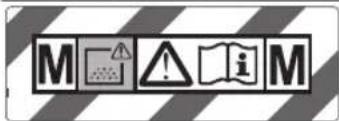
Dust extractor from dust class M in accordance with IEC/EN 60335-2-69 for the dry extraction of harmful dusts with an exposure limit of ≥ 0.1 mg/m³
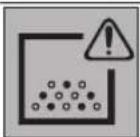
WARNING! The dust extractor contains dust particles that pose a risk to health. Emptying and maintenance procedures, including the disposal of dust containers, should only be carried out by professionals. Suitable protective equipment is required. Do not operate the dust extractor without the complete filter system. Otherwise, you are putting your health at risk.
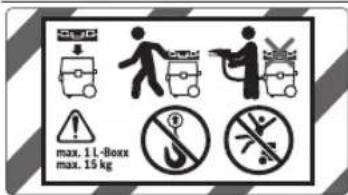
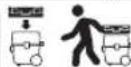
You can attach an L-Boxx to the top part of the dust extractor for transporting the extractor and to provide space-saving storage for extractor accessories and/or the power tool.

Do not use the dust extractor with an L-Boxx attached. This will raise the dust extractor's center of gravity. The extractor may tip over. There is a risk of injury and damage if you do this.

Only attach a maximum of one L-Boxx.
max. 1 L-Boxx max. 15 kg
The weight of the L-Boxx along with its contents must not exceed 15 kg.

Do not hang the dust extractor on a crane hook, e.g. in order to transport it. The dust extractor is not suitable for moving with a crane. There is a risk of injury and damage if you do this.

Do not sit or stand on the dust extractor. The dust extractor may tip over and become damaged if you do this. This poses a risk of injury.
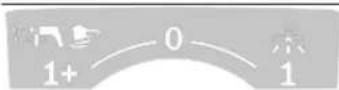
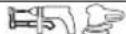
Automatic start/stop

Extracting dust that accumulates from working power tools The dust extractor switches on automatically and off again with a time delay

Switching off

Vacuuming
Vacuuming up dust deposits
Symbols and their meaning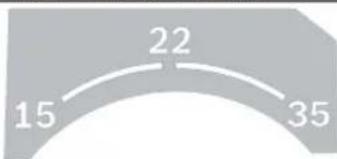
15 Volume flow monitoring for a hose diameter of 15 mm
22 Volume flow monitoring for a hose diameter of 22 mm
35 Volume flow monitoring for a hose diameter of 35 mm
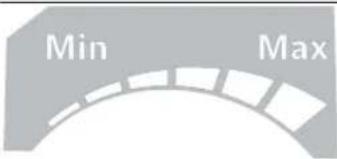
Min./max. Continuous regulation of suction power:
– Maximum suction power for applications with a high level of dust generation
- Reduced suction power for applications with a low level of dust generation, and also to regulate the suction between the connected power tool and the surface of the workpiece, for example (e.g. when sanding)
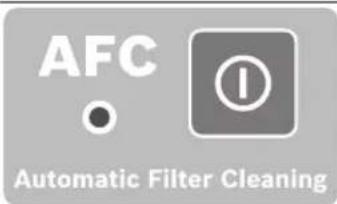
AFC Automatic filter cleaning (AFC)
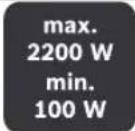
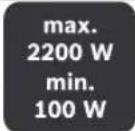
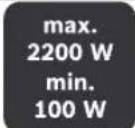
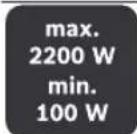
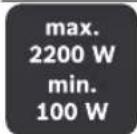
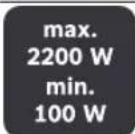
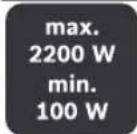
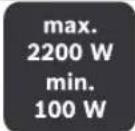
max. 2200 W min. 100 W
Permitted connected load of the connected power tool (country-specific)
Product description and specifications
Intended Use
The tool is intended for collecting, vacuuming, conveying and separating wood chips as well as non-flammable dry dust types, non-flammable liquids and a mixture of water and air. The dust extraction capability of the dust extractor has been tested and corresponds to dust class M. It is suitable for the increased demands in professional use, e.g. in trade, industry and workshops.
Dust extractors from dust class M in accordance with IEC/EN 60335-2-69 may only be used to vacuum and extract harmful dust with an exposure limit of ≥ 0.1 mg/m³.
Only use the dust extractor if you can fully evaluate all functions and carry them out without restrictions, or if you have received corresponding instructions.
Product features
The numbering of the product features refers to the representation of the vacuum cleaner on the graphic pages.
(1) Container (2) Sealing plug for extraction connection (3) Hose adapter (4) Holder for vacuum hose (5) Socket for power tool (6) Volume flow rate controller
(7) Mode selector switch (8) Suction power regulator (9) AFC button (10) Carrying handle (11) L-Boxx holder (12) Guide handle (13) Top part of dust extractor (14) Cable holder (15) Catch for top part of dust extractor (16) Wheel (17) Castor brake (18) Castor (19) Castor frame (20) Closing flap for filter cover (21) Holder for crevice nozzle/curved nozzle (22) Holder for suction tubes (23) Dump hose (24) Holder for floor nozzle (25) Dust extraction adapter (26) False air intake (27) Vacuum hose (28) Curved nozzle (29) Disposal bag (30) Flat-pleated filter (PES)
(31) Crevice nozzle (32) Rubber lip (33) Brush inserts (34) Floor nozzle (35) Suction tube (36) Adapter for vacuum hose holder (37) Snap fastener (38) Control LED (39) Filter cover (40) Fill level sensors
Technical data
| Wet/dry extractor GAS 55 M AFC | ||
| Article number | 3 601 JC3 3.. | |
| Rated power input W 1200 | ||
| Frequency Hz 50-60 | ||
| Container volume (gross) | 55 | ||
| Net volume (liquid) | 40 | ||
| Dust bag volume | 27 | ||
| Max. vacuum A) | ||
| – Dust extractor hPa 230 | ||
| – Turbine hPa 254 | ||
| Max. volume flow rate A) | ||
| – Dust extractor l/s | 36 | |
| m 3 /s | 0.036 | |
| – Turbine l/s | 74 | |
| m 3 /s | 0.074 | |
| Max. suction power W 1380 | ||
| Area of pleated filter m | 2 | 0.615 |
| Dust class M | ||
| Weight according to EPTA-Procedure 01:2014 | kg | 16.2 |
| Protection class | ±/ | |
| Protection rating | IPX4 | |
A) Measured using a vacuum hose 3 m long and 35 mm in diameter. The specifications apply to a rated voltage [U] of 230 V. These specifications may vary at different voltages and in country-specific models.
| Automatic start/stop | ||
| Rated voltage | Maximum power | Minimum power |
| 230 V | 2200 W 100 W | |
Permitted connected load of the connected power tool. These values can differ for other country-specific models. Please take note of the information on the socket of the dust extractor.
Noise/Vibration Information
Noise emission values determined according to EN 60335-2-69.
Typically the A-weighted sound pressure level of the dust extractor is 70 dB(A). Uncertainty K = 3 dB. The noise level when working can exceed 80 dB(A).
Wear hearing protection
Total vibration values ah (triax vector sum) and uncertainty K determined according to EN 60335-2-69: ah<2.5\ m/s2 , K=1.5\ m/s2 .
Assembly
Pull the plug out of the socket before carrying out any work on the dust extractor.
Fitting the holder for the vacuum hose (see figure A)
Slide the holder (4) for the vacuum hose firmly into the corresponding adapters (36) from above until they click into place.
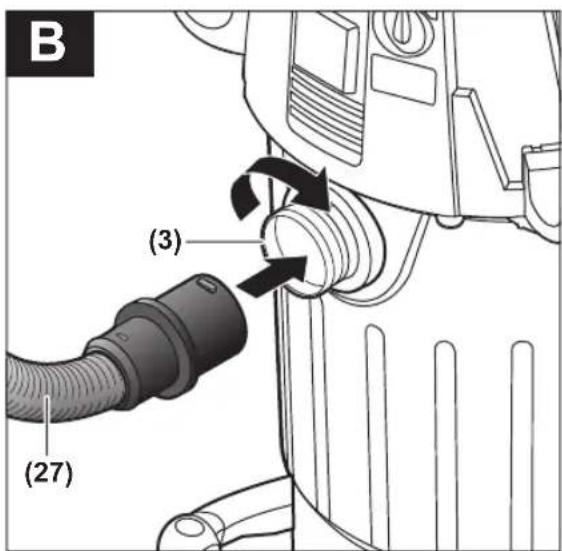
Fitting the vacuum hose (see figure B)
Attach the vacuum hose (27) to the hose adapter (3) and turn it clockwise as far as possible.
Note: The friction generated by the dust in the vacuum hose and accessory during extraction causes an electrostatic charge that the user may experience as static discharge (depending on environmental factors and their physiological state).
Bosch generally recommends using an anti-static vacuum hose (accessory) to vacuum up fine dust and dry materials.
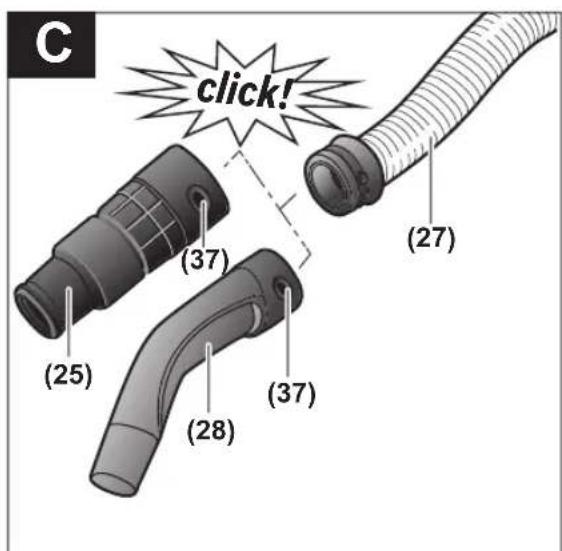
Fitting the vacuuming accessories (see figure C)
The vacuum hose (27) is equipped with a clip system which can be used to connect vacuuming accessories (dust extraction adapter (25), curved nozzle (28)).
Fitting the nozzles and tubes
- Push the curved nozzle (28) onto the vacuum hose (27) until you hear both snap fasteners (37) on the vacuum hose engage.
- Then attach the required extraction accessory (floor nozzle, crevice nozzle, suction tube, etc.) firmly to the curved nozzle (28).
- To remove the accessory, press the snap fasteners (37) inwards and pull apart the components.
Fitting the dust extraction adapter
- Push the dust extraction adapter (25) onto the vacuum hose (27) until you hear both snap fasteners (37) on the vacuum hose engage.
- To remove the adapter, press the snap fasteners (37) inwards and pull apart the components.
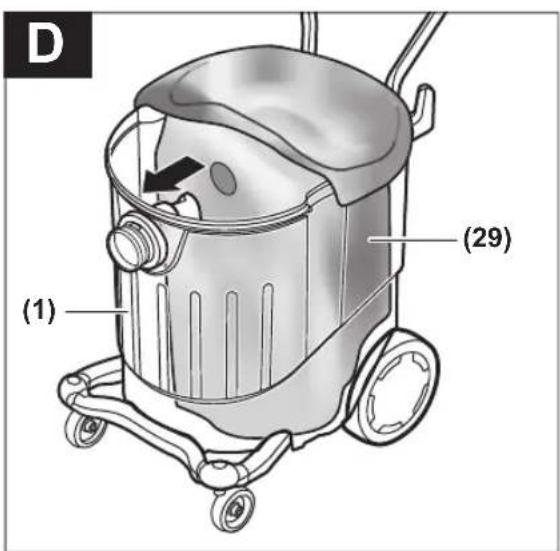
Inserting/removing the disposal bag or dust bag (dry extraction) (see figure D)
A disposal bag (29) or dust bag must be used for the dry extraction of dust class M materials.
Insofar as materials with or without an exposure limit of ≥ 1 mg/m³ (dust class L materials) are extracted, these can be sucked straight into the container.
Note: If using a paper filter bag, you must make sure that the automatic filter cleaning (AFC) is switched off; you should also do the same if using a fleece filter bag (see "Automatic filter cleaning (see figure I)", page 24).
WARNING
The vacuum cleaner contains dust particles that pose a risk to health.
Emptying and maintenance procedures, including the disposal of dust collectors, should only be carried out by professionals. Suitable protective equipment is required. Do not operate the vacuum cleaner without the complete filter system. Otherwise, you are putting your health at risk.
Inserting the disposal bag
- Open the catches (15) and remove the top part of the vacuum cleaner (13).
- Insert the disposal bag (29) into the container (1) with the inlet facing forwards. Pull the inlet over the connection flange and all the way into the recess of the connection flange.
- Make sure that the disposal bag (29) touches all the inside walls of the container (1).
- Fold the rest of the disposal bag (29) over the edge of the container (1).
- Put the top part of the vacuum cleaner (13) on and close the catches (15).
Removing and sealing the disposal bag
- Open the catches (15) and remove the top part of the vacuum cleaner (13).
- Pull the full disposal bag (29) backwards out of the connection flange.
- Carefully take the disposal bag (29) out of the container (1) without damaging it. When doing so, make sure that the disposal bag does not scrape against the connection flange or other sharp objects.
- Remove the adhesive strip cover and tape up the disposal bag. Then tie up the disposal bag (29) below the inlet using the adhesive strip cover that has been removed.
Changing/inserting the dust bag (accessory)
- Open the catches (15) and remove the top part of the vacuum cleaner (13).
- Pull the full dust bag backwards out of the connection flange. Close the opening in the dust bag by turning down the top. Take the closed dust bag out of the container (1).
- Place the new dust bag over the vacuum cleaner's connection flange. Make sure that the entire length of the dust bag touches the inside wall of the container (1).
- Put the top part of the vacuum cleaner (13) on and close the catches (15).
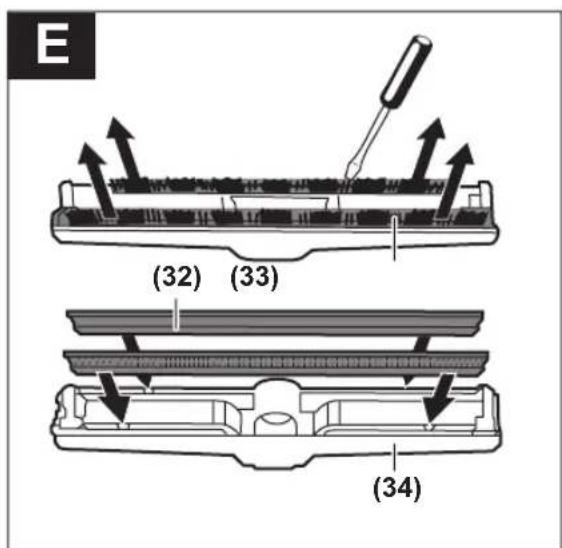
Fitting the rubber lip (wet extraction) (see figure E)
Note: The requirements for the degree of penetration (dust class M) have only been verified for dry extraction.
- Use a suitable tool to lift the brush inserts (33) out of the floor nozzle (34).
- Place the rubber lips (32) in the floor nozzle (34).
Note: The textured side of the rubber lips must be facing outwards.
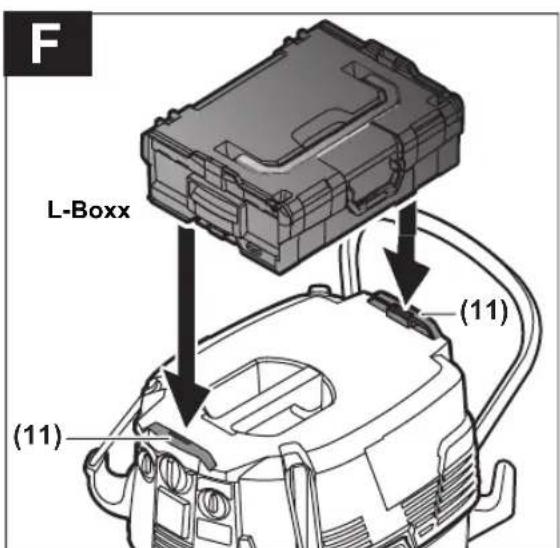
Attaching the L-Boxx (see figure F)
You can attach an L-Boxx to the top part of the dust extractor for transporting the extractor and to provide space-saving storage for extractor accessories and/or the power tool.
- Click the L-Boxx onto the adapters (11).
Do not use the dust extractor with an L-Boxx attached. This will raise the dust extractor's centre of gravity. The extractor may tip over. There is a risk of injury and damage if you do this. Do not carry the dust extractor by the carrying handle of the attached L-Boxx. The dust extractor is too heavy for the carrying handle of the L-Boxx. There is a risk of injury and damage if you do this.
Operation
Pull the plug out of the socket before cleaning or performing maintenance on the vacuum cleaner, making tool adjustments, changing accessories or putting away the vacuum cleaner. This safety measure prevents the vacuum cleaner from being started accidentally.
Start-up
Pay attention to the mains voltage. The voltage of the power source must correspond with the information on the type plate of the dust extractor. Chargers labelled as 230 V can also be operated with 220 V. Make sure you inform yourself about the applicable regulations/laws on how to handle harmful types of dust in your country.
The dust extractor may be used for vacuuming and extracting the following materials:
- Dusts with an exposure limit of ≥ 0.1 mg/m³
▶ Products sold only in AUS and NZ: Use a residual current device (RCD) with a rated residual current of 30 mA or less.
The dust extractor must never be used in potentially explosive areas.
To ensure optimal suction power, always fully unwind the vacuum hose (27) from the top part of the dust extractor (13).
Dry vacuuming
Vacuuming up dust deposits
- Adjust the volume flow controller (6) to match the hose diameter used.
- To switch on the dust extractor, set the mode selector switch (7) to the "extraction" symbol.

- To switch off the dust extractor, set the mode selector switch (7) to the "switch off" symbol.
The dust extractor is equipped with airflow monitoring. In the "vacuuming" operating mode, the volume flow monitoring is fixed at a value of 20 m/s, regardless of the setting of the volume flow controller (6).
If the value falls below this, e.g., due to accumulated dirt in the vacuum hose, a full dust bag, or a clogged flat-pleated filter, an audible alarm will sound. In this case, switch off the dust extractor and check it as described in the "Rectifying faults" section.
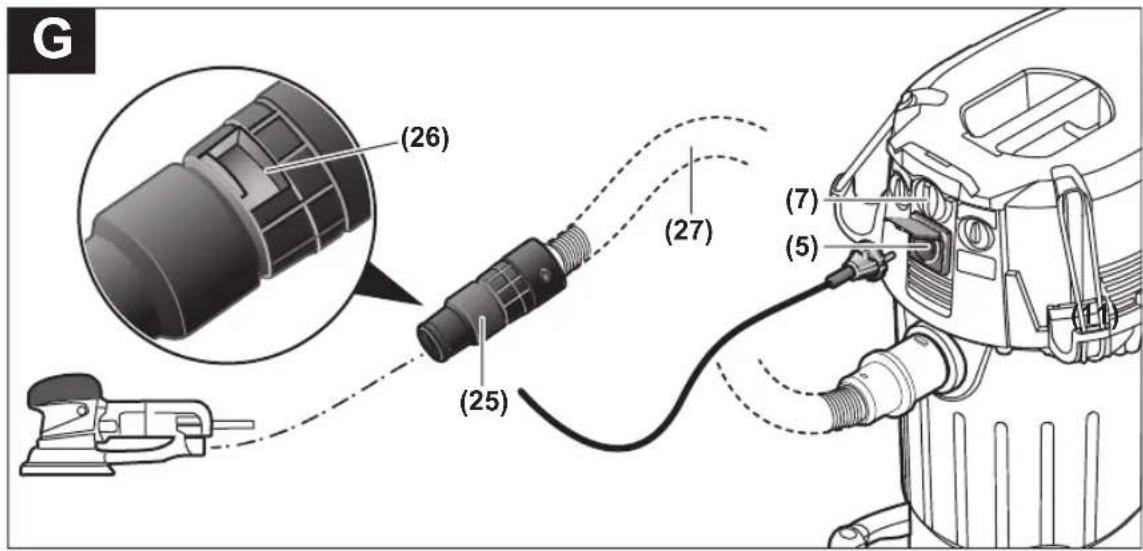
Extracting dust that accumulates from working power tools (see figure G)
There must be a sufficient air exchange rate (L) in the room when the exhaust air comes back into the room. Be aware of the corresponding national regulations.
The dust extractor has an electric socket with a protective earth contact (5), which can be used to connect an external power tool. Observe the maximum permitted load of the connected power tool.
To ensure sufficient dust transport at the extraction point, the volume flow must not fall below the minimum specified for the connected power tool.
Hose diameter Volume flow setting
| 35 mm 57.9 m | 3/h |
| 22 mm 41.2 m | 3/h |
| 15 mm 12.7 m | 3/h |
- Adjust the volume flow controller (6) to suit the hose diameter used.
- Fit the extraction adapter (25) (see "Fitting the dust extraction adapter", page 21).
- Insert the extraction adapter (25) into the dust extraction outlet of the power tool.
Note: When working with power tools that have a low air feed into the vacuum hose (e.g. jigsaws, sanders, etc.), the false air intake (26) of the dust extraction adapter (25) must be opened. This will ensure that the automatic filter cleaning function works correctly.
To do this, turn the ring above the false air intake (26) until the opening is at its maximum size.
- To activate the automatic start/stop
function of the dust extractor, set the operating mode selector switch (7) to the "automatic start/stop" symbol.
In this operating mode, the volume flow is electronically monitored according to the
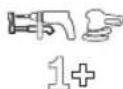
setting of the volume flow controller (6). Sufficient dust transport is ensured when the setting is correctly selected.
- To activate the dust extractor, switch on the power tool that is plugged into the electric socket (5). The dust extractor will start automatically.
- To stop dust extraction, switch the power tool off. The automatic start/stop run-on function will run for up to 15 seconds longer in order to extract the remaining dust from the vacuum hose.
- To switch off the dust extractor, set the mode selector switch (7) to the "switch off" symbol.

If the acoustic warning signal sounds, the dust extractor must be checked as described in the "Rectifying faults" section.
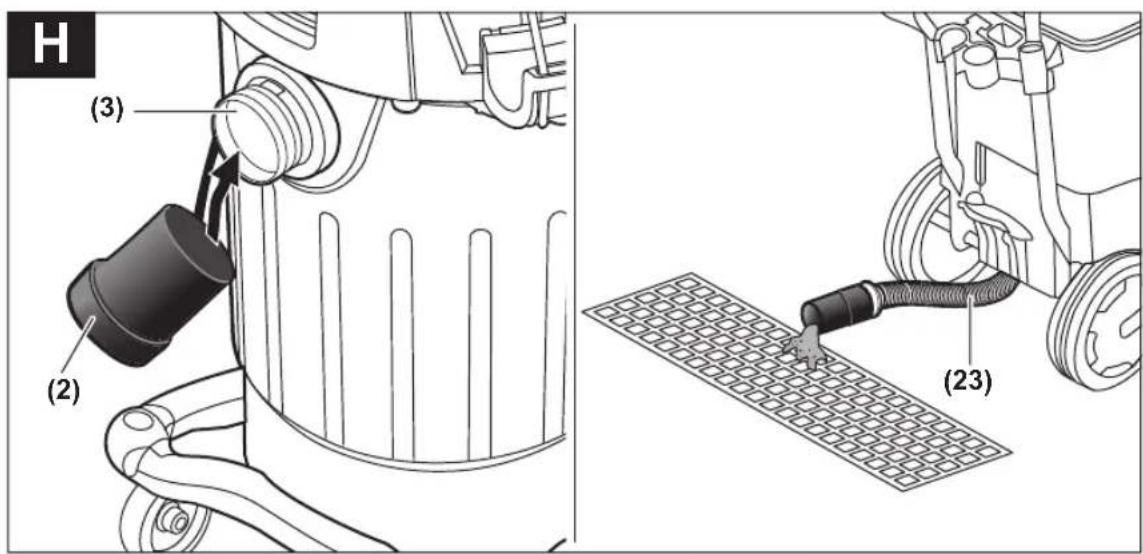
Wet extraction (see figure H)
Do not use the vacuum cleaner to vacuum combustible or explosive liquids, such as petrol, oil, alcohol, or solvents. Do not vacuum hot or burning dust. Do not operate the vacuum cleaner in areas subject to explosion hazards. Dust, vapors, and liquids can ignite or explode. The vacuum cleaner must not be used as a water pump. The vacuum cleaner is designed for vacuuming air and water mixtures.
Note: The requirements for the degree of penetration (dust class M) have only been verified for dry extraction.
Steps to Take before Wet Vacuuming
Remove the disposal bag (29) or dust bag if necessary.
Note: Use a wet filter bag (accessory), which separates liquid from solids, to make disposal easier when vacuuming water-solid mixtures.
- Fit the rubber lip (32) in the floor nozzle (34) (see "Fitting the rubber lip (wet extraction) (see figure E)", page 22).
- Switch off the automatic filter cleaning (AFC) (see "Automatic filter cleaning (see figure I)", page 24).
Vacuuming up liquids
To switch on the dust extractor, set the mode selector switch (7) to the "extraction" symbol.
The dust extractor is equipped with fill level sensors (40). The dust extractor shuts down if the maximum fill level has been reached. Set the mode selector switch (7) to the "switch off" symbol.
Note: When extracting non-conductive liquids (e.g., drilling emulsion, oils, and fats), the dust extractor will not switch off when the container is full. The fill level must be constantly monitored and the container emptied in good time.
If the acoustic warning signal sounds during wet extraction, the operating reliability of the dust extractor is not affected. No measures to rectify the fault are necessary.
To switch off the dust extractor, set the mode selector switch (7) to the "switch off" symbol.
- Pull the dump hose (23) from its holder and drain off the waste water through the dump hose.
- To transport the dust extractor, screw the sealing plug (2) onto the hose adapter (3).
- Empty the container (1). To prevent mould growth after wet extraction:
- Remove the flat-pleated filter (30) and leave this to dry thoroughly.
- Remove the top part of the dust extractor (13), open the filter cover (39) and leave both elements to dry thoroughly.
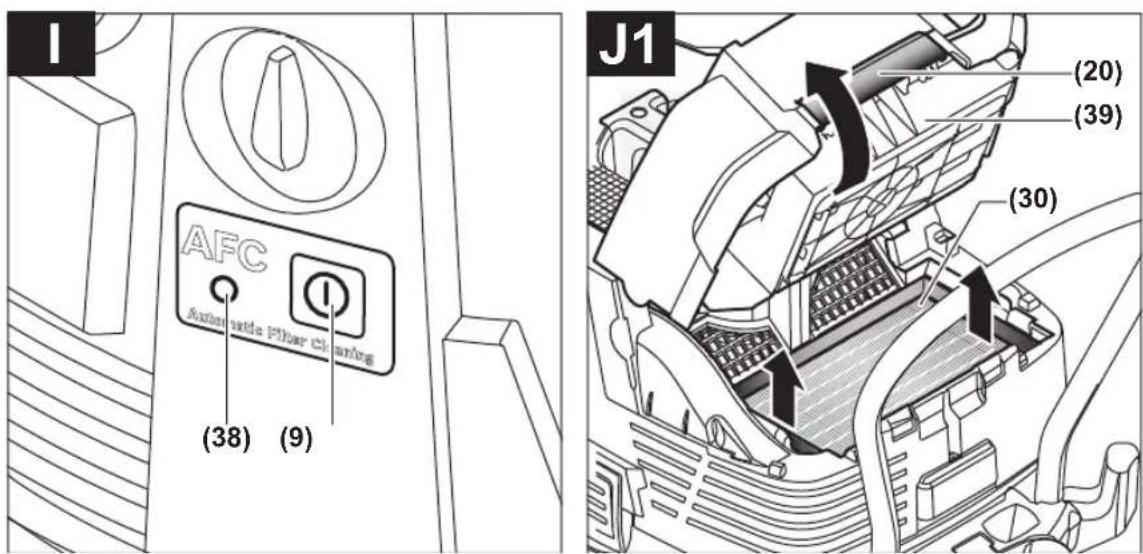
Automatic filter cleaning (see figure I)
When automatic filter cleaning (AFC) is active, the flat-pleated filter (30) is cleaned every 15 seconds using blasts of air (pulsating noise).
The filter cleaning function should be used regularly, and at the very latest when the suction power is no longer sufficient.
Regular use of the filter cleaning function will increase the service life of the filter.
In order to achieve an optimum filter service life, deactivate the automatic filter cleaning function only in exceptional cases, e.g. when vacuuming pure liquids or using a paper filter bag.
A flat-pleated filter with surface dirt is still fully functional. It is not necessary to clean the flat-pleated filter manually by shaking or blowing it out; this may even damage the filter.
Note: The automatic filter cleaning function is switched on by default when the dust extractor leaves the factory.
It is only possible to switch the automatic filter function on or off when the tool is switched on.
- Deactivating AFC
Press the AFC button (9). The control LED (38) will go out.
- Activating AFC
Press the AFC button (9). The control LED (38) will light up green.
Maintenance and service
Maintenance and cleaning
▶ Pull the plug out of the socket before cleaning or performing maintenance on the vacuum cleaner, making tool adjustments, changing accessories or putting away the vacuum cleaner. This safety measure prevents the vacuum cleaner from being started accidentally. ▶ To ensure safe and efficient operation, always keep the dust extractor and the ventilation slots clean. ▶ Wear a dust mask when servicing and cleaning the vacuum cleaner.
In order to avoid safety hazards, if the power supply cord needs to be replaced, this must be done by Bosch or by an after-sales service centre that is authorised to repair Bosch power tools.
For the user to carry out maintenance, the dust extractor needs to be disassembled, cleaned and maintained as far as this is possible without endangering maintenance personnel or other persons. Before disassembly, the dust extractor should be cleaned to prevent any potential hazards. The room in which the dust extractor is disassembled should be well ventilated. Wear personal protective equipment while carrying out maintenance. After completing maintenance, the maintenance area should be cleaned.
An inspection regarding the dust extraction capability must be carried out at least once a year by the manufacturer or someone who has been trained, e.g. to check for filter damage, that the vacuum cleaner is tight and that the control unit is functioning correctly.
Class M dust extractors that have been in dirty environments should have their exteriors, as well as all their components, cleaned or treated with sealant. When performing maintenance and repair work, all dirty parts that cannot be cleaned satisfactorily must be disposed of. Such parts must be disposed of in impermeable bags in accordance with the valid provisions for disposing of such waste.
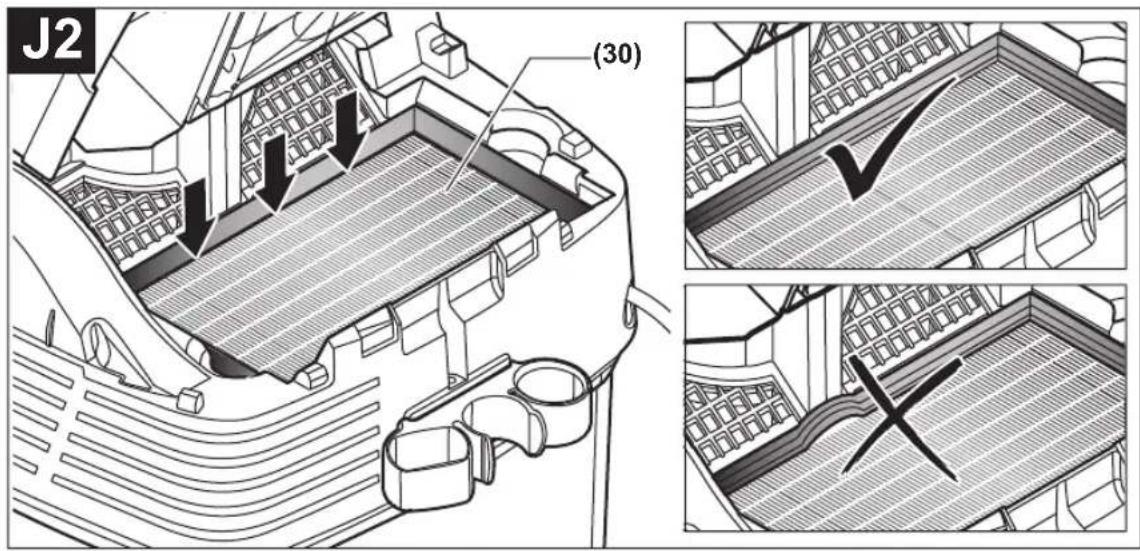
Removing/changing the flat-pleated filter (see figures J1-J2)
Suction power is dependent on the condition of the filter. Therefore, the filter should be cleaned regularly.
If the flat-pleated filter (30) becomes damaged, replace it immediately.
– Pull on the closing flap (20) and open the filter cover (39). - Hold the flat-pleated filter (30) by the supports and take it out from above. - Use a damp cloth to remove any dust and dirt that accrues around the closing edge of the filter cover (39) when removing the flat-pleated filter (30). PES and PTFE flat-pleated filters can be rinsed out under running water. - Insert the cleaned (or a new) flat-pleated filter (30), ensuring that it is positioned correctly and securely. - Close the filter cover (39) again (must audibly click into place).
Cleaning the container
- Wipe the container (1) from time to time using a non-abrasive off-the-shelf cleaning product and leave it to dry.
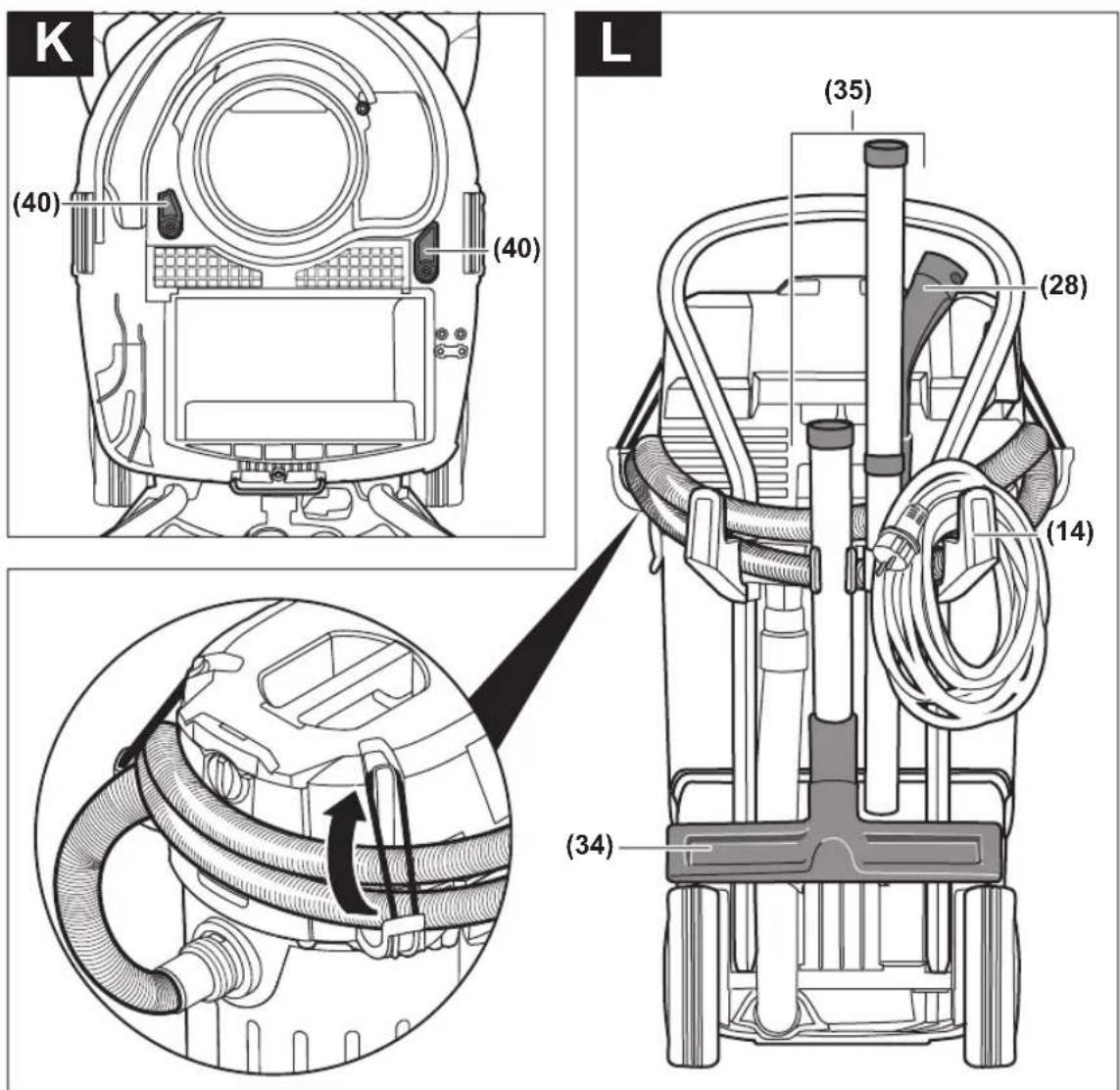
Cleaning the fill level sensors (see figure K)
Make sure that the fill level sensors are cleaned (40) occasionally.
- Open the catches (15) and remove the top part of the dust extractor (13).
- Clean the fill level sensors (40) using a soft cloth.
- Put the top part of the vacuum cleaner (13) on and close the catches (15).
Storage and transport
Storage (see figure L)
- Wrap the power cable around the cable holder (14).
- Insert the accessory into the holders provided for it: Suction tubes (35) into the holders (22), crevice nozzle (31) into the holder (21), floor nozzle (34) into the holder (24).
- Open the elastic bands of the vacuum hose holder (4) and wrap the vacuum hose (27) around the top part of the dust extractor in the holder (4). Hook the elastic bands back in.
- Click the L-Boxx onto the holders (11).
- Store the dust extractor in a dry room and secure it so that it cannot be used by unauthorised persons.
- Put the castor brake (17) down to hold the castors (18) in place.
Transport (see figure M)
- To transport the dust extractor, screw the sealing plug (2) onto the hose adapter (3).
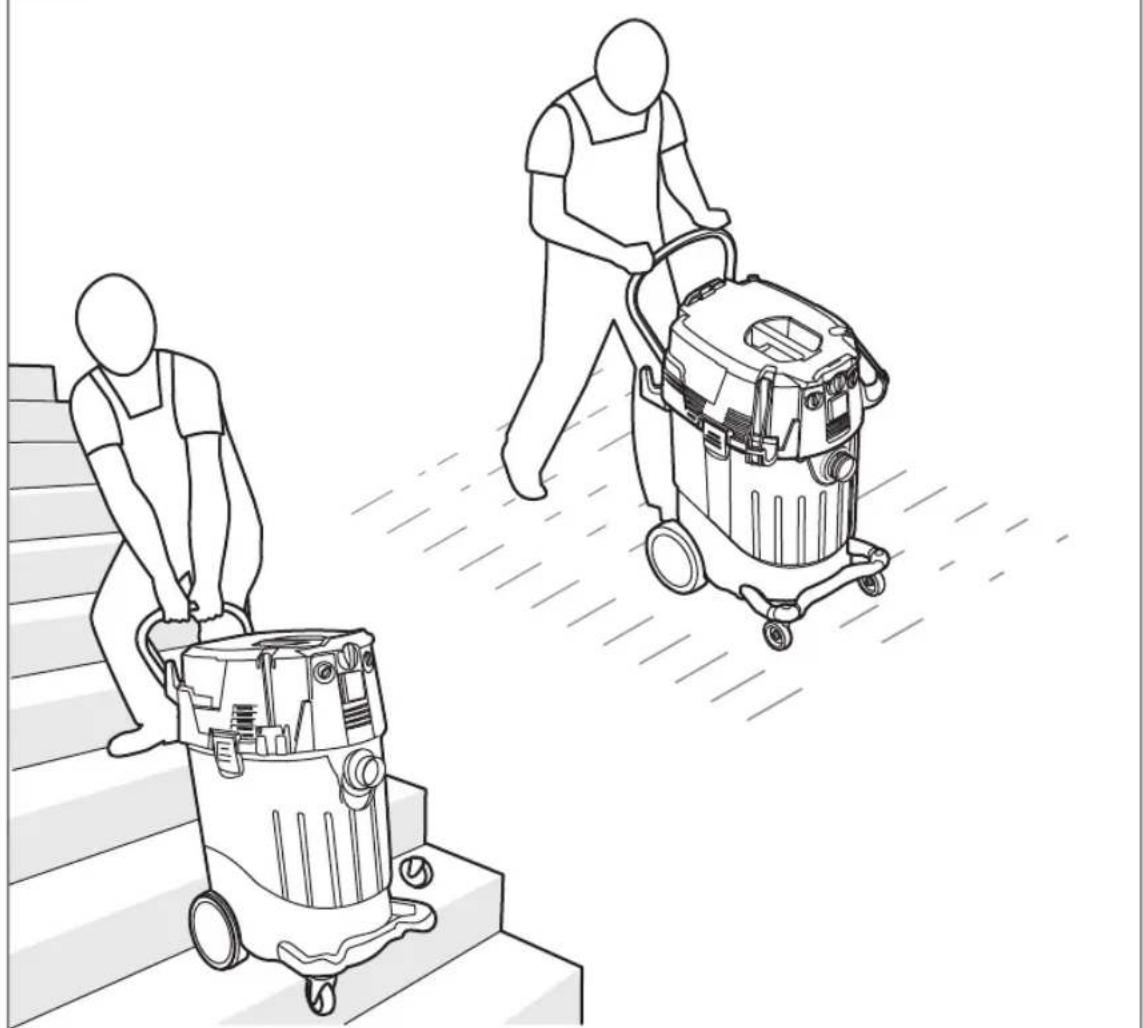
- Only ever carry the vacuum cleaner by the carrying handle (10).
- Use the guide handle (12) to push the dust extractor or to pull it up steps.
Rectifying faults
If a fault (e.g. a filter damage) occurs, the vacuum cleaner must be switched off immediately. The fault must be repaired before resuming operation.
Problem Corrective measures
| The suction turbine will not switch on. | - Check the mains cable, mains plug, fuse, socket and fill level sensors (40). |
| The mode selector switch (7) is set to "automatic start/stop". | |
| - Set the mode selector switch (7) to the "vacuuming" symbol or switch on the power tool plugged into the electric socket (5). | |
| The suction turbine switches off. | - Empty the container (1). |
| The suction turbine will not switch on again after emptying the container. | - Switch the dust extractor off and wait five seconds before switching it back on. |
| - Clean the fill level sensors (40) and the space between the fill level sensors (40) using a brush. | |
| The suction power is decreasing. | - Remove any blockages from the vacuum nozzle, suction tube (35), vacuum hose (27) or flat-pleated filter (30). |
| - Change the disposal bag (29) or dust bag. | |
| - Make sure the filter cover (39) is engaged correctly. | |
| - Place the top part of the dust extractor (13) on correctly and close the catches (15). | |
| - Change the flat-pleated filter (30). | |
| Dust is escaping when vacuuming | - Check that the flat-pleated filter (30) has been fitted correctly. |
| - Change the flat-pleated filter (30). | |
| Automatic switch-off (wet extraction) is not working. | - Clean the fill level sensors (40) and the space between the fill level sensors (40) using a brush. |
| Automatic switch-off will not work in the presence of non-conductive liquids or foaming. | |
| - Check the fill level regularly. | |
| Acoustic warning signal sounds. Suction power setting too low. | |
Problem Corrective measures
| - Open the false air intake (26) on the extraction adapter (25): Turn the ring on the extraction adapter until the false air intake is fully open.- Open the false air intake on the power tool if there is one. | |
| Malfunction of the monitoring electronics.- Contact an authorised Bosch after-sales service centre. | |
| The automatic filter cleaning function is not working. | - Activate the automatic filter cleaning function (press the AFC button (9)).- Connect the vacuum hose (27). |
| The automatic filter cleaning function will not switch off. | - Contact an authorised Bosch after-sales service centre. |
| The automatic filter cleaning function will not switch on. | - Contact an authorised Bosch after-sales service centre. |
Accessories
| Accessory number | |
| Paper filter bag (dry) 2 607 432 035 | |
| Fleece filter bag (dry) 2 607 432 037 | |
| Wet filter bag (wet) 2 607 432 039 | |
| Disposal bag (PE) (dry/wet) 2 607 432 043 | |
After-sales service and advice on using products
Our after-sales service responds to your questions concerning maintenance and repair of your product as well as spare parts. You can find explosion drawings and information on spare parts at: www.bosch-pt.com
The Bosch product use advice team will be happy to help you with any questions about our products and their accessories.
In all correspondence and spare parts orders, please always include the 10-digit article number given on the nameplate of the product.
Great Britain
Robert Bosch Ltd. (B.S.C.)
P.O. Box 98
Broadwater Park
North Orbital Road
Denham Uxbridge
UB 9 5HJ
At www.bosch-pt.co.uk you can order spare parts or arrange the collection of a product in need of servicing or repair.
Tel. Service: (0344) 7360109
E-Mail: boschservicecentre@bosch.com
Ireland
Origo Ltd.
Unit 23 Magna Drive
Magna Business Park
City West
Dublin 24
Tel. Service: (01) 4666700
Fax: (01) 4666888
Australia, New Zealand and Pacific Islands
Robert Bosch Australia Pty. Ltd.
Power Tools
Locked Bag 66
Clayton South VIC 3169
Customer Contact Center
Inside Australia:
Phone: (01300) 307044
Fax: (01300) 307045
Inside New Zealand:
Phone: (0800) 543353
Fax: (0800) 428570
Outside AU and NZ:
Phone: +61 3 95415555
www.bosch-pt.com.au
www.bosch-pt.co.nz
Republic of South Africa
Customer service
Hotline: (011) 6519600
Gauteng - BSC Service Centre
35 Roper Street, New Centre
Johannesburg
Tel.: (011) 4939375
Fax: (011) 4930126
E-mail: bsctools@icon.co.za
KZN - BSC Service Centre
Unit E, Almar Centre
143 Crompton Street
Pinetown
Tel.: (031) 7012120
Fax: (031) 7012446
E-mail: bsc.dur@za.bosch.com
Western Cape - BSC Service Centre
Democracy Way, Prosperity Park
Milnerton
Tel.: (021) 5512577
Fax: (021) 5513223
E-mail: bsc@zsd.co.za
Bosch Headquarters
Midrand, Gauteng
Tel.: (011) 6519600
Fax: (011) 6519880
E-mail: rbsa-hq.pts@za.bosch.com
Disposal
The vacuum cleaner, its accessories and packaging should be recycled in an environmentally friendly manner.

Do not dispose of the vacuum cleaner along with household waste.
Only for EU countries:
According to the European Directive 2012/19/EU on Waste Electrical and Electronic Equipment and its implementation into national law, vacuum cleaners that are no longer usable must be collected separately and disposed of in an environmentally friendly manner.
Robert Bosch (France) S.A.S.
Calle Robert Bosch No. 405
AFC
Automatic filter cleaning (AFC = Automatic Filter Cleaning)
| max. 2200 W |
| min. 100 W |
| AFC | Automatische filterreiniging (AFC = Automatic Filter Cleaning) |
max. 2200 W min. 100 W
Mount the extraction adapter
AFC
Automatic filter cleaning (AFC = Automatic Filter Cleaning)
Bosch Service Center
Telegrafvej 3
2750 Ballerup
At www.bosch-pt.dk you can order spare parts online or create a repair order.
Service Center phone: 44898855
Fax: 44898755
Email: vaerktoej@dk.bosch.com
Disposal
AFC
Automatic Filter Cleaning (AFC)
(25) Extraction adapter
Bosch Service Center
Telegrafvej 3
2750 Ballerup
Denmark
Tel.: (08) 7501820 (within Sweden)
Fax: (011) 187691
Waste management
AFC
Automatic filter cleaning (AFC = Automatic Filter Cleaning)
AFC
| AFC | Otomatik filtre temizleme (AFC = Automatic Filter Cleaning) |
Robert Bosch Sp. z o.o.
AFC
Bosch Service Center PT
K Vápence 1621/16
692 01 Mikulov
AFC Automatic Filter Cleaning (AFC = Automatic Filter Cleaning)
max. 2200 W min. 100 W
AFC
AFC
Power tool service
Strada Horia Măcelariu Nr. 30-34, sector 1
013937 Bucharest
Power tool service
Strada Horia Măcelariu Nr. 30-34, sector 1
013937 Bucharest, Romania
www.bosch-pt.com/bg/bg/
Disposal
AFC
Automatic Filter Cleaning (AFC)
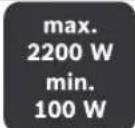
Information on the maximum permissible connected load of the connected power tool (depending on the country)
AFC Automatic Filter Cleaning (AFC)
Storage and transport
AFC
Automatic Filter Cleaning (AFC)
max. 2200 W min. 100 W
Information on the permissible connected load of the connected power tool (country-specific)
Product description and functions
Intended use
AFC
Automatic filter cleaning (AFC = Automatic Filter Cleaning)
AFC Automatic filter cleaning (AFC = Automatic Filter Cleaning)
AFC
Automatic filter cleaning device (AFC = "Automatic Filter Cleaning")
Automatic Filter Cleaning
Automatic Filter Cleaning
2 607 432 033 (Cellulose)
2 607 432 034 (PES)
2 607 432 041 (PTFE)
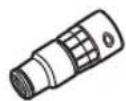
2 608 000 585
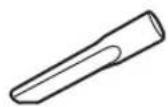
2 607 000 165

2 607 000 166

2 607 000 170
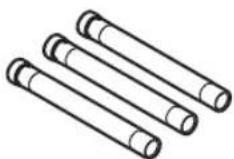
2 608 000 575
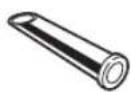
1609 201 229
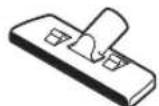
1609 201 230
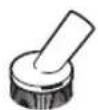
1 609 390 481
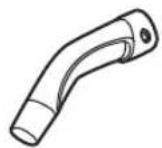
2 608 000 573
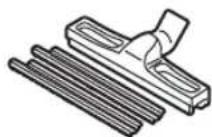
1 609 390 478
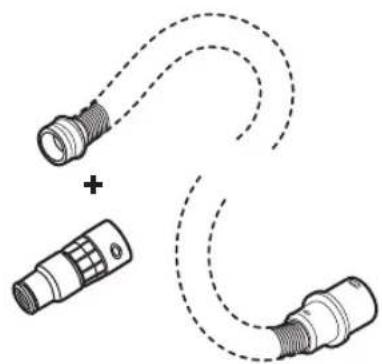

5m

35 mm

- 2608000565
5m
5m
3m
3m
3m
3m
35 mm
22 mm
22 mm
35 mm
35 mm
22 mm
22 mm
•
-
•
-
●
-
•
2 2 2 2 2 2 2
2 608 000 566 2 608 000 567 2 608 000 568 2 608 000 569 2 608 000 570 2 608 000 571 2 608 000 572
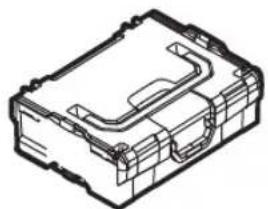
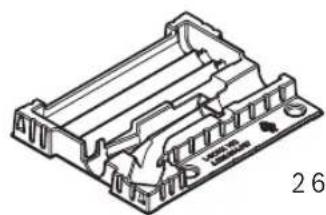
2 608 438 0912 608 438 6
CE
|
| de | EU-Konformitätserklärung | Wir erklären in alleiniger Verantwortung, dass die genannten Produkte allen einschlägigen Bestimmungen der nachfolgend aufgeführten Richtlinien und Verordnungen entsprechen und mit folgenden Normen übereinstimmen.Technische Unterlagen bei:* | |
| Nass-/Trockensauger | Sachnummer | ||
| en | EU Declaration of Conformity | We declare under our sole responsibility that the stated products comply with all applicable provisions of the directives and regulations listed below and are in conformity with the following standards.Technical file at:* | |
| Wet/dry extractor | Article number | ||
| fr | Déclaration de conformité UE | Nous déclarons sous notre propre responsabilité que les produits décrits sont en conformité avec les directives, règlements normatifs et normes énumérés ci-dessous.Dossier technique auprès de:* | |
| Aspirateur eau et poussière | N° d'article | ||
| es | Declaración de conformidad UE | Declaramos bajo nuestra exclusiva responsabilidad, que los productos nombrados cumplen con todas las disposiciones correspondientes de las Directivas y los Reglamentos mencionados a continuación y están en conformidad con las siguientes normas.Documentos técnicos de:* | |
| Aspiradora en húmedo y seco | N° de artículo | ||
| pt | Declaração de Conformidade UE | Declaramos sob nossa exclusiva responsabilidade que os produtos mencionados cumprem todas as disposições e os regulamentos indicados e estão em conformidade com as seguintes normas.Documentação técnica pertencente à:* | |
| Aspirador univer-sal | N.° do produto | ||
| it | Dichiarazione di conformità UE | Dichiariamo sotto la nostra piena responsabilità che i prodotti indicati sono conformi a tutte le disposizioni pertinenti delle Direttive e dei Regolamenti elencati di seguito, nonché alle seguenti Normative.Documentazione Tecnica presso:* | |
| Aspiratore a umido / a secco | Codice prodotto | ||
| nl | EU-conformiteitsverklaring | Wij verklaren op eigen verantwoordelijkheid dat de genoemde producten voldoen aan alle desbetreffende bepalingen van de hierna genoemde richtlijnen en verordeningen en overeenstemmen met de volgende normen.Technisch dossier bij:* | |
| Alleszuiger | Productnummer | ||
| da | EU-overensstemmelseserklæring | Vi erklærer som eneansvarlige, at det beskrevne produkt er i overensstemmelse med alle gældende bestemmelser i følgende direktiver og forordninger og opfylder følgende standarder.Tekniske bilag ved:* | |
| Våd-/tørsuger | Typenummer | ||
| sv | EU-konformitetsförklaring | Vi förklarar under eget ansvar att de nämnda produkterna uppfyller kraven i alla gällande bestämmelser i de nedan angivna direktiven och förordningar nas och att de stämmer överens med följande normer.Teknisk dokumentation:* | |
| Våt-/torrsug | Produktnummer | ||
| no | EU-samsvarserklæring | Vi erklærer under eneansvar at de nevnte produktene er i overensstemmelse med alle relevante bestemmelser i direktivene og forordningene nedenfor og med følgende standarder.Teknisk dokumentasjon hos:* | |
| Våt-/tørrsuger | Produktnummer | ||
| fi | EU-vaatimustenmukaisuusvakuutus | Vakuutamme täten, että mainitut tuotteet vastaavat kaikkia seuraavien direktiivien ja asetusten asiaankuuluvia vaatimuksia ja ovat seuraavien standardien vaatimusten mukaisia.Tekniset asiakirjat saatavana:* | |
| Märkäkuivaimuri | Tuotenumero | ||
| el | Δήλωση πιστότητας EE | Δηλώνουμε με αποκλειστική μας ευθύνη, ότι τα αναφερόμενα προϊόντα αντιστοιχούν σε όλες τις σχετικές διατάξεις των πιο κάτω αναφερόμενων οδηγιών και κανονισμών και ταυτίζονται με τα ακόλουθα πρότυπα.Tεχνικά έγγραφα στη:* | |
| Απορροφητήρας υγρής/στεγνής αναρρόφησης | Αριθμός ευρετηρίου σε όλες τις σχετικές διατάξεις των πιο κάτω αναφερόμενων οδηγιών και κανονισμών και ταυτίζονται με τα ακόλουθα πρότυπα.Τεχνικά έγγραφα στη:* | ||
| tr | AB Uygunluk beyani | Tek sorumlu olarak, tanımlanan ürünün aşağıdaki yönetmelik ve direktiflerin geçerli bütün hükümetine ve aşağıdaki standartlara uygun olduğunu beyan ederiz.Teknik belgelerin bulunduğu yer:* | |
| Islak/kuru elektri-kli süpürge | Ürün kodu | ||
| II | CE | ||
| pl | Deklaracja zgodności UE | Oświadczamy z pełną odpowiedzialnością, że niniejsze produkty odpowiadają wszystkim wymaganiom ponizej wyszczególnionych dyrektyw i rozporządzeń, oraz że są zgodne z następującymi normami.Dokumentacja techniczna:* | |
| Odkurzacz do pra-cy na sucho i mo-kro | Numer katalogowy | ||
| cs | EU prohlásení oshodě | Prohlašujeme na výhradní zodpovědnost, že uvedený výrobek splňuje všechna příslušná ustanovení níže uvedených směrnic anařízení aje vsouladu snásledujícími normami:Technické podklady u:* | |
| Vysavač pro mo-kré a suché sání | Objednací číslo | ||
| sk | EÚ vyhlásenie ozhode | Vyhlasujeme na výhradnú zodpovednosť, že uvedený výrobok splňa všetky príslušné ustanovenia nižšie uvedených smerníc anariadení aje vsúlade snasledujúcími normami:Technické podklady má spoločnosť:* | |
| Vysávač na vysávanie namo-kro/nasucho | Vecné číslo | ||
| hu | EU konformitási nyilatkozat | Egyedüli felelőséggel kijelentjük, hogy a megnevezett termékek megfelelnek az alábbiakban felsorolásra kerülő irányelvek és rendeletek valamennyi idevágó előírásainak és megfelelnek a következő szabványoknak.Műszaki dokumentumok megőrzési pontja:* | |
| Nedves / száraz elszívó berende-zés | Cikkszám | ||
| ru | Заявление о соответствии EC | Мы заявляем под нашу единоличную ответственность, что названные продукты соответствуют всем действующим предписаниям нижеуказанных директив и распоряжений, а также нижеуказанных норм.Техническая документация хранится y:* | |
| Пылесос для влажной уборки/пылесос | Товарный No | ||
| uk | Заява про відповідність ЄС | Мизаявляємо під нашу одноособову відповідальність, що названі вироби відповідають усім чинним положенням нищеозначених директив і розпоряджень, а також нижчеозначеним нормам.Технічна документація зберігається y:* | |
| Вологовідсмокту вач/пилосмок | Товарний номер | ||
| kk | EO сәйкестік мағлумдамасы | Өз жауапкершілікпен біз аталған өнімдер төменде жзылған директикалар мен жарлықтардың тиісті қағидаларына сәйкестігін және төменdegі нормаларға сай екенін білдіреміз.Техникалық құжаттар:* | |
| Ылғалды /құрғақ шаңсорғыш | Өнім нөмірі | ||
| ro | Declarație de conformitate UE | Declarăm pe proprie răspundere că produsele mentionate corespund tutu-ror dispozițiilor relevante ale directivelor și reglementărilor enumerate în ce-le ce urmează și sunt în conformitate cu următoarele standarde.Documentаție tehnică la:* | |
| Aspirator univer-sal | Număr de identificare | ||
| bg | EC декларация за съответствие | С пълна отговорностние декларираме, че посочените продукти отговарят на всички валидни изисквания на директивите и разпоредбите по-долу и съответства на следните стандарти.Техническа документация при:* | |
| Прахосмукачка за мокро/сухо засмукване | Каталожен номер | ||
| mk | EU-Изјава за сообразност | Со целосна одговорност изјавуваме, дека опишаните производи се во согласност со сите релевантни одредби на следните регулативи и прописи и се во согласност со следните норми.Техничка документација кaj:* | |
| Всисувач за мокро/суво всисување | Број на дел/артикл | ||
| sr | EU-izjava o usaglašenosti | Na sopstvenu odgovornost izjavljujemo, da navedeni proizvodi odgovaraju svim dotičnim odredbama naknadno navedenih smernica u uredaba i da su u skladu sa sledećim standardima.Tehnička dokumentacija kod:* | |
| Mokri/suvi usisi-vač | Broj predmeta | ||
| sl | Izjava o skladnosti EU | Izjavljamo pod izključno odgovornostjo, da je omenjen izdelek v skladu z vse-mi relevantnimi določili direktiv in uredb ter ustreza naslednjim standardom.Tehnična dokumentacija pri:* | |
| Mokri/suhi sesal-nik | Številka artikla | ||
| hr | EU izjava o sukladnosti | Pod punom odgovornošću izjavljujemo da navedeni proizvodi odgovaraju svim relevantnim odredbama direktiva i propisima navedenima u nastavku i da su sukladni sa sljedećim normama.Tehnička dokumentacija se može dobiti kod:* | |
| Usisavač za mo-kro/suho usisa-vanje | Kataloški br. | ||
| et | EL-vastavusdeklaratsioon | Kinnitame ainuvastutajatena, et nimetatud tooted vastavad järgnevalt loetle-tud direktiivide ja määruste köikidele asjaomastele nõuetele ja on kooskõlas järgmiste normidega.Tehnilised dokumendid saadaval: * | ||
| Märg-/kuivtol-muimeja | Tootenumber | |||
| lv | Deklarâcija par atbilstībuES standartiem | Mês ar pilnu atbildību paziņojam, ka šeit aplūkotie izstrādājumi atbilst visiem tālāk minētajās direktīvās un rīkojumos ietvertajām saistošajām nostādnēm,kā arī sekojošiem standartiem.Tehniskā dokumentācija no: * | ||
| Vakuumsūcējs mitrai un sausai uzsūkšanai | Izstrādājuma numurs | |||
| lt | ES atitikties deklaracija | Atsakingai pareiškiame, kad išvardyti gaminiai atitinka visus privalomus že-miau nurodytų direktyvų ir reglamentų reikalavimus ir šiuos standartus.Techninė dokumentacija saugoma: * | ||
| Skysčių ir sausų dulkių siurblys | Gaminio numeris | |||
| GAS 55 M AFC 3 601 JC3 3.. | 2006/42/EC2014/30/EU2011/65/EU | EN 60335-1:2012+A11:2014EN 60335-2-69:2012EN 55014-1:2006+A1:2009+A2:2011EN 55014-2:2015EN 61000-3-2:2014EN 61000-3-3:2013EN 50581:2012 | ||
| BOSCH | * Robert Bosch Power Tools GmbH(PT/ECS)70538 StuttgartGERMANY | |||
| Henk BeckerExecutive Vice PresidentEngineering and Manufacturing | Helmut HeinzelmannHead of Product Certification | |||
| Robert Bosch Power Tools GmbH, 70538 Stuttgart, GERMANYStuttgart, 19.11.2018 | ||||
- GAS 55 M AFC PROFESSIONAL
- BOSCH
- DEUTSCH
- SAFETY INFORMATION FOR VACUUM CLEANERS
- WARNING
- THE VACUUM CLEANER IS SUITABLE FOR VACUUMING DRY SUBSTANCES, AND CAN ALSO BE USED TO VACUUM LIQUIDS WHEN TAKING APPROPRIATE MEASURES. THE PENETRATION OF LIQUIDS INCREASES THE RISK OF AN ELECTRIC SHOCK
- SYMBOLS
- SYMBOLS AND THEIR MEANING
- AUTOMATIC START/STOP
- SWITCHING OFF
- VACUUMING
- PRODUCT DESCRIPTION AND SPECIFICATIONS
- INTENDED USE
- PRODUCT FEATURES
- NOISE/VIBRATION INFORMATION
- WEAR HEARING PROTECTION
- ASSEMBLY
- FITTING THE HOLDER FOR THE VACUUM HOSE (SEE FIGURE A)
- FITTING THE VACUUM HOSE (SEE FIGURE B)
- FITTING THE VACUUMING ACCESSORIES (SEE FIGURE C)
- FITTING THE NOZZLES AND TUBES
- FITTING THE DUST EXTRACTION ADAPTER
- INSERTING/REMOVING THE DISPOSAL BAG OR DUST BAG (DRY EXTRACTION) (SEE FIGURE D)
- THE VACUUM CLEANER CONTAINS DUST PARTICLES THAT POSE A RISK TO HEALTH
- INSERTING THE DISPOSAL BAG
- REMOVING AND SEALING THE DISPOSAL BAG
- CHANGING/INSERTING THE DUST BAG (ACCESSORY)
- FITTING THE RUBBER LIP (WET EXTRACTION) (SEE FIGURE E)
- ATTACHING THE L-BOXX (SEE FIGURE F)
- OPERATION
- START-UP
- DRY VACUUMING
- VACUUMING UP DUST DEPOSITS
- EXTRACTING DUST THAT ACCUMULATES FROM WORKING POWER TOOLS (SEE FIGURE G)
- WET EXTRACTION (SEE FIGURE H)
- STEPS TO TAKE BEFORE WET VACUUMING
- VACUUMING UP LIQUIDS
- AUTOMATIC FILTER CLEANING (SEE FIGURE I)
- MAINTENANCE AND SERVICE
- MAINTENANCE AND CLEANING
- REMOVING/CHANGING THE FLAT-PLEATED FILTER (SEE FIGURES J1-J2)
- CLEANING THE CONTAINER
- CLEANING THE FILL LEVEL SENSORS (SEE FIGURE K)
- STORAGE AND TRANSPORT
- STORAGE (SEE FIGURE L)
- TRANSPORT (SEE FIGURE M)
- RECTIFYING FAULTS
- AFTER-SALES SERVICE AND ADVICE ON USING PRODUCTS
- GREAT BRITAIN
- IRELAND
- REPUBLIC OF SOUTH AFRICA
- CUSTOMER SERVICE
- GAUTENG - BSC SERVICE CENTRE
- KZN - BSC SERVICE CENTRE
- WESTERN CAPE - BSC SERVICE CENTRE
- BOSCH HEADQUARTERS
- DISPOSAL
- ONLY FOR EU COUNTRIES
- MOUNT THE EXTRACTION ADAPTER
- WASTE MANAGEMENT
- PRODUCT DESCRIPTION AND FUNCTIONS
- CE
Brand : BOSCH
Model : GAS 55 M AFC Professional
Category : Vacuum Cleaner