
PAS15-200 - Vacuum Cleaner BOSCH - Free user manual and instructions
Find the device manual for free PAS15-200 BOSCH in PDF.


| Brand | Bosch |
| Model | PAS15-200 |
| Vacuum cleaner type | Wet and dry vacuum cleaner |
| Nominal power consumption | 1,000 W |
| Gross tank capacity | 15 L |
| Net tank capacity (liquids) | 5 L |
| Dust bag volume | 8 L |
| Vacuum pressure (vacuum cleaner A1) | 200 hPa |
| Vacuum pressure (turbine) | 225 hPa |
| Airflow (vacuum cleaner A1) | 97 m³/h |
| Airflow (turbine) | 108 m³/h |
| Weight | 6.2 kg |
| Protection class | Class II (double insulation) |
| Water splash protection | IPX4 |
| Main functions | Suction of dry and wet materials, blowing |
| Filter | Lamellar filter (cleanable) |
| Float | Yes (automatic stop for liquids) |
| Tank type | Stainless steel (estimated) |
| Included accessories | Suction hose, elbow, floor nozzle, crevice nozzle, tubes, dust bag |
Frequently Asked Questions - PAS15-200 BOSCH
User questions about PAS15-200 BOSCH
0 question about this device. Answer the ones you know or ask your own.
Ask a new question about this device
Download the instructions for your Vacuum Cleaner in PDF format for free! Find your manual PAS15-200 - BOSCH and take your electronic device back in hand. On this page are published all the documents necessary for the use of your device. PAS15-200 by BOSCH.
USER MANUAL PAS15-200 BOSCH

Safety instructions for dust extractors

Read all the safety information and instructions. Failure to observe the safety information and follow instructions may result in electric shock, fire and/or serious injury.
Save all warnings and instructions for future reference.
This dust extractor is not intended for use by children or persons with physical, sensory or mental impairments. It should not be used by persons who have insufficient experience and knowledge. Otherwise, there is a risk of operating errors and injuries.
Supervise children. This will ensure that children do not play with the dust extractor.
WARNING
Do not vacuum any harmful substances, e.g. beech or oak wood
dust, rock dust or asbestos. These substances are considered carcinogenic. Make sure you inform yourself about the applicable regulations/laws on how to handle harmful types of dust in your country.
▶ Only use the dust extractor if you have been adequately informed about how to use it. Thorough instruction on how to use the equipment prevents accidental misuse and injuries.
The dust extractor is suitable for vacuuming dry substances, and can also be used to vacuum liquids when taking appropriate measures. The penetration of liquids increases the risk of an electric shock.
The dust extractor is suitable for vacuuming dry substances, and
can also be used to vacuum liquids when taking appropriate measures. The penetration of liquids increases the risk of an electric shock.
▶ Do not use the dust extractor to vacuum combustible or explosive liquids, such as petrol, oil, alcohol or solvents. Do not vacuum hot, burning or explosive dust. Do not operate the dust extractor in areas subject to explosion hazards. Dust, vapours and liquids can ignite or explode.
WARNING
If you notice a foam or water leak, switch off the dust extractor immediately and empty the container. Otherwise, the dust extractor can become damaged.
NOTE: The dust extractor must only be stored indoors.
NOTE: Clean the float regularly and check whether it is damaged. Otherwise, the equipment may not function properly.
▶ If operating the dust extractor in a damp location is unavoidable, use a residual current device (RCD). Use of an RCD reduces the risk of electric shock.
▶ Always check the dust extractor, cable and plug before use. Do not use the dust extractor if you discover any damage. Do not open the dust extractor yourself. It should be repaired exclusively by a qualified professional using only genuine spare parts. Damaged dust extractors, cables and plugs increase the risk of electric shock.
Do not crush the cable or run the device over it. Do not pull on the power cable to pull the plug out of the socket or to move the dust extractor. Damaged cables increase the risk of an electric shock.
▶ Pull the plug out of the socket before cleaning or performing maintenance on the dust extractor, making tool adjustments, changing accessories or putting away the dust extractor. This safety measure prevents the dust extractor from being started accidentally.
▶ Ensure that the workplace is well ventilated.
The dust extractor should be repaired exclusively by a qualified professional using only genuine spare parts. This will ensure that the safety of the dust extractor is maintained.
Before using the equipment for the first time, check that the vacuum hose is in perfect condition. Leave the vacuum hose fitted to the dust extractor while doing this so that no dust escapes accidentally. Otherwise, you may end up inhaling dust particles.
▶ Do not sit on the dust extractor. You can damage the dust extractor this way.
▶ Take care when using the power cable and the vacuum hose. Improper use of these can put other people at risk.
▶ Do not clean the dust extractor by spraying a jet of water directly at it. Water entering the top of the dust extractor will increase the risk of electric shock.
▶ Products sold in GB only:
Your product is fitted with a BS 1363/A approved electric plug with an internal fuse (ASTA approved to BS 1362). If the plug is not suitable for your socket outlets, it should be cut off and an appropriate plug fitted in its place by an authorized customer service agent. The replacement plug
should have the same fuse rating as the original plug. The severed plug must be disposed of to avoid a possible shock hazard and should never be inserted into a mains socket elsewhere.
Do not leave the dust extractor running permanently; it is not designed to be used as an extraction unit.
Symbols
The following symbols may provide you with important information pertaining to the use of your dust extractor. Please take note of these symbols and their meaning. Knowing what these symbols mean will help you to use your extractor more effectively and more safely.
Symbols and their meaning
| 0 | Switching Off |
| 1 | ExtractionExtracting dust deposits |
Product Description and Specifications
Please observe the illustrations at the beginning of this operating manual.
Intended use
The wet/dry dust extractor is suitable for extracting dry and damp materials as well as aqueous liquids in standard household quantities and compositions. The blowing function is suitable for blowing out but not for dedusting.
The dust extractor is intended exclusively for private use in mixed operation.
Long-term vacuuming of homogeneous, harmful substances and the extraction of ash are not permitted. Specialized dust extractors or extraction systems of the corresponding suitability must be used for this.
Product Features
The numbering of the product features refers to the representation of the dust extractor on the graphic pages.
(1) Container (2) Hose socket for extraction function (3) On/off switch (4) Carrying handle (5) Top part of dust extractor (6) Catch for top part of dust extractor (7) Castor (8) Castor brake (9) Hose socket for blowing function (10) Cable holder (11) Holder for floor nozzle (12) Holder for extraction accessories (13) Holder for vacuum hose
14 | English
(14) Vacuum hose (15) Curved nozzle (16) Crevice nozzle (17) Suction tube (18) Floor nozzle (19) Floor nozzle insert (20) Adapter for vacuum hose holder (21) Snap fastener (22) Release buttons for floor nozzle insert (23) Castor mounts (24) Fastening pin (25) Dust bag (26) Connection flange (27) Filter holder (28) Filter (29) Filter basket with float
Technical Data
| Wet/dry dust extractor PAS15-200 | |
| Article number | 3 603 CE7 0.. |
| Rated power input W 1000 | |
| Container volume (gross) I 15 | |
| Net volume (liquid) I 5 | |
| Dust bag volume I 8 | |
| Vacuum pressure | |
| – Dust extractor A) | hPa 200 |
| – Turbine hPa 225 | |
| Flow rate | |
| – Dust extractor A) | m3/h 97 |
| – Turbine m3/h 108 | |
| WeightB) | kg 6.2 |
| Protection class | ☐ /II |
| Protection rating IPX4 | |
A) Measured with vacuum hose (14) B) Measured with mains connection cable, vacuum hose, curved nozzle and mounted wheels. The specifications apply to a rated voltage [U] of 230 V. These specifications may vary at different voltages and in country-specific models.
Assembly
Pull the plug out of the socket before cleaning or performing maintenance on the dust extractor, making tool adjustments, changing accessories or putting away the dust extractor. This safety measure prevents the dust extractor from being started accidentally.
Fitting the Holder for the Vacuum Hose (see figure A)
Push the holder (13) for the vacuum hose all the way into the corresponding adapter (20).
Fitting the Vacuum Hose
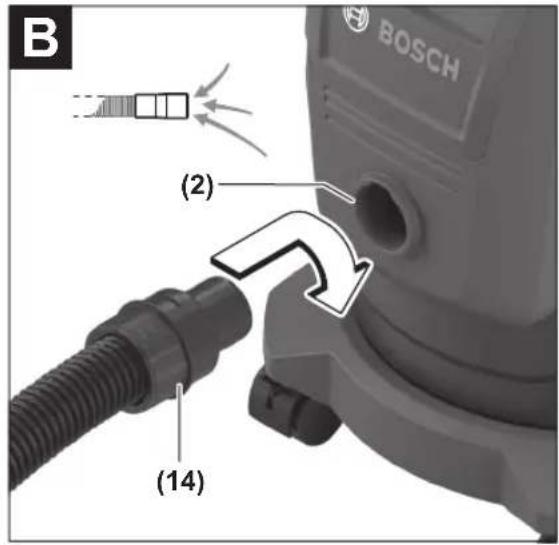
Extraction Function (see figure B)
Insert the vacuum hose (14) into the hose adapter (2) and turn it clockwise as far as possible.
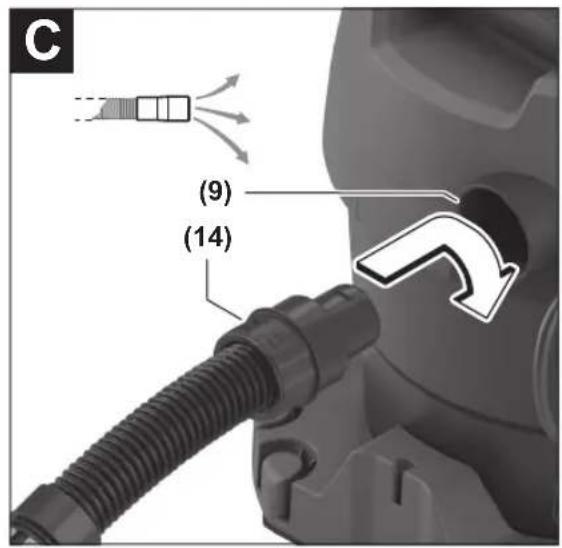
Blowing Function (see figure C)
The dust extractor has a blowing function. Do not blow exhaust air out into the open air. Only use the blowing function with a clean hose. Dust can be hazardous to health. Before using the blow-out function, check whether there are any deposits in the hose. Avoid stirring up deposited dust. Use safety goggles and a dust mask if there is a risk of dust being stirred up.
The blowing function is suitable for tasks where extraction is not possible due to excessive suction power, e.g. to remove small quantities of dried-out leaves from a flower bed.
Switch on the dust extractor for at least 5 seconds (on/off switch (3) to position 1) to clean the vacuum hose (14) of dust deposits.
Turn the vacuum hose (14) anticlockwise as far as it will go and pull it out of the hose socket for the extraction function (2).
Insert the vacuum hose (14) into the hose socket for the blowing function (9) and turn it clockwise as far as it will go.
Fitting the Extraction Accessories
The vacuum hose (14) features a clip system, which can be used to connect extraction accessories (curved nozzle (15)).
Fitting the curved nozzle (see figure D)
- Push the curved nozzle (15) onto the vacuum hose (14) until you hear both snap fasteners (21) on the vacuum hose engage.
- To remove it, press the snap fasteners (21) inwards and pull apart the components.
Fitting the Nozzles and Tubes
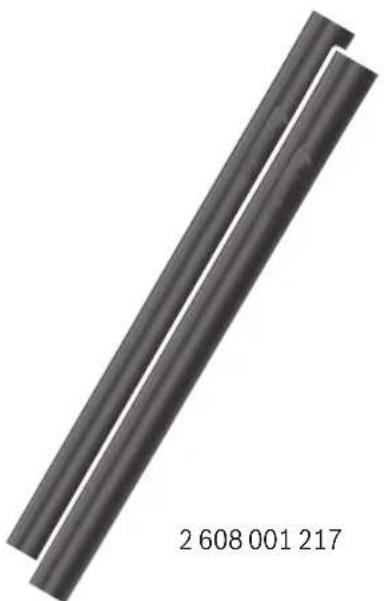
- If required, place the suction tubes (17) firmly inside one another and then attach them firmly to the curved nozzle (15).
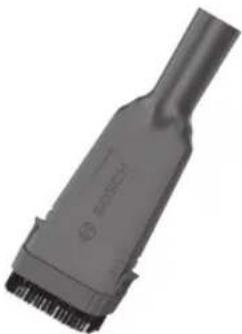
- Attach the floor nozzle (18) or the crevice nozzle (16) firmly to the suction tube (17) or the curved nozzle (15).
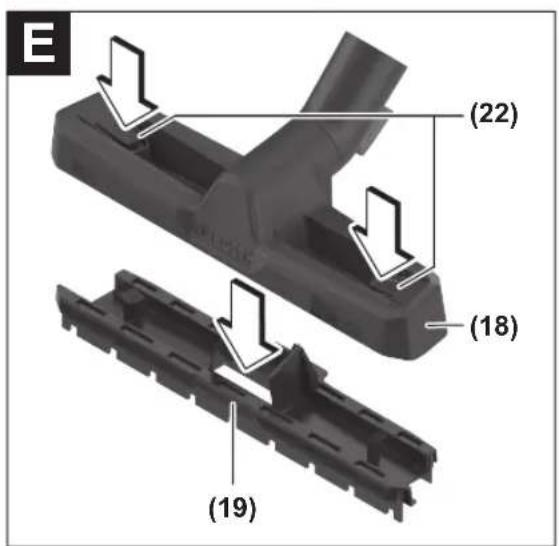
Removing/Inserting the Insert for the Floor Nozzle (see figure E)
To remove, press the release buttons (22) on the floor nozzle (18). The insert (19) is released from the floor nozzle.
To insert, clamp a new insert into the floor nozzle (18).
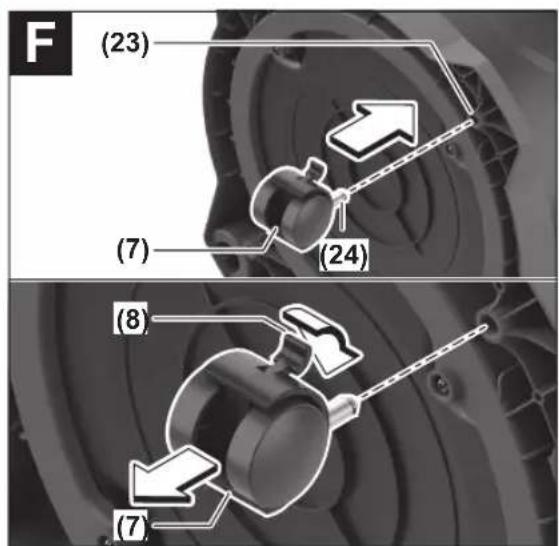
Inserting/Removing Castors (see figure F)
▶ Check the functionality of the roller brakes before using the dust extractor.
To insert, push the fastening pins (24) of the castors (7) all the way into the castor mounts (23).
To remove, release the castor brake (8) and pull the castors (7) out of the castor mounts (23).
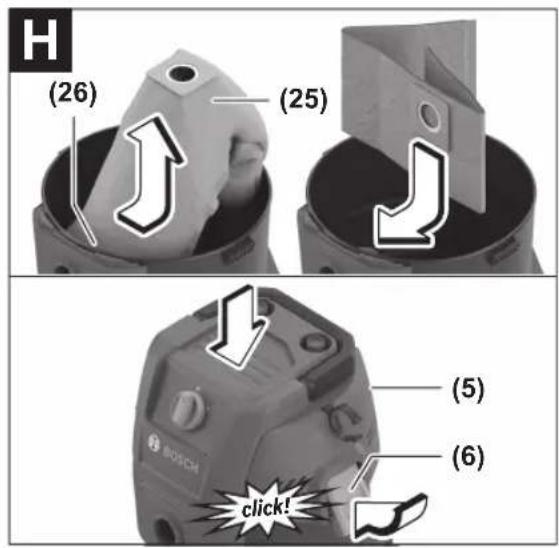
Inserting/Changing the Dust Bag (dry extraction) (see figures G-H)
You can insert a dust bag for dry vacuuming. This makes the dust easier to dispose of.
Open the catches (6) and remove the top part of the dust extractor (5).
To insert the dust bag (25), position the bag over the connection flange (26) of the dust extractor. Make sure that the entire length of the dust bag touches the inside wall of the container (1).
To change the dust bag (25), pull the full bag off the connection flange (26), remove it from the dust extractor and insert a new dust bag.
Put the top part of the dust extractor (5) on and close the catches (6).
Operation
Pull the plug out of the socket before cleaning or performing maintenance on the dust extractor, making tool adjustments, changing accessories or putting away the dust extractor. This safety measure prevents the dust extractor from being started accidentally.
Starting Operation
Check the mains voltage! The voltage of the power source must correspond with the information on the type plate of the dust extractor.
Products that are only sold in AUS and NZ: Use a residual current device (RCD) with a nominal residual current of 30 mA or less.
The dust extractor must categorically not be used in potentially explosive areas.
To ensure optimum suction power, you must always fully unwind the vacuum hose (14) from the top part of the dust extractor (5).
▶ Do not use damaged filters (e.g. no cracks, small holes, etc.). Replace any damaged filters immediately.
Switching On and Off
To switch on the dust extractor, turn the on/off switch (3) to position 1.
To switch off the dust extractor, turn the on/off switch (3) to position 0.
Dry vacuuming
Use a dust bag for dry vacuuming if possible.
If the dust bag is full, replace it with a new dust bag.
▶ Check the dust bag each time after using.
Wet vacuuming
▶ Do not use the dust extractor to vacuum combustible or explosive liquids, such as petrol, oil, alcohol or solvents. Do not vacuum hot, burning or explosive dust. Do not operate the dust extractor in areas subject to explosion hazards. Dust, vapours and liquids can ignite or explode. The dust extractor must not be used as a water pump. The dust extractor is designed for vacuuming air and vacuuming water mixtures. ▶ Pull the plug out of the socket before carrying out any work on the dust extractor.
Steps to Take before Wet Extraction
Open the catches (6) and remove the top part of the dust extractor (5).
Before commencing wet extraction, remove the dust bag (25) and empty the container (1).
Clean the filter (28).
Put the top part of the dust extractor (5) on and close the catches (6).
Extracting Liquids
The dust extractor is fitted with a float. The suction power is reduced when the maximum fill level is reached. Switch the dust extractor off immediately (on/off switch (3) to position 0).
Empty the container (1).
Steps to Take after Wet Extraction
To prevent mould growth after extracting wet dirt:
- Remove the top part of the dust extractor (5) and leave it to dry thoroughly.
- Remove the filter (28) and also leave this to dry thoroughly.
Maintenance and Service
Maintenance and Cleaning
▶ Pull the plug out of the socket before cleaning or performing maintenance on the dust extractor, making tool adjustments, changing accessories or putting away the dust extractor. This safety measure prevents the dust extractor from being started accidentally. ▶ To ensure safe and efficient operation, always keep the dust extractor and the ventilation slots clean. In order to avoid safety hazards, if the power supply cord needs to be replaced, this must be done by Bosch or by an after-sales service centre that is authorised to repair Bosch power tools. ▶ Wear a dust mask when servicing and cleaning the dust extractor.
Clean the housing of the dust extractor occasionally with a damp cloth.
▶ Do not use compressed air to clean the dust extractor.
The filter or other components may become damaged.
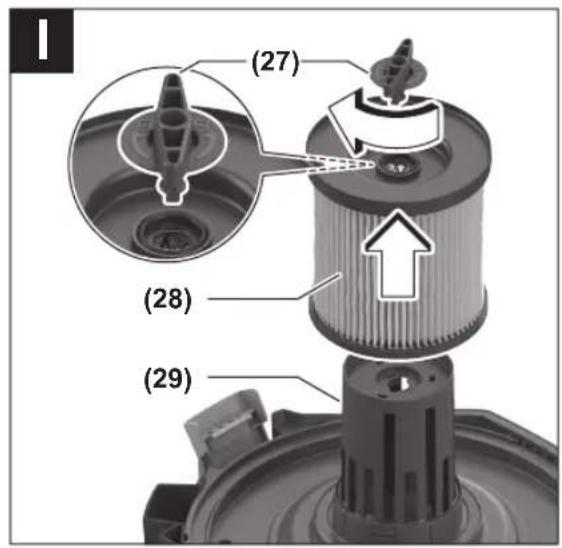
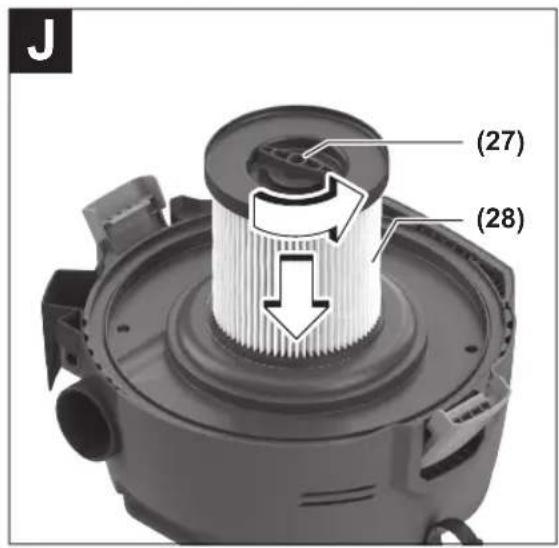
Cleaning/Changing the Filter (see figures I-J)
The suction power is dependent on the condition of the filter. Therefore, the filter should be cleaned regularly.
Replace any damaged filters immediately.
- Open the catches (6) and remove the top part of the dust extractor (5).
- Turn the filter holder (27) as far as it will go in the direction of rotation and remove the filter (28).
- Brush the pleats of the filter with a soft brush or replace the filter if damaged.
- Place the filter (28) over the filter basket (29) and turn the filter holder (27) as far as it will go in the direction of rotation.
Make sure that the opening of the filter (28) is lined up precisely with the positioning cam on the filter basket (29). The filter holder (27) clicks into place.
Cleaning the container
Wipe the container (1) from time to time using a non-abrasive off-the-shelf cleaning product and leave it to dry.
Faults
Regularly emptying the container (1) will ensure optimum suction power.
If the suction power is insufficient, check:
- Is the top part of the dust extractor (5) positioned correctly? – Is the hose system blocked?
- Are the suction tubes (17) firmly joined together?
- Is the container (1) full?
- Is the dust bag (25) full? – Is the filter (28) clogged with dust?
If sufficient suction power is not achieved after following these steps, please contact a Bosch customer service agent.
If the dust extractor overheats, it will automatically turn off. Proceed as follows:
- Turn the on/off switch (3) to position 0.
- Make sure that the container (1) and dust bag (25) are empty and that the vacuum hose (14) and the filter (28) are not clogged.
- Leave the dust extractor to cool down for 60 mins.
- Remove the mains plug from the plug socket and insert it back into the plug socket.
If the dust extractor cannot be switched on afterwards, the fuse protecting the dust extractor may have melted. Contact a Bosch customer service agent to have the fuse replaced.
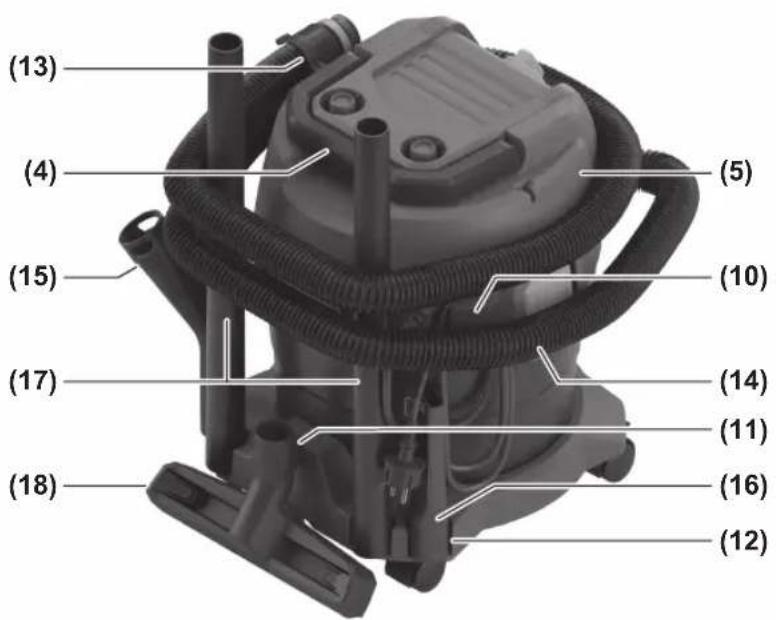
Storage and Transport (see figure K)
- Wrap the vacuum hose (14) around the top part of the dust extractor (5) and push the vacuum hose into the holder (13).
- Wrap the power cable around the cable holder (10).
- Insert the suction tubes (17), the curved nozzle (15) and the crevice nozzle (16) into the holder for extraction accessories (12).
- Insert the floor nozzle (18) into the holder (11).
- Carry the dust extractor by the carrying handle (4).
- Store the dust extractor in a dry room and secure it so that it cannot be used by unauthorised persons.
After-Sales Service and Application Service
Great Britain
Tel. Service: (0344) 7360109
You can find the link to our service addresses and warranty conditions on the last page.
In all correspondence and spare parts orders, please always include the 10-digit article number given on the nameplate of the product.
Disposal
The dust extractor, its accessories and packaging should be recycled in an environmentally friendly manner.
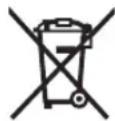
Do not dispose of the dust extractor along with household waste.
Only for EU countries and United Kingdom:
Electrical and electronic equipment that is no longer suitable for use must be collected separately and disposed of in an environmentally friendly manner. Use the designated collection systems. Incorrect disposal may cause harmful effects on the environment and human health, due to the potential presence of hazardous substances.
Français
Tlf. Service Center: 44898855
•
-۶۰۹۵
- Problem
- Problem
- Problem
- Problem
- Problem
- Shape?
- Shape?
- Shape?
- Shape?
- Shape?
- Smoke - Shape - Shape?
- Smoke - Shape - Shape?
- Smoke - Shape - Shape?
- Smoke - Shape - Shape?
- Problem
- Problem
- Problem
- Problem
- Problem
- Problem
- Problem
- Renewable
- Renewable
- Renewable
- Renewable
- Renewable
- What?
- What?
- What?
2 608 001 218
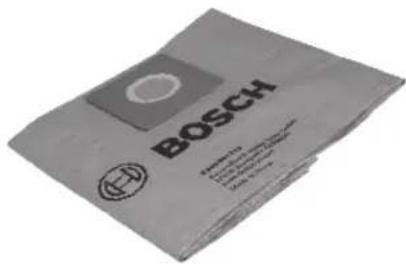
2 608 001 212
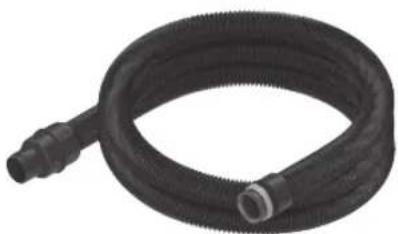
2 608 001 214
2.2 m
35 mm
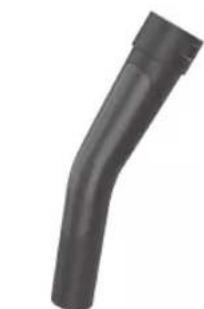
2 608 001 210
2 608 001 209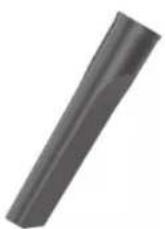
2608001211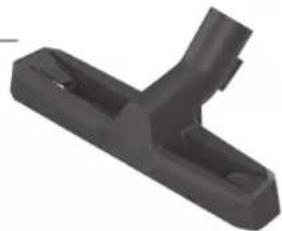

Service Contacts
Service Contacts
Service Contacts
https://www.bosch-pt.com/serviceaddresses
Guarantee Conditions

https://www.bosch-pt.com/guarantee/202507
- SAFETY INSTRUCTIONS FOR DUST EXTRACTORS
- WARNING
- THE DUST EXTRACTOR IS SUITABLE FOR VACUUMING DRY SUBSTANCES, AND CAN ALSO BE USED TO VACUUM LIQUIDS WHEN TAKING APPROPRIATE MEASURES. THE PENETRATION OF LIQUIDS INCREASES THE RISK OF AN ELECTRIC SHOCK
- SYMBOLS
- PRODUCT DESCRIPTION AND SPECIFICATIONS
- INTENDED USE
- PRODUCT FEATURES
- ENGLISH
- ASSEMBLY
- FITTING THE HOLDER FOR THE VACUUM HOSE (SEE FIGURE A)
- FITTING THE VACUUM HOSE
- EXTRACTION FUNCTION (SEE FIGURE B)
- BLOWING FUNCTION (SEE FIGURE C)
- FITTING THE EXTRACTION ACCESSORIES
- FITTING THE CURVED NOZZLE (SEE FIGURE D)
- FITTING THE NOZZLES AND TUBES
- REMOVING/INSERTING THE INSERT FOR THE FLOOR NOZZLE (SEE FIGURE E)
- INSERTING/REMOVING CASTORS (SEE FIGURE F)
- INSERTING/CHANGING THE DUST BAG (DRY EXTRACTION) (SEE FIGURES G-H)
- OPERATION
- STARTING OPERATION
- SWITCHING ON AND OFF
- DRY VACUUMING
- WET VACUUMING
- STEPS TO TAKE BEFORE WET EXTRACTION
- EXTRACTING LIQUIDS
- STEPS TO TAKE AFTER WET EXTRACTION
- MAINTENANCE AND SERVICE
- MAINTENANCE AND CLEANING
- CLEANING/CHANGING THE FILTER (SEE FIGURES I-J)
- CLEANING THE CONTAINER
- FAULTS
- STORAGE AND TRANSPORT (SEE FIGURE K)
- AFTER-SALES SERVICE AND APPLICATION SERVICE
- GREAT BRITAIN
- DISPOSAL
- ONLY FOR EU COUNTRIES AND UNITED KINGDOM
- FRANÇAIS
Brand : BOSCH
Model : PAS15-200
Category : Vacuum Cleaner