GHG 18B50 Professional - Heat gun BOSCH - Free user manual and instructions
Find the device manual for free GHG 18B50 Professional BOSCH in PDF.



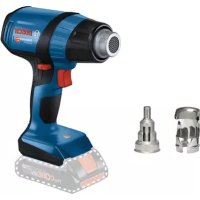
| Type de produit | Pistolet thermique sans fil |
| Marque | Bosch |
| Modèle | GHG 18B50 Professional |
| Tension nominale | 18 V |
| Débit d'air maxi | 175 l/min |
| Température à l'extrémité de la buse | 300 °C / 500 °C (selon réglage) |
| Précision de mesure de la température | ±10 % |
| Poids (selon EPTA 01:2014) | 0,93 – 2,0 kg (selon accu) |
| Dimensions (L × l × H) | 183 × 77 × 209 mm |
| Températures ambiantes admissibles (utilisation) | –20 °C à +50 °C |
| Accus compatibles | Tous les accus Bosch Professional 18 V (GBA 18V..., ProCORE18V...) |
| Accus recommandés | GBA 18V... ≥ 4,0 Ah / ProCORE18V... ≥ 4,0 Ah |
| Autonomie (à 300 °C, accu 8 Ah) | Environ 21 min |
| Réglage de température | 2 positions : 300 °C et 500 °C |
| Mise en marche | Interrupteur de déverrouillage + interrupteur Marche/Arrêt |
| Éclairage LED | Lampe de travail intégrée (LED) |
| Protection anti-redémarrage | Oui |
| Protection contre la surchauffe de l'accu | Oui (réduction de puissance puis arrêt automatique) |
| Accessoires fournis | Buse standard, protection thermique amovible |
| Accessoires optionnels | Buse à réflecteur, buse plate, buse coudée, gaines thermorétractables |
| Entretien | Nettoyer les fentes de ventilation avec un pinceau doux ; retirer l'accu avant nettoyage |
| Garantie | Consultez le SAV Bosch (réparation sous 5 jours via SAV DIRECT) |
Frequently Asked Questions - GHG 18B50 Professional BOSCH
User questions about GHG 18B50 Professional BOSCH
0 question about this device. Answer the ones you know or ask your own.
Ask a new question about this device
Download the instructions for your Heat gun in PDF format for free! Find your manual GHG 18B50 Professional - BOSCH and take your electronic device back in hand. On this page are published all the documents necessary for the use of your device. GHG 18B50 Professional by BOSCH.
USER MANUAL GHG 18B50 Professional BOSCH
GHG 18V-50 Professional
HEAVY DUTY
Robert Bosch Power Tools GmbH
70538 Stuttgart
GERMANY
www.bosch-pt.com
1609 92A 8YR (2023.07) T/169

1 609 92A 8YR
natural_image
Exterior view of a black industrial blender with heat sink and base (no visible text or symbols)www.bosch-pt.com/serviceaddresses
Transport
Read all the safety information and instructions. Failure to observe the safety information and follow instructions may result in electric shock, fire and/or serious injury.
Save all warnings and instructions for future reference.
This heat gun is not intended for use by children or persons with physical, sensory or mental limitations or a lack of experience or
knowledge. This heat gun can be used by children aged 8 or older and by persons who have physical, sensory or mental limitations or a lack of experience or knowledge if a person responsible for their safety supervises them or has instructed them in the safe operation of the heat gun and they understand the associated dangers.
Otherwise there is a risk of operating errors and injury.
▶ Supervise children during use, cleaning and maintenance. This will ensure that children do not play with the heat gun.
▶ Handle the heat gun with care. The heat gun produces intense heat which increases the risk of fire and explosion.
▶ Take particular care when working in the vicinity of flammable materials. The hot airflow or hot nozzle may ignite dust or gases.
▶ Do not work with the heat gun in potentially explosive areas.
▶ Do not aim the hot airflow at the same area for prolonged periods. Working with plastic, paint, varnish or similar materials may produce easily flammable gases.
▶ Please be aware that heat is directed to covered flammable materials, which may ignite.
▶ Safely place the heat gun on the storage surfaces after use and let it cool completely before packing it away. The hot nozzle can cause damage.
▶ Do not let children use the heat gun unsupervised when it is switched on.
▶ Store idle heat guns out of the reach of children. Do not allow persons unfamiliar with the heat gun or these instructions to operate the tool. Heat guns can be dangerous in the hands of untrained users.
▶ Do not expose the heat gun to rain or wet conditions. Water entering a heat gun increases the risk of electric shock.
▶ Always wear safety goggles. Safety goggles reduce the risk of injury.
Remove the rechargeable battery before adjusting the tool settings, changing accessories, or storing the heat gun. This safety measure prevents the heat gun from being started accidentally.

Keep your work area well-ventilated. The gas and steam produced during work are often harmful to one's health.
▶ Wear protective gloves and do not touch the nozzle while it is hot. There is a risk of burns.
▶ Do not direct the airflow at persons or animals.
▶ Do not use the heat gun as a hair dryer. The outgoing airflow is considerably hotter than that of a hair dryer.
▶ Do not allow foreign objects to enter the heat gun.
The distance between the nozzle and the workpiece depends on the material you are working on (metal, plastic, etc.) and the intended working method. Always test the amount of air and temperature first.
▶ Do not open the battery. There is a risk of short-circuiting.
In case of damage and improper use of the battery, vapours may be emitted. The battery can set alight or explode. Ensure the area is well ventilated and seek medical attention should you experience any adverse effects. The vapours may irritate the respiratory system.
If used incorrectly or if the battery is damaged, flammable liquid may be ejected from the battery. Contact with this liquid should be avoided. If contact accidentally occurs, rinse off with water. If the liquid comes into contact with your eyes, seek additional medical attention. Liquid ejected from the battery may cause irritation or burns.
The battery can be damaged by pointed objects such as nails or screwdrivers or by force applied externally. An internal short circuit may occur, causing the battery to burn, smoke, explode or overheat.
When the battery is not in use, keep it away from paper clips, coins, keys, nails, screws or other small metal objects that could make a connection from one terminal to another. A short circuit between the battery terminals may cause burns or a fire.
▶ Only use the battery with products from the manufacturer. This is the only way in which you can protect the battery against dangerous overload.
▶ Only charge the batteries using chargers recommended by the manufacturer. A charger that is suitable for one type of battery may pose a fire risk when used with a different battery.

Protect the battery against heat, e.g. against continuous intense sunlight, fire, dirt, water and moisture. There is a risk of explosion and short-circuiting.
Product Description and Specifications
Please observe the illustrations at the beginning of this operating manual.
Intended Use
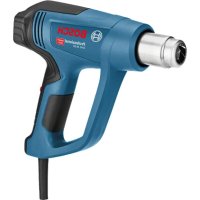
The heat gun is intended for deforming and welding plastic, removing coats of paint and heating heat shrink plastic tubes. It is also suitable for melting adhesive bonding and thawing water pipes.
The heat gun is only intended for handheld, supervised use.
▶ Do not use the heat gun in potentially explosive areas or in the presence of flammable materials or dusts.
Product Features
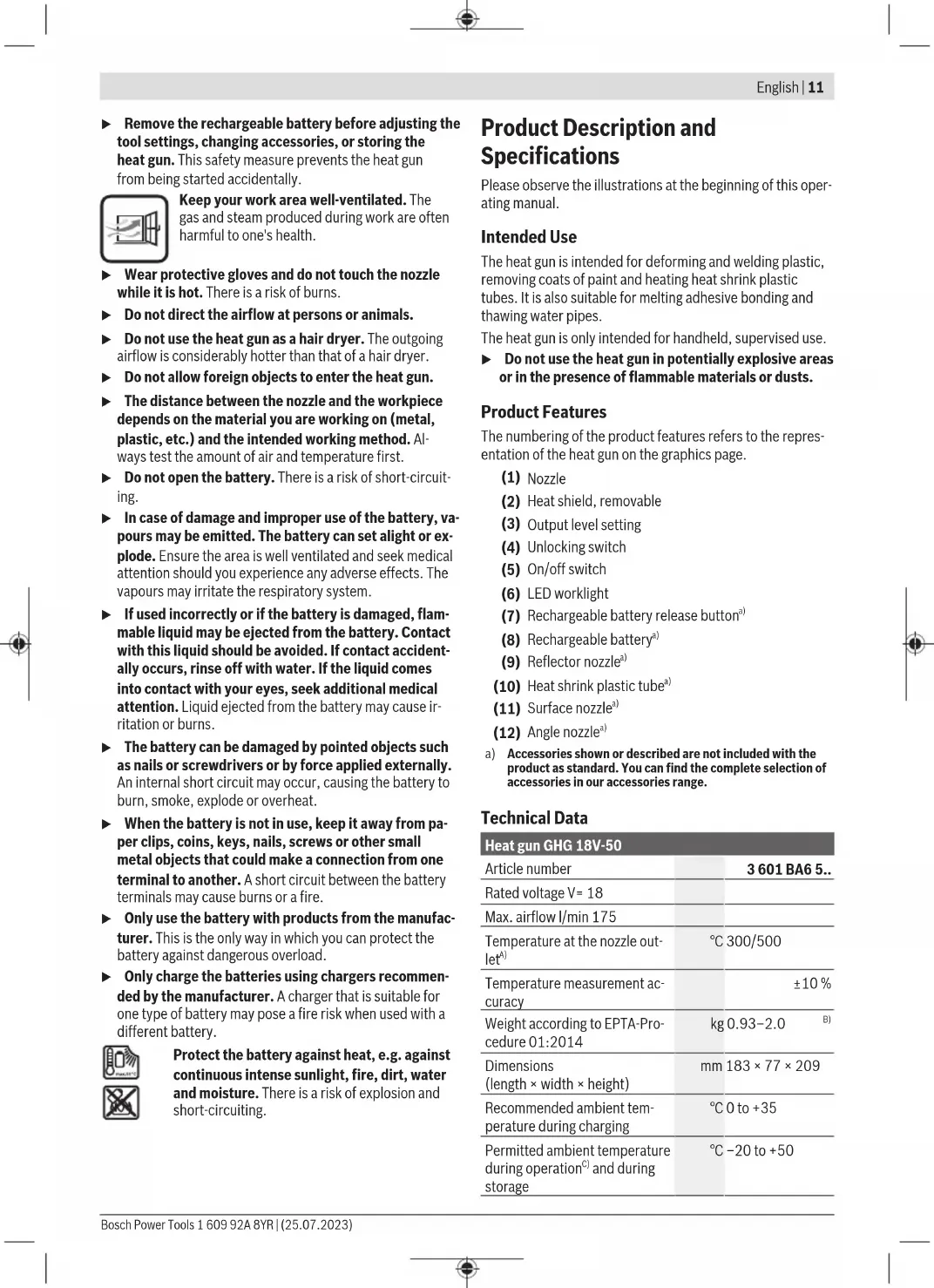
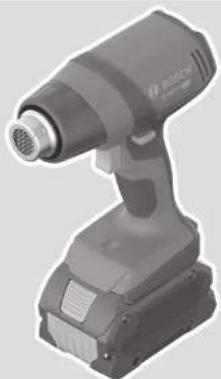
The numbering of the product features refers to the representation of the heat gun on the graphics page.
(1) Nozzle
(2) Heat shield, removable
(3) Output level setting
(4) Unlocking switch
(5) On/off switch
(6) LED worklight
(7) Rechargeable battery release button ^4
(8) Rechargeable battery ^a)
(9) Reflector nozzle ^a1
(10) Heat shrink plastic tube ^a)
(11) Surface nozzle ^a)
(12) Angle nozzle ^a)
a) Accessories shown or described are not included with the product as standard. You can find the complete selection of accessories in our accessories range.
Technical Data
| Heat gun GHG 18V-50 | |
| Article number | 3 601 BA6 5.. |
| Rated voltage V= 18 | |
| Max. airflow l/min 175 | |
| Temperature at the nozzle outletA) | °C 300/500 |
| Temperature measurement accuracy | ±10 % |
| Weight according to EPTA-Procedure 01:2014 | kg 0.93–2.0 B) |
| Dimensions(length × width × height) | mm 183 × 77 × 209 |
| Recommended ambient temperature during charging | °C 0 to +35 |
| Permitted ambient temperature during operationC) and during storage | °C –20 to +50 |
12 | English
| Heat gun GHG 18V-50 | |
| Compatible rechargeable batteries | GBA 18V...ProCORE18V... |
| Recommended rechargeable batteries | GBA 18V...≥4.0 AhProCORE18V...≥4.0 Ah |
| Recommended chargers GAL 18... | GAX 18...GAL 36... |
A) At an ambient temperature of 20 °C
B) Depends on battery in use
C) Limited performance at temperatures < 0 °C
Values can vary depending upon the product and are subject to application and environmental conditions. For further information www.bosch-professional.com/wac.
Noise/vibration information
Typically, the A-weighted sound pressure level of the heat gun is less than 70 dB(A).
Vibration total values a_n (triax vector sum) and uncertainty K: a_n < 2.5 m/s^2 , K = 1.5 m/s^2 .
Rechargeable battery
Bosch sells some cordless heat guns without a rechargeable battery. You can tell whether a rechargeable battery is included with the heat gun by looking at the packaging.
Charging the battery
▶ Use only the chargers listed in the technical data. Only these chargers are matched to the lithium-ion battery of your heat gun.
Note: Lithium-ion rechargeable batteries are supplied partially charged according to international transport regulations. To ensure full rechargeable battery capacity, fully charge the rechargeable battery before using your tool for the first time.
Inserting the Battery
▶ Do not use force to insert the rechargeable battery. The rechargeable battery is designed so that it can only be inserted into the heat gun in the right position.
Push the charged battery into the battery holder until it clicks into place.
The lithium-ion battery is protected against deep discharge by "Electronic Cell Protection (ECP)". A protective circuit switches the heat gun off when the rechargeable battery is drained.
Removing the Battery
To remove the rechargeable battery, press the battery release button and pull the battery out. Do not use force to do this.
Battery charge indicator
Note: Not all battery types have a battery charge indicator.
The green LEDs on the battery charge indicator indicate the state of charge of the rechargeable battery. For reasons of safety, you can call up the state of charge only when the heat gun is off.
Press the button for the battery charge indicator ☐ or ☐ show the state of charge. This is also possible when the rechargeable battery is removed.
If no LED lights up after pressing the button for the battery charge indicator, then the rechargeable battery is defective and must be replaced.
Battery model GBA 18V...

LED Capacity
| 3× continuous green light 60–100 % |
| 2× continuous green light 30–60 % |
| 1× continuous green light 5–30 % |
| 1× flashing green light 0–5 % |
Battery model ProCORE18V...

LED Capacity
| 5 × continuous green light 80–100 % |
| 4 × continuous green light 60–80 % |
| 3 × continuous green light 40–60 % |
| 2 × continuous green light 20–40 % |
| 1 × continuous green light 5–20 % |
| 1 × flashing green light 0–5 % |
Recommendations for Optimal Handling of the Battery
Protect the battery against moisture and water.
Only store the battery within a temperature range of -20 to 50 °C. Do not leave the battery in your car in the summer, for example.
Occasionally clean the ventilation slots on the battery using a soft brush that is clean and dry.
A significantly reduced operating time after charging indicates that the battery has deteriorated and must be replaced.
Follow the instructions on correct disposal.
Operation
Starting operation
▶ Remove the rechargeable battery before changing accessories or storing the heat gun. This safety measure prevents the heat gun from being started accidentally.
Creation of Smoke During Initial Use
A coating protects the metal surfaces from corrosion ex- works. This protective layer evaporates during initial use.
The heat gun may display discolourations on the nozzle (1) due to the production process. These do not count as damage; the functioning of the heat gun is not affected.
Selecting a Power Setting
With the output level setting (3) you can choose between two different output levels. The LED worklight flashes briefly while switching:
- Setting 300 °C
With this setting, you can, for instance, thaw water pipes or process heat shrink plastic tubes. Upon switching on, this temperature is reached in less than 6 s. With a fully charged 8 Ah rechargeable battery, the runtime is up to 21 min.
- Setting 500 °C
With this setting, you can, for instance, remove paint.
The specifications on heating-up time refer to measurements at room temperature.
Switching On
To switch on, first press the unlocking switch (4) and then the on/off switch (5). After starting, you can release the unlocking switch (4). The unlocking switch (4) does not have to be pressed again during operation.
Upon starting the heat gun, the LED worklight (6) switches on and illuminates the work area.
Switching Off
To switch off the tool, release the on/off switch (5).
Switch off the heat gun at the rechargeable battery (8) to allow it to cool down.
Restart Protection
If the rechargeable battery (8) is removed from the heat gun while in operation and the on/off switch (5) is still being held down when it is reinserted, the restart protection will activate. The LED worklight (6) flashes and the heat gun does not start.
Release the on/off switch (5) and switch the heat gun back on as usual.
Overheat Protection for the Rechargeable Battery
If the rechargeable battery (8) gets too hot during operation, the output is reduced. The LED worklight (6) flashes slowly for as long as the on/off switch (5) is pressed.
If the heat gun continues to be operated and the temperature in the rechargeable battery increases further, the heat gun will switch itself off.
Reduced Output
The heat gun is compatible with all available 18 V Bosch Professional rechargeable batteries.
When operating the heat gun with rechargeable batteries smaller than the recommended 4 Ah, however, the heat gun will not reach full power at the 500 °C setting (the temperature is not reached and the air volume is reduced). In order to show that the heat gun is working only with reduced output, the LED worklight (6) flashes slowly several times upon switching on.
LED Displays
The LED worklight (6) is also used as an LED status indicator.
Feedback via LED Event description
| Brief flashing Temperature change | |
| Flashing multiple times when starting the heat gun | Reduced output (use of re-chargeable battery < 4 Ah) |
| Flashing slowly for as long as the on/off switch (5) is pressed | Restart protection |
| Overheat protection for the rechargeable battery | |
| Flashing quickly for as long as the on/off switch (5) is pressed | Internal error |
If there is a permanent internal error in the heat gun (the heat gun does not start or switches off when it is already in operation), please contact customer service.
Practical advice
Note: Do not position the nozzle (1) too close to the workpiece that you are using the power tool on. The resulting air blockage can lead to the heat gun overheating.
Removing the heat shield
When working in particularly tight spaces, you can remove the heat shield (2) by turning it.
▶ Caution: Nozzle is hot! Working without the heat shield increases the risk of burns.
To remove or put on the heat shield (2), switch the heat gun off and let it cool down.
Example applications (see figures A–C)
Images of example applications can be found on the graphics pages.
The distance between the nozzle and the workpiece depends on the material you are working on (metal, plastic etc.) and the intended working method.
The optimum temperature for each application can be determined by a practical test.
Always test the amount of air and temperature first. Start at a greater distance and a lower power setting. Then adjust the distance and power setting according to requirements. If you are unsure what material you are working on or what effect the hot air might have on it, first test the effect on a concealed area.
You can work without accessories for all examples of work. However, using the recommended accessories will simplify the work and considerably increase the quality of the result. You can use all nozzles that are available as accessories from Bosch with this heat gun.
▶ Take care when changing the nozzle. Do not touch the nozzle while it is hot. Let the heat gun cool down and wear protective gloves during changeover. The heat from the nozzle can cause burns.
14 | English
Heat-shrinking (see figure A)
Attach the reflector nozzle (9). Choose the diameter of the heat shrink plastic tube (10) suitable for the workpiece. Evenly heat the heat shrink plastic tube until it fits closely against the workpiece.
Removing varnish/loosening adhesives (see figure B)
Attach the surface nozzle (11). Briefly soften the varnish with hot air and remove it with a clean spatula. Long heat exposure burns the varnish and makes removal more difficult. Many adhesives can be softened using heat. By heating adhesives, you can break connections or remove excess adhesive.
Thawing frozen water pipes (see figure C)
▶ Before applying heat to the pipe, check it is in fact a water pipe. Water pipes and gas pipes often look identical from the outside. Gas pipes must under no circumstances be heated.
Attach the angle nozzle (12). Gradually heat the frozen points of the pipe, starting at the outlet and moving back towards the inlet.
Take great care when warming plastic pipes and pipe connections to avoid causing damage.
Maintenance and Service
Maintenance and Cleaning
Remove the rechargeable battery from the heat gun before carrying out any work on the air pump (e.g. maintenance, tool change, etc.) as well as when transporting and storing the heat gun.
- Keep the heat gun and the ventilation slots clean in order to work safely and well.
After-Sales Service and Application Service
Our after-sales service responds to your questions concerning maintenance and repair of your product as well as spare parts. You can find explosion drawings and information on spare parts at: www.bosch-pt.com
The Bosch product use advice team will be happy to help you with any questions about our products and their accessories.
In all correspondence and spare parts orders, please always include the 10-digit article number given on the nameplate of the product.
Great Britain
Robert Bosch Ltd. (B.S.C.)
P.O. Box 98
Broadwater Park
North Orbital Road
Denham Uxbridge
UB 9 5HJ
At www.bosch-pt.co.uk you can order spare parts or arrange the collection of a product in need of servicing or repair.
Tel. Service: (0344) 7360109
E-Mail: boschservicecentre@bosch.com
You can find further service addresses at:
www.bosch-pt.com/serviceaddresses
Transport
The recommended lithium-ion batteries are subject to legislation on the transport of dangerous goods. The user can transport the batteries by road without further requirements.
When shipping by third parties (e.g.: by air transport or forwarding agency), special requirements on packaging and labelling must be observed. For preparation of the item being shipped, consulting an expert for hazardous material is required.
Dispatch battery packs only when the housing is undamaged. Tape or mask off open contacts and pack up the battery in such a manner that it cannot move around in the packaging. Please also observe the possibility of more detailed national regulations.
Disposal

Heat guns, rechargeable batteries, accessories and packaging should be fed into environmentally friendly recycling.

Do not throw heat guns and rechargeable batteries/non-rechargeable batteries in the domestic waste.
Only for EU countries:
According to the Directive 2012/19/EU on waste electrical and electronic equipment and its transposition into national law, heat guns that are no longer usable, and, according to the Directive 2006/66/EC, defective or drained batteries must be collected separately and disposed of in an environmentally correct manner.
If disposed incorrectly, waste electrical and electronic equipment may have harmful effects on the environment and human health, due to the potential presence of hazardous substances.
Only for United Kingdom:
According to The Waste Electrical and Electronic Equipment Regulations 2013 (SI 2013/3113) (as amended) and the Waste Batteries and Accumulators Regulations 2009 (SI 2009/890) (as amended), products that are no longer usable must be collected separately and disposed of in an environmentally friendly manner.
Battery packs/batteries:
Li-ion:
Please observe the notes in the section on transport (see "Transport", page 14).
Français
Robert Bosch (France) S.A.S.
www.bosch-pt.com/serviceaddresses
Transport
www.bosch-pt.com/serviceaddresses
Transporte
www.bosch-pt.com/serviceaddresses
Transporte
www.bosch-pt.com/serviceaddresses
Trasporto
www.bosch-pt.com/serviceaddresses
Vervoer
Bosch Service Center
Telegrafvej 3
2750 Ballerup
På www.bosch-pt.dk kan der online bestilles reservedele eller oprettes en reparations ordre.
Tlf. Service Center: 44898855
Fax: 44898755
E-Mail: vaerktoej@dk.bosch.com
www.bosch-pt.com/serviceaddresses
Transport
Bosch Service Center
Telegrafvej 3
2750 Ballerup
Danmark
Tel.: (08) 7501820 (inom Sverige)
Fax: (011) 187691
www.bosch-pt.com/serviceaddresses
Transport
Overopphetingsvern for batteriet
www.bosch-pt.com/serviceaddresses
Transport
www.bosch-pt.com/serviceaddresses
Kuljetus
www.bosch-pt.com/serviceaddresses
Μεταφορά
www.bosch-pt.com/serviceaddresses
Nakliye
Robert Bosch Sp. z o.o.
www.bosch-pt.com/serviceaddresses
Transport
Bosch Service Center PT
K Vápence 1621/16
692 01 Mikulov
www.bosch-pt.com/serviceaddresses
Přeprava
www.bosch-pt.com/serviceaddresses
Transport
www.bosch-pt.com/serviceaddresses
Szállítás
www.bosch-pt.com/serviceaddresses
Транспортировка
www.bosch-pt.com/serviceaddresses
Транспортування
www.bosch-pt.com/serviceaddresses
Тасымалдау
Service scule electrice
Strada Horia Măcelariu Nr. 30–34, sector 1
013937 Bucureşti
www.bosch-pt.com/serviceaddresses
Transport
Service scule electrice
Strada Horia Măcelariu Nr. 30–34, sector 1
013937 Bucureşti, România
www.bosch-pt.com/bg/bg/
www.bosch-pt.com/serviceaddresses
Транспортиране
www.bosch-pt.com/serviceaddresses
Транспорт
Odaberite stepen snage
Uz pomoć podešavanja stepena snage (3) možete birati između 2 različita stepena snage. Prilikom prebacivanja nakratko treperi LED radno svetlo:
- Stepen 300 °C
Sa ovim stepenom možete npr. da otapate creva sa vodom ili da obrađujete termoskupljajuća creva. Nakon uključivanja se ova temperatura dostiže za manje od 6 s. Sa potpuno napunjenim 8 Ah akumulatorom, vreme rada iznosi do 21 min.
- Stepen 500 °C
www.bosch-pt.com/serviceaddresses
Transport
Preporučeni litijum-jonski akumulatori podležu zahtevima propisa o opasnim materijama. Korisnik može bez dodatnih uslova transportovati akumulatore na drumu.
Kod slanja preko trećih lica (na primer vazdušnih transportom ili špedicijom) mora se obratiti pažnja na posebne zahteve u pogledu pakovanja i označavanja. Tada se kod pripreme paketa za slanje mora pozvati stručnjak za opasne materije.
www.bosch-pt.com/serviceaddresses
Transport
www.bosch-pt.com/serviceaddresses
Transport
www.bosch-pt.com/serviceaddresses
Transport
www.bosch-pt.com/serviceaddresses
Transportešana
www.bosch-pt.com/serviceaddresses
운반
(A-CAmetha Elgmal (Anjir Alpior)
Robert Bosch Morocco SARL
www.bosch-pt.com/serviceaddresses
159 | ۴ارسی
کار نکنید.
www.bosch-pt.com/serviceaddresses
جمل دستگاه
Declaration of Conformity
Heat gun Article number
GHG 18V-50 3 601 BA6 500
We declare under our sole responsibility that the stated products comply with all applicable provisions of the regulations listed below and are in conformity with the following standards.
Technical file at: Robert Bosch Ltd. (PT/SOP-GB), Broadwater Park, North Orbital Road, Uxbridge UB9 5HJ, United Kingdom
The Supply of Machinery (Safety) Regulations 2008
The Electromagnetic Compatibility Regulations 2016
The Restriction of the Use of Certain Hazardous Substances in
Electrical and Electronic Equipment Regulations 2012
EN 60335-1:2012+A11:2014+A13:2017+
A1:2019+A14:2019+A2:2019+A15:2021
EN 60335-2-45:2002+A1:2008+A2:2012
EN IEC 55014-1:2021
EN IEC 55014-2:2021
EN IEC 63000:2018

BOSCH
Vonjy Rajakoba
Managing Director - Bosch UK

Robert Bosch Power Tools GmbH, 70538 Stuttgart, Germany represented (in terms of the above regulations) by
Robert Bosch Limited, Broadwater Park, North Orbital Road,
Uxbridge UB9 5HJ, United Kingdom
Martin Sibley
Head of Sales Operations and Aftersales

Robert Bosch Ltd. Broadwater Park, North Orbital Road, Uxbridge UB9 5HJ, United Kingdom, as authorised representative acting on behalf of Robert Bosch Power Tools GmbH, 70538 Stuttgart, Germany
Place of issue: Uxbridge Date of issue: 26/06/2023

- GHG 18V-50 Professional
- Transport
- Product Description and Specifications
- Intended Use
- Product Features
- Noise/vibration information
- Rechargeable battery
- Charging the battery
- Inserting the Battery
- Removing the Battery
- Battery charge indicator
- Recommendations for Optimal Handling of the Battery
- Operation
- Starting operation
- Creation of Smoke During Initial Use
- Selecting a Power Setting
- Switching On
- Switching Off
- Restart Protection
- Overheat Protection for the Rechargeable Battery
- Reduced Output
- LED Displays
- Practical advice
- Removing the heat shield
- Example applications (see figures A–C)
- | English
- Heat-shrinking (see figure A)
- Removing varnish/loosening adhesives (see figure B)
- Thawing frozen water pipes (see figure C)
- Maintenance and Service
- Maintenance and Cleaning
- After-Sales Service and Application Service
- Great Britain
- You can find further service addresses at:
- Disposal
- Only for EU countries:
- Only for United Kingdom:
- Battery packs/batteries:
- Li-ion:
- Français
- Transporte
- Trasporto
- Vervoer
- Overopphetingsvern for batteriet
- Kuljetus
- Μεταφορά
- Nakliye
- Přeprava
- Szállítás
- Транспортировка
- Транспортування
- Тасымалдау
- Транспортиране
- Транспорт
- Odaberite stepen snage
- Transportešana
- 운반
- (A-CAmetha Elgmal (Anjir Alpior)
- جمل دستگاه
- Declaration of Conformity
- BOSCH
Brand : BOSCH
Model : GHG 18B50 Professional
Category : Heat gun