GHG 630 DCE Professional - Heat gun BOSCH - Free user manual and instructions
Find the device manual for free GHG 630 DCE Professional BOSCH in PDF.

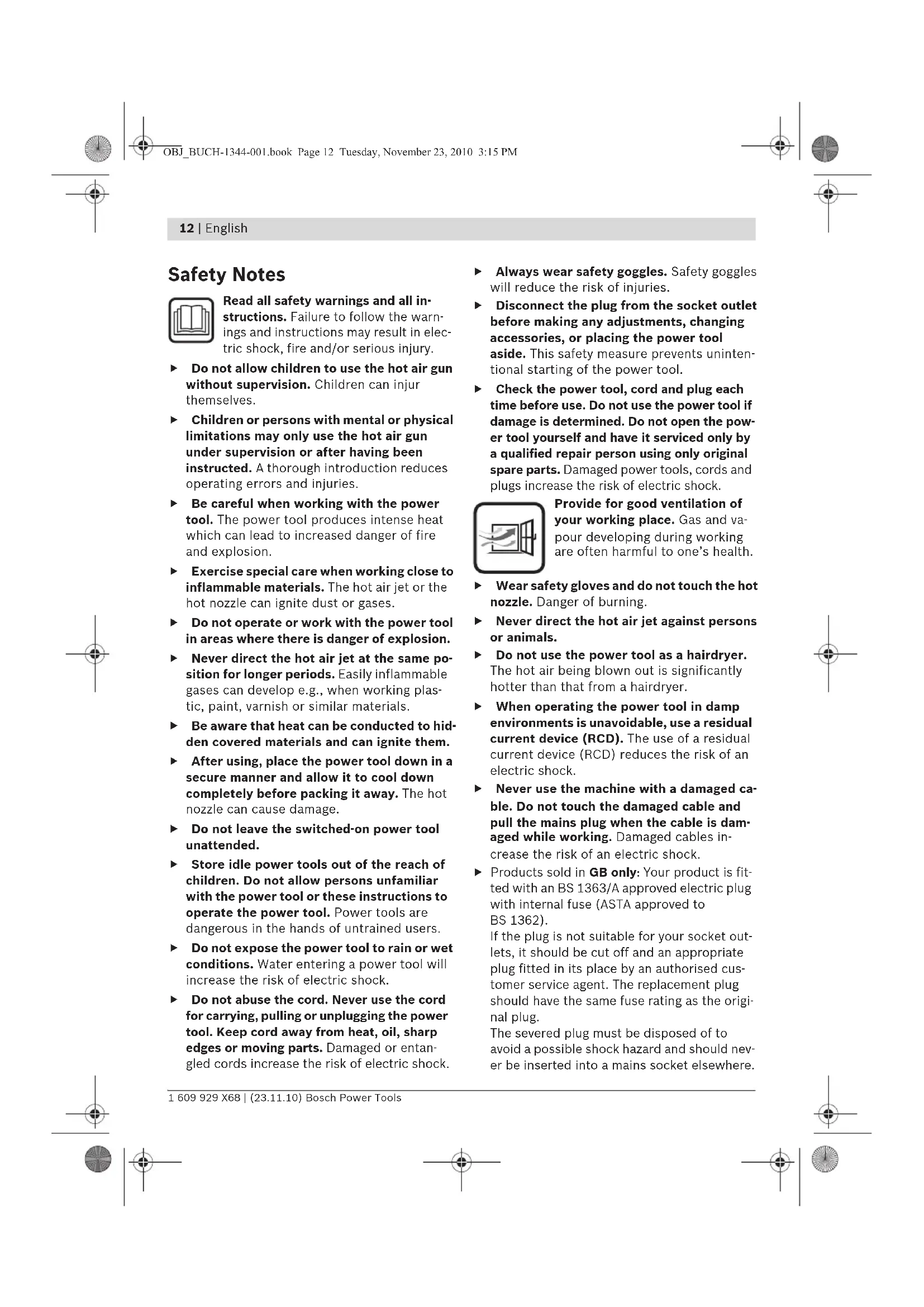


| Brand | Bosch |
| Model | GHG 630 DCE Professional |
| Type | Heat gun |
| Rated voltage | 220-240 V |
| Rated power input | 1800 W |
| Air flow rate (adjustable) | 150 / 300 / 500 l/min (3 positions) |
| Adjustable temperature | 50-630 °C (continuous, except cold air position at 50 °C) |
| Temperature measurement accuracy | ±10 % at nozzle outlet, ±5 % on display |
| Weight (according to EPTA 01/2003) | 0.9 kg |
| Protection class | II (double insulation) |
| Display | Digital temperature display |
| Heat shield | Removable |
| Accessories (optional) | Wide nozzle, glass protection nozzle, reflector nozzle, reducer nozzle, angular nozzle, welding aid |
| Main applications | Stripping, plastic welding, shrinking, soldering, defrosting, etc. |
| Sound level | < 70 dB(A) |
| Article number (220-240 V) | 0 601 94C 7.. |
| Thermal safety shut-off | Yes (automatic heating shut-off in case of overheating) |
| Display operating temperature | 0 °C to +50 °C |
Frequently Asked Questions - GHG 630 DCE Professional BOSCH
User questions about GHG 630 DCE Professional BOSCH
0 question about this device. Answer the ones you know or ask your own.
Ask a new question about this device
Download the instructions for your Heat gun in PDF format for free! Find your manual GHG 630 DCE Professional - BOSCH and take your electronic device back in hand. On this page are published all the documents necessary for the use of your device. GHG 630 DCE Professional by BOSCH.
USER MANUAL GHG 630 DCE Professional BOSCH
OFB31CIL-144400hokn Page 4 Tuesday, November 23, 2010 1:14 PM
WEU WEU
Robert Bosch GmbH
Power Tools Division
70745 Leinfelden-Echterdingen
Germany
www.bosch-pt.com
1609929X68(2010.11)T/83WEU

GHG Professional
500-2|600-3|630DCE

BOSCH
Read all safety warnings and all instructions. Failure to follow the warnings and instructions may result in electric shock, fire and/or serious injury.
Do not allow children to use the hot air gun without supervision. Children can injur themselves.
Children or persons with mental or physical limitations may only use the hot air gun under supervision or after having been instructed. A thorough introduction reduces operating errors and injuries.
- Be careful when working with the power tool. The power tool produces intense heat which can lead to increased danger of fire and explosion.
Exercise special care when working close to inflammable materials. The hot air jet or the hot nozzle can ignite dust or gases.
Do not operate or work with the power tool in areas where there is danger of explosion.
- Never direct the hot air jet at the same position for longer periods. Easily inflammable gases can develop e.g., when working plastic, paint, varnish or similar materials.
Be aware that heat can be conducted to hidden covered materials and can ignite them.
After using, place the power tool down in a secure manner and allow it to cool down completely before packing it away. The hot nozzle can cause damage.
Do not leave the switched-on power tool unattended.
- Store idle power tools out of the reach of children. Do not allow persons unfamiliar with the power tool or these instructions to operate the power tool. Power tools are dangerous in the hands of untrained users.
Do not expose the power tool to rain or wet conditions. Water entering a power tool will increase the risk of electric shock.
Do not abuse the cord. Never use the cord for carrying, pulling or unplugging the power tool. Keep cord away from heat, oil, sharp edges or moving parts. Damaged or entangled cords increase the risk of electric shock.
Always wear safety goggles. Safety goggles will reduce the risk of injuries.
- Disconnect the plug from the socket outlet before making any adjustments, changing accessories, or placing the power tool aside. This safety measure prevents unintentional starting of the power tool.
Check the power tool, cord and plug each time before use. Do not use the power tool if damage is determined. Do not open the power tool yourself and have it serviced only by a qualified repair person using only original spare parts. Damaged power tools, cords and plugs increase the risk of electric shock.

Provide for good ventilation of your working place. Gas and vapour developing during working are often harmful to one's health.
Wear safety gloves and do not touch the hot nozzle. Danger of burning.
- Never direct the hot air jet against persons or animals.
Do not use the power tool as a hairdryer. The hot air being blown out is significantly hotter than that from a hairdryer.
When operating the power tool in damp environments is unavoidable, use a residual current device (RCD). The use of a residual current device (RCD) reduces the risk of an electric shock.
- Never use the machine with a damaged cable. Do not touch the damaged cable and pull the mains plug when the cable is damaged while working. Damaged cables increase the risk of an electric shock.
- Products sold in GB only: Your product is fitted with an BS 1363/A approved electric plug with internal fuse (ASTA approved to BS 1362).
If the plug is not suitable for your socket outlets, it should be cut off and an appropriate plug fitted in its place by an authorised customer service agent. The replacement plug should have the same fuse rating as the original plug.
The severed plug must be disposed of to avoid a possible shock hazard and should never be inserted into a mains socket elsewhere.
Functional Description
While reading the operating instructions, unfold the graphics page for the machine and leave it open.
Intended Use
The power tool is intended for the forming and welding of plastic, removal of paint and the warming of heat-shrinkable tubing. It is also suitable for soldering and tinning, loosening of adhesive joints and the defrosting of water lines.
Product Features
The numbering of the product features refers to the illustration of the machine on the graphics page.
1 Nozzle
2 Heat protection collar
3 Standing surface
4 On-/Off switch with air-volume regulator and temperature control (GHG 500-2/GHG 600-3)
5 On/Off switch with air-volume regulator (GHG 630 DCE)
6 Button for temperature control (GHG 630 DCE)
7 Display (GHG 630 DCE)
8 Wide jet nozzle
9 Glass protection nozzle
10 Reflector nozzle
11 Welding rod
12 Welding shoe
13 Reduction nozzle
14 Heat-shrinkable sleeve
15 Angle nozzle
*Accessories shown or described are not part of the standard delivery scope of the product. A complete overview of accessories can be found in our accessories program.
Noise Information
Measured sound values determined according to EN 60745.
Typically the A-weighted sound pressure level of the product is lower than 70 dB(A).
Technical Data
| Hot Air Gun GHG Professional | 500-2 600-3 630 DCE 630 DCE | ||||
| Article number 0 601 ... | 94A 0.. 94B 0.. 94C 7.. 94C 7.. | ||||
| Rated voltage | V 220-240 220-240 115-127 220-240 | ||||
| Rated power input | W 1 6 0 0 | 1800 1500 2000 | |||
| Air flow | I/min 240/450 250/350/500 110/250/400 150/300/500 | ||||
| Temperature at the nozzle outlet (approx.) | °C 300/500 50/400/600 | 50-600 | 50-630 | ||
| Temperature-measuring accuracy - at the nozzle outlet - on the display | ± 10 % - | ± 10 % - | ± 10 % ± 5 % | ||
| Display operating temperature* | °C - | 0...+50 | 0...+50 | ||
| Weight according to EPTA-Procedure 01/2003 | kg | 0.75 | 0.8 | 0.9 | 0.9 |
| Protection class | ☐/II ☐/II ☐/II ☐/II | ||||
| * The display can turn black when not within the operating temperature. Please observe the article number on the type plate of your machine. The trade names of the individual machines may vary. | |||||
Bosch Power Tools 1609 929 X68 (23.11.10)
14 | English
Operation
Starting Operation
Observe correct mains voltage! The voltage of the power source must agree with the voltage specified on the nameplate of the machine. Power tools marked with 230V can also be operated with 220V .
Switching On
GHG 500-2: Press the On/Off switch 4 to position I or II.
GHG 600-3: Press the On/Off switch 4 to position I, II or III.
GHG 630 DCE: Press the On/Off switch 5 to position I, II or III.
Thermal-protection shut-off: In case of overheating (e.g. due to air build-up), the power tool automatically shuts off the heating system, but the blower will continue to run. When the power tool has cooled down to the operating temperature, the heating system is automatically switched on again.
Switching Off
GHG 500-2/GHG 600-3: Press the On/Off switch 4 to position 0.
GHG 630 DCE: Press the On/Off switch 5 to position 0.
GHG 600-3/GHG 630 DCE: After working for a longer time with high temperature, allow the power tool to cool down by running it in the cold air setting I before switching off.
Setting the Air Flow and Temperature (GHG 500-2/GHG 600-3)
With the On/Off switch 4, you can select between different air flows and temperature combinations:
| Setting | GHG 500-2 | GHG 600-3 |
| 1/min °C l/min °C | ||
124030025050
II 450 500 350 400
III--500600
GHG 600-3: The cold air setting I is suitable for cooling a warmed workpiece or for drying of paint. It is also suitable for cooling the power tool before placing it down or when changing nozzles.
Regulating the Air flow (GHG 630 DCE)
With the On/Off switch 5, you can regulate the air flow in three steps:
| Setting | For rated voltage | |
| 115-127 V: 220-240 V: | ||
| I/min | I/min | |
| I | 110 150 | |
| II | 250 300 | |
| III | 400 500 | |
As an example, reduce the air flow when the surrounding area of a workpiece is not to be heated excessively or when a light workpiece could be moved away by the air flow.
In the cold air setting I, the temperature is fixed at 50^ ; in the hot air settings II and III, the temperature can be continuously regulated.
Setting the Temperature (GHG 630 DCE)
The temperature can only be regulated in the hot air settings II and III. In the cold air setting I, the temperature is fixed at 50^
When switching from the cold air setting I to one of the hot air settings, the last set target temperature is indicated for approx. 3 seconds between flashing arrows on display 7. The target temperature is the same for both hot air steps II and III, and does not change when switching between the two steps.
To increase the temperature, press on the "+" of the temperature-control button 6, to decrease the temperature, press on the "-".
Briefly pressing the temperature-control button 6 at the respective position increases or decreases the temperature by 10^ . Prolonged pressing of the temperature-control button continuously increases or decreases the temperature by 10^ , until the button is released or the maximum or minimal temperature is reached.
After a change to the temperature setting, the power tool requires a short period to warm up or cool down the airflow. During this period, the target temperature is indicated between the flashing arrows in the display 7. When the target temperature is reached, the arrows go out and the display indicates the actual temperature.
When switching from the hot air steps II or III to the cold air setting I, a short time is required until the power tool has cooled to 50^ . During the cooling period, the actual temperature at the nozzle outlet is indicated on the display 7.
The cold air setting is suitable for cooling a warmed workpiece or for drying of paint. It is also suitable for cooling the power tool before placing it down or when changing nozzles.
Working Advice
Before any work on the machine itself, pull the mains plug.
Note: Do not apply the nozzle 1 too close to the workpiece being worked. The hot air build-up can lead to overheating of the power tool.
Removing the Heat Protection
The heat protection collar 2 can be removed when working at particularly hard-to-reach locations.
Be careful of the hot nozzle! Increased danger of burning exists when working without the heat protection collar.
To remove or mount the heat protection collar 2, switch the power tool off and allow it to cool down.
To speed up the cooling, the power tool can also be operated for a short period with the lowest adjustable temperature.
Turn the heat protection collar 2 in anticlockwise direction to remove and in clockwise direction to mount again.
Placing Down the Power Tool (see figure C)
To cool down the power tool or have both hands free, place it down on the standing surface 3.
Be especially careful when working with the placed down power tool! There is danger of burning oneself on the hot nozzle or on the hot air jet.
Work Examples
The illustrations of the work examples can be found on the fold-out pages.
The temperature settings in the work examples are reference values that can vary, depending on the material characteristics. The distance between the nozzle and the workpiece depends on the material to be worked.
The optimal temperature for the respective application can be determined by practical testing. Always start with a low temperature setting.
All application examples can be performed without accessories except for "Removing Varnish/Paint from Windows". However, the use of recommended accessories simplifies the work and significantly improves the quality of the result.
Be careful when changing the nozzle! Do not touch the hot nozzle. Allow the power tool to cool down and wear protective gloves while changing the nozzle. Danger of burning oneself on the hot nozzle.
Removing Varnish/Softening Adhesives (see figure A)
Mount the wide jet nozzle 8 (accessory). Briefly soften the varnish applying hot air and remove it using a sharp, clean scraper or putty knife. Applying heat too long will burn the varnish, making it more difficult to remove.
Many adhesives (e.g. of stickers) become soft when heated. Heated adhesives allow for bonds to be separated or excessive adhesive to be removed.
Removing Varnish/Paint from Windows (see figure B)
Use of the glass protection nozzle 9 (accessory) is essential. Danger of glass breaking.
On profiled surfaces, varnish can be removed using an appropriately fitting spatula and brushed off with a soft wire brush.


16 | English
Shaping Plastic Tubing (see figure C)
Mount the reflector nozzle 10 (accessory). To avoid kinking of the tubing, fill the tubing with sand and plug both ends. Heat the tubing evenly by applying the heat from side to side.
Welding Plastics (see figure D)
Mount the reduction nozzle 13 and the welding shoe 12 (both accessories). The workpieces to be welded and the welding rod 11 (accessory) must be of the same material (e.g. both of PVC). The seam must be clean and grease-free.
Carefully heat up the seam location until it becomes doughy. Please note that the temperature difference between the doughy and liquid state of plastic is low.
Feed in the welding rod 11 and allow it to run into the gap so that a uniform bead is produced.
Shrinking (see figure E)
Mount the reduction nozzle 13 (accessory). Select the diameter of the heat-shrinkable sleeve 14 (accessory) according to the workpiece (e.g. a cable lug). Heat the heat-shrinkable sleeve evenly.
Defrosting Water Pipes (see figure F)
Before heating pipes, check to make sure that it is actually a water pipe. Water lines often do not differ in appearance from gas lines. Gas lines are not to be heated under any circumstances.
Place on the angle nozzle 15 (accessory). Heat the frozen zone always from the outside to the middle.
Heat up plastic pipes as well as connections between pipe pieces especially careful to prevent damage.
Soft Soldering (see figure G)
For point soldering, place on the reduction nozzle 13, for the soldering of pipes/tubing, place on the reflector nozzle 10 (both accessories). If solder without flux is used, apply soldering grease or paste to the location to be soldered. Warm the location to be soldered for 50-120 seconds depending on the material. Apply the solder. The solder must melt from the workpiece temperature. After the soldered location has cooled, remove the flux.
Maintenance and Service
Maintenance and Cleaning
Before any work on the machine itself, pull the mains plug.
For safe and proper working, always keep the machine and ventilation slots clean.
If the machine should fail despite the care taken in manufacturing and testing procedures, repair should be carried out by an after-sales service centre for Bosch power tools.
In all correspondence and spare parts order, please always include the 10-digit article number given on the type plate of the machine.
After-sales Service and Customer Assistance
Our after-sales service responds to your questions concerning maintenance and repair of your product as well as spare parts. Exploded views and information on spare parts can also be found under:
www.bosch-pt.com
Our customer service representatives can answer your questions concerning possible applications and adjustment of products and accessories.
Great Britain
Robert Bosch Ltd. (B.S.C.)
P.O.Box 98
Broadwater Park
North Orbital Road
Denham
Uxbridge
UB95HJ
Tel. Service: +44 (0844) 736 0109
Fax:+44(0844)7360146
E-Mail: boschservicecentre@bosch.com
Ireland
Origo Ltd.
Unit 23 Magna Drive
Magna Business Park
City West
Dublin 24
Tel. Service: +353 (01) 466 67 00
Fax: +353 (01) 466 68 88

Australia, New Zealand and Pacific Islands
Robert Bosch Australia Pty. Ltd.
Power Tools
Locked Bag 66
Clayton South VIC 3169
Customer Contact Center
Inside Australia:
Phone: +61 (01300) 307 044
Fax: +61 (01300) 307 045
Inside New Zealand:
Phone: +64 (0800) 543 353
Fax: +64 (0800) 428570
Outside AU and NZ:
Phone: +61 (03) 9541 5555
www.bosch.com.au
Republic of South Africa
Customer service
Hotline: +27 (011) 6519600
Gauteng - BSC Service Centre
35 Roper Street, New Centre
Johannesburg
Tel.: +27 (011) 493 93 75
Fax: +27 (011) 4930126
E-Mail: bsctools@icon.co.za
KZN - BSC Service Centre
Unit E, Almar Centre
143 Crompton Street
Pinetown
Tel.: +27 (031) 7012120
Fax:+27(031)7012446
E-Mail: bsc.dur@za.bosch.com
Western Cape - BSC Service Centre
Democracy Way, Prosperity Park
Milnerton
Tel.: +27 (021) 551 25 77
Fax: +27 (021) 5513223
E-Mail: bsc@zsd.co.za
Bosch Headquarters
Midrand, Gauteng
Tel.: +27 (011) 6519600
Fax: +27 (011) 6519880
E-Mail: rbsa-hq.pts@za.bosch.com
Disposal
The machine, accessories and packaging should be sorted for environmental-friendly recycling.
Do not dispose of power tools into household waste!
Only for EC countries:

According to the European Guideline 2002/96/EC for Waste Electrical and Electronic Equipment and its implementation into national right, power tools that are no longer usable must be collected separately and disposed of in an environmentally correct manner.
Subject to change without notice.
18 | Français
Robert Bosch (France) S.A.S.
Bosch Service Center
Telegrafvej 3
2750 Ballerup
Tel. Service Center: +45 (4489) 8855
Fax: +45 (4489) 87 55
E-Mail: vaerktoej@dk.bosch.com
Bortskaffelse
El-vaerktj, tilbehor og emballage skal genbruges pa en miljovenlig maede.
Bosch Service Center
Telegrafvej 3
2750 Ballerup
Danmark
Tel.: +46 (020) 41 44 55
Fax: +46 (011) 187691
Avfallshantering
UykoAAnon nAaotikov (Bene eikova D)
TOnoTeTnTo aKpOoUo OuaToaNc 13 Kai To nLa ouykoAaNoC 12 (KaTa Suo eIdka Eaapntnata). Ta uno ouykoAaNoT euaia Ka T o Nktpodio ouykoAaNoC 11 (eIdko eApTna) npenei va elva ano to Ibiu uAiko (n.x. ano PVC). H paph npenei va elvai kaapn kai Xwpic Aaaa nAann.
Zeotavete npooektikn th eon ouyokannoc
expi va anoktnoei oopn zumc. Na exete
unown oac, ot n nepioxh oepokpaia metaEku 0uipnc kataotaoc evoc naoitko uikou eival elaxiatn.
Poo0eote Twpa To nAektpoio oukykOAnnc 11 Kai aphiote To tpeel otn axiun povvtocvat va 8nuiuoyelatmu ooiopopn ouvexnp
Uppikvwn (Bene Ekova E)
TOnoTe note to akpouio ouotoln 13 (eiiko eaptnma). EiieEte Tn diapepto tou oepouoauotaIc oawvwnc 14 (eiiko npapeakoevo) avloya me to uno katepyaia Tepaxio (n.x. nelo kaawdiou). Zeatave tN oepooautaon oawvwn opoiopopa.
Eenaywpa oawvvepuo (Bene eikova F)
Piv zotavete to oawna npeneva 8eai- wteire ot npokeita npaymuia oawna vepou.uxva oawnvec vpou dev diapepouv eEwterpa ano touc aywouc aepiou. Aev entpenetae ae kaia nepintwn to Zetataa aywyw aepiou.
TOnoTeHnTo yWvIaKo akpOpuio 15 (eiIdko eApntma).Na 0ePauVete Ta naywpeva pepn navtoe ano ta akpa npoc ta eo.
Na npoeexe ieiaetepoc otav eepaivee nlaotikouc oawnevoc n ouvdeoeic meaouwov ia va anoquyete evexoevec znuec.
KaatapeokoAon (Beneikova G)
Tia onmuiekec kollnoeic tonoetnote to akpoquo 0uotao13, yia to kolma oawvto akpooio avaklaonc 10 (kai ta duo eikacapntmuata).
Se nepintwn nou xpnoonoiite kaalxwpic oullinaoga, toe va enaaleyete tn thean ouykokannc me linoc n daota ouykokannc. Oepavete tvn uno oukykollanon thean 50 ec 120 deutepolenta nepinou. Akouimntote twpa to kalai. To kalai npenei va liwoei ano tn thepokpaia tou uno katepyaata teuaxiou. Av xpeiaotie, kaaplate tn v then ouykokannc ano to nepiaio oullinaoga.
Suvtnpnon kal Service
Bosch San. ve Tic. A.S.
Ahi Evran Cad. No:1 Kat:22
Polaris Plaza
80670 Maslak/Istanbul
Müsteri Danismani: +90 (0212) 335 06 66
Müsteri Servis Hatti: +90 (0212) 335 07 52
Tasfiye




- WEU WEU
- GHG Professional
- BOSCH
- Functional Description
- Intended Use
- Product Features
- Noise Information
- | English
- Operation
- Starting Operation
- Switching On
- Switching Off
- Setting the Air Flow and Temperature (GHG 500-2/GHG 600-3)
- Regulating the Air flow (GHG 630 DCE)
- Setting the Temperature (GHG 630 DCE)
- Working Advice
- Removing the Heat Protection
- Placing Down the Power Tool (see figure C)
- Work Examples
- Removing Varnish/Softening Adhesives (see figure A)
- Removing Varnish/Paint from Windows (see figure B)
- | English
- Shaping Plastic Tubing (see figure C)
- Welding Plastics (see figure D)
- Shrinking (see figure E)
- Defrosting Water Pipes (see figure F)
- Soft Soldering (see figure G)
- Maintenance and Service
- Maintenance and Cleaning
- After-sales Service and Customer Assistance
- www.bosch-pt.com
- Great Britain
- Ireland
- Australia, New Zealand and Pacific Islands
- Republic of South Africa
- Customer service
- Gauteng - BSC Service Centre
- KZN - BSC Service Centre
- Western Cape - BSC Service Centre
- Bosch Headquarters
- Disposal
- Only for EC countries:
- | Français
- Bortskaffelse
- Avfallshantering
- UykoAAnon nAaotikov (Bene eikova D)
- Uppikvwn (Bene Ekova E)
- Eenaywpa oawvvepuo (Bene eikova F)
- KaatapeokoAon (Beneikova G)
- Suvtnpnon kal Service
- Tasfiye
Brand : BOSCH
Model : GHG 630 DCE Professional
Category : Heat gun