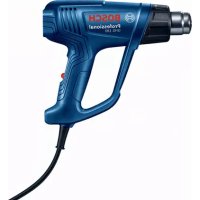
GHG 180 Professional - Heat gun BOSCH - Free user manual and instructions
Find the device manual for free GHG 180 Professional BOSCH in PDF.


| Product type | Heat gun (heat stripper) |
| Brand | Bosch |
| Model | GHG 180 Professional |
| Rated power input | 1800 W (230 V model) / 1500 W (127 V model) |
| Mains voltage | 230 V or 127 V depending on version |
| Temperature at nozzle outlet | 60 / 350 / 550 °C (230 V model) / 50 / 350 / 525 °C (127 V model) |
| Air flow rate | 350 / 350 / 550 l/min (depending on position) |
| Weight | 0.65 kg (according to EPTA-Procedure 01:2014) |
| Protection class | /II (double insulation) |
| Sound pressure level | Less than 70 dB(A) |
| Vibrations | a_n < 2.5 m/s², uncertainty K = 1.5 m/s² |
| Main functions | Plastic welding, forming, paint/varnish removal, heating shrink tubes, soldering, tinning, loosening, pipe thawing |
| Temperature positions | 3 positions: 60/350/550 °C (230 V) with corresponding air flow |
| Thermal safety cut-out | Yes, cuts off heating in case of overheating, fan continues |
| Included nozzle | Standard nozzle (3) |
| Compatible accessories | Glass protection nozzle, reduction nozzle (optional accessories) |
| Maintenance and cleaning | Disconnect before cleaning; clean ventilation slots; cable replacement by authorized service center |
| Safety | Safety goggles, protective gloves; do not direct at people/animals; do not use as hair dryer; do not leave unattended |
| Spare parts and repairability | Repair by qualified technician using original parts; exploded view at www.bosch-pt.com |
| General information | Hand-held use under supervision; not suitable for children or untrained persons |
Frequently Asked Questions - GHG 180 Professional BOSCH
User questions about GHG 180 Professional BOSCH
0 question about this device. Answer the ones you know or ask your own.
Ask a new question about this device
Download the instructions for your Heat gun in PDF format for free! Find your manual GHG 180 Professional - BOSCH and take your electronic device back in hand. On this page are published all the documents necessary for the use of your device. GHG 180 Professional by BOSCH.
USER MANUAL GHG 180 Professional BOSCH
GHG 180 Professional
Robert Bosch Power Tools GmbH
70538 Stuttgart
GERMANY
www.bosch-pt.com
1609 92A 4FD (2021.03) T / 39

1 609 92A 4FD
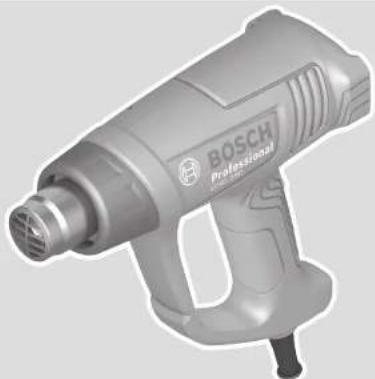
natural_image
Exterior view of a Bosch professional electric heater (no text or symbols visible on body)en Original instructions
fr Notice originale
pt Manual original
zh 正本使用说明书
zh原始使用說明書
English ...... Page 5
Français ...... Page 8
natural_image
Diagram showing two 3D objects with internal structures, one labeled (2) and the other marked '0', no readable text or symbols present.GHG 180
4
English
Safety instructions

Read all the safety information and instructions. Failure to observe the safety information and follow instructions may result in electric shock, fire and/or serious injury.
Save all warnings and instructions for future reference.
This heat gun is not intended for use by children or persons with physical, sensory or mental limitations or a lack of experience or knowledge. This heat gun can be used by children aged 8 or older and by persons who have physical, sensory or mental limitations or a lack of experience or knowledge if a person responsible for their safety supervises them or has instructed them in the safe operation of the heat gun and they understand the associated dangers.
Otherwise there is a risk of operating errors and injury.
▶ Supervise children during use, cleaning and maintenance. This will ensure that children do not play with the heat gun.
▶ Handle the power tool with care.
The power tool produces intense heat which increases the risk of fire and explosion.
▶ Take particular care when working in the vicinity of flammable materials. The hot airflow or hot nozzle may ignite dust or gases.
▶ Do not work with the power tool in potentially explosive areas.
▶ Do not aim the hot airflow at the same area for prolonged periods. Working with plastic, paint, varnish or similar materials may produce easily flammable gases.
▶ Please be aware that heat is directed to covered flammable materials, which may ignite.
▶ Safely place the power tool on the storage surfaces after use and let it cool completely before packing it away. The hot nozzle can cause damage.
▶ Do not leave the switched-on power tool unattended.
▶ Store idle power tools out of the reach of children. Do not allow persons unfamiliar with the power tool or these instructions to operate the power tool. Power tools are dangerous in the hands of untrained users.
▶ Do not expose the power tool to rain or wet conditions. Water entering a power tool will increase the risk of electric shock.
▶ Do not misuse the cable, for example by using it to carry, hang up or unplug the power tool. Keep the cable away from heat and oil. Damaged or entangled cords increase the risk of electric shock.
▶ Always wear safety goggles. Safety goggles reduce the risk of injury.
▶ Pull the plug out of the socket before adjusting the tool settings, changing accessories, or storing the power tool. Such preventive safety measures reduce the risk of starting the power tool accidentally.
▶ Always check the power tool, cable and plug before use. Stop using the power tool if you discover any damage. Do not open the power tool yourself, and have it repaired only by a qualified specialist using only original replacement parts. Damaged power tools, cables and plugs increase the risk of electric shock.
Keep your work area well-ventilated. The gas and steam produced during work are often harmful to one's health.
▶ Wear protective gloves and do not touch the nozzle while it is hot. There is a risk of burns.
▶ Do not direct the airflow at persons or animals.
▶ Do not use the power tool as a hair dryer. The outgoing airflow is considerably hotter than that that of a hair dryer.
▶ Do not allow foreign objects to enter the power tool.
The distance between the nozzle and the workpiece depends on the material you are working on (metal, plastic, etc.) and the intended working method. Always test the amount of air and temperature first.
If operating the power tool in a damp location is unavoidable, use a residual current device (RCD) protected supply. Use of an RCD reduces the risk of electric shock.
▶ Never use the power tool if the cable is damaged. Do not touch the damaged cable and pull out the mains plug if the cable is damaged while working. Damaged cables increase the risk of an electric shock.
Products sold in GB only:
Your product is fitted with an BS 1363/A approved electric plug with internal fuse (ASTA approved to BS 1362).
6 | English
If the plug is not suitable for your socket outlets, it should be cut off and an appropriate plug fitted in its place by an authorised customer service agent. The replacement plug should have the same fuse rating as the original plug. The severed plug must be disposed of to avoid a possible shock hazard and should never be inserted into a mains socket elsewhere.
Product Description and Specifications
Please observe the illustrations at the beginning of this operating manual.
Intended Use
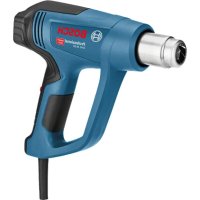
The power tool is intended for bending and welding plastic, stripping coats of paint and heating shrink tubing. It is also suitable for soldering and tinning, melting adhesive bonding and thawing water pipes.
The power tool is intended to be operated by hand, under supervision.
Product Features
The numbering of the product features refers to the diagram of the power tool on the graphics page.
(1) Storage surface
(2) On/off switch and power settings
(3) Nozzle
(4) Heat shield
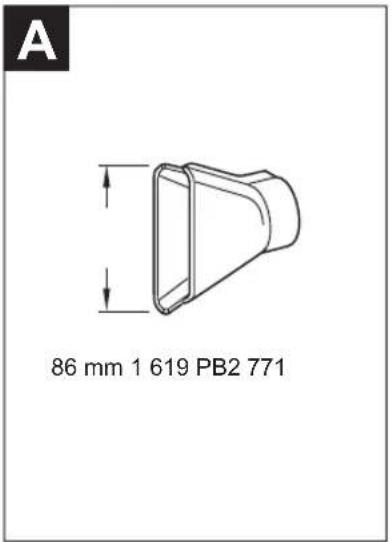
(5) Glass protection nozzle a)
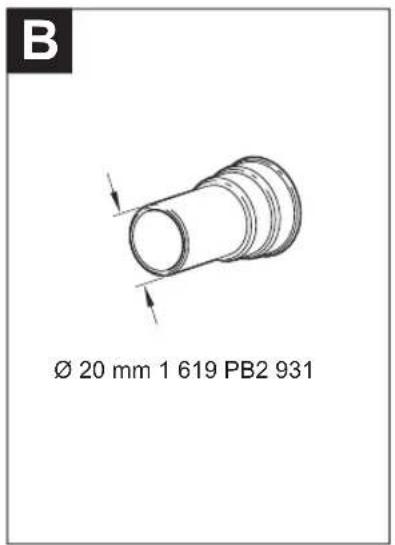
(6) Reducing nozzle ^a)
a) Accessories shown or described are not included with the product as standard. You can find the complete selection of accessories in our accessories range.
Technical Data
Heat gun GHG 180 GHG 180
| Article number | 3 601 J4D 0.. 3 601 J4D 0.. | ||
| Voltage V 127 230 | |||
| Rated power input W 1500 1800 | |||
| Airflow l/min 350/350/550 350/350/550 | |||
| Temperature at the nozzle outlet ^A) | °C 50/350/525 60/350/550 | ||
| Temperature measurement accuracy ±15 % ±15 % | |||
| Weight according to EPTA-Procedure 01:2014 kg 0.65 0.65 | |||
| Protection class | ☐/II | /II | ☐ |
A) At an ambient temperature of approx. 20 °C
The specifications apply to a rated voltage [U] of 230 V. These specifications may vary at different voltages and in country-specific models.
Noise/vibration information
Typically, the A-weighted sound pressure level of the power tool is less than 70 dB(A).
Total vibration values a_h (triax vector sum) and uncertainty K: a_h < 2.5 m/s^2, K = 1.5 m/s^2 .
Operation
Starting operation
▶ Pay attention to the mains voltage. The voltage of the power source must match the voltage specified on the rating plate of the power tool.
Creation of Smoke During Initial Use
A coating protects the metal surfaces from corrosion ex- works. This protective layer evaporates during initial use.
Switching On
Slide the on/off switch (2) upwards.
Thermal protection shutdown: If the power tool overheats (e.g. due to a build-up of air or too little air supply), the heating system will automatically switch off, though the blower
will continue to run. Once the power tool has cooled back down to its operating temperature, the heating system will automatically switch on again.
Switching Off
Slide the on/off switch (2) downwards into the 0 position.
▶ After working at high temperatures for a prolonged period, let the power tool cool down before switching it off. To do this, allow it to run on the lowest temperature setting for a short while.
Selecting a Power Setting
You can choose between different power settings using the on/off switch (2):
| Power setting | °C | l/min |
| I | 60 | 350 |
| II | 350 | 350 |
| III | 550 | 550 |
The I power setting is suitable for cooling down a heated workpiece or for drying paint. It is also suitable for cooling down the power tool before putting it down or changing the attachment nozzles.
Practical advice
▶ Pull the plug out of the socket before carrying out any work on the power tool.
Note: Do not position the nozzle (3) too close to the workpiece that you are using the power tool on. The resulting build-up of air can cause the power tool to overheat.
Setting down the power tool
Set the power tool down on the storage surfaces (1) to leave it to cool down or to keep both hands free to work with.
▶ Take particular care when working in the vicinity of the power tool while it has been set aside. The heat from the nozzle or the air flow can cause burns.
Position the power tool on an even, stable surface. Ensure that it cannot tip over. Secure the cable outside of your working area so that it cannot pull the power tool down or cause it to flip over.
Switch the power tool off when not in use for a long period and pull the mains plug out of the socket.
Example applications (see figures A-B)
Images of example applications can be found on the graphics pages.
The distance between the nozzle and the workpiece depends on the material you are working on (metal, plastic etc.) and the intended working method.
The optimum temperature for each application can be determined by a practical test.
Always test the amount of air and temperature first. Start at a greater distance and a lower power setting. Then adjust the distance and power setting according to requirements. If you are unsure what material you are working on or what effect the hot air might have on it, first test the effect on a concealed area.
All example applications apart from "Stripping paint from window frames" can be carried out without the use of accessories. However, using the recommended accessories will simplify the work and considerably increase the quality of the result.
The nozzles, which are available as accessories, are compatible with all models of Bosch heat guns.
▶ Take care when changing the nozzle. Do not touch the nozzle while it is hot. Leave the power tool to cool down before changing the nozzle, and wear protective gloves when doing so. The heat from the nozzle can cause burns.
To make the power tool cool down quicker, you can also let it run briefly on its lowest temperature setting.
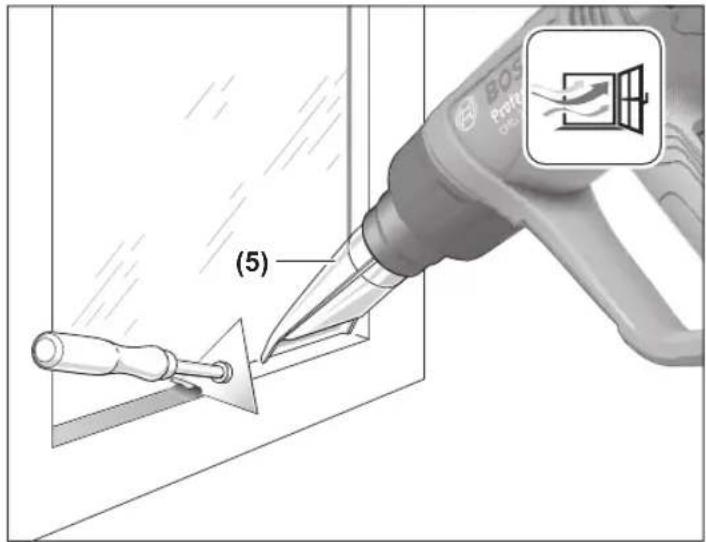
Stripping paint from window frames (see figure A)
The glass protection nozzle (5) (accessory) must be used for this application. There is a risk that the glass may break.
You can remove the paint from profiled surfaces with a suitable spatula and brush it off with a soft wire brush.
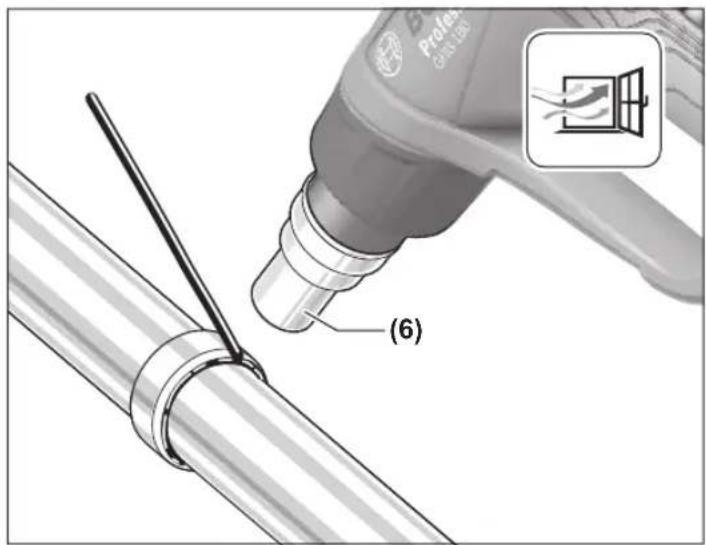
Soft Soldering (see figure B)
Fit the reducing nozzle (6) (accessories).
If you are using solder without flux, apply soldering grease or paste to the solder joint. Depending on the material, heat the solder joint for approx. 50 to 120 seconds. Apply the solder.
The solder must be melted by the temperature of the workpiece.
If necessary, remove the flux after the solder joint has cooled down.
Maintenance and Service
Maintenance and Cleaning
▶ Pull the plug out of the socket before carrying out any work on the power tool.
▶ To ensure safe and efficient operation, always keep the power tool and the ventilation slots clean.
In order to avoid safety hazards, if the power supply cord needs to be replaced, this must be done by Bosch or by an after-sales service centre that is authorised to repair Bosch power tools.
After-Sales Service and Application Service
Our after-sales service responds to your questions concerning maintenance and repair of your product as well as spare parts. You can find explosion drawings and information on spare parts at: www.bosch-pt.com
The Bosch product use advice team will be happy to help you with any questions about our products and their accessories.
In all correspondence and spare parts orders, please always include the 10-digit article number given on the nameplate of the product.
Malaysia
Robert Bosch Sdn. Bhd.(220975-V) PT/SMY
No. 8A, Jalan 13/6
46200 Petaling Jaya
Selangor
Tel.: (03) 79663194
Toll-Free: 1800 880188
Fax: (03) 79583838
E-Mail: kiathoe.chong@my.bosch.com
www.bosch-pt.com.my
You can find further service addresses at:
www.bosch-pt.com/serviceaddresses
Disposal
The power tool, accessories and packaging should be recycled in an environmentally friendly manner.

Do not dispose of power tools along with household waste.
Français
Robert Bosch Morocco SARL
53, Rue Lieutenant Mahroud Mohamed
20300 Casablanca
Tel.: +212 5 29 31 43 27
E-Mail : sav.outillage@ma.bosch.com
www.bosch-pt.com/serviceaddresses
www.bosch-pt.com/serviceaddresses
Eliminação
www.bosch-pt.com/serviceaddresses
处理废弃物
www.bosch-pt.com/serviceaddresses
廢棄物處理
www.bosch-pt.com/serviceaddresses
การกำจัดขยะ
Heat gun GHG 180 GHG 180
| Keakuratan pengukuran suhu ±15 % ±15 % | |||
| Berat sesuai dengan EPTA-Procedure 01:2014 kg 0,65 0,65 | |||
| Klasifikasi keamanan | ☐/II | /II | ☐ |
Palma Tower 10th Floor
Jalan RA Kartini II-S Kaveling 6
Pondok Pinang, Kebayoran Lama
www.bosch-pt.com/serviceaddresses
Cara membuang
www.bosch-pt.com/serviceaddresses
Sự thải bổ
Robert Bosch Morocco SARL
www.bosch-pt.com/serviceaddresses
的可能性درجة
www.bosch-pt.com/serviceaddresses

- GHG 180 Professional
- English
- Safety instructions
- Products sold in GB only:
- | English
- Product Description and Specifications
- Intended Use
- Product Features
- Technical Data
- Noise/vibration information
- Operation
- Starting operation
- Creation of Smoke During Initial Use
- Switching On
- Switching Off
- Selecting a Power Setting
- Practical advice
- Setting down the power tool
- Example applications (see figures A-B)
- Stripping paint from window frames (see figure A)
- Soft Soldering (see figure B)
- Maintenance and Service
- Maintenance and Cleaning
- After-Sales Service and Application Service
- Malaysia
- You can find further service addresses at:
- Disposal
- Français
- Eliminação
- 处理废弃物
- 廢棄物處理
- การกำจัดขยะ
- Cara membuang
- Sự thải bổ
- 的可能性درجة
Brand : BOSCH
Model : GHG 180 Professional
Category : Heat gun