ManualGo.com
GKS 10.8 VLI - Scie BOSCH - Free user manual and instructions
Find the device manual for free GKS 10.8 VLI BOSCH in PDF.
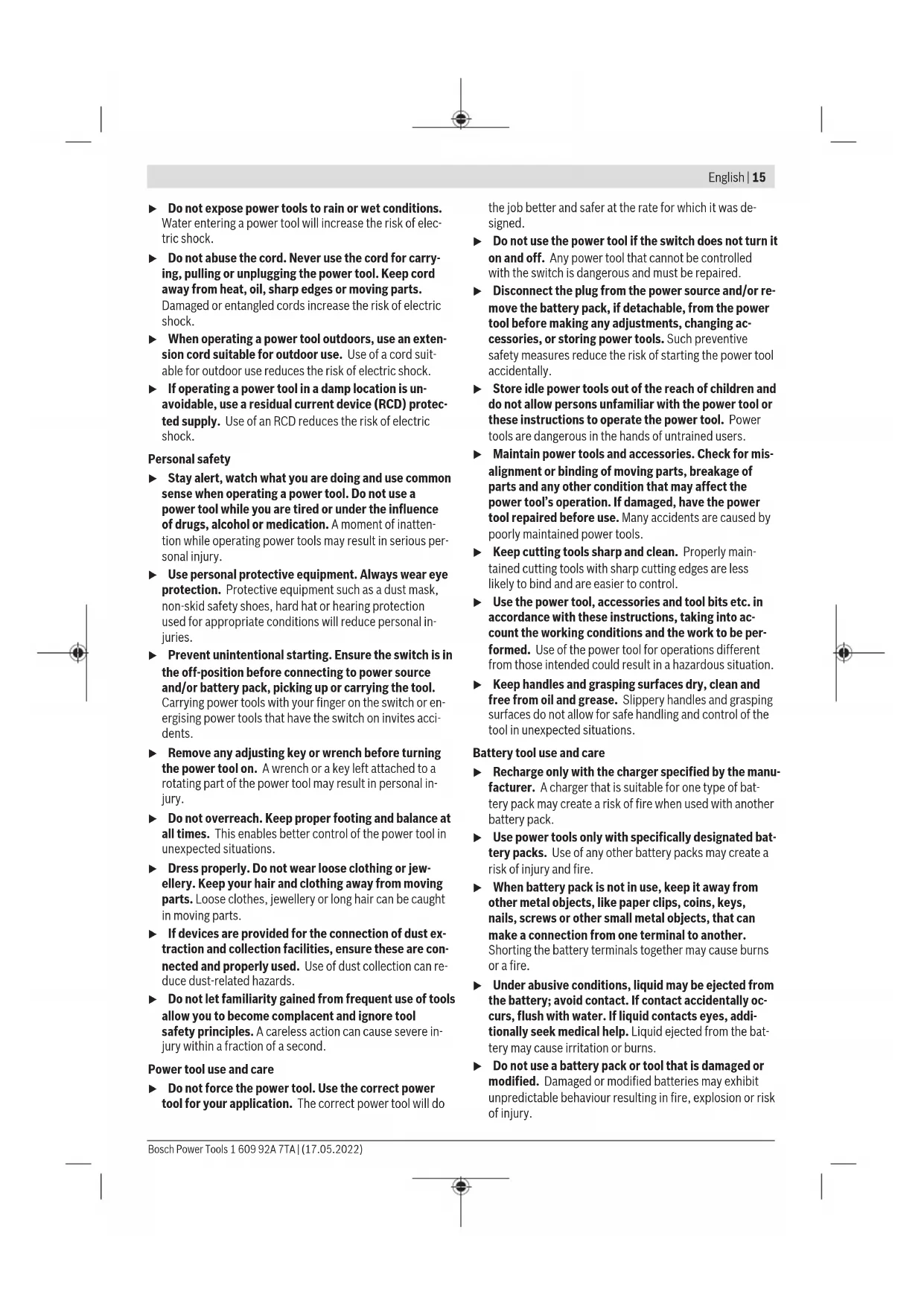


Download the instructions for your Scie in PDF format for free! Find your manual GKS 10.8 VLI - BOSCH and take your electronic device back in hand. On this page are published all the documents necessary for the use of your device. GKS 10.8 VLI by BOSCH.
USER MANUAL GKS 10.8 VLI BOSCH
www.bosch-pt.com/serviceaddresses
General Power Tool Safety Warnings
WARNING Read all safety warnings, instruc-
tions, illustrations and specifica-
tions provided with this power tool. Failure to follow all in-
structions listed below may result in electric shock, fire and/
Save all warnings and instructions for future reference.
The term "power tool" in the warnings refers to your mains-
operated (corded) power tool or battery-operated (cord-
Work area safety u Keep work area clean and well lit. Cluttered or dark areas invite accidents. u Do not operate power tools in explosive atmospheres, such as in the presence of flammable liquids, gases or
dust. Power tools create sparks which may ignite the dust
or fumes. u Keep children and bystanders away while operating a power tool. Distractions can cause you to lose control.
Electrical safety u Power tool plugs must match the outlet. Never modify the plug in any way. Do not use any adapter plugs with
earthed (grounded) power tools. Unmodified plugs and
matching outlets will reduce risk of electric shock. u Avoid body contact with earthed or grounded sur- faces, such as pipes, radiators, ranges and refrigerat-
ors. There is an increased risk of electric shock if your
body is earthed or grounded. 1 609 92A 7TA | (17.05.2022) Bosch Power ToolsEnglish | 15
u Do not expose power tools to rain or wet conditions.
Water entering a power tool will increase the risk of elec-
u Do not abuse the cord. Never use the cord for carry-
ing, pulling or unplugging the power tool. Keep cord
away from heat, oil, sharp edges or moving parts.
Damaged or entangled cords increase the risk of electric
u When operating a power tool outdoors, use an exten-
sion cord suitable for outdoor use. Use of a cord suit-
able for outdoor use reduces the risk of electric shock.
u If operating a power tool in a damp location is un-
avoidable, use a residual current device (RCD) protec-
ted supply. Use of an RCD reduces the risk of electric
u Stay alert, watch what you are doing and use common
sense when operating a power tool. Do not use a
power tool while you are tired or under the influence
of drugs, alcohol or medication. A moment of inatten-
tion while operating power tools may result in serious per-
u Use personal protective equipment. Always wear eye
protection. Protective equipment such as a dust mask,
non-skid safety shoes, hard hat or hearing protection
used for appropriate conditions will reduce personal in-
u Prevent unintentional starting. Ensure the switch is in
the off-position before connecting to power source
and/or battery pack, picking up or carrying the tool.
Carrying power tools with your finger on the switch or en-
ergising power tools that have the switch on invites acci-
u Remove any adjusting key or wrench before turning
the power tool on. A wrench or a key left attached to a
rotating part of the power tool may result in personal in-
u Do not overreach. Keep proper footing and balance at
all times. This enables better control of the power tool in
unexpected situations.
u Dress properly. Do not wear loose clothing or jew-
ellery. Keep your hair and clothing away from moving
parts. Loose clothes, jewellery or long hair can be caught
u If devices are provided for the connection of dust ex-
traction and collection facilities, ensure these are con-
nected and properly used. Use of dust collection can re-
duce dust-related hazards.
u Do not let familiarity gained from frequent use of tools
allow you to become complacent and ignore tool
safety principles. A careless action can cause severe in-
jury within a fraction of a second.
Power tool use and care
u Do not force the power tool. Use the correct power
tool for your application. The correct power tool will do
the job better and safer at the rate for which it was de-
u Do not use the power tool if the switch does not turn it
on and off. Any power tool that cannot be controlled
with the switch is dangerous and must be repaired.
u Disconnect the plug from the power source and/or re-
move the battery pack, if detachable, from the power
tool before making any adjustments, changing ac-
cessories, or storing power tools. Such preventive
safety measures reduce the risk of starting the power tool
u Store idle power tools out of the reach of children and
do not allow persons unfamiliar with the power tool or
these instructions to operate the power tool. Power
tools are dangerous in the hands of untrained users.
u Maintain power tools and accessories. Check for mis-
alignment or binding of moving parts, breakage of
parts and any other condition that may affect the
power tool’s operation. If damaged, have the power
tool repaired before use. Many accidents are caused by
poorly maintained power tools.
u Keep cutting tools sharp and clean. Properly main-
tained cutting tools with sharp cutting edges are less
likely to bind and are easier to control.
u Use the power tool, accessories and tool bits etc. in
accordance with these instructions, taking into ac-
count the working conditions and the work to be per-
formed. Use of the power tool for operations different
from those intended could result in a hazardous situation.
u Keep handles and grasping surfaces dry, clean and
free from oil and grease. Slippery handles and grasping
surfaces do not allow for safe handling and control of the
tool in unexpected situations.
Battery tool use and care
u Recharge only with the charger specified by the manu-
facturer. A charger that is suitable for one type of bat-
tery pack may create a risk of fire when used with another
u Use power tools only with specifically designated bat-
tery packs. Use of any other battery packs may create a
risk of injury and fire.
u When battery pack is not in use, keep it away from
other metal objects, like paper clips, coins, keys,
nails, screws or other small metal objects, that can
make a connection from one terminal to another.
Shorting the battery terminals together may cause burns
u Under abusive conditions, liquid may be ejected from
the battery; avoid contact. If contact accidentally oc-
curs, flush with water. If liquid contacts eyes, addi-
tionally seek medical help. Liquid ejected from the bat-
tery may cause irritation or burns.
u Do not use a battery pack or tool that is damaged or
modified. Damaged or modified batteries may exhibit
unpredictable behaviour resulting in fire, explosion or risk
Bosch Power Tools 1 609 92A 7TA | (17.05.2022)16 | English
u Do not expose a battery pack or tool to fire or excess-
ive temperature. Exposure to fire or temperature above
130°C may cause explosion.
u Follow all charging instructions and do not charge the
battery pack or tool outside the temperature range
specified in the instructions. Charging improperly or at
temperatures outside the specified range may damage
the battery and increase the risk of fire.
u Have your power tool serviced by a qualified repair
person using only identical replacement parts. This
will ensure that the safety of the power tool is maintained.
u Never service damaged battery packs. Service of bat-
tery packs should only be performed by the manufacturer
or authorized service providers.
Safety instructions for circular saws
u DANGER: Keep hands away from cutting area and
the blade. If both hands are holding the saw, they cannot
be cut by the blade.
u Do not reach underneath the workpiece. The guard
cannot protect you from the blade below the workpiece.
u Adjust the cutting depth to the thickness of the work-
piece. Less than a full tooth of the blade teeth should be
visible below the workpiece.
u Never hold the workpiece in your hands or across your
leg while cutting. Secure the workpiece to a stable
platform. It is important to support the work properly to
minimise body exposure, blade binding, or loss of con-
u Hold the power tool by insulated gripping surfaces,
when performing an operation where the cutting tool
may contact hidden wiring. Contact with a "live" wire
will also make exposed metal parts of the power tool "live"
and could give the operator an electric shock.
u When ripping always use a rip fence or straight edge
guide. This improves the accuracy of cut and reduces the
chance of blade binding.
u Always use blades with correct size and shape (dia-
mond versus round) of arbour holes. Blades that do not
match the mounting hardware of the saw will run off-
centre, causing loss of control.
u Never use damaged or incorrect blade washers or
bolt. The blade washers and bolt were specially designed
for your saw, for optimum performance and safety of op-
Kickback causes and related warnings
- kickback is a sudden reaction to a pinched, jammed or mis-
aligned saw blade, causing an uncontrolled saw to lift up and
out of the workpiece toward the operator;
- when the blade is pinched or jammed tightly by the kerf
closing down, the blade stalls and the motor reaction drives
the unit rapidly back toward the operator;
- if the blade becomes twisted or misaligned in the cut, the
teeth at the back edge of the blade can dig into the top sur-
face of the wood causing the blade to climb out of the kerf
and jump back toward the operator.
Kickback is the result of saw misuse and/or incorrect operat-
ing procedures or conditions and can be avoided by taking
proper precautions as given below.
u Maintain a firm grip on the saw and position your arms
to resist kickback forces. Position your body to either
side of the blade, but not in line with the blade. Kick-
back could cause the saw to jump backwards, but kick-
back forces can be controlled by the operator, if proper
precautions are taken.
u When blade is binding, or when interrupting a cut for
any reason, release the trigger and hold the saw mo-
tionless in the material until the blade comes to a com-
plete stop. Never attempt to remove the saw from the
work or pull the saw backward while the blade is in
motion or kickback may occur. Investigate and take cor-
rective actions to eliminate the cause of blade binding.
u When restarting a saw in the workpiece, centre the
saw blade in the kerf so that the saw teeth are not en-
gaged into the material. If a saw blade binds, it may walk
up or kickback from the workpiece as the saw is restar-
u Support large panels to minimise the risk of blade
pinching and kickback. Large panels tend to sag under
their own weight. Supports must be placed under the
panel on both sides, near the line of cut and near the edge
u Do not use dull or damaged blades. Unsharpened or im-
properly set blades produce narrow kerf causing excess-
ive friction, blade binding and kickback.
u Blade depth and bevel adjusting locking levers must
be tight and secure before making the cut. If blade ad-
justment shifts while cutting, it may cause binding and
u Use extra caution when sawing into existing walls or
other blind areas. The protruding blade may cut objects
that can cause kickback.
Lower guard function
u Check the lower guard for proper closing before each
use. Do not operate the saw if the lower guard does
not move freely and close instantly. Never clamp or tie
the lower guard into the open position.If the saw is ac-
cidentally dropped, the lower guard may be bent. Raise
the lower guard with the retracting handle and make sure
it moves freely and does not touch the blade or any other
part, in all angles and depths of cut.
u Check the operation of the lower guard spring. If the
guard and the spring are not operating properly, they
must be serviced before use. Lower guard may operate
sluggishly due to damaged parts, gummy deposits, or a
u The lower guard may be retracted manually only for
special cuts such as "plunge cuts" and "compound
1 609 92A 7TA | (17.05.2022) Bosch Power ToolsEnglish | 17
cuts”. Raise the lower guard by the retracting handle
and as soon as the blade enters the material, the lower
guard must be released.For all other sawing, the lower
guard should operate automatically.
u Always observe that the lower guard is covering the
blade before placing the saw down on bench or
floor.An unprotected, coasting blade will cause the saw
to walk backwards, cutting whatever is in its path. Be
aware of the time it takes for the blade to stop after
Additional safety warnings
u Do not allow the chip ejector to come into contact with
your hands. You may be injured by rotating parts.
u Do not use the saw above the level of your head. Doing
so will mean you have inadequate control of the power
u Use suitable detectors to determine if there are hid-
den supply lines or contact the local utility company
for assistance. Contact with electric cables can cause
fire and electric shock. Damaging gas lines can lead to ex-
plosion. Breaking water pipes causes property damage.
u Do not operate the power tool when stationary . It is
not suitable for operation with a saw table.
u When performing plunge cuts which are not right-
angled, secure the guide plate of the saw so that it will
not shift sideways.In the event of a sideways shift, the
saw blade may become jammed, which could lead to kick-
u Do not use HSS saw blades. Such saw blades can easily
u Do not saw any ferrous metals. Hot chips may ignite the
u In case of damage and improper use of the battery, va-
pours may be emitted. Ensure the area is well-ventilated
and seek medical attention should you experience any ad-
verse effects. The vapours may irritate the respiratory
u Do not open the battery. There is a risk of short-circuit-
u The battery can be damaged by pointed objects such
as nails or screwdrivers or by force applied externally.
An internal short circuit may occur, causing the battery to
burn, smoke, explode or overheat.
u Only use the battery with products from the manufac-
turer. This is the only way in which you can protect the
battery against dangerous overload.
Protect the battery against heat, e.g.
against continuous intense sunlight, fire,
water and moisture. There is a risk of explo-
u Always wait until the power tool has come to a com-
plete stop before placing it down. The application tool
can jam and cause you to lose control of the power tool.
Product Description and
Read all the safety and general instructions.
Failure to observe the safety and general in-
structions may result in electric shock, fire
and/or serious injury.
Please observe the illustrations at the beginning of this oper-
The power tool is intended for making straight cuts in wood
with and against the grain and mitre cuts in wood while rest-
ing firmly against the workpiece.
The numbering of the product features refers to the diagram
of the power tool on the graphics page.
Battery release button
Lock-off button for on/off switch
Fastening screw for parallel guide
Scale for mitre/bevel angles
Wing bolt for mitre/bevel angle preselection
Handle (insulated gripping surface)
Battery charge indicator
Wing bolt for preselecting the cutting depth
Adjusting lever for retracting blade guard
Retracting blade guard
Fastening screw for dust extraction adapter
Dust extraction adapter
Dust extraction hose
Reference mark for cutting depth setting
Bosch Power Tools 1 609 92A 7TA | (17.05.2022)18 | English
Parallel guide/guide rail adapter
Pair of screw clamps
Accessories shown or described are not included with the
product as standard. You can find the complete selection of
accessories in our accessories range.
Hand-held circular saw GKS 12V-26
No-load speed rpm 1400
Base plate dimensions mm 167 x 88
Max. saw blade diameter mm 85
Min. saw blade diameter mm 85
Max. base blade thickness mm 0.7
Max. tooth thickness/offset mm 1.1
Min. tooth thickness/offset mm 1.0
– during charging °C 0 to +45
Recommended chargers GAL 12..
A) Depends on battery in use
B) Limited performance at temperatures <0°C Noise/Vibration Information
Noise emission values determined according
Typically, the A-weighted noise level of the power tool is:
(triax vector sum) and uncertainty K
determined according toEN62841-2-5:
The vibration level and noise emission value given in these
instructions have been measured in accordance with a
standardised measuring procedure and may be used to com-
pare power tools. They may also be used for a preliminary
estimation of vibration and noise emissions.
The stated vibration level and noise emission value repres-
ent the main applications of the power tool. However, if the
power tool is used for other applications, with different ap-
plication tools or is poorly maintained, the vibration level
and noise emission value may differ. This may significantly
increase the vibration and noise emissions over the total
To estimate vibration and noise emissions accurately, the
times when the tool is switched off or when it is running but
not actually being used should also be taken into account.
This may significantly reduce vibration and noise emissions
over the total working period.
Implement additional safety measures to protect the oper-
ator from the effects of vibration, such as servicing the
power tool and application tools, keeping their hands warm,
and organising workflows correctly.
Fitting u Only use saw blades the maximum permitted speed of which is higher than the no-load speed of the power
Battery Charging u Use only the chargers listed on the accessories page. Only these chargers are matched to the lithium-ion bat-
tery of your power tool.
Note: The battery is supplied partially charged. To ensure
full battery capacity, fully charge the battery in the charger
before using your power tool for the first time.
The lithium-ion battery can be charged at any time without
reducing its service life. Interrupting the charging process
does not damage the battery.
The lithium-ion battery is protected against deep discharge
by the "Electronic Cell Protection (ECP)". When the battery
is discharged, the power tool is switched off by means of a
protective circuit: The application tool no longer rotates. u Do not continue to press the On/Off switch after the power tool has automatically switched off. The battery
Follow the instructions on correct disposal.
Removing the battery
The battery (1) is equipped with two locking levels to pre-
vent the battery from falling out if the battery release button
(2) is pressed unintentionally. As long as the battery is inser-
ted in the power tool, it is held in position by means of a
To remove the battery (1), press the release button (2) and
pull the battery to the rear and out of the power tool. Do not
use force to do this.
Battery Charge Indicator
The three green LEDs of the battery charge indicator (15) in-
dicate the state of charge of the battery (1). For safety reas-
1 609 92A 7TA | (17.05.2022) Bosch Power ToolsEnglish | 19
ons, it is only possible to check the state of charge when the
power tool is at a standstill.
Press the on/off switch (4) halfway or completely to display
the state of charge.
Continuous lighting 3 x green ≥ 2/3
Continuous lighting 2 x green ≥ 1/3
Continuous lighting 1 x green < 1/3
Flashing light 1 x green Reserve
If no LED lights up after pressing the on/off switch (4), then
the battery is defective and must be replaced.
Inserting/changing the circular saw blade
u Remove the battery before carrying out any work on
u Wear protective gloves when fitting the saw blade.
Danger of injury when touching the saw blade.
u Only use saw blades that match the specifications
given in this operating manual and that are tested and
marked in accordance with EN 847-1
u The permitted speed of the application tool must be at
least equal to the maximum speed marked on the
power tool. If accessories run faster than their rated
speed, they may break and fly off.
u Do not use abrasive wheels as the application tool un-
der any circumstances.
Selecting the saw blade
You will find an overview of recommended saw blades at the
end of these operating instructions.
Removing the saw blade (see figure A)
To change tools, we recommend that you place the power
tool down on the front side of the motor housing.
– Press and hold the spindle lock button (6).
u Do not press the spindle lock button (6) while the saw
spindle is moving. The power tool may become damaged
– Use the hex key (5) to undo the clamping bolt (25) in ro-
tational direction ➊.
– Swing the retracting blade guard (21) back and hold on
– Remove the clamping flange (24) and the saw blade (23)
from the saw spindle (20).
Fitting the saw blade (see figure A)
To change tools, we recommend that you place the power
tool down on the front side of the motor housing.
– Clean the saw blade (23) and all the clamping elements
– Swing the retracting blade guard (21) back and hold on
– Place the saw blade (23) on the mounting flange (22).
The cutting direction of the teeth (direction of the arrow
on the saw blade) must match the rotational direction of
the arrow on the protective guard (21).
– Attach the clamping flange (24) and screw in the clamp-
ing bolt (25) in rotational direction ➋. Ensure that the
mounting flange (22) and clamping flange (24) are in-
stalled in the correct position.
– Press and hold the spindle lock button (6).
– Use the hex key (5) to tighten the clamping bolt (25) in
rotational direction ➋. The tightening torque should be
6–9Nm, which corresponds to hand-tight plus ¼ turn.
Dust/chip extraction
The dust from materials such as lead paint, certain types of
wood, minerals and metal can be harmful to human health.
Touching or breathing in this dust can trigger allergic reac-
tions and/or cause respiratory illnesses in the user or in
people in the near vicinity.
Certain dusts, such as oak or beech dust, are classified as
carcinogenic, especially in conjunction with wood treatment
additives (chromate, wood preservative). Materials contain-
ing asbestos may only be machined by specialists.
– To achieve a high level of dust extraction, use a suitable
dust extractor together with this power tool.
– Provide good ventilation at the workplace.
– It is advisable to wear a P2 filter class breathing mask.
The regulations on the material being machined that apply in
the country of use must be observed.
u Avoid dust accumulation at the workplace. Dust can
Fitting the dust extraction adapter (see figure B)
Fasten the dust extraction adapter (29) to the base plate (7)
using the fastening screw (28).
A dust extraction hose with a diameter of 19mm can be con-
nected to the dust extraction adapter (29).
u The dust extraction adapter must only be fitted if an
external dust extraction system is connected. Other-
wise the extraction duct can become clogged.
u No dust bags should be connected to the dust extrac-
tion adapter. Otherwise the extraction system can be-
(29) must be cleaned regularly.
External dust extraction
Connect the dust extraction hose (30) to a dust extractor
(accessory). You will find an overview of how to connect to
various dust extractors at the end of these operating instruc-
The dust extractor must be suitable for the material being
When extracting dry dust that is especially detrimental to
health or carcinogenic, use a special dust extractor.
Bosch Power Tools 1 609 92A 7TA | (17.05.2022)20 | English
u Remove the battery before carrying out any work on
Setting the cutting depth (see figure C)
u Adapt the cutting depth to the thickness of the work-
piece. A space of less than the height of one full tooth
should be visible under the workpiece.
Loosen the wing bolt (17). For a smaller cutting depth, pull
the power tool away from the base plate (7); for a larger cut-
ting depth, push the power tool towards the base plate (7).
Set the required cutting depth on the scale (18). Retighten
When setting the cutting depth, use the reference mark (31)
to the side of the cutting depth scale (18).
Adjusting the mitre/bevel angle
We recommend that you place the power tool down on the
front side of the protective guard (13).
Loosen the wing bolt (10). Swivel the saw to the side. Set
the required mitre angle on the scale (9). Retighten the wing
Note: When making mitre cuts, the cutting depth is less than
the value shown on the cutting depth scale (18).
The 0° cut mark (12) indicates the position of the saw blade
when making a right-angled cut. The 45° cut mark (11) indic-
ates the position of the saw blade when making a 45° cut.
Inserting the battery
u Use only original Bosch lithium-ion batteries with the
voltage stated on the type plate of your power tool.
Using other batteries can lead to injuries and pose a fire
Slide the charged battery (1) into the foot of the power tool
from the front. Press the battery fully into the foot until the
red stripe is no longer visible and the battery is securely
To start the power tool, first press the lock-off switch (3),
then press and hold the on/off switch (4).
To switch off the power tool, release the on/off switch (4).
Note: For safety reasons, the on/off switch (4) cannot be
locked; it must remain pressed during the entire operation.
An integrated run-out brake shortens the time the saw blade
keeps running for after the power tool has been switched
Temperature monitoring/overload protection indicator
The red LED indicator (16) helps you to protect the battery
against overheating and the motor against overload.
If the LED indicator (16) is lit up permanently in red, the
temperature of the battery is too high and the power tool
switches off automatically.
– Switch the power tool off.
– Allow the battery to cool down before you carry on work-
If the LED indicator (16) is flashing red, then the power tool
is blocked and will switch off automatically.
Pull the power tool out of the workpiece.
The power tool will continue to work as soon as the blockage
Protection Against Deep Discharging
The lithium-ion battery is protected against deep discharge
by the Electronic Cell Protection (ECP). When the battery is
discharged, the power tool is switched off by means of a pro-
tective circuit: The application tool no longer rotates.
Switching on the LED worklight
The lamp (26) lights up when the on/off switch (4) is lightly
or fully pressed, meaning that the work area is illuminated in
poor lighting conditions.
Protect saw blades against shock and impact.
Guide the power tool evenly, pushing it gently in the cutting
direction. Applying too much pressure to the power tool
when moving it in the cutting direction significantly reduces
the service life of the application tools and can damage the
The sawing performance and the quality of the cut essen-
tially depend on the condition and the tooth shape of the
saw blade. This is why you should only use sharp saw blades
that are suitable for the material being machined.
Choosing the right saw blade depends on the wood type,
wood quality and whether cuts with or against the grain are
Making cuts in spruce with the grain produces long, spiral-
Beech and oak dust is especially detrimental to health.
Therefore, work only with dust extraction.
Sawing with a parallel guide (see figure D)
The parallel guide (32) allows you to make precise cuts
along the edge of a workpiece and cut strips with the same
Set the desired cutting width at the outer edge of the base
plate using the scale on the guides of the parallel guide/guide
Sawing with an auxiliary guide (see figure F)
For working on large workpieces or for cutting straight
edges, you can securely fasten a board or rail to the work-
1 609 92A 7TA | (17.05.2022) Bosch Power ToolsEnglish | 21
piece as an auxiliary guide. The circular saw can be guided
along the path of this auxiliary guide with the base plate.
Sawing with a guide rail (see figure E)
You can use the guide rail (34) to produce straight cuts.
Note: Only use the guide rail (34) for right-angled cuts. At-
tempting mitre/bevel cuts could damage the guide rail (34) .
The adhesive layer prevents the guide rail from slipping and
preserves the surface of the workpiece. The guide rail's coat-
ing allows the power tool to glide more easily.
Fasten the guide rail (34) to the workpiece using suitable
clamping devices, e.g. screw clamps. Put the power tool
with mounted guide rail adapter on the guide rail.
Note: Mount the parallel guide/guide rail adapter (32) on
the power tool with the Bosch logo facing down.
The guide rail (34) must not protrude over the edge of
the workpiece being sawn into.
Switch on the power tool and push it gently in the cutting dir-
ection, guiding it evenly.
Working with parallel guide/guide rail adapter and
First, mount the dust extraction adapter (29) with extraction
hose (30) and then the parallel guide/guide adapter (32).
Note: Use only the intended screws to fix the parallel guide/
guide adapter (32) and the dust extraction adapter (29).
Recommendations for Optimal Handling of the Battery
Protect the battery against moisture and water.
Only store the battery within a temperature range of −20 to
50°C. Do not leave the battery in your car in the summer, for
Occasionally clean the ventilation slots on the battery using a
soft brush that is clean and dry.
A significantly reduced operating time after charging indic-
ates that the battery has deteriorated and must be replaced.
Follow the instructions on correct disposal.
Maintenance and Service
Maintenance and Cleaning
u Remove the battery from the power tool before carry-
ing out work on the power tool (e.g. maintenance,
changing tool, etc.). The battery should also be re-
moved for transport and storage. There is risk of injury
from unintentionally pressing the on/off switch.
u To ensure safe and efficient operation, always keep
the power tool and the ventilation slots clean.
The retracting blade guard must always be able to move
freely and retract automatically. It is therefore important to
keep the area around the retracting blade guard clean at all
times. Remove dust and chips with a paintbrush.
Non-coated saw blades can be protected against corrosion
using a thin layer of acid-free oil. Remove the oil again before
sawing as failure to do so will stain the wood.
Resin or glue residue on the saw blade has a detrimental ef-
fect on the quality of the cut. You should therefore clean saw
blades straight after use.
After-Sales Service and Application Service
Our after-sales service responds to your questions concern-
ing maintenance and repair of your product as well as spare
parts. You can find explosion drawings and information on
spare parts at: www.bosch-pt.com
The Bosch product use advice team will be happy to help you
with any questions about our products and their accessor-
In all correspondence and spare parts orders, please always
include the 10‑digit article number given on the nameplate
Bosch Service Center
69, Habibullah Road, (Next to PSBB School), T. Nagar
Phone: (044) 64561816
Bosch Service Center
18, Community Center
Bosch Service Center
Shop no 7&8, Aspen garden
Walbhat road , Goregaon (E)
Near to Ram Mandir Railway Station
Robert Bosch Ltd. (B.S.C.)
UB 9 5HJ At www.bosch-pt.co.uk you can order spare parts or arrange
the collection of a product in need of servicing or repair.
Tel. Service: (0344) 7360109
Tel.: 080-955-0909 (Hotline)
You can find further service addresses at:
www.bosch-pt.com/serviceaddresses
The recommended lithium-ion batteries are subject to legis-
lation on the transport of dangerous goods. The user can
transport the batteries by road without further require-
When shipping by third parties (e.g.: by air transport or for-
warding agency), special requirements on packaging and la-
belling must be observed. For preparation of the item being
shipped, consulting an expert for hazardous material is re-
Dispatch battery packs only when the housing is undam-
aged. Tape or mask off open contacts and pack up the bat-
tery in such a manner that it cannot move around in the
packaging. Please also observe the possibility of more de-
tailed national regulations.
Power tools, rechargeable batteries, accessor-
ies and packaging should be sorted for environ-
mental-friendly recycling.
Do not dispose of power tools and batteries/re-
chargeable batteries into household waste!
Only for EU countries:
According to the Directive 2012/19/EU on waste electrical
and electronic equipment and its transposition into national
law, power tools that are no longer usable, and, according to
the Directive 2006/66/EC, defective or drained batteries
must be collected separately and disposed of in an environ-
mentally correct manner.
If disposed incorrectly, waste electrical and electronic
equipment may have harmful effects on the environment and
human health, due to the potential presence of hazardous
Only for United Kingdom:
According to Waste Electrical and Electronic Equipment Reg-
ulations 2013 (2013/3113) and the Waste Batteries and
Accumulators Regulations 2009 (2009/890), power tools
that are no longer usable must be collected separately and
disposed of in an environmentally friendly manner.
Battery packs/batteries:
Please observe the notes in the section on transport (see
Robert Bosch Morocco SARL
53, Rue Lieutenant Mahroud Mohamed
www.bosch-pt.com/serviceaddresses
www.bosch-pt.com/serviceaddresses
www.bosch-pt.com/serviceaddresses
www.bosch-pt.com/serviceaddresses
www.bosch-pt.com/serviceaddresses
Bosch Service Center
www.bosch-pt.com/serviceaddresses
Bosch Service Center
www.bosch-pt.com/serviceaddresses
www.bosch-pt.com/serviceaddresses
www.bosch-pt.com/serviceaddresses
www.bosch-pt.com/serviceaddresses
www.bosch-pt.com/serviceaddresses
Robert Bosch Sp. z o.o.
www.bosch-pt.com/serviceaddresses
www.bosch-pt.com/serviceaddresses
www.bosch-pt.com/serviceaddresses
www.bosch-pt.com/serviceaddresses
www.bosch-pt.com/serviceaddresses
www.bosch-pt.com/serviceaddresses
www.bosch-pt.com/serviceaddresses
Robert Bosch SRL Service scule electrice
www.bosch-pt.com/bg/bg/
Други сервизни адреси ще откриете на:
www.bosch-pt.com/serviceaddresses
www.bosch-pt.com/serviceaddresses
www.bosch-pt.com/serviceaddresses
www.bosch-pt.com/serviceaddresses
www.bosch-pt.com/serviceaddresses
www.bosch-pt.com/serviceaddresses
www.bosch-pt.com/serviceaddresses
www.bosch-pt.com/serviceaddresses
www.bosch-pt.com/serviceaddresses
EU Declaration of Conformity
We declare under our sole responsibility that the stated products comply
with all applicable provisions of the directives and regulations listed below
and are in conformity with the following standards.
Technical file at: *
Executive Vice President
Engineering and Manufacturing
Head of Product Certification