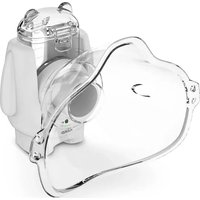
Atemo - Inhaler Neno - Free user manual and instructions
Find the device manual for free Atemo Neno in PDF.


| Product Type | Portable Ultrasonic Nebulizer |
| Brand | Neno |
| Model | Atemo |
| Dimensions (L x W x H) | 76 x 56 x 47 mm |
| Weight | 46 g |
| Power Supply | Lithium battery 3.7 V or USB-C (5 V / 1 A) |
| Reservoir Capacity | 8 ml (1 to 8 ml recommended) |
| Nebulization Rate | > 0.2 ml/min |
| Particle Size (MMAD) | < 5 µm |
| Ultrasonic Frequency | 110 ± 10 kHz |
| Battery Life | Approximately 1 hour of full charge |
| Auto Shut-off | Yes, after 20 minutes of operation |
| Cleaning Mode | Yes, 3 minutes of water rinsing |
| Indicator Lights | Green (operation/charging), orange (low battery), blue (low liquid) |
| Noise Level | ≤ 50 dB |
| Operating Conditions | 10 °C to 40 °C, 10 % to 95 % RH, 86 kPa to 106 kPa |
| Storage Conditions | -20 °C to 70 °C, 10 % to 95 % RH, 50 kPa to 106 kPa |
| Maintenance and Cleaning | Clean after each use: wash the reservoir, membrane, mask/mouthpiece with running water; disinfect with 70% ethanol before use |
| Safety | Do not use near oxygen, on unconscious patients or on respiratory support; do not immerse the main unit; do not open the cover during nebulization |
| Spare Parts and Accessories | Medication cup, membrane, child and adult masks, mouthpiece, USB-C cable; manufacturer-approved accessories |
| Warranty | 24 months |
| Intended Use | Inhalation of medications for respiratory diseases, home and clinical use |
| Standards | CE (EU Regulation 2017/745), notified body SGS, ISO 27427 for particle size distribution |
Frequently Asked Questions - Atemo Neno
User questions about Atemo Neno
0 question about this device. Answer the ones you know or ask your own.
Ask a new question about this device
Download the instructions for your Inhaler in PDF format for free! Find your manual Atemo - Neno and take your electronic device back in hand. On this page are published all the documents necessary for the use of your device. Atemo by Neno.
USER MANUAL Atemo Neno
natural_image
3D rendered image of a transparent medical device with a curved handle and circular opening (no visible text or symbols)Table of contents
Spis treści
4 Instrukcja obsługi PL
9 User manual EN
14 Bedienungsanleitung DE
19 Manuel de l'utilisateur FR
24 Návod k použití CZ
29 Használati utasítás HU
34 Používatel'ská príručka SK
39 Användarhandbok SE
44 Käyttäjän käsikirja FI
49 Brukerhändbok NO
54 Brugermanual DK
59 Gebruikershandleiding NL
64 Manual del usuario ES
69 Manuale utente IT
74 Manual de utilizare RO
79 Manual do utilizador PT
84 Korisnički priručnik HR/BA
89 Korisničko uputstvo RS/ME
94 Uporabniški priročnik SI
99 Οδηγιες χρησης GR
104 Naudotojo vadovas LT
109 Lietotāja rokasgrāmata LV
114 Kasutusjuhend ET
119 Інструкція користувача UA
124 Упатство за корисник MK
129 Инструкция за експлоатация BG
A
B
C
natural_image
Diagram showing a device before and after assembly, with no visible text or symbolsD
flowchart
graph LR
    A["Device 1: Valve"] --> B["Device 2: Valve"]
    B --> C["Device 3: Actuator"]
    C --> D["Device 4: Actuator"]
E
natural_image
Diagram showing a device with a spiral top and a U-shaped base, no text or symbols presentF
natural_image
Line drawings of a mechanical device with two views (front and side), no text or symbols presentG
natural_image
Three sequential illustrations of a person using glasses to consume or watch, showing different expressions (no text or symbols present)H
I
natural_image
Line drawing of a portable electronic device with a plug inserted (no text or symbols)J
natural_image
Line drawing of a hand mixer with a faucet (no text or symbols)K
natural_image
Technical line drawings of two mechanical components, one with a handle and the other showing internal structure (no text or symbols)TABLE
| CE1639 | 1 2 3 | MD |  | |||
 | 4 5 6 |  | [T227] | |||
| [NZZC] | 7 8 9 |  |  | |||
 | 10 11 12 |  | 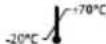 | |||
| 10% | [73A0] | 13 14 15 | [0YHT] | [AAT8] | ||
| 50kPa | ||||||
| [000] | 16 17 18 | [TT3] | [5470] | |||
| [0000] | 19 20 21 |  | [00040] | |||
INSTRUKCJA OBSŁUGI
Szanowny Kliencie,
line
| Particle Size (microns) | Accumulated Percentage | | ----------------------- | ---------------------- | | 0.10 | 1.0% | | 1.00 | 5.0% | | 10.00 | 50.0% |Thank you for purchasing the NENO ATEMO Portable Ultrasonic Nebulizer. A nebulizer is a medical device. Please read the following instructions before using the product and stop it if you need to use it again.
01. PRECAUTIONS
- Use the appliance only as described in the instructions. Do not use the device for any other purpose. The nebulizer is for respiratory therapy only. Any other uses are inappropriate and may be dangerous
- Consult your doctor about the type, dose and method of use and follow his recommendations. Only use medications prescribed by your doctor.
- The appliance must not be used for life support.
- The nebuliser is intended for use in conscious patients only.
- The device is not intended for use in patients connected to an anesthesia respiratory system or to a ventilator.
- Make sure there is no visible damage to the device or accessories before use. Do not use the product if any component is damaged or missing.
- Before each use, ensure that all components are thoroughly cleaned and disinfected, as recommended in the instructions, to prevent the risk of infection.
- Before turning on the device, make sure that the medicine container is not empty. Do not exceed the maximum capacity marked on the medication container.
- Do not use the appliance if it is damaged or has been submerged in water. In this case, stop use immediately and contact an authorized service center.
- The nebulizer is intended for individual use. It is not recommended to use the appliance by more than one person.
- Only use in ambient conditions between 10^ C and 40^ C.
- Do not use the device in an environment with a relative humidity exceeding 95% RH.
- When the device is in operation, keep it upright and stable to avoid leakage or improper nebulization.
- Do not open the lid of the medication container during nebulization.
- Do not direct the spray stream towards the eyes.
- Do not touch the membrane mesh with hard, sharp objects or fingers due to the risk of damage.
- If you experience discomfort during use, stop using and consult a doctor.
- The device is equipped with an automatic switch-off timer, which will turn it off after 20 minutes of continuous operation. If the appliance does not automatically turn off after this time, turn it OFF manually and contact an authorized service agent.
- If you do not use the device for an extended period of time, clean and disinfect the medication container and accessories before using it.
- Clean the medicine container and accessories after each use.
- Do not use accessories or spare parts other than those approved by the manufacturer. These accessories meet biocompatibility standards in accordance with ISO 10993-1.
- Do not disassemble or modify the device without the manufacturer's approval. Unauthorized changes may void the warranty and endanger the user's health.
- Do not use the device near sources of strong electromagnetic interference, such as microwave ovens, mobile phones, or other high-frequency devices.
- Do not use the appliance under a blanket or pillow. It may become overheated and cause a fire.
- Do not use the nebulizer in close proximity to heating devices or with open flames.
- When nebulization is complete, unplug the power source (e.g. USB cable) to ensure safety and save energy.
- Store the device in a cool, dry place, away from heat, sunlight, and high humidity.
- Keep the product and its packaging out of the reach of children who could swallow small parts. If small parts are swallowed by a child, consult a doctor immediately.
- The product is not a toy. Do not allow children to play with the appliance.
02. PRODUCT DESCRIPTION
PRINCIPLE
During the operation of the device, the ultrasonic generator generates high-frequency electricity. This energy is transferred to a transducer, which converts it into ultrasonic waves. The transducer is located near the medication container and vibrates the mesh in the nebulizer. Thanks to these vibrations, the liquid in the medicine container is converted into a fine aerosol. This process is carried out by squeezing the drug through the micropores of the mesh. The resulting aerosol is then delivered to the patient's airways using a mouthpiece or mask.
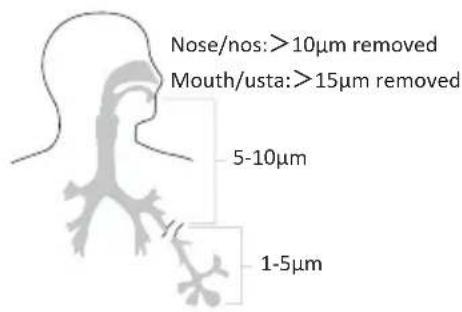
The size of the aerosol particles has a significant impact on the effectiveness of treatment. According to medical tests (SEE FIGURE A):
- Particles with a size of 1–5 μm are best for reaching the peripheral parts of the lungs.
- Particles with a size of 5–10 µm are mainly deposited in the conductive airways.
- Particles with a size of 10–100 µm remain mainly in the nose and/or mouth.
- Particles of 1 m or smaller are largely exhaled and may not reach their destination in the respiratory system.
Selection of the right particle size increases the effectiveness of therapy and reduces the risk of side effects. (Based on: „A Guide to Aerosol Delivery Devices for Respiratory Therapy – 4th Edition”)
INTENDED USE OF THE PRODUCT
The ultrasonic nebulizer is designed for inhalation of drugs used in the treatment of respiratory diseases. It can be used for both home and clinical use, at home and outdoors. The device can be used by people of all ages. However, it is recommended that the device be operated by an adult or healthcare personnel (e.g., a doctor or nurse). The user should have a general knowledge of the operation of the device and read the contents of this manual before operating.
ATTENTION! Children and adults who are unable to operate the appliance on their own should use it under the supervision of a guardian.
ATTENTION! Do not use in patients who are unconscious, do not breathe spontaneously or have pulmonary oedema. The use of a nebulizer in such cases can pose a serious threat to the patient's health and life.
KIT CONTENTS
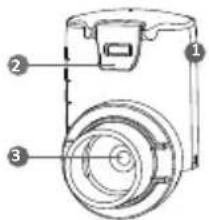
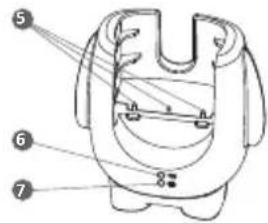
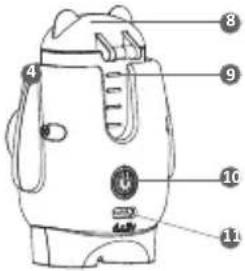
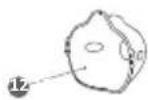
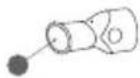
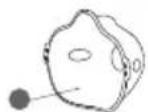
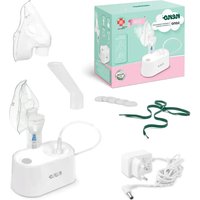
The ultrasonic nebulizer consists of a main unit with a medication container and accessories (SEE FIG. B). The set also includes a USB-C cable and a user manual.
- Medicine container
- Closing the medication container
- Siateczkowa membrane
- Main Unit
- Electrode contacts
- Low voltage indicator
- Low Fluid Level Indicator
- Medication container lid
- Measuring the amount of medicine
- Power button
- USB port for charging
- Mask for a child
- Mouthpiece
- Mask for an adult
03. INSTRUCTIONS FOR USE LIGHT NOTIFICATIONS
| Green light is solid during operation The device operates in nebulization mode |
| Green light turns on and off slowly during operation The device is in cleaning mode |
| Orange light flashes slowly Low battery notification |
| The orange light flashes quickly Very low power, automatic shut-off |
| Blue light flashes No liquid in the medicine container, automatic shut-off |
| Green light flashes while charging Loading |
| Green light is solid when charging Device fully charged |
PREPARATION
Before use, clean, disinfect and dry the appliance and accessories in accordance with the information in the CLEANING AND DISINFECTION section.
POWER
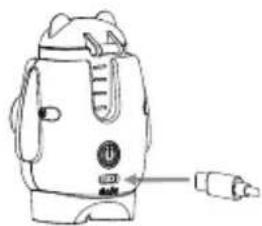
The nebulizer is equipped with a USB-C charging cable. The set does not include a power supply. Use an AC adapter in accordance with IEC 60601-1 (output: DC 5V/1A) for charging. Before using the device for the first time, and if the device has not been used for 3 months, it is recommended to charge the battery. The time to fully charge is approximately 1 hour. When the appliance is discharged, charge it using the cable (SEE FIG. I).
ATTENTION! Make sure the power outlet is working properly before charging.
PURING LIQUID
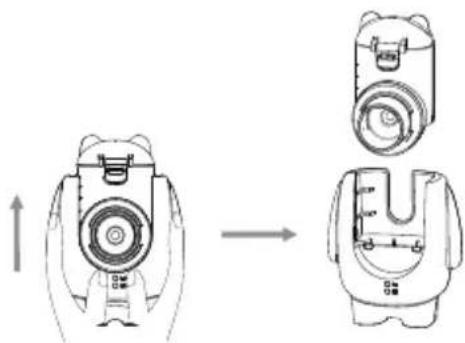
- Hold the main unit, then push the medication container vertically upwards, guiding it along the main unit guide. (SEE FIG. C)
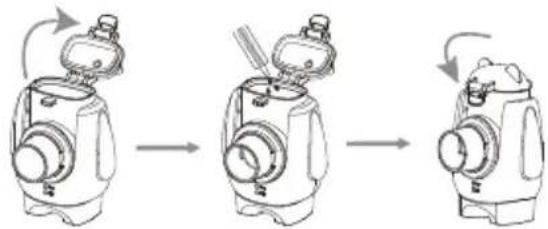
- Open the lid of the medication container, then pour the appropriate amount of liquid medication into the container and close the lid. Make sure the lid is properly engaged. (SEE FIG. D)
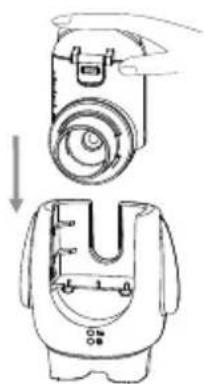
ATTENTION! When pouring liquid into the medicine container, remember to fill it only to the marked maximum level (8ml). The recommended amount of liquid is 1-8 ml. - Hold the medication container and guide it vertically downwards along the main unit guide until you hear a distinctive „click”. Make sure the bin is properly mounted. (SEE FIG. E)
ATTENTION! Make sure the electrodes in the main unit and in the medication container are clean and dry. Improper connection or contaminated electrodes can prevent the device from working properly.
NEBULIZATION
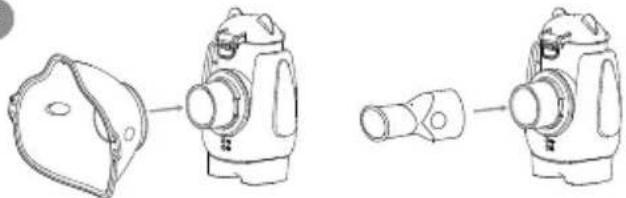
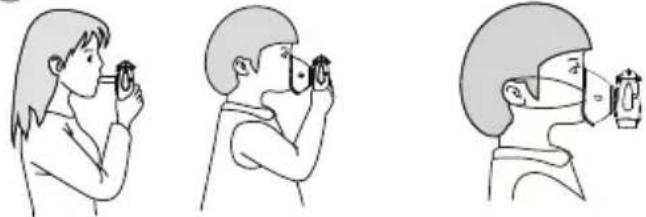
- Fit the mask or mouthpiece according to (SEE FIG. F.) Press the power button to turn on the device.
-
The device undergoes a short start-up process of about 2 seconds, after which it automatically starts nebulization.
ATTENTION! If liquid medicine is missing from the medicine container or there is a poorly conductive liquid (e.g. distilled water), the Low Liquid Level Indicator (blue) will flash and then the device will automatically turn off.
ATTENTION! During operation, a high-frequency sound may be heard due to the vibrations of the diaphragm. To reduce it, you need to gently shake the device. -
Apply the mask to your mouth and nose, or place the mouthpiece in your mouth. During nebulization, you can use a rubber band that should be put on your head, adjusting its size to your needs. (SEE FIG. G)
-
Take a deep breath slowly as you inhale the medication contained in the mist produced by the nebulizer.
-
Do not cover the ventilation openings located in the mask during nebulization. This can disrupt the aerosol flow.
-
When the medicine in the container is running low, it is recommended to tilt the nebuliser slightly towards the patient (i.e. towards the aerosol outlet) to facilitate contact between the remaining liquid and the membrane.
-
When the liquid medication is depleted, the nebulizer can emit a high-frequency sound. The low fluid indicator will flash and the unit will automatically shut off.
-
After nebulization, press the power button to turn off the device. Discard any residual liquid from the medication container and disassemble the device.
-
The nebulizer will automatically shut off after 20 minutes. Due to the different physicochemical properties of drugs, some liquids may not automatically shut down the nebulizer when they are depleted. In this case, manually turn off the device to prevent damage to the reticular membrane.
-
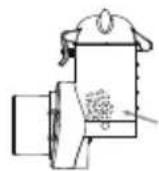
Some medications may form foam when sprayed, which accumulates near the spray net (SEE FIG. H). If this happens, turn off the device, shake it slightly and restart it.
CLEANING MODE
It is recommended to do after each use. To start the cleaning mode, follow the directions below:
-
Make sure the device is turned off.
-
Pour 3–6 ml of plain water into the medication container.
-
Press and hold the power button for 3 seconds to start the cleaning mode.
-
The unit will run for 3 minutes and then automatically shut down.
ATTENTION! The cleaning mode is used to rinse the spray mesh and internal channels with water.
04. CLEANING AND DISINFECTION
Clean and disinfect the nebulizer components after each use, especially the medication container, mesh membrane, spray head, mask or mouthpiece. The following cleaning and disinfection methods are recommended.
CLEANING
Turn off the nebulizer during cleaning and do not connect it to a power source.
- Remove the mask or mouthpiece, then remove the medication container from the main unit (SEE FIG. C)
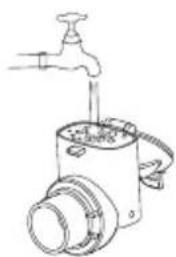
- Wash the medicine container with the mesh membrane and the mask or mouthpiece under running water for at least 3 minutes. (SEE FIG. J)
- After rinsing, inspect all components under bright light. They should be completely clean – without visible residue or smell. Repeat step 2 if necessary.
- Clean the main unit using a white cotton cloth lightly moistened with tap water. Wipe all external surfaces of the appliance, including the power switch.
- Wipe all components with a clean, soft cloth, place on a clean, dry towel and allow to dry completely for at least 1 hour.
ATTENTION! Do not immerse the main unit in water. Before use, the cloth should be thoroughly squeezed out of excess water to avoid moisture entering the device and possible damage to electronic components.
-
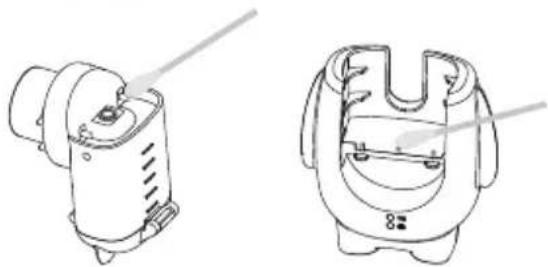
After prolonged nebulization, dirt may appear on the electrodes of the main unit and the medication container. In this case, gently wipe the dirty areas with a clean cotton swab. (SEE FIG. K)
-
Do not clean any parts of the appliance in the dishwasher.
- Do not tumble dry any components in the microwave oven.
- Store all components of the set in a dry and clean place.
DISINFECTION
It is recommended to disinfect the mask and mouthpiece before each use. Follow these rules:
- Rinse all interior and exterior surfaces of the mask and mouthpiece with tap water.
- Dry visible traces of water with a clean, dry towel. Then leave the mask and mouthpiece to dry completely.
- Completely immerse the dry mask and mouthpiece in a 70% ethanol solution for 5 minutes.
- Remove the elements from the solution, drain off any excess ethanol and rinse all surfaces again with tap water.
-
Pat dry with a clean towel and leave on a clean, dry towel to dry completely.
-
TROUBLESHOOTING
| Problem Potential cause Solution | ||
| The appliance cannot be started (the operating light does not light up) | Low battery Charge your device | |
| Power supply and nebulizer have not been connected properly | Check the power supply connection | |
| The device does not generate mist (the operating light is on) | The main unit or electrodes on the medication container are dirty | Clean the electrodes according to the instructions and restart |
| Na siatce membrany there is dirt, severe blockage, or damage | Clean the medicine container according to the instructions. If the fault has not been corrected, the medication container should be replaced | |
| The medication container is not folded correctly Disassemble and reassemble the medicine container, restart | ||
| The liquid drug does not touch the membrane mesh sufficiently | 1) Shake the medicine container lightly and restart2) Tilt the front of the nebulizer towards the user so that the liquid medicine came into contact with the membrane mesh | |
| The mist volume is too small There is dirt on the membrane mesh, serious blockage or damage | Clean the medicine container according to the instructions. If the fault has not been corrected, the medication container should be replaced | |
ATTENTION! If, despite following the above instructions, the device still does not work properly - contact an authorized service center. Do not unfold the appliance by yourself.
06. SYMBOLS EXPLAINED
- CE MARK: MARKING OF CONFORMITY TO REGULATION (EU) 2017/745 OF THE EUROPEAN PARLIAMENT AND OF THE COUNCIL OF 5 APRIL 2017. CONCERNING MEDICAL DEVICES. NOTIFIED BODY: SGS
- Medical device
- Producer
- Authorised Representative in the European Community
- Importer
- Do not dispose of the product in the mixed municipal waste container. Dispose of the product in accordance with the guidelines for the disposal of electronic devices of this type
- Production date
- Follow the instructions for use
- BF type parts
- Waterproof Grade
- Protect from moisture
- Permissible temperature
- Permissible humidity
- Permissible pressure
- Corrugated cardboard
- Delicate product
- Caution
- This side up
- Unique Product Identification Code (UDI)
- Serial Number
- Batch number
07. SPECIFICATION
Power supply: lithium battery - DC 3.7V or external power supply - 5V 1A (via USB-C)
Pobór mocy: <2VA
Standby Power Consumption: <0.1mA
Nebulization rate: >0.2ml/min
MMAD particle size: <5μm
Respirable fraction: ≥60%
Medicine Tank Capacity: 8ml
Minimum amount of medicine: 1 ml
Drug residue: <1ml
Noise Level: ≤50dB
Auto shut-off: yes, after 20 min
Ultrasonic Frequency: 110±10kHz
Operating Environment: 10°C-40°C(50°F-104°F), 10%RH-95%RH, 86kPa-106kPa
Storage Condition: -20°C-70°C(-4°F-158°F), 10%RH-95% RH, 50kPa-106kPa
Operating mode: intermittent operation (recommended operating time 20 min, break 10 min)
The appliance can be stored for 2 years under the conditions listed above.
Dimensions of the main unit with medication container and membrane: 76 x 56 x 47 mm
Weight: 46g
Do not use the nebulizer in an oxygen-rich environment.
08. PARTICLE SIZE DISTRIBUTION

Performance information provided by the manufacturer in accordance with ISO 27427 may not apply to suspension or high viscosity drugs. Information on this subject should be sought from the supplier of the drug.
Particle size distribution according to ISO 27427
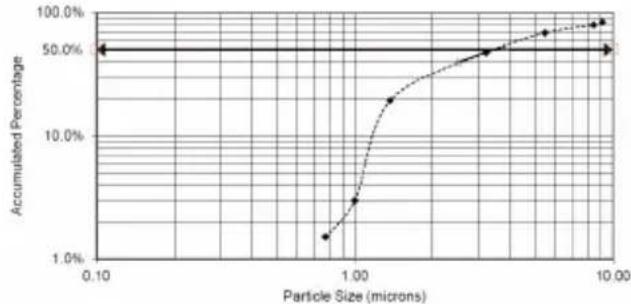
line
| Particle Size (microns) | Accumulated Percentage | | ----------------------- | ---------------------- | | 0.10 | 1.0% | | 1.00 | 5.0% | | 10.00 | 50.0% || Mass median aerodynamic diameter (MMAD, μm) 3,5 | |
| Geometric Standard Deviation (GSD) 2,1 | |
| Less than 5 μm (%) 65% | |
| Test Solution Albuterol 0.1% (M/V) concentration in 0.9% sodium chloride solution | |
| Filling volume (ml) 3ml | |
| Fill volume percentage emitted in 1 min (%/min) 7,3% | |
| Aerosol Yield (ml/min) 0,220 |
ATTENTION! The use of liquid medicines in the form of solutions, suspensions or emulsions other than those recommended by the manufacturer, in particular those with increased viscosity, may affect the particle size distribution generated in the aerosol, the value of the aerodynamic diameter of particles (MMAD) and the effectiveness of spraying and delivery of the drug to the respiratory tract. As a result, the operating parameters of the device may differ from those declared by the manufacturer.
ATTENTION! The performance parameters of the nebulizer were obtained during tests carried out using an adult patient ventilation model. Therefore, in the case of children or infants, the values obtained may differ from those presented in the technical documentation.
09. WARRANTY CARD
The product comes with a 24-month warranty. Warranty conditions can be found at: https://neno.pl/gwarancja
Details, contact and address of the service can be found at: https://neno.pl/kontakt
Specifications and kit contents are subject to change without notice. We apologize for any inconvenience caused.
10. ELECTROMAGNETIC
The device requires special precautions related to electromagnetic compatibility (EMC) and should be installed and operated in accordance with the EMC information in the manual. It can be susceptible to interference from portable and mobile radio frequency (RF) devices.
- The nebulizer is designed for use in hospital and home environments, excluding the immediate vicinity of active HF surgery devices and electromagnetically (RF) shielded rooms, such as magnetic resonance imaging systems, where there is a high level of electromagnetic interference.
- Do not use a mobile phone or other devices that emit electromagnetic fields near the nebulizer, as this may cause the nebulizer to malfunction.
- Note: The device has been thoroughly tested and inspected for proper operation.
- Note: Avoid using this appliance in the immediate vicinity of other electrical appliances or stacking them on top of each other. This can lead to malfunction. If this setup is necessary, monitor the nebulizer and adjacent devices to ensure they are functioning properly.
- The use of accessories other than those recommended or supplied by the manufacturer may increase the electromagnetic emissions or decrease the electromagnetic immunity of the device, which may lead to its malfunction.
- Do not expose the device to RFID systems that may interfere with its operation.
Electromagnetic Emission Guidelines and Declarations
The device is intended for use in the electromagnetic environment specified below. You should only use the product in this environment.
Emission tests Compatibility Electromagnetic Environment Guidelines
| Radio Frequency (RF) Emissions CISPR 11 | Group 1 | The device uses RF energy for its internal functions only. Therefore, the RF emission is very low and should not cause interference to nearby electronic equipment. |
| Radio Frequency (RF) Emissions CISPR 11 | Class B | The device is suitable for use in all plants, including households and directly connected to the public low-voltage grid, which supplies buildings used for domestic purposes. |
| Harmonic emissionsIEC 61000-3-2 | Class A | |
| Voltage fluctuations/flickeringIEC 61000-3-3 | Compatible |
Electromagnetic Emission Guidelines and Declarations
The device is intended for use in the electromagnetic environment specified below. You should only use the product in this environment.
| Resistance tests | IEC 60601 test level | Compatibility level | Electromagnetic Environment Guidelines |
| Electrostatic Discharge (ESD)IEC 61000-4-2 | ±8 kV contact±2 kV, ±4 kV, ±8 kV, ±15 kV air | ±8 kV contact±2 kV, ±4 kV, ±8 kV, ±15 kV air | Floors should be wooden, concrete or made of ceramic tiles. If the floors are covered with synthetic material, the relative humidity should be at least 30%. |
| Electrical overvoltages fast/pulsesIEC 61000-4-4 | ±2 kV for power line±1 kV for input/output line | ±2 kV for power line | The quality of the mains power supply should match a typical commercial or hospital environment. |
| SurgesIEC 61000-4-5 | ±1 kV differential mode±2 kV Common-mode | ±1 kV differential mode | |
| Voltage drops, short-term interruptions and voltage fluctuations on power linesIEC 61000-4-11 | 0 % UT; 0.5 cycles at 0°, 45°, 90°, 135°, 180°, 225°, 270° and 315°0 % UT; 1 cycle I70 % UT; 25/30 cyclesSingle-phase: at 0°0 % UT; 250/300 cycles | 0 % UT; 0.5 cycles at 0°, 45°, 90°, 135°, 180°, 225°, 270° and 315°0 % UT; 1 cycle I70 % UT; 25/30 cyclesSingle-phase: at 0°0 % UT; 250/300 cycles | The quality of the mains power supply should match a typical commercial or hospital environment. If the user requires continuous operation of the device during power outages, it is recommended to power the device from the uninterruptible power supply or from the battery. |
| Power Frequency(50/60 Hz) magnetic fieldIEC 61000-4-8 | 30 A/m 30 A/m Magnetic fields with power frequency should be | at levels characteristic of a typical location in atypical commercial or hospital environment. |
NOTE: UT is the AC supply voltage before the test level is applied.
Electromagnetic Emission Guidelines and Declarations
Resistance tests IEC 60601 test level Compatibility level Electromagnetic Environment Guidelines
| Conducted radio wavesIEC 61000-4-6 | 3 V 150 kHz to 80 MHz6 V in the ISM bands between 0.15 MHz and 80 MHz | 3 V 150 kHz to 80 MHz6 V in the ISM bands between 0.15 MHz and 80 MHz | Portable and mobile radio communication equipment should not be used closer to any part of the device, including cables, than the recommended distance calculated from the equation appropriate for the frequency of the transmitter.Recommended distance d = [ 3.5V_t ] d = [ 12V_t ] d = [ 3.5E_t ] 80 MHz do 800 MHz d = [ 7E_1 ] 800 MHz do 2.7 GHzwhere p is the maximum output power of the transmitter in watts (W) according to the transmitter manufacturer, and d is the recommended distance in meters (m).The field strength from fixed RF transmitters, as determined by the electromagnetic terrain survey, shall be lower than the level of compliance in each frequency range.Interference may occur near devices marked with the following symbol: |
| Radiated radio wavesIEC 61000-4-3 | 10V/m80 MHz do 2.7 GHz385MHz-5785MHz External Port Immunity Test Specification for RF Wireless Communication Devices | 10V/m80 MHz do 2.7 GHz385MHz-5785MHz External Port Immunity Test Specification for RF Wireless Communication Devices |
NOTE: At 80 MHz and 800 MHz, the higher frequency range applies.
NOTE: These guidelines may not apply to all situations. Electromagnetic radiation is affected by absorption and reflection by structures, objects and people.
a) The ISM (industrial, scientific, and medical) bands in the range of 150 kHz to 80 MHz are: 6.765 MHz to 6.795 MHz; 13.553 MHz to 13.567 MHz; 26.957 MHz to 27.283 MHz; 40.66 MHz to 40.70 MHz.
Amateur radio bands in the range from 0.15 MHz to 80 MHz include: 1.8 MHz to 2.0 MHz; 3.5 MHz to 4.0 MHz; 5.3 MHz to 5.4 MHz; 7 MHz to 7.3 MHz; 10.1 MHz to 10.15 MHz; 14 MHz to 14.2 MHz; 18.07 MHz to 18.17 MHz; 21.0 MHz to 21.4 MHz; 24.89 MHz to 24.99 MHz; 28.0 MHz to 29.7 MHz and 50.0 MHz to 54.0 MHz.
(b) The field strength from fixed transmitters, such as mobile phone or radio base stations, amateur radio, AM/FM transmitters and television transmitters, cannot be accurately predicted theoretically. To evaluate the electromagnetic environment coming from fixed RF transmitters, consider taking measurements at the point of use of the device. If the measured field strength at a location exceeds the allowable level of RF compliance, observe the device to ensure it is operating properly. If abnormalities are observed, additional measures may be necessary, e.g. reorientation or relocation of the device.
c) In the frequency range from 150 kHz to 80 MHz, the field strength shall not exceed 3 V/m.
Recommended distances between portable and mobile radio communication equipment and the nebulizer
The device is intended for use in an electromagnetic environment where radio interference is controlled. The user can help prevent electromagnetic interference by maintaining a minimum distance between the portable and mobile RF communication equipment (transmitters) and the device, as recommended below, depending on the maximum output power of the communication equipment.
| Maximum Transmitter Power Rating W | Distance depending on the frequency of the transmitter m | |||
| 150 kHz do 80 MHz 150 kHz to 80 MHz in the d=[ 3.5V_i ] | ISM and amateur bands d=[ 12V_i ] | 80 MHz do 800 MHz 800 MHz do 2.7 GHz | ||
| d=[ 3.5E_i ] | d=[ 7E_i ] | |||
| 0,01 0,12 0,20 0,035 0,07 | ||||
| 0,1 0,38 0,63 0,11 0,22 | ||||
| 1 1,20 2,00 0,35 0,70 | ||||
| 10 | 3,80 6,32 1,10 2,21 | |||
| 100 12,00 | 20,00 | 35,00 70,00 | ||
NOTE: For transmitters with a maximum output power not listed above, the recommended distance d in meters (m) can be estimated using the equation applicable to the transmitter frequency, where P is the maximum output power of the transmitter in watts (W) according to the transmitter manufacturer.
NOTE: At 80 MHz and 800 MHz, the separation distance for the higher frequency range applies.
NOTE: These guidelines may not apply to all situations. The propagation of electromagnetic waves is influenced by their absorption and reflection from structures, objects and people.
If users/patients/customers believe that they or a member of their family has experienced a serious incident related to this device, they are encouraged to report the incident to the manufacturer and to the competent authority of the Member State where the user/patient/customer is established or resident.
BEDIENUNGSANLEITUNG
line
| Particle Size (microns) | Accumulated Percentage | | ----------------------- | ---------------------- | | 0.10 | 1.0% | | 1.00 | 2.0% | | 10.00 | 50.0% |Respirable fraction: ≥60%
line
| Particle Size (microns) | Accumulated Percentage | | ----------------------- | ---------------------- | | 0.10 | 1.0% | | 1.00 | 5.0% | | 10.00 | 50.0% |line
| Particle Size (microns) | Accumulated Percentage | | ----------------------- | ---------------------- | | 0.10 | 1.0% | | 1.00 | 10.0% | | 10.00 | 50.0% |line
| Particle Size (microns) | Accumulated Percentage | | ----------------------- | ---------------------- | | 0.10 | 1.0% | | 1.00 | 10.0% | | 10.00 | 50.0% |line
| Particle Size (microns) | Accumulated Percentage | | ----------------------- | ---------------------- | | 0.10 | 1.0% | | 1.00 | 10.0% | | 10.00 | 50.0% |line
| Particle Size (microns) | Accumulated Percentage | | ----------------------- | ---------------------- | | 0.10 | 1.0% | | 1.00 | 10.0% | | 10.00 | 50.0% |Aerodynamisk massmediandiameter (MMAD, μm) 3,5
Geometrisk standardavvikelse (GSD) 2,1
Mindre än 5 μm (%) 65%
line
| Particle Size (microns) | Accumulated Percentage | | ----------------------- | ---------------------- | | 0.10 | 1.0% | | 1.00 | 3.0% | | 2.00 | 25.0% | | 3.00 | 45.0% | | 4.00 | 55.0% | | 5.00 | 65.0% | | 6.00 | 75.0% | | 7.00 | 85.0% | | 8.00 | 95.0% | | 9.00 | 98.0% | | 10.00 | 100.0% |line
| Particle Size (microns) | Accumulated Percentage | | ----------------------- | ---------------------- | | 0.10 | 1.0% | | 1.00 | 5.0% | | 10.00 | 50.0% |line
| Particle Size (microns) | Accumulated Percentage | | ----------------------- | ---------------------- | | 0.10 | 1.0% | | 1.00 | 2.0% | | 10.00 | 50.0% |Massemedian aerodynamisk diameter (MMAD, μm) 3,5
Geometrisk standardafvigelse (GSD) 2,1
Mindre end 5 μm (%) 65%
Test løsning Albuterol 0,1 % (M / V) koncentration i 0,9 % natriumchloridopløsning
Päfyldningsvolumen (ml) 3 ml
02. PRODUCTOMSCHRIJVING
PRINCIPE
line
| Particle Size (microns) | Accumulated Percentage | | ----------------------- | ---------------------- | | 0.10 | 1.0% | | 1.00 | 10.0% | | 10.00 | 50.0% |Massa median aerodynamische diameter (MMAD, μm) 3,5
line
| Particle Size (microns) | Accumulated Percentage | | ----------------------- | ---------------------- | | 0.10 | 1.0% | | 1.00 | 1.0% | | 10.00 | 50.0% |line
| Particle Size (microns) | Accumulated Percentage | | ----------------------- | ---------------------- | | 0.10 | 1.0% | | 1.00 | 10.0% | | 10.00 | 50.0% |line
| Particle Size (microns) | Accumulated Percentage | | ----------------------- | ---------------------- | | 0.10 | 1.0% | | 1.00 | 5.0% | | 10.00 | 50.0% |Diametrul aerodinamic mediu al masei (MMAD, μm) 3,5
line
| Particle Size (microns) | Accumulated Percentage | | ----------------------- | ---------------------- | | 0.10 | 1.0% | | 1.00 | 1.0% | | 10.00 | 50.0% |line
| Particle Size (microns) | Accumulated Percentage | | ----------------------- | ---------------------- | | 0.10 | 1.0% | | 1.00 | 5.0% | | 10.00 | 50.0% || Srednji aerodinamički promjer mase (MMAD, μm) 3,5 | |
| Geometrijska standardna devijacija (GSD) 2,1 | |
| Manje od 5 μm (%) 65% | |
| Rješenje za testiranje Koncentracija albuterola 0,1% (M/V) u 0,9% otopini natrijevog klorida | |
| Volumen punjenja (ml) 3ml | |
| Postotak volumena punjenja emitiranog u 1 min (%/min) 7,3% | |
| Kapacitet aerosola (ml/min) 0,220 |
line
| Particle Size (microns) | Accumulated Percentage | | ----------------------- | ---------------------- | | 0.10 | 50.0% | | 1.00 | 2.0% | | 10.00 | 50.0% || Masa srednji aerodinamički prečnik (MMAD, μm) 3,5 | |
| Geometrijska standardna devijacija (GSD) 2,1 | |
| Manje od 5 μm (%) 65% | |
| Test rešenje Albuterol 0,1% (M / V) koncentracija u 0,9% rastvoru natrijum hlorida | |
| Zapremina punjenja (ml) 3ml | |
| Procenat zapremine punjenja emitovan u 1 min (% / min) 7,3% | |
| Prinos aerosola (ml / min) 0,220 |
PAHJNU! Upotreba tečnih lekova u obliku rastvora, suspenzija ili emulzija osim onih koje preporučuje proizvođač, posebno onih sa povećanom viskoznošću, može uticati na raspodelu veličine čestica generisanih u aerosolu, vrednost aerodinamičkog prečnika čestica (MMAD) i efikasnost prskanja i isporuke leka u respiratorni trakt. Kao rezultat toga, radni parametri uređaja mogu se razlikovati od onih koje je deklarisao proizvođač.
PAŁNJU! Parametri performansi raspršivača dobijeni su tokom testova koji su sprovedeni korišćenjem modela ventilacije odraslog pacijenta. Stoga, u slučaju djece ili dojenčadi, dobijene vrijednosti mogu se razlikovati od onih prikazanih u tehničkoj dokumentaciji.
09. GARANTNI LIST
Proizvod dolazi sa garancijom od 24 meseca. Uslovi garancije mogu se naći na: https://neno.pl/gwarancja
Detalje, kontakt i adresu servisa možete naći na: https://neno.pl/kontakt
Specifikacije i sadržaj kompleta podložni su promenama bez prethodne najave. Izvinjavamo se zbog bilo kakvih neprijatnosti.
10. ELEKTROMAGNETNI
Uređaj zahteva posebne mere predestrožnosti koje se odnose na elektromagnetnu kompatibilnost (EMC) i treba da bude instaliran i upravljan u skladu sa EMC informacijama u priručniku. Može biti podložan smetnjama od prenosivih i mobilnih radiofrekvencijskih (RF) uređaja.
-
Nebulizator je dizajniran za upotrebu u bolničkim i kućnim okruženjima, isključujući neposrednu blizinu aktivnih HF hirurških uređaja i elektromagnetski (RF) oklopljene prostorije, kao što su sistemi za magnetnu rezonancu, gde postoji visok nivo elektromagnetnih smetnji.
-
Nemojte koristiti mobilni telefon ili druge uređaje koji emituju elektromagnetna polja u blizini raspršivača, jer to može dovesti do kvara raspršivača.
-
Napomena: Uređaj je temeljno testiran i pregledan za pravilan rad.
-
Napomena: Izbegavajte korišćenje ovog uređaja u neposrednoj blizini drugih električnih uređaja ili slaganje jedan na drugi. To može dovesti do kvara. Ako je ovo podešavanje je potrebno, prati raspršivač i susedne uređaje kako bi se osiguralo da pravilno funkcioniše.
-
Upotreba dodatne opreme osim one koju preporučuje ili isporučuje proizvođač može povećati elektromagnetne emisije ili smanjiti elektromagnetni imunitet uređaja, što može dovesti do njegovog kvara.
-
Ne izlažite uređaj RFID sistemima koji mogu ometati njegov rad.
line
| Particle Size (microns) | Accumulated Percentage | | ----------------------- | ---------------------- | | 0.10 | 1.0% | | 1.00 | 2.0% | | 10.00 | 50.0% |Masni srednji aerodinamični premer (MMAD, μm) 3,5
Geometrijski standardni odklon (GSD) 2,1
Manj kot 5 μm (%) 65%
Testna raztopina Koncentracija albuterola 0,1 % (M/V) v 0,9 % raztopini natrijevega klorida
Prostornina polnjenja (ml) 3 ml
Less than 5 μm (%) 15%
A## 60041, Altana 0.1% (1978) ##d#n###t## 0.1% S#k#a #d#n###t## ###
Ovaria (2019)
1000000000000000000000000000000000000000000
Arofam, repol., more (red min) 0.270
PRODUCED. It is an important purpose for the development of the 2015-2016 period, and it is a key objective in the future.
1973/2008: 10. Impediction, the superimposed organization of the public sector and government agencies, parloric companies, and other business entities.
S. S. S.
- KAPTA EITTH2HE
To replace the following and apply to the process, then use in [spire me, http://www.100.com/100.com] https://news.pl/guwaneda
In addition, we have a large number of small numbers in the first two categories. We will be called as an additional problem in the second category of this
The following table is in English:
a. Repl. of the company, Inc. (the company has a general structure of the company's subsidiaries)
(一)本次股东大会的召集和召开程序
In addition, the projector (the project) has been proposed to be a research team. The research team is not limited to the research team of the research team.
davajak, cinnipahen zorgodnjuu Gomjak, pycloprapynjau/ki papadovou, Gum. rle solimacnjuu in 561702-11 - Cudla i a matal voraunna el comyut 24 uvevce nawmucu bemwicer me. Enoluse newamukkien
nok vunah m bna nayr, a nunahri naonuikvei, a nunahdunanuakfudm
Dana-ple obozomovom v 201105711. Komosia 0
farns rle aonnals corvants an alfa m arndar at a bclam hana vankle nere m ona tacklant, cna nce
125 01/2010-3-2
line
| Particle Size (microns) | Accumulated Percentage | | ----------------------- | ---------------------- | | 0.10 | 1.0% | | 1.00 | 2.0% | | 5.00 | 50.0% | | 10.00 | 75.0% |Masès medianinis aerodinaminis skersmuo (MMAD, μm) 3,5
Geometrinis standartinis nuokrypis (GSD) 2,1
02. PRODUKTA APRAKSTS
PRINCIPS
line
| Particle Size (microns) | Accumulated Percentage | | ----------------------- | ---------------------- | | 0.10 | 1.0% | | 1.00 | 2.0% | | 10.00 | 50.0% |line
| Particle Size (microns) | Accumulated Percentage | | ----------------------- | ---------------------- | | 0.10 | 1.0% | | 1.00 | 5.0% | | 10.00 | 50.0% |line
| Particle Size (microns) | Accumulated Percentage | | ----------------------- | ---------------------- | | 0.10 | 1.0% | | 1.00 | 1.0% | | 10.00 | 50.0% |line
| Particle Size (microns) | Accumulated Percentage | | ----------------------- | ---------------------- | | 0.10 | 1.0% | | 1.00 | 10.0% | | 10.00 | 50.0% |line
| Particle Size (microns) | Accumulated Percentage | | ----------------------- | ---------------------- | | 0.10 | 1.0% | | 1.00 | 3.0% | | 10.00 | 50.0% |Date of last update of the user manual: 07.2025

Importer:
KGK TREND Sp. z o.o.
Ujastek 5b, 31-752 Kraków, Polska.
Wyprodukowano w PRC
Made in PRC
www.neno.pl

No.6, Zhangzhou Road, Daojiao Town, Dongguan City,
Guangdong Province, 523187, P.R.China
EU REP
- Table of contents
- Spis treści
- INSTRUKCJA OBSŁUGI
- PRECAUTIONS
- PRODUCT DESCRIPTION
- PRINCIPLE
- INTENDED USE OF THE PRODUCT
- KIT CONTENTS
- INSTRUCTIONS FOR USE LIGHT NOTIFICATIONS
- PREPARATION
- POWER
- PURING LIQUID
- NEBULIZATION
- CLEANING MODE
- CLEANING AND DISINFECTION
- CLEANING
- DISINFECTION
- SYMBOLS EXPLAINED
- SPECIFICATION
- PARTICLE SIZE DISTRIBUTION
- WARRANTY CARD
- ELECTROMAGNETIC
- BEDIENUNGSANLEITUNG
- PRODUCTOMSCHRIJVING
- PRINCIPE
- GARANTNI LIST
- ELEKTROMAGNETNI
- PRODUKTA APRAKSTS
- PRINCIPS
Brand : Neno
Model : Atemo
Category : Inhaler