RP200SL - Vacuum Cleaner HiKOKI - Free user manual and instructions
Find the device manual for free RP200SL HiKOKI in PDF.


| Brand | HiKOKI |
| Model | RP200SL |
| Category | Wet and dry vacuum cleaner |
| Dust class | L (light) |
| Rated voltage | 220-240 V |
| Frequency | 50-60 Hz |
| Rated input power | 1200 W |
| Max. vacuum pressure (at blower) | 22.5 kPa |
| Max. vacuum pressure (on hose) | 21.0 kPa |
| Max. air flow (at blower) | 4.2 m³/min |
| Max. air flow (on hose) | 2.3 m³/min |
| Collection tank volume | 20 l |
| Hose diameter | 32 mm |
| Hose length | 1.75 m |
| Protection class | IP 24 |
| Dimensions (L × D × H) | 377 × 381 × 400 mm |
| Weight (without cord) | 9.4 kg |
| Sound pressure level | 78.1 dB(A) |
| Total vibration | < 2.5 m/s² |
| Use | Dry non-combustible dusts, non-flammable liquids, wood shavings |
| Main functions | Dust and liquid suction, PressClean (filter cleaning), continuous or automatic suction (via tool socket) |
| Safety | Automatic shut-off float, splash protection, circuit breaker |
| Maintenance | Filter cleaning with PressClean, emptying the tank, replacing filter bag |
| Included accessories | Hose, non-woven filter bag, PE bag, accessory holders |
| Warranty | According to national regulations, manufacturing defects |
Frequently Asked Questions - RP200SL HiKOKI
User questions about RP200SL HiKOKI
0 question about this device. Answer the ones you know or ask your own.
Ask a new question about this device
Download the instructions for your Vacuum Cleaner in PDF format for free! Find your manual RP200SL - HiKOKI and take your electronic device back in hand. On this page are published all the documents necessary for the use of your device. RP200SL by HiKOKI.
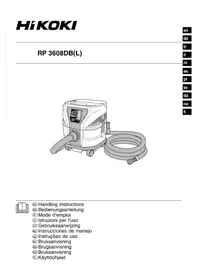
USER MANUAL RP200SL HiKOKI
natural_image
Line drawing of a vacuum cleaner with hoses and control panel (no text or symbols on the device itself)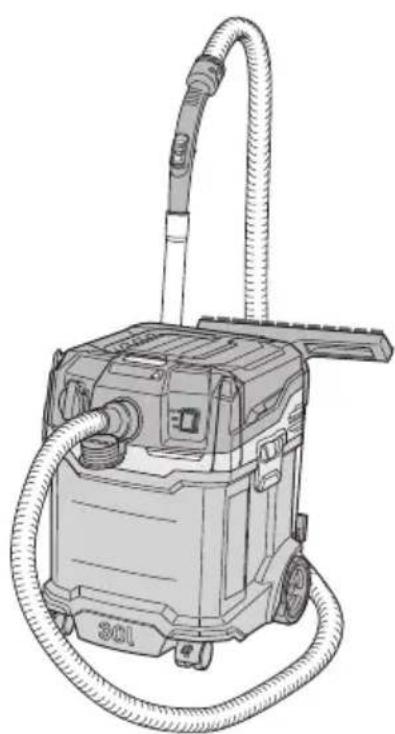
natural_image
Line drawing of a vacuum cleaner with hoses and control panel (no text or symbols)
en Handling instructions
de Bedienungsanleitung
fr Mode d'emploi
it Istruzioni per l'uso
nl Gebruiksaanwijzing
es Instrucciones de manejo
pt Instruções de uso
sv Bruksanvisning
da Brugsanvisning
no Bruksanvisning
fi Käyttöohjeet
el Οδηγίες χειρισμού
pl Instrukcja obsługi
hu Kezelési utasítás
cs Návod k obsluze
tr Kullanım talimatları
ro Instructiuni de utilizare
sl Navodila za rokovanje
sk Pokyny na manipuláciu
bg Инструкция за експлоатация
sr Uputstvo za rukovanje
hr Upute za rukovanje
1
2
flowchart
graph TD
    A["14"] --> B["2"]
    B --> C["12"]
    C --> D["1"]
    D --> E["17"]
    E --> F["3"]
    F --> G["14"]
    G --> H["5"]
    H --> I["12"]
    I --> J["6"]
    J --> K["6"]
    K --> L["4"]
    L --> M["4"]
    M --> N["18"]
3
4
5
6

7
8
9
10
11
12
natural_image
Technical line drawing of a mechanical device with hoses and a labeled component (no text or symbols present)13
natural_image
Technical line drawing of a mechanical component with coiled tubing and labeled part 13 (no text or symbols beyond label)14
SPECIFIED CONDITIONS OF USE
- This device is not designed for use by persons (including children) with physical, sensory or mental disabilities, or with insufficient experience and/or knowledge, unless they are supervised by a person responsible for their safety, or have received instructions on how to use the device by this person.
- Pay attention to the country-specific regulations, as well as the specifications of the material producer.
- This product is designed for industrial use.
- Dust containing asbestos must not be vacuumed.
- Inflammable dust must not be vacuumed.
- No inflammable or explosive solvents, material saturated with solvent, dust that represents an explosion hazard, liquids such as petrol, oil, alcohol, thinner or material that is hotter than 60^ C are allowed to be vacuumed.
This would cause an explosion and fire hazard! You are not allowed to use the device in the vicinity of inflammable gases or substances. - The user bears sole responsibility for any damage caused by improper use.
- Generally accepted accident prevention regulations and the enclosed safety information must be observed.
RP 200SL / RP 200YL / RP 300YL:

☐ The device is suitable for the vacuuming of dust, solid materials (broken glass, nails etc.), liquids of any kind with the exception of highly inflammable, combustible liquids and material that is hotter than 60^ C.
○ The device is suited for the separation of dry, non-flammable dust, non-flammable liquids, wood dust and dangerous dust with workplace limit values > 1 mg/m ^3 .
RP 300YM:

The device is suitable for vacuuming dust that is harmful to health (dust class M), in accordance with EN 60335-2-69. The device is suited for the separation of dry, non-flammable dust, non-flammable liquids, wood dust and dangerous dust with workplace limit values ≥ 0.1 mg/m ^3 .
☐ For occupational exposure limits and carcinogenic materials, see the list of occupational exposure limits or contact your local professional and accident prevention associations for information.
○ The results of the dust test only refer to the extraction or vacuuming of dry dust.
○ The device is suitable for use as: a) Industrial vacuum cleaner (IS) for vacuuming deposited dust. b) Dust extractor (ENT) for extracting airborne dusts from material processing machines.
☐ The device is suitable for the demanding requirements of commercial applications e.g. in the areas of craft and trade, installation work, construction, industry, workshops, painting and plastering, joinery, woodworking. As per EN 60335-2-69.
RP 300YH:

○ The device is suitable for vacuuming dusts, which are harmful to health and pathogenic, dust class H, in accordance with EN 60335-2-69.
The device is suited for the separation of dry, non-flammable dust, carcinogenic and pathogenic particles, as well as non-flammable liquids, wood dust and hazardous dust with workplace limit values < 0.1 mg/m ^3 .
☐ For occupational exposure limits and carcinogenic materials, see the list of occupational exposure limits or contact your local professional and accident prevention associations for information.
○ The results of the dust test only refer to the extraction or vacuuming of dry dust.
- The device is suitable for use as:
a) Industrial vacuum cleaner (IS) for vacuuming deposited dust.
b) Dust extractor (ENT) for extracting airborne dusts from material processing machines.
☐ The device is suitable for the demanding requirements of commercial applications e.g. in the areas of craft and trade, installation work, construction, industry, workshops, painting and plastering, joinery, woodworking. As per EN 60335-2-69.
GENERAL SAFETY INSTRUCTIONS
- Before using the device, carefully read through and familiarise yourself with all the enclosed safety information and the Operating Instructions. Keep all enclosed documentation for future reference, and ensure that you only pass on your device together with this documentation.
- Before using the device, the user must receive information, instructions and training material on using the device and the materials for which it is to be used (including details on safe disposal of the extracted material).
SPECIAL SAFETY INSTRUCTIONS
- For your own protection and for the protection of your dust extractor, pay attention to all parts of the text that are marked with this symbol!
This device is not designed for the use of persons (including children) with limited physical,
sensory or mental aptitude or lack of experience and/or knowledge.
-
Never allow children to use the device. Children should be supervised to ensure that they do not play with the device.
-
CAUTION! Only use accessories that are included with the device or specified Operating Instructions. The use of other accessories may impair safety.
-
WARNING - Do not allow the supply cord to come into contact with the rotating brushes. If the supply cord is damaged, it must be replaced by the manufacturer, its service agent or similarly qualified persons in order to avoid a hazard.
-
CAUTION! Clean the water level limiting device regularly and examine it for signs of damage.
-
You must not perform any work other than that described here.
-
In the event of misuse, improper operation or unprofessional repair work no liability shall be assumed by us for any damage incurred.
-
When the device is not in use, leave the hose on the device to prevent dust accidentally escaping.
-
Do not operate devices or accessories under the following conditions: – If the device has recognisable damage (cracks/breaks),
- If the mains connection lead is defective or shows signs of cracking or ageing, - If there is a suspected non-visible defect (after a fall). Do not point the nozzle, hose or tube at people or animals.
-
⚠ WARNING - If any foam or water egresses, switch off immediately. Empty the container and, if need be, the pleated filter.
-
Never sit or stand on the device.
-
Always set up the connection lead and hose so there is no danger of tripping.
-
Do not pull the connection lead over any sharp edges and do not kink or pinch it.
-
If the connection lead of the device is damaged, it must be replaced by a special connection lead. See the chapter on Repairs.
-
Always connect to a socket with protective contact.
16.Do not use any damaged extension leads.
-
Never insert or remove the mains plug with wet hands.
-
Only pull on the mains plug, not on the lead.
-
⚠ WARNING - The plug socket on the device must be used only for the purposes defined in the operating Instructions.
-
Do not leave the device unattended. If there is a long work interruption, disconnect the mains plug.
English
-
The dust extractor should not be used or stored outside in wet conditions.
-
IMPORTANT - This device must only be used or stored indoors.
-
Acids, acetone and solvents can corrode the device components.
24.⚠ Prior to any servicing work, clean the device. Switch off the device after each use and pull out the mains plug. Ensure the plug cannot be reconnected accidentally.
-
Steam cleaners and high-pressure cleaners must not be used to clean the device.
-
The inside of the cover must always be kept dry.
-
Mould contamination can result if the device is not cleaned for an extended period, especially if used in areas where foodstuffs are processed: Always clean and disinfect the device immediately after use.
-
Never open the device outdoors during rain or storms.
-
Do not use the device outdoors in cold weather.
-
The device must not be operated in areas with an explosion hazard.
-
Ensure that the device is steady.
-
If the extracted air is discharged into the room, ensure there is an adequate air change rate (L) in the room. Observe the regulations that apply in your country.
-
Keep the tool socket dry and do not expose to moisture.
-
Do not plug extension cords between the dust extractor and the power tool.
-
When using the tool socket, use the dust extractor in a dry environment.
36.CAUTION
This device contains dust that is harmful to health. Discharge and maintenance operations (including disposal of the dust collection containers) must only be carried out by qualified specialists wearing appropriate protective clothing and equipment.
- ⚠ WARNING - general danger!
38.CAUTION
Do not use the device until you have read the operating Instructions.
- ⚠️ WARNING - Operating
personnel must receive adequate instruction in the use of this device and in the materials for which it is used.
- Special safety information for RP 300YM:
Warning sign for machines with dust class M:
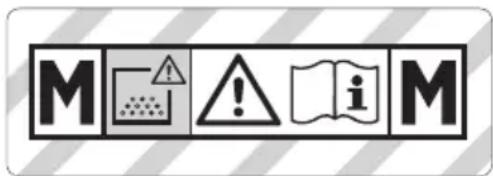
During discharge and maintenance operations, note the following: Clean the device before opening it. Wear a dust mask. Avoid exposing third parties to dust. Provide local filtered forced ventilation. Then clean the maintenance area. Do
not operate the device without the complete filtration system. (filter cassettes and PE disposal bags).
According to tests carried out as per EN 60335 section 1 and 2-69, the device also meets electrical safety requirements relating to the extraction of a water-air mixture.
41. Special safety instructions for RP 300YH:
Warning sign for machines with dust class H:
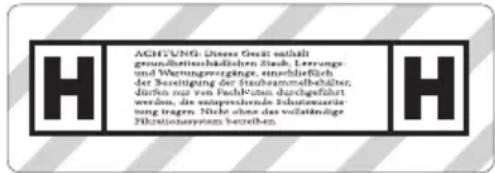
ATTENTION: This device contains dust that is harmful to health. Discharge and maintenance operations, including disposal of the dust collection containers, must only be carried out by qualified specialists wearing appropriate protective clothing and equipment. Do not operate the device without the complete filtration system.
During discharge and maintenance operations, note the following: Clean the device before opening it. Wear a dust mask. Avoid exposing third parties to dust. Provide local filtered forced ventilation. Then clean the maintenance area. Do not operate the device without the complete filtration system. (filter cassettes and special filter bags for H-class).
According to tests carried out as per EN 60335 section 1 and 2-69, the device also meets electrical safety requirements relating to the extraction of a water-air mixture.
⚠ WARNING - Do not reuse the filter cassettes after they have been removed from the machine.
42. Special safety instructions for RP 200SL / RP 200YL / RP 300YL:
Warning sign for machines with dust class L:
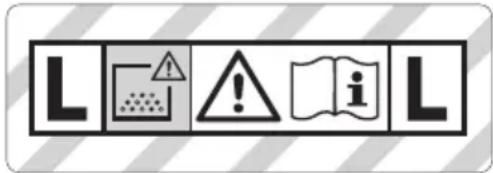
- While the device is suitable for extracting substances that pose a slight threat to health, it is not appropriate for reducing wood dust in inhaled air.
- Dust from material such as paint containing lead, some wood species, minerals and metal may be harmful. Contact with or inhalation of the dust may cause allergic reactions and/or respiratory diseases to the operator or bystanders.
- Certain kinds of dust are classified as carcinogenic such as oak and beech dust especially in conjunction with additives for wood conditioning (chromate, wood preservative).
PRECAUTIONS FOR USE OF THE DUST EXTRACTOR
The precautions common to the dust extractor has been described. For the dust extractor, follow further precautions described below:
English
WARNING
- Ensure that the power source to be utilized conforms to the power requirements specified on the product nameplate.
- Ensure that the power switch is in the OFF position. If the plug is connected to a receptacle while the power switch is in the ON position, the power tool will start operating immediately, which could cause a serious accident.
- When the work area is removed from the power source, use an extension cord of sufficient thickness and rated capacity. The extension cord should be kept as short as practicable.
- Prevent the appliance from sucking in the following:
○ Generated spark during metal grinding or cutting.
○ High temperature things, such as lighted cigarette.
○ Inflammable substances (gasoline, thinner, benzine, kerosene, paint, etc.), explosive substances (nitroglycerine, etc.), combustible substances (aluminum, zinc, magnesium, titanium, red phosphorus, yellow phosphorus, celluloid, etc.)
○ Sharp things, such as nail and razor.
○ Wood chip, metal, stone, string, etc. - Solidification materials, such as cement powder and toner, and conductive fine dusts, such as metal powder and carbon powder.
○ Foaming liquids, such as oil, boiling water, chemical fluid, and detergent. Liquids, such as water and oil. May cause fires or injuries. - Do not use the device with its suction opening obstructed. The temperature of the motor may rise abnormally, causing troubles such as deformation of parts or motor burnout.
- Do not topple the appliance or do not use it on its side. May cause electric shock or failures.
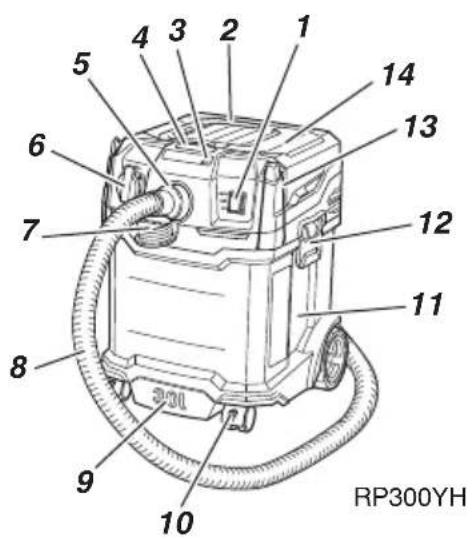
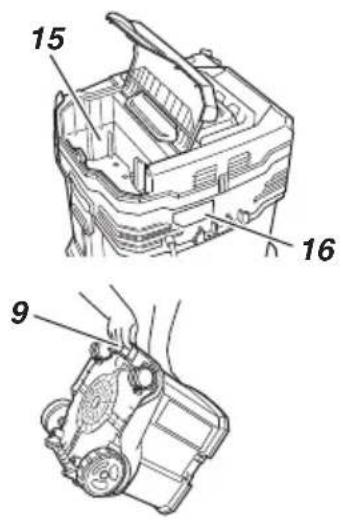
NAMES OF PARTS
The numbers in the list below correspond to Fig. 1–Fig. 14.
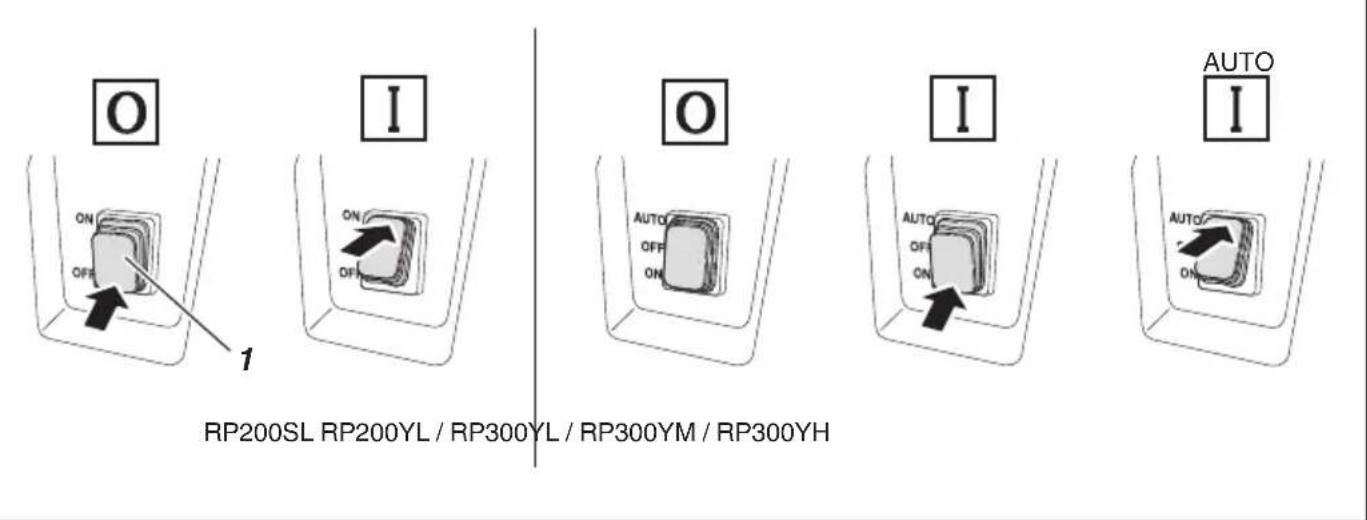
| 1 | Switch (on/off/automatic):(RP200YL / RP300YL / RP300YM / RP300YH)Switch (on/off): (RP200SL) |
| 2 | Carry handle |
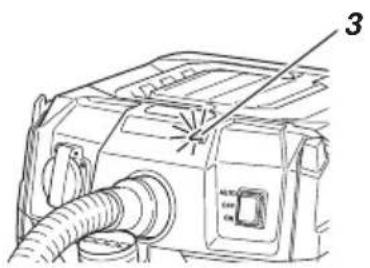
| 3 | Volume flow control display:(RP300YM / RP300YH) |
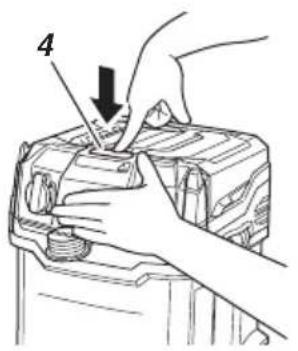
| 4 | Button for filter cleaning 'PressClean' |
| 5 | Suction opening |
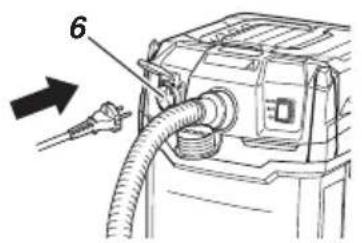
| 6 | Socket for power tools:(RP200YL / RP300YL / RP300YM / RP300YH) |
| 7 | Sealing cap: (RP300YM / RP300YH) |
| 8 | Suction hose |
| 9 | Roll protection/side handle |
| 10 | Roll brake |
| 11 | Container |
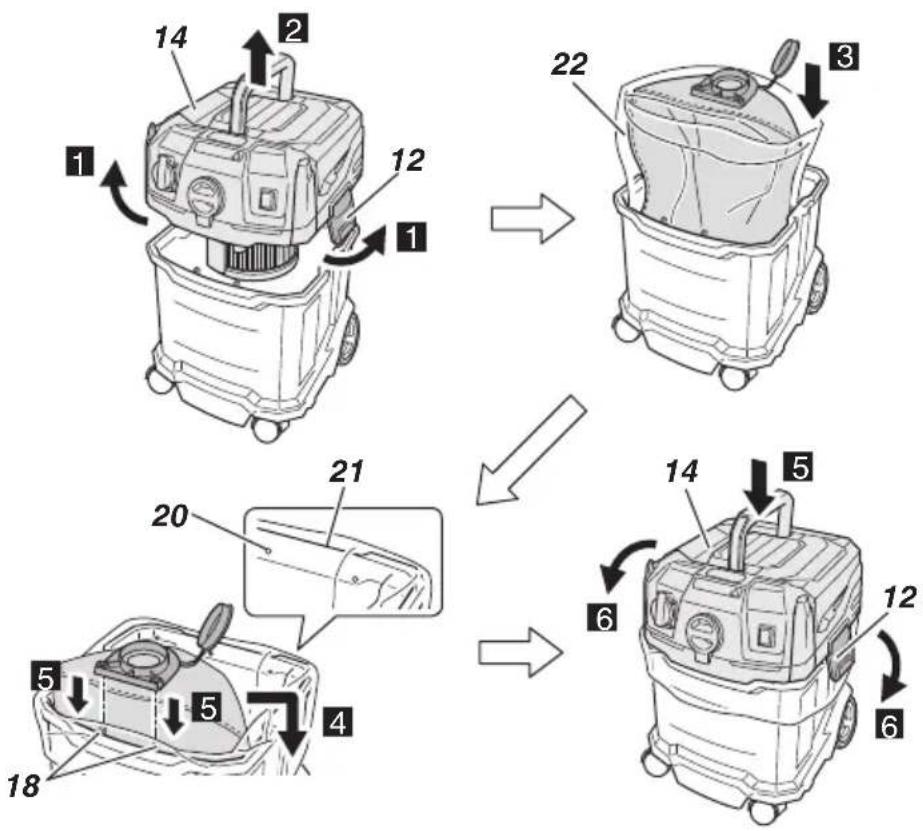
| 12 | Snap lock |
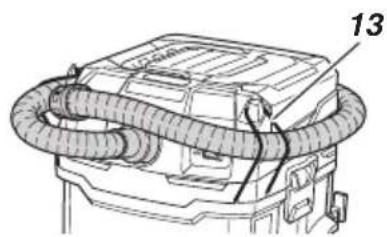
| 13 | Rubber for hose fixing |
| 14 | Upper part |
| 15 | Storage compartment |
| 16 | Nameplate |
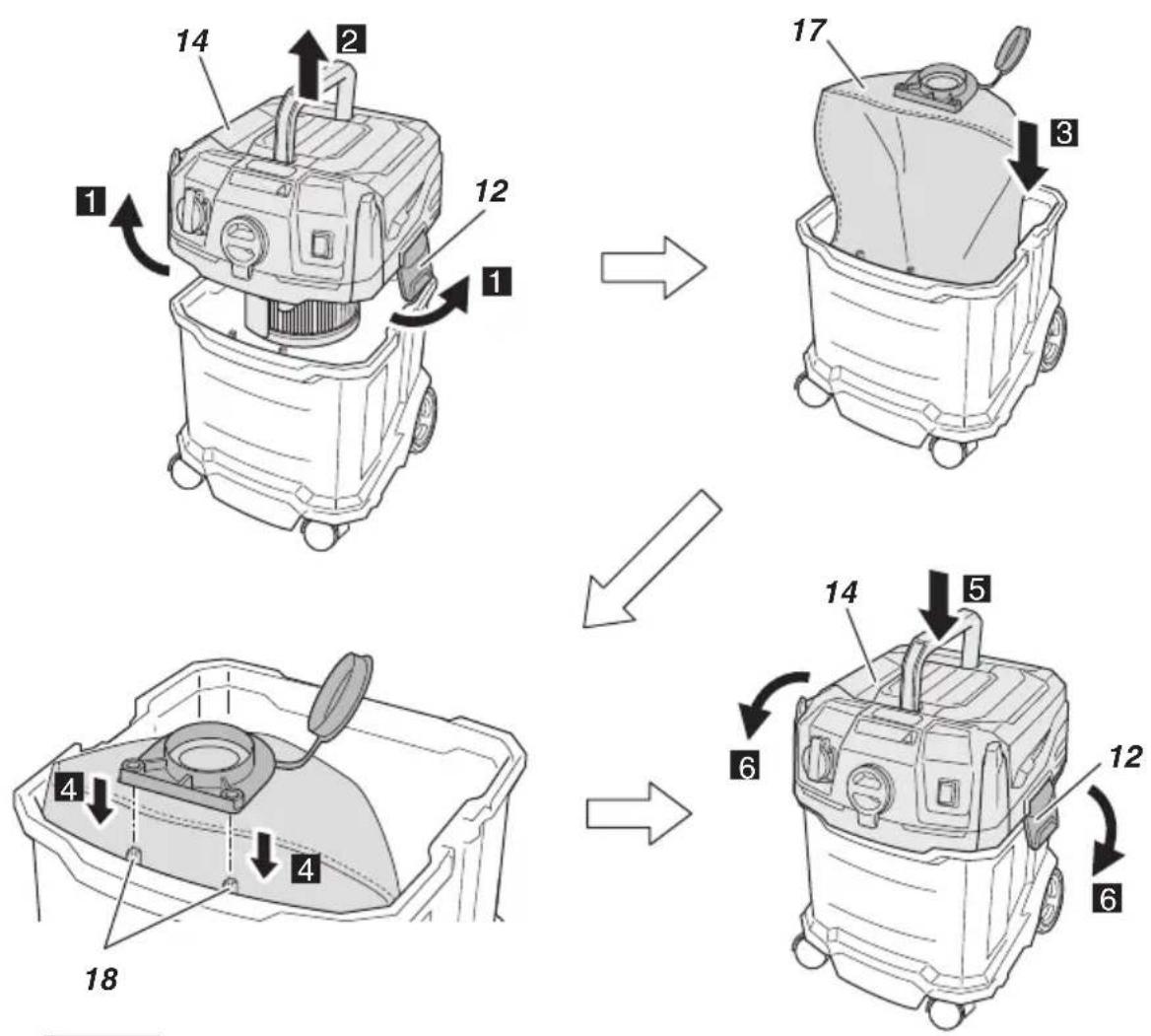
| 17 | Fleece filter bag |
| 18 | Fixtures for filter bag |
| 19 | PE disposal bag |
| 20 | Round hole |
| 21 | Container rim |
| 22 | Special filter bag for H-class |
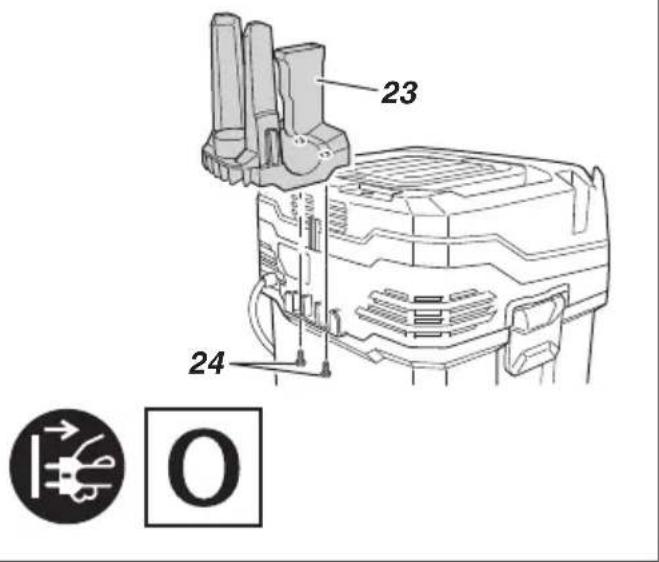
| 23 | Accessory fixtures for nozzles and hose |
| 24 | Screw |
| 25 | Rear end suction hose |
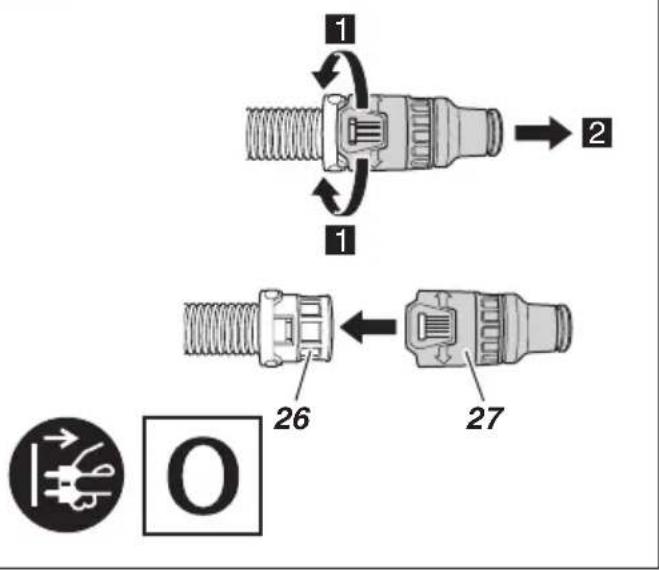
| 26 | Front end suction hose |
| 27 | Connecting sleeve |
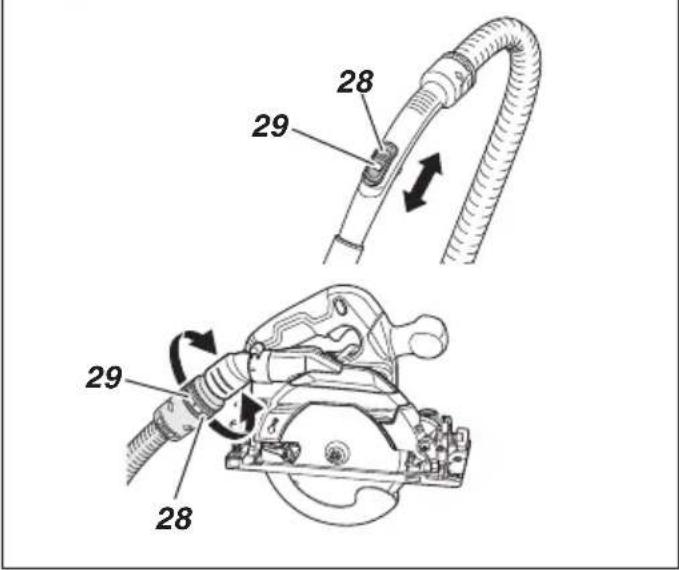
| 28 | Auxiliary air slide |
| 29 | Air inlet |
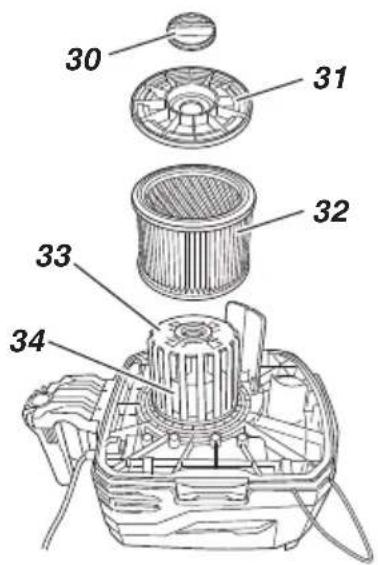
| 30 | Filter closure |
| 31 | Filter cover |
| 32 | Filter |
| 33 | Filter cage |
| 34 | Float |
SYMBOLS
WARNING
The following show symbols used for the machine. Be sure that you understand their meaning before use.
 | RP200SL / RP200YL / RP300YL / RP300YM / RP300YH: Dust extractor |
 | To reduce the risk of injury, user must read instruction manual. |
 | Only for EU countriesDo not dispose of electric tools together with household waste material!In observance of European Directive 2012/19/EU on waste electrical and electronic equipment and its implementation in accordance with national law, electric tools that have reached the end of their life must be collected separately and returned to an environmentally compatible recycling facility. |
| V | Rated voltage |
| ~ | Alternating current |
| WARNING! The dust extractor may contain hazardous dust. | |
| Dust class L (light).The dust extractors are capable of picking up dust class L. Follow your country's regulations relating to dusts and to occupational health and safety. | |
| Dust class M (medium).The dust extractors are capable of picking up dust class M. Follow your country's regulations relating to dusts and to occupational health and safety. | |
| Dust class H (high).The dust extractors are capable of picking up dust class H. Follow your country's regulations relating to dusts and to occupational health and safety. | |
| Switching ON | |
| AUTOI | The dust extractor is switched on or off by means of a power tool connected to the mains socket.(RP200YL / RP300YL / RP300YM / RP300YH) |
| Switching OFF | |
| Disconnect mains plug from electrical outlet | |
| Warning |
STANDARD ACCESSORIES
In addition to the main unit (1 unit), the package contains the accessories listed on page 218.
Standard accessories are subject to change without notice.
MOUNTING AND OPERATION
| Action Figure Page | ||
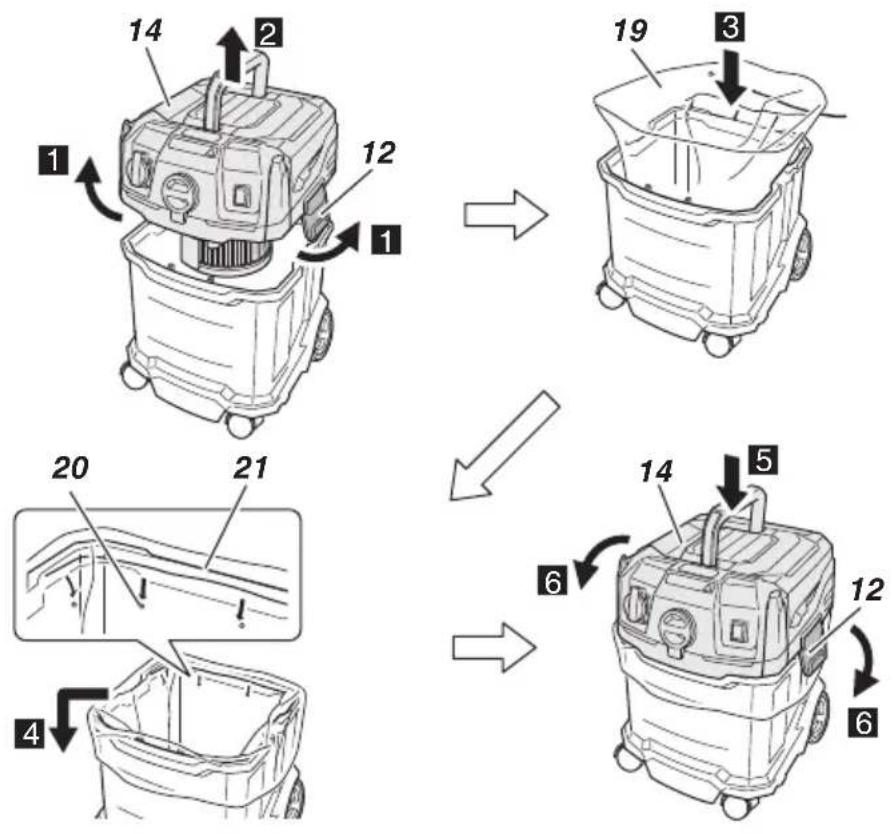
| Inserting a fleece filter bag*1 | 2 | 2 |
| Inserting a PE disposal bag*2 | 3 | 3 |
| Inserting a special filter bag for H-class*3 | 4 | 3 |
| Mount accessory fixtures for nozzles and hose | 5 | 4 |
| Installing the suction hose 6 4 | ||
| Removing and attaching the connecting sleeve | 7 | 4 |
| Regulating the suction power*4 | 8 | 4 |
| Action Figure Page | ||
| Switch operation 9 4 |
*1 We recommend using fleece filter bags for:
○ Applications, where small amounts of fine dust are created (e.g. spot-grinding and grinding of paint and lacquer coatings, extraction of drilling applications with small diameters < 10 mm of short duration, etc.).
○ Use of machines, such as: routers, planers, small grinding machines, etc.
NOTE
When using a fleece bag the filter cleaning is non-functional.
*2 We recommend the use of PE-disposal bags for:
○ Applications, where larger amounts of dust are created (e.g. removal of plaster surfaces, spot-grinding and grinding of screeds, etc.).
○ Use of machines, such as e.g.: renovation milling machines, renovation grinders, drywall grinders, wall grinders etc.
*3 The special filter bag must be used in the case of harmful dust.
*4 By turning the auxiliary air slide the air supply on the air intake and thus the suction power can be regulated.
PRIOR TO OPERATION
WARNING
Before commissioning, check that the rated mains voltage and mains frequency stated on the nameplate match your power supply.
THE DEVICE
- PressClean (Fig. 10)
To clean the filter using a strong air flow: Turn the swith on, cover the nozzle or suction opening with the hand and press the button several times (at least 3 times).
- Power socket (Fig. 11) (RP200YL / RP300YL / RP300YM / RP300YH)
WARNING
- The power socket is designed for connection to a power tool only.
○ The total maximum permissible current consumption (of dust extractor and connected power tool) must not exceed the value "Max. current consumption" (see "SPECIFICATIONS").
If the switch is in the "AUTO" position, the dust extractor is switched on or off by means of a power tool connected to the power socket.
- Volume flow control display (Fig. 12) (RP300YM / RP300YH)
Lights up red when the required volume flow of 20 m/sec is not achieved.
The volume flow control display lights up and there is an additional acoustic signal when the container is full and/or if the suction hose is blocked. See "TROUBLESHOOTING"
USE
- Dry Vacuuming
○ Vacuum using a dry filter, dry device and dry accessories only. If the cartridge is damp, dust may stick and form a crust.
○ Always use fleece filter bag or PE disposal bag together with pleated filter.
English
2. Wet vacuuming
WARNING
Never operate the machine without inserting filter or special wet filter. The machine may be destroyed and water may also escape.
Before carrying out any wet vacuuming, remove the dry vacuumed material. This process will prevent severe soiling and encrustation.
☐ The appliance has a float system that enables it to switch off the air flow when the maximum liquid level is reached. When this happens, you will hear a distinct change in the sound of the motor. Then switch off the appliance and pull the plug from the socket. Only vacuum liquids when the float is functioning properly (see maintenance).
○ After switching off, some water may run back out of the hose.
○ Before emptying, first of all take the suction hose out of the liquid.
○ If you are then going to dry vacuum, insert a dry filter. If there is frequent switching between dry and wet vacuuming, we recommend the use of a second (replacement) filter. Allow the filter, container and accessories to dry: otherwise dust may adhere to damp components.
Before storage: leave humid filter and the inside of the dust container to dry completely.
3. Transport
○ L class: Leave the hose on the machine to prevent dust from accidentally being released. (Fig. 13)
○ M and H class: with the hose disconnected, close the suction inlet with the plug. Insert the hose ends into each other so that no dust can escape from the hose.
- Secure the suction hose or mains connection lead to the appliance using the accessory fixture and rubber.
- The upper part must be securely sealed to the container - check that the snap locks are closed.
WARNING
The handle is only permitted for manual transport - not for attachment to cranes or similar!
CLEANING
WARNING
Be sure to turn off the vacuum switch and disconnect the plug from the power receptacle.
CAUTION
This device contains dust that is harmful to health. Discharge and maintenance operations (including disposal of the dust collection containers) must only be carried out by qualified specialists wearing appropriate protective clothing and equipment.
Clean the container and accessories with water. Wipe the upper part with a damp cloth.
1. Emptying the Container
WARNING
Only permitted for dusts with occupational exposure limits > 1 mg/m ^3
(1) Pull the mains plug. Ensure the plug cannot be reconnected accidentally.
(2) Open the snap locks. Remove the upper part of the device from the container.
(3) Tip out the container.
2. Disposing of the fleece filter bag
(1) Pull the mains plug. Ensure the plug cannot be reconnected accidentally.
(2) Put on a dust mask.
(3) Open the snap locks. Remove the upper part of the device from the container.
(4) Carefully pull back the fleece filter bag from the suction opening. Close the cap of the filter bag opening.
(5) Dispose of the vacuumed material in accordance with legal regulations.
3. Dispose of PE disposal bags and special filter bags for H-class.
(1) Insert mains supply plug.
(2) Switch on the dust extractor and clean the filter: Press the Button for filter cleaning 'PressClean' (see "1. PressClean" of "The DEVICE").
(3) Switch off the dust extractor: turn the switch to the "OFF" position.
(4) Put on a dust mask.
(5) Open the snap locks. Remove the upper part of the device from the container. Before setting down the upper part, turn switch to the "ON" position so that any falling dust is vacuumed.
(6) Carefully remove the bag from the container wall and close with the supplied cable binders. For the special filter bag for H-class, close the cap of the filter bag opening and then close the bag.
(7) Dispose of the vacuumed material in accordance with legal regulations.
MAINTENANCE AND INSPECTION
1. General instructions
WARNING
Before performing any maintenance, always switch off the device and remove the mains plug. Ensure the plug cannot be reconnected accidentally.
○ Clean the device (see “CLEANING”). For maintenance by the user, the dust extractor must be taken apart, cleaned and maintained, to the extent possible, without endangering maintenance staff or other people.
Preventive Measures
Appropriate preventive measures include: cleaning the device before disassembly; providing local filtered forced ventilation where the dust extractor is disassembled; cleaning of the maintenance area and providing suitable personal protective clothing and equipment.
2. Reduction in suction power
If the suction power decreases, carry out the following steps:
(1) Clean the filter: Press Button for filter cleaning 'PressClean' (see "1. PressClean" of "THE DEVICE")
(2) Empty the container or replace the fleece filter bag or PE disposal bag.
(3) Replace the filter, or shake it out, brush it off or remove it, rinse under running water, dry and reinsert (see "Replacing the filter").
3. Replacing the filter
(1) Clean the filter again before replacement ("1. PressClean" of "THE DEVICE")
(2) Unplug power cable; Ensure the plug cannot be reconnected accidentally.
(3) Open the snap locks. Remove the upper part of the device from the container.
Loosen closure (see imprint). Remove filter cover and filter. (Fig. 14)
Seal the old filter immediately in a dust-tight plastic bag and dispose of it in accordance with regulations.
4. Water sensor
CAUTION
Regularly clean the mobile float that is incorporated in the filter cage and check it for signs of damage.
5. Technical inspection
At least once a year, the manufacturer or a suitably qualified and trained person must carry out a dust test, e.g. to check for damage to the filter, verify that the device is air-tight and that the control unit is functioning correctly.
When carrying out maintenance or repairs, it is essential to dispose of any contaminated objects that cannot be adequately cleaned. These objects must be disposed of using impermeable bags and in accordance with the applicable regulations for removing such waste.
6. Inspecting the mounting screws
Regularly inspect all mounting screws and ensure that they are properly tightened. Should any of the screws be loose, retighten them immediately. Failure to do so could result in serious hazard.
7. Maintenance of the motor
Exercise due care to ensure the motor does not become wet with oil or water.
TROUBLESHOOTING
Reduction in suction power:
See the instructions in CLEANING.
○ Is the filter dirty? - clean.
○ Fleece filter bag full? - replace.
○ PE disposal bag full? - replace.
○ Container full? - empty.
○ Nozzle, tubes or hose blocked? - clean.
Device will not start:
○ Is the plug in the plug socket?
○ No power from mains?
O Mains lead OK?
○ Device hood correctly closed?
- Has the water sensor cut off? - Empty the container; then switch on and off again.
○ Switch in "AUTO" position? - Set to "ON" position. See Fig. 9.
○ The dust extractor is not switched on or off by means of a power tool, even though switch is set to the "AUTO" position. - Connect the power tool to the plug socket.
ACCESSORIES
Use only genuine HiKOKI accessories. See page 218. Use only accessories that fulfil the requirements and specifications listed in these operating instructions.
REPAIRS
Replacing supply cord
If the replacement of the supply cord is necessary, it has to be done by HiKOKI Authorized Service Center to avoid a safety hazard.
CAUTION
In the operation and maintenance of power tools, the safety regulations and standards prescribed in each country must be observed.
ENVIRONMENTAL PROTECTION

Only for EU countries
Do not dispose of electric tools together with household waste material!
In observance of European Directive
2012/19/EU on waste electrical and electronic equipment and its implementation in accordance with national law, electric tools that have reached the end of their life must be collected separately and returned to an environmentally compatible recycling facility.
GUARANTEE
We guarantee HiKOKI Power Tools in accordance with statutory/country specific regulation. This guarantee does not cover defects or damage due to misuse, abuse, or normal wear and tear. In case of complaint, please send the Power Tool, undismantled, with the GUARANTEE CERTIFICATE found at the end of this Handling instruction, to a HiKOKI Authorized Service Center.
Information concerning airborne noise and vibration The measured values were determined according to EN60335-2-69 and declared in accordance with ISO 4871.
Measured A-weighted sound pressure level: 78.1 dB (A) Uncertainty K: 2.5 dB (A).
Wear hearing protection.
During operation the noise level can exceed 80 dB (A).
Vibration total values (triax vector sum) determined according to EN 60335-2-69.
Vibration emission value ah < 2.5 m/s²
NOTE
Due to HiKOKI's continuing program of research and development, the specifications herein are subject to change without prior notice.
SPECIFICATIONS
| Model RP200SL RP200YL RP300YL RP300YM RP300YH | ||||||
| Dust class L M H | ||||||
| Voltage 220 V-240 V | ||||||
| Frequency 50-60 Hz | ||||||
| Rated input power 1200 W | ||||||
| Max. vacuum | (at blower) 22.5 kPa | |||||
| (at the hose) 21.0 kPa | ||||||
| Max. air flow | (at blower) 4.2 m | 3/min | ||||
| (at the hose) 2.3 m | 3/min 2.0 m | 3/min | ||||
| Max. container volume 20 l | 30 l | |||||
| Suction hose | Diameter | 32 mm | ||||
| Length | 1.75 m | 3.2 m | 4.0 m | |||
| Protection class | IP 24 | |||||
| Dimensions(W x D x H) | 377 x 381 x400 mm | 377 x 500 x400 mm | 377 x 500 x 493 mm | |||
| Weight*1 | 9.4 kg | 10.0 kg | 10.8 kg | |||
*1 without mains cord
Weight: According to EPTA-Procedure 01/2014
| Dust extractor maximum power consumption | 1200 W |
| Power tool maximum power consumption | 2300 W |
| Total of dust extractor and power tool | 3500 W |
| Max. current consumption | 16 A |
O Stekker in stopcontact?
O Stroomnet zonder spanning?
○ Voedingskabel in orde?
VEDLIKEHOLD OG INSPEKSJON
O PE-deponeringspose full? - tøm.
1. PressClean (Rys. 10)
1. PressClean (Sl. 10)
Za čišćenje filtera koristeći jak protok vazduha: Uključite prekidač, pokrijte mlaznicu ili otvor za usisavanje rukom i pritisnite dugme nekoliko puta (najmanje 3 puta).
Srpski
2. Utikač za napajanje (Sl. 11) (RP200YL / RP300YL / RP300YM / RP300YH)
UPOZORENJE
O Utikač za napajanje je dizajniran za povezivanje samo na električni alat.
○ Ukupna maksimalna dozvoljena trenutna potrošnja (vadioca prašine i povezanog električnog alata) ne sme da pređe vrednost „maks. trenutna potrošnja“ (pogledajte „SPECIFIKACIJE“).
Ako je prekidač u poziciji „AUTO“, vadioc prašine se uključe ili isključuje putem električnog alata povezanog na utikač za napajanje.
3. Prikaz kontrole toka jačine (Sl. 12) (RP300YM / RP300YH)
1. PressClean (Sl. 10)
Za čišćenje filtra pomoću snažnog protoka zraka: Uključite prekidač, rukom pokrijte mlaznicu ili usisni otvor i pritisnite tipku nekoliko puta (najmanje 3 puta).
2. Električna utičnica (Sl. 11) (RP200YL / RP300YL / RP300YM / RP300YH)
UPOZORENJE
O Električna utičnica je dizajnirana samo za spajanje na električni alat.
Siemensring 34, 47877 willich, Germany
Tel: +49 2154 49930
Fax: +49 2154 499350
URL: http://www.hikoki-powertools.de
Hikoki Power Tools Netherlands B.V.
Brabanthaven 11, 3433 PJ Nieuwegein, The Netherlands
Tel: +31 30 6084040
Fax: +31 30 6067266
URL: http://www.hikoki-powertools.nl
Hikoki Power Tools (U.K.) Ltd.
25 Majestic Road, Southampton, SO16 OYT,
United Kingdom
Tel: +44 1908 660663
Fax: +44 1908 606642
URL: http://www.hikoki-powertools.uk
Hikoki Power Tools France S.A.S.
Hikoki Power Tools Belgium N.V./S.A.
Koningin Astridlaan 51, B-1780 Wemmel, Belgium
Tel: +32 2 460 1720
Fax: +32 2 460 2542
URL: http://www.hikoki-powertools.be
Hikoki Power Tools Italia S.p.A
Via Piave 35, 36077, Altavilla Vicentina (VI), Italy
Tel: +39 0444 548111
Fax: +39 0444 548110
URL: http://www.hikoki-powertools.it
Hikoki Power Tools Ibérica, S.A.
C/ Puigbarral, 26-28, Pol. Ind. Can Petit, 08227 Terrassa
(Barcelona), Spain
Tel: +34 93 735 6722
Fax: +34 93 735 7442
URL: http://www.hikoki-powertools.es
Kjeller Vest 7, N-2007 Kjeller, Norway
Tel: (+47) 6692 6600
Fax: (+47) 6692 6650
URL: http://www.hikoki-powertools.no
Hikoki Power Tools Sweden AB
Rotebergsvagen 2B SE-192 78 Sollentuna, Sweden
Tel: (+46) 8 598 999 00
Fax: (+46) 8 598 999 40
URL: http://www.hikoki-powertools.se
Hikoki Power Tools Denmark A/S
Lillebaeltsvej 90, 6715 Esbjerg N, Denmark
Tel: (+45) 75 14 32 00
Fax: (+45) 75 14 36 66
URL: http://www.hikoki-powertools.dk
Hikoki Power Tools Finland Oy
Tupalankatu 9, 15680 Lahti, Finland
Tel: (+358) 20 7431 530
Fax: (+358) 20 7431 531
URL: http://www.hikoki-powertools.fi
Hikoki Power Tools Hungary Kft.
Hikoki Power Tools Romania S.R.L.
Ring Road, No. 66, Mustang Traco Warehouses,
Warehouse No.1, Pantelimon City, 077145, Ilfov County, Romania
natural_image
Line drawing of a quill pen in an inkwell (no text or symbols)
natural_image
Line drawing of a quill pen in an inkwell (no text or symbols)
natural_image
Line drawing of a quill pen in an inkwell (no text or symbols)
- SPECIFIED CONDITIONS OF USE
- RP 200SL / RP 200YL / RP 300YL:
- RP 300YM:
- RP 300YH:
- GENERAL SAFETY INSTRUCTIONS
- SPECIAL SAFETY INSTRUCTIONS
- English
- Special safety instructions for RP 300YH:
- Special safety instructions for RP 200SL / RP 200YL / RP 300YL:
- PRECAUTIONS FOR USE OF THE DUST EXTRACTOR
- WARNING
- NAMES OF PARTS
- SYMBOLS
- STANDARD ACCESSORIES
- NOTE
- PRIOR TO OPERATION
- THE DEVICE
- USE
- Wet vacuuming
- Transport
- CLEANING
- CAUTION
- Emptying the Container
- Disposing of the fleece filter bag
- Dispose of PE disposal bags and special filter bags for H-class.
- MAINTENANCE AND INSPECTION
- General instructions
- Preventive Measures
- Reduction in suction power
- Replacing the filter
- Water sensor
- Technical inspection
- Inspecting the mounting screws
- Maintenance of the motor
- TROUBLESHOOTING
- Reduction in suction power:
- Device will not start:
- ACCESSORIES
- REPAIRS
- Replacing supply cord
- ENVIRONMENTAL PROTECTION
- GUARANTEE
- VEDLIKEHOLD OG INSPEKSJON
- PressClean (Rys. 10)
- PressClean (Sl. 10)
- Srpski
- Utikač za napajanje (Sl. 11) (RP200YL / RP300YL / RP300YM / RP300YH)
- UPOZORENJE
- Prikaz kontrole toka jačine (Sl. 12) (RP300YM / RP300YH)
- Električna utičnica (Sl. 11) (RP200YL / RP300YL / RP300YM / RP300YH)
- Hikoki Power Tools Netherlands B.V.
- Hikoki Power Tools (U.K.) Ltd.
- Hikoki Power Tools France S.A.S.
- Hikoki Power Tools Belgium N.V./S.A.
- Hikoki Power Tools Italia S.p.A
- Hikoki Power Tools Ibérica, S.A.
- Hikoki Power Tools Sweden AB
- Hikoki Power Tools Denmark A/S
- Hikoki Power Tools Finland Oy
- Hikoki Power Tools Hungary Kft.
- Hikoki Power Tools Romania S.R.L.
Brand : HiKOKI
Model : RP200SL
Category : Vacuum Cleaner