
BCM1021 - Battery charger Ferm - Free user manual and instructions
Find the device manual for free BCM1021 Ferm in PDF.



| Product type | Battery charger |
| Brand | Ferm |
| Model | BCM1021 |
| Use | Charging of 6V and 12V lead-acid batteries |
| Input voltage | 230 V ~ 50 Hz |
| Output voltage | 6 V / 12 V (selectable) |
| Output current | 5 A |
| Recommended battery capacity | 20 Ah to 75 Ah |
| Compatible battery types | Lead-acid batteries with or without filler caps |
| Charge indicator | Analog ammeter on the front |
| Voltage selector | 6V/12V switch on the front |
| Protection | Blade fuse, thermal circuit breaker, reverse polarity protection |
| Ventilation required | Yes, charge in a well-ventilated area |
| Included accessories | Set of battery clamps, user manual, warranty card |
| Housing material | Plastic |
| Color | Black and orange (typical Ferm) |
| Maintenance and cleaning | Unplug before cleaning, use a dry cloth, do not use water or solvents |
| Safety | Use only indoors, do not expose to moisture, wear safety goggles |
| Repairability | Replaceable fuse; for other repairs, contact after-sales service |
| Warranty | See warranty card |
| Standards | Compliant with European directives |
Frequently Asked Questions - BCM1021 Ferm
User questions about BCM1021 Ferm
0 question about this device. Answer the ones you know or ask your own.
Ask a new question about this device
Download the instructions for your Battery charger in PDF format for free! Find your manual BCM1021 - Ferm and take your electronic device back in hand. On this page are published all the documents necessary for the use of your device. BCM1021 by Ferm.
USER MANUAL BCM1021 Ferm
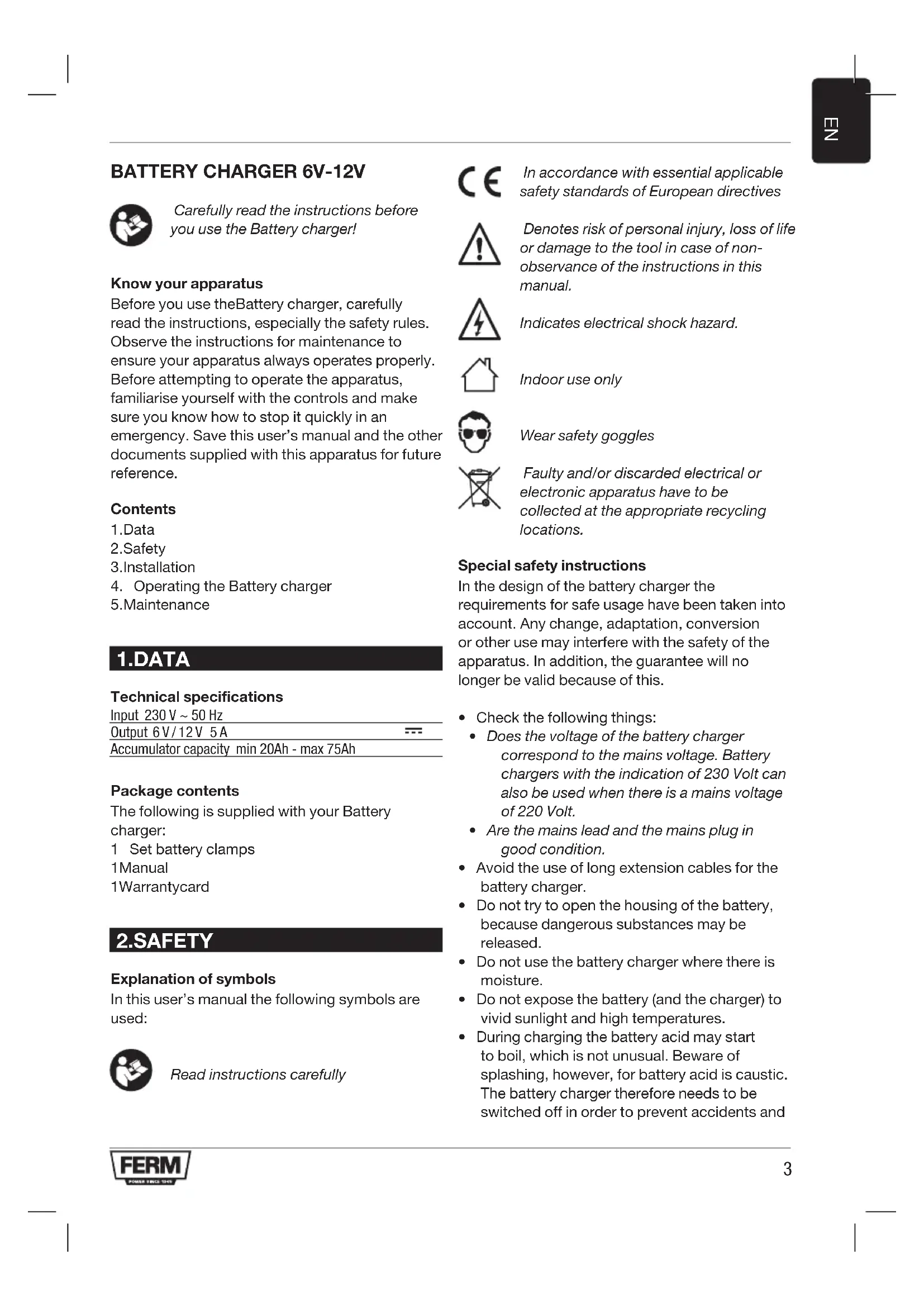
Carefully read the instructions before you use the Battery charger!
Know your apparatus
Before you use the Battery charger, carefully read the instructions, especially the safety rules. Observe the instructions for maintenance to ensure your apparatus always operates properly. Before attempting to operate the apparatus, familiarise yourself with the controls and make sure you know how to stop it quickly in an emergency. Save this user's manual and the other documents supplied with this apparatus for future reference.
Contents
1.Data
2.Safety
3.Installation
4. Operating the Battery charger
5.Maintenance
1.DATA
Technical specifications
Input 230V 50Hz
Output 6V/12V 5A
Accumulator capacity min 20Ah - max 75Ah
Package contents
The following is supplied with your Battery charger:
1 Set battery clamps
1Manual
1Warrantycard
2.SAFETY
Explanation of symbols
In this user's manual the following symbols are used:

Read instructions carefully

In accordance with essential applicable safety standards of European directives

Denotes risk of personal injury, loss of life or damage to the tool in case of non-observation of the instructions in this manual.

Indicates electrical shock hazard.

Indoor use only

Wear safety goggles

Faulty and/or discarded electrical or electronic apparatus have to be collected at the appropriate recycling locations.
Special safety instructions
In the design of the battery charger the requirements for safe usage have been taken into account. Any change, adaptation, conversion or other use may interfere with the safety of the apparatus. In addition, the guarantee will no longer be valid because of this.
- Check the following things:
- Does the voltage of the battery charger correspond to the mains voltage. Battery chargers with the indication of 230 Volt can also be used when there is a mains voltage of 220 Volt.
- Are the mains lead and the mains plug in good condition.
- Avoid the use of long extension cables for the battery charger.
- Do not try to open the housing of the battery, because dangerous substances may be released.
- Do not use the battery charger where there is moisture.
- Do not expose the battery (and the charger) to vivid sunlight and high temperatures.
- During charging the battery acid may start to boil, which is not unusual. Beware of splashing, however, for battery acid is caustic. The battery charger therefore needs to be switched off in order to prevent accidents and
to allow the battery to cool down.
- During charging so-called detonating gas can be liberated. That is why the filler caps are unscrewed before charging (does not apply to closed batteries, this means Battery chargers without filler caps). Charging has to take place in a thoroughly ventilated space.
- The battery charger does not stop automatically after charging. For this reason it needs to be switched off and disconnected from the battery. Do not leave the battery charger connected to the mains voltage after the battery has been charged completely.
- This range of devices is only suitable for accumulators containing lead and acid, as specified in table 1, and are capable of charging accumulators and starting vehicles. These devices may not be used for non-standard batteries and accessories. To avoid the danger of fire and electric shock, they may also not be used as DC power supplies.
- The charger must only be connected to an appropriate power socket with an earth connection.
- You should have water and soapy water available when using the accumulator. The accumulator contains corrosive substances that are dangerous to the skin and especially the eyes. If you should accidentally come into contact with these substances, immediately rinse the affected region with water and seek medical help.
The accumulator stores a great deal of energy. The plus and minus terminals should not be shorted with metal objects or this may cause a short circuit resulting in personal injury or fire.
Non-rechargeable batteries may not be charged. - First connect the battery terminal that is not connected to the vehicle chassis. The other connection is then made to the vehicle chassis, away from the battery and fuel lines. Only then should the battery charger be connected to the mains power supply.
The apparatus needs to be switched off completely in the case of:
- Malfunctioning or damage to the mains plug or mains cable.
Smoke or stench from scorched insulation.

Always wear safety glasses and old clothes during working with the battery, because battery acid is a biting product!
3.INSSTALLATION
Before putting the battery charger into operation the following steps need to be taken (Fig. 1):
- If the battery is still connected, it needs to be disconnected,
first the negative terminal (A); - then the positive terminal (B)!
It is advisable to remove the battery from the vehicle before charging it.
- Check the level of the battery acid. For this purpose remove the battery stoppers first, then check the acid level and, if necessary, fill up with distilled water (available from the chemists'). The level of the electric charge can be checked with a hydrometer.
- Clean the connections and the terminals. This can be done with a steel wire brush or with sandpaper.
- Connect the positive clamp of the charger (red) to the positive terminal (+) of the battery. Then connect the negative clamp of the charger (black) to the negative terminal (-) of the battery. Check if the clamps of the charger are firmly connected to the battery.
The following steps need to be taken with the help of the information of the charge control display. - The charger must not be placed on top of the accumulator or vice-versa. This is both illegal and unsafe
If the accumulator temperature rises above 40^ then the charging current should be reduced, and if the temperature rises above 45^ then you should stop charging and only resume charging when the temperature has dropped. - Now plug the power plug into the mains socket and set the switch to "6V/12V". When charging, you should keep an eye on the current meter to check that the indicator is working properly. (Caution! The current meter only provides a general indication and not an exact measurement).
- You should check that the battery electrolyte has reached a specific gravity of 1.28. If not,
then you can continue charging, and if so, then charging is finished. You should then set the "Voltage" switch to "Off". Then remove the mains power plug and the two clips from the plus and minus terminals of the accumulator. (When charging the battery while still in the vehicle, you should first remove the clip connected to the chassis.)
The integral flat fuse protects the equipment from polarity reversal and short circuits. If the fuse suffers a defect it must be replaced by a new fuse with the same amp value. If you wish to replace the flat fuse, first pull the mains plug out of the socket and remove the charger clamps from the battery. In the event of a thermal overload, an automatic circuit breaker will stop the charging process. After a cooling break it will cut in again automatically.
Explanation of switches, indication lights and display on front panel
6V/12V
The battery charger can charge batteries of 6V and 12V. For this purpose push the switch at the right side of the front panel in chosen position.
Charging process
- Connect the clamps correctly to the battery and connect the plug to the mains.
- Select the voltage 6V / 12V switch
- The charging current is now visible on the display on the front. This current meter is not a precision instrument and only gives a rough indication of the charging current.
- Disconnect from the mains supply.
- Remove the clamps from the + and - poles of the battery.
Trouble shooting
1. No charging current
- Bad contact of power socket
- ContactqualifiedElectrician
-
Select Voltage 6V / 12V is set incorrectly
-
Select correct voltage position
-
Initial voltage is too low
-
Changebattery
-
and - poles of battery are oxidized and/or dirty
Cleanpoles
- Battery has been damaged
-Replacethebattery
2. Low charging current
- and - poles of battery are oxidized and/or dirty
Cleanpoles
Battery is charged fully - Measurespecific gravity
3. Excessive transformer noise
- Select Voltage 6V / 12V is set incorrectly
- Select correct voltage position
- Unstableposition
- Change position for proper placement
Check charged battery
On the basis of the specific gravity of the battery acid can be gathered if an battery is fully loaded or not. With the help of a specific gravitometer the specific gravity can be appointed.
Empty battery: s.g. = 1.13 kg/dm³
Full battery: s.g. = 1.28 kg/dm³

CAUTION! The gas mixture is explosive. You must remove the power plug from the mains socket before connecting or disconnecting the battery.
5.MAINTENANCE
Always remove the plug from the mains socket when the battery charger is being serviced or cleaned. Never use any water or other liquids when cleaning the charger. Keep the cable and your battery charger clean. Some cleaners and solvents (petrol, thinner) can affect or dissolve plastic parts. These products contain a.o. benzene, trichloroethylene, chloride and ammonia.

CAUTION! To avoid electrical danger, the charger should be connected to a mains supply with good earthing and may not be subjected to rain or snow. Any damaged cables must be immediately replaced by a qualified specialist.
Defective batteries
- Damaged batteries which do not retain their charge. It is often the case that batteries which are in very bad condition can no longer be charged; they need to be replaced because they do not retain their charge.
- Short circuited batteries. If, after several hours the battery charger still does not indicate that the battery is being charged, this usually means that one of the elements is short circuited. The battery needs to be replaced.
Malfunction
If your battery charger no longer functions as it should, this may be due to the following reasons:
- The clamp has been connected wrongly. Check if the right clamp is connected to the right terminal.
Battery life
The life of your battery will be considerably longer if the following advice is taken:
- Check the liquid level of the battery every month and, if necessary, fill it up with distilled water.
- Clean the terminals of your battery regularly to prevent deposit. Put a little bit of vaseline on the terminals.
- If the vehicle is seldom used, the battery will discharge. Therefore it needs to be charged regularly to maximum capacity. In this way malfunctioning can be prevented.
If everything has been checked, and the battery charger still does not charge as it should, it needs to be taken to the Service address on the warranty card.
Environment
To prevent damage during transport, the appliance is delivered in a solid packaging which consists largely of reusable material. Therefore please make use of options for recycling the packaging.

Faulty and/or discarded electrical or electronic apparatus have to be collected at the appropriate recycling locations.
Only for EC countries
Do not dispose of power tools into domestic waste. According to the European Guideline 2012/19/EU for Waste Electrical and Electronic Equipment and its implementation into national right, power tools that are no longer usable must be collected separately and disposed of in an environmentally friendly way.
Warranty
For the conditions of warranty, please refer to the separately provided warranty card.
AKKULADEGERAT 6V-12V

O6aCheHHe Ha KJIIOUObE, INHdNKaTOpHN CBETINHHn IINcPJIe HAppeHnnaHeI.
6V/12V
3apHnTo yCTpoiCTBO 3a 6atepn MoKe da 3apeKda 6atepn ot 6V n 12V. 3a Ta3n ceI HaTnCHHe IpeBkJIIOuBaTeIe OT IaCHaTa CtpaHa Ha npEHHnaHeI B N3bpaHO NOLOKeHne.
PpoecHa3apeKdahe
CbpxTe cKoBnTe npaBnHc KbM 6aTePnTa n CbpxTe UeNCeJa KbM MpeKaTa.
- 136epete npeBknIOuBaTeIa HAnpeXeHne 6V/12V
ToKbT Ha 3apeXdahe cera ce BuxkaHa dncnpeoTnped.To3n n3MepBaTeI Ha Tok He e npeun3eH uHCTpyMeHT n daBa caMo rpy6a Hndnkaun 3a 3apeXdaun TOK.
- N3KJIIOUeTe OT 3aXpaHbAHeTo.
- 13BaTe cKo6nte OT + n - noIocnTe Ha 6aTeepnTa.
OctpaHbAhe Ha npo6JeMn
- HЯма TOK 3a 3apekkahe
- JIoW KOHTaKT Ha KOHTaKTA
CbpxKeTe ce c KBaIuΦnUnpaH eNeKtpoTeXnK
- 136epete HappeKeHne 6V/12Ve 3aJaHeHO HenpaBUNHO
- N36peTe npabunHata no3nua Ha HanpeXeHne
- Пьронанлно HanpexeHne e TBpde HnCKO
CmeHete6atepura
+H-NOJOCHTeHa6aTePnTa caOKncJeHn/nn3aMbpcEH
- YnCTu CTbJIbOBe
BaTePraTa e noBpeDeHa
- CmeHete 6atepura
- Hncka ToK Ha 3apeXdaHe
+H-NOJIOCTeHa6aTePnraTa ca OKncneHn/nn3aMbpcEH
- 甲CTu CTbJIbOBe
BatepnaTc 3apeKda HnblHo
- IV3MepBaHe Ha CneuHnHOTo TerNo
PpOBepeTe 3apeHeHaTa 6aTeepn
Bb3 ochoba Ha cneuФHOTo TergNo Ha
akymlyaTopa MoKe Da ce Cb6epe KncelnHa,
ako baTepya e HantbIhO 3apeDeHa NIn He. C
nomouTa Ha KOHKPeTeH rpaBHTaTOP MoKe Da ce
onpeDen CneuФHOTo TergNo.
DECLARATION OF CONFORMITY BCM1021 BATTERY CHARGER 6-12V
(EN) We declare under our sole responsibility that this product is in conformity with directive 2011/65/EU of the European parliament and of the council of 9 June on the restriction of the use of certain hazardous substances in electrical and electronic equipment is in conformity and accordance with the following standards and regulations:
(DE) Der Hersteller erklärt eigenerantwortlich, dass this Produkt der Directive 2011/65/EU des Europäischen Parliaments und des Rats vom 8. Juni 2011 über die Einschränkung der Anwendung von bestimmten gefährlichen Stoffen in elektrischen und elektronischen Geräten entspricht. den folgenden Standards und Vorschriften entspricht:
(NL) Wij verklaren onder once volledige verantwoordelijkheid dat dit product voldoet aan de conform Richtlijn 2011/65/EU van het Europees Parlement en de Raad van 8 Juni 2011 betreffende beperking van het gebruik van bepaalde gaavarlijke stoffen in elektrische en elektronische apparatus en in overeenstemming is met de volgende standaarden en reguleringen:
(FR) Nous déclarons sous notre seule responsabilité que ce produit est conforme aux standards et directives suivants: est conforme à la Directive 2011/65/EU du Parlement Européen et du Conseil du 8 juin 2011 concernant la limitation d'usage de certaines substances dangereuses dans l'équipement électrique etlectronique.
(ES) Declaramos bajo nuestra exclusiva responsabilidad que este producto cumple con las作為 normas y estandares de configuracion: seceechara conforme con la Directiva 2011/65/UE del Parliamento Europeo y del Consejo de 8 de junio de 2011 sobre la restriccion del uso de determinadas sustancias peligrosas en los equipos electricos y electronicos.
(PT) Declaramos por{nossa total responsabilida de que este produits est em conformidade e cumple as normas e regulamentacoes que se seguem: está em conformidade com a Directa 2011/65/EU do Parlamento Europeu e com o Conselho de 8 de Junho de 2011 no que respeita a restricao de uso de determinadas substancias perigosas existentes em equipamento eletrico e electronomico.
(IT) Dichiariamo, quello tha notre responsabilità, che questo prodotto è conforme alle normative e ai regolamenti segunti: è conforme alla Diretta 2011/65/UE del Parlamento Europeo e del Consiglio dell'8 giugno 2011 sulla limitazione dell'uso di determinate sostane pericolose nelle appearecchiature elettriche e edelettroniche.
(SV) Vi garanterar pa eget ansvar attenna produit uppyfller och foljer foljande standarder och bestammelser: uppyfler direktiv 2011/65/EU fran Europeiska parlementet och EG-radet fran den 8 Juni 2011 om begransingen av anvanding av farlga substanser i elektrisk och elektronisk utrusting.
(FI) Vakuutamme yksinomaan omalla vastuillamme, etta tama luote tayttaa seuraavat standardit ja saadokset: tayttaa Europan parlamentin ja neuvoston 8. kesakuuta 2011 paivatyn direktiavin 2011/65/EU vaatumkset koskien vaarallisten aineiden kayton rajoitusta sahko- je elektronisissa laitteissa.
(NO) Vierklaer under vart eget ansvar at dette prodktet er i samsvar med folgende standarder og regler: er i samsvar med EU-direktivet 2011/65/EU fra Europa-parlamentet og Europa-radet, pr. 8 Juni 2011, om begrensning i Bruken av visse farlige stoffer i elektrisk og elektronisk utsr.
(DA) Vi erklaerer under eget ansvar, at dette produit er i overensstemmelse med folgende standarder og bestemmelser: er i overensstemmelse med direktiv 2011/65/EU fra Europa-Parliamentet og Rådet af 8. Juni 2011 om begraensning af anvendelsen at visse faliige stoffer i elektrisk og elektronisk odystr.
(HU) Feelösségunk teljes tudataban kijelentjuk, hogy ez a termek teljes mertékben megfelei az alabbi szabvanyoknak és elöirasoknak: je v souladu se smemici 2011/65/EU Evropského parlementu a Rady EU ze dne 8. Června 2011, ktera te týká omezeni pouziti určitych nebezpečnych latek v elektrickych a elektronickych zaïfenich.
(CZ) Na naši vlastní zodpovednost prohlássujeme,Že je tento vyrobek v souladu s náslédujícími standardy a normami: Je v Šulade s normou 2011/65/EU Europskeho parliamentu a Rady z 8. juna 2011 týkajúcej sa obmedzenia používania určitych nebezpečných látok v elektrickom a elektronickom vybaveni.
(SK) Vyhlasujeme na nasu vyhradnu zodpovednost, ze tento vyrobok je v zhode a suliade s nasledujucimi normami a predispisi: je v suliade s normou 2011/65/EU Europskeho parlementa u Rady z 8. juna 201 tykajucej sa obmedzenia pouzivania urichy tnebepezchny latk o elektrickom a elektronikom vybaveni.
(SL) S polno odgovornostjo izjavljamo, da je ta izdelek v skladu in da odgovarja naslednjim standarder terpredispom: je v skladu z direktivo 2011/65/EU Evropskega parliamenta in Sveta z dne 8. junji 2010 omejevanju uporabe dolocenih nevarnih snovi v elektricii in elektronski upremi.
(PL) Deklarujemy na wlasnq odpwiedzialnosc, ze ten produkt spelnia wymogi zawarte w nastepujacych normach i przypesich: jest zgodny z Dyrektwy 2001/65/UE Parliamentu Europejskiego i Rady z dnia 8 czerwa 2011 r. w sprawie ograniczenia stosowania niedtorych niebepezicznych substancji w sprzechec elektrycznym i elektronicznym.
(LT) Prisimi dama visa alsakomybe deklaruojame, kad sis gaminys alitinka zeniaiu paminetus standarus arba nuostatus: atika 2011 m. birzeli 8 d. Europos Parliamento ir Tarybos direktyva 2011/65/EB del tam tikru pavojingu medziagu naudojimo elektros i elektronineje jrangoje apribojmo.
(LV) Iratibilstoa Eiropas Parliamenta un Padomes 2011. gada 8. junija Direktivai 2011/65/ES par dazu bistamu vieu izmantošanas ierobežošanu elektriskas un elektroniskas iekarlăs.
(ET) Apgalvojam ar visu atbildfu, ka šis produits ir saskajā un atbilst sekojosiemi standartiemi n oulikimiem: ir atbilstoša Eiropas Parliamenta un Padomes 2011. gada 8. jūnja Direktvai 2011/65/ES par dazu bistamu vielu izmantošanos ārerobežošan uelektriskas un elektroniskas ekárías.
(RO) Declarém prin aceasta cu raspunderea declina că produsul acesta este in conformitate cu urmatoarele standarde sau directive: este in conformitate cu Directa 2011/65/UE a Parliamentului European si a Consiliului din 8 iunie 2011 cu privire la interzicerea utilizari anumitor substante periculoase la echipamentele electrice si electronice.
(HR) Izavljmujo pod vlastitom odgovornol, su da je strojem ukladan sa litjesedim standardima li standardizarinam dokumenta i u skladu sa odredbama: uskldeno s Direktivom 2011/65/EU europskog parlamenta i vijeca izdanom 8. liprja 2011. oograničenju kurišenja odreženih opasnih tvari u elektrickojn i elektronickoj opremi.
(SRL)Pod punom odgovomoscu izjavljujecta da je usaglasen sa sledecim standardima ill normama: usaglasen sa direktivom 2011/65/EU Evropskog parlamenta i Saveta od 8.juna.2011. godine za restrickcjupo upotrebe odredenih opasnih materija u elektricnoj i elektronskoj upremi.
(RU) NcBIOOTBETCTBEHHOCTb 3aARnEM, TTO daHHOE INdENe COOTBETCTBYET CNEUYOUIM CTANDAPTAM HOPMAM: COOTBETCTBYET Tpe6oBAHmI DnkeKTHBi 2011/65/EU EbponeCkORO napJaMaTeHa CBota ot 8 IOHA 2011 r. no ORpAHNeHHIOINONLO3BOAHn OPpeJeEHhIX onaChbIX BeueCTB BJIeKTPnHeCKOM IJIeKTPPOHOM O6OpdyOBAHIn
(UK)Ha cboBnAchny BInIOBnAblbHCTb3AaBNMe, Ioo Tahe 6oNaDHaHHI BInIOBnAe HAcHTNnHm CTaADTpAM I HOpMaTbAM. 3aOBObnBhMnOr MInpekTHBn 2011/65/EC EbponeiCbkoro PnapameHy Ta PaDi N Bi8 4eBnBn 2011 poky Ha o6mEkeHHn BnKOpCtAHNe DneKIN He63eNHeHxpeOvBH n E enekTPnuHOMy Ta enekTPOnHOHMy 6naDHaHHI.
(EL) Anivoue utubua on to pioov auto uupvei kei tnei taq napakotu kavoviaoc kai npatma: auopnpovetrae je TNDyia 2011/65/EE tu Eupmaikou Koivobouaiou kai Tou umbouaiou nts 8ns louviou 2011 vao terepioipoi ngxphons opieevuv etikivvouw ouovn oe Nktpkiok Ka Nktpovirok eoTAtoi.
EN60335-1, EN60335-2-29, EN62233, EN55014-1, EN55014-2, EN61000-3-2, EN61000-3-3, EN61000-3-11 2014/35/EU, 2014/30/EU, 2011/65/EU, 2012/19/EU
Zwolle, 01-03-2021
H.G.F. Rosberg
CEO Ferm
Ferm · Lingenstraße 6 · 8028 PM · Zwolle The Netherlands