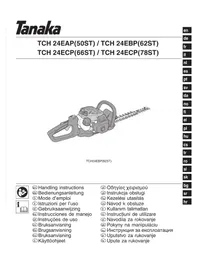
TCH24EAP - Hedge Trimmers HiKOKI - Free user manual and instructions
Find the device manual for free TCH24EAP HiKOKI in PDF.


| Product type | Petrol hedge trimmer |
| Brand | HiKOKI |
| Model | TCH24EAP |
| Engine | 2-stroke, air-cooled |
| Fuel | Unleaded petrol (89 octane) and 2-stroke oil mixture (ratio 25:1 to 50:1) |
| Blade length | 610 mm (24 inches) |
| Blade type | Double-edged, steel |
| Rotating rear handle | Yes, 5 locking positions (0°, 45°, 90°) |
| Power source | Petrol engine, fuel tank |
| Weight (empty) | Approximately 5.5 kg |
| Sound pressure level (LpA) | ≤ 92 dB(A) per ISO 10517 |
| Guaranteed sound power level (LwA) | ≤ 108 dB(A) per 2000/14/EC |
| Vibration level (front handle) | ≤ 8 m/s² per ISO 10517 |
| Fuel tank capacity | 0.5 L |
| Recommended safety distance | 15 m |
| Required protective equipment | Helmet, visor, hearing protection, gloves, non-slip boots, long clothing |
| Routine maintenance | Air filter cleaning, idle adjustment, blade lubrication every 20 h |
| Main spare parts | Spark plug, air filter, fuel filter, blade, blade guide, spark plugs |
| Included accessories | Blade sheath, multi-socket wrench, instruction manual |
| Warranty | 2 years (subject to general terms and conditions) |
Frequently Asked Questions - TCH24EAP HiKOKI
User questions about TCH24EAP HiKOKI
0 question about this device. Answer the ones you know or ask your own.
Ask a new question about this device
Download the instructions for your Hedge Trimmers in PDF format for free! Find your manual TCH24EAP - HiKOKI and take your electronic device back in hand. On this page are published all the documents necessary for the use of your device. TCH24EAP by HiKOKI.
USER MANUAL TCH24EAP HiKOKI
NOTE: Some units do not carry them.
| Symbols WARNING The following show symbols used for the machine. Be sure that you understand their meaning before use. | |||
| Hedge Trimmer Displacement | |||
| It is important that you read, fully understand and observe the following safety precautions and warnings. Careless or improper use of the unit may cause serious or fatal injury. | Spark plug | ||
| Read, understand and follow all warnings and instructions in this manual and on the unit. | Idle | Idling speed | |
| Always wear eye, head and ear protectors when using this unit. | Fuel tank capacity | ||
| Never touch the cutting blade when it is running. | kg | Dry weight (without fuel and blade case) | |
| Choke - Run position (Open) Blade type | non non non non butterfly | ||
| Choke - Start position (Closed) | L | Overall blade length | |
| I | On/Start | P | Blade pitch |
| O | Off /Stop Gear ratio | ||
| STOP | Emergency stop | LpA, eq ISO10517 | Sound pressure level LpA by ISO 10517 Equivalent* |
| R | Fuel and oil mixture | LWA, eq ISO10517 | Sound power level LwA by ISO 10517 Equivalent* |
| T | Idle speed adjustment | LWA, Ra(M) 2000/14/EC | Measured sound power level LwA by 2000/14/ EC Racing |
| Priming pump | LWA, Ra(G) 2000/14/EC | Guranteed sound power level LwA by 2000/14/ EC Racing | |
| Hot Surface - Contact with hot surface can cause serious burns. | ahv, eq(F) | Vibration level by ISO 10517 Front handle / Equivalent* | |
| 20H | Lubrication should be applied at 20 hour intervals and more frequent at heavy use. | ahv, eq(R) | Vibration level by ISO 10517 Rear handle / Equivalent* |
| LWA | Guaranteed sound power level | K | Uncertainty |
| Before using your machine · Read the manual carefully. · Check that the cutting equipment is correctly assembled and adjusted. · Start the unit and check the carburetor adjustment. See “MAINTENANCE”. | |||
NOTE: Equivalent noise level / vibration level are calculated as the time-weighted energy total for noise / vibration levels under various working conditions with the following time distribution:
* 1/5 Idle, 4/5 racing.
WHAT IS WHAT? (Fig. 1)
Since this manual covers several models, there may be some difference between pictures and your unit. Use the instructions that apply to your unit.
A: Starter handle
B: Fuel tank
C: Fuel tank cap
D: Throttle trigger
E: Throttle trigger lockout
F:Front handle
G: Rear handle
H: Spark plug
I: Hand guard
J: Cutting blade
K: Air cleaner cover
L: Ignition switch
M: Blade guide
N: Protection plate (if so equipped)
O: Gear case
P: Choke lever
Q: Lock button
R: Priming bulb
S: Blade case
T: Combi box spanner
U: Handling instructions
WARNING AND SAFETY INSTRUCTIONS
Pay special attention to statements preceded by the following words:
WARNING
Indicates a strong possibility of severe personal injury or loss of life, if instructions are not followed.
CAUTION
Indicates a possibility of personal injury or equipment damage, if instructions are not followed.
NOTE
Helpful information for correct function and use.
Keep for future reference
WARNING
THIS HEDGE TRIMMER CAN CAUSE SERIOUS INJURIES. Read the instructions carefully for the correct handling, preparation, maintenance, starting and stopping of the hedge trimmer. Become familiar with all controls and the proper use of the hedge trimmer.
Operator safety
Wear head protection (1). (Fig. 2)
Always wear a safety face shield or goggles (2). (Fig. 2)
O Wear approved hearing protection (3). (Fig. 2)
Long-term exposure to noise can result in permanent hearing impairment.
Pay attention to your surroundings. Be aware of any bystanders who may be signaling a problem.
Remove safety equipment immediately upon shutting off engine.
Always wear heavy, long-sleeved shirts (4) and long pants (5) and non-slip boots (6) and gloves (7). (Fig. 2)
Do not wear loose clothing, jewelry, short pants, sandals or go barefoot.
Secure hair so it is above shoulder length.
Do not operate this tool when you are tired, ill or under the influence of alcohol, drugs or medication.
- Do not operate the tool at night or under bad weather conditions when visibility is poor. And do not operate the tool when it is raining or right after it has been raining.
Working on slippery ground could lead to an accident if you lose your balance.
- Never let a child or inexperienced person operate the machine.
Beware of overhead power lines.
Do not start the engine if there are any flammables such as dry leaves, waste paper or fuel in the vicinity. - Never start or run the engine inside a closed room or building. Breathing exhaust fumes can kill.
- Keep handles free of oil and fuel.
- Keep hands away from cutting equipment.
- Do not grab or hold the unit by the cutting equipment.
Gloves should be worn when installing or removing the cutting blade. Failure to do so may result in injury. - When the unit is shut off, make sure the cutting blade has stopped before the unit is set down.
- When operation is prolonged, take a break periodically so that you may avoid possible Hand-Arm Vibration Syndrome (HAVS) which is caused by vibration.
-
If the cutting mechanism strikes any foreign object or the hedge trimmer starts making any unusual noise or vibration, shut off the power source and allow the hedge trimmer to stop. Disconnect the spark plug wire from the spark plug and take the following steps:
-
Inspect for damage;
- Check for, and tighten, any loose parts;
- Have any damaged parts replaced or repaired with parts having equivalent specifications.
WARNING
Always operate the tool with proper protective equipment and clothing. Failure to do so may result in accidents such as burns or injuries. (Fig. 2)
- Do not touch the spark plug area or high voltage during operation. Doing so may result in electric shock.
Do not allow children near the tool during operation.
Do not touch the engine, muffler cover or exhaust vent during or shortly after operation. Doing so may result in burn or injury.
Antivibration systems do not guarantee that you will not sustain Hand-Arm Vibration Syndrome or carpal tunnel syndrome. Therefore, continual and regular users should monitor closely the condition of their hands and fingers. If any of the above symptoms appear, seek medical advice immediately.
- If you are using any medical electric/electronic devices such as a pacemaker, consult your physician as well as the device manufacturer prior to operating any power equipment.
Unit/machine safety
Inspect the entire unit/machine before each use. Replace damaged parts. Check for fuel leaks and make sure all fasteners are in place and securely tightened.
Replace parts that are cracked, chipped or damaged in any way before using the unit/machine. Faulty parts may increase the risk of accidents and may lead to an injury.
- Keep others away when making carburetor adjustments.
- Use only accessories as recommended for this unit/machine by the manufacturer.
Before operation, make sure that there are no tools such as adjustment key or spanner still attached to the unit.
WARNING
- Never modify the unit/machine in any way. Do not use your unit/machine for any job except that for which it is intended.
- Tampering with the engine voids the EU type approval of this engine.
Non-authorized modifications and/or accessories may result in serious personal injury or the death of the operator or others.
Fuel safety
Mix and pour fuel outdoors and where there are no sparks or flames.
Use a container approved for fuel.
- Move at least 3m away from fueling site before starting engine.
- Stop engine before removing fuel cap. Do not remove the fuel cap during operation.
- Empty the fuel tank before storing the unit/machine. It is recommended that the fuel be emptied after each use. If fuel is left in the tank, store so fuel will not leak.
WARNING
Fuel is easy to ignite or get explosion or inhale fumes, so that pay special attention when handling or fi Iling fuel.
- Do not smoke or allow smoking near fuel or the unit/machine or while using the unit/machine.
O Wipe up all fuel spills before starting engine.
- Store unit/machine and fuel in area where fuel vapors cannot reach sparks or open fl ames from water heaters, electric motors or switches, furnaces, etc.
- When using the unit in dry areas, make sure that fire extinguishing equipment is readily available.
If you shut off the engine for refueling, make sure the unit has cooled down before adding fuel.
Cutting safety
Do not cut any material other than plant hedge.
Inspect the area to be cut before each use. Remove objects which can be thrown or become entangled.
Do not operate in areas where there are tree roots or rocks.
For respiratory protection, wear an aerosol protection mask when cutting the grass after insecticide is scattered.
- Keep others including children, animals, bystanders and helpers outside the 15m hazard zone. Stop the engine immediately if you are approached.
Please exercise caution as engine startup may be delayed after pulling the starter handle.
Hold the unit/machine firmly with both hands.
- Keep firm footing and balance. Do not over-reach. Losing your balance during work may lead to an injury.
- Keep all parts of your body away from the muffler and cutting blade when the engine is running.
- Keep cutting tool below shoulder level. NEVER operate unit from a ladder, while in a tree or from any unstable support.
Please exercise caution when operating in areas where electrical cables or gas pipes are present.
- When relocating to a new work area, or inspecting, adjusting, etc., be sure to shut off the machine and ensure that all cutting blade are stopped.
Never place the machine on the ground when running.
O Never touch the cutting blade when it is running.
Always carry a first-aid kit when operating any power equipment.
Turn off the engine and make sure the cutting blade has come to a full stop before leaving the unit unattended.
If you accidentally bump or drop the unit, inspect it immediately to make sure there are no damage, cracks or deformations.
If the tool is operating poorly and produces strange noise or vibrations, turn off the engine immediately and ask your dealer to have it inspected and repaired.
Continued use under these conditions could lead to injury or tool damage.
Use in accordance with local laws and regulations.
WARNING
When a foreign object is caught in the cutting blade, shut off the engine, and remove the foreign object carefully using a plier etc., after the hedge trimmer has been cooled down. Be careful when removing the foreign object, since the cutting blade may move because of the backlash.
Maintenance safety
O Maintain the unit/machine according to recommended procedures.
- Disconnect the spark plug before performing maintenance except for carburetor adjustments.
- Keep others away when making carburetor adjustments.
Use only genuine Tanaka replacement parts as recommended by the manufacturer.
- When the hedge trimmer is stopped for servicing, inspection or storage, shut off the power source, disconnect the spark plug cap from spark plug and make sure all moving parts have come to a stop.
Allow the hedge trimmer to cool before making any inspection, adjustments, etc.
CAUTION
Do not disassemble the recoil starter. There is a possibility of personal injury with recoil spring.
WARNING
Improper maintenance could result in serious engine damage or in serious personal injury.
Transport and storage
- Carry the unit/machine by hand with the engine stopped and the muffler away from your body.
- Allow the engine to cool, empty the fuel tank, and secure the unit/machine before storing or transporting. Failure to do so may result in fire or accidents.
- Empty the fuel tank before storing the unit/machine. It is recommended that the fuel be emptied after each use. If fuel is left in the tank, store so fuel will not leak.
- Store unit/machine out of the reach of children.
Clean and maintain the unit carefully and store it in a dry place. - Make sure engine switch is off when transporting or storing.
- When transporting and storing, place the blade case over the blade.
- You have to secure the machine during transport to prevent loss of fuel, damage or injury.
If a warning label cannot be read, peels off or becomes indistinct, replace it with a new one. To purchase new labels, contact Tanaka dealer.
If situations occur which are not covered in this manual, take care and use common sense. Contact Tanaka dealer if you need assistance.
SPECIFICATIONS
The SPECIFICATION of this machine are listed in the table on page 190.
NOTE
All data subject to change without notice.
OPERATING PROCEDURES
Fuel (Fig. 3)
WARNING
The hedge trimmer is equipped with a two-stroke engine. Always run the engine on fuel, which is mixed with oil. Provide good ventilation, when fueling or handling fuel.
Fuel is highly flammable and it is possible to get seriously injured when inhaling or spilling on your body.
Always pay attention when handling fuel. Always have good ventilation when handling fuel inside building.
Fuel
Always use branded 89 octane unleaded gasoline.
- Use genuine two-cycle oil or use a mix between 25:1 to 50:1, please consult about the mixture ratio to Tanaka dealer.
English
If genuine oil is not available, use an anti-oxidant added quality oil expressly labeled for air-cooled 2-cycle engine use (JASO FC GRADE OIL or ISO EGC GRADE). Do not use BIA or TCW (2-stroke water-cooling type) mixed oil.
Never use multi-grade oil (10 W/30) or waste oil.
- Never mix fuel and oil in machine's fuel tank. Always mix fuel and oil in a separate clean container.
Always start by filling half the amount of gasoline, which is to be used.
Then add the whole amount of oil. Mix (shake) the fuel mixture. Add the remaining amount of gasoline.
Mix (shake) the fuel-mix thoroughly before filling the fuel tank.
Mixing amount of two-cycle oil and gasoline
| Gasoline (Liter) | Two-cycle oil (ml) | |
| Ratio 50:1 Ratio 25:1 | ||
| 0.5 | 10 | 20 |
| 1 | 20 | 40 |
| 2 | 40 | 80 |
| 4 | 80 | 160 |
Fueling

WARNING
Always shut off the engine and let it cool for a few minutes before refueling.
Do not smoke or bring flames or sparks near the fueling site.
- Slowly open the fuel tank, when filling up with fuel, so that possible over-pressure disappears.
O Tighten the fuel tank cap carefully, after fueling.
Always move the unit at least 3m from the fueling area before starting.
Always wash any spilled fuel from clothing immediately with soap.
Be sure to check for any fuel leakage after refueling.
Before fueling, in order to remove static electricity from the main body, the fuel container and the operator, please touch the ground that is slightly damp.
Before fueling, clean the tank cap area carefully, to ensure that no dirt falls into the tank. Make sure that the fuel is well mixed by shaking the container, before fueling.
Starting

WARNING
Before starting the tool, ensure that the cutting blade is not touching any objects or the ground. Otherwise, the cutting blade may unexpectedly move and cause an injury.
Ensure that the cutting blade does not move while the engine is idling. If it does move, adjust the idle speed according to the instructions in "idle speed adjustment" in the "MAINTENANCE" section. If the cutting blade still moves after this adjustment, immediately stop the engine and cease use, then bring the tool to the nearest Tanaka dealer.
(1) Starting the cold engine
1. Set ignition switch (8) to ON position. (Fig. 4)
2. Push priming bulb (9) several times so that fuel flows into carburetor. (Fig. 5)
3. Set choke lever (10) to START position (closed) (A). (Fig. 6)
4. Pull starter handle briskly, taking care to keep the handle in your grasp and not allowing it to snap back. (Fig. 7)
5. When you hear the engine want to start, return choke lever to RUN position (open) (B). (Fig. 6)
6. Pull starter handle briskly again. (Fig. 7)
NOTE
If engine does not start, repeat procedures from 2 to 5.
- Then allow the engine about 2-3 minutes to warm up before subjecting it to any load.
- Check that the cutting blade does not move when the engine is idling.
(2) Starting the warm engine Use only 1, 2, 6 and 8 of the starting procedure for a cold engine.
If the engine does not start, use the same starting procedure as for a cold engine.
Cutting
WARNING
Always wear the proper attire and protective equipment when operating the unit. (Fig. 2)
NOTE
Use in accordance with local laws and regulations.
- When cutting, operate engine at full throttle as this maintains proper blade speed.
- When trimming top of hedge, hold trimmer so blades are between 15 and 30 degrees from a horizontal position and swing trimmer in an arc toward edge of hedge to sweep cuttings off. (Fig. 8)
- When trimming sides of hedge, hold blade vertically and swing unit in an arc. (Fig. 9)
NOTE
- Some garden trees have wood that is very hard and may be beyond the capacity of the tool even if it is of a width that is within normal capacity. Use a pair of pruning shear to remove thick branches before starting work.
An oblique cut may also exceed the capacity of the tool since the length of the cut increases. Be sure to trim thick branches at right angles.
CAUTION
Work that will repeatedly cause the blade to stop will eventually damage the tool.
Multi-position twist handle (Fig. 10)
The rear control handle turns 90 degrees to provide comfortable use while accommodating a variety of cutting angles. The handle allows for five different looking positions.
Rotating the rear handle;
- Push the lock button (11) allowing the handle to turn.
- Rotate the handle to the desired 0^ , 45^ or 90^ locking position and release the lock button to lock the handle in place.
C:LOCK
D:UNLOCK
NOTE
Before attempting to adjust rear handle, make sure the machine is at idle or engine is shut off.
The throttle trigger can not be engaged if the handle is not secured (the lock button is pressed).
Stopping (Fig. 11)
Decrease engine speed and run at an idle for a few minutes, then turn off ignition switch (8).
NOTE
If the engine does not stop, it can be forced to stop by rotating the choke lever to the START position.
Before restarting the engine, ask Tanaka dealer for repairs.
MAINTENANCE
MAINTENANCE, REPLACEMENT OR REPAIR OF THE EMISSION CONTROL DEVICES AND SYSTEMS MAY BE PERFORMED BY ANY NON-ROAD ENGINE REPAIR ESTABLISHMENT OR INDIVIDUAL.
Carburetor adjustment (Fig. 12)
The carburetor is a precision part that mixes air and fuel, and it is designed to ensure high performance from the engine. Before the tool is shipped from the factory, its carburetor is adjusted during a test run. Only make adjustments if it is necessary because of environmental conditions (the climate or atmospheric pressure), the type of fuel, the type of two-cycle oil, etc.

WARNING
Because the carburetor is manufactured with a high degree of precision, do not disassemble it.
For this product, the only setting of the carburetor that can be adjusted is the idle speed (T).
T = Idle speed adjustment screw.
Idle speed adjustment (T)

WARNING
- When the engine is stopped, do not excessively turn the idle speed adjustment screw (T) in a clockwise direction. Otherwise, when the engine starts, the cutting blade may unexpectedly move and cause an injury.
Do not adjust the idle speed adjustment screw (T) for any reason other than to adjust the idling.
Run the engine while adjusting the idling
(1) If the engine stops during idling
Start the engine, and slowly turn the idle speed adjustment screw (T) in a clockwise direction until it is in a position at which the engine rotates smoothly. At that time, ensure that the cutting blade is not moving.
(2) If the cutting blade moves during idling
Slowly turn the idle speed adjustment screw (T) in a counter-clockwise direction until it is in a position at which the cutting blade does not move. At that time, ensure that the rotation of the engine is smooth.

WARNING
If the cutting blade still moves after adjustment of the idle speed adjustment screw (T), immediately stop the engine and cease use, then contact the nearest Tanaka dealer.
Air fi lter (Fig. 13)
The air filter (12) must be cleaned from dust and dirt in order to avoid:
Carburetor malfunctions
Starting problems
O Engine power reduction
Unnecessary wear on the engine parts
Abnormal fuel consumption
Clean the air fiiter daily or more often if working in exceptionally dusty areas.
Loosen the bolt (13), then remove the air cleaner cover and the air fi Iter (12).Rinse it in warm soap suds. Check that the fi Iter is dry before reassembly.
An air fi liter that has been used for some time cannot be cleaned completely. Therefore, it must regularly be replaced with a new one. A damaged fi liter must always be replaced.
Fuel fi Iter (Fig. 14)
Remove the fuel filter (14) from the fuel tank, and replace it if it is dirty.
NOTE
A blocked fuel filter (14) can prevent the supply of fuel and cause a rotation malfunction of the engine.
Spark plug (Fig. 15)
The spark plug condition is influenced by:
An incorrect carburetor setting.
Wrong fuel mixture (too much oil in the gasoline).
O A dirty air filter.
O Hard running conditions (such as cold weather).
These factors cause deposits on the spark plug electrodes, which may result in malfunction and starting difficulties. If the engine is low on power, difficult to start or runs poorly at idling speed, always check the spark plug first.
If the spark plug is dirty, clean it and check the electrode gap. Re-adjust if necessary. The correct gap is 0.6mm . The spark plug should be replaced after about 100 operation hours or earlier if the electrodes are badly eroded.
NOTE
In some areas, local law requires using a resistor spark plug to suppress ignition signals. If this machine was originally equipped with resistor spark plug, use same type of spark plug for replacement.
Cutting blade
WARNING
Wear protective gloves when handling or performing maintenance on the blade.
The blades are installed to the blade guide with the five or six bolts. Those bolts are tightened with a clearance so that the cutters can move smoothly.
To adjust the blade clearance (Fig. 16)
- Loosen the blade fi xing nuts (15).
- Fully tighten the blade fixing bolts (16) and then loosen them approx. 3/8 turn.
- With the bolts (16) set at that position, tighten the blade fi xing nuts (15).
NOTE
(1) When clearance is too small
The blades do not move properly and the sliding surfaces may seize.
(2) When clearance is too large
The blades are poor in sharpness.
CAUTION
Be sure to replace blade fixing bolts when they are loosened, worn or damaged. Also be sure to replace damaged cutting blade.
Lubricating the blade (Fig. 17)
During trimming, sap adhering to the blade edge will increase load. Use machine oil (or bicycle oil or the like) to lubricate the blade and wipe the blade with a cloth. To prevent the blade from rusting, be sure to lubricate the blade after use and when it will not be used for an extended period of time before placing it in the blade case.
Gear case (Fig. 18)
Refi II the grease about every 20 hours of operation.
Fill a quality lithium based grease about 3g from the grease nipple on the side of gear case (indicated by an arrow) using a commercially available cartridge grease gun.
CAUTION
Before attempting inspection or maintenance of the gear case, make sure the gear case has cooled.
For long-term storage
Drain all fuel from the fuel tank. Start and let engine run until it stops. Repair any damage which has resulted from use. Clean the unit with a clean rag, or the use of high pressure air hose. Put a few drops of two-cycle engine oil into the cylinder through the spark plug hole, and spin the engine over several times to distribute oil.
Cover the unit and store it in a dry area.
English
Maintenance schedule
Below you will find some general maintenance instructions.
For further information please contact Tanaka dealer.
Daily maintenance
Clean the exterior of the unit.
Check the blade guide and protection plate (if so equipped) for damage or cracks. Change them in case of impacts or cracks.
Check that the cutting blade is sharp, and without cracks.
Check that the blade fixing nuts is sufficiently tightened.
- Make sure that the blade case is undamaged and that it can be securely fitted.
Check that nuts and screws are sufficiently tightened.
Check that the unit is undamaged and free of defects.
Weekly maintenance
Check the starter, especially the cord and return spring.
Clean the exterior of the spark plug.
- Remove the spark plug and check the electrode gap. Adjust it to 0.6mm , or change the spark plug.
Check that the air intake at the starter is not clogged.
Check gear case is filled with grease.
Clean the air filter.
Monthly maintenance
Rinse the fuel tank with gasoline.
Clean the exterior of the carburetor and the space around it.
Clean the fan and the space around it.
TROUBLESHOOTING
Use the inspections in the table below if the tool does not operate normally. If this does not remedy the problem, consult your dealer or the Tanaka dealer.
| Condition Cause Remedy | |||
| Engine does not start | Fuel system | Fuel tank is empty or fuel level is low | Fill the fuel tank with the correct fuel mix (25:1-50:1) |
| Fuel tank contains old fuel (off ensive odor) | Replace with new fuel | ||
| Too much fuel is absorbed and spark plug is wet | 1. Disconnect the spark plug and allow to dry 2. Pull the starter handle 5 or 6 times to remove the surplus fuel 3. Attach the spark plug 4. Set the choke lever to RUN position and pull the starter handle | ||
| Fuel filter is clogged with dirt | Clean the fuel filter | ||
| Fuel pipe is bent or disconnected | Ensure that the fuel flows smoothly | ||
| Carburetor malfunction Contact Tanaka dealer | |||
| Electrical system | Stop switch lead has short-circuited Cont | act Tanaka dealer | |
| Spark plug is dirty Replace or clean the | spark plug | ||
| Electrode gap is too big Adjust the gap to | 0.6mm | ||
| Poor connection between high tension cable and spark plug | Reconnect | ||
| Electrical system malfunction Contact Tanaka dealer | |||
| Other | Muffler exhaust port is clogged with carbon | Contact Tanaka dealer | |
| Engine starts but cuts out straightaway Engine is apt to cut out | Fuel system | Fuel tank is empty or fuel level is low | Fill the fuel tank with the correct fuel mix (25:1-50:1) |
| Fuel tank contains old fuel (off ensive odor) | Replace with new fuel | ||
| Two-cycle oil has not been added Contact Tanaka dealer | |||
| Choke lever is in START position Set the | choke lever to RUN position | ||
| Air has got into fuel system Reconnect the | fuel pipe or joint | ||
| Carburetor malfunction Contact Tanaka dealer | |||
| Electrical system | Ignition failure | ||
| Spark plug failure Replace with new | spark plug | ||
| Electrical system failure | Contact Tanaka dealer | ||
| Other | Engine overheating | ||
| Wrong spark plug model | Replace with designated part See "SPECIFICATIONS" | ||
| Dirty air cleaner | Clean | ||
| Carbon clogging (muffler exhaust port) | Clean | ||
| Insuffcient compression (piston, piston ring, cylinder) | Contact Tanaka dealer | ||
| Abnormal vibration | Handle, handle bracket or other fastening part is loose | Check and tighten | |
| Blade is bent or damaged | Contact Tanaka dealer | ||
| Grease level is low in the gear case | Refi II the grease See "maintenance of Gear case" | ||
| Blade clearance is too large | Adjust the blade clearance See "maintenance of Cutting blade" | ||
English
| Condition Cause Remedy | ||
| Engine is running but blade does not moveMovement is poor | Gear failure Contact Tanaka dealer | |
| Blade clearance is too small | Adjust the blade clearanceSee "maintenance of Cutting blade" | |
| Blade is bent or damaged Contact Tanaka dealer | ||
| Foreign matter is lodged in the blade Remove the foreign matter | ||
| Sap is attached, or rust the blade | Remove sap or rustSee "maintenance of Cutting blade" | |
| Cutting performance is poor | Blade clearance is too large | Adjust the blade clearanceSee "maintenance of Cutting blade" |
| Blade has become dull | Sharpen the bladeSee "maintenance of Cutting blade" | |
| Ask Tanaka dealer for replace the blade with a new one | ||
| Exceeded the blade's cutting capacity See "operating procedures of Cutting" | ||
| Engine does not stop Stop switch | failure | Set the choke lever to START position to stop the engineCease use immediately and contact Tanaka dealer |
| Engine stops when throttle is closed | Idle speed is too low | Adjust the idle speedSee "maintenance of Idle speed adjustment(T)"If this condition still occur after adjust the idle speed, contact Tanaka dealer |
| Blade continues moving when throttle is closed | Idle speed is too high | Adjust the idle speedSee "maintenance of Idle speed adjustment(T)"If this condition still occur after adjust the idle speed, contact Tanaka dealer |
| Throttle wire is too taut Contact Tanaka dealer | ||
SYMBOLBEDEUTUNGEN
WAARSCHUWINGEN EN VEILIGHEIDSINSTRUCTIES
HVAD ER HVAD? (Fig. 1)
Feil drivstoffblanding (for mye olje i drivstoffet)
O Et skittent luftfi iter
Be3onachoct Ha onepaTopa
Hocete 3aunTHn cpeCTBa 3a rnaBata (1). (Фиr.2)
O BnHaHn HocTe IInCeB npedna3nteI nn 3aunTHn Ounla (2). (Фиr. 2)
O Iop3BaIe Odo6peHn 3aunTHn CpeCDTba 3a cnyxa (3). (Фиг.2)
IpoBJIKNHTeJIHOTO N3laHaHe Ha Wm MoKe Da DoBeDe do TpaHn CJIyXOBN yBpeKdAHHa.
Obphe Te BnmaHne Ha 3aobnahanTa BA cpea. HMaIte npedBn BCnUKN, CToAun Ha 6n3O xopa, KOITMOMe Da CnHaJIN3npa 3a npo6JeM.
OCTpaHeTe 0630nacnteHHTO 60pyBaHe He3aBbHO CneI N3KIOUbaHe Ha DBuRaTeJI.
O BnHaHn HocTe TeKKn 6Iy3n C IbIbT pKaB (4), Ibln NaHTaIOHn (5), HeNtB3raun Ce oSyBkn (6) n pKaBUN (7). (Φnr. 2)
He HocTe 1npoKn dpexn,6nKyTa, Kbcn nHaTaNHOH, caHdaJIIN He XoTe 6Oci.
ФИКСИРаTe KOCaTa, Taka Ye Da e HaДынHa HApameHeTe.
He pa6oTeTe cTo3n HcTpyMeHT, KOraTO cTe n3MopeHN, 60JIH NII NOI Bb3DeiCTBHeTO Ha aIKOXOJI, JeKapCTBa IIIN ONNATN.
He pa6oTeTe c To3n ypeD npE3 HoUta HIN KOraTo KInMaTHuHHTe ycIOBnaI npElaRaT lo7a BNDMocCT. CbIo Taka, He n3noJI3BaIte ypeDa DOkaTO BaII NII BEdHaRa, cIeD KaTO dJbKdBT e CnpRJI.
Pa6oTata Ha xIb3raBa NOBbpxHOCT MOKe Da DOBeDe Do INUeHTn, aKO 3aRy6nte paBHOBecne.
O HnKora He octaBnTe Deua nn Lnua 6e3 onnt da pa60rT C MaunHata.
O Na3eTe ce ot Bb3dyuHHTe eJEnKTpponpOBOHN.
He nycaTe DnIraTeJIaHO HaKOJIIO IMa 3anaJIIMN OBeKTH KATO cyXH JInCTa, OTNaHa XApTnI nnI rOpINBO.
Hnkora He cTaptnpaIte Hne nyckaiTe DnBraTeN B 3aTBopeHa cTae nn Cprada. BdnuBaHeTo Ha OTPa6oTeHN r3OBe MoKe da DOBee Do Cmpt.
O PnDpbKaHTe dpbKHTe NCTN OT MacNo I RopnBO.
O DpbkTe pbcTe c n daJeU OpeKeu o6OpyDaHe.
He xbaaate n He dpbHTe ypea 3a pekeoTo o6opyDbahe.
O Hocete pKabu npMOnHTnpaHe uH demoHTnpaHa peKeIooctpne.B npOTnBeH clyuayc buecTByBa pNCK OT HapaHraBaHe.
O Horato ypeT e n3HIOUeyBepTe ce,Ye peKeToO To octpne e cnpraIIO npdi Da ocTaBnTe ypea.
O Korato pa6oTaTa e npoBnKHeJHa, npaBeTe nepnoDnHn NOuBKn, taKa Ye Da n36eHrTe Bb3MoKeH cnHdPom Ha Bn6paunn pKa-pamO (HAVS), KOITo ce npuynHraBa OT Bn6paunrTa.
Aho peHexuT MexaH3bM ynapyKIO TALNO IIN xpactope3bT 3anoHe Da n3daBa HeoBuHaen Wym IIN Bn6paun, n3HJouTe n3TOHnKa Ha 3axpaHbaHe n octabeTe xpactope3a da cnpe pa6ota.
H3BaTe Ka6eHa Ha 3aNaJIHTeJIHaTa CBeU H3BbPSeTe CJIeHNTECTbNkI:
- Поберета за пореди;
- Поберета заразхлабеничади Гглэтгнete;
-Подмени Te Ии nonpaBЯTe NOBpeDeHnte YacTN c TaKINBa C eKBnBaJIeHTN CNeUΦnKauun.
IPEyPENKDEHNE
BnHaHpa6oTe cypea cnoDxOJaTa 3auHTaeknnnpOBka n o6JeKn. B npOTnBEH cnyaHcIeCTbYBa pNCK OT HnCnDeHTn KaTO n3rApAHHaHapAHBaHn.(PnR.2)
He nnaTe 0bIacTTa Ha CBeuNTe HnHa BnCOKo HanpeKeHne no BpeMe Ha pa6To. B npOTnbEn clyuaM MoKeTe Da nOlyHTe TOKOB yap.
He octabryte deca da ce npnbHkabaTdo HCTpyMeHTa NO BpeMe Ha pa6ota.
He DoKocBaIte DnIraTeIe, Kanaka Ha 3aRnyuWnteIe IIN OTXoDHaTAtHana HEnOcpeDCTBeHO cJe Pa6ToA. B IpOTnBEH ClyuM MoKeTe Da NOLyUHTe N3raprHe IIN HapaHbAhe.
ANTINB6paHONHNTe CNTeMn He rapaHTnpaT,Ye HMa Da CTpaDte OT CnHDPom Ha Bn6paunp bKa-pamO nn CnHDPom Ha KapnaJHHra TyeH. ETo 3aio, KpaHInTe NOTpe6nteN, KOINTo pa6oTn npOdbLnHtEnHO n peYyIrpHo C ypeDa, Tpr6Ba Da CLeJeT NOCTOHNO PbCte N pBcTne Cn. AKe e HaNueH KOINTo n da e OT ROPHNTe CmMTOMn, NoTbpcTe He3a6abHO MeHNCHKA NOMOUI.
Ako n3noI3BaTe KaKBnTo n da e MeiHcHNeleKtpuueckn/eJeKtpoHHyCTpoIcTba KaTO neCMeIKbp, KOHCyItnpaIte Ce cbc CBOJLekap, KaKTo n C npOn3BODntJIHa yCTpOietBOTO, ppeJn da pa60tnte C eJeKtpoo6bOpdyBaHe.
Be3onacnoctHa ypea/MaunHata
O HcneKtnpaTne YpeMaunHa npEn BcKO n3no3BaHe. CmeHTe NOBpeDeHte qactn. IpOBepeTe 3a TeOBe Ha rOpINBO n Ce yBepTe, Ye BCNU KpeNk Ca Ha MeCTaTaN ca 3aTeRHaTn Do6pe.
CmeHeTe yactHte, KOTo ca HanykaHn, HaBp6eHn nn NOBpeHn No HkaKbB HauHH, PpeH da 3anoHete pa60Ta Cypea/MaunHaT. NobpeHn Yactm Morat da NobuWat PnCKa OT INUdEHTN n Da DOBeDat Do HapaHBAHn.
He no3B0JIaIe Ha OKoJIHnTe da ce npI6JIuKabT, KOrato peryInpate Kap6ypatopa.
O N3noJ3BaIe cAmo akcecoapn, npenopbuaHn OT npOn3BODHTeJIra 3a To3N ypeD/MaunHa.
O Ipei npabota, yBepete ce, ye Ha MaunHaTa Hma octaHaJI nperyInpaui ngaeHn KIOUOBE.
PNEyPENKDEHNE
O HnKora He MoiHnIuPaIte ypeHa/MaunHaTa no KaKbBTo n Da e NaHn. He n3NoJ3BaIte CBOr ypeD/ MaunHa 3a dpyra pa60ta, OCBeH 3a Ta3n, 3a KOrTO e npedHa3NaYeHa.
MaHnIyIpaHeTo Ha DnIraTeJIa anyIipa TInOBOTo oO6peHne Ha EC 3a To3n DnIRaTeJ.
HeperrnmeHTnpaHTe MoNnKaunn HnAkecoapn MOrat Da DOBeaT Do cepNo3HN TeleCN HapaHbAHn nn Cmpt Ha OpeaTopa nn dpyrn.
Be30nacHoc3a rOpHBOTO
O CmecBaHTe n 3apeKdaHTe rOpNBOTo Ha OTKpNTO KbTeTO HMa NCKpn NJI NJIaMbU.
O H3noJ3BaIte KOHTeHep, Oo6peH 3a rOpHBO.
O IpeMeCTeCe INoHe Ha 3 M OT MRCTOHa 3apeHdaHe C rOpNBO, npEi Da CTapTnPaTe DnraTeIa.
O NsKIOeTe DnraTeIa, npEn Da CBAInTe KanaHkata Ha pe3epBoapa. He CbAInTe KaNaHkata Ha pe3epBoapa no Bpeme Ha pa60Ta.
O N3npa3HeTe roPbHnpe3epBoap, npeDn da np6epeTe ypeDa/MaunHaTa 3a cXpaHene. PpenopbHTeJHO e rOpBOTO Da 6bDe n3TOBaHO CneB C8KO NO3BaHe.AKO rOpBOTO 6bDe oCTaBeHO B pe3epBoapa, cbxpanBaIe TaKa, Ye Da HMa TeOBe.
I PENEYIPENKDEHNE
O TropuBTo e IecHO 3anaJIHMo, B3pNBOOnaCHO NnI3nycKa OTOPBHN n3napeHnra, TaKa Ye o6pbuaTe CneUHaBHHMaHHe npa6oTa n 3apeKdaHe Ha rOpuBO.
He npweTe Hn No3B0JBAaIe Te npweH B 6n3oCT Do rOpNBTo nn ypeDa/MaunHaTa, nn DOKaTO n3No3BaTe ypeDa/MaunHaTa.
O N36bpuete BcKaKbnu pa3JIbHaHn, npeDn da CTapTtpaTe DnraTeIa.
CbxaHbaTe ypeJa/MaunHaTa n ropnBoto Ha MRCTO, KbdeTo H3napenraTa OT ropnbOTO He MoRaT a DOCTnIHat Do NcKpn INN OTKpNT PnAmbK OT BoJIepn, eEeKtpOMOTOpn INN ppeBKnOuBaTeIN, fypHn n np.
O Horato H3noJ3BaTe ypea B cyx npoHn, yBepTe ce, ye pa3noJaTaTe c nojkaporacnteI pKa.
Ako n3knOHTe DnIraTeIa npEapEnaHe, yBepTe Ce, ye ypeBt E n3CTnHaI, npEi Da do6abNTe rOpINBO.
Be3onacHoc npn p83aHe
HepekeTe HnKaBn MaTePnaJI,OCBeH xpaCTN.
O HncnEeKtnpaTe 30HaTa 3a pR3aHe npEiBcKa ynoTpe6a.
OtcpaHete npedmette, KOHTo MORaT da OTCKOAT nn da ce 3anletat.
He pa6oTeTe B 3OHN C DbPBeCHN KopeH NJI KAmBHN.
O 3a 3aunTa Ha dnxAteJIHnTe nBtUca, HOCeTe aepo30Ha 3aunTHa MaCA, KORATo peKeTe TpeBa CneI npnilaraHe Ha INHcEKNuI.
O DpbjTe npynte Xopa, BkIIOuHTeJIHO Deca, HJIBOTHN, OKoJIHn I NOMOUIN Ha 15 MeTpA n3BbH ONaCHaTa 30Ha. CnpTe DBIgatela He3a6abHo, aKO Bn np6JIHKaT.
O MoJnIpoRbBaIte BHMaHHe, TbN KaTO BKNIOUbaHETo Ha DBIraTeJI MOKe Da ce 3a6abN CJeI N3DbpNbAe Ha CTApTePHNIAoCT.
O DpbjTe ypea/MaunHaTa 3dpaBO C DBe pBue.
O PnIbpaKeTe cTa6nHa cToiKa n 6aHaC. He ce do6nKaBaTe npEkaJeHO.
Ako 3aIy6bIte paBHOBeCne NO Bpeme Ha pa6Ota, TOBa MoKe Da DoBeDe Do HapaHЯBaHe.
O DpbkTe BCnKn Yactn Ha TAnTo Cn DaJeu OT 3aRnyuHnteI nn peKeUTo OCTpne, KOraTO DBnRaTeIpa60Tu.
O DphtpepeeueHnHcTpMeHT nO HNBOTHa paMOT. HNHOA He pa6oTe cypea ot CTbI6a, Ha dbpBO nn OT HectabnHa onopa.
O MoIa BnMaBaTe npi pa60Ta Ha MeCTa C HAIuHN eJIeKtpNuecckn Ka6eJIn NIN Ra3OpBoDHN Tpb6N.
O Horato npemnhabate KbM HOba paobtha oBact HIN npOBepHa, HacTpoHka n dp. ce yBepeTe, ye CTe H3KIOUHN MaUNHaTaN Ye BCNUKN peKeun OCTpneTa ca cnpEn.
O HnKora He nocTabrTe MaunHaTa Ha 3emrTa, DOkato pa60TH.
O HnKora He DoKocBaIte peKeIoo OCTpne, KOraTo pa60TH.
BnHaHn HocTe KOMNJIeKr 3a IIpbBa NmOu, KOraTo pa6oTHe c KaKBOTOn Ia e EJeKrTOO6OpyDbaHe.
O N3KIOUHeTe DnIraTeJI N CE yBepTe, Ye peKeHToO OCTPne e HAnbJIHo CnpRANo, PpeDN Da OCTaBnTe ypeDa 6e3 HaI3Op.
Ako cIyauHNo ydapnte IIN n3TbPBeTe ypeDa, BeDnara ro npereJaTe 3a nobpeN, nyKHaTNn IIN deOpMaun.
O Ako ypeT he paobTu Do6pe n H3daBa cTpaHn 3Byu nn Bn6paun, He3a6abHo N3KluOte TBnraTeJn Ce KOHCyUInpaIe Tc Baun DocTaBnK 3a npereJed n nonpaBka.
PpOdbJIHKInHeHaTaN0Tpe6aB NOo6Ho CbCTOHNMOKe Da DOBeDe Do TpaMa Nn NOBpeDa Ha ypeDa.
O H3noJ3BaIte CbIaCHO MeCTHITe 3aKOH pa3npope6n.
PNEyNPEKDEHNE
Korato B pekeoTO ocTpne nonaHne yknd npedMeT, n3knOyete DBNrAteNn BNHMATEJHO OTCpaHeTe yHKnIpyeMetC NOMouTa Ha KLeuN np, cNeI KaTo xpactope3bT ce e oxlaan. BbDeTe BNHMATEJIHN, KORATOOTCPaHraBaTe yHKnIpyeMet, TbN KaTo pekeoTO ocTpne moKe da Ce DBNKnipopaN OTKata.
Be3onacHOCT npn noDpBkHa
O PnDbPkaHTe ypea/MaunHaTa CbIacHO npenopbuaHte npoueypu.
O Pa3kahe 3anaJIInTeJHaTa CBeU npEi npOBeJHaHeTo Ha nOdpbKa,OCBEN 3a peYInpaHe Ha Kap6ypaTopa.
He no3B0JIaBaiTe Ha OKoJIHnTe da ce npI6JIuKaBaT, Korato peryInpate Kap6ypatopa.
O N3noJ3BaIte cAmO opuHaJIHn pe3epBHN qactN Tanaka, KaKTo e npenOpbuaHO OT npou3BODHTeJI.
O Korato xpactope3bTe cnpn 3a 06cnykbahe, npOBepka nIN CbXpaHHeHne, n3KJIouyTe 3axpaHbAun H3TOUHNK, CBaIeTe KanaYKaTa Ha 3anaJInteHaTa CBeUOT 3anaJInteHaHaTa CBeU N Ce yBepTe, Ye BCNUHKn DBNKeUeCe YacTn Ca cnpell.
OcTaBTe xpactope3a Da ce oxlaN, npedn Da n3BbPbBaTe KaKBnTo N da 6nlo npOBepKn, HAcTpoiKn n T.H.
BHIMAHNE
He pa3rIIO6BaIte pBcHnI cTApTeP. Bb3MOJHo e HapaHbAHe OT npyKHaTa Ha cTapTepa.
PNEyPENKDEHNE
HenpaBnHaTaNpDpbKKaMOKe DaIOBePeO cepNo3HN NOpeN No DBnraTeIa NIIc cepNo3Hn HapaHbAHN.
TpaHcnpT n cxbpaeHne
O DpbkTe ypea/MaunHaTa c pka npn cnprn DBnraTeJ, a 3arIywnTeJr DaJeY OT TAnOTo BN.
O OctaBeTe DnraTeIa Ce OxlaIu, I3npa3HeTe pe3epBoapa 3a rOpNBO nHnKcnpaTte ypeDa/MaunHaTa npEn CbXpaHenHe nn TpaHCnoptnPaHe. B IpotNBen clyaCbueCTByBa pNCK OT NOKap nn HnUdENTn.
O Hsnpa3Hete ropBnna pe3epBoap, npdI da np6epeTe ypeDa/MaunHaTa 3a cbxpaHeHne. IpenopbYnteJHO e rOpBOTO Da 6bJe n3TOBaHO cIeD BCaKO NcI3BaHe.AKO rOpBOTO 6bJe ocTaBeHO B pe3epBoapa, cbxpaHbaIe TaKa, Ye Da HMa TeOBe.
CbxpahraBte ypea/MaunHaTa N3BbH DoCTbna Ha deua.
O NocTbAte H NOBbPkaTe ypea BHMaTeHNO I rO cbxpaHraBaTe Ha cyxo MCTO.
O YBepeTe Ce, Ye npeBKnIOUcBaTeJIe T e N3KIOUeH, KOraTo TpaHCnOpTnpaTe NIN CbXpaHRABaTe MaunHaTa.
O Pttn TpaHcnpTnpaHe n CbXpaHEnHe, NoCTaBeTe KaJIbFaHa OcTpneTo Bbpxy Hero.
O Tp6Ba Da Ocnrypnte MaunHaTa No BpeMe Ha TpaHcnpT, 3a Da N36erHete 3ary6a Ha rOpnBO, NOBpeDa HApHaRaHe.
O Ako Beue He MoKeTe Da pa3uHTaTe daHe npedynpednteH eTNKeT, ToI ce pa3JeNn HIn CTaHe HeeETINB, 3aMeHete Ro C HOB. 3a da 3aKynite HOB n eTNKeTn, MOJI, CBpKeTe Ce c dInbP ha Tanaka.
Pn CNTyaun, KOHTo He ca 3aceHaTb B TO3n HapbHnK, 6bDeTe BHImaTeJHH n npilaraite 3dpab pa3ym. CbbpKeTe ce c Baunna DnIbP Ha Tanaka, aHO ce Hykdaete OT NOMOu.
CNEUHKAUH
CNEUHNAUNTEHa ypeDa ca nocoueHN B Ta6nuaTa Ha cTp. 190.
3ABEJIeHHA
BcunHn daHHn ca npedMeT ha npomHa 6e3 npedynpexKdHne.
PABOTN IPOUeDyPN
TopnBO (Φn.r. 3)
I PEDAUPNEKDEHNE
O Xpactope3bT e obopyDbaH c DByTaKTOB DnRaTeI. BnHaH nYcKaHte DnRaTeJI C rOpNBO, KoEtO e CmecEHO C macNo.
Ocnyperte Do6pa BENTnlaunia, KOraTo 3apeKdaTe roPnBO nn6opabNTe C TaKOBa.
O TropnBOTO e cnHIO Bb3nIaMeHmO n e Bb3MOxHO da 6bTe CEpno3HO HapaHeH, aKO BnHaTe nn pa3JIeTe rOpnBO Bbpxy TAnTo CN.
BnHaN 6bDte BnMaTeJIHn, KOrato 6opaBnte C roPnBO. BuHaRn OcnIpyraBnTe Do6pa BeHTnlaucn, KOrato 6opaBNTe C roPnBO B crpda.
Topnbo
BnHaHn 3nOJ3BaIte MapKOB 89 OKTaHOB 6e3oIOBeH 6eH3nH.
O H3noJ3BaIte opHnHaIHO MacNo OT Dba CnKbJa nnCmec ot 25:1 KbM 50:1, MoJIa, KOHCyIHTpaIte ce cDnJIbpa Ha Tanaka 3a CbOTHOWeHHeTo Ha CmecTa.
O Ako He e HauuHOpunHaJIHo MacNo, n3no3BaIte MacNo c do6abKa npOTnB OKcndaun, n3pnuHO c ETKET 3a ynoTpe6a B 2-TaKTOBn DniratEn C Bb3dyuho oxlaKaHe (MACLO JASO KJAC FC nn ISO KJIAC EGC). He n3no3baTe BIA nn TCW (TNn 3a 2-TaKTOB DniratEn C BOHO OxJaKaDaHe) CmeceHo MacNo.
Hnkora He n3no3BaTe MacNo OT pa3nHn KnaCoBe (10 W/30) nnOtnaDbUHO MacNo.
HnKora He CmecBaIte rOpNBO C MacNo B pe3epBoapa Ha MaunHaTa. BuHarn CmecBaIte rOpNBOTo H MacIoTO B OTdJIeH YIcT KOHTeHep.
BnHa n CTapTnpaIte 3apeKdAHeTo KaTO 3apeDnte NIOOBHnata KOINueCTBO 6eH3nH, KOeTO 6e 6bDe H3NOJ3BaHo.
CleT OToBa Do6aBeTe cJIIoTO KOJIuHcTeBO MaCNo. CMeCeTe (pa3KlaTeTe) rOpNBHaTa CMeC. DObaBeTe OCTaBaUcToKOJIuHcTeBO 6eH3nH.
CmeceTe (pa3klaTeTe) roPbHbTa Cmec n3zJIO, npeIN da 3apeiTE pe3epBOapa 3a rOpBIO.
CmeceHO KOJIueCTBO Ha DByTaKTTOB MaCNo I 6eH3IN
PerylnpaheHa npa3nXoT
PNEyPENKDEHNE
O Korato DBnraTeJIe T e cnpH, He n3dbpnaBte npekaleHo BNHTa 3a KopeKuaHa npa3eH xoD (T) B Nocoka Ha yacOBnKOBaTa CtpEJa. B npotuBeH clyuA, KOrato DBnraTeJIe T ce CTapTnpa, peKeIto OcTpne MoKe HeOuyaKaBaHO Da ce 3aDbNKn I da npuHH HapaHbAHe.
He perylnpaTe BnHTa 3a perylnpaeHa cHOpocTTa Ha npa3eH xoD (T) no npyra npuHna, ocBeH 3a da perylnpate cHOpocTtHa npa3eH xoD.
CTapTnpaIte DnraTeJIa,doKaTo HacTpoNbaTe o6OpOTHe Na npa3eH xoJ.
(1) Ako DnurataJIeTcnpoBpeMeHa npa3eH xOd CtaptnpaIte DnurataJIeN 6abHO 3aBbPTeTe BnHTa 3a peryIinaHe Ha cKOpocTTa Ha npa3eH xOJ (T) B nocKa Ha yacOBnKObaTa CTpeJIka, DOkATO DCtURHe N03uJRA, B KOrTo DnurataJIeTc BbPTn 6e3nPepaTCTBeHO. IpE3 TOBa BpeMe ce yBepTe, Ye peKeUTo OCTpne He ce DnIKH.
(2) Ako pekeoTo ocTpe Ce DnKn No BpeMe Ha npa3eH XoD BaBHO 3aBpTeTe BNHTa 3a peryInpaHe Ha CKOpocTtHa Hpa3eH XoD (T) B nocKa, o6paTHa Ha YacOBHNKObTa CTpeJka, DOkATO IOCTnHE NO3nUra, KbTeTO peKeIoTo ocTpne He ce DnKn. Ipe3 TOBa BpeMe ce yBepeTe, Ye BbpTeHeTo Ha DnIraTeJe e 6e3npenrTCTBEHO.
PNEyPENKDEHNE
Ako pekeoTo ocTpe BCE oSe ce DnKn Cnei KopekunraHa BnHTa 3a perylnpaHe Ha CKOpocTTa Ha npaeh XoD (T), He3abBHO cnpete DnIgatela n Inpkpatete H3noJ3BaHeto, Cede TOBa Ce CbbpKeTe C Han-6n3Knr OToPn3npan CepBn3eH cHTbp Ha Tanaka.
Bb3dywen HnTbp (HnR.13)
Bb3dyuHnTfHnTp (12) Tp8Ba da 6bDe nouchTeH ot npax mPbcOTnC orneJa ca ne36eHrHe:
O Hen3npaBHOCTNa KaPbypaTopa
O Hen3npaBHOCTn np CTapTnpaHe
HaMaJIeHHe Ha MoUHOCCTTa Ha DnIraTeJRA
HeHyxHO n3HOCBaHe Ha yactnTe Ha DnBraTeIa
HeoHuaHa KOHCmaqHa HrOpHB
NoctBaIte B3dyuHn HJITbP eHeDHeBHO nn no- yecto, aKo pa6OTnte BcIIHO 3aIpaWeHn yactbci.
Pa3BnTe 6oI Ta (13), cIeT TOBa cBaIeTe KanaKaHa Bb3DyUHnI Tbp I Bb3DyUHnI Tbp (12). H3nJaKHeTe rC TOnJa canyHeHa nHa.
PpOBepeTe dAJI N pIITbPbT e cyx npEi Da crIo6nte OTHOBOMdyla.
Bb3dyuen HnTbp, nI0JI3BaH n3BeCTHO BpeMe He MoKe Da 6bJe noUncTeH HanblHo. ETo 3aio, ToI Tp6Ba Da 6bJe Cmehn peYJnRpHoC HO. NobpeDen HnTbp, BnHaRn Tp6Ba Da 6bJe Cmehn.
TOpHBENΦnITbp(ΦnR.14)
OCTpahete roPbHnna 14) ot pe3epBoapa 3a ropBO nro 3aMeHeTe, aKe e 3ambpceH.
3ABEJIEXHA
BLOKIPAHnT ΦnTbp 3a rOpNBO (14) MoKe da Bb3npenrTCTBa DoCTaBkata Ha rOpNBO n Da npuHHn HapyuEHO BbPteHe Ha Dniratela.
3anaHTeHa CBeu (Φn.r. 15)
CbctoHHeTo Ha 3anaJIteJIHaTa CBeUc BInre OTe:
He npabnHn HacTpOyKn Ha Kap6ypaTopa.
O TpeuHa rOpBHa CMEc (IpeKaJIeHO MHOrO MaCJO B 6eH3nHa).
MpbceH Bb3dUyweh HnTbp.
TpydHn yCIOBna Ha pa6Ota (KaTO cTydeHn aTMocΦepHn YcIIOBna).
Te3n faktopn npuHraBaT OTlaRaHn no eIeKtpoDnte Ha 3anaJIHTeJIHATA CBeU, KOeTO MoKe da DOBeDe Do HEn3npaBHOCT N TpydHOCT npi NaIeHe. AKO DBrTaTeJIe C HNcKa MOUHOCT, TpydHO paJIi nn pa6OTn loIo Ho H npa3eH XOD, BINHa NpOBepRAbTe nbpBO 3anaJIHTeJIHATA CBEU.
Ako 3anaIHTeHaTa CBeU e 3aMbpeHa, NoocTe Ta npobepete LyfTa Ha eneKtpoJa. PerynpaTte, ako e Heo6xOmo. IpaBnHnrt LyfTe 0,6 MM. 3anaIHTeHaTa CBeU Tp8Ba Da 6bDe cmeHeHa CneI Okono 100 pa6oTHu Haca nnno-PAHO, aKO eJeKtpOnTe ca epo3npaII MHOrO.
3ABEJIEXHA
B HЯко ретиони,MeCTHOTO 3aKoHOdaTeJIcTBO n3NCHBa NOI3BaHeTo Ha pe3NCTOpHn 3aIaNITeHN CBeUH 3a NOITnCKaHc HcINHaJIte 3a 3aNAIBaHe. Ako MaunHaTa NpBPOHaayalHo e pa3NoJARala c pe3NCTOpHn 3aIaNITeHN CBeUH, IN3NoI3BaIte CbUH TIN pRi NIOmHaHa.
Pecheseo octpne
IPEDAUYPENKDEHNE
Hocete 3aunTHn pbkabuN KOrato pa6oHTe nn N3BbPwBaTe NOdpbHKHa Ha octpneTo.
OctpneTaTc MOHTnpaT KbM BODaYa C nET NII N IeCT 6oI Ta. Te3N 6oJIToBe ca 3aTeHnat CbC pa3CTOARHe, 3a Da MOratΦpe3nte Da ce DnHAT rJaKnO.
3a perylnpaneHa pa3ctoHneTo Ha ocTpneTo (Mn.16)
-
Pa3xla6eTe raiKHe 3a fHKcnpaHe Ha ocTpneTo (15).
-
3aTeHHeTe DOKpaФИКСИРаUITE 6OЛTOBE Ha OCTPnETo (16), cIeI KOeTo rI paXla6Te npu6JI. 3/8 nTn.
-
C NOCTaBeHInTe B TOBa NIOJoxKeHne 6oJIToBe (16) 3aTeRHeTe raiKInTe 3aΦHKcnpaHe Ha oCtPnETo (15).
3AEBJIEKHA
(1)Korato pa3ctoHneTo e TBbpeMaIko OctpneTaTa He ce DnKaT npaBnJHo N pIb3raUnte Ce NOBbpxHOCTN MORaT Da c H3paBHrt.
(2)Korato pa3ctoHnEto e TBbpDe rOJMAO OctpneTata Hmat lowa octpota.
BHIMAHNE
He 3a6paBraIte Da CMeHnTe 6oJIToBeTe 3a fHKcnpaHe Ha OCPneTata, KOrATo ca pa3Xla6eHN, N3HOceHN IIN NOBpeDeHN. CbIoo TaKa He 3a6paBraIte Da CMeHnTe NOBpeDEHOTo peKeIoo OCTpne.
Cma3BaHe Ha ocTpneTo (Φn.r.17)
IbpeHa nOdpra3BaHe dbpBecnHcK, KOHTo noIeNba no p6a Ha ocTpneTo, ue yBeIuHn HaTOBapBaHTo. C NOMoTa Ha MaunHHo MacNo (HIn MaCNo 3a BeLoCnPeIe HIn NoD6Ho) CmaKeTe ocTpneTo n Ro n36bpweTe c Kbpna. 3a da npedOTbPaTte pbJxRcBaHe Ha ocTpneTo, Tpa6Ba Da ro CMa3BaTe cIeNn013BaHae, KaKTo N KOraTO HMa Da ce n3No13Ba npOdbJIHKITeHOb BpeMe, npEi Da rOocTabtbe B Kopnyca Ha ocTpneTo.
3aДлroTpainHo cIxpaHHeHne
H3TOUeTe cIIOTo rOpNBO OT pe3epBoapa 3a rOpNBO. CTapTnpaTe DBrAteJIg Iro OCTaBeTe Ja pa6OTdoKaTO cnpe.PemOHnPaIte BcRAKBN NOBpeNi, PnUHHEni OT yNoTpe6ata. NOnCTeTe UpeDa C NCT napcaI nn H3noJ3BaIte MapHyC Bb3dUnx ND HaJIraHe. NocTabete HAKOLKO KaHNOT DByTaKTOBO DBrAteJIHO MacLo B ZININHDbpa npe3 OTBopa Ha 3anaJIInTeJHaTa CBeu, IN 3aBbPTeTe DBrAteJIg HAKOLNO PbTN, 3a Da ce pa3npedeJI MaCLOTO.
PokpnTe ypea n ro cbxpaHeTe Ha cyxoMCTO.
rpaФнЗа npdRpBkHa
No-doly ue Hamepnte o6uHnCtpyKu3a noDnPbXHa. 3a noBee uHΦopMaunce CbPKeTe c nIb np Ha Tanaka.
EeHdHeBHa noDpBkHa
O NocTbAte ypeDa oTBbH.
O PpOBepTe BODaHa Ha OCTpneTo H 3aunTHata NLOa (ako mHa) 3a NOBpeHn nn NyKHATHH. CmeHeTe rB CnyaHa ydapn nn nyKHATHH.
O PpOBepeTe daHn peKeIooTo ocTpne e ocTpo n 6e3 nyKHATnHn.
O PpOBepe TaIraHKeTe 3a FHKnPaHe Ha OCTpneTo ca 3aTeHaTH DoCTaTbH0.
O YbepeTe ce, Ye Kopnyca Ha OCTpneTo He e NOBpeDeHo N daJIe E KINcupaHO npabNIO.
O PpOBepaBte daHraKHTe 6oJTOBeTe ca 3aTERHaTn DOCTaTbH0.
O IpoBepaBte daH ypeBt e 6e3 noBpeH n deΦeKTH.
CeMnUHa noDpBHKa
O PpOBeRpaBte cTApTepa, OcObeHo BbXKeTo n npyKHHata 3a BpbuaHe.
O NoCTBaIe BbHnHaTa YacT Ha 3anaJIteJHLHaTa CBeU.
O DEmoHTnpaTe 3anaJIteJIHaTa CBeu, n npOBepeTe lyΦTa Ha eIeKtpoJa. PeryIinaPeTge Do 0,6 MM nn CMeHete 3anaJIteJIHaTa CBeu.
O PpOBepeTe DaHn OTBepCTHeTo 3a 3acMyKBaHe Ha Bb3dYx pnp CTapTepa He e 3anyuHo.
O PpOBepTe dAnCKOpocTHaTa KytIe HAnbJIHeHa CbO cMa3Ka.
O NocTbaTe Bb3dyHnHnΦnITbp.
MeceHa noDpBxHa
O H3nlaKaBtepe3epBoapa c 6eH3nH.
O NpUHCTBaIte BbHsHaTa YAcT Ha KAp6ypaTopa N npocTpAHCbTO OKoJO Hero.
O NocTbaTe BeHTnlaTopa I npocTpaHCTBOTo OKoIHO Hero.
OTCTPAHRAHE HA IPOBJEMN
H3noJ3BaIte npOBepKITE B Ta6nIaTa No-dOly aNo ypeBt He pa6oTH npabuHIO. AHO C TOBa np6bEmbT He 6bde OTCTpaHEn, O6bpHeTe Ce KbM Ba7nI dNJIbP NII KbM dNJIbP Ha Tanaka.
UPOZORENJA I BEZBEDNOSNA UPUTSTVA
Obratite posebnu pažnju na izjave kojima prethode sledece reci:
UPOZORENJE
STO JE STO? (Sika 1)
Buduci da ovaj prisucnik obuhvaça nekoliko modela, mozdasta postoji nekakva razlika izmedu slike i vaseg uredaja. Koristite upute koje se odnose na vaš uredaj.
A: Bucka startera
B: Spremnik goriva
C: Poklopac spremnika goriva
D: Okidač gasa
E: Blokada okidaça gasa
F: Prednja ručka
G:Straznja rucka
H: Svjeica
I: Stitnik za ruke
J: Ostrica za rezanje
K: Poklopac Čistáča zraka
L: Prekidač paljenja
M: Vodilica ostrice
N: Zastitna ploča (ako je takto opremljena)
O: KuciSTE mjenjaca
P: Poluga coka
Q: Gumb za zaključavanje
R: Pumpa za ubrizgavanje
S: KuciSTE ostrice
T: Kombinirani cjevasti ključ
U: Upute za rukovanje
UPOZORENJA I SIGURNOSNE UPUTE
- WHAT IS WHAT? (Fig. 1)
- WARNING AND SAFETY INSTRUCTIONS
- WARNING
- CAUTION
- NOTE
- Keep for future reference
- Operator safety
- Unit/machine safety
- Fuel safety
- Cutting safety
- Maintenance safety
- Transport and storage
- SPECIFICATIONS
- OPERATING PROCEDURES
- Fuel (Fig. 3)
- Fuel
- English
- Fueling
- Starting
- Cutting
- Multi-position twist handle (Fig. 10)
- Stopping (Fig. 11)
- MAINTENANCE
- Carburetor adjustment (Fig. 12)
- Air fi lter (Fig. 13)
- Fuel fi Iter (Fig. 14)
- Spark plug (Fig. 15)
- Cutting blade
- Gear case (Fig. 18)
- For long-term storage
- Maintenance schedule
- Daily maintenance
- Weekly maintenance
- Monthly maintenance
- TROUBLESHOOTING
- SYMBOLBEDEUTUNGEN
- WAARSCHUWINGEN EN VEILIGHEIDSINSTRUCTIES
- HVAD ER HVAD? (Fig. 1)
- Be3onachoct Ha onepaTopa
- IPEyPENKDEHNE
- Be3onacnoctHa ypea/MaunHata
- PNEyPENKDEHNE
- Be30nacHoc3a rOpHBOTO
- I PENEYIPENKDEHNE
- Be3onacHoc npn p83aHe
- PNEyNPEKDEHNE
- Be3onacHOCT npn noDpBkHa
- BHIMAHNE
- TpaHcnpT n cxbpaeHne
- CNEUHKAUH
- 3ABEJIeHHA
- PABOTN IPOUeDyPN
- TopnBO (Φn.r. 3)
- I PEDAUPNEKDEHNE
- Topnbo
- PerylnpaheHa npa3nXoT
- Bb3dywen HnTbp (HnR.13)
- TOpHBENΦnITbp(ΦnR.14)
- 3ABEJIEXHA
- 3anaHTeHa CBeu (Φn.r. 15)
- Pecheseo octpne
- IPEDAUYPENKDEHNE
- 3AEBJIEKHA
- Cma3BaHe Ha ocTpneTo (Φn.r.17)
- 3aДлroTpainHo cIxpaHHeHne
- rpaФнЗа npdRpBkHa
- EeHdHeBHa noDpBkHa
- CeMnUHa noDpBHKa
- MeceHa noDpBxHa
- OTCTPAHRAHE HA IPOBJEMN
- UPOZORENJA I BEZBEDNOSNA UPUTSTVA
- UPOZORENJE
- STO JE STO? (Sika 1)
- UPOZORENJA I SIGURNOSNE UPUTE
Brand : HiKOKI
Model : TCH24EAP
Category : Hedge Trimmers