ManualGo.com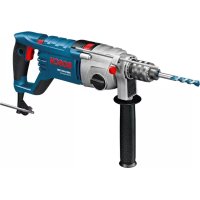
GSB 1622 RE Professional - Drill BOSCH - Free user manual and instructions
Find the device manual for free GSB 1622 RE Professional BOSCH in PDF.


Download the instructions for your Drill in PDF format for free! Find your manual GSB 1622 RE Professional - BOSCH and take your electronic device back in hand. On this page are published all the documents necessary for the use of your device. GSB 1622 RE Professional by BOSCH.
USER MANUAL GSB 1622 RE Professional BOSCH
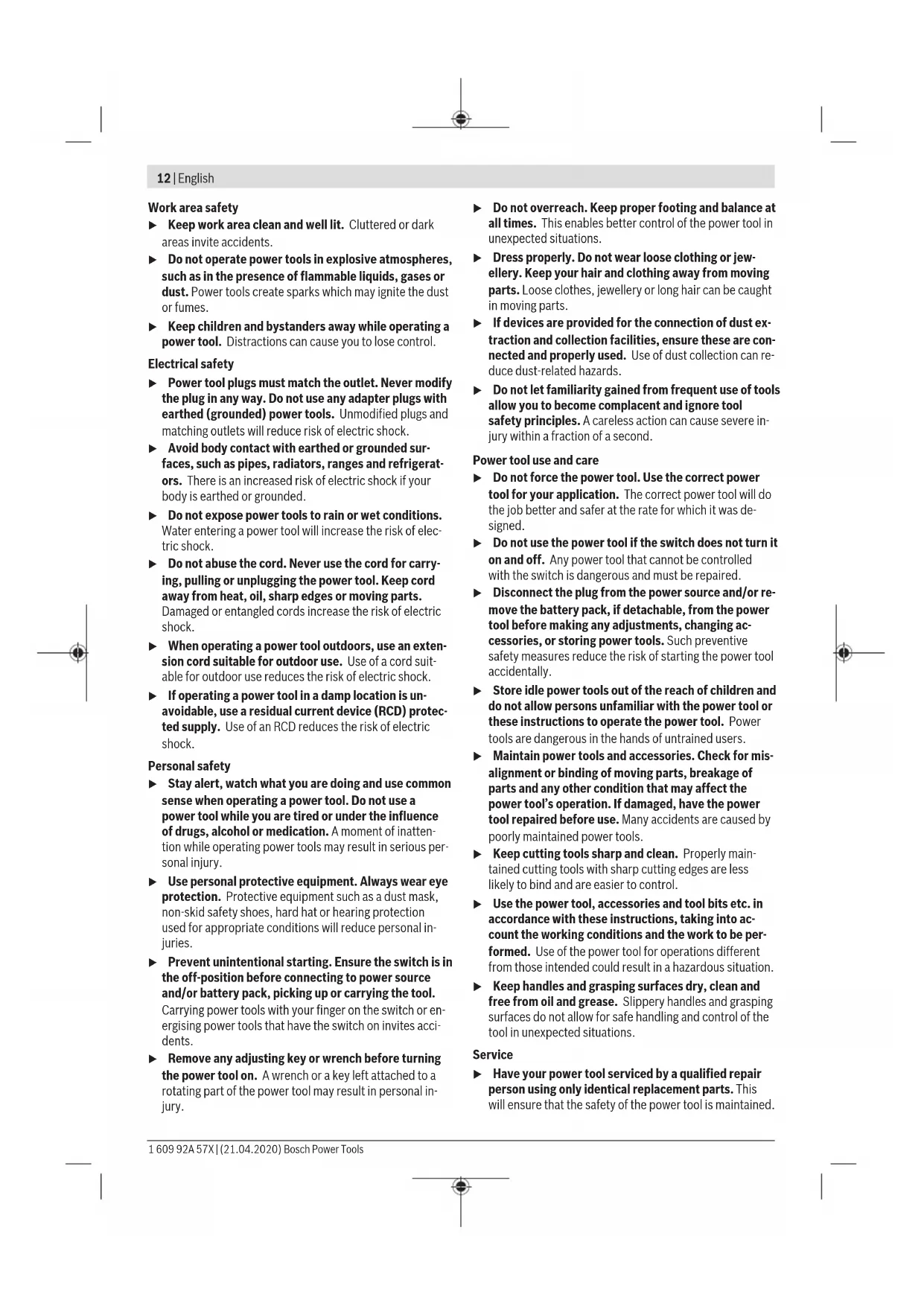
General Power Tool Safety Warnings
WARNING Read all safety warnings, instruc-
tions, illustrations and specifica-
tions provided with this power tool. Failure to follow all in-
structions listed below may result in electric shock, fire and/
Save all warnings and instructions for future reference.
The term "power tool" in the warnings refers to your mains-
operated (corded) power tool or battery-operated (cord-
less) power tool. Bosch Power Tools 1 609 92A 57X | (21.04.2020)12 | English
u Keep work area clean and well lit. Cluttered or dark
areas invite accidents.
u Do not operate power tools in explosive atmospheres,
such as in the presence of flammable liquids, gases or
dust. Power tools create sparks which may ignite the dust
u Keep children and bystanders away while operating a
power tool. Distractions can cause you to lose control.
u Power tool plugs must match the outlet. Never modify
the plug in any way. Do not use any adapter plugs with
earthed (grounded) power tools. Unmodified plugs and
matching outlets will reduce risk of electric shock.
u Avoid body contact with earthed or grounded sur-
faces, such as pipes, radiators, ranges and refrigerat-
ors. There is an increased risk of electric shock if your
body is earthed or grounded.
u Do not expose power tools to rain or wet conditions.
Water entering a power tool will increase the risk of elec-
u Do not abuse the cord. Never use the cord for carry-
ing, pulling or unplugging the power tool. Keep cord
away from heat, oil, sharp edges or moving parts.
Damaged or entangled cords increase the risk of electric
u When operating a power tool outdoors, use an exten-
sion cord suitable for outdoor use. Use of a cord suit-
able for outdoor use reduces the risk of electric shock.
u If operating a power tool in a damp location is un-
avoidable, use a residual current device (RCD) protec-
ted supply. Use of an RCD reduces the risk of electric
u Stay alert, watch what you are doing and use common
sense when operating a power tool. Do not use a
power tool while you are tired or under the influence
of drugs, alcohol or medication. A moment of inatten-
tion while operating power tools may result in serious per-
u Use personal protective equipment. Always wear eye
protection. Protective equipment such as a dust mask,
non-skid safety shoes, hard hat or hearing protection
used for appropriate conditions will reduce personal in-
u Prevent unintentional starting. Ensure the switch is in
the off-position before connecting to power source
and/or battery pack, picking up or carrying the tool.
Carrying power tools with your finger on the switch or en-
ergising power tools that have the switch on invites acci-
u Remove any adjusting key or wrench before turning
the power tool on. A wrench or a key left attached to a
rotating part of the power tool may result in personal in-
u Do not overreach. Keep proper footing and balance at
all times. This enables better control of the power tool in
unexpected situations.
u Dress properly. Do not wear loose clothing or jew-
ellery. Keep your hair and clothing away from moving
parts. Loose clothes, jewellery or long hair can be caught
u If devices are provided for the connection of dust ex-
traction and collection facilities, ensure these are con-
nected and properly used. Use of dust collection can re-
duce dust-related hazards.
u Do not let familiarity gained from frequent use of tools
allow you to become complacent and ignore tool
safety principles. A careless action can cause severe in-
jury within a fraction of a second.
Power tool use and care
u Do not force the power tool. Use the correct power
tool for your application. The correct power tool will do
the job better and safer at the rate for which it was de-
u Do not use the power tool if the switch does not turn it
on and off. Any power tool that cannot be controlled
with the switch is dangerous and must be repaired.
u Disconnect the plug from the power source and/or re-
move the battery pack, if detachable, from the power
tool before making any adjustments, changing ac-
cessories, or storing power tools. Such preventive
safety measures reduce the risk of starting the power tool
u Store idle power tools out of the reach of children and
do not allow persons unfamiliar with the power tool or
these instructions to operate the power tool. Power
tools are dangerous in the hands of untrained users.
u Maintain power tools and accessories. Check for mis-
alignment or binding of moving parts, breakage of
parts and any other condition that may affect the
power tool’s operation. If damaged, have the power
tool repaired before use. Many accidents are caused by
poorly maintained power tools.
u Keep cutting tools sharp and clean. Properly main-
tained cutting tools with sharp cutting edges are less
likely to bind and are easier to control.
u Use the power tool, accessories and tool bits etc. in
accordance with these instructions, taking into ac-
count the working conditions and the work to be per-
formed. Use of the power tool for operations different
from those intended could result in a hazardous situation.
u Keep handles and grasping surfaces dry, clean and
free from oil and grease. Slippery handles and grasping
surfaces do not allow for safe handling and control of the
tool in unexpected situations.
u Have your power tool serviced by a qualified repair
person using only identical replacement parts. This
will ensure that the safety of the power tool is maintained.
1 609 92A 57X | (21.04.2020) Bosch Power ToolsEnglish | 13
Safety Warnings for Drills
Safety instructions for all operations u Wear ear protectors when impact drilling. Exposure to noise can cause hearing loss. u Use the auxiliary handle(s). Loss of control can cause personal injury. u Hold the power tool by insulated gripping surfaces, when performing an operation where the cutting ac-
cessory or fasteners may contact hidden wiring or its
own cord. Cutting accessory or fasteners contacting a
"live" wire may make exposed metal parts of the power
tool "live" and could give the operator an electric shock.
Safety instructions when using long drill bits u Never operate at higher speed than the maximum speed rating of the drill bit. At higher speeds, the bit is
likely to bend if allowed to rotate freely without contact-
ing the workpiece, resulting in personal injury. u Always start drilling at low speed and with the bit tip in contact with the workpiece. At higher speeds, the bit
is likely to bend if allowed to rotate freely without contact-
ing the workpiece, resulting in personal injury. u Apply pressure only in direct line with the bit and do not apply excessive pressure.Bits can bend causing
breakage or loss of control, resulting in personal injury.
Additional safety warnings u Switch the power tool off immediately if the applica- tion tool becomes blocked. Be prepared for high
torque reactions which cause kickback. The applica-
tion tool becomes blocked when it becomes jammed in
the workpiece or when the power tool becomes over-
loaded. u Hold the power tool securely. When tightening and loosening screws be prepared for temporarily high torque
reactions. u Secure the workpiece. A workpiece clamped with clamping devices or in a vice is held more secure than by
hand. u Use suitable detectors to determine if utility lines are hidden in the work area or call the local utility com-
pany for assistance. Contact with electric lines can lead
to fire and electric shock. Damaging a gas line can lead to
explosion. Penetrating a water line causes property dam-
age or may cause an electric shock. u Always wait until the power tool has come to a com- plete stop before placing it down. The application tool
can jam and cause you to lose control of the power tool.
Products sold in GB only:
Your product is fitted with an BS 1363/A approved electric
plug with internal fuse (ASTA approved to BS 1362).
If the plug is not suitable for your socket outlets, it should be
cut off and an appropriate plug fitted in its place by an au-
thorised customer service agent. The replacement plug
should have the same fuse rating as the original plug.
The severed plug must be disposed of to avoid a possible
shock hazard and should never be inserted into a mains
Product Description and
Read all the safety and general instructions.
Failure to observe the safety and general in-
structions may result in electric shock, fire
and/or serious injury.
Please observe the illustrations at the beginning of this oper-
The power tool is intended for impact drilling in brick, con-
crete and stone, dry drilling (not suitable for wet drilling)
with diamond-studded core cutters in brick and lime-sand
brick, as well as for drilling in wood, metal, ceramic and
plastic. Tools with electronic control and right/left rotation
are also suitable for screwdriving and thread cutting.
The numbering of the product features refers to the diagram
of the power tool on the graphics page.
Keyed chuck with automatic lock
"Drilling/impact drilling" selector switch
Rotational direction switch
Lock-on button for on/off switch
Speed preselection thumbwheel
Wing bolt for depth stop adjustment
Auxiliary handle (insulated gripping surface)
Handle (insulated gripping surface)
Universal bit holder
Chuck key for keyed chuck with manual lock
Keyed chuck with manual lock
Accessories shown or described are not included with the
product as standard. You can find the complete selection of
accessories in our accessories range.
Commercially available (not included in the scope of deliv-
Impact drill GSB 162-2 RE Article number
Rated power input W 1 500
Impact rate at no-load speed
Max. drilling diameter (first/second gear)
/ II The specifications apply to a rated voltage [U] of 230 V. These spe-
cifications may vary at different voltages and in country-specific mod-
Noise/vibration information
Noise emission values determined according to
Typically, the A-weighted noise level of the power tool is:
(triax vector sum) and uncertainty K
determined according to EN62841-2-1:
Drilling into metal: a
Impact drilling into concrete: a
Drilling into concrete with a diamond drill: a
The vibration level and noise emission value given in these
instructions have been measured in accordance with a
standardised measuring procedure and may be used to com-
pare power tools. They may also be used for a preliminary
estimation of vibration and noise emissions.
The stated vibration level and noise emission value repres-
ent the main applications of the power tool. However, if the
power tool is used for other applications, with different ap-
plication tools or is poorly maintained, the vibration level
and noise emission value may differ. This may significantly
increase the vibration and noise emissions over the total
To estimate vibration and noise emissions accurately, the
times when the tool is switched off or when it is running but
not actually being used should also be taken into account.
This may significantly reduce vibration and noise emissions
over the total working period.
Implement additional safety measures to protect the oper-
ator from the effects of vibration, such as servicing the
power tool and application tools, keeping their hands warm,
and organising workflows correctly.
Assembly u Pull the plug out of the socket before carrying out any work on the power tool.
Auxiliary handle (see figure A) u Do not operate your power tool without the auxiliary handle (10).
You can adjust the auxiliary handle (10) to any of 12 posi-
tions in order to achieve a safe work posture that minimises
Turn the lower gripping end of the auxiliary handle (10) in
rotational direction ➊ and push the auxiliary handle (10) for-
ward until you can swivel it into the required position. Then
pull the auxiliary handle (10) back again and turn the lower
gripping end in rotational direction ➋ to tighten it.
Setting the Drilling Depth
You can use the depth stop(7) to set the required drilling
Loosen the wing bolt for adjusting the depth stop (9) and in-
sert the depth stop into the auxiliary handle (10).
Pull the depth stop far enough out that the distance between
the drill bit tip and the edge of the depth stop corresponds
to the required drilling depth X.
Retighten the wing bolt for adjusting the depth stop (9).
u Wear protective gloves when changing tools. The drill
chuck may heat up significantly when it is used for long
Keyed chuck with automatic lock (see figure D)
Open the keyed chuck (1) by turning it until the tool can be
Insert the tool. Insert the drill chuck key (12) into the corres-
ponding holes of the keyed chuck (1) and clamp the tool
Keyed Chuck with Manual Lock (seefigureE)
Open the keyed chuck(16) by turning it until the tool can be
inserted. Insert the tool.
Insert the chuck key(15) into the corresponding holes of the
keyed chuck(16) and clamp the tool evenly.
With the hexagon of the chuck key(15), turn the eccentric
cam as far as it will go in rotational direction ➋. This ensures
sufficient tensioning force.
1 609 92A 57X | (21.04.2020) Bosch Power ToolsEnglish | 15
To remove the application tool, turn the eccentric cam in ro-
tational direction ➊ and open the keyed chuck(16) with the
You should always use a universal bit holder (14) when using
screwdriver bits (13). Only use screwdriver bits that fit the
For screwdriving, make sure the "drilling/impact drilling" se-
lector switch (2) is always set to the "drilling" symbol.
Changing the drill chuck
u Pull the plug out of the socket before carrying out any
work on the power tool.
Removing the Drill Chuck (seefigureF)
To remove the keyed chuck(1), place an open-ended span-
ner(17) (width across flats: 17 mm) onto the spanner flat of
Place the power tool on a firm surface, e.g. a work bench. In-
sert the chuck key(12) into one of the three holes of the
keyed chuck(1) and release the keyed chuck(1) with this
lever by turning it in rotational direction ➊. A keyed chuck
that is fixed in place can be released by applying light force
to the chuck key(12). Remove the chuck key(12) from the
keyed chuck and completely unscrew the keyed chuck.
Fitting the Drill Chuck (seefigureG)
The keyed chuck is fitted in reverse order.
The drill chuck must be tightened using a tight-
ening torque of approx. 80–85 Nm.
Dust/Chip Extraction
Dust from materials such as lead-containing coatings, some
wood types, minerals and metal can be harmful to one’s
health. Touching or breathing-in the dust can cause allergic
reactions and/or lead to respiratory infections of the user or
Certain dust, such as oak or beech dust, is considered carci-
nogenic, especially in connection with wood-treatment ad-
ditives (chromate, wood preservative). Materials containing
asbestos may only be worked by specialists.
– Provide for good ventilation of the working place.
– It is recommended to wear a P2 filter-class respirator.
Observe the relevant regulations in your country for the ma-
terials to be worked.
u Avoid dust accumulation at the workplace. Dust can
u Pay attention to the mains voltage. The voltage of the
power source must match the voltage specified on the
rating plate of the power tool. Power tools marked
with 230V can also be operated with 220V.
u Products that are only sold in AUS and NZ: Use a resid-
ual current device (RCD) with a nominal residual current
Setting the Rotational Direction (seefigureH–I)
The rotational direction switch (3) is used to change the ro-
tational direction of the power tool. However, this is not pos-
sible while the on/off switch (5) is being pressed.
Clockwise rotation: To drill and drive in screws, slide the
rotational direction switch (3) to the left.
Anti-clockwise rotation: To loosen or unscrew screws and
nuts, slide the rotational direction switch (3) to the right.
Setting the Operating Mode
Drilling and screwdriving
Set the selector switch (2) to the "drilling"
Set the selector switch (2) to the "impact
The selector switch (2) clicks into place and
can also be actuated when the motor is running.
Mechanical Gear Selection
u You can press the gear selector switch (8) with the
power tool off or on. You should not do this at full load
or maximum torque, however.
You can preselect two speed ranges with the gear selector
Low speed range; for working with a large drilling diameter
or for screwdriving.
High speed range; for working with a small drilling diameter.
Gear Maximum drilling diameter
Do not use annular cutters
in hammer drilling mode.
Set the selector switch(2)
to the "drilling" symbol.
To start the power tool, press and hold the on/off switch
Press the lock-on button (4) to lock the on/off switch (5) in
To switch off the power tool, release the on/off switch (5);
or, if the switch is locked with the lock-on button (4), briefly
press the on/off switch (5) and then release it.
Bosch Power Tools 1 609 92A 57X | (21.04.2020)16 | English
The power tool is equipped with an overload
clutch (anti-rotation) to limit high torque reac-
u If the application tool jams or snags, the power trans-
mission to the drill spindle will be interrupted. Always
hold the power tool firmly with both hands to with-
stand the forces this may create and adopt a position
with stable footing.
u Switch the power tool off immediately and remove the
application tool if the power tool becomes blocked.
Switching on when the drilling tool is blocked may
cause high torque reactions.
Adjusting the Speed/Impact Rate
You can adjust the speed/impact rate of the power tool when
it is on by pressing in the on/off switch (5) to varying ex-
Applying light pressure to the on/off switch (5) results in a
low rotational speed/impact rate. Applying increasing pres-
sure to the switch increases the speed/impact rate.
Preselecting the speed/impact rate
You can preselect the required speed/impact rate using the
speed preselection thumbwheel (6), even during operation.
The required speed/impact rate is dependent on the mater-
ial and the work conditions and can be determined by prac-
The restart protection feature prevents the power tool from
starting unintentionally after the power supply to it has been
To restart the tool, set the on/off switch(5) to the "off" posi-
tion and then switch the power tool on again.
u Pull the plug out of the socket before carrying out any
work on the power tool.
u Only apply the power tool to the screw/nut when the
tool is switched off. Rotating tool inserts can slip off.
After working at a low speed for an extended period, you
should operate the power tool at the maximum speed for ap-
proximately three minutes without load to cool it down.
To drill into tiles, set the selector switch (2) to the "drilling"
symbol. After drilling through the tile, set the selector switch
to the "impact drilling" symbol and drill with impact.
Use carbide drill bits when working with concrete, stone and
When drilling into metal, only use sharpened HSS drills (HSS
= high-speed steel) which are in perfect condition. The
Bosch accessory range guarantees appropriate quality.
Using the drill bit sharpener (accessory), you can effortlessly
sharpen twist drill bits with a diameter of 2.5–10 mm.
Maintenance and Service
Maintenance and Cleaning
u Pull the plug out of the socket before carrying out any
work on the power tool.
u To ensure safe and efficient operation, always keep
the power tool and the ventilation slots clean.
In order to avoid safety hazards, if the power supply cord
needs to be replaced, this must be done by Bosch or by an
after-sales service centre that is authorised to repair Bosch
After-Sales Service and Application Service
Our after-sales service responds to your questions concern-
ing maintenance and repair of your product as well as spare
parts. You can find explosion drawings and information on
spare parts at: www.bosch-pt.com
The Bosch product use advice team will be happy to help you
with any questions about our products and their accessor-
In all correspondence and spare parts orders, please always
include the 10‑digit article number given on the nameplate
Robert Bosch Ltd. (B.S.C.)
UB 9 5HJ At www.bosch-pt.co.uk you can order spare parts or arrange
the collection of a product in need of servicing or repair.
Tel. Service: (0344) 7360109
Australia, New Zealand and Pacific Islands
Robert Bosch Australia Pty. Ltd.
Customer Contact Center
Republic of South Africa
Hotline: (011) 6519600
35 Roper Street, New Centre
E-Mail: bsctools@icon.co.za
KZN – BSC Service Centre
Unit E, Almar Centre
E-Mail: bsc.dur@za.bosch.com
Western Cape – BSC Service Centre
Democracy Way, Prosperity Park
Armenia, Azerbaijan, Georgia
TOO “Robert Bosch” Power Tools, After Sales Service
The power tool, accessories and packaging should be re-
cycled in an environmentally friendly manner.
Do not dispose of power tools along with
Only for EU countries:
According to the European Directive 2012/19/EU on Waste
Electrical and Electronic Equipment and its implementation
into national law, power tools that are no longer usable must
be collected separately and disposed of in an environment-
ally friendly manner.
kobling (Anti-Rotation).
Bosch Service Center
Bosch Service Center
Stille inn boredybden
Robert Bosch Sp. z o.o.
suprasarcină (Anti-Rotation).
Robert Bosch SRL Service scule electrice
www.bosch-pt.com/bg/bg/
EU Declaration of Conformity
We declare under our sole responsibility that the stated products comply
with all applicable provisions of the directives and regulations listed below
and are in conformity with the following standards.
Technical file at: *
Executive Management
Head of Product Certification