SHT 100 AE - Hedge trimmers STIGA - Free user manual and instructions
Find the device manual for free SHT 100 AE STIGA in PDF.



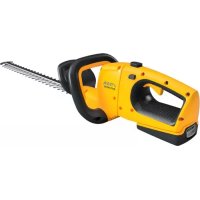
| Product type | Cordless hedge trimmer |
| Brand | Stiga |
| Model | SHT 100 AE |
| Power supply | Lithium-ion battery (rechargeable) |
| Battery type | Li-ion, removable |
| Blade type | Double action blade |
| Motor | Brushless electric motor |
| Safety | Double switch: command lever + safety switch; additional lock on some models |
| Handles | Ergonomic front handle with safety switch; rear handle adjustable to 3 positions (depending on version) |
| Blade guard | Provided for transport and storage |
| Intended use | Cutting and trimming of hedges, bushes, and shrubs with small branches |
| Usage | Amateur (home gardening) |
| Maintenance | Cleaning after each use; regular blade lubrication; sharpening by authorized center |
| Storage | In a dry place, protected from the weather; battery removed and recharged regularly |
| Warranty | Manufacturer's warranty on defects in materials and workmanship (current conditions) |
| Included accessories | User manual, blade guard (battery and charger depending on version) |
| Spare parts | Blades, batteries, chargers available as optional accessories |
Frequently Asked Questions - SHT 100 AE STIGA
User questions about SHT 100 AE STIGA
0 question about this device. Answer the ones you know or ask your own.
Ask a new question about this device
Download the instructions for your Hedge trimmers in PDF format for free! Find your manual SHT 100 AE - STIGA and take your electronic device back in hand. On this page are published all the documents necessary for the use of your device. SHT 100 AE by STIGA.
USER MANUAL SHT 100 AE STIGA
natural_image
Icon of a person reading a book inside a circle (no text or symbols)IT Tosasiepi portatile con alimentazione a batteria
MANUALE DI ISTRUZIONI
ATTENZIONE: prima di usare la macchina, leggere attentamente il presente libretto.
BG Електрическа машина за рязане на жив плет УПЪТВАНЕ ЗА УПОТРЕБА
ВНИМАНИЕ: преди да използвате машината прочетете внимателно настоящата книжка.
BS Ručni trimer za živicu na bateriju
UPUTSTVO ZA UPOTREBU
PAŽNJA: prije nego što koristite ovu mašinu, pažljivo pročitajte priručnik s uputama.
CS Přenosné akumulátorové plotové nůžky NÁVOD K POUŽITÍ
UPOZORNĚNÍ: před použitím stroje sl pozorně přečtěte tento návod k použití.
DA Bærbar batteridreven Hækkeklipper BRUGSANVISNING
ADVARSEL: læs instruktionsbogen omhyggelligt igennem, før du tager denne maskine I brug.
DE Tragbare batteriebetriebene Heckenschere GEBRAUCHSANWEISUNG
ACHTUNG: Vor Inbetriebnahme des Geräts die Gebrauchsanleitung aufmerksam lesen.
EL Φορητό ψαλίδι μπορντούρας μπαταρίας
ΟΔΗΓΙΕΣ ΧΡΗΣΠΣ
ΠΡΟΣΟΧΗ: πριν χρησιμοποιησετε το μηχανημα, διαβαστε προσεκτικα το παρον εγχειριδιο.
EN Battery powered hedge trimmer OPERATOR'S MANUAL
WARNING: read thoroughly the instruction booklet before using the machine.
ES Cortasetos portátil con alimentación por batería MANUAL DE INSTRUCCIONES
ATENCIÓN: antes de utilizar la máquina, leer atentamente el presente manual.
ET Elektriline hekilõikur KASUTUSJUHEND
TÄHELEPANU: enne maslna kasutamist lugeda tähelepanelikult antud kasutusjuhendlt.
FI Käsin kannateltava akkukäyttöinen pensasleikkuri
KÄYTTÖOHJEET
VAROITUS: lue käyttöopas huolellisesti ennen koneen käyttöä.
FR Taille-haie portatif alimenté par batterie MANUEL D'UTILISATION
ATTENTION: lire attentivement le manuel avant d'utiliser cette machine.
HR Prijenosne škare za živicu s baterijskim napajanjem PRIRUČNIK ZA UPORABU
POZOR: prije uporabe stroja, pažljivo pročitajte ovaj priručnik.
HU Hordozható akkumulátoros sövénynyíró HASZNÁLATI UTASÍTÁS
FIGYELEM! a gép használata előtt olvassa el figyelmesen a jelen kézikönyvet.
LT Rankinės akumuliatorinės gyvatvorių žirklės NAUDOJIMO INSTRUKCIJOS
DĖMESIO: prieš naudojant įrenginį, atidžiai perskaityti šį naudotojo vadovą.
LV Ar bateriju darbināms rokturamais dzīvžoga apgriezejs LIETOSANAS INSTRUKCIJA
UZMANĪBU: pirms aparāta lietošanai rūpīgi izlasiet doto instrukciju.
MK Преносен поткаструвач на грмушки на батерии УПАТСТВА ЗА УПОТРЕБА
ВНИМАНИЕ: прочитајте го внимателно ова упатство пред да ја користите машината.
NL Draagbare heggeschaar met accuvoeding
GEBRUIKERSHANDLEIDING
LET OP: vooraleer de machine te gebruiken, dient men deze handleiding aandachtig te lezen.
NO Bærbar batteridrevet hekksaks INSTRUKSJONSBOK
ADVARSEL: les denne bruksanvisningen nøye før du bruker maskinen.
PL Ręczny sekator akumulatorowy INSTRUKCJE OBSŁUGI
OSTRZEŻENIE: przed użvciem maszvnv. należv uważnie przeczytać ninielsza Instrukcie.

natural_image
Technical line drawing of a hairpin and its edge, showing mechanical components without any text or symbols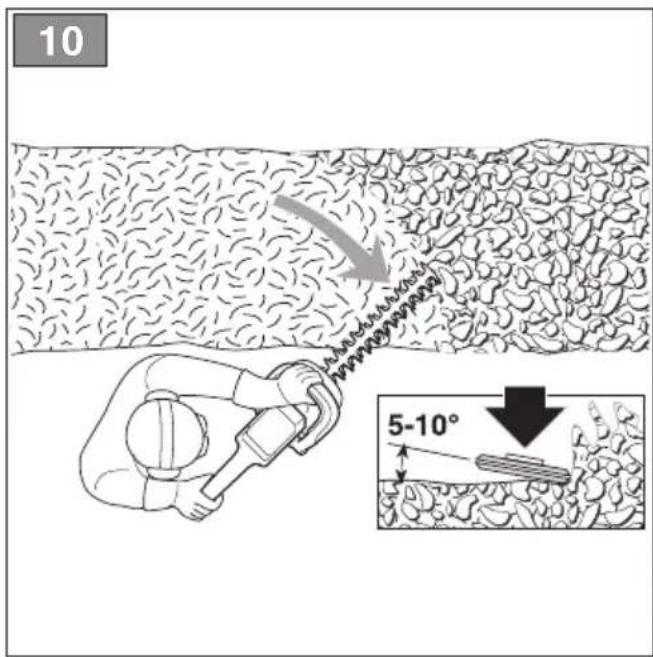
natural_image
Illustration of a hand inserting a device into a car seatbelt, with a black arrow indicating the motion (no text or symbols present)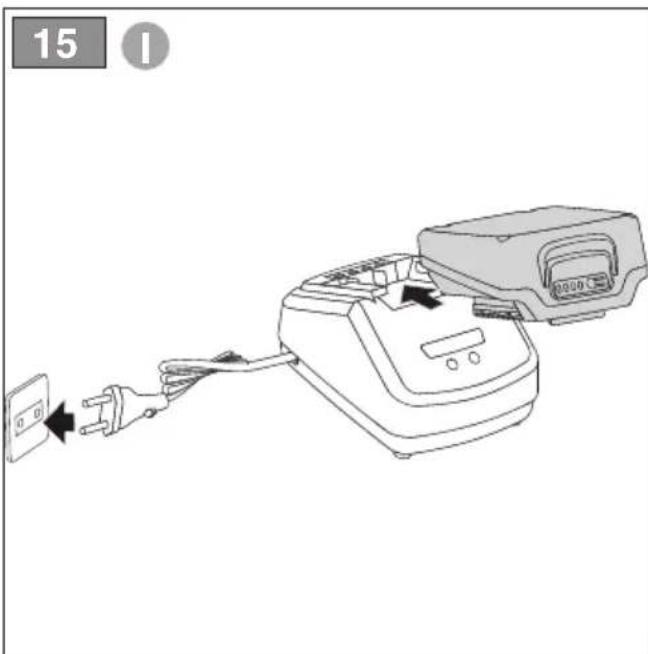
natural_image
Line drawing of a power tool with plug and power outlet, showing internal wiring and a device (no text or symbols)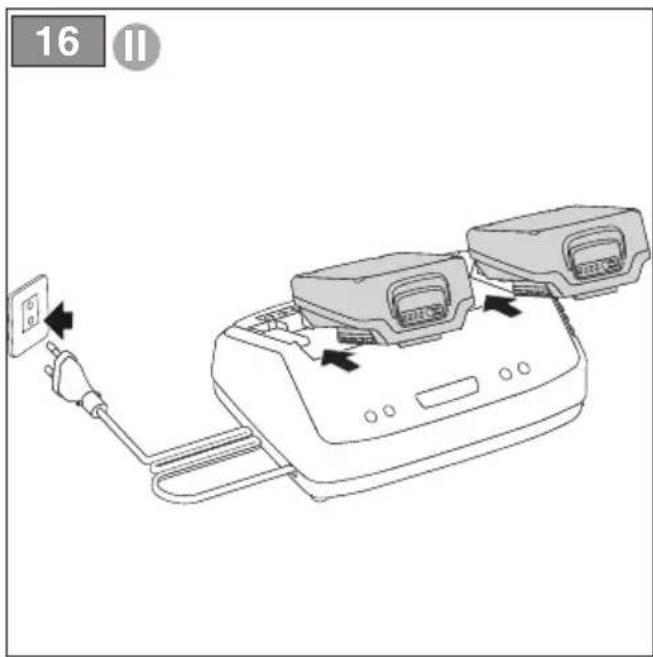
natural_image
Line drawing of a device with two connected devices and a power outlet, no text or symbols present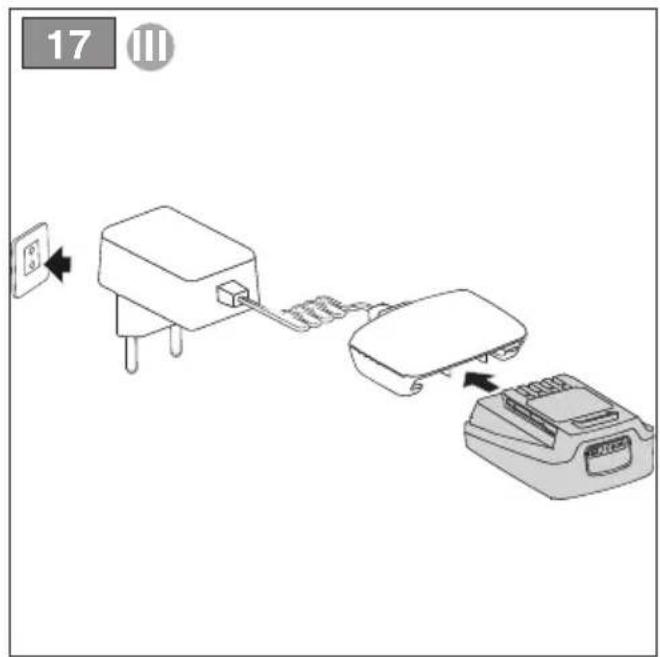
natural_image
Line drawing of a rectangular electronic device with a port and label '18' in the top-left corner (no other text or symbols)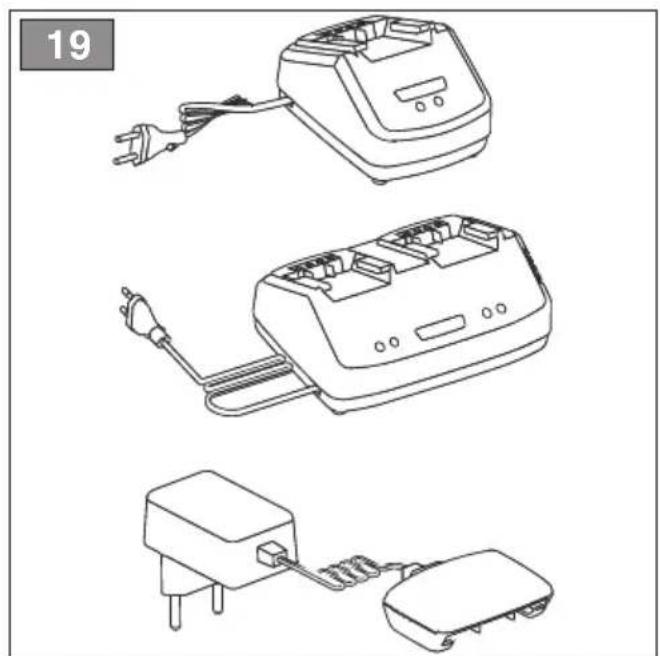
natural_image
Line drawings of three different electronic devices with plug and power connections (no text or symbols)
natural_image
Blank white image with no visible content, text, or symbols
natural_image
Blank white image with no visible content, text, or symbols[18] Batarya grubu, mod.
- USO DELLA MACCHINA......6
6. USO DELLA MACCHINA
6.4 PRACOVNÍ ČINNOST

3.3 PRODUKTETS TYPESKILT (Fig.1)
5.3 SIKKERHEDSAFBRYDER
- GENERAL INFORMATION .... 1
- SAFETY REGULATIONS....1
- ABOUT THE MACHINE .... 4
3.1 Machine description and intended use......4
3.2 Main components (Fig.1) 4
3.3 Product identification label (Fig.1) 5
3.4 Safety signs (Fig.2) 5
-
UNPACKING....5
-
CONTROLS....5
5.1 Blade control lever 5
5.3 Safety switch 6
- USING THE MACHINE 6
6.1 Preliminary operations.... 6
6.2 Safety checks....6
6.3 Start-up 7
6.4 Operation 7
6.5 Stop....8
6.6 After use....8
- MAINTENANCE....8
7.1 General Information......8
7.2 Battery....8
7.3 Cleaning the machine....9
7.4 Cleaning and lubrication of the cutting means 9
7.5 Nuts and bolts 9
7.6 Cutting means 9
- STORAGE....10
8.1 Storing.... 10
8.2 Storing the battery.... 10
-
HANDLING AND TRANSPORT 10
-
ASSISTANCE AND REPAIRS 10
- WARRANTY COVERAGE....10
- TROUBLESHOOTING 11
- ACCESSORIES ON REQUEST....12
13.1 Batteries.... 12
13.2 Battery charger.... 12
1. GENERAL INFORMATION
1.1 HOW TO READ THIS MANUAL
NOTE or IMPORTANT These give details or further information on what has been previously indicated and aim to prevent damage to the machine or cause other damage.
The symbol highlights danger. Failure to observe the warning can lead to possible personal and/or third party injury and/or damage.
The paragraphs highlighted in a dotted grey square indicate optional characteristics not available on all models documented in this manual. Check if the characteristics are available on this model.
Whenever reference is made to a position on the machine "front", "back", "left" or "right" hand side, this refers to the operator's working position.
2. SAFETY REGULATIONS
2.1 GENERAL SAFETY WARNINGS
Read all safety warnings, instructions, illustrations and specifications. provided with this power tool. Failure lo follow all instructions listed below may result in electric shock, fire and/or serious injury.
Save all warnings and instructions for future reference.
The term “power tool” in the warnings refers to your mains-opera/eel (cordecl) power tool or battery-operated (cordless) power tool.
1) Work area safety
a) Keep work area clean and well lit.
Cluttered or dark areas invite accidents.
b) Do not operate power tools in explosive atmospheres, such as in the presence of flammable liquids, gases or dust. Power tools create sparks which may ignite the dust or fumes.
c) Keep children and bystanders well away while using power tools. Distractions can cause you to lose control.
2) Electrical safety
a) Avoid body contact with earthed or grounded surfaces, such as pipes, radiators, cookers and refrigerators.
There is an increased risk of electric shock if your body is earthed or grounded.
b) Do not expose power tools to rain or wet environments. Water entering a power tool will increase the risk of electrical shock.
3) Personal safety
a) Stay alert, check what you are doing and use common sense when using a power tool. Do not use the power tool when you are tired or under the influence of drugs, alcohol or medicines. A moment of inattention while operating a power tool may result in serious personal injury.
b) Use personal protective equipment. Always wear eye protection. Protective equipment such as a dust mask, non-skid safety shoes, hard hat or hearing protection used for appropriate conditions will reduce personal injuries.
c) Prevent unintentional starting. Make sure the appliance is turned off before inserting the battery pack, picking up or carrying the power tool. Carrying power tools with your finger on the switch or mounting the battery with the switch in "ON" position invites accidents.
d) Remove any adjusting key or wrench before turning the power tool on. A wrench or a key left attached to a rotating part of the machine may result in personal injury.
e) Do not overreach. Keep proper footing and balance at all times.
This enables better control of the power tool in unexpected situations.
f) Dress properly. Do not wear loose clothing or jewellery. Keep your hair and clothing away from moving parts. Loose clothes, jewellery or long hair can be caught in moving parts.
g) If devices are provided for the connection of dust extraction and collection facilities, ensure these are connected and properly used. Use of dust collection can reduce dust-related hazards.
h) Do not let familiarity gained from frequent use of tools allow you to become complacent and ignore
tool safety principles. A careless action can cause severe injury within a fraction of a second.
4) Power tool use and care
a) Do not force the power tool. Use the correct power tool for your application. The correct power tool will do the job better and safer at the speed for which it was designed.
b) Do not use the power tool if the switch does not turn it on and off. Any power tool that cannot be controlled with the switch is dangerous and must be repaired.
c) Remove the battery pack from the machine before making any adjustments, changing accessories or storing the power tool. Such preventive safety measures reduce the risk of starting the power tool accidentally.
d) Store idle power tools out of the reach of children and do not allow persons unfamiliar with the power tool or these instructions to operate the machine. Power tools are dangerous in the hands of untrained users.
e) Maintain power tools and accessories. Check for misalignment or binding of moving parts, breakage of parts and any other condition that may affect power tool operation. In case of damage, the power tool must be repaired before it can be used. Many accidents are caused by poor maintenance.
f) Keep cutting tools sharp and clean.
Properly maintained cutting tools with sharp cutting edges are less likely to bind and are easier to control.
g) Use the power tool and its accessories in accordance with these instructions, taking into account the working conditions and the task to be performed. Using the power tool for operations other than those intended could result in a hazardous situation.
h) Keep handles and grasping surfaces dry, clean and free from oil and grease. Slippery handles and grasping surfaces do not allow for safe handling and control of the tool in unexpected situations.
5 Battery tool use and care
a) Recharge only with the charger specified by the manufacturer. A charger that is suitable for one type of battery pack may create a risk of fire,
electric shock, overheating or corrosive liquid to leak from the battery. when used with another battery pack.
b) Use power tools exclusively with specifically designated battery packs. Use of any other battery packs may create a risk of injury and fire.
c) When the battery pack is not in use, keep it away from other metal objects such as paper clips, coins, keys, nails, screws or other small metal objects that may create a connection from one terminal to another. Shorting the battery terminals together can cause burns or a fire.
d) Under abusive conditions, liquid may be ejected from the battery: avoid contact. If contact accidentally occurs, flush with water. If the liquid contacts eyes, seek medical help immediately. Fluid ejected from the battery may cause irritation and burns.
e) Do not use a battery pack or tool that is damaged or modified. Damaged or modified batteries may exhibit unpredictable behaviour resulting in fire, explosion or risk of injury.
f) Do not expose a battery pack or tool to fire or excessive temperature. Exposure to fire or temperature above 130^ C may cause explosion.
g) Charge only at room temperature, between 0^ + 45^ . Do not charge the battery pack or tool outside the specified temperature range. Charging improperly or at temperatures outside the specified range may damage the battery and increase the risk of fire.
6) Service
a) Have your power tool serviced by a qualified repair person using only identical replacement parts. This will ensure that the safety of the power tool is maintained.
b) Never service damaged battery packs. Service of battery packs should only be performed by the manufacturer or authorized service providers.
2.2 SPECIFIC SAFETY REGULATIONS FOR HEDGE TRIMMERS
- During work operations, always hold the machine firmly with both hands. Operating it with only one hand can cause loss of control and serious personal injury
- Keep all parts of the body away from the blade. Do not remove cut material or hold material to be cut when blades
are moving. Blades continue to move after the switch is turned off. A moment of inattention while operating the hedge trimmer may result in serious personal injury.
- Carry the hedge trimmer by the handle with the blade stopped and taking care not to operate any power switch. Proper carrying of the hedge trimmer will decrease the risk of inadvertent starting and resultant personal injury from the blades.
- Hold the power tool by insulated gripping surfaces only, because the blade may come in contact with hidden wiring. Contact between cutter blades and a "live" wire may cause exposed metal parts of the tool to become "live" and give the operator an electrical shock.
- When transporting or storing the hedge trimmer, always fit the blade cover. Proper handling of the hedge trimmer will decrease the risk of personal injury from the blades.
- Do not use the hedge trimmer in bad weather conditions, especially when there is a risk of lightning. This decreases the risk of being struck by lightning.
If something breaks or an accident occurs during work, turn off the motor immediately and move the machine away to prevent further damage; if an accident occurs with injuries or third parties are injured, carry out the first aid measures most suitable for the situation immediately and contact the medical authorities for any necessary health care. Carefully remove any debris which could cause damage or injury to persons or animals if ignored.
Prolonged exposure to vibrations can cause injuries and neurovascular disorders (also called “Raynaud’s syndrome” or “white finger”), especially to people suffering from circulation disorders. The symptoms can regard the hands, wrists and fingers and are shown through loss of sensitivity, torpor, itching, pain and discolouring of or structural changes to the skin. These effects can be worsened by low ambient temperatures and/or by gripping the hand grips excessively tightly. If the symptoms occur, the length of time the machine is used must be reduced and a doctor consulted.
2.3 ENVIRONMENTAL PROTECTION
- Scrupulously comply with local regulations for the disposal of packaging, deteriorated parts or any elements with a strong
environmental impact; this waste must not be disposed of with regular waste, but must be separated and taken to collection centres, which will recycle the materials.
- Scrupulously comply with local regulations for the disposal of waste materials
- When the machine is withdrawn from service, do not dispose of it in the environment, but take it to a waste disposal facility in accordance with the local regulations in force.
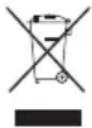
Do not throw electrical equipment away with domestic waste. According to the European Directive 2012/19/EU on electrical and electronic equipment waste and its implementation in compliance with national standards, old electrical equipment must be collected separately, for eco-compatible recycling. If electrical equipment is disposed of in a landfill or in the ground, the harmful substances can reach the water table and enter the food chain, damaging your health and well-being. For further information on the disposal of this product, contact your dealer or a domestic waste collection service.
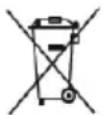
At the end of their working life, dispose of batteries paying due attention to the environment. Batteries contain material classified as hazardous for you and the environment. They must be removed and disposed of separately at a facility that accepts lithium-ion batteries.

Separate waste collection of the products and packaging used allows the materials to be recycled and reused. Reuse of recycled materials help to prevent environmental pollution and reduces the demand for raw materials.
3. ABOUT THE MACHINE
3.1 MACHINE DESCRIPTION AND INTENDED USE
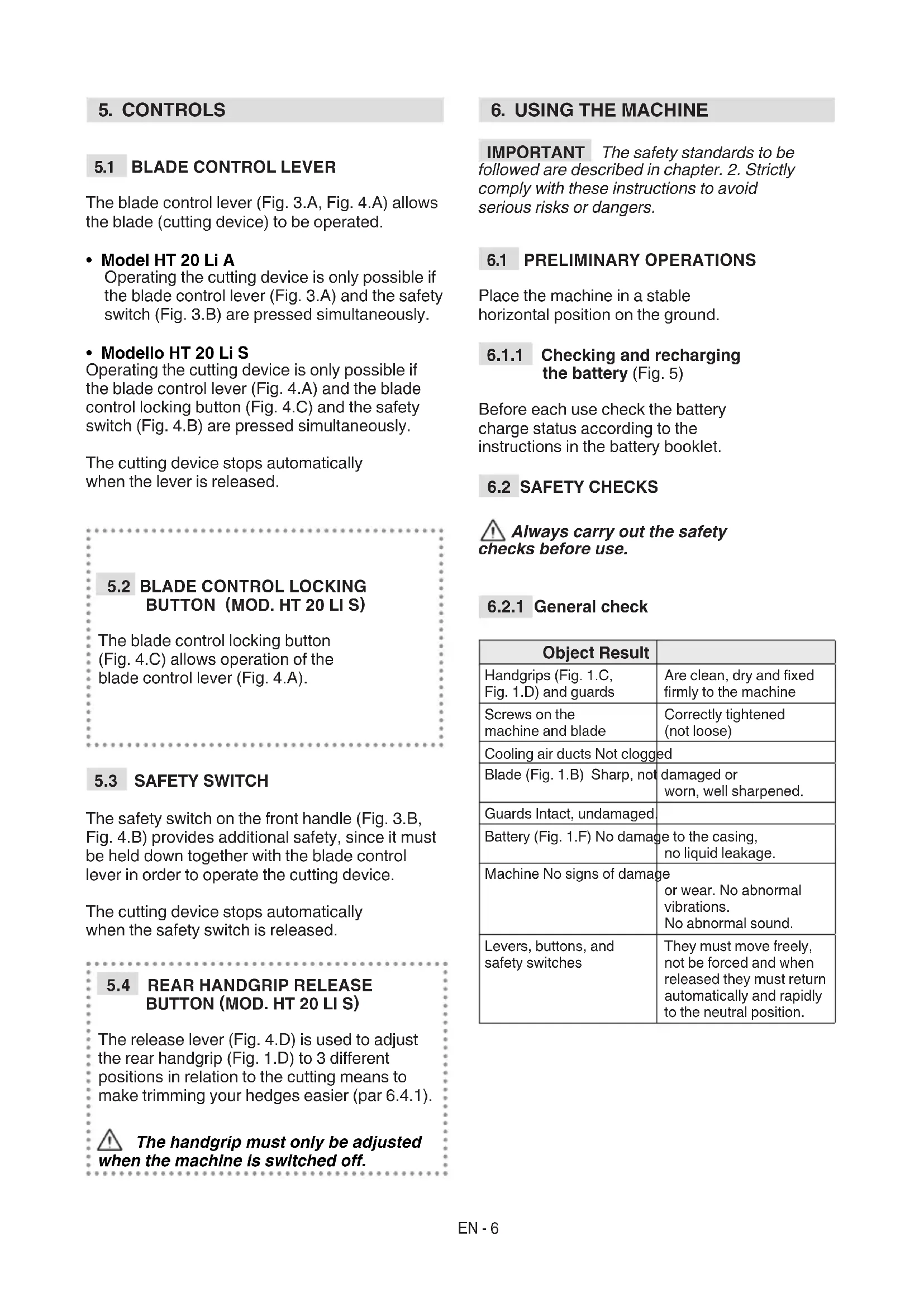
This machine is a garden tool and more precisely a battery-powered portable hedge trimmer.
The machine is essentially composed of a motor which drives a cutting means.
The operator can operate the machine and use the main controls, always keeping a safe distance from the cutting means.
3.1.1 Intended use
This machine was designed and manufactured for:
• cutting and trimming bushes and hedges comprising shrubs with small branches
- being used by one operator.
3.1.2 Improper use
Any other use that does not comply with the above, can be dangerous and cause damage to people and/or property. Examples of improper use may include, but are not limited to:
• cutting grass in general and in particular close to kerbs;
• shredding of materials for composting;
- pruning;
- using the machine with the cutting means above the operator's shoulder level;
- use of the machine for cutting non-plant material;
- using cutting means other than those found in the "Technical Data" table. Risk of serious injury and injuries;
- using of the machine by more than one person.
IMPORTANT Improper use of the machine will void the warranty and relieves the Manufacturer of any liability, placing all responsibility for damage or injury, to him/herself or third parties, on the user.
3.1.3 Type of users
This machine is intended for use by consumers, i.e. non-professional operators. It is intended for "hobby-related activities".
3.2 MAIN COMPONENTS (Fig.1)
A. Engine: supplies the drive power to the cutting means.
B. Blade (cutting means): the element designed to cut the vegetation.
C. Front hand grip: used to handle the machine and equipped with the safety switch.
D. Rear hand grip: used to handle the machine and equipped with the main control buttons.
E. Blade protection (for machine transport and handling): protects against accidental contact with the cutting means that can cause serious injuries.
F. Battery (if not supplied with the machine, see chapter : 13 "optional attachments"
device that supplies electric current to the tool; its specifications and regulations for use are described in a specific manual.
G. Battery charger (if not supplied with the machine, see chapter: 13 “optional attachments” device used to recharge the battery; its specifications and regulations for use are described in a specific manual.
3.3 PRODUCT IDENTIFICATION LABEL (Fig.1)
- CE conformity marking
- Name and address of Manufacturer
- Sound power level
- Article code
- Type of machine
- Serial number
- Year of manufacture
- Power voltage and frequency
- Blade speed
Write the identification data of the machine in the specific space on the label on the back of the cover page.
IMPORTANT Quote the information on the product identification label whenever you contact an Authorised Service Centre.
IMPORTANT An example of the Declaration of Conformity is provided on the last pages of this manual.
3.4 SAFETY SIGNS (Fig.2)
The machine has various symbols on it. Meanings of the symbols:

WARNING! DANGER! The failure to use this machine correctly can be hazardous for oneself and others.

WARNING! Read the owner's manual before using the machine.

Use ear protection devices and goggles.

Wear non-slip safety footwear.

Use thick non-slip protective gloves.

Do not leave the machine in the rain (or in damp conditions)

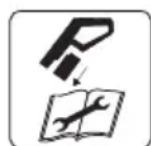
Remove the battery before performing any inspections, cleaning or maintenance/adjustment interventions on the machine:
IMPORTANT Any damaged or illegible decals must be replaced. Order replacement decals from an Authorised Service Centre.
4. UNPACKING
IMPORTANT The safety standards to be followed are described in chapter. 2. Strictly comply with these instructions to avoid serious risks or dangers.
⚠ Unpacking should be done on a flat and stable surface, with enough space for machine handling and its packaging, always making use of suitable equipment.
- Carefully open the packaging, paying attention not to lose components.
- Consult the documentation in the box, including these instructions.
- Remove the machine from the box.
- Dispose of the box and packaging in compliance with local regulations.
5. CONTROLS
The blade control lever (Fig. 3.A, Fig. 4.A) allows the blade (cutting device) to be operated.
- Model HT 20 Li A
Operating the cutting device is only possible if the blade control lever (Fig. 3.A) and the safety switch (Fig. 3.B) are pressed simultaneously.
• Modello HT 20 Li S
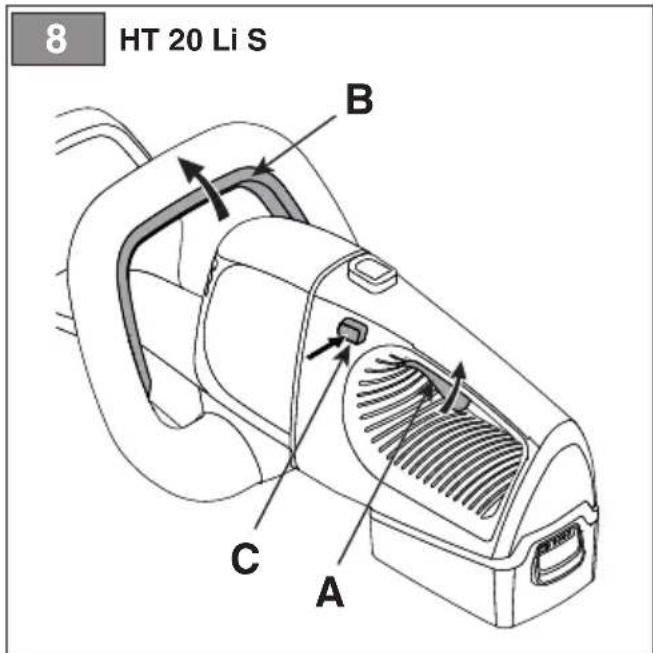
Operating the cutting device is only possible if the blade control lever (Fig. 4.A) and the blade control locking button (Fig. 4.C) and the safety switch (Fig. 4.B) are pressed simultaneously.
The cutting device stops automatically when the lever is released.
5.2 BLADE CONTROL LOCKING BUTTON (MOD. HT 20 LI S)
The blade control locking button (Fig. 4.C) allows operation of the blade control lever (Fig. 4.A).
5.3 SAFETY SWITCH
The safety switch on the front handle (Fig. 3.B, Fig. 4.B) provides additional safety, since it must be held down together with the blade control lever in order to operate the cutting device.
The cutting device stops automatically when the safety switch is released.
5.4 REAR HANDGRIP RELEASE BUTTON (MOD. HT 20 LI S)
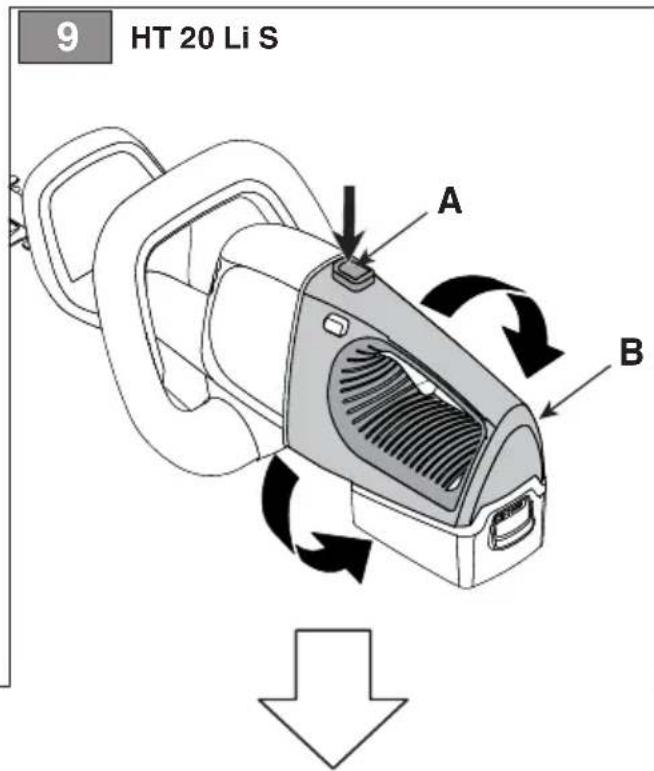
The release lever (Fig. 4.D) is used to adjust the rear handgrip (Fig. 1.D) to 3 different positions in relation to the cutting means to make trimming your hedges easier (par 6.4.1).

The handgrip must only be adjusted on the machine is switched off.
6. USING THE MACHINE
IMPORTANT The safety standards to be followed are described in chapter. 2. Strictly comply with these instructions to avoid serious risks or dangers.
6.1 PRELIMINARY OPERATIONS
Place the machine in a stable horizontal position on the ground.
6.1.1 Checking and recharging the battery (Fig. 5)
Before each use check the battery charge status according to the instructions in the battery booklet.
6.2 SAFETY CHECKS
⚠️ Always carry out the safety checks before use.
6.2.1 General check
| Object Result | |
| Handgrips (Fig. 1.C, Fig. 1.D) and guards | Are clean, dry and fixed firmly to the machine |
| Screws on the machine and blade | Correctly tightened (not loose) |
| Cooling air ducts Not clogged | |
| Blade (Fig. 1.B) Sharp, not | damaged or worn, well sharpened. |
| Guards Intact, undamaged. | |
| Battery (Fig. 1.F) No damage | to the casing, no liquid leakage. |
| Machine No signs of damage | or wear. No abnormal vibrations.No abnormal sound. |
| Levers, buttons, and safety switches | They must move freely, not be forced and when released they must return automatically and rapidly to the neutral position. |
6.2.2 Machine operating test
| Action Result | |
| 1. Start the machine (para. 6.3);2. Release the blade control lever (Fig. 3.A, Fig. 4.A) or the safety switch (Fig. 3.B, Fig. 4.B) | 1. The blade should move2. The controls should return automatically and rapidly to the neutral position and the blade should stop |
⚠️ If any of the results fail to match the indications provided in the tables below, do not use the machine! Take it to a service centre to be checked and repaired if necessary.
6.3 START-UP
Starting the machine causes the simultaneous engagement of the blade.
NOTE Operate the machine only on a firm, level surface.
- Remove the blade guard (Fig. 1.E) (if used)
- Make sure the blade is not touching the ground or any other object
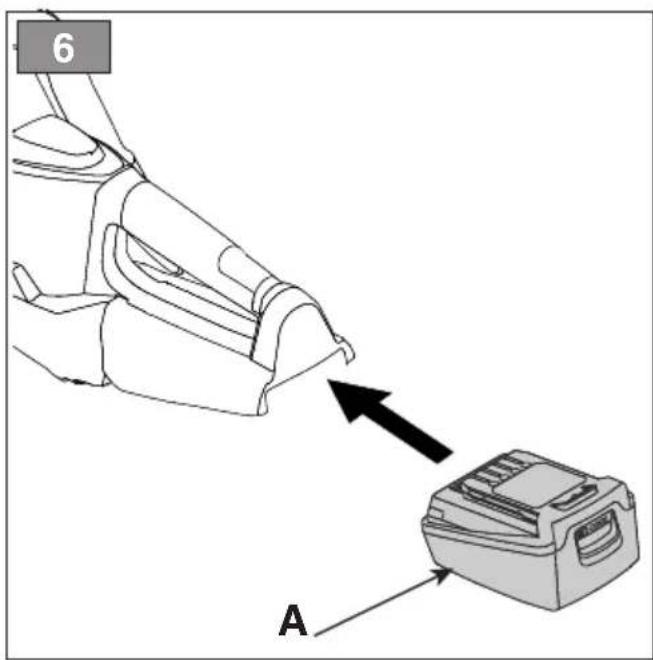
- Fit the battery (Fig. 6.A) inside its housing pressing down until you hear it clicks firmly into position and assure the electrical contact
- Take a firm and balance position
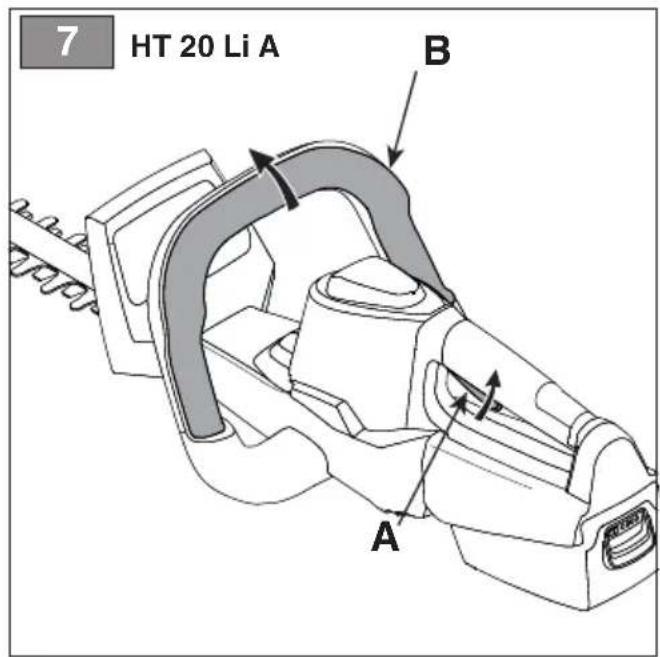
5.a Mod. HT 20 Li A
– Simultaneously operate the blade control lever (Fig. 7.A) and the safety switch (Fig. 7.B),
5.b Mod. HT 20 Li S
– Simultaneously operate the blade control lever (Fig. 8.A), blade control locking button (Fig. 8.C) and the safety switch (Fig. 8.B).
6.4 OPERATION
During use, always hold the machine firmly with two hands, using the machine with the cutting means under the operator's shoulder level.
⚠️ Always use the machine at ground level and not on ladders or any other unstable support.
Do not remove cut material or hold material to be cut when blades are moving. Make sure the machine is turned off when removing cut material.
NOTE During use, the battery is protected against total drainage with a protective device that switches off the machine and stops it from working.
6.4.1 Adjusting the rear handgrip (Mod. HT 20 Li S)
⚠ Perform this operation with the machine off.
- Press the rear handgrip release button (Fig. 9.A); (Fig. 9.A)
- Start rotating the rear handgrip (Fig. 9.B)
- Release the button
- Rotate the handgrip until it clicks into the desired position.
IMPORTANT Before using the machine check that the release button has correctly returned to the block position, and the rear handgrip is firmly attached.
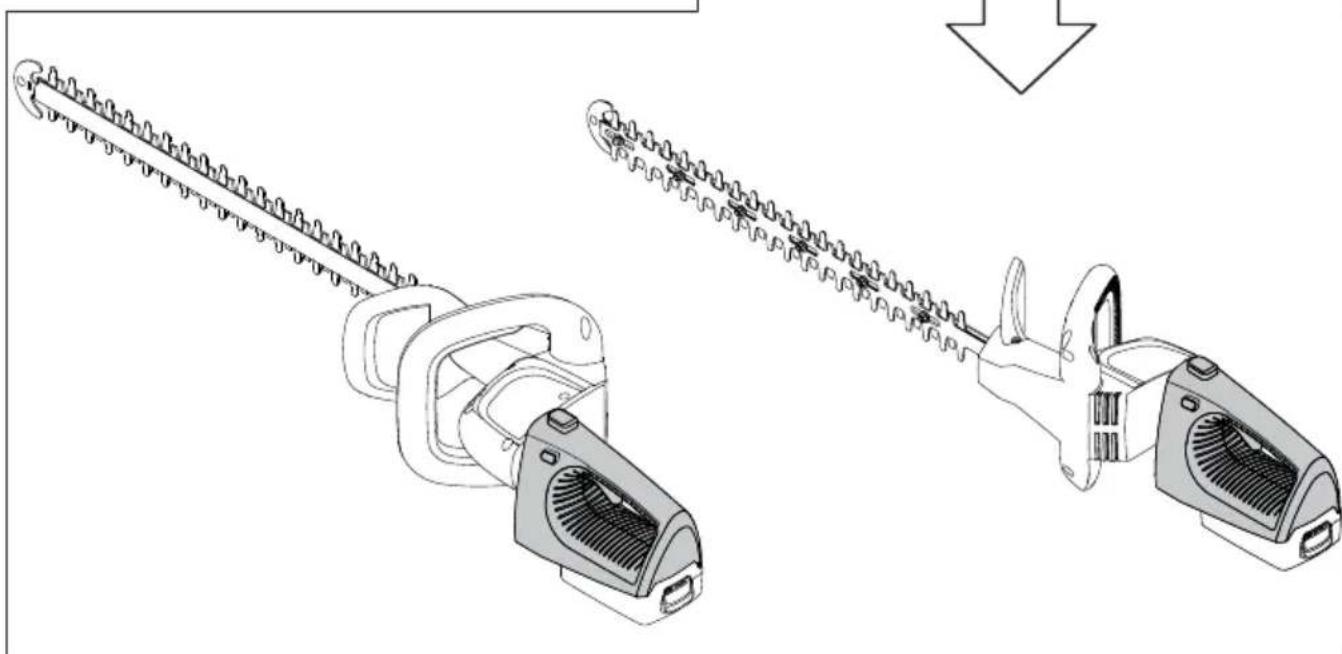
When working, the rear handgrip must always be in a vertical position, whatever the position of the cutting means.
6.4.2 Work techniques
It is recommended to trim the two vertical sides of the hedge before trimming the top.
NOTE Battery power reserve (and therefore the cuttable vegetation area before recharging is required) depends on many factors described in (para. 7.2.1).
6.4.2.a Vertical cutting
Proceed by cutting using curved movements from the bottom towards the top, keeping the blade as far from the body as possible (Fig. 10).
6.4.2.b Horizontal cutting
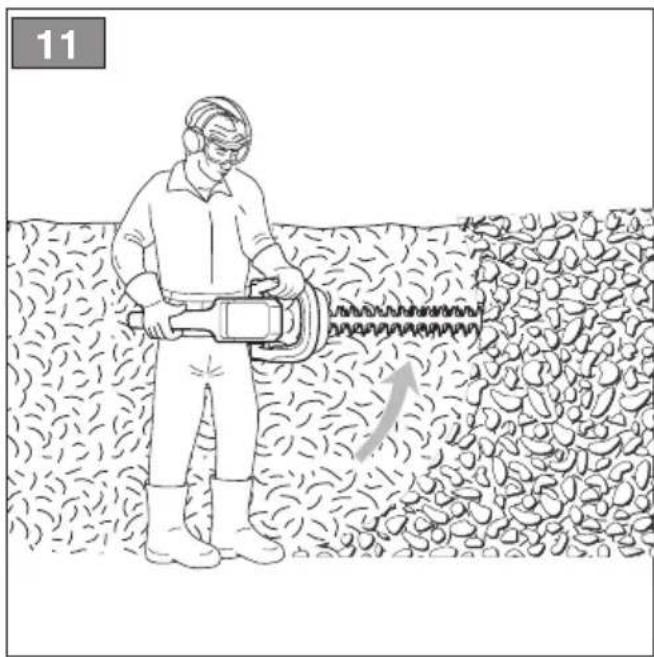
The best results will be obtained with the blade slightly inclined ( 5^ - 10^ ) in the direction you are cutting, proceed with a curved movement, slowly and without interruptions, especially in the case of very thick hedges (Fig.11).
6.4.3 Advice for operation
If the blades block while running or get caught up in the hedge branches:
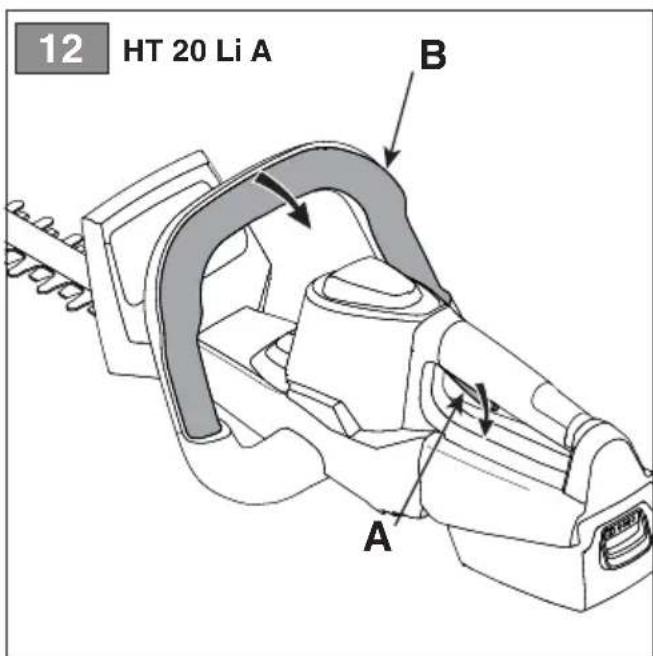
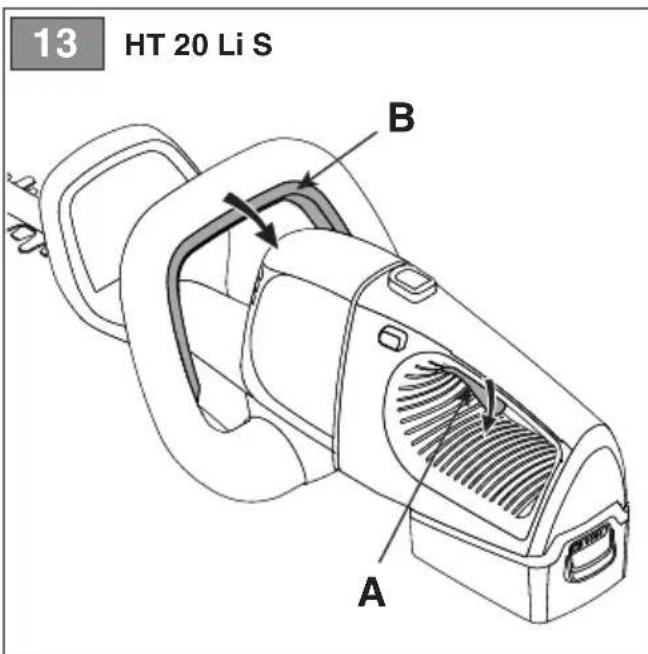
- Release the blade control lever (Fig. 12.A, Fig. 13.A) or the safety switch (Fig. 12.B, Fig. 13.B) immediately;
- Wait for the cutting means to come to a halt
- Remove the battery (para. 7.2.2)
- Remove the jammed material.
6.4.4 Lubricating the blades whilst working
If the cutting means overheats whilst working, it is necessary to lubricate the internal surfaces of the blades (para. 7.4).
This operation can only be done with the machine off and the battery removed from its housing.
6.5 STOP
- Release the blade control lever (Fig. 12.A, Fig. 13.A) or the safety switch (Fig. 12.B, Fig. 13.B).
When you have stopped the machine, it will take a few seconds for the cutting means to stop.
Always stop the machine when moving between work areas.
⚠ Do not keep your hand on the safety switch when moving the machine to avoid accidentally starting the machine.
6.6 AFTER USE
- Remove the battery from its housing and recharge it (para. 7.2.2).
- When the cutting means has halted, fit the blade guard (Fig. 1.E).
- Allow the engine to cool before storing in an enclosed space.
- Clean (para. 7.3).
- Check there are no loose or damaged components. If necessary, replace the damaged components and tighten any screws and loose bolts or contact the authorised service centre.
- Check there are no damages to the machine. If necessary contact the authorised service centre.
IMPORTANT Always remove the battery (para. 7.2.2) and fit the blade guard whenever the machine is unused or left unattended.
7. MAINTENANCE
7.1 GENERAL INFORMATION
IMPORTANT The safety standards to be followed are described in chapter. 2. Strictly comply with these instructions to avoid serious risks or dangers.
⚠️ Before performing any inspections, cleaning or maintenance/adjustment interventions on the machine:
- Stop the machine
- Remove the battery from its housing and recharge it (para. 7.2.2) (never leave the battery inserted or within the reach of children or unauthorised persons)
- When the cutting means is stationary, apply the blade protection device, (except when working directly on the blade)
- Allow the engine to cool before storing in an enclosed space
- Use suitable clothing, protective gloves and goggles
- Read the relevant instructions.
IMPORTANT Any maintenance and adjustment operations not described in this manual must be carried out by your dealer or Authorised Service Centre.
7.2 BATTERY
7.2.1 Battery power reserve
Battery power reserve (and therefore the cuttable vegetation area before recharging is required) mainly depends on:
a. Environmental factors, that cause higher energy requirements:
- cutting/trimming of very thick or wet hedges; - cutting/trimming of bushes with branches that are too thick;
b. operator behaviour that should be avoided:
– switching the machine on and off frequently whilst working;
- adopting a cutting technique that is unsuitable for the work to be performed (para. 6.4.1);
– cutting speed unsuitable for the condition of the hedge to be cut.
To optimise battery power reserve it is always recommended to:
• cut the hedge when dry;
- set a cutting speed suitable for the condition of the shrubs;
- use the most appropriate technique for the work to be performed.
If the need arises to use the machine for sessions which exceed the capability of a standard battery, it is possible to:
• purchase a second standard battery to immediately replace the discharged battery, without compromising the continuity of operations;
• purchase a battery with an extended power reserve compared to the standard version (para. 13.1).
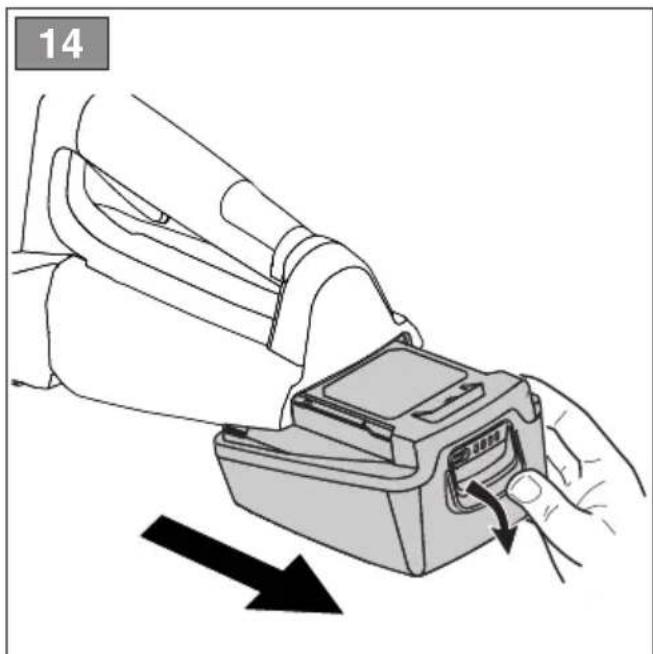
7.2.2 Battery removal and recharging (Fig.14÷17)
Fully charge the battery according to the instructions in the battery/battery charger booklet.
NOTE The battery is equipped with a guard that inhibits recharging if the environmental temperature is not between 0 and +45°C.
NOTE The battery can be recharged at any time, even partially, with no risk of damaging it.
7.3 CLEANING THE MACHINE
- To reduce fire hazards, keep the machine and, in particular, the motor free of leaves, branches or excessive grease.
- Always clean the machine after use with a damp cloth dipped in neutral detergent.
- Remove all traces of humidity using a soft damp cloth. Humidity can generate risks of electric shocks.
- Do not use aggressive detergents or solvents to clean the plastic parts or hand grips.
- Do not spray water onto the motor and electrical components and prevent them from getting wet.
- To avoid overheating and damage to the motor or the battery, always keep the cooling air vents clean and free of debris.
7.4 CLEANING AND LUBRICATION OF THE CUTTING MEANS
To increase the efficiency and working life of the blades, clean and lubricate them carefully after each work session:
Do not touch the cutting device until the battery has been removed and the cutting device is completely stationary.
- Place the machine in a stable horizontal position on the ground.
- Use a soft cloth to clean the blades, along with a brush to remove more difficult dirt and debris.
- Lubricate the blades by applying a light layer of specific oil, preferably the non-pollutant type, along the upper edge of the blade.
7.5 NUTS AND BOLTS
- Keep all nuts, bolts and screws tight to be sure the equipment is in safe working condition.
- Check regularly that the handles are fixed firmly.
7.6 CUTTING MEANS
⚠ Do not touch the cutting means until the battery has been removed and the cutting means is completely stationary.
7.6.1 Checks
Periodically check that the blades are not bent, damaged or deformed and that the screws are adequately tightened.
Adjustment of the distance between blades is not necessary, as this is predetermined by the manufacturer.
7.6.2 Sharpening
It is necessary to sharpen the blades when the trimming performance decreases and the branches tend to stick together.
⚠ For safety reasons, sharpening must be done by an Authorised Service Centre with suitable skills and equipment for the job; without risking any damage to the blade which would make it unsafe when used.
Always replace and never repair a blade which has blunt cutting edges.
7.6.3 Replacement
The blade must never be repaired, but must be replaced as soon as signs of breaking, wearing, bending are noted or the sharpening limit is exceeded. For
safety reasons replacements must be performed by an Authorised Service Centre.
Blades displaying the code indicated on the Technical Data table should be used on this machine.
Given product evolution, the blades listed in the "Technical Data" table may be replaced in time with others having similar interchangeable and operating safety features.
8. STORAGE
IMPORTANT The safety regulations to follow for putting into storage are described in paragraph 2.4. Strictly comply with these instructions to avoid serious risks or hazards.
8.1 STORING
When the machine is to be stored away:
- Remove the battery from its housing and recharge it (para. 7.2.2)
- When the cutting means has halted, fit the blade guard
- Allow the engine to cool before storing in an enclosed space
- Clean (para. 7.3);
- Make sure there are no loose or damaged components. If necessary, replace any damaged components and tighten any screws and loose bolts or contact the authorised service centre;
- Store the machine:
-in a dry place;
– protected from inclement weather;
– in a place out of children's reach;
– making sure that keys or tools used for maintenance are removed.
8.2 STORING THE BATTERY
If the battery is not charged for a long period of time, it must be kept in a cool, shaded place without humidity, with environmental temperature between 0\~45°C.
NOTE If unused for any length of time, recharge the battery every two months to prolong its working life.
9. HANDLING AND TRANSPORT
Whenever the machine is to be handled or transported you must:
- Stop the machine (para. 6.5);
- Make sure that all moving parts have come to a complete stop
- Remove the battery from its housing and recharge it (para. 7.2.2)
– Wear protective work gloves - When the cutting means has halted, fit the blade guard
- Only hold the machine using the hand grips and position the cutting means in the opposite direction to that used during operations
- Make sure that machine movements do not cause damage or injuries.
When transporting the machine on a vehicle, always:
- Position it so that it does not cause a hazard to anyone
– Fasten the machine securely with cables or chains.
10. ASSISTANCE AND REPAIRS
This manual provides all the necessary information to run the machine and for correct basic maintenance operations which can be performed by the user. Any regulations and maintenance operations not described herein must be carried out by your Dealer or Authorised Service Centre. Any operations performed in unauthorised centres or by unqualified persons will totally invalidate the Warranty and all obligations and responsibilities of the Manufacturer.
- Non-original parts and attachments are not approved; use of non-original spare parts and attachments will jeopardise the safety of the machine and relieve the Manufacturer from all obligations or liabilities.
- Original spare parts are supplied by authorised Dealers and by Authorised Service Centres.
11. WARRANTY COVERAGE
The warranty conditions are intended for consumers only, i.e. non-professional operators. The warranty covers all material quality and manufacturing defects recognised during the warranty period by your Dealer or Authorised Service Centre. The warranty is restricted
to the repair or replacement of components recognised as faulty.
The warranty only applies to machines subjected to regular maintenance.
The warranty does not cover damages resulting from:
- Failure to become familiar with the documentation accompanying the machine (Instruction manuals).
• Professional use. - Carelessness, negligence.
- External causes (lightning, impact, presence of foreign bodies inside the machine) or incidents.
- Incorrect use or assembly are prohibited by the manufacturer.
- Poor maintenance.
- Modification to the machine.
- Use of non-genuine spare parts (adaptable parts).
- Use of accessories not supplied or approved by the manufacturer.
The warranty does not cover:
- The maintenance operations (described in the instruction manual).
• Normal wear and tear of consumables. - Normal wear and tear.
The user is protected by his or her own national legislation. The user's rights under the national laws or his or her own country are not in any way restricted by this warranty.
12. TROUBLESHOOTING
If problems persist after implementing the solution, contact your Dealer.
| PROBLEM PROBABLE CAUSE SOLUTION | ||
| 1. Blade control lever and safety switch operated but the machine will not start (mod. HT 20 Li A) or2. Blade control lever, blade control locking button and safety switch operated but the machine will not start (mod. HT 20 Li S) | Battery is not inserted or is inserted incorrectly | Make sure that the battery is inserted correctly (Fig. 6.A) |
| Low battery Check the battery status and recharge if necessary (para. 7.2.2) | ||
| Hedge trimmer is damaged. Do not use the hedge trimmer.Remove the battery and contact an authorised service centre. | ||
| 3. The motor shuts down whilst working | Battery is not inserted correctly Make sure that the battery is inserted correctly (Fig. 6.A)) | |
| Low battery Check the battery status and recharge if necessary. (para. 7.2.2) | ||
| 4. The cutting means is stationary when the blade control lever and safety switch are engaged (mod. HT 20 Li A) or5. The cutting means is stationary when the blade control lever, blade control locking button and safety switch are engaged (mod. HT 20 Li S) | Hedge trimmer is damaged. Do not use the hedge trimmer. Immediately turn off the machine remove the battery and Contact an Authorised Service Centre. | |
| 6. The cutting means overheats whilst working | Insufficient blade lubrication Turn off the machine, wait until the cutting means is stationary, remove the battery and lubricate the blades (para. 7.4) | |
| PROBLEM PROBALE CAUSE SOLUTION | ||
| 7. The cutting means comes into contact with a line or electric cable | - DO NOT TOUCH THE BLADE AS IT | MAY BE LIVE AND BE EXTREMELY DANGEROUS! Grasp the machine using the insulated rear handgrip only and position it at a safe distance from yourself.Disconnect the current that powers the severed line or mains cable and remove the battery before freeing the blade teeth. |
| 8. The cutting means comes into contact with a foreign body. | - Turn off the machine remove the battery and: - Inspect for damage - Check for and tighten any loose parts - Contact an Authorised Service Centre for replacement or repair damaged parts with parts having equivalent specifications. | |
| 9. Excessive noise and/or vibration is experienced whilst working | Loose or damaged parts Turn off the machine remove the battery and: - inspect for damage; - check for and tighten any loose parts; - Contact an Authorised Service Centre for replacement or repair damaged parts with parts having equivalent specifications. | |
| 10. The machine gives off smoke whilst working | Hedge trimmer is damaged. Do not use the hedge trimmer. Immediately turn off the machine remove the battery and Contact an Authorised Service Centre. | |
| 11. Battery power reserve is low | Severe working conditions requiring greater current absorption | Optimise operations (para. 7.2.1) |
| Battery is insufficient for operating requirements | Use a second battery or an extended battery (para. 13.1) | |
| Decrease in battery capacity Purchase a new battery | ||
| 12. The battery charger is not recharging the battery | Battery is not correctly inserted in the battery charger | Check it is correctly inserted (para. 7.2.2) |
| Unsuitable environmental conditions Recharge the battery in places with suitable temperatures (see battery/battery charger instruction manual) | ||
| Dirty contacts Clean the contacts | ||
| The battery charger is not energised | Check it is plugged in and the power socket is energised | |
| Faulty battery charger | Replace with an original spare part | |
| If the problem persists, refer to the battery/battery charger manual | ||
13. ACCESSORIES ON REQUEST
13.1 BATTERIES
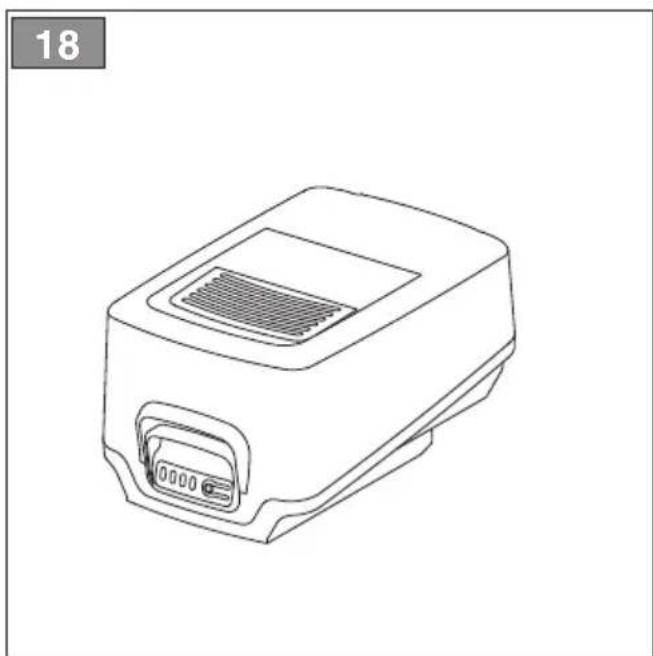
Different capacity batteries are available to suit specific operating requirements (Fig. 18). The list of approved batteries for this machine can be found in the "Technical Data" table.
13.2 BATTERY CHARGER
Device used to recharge the battery (Fig.19).
ÍNDICE
1.1 KUIDAS JUHENDIT LUGEDA
2.1 ÜLDISED OHUTUSHOIATUSED
9. MANUTENTION ET TRANSPORT
2.1 ALGEMENE VEILIGHEIDSWAARSCHUWINGEN
2.3 BESCHERMING VAN DE OMGEVING
7.5 MOEREN EN SCHROEVEN VOOR BEVESTIGING
- GENERELT.... 1
- SIKKERHETSBESTEMMELSER....1
- BLI KJENT MED MASKINEN....4
- UTPAKKING 6
- BETJENINGSUTSTYR....6
5.1 Kontrollspak knivblad 6
5.2 Låseknapp for knivblad (MOD. HT 20 LI S) .... 6
5.3 Sikkerhetsbryter 6
5.4 Utløserknapp for bakre håndtak
(MOD. HT 20 LI S)....6
- BRUK AV MASKINEN....6
3. BLI KJENT MED MASKINEN
3.1 BESKRIVELSE AV MASKINEN OG BEREGNET BRUK
6.1 CZYNNOŚCI WSTĘPNE
6.4 PRACOVNÁ ČINNOSŤ
Pred stroj shranite:
INNEHÅLLSFÖRTECKNING
- ALLMÄN INFORMATION....1
- SÄKERHETSFÖRESKRIFTER....1
- LÄRA KÄNNA MASKINEN 4
Do you have to get your home! Do
EN • The content and images in this User Manual were produced expressly for ST. S.p.A. and are protected by copyright – any unauthorised reproduction or modification to the document, either partially or in full, is prohibited.
Type:

- USO DELLA MACCHINA
- PRACOVNÍ ČINNOST
- PRODUKTETS TYPESKILT (Fig.1)
- SIKKERHEDSAFBRYDER
- GENERAL INFORMATION
- HOW TO READ THIS MANUAL
- SAFETY REGULATIONS
- GENERAL SAFETY WARNINGS
- 2) Electrical safety
- 3) Personal safety
- 4) Power tool use and care
- Battery tool use and care
- 6) Service
- SPECIFIC SAFETY REGULATIONS FOR HEDGE TRIMMERS
- ENVIRONMENTAL PROTECTION
- ABOUT THE MACHINE
- MACHINE DESCRIPTION AND INTENDED USE
- Intended use
- Improper use
- Type of users
- MAIN COMPONENTS (Fig.1)
- PRODUCT IDENTIFICATION LABEL (Fig.1)
- SAFETY SIGNS (Fig.2)
- UNPACKING
- CONTROLS
- - Model HT 20 Li A
- • Modello HT 20 Li S
- BLADE CONTROL LOCKING BUTTON (MOD. HT 20 LI S)
- SAFETY SWITCH
- REAR HANDGRIP RELEASE BUTTON (MOD. HT 20 LI S)
- USING THE MACHINE
- PRELIMINARY OPERATIONS
- Checking and recharging the battery (Fig. 5)
- SAFETY CHECKS
- General check
- Machine operating test
- START-UP
- 5.a Mod. HT 20 Li A
- 5.b Mod. HT 20 Li S
- OPERATION
- Adjusting the rear handgrip (Mod. HT 20 Li S)
- Work techniques
- 6.4.2.a Vertical cutting
- 6.4.2.b Horizontal cutting
- Advice for operation
- Lubricating the blades whilst working
- STOP
- AFTER USE
- MAINTENANCE
- GENERAL INFORMATION
- BATTERY
- Battery power reserve
- Battery removal and recharging (Fig.14÷17)
- CLEANING THE MACHINE
- CLEANING AND LUBRICATION OF THE CUTTING MEANS
- NUTS AND BOLTS
- CUTTING MEANS
- Checks
- Sharpening
- Replacement
- safety reasons replacements must be performed by an Authorised Service Centre.
- STORAGE
- STORING
- STORING THE BATTERY
- HANDLING AND TRANSPORT
- ASSISTANCE AND REPAIRS
- WARRANTY COVERAGE
- TROUBLESHOOTING
- ACCESSORIES ON REQUEST
- BATTERIES
- BATTERY CHARGER
- ÍNDICE
- KUIDAS JUHENDIT LUGEDA
- ÜLDISED OHUTUSHOIATUSED
- MANUTENTION ET TRANSPORT
- ALGEMENE VEILIGHEIDSWAARSCHUWINGEN
- BESCHERMING VAN DE OMGEVING
- MOEREN EN SCHROEVEN VOOR BEVESTIGING
- BLI KJENT MED MASKINEN
- BESKRIVELSE AV MASKINEN OG BEREGNET BRUK
- CZYNNOŚCI WSTĘPNE
- PRACOVNÁ ČINNOSŤ
- INNEHÅLLSFÖRTECKNING
Brand : STIGA
Model : SHT 100 AE
Category : Hedge trimmers