
MISSY IX/A/60 - Decorative wall hood ELICA - Free user manual and instructions
Find the device manual for free MISSY IX/A/60 ELICA in PDF.

 FR
FR
 AR
AR
 BG
BG
 CS
CS
 DA
DA
 DE
DE
 EL
EL
 EN
EN
 ES
ES
 ET
ET
 FI
FI
 HU
HU
 IT
IT
 KK
KK
 LT
LT
 LV
LV
 MK
MK
 NL
NL
 NO
NO
 PL
PL
 PT
PT
 RO
RO
 RU
RU
 SK
SK
 SL
SL
 SV
SV
 TR
TR
 UK
UK
| Product type | Wall-mounted decorative hood |
| Brand | ELICA |
| Model | MISSY IX/A/60 |
| Width | 60 cm |
| Mounting | Wall-mounted |
| Use version | Extracting (external evacuation) or recirculating (charcoal filter) |
| Number of speeds | 3 (according to control panel) |
| Lighting | 3 W LED, socket E14 |
| Grease filter type | Metallic, dishwasher safe or hand washable |
| Charcoal filter type | Replace every 4 months (not washable) |
| Power supply | 220-240 V ~ 50/60 Hz |
| Max lighting power | 3 W (LED) |
| Minimum safety distance (electric) | 50 cm |
| Minimum safety distance (gas) | 65 cm |
| Grease filter maintenance | Once a month |
| Exterior cleaning | Damp cloth with neutral detergent, no alcohol or abrasives |
| Control type | Manual control panel |
| Approximate weight | 15 kg |
| Dimensions (W x D x H) | 60 x 50 x 60 cm (approximate) |
| Main material | Stainless steel |
| Non-return valve | Optional (depending on model) |
Frequently Asked Questions - MISSY IX/A/60 ELICA
User questions about MISSY IX/A/60 ELICA
0 question about this device. Answer the ones you know or ask your own.
Ask a new question about this device
Download the instructions for your Decorative wall hood in PDF format for free! Find your manual MISSY IX/A/60 - ELICA and take your electronic device back in hand. On this page are published all the documents necessary for the use of your device. MISSY IX/A/60 by ELICA.
USER MANUAL MISSY IX/A/60 ELICA
EN Instruction on mounting and use
The carbon filter saturation occurs after a few minutes, but the man is still unable to move. He looks at his father's face and his mother's face. "I'm sorry," he says, "but I don't know how to tell him what he wants to say."
Closely follow the instructions set out in this manual. All responsibility, for any eventual inconveniences, damages or fires caused by not complying with the instructions in this manual, is declined. This appliance is intended to be used in household and similar application such as: - staff kitchen areas in shop, offices and other working environments; - farm houses; - by clients in hotels, motels and other residential type environments; - bed and breakfast type environments.
Note: The parts marked with the symbol ( * ) " are optional accessories supplied only with some models or otherwise not supplied, but available for purchase.
Caution
- Before any cleaning or maintenance operation, disconnect hood from the mains by removing the plug or disconnecting the mains electrical supply.
- Always wear work gloves for all installation and maintenance operations.
- This appliance can be used by children aged from 8 years and above and persons with reduced physical, sensory or mental capabilities or lack of experience and knowledge if they have been given supervision or instruction concerning use of the appliance in a safe way and understand the hazards involved. Children shall not be allowed to tamper with the controls or play with the appliance.
- Cleaning and user maintenance shall not be made by children without supervision.
- The premises where the appliance is installed must be sufficiently ventilated, when the kitchen hood is used together with other gas combustion devices or other fuels.
- The hood must be regularly cleaned on both the inside and outside (AT LEAST ONCE A MONTH).
- This must be completed in accordance with the maintenance instructions provided. Failure to follow the instructions
provided regarding the cleaning of the hood and filters will lead to the risk of fires.
- Do not flambe under the range hood.
- For lamp replacement use only lamp type indicated in the Maintenance/Replacing lamps section of this manual.
The use of exposed flames is detrimental to the filters and may cause a fire risk, and must therefore be avoided in all circumstances.
Any frying must be done with care in order to make sure that the oil does not overheat and ignite.
CAUTION: Accessible parts of the hood may become hot when used with cooking appliances.
- Do not connect the appliance to the mains until the installation is fully complete.
- With regards to the technical and safety measures to be adopted for fume discharging it is important to closely follow the regulations provided by the local authorities.
- The air must not be discharged into a flue that is used for exhausting fumes from appliance burning gas or other fuels.
- Do not use or leave the hood without the lamp correctly mounted due to the possible risk of electric shocks.
- Never use the hood without effectively mounted grids.
- The hood must NEVER be used as a support surface unless specifically indicated.
- Use only the fixing screws supplied with the product for installation or, if not supplied, purchase the correct screws type.
- Use the correct length for the screws which are identified in the Installation Guide.
- In case of doubt, consult an authorized service assistance center or similar qualified person.
WARNING!
- Failure to install the screws or fixing device in accordance with these instructions may result in electrical hazards.
- Do not use with a programmer, timer, separate remote control system or any other device that switches on automatically.
- This appliance is marked according to the European directive 2012/19/EC on Waste Electrical and Electronic Equipment (WEEE).
- By ensuring this product is disposed of correctly, you will help prevent potential negative consequences for the environment and human health, which could otherwise be caused by inappropriate waste handling of this product.

- The symbol on the product, or on the documents accompanying the product, indicates that this appliance may not be treated as household waste. Instead it should be taken to the appropriate collection point for the recycling of electrical and electronic equipment. Disposal must be carried out in accordance with local environmental regulations for waste disposal.
- For further detailed information regarding the process, collection and recycling of this product, please contact the appropriate department of your local authorities or the local department for household waste or the shop where you purchased this product.
Appliance designed, tested and manufactured according to:
- Safety: EN/IEC 60335-1; EN/IEC 60335-2-31, EN/IEC 62233. Performance: EN/IEC 61591; ISO 5167-1; ISO 5167-3; ISO 5168; EN/IEC 60704-1; EN/IEC 60704-2-13; EN/IEC 60704-3; ISO 3741; EN 50564; IEC 62301.
- EMC: EN 55014-1; CISPR 14-1; EN 55014-2; CISPR 14-2; EN/IEC 61000-3-2; EN/IEC 61000-3-3. Suggestions for a correct use in order to reduce the environmental impact: Switch ON the hood at minimum speed when you start cooking and keep it running for a few minutes after cooking is finished. Increase the speed only in case of large amount of smoke and vapor and use boost speed(s) only in extreme situations. Replace the charcoal filter(s) when necessary to maintain a good odor reduction efficiency. Clean the grease filter(s) when necessary to maintain a good grease filter efficiency. Use the maximum diameter of the ducting system indicated in this manual to optimize efficiency and minimize noise.
Use
The hood is designed to be used either for exhausting or filter version.
Ducting version
The hood is equipped with a top air outlet B for discharge of fumes to the outside (exhaust pipe and pipe fixing clamps not provided).
Attention! If the hood is supplied with carbon filter, then it must be removed.
Filter version
In the case of not being able to discharge the fumes and the steam of cooking outside, the hood in the filter version can be used mounting the F deflector on the flue and one or more carbon filters (on the basis of the model possessed). The fumes and steam are recycled into the kitchen through upper grill H.
Attention! If the hood is not supplied with carbon filter,
then it must be ordered and mounted.
The models with no suction motor only operate in ducting mode, and must be connected to an external suction device (not supplied).
The connecting instructions are supplied with the peripheral suction unit.
Installation
Fig. 3
The minimum distance between the supporting surface for the cooking equipment on the hob and the lowest part of the range hood must be not less than 50 cm from electric cookers and 65 cm from gas or mixed cookers.
If the instructions for installation for the gas hob specify a greater distance, this must be adhered to.

Electrical connection
The mains power supply must correspond to the rating indicated on the plate situated inside the hood. If provided with a plug connect the hood to a socket in compliance with current regulations and positioned in an accessible area, after installation. If it not fitted with a plug (direct mains connection) or if the plug is not located in an accessible area, after installation, apply a double pole switch in accordance with standards which assures the complete disconnection of the mains under conditions relating to over-current category III, in accordance with installation instructions.

WARNING!
Before re-connecting the hood circuit to the mains supply and checking the efficient function, always check that the mains cable is correctly assembled.
Mounting
Expansion wall plugs are provided to secure the hood to most types of walls/ceilings. However, a qualified technician must verify suitability of the materials in accordance with the type of wall/ceiling. The wall/ceiling must be strong enough to take the weight of the hood.
Do not tile, grout or silicone this appliance to the wall. Surface mounting only.
Operation
The hood is fitted with a control panel with aspiration speed selection control and a light switch to control cooking area lights.
Maintenance
Cleaning
Clean using ONLY a cloth dampened with neutral liquid detergent. DO NOT CLEAN WITH TOOLS OR
INSTRUMENTS. Do not use abrasive products. DO NOT USE ALCOHOL!
Grease filter
Fig. 1
Traps cooking grease particles.
The grease filter must be cleaned once a month using non aggressive detergents, either by hand or in the dishwasher, which must be set to a low temperature and a short cycle.
When washed in a dishwasher, the grease filter may discolor slightly, but this does not affect its filtering capacity.
To remove the grease filter, pull the spring release handle.
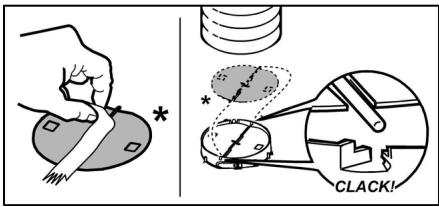
Charcoal filter (filter version only)
Fig. 2
It absorbs unpleasant odors caused by cooking.
The saturation of the charcoal filter occurs after more or less prolonged use, depending on the type of cooking and the regularity of cleaning of the grease filter.
In any case it is necessary to replace the cartridge at least every four months.
The charcoal filter may NOT be washed or regenerated.
Remove the grease filters.
Fit the charcoal filters over the motor.
Align the pins R on the cowl with the slots S, then turn the filter clockwise until it locks in place.
Reverse the above procedure to remove the charcoal filters.
Refit the grease filters.
Replacing lamps
Disconnect the appliance from the electricity.
Warning! Prior to touching the light bulbs ensure they are cooled down.
Remove cover A to access the lamp housing A.
Replace the damaged lamp.
Use E14 3W max LED lamps only. For more details, check enclosed leaflet "ILCOS D" (alfanumeric position "1d").
If the lights do not work, make sure that the lamps are fitted properly into their housings before you call for technical assistance.
On some models ONLY:
A Non Return Backdraft Damper is included in the supply, as optional accessory to be installed under certain installation conditions (i.e. if there is no protection against accidental backdraft of air from the outside). The damper must be installed inside the dedicated housing, inside of the Air Outlet Fitting, before installing the flue.
Fig. 1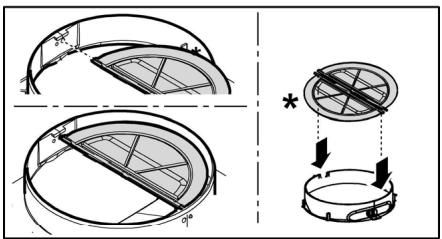
- European Directive 2012/19/EC
- Waste Electrical and Electronic Equipment (WEEE).
Please, be aware that this product has been designed and manufactured with high quality materials and components which can be recycled and reused. When you see the crossed-out wheeled bin symbol attached to the product, it means that the product is covered by the European Directive 2012/19/EC and must not be disposed of with other household waste. Please, dispose of this product at your local community waste collection/recycling centre. By doing this you will help to prevent potential negative consequences for the environment and human health, which could otherwise be caused by inappropriate waste handling. For more detailed information about recycling of this product, please contact your local city office, your household waste disposal service or the shop where you purchased the product.

The symbol on the product or its packaging indicates that this product shall not be treated as household waste. Instead it shall be handed over to the applicable collection point for the recycling of electrical and electronic equipment. By ensuring this product is disposed of correctly, you will help prevent potential negative consequences for the environment and human health, which could otherwise be caused by inappropriate waste handling of this product. The recycling of materials will help to conserve natural resources. For more detailed information about recycling of this product, please contact your local city office, your household waste disposal service or the shop where you purchased the product.
This product has been designed, tested and manufactured in accordance with:
- Safety: EN/IEC 60335-1; EN/IEC 60335-2-31, EN/IEC 62233.
- Performance characteristics: EN/IEC 61591; ISO 5167-1; ISO 5167-3; ISO 5168; EN/IEC 60704-1; EN/IEC 60704-2-13; EN/IEC 60704-3; ISO 3741; EN 50564; IEC 62301.
- EMC - Electromagnetic compatibility: EN 55014-1; CISPR 14-1; EN 55014-2; CISPR 14-2; EN/IEC 61000-3-2; EN/IEC 61000-3-3.
Suggestions for correct use in order to reduce the environmental impact: Switch on (ON) the aspirator at minimum speed when you start cooking and leave it running for a few minutes after cooking is finished. Increase the speed only in case of large amounts of smoke and vapours. Use the boost speed only in extreme situations. Replace the filters/charcoal filters when necessary to maintain good efficiency of the aspirator. Clean the grease filters when necessary to
maintain good efficiency of the grease filter. Use the maximum diameter of the air exhaust system, indicated in this manual, to optimize efficiency and minimize noise.
Aspirators and their intended use: suction of air and odors, simultaneously with the removal of recycled air.
Aspirating hood
The aspirators are equipped with a "B" opening in the upper part through which the smoke passes (the exhaust pipe and accessories for extraction are not included).
Attention! If the aspirator is equipped with a filter with active carbon, the pipe must be connected
In case it is not possible to exhaust the air and vapors that are released during cooking, you can use the aspirator in the recirculation version by mounting the F filter on the ventilation pipe and one or more active carbon filters (depending on the model). In this way, the air and vapors are sucked through the ventilation grille H.
Attention! If the aspirator is not equipped with a filter with active carbon, the pipe must be connected and mounted before using the device.
The models without aspirating motor are intended for operation only in the recirculation version and must be connected to a peripheral aspirating unit, which is purchased separately.
The connection instructions are supplied together with the peripheral aspirating unit.
Mounting
The minimum distance between the surface on which the cooking vessels are placed and the lower part of the kitchen aspirator must be not less than 50 cm in the case of electric cookers and not less than 65 cm in the case of gas or combined cookers.
If the instructions for the gas cooker specify a greater distance, this must be respected.
Before connecting the appliance to the mains, check that the data on the rating plate, supplied by the manufacturer, matches the mains voltage. If it is fitted with a plug, follow the relevant standards and connect it to an easily accessible socket. If it is not fitted with a plug (direct connection to the mains), or if the plug is not easily accessible,
for installation, use a double-pole switch in accordance with the standards, so that the appliance can be completely disconnected from the mains during installation category III, in accordance with the installation rules.
WARNING!
Before connecting the appliance to the mains and checking that it functions correctly, check that the cable is mounted as required.
INSTALLATION
For all this, we recommend that you consult a qualified technician to ensure that the supplied accessories are suitable for the purpose. The wall, according to the table, must be sufficiently stable to withstand the load.
Instructions for use
The appliance is supplied with a control panel with the possibility of adjusting the suction speed and switching off the lighting of the hob.
Cleaning
Cleaning.
For cleaning, use ONLY a cloth dampened with neutral detergent. DO NOT USE INSTRUMENTS OR DEVICES FOR CLEANING!
Avoid products that contain abrasive substances. DO NOT USE ALCOHOL!
Grease filter
Fig.1
The filter retains the grease particles released during cooking.
The product must be used with neutral detergent. It is recommended to wash the machine at a low temperature and in a short washing cycle.
Using a detergent dispenser is possible, but this is not necessary if the detergent is placed directly into the drum.
To remove the detergent dispenser, press the button with the spring mechanism.
The filter is activated carbon (for water filtration only).
Fig. 2
Close the inlet valves, which are located behind the appliance.
The activated carbon filter should be replaced periodically after a certain period of use, depending on the water hardness and how often the filter is used.
In any case, it is necessary to replace the activated carbon filter every four months or when the filter replacement indicator shows that it is necessary.
Do not reuse the filter.
Remove the detergent dispenser.
Install the filters that cover the motor housing.
Make sure that the bolts on top align with the holes, then tighten them clockwise until they are secure.
To remove the filters, perform the operations in reverse order.
Install the detergent dispenser again.
Normal operation of the appliance.
Replace the lamp. Warning.
Attention! Before taking the lamp in hand, check that the hooks are intact.
For this purpose, open the grille.
Replace the damaged lamp.
Use only LED lamps with a maximum power of 3W-E14. For more information, consult the attached instructions "ILCOS D" (alphanumeric position "1d").
If the lamp does not light, check that it is mounted correctly before contacting a specialist.
Replace the defective bulb.
Use exclusively LED bulbs of max 3W-E14. For more details, consult the attached instructions "ILCOS D" (alphanumeric position "1d").
The appliance has been designed, tested and manufactured in accordance with:
- Safety: EN/IEC 60335-1; EN/IEC 60335-2-31, EN/IEC 62233.
- Performance characteristics: EN/IEC 61591; ISO 5167-1; ISO 5167-3; ISO 5168; EN/IEC 60704-1; EN/IEC 60704-2-13; EN/IEC 60704-3; ISO 3741; EN 50564; IEC 62301. EMC: EN55014-1; CISPR 14-1; EN55014-2; CISPR 14-2; EN/IEC61000-3-2; EN/IEC61000-3-3. Recommendations for correct use to reduce environmental impact: Turn on the extractor at minimum speed when you start cooking and leave it running for a few minutes after finishing cooking. Increase the speed only in case of large amounts of smoke and steam, and use boost speeds in extreme situations. Replace the charcoal filter when necessary to maintain good odor reduction efficiency. Clean the grease filter(s) when necessary to maintain good grease filter performance. Use the maximum diameter of the ducting system, as indicated in this manual, to optimize efficiency and minimize noise.
Use
The hood is designed to operate in extraction mode (air exhausted outside) or in recirculation mode.
Extraction mode (air exhausted outside)
The hood is supplied with an upper flue outlet for discharging fumes outside (version with external air discharge - flue pipe and mounting clamps are not included in the kit).
Warning! If the hood is equipped with a charcoal filter, make sure it is installed.
Recirculation version
If it is impossible to discharge fumes and vapors from the kitchen, you can use the hood in recirculation mode when installing a deflector for one or more charcoal filters (depending on your model); in this case, the filtered air is recirculated into the kitchen through the upper grille.
Warning! If the hood is not equipped with a charcoal filter, install it before use.
Hood models without a motor unit can operate only in air extraction mode, so they must be connected to an external extraction system (not supplied).
Installation instructions are supplied with the hood.
Installation
Fig. 3
The distance between the lower edge of the hood and the hob surface must be at least 50 cm for electric hobs and at least 65 cm for gas or combined hobs.
If the installation instructions for the gas hob specify a greater distance, respect that.
! Electrical connection
The mains voltage must match the voltage indicated on the data plate located inside the appliance. If the hood is supplied with a plug, connect it to a suitable socket. The socket must comply with current regulations and be accessible. The socket can be switched on after installation. If the hood is not supplied with a plug (direct connection to the mains) or if the socket is not accessible after installation, use a double-pole switch that ensures complete disconnection from the mains under overvoltage category III conditions, in accordance with installation instructions.
WARNING!
Before connecting the hood to the electrical power supply, check that it is in good working order.
Its operation is based on the fact that each power supply must be checked.
Installation
The unit is supplied with dowels for fixing it to most walls/ceilings. However, it is necessary to contact a qualified technician to ensure that the materials of the walls/ceilings for this type are suitable. The wall/ceiling must have sufficient strength considering the weight of the device.
Operation
The unit is controlled by the control panel for fan speed and switching on the light for illuminating the work surface of the hob.
Maintenance
Cleaning
For cleaning, use only a special cloth moistened with neutral liquid detergent. Do not use any tools for cleaning. Do not use products containing abrasive materials. Do not use alcohol!
Version with exhaust
The hood has an outlet for air through the wall to the outside (not supplied with non-return valve and fixing clips).
Warning! If the hood is equipped with an activated carbon filter, it must be removed.
Version with recirculation
If it is not possible to exhaust the air through the wall to the outside, the hood can be used in the recirculation version by mounting the deflector on the top outlet and installing the carbon filter (depending on the model), and the air is recirculated through the upper grille.
Warning! If the hood is not equipped with a carbon filter, it must be ordered and installed before use.
Models without a fan operate only in the version with air extraction and must be connected to a peripheral extraction device (not supplied).
The device is supplied with a power cord for connection.
Installation
Fig. 3
The minimum distance between the hood and the hob for gas or combined hobs must not be less than 65 cm, and for electric hobs, 50 cm. If the installation instructions for the gas hob specify a greater distance, this must be respected.

Electrical connection
The electrical connection must comply with the requirements stated on the rating plate inside the hood. If the hood is equipped with a plug, connect it to a properly grounded socket in accordance with the installation instructions. If it is not equipped with a plug (direct connection to the electrical supply) or if the plug is not accessible after installation, install a bipolar switch in accordance with the standards that ensure complete disconnection from the electrical supply under conditions of overvoltage category III, in accordance with the installation instructions.
If the hood is not equipped with a plug (direct connection to the electrical supply) or if the plug is not accessible after installation, install a bipolar switch in accordance with the standards that ensure complete disconnection from the electrical supply under conditions of overvoltage category III, in accordance with the installation instructions.
WARNING!
Before (re)connecting the hood to the electrical supply and checking its functionality, always check the power cord and the plug for damage.
Disposal
The hood is made with parts suitable for recycling. At the end of its life, it must be disposed of separately from household waste. It must be handed over to a qualified technician for proper disposal, in accordance with the regulations for waste electrical and electronic equipment.
The waste electrical and electronic equipment must be disposed of separately from household waste. It must be handed over to a qualified technician for proper disposal, in accordance with the regulations for waste electrical and electronic equipment.
Operation
The hood is operated with a control panel with a speed regulator for suction and a regulator for the lighting, which is activated from the switch.
Maintenance
Clean the metal filter for grease with neutral detergent. Do not use other tools or instruments.
Do not use abrasive products. Do not use alcohol!
Grease filter
Fig. 1
For collecting the greasy residues from the steam from cooking.
The metal grease filter must be cleaned regularly with neutral detergent, at least once a month or when the machine is used at low temperatures for a short period.
With the machine for cleaning dishes, the metal grease filter may lose its shine, but its filtering characteristics do not change.
To remove the grease filter, pull it by the release tab.
Filter with active charcoal (only for the version with recirculation)
Fig. 2
For collecting the odors from the steam from cooking.
The saturation of the charcoal filter occurs after more or less prolonged use, depending on the type of cooking and the frequency of cleaning of the grease filter. In any case, it is necessary to replace the cartridge at least every 4 months.
It cannot be washed or regenerated.

EN/IEC 60335-2- EN/IEC 60335-1:EN/IEC 60335-2. EN/IEC 62233, 31
EN/IEC 61591; ISO 5167-1; ISO :5167-3; ISO 5168; EN/IEC 60704-1; EN/IEC 60704-2-13; EN/IEC 60704-3; ISO 3741; EN 50564; IEC 62301.
EN 55014-1; CISPR: (品品品品品品品品品品品品品品品品品品品品品 ) EMC· 14-1; EN 55014-2; CISPR 14-2; EN/IEC 61000- jgjgljgljgljgljgljgljgljgljgljgljgljgljgljgljgljgljgljgljgljgljgljgljgljgljgljgljgljgljgljgljgljgljgljgljgljgljgljgljgljgljgljgljgljgljgljgljgljgljgljglj
p1
g jyj yj yj yj yj yj yj yj yj yj yj yj yj yj yj yj yj yj yj yj yj yj yj yj yj yj yj yj yj yj yj yj yj yj yj yj yj yj yj yj yj yj
1234567890
#
a i 1500 B o all glo
()
1
.
#
Jlll lI Jlll Iaiaiaia aai nssalnnsaal 1 F aai ll iis gaaiaaii aai i aai i aai (y) jnnnnae
H. an + 1 = an + bn
4 1
1. p125-21 1
(1)
1
1
∴ a i = b i
y
y
A



- CAUTION
- WARNING
- USE
- DUCTING VERSION
- FILTER VERSION
- THEN IT MUST BE ORDERED AND MOUNTED
- INSTALLATION
- FIG
- ELECTRICAL CONNECTION
- MOUNTING
- OPERATION
- MAINTENANCE
- CLEANING
- GREASE FILTER
- CHARCOAL FILTER (FILTER VERSION ONLY)
- REPLACING LAMPS
- ON SOME MODELS ONLY
- ASPIRATING HOOD
- INSTRUCTIONS FOR USE
- THE FILTER IS ACTIVATED CARBON (FOR WATER FILTRATION ONLY)
- NORMAL OPERATION OF THE APPLIANCE
- EXTRACTION MODE (AIR EXHAUSTED OUTSIDE)
- RECIRCULATION VERSION
- VERSION WITH EXHAUST
- VERSION WITH RECIRCULATION
- DISPOSAL
- FILTER WITH ACTIVE CHARCOAL (ONLY FOR THE VERSION WITH RECIRCULATION)
- P
Brand : ELICA
Model : MISSY IX/A/60
Category : Decorative wall hood