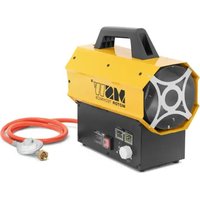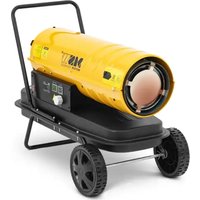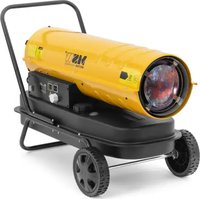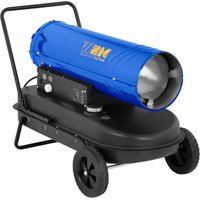
TW-DH-30000 - Heating MSW - Free user manual and instructions
Find the device manual for free TW-DH-30000 MSW in PDF.


| Product type | Diesel heater |
| Model | MSW TW-DH-30000 |
| Brand | MSW |
| Heating power | 30 kW |
| Fuel | Diesel or heating kerosene |
| Tank capacity | 38 L |
| Fuel consumption | 2.8 L/h |
| Approximate runtime | Approx. 13 hours |
| Dimensions (W x D x H) | 790 x 460 x 595 mm |
| Net weight | 19.5 kg |
| Power supply | 230 V / 50 Hz |
| Rated current | 1.1 A |
| Fuse | 3.15 A |
| Max airflow | 720 m³/h |
| Air pressure | 0.38 bar |
| Temperature control | Thermostat with digital display |
| Safety features | Overheat protection, fire extinguisher recommended, automatic shutdown in case of flame failure |
| Maintenance | Regular cleaning of tank, fuel filter, and electrodes |
| Usage | Well-ventilated indoor, outdoor only, safety distance 2-3 m |
| Included accessories | Wheels, handle, manometer |
| Warranty | Consult the manufacturer |
Frequently Asked Questions - TW-DH-30000 MSW
User questions about TW-DH-30000 MSW
0 question about this device. Answer the ones you know or ask your own.
Ask a new question about this device
Download the instructions for your Heating in PDF format for free! Find your manual TW-DH-30000 - MSW and take your electronic device back in hand. On this page are published all the documents necessary for the use of your device. TW-DH-30000 by MSW.
USER MANUAL TW-DH-30000 MSW
a) Luftauslass
b) Oberer Deckel
natural_image
Line drawing of a mechanical device with a wrench and tool, no text or symbols presentThis User Manual has been translated using machine translation. We have made every effort to ensure the translation is accurate, but please note that automated translations are not perfect and are not meant to replace human translators. The official version of the User Manual is in English. Any differences between the translated version and the original English are not legally binding. If you have any questions about the accuracy of the translation, please refer to the English version, which is the official reference. More language versions are available upon request via info@expondo.com.
1. Technical data
Table 1: Technical data of the product
| Parameter description | Parameter value | |||
| Product name | Diesel heater | |||
| Model | MSW-TB-DH-20000 | MSW-TW-DH-20000 | MSW-TW-DH-30000 | MSW-TW-DH-50000 |
| Dimensions [Width x Depth x Height; mm] | 765 x 395 x 560 | 765 x 395 x 560 | 790 x 460 x 595 | 1065 x 480 x 720 |
| Rated voltage [V~] / Frequency [Hz] | 230/50 | |||
| Fuel | Diesel fuel or heating kerosene | |||
| Heating power [kW] | 20 | 20 | 30 | 50 |
| Rated power [W] | 230 | 230 | 230 | 340 |
| Maximum air flow [m3/h] | 550 | 550 | 720 | 1100 |
| Fuel tank capacity [L] | 19 | 19 | 38 | 56 |
| Fuel consumption [L/h] | 1.88 | 1.88 | 2.8 | 4.7 |
| Net weight [kg] | 16.4 | 16.4 | 19.5 | 24.3 |
| Air pressure [bar] | 0.32 | 0.32 | 0.38 | 0.38 |
| Rated current [A] | 1.1 | 1.1 | 1.1 | 1.5 |
| Fuse [A] | 3.15 | |||
| Approximate runtime on a full tank [h] | ±10 | ±10 | ±13 | ±12 |
2. General description
The user manual is designed to assist in the safe and trouble-free use of the device. The product is designed and manufactured in accordance with strict technical guidelines, using state-of-the-art technologies and components. Additionally, it is produced in compliance with the most stringent quality standards.
DO NOT USE THE DEVICE UNLESS YOU HAVE THOROUGHLY READ AND UNDERSTOOD THIS USER MANUAL.
To increase the product life of the device and to ensure trouble-free operation, use it in accordance with this user manual and regularly perform maintenance tasks. The technical data and specifications in this user manual are up to date. The manufacturer reserves the right to make changes associated with quality improvement. The device is designed to reduce noise emission risks to a minimum, taking into account technological progress and noise reduction opportunities.
2.1. Legend
| Icon Description | |
 | The product satisfies the relevant safety standards. |
 | Read instructions before use. |
 | The product must be recycled. |
 | WARNING! or CAUTION! or REMEMBER! Applicable to the given situation.(general warning sign) |
 | ATTENTION! Electric shock warning! |
 | ATTENTION! Fire hazard - flammable materials! |
 | ATTENTION! Hot surface, risk of burns! |
 | Do not cover the device with any fabrics or items! |

PLEASE NOTE! DRAWINGS IN THIS MANUAL ARE FOR ILLUSTRATION PURPOSES ONLY AND IN SOME DETAILS MAY DIFFER FROM THE ACTUAL PRODUCT.
3. Usage safety

ATTENTION! READ ALL SAFETY WARNINGS AND ALL INSTRUCTIONS. FAILURE TO FOLLOW THE WARNINGS AND INSTRUCTIONS MAY RESULT IN ELECTRIC SHOCK, FIRE AND/OR SERIOUS INJURY OR EVEN DEATH.
The terms "device" or "product" are used in the warnings and instructions to refer to:
Diesel heater
3.1. Electrical safety
a) The plug must fit the socket. Do not modify the plug in any way. Using original plugs and matching sockets reduces the risk of electric shock.
b) Avoid touching earthed elements such as pipes, heaters, boilers and refrigerators. There is an increased risk of electric shock if the earthed device is exposed to rain, comes into direct contact with a wet surface or is operating in a damp environment. Water getting into the device increases the risk of damage to the device and of electric shock.
c) Do not touch the device with wet or damp hands.
d) Use the cable only for its designated use. Never use it to carry the device or to pull the plug out of a socket. Keep the cable away from heat sources, oil, sharp edges or moving parts. Damaged or tangled cables increase the risk of electric shock.
e) Do not place the power cable on the fuel reservoir!
f) If using the device in a damp environment cannot be avoided, a residual current device (RCD) should be applied. The use of an RCD reduces the risk of electric shock.
g) Do not use the device if the power cord is damaged or shows obvious signs of wear. A damaged power cord should be replaced by a qualified electrician or the manufacturer's service centre.
h) To avoid electric shock, do not immerse the cord, plug or device in water or other liquids. Do not use the device on wet surfaces.
i) ATTENTION! DANGER TO LIFE! While cleaning, never immerse the device in water or other liquids.
j) Do not use in very humid environments or in the direct vicinity of water tanks.
k) Prevent the device from getting wet. Risk of electric shock!
3.2. Safety in the workplace
a) Make sure the workplace is clean and well lit. A messy or poorly lit workplace may lead to accidents. Try to think ahead, observe what is going on and use common sense when working with the device.
b) Do not use the device near damp places (baths, showers, bathrooms, water reservoirs, etc.). Contact with water may cause a short circuit or an electric shock.
c) Do not use the device in a potentially explosive environment, for example in the presence of flammable liquids, gases or dust. The device generates sparks which may ignite dust or fumes.
d) Do not store fuel near the device.
e) Upon discovering damage or irregular operation, immediately switch the device off and report it to a supervisor without delay.
f) If you are unsure about whether the product is operating correctly or if you find damage, please contact the manufacturer's service centre.
g) Only the manufacturer's service centre may make repairs to the product. Do not attempt to make repairs yourself!
h) In case of fire, use a powder or carbon dioxide (CO _2 ) fire extinguisher (one intended for use on live electrical devices) to put it out.
i) Children or unauthorised persons are forbidden to enter a work station. A distraction may result in loss of control over the device.
j) Use the device in a well-ventilated space.
k) Please keep this manual available for future reference. If this device is passed on to a third party, the manual must be passed on with it.
I) If this device is used together with another equipment, the remaining instructions for use shall also be followed.

REMEMBER! WHEN USING THE DEVICE, PROTECT CHILDREN AND OTHER BYSTANDERS.
3.3. Personal safety
a) Do not use the device when tired, ill or under the influence of alcohol, narcotics or medication which can significantly impair the ability to operate the device.
b) The machine may be operated by physically fit persons who are able to handle the machine, are properly trained, who have reviewed this operating manual and have received training in occupational health and safety.
c) When working with the device, use common sense and stay alert. Temporary loss of concentration while using the device may lead to serious injuries.
d) To prevent the device from accidentally switching on, make sure the switch is on the OFF position before connecting to a power source.
e) Do not overestimate your abilities. When using the device, keep your balance and remain stable at all times. This will ensure better control over the device in unexpected situations.
f) Do not wear loose clothing or jewellery. Keep hair, clothes and gloves away from moving parts. Loose clothing, jewellery or long hair may get caught in moving parts.
g) Remove all adjusting tools or spanners before turning the device on. A tool or spanner left in the revolving part of the device may cause injury.
3.4. Safe device use
a) Do not overload the device. Use the appropriate tools for the given task. A correctly-selected device will perform the task for which it was designed better and in a safer manner.
b) Do not use the device if the "ON/OFF" switch does not function properly (does not switch the device on and off). Devices which cannot be switched on and off using the "ON/OFF" switch are hazardous, should not be operated and must be repaired.
c) Make sure the plug is disconnected from the socket before attempting any adjustments, accessory replacements or before putting the device aside. Such precautions will reduce the risk of accidentally activating the device.
d) When not in use, store in a safe place, away from children and people not familiar with the device who have not read the user manual. The device may pose a hazard in the hands of inexperienced users.
e) Keep the device in perfect technical condition. Before each use check for general damage, especially check moving components for cracked parts or elements, and for any other conditions which may impact the safe operation of the device. If damage is discovered, hand over the device for repair before use.
f) Keep the device out of the reach of children.
g) Device repair or maintenance should be carried out by qualified persons, only using original spare parts. This will ensure safe use.
h) When transporting and handling the device between the warehouse and the destination, observe the occupational health and safety principles for manual transport operations which apply in the country where the device will be used.
i) Do not transport the device with fuel in the reservoir.
j) Avoid situations where the device halts during use due to excessive loading. This may result in overheating of the drive elements and device damage.
k) Do not touch articulated parts or accessories unless the device has been disconnected from the power source.
I) Do not cover the air intake and outlet!
m) Use diesel, heating oil and kerosene only!
n) Do not refill the fuel reservoir when in use!
o) The work surface should be level, dry and heat resistant.

ATTENTION! DESPITE THE SAFE DESIGN OF THE DEVICE AND ITS PROTECTIVE FEATURES, AND DESPITE THE USE OF ADDITIONAL ELEMENTS PROTECTING THE OPERATOR, THERE IS STILL A SLIGHT RISK OF ACCIDENT OR INJURY WHEN USING THE DEVICE. STAY ALERT AND USE COMMON SENSE WHEN USING THE DEVICE.
4. Use guidelines
The diesel heater is designed for heating residential and utility premises (garages, workshops, cellars, greenhouses, etc.). Do not use the diesel heater as the main heat source, only as an additional heat source.
Use diesel, heating oil and kerosene only.
ATTENTION! The product is for outdoor use only. It may only be used within premises with ventilation in working order!
The user is liable for any damage resulting from unintended use of the device.
4.1. Device description
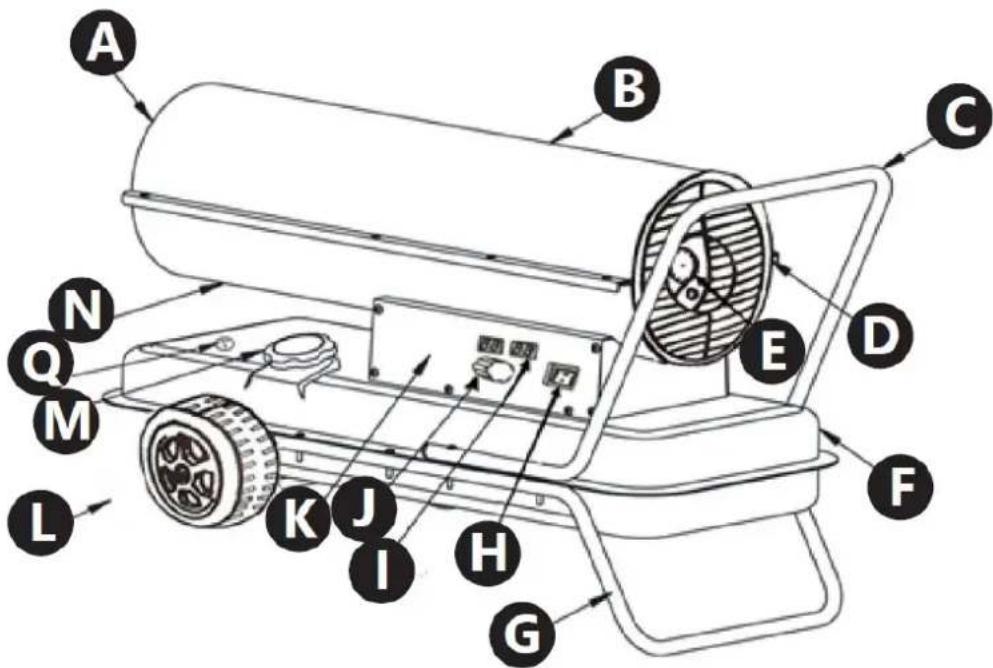
a) Air outlet
b) Top lid
c) Carry handle (except for model MSW-TB-DH-20000)
d) Grille
e) Manometer
f) Fuel reservoir
g) Support (except for model MSW-TB-DH-20000)
• On the left: target temperature (pre-set)
- On the right: current temperature
j) Thermostat knob
k) Side panel
I) Wheel (except for model) MSW-TB-DH-20000
m) Fuel reservoir filler
n) Lower enclosure
o) Fuel gauge
4.2. Preparing for use
4.2.1. Appliance location
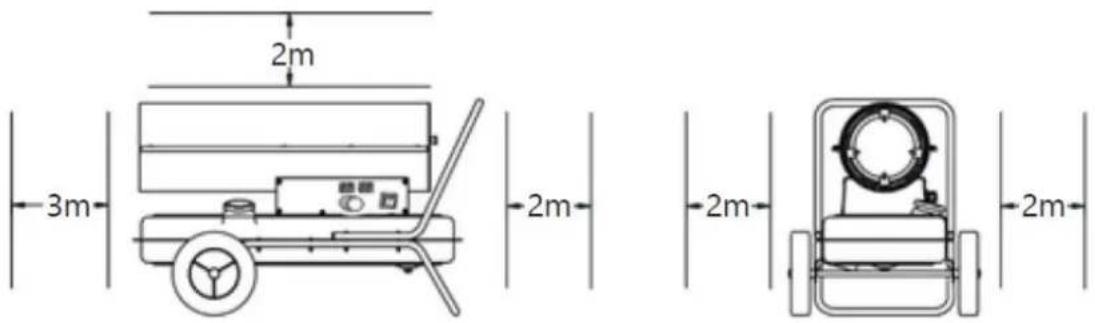
The temperature of the environment must not be higher than 40^ C and the relative humidity should be less than 85%. Ensure good ventilation in the room in which the device is used. The distance between each side of the device and the wall or other objects should be at least 2-3m. Keep the device away from hot surfaces. Operate the device on flat, stable, clean, refractory and dry surfaces out of the reach of children and people with mental disabilities. Install the device making sure that constant access to the main plug is ensured. The power cord connected to the appliance must be properly grounded and correspond to the technical details. Before the first use, remove all elements and clean them along with the entire device.
4.3. Assembling the device
4.3.1. Attaching/removing given device elements
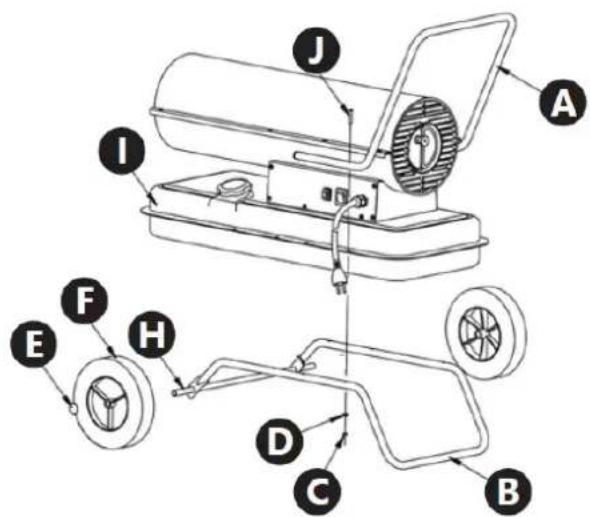
Assembling the wheels and handles (not applicable to model MSW-TB-DH-20000):
1) Slide wheel (F) onto the lower axle (H) (the axle should be secured in place using split pins), then slide on a washer and tighten with a bold (E).
2) Place the device on the lower ramp - support (B), aligning the 4 frame holes with the 4 device fuel reservoir holes (I).
3) Screw on two bolts on each side of the device into holes located nearer to the wheels (screw on nut (C), split lock washer and washer (D) onto bolt ends (J)).
4) Align the top section of the device frame – the carry handle (A) with the lower section (B) and fuel reservoir housing (I) and connect the three parts using longer bolts (J), nuts (C), split lock washers and washers (D).
5) Make sure everything is stable and correctly assembled.
4.3.2. Manometer assembly
Screw the manometer into the device in accordance with the thread direction.
4.4. Device use
NOTICE! Do not approach the device when in use. Maintain a safe distance from the device, as shown on the diagram below:
a) Make sure there are no leaks from the device.
b) There are no contaminants in the fuel reservoir.
c) The air intake and outlet are not covered.
CAUTION!
• Make sure there is sufficient fuel in the device.
- Keep your face and other body parts away from the device outlet.
• Before leaving the device to operate unattended, make sure there is a flame in the heater.
- Stop using the device if smoke or strange smells exude.
4.4.2. Fill the reservoir with fuel before use
a) make sure the device is off and disconnected from electricity (if not, then make sure it is done)
b) Place the device on a level, stable surface, sufficiently strong to support the weight of the device.
c) Unscrew the fuel cap and insert the funnel into the fuel reservoir filler.
d) Fill with fuel up to the maximum fill level.
e) Screw on the fuel cap.
4.4.3. Heating
a) Make sure there is fuel in the reservoir.
b) Make sure the ON/OFF switch is in the OFF position.
c) connect the device to a power source and use the main ON/OFF button to switch it on.
d) Use the thermostat knob to set the required temperature, and the device will start automatically after approximately. 3 seconds. Once the pre-set temperature is reached, the device will switch off, and when the temperature drops below the pre-set level, the device will start automatically.
e) After use, turn the device off using the main ON/OFF switch and disconnect it from the power source.
ATTENTION! Once the device is off, make sure the flame has gone out!
If the device is in use for extended periods of time, check the fuel level periodically. If the fuel in the reservoir is low, switch the device off, disconnect it from the power source and then fill it with fuel.
Do not top up with fuel when the device is in use!
ATTENTION!
• The device may be hot when in use, risk of burns!
- When in use, keep away from device heating elements (air outlet), risk of burns!
4.4.4. Pressure adjustment
To set the pressure, start the appliance and read the current air pressure on the pressure gauge. If necessary, operate the adjusting screw (see the figure below) in the appropriate direction:
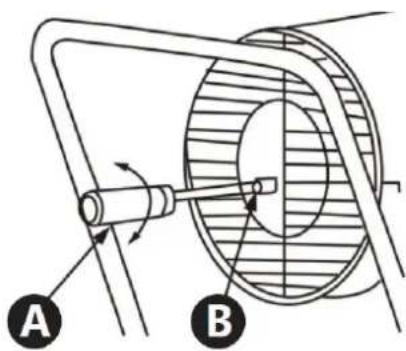
- Clockwise increases the pressure setting.
• Counter-clockwise reduces the pressure setting.
NOTE: The correct pressure setting depends on the model; see the Technical Data table.
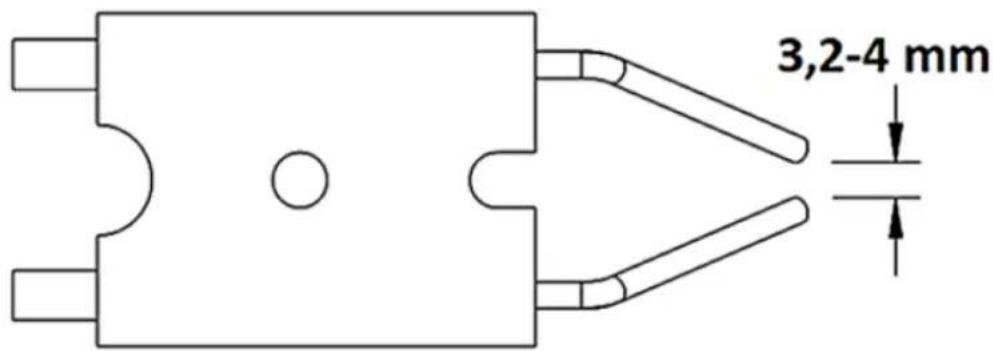
4.4.5. Setting the electrode gap
Check the condition of the ignition electrode regularly. Clean its ends and check the gap between them and reset it if necessary. If the electrode is worn, replace it with a new one. For proper operation of the device, a gap between the electrode ends is important – set it to be within the range shown in the figure below.
4.5. Cleaning and maintenance
4.5.1. General instructions
a) Unplug the mains plug and allow the device to cool completely before each cleaning, adjustment or replacement of accessories, or if the device is not being used.
b) Always unplug the device before cleaning or putting it away.
c) Use only non-corrosive cleaners to clean the surface.
d) Before cleaning, maintenance and when not in use, make sure the device has cooled down.
e) After cleaning the device, all parts should be dried completely before using it again.
f) Store the unit in a dry, cool place, free from moisture and direct exposure to sunlight.
g) Do not spray the device with a water jet or submerge it in water.
h) Do not allow water to get inside the device through vents in the housing of the device.
i) The device must be regularly inspected to check its technical efficiency and spot any damage.
j) Use a soft, damp cloth for cleaning.
k) Do not use sharp and/or metal objects for cleaning (e.g. a wire brush or a metal spatula) because they may damage the surface material of the appliance.
I) Do not clean the device with an acidic substance, agents of medical purposes, thinners, fuel, oils or other chemical substances because it may damage the device.
m) Regularly inspect the fuel reservoir for contaminants. Do remove complainants, empty the reservoir.
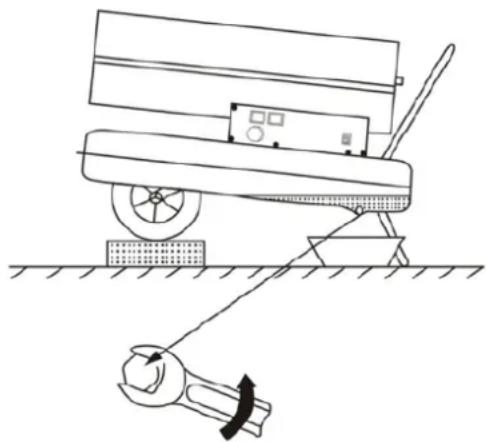
4.5.2. Emptying the fuel reservoir (see diagram below)
a) Place the device on a raised surface (the air discharge side), so that it is easy to tilt.
b) Place an appropriate vessel under the discharge valve.
c) Use a spanner to open the valve.
d) Once the reservoir is empty, close the valve and wipe the device dry.
natural_image
Line drawing of a mechanical device with a wrench and tool, no text or symbols present- Perform periodic fuel reservoir cleaning approximately. every 150-200 working hours, or if the performance deteriorates. Empty the remaining fuel, flush the reservoir using a small quantity of clean fuel. Fill the reservoir with clean fuel before starting.
- Cleaning the frame and heater housing: dust and fuel remain will accumulate on the heater housing and frame. This may constitute a fire risk. Use a soft, dry cloth to clean those elements. Perform this task regularly after every use.
• Store the unit in a dry, cool place, free from moisture and direct exposure to sunlight.
4.5.3. Disposing of used devices
Do not dispose of this device in municipal waste systems. Hand it over to an electric and electrical device recycling and collection point. Check the symbol on the product, instruction
manual and packaging. The plastics used to construct the device can be recycled in accordance with their markings. By choosing to recycle you are making a significant contribution to the protection of our environment.
Contact local authorities for information on your local recycling facility.
4.5.4. Troubleshooting
Table 2: Troubleshooting
| Problem Possible cause Solution | ||
| The motor will not start – the display reads error code E1 | Power supply is lost or low supply voltage. | Check the power supply and voltage. Check the fuse and replace it if necessary. |
| The display reads “--” | The appliance is in the lockout mode because it has overheated. | Investigate the root cause of overheating. Turn off the heater. Check the air inlet and outlet. Wait 5 minutes and try to restart the appliance. |
| The display reads error code E2 | Failed temperature sensor or its connection. | Check the sensor and replace it if necessary. |
| Check and replace the control PCB if necessary. | ||
| The motor is running, but the heater does not ignite and lock out after a short time – the display reads error code E1 | Fuel tank empty or dirty, or incorrect fuel used. | Check the fuel level and, if necessary, refill with fresh, clean Diesel fuel (or heating kerosene), or empty all contaminated/incorrect fuel and refill the tank with correct, fresh fuel. |
| Fuel filter clogged. | Clean or replace with a new one.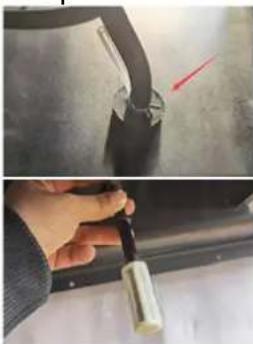 | |
| Fuel lines clogged with air. | Check the fuel lines for tight and sealed connections and any through-cracks. Refit the fuel lines in the connections or re- place the fuel lines with new ones. | |
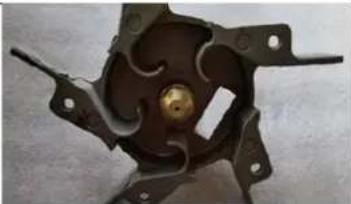
| Fuel nozzle clogged. | Blow the fuel nozzle clean with compressed air or replace it with a new one. | |
 | ||
| Fuel density / viscosity increases at lower temperatures. | Mix Diesel fuel with heating kerosene. | |
| The heater outlet belches flames – the display reads error code E1 | Insufficient air flow in the combustion chamber. | Inspect the air pump, the air inlet, the fan and the motor. |
| Air pressure is too low. | Check the air pressure on the pressure gauge and readjust the setting if required.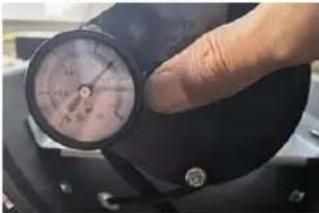 | |
| The heater automatically turns off during operation – the display reads the ambient temperature. | The set temperature was reached in the room. | Select a higher temperature setting with the thermostat control dial. |
| The heater automatically turns off during operation – the display reads error code E1 | Flame failure. | Troubleshoot the root cause. Reset the appliance by cycling the power switch from to and back to J |
| Poor combustion. | ||
| Reduced air flow. | ||
| Overheating. | ||

a) Wylot powietrza
b) Pokrywa górna
natural_image
Line drawing of a mechanical device with a wrench and tool, no text or symbols presenta) Vzduchový výstup
b) Horní víko
natural_image
Line drawing of a mechanical device with a wrench and tool, no text or symbols presenta) Sortie d'air
natural_image
Line drawing of a mechanical device with a wrench and gear, no text or symbols presentnatural_image
Line drawing of a mechanical device with a wrench and tool, no text or symbols presentnatural_image
Line drawing of a mechanical device with a wrench and tool, no text or symbols presentnatural_image
Line drawing of a mechanical device with a wrench and belt, connected to ground (no text or symbols)a) Luftudløb
b) Toplåg
c) Bærehåndtag (undtagen for model MSW-TB-DH-20000)
d) Gitter
e) Manometer
4.3.2. Montering af manometer
natural_image
Line drawing of a mechanical device with a wrench and tool, no text or symbols presenta) Ilman ulostulo
b) Yläkansi
c) Kantokahva (paitsi mallissa)MSW-TB-DH-20000
d) Säleikkö
e) Painemittari
f) Polttoainesäiliö
g) Tuki (paitsi mallissa) MSW-TB-DH-20000
h) Pääkytkin
i) Näyttö
4.3.2. Painemittarin kokoaminen
natural_image
Line drawing of a mechanical device with a wrench and tool, no text or symbols present4.3.2. Montage van de manometer
natural_image
Line drawing of a mechanical device with a wrench and belt, no text or symbols presentnatural_image
Line drawing of a mechanical device with a wrench and a tool, no text or symbols presenta) Luftutlopp
b) Övre lock
c) Bärhandtag (gäller ej modell) MSW-TB-DH-20000
d) Galler
e) Manometer
f) Bränslebehållare
g) Stöd (gäller ej mosell)TB-DH-20000
natural_image
Line drawing of a mechanical device with a tool and gear, no text or symbols presentnatural_image
Line drawing of a mechanical device with a wrench and lever, no text or symbols presenta) Výstup vzduchu
b) Horný kryt
c) Rukovat' na prenášanie (okrem modelu MSW-TB-DH-20000)
d) Mriežka
e) Manometer
f) Nádrž na palivo
4.3.2. Montáž manometra
Zaskrutkujte manometer do zariadenia v súlade so smerom závitu.
natural_image
Line drawing of a mechanical device with a wrench and belt, connected to ground (no text or symbols)a) Отвор за въздух
b) Горен капак
natural_image
Line drawing of a mechanical device with a tool and rope, no text or symbols presentnatural_image
Line drawing of a mechanical device with a wrench and gear, no text or symbols presenta) Izlaz za zrak
b) Gornji poklopac
c) Ručka za nošenje (osim modela MSW-TB-DH-20000)
d) Rešetka
e) Manometar
f) Spremnik za gorivo
g) Nosač (osim modela ) MSW-TB-DH-20000
h) Glavni prekidač UKLJUČENO/ISKLJUČENO
i) Zaslon
4.3.2. Sastavljanje manometra
natural_image
Line drawing of a mechanical cart with a wrench and a tool, no text or symbols present- Redovito čistite spremnik goriva otprilike svakih 150-200 radnih sati ili ako se performanse pogoršaju. Ispraznite preostalo gorivo i isperite spremnik malom količinom čistog goriva. Prije pokretanja napunite spremnik čistim gorivom.
- Čišćenje okvira i kućišta grijača: prašina i ostaci goriva nakupljat će se na kućištu grijača i okviru. To može predstavljati opasnost od požara. Za čišćenje tih elemenata koristite meku, suhu krpu. Redovito obavljaite ovaj zadatak nakon svake upotrebe.
4.3.2. Manometro surinkimas
Isukite manometra i jrenginj pagal sriegio kryptj.
natural_image
Line drawing of a mechanical device with a wrench and tool, no text or symbols presenta) Evacuare aer
b) Capac superior
c) Mâner de transport (cu exceptia modelului MSW-TB-DH-20000)
d) Grilă
e) Manometru
f) Rezervor de combustibil
natural_image
Diagram of a mechanical device with a wrench and gear, showing no text or symbolsa) Izhod za zrak
b) Zgornji pokrov
c) Ročaj za prenašanje (razen pri modelu MSW-TB-DH-20000)
d) Rešetka
e) Manometer
f) Rezervoar za gorivo
g) Nosilec (razen pri modelu ) MSW-TB-DH-20000
h) Glavno stikalo za VKLOP/IZKLOP
i) Zaslon
• Na levi: ciljna temperatura (prednastavljena)
• Na desni: trenutna temperatura
j) Gumb termostata
k) Stranska plošča
I) Kolesce (razen pri modelu ) MSW-TB-DH-20000
m) Polnilna odprtina rezervoarja za gorivo
n) Spodnji ohišje
o) Merilnik goriva
4.3.2. Sestavljanje manometra
natural_image
Line drawing of a mechanical device with a wrench and tool, no text or symbols presentFor the disposal of the device please consider and act according to the national and local rules and regulations.
CONTACT
expondo Polska sp. z o.o. sp. k.