
58G033 - Lawn mower Graphite - Free user manual and instructions
Find the device manual for free 58G033 Graphite in PDF.


| Product type | Lawn mower |
| Brand | Graphite |
| Model | 58G033 |
| Power supply | Lithium-ion battery 36 V (2 x 18 V) |
| Cutting width | 33 cm (estimated) |
| Cutting height | Adjustable, from 25 to 65 mm (estimated) |
| Grass catcher capacity | 30 L (estimated) |
| Motor type | Brushless motor |
| Battery runtime | Approximately 30-40 min depending on use |
| Charging time | 1-2 hours (estimated) |
| Main functions | Cutting, mulching, collection |
| Weight | Approximately 12 kg |
| Dimensions (L x W x H) | 120 x 40 x 90 cm (estimated) |
| Chassis material | Sturdy plastic |
| Wheel type | 4 wheels, diameter 16 cm (estimated) |
| Sound level | Approximately 85 dB(A) |
| Protection rating | IPX4 (estimated) |
| Maintenance | Clean after use, sharpen blade if necessary |
| Included accessories | Grass catcher, cutting guide |
| Warranty | 2 years |
Frequently Asked Questions - 58G033 Graphite
User questions about 58G033 Graphite
0 question about this device. Answer the ones you know or ask your own.
Ask a new question about this device
Download the instructions for your Lawn mower in PDF format for free! Find your manual 58G033 - Graphite and take your electronic device back in hand. On this page are published all the documents necessary for the use of your device. 58G033 by Graphite.
USER MANUAL 58G033 Graphite
natural_image
Black and white photo of a ORECON OE chain drive (no visible text or symbols on the device body)PL PILARKA ŁAŃCUCHOWA AKUMULATOROWA
Cordless Chain Saw
DE AKKU-KETTENSÄGE
RU ЦЕПНАЯ АККУМУЛЯТОРНАЯ ПИЛА
ПИЛКА ЛАНЦЮГОВА АКУМУЛЯТОРНА
HU AKKUMULÁTOROS LÁNCFÜRÉSZ
RO DRUJBĂ CU ACUMULATOR
©Z AKUMULÁTOROVÁ RETÉZOVÁ PILA
SK AKUMULÁTOROVÁ RETAZOVÁ PÍLKA
SL AKUMULATORSKA VERIŽNA ŽAGA
LT AKUMULIATORINIS GRANDININIS PJUKLAS
© KÉDES AKUMULATORA MOTORZÁGIS
AKUTOITEL KETTSAAG
ВЕРИЖЕН АКУМУЛАТОРЕН ТРИОН
AKUMULATORSKA LANČANA PILA
AKUMULATORSKA MOTORNA TESTERA
ΕΠΑΝΑΦΟΡΤΙΖΟΜΕΝΟ ΑΛΥΣΟΠΡΙΟΝΟ
SIERRA DE CADENA A BATERÍA
MOTOSEGA A BATTERIA
NL ACCU KETTINGZAAG
FR SCIE À BOIS À CHAÎNE ÉLECTRIQUE
10* LAT DOSTĘPNOŚCI CZĘŚCI ZAMIENNYCH
SR UPUTSTVO ZA UPOTREBU 81
GR ODHΓIEΣ XPHΣΗΣ 86
ES INSTRUCCIONES DE USO 91
IT MANUALE PER L'USO 97
FR MANUEL D'INSTRUCTION....108
e-mail service@gtxservice.pl
/Signed for and on behalf of:/
/GRUPA TOPEX Quality Agent/
CAUTION! BEFORE OPERATING THE POWER TOOL, READ THIS INSTRUCTION MANUAL CAREFULLY AND KEEP IT FOR FURTHER USE.
DETAILED SAFETY REGULATIONS
SPECIFIC SAFETY CONDITIONS FOR BATTERY CHAINSAWS
WARNING! Observe safety regulations when using the chainsaw. For your own safety and the safety of the persons around you, read the instruction manual first before using the chainsaw. Keep the instruction manual for future reference.
Chainsaw safety warnings:
- Keep all parts of the body away from the saw chain when saw is operating. Before you start the chain saw, make sure the saw chain is not contacting anything. A moment of inattention while operating chain saws may cause entanglement of your clothing or body with the saw chain.
• Always hold the chain saw with your right hand on the rear handle and your left hand on the front handle. Holding the chain saw with a reversed hand configuration increases the risk of personal injury and should never be done. - Wear safety glasses and hearing protection. Further protective equipment for head, hands, legs and feet is recommended.
Adequate protective clothing will reduce personal injury by flying debris or accidental contact with the saw chain.
- Do not operate a chain saw in a tree. Operation of a chain saw while up in a tree may result in personal injury.
- Always keep proper footing and operate the chain saw only when standing on fixed, secure and level surface. Slippery or unstable surfaces such as ladders may cause a loos of balance or control of the chain saw.
- When cutting a limb that is under tension be alert for spring back. When the tension in the wood fibers is released the spring loaded limb may strike the operator and/or throw the chain saw out of control.
- Use extreme caution when cutting brush and saplings. The slender material may catch the saw chain and be whipped toward you or pull you off balance.
- Carry the chain saw by the front handle with the chain saw switched off and away from your body. When transporting or storing the chain saw always fit the guide bar cover. Proper handling of the chain saw will reduce the likelihood of accidental contact with the moving saw chain.
- Follow instructions for lubricating, chain tensioning and changing accessories. Improperly tensioned or lubricated chain may either break or increase the chance for kickback.
- Keep handles dry, clean, and free from oil and grease. Greasy, oily handles ale slippery causing loss of control.
- Cut wood only. Do not use chain saw for purposes not intended. For example: do not use chain saw for cutting plastic, masonry or non-wood building materials. Use of the chain saw for operations different than intended could result in a hazardous situation.
Causes and operator prevention of kickback:
Kickback may occur when the nose or tip of the guide bar touches an object, or when the wood closes in and pinches the saw chain in the cut. Tip contact in some cases may cause a sudden reverse reaction, kicking the guide bar up and back towards the operator.
Pinching the saw chain along the top of the guide bar may push the guide bar rapidly back towards the operator.
Either of these reactions may cause you to lose control of he saw which could result in serious personal injury. Do not rely exclusively upon the safety devices built into your saw. As a chain saw user, you should take several steps to keep your cutting jobs free from accident or injury. Kickback is the result of tool misuse and/or incorrect operating procedures or conditions and can be avoided by taking proper precautions as given below:
- Maintain a firm grip, with thumbs and fingers encircling the chain saw handles, with both hands on the saw and position your body and arm to allow you to resist kickback forces. Kickback forces can be controlled by the operator, if proper precautions are taken. Do not let go of the chain saw.
- Do not overreach and do not cut above should height. This helps prevent unintended tip contact and enables better control of the chain saw in unexpected situations.
- Only use replacement bars and chains specified by the manufacturer. Incorrect replacement bars and chains may cause chain breakage and/or kickback.
- Follow the manufacturer's sharpening and maintenance instructions for the saw chain. Decreasing the depth gauge height can lead to increased kickback.
Additional safety precautions:
- Hold the chainsaw by insulated handles because the chain saw may touch hidden wiring. If the saw chain touches a live wire, voltage may appear on the exposed parts of the power tool and cause an electric shock.
- The chainsaw is designed for maintenance pruning in home gardens. It is designed for cutting off or cutting through branches. The device is not intended for felling trees.
Operation
• Take special care to avoid injuries at the end of the cut, because the chainsaw falls due to its inertia when there is no resistance of the material.
- During prolonged operation, the hands and fingers may tingle or feel numb. Stop working immediately, because numbness reduces the precision of operating the chainsaw.
- The chainsaw may significantly heat up during operation. Be careful not to touch the hot chainsaw parts with unprotected body parts.
- The chainsaw can be operated only by one person at a time. All other persons and animals should be away from the area of operation.
- When starting the chainsaw, the saw chain must not touch the material to be cut.
- Children and juveniles must not operate the chainsaw. The chainsaw must be operated only by adults who know how to handle it. When the chainsaw is given to another user, the instruction manual must be also attached.
- Stop working with the chainsaw immediately with the first signs of fatigue.
- Use a support (sawhorse) when cutting sawn timber or thin branches.
- Do not cut several planks simultaneously (stacked on top of each other), materials held by another person, or pressed with a leg.
- Long elements to be cut must be adequately fixed.
- On sloped terrain, always cut facing the top of the hill.
- When cutting through, always use the bumper spike as a support. Hold the chainsaw by the rear handle and guide with the front handle.
- When the cut cannot be finished in one go, slide the chainsaw out, adjust the bumper spike and continue the cut by lifting the rear handle.
- When cutting through in the horizontal plane, position yourself at an angle as close as possible to 90^ with regard to the cutting line. Horizontal cutting requires special attention.
- If the chain is jammed when cutting with the upper part of the chain, the chainsaw may kickback towards the operator. Because of this, cut
with the lower part of the chain, if possible, because if the saw chain gets jammed, the direction of the kickback is away from the operator.
- Pay special attention when cutting split wood. The cut-off pieces of wood can be projected in any direction (risk of injury!).
- Only trained persons may cut tree branches! Risk of injury by uncontrolled fall of a tree branch!
- Watch out for logs that can roll towards you. Jump away!
- The chainsaw acts unpredictably during kickback and the chain loosens.
- An improperly sharpened chain increases the risk of kickback.
- Hold the chainsaw with both hands when starting and operating it.
- Ensure that the cut material is securely fixed.
- Use clamps to fix the material.
- Never cut more than one branch at a time. Pay attention to adjacent branches when cutting them off.
Maintenance and storage
- Keep all the elements in good condition to ensure safe operation of the chainsaw.
- Replace worn or damaged parts to maintain safety.
- Protect the chainsaw against humidity.
- Keep out of reach of children.
NOTE! Despite safe design, application of safety measures, and other protective measures, there is always a residual risk of injury during operation.
Description of used symbols.

- CAUTION! Take special precautions.
- Read the instruction manual and observe the warnings and safety conditions!
- Use personal protective equipment (protective glasses, hearing protection).
- Use protective gloves.
- Use protective clothing.
- Keep the power tool away from children.
- Remove the battery from the device before adjustment or cleaning.
- The garden tool is designed for outdoor operation.
- Protect the device against humidity.
- Do not put hands or legs close to cutting elements!
- Hazard of kickback.
- Caution, risk of hand injury, cutting off the fingers.
- Keep a safe distance from the operating garden tool.
- Recycling.
CONSTRUCTION AND USE
The battery chainsaw is a hand-held device. The drive is a DC brushless motor. This power tool is designed for work in home gardens. The chainsaw can be used for maintenance pruning of trees, cutting branches, preparing firewood, wood for fireplaces, and for other applications that require cutting wood. The battery chainsaw is a power tool designed only for non-professional applications.
WARNING! Do not use the device to fell trees. Do not use the device contrary to its intended purpose.
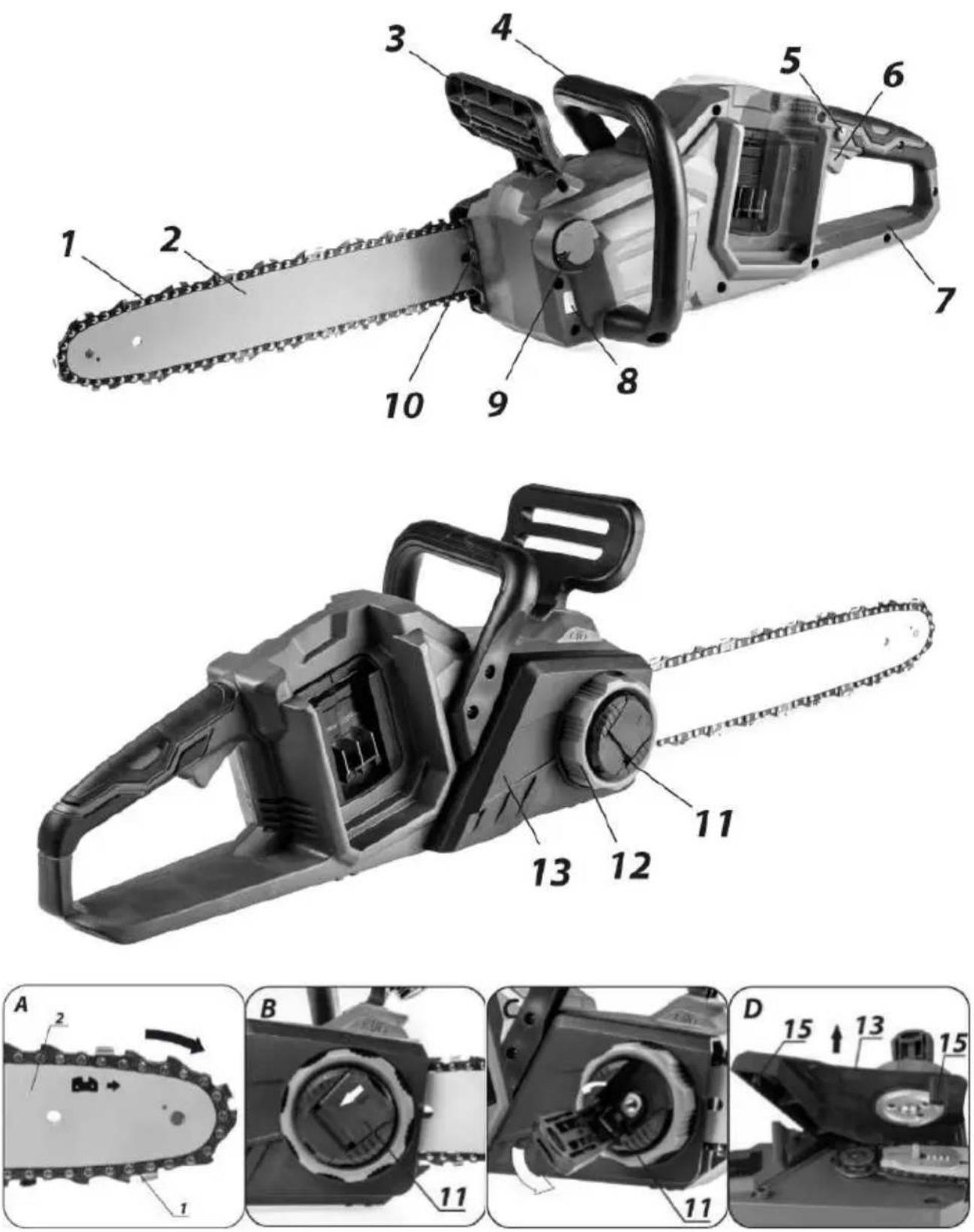
DESCRIPTION OF FIGURES
The following numbering refers to the parts of the device shown on pages with figures in the instruction manual.
- Chain
- Guide bar
- Brake lever (front hand guard)
- Front handle
- Switch lock button
- Power switch
- Handle
- Oil level indicator
- Oil filler cap
- Bumper spike
- Guide bar fixing knob
- Chain tension knob
- Chain wheel cover
- Chain guide bar cover
- Cover hook
- Pin
- Chain wheel
- Oil channel
* Differences may appear between the drawings and the product.
EQUIPMENT AND ACCESSORIES
- Guide bar 1 pc.
- Chain 1 pc.
- Chain guide bar cover 1 pc.
PREPARING FOR WORK
WARNING! Before carrying the chainsaw, always remove the battery and attach the guide bar cover. If several cutting operations are to be performed in a sequence, turn off the chainsaw with a main switch between the operations.
INSTALLATION OF THE GUIDE BAR AND SAW CHAIN
NOTE! The guide bar and the saw chain are delivered separately. The chainsaw must be disconnected from power (battery).
To avoid injury by sharp edges, always wear protective gloves when mounting and checking the chain.
WARNING! Before mounting the guide bar with the chain, check the correct position of chain cutting blades. The correct position of the chain on the guide bar is shown with an arrow on the tip of the guide bar (fig. A).
- Move and release the movable part of the guide bar fixing knob (11) (fig. B).
- Pull the movable part of the knob and turn left to loosen the guide bar fixing knob (11) (fig. C).
- Remove the chain wheel cover (13) by removing the cover hooks (15) from the fixing holes (fig. D).
- Hold the guide bar (2) vertically so that its tip is facing upwards.
- Put on the chain (1), starting from the guide bar tip (2).
- Make sure that the chain (1) is located in the guide bar groove (2).
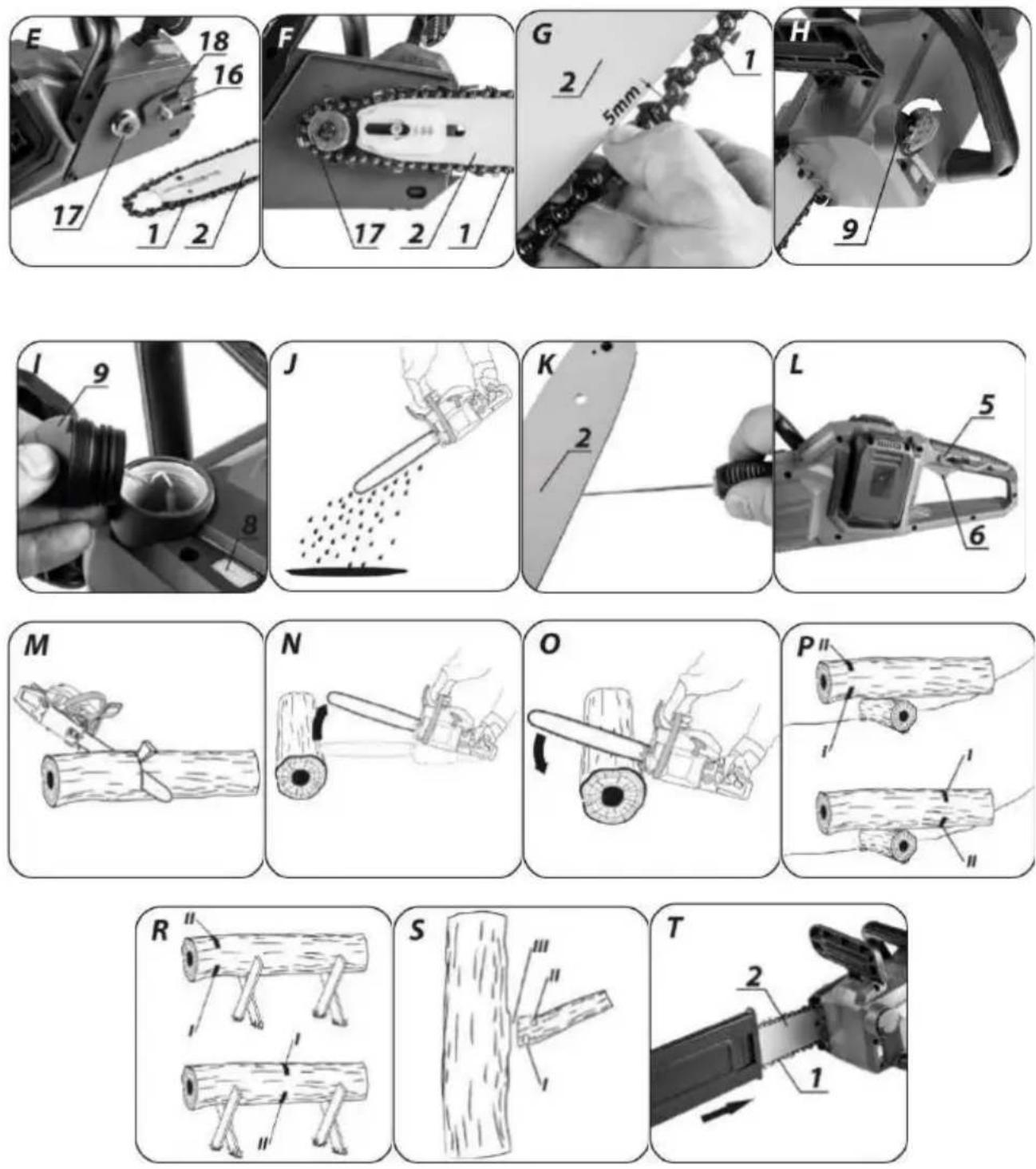
- Mount the guide bar (2) with the attached chain (1) on the chain wheel (17). The pin (16) must be in the groove in the middle of the guide bar (fig. E, F).
- Place the chain wheel cover (13) by inserting the cover hooks (15) into fixing holes and slightly tighten the guide bar fixing knob (11).
CHAIN TENSION ADJUSTMENT
When the guide bar fixing knob (11) is loosened, turn the chain tension knob (12).
- clockwise – to increase the chain tension.
- counter-clockwise – to loosen the chain.
- Check if the chain tension is adequate.
- Secure by tightening the guide bar fixing knob (11).
NOTE! Do not over-tighten the chain. Tighten the saw chain so that it can be lifted by about 5 mm in the middle of the guide bar (fig. G).
The chain is stretched and loosened during the operation and creates a risk of sliding off the guide bar.
Do not adjust the chain when it is very hot, because it may cause excessive tension when it cools down.
NOTE! The new saw chain requires a start-up period of about 5 minutes. It is very important to lubricate the chain at this stage. After the start-up period, check the chain tension and adjust if necessary.
Check and adjust the chain tension often, because loose chain may fall off the guide bar, wear out quickly, or cause excessive wear of the guide bar.
CHAIN LUBRICANTS
The durability of the saw chain and guide bar depends largely on the quality of the applied lubricant. Use only lubricants for chainsaws.
WARNING! Never use old, used oil to lubricate the saw chain.
FILLING THE TANK WITH CHAINSAW OIL
NOTE! New chainsaws have empty oil tanks. Fill the oil tank before operation.
To prevent dirt from entering the tank, clean the oil filler cap (9) before unscrewing it.
- Lift the movable part of the cap cover (fig. H) and unscrew the oil filler cap (9).
- Fill the tank with good quality oil until the entire oil level indicator glass (8) is filled with oil (fig. 1).
- Once it is filled, carefully close the oil tank by tightening the oil filler cap (9).
When using the chainsaw, observe the oil level in the tank with the oil level indicator (8).
CHAIN LUBRICATION
WARNING! To prevent excessive wear due to friction, the saw chain and guide bar must be lubricated during operation.
Never use the chainsaw if the above-mentioned parts are not lubricated. When the chain runs in dry operation, the entire cutting mechanism will be quickly and severely damaged. That is why it is very important to check chain lubrication and oil level during the chainsaw operation.
CHECKING CHAIN LUBRICATION
The saw chain and guide bar are lubricated automatically. Before starting work, check the lubrication of the saw chain and oil level.
- Start the chainsaw and hold it above the ground.
- If you see increasing oil traces, this means chain lubrication works properly (fig. J).
- If there are no traces of oil, try cleaning the oil outlet (18) (fig. E) and guide bar oil channel (fig. K) or contact the service.
NOTE! Take special care to prevent the chainsaw from touching the ground. Always maintain safety distance of at least 20 cm from the ground.
BEFORE STARTING THE CHAINSAW
- Check if the chain lubrication and the level shown by the oil level indicator (8) are correct.
- Check the chain tension and adjust if necessary.
WARNING! Before turning the chainsaw on, remove the guide bar cover and mount the batteries. The device requires 2 batteries for operation. To ensure correct operation of the device, the batteries should have the same capacity and similar charge level.
The chainsaw has a lock for the main switch to prevent against accidental start-up.
Turning on - press the main switch lock button (5) and then the main switch (6) (fig. L).
Turning off - release pressure from the main switch (6).
WARNING! When turned on, the chainsaw immediately starts operation at full speed.
NOTE! The brake lever automatically activates the chain brake. At the same time, the brake lever serves as the front hand guard (3) and protects the left hand against contact with the saw chain.
Kickback occurs when the rotating chain hits a hard object in the area around the top quarter of the guide bar tip and it is suddenly stopped. The rotating chain is jammed in the guide bar tip.
The chain brake is automatically activated with the force of inertia in the case of strong kickback or it can be applied by the operator.
Pull the brake lever (3) away from the front handle (4) with left hand. The chain brake will be locked with an audible click. The chain brake is activated.
- Pull the brake lever (3) with your left hand towards you. The brake lever (3) will be locked with an audible click. The chain brake is released.
- Turn on the chainsaw.
- Activate the chain brake. If the saw chain stops immediately, the chain brake works properly.
- If the saw chain does not stop immediately, the chain brake is damaged. Do not use the chainsaw and contact an authorised service.
NOTE! Never use the chainsaw during rains and in damp environments.
WARNING! All parts must be correctly mounted and meet the requirements for correct operation of the chainsaw. If any safety element or part is damaged, it should be immediately repaired or replaced.
- Before starting your work, read and understand the section about safe operation of the chainsaw. It is recommended to gain experience first by cutting waste wood pieces. This allows you to familiarise yourself with the operation of the chainsaw.
• Always observe safety regulations. - Use the chainsaw only to cut wood. Do not cut other materials.
- The intensity of vibrations and kickback are different for various wood types.
- Do not use the chainsaw as a lever for lifting, moving, or separating objects.
- If the chain is jammed, turn off the motor and insert a wooden or plastic wedge into the wood to release the chainsaw (fig. M). Restart the chainsaw and continue the cut carefully.
- Do not fix the chainsaw to stationary positions.
- Do not connect other devices to the drive of the chainsaw, which are not listed by the manufacturer.
- It is not necessary to apply great force when cutting. It is enough to apply only small pressure.
NOTE! When the chainsaw is jammed in the cut, do not remove the chainsaw with force. This may result in the loss of control over the chainsaw and cause injury and/or chainsaw damage.
PRACTICAL TIPS
Kickback
NOTE! Avoid cutting with the tip of the guide bar, because it may result in sharp upward kickback of the chainsaw. "Kickback" means the movement of the chainsaw guide bar upwards and/or backwards that may occur when the part of the saw chain near the guide bar tip touches an obstacle (fig. N).
Always use complete protective equipment and appropriate workwear when operating the chainsaw.
- Ensure that the cut material is securely fixed.
- Use clamps to fix the material.
- Hold the chainsaw with both hands when starting and operating it.
- The chainsaw acts unpredictably during kickback and the chain loosens.
- An improperly sharpened chain increases the risk of kickback.
- Never cut above shoulder height.
NOTE! If the chain is jammed when cutting with the upper part of the chain, the chainsaw may kickback towards the operator. Because of this, cut with the lower part of the chain, if possible, because when the saw chain is jammed, the direction of the kickback is away from the operator towards the wood.
CUTTING PIECES OF WOOD
When cutting pieces of wood, follow safety instructions and the instructions below.
- Ensure the material cannot move.
- Before cutting, clamp short pieces of material.
- Cut slowly wood and wood-like materials.
- Before cutting, ensure that the chainsaw will not touch any rocks or nails as this may cause the chainsaw to break out and damage the chain.
- Avoid situations in which the running chainsaw could touch a wire fence or ground.
- When cutting branches, support the chainsaw, if possible, and do not cut with the tip of the guide bar.
- Pay attention to obstacles such as stumps, roots, hollows, and holes in the ground, because they pose a risk of tripping or falling.
CUTTING TREE TRUNKS
- Press the bumper spike (10) to the material and make a cut (fig. O).
- If the cut cannot be finished even after reaching the maximum chainsaw range:
- move the guide bar backwards for a certain distance out of the material with the chain running, move slightly the handle (7) down and rest the bumper spike (10).
– finish the cut by slightly lifting the handle (7).
- Always keep sure footing on the ground. Do not stand on the trunk.
- Pay special attention as the trunk may rotate.
- Follow the instructions for safe operation to avoid chainsaw kickback.
-
Always finish the cut from the side of tensile stress to prevent the chain from jamming in the cut.
-
Before starting work, check the direction of stress in the trunk to prevent the chain from jamming.
- To eliminate the stress, the first cut should be made on the side of tensile stress (fig. P).
- When cutting the trunk that is on the ground, make the first cut at 1/3 of its diameter, then turn the trunk and finish the cut on the opposite side.
- When cutting the trunk that is on the ground, prevent the chain from touching the ground under the trunk. Otherwise, the chain may be immediately damaged.
- When cutting the trunk on a slope, always stand on the ground above the trunk.
CUTTING THE TRUNK LIFTED ABOVE THE GROUND
- In the case of trunks supported by or placed on a stable sawhorse, depending on the place of operation, always cut 1/3 of the trunk thickness from the side of compression stress and finish the cut on the opposite side (fig. R).
TRIMMING/CUTTING BUSHES AND TREE BRANCHES
- Start trimming the branches of a felled tree at the base and continue towards the top. Cut small branches with one cut.
- Check first which way the branch is bent. Then make a pre-cut from the side of the bend and finish the cut from the opposite side. Be careful as the branch can spring back.
- When trimming tree branches, always cut from the top to bottom to allow the branch to fall freely. Sometimes, it may be useful to cut the branch from underside (fig. S).
- Pay special attention when cutting branches that may be under stress. Such branches may spring back and hit the operator.
WARNING!
- Do not cut branches when climbing up the tree.
- Do not stand on ladders, platforms, logs, or in any other positions that may cause loss of balance and control over the chainsaw.
- Never cut above shoulder height.
• Always hold the chainsaw with both hands.
WARNING! Remove the battery from the device before installation, adjustment, repair, or handling.
NOTE! Be careful due to sharp edges of the chain. When the chainsaw is not used, always cover the guide bar and the chain (fig. T).
CHAIN SHARPENING
Pay attention to cutting tools. The cutting tools should be sharp and clean to ensure efficient and safe work. Sharpening the chain requires necessary equipment and skill. It is recommended to sharp the chain at specialised workshops.
CHAIN GUIDE BAR
The guide bar is exposed to particularly intense wear in the front and bottom parts. To prevent one-sided wear due to friction, check the guide bar every time the chain is sharpened.
CHAIN WHEEL
The chain wheel (17) is exposed to particularly intense wear. If there are clear signs of wear on the wheel teeth, replace the wheel. A worn chain wheel further reduces the durability of the saw chain. The chain wheel should be replaced by an authorised service workshop.
MAINTENANCE AND STORAGE
- Do not use any cleaning agents or solvents as they may damage plastic parts.
- Ensure that water does not enter the inside of the device.
- Ensure that ventilation openings in the motor housing are unobstructed.
- Perform the maintenance works on the chainsaw that are described in this instruction manual only. Any other maintenance may only be performed by authorised service.
- Do not make any changes to the design of the chainsaw.
- When not in use, the chainsaw should be stored clean, on a flat surface in a dry place and out of the reach of children.
All kinds of faults should be rectified by the manufacturer's authorised service provider.
TECHNICAL PARAMETERS
RATED PARAMETERS
| Battery chainsaw 58G043 | |
| Parameter | Value |
| Battery voltage | 36 VDC (2 x 18 VDC) |
| Motor speed (no load) | 10,000 rpm |
| Linear chain speed (no load) | 0 ÷ 19 m/s |
| Chain oil tank capacity | 160 ml |
| Chain oil feeding system | automatic |
| Chain wheel (teeth x pitch) | 6 x 3/8" |
| Guide bar type | 14" (350 mm) |
| Chain pitch | 3/8" (9.525 mm) |
| Chain thickness | 1.3 mm |
| Protection rating | III |
| Weight | 2.8 kg |
| Year of manufacture | 2020 |
| 58G043 denotes the type and designation of the machine. | |
NOISE AND VIBRATION DATA
| Sound pressure level | L_pA = 91.6 dB (A) K = 3 dB (A) |
| Sound power level | L_WA = 101.4 dB (A) K = 3 dB (A) |
| Vibration acceleration(front handle) | a_h = 3.27 m/s ^2 K = 1.5 m/s ^2 |
| Vibration acceleration(rear handle) | a_h = 3.58 m/s ^2 K = 1.5 m/s ^2 |
Noise and vibration information
The level of the noise emitted by the device is described by: the level of the emitted sound pressure L_pA and the sound power level L_WA , where K designates measurement uncertainty. The vibration emitted by the device are described by the vibration acceleration a_h , where K designates measurement uncertainty.
The values measured in this instruction manual, i.e. the level of the emitted sound pressure L_pA_y the sound power level L_wA_y and the vibration acceleration a_h , were measured in accordance with EN 60745-1. The given vibration level a_h may be used to compare devices and for preliminary evaluation of vibration exposure.
The given vibration level is representative only for the basic applications of the device. If the device is used for other applications or with other work tools, the vibration level may differ. Inadequate or rare maintenance of the device cause higher vibration levels. The above-mentioned causes may increase vibration exposure during the whole service life.
To determine precisely the vibration exposure, the device "on" and "off" periods must be taken into account, excluding the periods when it is used for operation. The total vibration exposure may be much lower when all factors are estimated accurately.
To protect the operator against vibration, use additional safety measures, e.g. regular maintenance of the device and work tools, proper hand temperature conditions, and proper work organisation.
ENVIRONMENTAL PROTECTION
Electrical equipment must not be disposed off with household waste and, instead, should be utilized at appropriate facilities. Information on utilization can be provided by the product vendor or the local authorities. Waste electrical and electronic equipment contains substances that are not neutral to the natural environment. Equipment that is not recycled constitutes a potential hazard to the environment and to human health.
* Right to introduce changes is reserved. "Grupa Topex Spółka z ograniczoną odpowiedzialnością" Spółka komandytowa with seat in Warsaw at ul. Pograniczna 2/4 (hereinafter Grupa Topex) informs, that all copyrights to this instruction (hereinafter Instruction), including, but not limited to, text, photographies, schemes, drawings and layout of the instruction, belong to Grupa Topex exclusively and are protected by laws accordingly to Copyright and Related Rights Act of 4 February 2004 (ustawa o prawie autorskim i prawach pokrewnych, Dz. U. 2006 No 90 item 631 with later amendments). Copying, processing, publishing, modifications for commercial purposes of the entire Instruction or its parts without written permission of Grupa Topex are strictly forbidden and may cause civil and legal liability.

REZANIE KMEŇOV STROMOV
natural_image
Symbol of a trash bin crossed out by two diagonal lines, representing waste sorting or disposal (no text or labels)PALKIDE SAAGIMINE MAAPINNAL
HOIATUS!
POSEBNI PROPISI O SIGURNOSTI
POSEBNI SIGURNOSNI UVJETI ZA AKUMULATORSKE LANČANE PILE
DETALJNE MERE BEZBEDNOSTI
OPŠTI SAVETI ZA BEZBEDNOST ZA AUKUMLATORSKE LANČANE TESTERE
TANYΣH THΣ ΑΛΥΣΙΔΑΣ TOY ΠΡΙΟΝΙΟΥ
DONNÉES RELATIVES AU BRUIT ET VIBRATIONS


- DETAILED SAFETY REGULATIONS
- SPECIFIC SAFETY CONDITIONS FOR BATTERY CHAINSAWS
- Chainsaw safety warnings:
- Causes and operator prevention of kickback:
- Additional safety precautions:
- Operation
- Maintenance and storage
- CONSTRUCTION AND USE
- DESCRIPTION OF FIGURES
- EQUIPMENT AND ACCESSORIES
- PREPARING FOR WORK
- INSTALLATION OF THE GUIDE BAR AND SAW CHAIN
- CHAIN TENSION ADJUSTMENT
- NOTE! Do not over-tighten the chain. Tighten the saw chain so that it can be lifted by about 5 mm in the middle of the guide bar (fig. G).
- NOTE! The new saw chain requires a start-up period of about 5 minutes. It is very important to lubricate the chain at this stage. After the start-up period, check the chain tension and adjust if necessary.
- CHAIN LUBRICANTS
- FILLING THE TANK WITH CHAINSAW OIL
- NOTE! New chainsaws have empty oil tanks. Fill the oil tank before operation.
- CHAIN LUBRICATION
- WARNING! To prevent excessive wear due to friction, the saw chain and guide bar must be lubricated during operation.
- CHECKING CHAIN LUBRICATION
- BEFORE STARTING THE CHAINSAW
- NOTE! The brake lever automatically activates the chain brake. At the same time, the brake lever serves as the front hand guard (3) and protects the left hand against contact with the saw chain.
- Kickback occurs when the rotating chain hits a hard object in the area around the top quarter of the guide bar tip and it is suddenly stopped. The rotating chain is jammed in the guide bar tip.
- NOTE! Never use the chainsaw during rains and in damp environments.
- WARNING! All parts must be correctly mounted and meet the requirements for correct operation of the chainsaw. If any safety element or part is damaged, it should be immediately repaired or replaced.
- PRACTICAL TIPS
- Kickback
- CUTTING PIECES OF WOOD
- CUTTING TREE TRUNKS
- CUTTING THE TRUNK LIFTED ABOVE THE GROUND
- TRIMMING/CUTTING BUSHES AND TREE BRANCHES
- WARNING!
- CHAIN SHARPENING
- CHAIN GUIDE BAR
- CHAIN WHEEL
- TECHNICAL PARAMETERS
- Noise and vibration information
- ENVIRONMENTAL PROTECTION
- REZANIE KMEŇOV STROMOV
- PALKIDE SAAGIMINE MAAPINNAL
- HOIATUS!
- POSEBNI PROPISI O SIGURNOSTI
- POSEBNI SIGURNOSNI UVJETI ZA AKUMULATORSKE LANČANE PILE
- DETALJNE MERE BEZBEDNOSTI
- OPŠTI SAVETI ZA BEZBEDNOST ZA AUKUMLATORSKE LANČANE TESTERE
- TANYΣH THΣ ΑΛΥΣΙΔΑΣ TOY ΠΡΙΟΝΙΟΥ
Brand : Graphite
Model : 58G033
Category : Lawn mower