
GAS 20 L SFC Professional - Vacuum Cleaner BOSCH - Free user manual and instructions
Find the device manual for free GAS 20 L SFC Professional BOSCH in PDF.
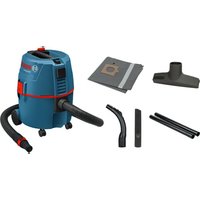
 FR
FR
 BG
BG
 CS
CS
 DA
DA
 DE
DE
 EL
EL
 EN
EN
 ES
ES
 ET
ET
 FI
FI
 HU
HU
 IT
IT
 KK
KK
 KO
KO
 LT
LT
 LV
LV
 MK
MK
 NL
NL
 NO
NO
 PL
PL
 PT
PT
 RO
RO
 RU
RU
 SK
SK
 SL
SL
 SV
SV
 TR
TR
 UK
UK
| Product type | Wet and dry vacuum cleaner |
| Brand | Bosch |
| Model | GAS 20 L SFC Professional |
| Gross capacity of the tank | 19 L |
| Net capacity of the tank | 15 L |
| Net capacity for liquids | 11.5 L |
| Dust bag volume | 7.5 L |
| Weight | 6.4 kg |
| Rated voltage | 220-240 V |
| Frequency | 50-60 Hz |
| Rated power input | 1 200 W |
| Max vacuum pressure | 202 hPa |
| Max flow rate | 31.5 l/s |
| Max suction power | 245 W |
| Pleated filter active surface area | 0.28 m² |
| Filtration class | L |
| Protection rating | IPX4 |
| Protection class | I |
| Sound pressure level | 72 dB(A) |
| Filter cleaning | Semi-automatic (SFC) |
| Socket for power tool | Yes, with automatic on/off |
| Delayed shut-off function | 15 seconds |
| Usage | Professional (construction sites, workshops) |
Frequently Asked Questions - GAS 20 L SFC Professional BOSCH
User questions about GAS 20 L SFC Professional BOSCH
0 question about this device. Answer the ones you know or ask your own.
Ask a new question about this device
Download the instructions for your Vacuum Cleaner in PDF format for free! Find your manual GAS 20 L SFC Professional - BOSCH and take your electronic device back in hand. On this page are published all the documents necessary for the use of your device. GAS 20 L SFC Professional by BOSCH.
USER MANUAL GAS 20 L SFC Professional BOSCH
German
www.bosch-pt.com/serviceaddresses
Disposal
Safety instructions for vacuum cleaners

Read all the safety information and instructions. Failure to observe the safety information and follow instructions may result in electric shock, fire and/or serious injury.
Save all warnings and instructions for future reference.
This vacuum cleaner is not intended for use by children or persons with physical, sensory or mental
14 | English
impairments. It should not be used by persons who have insufficient experience and knowledge. Otherwise, there is a risk of operating errors and injuries.
▶ Supervise children. This will ensure that children do not play with the vacuum cleaner. ▶ Do not vacuum beech or oak wood dust, rock dust or asbestos. These substances are considered carcinogenic.
WARNING
Only use the vacuum cleaner if you have been adequately informed about the use of the equipment, the substances to be vacuumed, and how to dispose of these safely. Thorough instruction on how to use the equipment prevents accidental misuse and injuries.
WARNING
The vacuum cleaner is suitable for vacuuming dry substances, and can also be used to vacuum liquids when taking appropriate measures. The penetration of liquids increases the risk of an electric shock.
Do not use the vacuum cleaner to vacuum combustible or explosive liquids, such as petrol, oil, alcohol, or solvents. Do not vacuum hot, burning, or explosive dust. Do not operate the vacuum cleaner in areas subject to explosion hazards. Dust, vapours, and liquids can ignite or explode.
WARNING
Only use the socket for the purpose stipulated in the operating
manual.
WARNING
If you notice a foam or water leak, switch off the vacuum cleaner immediately and empty the container. Otherwise, the vacuum cleaner can become damaged.
NOTE: The vacuum cleaner must only be used and stored indoors. The penetration of rain or moisture into the top of the vacuum cleaner increases the risk of electric shock. NOTE: Clean the float regularly and check whether it is damaged. Otherwise, the equipment may not function properly. If operating the vacuum cleaner in a damp location is unavoidable, use a residual current device (RCD). Use of an RCD reduces the risk of electric shock. Always check the vacuum cleaner, cable, and plug before use. Do not use the vacuum cleaner if you discover any damage. Do not open the vacuum cleaner yourself. It should be repaired exclusively by a qualified professional using only genuine spare parts. Damaged vacuum cleaners, cables, and plugs increase the risk of electric shock.
Do not crush the cable or run the device over it. Do not pull on the power cable to pull the plug out of the socket or to move the vacuum cleaner. Damaged cables increase the risk of an electric shock. Pull the plug out of the socket before cleaning or performing maintenance on the vacuum cleaner, making tool adjustments, changing accessories, or putting away the vacuum cleaner. This safety measure prevents the vacuum cleaner from being started accidentally. Ensure that the workplace is well ventilated. The vacuum cleaner should be repaired exclusively by a qualified professional using only genuine spare parts. This will ensure that the safety of the vacuum cleaner is maintained.
WARNING
The dust extractor contains dust particles that pose a risk to health. Emptying and maintenance procedures, including the disposal of dust containers, should only be carried out by professionals. Suitable protective equipment is required. Do not operate the vacuum cleaner unless the complete filter system is correctly inserted. Otherwise, you are putting your health at risk.
Before using the equipment for the first time, check that the vacuum hose is in perfect condition. Leave the vacuum hose fitted to the vacuum cleaner while doing this so that no dust escapes accidentally. Otherwise, you may end up inhaling dust particles. ▶ Do not sit on the vacuum cleaner. You can damage the vacuum cleaner this way. ▶ Take care when using the power cable and the vacuum hose. Improper use of these can put other people at risk. ▶ Do not clean the vacuum cleaner by spraying a jet of water directly at it. Water entering the top of the vacuum cleaner will increase the risk of electric shock. Connect the dust extractor to a properly earthed power supply system. The plug socket and extension cable must have a fully functioning protective conductor.
Products sold in GB only:
Your product is fitted with a BS 1363/A approved electric plug with internal fuse (ASTA approved to BS 1362). If the plug is not suitable for your socket outlets, it should be cut off and an appropriate plug fitted in its place by an authorized customer service agent. The replacement plug should have the same fuse rating as the original plug. The severed plug must be disposed of to avoid a possible shock hazard and should never be inserted into a mains socket elsewhere.
Symbols
The following symbols may provide you with important information pertaining to the use of your dust extractor. Please take note of these symbols and their meaning. Knowing what these symbols mean will help you to use your extractor more effectively and more safely.
Symbols and their meaning

WARNING! Read all the safety and general instructions. Failure to observe the safety and general instructions may result in electric shock, fire and/or serious injury.

Dust extractor from dust class L in accordance with IEC/EN 60335-2-69 for the dry extraction of harmful dusts with an exposure limit of >1 mg/m³
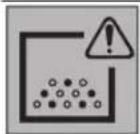
WARNING! The dust extractor contains dust particles that pose a risk to health. Emptying and maintenance procedures, including the disposal of dust containers, should only be carried out by professionals. Suitable protective equipment is required. Do not operate the dust extractor unless the complete filter system is correctly inserted. Otherwise, you are putting your health at risk.
Product Description and Specifications


Read all the safety and general instructions. Failure to observe the safety and general instructions may result in electric shock,
fire and/or serious injury.
Please observe the illustrations at the beginning of this operating manual.
Intended Use
The dust extractor is intended for collecting, vacuuming, conveying and separating non-flammable dry dusts, non-flammable liquids and a water-air mixture. The dust extraction capability of the dust extractor has been tested and corresponds to dust class L. It is suitable for the increased demands in professional use, e.g. in trade, industry and workshops.
Dust extractors of dust class L in accordance with IEC/EN 60335-2-69 may only be used for vacuuming and extracting harmful dust with an exposure limit of >1 mg/m³.
Only use the dust extractor if you can fully evaluate all functions and carry them out without restrictions, or if you have received corresponding instructions.
The plug socket must only be used in dry conditions during operation.
Product features
The numbering of the product features refers to the representation of the vacuum cleaner on the graphic pages.
(1) Container
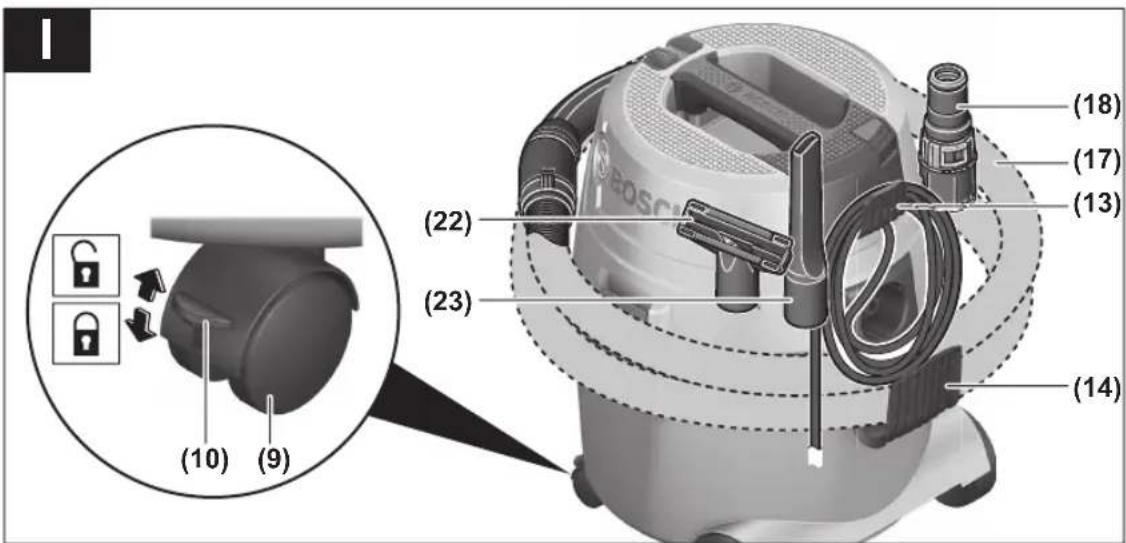
(2) Hose adapter (3) Plug socket for power tool (4) On/off button (5) Carrying handle (6) Top part of dust extractor (7) Catch for top part of dust extractor (8) Wheel (9) Castor (10) Castor brake (11) SFC switch (12) Holder for dust extraction adapter (13) Cable holder (14) Holder for vacuum hose (15) Holder for crevice nozzle/curved nozzle (16) Holder for coarse dirt nozzle (17) Vacuum hose (18) Dust extraction adapter (19) Curved nozzle (20) Disposal bag (21) Suction tube (22) Coarse dirt nozzle (23) Crevice nozzle (24) Snap fastener (25) Adapter for vacuum hose holder (26) False air intake (27) Filter holder (28) Pleated filter (29) Float
Technical data
| Wet/dry dust extractor GAS 20 L SFC | ||
| Article number | 3 601 J7B 1.. | |
| Rated voltage V 220-240 | ||
| Rated power input W 1200 | ||
| Frequency Hz 50-60 | ||
| Container volume (gross/net) I 19/15 | ||
| Net volume (liquid) I 11.5 | ||
| Dust bag volume I 7.5 | ||
| Max. vacuum A) | ||
| – Dust extractor hPa 202 | ||
| – Turbine | hPa 215 | |
| Max. volume flow rate A) | ||
| – Dust extractor l/s | 31.5 | |
| m 3 /s | 0.0315 | |
| – Turbine | l/s | 62 |
| m 3 /s | 0.062 | |
16 | English
Wet/dry dust extractor GAS 20 L SFC
| Max. suction power W 245 | |
| Area of pleated filter m20.28 | |
| Dust class L | |
| Weight according to EPTA-Procedure 01:2014 | kg 6.4 |
| Protection class /I | + |
| Dust extractor protection rating IPX4 | |
| Mains plug Switzerland protec-tion rating | IP55 |
A) Measured using a vacuum hose 3 m long and 35 mm in diameter. The specifications apply to a rated voltage [U] of 230 V. These specifications may vary at different voltages and in country-specific models. Values can vary depending upon the product and are subject to application and environmental conditions. For further information, visit www.bosch-professional.com/wac.
Automatic start/stop A)
| Rated voltage Maximum power | Minimum power | |
| EU 230 V 2000 W 100 W | ||
| FR 230 V 2000 W 100 W | ||
| UK 230 V 1700 W 100 W | ||
| CH 230 V 1100 W 100 W | ||
| DK 230 V 1100 W 100 W | ||
A) Permitted connected load of the connected power tool (country-specific)
Noise/Vibration Information
Noise emission values determined according to EN 60335-2-69.
Typically the A-weighted sound pressure level of the dust extractor is 72 dB(A). Uncertainty K = 2 dB. The noise level when working can exceed the volume stated. Wear hearing protection!
Vibration total values ah (triax vector sum) and uncertainty K determined according to EN 60335-2-69:
an lt; 2.5 m / s2, K = 1.5 m / s2.
Assembly
Pull the plug out of the socket before cleaning or performing maintenance on the vacuum cleaner, making tool adjustments, changing accessories or putting away the vacuum cleaner. This safety measure prevents the vacuum cleaner from being started accidentally.
Fitting the vacuuming accessories (see figure A)
The vacuum hose (17) is equipped with a clip system which can be used to connect vacuuming accessories (dust extraction adapter (18), curved nozzle (19)).
Fitting the nozzles and tubes
- Push the curved nozzle (19) onto the vacuum hose (17) until you hear both snap fasteners (24) on the vacuum hose engage.
- Then attach the required extraction accessory (coarse dirt nozzle, crevice nozzle, suction tube, etc.) firmly to the curved nozzle (19).
- To remove the adapter, press the snap fasteners (24) inwards and pull apart the components.
Fitting the dust extraction adapter
- Push the dust extraction adapter (18) onto the vacuum hose (17) until you hear both snap fasteners (24) on the vacuum hose engage.
- To remove the adapter, press the snap fasteners (24) inwards and pull apart the components.
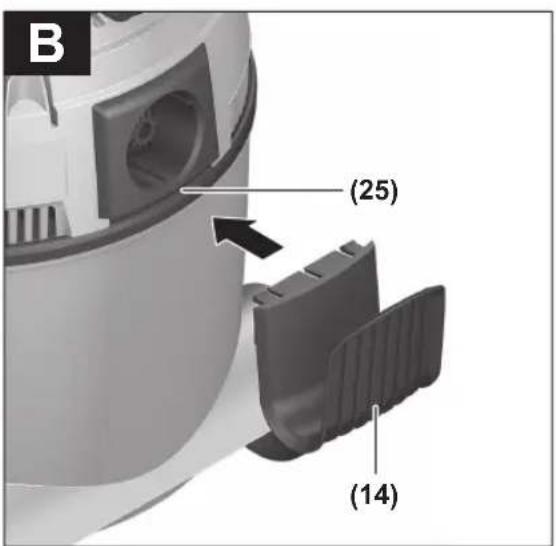
Fitting the holder for the vacuum hose (see figure B)
- Slide the holder (14) for the vacuum hose (17) firmly into the adapter (25) provided for it from above until it clicks into place.
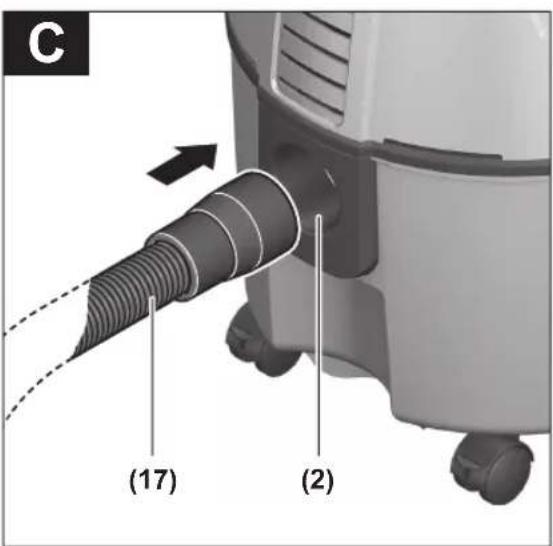
Fitting the vacuum hose (see figure C)
- Insert the vacuum hose (17) firmly into the hose adapter (2).
Note: The friction generated by the dust in the vacuum hose and accessory during extraction causes an electrostatic charge that the user may experience as static discharge (depending on environmental factors and their physiological state).
Bosch generally recommends using an anti-static vacuum hose (accessory) to vacuum up fine dust and dry materials.
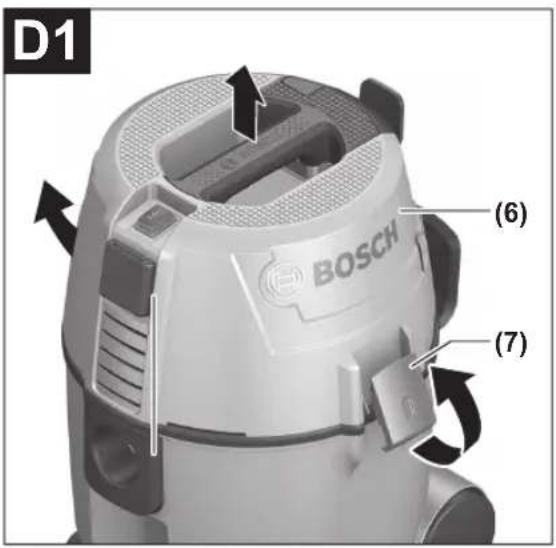
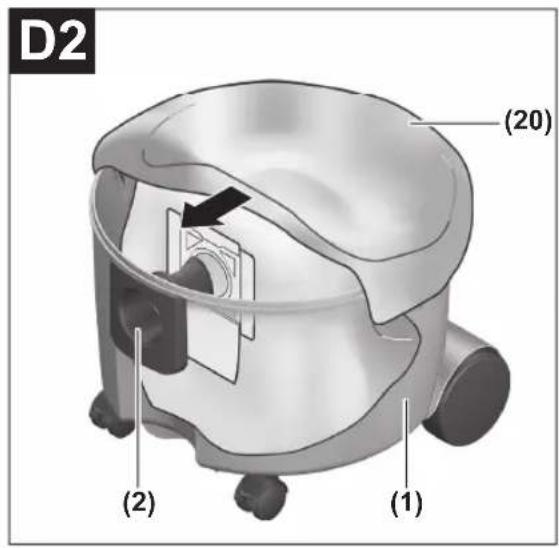
Inserting/removing the disposal bag or dust bag (dry vacuuming) (see figures D1–D2)
For dry vacuuming, you can insert a disposal bag (20) or a dust bag (accessory) into the container (1). This makes the dust easier to dispose of.
Inserting the disposal bag
- Open the catches (7) and remove the top part of the vacuum cleaner (6).
- Insert the disposal bag (20) into the container (1) with the inlet facing forwards.
- Pull the inlet over the connection flange and all the way into the recess of the connection flange.
- Make sure that the disposal bag (20) touches all the inside walls of the container (1).
- Fold the rest of the disposal bag (20) over the edge of the container (1).
- Put the top part of the vacuum cleaner (6) on and close the catches (7).
Removing and sealing the disposal bag
- Open the catches (7) and remove the top part of the vacuum cleaner (6).
- Pull the full disposal bag (20) backwards out of the connection flange. - Carefully take the disposal bag (20) out of the container (1) without damaging it. When doing so, make sure that the disposal bag does not scrape against the connection flange or other sharp objects. - Tie up the disposal bag (20) below the inlet.
Changing/inserting the dust bag (accessory)
- Open the catches (7) and remove the top part of the vacuum cleaner (6).
- Pull the full dust bag backwards out of the connection flange. Close the opening in the dust bag by turning down the top. Take the closed dust bag out of the container (1).
- Place the new dust bag over the vacuum cleaner's connection flange. Make sure that the entire length of the dust bag touches the inside wall of the container (1).
- Put the top part of the vacuum cleaner (6) on and close the catches (7).
Operation
▶ Pull the plug out of the socket before cleaning or performing maintenance on the vacuum cleaner, making tool adjustments, changing accessories or putting away the vacuum cleaner. This safety measure prevents the vacuum cleaner from being started accidentally.
When operating the dust extractor, ensure that the castors (9) are blocked with the castor brakes (10) to prevent the dust extractor from rolling away unintentionally. Test the correct functioning of the wheels (8) and castors (9) on the relevant surface before operation.
Start-up
▶ Pay attention to the mains voltage. The voltage of the power source must correspond with the information on the type plate of the dust extractor. Dust extractors marked with 230 V can also be operated with 220 V. ▶ Make sure you inform yourself about the applicable regulations/laws on how to handle harmful types of dust in your country.
The dust extractor may be used for vacuuming and extracting the following materials:
- Dusts with an exposure limit of >1mg / m3
▶ Products that are only sold in AUS and NZ: Use a residual current device (RCD) with a nominal residual current of 30 mA or less.
The dust extractor must categorically not be used in potentially explosive areas.
To ensure optimum suction power, you must always fully unwind the vacuum hose (17) from the top part of the dust extractor (6).
Dry vacuuming
Vacuuming up Dust Deposits
- To switch on the dust extractor, briefly press the on/off button (4).
- To switch off the dust extractor, press the on/off button (4) again.
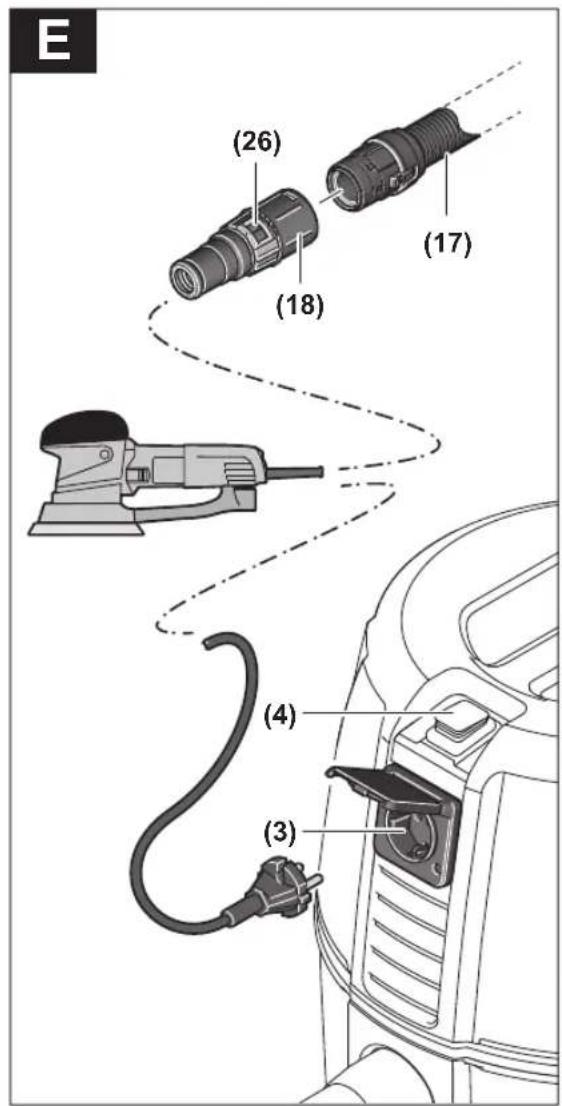
Extracting dust that accumulates from working power tools (see figure E)
There must be a sufficient air exchange rate (L) in the room when the exhaust air comes back into the room. Be aware of the corresponding national regulations.
The dust extractor has a plug socket with a protective earth contact (3) that can be used to connect an external power tool. Observe the maximum permitted connected load of the connected power tool.
- Fit the dust extraction adapter (18).
- Insert the dust extraction adapter (18) into the extraction outlet of the power tool.
Note: When working with power tools that have a low air feed into the vacuum hose (e.g. jigsaws, sanders, etc.), the false air intake (26) of the dust extraction adapter (18) must be opened. Only then can the semi-automatic filter cleaning (SFC) work without any problems.
To do this, turn the ring above the false air intake (26) until the opening is at its maximum size.
- To activate the automatic start/stop function of the dust extractor, briefly press the on/off button (4).
- To start the dust extractor, switch on the power tool connected to the plug socket (3). The dust extractor will start automatically.
- To stop dust extraction, switch the power tool off. The automatic start/stop run-on function will run for up to 15 seconds longer in order to extract the remaining dust from the vacuum hose.
- To switch off the dust extractor, press the on/off button (4).
Wet vacuuming
Do not use the vacuum cleaner to vacuum combustible or explosive liquids, such as petrol, oil, alcohol or solvents. Do not vacuum hot, burning or explosive dust. Do not operate the vacuum cleaner in areas subject to explosion hazards. Dust, vapours and liquids can ignite or explode. The vacuum cleaner must not be used as a water pump. The vacuum cleaner is designed for vacuuming air and vacuuming water mixtures.
Steps to Take before Wet Vacuuming
- Open the catches (7) and remove the top part of the vacuum cleaner (6).
- Remove the disposal bag (20) or dust bag if necessary.
- Empty the container (1) if necessary.
- Put the top part of the vacuum cleaner (6) on and close the catches (7).
Vacuuming up liquids
Switch on the dust extractor.
The dust extractor is equipped with a float. Extraction is stopped when the maximum filling level is reached.
Switch off the dust extractor.
Empty the container (1).
To prevent mould growth after wet extraction:
- Remove the top part of the dust extractor (6), then remove the pleated filter (28) and leave everything to dry thoroughly.
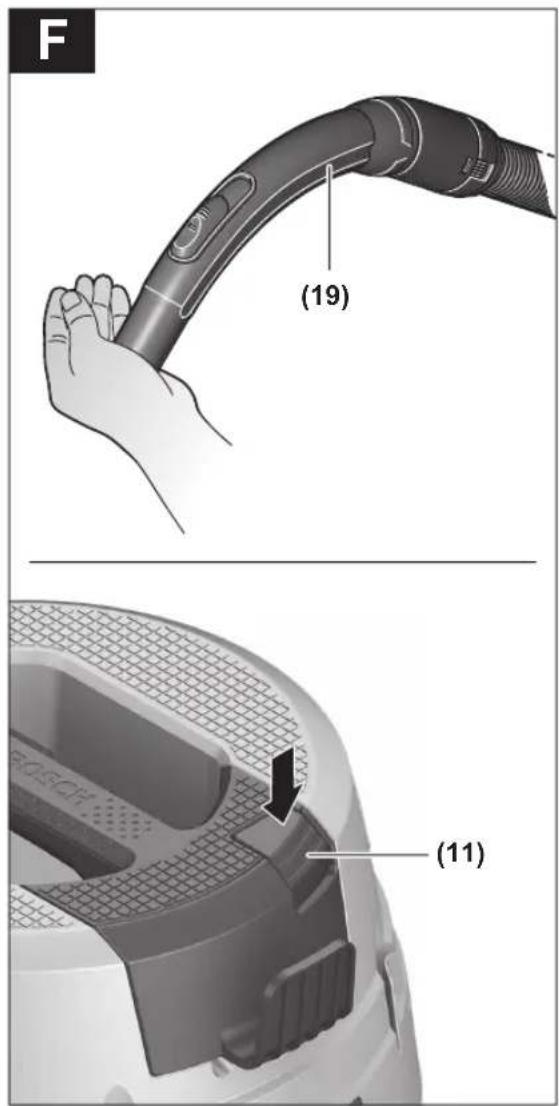
Semi-automatic filter cleaning (see figure F)
The filter cleaning function should be used regularly, and at the very latest when the suction power is no longer sufficient.
How often filter cleaning needs to be carried out will depend on the type and quantity of dust that has been vacuumed.
With regular use, the maximum conveying capacity will be maintained for longer.
During semi-automatic filter cleaning (SFC), the air flow is reversed to clean deposited dust from the flaps of the filter.
A pleated filter with surface dirt is still fully functional. It is not necessary to clean the flat-pleated filter manually by shaking or blowing it out; this may even damage the filter.
Triggering the SFC Filter Cleaning
- Use the palm of your hand to close the nozzle or vacuum hose opening.
- Press the SFC switch (11) three times.
Maintenance and Service
Maintenance and Cleaning
▶ Pull the plug out of the socket before cleaning or performing maintenance on the vacuum cleaner, making tool adjustments, changing accessories or putting away the vacuum cleaner. This safety measure prevents the vacuum cleaner from being started accidentally.
▶ To ensure safe and efficient operation, always keep the dust extractor and the ventilation slots clean.
▶ Wear a dust mask when servicing and cleaning the vacuum cleaner.
In order to avoid safety hazards, if the power supply cord needs to be replaced, this must be done by Bosch or by an after-sales service centre that is authorised to repair Bosch power tools.
For the user to carry out maintenance, the dust extractor needs to be disassembled, cleaned and maintained as far as this is possible without endangering maintenance personnel or other persons. Before disassembly, the dust extractor should be cleaned to prevent any potential hazards. The room/enclosure in which the dust extractor is disassembled should be well ventilated. Wear personal protective equipment while carrying out maintenance. After completing maintenance, the maintenance area should be cleaned.
An inspection regarding the dust extraction capability must be carried out at least once a year by the manufacturer or someone who has been trained, e.g. to check for filter damage, that the dust extractor is tight and that the control unit is functioning correctly.
Class L vacuum cleaners which were located in dirty environments should have their exteriors, as well as all their components, cleaned or treated with sealant. When performing maintenance and repair work, all dirty parts that cannot be cleaned satisfactorily must be disposed of. Such parts must be disposed of in impermeable bags in accordance with the valid provisions for disposing of such waste.
- Clean the housing of the dust extractor occasionally with a damp cloth.
Cleaning the container
- Wipe the container (1) from time to time using a non-abrasive off-the-shelf cleaning product and leave it to dry.
Cleaning the Filters
Regularly emptying the dust container and cleaning the filters will ensure optimum suction power. If suction power is not achieved after that, the vacuum cleaner is to be brought to the after-sales service.
Removing/changing the filter (see figures G1-G2)
Replace the damaged pleated filter immediately.
- Open the catches (7) and remove the top part of the vacuum cleaner (6).
- Turn the filter holder (27) as far as possible in the direction of rotation and take the filter holder, together with the pleated filter (28), out of the top part of the dust extractor (6).
- Take the dirty/damaged pleated filter (28) out of the filter holder (27).
- Brush the flaps of the pleated filter (28) with a soft brush. Or replace the pleated filter (28) if damaged.
- Place the filter holder (27) on the cleaned/new pleated filter (28).
- Insert the filter holder (27), together with the pleated filter (28), into the top part of the dust extractor and turn the filter holder (27) as far as possible in the direction of rotation.
- Put the top part of the vacuum cleaner (6) on and close the catches (7).
Cleaning the float (see figure H)
Make sure that the float (29) is cleaned occasionally.
- Open the catches (7) and remove the top part of the vacuum cleaner (6).
- Take the filter holder (27), together with the pleated filter (28), out of the top part of the dust extractor (6).
- Take the pleated filter (28) out of the filter holder (27). – Wash the float (29) with water.
- Insert the filter holder (27) with the pleated filter (28) back into the top part of the dust extractor (6).
- Put the top part of the vacuum cleaner (6) on and close the catches (7).
Storage and transport (see figure I)
- Empty and clean the container (1). To avoid mould formation, ensure that the pleated filter (28) and the inside of the dust extractor are dry.
- Wrap the power cable around the cable holder (13).
- Insert the accessories into the holders provided for them: Dust extraction adapter (18) into the holder (12), crevice
nozzle (23) into the holder (15), coarse dirt nozzle (22) into the holder (16).
- Place the vacuum hose (17) in the holder (14) around the top part of the vacuum cleaner.
- Carry the vacuum cleaner by the carrying handle (5).
- Store the dust extractor in a dry room and secure it so that it cannot be used by unauthorized persons.
- Put the castor brake (10) down to hold the castors (9) in place.
Rectifying faults
If a fault (e.g., filter damage) occurs, the vacuum cleaner must be switched off immediately. The fault must be repaired before resuming operation.
Problem Corrective measure
| Suction turbine will not switch on. | - Check the mains cable, mains plug, fuse, socket and float (29). |
| - Briefly press the on/off button (4) or switch on the power tool (3) that is connected to the socket. | |
| The suction turbine switches off. | - Empty the container (1). |
| The suction turbine will not switch on again after the container has been emptied. | - Switch the dust extractor off and wait 5 seconds before switching it back on. |
| - Clean the float (29). | |
| The suction power is decreasing. | - Remove any blockages from the vacuum nozzle, suction tube (21), vacuum hose (17) or pleated filter (28). |
| - Change the disposal bag (20) or dust bag. | |
| - Place the top part of the dust extractor (6) on correctly and close the catches (7). | |
| - Change the pleated filter (28). | |
| Dust is escaping during extraction | - Check that the pleated filter (28) has been fitted correctly. |
| - Change the pleated filter (28). | |
| Automatic switch-off (wet extraction) is not working. | - Clean the float (29). |
| Automatic switch-off will not work in the presence of non-conductive liquids or foaming. | |
| - Check the fill level regularly. |
After-Sales Service and Application Service
Our after-sales service responds to your questions concerning maintenance and repair of your product as well as spare parts. You can find explosion drawings and information on spare parts at: www.bosch-pt.com
The Bosch product use advice team will be happy to help you with any questions about our products and their accessories.
In all correspondence and spare parts orders, please always include the 10-digit article number given on the nameplate of the product.
Great Britain
Robert Bosch Ltd. (B.S.C.)
P.O. Box 98
Broadwater Park
North Orbital Road
Denham Uxbridge
UB 9 5HJ
At www.bosch-pt.co.uk you can order spare parts or arrange the collection of a product in need of servicing or repair.
Tel. Service: (0344) 7360109
E-Mail: boschservicecentre@bosch.com
You can find further service addresses at:
www.bosch-pt.com/serviceaddresses
Disposal
The vacuum cleaner, its accessories and packaging should be recycled in an environmentally friendly manner.
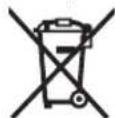
Do not dispose of the vacuum cleaner along with household waste.
Only for EU countries:
According to the European Directive 2012/19/EU on Waste Electrical and Electronic Equipment and its implementation
into national law, vacuum cleaners that are no longer usable must be collected separately and disposed of in an environmentally friendly manner.
If disposed incorrectly, waste electrical and electronic equipment may have harmful effects on the environment and human health, due to the potential presence of hazardous substances.
Only for United Kingdom:
According to The Waste Electrical and Electronic Equipment Regulations 2013 (SI 2013/3113) (as amended), products that are no longer usable must be collected separately and disposed of in an environmentally friendly manner.
French
Robert Bosch (France) S.A.S.
www.bosch-pt.com/serviceaddresses
www.bosch-pt.com/serviceaddresses
Disposal
www.bosch-pt.com/serviceaddresses
Disposal
(28) Harmonic filter
(29) Float
Technical data
Mounting the extraction adapter
www.bosch-pt.com/serviceaddresses
Disposal
Bosch Service Center
Telegrafvej 3
2750 Ballerup
At www.bosch-pt.dk you can order spare parts online or create a repair order.
Service Center phone: 44898855
Fax: 44898755
E-mail: vaerktoej@dk.bosch.com
www.bosch-pt.com/serviceaddresses
Disposal
Bosch Service Center
Telegrafvej 3
2750 Ballerup
Denmark
Tel.: (08) 7501820 (within Sweden)
Fax: (011) 187691
www.bosch-pt.com/serviceaddresses
Waste disposal
an < 2.5 m/s2, K = 1.5 m/s2 .
Assembly
www.bosch-pt.com/serviceaddresses
Disposal
www.bosch-pt.com/serviceaddresses
Disposal
www.bosch-pt.com/serviceaddresses
Disposal
www.bosch-pt.com/serviceaddresses
Disposal
Robert Bosch Sp. z o.o.
www.bosch-pt.com/serviceaddresses
Waste disposal
Bosch Service Center PT
K Vápence 1621/16
692 01 Mikulov
www.bosch-pt.com/serviceaddresses
Disposal
www.bosch-pt.com/serviceaddresses
Disposal
www.bosch-pt.com/serviceaddresses
Removal
www.bosch-pt.com/serviceaddresses
Disposal
www.bosch-pt.com/serviceaddresses
Disposal
www.bosch-pt.com/serviceaddresses
Disposal
Power tool service
Strada Horia Măcelariu Nr. 30–34, sector 1
013937 Bucharest
www.bosch-pt.com/serviceaddresses
Disposal
Power tool service
Strada Horia Măcelariu Nr. 30-34, sector 1
013937 Bucharest, Romania
www.bosch-pt.com/bg/bg/
www.bosch-pt.com/serviceaddresses
Disposal
www.bosch-pt.com/serviceaddresses
Disposal
www.bosch-pt.com/serviceaddresses
Removing debris
www.bosch-pt.com/serviceaddresses
Disposal
The vacuum cleaner, accessories, and packaging should be recycled in an environmentally friendly manner.
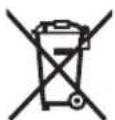
Do not dispose of the vacuum cleaner in household waste!
www.bosch-pt.com/serviceaddresses
Disposal
www.bosch-pt.com/serviceaddresses
www.bosch-pt.com/serviceaddresses
www.bosch-pt.com/serviceaddresses
Disposal
www.bosch-pt.com/serviceaddresses
Disposal
www.bosch-pt.com/serviceaddresses
Robert Bosch Morocco SARL
www.bosch-pt.com/serviceaddresses
Declaration of Conformity
Wet/dry dust extractor Article number
We declare under our sole responsibility that the stated products comply with all applicable provisions of the regulations listed below and are in conformity with the following standards.
Technical file at: Robert Bosch Ltd. (PT/SOP-GB), Broadwater Park, North Orbital Road, Uxbridge UB9 5HJ, United Kingdom
The Supply of Machinery (Safety) Regulations 2008
The Electromagnetic Compatibility Regulations 2016
The Restriction of the Use of Certain Hazardous Substances in
Electrical and Electronic Equipment Regulations 2012
EN 60335-1:2012+A11:2014+A13:2017+A1:2019+
A14:2019+A2:2019
EN 60335-2-69:2012
EN 55014-1:2017+A11:2020
EN 55014-2:2015
EN IEC 61000-3-2:2019
EN 61000-3-3:2013+A1:2019
EN IEC 63000:2018

BOSCH
Robert Bosch Power Tools GmbH, 70538 Stuttgart, Germany represented (in terms of the above regulations) by
Robert Bosch Limited, Broadwater Park, North Orbital Road, Uxbridge UB9 5HJ, United Kingdom
Vonjy Rajakoba
Managing Director - Bosch UK
Martin Sibley
Head of Sales Operations and Aftersales
Robert Bosch Ltd. Broadwater Park, North Orbital Road, Uxbridge UB9 5HJ, United Kingdom, as authorised representative acting on behalf of Robert Bosch Power Tools GmbH, 70538 Stuttgart, Germany
Place of issue: Uxbridge Date of issue: 02/02/2023
- GERMAN
- DISPOSAL
- SAFETY INSTRUCTIONS FOR VACUUM CLEANERS
- ENGLISH
- WARNING
- PRODUCTS SOLD IN GB ONLY
- SYMBOLS
- SYMBOLS AND THEIR MEANING
- PRODUCT DESCRIPTION AND SPECIFICATIONS
- INTENDED USE
- PRODUCT FEATURES
- NOISE/VIBRATION INFORMATION
- ASSEMBLY
- FITTING THE VACUUMING ACCESSORIES (SEE FIGURE A)
- FITTING THE NOZZLES AND TUBES
- FITTING THE DUST EXTRACTION ADAPTER
- FITTING THE HOLDER FOR THE VACUUM HOSE (SEE FIGURE B)
- FITTING THE VACUUM HOSE (SEE FIGURE C)
- INSERTING/REMOVING THE DISPOSAL BAG OR DUST BAG (DRY VACUUMING) (SEE FIGURES D1–D2)
- INSERTING THE DISPOSAL BAG
- REMOVING AND SEALING THE DISPOSAL BAG
- CHANGING/INSERTING THE DUST BAG (ACCESSORY)
- OPERATION
- START-UP
- DRY VACUUMING
- VACUUMING UP DUST DEPOSITS
- EXTRACTING DUST THAT ACCUMULATES FROM WORKING POWER TOOLS (SEE FIGURE E)
- WET VACUUMING
- STEPS TO TAKE BEFORE WET VACUUMING
- VACUUMING UP LIQUIDS
- SEMI-AUTOMATIC FILTER CLEANING (SEE FIGURE F)
- TRIGGERING THE SFC FILTER CLEANING
- MAINTENANCE AND SERVICE
- MAINTENANCE AND CLEANING
- CLEANING THE CONTAINER
- CLEANING THE FILTERS
- REMOVING/CHANGING THE FILTER (SEE FIGURES G1-G2)
- CLEANING THE FLOAT (SEE FIGURE H)
- STORAGE AND TRANSPORT (SEE FIGURE I)
- RECTIFYING FAULTS
- AFTER-SALES SERVICE AND APPLICATION SERVICE
- GREAT BRITAIN
- YOU CAN FIND FURTHER SERVICE ADDRESSES AT
- ONLY FOR EU COUNTRIES
- ONLY FOR UNITED KINGDOM
- FRENCH
- TECHNICAL DATA
- MOUNTING THE EXTRACTION ADAPTER
- WASTE DISPOSAL
- REMOVAL
- REMOVING DEBRIS
- DECLARATION OF CONFORMITY
- BOSCH
Brand : BOSCH
Model : GAS 20 L SFC Professional
Category : Vacuum Cleaner