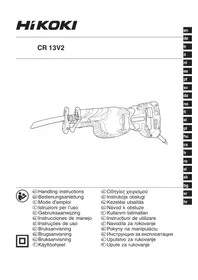
CR13V2 - Saw HiKOKI - Free user manual and instructions
Find the device manual for free CR13V2 HiKOKI in PDF.


| Product type | Sabre saw (reciprocating saw) |
| Brand | HiKOKI |
| Model | CR13V2 |
| Supply voltage | 110‑240 V (depending on region) |
| Power consumption | 1010 W |
| No-load speed | 0 – 2800 min⁻¹ (variable) |
| Stroke | 29 mm |
| Cutting capacity – steel (pipe) | Outer Ø 130 mm |
| Cutting capacity – wood | Depth 300 mm |
| Cutting capacity – mild steel sheet | Thickness 19 mm |
| Cutting capacity – PVC pipe | Outer Ø 130 mm |
| Weight (without cord) | 3.3 kg |
| Electrical class | Class II (double insulation) |
| Recommended blade length | Exceed material by at least stroke length |
| Blade type | HSC or bimetal blades (selection according to material) |
| Blade attachment | Tool-less, unlocking lever |
| Sole adjustment | Yes, tiltable |
| Pendular function | Yes (switchable) |
| Variable speed trigger | Yes, via trigger |
| Safety device | Lockable switch |
| Included accessories | Blade (No. 341), case, hex key |
| Routine maintenance | Cleaning and lubrication of blade holder |
| Sound level (LpA) | 91 dB(A) |
| Vibration level (wood) | 24.9 m/s² |
| Warranty | In accordance with national regulations |
Frequently Asked Questions - CR13V2 HiKOKI
User questions about CR13V2 HiKOKI
0 question about this device. Answer the ones you know or ask your own.
Ask a new question about this device
Download the instructions for your Saw in PDF format for free! Find your manual CR13V2 - HiKOKI and take your electronic device back in hand. On this page are published all the documents necessary for the use of your device. CR13V2 by HiKOKI.
USER MANUAL CR13V2 HiKOKI
(Original instructions)
GENERAL POWER TOOL SAFETY WARNINGS

WARNING
Read all safety warnings, instructions, illustrations and specifi cations provided with this power tool.
Failure to follow all instructions listed below may result in electric shock, fire and/or serious injury.
Save all warnings and instructions for future reference.
The term "power tool" in the warnings refers to your mains-operated (cored) power tool or battery-operated (cordless) power tool.
1) Work area safety
a) Keep work area clean and well lit.
Cluttered or dark areas invite accidents.
b) Do not operate power tools in explosive atmospheres, such as in the presence of flammable liquids, gases or dust. Power tools create sparks which may ignite the dust or fumes.
c) Keep children and bystanders away while operating a power tool.
Distractions can cause you to lose control.
2) Electrical safety
a) Power tool plugs must match the outlet.
Never modify the plug in any way.
Do not use any adapter plugs with earthed (grounded) power tools.
Unmodified plugs and matching outlets will reduce risk of electric shock.
b) Avoid body contact with earthed or grounded surfaces, such as pipes, radiators, ranges and refrigerators.
There is an increased risk of electric shock if your body is earthed or grounded.
c) Do not expose power tools to rain or wet conditions.
Water entering a power tool will increase the risk of electric shock.
d) Do not abuse the cord. Never use the cord for carrying, pulling or unplugging the power tool.
Keep cord away from heat, oil, sharp edges or moving parts.
Damaged or entangled cords increase the risk of electric shock.
e) When operating a power tool outdoors, use an extension cord suitable for outdoor use.
Use of a cord suitable for outdoor use reduces the risk of electric shock.
f) If operating a power tool in a damp location is unavoidable, use a residual current device (RCD) protected supply.
Use of an RCD reduces the risk of electric shock.
3) Personal safety
a) Stay alert, watch what you are doing and use common sense when operating a power tool. Do not use a power tool while you are tired or under the influence of drugs, alcohol or medication.
A moment of inattention while operating power tools may result in serious personal injury.
b) Use personal protective equipment. Always wear eye protection.
Protective equipment such as a dust mask, non-skid safety shoes, hard hat or hearing protection used for appropriate conditions will reduce personal injuries.
c) Prevent unintentional starting. Ensure the switch is in the off position before connecting to power source and/or battery pack, picking up or carrying the tool.
Carrying power tools with your finger on the switch or energising power tools that have the switch on invites accidents.
d) Remove any adjusting key or wrench before turning the power tool on.
A wrench or a key left attached to a rotating part of the power tool may result in personal injury.
e) Do not overreach. Keep proper footing and balance at all times.
This enables better control of the power tool in unexpected situations.
f) Dress properly. Do not wear loose clothing or jewellery. Keep your hair and clothing away from moving parts.
Loose clothes, jewellery or long hair can be caught in moving parts.
g) If devices are provided for the connection of dust extraction and collection facilities, ensure these are connected and properly used.
Use of dust collection can reduce dust-related hazards.
h) Do not let familiarity gained from frequent use of tools allow you to become complacent and ignore tool safety principles.
A careless action can cause severe injury within a fraction of a second.
4) Power tool use and care
a) Do not force the power tool. Use the correct power tool for your application.
The correct power tool will do the job better and safer at the rate for which it was designed.
b) Do not use the power tool if the switch does not turn it on and off.
Any power tool that cannot be controlled with the switch is dangerous and must be repaired.
c) Disconnect the plug from the power source and/ or remove the battery pack, if detachable, from the power tool before making any adjustments, changing accessories, or storing power tools.
Such preventive safety measures reduce the risk of starting the power tool accidentally.
d) Store idle power tools out of the reach of children and do not allow persons unfamiliar with the power tool or these instructions to operate the power tool.
Power tools are dangerous in the hands of untrained users.
e) Maintain power tools and accessories. Check for misalignment or binding of moving parts, breakage of parts and any other condition that may affect the power tool's operation.
If damaged, have the power tool repaired before use.
Many accidents are caused by poorly maintained power tools.
f) Keep cutting tools sharp and clean.
Properly maintained cutting tools with sharp cutting edges are less likely to bind and are easier to control.
g) Use the power tool, accessories and tool bits etc. in accordance with these instructions, taking into account the working conditions and the work to be performed.
Use of the power tool for operations diff erent from those intended could result in a hazardous situation.
h) Keep handles and grasping surfaces dry, clean and free from oil and grease.
Slippery handles and grasping surfaces do not allow for safe handling and control of the tool in unexpected situations.
5) Service
a) Have your power tool serviced by a qualified repair person using only identical replacement parts.
This will ensure that the safety of the power tool is maintained.
PRECAUTION
Keep children and infirm persons away.
When not in use, tools should be stored out of reach of children and infirm persons.
RECIPROCATING SAW SAFETY WARNINGS
- Hold the power tool by insulated gripping surfaces, when performing an operation where the cutting accessory may contact hidden wiring or its own cord.
Cutting accessory contacting a "live" wire may make exposed metal parts of the power tool "live" and could give the operator an electric shock.
- Use clamps or another practical way to secure and support the workpiece to a stable platform.
Holding the workpiece by hand or against your body leaves it unstable and may lead to loss of control.
ADDITIONAL SAFETY WARNINGS
- Ensure that the power source to be utilized conforms to the power requirements specified on the product nameplate.
- Ensure that the power switch is in the OFF position.
If the plug is connected to a receptacle while the power switch is in the ON position, the power tool will start operating immediately, which could cause a serious accident.
- When the work area is removed from the power source, use an extension cord of sufficient thickness and rated capacity. The extension cord should be kept as short as practicable.
- Prior to cutting into walls, ceilings or floors, ensure there are no electric cables or conduits inside.
- Dust produced in operation
The dust produced in normal operation may affect the operator's health. To wear a dust mask is recommended.
- Mounting the blade (Fig. 1)
This unit employs a detachable mechanism that enables mounting and removal of saw blades without the use of a wrench or other tools.
Turn on and off the switching trigger several times so that the lever can jump out of the front cover completely. Thereafter, turn off the switch and unplug the power cord.
Be absolutely sure to keep the switch turned off and the power cord unplugged to prevent any accident.
Pull the back of the saw blade two or three times by hand and check that the blade is securely mounted. When pulling the blade, you will know it is properly mounted if it clicks and the lever moves slightly.
When pulling the saw blade, be absolutely sure to pull it from the back. Pulling other parts of the blade will result in an injury.
7. Never touch the saw blade immediately after use. The metal is hot and can easily burn your skin.
8. When the blade is broken
Even when the saw blade is broken and remains inside the small slit of the plunger, it should fall out if you push the lever in the direction of the arrow mark, and face the blade downward. If it doesn't fall out itself, take it out using the procedures explained below.
(1) If a part of the broken saw blade is sticking out of the small slit of the plunger, pull out the protruding part and take the blade out.
(2) If the broken saw blade is hidden inside the small slit, hook the broken blade using a tip of another saw blade and take it out.
9. Although this unit employs a powerful motor, prolonged use at a low speed will increase the load unduly and may lead to overheating. Properly adjust the saw blade to allow steady, smooth cutting operation, avoiding any unreasonable use such as sudden stops during cutting operation.
10. Maintenance and inspection of saw blade mount
After use, blow away sawdust, earth, sand, moisture, etc., with air or brush them away with a brush, etc., to ensure that the blade mount can function smoothly.
As shown in Fig. 3, carry out lubrication around the blade holder on a periodic basis by use of cutting fluid, etc.
O Continued use of the tool without cleaning and lubricating the area where the saw blade is installed can result in some slack movement of the lever due to accumulated sawdust and chips. Under the circumstances, pull a rubber cap provided on the lever in the direction of an arrow mark as shown in Fig. 3 and remove the rubber cap from the lever. Then, clean up the inside of the blade holder with air and the like and carry out sufficient lubrication.
The rubber cap can be fitted on if it is pressed firmly onto the lever. At this time, make certain that there exists no clearance between the blade holder and the rubber cap, and furthermore ensure that the saw-blade-installed area can function smoothly.
Do not use any saw blade with a worn-out blade hole (A). Otherwise, the saw blade can come off, resulting in personal injury. (Fig. 4)
-
How to use
-
Avoid carrying it plugged to the outlet with your finger on the switch. A sudden startup can result in an unexpected injury.
- Be careful not to let sawdust, earth, moisture, etc., enter the inside of the machine through the plunger section during operation. If sawdust and the like accumulate in the plunger section, always clean it before use.
Do not remove the front cover.
Be sure to hold the body from the top of the front cover.
During use, press the base against the material while cutting.
Vibration can damage the saw blade if the base is not pressed firmly against the workpiece.
Furthermore, a tip of the saw blade can sometimes contact the inner wall of the pipe, damaging the saw blade.
- Select a saw blade of the most appropriate length. Ideally, the length protruding from the base of the saw blade after subtracting the stroke quantity should be larger than the material (see Fig. 7).
If you cut a large pipe, large block of wood, etc., that exceeds the cutting capacity of a blade; there is a risk that the blade may contact with the inner wall of the pipe, wood, etc., resulting in damage.
To maximize cutting efficiency for the materials you are using and working conditions, adjust the speed of the saw blade and the switching to swing cutting.
Cutting
Always hold the tool firmly with hand on housing as shown in Fig. 8, Fig. 9 and Fig. 10.
Press the base firmly against the workpiece.
- Never apply any unreasonable force to the saw blade when cutting. Doing so can easily break the blade.
O Fasten a workpiece firmly before operation. (Fig. 8)
English
- When cutting metallic materials, use proper machine oil (turbine oil, etc.). When not using liquid machine oil, apply grease over the workpiece.
The service life of the saw blade will be drastically shortened if you don't use machine oil.
- Never apply any unreasonable force to the saw blade when cutting. Also remember to press the base against the lumber firmly.
Sawing curved lines
We recommend that you use the BI-METAL blade mentioned in Table 2 for the saw blade since it is tough and hardly breaks.
Delay the feed speed when cutting the material into small circular arcs. An unreasonably fast feed may break the blade.
Plunge cutting (Fig. 9 and 10)
Avoid plunge cutting for metallic materials. This can easily damage the blade.
- Never pull the switch trigger while the tip of the saw blade tip is pressed against the material. If you do so, the blade can easily be damaged when it collides with the material.
Make absolutely sure that you cut slowly while holding the body firmly. If you apply any unreasonable force to the saw blade during the cutting operation, the blade can easily be damaged.
- Cut off guide for cutting pipe (optional accessory) Please refer to the cut off guide user's manual for details on how to use it correctly.
SYMBOLS
WARNING
The following show symbols used for the machine. Be sure that you understand their meaning before use.
| 一现即 | CR13V2: Reciprocating Saw |
| To reduce the risk of injury, user must read instruction manual. | |
| Only for EU countries Do not dispose of electric tools together with household waste material! In observance of European Directive 2012/19/EU on waste electrical and electronic equipment and its implementati on in accordance with national law, electric tools that have reached the end of their life must be collected separately and returned to an environmentally compatible recycling facility. | |
| I | Switching ON |
| O | Switching OFF |
| Stroke | |
| Disconnect mains plug from electrical outlet | |
| Class II tool |
STANDARD ACCESSORIES
In addition to the main unit (1 unit), the package contains the accessories listed in the below.
O Blade (No. 341)
Case 1
Hexagonal bar wrench 1
Standard accessories are subject to change without notice.
APPLICATIONS
Cutting pipe and angle steel.
Cutting various lumbers.
Cutting mild steel plates, aluminum plates, and copper plates.
Cutting synthetic resins, such as phenol resin and vinyl chloride.
For details refer to the section entitled "SELECTION OF BLADES".
SPECIFICATIONS
| Voltage (by areas) * | (110 V, 115 V, 120 V, 127 V, 220 V, 230 V, 240 V) ~ | |
| Power Input 1010 W * | ||
| Capacity | Mild Steel Pipe Q.D. 130 mm | |
| Vinyl Chloride Pipe | O.D. 130 mm | |
| Wood Depth 300 mm | ||
| Mild Steel Plate | Thickness 19 mm | |
| No-Load Speed | 0 - 2800 min-1 | |
| Stroke | 29 mm | |
| Weight (without cord)** | 3.3 kg | |
- Be sure to check the nameplate on product as it is subject to change by areas.
** According to EPTA-Procedure 01/2014
NOTE
Due to HiKOKI's continuing program of research and development, the specific cations herein are subject to change without prior notice.
MOUNTING AND OPERATION
| Action | Figure | Page |
| Mounting the blade | 1 | 116 |
| Taking the broken blade out | 2 | 116 |
| Maintenance and inspection of saw blade mount | 3 | 116 |
| Blade hole | 4 | 116 |
| Adjusting the base | 5 | 117 |
| Switch Operation | 6 | 117 |
| Selection of saw blade length | 7 | 117 |
| Fastening work piece firmly | 8 | 117 |
| Plunge cutting | 9 | 118 |
| Plunge cutting with the saw blade installed in reverse | 10 | 118 |
| Replacing carbon brushes | 11 | 118 |
| Selecting accessories — 119 |
Refer to Table 1, 2, 3 and 4 for use of the blades.
SELECTION OF BLADES
To ensure maximum operating efficiency and results, it is very important to select the appropriate blade best suited to the type and thickness of the material to be cut.
The blade number is engraved in the vicinity of the mounting portion of each blade. Select appropriate blades by referring to Table 1-2.
Table 1: HCS blades
| Blade No. | Uses | Thickness (mm) |
| No. 4 For c | cutting and roughing lumber | 50 – 70 |
| No. 5 For c | cutting and roughing lumber | Below 30 |
| No. 95 For | cutting stainless pipe less than 100 mm in diameter | Below 2.5 |
| No. 96 For | cutting stainless pipe less than 30 mm in diameter | Below 2.5 |
Table 2: BI-METAL blades
| Blade No. | Uses | Thickness (mm) |
| No. 101 | For cutting steel and stainless pipes less than 60 mm in outer diameter | 2.5 – 6 |
| No. 103 | ||
| No. 109 | ||
| No. 141(S) | ||
| No. 102 | For cutting steel and stainless pipes less than 100 mm in outer diameter | 2.5 – 6 |
| No. 104 | ||
| No. 110 | ||
| No. 142(S) | ||
| No. 143(S) | ||
| No. 107 For | cutting steel and stainless pipes less than 60 mm in outer diameter | Below 3.5 |
| No. 108 For | cutting steel and stainless pipes less than 100 mm in outer diameter | Below 3.5 |
| No. 121 For | cutting and roughing lumber | 100 |
| No. 131 All | purpose 100 | |
| No. 132 All | purpose 100 |
Table 3: Selection of blades for other materials
| Material to be cut | Material quality | Thickness (mm) | Blade No. |
| Iron plate Mild steel plate | 2.5 – 10 | No. 101, 102, 103, 104, 109, 110, 131, 141(S), 142(S), 143(S) | |
| Below 3.5 No. | No. 107, 108 | ||
| Nonferrous metal | Aluminium, Copper and Brass 5 – 20 | No. 101, 102, 103, 104, 109, 110, 131, 132, 141(S), 142(S), 143(S) | |
| Below 5 No. | No. 107, 108 | ||
| Synthetic resin | Phenol resin, Melamine resin, etc. | 10 – 50 | No. 101, 102, 103, 104, 131, 132, 141(S), 142(S), 143(S) |
| 5 – 30 | No. 107, 108, 109, 110 | ||
| Vinyl chloride, Acrylic resin, etc. | 10 – 60 | No. 101, 102, 103, 104, 131, 132, 141(S), 142(S), 143(S) | |
| 5 – 30 | No. 107, 108, 109, 110 |
MAINTENANCE AND INSPECTION
1. Inspecting the blade
Continued use of a dull or damaged blade will result in reduced cutting efficiency and may cause overloading of the motor. Replace the blade with a new one as soon as excessive abrasion is noted.
2. Inspecting the mounting screws
Regularly inspect all mounting screws and ensure that they are properly tightened. Should any of the screws be loose, retighten them immediately. Failure to do so could result in serious hazard.
3. Maintenance of the motor
The motor unit winding is the very "heart" of the power tool. Exercise due care to ensure the winding does not become damaged and/or wet with oil or water.
4. Inspecting the carbon brushes (Fig. 11)
The motor employs carbon brushes which are consumable parts. Since an excessively worn carbon brush can result in motor trouble, replace the carbon brushes with new ones having the same carbon brush No. ② shown in the figure when it becomes worn to or near the "wear limit" ⑤. In addition, always keep carbon brushes clean and ensue that they slide freely within the brush holders.
5. Replacing carbon brushes (Fig. 11)
Disassemble the brush caps with a slotted-head screwdriver. The carbon brushes can then be easily removed.
6. Replacing supply cord
If the replacement of the supply cord is necessary, it has to be done by HiKOKI Authorized Service Center to avoid a safety hazard.
CAUTION
In the operation and maintenance of power tools, the safety regulations and standards prescribed in each country must be observed.
GUARANTEE
We guarantee HiKOKI Power Tools in accordance with statutory/country specific regulation. This guarantee does not cover defects or damage due to misuse, abuse, or normal wear and tear. In case of complaint, please send the Power Tool, undismantled, with the GUARANTEE CERTIFICATE found at the end of this Handling instruction, to a HiKOKI Authorized Service Center.
IMPORTANT
Correct connection of the plug
The wires of the main lead are coloured in accordance with the following code:
Blue: — Neutral
Brown:Live
As the colours of the wires in the main lead of this tool may not correspond with the coloured markings identifying the terminals in your plug proceed as follows:
The wire coloured blue must be connected to the terminal marked with the letter N or coloured black. The wire coloured brown must be connected to the terminal marked with the letter L or coloured red. Neither core must be connected to the earth terminal.
NOTE
This requirement is provided according to BRITISH STANDARD 2769:1984.
Therefore, the letter code and colour code may not be applicable to other markets except The United Kingdom.
Information concerning airborne noise and vibration
The measured values were determined according to EN62841 and declared in accordance with ISO 4871.
Measured A-weighted sound power level: 102 dB (A)
Measured A-weighted sound pressure level: 91 dB (A)
Uncertainty K: 5 dB (A).
Wear hearing protection.
Vibration total values (triax vector sum) determined according to EN62841.
Cutting boards:
Vibration emission value a_h, B = 19.7 m/s^2
Uncertainty K = 1.5m / s^2
Cutting wooden beams:
Vibration emission value a_h , WB = 24.9 m/s^2
Uncertainty K = 1.6m / s^2
The declared vibration total value has been measured in accordance with a standard test method and may be used for comparing one tool with another.
It may also be used in a preliminary assessment of exposure.
The vibration emission during actual use of the power tool can differ from the declared total value depending in the ways in which the tool is used.
- Identify safety measures to protect the operator that are based on an estimation of exposure in the actual conditions of use (taking account of all parts of the operating cycle such as the times when the tool is switched off and when it is running idle in addition to the trigger time).
NOTE
Due to HiKOKI's continuing program of research and development, the specific cations herein are subject to change without prior notice.
ALLGEMEINE
VOORZORGSGMAATREGELEN
VEILIGHEIDSWAARSCHUWINGEN SCHROBZAAGMACHINE
VEILIGHEIDSWAARSCHUWINGEN
VEDLIKEHOLD OG INSPEKSJON
1. Inspiser bladet
On kappaigikarmayin.
b) He n3noJ3BaIte eIeHTpNueChn HnCTpyMeH TBB B3pHBOONaCHa CpeDa, npH HaJIuYe Ha 3aIaNIMN TeUHOCTn, ra3 nn npax.
Elenktpnuechnte HNCTpymEnTH npOn3BeHdaT NCHPN, KOINTo MORaT Da IOBeDaT Da Bb3PnAmeHRAHe.
c) He no3B0JBAaTe DocTbN Ha CtpaHnHn IInca n Deca npn pa6ota c eJeHTpueechn HhCTpyMeHTn.
HeBHMaHne IIO BpeMe Ha pa6To MaKe Ia IOBeIe Do 3ary6a Ha KOHTpOJI Bbpxy npoueca.
2) EJenTpHuecha 6e30nachoct
a) UenceIte Ha eIeHTpueeCHnte HNCTpyMeHTn Tpa6Ba Da OTROBaprT Ha TnHa HOHTaHTne.
HnKora He npaBeTe KaHBnTo n Da 6HIO npomEnn no uenceIte. He n3noJI3BaIte npexoHNuenceI 3a BKNIOUcBAHe Ha 3a3eMeHneJeEHTpNueeCKn HhCTpyMeHTn.
Lence, no KOnTo He ca npabeHn MoHnKaun n CbOTBETCTBaT Ha KOHTaKTITE HamaJIaBaT pNcKa OT eJeHTpueeckn ydap.
b) Pn pa6ota c eIeHTpuecH nHCTpyMeHTn 36raBaIte KOHTaHT Ha TAnOTo Cbc 3a3eMeHN NOBbpXHOCTN KaTO Tpb6n, PaHaTOpn XlaanlHn.
CbueCTByBa NOBnIeH pNcK OT eIeHTpUeCKn yIap, aHO TAnOTo Bu cTaHe YAcT OT 3a3eMITEJIHHN KOHTyp.
c) He n3laarTe eNeHTpueeCKHe nHCTpyMeHTn Ha BJIaHHeTo Ha BnaRa NIN dBkD.
InonadaheTo Ha Bnara B eJeKtpnuecknTe INHCTpymEnTH nOBnUba pncKa OT eJeKtpnueckn ydap.
d) He HapyuabaTe 9eNoCTTa Ha Ka6eHnTe. HnKora He n3KnUoBaTte eEKeTpnuEcHnTe ypeDu, Kato n3DbpNbATE OT Ka6eJa.
Na3ete Ka6eJIte OT n3ToUHnCu Ha ToIInHa, OT Cm3oOHN MaTePnaHn, OCTpn Pb6OBe N NOBUNHH KOMNOHEHTN.
Hapaehn nn npenpteHN Ka6eN NOBnwaBat pncKa oEneKtpueckn yap.
e) Horato n3noJ3BaTe eIeKtpnueChn ypeJ Ha OTKpnto, n3noJ3BaJte YdblHnTeJ, NOxOJa 3a BbHnH yCIOBnHa pa6ota.
H3noI3BaIte Ka6eI, NOxOJa 3a BbHsHn YcNoBna, KOITo HamaJIba pNcKa OT eJeKTPnueckn ydap.
f) Ako e HaIOHNTeJIHO H3NOJ3BaHeTO Ha eIeHTpueeCKn HNCTpyMeHT BBB BnaHH yCIOBn, H3noJ3BaIte ypeu c AnfepeHcuaHa 3aunTa (RCD) cpeuyyTeuHa. H3noJ3BaHeTo Ha dIeFepeHcuaHa 3aunTa HamaJIbRa pUcKa OT eJeHTpueeCKn ydap.
3)JInuHa6e3oNaCHOCT
a)БbTe 6dTeJIHH, BHNMaBaIte B DeIcTBnHTa cn n H3NoJ3BaIte pa3yMHO eIeHTpNueeCHNTe HHCTpyMeHTn.
He n3noJ3BaIe eJIeKtpnueChn HNCTpyMeHT, HORATO CTe N3MOpeHN, INN NOd BINRAHHeTo HaJeHApCTBeHN cpeDcTBa, aHHOxOJ INN ONHaTH.
BcraKHeBHMaHne npn pa6Ota c eJeKtpnueChn HNCTpyMeHTN MOKe da DOBeDe Do cepNo3HN HapaHaBaHna.
b) H3noJ3BaIte IuHn npEpa3Hn cpeCTBa. BnHaHn Hocete 3aunTHn OUYna nn Macka.
3aunTHnTe cpeCTBa, KaTo npaxo3aunTHa MaCKa, 3aunTHn ObyBn C yCTOuYBa Ha NtB3raHe NOmETKa, KACKa, Hn AHTNFOH, H3NOJ3BaHN CnopeyCNoBnTa Ha pa6ota, Ue HamaJrT OnaCHOCTTA OT HapaHBAhe.
c) PpeoTbpaTaBaHe Ha CnyaHNO BkIIOUbaHe. YBepete Ce, ye 6yToHbT 3a CTapr Ha ypeDa e B H3KIOUyeHO NIOJOKeHne, Ppeu Da CBbpKeTe ENEKtpnueechnn HNCTpyMeHT KbM N3TOOHK Ha 3axpaHbAhe n/nn 6aTeprna, KaHTo n PpeDu da ro B3eMeTe nn npeHaacrTe.
IpehaHTo Ha HnctpyMeHTn C npbCT Ha CTapT 6yToHa, Hn Ha NpEBNIOBATEeHa 3axpaHbaHeTO, HOCh ONaCHOCT OT INuDeHTN.
d) OTePaHete BCnHu pa6oTHn npncTabHN, npei Da BkIIOHTe ypea KbM 3axpaHbAHeTo.
TaeueH KIOU HN INHCTpymeHT, 3a6paBEN B PotaUNOHNN KOMNOHEHT Ha eJekTpueckn INHCTpymeHT, MOKe Da DOBeDe Do HapaHraBaHe.
e) He ce npecaraTe. Ppe3 uJIoTO BpeMe Tp6Ba Da HMaTe Cta6HnHa Onopa N da NODbPHeTa 6aHaHC Ha TJIOTO.
Toba OCHyprBa NO-06bP KOHTpO1 Bbpxy eNeKtpruecknte HHCTpyMeHTn Pn HeoayKaBAHn CHTyaun.
f) Hocete noxdxoadno 06leHIO. He hocete npekalneHO wnpOKn dpexn nn 6nHyta. Dpbhte hocata n dpexnte cn daJeou DTBnHeuNTe ce yactn.
UHpOKHTe npexu, bkyta u IbIra Koca MOraT da 6bTa3axBaHaTHN OT NOBnKHNTE KOMNoHEHTN.
g) Ako ca ocHrypeHn ycTpoNCTBa 3a npncbEdHHBaHe KbM npaxoyIOBHTeHN HhctaHaun, yBepTe ce, ye ca npabHnHO npncbEdHHeHn.
H3noJ3BaHeTo Ha npaxoyIOBHTeN n cHIOHN MOHe Da HamaJI N CBp3aHHTe CbC 3AmbpcBAHeTO pNCKOBE.
h) He no3BOLJBAIte ONHTHOCTTA Bn, npHIO6bNTa OT YecTOTO H3NOJ3BaHe Ha IHCTpyMeHTn, da BN Cb3daPe cAmOyBcTBHe, 3apaN KoETO da HrHopnPate npHUnnTe Ha 6e3oNaCHOCT npn pa6ota c INHCTpyMeHTn.
HeBHMaTeJIHO DeIcTBnE MoKe Da IOBeIe Do TeKHN HapaHbAHN B paMHTe Ha YaCTN OT CekyHdata.
4) EKcNloataaHn NOdPbHHHa Ha eJeHTpHuecHn HhCTpyMeHTn
a) He hacnBaIte eIeKtpnuechnte nHcTpymeHTn. H3noJ3BaIte noxOJaEeIeHTpnueeCHn HHcTpymENT 3a cbOTBETHnte cJIH.
IoxoJyNT eKtpnueckn HCTpymeHT OCHpyBa 630anachTo nNo-dObpo N3BbPwBaHe Ha paBOTHnTe DeHOCTN npN npedBnDeHnTe HOMHaJIHn napaMeTpN.
b) He n3no13BaIte eIeHTpHueChn HNCTpyMeHT, aHO He MoKe Da 6bJe BKNIOUeH NIN n3KIOUeH OT CbOTBeTHnA CTapT 6yTOH NIN npEbnIOuOBATeI.
BceH eIeKtpnueckn HNCTpyMeHT, KOHTo He MoKe Da ce KOHTpOIpna OT ppeBKnUoyBaTeJI, e OnaceH N NOJNeKHa peMOHT.
c) N3KIOUeTe ⅢeCena Ha HnCTpyMeHTa OT n3TOUHnKa Ha 3axpaHbAhe H/nnn H3BaJeTe 6aTePnHHna NaKeT OT HnCTpyMeHTa, aHO ToI NO3BOJRA CBaJIHe, ppeDn Da H3BbPbBAte HAcTPOHn, npn CmHa Ha npNCtABn nn npn cbXpaHeHne.
TeH npedna3Hm Mepn HamaJIraBt pNcKa OT CnyaHNO HeKeHaHO BKNIOUbaHe Ha eIeKtpuuecknIHNCTpyMeHT.
d) CbxpahraBaHTe HEn3noI3BaHHTe eIeKtpnueckn HNCTpyMeHTn DaJeY OT DocTbn Ha Deua N He No3BOJRABaHTe Ha INuca, He3aNo3HaTHc NaunHa Ha pa6ota c INHCTpyMeHTte N Te3n HNCTpyKcUn, da pa6oTATC TAX.
Enktpueechnte HnctpyMeHTn npedCTaBnBaT ONaCHOCT BpbTeHa HeONTHN Nua.
e) NopdbphaTe eENTPOHCTpymeHTnE n ahcecoapte. PpOBepaBte cHTPOBkata H 3aHPenBaHeTo Ha NOdBHNHe TcTn, npOBepaBte 3a NOBpeEnu Yactn, KOnTO MORAT da ce OTPa3rHa pa6oTaTa Ha eENTpuYeCHnte HNCTpyMeHTn. AHO yCTaHOBNTe NOBpeIn,OTCTpaHete rN ppeIN Da H3noJ3BaTe eENTpuYeCHnte HNCTpyMeHTn.
Mhoro 3IIOJOnyHu Ce IbIHaT Ha IOWa NOIepbHka Ha eIeKtpnueckHTe INCTpyMeHTN.
f) PndbpaHapeeHcHHTN 3aTOUeHN uHCTN.
PpabnHNO nDtbPkaHHTpeKeuINHCTpyMeHTN, C HatoeHN peKeuIN eIeMeHTN, ce ynpablaBaT N KOHTPOIIpaT NO-JeCHO.
g) H3noJ3BaIe eIeHTpHueChn HNCTpyMeHTn, npNCtABHN aKceCoapn T.H., CbrlaCHO Te3n INCHCTpyHKUHN, KaTO B3EmTe PpeBnD pa60THTE yCIOBn N BnDa pa60TN, KOHTo ige Ce n3BbpWbT.
H3noJ3BaHe Ha eJekTpueeCKIte HNCTpyMeHTn 3a pa60Tu, pa3InuHN OT Te3H, 3a KOHTo Ca npEdbuDeHH, MOKe Da Iobede Do NOBuWeH pNCK H ONaCHN CNTyaUHN.
h) PnaseTe pbKoXBaTHNte n NOBbpxHOCTnTE 3a 3axBaAaHe cyxH, YnCTn, 6e3 MacNo I rpec.
Xlb3rABNTe pbKOXBaTHN IN NOBbpxHOCTN 3a 3axBaune He No3BOJRAbT 6e30nachata pa6ota n npablenHe Ha HnCTpyMeHTA B HeoayKbaHn CnTyauHH.
5) 06cIyHbAHe
a) 06cIyKbaHeTo Ha eIeHTpueCKeHte HhCTpyMeHT Tpa6Ba da ce N3BbPwBa cMo OT KBAJIHΦHnpuHn cepBn3Hn pa6OTnHn, npn H3NoJ3BaHe Ha opRnHaJIHn pe3epBHN qactH.
ToBaIe rapaHTnpa 6e3oNaChocTta npu pa60Ta c eJeHTpueeCKnTe INHCTpyMeHTn.
BHIMAHNE
He donychaite B 30hata Ha pa6ota Deua H Bb3pacTHn Xopa. Horato He n3no13BaTe eJeKtpnuecknTe nHcTpymeHTn, cbxpanraBaIte rHa daJeu ot Doctbn Ha Deua N Bb3pacTHn Xopa.
ПЕДУПЕЖДECHИЗА 3A БЕЗПACHEСТ 3A ВБВРATHО- ПОCTьПATEЛЕН TPNOH
- EneHTpHueChnT HNCTpyMeHT Tp6Ba Da ce DbPKN 3a H3OJIHpAHTE 3axBAITHN NOBbPxHOCTN, HORATO pa6OTNTc HrO B CnyaH Ye peKeHaaT npHCTabHa BJIe3E B KOHTAKT CbC ChpHTo OKa6JIeBAHe HJN CO6CTBeHHn CN 3axpaHBAu Ka6eI.
HONTaHT Ha npuctabKHTe N KpeENHHTE eIeMeHTN C npOBODHnIPO HAnpeXHeHne, MoHe Da DOBeDe Do npOTuHaHE Ha TOK Ipe3 eJIeKTpUcEcknI INHCTpyMeHT N TOKOB ynap.
2.ИЗнOLЗВаTe CkO6n Илpyr npaKTNUeCKH NaUH Nda 3aCtONOpHTe UyHpeNITe O6pa6OTBaHnI DeTaII NbM CTaBnHa ПlaTΦOpMa.
Ako npndbpahtoe obaobtbaHnIe TaIc pkaTa nn CpeuTyIIOTo cn, ToI CTaBa HeCTa6nJIeH n Ce Cb3daBA ONaCHOCT OT 3aY6a Ha KOHTpOJ.
ДОПьЛНITEЛНИ ПРЕДУПЕЖDEHENЯ 3А БE3ОПАСHOCT
-
YbepeTe ce, Ye n3TOUHNKbT Ha HAnpeXeHne, KOTo ⅢNoJI3BaTe, OTROBapr Ha N3NCKBaHnra Tn CneuΦnKaua, NOCOeHn Bbpxy INHBENTapHaTa Ta6eIka.
-
YBepeTe Ce, Ye 6yToHbT 3a BkJIIOUbaHe N N3KJIIOUbaHe e B No3nua H3JI.
Ako 6bde BHKIOUeH Ucncela KbM KOHTaKTA, ypeIbT 1ue 3anoHHe da pa6oTH BeHara, npn 6yTOH B NO3Nua BRJ., KOETOMKe Da DOBeDe Do cepno3HN HUNdENTn.
He cBaIaIe Te npedHnKaIaNk.
Binharn dpbxte TAnlOTo OTKbM rOpHaTa YacT Ha npedHn KaNak.
O IIO Bpeme Ha ynoTpe6aTa, npntncheTe 6a3aTa KbMaTePnAJa,doKaTo peKeHete.
Bn6paunnte morat da noBpeJrT cnpKyIpa, aHO 6a3ata He e 3dpaBO npHTncHaTa KbM o6pa6oTBaHOT O3delle.
OcbEN TOBA, npEHNrKpA Na CnPKyIpa MoKe NOHkORA Da DOKOCHe BbTppeWHaTa CTpaHa Ha Tpb6aTa I TOBa Da NOBpeDNuPKyIpa.
O H36epete UnpkyIpa C haN-NOxOJaTa DbHNHa. B NdeaHnT BapnaHT, DbHNHaTa HaD 6a3aTa Ha cInpkyIpa CneI INBaHdaHe Ha KOJIueCTBaTa yApn Tpr6Ba Da e No-ToJMa OT Ta3H Ha MaTePnHa (BnKTe
Φn7).
Ako pekeTe roJMa Tp6a, roJMy napye DbPBO HApR. KOINTIpeBnBaBAT KanaNTeTa Ha HOHa; CbUeCTByBa PnCK OT DOKOCBAHe Ha BbTpewHaTa CTeHa Ha Tp6aTa, DbPBOTo N dp. OT HOHa N TOBa MOKe Da DoBeDe Do NOBpeJa.
O 3a Da yBelenuHte Do MaHCmym EeKHTNBHOCTTa Ha p3aHe 3a MaTePnAInTe, KOtO N3NOJ3BaTe N yCIOBnTHa pa60Ta, perylnpaTe cHOPoCTTa Ha CHPkyIpaN npeBkIIOUbaHeTo KbM p3aHe C BbPteHe.
Pra3aHe
O BnHaHn DpBkTe 3dpaBO HhCTpyMeHTa C DBeTe CN pBue Bbpxy KOpIyCa, KaKTo e NOKa3aHO Ha fnr.8, fnr.9 n fnr.10.
O 3dpabo npntncheTe OCHOBata cpeuy o6pa6oTbaHOTn3dJIne.
Hnkora He npnilaraTe n3IiUHa cNla Bbpyu cnpkyIpa no BpeMe Ha p3aHe. Ako HnpaBte TOBa, IeCHO MOKeTe da ChynTe HOka.
O 3dpab0 3aHpeene Te 6pb6oTBaHOTo n3dJIne npEIN da 3anOHTe pa6oTa. (Фиr.8)
O Korato pekeTe MeaJIH MaTePnAJI, H3NoI3BaIte npabInHOTo MaunHHo Maclo (Maclo 3a Typ6HH, n dp.). Korato He n3NoI3BaTe TeHOb MaunHHo Maclo, HaHeceTe rpec Bbpxy o6pa60TaBHOto n3deJIne. EKnIIOaTuONOHnT JnBOT Ha cnpHyJpa Ie Ce cbKpAn dpaCTnHOb, aKO He n3NoI3BaTe MaunHHo Maclo.
O HnKora He npinaraaTe n3JiUHa cna Bbpxy cnpyjra pa No Bpeme Ha p3aHe. He 3a6paBnTe da npNTICHE Te 3dpBO 6a3aTa KbM DpbBEHn MaTePnA1.
Prahe Ha KPNBn JINHNN
O IpenopbVbame da H3noJ3BaTe 6HMeTaJIeH HOK, cNoMeHaT B Ta6nua 2 3a CnHpyIrp, TbN KaTO TRe e 3dpaBn TpydHO Ce yyNI.
3a6abeTe noDaBaHeTo Ha ChOpocT Ta npn pr3aHe Ha MaTePnaI Ha MaJIKN KpbroBn DbRn. Hepa3ymHO 6bp30 NoDaBaHe MoKe Da Cuyn HOJa.
06pa6oTbahe ue3 Bp3Bahe (MnR. 9 n 10)
O N368BaTe 06pa6oTKa Ype3 Bpr3BaHe 3a MeTaHHTe MaTePnAIn. ToBa MoKe IecHO da ChyIn HOxJa.
HnKora He n3dbpnbAte cnycbKa Ha npBHKIOUbaTeJI, DOkato Bbpxa Ha HOka e npHTncHaT Cpeu MaTePnAJa. AHO HAnpaBnTe, HOKbT MoKe JecHO da ce NobpeNi, KOrato Ce ONpe B MaTePnAJa.
O Tp6Ba MHOrO Da BHIMaBate N da peKeTe 6aBHO, DOkato 3dpaBO DbpKHTe KOpNyCa. AHO npnIOHHTe Hepa3ymHa Cnla KbM cnpKyIra pa No BpeMe Ha p3aHe, HOKbT MOHe IecHO da Ce NOBpeDi.
12. Bɔdau 3a pr3aHe Ha Tp6a (aKcecoap no n36op) MoIa, HappaBeTe CnpaBHa c pKOBODCTBOTo 3a B0daa 3a pr3aHe 3a npdo6Hocn KaK Da ro n3no3BaTe npabuHIO.
CHMBOJN
IPEDyIPENXHEHNE
H3noJ3BaHn ca CneHNTE CNMBOJN 3a MaunHaT. YBepTe ce, Ye pa36napate 3NaueHHeTo NM npedn H3NoJ3BaHe.
| CR13V2:Вьзврано-посъданов.Tрнон | |
| За за hamалу риска OT hapаяразимя, notpeбintелТгябва д почete рьковдстото за павoting. | |
| Само за страви OT EC He n3хьрлайе[elektричесни уреши задно с битовпente OTпадыц! Вьв Вьзka c paэпоредichte наЕврөнөсka Директуba 2012/19/EC 3a[elektprichesite и[elektproнни уреши и НейнOTO пиножени съласно haцюнaltпente ЗAKOHODATEЛСТВа, eletкtripсесни уremeни, конто ИЗлиизат OT уnotpeба Тгябва д сьбират OTделно и праздават в спсuaлларанни пунктоve за peuzнлларанe. | |
| I | Вьлочанe |
| O | Изклочанe |
| Хд | |
| Разкачete главни有很大 сcentel OT[elektprichesня Контакт | |
| У畴д Клac II |
CTAHAPTHN AHCECOAPN
BdoNbHeHKeKbM OCHOBHHKOMnIeHT (1 KOMnJIeHT) ca npedocTabEHn H aHcecoapTe n pncTabHnte, 36poehn no-dony.
HOH (No 341) 1
O Kopnyc. 1
O WeictorpaMeH KJIIOU 1
Ctahapthnte npictabkn n akcecoapn ca npedMeT Ha npomHa 6e3 npedynpekdene.
PNILOXKEHNA
O Pra3aHe Ha TpB6n n CTOMaHeHn bTIN.
Pra3aHe Ha pa3nHn BnOBe IbPBeCuHa.
O P3aHe Ha MeKn CTOMaHEn IJIaCTuHN, aJyMHHeBN IIaCTuHN IN MeHN IIaCTuHN.
PraHa He Ha CnHTeTnHn CMOJI, KaTo ΦeHOJHa CMOJa N BUNHnJIxIopnI.
3a noDpo6HocTn BnKTe pa3dena, 03arJaBeH ,N35OP HA OCTPNIETA".
CNEUHRAUH
| Нар每一天нения (по облacrп)* | (110 V, 115 V, 120 V, 127 V, 220 V, 230 V, 240 V) ~ | |
| Зхраиваць 6лок 1010 W* | ||
| КашитET | Трьба OT МЕкa CTOMанa | Въшнигдиаметыр 130 MM |
| Трьба OT ВИнелхлориd | Въшнигдиаметыр 130 MM | |
| ДървО Дълбс | ЧИHA 300 MM | |
| Пл actина OT МЕкa CTOMaHa | Дeбенина 19 MM | |
| Овороти на пазенхов | 0-2800 мINH-1 | |
| XoД 29 ММ | ||
| Тер lo (бeз кабela)** 3,3 Кг | ||
- YBepete ce, Ye cTe npOBepnHn Pha6pnHata Ta6eHa Ha npOdykTa, KOJTo e npEmdet Ha npomeHb pa3nHnTe o6laactn.
** CbrlacHo EPTA-npoeDypa 01/2014
3A6EJIeHHKA
B pe3yIITaT Ha nporpaMaTa 3a HenpeKbChaToTo pa3BHTHe Ha HayHo-pa3BoHHaTa DeHocT Ha HiKOKI, daDeHnTe TYK CneuΦnKaun Ca npedMeT Ha npomHa 6e3 yBeDOMJIeHne.
MOHTAXI EKCIIOATAU
Siemensring 34, 47877 willich, Germany
Tel: +49 2154 49930
Fax: +49 2154 499350
URL: http://www.hikoki-powertools.de
Hikoki Power Tools Norway AS
Kjeller Vest 7, N-2007 Kjeller, Norway
Tel: (+47) 6692 6600
Fax: (+47) 6692 6650
URL: http://www.hikoki-powertools.no
Hikoki Power Tools Netherlands B.V.
Brabanthaven 11, 3433 PJ Nieuwegein, The Netherlands
Tel: +31 30 6084040
Fax: +31 30 6067266
URL: http://www.hikoki-powertools.nl
Hikoki Power Tools Sweden AB
Rotebergsvagen 2B SE-192 78 Sollentuna, Sweden
Tel: (+46) 859899900
Fax: (+46) 859899940
URL: http://www.hikoki-powertools.se
Hikoki Power Tools (U.K.) Ltd.
Precedent Drive, Rooksley, Milton Keynes, MK 13, 8PJ,
United Kingdom
Tel: +44 1908 660663
Fax: +44 1908 606642
URL: http://www.hikoki-powertools.uk
Hikoki Power Tools Denmark A/S
Lillebaeltsvej 90, 6715 Esbjerg N, Denmark
Tel: (+45) 75 14 32 00
Fax: (+45) 75 14 36 66
URL: http://www.hikoki-powertools.dk
Hikoki Power Tools France S.A.S.
Parc de I'Eglantier 22, rue des Cerisiers, Lisses-C.E. 1541,
91015 EVRY CEDEX, France
Tel: +33 169474949
Fax: +33 1 60861416
URL: http://www.hikoki-powertools.fr
Hikoki Power Tools Belgium N.V./S.A.
Koningin Astridlaan 51, B-1780 Wemmel, Belgium
Tel: +32 2 460 1720
Fax: +32 2 460 2542
URL http://www.hikoki-powertools.be
Hikoki Power Tools Italia S.p.A
Via Piave 35, 36077, Altavilla Vicentina (VI), Italy
Tel: +39 0444 548111
Fax: +39 0444 548110
URL: http://www.hikoki-powertools.it
Hikoki Power Tools Ibérica, S.A.
C/ Puigbarral, 26-28, Pol. Ind. Can Petit, 08227 Terrassa
(Barcelona), Spain
Tel: +34 93 735 6722
Fax: +34 93 735 7442
URL: http://www.hikoki-powertools.es
Hikoki Power Tools Romania S.R.L.
Ring Road, No. 66, Mustang Traco Warehouses, Warehouse No.1, Pantelimon City, 077145, Ilfov County, Romania
- (Original instructions)
- GENERAL POWER TOOL SAFETY WARNINGS
- WARNING
- 1) Work area safety
- 2) Electrical safety
- 3) Personal safety
- 4) Power tool use and care
- PRECAUTION
- RECIPROCATING SAW SAFETY WARNINGS
- ADDITIONAL SAFETY WARNINGS
- Cutting
- English
- Sawing curved lines
- Plunge cutting (Fig. 9 and 10)
- SYMBOLS
- STANDARD ACCESSORIES
- APPLICATIONS
- SPECIFICATIONS
- NOTE
- MOUNTING AND OPERATION
- SELECTION OF BLADES
- MAINTENANCE AND INSPECTION
- Inspecting the blade
- Inspecting the mounting screws
- Maintenance of the motor
- Inspecting the carbon brushes (Fig. 11)
- Replacing carbon brushes (Fig. 11)
- Replacing supply cord
- CAUTION
- GUARANTEE
- IMPORTANT
- Information concerning airborne noise and vibration
- ALLGEMEINE
- VOORZORGSGMAATREGELEN
- VEILIGHEIDSWAARSCHUWINGEN SCHROBZAAGMACHINE
- VEILIGHEIDSWAARSCHUWINGEN
- VEDLIKEHOLD OG INSPEKSJON
- Inspiser bladet
- 2) EJenTpHuecha 6e30nachoct
- 3)JInuHa6e3oNaCHOCT
- 5) 06cIyHbAHe
- BHIMAHNE
- ПЕДУПЕЖДECHИЗА 3A БЕЗПACHEСТ 3A ВБВРATHО- ПОCTьПATEЛЕН TPNOH
- ДОПьЛНITEЛНИ ПРЕДУПЕЖDEHENЯ 3А БE3ОПАСHOCT
- Pra3aHe
- Prahe Ha KPNBn JINHNN
- 06pa6oTbahe ue3 Bp3Bahe (MnR. 9 n 10)
- CHMBOJN
- IPEDyIPENXHEHNE
- CTAHAPTHN AHCECOAPN
- PNILOXKEHNA
- CNEUHRAUH
- 3A6EJIeHHKA
- MOHTAXI EKCIIOATAU
- Hikoki Power Tools Norway AS
- Hikoki Power Tools Netherlands B.V.
- Hikoki Power Tools Sweden AB
- Hikoki Power Tools (U.K.) Ltd.
- Hikoki Power Tools Denmark A/S
- Hikoki Power Tools France S.A.S.
- Hikoki Power Tools Belgium N.V./S.A.
- Hikoki Power Tools Italia S.p.A
- Hikoki Power Tools Ibérica, S.A.
- Hikoki Power Tools Romania S.R.L.
Brand : HiKOKI
Model : CR13V2
Category : Saw