 ManualGo.com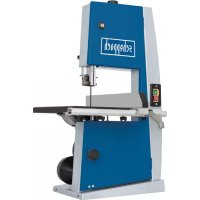
BASA1 - Saw SCHEPPACH - Free user manual and instructions
Find the device manual for free BASA1 SCHEPPACH in PDF.



Download the instructions for your Saw in PDF format for free! Find your manual BASA1 - SCHEPPACH and take your electronic device back in hand. On this page are published all the documents necessary for the use of your device. BASA1 by SCHEPPACH.
USER MANUAL BASA1 SCHEPPACH
Band saw Translation of original instruction manual
- Gabelschlüssel SW 10/8
- Inbusschlüssel SW 3/6
Explanation of the symbols on the device Warning! In case of non-compliance danger to life, risk of injury or damage to the tool possi- ble! Caution - Read the operating instructions to reduce the risk of inquiry! Wear safety goggles! Wear ear-mus! Wear a breathing mask! Important! Risk of injury. Never reach into the running saw blade! Wear protective gloves. Warning! Before installation, cleaning, alterations, maintenance, storage and transport switch o the device and disconnect it from the power supply. Saw blade direction The product complies with the applicable European directives.www.scheppach.com
The minimum age requirement must be complied with. In addition to the safety requirements in these oper- ating instructions and your country’s applicable regu- lations, you should observe the generally recognized technical rules concerning the operation of woodwork- ing machines. We cannot accept any liability for damage or accidents which arise due to a failure to follow these instructions and the safety instructions.
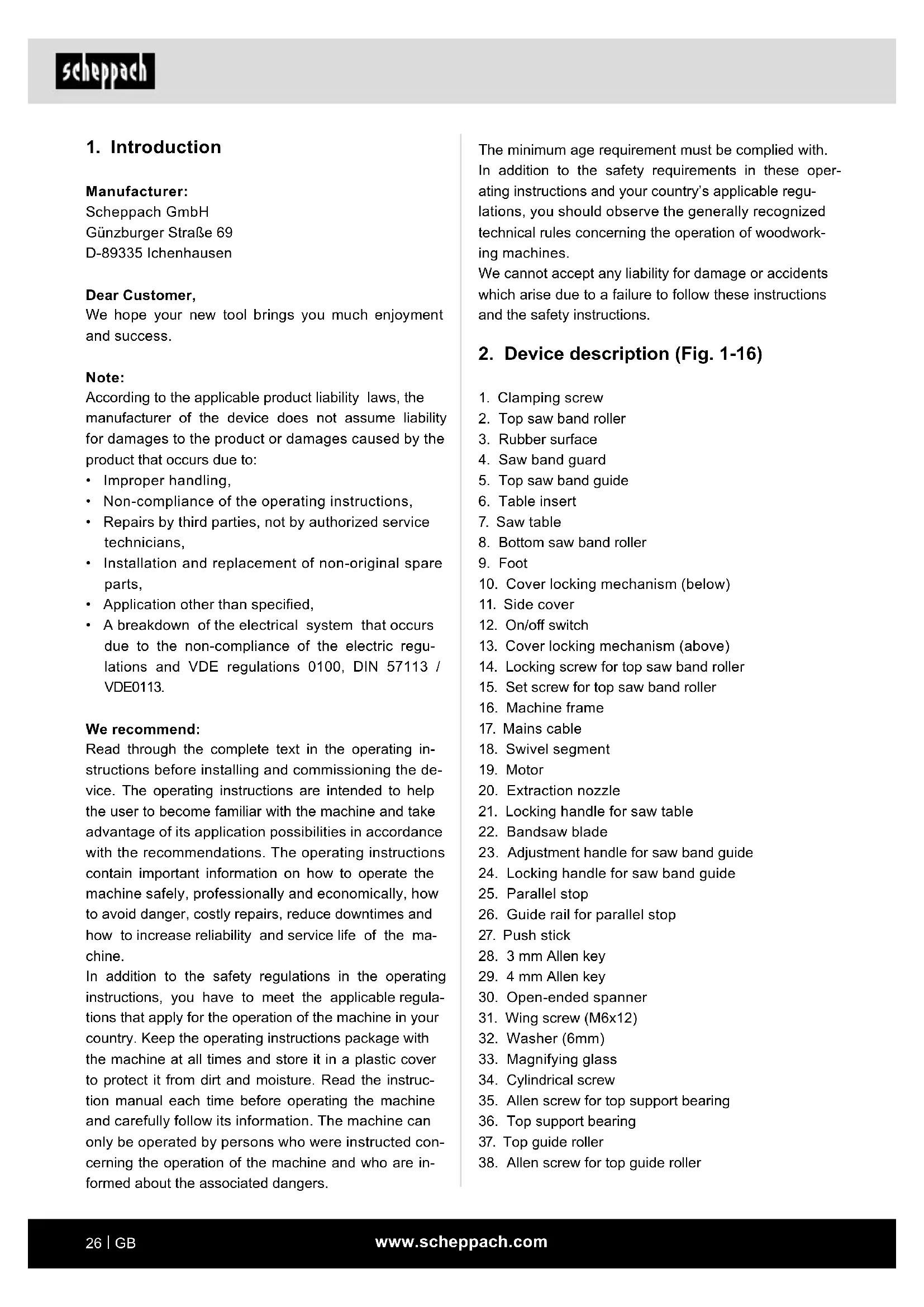
2. Top saw band roller
5. Top saw band guide
8. Bottom saw band roller
10. Cover locking mechanism (below)
13. Cover locking mechanism (above)
14. Locking screw for top saw band roller
15. Set screw for top saw band roller
23. Adjustment handle for saw band guide
24. Locking handle for saw band guide
31. Wing screw (M6x12)
35. Allen screw for top support bearing
36. Top support bearing
Manufacturer: Scheppach GmbH Günzburger Straße 69 D-89335 Ichenhausen Dear Customer, We hope your new tool brings you much enjoyment and success. Note: According to the applicable product liability laws, the manufacturer of the device does not assume liability for damages to the product or damages caused by the product that occurs due to:
- Non-compliance of the operating instructions,
- Repairs by third parties, not by authorized service technicians,
- Installation and replacement of non-original spare parts,
- Application other than specied,
- A breakdown of the electrical system that occurs due to the non-compliance of the electric regu- lations and VDE regulations 0100, DIN 57113 / VDE0113. We recommend: Read through the complete text in the operating in- structions before installing and commissioning the de- vice. The operating instructions are intended to help the user to become familiar with the machine and take advantage of its application possibilities in accordance with the recommendations. The operating instructions contain important information on how to operate the machine safely, professionally and economically, how to avoid danger, costly repairs, reduce downtimes and how to increase reliability and service life of the ma- chine. In addition to the safety regulations in the operating instructions, you have to meet the applicable regula- tions that apply for the operation of the machine in your country. Keep the operating instructions package with the machine at all times and store it in a plastic cover to protect it from dirt and moisture. Read the instruc- tion manual each time before operating the machine and carefully follow its information. The machine can only be operated by persons who were instructed con- cerning the operation of the machine and who are in- formed about the associated dangers.www.scheppach.com
The equipment is to be used only for its prescribed purpose. Any other use is deemed to be a case of mis- use. The user / operator and not the manufacturer will be liable for any damage or injuries of any kind caused as a result of this. The machine is to be operated only with suitable saw blades. To use the machine properly you must also o serve the safety regulations, the assembly instructions and the operating instructions to be found in this man- ual. All persons who use and service the machine have to be acquainted with this manual and must be informed about the machine’s potential hazards. It is also imper- ative to observe the accident prevention regulations in force in your area. The same applies for the general rules of occupational health and safety. The manufacturer shall not be liable for any changes made to the machine nor for any damage resulting from such changes. Even when the machine is used as prescribed it is still impossible to eliminate certain residual risk factors. The following hazards may arise in connection with the machine’s construction and design:
- Damage to hearing if ear-mus are not used as necessary.
- Harmful emissions of wood dust when used in closed rooms.
- Contact with the blade in the uncovered cutting zone.
- Injuries (cuts) when changing the blade.
- Injury from catapulted workpieces or parts of work- pieces.
- Tilting of the workpiece due to inadequate support.
- Catapulting of pieces of timber and workpieces. Please note that our equipment has not been designed for use in commercial, trade or industrial applications. Our warranty will be voided if the machine is used in commercial, trade or industrial businesses or for equivalent purposes.
41. Allen screw bottom support bearing
42. Bottom support bearing
49. Screw (saw table adjustment)
50. Nut (saw table adjustment)
3. Scope of delivery
- Open the packaging and remove the device care- fully.
- Remove the packaging material as well as the pack- aging and transport bracing (if available).
- Check that the delivery is complete.
- Check the device and accessory parts for trans- port damage.
- If possible, store the packaging until the warranty period has expired. m ATTENTION! The device and packaging materials are not toys! Children must not be allowed to play with plastic bags, lm and small parts! There is a risk of swal- lowing and suocation!
- Bandsaw / Bandsaw blade (pre-assembled)
- Guide rail for parallel stop
- Open-ended spanner, size 10/8
- Original operating instructions
The bandsaw is designed to perform longitudinal and cross cuts on timber or wood-type materials. To cut round materials you must use suitable holding devices.www.scheppach.com
10. Connect the dust extraction device if you will be
processing wood, materials similar to wood, or plastics. – If connections for dust extraction and a collect- ing device are present, make sure that they are connected and used properly. – When processing wood, materials similar to wood, and plastics. Operation in enclosed spac- es is only permitted with the use of a suitable extraction system.
11. Do not use the cable for purposes for which it is
not intended — Do not use the cable to pull the plug out of the outlet. Protect the cable from heat, oil and sharp edges.
12. Secure the workpiece
– Use the clamping devices or a vice to hold the workpiece in place. In this manner, it is held more securely than with your hand. – An additional support is necessary for long workpieces (table, trestle, etc.) in order to pre- vent the machine from tipping over. – Always press the workpiece rmly against the working plate and stop in order to prevent bouncing and twisting of the workpiece.
13. Avoid abnormal posture
– Make sure that you have secure footing and always maintain your balance. – Avoid awkward hand positions in which a sud- den slip could cause one or both hands to come into contact with the saw blade.
14. Take care of your tools
– Keep cutting tools sharp and clean in order to be able to work better and more safely. – Follow the instructions for lubrication and for tool replacement. – Check the connection cable of the electric tool regularly and have it replaced by a recognised specialist when damaged. – Check extension cables regularly and replace them when damaged. – Keep the handle dry, clean and free of oil and grease.
15. Pull the plug out of the outlet
– Never remove loose splinters, chips or jammed wood pieces from the running saw blade. – During non-use of the electric tool or prior to maintenance and when replacing tools such as saw blades, bits, milling heads.
5. General safety information
ATTENTION! The following basic safety measures must be observed when using electric tools for pro- tection against electric shock, and the risk of injury and re. Read all these notices before using the elec- tric tool and keep the safety instructions for later ref- erence. Safe work
1. Keep the work area orderly
– Disorder in the work area can lead to accidents.
2. Take environmental inuences into account
– Do not expose electric tools to rain. – Do not use electric tools in a damp or wet en- vironment. – Make sure that the work area is well-illuminated. – Do not use electric tools where there is a risk of re or explosion.
3. Protect yourself from electric shock
– Avoid physical contact with earthed parts (e.g. pipes, radiators, electric ranges, cooling units).
4. Keep children away
– Do not allow other persons to touch the equip- ment or cable, keep them away from your work area.
5. Securely store unused electric tools
– Unused electric tools should be stored in a dry, elevated or closed location out of the reach of children.
6. Do not overload your electric tool
– They work better and more safely in the spec- ied output range.
7. Use the correct electric tool
– Do not use low-output electric tools for heavy work. – Do not use the electric tool for purposes for which it is not intended. For example, do not use handheld circular saws for the cutting of branches or logs. – Do not use the electric tool to cut rewood.
8. Wear suitable clothing
– Do not wear wide clothing or jewellery, which can become entangled in moving parts. – When working outdoors, anti-slip footwear is recommended. – Tie long hair back in a hair net.
9. Use protective equipment
– Wear protective goggles. – Wear a mask when carrying out dust-creating work.www.scheppach.com
22. Have your electric tool repaired by a qualied
electrician – This electric tool conforms to the applicable safety regulations. Repairs may only be per- formed by an electrician using original spare parts. Otherwise accidents can occur. Additional safety instructions
- Wear safety gloves whenever you carry out any maintenance work on the blade!
- When cutting round or irregularly shaped wood, use a device to stop the workpiece from twisting.
- When cutting boards in upright position, use a de- vice to prevent kick-back.
- A dust extraction system designed for an air velocity of 20 m/s should be connected in order to comply with woodworking dust emission values and to en- sure reliable operation.
- Give these safety regulations to all persons who work on the machine.
- Do not use this saw to cut re wood.
- The machine is equipped with a safety switch to prevent it being switched on again accidentally af- ter a power failure.
- Before you use the machine for the rst time, check that the voltage marked on the rating plate is the same as your mains voltage.
- If you use a cable reel, the complete cable has to be pulled o the reel.
- Persons working on the machine should not be dis- tracted.
- Note the direction of rotation of the motor and blade.
- Never dismantle the machineʼs safety devices or put them out of operation.
- Never cut workpieces which are too small to hold securely in your hand.
- Never remove loose splinters, chips or jammed pieces of wood when the saw blade is running.
- It is imperative to observe the accident prevention regulations in force in your area as well as all other generally recognized rules of safety.
- Note the information published by your professional associations.
- Adjustable protective devices have to be adjusted as close as possible to the workpiece.
- Important! Support long workpieces (e.g. with a roll- er table) to prevent them sagging at the end of a cut.
- Make sure the blade guard (4) is in its lower position when the saw is being transported.
- Safety guards are not to be used to move or misuse the machine. – When the saw blade is blocked due to abnormal feed force during cutting, turn the machine o and disconnect it from power supply. Remove the work piece and ensure that the saw blade runs free. Turn the machine on and start new cutting operation with reduced feed force.
16. Do not leave a tool key inserted
– Before switching on, make sure that keys and adjusting tools are removed.
17. Avoid inadvertent starting
– Make sure that the switch is switched o when plugging the plug into an outlet.
18. Use extension cables for outdoors
– Only use approved and appropriately identied extension cables for use outdoors. – Only use cable reels in the unrolled state.
19. Remain attentive
– Pay attention to what you are doing. Remain sensible when working. Do not use the electric tool when you are distracted.
20. Check the electric tool for potential damage
– Protective devices and other parts must be carefully inspected to ensure that they are fault- free and function as intended prior to continued use of the electric tool. – Check whether the moving parts function faultlessly and do not jam or whether parts are damaged. – All parts must be correctly mounted and all conditions must be fullled to ensure fault-free operation of the electric tool. – The moving protective hood may not be xed in the open position. – Damaged protective devices and parts must be properly repaired or replaced by a recognised workshop, insofar as nothing dierent is spec- ied in the operating manual. – Damaged switches must be replaced at a cus- tomer service workshop. – Do not use any faulty or damaged connection cables. – Do not use any electric tool on which the switch cannot be switched on and o.
– The use of other insertion tools and other ac- cessories can entail a risk of injury.www.scheppach.com
Table size 313 x 302 x 25 mm Slewing range of the table 0° bis 45° Max. size of the workpiece 400 x 400 x 80 mm Overall weight 18 kg Subject to technical modications! The work piece must have a minimum height of 3 mm and a minimum width of 10 mm. The total noise values determined in accordance with EN 61029. Sound pressure level L
86,0 dB Uncertainty K
3 dB Wear hearing protection! The eects of noise can cause a loss of hearing. Keep the noise level and vibration to a minimum!
- Only use faultless devices.
- Maintain and clean the device at regular intervals.
- Adapt your working methods to the device.
- Do not overload the device.
- Have the device checked if necessary.
- Switch the device o if it is not in use.
7. Remaining hazards
The machine has been built using modern technology in accordance with recognized safety rules. Some re- maining hazards, however, may still exist.
- Risk of injury for ngers and hands by the rotat- ing saw band due to improper handling of the work piece. Risk of injury through the hurling work piece due to improper handling, such as working without the push stick.
- Risk of damaging your health due to wood dust and wood chips. Wear personal protective cloth such as goggles. Use a tting dust extractor.
- Risk of injury due to defective saw band. Regularely check saw band for such defects.
- Risk of injury for ngers and hands while changing saw band. Wear proper gloves.
- Risk of injury due to starting saw band while switch- ing on the machine.
- Blades that are misshapen or damaged in any way must not be used.
- If the table insert is worn, replace it.
- Never operate the machine if either the door pro- tecting the blade or the detachable safety device are open.
- Ensure that the choice of blade and the selected speed are suitable for the material to be cut.
- Do not begin cleaning the blade until it has come to a complete standstill.
- For straight cuts of small workpieces against the longitudinal limit stop the push stick has to be used.
- Wear gloves when handling the saw blade and rough materials
- The bandsaw blade guard should be in its lowest position close to the bench during transport.
- For miter cuts when the table is tilted, the parallel stop must be positioned on the lower part of the table.
- Never use guards to lift or transport items.
- Ensure that the bandsaw blade guards are used and correctly adjusted.
- Keep your hands a safety distance away from the bandsaw blade. Use a push stick for narrow cuts.
- The push stick has to be stored on the intended de- vice, so that it can be reached from normal working position and is always ready to be used.
- In the normal operating position the operator is in front of the machine. WARNING! This electric tool generates an electro- magnetic eld during operation. This eld can impair active or passive medical implants under certain con- ditions. In order to prevent the risk of serious or deadly injuries, we recommend that persons with medical im- plants consult with their physician and the manufactur- er of the medical implant prior to operating the electric tool.
- Set the swivel section to 30° by loosening the saw table locking handle (21) (g. 2).
- Guide the saw table (7) over the saw blade (22).
- Screw the saw table (7) to the swivel section (18) with 4 M6x12 hex screws. Do not fully tighten the screws.
- Swivel the saw table into the 0° position and tighten the saw table locking handle (21).
- Align the tabletop parallel to the saw blade. Tighten the 4 hex screws.
- Once adjustment is complete, close the side cover (11) again with the bottom (10) and top (13) cover locks in reverse order.
- Loosen the 3 hex nuts (X) ca. 2 turns and slide the swivel section with the mounted saw table. The saw band must run centrally in the table insert (6) (g. 3). Then tighten the 3 hex. nuts (X) again (g. 4). 9.2. Mounting the guide rail for the parallel stop (26) on the table (7) (Fig. 3)
- Screw in the 4 wing screws M6x12 (31), each with a at washer (32), ca. 5 mm into the saw table (7).
- Insert the guide rail for the parallel stop (26) until it stops against the table.
- Then tighten the 4 wing nuts. 9.3. Adjusting the parallel stop (Fig. 5)
- Place the parallel stop (25) on the guide rail (26) for the parallel stop, to the left of the saw blade, and clamp it rmly in place (see 10.2). The parallel stop must now be parallel to the cut-out in the saw table (7). It can be corrected by loosening the cylindrical screws (34). A 4 mm Allen key (not included) is re- quired for this. Remove the protective cap (Fig. 5.1).
9.3.1 Adjusting the scale (Fig. 5)
If necessary, the scale can be readjusted to the guide rail for the parallel stop.
- Place the longitudinal stop to the left of the saw blade, on the guide rail for the parallel stop.
- Measure 50 mm from the saw blade to the parallel stop. The graduation mark on the magnifying glass (33) should now be at 50 mm.
- If this is not the case, then loosen the Philips head screw (K) on the scale and set this to 50 mm. Tight- en the Philips head screw again.
- The use of incorrect or damaged mains cables can lead to injuries caused by electricity.
- Wear only closetting clothes. Remove rings, brace- lets and other jewelry.
- For the safety of long hair, wear a cap or hair net. Even when all safety measures are taken, some remaining hazards which are not yet evident may still be present.
- Remaining hazards can be minimized by follow- ing the instructions in „General safety instructions“ „Proper Use“ and in the entire operating manual.
8. Before starting the equipment
Make sure the machine stands securely, i.e. bolt it to a workbench or solid base. There are two holes for this purpose in the machine foot. (Fig. 17)
- The saw table must be mounted correctly.
- All covers and safety devices have to be properly tted before the machine is switched on.
- It must be possible for the blade to run freely.
- When working with wood that has been processed before, watch out for foreign bodies such as nails or screws etc.
- Before you actuate the On/O switch, make sure that the saw blade is correctly tted and that the machine’s moving parts run smoothly.
- Before you connect the machine to the power sup- ply, make sure the data on the rating plate is the same as that for your mains.
ATTENTION! Before all maintenance, set-up and assembly work on the band saw, unplug the mains plug. Assembly tools 1 Open-ended spanner, size 10/13 1 Allen key, size 3 1 Allen key, size 6 The saw table is not assembled for packaging rea- sons. 9.1. Assembling the saw table (Fig. 1-4)
- Open the side covers (11) by undoing the top (13) and bottom (10) cover locks. First unlock the top cover lock (13) with the help of the 6 mm Allen key (29) by turning this counter-clockwise. Then unlock the bottom cover lock (10) by unscrewing it coun- ter-clockwise.www.scheppach.com
If this is not the case, the angle of the top saw band roller (2) must be adjusted again.
- Turn the saw band roller a few times, until the ad- justment of the top saw band roller (2) acts on the saw band position on the bottom saw band roller (8).
- Tighten the locking screw for the top saw band roll- er (14).
- Once adjustment is complete, close the side cover (11) again with the bottom (10) and top (13) cover locks in reverse order. 9.6. Adjusting the saw band guide (Fig. 6-9) Both the support bearing (36 + 42) and the guide pins (37 + 46) must be readjusted after every saw band change.
- Open the side covers (11) by undoing the top (13) and bottom (10) cover locks. First unlock the top cover lock (13) with the help of the 6 mm Allen key (29) by turning this counterclockwise. Then unlock the bottom cover lock (10) by unscrewing it coun- terclockwise.
- Once adjustment is complete, close the side cover (11) again with the bottom (10) and top (13) cover locks in reverse order.
9.6.1. Top support bearing (36) ( Fig. 6)
- Undo Allen screw for top support bearing (35).
- Move support bearing (36) suciently far that it just no longer touches the Bandsaw blade (22) (distance max. 0.5 mm).
- Retighten the Allen screw for the top support bear- ing (35).
9.6.2. Adjusting the bottom support bearing (42)
- Disassemble the saw table as per 9.1 in the oppo- site direction.
- Undo Allen screw for bottom support bearing (41).
- Move bottom support bearing (42) suciently far that it just no longer touches the Bandsaw blade (22) (distance max. 0.5 mm).
- Retighten Allen screw for bottom support bearing (41).
- Move top retainer (39), top guide rollers (37), until the front edge of the guide rollers (37) is approx. 1 mm behind the tooth base of the saw band.
- Retighten Allen screws for top retainer (40). 9.4. Tensioning the saw band (Fig. 1a) ATTENTION! If the saw is at a standstill for an extend- ed period the saw band tension must be relieved, i.e. before switching the saw on it is necessary to check the saw blade tension.
- Turn the clamping screw (1) clockwise to tension the Bandsaw blade (22). The correct tension of the saw band can be determined by pressing the nger laterally against the saw band, roughly centrally be- tween the two saw band rollers (2+8). The Bandsaw blade (22) should only depress slightly (approx. 1-2 mm) here.
- The suciently tensioned saw band makes a me- tallic sound when tapped.
- Relieve the saw band tension if it is not in use for an extended time, so that it does not become over- stretched. ATTENTION! With high tension, the saw band may break. RISK OF INJURY! If the tension is too low, the driven saw band roller (8) may spin, resulting in the saw band coming to a standstill.
9.5 Adjusting the saw band (Fig. 1a+1b)
ATTENTION! Before it is possible to implement the saw band setting, the saw band must be tensioned correctly.
- Open the side covers (11) by undoing the top (13) and bottom (10) cover locks. First unlock the top cover lock (13) with the help of the 6 mm Allen key (28) by turning this counter-clockwise. Then unlock the bottom cover lock (10) by unscrewing it coun- ter-clockwise.
- Slowly turn the saw band roller (2) clockwise. The Bandsaw blade (22) should run centrally on the saw band roller (2). If this is not the case, the angle of the top saw band roller (2) must be corrected.
- If the Bandsaw blade (22) runs more towards the rear edge of the saw band roller (2) then the set screw (15) must be rotated anticlockwise.
- Open the locking screw for the top saw band roll- er (14).
- Turn the bottom saw band roller (8) slowly by hand, to check the position of the Bandsaw blade (22).
- If the Bandsaw blade (22) runs more towards the front edge of the saw band roller (2) then the set screw (15) must be rotated clockwise.
- After setting the top saw band roller (2), check the position of the Bandsaw blade (22) on the bottom saw band roller (8). The Bandsaw blade (22) should also lie centrally on the saw band roller (8) here.www.scheppach.com
- Tilt the saw table (7) by turning, until the angle to the Bandsaw blade (22) is precisely 90°. If the saw table is already on the screw (49) and a 90° angle cannot be set, undo the nut (50) and shorten the screw (49) by turning in a clockwise direction.
- Tighten the locking handle for the saw table (21) again by turning clockwise.
- Also undo the nut (50).
- Adjust the screw (49) suciently that the saw table touches the underside.
- Retighten the nut (50) to x the screw (49) in po- sition.
- If necessary, set the scale pointer (51) to 0° on the graduated scale (52). (Fig. 11) 9.9. Which saw band to use The saw band supplied in the band saw is intended for universal use. The following criteria should be consid- ered when selecting the saw band:
- It is possible to cut tighter radii with a narrow saw band than with a wide saw band.
- A wide saw band is used if a straight cut is required. This is important in particular when cutting wood. The saw band has a tendency to follow the wood grain and therefore deviates easily from the desired cutting line.
- Fine-toothed saw bands cut more smoothly, but also more slowly than coarse saw bands. ATTENTION: Never use bent or torn saw bands! 9.10. Replacing the saw band (Fig. 1a+1b+3+15)
- Set the saw band guide (5) at approx. half height between the saw table (7) and machine frame (16).
- Undo the cover locking mechanisms (10+13) and open the side covers (11).
- Remove the guide rail for the parallel stop (26) in reverse order (see 9.2)
- Relieve the Bandsaw blade (22) tension by turning the clamping screw (1) anti-clockwise.
- Remove the Bandsaw blade (22) from the saw band rollers (2+8) and through the slot in the saw table (7).
- Place the new Bandsaw blade (22) centrally on both saw band rollers (2+8). The teeth of the Bandsaw blade (22) must point downwards in the direction of the saw table (Fig. 6).
- Tension the Bandsaw blade (22) (see 9.4)
- Close the side cover (11) again.
- Then t the guide rail for the parallel stop again (per 9.2).
- Slide the guide rollers (37) in the direction of the saw band! Important note! The distance between the guide rollers (37) and saw band (22) must not exceed 0.5 mm. (Saw band must not jam)
- Retighten Allen screws (38).
- Turn the top saw band roller (2) a few times in a clockwise direction.
- Move bottom retainer (47), bottom guide rollers (46), until the front edge of the bottom guide rollers (46) is approx. 1 mm behind the tooth base of the saw band.
- Slide the two bottom guide rollers (46) suciently far in the direction of the saw band that the distance between the guide rollers (46) and saw band (22) is max. 0.5 mm. (Saw band must not jam)
- Retighten Allen screws for bottom guide rollers (45).
- Turn the bottom saw band roller (8) a few times in a clockwise direction.
- Undo locking handle for saw band guide (24).
- Turn the adjustment handle for the saw band guide (23) to lower the saw band guide (5) as closely as possible (distance approx. 2-3 mm) over the mate- rial to be cut.
- Retighten locking handle (24).
- Check the setting before every cutting process and adjust if necessary. 9.8. Adjusting the saw table (7) to 90° (Fig. 11+12)
- Set the top saw blade guide (5) fully upwards.
- Loosen the locking handle for the saw table (21) by turning counter-clockwise.
- Place the angle bracket between the Bandsaw blade (22) and saw table (7). Angle bracket not in- cluded in the scope of supply.www.scheppach.com
- Loosen the locking handle for saw table (21).
- Tilt saw bench (7) forwards, until the desired angle is set on the degree scale (52).
- Retighten locking handle (21). ATTENTION: With a tilted saw table (7), the parallel stop (25) must always be tted to the right of the Band- saw blade (22) in the working direction. This prevents the workpiece from slipping.
11. Working instructions
The following recommendations are examples of the safe use of band saws. The following safe working methods should be seen as an aid to safety. They cannot be applied suitably com- pletely or comprehensively to every use. They cannot treat every possible dangerous condition and must be interpreted carefully.
- Connect the machine to a suction unit when working in closed rooms. A suction device which conforms with commercial regulations must be used for suc- tion in commercial areas.
- Loosen the sawband when the machine is not in operation (e.g. after nishing work). Attach a no- tice on the tension of the saw band to the machine for the next user.
- Collect unused sawbands and store them safely in a dry place. Check for faults (teeth, cracks) before use. Do not use faulty sawbands!
- Wear suitable gloves when handling sawbands.
- All protective and safety devices must be securely mounted on the machine before beginning work.
- Never clean the sawband or the sawband guide with a hand-held brush or scraper while the sawband is running. Resin-covered sawbands impair working safety and must be cleaned regularly.
- For your own protection, wear protective glasses and hearing protection. Wear a hairnet if you have long hair. Roll up loose sleeves over the elbows.
- Always position the sawband guide as near the workpiece as possible when working.
- Insure sucient lighting in the work area and around the machine.
- Always use the fence for straight cuts to keep the workpiece from tipping or slipping away.
- When working on narrow workpieces with manual feed, use the push stick.
- For diagonal cuts, place the saw bench in the ap- propriate position and guide the workpiece on the fence. 9.11. Replacing the table insert (Fig. 14) In case of wear or damage, the table insert (6) must be replaced; otherwise there is an increased risk of injury.
- Remove the worn table insert (6) by lifting it up and out.
- Installation of the new table insert takes place in reverse order. 9.12. Extraction nozzle (Fig. 1b) The band saw is equipped with an extraction nozzle (20) 100/40 mm for chips. Only operate the device with a suitable extraction sys- tem. Check and clean the suction channels at regular intervals. 9.13. Push Stick retainer (Fig. 13) The Push Stick retainer (48) is pre-mounted on the machine frame. If unused, the Push stick (27) must always be stowed in the Push Stick retainer.
ATTENTION! Always make sure the device is fully assembled before commissioning!
- The band saw is equipped with an undervoltage switch. With a power failure, the band saw must be switched back on again. 10.2. Parallel stop (Fig. 17)
- Press the clamping bar (H) of the parallel stop (25) upwards
- Position the parallel stop (25) to the left or right of the saw blade (22) on the guide rail for the parallel stop and set to the desired measurement.
- Press the clamping bar (H) down to x the parallel stop (25) in place.
- Make sure that the parallel stop (25) always runs parallel to the Bandsaw blade (22). 10.3. Angled cuts (Fig. 2+12+19) In order to execute angled cuts parallel to the Band- saw blade (22), it is possible to tilt the saw bench (7) forwards from 0° - 45°.www.scheppach.com
- Slide the workpiece at an even feed rate along the longitudinal fence (25) into the Bandsaw blade (22).
- Important: Long workpieces must be secured against tipping at the end of the cutting process (e.g. with reel-o stand, etc.)
11.2 Performing angled cuts (Fig. 19)
- Set saw bench to desired angle (see „Angled cuts“).
- Perform the cut as described under „11.1“. When producing angled cuts, only use the parallel stop to the right of the saw band.
11.3 Freehand cuts (Fig. 21)
One of the most important features of a band saw is the ease with which it can cut curves and radii.
- Lower the saw band guide (5) onto the workpiece (see 9.5).
- Press the workpiece rmly onto the saw bench (7) and slowly slide into the Bandsaw blade (22).
- In many cases it is helpful to roughly saw curves and corners approximately 6 mm from the line.
- If it is necessary to saw curves that are too tight for the saw band used, auxiliary cuts must be sawn up to the front face of the curve, so that these fall o as wood waste when the nal radius is sawn.
The machine must only be lifted and transported on its frame or the frame plate. Never lift the machine at the safety devices, the adjusting levers, or the sawing table. During the transport the saw blade protection must be in the lowest position and near the table. Never raise at the table! Unplug the machine from the mains during transport.
13. Cleaning and maintenance
WARNING! Prior to any adjustment, maintenance or service work disconnect the mains power plug! Cleaning Keep all safety devices, air vents and the motor hous- ing free of dirt and dust as far as possible. Wipe the equipment with a clean cloth or blow it with com- pressed air at low pressure. We recommend that you clean the device immediately each time you have nished using it.
- In order to cut dovetail tenons and teeth or wedges, bring the saw table into the corresponding position on the angle scale.
- For arced and irregular cuts, push the workpiece evenly using both hands with the ngers together. Hold the workpiece with your hands on a safe area.
- Use a pattern for repeated arced or irregular cuts.
- Insure that the workpiece does not roll when cutting round pieces. Attention! After every new setting, we recommend performing a test cut, in order to check the dimen- sional settings.
- With all cutting processes, the top saw band guide (5) must be positioned as close as possible to the workpiece (see 9.5).
- The workpiece must always be guided with both hands and kept at against the saw table (7). This prevents the Bandsaw blade (22) from jamming.
- Forward feeding should always take place with an even pressure, which is just sucient for the saw band to cut through the material with ease without becoming blocked.
- Always use the parallel stop (25) for all cutting pro- cesses that it can be used for.
- It is better to perform a cut in a single working step than in multiple steps, which may require that the workpiece be drawn back. However, if it is not pos- sible to avoid drawing the workpiece back then the band saw must be switched o rst. Only draw the workpiece back once the bandsaw blade (22) has come to a standstill.
- When sawing, the workpiece must always be guided by its longest side. ATTENTION! When processing narrower workpieces it is essential to use a Push stick. The Push stick (27) must always be stored within reach, on the Push Stick retain- er (48) provided for this purpose on the side of the saw.
11.1 Performing longitudinal cuts (Fig. 20)
Here, a workpiece is cut in its longitudinal direction.
- Position the longitudinal fence (25) on the left side (if possible) of the Bandsaw blade (22), in accord- ance with the desired width.
- Lower the saw band guide (5) onto the workpiece (9.5).
- Switch on the saw (see 10.1).
- Press one edge of the workpiece against the longi- tudinal fence (25) with the right hand, whilst the at side lies on the saw bench (7).www.scheppach.com
- Insulation damages caused by pulling the connec- tion line out of the wall socket.
- Fissures caused by the ageing of the insulation. Such defective electric connection lines must not be used and are hazardous due to the insulation damag- es. Regularly check the electrical connection lines for damages. Please make sure that the connection lines are disconnected from the mains supply during the check. Electrical connection lines must comply with the rel- evant VDE and DIN regulations. Only use connection lines labelled with H05VV-F. The labelling of the connection cable with the type specication is required. AC motor
- The mains voltage must be 230 - 240 V~
- Extension cables up to 25 m long must have a cross-section of 1.5 mm
Connections and repairs of electrical equipment may only be carried out by an electrician. Connection type X If the mains connection cable of this product is dam- aged, it must be replaced by a specially prepared mains connection cable which can be obtained from the manufacturer or its service department. Please provide the following information in the event of any enquiries:
- Type of current for the motor
16. Disposal and recycling
Notes for packaging The packaging materials are recy- clable. Please dispose of packag- ing in an environmentally friendly manner. Maintenance There are no parts inside the equipment which require additional maintenance. Service information Please note that the following parts of this product are subject to normal or natural wear and that the following parts are therefore also required for use as consum- ables. Wear parts*: Bandsaw blade, Table insert, Push stick
- Not necessarily included in the scope of delivery! Spare parts and accessories can be obtained from our service centre. To do this, scan the QR code on the cover page.
Store the device and its accessories in a dark, dry and frost-proof place that is inaccessible to children. The optimum storage temperature is between 5 and 30˚C. Store the power tool in original packaging. Cover the electrical tool in order to protect it from dust and moisture. Store the operating manual with the electrical tool.
15. Electrical Connection
The installed electric motor is connected and is ready to work. The connection complies with the relevant VDE and DIN regulations. The customer-side mains supply and the used extension line must meet these regulations. Important information In the event of an overloading the motor will switch itself o. After a cool-down period (time varies) the motor can be switched back on again. Defective Electric Connection Lines Often, insulation damages occur on electrical connec- tion lines. Causes are:
- Drag marks if connection lines are led through win- dow or door clearances.
- Kinks due to improper attachment or routing of the connection line.
- Cuts caused by running over the connection line.www.scheppach.com
Notes on the electrical and electronic equipment act [ElektroG] Waste electrical and electronic equipment does not belong in household waste, but must be collected and disposed of sepa- rately!
- Used batteries or rechargeable batteries that are not installed permanently in the old appliance must be removed non-destructively before disposal. Their disposal is regulated by the battery law.
- Owners or users of electrical and electronic devices are legally obliged to return them after use.
- The end user is responsible for deleting their per- sonal data from the old device being disposed of!
- The symbol of the crossed-out dustbin means that waste electrical and electronic equipment must not be disposed of with household waste.
- Waste electrical and electronic equipment can be handed in free of charge at the following places: - Public disposal or collection points (e.g. municipal works yards) - Points of sale of electrical appliances (stationary and online), provided that dealers are obliged to take them back or oer to do so voluntarily. - Up to three waste electrical devices per type of device, with an edge length of no more than 25 centimetres, can be returned free of charge to the manufacturer without prior purchase of a new device from the manufacturer or taken to another authorised collection point in your vicinity. - Further supplementary take-back conditions of the manufacturers and distributors can be ob- tained from the respective customer service.
- If the manufacturer delivers a new electrical appli- ance to a private household, the manufacturer can arrange for the free collection of the old electrical appliance upon request from the end user. Please contact the manufacturer’s customer service for this.
- These statements only apply to devices installed and sold in the countries of the European Union and which are subject to the European Directive 2012/19/EU. In countries outside the European Un- ion, dierent regulations may apply to the disposal of waste electrical and electronic equipment.www.scheppach.com
Problem Possible cause Help Motor does not work Motor, cable or plug defective, fuses burnt Housing cover open (limit switch) Arrange for inspection of the machine by a special- ist. Never repair the motor yourself. Danger! Check fuses and replace as necessary Close housing cover exactly The motor starts up slowly and does not reach operating speed. Voltage too low, coils damaged, capacitor burnt Contact the utility provider to check the voltage. Arrange for inspection of the motor by a special- ist. Arrange for replacement of the capacitor by a specialist Motor makes excessive noise Coils damaged, motor defective Arrange for inspection of the motor by a specialist The motor does not reach its full power. Circuits in the network are over- loaded (lamps other motors, etc.) Do not use any other equipment or motors on the same circuit Motor overheats easily. Overloading of the motor, insu- cient cooling of the motor Avoid overloading the motor while cutting, remove dust from the motor in order to ensure optimal cooling of the motor Saw cut is rough or wavy Saw blade dull, tooth shape not appropriate for the material thickness Resharpen saw blade and/or use suitable saw blade Workpiece pulls away and/or splinters Excessive cutting pressure and/ or saw blade not suitable for use Insert suitable saw blade Saw blade is not run- ning straight Guide has been wrongly set Wrong saw blade Set the saw blade guide according to the operating instructions Select a saw blade according to the operating instructions Burn marks appear on the wood during the cutting work Blunt saw blade Wrong saw blade Change the saw blade Select a saw blade according to the operating instructions Saw blade jams during cutting work Blunt saw blade Deposits on the saw blade Guide has been set poorly Change the saw blade Clean the saw blade Set the saw blade guide according to the operating instructionswww.scheppach.com
86,0 dB Nesigurnost K
86,0 dB Nezanesljivost K