G101 - Screwdriver Abac - Free user manual and instructions
Find the device manual for free G101 Abac in PDF.



| Product type | Pneumatic impact wrench |
| Brand | Abac |
| Model | G101 |
| Category | Impact wrench |
| Power source | Compressed air |
| Recommended operating pressure | 6,2 bar (90 psi) |
| Approximate dimensions | 250 x 200 x 80 mm |
| Approximate weight | 2,5 kg |
| Main functions | Tightening and loosening nuts, bolts and threaded screws |
| Speed control | Trigger and progressive adjustment button |
| Rotation direction | Forward (F) and reverse (R) via F/R button |
| Included accessories | Impact socket set |
| Maintenance | Regular lubrication, filter cleaning, condensation drainage |
| Cleaning | Clean the fittings and air inlet, dry the tool after use |
| Safety | Wear protective gloves and goggles, do not use in explosive atmosphere |
| Spare parts available | Sockets, fittings, seals, silencers |
| Reparability | Repairs by qualified personnel only |
| Warranty | 12 months (parts and labor) |
| General information | 148-page manual, available in several languages |
Frequently Asked Questions - G101 Abac
User questions about G101 Abac
0 question about this device. Answer the ones you know or ask your own.
Ask a new question about this device
Download the instructions for your Screwdriver in PDF format for free! Find your manual G101 - Abac and take your electronic device back in hand. On this page are published all the documents necessary for the use of your device. G101 by Abac.
USER MANUAL G101 Abac
EN Impact wrench kit - Instructions
natural_image
Black industrial air潍 toy with trigger handle and control knob (no visible text or symbols)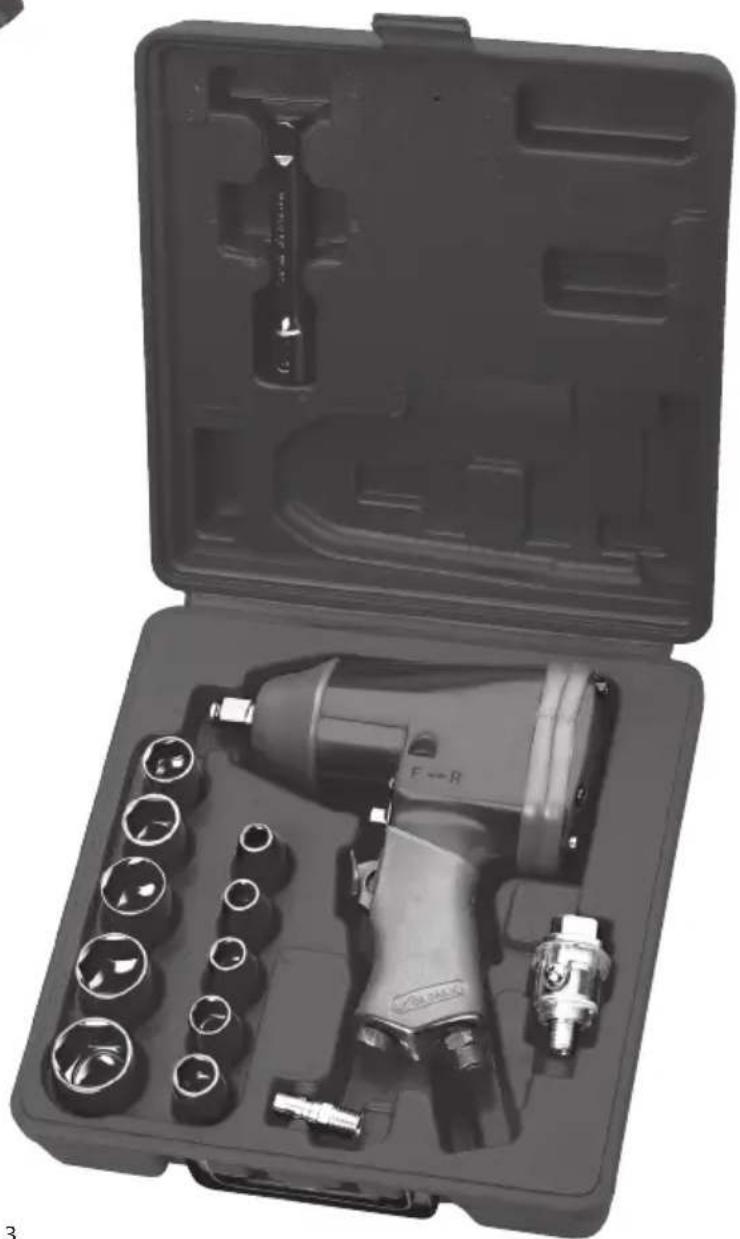
natural_image
Open black hard-shell tool kit with multiple screw holes and a force-driven drill (no visible text or symbols)IMPACT WRENCH KIT
| Air pressure max, Pressione pneumatica max., Maximaler Luftdruck, Pression d'air max, Presión de aire máx.,Pressão de ar máx., Max. luchtdruk, Maks. lufttryk, Lufttryck max, Ilman enimmäispaine, Max. ciśnienie, Męy.nieση aépo, Maks. tlak zraka, Zračni tlak maks., Max. súritett levegő nyomás, Max. tlak vzduchu, Max. tlakvzduchu, Maks. давление воздуха, Maks. lufttrykk, Hava basinci maks., Presiune de aer max., Máscimalnonaлягане на въздуха, Maks. radni pritisak, Oro slégis maks., Maksimaalne öhusurve, Maks. gaisa spiediens,Máscimalno налягане на въздуха, Maks. radni pritisak. | bar 6,3 | ||
| Socket drive, Attacco incassato, Steckschlüssel, Embase de douille, enchufe de accionamiento, Unidade desoquete, Inbusaandrijving, Sokkeldrev, Hylsnyckel, Vääntiö, Šrubokręt nasadkowy, Ynoðoχή, Utični pogon,Šestkotni nastavek, Karmantýús meghajtás, Nástrčný hrot, Nástrčný hrot, Torцевая головка, Socketnøkkel,Soket ṣç, Chele tubulară, Błockka, Nasadni ključ, Lizdinis suktuvas, Pesaühendus, Ligzdas piedziņa,шестостенна вложка, Gedora. | [inch] 1/2" | ||
| Torque, Coppia, Drehmoment, Couple, Par, Binário, Koppel, Drejningsmoment, Vridmoment, Vääntömomentti,Moment obrotowy, Ponį, Moment pritezanja, Vrtilni moment, Nyomaték, Točivý moment, Ut'ahovací moment,Kрутящий момент, Dreiemoment, Tork, Cupli, Bъртящ момент, Obrtni moment, Sukimo momentas,Pöördemoment, Griezes moments, Bъртящ момент, Obrtni moment. | [Nm] 345 | ||
| Revolutions per minute, Giri al minuto, Umdrehungen pro Minute, Tours par minute, Revoluciones por minuto,Rotações por minuto, Omwentelingen per minuut, Omdrejningstal o/min., Varv per minut, Kierrosta minuutissa,Obroty na minute, Στροφές ανὰ λεπτὸ, Broj okretaja u minuti, Vrtljaji na minuto, Fordulatszám percenként,Otáčky za minutu, Otáčky za minútu, Частота вращения вала, Omdreininger per minutt, Dakikadaki devirsayisi, Rotatii pe minut, Скорост на въртене, Obrtaja u minutu, Sūkių skaičius per minute, Pöörete arv minutis,Apgriezieni minūtě, Скорост на въртене, Obrtaja u minutu. | [min-1] 7000 | ||
| Air consumption, Consumo d'aria, Luftverbrauch, Consommation d'air, Consumo de aire, Consumo deLuchtverbruik, Luftforbrug, Luftförbrukning, Ilman kulutus, Zużycie powietrza, Kotaválωση αépo, Potrošnjazraka, Poraba zraka, Súritettlevegő-igény, Spotřeba vzduchu, Spotreba vzduchu, Потребление воздуха,Luftforbruk, Hava tüketimi, Consum de aer, Разход на въздух, Potrošnja vazduha, Oras sąnaudos, Ôhutarve,Gaisa patērinš, Разход на въздух, Potrošnja vazduha. | a[1/s] 4 | ||
| Vibration level EN-ISO 28927-9, Livello di vibrazioni EN-ISO 28927-9, Schwingungspegel EN-ISO 28927-9,Niveau de vibrations EN-ISO 28927-9, Nivel de vibración EN-ISO 28927-9, Nivel de vibração EN-ISO 28927-9,Trillingsniveau EN-ISO 28927-9, Vibrationsniveau EN-ISO 28927-9, Vibrationsnivå EN-ISO 28927-9, TärinätasoEN-ISO 28927-9, Poziom wibracji EN-ISO 28927-9, Enineðo dövnęŋς EN-ISO 28927-9, Razina vibracija EN-ISO28927-9, Raven tresljajev EN-ISO 28927-9, Rezgés szintje az EN-ISO 28927-9 szerint, Hladina vibraci podlenormy EN-ISO 28927-9, Úroveň vibrácí podľa EN-ISO 28927-9, Уровень вибрации согласно стандарту EN-ISO 28927-9, Vibrasjonsnivå EN-ISO 28927-9, Titreşim seviyesi EN-ISO 28927-9, Nivel de vibratei EN-ISO28927-9, Ниво на вибрациите съгласно EN ISO 28927-9, Nivo vibracija EN-ISO 28927-9, Vibracijos lygis EN-ISO 28927-9, Vibratsioonitase EN-ISO 28927-9, Vibracijas līmenis saskaņa ar standartu EN-ISO 28927-9, Нивона вибрациите съгласно EN ISO 28927-9, Nivo vibracija EN-ISO 28927-9. | [m/s2] 2,8 | ||
| Sound pressure level (LPA) acc. to. EN ISO 15744, Livello di pressione acustica (LPA) sec. EN ISO 15744,Schalldruckpegel (LPA) gem. EN ISO 15744, Niveau de pression sonore (LPA) selon la norme EN ISO 15744,Nivel de presión sonora (LPA) según EN ISO 15744, Nivel de pressão sonora (LPA) de acordo com a normaEN ISO 15744, Geluidsdrukniveau (LPA) volgens EN ISO 15744, Lydtryksniveau (LPA) iht. EN ISO 15744,Ljudtrycksnivå (LPA) enligt EN ISO 15744, Äänenpainetaso (LPA) standardin EN ISO 15744 mukainen, Poziomciśnienia akustycznego (LPA) zgod. z normą EN ISO 15744, Enineðo ἡnxootrůθμης (LPA) κατά. EN ISO 15744,Razina zvučnog tlaka (LPA) prema. EN ISO 15744, Raven zvočnega tlaka (LPA) v skladu z. EN ISO 15744,Hangnyomássztint (LPA) az EN ISO 15744 szerint, Hladina akustického tlaku (LPA) podle normy EN ISO 15744,Hladina akustického tlaku (LPA) podľa EN ISO 15744, Уровень звукового давления (LPA) согласно стандартуEN ISO 15744, Lydtrykksnivå (LPA) iht.EN ISO 15744, Ses basinç seviyesi (LPA) - EN ISO 15744 uyarinca, Nivelde presiune sonorą (LPA) conform cu EN ISO 15744, Ниво на звуковото налягане (LPA) съгласно EN ISO15744, Nivo zvučnog pritiska (LPA) u skladu sa. EN ISO 15744, Garso slégio lygis (LPA) pagal EN ISO 15744,Helirōhu tase (LPA) vastavalt EN ISO 15744, Skaņas spiediena līmenis (LPA), saskaņa ar standartu EN ISO15744, Ниво на звуковото налягане (LPA) съгласно EN ISO 15744, Nivo zvučnog pritiska (LPA) u skladu sa.EN ISO 15744. | [dB(A)] 92,6 | ||
| size length x wide x height, lunghezza x ampiezza x altezza, Größe Länge x Breite x Höhe, dimensions longueux largeur x hauteur, Tamaño (largo x ancho x alto), tamanho comprimento x largura x altura, Afmetingen: lengte x bredte x hoogte, størrelse længde x højde, längd x bredd x höjd, koko pituus x leveysx korkeus, rozmiar: długość x szerokość x wysokość, μέγεθος μήκος πλάτος x ύψος, dimenzijze duljina xširina x visina, dimenzije dolžina x širina x višina, méret hosszúság x szélesség x magasság, velikost délka xšifka x výška, Rozmery (D × Š × V), Размеры, длина x ширина x высота, størrelse lengde×bredde×høyde,boyutlar (uzunluk x genişlik x yükseklik), mărime lungime x lätime x înalțime, Размери: дължина x широчинax височина, veličina dužina x širina x visina, matmenys ligis x plotis x aukštis, suurus pikkus x laius x körgus,garums x platums x augstums, Размери: дължина x широчина x височина, veličina dužina x širina x visina | [mm] 180 x 63 x 190 | ||
| weight, peso, Gewicht, poids, Peso, peso, Gewicht, vægt, vikt, paino, waga, βόρος, težina, teža, tömeħmotnost, Hmotnosť, Macca, vekt, ağırlık, greutate, Maca, težina, svoris, kaal, svars, Maca, težina. | [19] 1/4" i | ||
| Air inlet (BSP), Ingresso aria (BSP), Lufteinlass (BSP), Entrée d'air (BSP), Entrada de aire (BSP), Entrada de ar (BSP), Luchtinlaat (BSP), Luftindtag (BSP), Luftintag (BSP), Ilmantulo (BSP), Wlot powietrza (BSP),Eiοδος αέρο (BSP), Ulaz zraka (BSP), Vhod za zrak (BSP), Levegőbemenet (BSP), Prívod vzduchu (BSP), Prívod vzduchu (BSP), Воздухозаборник (BSP), Luftintak (BSP), Hava girisi (BSP), Admisie a aerului (BSP), Размерна отвора за въздух (BSP), Ulaz vazduha (BSP), Oras jleidimo anga (BSP), Ôhu sisselase (BSP), Gaisa ievade (BSP), Вход за въздух (BSP), Ulaz vazduha (BSP). | [inch] 1/4" i |

| FR | Lire attentivement la notice et les étiquettes de l’outil. Lire et suivre toutes les instructions. |
| EN | Read the manual and tool labels carefully. Read and follow all the instructions. |
| IT | Leggere attentamente il manuale e le etichette dell’utensile. Leggere e seguire tutte le istruzioni. |
| DE | Die Bedienungsanleitung und die Etiketten des Geräts aufmerksam durchlesen. Alle Anweisungen lesen und befolgen. |
| ES | Lea atentamente el manual y las etiquetas de la herramienta. Lea y siga todas las instrucciones. |
| PT | Ler atentamente o manual e as etiquetas da ferramenta. Ler e seguir todas as instruções. |
| GR | Διαβάστε προσεκτικά τις οδηγίες και τις ετικέτες του εργαλείου. Διαβάστε και ακολουθήστε όλες τις οδηγίες. |
| TR | Aletin kılavuzunu ve etiketlerini dikkatlice okuyun. Yönergelerin tümünü okuyun ve uygulayın. |
| NL | Lees de handleiding en de etiketten van het gereedschap aandachtig door. Lees alle instructies en volg deze op. |
| DK | Læs vejledningen og mærkaterne på redskabet grundigt. Læs og følg alle instruktionerne. |
| NO | Les nøye verktøyets etiketter og håndbok Les og følg alle instruksjoner. |
| SE | Läs noggrant igenom verktygets handbok och etiketter. Läs igenom och följ alla instruktioner. |
| FI | Lue huolellisesti ohjekirja ja työkalun merkinnät. Lue ja noudata kaikkia ohjeita. |
| CZ | Pozorně si přečtěte návod a štítky na nástroji. Přečtěte si a dodržujte všechny pokyny. |
| PL | Należy zapoznać się z treścią instrukcji obsługi oraz etykiety umieszczonej na urządzeniu. Należy zapoznać się z wszystkimi zaleceniami i uważnie ich przestrzegać. |
| SI | Natančno preberite navodila in etikete orodja Vsa navodila preberite in upoštevajte. |
| SK | Pozorne si prečítajte návod a štítky na nástroji. Prečítajte si a dodržiavajte všetky pokyny. |
| LT | Atidžiai perskaitykite įrankio vadovą ir etiketes. Perskaitykite ir laikykitės visų nurodymų. |
| BE | Уважліва прачытайце інструкцыю выкарыстання і этикетку інструмента. Азнаёмцеся і выконвайце ўсе ůказанні. |
| RU | Внимательно прочитайте инструкцию и этикетки на инструменте. Прочитайте и выполняйте все инструкции. |
| HU | Figyelmesen olvassa el a kézikönyvet és a szerszámon lévő címkét! Olvassa el és kövesse az utasításokat! |
| RO | Citiți cu atenție manualul și etichetele instrumentului. Citiți și respectați toate instrucțiunile. |
| HR | Pažljivo pročitajte ovaj priručnik i naljepnice na alatu. Pročitajte i pridržavajte se svih uputa. |
| LV | Uzmanīgi izlasīt ierīces rokasgrāmatu un etiketes. Izlasīt visas instrukcijas un sekot tām. |
| EE | Kasutusjuhend ja etiketid hoolikalt läbi lugeda. Lugeda läbi ja järgida köiki instruktsioone. |
| BGR | Прочетете внимателно ръководството и етикетите на инструмента. Прочетете и следвайте инструкциите. |
| SRB | Pažljivo pročitajte priručnik i nalepnice na alatu. Pročitajte i sledite sva uputstva. |

| FR | L'opérateur et les préposés dans la zone de travail DOIVENT porter des lunettes de sécurité avec protections latérales. Ces lunettes de sécurité doivent être conformes aux normes et réglementations locales. |
| EN | The operator and the workers in the work area MUST wear safety goggles with side guards. These safety goggles must comply with local standards and regulations. |
| IT | L'operatore e gli addetti nell'area di lavoro DEVONO indossare occhiali di sicurezza dotati di protezioni laterali. Questi occhiali di sicurezza devono essere conformi alle norme e regolamenti locali. |
| DE | Bediener und Mitarbeiter im Arbeitsbereich MÜSSEN eine Schutzbrille tragen, die das Auge auch an der Seite schützt. Diese Schutzbrille muss den örtlichen Normen und Vorschriften entsprechen. |
| ES | El operador y las personas presentes en el área de trabajo DEBEN usar gafas de seguridad con protecciones laterales. Estas gafas de seguridad deberán ser conformes con las normas y los reglamentos locales. |
| PT | O operador e os responsáveis na área de trabalho DEVEM utilizar óculos de segurança com proteções laterais. Estes óculos de segurança devem estar em conformidade com as normas e regulamentos locais. |
| GR | O χειριστής και οι υπεύθυνοι της ζώνης εργασίας ΠΡΕΠΕΙ να φορούν γυαλιά ασφαλείας με πλευρική προστασία. Τα γυαλιά ασφαλείας πρέπει να πληρούν τους τοπικούς κανονισμούς και τα ισχύοντα πρότυπα. |
| TR | Çalışma alanında bulunan operatör ve görevliler, yan siperlere sahip güvenlik gözlükleri KULLANMALIDIR. Bahse konu güvenlik gözlükleri, yerel norm ve yönetmeliklere uygun olmalıdır. |
| NL | De operator en de werknemers in het werkgebied MOETEN een veiligheidsbril met zijkleppen dragen. Deze veiligheidsbril moet voldoen aan de lokale regels en voorschriften. |
| DK | Brugeren og andre medarbejdere i arbejdsområdet SKAL være iført beskyttelsesbriller med beskyttelse i siden. Beskyttelsesbrillerne skal overholde gældende lokale standarder og regler. |
| NO | Operatøren og andre personer i arbeidsområdet MÅ bruke vernebriller med sidebeskyttelse. Disse vernebrillene må være i samsvar med lokale regler og forskrifter. |
| SE | Operatøren och anställda SKA bära skyddsglasögon med sidoskydd. Säkerhetsglasögonen ska överensstämma med lokala standarder och förordningar. |
| FI | Käyttäjän ja työskentelyalueella olevien henkilöiden ON käytettävä suojalaseja, joissa on sivusuojukset. Kyseisten suojalasien on täytettävä standardien ja paikallisten määräysten vaatimukset. |
| CZ | Operátor a pověření pracovníci v daném pracovním prostoru MUSÍ mít nasazeny ochranné brýle s boční ochranou. Tyto brýle musí být ve shodě s normami a s místními předpisy. |
| PL | Operator obsługujący oraz pozostali operatorzy obecni w strefie pracy POWINNI nosić okulary ochronne z boczną osłoną. Okulary ochronne powinny spełniać wymogi lokalnych przepisów i rozporządzeń. |
| SI | Operater in delavci v delovnem območju MORAJO nositi varnostna očala z zaščito ob straneh. Varnostna očala morajo biti skladna z lokalnimi predpisi in standardi. |
| SK | Operátor a poverení pracovníci v danom pracovnom priestore MUSIA mať nasadené ochranné okuliare s bočnou ochranou. Tieto okuliare musia byť v zhode s normami a s miestnymi predpismi. |
| LT | Operatorius ir darbo zonoje paskirti dirbti asmenys PRIVALO mūvėti duotus apsauginius akinius su šoniniais apsaugais. Šie apsauginiai akiniai privalo atitikti vietinius standartus ir reglamentus. |
| BE | Супраçoўнік і людзі, якія знаходзяща ў праçoўнай зоне, ПАВІННЫ насісь ахоўныя акуляры з бакавымі шчытками. Ахоўныя акуляры павінны адпавядаць мясцовым правілам і нормам. |
| RU | Оператор или работающие поблизости люди ДОЛЖНЫ надевать защитные очки с боковыми экранами. Эти защитные очки должны соответствовать местным нормам и правилам. |
| HU | A kezelő és a munkaterületen tartózkodó személyek számára oldalsó védőelemmel ellátott védőszemüveg használata KÖTELEZŐ! A védőszemüveg a helyi szabályoknak és előírásoknak meg kell feleljen. |
| RO | Operatorul și personalul din zona de lucru TREBUIE să poarte ochelari de protecție cu protecții laterale. Acești ochelari de siguranță trebuie să respecte regulile și reglementările locale. |
| HR | Rukovatelj i osoblje u području rada MORAJU nositi zaštitne naočale s bočnim štitnicima. Ove zaštitne naočale moraju biti usklađene s normama i lokalnim odredbama. |
| LV | Operatoram un strădniekiem darba zonă IR jānēsā drošības brilles, kas ir aprikotas ar sānu aizsargiem. Ším drošības brillēm ir jāatbilst vietējiem standartiem un regulām. |
| EE | Seadme kasutaja ja tööpiirkonnas tegevad isikud ON KOHUSTATUD kandma külgkaitsetega kaitseprille. Need kaitseprillid peavad vastama kohalikele seadustele ja ohutusnõuetele. |
| BGR | Операторът и работещите в зоната за работа ТРЯБВА да носят предпазни очила със странични протектори. Тези предпазни очила трябва да отговарят на местните стандарти и нормативната уредба. |
| SRB | Operater i radnici u oblasti rada MORAJU da nose zaštitne naočare sa bočnim štitnicima. Ove zaštitne naočari moraju da budu u skladu sa lokalnim standardima i propisima. |

| FR | IMPORTANT: Porter des équipements et des chaussures de sécurité adaptés au travail à effectuer. Ne portez pas de vêtements larges ou avec des parties mobiles qui peuvent être happées dans les parties mobiles des outils pneumatiques. Attachez les cheveux longs. |
| EN | IMPORTANT: Wear safety gear and shoes suitable to the job to be performed. Do not wear loose clothes or with moving parts which can get clogged in the pneumatic tools moving parts. Tie back long hair. |
| IT | IMPORTANTE: indossare abiti e scarpe di sicurezza adatti al lavoro da svolgere. Non indossare indumenti larghi o con parti che possono muoversi restando incastrate nelle parti in movimento degli utensili pneumatici. Legare i capelli lunghi. |
| DE | WICHTIG: Tragen Sie Sicherheitsausrüstung und Schuhe, die für die auszuführende Arbeit geeignet sind. Tragen Sie keine weite Kleidung oder bewegliche Teile, die sich in den beweglichen Teilen des pneumatischen Werkzeugs verfangen können. Lange Haare zusammenbinden. |
| ES | IMPORTANTE: utilice calzado y material de seguridad adecuados para la tarea que tenga que realizar. Não use vestuário largo ou com partes móveis que puedan resultar atrapadas por las piezas en movimiento de las herramientas neumáticas. Debe sujetar el pelo largo. |
| PT | IMPORTANTE: Use equipamento e calçado de segurança adequado ao trabalho a realizar. Não use vestuário largo ou com partes móveis que possam ser apanhadas pelos componentes móveis das ferramentas pneumáticas. Amarre o cabelo comprido para trás. |
| GR | ΣΗΜΑΝΤΙΚΟ: Φορέστε ρούχα ασφαλείας και παπούτοια που είναι κατάλληλα για την εργασία που πρέτει να κάνετε. Μην φοράτε χαλαρά ρούχαή με κινούμενα μέρη που μπορούν να πταστούν στα κινούμενα μέρη των τνευματικών εργαλείων. Δέστε ταμαλλιά σαςαν είναι μακριά. |
| TR | ÖNEMLİ: Yapılacak işe uygun güvenlik ekipmanı ve ayakkabılar giyin. Pnömatik aletlerin hareketli parçalarına dolanabilecek, bol veya sarkan kısımlara sahip kıyafetler giymeyin. Uzunsa, saçınızı arkadan bağlayarak toplayın. |
| NL | BELANGRIJK: Draag veiligheidsuitrusting en schoenen die geschikt zijn voor de uit te voeren klus. Draag geen losse kleding of kleding met delen die in bewegende onderdelen van het pneumatisch gereedschap terecht kunnen komen. Bind lang haar vast. |
| DK | VIGTIGT: Brug sikkerhedsudstyr og velegnede sko til det arbejde, der skal udføres. Gå ikke med tøj, der er sidder löst eller har bevægelige dele, som kan blive revet ind trykluftsværktøjets bevægelige dele. Bind langt hår op i nakken. |
| NO | VIKTIG: Bruk verneutstyr og egnede sko til jobben som skal utføres. Ikke bruk löstsittende klær da disse kan sitte seg fast i trykkluftverktøyenes bevægelige deler. Sett opp håret hvis det er langt. |
| SE | VIKTIGT: Använd säkerhetsutrustning och skor som passar det jobb som ska utföras. Använd inte lösa kläder eller kläder med rörliga delar som kan fastna i de pneumatiska verktygens rörliga delar. Sätt upp långt hår. |
| FI | TÄRKEÄÄ: Käytä työtehtävään soveltuvia turvavarusteita ja kenkiä. Älä käytä väljiä vaatteita tai vaatteita, joiden irtonaiset osiot voida takertua paineilmatyökalun liikkuviiin osiin. Sido pitkät hiukset kiinni. |
| CZ | DÜLEŽITÉ: Použivejte bezpečnostní pomůcky a obuv vhodnou pro práci, která má být provedena. Nenoste volný oděv, ani oděv s pohyblivými částmi, které by se mohly zachytit do pohybujícich se dílů pneumatického nářadí. Dlouhé vlasy si stáhněte dozadu. |
| PL | WAŽNE: Nosić wyposażenie ochronne i buty odpowiednie do wykonywanej pracy. Nie nosić lužnych ubrań lub ruchomych elementów (np. bizuterii), które mogą zetknąć się z ruchomymi częściami narzędzi pneumatycznych. Związać długie włosy. |
| SI | POMEMBNO: Nosite varnostno opremo in čevlje, primerne delu, ki ga nameravate opraviti. Ne nosite ohlapnih oblačil ali oblačil, katerih deli se premikajo in se lahko zapletejo v gibljive dele pnevmatskega orodja. Dolge lase zadaj sprite. |
| SK | DÔLEŽITÉ: Použivajte ochranné pomôcky a ochrannú obuv zodpovedajúce vykonávanej práci. Nenoste volné oblečenie alebo oblečenie s volnými súčastami, ktoré by sa mohli zachytit do pohyblivých súčastí pneumatického náradia. Dlhé vlasy si zviažte. |
| LT | SVARBU: Dévékite saugos priemones ir batus, tinkamus atliekamam darbui. Nedèvékite laisvų drabužių, kuriuos gali įtraukti judancios pneumatinių įrankių dalys. Ilgus plaukus suriškite už vulgaros. |
| BE | ICTOTHA: Насіце ахоўны рыштунак і абутак, прыдатны для выканання працы. Не насіце свабодную вопратку або вопратку з рухомымі элементами, якія могущь зачапіцца за рухомья часткі пнеўматычных інструментаў. Завяжьце доўпя валасы. |
| RU | ВАЖНО! Носите защитное снаряжение и обувь, соответствующие условиям выполняемой работы. Не носите свободную одежду, так как движущиеся части пневматических инструментов могут зацепить ее. Подвязывайте длинные волосы. |
| HU | FONTOS: Használjon a végzett munkának megfelelő biztonsági lábbelit és ruházatot. Ne viseljen laza, lebegő ruházatot, amelyet a pneumatikus szerszámok mozgó részei becsíphetnek. A hosszú hajat össze kell fogni. |
| RO | IMPORTANT: Purtați echipament și încăltăminte de siguranță, adecvate pentru sarcina pe care trebuie să o efectuați. Nu purtați haine largi sau cu portiuni în mișcare care pot fi prinse în piesele mobile ale sculelor pnematice. Legați la spate părul lung. |
| HR | VAŽNO: Nosite zaštitnu opremu i obuću prikladne za posao koji trebate obaviti. Nemojte nositi široku odjeću ili odjeću čiji se dijelovi miću koju bi pokretni dijelovi pneumatskih alata mogli zahvatiti. Dugu kosu svežite iza. |
| LV | SVARĪGI! Valkājiet aizsargapgērbu un apavus, kas piemēroti veicamajam darbam. Nevalkājiet valīgas drēbes vai valīgas apgērba daļas, kuras var ieraut pneimatiskajos darbarikos. Sasieniet aizmugurē garus matus. |
| EE | OLULINE: Kandke teostatavale töö jaoks sobivaid kaitsevahendeid ja jalanõusid. Ärge kandke lohvakaid riideid või liikuvaid osi, mis võivad pneumaatiliste tööriistade liikuvatesse osadesse kinni jääda. Seadke pikad juuksed patsi. |
| BGR | ВАЖНО: Носете индивидуални предпазни средства и обувки, подходящи за извършваната работа. Не носете свободни дрехи или такива с подвижни части, които могат да попаднат между движещите се части на пневматичния инструмент. Дългата коса връзвайте назад. |
| SRB | VAŽNO: Nosite zaštitnu opremu i obuću koja odgovara poslu koji treba da obavite. Nemojte nositi široku odeću ili odeću koja ima pokretne delove koji mogu da se zakače za pokretne delove pneumatskih alata. Vežite dugu kosu. |

| FR | Porter des coiffes de protection contre le bruit pour éviter des dommages à l'ouïe. |
| EN | Wear noise protection earmuffs to prevent possible hearing damage. |
| IT | Indossare cuffie di protezione contro il rumore per evitare possibili danni all'udito. |
| DE | Persönlichen Gehörschutz tragen, um mögliche Gehörschäden zu vermeiden. |
| ES | Use cascos de protección contra los ruidos para evitar posibles daños al oído. |
| PT | Utilizar auriculares de proteção contra o ruído para evitar danos ao ouvido. |
| GR | Na φοράτε ωτοασπίδες για να αποφύγετε βλάβες στην ακοή |
| TR | İşitme duyusunun zarar görmesini önlemek amacı ile gürültüye karşı koruyucu kulaklıklar takın |
| NL | Draag gehoorbescherming om mogelijke gehoorschade te voorkomen |
| DK | Bær høreværn for at forhindre mulig høreskade |
| NO | Bruk hørselsvern for å forhindre hørselsskader |
| SE | Bär hörselskydd för att undvika hörselskador. |
| FI | Käytä kuulonsuojaimia melua vastaan, jotta vältetään mahdolliset kuulovauriot. |
| CZ | Nasad'te si chrániče sluchu na ochranu proti hluku a zabránění možnému poškození sluchu. |
| PL | W celu uniknięcia ewentualnego uszkodzenia słuchu należy nosić ochronne nauszniki. |
| SI | Uporabljajte zaščito pred hrupom, da preprečite morebitne poškodbe sluha. |
| SK | Nasad'te si chrániče sluchu na ochranu proti hluku a zabránenie možnému poškodeniu sluchu. |
| LT | Mūvėkite nuo triukšmo saugančias ausines, kad nepakenktumėte klausai. |
| BE | Апранайце навушнікі, якія абараняюць ад шуму, каб пазбегнуць пашкоджання слыху |
| RU | Надевайте шумозащитные наушники, чтобы не допустить повреждения органов слуха |
| HU | A halláskárosodás elkerülése érdekében viseljen fülvédöt a zaj ellen! |
| RO | Purtați căști de protecție împotriva zgomotului pentru a preveni posibile deteriorări ale auzului |
| HR | Nosite slušalice za zaštitu od buke kako biste izbjegli moguća oštećenja sluha. |
| LV | Nēsāt aizsardzības austiņas pret troksni, lai izvairītos no iespējamiem dzirdes bojājumiem |
| EE | Kuulmiskahjustuse vältimiseks kasutage mūrakindlaid kuulmekaitseid. |
| BGR | Носете предпазни тапи за уши, за да избегнете евентуално увреждане на слуха. |
| SRB | Nosite naušnice za zaštitu od buke da biste sprečili moguće oštećenje sluha. |

| FR | L'opérateur et les personnes présentes doivent porter un casque de sécurité pour se protéger contre les accidents. |
| EN | The operator and those present must wear a safety helmet to protect themselves against injury. |
| IT | L'operatore e i presenti devono indossare l'elmetto di sicurezza per proteggersi contro eventuali infortuni. |
| DE | Der Bediener und die anderen Anwesenden müssen einen Schutzhelm tragen, um sich vor Unfällen zu schützen. |
| ES | El operador y las demás personas presentes en el lugar deberán usar caso de seguridad para protegerse de los accidentes. |
| PT | O operador e os presentes devem utilizar capacete de segurança para se protegerem contra eventuais lesões. |
| GR | O χειριστής και οι παρόντες πρέπει να χρησιμοποιούν κράνος ασφαλείας για προστασία από ενδεχόμενα ατυχήματα. |
| TR | Operatör ve hazır bulunanlar, olası kazalara karşı korunmak amacı ile emniyet kaskı kullanmalıdır. |
| NL | De operator en de aanwezigen moeten een veiligheidshelm dragen om zichzelf te beschermen tegen mogelijk letsel. |
| DK | Brugeren og de tilstedeværende skal bære sikkerhedshjelm for at beskytte sig mod mulige kvæstelser. |
| NO | Operatøren og andre personer tilstede må bruke vernehjelm og beskytte seg mot eventuelle skader. |
| SE | Operatören och närvarande personer ska bära en säkerhetshjälm för skydd mot eventuella olyckor. |
| FI | Käyttäjän ja muiden paikalla olijoiden on käytettävä turvakypärää onnettomuuksilta suojautumiseksi. |
| CZ | Operátor a prítomné osoby musí mít nasazenou ochrannou přilbu kvûli ochraně před případnými úrazy. |
| PL | Operator obsługujący oraz pozostale osoby przebywające w strefie pracy powinny nosić kask ochronny. |
| SI | Operater in prisotni na delovnem območju morajo nositi varnostno čelado, da se zaščitijo pred morebitnimi nezgodami. |
| SK | Operátor a prítomné osoby musia mať nasadenú ochrannú prilbu kvôli ochrane pred možným úrazom. |
| LT | Operatorius ir dalyvaujantys asmenys privalo mūvéti apsauginį šalmą, kad apsisaugotų nuo bet kokių nelaimingų atsitikimų. |
| BE | Супраçoўнік і прысутныя асобы павінны надзець ахоўны шлем, каб абараніць сябе ад траўмавання. |
| RU | Оператор и присутствующие поблизости люди должны надевать защитный шлем, чтобы обезопасить себя от несчастных случаев. |
| HU | A kezelő és a jelenlévő személyek viseljenek védősisakot az esetleges balesetek elkerülése érdekében! |
| RO | Operatorul și cei prezenți trebuie să poarte o cască de siguranță pentru a se proteja împotriva eventualelor răni. |
| HR | Rukovatelj i sve prisutne osobe moraju nositi zaštitnu kacigu kako bi se zaštitili od eventualnih nesreća. |
| LV | Operatoram vai klātesošajiem ir jānēsā drošības ķivere, lai aizsargātos no iespējamiem savainojumiem. |
| EE | Nii operaator, kui kohapeal viibijad peavad kandma kaitsekiivrit, et olla kaitstud võimalike ŵnnetusjuhtumite korral. |
| BGR | Операторът и намиращите се в близост лица трябва да носят предпазни каски, за да се предпазят от наранявания. |
| SRB | Operater i prisutna lica moraju nositi zaštitnu kacigu da bi se zaštitili od povrede. |

MAX. WORKING PRESSURE
| FR | Utilisez de l'air comprimé propre jusqu'à 6,3 bar (maxi) |
| EN | Use clean and regulated compressed to 6,3 bar (max) |
| IT | Utilizzare aria compressa pulita e regolata a 6,3 bar (max) |
| DE | Verwenden Sie saubere und bis auf (max.) 6,3 bar geregelte Druckluft |
| ES | Utilice aire comprimido limpio y regulado a 6,3 bar (máx.). |
| PT | Utilize ar comprimido limpo e regulado até 6,3 bar (máx) |
| GR | Χρησιμοποιήστε καθαρό και ρυθμιζόμενο συμπιεσμένο αέρα 6,3 bar (μέγιστο) |
| TR | 6,3 bar (maks.) basıncında temiz ve ayarlı basınçlı hava kullanın |
| NL | Gebruik propere en geregelde perslucht tot en met 6,3 bar (max.) |
| DK | Brug ren og reguleret trykluft op til 6,3 bar (maks.) |
| NO | Bruk ren og regulert trykkluft opptil 6,3 bar (maks) |
| SE | Använd ren och regulerad tryckluft upp till 6,3 bar (max) |
| FI | Käytä puhdasta ja säädeltyä 6,3 baarin (enint.) paineilmaa |
| CZ | Použijte čistý a regulovaný stlačený vzduch s tlakem do 6,3 bar (max.) |
| PL | Używać czystego i regulowanego sprężonego powietrza o ciśnieniu do 6,3 bara (maks.) |
| SI | Uporabite čist in reguliran zrak, stisnjen na 6,3 bara (največ) |
| SK | Používajte čistý a regulovaný vzduch stlačený na 6,3 bar (max.) |
| LT | Naudokite švarų reguliuojamą suspausto oro srautą iki 6,3 barų (maks.) |
| BE | Выкарыстоўвайце чыстае i рэгуляванае сціснутае паветра да 6,3 бар (макс) |
| RU | Используйте чистый и отрегулированный до 6,3 бар сжатый воздух (макс.) |
| HU | Használjon tiszta és legfeljebb 6,3 bar-ra (max) beállított súrített levegőt |
| RO | Utilizați aer comprimat curat și reglat până la 6,3 bari (max) |
| HR | Upotrebljavajte čisti zrak komprimiran na 6,3 bara (maks.) |
| LV | Izmantojiet tīru un regulētu saspiestu gaisu līdz 6,3 bar (maksimāli) |
| EE | Kasutage puhast reguleeritud suruōhku rōhul kuni 6,3 bar (max) |
| BGR | Използвайте чист и регулиран сгъстен въздух до 6,3 bar (макс) |
| SRB | Koristite čist i regulisan komprimovan vazduh na 6,3 bara (maks.) |

| FR | Toujours porter l’outil sur le lieu de travail en le tenant par la poignée. Ne pas porter l’outil par le tuyau. Ne pas tirer sur le tuyau pour déplacer l’outil. |
| EN | Always carry the tool to the workplace holding it by the handle. Do not carry the tool by the tube. Do not pull on the the tube to move the tool. |
| IT | Trasportare sempre manualmente l’utensile sul luogo di lavoro. Non trasportare mai l’utensile sorreggendolo dal tubo. Non tirare il tubo per spostare l’utensile. |
| DE | Halten Sie das Werkzeug stets am Griff, wenn Sie es zum Arbeitsplatz tragen. Tragen Sie das Werkzeug nicht am Schlauch. Ziehen Sie nicht am Schlauch, um das Werkzeug zu bewegen. |
| ES | Cuando lleve la herramienta al lugar de trabajo, agárrela siempre por el mango. No lleve la herramienta cogiéndola por el tubo. No tire del tubo para mover la herramienta. |
| PT | Transporte a ferramenta no local de trabalho sempre segurando-a pela pega. Não transporte a ferramenta pelo tubo. Não puxe o tubo para deslocar a ferramenta. |
| GR | Πάντοτε να μεταφέρετε το εργαλείο στο χώρο εργασίας κρατώντας το από τη λαβή. Μην μεταφέρετε το εργαλείο από τον σωλήνα. Μην τραβάτε τον σωλήνα για να μετακινήσετε το εργαλείο. |
| TR | Aleti iş yerine her zaman kolundan tutarak taşıyın. Aleti borudan tutarak taşımayın. Aleti hareket ettirmek için borusundan çekmeyin. |
| NL | Draag het gereedschap altijd naar de werkplaats door het bij de handgreep vast te houden. Draag het gereedschap niet door de slang vast te houden. Trek niet aan de slang om het gereedschap te verplaatsen. |
| DK | Bær altid værktøjet til arbejdsstedet, ved at holde det i håndtaget. Bær ikke værktøjet via røret. Du må ikke trække i røret for at flytte værktøjet. |
| NO | Alltid bær verktyet til arbeidsplassen ved å holde det i håndtaket. Ikke bær verktyet etter slangen. Ikke dra i slangen for å flytte verktyet. |
| SE | Bär alltid verktyget till arbetsplatsen och håll det i handtaget. Bär inte verktyget i slangen. Dra inte i slangen för att flytta verktyget. |
| FI | Kanna työkalua työpaikalla aina kahvasta. Älä kanna työkalua putkesta. Älä siirrä työkalua vetämällä putkesta. |
| CZ | Nářadí přenášejte na pracoviště vždy za rukojeť. Nenoste nářadí za trubku. Nepřesouvejte nářadí tahem za trubku. |
| PL | Zawsze przenosić narzędzie do miejsca pracy, trzymając je za uchwyt. Nie przenosić narzędzia za rurkę. Nie ciągnąć za rurkę, aby przesunąć narzędzie. |
| SI | Za prenašanje orodja na delovno območje vedno uporabljajte ročaj. Orodja pri prenašanju ne držite za cev. Za premikanje orodja ne vlecite cevi. |
| SK | Pri nosení držte náradie vždy za rukovät. Nedržte náradie za rúrku. Pri premiestňovaní náradia neťahajte za rúrku. |
| LT | Jrankj visada neškite laikydami ji už rankenos. Neneškite įrankio laikydami už vamzdžio. Norėdami patraukti įrankj, netempkite jo už vamzdžio. |
| BE | Заўсёды пераносьце інструмент на праçoўнае месца, трымаючы яго за ручку. Не пераносьце інструмент за трубку. Для перасоўвання інструмента не цягніце за трубку. |
| RU | Всегда подносите инструмент к рабочей поверхности, удерживая его за рукоятку. Не переносите инструмент за шланг. Не натягивайте шланг для перемещения инструмента. |
| HU | A szerszámot a munkavégzés helyére mindig a fogantyúnál fogva vigye. Ne szállítsa a szerszámot a csővel. A szerszám mozgatásához ne húzza a csövet. |
| RO | Transportați întotdeauna unealta la locul de muncă ținându-o de mâner. Nu transportați unealta ținând-o de tub. Nu trageți de tub pentru a muta unealta. |
| HR | Uvijek nosite alat na radno mjesto držeći ga za dršku. Nemojte nositi alat držeći ga za cijev. Nemojte vući cijev da biste pomaknuli alat. |
| LV | Vienmër nesiet darbarīku uz darba vietu, to turot aiz roktura. Nenesiet darbarīku, to turot aiz caurules. Nevelciet cauruli, lai pārvietotu darbarīku. |
| EE | Kandke tööriista töökohal alati käepidemest hoides. Ärge hoidke tööriista torust. Ärge tömmake tööriista liigutamiseks torust. |
| BGR | Винаги носете инструмента към мястото на работа за дръжката. Не носете инструмента за маркуча. Не дърпайте маркуча, за да преместите инструмента. |
| SRB | Alat uvek prinesite predmetu obrade držeći ga za ručicu. Nikada ne nosite alat držeći ga za cev. Ne povlačite cev da biste pomerili alat. |

| FR | Ne jamais utiliser de bouteilles contenant de l'oxygène ou d'autres gaz, car des explosions pourraient se produire. Ne jamais utiliser de gaz combustibles ou d'autres gaz réactifs comme source d'énergie pour cet outil. Des explosions et des blessures graves peuvent survenir. |
| EN | Never use cylinders containing oxygen or other gases as explosions may occur. Never use combustible gases or other reactive gases as an energy source for this tool. Explosions and serious injuries may occur. |
| IT | Non usare mai bombole contenenti ossigeno o altri gas poiché possono verificarsi delle esplosioni. Non usare mai gas combustibili o altri gas reagenti come sorgente di energia per questo utensile. Potrebbero verificarsi esplosioni e gravi infortuni. |
| DE | Verwenden Sie niemals Gasflaschen mit Sauerstoff oder anderen Gasen. Explosionsgefahr! Verwenden Sie niemals brennbare Gase oder andere Gase als Energiequelle für dieses Gerät. Sonst könnte es zu Explosionen und schweren Unfällen kommen. |
| ES | No use nunca bombonas que contengan oxígeno u otros gases porque pueden producirse explosiones. No use nunca gases combustibles ni otros gases reactivos como fuente de energía para esta herramienta. Podrían producirse explosiones y graves accidentes. |
| PT | Nunca utilizar botijas com oxigénio ou outros gases pois podem verificar-se explosões. Nunca utilizar gases combustíveis ou outros gases reagentes como fonte de energía para esta ferramenta. Podem ocorrer explosões e lesões graves. |
| GR | Mnν χρησιμοποιείτε ποτέ φιάλες οξυγόνου ή άλλων αερίων προκειμένου να αποφύγετε τις εκρήξεις. Mην χρησιμοποιείτε ποτέ καύσιμα αέρια ή άλλα αντιδραστικά αέρια ως πηγή ενέργειας για αυτό το εργαλείο. Μπορούν να προκαλέσουν έκρηξη ή σοβαρά στυχήματα. |
| TR | Patlamalara sebebiyet verebileceğinden oksijen ya da diğer gazları ihtiva eden tüpleri asla kullanmayın. İşbu alet için yanıcı gazları ya da diğer tepkime gazlarını asla enerji kaynağı olarak kullanmayın. Patlamalar ve ciddi yaralanmalar meydana gelebilir. |
| NL | Gebruik nooit flessen die zuurstof of andere gassen bevatten, omdat er explosies kunnen optreden. Gebruik nooit brandbare gassen of andere reactiegassen als energiebron voor dit gereedschap. Dit kan explosies en ernstig letsel veroorzaken. |
| DK | Anvend aldrig gasflasker der indeholder ilt eller andre gasser, da der kan opstå eksplosioner. Brug aldrig brændbare gasser eller andre reagensgasser som en energikilde til dette redskab. Eksplosioner og alvorlige kvæstelser kan forekomme. |
| NO | Bruk aldri oksygenflasker eller andre gasser da det kan oppstå eksplosjoner. Bruk aldri forbrenningsgasser eller andre reagensgasser som energikilde til dette verktøyet. Det kan oppstå eksplosjoner og alvorlige skader. |
| SE | Använd aldrig sprejflaskor med syre eller annan gas eftersom de kan explodera. Använd aldrig brandfarliga gaser eller andra gaser som reagerar med verktygets energilällor. Det kan orsaka explosioner och allvarliga olyckor. |
| FI | Älä koskaan käytä habpea tai muita kaasuja sisältäviä pulloja, koska tällöin on olemassa räjähdysvaara. Älä koskaan käytä palavia kaasuja tai muita reagoivia kaasuja tämän tyókalun energianlähteenä. Ne voivat aiheuttaa räjähdyksiä tai vakavia onnettomuuksia. |
| CZ | Nikdy nepouživejte tlakové láhve s kyslíkem nebo jinými plyny, protože by mohlo dojít k výbuchu. Nikdy nepouživejte hořlavé nebo jiné reakční plyny jako zdroj energie pro tento nástroj. Mohlo by dojít k výbuchu a vážnému úrazu. |
| PL | Nie należy nigdy używać butli z tlenem lub innym gazem, gdyż mogłoby dojść do wybuchu. Nie należy nigdy używać paliwa gazowego lub innych odczynników gazowych jako źródła energii dla niniejszego przyrządu. Mogłoby dojść do powstania grożnych wybuchów lub wypadków. |
| SI | Nikoli ne uporabljajte jeklenk, ki vsebujejo kisik ali drug plin, ker bi lahko eksplodirale. Kot vir energije za to orodje nikoli ne uporabljajte gorljivih plinov ali drugih plinskih reaktantov. Lahko pride do eksplozij in hudih nezgod. |
| SK | Nikdy nepouživajte tlakové flaše s kyslíkom alebo inými plynmi, pretože by mohlo dôjšt k výbuchu. Nikdy nepouživajte hořlavé alebo iné reakčné plyny ako zdroj energie pre tento nástroj. Mohlo by dôjšt k výbuchu a vážnemu úrazu. |
| LT | Niekada nenaudokite balionų su deguonimi arba kitomis dujomis, nes gali kilti sprogimų. Niekada nenaudokite degių dujų arba kitokių dujų kaip šio įrankio energijos šaltinio. Gali kilti sprogimų arba rimtų sužalojimų. |
| BE | He выкарыстоўвайце балоны з кіслародам ці іншымі газамі, каб пазбегнучь выбухаў. Забараняецца выкарыстоўваць гаручыя ці іншыя рэактыўныя газы ў якасці крыніцы сілкавання для інструмента. Могуць адбыцца выбухі і сур’ёзнае траўмаванне. |
| RU | Никогда не используйте балоны с кислородом или же другими газами, так как это может привести к взрыву. Никогда не используйте горючие газы или же другие реактивные газы в качестве источника энергии для данного инструмента. Это может стать причиной взрыва и серьезных несчастных случаев. |
| HU | Soha ne használjon oxigént vagy egyéb gázokat tartalmazó palackokat, mert azok robbanást okozhatnak! A szerszám energiaellátásához ne használjon üzemanyagot vagy más reagens gázt, mert az robbanásveszélyt és súlyos balesetet okozhat! |
| RO | Nu folosiți niciodată butelii care conțin oxigen sau alte gaze, deoarece pot avea loc explozii. Nu folosiți niciodată gaze combustibile sau alte gaze reactive ca sursă de energie pentru acest instrument. Pot avea loc explozii și răniri grave. |
| HR | Nikada ne koristite boce koje sadrže kisik ili druge plinove jer bi moglo doći do eksplozije. Nikada ne koristite zapaljive plinove ili druge reaktivne plinove kao izvor energije za ovaj alat. Moglo bi doći do eksplozija i teških nesreća. |
| LV | Nekad neizmantot balonus, kas satur skäbekli vai citas gāzes, jo var notikt sprädzieni. Nekad neizmantot degošas gāzes vai citas reagentu gāzes, kā energijas avotu šai ierīcei. Varētu notikt sprädzieni un nopietni negadijumi. |
| EE | Võimalike plahvatuste vältimiseks ärge kasutage hapnikku või muid gaase sisaldavaid balloone. Selle tööriista puhul ärge kunagi kasutage energiaallikana gaaskütust või muid reageerivaid gaase. Esineb plahvatuse või raskete önnetusjuhtumite oht. |
| BGR | Никога не използвайте бутилки с кислород или друг газ, тъй като това може да доведе до експлозия. Никога не използвайте запалими или други реактивни газове като източник на захранване за този инструмент. Това може да доведе до експлозия и сериозни наранявания. |
| SRB | Nikada ne koristite cilindre koji sadrže kiseonik ili druge gasove, jer može doći do eksplozije. Nikada ne koristite zapaljive gasove ili druge reaktivne gasove kao izvor energije za ovaj alat. Može doći do eksplozija i ozbiljnih povreda. |

ATTENTION:
- Since this manual refers to international standards, we recommend to previously obtain information on local safety regulations and to make sure they are observed.
- Compressed air is a potentially powerful power source, therefore use extreme caution when using the compressor or the accessory kit.
- Using compressed air requires knowing and observing any applicable regulation.
- Do not allow unattended use by non – experienced staff. Keep children and animals out of the work area.
- Assume a stable position to properly make use of the tool and grip it firmly.
- Accidental and unexpected tool movement may represent a serious hazard.
- Do not employ the tools in premises that have a potentially explosive atmosphere, or where there are dust deposits, gas pipelines or electric duct-lines.
- Operate the tool in a suitably ventilated environment only.
- Pay special attention for processed materials that are highly flammable or to their potential explosion.
- Bear in mind that the poor consistency of the machined piece, or the poor quality of the accessories in use, may cause the dangerous flinging of chips or fragments.
- Be careful for possible sparks and machining slag.
- Tools with rotary parts and their accessories may get entangled and twist rubberised or metal-reinforced gloves. As such, be especially careful when using them.
- Pneumatic hammers are not suitable for the demolition of reinforced concrete.
GENERAL SAFETY REGULATIONS
- Do not use the equipment without the required safety devices.
- Never hold the tool from the compressed air hose when carrying it.
- Do not let other people approach the work area.
- Do not aim the air jet or the tool in your direction or towards any other third party.
- By all means, avoid direct contact with the tool engaged immediately after having used it, as its surface may be very hot.
- Do not touch the equipment moving parts during its operation.
- Do not open nor modify in any way the tool or its accessories. Any repair should be carried out only by trained staff.
- If working with metal, remember to direct the cutting so that it does not constitute a hazard, for the operator or other by-standers.
WHAT YOU SHOULD DO
- Read and understand the contents of this manual before installing, operating, repairing, maintaining, changing accessories this tool.
- Only qualified and trained operators should install, adjust or use the tool.
- Connect compressed air only when the equipment is shut down.
- For tool optimum performance, make sure hose and connection size are those required.
- Before starting up the tool, check its connection and make sure the compressed air hose is not damaged.
EN
- Before connecting the hose to the tool please check, whether the hose and the quick coupler are clean. Do this by letting air run freely through hose and quick coupler.
- Choose and replace the engaged accessory according to the instructions in the manual, in order to prevent unnecessary noise.
- Use accessories that are suitable for the application and that are in compliance with the device, and connect them properly. Check that they are being used as per instructions and that they are correctly installed.
- Check the wear status of the tools and accessories before every use. Replace them if necessary.
- In case of tool replacement, during maintenance operations and when finished working disconnect compressed air connection.
- Disconnect the tool only when the hose is NOT pressurized in order to avoid its uncontrolled motion.
- Keep the work area neat.
- Make sure the tool has come to a full stop before you lay it on the ground
- Store the pneumatic tool clean and in a dry place
• Always make sure the work station is steady. - Firmly hold the work piece with a clamp or a fixing tool.
- Use the tool only for its original application. The manufacturer waives any liability for damages arising out of the non observation of safety regulations or for tool misuse.
- Use only accessories that are suitable for the tool in use.
- The quality of the compressed air must be good, which means clean, dry and this is best assured by means of an air filter. We advise the use of a complete FRL (filter, regulator, lubricator) unit. The oiler has to be adjusted to approx. 3 to 6 droplets per minute. The air hose between oiler and tool should never exceed a length of 6 to 8 meters.
- Pneumatic tool and more specifically demotion hammers generate vibrations. An extended use and a wrong posture may cause damage to hands, fingers and elbows. Immediately pause using the product as soon as you feel any pain, tingling sensations or any other disorder. Should the problem persist, seek a physician's advice before resuming your work.

ATTENZIONE:
GENERAL SAFETY REGULATIONS
ÜLDISED OHUTUSJUHISED
Before connecting accessories make sure the compressor is shut down.
ACCESSORIES
Only use accessories and consumables that are designed for the use with this tool.
Select the best available inserted/mounted accessories/consumables for the lowest possible noise level and vibration. Replace them in case of an increased noise level and/or vibration.
Make sure that the inserted/mounted tool/accessory is properly held by the retainer and make sure that the retainer is in good condition. Never use the tool without a retainer as this may cause high speed projectiles.
Only use sharp chisels, as blunt chisels require excessive pressure and can break.
Never cool down a hot tool/accessory as this may influence the hardness causing dangerous circumstances.
Use the inserted/mounted accessory/tool according the manufacturer specifications.
Never use a chisel as lever as this can cause brakeage.
USING A PNEUMATIC TOOL
DO NOT operate the tool freely, It must always be in contact with the work surface. Failure to do so can cause Retainer, Cylinder or housing failure which may result in injury to the operator and will invalidate warranty.
If a chisel is released by the retainer whilst in use, stop the tool immediately and re insert the chisel.
Before start using the tool, make sure that you are familiar with the workplace and surrounding area.
Always obey the safety regulations for the work area you are working in.
Hold the tool always firmly with both hands.
During operating the tool, the operator may be exposed to hazards as crushing, impacts, heat, vibration, cuts, abrasions, etc: Wear suitable gloves.
Any person handling the tool must be able to handle the size, weight and power of the tool.
Always be prepared for normal/abnormal movements/forces generated by the tool.
Keep your body in balance, place your feet safe and secure.
In case of interruption of the air supply, release the lever/trigger.
When using a power tool, you may experience discomfort in your hands, arms, shoulders, neck and other parts of your body.
If you experience symptoms such as persistent or recurring discomfort, pain, throbbing, aching, tingling, numbness, burning sensation, or stiffness: Do not ignore these warning signs. Stop using the tool, tell your employer and consult a qualified health professional.
USING THE IMPACT WRENCH
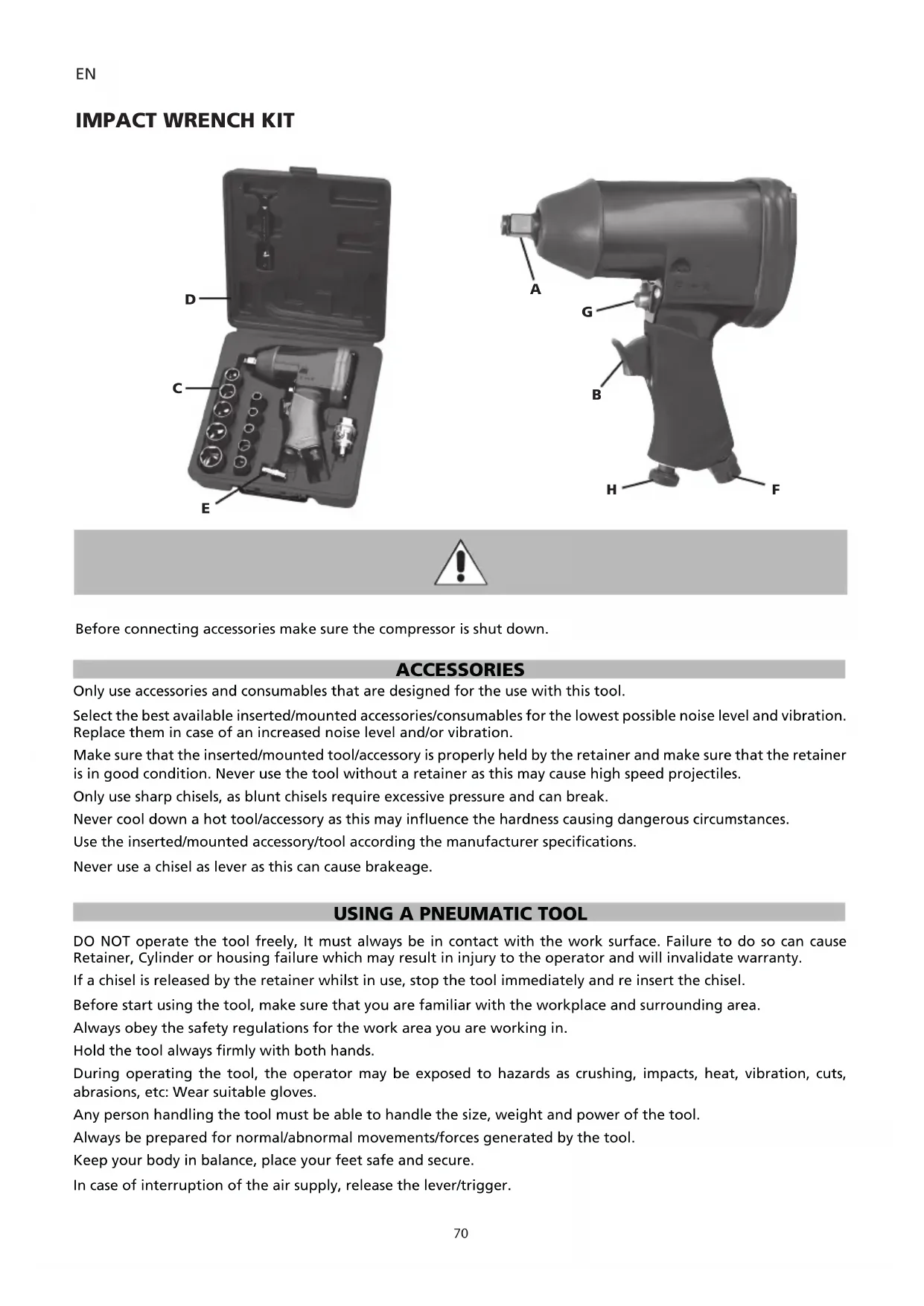
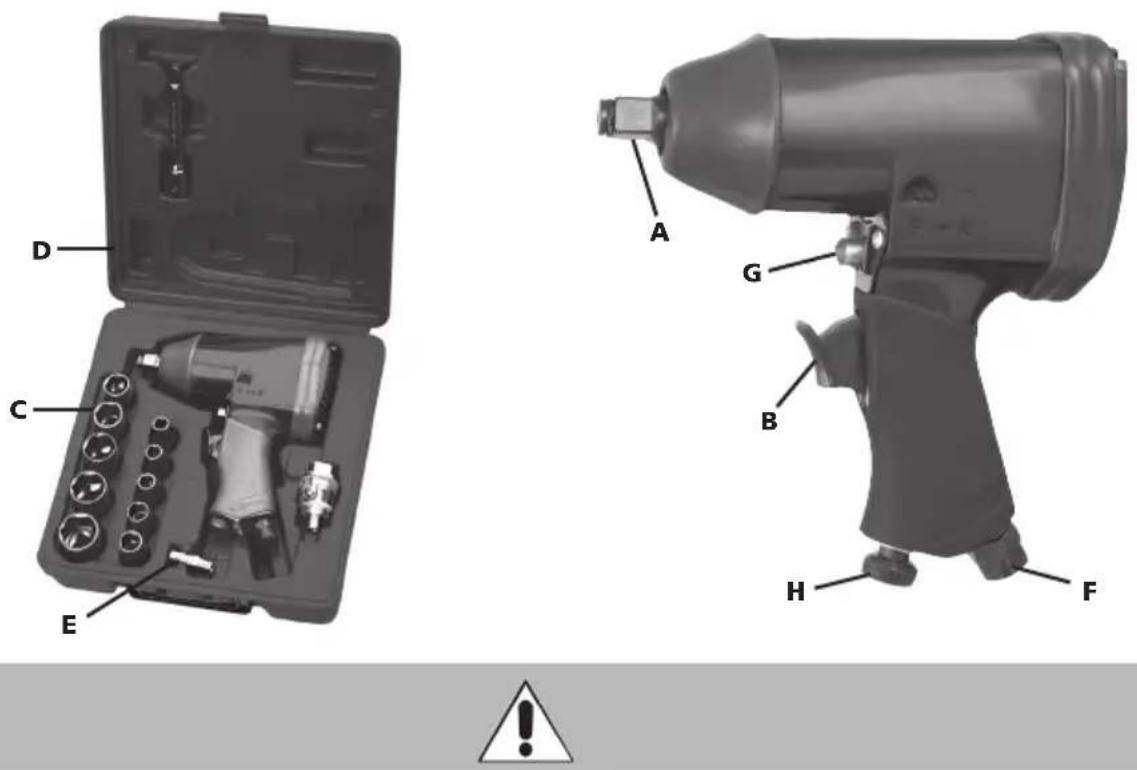
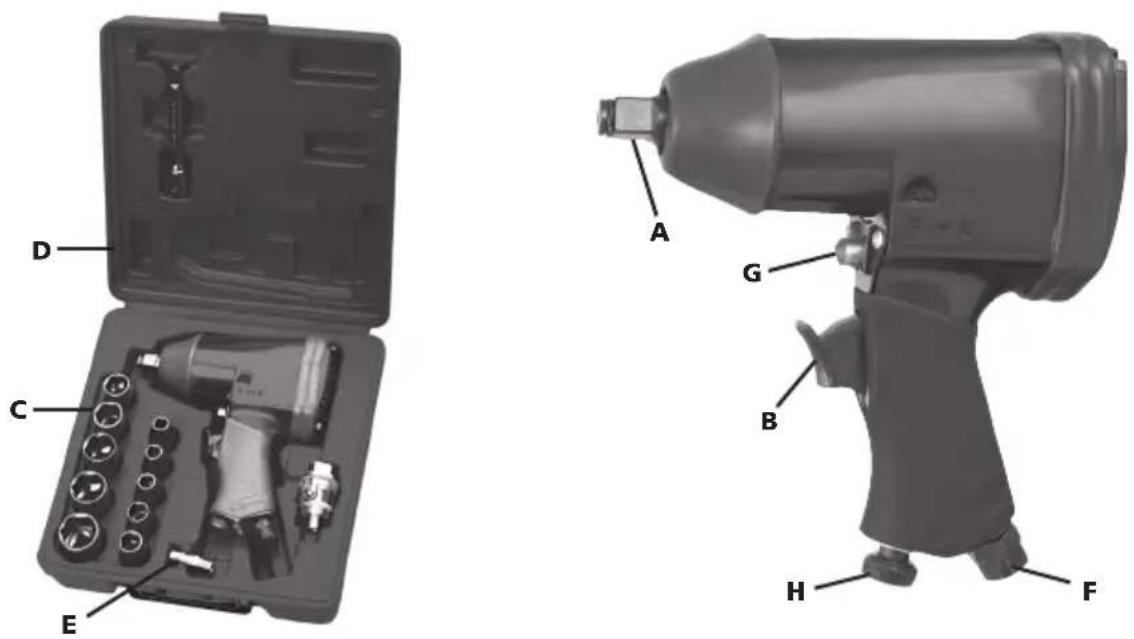
- Before operating the equipment, put some oil drops (D) in the air inlet opening (F) of the pneumatic tool.
- In case connection (E) is already assembled on the inlet opening (F), put some oil drops (D) on it (E).
- Choose the correct impact socket (C) from the kit as needed and mount it onto the anvil (A).
- Connect air supply hose to E.
- Place the socket over the nut to be removed or installed.
- Turn the F/R knob (G) to "F" or "R" position (F=Forward or R=Reverse).
- Adjust the regulator knob H to control the speed of the air flow.
- Press the trigger (B) to use the tool.
MAINTENANCE

Disconnect the air supply during maintenance on the tool.
Regularly clean and dry the filter in the system and the pneumatic tool air inlet opening.
Lubricate any quick-disconnect coupling on the system to prevent jamming.
Drain condensation from air filter and from the compressor on a daily basis.
In order to avoid rust formation and to minimize wear, clean and lubricate the tool after each use.
Check the tool regularly on loose bolts/screws or parts.
In case of power loss: have the tool repaired.
Only trained and qualified engineers are allowed to adjust or repair the tool.
In case the tool is equipped with a silencer, make sure that this silencer is working properly, a damaged silencer has to be replaced.
The tool should be maintained regularly to minimize the noise emission and occurring vibration.
If you intend not to use the tool for a longer period of time, it has to be oiled. Please fill some droplets of resin and acid free oil into the air inlet and let the tool run free for a couple of seconds.
Maintain the tool at least yearly.
INTENDED USE
The user or the user's employer shall assess the specific use that can be present as a result of each use.
Never use the tool otherwise than the tool is designed for and as explained in this manual.
Damages as a consequence of not following this manual, or caused by incorrect use or incorrect repairs, will never be covered by our warranty and we will have no responsibility for it. We reserve the right for technical improvements, without prior notification.
This tool is designed as a wrench. The intended use includes tightening and loosening nuts, bolts and threaded screws. If used otherwise a risk assessment has to be made by the employer/user.
POSSIBLE FAULTS
Immediately shut down the equipment in case you hear unusual noises, or if a sudden power drop occurs. Check the
EN
pneumatic tool and the compressed air supply system.
Pneumatic tool
- lubrication is insufficient
- worn tool/accessory, not suitable for use or faulted
Compressed air supply system
- compressor pressure is insufficient
- pressure regulator not set on the correct pressure level, suitable to the tool being used.
- there is a leak from the connection hose or from the connections (use Teflon tape or sealant paste)
- leaks in the pneumatic system
- filter or lubricator cogged
- hose is crushed, pierced or too long (loss of pressure)
DISPOSAL
Exhaust oil MUST BE DISPOSED OF so as not to pollute the environment and in compliance with the applicable law.
Any warranty is expressly waved in case of damages arising out of regular wear, overload, handling or use not suitable for the tool. For this warranty to be applicable, the tool should not be dismantled when returned to your retailer.
This warranty covers replaced parts and labor for a period of 12 months from the date of purchase (a proof of purchase such as invoice or receipt is required).
Any defect may be removed by replacing the tool or repairing it, as the case may be.
KIT AVVITATORE A IMPULSI
KIT CHAVE DE IMPACTO

WYPOSAŻENIE DODATKOWE
SMÜGINIŞ SUKTUVŞ RINKINYS



- IMPACT WRENCH KIT
- ATTENTION:
- GENERAL SAFETY REGULATIONS
- WHAT YOU SHOULD DO
- EN
- ATTENZIONE:
- ÜLDISED OHUTUSJUHISED
- ACCESSORIES
- USING A PNEUMATIC TOOL
- USING THE IMPACT WRENCH
- MAINTENANCE
- INTENDED USE
- POSSIBLE FAULTS
- Pneumatic tool
- Compressed air supply system
- DISPOSAL
- Exhaust oil MUST BE DISPOSED OF so as not to pollute the environment and in compliance with the applicable law.
- KIT AVVITATORE A IMPULSI
- KIT CHAVE DE IMPACTO
- WYPOSAŻENIE DODATKOWE
- SMÜGINIŞ SUKTUVŞ RINKINYS
Brand : Abac
Model : G101
Category : Screwdriver