
BBUM12320XPE - Other kitchen appliances BEKO - Free user manual and instructions
Find the device manual for free BBUM12320XPE BEKO in PDF.
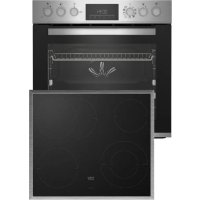



| Product Type | Built-in Hob |
| Brand | Beko |
| Model | BBUM12320XPE |
| Dimensions (W x D x H) | 590 x 520 x 45 mm (estimate) |
| Net Weight | Approximately 8 to 10 kg |
| Power Supply | 230 V / 400 V, 50 Hz, single-phase or three-phase depending on configuration |
| Maximum Power | Approximately 7.2 kW (estimate) |
| Cooking Type | Ceramic or induction depending on version (check the label) |
| Number of Burners | 4 (estimate) |
| Controls | Manual (touch or buttons) |
| Ventilation | Requires a 15 mm gap under the hob |
| Installation | Built into a worktop with a minimum thickness of 28 mm |
| Safety | Grounding mandatory, residual current circuit breaker protection recommended |
| Maintenance | Clean with a damp cloth and mild detergent, avoid abrasive products |
| Power Cable | Maximum length 2 m, cross-section according to technical specifications |
| Oven Compatibility | Can be installed above a Beko built-in oven |
| Warranty | Valid after proper installation by a professional |
Frequently Asked Questions - BBUM12320XPE BEKO
User questions about BBUM12320XPE BEKO
0 question about this device. Answer the ones you know or ask your own.
Ask a new question about this device
Download the instructions for your Other kitchen appliances in PDF format for free! Find your manual BBUM12320XPE - BEKO and take your electronic device back in hand. On this page are published all the documents necessary for the use of your device. BBUM12320XPE by BEKO.
USER MANUAL BBUM12320XPE BEKO
EN - Safety instructions
- Product must be installed by a qualified person in accordance with the regulations in force. The manufacturer shall not be held responsible for damages arising from procedures carried out by unauthorized persons which may also void the warranty.
- Preparation of location and electrical installation for the product is under customer's responsibility.
- The product must be installed in accordance with all local electrical regulations.
- Before installing the product, remove all the materials and documents in it and visually check if the product has any defects on it. If so, do not have it installed.
- Make sure that the user cannot reach the electrical connections after the installation.
- The product is heavy, carry the product with at least two people.
- The door and/or handle must not be used for lifting or moving the appliance. Use the lifting spaces on both sides of the product. Always wear protective gloves during transport and installation.
- Disconnect electrical connections in the area to be installed before installation.
- The surfaces of the furniture that the oven is to be installed in must be heat-resistant (100 °C minimum).
- Make sure that the furniture is in straight, horizontal position and that it is fixed before the installation of the appliance.
- Do not install heat insulation strips inside the interior of the furniture that the oven is to be installed in.
- The appliance must not be installed behind a decorative door in order to avoid overheating.
- The dimensions given in the installation diagrams are in mm.
Preparation of the furniture that the appliance shall be installed (Figures 2-3-4)
- The appliance is designed for installation into commercially available worktops. A safety distance shall be left between the appliance and the kitchen walls and furniture. (Figure 2-3)
- The clearance where the appliance shall be placed on the worktop shall be cut as per the dimensions given in figure 2-3.
- If there is no hood on the appliance, allow a distance of 750 mm from the hob surface to the furniture.
- If a shroud/hood is installed above the appliance, allow a distance for the installation height as described in the operating manual of the shroud/hood. -** Minimum distance between the cabinets shall be equal to the width of the hob.
- In order to provide the necessary ventilation in the back of the kitchen furniture, openings should be created in the dimensions shown in figure 2.
- The electrical connection must be in the area A in figure 2 or outside the installation site. Worktop thickness shall be at least 28 mm (Figure 4a).
Ventilation
- Ventilation affects the heating performance of the appliance directly. Even if no problem is detected in the first inspections, customer concerns may occur due to the performance losses while cooking for longer periods when correct ventilation clearances are not provided.
- A minimum distance of 15 mm shall be allowed between the lower surface of the hob and the upper wall of the oven (Figure 4b) to provide adequate ventilation. Additionally, a cross-section with the dimensions of 35 x 500 mm shall be left in the bottom of the furniture housing where the oven is placed. (Figure 2)
Installation of the appliance Connecting the appliance to the electricity supply
- Only connect the product to a grounded outlet/line with the voltage and protection as specified in the "Technical specifications". Have the grounding installation made by a qualified electrician while using the product with or without a transformer. Our company shall not be liable for any problems arising due to the product not being earthed in accordance with the local regulations.
- Before starting any work on the electrical installation, disconnect the product from the mains supply. There is the risk of electric shock!
- The product must be connected to the mains supply only by an authorized and
qualified person. The product's warranty period starts only after correct installation. The manufacturer shall not be held responsible for damages arising from procedures carried out by unauthorized persons.
- The appliance must be installed so that it can be completely disconnected from the mains supply. The separation must be provided by a switch built into the fixed electrical installation, according to construction regulations.
- The rear surface of the oven and the bottom surface of the hob get hot when in use. Make sure that the electrical connection does not come into contact with the rear surface; otherwise, connections can get damaged.
- The connection cable must not be clamped, bent, or trapped, nor come into contact with hot parts of the appliance. You may cause the appliance to short circuit and catch fire as a result of the cable melting. If the power cord is damaged, it must be replaced by a qualified electrician. Otherwise, there is a risk of electric shock, short circuit, or fire!
- The plug of the power cord should be easily accessible after installation (but not over the hobs).
- When wiring, you must comply with national/local electrical regulations and use a socket outlet/line and plug suitable for the appliance. If the power limits of the product exceed the current carrying capacity of the plug and socket outlet/line, you must connect the product directly to the fixed electrical installation without using the plug and socket outlet/line.
- Make sure that the fuse rating is compatible with the product.
- Connection must comply with national regulations.
- The mains supply data must correspond to the data specified on the type label of the product. You may see the hob's type label on the bottom of the hob, and open the oven door to see the oven's type label.
- The power cable of your product must comply with the values in the "Technical specifications" table.
- If the product will be connected directly to the supply power: If it is not possible to disconnect all poles in the supply power, a disconnection unit with at least 3
mm contact clearance (fuses, line safety switches, contactors) must be connected, and all the poles of this disconnection unit must be adjacent to (not above) the product in accordance with IEE directives. Failure to obey this instruction may cause operational problems and invalidate the product warranty.
Additional protection by a residual current circuit breaker is recommended.
If the product is produced with cable:
- Connect the cord of the product to the supply power as identified below:
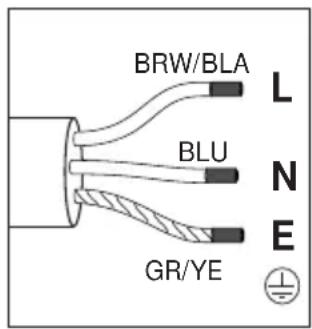
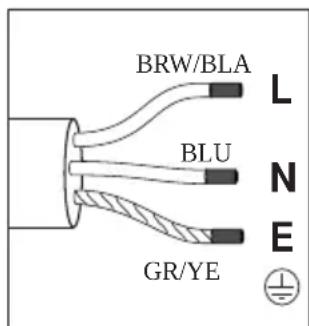
If your supply cord type is 3-conductor type, for 1-phase connection:
- (BRW/BLA) Brown/black = L (Phase)
- (BLU) Blue = N (Neutral)
- (GR/YE) Green/yellow wire = (E) (Earthing)
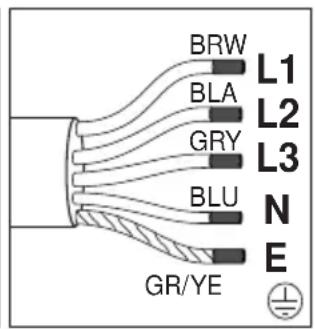
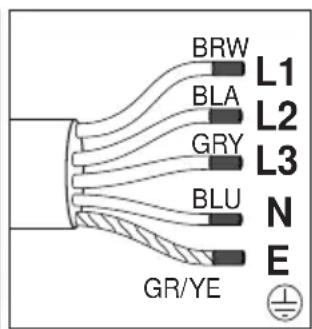
If your supply cord type is 5-conductor type, for 3-phase connection:
- (BRW) Brown = L1 (Phase)
- (BLA) Black = L2 (Phase)
- (GRE) Grey = L3 (Phase)
- (BLU) Blue = N (Neutral)
- (GR/YE) Green/yellow wire = (E) (Earthing)
1 NAC 220-240 V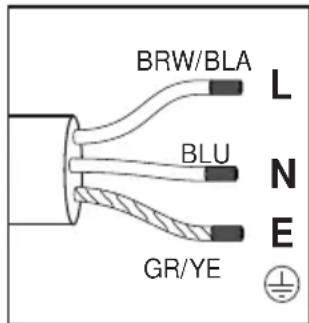
3 N AC 380-415 V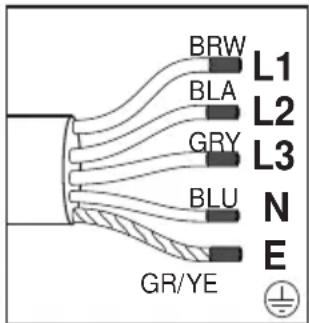
If the product is produced without cable:
A power cable that is defined in the technical table home must be connected to product by following the instructions. Power cable must not be longer than 2 m because of safety reasons.
- Open the terminal block cover with a screwdriver.
- Insert the power cable through the cable clamp below the terminal and secure it to the main body with the integrated screw on the cable clamping component.
- Connect the cables according to the supplied diagram.
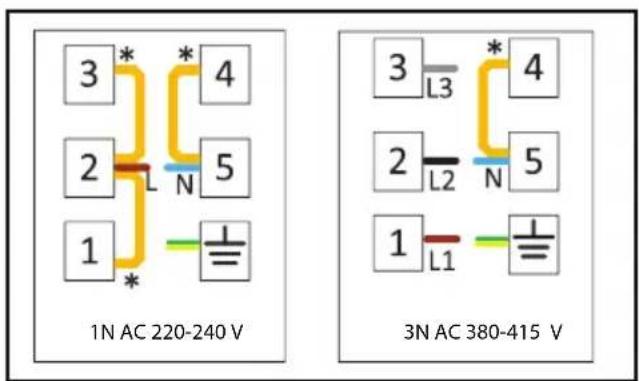
- Copper bridge
If your supply cord type is 3-conductor type, for 1-phase connection:
- Brown/black = L (Phase) - Blue = N (Neutral)
- Green/yellow wire = (E) (Earthing)
If your supply cord type is 5-conductor type, for 3-phase connection:
- Brown = L1 (Phase)
- Black = L2 (Phase)
- Grey = L3 (Phase) - Blue = N (Neutral)
- Green/yellow wire = (E) (Earthing)
- After completing the wire connections, close the terminal block cover.
- Connect the power cable to supply power by routing it so that it will not contact the product and get squeezed between the product and the wall.
Prevention against possible fire risk!
- Ensure all electrical connections are secure and tight to prevent risk of arcing.
- Do not use damaged cables or extension cables.
- Ensure liquid or moisture is not accessible to the electrical connection point.
Placing and securing of the hob (Figures 5-6-7-8)
After preparing the installation location of the appliances, turn the hob upside down and place it on a flat surface. - Affix the sealing gasket supplied with the appliance around the hob so that it shall be 1-2 mm inside the outer edge of the glass as shown in Figure 5. Ensure that no clearance is left between both ends and between the glass and gasket. - Screw and secure the mounting springs supplied with the appliance by engaging them to their seat on the lower housing of the hob as shown in Figure 6. (In some models, these springs may be secured to the appliance ex-factory.)
- Turn the hob again and align it with the worktop and then place it on the worktop. Cooker shall be placed on the worktop thanks to the springs, and it shall be easily secured.
- Ensure that the hob and the worktop are parallel when you place the cooker on the worktop. When it is not in parallel, connect the additional installation clamps supplied with the appliance as shown in Figure 8. Figure 8 shows the possible installation locations of the clamps. (The locations where the clamps can be attached may vary depending on the product model. You can connect according to the mounting holes on your hob.) Ensure the parallelism by attaching the clamps to the appropriate locations. The type and quantity of clamps supplied with the product may vary depending on the product model.
Making hob-oven connection and placing and fixing the oven (Figure 9a-9b-10)
- Connect the oven to the power supply.
- Slide the oven centered with at least two persons into the cabinet until half way.
- If your hob type is vitroceramic: The hob has a socket and a grounding cable to be connected to the oven. As shown in figure 9a, connect the socket to its slot on the oven in a way that the colors match. Fix the grounding cable with the screw shown in figure 9a.
- If your hob type is induction: The hob has two sockets and a grounding cable to be connected to the oven. As shown in figure 9b, connect the sockets to their slots on the oven. Fix the grounding cable with the screw shown in figure 9b.
- Place the oven completely into the cabinet. Fix the oven to the furniture using the screws provided. (Figure 10)
- At the end of the installation, check that the screws are properly tightened and that the product is firmly fixed. If the oven is not installed in accordance with the instructions and the screws are not properly tightened, there is a risk of tipping during use.
Final check
- After installation, turn on the power supply.
- Read the user manual for the first use of the appliances.
- Check functions of appliances.
Removing the appliances
- Disconnect the appliances from the power supply.
- Unscrew the fastening screws of the oven.
- Pull out the oven with at least two persons from the cabinet until halfway.
- Disconnect the oven and hob.
- Pull out the oven completely.
- If the hob is secured with additional clamps, unscrew the clamps first.
- Remove the hob by pushing upward from the bottom of the hob.
- (BRW) Brown = L1 (Phase)
- (BLA) Black = L2 (Phase)
- (GRE) Grey = L3 (Phase)
- (BLU) Blue = N (Neutral)
- (GR/YE) Green/yellow wire = (E) (Earth)
- Brown = L1 (Phase)
- Black = L2 (Phase)
- Grey = L3 (Phase)
- Blue = N (Neutral)
- Green/yellow wire = (E) (Earth)
Installation of apparatus
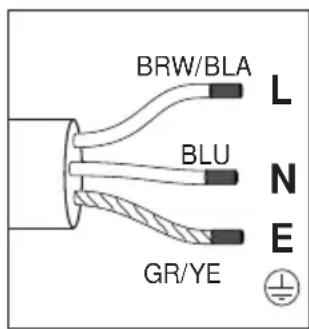
- (BRW/BLA) Brown/black = L (Phase)
- (BLU) Blue = N (Neutral)
- (GR/YE) Green/yellow wire = (E)
(Earth connection)
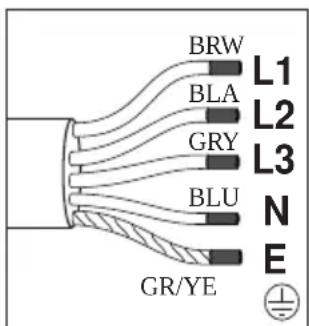
If your power cord type is 5-wire type, for 3-phase connection:
- (BRW) Brown = L1 (Phase)
- (BLA) Black = L2 (Phase)
- (GRA) Gray = L3 (Phase)
- (BLU) Blue = N (Neutral)
- (GR/YE) Green/yellow wire = (E) (Earth connection)
- (BRW/BLA) Brown/black = L (Phase)
- (BLU) Blue = N (Neutral)
- (GR/YE) Green/yellow cable = (E)
(Earth connection)
- (BRW) Brown = L1 (Phase)
- (BLA) Black = L2 (Phase)
- (GRE) Gray = L3 (Phase)
- (BLU) Blue = N (Neutral)
- (GR/YE) Green/yellow wire = (E) (Ground)
1 N AC 220-240 V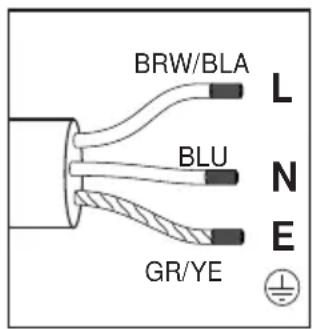
3 N AC 380-415 V
- (BRW) brown = L1 (phase)
- (BLA) black = L2 (phase)
- (GRE) grey = L3 (phase)
- (BLU) blue = N (neutral)
- (GR/YE) green/yellow wire = (E) (ground)
1 N AC 220-240 V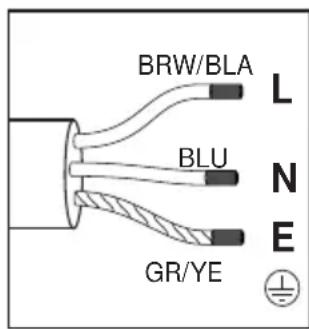
3 N AC 380-415 V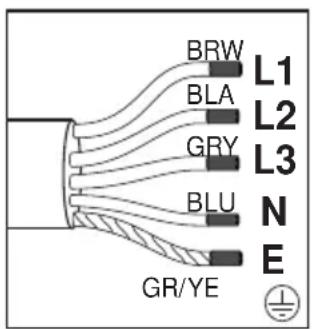
- (BRW) brown = L1 (phase)
- (BLA) black = L2 (phase)
- (GRE) grey = L3 (phase)
- (BLU) blue = N (neutral)
- (GR/YE) green/yellow wire = (E) (ground)
1 N AC 220-240 V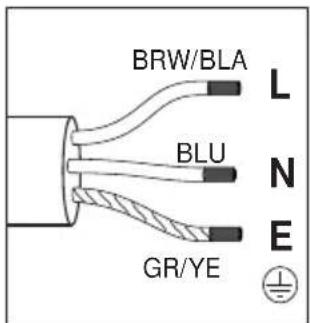
3 NAC 380-415V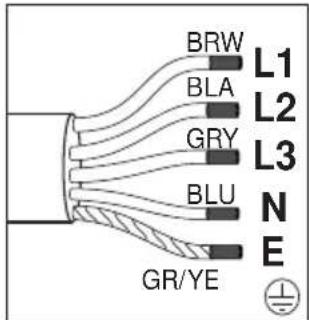
If the product is manufactured without a cable:
- brown/black = L (phase)
- blue = N (neutral)
- green/yellow wire = (E) (Earth)
- (BRW/BLA) brown/black = L (phase)
- (BLU) blue = N (neutral)
- (GR/YE) green/yellow wire = (E) (Earth)
If you use a 5-core power cable for 3-phase connection:
- (BRW) brown = L1 (phase)
- (BLA) black = L2 (phase)
- (GRE) grey = L3 (phase)
- (BLU) blue = N (neutral)
- (GR/YE) green/yellow wire = (E) (Earth)
1 N AC 220-240 V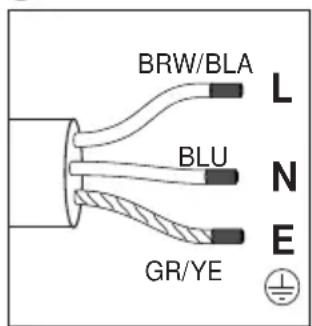
3 N AC 380-415 V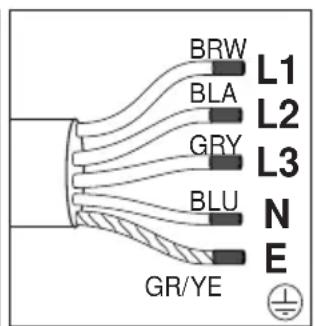
Connection without cable:
The power cable specified in the technical table must be disconnected before testing, following the instructions.
The power cable must not be longer than 2 m for safety reasons.
- Open the terminal block cover with a screwdriver. Insert the power cable through the cable gland under the terminal and tighten it to the main body using the built-in screw on the cable gland. - Connect the wires according to the diagram.
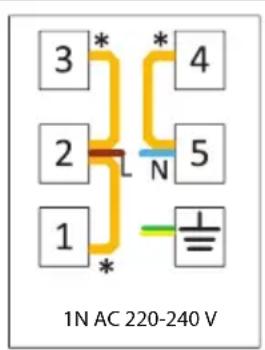
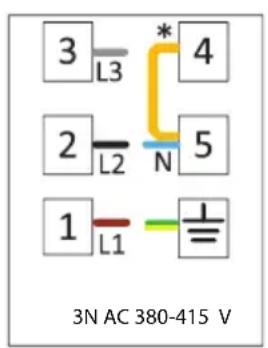
Connection diagram
If you use a 3-core power cable for single-phase connection:
- Brown = L (Phase)
- Blue = N (Neutral) - Green/Yellow = (E) (Earth)
If you use a 5-core power cable for three-phase connection:
-Brown = L1 (Phase) -Black = L2 (Phase) -Grey = L3 (Phase) -Blue = N (Neutral) -Green/Yellow = (E) (Earth)
-After completing the connection of the wires, close the terminal block cover. -Connect the power cable for power supply, placing it so that it does not come into contact with the product and is not pinched between the product and the wall.
Safety warnings:
- Check that all electrical connections are tight and sealed to avoid the risk of electric shock. Do not use damaged cables or cords. Ensure that dust or moisture does not enter the electrical enclosure.
Position the hob on the mounting surface (fig. 5-6-7-8).
After unpacking the appliance, check the hob and place it on a flat surface. Attach the sealing gasket supplied with the appliance to the underside of the hob so that it is 1-2 mm from the outer edge of the glass, as shown in fig. 5. Make sure that no gap remains between the glass and the gasket, and between the glass and the worktop. Tighten and secure the mounting springs supplied with the appliance, fixing them one by one to the lower housing of the hob, as shown in fig. 6. (Some models may come with springs already attached to the appliance.) Check the hob again and adjust its position relative to the worktop, then install it on the worktop. It is necessary that the hob is placed on the worktop with the help of the springs and is easily secured. When placing the hob on the worktop, ensure parallelism between the worktop and the hob. If parallelism cannot be achieved, adjust the mounting brackets supplied with the appliance, as shown in fig. 8. Fig. 8 shows the possible positions for installing the brackets. (The location of the brackets may vary depending on the model. They can be moved according to the mounting holes on the hob.)
Ensure parallelism by adjusting the brackets to the appropriate positions. The number and quantity of brackets supplied with the appliance may vary depending on the model.
Connect the hob to the oven and position and fix the oven (fig. 9a-9b-10).
Connect the oven to the electrical supply. Insert the oven, centering it with the help of two guides into the housing.
- If your hob is vitroceramic: The hob has a plug and an earthing cable that are connected to the oven. As shown in fig. 9a, insert the plug into its socket on the oven in such a way that the colors match. Secure the earthing cable with the screw shown in fig. 9a.
- If your hob is induction: The hob has a plug and an earthing cable that are connected to the oven. As shown in fig. 9b, connect the plug to its socket on the oven. Secure the earthing cable with the screw shown in fig. 9b.
Close the handle and secure it with the screws. (fig. 10) After installation, make sure the handle is correctly tightened and the screws are firmly fixed. If the handle is not installed according to the instructions and the screws are not tightened securely, there is a risk of the handle falling off during use.
Final check
- After installation, turn on the power supply. Before first use, read the user manual.
- Check the device operation.
Removing the device
- Disconnect the device from the power supply. Unscrew the locking screw from the handle.
Pull the handle using the two recesses on both sides. - Separate the handle from the abrasive surface. Pull the handle completely. - If the abrasive surface is secured with additional screws, first unscrew the screws. - Remove the abrasive surface by pressing on the bottom of the abrasive surface.
- EN - SAFETY INSTRUCTIONS
- PREPARATION OF THE FURNITURE THAT THE APPLIANCE SHALL BE INSTALLED (FIGURES 2-3-4)
- VENTILATION
- INSTALLATION OF THE APPLIANCE CONNECTING THE APPLIANCE TO THE ELECTRICITY SUPPLY
- IF THE PRODUCT IS PRODUCED WITH CABLE
- IF THE PRODUCT IS PRODUCED WITHOUT CABLE
- PREVENTION AGAINST POSSIBLE FIRE RISK
- PLACING AND SECURING OF THE HOB (FIGURES 5-6-7-8)
- MAKING HOB-OVEN CONNECTION AND PLACING AND FIXING THE OVEN (FIGURE 9A-9B-10)
- FINAL CHECK
- REMOVING THE APPLIANCES
- INSTALLATION OF APPARATUS
- IF THE PRODUCT IS MANUFACTURED WITHOUT A CABLE
- CONNECTION WITHOUT CABLE
- SAFETY WARNINGS
- POSITION THE HOB ON THE MOUNTING SURFACE (FIG. 5-6-7-8)
- CONNECT THE HOB TO THE OVEN AND POSITION AND FIX THE OVEN (FIG. 9A-9B-10)
- REMOVING THE DEVICE
Brand : BEKO
Model : BBUM12320XPE
Category : Other kitchen appliances