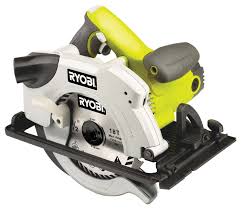
EWS-1366 - Power Tools RYOBI - Free user manual and instructions
Find the device manual for free EWS-1366 RYOBI in PDF.



| Product type | Circular saw |
| Brand | RYOBI |
| Model | EWS-1366 |
| Power supply | 110V / 230V AC |
| Power consumption | 1,250 W / 1,350 W |
| No-load speed | 4,500 rpm |
| Blade diameter | 190 mm |
| Blade bore | 16 mm |
| Cutting capacity at 0° | 66 mm |
| Cutting capacity at 45° | 38 mm |
| Bevel range | 0° - 45° |
| Laser guide | Yes |
| Lighting | Two LED indicator lights |
| Lower blade guard | Manually retractable |
| Riving knife | Adjustable |
| Double insulation | Yes |
| Voltage indicator | Yes |
| Sound pressure level | May exceed 85 dB |
| Warranty | 24 months |
| Cutting material | Wood |
| Included accessories | Blade, parallel guide, service key |
| Maintenance | Regular cleaning, annual lubrication at an approved center |
| Safety | Two-hand operation, do not use abrasive disc |
Frequently Asked Questions - EWS-1366 RYOBI
User questions about EWS-1366 RYOBI
0 question about this device. Answer the ones you know or ask your own.
Ask a new question about this device
Download the instructions for your Power Tools in PDF format for free! Find your manual EWS-1366 - RYOBI and take your electronic device back in hand. On this page are published all the documents necessary for the use of your device. EWS-1366 by RYOBI.
USER MANUAL EWS-1366 RYOBI
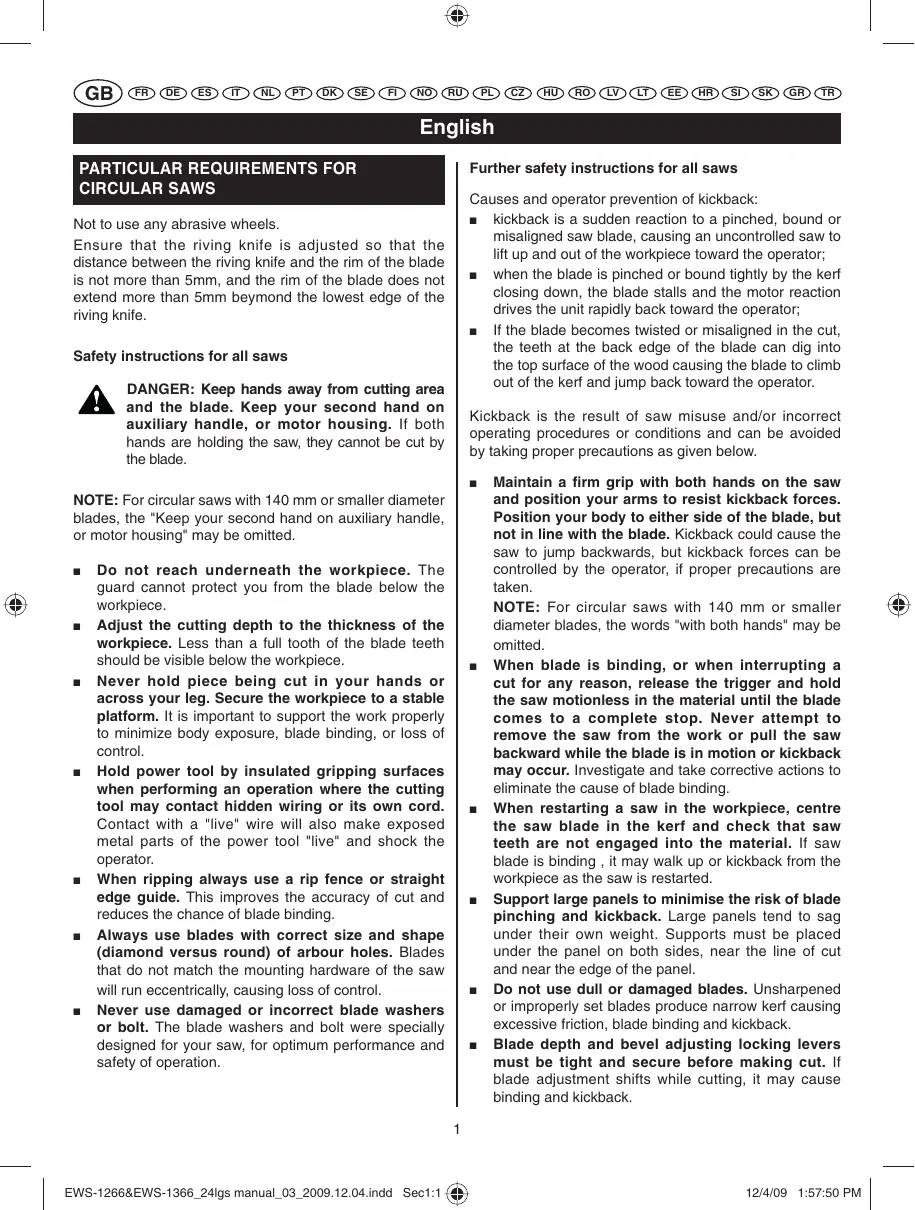
Not to use any abrasive wheels.
Ensure that the riving knife is adjusted so that the distance between the riving knife and the rim of the blade is not more than 5mm and the rim of the blade does not extend more than 5mm beyond the lowest edge of the riving knife.
Safety instructions for all saws

DANGER: Keep hands away from cutting area and the blade. Keep your second hand on auxiliary handle, or motor housing. If both hands are holding the saw, they cannot be cut by the blade.
NOTE: For circular saws with 140mm or smaller diameter blades, the "Keep your second hand on auxiliary handle, or motor housing" may be omitted.
- Do not reach underneath the workpiece. The guard cannot protect you from the blade below the workpiece.
- Adjust the cutting depth to the thickness of the workpiece. Less than a full tooth of the blade teeth should be visible below the workpiece.
- Never hold piece being cut in your hands or across your leg. Secure the workpiece to a stable platform. It is important to support the work properly to minimize body exposure, blade binding, or loss of control.
- Hold power tool by insulated gripping surfaces when performing an operation where the cutting tool may contact hidden wiring or its own cord. Contact with a "live" wire will also make exposed metal parts of the power tool "live" and shock the operator.
- When ripping always use a rip fence or straight edge guide. This improves the accuracy of cut and reduces the chance of blade binding.
Always use blades with correct size and shape (diamond versus round) of arbour holes. Blades that do not match the mounting hardware of the saw will run eccentrically, causing loss of control. - Never use damaged or incorrect blade washers or bolt. The blade washers and bolt were specially designed for your saw, for optimum performance and safety of operation.
Further safety instructions for all saws
Causes and operator prevention of kickback:
■ kickback is a sudden reaction to a pinched, bound or misaligned saw blade, causing an uncontrolled saw to lift up and out of the workpiece toward the operator;
- when the blade is pinched or bound tightly by the kerf closing down, the blade stalls and the motor reaction drives the unit rapidly back toward the operator;
If the blade becomes twisted or misaligned in the cut, the teeth at the back edge of the blade can dig into the top surface of the wood causing the blade to climb out of the kerf and jump back toward the operator.
Kickback is the result of saw misuse and/or incorrect operating procedures or conditions and can be avoided by taking proper precautions as given below.
- Maintain a firm grip with both hands on the saw and position your arms to resist kickback forces. Position your body to either side of the blade, but not in line with the blade. Kickback could cause the saw to jump backwards, but kickback forces can be controlled by the operator, if proper precautions are taken.
NOTE: For circular saws with 140 mm or smaller diameter blades, the words "with both hands" may be omitted. - When blade is binding, or when interrupting a cut for any reason, release the trigger and hold the saw motionless in the material until the blade comes to a complete stop. Never attempt to remove the saw from the work or pull the saw backward while the blade is in motion or kickback may occur. Investigate and take corrective actions to eliminate the cause of blade binding.
- When restarting a saw in the workpiece, centre the saw blade in the kerf and check that saw teeth are not engaged into the material. If saw blade is binding, it may walk up or kickback from the workpiece as the saw is restarted.
Support large panels to minimise the risk of blade pinching and kickback. Large panels tend to sag under their own weight. Supports must be placed under the panel on both sides, near the line of cut and near the edge of the panel. - Do not use dull or damaged blades. Unsharpened or improperly set blades produce narrow kerf causing excessive friction, blade binding and kickback.
- Blade depth and bevel adjusting locking levers must be tight and secure before making cut. If blade adjustment shifts while cutting, it may cause binding and kickback.

English
PARTICULAR REQUIREMENTS FOR CIRCULAR SAWS
Use extra caution when making a "plunge cut" into existing walls or other blind areas. The protruding blade may cut objects that can cause kickback.
Safety instructions for saws with lower guard
- Check lower guard for proper closing before each use. Do not operate the saw if lower guard does not move freely and close instantly. Never clamp or tie the lower guard into the open position. If saw is accidentally dropped, lower guard may be bent. Raise the lower guard with the retracting handle and make sure it moves freely and does not touch the blade or any other part, in all angles and depths of cut.
NOTE: Alternate wording may be substituted for "retracting handle".
- Check the operation of the lower guard spring. If the guard and the spring are not operating properly, they must be serviced before use. Lower guard may operate sluggishly due to damaged parts, gummy deposits, or a build-up debris.
Lower guard should be retracted manually only for special cuts such as "plunge cuts" and "compound cuts." Raise lower guard by retracting handle and as soon as blade enters the material, the lower guard must be released. For all other sawing, the lower guard should operate automatically.
NOTE: Alternate wording may be substituted for "retracting handle".
Always observe that the lower guard is covering the blade before placing saw down on bench or floor. An unprotected, coasting blade will cause the saw to walk backwards, cutting whatever is in its path. Be aware of the time it takes for the blade to stop after switch is released.
Additional safety instructions for all saws with riving knife
Use the appropriate riving knife for the blade being used. For the riving knife to work, it must be thicker than the body of the blade but thinner than the tooth set of the blade.
- Adjust the riving knife as described in this instruction manual. Incorrect spacing, positioning and alignment can make the riving knife ineffective in preventing kickback.
Always use the riving knife except when plunge cutting. Riving knife must be replaced after plunge cutting. Riving knife causes interference during
plunge cutting and can create kickback.
For the riving knife to work, it must be engaged in the workpiece. The riving knife is ineffective in preventing kickback during short cuts.
- Do not operate the saw if riving knife is bent. Even a light interference can slow the closing rate of a guard.
DESCRIPTION
- Spindle lock button
- Hex-head bolt
- Spanner
- Outer blade washer
- Lower guard
- Lower guard lever
- Upper guard
- Blade
- Inner blade washer
- Dust nozzle
- Riving knife
- Depth lock knob
- Base plate
- Depth of cut
- Depth scale
- Bevel adjustment knob
- Bevel scale
- Trigger switch
- Safety button
- Line guide
- Depth adjustment lug
- Live Tool indicator
- Laser guide button
- Laser guide
- LED button
- LED light
SPECIFICATIONS
| EWS-1266 | EWS-1366 | |
| Voltage | 230V | 110V/230V |
| Input | 1,250 W | 1,250 W/1,350 W |
| No load speed | 4,500 min-1 | 4,500 min-1 |
| Bore size | 16 mm | 16 mm |
| Blade size | 190mm | 190 mm |
| Cutting capacityat 0° | 66 mm | 66 mm |
| at 45° | 38 mm | 38 mm |
| Bevel scale | 0 – 45° | 0 – 45° |

English
INSTRUCTIONS FOR SAFE HANDLING
The maximum permissible system impedance:
Zmax for EWS-1266 is 0.245 Zref & Zmax for EWS-1366 is 0.252 Zref.
If in doubt, please verify with your local energy-utilitythat the AC outlets in your area do not exceed theabobe values.
STANDARD ACCESSORIES
Saw blade, Parallel fence, Spanner.
APPLICATION
Sawing wood.
NOISE BUILD-UP
Noise (sound pressure level) in the workplace can exceed 85 dB. In this case, sound insulation and hearing protection measures must be taken by the operator.
ASSEMBLY INSTRUCTIONS
BE SURE TO DISCONNECT THE TOOL FROM THE POWER SUPPLY BEFORE ATTACHING OR REMOivating THE SAW BLADE. BE SURE THAT THE TEETH OF THE SAW BLADE ARE POINTING UPWARD AT THE FRONT OF THE TOOL.
ATTACHING AND REMOVING THE BLADE (FIGURES 2, 3, 4, AND 5)
ATTACHING THE BLADE
- Pressing the spindle lock button (1), turn the hex-head bolt (2) with the spanner (3) until the spindle locks. (Fig.2)
- Loosen the hex-head bolt by turning the spanner anticlockwise while pressing the spindle lock button. (Fig.2)
- Remove the hex-head bolt and the outer blade washer (4). (Fig. 2)
- Retract the lower guard (5) back with the lower guard lever (6) as far as possible under the upper guard (7). (Fig. 3)
- Then, attach the saw blade (8) against the inner blade washer (9) on the spindle. Then fit the outer blade washer and the hex-head bolt. (Fig. 3 and 4)
-
Press the spindle lock button again, tighten the hexhead bolt by turning the spanner clockwise while pressing the spindle lock button. (Fig. 5)
-
After tightening the hex-head bolt, release the spindle lock button.
REMOVING THE BLADE
- Pressing the spindle lock button, turn the hex-head bolt with the spanner until the spindle locks.
- Loosen the hex-head bolt by turning the spanner anticlockwise while pressing the spindle lock button.
- Remove the hex-head bolt and the outer blade washer.
- Retract the lower guard back as far as possible under the upper guard, then remove the saw blade.
ADJUSTING THE RIVING KNIFE (FIG. 6)

WARNING!
Do not use saw blades the disk of which is thicker, or the set of which is smaller, then the thickness of the riving knife.
- Ensure that the riving knife is adjusted so that (Fig. 6):
A. The distance between the riving knife (11) and the toothed rim of the saw blade is under 5 mm.
B. The toothed rim does not extend more than 5mm beyond the lower edge of the riving knife.
- The riving knife should always be used except when making a plunging cut in the middle of a workpiece.
ADJUSTING THE DEPTH OF CUT (FIG. 7A, 7B, 8, 9)
- To adjust the depth of cut, loosen the depth adjustment knob (12). (Fig. 7A)
- Slide the base plate (13) to the desired depth using the depth adjustment lug (21) and retighten the knob securely. (Fig. 7B)
- The depth of cut (14) can be determined by the depth scale (15) or by measuring the distance by which the blade protrudes from the base plate. (Fig. 8 and 9)
ADJUSTING THE CUTTING ANGLE (FIG. 10A, 10B)
- The cutting angle may be set to any position between 0^ and 45^ . (Fig. 10A)
- Loosen the bevel adjustment knob (16) at the front of the tool and move the base plate to the desired angle using the bevel scale (17). (Fig.10B)
- Once the angle has been set, be sure to retighten the bevel adjustment knob firmly.

English
TRIGGER SWITCH (FIG. 11)
This tool is started and stopped by squeezing and releasing the trigger switch (18). To prevent the tool from being started accidentally, the trigger can only be operated if the safety button (19) is depressed first. The safety button can be depressed with the thumb leaving the other fingers free to squeeze the trigger switch. It is not necessary to maintain pressure on the safety button once the trigger switch has been depressed.
OPERATING INSTRUCTIONS (FIG. 12)

DANGER!
KEEP HANDS AWAY FROM THE CUTTING AREA WHEN OPERATING THE TOOL. KEEP THE CORD AWAY FROM THE CUTTING AREA AND POSITION IT SO THAT IT WILL NOT GET CAUGHT ON THE WORKPIECE DURING THE CUTTING OPERATION.
When cutting, use steady and even pressure (DO NOT FORCE) in order to obtain a uniform cut. Cut at a speed suited to the workpiece. (Cut slowly if the workpiece is hard.) Inspect the saw blade frequently and replace or sharpen it if dull, to avoid overloading the motor.
CUTTING POSITION (FIG. 13A, 13B)
When cutting a workpiece at 0^ , use point "A" of the base plate line guide (20) and move the saw along the pencilled line you have drawn. When cutting at 45^ , use point "B". This line guide shows an approximate line of cut. Make a sample cut in scrap lumber to determine the actual line of cut.

CAUTION!
When ripping, the rip fence should only touch the workpiece slightly. Do not force.
USING THE LASER GUIDE (FOR EWS-1366 ONLY) (FIG. 14)

WARNING
Do not stare into the laser beam or turn the laser on when the tool is not in use. Failure to do so could result in possible serious personal injury. The laser unit comes from the factory already installed and aligned.
NOTE: Make a trial cut on a piece of scrap to ensure laser is aligned. Adjusting the laser may be necessary.
Mark the line to be cut on the workpiece.
Adjust the depth and angle of the cut as needed.
Switch on the laser beam.
NOTE: Do not touch the blade to the workpiece until the saw has reached maximum speed.
Slowly push the saw forward into the workpiece.
NOTE: Keep the laser beam on the marked line on the workpiece for precision cutting.
Once the cut is complete, allow the saw to come to a complete stop before turning off the laser.
LED WORKLIGHTS (FOR EWS-1366 ONLY) (FIG. 15)
Your saw is equipped with 2 LED WORKLIGHTS (26). These worklight help illuminate the work piece in dimly lit areas and helps when following the cutting line.
ADJUSTING THE LASER GUIDE (FIG. 16)
Adjust the laser angle
- Rotate the screw clockwise to turn the laser beam to right.
- Rotate the screw anti-clockwise to turn the laser beam to left.
Adjust the laser position
Rotate the screw anti-clockwise to shift the beam to right.
- Rotate the screw clockwise to shift the beam to left.
MAINTENANCE
After use, check the tool to make sure that it is in top condition.
We recommended that you take this tool to an Authorised Ryobi Service Centre for a thorough cleaning and lubrication at least once a year.
DO NOT MAKE ANY ADJUSTMENTS WHILE THE MOTOR IS RUNNING.
ALWAYS DISCONNECT THE POWER CORD FROM THE SOCKET BEFORE CHANGING REMOVABLE OR EXPENDABLE PARTS (BLADE, BIT, SANDPAPER, ETC.), LUBRICATING OR WORKING ON THE SAW.
KEEP HANDLES CLEAN AND FREE FROM OIL AND GREASE.

WARNING!
For greater safety and reliability, all repairs should be performed by an Authorised Ryobi Service Centre.
English
LIVE TOOL INDICATOR
This tool features a live tool indicator (22) which illuminates as soon as the tool is connected to the supply. This warns the user that the tool is connected and will operate when the switch is pressed.
ENVIRONMENTAL PROTECTION
Recycle raw materials instead of disposing as waste. The machine, accessories and packaging should be sorted for environmental-friendly recycling.
SYMBOL
The following show the symbols used for the tool. Be sure that you understand their meaning before use.
V. Volts
Hz. Hertz
Alternating Current
W. Watts
No load Speed min-1.Revolutions or reciprocation per minute

Maximum cutting capacity in wood

Double Insulation

Read instruction manual

Recycle raw materials instead of disposing as waste. The machine, accessories and packaging should be sorted for environmental-friendly recycling.

Français
CONSIGNES DE SECURITE SPECIFIQUES AUX SCIES CIRCULAIRES
CHARACTERISTIQUES PRODUIT
STANDAARD ACCESSORIES
- Zmax = 0,245 x Zref for model EWS-1266
- Zmax = 0,252 x Zref for model EWS-1366
INDSTILLING AF SAVEDYBDE
(FIG. 7A, B, 8, 9)
INNSTILLING AV SPALTEKNIVEN (FIG. 6)

ADVARSEL!
HnKoIa He HcNoJIb3yIte a6pa3HBHbIe IINcK.
Поверъ,Тоьбы Делпгльньи HOKьг OTpeунрobан TAK,Тоьбы PACSTOHHNE МжДУ Hm N 3y6bMn Dncka 6blIO MeHbIe 5 MM,ИТоьбы 3у6ьВICTYANII He 6OJIe Yem Ha 5 MM 3a HIXKNI Кай Делпгльного HOJa.
BaxhIe IpaBHJaTexHHKN 6e30NaChocTH IJIa BceX TnIOB IIJI.

OIIACHOCTb: DepKHTe pyKn IoJaIbIhe ot IIIbHorO INcKa H 30HbI paCNIIOBKn. DepKHTecb OHOHpyKo 3a OCHOBHyO pyKOHTky, a DpyTOI -3a BCHOMOrateIbHyIO HIN 3a KApTeP MoToPA. B 3OTmIoJooKeHH pyKn He IOnaJyT B 3OHy paCNIIOBKn HIN Ha TpAeKTopHo paCINHa.
IpHmeeAe: IJI INCKOBHX IHJ C HnHaMeTpOM IINJIbHOI INKcA MeHJIe HII PAHBIM 140 MM INHCTpyKIIa NJEpKaTbC8I pyROy pKo3 A BNCNOMaTeJbHyO pyKOaTKy IIIN 3a KapTe MOTopo> He IpHmEHNCTc.
He 3aBoIHTe pyKn IIOI 3aIOTOBky: B 3TOM MecTe KOJyX He 3aIIHIIaET IOJIOTHO.
PeryhpyreIy6bHn paacnHa 3aBCHMocn ot ToJIHHbI 3aTOBOTKN.Bo BpeMa pacIHIOBKn 3y6BaJINCKa He JOJIHKHI POIHOCTbIO BbIXOINTb CHN3Y 3aTOBOTKN.
■ HNKOΓΑ He ČeρχHte 3aRθoTbKу pykO HnH Mexky Hor. 3akpenJIaHTe ee Ha yctOuHOB noBepxHoCTH. Bo I36kaHne TpaBM, H3rHOb DA nCKa HnoTe pKoTHpOJIa HAI INCHTpyMeHToM HCKIOUHTe bHO BaxHO npAByIbHO φHKcHPOBATb 3aRθoTbKy.
Ipn pa6ote B NOBepxHocTax, 3a KOtOpbIMn MOKet 6bItb cnPraTaHa 3JIeKTPoHpOBoJa, H paOtaX, np KOTopbIX IIHP HHTaHHe MoKet OKa3aTbcN Ha TpaekToPi N HcTpyMeN, DEpKHe N HcTpyMn ToJbKO 3a H3OJIHpOBaHHbIe H HeckOJIb3aHne qactH. Ipn cOnpKrKcOsBeHN C pIOBoDAMn IOI HApRKeHHem MeTAJIInHeCCKeYacTHn IHcTpyMeHTa MOrYT 3JIeKTPH3OBAbTcH NIOJIeYb YdAP TOKOM.
IpnnapaJIeJIbHOHpacIHIOBKe BceERJaNoJIb3yHTecb HnnpaBIAIOHoe NapaJIeJIbHOHpacIHIOBKn HIN npMByIM6yckOM.3TOIOBbICHT TOHOCt bPacIIJHa n npedOTBPaHTN I3RbIINbHOrIgckA.
HIOIb3yIeTcB IINCKAMH, HNOXOJNIMHM Ho pa3Mepy Hn foPme Hape3Ke BaJIa. Nucn, He NOxOJHnHeBaJIy, Ha KOTOpbI OHN yCTaHOJIeHbI, 6yUT BpaIaHTbcr HeInpaBnJIbHO nPiHBeYt K NOTEpe KOHTpOJIa HAJ HHCTpyMEHTOM.
Hnkorda He noJb3yItecb deΦeKTHbIMn HIN
HeNoDxOJaIHHM BnHTaMH NIIeKamH IIJIbHO IuNcKa. IIeKHN BnHTbI INJIbHO IINcKa IINrTOBJeHb CIIeHaJIbHO DIA DAHHo MOeJIIN IIJIbI, OHN OBeCneHBAOT ONTHMaJIbHYIO 6e3OpAChOCTb H pON3BOJNTeJIbHOCTb HnCTpymEHTa.
IIOHIOHTeJIbHbIe IpaBnJaTexHHKn 6e3OHaChocTH JIA BCEX TINOB IIJI.
PnHnBIOrCKOKOB INHXIpeynpexJHeH:
OTCKOK B03HNAeT, KOJIa IIJIbHbI INIck 3aJHKMaetc, HHTcER IIN HEPOBNO CTO Tt: IIJIa pe3KO OTcKaKHBaET OT 3aROTOBKn B CTOPHYIOJIb3OBATEJI.
Korda HnIbHbI dck 3actpeBaet B depeBe, MOTop npOIOJIgKaPbaOTaTH b OTOpaCbBAeT IIyB HnPaPbJIeHHN pOITBOHOJIOJXHM HnPaPbJIeHHo BpaIeHHN IINcKa, t.e. B CTOPOHY IOJIbIOBATEJIa.
ECLINIINBLHNIINCKTNIEHNEHOBCTOHT,ero 3aHNHE 3y6bMOYrBpeaTbcBJepeBO H pe3K0 OTOPoCHTNlUYOT3AOTOBKNBCTOPOHYNJI3OBATeJL.
TaKm 6pa3OM,OTCKOK BO3HHKaET Bpe3yIbTaTe HeNpabHIIbHorO HcIOJIbO3BOAHn HcHTpyMeHa TINHePABHIIbHX ycIOBHN I pOneDy pAcIHIOBKn.OTcKoka MOKHO 66exATb,CoBHIOJdA HEKOTOpBe IpaBIHa.
Ieprjnte nly o6eHmPykamu, YoToBkoHTpOJIHpOBaTb e e Clyae otCtKoka.BoVpeMaPobOt bOToTe c6Oky OTnbl, a He ae ee TpaekTopn.
Пн OTСКОК ПИЛУ OTБАСВЯТ НAZД, HO OTСКOK MOKHOKOHТРОПЮВАТ, ecJIИ NOЛБ3ОВАТЛ ГOTOB K HeMy.
Ппмчане: Длл Пи Сдамсгом Пьногу Днka Мьшп ИИ пабим 140 MM, Инструк� «ОбенMuPyKAMH» He рпснentс.
EcInn Dnck 3acptpHnHn Heo6xOdHmnppepbatb pacnn Hn KaKOH-Jn6o pnuHne,OTNCTHe Kypok H octabte nHly B 3arotOBke, noka dnck HoJHOCTbO He octahOBntC. HKnOrda He hItaTaeBc BByHTb HnIy H3 3arotOBKn Hn TnHyTb ee Ha3a, noka dnck He octahOBnICr: 3TO MoKeT npHBecTH K OTCKOky. EcInn IIhbn Dnck 3axat, NaHnTe pnuHny 3axHma H npMHre Heo6xOdHMbe Mepebl, Yo6bl 3TO He nobTOPnIOcb.
IpeKJe Yem 3anyckatb Hny H npOIOJkaTb pa60Ty BbPOBnHte HJIbHbN DnCK NIO JINHH pacHHa H y6eHntcB bTom, YTO erO 3y6bHe KacaHOTc8 3aOrOBKn. EcnI INck 3axat B 3aorOTbKe, pIn 3anycke INIbMoKET Ipon3oHTN OTCOK.
Bo n36eXaHne 3aXHMa HbHoro HnCKa H ONaChocTh OTcKOKa NOpDepKXBaHTe DInHHbHe 3aTOrTOBKn, DInHHbte 3aTOrTOBKn pOro6aHOTcN oO6c6bTeBBHM BEOM. PacCTaJIbTe NoCtABKn NO o6e CToPOhbl 3aTOrTOBKn pJIOM c IINHH paCINJHa H Kpa8 aTOrTOBKn.

Pysckn
OCObIe IIPABUNIA TEXHNIKBE30NACHOCTN JIA NCKOBbIX INJI
He noIb3yIteCb NOBpeJdeHbIMn HIN TybIMn HIIbHbIMn dNckamn. IIOxo 3aTOUeHHbe HIN HeNPaBnIbHO yCTaHOBJeHHBe HINbHbIE dNCKn CdeHaOT ouHb ToKNpacnI. IPhr tOM nck 6yJeT 6OJIbIE TepTeBC o 3aROTBky, IN pCK n3Γnδa HOTCKOKa BO3paCTeT.
I IpeH hauaIom pa60tBu npOBepBte 3aTAAK Ky BuHTOB peryHPOBKn rhy6NbHu HnAIOHa. EcIn peryHPOBa KIOLOKeHH NIIbHOrO INCKA H3MeHHTCBO BpEmpa60tBi, INCK MOKeT 3aXaTbCS H Bb3BATbOTCOKK.
Bybte oco6o BHHMaTeIbHbI npn Bpe3aHHN B cTneHn IpyrHe 3akbltbe IIIOckocTN. INsK MoKeT HAtOJIHKyThcBHa HeBnIHMbIe ChApyXn IpeJMeTbI H Bb13BaTbOTCKOK.
IpaBnla texHnKb 6e3oNaacOCTn IJIA 3aunTHoro KoKjyxa
I HepeH hauaTOM pa60tB bceFgA npObePnHTe, TTO6bI HnKHH 3aunTHB KOxuy NoJIIOCTbO 3akpBaJI nIIbHbI dNcK. HnKOrDa He pa6oTaIe HIOJ,ecJI HnKHH 3aunTHB KOxuy HE xOHT cBO6OHO HnHe cpa3y 3akpbIbAeT IIbHbI dNcK. HnKOrDa He 6IOkpyTe HnKHH 3aunTHB KOxuy B OTkpBTOM HOIOKeHH. Eclnn IINla cIyuaHoynaJa, HnKHH 3aunTHB KOxuy INIbHorO dNcKa MOI NorHybcN. IOnIHMMte HnKHH 3aunTHB KOxuy 3a pyuKy H npOBpeBte, YTO6bl OH XOJIIN CBO6OHO H He KacaIcN IIIBHO rHcKa I npYrHX TeaJIe, He3aBHCmOOT BbICTABLeHHO yIJa I rIy6HbIb paCInJa.
ПиMuMeaHHe:ВМecToТeрMHHa «Рыаг»МожЕуNotpe6JIЯTbCЯДPyroTepMHN.
IIOBepaIte neIOCTHOCTb HcnpabHypo pa60Ty npyJHbI HnJxHero 3aunTHoro Koxyxa HIIbHorO hNcKa. Ecln 3aunTHbI KOxyx HIN npyJHna HeNCpABHbI, HpeXJe Yem IpOJIoKbATbNl3OBatSc bHIOI cAITe Hx B pEmoHT HIN Ha 3aMeHy. IBHXeHHe HnJxHero 3aunTHoro Koxyxa HIIbHorO HNcKa HE JOLXHO 3aMeJIaTbc IOBpeJDeHHbIMn DeTaJIbIMn, HAJIeTOM CMOJIb IIN CKOIHNMInc OIIHIJKMm.
3aunthbKoKyxI0JIKeH ynpabTbcBpyHyTOJbKO IJIocO6bIX paCnHIOB, HnprHmep, npH Bpe3aHHN B 3aOROBky IIN npn paCnHIOBKe IOI DBOHbIM YIOM. IOnIHMMte 3aunTHbIKoKyx 3a pyKy.Kak TObKO IIbHbIM DCK BOIIeB 3aOROBky -OTNYCTHE 3aunTHbIKoKyx.IJIByCEX IPyTHX BUNOB paCnHIOBKN 3aunTHbIKoKyx IIbHOrO JnckA OJIKeH paBOTATb ABTomATuYeCKH.
Ппмецане: ВмecTo ТерMuHa» Можетуnotpe6JIaTbcsДPyroTepMnH.
IpeKJe Yem cTabHTb HJy Ha BepCTaK HJH Ha HOJI BcerJa npOBepaIte, TTO6bl HnXHH3aHHTbIKoKyx
HIOIHOCTbIO 3aKpbIBaII IIbIbHI INCK.EcIIINIIbHI INCK IIOIHOCTbIO He 3aKpbIT, OH MOKeT IpoIOJIaKbTB BpaIaTbI IO HHePcHn Hp3pe3aTb IpeMTeB, HaxOJaIIeNcH a Ero TpaEKTopHN. He 3a6bIABaTe, YTO IIINbHI INCK IPOJOJIkaeT HEKOTOpoe BpEMa BpaIaTbCIO INHEpIIN NOcIE OCTaHOKBKN MOTOPa.
IIpaBHa TeXHHK6e30NaChOcTH dIa JeJIHTeJIbHO HOKa
IIOJIb3yIteCbIeIHTeJIbHbIM HOXOM,IoJIXOJaIHMaDHHOHYIIbHOMyDHCy.IeJIITeJIbHbIHOHXIOJIKeH6bIbTOJIiE KOpIYCa IIJIbHOFO DHCka,HO TOJIbIIEero 3y6beb.
IIOJIb3yTeTcBJeJIHTeJIbHbIMHOXOMcorJIAcho HNCTpyKHHM HAcToaIIero pyKOBoDCTBA.EcIN JeJIITeJIbHbI HOK HeIIpaBUNbO yCTaHOBJIeHN JIN He BbIPOBHeH, OH He CMoKeT 3ΦΦeKTHBHO IIpeJyIpeJxJaTb OTCKOKI.
BcerdaNoIb3yTneCteJeITeIbHbIM HOXOM,KpOme pekhma Bpe3aHH. JeJIHTeJIbHbI HOK MOKET MeIHATb IIHN Bpe3aHHN B 3aIOTOBky HBy3bIbATb OTCKOK.HocJe Bpe3aHHY yctAHABJIbHaTE JeJIITeJIbHbI HOK HA MecTO.
1 JeJIHTeJIbHm HOK CTOnT IpaABHbHo, KOrJa KaCaTaer 3aTOrObKn,JeJIHTeJIbHm HOK He IpeyIpyEkaTe rOcK npri KOPOTKnx paacIIhax.
He noIb3yItebc IIIO,ecn DeIInTeIbHbI HOX nOhr. Ecn OH JaKe cIeKa 3aJeHcT 3a HNKnH 3aIIHTbIKoKyx INbHorO IcKa,KoKyx MoxKet OIyCTINbCra.
OIIINCAHNE
- KhoIIka 6JIOKINPOBKN BaJa
- BnHT IOJIOtha
- CepBnchbI KJIHOY
- BHeIIHry IIaIb6a IIOJIoTHa
- HnKHH 3aIHTbIKoKxIOJIOtha
- Pbyar HnKHeRo 3aIHTHOrO Koxyxa NoIToHa
- BepxHn3aIHTbIKoKyxIOJIoTHa
- IIOJIOTHO
- BnytpenHnIⅢaIbIIOJIoTHa
- CoJIIO JIAI IIbIIN
- Pa3JIeJIHTeJIbHbI HOK
- KhoIIka 6JIOKHPOBKN IJIy6HHb pe3Kn
13.ПоJOОШВа - TnybHa pe3KN
- IIIkaJa rIy6HbI pe3KN
- KhoIIka peYIINPOBKN HaKJIOna
- IIIkaJaHaKaJIoHa
- Kypok
- KhoIIka 6e30IaHocOCTN
- HanpaBlaIIOua pNcKa
- JIaIIka peryIInpOBKn rJy6HHb pe3KN
22.Индikatopптань

Pysckn
OIIHCAHIE
- BbIKJIIOHaTeJIbJa3ePHOro MeTnIka
24.Jia3epHbIM MeTtHK - BbIKHNoaTeJIb CBeTOBOrO JaTUnKa
- CBETOBOДТУнК
OBIIHE XAPAKTEPHCTIKN
INSTALOWANIE I SCIAGNIECIE TARCZY (RYSUNKI 2,3,415)
ZAINSTALOWANIE
INSTALOWANIE I SCIAGNIECIE TARCZY (RYSUNKI 2,3,415)
W CELU WYKONYWANIA CIECIA (RYS. 13A, B)
SAEKETTA MAHAVOTMINE
PYOMIISH TOY I A I A T I K O Y MAXAIPIOY (2x.6)

NPOEIAOIOIHSH!
Mn xpnouoioleite npiovlo to oWu TWv OTowv EelvA TLPOxu n oOsvTwn uKpOePn ATO Tnxoc Tou dXoTAtkouaXaiplou.
TIA NA KOVETE (X. 13A, B)
OTav kOBeTe ME KAtetn Tn Aaα, XpouoTounto aneio "A" TnC EYKoTnC KToobnyonC TOU nEaTOc (20) KA aKolouOthe Me To TpiOvi OAsn Tg ypaun KcoBdynnc Tou 0xexete Oxediaoei me oLouBt. OTav kOBeTe OTiC 45° xPouoTounte To aneio B". Autn e eykotn KatoobnyonC UToBDNwve KaTa PPOeYyIOn Tn Ypaum KOTnC. IpaaytoTouInote Mb Dokkaotkn KOTnOE AxpnoTo KoMaTl Eulou Vua KBoOpiaTe TNV pApoyaTuKn Ypaum Konng.

IPOEIOHOH:
'otx xnpoiotoiite Tpokaio 0nhy6,
ev npetel va kouopnta npa eAkpwC
oto akoTO uavtkemuevou. Mn CopiTcE.
XPHSH TOY ANEIZEP OAHFOY (MONOMonteAo Ews-1366) (XX. 14)
\PPOEIANOIOIHsH
Mny koltate note kateuthetaiav tvn akivaaiecp Kau n the tete note to aeicep oe leitoupyia otav dev xnpaotoiite to nplovi oac. H m npon n ts outaoc autnc utopei va emapele ooapao oomega tko pauatioo. O aeicep odnyos papaediotai vuaopolooynevo cau euyupamuievoc epyoataka.
Papntnpn: kavte mia dokun o eva xpnto KoumuI wote v a eleyeTe Tnv euyypamuon Tou λεiερ. Av xpeiaεTα, puθμioTe to λεiερ.
..Aaote Teyepidi pnon

AvakukwveTic
PwteG avtvaTc atpittetepe ta
Ikaa aattta. TnV npotaia Tu
Peiaavt, pTei va yive diaynu
epyaleiu, twv eaptnpatw kai twv
oukeuaowTu.

Türkce
All Ryobi products are guaranteed against manufacturing defects and defective parts for a period of twenty-four (24) months from the date stated on the original invoice drawn up by the retailer and given to the end user.
Deterioration caused by normal wear and tear, unauthorised or improper use or maintenance, or overload are excluded from this guarantee as are accessories such as battery packs, light bulbs, blades, fittings, bags, etc. In the event of malfunction during the warranty period, please take the NON-DISMANTLED product, along with the proof of purchase, to your retailer or nearest Authorised Ryobi Service Centre.
This warranty in no way affects your legal rights concerning defective products.

GARANTIE - CONDITIONS
The vibration emission level given in this information sheet has been measured in accordance with a standardised test given in EN 60745 and may be used to compare one tool with another. It may be used for a preliminary assessment of exposure. The declared vibration emission level represents the main applications of the tool. However if the tool is used for different applications, with different accessories or poorly maintained, the vibration emission may differ. This may significantly increase the exposure level over the total working period.
An estimation of the level of exposure to vibration should also take into account the times when the tool is switched off or when it is running but not actually doing the job. This may significantly reduce the exposure level over the total working period. Identify additional safety measures to protect the operator from the effects of vibration such as: maintain the tool and the accessories, keep the hands warm, organisation of work patterns.

AVERTISSEMENT
DECLARATION OF CONFORMITY
We declare under our sole responsibility that this product is in conformity with the following standards or standardized documents:
98/37/EC (until Dec. 28, 2009), 2006/42/EC (from Dec. 29, 2009), 2006/95/EC, 2004/108/EC.
EN55014-1; EN55014-2; EN61000-3-2; EN61000-3-3; EN60745-1; EN60745-2-5; EN50366

DECLARATION DE CONFORMITE
98/37/EC (tll 28. December 2009),2006/42/EC (fra 29.deember 2009),2006/95/EC,2004/108/EC,
EN55014-1; EN55014-2; EN61000-3-2; EN61000-3-3; EN60745-1; EN60745-2-5; EN50366

3AABJEHNE O COOTBETCTBHH CTAHAPTAM
Mfo Cbeo 3BETBECTHBOCTHO 3ABJEM, YTO HACTOIIIAI IPOIOIIXIOM COOTBECTHTEYHKIE CLEJIOOHIM HOPAM IN JOKYMEMTAM:
98/37/EC (do 28 de6a0b0 2009 r.), 2006/42/EC (nocne 29 de6a0b0 2009 r.), 2006/95/EC, 2004/108/EC.
EN55014-1; EN55014-2; EN61000-3-2; EN61000-3-3; EN60745-1; EN60745-2-5; EN50366

DEKLARACJA ZGODNOSCJI
Name/Title: Brian Ellis / Vice President - Engineering
Signature:
Dec. 05, 2009
Technical File at
Name of company: TTI EMEA
Address: MEDINA HOUSE, FIELDHOUSE LANE, MARLOW, BUCKS, SL7 1TB, UNITED KINGDOM
Name/Title: Carl Jefferies / Head of Ryobi Product Marketing
Signature:
Trademarks:
The use of the trademark Ryobi is pursuant to a license granted by Ryobi Limited.


Rev: 03
04-12-2009