ManualGo.com
GCR 180 Professional - Drill BOSCH - Free user manual and instructions
Find the device manual for free GCR 180 Professional BOSCH in PDF.

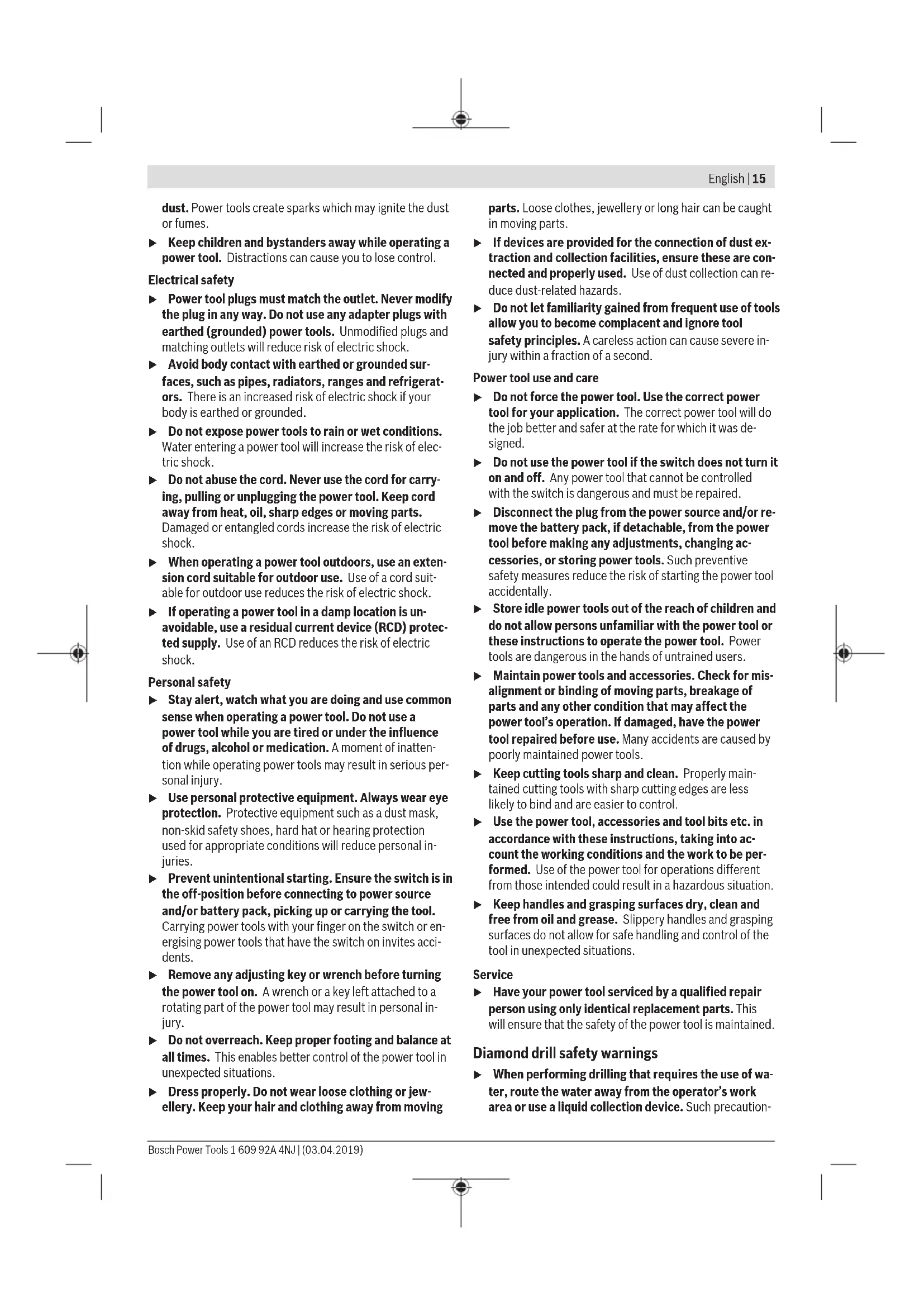


Download the instructions for your Drill in PDF format for free! Find your manual GCR 180 Professional - BOSCH and take your electronic device back in hand. On this page are published all the documents necessary for the use of your device. GCR 180 Professional by BOSCH.
USER MANUAL GCR 180 Professional BOSCH
Wasserdruckbehälter 2 609 390 308 Adapter G 1/2" 2 608 598 043 Nass-/Trockensauger GAS 35MAFC Nass-/Trockensauger GAS 55MAFC Kundendienst und Anwendungsberatung Der Kundendienst beantwortet Ihre Fragen zu Reparatur und Wartung Ihres Produkts sowie zu Ersatzteilen. Explosions- zeichnungen und Informationen zu Ersatzteilen finden Sie auch unter: www.bosch-pt.com Das Bosch-Anwendungsberatungs-Team hilft Ihnen gerne bei Fragen zu unseren Produkten und deren Zubehör. www.powertool-portal.de, das Internetportal für Handwer- ker und Heimwerker. Geben Sie bei allen Rückfragen und Ersatzteilbestellungen bitte unbedingt die 10-stellige Sachnummer laut Typen- schild des Produkts an. Deutschland Robert Bosch Power Tools GmbH Servicezentrum Elektrowerkzeuge Zur Luhne 2 37589 Kalefeld – Willershausen Unter www.bosch-pt.de können Sie online Ersatzteile be- stellen oder Reparaturen anmelden. Kundendienst: Tel.: (0711) 40040460 Fax: (0711) 40040461 E-Mail: Servicezentrum.Elektrowerkzeuge@de.bosch.com Anwendungsberatung: Tel.: (0711) 40040460 Fax: (0711) 40040462 E-Mail: kundenberatung.ew@de.bosch.com Österreich Unter www.bosch-pt.at können Sie online Ersatzteile bestel- len. Tel.: (01) 797222010 Fax: (01) 797222011 E-Mail: service.elektrowerkzeuge@at.bosch.com Schweiz Unter www.bosch-pt.com/ch/de können Sie online Ersatz- teile bestellen. Tel.: (044) 8471511 Fax: (044) 8471551 E-Mail: Aftersales.Service@de.bosch.com Luxemburg Tel.: +32 2 588 0589 Fax: +32 2 588 0595 E-Mail: outillage.gereedschap@be.bosch.com Entsorgung Elektrowerkzeuge, Bohrständer, Zubehör und Verpackungen sollen einer umweltgerechten Wiederverwertung zugeführt werden. Werfen Sie Elektrowerkzeuge nicht in den Hausmüll! Nur für EU-Länder: Gemaß der Europaischen Richtlinie 2012/19/EU uber Elek- tro- und Elektronik-Altgerate und ihrer Umsetzung in natio- nales Recht mussen nicht mehr gebrauchsfahige Elektro- werkzeuge getrennt gesammelt und einer umweltgerechten Wiederverwertung zugefuhrt werden. English Safety instructions General Power Tool Safety Warnings WARNING Read all safety warnings, instruc- tions, illustrations and specifica- tions provided with this power tool. Failure to follow all in- structions listed below may result in electric shock, fire and/ or serious injury. Save all warnings and instructions for future reference. The term "power tool" in the warnings refers to your mains- operated (corded) power tool or battery-operated (cord- less) power tool. WARNING ! When using electric tools basic safety precau- tions should always be followed to reduce the risk of fire, electric shock and personal injury including the following. Read all these instructions before attempting to operate this product and save these instructions. Work area safety u Keep work area clean and well lit. Cluttered or dark areas invite accidents. u Do not operate power tools in explosive atmospheres, such as in the presence of flammable liquids, gases or 1 609 92A 4NJ | (03.04.2019) Bosch Power ToolsEnglish | 15 dust. Power tools create sparks which may ignite the dust or fumes. u Keep children and bystanders away while operating a power tool. Distractions can cause you to lose control. Electrical safety u Power tool plugs must match the outlet. Never modify the plug in any way. Do not use any adapter plugs with earthed (grounded) power tools. Unmodified plugs and matching outlets will reduce risk of electric shock. u Avoid body contact with earthed or grounded sur- faces, such as pipes, radiators, ranges and refrigerat- ors. There is an increased risk of electric shock if your body is earthed or grounded. u Do not expose power tools to rain or wet conditions. Water entering a power tool will increase the risk of elec- tric shock. u Do not abuse the cord. Never use the cord for carry- ing, pulling or unplugging the power tool. Keep cord away from heat, oil, sharp edges or moving parts. Damaged or entangled cords increase the risk of electric shock. u When operating a power tool outdoors, use an exten- sion cord suitable for outdoor use. Use of a cord suit- able for outdoor use reduces the risk of electric shock. u If operating a power tool in a damp location is un- avoidable, use a residual current device (RCD) protec- ted supply. Use of an RCD reduces the risk of electric shock. Personal safety u Stay alert, watch what you are doing and use common sense when operating a power tool. Do not use a power tool while you are tired or under the influence of drugs, alcohol or medication. A moment of inatten- tion while operating power tools may result in serious per- sonal injury. u Use personal protective equipment. Always wear eye protection. Protective equipment such as a dust mask, non-skid safety shoes, hard hat or hearing protection used for appropriate conditions will reduce personal in- juries. u Prevent unintentional starting. Ensure the switch is in the off-position before connecting to power source and/or battery pack, picking up or carrying the tool. Carrying power tools with your finger on the switch or en- ergising power tools that have the switch on invites acci- dents. u Remove any adjusting key or wrench before turning the power tool on. A wrench or a key left attached to a rotating part of the power tool may result in personal in- jury. u Do not overreach. Keep proper footing and balance at all times. This enables better control of the power tool in unexpected situations. u Dress properly. Do not wear loose clothing or jew- ellery. Keep your hair and clothing away from moving parts. Loose clothes, jewellery or long hair can be caught in moving parts. u If devices are provided for the connection of dust ex- traction and collection facilities, ensure these are con- nected and properly used. Use of dust collection can re- duce dust-related hazards. u Do not let familiarity gained from frequent use of tools allow you to become complacent and ignore tool safety principles. A careless action can cause severe in- jury within a fraction of a second. Power tool use and care u Do not force the power tool. Use the correct power tool for your application. The correct power tool will do the job better and safer at the rate for which it was de- signed. u Do not use the power tool if the switch does not turn it on and off. Any power tool that cannot be controlled with the switch is dangerous and must be repaired. u Disconnect the plug from the power source and/or re- move the battery pack, if detachable, from the power tool before making any adjustments, changing ac- cessories, or storing power tools. Such preventive safety measures reduce the risk of starting the power tool accidentally. u Store idle power tools out of the reach of children and do not allow persons unfamiliar with the power tool or these instructions to operate the power tool. Power tools are dangerous in the hands of untrained users. u Maintain power tools and accessories. Check for mis- alignment or binding of moving parts, breakage of parts and any other condition that may affect the power tool’s operation. If damaged, have the power tool repaired before use. Many accidents are caused by poorly maintained power tools. u Keep cutting tools sharp and clean. Properly main- tained cutting tools with sharp cutting edges are less likely to bind and are easier to control. u Use the power tool, accessories and tool bits etc. in accordance with these instructions, taking into ac- count the working conditions and the work to be per- formed. Use of the power tool for operations different from those intended could result in a hazardous situation. u Keep handles and grasping surfaces dry, clean and free from oil and grease. Slippery handles and grasping surfaces do not allow for safe handling and control of the tool in unexpected situations. Service u Have your power tool serviced by a qualified repair person using only identical replacement parts. This will ensure that the safety of the power tool is maintained. Diamond drill safety warnings u When performing drilling that requires the use of wa- ter, route the water away from the operator’s work area or use a liquid collection device. Such precaution- Bosch Power Tools 1 609 92A 4NJ | (03.04.2019)16 | English ary measures keep the operator’s work area dry and re- duce the risk of electrical shock. u Operate power tool by insulated grasping surfaces, when performing an operation where the cutting ac- cessory may contact hidden wiring or its own cord. Cutting accessory contacting a “live” wire may make ex- posed metal parts of the power tool “live” and could give the operator an electric shock. u Wear hearing protection when diamond drilling. Ex- posure to noise can cause hearing loss. u When the bit is jammed, stop applying downward pressure and turn off the tool. Investigate and take cor- rective actions to eliminate the cause of the bit jamming. u When restarting a diamond drill in the workpiece check that the bit rotates freely before starting. If the bit is jammed, it may not start, may overload the tool, or may cause the diamond drill to release from the work- piece. u When securing the drill stand with anchors and fasten- ers to the workpiece, ensure that the anchoring used is capable of holding and restraining the machine dur- ing use. If the workpiece is weak or porous, the anchor may pull out causing the drill stand to release from the workpiece. u When securing the drill stand with a vacuum pad to the workpiece, install the pad on a smooth, clean, non- porous surface. Do not secure to laminated surfaces such as tiles and composite coating. If the workpiece is not smooth, flat or well affixed, the pad may pull away from the workpiece. u Ensure there is sufficient vacuum before and during drilling. If the vacuum is insufficient, the pad may release from the workpiece. u Never perform drilling with the machine secured by the vacuum pad only, except when drilling down- wards. If the vacuum is lost, the pad will release from the workpiece. u When drilling through walls or ceilings, ensure to pro- tect persons and the work area on the other side. The bit may extend through the hole or the core may fall out on the other side. u Do not use this tool for overhead drilling with water supply. Water entering the power tool will increase the risk of electric shock. u Use suitable detectors to determine if utility lines are hidden in the work area or call the local utility com- pany for assistance. Contact with electric lines can lead to fire and electric shock. Damaging a gas line can lead to explosion. Penetrating a water line causes property dam- age or may cause an electric shock. u Wear non-skid shoes. This prevents injuries that can oc- cur from slipping on smooth surfaces. u Never operate the power tool without the portable re- sidual current device (PRCD) included in delivery. u Pay attention that neither persons in the working area nor the power tool itself come into contact with the water that comes out. u Products sold in GB only: Never operate the 110 V ex- ecution of the machine without isolation transformer according to EN/IEC 61558-1 and EN/IEC 61558-2-23. The isolation transformer must have a grounded earth wire on the secondary winding side. u Never leave the tool unattended before it has come to a complete stop. Cutting tools that are still running can cause injuries. u Assemble the drill stand properly before mounting the drill. The correct assembly is important in order to ensure proper function. u Ensure that the drill is securely attached to the drill stand before using it. Otherwise, the drill may slip in the drill stand, which can lead to a loss of control. u Secure the drill stand on a stable and even surface. If there is a chance that the drill stand will slip or wobble, the safe and steady operation of the drill cannot be guar- anteed. u Keep the drill cord away from the work area. Damaged or entangled cords increase the risk of electric shock. u Do not overload the drill stand or climb or stand on it. Overloading or standing on the drill stand can raise its centre of gravity, causing it to tip over. u Store idle drill stands out of the reach of children. Do not allow persons unfamiliar with the tool or these in- structions to operate the tool. Tools can be dangerous in the hands of untrained users. u Before carrying out any work on the drill stand or drill, during work breaks and when not using the drill stand, secure the drill stand against unintentional movement by tightening the parking brake. u The power tool must only be operated on a mains sup- ply with protective conductor and adequate dimen- sioning. u Always fasten the drill stand while in operation, using anchors or vacuum (accessory) to prevent accidental tipping of the drill stand with inserted diamond drill and core bit. u Ensure that water-carrying hoses, connectors and the water collection ring (accessory) are in immaculate condition. Replace damaged or worn parts before the next use. Water escaping from parts of the power tool will increase the risk of electric shock. Products sold in GB only: Your product is fitted with an BS 1363/A approved electric plug with internal fuse (ASTA approved to BS 1362). If the plug is not suitable for your socket outlets, it should be cut off and an appropriate plug fitted in its place by an au- thorised customer service agent. The replacement plug should have the same fuse rating as the original plug. The severed plug must be disposed of to avoid a possible shock hazard and should never be inserted into a mains socket elsewhere. 1 609 92A 4NJ | (03.04.2019) Bosch Power ToolsEnglish | 17 Product Description and Specifications Read all the safety and general instructions. Failure to observe the safety and general in- structions may result in electric shock, fire and/or serious injury. Please observe the illustrations at the beginning of this oper- ating manual. Intended use Transportable diamond drill GDB180WE+ GCR180 Diamond drill In conjunction with diamond wet-drilling core bits and a wa- ter supply, the power tool is intended for wet drilling in con- crete and reinforced concrete. The power tool can be com- bined with a dust extraction attachment (water collection ring and wet/dry extractor). In conjunction with dry diamond core bits and a suitable dust extraction attachment, the power tool is intended for dry drilling in brick, sandstone, aerated concrete and tiles. When used in a fixed position, the power tool must be held in place by the drill stand for diamond drills GCR180. Over- head work is not permitted. Drill stand for diamond drills The drill stand for diamond drills is intended for mounting the Bosch diamond drill GDB180WE. Other tools may not be used. The drill stand for diamond drills can be secured to the floor or the wall using an anchor. The drill stand for diamond drills can be attached to the floor by means of vacuum (accessory) or (with an additional safe- guard) against the wall. Attaching overhead is not permitted. Product features The numbering of the product features refers to the repres- entation of the power tool and drill stand on the graphic pages. Diamond drill (1) On/off switch (2) Lock-on button for on/off switch (3) Level for vertical alignment (4) Level for horizontal alignment (5) Gear selector switch (6) Claw coupling (7) Drill spindle (8) Core bit
(9) Handle (insulated gripping surface) (10) Water cutoff valve (11) Valve adapter (12) Water connection adapter (13) Extraction adapter (14) Extraction outlet
(15) Extraction hose
(16) Portable residual current device (PRCD)
Accessories shown or described are not included with the product as standard. You can find the complete selection of accessories in our accessories range. Drill stand for diamond drills (17) Star handle (insulated gripping surface) (18) Screw on the drill holder (19) Drill holder (20) Drill column (21) Upper screw of the drilling angle adjuster (22) Levelling screw (23) Water collection ring
(24) Lower screw of the drilling angle adjuster (25) Base plate (26) Rack (27) Clamping nut of the drilling angle adjuster (28) Feed pinion (29) Locking brake (30) Masonry anchor/concrete anchor
(32) Wing nut for the quick-clamping spindle
(33) Tension spring for the water collection ring
(34) Sliding guides (35) Hex nut for sliding guides (x10) (36) Threaded pin for sliding guides (x10)
Accessories shown or described are not included with the product as standard. You can find the complete selection of accessories in our accessories range. Technical data Transportable diamond drill GDB180WE+ GCR180 Diamond drill GDB 180 WE Article number 3601A898.. Rated power input W 2000 Power output W 1340 Rated speed n
Drilling diameter – optimum in masonry mm 40–180 – possible in masonry mm 0–180 – optimum in concrete mm 40–150 – possible in concrete mm 0–180 Tool holder 11/4"UNC Max. pressure of water supply bar 3 Bosch Power Tools 1 609 92A 4NJ | (03.04.2019)18 | English Diamond drill GDB 180 WE Weight according to EPTA-Procedure 01:2014 kg 5.2 Protection class / I The specifications apply to a rated voltage [U] of 230 V. These spe- cifications may vary at different voltages and in country-specific mod- els. Drill stand for diamond drills GCR 180 Article number 3601A90100 Dimensions – Height mm 767 – Width mm 205 – Depth mm 423.5 Drill holder diameter mm 60 Max. dimensions of core bit – Diameter mm 180 – Diameter with water collec- tion ring mm 132 – Length mm 530 Max. drill stroke mm 514 Max. working length mm 455 Weight according to EPTA-Procedure 01:2014 kg 9.5 Noise information Noise emission values determined according to EN62841‑3‑6. Typically, the A-weighted noise level of the power tool is: Sound pressure level 88dB(A); sound power level 99dB(A). Uncertainty K=3dB. Wear hearing protection The noise emission value given in these instructions has been measured in accordance with a standardised measur- ing procedure and may be used to compare power tools. It may also be used for a preliminary estimation of noise emis- sions. The noise emission value given represents the main applica- tions of the power tool. However, if the power tool is used for other applications, with different application tools or is poorly maintained, the noise emission value may differ. This may significantly increase noise emissions over the total working period. To estimate noise emissions accurately, the times when the tool is switched off, or when it is running but not actually be- ing used, should also be taken into account. This may signi- ficantly reduce noise emissions over the total working period. Assembly u Pull the plug out of the socket before carrying out any work on the power tool. Assembling the drill stand Erecting the drill column Position the drill column(20) so that it is vertical. Insert the lower screw(24) (see illustration on the graphics page). Tighten the lower screw(24) and the upper screw(21) us- ing an open-ended spanner (width across flats 17mm). Tighten the clamping nut(27) using an open-ended spanner (width across flats 24mm). Star handle Screw the three handlebars of the star handle(17) all the way into the central hub of the star handle. The star handle(17) acts as the feed crank during drilling. To drill, push the star handle all the way to the left or right (as required) and onto the feed pinion(28). Pull the star handle off firmly to remove it. Feed lock with locking brake Before using for the first time, screw the locking brake(29) into the free threaded hole underneath the feed pinion(28). Lock the feed when performing any work on the drill stand, during breaks and when not using the drill stand. Do this by engaging the locking brake(29). To drill, loosen the locking brake(29) until the star handle(17) is easy to move. When doing so, hold the star handle in place to prevent the power tool from sliding down in an uncontrolled manner. Inserting the power tool (seefigureA) Ensure that the locking brake(29) is engaged. Loosen the screw(18) on the drill holder using an open- ended spanner (width across flats 13mm). Insert the power tool with the collar all the way into the drill holder(19) from above. Turn the power tool in the drill holder so that all the switches are easy to reach and the dust extraction/water cooling con- nection on the power tool does not interfere with drilling. Tighten the screw(18) using the open-ended spanner (width across flats 13mm). Slide the star handle(17) to the right or left and onto the feed pinion(28) in order to drill. u Check that the power tool is fitted securely in the drill holder. To remove the power tool from the drill stand, carry out the steps above in reverse order. Fixing the drill stand in place Note: Fix the drill stand in place so that it is free of play. This prevents the core bit jamming and segments from being torn out. Depending on the type and condition of the surface, fasten the drill stand at the planned bore hole using anchors or va- cuum. 1 609 92A 4NJ | (03.04.2019) Bosch Power ToolsEnglish | 19 Positioning the drill stand before fixing in place Mark the centre of the hole you want to drill on the surface. Mark the outer dimensions of the core bit you want to use, using the centre of the hole as the centre of the bit. Fix the drill stand (with power tool inserted) in place using an anchor or vacuum so that the core bit lines up with the marked dimensions when attached. Fixing with an anchor (seefigureB) Drill a separate attachment hole for fixing the drill stand in place with an anchor (accessories) in masonry or concrete. Distance between anchor hole and centre of planned hole Optimum 210mm Possible 200–300mm The following dimensions apply for the anchor hole: Diameter Depth Masonry 20 mm 85 mm Concrete 16 mm 50mm Insert a concrete anchor with expansion wedge or a masonry anchor (30). Screw the quick-clamping spindle(31) into the anchor. Attach the drill stand and a washer and screw these on using the wing nut(32). Tighten the wing nut according to the lev- elling using an open-ended spanner (width across flats 27mm). Fastening by vacuum (accessory) To fasten the drill stand by vacuum, you need a commercially available vacuum pump and a Bosch vacuum set (access- ory). The vacuum pump must meet the following minimum re- quirements: Volume flow: 6m
Vacuum at least: 80% (−800mbar) The surface must be smooth and flat in order to fasten with vacuum. Use on plaster or brickwork is not permitted. Once the vacuum connection has been established, gently attach the levelling screws(22) to the base material so that the drill stand is in a rigid position and the sealing ring re- laxes slightly. Otherwise the drill stand will sit very softly on the sealing ring. In order to connect the vacuum pump and Bosch vacuum set, please read and follow the respective operating instruc- tions. u The safety and operating instructions for the vacuum pump and vacuum set must be strictly observed. Levelling (does not apply for fastening by vacuum) Turn the levelling screws(22) in or out individually until the spirit level(3) on the power tool (when mounting vertically) or the spirit level (4) on the power tool (when mounting hori- zontally) is perfectly level. Then fix the drill stand firmly in place using an anchor attach- ment. Inserting/changing the core bit u Before carrying out any work on the drill stand or drill, during work breaks and when not using the drill stand, secure the drill stand against unintentional movement by tightening the parking brake. Selecting the core bit Bosch core bits are colour-coded: – Wet core bits: Blue – Dry core bits: Light grey Inserting the core bit u Always examine the core bits before inserting them. Only use core bits that are free of defects. Using dam- aged or deformed core bits may result in dangerous situ- ations. Clean the core bits before inserting them. Lightly grease the thread of the core bit or spray it with corrosion inhibitor. Screw a 11/4" UNC core bit(8) onto the drill spindle(7). u Check that the core bit is fitted securely. Core bits that are attached incorrectly or are not securely fixed in place may come loose during operation, thereby putting you at risk. Removing the core bit u Wear protective gloves when changing the core bit. The core bit may become hot when the power tool is op- erated for extended periods of time. Detach the core bit(8) using an open-ended spanner (width across flats 41mm). When doing so, hold a second open- ended spanner (width across flats 32mm) on the two flats of the drill spindle(7) to provide counterforce. Connecting the water cooling/dust extraction system If wet or dry core bits are not sufficiently cooled when drilling, the diamond segments can become damaged or the core bit can jam in the drill hole. You should therefore ensure that the water cooling system provides sufficient cooling when wet drilling, or that the dust extraction system is func- tioning properly when dry drilling. When expanding an existing hole, this must be sealed care- fully to allow the core bit to be sufficiently cooled. u Connected hoses, shut-off valves or accessories must not interfere with drilling. Connecting the water cooling system Attach the water connection adapter(12) to the claw coup- ling(6) and tighten it by turning it clockwise as far as pos- sible. Close the water cutoff valve(10). Connect a water supply line to the valve adapter(11). The water supply line can be provided from a mobile pressurised water tank (accessory) or a stationary water connection. You will need a water collection ring and a wet/dry extractor (both accessories) to collect the water that escapes from the drill hole during wet drilling. Bosch Power Tools 1 609 92A 4NJ | (03.04.2019)20 | English Fitting a water collection ring for water extraction (seefigureC) The water collection ring (see "Accessories/replacement parts", page22) is intended for use with the drill stand for diamond drills GCR180 and the diamond drill GDB180WE. Cut an opening for the required drilling diameter in the seal- ing cover. Push the tension spring(33) as far as possible into the gap between the base plate(25) and drill column(20). Make sure that the angled section of the tension spring is facing downwards. Put the water collection ring in position and place the ten- sion spring on the contact points on the water collection ring. (The lugs on the ends of the tension spring are used to pull the tension spring upwards.) The tensioning force of the spring will press the water collec- tion ring with its seal onto the surface. Together with the va- cuum of the wet/dry extractor, this will prevent water from escaping. Connecting the dust extraction system The dust from materials such as lead paint, some types of wood, minerals and metal can be harmful to human health. Touching or breathing in this dust can trigger allergic reac- tions and/or cause respiratory illnesses in the user or in people in the near vicinity. Certain dusts, such as oak or beech dust, are classified as carcinogenic, especially in conjunction with wood treatment additives (chromate, wood preservative). Materials contain- ing asbestos may only be machined by specialists. – Use a dust extraction system that is suitable for the ma- terial wherever possible. – Provide good ventilation at the workplace. – It is advisable to wear a P2 filter class breathing mask. The regulations on the material being machined that apply in the country of use must be observed. Attach the extraction adapter(13) to the claw coupling(6) and tighten it by turning it clockwise as far as possible. Attach the extraction hose(15) of a wet/dry extractor that is compatible with and recommended for this system (see "Ac- cessories/replacement parts", page22) to the extraction outlet(14). Operation Changing the drilling angle u Pull the plug out of the socket before carrying out any work on the power tool. u Always retighten all the screws after making adjust- ments to the drill stand. Loosen the lower screw(24) on the drilling angle adjuster using an open-ended spanner (width across flats 17mm) and remove it. Loosen the upper screw(21) using an open-ended spanner (width across flats 17mm). Loosen the clamping nut(27) using an open-ended spanner (width across flats 24mm). Set the drill stand to the re- quired drilling angle. Retighten the clamping nut(27) using the open-ended span- ner (width across flats 24mm). Tighten the upper screw(21) using an open-ended spanner (width across flats 17mm). u The drill stand must not be inserted until the clamping nut (27) and screw (21) of the angle adjuster have been retightened. After drilling, put the drill column(20) back in the vertical position (drilling angle of 0°) by carrying out the steps above in reverse order. To do this, you will need to refit the lower screw(24) and tighten it using an open-ended spanner (width across flats 17 mm). Starting operation u Pay attention to the mains voltage. The voltage of the power source must match the voltage specified on the rating plate of the power tool. u Seek advice from the responsible structural engineer, architect or construction supervisor regarding planned drill holes before starting work. Do not penet- rate any reinforcements unless you have authorisa- tion from a structural engineer. u When drilling holes that penetrate walls or ceilings, al- ways check the area concerned for obstacles. Close off the work site and prevent the drill core from falling by means of formwork. Function test of the portable residual current device (PRCD) Before starting work, always check that the portable residual current device (PRCD)(16) is functioning correctly: – Press the TEST button on the residual current device (PRCD). The red indicator light will switch off. – Press the RESET button. It must now be possible to switch the power tool on. If the red indicator light does not switch off when you press the TEST button or it switches off repeatedly when the power tool is switched on, you must have the power tool checked by an authorised Bosch after-sales service centre. u The power tool must not be used if the portable resid- ual current device (PRCD) is defective. Switching on Press the RESET button on the portable residual current device (PRCD)(16). Wet drilling: Set the water cutoff valve(10) to flow. To switch on the power tool, press the on/off switch(1) and keep it pressed. To lock the on/off switch down, press the lock-on button(2) as well. Switching off Release the on/off switch(1). If the on/off switch is locked, press the switch first and then release it. 1 609 92A 4NJ | (03.04.2019) Bosch Power ToolsEnglish | 21 Wet drilling: Close the water cutoff valve(10). Once work is complete, disconnect the valve adapter(11) from the water supply line. Open the water cutoff valve(10) and drain off the residual water. Starting current limitation The electronics of the power tool make the motor start softly, therefore preventing the starting current from being too high. Restart protection The restart protection feature prevents the power tool from uncontrolled starting after the power supply to it has been interrupted. To restart the tool, press the RESET button on the portable residual current device (PRCD)(16). Set the on/off switch(1) to the off position and then switch the power tool on again. Preselecting the speed Two speeds can be preselected using the gear selector switch(5). The gears are recommended for the following drilling dia- meters: – First gear: 80–180mm – Second gear: 25–60mm Working advice u Pull the plug out of the socket before carrying out any work on the power tool. To drill, loosen the locking brake(29) until the star handle(17) is easy to move. When doing so, hold the star handle in place to prevent the power tool from sliding down in an uncontrolled manner. Start drilling in first gear at a low speed until the core bit ro- tates in the material without vibrating. Then switch to second gear if necessary. You should always adjust the contact pressure to the mater- ial you are drilling. Drill applying uniform pressure. If neces- sary, pull the core bit gently out of the drill hole to remove the wet/dry drilling debris from the diamond segments. Use the star handle(17) to turn the power tool down to the required drilling depth. Then turn it back until the core bit is completely visible. To reach the maximum possible working length, you will need to remove the drill core once it completely fills the core bit. Then insert the core bit back into the drilled hole and drill to the maximum depth. Overload clutch If a core bit jams or snags, the power transmission to the drill spindle will be interrupted. If this happens, switch the power tool off immediately to prevent wear and heat build-up. Dislodge the core bit by turning it to the right and left using a suitable open-ended spanner. Carefully pull the power tool out of the bore hole as you do so. Overload protection If the overload threshold is exceeded, the power tool will start noticeably pulsating. Reduce the contact pressure until the power tool starts working normally again. If the contact pressure is not reduced, the power tool will switch off. You will be able to switch the power tool on again straight away, but you should now continue working with a lower contact pressure. Removing the drill core Wet drilling: Once drilling is complete, allow the water to keep flowing for a short while to rinse out the debris between the core bit and the drill core itself. If the drill core is tightly seated in the core bit, hit the core bit with a piece of soft wood or plastic to loosen the drill core. If necessary, push the drill core out through the shank of the core bit using a rod. Note: Do not hit the core bit with hard objects, as this may damage or deform it. Maintenance and Service Maintenance and Cleaning u Pull the plug out of the socket before carrying out any work on the power tool. u To ensure safe and efficient operation, always keep the power tool and the ventilation slots clean. Keep the rack(26) and the guide surfaces of the drill column(20) clean at all times. Clean the drill spindle(7) once the work is complete. Regu- larly spray the drill spindle and the core bit(8) with corro- sion inhibitor. In order to avoid safety hazards, if the power supply cord needs to be replaced, this must be done by Bosch or by an after-sales service centre that is authorised to repair Bosch power tools. Readjusting the sliding guides (seefigureD) The sliding guides(34) can wear down over time, resulting in play between the sliding guides and the drill column. To eliminate this play, you will need to readjust the sliding guides. Loosen all ten hex nuts(35) using an open-ended spanner (width across flats 13mm). Then tighten the threaded Bosch Power Tools 1 609 92A 4NJ | (03.04.2019)22 | English pins(36) evenly until the play is minimised. Retighten all ten hex nuts. The sliding guides do not need to be replaced until the slid- ing layer (red) is worn down, i.e. the red colour has disap- peared and the backing material is revealed. We recommend having the replacement done by an authorised after-sales service centre for Bosch power tools. Transport You can take down the drill stand while the power tool is still attached. To do this, turn the power tool by the star handle(17) as far as possible towards the base plate to re- duce the risk of tipping. To safely transport the power tool, remove it from the drill stand. Accessories/replacement parts Water collection ring (GCR180) 2 608 550 621 Sealing cover for water collection ring (GCR 180)
EU Declaration of Conformity We declare under our sole responsibility that the stated products comply with all applicable provisions of the directives and regulations listed below and are in conformity with the following standards. Technical file at: * Transportable diamond drill Article number