
RS 11-28 - After-sales service Flex - Free user manual and instructions
Find the device manual for free RS 11-28 Flex in PDF.


| Product type | Reciprocating saw |
| Brand | Flex |
| Model | RS 11-28 |
| Voltage | 230 V / 50 Hz |
| Power consumption | 1100 W |
| No‑load speed | 0–2700 min⁻¹ |
| Stroke length | 28 mm |
| Weight (according to EPTA 01/2003) | 3.6 kg |
| Protection class | II (double insulation) |
| Max. cutting thickness – Metal | 20 mm |
| Max. cutting thickness – Wood | 230 mm |
| Cord length | 4.0 m |
| Lighting | Integrated LED |
| Main functions | Cutting metal, wood, plastic, tiles, ceramic; straight, curved, plunge cuts (wood/plastic); tube cutting |
| Speed adjustment | Variable speed trigger |
| Saw shoe | Adjustable depth |
| Sound pressure level | 91 dB(A) |
| Sound power level | 102 dB(A) |
| Vibration (particle board sawing) | 14 m/s² (uncertainty K=1.5 m/s²) |
| Vibration (wood beam sawing) | 20 m/s² (uncertainty K=1.5 m/s²) |
| Maintenance | Regular cleaning of ventilation slots; blow with compressed air; do not loosen gearbox screws during warranty |
| Safety | Read the manual mandatory; wear PPE (goggles, ear protection); disconnect power before any intervention |
| Spare parts | Use only original Flex parts; exploded views on www.flex-tools.com |
| Intended use | Professional (industry and trade) |
Frequently Asked Questions - RS 11-28 Flex
User questions about RS 11-28 Flex
0 question about this device. Answer the ones you know or ask your own.
Ask a new question about this device
Download the instructions for your After-sales service in PDF format for free! Find your manual RS 11-28 - Flex and take your electronic device back in hand. On this page are published all the documents necessary for the use of your device. RS 11-28 by Flex.
USER MANUAL RS 11-28 Flex
natural_image
Illustration of a saw cutting tool with a flat blade and handle (no text or symbols)de Originalbetriebsanleitung 3
en Original operating instructions ..... 11
fr Notice d'instructions d'origine 19
it Istruzioni per l'uso originali 27
es Instrucciones de funcionamiento originales ..... 35
pt Instruções de serviço originais 43
nl Originele gebruiksaanwijzing 51
da Originale driftsvejledning 59
no Originale driftsanvisningen 66
sv Originalbruksanvisning 74
fi Alkuperäinen käyttöohjekirja 81
el Auθεντικές οδηγίες χειρισμού 89
p1 Instrukcja oryginalna 97
hu Eredeti üzemeltetési útmutató ..... 106
cs Originální návod k obsluze 114
sk Originálny návod na obsluhu 122
et Originaalkasutusjuhend 130
It Originali naudojimo instrukcija 138
Iv Lietošanas pamācības oriģināls ..... 146
ru Оригинальная инструкция по эксплуатации ..... 154
Inhalt
Verwendete Symbole 3
natural_image
Illustration of a saw cutting tool with two directional arrows indicating movement (no text or symbols)natural_image
Illustration of a saw cutting tool with a gear and handle (no text or symbols)natural_image
Close-up of a mechanical component with an arrow indicating direction (no text or symbols)natural_image
Illustration of a hand using a sawto tool to cut a block (no text or symbols visible)natural_image
Illustration of a hand using a sawtooth tool to cut a surface, showing motion direction (no text or symbols)Klaus Peter Weinper Head of Quality Department (QD)
12.11.2018
Symbols used in this manual ..... 11
Symbols on the power tool.... 11
Technical data 11
Overview 12
Important safety information ..... 13
Noise and vibration 14
Instructions for use 15
Maintenance and care 17
Disposal information 17
C ∈ conformity ..... 18
Exemption from liability 18
Symbols used in this manual

WARNING!
Denotes impending danger. Non-observance of this warning may result in death or extremely severe injuries.

CAUTION!
Denotes a potentially dangerous situation. Non-observance of this warning may result in slight injury or damage to property.

NOTE!
Denotes application tips and important information.
Symbols on the power tool

Before switching on the power tool, read the operating manual!

Wear protective goggles!

Wear ear defenders!

Disposal information for the old machine (see page 17)!
Technical data
| Sabre saw RS 11-28 | ||
| Mains voltage | V | 2 3 |
| Power input W 1100 | ||
| Stroke rate, no load rpm | 0–2700 | |
| Stroke mm 28 | ||
| Max. material thickness– metal– wood | mm mm | 20 230 |
| Weight according to “EPTA Procedure 01/2003” | kg 3.6 | |
| Protection class | II | |
0
Overview
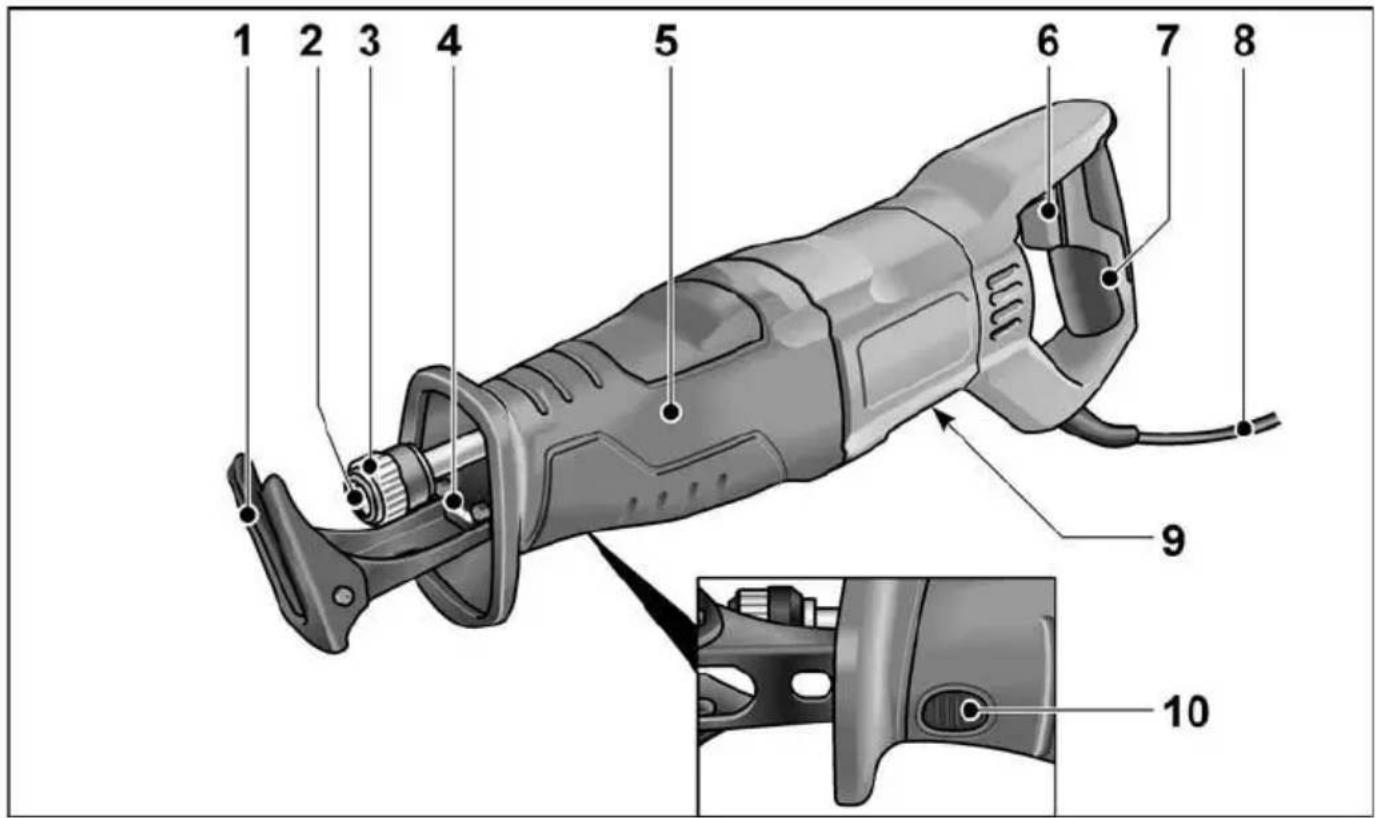
1 Cutting support
2 Tool holder
3 Tool holder lock
4 LED lighting
For illuminating the working area.
5 Front handle
6 ON/OFF switch
For switching on and off and for accelerating up to maximum stroke rate.
7 Rear handle
8 4.0 m power cord with plug
9 Rating plate *
10 Cutting support lock
* (not visible)
Important safety information

WARNING!
Read all safety instructions and general instructions. Failure to comply with the safety instructions and general instructions may result in electric shock, fire and/or serious injuries. Save all warnings and instructions for future reference.
Before using the power tool, please read and follow:
– these operating instructions,
- the "General safety instructions" on the handling of power tools in the enclosed booklet (leaflet no.: 315.915),
– the currently valid site rules and the regulations for the prevention of accidents.
This power tool is state of the art and has been constructed in accordance with the acknowledged safety regulations.
Nevertheless, when in use, the power tool may be a danger to life and limb of the user or a third party, or the power tool or other property may be damaged. The power tool may be operated only if it is
- for its intended use,
- in perfect working order.
Faults which compromise safety must be repaired immediately.
Intended use
The sabre saw is intended
– for commercial use in industry and trade,
– for sawing metal, plastic and wood,
– for sawing tiles and ceramics,
– for straight and curved cuts,
- for cutting pipes,
– to be used with suitable tools recommended by the manufacturer for this power tool.
Safety instructions for sabre saws
- Hold the power tool by the insulated gripping surfaces when performing an operation where the cutting accessory may contact hidden wiring or its own cord. The cutting accessory contacting a “live” wire may make exposed metal parts of the power tool “live” and shock the operator.
- Keep hands away from the sawing area. Do not grip under the workpiece. Risk of injury if contact is made with the saw blade!
■ Guide the power tool only when it is switched on against the workpiece. Otherwise there is the risk of kickback if the cutting accessory snags in the workpiece.
■ Make sure the cutting support always rests on the workpiece when sawing. The saw blade may snag, causing the operator to lose control of the power tool.
■ After completing the cutting operation, switch off the power tool and withdraw the saw blade from the cut only after the blade has come to a complete stop. In this way, you will avoid any kickback and you can now safely put the power tool down.
■ Use only undamaged saw blades that are in perfect condition. Bent or blunt saw blades may break or cause a kickback.
■ After switching off, do not attempt to brake the saw blade by applying lateral counterpressure. The saw blade may incur damage, break or cause a kickback.
■ Clamp the material so that it is firmly secured. Do not support the workpiece with your hand or foot. Do not touch any objects or the ground with the saw while it is running. Risk of kickback!
■ Do not use the power tool if it has a damaged power cord. Do not touch the damaged power cord and pull out the mains plug if the power cord is damaged during work. Damaged power cords increase the risk of an electric shock.
■ Use suitable detectors to detect concealed power supply cables or consult your local supply company. Contact with electric cables may result in a fire and/or electric shock. A damaged gas pipe may cause an explosion. Cutting into a water pipe will cause damage to property or may cause an electric shock.
■ When working, hold the power tool firmly with both hands and ensure that you have a secure footing. The power tool is controlled more securely if held with both hands.
- Keep the workplace clean. Material mixtures are especially dangerous. Light metal dust may burn or explode.
■ Wait until the power tool has come to a stop before putting it down. The cutting accessory may snag, causing the operator to lose control of the power tool.
- Secure the workpiece. A workpiece is held more securely in a clamping device than by hand.
Special safety instructions
■ The mains voltage and the voltage specifications on the rating plate must correspond.
■ Do not work on materials which release hazardous substances (e.g. asbestos).
■ Identify the power tool with stickers only. Do not drill any holes into the housing.
Noise and vibration
The noise and vibration values have been determined in accordance with EN 60745.
The A-weighted noise level of the power tool is typically:
– Sound pressure level: 91 dB(A);
– Sound power level: 102 dB(A);
– Uncertainty K: 3 dB.
Total vibration value:
- Emission value a_h when sawing chipboard: 14 m/s 2
- Emission value a_h when sawing wooden beam: 20 m/s
– Uncertainty K: 1.5 m/s ^2
ATTENTION!
The indicated measurements refer to new power tools. Daily use causes the noise and vibration values to change.
i NOTE!
The vibration emission level given in this information sheet has been measured in accordance with a standardised test given in EN 60745 and may be used to compare one tool with another. It may be used for a preliminary assessment of exposure. The declared vibration emission level represents the main applications of the tool. However if the tool is used for different applications, with different accessories or poorly maintained, the vibration emission may differ. This may significantly increase the exposure level over the total working period. To make an accurate estimation of the vibration exposure level, it is also necessary to take into account the times when the tool is switched off or running but not actually in use. This may significantly decrease the exposure level over the total working period. Identify additional safety measures to protect the operator from the effects of vibration such as: maintain the tool and the cutting accessories, keep the hands warm, organisation of work patterns.
CAUTION!
Wear ear defenders at a sound pressure above 85 dB(A).
Instructions for use
Before switching on the power tool Unpack the power tool and accessories and check that no parts are missing or damaged.
Inserting/changing the saw blades

WARNING!
Before performing any work on the power tool, pull out the mains plug.
Discharging used saw blade

CAUTION!
- Used cutting accessories may become hot. Wear protective gloves!
- Ensure that no persons, animals or sensitive surfaces are in the line of fire when discharging.

■ Release tool holder lock by turning anticlockwise and hold (1.). Used saw blade is discharged under spring pressure (2).

NOTE!
If used saw blade is not discharged, pull saw blade forwards out of tool holder.
Inserting new saw blade
Select a saw blade to suit the material to be machined. Refer to the manufacturer's catalogues for details of saw blades that can be used.

CAUTION!
Risk of injury from cutting teeth. Wear protective gloves!
■ Tool holder must be free of saw residue. Remove contamination with compressed air or a brush.

■ Open tool holder by turning anti-clockwise (1.), tool holder engages in end position.
■ Insert new saw blade into tool holder and push in as far as it will go (2.).
■ Release lock of tool holder; lock is engaged under spring pressure.
■ Pull saw blade several times to ensure that the attachment is secure.

NOTE!
If tool holder lock does not engage correctly, engage tool holder lock by turning in clockwise direction.

natural_image
Illustration of a saw cutting tool with a gear and handle (no text or symbols)Adjusting the cutting support

WARNING!
Before performing any work on the power tool, pull out the mains plug.
The cutting support should always rest on the material when sawing so as to avoid excessive vibrations.
It is possible, for example, to limit the saw blade cutting depth by adjusting the cutting support.
■ Push cutting support lock (1.).
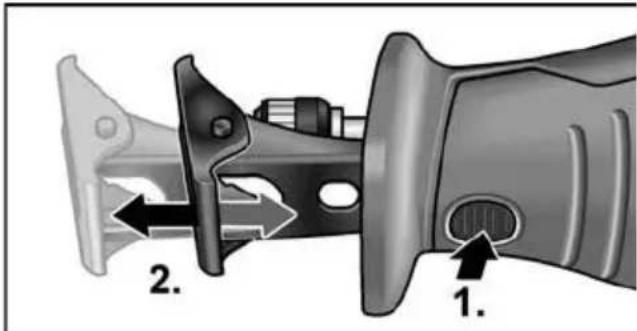
■ Adjust the cutting support to the required depth (2.).
■ Release cutting support lock.
Switching the power tool on/off
The power tool switch allows the operator to increase the stroke rate slowly up to the maximum setting.
■ Press and hold down the switch. The power tool starts.

natural_image
Close-up of a mechanical component with a highlighted section and directional arrow (no text or symbols)The LED illuminates the working area when the power tool is switched on.
To switch off the tool:
■ Release the switch.
Operating instructions

WARNING!
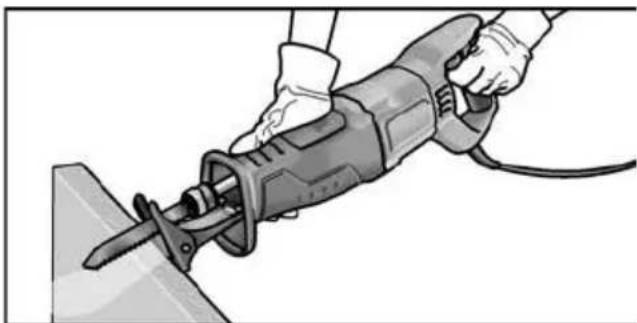
Always hold the power tool firmly with both hands!
natural_image
Person using a sawdriver to cut a block, no text or symbols visible■ Whenever possible, clamp the workpiece to be cut in a vice.
■ The saw has a cutting support. This helps to reduce vibrations. It also enables square cuts to be made.
■ After the power tool has been switched off, the saw blade continues running briefly.
■ Never touch the saw blade straight after use as it may be very hot.
Sawing metal
When sawing metal, use lubricant along the cutting line. This stops the material from overheating.
Sawing wood
Place the saw square on the workpiece. Guide the saw with uniform pressure through the wood, pressing the cutting support against the workpiece in the process.
Sawing directly at the wall
Thanks to the elasticity of bi-metal saw blades it is possible to cut pipes flush with the wall. To do so, use a saw blade of sufficient length that exceeds the diameter of the pipe. Position the saw blade flush with the wall so that the kink point is outside the workpiece to be sawn.
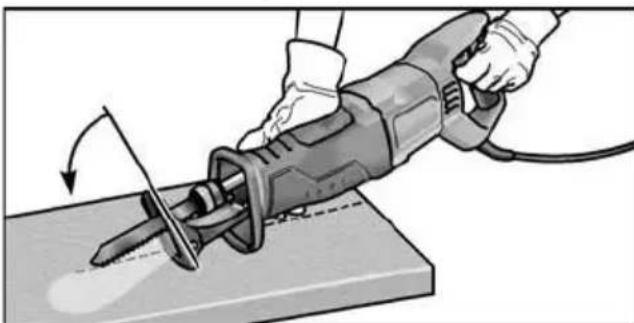
Plunge cuts
The saw is suitable for plunge cuts in wood and plastic. Use only short saw blades (<150 mm) to perform plunge cuts!
■ Place the saw on the workpiece with the bottom edge of the cutting support in such a way that the saw blade does not touch the workpiece.
natural_image
Illustration of a hand using a sawtooth tool to cut a screwdriver on a base (no text or symbols visible)■ Switch on the saw.
■ Press the cutting support firmly against the workpiece and swing the saw forwards.
Slowly plunge the saw blade into the workpiece.
■ When the cutting support is resting fully on the workpiece, continue sawing along the desired cutting line.
i NOTE
Do not perform plunge cuts in metal.
Other information
- The use of "sharp" cutting accessories increases performance and the service life of the power tool.
- After work, clean the power tool and store in the carry case in a dry location.
Maintenance and care
WARNING!
Before performing any work on the power tool, pull out the mains plug.
Cleaning
WARNING!
If metals are worked over a prolonged period, conductive dust may become deposited inside the housing.
■ Clean the power tool and ventilation slots at regular intervals. Frequency of cleaning is dependent on the material and duration of use.
■ Regularly blow out the housing interior and motor with dry compressed air.
Gear
i NOTE!
Do not loosen the screws on the gear head during the warranty period. Failure to comply with this requirement will invalidate any claims under the manufacturer's warranty.
Repairs
Repairs may be carried out by an authorised customer service centre only.
Spare parts and accessories
i NOTE!
Use only original parts supplied by the manufacturer for replacement purposes. The use of non-original parts will invalidate any claims under the manufacturer's warranty.
For other accessories, in particular cutting accessories, please refer to the manufacturer's catalogues.
Exploded drawings and spare-part lists can be found on our homepage:
www.flex-tools.com
Disposal information
WARNING!
Render disused power tools unusable by removing the power cord.
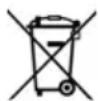
EU countries only.
Do not throw electric power tools into the household waste!
In accordance with the European Directive 2012/19/EU on Waste Electrical and Electronic Equipment and its incorporation into national law, used electric power tools must be collected separately and recycled in an environmentally friendly manner.
Raw material recovery instead of waste disposal.
Device, accessories and packaging should be recycled in an environmentally friendly manner. Plastic parts are identified for recycling according to material type.
i NOTE!
Please ask your dealer about disposal options.
CE conformity
We declare on our sole responsibility that the product described under "Technical data" conforms to the following standards or normative documents:
EN 60745 according to the provisions of Directives 2014/30/EU, 2006/42/EC, 2011/65/EU.
Responsible for technical documents:
Eckhard Rühle
Manager Research &
Development (R & D)
Klaus Peter Weinper
Head of Quality
Department (QD)
12.11.2018
Exemption from liability
The manufacturer and his representative are not liable for any damage and lost profits due to interruption in business caused by the product or by an unusable product.
The manufacturer and his representative are not liable for any damage which was caused by improper use of the power tool or by use of the power tool with products from other manufacturers.
Table des matières
natural_image
Illustration of a manual saw cutting tool with two labeled steps (1 and 2), showing mechanical components and motion arrows (no text or symbols beyond labels)natural_image
Illustration of a saw cutting tool with a gear and handle (no text or symbols)natural_image
Close-up of a mechanical component with a directional arrow indicating movement (no text or symbols)natural_image
Person using a sawto tool to cut a block, no text or symbols visiblenatural_image
Illustration of a hand using a power tool to cut a saw (no text or symbols visible)■ Mettre en marche la scie.
Eckhard Rühle Manager Research & Development (R & D)
Klaus Peter Weinper Head of Quality Department (QD)
12.11.2018
natural_image
Three circular icons representing user, safety, and work-related roles (no text or symbols)natural_image
Illustration of a manual saw tool with two labeled arrows indicating motion (no text or symbols present)natural_image
Illustration of a saw cutting tool with a gear and handle (no text or symbols)natural_image
Close-up of a mechanical component with a highlighted section and directional arrow (no text or symbols)natural_image
Person using a sawto tool to cut a block, no text or symbols visiblenatural_image
Illustration of a hand using a sawtooth tool to cut a surface, showing motion direction (no text or symbols)Manager Research & Development (R & D)
Klaus Peter Weinper
Head of Quality Department (QD)
12/11/2018
natural_image
Three circular icons representing people, headsets, and a trash bin (no text or symbols)natural_image
Illustration of a saw cutting tool with a gear and handle (no text or symbols)natural_image
Close-up of a mechanical component with a highlighted section and directional arrow (no text or symbols)natural_image
Person using a sawdriver to cut a block, no text or symbols visiblenatural_image
Illustration of a hand using a sawtooth tool to cut a sawtooth on a flat surface, with no visible text or symbols.Manager Research & Development (R & D)
Klaus Peter Weinper
Head of Quality Department (QD)
natural_image
Illustration of a saw cutting tool with a gear and handle (no text or symbols)natural_image
Close-up of a mechanical component with a highlighted section and directional arrow (no text or symbols)natural_image
Person using a sawlure to cut a surface, no text or symbols visiblenatural_image
Illustration of a hand using a sawtooth tool to cut a sawtooth on a flat surface, with no visible text or symbols.Manager Research & Development (R & D)
Klaus Peter Weinper Head of Quality Department (QD)
natural_image
Illustration of a saw cutting tool with two labeled arrows indicating motion (no text or symbols present)natural_image
Illustration of a saw cutting tool with a gear and handle (no text or symbols)natural_image
Close-up of a mechanical component with a highlighted arrow indicating direction (no text or symbols)natural_image
Person using a sawdriver to cut a block, no text or symbols visiblenatural_image
Illustration of a hand using a sawtooth tool to cut a component, with no visible text or symbolsEckhard Rühle Manager Research & Development (R & D)
Klaus Peter Weinper Head of Quality Department (QD)
12-11-2018
natural_image
Illustration of a saw cutting tool with two directional arrows indicating movement (no text or symbols)natural_image
Illustration of a saw cutting tool with a gear and handle (no text or symbols)Indstilling af savestøtte

ADVARSEL!
natural_image
Close-up of a mechanical component with a directional arrow indicating movement (no text or symbols)natural_image
Person using a sawlure to cut a block, no text or symbols visiblenatural_image
Illustration of a hand using a sawtooth tool to cut a sawtooth on a workbench, with no visible text or symbols.■ Start saven.
■ Tryk savestøtten hårdt mod emnet, og sving saven fremad.
Lad savklingen dykke langsomt ned i emnet.
Klaus Peter Weinper Head of Quality Department (QD)
1 Sageunderlag
2 Verktøyholder
3 Lås verktøyholder
4 LED-belysning
natural_image
Illustration of a saw cutting tool with two labeled steps (1 and 2), showing mechanical components without any text or symbols.natural_image
Illustration of a saw cutting tool with a gear and handle (no text or symbols)Stille inn sageunderlaget

ADVARSEL!
natural_image
Close-up of a mechanical component with a highlighted section and directional arrow (no text or symbols)natural_image
Person using a sawto tool to cut a piece of material (no text or symbols visible)natural_image
Illustration of a hand using a sawtooth tool to cut a surface, showing motion direction (no text or symbols)■ Slå på sagen.
■ Trykk sageunderlaget fast mot arbeidsemnet og sving sagen fremover. Senk sagbladet langsomt ned i arbeidsemnet.
Når sageunderlaget ligger helt mot arbeidsemnet, sager du videre langs ønsket snittlinje.
i MERKNAD
Eckhard Rühle Manager Research & Development (R & D)
Klaus Peter Weinper Head of Quality Department (QD)
natural_image
Illustration of a saw cutting tool with a gear and handle (no text or symbols)natural_image
Close-up of a mechanical component with directional arrows indicating movement or force (no text or symbols)natural_image
Person using a sawtopper to cut a block, no text or symbols visiblenatural_image
Illustration of a hand using a sawtooth tool to cut a sawtooth on a workbench (no text or symbols visible)Manager Research & Development (R & D)
2018-11-12
Klaus Peter Weinper
Head of Quality
Department (QD)
natural_image
Three circular icons showing a person, a person wearing glasses, and a person wearing headphones, with a crossed-out battery symbol below (no text or labels)1 Sahausjalka
2 Työkalun istukka
3 Istukan lukitsin
4 L E D - v a l o
natural_image
Illustration of a saw cutting tool with a handle and gear mechanism (no text or symbols)natural_image
Close-up of a mechanical component with a highlighted section and directional arrow (no text or symbols)natural_image
Person using a sawlifter to cut a block, no text or symbols visiblenatural_image
Illustration of a hand using a sawtooth tool to cut a sawtooth on a flat surface (no text or symbols visible)Klaus Peter Weinper Head of Quality Department (QD)
12.11.2018
1 Π ε λ μ α
2 Υποδοχή εργαλείου
natural_image
Illustration of a manual saw cutting a mechanical component with two directional arrows indicating motion (no text or symbols)natural_image
Illustration of a saw cutting tool with a gear and handle (no text or symbols)Ρύθμιση πέλματος
⚠️ ΠΡΟΕΙΔΟΠΟΙΗΣΗ!
natural_image
Close-up of a mechanical component with a directional arrow indicating movement (no text or symbols)natural_image
Person using a sawtopper to cut a surface (no text or symbols visible)natural_image
Illustration of a hand using a sawtooth tool to cut a surface, showing motion direction (no text or symbols)Eckhard Rühle Manager Research & Development (R & D)
Klaus Peter Weinper Head of Quality Department (QD)
12/11/2018
natural_image
Illustration of a saw cutting tool with a gear and handle (no text or symbols)natural_image
Close-up of a mechanical component with a directional arrow indicating flow or movement (no text or symbols present)natural_image
Person using a sawdriver to cut a block, no text or symbols visiblenatural_image
Illustration of a hand using a sawtooth tool to cut a surface, showing motion direction (no text or symbols)Eckhard Rühle
Manager Research & Development (R & D)
Klaus Peter Weinper
Head of Quality
Department (QD)
12.11.2018
1 Fürésztámasz
2 Szerszámbefogó
natural_image
Illustration of a saw cutting tool with two directional arrows indicating movement (no text or symbols)natural_image
Illustration of a saw cutting tool with a gear and handle (no text or symbols)natural_image
Close-up of a mechanical component with directional arrows indicating movement or force (no text or symbols)natural_image
Person using a sawlifter to cut a surface (no text or symbols visible)natural_image
Illustration of a hand using a sawtooth tool to cut a surface, showing motion direction (no text or symbols)Eckhard Rühle
Manager Research &
Development (R & D)
2018.11.12
natural_image
Illustration of a saw cutting tool with two directional arrows indicating movement (no text or symbols)natural_image
Illustration of a saw cutting tool with a gear and handle (no text or symbols)Nastavení opěrky

VAROVÁNÍ!
natural_image
Close-up of a mechanical component with a highlighted section and directional arrow (no text or symbols)natural_image
Illustration of a hand using a sawdriver to cut a block (no text or symbols visible)natural_image
Illustration of a hand using a sawtooth tool to cut a surface, showing motion direction (no text or symbols)■ Zapněte pilu.
Eckhard Rühle
Manager Research &
Development (R & D)
Klaus Peter Weinper
Head of Quality
Department (QD)
12.11.2018
natural_image
Illustration of a saw cutting tool with a handle and gear mechanism (no text or symbols)Nastavenie dosadacej podpery píly

VAROVANIE!
natural_image
Close-up of a mechanical component with a directional arrow indicating movement (no text or symbols)natural_image
Person using a sawdriver to cut a block, no text or symbols visiblenatural_image
Illustration of a hand using a sawtooth tool to cut a sawtooth on a base, with motion arrows indicating the process (no text or symbols present)Eckhard Rühle
Manager Research &
Development (R & D)
Klaus Peter Weinper
Head of Quality
Department (QD)
12.11.2018
natural_image
Illustration of a mechanical tool with a saw and gear assembly, showing two directional arrows (1 and 2) indicating movement or rotation.natural_image
Illustration of a saw cutting tool with a gear and handle (no text or symbols)Saagimistoe kohandamine
HOIATUS!
natural_image
Close-up of a mechanical component with a highlighted section and directional arrow (no text or symbols)natural_image
Illustration of a person using a sawlifter to cut a block (no text or symbols visible)natural_image
Illustration of a hand using a sawtooth tool to cut a wooden block, with no visible text or symbols.■ Lülitage saag sisse.
Eckhard Rühle Manager Research & Development (R & D)
Klaus Peter Weinper Head of Quality Department (QD)
12.11.2018
natural_image
Illustration of a manual saw tool with two labeled parts (1 and 2), showing mechanical components and motion arrows (no text or symbols)natural_image
Illustration of a saw cutting tool with a gear and handle (no text or symbols)natural_image
Close-up of a mechanical component with a highlighted section and directional arrow (no text or symbols)natural_image
Person using a sawdriver to cut a block, no text or symbols visiblenatural_image
Illustration of a hand using a sawtole to cut a sawtooth on a workbench, with no visible text or symbols.■ ljunkite pjūklą.
Eckhard Rühle
Manager Research & Development (R & D)
Klaus Peter Weinper
Head of Quality
Department (QD)
12.11.2018
natural_image
Illustration of a manual saw tool with two directional arrows indicating movement (no text or symbols)natural_image
Illustration of a saw cutting tool with a gear and handle (no text or symbols)natural_image
Close-up of a mechanical component with directional arrows indicating movement or force (no text or symbols)natural_image
Person using a sawdriver to cut a block, no text or symbols visiblenatural_image
Illustration of a hand using a sawtooth tool to cut a surface, showing motion direction (no text or symbols)■ leslēdziet zāgi.
Eckhard Rühle
Manager Research &
Development (R & D)
12.11.2018
Klaus Peter Weinper
Head of Quality
Department (QD)
1 O n o p a
natural_image
Illustration of a saw cutting tool with two directional arrows indicating movement (no text or symbols)natural_image
Illustration of a saw cutting tool with a gear and handle (no text or symbols)natural_image
Close-up of a mechanical component with a directional arrow and circular symbol (no readable text or symbols)natural_image
Person using a sawto tool to cut a block, no text or symbols visiblenatural_image
Illustration of a hand using a sawtooth tool to cut a surface, showing motion direction (no text or symbols)

- Inhalt
- Symbols used in this manual
- WARNING!
- CAUTION!
- NOTE!
- Symbols on the power tool
- Technical data
- Overview
- Important safety information
- Intended use
- Safety instructions for sabre saws
- Special safety instructions
- Noise and vibration
- ATTENTION!
- i NOTE!
- Instructions for use
- Switching the power tool on/off
- Operating instructions
- Sawing metal
- Sawing wood
- Sawing directly at the wall
- Plunge cuts
- i NOTE
- Other information
- Maintenance and care
- Cleaning
- Gear
- Repairs
- Spare parts and accessories
- Disposal information
- Raw material recovery instead of waste disposal.
- CE conformity
- Exemption from liability
- Table des matières
- Indstilling af savestøtte
- ADVARSEL!
- Stille inn sageunderlaget
- i MERKNAD
- Ρύθμιση πέλματος
- ⚠️ ΠΡΟΕΙΔΟΠΟΙΗΣΗ!
- Nastavení opěrky
- VAROVÁNÍ!
- Nastavenie dosadacej podpery píly
- VAROVANIE!
- Saagimistoe kohandamine
- HOIATUS!
Brand : Flex
Model : RS 11-28
Category : After-sales service