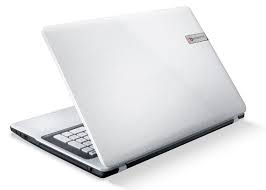
LV44HCG-32344G50MNWS - Laptop PACKARD BELL - Free user manual and instructions
Find the device manual for free LV44HCG-32344G50MNWS PACKARD BELL in PDF.



| Product type | Laptop |
| Brand | Packard Bell |
| Model | LV44HCG-32344G50MNWS |
| Processor | Intel Core i3 (estimated) |
| RAM Memory | 4 GB DDR3 |
| Hard drive | 500 GB SATA |
| Screen | 15.6-inch LED LCD |
| Screen resolution | 1366 x 768 pixels |
| Graphics card | Intel HD Graphics |
| Operating system | Windows 8 |
| Connectivity | 2 USB 2.0 ports, 1 USB 3.0 port, HDMI, VGA, Ethernet RJ-45, headphone/microphone combo jack, SD/MMC/MS/xD card reader |
| Wireless | Wi-Fi 802.11 a/b/g/n, Bluetooth |
| Power supply | 65 W AC adapter |
| Battery | 6-cell Lithium-ion |
| Battery life | Up to 4 hours (estimated) |
| Webcam | Integrated, 0.3 MP |
| Speakers | Integrated stereo |
| Touchpad | Multitouch with gestures |
| Dimensions | 38.2 x 25.6 x 2.5 cm (estimated) |
| Weight | Approximately 2.5 kg |
| Security | Kensington lock slot |
| Care and cleaning | Disconnect before cleaning. Use a damp cloth. Do not spray liquid directly onto the screen. |
Frequently Asked Questions - LV44HCG-32344G50MNWS PACKARD BELL
User questions about LV44HCG-32344G50MNWS PACKARD BELL
0 question about this device. Answer the ones you know or ask your own.
Ask a new question about this device
Download the instructions for your Laptop in PDF format for free! Find your manual LV44HCG-32344G50MNWS - PACKARD BELL and take your electronic device back in hand. On this page are published all the documents necessary for the use of your device. LV44HCG-32344G50MNWS by PACKARD BELL.
USER MANUAL LV44HCG-32344G50MNWS PACKARD BELL
Starting your computer 4
Wireless connection 4
Registration 5
Software installation 6
Recovery 6
Having trouble? 6
Computer Basics 8
Safety and comfort 8
Safety precautions 8
Health precautions. 11
Getting to know your computer 14
Top view - display 15
Top view - keyboard 16
Special keys. 17
Front view. 20
Left view 21
Right view 22
Base view 24
Touchpad 25
Touchpad basics 25
Upgrading your computer 27
Expanding through options 27
Connectivity options. 27
Power supply 32
AC power adapter 32
Battery pack 33
Battery pack characteristics 33
Replacing the battery pack 35
Installing or removing the battery pack..... 35
Charging the battery. 36
Checking the battery level 36
Optimizing battery life 37
Battery-low warning 37
Power management 39
Saving power 39
Software 42
Using Windows and your software 42
Internet security offer 42
Packard Bell Recovery Management.... 42
Internet 43
First steps on the net 43
Protecting your computer 43
Choose an Internet Service Provider 43
Network connections 45
Surf the Net! 49
Security 49
Recovery 58
Creating a recovery backup. 58
Creating a drivers and applications backup.... 61
Recovering your system 64
Reinstalling drivers and applications 65
Returning to an earlier system snapshot 68
Returning your system to its factory condition 69
Recovering from Windows 70
Recovering from a recovery backup 74
Frequently asked questions 78
Tips and hints for using Windows 8. 81
Three concepts you might want to keep in mind. 81
How do I access the charms? 81
How do I get to Start? 81
How do I jump between apps? 82
How do I turn off my computer? 82
Why is there a new interface? 82
How do I unlock my computer? 83
How do I personalize my computer? 83
I want to use Windows in the way that I'm used to - give me my desktop back! 84
Where are my apps? 84
What is a Microsoft ID (account)? 86
How do I add a favorite to Internet
Explorer? 86
How do I check for Windows
updates? 87
Where can I get more information? 87
Regulatory information 88
Environment 105
Software license 108
Index 111
Copyright © 10/2012. All Rights Reserved.
Packard Bell EasyNote LV User's Manual
This revision: 5 October 2012
Visit registration.packardbell.com and discover the benefits of being a customer of Packard Bell.
Remark: All images are for reference purposes only. Actual configuration may vary.
STARTING YOUR COMPUTER
Thank you for purchasing this Packard Bell computer!
This guide has been designed to introduce you to the features of your computer and assist in your computing experience.
After setting up and starting your computer, as shown in the setup instructions, it will ask you questions that will help you connect to the Internet. Your computer will then configure installed software.
WIRELESS CONNECTION
To connect to a wireless network, first check the wireless features of your computer are on, and that the router or modem you want to connect to is also correctly configured.
- If wireless is not on, press the Windows key (串) + W , type "Wireless" and then click on Wireless. Click the toggle switch under Wi-Fi to enable the wireless connection. Click again to disable.
- To connect to a network, press the Windows key (■) + W, type "Wireless" and then click on Connect to a network. Select your network and enter the password if required.
After a short delay, your computer should connect to the Internet.
If your network is not detected, or your computer does not connect to the Internet, please refer to your ISP or router's documentation. After your computer starts and you can use it, open Internet Explorer and follow the instructions.
Alternatively, use a network cable to connect directly to a network port on your router. Please refer to your ISP or router's guide.
REGISTRATION
When using your computer for the first time, it is recommended that you register it. This gives you access to some useful benefits, such as:
- Faster service from our trained representatives.
- Membership in the Packard Bell community: receive promotions and participate in customer surveys.
- The latest news from Packard Bell.
How to register
During the initial startup of your computer, a window will invite you to register. Please fill in the information and click Next. The second window you'll see contains optional fields that will help us to provide you with a more personable customer service experience.
Another option
Another way to register your Packard Bell product is to visit our website at registration.packardbell.com. Choose your country and follow the simple instructions.
After registering, you will be sent a confirmation email with important information that you should keep in a safe place.
SOFTWARE INSTALLATION
Your computer will automatically install software and prepare your computer for use. This may take some time, please do not turn off your computer; wait until the installation has finished.
RECOVERY
You should create recovery discs as soon as you are able. The Packard Bell Recovery Management program allows you to create recovery discs and then to restore or reinstall applications and drivers provided by Packard Bell.
HAVING TROUBLE?
Packard Bell provides several options to support your purchase.
Packard Bell support
Make sure you write down your computer serial number, date and place of purchase and model name on the area provided in this guide; save your proof of purchase. Before you call us, please write down any error message that accompanies the problem, and have the computer in front of you and switched on if possible. Having these items to hand when contacting us will ensure better and quicker service.
Packard Bell website
Remember to visit www.packardbell.com - Check out the support section for up-to-date information, help, drivers and downloads.
Warranty and contact information
You can find information about the warranty for your computer and how to contact technical support in your computer's Warranty.
COMPUTER BASICS
SAFETY AND COMFORT
Safety precautions
Please follow the guidelines below to use your computer comfortably and to avoid health problems.
Computer environment
Make sure that the computer:
- Is used on a stable surface, stand or table. A fall can seriously damage the computer.
- Is not used on a surface that vibrates, or used when taking part in sport, exercise or other activities in a dynamic environment. Vibration or movement can loosen fastenings, damage internal components and even cause battery leakage.
- Is away from direct sunlight and sources of heat.
- Is away from magnetic fields or any device generating static electricity.
- Is kept at least 30 centimetres (one foot) away from a mobile phone.
- Is not in a dusty or damp environment.
- Is not used near water. Never spill liquids of any kind on or into your computer.
- Is not placed on a carpet or any other surface that may have an electrical charge.
Please note
- Slots and openings are provided for ventilation to ensure reliable operation of the product and to protect it from overheating. These openings must not be blocked or covered. The openings should never be blocked by placing the product on a bed, sofa, rug or other similar surface. This product should never be placed near or over a radiator or heat register, or in a built-in installation unless proper ventilation is provided.
- Never push objects of any kind into this product through cabinet slots as they may touch dangerous voltage points or short-out parts that could result in a fire or electric shock. Never spill liquid of any kind onto or into the product.
- To avoid damage of internal components and to prevent battery leakage, do not place the product on a vibrating surface.
- Never use it under sporting, exercising, or any vibrating environment which will probably cause unexpected short current or damage rotor devices, HDD, optical drive, and even exposure risk from lithium battery pack.
Cables
Make sure that:
- Cables are not strained and that there is no risk of people walking or tripping over them.
-
Other devices do not crush the cables.
-
The power cable is connected to the computer before connecting the power cable to the AC power outlet.
- The power cable is unplugged from the power outlet before disconnecting the power cable from the computer.
- Three-pin power cords are connected to a grounded power outlet.
- The power outlet is easily accessible and as close to the computer as possible (do not overload it with too many adapters).
If your computer uses an external AC adapter:
- Do not cover or place objects on the AC adapter. Allow the adapter to cool properly during use by keeping it clear of objects.
- Only use the AC adapter that is supplied with your computer. Although other adapters may look similar, using them can damage your computer. If a replacement is required, use only parts certified for use with your computer.
Cleaning your computer
- Always unplug your computer from the power outlet before cleaning it.
- Do not use liquid or aerosol cleaners, use a damp cloth instead.
- Never spray cleaning product directly on the screen.
- If you spill liquid on your computer, switch it off immediately, unplug the AC adapter, remove the battery and make sure it is completely dry before switching it on again. Wait overnight if necessary.
Note: If your computer includes slots for memory cards or expansion devices, plastic 'dummies' may be installed in the card slots. Dummies
protect unused slots from dust, metal objects or other particles. Save the dummies for use when no cards are in the slots.
Servicing your computer
Do not attempt to service your computer yourself, as opening or removing covers may expose you to dangerous voltage or other risks. Refer all servicing to qualified service personnel.
Unplug your computer from the wall outlet and refer servicing to qualified service personnel when:
- the power cord or plug is damaged, cut or frayed,
- liquid was spilled into the product,
- the product was exposed to rain or water,
- the product has been dropped or the case has been damaged,
- the product exhibits a distinct change in performance,
- the product does not operate normally after following the operating instructions
Note: Adjust only those controls that are covered by the operating instructions, since improper adjustment of other controls may result in damage and will often require extensive work by a qualified technician to restore the product to normal condition.
Health precautions
-
The bottom surface, areas around ventilation openings and AC adapter may get hot. To avoid injury, ensure they do not come in contact with your skin or body.
-
Your device and its enhancements may contain small parts. Keep them out of the reach of small children.
-
The computer and accessories may contain small parts. Keep them out of the reach of small children.
-
If you work or play for hours at a time, then make sure you take regular breaks. Look away from the computer's screen once in a while. Do not use your computer if you are tired.
-
Arrange your computer so that you can work in a natural and relaxed position. Place items that you use frequently within easy reach.
-
Position your computer directly in front of you for increased safety and comfort. Ensure that your keyboard and touchpad are at a comfortable height. The screen should be about 45-70 cm (18-30 inches) from your eyes.
If you use your computer for long periods while sitting at a desk, invest in an external keyboard for improved comfort.
-
To protect your hearing, when using speakers or headphones, increase volume gradually until you can hear clearly and comfortably; do not increase the volume level after your ears have adjusted. Do not listen to high volumes for extended periods. Do not increase the volume to block out noisy surroundings; decrease the volume if you cannot hear people speaking near you.
-
The computer's underside, power adapter and the air from ventilation slots may become hot during use. Avoid continuous body contact and do not place the computer on your lap while it is operating.
- Ensure that the computer's ventilation slots and openings are never obstructed or covered. Do not place the computer on a soft surface (such as a carpet, chair or bed) that may block ventilation slots.
- Do not push objects of any kind into ventilation or case slots as they may touch dangerous voltage points or short-out parts that may result in a fire or electric shock.
- Some disorders of the hands, wrists, arms, neck, shoulders, legs and back may be associated with, or aggravated by certain repetitive actions. To reduce your risk of developing these disorders, type with your wrists straight and your hands and wrists floating above the keyboard. If you experience periods of pain, tingling, numbness or other discomfort, please contact your doctor.
- We advise that parents monitor the use of games by their children. If you or your child experience any of the following symptoms: dizziness, blurred vision, eye or muscle twitches, loss of consciousness, disorientation, any involuntary movement or convulsion, IMMEDIATELY discontinue use and consult your doctor. This may happen even if the person has no medical history of epilepsy.
GETTING TO KNOW YOUR COMPUTER
After setting up your computer, as illustrated in the setup instructions, let us show you around your new Packard Bell computer.
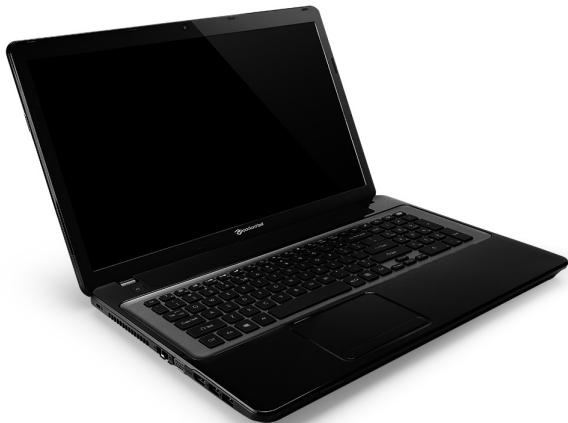
Packard Bell EasyNote LV
TOP VIEW - DISPLAY
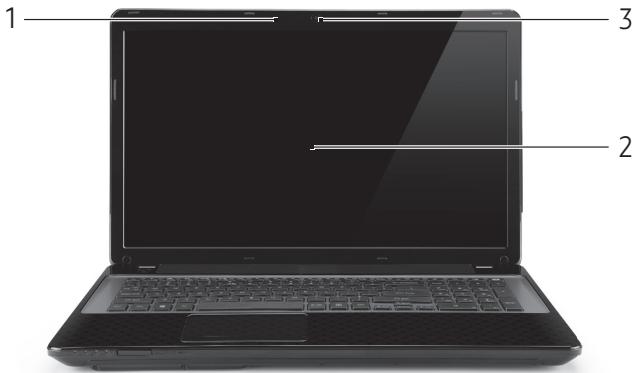
| # | Icon | Item | Description |
| 1 | Microphone | Internal microphone for sound recording. | |
| 2 | Display screen | Also called Liquid-Crystal Display (LCD), displays computer output. | |
| 3 | Webcam | Web camera for video communication.A light next to the Webcam indicates that the webcam is active. |
TOP VIEW - KEYBOARD
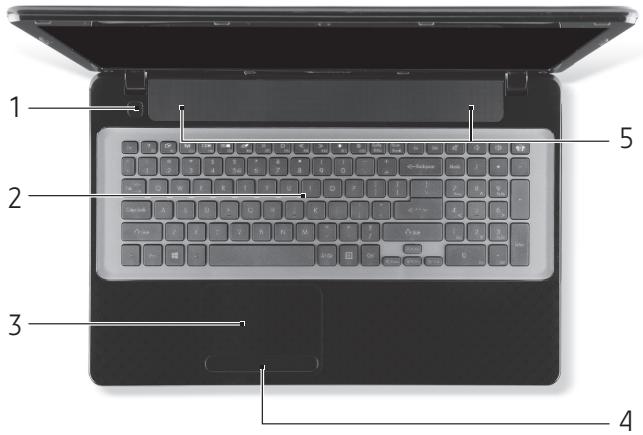
| # | Icon | Item | Description |
| 1 | ○ | Power button / indicator | Turns the computer on and off. Indicates the computer's power status. |
| 2 | Keyboard | For entering data into your computer. - Special keys are described on page 17. | |
| 3 | Touchpad | Touch-sensitive pointing device which functions like a computer mouse. | |
| 4 | Click buttons (left and right) | The left and right side of the button function as left and right selection buttons. | |
| 5 | Speakers | Deliver stereo audio output. |
- Note: The front panel indicators are visible even when the computer cover is closed.
Special keys
Your computer's keyboard includes keys that activate special functions. The function of each key is clearly marked with an icon.
| Icon | Function | Description |
| Fn | Hotkey for second function | Activates a second function on certain keys. E.g. press the Fn key to activate the F1 to F12 keys. |
| ? | Help | Opens the help menu. |
| Backup | Backup | Allows you to create backup copies of your computer; either the entire system or only selected files and folders. Create a regular schedule or make copies whenever you want. |
| Communication | Communication | Enables/disables the computer's communication devices. |
| Display toggle | Switches display output between the display screen, external monitor (if connected) and both. | |
| ■ | Screen blank | Turns the display screen backlight off to save power. Press any key to return. |
| ▲ | Touchpad toggle | Turns the internal touchpad on and off. |
| ■■ | Play/Pause | Play or pause a selected media file. |
| □ | Stop | Stop playing the selected media file. |
| ≪ | Previous | Return to the previous media file. |
| ≫ | Next | Jump to the next media file. |
| ● | Brightness down | Decreases the screen brightness. |
| ● | Brightness up | Increases the screen brightness. |
| ● | Social Networking | Opens the Social Networks application. - If this application is not installed, the key will start your instant messaging application. |
| ● | Volume up | Increases the sound volume. |
| ● | Volume down | Decreases the sound volume. |
| ▲ | Speaker toggle | Turns the speakers on and off. |
Hotkeys
The computer uses hotkeys (key combinations) to access function keys and navigation commands.
To activate hotkeys, press and hold the Fn key (bottom left) before pressing the other key in the hotkey combination.
| Hotkey | Function | Description |
| Fn + Special keys (see page 17) | Function keys | Activates the F1 to F12 keys. |
| Fn + < | Home | Scrolls to the beginning of a document. |
| Fn + > | End | Scrolls to the end of a document. |
| Fn + ^ | Page up | Scrolls up a page in a document. |
| Fn + ∨ | Page Down | Scrolls down a page in a document. |
- Note: It is not necessary to press the Fn key to use the F1 to F12 function keys when starting your computer or when using the BIOS.
To swap the hotkey and special function of the F1 to F12 keys, change the function key setting in the BIOS (to open the BIOS press F2 when starting your computer, then select the Main menu and change Function key behavior to Function keys).

| # | Icon | Item | Description |
| 1 | Power indicator | Indicates the computer's power status. | |
| Battery indicator | Indicates the computer's battery status. - Charging: The light shows amber when the battery is charging. - Fully charged: The light shows blue when in AC mode. | ||
| HDD indicator | Indicates when the hard disk drive is active. | ||
| Communication indicator | Indicates the computer's wireless connectivity device status. | ||
| 2 | Multi-in-1 card reader | Accepts Secure Digital (SD), MultiMediaCard (MMC), Memory Stick PRO (MS PRO), xD-Picture Card (xD). - Push to remove/install the card. Only one card can operate at any given time. |
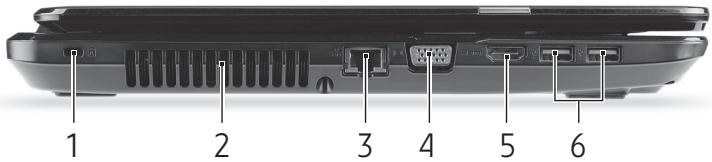
| # | Icon | Item | Description |
| 1 | K | Kensington lock slot | Connects to a Kensington-compatible computer security lock. |
| - Wrap the computer security lock cable around an immovable object such as a table or handle of a locked drawer. Insert the lock into the notch and turn the key to secure the lock. Some keyless models are also available. | |||
| 2 | Ventilation and cooling fan | Allows the computer to stay cool. - Do not cover or obstruct the openings. | |
| 3 | 古古 | Ethernet (RJ-45) port | Connects to an Ethernet 10/100/1000-based network. |
| 4 | External display (VGA) port | Connects to a display device (e.g., external monitor, LCD projector). | |
| 5 | HDMI | HDMI port | Supports high-definition digital video connections. |
| 6 | USB port | Connect to USB devices (e.g., USB mouse, USB camera). | |
| - If a port is black, it is USB 2.0 compatible, if a port is blue (optional) it is also USB 3.0 compatible. | |||
RIGHT VIEW
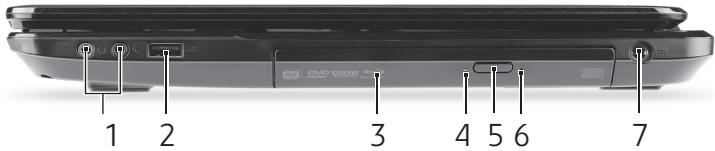
| # | Icon | Item | Description |
| 1 | Microphone jack | Accepts inputs from external microphones. | |
| Headphones / speaker jack | Connects to audio line-out devices (e.g., speakers, headphones). - Supports compatible 3.5 mm headsets with built-in microphone (e.g. Acer smart handheld Headsets). | ||
| 2 | USB port | Connect to USB devices (e.g., USB mouse, USB camera). - If a port is black, it is USB 2.0 compatible, if a port is blue (optional) it is also USB 3.0 compatible. | |
| 3 | Optical drive | Internal optical drive; accepts CDs or DVDs. | |
| 4 | Optical disk access indicator | Lights up when the optical drive is active. | |
| 5 | Optical drive eject button | Ejects the optical disk from the drive. | |
| 6 | Emergency eject hole | Ejects the optical drive tray when the computer is turned off. - Carefully insert a straightened paper clip to eject the optical drive tray. | |
| 7 | DC-in jack | Connects to your computer's AC adapter. | |
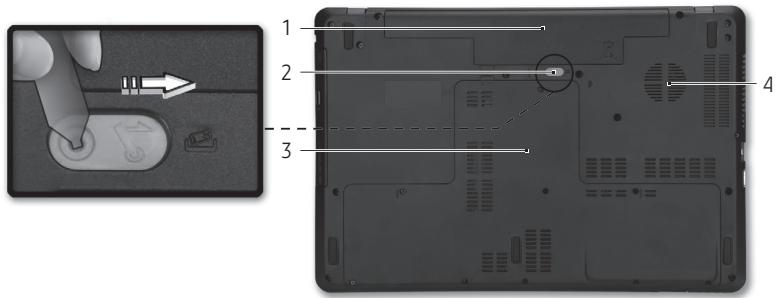
| # | Icon | Item | Description |
| 1 | Battery bay | Houses the computer's battery pack. | |
| 2 | Battery release latch | Releases the battery for removal. Insert a suitable tool and slide to release. | |
| 3 | Memory compartment | Houses the computer's main memory. | |
| Hard disk bay | Houses the computer's hard disk (secured with screws). | ||
| 4 | Ventilation and cooling fan | Allows the computer to stay cool. - Do not cover or obstruct the openings. |
TOUCHPAD
TOUCHPAD BASICS
The touchpad controls the arrow (or 'cursor') on the screen. As you slide your finger across the touchpad, the cursor will follow this movement.
Press the left or right side of the button located beneath the touchpad to perform selection and execution functions. These two areas are similar to the left and right buttons on a mouse. Tapping on the touchpad is the same as clicking the left side of the button.
Note: The touchpad is sensitive to finger movement; the lighter the touch, the better the response.
Please keep the touchpad and your fingers dry and clean.
The cursor is controlled by some basic gestures:
- Single-finger slide: Slide a finger across the touchpad to move the cursor.
- Single-finger tap: Lightly tap the touchpad with your finger, to perform a 'click', which will select or start an item. Quickly repeat the tap to perform a double tap or 'double click'.
- Drag: Press and hold the left side of the selection button, or tap twice anywhere on the touchtap, then slide a second finger across the touchpad to select all items in an area.

TOUCHPAD GESTURES
Windows 8 and many applications support touchpad gestures that use one or more fingers.
Note: Support for touchpad gestures depends on the active application. These allow you to control applications with a few simple gestures, such as:
- Swipe in from edge: Access Windows tools by swiping into the center of the touchpad from the right, top or left.
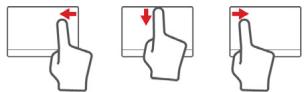
- Swipe in from right edge: Toggle the charms.
- Swipe in from top edge: Toggle the app commands.
-
Swipe in from left edge: Switch to the previous app.
-
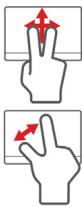
Two-finger slide: Swiftly scroll through web pages, documents and playlists by placing two fingers on the touchpad and moving both in any direction.
- Two-finger pinch: Zoom in and out of photos, maps and documents with a simple finger-and-thumb gesture.
UPGRADING YOUR COMPUTER
EXPANDING THROUGH OPTIONS
Your computer offers you many options for a complete computing experience.
Connectivity options
Ports allow you to connect peripheral devices to your computer. For instructions on how to connect different external devices to the computer, read the following section.
Memory card reader
Memory cards are used in a wide selection of digital cameras, PDAs, MP3 players and mobile phones.
Inserting a memory card
- Align the card so that the connector points towards the port, with the connectors facing down.
- Carefully slide the card into the port. If you find you need to use any force to insert the card, try reorientating the card slightly.
- Push the card until it clicks into place. A few millimetres of the card will extend from beyond the slot.
If the card contains some files, the Windows Auto Play window may appear (this depends on the contents of the card) and ask you if you wish
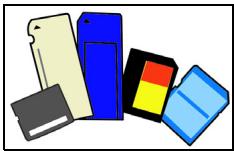
to use a program to access the contents of the card. Select an option here if it is appropriate, otherwise select Cancel. If the card contains no files, or unknown files, a window will open showing the contents of the card.
SD, SDHC and SDXC cards
Different types of SD cards cover different capacities, while using the same overall design. SD cards contain up to 4 GB, SDHC cards contain up to 32 GB, and SDXC cards can contain up to 2048 GB (2 TB). Your computer provides an SDHC or SDXC compatible card reader.
Note: SDXC memory cards can only be used in an SDXC-compatible reader; SD and SDHC cards can be used in either type.
Removing a card from a memory card reader
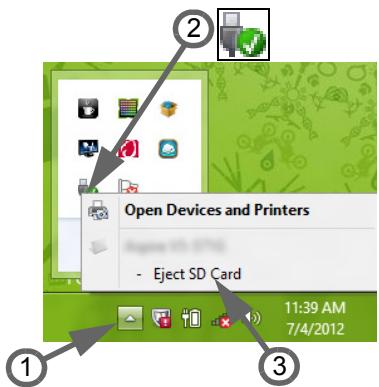
- Click on Show hidden icons arrow in the Notification Area (next to the clock).
- Click on the Safely Remove Hardware icon.
- Click on Eject SD Card (or the name of the device).
- Wait until a Safe to Remove Hardware message is displayed.
- Remove the card.
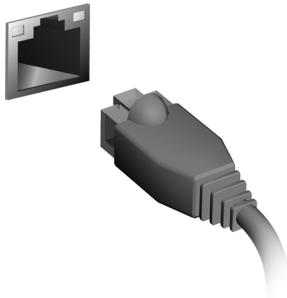
Built-in networking
The built-in networking allows you to connect your computer to an Ethernet-based network.
Connect an Ethernet cable from the Ethernet (RJ-45) port on the chassis of the computer to a network jack or hub on your network.
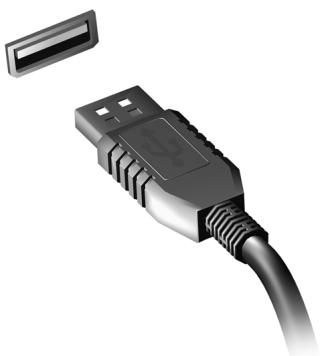
Universal Serial Bus (USB)
The USB port is a high-speed serial bus which allows you to connect USB peripherals without taking up system resources.
Certain computers may include one or more USB 3.0 ports. These resemble standard USB ports, except they include additional internal connections and are blue. You may use USB 3.0 compatible devices with these ports to benefit from faster transfer speeds.
Video port
Connect to a monitor with a VGA or DVI port (the type of connection supported depends on your computer's configuration). The appropriate
cable is usually included with the monitor.
Follow these steps to connect an monitor to your computer:
- Check that the computer is powered off and the monitor power switch is turned off.
- Attach the video cable to the monitor port on the computer. Secure the cable connection with the screws provided.
- Connect the monitor power cable and plug it into a properly grounded wall outlet.
- Follow any setup instructions in the monitor's user's guide.
- Turn on power to the monitor, then the computer.
- Make sure that the current resolution and refresh rate do not exceed the specifications of the monitor. If necessary change the display settings used by the computer.
Note: To access the display controls, press the Windows key (■) + W, type "Display" and then click on Display.
High-Definition Multimedia Interface (only for certain models)
HDMI (High-Definition Multimedia Interface) is an industry-supported, uncompressed, all-digital audio/video interface. HDMI provides an interface between any compatible digital audio/video source, such as a set-top box, DVD player, and A/V receiver and a compatible digital audio and/or video monitor, such as a digital television (DTV), over a single cable.
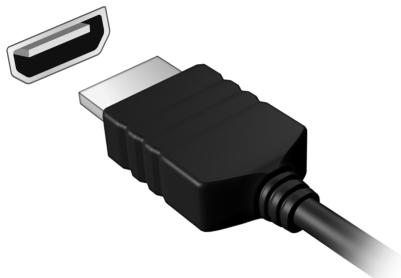
Use the HDMI port on your computer to connect with high-end audio and video equipment. Single cable implementation allows tidy setup and fast connection.
Headphones and microphone
These two ports allow you to connect audio devices. Use the headphone port to plug in stereo headphones or powered speakers. Plugging an audio device to the headphone port disables the built-in speakers. Use the microphone port to connect an external microphone for mono recording; plugging in an external microphone disables the built-in microphone.
POWER SUPPLY
AC POWER ADAPTER
Your computer can use the supplied external power adapter (a power 'brick') to run on AC power. A power cable is provided that is appropriate for the country where the computer was purchased.
The power adapter provides adequate power to run your computer and recharge the battery pack at the same time.
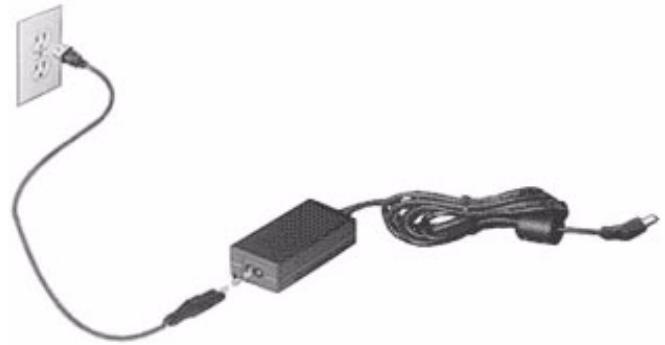
Caution: Do not cover or place objects on the AC adapter. Keeping the adapter clear of objects allows the adapter to cool properly during use.
Only use the AC adapter that is supplied with your computer. Although other adapters may look similar, using them can damage your computer.
Warning: The AC adapter and the underside of the computer can become hot after prolonged use. This is normal, but may cause injury with prolonged contact.
BATTERY PACK
The computer uses a battery pack that gives you extended use between charges.
Battery pack characteristics
The battery pack has the following characteristics:
- Employs current battery technology standards.
- Delivers a battery-low warning.
The battery is recharged whenever you connect the computer to the AC adapter. Your computer supports charge-in-use, enabling you to recharge the battery while you continue to operate the computer. However, recharging with the computer turned off results in a significantly faster charge time.
The battery will come in handy when you travel or during a power failure. It is advisable to have an extra fully-charged battery pack available as backup. Contact your dealer for details on ordering a spare battery pack.
Maximizing the battery's life
Like all other batteries, your computer's battery will degrade over time. This means that the battery's performance will diminish with time and use.
To maximize your battery's life, you are advised to adhere to the recommendations set out below.
Conditioning a new battery pack
Before you use a battery pack for the first time, there is a "conditioning" process that you should follow:
- Insert the new battery without turning the computer on.
- Connect the AC adapter and fully charge the battery.
- Disconnect the AC adapter.
- Turn on the computer and operate using battery power.
- Fully deplete the battery.
- Reconnect the AC adapter and fully charge the battery again.
Follow these steps again until the battery has been charged and discharged three times.
Use this conditioning process for all new batteries, or if a battery hasn't been used for a long time. If the computer is to be stored for more than two weeks, you are advised to remove the battery pack from the unit.
Warning: Do not expose battery packs to temperatures below 0 ^ C (32 F) or above 45^ C (113 F). Extreme temperatures may adversely affect the battery pack.
By following the battery conditioning process you condition your battery to accept the maximum possible charge. Failure to follow this procedure will prevent you from obtaining the maximum battery charge, and will also shorten the effective lifespan of the battery.
In addition, the useful lifespan of the battery is adversely affected by the following usage patterns:
- Using the computer on constant AC power with the battery inserted. If you want to use constant AC power, you are advised to remove the battery pack after it is fully charged.
- Not discharging and recharging the battery to its extremes, as described above.
- Frequent use; the more you use the battery, the faster it will reach the end of its effective life. A standard computer battery has a life span of about 300 charges.
Replacing the battery pack
The notebook uses lithium batteries. Replace the battery with the same type as that which came bundled with your product. Use of another battery may present a risk of fire or explosion.
Warning: Batteries may explode if not handled properly. Do not disassemble or dispose of them in fire. Keep them away from children. Follow local regulations when disposing of used batteries.
Installing or removing the battery pack
Important! Before removing the battery from the unit, connect the AC adapter if you want to continue using your computer. Otherwise, turn off the computer first.
To install a battery pack:
- Align the battery with the open battery bay; make sure that the end with the contacts will enter first, and that the top surface of the battery is facing up.
- Slide the battery into the battery bay and gently push until the battery locks in place.
To remove a battery pack:
- Slide the battery release latch to release the battery.
- Pull the battery from the battery bay.
Charging the battery
To charge the battery, first make sure that it is correctly installed in the battery bay. Plug the AC adapter into the computer, and connect to a mains power outlet. You can continue to operate your computer on AC power while your battery is charging. However, charging the battery with the computer turned off results in a significantly faster charge time.
Note: You are advised to charge the battery before retiring for the day. Charging the battery overnight before traveling enables you to start the next day with a fully-charged battery.
Checking the battery level
The Windows power meter indicates the current battery level. Rest the cursor over the battery/power icon on the taskbar to see the battery's present charge level.
Optimizing battery life
Optimizing battery life helps you get the most out of battery operation, prolonging the charge/recharge cycle and improving recharging efficiency. You are advised to follow the suggestions set out below:
Purchase an extra battery pack.
- Use AC power whenever possible, reserving battery for on-the-go use.
- Eject a PC Card if it is not being used, as it will continue to draw power (for selected models).
- Store the battery pack in a cool, dry place. The recommended temperature is 10^ ( 50^ ) to 30^ ( 86^ ). Higher temperatures cause the battery to self-discharge faster.
- Excessive recharging decreases the battery life.
- Look after your AC adapter and battery.
Battery-low warning
When using battery power pay attention to the Windows power meter.
Warning: Connect the AC adapter as soon as possible after the battery-low warning appears. Data will be lost if the battery to become fully depleted and the computer shuts down.
When the battery-low warning appears, the recommended course of action depends on your situation:
| Situation | Recommended Action |
| The AC adapter and a power outlet are available. | 1. Plug the AC adapter into the computer, and then connect to the mains power supply. 2. Save all necessary files. 3. Resume work. Turn off the computer if you want to recharge the battery rapidly. |
| An extra fully charged battery pack is available. | 1. Save all necessary files. 2. Close all applications. 3. Shut down the operating system to turn off the computer. 4. Replace the battery pack. 5. Turn on the computer and resume work. |
| The AC adapter or a power outlet is unavailable. You have no spare battery pack. | 1. Save all necessary files. 2. Close all applications. 3. Shut down the operating system to turn off the computer. |
POWER MANAGEMENT
This computer has a built-in power management unit that monitors system activity. System activity refers to any activity involving one or more of the following devices: keyboard, mouse, hard disk, peripherals connected to the computer, and video memory. If no activity is detected for a period of time, the computer stops some or all of these devices in order to conserve energy.
SAVING POWER
Disable Fast startup
Your computer uses Fast startup to start quickly, but also uses a small amount of power to check for signals to start. These checks will slowly drain your computer's battery.
If you prefer to reduce your computer's power requirements and environmental impact, turn off Fast startup:
Note: If Fast startup is off, your computer will take longer to start from Sleep.
Your computer will also not start if it receives an instruction to start over a network (Wake on LAN).
- Open the Desktop.
- Click Power Options in the Notification area.
- Select More Power Options.
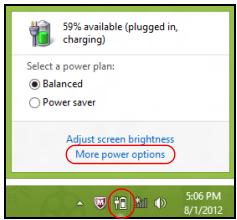
- Select Choose what the power buttons do.
- To access Shutdown Settings, select Change settings that are currently unavailable.
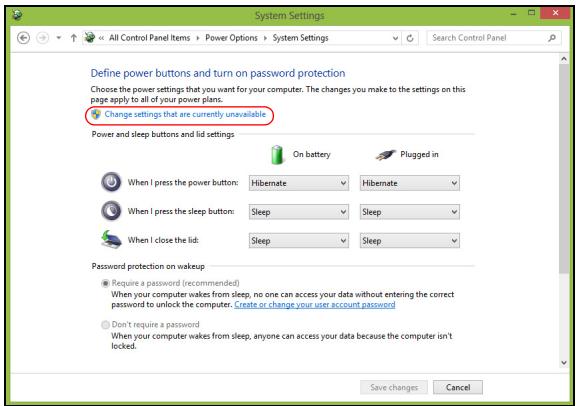
6. Scroll down and disable Turn on fast startup.
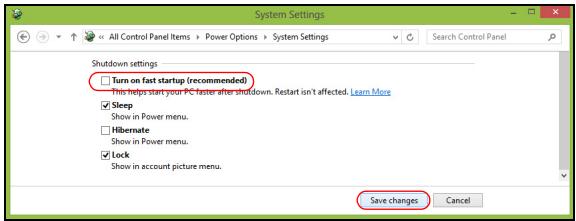
7. Select Save changes.
SOFTWARE
USING WINDOWS AND YOUR SOFTWARE
Packard Bell computers include software to help you use your computer; the programs and categories available on your computer depend on the model purchased.
Internet security offer
It is vital to protect your computer from viruses and attacks over the Internet (see Security on page 49). An comprehensive Internet security suite, including a free trial subscription period, is offered when you first start your computer. You should activate this protection before connecting to the Internet. This security suite protects your computer from the most recent online threats and protects your personal data (bank account credentials, credit card numbers, passwords, and more).
Packard Bell Recovery Management
To prepare your computer for system recovery options, you should create a set of recovery discs as soon as possible. See page 58 for more information.
FIRST STEPS ON THE NET
Protecting your computer
It is vital to protect your computer from viruses and attacks over the Internet (see Internet security offer on page 42 and Security on page 49). A comprehensive Internet security program is offered when you first start your computer. You should activate this protection as soon as possible, certainly before you connect to the Internet.
Choose an Internet Service Provider

Using the Internet has become a natural part of daily computing. Just a few simple steps can connect you to a vast collection of knowledge and communication tools. To accomplish these steps you should first select an Internet Service Provider (ISP), which supplies the connection between your computer and the Internet. You should research the ISPs available in your region, not
forgetting to talk to friends and family about their experiences or to check reviews and consumer reports. The ISP you select will provide instructions on how to connect to the Internet (you may need additional software or a special 'box' that connects to your phone line).
Connection types
Depending on your computer model, your location and your communication needs, you have several ways to connect to the Internet.
Dial-up
Some computers include a telephone dial-up ('modem') connector. This allows you to connect to the Internet using your telephone line. With a dial-up connection, you cannot use the modem and the telephone simultaneously on a single phone line. This type of connection is recommended only if you have limited use of the Internet as the connection speed is low and connection time is typically charged per hour.
DSL (e.g. ADSL)
DSL (Digital Subscriber Line) is an 'always-on' connection that runs over the phone line. As DSL and phone do not use the same frequencies, you can use your telephone at the same time you are connected to the Internet (this requires a 'micro-filter' on each telephone socket to avoid interference). To be eligible for DSL, you must be located near an DSL-equipped phone exchange (service is sometimes unavailable in rural areas). Connection speeds vary depending on your location, but DSL generally provides very fast and reliable Internet connection. As the connection is always-on, it is generally charged at fixed monthly rates.
Note: A DSL connection requires an appropriate modem. A modem is usually provided by the ISP when you register. Many of these modems include an 'router' that provides network and wi-fi access.
Cable
A cable connection provides fast and always-on Internet service via a cable television line. This service is generally available in large cities. You can use your telephone and watch cable TV at the same time you are connected to the Internet.
3G (WWAN or 'Wireless Wide-Area Network')
A 3G connection allows you to use cellular networks (such as those used by a mobile phone) to connect to the Internet while away from home. The socket for a SIM card may be built in to your computer, or may require an external device, such as a USB modem or even an appropriately equipped mobile phone.
Note: If your computer includes a SIM card slot, you require a compatible SIM card and a contract with a cellular provider.
Before using the 3G features, check with your service provider to see if any additional charges will be incurred, especially roaming charges.
Network connections
A LAN (Local Area Network) is a group of computers (for example, within an office building or home) that share a common communications line and resources. When you set up a network, you can share files, peripheral devices (such as a printer) and an Internet connection. You can set up a LAN using wired technologies (such as Ethernet) or wireless technologies (such as WiFi or Bluetooth).
Wireless networks
A wireless LAN or WLAN is a wireless local area network, which may link two or more computers without using wires. Setting up a wireless network is easy and allows you to share files, peripheral devices and an Internet connection.
What are benefits of a wireless network?
Mobility
Wireless LAN systems allow you and other users of your home network to share access to files and devices connected to the network, for example a printer or scanner.
Also you can share an internet connection with other computers in your home.
Installation speed and simplicity
Installing a wireless LAN system can be fast and easy and eliminates the need to pull cables through walls and ceilings.
Components of a wireless LAN
To set up your Wireless network at home you need to have the following:
Access point (router)
Access points (routers) are two-way transceivers that broadcast data into the surrounding environment. Access points act as a mediator between wired and wireless network. Most routers have a built-in DSL modem that will allow you access to a high speed DSL internet connection. The ISP (Internet Service Provider) you have chosen normally supplies a modem/
router with the subscription to their services. Read carefully the documentation supplied with your Access point/rodter for detailed setup instructions.
Network cable (RJ45)
A network cable (also called RJ45 cable) is used to connect the host computer to the access point (see illustration below); this type of cable may also be used to connect peripheral devices to the access point.
Wireless adapter
An internal wireless adapter is normally already installed in your computer. A button or controls in Windows allow you to activate or deactivate the adapter.
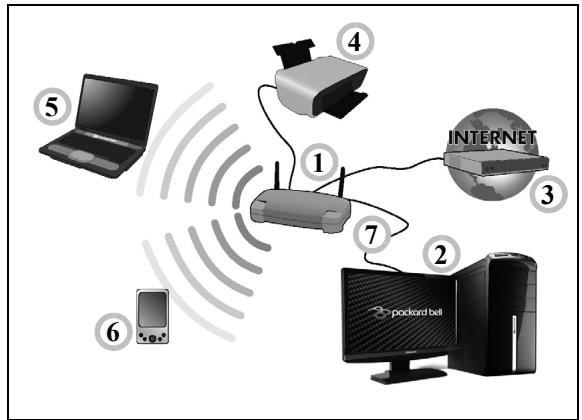
Diagram of a working network
- Access point/rodter
- Desktop computer
- Modem
- Printer
- Portable computer
- PDA/Smartphone
- Network cables (RJ45)
Turning on/off a wireless network connection
Most computers feature a 'WiFi' button that turns the network connection on or off. If your computer has wireless access, but does not feature a Communication button, you may turn your wireless network on or off, or control what is shared over the network with the network management options. Press the Windows key (■) + W, type "HomeGroup" and then click on HomeGroup.
Warning: Using wireless devices while flying in aircraft is prohibited. Switch off all devices before boarding an aircraft; they may be dangerous to the operation of the aircraft, disrupt
Surf the Net!
To surf the Internet, you need a program called an Internet browser. Internet Explorer provides an easy and secure web browsing experience. As soon as you have your Internet access installed and you are connected, from Start, click the Internet Explorer tile or the icon located on Desktop and take your Internet experience to a new level!

Packard Bell website
To get you started why not visit our website, www.packardbell.com.
Packard Bell is dedicated to provide you with on-going personalised support. Check out our Support section to get help tailored to your needs.
www.packardbell.com is your portal to a world of online activities and services: visit us regularly for the latest information and downloads!
Security
You are probably eager to explore everything the Internet has to offer. In order for you to be safe online, Packard Bell has pre-installed Symantec's award-winning Norton Internet Security™ on your computer.
Norton Internet Security runs quietly in the background to block today's complex threats and protect your identity when you shop, bank, or browse online.
Norton Internet Security blocks online identity theft, detects and eliminates spyware, removes viruses and Internet worms, protects against hackers.
Definitions
What is a virus?
Malicious software, typically called 'viruses', are programs designed to infect and damage computers. Most viruses are transmitted over the Internet, emails or malicious Web sites. A typical virus will replicate and pass itself undetected to multiple computers. Other forms of nuisance, such as Trojan horses, worms or spam can infect your computer in various ways, using up resources or clogging up a network.
Note: Packard Bell guarantees that your computer was 100% virus free at the time of purchase and does not cover damages due to viruses.
What is spyware?
Spyware refers to generally unwanted programs that are downloaded onto your computer while connected to the Internet, often without you knowing it. Once it has infected your computer, it can snoop on your browsing activity, collect personal information, cause pop-up ads to appear, or even change the configuration of your computer. Spyware consumes resources on your computer; it can slow down your Internet connection or entire computer system, and even cause crashes.
Spyware is sometimes used by unscrupulous companies to monitor and track the sites you visit on the Internet so as to determine your web-surfing habits and display targeted pop-up ads on your screen. However, some
kinds of spyware go beyond simple tracking and actually monitor keystrokes and capture passwords, posing a serious security risk.
What is malware?
Malicious software, also known as malware, is software designed to deliberately harm your computer. For example, viruses, worms, and Trojan horses are malicious software. To help protect your computer against malware, make sure it is using up-to-date antivirus and anti-malware software.
What is a personal firewall?
A personal firewall is a software program designed to prevent unauthorized access to or from a private network. It acts as a shield to protect your Internet connection from unwanted connections, some of which may attempt to take control of your computer to install or redistribute viruses or malicious programs. Each connection to your computer is monitored - programs that attempt to receive information without your permission are detected and the firewall will display an alert. You can then decide if you will allow the connection, if the connection is to a program you are currently using then normally you would allow it (i.e. a game connecting to a multi-player server or an encyclopediaaia making a content update).
How to protect your computer
Cybercrime prevention can be straight-forward - when armed with a little technical advice and common sense, many attacks can be avoided. In general, online criminals are trying to make their money as quickly and
easily as possible. The more difficult you make their job, the more likely they are to leave you alone and move on to an easier target. The tips below provide basic information on how you can prevent online fraud.
Keep your computer current with the latest patches and updates
One of the best ways to keep attackers away from your computer is to apply patches and other software fixes when they become available. By regularly updating your computer, you block attackers from being able to take advantage of software flaws (vulnerabilities) that they could otherwise use to break into your system.
While keeping your computer up-to-date will not protect you from all attacks, it makes it much more difficult for hackers to gain access to your system, blocks many basic and automated attacks completely, and might be enough to discourage less-determined attackers, so they will give up and look for a more vulnerable computer elsewhere.
More recent versions of Microsoft Windows and other popular software can be configured to download and apply updates automatically so that you do not have to remember to check for the latest software. Taking advantage of auto-update features in your software is a great start toward keeping yourself safe online.
Protect your computer with security software
Several types of security software are necessary for basic online security. Security software essentials include firewall and antivirus programs. A firewall is usually your computer's first line of defense-it controls who and what can communicate with your computer online. You could think of a firewall as a sort of "policeman" that watches all the data attempting to
flow in and out of your computer on the Internet, allowing communications that it knows are safe and blocking "bad" traffic such as attacks from ever reaching your computer.
The next line of defense many times is your antivirus software, which monitors all online activities such as email messages and Web browsing and protects an individual from viruses, worms, Trojan horse and other types of malicious programs. Your antivirus and antispyware software should be configured to update itself, and it should do so every time you connect to the Internet.
Integrated security suites such as Norton Internet Security, which combine firewall, antivirus, antispyware with other features such as antivirus and parental controls, have become popular as they offer all the security software needed for online protection in a single package. Many people find using a comprehensive security suite an attractive alternative to installing, configuring and updating several different types of security software.
A complete version of Norton Internet Security™ is pre-installed on your Packard Bell system. It includes a free trial subscription to protection updates. Make sure you Activate it!
Choose strong passwords and keep them safe
Passwords are a fact of life on the Internet today; we use them for everything from ordering flowers and online banking to logging into our favorite airline Web site to see how many miles we have accumulated. The following tips can help make your online experiences secure:
-
Selecting a password that cannot be easily guessed is the first step toward keeping passwords secure and out of the wrong hands. Strong passwords have eight characters or more and use a combination of letters, numbers and symbols (e.g., # $ % !?). Avoid using any of the following as your password: your login name, anything based on your personal information such as your last name, and words that can be found in the dictionary, especially "password". Try to select especially strong, unique passwords for protecting activities like online banking.
-
Keep your passwords in a safe place and try not to use the same password for every service you use online.
- Change passwords on a regular basis, at least every 90 days. This can limit the damage caused by someone who has already gained access to your account. If you notice something suspicious with one of your online accounts, one of the first steps you can take is to change your password.
Protect your personal information
Exercise caution when sharing personal information such as your name, home address, phone number, and email address online. To take advantage of many online services, you will inevitably have to provide personal information in order to handle billing and shipping of purchased goods. Since not divulging any personal information is rarely possible, the following list contains some advice for how to share personal information safely online:
- Keep an eye out for phony email messages. Things that indicate a message may be fraudulent are misspellings, poor grammar, odd
phrasing, Web site addresses with strange extensions, Web site addresses that are entirely numbers where there are normally words, and anything else out of the ordinary. Additionally, phishing messages will often tell you that you have to act quickly to keep your account open, update your security, or urge you to provide information immediately or else something bad will happen. Don't take the bait.
-
Don't respond to email messages that ask for personal information. Legitimate companies will not use email messages to ask for your personal information. When in doubt, contact the company by phone or by typing in the company Web address into your Web browser. Don't click on the links in these messages as they make take you to fraudulent, malicious Web sites.
-
Steer clear of fraudulent Web sites used to steal personal information. When visiting a Web site, type the address (URL) directly into the Web browser rather than following a link within an email or instant message. Fraudsters often forge these links to make them look convincing.
A shopping, banking or any other Web site where sensitive information should have an "S" after the letters "http" (i.e. https://www.yourbank.com not http://www.yourbank.com). The "s" stands for secure and should appear when you are in an area requesting you to login or provide other sensitive data. Another sign that you have a secure connection is the small lock icon in the bottom of your web browser (usually the right-hand corner).
- Pay attention to privacy policies on Web sites and in software. It is important to understand how an organization might collect and use your
personal information before you share it with them.
- Guard your email address. Spammers and "phishers" sometimes send millions of messages to email addresses that may or may not exist in hopes of finding a potential victim. Responding to these messages or even downloading images ensures you will be added to their lists for more of the same messages in the future. Also be careful when posting your email address online in newsgroups, blogs or online communities.
Online offers that look too good to be true usually are
The old saying "there's no such thing as a free lunch" still rings true today. Supposedly "free" software such as screen savers or smileys, secret investment tricks sure to make you untold fortunes, and contests that you've surprisingly won without entering are the enticing hooks used by companies to grab your attention.
While you may not directly pay for the software or service with money, the free software or service you asked for may have been bundled with advertising software ("adware") that tracks your behavior and displays unwanted advertisements. You may have to divulge personal information or purchase something else in order to claim your supposed content winnings. If an offer looks so good it's hard to believe, ask for someone else's opinion, read the fine print, or even better, simply ignore it.
Review bank and credit card statements regularly
The impact of identity theft and online crimes can be greatly reduced if you can catch it shortly after your data is stolen or when the first use of your information is attempted. One of the easiest ways to get the tip-off that something has gone wrong is by reviewing the monthly statements
provided by your bank and credit card companies for anything out of the ordinary.
Additionally, many banks and services use fraud prevention systems that call out unusual purchasing behavior (i.e. if you live in Texas and all of the sudden start buying refrigerators in Budapest). In order to confirm these out of the ordinary purchases, they might call you and ask you to confirm them. Don't take these calls lightly; this is your hint that something bad may have happened and you should take necessary action.
Protect your computer with Windows security tools
Windows provides a variety of protection applications.
Windows Updates
If you have an active Internet connection, Windows can check for important updates for your computer and install them automatically. These updates include security patches and program updates that can improve your computing experience and help protect your computer against new viruses and attacks.
How do I know when my computer is at risk?
If the Action Center reports an alert, or if your computer behaves erratically, crashes unexpectedly or if some of your programs do not work correctly, your computer may be infected by malicious software. However, do not blame every computer problem on a virus! If you suspect your computer is infected, the first thing to do is update, if you have not already done so, and run your antivirus and anti-spyware software.
RECOVERY
If you are having trouble with your computer, and the frequently asked questions (see page 78) do not help, you can 'recover' your computer - i.e. return it to an earlier state.
This section describes the recovery tools available on your computer. Packard Bell provides Packard Bell Recovery Management, which allows you to create a recovery backup, a drivers and applications backup, and to start recovery options, either using Windows tools, or the recovery backup.
Note: Packard Bell Recovery Management is only available with a pre-installed Windows operating system.
Important: We recommend that you create a Recovery Backup and Drivers and Applications Backup and as soon as possible. In certain situations a full recovery will require a USB recovery backup.
CREATING A RECOVERY BACKUP
To reinstall from a USB storage drive, you must first create a recovery backup. The recovery backup includes the entire original contents of your computer's hard drive, including Windows and all factory-loaded software and drivers. Using this backup will restore your computer to the same state as when you purchased it, while giving you an option to retain all settings and personal data.
Note: Make sure you have a USB drive with a capacity of at least 16 GB.
- From Start, type 'Recovery' and then click Packard Bell Recovery Management in the list of apps.

Packard Bell Recovery Management
?X
Welcome to Packard Bell Recovery Management
Packard Bell Recovery Management enables you to restore your system. To begin, select the task you want to perform. Please DO NOT remove the USB device while proceeding.

Customized Restore (Retain User Data)

Reinstall Drivers or Applications
Make a back-up before you restore (Recommended).

Create Factory Default Backup
Create Drivers and Applications Backup
Restores your computer to its factory default status. A system is required. NOTE: All data on drive C will be deleted.

packard bell
- Click Create Factory Default Backup. The Recovery Drive window opens.
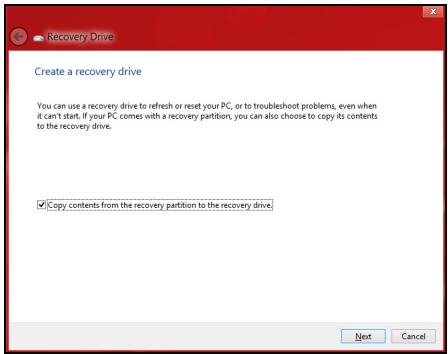
Make sure Copy contents from the recovery partition to the recovery drive is selected. This provides the most complete and safest recovery backup.
-
Plug in the USB drive then click Next.
-
Make sure your USB drive has enough capacity before continuing. The recovery backup requires at least 16 GB of storage
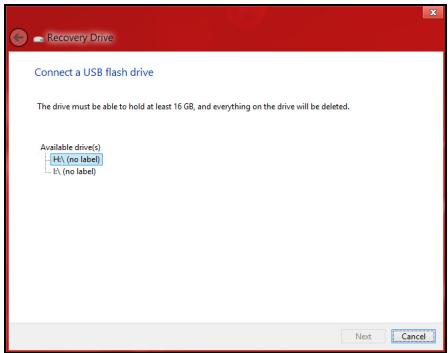
- You will be shown the backup progress on the screen.
- Follow the process until it completes.
- After creating the recovery backup, you can choose to delete the recovery information on your computer. If you delete this information, you can only use the USB recovery backup to restore your computer, if you lose or erase the USB drive, you cannot restore your computer.
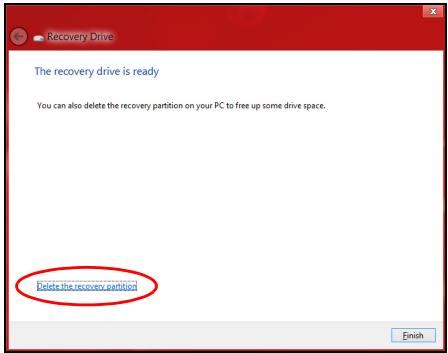
- Unplug the USB drive and label it clearly.
Important: Write a unique, descriptive label on the backup, such as 'Windows Recovery Backup'. Make sure you keep the backup in a safe place that you will remember.
CREATING A DRIVERS AND APPLICATIONS BACKUP
To create a Drivers and Applications Backup, that contains the factory-loaded software and drivers needed by your computer, you may use either a USB storage drive or, if your computer features a DVD recorder, one or more blank recordable DVDs.
- From Start, type 'Recovery' and then click Packard Bell Recovery Management in the list of apps.

Packard Bell Recovery Management
?X
Welcome to Packard Bell Recovery Management
Packard Bell Recovery Management enables you to restore your system. To begin, select the task you want to perform. Please DO NOT remove the USB device while proceeding.

Customized Restore (Retain User Data)

Reinstall Drivers or Applications
Make a back-up before you restore (Recommended).

Create Factory Default Backup
Create Drivers and Applications Backup
Restores your computer to its factory default status. A system is required. NOTE: All data on drive C will be deleted.

packard bell
- Click Create Drivers and Applications Backup.
Plug in the USB drive or insert a blank DVD into the optical drive, then click Next.
- If you are using a USB drive, make sure your USB drive has enough capacity before continuing.
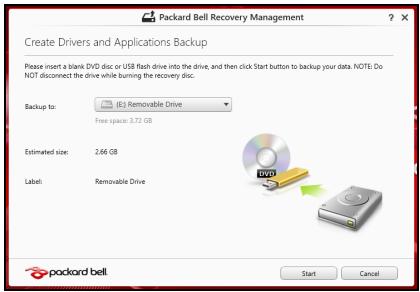
- If using DVDs, it will also show the number of blank, recordable discs you will need to complete the recovery discs. Make sure that you have the required number of identical, blank discs.
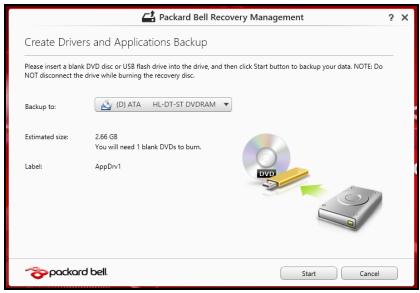
-
Click Start to copy files. You will be shown the backup progress on the screen.
-
Follow the process until it completes:
-
If you are using optical discs, the drive ejects each disc as it completes burning it. Remove the disc from the drive and mark it with a permanent marker.
If multiple discs are required, insert a new disc when prompted, then click OK. Continue until the process is complete.
- If you are using a USB drive, unplug the drive and label it clearly.
Important: Write a unique, descriptive label on each backup, such as 'Drivers and Applications Backup'. Make sure you keep the backup in a safe place that you will remember.
RECOVERING YOUR SYSTEM
To recover your system:
- Perform minor fixes.
If only one or two items of software or hardware have stopped working correctly, the problem may be solved by reinstalling the software or the device drivers.
To reinstall software and drivers that were pre-installed at the factory, see "Reinstalling drivers and applications" on page 65.
For instructions on reinstalling software and drivers that were not preinstalled, see that product's documentation or support Web site.
- Revert to a previous system condition.
If reinstalling software or drivers does not help, then the problem may be
solved by returning your system to a previous state when everything was working correctly.
For instructions, see "Returning to an earlier system snapshot" on page 68.
- Reset your operating system.
If nothing else has solved the problem and you want to reset your system, but keep your user information, see "Returning your system to its factory condition" on page 69.
- Reset your system to its factory condition.
If nothing else has solved the problem and you want to reset your system to factory condition, see "Returning your system to its factory condition" on page 69.
Reinstalling drivers and applications
As a troubleshooting step, you may need to reinstall the applications and device drivers that came pre-installed on your computer from the factory. You can reinstall using either your hard drive or the backup you have created.
- Other applications - If you need to reinstall software that did not come pre-installed on your computer, you need to follow that software's installation instructions.
- New device drivers - If you need to reinstall device drivers that did not come pre-installed on your computer, follow the instructions provided with the device.
If you are reinstalling using Windows and the recovery information stored on your computer:
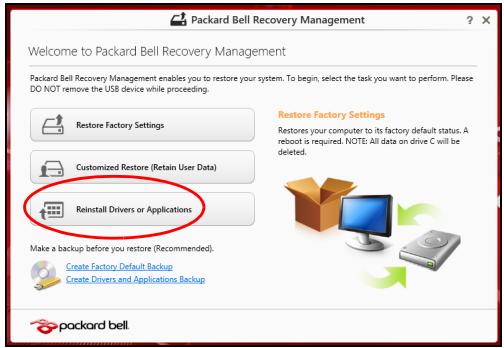
- From Start, type 'Recovery' and then click Packard Bell Recovery Management in the list of apps.
-
Click Reinstall Drivers or Applications.
-
You should see the Contents section of the Packard Bell Resource Center.
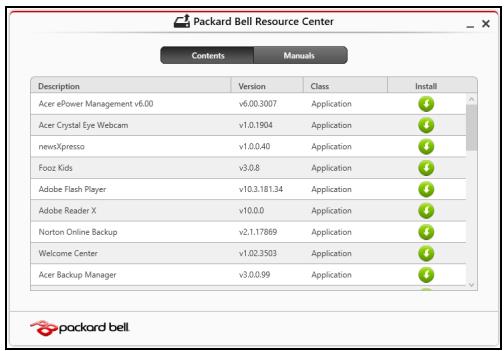
- Click the install icon for the item you want to install, then follow the onscreen instructions to complete the installation. Repeat this step for each item you want to reinstall.

If you are reinstalling from a Drivers and Applications Backup on a DVD or USB drive:
-
Insert the Drivers and Applications Backup into the disc drive or connect it to a free USB port.
-
If you inserted a DVD wait for Packard Bell Resource Center to start.
-
If Packard Bell Resource Center does not start automatically, press the Windows key +
, then double-click on the optical drive icon. -
If you are using a USB drive, press the Windows key +
, then double-click on the drive that contains the backup. Double-click on ResourceCenter. -
You should see the Contents section of the Packard Bell Resource Center.
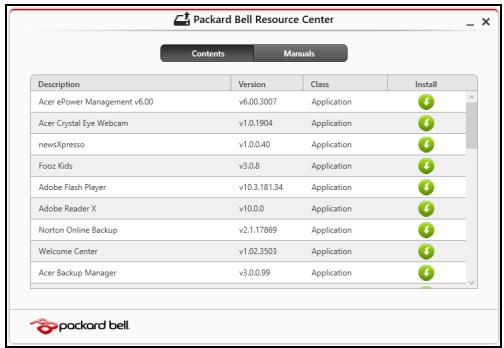
- Click the install icon for the item you want to install, then follow the onscreen prompts to complete the installation. Repeat this step for each item you want to reinstall.

Returning to an earlier system snapshot
Microsoft System Restore periodically takes a 'snapshot' of your system settings and saves them as restore points. In most cases of hard-to-resolve software problems, you can return to one of these restore points to get your system running again.
Windows automatically creates an additional restore point each day, and also each time you install software or device drivers.
Note: For more information about using Microsoft System Restore, from Start, type 'Help' and then click Help and Support in the list of apps. Type 'Windows system restore' in the Search Help box, then press Enter.
Returning to a restore point
- From Start, type 'Control Panel' and then click Control Panel in the list of apps.
- Click System and Security > Action Center, then click Recovery at the bottom of the window.
- Click Open System Restore, then Next.
- Click the latest restore point (at a time when your system worked correctly), click Next, then Finish.
- A confirmation window appears; click Yes. Your system is restored using the restore point you specified. This process may take several minutes, and may restart your computer.
Returning your system to its factory condition
If your computer experiences problems that are not recoverable by other methods, you may need to reinstall everything to return your system to its factory condition. You can recover from either your hard drive or the recovery backup you have created.
- If you can still run Windows and have not deleted the recovery partition, see "Recovering from Windows" on page 70.
- If you cannot run Windows, your original hard drive has been completely re-formatted or you have installed a replacement hard drive, see "Recovering from a recovery backup" on page 74.
Recovering from Windows
Start Packard Bell Recovery Management:
- From Start, type 'Recovery' and then click Packard Bell Recovery Management in the list of apps.
Two options are available, Restore Factory Settings (Reset my PC) or Customized Restore (Refresh my PC).

Restore Factory Settings deletes everything on your hard drive, then reinstalls Windows and all software and drivers that were pre-installed on your system. If you can access important files on your hard drive, back them up now. See "Restore Factory Settings with Packard Bell Recovery Management" on page 71.
Customized Restore will attempt to retain your files (user data) but will reinstall all software and drivers. Software installed since you purchased your PC will be removed (except software installed from the Windows
Store). See "Customized Restore with Packard Bell Recovery Management" on page 73.
Restore Factory Settings with Packard Bell Recovery Management
1. Click Restore Factory Settings.
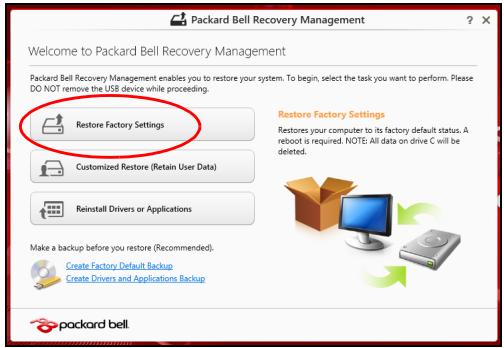
Caution: 'Restore Factory Settings' will erase all files on your hard drive.
- If your computer is configured with two operating systems (only available on certain systems), a window opens with the option to restore either Windows 7 or Windows 8. If you choose Windows 7, your computer will restart and restore Windows 7. If you choose Windows 8, Reset your PC opens, as described below.
Note: To fully enjoy Windows 8 features after changing from Windows 7, enter the BIOS (press <F2> when starting your computer) and
change Boot Mode to EFI. If you reinstall Windows 7, you must change Boot Mode back to Legacy before restarting your computer.
- The Reset your PC window opens.
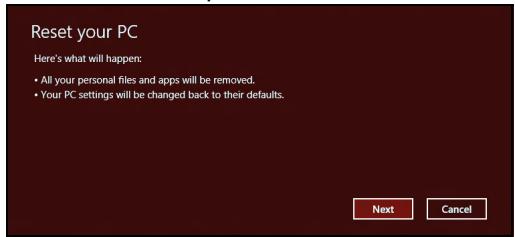
Images for reference only.
- Click Next, then choose how to erase your files:
a. Just remove my files quickly erases all files before restoring your computer and takes about 30 minutes.
b. Fully clean the drive completely cleans the drive after each file is erased, so no files can be viewed after the recovery. Cleaning the drive takes much longer, up to 5 hours, but is much more secure as old files are completely removed.
- Click Reset.
- The recovery process begins by restarting your computer, then continues by copying files to your hard drive.
- After the recovery has finished, you can start using your computer by repeating the first-start process.
1. Click Customized Restore (Retain User Data).
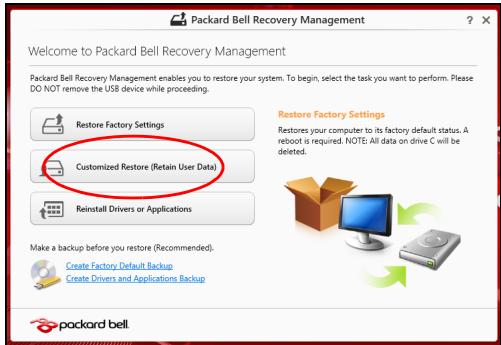
2. The Refresh your PC window opens.
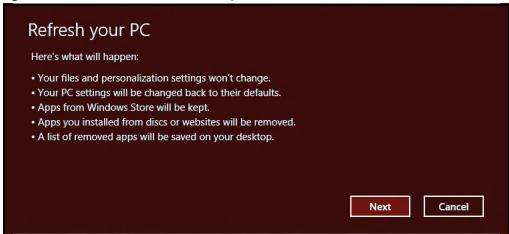
3. Click Next, then Refresh.
4. The recovery process begins by restarting your computer, then continues by copying files to your hard drive. This process takes about 30 minutes.
Recovering from a recovery backup
To recover from a recovery backup on a USB drive:
- Find your recovery backup.
- Plug in the USB drive and turn on your computer.
- If it is not already enabled, you must enable the F12 Boot Menu:
a. Press <F2> when starting your computer.
b. Use the left or right arrow keys to select the Main menu.
c. Press the down key until F12 Boot Menu is selected, press
d. Use the left or right arrow keys to select the Exit menu.
e. Depending on the type of BIOS your computer uses, select Save Changes and Exit or Exit Saving Changes and press Enter. Select OK or Yes to confirm.
f. Your computer will restart.
- During startup, press
to open the boot menu. The boot menu allows you to select which device to start from, select the USB drive.
a. Use your arrow keys to select USB Device, then press Enter.
b. Windows starts from the recovery backup instead of the normal startup process.
- Select your keyboard type.
- Select Troubleshooting and then choose the type of recovery to use:
a. Click Advanced then System Restore to start Microsoft System Restore:
Microsoft System Restore periodically takes a 'snapshot' of your system settings and saves them as restore points. In most cases of hard-to-resolve software problems, you can return to one of these restore points to get your system running again.
b. Click Reset your PC to start the reset process:
Reset your PC deletes everything on your hard drive, then reinstalls Windows and all software and drivers that were pre-installed on your system. If you can access important files on your hard drive, back them up now. See "Reset your PC from the recovery backup" on page 76.
c. Click Refresh your PC to start the refresh process:
Refresh your PC will attempt to retain your files (user data) but will reinstall all software and drivers. Software installed since you purchased your PC will be removed (except software installed from the Windows Store). See "Refresh your PC from the recovery backup" on page 77.
Reset your PC from the recovery backup
Caution: Reset your PC will erase all files on your hard drive.
- The Reset your PC window opens.
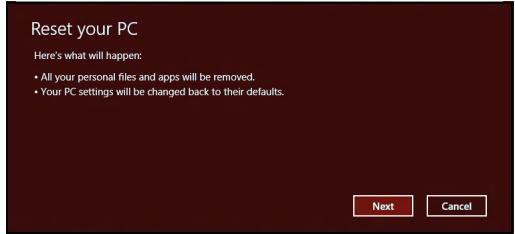
Images for reference only.
- Click Next.
- Select the operating system to recover (normally only one option is available).
- Choose to keep any changes to the hard drive:
a. If you have deleted the recovery partition or otherwise changed the partitions on the hard drive and want to keep these changes, select No.
b. To completely restore your computer to Factory Settings, select Yes.
- Choose how to erase your files:
a. Just remove my files quickly erases all files before restoring your computer and takes about 30 minutes.
b. Fully clean the drive completely cleans the drive after each file is erased, so no files can be viewed after the recovery. Cleaning the drive takes much longer, up to 5 hours, but is much more secure as
old files are completely removed.
- Click Reset.
- After the recovery has finished, you can start using your computer by repeating the first-start process.
Refresh your PC from the recovery backup
- The Refresh your PC window opens.
Refresh your PC
Here's what will happen:
- Your files and personalization settings won't change.
- Your PC settings will be changed back to their defaults.
- Apps from Windows Store will be kept.
- Apps you installed from discs or websites will be removed.
- A list of removed apps will be saved on your desktop.
Next
Cancel
- Click Next.
- Select the operating system to recover (normally only one option is available).
- Click Refresh.
- The recovery process begins by restarting your computer, then continues by copying files to your hard drive. This process takes about 30 minutes.
Frequently Asked Questions
The following is a list of possible situations that may arise during the use of your computer. Easy solutions are provided for each one.
I turned on the power, but the computer does not start or boot up.
Look at the power indicator:
-
If it is not lit, no power is being supplied to the computer. Check the following:
-
If you are using on the battery, it may be low and unable to power the computer. Connect the AC adapter to recharge the battery pack.
- Make sure that the AC adapter is properly plugged into the computer and to the power outlet.
If it is lit, check the following:
- Is a disc in the optical drive? Remove it and press <Ctrl> + <Alt> + <Del> to restart the system.
- Do you have a USB storage device (USB disk or smartphone) plugged into your computer? Unplug it and press <Ctrl> + <Alt> + <Del> to restart the system.
Nothing appears on the screen.
The computer's power management system automatically blanks the screen to save power. Press any key to turn the display back on.
If pressing a key does not turn the display back on, three things might be the cause:
- The brightness level might be too low. Press (increase) to adjust the brightness level.
- The display device might be set to an external monitor. Press ☐ to toggle the display back to the computer.
- If the Sleep indicator is lit, the computer is in Sleep mode. Press and release the power button to resume.
No audio is heard from the computer.
Check the following:
- The volume may be muted. In Windows, look at the volume control (speaker) icon on the taskbar. If it is crossed-out, click the icon and deselect the Mute all option.
- The volume level may be too low. In Windows, look at the volume control icon on the taskbar. You can also use the volume control buttons to adjust the volume.
- If headphones, earphones or external speakers are connected to the line-out port on the computer, the internal speakers automatically turn off.
I want to eject the optical drive tray without turning on the power
There is a mechanical eject hole on the optical drive. Simply insert the tip of a pen or paperclip into the hole and push to eject the tray.
The keyboard does not respond.
Try attaching an external keyboard to a USB port on the computer. If it works, contact your dealer or an authorized service center as the internal keyboard cable may be loose.
The printer does not work
Check the following:
- Make sure that the printer is connected to a power outlet and that it is turned on.
- Make sure that the printer cable is connected securely to a USB port and the corresponding port on the printer.
TIPS AND HINTS FOR USING WINDOWS 8
We know this is a new operating system that will take some getting used to, so we've created a few pointers to help you get started.
Three concepts you might want to keep in mind
1. Start
The Start button is no longer available; you can launch apps from the Start screen.
2. Tiles
Live tiles are similar to thumbnails of the apps.
3. Charms
Charms allow you to perform useful functions, such as sharing content, turning off your PC or changing settings.
How do I access the charms?
Move the cursor to the upper or lower right-hand corner of the screen to access the charms, or press the Windows key +
How do I get to Start?
Press the Windows key on the keyboard; press the Windows key +
How do I jump between apps?
Move the cursor to the left-hand edge of the screen to view thumbnails of apps that are currently running.
You may also press the Windows key +
How do I turn off my computer?
Press the Windows key +
Why is there a new interface?
The new interface for Windows 8 is designed to work well with touch input. Windows Store apps will automatically use the whole screen and don't require closing in the traditional way. Windows Store apps will be displayed on Start using live-tiles.
What are 'live tiles?'
Live tiles are similar to thumbnails of the apps that will be updated with new content whenever you're connected to the Internet. So, for example, you can view weather or stock updates without needing to open the app.
How do I unlock my computer?
Press the any key and click on a user account icon to unlock the computer. If your account has a password set, you will need to enter the password to continue.
How do I personalize my computer?
You can personalize Start with a different background image or by arranging the tiles to suit your personal needs.
To change the background, press the Windows key +
How do I move tiles?
Click and hold a tile to select it, then drag it to the place on Start that you want it to appear. Other tiles will be moved to accommodate the tile in its new location.
Can I make tiles bigger or smaller?
Right-click on a tile, then select Smaller or Larger from the menu that appears at the bottom of the screen.
How do I personalize the Lock screen?
You can personalize the lock screen with a different image or to show you quick status and notifications to suit your personal needs.
To change the background, press the Windows key +
So, how do I close an app?
Move the cursor to the top of the screen and click and drag the window downwards to close the app.
You can close apps from the thumbnails on the left-hand edge of the screen by right-clicking on a thumbnail and selecting Close.
Can I change the screen resolution?
From Start, start typing 'Control Panel' to open Search and display the results; click Control Panel > Adjust screen resolution.
I want to use Windows in the way that I'm used to - give me my desktop back!
From Start click the Desktop tile to see a traditional desktop. You can pin apps you frequently use to the taskbar to easily open them.
If you click an app that is not a Windows Store app, Windows will automatically open the app using Desktop.
Where are my apps?
From Start, simply start typing the name of the app you would like to open, and Search will automatically open and list results.
To view the complete list of apps, press the space bar or the Menu key and click All apps.
How do I make an app appear on Start?
If you're in All apps and you want to make an app appear on Start, you can select the app and right-click on it. Select Pin to Start from the menu that appears at the bottom of the screen.
How do I remove a tile from Start?
Right-click the tile and click Unpin from Start from the menu that appears at the bottom of the screen.
How do I make an app appear on my taskbar in Desktop?
If you're in All apps and you want to make an app appear on the taskbar in Desktop, you can select the app and right-click on it. Select Pin to taskbar from the menu that appears at the bottom of the screen.
How do I install apps?
You can download Windows Store apps from Store. You will need to have a Microsoft ID to purchase and download apps from Store.
I can't find apps like Notepad and Paint! Where are they?
From Start you can simply start typing the name of the app you're looking for to open Search and list the results. Alternatively, open All apps and scroll to 'Windows Accessories' to see the list of legacy programs.
What is a Microsoft ID (account)?
A Microsoft account is an email address and password that you use to sign in to Windows. You can use any email address, but it is best if you choose the one you already use to communicate with friends and sign in to your favorite websites. When you sign in to your PC with a Microsoft account, you'll connect your PC to the people, files, and devices you care about.
Do I need one?
You do not need a Microsoft ID to use Windows 8, but it makes life easier because you can sync data across different machines you sign in to using a Microsoft ID.
How do I get one?
If you've already installed Windows 8 and didn't sign in with a Microsoft account or you don't have a Microsoft account and want to get one, press the Windows key +
How do I add a favorite to Internet Explorer?
Internet Explorer 10 doesn't have traditional favorites, instead you can pin shortcuts to Start. Once you have the page open, right-click anywhere on the page to open the menu at the bottom of the screen. Click Pin to Start.
How do I check for Windows updates?
Press the Windows key +
Where can I get more information?
For more information please visit:
- Windows 8 tutorials: www.packardbell.com/windows8-tutorial
- Support FAQs: support.packardbell.com
REGULATORY INFORMATION
PREVENTION OF HEARING LOSS
To protect your hearing, follow these instructions.
- Increase the volume gradually until you can hear clearly and comfortably.
- Do not increase the volume level after your ears have adjusted.
- Do not listen to music at high volumes for extended periods.
- Do not increase the volume to block out noisy surroundings.
- Decrease the volume if you can't hear people speaking near you.

RADIO DEVICE REGULATORY NOTICE
- Note: Regulatory information below is for models with wireless LAN and/or Bluetooth only.
WIRELESS ADAPTER REGULATORY INFORMATION
USA—FCC and FAA
The FCC with its action in ET Docket 96-8 has adopted a safety standard for human exposure to radio frequency (RF) electromagnetic energy emitted by FCC certified equipment. The wireless adapter meets the Human Exposure limits found in OET Bulletin 65, supplement C, 2001, and ANSI/IEEE C95.1, 1992. Proper operation of this radio according to the instructions found in this manual will result in exposure substantially below the FCC's recommended limits.
- The following safety precautions should be observed:
Do not touch or move antenna while the unit is transmitting or receiving.
- Do not hold any component containing the radio such that the antenna is very close or touching any exposed parts of the body, especially the face or eyes, while transmitting.
- Do not operate the radio or attempt to transmit data unless the antenna is connected; this behavior may cause damage to the radio.
Use in specific environments:
- The use of wireless adapters in hazardous locations is limited by the constraints posed by the safety directors of such environments.
- The use of wireless adapters on airplanes is governed by the Federal Aviation Administration (FAA).
- The use of wireless adapters in hospitals is restricted to the limits set forth by each hospital.
Antenna Use
In order to comply with FCC RF exposure limits, low gain integrated antennas should be located at a minimum distance of 20~cm (8 inches) or more from the body of all persons or at a minimum distance as specified by the FCC module grant conditions. FCC grants can be viewed from the FCC Equipment Authorization website at https://fjallfoss.fcc.gov/oetcf/eas/reports/GenericSearch.cfm by entering the FCC ID printed on the module label.
Explosive Device Proximity Warning
Warning: Do not operate a portable transmitter (including this wireless adapter) near unshielded blasting caps or in an explosive environment unless the transmitter has been modified to be qualified for such use
AntennaWarnings
- Warning: To comply with the FCC and ANSI C95.1 RF exposure limits, it is recommended that for the wireless adapter installed in a desktop or portable computer, the antenna for this wireless adapter to be installed so as to provide a
separation distance of at least 20 cm (8 inches) from all persons or at the minimum distance as specified by the module grant conditions. FCC grants can be viewed from the FCC Equipment Authorization website at https://fjallfoss.fcc.gov/oetcf/eas/reports/GenericSearch.cfm by entering the FCC ID printed on the module label.
- Warning: The wireless adapter is not designed for use with high-gain directional antennas.
Use On Aircraft Caution
- Caution: Regulations of the FCC and FAA prohibit airborne operation of radio-frequency wireless devices (wireless adapters) because their signals could interfere with critical interference with critical aircraft instruments.
Local Restrictions on 802.11a, 802.11b, 802.11g and 802.11n Radio Usage
- Caution: Due to the fact that the frequencies used by 802.11a, 802.11b, 802.11g and 802.11n wireless LAN devices may not yet be harmonized in all countries, 802.11a, 802.11b, 802.11g and 802.11n products are designed for use only in specific countries, and are not allowed to be operated in countries other than those of designated use. As a user of these products, you are responsible for ensuring that the products are used only in the countries for which they were intended and for verifying that they are configured with the correct selection of frequency and channel for the country of use. Any deviation from the permissible power and frequency settings for the country of use is an infringement of national law and may be punished as such.
Wireless Interoperability
The wireless adapter is designed to be interoperable with other wireless LAN products that are based on direct sequence spread spectrum (DSSS) radio technology and to comply with the following standards:
- IEEE Std. 802.11b compliant Standard on Wireless LAN
- IEEE Std. 802.11g compliant Standard on Wireless LAN
-
IEEE Std. 802.11a compliant Standard on Wireless LAN (applies to devices supporting 802.11a)
-
IEEE Std. 802.11n draft 2.0 compliant on Wireless LAN
- Wireless Fidelity certification, as defined by the Wi-Fi Alliance
The Wireless Adapter and Your Health
The wireless adapter, like other radio devices, emits radio frequency electromagnetic energy. The level of energy emitted by the wireless adapter, however, is less than the electromagnetic energy emitted by other wireless devices such as mobile phones. The wireless adapter operates within the guidelines found in radio frequency safety standards and recommendations. These standards and recommendations reflect the consensus of the scientific community and result from deliberations of panels and committees of scientists who continually review and interpret the extensive research literature. In some situations or environments, the use of the wireless adapter may be restricted by the proprietor of the building or responsible representatives of the applicable organization. Examples of such situations may include:
Using the wireless adapter on board airplanes, or
- Using the wireless adapter in any other environment where the risk of interference with other devices or services is perceived or identified as being harmful.
If you are uncertain of the policy that applies to the use of wireless adapters in a specific organization or environment (an airport, for example), you are encouraged to ask for authorization to use the adapter before you turn it on.
FCC Radio Frequency Interference Requirements (applies to device supporting 802.11a)
This device is restricted to indoor use due to its operation in the 5.15 to 5.25 GHz and 5.470 to 5.725 GHz frequency ranges. FCC requires this product to be used indoors for the frequency ranges 5.15 to 5.25 GHz and 5.470 to 5.725 GHz to reduce the potential for harmful interference to co-channel mobile satellite systems. High power radars are allocated as primary users of the 5.25 to 5.35 GHz and 5.65 to 5.85 GHz bands. These radar stations can cause interference with and /or damage this device. No configuration controls are provided for this wireless adapter allowing any change in the frequency of
operations outside the FCC grant of authorization for U.S operation according to Part 15.407 of the FCC rules.
USA - Federal Communications Commission (FCC)
This device complies with Part 15 of the FCC Rules. Operation of the device is subject to the following two conditions:
- This device may not cause harmful interference.
- This device must accept any interference that may cause undesired operation.
- Note: The radiated output power of the adapter is far below the FCC radio frequency exposure limits. Nevertheless, the adapter should be used in such a manner that the potential for human contact during normal operation is minimized. To avoid the possibility of exceeding the FCC radio frequency exposure limits, you should keep a distance of at least 20cm between you (or any other person in the vicinity), or the minimum separation distance as specified by the FCC grant conditions, and the antenna that is built into the computer. Details of the authorized configurations can be found at http://www.fcc.gov/oet/ea/ by entering the FCC ID number on the device.
Interference Statement
This wireless adapter has been tested and found to comply with the limits for a Class B digital device, pursuant to Part 15 of the FCC Rules. These limits are designed to provide reasonable protection against harmful interference in a residential installation. This wireless adapter generates, uses, and can radiate radio frequency energy. If the wireless adapter is not installed and used in accordance with the instructions, the wireless adapter may cause harmful interference to radio communications. There is no guarantee, however, that such interference will not occur in a particular installation. If this wireless adapter does cause harmful interference to radio or television reception (which can be determined by turning the equipment off and on), the user is encouraged to try to correct the interference by taking one or more of the following measures:
-
Reorient or relocate the receiving antenna of the equipment experiencing the interference.
-
Increase the distance between the wireless adapter and the equipment experiencing the interference.
- Connect the computer with the wireless adapter to an outlet on a circuit different from that to which the equipment experiencing the interference is connected.
- Consult the dealer or an experienced radio/TV technician for help.
- Note: The adapter must be installed and used in strict accordance with the manufacturer's instructions as described in the user documentation that comes with the product. Any other installation or use will violate FCC Part 15 regulations.
Canada — Industry Canada (IC)
This device complies with RSS210 of Industry Canada. Cet apparéil se conforme à RSS210 de Canada d'Industrie.
- Caution: When machine supports and using IEEE 802.11a wireless LAN, this product is restricted to indoor use due to its operation in the 5.15- to 5.25 GHz frequency range. Industry Canada requires this product to be used indoors for the frequency range of 5.15 GHz to 5.25 GHz to reduce the potential for harmful interference to co-channel mobile satellite systems. High power radar is allocated as the primary user of the 5.25 to 5.35 GHz and 5.65 to 5.85 GHz bands. These radar stations can cause interference with and/or damage to this device. The maximum allowed antenna gain for use with this device is 6dBi in order to comply with the E.I.R.P limit for the 5.25 to 5.35 and 5.725 to 5.85 GHz frequency range in point-to-point operation. To comply with RF exposure requirements all antennas should be located at a minimum distance of 20~cm , or the minimum separation distance allowed by the module approval, from the body of all persons.
- Attention: l'utilisation d'un réseau sans fil IEEE802.11a est restreinte à une utilisation en interieur à cause du fonctionement dans la bande de fréquence 5,15 - 5,25 GHz. Industry Canada requiert que ce produit soit utilisé à l'intérieur desBATIMENTS pour la bande de fréquence 5,15 - 5,25 GHz afin de réduire les possibiltés d'interférences nuisibles aux canaux co-existants des systèmes de transmission satellites. Les radars de puissances ont fait l'objet d'une allocation primaire de
This Class B digital apparatus complies with Canadian ICES-003.
"To prevent radio interference to the licensed service, this device is intended to be operated indoors and away from windows to provide maximum shielding. Equipment (or its transmit antenna) that is installed outdoors is subject to licensing."
List of applicable countries
This product must be used in strict accordance with the regulations and constraints in the country of use. For further information, contact the local office in the country of use. Please see http://ec.europa.eu/enterprise/rtte/implement.htm for the latest country list.
List of National Codes
THIS EQUIPMENT MAY BE OPERATED IN THE FOLLOWING COUNTRIES:
| Country | ISO 31662 letter code | Country | ISO 31662 letter code | Country | ISO 31662 letter code | Country | ISO 31662 letter code |
| Austria | AT | Germany | DE | Malta | MT | United Kingdom | GB |
| Belgium | BE | Greece | GR | Netherlands | NT | Iceland | IS |
| Cyprus | CY | Hungary | HU | Poland | PL | Liechtenstein | LI |
| Czech Republic | CZ | Ireland | IE | Portugal | PT | Norway | NO |
| Denmark | DK | Italy | IT | Slovakia | SK | Switzerland | CH |
| Estonia | EE | Latvia | LV | Slovenia | SL | Bulgaria | BG |
| Finland | FI | Lithuania | LT | Spain | ES | Romania | RO |
| France | FR | Luxembourg | LU | Sweden | SE | Turkey | TR |
The low band 5.15 -5.35 GHz is for indoor use only.
This equipment complies with the essential requirements of the European Union directive 1999/5/EC. See Statements of European Union Compliance, and more details refer to the attached Declaration of Conformity.
| English | Hereby, ACER INC., declares that this devise is in compliance with the essential requirements and other relevant provisions of Directive 1999/5/EC. |
| Česky [Czech] | ACER INC. tímto prohlasuje,že toto zařizení je ve shodě se základnímí požadavyk a dalšími príslušnými ustanoveními směrnice 1999/5/ES. |
| Daansk [Danish] | Undertegnede ACER INC. erklærer herved, at følgende udstyr overholder de væsentlige krav og øvridge relevante krav i direktiv 1999/5/EF. |
| Deutsch [German] | Hiermit erklärrt ACER INC., dass sich das Gerät Radiolan in Übereinstimmung mit den grundlegenden Anforderungen und den übrigen einschlögigen Bestimmungen der Richtlinie 1999/5/EG befindet. |
| Eesti [Estonian] | Käesolevaga kinnitab ACER INC. seadme vastavust direktiivi 1999/5/EÜ pöhinõuetele ja nimetatud direktiivist tulenevatele teistele asjakohastele sätetele. |
| Espanol [Spanish] | Por medio de la presente ACER INC. declara que el dispositivo cumple con los requisitos esencias y caulesquiera除外 dispositions aplicables o exigibles de la Directiva 1999/5/CE. |
| Ελληνικά [Greek] | Δια του παρόντος η ACER INC. δηλώνει στι η παρούσα συακεύη συμμορώνεται προς τίς υουσιώδεις απατιήσεις και τις λοιπές διατάξεις της Εθηγίας 1999/5/ EK. |
| François [French] | Par laprésente ACER INC. Declare que cet appeareil est conforme aux exigences essentielles et aux autres dispositions pertinentes de la directive 1999/5/CE. |
| Íslenska [Icelandic] | Hér með lysir ACER INC. yfirþvi að erí samræmi við grunnkröfur og aðrar kröfur, sem gerða r eruí tīskipun 1999/5/EC. |
| Itaaliano [Italian] | Con la presente ACER INC. dichiara che questo dispositivo è conforme ai requisiti essenziali ed alle altre disposizioni pertinenti stabilite alla direttiva 1999/5/CE. |
| Latviski [Latvian] | Ar šo ACER INC. deklare, ka šī ierīce atbilst Direktīvas 1999/5/EK būtiskajām prasībām un citiem ar to saistītajiem noteikumiem. |
| Lietuvić [Lithuanian] | Šiuo ACER INC. deklaruoja, kad šis Žrenginys atitinka esminius reikalavimus irKitas 1999/5/EB Direktyvos nuostatas. |
| Malti [Maltese] | Hawnhekk, ACER INC., jiddikjara li dan jikkonforma mal- ti ijiet essenzjali u ma provvedimenti o rajn relevanti li he mm fid-Dirrettiva 1999/5/EC. |
| Magyar [Hungarian] | Alulírott, ACER INC. nyilatkozom, hogy a készülék megfelela a vonahtkoź alapveto követelényeknek és az 1999/5/EC irányelv egyéb eloírsainak. |
| Nederlands [Dutch] | Hierbij verklaart ACER INC. dat het toestel voldoet aan de essentièle eisen en de andere relevante bepalingen van richtlijn 1999/5/EG. |
| Norsk [Norwegiann] | ACER INC. erkrærer herved at utstyret er i samsvar med de grunnleggende krav og øvridge relevante krav i direktiv 1999/5/EF. |
| Polski [Polish] | Niniejszym ACER INC. oświadcza,ź urȩzdenie jest zgodne zzasadniczymi wymogami oraz pożostymi stosownymi postanowieniami Dyrektywy 1999/5/EC. |
| Portuguès [Portuguese] | ACER INC. declares que este dispositivo está conforme com os requisitos essentials iés e autres disponções da Directa 1999/5/CE. |
| Slovensko [Slovenian] | ACER INC. izjavlja, da je ta naprava skladna z bistvenimi zahtevami in ostalimi relevantnimi doložili Direktive 1999/5/ES. |
| Slovensky [Slovak] | ACER INC. týmto vyhlasuje,ź zariadenie splína základné požiadavky a větky príslušné ustanovenia Smernice 1999/5/ES. |
| Suomi [Finnish] | ACER INC. vakuuttaa täten että tämä laite on direktiivin 1999/5/EY oleellisten vaatimusten ja sitä koskevienn direktiivin muiden ehtojen mukainen. |
| Svenska [Swedish] | Härmed intygar ACER INC. attenna enchet stär i överensstammelse med väsentliga egenskapskrav och övriga relevanta bestämelse som framgår av direktiv 1999/5/EG. |
France
The use of these equipments is regulated by:
1.D.L.gs 1.8.2003, n. 259, article 104 (activity subject to general authorization) for outdoor use and article 105 (free use) for indoor use, in both cases for private use.
2.D.M. 28.5.03, for supply to public of LAN access to networks and telecom services.
Pakistan Telecommunication Authority (PTA) Approved
Morocco
The operation of this product in the radio channel 2 (2417 MHz) is not authorized in the following cities: Agadir, Assa-Zag, Cabo Negro, Chaouen, Goulmima, Oujda, Tan Tan, Taourirt, Taroudant and Taza.
The operation of this product in the radio channels 4, 5, 6 and 7 (2425 - 2442 MHz) is not authorized in the following cities: Aéroport Mohamed V, Agadir, Aguelmous, Anza, Benslimane, Béni Hafida, Cabo Negro, Casablanca, Fès, Lakhab, Marrakech, Merchich, Mohammédia, Rabat, Salé, Tanger, Tan Tan, Taunate, Tit Mellil, Zag.
Japan
5GHz 带は室内用使用のと
Korea
当達末軍総賬是運用中興進華無人能
Taiwan
第十二条
MODIFICATIONS TO THE PRODUCT
CE Marking
Packard Bell cannot be held responsible for unauthorized modifications made by the user and the consequences thereof, which may alter the conformity of the product with the CE Marking.
Radio frequency interference
The manufacturer is not responsible for any radio or TV interference caused by unauthorised modifications to this equipment.
CONNECTIONS AND REMOTE EARTHSH
PELV (Protected Extra Low Voltage)
To ensure the extra-low voltage integrity of the equipment, only connect equipment with mains-protected electrically-compatible circuits to the external ports.
SELV (Safety Extra Low Voltage)
Every input and output of this product is classified as Safety Extra Low Voltage.
Remote earths
To prevent electrical shock, connect all local (individual office) computers and computer support equipment to the same electrical circuit of the building wiring. If you are unsure, check the building wiring to avoid remote earth conditions.
Building supply
Only connect the equipment to a building supply that is in accordance with current wiring regulations in your country. In the U.K., these are the IEE regulations.
POWER SUPPLY AND CABLES
Power supply
The power supply socket-inlet and socket-outlet (if equipped) are classified as Hazardous Voltage.
You must unplug the power supply cord and remove the battery to disconnect the equipment from the power supply. In that aim, the socket-outlet should be installed near to the equipment and should be easily accessible.
Input rating: Refer to the rating label on the bottom of the computer and ensure that your power adapter complies with the specified rating.
Under no circumstances should the user attempt to disassemble the power supply. The power supply has no user-replaceable parts. Inside the power supply are hazardous voltages that can cause serious personal injury.
A defective power supply must be returned to your dealer.
Power cables and plug
This Product requires a grounded power cord and plug. The plug only fits in a grounded power outlet. Make sure the power outlet is properly grounded before inserting the plug. Do not insert the plug into a non-grounded power outlet. Contact your electrician for details.
The cord length must not exceed 2.5 metres. To prevent electrical hazards, do not remove or disable the ground contact on the power cord. Replace the power cord if it gets damaged. Contact your dealer for an exact replacement. In Europe, the plug must be rated for 250 VAC, 10 amp minimum. The plug must display an international agency approval marking. The cord must be suitable for use in the end-user country. Consult your dealer or the local electrical authorities if you are unsure of the type of power cord to use in your country.
Cables
For cables which are not delivered with the Product in the computer's packaging:
The EMC performance of the system is guaranteed only if the cable and interface use efficient shielding.
The use of shielded interface cable is required for USB, IEEE1394, serial, printer, game, analog or digital audio/ video, PS2, TV or FM antennas, and generally all high-speed cable interfaces.
Use only UL Listed No. 26AWG or larger telecommunication cords.
Only Ethernet LAN or RTC modem cable can have length exceeding 3 metres.
Packard Bell recommends that you add a ferrite core round clip to each cable connecting your computer to a hardware device that was not included with your computer.
- Ferrite reference: 28A-2029 from Steward (two loops)
During product certification, Packard Bell used the following cable quality:
- USB2.0 Certified Cables from Hama 46778
- IEEE1394 shielded FireWire from Hama 50011
- RCA-RCA shielded Audio/Video Cables from Thomson KHC001M, KHC012M, KHC028M
- Stereo Jack shielded Audio cables from Hama 43330H, 42714H
Heat Build-up and Portable Computers
The AC adapter and the underside of the computer can become hot after prolonged use.
Sustained physical contact with either should be avoided.
CHASSIS COVER REMOVAL AND REPLACEMENT
Before removing the chassis cover to service or modify the equipment, you must disconnect all power and modem cords, and remove or disable the battery.
- Caution: Some components inside the computer can become hot after prolonged use.
You then must close the chassis before you plug in and switch on the equipment.
LASER COMPLIANCE STATEMENT
The optical devices are tested and certified to be compliant with International Electrotechnical Commission IEC60825-1 and European EN60825-1 standards for Class 1 laser products.
Class 1 laser products are not considered hazardous. The optical devices are designed such that there is never human access to laser radiation above a Class 1 level during normal operation or prescribed maintenance conditions.
The optical devices installed in your computer are designed for use solely as components of such electronic product and therefore do not comply with the appropriate requirements of Code of Federal Regulation Sec. 1040.10 and Sec. 1040.11 for COMPLETE laser products.
Because exposure to laser radiation is extremely hazardous, under no circumstances should the user attempt to disassemble the laser device.
PACKAGING
The packaging of this product is compliant with the European Environmental Directive 94/62/EC from December 20th 1994 and its equivalent in the French Legislation by the Decree 98-638 from july 20th 1998.
COMPLIANT WITH RUSSIAN REGULATORY CERTIFICATION

ME61
ENVIRONMENT
OUR COMMITMENT TO ENVIRONMENTAL PROTECTION
Environment has been at the heart of our products.
Packard Bell is committed to limit the environmental impact of its products during product life cycle.
Starting at design phase, with a very strict procurement policy, maximum attention is given to electronic components in order to limit their weight in heavy metals such as lead, cadmium, chromium, mercury, etc. Suppliers are asked, for each part of any product, to respect all regulations.
As far as end-of-life products are concerned, measures have been taken to anticipate and facilitate the recycling of all our products. Thus, all plastic parts heavier than 25 grams used in Packard Bell products are labelled ISO 11469. This label allows a quick recognition of the material and eases its valorisation. Likewise, desktop computers are designed to be easily dismantled, with screws being replaced by clips.
PRODUCT DISPOSAL
The 2002/96/EC Directive, known as Waste Electrical and Electronic Equipment (WEEE) Directive, requires that used electrical and electronic products must be disposed of separately from normal household waste in order to promote reuse, recycling and other forms of recovery and to reduce the quantity of waste to be eliminated with a view to reducing landfill and incineration. The crossed-out dustbin logo is there to remind you that these products must be sorted separately for disposal. These
rules concern all Packard Bell products and also all accessories, such as keyboard, mouse, speakers, remote control, etc. When you have to dispose of such products, make sure that they are correctly recycled by checking with your local authority, or by returning your old equipment to your retailer if you are replacing it. For information, visit www.packardbell.com/recycling.
Battery disposal (when applicable)
Before disposing of your equipment ensure that you have removed any batteries that may be fitted in the equipment. European law states that batteries must be collected for disposal separately from household waste. Do not throw your used batteries in the dustbin. Disposse of your used batteries via a battery collection scheme where available, or ask your distributor or local authority what infrastructures you can use. Your efforts will enable the safe collection, recycling and destruction of used batteries and will help protect the environment and reduce health hazards.
- Caution: Risk of explosion if battery is replaced by an incorrect type. Dispose of used batteries according to the instructions.
ENERGY STAR

Packard Bell's ENERGY STAR qualified products save your money by reducing energy cost and protecting the environment without sacrificing features or performance. Packard Bell is proud to offer our customers products with the ENERGY STAR mark.
What is ENERGY STAR?
Products that are ENERGY STAR qualified use less energy and prevent greenhouse gas emissions by meeting strict energy efficiency guidelines set by the U.S. Environmental Protection Agency. Packard Bell is committed to offering products and services worldwide that help customers save money, conserve energy and improve the quality of our environment. The more energy we can save through higher energy efficiency, the more we reduce greenhouse gases and the risks of climate change. More information refers to www.energystar.gov or www.energystar.gov/powermanagement.
- Note: Information in this section may not apply to your computer.
Packard Bell ENERGY STAR qualified products:
- produce less heat and reduce cooling loads in warmer climates.
-
automatically go into "display Sleep" and "computer Sleep" mode after 10 and 30 minutes of inactivity, respectively.
-
wake from "Sleep" mode if the keyboard is pressed or mouse is moved.
save more than 80% energy when in "Sleep" mode.
ENERGY STAR and the ENERGY STAR mark are registered U.S. marks.
SOFTWARE LICENSE
- Note: Most of the software applications are already preinstalled on your Packard Bell computer. They are ready to use or to set up. However, some titles require a CD or DVD to run. You will find these discs in your computer's packaging.
Packard Bell License Agreement (CD and/or DVD Products). This copy of the original is your proof of license. Please treat it as valuable property.
Important!
Read carefully before installing the software.
The following License Agreement applies to you. This is a legal agreement between you (either individual or an entity) and Packard Bell. By installing the software you are agreeing to be bound by the terms of this Agreement. If you do not agree to the terms of this Agreement, promptly return your entire computer system, the unopened software packet(s), if any, as well as the accompanying terms (including written materials or other container(s)) in the place you obtained them for a full refund.
PACKARD BELL SOFTWARE LICENSE
1. Grant of License
This Packard Bell License Agreement ("License") permits you to use one copy of the specified version of the Packard Bell SOFTWARE identified above (which may include at least one CD or DVD disc) on any single computer, provided the SOFTWARE is in use on only one computer at any time. If you have multiple Licenses for the SOFTWARE, then at any time you may have as many copies of the SOFTWARE in use as you have Licenses. The SOFTWARE is "in use" on a computer when it is loaded into the temporary memory (i.e. RAM) or installed in the permanent memory (e.g. hard disk, CD and/or DVD, or other storage device of that computer, except that a copy installed on a network server for the sole purpose of distribution of other computer is not "in use." If the anticipated number of users of the SOFTWARE will exceed the number of applicable Licenses, then you must have a reasonable mechanism or process in place to assure that the number of persons
using the SOFTWARE concurrently does no exceed the number of Licenses. If the SOFTWARE is permanently installed on the hard disk or the storage device of a computer (other than a network server) and one person uses that computer more than 80% of the time it is in use, then that person may also use the SOFTWARE on a portable or home computer.
2. Copyright
The SOFTWARE is owned by Packard Bell or its suppliers and is protected by United States copyright laws and international treaty provision. Therefore, you must treat the SOFTWARE like any other copyrighted material (e.g. a book or musical recording) except that you may transfer the CD and/or DVD disc portion of the SOFTWARE, if any, to a single hard disk provided you keep the original solely for backup or archival purposes. You may not copy the CD and/or DVD disc portion of the SOFTWARE or the written materials accompanying the SOFTWARE.
3. Other restrictions
You may not rent or lease the SOFTWARE, but you may transfer the SOFTWARE and accompanying written materials on a permanent basis provided you retain no copies and the recipient agrees to the terms of this Agreement. You may not reverse engineer, decompile or disassemble the SOFTWARE. Any transfer of the SOFTWARE must include the most recent update and all prior versions.
THIRD PARTY SOFTWARE OR FREE SOFTWARE LICENSE INFORMATION
Software pre-loaded, embedded or otherwise distributed with the products provided by Packard Bell does contain free or third party software programs (the "Free Software"), which are licensed under the terms GNU General Public License (the "GPL"). The Free Software is marked as such. Your copying, distribution and/or modification of the Free Software shall be subject to the terms of the GPL.
The Free Software is distributed in the hope that, but it will be useful WITHOUT ANY WARRANTY; without even the implied warranty of MERCHANTABILITY or FITNESS FOR A PARTICULAR PURPOSE. The provisions of the GNU General Public License shall always apply. You may access http://www.gnu.org directly to obtain a copy of the
GPL or write to the free Software Foundation, Inc. and request a copy. The address of the Free Software Foundation, Inc is: 59 Temple Place - Suite 330, Boston, MA, 02111-1307, USA.
For a period of three (3) years as commencing from your receipt of this software, you may obtain a complete machine-readable copy of the source code for the Free Software under the terms of the GPL without charge except for the cost of media, shipping, and handling, upon a written request to us.
Contact us if you have any further questions. Our mailing address is 8F, 88, Sec. 1, Hsin Tai Wu Rd., Hsichih, New Taipei City 221, Taiwan.
INDEX
A
audio troubleshooting 79
B
Batteries 106 low conditions 38
battery disposal 106 maximizing life 33
battery pack optimizing 37
battery-low warning 37 removing 36
characteristics 33 using the first time 34
charging. 36 brightness
checking charge level 36 hotkeys 18
installing 36 Browser 49
C
Cables. 9, 102 computer
CD-ROM features 14
ejecting manually 79 on indicator 20
troubleshooting 79 Computer environment 8
charging connections
checking level 36 network 29
Cleaning your computer. 10 Cursor 25
D
Display Packard Bell Website 49
hotkeys. 17 Drives
display Memory card reader 27
troubleshooting 78 DSL 44
Documentation
E
Environment. 105 Epilepsy warning. 13
F
FAQ. See frequently-asked questions frequently-asked questions 78
Firewall 51 front view. 20
H
Health precautions 11 hotkeys 19
1
Interference 101 Firewall 51
Internet Internet Service Provider (ISP) 43
Connection 43, 44
K
Keyboard keyboard hotkeys 19 troubleshooting 80
L
LAN (Local Area Network) 45 left view 20
M
Maintenance Memory card reader 27
Recovery Management. 42, 58 Modem 44
Malware 51
N
network. 29 Norton Internet Security.. 49, 53
Network connections 45
P
Packard Bell problems 78
Recovery Management. 42 CD-ROM 79
Website 49 display. 78
ports 27 keyboard 80
Power cords. 9 printer. 80
printer startup 78
troublesheathing 80
R
Recovery Removable media devices. 28
Recovery Management. 42, 58 Removing hardware. 28
Regulatory Information 88, 105
s
Safety precautions 8 speakers
Security hotkey 18, 19
Antivirus 51 troubleshooting 79
Updates 57 Spyware 50
Software Support
Software License 108 Packard Bell Website 49
T
touchpad 25 using 25-??
U
Uninstalling hardware.. 28 Update
universal serial bus. 29 Windows automatic updates.. 57
V
view left 21
front 21 right 22
W
Warranty. 7
WiFi 45, 46
Windows
Using Windows 42
Windows automatic updates 57
Packard Bell Recovery Management. 46
Internet 47
VOUS AVEZ DES PROBLEMES?
Support Packard Bell
EXTENSION AVEC DES OPTIONS
Packard Bell Recovery Management
Packard Bell Recovery Management
?X
Welcome to Packard Bell Recovery Management
Packard Bell Recovery Management enables you to restore your system. To begin, select the task you want to perform. Please DO NOT remove the USB device while proceeding.

Customized Restore (Retain User Data)

Reinstall Drivers or Applications
Make a back-up before you restore (Recommended).

Create Factory Default Backup
Create Drivers and Applications Backup

packard bell.
Restores your computer to its factory default status. A system is required. NOTE: All data on drive C will be deleted.
Packard Bell Recovery Management
?X
Welcome to Packard Bell Recovery Management
Packard Bell Recovery Management enables you to restore your system. To begin, select the task you want to perform. Please DO NOT remove the USB device while proceeding.

Customized Restore (Retain User Data)

Reinstall Drivers or Applications
Make a backup before you restore (Recommended).

Create Factory Default Backup
Create Drivers and Applications Backup

packard bell
Restores your computer to its factory default status. A reboot is required. NOTE: All data on drive C will be restored.
Here's what will happen:
- Your files and personalization settings won't change.
- Your PC settings will be changed back to their defaults.
- Apps from Windows Store will be kept.
- Apps you installed from discs or websites will be removed.
- A list of removed apps will be saved on your desktop.
Next
Cancel
The FCC with its action in ET Docket 96-8 has adopted a safety standard for human exposure to radio frequency (RF) electromagnetic energy emitted by FCC certified equipment. The wireless adapter meets the Human Exposure limits found in OET Bulletin
65, supplement C, 2001, and ANSI/IEEE C95.1, 1992. Proper operation of this radio according to the instructions found in this manual will result in exposure substantially below the FCC's recommended limits.
- The following safety precautions should be observed:
Do not touch or move antenna while the unit is transmitting or receiving.
- Do not hold any component containing the radio such that the antenna is very close or touching any exposed parts of the body, especially the face or eyes, while transmitting.
- Do not operate the radio or attempt to transmit data unless the antenna is connected; this behavior may cause damage to the radio.
Use in specific environments:
- The use of wireless adapters in hazardous locations is limited by the constraints posed by the safety directors of such environments.
- The use of wireless adapters on airplanes is governed by the Federal Aviation Administration (FAA).
- The use of wireless adapters in hospitals is restricted to the limits set forth by each hospital.
Antenna Use
In order to comply with FCC RF exposure limits, low gain integrated antennas should be located at a minimum distance of 20~cm (8 inches) or more from the body of all persons or at a minimum distance as specified by the FCC module grant conditions. FCC grants can be viewed from the FCC Equipment Authorization website at https://fjallfoss.fcc.gov/oetcf/eas/reports/GenericSearch.cfm by entering the FCC ID printed on the module label.
Explosive Device Proximity Warning
Warning: Do not operate a portable transmitter (including this wireless adapter) near unshielded blasting caps or in an explosive environment unless the transmitter has been modified to be qualified for such use
AntennaWarnings
-
Warning: To comply with the FCC and ANSI C95.1 RF exposure limits, it is recommended that for the wireless adapter installed in a desktop or portable computer, the antenna for this wireless adapter to be installed so as to provide a separation distance of at least 20cm (8 inches) from all persons or at the minimum distance as specified by the module grant conditions. FCC grants can be viewed from the FCC Equipment Authorization website at https://fjallfoss.fcc.gov/oetcf/eas/reports/GenericSearch.cfm by entering the FCC ID printed on the module label.
-
Warning: The wireless adapter is not designed for use with high-gain directional antennas.
Use On Aircraft Caution
- Caution: Regulations of the FCC and FAA prohibit airborne operation of radio-frequency wireless devices (wireless adapters) because their signals could interfere with critical interference with critical aircraft instruments.
Local Restrictions on 802.11a, 802.11b, 802.11g and 802.11n Radio Usage
- Caution: Due to the fact that the frequencies used by 802.11a, 802.11b, 802.11g and 802.11n wireless LAN devices may not yet be harmonized in all countries, 802.11a, 802.11b, 802.11g and 802.11n products are designed for use only in specific countries, and are not allowed to be operated in countries other than those of designated use. As a user of these products, you are responsible for ensuring that the products are used only in the countries for which they were intended and for verifying that they are configured with the correct selection of frequency and channel for the country of use. Any deviation from the permissible power and frequency settings for the country of use is an infringement of national law and may be punished as such.
Wireless Interoperability
The wireless adapter is designed to be interoperable with other wireless LAN products that are based on direct sequence spread spectrum (DSSS) radio technology and to comply with the following standards:
- IEEE Std. 802.11b compliant Standard on Wireless LAN
- IEEE Std. 802.11g compliant Standard on Wireless LAN
- IEEE Std. 802.11a compliant Standard on Wireless LAN (applies to devices supporting 802.11a)
- IEEE Std. 802.11n draft 2.0 compliant on Wireless LAN
- Wireless Fidelity certification, as defined by the Wi-Fi Alliance
The Wireless Adapter and Your Health
The wireless adapter, like other radio devices, emits radio frequency electromagnetic energy. The level of energy emitted by the wireless adapter, however, is less than the electromagnetic energy emitted by other wireless devices such as mobile phones. The wireless adapter operates within the guidelines found in radio frequency safety standards and recommendations. These standards and recommendations reflect the consensus of the scientific community and result from deliberations of panels and committees of scientists who continually review and interpret the extensive research literature. In some situations or environments, the use of the wireless adapter may be restricted by the proprietor of the building or responsible representatives of the applicable organization. Examples of such situations may include:
- Using the wireless adapter on board airplanes, or
- Using the wireless adapter in any other environment where the risk of interference with other devices or services is perceived or identified as being harmful.
If you are uncertain of the policy that applies to the use of wireless adapters in a specific organization or environment (an airport, for example), you are encouraged to ask for authorization to use the adapter before you turn it on.
FCC Radio Frequency Interference Requirements (applies to device supporting 802.11a)
This device is restricted to indoor use due to its operation in the 5.15 to 5.25 GHz and 5.470 to 5.725 GHz frequency ranges. FCC requires this product to be used indoors for the frequency ranges 5.15 to 5.25 GHz and 5.470 to 5.725 GHz to reduce the potential
for harmful interference to co-channel mobile satellite systems. High power radars are allocated as primary users of the 5.25 to 5.35 GHz and 5.65 to 5.85 GHz bands. These radar stations can cause interference with and /or damage this device. No configuration controls are provided for this wireless adapter allowing any change in the frequency of operations outside the FCC grant of authorization for U.S operation according to Part 15.407 of the FCC rules.
USA — Federal Communications Commission (FCC)
This device complies with Part 15 of the FCC Rules. Operation of the device is subject to the following two conditions:
- This device may not cause harmful interference.
- This device must accept any interference that may cause undesired operation.
- Note: The radiated output power of the adapter is far below the FCC radio frequency exposure limits. Nevertheless, the adapter should be used in such a manner that the potential for human contact during normal operation is minimized. To avoid the possibility of exceeding the FCC radio frequency exposure limits, you should keep a distance of at least 20cm between you (or any other person in the vicinity), or the minimum separation distance as specified by the FCC grant conditions, and the antenna that is built into the computer. Details of the authorized configurations can be found at http://www.fcc.gov/oet/ea/ by entering the FCC ID number on the device.
Interference Statement
This wireless adapter has been tested and found to comply with the limits for a Class B digital device, pursuant to Part 15 of the FCC Rules. These limits are designed to provide reasonable protection against harmful interference in a residential installation. This wireless adapter generates, uses, and can radiate radio frequency energy. If the wireless adapter is not installed and used in accordance with the instructions, the wireless adapter may cause harmful interference to radio communications. There is no guarantee, however, that such interference will not occur in a particular installation. If this wireless
adapter does cause harmful interference to radio or television reception (which can be determined by turning the equipment off and on), the user is encouraged to try to correct the interference by taking one or more of the following measures:
- Reorient or relocate the receiving antenna of the equipment experiencing the interference.
- Increase the distance between the wireless adapter and the equipment experiencing the interference.
- Connect the computer with the wireless adapter to an outlet on a circuit different from that to which the equipment experiencing the interference is connected.
- Consult the dealer or an experienced radio/TV technician for help.
- Note: The adapter must be installed and used in strict accordance with the manufacturer's instructions as described in the user documentation that comes with the product. Any other installation or use will violate FCC Part 15 regulations.
Canada - Industry Canada (IC)
This device complies with RSS210 of Industry Canada. Cet apparéil se conforme à RSS210 de Canada d'Industrie.
This Class B digital apparatus complies with Canadian ICES-003.
"To prevent radio interference to the licensed service, this device is intended to be operated indoors and away from windows to provide maximum shielding. Equipment (or its transmit antenna) that is installed outdoors is subject to licensing."
The use of these equipments is regulated by:
1.D.L.gs 1.8.2003, n. 259, article 104 (activity subject to general authorization) for outdoor use and article 105 (free use) for indoor use, in both cases for private use.
2.D.M. 28.5.03, for supply to public of LAN access to networks and telecom services.
Pakistan Telecommunication Authority (PTA) Approved
Morocco
The operation of this product in the radio channel 2 (2417 MHz) is not authorized in the following cities: Agadir, Assa-Zag, Cabo Negro, Chaouen, Goulmima, Oujda, Tan Tan, Taourirt, Taroudant and Taza.
The operation of this product in the radio channels 4, 5, 6 and 7 (2425 - 2442 MHz) is not authorized in the following cities: Aéroport Mohamed V, Agadir, Aguelmous, Anza, Benslimane, Béni Hafida, Cabo Negro, Casablanca, Fès, Lakhab, Marrakech, Merchich, Mohammédia, Rabat, Salé, Tanger, Tan Tan, Taounate, Tit Mellil, Zag.
Japan
5 GHz 带は室内のは使用のと
Korea
MODIFICATIONS APPORTÉES AU PRODUIT
Homologation CE
MISE AU REBUT DU PRODUIT
Recovery Management 65
Mise à jour
Recovery Management Program.... 46
Norton Internet Security. 54, 58
Recovery Management 65
réseau 31
s
Sécurité
Support
Antivirus. 56
Packard Bell Website 53
Mises à jour 63
T
touches speciales. 21
utiliser. 27
touchpad 27
U
universal serial bus. 32
V
vue gauche 23
Packard Bell-Support
Packard Bell Recovery Management
Here's what will happen:
- Your files and personalization settings won't change.
- Your PC settings will be changed back to their defaults.
- Apps from Windows Store will be kept.
- Apps you installed from discs or websites will be removed.
A list of removed apps will be saved on your desktop.
Next
Cancel
The FCC with its action in ET Docket 96-8 has adopted a safety standard for human exposure to radio frequency (RF) electromagnetic energy emitted by FCC certified equipment. The wireless adapter meets the Human Exposure limits found in OET Bulletin 65, supplement C, 2001, and ANSI/IEEE C95.1, 1992. Proper operation of this radio according to the instructions found in this manual will result in exposure substantially below the FCC's recommended limits.
- The following safety precautions should be observed:
Do not touch or move antenna while the unit is transmitting or receiving. - Do not hold any component containing the radio such that the antenna is very close or touching any exposed parts of the body, especially the face or eyes, while transmitting.
- Do not operate the radio or attempt to transmit data unless the antenna is connected; this behavior may cause damage to the radio.
Use in specific environments:
- The use of wireless adapters in hazardous locations is limited by the constraints posed by the safety directors of such environments.
- The use of wireless adapters on airplanes is governed by the Federal Aviation Administration (FAA).
- The use of wireless adapters in hospitals is restricted to the limits set forth by each hospital.
Antenna Use
In order to comply with FCC RF exposure limits, low gain integrated antennas should be located at a minimum distance of 20~cm (8 inches) or more from the body of all persons or at a minimum distance as specified by the FCC module grant conditions. FCC grants can be viewed from the FCC Equipment Authorization website at https://fjallfoss.fcc.gov/oetcf/eas/reports/GenericSearch.cfm by entering the FCC ID printed on the module label.
Explosive Device Proximity Warning
Warning: Do not operate a portable transmitter (including this wireless adapter) near unshielded blasting caps or in an explosive environment unless the transmitter has been modified to be qualified for such use
AntennaWarnings
-
Warning: To comply with the FCC and ANSI C95.1 RF exposure limits, it is recommended that for the wireless adapter installed in a desktop or portable computer, the antenna for this wireless adapter to be installed so as to provide a separation distance of at least 20cm (8 inches) from all persons or at the minimum distance as specified by the module grant conditions. FCC grants can be viewed from the FCC Equipment Authorization website at https://fjallfoss.fcc.gov/oetcf/eas/reports/GenericSearch.cfm by entering the FCC ID printed on the module label.
-
Warning: The wireless adapter is not designed for use with high-gain directional antennas.
Use On Aircraft Caution
- Caution: Regulations of the FCC and FAA prohibit airborne operation of radio-frequency wireless devices (wireless adapters) because their signals could interfere with critical interference with critical aircraft instruments.
Local Restrictions on 802.11a, 802.11b, 802.11g and 802.11n Radio Usage
- Caution: Due to the fact that the frequencies used by 802.11a, 802.11b, 802.11g and 802.11n wireless LAN devices may not yet be harmonized in all countries, 802.11a, 802.11b, 802.11g and 802.11n products are designed for use only in specific countries, and are not allowed to be operated in countries other than those of designated use. As a user of these products, you are responsible for ensuring that the products are used only in the countries for which they were intended and for verifying that they are configured with the correct selection of frequency and channel for the country of use. Any deviation from the permissible power and frequency settings for the country of use is an infringement of national law and may be punished as such.
Wireless Interoperability
The wireless adapter is designed to be interoperable with other wireless LAN products that are based on direct sequence spread spectrum (DSSS) radio technology and to comply with the following standards:
- IEEE Std. 802.11b compliant Standard on Wireless LAN
- IEEE Std. 802.11g compliant Standard on Wireless LAN
- IEEE Std. 802.11a compliant Standard on Wireless LAN (applies to devices supporting 802.11a)
- IEEE Std. 802.11n draft 2.0 compliant on Wireless LAN
- Wireless Fidelity certification, as defined by the Wi-Fi Alliance
The Wireless Adapter and Your Health
The wireless adapter, like other radio devices, emits radio frequency electromagnetic energy. The level of energy emitted by the wireless adapter, however, is less than the electromagnetic energy emitted by other wireless devices such as mobile phones. The wireless adapter operates within the guidelines found in radio frequency safety standards and recommendations. These standards and recommendations reflect the consensus of the scientific community and result from deliberations of panels and committees of scientists who continually review and interpret the extensive research literature. In some situations or environments, the use of the wireless adapter may be restricted by the proprietor of the building or responsible representatives of the applicable organization. Examples of such situations may include:
- Using the wireless adapter on board airplanes, or
- Using the wireless adapter in any other environment where the risk of interference with other devices or services is perceived or identified as being harmful.
If you are uncertain of the policy that applies to the use of wireless adapters in a specific organization or environment (an airport, for example), you are encouraged to ask for authorization to use the adapter before you turn it on.
FCC Radio Frequency Interference Requirements (applies to device supporting 802.11a)
This device is restricted to indoor use due to its operation in the 5.15 to 5.25 GHz and 5.470 to 5.725 GHz frequency ranges. FCC requires this product to be used indoors for the frequency ranges 5.15 to 5.25 GHz and 5.470 to 5.725 GHz to reduce the potential for harmful interference to co-channel mobile satellite systems. High power radars are allocated as primary users of the 5.25 to 5.35 GHz and 5.65 to 5.85 GHz bands. These radar stations can cause interference with and /or damage this device. No configuration controls are provided for this wireless adapter allowing any change in the frequency of operations outside the FCC grant of authorization for U.S operation according to Part 15.407 of the FCC rules.
USA - Federal Communications Commission (FCC)
This device complies with Part 15 of the FCC Rules. Operation of the device is subject to the following two conditions:
- This device may not cause harmful interference.
- This device must accept any interference that may cause undesired operation.
- Note: The radiated output power of the adapter is far below the FCC radio frequency exposure limits. Nevertheless, the adapter should be used in such a manner that the potential for human contact during normal operation is minimized. To avoid the possibility of exceeding the FCC radio frequency exposure limits, you should keep a distance of at least 20cm between you (or any other person in the vicinity), or the minimum separation distance as specified by the FCC grant conditions, and the antenna that is built into the computer. Details of the authorized configurations can be found at http://www.fcc.gov/oet/ea/ by entering the FCC ID number on the device.
Interference Statement
This wireless adapter has been tested and found to comply with the limits for a Class B digital device, pursuant to Part 15 of the FCC Rules. These limits are designed to provide reasonable protection against harmful interference in a residential installation. This wireless adapter generates, uses, and can radiate radio frequency energy. If the wireless
adapter is not installed and used in accordance with the instructions, the wireless adapter may cause harmful interference to radio communications. There is no guarantee, however, that such interference will not occur in a particular installation. If this wireless adapter does cause harmful interference to radio or television reception (which can be determined by turning the equipment off and on), the user is encouraged to try to correct the interference by taking one or more of the following measures:
- Reorient or relocate the receiving antenna of the equipment experiencing the interference.
- Increase the distance between the wireless adapter and the equipment experiencing the interference.
- Connect the computer with the wireless adapter to an outlet on a circuit different from that to which the equipment experiencing the interference is connected.
- Consult the dealer or an experienced radio/TV technician for help.
- Note: The adapter must be installed and used in strict accordance with the manufacturer's instructions as described in the user documentation that comes with the product. Any other installation or use will violate FCC Part 15 regulations.
Canada - Industry Canada (IC)
This device complies with RSS210 of Industry Canada. Cet apparéil se conforme à RSS210 de Canada d'Industrie.
- Caution: When machine supports and using IEEE 802.11a wireless LAN, this product is restricted to indoor use due to its operation in the 5.15- to 5.25 GHz frequency range. Industry Canada requires this product to be used indoors for the frequency range of 5.15 GHz to 5.25 GHz to reduce the potential for harmful interference to co-channel mobile satellite systems. High power radar is allocated as the primary user of the 5.25 to 5.35 GHz and 5.65 to 5.85 GHz bands. These radar stations can cause interference with and/or damage to this device. The maximum allowed antenna gain for use with this device is 6dBi in order to comply with the E.I.R.P limit for the 5.25 to 5.35 and 5.725 to 5.85 GHz frequency range in point-to
point operation. To comply with RF exposure requirements all antennas should be located at a minimum distance of 20~cm , or the minimum separation distance allowed by the module approval, from the body of all persons.
This Class B digital apparatus complies with Canadian ICES-003.
"To prevent radio interference to the licensed service, this device is intended to be operated indoors and away from windows to provide maximum shielding. Equipment (or its transmit antenna) that is installed outdoors is subject to licensing."
The use of these equipments is regulated by:
1.D.L.gs 1.8.2003, n. 259, article 104 (activity subject to general authorization) for outdoor use and article 105 (free use) for indoor use, in both cases for private use.
2.D.M. 28.5.03, for supply to public of LAN access to networks and telecom services.
Pakistan Telecommunication Authority (PTA) Approved
Morocco
The operation of this product in the radio channel 2 (2417 MHz) is not authorized in the following cities: Agadir, Assa-Zag, Cabo Negro, Chaouen, Goulmima, Oujda, Tan Tan, Taourirt, Taroudant and Taza.
The operation of this product in the radio channels 4, 5, 6 and 7 (2425 - 2442 MHz) is not authorized in the following cities: Aéroport Mohamed V, Agadir, Aguelmous, Anza, Benslimane, Béni Hafida, Cabo Negro, Casablanca, Fès, Lakhab, Marrakech, Merchich, Mohammédia, Rabat, Sale, Tanger, Tan Tan, Taounate, Tit Mellil, Zag.
Japan
5 GHz 带は室内のは使用のと
Korea
PELV (Protected Extra Low Voltage)
LAN (Local Area Network) 52 Tastenkombination 19, 20
Recovery Management. 67 WLAN. 52
Manuale dell'utente
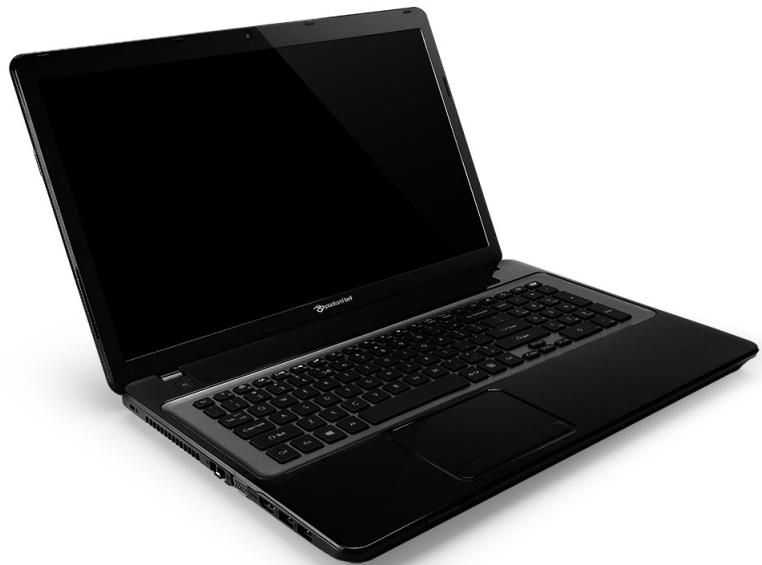
Packard Bell EasyNote LV
INDICE
Packard Bell Recovery Management
Packard Bell Recovery Management
?X
Welcome to Packard Bell Recovery Management
Packard Bell Recovery Management enables you to restore your system. To begin, select the task you want to perform. Please DO NOT remove the USB device while proceeding.

Customized Restore (Retain User Data)

Reinstall Drivers or Applications
Make a back-up before you restore (Recommended).

Create Factory Default Backup
Create Drivers and Applications Backup

packard bell
Restores your computer to its factory default status. A reboot is required. NOTE: All data on drive Cwill be restored.
Packard Bell Recovery Management
?X
Welcome to Packard Bell Recovery Management
Packard Bell Recovery Management enables you to restore your system. To begin, select the task you want to perform. Please DO NOT remove the USB device while proceeding.

Customized Restore (Retain User Data)
Restores your computer to its factory default status. A computer is required. NOTE: All data on drive Cwill be deleted.

Reinstall Drivers or Applications
Make a backup before you restore (Recommended).

Create Factory Default Backup
Create Drivers and Applications Backup

packard bell
Here's what will happen:
- Your files and personalization settings won't change.
- Your PC settings will be changed back to their defaults.
- Apps from Windows Store will be kept.
- Apps you installed from discs or websites will be removed.
A list of removed apps will be saved on your desktop.
Next
Cancel
Here's what will happen:
- Your files and personalization settings won't change.
- Your PC settings will be changed back to their defaults.
- Apps from Windows Store will be kept.
- Apps you installed from discs or websites will be removed.
A list of removed apps will be saved on your desktop.
Next
Cancel
Come arriv o a Start?
The FCC with its action in ET Docket 96-8 has adopted a safety standard for human exposure to radio frequency (RF) electromagnetic energy emitted by FCC certified equipment. The wireless adapter meets the Human Exposure limits found in OET Bulletin 65, supplement C, 2001, and ANSI/IEEE C95.1, 1992. Proper operation of this radio according to the instructions found in this manual will result in exposure substantially below the FCC's recommended limits.
- The following safety precautions should be observed:
- Do not touch or move antenna while the unit is transmitting or receiving.
- Do not hold any component containing the radio such that the antenna is very close or touching any exposed parts of the body, especially the face or eyes, while transmitting.
- Do not operate the radio or attempt to transmit data unless the antenna is connected; this behavior may cause damage to the radio.
Use in specific environments:
- The use of wireless adapters in hazardous locations is limited by the constraints posed by the safety directors of such environments.
- The use of wireless adapters on airplanes is governed by the Federal Aviation Administration (FAA).
- The use of wireless adapters in hospitals is restricted to the limits set forth by each hospital.
Antenna Use
In order to comply with FCC RF exposure limits, low gain integrated antennas should be located at a minimum distance of 20~cm (8 inches) or more from the body of all persons or at a minimum distance as specified by the FCC module grant conditions. FCC grants can be viewed from the FCC Equipment Authorization website at https://fjallfoss.fcc.gov/oetcf/eas/reports/GenericSearch.cfm by entering the FCC ID printed on the module label.
Explosive Device Proximity Warning
Warning: Do not operate a portable transmitter (including this wireless adapter) near unshielded blasting caps or in an explosive environment unless the transmitter has been modified to be qualified for such use
AntennaWarnings
- Warning: To comply with the FCC and ANSI C95.1 RF exposure limits, it is recommended that for the wireless adapter installed in a desktop or portable computer, the antenna for this wireless adapter to be installed so as to provide a
separation distance of at least 20 cm (8 inches) from all persons or at the minimum distance as specified by the module grant conditions. FCC grants can be viewed from the FCC Equipment Authorization website at https://fjallfoss.fcc.gov/oetcf/eas/reports/GenericSearch.cfm by entering the FCC ID printed on the module label.
- Warning: The wireless adapter is not designed for use with high-gain directional antennas.
Use On Aircraft Caution
- Caution: Regulations of the FCC and FAA prohibit airborne operation of radio-frequency wireless devices (wireless adapters) because their signals could interfere with critical interference with critical aircraft instruments.
Local Restrictions on 802.11a, 802.11b, 802.11g and 802.11n Radio Usage
- Caution: Due to the fact that the frequencies used by 802.11a, 802.11b, 802.11g and 802.11n wireless LAN devices may not yet be harmonized in all countries, 802.11a, 802.11b, 802.11g and 802.11n products are designed for use only in specific countries, and are not allowed to be operated in countries other than those of designated use. As a user of these products, you are responsible for ensuring that the products are used only in the countries for which they were intended and for verifying that they are configured with the correct selection of frequency and channel for the country of use. Any deviation from the permissible power and frequency settings for the country of use is an infringement of national law and may be punished as such.
Wireless Interoperability
The wireless adapter is designed to be interoperable with other wireless LAN products that are based on direct sequence spread spectrum (DSSS) radio technology and to comply with the following standards:
- IEEE Std. 802.11b compliant Standard on Wireless LAN
- IEEE Std. 802.11g compliant Standard on Wireless LAN
-
IEEE Std. 802.11a compliant Standard on Wireless LAN (applies to devices supporting 802.11a)
-
IEEE Std. 802.11n draft 2.0 compliant on Wireless LAN
- Wireless Fidelity certification, as defined by the Wi-Fi Alliance
The Wireless Adapter and Your Health
The wireless adapter, like other radio devices, emits radio frequency electromagnetic energy. The level of energy emitted by the wireless adapter, however, is less than the electromagnetic energy emitted by other wireless devices such as mobile phones. The wireless adapter operates within the guidelines found in radio frequency safety standards and recommendations. These standards and recommendations reflect the consensus of the scientific community and result from deliberations of panels and committees of scientists who continually review and interpret the extensive research literature. In some situations or environments, the use of the wireless adapter may be restricted by the proprietor of the building or responsible representatives of the applicable organization. Examples of such situations may include:
- Using the wireless adapter on board airplanes, or
- Using the wireless adapter in any other environment where the risk of interference with other devices or services is perceived or identified as being harmful.
If you are uncertain of the policy that applies to the use of wireless adapters in a specific organization or environment (an airport, for example), you are encouraged to ask for authorization to use the adapter before you turn it on.
FCC Radio Frequency Interference Requirements (applies to device supporting 802.11a)
This device is restricted to indoor use due to its operation in the 5.15 to 5.25 GHz and 5.470 to 5.725 GHz frequency ranges. FCC requires this product to be used indoors for the frequency ranges 5.15 to 5.25 GHz and 5.470 to 5.725 GHz to reduce the potential for harmful interference to co-channel mobile satellite systems. High power radars are allocated as primary users of the 5.25 to 5.35 GHz and 5.65 to 5.85 GHz bands. These radar stations can cause interference with and /or damage this device. No configuration
controls are provided for this wireless adapter allowing any change in the frequency of operations outside the FCC grant of authorization for U.S operation according to Part 15.407 of the FCC rules.
USA - Federal Communications Commission (FCC)
This device complies with Part 15 of the FCC Rules. Operation of the device is subject to the following two conditions:
- This device may not cause harmful interference.
- This device must accept any interference that may cause undesired operation.
- Note: The radiated output power of the adapter is far below the FCC radio frequency exposure limits. Nevertheless, the adapter should be used in such a manner that the potential for human contact during normal operation is minimized. To avoid the possibility of exceeding the FCC radio frequency exposure limits, you should keep a distance of at least 20cm between you (or any other person in the vicinity), or the minimum separation distance as specified by the FCC grant conditions, and the antenna that is built into the computer. Details of the authorized configurations can be found at http://www.fcc.gov/oet/ea/ by entering the FCC ID number on the device.
Interference Statement
This wireless adapter has been tested and found to comply with the limits for a Class B digital device, pursuant to Part 15 of the FCC Rules. These limits are designed to provide reasonable protection against harmful interference in a residential installation. This wireless adapter generates, uses, and can radiate radio frequency energy. If the wireless adapter is not installed and used in accordance with the instructions, the wireless adapter may cause harmful interference to radio communications. There is no guarantee, however, that such interference will not occur in a particular installation. If this wireless adapter does cause harmful interference to radio or television reception (which can be determined by turning the equipment off and on), the user is encouraged to try to correct the interference by taking one or more of the following measures:
-
Reorient or relocate the receiving antenna of the equipment experiencing the interference.
-
Increase the distance between the wireless adapter and the equipment experiencing the interference.
- Connect the computer with the wireless adapter to an outlet on a circuit different from that to which the equipment experiencing the interference is connected.
- Consult the dealer or an experienced radio/TV technician for help.
- Note: The adapter must be installed and used in strict accordance with the manufacturer's instructions as described in the user documentation that comes with the product. Any other installation or use will violate FCC Part 15 regulations.
Canada — Industry Canada (IC)
This device complies with RSS210 of Industry Canada. Cet apparéil se conforme à RSS210 de Canada d'Industrie.
-
Caution: When machine supports and using IEEE 802.11a wireless LAN, this product is restricted to indoor use due to its operation in the 5.15- to 5.25 GHz frequency range. Industry Canada requires this product to be used indoors for the frequency range of 5.15 GHz to 5.25 GHz to reduce the potential for harmful interference to co-channel mobile satellite systems. High power radar is allocated as the primary user of the 5.25 to 5.35 GHz and 5.65 to 5.85 GHz bands. These radar stations can cause interference with and/or damage to this device. The maximum allowed antenna gain for use with this device is 6dBi in order to comply with the E.I.R.P limit for the 5.25 to 5.35 and 5.725 to 5.85 GHz frequency range in point-to-point operation. To comply with RF exposure requirements all antennas should be located at a minimum distance of 20 cm, or the minimum separation distance allowed by the module approval, from the body of all persons.
-
Attention: l'utilisation d'un réseau sans fil IEEE802.11a est restreinte à une utilisation en interieur à cause du fonctionement dans la bande de fréquence 5,15 - 5,25 GHz. Industry Canada requiert que ce produit soit utilisé à l'intérieur desBATIMENTS pour la bande de fréquence 5,15 - 5,25 GHz afin de réduire les possibiltés d'interférences nuisibles aux canaux co-existants des systèmes de transmission satellites. Les radars de puissances ont fait l'objet d'une allocation primaire de
This Class B digital apparatus complies with Canadian ICES-003.
"To prevent radio interference to the licensed service, this device is intended to be operated indoors and away from windows to provide maximum shielding. Equipment (or its transmit antenna) that is installed outdoors is subject to licensing."
The use of these equipments is regulated by:
1.D.L.gs 1.8.2003, n. 259, article 104 (activity subject to general authorization) for outdoor use and article 105 (free use) for indoor use, in both cases for private use.
2.D.M. 28.5.03, for supply to public of RLAN access to networks and telecom services.
Pakistan Telecommunication Authority (PTA) Approved
Morocco
The operation of this product in the radio channel 2 (2417 MHz) is not authorized in the following cities: Agadir, Assa-Zag, Cabo Negro, Chaouen, Goulmima, Oujda, Tan Tan, Taourirt, Taroudant and Taza.
The operation of this product in the radio channels 4, 5, 6 and 7 (2425 - 2442 MHz) is not authorized in the following cities: Aéroport Mohamed V, Agadir, Aguelmous, Anza, Benslimane, Béni Hafida, Cabo Negro, Casablanca, Fès, Lakhab, Marrakech, Merchich, Mohammédia, Rabat, Salé, Tanger, Tan Tan, Taunate, Tit Mellil, Zag.
Japan
5 GHz 带是室内用使用のと
Korea
当用,
Taiwan
第十二条
pacco battery Recovery Management Program .... 47
Recovery Management 65
Rete 32
s
schermo
Packard Bell Recovery Management
Packard Bell Recovery Management
?X
Welcome to Packard Bell Recovery Management
Packard Bell Recovery Management enables you to restore your system. To begin, select the task you want to perform. Please DO NOT remove the USB device while proceeding.

Customized Restore (Retain User Data)

Reinstall Drivers or Applications
Make a backup before you restore (Recommended).

Create Factory Default Backup
Create Drivers and Applications Backup

packard bell
Restores your computer to its factory default status. A system is required. NOTE: All data on drive C will be deleted.
Here's what will happen:
- Your files and personalization settings won't change.
- Your PC settings will be changed back to their defaults.
- Apps from Windows Store will be kept.
- Apps you installed from discs or websites will be removed.
- A list of removed apps will be saved on your desktop.
Next
Cancel
The FCC with its action in ET Docket 96-8 has adopted a safety standard for human exposure to radio frequency (RF) electromagnetic energy emitted by FCC certified equipment. The wireless adapter meets the Human Exposure limits found in OET Bulletin
65, supplement C, 2001, and ANSI/IEEE C95.1, 1992. Proper operation of this radio according to the instructions found in this manual will result in exposure substantially below the FCC's recommended limits.
- The following safety precautions should be observed:
Do not touch or move antenna while the unit is transmitting or receiving.
- Do not hold any component containing the radio such that the antenna is very close or touching any exposed parts of the body, especially the face or eyes, while transmitting.
- Do not operate the radio or attempt to transmit data unless the antenna is connected; this behavior may cause damage to the radio.
Use in specific environments:
- The use of wireless adapters in hazardous locations is limited by the constraints posed by the safety directors of such environments.
- The use of wireless adapters on airplanes is governed by the Federal Aviation Administration (FAA).
- The use of wireless adapters in hospitals is restricted to the limits set forth by each hospital.
Antenna Use
In order to comply with FCC RF exposure limits, low gain integrated antennas should be located at a minimum distance of 20~cm (8 inches) or more from the body of all persons or at a minimum distance as specified by the FCC module grant conditions. FCC grants can be viewed from the FCC Equipment Authorization website at https://fjallfoss.fcc.gov/ oetcf/eas/reports/GenericSearch.cfm by entering the FCC ID printed on the module label.
Explosive Device Proximity Warning
Warning: Do not operate a portable transmitter (including this wireless adapter) near unshielded blasting caps or in an explosive environment unless the transmitter has been modified to be qualified for such use
AntennaWarnings
-
Warning: To comply with the FCC and ANSI C95.1 RF exposure limits, it is recommended that for the wireless adapter installed in a desktop or portable computer, the antenna for this wireless adapter to be installed so as to provide a separation distance of at least 20cm (8 inches) from all persons or at the minimum distance as specified by the module grant conditions. FCC grants can be viewed from the FCC Equipment Authorization website at https://fjallfoss.fcc.gov/oetcf/eas/reports/GenericSearch.cfm by entering the FCC ID printed on the module label.
-
Warning: The wireless adapter is not designed for use with high-gain directional antennas.
Use On Aircraft Caution
- Caution: Regulations of the FCC and FAA prohibit airborne operation of radio-frequency wireless devices (wireless adapters) because their signals could interfere with critical interference with critical aircraft instruments.
Local Restrictions on 802.11a, 802.11b, 802.11g and 802.11n Radio Usage
- Caution: Due to the fact that the frequencies used by 802.11a, 802.11b, 802.11g and 802.11n wireless LAN devices may not yet be harmonized in all countries, 802.11a, 802.11b, 802.11g and 802.11n products are designed for use only in specific countries, and are not allowed to be operated in countries other than those of designated use. As a user of these products, you are responsible for ensuring that the products are used only in the countries for which they were intended and for verifying that they are configured with the correct selection of frequency and channel for the country of use. Any deviation from the permissible power and frequency settings for the country of use is an infringement of national law and may be punished as such.
Wireless Interoperability
The wireless adapter is designed to be interoperable with other wireless LAN products that are based on direct sequence spread spectrum (DSSS) radio technology and to comply with the following standards:
- IEEE Std. 802.11b compliant Standard on Wireless LAN
- IEEE Std. 802.11g compliant Standard on Wireless LAN
- IEEE Std. 802.11a compliant Standard on Wireless LAN (applies to devices supporting 802.11a)
- IEEE Std. 802.11n draft 2.0 compliant on Wireless LAN
- Wireless Fidelity certification, as defined by the Wi-Fi Alliance
The Wireless Adapter and Your Health
The wireless adapter, like other radio devices, emits radio frequency electromagnetic energy. The level of energy emitted by the wireless adapter, however, is less than the electromagnetic energy emitted by other wireless devices such as mobile phones. The wireless adapter operates within the guidelines found in radio frequency safety standards and recommendations. These standards and recommendations reflect the consensus of the scientific community and result from deliberations of panels and committees of scientists who continually review and interpret the extensive research literature. In some situations or environments, the use of the wireless adapter may be restricted by the proprietor of the building or responsible representatives of the applicable organization. Examples of such situations may include:
- Using the wireless adapter on board airplanes, or
- Using the wireless adapter in any other environment where the risk of interference with other devices or services is perceived or identified as being harmful.
If you are uncertain of the policy that applies to the use of wireless adapters in a specific organization or environment (an airport, for example), you are encouraged to ask for authorization to use the adapter before you turn it on.
FCC Radio Frequency Interference Requirements (applies to device supporting 802.11a)
This device is restricted to indoor use due to its operation in the 5.15 to 5.25 GHz and 5.470 to 5.725 GHz frequency ranges. FCC requires this product to be used indoors for the frequency ranges 5.15 to 5.25 GHz and 5.470 to 5.725 GHz to reduce the potential
for harmful interference to co-channel mobile satellite systems. High power radars are allocated as primary users of the 5.25 to 5.35 GHz and 5.65 to 5.85 GHz bands. These radar stations can cause interference with and /or damage this device. No configuration controls are provided for this wireless adapter allowing any change in the frequency of operations outside the FCC grant of authorization for U.S operation according to Part 15.407 of the FCC rules.
USA — Federal Communications Commission (FCC)
This device complies with Part 15 of the FCC Rules. Operation of the device is subject to the following two conditions:
- This device may not cause harmful interference.
- This device must accept any interference that may cause undesired operation.
- Note: The radiated output power of the adapter is far below the FCC radio frequency exposure limits. Nevertheless, the adapter should be used in such a manner that the potential for human contact during normal operation is minimized. To avoid the possibility of exceeding the FCC radio frequency exposure limits, you should keep a distance of at least 20cm between you (or any other person in the vicinity), or the minimum separation distance as specified by the FCC grant conditions, and the antenna that is built into the computer. Details of the authorized configurations can be found at http://www.fcc.gov/oet/ea/ by entering the FCC ID number on the device.
Interference Statement
This wireless adapter has been tested and found to comply with the limits for a Class B digital device, pursuant to Part 15 of the FCC Rules. These limits are designed to provide reasonable protection against harmful interference in a residential installation. This wireless adapter generates, uses, and can radiate radio frequency energy. If the wireless adapter is not installed and used in accordance with the instructions, the wireless adapter may cause harmful interference to radio communications. There is no guarantee, however, that such interference will not occur in a particular installation. If this wireless
adapter does cause harmful interference to radio or television reception (which can be determined by turning the equipment off and on), the user is encouraged to try to correct the interference by taking one or more of the following measures:
- Reorient or relocate the receiving antenna of the equipment experiencing the interference.
- Increase the distance between the wireless adapter and the equipment experiencing the interference.
- Connect the computer with the wireless adapter to an outlet on a circuit different from that to which the equipment experiencing the interference is connected.
- Consult the dealer or an experienced radio/TV technician for help.
- Note: The adapter must be installed and used in strict accordance with the manufacturer's instructions as described in the user documentation that comes with the product. Any other installation or use will violate FCC Part 15 regulations.
Canada - Industry Canada (IC)
This device complies with RSS210 of Industry Canada. Cet apparéil se conforme à RSS210 de Canada d'Industrie.
This Class B digital apparatus complies with Canadian ICES-003.
"To prevent radio interference to the licensed service, this device is intended to be operated indoors and away from windows to provide maximum shielding. Equipment (or its transmit antenna) that is installed outdoors is subject to licensing."
The use of these equipments is regulated by:
1.D.L.gs 1.8.2003, n. 259, article 104 (activity subject to general authorization) for outdoor use and article 105 (free use) for indoor use, in both cases for private use.
2.D.M. 28.5.03, for supply to public of LAN access to networks and telecom services.
Pakistan Telecommunication Authority (PTA) Approved
Morocco
The operation of this product in the radio channel 2 (2417 MHz) is not authorized in the following cities: Agadir, Assa-Zag, Cabo Negro, Chaouen, Goulmima, Oujda, Tan Tan, Taourirt, Taroudant and Taza.
The operation of this product in the radio channels 4, 5, 6 and 7 (2425 - 2442 MHz) is not authorized in the following cities: Aéroport Mohamed V, Agadir, Aguelmous, Anza, Benslimane, Béni Hafida, Cabo Negro, Casablanca, Fès, Lakhab, Marrakech, Merchich, Mohammédia, Rabat, Sale, Tanger, Tan Tan, Taounate, Tit Mellil, Zag.
Japan
5 GHz 带は室内のは使用のと
Korea
Recovery Management 64
s
Packard Bell Recovery Management.... 45
Internet 46
Cartoes SD, SDHC e SDXC
Packard Bell Recovery Management
Packard Bell Recovery Management
?X
Welcome to Packard Bell Recovery Management
Packard Bell Recovery Management enables you to restore your system. To begin, select the task you want to perform. Please DO NOT remove the USB device while proceeding.

Restores your computer to its factory default status. A reboot is required. NOTE: All data on drive Cwill be restored.

Customized Restore (Retain User Data)

Reinstall Drivers or Applications
Make a backup before you restore (Recommended).

Create Factory Default Backup
Create Drivers and Applications Backup

packard bell
Here's what will happen:
- Your files and personalization settings won't change.
- Your PC settings will be changed back to their defaults.
- Apps from Windows Store will be kept.
- Apps you installed from discs or websites will be removed.
A list of removed apps will be saved on your desktop.
Next
Cancel
The FCC with its action in ET Docket 96-8 has adopted a safety standard for human exposure to radio frequency (RF) electromagnetic energy emitted by FCC certified equipment. The wireless adapter meets the Human Exposure limits found in OET Bulletin
65, supplement C, 2001, and ANSI/IEEE C95.1, 1992. Proper operation of this radio according to the instructions found in this manual will result in exposure substantially below the FCC's recommended limits.
- The following safety precautions should be observed:
Do not touch or move antenna while the unit is transmitting or receiving.
- Do not hold any component containing the radio such that the antenna is very close or touching any exposed parts of the body, especially the face or eyes, while transmitting.
- Do not operate the radio or attempt to transmit data unless the antenna is connected; this behavior may cause damage to the radio.
Use in specific environments:
- The use of wireless adapters in hazardous locations is limited by the constraints posed by the safety directors of such environments.
- The use of wireless adapters on airplanes is governed by the Federal Aviation Administration (FAA).
- The use of wireless adapters in hospitals is restricted to the limits set forth by each hospital.
Antenna Use
In order to comply with FCC RF exposure limits, low gain integrated antennas should be located at a minimum distance of 20~cm (8 inches) or more from the body of all persons or at a minimum distance as specified by the FCC module grant conditions. FCC grants can be viewed from the FCC Equipment Authorization website at https://fjallfoss.fcc.gov/ oetcf/eas/reports/GenericSearch.cfm by entering the FCC ID printed on the module label.
Explosive Device Proximity Warning
Warning: Do not operate a portable transmitter (including this wireless adapter) near unshielded blasting caps or in an explosive environment unless the transmitter has been modified to be qualified for such use
AntennaWarnings
-
Warning: To comply with the FCC and ANSI C95.1 RF exposure limits, it is recommended that for the wireless adapter installed in a desktop or portable computer, the antenna for this wireless adapter to be installed so as to provide a separation distance of at least 20cm (8 inches) from all persons or at the minimum distance as specified by the module grant conditions. FCC grants can be viewed from the FCC Equipment Authorization website at https://fjallfoss.fcc.gov/oetcf/eas/reports/GenericSearch.cfm by entering the FCC ID printed on the module label.
-
Warning: The wireless adapter is not designed for use with high-gain directional antennas.
Use On Aircraft Caution
- Caution: Regulations of the FCC and FAA prohibit airborne operation of radio-frequency wireless devices (wireless adapters) because their signals could interfere with critical interference with critical aircraft instruments.
Local Restrictions on 802.11a, 802.11b, 802.11g and 802.11n Radio Usage
- Caution: Due to the fact that the frequencies used by 802.11a, 802.11b, 802.11g and 802.11n wireless LAN devices may not yet be harmonized in all countries, 802.11a, 802.11b, 802.11g and 802.11n products are designed for use only in specific countries, and are not allowed to be operated in countries other than those of designated use. As a user of these products, you are responsible for ensuring that the products are used only in the countries for which they were intended and for verifying that they are configured with the correct selection of frequency and channel for the country of use. Any deviation from the permissible power and frequency settings for the country of use is an infringement of national law and may be punished as such.
Wireless Interoperability
The wireless adapter is designed to be interoperable with other wireless LAN products that are based on direct sequence spread spectrum (DSSS) radio technology and to comply with the following standards:
- IEEE Std. 802.11b compliant Standard on Wireless LAN
- IEEE Std. 802.11g compliant Standard on Wireless LAN
- IEEE Std. 802.11a compliant Standard on Wireless LAN (applies to devices supporting 802.11a)
- IEEE Std. 802.11n draft 2.0 compliant on Wireless LAN
- Wireless Fidelity certification, as defined by the Wi-Fi Alliance
The Wireless Adapter and Your Health
The wireless adapter, like other radio devices, emits radio frequency electromagnetic energy. The level of energy emitted by the wireless adapter, however, is less than the electromagnetic energy emitted by other wireless devices such as mobile phones. The wireless adapter operates within the guidelines found in radio frequency safety standards and recommendations. These standards and recommendations reflect the consensus of the scientific community and result from deliberations of panels and committees of scientists who continually review and interpret the extensive research literature. In some situations or environments, the use of the wireless adapter may be restricted by the proprietor of the building or responsible representatives of the applicable organization. Examples of such situations may include:
- Using the wireless adapter on board airplanes, or
- Using the wireless adapter in any other environment where the risk of interference with other devices or services is perceived or identified as being harmful.
If you are uncertain of the policy that applies to the use of wireless adapters in a specific organization or environment (an airport, for example), you are encouraged to ask for authorization to use the adapter before you turn it on.
FCC Radio Frequency Interference Requirements (applies to device supporting 802.11a)
This device is restricted to indoor use due to its operation in the 5.15 to 5.25 GHz and 5.470 to 5.725 GHz frequency ranges. FCC requires this product to be used indoors for the frequency ranges 5.15 to 5.25 GHz and 5.470 to 5.725 GHz to reduce the potential
for harmful interference to co-channel mobile satellite systems. High power radars are allocated as primary users of the 5.25 to 5.35 GHz and 5.65 to 5.85 GHz bands. These radar stations can cause interference with and /or damage this device. No configuration controls are provided for this wireless adapter allowing any change in the frequency of operations outside the FCC grant of authorization for U.S operation according to Part 15.407 of the FCC rules.
USA — Federal Communications Commission (FCC)
This device complies with Part 15 of the FCC Rules. Operation of the device is subject to the following two conditions:
- This device may not cause harmful interference.
- This device must accept any interference that may cause undesired operation.
- Note: The radiated output power of the adapter is far below the FCC radio frequency exposure limits. Nevertheless, the adapter should be used in such a manner that the potential for human contact during normal operation is minimized. To avoid the possibility of exceeding the FCC radio frequency exposure limits, you should keep a distance of at least 20cm between you (or any other person in the vicinity), or the minimum separation distance as specified by the FCC grant conditions, and the antenna that is built into the computer. Details of the authorized configurations can be found at http://www.fcc.gov/oet/ea/ by entering the FCC ID number on the device.
Interference Statement
This wireless adapter has been tested and found to comply with the limits for a Class B digital device, pursuant to Part 15 of the FCC Rules. These limits are designed to provide reasonable protection against harmful interference in a residential installation. This wireless adapter generates, uses, and can radiate radio frequency energy. If the wireless adapter is not installed and used in accordance with the instructions, the wireless adapter may cause harmful interference to radio communications. There is no guarantee, however, that such interference will not occur in a particular installation. If this wireless
adapter does cause harmful interference to radio or television reception (which can be determined by turning the equipment off and on), the user is encouraged to try to correct the interference by taking one or more of the following measures:
- Reorient or relocate the receiving antenna of the equipment experiencing the interference.
- Increase the distance between the wireless adapter and the equipment experiencing the interference.
- Connect the computer with the wireless adapter to an outlet on a circuit different from that to which the equipment experiencing the interference is connected.
- Consult the dealer or an experienced radio/TV technician for help.
- Note: The adapter must be installed and used in strict accordance with the manufacturer's instructions as described in the user documentation that comes with the product. Any other installation or use will violate FCC Part 15 regulations.
Canada - Industry Canada (IC)
This device complies with RSS210 of Industry Canada. Cet apparéil se conforme à RSS210 de Canada d'Industrie.
This Class B digital apparatus complies with Canadian ICES-003.
"To prevent radio interference to the licensed service, this device is intended to be operated indoors and away from windows to provide maximum shielding. Equipment (or its transmit antenna) that is installed outdoors is subject to licensing."
The use of these equipments is regulated by:
1.D.L.gs 1.8.2003, n. 259, article 104 (activity subject to general authorization) for outdoor use and article 105 (free use) for indoor use, in both cases for private use.
2.D.M. 28.5.03, for supply to public of LAN access to networks and telecom services.
Pakistan Telecommunication Authority (PTA) Approved
Morocco
The operation of this product in the radio channel 2 (2417 MHz) is not authorized in the following cities: Agadir, Assa-Zag, Cabo Negro, Chaouen, Goulmima, Oujda, Tan Tan, Taourirt, Taroudant and Taza.
The operation of this product in the radio channels 4, 5, 6 and 7 (2425 - 2442 MHz) is not authorized in the following cities: Aéroport Mohamed V, Agadir, Aguelmous, Anza, Benslimane, Béni Hafida, Cabo Negro, Casablanca, Fès, Lakhab, Marrakech, Merchich, Mohammédia, Rabat, Sale, Tanger, Tan Tan, Taounate, Tit Mellil, Zag.
Japan
5 GHz 带は室内のは使用のと
Korea
ELIMINACAO DO PRODUCTO
Programa Recovery Management... 45
N
Norton Internet Security 53, 57
P
Packard Bell problemas 85
Programa Recovery Management... 45 arranque 85
Website: 52 CD-ROM 87
Programa Recovery Management... 45 Recovery Management 63
rede 31
s
Segurarca Software
De computer upgraden 29
Packard Bell Recovery Management
3g (WWAN of 'Wireless Wide-Area Network')
Packard Bell Recovery Management
?X
Welcome to Packard Bell Recovery Management
Packard Bell Recovery Management enables you to restore your system. To begin, select the task you want to perform. Please DO NOT remove the USB device while proceeding.

Restores your computer to its factory default status. A system is required. NOTE: All data on drive C will be deleted.

Customized Restore (Retain User Data)

Reinstall Drivers or Applications
Make a backup before you restore (Recommended).

Create Factory Default Backup
Create Drivers and Applications Backup

packard bell
Here's what will happen:
- Your files and personalization settings won't change.
- Your PC settings will be changed back to their defaults.
- Apps from Windows Store will be kept.
- Apps you installed from discs or websites will be removed.
A list of removed apps will be saved on your desktop.
Next
Cancel
Here's what will happen:
- Your files and personalization settings won't change.
- Your PC settings will be changed back to their defaults.
- Apps from Windows Store will be kept.
- Apps you installed from discs or websites will be removed.
A list of removed apps will be saved on your desktop.
Next
Cancel
The FCC with its action in ET Docket 96-8 has adopted a safety standard for human exposure to radio frequency (RF) electromagnetic energy emitted by FCC certified equipment. The wireless adapter meets the Human Exposure limits found in OET Bulletin
65, supplement C, 2001, and ANSI/IEEE C95.1, 1992. Proper operation of this radio according to the instructions found in this manual will result in exposure substantially below the FCC's recommended limits.
- The following safety precautions should be observed:
Do not touch or move antenna while the unit is transmitting or receiving.
- Do not hold any component containing the radio such that the antenna is very close or touching any exposed parts of the body, especially the face or eyes, while transmitting.
- Do not operate the radio or attempt to transmit data unless the antenna is connected; this behavior may cause damage to the radio.
Use in specific environments:
- The use of wireless adapters in hazardous locations is limited by the constraints posed by the safety directors of such environments.
- The use of wireless adapters on airplanes is governed by the Federal Aviation Administration (FAA).
- The use of wireless adapters in hospitals is restricted to the limits set forth by each hospital.
Antenna Use
In order to comply with FCC RF exposure limits, low gain integrated antennas should be located at a minimum distance of 20~cm (8 inches) or more from the body of all persons or at a minimum distance as specified by the FCC module grant conditions. FCC grants can be viewed from the FCC Equipment Authorization website at https://fjallfoss.fcc.gov/ oetcf/eas/reports/GenericSearch.cfm by entering the FCC ID printed on the module label.
Explosive Device Proximity Warning
Warning: Do not operate a portable transmitter (including this wireless adapter) near unshielded blasting caps or in an explosive environment unless the transmitter has been modified to be qualified for such use
AntennaWarnings
-
Warning: To comply with the FCC and ANSI C95.1 RF exposure limits, it is recommended that for the wireless adapter installed in a desktop or portable computer, the antenna for this wireless adapter to be installed so as to provide a separation distance of at least 20cm (8 inches) from all persons or at the minimum distance as specified by the module grant conditions. FCC grants can be viewed from the FCC Equipment Authorization website at https://fjallfoss.fcc.gov/oetcf/eas/reports/GenericSearch.cfm by entering the FCC ID printed on the module label.
-
Warning: The wireless adapter is not designed for use with high-gain directional antennas.
Use On Aircraft Caution
- Caution: Regulations of the FCC and FAA prohibit airborne operation of radio-frequency wireless devices (wireless adapters) because their signals could interfere with critical interference with critical aircraft instruments.
Local Restrictions on 802.11a, 802.11b, 802.11g and 802.11n Radio Usage
- Caution: Due to the fact that the frequencies used by 802.11a, 802.11b, 802.11g and 802.11n wireless LAN devices may not yet be harmonized in all countries, 802.11a, 802.11b, 802.11g and 802.11n products are designed for use only in specific countries, and are not allowed to be operated in countries other than those of designated use. As a user of these products, you are responsible for ensuring that the products are used only in the countries for which they were intended and for verifying that they are configured with the correct selection of frequency and channel for the country of use. Any deviation from the permissible power and frequency settings for the country of use is an infringement of national law and may be punished as such.
Wireless Interoperability
The wireless adapter is designed to be interoperable with other wireless LAN products that are based on direct sequence spread spectrum (DSSS) radio technology and to comply with the following standards:
- IEEE Std. 802.11b compliant Standard on Wireless LAN
- IEEE Std. 802.11g compliant Standard on Wireless LAN
- IEEE Std. 802.11a compliant Standard on Wireless LAN (applies to devices supporting 802.11a)
- IEEE Std. 802.11n draft 2.0 compliant on Wireless LAN
- Wireless Fidelity certification, as defined by the Wi-Fi Alliance
The Wireless Adapter and Your Health
The wireless adapter, like other radio devices, emits radio frequency electromagnetic energy. The level of energy emitted by the wireless adapter, however, is less than the electromagnetic energy emitted by other wireless devices such as mobile phones. The wireless adapter operates within the guidelines found in radio frequency safety standards and recommendations. These standards and recommendations reflect the consensus of the scientific community and result from deliberations of panels and committees of scientists who continually review and interpret the extensive research literature. In some situations or environments, the use of the wireless adapter may be restricted by the proprietor of the building or responsible representatives of the applicable organization. Examples of such situations may include:
- Using the wireless adapter on board airplanes, or
- Using the wireless adapter in any other environment where the risk of interference with other devices or services is perceived or identified as being harmful.
If you are uncertain of the policy that applies to the use of wireless adapters in a specific organization or environment (an airport, for example), you are encouraged to ask for authorization to use the adapter before you turn it on.
FCC Radio Frequency Interference Requirements (applies to device supporting 802.11a)
This device is restricted to indoor use due to its operation in the 5.15 to 5.25 GHz and 5.470 to 5.725 GHz frequency ranges. FCC requires this product to be used indoors for the frequency ranges 5.15 to 5.25 GHz and 5.470 to 5.725 GHz to reduce the potential
for harmful interference to co-channel mobile satellite systems. High power radars are allocated as primary users of the 5.25 to 5.35 GHz and 5.65 to 5.85 GHz bands. These radar stations can cause interference with and/or damage this device. No configuration controls are provided for this wireless adapter allowing any change in the frequency of operations outside the FCC grant of authorization for U.S operation according to Part 15.407 of the FCC rules.
USA — Federal Communications Commission (FCC)
This device complies with Part 15 of the FCC Rules. Operation of the device is subject to the following two conditions:
- This device may not cause harmful interference.
- This device must accept any interference that may cause undesired operation.
- Note: The radiated output power of the adapter is far below the FCC radio frequency exposure limits. Nevertheless, the adapter should be used in such a manner that the potential for human contact during normal operation is minimized. To avoid the possibility of exceeding the FCC radio frequency exposure limits, you should keep a distance of at least 20cm between you (or any other person in the vicinity), or the minimum separation distance as specified by the FCC grant conditions, and the antenna that is built into the computer. Details of the authorized configurations can be found at http://www.fcc.gov/oet/ea/ by entering the FCC ID number on the device.
Interference Statement
This wireless adapter has been tested and found to comply with the limits for a Class B digital device, pursuant to Part 15 of the FCC Rules. These limits are designed to provide reasonable protection against harmful interference in a residential installation. This wireless adapter generates, uses, and can radiate radio frequency energy. If the wireless adapter is not installed and used in accordance with the instructions, the wireless adapter may cause harmful interference to radio communications. There is no guarantee, however, that such interference will not occur in a particular installation. If this wireless
adapter does cause harmful interference to radio or television reception (which can be determined by turning the equipment off and on), the user is encouraged to try to correct the interference by taking one or more of the following measures:
- Reorient or relocate the receiving antenna of the equipment experiencing the interference.
- Increase the distance between the wireless adapter and the equipment experiencing the interference.
- Connect the computer with the wireless adapter to an outlet on a circuit different from that to which the equipment experiencing the interference is connected.
- Consult the dealer or an experienced radio/TV technician for help.
- Note: The adapter must be installed and used in strict accordance with the manufacturer's instructions as described in the user documentation that comes with the product. Any other installation or use will violate FCC Part 15 regulations.
Canada - Industry Canada (IC)
This device complies with RSS210 of Industry Canada. Cet apparéil se conforme à RSS210 de Canada d'Industrie.
This Class B digital apparatus complies with Canadian ICES-003.
"To prevent radio interference to the licensed service, this device is intended to be operated indoors and away from windows to provide maximum shielding. Equipment (or its transmit antenna) that is installed outdoors is subject to licensing."
The use of these equipments is regulated by:
1.D.L.gs 1.8.2003, n. 259, article 104 (activity subject to general authorization) for outdoor use and article 105 (free use) for indoor use, in both cases for private use.
2.D.M. 28.5.03, for supply to public of LAN access to networks and telecom services.
Pakistan Telecommunication Authority (PTA) Approved
Morocco
The operation of this product in the radio channel 2 (2417 MHz) is not authorized in the following cities: Agadir, Assa-Zag, Cabo Negro, Chaouen, Goulmima, Oujda, Tan Tan, Taourirt, Taroudant and Taza.
The operation of this product in the radio channels 4, 5, 6 and 7 (2425 - 2442 MHz) is not authorized in the following cities: Aéroport Mohamed V, Agadir, Aguelmous, Anza, Benslimane, Béni Hafida, Cabo Negro, Casablanca, Fès, Lakhab, Marrakech, Merchich, Mohammédia, Rabat, Salé, Tanger, Tan Tan, Taounate, Tit Mellil, Zag.
Japan
5 GHz 带は室内のは使用的ごと
Korea
PELV (Protected Extra Low Voltage)
SELV (Safety Extra Low Voltage)
VERKLARING LASERPRODUCT
network 31 Norton Internet Security 54, 58
Packard Bell Recovery Management. 43
Internet 44
Dine forste trinn pa nettet 44
Beskyttdatamaskinen 44
Velg Internen-tjenesteleverandr 44
Deaktiver hurtigoppstart
Packard Bell Recovery Management
Start Packard Bell Recovery Management:
Here's what will happen:
- Your files and personalization settings won't change.
- Your PC settings will be changed back to their defaults.
- Apps from Windows Store will be kept.
- Apps you installed from discs or websites will be removed.
- A list of removed apps will be saved on your desktop.
Next
Cancel
The FCC with its action in ET Docket 96-8 has adopted a safety standard for human exposure to radio frequency (RF) electromagnetic energy emitted by FCC certified equipment. The wireless adapter meets the Human Exposure limits found in OET Bulletin 65, supplement C, 2001, and ANSI/IEEE C95.1, 1992. Proper operation of this radio according to the instructions found in this manual will result in exposure substantially below the FCC's recommended limits.
- The following safety precautions should be observed:
Do not touch or move antenna while the unit is transmitting or receiving.
- Do not hold any component containing the radio such that the antenna is very close or touching any exposed parts of the body, especially the face or eyes, while transmitting.
- Do not operate the radio or attempt to transmit data unless the antenna is connected; this behavior may cause damage to the radio.
Use in specific environments:
- The use of wireless adapters in hazardous locations is limited by the constraints posed by the safety directors of such environments.
- The use of wireless adapters on airplanes is governed by the Federal Aviation Administration (FAA).
- The use of wireless adapters in hospitals is restricted to the limits set forth by each hospital.
Antenna Use
In order to comply with FCC RF exposure limits, low gain integrated antennas should be located at a minimum distance of 20~cm (8 inches) or more from the body of all persons or at a minimum distance as specified by the FCC module grant conditions. FCC grants can be viewed from the FCC Equipment Authorization website at https://fjallfoss.fcc.gov/oetcf/eas/reports/GenericSearch.cfm by entering the FCC ID printed on the module label.
Explosive Device Proximity Warning
Warning: Do not operate a portable transmitter (including this wireless adapter) near unshielded blasting caps or in an explosive environment unless the transmitter has been modified to be qualified for such use
AntennaWarnings
- Warning: To comply with the FCC and ANSI C95.1 RF exposure limits, it is recommended that for the wireless adapter installed in a desktop or portable computer, the antenna for this wireless adapter to be installed so as to provide a
separation distance of at least 20 cm (8 inches) from all persons or at the minimum distance as specified by the module grant conditions. FCC grants can be viewed from the FCC Equipment Authorization website at https://fjallfoss.fcc.gov/oetcf/eas/reports/GenericSearch.cfm by entering the FCC ID printed on the module label.
- Warning: The wireless adapter is not designed for use with high-gain directional antennas.
Use On Aircraft Caution
- Caution: Regulations of the FCC and FAA prohibit airborne operation of radio-frequency wireless devices (wireless adapters) because their signals could interfere with critical interference with critical aircraft instruments.
Local Restrictions on 802.11a, 802.11b, 802.11g and 802.11n Radio Usage
- Caution: Due to the fact that the frequencies used by 802.11a, 802.11b, 802.11g and 802.11n wireless LAN devices may not yet be harmonized in all countries, 802.11a, 802.11b, 802.11g and 802.11n products are designed for use only in specific countries, and are not allowed to be operated in countries other than those of designated use. As a user of these products, you are responsible for ensuring that the products are used only in the countries for which they were intended and for verifying that they are configured with the correct selection of frequency and channel for the country of use. Any deviation from the permissible power and frequency settings for the country of use is an infringement of national law and may be punished as such.
Wireless Interoperability
The wireless adapter is designed to be interoperable with other wireless LAN products that are based on direct sequence spread spectrum (DSSS) radio technology and to comply with the following standards:
- IEEE Std. 802.11b compliant Standard on Wireless LAN
- IEEE Std. 802.11g compliant Standard on Wireless LAN
-
IEEE Std. 802.11a compliant Standard on Wireless LAN (applies to devices supporting 802.11a)
-
IEEE Std. 802.11n draft 2.0 compliant on Wireless LAN
- Wireless Fidelity certification, as defined by the Wi-Fi Alliance
The Wireless Adapter and Your Health
The wireless adapter, like other radio devices, emits radio frequency electromagnetic energy. The level of energy emitted by the wireless adapter, however, is less than the electromagnetic energy emitted by other wireless devices such as mobile phones. The wireless adapter operates within the guidelines found in radio frequency safety standards and recommendations. These standards and recommendations reflect the consensus of the scientific community and result from deliberations of panels and committees of scientists who continually review and interpret the extensive research literature. In some situations or environments, the use of the wireless adapter may be restricted by the proprietor of the building or responsible representatives of the applicable organization. Examples of such situations may include:
- Using the wireless adapter on board airplanes, or
- Using the wireless adapter in any other environment where the risk of interference with other devices or services is perceived or identified as being harmful.
If you are uncertain of the policy that applies to the use of wireless adapters in a specific organization or environment (an airport, for example), you are encouraged to ask for authorization to use the adapter before you turn it on.
FCC Radio Frequency Interference Requirements (applies to device supporting 802.11a)
This device is restricted to indoor use due to its operation in the 5.15 to 5.25 GHz and 5.470 to 5.725 GHz frequency ranges. FCC requires this product to be used indoors for the frequency ranges 5.15 to 5.25 GHz and 5.470 to 5.725 GHz to reduce the potential for harmful interference to co-channel mobile satellite systems. High power radars are allocated as primary users of the 5.25 to 5.35 GHz and 5.65 to 5.85 GHz bands. These radar stations can cause interference with and /or damage this device. No configuration
controls are provided for this wireless adapter allowing any change in the frequency of operations outside the FCC grant of authorization for U.S operation according to Part 15.407 of the FCC rules.
USA - Federal Communications Commission (FCC)
This device complies with Part 15 of the FCC Rules. Operation of the device is subject to the following two conditions:
- This device may not cause harmful interference.
- This device must accept any interference that may cause undesired operation.
- Note: The radiated output power of the adapter is far below the FCC radio frequency exposure limits. Nevertheless, the adapter should be used in such a manner that the potential for human contact during normal operation is minimized. To avoid the possibility of exceeding the FCC radio frequency exposure limits, you should keep a distance of at least 20cm between you (or any other person in the vicinity), or the minimum separation distance as specified by the FCC grant conditions, and the antenna that is built into the computer. Details of the authorized configurations can be found at http://www.fcc.gov/oet/ea/ by entering the FCC ID number on the device.
Interference Statement
This wireless adapter has been tested and found to comply with the limits for a Class B digital device, pursuant to Part 15 of the FCC Rules. These limits are designed to provide reasonable protection against harmful interference in a residential installation. This wireless adapter generates, uses, and can radiate radio frequency energy. If the wireless adapter is not installed and used in accordance with the instructions, the wireless adapter may cause harmful interference to radio communications. There is no guarantee, however, that such interference will not occur in a particular installation. If this wireless adapter does cause harmful interference to radio or television reception (which can be determined by turning the equipment off and on), the user is encouraged to try to correct the interference by taking one or more of the following measures:
-
Reorient or relocate the receiving antenna of the equipment experiencing the interference.
-
Increase the distance between the wireless adapter and the equipment experiencing the interference.
- Connect the computer with the wireless adapter to an outlet on a circuit different from that to which the equipment experiencing the interference is connected.
- Consult the dealer or an experienced radio/TV technician for help.
- Note: The adapter must be installed and used in strict accordance with the manufacturer's instructions as described in the user documentation that comes with the product. Any other installation or use will violate FCC Part 15 regulations.
Canada — Industry Canada (IC)
This device complies with RSS210 of Industry Canada. Cet apparéil se conforme à RSS210 de Canada d'Industrie.
-
Caution: When machine supports and using IEEE 802.11a wireless LAN, this product is restricted to indoor use due to its operation in the 5.15- to 5.25 GHz frequency range. Industry Canada requires this product to be used indoors for the frequency range of 5.15 GHz to 5.25 GHz to reduce the potential for harmful interference to co-channel mobile satellite systems. High power radar is allocated as the primary user of the 5.25 to 5.35 GHz and 5.65 to 5.85 GHz bands. These radar stations can cause interference with and/or damage to this device. The maximum allowed antenna gain for use with this device is 6dBi in order to comply with the E.I.R.P limit for the 5.25 to 5.35 and 5.725 to 5.85 GHz frequency range in point-to-point operation. To comply with RF exposure requirements all antennas should be located at a minimum distance of 20 cm, or the minimum separation distance allowed by the module approval, from the body of all persons.
-
Attention: l'utilisation d'un réseau sans fil IEEE802.11a est restreinte à une utilisation en interieur à cause du fonctionement dans la bande de fréquence 5,15 - 5,25 GHz. Industry Canada requiert que ce produit soit utilisé à l'intérieur desBATIMENTS pour la bande de fréquence 5,15 - 5,25 GHz afin de réduire les possibiltés d'interférences nuisibles aux canaux co-existants des systèmes de transmission satellites. Les radars de puissances ont fait l'objet d'une allocation primaire de
This Class B digital apparatus complies with Canadian ICES-003.
"To prevent radio interference to the licensed service, this device is intended to be operated indoors and away from windows to provide maximum shielding. Equipment (or its transmit antenna) that is installed outdoors is subject to licensing."
The use of these equipments is regulated by:
1.D.L.gs 1.8.2003, n. 259, article 104 (activity subject to general authorization) for outdoor use and article 105 (free use) for indoor use, in both cases for private use.
2.D.M. 28.5.03, for supply to public of LAN access to networks and telecom services.
Pakistan Telecommunication Authority (PTA) Approved
Morocco
The operation of this product in the radio channel 2 (2417 MHz) is not authorized in the following cities: Agadir, Assa-Zag, Cabo Negro, Chaouen, Goulmima, Oujda, Tan Tan, Taourirt, Taroudant and Taza.
The operation of this product in the radio channels 4, 5, 6 and 7 (2425 - 2442 MHz) is not authorized in the following cities: Aéroport Mohamed V, Agadir, Aguelmous, Anza, Benslimane, Béni Hafida, Cabo Negro, Casablanca, Fès, Lakhab, Marrakech, Merchich, Mohammédia, Rabat, Salé, Tanger, Tan Tan, Taunate, Tit Mellil, Zag.
Japan
5 GHz 带是室内用使用のと
Korea
当用,
Taiwan
第十二条
Recovery Management 60
Recovery Management
programmet 43
H
Helsetiltak 12
hoyttaler
feilsking og problemlösing 82
hurtigtast 18, 19
hurtigmaster 19
1
Norton Internet Security. 50, 54
0
Ondsinnetprogramvare 52
Oppdater
Windows Automatiske
oppateringer 58
P
Packard Bell
CD-ROM 83
Recovery Management
oppstart 81
programmet 43
skjerm 82
Webomrade 50
skriver 83
pekeplate 26
tastatur 83
bruke 26
Programvare
porter 28
Programvarelisens 111
problemer 81
R
Recovery Management. 60 front. 21
Recovery Management- hyre 23
programmet 43 venstre 21
W
WiFi 46, 47 Windows Automatiske
Packard Bell support
Packard Bells websted.
Service of computeren
Packard Bell Recovery Management
Packard Bells websted
Start Packard Bell Recovery Management:
- Fra Start indtaster du 'Recovery', hvorefter du klikker på Packard BellRecovery Management i listen over apps.
Here's what will happen:
- Your files and personalization settings won't change.
- Your PC settings will be changed back to their defaults.
- Apps from Windows Store will be kept.
- Apps you installed from discs or websites will be removed.
- A list of removed apps will be saved on your desktop.
Next
Cancel
The FCC with its action in ET Docket 96-8 has adopted a safety standard for human exposure to radio frequency (RF) electromagnetic energy emitted by FCC certified equipment. The wireless adapter meets the Human Exposure limits found in OET Bulletin
65, supplement C, 2001, and ANSI/IEEE C95.1, 1992. Proper operation of this radio according to the instructions found in this manual will result in exposure substantially below the FCC's recommended limits.
- The following safety precautions should be observed:
Do not touch or move antenna while the unit is transmitting or receiving.
- Do not hold any component containing the radio such that the antenna is very close or touching any exposed parts of the body, especially the face or eyes, while transmitting.
- Do not operate the radio or attempt to transmit data unless the antenna is connected; this behavior may cause damage to the radio.
Use in specific environments:
- The use of wireless adapters in hazardous locations is limited by the constraints posed by the safety directors of such environments.
- The use of wireless adapters on airplanes is governed by the Federal Aviation Administration (FAA).
- The use of wireless adapters in hospitals is restricted to the limits set forth by each hospital.
Antenna Use
In order to comply with FCC RF exposure limits, low gain integrated antennas should be located at a minimum distance of 20~cm (8 inches) or more from the body of all persons or at a minimum distance as specified by the FCC module grant conditions. FCC grants can be viewed from the FCC Equipment Authorization website at https://fjallfoss.fcc.gov/ oetcf/eas/reports/GenericSearch.cfm by entering the FCC ID printed on the module label.
Explosive Device Proximity Warning
Warning: Do not operate a portable transmitter (including this wireless adapter) near unshielded blasting caps or in an explosive environment unless the transmitter has been modified to be qualified for such use
AntennaWarnings
-
Warning: To comply with the FCC and ANSI C95.1 RF exposure limits, it is recommended that for the wireless adapter installed in a desktop or portable computer, the antenna for this wireless adapter to be installed so as to provide a separation distance of at least 20cm (8 inches) from all persons or at the minimum distance as specified by the module grant conditions. FCC grants can be viewed from the FCC Equipment Authorization website at https://fjallfoss.fcc.gov/oetcf/eas/reports/GenericSearch.cfm by entering the FCC ID printed on the module label.
-
Warning: The wireless adapter is not designed for use with high-gain directional antennas.
Use On Aircraft Caution
- Caution: Regulations of the FCC and FAA prohibit airborne operation of radio-frequency wireless devices (wireless adapters) because their signals could interfere with critical interference with critical aircraft instruments.
Local Restrictions on 802.11a, 802.11b, 802.11g and 802.11n Radio Usage
- Caution: Due to the fact that the frequencies used by 802.11a, 802.11b, 802.11g and 802.11n wireless LAN devices may not yet be harmonized in all countries, 802.11a, 802.11b, 802.11g and 802.11n products are designed for use only in specific countries, and are not allowed to be operated in countries other than those of designated use. As a user of these products, you are responsible for ensuring that the products are used only in the countries for which they were intended and for verifying that they are configured with the correct selection of frequency and channel for the country of use. Any deviation from the permissible power and frequency settings for the country of use is an infringement of national law and may be punished as such.
Wireless Interoperability
The wireless adapter is designed to be interoperable with other wireless LAN products that are based on direct sequence spread spectrum (DSSS) radio technology and to comply with the following standards:
- IEEE Std. 802.11b compliant Standard on Wireless LAN
- IEEE Std. 802.11g compliant Standard on Wireless LAN
- IEEE Std. 802.11a compliant Standard on Wireless LAN (applies to devices supporting 802.11a)
- IEEE Std. 802.11n draft 2.0 compliant on Wireless LAN
- Wireless Fidelity certification, as defined by the Wi-Fi Alliance
The Wireless Adapter and Your Health
The wireless adapter, like other radio devices, emits radio frequency electromagnetic energy. The level of energy emitted by the wireless adapter, however, is less than the electromagnetic energy emitted by other wireless devices such as mobile phones. The wireless adapter operates within the guidelines found in radio frequency safety standards and recommendations. These standards and recommendations reflect the consensus of the scientific community and result from deliberations of panels and committees of scientists who continually review and interpret the extensive research literature. In some situations or environments, the use of the wireless adapter may be restricted by the proprietor of the building or responsible representatives of the applicable organization. Examples of such situations may include:
- Using the wireless adapter on board airplanes, or
- Using the wireless adapter in any other environment where the risk of interference with other devices or services is perceived or identified as being harmful.
If you are uncertain of the policy that applies to the use of wireless adapters in a specific organization or environment (an airport, for example), you are encouraged to ask for authorization to use the adapter before you turn it on.
FCC Radio Frequency Interference Requirements (applies to device supporting 802.11a)
This device is restricted to indoor use due to its operation in the 5.15 to 5.25 GHz and 5.470 to 5.725 GHz frequency ranges. FCC requires this product to be used indoors for the frequency ranges 5.15 to 5.25 GHz and 5.470 to 5.725 GHz to reduce the potential
for harmful interference to co-channel mobile satellite systems. High power radars are allocated as primary users of the 5.25 to 5.35 GHz and 5.65 to 5.85 GHz bands. These radar stations can cause interference with and/or damage this device. No configuration controls are provided for this wireless adapter allowing any change in the frequency of operations outside the FCC grant of authorization for U.S operation according to Part 15.407 of the FCC rules.
USA — Federal Communications Commission (FCC)
This device complies with Part 15 of the FCC Rules. Operation of the device is subject to the following two conditions:
- This device may not cause harmful interference.
- This device must accept any interference that may cause undesired operation.
- Note: The radiated output power of the adapter is far below the FCC radio frequency exposure limits. Nevertheless, the adapter should be used in such a manner that the potential for human contact during normal operation is minimized. To avoid the possibility of exceeding the FCC radio frequency exposure limits, you should keep a distance of at least 20cm between you (or any other person in the vicinity), or the minimum separation distance as specified by the FCC grant conditions, and the antenna that is built into the computer. Details of the authorized configurations can be found at http://www.fcc.gov/oet/ea/ by entering the FCC ID number on the device.
Interference Statement
This wireless adapter has been tested and found to comply with the limits for a Class B digital device, pursuant to Part 15 of the FCC Rules. These limits are designed to provide reasonable protection against harmful interference in a residential installation. This wireless adapter generates, uses, and can radiate radio frequency energy. If the wireless adapter is not installed and used in accordance with the instructions, the wireless adapter may cause harmful interference to radio communications. There is no guarantee, however, that such interference will not occur in a particular installation. If this wireless
adapter does cause harmful interference to radio or television reception (which can be determined by turning the equipment off and on), the user is encouraged to try to correct the interference by taking one or more of the following measures:
- Reorient or relocate the receiving antenna of the equipment experiencing the interference.
- Increase the distance between the wireless adapter and the equipment experiencing the interference.
- Connect the computer with the wireless adapter to an outlet on a circuit different from that to which the equipment experiencing the interference is connected.
- Consult the dealer or an experienced radio/TV technician for help.
- Note: The adapter must be installed and used in strict accordance with the manufacturer's instructions as described in the user documentation that comes with the product. Any other installation or use will violate FCC Part 15 regulations.
Canada - Industry Canada (IC)
This device complies with RSS210 of Industry Canada. Cet apparéil se conforme à RSS210 de Canada d'Industrie.
This Class B digital apparatus complies with Canadian ICES-003.
"To prevent radio interference to the licensed service, this device is intended to be operated indoors and away from windows to provide maximum shielding. Equipment (or its transmit antenna) that is installed outdoors is subject to licensing."
The use of these equipments is regulated by:
1.D.L.gs 1.8.2003, n. 259, article 104 (activity subject to general authorization) for outdoor use and article 105 (free use) for indoor use, in both cases for private use.
2.D.M. 28.5.03, for supply to public of LAN access to networks and telecom services.
Pakistan Telecommunication Authority (PTA) Approved
Morocco
The operation of this product in the radio channel 2 (2417 MHz) is not authorized in the following cities: Agadir, Assa-Zag, Cabo Negro, Chaouen, Goulmima, Oujda, Tan Tan, Taourirt, Taroudant and Taza.
The operation of this product in the radio channels 4, 5, 6 and 7 (2425 - 2442 MHz) is not authorized in the following cities: Aéroport Mohamed V, Agadir, Aguelmous, Anza, Benslimane, Béni Hafida, Cabo Negro, Casablanca, Fès, Lakhab, Marrakech, Merchich, Mohammédia, Rabat, Salé, Tanger, Tan Tan, Taounate, Tit Mellil, Zag.
Japan
5 GHz 带は室内のは使用的ごと
Korea
PELV (Protected Extra Low Voltage)
SELV (Safety Extra Low Voltage)
Packard Bell Recovery Management. 44
Internet 45
De forsta stegen pa naret 45
Skydda din dator 45
Packard Bell-support
Packard Bell Recovery Management
Starta Packard Bell Recovery Management:
Packard Bell Recovery Management
?X
Welcome to Packard Bell Recovery Management
Packard Bell Recovery Management enables you to restore your system. To begin, select the task you want to perform. Please DO NOT remove the USB device while proceeding.

Customized Restore (Retain User Data)
Restores your computer to its factory default status. A reboot is required. NOTE: All data on drive Cwill be restored.

Reinstall Drivers or Applications
Make a backup before you restore (Recommended).

Create Factory Default Backup
Create Drivers and Applications Backup

packard bell
Here's what will happen:
- Your files and personalization settings won't change.
- Your PC settings will be changed back to their defaults.
- Apps from Windows Store will be kept.
- Apps you installed from discs or websites will be removed.
A list of removed apps will be saved on your desktop.
Next
Cancel
Here's what will happen:
- Your files and personalization settings won't change.
- Your PC settings will be changed back to their defaults.
- Apps from Windows Store will be kept.
- Apps you installed from discs or websites will be removed.
- A list of removed apps will be saved on your desktop.
Next
Cancel
The FCC with its action in ET Docket 96-8 has adopted a safety standard for human exposure to radio frequency (RF) electromagnetic energy emitted by FCC certified equipment. The wireless adapter meets the Human Exposure limits found in OET Bulletin 65, supplement C, 2001, and ANSI/IEEE C95.1, 1992. Proper operation of this radio according to the instructions found in this manual will result in exposure substantially below the FCC's recommended limits.
- The following safety precautions should be observed:
Do not touch or move antenna while the unit is transmitting or receiving.
- Do not hold any component containing the radio such that the antenna is very close or touching any exposed parts of the body, especially the face or eyes, while transmitting.
- Do not operate the radio or attempt to transmit data unless the antenna is connected; this behavior may cause damage to the radio.
Use in specific environments:
- The use of wireless adapters in hazardous locations is limited by the constraints posed by the safety directors of such environments.
- The use of wireless adapters on airplanes is governed by the Federal Aviation Administration (FAA).
- The use of wireless adapters in hospitals is restricted to the limits set forth by each hospital.
Antenna Use
In order to comply with FCC RF exposure limits, low gain integrated antennas should be located at a minimum distance of 20~cm (8 inches) or more from the body of all persons or at a minimum distance as specified by the FCC module grant conditions. FCC grants can be viewed from the FCC Equipment Authorization website at https://fjallfoss.fcc.gov/oetcf/eas/reports/GenericSearch.cfm by entering the FCC ID printed on the module label.
Explosive Device Proximity Warning
Warning: Do not operate a portable transmitter (including this wireless adapter) near unshielded blasting caps or in an explosive environment unless the transmitter has been modified to be qualified for such use
AntennaWarnings
- Warning: To comply with the FCC and ANSI C95.1 RF exposure limits, it is recommended that for the wireless adapter installed in a desktop or portable computer, the antenna for this wireless adapter to be installed so as to provide a
separation distance of at least 20 cm (8 inches) from all persons or at the minimum distance as specified by the module grant conditions. FCC grants can be viewed from the FCC Equipment Authorization website at https://fjallfoss.fcc.gov/oetcf/eas/reports/GenericSearch.cfm by entering the FCC ID printed on the module label.
- Warning: The wireless adapter is not designed for use with high-gain directional antennas.
Use On Aircraft Caution
- Caution: Regulations of the FCC and FAA prohibit airborne operation of radio-frequency wireless devices (wireless adapters) because their signals could interfere with critical interference with critical aircraft instruments.
Local Restrictions on 802.11a, 802.11b, 802.11g and 802.11n Radio Usage
- Caution: Due to the fact that the frequencies used by 802.11a, 802.11b, 802.11g and 802.11n wireless LAN devices may not yet be harmonized in all countries, 802.11a, 802.11b, 802.11g and 802.11n products are designed for use only in specific countries, and are not allowed to be operated in countries other than those of designated use. As a user of these products, you are responsible for ensuring that the products are used only in the countries for which they were intended and for verifying that they are configured with the correct selection of frequency and channel for the country of use. Any deviation from the permissible power and frequency settings for the country of use is an infringement of national law and may be punished as such.
Wireless Interoperability
The wireless adapter is designed to be interoperable with other wireless LAN products that are based on direct sequence spread spectrum (DSSS) radio technology and to comply with the following standards:
- IEEE Std. 802.11b compliant Standard on Wireless LAN
- IEEE Std. 802.11g compliant Standard on Wireless LAN
-
IEEE Std. 802.11a compliant Standard on Wireless LAN (applies to devices supporting 802.11a)
-
IEEE Std. 802.11n draft 2.0 compliant on Wireless LAN
- Wireless Fidelity certification, as defined by the Wi-Fi Alliance
The Wireless Adapter and Your Health
The wireless adapter, like other radio devices, emits radio frequency electromagnetic energy. The level of energy emitted by the wireless adapter, however, is less than the electromagnetic energy emitted by other wireless devices such as mobile phones. The wireless adapter operates within the guidelines found in radio frequency safety standards and recommendations. These standards and recommendations reflect the consensus of the scientific community and result from deliberations of panels and committees of scientists who continually review and interpret the extensive research literature. In some situations or environments, the use of the wireless adapter may be restricted by the proprietor of the building or responsible representatives of the applicable organization. Examples of such situations may include:
- Using the wireless adapter on board airplanes, or
- Using the wireless adapter in any other environment where the risk of interference with other devices or services is perceived or identified as being harmful.
If you are uncertain of the policy that applies to the use of wireless adapters in a specific organization or environment (an airport, for example), you are encouraged to ask for authorization to use the adapter before you turn it on.
FCC Radio Frequency Interference Requirements (applies to device supporting 802.11a)
This device is restricted to indoor use due to its operation in the 5.15 to 5.25 GHz and 5.470 to 5.725 GHz frequency ranges. FCC requires this product to be used indoors for the frequency ranges 5.15 to 5.25 GHz and 5.470 to 5.725 GHz to reduce the potential for harmful interference to co-channel mobile satellite systems. High power radars are allocated as primary users of the 5.25 to 5.35 GHz and 5.65 to 5.85 GHz bands. These radar stations can cause interference with and /or damage this device. No configuration
controls are provided for this wireless adapter allowing any change in the frequency of operations outside the FCC grant of authorization for U.S operation according to Part 15.407 of the FCC rules.
USA - Federal Communications Commission (FCC)
This device complies with Part 15 of the FCC Rules. Operation of the device is subject to the following two conditions:
- This device may not cause harmful interference.
- This device must accept any interference that may cause undesired operation.
- Note: The radiated output power of the adapter is far below the FCC radio frequency exposure limits. Nevertheless, the adapter should be used in such a manner that the potential for human contact during normal operation is minimized. To avoid the possibility of exceeding the FCC radio frequency exposure limits, you should keep a distance of at least 20cm between you (or any other person in the vicinity), or the minimum separation distance as specified by the FCC grant conditions, and the antenna that is built into the computer. Details of the authorized configurations can be found at http://www.fcc.gov/oet/ea/ by entering the FCC ID number on the device.
Interference Statement
This wireless adapter has been tested and found to comply with the limits for a Class B digital device, pursuant to Part 15 of the FCC Rules. These limits are designed to provide reasonable protection against harmful interference in a residential installation. This wireless adapter generates, uses, and can radiate radio frequency energy. If the wireless adapter is not installed and used in accordance with the instructions, the wireless adapter may cause harmful interference to radio communications. There is no guarantee, however, that such interference will not occur in a particular installation. If this wireless adapter does cause harmful interference to radio or television reception (which can be determined by turning the equipment off and on), the user is encouraged to try to correct the interference by taking one or more of the following measures:
-
Reorient or relocate the receiving antenna of the equipment experiencing the interference.
-
Increase the distance between the wireless adapter and the equipment experiencing the interference.
- Connect the computer with the wireless adapter to an outlet on a circuit different from that to which the equipment experiencing the interference is connected.
- Consult the dealer or an experienced radio/TV technician for help.
- Note: The adapter must be installed and used in strict accordance with the manufacturer's instructions as described in the user documentation that comes with the product. Any other installation or use will violate FCC Part 15 regulations.
Canada — Industry Canada (IC)
This device complies with RSS210 of Industry Canada. Cet apparéil se conforme à RSS210 de Canada d'Industrie.
- Caution: When machine supports and using IEEE 802.11a wireless LAN, this product is restricted to indoor use due to its operation in the 5.15- to 5.25 GHz frequency range. Industry Canada requires this product to be used indoors for the frequency range of 5.15 GHz to 5.25 GHz to reduce the potential for harmful interference to co-channel mobile satellite systems. High power radar is allocated as the primary user of the 5.25 to 5.35 GHz and 5.65 to 5.85 GHz bands. These radar stations can cause interference with and/or damage to this device. The maximum allowed antenna gain for use with this device is 6dBi in order to comply with the E.I.R.P limit for the 5.25 to 5.35 and 5.725 to 5.85 GHz frequency range in point-to-point operation. To comply with RF exposure requirements all antennas should be located at a minimum distance of 20~cm , or the minimum separation distance allowed by the module approval, from the body of all persons.
- Attention: l'utilisation d'un réseau sans fil IEEE802.11a est restreinte à une utilisation en interieur à cause du fonctionement dans la bande de fréquence 5,15 - 5,25 GHz. Industry Canada requiert que ce produit soit utilisé à l'intérieur desBATIMENTS pour la bande de fréquence 5,15 - 5,25 GHz afin de réduire les possibiltés d'interférences nuisibles aux canaux co-existants des systèmes de transmission satellites. Les radars de puissances ont fait l'objet d'une allocation primaire de
This Class B digital apparatus complies with Canadian ICES-003.
"To prevent radio interference to the licensed service, this device is intended to be operated indoors and away from windows to provide maximum shielding. Equipment (or its transmit antenna) that is installed outdoors is subject to licensing."
The use of these equipments is regulated by:
1.D.L.gs 1.8.2003, n. 259, article 104 (activity subject to general authorization) for outdoor use and article 105 (free use) for indoor use, in both cases for private use.
2.D.M. 28.5.03, for supply to public of LAN access to networks and telecom services.
Pakistan Telecommunication Authority (PTA) Approved
Morocco
The operation of this product in the radio channel 2 (2417 MHz) is not authorized in the following cities: Agadir, Assa-Zag, Cabo Negro, Chaouen, Goulmima, Oujda, Tan Tan, Taourirt, Taroudant and Taza.
The operation of this product in the radio channels 4, 5, 6 and 7 (2425 - 2442 MHz) is not authorized in the following cities: Aéroport Mohamed V, Agadir, Aguelmous, Anza, Benslimane, Béni Hafida, Cabo Negro, Casablanca, Fès, Lakhab, Marrakech, Merchich, Mohammédia, Rabat, Salé, Tanger, Tan Tan, Taunate, Tit Mellil, Zag.
Japan
5 GHz 带是室内用使用のと
Korea
当用,
Taiwan
第十二条
PELV (Protected Extra Low Voltage)
SELV (Safety Extra Low Voltage)
Recovery Management 60
avfallshantering av batterier 111
B
batteri
anvanda forsta gangen 36
egenskaper 35
forhallenden medlagniva. 40
Recovery Management. 60 Windows. 59
V
Vanligafragor 82 hoger. 23
visa vylfrifran 20
framifran 21vy fran vander 20
fran vander 21
W
Webblasare 50 Anvanda Windows 44
Wi-Fi 47, 48 Automatiska upddateringar i
Windows 59
Käyttoohjekirja
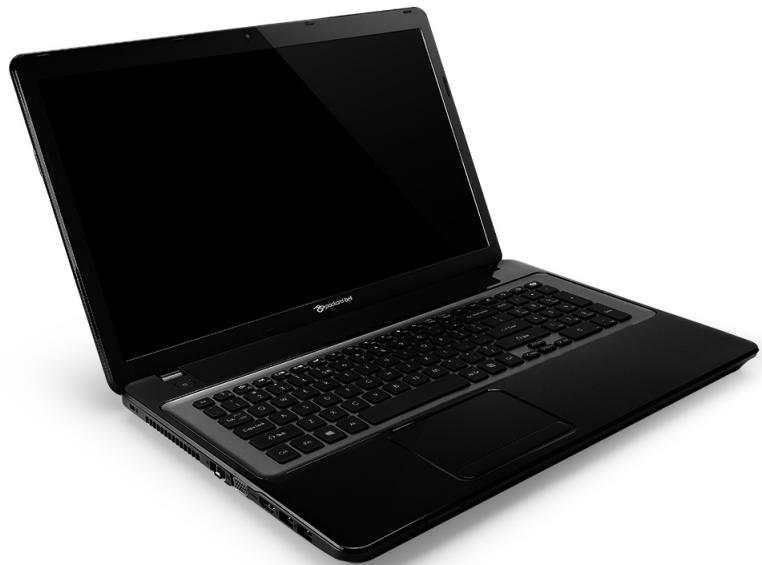
Packard Bell EasyNote LV
SISÄLLYSLUETTELO
Packard Bell Recovery Management. 44
Internet 45
Packard Bell Recovery Management
Packard Bell Recovery Management
?X
Welcome to Packard Bell Recovery Management
Packard Bell Recovery Management enables you to restore your system. To begin, select the task you want to perform. Please DO NOT remove the USB device while proceeding.

Restores your computer to its factory default status. A reboot is required. NOTE: All data on drive Cwill be restored.

Customized Restore (Retain User Data)

Reinstall Drivers or Applications
Make a backup before you restore (Recommended).

Create Factory Default Backup
Create Drivers and Applications Backup

packard bell
Here's what will happen:
- Your files and personalization settings won't change.
- Your PC settings will be changed back to their defaults.
- Apps from Windows Store will be kept.
- Apps you installed from discs or websites will be removed.
A list of removed apps will be saved on your desktop.
Next
Cancel
Here's what will happen:
- Your files and personalization settings won't change.
- Your PC settings will be changed back to their defaults.
- Apps from Windows Store will be kept.
- Apps you installed from discs or websites will be removed.
A list of removed apps will be saved on your desktop.
Next
Cancel
The FCC with its action in ET Docket 96-8 has adopted a safety standard for human exposure to radio frequency (RF) electromagnetic energy emitted by FCC certified equipment. The wireless adapter meets the Human Exposure limits found in OET Bulletin 65, supplement C, 2001, and ANSI/IEEE C95.1, 1992. Proper operation of this radio according to the instructions found in this manual will result in exposure substantially below the FCC's recommended limits.
- The following safety precautions should be observed:
Do not touch or move antenna while the unit is transmitting or receiving.
- Do not hold any component containing the radio such that the antenna is very close or touching any exposed parts of the body, especially the face or eyes, while transmitting.
- Do not operate the radio or attempt to transmit data unless the antenna is connected; this behavior may cause damage to the radio.
Use in specific environments:
- The use of wireless adapters in hazardous locations is limited by the constraints posed by the safety directors of such environments.
- The use of wireless adapters on airplanes is governed by the Federal Aviation Administration (FAA).
- The use of wireless adapters in hospitals is restricted to the limits set forth by each hospital.
Antenna Use
In order to comply with FCC RF exposure limits, low gain integrated antennas should be located at a minimum distance of 20~cm (8 inches) or more from the body of all persons or at a minimum distance as specified by the FCC module grant conditions. FCC grants can be viewed from the FCC Equipment Authorization website at https://fjallfoss.fcc.gov/oetcf/eas/reports/GenericSearch.cfm by entering the FCC ID printed on the module label.
Explosive Device Proximity Warning
Warning: Do not operate a portable transmitter (including this wireless adapter) near unshielded blasting caps or in an explosive environment unless the transmitter has been modified to be qualified for such use
AntennaWarnings
- Warning: To comply with the FCC and ANSI C95.1 RF exposure limits, it is recommended that for the wireless adapter installed in a desktop or portable computer, the antenna for this wireless adapter to be installed so as to provide a
separation distance of at least 20 cm (8 inches) from all persons or at the minimum distance as specified by the module grant conditions. FCC grants can be viewed from the FCC Equipment Authorization website at https://fjallfoss.fcc.gov/oetcf/eas/reports/GenericSearch.cfm by entering the FCC ID printed on the module label.
- Warning: The wireless adapter is not designed for use with high-gain directional antennas.
Use On Aircraft Caution
- Caution: Regulations of the FCC and FAA prohibit airborne operation of radio-frequency wireless devices (wireless adapters) because their signals could interfere with critical interference with critical aircraft instruments.
Local Restrictions on 802.11a, 802.11b, 802.11g and 802.11n Radio Usage
- Caution: Due to the fact that the frequencies used by 802.11a, 802.11b, 802.11g and 802.11n wireless LAN devices may not yet be harmonized in all countries, 802.11a, 802.11b, 802.11g and 802.11n products are designed for use only in specific countries, and are not allowed to be operated in countries other than those of designated use. As a user of these products, you are responsible for ensuring that the products are used only in the countries for which they were intended and for verifying that they are configured with the correct selection of frequency and channel for the country of use. Any deviation from the permissible power and frequency settings for the country of use is an infringement of national law and may be punished as such.
Wireless Interoperability
The wireless adapter is designed to be interoperable with other wireless LAN products that are based on direct sequence spread spectrum (DSSS) radio technology and to comply with the following standards:
- IEEE Std. 802.11b compliant Standard on Wireless LAN
- IEEE Std. 802.11g compliant Standard on Wireless LAN
-
IEEE Std. 802.11a compliant Standard on Wireless LAN (applies to devices supporting 802.11a)
-
IEEE Std. 802.11n draft 2.0 compliant on Wireless LAN
- Wireless Fidelity certification, as defined by the Wi-Fi Alliance
The Wireless Adapter and Your Health
The wireless adapter, like other radio devices, emits radio frequency electromagnetic energy. The level of energy emitted by the wireless adapter, however, is less than the electromagnetic energy emitted by other wireless devices such as mobile phones. The wireless adapter operates within the guidelines found in radio frequency safety standards and recommendations. These standards and recommendations reflect the consensus of the scientific community and result from deliberations of panels and committees of scientists who continually review and interpret the extensive research literature. In some situations or environments, the use of the wireless adapter may be restricted by the proprietor of the building or responsible representatives of the applicable organization. Examples of such situations may include:
- Using the wireless adapter on board airplanes, or
- Using the wireless adapter in any other environment where the risk of interference with other devices or services is perceived or identified as being harmful.
If you are uncertain of the policy that applies to the use of wireless adapters in a specific organization or environment (an airport, for example), you are encouraged to ask for authorization to use the adapter before you turn it on.
FCC Radio Frequency Interference Requirements (applies to device supporting 802.11a)
This device is restricted to indoor use due to its operation in the 5.15 to 5.25 GHz and 5.470 to 5.725 GHz frequency ranges. FCC requires this product to be used indoors for the frequency ranges 5.15 to 5.25 GHz and 5.470 to 5.725 GHz to reduce the potential for harmful interference to co-channel mobile satellite systems. High power radars are allocated as primary users of the 5.25 to 5.35 GHz and 5.65 to 5.85 GHz bands. These radar stations can cause interference with and /or damage this device. No configuration
controls are provided for this wireless adapter allowing any change in the frequency of operations outside the FCC grant of authorization for U.S operation according to Part 15.407 of the FCC rules.
USA - Federal Communications Commission (FCC)
This device complies with Part 15 of the FCC Rules. Operation of the device is subject to the following two conditions:
- This device may not cause harmful interference.
- This device must accept any interference that may cause undesired operation.
- Note: The radiated output power of the adapter is far below the FCC radio frequency exposure limits. Nevertheless, the adapter should be used in such a manner that the potential for human contact during normal operation is minimized. To avoid the possibility of exceeding the FCC radio frequency exposure limits, you should keep a distance of at least 20cm between you (or any other person in the vicinity), or the minimum separation distance as specified by the FCC grant conditions, and the antenna that is built into the computer. Details of the authorized configurations can be found at http://www.fcc.gov/oet/ea/ by entering the FCC ID number on the device.
Interference Statement
This wireless adapter has been tested and found to comply with the limits for a Class B digital device, pursuant to Part 15 of the FCC Rules. These limits are designed to provide reasonable protection against harmful interference in a residential installation. This wireless adapter generates, uses, and can radiate radio frequency energy. If the wireless adapter is not installed and used in accordance with the instructions, the wireless adapter may cause harmful interference to radio communications. There is no guarantee, however, that such interference will not occur in a particular installation. If this wireless adapter does cause harmful interference to radio or television reception (which can be determined by turning the equipment off and on), the user is encouraged to try to correct the interference by taking one or more of the following measures:
-
Reorient or relocate the receiving antenna of the equipment experiencing the interference.
-
Increase the distance between the wireless adapter and the equipment experiencing the interference.
- Connect the computer with the wireless adapter to an outlet on a circuit different from that to which the equipment experiencing the interference is connected.
- Consult the dealer or an experienced radio/TV technician for help.
- Note: The adapter must be installed and used in strict accordance with the manufacturer's instructions as described in the user documentation that comes with the product. Any other installation or use will violate FCC Part 15 regulations.
Canada — Industry Canada (IC)
This device complies with RSS210 of Industry Canada. Cet apparéil se conforme à RSS210 de Canada d'Industrie.
-
Caution: When machine supports and using IEEE 802.11a wireless LAN, this product is restricted to indoor use due to its operation in the 5.15- to 5.25 GHz frequency range. Industry Canada requires this product to be used indoors for the frequency range of 5.15 GHz to 5.25 GHz to reduce the potential for harmful interference to co-channel mobile satellite systems. High power radar is allocated as the primary user of the 5.25 to 5.35 GHz and 5.65 to 5.85 GHz bands. These radar stations can cause interference with and/or damage to this device. The maximum allowed antenna gain for use with this device is 6dBi in order to comply with the E.I.R.P limit for the 5.25 to 5.35 and 5.725 to 5.85 GHz frequency range in point-to-point operation. To comply with RF exposure requirements all antennas should be located at a minimum distance of 20 cm, or the minimum separation distance allowed by the module approval, from the body of all persons.
-
Attention: l'utilisation d'un réseau sans fil IEEE802.11a est restreinte à une utilisation en interieur à cause du fonctionement dans la bande de fréquence 5,15 - 5,25 GHz. Industry Canada requiert que ce produit soit utilisé à l'intérieur desBATIMENTS pour la bande de fréquence 5,15 - 5,25 GHz afin de réduire les possibiltés d'interférences nuisibles aux canaux co-existants des systèmes de transmission satellites. Les radars de puissances ont fait l'objet d'une allocation primaire de
This Class B digital apparatus complies with Canadian ICES-003.
"To prevent radio interference to the licensed service, this device is intended to be operated indoors and away from windows to provide maximum shielding. Equipment (or its transmit antenna) that is installed outdoors is subject to licensing."
The use of these equipments is regulated by:
1.D.L.gs 1.8.2003, n. 259, article 104 (activity subject to general authorization) for outdoor use and article 105 (free use) for indoor use, in both cases for private use.
2.D.M. 28.5.03, for supply to public of LAN access to networks and telecom services.
Pakistan Telecommunication Authority (PTA) Approved
Morocco
The operation of this product in the radio channel 2 (2417 MHz) is not authorized in the following cities: Agadir, Assa-Zag, Cabo Negro, Chaouen, Goulmima, Oujda, Tan Tan, Taourirt, Taroudant and Taza.
The operation of this product in the radio channels 4, 5, 6 and 7 (2425 - 2442 MHz) is not authorized in the following cities: Aéroport Mohamed V, Agadir, Aguelmous, Anza, Benslimane, Béni Hafida, Cabo Negro, Casablanca, Fès, Lakhab, Marrakech, Merchich, Mohammédia, Rabat, Salé, Tanger, Tan Tan, Taunate, Tit Mellil, Zag.
Japan
5 GHz 带是室内用使用のと
Korea
当用,
Taiwan
第十二条
Recovery Management 60
Руковозгово
Пользователя
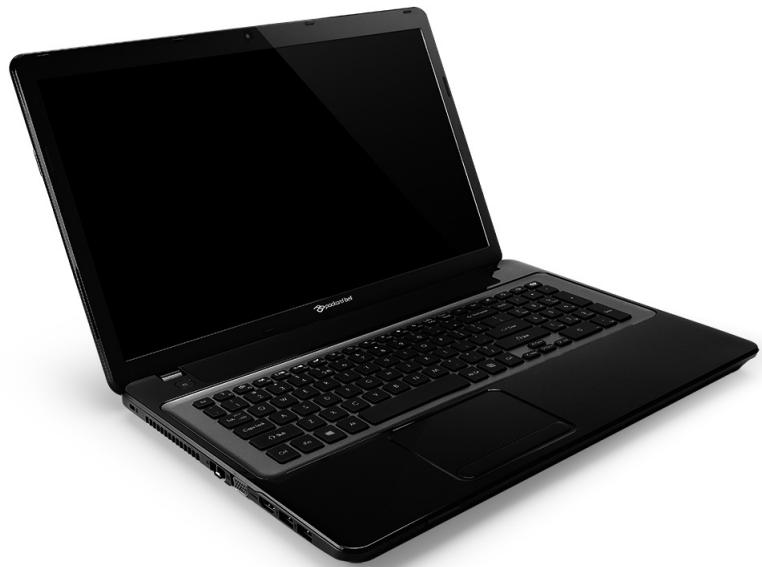
Packard Bell EasyNote LV
ÖrJIABJIΕΗΝΕ
3anyck KOMnbHOtepa 4
BecnpoBODHoe noDKIoueHne 4
Pernctpaia 5
UcTaHOBka nporpamMHO oBecneueHnra 6
BocctaHOBJIeHne 6
Bo3nKnn npo6JIembl? 6
OchOBhIe CBeDeHnO KOMNbIToTepe 8
Be3oNaChOCTb u yDObcTBo pa60TbI. 8
Mepb6e3oNaChocTu 8
OxpaHa 3dopOBb. 13
3HaKOMCTBO C KOMNbIOTepOM 16
Budcbepy-dncnnne 17
Bvndcbepxy-KnaBnataype 18
CneunalbHbIe KnaBnSi 19
Bvnd cpeeni 23
Bud cneBa 24
Bud cnpaba 26
Bud cH3y 28
CehcopnaheJIb 30
OchobblncnojIb3OBaHncaHcOpHn nHeJI..30
KectbHa ceHcOpHo nanei 31
Moepn3aunBaawero
KOMNbIOTepa 33
PacupeHne BO3MOXHOCTe C NOMOJIbIO
DOnOJIHNTeJIbHbIX MoUynei 33
Bo3MOxHocTn POnKJIIOueHEN 33
3JIeKtpoNTaHHe 39
AanTep ceteBoro nHTaHn 39
AkkymyTOp 40
XapakTepcntkn aKkymyIaTopa 40
3aMeHa aKkyMnyTopa. 42
3apka aKymyTopa 44
3aem HjkeH HObI INTepeic? 96
KaKa pa36JIOKINPOBaT KOMNbIOTep? 97
Kak HactpoNTb KOMNbIOpTeP corNaCHO
MONIpeDNoTHeHnM? 97
XOuyncnoJb3oBaTbWindows
PnBbHbIM MHe cNoocobm. KaK
BepHyTb "paoboun CToJ? 98
「Ie mon npinoxehnra? 99
Yto TaKoe Microsoft ID (yHETHa
3aipncb)? 100
KaKdo6abntb CcbInKyHa n36paHHbIe
Bbe6-caiTbI B 6pay3epe Internet
Explorer? 101
Kak npobepntb haJIynchoe OboJIeHn
ДЯ Windows? 101
TdeMOxHO NOJyUHTb DOnONHInTeJbHyIO
HHopmaquio? 102
HopMaTHBnaI INΦopMaζη 103
3aunta okpykaiooey cpebl
JIueHnHa nporpaMMHOe
obecneueHne 124
yka3ATEJIb 128
Copyright © 2012. Bce npaba 3aunnebl.
PykoBODCTBO noIb3ObaTeNa Packard Bell EasyNote LV
PepBbI Bblnyck: 20 NioJIb 2012 r.
Iocetnte Be6-cait registration.packardbell.com, rde Bbl y3Haete o Ibrotax dna BnaedeJIbueB yctpoiCTB Packard Bell.
PpmeHHe: Bce nok3aHbIe 3decb n3o6paXeHn PpBBeHbToJbKO dJa CnpaBKn.
PeaJIbHaN KOHΦnIpyaZn MOKET OTJNUaTbC T O NOKa3aHHoH.
3anyck kompbioTepa
OcbnyxueaHue KOMnbIomepa
He nbItaTecb 06cnykBaTb KOMNbIOTep cAmOCToTeJbHo, TAK KaK, OTkpBIB NIN CHRB KpbIuKy, Bbl MoKeTe NOdBeprHyt b Ce6y DeiCTBnIO onachoro HappJxHEny NIN dpym puckam. Bce Bnbl TexHnueckoro 06cnykBaHnN DOJXhBI npOBODITb CneuaJIncTb cepBnCHORo ceHTpa.
OTKJIIOHTe KOMNbIOTep OT cTeBOI PO3ETKN I O6paTNTecb 3a NOMOJIbIO B cepBnCHbI ΚeHTp, eCNI:
- ShHyp pntaHnI nn pa3bem nobpeXdeHbI, HAppe3aHbI nn npOteptbl,
B yctpoiCTBO 6bIa npoIiTa KIOKOCTB, - yctpoiCTBO nonano noD dojkb nIIN noDBeprrocb Bo3deiCTBnIO BnaI,
- yctpoiCTBO ynpaIO nIII NOBpeKdE h erO KOpNyc
Bpa6oTe yctpoiCTBa BnHbI RbHbI OTKIOHeHnO T HopMbI - yctpoiCTBO He paobotaet HopmaJIbHo npu co6IIOdeHm INHcTpyKcN IO 3KcIIyatau
Ipumeyuhe: Inpeaynpoeku noIb3yUmecb moIbko meMu opaHaMu ynpaeJeHua, peaynpoEka komOpbIX npedycMompena UhcmpyKzmaMu no 3KcIpyamauu, mak kak HnpaBunbHoe uCnoIb3O6aHue dpyaux opaHOe ynpaeJeHua MoXem npueecmu K npoejdeHuo u3denuu u, ckopee ecezo, nompebyem om cneuauncmoe cepBuchozo uehmpa bOnbux ycuiu dny ooccmaHo6eHue HopMaJIbHbIx pa6oux npamempoe u3deJnua.
OxpaHa 3dOpOBbY
-Дише,учаски BOKpyr BeHTINЯцIHbIX OTBepCTn n aadantep nepemehHoro TOKa MOry HarpeBaTbc. He npikacaiTecb K Hm, YTO6bl He noIyUHTb OXKOr nIIu TpaBMy.
B Baawem yctpoictbe n npnaIeXHocTg X HeMy Moryt HaxOHTbcr MeIKe IeTaJI. DepkTe INx B MeCTax, HeIOCTyINbIX IJRA MaIeHbKnx Idetei.
- Komпьютей и akceccуapы могут соржаъ Мелкге комно entы. Дерхитух в мостax, He doctyn HBix дя маленькх DeTei.
- Пи порджгельною pa6ote 3a komlbiptepom peryrahpno deaite nepepbbl. Hehaonro OTbOnte rna3a ot kpaHa KOMbIOTepa. Ppekpatnte pa6oty 3a komlbiptepom, noCyBCTBOBAB yctanoctb.
- PacnoJoxnTe KOMnbIOTep TaK, YTOb6bl Bam 6blIO 6blIO eCTeCTBeHHO IN KOMΦopTHo pa60TaB 3a Hm. NObHn3OCTn pacnoJoxnTe npeDMeTbI, KOtOpBIMN Bbl YaCTO NOlb3yeTEcb.
-Дяболгьебзогиудбногшьпсindnte npraMo nepekomnbItepOM.KnabNAtypa nceHcOpHЯ naHeJIbdoJxHbI b6ItbHa ydOshoДЯВACBbICote.PacctOryHneOTIJa3do3KpaHa doJxHcoCTaBJIrtpmepHo 45-70 cm.
EcnBbI nooJrny pa6oTaete 3a KOMnbIOTePOM, CnJa 3a CTOnOM, To nJa IOBbIeHnY yOobCTBa pa6oTbI COBetyEM KynITb BHeuHIOU KNaBnAtypy.
-
ChTo6bI He NoBpeiNTb Cnyx, npn IcNoJIb3OBAHm DInHAMIKOB nINn HayuHNIKOB yBeJIuHVAIte rPOMKOCTb NOCTeNEHHO, NOKa HE DOCTNHTe HOpMaJIbHOI N KOMΦoPTHOH CblIshMocTn. He NobIshaIte yPoBeHb rPOMKOCtN PocIe TORO, KaK BaI sCnyx aJaANTnpyETcA. He ClysaIte My3bIKy Ha BbICOKOI rPOMKOCtN B TeueHne DJIITeJIbHOrO BpemeHn. He NObbIshaIte rPOMKOCTb, ChTo6bI nepeCNIPTb OkpykaIOUm Shym; UMeHbIJTe rPOMKOCTb, ecJn He MoXeTe CblIshaTb TOLOC IIOJe pIdom C Bamn.
-
Bo Bpemra pa60bI HnKnHЯ qactb KOMnbHTopea, aanTep nITaHnRA N BO3dUx, BbIXOJaIuN N3 BeHTnJIaCIOHHbIX OTBepCTn, MoryT HarpeBaTbcr. N36eraTe dIITeNbHOcoPnKoCHOBeHnra pa60taUoJero KOMnbHTopea C TeJOMn He KJaInte ero Ha KOJIeHn.
-
He nepekepbiaBte n He 3aropaxnBaIte BeHTnJIaCIOHbIe n dpyrHe OTBepCTnKOMNbIoTepa.He CTabBe T KOMNbIoTeP Ha MmRkyIO NOBepxHOCTb (KOBep, KpecNo, KpOBAt b N T.I.) KOTOpbie MOryT nepekepbIb BEHTnJIaCIOHbIe OTBepCTnI.
He npocobbIbaTe nocToPOHHne npedMeTbI B yctpoiCTBO uepe3 BeHTnJIaUHOHHbIe OTBepCTnI nnI Na3bl B Kopnyce, TAK KAK OHN MOyT COpNIKOCHyTbcr C TOUYkAMN ONaCHOro HAnpJxHnI NII NBl3BaTbK KopOTKoe 3aMbIkaHne DeTaJIeN, YTO MOKeT pInuBcTn K BO3rOpAHIO IIN NopaxHeHIO 3JIeKTPnuCeKIM TOKOM.
-Опразденийные NOВТОРЯЮшпеся DeиCTBЯ MOryT Bbl3BaTb 3abOJIeBAHnEpyK,KnCTeI,JaOHeI,SeI,ПleYeI,Hor n CnINHbI.уTObI yMeHbUHTb pNCK pa3BVITnA 3a6OJIeBAHnI,NeYaTATE,Держа 3aJrCTbI KnCTn IpRMo IpoBHO NaKJIaBnATypoI.ПочВСТВOBaBперIoDInuYeCKe 60Ii,ПOKaJIbIbAHnE,ОнЕмEHne ИПИ ДPyrIe ПрИЗHAkINДИСКOMФOPTa,образИТecьКВ行政处罚.
Cobetyem poNDteJAM KOHTPOJIINPOBAtB, KaK INx DeTn IrgpaIOT BV KOMNbIOTEPHe BIE INrpbI. EcIn y DeTei NOBITcI JIO6oN i3 CmNTOMOB 3a6OJIeBaHnIA (roLOBOKpyKeHne, 3aTYMaHEnHoe 3peHne, cyDopora rna3 INIy MyCKyIbON, NOREPRA CO3HaHnA, DE3OpNEHTaCnR, HENpOIN3BOJbHbIe INIy KOHNByIbCSNBHbIe DvIXKeHnA), To HEMEДЛEHHO npeKpatnte NCNoJIb3OBAHnE KOMNbIOTEpa I O6paTIteCb K BpaUy. 3TO MoKET cLYuHTbcra, DaXe ecIn y YeNoBeka HNKOrda He 6blINO 3nnIeTTuecknx INpIpaIKnOB.
3HaKOMCTBO C KOMNbIOTepom
Tenepb, KOrda Bbl BblONHnI NAcTroPOnK, KaK NOKa3aHO Ha NJaKaTe No yctaHOBKe, DaBaTe NObJIxke N03HaKOMMmCc BaUIM HObIM Packard Bell HoYToyKom.
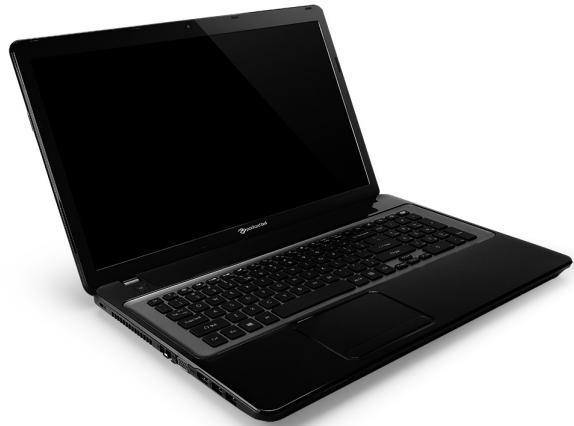
Packard Bell EasyNote LV
BvD cBepxu - dncnpei
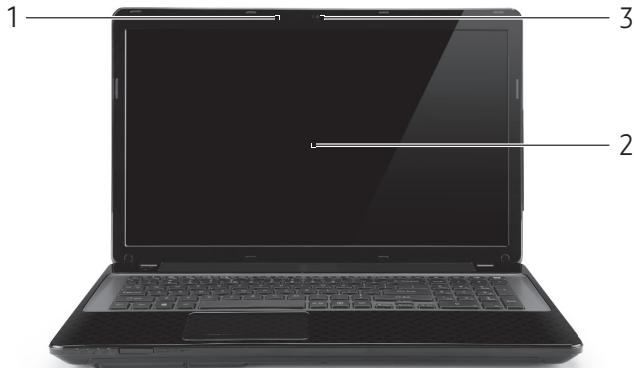
OCHOBbI NcNoJIb3OBaHnA CeHCOPHO NaHeJI
Cencopna naheIb clyknt Iy npablenn npemeuenem cTreJkn (nn 'kycopa') no 3kpany. Pnp npoBeHn n aJIbca no ceHcOpno naHeJI KypCop IOBTOPReT TpaekTopIO npemeuena naIbca.
Haxmaite nebyu npaByu KhONKn noCcehCopHo nAHeIbIO nIyBbOpa N BbIOJIneHn OYHKcN. 3TN DBe OBactn aHaIOnHyb IeBOi n npaBoi KhONkam MbIiN. NocTyKnbAHne NO ceHCOPHO nAHeJn aHaIOnHyo HaaTnIO JEBO KHONKnMbIiN.
Ppumeyue: Cencopnna nane lyceumenbHa K deuxeHIO naiba; yem neae kacaHue, mem moyhee peaku.
cne du me 3a mem, ymo6bI cHcOpnaHn b u bauu nlaBbI bInu cyxmu u yucmbimu.
YnpabJrTb Kypcopom MOXHO HeCKOJIbKIMN OCHOBHbIMN XeCTaM:
CdBnOdHnMaIbIeM:ДЯперemeIeHnKypcopaDbIraTe NaIbIeM NO ceHCOPHOI naHJI.
Kacahne oHn m naIbceM: CJIeRka KocHTecb ee naIbceM, YTO6bl "UeJyKom" BbIbpaTb 3JeMeENT nIN 3aNytB erO. IIn
Kapmbi SD, SDHC u SDXC
HecmotpHa cXoKn BHeuHn BnD, pa3HbIe TINbI KapT SD OTInuAHTcpa3HOJ emKocTbU. Y kapT SD emKocTb DoCTnraet 4 TB, y kapT SDHC-32 TB, a emKocTb KapT SDXC MoKeT DoCTnRaTb 2048 TB (2 TB).YcTpoiCTBO UTeHn KaP T NaMaTn B BaWeM KOMnbItepe NoIdepXnBaETkapTbTIINOB SDHC nINSDXC.
Пр汞анue: Kapmbi nammu SDXC moxho ucnnoIb3o6aMb moIbko e ycmpoucmee qmehua, noodepkueaouem foopMam SDXC; Kapmbi SD u SDHC moxho ucnnoIb3o6aMb e ycmpoucmee qmehua IIO6Oa muna.
- Haxmnte cTpeNkI Noka3bIBaTbCKpbITbIe 3HaUKN B ObnacmuyeedomneHu (pIOM C yacAMn).
- Haxmte 3HaQoK Be3onacHoe n3BHeueHne yCtpoiCTBa.
- Haxmte N3BneYb KapTy SD (NJINIMy yCTPOIcTBA).
4.ДоЖДИТЕСь NOЯВЛЕнЯ COOБSUHEN TENEpb MOXHO 6e3oNacHo u3eJIeY yCmpoUcM8O.
5.ИЗВЛЕКИТЕΚAPТУ.
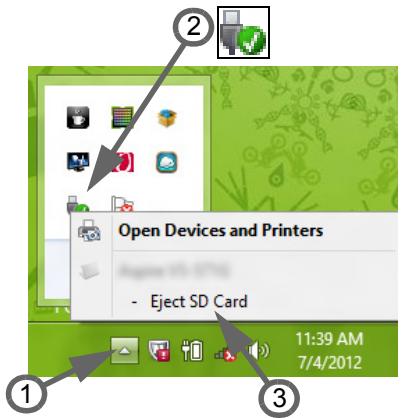
BcmpoeHHbIe cpecdmea paobmbi s cemu
BcTpoEHHbIe cpeIcTBa pa6Otbl B ceTN IO3BOJIAHOT IOdKJIIOUaTb BaI J KOMNbIOTep K ceTI Ethernet.
ПоdkночиЕ Ethernet-кабел b ot pa3beMa Ethernet (RJ-45) Na Корпuce Комьтepа К сеТБОВ розETК ИПИ сTeBOMY KOнцentpaTopy.
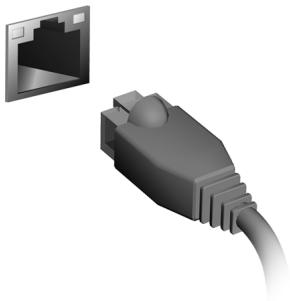
USB (yHueepcaJIbHaI nOcneoBeaMeIbHaI uHa)
Pa3bem USB BbICOKOCKOPCTHOI 小HbI NOcneIOBaTeJIbHOI IpepaUdAHNbIX IO3BOJIAET IOkJIIOuATb BHeUHNe USB- yCTpOiCTBa, He 3aHIMaPecypcoB CnCTEmbl.
B onpeJeHbIx MoIeJX KOMNbIOTePOB MOKeT 6bITb OIN Hn HeCKOJIbKO pa3beMOB USB 3.0. OHn IOxOKn Ha oBlyHbIe pa3BeMbI USB, HO coDEpKzAT DOONJIHHTeJIbHbIe BHyTpEHHne IPOBOHNIKN
I NMEOT CINH NCBET. K 3TUM pa3bEmam MOXHO NOKJIouaTB yCTpoiCTBa, IOnDEpKINBAIOUe cTaHdapt USB 3.0,ДЯперетачданныхсбОпee BBICOKOДСКОРOCТБИ.
Budeopa3bem
Подклочи TE MOHITOP K pa3bemy VGA nJIN DVI (poДержИBaembl TIN NOДКЛЮЧЕнЯ 3aBnCnT OT KOHФгураци Baшero KOMMbIOTepa). COOTBetCTByUOuŋ Ka6eJIb OБьИHO BXOДNT B KOMПЛЕKT NOCTaВКИ MOHITOPa.
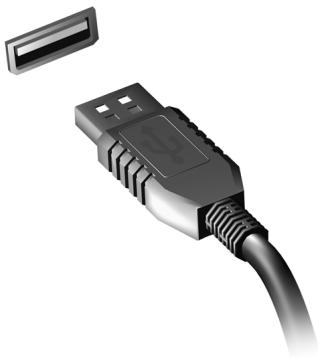
COBMeCTUMbIM MOHITOPOM ZnΦpOBOr 3Byka N/INN BnDeO, HAnpIMep, PnIeMHNKOM ZnΦpOBOr TeJIeBnIeHn (DTV).
IcnoJb3yIe npT HDMI B BaWem KOMNbItepe IJr noKJIuOHeHnK BbICOKKJIacChOH ayDnO- n BnDeoannapaType. IcNoIb3ObaHne BCero OdHoro KaBEn 3HaunTeJbHO yckopReT noKJIuOHeHn HAcTpOky.
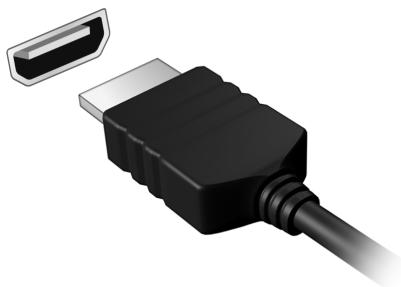
HayuHuku u Mukpogboh
K 3TtM mBvym pa3bemam MoXHO NODKNIOUaTb ayDNOUCPOIcTBa. K pa3bemy HauShNIOKOB NODKNIOUaTe CtepeOHaySHNIK NIM AKTNHBIE (C CO6CTBeHHbIM yCNINTEJEM) DInHAMNK. Ppr NOkHoyehn M ayDNOUCPOIcTB B THe3DO HauShNIOKOB BCTOEHNbIE DInHAMNK OTKNIUaOTc. K pa3bemy MKNPOOHa NODKNIOUaTe BHeSHN MKNPOOHO DnA MOHOONueCKo 3aNNc 3Byka; Ppr NOkHIOUeHN BHeSHero MKNPOOHa BCTPOEHNB IMKPOOHO TOKNIUOaETc.
Злектононne
AdaanTep ceTeBOro NITaHnIa
BaW KOMNbIOTep MoKet IcNOJIb3OBAtB npINaRaEmb BHeUHn aAanTep nITAHnI dIpa6Obl OT cTeBOrO 3JeKtpoNTAHnI. PpINaRaEmb UHyp nITAHnI COOTBeTCTByET CTaHdApTaM TOI CTrpaHbI, rDe 6bl KynJIeH KOMNbIOTep.
3TOT aanTep nntaHnna oecneuBaet HxKhoe nntaHne IpaobtI KOMnbIoTepa N OndHOBpeMeHHoNpO3apJkaeT erO akkymyIaTOp.
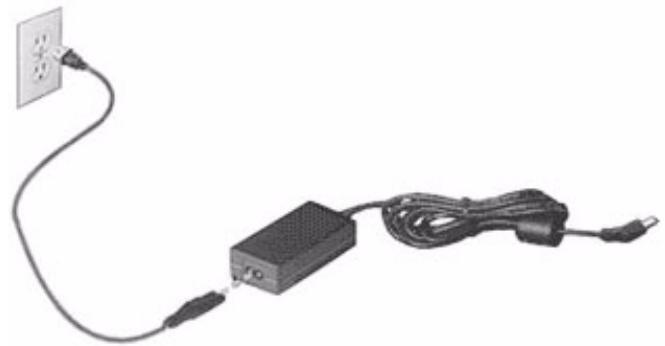
BHMaHne! He 3akpbIbaiTe aadantep ceteBO r nHTAHn I He KnaIte Ha Hero noctopOHHe npedMebl. NocToPOHHne npedMebl, nOLOXeHHbIe Ha aadTep, He n03BOJr t Emy OxlaJdaTcBc BO Bpem pa60Tbl.
Приименяп Te Tolyko aадanTep ceteBOrO nITaHnA, BXODaIu B KOMPJIeKT nocTabKn KOMNbIoTepa. Bo3MoXHo, dpyrne aadanTepbI bByIgIyIaT noXoKe, HO IN Приимени MeKet NOBpeDInTB BaU KOMNbIoTeP.
BHHMaHHe! Nocne npoDoJXHTeJbHO pa6Otbl aanTepe CTeBOrO nHTaHnI u DNHlue KOMNbIOTepa MOrYT HArpeBaTbcra. 3To HopMaJIbHOe ABLeHne, HO npoDoJXHTeJbHbI KOHTaKT c HmM MoRyT pNpUHNITb TpaBMy.
AkkymyIaTOp
KoMnboTepeNcNoJIb3yeT aKKymyIaTOp, oBeCneuBaOuI npOIOJXKeIeJIbHOe BpeMraBTOHOMHO pa6Otbl.
XapakrepncTnKn aKKyMylToppa
AkkymyIop o6laaet cIeIyUOUMM xapaKTePncTnKaAMn:
- COOTBeTCTBnE TeKyuIzIM TexHOJIoRnuecknM CTaHdApTaM.
- Bыдач п dedурждени O nH3kom уpoBHe 3apяda.
AkkymyIaTOp 3apJxaeTc npi NpOdkIIOUeHn aIaITepa ceTeBOro nITAHN K KOMNbIbTepy. AkkymyIaTOp MOXHO 3apJxAtb, He IpepbIBaRa paBOTy c KOMNbIbTePOM dIg 3apJda aKKymyIaTOpa. TeM He MeHee, pni BbIKNoUeHHOM KOMNbIbTepe aKKymyJIaTOp 3apJxAEtC3HaHTeJIbHO 6blCTpee.
AkkymyIaTOp nO3B0JIaTe NcNoJIb3ObaT b KOMNbIoTeP b Ioe3dKe IIN npn c6oax 3JIeKTpOnITaHn. Cobetyem IMeTb B pe3epBe dIOJIoHNITeJIbHbI IIOJIHOCTbIO 3apJxKeHHbI aKKymyIaTOp. KynITb pe3epBbI b AKKymyIaTOp MOXHO B KOMNbIoTePHOM MaRa3UHe.
YeenuyeHue cpoKa cnYk6bI akKymnIamopa
Kak n BCE npyrne akkymylantopbl, akkymylantop BaWero KOMnbIOTepa CO BpemeHem HauHET TepaTb EMKOCTb. 3TO 3HaHT, YTO Bpempa60TbI OT aKKMylantopa CO BpemeHem COKpaUaetcra.
Дпя npodlenna cpoka cnjxkbbl akkymyIaTopa COBeTyem BbIIOJIHrTb cIeNyUOUIpe ekOMeHdaци.
Iodaomovka HoeooaKkymyJamopa K uCnoJIb3O6aHuO
Ipeed nepBbIM nCNoJIb3OBAHnEM HOBOr aKKyMylTOpa COBeTyEm npOBecTu npoceDpy erO "POIroTOBKn" K paBoTe:
- BcTaBbTe HObBi aKkyMylTOp B bYkJIIOueHHbI KOMnblOTep.
2.ПодсоeДинite aадаNTep ceTeBOrO nITaHnI N NOJIHoCTbIO 3apAДnte aKKyMЛЯТOP. - OToeHNHe aAnTepeTeBOrIHTaHn.
- BkIIOHInTe KOMMbIoTeP i pa6OtaTHe, IcNoJIb3yra 3JIeKTpOniTahHe OTAKKymJrTopa.
5.Дождпесь поного разрааakумлгета. - Choba noДcoeДиHInTe aДanTep ceTeBOrO nITaHnI eIe pa3 noJIHOCTbI O 3apJInTe aKKyMЛЯТOP.
Packard Bell Recovery Management
YTo6bI NOJrTOBHTb KOMNbHOTep K BOCCTaHOBJeHNIO CNTcEmbl C NcNoJIb3OBAHnEM DOnoJIHnTeJIbHbIX NapaMeTpOB, CNeJyET KaK MOXHO CKopee Co3dA Tb Ha6Op DNCKOB dIpy BOCCTaHOBJeHNIA. DOnoJIHnTeJIbHbIe CBeJeHnA CM. Na Ctp. 69.
ПервbieшагиВИntepheTe
3aunTa KOMnbIOTepa
Дянаджно paBOTы KOMьTOЕра ХИЗHEHNO BaxKHO 3aUNITb erO OT BnpycoB n aTak chepe3 INHTepHeT (cM. pa3dJe IpeDIOXeHue no 6e3ONaCHO paBOme e INHmepHeme Ha cTp. 50 n pa3dJe Be3ONaChocmb Na cTp. 58).Пи nepBOM 3aNyCke KOMbIOTep IpeDIOXHT BOCNoJIb3OBaTBcR 3ΦΦeKTNBHO pOrpaMMoI dЯ 6e3ONaCHO paBOTb I INHTepHeTe. 3Tu 3aUnTy cNeDuYet AKTNBnPoBaT b KaK MoXHo Ckopee, HO O6braTeJIbHO Do NOdkIQUeHnRA K INHTepHETy.
BbIbOp noCTabUzIkA ycnyr INHTepHET

Pa60a B INThepHeTe CTana HeOTbEmIeMoJ yactbIooExeJdHeBHOpa60tbcOMNbIOTePOM.HTo6bl NOnyUHTbDOCTyn K pa3HOO6pa3HOINΦOpMaunn I cpeDCTBaM O6uEHNy, HxKHO BbIPOJNHTb HECKOJIbKO IPOCTbIX WaROB.ДЯ 3TOrO BbIbEPnte Chayana nocmaeuzka Ycnye INHmepHem (ISP), KOtOpbi OBeCneHTN IOdkIIOUeHne KOMNbIOTepa K INThepHety. Y3HaIte, KaKne MeCTHbe KOMNaHIn OKa3bIBaHOT ycLyTn INThepHET,
IIOCOBeTyITeCb C pOJCTBHeHHKAMN Ipy3bAMN IIN NOHTaNTe O63Opbl NOT3bIBbl KJIneHToB. Bbl6paHHb Bamn NocTabUKN YcIyr INTEpHET ONIIWET NOPADOK NODKIIHcyHnK INTEpHETy (BO3MOXHO, INPdETcY UCTaHOBtB DOnONHInTeNbHbIe PporpaMMbl IIN KynITb CNEuHaNbHoE yCTPOJCTBO DnI NOkJIHcyHnK TeNeΦoHNoI nnHn).
TunbI NOdkNIOUeHnI
B 3aBncmoctn OT MoJeI N KOMNbIOTepa, MeCTOHaXoKJeHn IOnb3OBaTeJIy n erO notpe6HOCTe moxHo IcNoJIb3OBaTb pa3HbIe cnoCobI IOnkJIouHeHn K INHTepHety.
Kommymupyemoe coeduHue
B HeKOTopbIX KOMNbHOTepax ectb TelefoHHb ("MOeMHbI") pa3bEmdIyUdJIeHHORO DoCTyna K INTepHETy NO KOMMyTnpyeMoN TelefoHHoIINHm. C erO NOMOUsbIO MOxHO NODKNIOHTbcra K INTepHETy nO TelefoHHoI INHm. PnKOMMyTnpyeMoM NODKNIOHOBpeMeHHoe IcNOJb3OBAHne OJHOI TelefoHHoI INHm MOeMoM INTelefoHOM HeBO3MOxHO. 13-3a HN3KOJ CKOPoCTn NepeDaun DaHHbIX INOBpeMeHHoI ONIIaTbI TAKOH NIOkNIOUeHnRA peKOMeHdyetc ToJIbKO dJIyHeuactbIX BvIXoDOb BV INTepHET.
DSL (Haipumep, ADSL)
Lunpobar aboentckara liHna (Digital Subscriber Line, DSL) - 3to noctoHHoe noKluoyehne no TelefoHHo JInn. DSL n TelefoH NCNoB3yOT dIe nepeayn pa3hble yactObl, PO3tOMy NO Ondoh TelefoHHo JInn moxHO noKluoyatbcy K INtepHeTy N pOlb3OBaTbCra TelefoHOM. IOnkluoyehne no DSL obiyuHO MOxHO 3aKa3aTb, eCNI HeJaJIeKO OT BAC ecTB TelefoHHa CTanzcaDSL-60bOpUdoBaHem (B CeJIbCKoJ MeCTHOCTN Takaay Cnyta MoXET 6bITb HeIOCTUnHa). CkopoCTb nepeaun DaHHbIX 3aBNCNT OT MeCTOHAXOXDeHnKJIneHTa, HO B BoJbShnHCTBe clyuaeb DSL oecneuBAet ouehb 6bICTpoe n HadexHoe noKluoyehne K INtepHeTy. PocKolbky 3TO noKluoyehne noCTOARHOrTo Tnna, ObUYHO OHO ONLaUaNBaETcY NOMeCyaHOb.

Ipumeyue:ДЯDSL-нodknquenu hyxhen coomemcmyouu moem.ObbHNO moem npedocmaaemcnaocmauukom ycnye Hmephema npu peucmpauu. Mhoue maKue modembi noCMAJIOMc c Mapwpymuzamopom, obecneueaouum coedunehue c cembu u becpnoobdnoe no kquoenue no cemu Wi-Fi.
Kabénbha
KaßebHbHOe NOdkIIOUcHHe - TIN 6bICTpOro NocToHHORo NOdkIIOUcHnRA K INHTepHETy PO cETN KaßebHOrO TeJIeBnDEHnra. OblyHo TaKoe NOdkIIOUcHHe IpeDlaraetcB Kpyhblx rOpOax. B 3tOM cIyae MoXHO ODHOBPeMeHNO pa3rOBaPbA Tb IO TeJeΦohy, CMOTpeTb KaßebHObE TeJIeBnDEHne I pa6OtaTb B INHTepHETe.
Texhonoa 3G (WWAN, unu becnpooohna anobabha cemb)
C nOMOuBIO 3G-noKJIoueHn moXHo nCNoJb3OBaTb cOTOBbIe ceTN (Ha npimep, nCnoJb3yEmbIe MObIbHbIMn TelefoHAmN) dIra nOdkIoueHn K IHTepHeTy, haxoJcB BHe Doma. B KOMnbIOTpe MoKeT 6bITb rHe3do dIg SIM-kapTb; ecIn erO HeT, TO moXHO BOCNoJb3OBaTbcr BHeSHnM yCTpoiCTBOM, Ha npimep USB-MoDEMOM nn DaJce COOTBeTCTByUoUM o6pa30m o6opUdOBaHHbIM MObIbHbIM TelefoHOM.

Пи汞сьг:Есл e komblompe ecmb aHe3do SIM-kapmbl, mo Бам поадобumс coemecmumay SIM-kapma u dozoeop c Опepamopom comoeo cemu. Пөхдчem урлбзовам 3G- Функцu, yЗнайу y сeozezo nocmaeuzka ycnye, bydem lu Начucямьсд долншьная пама, осobенho 3a poymunhe.
CetebIe noDKnIOUeHnA
IokaBnaCeTb-3To rpyPnKa KOMNbTepeOB (HaPnMpE, B OΦnce nIn B 3daHn), KOToPbIE COBMeCTHO NcNoJIb3yIOT IINHIO CBa3N IN pecypcbI. TaKa CeTb P03BOJraET COBMeCTHO NcNoJIb3OBA Tb ΦaJIbI, nepnΦeRnHbIe yctpOietBa (HaPnMpE, pPrntepbl) INoDKJIuOeHne K INHTepHeTy. Co3DaTb CeTb MoXHo Ha OCHObe npoBoDhblx (Ethernet) nIn 6ecnpoBOdHbIX (HaPnMpE, Wi-Fi nIn Bluetooth) texHolorn.
Eecnpo60Dhbcemu
Umo maKoe "uUnoHcKue" npOapamMbI?
"UHIOHCKne" nporpaMMbl - 3TO HeKeIaTeIbHbIe npoRpaMMbl, KOtOpBIE 3aRpykaOTcB KOMNbIoTEp, KOrda OH NIOKJIIOueH K INHTepHeTy, cacto 6e3 BeDoma nOJIb3OBaTeJI. NocIe 3apaxeHnO hN MOrT OTCJExJINBaTb paBoTy nOJIb3OBaTeJI B INHTepHeTe, CObIPaTb erO IInHyu INΦopMaunO, COzDABaTb BCJIbIBaHOUIe OKHa C peKJIAmO NIN DaJKe IN3MeHrTb HAcTPOIK NOMNbIoTEpa. "UHIOHCKne" nporpaMMbl NOTpe6JIaHOT pecypcbI KOMNbIoTEpa, MOrT 3aMeJDIIITb NIOKJIIOueHne K INHTepHeTy, CHINITb POnI3BOIDITeJIbHOCTb CNCTeMbl ININ Bbl3BaTb ee c60i.
"UHNOHCKne" npOrpaMMbI INHOrda NcNoIb3yOTcR HeIObOpcOBCTNbIM KOMnAHmMn DnI OTCLeXNBaHNr TORo, KaKne Be6-caNtB1 Noceuaet NOIb3OBaTeJIb, YTO6bl BbIaBNTb erO npINbYckN npI paBoTe B IVTEpHete I NOKa3bIBaTb peKJIaMy Ha 3kPaHe erO KOMlbOTepa. Ondako HeKOtopbIe TINbI "UHNOHCKnx" npOrpAMM DeIcTByOT BoJee N3OupeHHO - OHN OTCLeXNBaOT Haxatne KNaBNIu N nePexBaTbBAOT napOIu N dpyrIne FyHKUIN, NOdBeprAra NlB3OBaTeJIa ORPOMHOMy PNCKy.
Umo maKoe spedohocHbI npOpaMMbI?
BpehoHocbI npoapMbI npedHa3HaueHb I nAmepeHHoro npuHHeHn Bpea KOMbIoTepy. K Hm OTHOcTc Bnpycb, "eepBn" n "TpOraHckne KOH". 7To6bl 3aunITnb KOMbIoTe pOT BpeHOCHbIX nporpamm, NcnoJb3yIte n peyJrApo HO bHOBJnTe aHTNBUPychble nporpammbl npoRpaMMbl 3aunTbI OT BpeHOCHbIX npoPamM.
Umo makoe nepcoHaJIbHbI 6paHdMay3p?
IepcoHaJIbHbI 6paHdMay3p, IIN CeTeB0 3KpaH, - 3TO npOrpAMMa, npedOTBpaUaOuaJ HecAHKUnOHnpoBAHbI DOCTyn K qactHOcETn IINn I3 Hee BO BHeuHIO Cetb. OH pa6otaet kak 3KpaH, 3aunuaOuJN OT HekeJaTeNbHbIX CoedInHeHn PnP NOkJIouChEn N INTepHeTy, TAK KAK HEKOtOpBie n3 HNX MOryT NcNoJIb3OBaTcR DJIY NOnUyeHnK OHTPOJn HAcdCnCTEmoJ, YTObbl UcTaHOBnTB IIN PaCnPoCTpaHrTb BvpyCbI IN BpeDOHOChBle npOrpAMMbI. BpaHdMay3p KOHTPOJIpyET KaKdoE IOkJIIOUeHne K KomlbIoTEpy I ObHApJxNBAeT npOrpAMMbI, KOTOpBie NbITaOTcra NOnUyAtb INΦopMauzHO 6e3 pa3peSeHn NOnb3OBaTeJn, IN BbIdaET npEDyPrExDeHne. Ecn I NOkJIIOUeHne BbINOJNReTcA NcNoJIb3YeMoB B DaHHoM MOMENT npOrpAMMo (HaNPIMep, INpa POkJIIOUaEtCRA K INrpoBOMy CepBepy IIN AnzIKNoJeDn OShOBJAE TCOdepXMMoe), TO NOnb3OBaTeB MOKeT erO pa3peWntB.
3aumakomnbomepa
IpeodTbpaaTb KOMlbIOTePbHbIe IpcTeynHeNMyoXHO, He OblaJa4a CnEuaJIbHbIMN 3HaHnMaM. BblONHra 6OuNe TexHnueckne peKOMeHdaaun I pyKOBoODCTByc 3dpaBbIM CmBIClOM, MOxHO OTpa3ntb MHOKeCTBO aTak 3IoUmbIaJeHHNKOB. O6bHuNO INTEpHET-IPcTeyHnKn NbTAOTcA 3apAbToTaB KaK MoXHO 6OJee 6bICTpbIM n IeRKM CnOCo6om. Yem AKTINBHee NOp3ObaTeJIb IpoTInBOCTOIT NM, TEM BepoRTHee, UTO OHN OCTABrER O B NOKoe HaCeJIaTcRA Ha 6OJee IeRkyU JxepTBy. IpiNbDeHNbIe HNXe peKOMeHdaaun CoedePkaT o6Une CBeDeHnO O 3aUHTe OT cTeBOrO MoSeHHnYeCTBa.
OdHH n3 LyuHux cnoocob o6e3oPacntb kOMNbIOTep OT 3IOyMbIiJIeHNIKOB - yCTaHOBka NcnpaBLeHn I dpyrNX O6HOBJIeHn IO Mepe IH NOABHeH.N. PeryIaRhoe O6HOBJIeHne KOMNbIOTepa He I03BOJRAET 3IOyMbIiJIeHNIKAM BOCNoJIb3OBAtbcra Yr3BIMOCTAmN DJIAPPOHNIKHOBeHnB BAaY CnCTeM.Y
PerylraHoe 6HOBHe He 3aUHaeT OBCEx BO3MOxHbIX aTaK, HO OHO 3NaHTeJIbHO 3aTpUdHReT 3IOyMbIuHHeHHKam IOnUyeHne DoCTyna K CnCTeme, NOJHoCTbIO ppeIoTbPaUaet IpOcTBie n ABTomAtueckne aTaKn. 3TOrO MoXeT 6bITb DOCTaTOUHO, UTo6bI 3aCTaBtB MeHee peWHTeJIbHbIX npectynHKOB NCKaTb Cebe 6oJe e JeKyo ceJIb.
BoJee nO3dHne BepCn CnCTembl Microsoft Windows n Dpyrnx NOnyIpaHbIX nPoRpAMM MOxHO HAcTPOHTb Ha aBTOMaTnueCKyO 3arpy3ky NycTaHOBky O6HOBJIeHNI, YTObI He 3a6OTnTbCra O nPoBepKax NOrAJIeHNI O6HOBJIeHNI. IcNoJIb3OBaHHe BO3MOxHOCTe aBTOMaTnueCKOro O6HOBJIeHNI - OTInuHbI CNOCo6 3aUHTbI KOMNbIoTepa npi pa6Ote B INtepHeTe.
- Ecnn nCnOJb3yTe DVD-DnCKN, To nporpaMa yKaKeT, cKoJIbKO HUxHNO YnCTbIX 3aINCbIbAeMbIX DnCKOB IJIg 3aINcN DnCKOB BOCCTaHOBJIeHn. PnpiroTOBbTe INx nepeH hauaIOM npOceIybl.
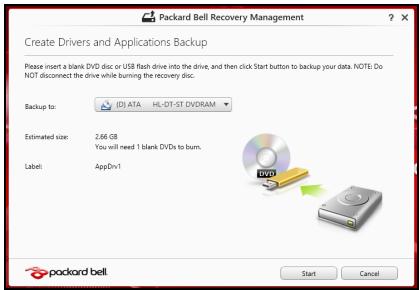
-
Haxmte Nyck, yTo6bI cKOnIpoBaTb faiJIb. Ha 3kpaHe 6ydet OTo6paXaTbCxaOxD BblONHHeHHpe3epBHOr KOInpOBAHH.
-
BbIopHnTe yka3aHnna IJy 3aBepSeHn npoceca:
-
Ecnn nCnOJIb3yTe ONTnueckne DNCKN,TO JIoTOK npINBOda 6yDet OTKpbIBaTbcra Nocne 3aIncn KaJDoRo DNCKa. N3BNeKInTe DNCK N3 npINBOda NOMeTbTe erO nepMaHeHThBIM Mapkepom. Ecnn HuxH0 3aIncatb HeCKOnbKO DNCKOB,TO,yBnDeB ppeJIOxKeHne Ha 3kpaHe, BCTaBbTe CNeDyuOuN MnCK N HaxMITE OK. PpoJOnJaTe 3Tu DeIcTBn, NOka npOcecc He 3aBePunTCra.
- Ecπn nCπoJb3yeTe USB-haKoπIeJIb, To OTcoEπHInTe erO nHaHeCnTe Ha Hero YeTkyo MapKnIpOBKy.
Baxho! HanuHnte Ha KaXdOM DnCKe NOHrTHbI TeKCT, HAnpImep, "Pe3epBHaJ KOnNJa DpaBepOB N npNJIOxHeHn". CoXpaHnte 3Ty pe3epBHyU KOHNo B HaJeXHOM MecTe n 3aONMHnte 3TO MeCTO.
BocctaHOBJeHne cIcTeMbI
IopraOK BOCCTaHOBHeHnCnCTeMbI:
- UctpaHnTe MeIknIe npo6IeMbI.
EcnB03HnKHyT HeNoJaKn B pa6Ote TOnbKO OndHO NIn DByX npOrpaMMhBix NIn annapaTHbIX KOMNOHETOB, TO npo6JeMy MOxHo peuNTb nepeycTaHOBko 3TNx nporpaMM NIn dpaBepOB yCTpoiCTB. IopraDOK BOCCTaHOBJeHnI PO n dpaBepOB, ppeyctaHOBJeHHbIX Ha 3aBOe-13rOTOBHTeNe, CM. B pa3dJe "PepeyctaHOBka dpaiBepOB n npinloKeHn" cTp.77.
- C6poc cnCTeMbI do nepBOHaayJIbHOro COCTOaHnIy.
Ecni HnTu He nomoraet ycTpaHnTB npo6IeMy n Bbl XOTNe BbINOHNtB c6poc cnCTembl Do n3HaayJIbHOcOCTOHNr C 3aBOIDCKIMN HaCTpoiKaMn, To CM. pa3JeI "BocctaHOBJeHne cnCTembl Do nepBOHaayJIbHOro coCTOHNr" Ctp.82.
IpeyectaHOBka dpaBepOB n npNJoxeHn
B KaueCTBe OndHou n3 Mep yctpaHeHn HeNCpPaBHocTe MoKet IOnaIobntbcra NepeycTaHOBka npInIOxKeHn N dpaBepOB yCTpoiCTB, n3HaayJIbHO yCTaHOBJIeHHbIX B KOMNbIoTepe npEero n3rOToBJIeHN. JIpy NepeycTaHOBKn MOxHO NcNoJIb3OBAt b JIN6O JeCTKn DnCK, JIN6O CO3dAHhble BamN pe3epBhble KOHN.
-Дугпірпложеня -ЧтобіпpeyectановьпpoрразмУ,ИЗначальНо He yCTaHOBJIeHHyU B KOMMbItepe, BAM 6yIeT HxKHO BbIOnHHTb yka3aHЯ NO yCTaHOBKe TAKOДnporpaMMbl.
Hobbie npaibepbI yctpoiCTB -yTO6bl nepeycTaHOBNbI dpaibepbI yctpoiCTB, n3HaayJIbHO He yCTaHOJIeHHbIX B KOMlbIOTepe, BAM 6ydet HxKHO BbIPOJHNITb INCHpyKcIMN I3 pyKOBOIDCTBa Ha 3TO yCTPOICTBO.
Ecni ebl ebinoHnYe me nepeymaHOy npu nomou Windows, a unhopmaue dner oocmaHOeHua xpaHumc E Komlbomepe:
- Ha зкpane Пуск В蜱дпге "Recovery" и заlem в спиcke приложенй нажмпге Packard Bell Recovery Management.
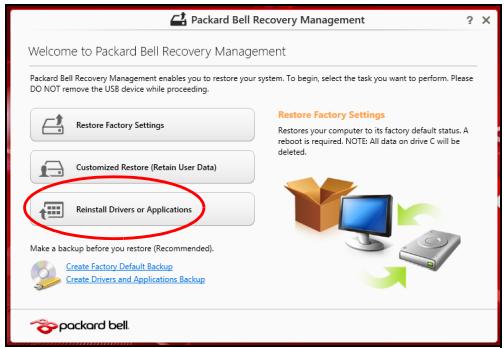
- Haxmnte PepeycaHOBtB dpaBebpI nII npInOKeHn.
-Должен OTKpbITbCЯ pa3дeн Содерхане OKha Packard Bell ZeHtp pecypcoB.
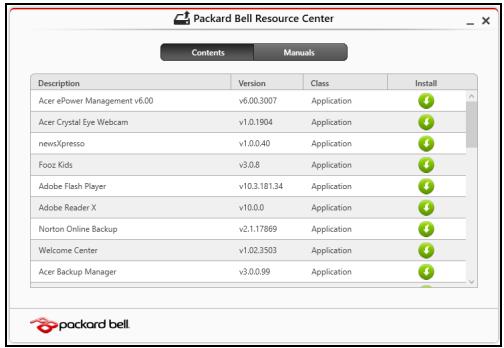
HaxMnte 3HaQOK yCTaHOBnTB dIy 3JIeMeHTa, KOTOpbI XOTnTe yCTaHOBnTB, 3aTeM cIeIyIte 3KpaHHbIM yKa3aHnAM dIy BblONHeHnY yCTaHOBKn. NOBtOpTE 3TN DeIcTBnI dIy BCEx 3JIeMeHTOB, KOTOpbIe XOTnTe nepeyCTaHOBnTB.
Ecnu bblbnoJHme nepeycmaHOeK npu nOou pe3epHoKoUU dpauBepoe u npuLoKeHu, 3aIucnHou Ha DVD-ducke unu USB-Hakonumene:
-
BctaBbTe dNcK Pe3epBHaЯ konna dpaBepOB n npInloKeHn B npINBOd INCKOB INI INoDKJIIOHTe HAKONITeB BCBO6OHN pa3beM USB.
-
Ecni Bbl BCTaBnIi DVD-DnCK, To DoXdntecb OTkpbltna OKHa Packard Bell LcHtp pecypcoB.
-
Ecni OKHO Packard Bell ΚeHTp pecypcoB He OTKpoEeTcABTOMaTnueckn, TO HaxMnte KJIaBmUu Windows +
, 3aTeMДВaJkDbl ΜeJIKNHe 3HaOK npINBOda ONTNuecknx DnCKOB. -
Ecni nCnoIb3yeTe USB-haKoNITeIb, To haxMnTe KnaBnWiin Windows +
, 3aTeM DbaXdbI uenKHNte HaKoNITeJIb, Ha KOTOpOM 3aIncaHa pe3epBnA konIIy. DbaXdbI uenKHNte 3NaUOK UeHtp pecypcoB.
2.Должен OTKpbIbTbCpa3dEeN CopepxaHne OKHa Packard Bell LeptppecypcoB.
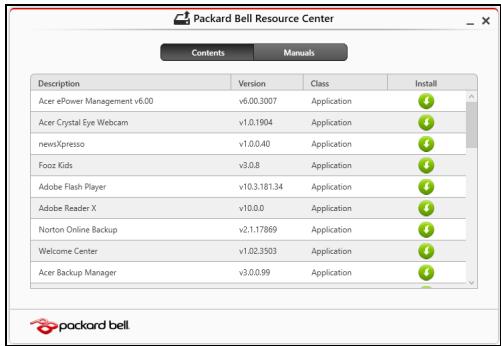
- Haxmte 3NaOK yCTaHOBnTb Дя 3JIeMeHtA, KOToPbI XOTnTe yCTaHOBnTb, 3aTeM CJIeDyIe 3KpaHHbIM Yka3aHnI M NO BblIOJIHeHIO yCTaHOBKn. IOBTOPIte 3TN DeIcTBnI DJIa BCEX 3JIeMeHTOB, KOTOpbIe XOTnTE nepeyCTaHOBnTb.
Bo3BpaK npedeIyUeMy "MoneHtAlbHOMy CHIMKy" CnCTeMbI
Функця "BocctaHOBJIeHne CnCTeMbI Microsoft" nepNoJnueckn DeJaet "MomeHTaJIbHbIe ChIMKn" napameTpOB n HactpoeK BaIeN CnCTeMbI n COxpaHReT Ix KAK ToUKN BOCCTaHOBJIeHn. B 6oJIbShINHCTBe CnyuAeB CLOXHBIX npO6JIem C npOrpAMMaMn DJIY BOCCTaHOBJIeHn pa6OTocIOcO6HOCTn CnCTeMbI MoXHO BepHyTbcr Ha OdHy IIn NHeCKOJIbKO 3Tnx TOUeK BOCCTaHOBJIeHn Ha3aI.
CnCTema Windows aBTOMaTnueckn CO3daET DOnOJIHnTeJbHyIO TOOKY BOCCTaHOBJIeHnE He ToJIbKO exKeIHeBHO, HO I npN yCTaHOBKe KaKdoH IOBOI npOrpAMMbI INI dpaIbEpa yCTpoIcTba.
Пи汞Hue:TO6bI pOcMOTpeTdoONHtEhBhIe CBeHnO6 McNoJIb3OBaHmNФyHKuIN "BocCTaHOBJeHne CnCTeMbIMrOsoft",Ha 3KpaHe Nysk BVEdnte "CnpabKa" n 3aTeM B cInsKe npInIOxHeHn HaxMITE CnpabKa n NOdepXka. B OKHe nonCKoBO r 3anpoca CnpabKn BVEdnte "BOcCTaHOBJeHne CnCTeMbI Windows" n HaxMITE KJIaBnUy Enter.
Bo38pam K moyke boccaMaHoEneHua
- Ha экpahe Пуck BВeДиTe "Пань упавлени" И 3aTeM B CпИСКЕ npиLOжени НжмITE Paнь упавлени.
- HaxmTe Cnctema n 6e3oNaChocTb > LcHtp noDpeKKn, 3aTeM BHN3y OKHa HaxmTe BocCTaHOBJeHne.
-
HaxmTe 3anyck BOCCTaHOBJeHnC nCTeMbI, 3aTeM DaJee.
-
Haxmnte camyio nocJeHHIO TOky BOCCTaHOBJIeHnra (Ha TOT MOMENT, KOrda Ba7a CnCTema pa6oTana npabUNbHO), Haxmnte Danee n 3aTeM FToTOBO.
5.B OTPbIbIeMcR OKHe c 3aIpOcOM Ha NOITBepKJdeHne HaxMMte Da. Pocne 3TOro CnCTema 6yDet BOCCTaHOBNeHa C NcNoJIb3OBAHNem yka3aHHoB BamN TOChN BOCCTaHOBNeHn. 3TOT IpoUeCC MoKeT 3aHrTb HeCKoJIbKO MmHyt INOTpe6oBaTb nepe3arpy3Kn KOMNbIoTepa.
BocctaHOBJIeHne cncTeMbI do nepBOHaayJbHoro COCTOHNIA
EcnB KOMNbItepe BO3HKnHyT npo6JIembl, KOToPbIe He ydaCTcayCTpaHnTb DpyrIMN CnOCO6aMNI, TO, BO3MOxHNO, NOHaIO6bNTcAnepeyCTaHOBnTb CNCTEmY CEJIKOM, YTO6bl BOCCTaHOBnTb eeN3HaayAbHoe COCTOHN. JIBy BOCCTaHOBNeHMy MOXHO NcNoJIb3OBaTb JIn60 JeCTKm DNCK, JIn60 Co3DaHHbIe BamN pe3epBHbIe KOnIN dJaBOCCTaHOBJIeHn.
- Ecni cnCTema Windows eue 3aynckaetc, n BbI He ydaJIIN Ha JxecTKOM DNCKe pa3deI BOCCTaHOBJIeHn, TO CM. pa3deI "BocctaHOBJIeHne n3 camo cnCTembl Windows" ctp. 83.
- Ecni cnctema Windows He 3anyckaetcra, a opnHnaJIbHbI JxecTkIn DnCK 6blI PONHOCTbIO nepeΦopMaHTPOBaH NII 3aMeHeH, TO CM. pa3JeI "BocTaHOBJIeHne n3 pe3epBHOJ KOHN dJa BOCCTaHOBJIeHnA" cTp.87.
BocctaHOBHeHne n3 cAmO cnCTeMbI Windows
3anycntte prniloxeHne Packard BellRecovery Management:
- Ha захане Пусяк В蜱Enumе "Recovery" и заlem в списке пиюжень нахшtene Packard Bell Recovery Management.
IpeDyucMOTpeHo DbA cnoc6a - BocCTaHOBJIeHne 3aBOIDcKnx yCTaHOBOK (C6poc PIK) nIIn HAcTpaINBaEMoe BOCCTaHOBJIeHne (O6HOBNTb PIK).
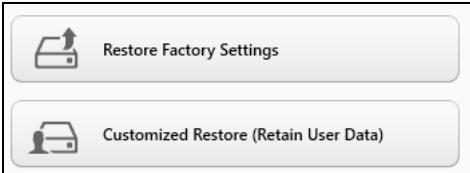
Функиь ВocstahOBlenhe 3aBODckx yCTAHOBOK ydaJIIT BCE daHHbIe C JecTKORO DNCKA, 3aTeM nepeyctahOBNT Windows N BCE npdeYCTaHOBLeHbIe B KOMpbIOTepe nporpaMMbl I dpaiBepbl. EcIIe esMe MOKHO OTKpbITb BaxHbIe paJIbI Ha JecTkom DnCKe, TO npraMo ceuac CO3daiTe INx pe3epBhIe KOJIIN. CM. pa3dJe "BocstahOBlenhe 3aBODckx HacTpoEk pRn NOMOUI npriLoXeHnja Packard Bell Recovery Management" cTp.84.
Функця HabtpanBaemoe BOCCTaHOBJIeHne NObIaTeCry COxpaHITb BaunФайы (noJb3OBAteJIbCKNe DaHHbIe), HO NepeyctaHOBIT BCE nporpamMbI n dpaIbEbpI. IprpamMbI, yCTaHOBJIeHHbIe BamN NOcIe NOKyIKN Pk, 6yDyt ydaJIeHbI (KpOME nporpaMM, yCTaHOBJIeHHbIX C caIHa Marazn Windows). Cm. pa3dEn "HactpanBaemoe BOCCTaHOBJIeHne npi nomoi npinloXeHnja Packard Bell Recovery Management" cTp.86.
1. Haxmnte BocctaHOBNTb 3aBOckne HaCtpoKn.
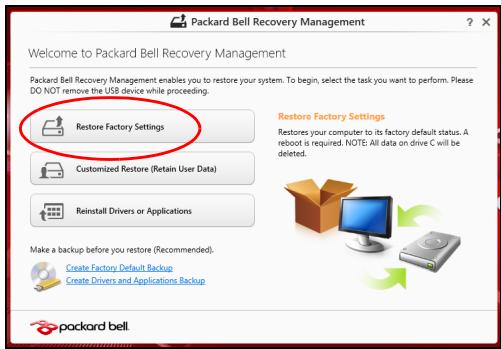
BHHMaHHe!ФункцЯ "BocctaHOBHTb 3aBOdCKne HacTpoiKn" cotpeT BCE paIJIbI Ha JxecTKOM DnCKe.
2. OTPpoeTc8 OKHO C6poc PIK.
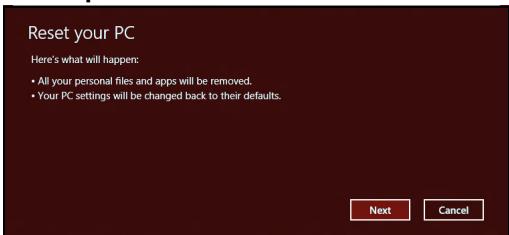
Inniocmppau npueedeh moIbko dna cnpaeku.
- Haxmnte Danee n BbIbepeTc cnooc ydaJIeHna qaiIOB:
a. YdaNTb TOnbKO MON ΦaJIbI - 6bICTpoe ydaJIeHne BCex φaIIIOB IpeEi BOCCTaHOBJIeHNEM KOMNbIOTepa; TaKoe ydaJIeHne 3aHIMaET OKOJIO 30 MInHyT.
b.ПОЛHOCTBIO OUHCTNtB DnCK - NOJHЯ OUHCTKa DnCKa NOCNe YdaJIeHnK KaJDoR OpaJIa, YTO6bI NocNe BOCCTaHOBJIeHn Hn OdINH CTapBI OpaJI HeJIb3a 6bIIO IpOuHTaTb. OUHCTKa DnCKa 3aHmMaET HamHOrO 6oJIbWe BpemeHn (do 5 yacOB), HO 3To HAMHOrO 6oJee 6e3OnaChbI CnOCo6, TAK KAc CTapBle PaJIbI yDaJIaHOTc8 6e3BO3BpaTHO.
4. HaxmTe C6poc.
5.B npocece BocTaHOBNeHn CHaJa npon3oJTe nepe3arpy3ka KOMNbToTepa, a 3aTeM NaHHeTcK OIpnoBaHne paJIIOB Ha JecTkni DnCK.
6. После завршени BOCCTaHOBJIeHЯ Bbl CMOKeTe Haaytbpapoty c KOMNbIOTepom, NOBTOpNB DeiCTBnY, BblIOJHReMbIe Ppi NepBOM 3anycke.
1. Haxmnte
HactpanBaemoe
BOCCTAHOBJIeHne
(coxpaHntb
N0lb3OBaTeNbckNe daHHbIe).

Packard Bell Recovery Management
?X
Welcome to Packard Bell Recovery Management
Packard Bell Recovery Management enables you to restore your system. To begin, select the task you want to perform. Please DO NOT remove the USB device while proceeding.

Customized Restore (Retain User Data)

Reinstall Drivers or Applications
Make a backup before you restore (Recommended).

Create Factory Default Backup
Create Drivers and Applications Backup

packard bell
Restores your computer to its factory default status. A system is required. NOTE: All data on drive C will be deleted.
2. OTKpoEcra OKHO O6HOBITb PIK.
Refresh your PC
Here's what will happen:
- Your files and personalization settings won't change.
- Your PC settings will be changed back to their defaults.
- Apps from Windows Store will be kept.
- Apps you installed from discs or websites will be removed.
A list of removed apps will be saved on your desktop.
Next
Cancel
3. Haxmnte Danee, 3aTeM 06HOBntb.
4.B npocece BocctaHOBHeHn CHaJaI npOn3OJTe nepe3arpy3Ka KOMpbTope, a 3aTeM NaHcHTcK OKnIpOBaHne PaJIOB Ha JKeCTKN IINCK. 3TOT npoeec 3aHmMaET OkOIO 30 MNHyT.
BocctaHOBJIeHne n3 pe3epBHOJ KOHN dJa BOCCTaHOBJIeHnA
Iopraok BocctaHOBJIeHnI 3 pe3epBHOJ KOII, 3aIIscAHHOJ Ha USB- NaKoITeJIe:
- HaniTe pe3epBHyIO KOINIO JIa BOCCTaHOBJIeHnI.
- BCTaBbTe USB-нakОпnteBJи BKJIIOHnTe KOMIbIOTep.
- BKHIOHTe F12 Boot Menu (MeHIO 3aapy3ku F12), ecn oHO eue He BKLIOUcHo:
a.Bo Bpem 3arpy3kn KOMnbTepa HaxMnTe KnaBnUp
b. HaxaTneM KnaBnS CO CTeJIkAmN BHeBO NIn BnPaBO BbIbepnte MeHIO Main (TnaBHOe).
c. HαkaTneM KλaBùnùn CO CτpeIκOι BHN3 BbI6epNte F12 Boot Menu (MéHIO 3arpy3Kn F12), 3aTeM HαχMnte KλaBùnùy
d. HaxaTneM KnaBnS CO CTpeJIkAmN BnEBO NnBnPaBO BbIbepnte MeHIO Exit (BbIXoJ).
e. B 3aBnCmOCTn OT Tnna CnCTEmbl BIOS BaWero KOMNbIOTepa BbIbepnte Save Changes and Exit (CoXpaHNTb n3MeHeHn y BbIITn) nIi Exit Saving Changes (BbIHTn, coXpaHNB n3MeHeHn) n HaxMITE kJIaBnUy Enter. IJRA NOITBepKdEHNr HaxMITE OK nIi Yes (Ja).
f. KomnboTep nepe3arpy3ntcra.
4.BoBpem3arpy3Kn Haxmnte KnaBnuy F12>,YTO6bl OTKpbItb MeHIO 3arpy3Kn.B MeHIO 3arpy3Kn MOxHO BbI6paTb yCTpoiCTBO,C KOtOporo cNeDyET 3arpyKaTbCra, HanpImep, USB-HaKoNITeJb.
a. HαkaTne KλaBιu co cTpεπΚaΜι BbIeJIηTe cTρογk USB Device (USB-устpoиCTBO), 3aTeM HαχΜιTe KλaBιu ηU Enter.
b. BmecTo 06bIChNo 3aRpy3Kn npOn3oJTeT 3aNyck Windows c pe3epBHO KONIN BOCCTaHOBJIeHnI.
5. BbIbepuTe TnKJIaBnaTpybl.
6. BbIbepnTe Troubleshoot (YcTpaHenne HeucnpaBHOCTe) n 3aTeM BblbepnTe HxKhbl TIN BOCCTaHOBJIeHNA:
a. Haxmte DoonHnTeIbHo n 3aTeM BocCTaHOBHeHne CnCTeMbI, yTObI 3aNyCTnITb fYHKUIO "BocCTaHOBHeHne CnCTeMbI Microsoft": FyHKUIN "BocCTaHOBHeHne CnCTeMbI Microsoft" nepNoDnueckn DeLaet "MomentaJIbHbIe CHUMKn" napameTPOB n HacTpoE K BaSei CnCTeMbI n COxpaHReT INK KAK TOUY KBOcCTaHOBHeHn. B 6OJbShnHCTBe CnyAeB CNOXhBX INpO6LnEM C npOrpAMMaMn dIn BOCCTaHOBHeHn paOToCnOco6HOCTn CnCTeMbI MoXHO BepHyTbcr Ha ONDy IIN HeCKoJIbKO 3TNX TOUY EK BOCCTaHOBHeHn Ha3ad.
b. Haxmte C6poc PK, YTO6bl HAaTb npoecc c6poca NaCTPOeK:ФyHKUJN C6poc PK ydaIHT BCE DaHHbIe C JecTKOro DNCKA, NOCLe 3TOrO 6ydyT nepeycTaHOBJIeHbI CNCTema Windows n BCE npeducHOBJIeHbIe B KOMlbHOtepe IporpaMMbl I dpaBepbl. EcnI eue MoKHO OTkpblb BaxHbIe paJIbI Ha JecTKOM DNCKe, TO npraMo Ceuac CO3DAaTe INX pe3epBHbIe KOHN. CM. pa3dEIN "C6poc PK n3 pe3epBHOJ KOHN BOCCTAHOBJIeHn" cTp.89.
c. Haxmte O6HOBnTB PK, YTO6b HAaTb npocecc
OBHOBJIeHn:AyHKUa
06HOBtB PK nonbItaeTcOxpaHnTb BaIu 7aJIbI (noJIb3OBAteJIbCKne daHHbIe), HO nepeyCTaHOBt BCE nporpAMMbI n dpaIbepbl. PporpAMMbI, yCTaHOBLeHHbIe BamN nocJe nokyPkN PIK, 6byt ydaJIeHbI (KpOME nporpaMM, yCTaHOBLeHHbIX C caITa Mara3Ha Windows). CM. pa3dEn "06HOBlenHe PIK n3 pe3epBHOJ KOHN BOCCTaHOBJeHNA" cTp.91.
C6poc Pk u3 pe3ep8Hou konuu boccmaHo8neHu
BHHMaHHe! Pn c6pOce PIK 6yDyT ydaJIeHbI Bce paJIbI Ha JxecTKOM dNcKe.
- OTPkoetcOKHO C6poc PK
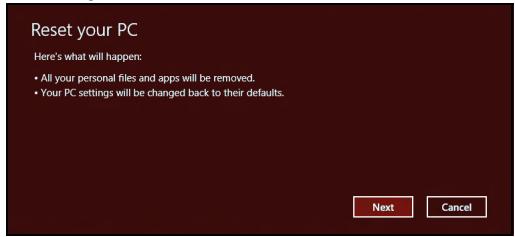
Innocpau npueedehbl monbko dncpaKu.
- Haxmte Danee.
-
Bыберпе onepaunOHHy cncTeMy Дя BOCCTaHOBJeHn (ObIyHO DoCTyneH TOnbKO OINB BapnaHT).
-
BbI6epnte coXpaHeHne BCex n3MeHn, npOn3BeDeHHbIX C JxecTKIM DnCKOM:
a. Ecπn Bbl ydaIINn Ha JxecTkOM DnCKe pa3dEIN BOCCTaHOBJIeHNr IIN npyTm CnOCoBOM n3MeHInn pa3dEbl JxcTKOrO DnCKa N XOTnTe COxpaHnTB 3TN n3MeHeHnR, TO BBiBePnte HeT.
b. YTo6bl NJIHOCTbIO BOCCTaHOBNTb KOMIbIOTep Do COCTOARHn3aBOIDCKNX HAcTPOEK, TO BBIEpePnte Da.
- BbIbepeTe cnooc ydaIeHna faiIOB:
a. YdaIHTb TOnbKO MOn ΦaJIbI - 6bICTpoe ydaJIeHne BCEx φaIIOBперд BOCCTaHOBJIeHnEM KOMNbIOTepa; TaKoe ydaJIeHne 3aHIMMaET OKOJIO 30 MNHyT.
b.ПОЛHOCtIbO OUHCTMbDCK - NOJHЯ OUHCTKa DnCKa NOCJe UdaJIeHnK KaJDoRo FaJNa, YTO6bI NocNe BOCCTaHOBJIeHn HN OdINH CTapbI KafJI HeJIb3a 6blIO npOuHTaTb. OUHCTKa DnCKa 3aHIMaET HamHOrO 60JIbWe BpemeHn (do 5 yacOB), HO 3To HAMHOrO 6oJee 6e3OpaChbI CnOCo6, TaK KaK CTapbIe FauJIbI ydaJIaOTcR 6e3BO3BpaTHO.
- HaxmTe C6poc.
- После заBERшеня BOCCTaHOBJIeHЯ Bbl CMOKeTe Hauatb pa60Tu c KOMNBIOTepOM, NOBTOpNB DeiCTBnR, BblIOJHReMbIe Ppi nepBOM 3anycke.
OboeHue PIu3 peepohou konuu 8occmHOeHua
- OTKPOEcra OKHO 06HOBntb PIK.
Refresh your PC
Here's what will happen:
- Your files and personalization settings won't change.
- Your PC settings will be changed back to their defaults.
- Apps from Windows Store will be kept.
- Apps you installed from discs or websites will be removed.
- A list of removed apps will be saved on your desktop.
Next
Cancel
- Haxmte Danee.
- BbI6epnte OnpaunOHyCnCTemy IJI BOCCTaHOJIeHn (ObIuHO IOCTypeH TOJIbKO OINH BapnaHT).
- Haxmte 06HOBTb.
5.B npocece BocctaHOBnEHH CnaHajna npon3OJTe npe3arpy3Ka KOMNbIOTepa, a 3aTEM NaHHeTc KOINPOBaHne paJIIOB Ha JecTkN IINCK. 3TOT npoeecc 3aHnMaet OKOLO 30 MNHyT.
Часто задаваемble Ворpoсы
Danaee npBBeDen CnNCOK BO3MOXHbIX CNTyaCNI, KOToPbIe MOrYT BCTpeTntbcra Pn PONb3OBAHN BaUNM KOMNbIOTePOM. JIa KaJDoI CNTyaCNI npBBeDeHbI IpocTbe OTBeTb I peSeHnI.
Iocne 6KJIouHeHnmaHn KOMNbIomep He 3aNyckaemc uU He 3aepykaemc
B3rIyHnTe Ha nHdNkAtop Power (IITaHne):
-
Ecni OH He CBeTnTcra, NiTaHne Ha KOMNbIOTep He nOdaHO. IpoBepbTe cJeDyUoUee:
-
Ecπi Bbl pa6oTaTe OT aKKymyIaTopa, 3TO MOKeT O3HaaytB, yTO eRO 3apJn Hn3Km I HeCNoCo6eH nITaTB KOMbIbTe. POnkJIIOuHTe aadAnTeP nepemehHOrO ToKa, YTObIb 3apJnTb aKKymyIaTOp.
-
Поберъправиьhoeьи Наджhoeьи подюченя залтета пелемногToka K komblOTepу N к сеТбоВ розтke.
-
Ecπn ένικαTOp CBetntcπ, προΒεpbTe cπeúθuεe:
-
EcTB Ли ДИСКВ РпИВОдЕ ONТИЧЕСКИХ ДИСКOB? ИЗВЛЕКИТЕ erо И НAZKMITE
+ + , Утобblеpe3aRpy3nITb CnCTeMy. - BCTabIeH JI B KOMNbIoTeP USB-NaKoNtTeIb (USB-Dnck nIIcMaprTfOH)? OToCoEiINHnte erO n HaxMnte
+ + , yTO6bl Ipepe3arpy3ntb cncTeMy.
Hem u306paxeHua Ha 3KpaHe
CnCTema ynpabJIeHnI\PntaHnEM KOMnbIOTepa aBTOMaTnueCKN OTKJIIOHaET DIncPJIe IJRA 3KOHOOMn 3JeKTPo3Heprn. Haxmnte NIO6yIO KnaBnUy, YTO6bI BkJIIOHTb DIncPJIe.
Ecnnaatne KnaBnHn He Bo3Bpaaet Dncnpe B pa6oyn peKIM, BO3MOXHbI DBe npuHbl:
- UpoBHeH JRPoCTn MoKet 6bIb CJIiUkOM Hn3Ok. HaxMnte (yBeJIuHTb), YTO6bl IOBbICHTb yPoBHeH JRPoCTn.
B KaueCTBe yCtpoCTBa OTo6paXeHnMa MOr 6bITb BbIbpaH BHeUHm MOHnTOP. UTo6bl DInCpJIeN PepeKJIIOuHTb CHOBa Ha KOMNbIoTeP, HaxMNTe - EcJn rOpNT nHdNkAtop pexKMa cHa (Sleep),To 3TO 3NaHT,TO KOMNbIbTeP hXoDITcB PexKMe cHa.ДЯ BO3ObHOBHeHra pa60TbIB O6bIyHOM pexKMe HAXMITE N OTnyCTnte KHOJIky PtntAHnI.
Kombioomep He 6ocnpou3o0dum 3eyk
PpOBepeTcIeDyUouee:
- PpOMKocTb MoKet 6bIb OTKJIouheHa. B Windows, IocMOTpIte Ha 3HaQoK peYJrTOpa rpOMKoCTn (DINHAMIK) B NaHeJI 3aJaUc. EcNI OH nepeuepkHyT, To HaxMtTe 3HaQoK n CHmIte fJaXoK BbIK. BCE.
-
UpoBHeHb rPOMKoCTn MoXeT 6bITb CJIuKOM Hn3Ok. B Windows, PocMOTpIte Ha 3NaUOK peYJrTOpa rPOMKoCTn B paHeN 3aJaU. OtperyJInPoBaTb rPOMKoCTb MOxHOb TaKKe KHOJkAmn peYJInPoBKn rPOMKoCTn.
-
Ecπn rɔlOBhblte TeneΦoHbI, HayuHnKn nJIn BHeuHne DnHaMnKn PoiKJIIOUeHbI K pa3BeMy IINHeiHOr BOxOda nepeDHeN KOMNbIoTepa, To BHyTpEHHne DnHaMnKn aBtOMaTUnCeCKN OTKJIIOUaIOTcR.
Ecnu 2oIosHbIe meNefoHbI. HayuHuku unu eHeuHue duHaMuku NODKIOUeHbI K pa3bemy luHeuHOo 6bIXOda nepeDHeu KOMIbIomepa, mo EhmpeHHue duHaMuku aeomamUuecku omKnIOuaIOMc
Ha npINBOe ONTNUeCKNX DNCKOB eCTb OTBepCTne IJRA MEXAHUweCKORO n3BJIeueHnra DnCKa. YTO6bI BblDINHyTb IOTOK, BCTaBtBe B 3TO OTBepCTne KOHcIK CTePjXHr ShapNKOBOn pyuKn INN KaHcJIepCkyo CKpeNky N HaxMNTe.
Knaasuamypa He peaaupyem
3aHem HxKeH HOBbI INHTepFeic?
Hob布局中Teppein DnWindows 8 pa3pa6oTaH CneuaJIbHO nIaCeHCOPHOrO ynpabLeHn. PpIoXeHn I3 Mara3Ha Windows 6yDyT abTomatUcEckn NcNoJIb3OBA Tb BeCb 3KpaH, INx He HJxHo 3aKpbIbTa b O6bUHbIM cNoCobom. PpIoXeHn I3 Mara3Ha Windows 6yDyT OTo6paKaTbCa Ha 3KpaHe PycB B VIne "DINHAMueeCKNX pIITOK".
Umo makoe "duHaMuueckue nIumKu"?
"Диhamчecne пNTkn (Live tiles)" analorunhbl 3ckn3am npInIOxehn, OHI 6byt OOBNtBcra C HObIM COdepKIMbIM KaJdbI pa3, KOrda Bbl IOdkJIIOyaeTecb K INHTepHeTy. IOnTOMy Bbl CMOxete, HAnpIMep, INpOCMaTPnbAtb ObHOBNeHHbIe MeTeOCBOdKn NII INbpXeBbIe KOTnpOBKn, He 3aIpycka COOTBeTCTByIoUcne npInIOxehn.
Kak pa36JokpoBaTb KOMNbIOpTeP?
YTo6bl pa3bIOKIpOBaTb KOMNbIOpTe, HaxMITE IIO6yU KJIaBnUy N HaxMITE 3HaOK NOIb3OBaTeIbCKoY UyeTHoN 3aIncN. EcIn dIyUyeTHoN 3aIncN yCTaHOBJIeH npOJIb, To dIy IpoIoJKeHry HxKHO BBeCTN 3TOT npOJIb.
Kak hactpontb KOMnbIOTe pcoJIacHO MOH npednoTHeHnM?
Moxho Hacptonb 3KpaH Pyck, yCTaHOBnB pa3JIuHhIe foHOBblE n3O6paXeHnI, nIynpAIOUHTb IINTKN B COOTBeTCTBn C BaIIMN npednoTuTeHnAMn.
UTo6bI n3MeHnTb foHOBOe n3o6paXeHne, HaxMnte KJIaBnWiN Windows +
Kak nepemewambnnumku?
Haxmnte uyepeKnBaTe nnTky, TTObI BbIbpaTbe ee, 3aTe m nepeTaunTe ee Ha HxKHOe MecTo Ha 3KpaHe Nyc. Dpyrne nnTKn CdbHyTCy, TTObI 3Ta nnTKa BCTana Ha HOBOE MecTo.
Kak denamb nnumku kpynhee unu menbue?
The FCC with its action in ET Docket 96-8 has adopted a safety standard for human exposure to radio frequency (RF) electromagnetic energy emitted by FCC certified equipment. The wireless adapter meets the Human Exposure limits found in OET Bulletin 65, supplement C, 2001, and ANSI/IEEE C95.1, 1992. Proper operation of this radio according to the instructions found in this manual will result in exposure substantially below the FCC's recommended limits.
- The following safety precautions should be observed:
Do not touch or move antenna while the unit is transmitting or receiving.
- Do not hold any component containing the radio such that the antenna is very close or touching any exposed parts of the body, especially the face or eyes, while transmitting.
- Do not operate the radio or attempt to transmit data unless the antenna is connected; this behavior may cause damage to the radio.
Use in specific environments:
- The use of wireless adapters in hazardous locations is limited by the constraints posed by the safety directors of such environments.
- The use of wireless adapters on airplanes is governed by the Federal Aviation Administration (FAA).
- The use of wireless adapters in hospitals is restricted to the limits set forth by each hospital.
Antenna Use
In order to comply with FCC RF exposure limits, low gain integrated antennas should be located at a minimum distance of 20~cm (8 inches) or more from the body of all persons or at a minimum distance as specified by the FCC module grant conditions. FCC grants can be viewed from the FCC Equipment Authorization website at https://fjallfoss.fcc.gov/oetcf/eas/reports/GenericSearch.cfm by entering the FCC ID printed on the module label.
Explosive Device Proximity Warning
Warning: Do not operate a portable transmitter (including this wireless adapter) near unshielded blasting caps or in an explosive environment unless the transmitter has been modified to be qualified for such use
AntennaWarnings
- Warning: To comply with the FCC and ANSI C95.1 RF exposure limits, it is recommended that for the wireless adapter installed in a desktop or portable computer, the antenna for this wireless adapter to be installed so as to provide a
separation distance of at least 20 cm (8 inches) from all persons or at the minimum distance as specified by the module grant conditions. FCC grants can be viewed from the FCC Equipment Authorization website at https://fjallfoss.fcc.gov/oetcf/eas/reports/GenericSearch.cfm by entering the FCC ID printed on the module label.
- Warning: The wireless adapter is not designed for use with high-gain directional antennas.
Use On Aircraft Caution
- Caution: Regulations of the FCC and FAA prohibit airborne operation of radio-frequency wireless devices (wireless adapters) because their signals could interfere with critical interference with critical aircraft instruments.
Local Restrictions on 802.11a, 802.11b, 802.11g and 802.11n Radio Usage
- Caution: Due to the fact that the frequencies used by 802.11a, 802.11b, 802.11g and 802.11n wireless LAN devices may not yet be harmonized in all countries, 802.11a, 802.11b, 802.11g and 802.11n products are designed for use only in specific countries, and are not allowed to be operated in countries other than those of designated use. As a user of these products, you are responsible for ensuring that the products are used only in the countries for which they were intended and for verifying that they are configured with the correct selection of frequency and channel for the country of use. Any deviation from the permissible power and frequency settings for the country of use is an infringement of national law and may be punished as such.
Wireless Interoperability
The wireless adapter is designed to be interoperable with other wireless LAN products that are based on direct sequence spread spectrum (DSSS) radio technology and to comply with the following standards:
- IEEE Std. 802.11b compliant Standard on Wireless LAN
- IEEE Std. 802.11g compliant Standard on Wireless LAN
-
IEEE Std. 802.11a compliant Standard on Wireless LAN (applies to devices supporting 802.11a)
-
IEEE Std. 802.11n draft 2.0 compliant on Wireless LAN
- Wireless Fidelity certification, as defined by the Wi-Fi Alliance
The Wireless Adapter and Your Health
The wireless adapter, like other radio devices, emits radio frequency electromagnetic energy. The level of energy emitted by the wireless adapter, however, is less than the electromagnetic energy emitted by other wireless devices such as mobile phones. The wireless adapter operates within the guidelines found in radio frequency safety standards and recommendations. These standards and recommendations reflect the consensus of the scientific community and result from deliberations of panels and committees of scientists who continually review and interpret the extensive research literature. In some situations or environments, the use of the wireless adapter may be restricted by the proprietor of the building or responsible representatives of the applicable organization. Examples of such situations may include:
- Using the wireless adapter on board airplanes, or
- Using the wireless adapter in any other environment where the risk of interference with other devices or services is perceived or identified as being harmful.
If you are uncertain of the policy that applies to the use of wireless adapters in a specific organization or environment (an airport, for example), you are encouraged to ask for authorization to use the adapter before you turn it on.
FCC Radio Frequency Interference Requirements (applies to device supporting 802.11a)
This device is restricted to indoor use due to its operation in the 5.15 to 5.25 GHz and 5.470 to 5.725 GHz frequency ranges. FCC requires this product to be used indoors for the frequency ranges 5.15 to 5.25 GHz and 5.470 to 5.725 GHz to reduce the potential for harmful interference to co-channel mobile satellite systems. High power radars are allocated as primary users of the 5.25 to 5.35 GHz and 5.65 to 5.85 GHz bands. These radar stations can cause interference with and /or damage this device. No configuration
controls are provided for this wireless adapter allowing any change in the frequency of operations outside the FCC grant of authorization for U.S operation according to Part 15.407 of the FCC rules.
USA - Federal Communications Commission (FCC)
This device complies with Part 15 of the FCC Rules. Operation of the device is subject to the following two conditions:
- This device may not cause harmful interference.
- This device must accept any interference that may cause undesired operation.
- Note: The radiated output power of the adapter is far below the FCC radio frequency exposure limits. Nevertheless, the adapter should be used in such a manner that the potential for human contact during normal operation is minimized. To avoid the possibility of exceeding the FCC radio frequency exposure limits, you should keep a distance of at least 20cm between you (or any other person in the vicinity), or the minimum separation distance as specified by the FCC grant conditions, and the antenna that is built into the computer. Details of the authorized configurations can be found at http://www.fcc.gov/oet/ea/ by entering the FCC ID number on the device.
Interference Statement
This wireless adapter has been tested and found to comply with the limits for a Class B digital device, pursuant to Part 15 of the FCC Rules. These limits are designed to provide reasonable protection against harmful interference in a residential installation. This wireless adapter generates, uses, and can radiate radio frequency energy. If the wireless adapter is not installed and used in accordance with the instructions, the wireless adapter may cause harmful interference to radio communications. There is no guarantee, however, that such interference will not occur in a particular installation. If this wireless adapter does cause harmful interference to radio or television reception (which can be determined by turning the equipment off and on), the user is encouraged to try to correct the interference by taking one or more of the following measures:
-
Reorient or relocate the receiving antenna of the equipment experiencing the interference.
-
Increase the distance between the wireless adapter and the equipment experiencing the interference.
- Connect the computer with the wireless adapter to an outlet on a circuit different from that to which the equipment experiencing the interference is connected.
- Consult the dealer or an experienced radio/TV technician for help.
- Note: The adapter must be installed and used in strict accordance with the manufacturer's instructions as described in the user documentation that comes with the product. Any other installation or use will violate FCC Part 15 regulations.
Canada — Industry Canada (IC)
This device complies with RSS210 of Industry Canada. Cet apparéil se conforme à RSS210 de Canada d'Industrie.
-
Caution: When machine supports and using IEEE 802.11a wireless LAN, this product is restricted to indoor use due to its operation in the 5.15- to 5.25 GHz frequency range. Industry Canada requires this product to be used indoors for the frequency range of 5.15 GHz to 5.25 GHz to reduce the potential for harmful interference to co-channel mobile satellite systems. High power radar is allocated as the primary user of the 5.25 to 5.35 GHz and 5.65 to 5.85 GHz bands. These radar stations can cause interference with and/or damage to this device. The maximum allowed antenna gain for use with this device is 6dBi in order to comply with the E.I.R.P limit for the 5.25 to 5.35 and 5.725 to 5.85 GHz frequency range in point-to-point operation. To comply with RF exposure requirements all antennas should be located at a minimum distance of 20 cm, or the minimum separation distance allowed by the module approval, from the body of all persons.
-
Attention: l'utilisation d'un réseau sans fil IEEE802.11a est restreinte à une utilisation en interieur à cause du fonctionement dans la bande de fréquence 5,15 - 5,25 GHz. Industry Canada requiert que ce produit soit utilisé à l'intérieur desBATIMENTS pour la bande de fréquence 5,15 - 5,25 GHz afin de réduire les possibiltés d'interférences nuisibles aux canaux co-existants des systèmes de transmission satellites. Les radars de puissances ont fait l'objet d'une allocation primaire de
This Class B digital apparatus complies with Canadian ICES-003.
"To prevent radio interference to the licensed service, this device is intended to be operated indoors and away from windows to provide maximum shielding. Equipment (or its transmit antenna) that is installed outdoors is subject to licensing."
The use of these equipments is regulated by:
1.D.L.gs 1.8.2003, n. 259, article 104 (activity subject to general authorization) for outdoor use and article 105 (free use) for indoor use, in both cases for private use.
2.D.M. 28.5.03, for supply to public of RLAN access to networks and telecom services.
Pakistan Telecommunication Authority (PTA) Approved
Morocco
The operation of this product in the radio channel 2 (2417 MHz) is not authorized in the following cities: Agadir, Assa-Zag, Cabo Negro, Chaouen, Goulmima, Oujda, Tan Tan, Taourirt, Taroudant and Taza.
The operation of this product in the radio channels 4, 5, 6 and 7 (2425 - 2442 MHz) is not authorized in the following cities: Aéroport Mohamed V, Agadir, Aguelmous, Anza, Benslimane, Béni Hafida, Cabo Negro, Casablanca, Fès, Lakhab, Marrakech, Merchich, Mohammédia, Rabat, Salé, Tanger, Tan Tan, Taunate, Tit Mellil, Zag.
Japan
5 GHz 带は室内のは使用のと
Korea
当用,
Taiwan
第十二条
UHypbI nHTaHn I BNlKa
Y 3Toro yCTpoiCTBa aanTep nepemehHOro TOKa IMeet U Hyp n Bnky C 3a3emIeHneM. 3Ty Bnky MoXHO NQKIIOnuATb TOnbKO K 3a3emJIeHHbIM 3NeKTpopo3eTkAM. IpexKe Yem BCTabJTB BNky B 3NeKTpopo3eTKy, Y6eIInTeCb, YTO 3NeKTpopo3eTKa HndIeKaIIm M o6pa30m 3a3emIeHa. He BCTabJMy Te BNky B He3a3emJIeHHyO 3NeKTpopo3eTKy. O6paTntEcB 3a cnpaBko K KBaIINΦnIupOBaHOMy 3NeKTpNkY.
Длнаншура He длжна превшать 2,5 M. Вилбекане поалкеня злелкгческIM TOKOM He OTKlquаite n He ydaJIITE KOHTAKT 3a3eMneHnB B shHype пNTahnI. Пов配电ньшурпNTAHNHyKHO 3aMeHnTB.ДлЯ 3aMeHbIshHypa пNTAHNOBspATNEcB K npOdaBcy.ВЕрone Bvlnka shHypa пNTAHNJa DOnJXHa 6bITb paccHTaHa Ha nepemehHoe habpajekhenze 250 B nHa cnly Toka He MeHee 10 A. BUnka shHpya пNTAHNIDOnJXHa IMTeMapkpOBky COOTBetCTByUoIero MeKdYhapoDHoro areHTCTBa.Ин hypпNTAHNДОнЖENb6bITпprIoDeHДЯ NcNoIb3OBAHnB B cTpaHecKcnPlyaatauIN.Tin HynKHOShypaПNTAHNMOxHo YTOCHNb ynpOdaBa nI IN MeCThBix CneZnaJIInCTOB nO 3JIeKTPotexHnke.
Ka6eJn
Cbehenra O kaebnax, He BXOJauNX B KOMJIeKT NocTabKN KOMNbIOTepa:
3aBHeHbIe npaMeTpbl 3JIeKTPomarHHTHOI COBMeCTUMOCTn CNTeMbI rapaHTnpyOTcT OToBko Ipn NcNoIb3OBaHN 3kpaHnPOBaHHbIX Ka6eNe I INTEppeNcoB.
EkpaHnPOBaHbIe INHTepFeIChIbe KaBEn Tpe6yOTc Ia pa3bEmOB USB, IEEE1394, nocJeIOBaTeIbHorO INrPoBOrO NpOToB, pa3bEma PpiHTEpa, pa3bEMOB aHaIOrOBbIX IINu cNΦpOBbIX ayDIO/BnDEoYcTpoCtB, JOKaJIbHOI CETn Ethernet, npota PS/2; rHe3do TeNeBn3IOHHbIX IN YKB-aHTeHH, a TaKke pPaKTnueckn BceX BbICOKOCKOpocTHbIX Ka6eJIbHbIX INHTepFeIcoB.
IcnoJIb3yIte ToIbKO TeleKOMMHyNHaKaUOnHbIe KaBeJIIM MapKn UL 26AWG nI nyUwe.
YacTo 3aDaBaEmbIe BOpocbl. 92
A
BpeoHochIe nporpaMmbI 59
Брандмayр 60
Bpay3ep 57
TapaHTy 7
Bezonachoctb
ANTINBUPCHeI nporpaMMbl 60
OboBneHn 68
BnD
CneBa 24
cnpaba. 26
cpepi 24
BVD CnEBA 23
BnD cpeeni 23
akMyJrTop
3apya 44
n3BneueHne 43,44
PpeDynpexKdEHHe O Hn3kOM ypOBHe
3apya aKcyMnyTopa 45
PpOBepKa yPoBn 3apJa 44
nepBoe nCNoB3OBAHnna 41
Hn3Km ypoBHeb 3apra da 46
ONTNIM3aIur 44
xapakTepeuCTnKu 40
yBeIuHHe cpoKa cnJxKbI 41
yctaHOBka 43
aKKyMnyTOpbl 122
INHAMKIN
KOM6bHaCaJN KApBnU 20,21
yctpaHHeH HeNoJaOK. 93
Ducnnei
KOMBHaCmN KnaBnI 20
Ducnnnei
yctpaheHne HenoJaoK. 93
Dokymentaun
Be6-caT kompaHn Packard Bell ... 57
BocctaHOBJeHne
Iporpamma Recovery
Management. 50
Recovery Management 69
C
3apЯнka
npOBepKa ypoBnA 44
3ByK
yctpaHHe HEnoJaOk 93
D
DSL 52
E
Kabenn 10, 117
KlambnTypa
KOM6uHaucn KnaBnI 22
Kləbɪnɪtɪya
yctpaHene HenoJaok 94
JokalbHa cetb. 54
KOMbHaCNI KIaBNI 22
KOMNbIOTeP
INHdNKaTOp BKn. 23
xapakTepeNCTnKn 16
KOMnbIOpTePbI KOMNaKT-DnCK
pyuHoe n3BNeueHne 94
ycTpaHHe HenoJaok 94
Интерnet
Брандмayзр 60
PoiKJIIOUeHHe 51,52
Kypcop 30
1
PpeDynpexdHneBOTHOWeHH
3nnnneTnuecknx npnaKOB 15
PpmbOdbI
UcTpoIcTBo UTeHnKapT nAmrTu.... 33
nprntep
yctpaenhe HenoJaok. 94
PpOrpaMMHoe oBecneueHne
JIuueH3nHa nporpaMMHoe
obecneueHne 124
npo6JIembl 92
Dnscnnen 93
3anyck 92
KlaBnaTypa 94
KOMnbIbTePHyBI KOMnAaT-DnCK. 94
πρηntερ 94
Mepbl 6e3oNaChocTn. 8
O6HOBNTb
ABTomatUeCKne O6HOBJIeHnIa
Windows 68
O6cIyKuBaHne
Nporpamma Recovery
Management. 50
Recovery Management. 69 podkliuyeHn
HopmatBnaHnΦopMaun 103,121 ceTb 35
Подержka Tomexn 116
Be6-caT KOMpaHm Packard Bell ... 57 IocTaBzuk yCnyr INTepeHET (ISP)..... 51
MoDem 52,53 OxpaHa 3IopOBbY 13
N
cehcopnaheIb 30 ceTb 35
HcnoJIb3OBAHne 30 CmehHbIe HAKONITeIN 35
Cetebie nodknueHna 54 Norton Internet Security. 58,63
0
yHnBepcaIbHa nOcneIOBaTeIbHa YcNoBnI dIpa6oTbIC KOMnbIePoPOM....8
UHHa 36 UcTpoIcTBo UTeHnKapT nAmrtn. 33
UHpyI nHTAHN 10 yTIN3aun aKKyMylrTopOB 122
UcnoBna 3Kcnnyataunn 121
P
Packard Bell Веб-сан . 57 Management. 50
W
WiFi 54 ABTomatueckme oHOBJIeHnWindows Windows 68
Pabota B Windows. 50
Y
Rkoctb
KOMBnHaCmN KlaBnI 21
Karty SD, SDHC i SDXC
Packard Bell Recovery Management
Packard Bell Recovery Management
?X
Welcome to Packard Bell Recovery Management
Packard Bell Recovery Management enables you to restore your system. To begin, select the task you want to perform. Please DO NOT remove the USB device while proceeding.

Customized Restore (Retain User Data)

Reinstall Drivers or Applications
Make a backup before you restore (Recommended).

Create Factory Default Backup
Create Drivers and Applications Backup

packard bell
Restores your computer to its factory default status. A reboot is required. NOTE: All data on drive Cwill be restored.
Here's what will happen:
- Your files and personalization settings won't change.
- Your PC settings will be changed back to their defaults.
- Apps from Windows Store will be kept.
- Apps you installed from discs or websites will be removed.
A list of removed apps will be saved on your desktop.
Next
Cancel
The FCC with its action in ET Docket 96-8 has adopted a safety standard for human exposure to radio frequency (RF) electromagnetic energy emitted by FCC certified equipment. The wireless adapter meets the Human Exposure limits found in OET Bulletin
65, supplement C, 2001, and ANSI/IEEE C95.1, 1992. Proper operation of this radio according to the instructions found in this manual will result in exposure substantially below the FCC's recommended limits.
- The following safety precautions should be observed:
Do not touch or move antenna while the unit is transmitting or receiving.
- Do not hold any component containing the radio such that the antenna is very close or touching any exposed parts of the body, especially the face or eyes, while transmitting.
- Do not operate the radio or attempt to transmit data unless the antenna is connected; this behavior may cause damage to the radio.
Use in specific environments:
- The use of wireless adapters in hazardous locations is limited by the constraints posed by the safety directors of such environments.
- The use of wireless adapters on airplanes is governed by the Federal Aviation Administration (FAA).
- The use of wireless adapters in hospitals is restricted to the limits set forth by each hospital.
Antenna Use
In order to comply with FCC RF exposure limits, low gain integrated antennas should be located at a minimum distance of 20~cm (8 inches) or more from the body of all persons or at a minimum distance as specified by the FCC module grant conditions. FCC grants can be viewed from the FCC Equipment Authorization website at https://fjallfoss.fcc.gov/ oetcf/eas/reports/GenericSearch.cfm by entering the FCC ID printed on the module label.
Explosive Device Proximity Warning
Warning: Do not operate a portable transmitter (including this wireless adapter) near unshielded blasting caps or in an explosive environment unless the transmitter has been modified to be qualified for such use
AntennaWarnings
-
Warning: To comply with the FCC and ANSI C95.1 RF exposure limits, it is recommended that for the wireless adapter installed in a desktop or portable computer, the antenna for this wireless adapter to be installed so as to provide a separation distance of at least 20cm (8 inches) from all persons or at the minimum distance as specified by the module grant conditions. FCC grants can be viewed from the FCC Equipment Authorization website at https://fjallfoss.fcc.gov/oetcf/eas/reports/GenericSearch.cfm by entering the FCC ID printed on the module label.
-
Warning: The wireless adapter is not designed for use with high-gain directional antennas.
Use On Aircraft Caution
- Caution: Regulations of the FCC and FAA prohibit airborne operation of radio-frequency wireless devices (wireless adapters) because their signals could interfere with critical interference with critical aircraft instruments.
Local Restrictions on 802.11a, 802.11b, 802.11g and 802.11n Radio Usage
- Caution: Due to the fact that the frequencies used by 802.11a, 802.11b, 802.11g and 802.11n wireless LAN devices may not yet be harmonized in all countries, 802.11a, 802.11b, 802.11g and 802.11n products are designed for use only in specific countries, and are not allowed to be operated in countries other than those of designated use. As a user of these products, you are responsible for ensuring that the products are used only in the countries for which they were intended and for verifying that they are configured with the correct selection of frequency and channel for the country of use. Any deviation from the permissible power and frequency settings for the country of use is an infringement of national law and may be punished as such.
Wireless Interoperability
The wireless adapter is designed to be interoperable with other wireless LAN products that are based on direct sequence spread spectrum (DSSS) radio technology and to comply with the following standards:
- IEEE Std. 802.11b compliant Standard on Wireless LAN
- IEEE Std. 802.11g compliant Standard on Wireless LAN
- IEEE Std. 802.11a compliant Standard on Wireless LAN (applies to devices supporting 802.11a)
- IEEE Std. 802.11n draft 2.0 compliant on Wireless LAN
- Wireless Fidelity certification, as defined by the Wi-Fi Alliance
The Wireless Adapter and Your Health
The wireless adapter, like other radio devices, emits radio frequency electromagnetic energy. The level of energy emitted by the wireless adapter, however, is less than the electromagnetic energy emitted by other wireless devices such as mobile phones. The wireless adapter operates within the guidelines found in radio frequency safety standards and recommendations. These standards and recommendations reflect the consensus of the scientific community and result from deliberations of panels and committees of scientists who continually review and interpret the extensive research literature. In some situations or environments, the use of the wireless adapter may be restricted by the proprietor of the building or responsible representatives of the applicable organization. Examples of such situations may include:
- Using the wireless adapter on board airplanes, or
- Using the wireless adapter in any other environment where the risk of interference with other devices or services is perceived or identified as being harmful.
If you are uncertain of the policy that applies to the use of wireless adapters in a specific organization or environment (an airport, for example), you are encouraged to ask for authorization to use the adapter before you turn it on.
FCC Radio Frequency Interference Requirements (applies to device supporting 802.11a)
This device is restricted to indoor use due to its operation in the 5.15 to 5.25 GHz and 5.470 to 5.725 GHz frequency ranges. FCC requires this product to be used indoors for the frequency ranges 5.15 to 5.25 GHz and 5.470 to 5.725 GHz to reduce the potential for harmful interference to co-channel mobile satellite systems. High power radars are allocated as primary users of the 5.25 to 5.35 GHz and 5.65 to 5.85 GHz bands. These radar stations can cause interference with and /or damage this device. No configuration controls are provided for this wireless adapter allowing any change in the frequency of operations outside the FCC grant of authorization for U.S operation according to Part 15.407 of the FCC rules.
USA - Federal Communications Commission (FCC)
This device complies with Part 15 of the FCC Rules. Operation of the device is subject to the following two conditions:
- This device may not cause harmful interference.
- This device must accept any interference that may cause undesired operation.
- Note: The radiated output power of the adapter is far below the FCC radio frequency exposure limits. Nevertheless, the adapter should be used in such a manner that the potential for human contact during normal operation is minimized. To avoid the possibility of exceeding the FCC radio frequency exposure limits, you should keep a distance of at least 20cm between you (or any other person in the vicinity), or the minimum separation distance as specified by the FCC grant conditions, and the antenna that is built into the computer. Details of the authorized configurations can be found at http://www.fcc.gov/oet/ea/ by entering the FCC ID number on the device.
Interference Statement
This wireless adapter has been tested and found to comply with the limits for a Class B digital device, pursuant to Part 15 of the FCC Rules. These limits are designed to provide reasonable protection against harmful interference in a residential installation. This wireless adapter generates, uses, and can radiate radio frequency energy. If the wireless
adapter is not installed and used in accordance with the instructions, the wireless adapter may cause harmful interference to radio communications. There is no guarantee, however, that such interference will not occur in a particular installation. If this wireless adapter does cause harmful interference to radio or television reception (which can be determined by turning the equipment off and on), the user is encouraged to try to correct the interference by taking one or more of the following measures:
- Reorient or relocate the receiving antenna of the equipment experiencing the interference.
- Increase the distance between the wireless adapter and the equipment experiencing the interference.
- Connect the computer with the wireless adapter to an outlet on a circuit different from that to which the equipment experiencing the interference is connected.
- Consult the dealer or an experienced radio/TV technician for help.
- Note: The adapter must be installed and used in strict accordance with the manufacturer's instructions as described in the user documentation that comes with the product. Any other installation or use will violate FCC Part 15 regulations.
Canada - Industry Canada (IC)
This device complies with RSS210 of Industry Canada. Cet apparéil se conforme à RSS210 de Canada d'Industrie.
- Caution: When machine supports and using IEEE 802.11a wireless LAN, this product is restricted to indoor use due to its operation in the 5.15- to 5.25 GHz frequency range. Industry Canada requires this product to be used indoors for the frequency range of 5.15 GHz to 5.25 GHz to reduce the potential for harmful interference to co-channel mobile satellite systems. High power radar is allocated as the primary user of the 5.25 to 5.35 GHz and 5.65 to 5.85 GHz bands. These radar stations can cause interference with and/or damage to this device. The maximum allowed antenna gain for use with this device is 6dBi in order to comply with the E.I.R.P limit for the 5.25 to 5.35 and 5.725 to 5.85 GHz frequency range in point-to
point operation. To comply with RF exposure requirements all antennas should be located at a minimum distance of 20~cm , or the minimum separation distance allowed by the module approval, from the body of all persons.
This Class B digital apparatus complies with Canadian ICES-003.
"To prevent radio interference to the licensed service, this device is intended to be operated indoors and away from windows to provide maximum shielding. Equipment (or its transmit antenna) that is installed outdoors is subject to licensing."
The use of these equipments is regulated by:
1.D.L.gs 1.8.2003, n. 259, article 104 (activity subject to general authorization) for outdoor use and article 105 (free use) for indoor use, in both cases for private use.
2.D.M. 28.5.03, for supply to public of LAN access to networks and telecom services.
Pakistan Telecommunication Authority (PTA) Approved
Morocco
The operation of this product in the radio channel 2 (2417 MHz) is not authorized in the following cities: Agadir, Assa-Zag, Cabo Negro, Chaouen, Goulmima, Oujda, Tan Tan, Taourirt, Taroudant and Taza.
The operation of this product in the radio channels 4, 5, 6 and 7 (2425 - 2442 MHz) is not authorized in the following cities: Aéroport Mohamed V, Agadir, Aguelmous, Anza, Benslimane, Béni Hafida, Cabo Negro, Casablanca, Fès, Lakhab, Marrakech, Merchich, Mohammédia, Rabat, Sale, Tanger, Tan Tan, Taounate, Tit Mellil, Zag.
Japan
5 GHz 带は室内のは使用のと
Korea
Kable. 10, 111 computer
Kable zasilania. 10 wlaosciwi 16
Service Provider, ISP) 48
W
Packard Bell Recovery Management
Packard Bell Recovery Management
?X
Welcome to Packard Bell Recovery Management
Packard Bell Recovery Management enables you to restore your system. To begin, select the task you want to perform. Please DO NOT remove the USB device while proceeding.

Customized Restore (Retain User Data)

Reinstall Drivers or Applications
Make a backup before you restore (recommended).

Create Factory Default Backup
Create Drivers and Applications Backup
Restores your computer to its factory default status. A system is required. NOTE: All data on drive Cwill be deleted.

packard bell.
Start Packard Bell Recovery Management:
The FCC with its action in ET Docket 96-8 has adopted a safety standard for human exposure to radio frequency (RF) electromagnetic energy emitted by FCC certified equipment. The wireless adapter meets the Human Exposure limits found in OET Bulletin 65, supplement C, 2001, and ANSI/IEEE C95.1, 1992. Proper operation of this radio according to the instructions found in this manual will result in exposure substantially below the FCC's recommended limits.
- The following safety precautions should be observed:
Do not touch or move antenna while the unit is transmitting or receiving.
- Do not hold any component containing the radio such that the antenna is very close or touching any exposed parts of the body, especially the face or eyes, while transmitting.
- Do not operate the radio or attempt to transmit data unless the antenna is connected; this behavior may cause damage to the radio.
Use in specific environments:
- The use of wireless adapters in hazardous locations is limited by the constraints posed by the safety directors of such environments.
- The use of wireless adapters on airplanes is governed by the Federal Aviation Administration (FAA).
- The use of wireless adapters in hospitals is restricted to the limits set forth by each hospital.
Antenna Use
In order to comply with FCC RF exposure limits, low gain integrated antennas should be located at a minimum distance of 20~cm (8 inches) or more from the body of all persons or at a minimum distance as specified by the FCC module grant conditions. FCC grants can be viewed from the FCC Equipment Authorization website at https://fjallfoss.fcc.gov/oetcf/eas/reports/GenericSearch.cfm by entering the FCC ID printed on the module label.
Explosive Device Proximity Warning
Warning: Do not operate a portable transmitter (including this wireless adapter) near unshielded blasting caps or in an explosive environment unless the transmitter has been modified to be qualified for such use
AntennaWarnings
- Warning: To comply with the FCC and ANSI C95.1 RF exposure limits, it is recommended that for the wireless adapter installed in a desktop or portable computer, the antenna for this wireless adapter to be installed so as to provide a
separation distance of at least 20 cm (8 inches) from all persons or at the minimum distance as specified by the module grant conditions. FCC grants can be viewed from the FCC Equipment Authorization website at https://fjallfoss.fcc.gov/oetcf/eas/reports/GenericSearch.cfm by entering the FCC ID printed on the module label.
- Warning: The wireless adapter is not designed for use with high-gain directional antennas.
Use On Aircraft Caution
- Caution: Regulations of the FCC and FAA prohibit airborne operation of radio-frequency wireless devices (wireless adapters) because their signals could interfere with critical interference with critical aircraft instruments.
Local Restrictions on 802.11a, 802.11b, 802.11g and 802.11n Radio Usage
- Caution: Due to the fact that the frequencies used by 802.11a, 802.11b, 802.11g and 802.11n wireless LAN devices may not yet be harmonized in all countries, 802.11a, 802.11b, 802.11g and 802.11n products are designed for use only in specific countries, and are not allowed to be operated in countries other than those of designated use. As a user of these products, you are responsible for ensuring that the products are used only in the countries for which they were intended and for verifying that they are configured with the correct selection of frequency and channel for the country of use. Any deviation from the permissible power and frequency settings for the country of use is an infringement of national law and may be punished as such.
Wireless Interoperability
The wireless adapter is designed to be interoperable with other wireless LAN products that are based on direct sequence spread spectrum (DSSS) radio technology and to comply with the following standards:
- IEEE Std. 802.11b compliant Standard on Wireless LAN
- IEEE Std. 802.11g compliant Standard on Wireless LAN
-
IEEE Std. 802.11a compliant Standard on Wireless LAN (applies to devices supporting 802.11a)
-
IEEE Std. 802.11n draft 2.0 compliant on Wireless LAN
- Wireless Fidelity certification, as defined by the Wi-Fi Alliance
The Wireless Adapter and Your Health
The wireless adapter, like other radio devices, emits radio frequency electromagnetic energy. The level of energy emitted by the wireless adapter, however, is less than the electromagnetic energy emitted by other wireless devices such as mobile phones. The wireless adapter operates within the guidelines found in radio frequency safety standards and recommendations. These standards and recommendations reflect the consensus of the scientific community and result from deliberations of panels and committees of scientists who continually review and interpret the extensive research literature. In some situations or environments, the use of the wireless adapter may be restricted by the proprietor of the building or responsible representatives of the applicable organization. Examples of such situations may include:
- Using the wireless adapter on board airplanes, or
- Using the wireless adapter in any other environment where the risk of interference with other devices or services is perceived or identified as being harmful.
If you are uncertain of the policy that applies to the use of wireless adapters in a specific organization or environment (an airport, for example), you are encouraged to ask for authorization to use the adapter before you turn it on.
FCC Radio Frequency Interference Requirements (applies to device supporting 802.11a)
This device is restricted to indoor use due to its operation in the 5.15 to 5.25 GHz and 5.470 to 5.725 GHz frequency ranges. FCC requires this product to be used indoors for the frequency ranges 5.15 to 5.25 GHz and 5.470 to 5.725 GHz to reduce the potential for harmful interference to co-channel mobile satellite systems. High power radars are allocated as primary users of the 5.25 to 5.35 GHz and 5.65 to 5.85 GHz bands. These radar stations can cause interference with and /or damage this device. No configuration
controls are provided for this wireless adapter allowing any change in the frequency of operations outside the FCC grant of authorization for U.S operation according to Part 15.407 of the FCC rules.
USA - Federal Communications Commission (FCC)
This device complies with Part 15 of the FCC Rules. Operation of the device is subject to the following two conditions:
- This device may not cause harmful interference.
- This device must accept any interference that may cause undesired operation.
- Note: The radiated output power of the adapter is far below the FCC radio frequency exposure limits. Nevertheless, the adapter should be used in such a manner that the potential for human contact during normal operation is minimized. To avoid the possibility of exceeding the FCC radio frequency exposure limits, you should keep a distance of at least 20cm between you (or any other person in the vicinity), or the minimum separation distance as specified by the FCC grant conditions, and the antenna that is built into the computer. Details of the authorized configurations can be found at http://www.fcc.gov/oet/ea/ by entering the FCC ID number on the device.
Interference Statement
This wireless adapter has been tested and found to comply with the limits for a Class B digital device, pursuant to Part 15 of the FCC Rules. These limits are designed to provide reasonable protection against harmful interference in a residential installation. This wireless adapter generates, uses, and can radiate radio frequency energy. If the wireless adapter is not installed and used in accordance with the instructions, the wireless adapter may cause harmful interference to radio communications. There is no guarantee, however, that such interference will not occur in a particular installation. If this wireless adapter does cause harmful interference to radio or television reception (which can be determined by turning the equipment off and on), the user is encouraged to try to correct the interference by taking one or more of the following measures:
-
Reorient or relocate the receiving antenna of the equipment experiencing the interference.
-
Increase the distance between the wireless adapter and the equipment experiencing the interference.
- Connect the computer with the wireless adapter to an outlet on a circuit different from that to which the equipment experiencing the interference is connected.
- Consult the dealer or an experienced radio/TV technician for help.
- Note: The adapter must be installed and used in strict accordance with the manufacturer's instructions as described in the user documentation that comes with the product. Any other installation or use will violate FCC Part 15 regulations.
Canada — Industry Canada (IC)
This device complies with RSS210 of Industry Canada. Cet apparéil se conforme à RSS210 de Canada d'Industrie.
-
Caution: When machine supports and using IEEE 802.11a wireless LAN, this product is restricted to indoor use due to its operation in the 5.15- to 5.25 GHz frequency range. Industry Canada requires this product to be used indoors for the frequency range of 5.15 GHz to 5.25 GHz to reduce the potential for harmful interference to co-channel mobile satellite systems. High power radar is allocated as the primary user of the 5.25 to 5.35 GHz and 5.65 to 5.85 GHz bands. These radar stations can cause interference with and/or damage to this device. The maximum allowed antenna gain for use with this device is 6dBi in order to comply with the E.I.R.P limit for the 5.25 to 5.35 and 5.725 to 5.85 GHz frequency range in point-to-point operation. To comply with RF exposure requirements all antennas should be located at a minimum distance of 20~cm , or the minimum separation distance allowed by the module approval, from the body of all persons.
-
Attention: l'utilisation d'un réseau sans fil IEEE802.11a est restreinte à une utilisation en interieur à cause du fonctionement dans la bande de fréquence 5,15 - 5,25 GHz. Industry Canada requiert que ce produit soit utilisé à l'intérieur desBATIMENTS pour la bande de fréquence 5,15 - 5,25 GHz afin de réduire les possibiltés d'interférences nuisibles aux canaux co-existants des systèmes de transmission satellites. Les radars de puissances ont fait l'objet d'une allocation primaire de
This Class B digital apparatus complies with Canadian ICES-003.
"To prevent radio interference to the licensed service, this device is intended to be operated indoors and away from windows to provide maximum shielding. Equipment (or its transmit antenna) that is installed outdoors is subject to licensing."
The use of these equipments is regulated by:
1.D.L.gs 1.8.2003, n. 259, article 104 (activity subject to general authorization) for outdoor use and article 105 (free use) for indoor use, in both cases for private use.
2.D.M. 28.5.03, for supply to public of LAN access to networks and telecom services.
Pakistan Telecommunication Authority (PTA) Approved
Morocco
The operation of this product in the radio channel 2 (2417 MHz) is not authorized in the following cities: Agadir, Assa-Zag, Cabo Negro, Chaouen, Goulmima, Oujda, Tan Tan, Taourirt, Taroudant and Taza.
The operation of this product in the radio channels 4, 5, 6 and 7 (2425 - 2442 MHz) is not authorized in the following cities: Aéroport Mohamed V, Agadir, Aguelmous, Anza, Benslimane, Béni Hafida, Cabo Negro, Casablanca, Fès, Lakhab, Marrakech, Merchich, Mohammédia, Rabat, Salé, Tanger, Tan Tan, Taunate, Tit Mellil, Zag.
Japan
5 GHz 带是室内用使用のと
Korea
当用,
Taiwan
第十二条
Packard Bell Recovery Management.... 43
Internet 44
Karty SD. SDHC a SDXC
Packard Bell Recovery Management
Scheme fungujici sited
Packard Bell Recovery Management
?×
Welcome to Packard Bell Recovery Management
Packard Bell Recovery Management enables you to restore your system. To begin, select the task you want to perform. Please DO NOT remove the USB device while proceeding.

Customized Restore (Retain User Data)

Reinstall Drivers or Applications
Make a back-up before you restore (Recommended).

Create Factory Default Backup
Create Drivers and Applications Backup

packard bell
Restores your computer to its factory default status. A reboot is required. NOTE: All data on drive Cwill be restored.
Spust'te Packard Bell Recovery Management:
Packard Bell Recovery Management
?X
Welcome to Packard Bell Recovery Management
Packard Bell Recovery Management enables you to restore your system. To begin, select the task you want to perform. Please DO NOT remove the USB device while proceeding.

Customized Restore (Retain User Data)

Reinstall Drivers or Applications
Make a backup before you restore (Recommended).

Create Factory Default Backup
Create Drivers and Applications Backup

packard bell
Restores your computer to its factory default status. A reboot is required. NOTE: All data on drive Cwill be restored.
Here's what will happen:
- Your files and personalization settings won't change.
- Your PC settings will be changed back to their defaults.
- Apps from Windows Store will be kept.
- Apps you installed from discs or websites will be removed.
A list of removed apps will be saved on your desktop.
Next
Cancel
Here's what will happen:
- Your files and personalization settings won't change.
- Your PC settings will be changed back to their defaults.
- Apps from Windows Store will be kept.
- Apps you installed from discs or websites will be removed.
- A list of removed apps will be saved on your desktop.
Next
Cancel
The FCC with its action in ET Docket 96-8 has adopted a safety standard for human exposure to radio frequency (RF) electromagnetic energy emitted by FCC certified equipment. The wireless adapter meets the Human Exposure limits found in OET Bulletin 65, supplement C, 2001, and ANSI/IEEE C95.1, 1992. Proper operation of this radio according to the instructions found in this manual will result in exposure substantially below the FCC's recommended limits.
- The following safety precautions should be observed:
Do not touch or move antenna while the unit is transmitting or receiving.
- Do not hold any component containing the radio such that the antenna is very close or touching any exposed parts of the body, especially the face or eyes, while transmitting.
- Do not operate the radio or attempt to transmit data unless the antenna is connected; this behavior may cause damage to the radio.
Use in specific environments:
- The use of wireless adapters in hazardous locations is limited by the constraints posed by the safety directors of such environments.
- The use of wireless adapters on airplanes is governed by the Federal Aviation Administration (FAA).
- The use of wireless adapters in hospitals is restricted to the limits set forth by each hospital.
Antenna Use
In order to comply with FCC RF exposure limits, low gain integrated antennas should be located at a minimum distance of 20~cm (8 inches) or more from the body of all persons or at a minimum distance as specified by the FCC module grant conditions. FCC grants can be viewed from the FCC Equipment Authorization website at https://fjallfoss.fcc.gov/oetcf/eas/reports/GenericSearch.cfm by entering the FCC ID printed on the module label.
Explosive Device Proximity Warning
Warning: Do not operate a portable transmitter (including this wireless adapter) near unshielded blasting caps or in an explosive environment unless the transmitter has been modified to be qualified for such use
AntennaWarnings
- Warning: To comply with the FCC and ANSI C95.1 RF exposure limits, it is recommended that for the wireless adapter installed in a desktop or portable computer, the antenna for this wireless adapter to be installed so as to provide a
separation distance of at least 20 cm (8 inches) from all persons or at the minimum distance as specified by the module grant conditions. FCC grants can be viewed from the FCC Equipment Authorization website at https://fjallfoss.fcc.gov/oetcf/eas/reports/GenericSearch.cfm by entering the FCC ID printed on the module label.
- Warning: The wireless adapter is not designed for use with high-gain directional antennas.
Use On Aircraft Caution
- Caution: Regulations of the FCC and FAA prohibit airborne operation of radio-frequency wireless devices (wireless adapters) because their signals could interfere with critical interference with critical aircraft instruments.
Local Restrictions on 802.11a, 802.11b, 802.11g and 802.11n Radio Usage
- Caution: Due to the fact that the frequencies used by 802.11a, 802.11b, 802.11g and 802.11n wireless LAN devices may not yet be harmonized in all countries, 802.11a, 802.11b, 802.11g and 802.11n products are designed for use only in specific countries, and are not allowed to be operated in countries other than those of designated use. As a user of these products, you are responsible for ensuring that the products are used only in the countries for which they were intended and for verifying that they are configured with the correct selection of frequency and channel for the country of use. Any deviation from the permissible power and frequency settings for the country of use is an infringement of national law and may be punished as such.
Wireless Interoperability
The wireless adapter is designed to be interoperable with other wireless LAN products that are based on direct sequence spread spectrum (DSSS) radio technology and to comply with the following standards:
- IEEE Std. 802.11b compliant Standard on Wireless LAN
- IEEE Std. 802.11g compliant Standard on Wireless LAN
-
IEEE Std. 802.11a compliant Standard on Wireless LAN (applies to devices supporting 802.11a)
-
IEEE Std. 802.11n draft 2.0 compliant on Wireless LAN
- Wireless Fidelity certification, as defined by the Wi-Fi Alliance
The Wireless Adapter and Your Health
The wireless adapter, like other radio devices, emits radio frequency electromagnetic energy. The level of energy emitted by the wireless adapter, however, is less than the electromagnetic energy emitted by other wireless devices such as mobile phones. The wireless adapter operates within the guidelines found in radio frequency safety standards and recommendations. These standards and recommendations reflect the consensus of the scientific community and result from deliberations of panels and committees of scientists who continually review and interpret the extensive research literature. In some situations or environments, the use of the wireless adapter may be restricted by the proprietor of the building or responsible representatives of the applicable organization. Examples of such situations may include:
- Using the wireless adapter on board airplanes, or
- Using the wireless adapter in any other environment where the risk of interference with other devices or services is perceived or identified as being harmful.
If you are uncertain of the policy that applies to the use of wireless adapters in a specific organization or environment (an airport, for example), you are encouraged to ask for authorization to use the adapter before you turn it on.
FCC Radio Frequency Interference Requirements (applies to device supporting 802.11a)
This device is restricted to indoor use due to its operation in the 5.15 to 5.25 GHz and 5.470 to 5.725 GHz frequency ranges. FCC requires this product to be used indoors for the frequency ranges 5.15 to 5.25 GHz and 5.470 to 5.725 GHz to reduce the potential for harmful interference to co-channel mobile satellite systems. High power radars are allocated as primary users of the 5.25 to 5.35 GHz and 5.65 to 5.85 GHz bands. These radar stations can cause interference with and /or damage this device. No configuration
controls are provided for this wireless adapter allowing any change in the frequency of operations outside the FCC grant of authorization for U.S operation according to Part 15.407 of the FCC rules.
USA - Federal Communications Commission (FCC)
This device complies with Part 15 of the FCC Rules. Operation of the device is subject to the following two conditions:
- This device may not cause harmful interference.
- This device must accept any interference that may cause undesired operation.
- Note: The radiated output power of the adapter is far below the FCC radio frequency exposure limits. Nevertheless, the adapter should be used in such a manner that the potential for human contact during normal operation is minimized. To avoid the possibility of exceeding the FCC radio frequency exposure limits, you should keep a distance of at least 20cm between you (or any other person in the vicinity), or the minimum separation distance as specified by the FCC grant conditions, and the antenna that is built into the computer. Details of the authorized configurations can be found at http://www.fcc.gov/oet/ea/ by entering the FCC ID number on the device.
Interference Statement
This wireless adapter has been tested and found to comply with the limits for a Class B digital device, pursuant to Part 15 of the FCC Rules. These limits are designed to provide reasonable protection against harmful interference in a residential installation. This wireless adapter generates, uses, and can radiate radio frequency energy. If the wireless adapter is not installed and used in accordance with the instructions, the wireless adapter may cause harmful interference to radio communications. There is no guarantee, however, that such interference will not occur in a particular installation. If this wireless adapter does cause harmful interference to radio or television reception (which can be determined by turning the equipment off and on), the user is encouraged to try to correct the interference by taking one or more of the following measures:
-
Reorient or relocate the receiving antenna of the equipment experiencing the interference.
-
Increase the distance between the wireless adapter and the equipment experiencing the interference.
- Connect the computer with the wireless adapter to an outlet on a circuit different from that to which the equipment experiencing the interference is connected.
- Consult the dealer or an experienced radio/TV technician for help.
- Note: The adapter must be installed and used in strict accordance with the manufacturer's instructions as described in the user documentation that comes with the product. Any other installation or use will violate FCC Part 15 regulations.
Canada — Industry Canada (IC)
This device complies with RSS210 of Industry Canada. Cet apparéil se conforme à RSS210 de Canada d'Industrie.
- Caution: When machine supports and using IEEE 802.11a wireless LAN, this product is restricted to indoor use due to its operation in the 5.15- to 5.25 GHz frequency range. Industry Canada requires this product to be used indoors for the frequency range of 5.15 GHz to 5.25 GHz to reduce the potential for harmful interference to co-channel mobile satellite systems. High power radar is allocated as the primary user of the 5.25 to 5.35 GHz and 5.65 to 5.85 GHz bands. These radar stations can cause interference with and/or damage to this device. The maximum allowed antenna gain for use with this device is 6dBi in order to comply with the E.I.R.P limit for the 5.25 to 5.35 and 5.725 to 5.85 GHz frequency range in point-to-point operation. To comply with RF exposure requirements all antennas should be located at a minimum distance of 20 cm, or the minimum separation distance allowed by the module approval, from the body of all persons.
- Attention: l'utilisation d'un réseau sans fil IEEE802.11a est restreinte à une utilisation en interieur à cause du fonctionement dans la bande de fréquence 5,15 - 5,25 GHz. Industry Canada requiert que ce produit soit utilisé à l'intérieur desBATIMENTS pour la bande de fréquence 5,15 - 5,25 GHz afin de réduire les possibiltés d'interférences nuisibles aux canaux co-existants des systèmes de transmission satellites. Les radars de puissances ont fait l'objet d'une allocation primaire de
This Class B digital apparatus complies with Canadian ICES-003.
"To prevent radio interference to the licensed service, this device is intended to be operated indoors and away from windows to provide maximum shielding. Equipment (or its transmit antenna) that is installed outdoors is subject to licensing."
The use of these equipments is regulated by:
1.D.L.gs 1.8.2003, n. 259, article 104 (activity subject to general authorization) for outdoor use and article 105 (free use) for indoor use, in both cases for private use.
2.D.M. 28.5.03, for supply to public of RLAN access to networks and telecom services.
Pakistan Telecommunication Authority (PTA) Approved
Morocco
The operation of this product in the radio channel 2 (2417 MHz) is not authorized in the following cities: Agadir, Assa-Zag, Cabo Negro, Chaouen, Goulmima, Oujda, Tan Tan, Taourirt, Taroudant and Taza.
The operation of this product in the radio channels 4, 5, 6 and 7 (2425 - 2442 MHz) is not authorized in the following cities: Aéroport Mohamed V, Agadir, Aguelmous, Anza, Benslimane, Béni Hafida, Cabo Negro, Casablanca, Fès, Lakhab, Marrakech, Merchich, Mohammédia, Rabat, Salé, Tanger, Tan Tan, Taunate, Tit Mellil, Zag.
Japan
5 GHz 带是室内用使用のと
Korea
当用,
Taiwan
第十二条
Recovery Management. 59
P
Packard Bell Podpora
Program Recovery Management.... 43 Web Packard Bell 50
Webová stránka 50
počítač porty 27
Recovery Management. 59
V
Vymenitelna medialni zaifeni 29
W
WiFi 46, 47
Packard Bell Recovery Management.... 45
Internet 46
Karty SD, SDHC a SDXC
Packard Bell Recovery Management
Packard Bell Recovery Management
?X
Welcome to Packard Bell Recovery Management
Packard Bell Recovery Management enables you to restore your system. To begin, select the task you want to perform. Please DO NOT remove the USB device while proceeding.

Customized Restore (Retain User Data)

Reinstall Drivers or Applications
Make a back-up before you restore (Recommended).

Create Factory Default Backup
Create Drivers and Applications Backup

packard bell
Restores your computer to its factory default status. A reboot is required. NOTE: All data on drive Cwill be restored.
Spustite Packard Bell Recovery Management:
- V Časti Štart napíste „Recovery“ a potom kliknite v zozname aplikácí na Packard Bell Recovery Management.
K dispozífii su dve možnosti: Obnovit' pôvodné nastavenia (Resetovat'moj PC) alebo Prispósobé obnovenie (Obnovit'moj PC).
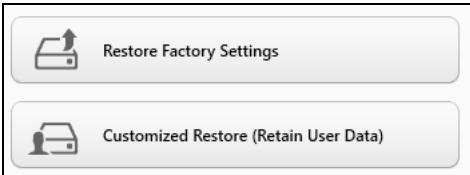
Packard Bell Recovery Management
?X
Welcome to Packard Bell Recovery Management
Packard Bell Recovery Management enables you to restore your system. To begin, select the task you want to perform. Please DO NOT remove the USB device while proceeding.

Customized Restore (Retain User Data)

Reinstall Drivers or Applications
Make a backup before you restore (Recommended).

Create Factory Default Backup
Create Drivers and Applications Backup

packard bell
Restores your computer to its factory default status. A reboot is required. NOTE: All data on drive Cwill be restored.
Here's what will happen:
- Your files and personalization settings won't change.
- Your PC settings will be changed back to their defaults.
- Apps from Windows Store will be kept.
- Apps you installed from discs or websites will be removed.
- A list of removed apps will be saved on your desktop.
Next
Cancel
Here's what will happen:
- Your files and personalization settings won't change.
- Your PC settings will be changed back to their defaults.
- Apps from Windows Store will be kept.
- Apps you installed from discs or websites will be removed.
- A list of removed apps will be saved on your desktop.
Next
Cancel
The FCC with its action in ET Docket 96-8 has adopted a safety standard for human exposure to radio frequency (RF) electromagnetic energy emitted by FCC certified equipment. The wireless adapter meets the Human Exposure limits found in OET Bulletin 65, supplement C, 2001, and ANSI/IEEE C95.1, 1992. Proper operation of this radio according to the instructions found in this manual will result in exposure substantially below the FCC's recommended limits.
- The following safety precautions should be observed:
Do not touch or move antenna while the unit is transmitting or receiving.
- Do not hold any component containing the radio such that the antenna is very close or touching any exposed parts of the body, especially the face or eyes, while transmitting.
- Do not operate the radio or attempt to transmit data unless the antenna is connected; this behavior may cause damage to the radio.
Use in specific environments:
- The use of wireless adapters in hazardous locations is limited by the constraints posed by the safety directors of such environments.
- The use of wireless adapters on airplanes is governed by the Federal Aviation Administration (FAA).
- The use of wireless adapters in hospitals is restricted to the limits set forth by each hospital.
Antenna Use
In order to comply with FCC RF exposure limits, low gain integrated antennas should be located at a minimum distance of 20~cm (8 inches) or more from the body of all persons or at a minimum distance as specified by the FCC module grant conditions. FCC grants can be viewed from the FCC Equipment Authorization website at https://fjallfoss.fcc.gov/oetcf/eas/reports/GenericSearch.cfm by entering the FCC ID printed on the module label.
Explosive Device Proximity Warning
Warning: Do not operate a portable transmitter (including this wireless adapter) near unshielded blasting caps or in an explosive environment unless the transmitter has been modified to be qualified for such use
AntennaWarnings
- Warning: To comply with the FCC and ANSI C95.1 RF exposure limits, it is recommended that for the wireless adapter installed in a desktop or portable computer, the antenna for this wireless adapter to be installed so as to provide a
separation distance of at least 20 cm (8 inches) from all persons or at the minimum distance as specified by the module grant conditions. FCC grants can be viewed from the FCC Equipment Authorization website at https://fjallfoss.fcc.gov/oetcf/eas/reports/GenericSearch.cfm by entering the FCC ID printed on the module label.
- Warning: The wireless adapter is not designed for use with high-gain directional antennas.
Use On Aircraft Caution
- Caution: Regulations of the FCC and FAA prohibit airborne operation of radio-frequency wireless devices (wireless adapters) because their signals could interfere with critical interference with critical aircraft instruments.
Local Restrictions on 802.11a, 802.11b, 802.11g and 802.11n Radio Usage
- Caution: Due to the fact that the frequencies used by 802.11a, 802.11b, 802.11g and 802.11n wireless LAN devices may not yet be harmonized in all countries, 802.11a, 802.11b, 802.11g and 802.11n products are designed for use only in specific countries, and are not allowed to be operated in countries other than those of designated use. As a user of these products, you are responsible for ensuring that the products are used only in the countries for which they were intended and for verifying that they are configured with the correct selection of frequency and channel for the country of use. Any deviation from the permissible power and frequency settings for the country of use is an infringement of national law and may be punished as such.
Wireless Interoperability
The wireless adapter is designed to be interoperable with other wireless LAN products that are based on direct sequence spread spectrum (DSSS) radio technology and to comply with the following standards:
- IEEE Std. 802.11b compliant Standard on Wireless LAN
- IEEE Std. 802.11g compliant Standard on Wireless LAN
-
IEEE Std. 802.11a compliant Standard on Wireless LAN (applies to devices supporting 802.11a)
-
IEEE Std. 802.11n draft 2.0 compliant on Wireless LAN
- Wireless Fidelity certification, as defined by the Wi-Fi Alliance
The Wireless Adapter and Your Health
The wireless adapter, like other radio devices, emits radio frequency electromagnetic energy. The level of energy emitted by the wireless adapter, however, is less than the electromagnetic energy emitted by other wireless devices such as mobile phones. The wireless adapter operates within the guidelines found in radio frequency safety standards and recommendations. These standards and recommendations reflect the consensus of the scientific community and result from deliberations of panels and committees of scientists who continually review and interpret the extensive research literature. In some situations or environments, the use of the wireless adapter may be restricted by the proprietor of the building or responsible representatives of the applicable organization. Examples of such situations may include:
- Using the wireless adapter on board airplanes, or
- Using the wireless adapter in any other environment where the risk of interference with other devices or services is perceived or identified as being harmful.
If you are uncertain of the policy that applies to the use of wireless adapters in a specific organization or environment (an airport, for example), you are encouraged to ask for authorization to use the adapter before you turn it on.
FCC Radio Frequency Interference Requirements (applies to device supporting 802.11a)
This device is restricted to indoor use due to its operation in the 5.15 to 5.25 GHz and 5.470 to 5.725 GHz frequency ranges. FCC requires this product to be used indoors for the frequency ranges 5.15 to 5.25 GHz and 5.470 to 5.725 GHz to reduce the potential for harmful interference to co-channel mobile satellite systems. High power radars are allocated as primary users of the 5.25 to 5.35 GHz and 5.65 to 5.85 GHz bands. These radar stations can cause interference with and /or damage this device. No configuration
controls are provided for this wireless adapter allowing any change in the frequency of operations outside the FCC grant of authorization for U.S operation according to Part 15.407 of the FCC rules.
USA - Federal Communications Commission (FCC)
This device complies with Part 15 of the FCC Rules. Operation of the device is subject to the following two conditions:
- This device may not cause harmful interference.
- This device must accept any interference that may cause undesired operation.
- Note: The radiated output power of the adapter is far below the FCC radio frequency exposure limits. Nevertheless, the adapter should be used in such a manner that the potential for human contact during normal operation is minimized. To avoid the possibility of exceeding the FCC radio frequency exposure limits, you should keep a distance of at least 20cm between you (or any other person in the vicinity), or the minimum separation distance as specified by the FCC grant conditions, and the antenna that is built into the computer. Details of the authorized configurations can be found at http://www.fcc.gov/oet/ea/ by entering the FCC ID number on the device.
Interference Statement
This wireless adapter has been tested and found to comply with the limits for a Class B digital device, pursuant to Part 15 of the FCC Rules. These limits are designed to provide reasonable protection against harmful interference in a residential installation. This wireless adapter generates, uses, and can radiate radio frequency energy. If the wireless adapter is not installed and used in accordance with the instructions, the wireless adapter may cause harmful interference to radio communications. There is no guarantee, however, that such interference will not occur in a particular installation. If this wireless adapter does cause harmful interference to radio or television reception (which can be determined by turning the equipment off and on), the user is encouraged to try to correct the interference by taking one or more of the following measures:
-
Reorient or relocate the receiving antenna of the equipment experiencing the interference.
-
Increase the distance between the wireless adapter and the equipment experiencing the interference.
- Connect the computer with the wireless adapter to an outlet on a circuit different from that to which the equipment experiencing the interference is connected.
- Consult the dealer or an experienced radio/TV technician for help.
- Note: The adapter must be installed and used in strict accordance with the manufacturer's instructions as described in the user documentation that comes with the product. Any other installation or use will violate FCC Part 15 regulations.
Canada — Industry Canada (IC)
This device complies with RSS210 of Industry Canada. Cet apparéil se conforme à RSS210 de Canada d'Industrie.
-
Caution: When machine supports and using IEEE 802.11a wireless LAN, this product is restricted to indoor use due to its operation in the 5.15- to 5.25 GHz frequency range. Industry Canada requires this product to be used indoors for the frequency range of 5.15 GHz to 5.25 GHz to reduce the potential for harmful interference to co-channel mobile satellite systems. High power radar is allocated as the primary user of the 5.25 to 5.35 GHz and 5.65 to 5.85 GHz bands. These radar stations can cause interference with and/or damage to this device. The maximum allowed antenna gain for use with this device is 6dBi in order to comply with the E.I.R.P limit for the 5.25 to 5.35 and 5.725 to 5.85 GHz frequency range in point-to-point operation. To comply with RF exposure requirements all antennas should be located at a minimum distance of 20 cm, or the minimum separation distance allowed by the module approval, from the body of all persons.
-
Attention: l'utilisation d'un réseau sans fil IEEE802.11a est restreinte à une utilisation en interieur à cause du fonctionement dans la bande de fréquence 5,15 - 5,25 GHz. Industry Canada requiert que ce produit soit utilisé à l'intérieur desBATIMENTS pour la bande de fréquence 5,15 - 5,25 GHz afin de réduire les possibiltés d'interférences nuisibles aux canaux co-existants des systèmes de transmission satellites. Les radars de puissances ont fait l'objet d'une allocation primaire de
This Class B digital apparatus complies with Canadian ICES-003.
"To prevent radio interference to the licensed service, this device is intended to be operated indoors and away from windows to provide maximum shielding. Equipment (or its transmit antenna) that is installed outdoors is subject to licensing."
The use of these equipments is regulated by:
1.D.L.gs 1.8.2003, n. 259, article 104 (activity subject to general authorization) for outdoor use and article 105 (free use) for indoor use, in both cases for private use.
2.D.M. 28.5.03, for supply to public of LAN access to networks and telecom services.
Pakistan Telecommunication Authority (PTA) Approved
Morocco
The operation of this product in the radio channel 2 (2417 MHz) is not authorized in the following cities: Agadir, Assa-Zag, Cabo Negro, Chaouen, Goulmima, Oujda, Tan Tan, Taourirt, Taroudant and Taza.
The operation of this product in the radio channels 4, 5, 6 and 7 (2425 - 2442 MHz) is not authorized in the following cities: Aéroport Mohamed V, Agadir, Aguelmous, Anza, Benslimane, Béni Hafida, Cabo Negro, Casablanca, Fès, Lakhab, Marrakech, Merchich, Mohammédia, Rabat, Salé, Tanger, Tan Tan, Taunate, Tit Mellil, Zag.
Japan
5 GHz 带是室内用使用のと
Korea
当用,
Taiwan
第十二条
Recovery Management 62
P
Program Recovery Management.... 45
Podpora
Program Recovery Management.... 45
Upozomenie na epilepsiu 14
Recovery Management. 62
V
Vymenitelné zariadenia na media 31
W
WiFi 48, 49
Packard Bell Recovery Management.... 45
Internet 46
Effectuarea unui upgrade la computer
Extinderea prin optiuni
Accumulatorul are urmatoarele characteristic:
Packard Bell Recovery Management
Lansati Packard Bell Recovery Management:
- Din Start, tasti 'Recuperare'.si dati cli pe Packard Bell Recovery Management in lista de aplicati.
Packard Bell Recovery Management
?X
Welcome to Packard Bell Recovery Management
Packard Bell Recovery Management enables you to restore your system. To begin, select the task you want to perform. Please DO NOT remove the USB device while proceeding.

Customized Restore (Retain User Data)

Reinstall Drivers or Applications
Make a backup before you restore (Recommended).

Create Factory Default Backup
Create Drivers and Applications Backup

packard bell.
Restores your computer to its factory default status. A system is required. NOTE: All data on drive C will be deleted.
Atentie: „Restaurare la valorile implicite din fabrica" va sterge toate fisierele de pe hardisk.
- Se deschide fereastra Resetare PC.
Reset your PC
Here's what will happen:
- All your personal files and apps will be removed.
- Your PC settings will be changed back to their defaults.
Next
Cancel
Packard Bell Recovery Management
?X
Welcome to Packard Bell Recovery Management
Packard Bell Recovery Management enables you to restore your system. To begin, select the task you want to perform. Please DO NOT remove the USB device while proceeding.

Customized Restore (Retain User Data)

Reinstall Drivers or Applications
Make a backup before you restore (Recommended).

Create Factory Default Backup
Create Drivers and Applications Backup

packard bell
Restores your computer to its factory default status. A system is required. NOTE: All data on drive Cwill be deleted.
- Se deschide fereastra Reimprospātare PC.
Refresh your PC
Here's what will happen:
- Your files and personalization settings won't change.
- Your PC settings will be changed back to their defaults.
- Apps from Windows Store will be kept.
- Apps you installed from discs or websites will be removed.
- A list of removed apps will be saved on your desktop.
Next
Cancel
The FCC with its action in ET Docket 96-8 has adopted a safety standard for human exposure to radio frequency (RF) electromagnetic energy emitted by FCC certified equipment. The wireless adapter meets the Human Exposure limits found in OET Bulletin
65, supplement C, 2001, and ANSI/IEEE C95.1, 1992. Proper operation of this radio according to the instructions found in this manual will result in exposure substantially below the FCC's recommended limits.
- The following safety precautions should be observed:
Do not touch or move antenna while the unit is transmitting or receiving.
- Do not hold any component containing the radio such that the antenna is very close or touching any exposed parts of the body, especially the face or eyes, while transmitting.
- Do not operate the radio or attempt to transmit data unless the antenna is connected; this behavior may cause damage to the radio.
Use in specific environments:
- The use of wireless adapters in hazardous locations is limited by the constraints posed by the safety directors of such environments.
- The use of wireless adapters on airplanes is governed by the Federal Aviation Administration (FAA).
- The use of wireless adapters in hospitals is restricted to the limits set forth by each hospital.
Antenna Use
In order to comply with FCC RF exposure limits, low gain integrated antennas should be located at a minimum distance of 20~cm (8 inches) or more from the body of all persons or at a minimum distance as specified by the FCC module grant conditions. FCC grants can be viewed from the FCC Equipment Authorization website at https://fjallfoss.fcc.gov/ oetcf/eas/reports/GenericSearch.cfm by entering the FCC ID printed on the module label.
Explosive Device Proximity Warning
Warning: Do not operate a portable transmitter (including this wireless adapter) near unshielded blasting caps or in an explosive environment unless the transmitter has been modified to be qualified for such use
AntennaWarnings
-
Warning: To comply with the FCC and ANSI C95.1 RF exposure limits, it is recommended that for the wireless adapter installed in a desktop or portable computer, the antenna for this wireless adapter to be installed so as to provide a separation distance of at least 20cm (8 inches) from all persons or at the minimum distance as specified by the module grant conditions. FCC grants can be viewed from the FCC Equipment Authorization website at https://fjallfoss.fcc.gov/oetcf/eas/reports/GenericSearch.cfm by entering the FCC ID printed on the module label.
-
Warning: The wireless adapter is not designed for use with high-gain directional antennas.
Use On Aircraft Caution
- Caution: Regulations of the FCC and FAA prohibit airborne operation of radio-frequency wireless devices (wireless adapters) because their signals could interfere with critical interference with critical aircraft instruments.
Local Restrictions on 802.11a, 802.11b, 802.11g and 802.11n Radio Usage
- Caution: Due to the fact that the frequencies used by 802.11a, 802.11b, 802.11g and 802.11n wireless LAN devices may not yet be harmonized in all countries, 802.11a, 802.11b, 802.11g and 802.11n products are designed for use only in specific countries, and are not allowed to be operated in countries other than those of designated use. As a user of these products, you are responsible for ensuring that the products are used only in the countries for which they were intended and for verifying that they are configured with the correct selection of frequency and channel for the country of use. Any deviation from the permissible power and frequency settings for the country of use is an infringement of national law and may be punished as such.
Wireless Interoperability
The wireless adapter is designed to be interoperable with other wireless LAN products that are based on direct sequence spread spectrum (DSSS) radio technology and to comply with the following standards:
- IEEE Std. 802.11b compliant Standard on Wireless LAN
- IEEE Std. 802.11g compliant Standard on Wireless LAN
- IEEE Std. 802.11a compliant Standard on Wireless LAN (applies to devices supporting 802.11a)
- IEEE Std. 802.11n draft 2.0 compliant on Wireless LAN
- Wireless Fidelity certification, as defined by the Wi-Fi Alliance
The Wireless Adapter and Your Health
The wireless adapter, like other radio devices, emits radio frequency electromagnetic energy. The level of energy emitted by the wireless adapter, however, is less than the electromagnetic energy emitted by other wireless devices such as mobile phones. The wireless adapter operates within the guidelines found in radio frequency safety standards and recommendations. These standards and recommendations reflect the consensus of the scientific community and result from deliberations of panels and committees of scientists who continually review and interpret the extensive research literature. In some situations or environments, the use of the wireless adapter may be restricted by the proprietor of the building or responsible representatives of the applicable organization. Examples of such situations may include:
- Using the wireless adapter on board airplanes, or
- Using the wireless adapter in any other environment where the risk of interference with other devices or services is perceived or identified as being harmful.
If you are uncertain of the policy that applies to the use of wireless adapters in a specific organization or environment (an airport, for example), you are encouraged to ask for authorization to use the adapter before you turn it on.
FCC Radio Frequency Interference Requirements (applies to device supporting 802.11a)
This device is restricted to indoor use due to its operation in the 5.15 to 5.25 GHz and 5.470 to 5.725 GHz frequency ranges. FCC requires this product to be used indoors for the frequency ranges 5.15 to 5.25 GHz and 5.470 to 5.725 GHz to reduce the potential
for harmful interference to co-channel mobile satellite systems. High power radars are allocated as primary users of the 5.25 to 5.35 GHz and 5.65 to 5.85 GHz bands. These radar stations can cause interference with and /or damage this device. No configuration controls are provided for this wireless adapter allowing any change in the frequency of operations outside the FCC grant of authorization for U.S operation according to Part 15.407 of the FCC rules.
USA — Federal Communications Commission (FCC)
This device complies with Part 15 of the FCC Rules. Operation of the device is subject to the following two conditions:
- This device may not cause harmful interference.
- This device must accept any interference that may cause undesired operation.
- Note: The radiated output power of the adapter is far below the FCC radio frequency exposure limits. Nevertheless, the adapter should be used in such a manner that the potential for human contact during normal operation is minimized. To avoid the possibility of exceeding the FCC radio frequency exposure limits, you should keep a distance of at least 20cm between you (or any other person in the vicinity), or the minimum separation distance as specified by the FCC grant conditions, and the antenna that is built into the computer. Details of the authorized configurations can be found at http://www.fcc.gov/oet/ea/ by entering the FCC ID number on the device.
Interference Statement
This wireless adapter has been tested and found to comply with the limits for a Class B digital device, pursuant to Part 15 of the FCC Rules. These limits are designed to provide reasonable protection against harmful interference in a residential installation. This wireless adapter generates, uses, and can radiate radio frequency energy. If the wireless adapter is not installed and used in accordance with the instructions, the wireless adapter may cause harmful interference to radio communications. There is no guarantee, however, that such interference will not occur in a particular installation. If this wireless
adapter does cause harmful interference to radio or television reception (which can be determined by turning the equipment off and on), the user is encouraged to try to correct the interference by taking one or more of the following measures:
- Reorient or relocate the receiving antenna of the equipment experiencing the interference.
- Increase the distance between the wireless adapter and the equipment experiencing the interference.
- Connect the computer with the wireless adapter to an outlet on a circuit different from that to which the equipment experiencing the interference is connected.
- Consult the dealer or an experienced radio/TV technician for help.
- Note: The adapter must be installed and used in strict accordance with the manufacturer's instructions as described in the user documentation that comes with the product. Any other installation or use will violate FCC Part 15 regulations.
Canada - Industry Canada (IC)
This device complies with RSS210 of Industry Canada. Cet apparéil se conforme à RSS210 de Canada d'Industrie.
This Class B digital apparatus complies with Canadian ICES-003.
"To prevent radio interference to the licensed service, this device is intended to be operated indoors and away from windows to provide maximum shielding. Equipment (or its transmit antenna) that is installed outdoors is subject to licensing."
The use of these equipments is regulated by:
1.D.L.gs 1.8.2003, n. 259, article 104 (activity subject to general authorization) for outdoor use and article 105 (free use) for indoor use, in both cases for private use.
2.D.M. 28.5.03, for supply to public of LAN access to networks and telecom services.
Pakistan Telecommunication Authority (PTA) Approved
Morocco
The operation of this product in the radio channel 2 (2417 MHz) is not authorized in the following cities: Agadir, Assa-Zag, Cabo Negro, Chaouen, Goulmima, Oujda, Tan Tan, Taourirt, Taroudant and Taza.
The operation of this product in the radio channels 4, 5, 6 and 7 (2425 - 2442 MHz) is not authorized in the following cities: Aéroport Mohamed V, Agadir, Aguelmous, Anza, Benslimane, Béni Hafida, Cabo Negro, Casablanca, Fès, Lakhab, Marrakech, Merchich, Mohammédia, Rabat, Sale, Tanger, Tan Tan, Taounate, Tit Mellil, Zag.
Japan
5 GHz 带は室内のは使用のと
Korea
Program Recovery Management .... 45
vigoare 95,113
Recovery Management 62
Interferentä 108
intrebari freventa 85
L
LAN (ReTea locala) 48
luminozitate
taste rapide 19
M
Malware 54 Mediu 113
Norton Internet Security. 52, 57
P
Packard Bell afisaj 86
Program Recovery Management.... 45 CD-ROM 87
Site Web 52 imprimanta 87
Recovery Management. 62
s
Securitate Spyware 53
Actualizari 61 Suport
Antivirus. 55 Site-ul Web Packard Bell. 52
Software
Licenta Software 116
T
Tastatură tastatură
taste rapide 20 depanare 87
taste rapide 20
U
U3nTbTe 3atpydHeHn? 7
OCHOBHI IO3HaHn 3a KOMNHTbpa 8
Be3onachocT IN KOMΦopT 8
Mepkn 3a 6e3oNaChocT 8
IpeDn3Hn 3dpBnMepKn 12
3ana03HaBaHe c Bauny KOMnHToBp 15
I3rpe - 16
I3rne otrope - KnaBnataype 17
Cneunannn KnaBn.. 18
I3rIeD oTnped 22
I3rpeOToJBO 23
I3rpeD OTdACHO 25
I3rnn oTOny 27
Tbyna 28
OchOBHn Heua 3a Tbyna da 28
TbuaJxceCTBOBe 29
HaandtroBaeHaBaun
KOMNHTbP 31
IOnbHnTeHNB3MOXHOCTN 31
Onuun 3a Bpb3ka 31
EneKtpnuecko 3axpaHbaHe 37
AanTep 3a npomeHnB TOK. 37
BaTepeHmOyJ 38
XapakTepcntnHa 6aTepyHmMyu..38
CmHa Ha 6aTePnHnnaKaeT 41
IocTabaHHe nI3BaXdaHe Ha
6aTeprnHnMaMoDy.. 41
3apekdaheHa6aTepeyra 42
PpOBepKa Ha HnBTo Ha 6aTepeyra 42
Packard Bell Recovery Management. 49
IHTepHeT 50
Pbpyn CTbpiK BmpekaTa 50
3aunTa Ha KOMnIObpa. 50
I36peTe nHTepHeTdoCTaBvNK 50
MpexkOBn Bpb3kn 53
Cbpfnpahe BmpekaTata! 56
CnryphocT 57
Bb3TaHOBraBe 67
Cb3daBaHe Ha apxNB 3a Bb3CTaHOBraBe..... 68
b3daBaHe Ha apxNB C dpaiBepn I npiloxKeHna 72
Bb3TaHOBBAHe Ha CnCTeMaTa. 74
PpeHCTaIipaHe Ha dpaIbepn
npuJIOXeHn 75
Bpbuahe KbM INo-paHen cTaTyc. 79
BpIaHHe HaΦa6PcHnTe HacTpoKHa cIcTeMaTa. 80
Bb3ctaHOBAhe OT Windows 81
Bb3ctaHOBAhe OT apxNB 3a Bb3CTaHOBAhe. 85
YeceTo 3aDaBaHn Bbnpocn 90
CbBETN noDcKa3BaHe 3a n3nOJ3BaHe Ha Windows 8. 93
Tpne Hea, KOTo e Do6pe da 3anomHnTe 93
Kak da OTbopr charms? 93
Kak da OTnda B Ctap? 94
Kak da ppeckaayam mekdy pa3nunHntepniloKeHHa? 94
KaKaJa N3KJIIOUa KOMIIObTaPc cn? 94
3aIo NIma HOB INHTeppeic? 94
Kak da OTKNIOUa KOMNIObpa cn? 95
Kak da nepcoHaJIIm3IpaM KOMnHtbpa cn? 95
Ickam da n3non3BaM Windows kAko npedn -BbPheTe MN cTapna pa6oTe hnnor!. 97
Kbde ca npinloxeHnra M? 97
KakBo e Microsoft ID (akayHT)? 98
Kak da do6abam npedeIOuHTaHn KbM Internet Explorer? 99
KaJa npoBePbAM 3a akTyaJIINaIauNHa Windows? 99
Kbde mora da nonya nobeeuHopmaun? 100
PerynaToPHa HnΦopMaun 101
Pa6oTHa cpeia 119
CoΦTyepenIinceH3 122
Hndekc 125
AВТОРСКИ пава © 2012. Всичкнирава заразецни.
Packard Bell EasyNote LV Pькововстvo на потpeителя
Пьроначално Идамп: 20Юл 2012
Iocete registration.packardbell.com n OTKPnTe IpeIMCTBaTa Ha TOBa da 6bdeW KIneHT ha Packard Bell.
3a6eexka: BcNkN nIIOCTpaun ca cAmo 3a cnpaBka. JeNCTBNTeHnHaTa KOHfNpyaNa MoKe da e pa3NIuHa.
ВклочеTekmптьра сн
Бларам Ви, чу закушистои Packard Bell komптbp!
LeTaHaToBaYnbTbAHee DaBn3aNo3HaeCΦyHKuInTeHaBaMnKOMNIOTpBpIdaBn NomOHe npa6oTaTa C Hero.
Cne KaTo HactponTe n Ctaptnpate KOMnHbpa cn, KaKTo e Noka3aHo BVnHCTpykUnITE 3a INHcTaNipAHe, ToI ue Bn 3aJaDe Bbnpocn, KOInTO uCe Bn NOMOrHaT da ce CBbpKeTe c INHTepHet. PocNe KOMNtBpbT Bn Ue KOHfNpynpa INHctaNipAHHaCoFtyep.
Бe3ЖИЧа ВрьЗкa
3a da yctanohBnTe Bpb3ka c 6e3KmHa MpeKa, nbpBO npOBepTe daJIH cyHKcInTe 3a 6e3KmHa Bpb3ka Ha Baunia KOMNTObP ca BKJIOUeHN i daJIpyTepbT INI MoJeMbT, KbM KOITO JeJaete da ce CBbpKeTe, e KOHcHypnpaH npabUNHO.
- Ako 6e3xuHaTa MpeXa He e BkIouHe, HATncHeTe Windows KlaBnua ( + W, HAnuTe "Be3xuHa", CneJ KOeTO upaKHeTe Bbpy Xe3xuHa. UpaKHeTe Bbpyx KlnOua noD Wi-Fi, 3a da aKTtBnPaTe 6e3xuHaTb3ka. UpaKHeTe OTHOBo 3a 3a6pHa.
- 3a Cbþp3BaHe KbM MpeKa, HattncHete Windows KnaBnHa (串) + W , HannIeTe "Be3xNUnH" n IupakHeTe Bbpxy Cbþp3BaHe KbM MpeKa. N3bepeTcBOrTa MpeKa n ako e Heo6xoJMo, BbBeJeTe napOJata.
CpeKpaTko 3a6abAhe, BaHnT KOMNtbp 6n Tp8BaNo da ce cBbpxe C nHTepHeT.
Ako Baata Mpeka He e OTKpnta Nn Baunr KOMNtbp He ycnee da cce Cbpxe C nHTepHe, CbpxeTe ce C Baunr INTepHe T DOCTabuK Nn BnKTe DOKyMeNTaunrHa pyTepa. CneI KaTO KOMNtbpBn Bn ce CTapTnpa I MOxTe Da ro N3no3BaTe, OTbopTe Internet Explorer n CneDbaiTe IHCTpyKUnTe.
Moxeme cIoo da u3non3ame Mpeko Su Ka6en, 3a da ce cBpXem Hnnpaso KbM Mpeko Su nopm Ha pymepa. O6bPhemce KbM C8oA Uhmephem docmaueuk unu buxme pbkoodcmomo Ha pymepa.
Pernctpaun
Korato n3noJ3BaTe cB0r KOMnHbTp 3a npBb NbT, npenOpbYnteNHO e da ro pernctpnpate. Toba ue Bn daJe doCTbN Do HraKoN noJe3Hn npedIMCTBa, kaTo HanpImep:
OcbnyxbaHe Ha Bauu KOMNkmbp
He ce onntbaite da obcnykBaTe KOMnToBpa cam, 3aIoTO npn OTbapRe nIIN OTCTpAnBaHe Ha KaNaUte CbIeCTByBa ONaCHOCT OT KOB yadn DpyrnpckObe. Ocbabe TobkyBaHTo Ha KBaIIuΦnUnpaH cepBn3eH nepcoHaJ.
Myc npbct, 3a da n3BbpHInTe 5paKbaHe C MIIkata, KOeTo
Ie n36pe ne nCtApTnpa eIemEn. Bbp3o nobTopeTe HaTnCKaHeTo 3a DByKpaTHO HATnCKaHe IIN DByKpaTHO UpaKaBaHe.

DOnbJIHNTeJIHH Bb3MOxHOCTN
Baunr KOMnTbP Bn npedna MHO OOnu 3a NtNHO KOMnTObPHO n3XNBraHe.
Onu 3a Bpb3ka
IopToBeTe Bn daBaT Bb3MOxHocT da CbBp3BaTe nepuΦepHn yctpoiCTBa KbM Baunr KOMNtbp. 3a yka3aHn r OTHOCHO Ka d cBbpxeTa pa3nnHn BbHnHn yctpoiCTBa KbM KOMNtbpca cn, IpOuyTeTe CJeDaBau nra pa3deJn.
Yemeu3a Kapmu c namem
KapTnte c nameT ce n3nOJ3BaT B pa3NJuH N BuIOBe zuΦpOvN KAmepn, PDA yctpoiCTBa, MP3 nIeJbprn MO6nIH N TeJIeΦOHi.
IocmaeHaKapmcnAmem.
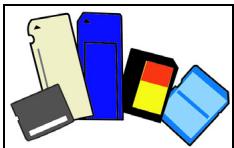
1.Полравне Картata,Taka ue KoHEKTopbT da coyn KbM nopTa,a KOHEKTopnTe da rIeDat haOny.
2. BHIMATEHNO ПьзHeTe KapTaTа В поТа. Ако снорд Bac e Heo6xOДМОда ИЗПОЛЗВATEсИla, 3a ДА NOCTaBNTe KapTaTа, ONITaIte BHHMATEHNOда пpeOpneHTnIpaTe KapTaTа.
- Hatnche KapTa, DOKaTo He ⅢpaKHe Ha MrcTo. HraKoJIko MmJImMeTp a OT KapTaTa Ⅲca N3BbH Cnota.
Ako KapTaTa CbIbPka FaaiNoBe, MoKe Da ce nOBn npO3OpEcbT Windows Auto Play (ToBa 3aBnCn OT cbIbPkaHneTO Ha KapTaTa) N Ze Bn nonIta, daN JxenaTe Da n3non3BaTe npOrpama, 3a Da BnE3eTe B CbIbPkaHneTo Ha KapTaTa. N3bepeTe onu Tk Ako e Heo6xoDmO, B npOTnbEN cnyaH n3bepeTe OTKa3. Ako B KapTaTa Hma faJIOBE iIN mMa HEnO3HaTu FaiNoBe, ue Ce OTbOpn npO3opeU, KoITo Ue nOKaKe CbIbPkaHneTo Ha KapTaTa.
SD. SDHC u SDXC kapmu
Pa3IuHnTe BnOBe SD KapTu nMaT pa3IuYeH KanaUTeT KaTo Dn3aHbT nM KaTo cIe o eEInn CbU. SD KapTuTe ca c KanaUTeT 4 GB, SDHC KapTuTe - 32 GB, a SDXC KapTuTe - Do 2048 GB (2 TB). BaunrKOMnHTbp nMa cheTe, KoTo PoDlbPka SDHC nIi SDXC KapTu.
3a6eJekka: SDXC Kapmume c namem Mozam da ce u3noJ3eam camo e yemeu, koUmo noOdbpka SDXC; SD u SDHC kapmume Mozam da ce u3noJ3am c cecku yemeu.
- UpaKHeTe Bbpxy CTpeIkaTa PokaXu cKpntuTe NkOHn B Oblacm 3a yeeodomrahe (do YacOBHnka).
- LpakHeTe Bbpxy IKOHaTa Be30nacHo npemaxBaHe Ha xapdyep.
3.単pakHe Te Bbpxy N3BaxJaHe Ha SD KapTaTa (NJIIN Bbpxy IMeTo Ha yCTpoiCTBOTo).
4.ИЗчakай TeДOKATO He ce NOЯВи cboшцehneTo Xapdyep, KoUMo MÖke da ce npemaxhe 6e3onacHo. - OtctpaHete KapTaTata.

BapadeHuMpexku
BrpadeHaT MpeKa Bn no3BoJBa da CBpKTe KOMnOtbpa cn C Ethernet-6a3npaHa MpeKa.
Cbpxke Ethernet ka6eHa oT Ethernet (RJ45) npTa Ha Kopnyca Ha KOMnIObpa cMpexOB JAK NJI Xb6 Ha BaWata Mpeka.
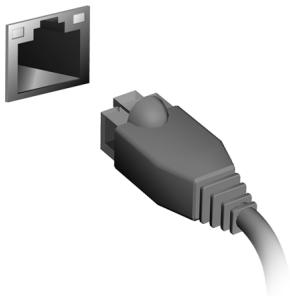
YHueepcaHa cepuHa wuHa (USB)
USB npTbT e BnCOKOCKOPOCTHa cepnHa
HnHa, KOrTO Bn PO3BOJRA Da CBp3BaTe
USB nepnΦeepn yctpoiCTBa 6e Da ce
OTHEmat CNTeMHn pecypcn.
HЯкои komнгтп може ду IMaT eINH nIn nobeue USB 3.0 nopTa. Te npinuayat Ha ctaHdapTHN USB nopTOBe c ta3n pa3nka, ye IMaT dOnbIHNteJIHN BbTpewHn Bpb3kn I ca cHH. Mochete da n3noJ3BaTe USB 3.0 CbBMeCTHMN yCTPOJCTBa C Te3n nopTOBe, 3a da ce Bb3NoJ3BaTe OT no-6bp3aTa CKOpOCT Ha npehoc Ha daHHN.
Budeo npom
Cbpxte KbM MOHToP c VGA nnn DVI nopT (BnIbT ha noIdbpkaHaTa Bpb3ka 3aBnCn OT KOHpypaunra Ha KOMNtba). POnxOJaIyraT Ka6eI ObIKHOBeHo E BKJIIOueH B KOMIIeKta Ha MOHToPa.
CneIbAaTe Te3n CbIKN, 3a Da CbPKeTe MOHITOp KbM KOMNIObPa CN:
- YbepeTe ce, Ye 3axpaHbAHeTo Ha KOMNIObpa I TOBa Ha MOHITopa Ca n3KJIIOUeHN.
2.CbpxTe Bndeo Ka6ena c nopTa 3a MOHITopa Ha KOMNIOTBpa. 3akpenete Ka6enHaT a Bpb3ka c npedocTabeHNte 60JTObe. - Cbpxte 3axpaHbaun Ka6e Ha MOHTopa I ro BkIIOye B npaBnHO 3a3eMeH KOHTaKT.
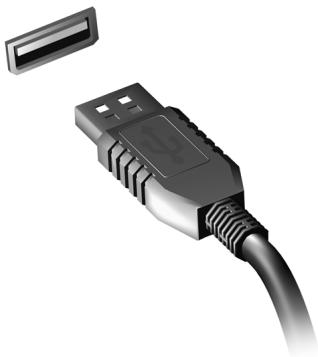
- CnEaBaiTe HNCTpyKcHInTe 3a INHCTaJInpaHe B pBKOBOdCTBOTO Ha notpe6nteJHa MOHITopa.
- BkHouTe pBpBO MOHITopa, a cnei TOBa N KOMNIObpa.
- YBepete ce, ye HactoIaTa pa3dIeIeTHe cNoocbHcT nCKopocT Ha oBHOBraBe He HaDbNlBaBat CneuΦnKaunTe Ha MOHTopa. Ako e HeoBXoDmO, IpomeHete HAcToPoiKInTe Ha DnCnJIe, I3nOJ3BaHn OT KOMNIObpa.
3a6eIeKka: Ako Be3xuHama MpeXa He e EKnIOueHa, Hamucheme Windows KnaBua ( ) + W, HanuUe me "Be3xuHa", cIed Koemo upaKaHeme ebpyx Be3xuHa.
Hmepcbeuc 3a bucokodemaunHa Mylmumedu (cmo 3a HyaKou Modenu)
HDMI (High-Definition Multimedia Interface) e npomuIeNoIopIbpxaH, HeKOMnpecnpaH, n3zIIO zIcpoB ayDIO/BnDeo INHTeppeic. HMI npedlara INHTeppeic Mekdy BceKN CbBMecTmM ZIcpoB ayDIO/BnDeo N3TOUHN, KaTO hAnpimep TB DeKOdep, DVD PneBp IIN A/V pRnEMHN CbC CbBMecTm ZIcpoB ayDIO N/NI BnDeO MOHITOP, KaTO zIcpoB TeJIeBN3Op, C nOMoTu caMo Ha eDInN Ka6en.
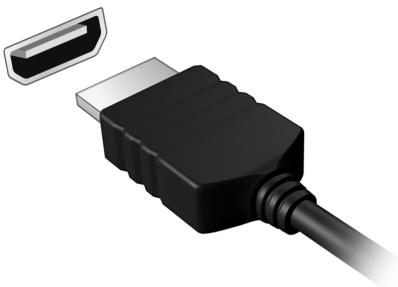
CmHa Ha 6aTePnHnnaKaTe
HoytkybI NTnON3Ba JNTnEbn 6aTePN. CMeHeTe 6aTePnra Ta cBc CbUIN Bn KaTO Ta3N, KOYTo E DoWJa C npOdykTa OTHaJNo. AKO n3nON3BaTe dpyra 6aTePnra, CbUeCTByBa pNCK OT NOxap NnN EKcnNo3n.
BnMaHHe: BaTePnHTe Morat da ekCnIoDnIpaT, aKO He 6opabNTe c TAn npaBnInHO. He rna3rno6BaIte n He rna3XBbPnIte B orbH. DpXTe rna daJeu ot deua. Cb6nOdaBaIte MeCTHnTe 3aKoHOBn pa3nopeD6n, KOraTo N3XBbPnIte N3IOJ3BaHN 6aTePnN.
IocTabaHHe n 3BaXdaH He 6aTePnHnMoDyI
Baxho! Ppedu da u36adume 6amepuyma om KOMnIombpa, c8bpxeme AC adanmepa, ako kejaeme da npodjnxume da u3noJ38ame KOMnIombpa cu. B npomueen cnyuau nbpoe u3KJIIOyeme KOMnIombpa.
IocTabaHHe Ha 6aTepeHn MoDyJI:
1.Подравнeteбаерияа спразmo OTворено OTделене 3aбаерия;Вкарайтпьрв КраяСКлемиTeи ce ybepeTe,угогнataстара на вьериятгледа harope.
2.Пьзhte Бастяв OTделенeto 3a 6atepyи BHMMaTeHnHaTNCHTe,ДOKATO He 3aCTaHe Ha MICTOTO cN.
I3BaJdaHe Ha 6aTepeHMeOMyJI:
1.ПьзHeTe KIIOUeTo 3a OCBO6OxJaBaHe Ha 6aTepeYra, 3a JaocBO6OoNte.
2.ИЗва对接е батерияа OT отденинeto 3a сатерия.
3apekdahe Ha 6aTepeyra
3a da 3apeiTe 6atepTa, npBo ce yBepeTe, ye e noCTaBeHa npabuHNO B OTdeJeHneTo 3a 6atepN. BkIouHe AC aanTepa B KOMnHTbpa n ro CBpXeTe KbM eJIeKtpUeCKn KOtAKT. Moxete da npOdbJnxTe da pa6oTnte C KOMnHTbpa Ha IpomEnJIb TOK, DOKaTO 6atepTa Bn ce 3apExda. BCE naK, aKO 3apexdaTe npN i3KnIOueH KOMnHTbP, BpeMeTo 3a 3apeXdAne Ie 6bIe 3NaUteJIHo NO-KpaTKO.
3a6eIekKa: Cbsemame Bu da 3apekdoame bamepuma, npedu da npuknoume paoboma 3a deHra. 3apekdaHemo Ha bamepuma npez Hooima npedu nIbmyBaHe Bu no3eOJIrea da 3anoyHeme cneDeauuia deH c HantbnHO 3apedeHa bamepu.
Поберka Ha HNBOTo Ha 6aTepeyra
Инданахорьт ha 3axpaHbaHeto Ha Windows noka3Ba TekyuTo HnBO Ha 6bATEpya. 3aPbXTe Kypcopa Bbpxy IKoHaTa 3a 6bATEpya/ 3axpaHbaHeto B JIeHTata CbC 3aДa BnDInTe TekyuTo HnBO Ha 3apya Ha 6bATEpya.
OnTnMn3HpaHe Ha XnBota Ha 6aTepeyraTa
OnTtMn3IpaHTo Ha XINBota Ha 6aTePnra Ta Bn nomara da noCTnHHeTa Bb3MOxHO Hau-MHOrO npn pa6oTa c 6aTePnra, yDbJnxBa CnKbJa Ha 3apeXdAne/npesapexkdahe n noDobpRa eFHKacHocTTa Ha npesapexkdHTo. CbBeTBaMe Bn da cJeDbate npenopbKITE, n36poEHn PO-DOJy:
3akynete DoonbHnHTeH eBatepeHmOdyI.
- ɪənənɪs baiTe AC 3axpaɪhBaɪe Bɪnʌrɪ, KɔrɑT O Mɔkete i nɪ na3eTe 6aTepeɪyra 3a paʊbTo, KɔrɑT O CTe B ἀνIxkeHne.
- I3BaTe PC KapTa, KOraTo HeЯ n3NoI3BaTe, TbN KaTo TnpoIbIjXaba Da Yepn 3axpaHbaHe (npn OnPpeJeHn MoJEn).
CbxaHraBaTe bateHHa MyuHa cyxo n poXnAdNo MrcTo. PpeopbHTeHaTa temepaTpa e ot 10^ (50^) do 30^ (86^) . NocOKte Tempeatypn BojT do 6bp3o camopa3peJdaHe Ha 6atepnaTa.
- Ппекомерно пезараздане ськрацава кивота на батугаят.
- Погаайтагрикзда AC зааптера и бастая.
PpeynpexdHne 3a n3ToeHa 6aTepn
Korato pa6oTnte Ha 3axpaHbAne ot 6aTePn, o6pb7aIte BHNMaHne Ha HndnKaToPA Ha 3axpaHbAHeTO Ha Windows.
BHMaHHe: CbpxTe AC aanTepa Bb3MOxHO haN-6bp3o, cne KaTO ce nOABn IpeDynpexKeHneTo 3a N3TOUeHa 6aTePnA. Ako 6aTePnraTa Ce n3TOUHn HAnbIHO N KOMNIObTpCTe N3KJIuOn, ue n3rHybnte daHH.
Korato ce nOBn npdUnpExKeHneTo 3a n3ToUeHa 6aTepeia, npenopbYntEnHnte DeIcTBnA 3aBnCrt OT cTtuaIyTA:
| Ситуаця | Прелорьчтелно Deievstве |
| Имате на\ разимлочени AC\ адаотери\ екешиески\ Контакт. | 1. Вклочete AC залитора вkomлочьр, с点点头 Което Г CBьржete КьМ сеньлочецки Контак. 2. 3ааэte BCИЧКи Heobховимп Файлоve. 3. Пюдьлочete работа. Ако Искате бateшиета за ce пpeзарди\ Бьрз0, ИЗлочete komлочьр. 1. 3ааэte BCИЧКи Heobховимп Файлоve. 2. 3атворе BCИЧКи рпимлочень. 3. Излочete onepaционнata систema и\ Комлочьр. 4. Сmenete bateшия мodyл. 5. Вклочete komлочьр и пюдьлочete работа. |
| Разимлагате с\ наньлно зареeding\ pezeревен bateшиени\ MOdун. | |
| Ситуаця | Прелорьчтелно DeйстVENe |
| НямаTE Ha разноLOжЕне AC адаNTер пли еLEКТрически KOHTaKT. HeразнолагATE c peЗерВен сбатерпен MOdун. | 1.Заразete BCИЧКи HeобхODIMи ФайлоBE. 2.3aTBОрete BCИЧКи priиLOжЕнЯ. 3.ИзКЛюсTe OперацIHнATA сИСТЕм a KOMПНOTьра. |
Управлике на захсановeto
KOMNHTbpbT mma BrpaDeH 3axpaHbAa, 6JIOK, KOITO CJIeDN aKTNBHOCTTa Ha CNCTeMaT. AKTNBHOCTTa Ha CNCTeMaT Ce OTHAcI DO BCaKe DeHOCCT, BKIOUbaa eJHO IIN IOBeue OT CJIeHNITE yCTPOiCTBa: KNaBnAtypa, MIIuKa, TBbpD DnCK, nepupepna, CBbp3aHa C KOMNTObpa N BInDeo NaMeTTa. AKO He 6bJe YcTAHOBEHa DeHOCCT 3a ONpeDeEN nepNOd OT BPeMe, KOMNTObpbT cPiPa HAKON IIN BCNUKN Te3N yCTPOiCTBa, 3a Da Cnectn eHeprn.
ИКОHOMЯ Ha eHeprma
3a6paHyaHe Ha 5bp3o 3apeKdaHe
BaunrKOMNtbp n3nON3Ba BbP3o 3apeXdahe, 3a da ce cTaptnpa 6bp30, Ho n npabN IKOHOMnHa eHepn r npOBepKa 3a cnHann 3a cTaptnpaHe. Te3n npOBepKn 6abHo ige n3ToUaT 6aTepeyraHa Baunr KOMNtbp.
Ako npednoHTaTe da HamaJIte eHeprHnHTe N3NCKBaHnK bM KOMIOTbpa N BnHHeTo Bbpxy OkOJHaTa Cpea, n3KnUoyTe Bbp30 3apexKaHe:
3a6eIeKka: Ako BbP3O 3apexKahe e u3Kn., Ha BaUur KOMnHOBp ue My e Heo6xodumo no8eue epeme 3a cmapupahe om pexum 3acnueahe.
Bawuam komnombp cbto Hma da ce cmapupa, ako noyuuhcmpkyuu da ce cmapupa no mpeka (Wake on LAN).
- Otbopete pa60THnI pIoT.
2.лракнелу Вьрху Onци Ha 3axpaHbaHeto BоблacrTa 3a yBeDOMJIeHnI.
3.Изберете Oоe onци Ha 3axpaHbaHeTo.
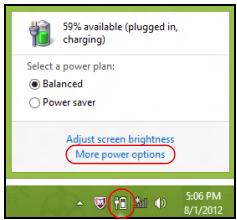
4.Изберete Изберete кakBOда правгБутонITEа 3axpaHbaHeTo.
5.3a DoctbI Do HacTpoKn 3a N3KJIIOUbaHe, N36epeTe PpomHa Ha HacTpoKn, KOHTOB MOpEHTa He ca Ha pa3NoJoxKeHne.
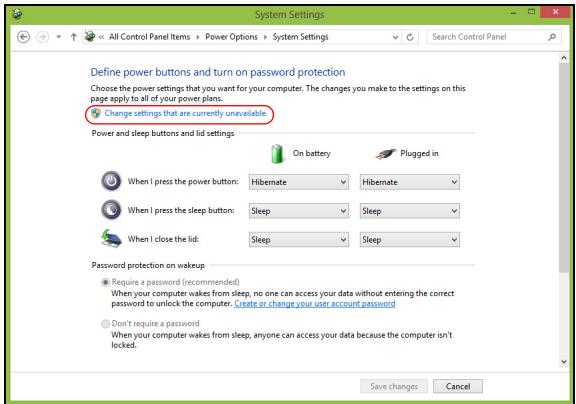
6.ИЗклочвае Или 3абраза Вклочete Бьрзостарпаhe.
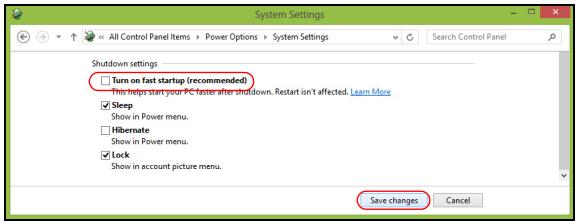
7.ИзберетеЗаиnpomehnte.
CoppTyep
Packard Bell Recovery Management
3a Na NODROTBnTe CBOK KOMNIOTp 3a ONUInTe 3a Bb3CTaHOBBaHe Ha CnCTeMaTa, Tp6Ba Da Cb3daTe He HApO OT DnCKOBe 3a Bb3CTaHOBBaHe Bb3MOxHo Hai-CKopo. BnXTe cTp. 67 3a NOBeue INHΦopMaunr.
3aunTa Ha KOMnHOrbpa
Baxho e da npedna3nte cB08 KOMIObTp O TBnpycn n aTakn no INHTepHET (BnKTe PnpdoXeHue 3a 3aumama uNHmephem Ha cTp. 49 n Cuayphocm Ha ctp.57).Ie npuynte npednoXeHne 3a nporpaMa 3a nblna INHTepHET 3aunta, Korato 3a npbB nbT CTaptnpate KOMIObTa cn. Tp6Ba da AKTNbupate Ta3n 3aunTa Bb3MOxHO hN-CKOPO, npdN da ce Cbbpxte KbM INHTepHET.
I36peTe nHTepHET IOCTaBvNK

I3noJ3BaHeTo Ha nHTepHET e cTaHaNo eCTeBeHa qactOT exKeJHeBHaTa pa6ota c KOMnIObTp. CaMo HЯKoJIKO npocTn CTbKn MOrat Da Bn CbbpKxat C rOJaMa 6a3a daHHN i NHCtpymEnTH 3a KOMyHnKaun. 3a da I3PbJHnTe Te3n CTbKn, nbpBO Tp86Ba Da n36epTe Uhnemph docmawuk, KOItO ppeOCTabR Bpb3kata Mexdy Ba7nq KOMnIObTp n nHTepHET. Tp86Ba Da
IpouyuHTe INTEpHET DoCTaunuTe BvB Baunr pernOH, KaTO He 3abpaBraTe Da IONiTate PnraTeN n CeMeiCTBOTo Cn 3a TexHnO ONIT nn Da IPOBepuTe KOMeHTapUte N hAbJIODeHNrTa Ha Notpe6nteN. INTEpHET DOCTaUnKbT, KOITo N3bepTe, Ue Bn DaJe IHcTpyKUnn 3a TOBa KaK da Ce CBpbXeTe C INTEpHET (MOKe Da Bn e Heo6xOdIm DOnbJIHNTeJEn
coΦTyep nIIN cIeIuaIHa „KytIa", KOrTo ce CbByP3Ba KbM BaIaTa TeIeIoHHa IInHna).
Budoe 8pb3ku
B 3aBnCIMoCT OT MoeJa Ha KOMNtBpa Bn, BaSeTo MecToNoJoxHe n Huxdnte Bn ot KOMyHnKaZna, Ima HraKoIko NauHa 3a yctaHOBRAhe Ha Bp3ka C nHTepHeT.
Komymupyema 6pb3ka
HЯкои KMПИТРи IMAT KOHEKTOP 3a KOMyTIPyEma Bpb3ka Qpe3 TeleФОH ("MOeM"). Toba MoXeTe Da ce CbbpXeTe C INHTepHET KaTO N3IOn3BaTe CBOrTa TeLEFOHnHa JInHn. При KOMyTIPyEmaTb3ka He MoXeTe Da N3IOn3BaTe MOdema N TeLEFOHa EINHOBpEmHo Ha eDHa TeLEFOHnHa JInHn. To3n TIN Bpb3ka Ce npenOpbUba camo npi ORpaHnueHa yNtpe6a Ha INHTepHET, NOPaNi HnCKaTa CKOpOCT Ha Bpb3kAta N 3apaNi TOBa, Ye PPOJbJIxNITeHOCCTTa Ha Bpb3kAta ObIKHOBEHo Ce TAKCyBa Ha Yac.
DSL (Harpumep ADSL)
DSL (Digital Subscriber Line) e „nocToHHo BkJIuOHeHa" Bpb3ka npe3 TelefoHHaTa JINHЯ. IOnHexe DSL n TelefoHbT He n3NoI3BaT eHNi NcBzU chCTOTn, MoXeTe Da n3NoI3BaTe TetefoHa, DOKaTO Cte B INHTepHET (TOBa n3NcKBa „MnKpO fInIbP" Ha BCsKa eJHa TetefoHHa po3etKa, 3a da ce n36erHaT cMyueHnra). 3a da MoXe Ta n3NoI3BaTe DSL, Tp8Ba MeToHaxOxJdeHneTo Bn da e 6JIn3o Do DSL-06OpyDbaHa TelefoHHa ZehtpaJa (ycnyrata noHrkora He e HAnuHa B hAkon CeIckn paioHn). CkopocTt ha Bpb3kata MoXe Da Bapnpa B 3aBNCmOCT OT BaWeTo MeToNOloXeHne, Ho DSL kato pJeIpaIra MHOro 6bp3a i
HaJekDa HHTepHET Bpb3ka. TbI KaTo Bpb3KaTa e "IOCTOHHO BKNUOyeHa", Tg ONpeDeJeHO e C qNKcnpaHa MeceHa TAKca.

3a6eIeKka:DSL ep3kama u3uckea nOxDoxoM,modem. Modemb m obukhoBHeO ce npedocmae om unHmephem docmaeuuka cned kamo ce peuucmpupame. Mhoeo om me3u modemu umam „pymep", KoUmo npedocmae mpexa u wi-fi docmbn.
Kabel
Bpb3kata c ka6en npedoctaba 6bp3a nnoctoHHo BkHIOueHa nHTepHet ycnyra ype3 liHHyta Ha ka6enhata TeleBn3n. Ta3n ycnyra e hAnuHa npedmHO B rOleMnte rpaIObe. MoKeTe da n3noJ3BaTe TenefoHa cn n da rIeJaTe Ka6eJHa TeleBn3n, Dokato Cte B nHTepHet.
3G (WWAN unu „Bé3xúuHa pa3wupeHa mpeka")
3GВрьзкаТВипОЗвяВадаиИЗПОЛЗВATEКЛЕТУНМРЕХИ(kaToTe3HaMOБИNHITeTepeHOn),3aДаceCBbp3BaTeCINHTepHET,KOrATOCTeДaleчOTdoma cN.THe3dOTO 3aSIM KapTaMoKeJa e BrpaDeHo BKOMIOTbPaBnIлДаИЗСКВaВьншоустpoiCTBO KaTOUSB moDemIлДориПОДхODЯsoоборydВанTepeHOn.

3a6eIexka: Ako BaUyam KOMnOmbp UMa cIom 3a SIM kapma, uce Bu e Heobxoduma cBMeCmMa SIM kapma u dozOBop c docmauek. Ppedu da zanoHeme da u3noJ3ame 3G fynkuuime, koncymupaume ce c docmaeuuka Ha ycnyama, 3a da pa3bepeme daIu uma donblnmeHn maKcu, ocobeno npu poymune.
MpeXOBn Bp3Kn
- LpakHeTe Bbpxy IpenHcTaJnpaHe Ha dpaBepn nn npuLoXeHn.
BuxTe pa3JeI CbIbpxKaHne Ha Packard Bell PecypceH ueHTbp.
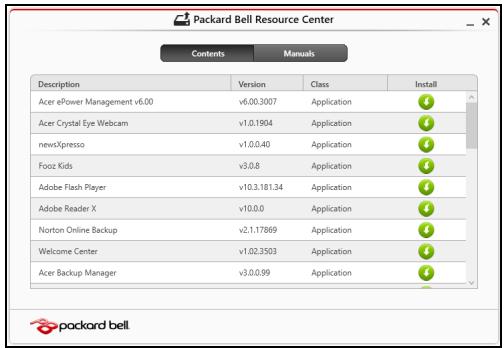
- ΜιρακHeTe Bbpxu INKoHata INHCTaJInpaHe 3a eIeMeHtA, KOITO NCKaTe Da INHCTaJInpaTe, CNeD KOEtO CNeDBAIte INHCTpyKUInTe Ha ekpaHa, 3a Da 3aBbPwTe INHCTaJIauNraTa. ПOBTOpeTe Ta3n CTbPkA 3a BCEKN eJIeMeHT, KOITO INCKaTe Da INHCTaJInpaTe.
Ako npueunhcmanupame om Apxueha Ha dpauepu u npuioxeHna DVD duck unu USB ycmpoucmeo:
-
ПоставеApxNBHaДраьери И пилженьяВ устpoиCTBOTO Ипго CBbpжTe CBс CBобodeн USB пот.
-
Ako nocabnte DVD nsck, n3yakaiTe da ce cTapTnpa Packard Bell PecypceH ueHTbp.
-
Ako Packard Bell Pecypceh ueHTbP He ce cTapTnpa aBTOMaTHUHO, HATNCHeTe Windows KnaeUwa +
, cNeI KOeTO ⅢpaKHeTe DBykPaTHO BbPxY IKoHaTa Ha ONTuHOTO yCTpOCTBO. -
Ako n3no3BaTe USB yctpoiCTBO, HATnCHeTe Windows knaeuua +
, cIeI KoEtO upaKHeTe DBykPaTHO Bbpxy yctpoiCTBOTO, KbDeTo e apxNBt. UpaKHeTe DBykPaTHO Bbpxy Pecypcen ueHTbp. -
BuxTe pa3dJIe CbIbpxaHne Ha Packard Bell PecypceH ueHTbp.
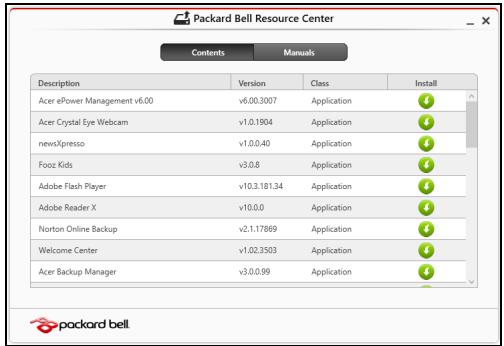
Bpbzane KbM no-paHeH cTaTyc
Bb3ctahOBBAHe Ha cncTemata Ha Microsoft nepnoDnHOpaBn "ChIMKn" Ha Baushite cncTemHN hAcTpoKn I n 3aNcBa KaTO TOKN 3a Bb3CTAHOBBAHe. B nobecheto cnyan Ha TpydHi 3a peuabaHe coΦTyepHn npoBlem MoKeTe Da ce BbPheTe Ha eHa OT Te3N TOKN 3a Bb3CTAHOBBAHe, 3a Da hakapate BaWATA cnctema Da pa6OT OTHOBO.
Windows aBTOMaTnUHO Cb3dAba DOnbJIHNTeJHa TOUka 3a Bb3CTaHOBRABaHE BCEKINDeH ININ BCEKINbT, KOraTO INHCTaIInpate COΦTyep ININ dpaBepn Ha yCTpoiCTBa.
3a6eKka: 3a DOIbJIHnTeJHa INHΦOpMaζηr OTHOCHO Bb3CTaHOBЯBaHe Ha cnCTeMaTa Ha Microsoft ot Cmapm, HaniuSeTe POMOù, cIeI KoETo ΚρakHete Bbpxy POMOù n noDpBxKa B cnCSbKa C npINoXeHn. HanuSeTe "Windows Bb3CTaHOBЯBaHe Ha cnCTeMaTa" B noJIeTO TbpcHe B "POMOù" n HATnCHete Enter.
BpbuHaHe do moUka Ha 6b3cmaHo8BaHe
- Ot Cmapm, HanuweTe "KoHTpOen NaHEn" n UpaKaHete Bbpxy KoHTpOen NaHEn B cIncBka C npJIOxHeHn.
- ΜιραπeTe Bbpxy CnCTema n cnryphoCt > Pa60Te HcHTbp, cIeI KOeTo UpaKHeTe Bbpxy Bb3ctaHOBBAhe B DoJIHata Yact Ha npO3opeu.
-
ΜιρακHeTe Bbpxy OTbOpn Bb3CTaHOBЯBaHe Ha CnCTeMaTa, cIeД KoETo HanpeI.
-
IlpakHeTe Bbpy NocJIeHHaTa TOnka Ha Bb3CTaHOBraHe (KOraTO cNCTemata e pa60Tnla KaKTo Tp8Ba), IprakHeTe Bbpy HanpeI, CneI KOeTO Bbpy KpaI.
- Поваява се позорец за Notьрждени; уразкete Вьрух Д. Вашистема e Бзостаюва на Като e Използва на Точковда вьзстаяюва, когто се поочил. Toи позес може д отHEME Няковские минуни и вьз можно komпютьръВи да се рсетаразра.
Bpbuahe Ha 6pHnTe HactpoKn Ha cnCTemata
Ako nma npo6JIemn C Baunr KOMNIObP, KOnto He Morat da 6bdaT Bb3CTaHOBeHn Ype3 Dpyn MeToDn, MoXe Da Ce HANOxN Da npenHCTaJInpaTe BCnUKO, 3a Da BbpHeTe fAbpnuHnTe HaCTpoIKN Ha cnCTeMaTa. MoXeTe Da Bb3CTaHOBnTE CNCTeMaTa KaTO N3NoI3BaTe IIN TBbpIInaNCK, INI npaxNBa 3a Bb3CTaHOBRAHe, KOntO CTe Cb3JaII.
- Ako BCE Oüe MoXeTe Αa PynchTe Windows n He cTe n3TpNJn Dja 3a Bb3CTaHOBBAHe, BIXTe "Bb3CTaHOBBAHe ot Windows" cTp. 81.
- Ako He MokeTe Da CTapTnpaTe Windows, opuHnHaHnIe TBbpI dNcK e 6bn IpeOpopMaTupan NJIIN CTE INCTaHnpaII npyr TBbpI dNcK, BvXkTe "Bb3ctaHOBBAhe O T apxNB 3a Bb3CTaHOBBAhe" cTp. 85.
Bb3TaHOBraBaHe ot Windows
СтатураиTe Packard Bell Recovery Management:
- OT Cmapm, habniye "Recovery"и урakhte Вьрху Packard Bell Recovery Management B cnncbka c npniloxeHn.
IoctbHnCa DBe OIcHn, Bb3ctaHOBAHe Ha 6pHn HacTpoKn(Bb3CTaHOBn KOMNTObpa MN) NJI NepcoHaJn3npaHO Bb3CTaHOBAHe (O6HOBAHe Ha KOMNTObpa MN).

Customized Restore (Retain User Data)
Вьз tcAnOBraBe Ha Фбрчнп HacToPkn N3TpBa BCnKo Ha TBbPdIa DnCK, CpeJ KOeTO npEnHCTaInpa Windows n BCnKu ДpaIbepn I coФTyep, KOnTO ca 6BII IN pEdbapITeH NOHCTaInpaHn Ha BaWata CnCTema. Ako MoKTe Da OTBOpHTe BaxKn ФаЛОВе Ha TBbPdIa DnCK, apXINbPaIte rN cera. BxKTe "Bьз tcAnOBraBe Ha Фбрчнп HacToPkn c Packard Bell Recovery Management" cTp. 82.
Packard Bell Recovery Management
?×
Welcome to Packard Bell Recovery Management
Packard Bell Recovery Management enables you to restore your system. To begin, select the task you want to perform. Please DO NOT remove the USB device while proceeding.

Customized Restore (Retain User Data)

Reinstall Drivers or Applications
Make a backup before you restore (Recommended).

Create Factory Default Backup
Create Drivers and Applications Backup

packard bell
Restores your computer to its factory default status. A reboot is required. NOTE: All data on drive Cwill be restored.
- O'TbAp r Ce npO3OpEeBt 06HOBaBaHe Ha Baunr KOMnIOTbP.
Refresh your PC
Here's what will happen:
- Your files and personalization settings won't change.
- Your PC settings will be changed back to their defaults.
- Apps from Windows Store will be kept.
- Apps you installed from discs or websites will be removed.
A list of removed apps will be saved on your desktop.
Next
Cancel
-
LpakHe Te Bbpy Hanpe, nocne Bbpy O6HOBahe.
-
Празецьт на Вьзаговаяне 3аночы с ресартураху КOMПOTьр, слд Което порджава с когпаху на phайноу ТВьрдя дск.Тои празец отема okono 30 мнуtn.
Bb3ctaHOBAHe OI apXnB 3a Bb3CTaHOBAHe
3a Bb3CTaHOBRAHe OT apxNBa 3a Bb3CTaHOBRAHe Ha USB yCTpoiCTBOTO:
- HamepeTe CBOB apxNB 3a Bb3CTaHOBBAhe.
- BkIIOUeTe USB yCTpOINCTBOTO IN BKIIOUeTe KOMNIOTBpa Cn.
- TpЯбba Да akтubираTe F12 Meню 3a 3apexkaHe, ako To BCE Oоц He e aktubираHo:
a. HatncheTe <F2 > , KOrato cTaptnapeKOMNIObpa cn.
b.ИЗПОЛЗВайтЕ ЛЯВаТа Или ДяСHаТа CTpeДКа,зa за ИЗБeрЕТe MeHOTO Main.
c. Hatnche Te CTpeNka HAnOly, DOKaTo He Ce MapKupa F12 Boot Menu, HATNCheTe < F5> , 3a Da npOMEHIne Ta3n HAcTpoiKa Ha Enabled.
d.ИЗПОЛЗВайтЕ ЛЯВаТа Или ДяСHаТа CTpeДКа,зa за ИЗБeрTe MeHOTO Exit.
e. B 3aBnCmOcT OT Tnla Ha BIOS, KOITo n3NoJ3Ba KOMnHbpa Bn, n36epTe 3aIIu npomeHnte u n3XoJ nn N3XoJ cbc 3ana3BaHe Ha npomeHnte u HaTnCHete Enter. N36epTe OK nn Da, 3a da NOTBbPdntE.
f. KomnoTbPbT Bn ue ce pecTapTnpa.
- По врeme на статиранe, натусентe
, за ра OTВОпITE MeHIOTO 3a заразхдае. Менито за заразхдае Ви позьогая за ИЗБИраTe yстюctBOTo, оТ koeto за ce статира сисемаТа, habример USB yстюctBO.
a.Използвайтстpeлкite,3aдаинберетe рета USB yctpoистBO, cneД Koeto HATINCHete Enter.
b. Windows ce CTapTupa O T apxINBa 3a Bb3CTaHOBRAHe BMeCTO Upe3 HOpMaJIHHI pIouec Ha CTapTupaHe.
5.Изберетe вида на Клавиатура.Ta.
6.ИзберетеОтстаяньа themselves Ha HeH3npaBHOCTn nИзберетe Tuna Ha Bb3ctaHOBJBaHe:
a. UpaKHe T Bbpy Pa3upeHn, cIeJ KoETo Bb3ctaHOBaHe Ha CnCTeaT, 3a Da CTapTpate Bb3cTaHOBAHe Ha CnCTeMaTHa Microsoft: Bb3CTaHOBAHe Ha CnCTeMaTHa Microsoft nepnoDmH no paBn "ChIMKn" Ha Baunte CnCTeMHn HAcTpoKn n rN 3aInCBA KaTO TOKn 3a Bb3CTaHOBAHe. B NOBeYeTo CnyauH Na TpydHn 3a peWabHe COpTyepHn np6JIemMoKeTe Da ce BbPHeTe Ha eHa OT Te3N TOKn 3a Bb3CTaHOBAHe, 3a Da Hakapate BaWata CnCTeMa Da pa6OTn OTHOBO.
b. UpaKHe T Bpxy HynipaHe Ha Baun KOMnOtbp, 3a Da CTapTnpate npoeca no HynipaHe: HynipaHe Ha Baun KOMnOtbp n3TpINBa BCNUKO Ha TBbpDnI dNCK, cNeI KoETo npEnHCTaIIpa Windows u BCNUKn dpaBepu n coQfTyep, KOInTO ca bNil npedBapnteNo IHCTaIIpaHn Ha BaWata cnCTema.
Ako MoKeTe Da OTBOpTe BaXHn PhaIIOBe Ha TBbPdNr IuCK, apxNBpaTe rI cera. BIXe "HynpaHe Ha Baunr KomnIoTbp OApxNBa 3a Bb3CTaHOBRAHe" Ctp. 87.
c. lpaKHe Te Bbpy O6HOBaHe Ha BaIa N KOMnHtbp, 3a da cTaptnpate npoeca no o6HOBaHe:
06HOBRAHe Ha Baunn KOMNHTbp 1e ce onNTa da 3ana3n BaunTe fainoBe (notpeBntenckn daHHn), Ho 1e npEnHCTanIPA BCNUK coFtyePH nporpamn uCtpoiCTBa. CoFtyeP, INCTaINPAH cJeI KaTO CTe 3akynJIn KOMNHTbpa, 1e 6bJe npemaxHaT (OCBeH COFtyeP, INCTaINPAH ot Windows Store). BxKTe "06HOBAHe Ha Baunn KOMNHTbp OAPXnBa 3a Bb3ctaHOBAHe" Ctp.89.
Hynupahe Ha Bawu komnombp om apxuea 3a 6b3cmahos8ahe
BhImaHne: HynpaHe Ha Baunia KOMnIObP ige n3Tpne BnKn faiNoBe Ha BaWeTo TBbpD nCK.
- O'TbApCe npo3opeuT HynipaHe Ha Baunn KOMnIOTbP.
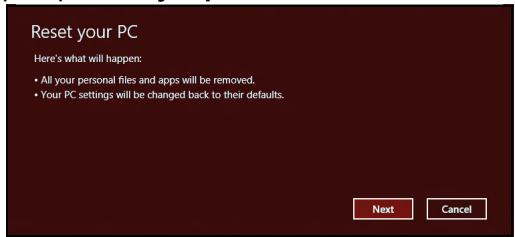
NIOcmpaquume ca camo cnpaKa.
2.単pakHeTe Bbpxy CJeDbau.
3.Изберете onepaционната систema,зада вьзсановite(obNKHObeHIMaHaJIuHa caMo eHaOniura).
The FCC with its action in ET Docket 96-8 has adopted a safety standard for human exposure to radio frequency (RF) electromagnetic energy emitted by FCC certified equipment. The wireless adapter meets the Human Exposure limits found in OET Bulletin
65, supplement C, 2001, and ANSI/IEEE C95.1, 1992. Proper operation of this radio according to the instructions found in this manual will result in exposure substantially below the FCC's recommended limits.
- The following safety precautions should be observed:
Do not touch or move antenna while the unit is transmitting or receiving.
- Do not hold any component containing the radio such that the antenna is very close or touching any exposed parts of the body, especially the face or eyes, while transmitting.
- Do not operate the radio or attempt to transmit data unless the antenna is connected; this behavior may cause damage to the radio.
Use in specific environments:
- The use of wireless adapters in hazardous locations is limited by the constraints posed by the safety directors of such environments.
- The use of wireless adapters on airplanes is governed by the Federal Aviation Administration (FAA).
- The use of wireless adapters in hospitals is restricted to the limits set forth by each hospital.
Antenna Use
In order to comply with FCC RF exposure limits, low gain integrated antennas should be located at a minimum distance of 20~cm (8 inches) or more from the body of all persons or at a minimum distance as specified by the FCC module grant conditions. FCC grants can be viewed from the FCC Equipment Authorization website at https://fjallfoss.fcc.gov/ oetcf/eas/reports/GenericSearch.cfm by entering the FCC ID printed on the module label.
Explosive Device Proximity Warning
Warning: Do not operate a portable transmitter (including this wireless adapter) near unshielded blasting caps or in an explosive environment unless the transmitter has been modified to be qualified for such use
AntennaWarnings
-
Warning: To comply with the FCC and ANSI C95.1 RF exposure limits, it is recommended that for the wireless adapter installed in a desktop or portable computer, the antenna for this wireless adapter to be installed so as to provide a separation distance of at least 20cm (8 inches) from all persons or at the minimum distance as specified by the module grant conditions. FCC grants can be viewed from the FCC Equipment Authorization website at https://fjallfoss.fcc.gov/oetcf/eas/reports/GenericSearch.cfm by entering the FCC ID printed on the module label.
-
Warning: The wireless adapter is not designed for use with high-gain directional antennas.
Use On Aircraft Caution
- Caution: Regulations of the FCC and FAA prohibit airborne operation of radio-frequency wireless devices (wireless adapters) because their signals could interfere with critical interference with critical aircraft instruments.
Local Restrictions on 802.11a, 802.11b, 802.11g and 802.11n Radio Usage
- Caution: Due to the fact that the frequencies used by 802.11a, 802.11b, 802.11g and 802.11n wireless LAN devices may not yet be harmonized in all countries, 802.11a, 802.11b, 802.11g and 802.11n products are designed for use only in specific countries, and are not allowed to be operated in countries other than those of designated use. As a user of these products, you are responsible for ensuring that the products are used only in the countries for which they were intended and for verifying that they are configured with the correct selection of frequency and channel for the country of use. Any deviation from the permissible power and frequency settings for the country of use is an infringement of national law and may be punished as such.
Wireless Interoperability
The wireless adapter is designed to be interoperable with other wireless LAN products that are based on direct sequence spread spectrum (DSSS) radio technology and to comply with the following standards:
- IEEE Std. 802.11b compliant Standard on Wireless LAN
- IEEE Std. 802.11g compliant Standard on Wireless LAN
- IEEE Std. 802.11a compliant Standard on Wireless LAN (applies to devices supporting 802.11a)
- IEEE Std. 802.11n draft 2.0 compliant on Wireless LAN
- Wireless Fidelity certification, as defined by the Wi-Fi Alliance
The Wireless Adapter and Your Health
The wireless adapter, like other radio devices, emits radio frequency electromagnetic energy. The level of energy emitted by the wireless adapter, however, is less than the electromagnetic energy emitted by other wireless devices such as mobile phones. The wireless adapter operates within the guidelines found in radio frequency safety standards and recommendations. These standards and recommendations reflect the consensus of the scientific community and result from deliberations of panels and committees of scientists who continually review and interpret the extensive research literature. In some situations or environments, the use of the wireless adapter may be restricted by the proprietor of the building or responsible representatives of the applicable organization. Examples of such situations may include:
- Using the wireless adapter on board airplanes, or
- Using the wireless adapter in any other environment where the risk of interference with other devices or services is perceived or identified as being harmful.
If you are uncertain of the policy that applies to the use of wireless adapters in a specific organization or environment (an airport, for example), you are encouraged to ask for authorization to use the adapter before you turn it on.
FCC Radio Frequency Interference Requirements (applies to device supporting 802.11a)
This device is restricted to indoor use due to its operation in the 5.15 to 5.25 GHz and 5.470 to 5.725 GHz frequency ranges. FCC requires this product to be used indoors for the frequency ranges 5.15 to 5.25 GHz and 5.470 to 5.725 GHz to reduce the potential
for harmful interference to co-channel mobile satellite systems. High power radars are allocated as primary users of the 5.25 to 5.35 GHz and 5.65 to 5.85 GHz bands. These radar stations can cause interference with and /or damage this device. No configuration controls are provided for this wireless adapter allowing any change in the frequency of operations outside the FCC grant of authorization for U.S operation according to Part 15.407 of the FCC rules.
USA — Federal Communications Commission (FCC)
This device complies with Part 15 of the FCC Rules. Operation of the device is subject to the following two conditions:
- This device may not cause harmful interference.
- This device must accept any interference that may cause undesired operation.
- Note: The radiated output power of the adapter is far below the FCC radio frequency exposure limits. Nevertheless, the adapter should be used in such a manner that the potential for human contact during normal operation is minimized. To avoid the possibility of exceeding the FCC radio frequency exposure limits, you should keep a distance of at least 20cm between you (or any other person in the vicinity), or the minimum separation distance as specified by the FCC grant conditions, and the antenna that is built into the computer. Details of the authorized configurations can be found at http://www.fcc.gov/oet/ea/ by entering the FCC ID number on the device.
Interference Statement
This wireless adapter has been tested and found to comply with the limits for a Class B digital device, pursuant to Part 15 of the FCC Rules. These limits are designed to provide reasonable protection against harmful interference in a residential installation. This wireless adapter generates, uses, and can radiate radio frequency energy. If the wireless adapter is not installed and used in accordance with the instructions, the wireless adapter may cause harmful interference to radio communications. There is no guarantee, however, that such interference will not occur in a particular installation. If this wireless
adapter does cause harmful interference to radio or television reception (which can be determined by turning the equipment off and on), the user is encouraged to try to correct the interference by taking one or more of the following measures:
- Reorient or relocate the receiving antenna of the equipment experiencing the interference.
- Increase the distance between the wireless adapter and the equipment experiencing the interference.
- Connect the computer with the wireless adapter to an outlet on a circuit different from that to which the equipment experiencing the interference is connected.
- Consult the dealer or an experienced radio/TV technician for help.
- Note: The adapter must be installed and used in strict accordance with the manufacturer's instructions as described in the user documentation that comes with the product. Any other installation or use will violate FCC Part 15 regulations.
Canada - Industry Canada (IC)
This device complies with RSS210 of Industry Canada. Cet apparéil se conforme à RSS210 de Canada d'Industrie.
This Class B digital apparatus complies with Canadian ICES-003.
"To prevent radio interference to the licensed service, this device is intended to be operated indoors and away from windows to provide maximum shielding. Equipment (or its transmit antenna) that is installed outdoors is subject to licensing."
The use of these equipments is regulated by:
1.D.L.gs 1.8.2003, n. 259, article 104 (activity subject to general authorization) for outdoor use and article 105 (free use) for indoor use, in both cases for private use.
2.D.M. 28.5.03, for supply to public of LAN access to networks and telecom services.
Pakistan Telecommunication Authority (PTA) Approved
Morocco
The operation of this product in the radio channel 2 (2417 MHz) is not authorized in the following cities: Agadir, Assa-Zag, Cabo Negro, Chaouen, Goulmima, Oujda, Tan Tan, Taourirt, Taroudant and Taza.
The operation of this product in the radio channels 4, 5, 6 and 7 (2425 - 2442 MHz) is not authorized in the following cities: Aéroport Mohamed V, Agadir, Aguelmous, Anza, Benslimane, Béni Hafida, Cabo Negro, Casablanca, Fès, Lakhab, Marrakech, Merchich, Mohammédia, Rabat, Sale, Tanger, Tan Tan, Taounate, Tit Mellil, Zag.
Japan
5 GHz 带是室内用使用のと
Korea
PaioeToHa nItepepeHn
ПюиЗВоДиТелЯне OTROВApязИнКаВа ради ИпTV ИNTeрфepeHця,причнHeаOT HepaZPeш�Енa мОдиФикauцян ha ToBa yCTpoIcTBO.
Bpb3kn n dNCTaHcNoHHn 3a3eMaBAHn
PELV (Protected Extra Low Voltage)
3a da rapaHTnpaTe cJIIOCTHO HnCKO HnpeXeHne Ha oBOpyDbaHeTo, CBpXeTe oBOpyDbaHeTo c.
PELV (Беэ�насно CBрхниско Hanpeхенne)
Bcekn Bxod n 3XoD Ha To3n npOyKT e KlaCnΦuPah KaTo „Be3OnaCHO HnCKO HanpeKeHne".
ДиctaHNoHH3a3eMaBaHn
3a da n36berhepe nCK OT KOKB yap, CBpKte BCnK INokaiHn (B OTdeHen OΦnc) KOMNTOPI N KOMNTObPHO ObOpyDBeAe KbM edHa N cbUa eIeKTPuecka Bepira, Ta3n Ha IHCTanaqraTa Ha crpaData. AKe He cTe ciRpyHn, npOBepe IHCTaJauqraTa Ha crpaData, 3a da n36berhepe nCTaHcNoOHn 3a3emRABaHna.
3axpaHbHe Ha crpaData
CbpxTe 606pyDbaHTo KbM 3axpaHbHe Ha crpaTa, KoETo E B CbOTBeTCTBne C TekyuIte pa3npoep6n 3a OkabEnyBaHe B cTpaHaTb. BbB BeNko6pntaHn, TOBa ca pa3npoep6nTE IEE.
EneKtpnuecko 3axpaHbAne n Ka6eIi
EneKtpuuecko 3axpaHbaHe
BxOdbT IN 3xOdbT Ha 3axpaHbHaTo (aKO Ima TaKbBa) Ce KNaCnΦuPaT KaTO BnCOkO HanpeKeHne.
Tp6Ba Da n3KnHcHTe 3axpaHbAunna Ka6en n da n3BaJnte 6aTePnra, 3a da cnpete 3axpaHbAHeTo Do obOpUdBaHeTo. 3a Ta3n ceN, KOHTaKtBt Tp6Ba Da e 6n3o Do 06opUdBaHeTo n da 6bJe neCHO doCTbneH.
BxOHa MoUHocT: BxKTe etNKeTa OT DOnHata CtpaHa Ha KOMnIObPa I ce yBepTe, Ye 3axpaHbAaIaT aAdanTp eTRObAp Ra NOKa3aHnraTa.
ПинкakBNOбстгелТВа He TРБВОптБИТЯТа ce onNTBA da pa3rIIO6BA 3axpaHbAHeto. 3axpaHbAHeto He CbIbPkaЧaTи, KOITO MOrAT DA bБДAT CMeHeHn OT notpeBHTeR. BbTpe B 3axpaHbAHeto ИMa BvCOKO HanpexKeHne, KoETO MoKe Д anpeDin3BnKa cepno3Hn HapahBaHnY.
Ako 3axpaHbAHTo e DepeKTHo, To Tp8Ba Da 6bDe BbpHaTo Ha TbproBeua.
3axpaHbaunKa6eInu
To3n npOdyKT n3NcKBa 3a3eMeH 3axpaHbaa Kaben I quencen. IeIceNbT nacBa cAmo B 3a3eMeH eEeKtpuYeCKn KOHTaK. YBepeTe ce, ye eEeKtpuYeCKnT KOHTaK t e 3a3eMeH npAByJHo, npEdn Da BkIIOUHte 7eenceJa Ha AC aAdanTepa. He BKJIIOUBaYte 7eIcnCena B He3a3eMeH eEeKtpuYeCKn KOHTaK. 3a nobuee noDpO6HocTn Ce CbbpKeTe cbc CBOB eEeKTPoTEXNIK.
IbIjxHnata Ha Ka6eNa He Tpr6Ba Da HaBnUaBa 2,5 MeTa. 3a da npedotBpATte TOKOB ynap, He OCTpaHraBaiTe N He DeakTNBpuAte 3a3emBAHeTo Ha 3axpaHbaaNka6eN. Cmehete 3axpaHbaaNka6e Ako 6bJe NOBpeDeH. CbpxKeTe ce c TbproBeu OTHOCHO noDxOJaN Bn Ka6eB. B Ebpona, KOHTaKTtne Tpr6Ba Da ca c HanpeXeHne 250 VAC, Na-Malko 10 amp. Ha 7eCenca Tpr6Ba Da nMa MapKnipOBka 3a oOnobpeHne ot MekdyHapOHa areHcNIA. Ka6eBbT Tpr6Ba Da e nDxOJa 3a yNtpe6Ba B CTpaHata Ha KpaHnna Notpe6nte. KoHCyunTpauiTe ce c TbproBeua nPi MeCTHaT a enEeKtpuecka KOMpanHn aKO He CTE CInpyhN Ka6bT Tn3axpaHbaa Ka6eJ Da n3NoJ3Bate B CTpaHata CN.
Ka6eJn
OTHOCHO KaBEn, KOInTo He ca npedocTaBeHc npoDyKtBa ONaKOBkata Ha KOMnHbpa:
EJIeKTPomarHHTHATA cBMeCTMIOCT Ha CnCTeMaTa Ce rapaHTnpa cAmO aKO Ka6eNbT INHTeppeCt IMAT eFeKTNBHO ekpaHipaHe.
I3non3baheTo ha ekpaHnpan Hntepfeiecen Ka6e e 3aIbJnKtEnHo 3a USB, IEEE1394, cepHnHy cTpoiCTBa, pInHTepn, nprn, aHaIorOB nnnu cnpob ayDIO/BnDeo cnHan, PS2, TeENB3Opn nI FM anTeHN n Kato yano 3a BCNUKN BnCOKOcKOpocTHN Ka6enHn Hntepfeien.
I3no3BaTe cmo No. 26AWG nIIN no-roIeMn TeleKOMyHnKaUOnHH Ka6eN, oOobpeHn ot UL.
Camo IblnxnHaTa Ha KaBeIIne Ha Ethernet LAN nIN RTC MoEmTe MoKe da HAdBnAba 3 MeTpa.
Packard Bell npenopbUba da doabuTe KpbIgna cKoBa c fepnTHO JaIO KoBM BcEKN KaBEn, KOITOB CBp3Ba BaAaN KOMNIOTbP C xapdyepHO yCTPOINCTBO, KOeTO He e CBbp3aHO KbM BaAaN KOMNIOTbP.
- Cnpabka 3a Ферита: 28A-2029 ot Steward (Два Крва)
Pn ceptnΦniupaHe Ha npOyKta Packard Bell n3noJ3Ba cneHOTo KaueCTBO Ha Ka6eJInte:
- USB2.0 septnФицрани kaбени ot Hama 46778
- IEEE1394 ekpanipanu FireWire ot Hama 50011
- RCA-RCA ekpañpañá yándno/BiJeO ka6eNi oT Thomson KHC001M, KHC012M, KHC028M
- Ctepeo xak, ekpaHnpaHn ayDIO ka6eIOn t Hama 43330H, 42714H
AkymynpaHe Ha TOnnHa n IpeHocmKOMnIOTpn
AC aanTepbI n doHata cTpaHa Ha KOMnIObpa Moar Da cTaHaT ropeu Cnei npOdbJnxTeHa yNtpe6a. PpOdbJnxTeHeh qn3nueckn KOHTAKT c aanTepa NdoHata cTpaHa Ha KOMnIObpa da ce 136yraBa.
OCTpaHЯBaHe n noctabYe Ha kanaZnte Ha shacHTO
IpeDN da OTcTpaHNTe KanaunTe Ha 7acnTo 3a 06cnyXbaHe nIN npomraHa NaobopydBaHeto, Tp8bDa n3KJIouHTe nIN OTcTpaHNTe BCNUKn 3axpaHbAunn MOnemHN Ka6eJIn n Da n3BaUnTe 6atePnraTa.
-BHumHe: Hrkou KOMnoHeMu e Komnombpa Moaam da cmaHam oopeu cned npobIxmuHa ynompe6a.
Toraba Tp8bDa da 3aTbOpnte IacnTo IpeDn da CbPjKeTe N BkIIOHTe O60pyDbAHeTo.
3aBHeHne 3a CbOTBeTCTBnE C Na3epHnTe CTaHapTN
I3xbpnaHe Ha 6aTeepn (Korato e npnIOxmo)
Ipei Da n3xBpnte BaheTo o6OpDbaHe, ybepeTe ce, ye cTe n3BaDnIn BCnKKn 6aTePnN, KOnto MoKe Da ca MOHTnpaHb N B o6OpyDbaHeTo. EbponecknT 3akOH rnaCn, Ye 6aTePnNTe Tpr6Ba Da 6bDat Cb6nPaHn 3a n3XBpIne OTeJHo OT DmoknHcknte OTNaDbu. He XbPnIte n3No3BaHnTe 6aTePnB N KoFata 3a 60kIyK. NxBbPnIte n3No3BaHnTe 6aTePnN cnope Pa3Nope6bte 3a cb6PnAe Ha 6aTePnN, KbDeTo mMa TaKbNA HIN PONtai Te Ba7nN dNCTpn6byTop nIN CbOTBeTHaT MeCTHa INCTaHcNJa KbDe MoKeTe Da npedaTe 6aTePnNTe. BlaOdapeHne Ha BaWnte ycHnIa CTaBA B3MoXHO 6e3OnachTO cb6PnAe, peUKNpTaHe n YHnIOXkaBaHe Ha n3No3BaHnTe 6aTePnN KaT O Taka cnOMarate 3a Ona3BaHeTo Ha OKoJIhata CpeDa n 3a HamaJIraBaHe Ha pNCKOBete 3a 3dpaBeTo.
-BhumaHue: Ima puck om ekcnno3a kao u3non3ame apween mun 6amepuu.
I3x6bpne me u3non3eahume 6amepuu cnped uncmpykuuume.
ENERGY STAR

ENERGY STAR
Пюдктпе на Packard Bell,обзачени c ENERGY STAR, Вспесяват napи, кATO hamаляват eнергийнITE pa3хODи n 3aцntabat OKOLнота срда,бez тoba д e B уцьрб на Функципеши npin3водителнocтta. Packard Bell c ropdoct npednara ha cbonte notpe6bnteni рюдктпe сслoroto ENERGY STAR.
KakBo e ENERGY STAR?
PpOdykTN c IloroTO ENERGY STAR KOhCymnP aT NO-MaJIKO eHepnI N ppeDToBpaTBA tEmcHn Ha napHKnOB ra3Obe Kato OTROBAPrT HcTpIKTHnTe pa3nope6b 3a eHepnHa eFekTINBHOCT Ha AreHzIyTA 3a 3aunTa Ha OKoHNtA CpeDa Ha CAU. Packard Bell npedlara PpOdykTN u ycLytn No ceLIIra CBY, KOtTO nOMarAT Ha KNHeHTnTe da neCTa
napi n eheprn y da noobpbaT kaeeCTbOTo Ha okonHata cpea. KoKoTO nobuee eheprn MOxem Da cneTUM Ype3 NO-BNCOKA eheprnHa efeKTNBHOCT, TONKOBa nobuee MOxem Da HamaIM EMUCINTE Ha napHKOBn ra3OBe i pNCKOBTe 3a npOMraHa HA KInMATA. 3a nobce INΦopMaunia BIXTe www.energystar.gov www.energystar.gov/powermanagement.
Recovery Management 67
C
3apexndahe CD-ROM
npOBepKa Ha HnBTo 42 pbUHO n3BaXdaHe 92
3axpanBaun KaBeu 10 otctpaHraVe Ha npo6JIeMn. 92
3auntha cteha 59 3noHaMepeh coOpTyep. 58
D
DSL 51
E
Ka6eI 10,115 KOMnHToBp
n3rpeBkIIOUeH INHdNkAToP 22
OTDAHO 25 15
OTJBA 23 KomnoTbPncapea 8
otnped. 23 INHTepHeT
n3rpeoTJBO 22 Bpb3ka 50,51
n3rpeoTpe 22 3aunTHa CTeHa. 59
I3XbPJIeHa 6aTeepn.. 120 IHTepHeT DocTaBUnK (ISP) 50
Klajnataya IHTeppepeHcna 114
6bprn knabniu 21 Kypcop 28
Kləbɪnʌtypə
OTcTpaHraBaHe Ha npo6JIeMn. 92
1
Mpeka 33 cTaptnpaHe 90
MpekoBvbp3kn 53 PpO3Opu
IpeIpa3Hn 3dpabHn Mepkn 12 I3noJI3BaHe Ha Windows 49
IpeDynpexdHeNe 3a eHJIeNcT 14 MepKn 3a 6e3oNaChocT 8
IpeHocIMMyTmEduHH OkoHa cpea 119
yctpoiCTBa 33 nopToBe 31
Ipnntep OoHCTBaHe Ha KOMnIObpa. 11
OTcTpaHЯBaHe Ha npo6JIeMn. 92 POndRpXka
Ipo6JIeMn 90 IporpaMaRecoveryManagement..49
dncnnei 91 Ye6 caT ha Packard Bell. 56
CD-ROM 92 Recovery Management 67
KlauBaTpa. 92 MoDcM 51, 52
Ipnntep 92
L
LAN (Jokalmapeka) 53
N
Cnpynoct Coptyep
AkyaIinau 66 CoTyepeH Iuueh3 122
ANTINBIPUC 59 Norton Internet Security.. 57,61
0
yHnBepcaHa cepnHa ⅢHa. 34 TbuaI 28
UIIIOHcKn coOpTyep. 58 I3NoI3BaHe 28-28
UcTpoIcTbA
YeTeu 3a KapTn C nAmet 31
P
Packard Bell 56
Ilporpama Recovery Management... 49
W
WiFi 53 Windows abTomatnHn
Windows 66
Y
AToKaToTaOaOn aToTa Windows. 84
AToKataaon aTo avIypapo
aOpaaleiac 88
EuxvEs Epwntnoeis 93
ZumoualeKai UTOEIEeG OXETIKa E Tn XpnoT Twv Windows 8 96
YIAPXOUV TPEIS EVVOIE SIOU THELETE EVDEXOUEVWS VA KpatnoTe 96
Pioc aon 70
Charms; 96
Pioc Tnyaivw oTo Evapx; 97
Piws aivw ato ia εφapouyn oε
aλλη; 97
Pioc aTeevepyOToiW tov UToAoyoiTn
ou; 97
IaTI uTAPxE I vO TEPiβaAov Epyaia;... 97
PiwcEekaiodwovuToIooiOHTnou;....98
PiC EaToiKeUw To UToLoyoiTn o ;.... 98
Packard Bell Recovery Management
Tia va TPOEtoiAOeTe TOV UTOLOAVOTn OaC YA EITINPPoOeTeC EITIOyEc aTOKATAOtaOns TOU OuaTmuToC, 0a TpeTcVa DnUIoupynoTeEva OET biokwv aTOKATAOtaOns To Taxutepo Duvatov. AvatpeTe OTN OELIDA 69 YIA TEPIOOOTEPeC PAnpOpopieC.
PpwaBnmuata OTOdelta
Pooataia tou unloayiotn oac
Eivai Zwtikns onmaiaic va TnapeXeT TPOOtaia OTOV UTOLOyoiTn OAC
aio Iouc kai TPOAOBolc meow Internet (Bλ. PPOoPopa aopalaeia CInernt
OTN OELIDA 49 KAI PPOOtaia ot N eLIDa 57).OTAV TeoTe Tov UTOLOyoiTn
OAc OE LEIToupyia yia TpWtn oPopa, TPOTEIVETAI EVA OLOKAnpwoEvno
TPOypaumaa aqalaeiaC Internet. Oa TpeTTIva EveyoToIOHeTe autHy Tnv
TPoOtaia 0oo to duvatov ouvtOpotepa, oiyoupa piv ouvDSeiTe oTo
Internet.
Eπiλoyn Napóxou Yπηρεοιw Ḁαδiktúou

Pepinythie T OTo DiakikTuO!
Tia va Tepinynte OTo DiakiktuO, XpeiaZeote eva Tpoypauma Tepinyonc OTo DiakiktuO.To Internet Explorer Tpoospeei mua Eukolotepn kai aopaaoletpn Eptiia Tepinyonc OTo DiakiktuO. Aeoos mIoic puoioeis tic npaetpouc TpooBaonc OTo DiakiktuO kai kavete evapn ouvdeon, kavte kAI OTn ouvtouanl Internet Explorer Tou Bpioketa tny Etipavieia epyaia c Kai avebaoTe ovea Etinteda tnv Eptiopia oac OTo DiakiktuO!

Ti ειναί to spyware;
To Spyware avaapeptai e yevikwac aventihmueta ppoypamata ta otoia 巴 OV TA oTO UTOLOYIOIOT OAC OoO EIOE OUVDBEVEO I TO DIAIKTUO, ouxva xomegaic va to yyomegaizTe. Ta ppoypamata auta, apou muovouv To UTOLOAYIOIOT OAC, mTOpEVA napatnpouv Tc bpaotnpioTntcog KATA TnV TEpiynonocst OTO DIAIKTUO, va oullEyouv TPOOWTIKEc PAnpopoipcs, va TPOKALOUVTN EAPAVION avabuoueuv Wapapthetauw n akopa kai va aALAZOUV Tc puOIOEIC Tou UTOLOYIOIT Noc. To Spyware katavaawvei Tlopous Tou UTOLOYIOIT OAC. MTopei va eTINBpaDuvE IT OUVDEON OT OIAIDIKTUO h OLoknpo To OUsTma Tou UTOLOYIOIT OAC, Akopa kai va kavei Tov UTOLOYIOIT OAC v "koAHOE".
Meipke oepc, to Spyware xnpoiotooietai aTIO abiotaktes Etaipieys ia va Tapaokaouov kai va Evtonizouv tic tonoeciou c Toun ETIOKETTEOTe OTo diaiktuO wote va Tpooiopiogouv tic ouvntheic oac OTNV Tepinyon OTo diaiktuO kai va eupaviciouv otnv oboyn oac avaduomeva npapdupa Toun aTneuohuvovtai eiko aEosac. Oomega,peika eion spyware uTepbaivouv Tny aTn Tapaokaouthetaon kai kataypapov 0,Ti TAnktpolooyite, touc kwokouc oac, aTOneawvTac oobapo kivduvo yia tnV aoqalia.
Packard Bell Recovery Management
?X
Welcome to Packard Bell Recovery Management
Packard Bell Recovery Management enables you to restore your system. To begin, select the task you want to perform. Please DO NOT remove the USB device while proceeding.

Customized Restore (Retain User Data)

Reinstall Drivers or Applications
Make a back-up before you restore (Recommended).

Create Factory Default Backup
Create Drivers and Applications Backup
Restores your computer to its factory default status. A system is required. NOTE: All data on drive C will be deleted.

packard bell
- PpaayataoToioTe iikpOoiop0woeic.
Av exouv stapatnoe i va aeitoupyouv owo ta olic eva n duo otoixia loyioikou n uikou, to pobma u tropei evoexoewvsc v etilutheta i e ETTAVeykataoan tou loyioikou n twpoypaumaw odynanoc oukeuwv.
Tia eTavEYkataoTaon Tou loyioikou kai twv TPOpyaumaw oyynonns Tou exouv TPOeykataoTahei Epyoostaiaka, avatpeTe OTnv Evotnta "ETAVEYkataoTaon TPOpyaumaw oyynonnc kai epapuyov" 6eLi8a 78.
Tia oyniec oxetiká e Tnv ETTAVyKATaOtaon loyioikou kai TPOpyapuMATWv OynonC TOU dV nTAV TPOeykateoTneva, avatpEeTc OTNV TEKnpiwn Tou PoiovTOC n 0To dIKTuKO tTO UTOOTnIgns.
Packard Bell Recovery Management
?X
Welcome to Packard Bell Recovery Management
Packard Bell Recovery Management enables you to restore your system. To begin, select the task you want to perform. Please DO NOT remove the USB device while proceeding.

Restores your computer to its factory default status. A reboot is required. NOTE: All data on drive Cwill be restored.

Customized Restore (Retain User Data)

Reinstall Drivers or Applications
Make a backup before you restore (Recommended).

Create Factory Default Backup
Create Drivers and Applications Backup

packard bell
KavTE KAIk OTO EAnaveyKataoTaon PpoypaMaTov obynoNc n eapouvV.
EkkivnoTe To Packard Bell Recovery Management:
- ATo Evapx, TAnKtpoAoynote 'AtokataoTaon' kai tKaVte KIAK oTo Packard Bell Recovery Management oTn Iota evapmuoyv.
Here's what will happen:
- Your files and personalization settings won't change.
- Your PC settings will be changed back to their defaults.
- Apps from Windows Store will be kept.
- Apps you installed from discs or websites will be removed.
- A list of removed apps will be saved on your desktop.
Next
Cancel
The FCC with its action in ET Docket 96-8 has adopted a safety standard for human exposure to radio frequency (RF) electromagnetic energy emitted by FCC certified equipment. The wireless adapter meets the Human Exposure limits found in OET Bulletin

65, supplement C, 2001, and ANSI/IEEE C95.1, 1992. Proper operation of this radio according to the instructions found in this manual will result in exposure substantially below the FCC's recommended limits.
- The following safety precautions should be observed:
Do not touch or move antenna while the unit is transmitting or receiving.
- Do not hold any component containing the radio such that the antenna is very close or touching any exposed parts of the body, especially the face or eyes, while transmitting.
- Do not operate the radio or attempt to transmit data unless the antenna is connected; this behavior may cause damage to the radio.
Use in specific environments:
- The use of wireless adapters in hazardous locations is limited by the constraints posed by the safety directors of such environments.
- The use of wireless adapters on airplanes is governed by the Federal Aviation Administration (FAA).
- The use of wireless adapters in hospitals is restricted to the limits set forth by each hospital.
Antenna Use
In order to comply with FCC RF exposure limits, low gain integrated antennas should be located at a minimum distance of 20~cm (8 inches) or more from the body of all persons or at a minimum distance as specified by the FCC module grant conditions. FCC grants can be viewed from the FCC Equipment Authorization website at https://fjallfoss.fcc.gov/oetcf/eas/reports/GenericSearch.cfm by entering the FCC ID printed on the module label.
Explosive Device Proximity Warning
Warning: Do not operate a portable transmitter (including this wireless adapter) near unshielded blasting caps or in an explosive environment unless the transmitter has been modified to be qualified for such use
AntennaWarnings
-
Warning: To comply with the FCC and ANSI C95.1 RF exposure limits, it is recommended that for the wireless adapter installed in a desktop or portable computer, the antenna for this wireless adapter to be installed so as to provide a separation distance of at least 20cm (8 inches) from all persons or at the minimum distance as specified by the module grant conditions. FCC grants can be viewed from the FCC Equipment Authorization website at https://fjallfoss.fcc.gov/oetcf/eas/reports/GenericSearch.cfm by entering the FCC ID printed on the module label.
-
Warning: The wireless adapter is not designed for use with high-gain directional antennas.
Use On Aircraft Caution
- Caution: Regulations of the FCC and FAA prohibit airborne operation of radio-frequency wireless devices (wireless adapters) because their signals could interfere with critical interference with critical aircraft instruments.
Local Restrictions on 802.11a, 802.11b, 802.11g and 802.11n Radio Usage
- Caution: Due to the fact that the frequencies used by 802.11a, 802.11b, 802.11g and 802.11n wireless LAN devices may not yet be harmonized in all countries, 802.11a, 802.11b, 802.11g and 802.11n products are designed for use only in specific countries, and are not allowed to be operated in countries other than those of designated use. As a user of these products, you are responsible for ensuring that the products are used only in the countries for which they were intended and for verifying that they are configured with the correct selection of frequency and channel for the country of use. Any deviation from the permissible power and frequency settings for the country of use is an infringement of national law and may be punished as such.
Wireless Interoperability
The wireless adapter is designed to be interoperable with other wireless LAN products that are based on direct sequence spread spectrum (DSSS) radio technology and to comply with the following standards:
- IEEE Std. 802.11b compliant Standard on Wireless LAN
- IEEE Std. 802.11g compliant Standard on Wireless LAN
- IEEE Std. 802.11a compliant Standard on Wireless LAN (applies to devices supporting 802.11a)
- IEEE Std. 802.11n draft 2.0 compliant on Wireless LAN
- Wireless Fidelity certification, as defined by the Wi-Fi Alliance
The Wireless Adapter and Your Health
The wireless adapter, like other radio devices, emits radio frequency electromagnetic energy. The level of energy emitted by the wireless adapter, however, is less than the electromagnetic energy emitted by other wireless devices such as mobile phones. The wireless adapter operates within the guidelines found in radio frequency safety standards and recommendations. These standards and recommendations reflect the consensus of the scientific community and result from deliberations of panels and committees of scientists who continually review and interpret the extensive research literature. In some situations or environments, the use of the wireless adapter may be restricted by the proprietor of the building or responsible representatives of the applicable organization. Examples of such situations may include:
- Using the wireless adapter on board airplanes, or
- Using the wireless adapter in any other environment where the risk of interference with other devices or services is perceived or identified as being harmful.
If you are uncertain of the policy that applies to the use of wireless adapters in a specific organization or environment (an airport, for example), you are encouraged to ask for authorization to use the adapter before you turn it on.
FCC Radio Frequency Interference Requirements (applies to device supporting 802.11a)
This device is restricted to indoor use due to its operation in the 5.15 to 5.25 GHz and 5.470 to 5.725 GHz frequency ranges. FCC requires this product to be used indoors for the frequency ranges 5.15 to 5.25 GHz and 5.470 to 5.725 GHz to reduce the potential
for harmful interference to co-channel mobile satellite systems. High power radars are allocated as primary users of the 5.25 to 5.35 GHz and 5.65 to 5.85 GHz bands. These radar stations can cause interference with and/or damage this device. No configuration controls are provided for this wireless adapter allowing any change in the frequency of operations outside the FCC grant of authorization for U.S operation according to Part 15.407 of the FCC rules.
USA — Federal Communications Commission (FCC)
This device complies with Part 15 of the FCC Rules. Operation of the device is subject to the following two conditions:
- This device may not cause harmful interference.
- This device must accept any interference that may cause undesired operation.
- Note: The radiated output power of the adapter is far below the FCC radio frequency exposure limits. Nevertheless, the adapter should be used in such a manner that the potential for human contact during normal operation is minimized. To avoid the possibility of exceeding the FCC radio frequency exposure limits, you should keep a distance of at least 20cm between you (or any other person in the vicinity), or the minimum separation distance as specified by the FCC grant conditions, and the antenna that is built into the computer. Details of the authorized configurations can be found at http://www.fcc.gov/oet/ea/ by entering the FCC ID number on the device.
Interference Statement
This wireless adapter has been tested and found to comply with the limits for a Class B digital device, pursuant to Part 15 of the FCC Rules. These limits are designed to provide reasonable protection against harmful interference in a residential installation. This wireless adapter generates, uses, and can radiate radio frequency energy. If the wireless adapter is not installed and used in accordance with the instructions, the wireless adapter may cause harmful interference to radio communications. There is no guarantee, however, that such interference will not occur in a particular installation. If this wireless
adapter does cause harmful interference to radio or television reception (which can be determined by turning the equipment off and on), the user is encouraged to try to correct the interference by taking one or more of the following measures:
- Reorient or relocate the receiving antenna of the equipment experiencing the interference.
- Increase the distance between the wireless adapter and the equipment experiencing the interference.
- Connect the computer with the wireless adapter to an outlet on a circuit different from that to which the equipment experiencing the interference is connected.
- Consult the dealer or an experienced radio/TV technician for help.
- Note: The adapter must be installed and used in strict accordance with the manufacturer's instructions as described in the user documentation that comes with the product. Any other installation or use will violate FCC Part 15 regulations.
Canada - Industry Canada (IC)
This device complies with RSS210 of Industry Canada. Cet apparéil se conforme à RSS210 de Canada d'Industrie.
This Class B digital apparatus complies with Canadian ICES-003.
"To prevent radio interference to the licensed service, this device is intended to be operated indoors and away from windows to provide maximum shielding. Equipment (or its transmit antenna) that is installed outdoors is subject to licensing."
The use of these equipments is regulated by:
1.D.L.gs 1.8.2003, n. 259, article 104 (activity subject to general authorization) for outdoor use and article 105 (free use) for indoor use, in both cases for private use.
2.D.M. 28.5.03, for supply to public of LAN access to networks and telecom services.
Pakistan Telecommunication Authority (PTA) Approved
Morocco
The operation of this product in the radio channel 2 (2417 MHz) is not authorized in the following cities: Agadir, Assa-Zag, Cabo Negro, Chaouen, Goulmima, Oujda, Tan Tan, Taourirt, Taroudant and Taza.
The operation of this product in the radio channels 4, 5, 6 and 7 (2425 - 2442 MHz) is not authorized in the following cities: Aéroport Mohamed V, Agadir, Aguelmous, Anza, Benslimane, Béni Hafida, Cabo Negro, Casablanca, Fès, Lakhab, Marrakech, Merchich, Mohammédia, Rabat, Sale, Tanger, Tan Tan, Taounate, Tit Mellil, Zag.
Japan
5 GHz 带は室内のは使用のと
Korea
Ti Eival to ENERGY STAR;
Ta TPOIOVTA ME TIOIOTOINON ENERGY STAR KATAVALWOV LIVOTEPN EVPEYEA KAI TOTPETTou T EKTIOMIEC aepiwv Tou eepokntiou, D0eou O tAVTOKpivovtai OTIC auTNPcE OONYIEC EVPEYIAKNC aTOBOAN TS OEOITNOKAV ATO T PAPEQI PPOOATAIa C PEPiAALVOVTOw H.P.A.H Packard Bell ExE DEAEUEU VA TPOOAPPEI PAKOOIwS TPOIOVTA KAI UTNPEOIECS Toun BOHOUv Tou TEALATEs OTNV EGOIKOVUMON XPNmuWv KAI EVPEYIACAS KAOWC KAI ATN BELTIOW TN SIOITNTAC Tou PEPiAALVOVTOs MAo OTO PEPIAOTEPN EVPEYIA MTOPOUVEva EGOIKOVMOAUME EOW TNS UPHOTPNES EVPEYIAKNC aTTOBOAN, TOO PEPIAOTEPO MEIWVouME TA epiA Tou EEPOKNTIOU KAI Tous KIVDUVOUS KLIATIKWv AALLAYW. PEPIAOTEPC NLPOPOPIECs MTPOEITE v BPeITE OTNV IATOEIAOA www.energystar.gov n TNY IOToeAIDA www.energystar.gov/powermanagement.
Norton Internet Security. 57, 62
UToAovIaTnCS duVAtOtnTeC 15
EvEIKIauxviaevepytooino.. 22 YTOOtnpIeN
ΔIKTuαKóC tóToc Packard Bell. 57
Teknpiow
IKU KO TOnoc Packard Bell. 57
Teixoc TpooTaiaos 52,59
ouxvcs epwntoeis (FAQ). 93
ouvOeIc
DikTuO 33
Recovery Management. 69
Zoukeun avayvwongkaptovmvnns....31
outoixia mttapiwv
Ppoeiobtooinan xaunns opoitions
μπαταρίας 44
Packard Bell Recovery Management.... 43
internet 44
Packard Bell Recovery Management
Packard Bell Recovery Management
?X
Welcome to Packard Bell Recovery Management
Packard Bell Recovery Management enables you to restore your system. To begin, select the task you want to perform. Please DO NOT remove the USB device while proceeding.

Restores your computer to its factory default status. A system is required. NOTE: All data on drive Cwill be deleted.

Customized Restore (Retain User Data)

Reinstall Drivers or Applications
Make a backup before you restore (Recommended).

Create Factory Default Backup
Create Drivers and Applications Backup

packard bell
Here's what will happen:
- Your files and personalization settings won't change.
- Your PC settings will be changed back to their defaults.
- Apps from Windows Store will be kept.
- Apps you installed from discs or websites will be removed.
A list of removed apps will be saved on your desktop.
Next
Cancel
3. Ileri'yi, ardindan Yenile'yi tiklatin.
Here's what will happen:
- Your files and personalization settings won't change.
- Your PC settings will be changed back to their defaults.
- Apps from Windows Store will be kept.
- Apps you installed from discs or websites will be removed.
A list of removed apps will be saved on your desktop.
Next
Cancel
The FCC with its action in ET Docket 96-8 has adopted a safety standard for human exposure to radio frequency (RF) electromagnetic energy emitted by FCC certified equipment. The wireless adapter meets the Human Exposure limits found in OET Bulletin 65, supplement C, 2001, and ANSI/IEEE C95.1, 1992. Proper operation of this radio according to the instructions found in this manual will result in exposure substantially below the FCC's recommended limits.
- The following safety precautions should be observed:
Do not touch or move antenna while the unit is transmitting or receiving.
- Do not hold any component containing the radio such that the antenna is very close or touching any exposed parts of the body, especially the face or eyes, while transmitting.
- Do not operate the radio or attempt to transmit data unless the antenna is connected; this behavior may cause damage to the radio.
Use in specific environments:
- The use of wireless adapters in hazardous locations is limited by the constraints posed by the safety directors of such environments.
- The use of wireless adapters on airplanes is governed by the Federal Aviation Administration (FAA).
- The use of wireless adapters in hospitals is restricted to the limits set forth by each hospital.
Antenna Use
In order to comply with FCC RF exposure limits, low gain integrated antennas should be located at a minimum distance of 20~cm (8 inches) or more from the body of all persons or at a minimum distance as specified by the FCC module grant conditions. FCC grants can be viewed from the FCC Equipment Authorization website at https://fjallfoss.fcc.gov/oetcf/eas/reports/GenericSearch.cfm by entering the FCC ID printed on the module label.
Explosive Device Proximity Warning
Warning: Do not operate a portable transmitter (including this wireless adapter) near unshielded blasting caps or in an explosive environment unless the transmitter has been modified to be qualified for such use
AntennaWarnings
- Warning: To comply with the FCC and ANSI C95.1 RF exposure limits, it is recommended that for the wireless adapter installed in a desktop or portable computer, the antenna for this wireless adapter to be installed so as to provide a
separation distance of at least 20 cm (8 inches) from all persons or at the minimum distance as specified by the module grant conditions. FCC grants can be viewed from the FCC Equipment Authorization website at https://fjallfoss.fcc.gov/oetcf/eas/reports/GenericSearch.cfm by entering the FCC ID printed on the module label.
- Warning: The wireless adapter is not designed for use with high-gain directional antennas.
Use On Aircraft Caution
- Caution: Regulations of the FCC and FAA prohibit airborne operation of radio-frequency wireless devices (wireless adapters) because their signals could interfere with critical interference with critical aircraft instruments.
Local Restrictions on 802.11a, 802.11b, 802.11g and 802.11n Radio Usage
- Caution: Due to the fact that the frequencies used by 802.11a, 802.11b, 802.11g and 802.11n wireless LAN devices may not yet be harmonized in all countries, 802.11a, 802.11b, 802.11g and 802.11n products are designed for use only in specific countries, and are not allowed to be operated in countries other than those of designated use. As a user of these products, you are responsible for ensuring that the products are used only in the countries for which they were intended and for verifying that they are configured with the correct selection of frequency and channel for the country of use. Any deviation from the permissible power and frequency settings for the country of use is an infringement of national law and may be punished as such.
Wireless Interoperability
The wireless adapter is designed to be interoperable with other wireless LAN products that are based on direct sequence spread spectrum (DSSS) radio technology and to comply with the following standards:
- IEEE Std. 802.11b compliant Standard on Wireless LAN
- IEEE Std. 802.11g compliant Standard on Wireless LAN
-
IEEE Std. 802.11a compliant Standard on Wireless LAN (applies to devices supporting 802.11a)
-
IEEE Std. 802.11n draft 2.0 compliant on Wireless LAN
- Wireless Fidelity certification, as defined by the Wi-Fi Alliance
The Wireless Adapter and Your Health
The wireless adapter, like other radio devices, emits radio frequency electromagnetic energy. The level of energy emitted by the wireless adapter, however, is less than the electromagnetic energy emitted by other wireless devices such as mobile phones. The wireless adapter operates within the guidelines found in radio frequency safety standards and recommendations. These standards and recommendations reflect the consensus of the scientific community and result from deliberations of panels and committees of scientists who continually review and interpret the extensive research literature. In some situations or environments, the use of the wireless adapter may be restricted by the proprietor of the building or responsible representatives of the applicable organization. Examples of such situations may include:
- Using the wireless adapter on board airplanes, or
- Using the wireless adapter in any other environment where the risk of interference with other devices or services is perceived or identified as being harmful.
If you are uncertain of the policy that applies to the use of wireless adapters in a specific organization or environment (an airport, for example), you are encouraged to ask for authorization to use the adapter before you turn it on.
FCC Radio Frequency Interference Requirements (applies to device supporting 802.11a)
This device is restricted to indoor use due to its operation in the 5.15 to 5.25 GHz and 5.470 to 5.725 GHz frequency ranges. FCC requires this product to be used indoors for the frequency ranges 5.15 to 5.25 GHz and 5.470 to 5.725 GHz to reduce the potential for harmful interference to co-channel mobile satellite systems. High power radars are allocated as primary users of the 5.25 to 5.35 GHz and 5.65 to 5.85 GHz bands. These radar stations can cause interference with and /or damage this device. No configuration
controls are provided for this wireless adapter allowing any change in the frequency of operations outside the FCC grant of authorization for U.S operation according to Part 15.407 of the FCC rules.
USA - Federal Communications Commission (FCC)
This device complies with Part 15 of the FCC Rules. Operation of the device is subject to the following two conditions:
- This device may not cause harmful interference.
- This device must accept any interference that may cause undesired operation.
- Note: The radiated output power of the adapter is far below the FCC radio frequency exposure limits. Nevertheless, the adapter should be used in such a manner that the potential for human contact during normal operation is minimized. To avoid the possibility of exceeding the FCC radio frequency exposure limits, you should keep a distance of at least 20cm between you (or any other person in the vicinity), or the minimum separation distance as specified by the FCC grant conditions, and the antenna that is built into the computer. Details of the authorized configurations can be found at http://www.fcc.gov/oet/ea/ by entering the FCC ID number on the device.
Interference Statement
This wireless adapter has been tested and found to comply with the limits for a Class B digital device, pursuant to Part 15 of the FCC Rules. These limits are designed to provide reasonable protection against harmful interference in a residential installation. This wireless adapter generates, uses, and can radiate radio frequency energy. If the wireless adapter is not installed and used in accordance with the instructions, the wireless adapter may cause harmful interference to radio communications. There is no guarantee, however, that such interference will not occur in a particular installation. If this wireless adapter does cause harmful interference to radio or television reception (which can be determined by turning the equipment off and on), the user is encouraged to try to correct the interference by taking one or more of the following measures:
-
Reorient or relocate the receiving antenna of the equipment experiencing the interference.
-
Increase the distance between the wireless adapter and the equipment experiencing the interference.
- Connect the computer with the wireless adapter to an outlet on a circuit different from that to which the equipment experiencing the interference is connected.
- Consult the dealer or an experienced radio/TV technician for help.
- Note: The adapter must be installed and used in strict accordance with the manufacturer's instructions as described in the user documentation that comes with the product. Any other installation or use will violate FCC Part 15 regulations.
Canada — Industry Canada (IC)
This device complies with RSS210 of Industry Canada. Cet apparéil se conforme à RSS210 de Canada d'Industrie.
- Caution: When machine supports and using IEEE 802.11a wireless LAN, this product is restricted to indoor use due to its operation in the 5.15- to 5.25 GHz frequency range. Industry Canada requires this product to be used indoors for the frequency range of 5.15 GHz to 5.25 GHz to reduce the potential for harmful interference to co-channel mobile satellite systems. High power radar is allocated as the primary user of the 5.25 to 5.35 GHz and 5.65 to 5.85 GHz bands. These radar stations can cause interference with and/or damage to this device. The maximum allowed antenna gain for use with this device is 6dBi in order to comply with the E.I.R.P limit for the 5.25 to 5.35 and 5.725 to 5.85 GHz frequency range in point-to-point operation. To comply with RF exposure requirements all antennas should be located at a minimum distance of 20 cm, or the minimum separation distance allowed by the module approval, from the body of all persons.
- Attention: l'utilisation d'un réseau sans fil IEEE802.11a est restreinte à une utilisation en interieur à cause du fonctionement dans la bande de fréquence 5,15 - 5,25 GHz. Industry Canada requiert que ce produit soit utilisé à l'intérieur desBATIMENTS pour la bande de fréquence 5,15 - 5,25 GHz afin de réduire les possibiltés d'interférences nuisibles aux canaux co-existants des systèmes de transmission satellites. Les radars de puissances ont fait l'objet d'une allocation primaire de
This Class B digital apparatus complies with Canadian ICES-003.
"To prevent radio interference to the licensed service, this device is intended to be operated indoors and away from windows to provide maximum shielding. Equipment (or its transmit antenna) that is installed outdoors is subject to licensing."
The use of these equipments is regulated by:
1.D.L.gs 1.8.2003, n. 259, article 104 (activity subject to general authorization) for outdoor use and article 105 (free use) for indoor use, in both cases for private use.
2.D.M. 28.5.03, for supply to public of RLAN access to networks and telecom services.
Pakistan Telecommunication Authority (PTA) Approved
Morocco
The operation of this product in the radio channel 2 (2417 MHz) is not authorized in the following cities: Agadir, Assa-Zag, Cabo Negro, Chaouen, Goulmima, Oujda, Tan Tan, Taourirt, Taroudant and Taza.
The operation of this product in the radio channels 4, 5, 6 and 7 (2425 - 2442 MHz) is not authorized in the following cities: Aéroport Mohamed V, Agadir, Aguelmous, Anza, Benslimane, Béni Hafida, Cabo Negro, Casablanca, Fès, Lakhab, Marrakech, Merchich, Mohammédia, Rabat, Salé, Tanger, Tan Tan, Taunate, Tit Mellil, Zag.
Japan
5 GHz 带是室内の用使用的二上
Korea
当用末端比是的,用完中,其
Taiwan
第十二条
Norton Internet Security. 50, 55
0
on görunum 20
P
Packard Bell duşuk kosullar 39
Recovery Management Programi.... 43 duşuk pil uyarisi. 38
Packard Bell Recovery Management.... 43
Internet 44
Esimesed sammud vorgus 44
Arvuti kaitsmine 44
Valige internetteenuse pakkuja 44
Vorguhendused 46
Surfakervorgus! 49
Turvalisus 50
Taaste 60
Akul on jargmised omadused.
Packard Bell Recovery Management
Packard Bell Recovery Management
?X
Welcome to Packard Bell Recovery Management
Packard Bell Recovery Management enables you to restore your system. To begin, select the task you want to perform. Please DO NOT remove the USB device while proceeding.

Customized Restore (Retain User Data)

Reinstall Drivers or Applications
Make a backup before you restore (Recommended).

Create Factory Default Backup
Create Drivers and Applications Backup

packard bell
Restores your computer to its factory default status. A system is required. NOTE: All data on drive C will be deleted.
Here's what will happen:
- Your files and personalization settings won't change.
- Your PC settings will be changed back to their defaults.
- Apps from Windows Store will be kept.
- Apps you installed from discs or websites will be removed.
- A list of removed apps will be saved on your desktop.
Next
Cancel
Here's what will happen:
- Your files and personalization settings won't change.
- Your PC settings will be changed back to their defaults.
- Apps from Windows Store will be kept.
- Apps you installed from discs or websites will be removed.
A list of removed apps will be saved on your desktop.
Next
Cancel
Pakistan Telecommunication Authority (PTA) Approved
Maroko
Selle toote kasutamine raadiokanalil 2 (2417 MHz) pole lubatud jargmistes linnades: Agadir, Assa-Zag, Cabo Negro, Chaouen, Goulmima, Oujda, Tan Tan, Taourirt, Taroudant ja Taza.
Selle toote kasutamine raadiokanalitel 4, 5, 6 ja 7 (2425-2442 MHz) pole lubatud jargmistes linnades: Aéroport Mohamed V, Agadir, Aguelmous, Anza, Benslimane, Béni Hafida, Cabo Negro, Casablanca, Fcs, Lakbab, Marrakech, Merchich, Mohammédia, Rabat, Sale, Tanger, Tan Tan, Taounate, Tit Mellil, Zag.
Jaapan
5 GHz 带は室内ごの使用のと
Korea
当用,
Taiwan
第十二条
Recovery Management. 60
Tarkvara Turvalisus
Tarkvarilitsents 112
Packard Bell Recovery Management. 46
Internets 47
Pirmie sojtimekli 47
Packard Bell Recovery Management
Packard Bell Recovery Management
?X
Welcome to Packard Bell Recovery Management
Packard Bell Recovery Management enables you to restore your system. To begin, select the task you want to perform. Please DO NOT remove the USB device while proceeding.

Customized Restore (Retain User Data)

Reinstall Drivers or Applications
Make a back-up before you restore (Recommended).

Create Factory Default Backup
Create Drivers and Applications Backup
Restores your computer to its factory default status. A system is required. NOTE: All data on drive Cwill be deleted.

packard bell
- Noklikskinet uz Izveidot rupnicas noklusejumu dubljumu. Tiek atverts logs Atkopsanas disks.
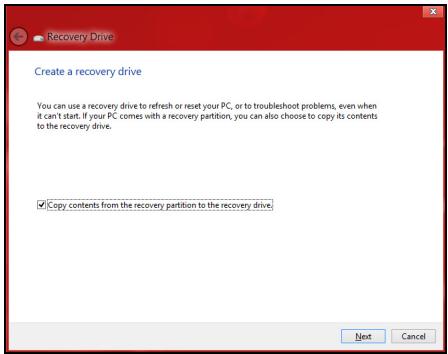
Packard Bell Recovery Management
?X
Welcome to Packard Bell Recovery Management
Packard Bell Recovery Management enables you to restore your system. To begin, select the task you want to perform. Please DO NOT remove the USB device while proceeding.

Customized Restore (Retain User Data)

Reinstall Drivers or Applications
Make a backup before you restore (Recommended).

Create Factory Default Backup
Create Drivers and Applications Backup

packard bell
Restores your computer to its factory default status. A reboot is required. NOTE: All data on drive Cwill be restored.
Here's what will happen:
- Your files and personalization settings won't change.
- Your PC settings will be changed back to their defaults.
- Apps from Windows Store will be kept.
- Apps you installed from discs or websites will be removed.
A list of removed apps will be saved on your desktop.
Next
Cancel
Here's what will happen:
- Your files and personalization settings won't change.
- Your PC settings will be changed back to their defaults.
- Apps from Windows Store will be kept.
- Apps you installed from discs or websites will be removed.
- A list of removed apps will be saved on your desktop.
Next
Cancel
ASV - Federal Communications Commission (FCC)
Pakistan Telecommunication Authority (PTA) Approved
Maroka
Št izstradajuma darbība radiokanalā 2 (2417 MHz) nav atlauta šajās pilsetās: Agadir, Assa-Zag, Cabo Negro, Chaouen, Goulmima, Oujda, Tan Tan, Taourirt, Taroudant un Taza.
Št izstradajuma darbība radiokanālos 4, 5, 6 un 7 (2425-2442 MHz) nav atlauta šajās pilsetās: Aéroport Mohamed V, Agadir, Aguelmous, Anza, Benslimane, Béni Hafida, Cabo Negro, Casablanca, Fcs, Lakbab, Marrakech, Merchich, Mohammédia, Rabat, Sale, Tanger, Tan Tan, Taounate, Tit Mellil, Zag.
Japana
5GHz 带是室内の使用のと
Korea
当用,
Taivana
第十二条
"Windows" atnaujinimai
Packard Bell Recovery Management
?X
Welcome to Packard Bell Recovery Management
Packard Bell Recovery Management enables you to restore your system. To begin, select the task you want to perform. Please DO NOT remove the USB device while proceeding.

Customized Restore (Retain User Data)

Reinstall Drivers or Applications
Make a back-up before you restore (recommended).

Create Factory Default Backup
Create Drivers and Applications Backup
Restores your computer to its factory default status. A system is required. NOTE: All data on drive C will be deleted.

packard bell
Paleiskite Packard Bell Recovery Management:
- Srityje Pradžia jveskite „Recovery" ir programu sąaste spustelekite Packard Bell Recovery Management.
Packard Bell Recovery Management
?X
Welcome to Packard Bell Recovery Management
Packard Bell Recovery Management enables you to restore your system. To begin, select the task you want to perform. Please DO NOT remove the USB device while proceeding.

Restores your computer to its factory default status. A reboot is required. NOTE: All data on drive Cwill be restored.

Customized Restore (Retain User Data)

Reinstall Drivers or Applications
Make a backup before you restore (Recommended).

Create Factory Default Backup
Create Drivers and Applications Backup

packard bell


- Atidaromas langasKompiuterio atnaujinimas.
Refresh your PC
Here's what will happen:
- Your files and personalization settings won't change.
- Your PC settings will be changed back to their defaults.
- Apps from Windows Store will be kept.
- Apps you installed from discs or websites will be removed.
A list of removed apps will be saved on your desktop.
Next
Cancel
Here's what will happen:
- Your files and personalization settings won't change.
- Your PC settings will be changed back to their defaults.
- Apps from Windows Store will be kept.
- Apps you installed from discs or websites will be removed.
- A list of removed apps will be saved on your desktop.
Next
Cancel
"Recovery Management" 63