TS504AC - Saw Vonroc - Free user manual and instructions
Find the device manual for free TS504AC Vonroc in PDF.


| Product type | Stationary table circular saw |
| Brand | Vonroc |
| Model | TS504AC |
| Rated voltage | 220-240 V ~ |
| Frequency | 50 Hz |
| Power consumption | 1800 W (S1) / 2000 W (S6 25 %) |
| No-load speed | 5000 rpm |
| Blade diameter | 250 mm |
| Blade bore | 30 mm |
| Number of blade teeth | 60 |
| Max cutting depth at 0° | 85 mm |
| Max cutting depth at 45° | 65 mm |
| Bevel angle | 0° to +45° |
| Weight | 14.5 kg |
| Sound pressure level (LpA) | 94 +3 dB(A) |
| Sound power level (LwA) | 107 +3 dB(A) |
| Protection class | Class II (double insulation) |
| Intended use | Ripping and cross-cutting in solid wood and derivatives, free of foreign objects |
| Dust extraction system | Vacuum cleaner connection (diameter not specified) |
| Safety devices | Blade guard, riving knife, overload switch, push stick |
| Maintenance and cleaning | Clean the body with a soft, slightly damp cloth; do not use solvents |
| Warranty | Legal warranty against defects in parts and workmanship |
Frequently Asked Questions - TS504AC Vonroc
User questions about TS504AC Vonroc
0 question about this device. Answer the ones you know or ask your own.
Ask a new question about this device
Download the instructions for your Saw in PDF format for free! Find your manual TS504AC - Vonroc and take your electronic device back in hand. On this page are published all the documents necessary for the use of your device. TS504AC by Vonroc.
USER MANUAL TS504AC Vonroc
natural_image
Simple icon of a hat with a saw blade and handle, no text or symbols present.EN Original Instructions 11
CE Declaration of conformity 165
WEEE Directive 166
PACKAGE CONTENTS
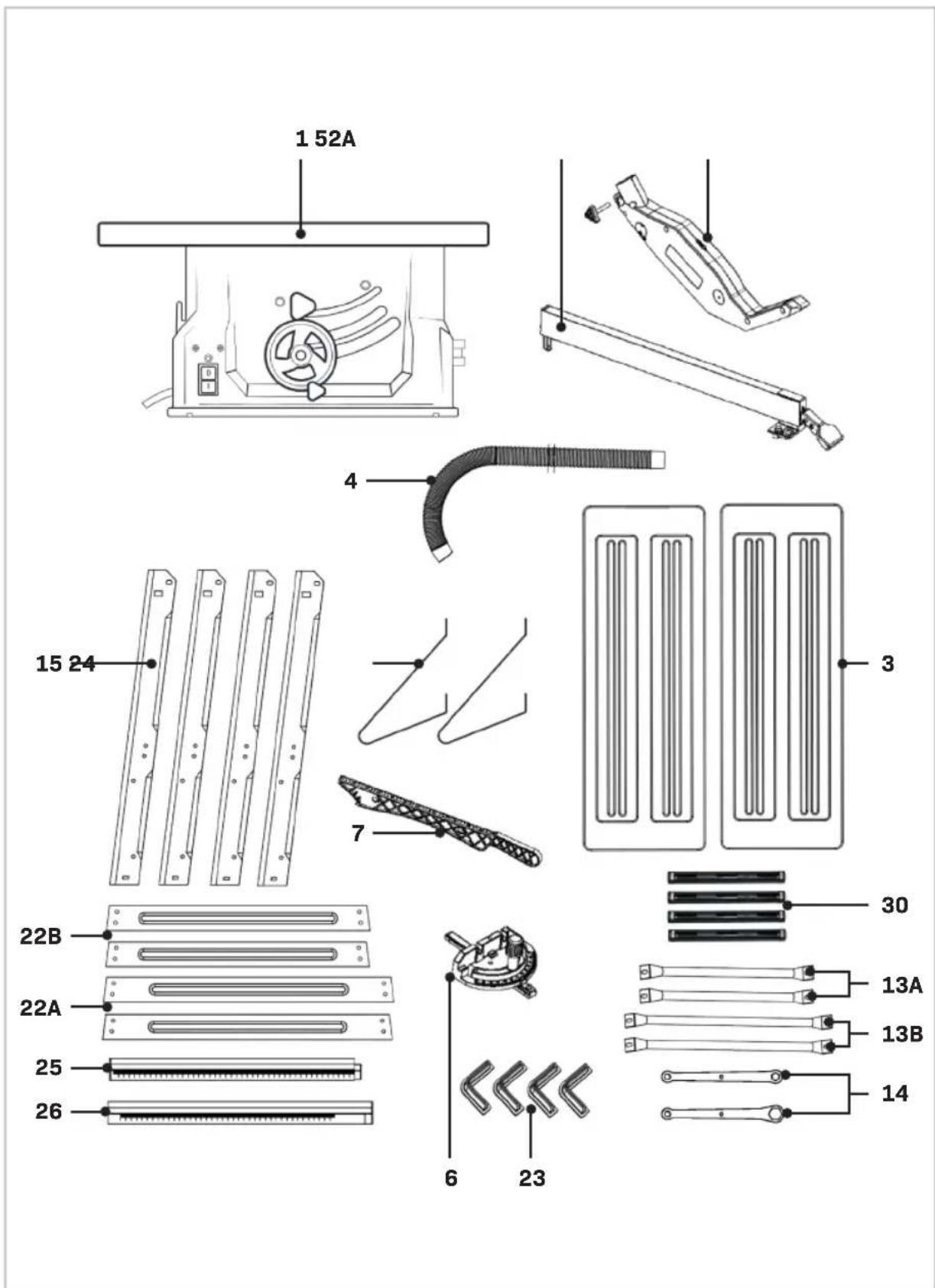
A

B-3
natural_image
Technical line drawing of a mechanical assembly with a central blade and mounting bracket (no text or symbols)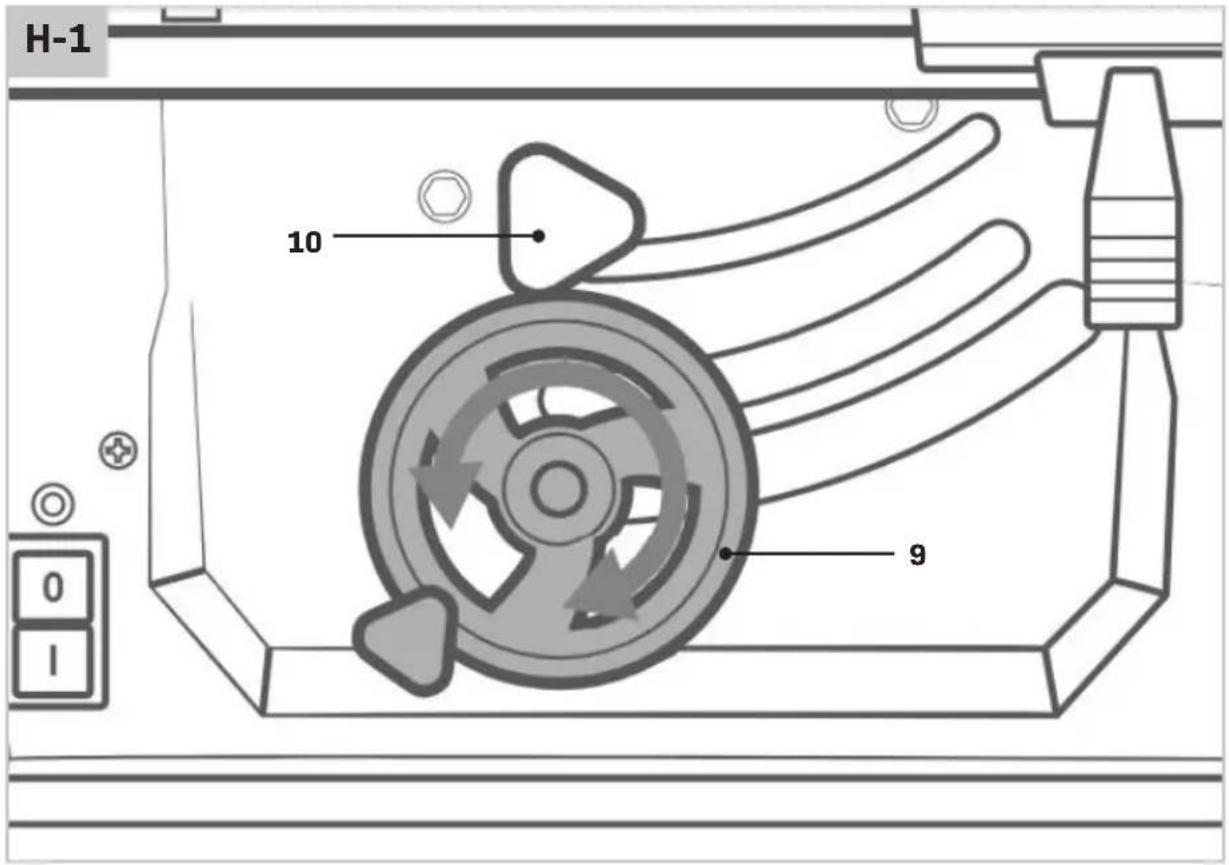
natural_image
Illustration of hands operating a wooden cutting board with a hinged handle (no text or symbols)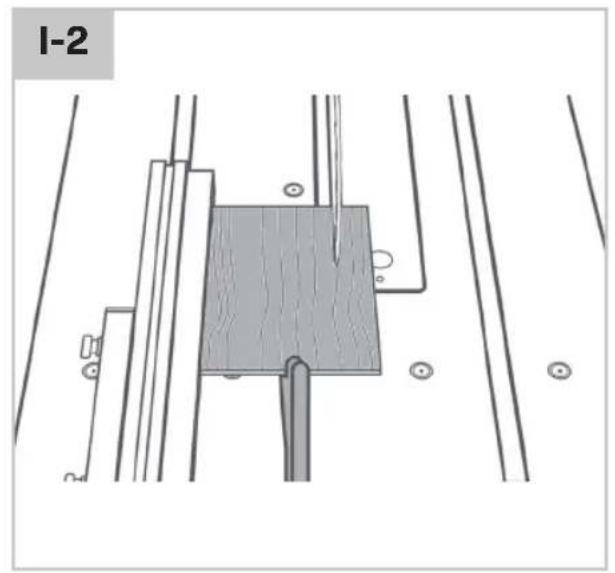
natural_image
Technical diagram showing a structural assembly with beams, a central block, and circular features (no text or symbols)
natural_image
Technical line drawing showing a wooden plank and angled metal structure (no text or symbols)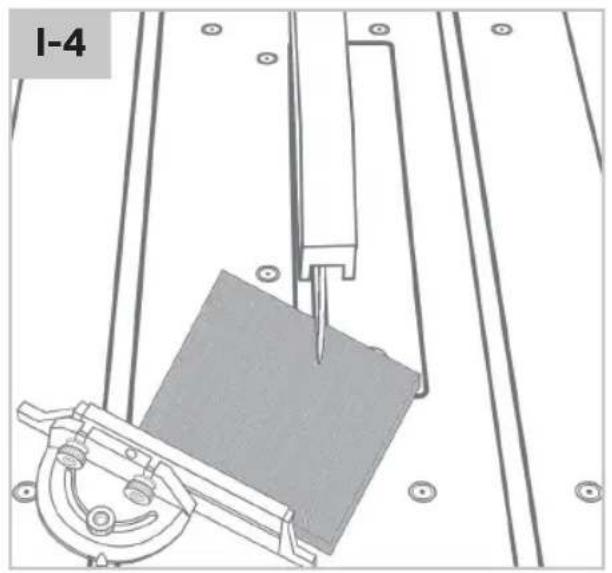
natural_image
Technical line drawing of a mechanical assembly with a tool and clamping mechanism (no text or symbols)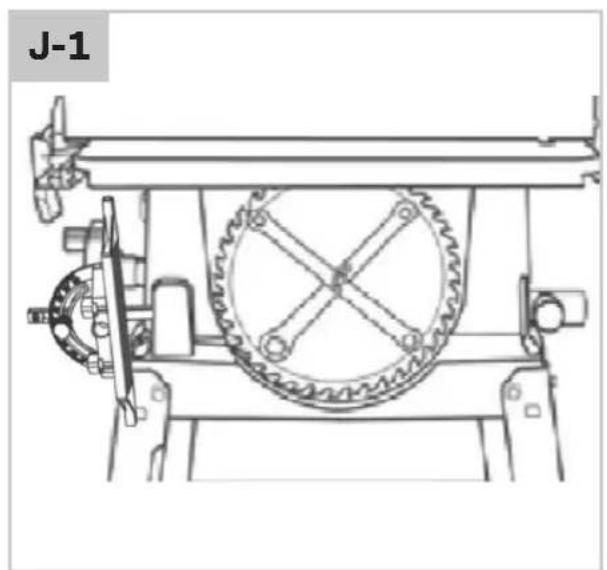
natural_image
Technical line drawing of a mechanical device with gears and shafts (no text or symbols)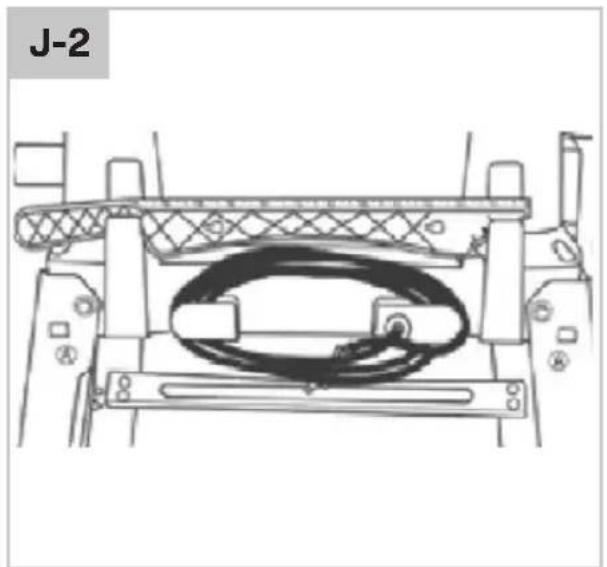
natural_image
Technical line drawing of a mechanical assembly with a coiled cable and mounting brackets (no text or symbols)1. SAFETY INSTRUCTIONS
Read the enclosed safety warnings, the additional safety warnings and the instructions. Failure to follow the safety warnings and the instructions may result in electric shock, fire and/or serious injury. Save the safety warnings and the instructions for future reference.
The following symbols are used in the user manual or on the product:

Read the user manual.

Denotes risk of personal injury, loss of life or damage to the tool in case of non-observance of the instructions in this manual.

Risk of electric shock.

Wear a dust protection.

Wear hearing protection.

Wear eye protection.

Danger area! Keep hands, fingers or arms away from this area.

Class II machine - Double insulation - You don't need any earthed plug.

The product is in accordance with the applicable safety standards in the European directives.
GENERAL POWER TOOL SAFETY WARNINGS WARNING! Read all safety warnings and all

instructions. Failure to follow the warnings and instructions may result in electric shock, fire and/or serious injury.
Save all warnings and instructions for future reference.
The term “power tool” in the warnings refers to your mains-operated (corded) power tool or battery-operated (cordless) power tool.
1) Work area safety
a) Keep work area clean and well lit. Cluttered or dark areas invite accidents.
b) Do not operate power tools in explosive atmospheres, such as in the presence of flammable liquids, gases or dust. Power tools create sparks which may ignite the dust or fumes.
c) Keep children and bystanders away while operating a power tool. Distractions can cause you to lose control.
2) Electricalsafety
a) Power tool plugs must match the outlet. Never modify the plug in any way. Do not use any adapter plugs with earthed (grounded) power tools. Unmodified plugs and matching outlets will reduce risk of electric shock.
b) Avoid body contact with earthed or grounded surfaces, such as pipes, radiators, ranges and refrigerators. There is an increased risk of electric shock if your body is earthed or grounded.
c) Do not expose power tools to rain or wet conditions. Water entering a power tool will increase the risk of electric shock.
d) Do not abuse the cord. Never use the cord for carrying, pulling or unplugging the power tool. Keep cord away from heat, oil, sharp edges or moving parts. Damaged or entangled cords increase the risk of electric shock.
e) When operating a power tool outdoors, use an extension cord suitable for outdoor use. Use of a cord suitable for outdoor use reduces the risk of electric shock.
f) If operating a power tool in a damp location is unavoidable, use a residual current device (RCD) protected supply. Use of an RCD reduces the risk of electric shock.
3) Personalsafety
a) Stay alert, watch what you are doing and use common sense when operating a power tool. Do not use a power tool while you are tired or under the influence of drugs, alcohol or medication. A moment of inattention while operating power tools may result in serious personal injury.
b) Use personal protective equipment. Always wear eye protection. Protective equipment such as dust mask, non-skid safety shoes, hard hat, or hearing protection used for appropriate conditions will reduce personal injuries.
c) Prevent unintentional starting Ensure the switch is in the off-position before connecting to power source and/or battery pack, picking up or carrying the tool. Carrying power tools with
your finger on the switch or energising power tools that have the switch on invites accidents.
d) Remove any adjusting key or wrench before turning the power tool on. A wrench or a key left attached to a rotating part of the power tool may result in personal injury.
e) Do not overreach. Keep proper footing and balance at all times. This enables better control of the power tool in unexpected situations.
f) Dress properly. Do not wear loose clothing or jewellery. Keep your hair, clothing and gloves away from moving parts. Loose clothes, jewellery or long hair can be caught in moving parts.
g) If devices are provided for the connection of dust extraction and collection facilities, ensure these are connected and properly used. Use of dust collection can reduce dust related hazards.
h) Do not let familiarity gained from frequent use of tools allow you to become complacent and ignore tool safety principles. A careless action can cause severe injury within a fraction of a second.
4) Power tool use and care
a) Do not force the power tool. Use the correct power tool for your application. The correct power tool will do the job better and safer at the rate for which it was designed.
b) Do not use the power tool if the switch does not turn it on and off. Any power tool that cannot be controlled with the switch is dangerous and must be repaired.
c) Disconnect the plug from the power source and/or the battery pack from the power tool before making any adjustments, changing accessories, or storing power tools. Such preventive safety measures reduce the risk of starting the power tool accidentally.
d) Store idle power tools out of the reach of children and do not allow persons unfamiliar with the power tool or these instructions to operate the power tool. Power tools are dangerous in the hands of untrained users.
e) Maintain power tools. Check for misalignment or binding of moving parts, breakage of parts and any other condition that may affect the power tool's operation. If damaged, have the power tool repaired before use. Many accidents are caused by poorly maintained power tools.
f) Keep cutting tools sharp and clean. Properly maintained cutting tools with sharp cutting edges are less likely to bind and are easier to control.
g) Use the power tool, accessories and tool bits etc. in accordance with these instructions, taking into account the working conditions and the work to be performed. Use of the power tool for operations different from those intended could result in a hazardous situation.
h) Keep handles and grasping surfaces dry, clean and free from oil and grease. Slippery handles and grasping surfaces do not allow for safe handling and control of the tool in unexpected situations.
5)Service
a) Have your power tool serviced by a qualified repair person using only identical replacement parts. This will ensure that the safety of the power tool is maintained.
SAFETY INSTRUCTIONS FOR TABLE SAWS
1) Guarding related warnings
a) Keep guards in place. Guards must be in working order and be properly mounted. A guard that is loose, damaged, or is not functioning correctly must be repaired or replaced.
b) Always use saw blade guard and riving knife for every through-cutting operation. For through-cutting operations where the saw blade cuts completely through the thickness of the workpiece, the guard and other safety devices help reduce the risk of injury.
c) After completing a non-through cut such as rabbeting, resawing, or dadoing, restore the riving knife to the extended-up position. With the riving knife in the extended-up position, reattach the blade guard. The guard and riving knife help to reduce the risk of injury.
d) Make sure the saw blade is not contacting the guard, riving knife or the workpiece before the switch is turned on. Inadvertent contact of these items with the saw blade could cause a hazardous condition.
e) Adjust the riving knife as described in this instruction manual. Incorrect spacing, positioning and alignment can make the riving knife ineffective in reducing the likelihood of kickback.
f) For the riving knife to work, it must be engaged in the workpiece. The riving knife is ineffective when cutting workpieces that are too short to be engaged with the riving knife. Under these conditions, a kickback cannot be prevented by the riving knife.
g) Use the appropriate saw blade for the riving knife. For the riving knife to function properly, the saw blade diameter must match the appropriate riving knife and the body of the saw blade must be thinner than the thickness of the riving knife and the cutting width of the saw blade must be wider than the thickness of the riving knife.
2) Cutting procedures warnings
a) DANGER: Never place your fingers or hands in the vicinity or in line with the saw blade. A moment of inattention or a slip could direct your hand towards the saw blade and result in serious personal injury.
b) Feed the workpiece into the saw blade or only against the direction of rotation. Feeding the workpiece in the same direction that the saw blade is rotating above the table may result in the workpiece, and your hand, being pulled into the saw blade.
c) Never use the mitre gauge to feed the workpiece when ripping and do not use the rip fence as a length stop when cross cutting with the mitre gauge. Guiding the workpiece with the rip fence and the mitre gauge at the same time increases the likelihood of saw blade binding and kick-back.
d) When ripping, always keep the workpiece in full contact with the fence and always apply the workpiece feeding force between the fence and the saw blade. Use a push stick when the distance between the fence and the saw blade is less than 150 mm, and use a push block when this distance is less than 50 mm. "Work helping" devices will keep your hand at a safe distance from the saw blade.
e) Use only the push stick provided by the manufacturer or constructed in accordance with the instructions. This push stick provides sufficient distance of the hand from the saw blade.
f) Never use a damaged or cut push stick. A damaged or cut push stick may break causing your hand to slip into the saw blade.
g) Do not perform any operation "freehand". Always use either the rip fence or the mitre gauge to position and guide the workpiece.
"Freehand" means using your hands to support or guide the workpiece, in lieu of a rip fence or mitre gauge. Freehand sawing leads to misalignment, binding and kickback.
h) Never reach around or over a rotating saw blade. Reaching for a workpiece may lead to accidental contact with the moving saw blade.
i) Provide auxiliary workpiece support to the rear and/or sides of the saw table for long and/or wide workpieces to keep them level. A long and/or wide workpiece has a tendency to pivot on the table's edge, causing loss of control, saw blade binding and kickback.
j) Feed the workpiece at an even pace. Do not bend, twist or shift the workpiece from side to side. If jamming occurs, turn the tool off immediately, unplug the tool, then clear the jam. Jamming the saw blade by the workpiece can cause kickback or stall the motor.
k) Do not remove pieces of cut-off material while the saw is running. The material may become trapped between the fence or inside the saw blade guard and the saw blade pulling your fingers into the saw blade. Turn the saw off and wait until the saw blade stops before removing material.
1) Use an auxiliary fence in contact with the table top when ripping workpieces less than 2 mm thick. A thin workpiece may wedge under the rip fence and create a kickback.
3) Kickback causes and related warnings
Kickback is a sudden reaction of the workpiece due to a pinched, jammed saw blade or misaligned line of cut in the workpiece with respect to the saw blade or when a part of the workpiece binds between the saw blade and the rip fence or other fixed object.
Most frequently during kickback, the workpiece is lifted from the table by the rear portion of the saw blade and is propelled towards the operator.
Kickback is the result of saw misuse and/or incorrect operating procedures or conditions and can be avoided by taking proper precautions as given below.
a) Never stand directly in line with the saw blade. Always position your body on the same side of the saw blade as the fence. Kickback may propel the workpiece at high velocity towards anyone standing in front and in line with the saw blade.
b) Never reach over or in back of the saw blade to pull or to support the workpiece. Accidental contact with the saw blade may occur or kick-back may drag your fingers into the saw blade.
c) Never hold and press the workpiece that is being cut off against the rotating saw blade. Pressing the workpiece being cut off against the saw blade will create a binding condition and kickback.
d) Align the fence to be parallel with the saw blade. A misaligned fence will pinch the workpiece against the saw blade and create kickback.
e) Use a featherboard to guide the workpiece against the table and fence when making non-through cuts such as rabbeting, dadoing or resawing cuts. A featherboard helps to control the workpiece in the event of a kickback.
f) Use extra caution when making a cut into blind areas of assembled workpieces. The protruding saw blade may cut objects that can cause kickback.
g) Support large panels to minimise the risk of saw blade pinching and kickback. Large panels tend to sag under their own weight. Support(s) must be placed under all portions of the panel overhanging the table top.
h) Use extra caution when cutting a workpiece that is twisted, knotted, warped or does not have a straight edge to guide it with a mitre gauge or along the fence. A warped, knotted, or twisted workpiece is unstable and causes misalignment of the kerf with the saw blade, binding and kickback.
i) Never cut more than one workpiece, stacked vertically or horizontally. The saw blade could pick up one or more pieces and cause kickback.
j) When restarting the saw with the saw blade in the workpiece, centre the saw blade in the kerf so that the saw teeth are not engaged in the material. If the saw blade binds, it may lift up the workpiece and cause kickback when the saw is restarted.
k) Keep saw blades clean, sharp, and with sufficient set. Never use warped saw blades or saw blades with cracked or broken teeth. Sharp and properly set saw blades minimize binding, stalling and kickback.
4) Table saw operating procedure warnings
a) Turn off the table saw and disconnect the power cord when removing the table insert, changing the saw blade or making adjustments to the riving knife, or saw blade guard, and when the machine is left unattended. Precautional measures will avoid accidents.
b) Never leave the table saw running unattended. Turn it off and don't leave the tool until it comes to a complete stop. An unattended running saw is an uncontrolled hazard.
c) Locate the table saw in a well-lit and level area where you can maintain good footing and balance. It should be installed in an area that provides enough room to easily handle the size of your workpiece. Cramped, dark areas, and uneven slippery floors invite accidents.
d) Frequently clean and remove sawdust from under the saw table and/or the dust collection device. Accumulated sawdust is combustible and may self-ignite.
e) The table saw must be secured. A table saw that is not properly secured may move or tip over.
f) Remove tools, wood scraps, etc. from the table before the table saw is turned on. Distraction or a potential jam can be dangerous.
g) Always use saw blades with correct size and shape (diamond versus round) of arbour holes. Saw blades that do not match the mounting hardware of the saw will run off-centre, causing loss of control.
h) Never use damaged or incorrect saw blade mounting means such as flanges, saw blade washers, bolts or nuts. These mounting means were specially designed for your saw, for safe operation and optimum performance.
i) Never stand on the table saw, do not use it as a stepping stool. Serious injury could occur if the tool is tipped or if the cutting tool is accidentally contacted.
j) Make sure that the saw blade is installed to rotate in the proper direction. Do not use grinding wheels, wire brushes, or abrasive wheels on a table saw. Improper saw blade installation or use of accessories not recommended may cause serious injury.
Electrical safety

Always check that the voltage of the power supply corresponds to the voltage on the rating plate.
- Do not use the machine if the mains cable or the mains plug is damaged.
- Only use extension cables that are suitable for the power rating of the machine with a minimum thickness of 1.5 mm ^2 . If you use an extension cable reel, always fully unroll the cable.
Power supply
- The motor is fitted with an overload switch. If the table saw overloads, the overload switch switches the equipment off automatically to protect the table saw from overheating. If the overload switch triggers, switch off the table saw using the ON/OFF switch (8) and wait until the table saw cools down. Then press the ON/OFF switch (8) and restart the table saw.
2. MACHINE INFORMATION
Intended use
This power tool is intended as a stationary machine for making straight lengthways and crossways cuts in hard and soft wood free from foreign bodies such as nails, screws and mortar.
TECHNICAL SPECIFICATIONS
| Model No. TS504AC | |
| Voltage 220-240V~ | |
| Frequency 50 Hz | |
| Power input | 1800W (S1),2000W (S6 25%)* |
| No load speed 5000/min | |
| Bevel angles 0° <> +45° | |
| Sawblade specifications:Diameter | ∅ 250 mm |
| Base blade thickness | 1.8 mm |
| Width of cut | 2.8 mm |
| Bore diameter | ∅ 30 mm |
| Number of teeth | 60T |
| Sawing capacity 0° | 85 mm |
| Sawing capacity 45° | 65 mm |
| Thickness of the riving knife 2 | 0 mm |
| Weight 14.5 kg | |
| L_pA (sound pressure level) 94 +3 dB(A) | |
| L_wA (sound power level) 107 +3 dB(A) | |
* S1, continuous duty operation mode.
* S6, continuous operation periodic duty. Identical duty cycles with a period at load followed by a period at no load. Running time 10 minutes; duty cycle is 25% of the running time.
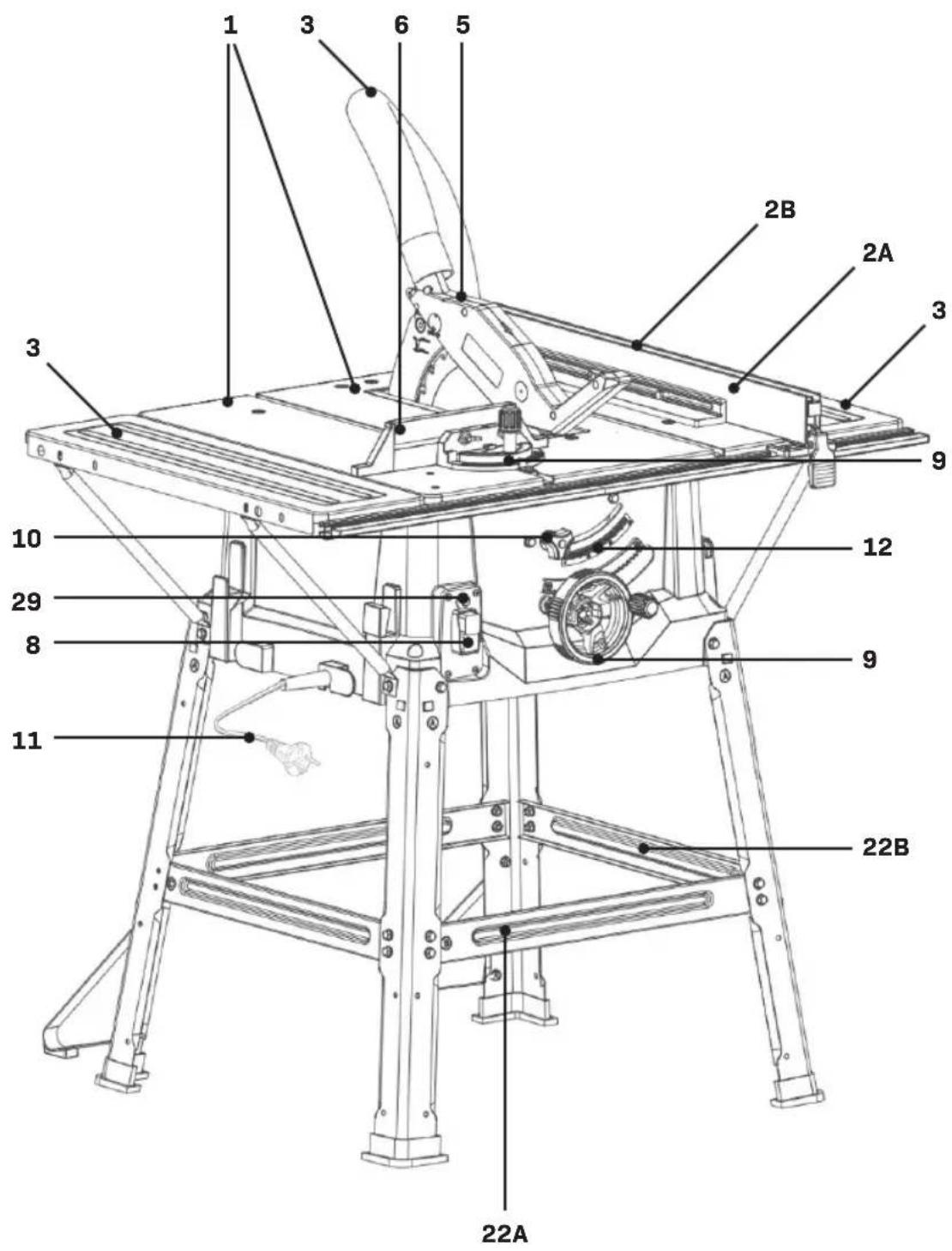
DESCRIPTION
The numbers in the text refer to the diagrams on page 2-6.
- Saw table with two rulers
2A. Parallel guide
2B. Guide extension
2C. Wing nuts - Extensions (2 pcs)
- Dust extraction
5.Guard - Mitre guide
7.Push stick
8.0n/off switch - 2 in 1 adjustment handle
- Locking knob
- Electric plug
- Ruler sawblade angle
13A. Short extension support (2 pcs)
13B. Long extension support (2 pcs) - Wrenches (2 pcs)
- Legs (4 pcs)
- Bolt
- Nut
- Dust extraction connection
- Sawblade guard knob
- Riving knife
- Saw table inlay
22A. Cross strut long (2 pcs)
22B. Cross strut short (2 pcs) - Rubber feet (4 pcs)
- Additional legs (2 pcs)
- Left ruler rail
- Right ruler rail
- Connection vacuum cleaner
- Fixing screw
- Overload protection switch
- Cross brace
3. ASSEMBLY

First assemble all parts before firmly tightening all bolts.
Assembly of the extensions (Fig B1)
- Ensure the blade height is wound fully down and then turn the table saw upside down on the floor. Put a piece of cardboard underneath, so you don't damage the subsurface.
- Align a table extension (3) with the side of the table saw.
- Place a cross brace (30) on the extension piece and align it with the bolt holes in the table extension.
- Use a bolt (16) to secure the table extension (3) and table cross brace (30) to the table saw.
- Repeat steps 3 and 4 for the other cross brace (30) and then attach the other table extension (3) in the exact same manner.
- Use another bolt (16) to attach a table extension support (13) to the outside of the table extension (3). Repeat for the other 3 table extension supports (13)
- Note: One pair of table extension supports (13) is longer than the other. The longer pair of table extension supports should be used on the side of the table saw with the power cord.
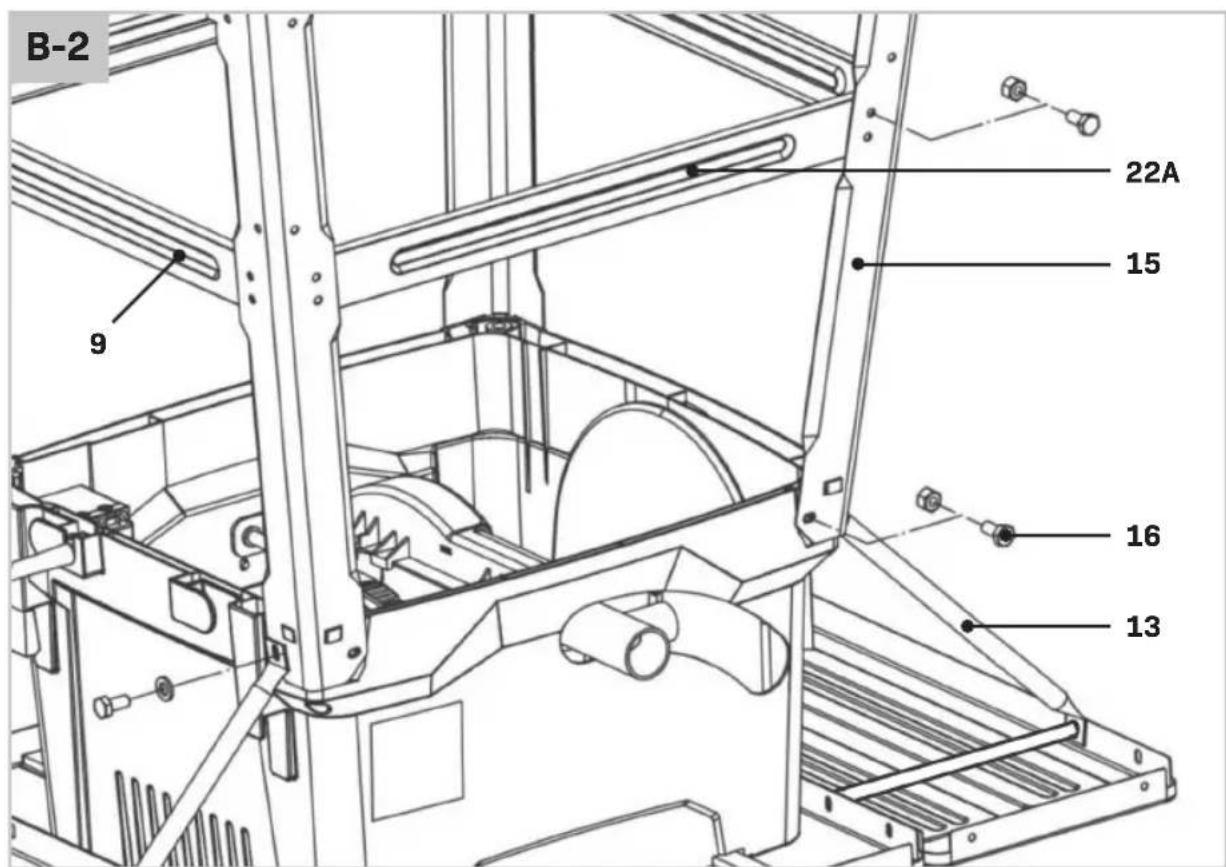
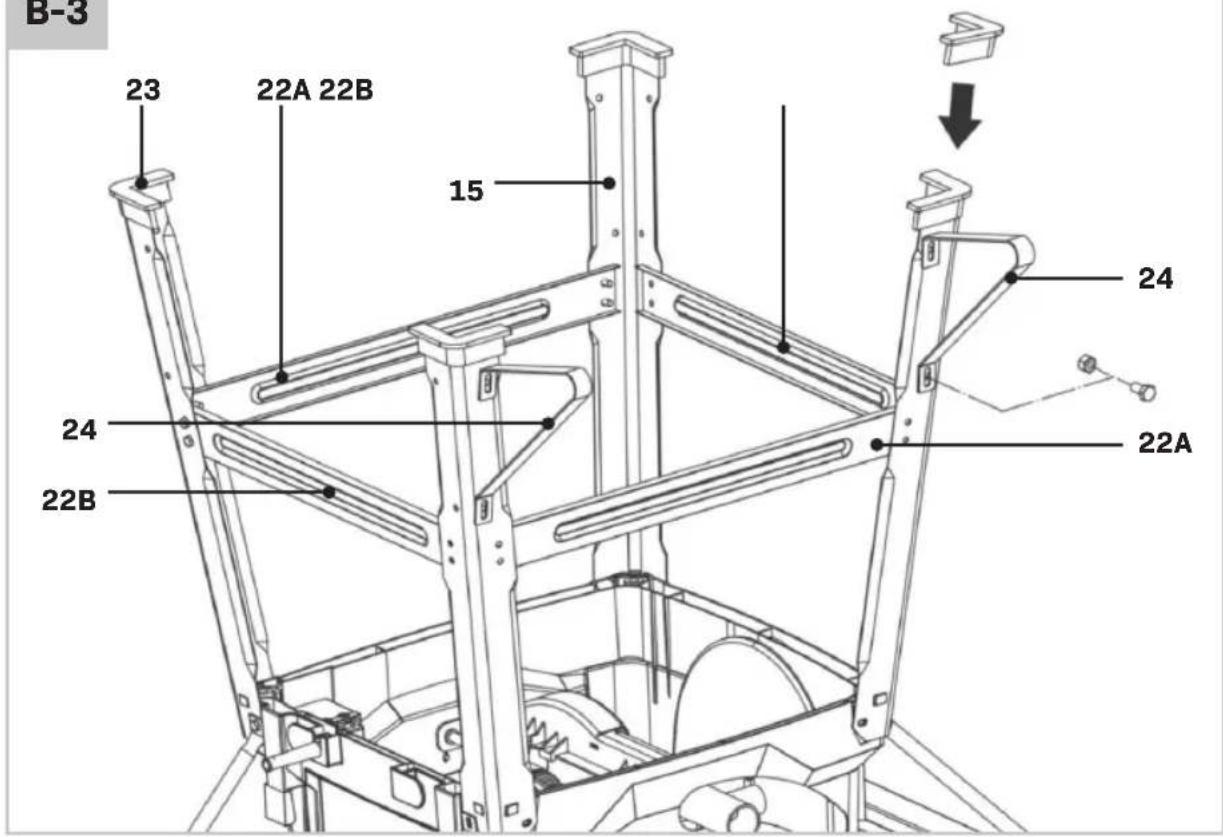
Assembly of the undercarriage (Fig B1, B2, B3)
- Machine is still upside down.
- Mount the legs (15) (4 pcs) with one extension support (13) (4 pcs) per leg on the four corners of the body, use bolts (16) (2 pcs per leg).
- Make sure the extension supports (13) are mounted in the same way as shown in Fig.B1.
- Mount Cross strut long (22A) (2 pcs) between the legs on the front and back side of the machine. Use bolts (16) with nuts (17).
- Mount Cross strut short (22B) (2 pcs) between the legs on both sides of the machine. Use bolts (16) with nuts (17).
- Place the rubber feet (23) (4 pcs) as shown in figure B3.
- Mount the additional legs (24) (2 pcs) on the backside of the machine, use bolts (16) with nuts (17).
- Turn the machine back on its feet. Make sure the extensions are leveled with the table, by using the slots in the extensions supports.
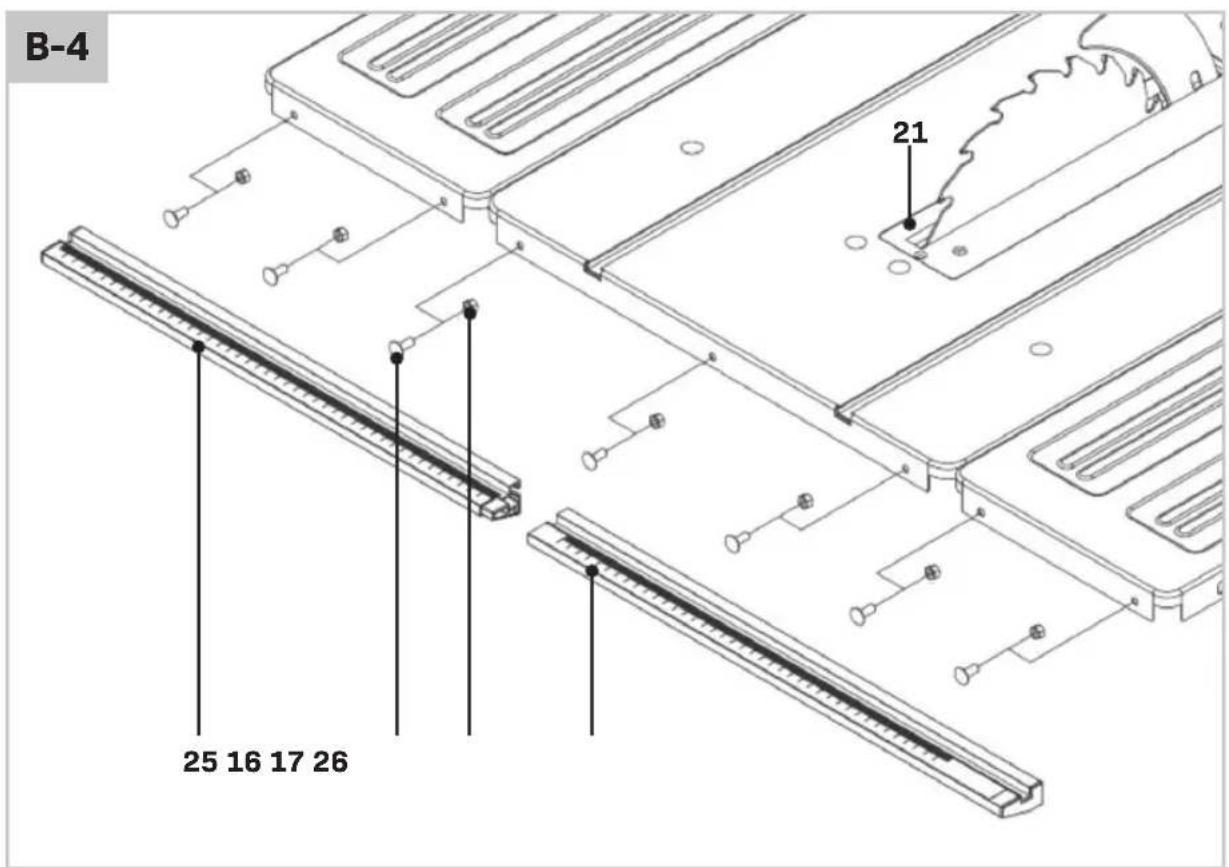
Assembly of the ruler rail (Fig B4)
- Assemble the left ruler rail (25) and right ruler rail (26) together.
- Position seven bolts (16) in the T-slot of the assembled ruler rail. Align all the bolts to the holes on the table.
- Attach ruler rail to the table using nuts (17).
- Hand tighten the nuts (17), Do not completely tighten.
- Place the parallel guide on the table, slide it to just touch the saw blade, check if the pointer indicates "0" on the scale. If not, slide the ruler rail to the left or right.
- Tighten the nuts to fix the ruler rail.
Assembly of the riving knife (Fig C1, C2, C3)
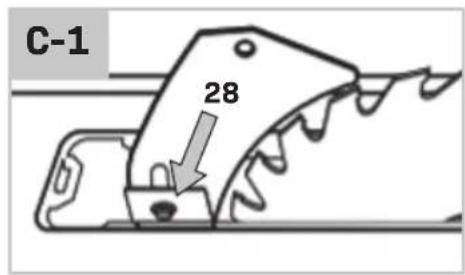
- Remove the inlay (21) from the table, by using a screwdriver (Fig.C1).
- Loosen the fixing screw (28)(Fig.C1)
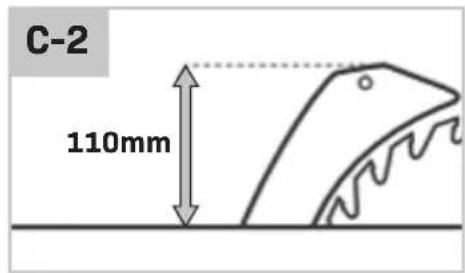
- Raise the riving knife until the depth between the saw table and the upper edge of the riving knife equals approx. 110mm (Fig.C2)
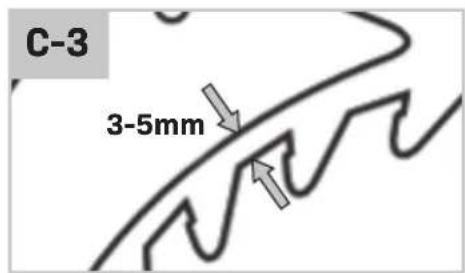
- The distance between the riving knife and the toothed rim of the saw blade must be between 3 and 5 mm (Fig.C3).
- The tip of the riving knife shall not be lower than 5 mm from the tooth peak, as shown in Fig.C3.
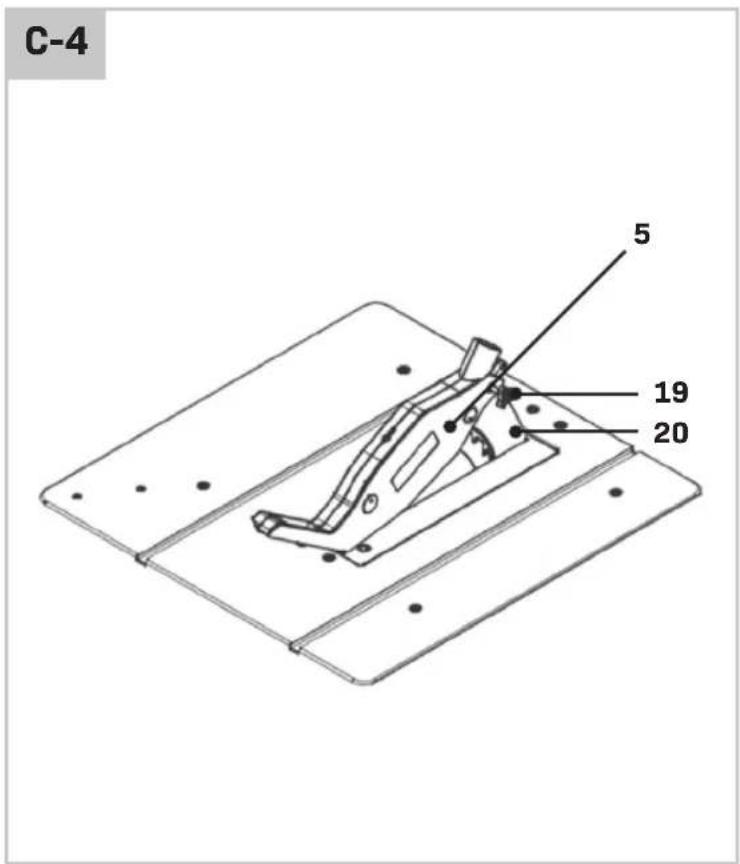
Attachment of the guard (Fig C4)
- Turn sawblade completely upwards (instructions for height adjustment see chapter 4).
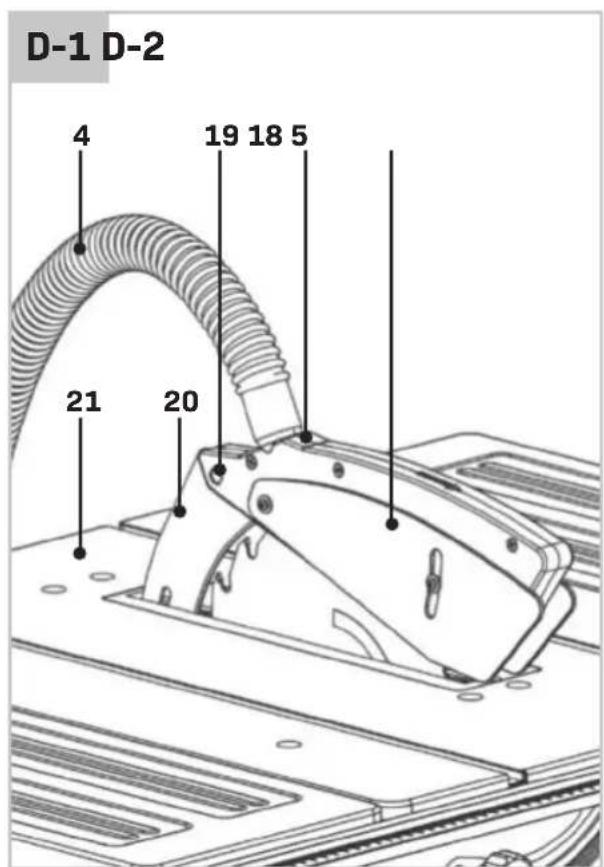
- Pull the knob (19) of the guard (5) and place it over the riving knife (20) while pulling the knob.
- Release the knob and make sure the pin slides in the hole.
- Secure the guard by tightening the knob.
Assembly of the dust extraction (Fig. D1, D2)
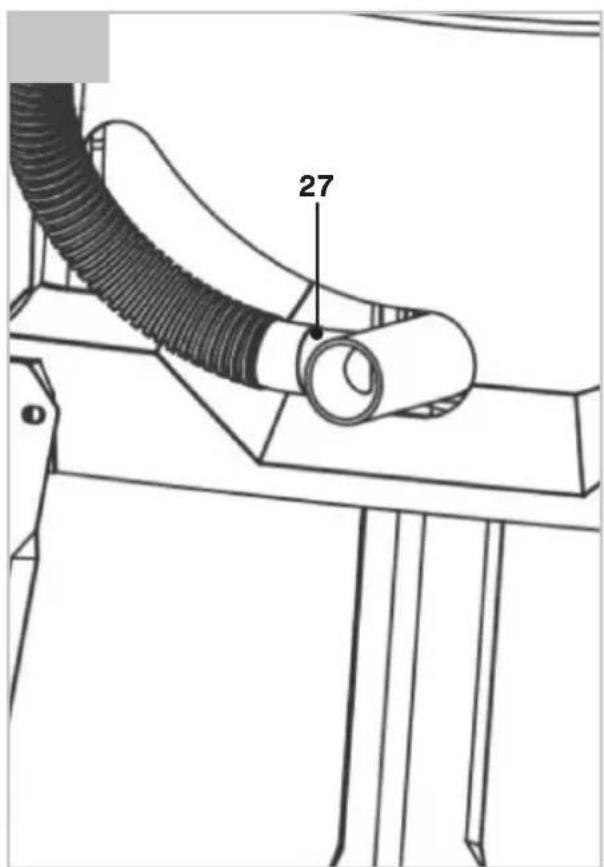
- Assemble dust extraction like shown on Fig. D1 and D2.
- Attach the vacuum cleaner to the vacuum cleaner connection (27)(Fig.D2).
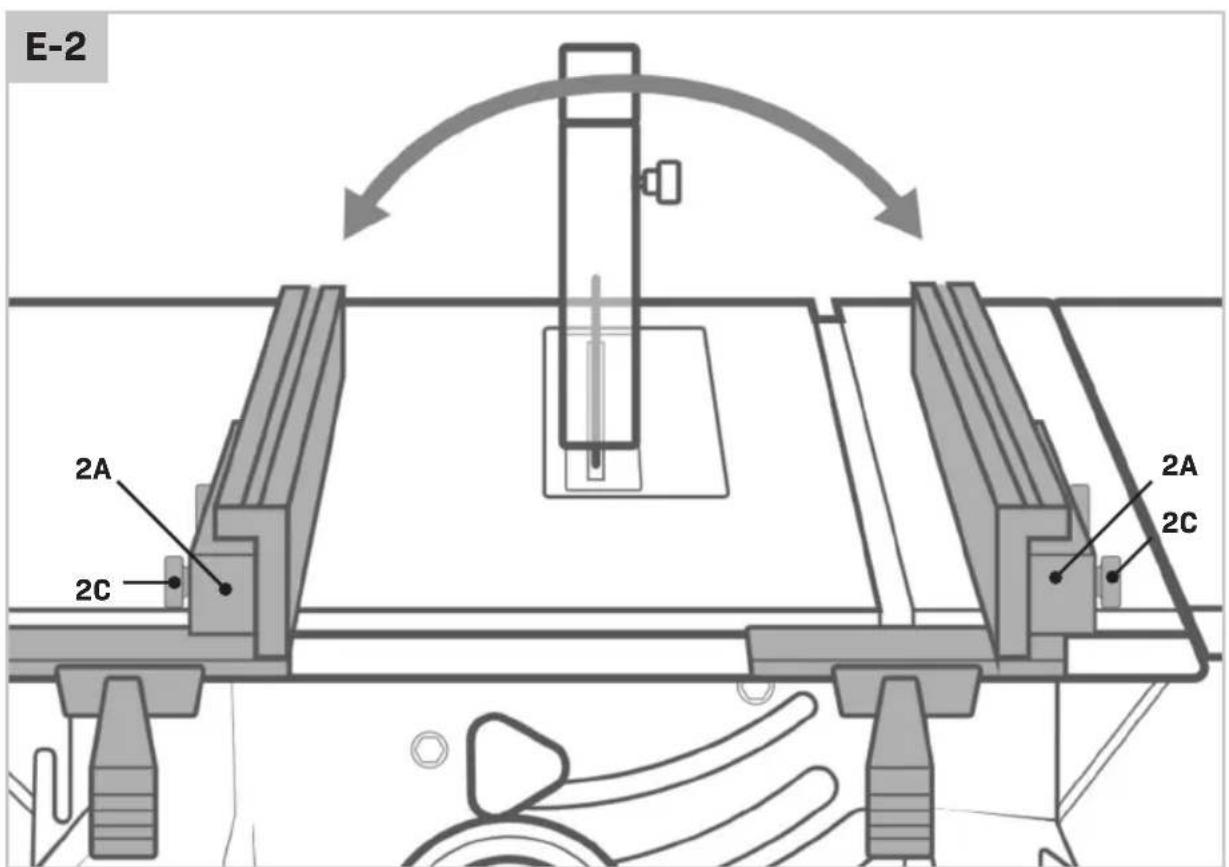
Attachment of the parallel guide (Fig E1, E2, E3, E4)
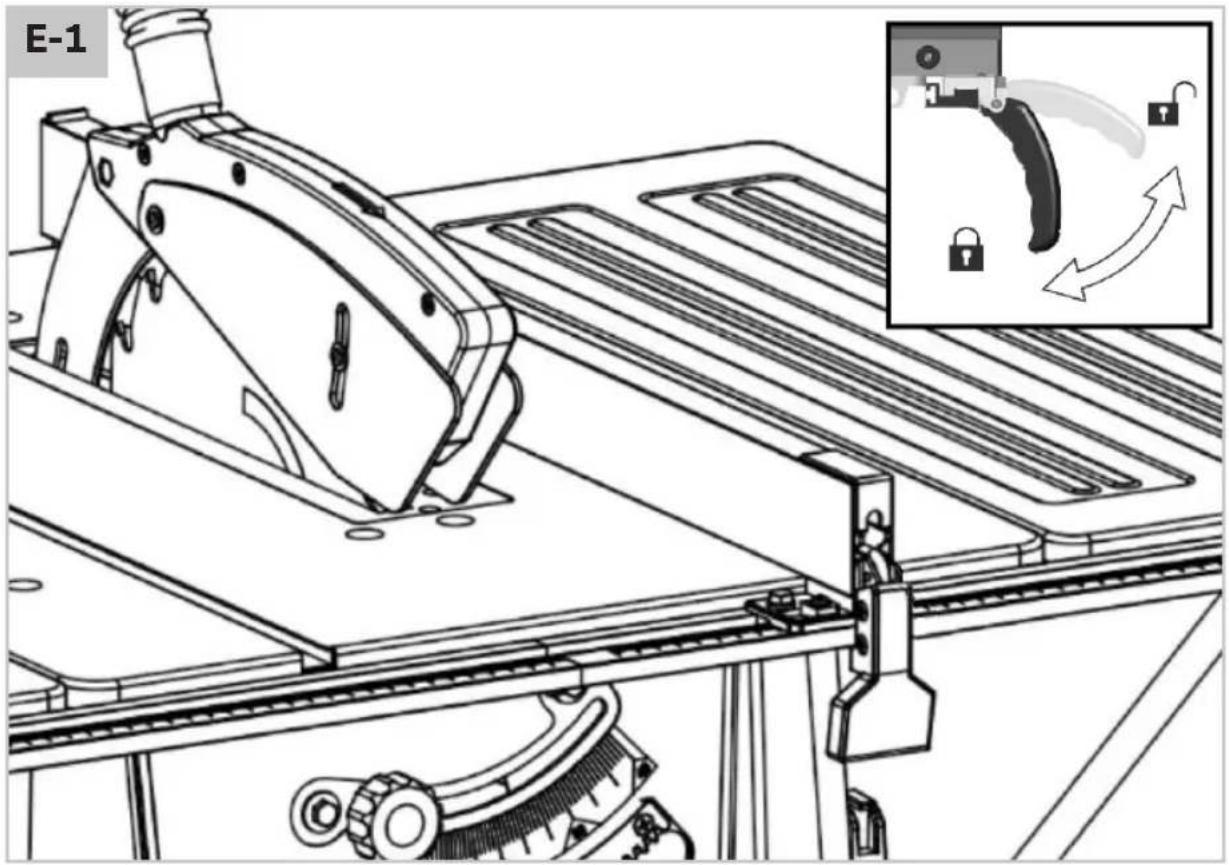
- Attach the parallel guide (2A) on the right side off the saw blade on the table.
- Lock the guide down by pushing down the handle (Fig.E1).
Attachment of the mitre guide (Fig A)
- Slide the guide in the slot of the table at the left side of the sawblade (Fig A).
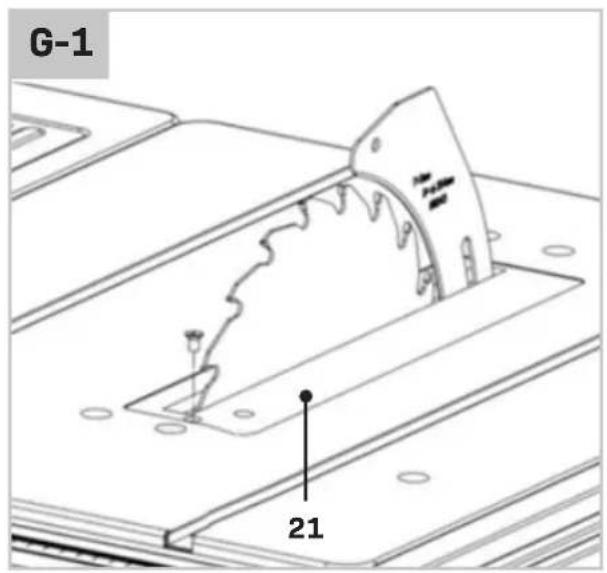
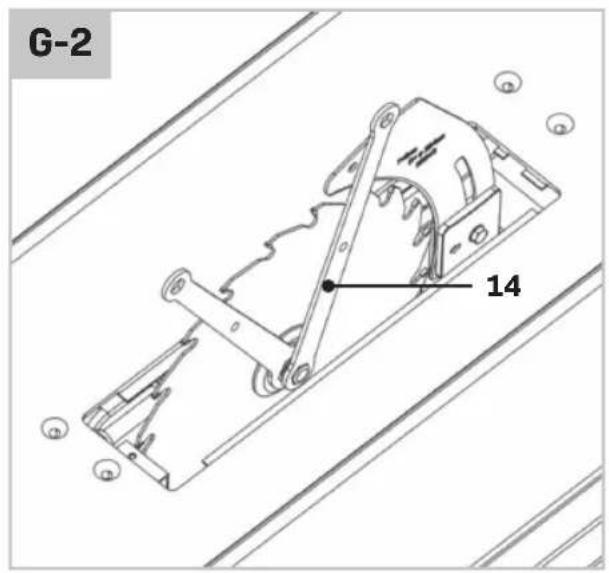
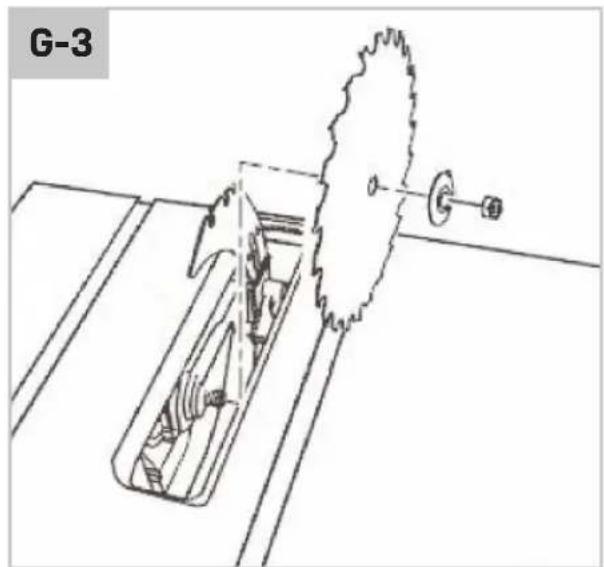
Assemble or change the saw blade (Fig G1, G2, G3)

The arrow marked on the saw blade, which indicates the direction of rotation, must point in the same direction as the arrow marked on the machine, the saw blade teeth must point downwards on the front of the saw.
- Remove the inlay (21) from the table, by using a screwdriver. Fig.G1
- Turn the saw blade completely upwards. (Instructions for height adjustment see chapter 4)
- Loosen the nut with the wrenches (14) (Fig.G2)
- Remove the nut and the outside flange from the sawblade axle. (Fig.G3)
- Slide the old saw blade over the saw blade axle and put on a new saw blade.
- Put the outside flange back on add the nut.
- Tighten the nut by using the wrenches.
- Put the inlay back in the table and tighten the screw.
4. OPERATION
Switching on/off (Fig A)
- Press the switch into position "1" to put your machine into operation.
- To switch off the machine the same switch needs to be pressed to position "0."
- Always keep the mains cable away from moving parts.
Overload protection (Fig. A)
This electrical power tool is provided with an overload protection (29). In case that the overload protection was initiated, proceed as follows:
- Disconnect the power tool from the power supply.
- Allow the power tool to cool down.
- Check the power tool carefully for possible damages.
- Have damages repaired before re-starting the power tool.
- Connect the power tool to the power supply.
- Push the overload switch (29)(Fig.A).
- Turn on the power tool as described and put it into operation.
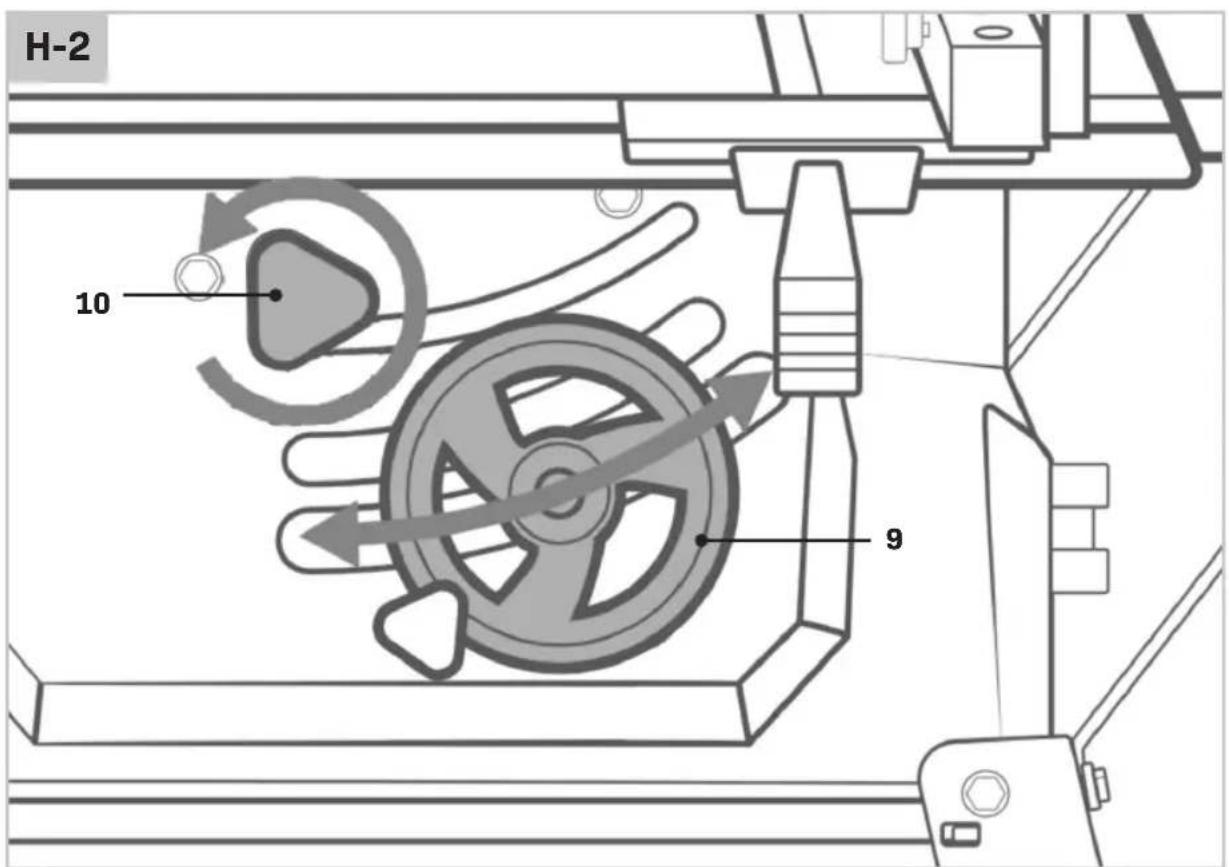
Using the 2 in 1 handle, Adjust the angle and height of the saw blade (Fig H1, H2)
Using the height adjustment (fig. H1)
- Turn the handle (9) clockwise to raise the saw-blade.
- Turn the handle counter clockwise to lower the sawblade.
- Make sure the saw blade is always approximately 2 mm higher than the total thickness of the material to be sawn.
Using the angle adjustment (Fig. H2)
- Slightly loosen the knob(10)
- Press the handle(9) towards the machine and turn counter clockwise to adjust the sawblade in its angle.
- Fasten the knob(10)
Using the parallel guide (Fig A, E)
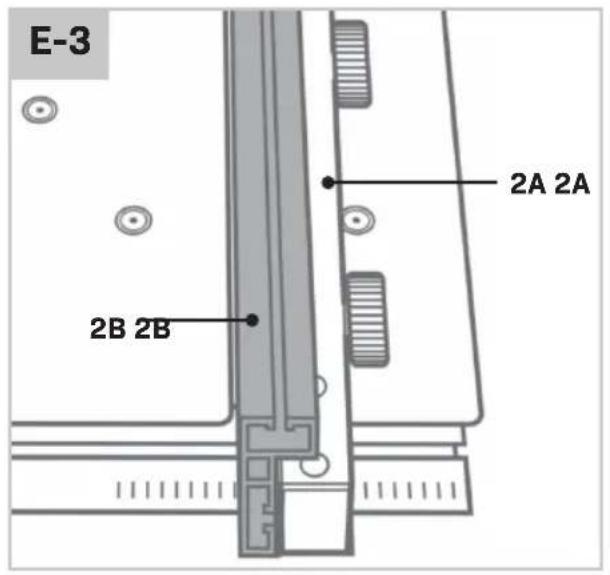
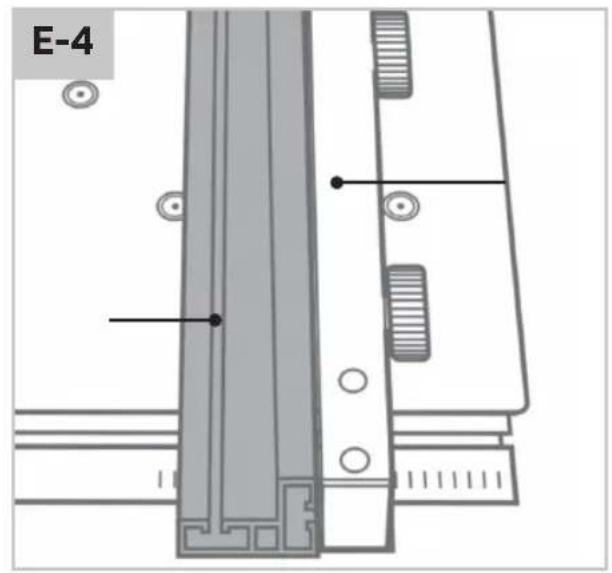
The parallel guide (2A) is equipped with a guide extension (2B). The guide extension can be used in two different ways, depending on the thickness of the wood.
For thicker wood, the guide extension (2B) should be mounted as shown in figure E3.
For thinner wood, the guide extension (2B) should be mounted as shown in figure E4.
- Unlock the guide down by pushing the handle upwards (Fig. E1).
- Slightly loosen the wing nuts (2C)
- Remove the guide extension (2B) from the parallel guide (2A) by sliding it away from the parallel guide
- Turn the guide extension to the desired position and slide it back onto the parallel guide
- Tighten the wing nuts (2C)
Working instructions
There are two types of sawing methods:
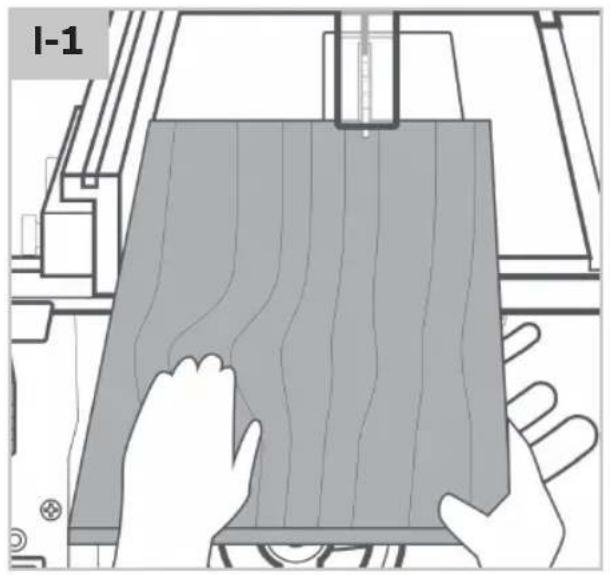
- Lengthwise sawing (Fig. I1):
Sawing the workpiece in the length of the wood again - Cross-cutting or cutting off, use the mitre guide (Fig. 14).
Sawing off the workpiece crosswise

For both sawing methods one of the fences must be used. Therefor never saw without a fence!
Attention! Before you start sawing, first check the following:
- Is the saw blade secured?
- Are all the locking handles secured?
- Is the fence parallel to the saw blade?
- Is the protective cap working properly?
- Are you wearing safety goggles?
- Is the saw blade not rubbing against anything?

It is absolutely necessary to take these points into consideration before you start work!
Lengthwise sawing (Fig. I1)
- Secure the fence to the correct measuring position and remove the cut-off guide from the bench carriage.
- Press the wood lightly towards the bench and let it glide against the cut-off fence.

Remain at least 3 cm. from the front of the saw blade before you switch on the motor. The side of the wood which is against the fence must be completely straight. Keep your hands at least 10 cm away from the saw track to be followed.
- Switch on the motor and wait until the saw blade has reached the maximum number of revolutions before you start sawing.
- While you press the wood against the bench and the fence, you can carefully push the wood through the saw blade without forcing it.
- Never pull the workpiece backwards. If necessary, switch off the motor first without altering the position of the workpiece.
Lengthwise sawing with a (vertical) mitre (fig. 13)
This method is practically the same, except that the saw blade is placed at the angle required.

With this type of method the fence may only be along the righthand side of the sawblade.
Lengthwise sawing of narrow workpieces (fig. 12)

Assume that this process is extremely dangerous.
Take all the necessary safety measures and continually push the workpiece through (until behind the saw blade) using a push stick instead of by hand.
Crosswise sawing (fig. 14)
- Remove the fence and apply the cross-cut fence in the righthand carriage.
- Adjust the height of the saw blade (see length-wise sawing).
- Press the workpiece against the cross-cut fence and keep at least 2,5 cm distance from the front of the saw blade.
- Switch on the motor and wait until the maximum number of revolutions has been reached.
- Press the workpiece against the fence and the bench. Carefully push the wood through the saw blade. Continue until behind the saw blade. Then switch off the motor and keep this position until the saw blade has stopped completely before you remove the wood.
- Never pull the wood back. If necessary, switch the motor off and keep the position until the saw blade has stopped completely.
Crosswise sawing with a vertical mitre (fig. 14)
This method is practically the same, except that the saw blade is placed in the angle required.

Only place the cross-cut fence on the righthand side of the saw blade. Never saw too small pieces of wood. Never use your hands to carry out difficult operations.
Crosswise sawing with a horizontal mitre (fig. 14)
With this method the cross-cut fence must be secured at the angle required. Keep the workpiece pressed firmly against the cross-cut fence and the bench before you start cutting off.
Transporting the table saw
Before transporting the bench saw, the following steps must be carried out:
- Pull the mains plug.
- Turn the hand-wheel (9) (Fig. A2) in an anti-clockwise direction, lower the blade as much as possible.
- Mount unused saw blades, wrenches (14) and mitre guide (6) as shown on figure J1.
- Mount the push stick (7) as shown on figure J2.
- Remove all accessories that cannot be mounted firmly to the power tool. If possible, place unused saw blades in an enclosed container for transport.
- Wind the mains cable and bind it as shown on figure J2.
- For lifting or transport, hold on the main table (1).

The bench saw should always be carried by two persons in order to avoid back injuries.
5. MAINTENANCE
Clean the machine casings regularly with a soft cloth, preferably after each use. Make sure that the ventilation openings are free of dust and dirt. Remove very persistent dirt using a soft cloth moistened with soapsuds. Do not use any solvents such as gasoline, alcohol, ammonia, etc. Chemicals such as these will damage the synthetic components.
WARRANTY
VONROC products are developed to the highest quality standards and are guaranteed free of defects in both materials and workmanship for the period lawfully stipulated starting from the date of original purchase. Should the product develop any failure during this period due to defective material and/or workmanship then contact your VONROC directly.
The following circumstances are excluded from this guarantee:
- Repairs and or alterations have been made or attempted to the machine by unauthorized service centers;
- Normal wear and tear;
- The tool has been abused, misused or improperly maintained;
- Non-original spare parts have been used.
This constitutes the sole warranty made by company either expressed or implied. There are no other warranties expressed or implied which extend beyond the face hereof, herein, including the implied warranties of merchantability and fitness for a particular purpose. In no event shall VONROC be liable for any incidental or consequential damages. The dealers remedies shall be limited to repair or replacement of nonconforming units or parts.
The product and the user manual are subject to change. Specifications can be changed without further notice.
Pokyny pro obsluhu pily
DECLARATION OF CONFORMITY TS504AC - TABLE SAW
(EN) We declare under our sole responsibility that this product is in conformity with directive 2011/65/EU of the European parliament and of the council of 8 June on the restriction of the use of certain hazardous substances in electrical and electronic equipment is in conformity and accordance with the following standards and regulations:
(DE) Der Hersteller erklärt eigenverantwortlich, dass dieses Produkt der Direktive 2011/65/EU des Europäischen Parlaments und des Rats vom 8. Juni 2011 über die Einschränkung der Anwendung von bestimmten gefährlichen Stoffen in elektrischen und elektronischen Geräten entspricht. den folgenden Standards und Vorschriften entspricht:
(NL) Wij verklaren onder onze volledige verantwoordelijkheid dat dit product voldoet aan de conform Richtlijn 2011/65/EU van het Europees Parlement en de Raad van 8 juni 2011 betreffende beperking van het gebruik van bepaalde gevaarlijke stoffen in elektrische en elektronische apparatuur en in overeenstemming is met de volgende standaarden en reguleringen:
(FR) Nous déclarons sous notre seule responsabilité que ce produit est conforme aux standards et directives suivants: est conforme à la Directive 2011/65/EU du Parlement Européen et du Conseil du 8 juin 2011 concernant la limitation d'usage de certaines substances dangereuses dans l'équipement électrique et électronique.
(ES) Declaramos bajo nuestra exclusiva responsabilidad que este producto cumple con las siguientes normas y estándares de funcionamiento: se encuentra conforme con la Directiva 2011/65/UE del Parlamento Europeo y del Consejo de 8 de junio de 2011 sobre la restricción del uso de determinadas sustancias peligrosas en los equipos eléctricos y electrónicos.
(IT) Dichiariamo, sotto la nostra responsabilità, che questo prodotto è conforme alle normative e ai regolamenti seguenti: è conforme alla Direttiva 2011/65/UE del Parlamento Europeo e del Consiglio dell'8 giugno 2011 sulla limitazione dell'uso di determinate sostanze pericolose nelle apparecchiature elettriche ed elettroniche.
(SV) Vi försäkrar under vårt eget ansvar att denna produkt överensstämmer med Europaparlamentets och rådets direktiv 2011/65/EU av den 8 juni om begränsning av användningen av vissa farliga ämnen i elektrisk och elektronisk utrustning och är i överensstämmelse och enlighet med följande standarder och föreskrifter:
(FI) Vakuutamme omalla vastuullamme, että tämä tuote on tiettyjen vaarallisten aineiden käytön rajoittamisesta sähkö- ja elektroniikkalaitteissa 8. kesäkuuta annetun Euroopan parlamentin ja neuvoston direktiivin 2011/65/EU mukainen. Se täyttää seuraavien standardien ja määräysten vaatimukset:
(NO) Vi erklærer under vårt eget fulle ansvar at dette produktet er i samsvar med direktiv 2011/65/EU fra det europeiske parlamentet og rådet av 8. juni om begrensning av bruken av visse farlige stoffer i elektrisk og elektronisk utstyr, og at det er i samsvar og overensstemmelse med følgende standarder og forskrifter:
(DA) Vi erklærer under eget ansvar, at dette produkt er i overensstemmelse med Europa-Parlamentets og Rådets direktiv 2011/65/EU af 8. juni om begrænsning af brugen af visse farlige stoffer i elektrisk og elektronisk udstyr og overholder og er i overensstemmelse med følgende standarder og regler:
(PL) Deklarujemy na własną odpowiedzialność, że ten produkt spełnia wymogi zawarte w następujących normach i przepisach: jest zgodny z Dyrektywą 2011/65/UE Parlamentu Europejskiego i Rady z dnia 8 czerwca 2011 r. w sprawie ograniczenia stosowania niektórych niebezpiecznych substancji w sprzęcie elektrycznym i elektronicznym.
(RO) Declarăm sub responsabilitatea exclusivă că acest produs este în conformitate cu Directiva 2011/65/EU a Parlamentului și a Consiliului European din 8 iunie privind restricționarea utilizării anumitor substanțe periculoase în echipamentele electrice și electronice și în conformitate cu următoarele standarde și reglementări:
(PT) Declaramos, sob nossa exclusiva responsabilidade, que este produto está em conformidade com a directiva 2011/65/UE do Parlamento Europeu e com a do conselho de 8 de Junho sobre a restrição da utilização de determinadas substâncias perigosas em equipamento eléctrico e electrónico está em conformidade e de acordo com as seguintes normas e regulamentações:
(HU) Kizárólagos felelősségünk tudatában kijelentjük, hogy ez a termék megfelel az Európai Parlamentnek és a Tanácsnak az egyes veszélyes anyagok elektromos és elektronikus berendezésekben való alkalmazásának korlátozásáról szóló 2011/65/EU irányelvének (2011. június 8.), valamint a következő szabványoknak és jogszabályoknak:
(CS) Prohlašujeme na svou výhradní odpovědnost, že tento výrobek splňuje požadavky směrnice 2011/65/EU Evropské rady a parlamentu ze dne 8. června, která se týká omezení používání určitých nebezpečných látek v elektrických a elektronických zařízeních, a splňuje také všechny požadavky následujících norem a předpisů:
(TR) Tek sorumlusu biz olmak üzere bu ürünün Avrupa Parlamentosunun 2011/65/EU ve 8 Haziran 2011 tarihli konseyin elektrikli ve elektronik ekipmanlarda belirlenmiş tehlikeli malzeme kullanımının kısıtlanması hakkındaki talimatları ile birlikte aşağıda belirtilen standart ve yönergelere uygun ve uyumlu olduğunu beyan ederiz:
EN62841-1, EN 62841-3-1, EN 61000-3-3, EN55014-1, EN55014-2, EN61000-3-2, 2006/42/EC, 2014/30/EU, 2011/65/EU, 2012/19/EU
Zwolle, 01-01-2025


- SAFETY INSTRUCTIONS
- GENERAL POWER TOOL SAFETY WARNINGS WARNING! Read all safety warnings and all
- Save all warnings and instructions for future reference.
- 1) Work area safety
- 2) Electricalsafety
- 3) Personalsafety
- 5)Service
- SAFETY INSTRUCTIONS FOR TABLE SAWS
- 2) Cutting procedures warnings
- 3) Kickback causes and related warnings
- Electrical safety
- Power supply
- MACHINE INFORMATION
- Intended use
- DESCRIPTION
- ASSEMBLY
- Assembly of the extensions (Fig B1)
- Assembly of the undercarriage (Fig B1, B2, B3)
- Assembly of the ruler rail (Fig B4)
- Assembly of the riving knife (Fig C1, C2, C3)
- Attachment of the guard (Fig C4)
- Assembly of the dust extraction (Fig. D1, D2)
- Attachment of the parallel guide (Fig E1, E2, E3, E4)
- Attachment of the mitre guide (Fig A)
- Assemble or change the saw blade (Fig G1, G2, G3)
- OPERATION
- Switching on/off (Fig A)
- Overload protection (Fig. A)
- Using the 2 in 1 handle, Adjust the angle and height of the saw blade (Fig H1, H2)
- Using the angle adjustment (Fig. H2)
- Using the parallel guide (Fig A, E)
- Working instructions
- Lengthwise sawing (Fig. I1)
- Crosswise sawing (fig. 14)
- Transporting the table saw
- MAINTENANCE
- WARRANTY
- Pokyny pro obsluhu pily
- DECLARATION OF CONFORMITY TS504AC - TABLE SAW
Brand : Vonroc
Model : TS504AC
Category : Saw