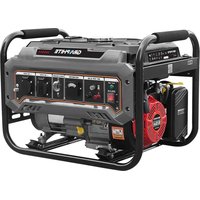
58G904 - Generator Graphite - Free user manual and instructions
Find the device manual for free 58G904 Graphite in PDF.


| Product type | Generator set |
| Brand | Graphite |
| Model | 58G904 |
| Dimensions (L × W × H) | 60.5 × 44.5 × 45.5 cm |
| Weight | 41 kg |
| Rated power | 2000 W |
| Maximum power | 2200 W |
| Output voltage | 230 V AC / 12 V DC |
| Frequency | 50 Hz |
| Fuel type | Unleaded gasoline (octane rating ≥ 86) |
| Tank capacity | 15 L |
| Fuel consumption | 2.44 L/h |
| Engine oil type | SAE 15W30 |
| Oil capacity | 0.6 L |
| Engine displacement | 196 cm³ |
| Starting type | Manual (recoil) and electric (battery) |
| Sound pressure level | 65 dB(A) |
| Sound power level | 95 dB(A) |
| Protection rating | IP23M |
| Protection class | I |
| Main functions | Backup power for power tools, lamps, heating; 12V battery charging |
| Maintenance and cleaning | Oil change every 20 h (first), then every 50 h; air filter cleaning; spark plug replacement |
| Safety equipment | AC circuit breaker, DC circuit protection, oil level sensor, grounding |
| Spare parts and repairability | Spark plug F5T/F6TC/F7TJC, air filter, belt; repairs by authorized service |
Frequently Asked Questions - 58G904 Graphite
User questions about 58G904 Graphite
0 question about this device. Answer the ones you know or ask your own.
Ask a new question about this device
Download the instructions for your Generator in PDF format for free! Find your manual 58G904 - Graphite and take your electronic device back in hand. On this page are published all the documents necessary for the use of your device. 58G904 by Graphite.
USER MANUAL 58G904 Graphite
natural_image
Exterior view of a portable electricity generator with control panel and motor (no visible text or symbols)58G904
10 ^* LAT DOSTĘPNOŚCI CZĘŚCI ZAMIENNYCH

natural_image
Icon of a person reading a book inside a circle (no text or symbols)A
B
C
natural_image
Black portable electronic device with labeled ports and connectors (no visible text or symbols)PL INSTRUKCJA ORYGINALNA (OBSŁUGI)......4
EN TRANSLATION (USER) MANUAL 9
DE ÜBERSETZUNG (BENUTZERHANDBUCH)....14

EN TRANSLATION (USER) MANUAL
Generator set: 58G904
NOTE: BEFORE USING THE EQUIPMENT, PLEASE READ THIS MANUAL CAREFULLY AND KEEP IT FOR FUTURE REFERENCE. PERSONS WHO HAVE NOT READ THE INSTRUCTIONS SHOULD NOT CARRY OUT ASSEMBLY, ADJUSTMENT OR OPERATION OF THE EQUIPMENT. KEEP THIS MANUAL FOR FUTURE REFERENCE.
SPECIFIC SAFETY PROVISIONS
NOTE!
Read the operating instructions carefully, follow the warnings and safety conditions contained therein. The appliance has been designed for safe operation. Nevertheless: installation, maintenance and operation of the appliance can be dangerous. Following the following procedures will reduce the risk of fire, electric shock, injury and will reduce the installation time of the appliance
WARNINGS REGARDING THE OPERATION OF THE DIESEL ELECTRIC GENERATOR
1. EXHAUST FROM THE INTERNAL COMBUSTION ENGINE IS POISONOUS.
- Never operate a combustion engine in an enclosed space, as there is a risk of poisoning or even death after a short stay in such conditions. The combustion engine is designed for operation in a well-ventilated environment.
2. MOTOR FUEL IS FLAMMABLE AND TOXIC
- If fuel spills into the gastrointestinal tract, into the respiratory tract or into the eyes, seek immediate medical attention. If fuel spills on the skin or clothing, it must be washed off immediately with soap and water and the clothing must be changed immediately.
- When using or moving the generator, be sure it is in the correct position. Keeping the generator tilted can cause fuel to leak from the carburettor or tank.
- Smoking and approaching with an open flame is prohibited while the generator is in operation.
3. THE INTERNAL COMBUSTION ENGINE OR ITS EXHAUST PIPE MAY BE HOT
- The generator should be placed where it is not likely to be touched by people passing by, including children.
- Avoid placing any flammable materials in the vicinity of the exhaust pipe of a running internal combustion engine.
- The generator should be positioned at a distance of at least 1 metre from a building or other equipment so that the generator does not overheat.
- The exhaust system heats up to high temperatures during operation and remains hot when the engine stops.
4. PREVENTING THE POSSIBILITY OF ELECTRIC SHOCK
- Never operate the generator set in damp conditions.
- Never touch the generator components with wet hands as there is a risk of electric shock.
- The generator must be earthed before use.
- Do not lay switching cables on or under the generator.
5. CONNECTION NOTES
- Do not connect the generator to the normal mains supply.
- Do not connect the generator in parallel with another generator.
- Do not power electronic devices such as radios, TV sets, home cinema sets, SAT installations, computers, etc.
NOTES ON THE SAFE USE OF THE DIESEL ELECTRIC GENERATOR
- Carefully read this manual to become well acquainted with the equipment you have purchased. Pay attention to the use of the generator, its limitations and the potential risks of danger inherent in this type of product.
- The generator should be placed on a firm surface.
- The load on the generator must be within the limits specified on the nameplate. Overloading may result in damage to the generator or a reduction in service life.
- The engine should not be run at excessive speed. No arbitrary changes to the design of the generator should be made to increase or decrease the engine speed of the unit.
- Never operate a generator that is missing any parts, has no protective covers, etc.
- The generator should not be operated or stored in wet or humid conditions. The generator should not be placed on highly conductive surfaces such as metal platforms etc. However, if such conditions cannot be avoided then rubber gloves and footwear should be worn.
- Keep the generator clean so that there are no traces of oil, mud or other debris on it.
- Extension cords, power cords and all other electrical equipment must be in good condition. Never handle electrical equipment that has damaged power cords.
If you have been electrocuted, seek medical attention immediately.
- Never operate the generator under the following conditions:
- The engine speed is not stabilised.
- No electricity collection.
- Overheating of the electricity consumer has occurred.
- There is sparking at electrical connections.
- Damaged sockets.
- Ignition intervals occur in the internal combustion engine.
- Excessive vibration occurs.
- Flames or smoke appear.
- The room in which the generator is located is enclosed.
- It is raining or there is inclement weather.
- In an environment with a high fire risk.
- Periodically check the fuel supply system for leaks or signs of damage such as rubbing or aging of the fuel line, damage to the tank or fuel filler cap. All damage should be rectified before starting the generator.
- The generator may only be used, operated and filled with fuel under the following conditions:
- With good ventilation - avoid rooms and areas where fumes or vapours could accumulate, such as excavations, cellars, shelters, exhaust rooms,
bilge rooms of yachts. Air flow and adequate temperature are very important. The temperature should not exceed 40^ C.
- Exhaust fumes should be discharged from the enclosure via a heat-resistant duct. Exhaust fumes contain carbon monoxide, which is odourless and invisible. If it is allowed to be inhaled, serious poisoning and even death can result.
- Fill the generator tank with fuel in well-lit areas. Avoid spilling fuel. Never refuel the tank with the engine running. Always wait until the engine has cooled down slightly before pouring fuel.
- Both the silencer and the air filter must always be installed and remain in good condition, as they protect against the escape of flame if the mixture is burned in the intake duct.
- Keep flammable materials away from the generator.
- When operating the generator, do not wear loose clothing, jewellery or anything else that can be caught during start-up or by rotating generator components.
- The generator must reach its operating speed before connecting the electrical load. The electric load must be disconnected before the combustion engine is switched off.
- In order to avoid dangerous power ripples that could damage the equipment, the internal combustion engine must not be allowed to stall due to fuel exhaustion when an electrical load is connected.
- Do not insert anything through the ventilation slots even when the generator is not running. Doing so may damage the generator or result in personal injury.
- Before transporting the generator in a motor vehicle, empty its tank to prevent possible fuel spillage.
- Use proper lifting methods when moving the generator from place to place. Improper lifting methods can cause injury.
- To avoid burns, do not touch the engine muffler or other parts of the internal combustion engine or generator that may become hot during operation.
- Do not combine the generator with other sources of electricity.
- Wear ear protection.
- All repairs should be carried out by the manufacturer's service department.
ATTENTION! Despite the inherently safe design, the use of safety measures and additional protective measures, there is always a risk of residual injury during operation.
PICTOGRAMS AND WARNINGS
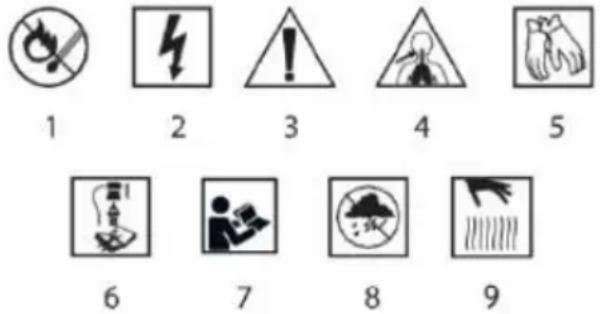
- Fire hazard
- Live equipment
- Caution Take special precautions
- Risk of exhaust gas poisoning
- Use protective gloves
- Switch off the engine and remove the wire from the spark plug before carrying out maintenance or repair work.
- Read the operating instructions, observe the warnings and safety conditions contained therein!
- Protect against moisture
- Attention hot element.
DESCRIPTION OF THE GRAPHIC ELEMENTS
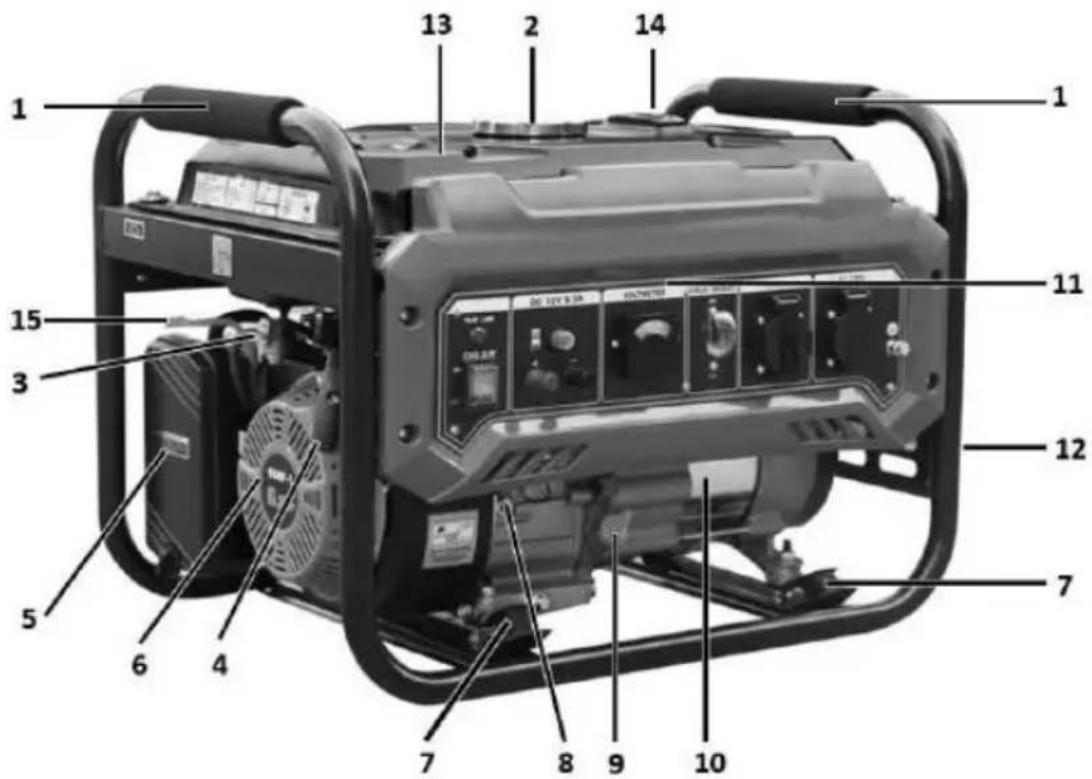
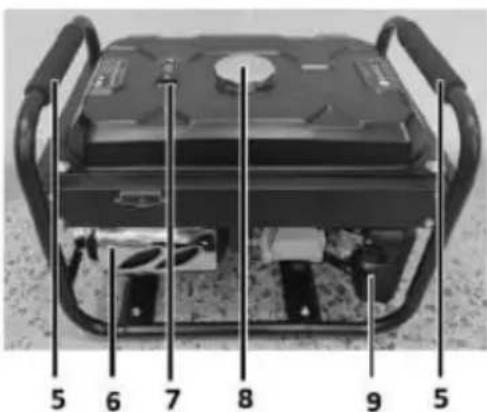
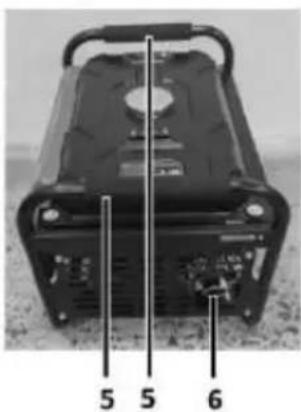
The following numbering refers to the components of the device shown on the graphic pages of this manual.
| Designation | Description |
| 1 | Transport handle |
| 2 | Fuel filler cap |
| 3 | Carburettor valve |
| 4 | Starter cable |
| 5 | Air filter |
| 6 | Internal combustion engine |
| 7 | Vibration dampers |
| 8 | Oil level indicator (dipstick) |
| 9 | Oil filler cap |
| 10 | Power generator |
| 11 | Unit panel |
| 12 | Exhaust outlet/ silencer |
| 13 | Fuel tank |
| 14 | Fuel level indicator |
| 15 | Suction lever |
* There may be differences between the graphic and the actual product
PURPOSE
A generator is a device that converts mechanical energy into electrical energy. Its power source is an internal combustion engine. The generator is ideal when there is no permanent source of electricity. It is ideal as an emergency power source in homes, camps, holiday cottages, etc. The generator can be used to power devices such as power tools, incandescent lamps, heating devices and similar devices that require 230 V AC.
The generator requires virtually no maintenance.
Do not misuse the generator
Do not connect consumers in the form of any electrical equipment before starting the engine. The tank must not be filled above the permissible maximum level, as fuel may flow out as it expands due to the increase in temperature while the engine is running.
The following rules must be observed when filling with fuel:
the engine cannot run.
fuel must not be spilled.
GROUNDING THE GENERATOR
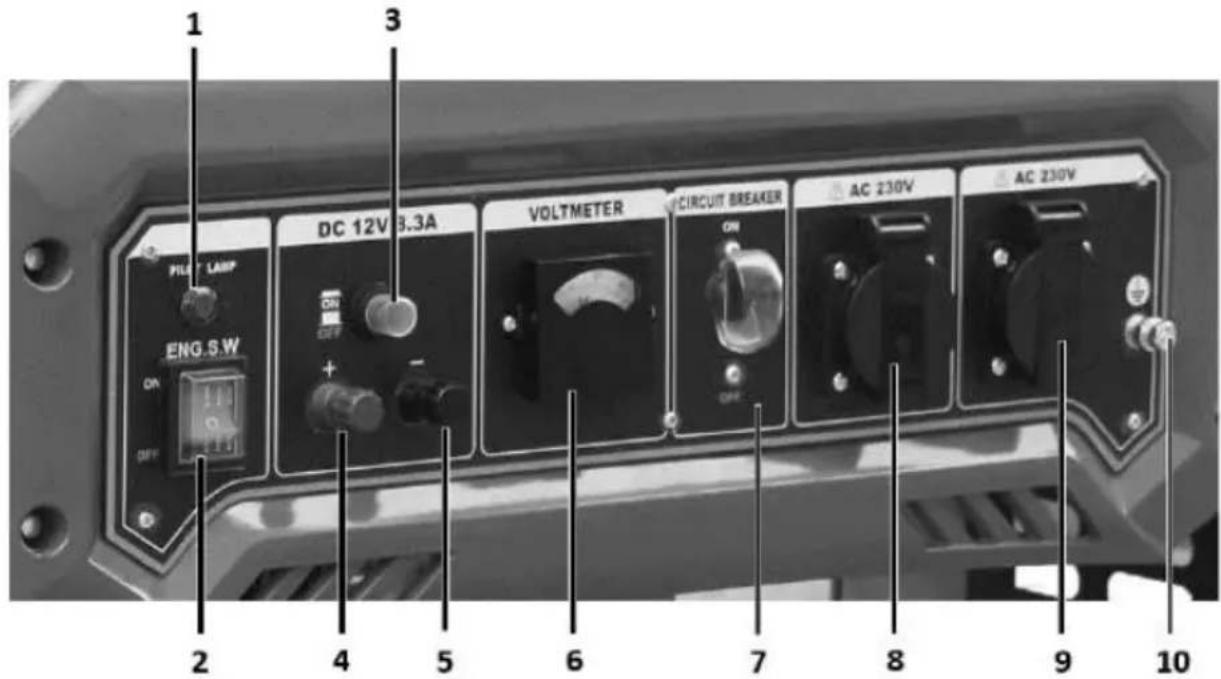
The generator earth terminal is located on the generator panel Fig. B10, and connected to the non-conductive metal parts of the generator and to the earth terminals of each socket.
Before using the earth terminal, consult a qualified electrician, electrical inspector or local agency with jurisdiction over local regulations or ordinances that apply to the intended use of the generator.
To prevent electric shock from faulty equipment, the generator should be earthed. Connect a section of single-core power cable (wire) with a large cross-section (minimum 4mm^2 ) between the figure B10 earthing terminal and the earthing rod driven into the ground. Generators have a system earth that connects the generator frame components to the earth terminals on the AC output sockets. The system earth is not connected to the AC neutral conductor. If the generator is tested with an outlet tester, it will show the same earthing circuit condition as for domestic outlets.
OIL SPILLAGE
- Before starting the generator for the first time, prepare 0.6 litres of SAE type 15W30 oil. Unscrew the oil filler cap fig. A9 and pour in the specified amount of oil. Check the oil level fig. A8 and screw on the oil filler cap fig. A9.
- Fill the fuel tank fig. A13 with unleaded petrol. Unscrew the fuel filler cap fig. A2. When you have finished filling the fuel, make sure that the fuel filler cap fig. A2 is securely tightened.
- Ground the generator Fig. B10 (earthing cable not included in the generator equipment).
STARTING THE INTERNAL COMBUSTION ENGINE
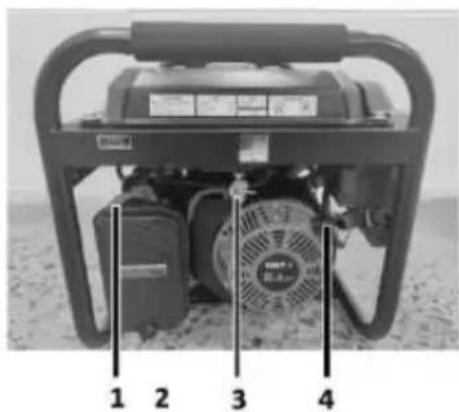
Turn the fuel valve lever fig. A3 to the "ON" position. With the engine cold, move the fuel throttle lever (suction) fig. A15/fig. C1 to the right.
Switch on the generator ignition by pressing the button fig. B1 to the "ON" position. Pull the starter cord Fig. A4/Fig. C4 slowly at first until you hear the clutch engage and then pull it vigorously. Starting the combustion engine may require pulling the starter cord several times.
STARTING THE GENERATOR FROM THE BATTERY
When starting the engine with the starter, read the following instructions.
- Move the fuel throttle lever (suction) fig. A15 to the right and connect the receiver to the 230V AC socket fig. B8 or fig. B9.
- Move the lever of the AC overcurrent protection switch fig. B7 to the "ON" position. The voltage indicator lamp fig. B1 will illuminate and the voltmeter fig. B6 will show the voltage generated.
- Place the engine switch in the START position and hold it there for 5 seconds or until the engine starts.
- Operating the starter for more than 5 seconds can damage the engine. If the engine fails to start, release the switch and wait 10 seconds before restarting the starter.
- If the speed of the starter motor drops after a certain period of time, this indicates that the battery needs to be recharged.
- After starting the engine, allow the engine switch to return to the ON position.
- Turn the choke lever or push the choke rod to the OPEN position as the engine warms up.
STOPPING THE ENGINE
Turn off all consumers, in the form of electrical appliances, before stopping the engine.
- Turn off the generator ignition by pressing the Fig. B2 button to the "OFF" position.
- Turn the fuel valve lever Fig. A3/Fig. A3 to the "OFF" position. This will switch off the engine.
After the internal combustion engine has finished running, the engine itself and its exhaust pipe can be very hot.
CAUTION! As long as the combustion engine and its exhaust pipe have not cooled down, avoid touching them with any part of your body or clothing when undertaking inspection, maintenance or repair work.
AC POWER SUPPLY
Before connecting the device to the generator:
- Make sure it is in good working order. Faulty equipment or power cords can create a risk of electric shock.
- If the appliance starts to malfunction, becomes slow or stops suddenly, switch it off immediately. Unplug the appliance and determine whether the problem is the appliance or whether the rated load capacity of the generator has been exceeded.
- Ensure that the electrical rating of the tool or appliance does not exceed the generator rating. Never exceed the maximum power rating of the generator.
- Power levels between rated and maximum may not be used for more than 30 minutes.
- Significant overloading of the generator will cause the circuit breaker to shut down.
- Exceeding the maximum power time limit or slightly overloading the generator may not cause the breaker to trip, but will reduce the life of the generator.
- For continuous operation, do not exceed the rated power.
- In both cases, the total power requirement (VA) of all connected appliances must be taken into account. The power data of the appliance can be found on the rating plate
AC power supply for equipment
- Start the engine.
- switch on the AC circuit breaker.
- Connect the device.
ATTENTION: Most motorised equipment requires more power than its rated output to start.
Do not exceed the current limit specified for one socket. If an overloaded circuit causes the AC breaker to trip, reduce the electrical load in the circuit, wait a few minutes and then switch the breaker back on.
DC POWER SUPPLY
ATTENTION: DC terminals may ONLY be used to charge 12 V vehicle batteries.
CAUTION: Do not start the vehicle while the battery charging cables are connected and the generator is running. The vehicle or damage to the generator may occur.
The terminals are coloured red, positive terminal (+) fig. B4 and black, negative terminal (-) fig. B5. The battery must be connected to the DC terminals of the generator with the correct polarity (positive battery to the red terminal of the generator and negative battery to the black terminal of the generator).
DC circuit protection with DC fuse
The DC circuit protection Fig. B3 automatically switches off the DC battery charging circuit when the DC circuit is overloaded, when there is a problem with the battery or the connections between the battery, or when the connections between the battery and the generator are incorrect.
ATTENTION! If the DC circuit protection has been deactivated Fig. B3, wait a few minutes and press the button inwards to reset the DC circuit protection.
Connecting the battery cables
CAUTION: The battery may emit explosive gases. Keep open flames and cigarettes away. Ensure adequate ventilation when charging batteries.
- before connecting the charging cables to the battery that is installed in the vehicle,
- disconnect the vehicle's earthed battery cable.
- connect the positive (+) cable of the battery to the positive (+) terminal of the battery.
- connect the other end of the positive (+) battery cable to the generator.
- connect the negative (-) cable of the battery to the negative (-) terminal of the battery.
- connect the other end of the negative (-) battery cable to the generator.
- Start the generator.
Disconnecting the battery cables:
1. Stop the engine.
- Disconnect the negative (-) terminal of the battery cable from the negative (-) terminal of the generator Fig. B5.
- Disconnect the other end of the negative (-) battery cable from the negative (-) battery terminal.
- Disconnect the positive (+) battery cable from the positive (+) terminal of the generator Fig. B5.
- Disconnect the other end of the positive (+) battery cable to the positive (+) terminal of the battery.
- Connect the vehicle earth cable to the negative (-) terminal of the battery.
- Reconnect the vehicle's battery earth cable.
Working at great heights
NOTE: At high altitudes, the standard fuel-air mixture in the carburettor will be excessively rich. Performance will decrease and fuel consumption will increase. Engine power will drop by approx.
3.5% for every 300 metres (1,000 ft) increase in altitude.
MAINTENANCE AND STORAGE
OIL
- Engine oil is a major factor in engine performance and life. The wrong engine oil for two-stroke engines, for example, will damage the engine and is not recommended.
- Check the oil level BEFORE EVERY USE of the generator, the check is to be done on a level surface with the engine switched off.
- Use 4-stroke engine oil or equivalent high quality oil. SAE15W30 oil type is recommended for use at medium temperatures.
Oil top-up
- Remove the oil filler cap fig. A9 and wipe the dipstick clean fig. A8.
- Check the oil level by inserting the dipstick Fig. A8 into the filler neck without screwing it in.
- If the level is low, add the recommended oil to the upper mark on the dipstick.
• After topping up, tighten the cap firmly, and stow the dipstick.
ATTENTION: If there is no or insufficient oil in the oil sump, the oil level sensor may trip, causing the engine to stop or not start.
Changing engine oil
NOTE: Drain the oil when the engine is warm to ensure complete and rapid drainage.
- Remove the drain plug and sealing washer, the oil filler cap and drain the oil.
- Reinstall drain plug and sealing washer. Tighten the plug firmly.
- top up with recommended oil and check oil level.
Please dispose of used engine oil in an environmentally compatible manner. We recommend that you hand it over in a sealed container at your local petrol station or for recycling. Do not dispose of it in the bin or spill it on the ground.
FUEL
- Check the fuel level indicator.
- Top up the tank if the fuel level is low. Do not fill the tank above the fuel strainer arm. Petrol is extremely flammable and is explosive under certain conditions. Refuel in a well-ventilated area with the engine
switched off. Do not smoke or allow flames or sparks in the area where the engine is refuelled or where petrol is stored.
- Do not overfill the fuel tank (there should be no fuel in the filler neck). After refuelling, make sure the tank cap is properly and securely closed. Take care not to spill fuel when refuelling. Spilled fuel or fuel vapour can catch fire. If fuel is spilled, make sure the area is dry before starting the engine.
- Avoid repeated or prolonged contact of the fuel with the skin or inhalation of vapours.
CAUTION: KEEP FUEL OUT OF THE REACH OF CHILDREN.
- Use petrol with an octane number of 86 or higher.
- We recommend unleaded petrol because it produces fewer deposits in the engine and on the spark plugs and extends the life of the exhaust system.
- Never use stale or contaminated petrol or a mixture of oil and petrol. Avoid getting dirt or water into the fuel tank.
- Occasionally, a slight 'spark knock' or 'pinging' (a metallic sound reminiscent of rapping) can be heard.
- when operating under a heavy load. This is not a cause for concern.
- If knocking sparks or pinging occurs at constant engine speed, under normal load, change the brand of petrol. If the knocking or pinging sparks persist, contact an authorised generator dealer.
GENERATOR INSPECTIONS
- Proper maintenance is essential for safe, economical and trouble-free operation. It will also help to reduce air pollution.
- The exhaust gas contains poisonous carbon monoxide. Switch off the engine before carrying out any maintenance. If the engine must be run, make sure the area is well ventilated.
- Periodic maintenance and adjustment is necessary to keep the generator in good working condition. Service and inspection should be carried out at the intervals shown in the maintenance schedule below.
- The generator should be serviced more frequently if used in dusty areas.
- The generator should be serviced by the dealer, or an authorised service centre.
- For professional or commercial applications, operating hours should be recorded to determine the correct maintenance frequency.
| PERIOD OF CONTINUOUS OPERATION Performed in each month indicated or after working hours, whichever comes first. | Each use of | First month or 20 hrs. | Every 3 months or 50 hrs. | Every 6 months or 100 hrs. | Every year or 300 hrs. | |
| ELEMENT | ||||||
| Engine oil | Check the level | O | ||||
| Replace | O | O | ||||
| Air filter | Check out | O | ||||
| Clean or replace | O | |||||
| Sediment cup | Clean | O | ||||
| Spark plug | Check clean | O | ||||
| Silencer | Clean | O | ||||
| Valve cleaner | Check and adjust | O | ||||
| Fuel tank and filter | Clean | O | ||||
| Fuel line | Check out | Every 2 years (replace if necessary | ||||
CAUTION! Failure to perform maintenance correctly or to rectify a problem before operation may result in a malfunction that could seriously injure or kill the user.
Always follow the inspection and maintenance recommendations and schedules in this operating manual.
The maintenance schedule applies to normal operating conditions. If the generator is operated under severe conditions, such as continuous operation under heavy loads or high temperatures, or if it is used in extremely wet or dusty conditions, consult your service dealer for recommendations applicable to your individual needs and use.
AIR FILTER SERVICE
A dirty air filter will restrict air flow to the carburettor. To prevent carburettor failure, the air filter must be serviced regularly. Service more frequently when operating generator in very dusty areas
CAUTION: Using petrol or flammable solvent to clean the filter element may cause a fire or explosion. Use only soap, water or a non-flammable solvent.
CAUTION: Never run the generator without an air filter. This will cause rapid engine wear.
Filter replacement or cleaning
- detach the clips of the air filter cover, remove the air cleaner cover, and remove the element.
2 Wash the component in warm water with detergent, then rinse thoroughly; or wash in a non-flammable solvent or one with a high flash point. Allow the component to dry thoroughly. - soak the filter in clean engine oil and squeeze out the excess. The engine will smoke on first start-up if too much oil remains in the filter.
4 Reinstall the air cleaner element and cover.
SPARK PLUG SERVICE
NOTE: Recommended spark plugs: F5T or F6TC or F7TJC or equivalent.
To ensure proper engine operation, the spark plug must be properly slotted and free of deposits.
CAUTION: If the engine has been running, the muffler will be very hot. Be careful not to touch the muffler.
-
Remove the spark plug cover.
-
Clean any debris from around the spark plug base.
- use the spanner provided in the tool kit to remove the spark plug.
4 Visually inspect the spark plug. Discard it if the insulator is cracked or chipped. If the spark plug is to be reused, clean it with a wire brush.
5 Measure the spark plug gap with a gap gauge. Correct if necessary by carefully adjusting the distance of the side electrode.
6 Check that the spark plug washer is in good condition and manually screw in the spark plug to prevent cross-threading.
7 After seating the spark plug, tighten with a spark plug spanner to compress the washer.
The gap should be: 0.70-0.80 mm (0.026-0.031 in).
If installing a new spark plug, tighten 1/2 turn after seating the spark plug to compress the washer. If reinstalling a used spark plug, tighten 1/8 - 1/4 turn after seating the spark plug to compress the washer.
The spark plug must be securely tightened. An incorrectly tightened spark plug can get very hot and can damage the engine. Never use spark plugs that have the wrong heat range, use only recommended spark plugs or equivalent.
PROBLEM SOLVING
| Symptom | Possible cause | Solution |
| When the engine does notOne wants to Run: | Is there fuel in the tank? | Check and refuel |
| Is there oil in the tank? | Check and top up the oil | |
| Is there a spark coming out of the spark plug? | Check and replace spark plugs | |
| Does the fuel reach the carburettor? | Clean the fuel tank of deposits | |
| If the engine still does not start, take the generator to an authorised service centre. | ||
| Lack of electricity in AC sockets | Is the AC circuit breaker switched on? | Turn the AC switch |
| The equipment connected to the generator is faulty | Check that the appliance or electrical equipment has no defects | |
| If the generator still does not show voltage at the AC sockets, contact your dealer or service centre | ||
| Lack of electricity in DC sockets | Is the DC circuit protection switch on | Switch on DC protection |
| The equipment connected to the generator is faulty | Check that the appliance or electrical equipment has no defects | |
| If the generator still does not show voltage at the DC sockets, contact your dealer or service centre | ||
TRANSPORT / STORAGE
- When transporting the generator, switch off the engine switch and fuel valve.
- Keep the generator level to prevent fuel spillage. Fuel vapour or spilled fuel can catch fire.
- Contact with a hot engine or exhaust system can cause serious burns or fire. Allow the engine to cool before transporting or storing the generator.
- Take care not to drop or bump the generator during transport. Do not place heavy objects on the generator.
Before storing the device for an extended period of time:
Ensure that the storage area is free from excessive moisture and dust.
| STORAGE TIME | RECOMMENDED SERVICE PROCEDURE TO PREVENT HARD STARTING |
| Less than 1 month1 to 2 months | No preparation required.Fill with fresh petrol and add petrol conditioner. |
| 2 months to 1 year | Fill with fresh petrol and add petrol conditioner.Drain the float bowl of the carburettor.Empty the fuel sediment reservoir. |
| 1 year or more | Fill with fresh petrol and add petrol conditioner.Drain the float bowl of the carburettor.Empty the fuel deposit tank.Remove the spark plug. Pour a tablespoon of engine oil into the cylinde.Turn the engine slowly using the cable distribute the oil.Reinstall the spark plug.Change the engine oil.When collected from storage - drain the stored petrol into suitable containers for disposal.and fill with fresh petrol before starting. |
| *Use petrol conditioners that have been formulated to extend shelf life. | |
Service in accordance with the table below.
TECHNICAL DATA
| Rated data | |
| Parameter | Value |
| Engine capacity | 196 cm3 |
| Output voltage | 230 V AC |
| Output frequency | 50 Hz |
| Output power | 2000 W |
| Peak output power | 2200 W |
| Additional output voltage | 12V DC |
| Power of additional output | 8,3A |
| Degree of protection | IP23M |
| Protection class | I |
| Idle speed | 3000 min-1 |
| Internal combustion engine power | 6.5 HP |
| Performance class | G1 |
| Power factor (cos φ) | 1.0 |
| Type of fuel | #92; #95; #98 |
| Fuel tank capacity | 15 L |
| Average fuel consumption | 2.44l/h |
| Engine oil type | SAE15W30 |
| Oil quantity for the internal combustion engine | 0,6 L |
| Spark plug type | Magneto ignition |
| Maximum ambient temperature | + 40°C |
| Dimensions LxWxH | 60.5x44.5x45.5 cm |
| Mass | 41 kg |
| Year of production | 2023 |
| 58G904 stands for both type and machine designation | |
NOISE AND VIBRATION DATA
| Sound pressure level | L_PA = 65 dB(A) K=3 dB(A) |
| Sound power level | L_WA = 95 dB(A) K=3 dB(A) |
Information on noise and vibration
The noise emission level of the equipment is described by: the emitted sound pressure level Lp and the sound power level Lw (where K denotes measurement uncertainty). The vibrations emitted by the equipment are described by the vibration acceleration value a_h (where K is the measurement uncertainty).
The sound pressure level Lp, the sound power level Lw and the vibration acceleration value is given in these instructions have been measured in accordance with ISO 8528-10:1998. The vibration level a given can be used to compare equipment and to make a preliminary assessment of vibration exposure.
The vibration level quoted is only representative of the basic use of the unit. If the unit is used for other applications or with other work tools, the vibration level may change. A higher vibration level will be influenced by insufficient or too infrequent maintenance of the unit. The reasons given above may result in increased vibration exposure during the entire working period.
In order to accurately estimate vibration exposure, it is necessary to take into account periods when the unit is switched off or when it is switched on but not used for work. Once all factors have been accurately estimated, the total vibration exposure may turn out to be much lower.
In order to protect the user from the effects of vibration, additional safety measures should be implemented, such as cyclical maintenance of the machine and working tools, securing an adequate hand temperature and proper work organisation.
ENVIRONMENTAL PROTECTION

Electrically-powered products should not be disposed of with househ waste, but should be taken to appropriate facilities for disposal. Cont your product dealer or local authority for information on disposal. Wa electrical and electronic equipment contains environmentally iner substances. Equipment that is not recycled poses a potential risk to environment and human health.
"Grupa Topex Spółka z ograniczoną odpowiedzialnością" Spółka komandytowa with its registered office in Warsaw, ul. Pograniczna 2/4 (hereinafter: "Grupa Topex") informs that all copyrights to the content of this manual (hereinafter: "Manual"), including, among others. Its text, photographs, diagrams, drawings, as well as its composition, belong exclusively to Grupa Topex and are subject to legal protection under the Act of 4 February 1994 on Copyright and Related Rights (ie Journal of Laws 2006 No. 90 Poz. 631, as amended). Copying, processing, publishing, modification for commercial purposes of the entire Manual and its individual elements, without the consent of Grupa Topex expressed in writing, is strictly prohibited and may result in civil and criminal liability.
EC Declaration of Conformity
Manufacturer: Grupa Topex Sp. z o.o. Sp.k., Pograniczna 2/4 02-285 Warszawa
Product: Generator set
Model: 58G904
Trade name: GRAPHITE
Serial number: 00001 ÷ 99999
This declaration of conformity is issued under the sole responsibility of the manufacturer.
The product described above complies with the following documents:
Machinery Directive 2006/42/EC
Electromagnetic Compatibility Directive 2014/30/EU
Noise Emission Directive 2000/14/EC as amended by 2005/88/EC Guaranteed sound power level LWA=95 dB(A)
RoHS Directive 2011/65/EU as amended by Directive 2015/863/EU And meets the requirements of the standards:
EN ISO 8528-13:2016; EN 60204-1:2018;
EN 55012:2007+A1:2009; EN 61000-6-1:2007;
EN IEC 63000:2018
This declaration relates only to the machinery as placed on the market and does not include components
added by the end user or carried out by him/her subsequently.
Name and address of the EU resident person authorised to prepare the technical dossier:
Signed on behalf of:
Grupa Topex Sp. z o.o. Sp.k.
TOPEX GROUP Quality Officer
Warsaw, 2022-09-22
motors nevar darboties.
MAINSTRĀVAS BAROŠANAS AVOTS
LĪDZSTRĀVAS BAROŠANAS AVOTS
SISEPÕLEMISMOOTORI KÄIVITAMINE
VERTALING (GEBRUIKERS)HANDLEIDING
Generatorset: 58G904
OPMERKING: LEES DEZE HANDLEIDING ZORGVULDIG DOOR VOORDAT U HET APPARAAT IN GEBRUIK NEEMT EN BEWAAR DEZE VOOR TOEKOMSTIG GEBRUIK. PERSONEN DIE DE INSTRUCTIES NIET HEBBEN GELEZEN, MOGEN DE APPARATUUR NIET MONTEREN, AFSTELLEN OF BEDIENEN. BEWAAR DEZE HANDLEIDING VOOR TOEKOMSTIG GEBRUIK.
SPECIFIEKE VEILIGHEIDSVOORSCHRIFTEN OPMERKING!
WERKING VAN HET APPARAAT
VOORBEREIDING OP HET WERK
Product: Generatorset
Model: 58G904