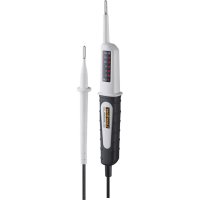
ActiveTester - Measuring equipment Laserliner - Free user manual and instructions
Find the device manual for free ActiveTester Laserliner in PDF.



| Product Type | Universal Voltage Tester |
| Brand | Laserliner |
| Model | ActiveTester |
| Voltage Range | 12 V, 24 V, 36 V, 50 V, 120 V, 230 V, 400 V AC and DC |
| Frequency Range | 50 / 60 Hz |
| Display | LEDs: 12, 24, 36, 50, 120, 230, 400 V and polarity (+/-) |
| Tolerance | -30 % to 0 % of reading |
| Response Time | < 0.1 s (LED) |
| Overvoltage Category | CAT III - 400 V |
| Pollution Degree | 2 |
| Protection Type | IP64 |
| Current Consumption | Is < 0.2 A; Is (5 s) < 3.5 mA (cycle 5% ED / 10 min) |
| Operating Conditions | -10 °C to 55 °C, max. relative humidity 80 % rH, max. altitude 2000 m |
| Storage Conditions | -10 °C to 70 °C, max. relative humidity 80 % rH |
| Weight | 115 g |
| Power Supply | Powered by the measured circuit (battery-free) |
| Main Functions | AC/DC voltage detection with polarity indication |
| Maintenance | Clean and dry before use; annual calibration recommended |
| Safety | Compliant with CAT III - 400 V; use protective caps for voltages > 24 V AC / 60 V DC |
| Included Accessories | 2 protective caps |
Frequently Asked Questions - ActiveTester Laserliner
User questions about ActiveTester Laserliner
0 question about this device. Answer the ones you know or ask your own.
Ask a new question about this device
Download the instructions for your Measuring equipment in PDF format for free! Find your manual ActiveTester - Laserliner and take your electronic device back in hand. On this page are published all the documents necessary for the use of your device. ActiveTester by Laserliner.
USER MANUAL ActiveTester Laserliner
natural_image
Two laboratory electrophysic tools, one with a digital display and the other with a pointed tip (no visible text or symbols on the devices themselves)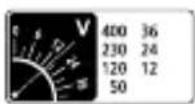
Laserliner
Laserliner
A
text_image
1 2 3 4 5 CAT III 400 V CAT III 400 V Laserliner 400VB
natural_image
Close-up of a wall socket with a tool applying wire to the socket (no text or symbols visible)C
natural_image
Electrical outlet with a screwdriver and warning symbol (no readable text or labels)Laserliner
!
Completely read through the operating instructions, the „Warranty and Additional Information“ booklet as well as the latest information under the internet link at the end of these instructions. Follow the instructions they contain. This document must be kept in a safe place and passed on together with the device.
Function / Application
Universal voltage tester for the entire electrical system of a building. The device can be used to test DC and AC voltages from 12 to 400 V. With DC voltage, polarity tests from 12 VDC and up can be carried out. Information is shown by means of a high-contrast LED display.
Safety instructions
- The device must only be used in accordance with its intended purpose and within the scope of the specifications.
- The measuring tools and accessories are not toys. Keep out of reach of children.
- Modifications or changes to the device are not permitted, this will otherwise invalidate the approval and safety specifications.
- Do not expose the device to mechanical stress, extreme temperatures or significant vibration.
- Stop using the device if one or a number of its functions fails.
- Exercise extreme caution when working with voltages higher than 24 V/AC rms or 60 V/DC. Touching the electrical conductors at such voltages poses a risk of life-threatening electric shocks. Take particular care if the 50 V warning LED is on.
- If the device comes into contact with moisture or other conductiveresidue, work must not be carried out under voltage. At and above voltages of 24 V/AC rms / 60 V/DC, the presence of moisture creates the risk of life-threatening electric shocks.
- Clean and dry the device before use.
- When using the device outdoors, make sure that the weather conditions are appropriate and/or that suitable protection measures are taken.
- In overvoltage category III (CAT III - 400 V), the voltage between the test device and earth must not exceed 400 V.
-
When performing measurements in overvoltage category III - 400 V, make sure the device is only used with the protective cap.
-
Before taking any measurements, make sure that both the area to be tested (e.g. a line), the test device and the accessories used (e.g. connection cable) are in proper working order. Test the device by connecting it to known voltage sources (e.g. a 230 V socket in the case of AC testing or a car battery in the case of DC testing).
- Observe the safety precautions of local and national authorities relating to the correct use of the device and any prescribed safety equipment (e.g. electrician's safety gloves).
- The device must not be connected to voltages for longer than 30 seconds.
- The device is not suitable for unsupervised use.
- If you have to take hold of the measuring spikes, do so by the grip sections only. Do not touch the measuring contacts whilst the measurement is being taken.
- Do not work alone in the vicinity of hazardous electrical installations and only under the guidance of a qualified electrician.
Additional information on use
Observe the technical safety regulations for working on electrical systems, especially: 1. Safely isolating from power supply,
- Securing to prevent system being switched on again,
- Checking zero potential, two-pole, 4. Earthing and short-circuiting, 5. Securing and covering adjacent live components.
Safety instructions
Dealing with electromagnetic radiation
- The measuring device complies with electromagnetic compatibility regulations and limits in accordance with the EMC Directive 2014/30/EU which is covered by the Radio Equipment Directive 2014/53/EU.
- Local operating restrictions – for example, in hospitals, aircraft, petrol stations or in the vicinity of people with pacemakers – may apply. Electronic devices can potentially cause hazards or interference or be subject to hazards or interference.
Symbols
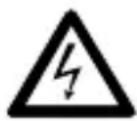
Hazardous electrical voltage warning:
Unprotected live components inside the device housing may pose a risk of electric shock.

Danger area warning
Laserliner

Protection class II: The test device has reinforced or double insulation.
CAT II
Overvoltage category II: Single-phase consumers that are connected to standard sockets, e.g. household appliances, portable tools.
CAT III
Overvoltage category III: Equipment in fixed installations and for applications where specific requirements with regard to the reliability and availability of equipment have to be met, e.g. circuit-breakers in fixed installations and devices used in industrial applications which are permanently connected to the fixed installation.
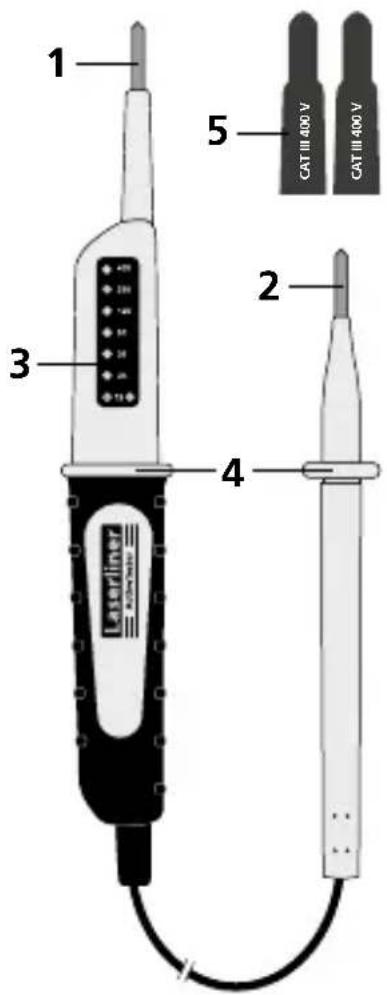
Device description (see Fig. A)
1 Test prod +
3 LED display
5 Protective covers
2 Test prod -
4 Grip guard
1 Testing AC voltage

To achieve increased security against foreign touch that the protective covers (5) must be placed over the test prods.
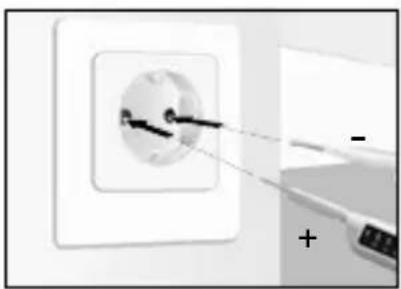
Fig. B: Hold the base device (+) in your right hand and the second test prod (-) in your left hand. Now apply the test prods to the contacts to be tested (line, socket, etc.).
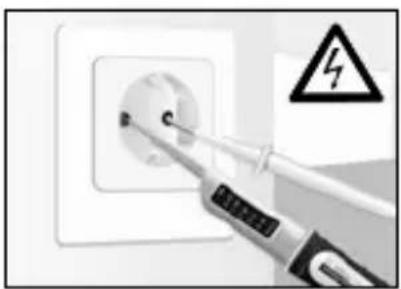
Fig. C: If voltage is present, all the LEDs up to the voltage measured will light up, along with the positive and negative LEDs.

Make sure that the measuring circuit is closed. It is not sufficient to use just one of the test prods.
2 Testing DC voltage
Follow the instructions in section 1 („Testing AC voltage“). If voltage is present, the relevant LEDs will light up.
The positive or negative LED will indicate the polarity.
- Positive LED lights up: The positive pole is in contact with the „+“ test prod
- Negative LED lights up: The negative pole is in contact with the „+“ test prod
3 Calibration
The voltage tester needs to be calibrated and tested on a regular basis to ensure it produces accurate measurement results.
We recommend carrying out calibration once a year.
Technical data
| Voltage range 12,24,36 | 6,50,120,230,400 VAC+/- 12,24,36,50,120,230,400 VDC |
| Frequency range 50/60 | Hz |
| LED display 12, 24, 36, | 50, 120, 230, 400 VPositive/negative polarity |
| Tolerance -30% to 0% | of the reading |
| Response time < 0.1 s, | LED |
| Overvoltage CAT III - 400 V | |
| Pollution degree 2 | |
| Degree of protection IP64 | |
| Power consumption Is | < 0.2 A / Is (5s) < 3.5 mA(cycle: 5% switch-on duration / 10 min.) |
| Operating conditions | -10°C ... 55°C, Max. humidity 80%rH,no condensation, Max. workingaltitude 2000 m above sea level |
| Storage conditions -10°C | ... 70°C, Max. humidity 80%rH |
| Weight 115 g | |
Subject to technical alterations. 18W21
EU directives and disposal
This device complies with all necessary standards for the free movement of goods within the EU.
This product is an electric device and must be collected separately for disposal according to the European Directive on waste electrical and electronic equipment.
Further safety and supplementary notices at:
http://laserliner.com/info?an=actes
text_image
CE —Laserliner
!
natural_image
Electric shock test setup with a power plug and warning symbol (no text or labels)
SERVICE
Umarex GmbH & Co. KG
- Laserliner -