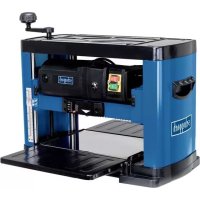
PLM1800 - Plane SCHEPPACH - Free user manual and instructions
Find the device manual for free PLM1800 SCHEPPACH in PDF.

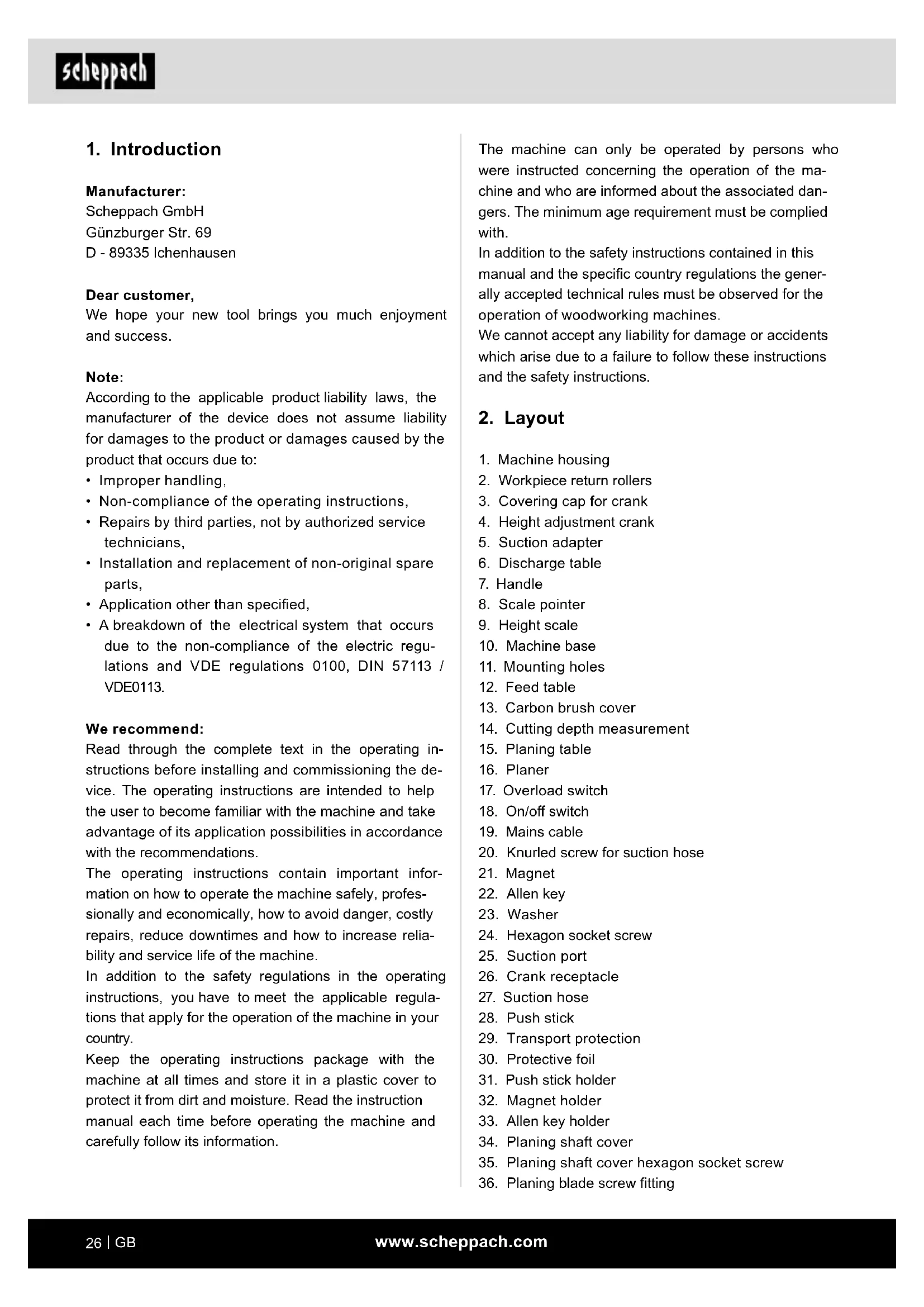


| Product type | Planer (jointer-planer) |
| Brand | Scheppach |
| Model | PLM1800 |
| Dimensions (L x W x H) | 630 x 580 x 500 mm |
| Weight | 30.5 kg |
| Power supply | 230 V / 50 Hz |
| Motor power | 1500 W |
| Max. working width | 330 mm |
| Planing height max./min. | 152 mm / 152 mm |
| Depth of cut | 0.8 - 2.8 mm |
| Feed speed | 7.4 m/min |
| No-load speed | 8500 rpm |
| Number of blades | 2 |
| Sound pressure level LpA | 83.8 dB |
| Sound power level LwA | 96.8 dB |
| Motor protection | Overload switch |
| Safety devices | Anti-kickback claws, protective cover, On/Off switch, transport safety |
| Dust extraction connection | Yes (adapter sleeve) |
| Machinable materials | Solid wood (not metal, plastic, or wood with nails) |
| Maintenance | Regular cleaning, lubrication of moving parts every 10 h, carbon brush replacement after 50 h |
| Wear parts | Planer blades, carbon brushes, V-belt, rubber rollers |
| Warranty | Legal warranty (see manual) |
| Intended use | Planing of rectangular, debarked construction timber to obtain desired width and thickness |
| Included accessories | Extraction hood, crank handle, extraction adapter, push stick, Allen key, magnets |
Frequently Asked Questions - PLM1800 SCHEPPACH
User questions about PLM1800 SCHEPPACH
0 question about this device. Answer the ones you know or ask your own.
Ask a new question about this device
Download the instructions for your Plane in PDF format for free! Find your manual PLM1800 - SCHEPPACH and take your electronic device back in hand. On this page are published all the documents necessary for the use of your device. PLM1800 by SCHEPPACH.
USER MANUAL PLM1800 SCHEPPACH
Homepage: https://www.scheppach.com/de/service
Explanation of the symbols on the equipment
Symbols are used in this manual to draw your attention to potential hazards. The safety symbols and the accompanying explanations must be fully understood. The warnings themselves will not rectify a hazard and cannot replace proper accident prevention measures.
| Read and observe the instructions manual and safety regulations before starting the machine! | |
| Wear ear-muffs! | |
| Wear a breathing mask. Dust which is injurious to health can be generated when working on wood and other materials. Never use the tool to work on any materials containing asbestos! | |
| Wear safety goggles. Sparks generated during working or splinters, chips and dust emitted by the device can cause loss of sight. | |
| WARNING! Risk of injury! Never reach into the planing knife during operation. | |
| Wear protective gloves when changing the blade! | |
| OFFON | Overload switch |
| Feed direction | |
| CE | The product complies with the applicable European directives. |
| △ Attention! | We have marked points in these operating instructions that impact your safety with this symbol. |
Table of contents: Page:
- Introduction 26
- Layout 26
- Scope of delivery 27
- Intended use 27
- Important information 27
- Technical data 30
- Unpacking 30
- Before starting the equipment 30
- Installation 31
- Operation 32
- Working instructions 33
- Electrical Connection 34
- Cleaning, maintenance and ordering spare parts 34
- Transport 35
- Storage 35
- Disposal and recycling 35
- Trouble shooting 36
- Declaration of conformity 283
1. Introduction
Manufacturer:
Scheppach GmbH
Günzburger Str. 69
D-89335 Ichenhausen
Dear customer,
We hope your new tool brings you much enjoyment and success.
Note:
According to the applicable product liability laws, the manufacturer of the device does not assume liability for damages to the product or damages caused by the product that occurs due to:
- Improper handling,
- Non-compliance of the operating instructions,
- Repairs by third parties, not by authorized service technicians.
- Installation and replacement of non-original spare parts,
Application other than specified, - A breakdown of the electrical system that occurs due to the non-compliance of the electric regulations and VDE regulations 0100, DIN 57113 / VDE0113.
We recommend:
Read through the complete text in the operating instructions before installing and commissioning the device. The operating instructions are intended to help the user to become familiar with the machine and take advantage of its application possibilities in accordance with the recommendations.
The operating instructions contain important information on how to operate the machine safely, professionally and economically, how to avoid danger, costly repairs, reduce downtimes and how to increase reliability and service life of the machine.
In addition to the safety regulations in the operating instructions, you have to meet the applicable regulations that apply for the operation of the machine in your country.
Keep the operating instructions package with the machine at all times and store it in a plastic cover to protect it from dirt and moisture. Read the instruction manual each time before operating the machine and carefully follow its information.
The machine can only be operated by persons who were instructed concerning the operation of the machine and who are informed about the associated dangers. The minimum age requirement must be complied with.
In addition to the safety instructions contained in this manual and the specific country regulations the generally accepted technical rules must be observed for the operation of woodworking machines.
We cannot accept any liability for damage or accidents which arise due to a failure to follow these instructions and the safety instructions.
2. Layout
- Machine housing
- Workpiece return rollers
- Covering cap for crank
- Height adjustment crank
- Suction adapter
- Discharge table
- Handle
- Scale pointer
- Height scale
- Machine base
- Mounting holes
- Feed table
- Carbon brush cover
- Cutting depth measurement
- Planing table
- Planer
- Overload switch
- On/off switch
- Mains cable
- Knurled screw for suction hose
- Magnet
- Allen key
- Washer
- Hexagon socket screw
- Suction port
- Crank receptacle
- Suction hose
- Push stick
- Transport protection
- Protective foil
- Push stick holder
- Magnet holder
- Allen key holder
- Planing shaft cover
- Planing shaft cover hexagon socket screw
-
Planing blade screw fitting
-
Terminal strip
- Planing blade
- Planing blade protection springs
- Planing shaft
- Planing blade holding pins
- Anti-return claws
- Threaded rod for adjusting the height of the planer
- Guide columns for height adjustment
3. Scope of delivery
- 1x thickness planer
- 1x suction hose
- 2x knurled screw
- 2x magnet
- 1x suction adapter
- 1x height adjustment crank
- 1x hexagon socket screw
- 1x washer
- 1x Allen key
- 1x push stick
- 1x operating manual
4. Intended use
Debarked, rectangular sawn wood of all types can be planed to the desired width and thickness using the thickness planer.
The thickness planer has been specially designed for the planing of solid wood.
The device is not suitable for cutting rebates, indentations, tenons or shapes
Metal parts or splintering material must not be processed with this device.
Do not process wood that contains numerous branches or knotholes.
Make sure that the workpiece does not include any cables, ropes, strands, nails or the like.
The machine must be securely fixed to the floor / working plate using suitable screws as there is a risk of tipping. (fig. 9 + 10)
The equipment is to be used only for its prescribed purpose. Any other use is deemed to be a case of misuse. The user / operator and not the manufacturer will be liable for any damage or injuries of any kind caused as a result of this.
An element of the intended use is also the observance of the safety instructions, as well as the assembly instructions and operating information in the operating manual.
Persons who operate and maintain the machine must be familiar with the manual and must be informed about potential dangers.
In addition, the applicable accident prevention regulations must be strictly observed.
Other general occupational health and safety-related rules and regulations must be observed.
The liability of the manufacturer and resulting damages are excluded in the event of modifications of the machine.
The machine shall be operated only with original parts and original accessories from the manufacturer.
The safety, operating and maintenance specifications of the manufacturer, as well as the dimensions specified in the technical data, must be observed.
Please note that our equipment has not been designed for use in commercial, trade or industrial applications.
Our warranty will be voided if the machine is used in commercial, trade or industrial businesses or for equivalent purposes.
5. Important information
General Safety Instructions
WARNING! When using electric tools basic safety precautions should always be followed to reduce the risk of fire, electric shock and personal injury including the following.
Read all these instructions before attempting to operate this product and save these instructions.
Safe operation
1 Keep work area clear
- Cluttered areas and benches invite injuries.
2 Consider work area environment
- Do not expose tools to rain.
- Do not use tools in damp or wet locations.
- Keep work area well lit.
- Do not use tools in the presence of flammable liquids or gases.
3 Guard against electric shock
- Avoid body contact with earthed or grounded surfaces (e.g. pipes, radiators, ranges, refrigerators).
4 Keep other persons away
- Do not let persons, especially children, not involved in the work touch the tool or the extension cord and keep them away from the work area.
5 Store idle tools
- When not in use, tools should be stored in a dry locked-up place, out of reach of children.
6 Do not force the tool
- It will do the job better and safer at the rate for which it was intended.
7 Use the right tool
-
Do not force small tools to do the job of a heavy duty tool.
-
Do not use tools for purposes not intended; or example do not use circular saws to cut tree limbs or logs.
8 Dress properly
-
Do not wear loose clothing or jewellery, they can be caught in moving parts.
-
Non-skid footwear is recommended when working outdoors.
-
Wear protective hair covering to contain long hair.
9 Use protective equipment
-
Use safety glasses.
-
Use face or dust mask if working operations create dust.
10 Connect dust extraction equipment
- If the tool is provided for the connection of dust extraction and collecting equipment, ensure these are connected and properly used.
11 Do not abuse the cord
- Never yank the cord to disconnect it from the socket. Keep the cord away from heat, oil and sharp edges.
12 Secure work
- Where possible use clamps or a vice to hold the work. It is safer than using your hand.
13 Do not overreach
- Keep proper footing and balance at all times.
14 Maintain tools with care
-
Keep cutting tools sharp and clean for better and safer performance.
-
Follow instruction for lubricating and changing accessories.
-
Inspect tool cords periodically and if damaged have them repaired by an authorized service facility.
-
Inspect extension cords periodically and replace if damaged.
-
Keep handles dry, clean and free from oil and grease.
15 Disconnect tools
- When not in use, before servicing and when changing accessories such as blades, bits and cutters, disconnect tools from the power supply. If the planer shaft blocked when working by excessive feed force or clamping the work piece, turn off the device and disconnect it from the mains plug. Remove the workpiece and make sure that the planer shaft runs freely. Turn the power on, and run the operation again with reduced feed force.
16 Remove adjusting keys and wrenches
- Form the habit of checking to see that keys and adjusting wrenches are removed from the tool before turning it on.
17 Avoid unintentional starting
- Ensure switch is in "off" position when plugging in.
18 Use outdoor extension leads
- When the tool is used outdoors, use only extension cords intended for outdoor use and so marked.
19 Stay alert
- Watch what you are doing, use common sense and do not operate the tool when you are tired.
20 Check damaged parts
-
Before further use of tool, it should be carefully checked to determine that it will operate properly and perform its intended function.
-
Check for alignment of moving parts, binding of moving parts, breakage of parts, mounting and any other conditions that may affect its operation.
-
A guard or other part that is damaged should be properly repaired or replaced by an authorized service centre unless otherwise indicated in this instruction manual.
-
Have defective switches replaced by an authorized service centre.
-
Do not use the tool if the switch does not turn it on and off.
21WARNING!
- The use of any accessory or attachment other than one recommended in this instruction manual may present a risk of personal injury.
22 Have your tool repaired by a qualified person
- This electric tool complies with the relevant safety rules. Repairs should only be carried out by qualified persons using original spare parts, otherwise this may result in considerable danger to the user.
This appliance is not intended for use by persons (including children) with reduced physical, sensory or mental capabilities, or lack of experience and knowledge, unless they have been given supervision or instruction concerning use of the appliance by a person responsible for their safety.
Children should be supervised to ensure that they do not play with the appliance.
WARNING! This electric tool generates an electromagnetic field during operation. This field can impair active or passive medical implants under certain conditions. In order to prevent the risk of serious or deadly injuries, we recommend that persons with medical implants consult with their physician and the manufacturer of the medical implant prior to operating the electric tool.
Special safety instructions
-
Do not use blunt knives. Risk of kick-back.
-
The cutter block must be fully covered.
-
Use a push stick to plane any short workpieces.
-
Take additional safety precautions if you are planing any narrow workpieces. It may be necessary to use lateral pressure equipment and springloaded covers to ensure that you can work in safety.
-
The machine is not suitable for cutting rebates.
-
The anti-kick safeguard and the infeed roller must be inspected at regular intervals.
-
Machines fitted with a sawdust extractor and extractor hoods must be connected to the devices concerned. The type of material used can have a negative influence on the dust generated.
-
The machine is designed exclusively for the cutting of wood and similar materials.
-
The knife must be replaced immediately once it becomes worn down by 5% .
-
If a push stick is not used there may be a risk of serious danger. The push stick should always be kept at the machine when not used.
-
There is a greater risk of danger when small workpieces are fed in by hand. Always observe the manufacturer's instructions on the use of the push stick.
-
If the safety covers, infeed table or mesh are incorrectly aligned they could lead to uncontrollable situations.
-
Damaged or soiled workpieces may cause a risk of danger. Never use metal parts in the machine or any materials which can fracture or shatter. Risk of injury!
-
To cut long workpieces, always place them on a mobile table or similar type of supporting equipment. Otherwise there is a risk that you may lose control over the workpiece.
-
The machine is only suitable for planing and thicknessing.
-
Wear suitable protective clothing when working with the machine:
-
ear protection to prevent damage to your ears,
-
a breathing mask to avoid the risk of inhaling hazardous particles of dust,
-
safety gloves to avoid injuries from sharp edges or knives,
-
safety goggles to avoid eye injuries from flying parts.
-
It is imperative that the following situations are avoided at all times: Premature interruption of the cutting operation (planing cuts which do not complete the entire length of the workpiece; planing of uneven pieces of wood which do not lie flat on the infeed table).
IMPORTANT! If the primary mains connection is in a poor condition there is a risk of short-circuits when the machine is switched on. This may also affect other functions (e.g. the lighting up of indicator lamps). Should there be any faults in the primary mains connection, please contact your local electricity supplier to advice and information.
Residual risks
Even when the machine is used as prescribed it is still impossible to eliminate certain residual risk factors. There is a risk of the following injuries in connection with the required operation of the machine:
WARNING! Danger of injury! of fingers and hands by contact with the blade shaft at uncovered areas when changing tools. These can also be crushed by opening the guard.
-
Eye injuries
-
on the infeed and discharge opening by dangerous recoil
-
Danger from current if the electric cables have not been connected correctly.
-
harmful wood duct may be generated if operated without an extractor or chip bag.
-
by catapulted parts
-
Metal parts in the workpiece can blunt or destroy the blades.
-
Lung damage if no suitable protective dust mask is used.
WARNING! Hearing damage!
A longer stay in the immediate vicinity of the running unit may cause hearing damage.
Wear ear protectors!
Despite the observance of the operating instructions there still may be some hidden residual risks.
Emergency procedure
Conduct a first-aid procedure adequate to the injury and summon qualified medical attendance as quickly as possible. Protect the injured person from further harm and calm them down.
For the sake of eventual accident, in accordance with DIN 13164, a workplace has to be fitted with a first-aid kit. It is essential to replace any used material in the first-aid kit immediately after it has been used. If you seek help, state the following pieces of information:
- Accident site
- Accident type
- Number of injured persons
- Injury type(s)
6. Technical data
Dimensions L x W x H 630 x 580 x 500 mm
| Motor 230 V / 50 Hz | |
| Engine output 1500 W | |
| Motor protection yes | |
| Max planing width | 330 mm |
| Planing height max. | 152 mm |
| Planing length min. | 152 mm |
| Chip take-off | 0.8 - 2.8 mm |
| Feed speed | 7.4 m/min |
| Idle speed | 8500 min-1 |
| Number of knives | 2 |
| Weight | 30,5 kg |
Subject to technical changes!
Noise & vibration
Warning: Noise can have serious effects on your health. If the machine noise exceeds 85 dB, please wear suitable hearing protection.
Keep the noise emissions and vibrations to am minimum!
- Only use appliances which are in perfect working order.
Service and clean the appliance regularly. - Adapt your working style to suit the appliance.
- Do not overload the appliance.
- Have the appliance serviced whenever necessary.
- Switch the appliance off when it is not in use.
7. Unpacking
Open the packaging and remove the device carefully. Remove the packaging material as well as the packaging and transport bracing (if available).
Check that the delivery is complete.
Check the device and accessory parts for transport damage. If possible, store the packaging until the warranty period has expired.
Familiarise yourself with the device by means of the operating manual before using for the first time.
With accessories as well as wearing parts and spare parts use only original parts. Spare parts can be obtained from your specialist dealer.
When ordering please provide our article number as well as type and year of manufacture for your equipment.
ATTENTION!
The device and packaging materials are not toys! Children must not be allowed to play with plastic bags, film and small parts! There is a risk of swallowing and suffocation!
8. Before starting the equipment
ATTENTION! Always make sure the device is fully assembled before start-up!
Before each use, check the following:
-
Proper function of the on and off button, incl. the emergency switch (if available).
-
Locked disconnected protective equipment by gradual opening of every separating protective equipment to be able to turn the machine off and checking that the machine cannot be turned on whenever the protective equipment is open
- Brake
Switch on the machine at the start of work and allow the machine to reach speed. Now switch the machine off again. The engine must come to a standstill within 10 seconds. Otherwise, there is a defect.
- Anti-kick claws
at least once per shift by a visual inspection to establish that they are in good working order, for example, that the contact surface has not been damaged by impacts and that the anti-kick claws fall back without hindrance due to their own weight;
- Planing blades
for signs of damage and to ensure they are positioned correctly.
The machine may only be used if all these conditions are satisfied.
- Use only well sharpened and maintained blades.
Use only blades that are designed for the machine. - Use pusher wood or sticks which are in perfect condition for machining short workpieces.
- Connect the machine to a dust and chip extractor.
- Check that the stop is secure before starting the machining work.
- Ensure that you can maintain your balance at all times. Stand to the side of the machine.
- Whilst the machine is running keep your hands at a safe distance from the cutting block and from the point at which the chips are discharged.
- Do not start the planing work until the cutting block has reached the required speed.
- Also ensure that the workpiece does not contain any cables, wires, cords or the like. Do not machine any wood which has lots of knots or knot holes.
- Secure long workpieces to prevent them tipping over at the end of the planing process. Use roller stands, for example, or similar devices for this purpose.
- Removing sawdust and chippings from the machine when running is strictly prohibited.
- Switch off the machine immediately it is jams. Pull out the mains plug and remove the jammed workpiece.
- Set the smallest cutting size after use to prevent the risk of injury.
CAUTION!
The machine must be secured to the floor / countertop using suitable screws / screw clamps since otherwise there is a risk that it will tip over.
- Before you connect the equipment to the mains supply make sure that the data on the rating plate are identical to the mains data.
WARNING! Before cleaning~, adjustment~, maintenance~ or repair work, disconnect the power cord from the main power supply!
- Check at regular intervals that the knife is firmly attached in the knife block.
- The knives must not project more than a maximum of 1mm out of the knife block.
- Make sure that the anti-kick claws work correctly.
Always wear eye protection. - Never cut concavities, tenons or shapes.
- All covers and safety devices have to be properly fitted before the machine is switched on.
It must be possible for the planing knife to run freely.
9. Installation
9.1 Stable fastening of the planing machine (fig. 9 + 10)
- Fasten the machine to a solid surface using 4 screws.
- Mounting holes 10mm (11) for this purpose can be found on the machine base (10) on all 4 sides. The spacing for the mounting can be found at fig. 9.
9.2 Feed (12) and discharge table (6) (fig. 3)
- The feed (12) and discharge table (6) is pre-mounted and is folded upwards when packaged.
- Fold down the feed (12) and discharge table (6).
9.3 Installing the height adjustment crank (4) (fig. 4)
- First remove the cover cap for the crank (3) from height adjustment crank (4).
- Place the height adjustment crank (4) in the crank receptacle (26).
- Then fix the crank in place using the hexagon socket screw (24) and washer (23). Tighten it using the Allen key (22) in a clockwise direction. Counterhold at the height adjustment crank while doing this.
- Then re-affix the cover cap for the crank (3) to the height adjustment crank (4).
9.4 Removing the transport protection and protective foil (fig. 5 + 6)
- Remove the transport protection (29) from the machine. If necessary, crank the planer (16) upwards using the height adjustment crank (4) in a clockwise direction. Subsequently remove the protective foil (30) from the planing table (15).
9.5 Fitting the suction hose (27) (fig. 7 + 8)
- Affix the suction hose (27) to the planer (16) on the back of the machine using 2 knurled screws for the suction hood (20). The suction ports (the suction adapter (5) in fig. 7 + 8 is already fitted) points in the opposite direction to the height adjustment crank (4).
- Mount/remove the suction adapter (5), if necessary.
9.6 Stowing the push stick (fig. 11+12)
- Attach the push stick (28) to the rear of the machine, as shown in fig 11+12, on both screws of the push stick holder (31). The push stick must be stowed close to the machine.
10. Operation
ATTENTION! Always make sure the device is fully assembled before start-up!
ATTENTION! Disconnect the mains plug before carrying out any maintenance, cleaning or adjustment work.
IMPORTANT!: The surfacing and thickening plane has been specially designed for planing solid wood.
- High alloy knives (38) are used for this purpose. The contact surface of the workpiece must be flat for thicknessing. If you want to work on large or heavy workpieces, the machine must be secured in place (e.g. using the thread in the machine base).
- The ON/OFF switch (18) is on the left-hand side of the machine. Press the green key "I" to switch on the machine. Press the red key "0" to switch off the machine.
- The machine is fitted with an overload switch (17) to protect the motor. In the event of an overload, the machine will cut out automatically. After a short time, the overload switch (17) can be reset again.
ATTENTION! The machine starts when the overload protection button is pressed in!
- To work on long workpieces, use roller tables or a similar supporting arrangement. Such optional units are available from your local DIY stores. They must be placed at the entry and exit ends of the plane. Their height must be adjusted such that the workpiece is horizontal when it is fed into and out of the machine.
10.1 Adjusting to the desired height (fig. 13)
- Adjust to the desired planer (16) height using the height adjustment crank (4). The scale pointer (8) indicates the height of the planer (16) above the planing table (15) on the height scale (9).
- It is important to adjust the height of the planer (16) from bottom to top, i.e. crank the planer (16) further down (approx. 5mm ) than the desired height. Then crank the planer (16) upwards to the desired height.
1 rotation of the height adjustment crank corresponds to about 2mm of height adjustment.
10.2 Cutting depth measurement (14) (fig. 14)
- The thickness planer is equipped with cutting depth measurement (14). The pointer on the cutting depth measurement (14) shows the cutting depth when the workpiece is positioned between this and the planer, for adjusting to the desired planing thickness.
- The cutting depth must not exceed 2.8 ~mm . The workpiece must be planed multiple times to reach the thickness, if necessary. Check the measurement with a calliper (not included in the scope of delivery), if necessary.
10.3 Operating the thickness planer (fig. 15)
- Connect the mains plug using the mains cable (19).
- Press the green "l" button on the on/off switch (18) to start the planing machine.
- Place a workpiece on the feed table (12).
To feed the workpiece into the machine, stand sideways next to the feed opening. Guide the workpiece in the direction of the planing table (15). - Slide in the workpiece slowly and in a straight line. The workpiece is automatically drawn in. Guide the workpiece in a straight line through the planing machine.
- To remove the workpiece from the machine, stand sideways next to the discharge table. Support long workpieces with roller blocks.
- Switch off the machine after work is complete. To do this, press the red "0" button on the on/off switch (18). Then, disconnect the machine from the mains.
10.4 Suction system (fig. 1 + 8)
- Connect the planing machine at the suction ports (25) to a chip extraction unit (not in scope of delivery) using the suction adapter (5), if necessary.
- A suction system must be used for extracting the wood chippings and dust. The flow speed at the suction ports must be at least 20m / s .
10.5 Changing the planing blade (fig. 16-19)
ATTENTION! Disconnect the mains plug before carrying out any maintenance, cleaning or adjustment work.
- The planing shaft cover (34) on the planer (16) is found on the back of the machine where there are 2 magnetic holders (32) and an Allen key holder (33).
- Crank the planer all the way down (see 10.1)
- Remove the suction hose (27) (see 9.4)
- Remove the planing shaft cover (34).
- Remove the 4 hexagon socket screws for the planing shaft cover (35) using the Allen key (22).
ATTENTION! Planing blades are sharp! Always wear suitable work gloves when changing the planing blades.
- Remove the 6 planing blade (36) screw fittings using the Allen key (22).
- Remove the terminal strip (37) and the planing blade (38) carefully from the planing shaft (40) with the 2 magnets (21). Make sure that the 2 springs for the planing blade protection (39) are not lost.
- The planing blade (38) can now be turned over or a new planing blade (38) can be inserted. If the planing blade must be turned over, mark the already used edge with a waterproof marker.
- Fit the planing blade (38) to the planing shaft in reverse order. Make sure that the planing blade holding pins (41) prevent the planing blades (38) from sliding. Furthermore, ensure that the 2 planing blade protection springs (39) are in the correct position. Another adjustment is not required.
- Tighten the planing blade screws firmly. Check this several times.
- Repeat the above described steps for the 2 planing blades (38) that can be reached by carefully turning the planing shaft (40).
- Fit the planing shaft cover (34) and the suction hose (27) in reverse order after changing the planing blade.
10.6 Changing the carbon brushes (fig. 20)
ATTENTION! Disconnect the mains plug before carrying out any maintenance, cleaning or adjustment work.
- Check the condition of the brushes after approx. 50 operating hours. These must be replaced when the brush length is below 3mm . (2 pieces required) Always replace in pairs.
10.7 Workpiece return rollers (fig. 1)
The workpiece return rollers (2) serve to return a finished planed workpiece or to place it on the machine without scratching the machine housing (1).
11. Working instructions
- Only work with sharp planing blades!
- Insert the workpiece with the thicker end first, hollow side at the bottom.
-
The maximum chip removal of this planer is 2.8mm . However, this dimension may only be utilised with the following factors:
-
When the workpiece width is 152mm
- When using very sharp planing knives;
- When planing soft wood.
Otherwise there is a risk that the machine will be overloaded. It is best to work on a workpiece in several operations until the desired thickness is reached.
- As the width of the workpiece increases, the chip removal must be reduced.
- If the workpiece gets stuck, lift the planer approx. 1 mm (1/2 crank turn). Plane the workpiece along the grain if possible.
- The surface quality is better if less material is removed in multiple passes.
- Switch the machine off if work is not going to continue immediately.
Workpieces that are shorter than 152mm must not be processed. - Plane a maximum of 2 workpieces at a time. Feed at both outer edges.
- Use the push stick for small workpieces.
12. Electrical Connection
The electric motor is connected in a ready-to-operate state. The connection corresponds to the relevant VDE and DIN regulations. The mains connection at the customer's work place and the extension cable used must correspond to these regulations.
- The product meets the requirements of EN 61000-3-11 and is subject to special connection conditions. This means that use of the product at any freely selectable connection point is not allowed.
- Given unfavourable conditions in the power supply the product can cause the voltage to fluctuate temporarily.
The product is intended solely for use at connection points that a) do not exceed a maximum permitted supply impedance Z_max = 0,357 or b) have a continuous current-carrying capacity of the mains of at least 100 A per phase. - As the user, you are required to ensure, in consultation with your electric power company if necessary, that the connection point at which you wish to operate the product meets one of the two requirements, a) or b), named above.
Important information
In the event of an overloading the motor will switch itself off. After a cool-down period (time varies) the motor can be switched back on again.
Faulty electrical connecting leads
Insulation damage often occurs at electrical connecting leads.
Causes include:
- Pressure marks caused when connecting leads are run through windows or the cracks of doors.
- Folds caused by the improper attachment of running of the connecting leads.
- Cutsresulting from the crossing of the connecting lead.
- Insulation damages caused by the ripping out of the connecting lead from the wall socket.
- Cracks due to the ageing of the insulation. Faulty electrical connecting leads such as these may not be used and are highly dangerous due to the insulation damage.
Check electrical connecting leads regularly for damage. Ensure that the connecting lead is not attached to the mains supply when you are checking it.
Electrical connecting leads must correspond to the relevant VDE and DIN regulations. Only use connecting leads with the code H05VV-F.
The type designation must be printed on the connecting lead by regulation.
With a single-phase a.c. motor, we recommend a C 16A or K 16A fuse for machines with a high start-up current (from 3000 Watt)!
Connection type M
Connection method, in which the connection cable can be easily replaced without the aid of a special tool, using a special cable, for example with moulded bending protection sleeve or crimped connections.
13. Cleaning, maintenance and ordering spare parts
General maintenance measures
Wipe chips and dust off the machine from time to time using a cloth. In order to extend the service life of the tool, oil the rotary parts once monthly. Do not oil the motor.
When cleaning the plastic do not use corrosive products.
WARNING! Pull out the power plug before performing any maintenance, cleaning and adjusting work.
13.1 Cleaning
- Keep protective devices, air vents and the motor housing as free of dust and dirt as possible. Rub the device clean with a clean cloth or blow it off with compressed air at low pressure.
- We recommend that you clean the device directly after every use.
- Clean the device at regular intervals using a damp cloth and a little soft soap. Do not use any cleaning products or solvents; they could attack the plastic parts of the device. Make sure that no water can penetrate the device interior. Water penetrating an electrical device increases the risk of an electric shock.
- Clean the chip ejection and/or dust extraction on a regular basis.
- Do not spray the device with water!
13.2 Maintenance
13.2.1 Machine (fig. 21 + 22)
Periodically lubricate the following parts about every 10 operating hours:
- Anti-return claws (42)
- Threaded rod for adjusting the height of the planer (43)
- Guide columns for height adjustment (44)
Use only dry lubricant.
The feed table, discharge table, planing table, feed/discharge rollers and anti-return claws must always be kept free from resin. Soiled feed/discharge rollers or anti-return claws must be cleaned. To prevent the motor from overheating, dust that settles in the ventilation openings must be removed on a regular basis. Improve the sliding capability of the table by periodically treating it with a lubricant.
13.2.2 Cutting tool
Blade, terminal strip and planing shaft must be kept free from resin. Clean these with an appropriate resin remover.
13.3 Ordering spare parts:
Please provide the following information when ordering spare parts;
Device type
Device article number
Device ID number
- Spare part number of the required spare part
Repairs and work that has not been described in these instructions may only be carried out by qualified spec. cialists.
Service information
Please note that the following parts of this product are subject to normal or natural wear and that the following parts are therefore also required for use as consumables.
Wear parts*: V-belt, Carbon brushes, Planing blade, Push stick, Rubber rollers
- Not necessarily included in the scope of delivery!
Spare parts and accessories can be obtained from our service centre. To do this, scan the QR code on the cover page.
14. Transport
Only transport the machine with the 2 handles. (7) Disconnect the machine from the mains to transport.
15. Storage
Store the equipment and accessories out of children's reach in a dark and dry place at above freezing temperature. The ideal storage temperature is between 5 and 30^ .
Store the electric tool in its original packaging.
Cover the electrical tool in order to protect it from dust and moisture.
Store the operating manual with the electrical tool.
16. Disposal and recycling
Notes for packaging


The packaging materials are recyclable. Please dispose of packaging in an environmentally friendly manner.
Notes on the electrical and electronic equipment act [ElektroG]
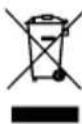
Waste electrical and electronic equipment does not belong in household waste, but must be collected and disposed of separately!
-
Used batteries or rechargeable batteries that are not installed permanently in the old appliance must be removed non-destructively before disposal. Their disposal is regulated by the battery law.
-
Owners or users of electrical and electronic devices are legally obliged to return them after use.
-
The end user is responsible for deleting their personal data from the old device being disposed of!
-
The symbol of the crossed-out dustbin means that waste electrical and electronic equipment must not be disposed of with household waste.
-
Waste electrical and electronic equipment can be handed in free of charge at the following places:
-
Public disposal or collection points (e.g. municipal works yards)
-
Points of sale of electrical appliances (stationary and online), provided that dealers are obliged to take them back or offer to do so voluntarily.
-
Up to three waste electrical devices per type of device, with an edge length of no more than 25 centimetres, can be returned free of charge to the manufacturer without prior purchase of a new device from the manufacturer or taken to another authorised collection point in your vicinity.
Further supplementary take-back conditions of the manufacturers and distributors can be obtained from the respective customer service. -
If the manufacturer delivers a new electrical appliance to a private household, the manufacturer can arrange for the free collection of the old electrical appliance upon request from the end user. Please contact the manufacturer's customer service for this.
These statements only apply to devices installed and sold in the countries of the European Union and which are subject to the European Directive 2012/19/EU. In countries outside the European Union, different regulations may apply to the disposal of waste electrical and electronic equipment.
17. Trouble shooting
| Problem Possible Cause Remedy | ||
| Machine cannot be switched on. | • No power supply. • Carbon brush worn. | • Check power supply. • Take machine to your service point. |
| Machine does not work or stops suddenly. | • Power cut. • Motor or switch defective. | • Power cut. • Motor or switch defective. |
| Machine stops during planing. | • Planing blade blunt/worn. • Overload switch has tripped. • Too much chip removal. | • Replace or sharpen blade. • Switch on the motor again once it has cooled. • Reduce chip removal. |
| Workpiece jams during thickening. | • Cutting depth too great. • Reduce | • cutting depth and machine the work-piece in several passes. |
| Speed decreases when planing. | • Too much chip removal • Blunt knives. | • Reduce chip removal. • Replace knives. |
| Unsatisfactory surface finish. | • Planing blade blunt/worn. • Planing blade filled with chips. • Uneven feed. | • Replace or sharpen blade. • Remove chips. • Feed the workpiece with constant pressure and at reduced speed. |
| Machined surface too rough. | • Workpiece contains too much moisture. | • Dry workpiece. |
| Machined surface cracked. | • Workpiece was machined against the grain. • Too much material planed at one pass. | • Machine the workpiece from the opposite direction. • Machine the workpiece in several passes. |
| Workpiece speed too low during thickening. | • Thicknesser table resinous • Feed roller too slippery | • Clean and apply glide wax • Gently scour with sand paper |
| When thickening, chip ejection obstructed (with-out dust extractor). | • Too much chip removal. • Blunt knives. • Wood too humid. | • Reduce chip removal. • Replace knives. • Dry workpiece. |
| With surface planing and thicknessing, chip ejection obstructed (with dust extractor). | ·Suction performance too weak. | ·Use a dust extractor unit having an airflow rate at the suction connection of at least 20 m/s. |
| Regular servicing period | Before any start-up | If neces-sary | Once a week | After 6 months | |
| Check that the planing blade is in perfect condition | Inspection X | ||||
| Change XX | |||||
| Check the function of the safety equipment | Inspection X | ||||
| Change X | |||||
| Clean dust and chips off the machine Clean X | |||||
| Check the drive belt to ensure it has the correct tension and is in good condition or not worn | Inspection X | ||||
| Change | |||||
| Oil or grease all moving connecting parts XX | |||||
WAARSCHUWING! Gehoorschade!
Günzburger Straße 69
Miary D x S x W 630 x 580 x 500 mm
Uldised ohutusjuhised
13.2.2 Griezeyinstruments
No naziem, stiprinajuma listem un evelmasinas nazu varpstas regulari janotira sveki. Notiriet tos ar atbilsto-su sveku nonemsanas lidzekli.
13.3 Rezerves dalu pasutisana:
Veicotrezervesdalu pasutisanu,vajadzetu noradit sadu informaciju;
- ierices veins;
- ierfces artikula numurs;
- ierfces identifikacijas numurs;
- nepiecesamaszrezervesdalasnumurs.
EU Declaration of Conformity
Noise: measured Lvix = xx dB; guaranteed Lvix = xx dB P = xx KW: L/0 = cm
Notified Body:
Notified Body No.:
2016/1628/EU
Emission. No:
Standard references:
EN 61029-1:2009+A11; EN 61029-2-3:2011;
EN IEC 55014-1:2021; EN IEC 55014-2:2021; EN IEC 61000-3-2:2019; EN IEC 61000-3-11:2019
This declaration of conformity is issued under the sole responsibility of the manufacturer.
The object of the declaration described above fulfils the regulations of the directive 2011/65/EU of the European Parliament and Council from 8th June 2011, on the restriction of the use of certain hazardous substances in electrical and electronic equipment.
Subject to change without notice
Documents registrar: Dawid Hudzik
Günzburger Str. 69, D-89335 Ichenhausen
EU Declaration of Conformity
Standard references:
EN 61029-1:2009+A11; EN 61029-2-3:2011;
EN IEC 55014-1:2021; EN IEC 55014-2:2021; EN IEC 61000-3-2:2019; EN IEC 61000-3-11:2019
This declaration of conformity is issued under the sole responsibility of the manufacturer.
The object of the declaration described above fulfils the regulations of the directive 2011/65/EU of the European Parliament and Council from 8th June 2011, on the restriction of the use of certain hazardous substances in electrical and electronic equipment.
Subject to change without notice
Documents registrar: Dawid Hudzik
Günzburger Str. 69, D-89335 Ichenhausen
EU Declaration of Conformity
Standard references:
EN 61029-1:2009+A11; EN 61029-2-3:2011;
EN IEC 55014-1:2021; EN IEC 55014-2:2021; EN IEC 61000-3-2:2019; EN IEC 61000-3-11:2019
This declaration of conformity is issued under the sole responsibility of the manufacturer.
The object of the declaration described above fulfils the regulations of the directive 2011/65/EU of the European Parliament and Council from 8th June 2011, on the restriction of the use of certain hazardous substances in electrical and electronic equipment.
Subject to change without notice
Documents registrar: Dawid Hudzik
Günzburger Str. 69, D-89335 Ichenhausen
Garantie DE
Apparent defects must be notified within 8 days from the receipt of the goods. Otherwise, the buyer's rights of claim due to such defects are invalidated. We guarantee for our machines in case of proper treatment for the time of the statutory warranty period from delivery in such a way that we replace any machine part free of charge which provably becomes unusable due to faulty material or defects of fabrication within such period of time. With respect to parts not manufactured by us we only warrant insofar as we are entitled to warranty claims against the upstream suppliers. The costs for the installation of the new parts shall be borne by the buyer. The cancellation of sale or the reduction of purchase price as well as any other claims for damages shall be excluded.
Garantie FR
Apparent defects must be notified within 8 days from the receipt of the goods. Otherwise, the buyer's rights of claim due to such defects are invalidated. We guarantee for our machines in case of proper treatment for the time of the statutory warranty period from delivery in such a way that we replace any machine part free of charge which provably becomes unusable due to faulty material or defects of fabrication within such period of time. With respect to parts not manufactured by us we only warrant insofar as we are entitled to warranty claims against the upstream suppliers. The costs for the installation of the new parts shall be borne by the buyer. The cancellation of sale or the reduction of purchase price as well as any other claims for damages shall be excluded.
Zaruka CZ
Apparent defects must be notified within 8 days from the receipt of the goods. Otherwise, the buyer's rights of claim due to such defects are invalidated. We guarantee for our machines in case of proper treatment for the time of the statutory warranty period from delivery in such a way that we replace any machine part free of charge which provably becomes unusable due to faulty material or defects of fabrication within such period of time. With respect to parts not manufactured by us we only warrant insofar as we are entitled to warranty claims against the upstream suppliers. The costs for the installation of the new parts shall be borne by the buyer. The cancellation of sale or the reduction of purchase price as well as any other claims for damages shall be excluded.
Garantii EE


- Explanation of the symbols on the equipment
- Table of contents: Page:
- Introduction
- Manufacturer:
- Dear customer,
- Note:
- We recommend:
- Layout
- Scope of delivery
- Intended use
- Important information
- General Safety Instructions
- Safe operation
- 21WARNING!
- Special safety instructions
- Residual risks
- WARNING! Hearing damage!
- Wear ear protectors!
- Emergency procedure
- Technical data
- Noise & vibration
- Unpacking
- ATTENTION!
- Before starting the equipment
- Before each use, check the following:
- - Brake
- - Anti-kick claws
- - Planing blades
- The machine may only be used if all these conditions are satisfied.
- CAUTION!
- Installation
- Stable fastening of the planing machine (fig. 9 + 10)
- Feed (12) and discharge table (6) (fig. 3)
- Installing the height adjustment crank (4) (fig. 4)
- Removing the transport protection and protective foil (fig. 5 + 6)
- Fitting the suction hose (27) (fig. 7 + 8)
- Stowing the push stick (fig. 11+12)
- Operation
- Adjusting to the desired height (fig. 13)
- Cutting depth measurement (14) (fig. 14)
- Operating the thickness planer (fig. 15)
- Suction system (fig. 1 + 8)
- Changing the planing blade (fig. 16-19)
- ATTENTION! Disconnect the mains plug before carrying out any maintenance, cleaning or adjustment work.
- ATTENTION! Planing blades are sharp! Always wear suitable work gloves when changing the planing blades.
- Changing the carbon brushes (fig. 20)
- ATTENTION! Disconnect the mains plug before carrying out any maintenance, cleaning or adjustment work.
- Workpiece return rollers (fig. 1)
- Working instructions
- Electrical Connection
- Important information
- Faulty electrical connecting leads
- Causes include:
- Connection type M
- Cleaning, maintenance and ordering spare parts
- General maintenance measures
- Cleaning
- Maintenance
- Machine (fig. 21 + 22)
- Cutting tool
- Ordering spare parts:
- Service information
- Transport
- Storage
- Disposal and recycling
- Notes for packaging
- Trouble shooting
- WAARSCHUWING! Gehoorschade!
- Uldised ohutusjuhised
- Griezeyinstruments
- Rezerves dalu pasutisana:
- EU Declaration of Conformity
- Standard references:
- Garantie DE
- Garantie FR
- Zaruka CZ
- Garantii EE
Brand : SCHEPPACH
Model : PLM1800
Category : Plane