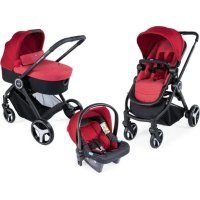
Trio Best Friend Light - Stroller CHICCO - Free user manual and instructions
Find the device manual for free Trio Best Friend Light CHICCO in PDF.



| Product type | Travel system (stroller + car seat) Chicco Trio Best Friend Light |
| Brand | Chicco |
| Model | Trio Best Friend Light |
| Category | Combination stroller |
| Main use | Transporting child in car (car seat) and for walks (stroller), also usable as a carrycot |
| Group / Max weight car seat | Group 0+, from birth to 13 kg |
| Recommended age for carrycot | From birth to 9 kg (approx. 6 months) or until the child can sit up alone |
| Car seat approval | UN/ECE Regulation R44/04, universal |
| Installation in car | On rear or front seat (only if airbag deactivated), with 3-point seat belt |
| Safety harness | 3-point, height adjustable (2 positions), with harness covers and crotch protector |
| Handle | 3 positions: transport, rest, carrycot stabilizer |
| Sun canopy | Yes, removable |
| Stroller compatibility | Only with the Chicco Best Friend stroller |
| Cover material | Washable fabric |
| Cover maintenance | Hand wash cold, do not bleach, do not tumble dry, do not iron, do not dry clean |
| Maintenance of straps and plastic | Clean with damp cloth, no solvents or bleaching agents |
| General maintenance | Do not immerse, dry metal parts to avoid rust |
| Spare parts | Only approved by the manufacturer (covers, straps) |
| Warranty | Against conformity defects according to national conditions of the country of purchase |
| Manufacturer | Artsana S.p.A., Italy |
| Documents provided | User manual (136 pages, multilingual) |
Frequently Asked Questions - Trio Best Friend Light CHICCO
User questions about Trio Best Friend Light CHICCO
0 question about this device. Answer the ones you know or ask your own.
Ask a new question about this device
Download the instructions for your Stroller in PDF format for free! Find your manual Trio Best Friend Light - CHICCO and take your electronic device back in hand. On this page are published all the documents necessary for the use of your device. Trio Best Friend Light by CHICCO.
USER MANUAL Trio Best Friend Light CHICCO
GR. 0+ 0-13Kg
• ISTRUZIONI D'USO
• MODE D'EMPLOI
• GEBRAUCHSANLEITUNG
• INSTRUCTIONS FOR USE
• INSTRUCCIONES DE USO
- INSTRUÇÕES PARA A UTILIZAÇÃO
• GEBRUIKSAANWIJZINGEN
• ANVÄNDNINGSINSTRUKTIONER
• NÁVOD K POUŽITÍ
• INSTRUKCJE SPOSOBU UŻYCIA
• ΟΔΗΓΙΕΣ ΧΡΗΣΗΣ
• KULLANIM BİLGİLERİ
- ИНСТРУКЦИЯ ПО ЭКСПЛУАТАЦИИ
• تعليمات الاستعمال
• УПЪТВАНЕ ЗА ПОТРЕБИТЕЛЯ
• ІНСТРУКЦІЯ З ВИКОРИСТАННЯ
• INSTRUÇÕES DE UTILIZAÇÃO













BEST FRIEND- SEGGIOLINO
ISTRUZIONI D'USO
AVVISO IMPORTANTE!
CONSERVARE PER FUTURI RIFERIMENTI. IMPORTANTE: PRIMA DELL'USO LEGGERE ATTENTAMENTE E INTEGRALMENTE QUE- STO LIBRETTO D'ISTRUZIONI PER EVITARE PERICOLI NELL'UTILIZZO E CONSERVAR- LO PER OGNI FUTURO RIFERIMENTO. PER NON COMPROMETTERE LA SICUREZZA DEL BAMBINO SEGUIRE ATTENTAMENTE QUESTE ISTRUZIONI.
ATTENZIONE! PRIMA DELL'USO RIMUOVERE ED ELIMINARE EVENTUALI SACCHETTI DI PLASTICA E TUTTI GLI ELEMENTI FACENTI PARTE DELLA CONFEZIONE DEL PRODOTTO O COMUNQUE TENERLI LONTANI DALLA PORTATA DEI BAMBINI. SI RACCOMANDA DI EFFETTUARE LO SMALTIMENTO DI QUESTI ELEMENTI OPERANDO LA RACCOLTA DIFFERENZIATA IN CONFORMITA' ALLE LEGGI VIGENTI.
IMPORTANTISSIMO! DA LEGGERE SUBITO
- Read these instructions carefully before installing the product. Prevent anybody from using the product without reading the instructions.
- Keep this instruction booklet for future use.
- Each country implements different laws and regulations in terms of safety to carry children inside vehicles. For this reason, contact local authorities for further information.
- WARNING! According to accident statistics, a vehicle's rear seat is generally safer than the front seat: therefore, we suggest to install the car seat on the rear seat of the vehicle. In particular, the safer seat is the rear central one, if featuring a 3-point belt: in this case, we suggest positioning the Car seat on the rear central seat.
- WARNING!HAZARD! Never use this car seat fitted on the font seat of a vehicle with a front airbag; use only if the front airbag is deactivated: check with the car manufacturer or see the owner's manual of your car for instructions on how to deactivate the airbag.
- If the child car seat is fitted on the front seat of
the car (only if the front airbag is not present or has been deactivated), to ensure maximum safety the seat should be pushed as far back as possible while taking into account the comfort of the passenger sitting in the seat directly behind it.
- Never use this child car seat on side-facing or rear-facing car seats.
- Only fit the child car seat onto seats which are fastened to the car chassis and facing forwards. Make sure that all folding or rotating car seats are always securely fastened in place; if not, they could be dangerous.
- Pay attention when fitting the child car seat into the car in order to avoid the car seat or car door, which may interfere with installation.
- No car seat can guarantee your child's total safety in the case of an accident but using this product reduces the risk of serious injuries or death.
- Serious risks for your child increase, not only in case of accident but also in other circumstances (e.g. sudden brakes, etc.) if the instructions contained in this manual are not followed carefully: always check that the child car seat is secured correctly to the vehicle's seat.
- If the child car seat is damaged, deformed or worn out, it must be replaced: it may no longer meet the original safety standards.
- Do not modify or add any components to the product without the manufacturer's approval.
- Do not install accessories, spare parts, or any component not supplied by the manufacturer.
- Never leave the child unattended in the child car seat for any reason.
- To avoid the risk of the child falling, fasten the child to the Car Seat also during transport by hand.
- When using the car seat out of the car, it is dangerous to use this product on an elevated surface.
- Never leave the child car seat unsecured in the car as it may hurt or harm the passengers.
- Never place anything except an approved accessory between the vehicle seat and the
child car seat or between the child car seat and the child: in case of accident, the child car seat may not work properly.
-
It is recommended to cover the child car seat if the vehicle is left exposed to direct sunlight.
-
Even if not visible with eyes, after an accident (even minor ones) the car seat will suffer permanent damages: It must therefore be replaced.
-
Before transporting the child seat by hand, make sure that the child is fastened with the belts and that the handle is correctly locked in the vertical position.
-
This child car seat can ONLY be used on the CHICCO BEST FRIEND stroller.
-
Make sure that the child car seat is correctly attached to the stroller before placing your child inside.
-
Do not use second-hand Car seats: they may have been structurally damaged and not visible to the naked eye but still liable to compromise the safety of the product.
-
Artsana declines all responsibility for any inappropriate use of the product.
-
The seat fabric must only be replaced with another approved by the manufacturer as it forms an integral part of the child car seat. The child car seat must never be used without the fabric cover.
-
Check that the safety harness strap is not twisted to avoid the strap or any parts of the child car seat becoming trapped between the car doors, or rubbing against cutting edges. If the safety harness is cut or frayed, it must be replaced.
-
Make sure that no objects or luggage is carried in particular on the rear shelf inside the vehicle, without previously having anchored or positioned them safely: they may injure the passengers in the case of an accident or sudden breaking.
-
Make sure that all the vehicle's passengers use their safety belt for their own safety also because during the trip, they may injure the child in case of accident or sudden braking.
-
On long distance journeys, make frequent stops. Children get tired easily. Do not remove the child from the child car seat while
travelling. If your child needs attention, find a safe place and stop.
-
Premature babies born before the 37th week of pregnancy can be at risk if placed in a child car seat. Newborn babies may have breathing difficulties when seated in the child car seat. We recommend consulting your doctor, or the hospital's staff, for their medical advice on whether your child can be transported in the child car seat when leaving the hospital.
-
Make sure that all passengers in the vehicle know how to release the child from the child car seat in case of an emergency.
PRODUCT FEATURES
The child car seat is approved for "Group 0+", for the safe transportation of babies from birth up to 13 Kg in weight.
IMPORTANT WARNING
-
This is a "Universal" child restraint device. It is approved according to Regulation No. 44.04 series of amendments 04. suitable for general use in vehicles and compatible with most but not all vehicles' seats.
-
For perfect compatibility, check that the manufacturer of your vehicle has indicated in the manual whether your vehicle foresees the installation of Universal child retention devices for the age group in object.
-
This child restraint device has been classified as "Universal" under more stringent conditions than those that were applied to earlier designs that do not display this notice.
-
Suitable exclusively to be used in vehicles equipped with 3-point safety harnesses, whether static or with winder, approved according to UN/ECE Regulation no. 16 or other equivalent standards.
-
In case of doubts, contact the manufacturer of the restraint device or your dealer.
LIMITATIONS ON USE
WARNING! Scrupulously observe the following limitations on the use of the product; safety will not be guaranteed otherwise.
-
The weight of the child must not exceed 13 kg.
-
Never use this car seat fitted on the front seat of a vehicle with front airbag; use only if the front airbag is deactivated: check with the car manufacturer or see the owner's manual of your car for instructions on how to deactivate the airbag.
WARNING! If it is used in a vehicle equipped with rear safety harnesses with integrated airbags (inflatable seat belts), the interplay between the inflatable portion of the seat belt and this child restraint system could cause serious injury or death. Do not install this child restraint equipment where an inflatable safety harness must be used.
The BEST FRIEND Child Car Seat features a booster cushion:
WARNING! To ensure maximum child safety, never use the booster cushion for children weighing more than 6 Kg.
- The Child Car Seat features a booster cushion to ensure good containment and greater comfort for children from birth to 6 kg in weight.
Before fitting the booster cushion, check that the belts are inserted into the lowest slot: this is the only position allowed for use with this accessory.
NECESSARY REQUIREMENTS FOR THE CAR SEAT AND SAFETY BELT
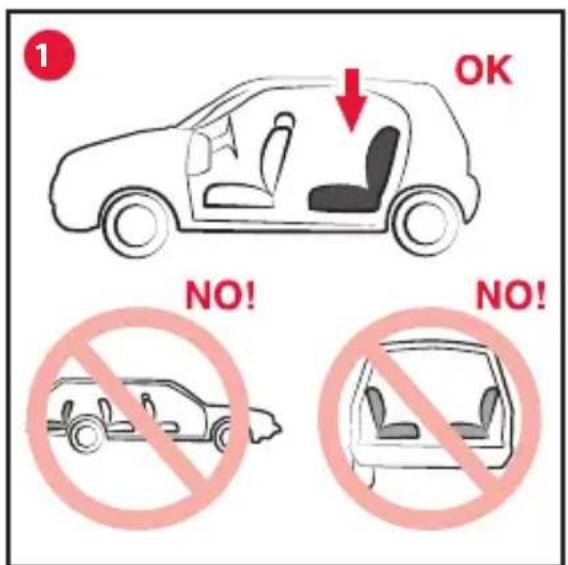
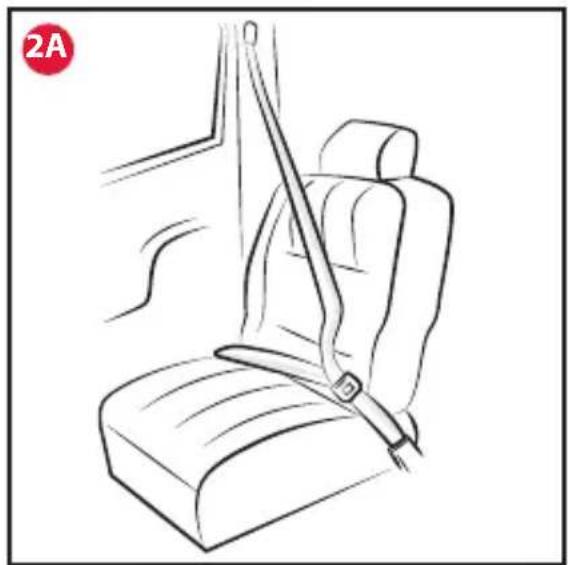
The Child Car Seat can be installed on any front passenger or rear seat, but with the following limitations, the car seat must be:
- positioned forward-facing (Fig. 1); - equipped with a 3-point safety belts, whether static or with inertia reel (Fig. 2A)
WARNING! Never install the child car seat on a car seat that is only equipped with a waist belt (Fig. 2B)
ADJUSTING THE SAFETY HARNESS
WARNING! The harness straps must always be adjusted to adapt to the child's growth phase. Before installing the child car seat inside the vehicle, adjust the child harness straps to the right height.
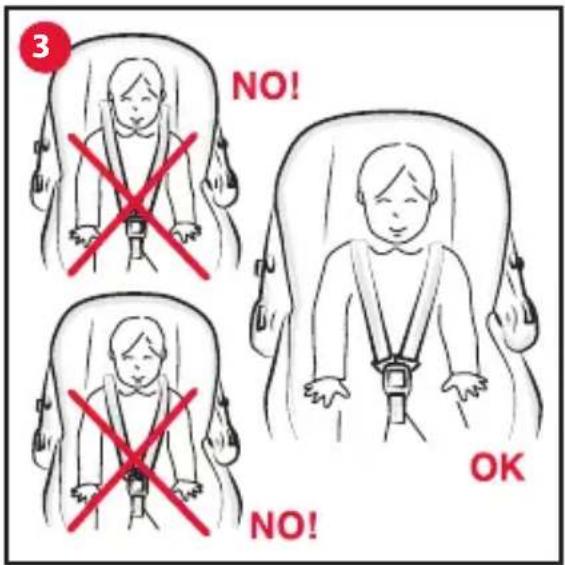
The correct belt height is slightly below the shoulder level (Fig. 3). The child car seat has 2 height adjustment positions (Fig. 4).
The BEST FRIEND Child Car Seat features a booster cushion:
Before fitting the booster cushion, check that the belts are inserted into the lowest slot: this is the only position allowed for use with this accessory.
INSTRUCTIONS FOR USE
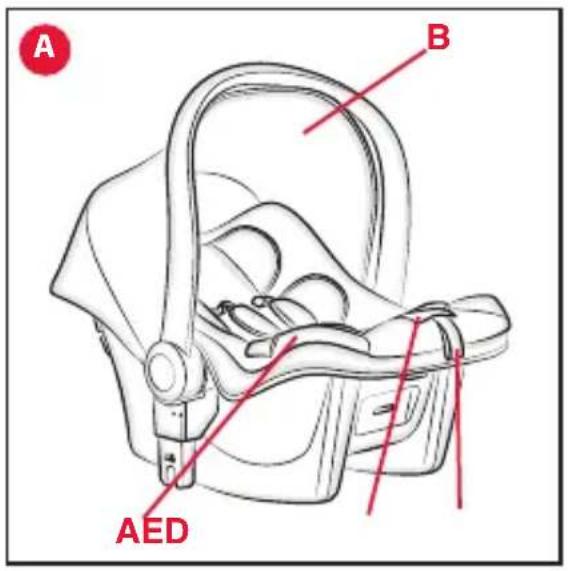
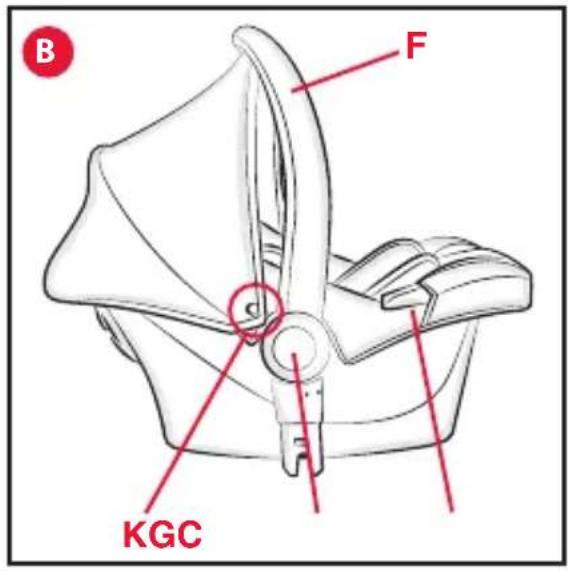
COMPONENTS:
A. Lining
B. Sun canopy
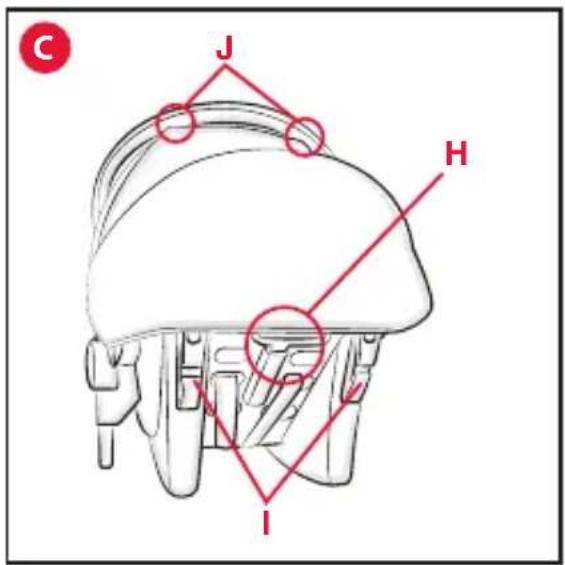
C. Side guides for the horizontal car belt
D. Adjustment belt
E. Harness adjustment button
F. Hand grip
G. Buttons to adjust the handle
H. Stroller fastening/release button
I. Diagonal car safety belt slots
J. Canopy hooks
K. Canopy buttons
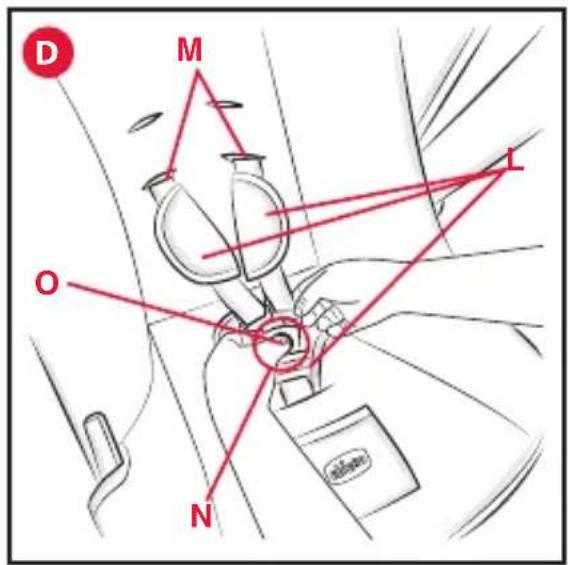
L. Comfort kit (two shoulder and crotch straps)
M. Safety harness
N. Safety harness buckle
O. Buckle opening button
NB: The images and instructions in this manual refer to car seat version. Some of the components and functions described here may vary depending on the model purchased.
CONTENTS
- Adjusting the safety harness height
• Fastening the child car seat inside the vehicle - Placing the child
- Adjusting the handle
- Rocker position (use as baby reclined cradle)
- Removing the child car seat cover
• Fastening the child car seat on the stroller
ADJUSTING THE SAFETY HARNESS HEIGHT
- Unfasten the safety harness by pressing the red button on the buckle (Fig. 5).
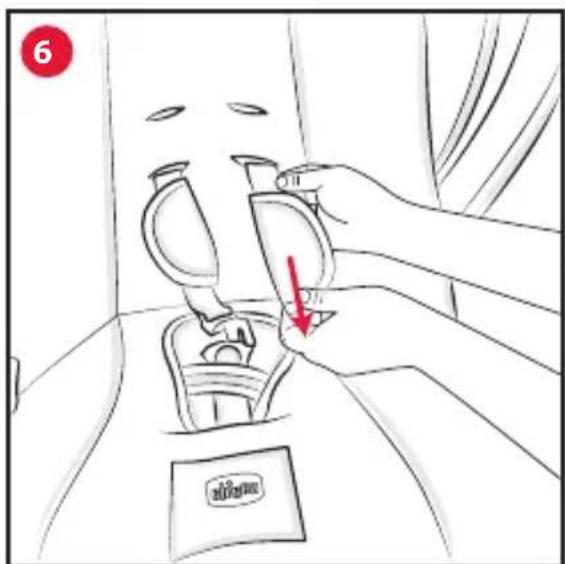
- Remove the two shoulder straps from the belts and the two ends of the safety harness as shown in Figure 6.
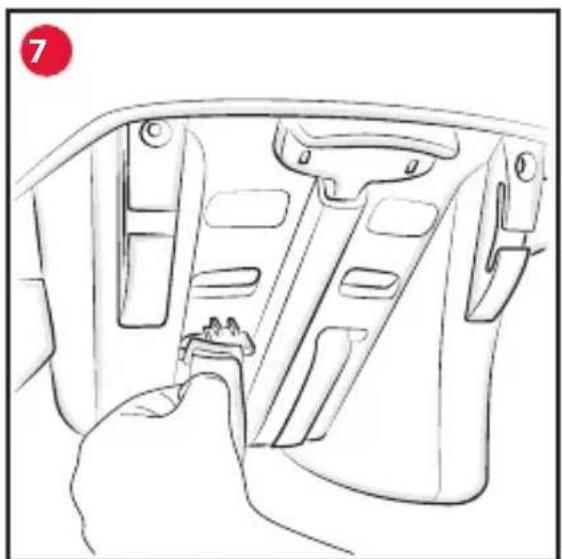
- Remove the two parts of the belt from the back of the seat and fit them again through the slot most suited to the height of the child (Fig. 7).
- Insert the shoulder straps, if any, again.


FASTENING THE CHILD CAR SEAT INSIDE THE VEHICLE
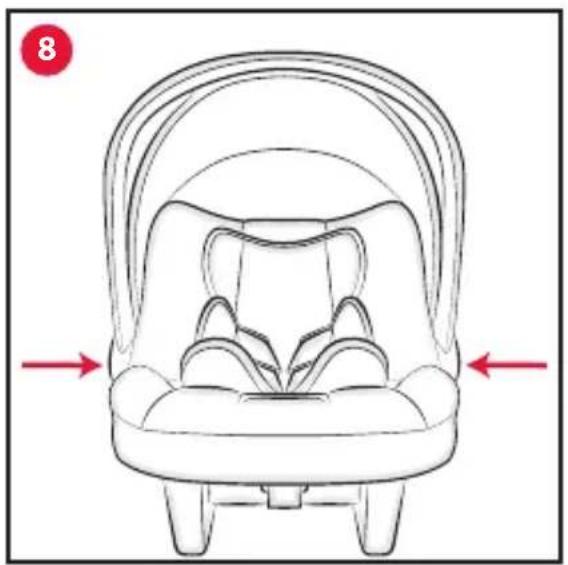
- Position the handle of the child car seat vertically by pressing the two side adjustment buttons (Fig. 8).
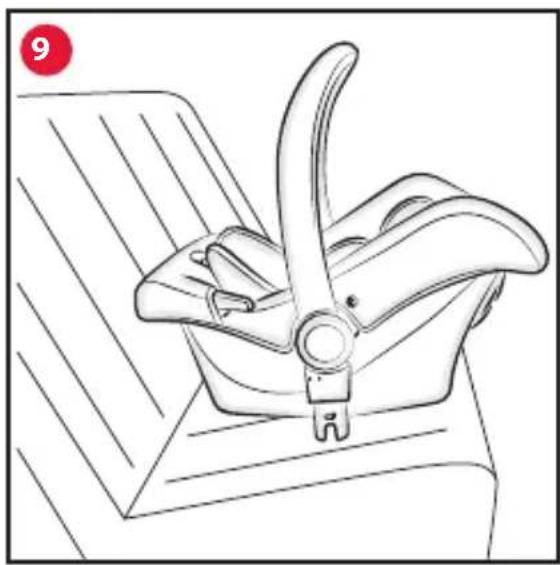
- Position the child car seat on the car seat where you intend to install it (Fig. 9).
- Pull the car's safety belt and fasten it in the relevant buckle by passing the waist belt through the two blue guides on the side of the Child Car Seat (Fig. 10).
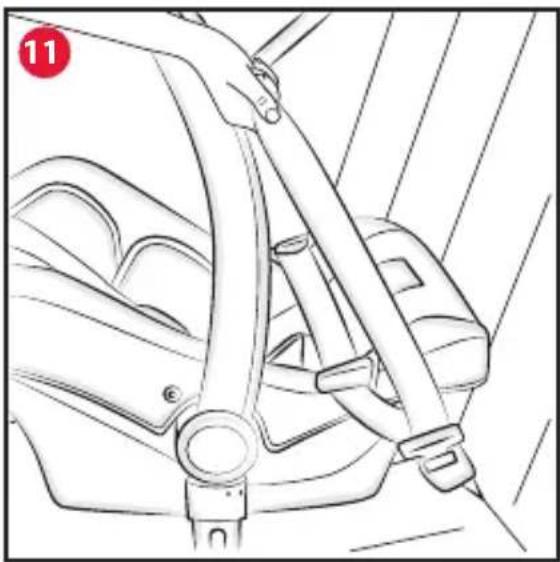
- Hold the chest belt and pull it, tensioning the waist belt (Fig. 11). At the end of the operation, check that the waist belt is always in the relevant blue belt guides.
- Always keeping the chest belt tensioned, pass it through the blue guides on the back of the backrest (Fig. 12). Pull the belt as tightly as possible without leaving any slack and making sure it is not twisted.
WARNING! After installing the child car seat, always check that the vehicle safety belt is tightened and that the buckle does not force the belt to come out of the relevant slot. Also check that the buckle of the car belt is not in contact with the point of passage of the belt on the child car seat. These situations may compromise the effectiveness of the child car seat in the event of an accident.
WARNING! Never fit the seat belt in any way not mentioned in this instruction booklet, as it would compromise the child's safety!
POSITIONING THE CHILD
- Press the aluminium button in the front part of the Child Car Seat (covered by the fabric) and loosen the two shoulder straps on the Child Car Seat while holding it down (Fig. 13).
- Unfasten the fastening buckle of the safety harness, pressing the red button (Fig. 14).
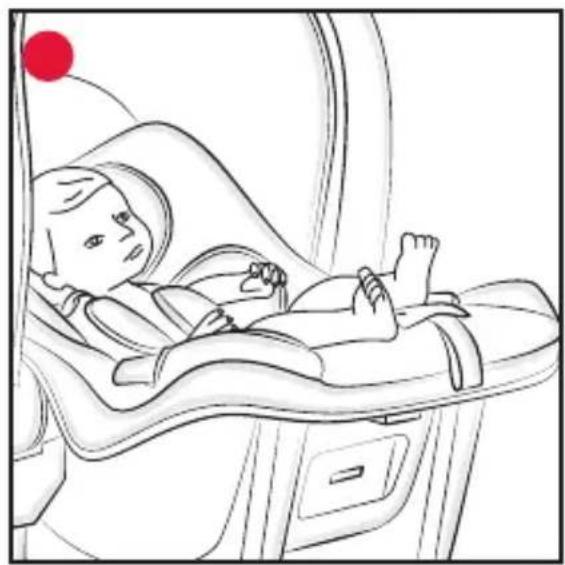
- Place your child in the child car seat and then fasten the safety harness (Fig. 15). The shape of the forks is designed that it does not allow inserting one of the two forks in the buckle; they both need to be overlapped before inserting in the buckle.
- Adjusting the tension of the child's safety harness by pulling on the relevant adjustment belt (Fig. 16) making sure not to tight-
en the child too much.
ADJUSTING THE HANDLE
The child car seat handle can be adjusted to 3 different positions:
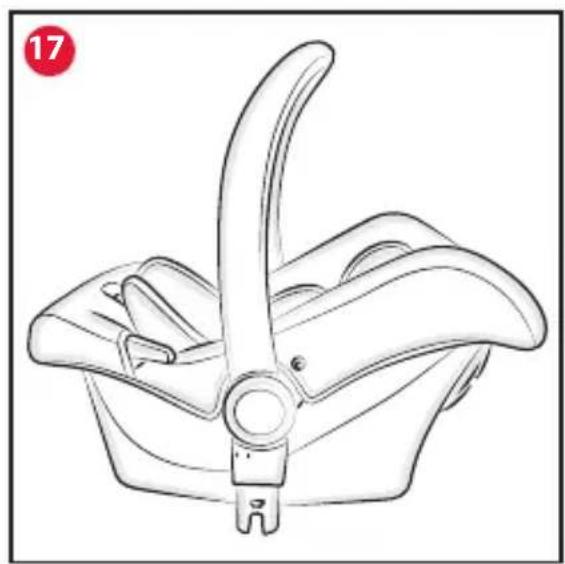
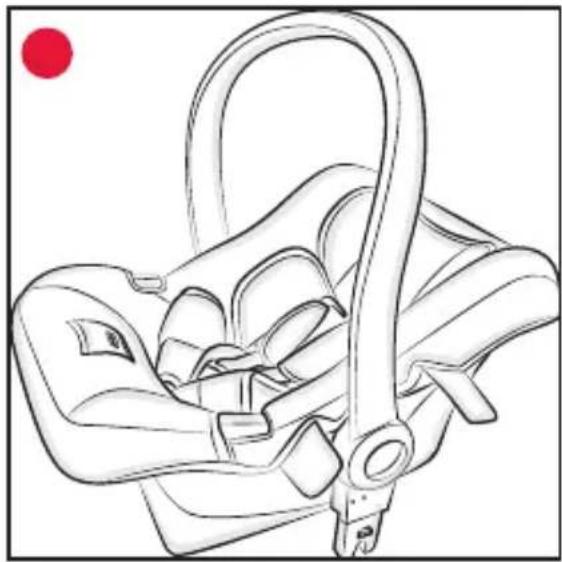
- Carrying position (Fig. 17)
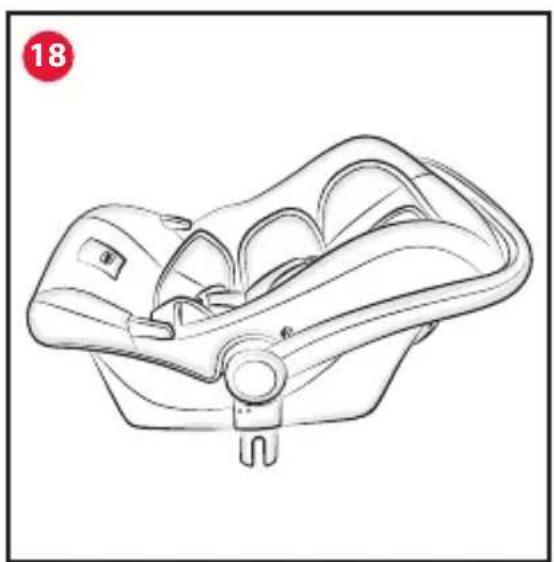
- Rest position (Fig. 18)
- Baby reclined cradle stabiliser position (Fig. 19) To switch from one position to another, press the two buttons on the lateral joints of the handle.
ROCKER POSITION (USE AS BABY Reclined cradle)
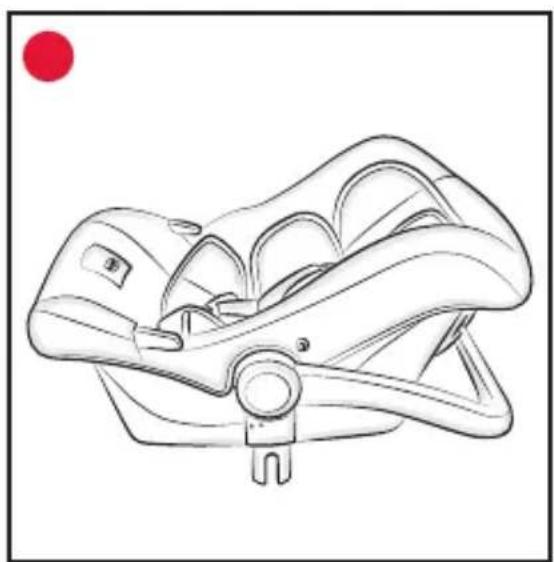
When the child car seat is not used in a car, it can be used as a rocker or baby reclined cradle. To make it rock, position the handle in the rest position.
To make it stationary, position the handle in the baby reclined cradle stabiliser position.
IMPORTANT! KEEP FOR FUTURE REFERENCE.
WARNING: BEFORE USE, REMOVE AND DISPOSE OF ALL PLASTIC BAGS AND PACKAGING MATERIALS AND KEEP THEM OUT OF REACH OF CHILDREN.
WARNINGS
- WARNING: Age range intended for use: from birth to 9 kg (6 months).
•WARNING: Never leave the child unattended - WARNING: Do not use the reclined cradle once your child can sit unaided, roll over or stand up pushing on their hands, knees and feet.
- WARNING: This reclined cradle is not intended for prolonged periods of sleeping
- WARNING: It is dangerous to use this reclined cradle on an elevated surface, e.g. a table.
- WARNING: Always use the restraint system.
• Always use the restraint system when your child is in the baby reclined cradle; adjust the length of the straps as necessary. - WARNING: The baby reclined cradle does not replace a bed or a crib. Then it should be placed in a suitable bed or cradle.
- WARNING: Do not use the baby reclined cradle if any components are broken or missing
- WARNING: Do not use accessories or replacement parts other than those approved
by the manufacturer
- Do not use the reclined cradle with more than one child at time.
- Never leave the reclined cradle on surfaces that are not perfectly horizontal.
• Always supervise children playing near the reclined cradle.
• To prevent fire hazards, do not leave the reclined cradle near sources of heat, electrical or gas devices etc.
• Make sure that the cover is properly secured to the structure of the chair.
- WARNING: Before lifting and carrying the reclined cradle, always bring back and lock the handle in the vertical position "B".
• Periodically check for any worn parts, loose screws, worn or unstitched materials and replace any damaged parts immediately.
- Do not place the reclined cradle with your child in it near windows or walls where strings, curtains or other objects could be used by the child to climb or pose choking or strangling hazards.
• To avoid the risk of your child overbalancing and falling do not place the reclined cradle near windows or walls.
- Keep the product out of reach of children when it is not being used.
CARE AND MAINTENANCE
- This product requires periodical maintenance. The cleaning and maintenance of the product must only be carried out by an adult. Periodically inspect the baby reclined cradle to check for broken, torn or missing parts: do not use it in this case.
- The belts, buckle and plastic parts need to be cleaned only with a damp cloth. Do not use solvents or detergents that may damage or make them unsafe.
- Do not immerse the child car seat in water; dry the metal parts to avoid rusting.
- Please refer to the care label for instructions on washing the fabric:

Handwash in cold water

Do not bleach

Do not tumble dry

Do not iron

Do not dry clean
- Check that the fabric and stitching are in good condition each time you wash it.
- Prolonged exposure to direct sunlight can cause the fabric to fade.
REMOVING THE FABRIC FROM THE CHILD CAR SEAT
The lining of the child car seat is washable. To perform this operation, you need to remove it the structure of the child car seat.
- Move the handle to a vertical position and remove the hood by releasing it from the relevant hooks and buttons (Fig. 20).
- Release the plastic flaps located near the handle joints with the belts unfastened (Fig. 21).
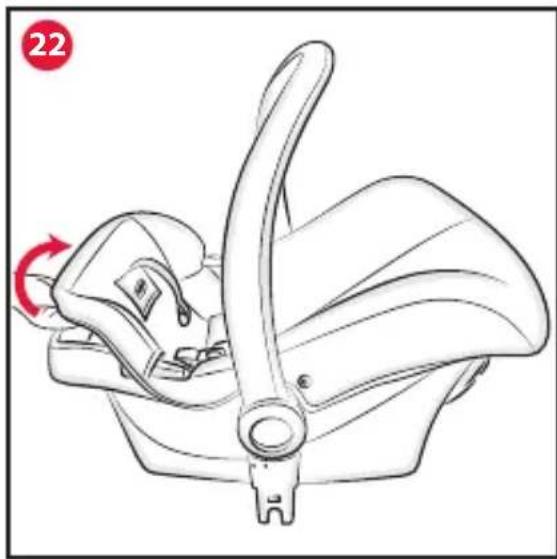
- Pull off the lining from the front of the seat, taking care to remove the lining at the belt adjustment button (Fig. 22); release the fabric from the belt guides (Fig. 23).
- Lift the fabric from the back of the child car seat, pull off the shoulder straps and crotch strap from the fabric.
- To fit the lining on the child car seat again, repeat the steps described above in reverse order.
The Child Car Seat can be attached ONLY on the BEST FRIEND stroller.
- To fasten the Child Car Seat, remove the stroller or carrycot seat, if present.
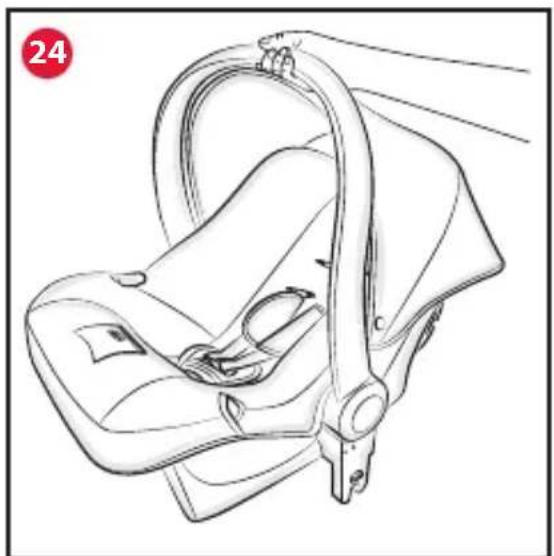
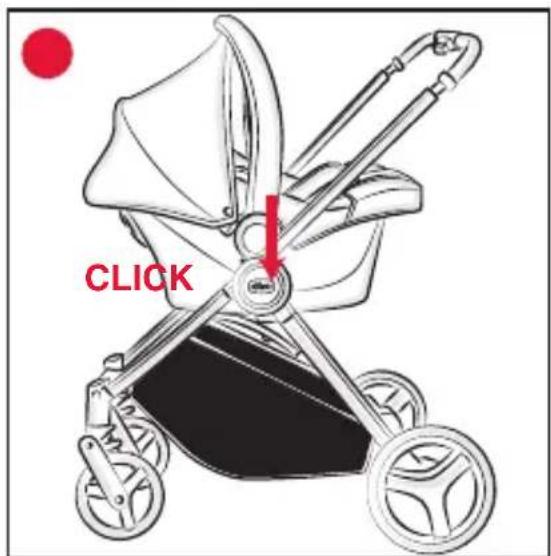
- Hold the handle in the transport position (Fig. 24) and position the Child Car Seat on the lateral hooks of the stroller with the foot zone facing rearward. Ease it on the frame until you hear a click (Fig. 25).
WARNING: Before use, ensure that the Child Car Seat is properly fastened by pulling up on it.
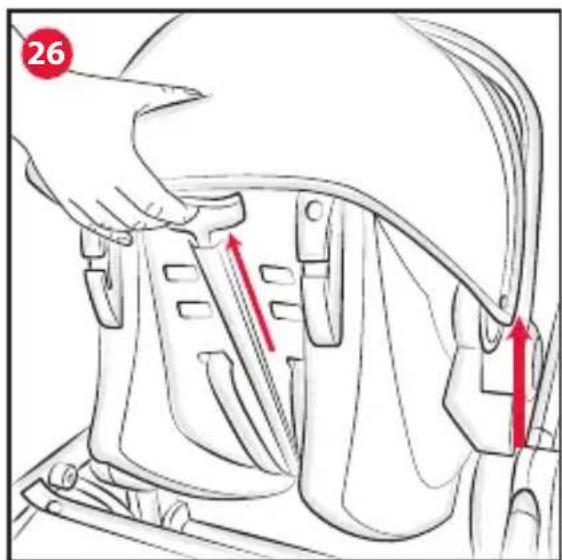
- To release the Child Car Seat from the stroller, put the handle in the vertical position (trans-
port), push the button located on the back of the backrest and lift it up from the frame (Fig. 26).
WARNING: The fastening and releasing operations can be carried out also with your child inside the car seat; however, the child's weight may make these operations more difficult.
Pay attention when carrying out the above mentioned operations.
WARRANTY
The product is guaranteed against any conformity defect in normal conditions of use as provided for by the instructions. The warranty shall not therefore apply in the case of damage caused by improper use, wear or accidental events. For the duration of the warranty on conformity defects please refer to the specific provisions of applicable national laws in the country of purchase, where appropriate.

SIÈGE-AUTO BEST FRIEND
NOTICE D'EMPLOI
AVERTISSEMENT IMPORTANT! À CONSERVER POUR DE FUTURES RÉFÉRENCES. IMPORTANT : LIRE ATTENTIVEMENT ET INTÉGRALEMENT CETTE NOTICE D'EMPLOI AVANT DE SE SERVIR DU PRODUIT POUR ÉVITER TOUT RISQUE PENDANT L'UTILISATION, CONSERVER LA NOTICE POUR POUVOIR LA CONSULTER PAR LA SUITE. SE CONFORMER AUX INDICATIONS DE LA NOTICE POUR NE PAS COMPROMETTRE LA SÉCURITÉ DE L'ENFANT.
AVERTISSEMENT ! AVANT L'EMPLOI, ENLEVER ET ÉLIMINER TOUS LES SACS EN PLASTIQUE ET ÉLÉMENTS QUI FONT PARTIE DE L'EMBALLAGE DU PRODUIT ET LES TENIR HORS DE PORTÉE DES ENFANTS. NOUS RECOMMANDONS D'ÉLIMINER CES ÉLÉMENTS CONFORMÉMENT AUX RÉGLEMENTATIONS EN VIGUEUR EN MATIÈRE DE TRI SÉLECTIF.
TRÈS IMPORTANT ! À LIRE ATTENTIVEMENT
CARACTÉRISTIQUES DU PRODUIT
JUSTERING AV REMMARNAS LÄGE
ARTSANA UK Ltd. 2nd Floor 1 Imperial Place Maxwell Road Borehamwood Hertfordshire - WD6 1JN 01623 750870 (office hours) www.CHICCO.uk.com

ARTSANA SPAIN S.A.U. C/Industria 10 Pol. Industrial Urtinsa Apartado De Correos 212 - E 28923 Alcorcon (Madrid)-Spain 902 117 093 www.CHICCO.es

ARTSANA PORTUGAL S.A. Rua Humberto Madeira, 9 2730-097 Queluz De Baixo Barcarena Portugal 21 434 78 00 800 20 19 77 www.CHICCO.pt

ARTSANA BELGIUM N.V. Temselaan 5 B-1853 Strombeek - Bever Belgium +32 23008240 www.CHICCO.be

ARTSANA INDIA PRIVATE LIMITED, 7Th Floor, Tower B, Paras Twin Towers, Golf Course Road, Sector 54 Gurgaon - 122002 - Haryana, India (+91)(124)(4964500) www.CHICCO.in

ARTSANA S.p.A. Via Saldarini Catelli, 1 22070 Grandate (CO) - Italy Tel. (+39) 031 382 111 Fax (+39) 031 382 400 www.CHICCO.com

NOTE


NOTE


ARTSANA S.p.A. - Via Saldarini Catelli, 1 - 22070 Grandate (CO) - Italy
Tel. (+39) 031 382 111 - Fax (+39) 031 382 400 - www.chicco.com


- BEST FRIEND- SEGGIOLINO
- ISTRUZIONI D'USO
- AVVISO IMPORTANTE
- IMPORTANTISSIMO! DA LEGGERE SUBITO
- PRODUCT FEATURES
- IMPORTANT WARNING
- LIMITATIONS ON USE
- NECESSARY REQUIREMENTS FOR THE CAR SEAT AND SAFETY BELT
- ADJUSTING THE SAFETY HARNESS
- INSTRUCTIONS FOR USE
- CONTENTS
- ADJUSTING THE SAFETY HARNESS HEIGHT
- FASTENING THE CHILD CAR SEAT INSIDE THE VEHICLE
- POSITIONING THE CHILD
- ADJUSTING THE HANDLE
- ROCKER POSITION (USE AS BABY RECLINED CRADLE)
- IMPORTANT! KEEP FOR FUTURE REFERENCE
- WARNINGS
- CARE AND MAINTENANCE
- REMOVING THE FABRIC FROM THE CHILD CAR SEAT
- WARRANTY
- SIÈGE-AUTO BEST FRIEND
- NOTICE D'EMPLOI
- TRÈS IMPORTANT ! À LIRE ATTENTIVEMENT
- CARACTÉRISTIQUES DU PRODUIT
- JUSTERING AV REMMARNAS LÄGE
- NOTE
Brand : CHICCO
Model : Trio Best Friend Light
Category : Stroller