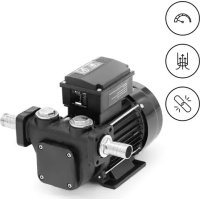
OP100 - Pump MSW - Free user manual and instructions
Find the device manual for free OP100 MSW in PDF.



| Product type | Diesel transfer pump |
| Brand | MSW |
| Model | OP100 |
| Rated voltage | 230 V / 50 Hz |
| Rated power | 750 W |
| Max flow rate | 100 L/min |
| Protection class | I |
| Dimensions (L x W x H) | 280 x 165 x 206 mm |
| Weight | 10.15 kg |
| Intended use | Diesel transfer only |
| Usage precautions | Do not use with gasoline, alcohol, or water |
| Electrical safety | Disconnect before maintenance; do not use barefoot or with wet hands |
| Splash protection | Keep the plug protected from water and rain |
| Recommended filter | Use a diesel-compatible filter at the outlet |
| Transport and handling | Disconnect and remove hoses before moving |
| Required supervision | Never leave the pump running unattended |
| Alternative power supply | Can be connected to a 12V battery (check voltage on nameplate) |
| Battery polarity | Observe polarity: black (-) and red (+) |
Frequently Asked Questions - OP100 MSW
User questions about OP100 MSW
0 question about this device. Answer the ones you know or ask your own.
Ask a new question about this device
Download the instructions for your Pump in PDF format for free! Find your manual OP100 - MSW and take your electronic device back in hand. On this page are published all the documents necessary for the use of your device. OP100 by MSW.
USER MANUAL OP100 MSW
PbKOBOCTBO3A YIOTPEBA
O△HΓIΕΣ XPHΞHΣ
UPUTEZAUPORABU
NAUDOJIMO INSTRUKCIJA
MANUAL DE UTILIZARE
NAVODILA ZA UPORABO
OIL PUMP
| DE | Produktname | Dieselpumpe |
| EN | Product name | Diesel Transfer pump |
| PL | Nazwa produktu | Pompa oleju |
| CZ | Název výrobku | Přenosové Čerpadlo na naftu |
| FR | Nom du produit | Pompe de transfert de diesel |
| IT | Nome del prodotto | Pompa di trasferimento diesel |
| ES | Nombre del producto | Bomba de transferencia de diésel |
| HU | Termék neve | Dízel áftej'tsizvattyú |
| DA | Produktnavn | Dieselpumpe |
| FI | Tuotteen nimi | Dieselpumppu |
| NL | Productnaam | Dieselpomp |
| NO | Produktnavn | Dieselpumpe |
| SE | Produktnamn | Dieselpump |
| PT | Nome do produits | Bomba de transferência de diesel |
| SK | Názov produktu | Prečerpávacia Pumpa na naftu |
| BG | Иme на пожукta | Помma за пожврлес на дизел |
| EL | Övoа пожóуtoc | Аντλία μεταφорас πετρελαίου |
| HR | Naziv proizvoda | Pumpa za prijenos dizela |
| LT | Produkto pavadinimas | Dyzelnio kuro perdavimo siurblys |
| RO | Numele produsului | Pompa de transfer pentru motorină |
| SL | Ime izdelka | Prenosna Črpalka za dizelsko gorivo |
| DE Modell | EN Product model |PL Model Produktu|CZ Model vyrobku | FR Modèle |IT Modello | ES Modelo | HU Modell |DA Model | FI Tuotteen malli |NL Productmodel | NO Produktmodell |SE Produktmodell | PT Modelo do produits|SK Model | BG Мodel на пожукт|EL Movétéλο προίντος | HR Modelproizvoda | LT: Gaminio modelis | RO:Model de produs | SL: Model izdelka | MSW-OP100 | |
| DE Hersteller | EN Manufacturer |PL Producent | CZ Výrobce|FR Fabricant | IT Produttore|ES Fabricante | HU Termeló|DA Producent | FI Valmistaja|NL Producent | NO Produent|SE Tillverkare | PT Fabricante|SK Výrobca | BG Пожимовдител|EL Kατακειαστός | HR Proizvodac|LT Gamintojas | RO Produçător|SL Proizvajalec | expendo Polska sp. z o.o. sp. k. | |
| DE Anschrift des Herstellers |EN Manufacturer Address | PL Adresproducenta | CZ Adresa výrobce|FR Adresse du fabricant | IT Indirizzo delproduttore | ES Dirección del fabricante |HUA gyártó cime | DA Producentendresses | FI Valmistajan osoite|NL Adres producent | NO Produusentsaddress | SE Tillverkarends adress|PT Endereço do fabricante | SK Adresavýrobcu | BG Адrecа на пожимовдител|EL:Диúθυνηκατακειαστή | HR Adresaproizvodac | LT Gamintojo adresas|RO Adresa producătorului | SL Naslovproizvajalca | ul. Nowy Kisielin - Innowacyjna 7, 66-002 Zielona Góra | Poland, EU |

- This User Manual has been translated for your convenience using machine translation. Reasonable efforts have been made to provide an accurate translation; however, no automated translation is perfect nor is it intended to replace human translators. The official User Manual is the English version. Any discrepancies or differences created in the translation are not binding and have no legal effect for compliance or enforcement purposes. If any questions arise related to the accuracy of the information contained in the User Manual, please refer to the English version of those contents which is the official version.
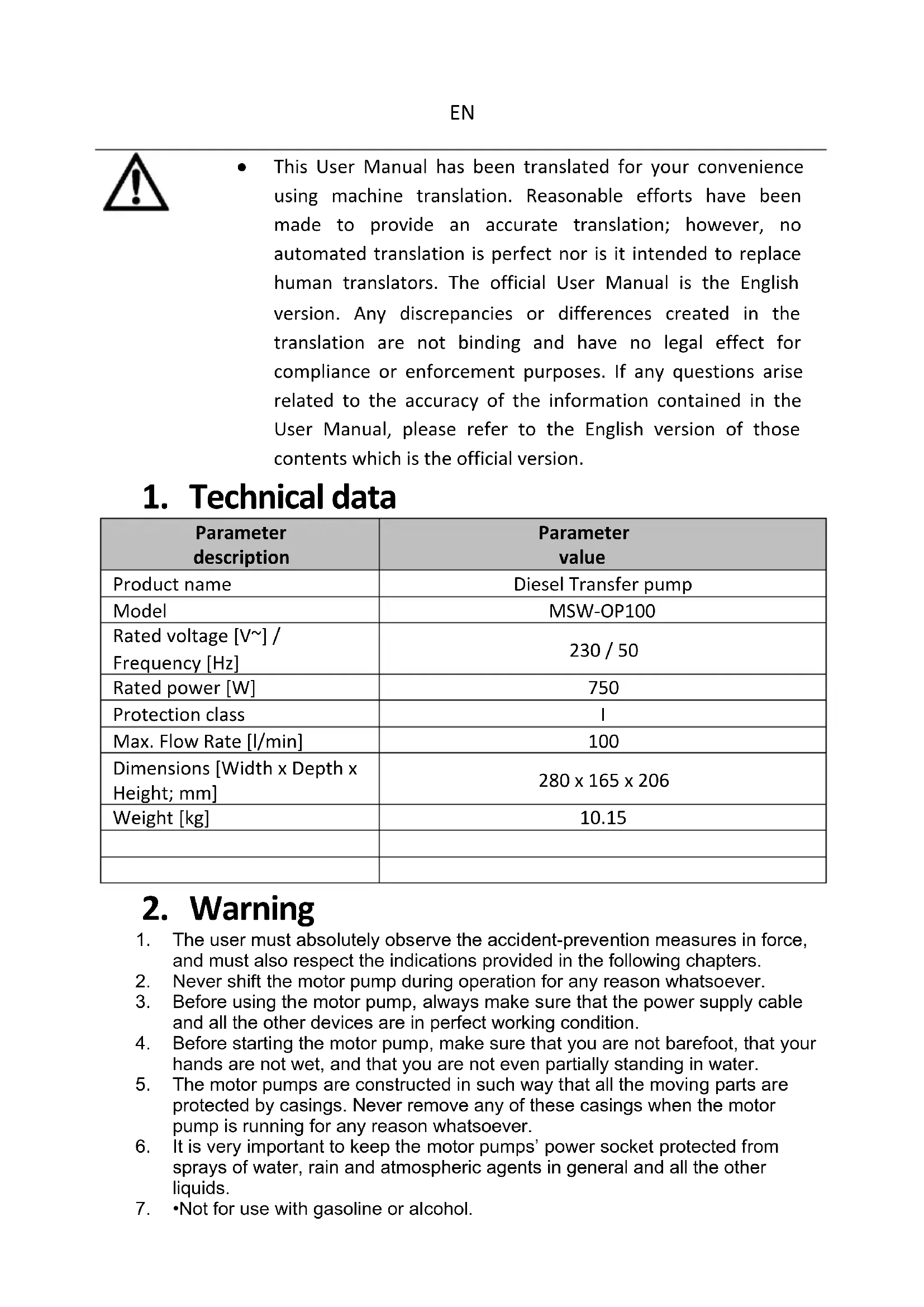
1. Technical data
| Parameter description | Parameter value |
| Product name | Diesel Transfer pump |
| Model | MSW-OP100 |
| Rated voltage [V~] / Frequency [Hz] | 230 / 50 |
| Rated power [W] | 750 |
| Protection class | I |
| Max. Flow Rate [l/min] | 100 |
| Dimensions [Width x Depth x Height; mm] | 280 x 165 x 206 |
| Weight [kg] | 10.15 |
2. Warning
- The user must absolutely observe the accident-prevention measures in force, and must also respect the indications provided in the following chapters.
- Never shift the motor pump during operation for any reason whatsoever.
- Before using the motor pump, always make sure that the power supply cable and all the other devices are in perfect working condition.
- Before starting the motor pump, make sure that you are not barefoot, that your hands are not wet, and that you are not even partially standing in water.
- The motor pumps are constructed in such way that all the moving parts are protected by casings. Never remove any of these casings when the motor pump is running for any reason whatsoever.
- It is very important to keep the motor pumps' power socket protected from sprays of water, rain and atmospheric agents in general and all the other liquids.
-
•Not for use with gasoline or alcohol.
-
Not for use in hazardous locations.
- Improper use or installation of this product can cause serious bodily injury or death.
- Do NOT smoke near a pump or use pump near an open flame.
- Do not use this product for fluid transfer into aircraft.
- This product is not suited for use with fluids for human consumption or fluids containing water.
- Do not dispense fluid that is thicker than diesel fuel. Motor may overheat.
3. Safety instructions
To ensure safe and efficient operation, it is essential to read and follow each of these warnings and precautions.
- Disconnect power to pump before servicing pump.
- A diesel compatible filter should be used on pump outlet to ensure that no foreign material is transferred to fuel tank.
- Tank or barrel should be anchored to prevent tipping in both the full and empty conditions.
- The pump should never be left running unattended.
4. Handing and transport
Unpacking
- If the packaging appears damaged, carefully inspect the motor pump for any signs of damage that may have occurred during transport or handling.
- WARNING: Before installing and using the motor pump, verify the identification plate to ensure that the model and its characteristics match the specifications provided. Handling disassembly and transport
Handling, Disassembly, and Transport
-
Although the motor pump's compact size and weight generally do not pose significant transport issues, the following precautions are recommended:
-
Never move the motor pump without first unplugging the power supply plug from the socket or disconnecting the electrical power supply.
Unscrew and remove the delivery and suction tubes before moving the motor pump.
Unscrew any bolts or screws anchoring the motor pump in place. - Never move or drag the motor pump by pulling its power supply cable.
These steps will help ensure safe handling and transport of the motor pump.
5. Use and starting
If the pump's power is DC power:
- Connect to a Battery: Connect the pump's clamps to a battery capable of delivering the required current and voltage for the pump's operation.
- Using a Vehicle Battery: If using a motor vehicle battery, it is recommended to first remove the battery from the vehicle and place it on a stable, comfortable surface.
- In-Vehicle Use: The pump can be connected to a battery still mounted in a vehicle only if the vehicle is parked outdoors, and if the pump's electrical cables and connection piping are long enough to provide solid support to the pump.
- Avoid Extension Cords: Do not use extension cords with the pump's electrical cables connected to the clamps. If the provided cables are not long enough, have a specialized electrician replace the clamps with jack plugs of adequate section.
- Using a Battery Charger: The pump can only be connected to a battery charger of adequate power with proper terminals. Never connect the pump's clamps directly to the battery charger's clamps; always connect to the charger's terminals to avoid sparks that could cause fires.
- Voltage Check: Ensure that the voltage indicated on the pump's identification plate matches the voltage of the battery.
- Correct Polarity: Always respect polarity—connect the black clamp to the negative (-) pole and the red clamp to the positive (+) pole. Be very careful when connecting the pump to the battery to avoid contact between opposite poles, which could generate sparks and cause a fire. It is recommended to connect the negative pole first, followed by the positive pole.
- Secure Positioning: Position the pump securely, ensuring that the power supply cables, and piping are long enough to provide stable positioning.
If the pump's power is AC power:
- Install Protection: Install a power overload current protection switch.
- Secure Positioning: Position the pump securely, ensuring that the power supply cables, and piping are long enough to ensure stable positioning.
5.2 Starting:
- Pre-Start Checks: Ensure that all tubes are adequately sealed, the power supply cable is properly connected, and the gun is in the rest position before starting the pump.
- Operation:
Insert the suction tube into the tank and the gun into the filling hole.
- Switch on the pump, gradually release the gun's lever, and begin transferring the Diesel oil.
WARNING:
- Supervision Required: Never leave the pump unattended during operation to prevent potential overflow of Diesel oil.
- Tube Connection: Do not start the pump before first connecting the suction and delivery tubes.
- Shutdown: After closing the gun, switch off the motor pump as quickly as possible to avoid unnecessary operation.

Obstuga, demontaz i transport
4. Predaja in transport
Razpakiranje
For the disposal of the device please consider and act according to the national and local rules and regulations.
CONTACT
expondo Polska sp. z o.o. sp. k.
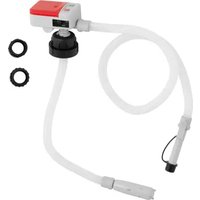
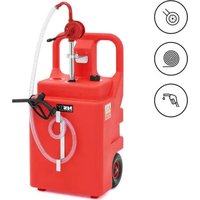
Brand : MSW
Model : OP100
Category : Pump